US6032583A - Ammunition unit in the form of a shell - Google Patents
Ammunition unit in the form of a shell Download PDFInfo
- Publication number
- US6032583A US6032583A US09/125,948 US12594898A US6032583A US 6032583 A US6032583 A US 6032583A US 12594898 A US12594898 A US 12594898A US 6032583 A US6032583 A US 6032583A
- Authority
- US
- United States
- Prior art keywords
- charge
- warhead
- ignition device
- dividing
- ammunition unit
- Prior art date
- Legal status (The legal status is an assumption and is not a legal conclusion. Google has not performed a legal analysis and makes no representation as to the accuracy of the status listed.)
- Expired - Lifetime
Links
Images
Classifications
-
- F—MECHANICAL ENGINEERING; LIGHTING; HEATING; WEAPONS; BLASTING
- F42—AMMUNITION; BLASTING
- F42B—EXPLOSIVE CHARGES, e.g. FOR BLASTING, FIREWORKS, AMMUNITION
- F42B12/00—Projectiles, missiles or mines characterised by the warhead, the intended effect, or the material
- F42B12/02—Projectiles, missiles or mines characterised by the warhead, the intended effect, or the material characterised by the warhead or the intended effect
- F42B12/04—Projectiles, missiles or mines characterised by the warhead, the intended effect, or the material characterised by the warhead or the intended effect of armour-piercing type
- F42B12/10—Projectiles, missiles or mines characterised by the warhead, the intended effect, or the material characterised by the warhead or the intended effect of armour-piercing type with shaped or hollow charge
- F42B12/16—Projectiles, missiles or mines characterised by the warhead, the intended effect, or the material characterised by the warhead or the intended effect of armour-piercing type with shaped or hollow charge in combination with an additional projectile or charge, acting successively on the target
Definitions
- the present invention relates to an ammunition unit in the form of a shell or the like, comprising at least one front warhead and one rear warhead, such as, for example, shaped-charge warheads, arranged in succession one after the other and connected to each other via a supporting structure.
- Each of the warheads included is assigned an ignition device with ignition and safety functions, and the ignition device of the front warhead is arranged in the supporting structure behind the front warhead in the direction of action of a warhead lying to the rear.
- An ammunition unit of the above type is already known from EP, B1, 0 238 715, for example.
- the latter involves a small front warhead with shaped charge, the so-called pre-penetrator, and a larger rear warhead with shaped charge, the so-called main charge.
- the object of the present invention is to lessen or to completely prevent the impairment in the efficiency of the ammunition unit caused by the above factors mentioned.
- the object of the invention is achieved by means of an ammunition unit in which structure-dividing charge is arranged in the supporting structure in order to divide the supporting structure into a front part and a rear part after initiation.
- division of the structure is intended to mean everything from narrow cuts to more extensive removal of material in the area where the supporting structure is divided.
- the structure-dividing charge comprises an annular element with an external diameter essentially corresponding to the internal diameter of the supporting structure, and a number of radial channels which connect the inner surface of the annular element to a central point common to the channels.
- This embodiment of the structure-dividing charge has been shown to produce an effective division of the structure without any disruptive effect on the rest of the ammunition unit.
- the annular element is connected to the common center point by means of two channels directed radially towards each other. This embodiment gives a symmetrical activation with little effect on warheads situated to the rear.
- the structure-dividing charge comprises a disc-shaped element whose external diameter essentially corresponds to the internal diameter of the supporting structure.
- a structure-dividing charge of this design is, among other things, simple to produce.
- a clearing charge can be arranged in order to clear the ignition device belonging to a forward warhead out of the way.
- the design is characterized in that a clearing charge is linked to the structure-dividing charge in order to clear the ignition member out of the way of a warhead situated to the rear.
- the clearing charge is made up of a curved plate arranged between the ignition device and the supporting structure to cover only parts of the circumference of the ignition device.
- the clearing charge is preferably ignited by crossover ignition from the structure-dividing charge.
- the structure-dividing charge and the clearing charge can advantageously be designed as one component.
- the initiation of the front warhead, the structure-dividing charge and the clearing charge is effected by means of the ignition device acting at one initiation point common to the warhead and the two charges.
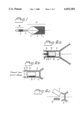
- FIG. 1 shows diagrammatically an example of an ammunition unit according to the invention in the form of a tandem shell
- FIGS. 2a to 2c show diagrammatically a section through the middle part of the tandem shell according to FIG. 1, at three different times during the shell's detonation phase;
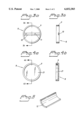
- FIGS. 3a and 3b show, in a front view and cross-sectional side view, respectively, a first example of a structure-dividing charge which can be incorporated in the tandem shell according to FIG. 1;
- FIGS. 4a and 4b show, in a front view and cross-sectional side view, respectively, a second example of a structure-dividing charge which can be incorporated in a tandem shell according to FIG. 1;
- FIG. 5 shows a perspective view of an example of a clearing charge which can be incorporated in the tandem shell according to FIG. 1.
- the ammunition unit shown in FIG. 1 is in the form of a shell 1 and comprises a front explosive charge 2, which is incorporated in a front warhead 18, and a rear explosive charge 3, which is incorporated in a rear warhead 19.
- the rear explosive charge 3 includes a shaped charge with liner 4, while the front charge includes another type of charge known in connection with tandem shells.
- the front and rear charges 2, 3 are held together by means of a supporting structure 5 in the middle part of the shell.
- FIG. 2 shows the middle part 5 of the shell in greater detail.
- the supporting structure 5 comprises a tubular part 6 which accommodates, among other things, the ignition device 7 of the front explosive charge, with ignition members and safety members.
- a corresponding ignition device is arranged behind the rear explosive charge 3.
- the structure-dividing charge 8 Arranged between the ignition device and the front explosive charge there is a structure-dividing charge 8.
- a first example of a structure-dividing charge is shown in FIGS. 3a and 3b.
- the structure-dividing charge 8 in this case comprises a ring 9 and two radially opposed channels 10, 11 which connect to the center of the ring.
- the external diameter of the ring is dimensioned so as to correspond essentially to the internal diameter of the tubular structure 5.
- the structure-dividing charge 8 comprises a ring 9 and a disc 21.
- the ring 9 and the disc 21 can be designed as one unit.
- the external diameter of the ring is dimensioned to correspond essentially to the internal diameter of the tubular structure 5.
- the clearing charge 12 Arranged in the space between the ignition device 7 and the tubular structure 5, there is a clearing charge 12.
- the clearing charge has the shape of a curved plate, see in particular FIG. 5, which plate covers parts of the circumference of the ignition device.
- the clearing charge 12 is separated from the structure-dividing charge 8 by means of an air gap 13 which is dimensioned so that crossover ignition of the clearing charge can be effected from the structure-dividing charge.
- the clearing charge 12 and the structure-dividing charge 8 can be arranged in direct connection to each other or can even be designed as one single-piece component.
- a suitable material for the clearing charge and the structure-dividing charge is a compressible explosive, for example of the plastic-based type.
- the clearing charge 12 can be arranged in the ignition device 7 and, according to another embodiment, on the outside of the structure 5.
- the ignition members in the ignition device 7 act at one initiation point 17, common to the front explosive charge 2, the structure-dividing charge 8 and the clearing charge 12, at the center of the ring 9, which is included in the structure-dividing charge 8.
- the structure-dividing charge 8 detonates and divides the structure 5 into a front part 14 and a rear part 15 separated by an intermediate air space 16.
- the intermediate air space 16 can be obtained by means of comparatively large or small parts of the structure being blasted away in the vicinity of the structure-dividing charge 8.
- the structure-dividing charge can also effect a certain separation in the longitudinal direction between the front and rear parts of the structure.
- the front charge 2 detonates slightly later.
- the intermediate air space 16 which has been formed, the impact from the front charge 2 is prevented from reaching the charge 3 lying to the rear.
- crossover ignition to the clearing charge 12 takes place with a certain delay.
- the rear part of the tubular structure is broken open, as indicated in FIG. 2c, and the ignition device 7 is caused to leave the area in front of the remaining explosive charge 3. Free space is in this way made available to allow the remaining explosive charge to develop its shaped-charge jet without disruption.
- the clearing charge 12 can be used to transmit a detonation which in turn can ignite, for example, a charge situated to the rear.
Landscapes
- Engineering & Computer Science (AREA)
- Combustion & Propulsion (AREA)
- General Engineering & Computer Science (AREA)
- Chemical & Material Sciences (AREA)
- Automotive Seat Belt Assembly (AREA)
- Emergency Lowering Means (AREA)
- Air Bags (AREA)
- Management, Administration, Business Operations System, And Electronic Commerce (AREA)
- Acyclic And Carbocyclic Compounds In Medicinal Compositions (AREA)
- Buildings Adapted To Withstand Abnormal External Influences (AREA)
- Looms (AREA)
- Forms Removed On Construction Sites Or Auxiliary Members Thereof (AREA)
- Tents Or Canopies (AREA)
Abstract
Description
Claims (8)
Applications Claiming Priority (3)
| Application Number | Priority Date | Filing Date | Title |
|---|---|---|---|
| SE9601114 | 1996-03-22 | ||
| SE9601114A SE505188C2 (en) | 1996-03-22 | 1996-03-22 | Ammunition device in the form of grenade or similar |
| PCT/SE1997/000460 WO1997035157A1 (en) | 1996-03-22 | 1997-03-20 | Ammunition unit in the form of a shell or the like |
Publications (1)
| Publication Number | Publication Date |
|---|---|
| US6032583A true US6032583A (en) | 2000-03-07 |
Family
ID=20401910
Family Applications (1)
| Application Number | Title | Priority Date | Filing Date |
|---|---|---|---|
| US09/125,948 Expired - Lifetime US6032583A (en) | 1996-03-22 | 1997-03-20 | Ammunition unit in the form of a shell |
Country Status (7)
| Country | Link |
|---|---|
| US (1) | US6032583A (en) |
| EP (1) | EP0883790B1 (en) |
| DE (1) | DE69708608T2 (en) |
| ES (1) | ES2166072T3 (en) |
| NO (1) | NO317749B1 (en) |
| SE (1) | SE505188C2 (en) |
| WO (1) | WO1997035157A1 (en) |
Cited By (1)
| Publication number | Priority date | Publication date | Assignee | Title |
|---|---|---|---|---|
| US20100242769A1 (en) * | 2005-07-01 | 2010-09-30 | Saab Ab | Ammunition unit |
Families Citing this family (1)
| Publication number | Priority date | Publication date | Assignee | Title |
|---|---|---|---|---|
| DE102020001784A1 (en) | 2020-03-17 | 2021-09-23 | Diehl Defence Gmbh & Co. Kg | Projectile, device arrangement and method |
Citations (12)
| Publication number | Priority date | Publication date | Assignee | Title |
|---|---|---|---|---|
| FR493294A (en) * | 1916-03-01 | 1919-08-05 | Joseph Paonessa | Repeating shells |
| GB1051407A (en) * | 1964-07-08 | 1966-12-14 | Director General Of Fírsvarets Fabriksstyrelse. | Improvements in or relating to High-explosive Armour piercing Shells |
| FR2385074A1 (en) * | 1977-03-23 | 1978-10-20 | Haut Rhin Manufacture Machines | Anti-personnel rocket multiple explosive charge - has propulsive charge, scatter charge with detonator and impact charge with detonator |
| US4497253A (en) * | 1980-02-05 | 1985-02-05 | Rheinmetall Gmbh | Armor-piercing projectile |
| FR2552870A1 (en) * | 1980-10-24 | 1985-04-05 | France Etat Armement | IMPROVEMENT FOR MILITARY HEADS WITH FORMED LOADS MOUNTED IN TANDEM |
| US4606272A (en) * | 1984-02-20 | 1986-08-19 | Etat Francais | Initiation delay system for warheads with tandem mounted shaped charges |
| US4612859A (en) * | 1983-10-11 | 1986-09-23 | Rheinmetall Gmbh. | Multiple purpose warhead |
| DE3605580C1 (en) * | 1986-02-21 | 1987-06-04 | Messerschmitt Boelkow Blohm | Warhead |
| US4854240A (en) * | 1986-12-25 | 1989-08-08 | The State Of Israel, Ministry Of Defence, Israel Military Industries | Two-stage shaped charge projectile |
| US5107766A (en) * | 1991-07-25 | 1992-04-28 | Schliesske Harold R | Follow-thru grenade for military operations in urban terrain (MOUT) |
| GB2272962A (en) * | 1986-08-19 | 1994-06-01 | British Aerospace | Projectile warhead |
| US5698814A (en) * | 1995-03-10 | 1997-12-16 | The United States Of America As Represented By The Secretary Of The Air Force | Hard target penetrator with multi-segmenting casing cutter |
-
1996
- 1996-03-22 SE SE9601114A patent/SE505188C2/en not_active IP Right Cessation
-
1997
- 1997-03-20 ES ES97914723T patent/ES2166072T3/en not_active Expired - Lifetime
- 1997-03-20 US US09/125,948 patent/US6032583A/en not_active Expired - Lifetime
- 1997-03-20 EP EP97914723A patent/EP0883790B1/en not_active Expired - Lifetime
- 1997-03-20 WO PCT/SE1997/000460 patent/WO1997035157A1/en not_active Ceased
- 1997-03-20 DE DE69708608T patent/DE69708608T2/en not_active Expired - Lifetime
-
1998
- 1998-09-21 NO NO19984396A patent/NO317749B1/en not_active IP Right Cessation
Patent Citations (13)
| Publication number | Priority date | Publication date | Assignee | Title |
|---|---|---|---|---|
| FR493294A (en) * | 1916-03-01 | 1919-08-05 | Joseph Paonessa | Repeating shells |
| GB1051407A (en) * | 1964-07-08 | 1966-12-14 | Director General Of Fírsvarets Fabriksstyrelse. | Improvements in or relating to High-explosive Armour piercing Shells |
| FR2385074A1 (en) * | 1977-03-23 | 1978-10-20 | Haut Rhin Manufacture Machines | Anti-personnel rocket multiple explosive charge - has propulsive charge, scatter charge with detonator and impact charge with detonator |
| US4497253A (en) * | 1980-02-05 | 1985-02-05 | Rheinmetall Gmbh | Armor-piercing projectile |
| FR2552870A1 (en) * | 1980-10-24 | 1985-04-05 | France Etat Armement | IMPROVEMENT FOR MILITARY HEADS WITH FORMED LOADS MOUNTED IN TANDEM |
| US4612859A (en) * | 1983-10-11 | 1986-09-23 | Rheinmetall Gmbh. | Multiple purpose warhead |
| US4606272A (en) * | 1984-02-20 | 1986-08-19 | Etat Francais | Initiation delay system for warheads with tandem mounted shaped charges |
| DE3605580C1 (en) * | 1986-02-21 | 1987-06-04 | Messerschmitt Boelkow Blohm | Warhead |
| EP0238715A1 (en) * | 1986-02-21 | 1987-09-30 | Messerschmitt-Bölkow-Blohm Gesellschaft mit beschränkter Haftung | War head |
| GB2272962A (en) * | 1986-08-19 | 1994-06-01 | British Aerospace | Projectile warhead |
| US4854240A (en) * | 1986-12-25 | 1989-08-08 | The State Of Israel, Ministry Of Defence, Israel Military Industries | Two-stage shaped charge projectile |
| US5107766A (en) * | 1991-07-25 | 1992-04-28 | Schliesske Harold R | Follow-thru grenade for military operations in urban terrain (MOUT) |
| US5698814A (en) * | 1995-03-10 | 1997-12-16 | The United States Of America As Represented By The Secretary Of The Air Force | Hard target penetrator with multi-segmenting casing cutter |
Cited By (1)
| Publication number | Priority date | Publication date | Assignee | Title |
|---|---|---|---|---|
| US20100242769A1 (en) * | 2005-07-01 | 2010-09-30 | Saab Ab | Ammunition unit |
Also Published As
| Publication number | Publication date |
|---|---|
| DE69708608T2 (en) | 2002-08-08 |
| SE9601114L (en) | 1997-07-14 |
| ES2166072T3 (en) | 2002-04-01 |
| NO984396D0 (en) | 1998-09-21 |
| EP0883790A1 (en) | 1998-12-16 |
| SE505188C2 (en) | 1997-07-14 |
| NO984396L (en) | 1998-09-21 |
| NO317749B1 (en) | 2004-12-13 |
| EP0883790B1 (en) | 2001-11-28 |
| DE69708608D1 (en) | 2002-01-10 |
| WO1997035157A1 (en) | 1997-09-25 |
Similar Documents
| Publication | Publication Date | Title |
|---|---|---|
| US4026213A (en) | Selectively aimable warhead | |
| AU596749B2 (en) | Improved perforating projectile | |
| US4665826A (en) | Hybrid explosive unit | |
| US5594197A (en) | Secondary projectile for a tandem warhead | |
| US4425850A (en) | Device for initiating an explosive charge with damming means of non-explosive shock wave attenuating material between the outer booster and the liner | |
| US4854240A (en) | Two-stage shaped charge projectile | |
| US5042388A (en) | Forward control tube with sequenced ignition | |
| US5619010A (en) | Method and an apparatus for spreading warheads | |
| US8413585B2 (en) | Projectile | |
| US5347907A (en) | Multipurpose projectile and a method of making it | |
| EP0883790B1 (en) | Ammunition unit in the form of a shell or the like | |
| US5351622A (en) | Securement of liner for shaped charge | |
| CH635422A5 (en) | EXPLOSIVE CHARGE. | |
| EP1634034B1 (en) | Device adjacent to an explosive charge with at least two liners | |
| US4889030A (en) | Projectile equipped with deployable parachute | |
| GB2089947A (en) | A fuze having a detonator | |
| US5952604A (en) | Shell with multi-charges | |
| CA2155399C (en) | Spin-stabilized projectile with a payload | |
| EP0694155B1 (en) | A method and an apparatus for imparting to an airborn warhead a desired pattern of movement | |
| ES8308632A1 (en) | Safety device for a projectile | |
| KR20030090667A (en) | Igniter with a safety device for a projectile which is shot from a pipe with angular momentum | |
| RU95107279A (en) | Charging device to gunshot | |
| RU97114855A (en) | Shell | |
| US5050502A (en) | Ammunition unit having a sleeve on a primer tube | |
| RU2244243C1 (en) | Shaped charge |
Legal Events
| Date | Code | Title | Description |
|---|---|---|---|
| AS | Assignment |
Owner name: BOFORS AB, SWEDEN Free format text: ASSIGNMENT OF ASSIGNORS INTEREST;ASSIGNORS:KARLSTEDT, GUSTAV;HELANDER, JYRKI;SJOO, LENNART;AND OTHERS;REEL/FRAME:009730/0780;SIGNING DATES FROM 19980909 TO 19980915 |
|
| STCF | Information on status: patent grant |
Free format text: PATENTED CASE |
|
| FPAY | Fee payment |
Year of fee payment: 4 |
|
| FPAY | Fee payment |
Year of fee payment: 8 |
|
| AS | Assignment |
Owner name: SAAB BOFORS AB, SWEDEN Free format text: ASSIGNMENT OF ASSIGNORS INTEREST;ASSIGNOR:BOFORS AB;REEL/FRAME:021158/0394 Effective date: 20050707 |
|
| AS | Assignment |
Owner name: SAAB AB, SWEDEN Free format text: ASSIGNMENT OF ASSIGNORS INTEREST;ASSIGNOR:SAAB BOFORS AB;REEL/FRAME:021824/0234 Effective date: 20080917 |
|
| FPAY | Fee payment |
Year of fee payment: 12 |