US6006529A - Refrigerator having horizontal and vertical dispersing blades - Google Patents
Refrigerator having horizontal and vertical dispersing blades Download PDFInfo
- Publication number
- US6006529A US6006529A US09/114,885 US11488598A US6006529A US 6006529 A US6006529 A US 6006529A US 11488598 A US11488598 A US 11488598A US 6006529 A US6006529 A US 6006529A
- Authority
- US
- United States
- Prior art keywords
- elevation
- vertical
- cool air
- link member
- dispersing
- Prior art date
- Legal status (The legal status is an assumption and is not a legal conclusion. Google has not performed a legal analysis and makes no representation as to the accuracy of the status listed.)
- Expired - Fee Related
Links
Images


Classifications
-
- F—MECHANICAL ENGINEERING; LIGHTING; HEATING; WEAPONS; BLASTING
- F25—REFRIGERATION OR COOLING; COMBINED HEATING AND REFRIGERATION SYSTEMS; HEAT PUMP SYSTEMS; MANUFACTURE OR STORAGE OF ICE; LIQUEFACTION SOLIDIFICATION OF GASES
- F25D—REFRIGERATORS; COLD ROOMS; ICE-BOXES; COOLING OR FREEZING APPARATUS NOT OTHERWISE PROVIDED FOR
- F25D17/00—Arrangements for circulating cooling fluids; Arrangements for circulating gas, e.g. air, within refrigerated spaces
- F25D17/04—Arrangements for circulating cooling fluids; Arrangements for circulating gas, e.g. air, within refrigerated spaces for circulating air, e.g. by convection
- F25D17/042—Air treating means within refrigerated spaces
- F25D17/045—Air flow control arrangements
-
- F—MECHANICAL ENGINEERING; LIGHTING; HEATING; WEAPONS; BLASTING
- F24—HEATING; RANGES; VENTILATING
- F24F—AIR-CONDITIONING; AIR-HUMIDIFICATION; VENTILATION; USE OF AIR CURRENTS FOR SCREENING
- F24F13/00—Details common to, or for air-conditioning, air-humidification, ventilation or use of air currents for screening
- F24F13/02—Ducting arrangements
- F24F13/06—Outlets for directing or distributing air into rooms or spaces, e.g. ceiling air diffuser
- F24F13/075—Outlets for directing or distributing air into rooms or spaces, e.g. ceiling air diffuser having parallel rods or lamellae directing the outflow, e.g. the rods or lamellae being individually adjustable
-
- F—MECHANICAL ENGINEERING; LIGHTING; HEATING; WEAPONS; BLASTING
- F25—REFRIGERATION OR COOLING; COMBINED HEATING AND REFRIGERATION SYSTEMS; HEAT PUMP SYSTEMS; MANUFACTURE OR STORAGE OF ICE; LIQUEFACTION SOLIDIFICATION OF GASES
- F25D—REFRIGERATORS; COLD ROOMS; ICE-BOXES; COOLING OR FREEZING APPARATUS NOT OTHERWISE PROVIDED FOR
- F25D17/00—Arrangements for circulating cooling fluids; Arrangements for circulating gas, e.g. air, within refrigerated spaces
- F25D17/04—Arrangements for circulating cooling fluids; Arrangements for circulating gas, e.g. air, within refrigerated spaces for circulating air, e.g. by convection
- F25D17/06—Arrangements for circulating cooling fluids; Arrangements for circulating gas, e.g. air, within refrigerated spaces for circulating air, e.g. by convection by forced circulation
- F25D17/062—Arrangements for circulating cooling fluids; Arrangements for circulating gas, e.g. air, within refrigerated spaces for circulating air, e.g. by convection by forced circulation in household refrigerators
- F25D17/065—Arrangements for circulating cooling fluids; Arrangements for circulating gas, e.g. air, within refrigerated spaces for circulating air, e.g. by convection by forced circulation in household refrigerators with compartments at different temperatures
-
- F—MECHANICAL ENGINEERING; LIGHTING; HEATING; WEAPONS; BLASTING
- F25—REFRIGERATION OR COOLING; COMBINED HEATING AND REFRIGERATION SYSTEMS; HEAT PUMP SYSTEMS; MANUFACTURE OR STORAGE OF ICE; LIQUEFACTION SOLIDIFICATION OF GASES
- F25D—REFRIGERATORS; COLD ROOMS; ICE-BOXES; COOLING OR FREEZING APPARATUS NOT OTHERWISE PROVIDED FOR
- F25D2317/00—Details or arrangements for circulating cooling fluids; Details or arrangements for circulating gas, e.g. air, within refrigerated spaces, not provided for in other groups of this subclass
- F25D2317/06—Details or arrangements for circulating cooling fluids; Details or arrangements for circulating gas, e.g. air, within refrigerated spaces, not provided for in other groups of this subclass with forced air circulation
- F25D2317/065—Details or arrangements for circulating cooling fluids; Details or arrangements for circulating gas, e.g. air, within refrigerated spaces, not provided for in other groups of this subclass with forced air circulation characterised by the air return
- F25D2317/0653—Details or arrangements for circulating cooling fluids; Details or arrangements for circulating gas, e.g. air, within refrigerated spaces, not provided for in other groups of this subclass with forced air circulation characterised by the air return through the mullion
-
- F—MECHANICAL ENGINEERING; LIGHTING; HEATING; WEAPONS; BLASTING
- F25—REFRIGERATION OR COOLING; COMBINED HEATING AND REFRIGERATION SYSTEMS; HEAT PUMP SYSTEMS; MANUFACTURE OR STORAGE OF ICE; LIQUEFACTION SOLIDIFICATION OF GASES
- F25D—REFRIGERATORS; COLD ROOMS; ICE-BOXES; COOLING OR FREEZING APPARATUS NOT OTHERWISE PROVIDED FOR
- F25D2317/00—Details or arrangements for circulating cooling fluids; Details or arrangements for circulating gas, e.g. air, within refrigerated spaces, not provided for in other groups of this subclass
- F25D2317/06—Details or arrangements for circulating cooling fluids; Details or arrangements for circulating gas, e.g. air, within refrigerated spaces, not provided for in other groups of this subclass with forced air circulation
- F25D2317/067—Details or arrangements for circulating cooling fluids; Details or arrangements for circulating gas, e.g. air, within refrigerated spaces, not provided for in other groups of this subclass with forced air circulation characterised by air ducts
- F25D2317/0672—Outlet ducts
-
- F—MECHANICAL ENGINEERING; LIGHTING; HEATING; WEAPONS; BLASTING
- F25—REFRIGERATION OR COOLING; COMBINED HEATING AND REFRIGERATION SYSTEMS; HEAT PUMP SYSTEMS; MANUFACTURE OR STORAGE OF ICE; LIQUEFACTION SOLIDIFICATION OF GASES
- F25D—REFRIGERATORS; COLD ROOMS; ICE-BOXES; COOLING OR FREEZING APPARATUS NOT OTHERWISE PROVIDED FOR
- F25D2317/00—Details or arrangements for circulating cooling fluids; Details or arrangements for circulating gas, e.g. air, within refrigerated spaces, not provided for in other groups of this subclass
- F25D2317/06—Details or arrangements for circulating cooling fluids; Details or arrangements for circulating gas, e.g. air, within refrigerated spaces, not provided for in other groups of this subclass with forced air circulation
- F25D2317/068—Details or arrangements for circulating cooling fluids; Details or arrangements for circulating gas, e.g. air, within refrigerated spaces, not provided for in other groups of this subclass with forced air circulation characterised by the fans
- F25D2317/0682—Two or more fans
-
- F—MECHANICAL ENGINEERING; LIGHTING; HEATING; WEAPONS; BLASTING
- F25—REFRIGERATION OR COOLING; COMBINED HEATING AND REFRIGERATION SYSTEMS; HEAT PUMP SYSTEMS; MANUFACTURE OR STORAGE OF ICE; LIQUEFACTION SOLIDIFICATION OF GASES
- F25D—REFRIGERATORS; COLD ROOMS; ICE-BOXES; COOLING OR FREEZING APPARATUS NOT OTHERWISE PROVIDED FOR
- F25D2400/00—General features of, or devices for refrigerators, cold rooms, ice-boxes, or for cooling or freezing apparatus not covered by any other subclass
- F25D2400/04—Refrigerators with a horizontal mullion
Definitions
- the present invention relates to a refrigerator having a cabinet for forming a cooling compartment, and a duct for forming a passage of cool air, which is provided in an inner wall of the cooling compartment and has at least one cool air discharge port opened into the cooling compartment, and more particularly, relates to a refrigerator having a device for dispersing cool air uniformly into the cooling compartment.
- a refrigerator has a cabinet for forming a pair of cooling compartments, i. e., a freezing compartment and a fresh food compartment which are partitioned by a partitioning wall, a freezing compartment door and a fresh food compartment door for opening/closing the cooling compartments respectively, and a cooling system for supplying the freezing compartment and the fresh food compartment with cool air, which comprises a compressor, a condenser and an evaporator.
- the cool air generated by the evaporator flows along a supply duct formed in a rear wall of each compartment, and then is supplied into each cooling compartment by a blowing fan through cool air discharge ports opened thereinto.
- the refrigerator adopting so called tri-dimensional cooling method which has solved such a problem has been proposed.
- the cool air discharge ports are provided at both side walls as well as at the rear wall of the cooling compartment in order to promote the uniform cooling.
- FIGS. 1 through 3 are a side view, a partial enlarged sectional view, and an exploded perspective view of main elements of the refrigerator having the device for dispersing cool air.
- the conventional refrigerator having the device for dispersing cool air has a pair of cooling compartments 2 and 3 in a cabinet 1, which are partitioned from each other by a partitioning wall 5.
- the cooling compartments 2 and 3 are called a freezing compartment 2 of relatively low temperature and a fresh food compartment 3 of relatively high temperature.
- doors 6 and 7 for opening/closing them are installed respectively.
- a cooling system comprising a compressor 11, a condenser (not shown), a freezing compartment evaporator 12a, and a fresh food compartment evaporator 12b.
- the cool air generated from the evaporators 12a and 12b is supplied to the corresponding compartments 2 and 3 by a freezing compartment fan 13a and a fresh food compartment fan 13b respectively.
- a duct plate 9 of partial cylinder shape having cool air discharge ports 16 opened to the fresh food compartment 3 is attached to an inner wall plate 23 forming a rear inner wall surface of the fresh food compartment 3, and a supply duct 15 and a return duct 17 separated from each other by a seal plate 25 are provided between the duct plate 9 and a rear wall 4 of the cabinet 1.
- a supply duct 15 is installed in the supply duct 15 in the supply duct 15 in the supply duct 15 for guiding the cool air blown by the fresh food compartment fan 13b downwardly.
- the cool air generated by the fresh food compartment evaporator 12b is blown by the fresh food compartment fan 13b, and then supplied to the fresh food compartment 3 via the supply duct 15 and the cool air discharge ports 16.
- a cool air dispersing device 130 is installed in the supply duct 15.
- the cool air dispersing device 130 comprises a rotational shaft 131 having a vertical axis, cool air dispersing blades 132 assembled with the rotational shaft 131 in correspondence with the cool air discharge ports 16 respectively, and a driving motor 135 for rotating the rotational shaft 131.
- Each of the cool air dispersing blades 132 comprises three discs 136, 137 and 138 disposed in parallel with each other along the axis direction, and a first blade part 133 and a second blade part 134 disposed between the discs 136, 137 and 138.
- Each of the blade parts 133 and 134 are bent so that their cross section is a lax shape of alphabet S.
- the blade parts 133 and 134 are bent to the opposite directions to each other.
- the driving motor 131 rotates the rotational shaft 131 at a low speed
- the cool air flowing along the supply duct 15 changes its flowing direction along the bent surface of the cool air dispersing blades 132, and is charged into the fresh food compartment 3 to be dispersed horizontally.
- the driving motor 135 stops the rotational shaft 131 in accordance with the direction of the cool air dispersing blades 132 so that the cool air is concentrated on the specific area.
- the blade parts 133 and 134 of the cool air dispersing device 130 are bent to be shaped into the lax alphabet S, left or right side of the fresh food compartment 3 may not be supplied with the cool air sufficiently according to the rotational direction of the rotational shaft 131, and the smooth flow of cool air may be impeded by a vortex of the cool air formed about the cool air discharge ports 16.
- the present invention has been proposed to overcome the above-described problems in the prior art, and accordingly it is the object of the present invention to provide a refrigerator having a cool air dispersing device capable of preventing vortex of cool air and achieving effectively the uniform distribution of cool air in horizontal direction and vertical direction.
- the present invention provides a refrigerator having a cooling compartment for storing food, and a duct being provided in a side wall of said cooling compartment, said duct for forming a cool air passage, said duct having at least one cool air discharge port opened into said cooling compartment, said refrigerator comprising: at least one horizontal-dispersing blade of planar plate shape being installed near the cool air discharge port in said duct, said-horizontal dispersing blade being disposed vertically according to a vertical axis; a rotational shaft being connected with said horizontal dispersing blade, said rotational shaft being extended along the vertical axis; a motor for rotating said rotational shaft; at least one vertical-dispersing blade being installed near the cool air discharge port in said duct, said vertical dispersing blade being capable of pivoting about a horizontal axis; and a means for pivoting said vertical dispersing blade in a vertical direction.
- said vertical dispersing blade pivots in a predetermined angular range.
- said pivoting means comprises: a link member having a plurality of hinge assembly parts respectively assembled with said vertical dispersing blades at positions distanced from said horizontal axis, said link member being capable of moving up and down in the vertical direction; and a means for elevating/de-elevating said link member.
- said elevating/de-elevating means comprises: an elevation/de-elevation cam being installed on said rotational shaft of said horizontal dispersing blade, said elevation/de-elevation cam rotating together with said rotational shaft; and an operation part formed in a body with said link member, said operation part interacting with said elevation/de-elevation cam so that a rotational movement of said elevation/de-elevation cam is transmitted to said link member as an elevational/de-elevational movement thereof.
- Said elevation/de-elevation cam has a cylindrical cam body coaxially installed on said rotational shaft, and a cam groove which is a closed loop having an elevational/de-elevational cam profile at an outer surface of said cam body; and said operation part protrudes from said link member and is engaged with said cam groove.
- Said link member is guided by a guiding means so as to be capable of moving up and down vertically while preventing rotation thereof.
- said guiding means comprises: a guiding piece protruding from an axis of said link member; and a guiding part formed at an inner surface of said duct, said guiding part into which said guiding piece is inserted to be capable of moving up and down.
- said elevation/de-elevation cam is implemented by a disc installed on said rotational shaft so that a plane thereof is tilted against said rotational shaft at a predetermined angle, said disc rotating together with said rotational shaft; and said operation part protrudes from said link member and is engaged with said disc.
- said pivoting means comprises: pivoting pins protruding from said vertical dispersing blades respectively; a link member being formed with a plurality of holes along a longitudinal direction thereof with being spaced from each other at a predetermined distance, said holes for receiving said pivoting pins, said link member being capable of moving up and down in the vertical direction; an elevation/de-elevation cam being installed on said rotational shaft, said elevation/de-elevation cam rotating together with said rotational shaft; a lever member for connecting said elevation/de-elevation cam with said link member; and a lever supporting shaft for supporting said lever member to be capable of rotating so that a rotational movement of said elevation/de-elevation cam is transmitted to an elevational/de-elevational movement of said link member by a levering movement of said lever member.
- said elevation/de-elevation cam has a cylindrical cam body coaxially installed on said rotational shaft, and a cam groove which is a closed loop having an elevational/de-elevational cam profile at an outer surface of said cam body; and said lever member has an operation part engaged with said cam groove.
- a guide plate is assembled at both ends of said horizontal dispersing blade. Said guide plate guides cool air flowing into said duct toward the cool air discharge ports.
- a stable cool air flow and a uniform distribution of the cool air can be achieved not only in horizontal direction but also in vertical direction.
- FIG. 1 is a side sectional view of a conventional refrigerator having cool air dispersing blades
- FIG. 2 is a partial enlarged sectional view of FIG. 1;
- FIG. 3 is an enlarged exploded perspective view of main elements of FIG. 2;
- FIG. 4 is a side sectional view of a refrigerator according to the first embodiment of the present invention.
- FIG. 5 is an exploded perspective view of the cool air dispersing device of FIG.
- FIGS. 6 through 8 are enlarged transverse sectional views showing the cool air dispersing process performed by the horizontal dispersing blades successively;
- FIGS. 9 through 11 are enlarged side sectional views showing the cool air dispersing process performed by the vertical dispersing blades successively;
- FIG. 12 is an exploded perspective view of the cool air dispersing device according to the second embodiment of the present invention.
- FIG. 13 is a perspective view of an assembled state of FIG. 12;
- FIGS. 14 through 16 are side sectional views of FIG. 13, which show the cool air dispersing operation of the vertical dispersing blades
- FIG. 17 is an exploded perspective view of the cool air dispersing device according to the third embodiment of the present invention.
- FIG. 18 is a perspective view showing the assembled state of FIG. 17.
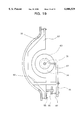
- FIG. 19 is an enlarged transverse sectional view of FIG. 18.
- FIG. 4 is a side sectional view of a refrigerator according to the first embodiment of the present invention.
- the refrigerator has, as the conventional refrigerator which has been illustrated with reference to FIGS. 1 through 3, a cabinet 1 forming freezing compartment 2 and a fresh food compartment which are partitioned by a partitioning wall 5 and are disposed upper and lower parts thereof, respectively.
- a cabinet 1 forming freezing compartment 2 and a fresh food compartment which are partitioned by a partitioning wall 5 and are disposed upper and lower parts thereof, respectively.
- doors 6 and 7 for opening/closing them are installed respectively.
- shelves 8 for placing food thereon is installed, which divide the fresh food compartment 3 into three stratified area, i. e., an upper area, a middle area, and a lower area.
- a special fresh chamber 18 for storing food which are proper to a specific temperature range is formed at the upper part of the fresh food compartment 3
- a vegetable chamber 19 for storing vegetables is formed at the lower part of the fresh food compartment 3.
- a duct plate 9 is attached on the inner wall plate 23 forming the rear inner wall of the fresh food compartment 3.
- the duct plate 9 is formed into a partial cylinder shape so as to protrude at the shape of an arc from the inner wall plate 23 toward the fresh food compartment 3, and has cool air discharge ports 16 opened toward the respective storing areas of the fresh food compartment 3.
- At the upper area of the inner wall plate 23 is provided another cool air discharge port 16' opened toward the special fresh chamber 18.
- a supply duct 15 and a return duct 17 are provided, which are partitioned from each other by a seal plate 25.
- a duct member 21 for guiding the cool air blown by the fresh food compartment fan 13b downwardly is installed in the supply duct 15.
- the cool air generated by the fresh food compartment evaporator 12b is blown by the fresh food compartment fan 13b so as to be supplied into the fresh food compartment 3 via the supply duct 15 and the cool air discharge ports 16.
- a device for dispersing the cool air horizontally is installed in the supply duct 15.
- the horizontal dispersing device 30 has a rotational shaft 31 having a vertical axis, three horizontal dispersing blades 33 having the shape of a planar plate, and a driving motor 35 for rotating the rotational shaft 31.
- Those blades 33 which extend vertically, are called “horizontal” dispersing blades because they control the horizontal dispersing of air.
- Three horizontal dispersing blades 33 are disposed near the respective cool air discharge ports 16 formed on the duct plate 9 along an axis direction.
- a coupling part 39 being coupled with a driving shaft 36 of the driving motor 35 is provided at the upper end of the rotational shaft 31, and a journal part 32 supported rotatably by being inserted into a bearing hole 9g formed at the lower area of the duct plate 9 is provided at the lower end of the rotational shaft 31.
- the driving motor 35 is a stepping motor which is capable of controlling angular stop position.
- the vertical dispersing device 40 comprises a plurality of vertical dispersing blades 57 which are disposed near the cool air discharge ports 16 and capable of pivoting about a horizontal axis, a link member 61 installed in the supply duct 15 to be capable of moving up and down, and an elevation/de-elevation cam 63 for elevating/de-elevating the link member 61.
- Those blades 57 are called “vertical" dispersing blades because they control the vertical dispersing of air.
- the link member 61 is disposed in parallel with the rotational shaft 31.
- the link member 61 is formed into the shape of a rod, and has a plurality of hinge assembly parts 62 which have the shape of a partial ring and protrude toward the vertical dispersing blades 57.
- each of the vertical dispersing blades 57 has a hinge part 55 at the inner central area thereof, which is formed into a cylinder disposed along the horizontal direction.
- the hinge assembly parts 62 are engaged with the hinge parts 73 to be capable of rotating relatively thereto.
- the elevation/de-elevation cam 63 is installed on the rotational shaft 31 of the horizontal dispersing device 30.
- the elevation/de-elevation cam 63 is comprised of a cylindrical cam body 66, and a cam groove 65 formed on the outer surface of the cam body 66.
- the cam groove 65 is a closed loop having an elevational/de-elevational cam profile along the cylindrical surface.
- On the link member 61 is provided an operation part 67 protruding transversely to the longitudinal direction thereof, and the free end of the operation part 67 is inserted into the cam groove 65 of the elevation/de-elevation cam 63.
- the link member 61 has a guiding piece 69 protruding toward the duct plate 9, and the guiding piece 69 is accommodated in the elevation/de-elevation guiding part 49 formed on the inner wall of the duct plate 9.
- the elevation/de-elevation guiding part 49 accommodates the guiding piece 69 to be capable of guiding it up and down and preventing the link member 61 from rotating about the axis thereof.
- FIGS. 6 through 8 are transverse sectional views showing the discharging state of the cool air while the horizontal dispersing blades 33 are rotating.
- the horizontal dispersing blades 33 of the cool air dispersing device 30 rotate at 360 degrees as the driving motor 35 operates.
- the horizontal dispersing blades 33 are directed to the front side as shown in FIG. 6, the cool air in the supply duct 15 is discharged to the front side along both sides of the horizontal dispersing blades 33.
- the horizontal dispersing blades 33 are rotated to the left side or the right side as shown in FIGS. 7 and 8, the cool air is discharged toward the left side or the right side.
- the discharge direction of the cool air is consecutively changed as the angular position of the horizontal dispersing blades 33 is changed, so the cool air is dispersed into the fresh food compartment 3 uniformly.
- the horizontal dispersing blades 33 are formed into the shape of a planar plate, there is no vortex caused by the rotation of the horizontal dispersing blades 33.
- the concentrative cooling can be realized by stopping the driving motor 35 when the horizontal dispersing blades 33 is directed to the corresponding area.
- temperature sensors placed at a plurality of positions in the fresh food compartment 3, as well as a control part for controlling the driving motor 35 on the basis of the sensing signal from the temperature sensors have to be provided.
- horizontal dispersing blades 33 are disposed in correspondence to the cool air discharge ports 16, however, it is possible that only one horizontal dispersing blade is extended throughout all of the cool air discharge ports 16.
- the elevation/de-elevation cam 63 rotates together therewith, and the link member 61 is elevated/de-elevated by the operation part 67 engaged with the cam groove 65 of the elevation/de-elevation cam 63.
- the elevational/de-elevational movement of the link member 61 causes the pivoting of the vertical dispersing blades 57 relatively to the horizontal rotational shaft 53 through the hinge assembly part 62 and the hinge part 55 of the vertical dispersing blades 57.
- the link member 61 does not rotate but reciprocates in the vertical direction while the elevation/de-elevation cam 63 rotates.
- FIGS. 9 through 11 are side sectional views showing the elevational/de-elevational movement of the vertical dispersing blades 57 caused by the rotation of the rotational shaft 31.
- the cool air is discharged horizontally.
- the rotational shaft 31 rotates at about 90 degrees
- the vertical dispersing blades 57 are tilted upward as shown in FIG. 10, and in such a situation, the cool air is discharged upward to be supplied into the upper area of the fresh food compartment 3.
- the rotational shaft 31 further rotates at about 90 degrees from the position shown in FIG. 10
- the vertical dispersing blades 57 are returned to the horizontal state as shown in FIG. 9, and as it further rotates at about 90 degrees, the vertical dispersing blades 57 are tilted downward as shown in FIG. 11. In such a situation, the cool air is discharged downward.
- the cool air is supplied uniformly along the vertical direction and the horizontal direction.
- FIG. 12 is an exploded perspective view of the cool air dispersing device according to the second embodiment of the present invention
- FIG. 13 is a perspective view of an assembled state of FIG. 12.
- the construction of the horizontal dispersing device 30 and the vertical dispersing device 40 is substantially the same with that of the above-described first embodiment.
- the construction of the elevation/de-elevation cam 73 is different from that of the first embodiment.
- the elevation/de-elevation cam 73 is comprised of a disc 73 which is installed on the rotational shaft 31 and is tilted against the rotational shaft 31 at a predetermined angle.
- the disc 73 rotates together with the rotational shaft 31.
- An assembly part 76 assembled with the disc 73 is formed at the end of the operation part 67.
- the assembly part 76 consists of a pair of ribs disposed in parallel with each other horizontally, which forms a guide groove in horizontal direction. The guide groove receives the edge of the disc 73, whereby the disc 73 and the assembly part 76 are engaged with each other.
- the cool air is dispersed vertically while being dispersed horizontally. According to the present embodiment, there is an advantage that the construction of the cam for elevating/de-elevating the link member 61 is simple.
- FIGS. 17 through 19 show the third embodiment of the present invention.
- the construction of the horizontal dispersing device 30 and the vertical dispersing device 40 is substantially the same with that of the first embodiment and the second embodiment. Furthermore, the construction of the elevation/de-elevation cam 63 installed on the rotational shaft 31 of the horizontal dispersing device 30 is the same with that of the first embodiment. However, the construction of the vertical pivoting means for driving the vertical dispersing device 40 is different from that of the aforementioned first and second embodiments.
- the vertical pivoting means includes pivoting pins 85 protruding from the respective vertical dispersing blades 57, a link member 81 engaged with the pivoting pins 85, and a lever member 91 connecting the elevation/de-elevation cam 63 and the link member 81 with each other.
- the link member 81 is formed with a plurality of receiving holes 82 for receiving the pivoting pins 85 along the longitudinal direction thereof with being spaced from each other at a predetermined distance.
- a lever supporting shaft 80 is formed at the inner side of the duct plate 9.
- the lever supporting shaft 80 is inserted into a shaft hole 95 formed at the central part of the lever member 91, whereby the lever member 91 is rotatably supported by the lever supporting shaft 80.
- An operation part 87 protrudes at a part of the link member 81, and a guiding hole 93 assembled with the operation part 87 is formed on the lever member 91.
- the guiding hole 93 is formed into a long hole so that the movement of the lever member 91 is easily converted to the elevational/de-elevational movement of the link member 81.
- the lever member 91 is formed with an elevation/de-elevation pin 97 inserted into the cam groove 65 of the elevation/de-elevation cam 63.
- the lever member 91 pivots upward and downward about the lever supporting shaft 80.
- the link member 81 is moved up and down by such a levering movement of the lever member 91. While the link member 81 is elevated/de-elevated, the vertical dispersing blades 57 assembled with the link member 81 through the pivoting pins 85 and the receiving holes 82 pivot upward and downward reciprocally. Therefore, the cool air is dispersed horizontally and vertically.
- each horizontal dispersing blade 33 At both end of each horizontal dispersing blade 33 are installed guide plates 34.
- the cool air flowing down in the supply duct 15 strikes on the guide plates 34 to be guided toward the cool air discharge ports 16.
- a stable cool air flow and a uniform distribution of the cool air can be achieved without the vortex of the cool air about the cool air discharge ports. Furthermore, the uniform distribution of the cool air can be achieved not only in horizontal direction but also in vertical direction.
Landscapes
- Engineering & Computer Science (AREA)
- Chemical & Material Sciences (AREA)
- Combustion & Propulsion (AREA)
- Mechanical Engineering (AREA)
- General Engineering & Computer Science (AREA)
- Physics & Mathematics (AREA)
- Thermal Sciences (AREA)
- Cold Air Circulating Systems And Constructional Details In Refrigerators (AREA)
Applications Claiming Priority (6)
| Application Number | Priority Date | Filing Date | Title |
|---|---|---|---|
| KR1019970033258A KR100208340B1 (ko) | 1997-07-16 | 1997-07-16 | 냉기분배장치를 갖는 냉장고 |
| KR97-33258 | 1997-07-16 | ||
| KR1019970035937A KR100222941B1 (ko) | 1997-07-29 | 1997-07-29 | 냉기분배장치를 갖는 냉장고 |
| KR97-35937 | 1997-07-29 | ||
| KR1019970051043A KR100218927B1 (ko) | 1997-10-02 | 1997-10-02 | 냉기분배장치를 갖는 냉장고 |
| KR97-51043 | 1997-10-02 |
Publications (1)
| Publication Number | Publication Date |
|---|---|
| US6006529A true US6006529A (en) | 1999-12-28 |
Family
ID=27349574
Family Applications (1)
| Application Number | Title | Priority Date | Filing Date |
|---|---|---|---|
| US09/114,885 Expired - Fee Related US6006529A (en) | 1997-07-16 | 1998-07-14 | Refrigerator having horizontal and vertical dispersing blades |
Country Status (5)
| Country | Link |
|---|---|
| US (1) | US6006529A (de) |
| EP (1) | EP0892227B1 (de) |
| JP (1) | JP3037272B2 (de) |
| CN (1) | CN1107212C (de) |
| DE (1) | DE69820930T2 (de) |
Cited By (3)
| Publication number | Priority date | Publication date | Assignee | Title |
|---|---|---|---|---|
| US20060005566A1 (en) * | 2002-10-29 | 2006-01-12 | Bsh Bosch Und Siemens Hausgerate Gmbh | No-frost refrigerator |
| US20060254293A1 (en) * | 2005-05-10 | 2006-11-16 | Lg Electronics Inc. | Method of controlling vanes of ceiling type air conditioner |
| US20070101757A1 (en) * | 2005-11-10 | 2007-05-10 | Lg Electronics Inc., Of Republic Of Korea | Cool air supply duct of refrigerator |
Families Citing this family (3)
| Publication number | Priority date | Publication date | Assignee | Title |
|---|---|---|---|---|
| CN103033015B (zh) * | 2012-12-30 | 2015-07-15 | 合肥华凌股份有限公司 | 冰箱 |
| CN103292439A (zh) * | 2013-06-14 | 2013-09-11 | 苏州原点工业设计有限公司 | 一种空调扇排风结构 |
| CN105928298B (zh) * | 2016-05-07 | 2018-12-11 | 惠而浦(中国)股份有限公司 | 一种风冷冰箱风道结构及其控制方法 |
Citations (5)
| Publication number | Priority date | Publication date | Assignee | Title |
|---|---|---|---|---|
| US4738116A (en) * | 1985-07-08 | 1988-04-19 | Matsushita Electric Industrial Co., Ltd. | Apparatus for deflecting the direction of the wind in an air conditioner |
| US5191774A (en) * | 1990-09-26 | 1993-03-09 | Samsung Electronics Co., Ltd. | Refrigerating compartment temperature control device |
| US5251814A (en) * | 1991-10-18 | 1993-10-12 | Kabushiki Kaisha Toshiba | Air conditioning apparatus having louver for changing the direction of air into room |
| US5816061A (en) * | 1995-10-18 | 1998-10-06 | Lg Electronics Inc. | Method and apparatus for controlling the temperature of the refrigerating chamber of a refrigerator |
| US5884496A (en) * | 1995-11-25 | 1999-03-23 | Lg Electronics, Inc. | Cool air feeding system for refrigerator |
Family Cites Families (11)
| Publication number | Priority date | Publication date | Assignee | Title |
|---|---|---|---|---|
| US3257931A (en) * | 1963-12-09 | 1966-06-28 | Whirlpool Co | Air conditioner louver mechanism |
| US4653386A (en) * | 1984-11-20 | 1987-03-31 | Toyota Jidosha Kabushiki Kaisha | Wind direction adjusting mechanism for air conditioner |
| JPH0725258B2 (ja) * | 1987-05-27 | 1995-03-22 | 日産自動車株式会社 | 自動車用ベンチレ−タ |
| JPH0420949U (de) * | 1990-06-07 | 1992-02-21 | ||
| JPH04288442A (ja) * | 1991-03-13 | 1992-10-13 | Nippon Plast Co Ltd | 風向調整装置 |
| GB2288162B (en) | 1994-03-30 | 1997-11-26 | Harrison & Sons Ltd | Self-adhesive stamps |
| KR0160424B1 (ko) * | 1994-06-01 | 1999-01-15 | 윤종용 | 냉장고 |
| KR0182533B1 (ko) * | 1994-11-15 | 1999-05-01 | 윤종용 | 냉장고 및 그 온도제어방법 |
| KR0162412B1 (ko) * | 1995-10-13 | 1999-02-18 | 구자홍 | 냉장고의 신규 부하 집중 냉각장치 |
| US5722252A (en) * | 1995-10-13 | 1998-03-03 | Lg Electronics, Inc. | Cooling air distribution apparatus for refrigerator |
| JP2993412B2 (ja) * | 1995-11-20 | 1999-12-20 | 三菱電機株式会社 | 吹出口及び該吹出口を備えた空気調和装置 |
-
1998
- 1998-07-14 DE DE69820930T patent/DE69820930T2/de not_active Expired - Fee Related
- 1998-07-14 US US09/114,885 patent/US6006529A/en not_active Expired - Fee Related
- 1998-07-14 EP EP98305601A patent/EP0892227B1/de not_active Expired - Lifetime
- 1998-07-16 JP JP10202352A patent/JP3037272B2/ja not_active Expired - Fee Related
- 1998-07-16 CN CN98117589A patent/CN1107212C/zh not_active Expired - Fee Related
Patent Citations (5)
| Publication number | Priority date | Publication date | Assignee | Title |
|---|---|---|---|---|
| US4738116A (en) * | 1985-07-08 | 1988-04-19 | Matsushita Electric Industrial Co., Ltd. | Apparatus for deflecting the direction of the wind in an air conditioner |
| US5191774A (en) * | 1990-09-26 | 1993-03-09 | Samsung Electronics Co., Ltd. | Refrigerating compartment temperature control device |
| US5251814A (en) * | 1991-10-18 | 1993-10-12 | Kabushiki Kaisha Toshiba | Air conditioning apparatus having louver for changing the direction of air into room |
| US5816061A (en) * | 1995-10-18 | 1998-10-06 | Lg Electronics Inc. | Method and apparatus for controlling the temperature of the refrigerating chamber of a refrigerator |
| US5884496A (en) * | 1995-11-25 | 1999-03-23 | Lg Electronics, Inc. | Cool air feeding system for refrigerator |
Cited By (5)
| Publication number | Priority date | Publication date | Assignee | Title |
|---|---|---|---|---|
| US20060005566A1 (en) * | 2002-10-29 | 2006-01-12 | Bsh Bosch Und Siemens Hausgerate Gmbh | No-frost refrigerator |
| US7654106B2 (en) * | 2002-10-29 | 2010-02-02 | Bsh Bosch Und Siemens Hausgeraete Gmbh | No-frost refrigerator |
| US20060254293A1 (en) * | 2005-05-10 | 2006-11-16 | Lg Electronics Inc. | Method of controlling vanes of ceiling type air conditioner |
| US20070101757A1 (en) * | 2005-11-10 | 2007-05-10 | Lg Electronics Inc., Of Republic Of Korea | Cool air supply duct of refrigerator |
| US7730738B2 (en) * | 2005-11-10 | 2010-06-08 | Lg Electronics Inc. | Cool air supply duct of refrigerator |
Also Published As
| Publication number | Publication date |
|---|---|
| CN1107212C (zh) | 2003-04-30 |
| EP0892227A3 (de) | 1999-09-29 |
| JPH1172282A (ja) | 1999-03-16 |
| EP0892227A2 (de) | 1999-01-20 |
| JP3037272B2 (ja) | 2000-04-24 |
| EP0892227B1 (de) | 2004-01-07 |
| CN1207481A (zh) | 1999-02-10 |
| DE69820930D1 (de) | 2004-02-12 |
| DE69820930T2 (de) | 2004-12-23 |
Similar Documents
| Publication | Publication Date | Title |
|---|---|---|
| US6131403A (en) | Refrigerator with a cool air dispersing device capable of preventing backflow of air in a cooling compartment | |
| US5946935A (en) | Refrigerator with a discharge member for changing a discharge position of cool air | |
| US6044659A (en) | Refrigerator having a device for opening/closing cool air discharge ports | |
| EP0895043A2 (de) | Kühlschrank | |
| US6009720A (en) | Refrigerator having cool air dispersing blades | |
| US6006529A (en) | Refrigerator having horizontal and vertical dispersing blades | |
| US5950449A (en) | Refrigerator having cool air dispersing blades of which angular position is changed successively | |
| US6029460A (en) | Method for controlling cool air dispersing operation of a refrigerator | |
| EP0907059A2 (de) | Kühlschrank mit Kühlluftführungsvorrichtung | |
| US6029470A (en) | Refrigerator with cool air dispersing blades | |
| US5918479A (en) | Refrigerator with blades for dispersing cool air horizontally and vertically | |
| KR100482003B1 (ko) | 수직 냉기분배날개를 갖는 냉장고 | |
| KR100482002B1 (ko) | 냉기분배날개 및 이에 부착된 보조날개를 갖는 냉장고 | |
| EP0893662A2 (de) | Kühlschrank mit Kühlluftleitvorrichtung | |
| EP0899523A2 (de) | Kühlschrank mit Kühlluftverteilvorrichtung | |
| EP0892228A2 (de) | Kühlschrank mit Kühlluftverteilungsvorrichtung | |
| EP0895041A2 (de) | Kühlschrank | |
| KR100229490B1 (ko) | 냉기분배장치를 갖는 냉장고 | |
| KR100229481B1 (ko) | 냉기분배장치를 갖는 냉장고 | |
| KR100213626B1 (ko) | 냉기분배장치를 갖는 냉장고 | |
| KR100229477B1 (ko) | 냉장고용 냉기분배장치 | |
| KR19990031595A (ko) | 냉기분배장치를 갖는 냉장고 | |
| KR19990018973A (ko) | 냉기분배장치를 갖는 냉장고 |
Legal Events
| Date | Code | Title | Description |
|---|---|---|---|
| AS | Assignment |
Owner name: SAMSUNG ELECTRONICS CO., LTD., KOREA, REPUBLIC OF Free format text: ASSIGNMENT OF ASSIGNORS INTEREST;ASSIGNORS:JI, JOON DONG;KIM, JAE IN;REEL/FRAME:009462/0621;SIGNING DATES FROM 19980810 TO 19980812 |
|
| FEPP | Fee payment procedure |
Free format text: PAYOR NUMBER ASSIGNED (ORIGINAL EVENT CODE: ASPN); ENTITY STATUS OF PATENT OWNER: LARGE ENTITY |
|
| FPAY | Fee payment |
Year of fee payment: 4 |
|
| FPAY | Fee payment |
Year of fee payment: 8 |
|
| REMI | Maintenance fee reminder mailed | ||
| LAPS | Lapse for failure to pay maintenance fees | ||
| STCH | Information on status: patent discontinuation |
Free format text: PATENT EXPIRED DUE TO NONPAYMENT OF MAINTENANCE FEES UNDER 37 CFR 1.362 |
|
| FP | Lapsed due to failure to pay maintenance fee |
Effective date: 20111228 |