US5898201A - Low resistance, high breakdown voltage, power mosfet - Google Patents
Low resistance, high breakdown voltage, power mosfet Download PDFInfo
- Publication number
- US5898201A US5898201A US08/900,922 US90092297A US5898201A US 5898201 A US5898201 A US 5898201A US 90092297 A US90092297 A US 90092297A US 5898201 A US5898201 A US 5898201A
- Authority
- US
- United States
- Prior art keywords
- region
- field
- well
- doped
- substrate
- Prior art date
- Legal status (The legal status is an assumption and is not a legal conclusion. Google has not performed a legal analysis and makes no representation as to the accuracy of the status listed.)
- Expired - Lifetime
Links
- 230000015556 catabolic process Effects 0.000 title description 6
- 239000000758 substrate Substances 0.000 claims abstract description 34
- 230000005669 field effect Effects 0.000 claims abstract description 5
- 229910044991 metal oxide Inorganic materials 0.000 claims abstract description 5
- 150000004706 metal oxides Chemical class 0.000 claims abstract description 5
- 239000004065 semiconductor Substances 0.000 claims abstract description 5
- 239000002344 surface layer Substances 0.000 claims 1
- 229910052710 silicon Inorganic materials 0.000 abstract description 11
- 239000010703 silicon Substances 0.000 abstract description 11
- XUIMIQQOPSSXEZ-UHFFFAOYSA-N Silicon Chemical compound [Si] XUIMIQQOPSSXEZ-UHFFFAOYSA-N 0.000 abstract description 10
- 239000002019 doping agent Substances 0.000 description 29
- 239000007943 implant Substances 0.000 description 26
- 150000002500 ions Chemical class 0.000 description 18
- 229910021420 polycrystalline silicon Inorganic materials 0.000 description 15
- 229920005591 polysilicon Polymers 0.000 description 15
- OAICVXFJPJFONN-UHFFFAOYSA-N Phosphorus Chemical compound [P] OAICVXFJPJFONN-UHFFFAOYSA-N 0.000 description 13
- 238000000034 method Methods 0.000 description 13
- 229910052698 phosphorus Inorganic materials 0.000 description 13
- 239000011574 phosphorus Substances 0.000 description 13
- 229920002120 photoresistant polymer Polymers 0.000 description 13
- 239000002184 metal Substances 0.000 description 8
- 230000002093 peripheral effect Effects 0.000 description 7
- ZOXJGFHDIHLPTG-UHFFFAOYSA-N Boron Chemical compound [B] ZOXJGFHDIHLPTG-UHFFFAOYSA-N 0.000 description 6
- 229910052581 Si3N4 Inorganic materials 0.000 description 6
- 229910052796 boron Inorganic materials 0.000 description 6
- 238000005530 etching Methods 0.000 description 6
- HQVNEWCFYHHQES-UHFFFAOYSA-N silicon nitride Chemical compound N12[Si]34N5[Si]62N3[Si]51N64 HQVNEWCFYHHQES-UHFFFAOYSA-N 0.000 description 6
- 229910007277 Si3 N4 Inorganic materials 0.000 description 5
- 230000015572 biosynthetic process Effects 0.000 description 5
- 239000010409 thin film Substances 0.000 description 5
- 239000003989 dielectric material Substances 0.000 description 4
- 238000007747 plating Methods 0.000 description 4
- 238000005468 ion implantation Methods 0.000 description 3
- 238000004519 manufacturing process Methods 0.000 description 3
- 239000000654 additive Substances 0.000 description 2
- 230000000996 additive effect Effects 0.000 description 2
- 244000235115 Alocasia x amazonica Species 0.000 description 1
- 230000000295 complement effect Effects 0.000 description 1
- 230000005684 electric field Effects 0.000 description 1
- 238000012986 modification Methods 0.000 description 1
- 230000004048 modification Effects 0.000 description 1
- 238000000059 patterning Methods 0.000 description 1
- -1 phosphorous ions Chemical class 0.000 description 1
Images




Classifications
-
- H—ELECTRICITY
- H10—SEMICONDUCTOR DEVICES; ELECTRIC SOLID-STATE DEVICES NOT OTHERWISE PROVIDED FOR
- H10D—INORGANIC ELECTRIC SEMICONDUCTOR DEVICES
- H10D62/00—Semiconductor bodies, or regions thereof, of devices having potential barriers
- H10D62/10—Shapes, relative sizes or dispositions of the regions of the semiconductor bodies; Shapes of the semiconductor bodies
- H10D62/102—Constructional design considerations for preventing surface leakage or controlling electric field concentration
- H10D62/103—Constructional design considerations for preventing surface leakage or controlling electric field concentration for increasing or controlling the breakdown voltage of reverse-biased devices
- H10D62/105—Constructional design considerations for preventing surface leakage or controlling electric field concentration for increasing or controlling the breakdown voltage of reverse-biased devices by having particular doping profiles, shapes or arrangements of PN junctions; by having supplementary regions, e.g. junction termination extension [JTE]
-
- H—ELECTRICITY
- H10—SEMICONDUCTOR DEVICES; ELECTRIC SOLID-STATE DEVICES NOT OTHERWISE PROVIDED FOR
- H10D—INORGANIC ELECTRIC SEMICONDUCTOR DEVICES
- H10D30/00—Field-effect transistors [FET]
- H10D30/01—Manufacture or treatment
- H10D30/021—Manufacture or treatment of FETs having insulated gates [IGFET]
- H10D30/0221—Manufacture or treatment of FETs having insulated gates [IGFET] having asymmetry in the channel direction, e.g. lateral high-voltage MISFETs having drain offset region or extended-drain MOSFETs [EDMOS]
-
- H—ELECTRICITY
- H10—SEMICONDUCTOR DEVICES; ELECTRIC SOLID-STATE DEVICES NOT OTHERWISE PROVIDED FOR
- H10D—INORGANIC ELECTRIC SEMICONDUCTOR DEVICES
- H10D30/00—Field-effect transistors [FET]
- H10D30/01—Manufacture or treatment
- H10D30/021—Manufacture or treatment of FETs having insulated gates [IGFET]
- H10D30/0223—Manufacture or treatment of FETs having insulated gates [IGFET] having source and drain regions or source and drain extensions self-aligned to sides of the gate
-
- H—ELECTRICITY
- H10—SEMICONDUCTOR DEVICES; ELECTRIC SOLID-STATE DEVICES NOT OTHERWISE PROVIDED FOR
- H10D—INORGANIC ELECTRIC SEMICONDUCTOR DEVICES
- H10D30/00—Field-effect transistors [FET]
- H10D30/60—Insulated-gate field-effect transistors [IGFET]
- H10D30/601—Insulated-gate field-effect transistors [IGFET] having lightly-doped drain or source extensions, e.g. LDD IGFETs or DDD IGFETs
- H10D30/603—Insulated-gate field-effect transistors [IGFET] having lightly-doped drain or source extensions, e.g. LDD IGFETs or DDD IGFETs having asymmetry in the channel direction, e.g. lateral high-voltage MISFETs having drain offset region or extended drain IGFETs [EDMOS]
-
- H—ELECTRICITY
- H10—SEMICONDUCTOR DEVICES; ELECTRIC SOLID-STATE DEVICES NOT OTHERWISE PROVIDED FOR
- H10D—INORGANIC ELECTRIC SEMICONDUCTOR DEVICES
- H10D62/00—Semiconductor bodies, or regions thereof, of devices having potential barriers
- H10D62/10—Shapes, relative sizes or dispositions of the regions of the semiconductor bodies; Shapes of the semiconductor bodies
- H10D62/102—Constructional design considerations for preventing surface leakage or controlling electric field concentration
- H10D62/103—Constructional design considerations for preventing surface leakage or controlling electric field concentration for increasing or controlling the breakdown voltage of reverse-biased devices
- H10D62/105—Constructional design considerations for preventing surface leakage or controlling electric field concentration for increasing or controlling the breakdown voltage of reverse-biased devices by having particular doping profiles, shapes or arrangements of PN junctions; by having supplementary regions, e.g. junction termination extension [JTE]
- H10D62/109—Reduced surface field [RESURF] PN junction structures
- H10D62/111—Multiple RESURF structures, e.g. double RESURF or 3D-RESURF structures
-
- H—ELECTRICITY
- H10—SEMICONDUCTOR DEVICES; ELECTRIC SOLID-STATE DEVICES NOT OTHERWISE PROVIDED FOR
- H10D—INORGANIC ELECTRIC SEMICONDUCTOR DEVICES
- H10D84/00—Integrated devices formed in or on semiconductor substrates that comprise only semiconducting layers, e.g. on Si wafers or on GaAs-on-Si wafers
- H10D84/01—Manufacture or treatment
- H10D84/0123—Integrating together multiple components covered by H10D12/00 or H10D30/00, e.g. integrating multiple IGBTs
- H10D84/0126—Integrating together multiple components covered by H10D12/00 or H10D30/00, e.g. integrating multiple IGBTs the components including insulated gates, e.g. IGFETs
- H10D84/0165—Integrating together multiple components covered by H10D12/00 or H10D30/00, e.g. integrating multiple IGBTs the components including insulated gates, e.g. IGFETs the components including complementary IGFETs, e.g. CMOS devices
-
- H—ELECTRICITY
- H10—SEMICONDUCTOR DEVICES; ELECTRIC SOLID-STATE DEVICES NOT OTHERWISE PROVIDED FOR
- H10D—INORGANIC ELECTRIC SEMICONDUCTOR DEVICES
- H10D84/00—Integrated devices formed in or on semiconductor substrates that comprise only semiconducting layers, e.g. on Si wafers or on GaAs-on-Si wafers
- H10D84/01—Manufacture or treatment
- H10D84/02—Manufacture or treatment characterised by using material-based technologies
- H10D84/03—Manufacture or treatment characterised by using material-based technologies using Group IV technology, e.g. silicon technology or silicon-carbide [SiC] technology
- H10D84/038—Manufacture or treatment characterised by using material-based technologies using Group IV technology, e.g. silicon technology or silicon-carbide [SiC] technology using silicon technology, e.g. SiGe
-
- H—ELECTRICITY
- H10—SEMICONDUCTOR DEVICES; ELECTRIC SOLID-STATE DEVICES NOT OTHERWISE PROVIDED FOR
- H10D—INORGANIC ELECTRIC SEMICONDUCTOR DEVICES
- H10D84/00—Integrated devices formed in or on semiconductor substrates that comprise only semiconducting layers, e.g. on Si wafers or on GaAs-on-Si wafers
- H10D84/80—Integrated devices formed in or on semiconductor substrates that comprise only semiconducting layers, e.g. on Si wafers or on GaAs-on-Si wafers characterised by the integration of at least one component covered by groups H10D12/00 or H10D30/00, e.g. integration of IGFETs
- H10D84/82—Integrated devices formed in or on semiconductor substrates that comprise only semiconducting layers, e.g. on Si wafers or on GaAs-on-Si wafers characterised by the integration of at least one component covered by groups H10D12/00 or H10D30/00, e.g. integration of IGFETs of only field-effect components
- H10D84/83—Integrated devices formed in or on semiconductor substrates that comprise only semiconducting layers, e.g. on Si wafers or on GaAs-on-Si wafers characterised by the integration of at least one component covered by groups H10D12/00 or H10D30/00, e.g. integration of IGFETs of only field-effect components of only insulated-gate FETs [IGFET]
- H10D84/85—Complementary IGFETs, e.g. CMOS
- H10D84/856—Complementary IGFETs, e.g. CMOS the complementary IGFETs having different architectures than each other, e.g. high-voltage and low-voltage CMOS
-
- H—ELECTRICITY
- H10—SEMICONDUCTOR DEVICES; ELECTRIC SOLID-STATE DEVICES NOT OTHERWISE PROVIDED FOR
- H10D—INORGANIC ELECTRIC SEMICONDUCTOR DEVICES
- H10D64/00—Electrodes of devices having potential barriers
- H10D64/20—Electrodes characterised by their shapes, relative sizes or dispositions
- H10D64/27—Electrodes not carrying the current to be rectified, amplified, oscillated or switched, e.g. gates
- H10D64/311—Gate electrodes for field-effect devices
- H10D64/411—Gate electrodes for field-effect devices for FETs
- H10D64/511—Gate electrodes for field-effect devices for FETs for IGFETs
- H10D64/514—Gate electrodes for field-effect devices for FETs for IGFETs characterised by the insulating layers
- H10D64/516—Gate electrodes for field-effect devices for FETs for IGFETs characterised by the insulating layers the thicknesses being non-uniform
-
- Y—GENERAL TAGGING OF NEW TECHNOLOGICAL DEVELOPMENTS; GENERAL TAGGING OF CROSS-SECTIONAL TECHNOLOGIES SPANNING OVER SEVERAL SECTIONS OF THE IPC; TECHNICAL SUBJECTS COVERED BY FORMER USPC CROSS-REFERENCE ART COLLECTIONS [XRACs] AND DIGESTS
- Y10—TECHNICAL SUBJECTS COVERED BY FORMER USPC
- Y10S—TECHNICAL SUBJECTS COVERED BY FORMER USPC CROSS-REFERENCE ART COLLECTIONS [XRACs] AND DIGESTS
- Y10S148/00—Metal treatment
- Y10S148/126—Power FETs
-
- Y—GENERAL TAGGING OF NEW TECHNOLOGICAL DEVELOPMENTS; GENERAL TAGGING OF CROSS-SECTIONAL TECHNOLOGIES SPANNING OVER SEVERAL SECTIONS OF THE IPC; TECHNICAL SUBJECTS COVERED BY FORMER USPC CROSS-REFERENCE ART COLLECTIONS [XRACs] AND DIGESTS
- Y10—TECHNICAL SUBJECTS COVERED BY FORMER USPC
- Y10S—TECHNICAL SUBJECTS COVERED BY FORMER USPC CROSS-REFERENCE ART COLLECTIONS [XRACs] AND DIGESTS
- Y10S438/00—Semiconductor device manufacturing: process
- Y10S438/914—Doping
- Y10S438/919—Compensation doping
Definitions
- This invention relates to power MOSFET devices and more particularly to an improved design of such devices.
- the thickness of diffused layers is scaled to eliminate the surface breakdown.
- the on-resistance is accordingly increased. The driving current is therefore reduced.
- a metal oxide semiconductor field effect transistor power device with a lightly doped silicon substrate includes a source region and a drain region, the improvement comprises at least one field implanted island region formed along the surface of the oppositely substrate between the source and drain regions with a field oxide region formed above the field implanted region, a dielectric layer and a gate electrode of matching configurations formed over the substrate, and self-aligned source drain regions implanted into the device with external electrodes connected thereto.
- the substrate is lightly doped P- silicon including an oppositely doped N- well; the field implanted region being a counterdoped region relative to the N- well
- an oppositely doped source region in the substrate with respect to the lightly doped substrate substrate comprises a P-substrate, the well comprises an N- well and the counter doped region is doped P; the external electrode connected to the counterdoped region is connected to one end of an inverter; the depth of the counter doped region is within a range from about 3,000 ⁇ to about 5,000 ⁇ , the dopant is applied within a range of energies from about 30 keV to about 50 keV, and within a range of doses from about 1E12 cm -2 to about 1E13 cm -2 ; the depth of the counter doped island region is within a range from about 3,000 ⁇ to about 5,000 ⁇ , the dopant is applied within a range of energies from about 30 keV to about 50 keV, and within a range of doses from about 1E11 cm -2 to about 5E11 cm -2 ; the depth of the counter doped region comprises boron dopant ion selected from boron and BF 2 implant
- a method for manufacture of a metal oxide semiconductor field effect transistor device selected from power devices and peripheral devices with a lightly doped silicon substrate is provided.
- the device comprises a power device on a P-substrate, the device includes an N- well with a counterdoped P region; the depth of the counter doped region is within a range from about 3,000 ⁇ to about 5,000 ⁇ , the dopant is applied within a range of energies from about 30 keV to about 50 keV, and within a range of doses from about 1E12 cm -2 to about 1E13 cm -2 ; and the depth of the source/drain regions is within a range from about 3,000 ⁇ to about 5,000 ⁇ , the dopant comprising boron is applied within a range of energies from about 30 keV to about 50 keV, and within a range of doses from about 1E12 cm -2 to about 1E13 cm -2 ; and the source/drain dopant comprising phosphorus is applied at a range of energies from about 30 keV to about 50 keV, and a range of doses from about 1E15 cm -2 to about 5
- the device comprises a peripheral device on a P-substrate comprising,
- the field implant regions are formed by ion implantation of phosphorus dopant, the dopant being applied within a range of energies from about 100 keV to about 150 keV, and within a range of doses from about 1E12 cm -2 to about 1E13 cm -2 ; and the source/drain regions are formed by ion implantation of dopant, the dopant comprising phosphorus applied within a range of energies from about 30 keV to about 50 keV, and within a range of doses from about 1E15 cm -2 to about 5E13 cm -2 .
- a metal oxide semiconductor field effect transistor device with a lightly doped silicon substrate including an oppositely doped well and oppositely doped source region and oppositely drain region with respect to the lightly doped substrate manufactured by the method comprising
- the substrate comprises a P-substrate
- the well comprises an N- well and the counterdoped region is doped P,
- the external electrode being connected to the counterdoped region is connected to one end of an inverter; and the external electrode connected to the counterdoped region is connected to one end of an inverter.
- FIG. 1 shows a P doped silicon substrate containing an N-well in which a counterdoped P region has been formed.
- FIG. 2A shows a P doped silicon substrate contains an N-well formed through a mask by doping.
- FIG. 2B shows the device of FIG. 2A after formation of an N-well, a thin film gate oxide layer, a silicon nitride (Si 3 N 4 ) layer and a photoresist layer.
- FIG. 2C shows the device of FIG. 2B after formation of a counterdoped P region.
- FIG. 2D shows a FOX region is formed by a conventional field oxide process.
- FIG. 2E shows the device of FIG. 2D after formation of a new gate oxide layer on top of the entire device, and a polysilicon gate layer deposited upon the gate oxide layer, with a mask formed over the polysilicon gate layer to protect the gate area from etching.
- FIG. 2F shows the device of FIG. 2E after etching of the polysilicon gate layer using the mask of FIG. 2E, followed by a self-aligned implant.
- FIG. 2G the product of FIG. 2F has been coated with a blanket layer of dielectric material, and a mask has been formed over the device of FIG. 2F with openings therein and openings below that opening have been opened in the dielectric in the center and on each side, and the center the FOX region is etched down to the counterdoped P region and in dielectric layer down to N+ source/drain regions.
- FIG. 2H the product of FIG. 2G is shown after regions and metal electrodes have been formed in the openings by a plating process, a terminal is connected to electrode which connects to the P region, a terminal is connected to a metal electrode which is connected to an N+ region.
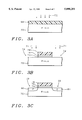
- FIG. 3A shows a P-doped silicon substrate and a photoresist mask with no openings since there is no N-well to be formed in in the region being illustrated here.
- FIG. 3B shows a thin film gate oxide layer a silicon nitride layer and a photoresist mask and the silicon nitride layer and the photoresist layer have been etched to form openings.
- the field implant is made into the field implant regions.
- FOX regions are formed by a conventional field oxide process over the P doped regions.
- FIG. 3E shows a new gate oxide layer formed on top of the P-sub where the FOX regions are absent, with a polysilicon layer is deposited upon the gate oxide layer, a. mask over the polysilicon layer patterned for etching away unwanted portions to form a gate electrode as shown in FIG. 3F.
- FIG. 3F shows an N+ doped source region located on the left and drain region located on the right with dopant N+ ions composed of phosphorus are implanted through openings in a self-aligned implant into N+ regions.
- FIG. 3G the product of FIG. 3F has been coated with a blanket layer of dielectric material, a mask formed over the device of FIG. 3F with openings therein, and openings farther below have been opened in the dielectric on each side which is etched down to N+ regions.
- FIG. 3H the product of FIG. 3G is shown after metal electrodes have been formed in the openings by a plating process with a terminal connected the electrodes which is connected to N+ regions.
- a counter-doped P/N junction between P region 18 and N-well 12 is built on top of a diffused layer and beneath a field oxide structure 27.
- the P/N junction is connected to the gate 26 through an inverter 31.
- the voltage applied to the P/N junction is 0 Volts.
- the current tunnel in the diffused layer is wide. Therefore, the resistance can be small.
- the P/N junction is reversal biased to reduce the thickness of the diffused layer to eliminate the surface breakdown.
- the inverter 31 is connected between terminal 25 and terminal 30 connecting between V G and V F which is an improvement because the complementary waveform of V G and V F can result in the appropriate current transportation width during on/off operation.
- the inverter has a terminal 32 connected thereto to negative voltage supply. Therefore, the output of the inverters can range from zero (0) to a negative voltage.
- a power MOSFET with the above structure and bias conditions can achieve both the advantage of low resistance and the advantage of high breakdown voltage.
- a voltage Vp is applied to reverse bias the P/N junction.
- the thickness of the diffused layer is reduced due to the depletion of the P/N junction.
- the thickness is thin enough to cause the full depletion of the diffused layers so the surface breakdown can be eliminated.
- the device can be operated at a high breakdown voltage.
- Counter-doping refers to using a P dopant in an N-well or alternatively, it can refer to using an N dopant in a P-well, if that were the embodiment being employed.
- a P doped silicon substrate 10 contains an N-well 12 in which a counterdoped P region 18 has been formed. Spaced substantially to the left of the N-well 12 is an N+ source region 14, To the right of the counter-doped region 18 is an N+ drain region 16. The counter-doped region 18 and drain region 16 are relatively close together. The counter-doped region 18 and N+ source N+ region 14 are relatively far apart; for example, at 200 Volts, the spacing is 20 ⁇ m and at 780 Volts, the spacing is 80 ⁇ m.
- the counter-doped regions 18 are of 20 ⁇ m to about 80 ⁇ m size depending upon the voltage rating and a 5,000 ⁇ depth.
- the diameter is within a range from about 20 ⁇ m to about 80 ⁇ m.
- the depth is within a range from about 3,000 ⁇ to about 5,000 ⁇ .
- Dopant P ions in a concentration of 1 ⁇ 10 16 /cm 3 were implanted through an opening into counter-doped region 18 of N-well 12.
- the dopant was applied at a preferred dose of 1E11 cm -2 of boron at a preferred energy of 40 keV to provide a far higher level of doping than in the remainder of the N-well 12.
- a range of energies from about 30 keV to about 50 keV is possible.
- a range of doses from about 1E11 cm -2 to about 5E11 cm -2 is possible.
- the N+ doped source region 14 is located to the left of the N-well 12 in the P-sub 10. Bridging the N+ source region 14 and the N-well 12 above a gate oxide dielectric 21 is a gate electrode 26 connected to terminal 25 at voltage V G . Source region 14 is connected to electrode 22 at voltage V S . Above the N+ drain region 16 to the right of the counter-doped region 18 is a polysilicon electrode 23 (formed on the surface of region 16 and FOX region 28) connected to terminal 24.
- a P doped silicon substrate 40 contains an N-well 42 which was formed through a mask 48 by doping N ions 37 composed of phosphorus implanted through an opening 34 to form N-well 42.
- the dopant is applied at a preferred dose of 5E10 cm -2 of phosphorus at a preferred energy of 250 keV to provide a higher level of doping than in the remainder of P-sub 40.
- a range of energies from about 250 keV to about 300 keV is possible.
- a range of doses from about 1E10 cm -2 to about 5E10 cm -2 is possible. to form opening 34 for implanting the ions into substrate 40 to form N-well 42.
- FIG. 2B the device of FIG. 2A is shown. Above the N-well 42, a thin film gate oxide layer 44, a silicon nitride (Si 3 N 4 ) layer 46 and a photoresist layer 48 have been formed.
- the photoresist layer 48 was photolithographically exposed, patterned and developed and the thin film gate oxide layer 44, and the silicon nitride (Si 3 N 4 ) layer 46 and a photoresist layer 48 have been etched to form opening 49 down to N-well 42 forming a mask for ion implanting field implant dopant ions 47 into a counter-doped P region 50.
- FIG. 2C shows the device of FIG. 2B after formation of counterdoped P region 50.
- counterdoped P region 50 is of from about 20 ⁇ m to about 80 ⁇ m diameter and 5,000 ⁇ depth.
- the diameter is within a range from about 20 ⁇ m to about 80 ⁇ m.
- the depth is within a range from about 3,000 ⁇ to about 5,000 ⁇ .
- the field implant of boron dopant ions 47 from B 11 or BF 2 in FIG. 2B is implanted through the opening 49 into zone 42 of P-substrate 40.
- a range of energies from about 30 keV to about 50 keV is possible.
- a range of doses within a range from about 1E12 cm -2 to about 1E13 cm -2 is possible.
- a FOX region 54 is formed by a conventional field oxide process. Region 54 is formed over the counterdoped P-region 50.
- FIG. 2E shows the device of FIG. 2D after formation of a new gate oxide layer 55 formed on top of the entire device including the P-sub 40 and the N-well 42 where the FOX region 54 is absent. Then a polysilicon gate layer 56 is deposited upon the gate oxide layer 55. A mask 87 is formed over the polysilicon gate layer 56 to protect the gate area from etching.
- FIG. 2F shows the device of FIG. 2E after etching of the polysilicon gate layer 56 using the mask 87 of FIG. 2E.
- the N+ doped source region 64 is located to the left of the N-well 42 in the P-sub 40.
- Dopant phosphorous ions 69 are implanted in a self-aligned implant (using the gate 56 and FOX regions 54 as a mask) into N+ regions 64 and 66.
- the dopant is applied at a preferred dose of 5E15 cm -2 of phosphorus at a preferred energy of 40 keV to provide a far higher level of doping than in the remainder of the N- well 42 in region 66 and in the P-sub in N+ region 64.
- a range of energies from about 30 keV to about 50 keV is possible.
- a range of doses from about 6E15 cm -2 to about 5E15 cm -2 is possible.
- a gate electrode 56 Bridging the N+ source region 64 and the N-well 42 above gate oxide is a gate electrode 56 connected to terminal 55.
- Source region 64 is connected to terminal 61 by contact electrode 60.
- an electrode 62 connected to terminal 64.
- FIG. 2G the product of FIG. 2F has been coated with a blanket layer of dielectric material 58. Then a mask 77 has been formed over the device of FIG. 2F with openings 75 therein. Openings 75' below opening 75 have been opened in the dielectric 58 in the center and on each side. In the center the FOX region 54 is etched down to the counterdoped P region 50; and dielectric layer 58 is etched down to N+ regions 64 and 66.
- FIG. 2H the product of FIG. 2G is shown after metal electrodes 60, 67, and 62 have been formed in the openings 75' by an additive, e.g. plating process. Then a terminal 68 is connected to electrode 67 which connects to P region 50. A terminal 61 is connected to metal electrode 60, which is connected to N+ region 64. A terminal 64 is connected to metal electrode 62 which is connected to N+ region 66.
- a P-doped silicon substrate 70 and a photoresist layer 68 have been formed.
- the photoresist layer 68 was photolithographically exposed, patterned and developed and the portion shown in this drawing has no openings since there is no N-well to be formed in in the region being illustrated here. If CMOS is required in the peripheral circuit is required in the peripheral circuit, an N-well is needed for a P-MOSFET.
- the P on the N-well is implemented at the same time as the filed implant in a peripheral N-channel MOSFET.
- a thin film gate oxide layer 74, a silicon nitride (Si 3 N 4 ) layer 76 and a photoresist layer 78 have been formed.
- the photoresist layer 78 was photolithographically exposed, patterned and developed and the Si 3 N 4 layer 76 and the photoresist layer 78 have been etched to form openings 79. Then, P doped regions 80 and 81 are formed.
- the field implant is made into P-sub 70 to form the field implant regions 80, 81 which are of 3,000 ⁇ depth.
- the diameter depends upon the design rule of the circuits.
- the field implant comprises ion implantation of P dopant ions 71 composed of phosphorus (P).
- the field implant ions 71 are implanted through the openings 79 into regions 80 and 61 of P-substrate 70.
- the dopant ions 71 are applied at a preferred dose of 1E13 cm -2 of phosphorus at a preferred energy of 125 keV to provide a far higher level of doping than in the N-wells in the device.
- the parameters of the process include a range of energies from about 100 keV to about 150 keV and a range of doses from about 1E12 cm -2 to about 1E13 cm -2 .
- FOX regions 83 are formed by a conventional field oxide process over the P doped regions 80 and 81.
- FIG. 3E shows a new gate oxide layer 85 formed on top of the P-sub 70 where the FOX regions 83 are absent.
- Polysilicon layer 86 is deposited upon the gate oxide layer 85.
- FIG. 3E also a photoresist mask 87 over polysilicon layer 86 patterned for etching away unwanted portions of layer 86 to form gate electrode 86 as shown in FIG. 3F.
- FIG. 3F shows an N+ doped source region 94 located on the left and drain region 96 located on the right.
- Dopant N+ ions 97 composed of phosphorus are implanted through openings in a self-aligned implant into N+ regions 94 and 96.
- the dopant is applied at a preferred dose of 5E15 cm -2 of phosphorus at a preferred energy of 40 keV to provide a far higher level of doping than in the remainder of P-sub 70.
- a range of energies from about 30 keV to about 50 keV is possible.
- a range of doses from about 1E15 cm -2 to about 5E15 cm -2 is possible.
- FIG. 3G the product of FIG. 3F has been coated with a blanket layer of dielectric material 89. Then a mask 84 has been formed over the device of FIG. 3F with openings 84' therein. Openings 89' below openings 84' have been opened in the dielectric 89 on each side. The dielectric layer 89 is etched down to N+ regions 94 and 96.
- FIG. 3H the product of FIG. 3G is shown after metal electrodes 90, and 92 have been formed in the openings 89' by an additive, e.g. plating process. Then a terminal 91 is connected to electrode 90 which is connected to N+ region 94. A terminal 93 is connected to metal electrode 92 which is connected to N+ region 96.
- Source region 94 is connected to terminal 91 by contact electrode 90.
- electrode 90 Above the N+ drain region 96 to the right of the device is an electrode 92 connected to terminal 93.
Landscapes
- Metal-Oxide And Bipolar Metal-Oxide Semiconductor Integrated Circuits (AREA)
- Insulated Gate Type Field-Effect Transistor (AREA)
Abstract
A metal oxide semiconductor field effect transistor power device with a lightly doped silicon substrate includes a source region and a drain region. At least one field implanted island region is formed along the surface of the substrate between the source and drain regions with a field oxide region formed above the field implanted region, a dielectric layer and a gate electrode formed over the substrate, and self-aligned source and drain regions implanted into the device with external electrodes connected thereto.
Description
This is a continuation of application Ser. No. 08/537,140, filed Sep. 29, 1995 and now abandoned, which was a divisional of application Ser. No. 08/289,630, filed Aug. 12, 1994 and now U.S. Pat. No. 5,482,888.
1. Field of the Invention
This invention relates to power MOSFET devices and more particularly to an improved design of such devices.
2. Description of Related Art
In current laterally diffused power MOSFETs, the thickness of diffused layers is scaled to eliminate the surface breakdown. However, due to the thinning of the diffused layer, the on-resistance is accordingly increased. The driving current is therefore reduced.
SUMMARY OF THE INVENTION
In accordance with this invention, a metal oxide semiconductor field effect transistor power device with a lightly doped silicon substrate includes a source region and a drain region, the improvement comprises at least one field implanted island region formed along the surface of the oppositely substrate between the source and drain regions with a field oxide region formed above the field implanted region, a dielectric layer and a gate electrode of matching configurations formed over the substrate, and self-aligned source drain regions implanted into the device with external electrodes connected thereto.
Preferably, the substrate is lightly doped P- silicon including an oppositely doped N- well; the field implanted region being a counterdoped region relative to the N- well
an oppositely doped source region in the substrate with respect to the lightly doped substrate substrate comprises a P-substrate, the well comprises an N- well and the counter doped region is doped P; the external electrode connected to the counterdoped region is connected to one end of an inverter; the depth of the counter doped region is within a range from about 3,000 Å to about 5,000 Å, the dopant is applied within a range of energies from about 30 keV to about 50 keV, and within a range of doses from about 1E12 cm-2 to about 1E13 cm-2 ; the depth of the counter doped island region is within a range from about 3,000 Å to about 5,000 Å, the dopant is applied within a range of energies from about 30 keV to about 50 keV, and within a range of doses from about 1E11 cm-2 to about 5E11 cm-2 ; the depth of the counter doped region comprises boron dopant ion selected from boron and BF2 implanted at a preferred energy of 40 keV to provide a far higher level of doping than in the N-wells of the device the islands having a depth within a range from about 3,000 Å to about 5,000 Å, the source/drain regions are doped with a preferred dose of about a phosphorus dopant applied within a range of energies from about 30 keV to about 50 keV, and within a range of doses from about 1E15 cm-2 to about 5E15 cm-2 ; the source/drain regions are doped with a preferred dose of about a phosphorus dopant applied within a range of energies from about 30 keV to about 50 keV, and within a range of doses from about 1E15 cm-2 to about 5E15 cm-2.
Further in accordance with this invention, a method is provided for manufacture of a metal oxide semiconductor field effect transistor device selected from power devices and peripheral devices with a lightly doped silicon substrate,
forming a field implant region in islands in the device by ion implanting P ions into the islands,
forming a field oxide layer and driving in the field implant dopant,
forming a gate oxide on the device,
forming a gate electrode layer on the gate oxide layer,
patterning the gate electrode layer and the gate oxide layer, and
performing a self-aligned source/drain implant into source/drain regions of the device.
Preferably, the device comprises a power device on a P-substrate, the device includes an N- well with a counterdoped P region; the depth of the counter doped region is within a range from about 3,000 Å to about 5,000 Å, the dopant is applied within a range of energies from about 30 keV to about 50 keV, and within a range of doses from about 1E12 cm-2 to about 1E13 cm-2 ; and the depth of the source/drain regions is within a range from about 3,000 Å to about 5,000 Å, the dopant comprising boron is applied within a range of energies from about 30 keV to about 50 keV, and within a range of doses from about 1E12 cm-2 to about 1E13 cm-2 ; and the source/drain dopant comprising phosphorus is applied at a range of energies from about 30 keV to about 50 keV, and a range of doses from about 1E15 cm-2 to about 5E15 cm-2 ; an external electrode is connected to the counterdoped region, the counterdoped region being connected to one end of an inverter;
Preferably, the device comprises a peripheral device on a P-substrate comprising,
forming P doped field implant regions and then forming FOX regions over the field implant regions,
forming a gate oxide and gate structure between the FOX regions, and
forming self-aligned source/drain regions by ion implanting source/drain dopant into the substrate adjacent to the gate structure; the field implant regions are formed by ion implantation of phosphorus dopant, the dopant being applied within a range of energies from about 100 keV to about 150 keV, and within a range of doses from about 1E12 cm-2 to about 1E13 cm-2 ; and the source/drain regions are formed by ion implantation of dopant, the dopant comprising phosphorus applied within a range of energies from about 30 keV to about 50 keV, and within a range of doses from about 1E15 cm-2 to about 5E13 cm-2.
In accordance with another aspect of the invention, a metal oxide semiconductor field effect transistor device with a lightly doped silicon substrate including an oppositely doped well and oppositely doped source region and oppositely drain region with respect to the lightly doped substrate, manufactured by the method comprising
implanting at least one counter doped region formed along the surface of the well between the source and drain regions, the counter doped region having an external electrode connected thereto;
the substrate comprises a P-substrate,
the well comprises an N- well and the counterdoped region is doped P,
the external electrode being connected to the counterdoped region is connected to one end of an inverter; and the external electrode connected to the counterdoped region is connected to one end of an inverter.
The foregoing and other aspects and advantages of this invention are explained and described below with reference to the accompanying drawings, in which:
FIG. 1 shows a P doped silicon substrate containing an N-well in which a counterdoped P region has been formed.
FIG. 2A shows a P doped silicon substrate contains an N-well formed through a mask by doping.
FIG. 2B shows the device of FIG. 2A after formation of an N-well, a thin film gate oxide layer, a silicon nitride (Si3 N4) layer and a photoresist layer.
FIG. 2C shows the device of FIG. 2B after formation of a counterdoped P region.
FIG. 2D shows a FOX region is formed by a conventional field oxide process.
FIG. 2E shows the device of FIG. 2D after formation of a new gate oxide layer on top of the entire device, and a polysilicon gate layer deposited upon the gate oxide layer, with a mask formed over the polysilicon gate layer to protect the gate area from etching.
FIG. 2F shows the device of FIG. 2E after etching of the polysilicon gate layer using the mask of FIG. 2E, followed by a self-aligned implant.
In FIG. 2G, the product of FIG. 2F has been coated with a blanket layer of dielectric material, and a mask has been formed over the device of FIG. 2F with openings therein and openings below that opening have been opened in the dielectric in the center and on each side, and the center the FOX region is etched down to the counterdoped P region and in dielectric layer down to N+ source/drain regions.
In FIG. 2H, the product of FIG. 2G is shown after regions and metal electrodes have been formed in the openings by a plating process, a terminal is connected to electrode which connects to the P region, a terminal is connected to a metal electrode which is connected to an N+ region.
FIG. 3A shows a P-doped silicon substrate and a photoresist mask with no openings since there is no N-well to be formed in in the region being illustrated here.
FIG. 3B shows a thin film gate oxide layer a silicon nitride layer and a photoresist mask and the silicon nitride layer and the photoresist layer have been etched to form openings.
In FIG. 3C the field implant is made into the field implant regions.
In FIG. 3D, FOX regions are formed by a conventional field oxide process over the P doped regions.
FIG. 3E shows a new gate oxide layer formed on top of the P-sub where the FOX regions are absent, with a polysilicon layer is deposited upon the gate oxide layer, a. mask over the polysilicon layer patterned for etching away unwanted portions to form a gate electrode as shown in FIG. 3F.
FIG. 3F shows an N+ doped source region located on the left and drain region located on the right with dopant N+ ions composed of phosphorus are implanted through openings in a self-aligned implant into N+ regions.
In FIG. 3G, the product of FIG. 3F has been coated with a blanket layer of dielectric material, a mask formed over the device of FIG. 3F with openings therein, and openings farther below have been opened in the dielectric on each side which is etched down to N+ regions.
In FIG. 3H, the product of FIG. 3G is shown after metal electrodes have been formed in the openings by a plating process with a terminal connected the electrodes which is connected to N+ regions.
              TABLE I
______________________________________
Voltage Condition During Operation
        V.sub.S
            V.sub.G      V.sub.P
                                V.sub.D
______________________________________
ON        0     High         0    High
OFF       0     0
High      High
______________________________________
Referring to FIG. 1, in accordance with this invention, a counter-doped P/N junction between P region 18 and N-well 12 is built on top of a diffused layer and beneath a field oxide structure 27. The P/N junction is connected to the gate 26 through an inverter 31. As the transistor is turned on, the voltage applied to the P/N junction is 0 Volts. The current tunnel in the diffused layer is wide. Therefore, the resistance can be small. However, as the device is off, the P/N junction is reversal biased to reduce the thickness of the diffused layer to eliminate the surface breakdown.
The inverter 31 is connected between terminal 25 and terminal 30 connecting between VG and VF which is an improvement because the complementary waveform of VG and VF can result in the appropriate current transportation width during on/off operation. The inverter has a terminal 32 connected thereto to negative voltage supply. Therefore, the output of the inverters can range from zero (0) to a negative voltage.
A power MOSFET with the above structure and bias conditions can achieve both the advantage of low resistance and the advantage of high breakdown voltage.
i) During the ON state The voltage Vp is 0 Volts. Therefore the current path in the diffused layer can be wide so that the ON resistance is low.
ii) During the OFF state A voltage Vp is applied to reverse bias the P/N junction. The thickness of the diffused layer is reduced due to the depletion of the P/N junction. The thickness is thin enough to cause the full depletion of the diffused layers so the surface breakdown can be eliminated. The device can be operated at a high breakdown voltage.
This invention provides a counter-doped layer between the source and the drain of a MOSFET device to reduce the surface electric field. Counter-doping refers to using a P dopant in an N-well or alternatively, it can refer to using an N dopant in a P-well, if that were the embodiment being employed.
Referring to FIG. 1, a P doped silicon substrate 10 contains an N-well 12 in which a counterdoped P region 18 has been formed. Spaced substantially to the left of the N-well 12 is an N+ source region 14, To the right of the counter-doped region 18 is an N+ drain region 16. The counter-doped region 18 and drain region 16 are relatively close together. The counter-doped region 18 and N+ source N+ region 14 are relatively far apart; for example, at 200 Volts, the spacing is 20 μm and at 780 Volts, the spacing is 80 μm. Preferably, the counter-doped regions 18 are of 20 μm to about 80 μm size depending upon the voltage rating and a 5,000 Å depth. The diameter is within a range from about 20 μm to about 80 μm. The depth is within a range from about 3,000 Å to about 5,000 Å. Dopant P ions in a concentration of 1×10¹⁶ /cm3 were implanted through an opening into counter-doped region 18 of N-well 12. The dopant was applied at a preferred dose of 1E11 cm-2 of boron at a preferred energy of 40 keV to provide a far higher level of doping than in the remainder of the N-well 12. A range of energies from about 30 keV to about 50 keV is possible. A range of doses from about 1E11 cm-2 to about 5E11 cm-2 is possible.
Above the counter-doped region 18, FOX regions 27 and 28 were formed.
The N+ doped source region 14 is located to the left of the N-well 12 in the P-sub 10. Bridging the N+ source region 14 and the N-well 12 above a gate oxide dielectric 21 is a gate electrode 26 connected to terminal 25 at voltage VG. Source region 14 is connected to electrode 22 at voltage VS. Above the N+ drain region 16 to the right of the counter-doped region 18 is a polysilicon electrode 23 (formed on the surface of region 16 and FOX region 28) connected to terminal 24.
Referring to FIG. 2A, a P doped silicon substrate 40 contains an N-well 42 which was formed through a mask 48 by doping N ions 37 composed of phosphorus implanted through an opening 34 to form N-well 42. The dopant is applied at a preferred dose of 5E10 cm-2 of phosphorus at a preferred energy of 250 keV to provide a higher level of doping than in the remainder of P-sub 40. A range of energies from about 250 keV to about 300 keV is possible. A range of doses from about 1E10 cm-2 to about 5E10 cm-2 is possible. to form opening 34 for implanting the ions into substrate 40 to form N-well 42.
Referring to FIG. 2B, the device of FIG. 2A is shown. Above the N-well 42, a thin film gate oxide layer 44, a silicon nitride (Si3 N4) layer 46 and a photoresist layer 48 have been formed. The photoresist layer 48 was photolithographically exposed, patterned and developed and the thin film gate oxide layer 44, and the silicon nitride (Si3 N4) layer 46 and a photoresist layer 48 have been etched to form opening 49 down to N-well 42 forming a mask for ion implanting field implant dopant ions 47 into a counter-doped P region 50.
FIG. 2C shows the device of FIG. 2B after formation of counterdoped P region 50.
Preferably, counterdoped P region 50 is of from about 20 μm to about 80 μm diameter and 5,000 Å depth. The diameter is within a range from about 20 μm to about 80 μm. The depth is within a range from about 3,000 Å to about 5,000 Å.
The field implant of boron dopant ions 47 from B11 or BF2 in FIG. 2B is implanted through the opening 49 into zone 42 of P-substrate 40. The dopant ions 47 areas applied at a preferred dose of 1E12 cm-2 of boron at a preferred energy of 40 keV to provide a far higher level of doping than in the remainder of N- substrate. A range of energies from about 30 keV to about 50 keV is possible. A range of doses within a range from about 1E12 cm-2 to about 1E13 cm-2 is possible.
Referring to FIG. 2D, a FOX region 54 is formed by a conventional field oxide process. Region 54 is formed over the counterdoped P-region 50.
FIG. 2E shows the device of FIG. 2D after formation of a new gate oxide layer 55 formed on top of the entire device including the P-sub 40 and the N-well 42 where the FOX region 54 is absent. Then a polysilicon gate layer 56 is deposited upon the gate oxide layer 55. A mask 87 is formed over the polysilicon gate layer 56 to protect the gate area from etching.
FIG. 2F shows the device of FIG. 2E after etching of the polysilicon gate layer 56 using the mask 87 of FIG. 2E.
Next a self-aligned implant follows. The N+ doped source region 64 is located to the left of the N-well 42 in the P-sub 40. Dopant phosphorous ions 69 are implanted in a self-aligned implant (using the gate 56 and FOX regions 54 as a mask) into N+ regions 64 and 66. The dopant is applied at a preferred dose of 5E15 cm-2 of phosphorus at a preferred energy of 40 keV to provide a far higher level of doping than in the remainder of the N- well 42 in region 66 and in the P-sub in N+ region 64. A range of energies from about 30 keV to about 50 keV is possible. A range of doses from about 6E15 cm-2 to about 5E15 cm-2 is possible.
Bridging the N+ source region 64 and the N-well 42 above gate oxide is a gate electrode 56 connected to terminal 55.
In FIG. 2G, the product of FIG. 2F has been coated with a blanket layer of dielectric material 58. Then a mask 77 has been formed over the device of FIG. 2F with openings 75 therein. Openings 75' below opening 75 have been opened in the dielectric 58 in the center and on each side. In the center the FOX region 54 is etched down to the counterdoped P region 50; and dielectric layer 58 is etched down to N+ regions 64 and 66.
In FIG. 2H, the product of FIG. 2G is shown after metal electrodes 60, 67, and 62 have been formed in the openings 75' by an additive, e.g. plating process. Then a terminal 68 is connected to electrode 67 which connects to P region 50. A terminal 61 is connected to metal electrode 60, which is connected to N+ region 64. A terminal 64 is connected to metal electrode 62 which is connected to N+ region 66.
Referring to FIG. 3A, a P-doped silicon substrate 70 and a photoresist layer 68 have been formed. The photoresist layer 68 was photolithographically exposed, patterned and developed and the portion shown in this drawing has no openings since there is no N-well to be formed in in the region being illustrated here. If CMOS is required in the peripheral circuit is required in the peripheral circuit, an N-well is needed for a P-MOSFET.
The P on the N-well is implemented at the same time as the filed implant in a peripheral N-channel MOSFET.
Referring to FIG. 3B, a thin film gate oxide layer 74, a silicon nitride (Si3 N4) layer 76 and a photoresist layer 78 have been formed. The photoresist layer 78 was photolithographically exposed, patterned and developed and the Si3 N4 layer 76 and the photoresist layer 78 have been etched to form openings 79. Then, P doped regions 80 and 81 are formed.
Referring to FIG. 3C the field implant is made into P-sub 70 to form the field implant regions 80, 81 which are of 3,000 Å depth. The diameter depends upon the design rule of the circuits.
The field implant comprises ion implantation of P dopant ions 71 composed of phosphorus (P). The field implant ions 71 are implanted through the openings 79 into regions 80 and 61 of P-substrate 70. The dopant ions 71 are applied at a preferred dose of 1E13 cm-2 of phosphorus at a preferred energy of 125 keV to provide a far higher level of doping than in the N-wells in the device. The parameters of the process include a range of energies from about 100 keV to about 150 keV and a range of doses from about 1E12 cm-2 to about 1E13 cm-2.
Referring to FIG. 3D, FOX regions 83 are formed by a conventional field oxide process over the P doped regions 80 and 81.
FIG. 3E shows a new gate oxide layer 85 formed on top of the P-sub 70 where the FOX regions 83 are absent. Polysilicon layer 86 is deposited upon the gate oxide layer 85.
FIG. 3E also a photoresist mask 87 over polysilicon layer 86 patterned for etching away unwanted portions of layer 86 to form gate electrode 86 as shown in FIG. 3F.
FIG. 3F shows an N+ doped source region 94 located on the left and drain region 96 located on the right. Dopant N+ ions 97 composed of phosphorus are implanted through openings in a self-aligned implant into N+ regions 94 and 96. The dopant is applied at a preferred dose of 5E15 cm-2 of phosphorus at a preferred energy of 40 keV to provide a far higher level of doping than in the remainder of P-sub 70. A range of energies from about 30 keV to about 50 keV is possible. A range of doses from about 1E15 cm-2 to about 5E15 cm-2 is possible.
In FIG. 3G, the product of FIG. 3F has been coated with a blanket layer of dielectric material 89. Then a mask 84 has been formed over the device of FIG. 3F with openings 84' therein. Openings 89' below openings 84' have been opened in the dielectric 89 on each side. The dielectric layer 89 is etched down to N+ regions 94 and 96.
In FIG. 3H, the product of FIG. 3G is shown after metal electrodes 90, and 92 have been formed in the openings 89' by an additive, e.g. plating process. Then a terminal 91 is connected to electrode 90 which is connected to N+ region 94. A terminal 93 is connected to metal electrode 92 which is connected to N+ region 96.
Source region 94 is connected to terminal 91 by contact electrode 90. Above the N+ drain region 96 to the right of the device is an electrode 92 connected to terminal 93.
While this invention has been described in terms of the above specific embodiment(s), those skilled in the art will recognize that the invention can be practiced with modifications within the spirit and scope of the appended claims, i.e. that changes can be made in form and detail, without departing from the spirit and scope of the invention. Accordingly all such changes come within the purview of the present invention and the invention encompasses the subject matter of the claims which follow.
Claims (7)
1. A metal oxide semiconductor field effect transistor power device formed on a substrate having at least a surface layer doped to a first conductivity type, the power device comprising:
a well doped to a second conductivity type, extending from a surface of the substrate;
a first source/drain region, doped to the second conductivity type and located in the substrate, wherein the first source/drain region is spaced from the well by a channel region of the substrate which is doped to the first conductivity type;
a gate electrode over the channel region;
a second source/drain region doped to the second conductivity type and located within the well;
a field region doped to the first conductivity type within the well and located between the first and second source/drain regions, the field region having a field contact electrically connected thereto; and
an inverter connecting the gate electrode to the field contact, wherein the inverter is connected to a negative voltage supply, so that the inverter applies a negative voltage to the field contact in response to a first signal on the gate electrode which corresponds to an OFF state of the channel region.
2. The power device of claim 1, wherein application of the first signal to the gate electrode places the channel region in a less conductive state and the negative voltage applied by the inverter increases reverse biasing of a P/N junction formed between the field region and the well.
3. The power device of claim 1, wherein the substrate is P-type and the well is N-type.
4. The power device of claim 1, wherein the field region is covered by and in contact with a thick oxide region and wherein the field contact is formed through the thick oxide.
5. The power device of claim 4, wherein the field region is between 3000 and 5000 Å deep.
6. The power device of claim 1, wherein application of a second signal to the gate electrode places the channel region in an ON state which is more conductive than an OFF state of the channel region, and causes a contact voltage that is more positive than the negative voltage to be applied to the field contact, reducing a reverse bias applied to a PIN junction formed between the field region and the well to below that applied to the P/N junction when the first signal is applied to the gate electrode.
7. The power device of claim 1, wherein the field region has a diameter of between 20 and 80 μm.
Priority Applications (1)
| Application Number | Priority Date | Filing Date | Title |
|---|---|---|---|
| US08/900,922 US5898201A (en) | 1994-08-12 | 1997-07-28 | Low resistance, high breakdown voltage, power mosfet |
Applications Claiming Priority (3)
| Application Number | Priority Date | Filing Date | Title |
|---|---|---|---|
| US08/289,630 US5482888A (en) | 1994-08-12 | 1994-08-12 | Method of manufacturing a low resistance, high breakdown voltage, power MOSFET |
| US53714095A | 1995-09-29 | 1995-09-29 | |
| US08/900,922 US5898201A (en) | 1994-08-12 | 1997-07-28 | Low resistance, high breakdown voltage, power mosfet |
Related Parent Applications (1)
| Application Number | Title | Priority Date | Filing Date |
|---|---|---|---|
| US53714095A Continuation | 1994-08-12 | 1995-09-29 |
Publications (1)
| Publication Number | Publication Date |
|---|---|
| US5898201A true US5898201A (en) | 1999-04-27 |
Family
ID=23112358
Family Applications (2)
| Application Number | Title | Priority Date | Filing Date |
|---|---|---|---|
| US08/289,630 Expired - Lifetime US5482888A (en) | 1994-08-12 | 1994-08-12 | Method of manufacturing a low resistance, high breakdown voltage, power MOSFET |
| US08/900,922 Expired - Lifetime US5898201A (en) | 1994-08-12 | 1997-07-28 | Low resistance, high breakdown voltage, power mosfet |
Family Applications Before (1)
| Application Number | Title | Priority Date | Filing Date |
|---|---|---|---|
| US08/289,630 Expired - Lifetime US5482888A (en) | 1994-08-12 | 1994-08-12 | Method of manufacturing a low resistance, high breakdown voltage, power MOSFET |
Country Status (1)
| Country | Link |
|---|---|
| US (2) | US5482888A (en) |
Cited By (5)
| Publication number | Priority date | Publication date | Assignee | Title |
|---|---|---|---|---|
| US6552393B2 (en) * | 2001-04-05 | 2003-04-22 | Oki Electric Industry Co., Ltd. | Power MOS transistor having increased drain current path |
| US7180133B1 (en) * | 2004-12-17 | 2007-02-20 | National Semiconductor Corporation | Method and structure for addressing hot carrier degradation in high voltage devices |
| US20100025764A1 (en) * | 2008-07-29 | 2010-02-04 | Yuichiro Kitajima | Semiconductor device and manufacturing method thereof |
| US8053835B1 (en) * | 1999-05-03 | 2011-11-08 | Klas-Hakan Eklund | Lateral semiconductor device comprising two layers of mutually opposite conductivity-type materials between source and drain |
| US8269277B2 (en) * | 2010-08-11 | 2012-09-18 | Fairchild Semiconductor Corporation | RESURF device including increased breakdown voltage |
Families Citing this family (8)
| Publication number | Priority date | Publication date | Assignee | Title |
|---|---|---|---|---|
| EP0698919B1 (en) * | 1994-08-15 | 2002-01-16 | Siliconix Incorporated | Trenched DMOS transistor fabrication using seven masks |
| DE19705530C2 (en) * | 1997-02-13 | 1999-03-11 | Siemens Ag | Method for producing a contact and a capacitor in a half-rent component |
| US6346438B1 (en) * | 1997-06-30 | 2002-02-12 | Kabushiki Kaisha Toshiba | Method of manufacturing a semiconductor device |
| US6110782A (en) * | 1998-11-19 | 2000-08-29 | Taiwan Semiconductor Manufacturing Company | Method to combine high voltage device and salicide process |
| TW512533B (en) * | 2000-04-26 | 2002-12-01 | Sanyo Electric Co | Semiconductor device and its manufacturing process |
| US6628521B2 (en) * | 2000-11-06 | 2003-09-30 | Adc Telecommunications, Inc. | Mechanical housing |
| US6822292B2 (en) * | 2001-11-21 | 2004-11-23 | Intersil Americas Inc. | Lateral MOSFET structure of an integrated circuit having separated device regions |
| US10134891B2 (en) * | 2016-08-30 | 2018-11-20 | United Microelectronics Corp. | Transistor device with threshold voltage adjusted by body effect |
Citations (4)
| Publication number | Priority date | Publication date | Assignee | Title |
|---|---|---|---|---|
| US5019522A (en) * | 1986-03-21 | 1991-05-28 | Advanced Power Technology, Inc. | Method of making topographic pattern delineated power MOSFET with profile tailored recessed source |
| JPH04107877A (en) * | 1990-08-27 | 1992-04-09 | Matsushita Electron Corp | Semiconductor device and its manufacturing method |
| US5258641A (en) * | 1989-12-28 | 1993-11-02 | Mitsubishi Denki Kabushiki Kaisha | Semiconductor device for extracting a signal used to monitor potential of a high voltage island at a low voltage island and method of manufacturing the same |
| US5322804A (en) * | 1992-05-12 | 1994-06-21 | Harris Corporation | Integration of high voltage lateral MOS devices in low voltage CMOS architecture using CMOS-compatible process steps |
Family Cites Families (1)
| Publication number | Priority date | Publication date | Assignee | Title |
|---|---|---|---|---|
| US4786609A (en) * | 1987-10-05 | 1988-11-22 | North American Philips Corporation, Signetics Division | Method of fabricating field-effect transistor utilizing improved gate sidewall spacers |
-
1994
- 1994-08-12 US US08/289,630 patent/US5482888A/en not_active Expired - Lifetime
-
1997
- 1997-07-28 US US08/900,922 patent/US5898201A/en not_active Expired - Lifetime
Patent Citations (4)
| Publication number | Priority date | Publication date | Assignee | Title |
|---|---|---|---|---|
| US5019522A (en) * | 1986-03-21 | 1991-05-28 | Advanced Power Technology, Inc. | Method of making topographic pattern delineated power MOSFET with profile tailored recessed source |
| US5258641A (en) * | 1989-12-28 | 1993-11-02 | Mitsubishi Denki Kabushiki Kaisha | Semiconductor device for extracting a signal used to monitor potential of a high voltage island at a low voltage island and method of manufacturing the same |
| JPH04107877A (en) * | 1990-08-27 | 1992-04-09 | Matsushita Electron Corp | Semiconductor device and its manufacturing method |
| US5322804A (en) * | 1992-05-12 | 1994-06-21 | Harris Corporation | Integration of high voltage lateral MOS devices in low voltage CMOS architecture using CMOS-compatible process steps |
Cited By (6)
| Publication number | Priority date | Publication date | Assignee | Title |
|---|---|---|---|---|
| US8053835B1 (en) * | 1999-05-03 | 2011-11-08 | Klas-Hakan Eklund | Lateral semiconductor device comprising two layers of mutually opposite conductivity-type materials between source and drain |
| US6552393B2 (en) * | 2001-04-05 | 2003-04-22 | Oki Electric Industry Co., Ltd. | Power MOS transistor having increased drain current path |
| US7180133B1 (en) * | 2004-12-17 | 2007-02-20 | National Semiconductor Corporation | Method and structure for addressing hot carrier degradation in high voltage devices |
| US20100025764A1 (en) * | 2008-07-29 | 2010-02-04 | Yuichiro Kitajima | Semiconductor device and manufacturing method thereof |
| US8404547B2 (en) * | 2008-07-29 | 2013-03-26 | Seiko Instruments Inc. | Semiconductor device and manufacturing method thereof |
| US8269277B2 (en) * | 2010-08-11 | 2012-09-18 | Fairchild Semiconductor Corporation | RESURF device including increased breakdown voltage |
Also Published As
| Publication number | Publication date |
|---|---|
| US5482888A (en) | 1996-01-09 |
Similar Documents
| Publication | Publication Date | Title |
|---|---|---|
| US5646431A (en) | Surface breakdown reduction by counter-doped island in power mosfet | |
| US4946799A (en) | Process for making high performance silicon-on-insulator transistor with body node to source node connection | |
| US4899202A (en) | High performance silicon-on-insulator transistor with body node to source node connection | |
| US6147383A (en) | LDD buried channel field effect semiconductor device and manufacturing method | |
| US4965213A (en) | Silicon-on-insulator transistor with body node to source node connection | |
| US5444282A (en) | Semiconductor device and a method of manufacturing thereof | |
| US4935379A (en) | Semiconductor device and method of manufacturing the same | |
| US5593909A (en) | Method for fabricating a MOS transistor having an offset resistance | |
| US5714393A (en) | Diode-connected semiconductor device and method of manufacture | |
| US5031008A (en) | MOSFET transistor | |
| EP0749165A2 (en) | Thin film transistor in insulated semiconductor substrate and manufacturing method thereof | |
| EP0596468A2 (en) | MOSFET of LDD type and a method for fabricating the same | |
| US20030011033A1 (en) | High-voltage transistor and fabrication process | |
| EP0422129B1 (en) | Enclosed buried channel transistor | |
| EP0179407A2 (en) | Method for producing a DMOS semiconductor device | |
| US5898201A (en) | Low resistance, high breakdown voltage, power mosfet | |
| EP0098652B1 (en) | Method of manufacturing an insulated gate field effect device and device manufactured by the method | |
| US5627394A (en) | LD-MOS transistor | |
| US6025628A (en) | High breakdown voltage twin well device with source/drain regions widely spaced from fox regions | |
| US5786265A (en) | Methods of forming integrated semiconductor devices having improved channel-stop regions therein, and devices formed thereby | |
| EP0187260A2 (en) | Process for fabricating a semiconductor integrated circuit device having MISFETs | |
| GB2045525A (en) | Field effect transistor construction | |
| US6300662B1 (en) | Electronic programmable read-only-memory including a charge storage capacitor coupled to the gate electrode | |
| US4471523A (en) | Self-aligned field implant for oxide-isolated CMOS FET | |
| JPH0482064B2 (en) |
Legal Events
| Date | Code | Title | Description |
|---|---|---|---|
| STCF | Information on status: patent grant |
Free format text: PATENTED CASE |
|
| FPAY | Fee payment |
Year of fee payment: 4 |
|
| FPAY | Fee payment |
Year of fee payment: 8 |
|
| FPAY | Fee payment |
Year of fee payment: 12 |