US5889809A - Cooling system for electrodes in D.C. electric arc furnaces - Google Patents
Cooling system for electrodes in D.C. electric arc furnaces Download PDFInfo
- Publication number
- US5889809A US5889809A US08/936,624 US93662497A US5889809A US 5889809 A US5889809 A US 5889809A US 93662497 A US93662497 A US 93662497A US 5889809 A US5889809 A US 5889809A
- Authority
- US
- United States
- Prior art keywords
- electrode
- metal
- hollow
- joint
- hot environment
- Prior art date
- Legal status (The legal status is an assumption and is not a legal conclusion. Google has not performed a legal analysis and makes no representation as to the accuracy of the status listed.)
- Expired - Fee Related
Links
- 238000001816 cooling Methods 0.000 title claims abstract description 29
- 238000010891 electric arc Methods 0.000 title claims abstract description 12
- OKTJSMMVPCPJKN-UHFFFAOYSA-N Carbon Chemical compound [C] OKTJSMMVPCPJKN-UHFFFAOYSA-N 0.000 claims abstract description 28
- 239000012809 cooling fluid Substances 0.000 claims abstract description 16
- RYGMFSIKBFXOCR-UHFFFAOYSA-N Copper Chemical compound [Cu] RYGMFSIKBFXOCR-UHFFFAOYSA-N 0.000 claims abstract description 13
- 229910052802 copper Inorganic materials 0.000 claims abstract description 10
- 239000010949 copper Substances 0.000 claims abstract description 10
- 229910002804 graphite Inorganic materials 0.000 claims abstract description 7
- 239000010439 graphite Substances 0.000 claims abstract description 7
- 229910052751 metal Inorganic materials 0.000 claims description 35
- 239000002184 metal Substances 0.000 claims description 34
- 239000007787 solid Substances 0.000 claims description 7
- 229910045601 alloy Inorganic materials 0.000 claims description 6
- 239000000956 alloy Substances 0.000 claims description 6
- 239000007788 liquid Substances 0.000 claims description 6
- XEEYBQQBJWHFJM-UHFFFAOYSA-N Iron Chemical compound [Fe] XEEYBQQBJWHFJM-UHFFFAOYSA-N 0.000 claims description 5
- 229910052797 bismuth Inorganic materials 0.000 claims description 4
- JCXGWMGPZLAOME-UHFFFAOYSA-N bismuth atom Chemical compound [Bi] JCXGWMGPZLAOME-UHFFFAOYSA-N 0.000 claims description 4
- 238000002844 melting Methods 0.000 claims description 4
- 230000008018 melting Effects 0.000 claims description 4
- 229910052708 sodium Inorganic materials 0.000 claims description 4
- 239000011734 sodium Substances 0.000 claims description 4
- DGAQECJNVWCQMB-PUAWFVPOSA-M Ilexoside XXIX Chemical compound C[C@@H]1CC[C@@]2(CC[C@@]3(C(=CC[C@H]4[C@]3(CC[C@@H]5[C@@]4(CC[C@@H](C5(C)C)OS(=O)(=O)[O-])C)C)[C@@H]2[C@]1(C)O)C)C(=O)O[C@H]6[C@@H]([C@H]([C@@H]([C@H](O6)CO)O)O)O.[Na+] DGAQECJNVWCQMB-PUAWFVPOSA-M 0.000 claims description 3
- 230000005496 eutectics Effects 0.000 claims description 3
- WHXSMMKQMYFTQS-UHFFFAOYSA-N Lithium Chemical compound [Li] WHXSMMKQMYFTQS-UHFFFAOYSA-N 0.000 claims description 2
- ZLMJMSJWJFRBEC-UHFFFAOYSA-N Potassium Chemical compound [K] ZLMJMSJWJFRBEC-UHFFFAOYSA-N 0.000 claims description 2
- ATJFFYVFTNAWJD-UHFFFAOYSA-N Tin Chemical compound [Sn] ATJFFYVFTNAWJD-UHFFFAOYSA-N 0.000 claims description 2
- 229910052742 iron Inorganic materials 0.000 claims description 2
- 229910052744 lithium Inorganic materials 0.000 claims description 2
- 229910052700 potassium Inorganic materials 0.000 claims description 2
- 239000011591 potassium Substances 0.000 claims description 2
- 238000000926 separation method Methods 0.000 claims description 2
- 229910052718 tin Inorganic materials 0.000 claims description 2
- 238000000034 method Methods 0.000 claims 2
- 239000012777 electrically insulating material Substances 0.000 claims 1
- 229910001338 liquidmetal Inorganic materials 0.000 abstract description 24
- 230000000694 effects Effects 0.000 description 6
- 239000000463 material Substances 0.000 description 6
- 239000000155 melt Substances 0.000 description 4
- 239000004020 conductor Substances 0.000 description 3
- 238000010309 melting process Methods 0.000 description 3
- 230000006978 adaptation Effects 0.000 description 2
- 230000008901 benefit Effects 0.000 description 2
- 230000015572 biosynthetic process Effects 0.000 description 2
- 239000002826 coolant Substances 0.000 description 2
- 239000006185 dispersion Substances 0.000 description 2
- 239000000243 solution Substances 0.000 description 2
- XLYOFNOQVPJJNP-UHFFFAOYSA-N water Substances O XLYOFNOQVPJJNP-UHFFFAOYSA-N 0.000 description 2
- 230000009471 action Effects 0.000 description 1
- 238000013019 agitation Methods 0.000 description 1
- QVGXLLKOCUKJST-UHFFFAOYSA-N atomic oxygen Chemical compound [O] QVGXLLKOCUKJST-UHFFFAOYSA-N 0.000 description 1
- 239000012141 concentrate Substances 0.000 description 1
- 230000005494 condensation Effects 0.000 description 1
- 238000009833 condensation Methods 0.000 description 1
- 230000001419 dependent effect Effects 0.000 description 1
- 230000008020 evaporation Effects 0.000 description 1
- 238000001704 evaporation Methods 0.000 description 1
- 238000002347 injection Methods 0.000 description 1
- 239000007924 injection Substances 0.000 description 1
- 238000009434 installation Methods 0.000 description 1
- 238000012423 maintenance Methods 0.000 description 1
- 229910001092 metal group alloy Inorganic materials 0.000 description 1
- 239000007769 metal material Substances 0.000 description 1
- 238000013021 overheating Methods 0.000 description 1
- 229910052760 oxygen Inorganic materials 0.000 description 1
- 239000001301 oxygen Substances 0.000 description 1
- 230000002093 peripheral effect Effects 0.000 description 1
- 230000003134 recirculating effect Effects 0.000 description 1
- 230000009467 reduction Effects 0.000 description 1
- 239000011135 tin Substances 0.000 description 1
- 230000017105 transposition Effects 0.000 description 1
Images


Classifications
-
- C—CHEMISTRY; METALLURGY
- C21—METALLURGY OF IRON
- C21C—PROCESSING OF PIG-IRON, e.g. REFINING, MANUFACTURE OF WROUGHT-IRON OR STEEL; TREATMENT IN MOLTEN STATE OF FERROUS ALLOYS
- C21C5/00—Manufacture of carbon-steel, e.g. plain mild steel, medium carbon steel or cast steel or stainless steel
- C21C5/52—Manufacture of steel in electric furnaces
- C21C5/5229—Manufacture of steel in electric furnaces in a direct current [DC] electric arc furnace
-
- F—MECHANICAL ENGINEERING; LIGHTING; HEATING; WEAPONS; BLASTING
- F27—FURNACES; KILNS; OVENS; RETORTS
- F27D—DETAILS OR ACCESSORIES OF FURNACES, KILNS, OVENS OR RETORTS, IN SO FAR AS THEY ARE OF KINDS OCCURRING IN MORE THAN ONE KIND OF FURNACE
- F27D1/00—Casings; Linings; Walls; Roofs
- F27D1/12—Casings; Linings; Walls; Roofs incorporating cooling arrangements
-
- H—ELECTRICITY
- H05—ELECTRIC TECHNIQUES NOT OTHERWISE PROVIDED FOR
- H05B—ELECTRIC HEATING; ELECTRIC LIGHT SOURCES NOT OTHERWISE PROVIDED FOR; CIRCUIT ARRANGEMENTS FOR ELECTRIC LIGHT SOURCES, IN GENERAL
- H05B7/00—Heating by electric discharge
- H05B7/02—Details
- H05B7/12—Arrangements for cooling, sealing or protecting electrodes
-
- Y—GENERAL TAGGING OF NEW TECHNOLOGICAL DEVELOPMENTS; GENERAL TAGGING OF CROSS-SECTIONAL TECHNOLOGIES SPANNING OVER SEVERAL SECTIONS OF THE IPC; TECHNICAL SUBJECTS COVERED BY FORMER USPC CROSS-REFERENCE ART COLLECTIONS [XRACs] AND DIGESTS
- Y02—TECHNOLOGIES OR APPLICATIONS FOR MITIGATION OR ADAPTATION AGAINST CLIMATE CHANGE
- Y02P—CLIMATE CHANGE MITIGATION TECHNOLOGIES IN THE PRODUCTION OR PROCESSING OF GOODS
- Y02P10/00—Technologies related to metal processing
- Y02P10/20—Recycling
Definitions
- This invention concerns a cooling system for electrodes in D.C. electric arc furnaces.
- the invention is applied to cool electrodes in D.C. electric arc furnaces used to melt metal alloys.
- cooling system can be applied both to the electrodes associated with the crown of the furnace (cathodes) and to the electrodes at the bottom of the furnace (anodes), in the following description, for reasons of practicality, we shall refer to the application of the system to an electrode functioning as a cathode.
- electrodes in electric arc furnaces when they are functioning as a cathode, are generally composed of two main parts: a lower part made of graphite and an upper part made of metallic material, which also has a bearing function, associated with the electrode-bearing arm of the furnace.
- the graphite part is replaced by a copper part, but the following description can be applied in the same way, with the appropriate transpositions and adaptations.
- the two parts of the cathode are constrained together by an intermediate joint, normally threaded, made of an electricity-conducting material so as to allow the passage of electric current.
- the graphite part reaches very high temperatures and is progressively consumed so from time to time new segments of graphite are added. These temperatures cause a flow of heat from the graphite part to the metallic part of the electrode which can cause damage to its structure, apart from causing dispersion of the heat which is useful in the melting process being carried out.
- the electrode needs a cooling system which acts in correspondence with the metallic part and which is able to remove a great part of the heat which migrates from the graphite part towards the metallic part.
- EP-A-0.682.463 for example teaches to cool the anode by means of forced recirculating water, which is not electrically conductive.
- the coolant which may be water or monatomic liquid metals (Hg, K, Na).
- vapours When using vapours, it uses the latent heat of the cooling fluid which evaporates and condenses.
- EP-A-0.223.991 provides to cool oxygen injection nozzles in a convertor by means of molten liquid metal, made to circulate by means of a remote circulation pump, the liquid metal cooperating with a remote heat exchanger.
- the purpose of the invention is to provide a cooling system for electrodes in D.C. electric arc furnaces which will ensure an efficient cooling action on the metallic part of the electrode, and will also be able to control and limit to desired values the flow of heat which, from the part subjected to high temperatures, whether it be the graphite part of the cathode or the copper part of the anode, is transmitted to this metallic part, maintaining substantially unchanged the characteristics of electroconductivity of the electrode itself.
- a further purpose of the invention is to ensure a low temperature of the connection between the graphite or copper part and the metallic part in order to obtain a high mechanical stability of the connecting joint.
- Another purpose of the invention is to obtain this cooling without compromising the electric conductivity of the electrode.
- a further purpose is to achieve a lower consumption of energy in the feeding of the furnace.
- the cooling system according to the invention can be used, with the appropriate adaptations, both with electrodes functioning as a cathodes and with electrodes functioning as an anode.
- the invention includes a closed circuit cooling system which uses melted metal, not in its vaporous state, to transport the heat, and thus uses the perceptible heat transported by the cooling fluid.
- the metal used as a cooling fluid is, according to the preferred embodiment, a eutectic of lead and bismuth, (for example lead 55% and bismuth 45%).
- either tin, sodium, potassium or lithium can be used as a cooling fluid; in this case too, the metal is maintained in its molten state and not as vaporised metal.
- the closed circuit comprises upwards and downwards channels for the cooling fluid and at least one element which functions as a heat exchanger.
- At least some of these channels cooperate with a hydromagnetic pump activated by the passing of a current.
- the metal functioning as the cooling fluid, in one embodiment of the invention, at ambient temperature is in its solid state and is melted by the effect of the heat generated by the electric arc, the passage of the electric current (Joule effect) and the heat exchange with the inner part of the furnace in the various steps of the melting process.
- the metal is already in its liquid state at ambient temperature.
- the metal at ambient temperature is in its solid state and is composed of tiny bearings or other granular bodies of tiny dimensions.
- a first channel, or delivery channel cooperates with the hydromagnetic pump which delivers the liquid metal to the channel which develops in correspondence with the side walls of the metallic part of the electrode.
- the outer side walls of the delivery channel are made of two metallic jackets closely associated together, one of which (the inner or outer) is made of copper or its alloys, and the other of which (the outer or inner) is made of metal or its alloys.
- a second channel, or return channel, from which the hydromagnetic pump sucks in the liquid metal is developed in an area near the axis of the electrode.
- the delivery and return channels for the circulation of the liquid metal directly communicate with the inner hollow of the joint.
- the liquid metal gives up heat to the outer environment, cools down and returns to the desired temperature.
- the flow of liquid metal arriving from the delivery channel apart from cooling the walls of the metallic part of the electrode and the walls of the joint, also removes the heat arriving from the graphite part of the same electrode.
- a separator element suitable to create two distinct cooling circuits.
- the metal in the two circuits is the same.
- a eutectic of lead and bismuth is made to circulate, whereas in the hollow lead or sodium circulates.
- laminar diaphragms made of a highly electroconductive material (for example copper) arranged substantially parallel to the axis of the electrode.
- the hollow in the joint has, in cooperation with the graphite part and substantially in correspondence with the axis of the electrode, a conveyor insert of an elongate form developing upwards.
- This conveyor insert made of a metal with greater electroconductive properties than that of the joint, is the main passageway for the electric current from the graphite part to the metallic part of the electrode.
- This circulation inside the hollow is in an opposite direction to that of the metal in the main circuit, which makes it possible to obtain a considerable level of uniformity of the temperatures in the mechanical connection.
- the side walls of the conveyor insert are electrically shielded in order to concentrate the flow of the current to the two ends.
- the liquid metal inside the hollow is used to make the temperature of the joint uniform, while the liquid metal circulating in the channels has a cooling function and also serves to remove the flow of heat arriving from the graphite part of the electrode.
- the joint in the area where the graphite part and the metallic part join, includes an air ring suitable to convey the flow of electric current and therefore the heat to a position corresponding with the central area of the electrode.
- a metallic element which melts at a low temperature (for example, lead).
- This element which is passed through by the electric current, melts and thus increases in volume; it rises up the joint and positions itself between the two parts of the joint itself, thus improving the mechanical connection and the passage of the current.
- the system according to the invention therefore makes it possible to cool the walls of the metallic part of the electrode and contrast the rise of the flow of heat arriving from the graphite part, keeping unchanged the electroconductive characteristics of the electrode and therefore without causing functional imbalances of the furnace.
- the system according to the invention also makes it possible to make the temperature of the joint uniform and maintain it within the appropriate values, this in order to guarantee the mechanical stability of the connection between the graphite part and the metallic part; this stability moreover is increased as a result of the interstices between the walls of the joint being filled.
- the intensity of the cooling of the side walls of the metallic part of the electrode and the level of the temperature of the joint can be varied by intervening on the functioning cycle of the hydromagnetic pump and/or on the position and/or the characteristics of the heat exchanger.
- the whole cooling system can be replaced to carry out operations to restore, maintain or substitute the used metal.
- FIG. 1 shows the longitudinal section of an electrode in an electric arc furnace using the cooling system in a first embodiment of the invention
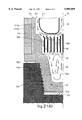
- FIG. 2 shows the detail "A" of FIG. 1
- FIG. 3 shows the longitudinal section of an electrode in an electric arc furnace using the cooling system in a second embodiment of the invention
- FIG. 4 shows the detail "B" of FIG. 3.
- the number 10 indicates the cooling system for electrodes 11 in D.C. electric arc furnaces.
- the electrode 11 functions as a cathode, it has a graphite part 11a above and a metallic part 11b below which also functions as a bearing element associated with its own means 12 to grip the electrode-bearing arm.
- the structure of the metallic part 11b is composed of two metallic jackets closely associated together one of which either 111b or 211b is made of copper or its alloys and the other of which 211b or 111b is made of iron or its alloys.
- This configuration of the metallic part 11b is advantageous in that it gives high characteristics of both mechanical resistence and also of electric conductivity; the metallic part 11b is, moreover, in its lower part, covered on the outside by a refractory layer 11c.
- the graphite part 11a and the metallic part 11b are associated together by means of a threaded joint 13, which has inside a hollow 14 filled with metal with a desired melting temperature.
- This hollow 14 cooperates with a circuit 20 containing the same metal and comprising a delivery channel 15 which develops along the inner side wall 111b of the metallic part 11b, a return channel 16 which develops in a central position with respect to the metallic part 11b, a hydromagnetic pump 17 communicating with the two channels 15, 16 and a heat exchanger 18 mounted outside on the metallic part 11b and associated with the delivery channel 15.
- the delivery channel 15 develops in an annular way, while the return channel 16 extends coaxially with respect to the metallic part 11b of the electrode.
- the heat developed inside the furnace causes the metal contained inside the hollow 14 and the circuit 20 to melt, in the event that this metal is in its solid state at ambient temperature.
- the metal is already in its liquid state at ambient temperature.
- the metal is in its solid state and is composed of little bearings or other granular bodies with a small dimension, which facilitates and accelerates the first melting step.
- the hydromagnetic pump 17 sucks in the melted metal from the return channel 16 and sends it, through the delivery channel 15, towards the heat exchanger 18 where this liquid metal gives up heat to the outer environment before reaching the hollow 14 (FIG. 1).
- the flow 21 of liquid metal along the delivery channel 15 causes the side walls 111b, 211b of the metallic part 11b to cool down.
- a laminar grid 19 which has on its periphery deflectors 19a positioned in such a way as to direct, at least partly, the flow 21 of the liquid metal arriving from the delivery channel 15 into the hollow 14 (FIG. 2).
- the laminar grid 19 has, in a central position, deflectors 19b positioned in such a way as to direct the flow 21 of liquid metal from the hollow 14 to the return channel 16.
- This direction of circulation of the flow 21 of liquid metal is opposite to the direction taken by the electric current and of the consequent flow of heat which from the graphite part 11a spreads towards the metallic part 11b mainly through the walls 13a of the joint 13.
- This mechanical stability is increased further by including a plate 22 made of a metal which melts at a low temperature, for example lead, between the lower face 13b of the joint 13 and the graphite part 11a. When the electric current passes through, this plate 22 melts, increases in volume and expands into the interstices 13c between the threads of the joint 13 and of the graphite part 11a.
- the joint 13 in order to limit the passage of the electric current and therefore the flow of heat in the peripheral areas of the electrode 11, the joint 13 has, in its outermost part, an air ring 13d to separate it from the graphite part 11a. Due to the presence of this air ring 13d, the electric current and the relative flow of heat spread mainly through the side walls 13a of the joint 13, therefore in the area of greatest efficiency of the cooling system 10.
- the hollow 14 does not communicate with the delivery channel 15 and return channel 16, it is separated from them by means of a separating wall 23, in this case solid with the joint 13.
- a separating wall 23 On this separating wall 23 there is a plurality of laminar diaphragms 24, made of a highly electroconductive material (such as copper), arranged substantially parallel to the longitudinal axis of the electrode 11 and, in this case, extending from the upper face 23a of the separation wall 23 up to the hollow 14.
- a conveyor insert 25 made of a highly electroconductive material (for example, copper).
- This conveyor insert 25 is of an elongate form and extends upwards inside the hollow 14; in correspondence with the outer side walls, it is lined with a layer of electrically insulated material 27.
- This configuration of the conveyor insert 25 causes the flow 26 of current to take a preferential path; from the graphite part 11a it spreads mainly through the conveyor insert 25 from one end to the other until, near the top 25a of the conveyor insert 25, it expands into the hollow 14.
- the system according to the invention is able to maintain substantially unchanged the characteristics of electroconductivity of the electrode 11 without causing imbalances with regards to the functionality of the electric furnace.
- the invention makes it possible to exploit intensively the effect of electromagnetic agitation of the cooling fluid as generated by the lines of electric current, the effect of which is exasperated by the geometric disposition of the parts.
Landscapes
- Engineering & Computer Science (AREA)
- Chemical & Material Sciences (AREA)
- Physics & Mathematics (AREA)
- General Engineering & Computer Science (AREA)
- Plasma & Fusion (AREA)
- Manufacturing & Machinery (AREA)
- Mechanical Engineering (AREA)
- Materials Engineering (AREA)
- Metallurgy (AREA)
- Organic Chemistry (AREA)
- Vertical, Hearth, Or Arc Furnaces (AREA)
- Furnace Details (AREA)
- Discharge Heating (AREA)
Applications Claiming Priority (2)
| Application Number | Priority Date | Filing Date | Title |
|---|---|---|---|
| IT96UD000182A IT1288991B1 (it) | 1996-09-27 | 1996-09-27 | Sistema di raffreddamento per elettrodi per forni elettrici ad arco in corrente continua |
| ITUD96A0182 | 1996-09-27 |
Publications (1)
| Publication Number | Publication Date |
|---|---|
| US5889809A true US5889809A (en) | 1999-03-30 |
Family
ID=11422195
Family Applications (1)
| Application Number | Title | Priority Date | Filing Date |
|---|---|---|---|
| US08/936,624 Expired - Fee Related US5889809A (en) | 1996-09-27 | 1997-09-24 | Cooling system for electrodes in D.C. electric arc furnaces |
Country Status (8)
| Country | Link |
|---|---|
| US (1) | US5889809A (it) |
| EP (1) | EP0834579A1 (it) |
| KR (1) | KR19980024985A (it) |
| AU (1) | AU719391B2 (it) |
| BR (1) | BR9702932A (it) |
| CA (1) | CA2216489A1 (it) |
| IT (1) | IT1288991B1 (it) |
| ZA (1) | ZA978429B (it) |
Cited By (4)
| Publication number | Priority date | Publication date | Assignee | Title |
|---|---|---|---|---|
| US20050189218A1 (en) * | 2004-02-27 | 2005-09-01 | Tao Qian | Cathodic arc coating apparatus |
| WO2013126143A1 (en) * | 2012-02-22 | 2013-08-29 | Clearsign Combustion Corporation | Cooled electrode and burner system including a cooled electrode |
| CN112313348A (zh) * | 2018-05-23 | 2021-02-02 | 米文缇有限责任公司 | 用于冶金电炉的冷却电极 |
| WO2025115807A1 (ja) * | 2023-11-30 | 2025-06-05 | 信越石英株式会社 | 電極装置及びその製造方法 |
Citations (5)
| Publication number | Priority date | Publication date | Assignee | Title |
|---|---|---|---|---|
| US3744780A (en) * | 1972-01-07 | 1973-07-10 | Applied Techn Corp | Method of treating molten material by use of a lance |
| US4646316A (en) * | 1984-06-27 | 1987-02-24 | Irsid | Electric connecting device for contacting a molten metallic mass |
| EP0223991A1 (de) * | 1985-11-27 | 1987-06-03 | Neue Hamburger Stahlwerke GmbH | Verfahren zur Kühlung von Sauerstoff-Einblasdüsen bei der Sauerstoffbehandlung von Roheisen oder Stahl |
| US5125003A (en) * | 1989-10-11 | 1992-06-23 | Francaise Institut De Recherches De La Siderurgie | Bottom electrode cooled sleeve for a metallurgical container |
| EP0682463A1 (en) * | 1994-05-11 | 1995-11-15 | DANIELI & C. OFFICINE MECCANICHE S.p.A. | Cooled bottom electrode for a direct current electric furnace |
-
1996
- 1996-09-27 IT IT96UD000182A patent/IT1288991B1/it active IP Right Grant
-
1997
- 1997-09-18 ZA ZA9708429A patent/ZA978429B/xx unknown
- 1997-09-18 EP EP97116228A patent/EP0834579A1/en not_active Withdrawn
- 1997-09-19 AU AU38367/97A patent/AU719391B2/en not_active Ceased
- 1997-09-24 US US08/936,624 patent/US5889809A/en not_active Expired - Fee Related
- 1997-09-25 CA CA002216489A patent/CA2216489A1/en not_active Abandoned
- 1997-09-26 KR KR1019970048890A patent/KR19980024985A/ko not_active Withdrawn
- 1997-09-29 BR BR9702932A patent/BR9702932A/pt not_active Application Discontinuation
Patent Citations (5)
| Publication number | Priority date | Publication date | Assignee | Title |
|---|---|---|---|---|
| US3744780A (en) * | 1972-01-07 | 1973-07-10 | Applied Techn Corp | Method of treating molten material by use of a lance |
| US4646316A (en) * | 1984-06-27 | 1987-02-24 | Irsid | Electric connecting device for contacting a molten metallic mass |
| EP0223991A1 (de) * | 1985-11-27 | 1987-06-03 | Neue Hamburger Stahlwerke GmbH | Verfahren zur Kühlung von Sauerstoff-Einblasdüsen bei der Sauerstoffbehandlung von Roheisen oder Stahl |
| US5125003A (en) * | 1989-10-11 | 1992-06-23 | Francaise Institut De Recherches De La Siderurgie | Bottom electrode cooled sleeve for a metallurgical container |
| EP0682463A1 (en) * | 1994-05-11 | 1995-11-15 | DANIELI & C. OFFICINE MECCANICHE S.p.A. | Cooled bottom electrode for a direct current electric furnace |
Non-Patent Citations (2)
| Title |
|---|
| Stahl Und Eisen, vol. 110, No. 8, Aug 14, 1990, Dusseldorf, DE pp. 91 98, XP000168123 Bullerschen K G et al: Kuehlung von Lichtbogenoffenelektroden Durch Waermerohre, p. 95 left hald column, paragrah 2; figures 1,2. * |
| Stahl Und Eisen, vol. 110, No. 8, Aug 14, 1990, Dusseldorf, DE pp. 91-98, XP000168123 Bullerschen K G et al: Kuehlung von Lichtbogenoffenelektroden Durch Waermerohre, p. 95 left-hald column, paragrah 2; figures 1,2. |
Cited By (7)
| Publication number | Priority date | Publication date | Assignee | Title |
|---|---|---|---|---|
| US20050189218A1 (en) * | 2004-02-27 | 2005-09-01 | Tao Qian | Cathodic arc coating apparatus |
| SG118232A1 (en) * | 2004-02-27 | 2006-06-27 | Superiorcoat Private Ltd | Cathodic arc coating apparatus |
| WO2013126143A1 (en) * | 2012-02-22 | 2013-08-29 | Clearsign Combustion Corporation | Cooled electrode and burner system including a cooled electrode |
| CN104136849A (zh) * | 2012-02-22 | 2014-11-05 | 克利尔赛恩燃烧公司 | 冷却电极以及包含冷却电极的燃烧器系统 |
| CN112313348A (zh) * | 2018-05-23 | 2021-02-02 | 米文缇有限责任公司 | 用于冶金电炉的冷却电极 |
| CN112313348B (zh) * | 2018-05-23 | 2022-05-13 | 米文缇有限责任公司 | 用于冶金电炉的电极 |
| WO2025115807A1 (ja) * | 2023-11-30 | 2025-06-05 | 信越石英株式会社 | 電極装置及びその製造方法 |
Also Published As
| Publication number | Publication date |
|---|---|
| KR19980024985A (ko) | 1998-07-06 |
| ITUD960182A1 (it) | 1998-03-27 |
| AU719391B2 (en) | 2000-05-11 |
| MX9707406A (es) | 1998-07-31 |
| ZA978429B (en) | 1998-03-26 |
| BR9702932A (pt) | 1998-12-22 |
| CA2216489A1 (en) | 1998-03-27 |
| IT1288991B1 (it) | 1998-09-25 |
| AU3836797A (en) | 1998-04-02 |
| EP0834579A1 (en) | 1998-04-08 |
Similar Documents
| Publication | Publication Date | Title |
|---|---|---|
| JPS6128914B2 (it) | ||
| US4754464A (en) | Bottom electrodes for arc furnaces | |
| US6294067B1 (en) | 3 component cathode collector bar | |
| US4125737A (en) | Electric arc furnace hearth connection | |
| US5889809A (en) | Cooling system for electrodes in D.C. electric arc furnaces | |
| US5287382A (en) | Wall electrode for a DC electric metallurgical furnace | |
| CA1068115A (en) | Method for steelmaking with direct current | |
| MXPA97007406A (en) | Cooling system for electrodes in hornosde electric arc electric current | |
| US6137822A (en) | Direct current arc furnace and a method for melting or heating raw material or molten material | |
| KR100259126B1 (ko) | 직류전기 아아크로용 라이닝 | |
| US5933445A (en) | Cooling system for cathodes in direct current electric arc furnaces | |
| CN115200026A (zh) | 一种熔融炉炉底加热装置 | |
| US3391237A (en) | Electrical contact system for ceramic electrodes | |
| US4532633A (en) | DC arc furnace improved hearth construction | |
| Harris et al. | Arc decomposition of rhodonite | |
| US3354256A (en) | Apparatus for heating molten metals | |
| DE4022720A1 (de) | Untergefaess eines gleichstromlichtbogenofens | |
| JPH11219781A (ja) | 直流アーク炉の炉底電極の冷却構造 | |
| US3145436A (en) | Focused electron-beam melting and casting | |
| RU2112187C1 (ru) | Подовый электрод электропечи | |
| CN218442300U (zh) | 一种熔融炉炉底加热装置 | |
| JPH0361318B2 (it) | ||
| US880743A (en) | Electric-furnace process. | |
| RU2285356C2 (ru) | Подовый электрод электропечи | |
| Voermann et al. | Improvements to Stillwater Mining Company's smelting furnace yielding increased capacity and productivity |
Legal Events
| Date | Code | Title | Description |
|---|---|---|---|
| AS | Assignment |
Owner name: DANIELI & C. OFFICINE MECCANICHE SPA, ITALY Free format text: ASSIGNMENT OF ASSIGNORS INTEREST;ASSIGNORS:PAVLICEVIC, MILORAD;KOLESNICHENKO, ANATOLY;DELLA NEGRA, ANGELICO;AND OTHERS;REEL/FRAME:008813/0893 Effective date: 19970905 |
|
| REMI | Maintenance fee reminder mailed | ||
| LAPS | Lapse for failure to pay maintenance fees | ||
| FP | Lapsed due to failure to pay maintenance fee |
Effective date: 20030330 |
|
| STCH | Information on status: patent discontinuation |
Free format text: PATENT EXPIRED DUE TO NONPAYMENT OF MAINTENANCE FEES UNDER 37 CFR 1.362 |