US5817409A - Fabric prepreg produced from such fabric, lightweight component from such prepregs, overhead baggage rack for aircraft - Google Patents
Fabric prepreg produced from such fabric, lightweight component from such prepregs, overhead baggage rack for aircraft Download PDFInfo
- Publication number
- US5817409A US5817409A US08/637,385 US63738596A US5817409A US 5817409 A US5817409 A US 5817409A US 63738596 A US63738596 A US 63738596A US 5817409 A US5817409 A US 5817409A
- Authority
- US
- United States
- Prior art keywords
- prepreg
- laminate
- wall members
- fabric
- layer
- Prior art date
- Legal status (The legal status is an assumption and is not a legal conclusion. Google has not performed a legal analysis and makes no representation as to the accuracy of the status listed.)
- Expired - Lifetime
Links
- 239000004744 fabric Substances 0.000 title claims abstract description 38
- 239000002759 woven fabric Substances 0.000 claims abstract description 36
- 239000004745 nonwoven fabric Substances 0.000 claims abstract description 35
- 239000000835 fiber Substances 0.000 claims abstract description 15
- OKTJSMMVPCPJKN-UHFFFAOYSA-N Carbon Chemical compound [C] OKTJSMMVPCPJKN-UHFFFAOYSA-N 0.000 claims description 19
- 229910052799 carbon Inorganic materials 0.000 claims description 19
- 239000000463 material Substances 0.000 claims description 19
- 238000010276 construction Methods 0.000 claims description 16
- 239000003365 glass fiber Substances 0.000 claims description 16
- 230000002787 reinforcement Effects 0.000 claims description 9
- 230000001070 adhesive effect Effects 0.000 claims description 7
- 239000000853 adhesive Substances 0.000 claims description 6
- 239000002131 composite material Substances 0.000 claims description 5
- 239000000725 suspension Substances 0.000 claims description 5
- 230000036961 partial effect Effects 0.000 claims description 3
- 238000003466 welding Methods 0.000 claims description 3
- 238000009827 uniform distribution Methods 0.000 claims 1
- 238000004519 manufacturing process Methods 0.000 abstract description 43
- 238000003490 calendering Methods 0.000 abstract description 15
- 230000005484 gravity Effects 0.000 abstract description 3
- 229920000049 Carbon (fiber) Polymers 0.000 abstract description 2
- 239000004917 carbon fiber Substances 0.000 abstract 1
- 239000010410 layer Substances 0.000 description 60
- 239000011162 core material Substances 0.000 description 27
- 229920005989 resin Polymers 0.000 description 22
- 239000011347 resin Substances 0.000 description 22
- 230000032798 delamination Effects 0.000 description 14
- 230000002829 reductive effect Effects 0.000 description 13
- 238000000034 method Methods 0.000 description 11
- 238000012545 processing Methods 0.000 description 10
- 238000005470 impregnation Methods 0.000 description 8
- 238000005192 partition Methods 0.000 description 8
- 230000008569 process Effects 0.000 description 8
- 239000002904 solvent Substances 0.000 description 8
- 238000000638 solvent extraction Methods 0.000 description 8
- 208000016261 weight loss Diseases 0.000 description 8
- 238000012360 testing method Methods 0.000 description 7
- 239000013585 weight reducing agent Substances 0.000 description 7
- LFQSCWFLJHTTHZ-UHFFFAOYSA-N Ethanol Chemical compound CCO LFQSCWFLJHTTHZ-UHFFFAOYSA-N 0.000 description 6
- 230000008901 benefit Effects 0.000 description 5
- 230000007704 transition Effects 0.000 description 5
- 241000264877 Hippospongia communis Species 0.000 description 4
- 239000011247 coating layer Substances 0.000 description 4
- 238000009434 installation Methods 0.000 description 4
- 229920001568 phenolic resin Polymers 0.000 description 4
- 239000005011 phenolic resin Substances 0.000 description 4
- 230000003014 reinforcing effect Effects 0.000 description 4
- 238000009941 weaving Methods 0.000 description 4
- 238000005452 bending Methods 0.000 description 3
- 239000011152 fibreglass Substances 0.000 description 3
- 239000011888 foil Substances 0.000 description 3
- 229920002620 polyvinyl fluoride Polymers 0.000 description 3
- 238000003860 storage Methods 0.000 description 3
- 238000012546 transfer Methods 0.000 description 3
- CSCPPACGZOOCGX-UHFFFAOYSA-N Acetone Chemical compound CC(C)=O CSCPPACGZOOCGX-UHFFFAOYSA-N 0.000 description 2
- WSFSSNUMVMOOMR-UHFFFAOYSA-N Formaldehyde Chemical compound O=C WSFSSNUMVMOOMR-UHFFFAOYSA-N 0.000 description 2
- 238000004026 adhesive bonding Methods 0.000 description 2
- 239000003575 carbonaceous material Substances 0.000 description 2
- 238000006243 chemical reaction Methods 0.000 description 2
- 238000012937 correction Methods 0.000 description 2
- 238000006073 displacement reaction Methods 0.000 description 2
- 239000003822 epoxy resin Substances 0.000 description 2
- 230000002349 favourable effect Effects 0.000 description 2
- 238000010438 heat treatment Methods 0.000 description 2
- 239000000203 mixture Substances 0.000 description 2
- 230000003287 optical effect Effects 0.000 description 2
- 229920000647 polyepoxide Polymers 0.000 description 2
- 230000000750 progressive effect Effects 0.000 description 2
- 230000009467 reduction Effects 0.000 description 2
- 238000004904 shortening Methods 0.000 description 2
- 239000007787 solid Substances 0.000 description 2
- 230000003068 static effect Effects 0.000 description 2
- 239000000126 substance Substances 0.000 description 2
- 229920003002 synthetic resin Polymers 0.000 description 2
- 239000000057 synthetic resin Substances 0.000 description 2
- 241000845082 Panama Species 0.000 description 1
- 230000006978 adaptation Effects 0.000 description 1
- 230000005540 biological transmission Effects 0.000 description 1
- 238000009835 boiling Methods 0.000 description 1
- 238000005253 cladding Methods 0.000 description 1
- 238000001816 cooling Methods 0.000 description 1
- 238000005516 engineering process Methods 0.000 description 1
- 239000002657 fibrous material Substances 0.000 description 1
- 239000012467 final product Substances 0.000 description 1
- LNEPOXFFQSENCJ-UHFFFAOYSA-N haloperidol Chemical compound C1CC(O)(C=2C=CC(Cl)=CC=2)CCN1CCCC(=O)C1=CC=C(F)C=C1 LNEPOXFFQSENCJ-UHFFFAOYSA-N 0.000 description 1
- 231100000206 health hazard Toxicity 0.000 description 1
- 230000006872 improvement Effects 0.000 description 1
- 238000011835 investigation Methods 0.000 description 1
- 230000000670 limiting effect Effects 0.000 description 1
- 238000003754 machining Methods 0.000 description 1
- 238000010309 melting process Methods 0.000 description 1
- VNWKTOKETHGBQD-UHFFFAOYSA-N methane Chemical compound C VNWKTOKETHGBQD-UHFFFAOYSA-N 0.000 description 1
- 230000004048 modification Effects 0.000 description 1
- 238000012986 modification Methods 0.000 description 1
- 230000035515 penetration Effects 0.000 description 1
- 238000006068 polycondensation reaction Methods 0.000 description 1
- 239000011877 solvent mixture Substances 0.000 description 1
- 239000007858 starting material Substances 0.000 description 1
- XLYOFNOQVPJJNP-UHFFFAOYSA-N water Substances O XLYOFNOQVPJJNP-UHFFFAOYSA-N 0.000 description 1
- 230000003313 weakening effect Effects 0.000 description 1
Images



Classifications
-
- B—PERFORMING OPERATIONS; TRANSPORTING
- B32—LAYERED PRODUCTS
- B32B—LAYERED PRODUCTS, i.e. PRODUCTS BUILT-UP OF STRATA OF FLAT OR NON-FLAT, e.g. CELLULAR OR HONEYCOMB, FORM
- B32B3/00—Layered products comprising a layer with external or internal discontinuities or unevennesses, or a layer of non-planar shape; Layered products comprising a layer having particular features of form
- B32B3/10—Layered products comprising a layer with external or internal discontinuities or unevennesses, or a layer of non-planar shape; Layered products comprising a layer having particular features of form characterised by a discontinuous layer, i.e. formed of separate pieces of material
- B32B3/12—Layered products comprising a layer with external or internal discontinuities or unevennesses, or a layer of non-planar shape; Layered products comprising a layer having particular features of form characterised by a discontinuous layer, i.e. formed of separate pieces of material characterised by a layer of regularly- arranged cells, e.g. a honeycomb structure
-
- B—PERFORMING OPERATIONS; TRANSPORTING
- B29—WORKING OF PLASTICS; WORKING OF SUBSTANCES IN A PLASTIC STATE IN GENERAL
- B29B—PREPARATION OR PRETREATMENT OF THE MATERIAL TO BE SHAPED; MAKING GRANULES OR PREFORMS; RECOVERY OF PLASTICS OR OTHER CONSTITUENTS OF WASTE MATERIAL CONTAINING PLASTICS
- B29B15/00—Pretreatment of the material to be shaped, not covered by groups B29B7/00 - B29B13/00
- B29B15/08—Pretreatment of the material to be shaped, not covered by groups B29B7/00 - B29B13/00 of reinforcements or fillers
- B29B15/10—Coating or impregnating independently of the moulding or shaping step
- B29B15/12—Coating or impregnating independently of the moulding or shaping step of reinforcements of indefinite length
- B29B15/122—Coating or impregnating independently of the moulding or shaping step of reinforcements of indefinite length with a matrix in liquid form, e.g. as melt, solution or latex
- B29B15/125—Coating or impregnating independently of the moulding or shaping step of reinforcements of indefinite length with a matrix in liquid form, e.g. as melt, solution or latex by dipping
-
- B—PERFORMING OPERATIONS; TRANSPORTING
- B29—WORKING OF PLASTICS; WORKING OF SUBSTANCES IN A PLASTIC STATE IN GENERAL
- B29C—SHAPING OR JOINING OF PLASTICS; SHAPING OF MATERIAL IN A PLASTIC STATE, NOT OTHERWISE PROVIDED FOR; AFTER-TREATMENT OF THE SHAPED PRODUCTS, e.g. REPAIRING
- B29C70/00—Shaping composites, i.e. plastics material comprising reinforcements, fillers or preformed parts, e.g. inserts
- B29C70/04—Shaping composites, i.e. plastics material comprising reinforcements, fillers or preformed parts, e.g. inserts comprising reinforcements only, e.g. self-reinforcing plastics
- B29C70/28—Shaping operations therefor
- B29C70/40—Shaping or impregnating by compression not applied
- B29C70/50—Shaping or impregnating by compression not applied for producing articles of indefinite length, e.g. prepregs, sheet moulding compounds [SMC] or cross moulding compounds [XMC]
-
- B—PERFORMING OPERATIONS; TRANSPORTING
- B32—LAYERED PRODUCTS
- B32B—LAYERED PRODUCTS, i.e. PRODUCTS BUILT-UP OF STRATA OF FLAT OR NON-FLAT, e.g. CELLULAR OR HONEYCOMB, FORM
- B32B37/00—Methods or apparatus for laminating, e.g. by curing or by ultrasonic bonding
- B32B37/14—Methods or apparatus for laminating, e.g. by curing or by ultrasonic bonding characterised by the properties of the layers
- B32B37/146—Methods or apparatus for laminating, e.g. by curing or by ultrasonic bonding characterised by the properties of the layers whereby one or more of the layers is a honeycomb structure
-
- B—PERFORMING OPERATIONS; TRANSPORTING
- B32—LAYERED PRODUCTS
- B32B—LAYERED PRODUCTS, i.e. PRODUCTS BUILT-UP OF STRATA OF FLAT OR NON-FLAT, e.g. CELLULAR OR HONEYCOMB, FORM
- B32B38/00—Ancillary operations in connection with laminating processes
- B32B38/08—Impregnating
-
- B—PERFORMING OPERATIONS; TRANSPORTING
- B32—LAYERED PRODUCTS
- B32B—LAYERED PRODUCTS, i.e. PRODUCTS BUILT-UP OF STRATA OF FLAT OR NON-FLAT, e.g. CELLULAR OR HONEYCOMB, FORM
- B32B5/00—Layered products characterised by the non- homogeneity or physical structure, i.e. comprising a fibrous, filamentary, particulate or foam layer; Layered products characterised by having a layer differing constitutionally or physically in different parts
- B32B5/02—Layered products characterised by the non- homogeneity or physical structure, i.e. comprising a fibrous, filamentary, particulate or foam layer; Layered products characterised by having a layer differing constitutionally or physically in different parts characterised by structural features of a fibrous or filamentary layer
- B32B5/024—Woven fabric
-
- B—PERFORMING OPERATIONS; TRANSPORTING
- B32—LAYERED PRODUCTS
- B32B—LAYERED PRODUCTS, i.e. PRODUCTS BUILT-UP OF STRATA OF FLAT OR NON-FLAT, e.g. CELLULAR OR HONEYCOMB, FORM
- B32B5/00—Layered products characterised by the non- homogeneity or physical structure, i.e. comprising a fibrous, filamentary, particulate or foam layer; Layered products characterised by having a layer differing constitutionally or physically in different parts
- B32B5/22—Layered products characterised by the non- homogeneity or physical structure, i.e. comprising a fibrous, filamentary, particulate or foam layer; Layered products characterised by having a layer differing constitutionally or physically in different parts characterised by the presence of two or more layers which are next to each other and are fibrous, filamentary, formed of particles or foamed
- B32B5/24—Layered products characterised by the non- homogeneity or physical structure, i.e. comprising a fibrous, filamentary, particulate or foam layer; Layered products characterised by having a layer differing constitutionally or physically in different parts characterised by the presence of two or more layers which are next to each other and are fibrous, filamentary, formed of particles or foamed one layer being a fibrous or filamentary layer
- B32B5/26—Layered products characterised by the non- homogeneity or physical structure, i.e. comprising a fibrous, filamentary, particulate or foam layer; Layered products characterised by having a layer differing constitutionally or physically in different parts characterised by the presence of two or more layers which are next to each other and are fibrous, filamentary, formed of particles or foamed one layer being a fibrous or filamentary layer another layer next to it also being fibrous or filamentary
-
- B—PERFORMING OPERATIONS; TRANSPORTING
- B32—LAYERED PRODUCTS
- B32B—LAYERED PRODUCTS, i.e. PRODUCTS BUILT-UP OF STRATA OF FLAT OR NON-FLAT, e.g. CELLULAR OR HONEYCOMB, FORM
- B32B7/00—Layered products characterised by the relation between layers; Layered products characterised by the relative orientation of features between layers, or by the relative values of a measurable parameter between layers, i.e. products comprising layers having different physical, chemical or physicochemical properties; Layered products characterised by the interconnection of layers
- B32B7/04—Interconnection of layers
- B32B7/12—Interconnection of layers using interposed adhesives or interposed materials with bonding properties
-
- B—PERFORMING OPERATIONS; TRANSPORTING
- B64—AIRCRAFT; AVIATION; COSMONAUTICS
- B64D—EQUIPMENT FOR FITTING IN OR TO AIRCRAFT; FLIGHT SUITS; PARACHUTES; ARRANGEMENT OR MOUNTING OF POWER PLANTS OR PROPULSION TRANSMISSIONS IN AIRCRAFT
- B64D11/00—Passenger or crew accommodation; Flight-deck installations not otherwise provided for
- B64D11/003—Stowage devices for passengers' personal luggage
-
- B—PERFORMING OPERATIONS; TRANSPORTING
- B29—WORKING OF PLASTICS; WORKING OF SUBSTANCES IN A PLASTIC STATE IN GENERAL
- B29K—INDEXING SCHEME ASSOCIATED WITH SUBCLASSES B29B, B29C OR B29D, RELATING TO MOULDING MATERIALS OR TO MATERIALS FOR MOULDS, REINFORCEMENTS, FILLERS OR PREFORMED PARTS, e.g. INSERTS
- B29K2063/00—Use of EP, i.e. epoxy resins or derivatives thereof, as moulding material
-
- B—PERFORMING OPERATIONS; TRANSPORTING
- B29—WORKING OF PLASTICS; WORKING OF SUBSTANCES IN A PLASTIC STATE IN GENERAL
- B29L—INDEXING SCHEME ASSOCIATED WITH SUBCLASS B29C, RELATING TO PARTICULAR ARTICLES
- B29L2024/00—Articles with hollow walls
-
- B—PERFORMING OPERATIONS; TRANSPORTING
- B32—LAYERED PRODUCTS
- B32B—LAYERED PRODUCTS, i.e. PRODUCTS BUILT-UP OF STRATA OF FLAT OR NON-FLAT, e.g. CELLULAR OR HONEYCOMB, FORM
- B32B2260/00—Layered product comprising an impregnated, embedded, or bonded layer wherein the layer comprises an impregnation, embedding, or binder material
- B32B2260/02—Composition of the impregnated, bonded or embedded layer
- B32B2260/021—Fibrous or filamentary layer
-
- B—PERFORMING OPERATIONS; TRANSPORTING
- B32—LAYERED PRODUCTS
- B32B—LAYERED PRODUCTS, i.e. PRODUCTS BUILT-UP OF STRATA OF FLAT OR NON-FLAT, e.g. CELLULAR OR HONEYCOMB, FORM
- B32B2260/00—Layered product comprising an impregnated, embedded, or bonded layer wherein the layer comprises an impregnation, embedding, or binder material
- B32B2260/04—Impregnation, embedding, or binder material
- B32B2260/046—Synthetic resin
-
- B—PERFORMING OPERATIONS; TRANSPORTING
- B32—LAYERED PRODUCTS
- B32B—LAYERED PRODUCTS, i.e. PRODUCTS BUILT-UP OF STRATA OF FLAT OR NON-FLAT, e.g. CELLULAR OR HONEYCOMB, FORM
- B32B2262/00—Composition or structural features of fibres which form a fibrous or filamentary layer or are present as additives
- B32B2262/10—Inorganic fibres
- B32B2262/101—Glass fibres
-
- B—PERFORMING OPERATIONS; TRANSPORTING
- B32—LAYERED PRODUCTS
- B32B—LAYERED PRODUCTS, i.e. PRODUCTS BUILT-UP OF STRATA OF FLAT OR NON-FLAT, e.g. CELLULAR OR HONEYCOMB, FORM
- B32B2305/00—Condition, form or state of the layers or laminate
- B32B2305/02—Cellular or porous
- B32B2305/024—Honeycomb
-
- B—PERFORMING OPERATIONS; TRANSPORTING
- B32—LAYERED PRODUCTS
- B32B—LAYERED PRODUCTS, i.e. PRODUCTS BUILT-UP OF STRATA OF FLAT OR NON-FLAT, e.g. CELLULAR OR HONEYCOMB, FORM
- B32B2439/00—Containers; Receptacles
-
- Y—GENERAL TAGGING OF NEW TECHNOLOGICAL DEVELOPMENTS; GENERAL TAGGING OF CROSS-SECTIONAL TECHNOLOGIES SPANNING OVER SEVERAL SECTIONS OF THE IPC; TECHNICAL SUBJECTS COVERED BY FORMER USPC CROSS-REFERENCE ART COLLECTIONS [XRACs] AND DIGESTS
- Y02—TECHNOLOGIES OR APPLICATIONS FOR MITIGATION OR ADAPTATION AGAINST CLIMATE CHANGE
- Y02T—CLIMATE CHANGE MITIGATION TECHNOLOGIES RELATED TO TRANSPORTATION
- Y02T50/00—Aeronautics or air transport
- Y02T50/40—Weight reduction
-
- Y—GENERAL TAGGING OF NEW TECHNOLOGICAL DEVELOPMENTS; GENERAL TAGGING OF CROSS-SECTIONAL TECHNOLOGIES SPANNING OVER SEVERAL SECTIONS OF THE IPC; TECHNICAL SUBJECTS COVERED BY FORMER USPC CROSS-REFERENCE ART COLLECTIONS [XRACs] AND DIGESTS
- Y10—TECHNICAL SUBJECTS COVERED BY FORMER USPC
- Y10T—TECHNICAL SUBJECTS COVERED BY FORMER US CLASSIFICATION
- Y10T428/00—Stock material or miscellaneous articles
- Y10T428/13—Hollow or container type article [e.g., tube, vase, etc.]
- Y10T428/131—Glass, ceramic, or sintered, fused, fired, or calcined metal oxide or metal carbide containing [e.g., porcelain, brick, cement, etc.]
- Y10T428/1317—Multilayer [continuous layer]
-
- Y—GENERAL TAGGING OF NEW TECHNOLOGICAL DEVELOPMENTS; GENERAL TAGGING OF CROSS-SECTIONAL TECHNOLOGIES SPANNING OVER SEVERAL SECTIONS OF THE IPC; TECHNICAL SUBJECTS COVERED BY FORMER USPC CROSS-REFERENCE ART COLLECTIONS [XRACs] AND DIGESTS
- Y10—TECHNICAL SUBJECTS COVERED BY FORMER USPC
- Y10T—TECHNICAL SUBJECTS COVERED BY FORMER US CLASSIFICATION
- Y10T428/00—Stock material or miscellaneous articles
- Y10T428/13—Hollow or container type article [e.g., tube, vase, etc.]
- Y10T428/131—Glass, ceramic, or sintered, fused, fired, or calcined metal oxide or metal carbide containing [e.g., porcelain, brick, cement, etc.]
- Y10T428/1317—Multilayer [continuous layer]
- Y10T428/1321—Polymer or resin containing [i.e., natural or synthetic]
-
- Y—GENERAL TAGGING OF NEW TECHNOLOGICAL DEVELOPMENTS; GENERAL TAGGING OF CROSS-SECTIONAL TECHNOLOGIES SPANNING OVER SEVERAL SECTIONS OF THE IPC; TECHNICAL SUBJECTS COVERED BY FORMER USPC CROSS-REFERENCE ART COLLECTIONS [XRACs] AND DIGESTS
- Y10—TECHNICAL SUBJECTS COVERED BY FORMER USPC
- Y10T—TECHNICAL SUBJECTS COVERED BY FORMER US CLASSIFICATION
- Y10T428/00—Stock material or miscellaneous articles
- Y10T428/19—Sheets or webs edge spliced or joined
- Y10T428/192—Sheets or webs coplanar
- Y10T428/195—Beveled, stepped, or skived in thickness
-
- Y—GENERAL TAGGING OF NEW TECHNOLOGICAL DEVELOPMENTS; GENERAL TAGGING OF CROSS-SECTIONAL TECHNOLOGIES SPANNING OVER SEVERAL SECTIONS OF THE IPC; TECHNICAL SUBJECTS COVERED BY FORMER USPC CROSS-REFERENCE ART COLLECTIONS [XRACs] AND DIGESTS
- Y10—TECHNICAL SUBJECTS COVERED BY FORMER USPC
- Y10T—TECHNICAL SUBJECTS COVERED BY FORMER US CLASSIFICATION
- Y10T428/00—Stock material or miscellaneous articles
- Y10T428/19—Sheets or webs edge spliced or joined
- Y10T428/192—Sheets or webs coplanar
- Y10T428/197—Sheets or webs coplanar with noncoplanar reinforcement
-
- Y—GENERAL TAGGING OF NEW TECHNOLOGICAL DEVELOPMENTS; GENERAL TAGGING OF CROSS-SECTIONAL TECHNOLOGIES SPANNING OVER SEVERAL SECTIONS OF THE IPC; TECHNICAL SUBJECTS COVERED BY FORMER USPC CROSS-REFERENCE ART COLLECTIONS [XRACs] AND DIGESTS
- Y10—TECHNICAL SUBJECTS COVERED BY FORMER USPC
- Y10T—TECHNICAL SUBJECTS COVERED BY FORMER US CLASSIFICATION
- Y10T428/00—Stock material or miscellaneous articles
- Y10T428/24—Structurally defined web or sheet [e.g., overall dimension, etc.]
- Y10T428/24149—Honeycomb-like
-
- Y—GENERAL TAGGING OF NEW TECHNOLOGICAL DEVELOPMENTS; GENERAL TAGGING OF CROSS-SECTIONAL TECHNOLOGIES SPANNING OVER SEVERAL SECTIONS OF THE IPC; TECHNICAL SUBJECTS COVERED BY FORMER USPC CROSS-REFERENCE ART COLLECTIONS [XRACs] AND DIGESTS
- Y10—TECHNICAL SUBJECTS COVERED BY FORMER USPC
- Y10T—TECHNICAL SUBJECTS COVERED BY FORMER US CLASSIFICATION
- Y10T428/00—Stock material or miscellaneous articles
- Y10T428/24—Structurally defined web or sheet [e.g., overall dimension, etc.]
- Y10T428/24149—Honeycomb-like
- Y10T428/24165—Hexagonally shaped cavities
-
- Y—GENERAL TAGGING OF NEW TECHNOLOGICAL DEVELOPMENTS; GENERAL TAGGING OF CROSS-SECTIONAL TECHNOLOGIES SPANNING OVER SEVERAL SECTIONS OF THE IPC; TECHNICAL SUBJECTS COVERED BY FORMER USPC CROSS-REFERENCE ART COLLECTIONS [XRACs] AND DIGESTS
- Y10—TECHNICAL SUBJECTS COVERED BY FORMER USPC
- Y10T—TECHNICAL SUBJECTS COVERED BY FORMER US CLASSIFICATION
- Y10T428/00—Stock material or miscellaneous articles
- Y10T428/24—Structurally defined web or sheet [e.g., overall dimension, etc.]
- Y10T428/24479—Structurally defined web or sheet [e.g., overall dimension, etc.] including variation in thickness
- Y10T428/24562—Interlaminar spaces
-
- Y—GENERAL TAGGING OF NEW TECHNOLOGICAL DEVELOPMENTS; GENERAL TAGGING OF CROSS-SECTIONAL TECHNOLOGIES SPANNING OVER SEVERAL SECTIONS OF THE IPC; TECHNICAL SUBJECTS COVERED BY FORMER USPC CROSS-REFERENCE ART COLLECTIONS [XRACs] AND DIGESTS
- Y10—TECHNICAL SUBJECTS COVERED BY FORMER USPC
- Y10T—TECHNICAL SUBJECTS COVERED BY FORMER US CLASSIFICATION
- Y10T428/00—Stock material or miscellaneous articles
- Y10T428/24—Structurally defined web or sheet [e.g., overall dimension, etc.]
- Y10T428/24942—Structurally defined web or sheet [e.g., overall dimension, etc.] including components having same physical characteristic in differing degree
- Y10T428/24992—Density or compression of components
-
- Y—GENERAL TAGGING OF NEW TECHNOLOGICAL DEVELOPMENTS; GENERAL TAGGING OF CROSS-SECTIONAL TECHNOLOGIES SPANNING OVER SEVERAL SECTIONS OF THE IPC; TECHNICAL SUBJECTS COVERED BY FORMER USPC CROSS-REFERENCE ART COLLECTIONS [XRACs] AND DIGESTS
- Y10—TECHNICAL SUBJECTS COVERED BY FORMER USPC
- Y10T—TECHNICAL SUBJECTS COVERED BY FORMER US CLASSIFICATION
- Y10T428/00—Stock material or miscellaneous articles
- Y10T428/26—Web or sheet containing structurally defined element or component, the element or component having a specified physical dimension
- Y10T428/263—Coating layer not in excess of 5 mils thick or equivalent
-
- Y—GENERAL TAGGING OF NEW TECHNOLOGICAL DEVELOPMENTS; GENERAL TAGGING OF CROSS-SECTIONAL TECHNOLOGIES SPANNING OVER SEVERAL SECTIONS OF THE IPC; TECHNICAL SUBJECTS COVERED BY FORMER USPC CROSS-REFERENCE ART COLLECTIONS [XRACs] AND DIGESTS
- Y10—TECHNICAL SUBJECTS COVERED BY FORMER USPC
- Y10T—TECHNICAL SUBJECTS COVERED BY FORMER US CLASSIFICATION
- Y10T428/00—Stock material or miscellaneous articles
- Y10T428/26—Web or sheet containing structurally defined element or component, the element or component having a specified physical dimension
- Y10T428/263—Coating layer not in excess of 5 mils thick or equivalent
- Y10T428/264—Up to 3 mils
Definitions
- the invention relates to a woven or non-woven fabric for the manufacture of prepregs, serving specifically for the manufacture of components in the aircraft industry, a prepreg manufactured from such woven or non-woven fabric, a process for its manufacture, a lightweight component which is to be used particularly in the aircraft industry and a container manufactured with the use of such lightweight component, more specifically an overhead baggage storage rack for aircraft.
- U.S. Pat. No. 3,859,158 describes a belt of open fabric of fibrous materials wherein the fibres by recalculation are found to have an elasticity modulus of more than 275500 E/mm 2 and the composite articles manufactured from the thus described belt attain specific gravities of 0,4 to 1,4 g/cm.
- the composite articles manufactured from the thus described belt attain specific gravities of 0,4 to 1,4 g/cm.
- no directions are given how to obtain a construction of composite parts which is particularly capable of withstanding high mechanical stresses whilst preserving the lightweight construction characteristics, and in particular not in connection with applications in the aviation industry.
- a woven or non-woven fabric for example of unidirectional fibres side by side which optionally may be secured against mutual displacement merely by some kind of stitching, which combined with high strength offers low weight and in addition can be manufactured simply and economically and which is suitable particularly for the manufacture of materials, in particular lightweight components for the aircraft industry.
- a second object resided in finding, for this field of application, a starting material, specifically in the form of a pre-impregnated woven or non-woven fabric (pre-impregnated fabric known for short as prepreg), for the manufacture of a variety of light, and in spite of that very solid components and structural parts for the aircraft industry or for the manufacture of accessories in that field.
- a starting material specifically in the form of a pre-impregnated woven or non-woven fabric (pre-impregnated fabric known for short as prepreg)
- a further object of the present invention was the proposal of an advantageous process for processing the woven or non-woven fabric and for the manufacture of a pre-impregnated woven or non-woven fabric as well as suitable measures and parameters for the manufacture of a lightweight structural element.
- a further object was the construction of a container of reduced weight and nevertheless complying with the demanded strength requirements for use on board aircraft and more specifically for overhead baggage compartments.
- all other containers such as for example trolleys, suitcases, boxes etc., are likewise included.
- the weight aimed at of the raw woven or non-woven fabric, given without a resin component, should be as low as possible. This can be adjusted, apart from by employing the prescribed fibre thickness of preferably 3000 mono-filaments and the thereby defined material weight, also by the number of the threads per length or surface area (cm 2 ) of the woven or non-woven fabric.
- the object of having as little as possible weight per surface area can advantageously be attained by a so-called "open fabric", in which between the individual yarns uniform distances are maintained.
- a number of 3,71 ⁇ 5% threads per cm or 3,71 ⁇ 3,71 threads per cm 2 was found to be particularly suitable having regard to the additional fabric parameters to be disclosed further below.
- the raw weight of the woven or non-woven fabric which includes only the weight per surface area of the processed, preferably woven carbon fibres without resin content, is less than 190 g/m 2 , preferably between 170 and 150 g/m 2 , specifically 150+5/-2 g/m 2 .
- weave types in which the weft yarn floats over two or more warp threads there may, if necessary, be attained even better mechanical properties such as bending and tensile strength as compared with the plain weave.
- the lower drapability in the case of a plain weave as compared with other weaves, for example Panama, Koepper or Atlas weaves is of no disadvantageous significance in the context of the special application in the aircraft industry and accordingly required no correction by other weaving parameters.
- the reduced contact area necessitated by the need of an "open" woven or non-woven fabric having, relatively large yarn spacings and the reduction of both the bonding area as well as the mechanical properties dictated by the largest possible interweaving frequency, is counteracted advantageously according to the invention by a suitable selection of the type and amount of curable synthetic resin (duroplastics) for impregnating the woven or non-woven fabric.
- the second object of the invention was attained specifically by a slight increase of the resin content as compared with conventional materials for comparable applications, wherein the resin content, which also includes the volatile components derived from the solvent impregnation, is held between 37% and 55%, preferably between 46% and 50% more specifically at 47%.
- the slight increase according to the invention of the average resin content above 37% is more than compensated for by the weight reduction of the raw fabric.
- the pre-impregnated fabrics can be manufactured having a weight of less than 300 g/m 2 , ideally about 270 g/m 2 but not less than 250 g/m 2 , so that it finally becomes possible to attain in the complete component a weight reduction of between 20 and 35%.
- phenolic resins optionally of epoxy resin, with an H-type solvent (90% ethanol and 10% acetone), preferably an HE-type solvent (100% ethanol) is provided for, which also, compared with conventional prepreg systems, comprise a reduced content of free formaldehyd.
- Phenolic resins besides their low creep tendency, also have high configurational stability in hot conditions and good resistance against chemicals, and, specifically for use in aircraft interiors, offer the advantage of low flammability.
- the selection and amount of the solvent used for impregnating influences very substantially the processability of the materials by changing the tackiness as well as the kind, instant and amount of volatile components produced.
- the content of volatile components which, however, in the case of phenolic resins also includes the water component produced during the polycondensation, lies ideally below the maximum of 9%.
- the most advantageous solution is found with solvents on an ethanol basis (HE) and which ensure good processability--because of the higher boiling point (period of production of the volatile components)--and tackiness as well as a lower health hazard, even though other solvents (H) as well ensure the processability of the impregnated woven or non-woven fabric as well as the properties in use of the components manufactured from these woven or non-woven fabrics.
- HE ethanol basis
- the process for the manufacture of a prepreg is characterised according to the invention by the impregnation of a woven or non-woven fabric, preferably a woven or non-woven fabric in one of the above described embodiments with a curable synthetic resin and by calendering the woven or non-woven fabric after or even during the impregnation, optionally also between two impregnation steps.
- this processing step is also particularly advantageous for visible surfaces of structural components for the aircraft interior.
- the impregnation which precedes the or each calendering step preferably takes place with a resin content higher than that required for the final product, which is then reduced by the subsequent calendering of the woven or non-woven fabric with simultaneous flattening of the fibres thereof.
- the third object is attained by the creation of a light structural component, in particular a panel for the aircraft industry, for example for use as a wall panel, building panel or the like, comprising at least one core, preferably composed of a honeycomb material, extending over the predominating portion of the surface area of the structural component and at least one coating layer on both sides of the or each core, which is characterised in that at least one of the coating layers, preferably both coating layers comprise(s) a laminate, preferably employing a woven or non-woven fabric according to any one of the above described embodiments which, by means of an adhesive, is bonded to the core or a prepreg according to one of the above paragraphs.
- the additional prepreg or laminate layers are preferably provided directly on the core material underneath the or each covering layer.
- At least one additional prepreg laminate layer of glass fibre fabric is provided on that side of the covering layer which faces away from the core in positions in which bores or recesses must be provided.
- a container composed of plane end and where appropriate partitioning walls as well as a bent or buckled component forming at least part of the side walls or cabinet surround, characterised in that the end and/or the partitioning walls and/or the component forming the cabinet surround have been manufactured as a sandwich structure and are constructed of fibre composite components in accordance with the aforedescribed lightweight components.
- a honeycomb material is employed as the core material which preferably has a hexagonal structure and a bulk density of less than 60 kg/ 3 .
- the component constituting the side walls or cabinet surround is connected at least in a limited region of the circumference of the end and/or partitioning walls by overlapping of the prepregs or laminates and in another partial region of the circumference of the plane end and/or partitioning walls by means of a subsequently produced connection, preferably a screw connection, adhesive connection or welding connection.
- This additional layer or layers provided preferably below the one or more covering layer(s), preferably directly on the core material, due to locally increased rigidity as well as by increasing the resin content and the resulting enlargement of the surface contributing to carrying the load, both between the individual layers as well as between the laminate forming the covering layer and the core, lend an adequate strength to the positions particularly endangered by peak loading so that the loads occurring even in extreme conditions, i.e. during critical flight conditions, are withstood.
- an additional laminate or prepreg layer preferably of fibre glass fabric is to be provided for improved protection against delamination in positions at which bores or other rebates have to be provided for, in such a manner that the marginal zones remaining on or in the component are covered to an adequate extent to appropriately resist the reaction forces applied during processing.
- such layer is advantageously so placed that it comes to lie on the side facing the processing tool, in the special case of the outside of the container, as a covering layer of the laminate; although an application on the side facing the core, i.e. between the covering layer and the core is possible, this necessitates a less optimal adaptation of the processing parameters.
- these regions are specially prepared by a layer of laminate or prepreg, a glass fibre material being ideally used in this special case.
- the overhead baggage compartment comprising the container according to the invention which in accordance with the preceding paragraphs is constructed of two plane, essentially trapezoidally-shaped end walls, a partition wall or stiffening or partitioning rib subsequently applied in the interior of the container and a monolithic constructional part forming the surround, is characterised in that the component in the region of bores in the end walls close to an upper corner point and close to the laminate layer forming the covering layer of the container, which serve for the suspension of the container, is reinforced by three to five, preferably four additional layers of carbon laminate or carbon prepregs.
- a reinforcement element passes between the lower and rear most wall section of the component forming the surround, and at least in the region of this reinforcement element an additional carbon prepreg or laminate is provided covering this element and preferably extending so far into the laminate proper, in a constructional sense into the space between the covering layer and the core, that applied forces will be withstood and the application of these forces takes place over a larger area so as to provide the container with additional stability.
- a reinforcement element extends at the level of the partition or stiffening rib between the lower and the rear wall section of the component and at least one layer of carbon prepreg or laminate is provided covering this reinforcement element, which layer is preferably selected sufficiently large that the ends thereof on the rear and the lower wall section are equi-distantly removed from the lower edge of the structural component. In this manner the forces arising are uniformly applied to the structural component.
- a patch of carbon prepreg in accordance with the above described pre-impregnated fabric is applied which is at least so large that it passes the regions of maximum force application, yet at least beyond the regions of the fastening means, e.g. screws or adhesive bonding positions in such a manner that the tension arising during loading can be reduced to a minimum and no delaminations between the covering layers and core arise. From a production point of view it appears advantageous that this additional layer of carbon is applied in direct contact with the core although, for reasons of strength and stability, any other sequence is conceivable as well.
- FIG. 1 illustrates some fabric types which may be used for the manufacture of the prepregs in accordance with the invention.
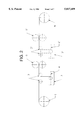
- FIG. 2 shows schematically an advantageous production process for the prepreg according to the invention.
- FIG. 3 shows the structure of an embodiment of a lightweight structural component according to the invention as can be used also for the manufacture of containers or the like for aviation.
- FIG. 4 a schematic perspective view of an overhead luggage rack for aircraft is shown as an example of a container according to the invention, preferably composed of wall elements having the structure of FIG. 3.
- FIG. 5 represents a section through a luggage rack according to FIG. 4.
- FIG. 6 is a perspective schematic illustration of the luggage rack showing the positions of additional reinforcing layers of prepregs and
- FIG. 7 represents schematically on a larger scale the suspension region of the luggage rack.
- FIG. 1 a plurality of weave types are illustrated which besides or in combination with non-woven fabrics can be used for the manufacture of prepregs.
- the individual yarns or threads of the woven or non-woven fabric are composed of materials of high strength i.e. with an elasticity modulus, E, greater than 80 000 n/mm 2 , preferably manufactured of carbon fibres with E ⁇ or greater than about 200 000 N/mm 2 and yet of low weight (1,75 g/cm 3 as compared with glass fibres at 2,5 g/cm 2 ), wherein each thread is advantageously made of 3000 mono-filaments corresponding to about 200 g/1000 m.
- E elasticity modulus
- FIG. 1a represents a plain weave which according to the invention is preferably used, which offers the highest resistance against fraying when being cut to size and the highest dimensional stability during handling.
- FIG. 1b shows the so-called Koepper weave ("Twill"). This weave is characterised by greater strength and rigidity of the laminate due to its reduced thread deflection and by better draping ability.
- FIG. 1c shows the Atlas weave which, because of its very low thread deflection, is characterised by particularly good draping ability and also because of the very good surface textures attainable can be used for pronounced spherical and visible components.
- the number of threads per unit of surface area is reduced as much as possible to the extent permitted by the required mechanical properties of the component to be manufactured therefrom which in practice is preferably determined by various tests.
- the weight per surface area of the fabric is reduced to 170 g/m 2 and even to 150 g/m 2 which then results in a value of 3,71 ⁇ 5% threads per cm weft or warp thread.
- FIG. 2 a diagrammatic representation of an advantageous manufacturing method for a prepreg material, further properties of the woven fabric and the prepreg manufactured therefrom become apparent.
- the dry fabric 1, optionally already calendered, is passed by way of rollers 2 through a bath in which the fabric 1 is impregnated with a mixture 4 of resin and solvent--being of the H-type or more appropriately of the HE-type, the processing speed and the further process parameters, advantageously determined by practical testing, are so adjusted that the resin content, in this case preferably phenolic resins, however, optionally also epoxy resins, are advantageously somewhat larger after the bath 3 than the required resin content for the completed prepregs.
- the resin content in this case preferably phenolic resins, however, optionally also epoxy resins
- the impregnated woven fabric is passed to rollers 5 in which the fabric is calendered and thereby the threads as well are pressed flat, or alternatively only the thickness of the resin layer can be adjusted by part of the resin/solvent mixture being squeezed out again.
- a further impregnation step in a bath 3' may take place with the same or a different solvent/resin mixture 4', whereafter the again impregnated fabric is passed to a further set of rollers 5'.
- the prepregs are ready for further processing. They preferably now comprise a resin content--including the volatile solvent component--of 46 to 50%.
- the described expedient according to which the individual fibres of the woven or non-woven fabric are pressed flat, preferably calendered, whereby the gaps in the fabric or non-woven fabric become closed, is particularly advantageous. Because later on the surface impregnated with resin, the contact area of the threads one to the other and to the adjoining layers, the interlaminar contact area is enlarged, it is possible to substantially improve on the one hand the processability, essentially characterised by the adhesiveness and thus by the adhesion during the manufacture of a light structural component, and on the other hand also the static load-bearing capacity, characterised by the adhesion of the prepreg layers in the cured condition.
- the prepregs can of course also be manufactured in a melting process wherein it is necessary that the fabric during the process is likewise calendered or that, as described before, a pre-calendered fabric is employed.
- FIG. 3 the construction of a light structural component is schematically shown as is used for the manufacture of containers in the aviation field, for example for overhead luggage racks, suitcases, boxes or the like but also as a cladding component for example as an interior panel.
- a core material 10 preferably, because of its favourable strength to weight ratio, a honeycomb material having honeycombs orientated normal to the direction of main loading, a prepreg 11 according to the invention is applied to each side as a covering layer, preferably being composed of carbon fibre fabric of low weight per surface area and having an appropriately adapted resin content. Due to the lesser thickness of the carbon material as compared with glass fibre materials and for further increasing the strength, an increase of the thickness of the core material as compared with comparable sandwich constructions has been carried out.
- an additional layer of prepreg material 12 as illustrated in FIG. 3, advantageously a light glass fibre prepreg, may be applied, locally restricted to one or even both sides onto the cover layer 11, in order to increase the resin content (content per surface area) in that region and to ensure the bonding of the individual layers respectively the yarns to one another by a reduced mesh width of the intermediate or final layer.
- the visible surface is formed by a foil or panel 13 optically covering and protecting the layers there below, more specifically by a Tedlar foil.
- the mechanical protection against the penetration or knocking of objects into the inner, main loading-bearing covering layer of carbon fabric, is provided by a light layer of glass fibre fabric.
- a special application example is the overhead luggage rack illustrated schematically in FIG. 4. It is composed of plane end walls 20 monolithically manufactured together with a component 21 constituting the cabinet surround and thus connected thereto in one operation.
- This component 21 together with the end walls is formed of a wall section 21a opened against the installation orientation, a rear wall 21b extending at an incline to the rear and downwardly, the essentially vertically downwardly extending rear wall section 21c as well as the bottom 21d of the luggage rack.
- the front may be closed by a flap which is not illustrated here and which essentially is optionally formed, however, advantageously is made as a lightweight component likewise according to the present invention and is subsequently fitted to the container or may be manufactured integrally with the latter, more specifically with the component 21 forming the surround.
- this special container the component forming it, prepregs and pre-cut core panels are suitably applied onto a mould and fixed by pressure panels in the vacuum process. Thereafter the curing of the assembly proceeds at increased external pressure and temperature in an appropriate plant, e.g. an autoclave.
- the then predominating process parameters are to be selected such that on the one hand the greatest possible resin flow is attained and thereby the optimum connection between the core and the covering layer, and also that the volatile components which may be formed during the curing reaction can be transported away in the best possible manner.
- At least one bore 22 each is provided in the transition region, that is to say exactly at the curvature of the rest position of a construction designed as a movable connection (with core material) between the upper wall 21a and the rear wall 21b, at least one bore 22, for suspending the container from the inner structure of the aircraft.
- a further fixing point is positioned in the middle of the luggage rack, where the screw connection elements are connected by a suitable aperture, bore 25 which preferably is reinforced by additional laminate or prepreg layers 31 in the transitional region with the stiffening ribs or partition walls.
- This fastening point is an arm downwardly extending from the inner structure of the aircraft having an end which is essentially fork-shaped on both sides of the partition wall or stiffening rib 24 and which, by means of a bolt displaceable in the longitudinal direction, establishes the connection between the aircraft body and the luggage rack in order, in the event of stressing, to permit movements of the luggage rack in that direction, i.e. the shortening of the structural component.
- the partitioning wall 24 is not of the same size as the end wall 20 of the luggage rack but is cut out to a substantial degree towards the rear wall 21b so as to form a kind of stiffening rib and to attain an even greater weight reduction.
- the partitioning wall 24 is fixed in the container to the component 21, which fixing is preferably brought about by screws, optionally also by rivets, adhesive bonding or welding.
- at least one additional layer of carbon fibre prepreg 30 is provided in the connecting region for locally increasing the strength.
- an additional reinforcing layer preferably in the form of a high load-bearing carbon fibre prepreg 33 is provided in the region 34, where forces attack, of the edge region between the bottom panel 21d and the rear most wall section 21c.
- This force attack element 34 also referred to as an "X bracket" contact area for force transmission is enlarged by the additional layer and on the other hand this position in the edge region is substantially reinforced, which in accordance with loading tests is particularly critical with regard to delaminations.
- At least 3 or more layers of prepreg 34 are provided to reinforce those regions.
- FIG. 7 shows a preferred example of the embodiment of the luggage rack in the region of the bores 22 in a schematic illustration.
- at least 2 additional carbon fibre prepregs 35a to 35b which overlap each other in a suitable manner, being of staggered outlines to provide a progressive transition in the region of the bore 22, are provided on that side which in relation to the core material 10 is innermost.
- At least one additional layer of glass fibre prepreg is also provided as a reinforcing layer in the strongly buckled or bent region of transition from the rear wall 21b to the wall section 21c at the edge formed by this transition.
- This reinforcing layer is also applied directly onto the core because the delamination here to be prevented likewise concerns delaminations from the core.
Landscapes
- Engineering & Computer Science (AREA)
- Mechanical Engineering (AREA)
- Chemical & Material Sciences (AREA)
- Composite Materials (AREA)
- Aviation & Aerospace Engineering (AREA)
- Textile Engineering (AREA)
- Laminated Bodies (AREA)
- Moulding By Coating Moulds (AREA)
- Reinforced Plastic Materials (AREA)
Priority Applications (1)
| Application Number | Priority Date | Filing Date | Title |
|---|---|---|---|
| US08/637,385 US5817409A (en) | 1993-12-17 | 1996-04-25 | Fabric prepreg produced from such fabric, lightweight component from such prepregs, overhead baggage rack for aircraft |
Applications Claiming Priority (4)
| Application Number | Priority Date | Filing Date | Title |
|---|---|---|---|
| AT0256593A AT400954B (de) | 1993-12-17 | 1993-12-17 | Gewebe, prepreg aus diesem gewebe, leichtbauteil aus derartigen prepregs, überkopf-gepäckablage für flugzeuge |
| AT2565/93 | 1993-12-17 | ||
| US35211694A | 1994-12-01 | 1994-12-01 | |
| US08/637,385 US5817409A (en) | 1993-12-17 | 1996-04-25 | Fabric prepreg produced from such fabric, lightweight component from such prepregs, overhead baggage rack for aircraft |
Related Parent Applications (1)
| Application Number | Title | Priority Date | Filing Date |
|---|---|---|---|
| US35211694A Division | 1993-12-17 | 1994-12-01 |
Publications (1)
| Publication Number | Publication Date |
|---|---|
| US5817409A true US5817409A (en) | 1998-10-06 |
Family
ID=3536556
Family Applications (1)
| Application Number | Title | Priority Date | Filing Date |
|---|---|---|---|
| US08/637,385 Expired - Lifetime US5817409A (en) | 1993-12-17 | 1996-04-25 | Fabric prepreg produced from such fabric, lightweight component from such prepregs, overhead baggage rack for aircraft |
Country Status (3)
| Country | Link |
|---|---|
| US (1) | US5817409A (de) |
| EP (1) | EP0658644A3 (de) |
| AT (1) | AT400954B (de) |
Cited By (14)
| Publication number | Priority date | Publication date | Assignee | Title |
|---|---|---|---|---|
| US6114006A (en) * | 1997-10-09 | 2000-09-05 | Alliedsignal Inc. | High thermal conductivity carbon/carbon honeycomb structure |
| US6261675B1 (en) | 1999-03-23 | 2001-07-17 | Hexcel Corporation | Core-crush resistant fabric and prepreg for fiber reinforced composite sandwich structures |
| US20020081416A1 (en) * | 2000-12-27 | 2002-06-27 | Jonathan Goering | Article and method of making |
| US6733862B2 (en) * | 2000-12-27 | 2004-05-11 | Albany International Techniweave, Inc. | Reinforced article and method of making |
| US20040224093A1 (en) * | 1997-05-15 | 2004-11-11 | Toray Intellectual Property Center Ltd. | Cloth prepreg and wet process for manufacturing the same |
| US20050040287A1 (en) * | 2001-10-09 | 2005-02-24 | Stephan Walter Alfred | Overhead luggage container, particularly for airplanes |
| US20050277501A1 (en) * | 2004-06-14 | 2005-12-15 | Caterpillar Inc. | System and method for controlling a continuously variable transmission |
| US20070087179A1 (en) * | 2005-10-17 | 2007-04-19 | Horn Donald R | Solid surface composite |
| US20070085236A1 (en) * | 2005-10-17 | 2007-04-19 | Horn Donald R | Process for making solid surface counter tops |
| US20080210814A1 (en) * | 2003-12-01 | 2008-09-04 | Walter Stephan | Device for Introducing and Distributing Forces Into or Inside a Luggage Compartment |
| US20120301695A1 (en) * | 2009-12-04 | 2012-11-29 | Sgl Carbon Se | Method of producing a 3d textile structure and semi-finished fiber product made of fiber composites |
| US20150097081A1 (en) * | 2013-10-04 | 2015-04-09 | Embraer S.A. | Overhead bin system |
| US20160088910A1 (en) * | 2013-05-28 | 2016-03-31 | Ryan Christopher Axton | Carbon Fiber Equestrian Tack Trunk |
| CN111907713A (zh) * | 2020-08-13 | 2020-11-10 | 菲舍尔航空部件(镇江)有限公司 | 分体成型式飞机行李箱 |
Families Citing this family (8)
| Publication number | Priority date | Publication date | Assignee | Title |
|---|---|---|---|---|
| DE50102466D1 (de) | 2000-02-10 | 2004-07-08 | Rieter Automative Internationa | Akustisch wirksame hutablage |
| FR2871904B1 (fr) * | 2004-06-22 | 2006-09-22 | Airbus Groupement D Interet Ec | Dispostif de commande de fermeture d'un coffre a bagages |
| DE102007014464B4 (de) * | 2007-03-22 | 2008-12-11 | Eads Deutschland Gmbh | Mechanische Absorptionsvorrichtung |
| DE102007062082A1 (de) * | 2007-12-21 | 2009-07-23 | Airbus Deutschland Gmbh | Kernverbundstruktur |
| AT519627B1 (de) * | 2017-02-14 | 2021-11-15 | Hilitech Gmbh | Einstückige schale |
| AT519620B1 (de) * | 2017-02-14 | 2018-11-15 | Hilitech Gmbh | Schaumstoffplatte |
| DE102017117274A1 (de) * | 2017-07-31 | 2019-01-31 | Airbus Operations Gmbh | Gepäckfach zur rumpf- oder deckenseitigen Installation in einem Fahrzeug und Verfahren zum Herstellen eines derartigen Gepäckfachs |
| CN109706655A (zh) * | 2018-11-17 | 2019-05-03 | 尹小美 | 一种绣花机的送布机构及绣花机 |
Citations (20)
| Publication number | Priority date | Publication date | Assignee | Title |
|---|---|---|---|---|
| US3859158A (en) * | 1971-04-20 | 1975-01-07 | Celanese Corp | Production of pervious low density carbon fiber reinforced composite articles |
| JPS50145620A (de) * | 1974-05-14 | 1975-11-22 | ||
| GB1463969A (en) * | 1974-04-26 | 1977-02-09 | Bay Mills Ltd | Process for making a substantially closed fabric by compressive redistribution of the filaments of at least some yarns of an open mesh fabric |
| US4092453A (en) * | 1974-12-21 | 1978-05-30 | Messerschmitt-Bolkow-Blohm Gmbh | Lightweight structural part formed of carbon fiber-reinforced plastic |
| DE2823426A1 (de) * | 1977-05-30 | 1978-12-07 | Toray Industries | Verfahren zur herstellung von kohlenstoff-fasern |
| JPS5425999A (en) * | 1977-07-28 | 1979-02-27 | Cosmo Co Ltd | Varnish |
| US4186179A (en) * | 1977-05-30 | 1980-01-29 | Toray Industries, Inc. | Process for producing oxidized or carbon fibers |
| JPS55164148A (en) * | 1979-06-11 | 1980-12-20 | Toray Industries | Resin impregnated composite sheet* whose adhesive property is easy and which is thermosetted* and its preparation |
| FR2478693A1 (fr) * | 1980-03-20 | 1981-09-25 | Hexcel Corp | Procede pour reduire la porosite d'un tissu, notamment de fibres de carbone, pre-impregne |
| JPS595027A (ja) * | 1982-07-01 | 1984-01-11 | Matsushita Electric Works Ltd | 積層板用基材へのワニス含浸方法 |
| JPS60166413A (ja) * | 1984-02-10 | 1985-08-29 | Matsushita Electric Works Ltd | 基材への樹脂の含浸方法 |
| FR2561509A1 (fr) * | 1984-03-26 | 1985-09-27 | Soceman | Chariot pour le service des repas a l'interieur d'un avion |
| FR2563153A1 (fr) * | 1984-04-18 | 1985-10-25 | Catherineau Alain | Panneau composite notamment destine au mobilier avion |
| USH47H (en) * | 1985-05-15 | 1986-04-01 | E. I. Du Pont De Nemours And Company | Panel with aramid honeycomb core |
| US4712710A (en) * | 1984-10-22 | 1987-12-15 | The Budd Company | One-piece seamless enclosure and methods of making it |
| EP0271118A2 (de) * | 1986-12-11 | 1988-06-15 | The Boeing Company | Wand für Thermobehälter |
| EP0302449A2 (de) * | 1987-08-03 | 1989-02-08 | Mitsubishi Rayon Co., Ltd. | Verfahren zur Verdichtung eines Gewebes |
| US4917747A (en) * | 1989-02-24 | 1990-04-17 | The Boeing Company | Method of making crushed core molded panels |
| EP0557267A1 (de) * | 1992-02-20 | 1993-08-25 | FISCHER ADVANCED COMPOSITE COMPONENTS GESELLSCHAFT m.b.H. | Kunststoffbehälter |
| WO1994012708A1 (fr) * | 1992-11-30 | 1994-06-09 | Brochier S.A. | Tissu chaine et trame a base de fils techniques multifilaments a predominance sans torsion et procede d'obtention |
Family Cites Families (1)
| Publication number | Priority date | Publication date | Assignee | Title |
|---|---|---|---|---|
| JPH07112721B2 (ja) * | 1991-03-25 | 1995-12-06 | 東レ株式会社 | ハニカムサンドイッチパネルの製造方法 |
-
1993
- 1993-12-17 AT AT0256593A patent/AT400954B/de not_active IP Right Cessation
-
1994
- 1994-12-14 EP EP94890210A patent/EP0658644A3/de not_active Withdrawn
-
1996
- 1996-04-25 US US08/637,385 patent/US5817409A/en not_active Expired - Lifetime
Patent Citations (20)
| Publication number | Priority date | Publication date | Assignee | Title |
|---|---|---|---|---|
| US3859158A (en) * | 1971-04-20 | 1975-01-07 | Celanese Corp | Production of pervious low density carbon fiber reinforced composite articles |
| GB1463969A (en) * | 1974-04-26 | 1977-02-09 | Bay Mills Ltd | Process for making a substantially closed fabric by compressive redistribution of the filaments of at least some yarns of an open mesh fabric |
| JPS50145620A (de) * | 1974-05-14 | 1975-11-22 | ||
| US4092453A (en) * | 1974-12-21 | 1978-05-30 | Messerschmitt-Bolkow-Blohm Gmbh | Lightweight structural part formed of carbon fiber-reinforced plastic |
| DE2823426A1 (de) * | 1977-05-30 | 1978-12-07 | Toray Industries | Verfahren zur herstellung von kohlenstoff-fasern |
| US4186179A (en) * | 1977-05-30 | 1980-01-29 | Toray Industries, Inc. | Process for producing oxidized or carbon fibers |
| JPS5425999A (en) * | 1977-07-28 | 1979-02-27 | Cosmo Co Ltd | Varnish |
| JPS55164148A (en) * | 1979-06-11 | 1980-12-20 | Toray Industries | Resin impregnated composite sheet* whose adhesive property is easy and which is thermosetted* and its preparation |
| FR2478693A1 (fr) * | 1980-03-20 | 1981-09-25 | Hexcel Corp | Procede pour reduire la porosite d'un tissu, notamment de fibres de carbone, pre-impregne |
| JPS595027A (ja) * | 1982-07-01 | 1984-01-11 | Matsushita Electric Works Ltd | 積層板用基材へのワニス含浸方法 |
| JPS60166413A (ja) * | 1984-02-10 | 1985-08-29 | Matsushita Electric Works Ltd | 基材への樹脂の含浸方法 |
| FR2561509A1 (fr) * | 1984-03-26 | 1985-09-27 | Soceman | Chariot pour le service des repas a l'interieur d'un avion |
| FR2563153A1 (fr) * | 1984-04-18 | 1985-10-25 | Catherineau Alain | Panneau composite notamment destine au mobilier avion |
| US4712710A (en) * | 1984-10-22 | 1987-12-15 | The Budd Company | One-piece seamless enclosure and methods of making it |
| USH47H (en) * | 1985-05-15 | 1986-04-01 | E. I. Du Pont De Nemours And Company | Panel with aramid honeycomb core |
| EP0271118A2 (de) * | 1986-12-11 | 1988-06-15 | The Boeing Company | Wand für Thermobehälter |
| EP0302449A2 (de) * | 1987-08-03 | 1989-02-08 | Mitsubishi Rayon Co., Ltd. | Verfahren zur Verdichtung eines Gewebes |
| US4917747A (en) * | 1989-02-24 | 1990-04-17 | The Boeing Company | Method of making crushed core molded panels |
| EP0557267A1 (de) * | 1992-02-20 | 1993-08-25 | FISCHER ADVANCED COMPOSITE COMPONENTS GESELLSCHAFT m.b.H. | Kunststoffbehälter |
| WO1994012708A1 (fr) * | 1992-11-30 | 1994-06-09 | Brochier S.A. | Tissu chaine et trame a base de fils techniques multifilaments a predominance sans torsion et procede d'obtention |
Non-Patent Citations (6)
| Title |
|---|
| Handbook of Fillers and Reinforcements for Plastics, 1978, Van Nostrand Reinhold Company, pp. 570 571. * |
| Handbook of Fillers and Reinforcements for Plastics, 1978, Van Nostrand Reinhold Company, pp. 570-571. |
| John Murphy, Reinforced Plastics Handbook, pp. 59 62 (1994). * |
| John Murphy, Reinforced Plastics Handbook, pp. 59-62 (1994). |
| Patent Abstract of Japan, Kokai Nr. 4 294 136, 1997. * |
| Patent Abstract of Japan, Kokai Nr. 4-294 136, 1997. |
Cited By (24)
| Publication number | Priority date | Publication date | Assignee | Title |
|---|---|---|---|---|
| US7220453B2 (en) * | 1997-05-15 | 2007-05-22 | Toray Industries, Inc. | Cloth prepreg and wet process for manufacturing the same |
| US20040224093A1 (en) * | 1997-05-15 | 2004-11-11 | Toray Intellectual Property Center Ltd. | Cloth prepreg and wet process for manufacturing the same |
| US6114006A (en) * | 1997-10-09 | 2000-09-05 | Alliedsignal Inc. | High thermal conductivity carbon/carbon honeycomb structure |
| US6475596B2 (en) | 1999-03-23 | 2002-11-05 | Hexcel Corporation | Core-crush resistant fabric and prepreg for fiber reinforced composite sandwich structures |
| US6663737B2 (en) | 1999-03-23 | 2003-12-16 | Hexcel Corporation | Core-crush resistant fabric and prepreg for fiber reinforced composite sandwich structures |
| US6261675B1 (en) | 1999-03-23 | 2001-07-17 | Hexcel Corporation | Core-crush resistant fabric and prepreg for fiber reinforced composite sandwich structures |
| US6733862B2 (en) * | 2000-12-27 | 2004-05-11 | Albany International Techniweave, Inc. | Reinforced article and method of making |
| US20020081416A1 (en) * | 2000-12-27 | 2002-06-27 | Jonathan Goering | Article and method of making |
| US6890612B2 (en) | 2000-12-27 | 2005-05-10 | Albany International Techniweave, Inc. | Article and method of making |
| US6899941B2 (en) * | 2000-12-27 | 2005-05-31 | Albany International Techniweave, Inc. | Reinforced article and method of making |
| US20050040287A1 (en) * | 2001-10-09 | 2005-02-24 | Stephan Walter Alfred | Overhead luggage container, particularly for airplanes |
| US7097138B2 (en) * | 2001-10-09 | 2006-08-29 | Fisher Advanced Composite Components Ag | Overhead luggage container, particularly for airplanes |
| CN100404373C (zh) * | 2001-10-09 | 2008-07-23 | 菲舍尔高级合成元件股份公司 | 用于飞机的高架行李存放箱 |
| US7918418B2 (en) * | 2003-12-01 | 2011-04-05 | Facc Ag | Device for introducing and distributing forces into or inside a luggage compartment |
| US20080210814A1 (en) * | 2003-12-01 | 2008-09-04 | Walter Stephan | Device for Introducing and Distributing Forces Into or Inside a Luggage Compartment |
| CN1886294B (zh) * | 2003-12-01 | 2010-06-09 | 菲舍尔高级合成元件股份公司 | 用于将力导入到行李格架中和在行李格架中分配力的装置 |
| US20050277501A1 (en) * | 2004-06-14 | 2005-12-15 | Caterpillar Inc. | System and method for controlling a continuously variable transmission |
| US20070085236A1 (en) * | 2005-10-17 | 2007-04-19 | Horn Donald R | Process for making solid surface counter tops |
| US20070087179A1 (en) * | 2005-10-17 | 2007-04-19 | Horn Donald R | Solid surface composite |
| US20120301695A1 (en) * | 2009-12-04 | 2012-11-29 | Sgl Carbon Se | Method of producing a 3d textile structure and semi-finished fiber product made of fiber composites |
| US20160088910A1 (en) * | 2013-05-28 | 2016-03-31 | Ryan Christopher Axton | Carbon Fiber Equestrian Tack Trunk |
| US20150097081A1 (en) * | 2013-10-04 | 2015-04-09 | Embraer S.A. | Overhead bin system |
| US9327834B2 (en) * | 2013-10-04 | 2016-05-03 | Embraer S.A. | Overhead bin system |
| CN111907713A (zh) * | 2020-08-13 | 2020-11-10 | 菲舍尔航空部件(镇江)有限公司 | 分体成型式飞机行李箱 |
Also Published As
| Publication number | Publication date |
|---|---|
| EP0658644A3 (de) | 1996-07-31 |
| ATA256593A (de) | 1995-09-15 |
| EP0658644A2 (de) | 1995-06-21 |
| AT400954B (de) | 1996-05-28 |
Similar Documents
| Publication | Publication Date | Title |
|---|---|---|
| US5817409A (en) | Fabric prepreg produced from such fabric, lightweight component from such prepregs, overhead baggage rack for aircraft | |
| US5100713A (en) | Reinforcing woven fabric and preformed material, fiber reinforced composite material and beam using it | |
| EP2231910B1 (de) | Verfahren zum weben von geschlossenen strukturen mit zwischenwänden | |
| US6247747B1 (en) | Panel and cargo compartment for a truck | |
| US6161714A (en) | Cargo container | |
| US6187411B1 (en) | Stitch-reinforced sandwich panel and method of making same | |
| RU2516802C2 (ru) | Способ тканья основ с цельными боковыми стенками | |
| US5981023A (en) | Fiber-reinforced composite structural element and method of manufacturing the same | |
| US6375120B1 (en) | Method and apparatus for building a metal/composite hybrid airplane component | |
| EP2483045B1 (de) | Webvorformling, verbundstoff und herstellungsverfahren dafür | |
| US20110247958A1 (en) | Lightweight unit load device | |
| US5789060A (en) | Heat conduction honeycomb core | |
| KR0151780B1 (ko) | 단열보강판넬의 제조방법 | |
| KR102624064B1 (ko) | 제직 3d 섬유 보강 구조체 및 이의 제조 방법 | |
| CA2775882A1 (en) | Woven preform, composite, and method of making thereof | |
| US20030104156A1 (en) | Composite material | |
| JPH08337666A (ja) | プリフォームおよびその製造方法 | |
| EP3694694B1 (de) | Dreidimensional gewebte vorformen für omega-versteifungen | |
| JPH08300526A (ja) | 輸送機器用部材 | |
| JPH0776051A (ja) | Frp製パネル及びその製造方法 | |
| US20250277454A1 (en) | High Strength Composite Structure and Method of Production |
Legal Events
| Date | Code | Title | Description |
|---|---|---|---|
| STCF | Information on status: patent grant |
Free format text: PATENTED CASE |
|
| FEPP | Fee payment procedure |
Free format text: PAT HOLDER NO LONGER CLAIMS SMALL ENTITY STATUS, ENTITY STATUS SET TO UNDISCOUNTED (ORIGINAL EVENT CODE: STOL); ENTITY STATUS OF PATENT OWNER: LARGE ENTITY |
|
| FPAY | Fee payment |
Year of fee payment: 4 |
|
| FEPP | Fee payment procedure |
Free format text: PAYOR NUMBER ASSIGNED (ORIGINAL EVENT CODE: ASPN); ENTITY STATUS OF PATENT OWNER: LARGE ENTITY |
|
| FPAY | Fee payment |
Year of fee payment: 8 |
|
| AS | Assignment |
Owner name: FACC AG, AUSTRIA Free format text: CHANGE OF NAME;ASSIGNOR:FISCHER ADVANCED COMPOSITE COMPONENTS GESELLSCHAFT M.B.H.;REEL/FRAME:022240/0947 Effective date: 20080725 |
|
| FPAY | Fee payment |
Year of fee payment: 12 |