US5758024A - Method and system for encoding pronunciation prefix trees - Google Patents
Method and system for encoding pronunciation prefix trees Download PDFInfo
- Publication number
- US5758024A US5758024A US08/674,656 US67465696A US5758024A US 5758024 A US5758024 A US 5758024A US 67465696 A US67465696 A US 67465696A US 5758024 A US5758024 A US 5758024A
- Authority
- US
- United States
- Prior art keywords
- node
- pronunciation
- probability
- prefix tree
- tree
- Prior art date
- Legal status (The legal status is an assumption and is not a legal conclusion. Google has not performed a legal analysis and makes no representation as to the accuracy of the status listed.)
- Expired - Lifetime
Links
Images



Classifications
-
- G—PHYSICS
- G10—MUSICAL INSTRUMENTS; ACOUSTICS
- G10L—SPEECH ANALYSIS TECHNIQUES OR SPEECH SYNTHESIS; SPEECH RECOGNITION; SPEECH OR VOICE PROCESSING TECHNIQUES; SPEECH OR AUDIO CODING OR DECODING
- G10L15/00—Speech recognition
- G10L15/08—Speech classification or search
- G10L15/18—Speech classification or search using natural language modelling
- G10L15/183—Speech classification or search using natural language modelling using context dependencies, e.g. language models
- G10L15/187—Phonemic context, e.g. pronunciation rules, phonotactical constraints or phoneme n-grams
-
- G—PHYSICS
- G06—COMPUTING OR CALCULATING; COUNTING
- G06F—ELECTRIC DIGITAL DATA PROCESSING
- G06F40/00—Handling natural language data
- G06F40/20—Natural language analysis
- G06F40/205—Parsing
- G06F40/216—Parsing using statistical methods
-
- G—PHYSICS
- G06—COMPUTING OR CALCULATING; COUNTING
- G06F—ELECTRIC DIGITAL DATA PROCESSING
- G06F40/00—Handling natural language data
- G06F40/20—Natural language analysis
- G06F40/279—Recognition of textual entities
Definitions
- This invention relates to a computer system for computer speech recognition and, more particularly, to a method and system for compactly encoding pronunciation prefix trees.
- CSR computer speech recognition
- FIG. 1A illustrates a phonetic dictionary for a sample 5-word vocabulary.
- the phonetic dictionary contains each word in the vocabulary along with the phonemes that compose the word. For example, the dictionary entry for the word "cotton” is "cotton k aw t en.”
- the CSR system can scan the dictionary to determine which word comprises those phonemes. If the CSR system could correctly identify each phoneme, then speech recognition would be a relatively straightforward task. However, the correct identification of the phonemes is proving to be a difficult task.
- the CSR system may assign a probability of 0.9 to the phoneme "w”, a probability of 0.1 to the phoneme “axr”, and a probability of zero to all other phonemes.
- the CSR system may assign a probability of 0.6 to phoneme “er”, a probability of 0.3 to phoneme “axr”, a probability of 0.1 to phoneme “w”, and a probability of zero to all other phonemes. The CSR system can then recognize the sequence of phonemes with the highest probability that most closely matches a word as the spoken word.
- the probability that the spoken word is "were” is 0.54 (i.e., 0.9 ⁇ 0.6), and the probability that the spoken word is "wear” is 0.36 (i.e., 0.9 ⁇ 0.4).
- the CSR system would recognize the word as "were.”
- CSR systems use various probabilities accumulated from typical speech patterns to help identify the spoken words.
- CSR systems use the probability that a particular word will be spoken in normal everyday speech.
- the phonetic dictionary of FIG. 1A illustrates sample probabilities for the words of the vocabulary. These probabilities are context independent, that is, they represent the probability that the word will be spoken regardless of the words spoken before or after that word. For example, in this sample vocabulary, the word ("we” has a probability of 0.3 and the word "cotton” has a probability of 0.1.
- CSR systems may also use context-dependent probabilities.
- a context-dependent probability is the probability that each word will follow a certain sequence of other words. For example, the probability the words "to be or not to" are followed by the word "be” is very high.
- the number of probabilities that need to be stored grows exponentially with the length of the sequence.
- FIG. 1B illustrates the context-dependent probabilities for sequences of length 2 of the sample vocabulary. For example, the probability that the word “wear” is followed by the word “cotton” is 0.9 and the probability that the word “wear” is followed by the word “we” is 0.1. Since these context-dependent probabilities are based on a sequence of two words, they are referred to as bigram probabilities.
- the probability that the first spoken word is "were” is 0.0405, and the probability that the first spoken word is "wear” is 0.009.
- the CRS system would recognize the first spoken word as the word "were.”
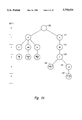
- FIG. 2A illustrates a prefix tree data structure for the sample phonetic dictionary.
- the prefix tree data structure contains the same information as in the phonetic dictionary, but in a format that saves space and that can be rapidly searched.
- the prefix tree data structure referred to as a pronunciation prefix tree (PPT) saves space by eliminating the storing of redundant phonemes for words that share common prefixes. For example, the pronunciation for the words “caught” and “cotton” are represented by nodes 201-206. Since the first three phonemes in “k,” “aw,” and “t” are shared by both words, the PPT contains only one node for each of these phonemes.
- PPT pronunciation prefix tree
- a CSR system can rapidly search a PPT by following the path of recognized phonemes from the root node to a leaf node that represents a spoken word. For example, if the phonemes "k aw t en" are received, then the CSR system would traverse the prefix tree starting at the root node 200 and finishing at the leaf node 206, which represents the word "cotton.”
- Each leaf node represents a word in the dictionary and contains the unigram probability for that word. For example, leaf node 206 contains the probability of 0.1, which is the unigram probability for the word "cotton.”
- Each node in the PPT is at a depth within the prefix tree that represents the number of branches from the root to that node. For example, the depth of node 206 is 5. Since the PPT of FIG. 2A contains unigram probability, it is known as a unigram PPT.
- FIG. 2B is a bigram PPT representing the bigram probabilities for the words in the dictionary that follow the word "were.”
- Each leaf node corresponds to a word that can follow the word "were” and contains the probability that such a word will follow the word “were.”
- each word in the dictionary will have a bigram PPT containing corresponding probabilities for words that will follow that word.
- the representation of such bigram PPTs requires a large amount of storage. For example, a typical dictionary has 5.02 million bigram probabilities represented in bigram PPTs with a total of 18.2 million nodes. Assuming that each node uses 4 bytes of memory, then 72.8 million bytes would be needed to store all bigram probabilities. Such a large amount of data makes it impractical not only to store such information on conventional memory devices, but also to locate rapidly the probabilities.
- the present invention provides a method and system for linearly encoding bigram pronunciation prefix trees in a way that significantly reduces the amount of storage needed to represent the bigram pronunciation prefix tree and allows for rapid determination of child nodes during speech recognition.
- the computer system represents the bigram pronunciation prefix trees with a linear encoding for each bigram pronunciation prefix tree along with one tree node dictionary.
- the computer system generates a tree node dictionary which contains a listing of the phonemes that compose each word in the vocabulary.
- the computer system then repeats the following for each bigram pronunciation prefix tree.
- the computer system sets the probability of each non-leaf node to a probability based on the probability of its child nodes (i.e., "smearing").
- the computer system sets the factor of each node to the probability of the node divided by the probability of a parent node of the node (i.e., "factoring"). Finally, the computer system generates an encoded pronunciation entry for each leaf node of the bigram pronunciation prefix tree.
- the encoded pronunciation entry indicates the word represented by the leaf node and contains the factor of a nearest ancestor node with a factor other than a predefined factor.
- the linearly encoded bigram pronunciation prefix tree can then be used during speech recognition to instantiate a bigram context.
- the bigram context is an instantiation of the bigram pronunciation prefix tree with probabilities in each node indicating the likelihood that the corresponding phonemes have been spoken.
- the computer system uses the linear encoding to identify the next child nodes to be added to the bigram context.
- the computer system then uses the tree node dictionary to rapidly identify the child nodes to be added to the bigram context.
- the computer system can encode pronunciation trees for trigrams and, in general, n-grams of arbitrary length.
- Each pronunciation prefix tree regardless of the length of the n-gram, contains the same type of information, that is, leaf nodes that correspond to words and probabilities.
- the n-gram context is set to the number of words of the n-gram minus 1.
- the trigram context is set to the two words associated with the linearly encoded trigram pronunciation prefix tree.
- FIG. 1A illustrates a phonetic dictionary for a sample 5-word vocabulary.
- FIG. 1B illustrates the context-dependent probabilities for sequences of length 2 of the sample vocabulary.
- FIG. 2A illustrates a unigram PPT for the sample phonetic dictionary.
- FIG. 2B is a bigram PPT for the words in the dictionary that follow the word "were.”
- FIG. 3 is a block diagram of a computer system illustrating components of the present invention.
- FIG. 4 illustrates an augmented unigram PPT for the sample dictionary.
- FIG. 5 shows a Tree Node Dictionary for the unigram PPT of FIG. 4.
- FIG. 6 represents the augmented bigram PPT for the word "were.”
- FIG. 7 represents the bigram PPT for the word “wear.”
- FIG. 8 is a flow diagram of an Encode Bigram PPT routine.
- FIG. 9 is a flow diagram of the Decode LEBPPT routine.
- FIG. 10 is a flow diagram of a CSR system that uses an LEBPPT.
- FIGS. 11A-13B illustrate the PPTs that are generated by the CSR system.
- FIG. 14 is a flow diagram of the initialize interword bigram PPT routine.
- FIG. 15 is a flow diagram of the initialize interword unigram PPT routine.
- FIG. 16 is a flow diagram of the update bigram PPT routine.
- FIG. 17 is a flow diagram of the routine to add nodes for the sibling of the instantiated node.
- FIG. 18 is a flow diagram of the update unigram PPT routine.
- the present invention provides a method and system for linearly encoding bigram pronunciation prefix trees and for recognizing speech using the linearly encode pronunciation prefix tree.
- the bigram pronunciation prefix trees are encoded in such a way that the "smeared" probabilities can be determined during recognition based solely on the ancestor nodes.
- a smeared probability refers to a probability stored in each non-leaf node that is based on the probabilities of the descendent nodes of that node. The use of smeared probabilities allows for probability calculations to occur during recognition before the identity of the word is known.
- the system of the present invention encodes the bigram pronunciation prefix trees with the smeared probabilities as a combination of one tree node dictionary and a linear encoding for each bigram pronunciation prefix.
- the tree node dictionary contains a listing of the phonemes that compose each word in the vocabulary.
- a linear encoding of each bigram pronunciation prefix tree contains an entry for each leaf node. The entry identifies the word of the leaf node along with the factor of the nearest ancestor node with a factor other than 1.0.
- Each node in the bigram pronunciation prefix tree is assigned a factor that is equal to the smeared probability of that node divided by the probability of the parent node.
- the factors have the characteristic that the factor in each node that has no sibling nodes is 1.0. Since the majority of the nodes in bigram pronunciation prefix pronunciation trees typically have no siblings, the factors of 1.0 can be omitted from the encoding.
- the linearly encoded bigram pronunciation prefix tree can then be used during speech recognition to instantiate a bigram context.
- the bigram context is an instantiation of the bigram pronunciation prefix tree with probabilities in each node indicating the likelihood that the corresponding phonemes have been spoken.
- the computer system uses the linear encoding to identify the next child nodes to be added to the bigram context.
- the computer system then uses the tree node dictionary to rapidly identify the child nodes to be added to the bigram context.
- FIG. 3 is a block diagram of a computer system illustrating components of the present invention.
- the computer system may be a standard computer with central processing unit, memory, and various storage devices.
- the computer system comprises bigram PPTs 301, a linear PPT encoder 302, linearly encoded bigram PPT 303, a phoneme recognizer 304, a computer speech recognizer 305, and a unigram PPT 306.
- a computer program implementing the linear PPT encoder and computer speech recognizer is typically stored on a computer-readable medium such as computer memory or disk drive.
- the linear PPT encoder 302 encodes the bigram PPTs 301 to generate linearly encoded bigram PPTs 303.
- the linearly encoded bigram PPTs are a compact encoding of the bigram PPTs.
- the CSR system 305 receives a sequence of phonemes from a phoneme recognizer 304 and uses the linearly encoded bigram PPTs 303 and the unigram PPT 306 to recognize the received sequence of phonemes as words.
- FIG. 4 illustrates an augmented unigram PPT for the sample dictionary.
- An augmented unigram PPT is a unigram PPT that has been augmented to contain a factor in each node and that has its nodes ordered by the unigram probabilities.
- the child nodes of each parent node are ordered from left-to-right based on the maximum probability of a descendent leaf node of that child node. For example, since the maximum probability of a descendent leaf node of node 1! is 0.3, and the maximum probability of a descendent leaf node of node 2! is 0.2, node 1! is to the left of node 2!. Similarly, since the maximum probabilities of the descendent leaf nodes of node 3!, node 4!, and node 5!
- node 3! is the leftmost and node 5! is the rightmost.
- Each node of the unigram PPT is assigned a sequential node identification.
- the node identifications are assigned as the nodes are visited in a breadth-first, left-right traversal of the unigram PPT.
- the nodes at the same depth have sequential unique identifiers.
- the nodes at depth 3 contain the identifiers 3!, 4!, 5!, and 6!.
- the factors for the augmented unigram PPTs are generated from the probabilities according to equations (1) and (2).
- the probabilities in each non-leaf node is set based on the probabilities in the leaf nodes.
- the probability in each non-leaf node is generated by the following equation: ##EQU1## That is, the probability in each non-leaf node of the unigram PPT is the maximum of the probabilities of its child nodes. For example, node 1! contains a probability of 0.3, which is the maximum probability of 0.3, 0.25, and 0.15, which are the probabilities of its child nodes 3!, 4!, and 5!.
- the factors in each node are generated by the following equation: ##EQU2## That is, the factor of a node is the probability of that node divided by the probability of its parent node. For example, the probability of node 5! is 0.15 and the probability of its parent node 1! is 0.3, thus the factor for node 5! is 0.15 divided by 0.3, which is 0.5.
- An augmented unigram PPT stores only the factor for a node because the probabilities can be generated from the factors.
- the probability associated with a node is the probability of its parent node times the factor of the node. For example, the probability of node 1! is 0.3 and the factor for child node 5! is 0.5. Thus, the probability for node 5!
- FIG. 5 contains a Tree Node Dictionary for the augmented unigram PPT of FIG. 4.
- the TND contains an entry for each word in the dictionary along with the node identifiers of each node that would be visited in the augmented unigram PPT when recognizing that word. For example, to recognize the word "cotton,” the nodes 0!, 2!, 6!, 10!, 12!, and 13! would be traversed. Since the traversal always starts out at node 0!, that node identifier can be omitted from the TND.
- the TND and the linearly encoded bigram PPTs represent an encoding of the bigram PPTs.
- the linear PPT encoder also augments each bigram PPT in a manner analogous to the augmentation of the unigram PPT. In particular, a factor is generated for each non-leaf node.
- FIG. 6 represents the augmented bigram PPT for the word bigram context "were”
- FIG. 7 represents the augmented bigram PPT for the word bigram context "wear.”
- the linear PPT encoder generates the linear encodings 602 and 702 for the augmented bigram PPTs 601 and 701, respectively.
- the linearly encoded bigram PPTs contain an entry for each leaf node. From a linearly encoded bigram PPT and the TND, the bigram PPT can be regenerated.
- a linearly encoded bigram PPT represents a compact encoding of the bigram PPT.
- Each entry of the linearly encoded bigram PPT identifies a word, a factor, and a depth within the augmented bigram PPT.
- the second entry in the LEBPPT 602 identifies the word "caught,” the factor of 0.8, and the depth of 1.
- This second entry indicates that the leaf node for the word "caught” has a probability that is 0.8 times the probability of the previous entry in the LEBPPT. That is, the probability for the node 11! is 0.8 times the factor of the first entry in the LEBPPT 602, which is 0.5.
- this second entry indicates that the factor of 0.8 is stored in a node with depth of 1 within the augmented bigram PPT.
- the linear PPT encoder generates an LEBPPT by performing a left-right, depth-first traversal of the augmented bigram PPT. For each leaf node visited, the linear PPT encoder adds an entry to the LEBPPT that identifies the word within the leaf node and the factor and depth of the last node visited that had a factor other than 1.0. For example, when the leaf node 7! of FIG. 6 is visited, the last node visited with a factor other than 1.0 was node 0!. Therefore, the first entry in the LEBPPT is "we 0.5 0", indicating a factor of 0.5 and a depth of 0. The second entry corresponds to node 11!.
- the last node visited, prior to visiting node 11!, with a factor other than 1.0 is node 2!, which lo has a factor of 0.8 and a depth of 1.
- the second entry in the LEBPPT is "caught 0.8 1.”
- the last node visited with a probability other than 1.0 is node 12!, which has a factor of 0.25 and a depth of 4.
- the third entry in the LEBPPT is "cotton 0.25 4.”
- a bigram PPT can be regenerated from the LEBPPT by decoding the LEBPPT using the Tree Node Dictionary (TND). For each entry in the LEBPPT, a decoder would retrieve the entry from the TND for the word stored in the LEBPPT entry. (A preferred CSR system does not actually perform such a decoding prior to the start of recognition, rather such a decoding is integrated with recognition.)
- the TND entry identifies the nodes that are part of the bigram PPT for that word. That is, the entry identifies the nodes of the bigram PPT on the path from the root node to the leaf node for that word.
- the decoder adds a node to the bigram PPT for each identified node.
- the decoder when the decoder encounters the first entry of LEBPPT 601, the decoder adds the root to the bigram PPT and adds a node for each node identified in the TND entry for the word "we.” The decoder then sets the factor of each added node to 1.0, except for the node at the depth stored in the LEBPPT entry. The decoder sets the factor of that node to the factor in the LEBPPT entry. Similarly, when the decoder encounters the second entry, the decoder retrieves the entry from the TND for the word stored in the second entry. The decoder adds a node to the bigram PPT for each identified node (if not already added).
- the decoder retrieves the identifiers of the nodes for the word "caught" from the TND and adds a node for each identified node. The decoder then sets the factor for the node created at depth 1 to 0.8 and all other factors to 1.0. Finally, when the decoder encounters the third entry, it retrieves the TND entry for the word "cotton” and adds a node for each identified node that has not yet been added, that is, node 12! and node 13!. The decoder then sets the factor of the node at the depth of the LEBPPT entry to the factor 0.25 of the LEBPPT entry and all other factors to 1.0. The PPT generated at this point is the augmented bigram PPT.
- the decoder then traverses the augmented bigram PPT to generate the probabilities for the leaf nodes.
- the depth of the column of the linearly encoded bigram tree is not needed. However, as will be seen below, the inclusion of the depth allows for rapid creation of bigram context during speech recognition.
- FIG. 8 is a flow diagram of an Encode Bigram PPT routine.
- the Encode Bigram PPT routine is performed by the linear PPT encoder.
- the routine is a recursive routine that performs a depth-first, left-to-right traversal of an augmented bigram PPT that is passed to the routine and creates a linearly encoded bigram PPT.
- the routine is initially invoked passing the root node of the augmented bigram PPT. Each time the routine recursively invokes itself, it passes a subtree of the augmented bigram PPT. In step 801, if the root node of the passed subtree is a leaf node, then the routine continues at step 805, else the routine continues at step 802.
- steps 802-804 the routine loops selecting each child node of the root node of the passed subtree and recursively invoking this routine passing the selected child node as the root node of a subtree.
- the routine selects the next child node of the passed subtree starting with the first child node.
- the routine returns, else the routine recursively invokes this routine passing the selected node as the root node of a subtree and loops to step 802 to select the next child node.
- step 805 the routine adds an entry to the LEBPPT for the word of the root node, and adds the depth and factor of the last node visited that does not have a factor of 1.0 and then returns.
- this routine has been described as encoding a bigram PPT, the same routine without modification can be used to encode any PPT, regardless of the length of the n-gram to which it corresponds.
- FIG. 9 is a flow diagram of the Decode LEBPPT routine.
- the Decode LEBPPT routine is passed a LEBPPT and a TND and regenerates the augmented bigram PPT.
- a preferred CSR system does not need to regenerate the augmented bigram PPTs. Rather, the CSR system retrieves the needed information directly from the LEBPPT as described below.
- the routine loops selecting each LEBPPT entry and adding nodes to the augmented bigram PPT represented by that entry.
- the routine selects the next LEBPPT entry starting with the first.
- step 902 if all of the LEBPPT entries have already been selected, then the routine returns, else the routine continues at step 903.
- step 903 the routine selects the TND entry corresponding to the word in the selected LEBPPT entry.
- steps 904-909 the routine loops processing each node identified in the selected TND entry and adding it to the augmented bigram PPT if not already added.
- step 904 the routine selects the next depth starting with the depth in the selected LEBPPT entry. If the selected depth is greater than the maximum depth for the selected TND entry, then the routine loops to step 901 to select the next LEBPPT entry, else the routine continues at 906.
- step 906 the routine adds a node corresponding to the node identified in the selected TND entry to the augmented bigram PPT.
- step 907 if the selected depth equals the depth in the selected LEBPPT entry, then the routine continues at step 908, else the routine continues at step 909.
- step 908 the routine sets the factor of the added node to the factor in the selected LEBPPT entry.
- step 909 the routine sets the factor of the added node to 1.0. The routine then loops to step 904 to select the next depth.
- FIG. 10 is a flow diagram of a CSR system that uses an LEBPPT.
- the CSR system retrieves a sequence of phonemes and selects the sequence of words that best matches the phonemes.
- the recognition system repeatedly generates new hypotheses as to the sequence of words that a sequence of phonemes represent as each phoneme is processed. For example, the CSR system may establish the following hypotheses: ##EQU3## The CSR system extends these hypotheses by referring to the unigram and bigram PPTs in conjunction with the TND.
- FIGS. 11A-13B illustrate the PPTs that are generated by the CSR system.
- the CSR system generates a unigram PPT for the best hypothesis (i.e., the hypothesis with the highest probability) and a bigram PPT for each hypothesis (referred to as a bigram context).
- the nodes of the unigram PPT contain the probability of the best hypothesis times the unigram probability for that node. For example, the probability in node 5! of FIG. 11A is 0.09, which is the unigram probability 0.15 from node 5! of FIG. 4 times the probability 0.6 of the best hypothesis.
- the nodes of the bigram PPTs contain the probability of the corresponding hypothesis times the probability for that node. For example, the probability of node 10! of FIG.
- the CSR system builds the unigram PPT and the bigram PPTs in parallel as each phoneme is received. To generate the bigram PPTs, the CSR system uses the LEBPPT and the TND to identify what nodes to add and the probabilities for the nodes.
- the CSR system selects the best hypothesis as the sequence of words that best matches the phonemes. If the last phoneme has not yet been processed, then the CSR system selects starting with the first, the next unprocessed hypothesis as the next hypothesis.
- step 1001 the system retrieves the next phoneme.
- step 1002 if all the phonemes have already been processed, then the system continues at step 1010, else the system continues at step 1003.
- step 1003 the system establishes a new hypothesis for the retrieved phoneme.
- step 1004 if any new hypotheses have been established, then the system continues at step 1005, else the system skips to step 1007 to update the bigrams PPTs.
- steps 1005-1009 the system instantiates a unigram PPT for the best hypothesis and a bigram PPT for each hypothesis.
- the system then sets the probabilities in the nodes of the PPTs based on the probability of the hypothesis and the unigram and bigram probabilities, the system loops updating the PPTs to reflect the state of the hypothesis.
- the system invokes the initialize interword bigram PPT routine, which initializes a bigram PPT for the transition from one word to the next.
- the system invokes the initialize interword unigram PPT routine, which initializes a unigram PPT for the transition from one word to the next.
- steps 1007-1009 the routine loops updating the bigram PPTs unigram based on the phonemes.
- the system invokes the update bigram PPT to update the bigram PPT based on the phoneme.
- step 1008 the system invokes the update unigram PPT routine.
- step 1009 if the bigram PPT for each newly established hypothesis is complete, then the routine loops to step 1001, to select the next phoneme, else the routine loops to step 1007, to complete the updating of the PPTs.
- step 1010 the system selects the best hypothesis as the recognized words for the retrieved sequence of phonemes and completes.
- FIG. 14 is a flow diagram of the initialize interword bigram PPT routine.
- This routine establishes a bigram context (i.e., a new bigram PPT) for the last word in each newly established hypothesis.
- This routine initializes the root node for each bigram context.
- the routine loops selecting and processing each hypothesis.
- the routine selects the next hypothesis starting with the first.
- the routine returns, as the routine continues its step 1403.
- the routine sets the bigram context to the last word of the selected hypothesis.
- the routine loops processing each LEBPPT entry for the designated bigram context.
- step 1404 the routine selects the next entry in the LEBPPT for the selected bigram context starting with the first LEBPPT entry.
- step 1405 if all of the LEBPPT entries for the bigram context have already been selected, the routine loops to step 1401 to select the next hypothesis, else the routine continues as step 1406.
- step 1406 if the depth of the selected entry is zero or one, then the routine continues at step 1407, else the routine loops to step 1404 to select the next LEBPPT entry.
- step 1407 the routine identifies the first phoneme of the word of the selected LEBPPT entry from the TND.
- step 1408 the routine instantiates a node for this bigram context for the first phoneme in the word of the selected LEBPPT entry.
- step 1409 the routine sets the probability of the node to the factor of the LEBPPT entry times the probability of the selected hypothesis and loops to step 1404 to select the next LEBPPT entry.
- FIG. 15 is a flow diagram of the initialize interword unigram PPT routine.
- This routine instantiates a unigram PPT for the hypothesis with the highest probability.
- the routine initializes a node for each child node of the root node of the unigram PPT.
- the routine selects the hypothesis with the highest probability.
- the routine instantiates a unigram context for each child node of the root node of the unigram PPT.
- the routine selects the next child node of the root node of the unigram PPT starting with the first.
- step 1503 if all child nodes have already been selected, then the routine returns, else the routine continues at step 1504.
- step 1504 the routine instantiates a node for the selected hypothesis for the selected child node.
- step 1505 the routine sets the probability of the instantiated node to the factor of the child nodes times the probability of the selected hypothesis and loops to step 1502 to select the next child node of the root node.
- FIG. 16 is a flow diagram of the update bigram PPT routine.
- the routine selects the next bigram context starting with the first.
- the routine if all the bigram contexts have already been selected, then the routine returns, else the routine continues at step 1603.
- the routine loops adding a child node to each leaf node of the bigram PPT for the selected bigram contexts.
- the routine selects the next leaf node for the bigram PPT starting with the first.
- step 1604 if all the leaf nodes have already been selected, then the routine loops to step 1601 to select the next bigram context, else the routine continues at step 1605.
- step 1605 the routine identifies the next phoneme of the word of the selected node in the TND.
- step 1606 the routine instantiates a node for the bigram PPT of the selected bigram context for the next phoneme.
- step 1607 the routine sets a probability of the instantiated node to the probability of the selected leaf node.
- step 1608 the routine invokes a routine to add nodes for the siblings of the instantiated node and loops to step 1603 to select the next leaf node.
- FIG. 17 is a flow diagram of the routine to add nodes for the sibling of the instantiated node.
- the routine selects the next entry in the LEBPPT starting with the entry for the instantiated node.
- the routine returns, else the routine continues at step 1703.
- step 1703 if the depth of the selected LEBPPT entry is greater to than the depth plus one of the instantiated node, then the routine loops to step 1701 to select the next LEBPPT entry, else the routine continues at step 1704.
- step 1704 if the depth of the selected entry is less than or equal to the depth of the instantiated node, then the routine returns, else the routine continues at step 1705.
- step 1705 the routine identifies the next phoneme of the word in the selected LEBPPT entry from the TND.
- step 1706 the routine instantiates a node for the bigram PPT of selected bigram context for the next phoneme.
- step 1707 the routine sets the probability of the node to the probability of the parent node times the factor of the selected LEBPPT entry and loops to step 1701 to select the next LEBPPT entry.
- FIG. 18 is a flow diagram of the update unigram PPT routine.
- the routine selects the next leaf node of the best hypothesis.
- the routine if all of the leaf nodes of the best hypothesis have already been selected, then the routine returns, else the routine continues at step 1803.
- the routine instantiates nodes for each child node of the selected leaf node.
- the routine selects the next child node of the selected leaf node from the augmented unigram PPT.
- step 1804 if all the child nodes have already been selected, then the routine loops to step 1801 to select the next leaf node, else the routine continues at step 1805.
- the routine instantiates a node for the selected child node.
- the routine selects the probability of the instantiated node to the probability of the parent node times the factor from the augmented unigram PPT and loops to step 1803 to select the next child node.
- linear encoding techniques of the present invention can be used to encode tree data structures for a variety of applications not related to speech recognition.
- the encoding techniques can be used as a generic mechanism for compactly representing tree data structures.
Landscapes
- Engineering & Computer Science (AREA)
- Theoretical Computer Science (AREA)
- Physics & Mathematics (AREA)
- Audiology, Speech & Language Pathology (AREA)
- Artificial Intelligence (AREA)
- Computational Linguistics (AREA)
- Health & Medical Sciences (AREA)
- General Engineering & Computer Science (AREA)
- General Physics & Mathematics (AREA)
- General Health & Medical Sciences (AREA)
- Acoustics & Sound (AREA)
- Multimedia (AREA)
- Human Computer Interaction (AREA)
- Probability & Statistics with Applications (AREA)
- Machine Translation (AREA)
- Information Retrieval, Db Structures And Fs Structures Therefor (AREA)
- Compression, Expansion, Code Conversion, And Decoders (AREA)
Priority Applications (5)
| Application Number | Priority Date | Filing Date | Title |
|---|---|---|---|
| US08/674,656 US5758024A (en) | 1996-06-25 | 1996-06-25 | Method and system for encoding pronunciation prefix trees |
| EP97109014A EP0817169B1 (en) | 1996-06-25 | 1997-06-04 | Method and system for encoding pronunciation prefix trees |
| DE69726499T DE69726499T2 (de) | 1996-06-25 | 1997-06-04 | Verfahren und Vorrichtung zur Kodierung von Aussprache-Prefix-Bäumen |
| CN97113944A CN1107915C (zh) | 1996-06-25 | 1997-06-24 | 用于编码读音前缀树的方法及系统 |
| JP16891497A JP3601751B2 (ja) | 1996-06-25 | 1997-06-25 | 発音プレフィックスツリーのエンコード方法及びシステム |
Applications Claiming Priority (1)
| Application Number | Priority Date | Filing Date | Title |
|---|---|---|---|
| US08/674,656 US5758024A (en) | 1996-06-25 | 1996-06-25 | Method and system for encoding pronunciation prefix trees |
Publications (1)
| Publication Number | Publication Date |
|---|---|
| US5758024A true US5758024A (en) | 1998-05-26 |
Family
ID=24707448
Family Applications (1)
| Application Number | Title | Priority Date | Filing Date |
|---|---|---|---|
| US08/674,656 Expired - Lifetime US5758024A (en) | 1996-06-25 | 1996-06-25 | Method and system for encoding pronunciation prefix trees |
Country Status (5)
| Country | Link |
|---|---|
| US (1) | US5758024A (ja) |
| EP (1) | EP0817169B1 (ja) |
| JP (1) | JP3601751B2 (ja) |
| CN (1) | CN1107915C (ja) |
| DE (1) | DE69726499T2 (ja) |
Cited By (63)
| Publication number | Priority date | Publication date | Assignee | Title |
|---|---|---|---|---|
| WO2000007123A1 (en) * | 1998-07-28 | 2000-02-10 | Triada, Ltd. | Methods of deleting information in n-gram tree structures |
| US6260011B1 (en) | 2000-03-20 | 2001-07-10 | Microsoft Corporation | Methods and apparatus for automatically synchronizing electronic audio files with electronic text files |
| WO2001048737A3 (en) * | 1999-12-23 | 2002-11-14 | Intel Corp | Speech recognizer with a lexical tree based n-gram language model |
| US6614789B1 (en) | 1999-12-29 | 2003-09-02 | Nasser Yazdani | Method of and apparatus for matching strings of different lengths |
| US6757647B1 (en) * | 1998-07-30 | 2004-06-29 | International Business Machines Corporation | Method for encoding regular expressions in a lexigon |
| US20060195319A1 (en) * | 2005-02-28 | 2006-08-31 | Prous Institute For Biomedical Research S.A. | Method for converting phonemes to written text and corresponding computer system and computer program |
| US7653619B1 (en) * | 2004-07-23 | 2010-01-26 | Netlogic Microsystems, Inc. | Integrated search engine devices having pipelined search and tree maintenance sub-engines therein that support variable tree height |
| US7747599B1 (en) | 2004-07-23 | 2010-06-29 | Netlogic Microsystems, Inc. | Integrated search engine devices that utilize hierarchical memories containing b-trees and span prefix masks to support longest prefix match search operations |
| US7805427B1 (en) | 2006-11-27 | 2010-09-28 | Netlogic Microsystems, Inc. | Integrated search engine devices that support multi-way search trees having multi-column nodes |
| US7941317B1 (en) * | 2002-09-18 | 2011-05-10 | At&T Intellectual Property Ii, L.P. | Low latency real-time speech transcription |
| US7953721B1 (en) | 2006-11-27 | 2011-05-31 | Netlogic Microsystems, Inc. | Integrated search engine devices that support database key dumping and methods of operating same |
| US7987205B1 (en) | 2006-11-27 | 2011-07-26 | Netlogic Microsystems, Inc. | Integrated search engine devices having pipelined node maintenance sub-engines therein that support database flush operations |
| US8086641B1 (en) | 2006-11-27 | 2011-12-27 | Netlogic Microsystems, Inc. | Integrated search engine devices that utilize SPM-linked bit maps to reduce handle memory duplication and methods of operating same |
| US8494850B2 (en) | 2011-06-30 | 2013-07-23 | Google Inc. | Speech recognition using variable-length context |
| US8886677B1 (en) | 2004-07-23 | 2014-11-11 | Netlogic Microsystems, Inc. | Integrated search engine devices that support LPM search operations using span prefix masks that encode key prefix length |
| US20150248381A1 (en) * | 2013-02-27 | 2015-09-03 | Oracle International Corporation | Compact encoding of node locations |
| US20150347383A1 (en) * | 2014-05-30 | 2015-12-03 | Apple Inc. | Text prediction using combined word n-gram and unigram language models |
| US20150371633A1 (en) * | 2012-11-01 | 2015-12-24 | Google Inc. | Speech recognition using non-parametric models |
| US9633660B2 (en) | 2010-02-25 | 2017-04-25 | Apple Inc. | User profiling for voice input processing |
| US9668024B2 (en) | 2014-06-30 | 2017-05-30 | Apple Inc. | Intelligent automated assistant for TV user interactions |
| US9858922B2 (en) | 2014-06-23 | 2018-01-02 | Google Inc. | Caching speech recognition scores |
| US9865248B2 (en) | 2008-04-05 | 2018-01-09 | Apple Inc. | Intelligent text-to-speech conversion |
| US9934775B2 (en) | 2016-05-26 | 2018-04-03 | Apple Inc. | Unit-selection text-to-speech synthesis based on predicted concatenation parameters |
| US9953088B2 (en) | 2012-05-14 | 2018-04-24 | Apple Inc. | Crowd sourcing information to fulfill user requests |
| US9966060B2 (en) | 2013-06-07 | 2018-05-08 | Apple Inc. | System and method for user-specified pronunciation of words for speech synthesis and recognition |
| US9971774B2 (en) | 2012-09-19 | 2018-05-15 | Apple Inc. | Voice-based media searching |
| US9972304B2 (en) | 2016-06-03 | 2018-05-15 | Apple Inc. | Privacy preserving distributed evaluation framework for embedded personalized systems |
| US9986419B2 (en) | 2014-09-30 | 2018-05-29 | Apple Inc. | Social reminders |
| US10049668B2 (en) | 2015-12-02 | 2018-08-14 | Apple Inc. | Applying neural network language models to weighted finite state transducers for automatic speech recognition |
| US10049663B2 (en) | 2016-06-08 | 2018-08-14 | Apple, Inc. | Intelligent automated assistant for media exploration |
| US10067938B2 (en) | 2016-06-10 | 2018-09-04 | Apple Inc. | Multilingual word prediction |
| US10079014B2 (en) | 2012-06-08 | 2018-09-18 | Apple Inc. | Name recognition system |
| US10089072B2 (en) | 2016-06-11 | 2018-10-02 | Apple Inc. | Intelligent device arbitration and control |
| US10169329B2 (en) | 2014-05-30 | 2019-01-01 | Apple Inc. | Exemplar-based natural language processing |
| US10192552B2 (en) | 2016-06-10 | 2019-01-29 | Apple Inc. | Digital assistant providing whispered speech |
| US10204619B2 (en) | 2014-10-22 | 2019-02-12 | Google Llc | Speech recognition using associative mapping |
| US10223066B2 (en) | 2015-12-23 | 2019-03-05 | Apple Inc. | Proactive assistance based on dialog communication between devices |
| US10249300B2 (en) | 2016-06-06 | 2019-04-02 | Apple Inc. | Intelligent list reading |
| US10269345B2 (en) | 2016-06-11 | 2019-04-23 | Apple Inc. | Intelligent task discovery |
| US10283110B2 (en) | 2009-07-02 | 2019-05-07 | Apple Inc. | Methods and apparatuses for automatic speech recognition |
| US10297253B2 (en) | 2016-06-11 | 2019-05-21 | Apple Inc. | Application integration with a digital assistant |
| US10318871B2 (en) | 2005-09-08 | 2019-06-11 | Apple Inc. | Method and apparatus for building an intelligent automated assistant |
| US10354011B2 (en) | 2016-06-09 | 2019-07-16 | Apple Inc. | Intelligent automated assistant in a home environment |
| US10366158B2 (en) | 2015-09-29 | 2019-07-30 | Apple Inc. | Efficient word encoding for recurrent neural network language models |
| US10446143B2 (en) | 2016-03-14 | 2019-10-15 | Apple Inc. | Identification of voice inputs providing credentials |
| US10490187B2 (en) | 2016-06-10 | 2019-11-26 | Apple Inc. | Digital assistant providing automated status report |
| US10509862B2 (en) | 2016-06-10 | 2019-12-17 | Apple Inc. | Dynamic phrase expansion of language input |
| US10521466B2 (en) | 2016-06-11 | 2019-12-31 | Apple Inc. | Data driven natural language event detection and classification |
| US10593346B2 (en) | 2016-12-22 | 2020-03-17 | Apple Inc. | Rank-reduced token representation for automatic speech recognition |
| US10592610B1 (en) * | 2019-01-30 | 2020-03-17 | Babylon Partners Limited | Semantic graph traversal for recognition of inferred clauses within natural language inputs |
| CN111128172A (zh) * | 2019-12-31 | 2020-05-08 | 达闼科技成都有限公司 | 一种语音识别方法、电子设备和存储介质 |
| US10671428B2 (en) | 2015-09-08 | 2020-06-02 | Apple Inc. | Distributed personal assistant |
| US10691473B2 (en) | 2015-11-06 | 2020-06-23 | Apple Inc. | Intelligent automated assistant in a messaging environment |
| US10706841B2 (en) | 2010-01-18 | 2020-07-07 | Apple Inc. | Task flow identification based on user intent |
| US10733993B2 (en) | 2016-06-10 | 2020-08-04 | Apple Inc. | Intelligent digital assistant in a multi-tasking environment |
| US10747498B2 (en) | 2015-09-08 | 2020-08-18 | Apple Inc. | Zero latency digital assistant |
| US10791176B2 (en) | 2017-05-12 | 2020-09-29 | Apple Inc. | Synchronization and task delegation of a digital assistant |
| US10795541B2 (en) | 2009-06-05 | 2020-10-06 | Apple Inc. | Intelligent organization of tasks items |
| US10810274B2 (en) | 2017-05-15 | 2020-10-20 | Apple Inc. | Optimizing dialogue policy decisions for digital assistants using implicit feedback |
| US11010550B2 (en) | 2015-09-29 | 2021-05-18 | Apple Inc. | Unified language modeling framework for word prediction, auto-completion and auto-correction |
| US11080012B2 (en) | 2009-06-05 | 2021-08-03 | Apple Inc. | Interface for a virtual digital assistant |
| US20220415315A1 (en) * | 2021-06-23 | 2022-12-29 | International Business Machines Corporation | Adding words to a prefix tree for improving speech recognition |
| US11587559B2 (en) | 2015-09-30 | 2023-02-21 | Apple Inc. | Intelligent device identification |
Families Citing this family (6)
| Publication number | Priority date | Publication date | Assignee | Title |
|---|---|---|---|---|
| JP3481497B2 (ja) * | 1998-04-29 | 2003-12-22 | 松下電器産業株式会社 | 綴り言葉に対する複数発音を生成し評価する判断ツリーを利用する方法及び装置 |
| AU2000276400A1 (en) * | 2000-09-30 | 2002-04-15 | Intel Corporation | Search method based on single triphone tree for large vocabulary continuous speech recognizer |
| GB2428508B (en) * | 2005-07-15 | 2009-10-21 | Toshiba Res Europ Ltd | Parsing method |
| KR100748720B1 (ko) | 2006-02-09 | 2007-08-13 | 삼성전자주식회사 | 다중 계층 중심 어휘 목록에 기초하여 대규모 단어 음성인식 방법 및 그 장치 |
| CN103577548B (zh) * | 2013-10-12 | 2017-02-08 | 优视科技有限公司 | 近音文字匹配方法及装置 |
| US10290299B2 (en) | 2014-07-17 | 2019-05-14 | Microsoft Technology Licensing, Llc | Speech recognition using a foreign word grammar |
Citations (4)
| Publication number | Priority date | Publication date | Assignee | Title |
|---|---|---|---|---|
| US5329608A (en) * | 1992-04-02 | 1994-07-12 | At&T Bell Laboratories | Automatic speech recognizer |
| US5454062A (en) * | 1991-03-27 | 1995-09-26 | Audio Navigation Systems, Inc. | Method for recognizing spoken words |
| US5528728A (en) * | 1993-07-12 | 1996-06-18 | Kabushiki Kaisha Meidensha | Speaker independent speech recognition system and method using neural network and DTW matching technique |
| US5535305A (en) * | 1992-12-31 | 1996-07-09 | Apple Computer, Inc. | Sub-partitioned vector quantization of probability density functions |
Family Cites Families (3)
| Publication number | Priority date | Publication date | Assignee | Title |
|---|---|---|---|---|
| US5033087A (en) * | 1989-03-14 | 1991-07-16 | International Business Machines Corp. | Method and apparatus for the automatic determination of phonological rules as for a continuous speech recognition system |
| US5144671A (en) * | 1990-03-15 | 1992-09-01 | Gte Laboratories Incorporated | Method for reducing the search complexity in analysis-by-synthesis coding |
| US5349645A (en) * | 1991-12-31 | 1994-09-20 | Matsushita Electric Industrial Co., Ltd. | Word hypothesizer for continuous speech decoding using stressed-vowel centered bidirectional tree searches |
-
1996
- 1996-06-25 US US08/674,656 patent/US5758024A/en not_active Expired - Lifetime
-
1997
- 1997-06-04 DE DE69726499T patent/DE69726499T2/de not_active Expired - Lifetime
- 1997-06-04 EP EP97109014A patent/EP0817169B1/en not_active Expired - Lifetime
- 1997-06-24 CN CN97113944A patent/CN1107915C/zh not_active Expired - Fee Related
- 1997-06-25 JP JP16891497A patent/JP3601751B2/ja not_active Expired - Lifetime
Patent Citations (4)
| Publication number | Priority date | Publication date | Assignee | Title |
|---|---|---|---|---|
| US5454062A (en) * | 1991-03-27 | 1995-09-26 | Audio Navigation Systems, Inc. | Method for recognizing spoken words |
| US5329608A (en) * | 1992-04-02 | 1994-07-12 | At&T Bell Laboratories | Automatic speech recognizer |
| US5535305A (en) * | 1992-12-31 | 1996-07-09 | Apple Computer, Inc. | Sub-partitioned vector quantization of probability density functions |
| US5528728A (en) * | 1993-07-12 | 1996-06-18 | Kabushiki Kaisha Meidensha | Speaker independent speech recognition system and method using neural network and DTW matching technique |
Non-Patent Citations (18)
| Title |
|---|
| Alleva, Fil et al., 1993 IEEE International Conference on Acoustics, Speech, and Signal Processing, "An Improved Search Algorithm Using Incremental Knowledge for Continuous Speech Recognition," Minneapolis Convention Center, Minneapolis, Minnesota, Apr. 27-30, 1993, Speech Processing vol. II of V, pp. II-307-II-310. |
| Alleva, Fil et al., 1993 IEEE International Conference on Acoustics, Speech, and Signal Processing, An Improved Search Algorithm Using Incremental Knowledge for Continuous Speech Recognition , Minneapolis Convention Center, Minneapolis, Minnesota, Apr. 27 30, 1993, Speech Processing vol. II of V, pp. II 307 II 310. * |
| Antoniol, Giuliano, The Signal Processing Society of The Institute of Electrical and Electronics Engineers: The 1995 International Conference on Acoustics, Speech, and Signal Processing, "Language Model Representations for Beam-Search Decoding," Westin Hotel, Detroit, Michigan, May 9-12, 1995, Conference Proceedings, vol. 1: Speech, p. 588-591. |
| Antoniol, Giuliano, The Signal Processing Society of The Institute of Electrical and Electronics Engineers: The 1995 International Conference on Acoustics, Speech, and Signal Processing, Language Model Representations for Beam Search Decoding , Westin Hotel, Detroit, Michigan, May 9 12, 1995, Conference Proceedings, vol. 1: Speech, p. 588 591. * |
| Aubert, X. et al., "Large Vocabulary Continuous Speech Recognition of Wall Street Journal Data," in Proceedings of the IEEE ICASSP, Adelaide, South Australia, 1994, pp. 129-132. |
| Aubert, X. et al., Large Vocabulary Continuous Speech Recognition of Wall Street Journal Data, in Proceedings of the IEEE ICASSP, Adelaide, South Australia, 1994, pp. 129 132. * |
| Huang, X., et al., "From SPHINX-II to Whisper--Making Speech Recognition Usable," Speech and Speaker Recognition-Advanced Topics, Kulwer Publisher, 1994, pp. 481-508. |
| Huang, X., et al., From SPHINX II to Whisper Making Speech Recognition Usable, Speech and Speaker Recognition Advanced Topics, Kulwer Publisher, 1994, pp. 481 508. * |
| Ney, H., et al., IEEE Signal Processing Society: 1992 International Conference on Acoustics, Speech, and Signal Processing, "Improvements in Beam Search for 10000-Word Continuous Speech Recognition," San Francisco Marriott Hotel, San Francisco, California, Mar. 23-26, 1992, vol. 1, pp. I-9-I-12. |
| Ney, H., et al., IEEE Signal Processing Society: 1992 International Conference on Acoustics, Speech, and Signal Processing, Improvements in Beam Search for 10000 Word Continuous Speech Recognition , San Francisco Marriott Hotel, San Francisco, California, Mar. 23 26, 1992, vol. 1, pp. I 9 I 12. * |
| Ney, Hermann, Eurospeech 1993: Third European Conference on Speech Communication and Technology, "Modeling and Search in Continuous Speech Recognition," Berlin, Germany, Sep. 21-23, vol. 1, pp. 491-498. |
| Ney, Hermann, Eurospeech 1993: Third European Conference on Speech Communication and Technology, Modeling and Search in Continuous Speech Recognition , Berlin, Germany, Sep. 21 23, vol. 1, pp. 491 498. * |
| Nilson, Nils J., "Problem-Solving Methods in Artificial Intelligence: Chapter Five, Problem-Reduction Search Methods," Artificial Intelligence Group, Stanford Research Institute, Menlo Park, California, 1971, pp. 116-155. |
| Nilson, Nils J., Problem Solving Methods in Artificial Intelligence: Chapter Five, Problem Reduction Search Methods , Artificial Intelligence Group, Stanford Research Institute, Menlo Park, California, 1971, pp. 116 155. * |
| Odell, J., et al., "A One Pass Decoder Design for Large Vocabulary Recognition," in Proceedings of the ARPA HLT Workshop, Plainsboro, NJ, 1994, pp. 405-410. |
| Odell, J., et al., A One Pass Decoder Design for Large Vocabulary Recognition, in Proceedings of the ARPA HLT Workshop, Plainsboro, NJ, 1994, pp. 405 410. * |
| Woodland, P.C., et al., ICASSP 1994: 1994 International Conference on Acoustics, Speech and Signal Processing, "Large Vocabulary Continuous Speech Recognition Using HTK," Adelaide Convention Centre, Adelaide, South Australia, Apr. 19-22, 1994, vol. 2, Speech Processing 2 Audio, Underwater Acoustics, VLSI and Neural Networks, pp. II-125-II-128. |
| Woodland, P.C., et al., ICASSP 1994: 1994 International Conference on Acoustics, Speech and Signal Processing, Large Vocabulary Continuous Speech Recognition Using HTK , Adelaide Convention Centre, Adelaide, South Australia, Apr. 19 22, 1994, vol. 2, Speech Processing 2 Audio, Underwater Acoustics, VLSI and Neural Networks, pp. II 125 II 128. * |
Cited By (79)
| Publication number | Priority date | Publication date | Assignee | Title |
|---|---|---|---|---|
| WO2000007123A1 (en) * | 1998-07-28 | 2000-02-10 | Triada, Ltd. | Methods of deleting information in n-gram tree structures |
| US6757647B1 (en) * | 1998-07-30 | 2004-06-29 | International Business Machines Corporation | Method for encoding regular expressions in a lexigon |
| WO2001048737A3 (en) * | 1999-12-23 | 2002-11-14 | Intel Corp | Speech recognizer with a lexical tree based n-gram language model |
| US6614789B1 (en) | 1999-12-29 | 2003-09-02 | Nasser Yazdani | Method of and apparatus for matching strings of different lengths |
| US6859455B1 (en) | 1999-12-29 | 2005-02-22 | Nasser Yazdani | Method and apparatus for building and using multi-dimensional index trees for multi-dimensional data objects |
| US6260011B1 (en) | 2000-03-20 | 2001-07-10 | Microsoft Corporation | Methods and apparatus for automatically synchronizing electronic audio files with electronic text files |
| US7941317B1 (en) * | 2002-09-18 | 2011-05-10 | At&T Intellectual Property Ii, L.P. | Low latency real-time speech transcription |
| US8886677B1 (en) | 2004-07-23 | 2014-11-11 | Netlogic Microsystems, Inc. | Integrated search engine devices that support LPM search operations using span prefix masks that encode key prefix length |
| US7653619B1 (en) * | 2004-07-23 | 2010-01-26 | Netlogic Microsystems, Inc. | Integrated search engine devices having pipelined search and tree maintenance sub-engines therein that support variable tree height |
| US7747599B1 (en) | 2004-07-23 | 2010-06-29 | Netlogic Microsystems, Inc. | Integrated search engine devices that utilize hierarchical memories containing b-trees and span prefix masks to support longest prefix match search operations |
| US20060195319A1 (en) * | 2005-02-28 | 2006-08-31 | Prous Institute For Biomedical Research S.A. | Method for converting phonemes to written text and corresponding computer system and computer program |
| US10318871B2 (en) | 2005-09-08 | 2019-06-11 | Apple Inc. | Method and apparatus for building an intelligent automated assistant |
| US8086641B1 (en) | 2006-11-27 | 2011-12-27 | Netlogic Microsystems, Inc. | Integrated search engine devices that utilize SPM-linked bit maps to reduce handle memory duplication and methods of operating same |
| US7987205B1 (en) | 2006-11-27 | 2011-07-26 | Netlogic Microsystems, Inc. | Integrated search engine devices having pipelined node maintenance sub-engines therein that support database flush operations |
| US7805427B1 (en) | 2006-11-27 | 2010-09-28 | Netlogic Microsystems, Inc. | Integrated search engine devices that support multi-way search trees having multi-column nodes |
| US7953721B1 (en) | 2006-11-27 | 2011-05-31 | Netlogic Microsystems, Inc. | Integrated search engine devices that support database key dumping and methods of operating same |
| US7831626B1 (en) | 2006-11-27 | 2010-11-09 | Netlogic Microsystems, Inc. | Integrated search engine devices having a plurality of multi-way trees of search keys therein that share a common root node |
| US9865248B2 (en) | 2008-04-05 | 2018-01-09 | Apple Inc. | Intelligent text-to-speech conversion |
| US10795541B2 (en) | 2009-06-05 | 2020-10-06 | Apple Inc. | Intelligent organization of tasks items |
| US11080012B2 (en) | 2009-06-05 | 2021-08-03 | Apple Inc. | Interface for a virtual digital assistant |
| US10283110B2 (en) | 2009-07-02 | 2019-05-07 | Apple Inc. | Methods and apparatuses for automatic speech recognition |
| US11423886B2 (en) | 2010-01-18 | 2022-08-23 | Apple Inc. | Task flow identification based on user intent |
| US10706841B2 (en) | 2010-01-18 | 2020-07-07 | Apple Inc. | Task flow identification based on user intent |
| US9633660B2 (en) | 2010-02-25 | 2017-04-25 | Apple Inc. | User profiling for voice input processing |
| US10049675B2 (en) | 2010-02-25 | 2018-08-14 | Apple Inc. | User profiling for voice input processing |
| US8959014B2 (en) * | 2011-06-30 | 2015-02-17 | Google Inc. | Training acoustic models using distributed computing techniques |
| US8494850B2 (en) | 2011-06-30 | 2013-07-23 | Google Inc. | Speech recognition using variable-length context |
| US9953088B2 (en) | 2012-05-14 | 2018-04-24 | Apple Inc. | Crowd sourcing information to fulfill user requests |
| US10079014B2 (en) | 2012-06-08 | 2018-09-18 | Apple Inc. | Name recognition system |
| US9971774B2 (en) | 2012-09-19 | 2018-05-15 | Apple Inc. | Voice-based media searching |
| US20150371633A1 (en) * | 2012-11-01 | 2015-12-24 | Google Inc. | Speech recognition using non-parametric models |
| US9336771B2 (en) * | 2012-11-01 | 2016-05-10 | Google Inc. | Speech recognition using non-parametric models |
| US9619449B2 (en) * | 2013-02-27 | 2017-04-11 | Oracle International Corporation | Compact encoding of node locations |
| US20150248381A1 (en) * | 2013-02-27 | 2015-09-03 | Oracle International Corporation | Compact encoding of node locations |
| US9966060B2 (en) | 2013-06-07 | 2018-05-08 | Apple Inc. | System and method for user-specified pronunciation of words for speech synthesis and recognition |
| US10169329B2 (en) | 2014-05-30 | 2019-01-01 | Apple Inc. | Exemplar-based natural language processing |
| US20150347383A1 (en) * | 2014-05-30 | 2015-12-03 | Apple Inc. | Text prediction using combined word n-gram and unigram language models |
| US9785630B2 (en) * | 2014-05-30 | 2017-10-10 | Apple Inc. | Text prediction using combined word N-gram and unigram language models |
| US9858922B2 (en) | 2014-06-23 | 2018-01-02 | Google Inc. | Caching speech recognition scores |
| US9668024B2 (en) | 2014-06-30 | 2017-05-30 | Apple Inc. | Intelligent automated assistant for TV user interactions |
| US10904611B2 (en) | 2014-06-30 | 2021-01-26 | Apple Inc. | Intelligent automated assistant for TV user interactions |
| US9986419B2 (en) | 2014-09-30 | 2018-05-29 | Apple Inc. | Social reminders |
| US10204619B2 (en) | 2014-10-22 | 2019-02-12 | Google Llc | Speech recognition using associative mapping |
| US10747498B2 (en) | 2015-09-08 | 2020-08-18 | Apple Inc. | Zero latency digital assistant |
| US11500672B2 (en) | 2015-09-08 | 2022-11-15 | Apple Inc. | Distributed personal assistant |
| US10671428B2 (en) | 2015-09-08 | 2020-06-02 | Apple Inc. | Distributed personal assistant |
| US11010550B2 (en) | 2015-09-29 | 2021-05-18 | Apple Inc. | Unified language modeling framework for word prediction, auto-completion and auto-correction |
| US10366158B2 (en) | 2015-09-29 | 2019-07-30 | Apple Inc. | Efficient word encoding for recurrent neural network language models |
| US11587559B2 (en) | 2015-09-30 | 2023-02-21 | Apple Inc. | Intelligent device identification |
| US11526368B2 (en) | 2015-11-06 | 2022-12-13 | Apple Inc. | Intelligent automated assistant in a messaging environment |
| US10691473B2 (en) | 2015-11-06 | 2020-06-23 | Apple Inc. | Intelligent automated assistant in a messaging environment |
| US10049668B2 (en) | 2015-12-02 | 2018-08-14 | Apple Inc. | Applying neural network language models to weighted finite state transducers for automatic speech recognition |
| US10223066B2 (en) | 2015-12-23 | 2019-03-05 | Apple Inc. | Proactive assistance based on dialog communication between devices |
| US10446143B2 (en) | 2016-03-14 | 2019-10-15 | Apple Inc. | Identification of voice inputs providing credentials |
| US9934775B2 (en) | 2016-05-26 | 2018-04-03 | Apple Inc. | Unit-selection text-to-speech synthesis based on predicted concatenation parameters |
| US9972304B2 (en) | 2016-06-03 | 2018-05-15 | Apple Inc. | Privacy preserving distributed evaluation framework for embedded personalized systems |
| US10249300B2 (en) | 2016-06-06 | 2019-04-02 | Apple Inc. | Intelligent list reading |
| US11069347B2 (en) | 2016-06-08 | 2021-07-20 | Apple Inc. | Intelligent automated assistant for media exploration |
| US10049663B2 (en) | 2016-06-08 | 2018-08-14 | Apple, Inc. | Intelligent automated assistant for media exploration |
| US10354011B2 (en) | 2016-06-09 | 2019-07-16 | Apple Inc. | Intelligent automated assistant in a home environment |
| US10067938B2 (en) | 2016-06-10 | 2018-09-04 | Apple Inc. | Multilingual word prediction |
| US11037565B2 (en) | 2016-06-10 | 2021-06-15 | Apple Inc. | Intelligent digital assistant in a multi-tasking environment |
| US10192552B2 (en) | 2016-06-10 | 2019-01-29 | Apple Inc. | Digital assistant providing whispered speech |
| US10733993B2 (en) | 2016-06-10 | 2020-08-04 | Apple Inc. | Intelligent digital assistant in a multi-tasking environment |
| US10490187B2 (en) | 2016-06-10 | 2019-11-26 | Apple Inc. | Digital assistant providing automated status report |
| US10509862B2 (en) | 2016-06-10 | 2019-12-17 | Apple Inc. | Dynamic phrase expansion of language input |
| US10297253B2 (en) | 2016-06-11 | 2019-05-21 | Apple Inc. | Application integration with a digital assistant |
| US10521466B2 (en) | 2016-06-11 | 2019-12-31 | Apple Inc. | Data driven natural language event detection and classification |
| US11152002B2 (en) | 2016-06-11 | 2021-10-19 | Apple Inc. | Application integration with a digital assistant |
| US10269345B2 (en) | 2016-06-11 | 2019-04-23 | Apple Inc. | Intelligent task discovery |
| US10089072B2 (en) | 2016-06-11 | 2018-10-02 | Apple Inc. | Intelligent device arbitration and control |
| US10593346B2 (en) | 2016-12-22 | 2020-03-17 | Apple Inc. | Rank-reduced token representation for automatic speech recognition |
| US11405466B2 (en) | 2017-05-12 | 2022-08-02 | Apple Inc. | Synchronization and task delegation of a digital assistant |
| US10791176B2 (en) | 2017-05-12 | 2020-09-29 | Apple Inc. | Synchronization and task delegation of a digital assistant |
| US10810274B2 (en) | 2017-05-15 | 2020-10-20 | Apple Inc. | Optimizing dialogue policy decisions for digital assistants using implicit feedback |
| US10592610B1 (en) * | 2019-01-30 | 2020-03-17 | Babylon Partners Limited | Semantic graph traversal for recognition of inferred clauses within natural language inputs |
| CN111128172A (zh) * | 2019-12-31 | 2020-05-08 | 达闼科技成都有限公司 | 一种语音识别方法、电子设备和存储介质 |
| US20220415315A1 (en) * | 2021-06-23 | 2022-12-29 | International Business Machines Corporation | Adding words to a prefix tree for improving speech recognition |
| US11893983B2 (en) * | 2021-06-23 | 2024-02-06 | International Business Machines Corporation | Adding words to a prefix tree for improving speech recognition |
Also Published As
| Publication number | Publication date |
|---|---|
| EP0817169A3 (en) | 1998-09-23 |
| DE69726499T2 (de) | 2004-05-27 |
| CN1107915C (zh) | 2003-05-07 |
| JP3601751B2 (ja) | 2004-12-15 |
| EP0817169A2 (en) | 1998-01-07 |
| EP0817169B1 (en) | 2003-12-03 |
| JPH10116092A (ja) | 1998-05-06 |
| DE69726499D1 (de) | 2004-01-15 |
| CN1180202A (zh) | 1998-04-29 |
Similar Documents
| Publication | Publication Date | Title |
|---|---|---|
| US5758024A (en) | Method and system for encoding pronunciation prefix trees | |
| US5502791A (en) | Speech recognition by concatenating fenonic allophone hidden Markov models in parallel among subwords | |
| US7120582B1 (en) | Expanding an effective vocabulary of a speech recognition system | |
| EP1575030B1 (en) | New-word pronunciation learning using a pronunciation graph | |
| US6501833B2 (en) | Method and apparatus for dynamic adaptation of a large vocabulary speech recognition system and for use of constraints from a database in a large vocabulary speech recognition system | |
| US6243680B1 (en) | Method and apparatus for obtaining a transcription of phrases through text and spoken utterances | |
| US7574411B2 (en) | Low memory decision tree | |
| EP0570660B1 (en) | Speech recognition system for natural language translation | |
| US7149688B2 (en) | Multi-lingual speech recognition with cross-language context modeling | |
| KR100486733B1 (ko) | 음소 결합정보를 이용한 연속 음성인식방법 및 장치 | |
| US5983177A (en) | Method and apparatus for obtaining transcriptions from multiple training utterances | |
| US5875426A (en) | Recognizing speech having word liaisons by adding a phoneme to reference word models | |
| JPH08278794A (ja) | 音声認識装置および音声認識方法並びに音声翻訳装置 | |
| WO2007056029A1 (en) | Speech index pruning | |
| JP2001249684A (ja) | 音声認識装置および音声認識方法、並びに記録媒体 | |
| Lee et al. | An efficient two-pass search algorithm using word trellis index. | |
| US20230360646A1 (en) | End-to-end automatic speech recognition system for both conversational and command-and-control speech | |
| US20050192793A1 (en) | System and method for generating a phrase pronunciation | |
| KR100726875B1 (ko) | 구두 대화에서의 전형적인 실수에 대한 보완적인 언어모델을 갖는 음성 인식 디바이스 | |
| EP1111587A1 (en) | Speech recognition device implementing a syntactic permutation rule | |
| Hanazawa et al. | An efficient search method for large-vocabulary continuous-speech recognition. | |
| JP4360453B2 (ja) | 文法を使用する音声認識のための方法 | |
| Kenny et al. | Experiments in continuous speech recognition using books on tape | |
| Zhang et al. | A two-layer lexical tree based beam search in continuous Chinese speech recognition. | |
| Kitaoka et al. | Large‐vocabulary continuous speech recognition using linear lexicon search and 1‐best approximation tree‐structured lexicon search |
Legal Events
| Date | Code | Title | Description |
|---|---|---|---|
| AS | Assignment |
Owner name: MICROSOFT CORPORATION, WASHINGTON Free format text: ASSIGNMENT OF ASSIGNORS INTEREST;ASSIGNOR:ALLEVA, FILENO A.;REEL/FRAME:008083/0097 Effective date: 19960624 |
|
| STCF | Information on status: patent grant |
Free format text: PATENTED CASE |
|
| FPAY | Fee payment |
Year of fee payment: 4 |
|
| REMI | Maintenance fee reminder mailed | ||
| FPAY | Fee payment |
Year of fee payment: 8 |
|
| FPAY | Fee payment |
Year of fee payment: 12 |
|
| AS | Assignment |
Owner name: MICROSOFT TECHNOLOGY LICENSING, LLC, WASHINGTON Free format text: ASSIGNMENT OF ASSIGNORS INTEREST;ASSIGNOR:MICROSOFT CORPORATION;REEL/FRAME:034541/0001 Effective date: 20141014 |