US5723075A - Dimerized thiourea derivatives near-infared absorbents comprising the same, and heat wave shielding materials comprising the same - Google Patents
Dimerized thiourea derivatives near-infared absorbents comprising the same, and heat wave shielding materials comprising the same Download PDFInfo
- Publication number
- US5723075A US5723075A US08/634,126 US63412696A US5723075A US 5723075 A US5723075 A US 5723075A US 63412696 A US63412696 A US 63412696A US 5723075 A US5723075 A US 5723075A
- Authority
- US
- United States
- Prior art keywords
- copper
- infrared absorbent
- group
- compound
- carbon atoms
- Prior art date
- Legal status (The legal status is an assumption and is not a legal conclusion. Google has not performed a legal analysis and makes no representation as to the accuracy of the status listed.)
- Expired - Fee Related
Links
- 239000002250 absorbent Substances 0.000 title claims abstract description 118
- 230000002745 absorbent Effects 0.000 title claims abstract description 118
- 239000000463 material Substances 0.000 title claims abstract description 40
- 150000003585 thioureas Chemical class 0.000 title claims abstract description 37
- -1 benzylthiocarbamoyl Chemical group 0.000 claims abstract description 45
- 239000010949 copper Substances 0.000 claims abstract description 43
- 239000011347 resin Substances 0.000 claims abstract description 43
- 229920005989 resin Polymers 0.000 claims abstract description 43
- RYGMFSIKBFXOCR-UHFFFAOYSA-N Copper Chemical compound [Cu] RYGMFSIKBFXOCR-UHFFFAOYSA-N 0.000 claims abstract description 42
- 229910052802 copper Inorganic materials 0.000 claims abstract description 42
- 239000005749 Copper compound Substances 0.000 claims abstract description 36
- 150000001880 copper compounds Chemical class 0.000 claims abstract description 36
- 238000000465 moulding Methods 0.000 claims abstract description 21
- 238000010438 heat treatment Methods 0.000 claims abstract description 16
- JXSRRBVHLUJJFC-UHFFFAOYSA-N 7-amino-2-methylsulfanyl-[1,2,4]triazolo[1,5-a]pyrimidine-6-carbonitrile Chemical compound N1=CC(C#N)=C(N)N2N=C(SC)N=C21 JXSRRBVHLUJJFC-UHFFFAOYSA-N 0.000 claims abstract description 10
- 239000000203 mixture Substances 0.000 claims description 91
- 150000001875 compounds Chemical class 0.000 claims description 83
- 125000004432 carbon atom Chemical group C* 0.000 claims description 34
- 239000011342 resin composition Substances 0.000 claims description 16
- 239000002994 raw material Substances 0.000 claims description 14
- 239000011248 coating agent Substances 0.000 claims description 13
- 239000000178 monomer Substances 0.000 claims description 13
- 125000000217 alkyl group Chemical group 0.000 claims description 12
- 238000000034 method Methods 0.000 claims description 11
- 239000000758 substrate Substances 0.000 claims description 11
- 125000003118 aryl group Chemical group 0.000 claims description 9
- 229920001296 polysiloxane Polymers 0.000 claims description 8
- 125000003710 aryl alkyl group Chemical group 0.000 claims description 6
- 125000006297 carbonyl amino group Chemical group [H]N([*:2])C([*:1])=O 0.000 claims description 6
- YEOCHZFPBYUXMC-UHFFFAOYSA-L copper benzoate Chemical compound [Cu+2].[O-]C(=O)C1=CC=CC=C1.[O-]C(=O)C1=CC=CC=C1 YEOCHZFPBYUXMC-UHFFFAOYSA-L 0.000 claims description 6
- 125000000753 cycloalkyl group Chemical group 0.000 claims description 6
- 238000002156 mixing Methods 0.000 claims description 6
- 229910052760 oxygen Inorganic materials 0.000 claims description 6
- XNGIFLGASWRNHJ-UHFFFAOYSA-L phthalate(2-) Chemical compound [O-]C(=O)C1=CC=CC=C1C([O-])=O XNGIFLGASWRNHJ-UHFFFAOYSA-L 0.000 claims description 6
- 229910052717 sulfur Inorganic materials 0.000 claims description 6
- RAHZWNYVWXNFOC-UHFFFAOYSA-N sulfur dioxide Inorganic materials O=S=O RAHZWNYVWXNFOC-UHFFFAOYSA-N 0.000 claims description 6
- 125000002252 acyl group Chemical group 0.000 claims description 5
- 125000003342 alkenyl group Chemical group 0.000 claims description 5
- 125000005843 halogen group Chemical group 0.000 claims description 5
- 125000004435 hydrogen atom Chemical group [H]* 0.000 claims description 5
- 239000007870 radical polymerization initiator Substances 0.000 claims description 5
- 125000004453 alkoxycarbonyl group Chemical group 0.000 claims description 4
- 125000001624 naphthyl group Chemical group 0.000 claims description 4
- 229920000642 polymer Polymers 0.000 claims description 4
- 239000007787 solid Substances 0.000 claims description 4
- YNXICDMQCQPQEW-UHFFFAOYSA-N 1-naphthyl dihydrogen phosphate Chemical compound C1=CC=C2C(OP(O)(=O)O)=CC=CC2=C1 YNXICDMQCQPQEW-UHFFFAOYSA-N 0.000 claims description 3
- OZFLRNPZLCUVFP-UHFFFAOYSA-N 8-methylnonyl dihydrogen phosphate Chemical compound CC(C)CCCCCCCOP(O)(O)=O OZFLRNPZLCUVFP-UHFFFAOYSA-N 0.000 claims description 3
- QPFBTQTYWKIRMU-UHFFFAOYSA-N C1(=CC=CC=C1)OC(C1=CC=CC=C1)=O.[Cu] Chemical compound C1(=CC=CC=C1)OC(C1=CC=CC=C1)=O.[Cu] QPFBTQTYWKIRMU-UHFFFAOYSA-N 0.000 claims description 3
- OCUCCJIRFHNWBP-IYEMJOQQSA-L Copper gluconate Chemical compound [Cu+2].OC[C@@H](O)[C@@H](O)[C@H](O)[C@@H](O)C([O-])=O.OC[C@@H](O)[C@@H](O)[C@H](O)[C@@H](O)C([O-])=O OCUCCJIRFHNWBP-IYEMJOQQSA-L 0.000 claims description 3
- FEWJPZIEWOKRBE-JCYAYHJZSA-N Dextrotartaric acid Chemical compound OC(=O)[C@H](O)[C@@H](O)C(O)=O FEWJPZIEWOKRBE-JCYAYHJZSA-N 0.000 claims description 3
- JPCSNIPCVHOSKG-UHFFFAOYSA-N benzoyl benzoate;copper Chemical compound [Cu].C=1C=CC=CC=1C(=O)OC(=O)C1=CC=CC=C1 JPCSNIPCVHOSKG-UHFFFAOYSA-N 0.000 claims description 3
- MGIWDIMSTXWOCO-UHFFFAOYSA-N butanedioic acid;copper Chemical compound [Cu].OC(=O)CCC(O)=O MGIWDIMSTXWOCO-UHFFFAOYSA-N 0.000 claims description 3
- 229940108925 copper gluconate Drugs 0.000 claims description 3
- 229940120693 copper naphthenate Drugs 0.000 claims description 3
- GXROCGVLAIXUAF-UHFFFAOYSA-N copper octan-1-ol Chemical compound [Cu].CCCCCCCCO GXROCGVLAIXUAF-UHFFFAOYSA-N 0.000 claims description 3
- OPQARKPSCNTWTJ-UHFFFAOYSA-L copper(ii) acetate Chemical compound [Cu+2].CC([O-])=O.CC([O-])=O OPQARKPSCNTWTJ-UHFFFAOYSA-L 0.000 claims description 3
- SVOAENZIOKPANY-CVBJKYQLSA-L copper;(z)-octadec-9-enoate Chemical compound [Cu+2].CCCCCCCC\C=C/CCCCCCCC([O-])=O.CCCCCCCC\C=C/CCCCCCCC([O-])=O SVOAENZIOKPANY-CVBJKYQLSA-L 0.000 claims description 3
- BNPNTOCOXIIGRH-UHFFFAOYSA-L copper;2,3,4-trichlorobenzoate Chemical compound [Cu+2].[O-]C(=O)C1=CC=C(Cl)C(Cl)=C1Cl.[O-]C(=O)C1=CC=C(Cl)C(Cl)=C1Cl BNPNTOCOXIIGRH-UHFFFAOYSA-L 0.000 claims description 3
- ZLBNIEALSOKBJD-UHFFFAOYSA-L copper;2,3-dichlorobenzoate Chemical compound [Cu+2].[O-]C(=O)C1=CC=CC(Cl)=C1Cl.[O-]C(=O)C1=CC=CC(Cl)=C1Cl ZLBNIEALSOKBJD-UHFFFAOYSA-L 0.000 claims description 3
- QPXYRZNGQKQMIE-UHFFFAOYSA-L copper;2,5-dimethylbenzenesulfonate Chemical compound [Cu+2].CC1=CC=C(C)C(S([O-])(=O)=O)=C1.CC1=CC=C(C)C(S([O-])(=O)=O)=C1 QPXYRZNGQKQMIE-UHFFFAOYSA-L 0.000 claims description 3
- BOZZLSTZCUGZHL-UHFFFAOYSA-L copper;2-aminobenzoate Chemical compound [Cu+2].NC1=CC=CC=C1C([O-])=O.NC1=CC=CC=C1C([O-])=O BOZZLSTZCUGZHL-UHFFFAOYSA-L 0.000 claims description 3
- DGCMYGHSIOQXPR-UHFFFAOYSA-L copper;2-aminonaphthalene-1-sulfonate Chemical compound [Cu+2].C1=CC=CC2=C(S([O-])(=O)=O)C(N)=CC=C21.C1=CC=CC2=C(S([O-])(=O)=O)C(N)=CC=C21 DGCMYGHSIOQXPR-UHFFFAOYSA-L 0.000 claims description 3
- RFOBAXICGWDOKB-UHFFFAOYSA-L copper;2-chlorobenzoate Chemical compound [Cu+2].[O-]C(=O)C1=CC=CC=C1Cl.[O-]C(=O)C1=CC=CC=C1Cl RFOBAXICGWDOKB-UHFFFAOYSA-L 0.000 claims description 3
- IZMFJPZQUGMVLT-UHFFFAOYSA-L copper;2-iodobenzoate Chemical compound [Cu+2].[O-]C(=O)C1=CC=CC=C1I.[O-]C(=O)C1=CC=CC=C1I IZMFJPZQUGMVLT-UHFFFAOYSA-L 0.000 claims description 3
- KOKFUFYHQQCNNJ-UHFFFAOYSA-L copper;2-methylpropanoate Chemical compound [Cu+2].CC(C)C([O-])=O.CC(C)C([O-])=O KOKFUFYHQQCNNJ-UHFFFAOYSA-L 0.000 claims description 3
- SKBIZDDDGXQRMJ-UHFFFAOYSA-L copper;2-nitrobenzoate Chemical compound [Cu+2].[O-]C(=O)C1=CC=CC=C1[N+]([O-])=O.[O-]C(=O)C1=CC=CC=C1[N+]([O-])=O SKBIZDDDGXQRMJ-UHFFFAOYSA-L 0.000 claims description 3
- SEVNKWFHTNVOLD-UHFFFAOYSA-L copper;3-(4-ethylcyclohexyl)propanoate;3-(3-ethylcyclopentyl)propanoate Chemical compound [Cu+2].CCC1CCC(CCC([O-])=O)C1.CCC1CCC(CCC([O-])=O)CC1 SEVNKWFHTNVOLD-UHFFFAOYSA-L 0.000 claims description 3
- MRYMYQPDGZIGDM-UHFFFAOYSA-L copper;4-methylbenzenesulfonate Chemical compound [Cu+2].CC1=CC=C(S([O-])(=O)=O)C=C1.CC1=CC=C(S([O-])(=O)=O)C=C1 MRYMYQPDGZIGDM-UHFFFAOYSA-L 0.000 claims description 3
- RIOSFUBRIQHOMS-UHFFFAOYSA-L copper;benzenesulfonate Chemical compound [Cu+2].[O-]S(=O)(=O)C1=CC=CC=C1.[O-]S(=O)(=O)C1=CC=CC=C1 RIOSFUBRIQHOMS-UHFFFAOYSA-L 0.000 claims description 3
- PUHAKHQMSBQAKT-UHFFFAOYSA-L copper;butanoate Chemical compound [Cu+2].CCCC([O-])=O.CCCC([O-])=O PUHAKHQMSBQAKT-UHFFFAOYSA-L 0.000 claims description 3
- ZZBHLLYRFXFBLC-UHFFFAOYSA-N copper;decanedioic acid Chemical compound [Cu].OC(=O)CCCCCCCCC(O)=O ZZBHLLYRFXFBLC-UHFFFAOYSA-N 0.000 claims description 3
- OBITVTZBIATBCL-UHFFFAOYSA-L copper;decanoate Chemical compound [Cu+2].CCCCCCCCCC([O-])=O.CCCCCCCCCC([O-])=O OBITVTZBIATBCL-UHFFFAOYSA-L 0.000 claims description 3
- HFDWIMBEIXDNQS-UHFFFAOYSA-L copper;diformate Chemical compound [Cu+2].[O-]C=O.[O-]C=O HFDWIMBEIXDNQS-UHFFFAOYSA-L 0.000 claims description 3
- NVNJDKNLESDRQF-UHFFFAOYSA-L copper;docosanoate Chemical compound [Cu+2].CCCCCCCCCCCCCCCCCCCCCC([O-])=O.CCCCCCCCCCCCCCCCCCCCCC([O-])=O NVNJDKNLESDRQF-UHFFFAOYSA-L 0.000 claims description 3
- JDPSPYBMORZJOD-UHFFFAOYSA-L copper;dodecanoate Chemical compound [Cu+2].CCCCCCCCCCCC([O-])=O.CCCCCCCCCCCC([O-])=O JDPSPYBMORZJOD-UHFFFAOYSA-L 0.000 claims description 3
- OUNVHRVEZKVXQB-UHFFFAOYSA-N copper;dodecyl benzenesulfonate Chemical compound [Cu].CCCCCCCCCCCCOS(=O)(=O)C1=CC=CC=C1 OUNVHRVEZKVXQB-UHFFFAOYSA-N 0.000 claims description 3
- AITVUWGCWIXHDT-UHFFFAOYSA-L copper;dodecyl phosphate Chemical compound [Cu+2].CCCCCCCCCCCCOP([O-])([O-])=O AITVUWGCWIXHDT-UHFFFAOYSA-L 0.000 claims description 3
- QXPQHPAJDGRSQA-UHFFFAOYSA-L copper;dodecyl sulfate Chemical compound [Cu+2].CCCCCCCCCCCCOS([O-])(=O)=O.CCCCCCCCCCCCOS([O-])(=O)=O QXPQHPAJDGRSQA-UHFFFAOYSA-L 0.000 claims description 3
- GYPBUYJSHBFNEJ-UHFFFAOYSA-L copper;hexadecanoate Chemical compound [Cu+2].CCCCCCCCCCCCCCCC([O-])=O.CCCCCCCCCCCCCCCC([O-])=O GYPBUYJSHBFNEJ-UHFFFAOYSA-L 0.000 claims description 3
- ZCXLQZOQWCXFNN-UHFFFAOYSA-N copper;hexanedioic acid Chemical compound [Cu].OC(=O)CCCCC(O)=O ZCXLQZOQWCXFNN-UHFFFAOYSA-N 0.000 claims description 3
- UFXHHGSBXSVQCB-UHFFFAOYSA-L copper;naphthalene-1-sulfonate Chemical compound [Cu+2].C1=CC=C2C(S(=O)(=O)[O-])=CC=CC2=C1.C1=CC=C2C(S(=O)(=O)[O-])=CC=CC2=C1 UFXHHGSBXSVQCB-UHFFFAOYSA-L 0.000 claims description 3
- OLDQZPLCLDNEQJ-UHFFFAOYSA-L copper;nonanedioate Chemical compound [Cu+2].[O-]C(=O)CCCCCCCC([O-])=O OLDQZPLCLDNEQJ-UHFFFAOYSA-L 0.000 claims description 3
- CBWHZKYVNWJCRL-UHFFFAOYSA-L copper;octadecyl phosphate Chemical compound [Cu+2].CCCCCCCCCCCCCCCCCCOP([O-])([O-])=O CBWHZKYVNWJCRL-UHFFFAOYSA-L 0.000 claims description 3
- HHVMSVSAWRRCIK-UHFFFAOYSA-N copper;octanedioic acid Chemical compound [Cu].OC(=O)CCCCCCC(O)=O HHVMSVSAWRRCIK-UHFFFAOYSA-N 0.000 claims description 3
- VNZQQAVATKSIBR-UHFFFAOYSA-L copper;octanoate Chemical compound [Cu+2].CCCCCCCC([O-])=O.CCCCCCCC([O-])=O VNZQQAVATKSIBR-UHFFFAOYSA-L 0.000 claims description 3
- QYCVHILLJSYYBD-UHFFFAOYSA-L copper;oxalate Chemical compound [Cu+2].[O-]C(=O)C([O-])=O QYCVHILLJSYYBD-UHFFFAOYSA-L 0.000 claims description 3
- LMCVMQNMDSVUFJ-UHFFFAOYSA-N copper;pentanedioic acid Chemical compound [Cu].OC(=O)CCCC(O)=O LMCVMQNMDSVUFJ-UHFFFAOYSA-N 0.000 claims description 3
- NBPFTDFXKORRKN-UHFFFAOYSA-L copper;pentanoate Chemical compound [Cu+2].CCCCC([O-])=O.CCCCC([O-])=O NBPFTDFXKORRKN-UHFFFAOYSA-L 0.000 claims description 3
- GSCLWPQCXDSGBU-UHFFFAOYSA-L copper;phthalate Chemical compound [Cu+2].[O-]C(=O)C1=CC=CC=C1C([O-])=O GSCLWPQCXDSGBU-UHFFFAOYSA-L 0.000 claims description 3
- PJBGIAVUDLSOKX-UHFFFAOYSA-N copper;propanedioic acid Chemical compound [Cu].OC(=O)CC(O)=O PJBGIAVUDLSOKX-UHFFFAOYSA-N 0.000 claims description 3
- LZJJVTQGPPWQFS-UHFFFAOYSA-L copper;propanoate Chemical compound [Cu+2].CCC([O-])=O.CCC([O-])=O LZJJVTQGPPWQFS-UHFFFAOYSA-L 0.000 claims description 3
- FWBOFUGDKHMVPI-UHFFFAOYSA-K dicopper;2-oxidopropane-1,2,3-tricarboxylate Chemical compound [Cu+2].[Cu+2].[O-]C(=O)CC([O-])(C([O-])=O)CC([O-])=O FWBOFUGDKHMVPI-UHFFFAOYSA-K 0.000 claims description 3
- FUZZWVXGSFPDMH-UHFFFAOYSA-M hexanoate Chemical compound CCCCCC([O-])=O FUZZWVXGSFPDMH-UHFFFAOYSA-M 0.000 claims description 3
- LPNBBFKOUUSUDB-UHFFFAOYSA-N p-toluic acid Chemical compound CC1=CC=C(C(O)=O)C=C1 LPNBBFKOUUSUDB-UHFFFAOYSA-N 0.000 claims description 3
- WLJVNTCWHIRURA-UHFFFAOYSA-M pimelate(1-) Chemical compound OC(=O)CCCCCC([O-])=O WLJVNTCWHIRURA-UHFFFAOYSA-M 0.000 claims description 3
- LYDRKKWPKKEMNZ-UHFFFAOYSA-N tert-butyl benzoate Chemical compound CC(C)(C)OC(=O)C1=CC=CC=C1 LYDRKKWPKKEMNZ-UHFFFAOYSA-N 0.000 claims description 3
- JJLJMEJHUUYSSY-UHFFFAOYSA-L Copper hydroxide Chemical compound [OH-].[OH-].[Cu+2] JJLJMEJHUUYSSY-UHFFFAOYSA-L 0.000 claims description 2
- 239000005750 Copper hydroxide Substances 0.000 claims description 2
- 229910001956 copper hydroxide Inorganic materials 0.000 claims description 2
- RFGJOLHZXYLVCT-UHFFFAOYSA-L copper;2-bromobenzoate Chemical compound [Cu+2].[O-]C(=O)C1=CC=CC=C1Br.[O-]C(=O)C1=CC=CC=C1Br RFGJOLHZXYLVCT-UHFFFAOYSA-L 0.000 claims description 2
- FGUOYHAMMRMUQO-UHFFFAOYSA-L copper;4-cyclohexylbutanoate Chemical compound [Cu+2].[O-]C(=O)CCCC1CCCCC1.[O-]C(=O)CCCC1CCCCC1 FGUOYHAMMRMUQO-UHFFFAOYSA-L 0.000 claims description 2
- CAMXOLUXKJMDSB-UHFFFAOYSA-L copper;naphthalene-1-carboxylate Chemical compound [Cu+2].C1=CC=C2C(C(=O)[O-])=CC=CC2=C1.C1=CC=C2C(C(=O)[O-])=CC=CC2=C1 CAMXOLUXKJMDSB-UHFFFAOYSA-L 0.000 claims description 2
- 125000004093 cyano group Chemical group *C#N 0.000 claims description 2
- 125000000449 nitro group Chemical group [O-][N+](*)=O 0.000 claims description 2
- 125000001997 phenyl group Chemical group [H]C1=C([H])C([H])=C(*)C([H])=C1[H] 0.000 claims description 2
- 239000011247 coating layer Substances 0.000 claims 4
- 125000006267 biphenyl group Chemical group 0.000 claims 2
- 230000000379 polymerizing effect Effects 0.000 claims 2
- 101100177155 Arabidopsis thaliana HAC1 gene Proteins 0.000 claims 1
- 101100434170 Oryza sativa subsp. japonica ACR2.1 gene Proteins 0.000 claims 1
- 101100434171 Oryza sativa subsp. japonica ACR2.2 gene Proteins 0.000 claims 1
- ZVMSVXFFPGFODV-UHFFFAOYSA-N copper;cyclohexyl butanoate Chemical compound [Cu].CCCC(=O)OC1CCCCC1 ZVMSVXFFPGFODV-UHFFFAOYSA-N 0.000 claims 1
- 239000012780 transparent material Substances 0.000 claims 1
- 238000010521 absorption reaction Methods 0.000 abstract description 13
- 101100386054 Saccharomyces cerevisiae (strain ATCC 204508 / S288c) CYS3 gene Proteins 0.000 abstract 1
- 101150035983 str1 gene Proteins 0.000 abstract 1
- XEKOWRVHYACXOJ-UHFFFAOYSA-N Ethyl acetate Chemical compound CCOC(C)=O XEKOWRVHYACXOJ-UHFFFAOYSA-N 0.000 description 162
- VLKZOEOYAKHREP-UHFFFAOYSA-N n-Hexane Chemical compound CCCCCC VLKZOEOYAKHREP-UHFFFAOYSA-N 0.000 description 62
- IAZDPXIOMUYVGZ-WFGJKAKNSA-N Dimethyl sulfoxide Chemical compound [2H]C([2H])([2H])S(=O)C([2H])([2H])[2H] IAZDPXIOMUYVGZ-WFGJKAKNSA-N 0.000 description 60
- 229940093499 ethyl acetate Drugs 0.000 description 54
- 235000019439 ethyl acetate Nutrition 0.000 description 54
- 229920003229 poly(methyl methacrylate) Polymers 0.000 description 40
- 239000004926 polymethyl methacrylate Substances 0.000 description 40
- 238000002844 melting Methods 0.000 description 33
- 230000008018 melting Effects 0.000 description 33
- 238000000411 transmission spectrum Methods 0.000 description 33
- CSCPPACGZOOCGX-UHFFFAOYSA-N Acetone Chemical compound CC(C)=O CSCPPACGZOOCGX-UHFFFAOYSA-N 0.000 description 32
- 230000015572 biosynthetic process Effects 0.000 description 31
- 238000001816 cooling Methods 0.000 description 31
- 239000013078 crystal Substances 0.000 description 31
- 239000011541 reaction mixture Substances 0.000 description 31
- 238000003786 synthesis reaction Methods 0.000 description 31
- 238000002834 transmittance Methods 0.000 description 30
- 238000005160 1H NMR spectroscopy Methods 0.000 description 29
- 239000004793 Polystyrene Substances 0.000 description 27
- UMGDCJDMYOKAJW-UHFFFAOYSA-N aminothiocarboxamide Natural products NC(N)=S UMGDCJDMYOKAJW-UHFFFAOYSA-N 0.000 description 23
- MDKCFLQDBWCQCV-UHFFFAOYSA-N benzyl isothiocyanate Chemical compound S=C=NCC1=CC=CC=C1 MDKCFLQDBWCQCV-UHFFFAOYSA-N 0.000 description 22
- XSQUKJJJFZCRTK-UHFFFAOYSA-N Urea Natural products NC(N)=O XSQUKJJJFZCRTK-UHFFFAOYSA-N 0.000 description 18
- 239000007789 gas Substances 0.000 description 18
- 239000008188 pellet Substances 0.000 description 18
- USIUVYZYUHIAEV-UHFFFAOYSA-N diphenyl ether Chemical compound C=1C=CC=CC=1OC1=CC=CC=C1 USIUVYZYUHIAEV-UHFFFAOYSA-N 0.000 description 16
- CZZYITDELCSZES-UHFFFAOYSA-N diphenylmethane Chemical compound C=1C=CC=CC=1CC1=CC=CC=C1 CZZYITDELCSZES-UHFFFAOYSA-N 0.000 description 15
- 238000006116 polymerization reaction Methods 0.000 description 15
- 239000000126 substance Substances 0.000 description 15
- KZTYYGOKRVBIMI-UHFFFAOYSA-N diphenyl sulfone Chemical compound C=1C=CC=CC=1S(=O)(=O)C1=CC=CC=C1 KZTYYGOKRVBIMI-UHFFFAOYSA-N 0.000 description 14
- 230000000052 comparative effect Effects 0.000 description 12
- 239000003999 initiator Substances 0.000 description 12
- QAADZYUXQLUXFX-UHFFFAOYSA-N N-phenylmethylthioformamide Natural products S=CNCC1=CC=CC=C1 QAADZYUXQLUXFX-UHFFFAOYSA-N 0.000 description 11
- DMBHHRLKUKUOEG-UHFFFAOYSA-N diphenylamine Chemical compound C=1C=CC=CC=1NC1=CC=CC=C1 DMBHHRLKUKUOEG-UHFFFAOYSA-N 0.000 description 10
- 238000001125 extrusion Methods 0.000 description 10
- QKFJKGMPGYROCL-UHFFFAOYSA-N phenyl isothiocyanate Chemical compound S=C=NC1=CC=CC=C1 QKFJKGMPGYROCL-UHFFFAOYSA-N 0.000 description 10
- CPEKAXYCDKETEN-UHFFFAOYSA-N benzoyl isothiocyanate Chemical compound S=C=NC(=O)C1=CC=CC=C1 CPEKAXYCDKETEN-UHFFFAOYSA-N 0.000 description 9
- 238000002347 injection Methods 0.000 description 9
- 239000007924 injection Substances 0.000 description 9
- 238000001228 spectrum Methods 0.000 description 9
- YBRVSVVVWCFQMG-UHFFFAOYSA-N 4,4'-diaminodiphenylmethane Chemical compound C1=CC(N)=CC=C1CC1=CC=C(N)C=C1 YBRVSVVVWCFQMG-UHFFFAOYSA-N 0.000 description 8
- 238000001746 injection moulding Methods 0.000 description 8
- 229920002223 polystyrene Polymers 0.000 description 8
- 238000000354 decomposition reaction Methods 0.000 description 7
- 238000001514 detection method Methods 0.000 description 7
- LTYMSROWYAPPGB-UHFFFAOYSA-N diphenyl sulfide Chemical compound C=1C=CC=CC=1SC1=CC=CC=C1 LTYMSROWYAPPGB-UHFFFAOYSA-N 0.000 description 7
- 238000004898 kneading Methods 0.000 description 7
- 239000000243 solution Substances 0.000 description 7
- QWUWMCYKGHVNAV-UHFFFAOYSA-N 1,2-dihydrostilbene Chemical compound C=1C=CC=CC=1CCC1=CC=CC=C1 QWUWMCYKGHVNAV-UHFFFAOYSA-N 0.000 description 6
- UHOVQNZJYSORNB-UHFFFAOYSA-N Benzene Chemical compound C1=CC=CC=C1 UHOVQNZJYSORNB-UHFFFAOYSA-N 0.000 description 6
- HEMHJVSKTPXQMS-UHFFFAOYSA-M Sodium hydroxide Chemical compound [OH-].[Na+] HEMHJVSKTPXQMS-UHFFFAOYSA-M 0.000 description 6
- PPBRXRYQALVLMV-UHFFFAOYSA-N Styrene Chemical compound C=CC1=CC=CC=C1 PPBRXRYQALVLMV-UHFFFAOYSA-N 0.000 description 6
- 125000002496 methyl group Chemical group [H]C([H])([H])* 0.000 description 5
- 229940117953 phenylisothiocyanate Drugs 0.000 description 5
- XLYOFNOQVPJJNP-UHFFFAOYSA-N water Substances O XLYOFNOQVPJJNP-UHFFFAOYSA-N 0.000 description 5
- OZAIFHULBGXAKX-UHFFFAOYSA-N 2-(2-cyanopropan-2-yldiazenyl)-2-methylpropanenitrile Chemical compound N#CC(C)(C)N=NC(C)(C)C#N OZAIFHULBGXAKX-UHFFFAOYSA-N 0.000 description 4
- 229910000831 Steel Inorganic materials 0.000 description 4
- ZUOUZKKEUPVFJK-UHFFFAOYSA-N diphenyl Chemical group C1=CC=CC=C1C1=CC=CC=C1 ZUOUZKKEUPVFJK-UHFFFAOYSA-N 0.000 description 4
- 230000000694 effects Effects 0.000 description 4
- HBNYJWAFDZLWRS-UHFFFAOYSA-N ethyl isothiocyanate Chemical compound CCN=C=S HBNYJWAFDZLWRS-UHFFFAOYSA-N 0.000 description 4
- 239000004417 polycarbonate Substances 0.000 description 4
- 229920000515 polycarbonate Polymers 0.000 description 4
- 229920000915 polyvinyl chloride Polymers 0.000 description 4
- 239000004800 polyvinyl chloride Substances 0.000 description 4
- 230000005855 radiation Effects 0.000 description 4
- 239000002904 solvent Substances 0.000 description 4
- 239000010959 steel Substances 0.000 description 4
- KOFLVDBWRHFSAB-UHFFFAOYSA-N 1,2,4,5-tetrahydro-1-(phenylmethyl)-5,9b(1',2')-benzeno-9bh-benz(g)indol-3(3ah)-one Chemical compound C1C(C=2C3=CC=CC=2)C2=CC=CC=C2C23C1C(=O)CN2CC1=CC=CC=C1 KOFLVDBWRHFSAB-UHFFFAOYSA-N 0.000 description 3
- ZWEHNKRNPOVVGH-UHFFFAOYSA-N 2-Butanone Chemical compound CCC(C)=O ZWEHNKRNPOVVGH-UHFFFAOYSA-N 0.000 description 3
- ICNFHJVPAJKPHW-UHFFFAOYSA-N 4,4'-Thiodianiline Chemical compound C1=CC(N)=CC=C1SC1=CC=C(N)C=C1 ICNFHJVPAJKPHW-UHFFFAOYSA-N 0.000 description 3
- HLBLWEWZXPIGSM-UHFFFAOYSA-N 4-Aminophenyl ether Chemical compound C1=CC(N)=CC=C1OC1=CC=C(N)C=C1 HLBLWEWZXPIGSM-UHFFFAOYSA-N 0.000 description 3
- WEVYAHXRMPXWCK-UHFFFAOYSA-N Acetonitrile Chemical compound CC#N WEVYAHXRMPXWCK-UHFFFAOYSA-N 0.000 description 3
- YMWUJEATGCHHMB-UHFFFAOYSA-N Dichloromethane Chemical compound ClCCl YMWUJEATGCHHMB-UHFFFAOYSA-N 0.000 description 3
- RTZKZFJDLAIYFH-UHFFFAOYSA-N Diethyl ether Chemical compound CCOCC RTZKZFJDLAIYFH-UHFFFAOYSA-N 0.000 description 3
- LFQSCWFLJHTTHZ-UHFFFAOYSA-N Ethanol Chemical compound CCO LFQSCWFLJHTTHZ-UHFFFAOYSA-N 0.000 description 3
- OKKJLVBELUTLKV-UHFFFAOYSA-N Methanol Chemical compound OC OKKJLVBELUTLKV-UHFFFAOYSA-N 0.000 description 3
- ZMXDDKWLCZADIW-UHFFFAOYSA-N N,N-Dimethylformamide Chemical compound CN(C)C=O ZMXDDKWLCZADIW-UHFFFAOYSA-N 0.000 description 3
- 229920002845 Poly(methacrylic acid) Polymers 0.000 description 3
- YXFVVABEGXRONW-UHFFFAOYSA-N Toluene Chemical compound CC1=CC=CC=C1 YXFVVABEGXRONW-UHFFFAOYSA-N 0.000 description 3
- NIXOWILDQLNWCW-UHFFFAOYSA-N acrylic acid group Chemical group C(C=C)(=O)O NIXOWILDQLNWCW-UHFFFAOYSA-N 0.000 description 3
- 125000003545 alkoxy group Chemical group 0.000 description 3
- 238000000576 coating method Methods 0.000 description 3
- 150000004985 diamines Chemical class 0.000 description 3
- 239000011521 glass Substances 0.000 description 3
- 125000005395 methacrylic acid group Chemical group 0.000 description 3
- 239000000113 methacrylic resin Substances 0.000 description 3
- 150000002978 peroxides Chemical class 0.000 description 3
- 239000002985 plastic film Substances 0.000 description 3
- 239000011118 polyvinyl acetate Substances 0.000 description 3
- 229920002689 polyvinyl acetate Polymers 0.000 description 3
- KWPNNZKRAQDVPZ-UHFFFAOYSA-N 1,3-bis(2-methylphenyl)thiourea Chemical compound CC1=CC=CC=C1NC(=S)NC1=CC=CC=C1C KWPNNZKRAQDVPZ-UHFFFAOYSA-N 0.000 description 2
- IEVVQKPULIGDCA-UHFFFAOYSA-N 1-benzyl-3-[3-(benzylcarbamothioylamino)phenyl]thiourea Chemical compound C=1C=CC(NC(=S)NCC=2C=CC=CC=2)=CC=1NC(=S)NCC1=CC=CC=C1 IEVVQKPULIGDCA-UHFFFAOYSA-N 0.000 description 2
- QVRITLZYKIESLA-UHFFFAOYSA-N 1-benzyl-3-[4-(benzylcarbamothioylamino)phenyl]thiourea Chemical compound C=1C=C(NC(=S)NCC=2C=CC=CC=2)C=CC=1NC(=S)NCC1=CC=CC=C1 QVRITLZYKIESLA-UHFFFAOYSA-N 0.000 description 2
- NJKJVIWDRMAYOH-UHFFFAOYSA-N 1-benzyl-3-[5-(benzylcarbamothioylamino)naphthalen-1-yl]thiourea Chemical compound C=1C=CC2=C(NC(=S)NCC=3C=CC=CC=3)C=CC=C2C=1NC(=S)NCC1=CC=CC=C1 NJKJVIWDRMAYOH-UHFFFAOYSA-N 0.000 description 2
- WECDUOXQLAIPQW-UHFFFAOYSA-N 4,4'-Methylene bis(2-methylaniline) Chemical compound C1=C(N)C(C)=CC(CC=2C=C(C)C(N)=CC=2)=C1 WECDUOXQLAIPQW-UHFFFAOYSA-N 0.000 description 2
- IDYRKIDSXFUNQR-UHFFFAOYSA-N 4-(benzylcarbamothioylamino)-n-[4-(benzylcarbamothioylamino)phenyl]benzamide Chemical compound C=1C=C(NC(=S)NCC=2C=CC=CC=2)C=CC=1C(=O)NC(C=C1)=CC=C1NC(=S)NCC1=CC=CC=C1 IDYRKIDSXFUNQR-UHFFFAOYSA-N 0.000 description 2
- HQPBUMDSBJZECV-UHFFFAOYSA-N 4-(phenylcarbamothioylamino)-n-[4-(phenylcarbamothioylamino)phenyl]benzamide Chemical compound C=1C=C(NC(=S)NC=2C=CC=CC=2)C=CC=1C(=O)NC(C=C1)=CC=C1NC(=S)NC1=CC=CC=C1 HQPBUMDSBJZECV-UHFFFAOYSA-N 0.000 description 2
- HSBOCPVKJMBWTF-UHFFFAOYSA-N 4-[1-(4-aminophenyl)ethyl]aniline Chemical compound C=1C=C(N)C=CC=1C(C)C1=CC=C(N)C=C1 HSBOCPVKJMBWTF-UHFFFAOYSA-N 0.000 description 2
- XPAQFJJCWGSXGJ-UHFFFAOYSA-N 4-amino-n-(4-aminophenyl)benzamide Chemical compound C1=CC(N)=CC=C1NC(=O)C1=CC=C(N)C=C1 XPAQFJJCWGSXGJ-UHFFFAOYSA-N 0.000 description 2
- OOZQLPDAELLDNY-UHFFFAOYSA-N 4-n-(4-aminophenyl)benzene-1,4-diamine;sulfuric acid Chemical compound OS(O)(=O)=O.C1=CC(N)=CC=C1NC1=CC=C(N)C=C1 OOZQLPDAELLDNY-UHFFFAOYSA-N 0.000 description 2
- KWOLFJPFCHCOCG-UHFFFAOYSA-N Acetophenone Chemical compound CC(=O)C1=CC=CC=C1 KWOLFJPFCHCOCG-UHFFFAOYSA-N 0.000 description 2
- HEDRZPFGACZZDS-UHFFFAOYSA-N Chloroform Chemical compound ClC(Cl)Cl HEDRZPFGACZZDS-UHFFFAOYSA-N 0.000 description 2
- IAZDPXIOMUYVGZ-UHFFFAOYSA-N Dimethylsulphoxide Chemical compound CS(C)=O IAZDPXIOMUYVGZ-UHFFFAOYSA-N 0.000 description 2
- CERQOIWHTDAKMF-UHFFFAOYSA-N Methacrylic acid Chemical compound CC(=C)C(O)=O CERQOIWHTDAKMF-UHFFFAOYSA-N 0.000 description 2
- VVQNEPGJFQJSBK-UHFFFAOYSA-N Methyl methacrylate Chemical compound COC(=O)C(C)=C VVQNEPGJFQJSBK-UHFFFAOYSA-N 0.000 description 2
- FCSHMCFRCYZTRQ-UHFFFAOYSA-N N,N'-diphenylthiourea Chemical compound C=1C=CC=CC=1NC(=S)NC1=CC=CC=C1 FCSHMCFRCYZTRQ-UHFFFAOYSA-N 0.000 description 2
- 239000004698 Polyethylene Substances 0.000 description 2
- 229920001328 Polyvinylidene chloride Polymers 0.000 description 2
- WYURNTSHIVDZCO-UHFFFAOYSA-N Tetrahydrofuran Chemical compound C1CCOC1 WYURNTSHIVDZCO-UHFFFAOYSA-N 0.000 description 2
- 239000000654 additive Substances 0.000 description 2
- ZOJBYZNEUISWFT-UHFFFAOYSA-N allyl isothiocyanate Chemical compound C=CCN=C=S ZOJBYZNEUISWFT-UHFFFAOYSA-N 0.000 description 2
- 150000001491 aromatic compounds Chemical class 0.000 description 2
- 150000001555 benzenes Chemical group 0.000 description 2
- ISAOCJYIOMOJEB-UHFFFAOYSA-N benzoin Chemical compound C=1C=CC=CC=1C(O)C(=O)C1=CC=CC=C1 ISAOCJYIOMOJEB-UHFFFAOYSA-N 0.000 description 2
- 239000011230 binding agent Substances 0.000 description 2
- 239000004305 biphenyl Chemical group 0.000 description 2
- 235000010290 biphenyl Nutrition 0.000 description 2
- 239000003054 catalyst Substances 0.000 description 2
- 238000006243 chemical reaction Methods 0.000 description 2
- MVPPADPHJFYWMZ-UHFFFAOYSA-N chlorobenzene Chemical compound ClC1=CC=CC=C1 MVPPADPHJFYWMZ-UHFFFAOYSA-N 0.000 description 2
- 238000005520 cutting process Methods 0.000 description 2
- 239000000975 dye Substances 0.000 description 2
- 239000000706 filtrate Substances 0.000 description 2
- 150000002576 ketones Chemical class 0.000 description 2
- MFUDLDJBADJSHG-UHFFFAOYSA-N n-[[4-(benzoylcarbamothioylamino)-2,5-dimethylphenyl]carbamothioyl]benzamide Chemical compound CC=1C=C(NC(=S)NC(=O)C=2C=CC=CC=2)C(C)=CC=1NC(=S)NC(=O)C1=CC=CC=C1 MFUDLDJBADJSHG-UHFFFAOYSA-N 0.000 description 2
- 229920003023 plastic Polymers 0.000 description 2
- 229920000728 polyester Polymers 0.000 description 2
- 229920000573 polyethylene Polymers 0.000 description 2
- 229920000098 polyolefin Polymers 0.000 description 2
- 239000005033 polyvinylidene chloride Substances 0.000 description 2
- 238000007639 printing Methods 0.000 description 2
- 239000002002 slurry Substances 0.000 description 2
- 238000005507 spraying Methods 0.000 description 2
- 229920005992 thermoplastic resin Polymers 0.000 description 2
- VCFRAMZVMJTSDM-UHFFFAOYSA-N (1,2,2,3,3,3-hexafluoro-1-phenylpropyl)benzene Chemical compound C=1C=CC=CC=1C(F)(C(F)(F)C(F)(F)F)C1=CC=CC=C1 VCFRAMZVMJTSDM-UHFFFAOYSA-N 0.000 description 1
- ZPDWPNIGXQGMPE-UHFFFAOYSA-N (1-fluoro-1-phenylpropyl)benzene Chemical compound FC(CC)(C1=CC=CC=C1)C1=CC=CC=C1 ZPDWPNIGXQGMPE-UHFFFAOYSA-N 0.000 description 1
- OHTZFCUFXJZMOH-UHFFFAOYSA-N (2,6-dibenzylphenyl)thiourea Chemical compound C1=CC=C(CC=2C=CC=CC=2)C(NC(=S)N)=C1CC1=CC=CC=C1 OHTZFCUFXJZMOH-UHFFFAOYSA-N 0.000 description 1
- CVBWTNHDKVVFMI-LBPRGKRZSA-N (2s)-1-[4-[2-[6-amino-8-[(6-bromo-1,3-benzodioxol-5-yl)sulfanyl]purin-9-yl]ethyl]piperidin-1-yl]-2-hydroxypropan-1-one Chemical compound C1CN(C(=O)[C@@H](O)C)CCC1CCN1C2=NC=NC(N)=C2N=C1SC(C(=C1)Br)=CC2=C1OCO2 CVBWTNHDKVVFMI-LBPRGKRZSA-N 0.000 description 1
- WZCQRUWWHSTZEM-UHFFFAOYSA-N 1,3-phenylenediamine Chemical compound NC1=CC=CC(N)=C1 WZCQRUWWHSTZEM-UHFFFAOYSA-N 0.000 description 1
- CBCKQZAAMUWICA-UHFFFAOYSA-N 1,4-phenylenediamine Chemical compound NC1=CC=C(N)C=C1 CBCKQZAAMUWICA-UHFFFAOYSA-N 0.000 description 1
- SAPMBIXIXQBNIT-UHFFFAOYSA-N 1-[3-amino-6-(4-amino-3-chlorophenyl)-2-chlorophenyl]-3-benzylthiourea Chemical compound C1=C(Cl)C(N)=CC=C1C1=CC=C(N)C(Cl)=C1NC(=S)NCC1=CC=CC=C1 SAPMBIXIXQBNIT-UHFFFAOYSA-N 0.000 description 1
- ICRRWDHCYAALIL-UHFFFAOYSA-N 1-benzyl-3-[3-(benzylcarbamothioylamino)-4-methoxyphenyl]thiourea Chemical compound C1=C(NC(=S)NCC=2C=CC=CC=2)C(OC)=CC=C1NC(=S)NCC1=CC=CC=C1 ICRRWDHCYAALIL-UHFFFAOYSA-N 0.000 description 1
- BTODNUFYVGVJKV-UHFFFAOYSA-N 1-benzyl-3-[3-(benzylcarbamothioylamino)-5-chlorophenyl]thiourea Chemical compound C=1C(NC(=S)NCC=2C=CC=CC=2)=CC(Cl)=CC=1NC(=S)NCC1=CC=CC=C1 BTODNUFYVGVJKV-UHFFFAOYSA-N 0.000 description 1
- NKJPTYLMJKBYLX-UHFFFAOYSA-N 1-benzyl-3-[4-(benzylcarbamothioylamino)-2,3,5,6-tetramethylphenyl]thiourea Chemical compound CC=1C(C)=C(NC(=S)NCC=2C=CC=CC=2)C(C)=C(C)C=1NC(=S)NCC1=CC=CC=C1 NKJPTYLMJKBYLX-UHFFFAOYSA-N 0.000 description 1
- RNHQSHARRFUIGX-UHFFFAOYSA-N 1-benzyl-3-[4-(benzylcarbamothioylamino)-2-methylphenyl]thiourea Chemical compound C=1C=C(NC(=S)NCC=2C=CC=CC=2)C(C)=CC=1NC(=S)NCC1=CC=CC=C1 RNHQSHARRFUIGX-UHFFFAOYSA-N 0.000 description 1
- PAOHAQSLJSMLAT-UHFFFAOYSA-N 1-butylperoxybutane Chemical compound CCCCOOCCCC PAOHAQSLJSMLAT-UHFFFAOYSA-N 0.000 description 1
- MZZVFXMTZTVUFO-UHFFFAOYSA-N 1-chloro-4-isothiocyanatobenzene Chemical compound ClC1=CC=C(N=C=S)C=C1 MZZVFXMTZTVUFO-UHFFFAOYSA-N 0.000 description 1
- 125000001637 1-naphthyl group Chemical group [H]C1=C([H])C([H])=C2C(*)=C([H])C([H])=C([H])C2=C1[H] 0.000 description 1
- BWAPJIHJXDYDPW-UHFFFAOYSA-N 2,5-dimethyl-p-phenylenediamine Chemical compound CC1=CC(N)=C(C)C=C1N BWAPJIHJXDYDPW-UHFFFAOYSA-N 0.000 description 1
- KNBIXDXLOIHINH-UHFFFAOYSA-N 2-[(1-methoxy-2-methyl-1-oxopropan-2-yl)diazenyl]-2-methylpropanoic acid Chemical compound COC(=O)C(C)(C)N=NC(C)(C)C(O)=O KNBIXDXLOIHINH-UHFFFAOYSA-N 0.000 description 1
- 125000004974 2-butenyl group Chemical group C(C=CC)* 0.000 description 1
- MDOJOSZENYYYBS-UHFFFAOYSA-M 2-butoxycarbonylbenzoate copper(1+) Chemical compound C(CCC)OC(C=1C(C(=O)[O-])=CC=CC1)=O.[Cu+] MDOJOSZENYYYBS-UHFFFAOYSA-M 0.000 description 1
- KMNCBSZOIQAUFX-UHFFFAOYSA-N 2-ethoxy-1,2-diphenylethanone Chemical compound C=1C=CC=CC=1C(OCC)C(=O)C1=CC=CC=C1 KMNCBSZOIQAUFX-UHFFFAOYSA-N 0.000 description 1
- MRDMGGOYEBRLPD-UHFFFAOYSA-N 2-ethoxy-1-(2-ethoxyphenyl)ethanone Chemical compound CCOCC(=O)C1=CC=CC=C1OCC MRDMGGOYEBRLPD-UHFFFAOYSA-N 0.000 description 1
- ZNQVEEAIQZEUHB-UHFFFAOYSA-N 2-ethoxyethanol Chemical compound CCOCCO ZNQVEEAIQZEUHB-UHFFFAOYSA-N 0.000 description 1
- 125000003903 2-propenyl group Chemical group [H]C([*])([H])C([H])=C([H])[H] 0.000 description 1
- VVBLNCFGVYUYGU-UHFFFAOYSA-N 4,4'-Bis(dimethylamino)benzophenone Chemical compound C1=CC(N(C)C)=CC=C1C(=O)C1=CC=C(N(C)C)C=C1 VVBLNCFGVYUYGU-UHFFFAOYSA-N 0.000 description 1
- XKXPBJBODVHDAW-UHFFFAOYSA-N 4-(4-amino-2-chlorophenyl)-3-chloroaniline Chemical compound ClC1=CC(N)=CC=C1C1=CC=C(N)C=C1Cl XKXPBJBODVHDAW-UHFFFAOYSA-N 0.000 description 1
- PJXZNWCGYOGGLA-UHFFFAOYSA-N 4-(cyclohexylcarbamothioylamino)-n-[4-(cyclohexylcarbamothioylamino)phenyl]benzamide Chemical compound C=1C=C(NC(=S)NC2CCCCC2)C=CC=1C(=O)NC(C=C1)=CC=C1NC(=S)NC1CCCCC1 PJXZNWCGYOGGLA-UHFFFAOYSA-N 0.000 description 1
- RSWGJHLUYNHPMX-UHFFFAOYSA-N Abietic-Saeure Natural products C12CCC(C(C)C)=CC2=CCC2C1(C)CCCC2(C)C(O)=O RSWGJHLUYNHPMX-UHFFFAOYSA-N 0.000 description 1
- 240000000972 Agathis dammara Species 0.000 description 1
- 239000004342 Benzoyl peroxide Substances 0.000 description 1
- OMPJBNCRMGITSC-UHFFFAOYSA-N Benzoylperoxide Chemical compound C=1C=CC=CC=1C(=O)OOC(=O)C1=CC=CC=C1 OMPJBNCRMGITSC-UHFFFAOYSA-N 0.000 description 1
- LTCIVKKXUXWSCV-UHFFFAOYSA-N C(C1=CC=CC=C1)(=O)NC(=S)NC1(C(=CC(C=C1)=C1C=C(C(N)(C=C1)NC(NC(C1=CC=CC=C1)=O)=S)Cl)Cl)N Chemical compound C(C1=CC=CC=C1)(=O)NC(=S)NC1(C(=CC(C=C1)=C1C=C(C(N)(C=C1)NC(NC(C1=CC=CC=C1)=O)=S)Cl)Cl)N LTCIVKKXUXWSCV-UHFFFAOYSA-N 0.000 description 1
- YSDXEPLWPHNOOH-UHFFFAOYSA-N C(C1=CC=CC=C1)(=O)NC(=S)NC1(C(=CC(C=C1)=C1C=C(C(N)(C=C1)NC(NC(C1=CC=CC=C1)=O)=S)OC)OC)N Chemical compound C(C1=CC=CC=C1)(=O)NC(=S)NC1(C(=CC(C=C1)=C1C=C(C(N)(C=C1)NC(NC(C1=CC=CC=C1)=O)=S)OC)OC)N YSDXEPLWPHNOOH-UHFFFAOYSA-N 0.000 description 1
- 229920002871 Dammar gum Polymers 0.000 description 1
- MQJKPEGWNLWLTK-UHFFFAOYSA-N Dapsone Chemical compound C1=CC(N)=CC=C1S(=O)(=O)C1=CC=C(N)C=C1 MQJKPEGWNLWLTK-UHFFFAOYSA-N 0.000 description 1
- 239000004594 Masterbatch (MB) Substances 0.000 description 1
- 229920000877 Melamine resin Polymers 0.000 description 1
- 238000005481 NMR spectroscopy Methods 0.000 description 1
- CTQNGGLPUBDAKN-UHFFFAOYSA-N O-Xylene Chemical compound CC1=CC=CC=C1C CTQNGGLPUBDAKN-UHFFFAOYSA-N 0.000 description 1
- 229910019142 PO4 Inorganic materials 0.000 description 1
- 239000004743 Polypropylene Substances 0.000 description 1
- 239000004372 Polyvinyl alcohol Substances 0.000 description 1
- KHPCPRHQVVSZAH-HUOMCSJISA-N Rosin Natural products O(C/C=C/c1ccccc1)[C@H]1[C@H](O)[C@@H](O)[C@@H](O)[C@@H](CO)O1 KHPCPRHQVVSZAH-HUOMCSJISA-N 0.000 description 1
- 101150108015 STR6 gene Proteins 0.000 description 1
- 244000028419 Styrax benzoin Species 0.000 description 1
- 235000000126 Styrax benzoin Nutrition 0.000 description 1
- UCKMPCXJQFINFW-UHFFFAOYSA-N Sulphide Chemical compound [S-2] UCKMPCXJQFINFW-UHFFFAOYSA-N 0.000 description 1
- 235000008411 Sumatra benzointree Nutrition 0.000 description 1
- 229920001807 Urea-formaldehyde Polymers 0.000 description 1
- XTXRWKRVRITETP-UHFFFAOYSA-N Vinyl acetate Chemical compound CC(=O)OC=C XTXRWKRVRITETP-UHFFFAOYSA-N 0.000 description 1
- BZHJMEDXRYGGRV-UHFFFAOYSA-N Vinyl chloride Chemical compound ClC=C BZHJMEDXRYGGRV-UHFFFAOYSA-N 0.000 description 1
- KYIKRXIYLAGAKQ-UHFFFAOYSA-N abcn Chemical compound C1CCCCC1(C#N)N=NC1(C#N)CCCCC1 KYIKRXIYLAGAKQ-UHFFFAOYSA-N 0.000 description 1
- CSCPPACGZOOCGX-WFGJKAKNSA-N acetone d6 Chemical compound [2H]C([2H])([2H])C(=O)C([2H])([2H])[2H] CSCPPACGZOOCGX-WFGJKAKNSA-N 0.000 description 1
- 239000002253 acid Substances 0.000 description 1
- 150000001298 alcohols Chemical class 0.000 description 1
- 150000001336 alkenes Chemical class 0.000 description 1
- 235000016720 allyl isothiocyanate Nutrition 0.000 description 1
- 150000001412 amines Chemical class 0.000 description 1
- 239000003963 antioxidant agent Substances 0.000 description 1
- 230000003078 antioxidant effect Effects 0.000 description 1
- 150000004945 aromatic hydrocarbons Chemical class 0.000 description 1
- 239000012298 atmosphere Substances 0.000 description 1
- 239000011324 bead Substances 0.000 description 1
- HFACYLZERDEVSX-UHFFFAOYSA-N benzidine Chemical compound C1=CC(N)=CC=C1C1=CC=C(N)C=C1 HFACYLZERDEVSX-UHFFFAOYSA-N 0.000 description 1
- 229960002130 benzoin Drugs 0.000 description 1
- RWCCWEUUXYIKHB-UHFFFAOYSA-N benzophenone Chemical compound C=1C=CC=CC=1C(=O)C1=CC=CC=C1 RWCCWEUUXYIKHB-UHFFFAOYSA-N 0.000 description 1
- 239000012965 benzophenone Substances 0.000 description 1
- 125000003236 benzoyl group Chemical group [H]C1=C([H])C([H])=C(C([H])=C1[H])C(*)=O 0.000 description 1
- 229960003328 benzoyl peroxide Drugs 0.000 description 1
- 235000019400 benzoyl peroxide Nutrition 0.000 description 1
- 125000001797 benzyl group Chemical group [H]C1=C([H])C([H])=C(C([H])=C1[H])C([H])([H])* 0.000 description 1
- 230000000903 blocking effect Effects 0.000 description 1
- LIMQQADUEULBSO-UHFFFAOYSA-N butyl isothiocyanate Chemical compound CCCCN=C=S LIMQQADUEULBSO-UHFFFAOYSA-N 0.000 description 1
- 239000007795 chemical reaction product Substances 0.000 description 1
- 239000003795 chemical substances by application Substances 0.000 description 1
- 125000000068 chlorophenyl group Chemical group 0.000 description 1
- 238000004040 coloring Methods 0.000 description 1
- 238000013329 compounding Methods 0.000 description 1
- 229920001577 copolymer Polymers 0.000 description 1
- 150000001879 copper Chemical class 0.000 description 1
- 125000004802 cyanophenyl group Chemical group 0.000 description 1
- BLCKNMAZFRMCJJ-UHFFFAOYSA-N cyclohexyl cyclohexyloxycarbonyloxy carbonate Chemical compound C1CCCCC1OC(=O)OOC(=O)OC1CCCCC1 BLCKNMAZFRMCJJ-UHFFFAOYSA-N 0.000 description 1
- 125000000113 cyclohexyl group Chemical group [H]C1([H])C([H])([H])C([H])([H])C([H])(*)C([H])([H])C1([H])[H] 0.000 description 1
- 229960004132 diethyl ether Drugs 0.000 description 1
- 125000003438 dodecyl group Chemical group [H]C([H])([H])C([H])([H])C([H])([H])C([H])([H])C([H])([H])C([H])([H])C([H])([H])C([H])([H])C([H])([H])C([H])([H])C([H])([H])C([H])([H])* 0.000 description 1
- 238000001035 drying Methods 0.000 description 1
- 238000007720 emulsion polymerization reaction Methods 0.000 description 1
- 239000003822 epoxy resin Substances 0.000 description 1
- 150000002148 esters Chemical class 0.000 description 1
- 150000002170 ethers Chemical class 0.000 description 1
- 229940052303 ethers for general anesthesia Drugs 0.000 description 1
- 125000003754 ethoxycarbonyl group Chemical group C(=O)(OCC)* 0.000 description 1
- 125000001495 ethyl group Chemical group [H]C([H])([H])C([H])([H])* 0.000 description 1
- BDTDECDAHYOJRO-UHFFFAOYSA-N ethyl n-(sulfanylidenemethylidene)carbamate Chemical compound CCOC(=O)N=C=S BDTDECDAHYOJRO-UHFFFAOYSA-N 0.000 description 1
- 238000011156 evaluation Methods 0.000 description 1
- 239000003063 flame retardant Substances 0.000 description 1
- 239000005357 flat glass Substances 0.000 description 1
- 125000001207 fluorophenyl group Chemical group 0.000 description 1
- 238000010528 free radical solution polymerization reaction Methods 0.000 description 1
- 239000008187 granular material Substances 0.000 description 1
- 235000019382 gum benzoic Nutrition 0.000 description 1
- 150000008282 halocarbons Chemical class 0.000 description 1
- LNEPOXFFQSENCJ-UHFFFAOYSA-N haloperidol Chemical compound C1CC(O)(C=2C=CC(Cl)=CC=2)CCN1CCCC(=O)C1=CC=C(F)C=C1 LNEPOXFFQSENCJ-UHFFFAOYSA-N 0.000 description 1
- 230000017525 heat dissipation Effects 0.000 description 1
- 125000003187 heptyl group Chemical group [H]C([*])([H])C([H])([H])C([H])([H])C([H])([H])C([H])([H])C([H])([H])C([H])([H])[H] 0.000 description 1
- 125000000623 heterocyclic group Chemical group 0.000 description 1
- 229910052739 hydrogen Inorganic materials 0.000 description 1
- 239000001257 hydrogen Substances 0.000 description 1
- 230000010354 integration Effects 0.000 description 1
- 125000001449 isopropyl group Chemical group [H]C([H])([H])C([H])(*)C([H])([H])[H] 0.000 description 1
- 239000007788 liquid Substances 0.000 description 1
- 229940018564 m-phenylenediamine Drugs 0.000 description 1
- 238000004519 manufacturing process Methods 0.000 description 1
- MKMHBFMGSCMOER-UHFFFAOYSA-N n-[[3-(benzoylcarbamothioylamino)-2,4,6-trimethylphenyl]carbamothioyl]benzamide Chemical compound CC1=C(NC(=S)NC(=O)C=2C=CC=CC=2)C(C)=CC(C)=C1NC(=S)NC(=O)C1=CC=CC=C1 MKMHBFMGSCMOER-UHFFFAOYSA-N 0.000 description 1
- CYVWTCGOSOOVLJ-UHFFFAOYSA-N n-[[3-(benzoylcarbamothioylamino)-2-methylphenyl]carbamothioyl]benzamide Chemical compound C1=CC=C(NC(=S)NC(=O)C=2C=CC=CC=2)C(C)=C1NC(=S)NC(=O)C1=CC=CC=C1 CYVWTCGOSOOVLJ-UHFFFAOYSA-N 0.000 description 1
- SFEJRSDQOPVZLC-UHFFFAOYSA-N n-[[4-(benzoylcarbamothioylamino)-3-chlorophenyl]carbamothioyl]benzamide Chemical compound C=1C=C(NC(=S)NC(=O)C=2C=CC=CC=2)C(Cl)=CC=1NC(=S)NC(=O)C1=CC=CC=C1 SFEJRSDQOPVZLC-UHFFFAOYSA-N 0.000 description 1
- UDZSTXDKKVOEBH-UHFFFAOYSA-N n-[[4-(benzoylcarbamothioylamino)-5-chloro-2-methylphenyl]carbamothioyl]benzamide Chemical compound ClC=1C=C(NC(=S)NC(=O)C=2C=CC=CC=2)C(C)=CC=1NC(=S)NC(=O)C1=CC=CC=C1 UDZSTXDKKVOEBH-UHFFFAOYSA-N 0.000 description 1
- LEAVWJMZKLOIKB-UHFFFAOYSA-N n-[[5-(benzoylcarbamothioylamino)naphthalen-1-yl]carbamothioyl]benzamide Chemical compound C=1C=CC=CC=1C(=O)NC(=S)NC(C1=CC=C2)=CC=CC1=C2NC(=S)NC(=O)C1=CC=CC=C1 LEAVWJMZKLOIKB-UHFFFAOYSA-N 0.000 description 1
- 125000004108 n-butyl group Chemical group [H]C([H])([H])C([H])([H])C([H])([H])C([H])([H])* 0.000 description 1
- 125000004123 n-propyl group Chemical group [H]C([H])([H])C([H])([H])C([H])([H])* 0.000 description 1
- KQSABULTKYLFEV-UHFFFAOYSA-N naphthalene-1,5-diamine Chemical compound C1=CC=C2C(N)=CC=CC2=C1N KQSABULTKYLFEV-UHFFFAOYSA-N 0.000 description 1
- 239000000025 natural resin Substances 0.000 description 1
- 150000002825 nitriles Chemical class 0.000 description 1
- 125000006501 nitrophenyl group Chemical group 0.000 description 1
- VMPITZXILSNTON-UHFFFAOYSA-N o-anisidine Chemical compound COC1=CC=CC=C1N VMPITZXILSNTON-UHFFFAOYSA-N 0.000 description 1
- 150000007524 organic acids Chemical class 0.000 description 1
- 239000003504 photosensitizing agent Substances 0.000 description 1
- 150000003021 phthalic acid derivatives Chemical class 0.000 description 1
- 239000000049 pigment Substances 0.000 description 1
- 239000004033 plastic Substances 0.000 description 1
- 239000004014 plasticizer Substances 0.000 description 1
- 239000002798 polar solvent Substances 0.000 description 1
- 229920000647 polyepoxide Polymers 0.000 description 1
- 239000002685 polymerization catalyst Substances 0.000 description 1
- 239000003505 polymerization initiator Substances 0.000 description 1
- 229920001155 polypropylene Polymers 0.000 description 1
- 229920002451 polyvinyl alcohol Polymers 0.000 description 1
- 235000019422 polyvinyl alcohol Nutrition 0.000 description 1
- BWJUFXUULUEGMA-UHFFFAOYSA-N propan-2-yl propan-2-yloxycarbonyloxy carbonate Chemical compound CC(C)OC(=O)OOC(=O)OC(C)C BWJUFXUULUEGMA-UHFFFAOYSA-N 0.000 description 1
- FVSKHRXBFJPNKK-UHFFFAOYSA-N propionitrile Chemical compound CCC#N FVSKHRXBFJPNKK-UHFFFAOYSA-N 0.000 description 1
- 239000011253 protective coating Substances 0.000 description 1
- 230000001681 protective effect Effects 0.000 description 1
- 238000010526 radical polymerization reaction Methods 0.000 description 1
- 125000002914 sec-butyl group Chemical group [H]C([H])([H])C([H])([H])C([H])(*)C([H])([H])[H] 0.000 description 1
- 239000000779 smoke Substances 0.000 description 1
- 239000003381 stabilizer Substances 0.000 description 1
- 125000004079 stearyl group Chemical group [H]C([*])([H])C([H])([H])C([H])([H])C([H])([H])C([H])([H])C([H])([H])C([H])([H])C([H])([H])C([H])([H])C([H])([H])C([H])([H])C([H])([H])C([H])([H])C([H])([H])C([H])([H])C([H])([H])C([H])([H])C([H])([H])[H] 0.000 description 1
- 229920003048 styrene butadiene rubber Polymers 0.000 description 1
- 238000010557 suspension polymerization reaction Methods 0.000 description 1
- 125000000999 tert-butyl group Chemical group [H]C([H])([H])C(*)(C([H])([H])[H])C([H])([H])[H] 0.000 description 1
- YLQBMQCUIZJEEH-UHFFFAOYSA-N tetrahydrofuran Natural products C=1C=COC=1 YLQBMQCUIZJEEH-UHFFFAOYSA-N 0.000 description 1
- 238000002076 thermal analysis method Methods 0.000 description 1
- 238000005979 thermal decomposition reaction Methods 0.000 description 1
- 229920001187 thermosetting polymer Polymers 0.000 description 1
- 125000005425 toluyl group Chemical group 0.000 description 1
- KHPCPRHQVVSZAH-UHFFFAOYSA-N trans-cinnamyl beta-D-glucopyranoside Natural products OC1C(O)C(O)C(CO)OC1OCC=CC1=CC=CC=C1 KHPCPRHQVVSZAH-UHFFFAOYSA-N 0.000 description 1
- 229940117958 vinyl acetate Drugs 0.000 description 1
- 230000000007 visual effect Effects 0.000 description 1
- 238000012800 visualization Methods 0.000 description 1
- 238000003466 welding Methods 0.000 description 1
- 239000008096 xylene Substances 0.000 description 1
Images


Classifications
-
- C—CHEMISTRY; METALLURGY
- C07—ORGANIC CHEMISTRY
- C07C—ACYCLIC OR CARBOCYCLIC COMPOUNDS
- C07C335/00—Thioureas, i.e. compounds containing any of the groups, the nitrogen atoms not being part of nitro or nitroso groups
- C07C335/04—Derivatives of thiourea
- C07C335/16—Derivatives of thiourea having nitrogen atoms of thiourea groups bound to carbon atoms of six-membered aromatic rings of a carbon skeleton
- C07C335/22—Derivatives of thiourea having nitrogen atoms of thiourea groups bound to carbon atoms of six-membered aromatic rings of a carbon skeleton being further substituted by carboxyl groups
-
- C—CHEMISTRY; METALLURGY
- C07—ORGANIC CHEMISTRY
- C07C—ACYCLIC OR CARBOCYCLIC COMPOUNDS
- C07C335/00—Thioureas, i.e. compounds containing any of the groups, the nitrogen atoms not being part of nitro or nitroso groups
- C07C335/04—Derivatives of thiourea
- C07C335/16—Derivatives of thiourea having nitrogen atoms of thiourea groups bound to carbon atoms of six-membered aromatic rings of a carbon skeleton
-
- C—CHEMISTRY; METALLURGY
- C07—ORGANIC CHEMISTRY
- C07C—ACYCLIC OR CARBOCYCLIC COMPOUNDS
- C07C335/00—Thioureas, i.e. compounds containing any of the groups, the nitrogen atoms not being part of nitro or nitroso groups
- C07C335/04—Derivatives of thiourea
- C07C335/16—Derivatives of thiourea having nitrogen atoms of thiourea groups bound to carbon atoms of six-membered aromatic rings of a carbon skeleton
- C07C335/18—Derivatives of thiourea having nitrogen atoms of thiourea groups bound to carbon atoms of six-membered aromatic rings of a carbon skeleton being further substituted by singly-bound oxygen atoms
-
- C—CHEMISTRY; METALLURGY
- C07—ORGANIC CHEMISTRY
- C07C—ACYCLIC OR CARBOCYCLIC COMPOUNDS
- C07C335/00—Thioureas, i.e. compounds containing any of the groups, the nitrogen atoms not being part of nitro or nitroso groups
- C07C335/04—Derivatives of thiourea
- C07C335/16—Derivatives of thiourea having nitrogen atoms of thiourea groups bound to carbon atoms of six-membered aromatic rings of a carbon skeleton
- C07C335/20—Derivatives of thiourea having nitrogen atoms of thiourea groups bound to carbon atoms of six-membered aromatic rings of a carbon skeleton being further substituted by nitrogen atoms, not being part of nitro or nitroso groups
-
- C—CHEMISTRY; METALLURGY
- C07—ORGANIC CHEMISTRY
- C07C—ACYCLIC OR CARBOCYCLIC COMPOUNDS
- C07C335/00—Thioureas, i.e. compounds containing any of the groups, the nitrogen atoms not being part of nitro or nitroso groups
- C07C335/04—Derivatives of thiourea
- C07C335/24—Derivatives of thiourea containing any of the groups, X being a hetero atom, Y being any atom
- C07C335/26—Y being a hydrogen or a carbon atom, e.g. benzoylthioureas
-
- C—CHEMISTRY; METALLURGY
- C07—ORGANIC CHEMISTRY
- C07C—ACYCLIC OR CARBOCYCLIC COMPOUNDS
- C07C335/00—Thioureas, i.e. compounds containing any of the groups, the nitrogen atoms not being part of nitro or nitroso groups
- C07C335/04—Derivatives of thiourea
- C07C335/24—Derivatives of thiourea containing any of the groups, X being a hetero atom, Y being any atom
- C07C335/28—Y being a hetero atom, e.g. thiobiuret
-
- C—CHEMISTRY; METALLURGY
- C08—ORGANIC MACROMOLECULAR COMPOUNDS; THEIR PREPARATION OR CHEMICAL WORKING-UP; COMPOSITIONS BASED THEREON
- C08F—MACROMOLECULAR COMPOUNDS OBTAINED BY REACTIONS ONLY INVOLVING CARBON-TO-CARBON UNSATURATED BONDS
- C08F2/00—Processes of polymerisation
- C08F2/44—Polymerisation in the presence of compounding ingredients, e.g. plasticisers, dyestuffs, fillers
-
- C—CHEMISTRY; METALLURGY
- C08—ORGANIC MACROMOLECULAR COMPOUNDS; THEIR PREPARATION OR CHEMICAL WORKING-UP; COMPOSITIONS BASED THEREON
- C08K—Use of inorganic or non-macromolecular organic substances as compounding ingredients
- C08K5/00—Use of organic ingredients
- C08K5/36—Sulfur-, selenium-, or tellurium-containing compounds
- C08K5/39—Thiocarbamic acids; Derivatives thereof, e.g. dithiocarbamates
- C08K5/405—Thioureas; Derivatives thereof
Definitions
- This invention relates to a novel dimerized thiourea derivative, a near-infrared absorbent composition comprising the dimerized thiourea derivative and a copper compound, a near-infrared absorbent obtained by heating the composition, a near-infrared absorbent resin obtained by melting the near-infrared absorbent composition or the near-infrared absorbent, and a heat wave shielding material using the near-infrared absorbent resin.
- Japanese Patent Laid-open Publications Japanese Patent Laid-open Publications (Japanese OPI) 2-3493, 2-34682, 2-80486, and 3-246256, the inventors already disclosed a near-infrared absorbent composition comprising a thiourea compound and a copper compound, a near-infrared absorbent material obtained by heating the composition, and a near-infrared absorbent resin molding containing the absorbents in a resin, or a near-infrared absorbent resin molding obtained by mixing the absorbents with a radical polymerization initiator and heating the mixture to polymerize.
- near-infrared absorbents obtained by heating a composition comprising a thiourea compound and a copper compound are inexpensive compared to near-infrared absorbent dyes known in the past, and superior in terms of light fastness and near-infrared absorption range.
- a primary object of the present invention is to provide a near-infrared absorbent composition, and a near-infrared absorbent, which, heat molded to produce a near-infrared absorbent resin, do not decompose or generate malodorous gases at the melding temperature, a near-infrared absorbent resin containing these near-infrared absorbent composition and near-infrared absorbent, and a heat wave shielding material comprising the resin.
- thiourea compound (hereinafter referred to as "dimerized thiourea compound") which has two thiourea structures (--NH--(C ⁇ S)--NH--) in the molecule.
- a near-infrared absorbent composition comprising a dimerized thiourea compound of Formula 1! or Formula 2! and a copper compound: ##STR2## (wherein A denotes CH 2 , (CH 2 ) 2 , S, O, SO 2 , CONH, NH, or C(CF 3 ) 2 .
- R denotes a substituted or unsubstituted alkyl group having 1 to 18 carbon atoms, a substituted or unsubstituted cycloalkyl group having 3 to 18 carbon atoms, a substituted or unsubstituted aralkyl group having 7 to 30 carbon atoms, a substituted or unsubstituted aryl group having 6 to 30 carbon atoms, a substituted or unsubstituted acyl group having 2 to 20 carbon atoms, a substituted or unsubstituted alkenyl group having 2 to 20 carbon atoms, or a substituted or unsubstituted alkoxycarbonyl group having 2 to 20 carbon atoms.
- R 1 , R 2 , R 3 , R 4 , R 5 , R 6 , R 7 , and R 8 denote a lower alkyl group having 1 to 6 carbon atoms, lower alkoxy group having 1 to 6 carbon atoms, nitro group, cyano group, halogen atom, or hydrogen atom.
- the alkyl group includes methyl group, ethyl group, n-propyl group, iso-propyl group, n-butyl group, sec-butyl group, tert-butyl group, heptyl group, dodecyl group, stearyl group, or the like;
- the cycloalkyl group includes cyclohexyl group or the like;
- the aralkyl group includes benzyl group, b-phenylethyl group, or the like;
- the aryl group includes phenyl group, chlorophenyl group, fluorophenyl group, toluyl group, cyanophenyl group, nitrophenyl group, methoxyphenyl group, 1-naphthyl group, or the like;
- the acyl group includes benzoyl group or the like, the alkenyl group includes allyl group, 2-butenyl group, 4-pentenyl group, or
- 1,3-di(benzylthiocarbamoylamino)benzene 1,3-di(benzoylthiocarbamoylamino)-2-methylbenzene, 1,3-di(benzylthiocarbamoylamino)-5-chlorobenzene, 1,3-di(benzylthiocarbamoylamino)-4-methoxybenzene, 1,3-di(benzoylthiocarbamoylamino)-2,4,6-trimethylbenzene, 1,4-di(benzylthiocarbamoylamino)benzene, 1,4-di(benzoylthiocarbamoylamino)-2-chlorobenzene, 1,4-di(benzylthiocarbamoylamino)-2-methylbenzene, 1,4-di(benzoylthiocarbamoylamino)-2,5-dimethylbenzene,
- the compounds of Formulae 1! and 2! of the present invention can be produced by using a reaction of monoisothiocyanate compounds and diamines.
- a monoisothiocyanate is added to 1 mole of a diamine.
- Usable solvents are those which dissolve diamines and monoisothiocyanates, including aromatic hydrocarbons such as benzene, toluene, xylene, and the like; halogenated hydrocarbons such as chloroform, dichloromethane, chlorobenzene, and the like; ethers such as diethylether, tetrahydrofuran, and the like; nitriles such as acetonitrile, propionitrile, and the like; esters such as ethyl acetate and the like; ketones such as acetone, methylethylketone, and the like; non-proton donating polar solvents such as dimethylformamide, dimethylsulfoxide, and the like; alcohols such as methanol, ethanol, and the like; or mixtures thereof.
- the reaction temperature is 0° to 150° C.
- the dimerized thiourea compound of Formula 1! has two thiourea structures, which can be considered as a compound in which the two thiourea structures are linked by two aromatic compounds.
- dimerized thiourea compounds of Formula 1! especially those of Formulae 3!- 4! are novel compounds. ##STR4## (wherein A 1 denotes CH 2 , (CH 2 ) 2 , S, O, SO 2 , CONH, NH, or C(CF 3 ) 2 .
- R A denotes a substituted or unsubstituted alkyl group having 1 to 18 carbon atoms, a substituted or unsubstituted aralkyl group having 7 to 30 carbon atoms, a substituted or unsubstituted acyl group having 2 to 20 carbon atoms, a substituted or unsubstituted alkenyl group having 2 to 20 carbon atoms, or a substituted or unsubstituted alkoxycarbonyl group having 2 to 20 carbon atoms.
- R 1 , R 2 , R 3 , R 4 , R 5 , R 6 , R 7 , and R 8 denote the same as those in Formula 1!.
- a 2 denotes S, O, SO 2 , CONH, NH, or C(CF 3 ) 2 .
- R B denotes a substituted or unsubstituted aryl group having 6 to 30 carbon atoms.
- R 1 , R 2 , R 3 , R 4 , R 5 , R 6 , R 7 , and R 8 denote the same as those in Formula 1!.
- thiourea compounds of Formula 3! those of Formulae 5!- 6! are more preferable.
- a 1 denotes CH 2 , (CH 2 ) 2 , S, O, SO 2 , CONH, NH, or C(CF 3 ) 2 .
- R 1 , R 2 , R 3 , R 4 , R 5 , R 6 , R 7 , and R 8 denote the same as those in Formula 1!.
- X is a lower alkyl group having 1 to 6 carbon atoms, lower alkoxy group having 1 to 6 carbon atoms, halogen atom, or hydrogen atom.
- n is an integer from 1 to 3.
- a 1 denotes CH 2 , (CH 2 ) 2 , S, O, SO 2 , CONH, NH, or C(CF 3 ) 2 .
- R 1 , R 2 , R 3 , R 4 , R 5 , R 6 , R 7 , and R 8 denote the same as those in Formula 1!.
- X is a lower alkyl group having 1 to 6 carbon atoms, lower alkoxy group having 1 to 6 carbon atoms, halogen atom, or hydrogen atom.
- n is an integer from 1 to 3.
- the thiourea compounds of Formula 4! can be broadly classified into the following Formulae 7!- 11! by the group (A 2 ) linking two aromatic rings.
- a 2 linking two aromatic rings.
- R 1 , R 2 , R 3 , R 4 , R 5 , R 6 , R 7 , and R 8 denote the same as those in Formula 1!.
- X and n are the same as those in Formula 5!.
- R1, R2, R3, R4, R5, R6, R7, and R8 denote the same as those in Formula 1!.
- X and n are the same as those in Formula 5!.) ##STR10## (wherein R 1 , R 2 , R 3 , R 4 , R 5 , R 6 , R 7 , and R 8 denote the same as those in Formula 1!. X and n are the same as those in Formula 5!.) ##STR11## (wherein R 1 , R 2 , R 3 , R 4 , R 5 , R 6 , R 7 , and R 8 denote the same as those in Formula 1!.
- the dimerized thiourea compound of Formula 2! has two thiourea structures, which can be considered as a compound in which the thiourea structures are linked by a single aromatic compound.
- dimerized thiourea compounds of Formula 2! especially the dimerized thiourea compound of Formula 12! is a novel compound. ##STR14## (wherein R A denotes the same as that in Formula 3!, and B denotes a substituted or unsubstituted benzene ring, naphthalene ring, or biphenyl ring.)
- the copper compound used in the present invention can preferably be at least one copper compound selected from the group consisting of copper compounds of an organic acid of Formula 15!, copper bis-acetylacetonate, and copper hydroxide:
- Y denotes a substituted or unsubstituted alkyl group, a substituted or unsubstituted cycloalkyl group, a substituted or unsubstituted aryl group, a substituted or unsubstituted aralkyl group, or heterocyclic residue
- Z is COO, SO 4 , SO 3 , PO 4
- m is an integer from 1 to 4.
- each of the above copper compound and the dimerized thiourea derivative alone has no absorption in the near-infrared region (780 nm-2,500 nm), or slightly absorbs a specific wavelength, and the absorption in the near-infrared region is not substantially changed even when each of the compounds alone is heat treated.
- a composition comprising a mere mixture of the copper compound and the dimerized thiourea derivative does not provide a substantial change in near-infrared absorption.
- the composition when the composition is heat treated, they immediately react to have a nearly uniform and strong absorption over the entire near-infrared region. Therefore, the composition comprising a mixture of the dimerized thiourea derivative and the copper compound is a superior near-infrared absorbent composition, and a reaction product obtained by heating the composition is a very good near-infrared absorbent.
- Degree of the near-infrared absorption can be flexibly controlled by adjusting the types and ratio of the dimerized thiourea derivative and the copper compound, heating temperature, heating time, and the like.
- the ratio of the dimerized thiourea derivative and the copper compound is normally about 8:2 to 1:2 in molar ratio, preferably 2:1 to 1:1, the heating temperature is 100° to 250° C., preferably 120° to 180° C., and a heating time of several milliseconds is sufficient.
- the near-infrared absorbent composition when the near-infrared absorbent composition is provided with heat energy, since the portion provided with the heat energy is changed to near-infrared absorbent but has almost no absorption in the visible region, the composition can be incorporated in a heating pattern or a near-infrared detection apparatus, and an appropriate visualization means is used to obtain the recording image.
- a laser light having a wavelength in the near-infrared region as a heat source, a noncontacting visible image recording system can be obtained.
- a near-infrared absorbent molding and a heat wave shielding material can be obtained.
- the near-infrared absorbent molding can be obtained by melting the dimerized thiourea compound and the copper compound or a composition comprising a mixture thereof with a resin and then molding, or by heat molding a near-infrared absorbent obtained by previously heating the raw materials to above a predetermined temperature with a resin, in the form of granules, films, sheets, boards, or desired three-dimensional shapes. Further, the near-infrared absorbent or the near-infrared absorbent composition can be sprayed, coated, or impregnated to a desired substrate, dried, and heated to endow the substrate with a near-infrared absorbing property. Since near-infrared light acts as a heat source, when a highly transparent resin is used as the resin or the substrate, the material can also be used as a heat wave shielding material which blocks the near-infrared region.
- the dimerized thiourea compound and the copper compound can be added in amounts of 0.05 to 5% by weight, preferably 0.1 to 1% by weight, based on the resin to obtain a near-infrared absorbent resin composition which is less colored, good in visible light transmittance, and superior in near-infrared absorbing property.
- the resin can be known thermoplastic resins such as polyethylene, polyvinylchloride, poly(meth)acrylic acid or poly(meth)acrylic esters, polycarbonate, polystyrene, and styrene-butadiene copolymers; known thermosetting resins such as urea resins, melamine resins, and epoxy resins; and natural resins such as rosin and dammar.
- Thermoplastic resins are widely used for producing moldings. For example, for glazing applications, polycarbonate, polymethyl methacrylate, and the like are used to good advantage in terms of transparency and strength.
- a dimerized thiourea derivative of type that does not decompose at the temperature can be selected to prevent unpleasant gas evolution.
- the resin is mixed with the near-infrared absorbent composition of the present invention by a tumbler, mixer, blender, or the like to obtain a master batch and, as needed, additives such as a dye for coloring, a pigment, an antioxidant, a stabilizer such as an ultraviolet absorbent, a fire-retardant agent, a plasticizer, and the like to obtain a compounding material.
- additives such as a dye for coloring, a pigment, an antioxidant, a stabilizer such as an ultraviolet absorbent, a fire-retardant agent, a plasticizer, and the like to obtain a compounding material.
- the near-infrared absorbent resin and its molding can also be obtained by mixing a polymerizable raw material with the dimerized thiourea compound of the present invention and the copper compound, and heat polymerized in the presence of a radical polymerization initiator.
- the dimerized thiourea derivative and the copper compound are used in total amounts of about 0.1 to 0.5 parts by weight, preferably 0.2 to 1.0 part by weight, based on 100 parts by weight of the polymerizable raw material to obtain a sufficient effect.
- the polymerizable raw material is at least one of known radical polymerizable unsaturated monomers such as (meth)acrylic acid, (meth)acrylic esters, styrene, olefins, vinylchloride, and the like, and a prepolymer of these polymerizable monomers dissolved in the polymerizable monomer can also be used as the polymerizable raw material.
- known radical polymerizable unsaturated monomers such as (meth)acrylic acid, (meth)acrylic esters, styrene, olefins, vinylchloride, and the like.
- the polymerizable raw material can be polymerized by known polymerization means to obtain polymers such as poly(meth)acrylic acid, poly(meth)acrylic esters, polyolefins, polyvinylchloride, polyvinylidenechloride, polystyrene, polyesters, polyvinylacetate, polyvinylalcohol, and the like.
- Radical polymerization is initiated by the action of heat, light, or radiation, and normally carried out in the presence of an initiator or photosensitizer. Further, by the polymerization condition, the process is classified into block polymerization, solution polymerization, emulsion polymerization, and suspension polymerization.
- Typical examples of the radical polymerization initiator are azo compound type initiators and peroxide type initiators.
- Practical examples of the azo compound type initiator include 2,2'-azo-bis-isobutyronitrile, 2,2'-azo-bis-2,4-dimethylvaleronitrile, 1,1'-azo-bis-1-cyclohexanecarbonitrile, methyl 2,2'-azo-bis-isobutyrate, and the like; and practical examples of the peroxide type initiator include benzoylperoxide, di-1-butylperoxide, diisopropylperoxydicarbonate, dicyclohexylperoxydicarbonate, and the like.
- the near-infrared absorption may be reduced depending on the type and amount of the initiator. Therefore, the use of an azo compound type initiator is preferable.
- a molding can be produced simultaneously with block polymerization of each monomer. Further, when two or more types of monomers are combined and block polymerized, a copolymer can be obtained.
- films can be produced by polymerization of each monomer followed by melt extrusion.
- polyvinylchloride, polycarbonate, methacrylic resins, polystyrene, polypropylene, and polyethylene plates and films can be produced by a solution flow method after polymerization.
- photopolymerization a photopolymerization initiator and, as needed, a visible light sensitizer are added to the above polymerizable raw material, and polymerization is carried out.
- the photopolymerization initiator include acetophenone, 2,2'-diethoxyacetophenone, benzophenone, 4,4'-bisdimethylaminobenzophenone, benzoin, benzoinethylether, and the like, of which one or more types are used.
- Polymerization is carried out by a method in which a mixture mainly comprising the above polymerizable raw material, the near-infrared absorbent composition or the near-infrared absorbent of the present invention, and a photopolymerization initiator is coated on a substrate, or sealed in a transparent made of glass, plastics, or the like, and then irradiated with light.
- an object already formed to a certain shape can also be endowed with a near-infrared absorbent property by spraying, coating, or printing a slurry comprising a composition of the dimerized thiourea derivative of the present invention and the copper compound dissolved or dispersed with a binder on a substrate, followed by drying and heating, or by spraying, coating, or printing a slurry comprising the near-infrared absorbent of the present invention and a binder.
- the substrate can also be endowed with a near-infrared absorbent property by a method in which a solution of the resin composition containing the near-infrared absorbent composition in a solvent or a molten liquid thereof is coated on the substrate, dried, and heat treated.
- the dimerized thiourea derivative and the copper compound are dissolved in a silicone-based hard coating agent, coated on the substrate, and heat treated, polysiloxane condenses to form a glass-like substance, and the dimerized thiourea derivative and the copper compound react to yield a near-infrared absorbent, thereby obtaining a near-infrared absorbent glass-like protective coating.
- the silicone-based hard coating agent mainly comprises three-functional and four-functional organoalkoxysilane monomers, which are hydrolyzed in the presence of a solvent and an acid or base, and partially condensed to obtain a polysiloxane, which is dissolved in a solvent such as alcohol, cellosolve, ketone, or the like, mixed with a curing catalyst and, according to a required function, mixed with various additives to obtain a sol.
- the sol can be cured at a low temperature of about 120° to 150° C. by selecting a catalyst, thereby coating a resin having a low heat distortion temperature such as polymethylmethacrylate with a near-infrared absorbent glass-like protective film without deformation of the resin.
- the total amount of the dimerized thiourea compound and the copper compound is 5 to 50 parts by weight based on 100 parts by weight of solid of the silicone-based hard coating agent, and the molar ratio of the dimerized thiourea derivative and the copper compound is 8:2 to 1:2.
- a plastic sheet or film comprising the near-infrared absorbent contained in a highly transparent plastic has a wide and strong absorption in the near-infrared region, it can be used as a heat wave shielding material.
- the heat wave shielding plastic sheet is required to have the following quality: (1) it cuts off sunlight energy as much as possible, and allows visible light to pass, (2) physical strength is not reduced, (3) the heat wave shielding effect does not vary with time, and (4) it is clear and least turbid as possible.
- Heat wave shielding performance of the heat wave shielding material can be evaluated for sunlight transmittance and visible light transmittance according to JIS R 3106.
- the visible light transmittance represents a visual transmittance to daylight (standard light D 65), of which the greater value is the lighter.
- the sunlight transmittance represents a transmittance to sunlight, that is, radiations of the near-ultraviolet, visible, and near-infrared regions which comes from the sun passing through the atmosphere to the ground, of which the lower the value, the higher is the cutting rate.
- the sunlight energy distributes in 0.3 to 2.5 ⁇ m in wavelength. Of the total sunlight energy, that of the visible light region (0.38 to 0.78 ⁇ m) accounts for about 45%, and the remaining 50% is in the near-infrared region (0.78 to 2.5 ⁇ m).
- the sunlight transmittance and visible light transmittance are 100.
- the visible light transmittance is 0
- the sunlight transmittance is 55, but it is dark to human eyes.
- Such a heat wave shielding material is not directed to by the present invention.
- the sunlight transmittance is 50.
- a heat wave shielding efficiency is defined by Formula A!:
- E is a visible light transmittance
- Y is a sunlight transmittance
- 50 indicates a sunlight transmittance of an ideal heat wave shielding material.
- the heat wave shielding material of the present invention which can sufficiently transmit visible light while cutting off near-infrared light is used, sunlight passed through the material feels no heat.
- the material can be used in summer in exterior applications for roofing, exterior materials, and the like such as in a carport, sunroom, terrace, and the like to supply bright and cool light, thereby suppressing temperature increase in rooms and reducing operation of air conditioners.
- the heat wave shielding material of the present invention blocks near-infrared light by absorbing it. Finally the absorbed near-infrared light is partly converted to heat, and emits radiation energy according to the temperature of the substance.
- the radiation energy is 3.0 to 30 ⁇ m in wavelength. Therefore, when the heat wave shielding material is used in the interiors, a greenhouse effect occurs unless an efficient heat dissipation is effected but, when it is used in winter, operation of heaters can be reduced.
- the material resin desirably has a high transparency and, at the same time, it is necessary to select a dimerized thiourea compound and a copper compound which dissolve in the polymerizable raw material.
- a dimerized thiourea compound and a copper compound which dissolve in the polymerizable raw material.
- copper compound copper salt of phthalic acid derivative which is readily soluble in the polymerizable raw material as disclosed in Japanese Patent Laid-open Publication 3-246256 can be used.
- the transparent polymer is preferably based on an unsaturated monomer such as (meth)acrylic acid, (meth)acrylic ester, styrene, vinylacetate, or the like as the polymerizable monomer and, particularly, one which is based mainly on (meth)acrylic ester is preferable.
- the (meth)acrylic ester is a (meth)acrylic ester of a compound having monohydric or polyhydric hyroxyl groups or in which a prepolymer of the (meth)acrylic ester is dissolved.
- the polymerization condition is not specifically limited but, for example, when the dimerized thiourea compound and the copper compound and a polymerization initiator are dissolved in methylmethacrylate and block polymerized in a mold, an initial-stage polymerization (pre-polymerization) is carried out at 40° to 90° C. for 2 to 3 hours, and a post-stage polymerization (main polymerization) is carried out at 90° to 140° C. for 2 to 3 hours to obtain a near-infrared absorbent resin plate.
- pre-polymerization an initial-stage polymerization
- main polymerization main polymerization
- a resin material containing the dimerized thiourea compound and the copper compound is mixed with a photopolymerization initiator, and photopolymerized to obtain a near-infrared absorbent plate.
- the thus obtained heat wave shielding material for example, a 1 mm thick near-infrared absorbent methacrylic sheet obtained by a method in which 100 parts by weight of methacrylic resin is mixed with 0.3 parts by weight of the near-infrared absorbent composition and extrusion injection molded has a sunlight transmittance of 55 to 60% and a visible light transmittance of 70 to 75%. Further, a 2 mm thick near-infrared absorbent methacrylic sheet containing 0.5 parts by weight of the near-infrared absorbent composition has a sunlight transmittance of 15 to 25% and a visible light transmittance of 30 to 40%. At either concentration, the heat wave shielding efficiency is 35 to 45%.
- the heat wave shielding material can also cut off ultraviolet rays. Since such an ultraviolet shielding material is transparent, that is, passes visible light, it is effectively used in sunglasses, window glass, and the like which can block harmful ultraviolet rays without inconvenience in viewing objects such as in seashore, skiing ground, high mountains, welding place, and the like.
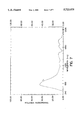
- FIG. 1-A A transmission spectrum of a 3.05 mm thick PMMA plate obtained in Example 37.
- FIG. 1-B A transmission spectrum of a 3 mm thick PMMA plate.
- FIG. 2-C A transmission spectrum of a 2 mm thick PS plate obtained in Example 38.
- FIG. 2-D A transmission spectrum of a 2 mm thick PS plate.
- FIG. 3-E A transmission spectrum of a 2 mm thick PS plate obtained in Example 39.
- FIG. 3-D A transmission spectrum of a 2 mm thick PS plate.
- FIG. 4-F A transmission spectrum of a 1 mm thick PMMA plate obtained in Example 40.
- FIG. 4-G A transmission spectrum of a 1 mm thick PMMA plate.
- FIG. 5-H A transmission spectrum of a 2 mm thick PMMA plate obtained in Example 41.
- FIG. 5-I A transmission spectrum of a 2 mm thick PMMA plate.
- FIG. 5-J A transmission spectrum of a brown-colored 2 mm thick PMMA plate.
- FIG. 6-K A transmission spectrum of a 2 mm thick PMMA plate obtained in Example 42.
- FIG. 7-L A transmission spectrum of a 2 mm thick PMMA plate obtained in Example 43.
- 4,4'-Diaminodiphenylmethane (0.991 g, 5 mM) was dissolved in 20 ml of ethyl acetate, and 2 equivalents of phenylisothiocyanate (1.352 g, 10 mM) was added. The mixture was stirred at 80° C. for 10 minutes. After cooling, the reaction mixture was filtered, and washed with ethylacetate/n-hexane to obtain 1.79 g (75.9% yield) of a a colorless crystal of compound A-1.
- 4,4'-Diaminodiphenylmethane (0.991 g, 5 mM) was dissolved in 20 ml of ethyl acetate, and 2 equivalents of benzylisothiocyanate (1.492 g, 10 mM) was added. The mixture was stirred at 80° C. for 10 minutes. After cooling, the reaction mixture was filtered, and washed with ethylacetate/n-hexane to obtain 2.24 g (90.2% yield) of a colorless crystal of compond A-2.
- 4,4'-Diaminodiphenylmethane (0.496 g, 2.5 mM) was dissolved in 20 ml of ethyl acetate, and 2 equivalents of benzoylisothiocyanate (0.816 g, 5 mM) was added. The mixture was stirred at 25° C. for 10 minutes. After cooling, the reaction mixture was filtered, and washed with ethylacetate/n-hexane to obtain 1.26 g (96.1% yield) of a colorless crystal of compound A-3.
- 4,4'-Diaminodiphenylmethane (0.991 g, 5 mM) was dissolved in 15 ml of ethyl acetate, and 2 equivalents of ethylisothiocyanate (0.872 g, 10 mM) was added. The mixture was stirred at 80° C. for 30 minutes. After cooling, the reaction mixture was filtered, and washed with ethylacetate/n-hexane to obtain 1.21 g (64.9% yield) of a colorless crystal of compound A-4.
- 4,4'-Diaminodiphenylmethane (0.991 g, 5 mM) was dissolved in 15 ml of ethyl acetate, and 2 equivalents of n-butylisothiocyanate (1.152 g, 10 mM) was added. The mixture was stirred at 80° C. for 30 minutes. After cooling, the reaction mixture was filtered, and washed with ethylacetate/n-hexane to obtain 1.47 g (68.5% yield) of a colorless crystal of compound A-5.
- 4,4'-Diaminodiphenylmethane (0.991 g, 5 mM) was dissolved in 15 ml of ethyl acetate, and 2 equivalents of allylisothiocyanate (0.991 g, 10 mM) was added. The mixture was stirred at 80° C. for 60 minutes. After cooling, the reaction mixture was filtered, and washed with ethylacetate/n-hexane to obtain 1.01 g (51.1% yield) of a colorless crystal of compound A-6.
- 4,4'-Diaminodiphenylmethane (0.496 g, 2.5 mM) was dissolved in 15 ml of ethyl acetate, and 2 equivalents of ethylisothiocyanate (0.816 g, 5 mM) was added. The mixture was stirred at 80° C. for 30 minutes. After cooling, the reaction mixture was filtered, and washed with ethylacetate/n-hexane to obtain 0.50 g (38.0% yield) of a colorless crystal of compound A-7.
- 4,4'-Diaminodiphenylmethane (0.496 g, 2.5 mM) was dissolved in 20 ml of ethyl acetate, and 10 ml of an ethyl acetate solution of 2 equivalents of ethoxycarbonylisothiocyanate (0.816 g, 5 mM) was added. The mixture was stirred at 80° C. for 10 minutes. After cooling, the reaction mixture was filtered, and washed with ethyl acetate/n-hexane to obtain 1.07 g (92.8% yield) of a colorless crystal of compound A-8.
- 4,4'-Diaminodiphenylether (1.001 g, 5 mM) was dissolved in 30 ml of acetone, and 2 equivalents of phenylisothiocyanate (1.352 g, 10 mM) was added. The mixture was stirred at 40° C. for 75 minutes. After cooling, the reaction mixture was filtered, and washed with acetone/n-hexane to obtain 1.96 g (83.4% yield) of a colorless crystal of compound A-9.
- 4,4'-Diaminodiphenylether (1.001 g, 5 mM) was dissolved in 30 ml of acetone, and 2 equivalents of benzylisothiocyanate (1.492 g, 10 mM) was added. The mixture was stirred at 55° C. for 15 minutes. After cooling, the reaction mixture was filtered, and washed with acetone/n-hexane to obtain 1.19 g (47.8% yield) of a colorless crystal of compound A-10.
- 4,4'-Diaminodiphenylether (0.501 g, 2.5 mM) was dissolved in 30 ml of acetone, and 2 equivalents of benzoylisothiocyanate (0.816 g, 5 mM) was added. The mixture was stirred at 55° C. for 15 minutes. After cooling, the reaction mixture was filtered, and washed with acetone/n-hexane to obtain 1.23 g (93.2% yield) of a colorless crystal of compound A-11.
- 4,4'-Diaminodipheylsulfone (1.242 g, 5 mM) was dissolvedi n 10 ml of a mixture of acetone and ethyl acetate, and 2 equivalents of benzylisothiocyanate (1.492 g, 10 mM) was added. The mixture was stirred at 55° C. for 90 minutes. After cooling, the reaction mixture was filtered, and washed with acetone/n-hexane to obtain 1.75 g (64.1% yield) of a colorless crystal of compound A-12.
- 4,4'-Diaminodiphenylsulfone (0.621 g, 2.5 mM) was dissolved in 10 ml of a mixture of acetone and ethyl acetate, and 2 equivalents of benzoylisothiocyanate (0.816 g, 5 mM) was added. The mixture was stirred at 55° C. for 90 minutes. After cooling, the reaction mixture was filtered, and washed with acetone/n-hexane to obtain 1.30 g (90.5% yield) of a colorless crystal of compound A-13.
- 4,4'-Diaminodiphenylethane (0.531 g, 2.5 mM) was dissolved in 20 ml of ethyl acetate, and 2 equivalents of phenylisothiocyanate (0.676 g, 5 mM) was added. The mixture was stirred at 40° C. for 60 minutes. After cooling, the reaction mixture was filtered, and washed with ethyl acetate/n-hexane to obtain 0.91 g (75.4% yield) of a colorless crystal of compound A-17.
- 4,4'-Diaminodiphenylethane (0.531 g, 2.5 mM) was dissolved in 20 ml of ethyl acetate, and 2 equivalents of benzylisothiocyanate (0.746 g, 5 mM) was added. The mixture was stirred at 80° C. for 60 minutes. After cooling, the reaction mixture was filtered, and washed with ethylacetate/n-hexane to obtain 1.11 g (86.9% yield) of a colorless crystal of compound A-18.
- 4,4'-Diamino-3,3'-dimethyldiphenylmethane (0.566 g, 2.5 mM) was dissolved in 10 ml of ethyl acetate, and 2 equivalents of benzylisothiocyanate (0.746 g, 5 mM) was added. The mixture was stirred at 80° C. for 10 minutes. After cooling, the reaction mixture was filtered, and washed with ethyl acetate/n-hexane to obtain 1.00 g (77.7% yield) of a pale pink crystal of compound A-19.
- 4,4'-Diamino-3,3'-dimethyldiphenylmethane (0.566 g, 2.5 mM) was dissolved in 10 ml of ethyl acetate, and 2 equivalents of benzoylisothiocyanate (0.816 g, 5 mM) was added. The mixture was stirred at 80° C. for 10 minutes. After cooling, the reaction mixture was filtered, and washed with ethyl acetate/n-hexane to obtain 1.24 g (89.7% yield) of a pale pink crystal of compound A-20.
- 4,4'-Diaminodiphenylamine sulfate (1.486 g, 5 mM) was dissolved in 100 ml of water, sodium hydroxide (0.40 g, 10 mM) was added and stirred, and extracted with 150 ml of ethyl acetate. The resulting ethyl acetate solution was thoroughly washed with water, dewatered, and vacuum concentrated to about 20 ml. Precipitated insoluble substances were filtered out, and 2 equivalents of benzylisothiocyanate (1.492 g, 10 mM) were added to the filtrate. The mixture was stirred at 80° C. for 30 minutes, after cooling, the reaction mixture was filtered, and washed with ethyl acetate/n-hexane to obtain 0.97 g (39.0% yield) of a pale pink crystal of compound A-21.
- 4,4'-Diaminodiphenylamine sulfate (1.486 g, 5 mM) was dissolved in 100 ml of water, sodium hydroxide (0.40 g, 10 mM) was added and stirred, and extracted with 150 ml of ethyl acetate. The resulting ethyl acetate solution was thoroughly washed with water, dewatered, and vacuum concentrated to about 20 ml. Precipitated insoluble substances were filtered out, and an ethyl acetate solution of 2 equivalents of benzoylisothiocyanate (1.492 g, 10 mM) was added to the filtrate. The mixture was stirred at room temperature for 30 minutes, the reaction mixture was filtered, and washed with ethyl acetate/n-hexane to obtain 1.60 g (51.1% yield) of a light brown crystal of compound A-22.
- 4,4'-Diaminodiphenylhexafluoropropane (0.363 g, 1 mM) was dissolved in 20 ml of ethyl acetate, and 2 equivalents of benzoylisothiocyanate (0.326 g, 2 mM) were added. The mixture was stirred at 80° C. for 60 minutes. After cooling, the reaction mixture was filtered, and washed with ethylacetate/n-hexane to obtain 0.671 g (97.3% yield) of a colorless crystal of compound A-23.
- p-Phenylenediamine (2.707 g, 25 mM) was dissolved in 20 ml of ethyl acetate, and 2 equivalents of benzylisothiocyanate (7.461 g, 50 mM) were added. The mixture was stirred at 80° C. for 30 minutes. After cooling, the reaction mixture was filtered, and washed with ethylacetate/n-hexane to obtain 6.26 g (61.6% yield) of a colorless crystal of compound A-25.
- 2,5-Dimethyl-p-phenylenediamine (0.340 g, 2.5 mM) was dissolved in 30 ml of ethyl acetate, and 2 equivalents of benzoylisothiocyanate (0.816 g, 5 mM) were added. The mixture was stirred at room temperature for 10 minutes. After cooling, the reaction mixture was filtered, and washed with ethyl acetate/n-hexane to obtain 1.14 g (98.6% yield) of a colorless crystal of compound A-26.
- o-Anisidine (0.611 g, 2.5 mM) was dissolved in 30 ml of ethyl acetate, and 2 equivalents of benzoylisothiocyanate (0.816 g, 5 mM) were added. The mixture was stirred at room temperature for 10 minutes. After cooling, the reaction mixture was filtered, and washed with ethyl acetate/n-hexane to obtain 1.18 g (82.7% yield) of a colorless crystal of compound A-27.
- o-Dichlorobenzidine (0.633 g, 2.5 mM) was dissolved in 30 ml of ethyl acetate, and 2 equivalents of benzoylisothiocyanate (0.816 g, 5 mM) were added. The mixture was stirred at room temperature for 10 minutes. After cooling, the reaction mixture was filtered, and washed with ethyl acetate/n-hexane to obtain 1.44 g (99.6% yield) of a pale yellow crystal of compound A-28.
- 1,5-Naphthalenediamine (0.791 g, 5 mM) was dissolved in 20 ml of ethyl acetate, and 2 equivalents of benzylisothiocyanate (1.492 g, 10 mM) were added. The mixture was stirred at 80° C. for 30 minutes. After cooling, the reaction mixture was filtered, and washed with ethylacetate/n-hexane to obtain 0.70 g (30.7% yield) of a colorless crystal of compound A-29.
- 4,4'-Diaminodiphenylsulfide (1.082 g, 5 mM) was dissolved in 10 ml of ethyl acetate, and 2 equivalents of phenylisothiocyanate (1.351 g, 10 mM) were added. The mixture was stirred at 55° C. for 90 minutes. After cooling, the reaction mixture was filtered, and washed with ethylacetate/n-hexane to obtain 1.10 g (45.2% yield) of a colorless crystal of compound A-30.
- 4,4'-Diaminodiphenylsulfide (1.082 g, 5 mM) were dissolved in 10 ml of ethyl acetate, and 2 equivalents of p-chlorophenylisothiocyanate (1.696 g, 10 mM) were added. The mixture was stirred at 55° C. for 90 minutes. After cooling, the reaction mixture was filtered, and washed with ethyl acetate/n-hexane to obtain 1.39 g (50.2% yield) of a colorless crystal of compound A-31.
- a composition comprising compound A-2 and copper stearate, mixed in a molar ratio of 2:1, was dry blended in an amount of 0.25 parts by weight with 100 parts by weight of polystyrene (PS, Nippon Steel Chemical ESTYRENE), and kneaded by an extruder at an extrusion temperature of 190° C. to produce a near-infrared absorbent PS pellet.
- PS polystyrene
- types and amounts of evolving gases were determined using a g gas detection tube.
- a composition comprising compound A-10 and copper stearate, mixed in a molar ratio of 3:1, was dry blended in an amount of 0.5 parts by weight with 100 parts by weight of polystyrene (PS, Nippon Steel Chemical ESTYRENE), and kneaded by an extruder at an extrusion temperature of 190° C. to produce a near-infrared absorbent PS pellet.
- PS polystyrene
- types and amounts of evolving gases were determined using a gas detection tube.
- a composition comprising compound A-12 and copper stearate, mixed in a molar ratio of 3:1, was dry blended in an amount of 0.4 parts by weight with 100 parts by weight of polymethylmethacrylate (PMMA, Sumitomo Chemical SUMIPEX), and kneaded by an extruder at an extrusion temperature of 200° C. to produce a near-infrared absorbent PMMA pellet.
- PMMA polymethylmethacrylate
- types and amounts of evolving gases were determined using a gas detection tube.
- a composition comprising compound A-24 and copper ⁇ -acryloyloxypropylhydrogenphthalate, mixed in a molar ratio of 4:1, was dry blended in an amount of 0.3 parts by weight with 100 parts by weight of polymethylmethacrylate (PMMA, Sumitomo Chemical SUMIPEX), and kneaded by an extruder at an extrusion temperature of 200° C. to produce a near-infrared absorbent PMMA pellet.
- PMMA polymethylmethacrylate
- types and amounts of evolving gases were determined using a gas detection tube.
- a composition comprising 1,3-diphenylthiourea and copper stearate, mixed in a molar ratio of 5:1, was dry blended in an amount of 0.5 parts by weight with 100 parts by weight of polystyrene (PS, Nippon Steel Chemical ESTYRENE), and kneaded by an extruder at an extrusion temperature of 190° C. to produce a near-infrared absorbent PS pellet.
- PS polystyrene
- ESTYRENE polystyrene
- types and amounts of evolving gases were determined using a gas detection tube.
- a composition comprising 1,3-di-tolylthiourea and copper monobutylphthalate, mixed in a molar ratio of 3:1, was dry blended in an amount of 0.3 parts by weight with 100 parts by weight of polymethylmethacrylate (PMMA, Sumitomo Chemical SUMIPEX), and kneaded by an extruder at an extrusion temperature of 200° C. to produce a near-infrared absorbent PMMA pellet.
- PMMA polymethylmethacrylate
- types and amounts of evolving gases were determined using a gas detection tube.
- a composition comprising compound A-23 and copper ⁇ -acryloyloxypropylhydrogenphthalate, mixed in a molar ratio of 1:1, was added in an amount of 0.3 parts by weight to 100 parts by weight of methylmethacrylate to therein.
- the solution was mixed with 0.15 parts of 2,2'-azo-bis-isobutyronitrile as a polymerization catalyst, injected into a mold comprising a gasket inserted between two parallel glass plates, immersed in a water bath at 60° C. for 3 hours, then heated in an air oven at 90° C. to complete polymerization. After cooling the resin plate was removed from the glass plates to obtain a 3.05 mm thick resin plate.
- the resulting resin plate was measured for transmission spectrum at 240 nm to 2,500 nm in wavelength by means of a recording spectrophotometer (Shimadzu UV-3100 and a multi-purpose large-sized sample chamber MPC-3100 incorporated with an integration sphere). The result is shown as A in FIG. 1.
- B in the same Figure is a transmission spectrum of a 3 mm thick ordinary methacrylic resin plate (Sumitomo Chemical).
- the resin plate containing the near-infrared absorbent of the present invention well passes light of the visible region, and is superior in absorption properties which cannot be obtained with conventional methacrylic resin.
- the near-infrared absorbent PS pellet prepared in Example 33 was injection molded at an injection molding temperature of 160° C. to produce a 2 mm thick near-infrared absorbent PS plate.
- this near-infrared absorbent PS plate and a 2 mm thick ordinary PS plate not containing a near-infrared absorbent were measured for transmission spectra at 240 nm to 2,500 nm in wavelength. The results are shown as C and D in FIG. 2.
- the inventive plate well passes light of the visible region, and is superior in absorption properties which cannot be obtained with conventional styrene resin.
- the near-infrared absorbent PS pellet prepared in Example 34 was injection molded at an injection molding temperature of 160° C. to produce a 2 mm thick near-infrared absorbent PS plate.
- the plate was measured for transmission spectrum. The result is shown as spectrum E in FIG. 3.
- spectrum D is also shown in FIG. 3 .
- the near-infrared absorbent PMMA pellet prepared in Example 35 was injection molded at an injection molding temperature of 190° C. to produce a 2 mm thick near-infrared absorbent PMMA plate. As in Example 38, the plate was measured for transmission spectrum. The result is shown as transmission spectrum F in FIG. 4. A 1 mm thick ordinary PMMA plate not containing a near-infrared absorbent was also measured for transmission spectra at 20 nm to 2500 nm in wavelength. The result is shown as transmission spectrum G in FIG. 4. The differences in transmission spectra are readily apparent.
- the near-infrared absorbent PMMA pellet prepared in Example 36 was injection molded at an injection molding temperature of 190° C. to produce a 2 mm thick near-infrared absorbent PMMA plate.
- the 2 mm thick plate was measured for transmission spectrum. The result is shown as spectra H in FIG. 5.
- spectra H in FIG. 5.
- FIG. 4 Also shown in FIG. 4 are the transmission spectrum I of an ordinary 2 mm thick PMMA plate without a near-infrared absorbent and the transmission spectrum J of a brown-colored 2 mm thick PMMA plate. The differences in the spectra I and J from spectrum H are readily apparent.
- a composition comprising compound A-21 and copper stearate, mixed in a molar ratio of 1:1, was dry blended in an amount of 0.1 part by weight with 100 parts by weight of polymethylmethacrylate (PMMA, Sumitomo Chemical SUMIPEX), and kneaded by an extruder at an extrusion temperature of 200° C. to produce a near-infrared absorbent PMMA pellet. Further, the pellet was injection molded at an injection molding temperature of 190° C. to produce a 2 mm thick near-infrared absorbent PMMA plate. As in Example 38, the plate was measured for transmission spectrum. The result is shown in FIG. 6 as spectrum K.
- a composition comprising compound A-28 and copper stearate, mixed in a molar ratio of 2:1, was dry blended in an amount of 1 part by weight with 100 parts by weight of polymethylmethacrylate (PMMA, Sumitomo Chemical SUMIPEX), and kneaded by an extruder at an extrusion temperature of 200° C. to produce a near-infrared absorbent PMMA pellet. Further, the pellet was injection molded at an injection molding temperature of 190° C. to produce a 2 mm thick near-infrared absorbent PMMA plate. As in Example 38, the plate was measured for transmission spectrum. The result is shown in FIG. 7 as spectrum L.
- PMMA polymethylmethacrylate
- a polystyrene (PS, Nippon Steel Chemical ESTYRENE) pellet was injection molded at an injection molding temperature of 160° C. to produce a 2 mm thick PS plate. As in Example 36, the plate was measured for transmission spectrum.
- PS Polystyrene
- a polymethylmethacrylate (PMMA, Sumitomo Chemical SUMIPEX) bead was kneaded by an extruder at a temperature of 200° C. to produce a pellet.
- the PMMA pellet was injection molded at an injection molding temperature of 190° C. to produce a 2 mm thick PMMA plate. As in Example 36, the plate was measured for transmission spectrum.
- a commercial brown-colored smoke type polymethylmethacrylate plate was measured for transmission spectrum as in Example 36.
- the plate containing the near-infrared absorbent comprising the dimerized thiourea derivative of the present invention and the copper compound showed a heat wave shielding efficiency of about 40%, whereas that containing no near-infrared absorbent had a heat wave shielding efficiency of only about 5%. Further, the commercial heat wave shielding plate had a heat wave shielding efficiency of -53%.
- the brown-colored plate which does not absorb near-infrared rays of over 800 nm, merely absorbs visible light to reduce the visible light transmittance, thereby reducing the sunlight transmittance as a whole. Therefore, the heat wave shielding efficiency is a negative value.
- the heat wave shielding material using the near-infrared absorbent of the present invention is much superior.
- a near-infrared absorbent property appears by mixing and heating a thiourea compound and a copper compound, however, since the dimerized thiourea derivative of the present invention is higher in thermal decomposition temperature than conventional thiourea compounds, it does not decompose when the near-infrared absorbent composition comprising the dimerized thiourea derivative and the copper compound is kneaded with a resin, thereby suppressing generation of malodorous gases.
- the heat wave shielding material formed by mixing the near-infrared absorbent composition with a transparent resin and molding can be used for roofing, window materials, and the like of carport, sunroom, and terrace to suppress temperature increase in the room.
- the heat wave shielding material of the present invention passes visible light relatively well and absorbs near-infrared rays in a wide range, and it can also efficiently absorb ultraviolet light as well.
Landscapes
- Chemical & Material Sciences (AREA)
- Organic Chemistry (AREA)
- Health & Medical Sciences (AREA)
- Chemical Kinetics & Catalysis (AREA)
- Medicinal Chemistry (AREA)
- Polymers & Plastics (AREA)
- Compositions Of Macromolecular Compounds (AREA)
- Organic Low-Molecular-Weight Compounds And Preparation Thereof (AREA)
Abstract
A near-infrared absorbent is obtained by heating a dimerized thiourea derivative of Formula 1! or 2! and a copper compound: ##STR1## The near-infrared absorbent is used to obtain a near-infrared absorbent resin material having a wide absorption in the near-infrared region, and the absorbent does not substantially decompose at a molding temperature of the resin. Typical examples of the dimerized thiourea derivative are 4,4'-di(benzylthiocarbamoyl)-aminodiphenylmethane, 4,4'-di(benzylthiocarbamoyl)-aminodiphenylhexafluoropropane, and 1,4'-di(dibenzoylthiocarbamoylamino)-2,5-dimethylbenzene, and typical examples of the copper compound are copper stearate and copper β-acryloyloxypropylhydrogenphthalate.
Description
This application is a continuation of application Ser. No. 08/197,948, filed Feb. 17, 1994 now abandoned.
This invention relates to a novel dimerized thiourea derivative, a near-infrared absorbent composition comprising the dimerized thiourea derivative and a copper compound, a near-infrared absorbent obtained by heating the composition, a near-infrared absorbent resin obtained by melting the near-infrared absorbent composition or the near-infrared absorbent, and a heat wave shielding material using the near-infrared absorbent resin.
In Japanese Patent Laid-open Publications (Japanese OPI) 2-3493, 2-34682, 2-80486, and 3-246256, the inventors already disclosed a near-infrared absorbent composition comprising a thiourea compound and a copper compound, a near-infrared absorbent material obtained by heating the composition, and a near-infrared absorbent resin molding containing the absorbents in a resin, or a near-infrared absorbent resin molding obtained by mixing the absorbents with a radical polymerization initiator and heating the mixture to polymerize.
These near-infrared absorbents obtained by heating a composition comprising a thiourea compound and a copper compound are inexpensive compared to near-infrared absorbent dyes known in the past, and superior in terms of light fastness and near-infrared absorption range.
However, when containing a composition comprising a prior art thiourea compound and a copper compound in a resin and molding to a pellet or a specified form, the composition tends to undergo partial decomposition due to the molding heat, resulting in gas evolution.
Therefore, a primary object of the present invention is to provide a near-infrared absorbent composition, and a near-infrared absorbent, which, heat molded to produce a near-infrared absorbent resin, do not decompose or generate malodorous gases at the melding temperature, a near-infrared absorbent resin containing these near-infrared absorbent composition and near-infrared absorbent, and a heat wave shielding material comprising the resin.
The above object is attained by a thiourea compound (hereinafter referred to as "dimerized thiourea compound") which has two thiourea structures (--NH--(C═S)--NH--) in the molecule.
In accordance with the present invention, there is provided a near-infrared absorbent composition comprising a dimerized thiourea compound of Formula 1! or Formula 2! and a copper compound: ##STR2## (wherein A denotes CH2, (CH2)2, S, O, SO2, CONH, NH, or C(CF3)2. R denotes a substituted or unsubstituted alkyl group having 1 to 18 carbon atoms, a substituted or unsubstituted cycloalkyl group having 3 to 18 carbon atoms, a substituted or unsubstituted aralkyl group having 7 to 30 carbon atoms, a substituted or unsubstituted aryl group having 6 to 30 carbon atoms, a substituted or unsubstituted acyl group having 2 to 20 carbon atoms, a substituted or unsubstituted alkenyl group having 2 to 20 carbon atoms, or a substituted or unsubstituted alkoxycarbonyl group having 2 to 20 carbon atoms. R1, R2, R3, R4, R5, R6, R7, and R8 denote a lower alkyl group having 1 to 6 carbon atoms, lower alkoxy group having 1 to 6 carbon atoms, nitro group, cyano group, halogen atom, or hydrogen atom.) ##STR3## (wherein R denotes the same as R in Formula 1!, and B denotes a substituted or unsubstituted benzene ring, naphthalene ring, or biphenyl ring.)
In R of Formula 1! and Formula 2!, the alkyl group includes methyl group, ethyl group, n-propyl group, iso-propyl group, n-butyl group, sec-butyl group, tert-butyl group, heptyl group, dodecyl group, stearyl group, or the like; the cycloalkyl group includes cyclohexyl group or the like; the aralkyl group includes benzyl group, b-phenylethyl group, or the like; the aryl group includes phenyl group, chlorophenyl group, fluorophenyl group, toluyl group, cyanophenyl group, nitrophenyl group, methoxyphenyl group, 1-naphthyl group, or the like; the acyl group includes benzoyl group or the like, the alkenyl group includes allyl group, 2-butenyl group, 4-pentenyl group, or the like; and the alkoxycarbonyl group includes ethoxycarbonyl group or the like.
Examples of the dimerized thiourea derivative of Formula 1! used in the present invention include, but are not limited to, the following:
4,4'-di(phenylthiocarbamoylamino)diphenylmethane, 4,4'di-(benzylthiocarbamoylamino)diphenylmethane, 4,4'di-(benzoylthiocarbamoylamino)diphenylmethane, 4,4'di-(ethylthiocarbamoylamino)diphenylmethane, 4,4'-di(n-butylthiocarbamoylamino)diphenylmethane, 4,4'-di(allylthiocarbamoylamino)diphenylmethane, 4,4'-di(ethoxycarbonylthiocarbamoylamino)diphenylmethane, 4,4'-di(phenylthiocarbamoylamino)diphenylether, 4,4'-di(p-tolylthiocarbamoylamino)diphenylether, 4,4'-di(tert-butylthiocarbamoylamino)diphenylether, 4,4'-di(benzylthiocarbamoylamino)diphenylether, 4,4'-di(benzoylthiocarbamoylamino)diphenylether, 4,4'-di(phenylthiocarbamoylamino)diphenylsulfone, 4,4'-di(p-chlorophenylthiocarbamoylamino)diphenylsulfone, 4,4'-di(iso-butylbenzylthiocarbamoylamino)diphenylsulfone, 4,4'-di(benzylthiocarbamoylamino)diphenylsulfone, 4,4'-di(benzoylthiocarbamoylamino)diphenylsulfone, 4,4'-di(phenylthiocarbamoylamino)diphenylsulfide, 4,4'-di(o-tolylthiocarbamoylamino)diphenylsulfide, 4,4'-di(dodecylthiocarbamoylamino)diphenylsulfide, 4,4'-di(benzylthiocarbamoylamino)diphenylsulfide, 4,4'-di(phenylthiocarbamoylamino)benzanilide, 4,4'-di(cyclohexylthiocarbamoylamino)benzanilide, 4,4'-di(benzylthiocarbamoylamino)benzanilide, 4,4'-di(phenylthiocarbamoylamino)diphenylethane, 4,4'-di(m-tolylthiocarbamoylamino)diphenylethane, 4,4'-di(octadecylthiocarbamoylamino)diphenylethane, 4,4'-di(benzylthiocarbamoylamino)diphenylethane, 4,4'-di(diphenylthiocarbamoylamino)-3,3'-dimethyldiphenylmethane, 4,4'-di(p-methoxyphenylthiocarbamoylamino)-3,3'-dimethyldiphenylmethane, 4,4'-di(benzylthiocarbamoylamino)-3,3'-dimethyldiphenylmethane, 4,4'-di(benzoylthiocarbamoylamino)-3,3'-dimethyldiphenylmethane, 4,4'-di(benzylthiocarbamoylamino)diphenylamine, 4,4'-di(benzylthiocarbamoylamino)diphenylamine, 4,4'-di(benzoylthiocarbamoylamino)diphenylamine, 4,4'-di(benzylthiocarbamoylamino)diphenylfluoropropane, and 4,4'-di(benzoylthiocarbamoylamino)diphenylhexafluoropropane.
Further, examples of the dimerized thiourea derivative of Formula 2! used in the present invention include, but are not limited to, the following:
1,3-di(benzylthiocarbamoylamino)benzene, 1,3-di(benzoylthiocarbamoylamino)-2-methylbenzene, 1,3-di(benzylthiocarbamoylamino)-5-chlorobenzene, 1,3-di(benzylthiocarbamoylamino)-4-methoxybenzene, 1,3-di(benzoylthiocarbamoylamino)-2,4,6-trimethylbenzene, 1,4-di(benzylthiocarbamoylamino)benzene, 1,4-di(benzoylthiocarbamoylamino)-2-chlorobenzene, 1,4-di(benzylthiocarbamoylamino)-2-methylbenzene, 1,4-di(benzoylthiocarbamoylamino)-2,5-dimethylbenzene, 1,4-di(benzylthiocarbamoylamino)-2,3,5,6-tetramethylbenzene, 1,4-di(benzoylthiocarbamoylamino)-2-chloro-5-methylbenzene, 4,4-di(benzylthiocarbamoylamino)-3,3'-dimethoxybenzidine, 4,4-di(benzoylthiocarbamoylamino)-3,3'-dimethoxybenzidine, 4,4-di(benzylthiocarbamoylamino)benzidine, 4,4-di(benzylthiocarbamoylamino)-3,3'-dimethylbenzidine, 4,4-di (benzylthiocarbamoylamino)-3,3'-dichlorobenzidine, 4,4-di(benzylthiocarbamoylamino)-3,3'6,6'-tetrachlorobenzidine, 4,4-di(benzoylthiocarbamoylamino)-3,3',6,6'-tetrachlorobenzidine, 1,5-di(benzylthiocarbamoylamino)naphthalene, and 1,5-di(benzoylthiocarbamoylamino)naphthalene.
The compounds of Formulae 1! and 2! of the present invention can be produced by using a reaction of monoisothiocyanate compounds and diamines.
Specifically, approximately 2 molar equivalents of a monoisothiocyanate are added to 1 mole of a diamine. Usable solvents are those which dissolve diamines and monoisothiocyanates, including aromatic hydrocarbons such as benzene, toluene, xylene, and the like; halogenated hydrocarbons such as chloroform, dichloromethane, chlorobenzene, and the like; ethers such as diethylether, tetrahydrofuran, and the like; nitriles such as acetonitrile, propionitrile, and the like; esters such as ethyl acetate and the like; ketones such as acetone, methylethylketone, and the like; non-proton donating polar solvents such as dimethylformamide, dimethylsulfoxide, and the like; alcohols such as methanol, ethanol, and the like; or mixtures thereof. The reaction temperature is 0° to 150° C., preferably 20° to 80° C.
Practical examples of the compounds of Formulae 1! and 2! are shown above, which are symmetrical compounds, however, the present invention is not limited to these symmetrical compounds, but asymmetrical compounds are also included.
The dimerized thiourea compound of Formula 1! has two thiourea structures, which can be considered as a compound in which the two thiourea structures are linked by two aromatic compounds. Of dimerized thiourea compounds of Formula 1!, especially those of Formulae 3!- 4! are novel compounds. ##STR4## (wherein A1 denotes CH2, (CH2)2, S, O, SO2, CONH, NH, or C(CF3)2. RA denotes a substituted or unsubstituted alkyl group having 1 to 18 carbon atoms, a substituted or unsubstituted aralkyl group having 7 to 30 carbon atoms, a substituted or unsubstituted acyl group having 2 to 20 carbon atoms, a substituted or unsubstituted alkenyl group having 2 to 20 carbon atoms, or a substituted or unsubstituted alkoxycarbonyl group having 2 to 20 carbon atoms. R1, R2, R3, R4, R5, R6, R7, and R8 denote the same as those in Formula 1!.) ##STR5## (wherein A2 denotes S, O, SO2, CONH, NH, or C(CF3)2. RB denotes a substituted or unsubstituted aryl group having 6 to 30 carbon atoms. R1, R2, R3, R4, R5, R6, R7, and R8 denote the same as those in Formula 1!. )
Of the thiourea compounds of Formula 3!, those of Formulae 5!- 6! are more preferable. ##STR6## (wherein A1 denotes CH2, (CH2)2, S, O, SO2, CONH, NH, or C(CF3)2. R1, R2, R3, R4, R5, R6, R7, and R8 denote the same as those in Formula 1!. X is a lower alkyl group having 1 to 6 carbon atoms, lower alkoxy group having 1 to 6 carbon atoms, halogen atom, or hydrogen atom. n is an integer from 1 to 3.) ##STR7## (wherein A1 denotes CH2, (CH2)2, S, O, SO2, CONH, NH, or C(CF3)2. R1, R2, R3, R4, R5, R6, R7, and R8 denote the same as those in Formula 1!. X is a lower alkyl group having 1 to 6 carbon atoms, lower alkoxy group having 1 to 6 carbon atoms, halogen atom, or hydrogen atom. n is an integer from 1 to 3.)
The thiourea compounds of Formula 4! can be broadly classified into the following Formulae 7!- 11! by the group (A2) linking two aromatic rings. ##STR8## (wherein R1, R2, R3, R4, R5, R6, R7, and R8 denote the same as those in Formula 1!. X and n are the same as those in Formula 5!.) ##STR9## (wherein R1, R2, R3, R4, R5, R6, R7, and R8 denote the same as those in Formula 1!. X and n are the same as those in Formula 5!.) ##STR10## (wherein R1, R2, R3, R4, R5, R6, R7, and R8 denote the same as those in Formula 1!. X and n are the same as those in Formula 5!.) ##STR11## (wherein R1, R2, R3, R4, R5, R6, R7, and R8 denote the same as those in Formula 1!. X and n are the same as those in Formula 5!.) ##STR12## (wherein R1, R2, R3, R4, R5, R6, R7, and R8 denote the same as those in Formula 1!. X and n are the same as those in Formula 5!.)
For example, compounds of Formulae 7! and 8! include the following. ##STR13##
On the other hand, the dimerized thiourea compound of Formula 2! has two thiourea structures, which can be considered as a compound in which the thiourea structures are linked by a single aromatic compound. Of dimerized thiourea compounds of Formula 2!, especially the dimerized thiourea compound of Formula 12! is a novel compound. ##STR14## (wherein RA denotes the same as that in Formula 3!, and B denotes a substituted or unsubstituted benzene ring, naphthalene ring, or biphenyl ring.)
Of the thiourea compounds of Formula 12!, those of Formulae 13!- 14! are more preferable. ##STR15## (wherein B denotes the same as that in Formula 2!, and X and n denote the same as those in Formula 5!.) ##STR16## (wherein B denotes the same as that in Formula 2!, and X and n denotes the same as those in Formula 5!.)
The copper compound used in the present invention can preferably be at least one copper compound selected from the group consisting of copper compounds of an organic acid of Formula 15!, copper bis-acetylacetonate, and copper hydroxide:
(Y--Z)mCu 15!
(wherein Y denotes a substituted or unsubstituted alkyl group, a substituted or unsubstituted cycloalkyl group, a substituted or unsubstituted aryl group, a substituted or unsubstituted aralkyl group, or heterocyclic residue, Z is COO, SO4, SO3, PO4, and m is an integer from 1 to 4.) Practical examples of the compounds of Formula 15! include, but are not limited to, the following:
Copper stearate, copper palmitate, copper oleate, copper behenate, copper laurate, copper caprate, copper caprylate, copper caproate, copper valerate, copper isobutyrate, copper 4-cyclohexylbutyrate, copper butyrate, copper propionate, copper acetate, copper formate, copper benzoate, copper toluate, copper t-butylbenzoate, copper chlorobenzoate, copper dichlorobenzoate, copper trichlorobenzoate, copper bromobenzoate, copper iodobenzoate, copper phenylbenzoate, copper benzoylbenzoate, copper nitrobenzoate, copper aminobenzoate, copper oxalate, copper malonate, copper succinate, copper glutarate, copper adipate, copper pimelate, copper suberate, copper azelaate, copper sebacate, copper citrate, copper phthalate, copper monoalkylester phthalate, copper monoacryloylester phthalate, copper naphthenate, copper naphthalenecarboxylate, copper diphenylamine-2-carboxylate, copper tartarate, copper gluconate, copper octylate, copper benzenesulfonate, copper p-toluenesulfonate, copper 2,5-dimethylbenzenesulfonate, copper 2-methoxycarbonyl-5-methylsulfonate, copper dodecylbenzenesulfonate, copper naphthalenesulfonate, copper aminonaphthalenesulfonate, copper dodecylsulfate, copper α-naphthylphosphate, copper stearyl-phosphate, copper laurylphosphate, copper di-2-ethylhexylphosphate, and copper isodecylphosphate.
Each of the above copper compound and the dimerized thiourea derivative alone has no absorption in the near-infrared region (780 nm-2,500 nm), or slightly absorbs a specific wavelength, and the absorption in the near-infrared region is not substantially changed even when each of the compounds alone is heat treated. Further, a composition comprising a mere mixture of the copper compound and the dimerized thiourea derivative does not provide a substantial change in near-infrared absorption. However, when the composition is heat treated, they immediately react to have a nearly uniform and strong absorption over the entire near-infrared region. Therefore, the composition comprising a mixture of the dimerized thiourea derivative and the copper compound is a superior near-infrared absorbent composition, and a reaction product obtained by heating the composition is a very good near-infrared absorbent.
Degree of the near-infrared absorption can be flexibly controlled by adjusting the types and ratio of the dimerized thiourea derivative and the copper compound, heating temperature, heating time, and the like. The ratio of the dimerized thiourea derivative and the copper compound is normally about 8:2 to 1:2 in molar ratio, preferably 2:1 to 1:1, the heating temperature is 100° to 250° C., preferably 120° to 180° C., and a heating time of several milliseconds is sufficient.
Various applications can be considered utilizing the properties. For example, when the near-infrared absorbent composition is provided with heat energy, since the portion provided with the heat energy is changed to near-infrared absorbent but has almost no absorption in the visible region, the composition can be incorporated in a heating pattern or a near-infrared detection apparatus, and an appropriate visualization means is used to obtain the recording image. By using a laser light having a wavelength in the near-infrared region as a heat source, a noncontacting visible image recording system can be obtained.
Further, utilizing the property of having a strong absorption over nearly the entire near-infrared region, a near-infrared absorbent molding and a heat wave shielding material can be obtained.
The near-infrared absorbent molding can be obtained by melting the dimerized thiourea compound and the copper compound or a composition comprising a mixture thereof with a resin and then molding, or by heat molding a near-infrared absorbent obtained by previously heating the raw materials to above a predetermined temperature with a resin, in the form of granules, films, sheets, boards, or desired three-dimensional shapes. Further, the near-infrared absorbent or the near-infrared absorbent composition can be sprayed, coated, or impregnated to a desired substrate, dried, and heated to endow the substrate with a near-infrared absorbing property. Since near-infrared light acts as a heat source, when a highly transparent resin is used as the resin or the substrate, the material can also be used as a heat wave shielding material which blocks the near-infrared region.
The dimerized thiourea compound and the copper compound can be added in amounts of 0.05 to 5% by weight, preferably 0.1 to 1% by weight, based on the resin to obtain a near-infrared absorbent resin composition which is less colored, good in visible light transmittance, and superior in near-infrared absorbing property.
The resin can be known thermoplastic resins such as polyethylene, polyvinylchloride, poly(meth)acrylic acid or poly(meth)acrylic esters, polycarbonate, polystyrene, and styrene-butadiene copolymers; known thermosetting resins such as urea resins, melamine resins, and epoxy resins; and natural resins such as rosin and dammar. Thermoplastic resins are widely used for producing moldings. For example, for glazing applications, polycarbonate, polymethyl methacrylate, and the like are used to good advantage in terms of transparency and strength.
In the production of moldings, since the molding temperature depends on the type of resin used, a dimerized thiourea derivative of type that does not decompose at the temperature can be selected to prevent unpleasant gas evolution.
In molding, it is preferable that the resin is mixed with the near-infrared absorbent composition of the present invention by a tumbler, mixer, blender, or the like to obtain a master batch and, as needed, additives such as a dye for coloring, a pigment, an antioxidant, a stabilizer such as an ultraviolet absorbent, a fire-retardant agent, a plasticizer, and the like to obtain a compounding material.
Further, the near-infrared absorbent resin and its molding can also be obtained by mixing a polymerizable raw material with the dimerized thiourea compound of the present invention and the copper compound, and heat polymerized in the presence of a radical polymerization initiator. The dimerized thiourea derivative and the copper compound are used in total amounts of about 0.1 to 0.5 parts by weight, preferably 0.2 to 1.0 part by weight, based on 100 parts by weight of the polymerizable raw material to obtain a sufficient effect.
The polymerizable raw material is at least one of known radical polymerizable unsaturated monomers such as (meth)acrylic acid, (meth)acrylic esters, styrene, olefins, vinylchloride, and the like, and a prepolymer of these polymerizable monomers dissolved in the polymerizable monomer can also be used as the polymerizable raw material. The polymerizable raw material can be polymerized by known polymerization means to obtain polymers such as poly(meth)acrylic acid, poly(meth)acrylic esters, polyolefins, polyvinylchloride, polyvinylidenechloride, polystyrene, polyesters, polyvinylacetate, polyvinylalcohol, and the like.
Radical polymerization is initiated by the action of heat, light, or radiation, and normally carried out in the presence of an initiator or photosensitizer. Further, by the polymerization condition, the process is classified into block polymerization, solution polymerization, emulsion polymerization, and suspension polymerization.
Typical examples of the radical polymerization initiator are azo compound type initiators and peroxide type initiators. Practical examples of the azo compound type initiator include 2,2'-azo-bis-isobutyronitrile, 2,2'-azo-bis-2,4-dimethylvaleronitrile, 1,1'-azo-bis-1-cyclohexanecarbonitrile, methyl 2,2'-azo-bis-isobutyrate, and the like; and practical examples of the peroxide type initiator include benzoylperoxide, di-1-butylperoxide, diisopropylperoxydicarbonate, dicyclohexylperoxydicarbonate, and the like. In the present invention, when polymerization is carried out using a peroxide type initiator, the near-infrared absorption may be reduced depending on the type and amount of the initiator. Therefore, the use of an azo compound type initiator is preferable.
For poly(meth)acrylic acid, poly(meth)acrylic ester, polystyrene, and polyvinylacetate, a molding can be produced simultaneously with block polymerization of each monomer. Further, when two or more types of monomers are combined and block polymerized, a copolymer can be obtained.
Further, for polyolefin, polyvinylchloride, polyvinylidenechloride, polycarbonate, polyester, and polyvinylacetate, films can be produced by polymerization of each monomer followed by melt extrusion. For polyvinylchloride, polycarbonate, methacrylic resins, polystyrene, polypropylene, and polyethylene, plates and films can be produced by a solution flow method after polymerization.
In photopolymerization, a photopolymerization initiator and, as needed, a visible light sensitizer are added to the above polymerizable raw material, and polymerization is carried out. Practical examples of the photopolymerization initiator include acetophenone, 2,2'-diethoxyacetophenone, benzophenone, 4,4'-bisdimethylaminobenzophenone, benzoin, benzoinethylether, and the like, of which one or more types are used.
Polymerization is carried out by a method in which a mixture mainly comprising the above polymerizable raw material, the near-infrared absorbent composition or the near-infrared absorbent of the present invention, and a photopolymerization initiator is coated on a substrate, or sealed in a transparent made of glass, plastics, or the like, and then irradiated with light.
Further, an object already formed to a certain shape can also be endowed with a near-infrared absorbent property by spraying, coating, or printing a slurry comprising a composition of the dimerized thiourea derivative of the present invention and the copper compound dissolved or dispersed with a binder on a substrate, followed by drying and heating, or by spraying, coating, or printing a slurry comprising the near-infrared absorbent of the present invention and a binder. Further, the substrate can also be endowed with a near-infrared absorbent property by a method in which a solution of the resin composition containing the near-infrared absorbent composition in a solvent or a molten liquid thereof is coated on the substrate, dried, and heat treated.
For example, when the dimerized thiourea derivative and the copper compound are dissolved in a silicone-based hard coating agent, coated on the substrate, and heat treated, polysiloxane condenses to form a glass-like substance, and the dimerized thiourea derivative and the copper compound react to yield a near-infrared absorbent, thereby obtaining a near-infrared absorbent glass-like protective coating. The silicone-based hard coating agent mainly comprises three-functional and four-functional organoalkoxysilane monomers, which are hydrolyzed in the presence of a solvent and an acid or base, and partially condensed to obtain a polysiloxane, which is dissolved in a solvent such as alcohol, cellosolve, ketone, or the like, mixed with a curing catalyst and, according to a required function, mixed with various additives to obtain a sol. The sol can be cured at a low temperature of about 120° to 150° C. by selecting a catalyst, thereby coating a resin having a low heat distortion temperature such as polymethylmethacrylate with a near-infrared absorbent glass-like protective film without deformation of the resin.
The total amount of the dimerized thiourea compound and the copper compound is 5 to 50 parts by weight based on 100 parts by weight of solid of the silicone-based hard coating agent, and the molar ratio of the dimerized thiourea derivative and the copper compound is 8:2 to 1:2.
Since a plastic sheet or film comprising the near-infrared absorbent contained in a highly transparent plastic has a wide and strong absorption in the near-infrared region, it can be used as a heat wave shielding material.
The heat wave shielding plastic sheet is required to have the following quality: (1) it cuts off sunlight energy as much as possible, and allows visible light to pass, (2) physical strength is not reduced, (3) the heat wave shielding effect does not vary with time, and (4) it is clear and least turbid as possible.
Heat wave shielding performance of the heat wave shielding material can be evaluated for sunlight transmittance and visible light transmittance according to JIS R 3106.
The visible light transmittance represents a visual transmittance to daylight (standard light D 65), of which the greater value is the lighter. The sunlight transmittance represents a transmittance to sunlight, that is, radiations of the near-ultraviolet, visible, and near-infrared regions which comes from the sun passing through the atmosphere to the ground, of which the lower the value, the higher is the cutting rate.
The sunlight energy distributes in 0.3 to 2.5 μm in wavelength. Of the total sunlight energy, that of the visible light region (0.38 to 0.78 μm) accounts for about 45%, and the remaining 50% is in the near-infrared region (0.78 to 2.5 μm).
When there is no sunlight blocking material, the sunlight transmittance and visible light transmittance are 100. For a shielding material which passes all of near-infrared rays and cuts off all of visible light (the visible light transmittance is 0), from the wavelength ratio of sunlight, the sunlight transmittance is 55, but it is dark to human eyes. Such a heat wave shielding material is not directed to by the present invention. Further, as the visible light transmittance is increased, the sunlight transmittance of course increases, and the result becomes worse. On the contrary, in an ideal condition where all of visible light is passed (visible light transmittance 100) and all of near-infrared rays are cut off, the sunlight transmittance is 50. Then, since the objective heat wave shielding material is required to pass visible light as much as possible and cut off near-infrared rays as much as possible, in the present invention a heat wave shielding efficiency is defined by Formula A!:
η= (E-Y)/50!×100 A!
(wherein E is a visible light transmittance, Y is a sunlight transmittance, and 50 indicates a sunlight transmittance of an ideal heat wave shielding material.)
That is, in an ideal condition as a heat wave shielding material,
η.sub.0 = (100-50)/50!×100=100 (%),
and when all of light is passed,
η= (100-100)/50!×100=0 (%).
Therefore, the greater the η value, the better the heat wave shielding efficiency of the plate.
When the heat wave shielding material of the present invention which can sufficiently transmit visible light while cutting off near-infrared light is used, sunlight passed through the material feels no heat. The material can be used in summer in exterior applications for roofing, exterior materials, and the like such as in a carport, sunroom, terrace, and the like to supply bright and cool light, thereby suppressing temperature increase in rooms and reducing operation of air conditioners.
Further, the heat wave shielding material of the present invention blocks near-infrared light by absorbing it. Finally the absorbed near-infrared light is partly converted to heat, and emits radiation energy according to the temperature of the substance. The radiation energy is 3.0 to 30 μm in wavelength. Therefore, when the heat wave shielding material is used in the interiors, a greenhouse effect occurs unless an efficient heat dissipation is effected but, when it is used in winter, operation of heaters can be reduced.
Since the heat wave shielding material is required to pass visible light as much as possible, the material resin desirably has a high transparency and, at the same time, it is necessary to select a dimerized thiourea compound and a copper compound which dissolve in the polymerizable raw material. For the copper compound, copper salt of phthalic acid derivative which is readily soluble in the polymerizable raw material as disclosed in Japanese Patent Laid-open Publication 3-246256 can be used.
The transparent polymer is preferably based on an unsaturated monomer such as (meth)acrylic acid, (meth)acrylic ester, styrene, vinylacetate, or the like as the polymerizable monomer and, particularly, one which is based mainly on (meth)acrylic ester is preferable. The (meth)acrylic ester is a (meth)acrylic ester of a compound having monohydric or polyhydric hyroxyl groups or in which a prepolymer of the (meth)acrylic ester is dissolved.
The polymerization condition is not specifically limited but, for example, when the dimerized thiourea compound and the copper compound and a polymerization initiator are dissolved in methylmethacrylate and block polymerized in a mold, an initial-stage polymerization (pre-polymerization) is carried out at 40° to 90° C. for 2 to 3 hours, and a post-stage polymerization (main polymerization) is carried out at 90° to 140° C. for 2 to 3 hours to obtain a near-infrared absorbent resin plate.
It is also a preferable method that a resin material containing the dimerized thiourea compound and the copper compound is mixed with a photopolymerization initiator, and photopolymerized to obtain a near-infrared absorbent plate.
The thus obtained heat wave shielding material, for example, a 1 mm thick near-infrared absorbent methacrylic sheet obtained by a method in which 100 parts by weight of methacrylic resin is mixed with 0.3 parts by weight of the near-infrared absorbent composition and extrusion injection molded has a sunlight transmittance of 55 to 60% and a visible light transmittance of 70 to 75%. Further, a 2 mm thick near-infrared absorbent methacrylic sheet containing 0.5 parts by weight of the near-infrared absorbent composition has a sunlight transmittance of 15 to 25% and a visible light transmittance of 30 to 40%. At either concentration, the heat wave shielding efficiency is 35 to 45%.
Further, the heat wave shielding material can also cut off ultraviolet rays. Since such an ultraviolet shielding material is transparent, that is, passes visible light, it is effectively used in sunglasses, window glass, and the like which can block harmful ultraviolet rays without inconvenience in viewing objects such as in seashore, skiing ground, high mountains, welding place, and the like.
FIG. 1-A: A transmission spectrum of a 3.05 mm thick PMMA plate obtained in Example 37.
FIG. 1-B: A transmission spectrum of a 3 mm thick PMMA plate.
FIG. 2-C: A transmission spectrum of a 2 mm thick PS plate obtained in Example 38.
FIG. 2-D: A transmission spectrum of a 2 mm thick PS plate.
FIG. 3-E: A transmission spectrum of a 2 mm thick PS plate obtained in Example 39.
FIG. 3-D: A transmission spectrum of a 2 mm thick PS plate.
FIG. 4-F: A transmission spectrum of a 1 mm thick PMMA plate obtained in Example 40.
FIG. 4-G: A transmission spectrum of a 1 mm thick PMMA plate.
FIG. 5-H: A transmission spectrum of a 2 mm thick PMMA plate obtained in Example 41.
FIG. 5-I: A transmission spectrum of a 2 mm thick PMMA plate.
FIG. 5-J: A transmission spectrum of a brown-colored 2 mm thick PMMA plate.
FIG. 6-K: A transmission spectrum of a 2 mm thick PMMA plate obtained in Example 42.
FIG. 7-L: A transmission spectrum of a 2 mm thick PMMA plate obtained in Example 43.
The present invention will be described further in detail with reference to the embodiments.
(Synthesis of Compound A-1)
4,4'-di(phenylthiocarbamoylamino)diphenylmethane
4,4'-Diaminodiphenylmethane (0.991 g, 5 mM) was dissolved in 20 ml of ethyl acetate, and 2 equivalents of phenylisothiocyanate (1.352 g, 10 mM) was added. The mixture was stirred at 80° C. for 10 minutes. After cooling, the reaction mixture was filtered, and washed with ethylacetate/n-hexane to obtain 1.79 g (75.9% yield) of a a colorless crystal of compound A-1.
Melting point: 181° C.
1 H-NMR (DMSO-d6) ppm δ=3.97 (2H, s, φ-CH2 -φ) δ=7.17-7.55 (18H, m, --C6 H4 -- x 2, C6 H5 -- x 2) δ=9.02 (4H, broad s, --NH-- x 2)
(Synthesis of Compound A-2)
4,4'-di(benzylthiocarbamoylamino)diphenylmethane
4,4'-Diaminodiphenylmethane (0.991 g, 5 mM) was dissolved in 20 ml of ethyl acetate, and 2 equivalents of benzylisothiocyanate (1.492 g, 10 mM) was added. The mixture was stirred at 80° C. for 10 minutes. After cooling, the reaction mixture was filtered, and washed with ethylacetate/n-hexane to obtain 2.24 g (90.2% yield) of a colorless crystal of compond A-2.
Melting point: 200° C. (dec.)
1 H-NMR (DMSO-d6) ppm δ=3.87 (2H, s, φ-CH2 -φ) δ=4.72 (4H, d, J=5.5, φ-CH2 -φ) δ=7.18-7.36 (18H, m, --C6 H4 -- x 2, C6 H5 -- x 2) δ=8.11 (2H, broad s, --CH2 NH-- x 2) δ=9.55 (2H, broad s, --NH-- x 2)
(Synthesis of Compound A-3)
4,4'-di(benzoylthiocarbamoylamino)diphenylmethane
4,4'-Diaminodiphenylmethane (0.496 g, 2.5 mM) was dissolved in 20 ml of ethyl acetate, and 2 equivalents of benzoylisothiocyanate (0.816 g, 5 mM) was added. The mixture was stirred at 25° C. for 10 minutes. After cooling, the reaction mixture was filtered, and washed with ethylacetate/n-hexane to obtain 1.26 g (96.1% yield) of a colorless crystal of compound A-3.
Melting point: 221° C.
1 H-NMR (DMSO-d6) ppm δ=3.98 (2H, s, φ-CH2 -φ) δ=7.30-7.99 (18H, m, --C6 H4 -- x 2, C6 H5 -- x 2) δ=11.56 (2H, broad s, --NH-- x 2) δ=12.58 (2H, broad s, --NH-- x 2)
(Synthesis of Compound A-4)
4,4'-di(ethylthiocarbamoylamino)diphenylmethane
4,4'-Diaminodiphenylmethane (0.991 g, 5 mM) was dissolved in 15 ml of ethyl acetate, and 2 equivalents of ethylisothiocyanate (0.872 g, 10 mM) was added. The mixture was stirred at 80° C. for 30 minutes. After cooling, the reaction mixture was filtered, and washed with ethylacetate/n-hexane to obtain 1.21 g (64.9% yield) of a colorless crystal of compound A-4.
Melting point: 161° C.
1 H-NMR (DMSO-d6) ppm δ=1.09 (3H, t, J=14.3, --CH3 x 2) δ=3.46 (2H, t, J=12.6, --CH2 x 2) δ=3.86 (2H, s, φ-CH2 -φ) δ=7.22 (8H, dd, J=8.4, 8.3, --C6 H4 -- x 2) δ=7.67 (2H, broad s, --CH2 NH-- x 2) δ=9.36 (2H, broad s, --NH-- x 2)
(Synthesis of Compound A-5)
4,4'-di(n-butylthiocarbamoylamino)diphenylmethane
4,4'-Diaminodiphenylmethane (0.991 g, 5 mM) was dissolved in 15 ml of ethyl acetate, and 2 equivalents of n-butylisothiocyanate (1.152 g, 10 mM) was added. The mixture was stirred at 80° C. for 30 minutes. After cooling, the reaction mixture was filtered, and washed with ethylacetate/n-hexane to obtain 1.47 g (68.5% yield) of a colorless crystal of compound A-5.
Melting point: 174° C.
1 H-NMR (DMSO-d6) ppm
δ=0.89 (3H, t, J=14.6, --CH3 x 2) δ=1.29 (4H, dd, J=7.1, 7.6, --CH2 -- x 2) δ=1.50 (4H, t, J=14.4, --CH2 x 2) δ=3.46 (4H, broad dd, J=5.5, --CH2 x 2) δ=3.86 (2H, s, φ-CH2 -φ) δ=7.23 (8H, dd, J=7.6, 7.4, --C6 H4 -- x 2) δ=7.67 (2H, broad s, --CH2 NH x 2) δ=9.36 (2H, broad s, --NH-- x 2)
(Synthesis of Compound A-6)
4,4'-di(allylthiocarbamoylamino)diphenylmethane
4,4'-Diaminodiphenylmethane (0.991 g, 5 mM) was dissolved in 15 ml of ethyl acetate, and 2 equivalents of allylisothiocyanate (0.991 g, 10 mM) was added. The mixture was stirred at 80° C. for 60 minutes. After cooling, the reaction mixture was filtered, and washed with ethylacetate/n-hexane to obtain 1.01 g (51.1% yield) of a colorless crystal of compound A-6.
Melting point: 155° C.
1 H-NMR (DMSO-d6) ppm δ=3.87 (2H, s, φ-CH2 -φ) δ=4.12 (4H, collapsed t, CH2 ═CH--CH2 x 2) δ=5.07-5.19 (4H, m, CH2 ═CH--CH2 x 2) δ=5.83-5.92 (2H, m, CH2 ═CH--CH2 x 2) δ=7.23 (8H, dd, J=8.3, 8.3, --C6 H4 -- x 2) δ=7.77 (2H, broad s, --CH2 NH x 2) δ=9.47 (2H, broad s, --NH-- x 2)
(Synthesis of Compound A-7)
4,4'-di(β-phenylethylthiocarbamoylamino)diphenylmethane
4,4'-Diaminodiphenylmethane (0.496 g, 2.5 mM) was dissolved in 15 ml of ethyl acetate, and 2 equivalents of ethylisothiocyanate (0.816 g, 5 mM) was added. The mixture was stirred at 80° C. for 30 minutes. After cooling, the reaction mixture was filtered, and washed with ethylacetate/n-hexane to obtain 0.50 g (38.0% yield) of a colorless crystal of compound A-7.
Melting point: 145° C.
1 H-NMR (DMSO-d6) ppm δ=2.85 (3H, t, J=14.3, --CH3 x 2) δ=3.69 (2H, t, J=12.6, --CH2 x 2) δ=3.87 (2H, s, φ-CH2 -φ) δ=7.08-7.33 (18H, m, --C6 H4 -- x 2, C6 H5 -- x 2) δ=7.66 (2H, broad s, --CH2 NH-- x 2) δ=9.49 (2H, broad s, --NH-- x 2)
(Synthesis of Compound A-8)
4,4'-di(ethoxycarbonylthiocarbamoylamino)diphenylmethane
4,4'-Diaminodiphenylmethane (0.496 g, 2.5 mM) was dissolved in 20 ml of ethyl acetate, and 10 ml of an ethyl acetate solution of 2 equivalents of ethoxycarbonylisothiocyanate (0.816 g, 5 mM) was added. The mixture was stirred at 80° C. for 10 minutes. After cooling, the reaction mixture was filtered, and washed with ethyl acetate/n-hexane to obtain 1.07 g (92.8% yield) of a colorless crystal of compound A-8.
Melting point: 172° C.
1 H-NMR (DMSO-d6) ppm δ=1.25 (3H, t, J=14.1, --CH3 x 2) δ=3.94 (2H, s, φ-CH2 -φ) δ=4.20 (2H, t J=12.6, O--CH2 x 2) δ=7.26, 7.51 (8H, dd, J=8.4, 8.3, --C6 H4 -- x 2) δ=11.24 (2H, broad s, --NH-- x 2) δ=11.48 (2H, broad s, --NH-- x 2)
4,4'-di(phenylthiocarbamoylamino)diphenylether
4,4'-Diaminodiphenylether (1.001 g, 5 mM) was dissolved in 30 ml of acetone, and 2 equivalents of phenylisothiocyanate (1.352 g, 10 mM) was added. The mixture was stirred at 40° C. for 75 minutes. After cooling, the reaction mixture was filtered, and washed with acetone/n-hexane to obtain 1.96 g (83.4% yield) of a colorless crystal of compound A-9.
Melting point: 201° C.
1 H-NMR (DMSO-d6) ppm δ=6.97-7.48 (18H, m, --C6 H4 x 2, C6 H5 -- x 2) δ=9.76 (2H, broad s, --NH-- x 2)
4,4'-di(benzylthiocarbamoylamino)diphenylether
4,4'-Diaminodiphenylether (1.001 g, 5 mM) was dissolved in 30 ml of acetone, and 2 equivalents of benzylisothiocyanate (1.492 g, 10 mM) was added. The mixture was stirred at 55° C. for 15 minutes. After cooling, the reaction mixture was filtered, and washed with acetone/n-hexane to obtain 1.19 g (47.8% yield) of a colorless crystal of compound A-10.
Melting point: 194° C. (dec.)
1 H-NMR (DMSO-d6) ppm δ=4.75 (4H, d, J=5.4, φ-CH2 -- x 2) δ=6.97-7.42 (18H, m, --C6 H4 -- x 2, C6 H5 -- x 2) δ=8.08 (2H, broad s, --CH2 NH-- x 2) δ=9.54 (2H, broad s, --NH-- x 2)
(Synthesis of Compound A-11)
4,4'-di(benzoylthiocarbamoylamino)diphenylether
4,4'-Diaminodiphenylether (0.501 g, 2.5 mM) was dissolved in 30 ml of acetone, and 2 equivalents of benzoylisothiocyanate (0.816 g, 5 mM) was added. The mixture was stirred at 55° C. for 15 minutes. After cooling, the reaction mixture was filtered, and washed with acetone/n-hexane to obtain 1.23 g (93.2% yield) of a colorless crystal of compound A-11.
Melting point: 213° C.
1 H-NMR (DMSO-d6) ppm δ=7.09-8.01 (18H, m, --C6 H4 -- x 2, C6 H5 -- x 2) δ=11.59 (2H, broad s, --NH-- x 2) δ=12.56 (2H, broad s, --NH-- x 2)
(Synthesis of Compound A-12)
4,4'-di(benzylthiocarbamoylamino)diphenylsulfone
4,4'-Diaminodipheylsulfone (1.242 g, 5 mM) was dissolvedi n 10 ml of a mixture of acetone and ethyl acetate, and 2 equivalents of benzylisothiocyanate (1.492 g, 10 mM) was added. The mixture was stirred at 55° C. for 90 minutes. After cooling, the reaction mixture was filtered, and washed with acetone/n-hexane to obtain 1.75 g (64.1% yield) of a colorless crystal of compound A-12.
Melting point: 203° C. (dec.)
1H-NMR (DMSO-d6) ppm δ=4.74 (4H, d, J=5.2, φ-CH2 -- x 2) δ=7.24-7.88 (18H, m, --C6 H4 -- x 2, C6 H5 -- x 2) δ=8.50 (2H, broad s, --CH2 NH-- x 2) δ=9.97 (2H, broad s, --NH-- x 2)
(Synthesis of Compound A-13)
4,4'-di(benzoylthiocarbamoylamino)diphenylsulfone
4,4'-Diaminodiphenylsulfone (0.621 g, 2.5 mM) was dissolved in 10 ml of a mixture of acetone and ethyl acetate, and 2 equivalents of benzoylisothiocyanate (0.816 g, 5 mM) was added. The mixture was stirred at 55° C. for 90 minutes. After cooling, the reaction mixture was filtered, and washed with acetone/n-hexane to obtain 1.30 g (90.5% yield) of a colorless crystal of compound A-13.
Melting point: 219° C. (dec.)
1 H-NMR (DMSO-d6) ppm δ=7.52-8.03 (18H, m, --C6 H4 -- x 2, C6 H5 -- x 2) δ=11.76 (2H, broad s, --NH-- x 2) δ=12.74 (2H, broad s, --NH-- x 2)
(Synthesis of Compound A-14)
4,4'-di(benzylthiocarbamoylamino)diphenylsulfide
4,4'-Diaminodiphenylsulfide (1.082 g, 5 mM) was dissolved in 10 ml of ethyl acetate, and 2 equivalents of benzylisothiocyanate (1.492 g, 10 mM) was added. The mixture was stirred at 55° C. for 90 minutes. After cooling, the reaction mixture was filtered, and washed with acetone/n-hexane to obtain 1.00 g (77.7% yield) of a colorless crystal of compound A-14.
Melting point: 183° C. (dec.)
1 H-NMR (DMSO-d6) ppm δ=4.73 (4H, d, J=5.2, φ-CH2 -- x 2) δ=7.23-7.49 (18H, m, --C6 H4 -- x 2, C6 H5 -- x 2) δ=8.27 (2H, broad s, --CH2 NH-- x 2) δ=9.71 (2H, broad s, --NH-- x 2)
(Synthesis of Compound A-15)
4,4'-di(phenylthiocarbamoylamino)benzanilide
4,4'-Diaminobenzanilide (0.658 g, 2.5 mM) was dissolved in 20 ml of acetone, and 2 equivalents of phenylisothiocyanate (0.676 g, 5 mM) was added. The mixture was stirred at 55° C. for 10 minutes. After cooling, the reaction mixture was filtered, and washed with acetone/n-hexane to obtain 0.90 g (72.3% yield) of a colorless crystal of compound A-15.
Melting point: 206° C. (dec.)
1 H-NMR (DMSO-d6) ppm δ=7.12-7.95 (18H, m, --C6 H4 -- x 2, C6 H5 -- x 2) δ=9.75 (2H, broad s, --NH-- x 2) δ=10.04 (2H, broad s, --NH-- x 2) δ=10.19 (1H, broad s, --NH--)
(Synthesis of Compound A-16)
4,4'-di(benzylthiocarbamoylamino)benzanilide
4,4'-Diaminobenzanilide (0.568 g, 2.5 mM) was dissolved in 20 ml of acetone, and 2 equivalents of benzylisothiocyanate (0.746 g, 5 mM) was added. The mixture was stirred at 55° C. for 10 minutes. After cooling, the reaction mixture was filtered, and washed with acetone/n-hexane to obtain 0.57 g (43.4% yield) of a colorless crystal of compound A-16.
Melting point: 207° C.
1 HNMR (DMSO-d6) ppm δ=4.75 (4H, t, J=12.8, φ-CH2 -- x 2) δ=7.23-7.93 (18H, m, --C6 H4 -- x 2, C6 H5 -- x 2) δ=8.08 (1H, broad s, --CH2 NH--) δ=8.43 (1H, broad s, --CH2 NH--) δ=9.56 (1H, broad s, --NH--) δ=9.91 (1H, broad s, --NH--) δ=10.17 (1H, s, --NH--)
(Synthesis of Compound A-17)
4,4'-di(phenylthiocarbamoylamino)diphenylethane
4,4'-Diaminodiphenylethane (0.531 g, 2.5 mM) was dissolved in 20 ml of ethyl acetate, and 2 equivalents of phenylisothiocyanate (0.676 g, 5 mM) was added. The mixture was stirred at 40° C. for 60 minutes. After cooling, the reaction mixture was filtered, and washed with ethyl acetate/n-hexane to obtain 0.91 g (75.4% yield) of a colorless crystal of compound A-17.
Melting point: 198° C. (dec.)
1 H-NMR (DMSO-d6) ppm δ=2.86 (4H, s, φ-CH2 --CH2 -φ) δ=7.09-7.49 (18H, m, --C6 H4 -- x 2, C6 H5 -- x 2) δ=9.74 (4H, broad s, --NH-- x 2)
(Synthesis of Compound A-18)
4,4'-di(benzylthiocarbamoylamino)diphenylethane
4,4'-Diaminodiphenylethane (0.531 g, 2.5 mM) was dissolved in 20 ml of ethyl acetate, and 2 equivalents of benzylisothiocyanate (0.746 g, 5 mM) was added. The mixture was stirred at 80° C. for 60 minutes. After cooling, the reaction mixture was filtered, and washed with ethylacetate/n-hexane to obtain 1.11 g (86.9% yield) of a colorless crystal of compound A-18.
Melting point: 197° C.
1 -NMR (DMSO-d6) ppm δ=2.84 (4H, s, φ-CH2 --CH2 -φ) δ=4.73 (4H, d, J=5.2, φ-CH2 -- x 2) δ=7.19-7.34 (18H, m, --C6 H4 -- x 2, C6 H5 -- x 2) δ=8.10 (2H, broad s, --CH2 NH-- x 2) δ=9.55 (2H, broad s, --NH-- x 2)
(Synthesis of Compound A-19)
4,4'-di(benzylthiocarbamoylamino)-3,3'-dimethyldiphenylmethane
4,4'-Diamino-3,3'-dimethyldiphenylmethane (0.566 g, 2.5 mM) was dissolved in 10 ml of ethyl acetate, and 2 equivalents of benzylisothiocyanate (0.746 g, 5 mM) was added. The mixture was stirred at 80° C. for 10 minutes. After cooling, the reaction mixture was filtered, and washed with ethyl acetate/n-hexane to obtain 1.00 g (77.7% yield) of a pale pink crystal of compound A-19.
Melting point: 187° C.
1 H-NMR (DMSO-d6) ppm δ=2.12 (6H, s, φ-CH3 x 2) δ=3.83 (2H, s, φ-CH2 -φ) δ=4.68 (4H, d, J=5.0, φ-CH2 -- x 2) δ=7.06-7.34 (16H, m, --C6 H3 -- x 2, C6 H5 -- x 2) δ=7.84 (2H, broad s, --CH2 NH-- x 2) δ=9.12 (2H, broad s, --NH-- x 2)
(Synthesis of Compound A-20)
4,4'-di(benzoylthiocarbamoylamino)-3,3'-dimethyldiphenylmethane
4,4'-Diamino-3,3'-dimethyldiphenylmethane (0.566 g, 2.5 mM) was dissolved in 10 ml of ethyl acetate, and 2 equivalents of benzoylisothiocyanate (0.816 g, 5 mM) was added. The mixture was stirred at 80° C. for 10 minutes. After cooling, the reaction mixture was filtered, and washed with ethyl acetate/n-hexane to obtain 1.24 g (89.7% yield) of a pale pink crystal of compound A-20.
Melting point: 220° C. (dec.)
1 H-NMR (DMSO-d6) ppm δ=2.24 (6H, s, φ-CH3 x 2) δ=3.92 (2H, s, φ-CH2 --φ) δ=7.14-8.01 (16H, m, --C6 H3 -- x 2, C6 H5 -- x 2) δ=11.60 (2H, broad s, --NH-- x 2) δ=12.23 (2H, broad s, --NH-- x 2)
(Synthesis of Compound A-21)
4,4'-di(benzylthiocarbamoylamino)diphenylamine
4,4'-Diaminodiphenylamine sulfate (1.486 g, 5 mM) was dissolved in 100 ml of water, sodium hydroxide (0.40 g, 10 mM) was added and stirred, and extracted with 150 ml of ethyl acetate. The resulting ethyl acetate solution was thoroughly washed with water, dewatered, and vacuum concentrated to about 20 ml. Precipitated insoluble substances were filtered out, and 2 equivalents of benzylisothiocyanate (1.492 g, 10 mM) were added to the filtrate. The mixture was stirred at 80° C. for 30 minutes, after cooling, the reaction mixture was filtered, and washed with ethyl acetate/n-hexane to obtain 0.97 g (39.0% yield) of a pale pink crystal of compound A-21.
Melting point: 179° C.
1 H-NMR (DMSO-d6) ppm δ=4.72 (4H, d, J=5.6, φ-CH2 -- x 2) δ=7.01-7.33 (18H, m, --C6 H4 -- x 2, C6 H5 -- x 2) δ=7.93 (2H, broad s, --CH2 NH-- x 2) δ=8.20 (1H, broad s, --NH--) δ=9.42 (2H, s, --NH-- x 2)
(Synthesis of Compound A-22)
4,4'-di(benzoylthiocarbamoylamino)diphenylamine
4,4'-Diaminodiphenylamine sulfate (1.486 g, 5 mM) was dissolved in 100 ml of water, sodium hydroxide (0.40 g, 10 mM) was added and stirred, and extracted with 150 ml of ethyl acetate. The resulting ethyl acetate solution was thoroughly washed with water, dewatered, and vacuum concentrated to about 20 ml. Precipitated insoluble substances were filtered out, and an ethyl acetate solution of 2 equivalents of benzoylisothiocyanate (1.492 g, 10 mM) was added to the filtrate. The mixture was stirred at room temperature for 30 minutes, the reaction mixture was filtered, and washed with ethyl acetate/n-hexane to obtain 1.60 g (51.1% yield) of a light brown crystal of compound A-22.
Melting point: 210° C.
1 H-NMR (DMSO-d6) ppm δ=7.12-8.00 (18H, m, --C6 H4 -- x 2, C6 H5 -- x 2) δ=8.47 (1H, s, --NH--) δ=11.50 (2H, s, --NH-- x 2) δ=12.53 (2H, s, --NH-- x 2)
(Synthesis of Compound A-23)
4,4'-di(benzoylthiocarbamoylamino)-diphenylhexafluoropropane
4,4'-Diaminodiphenylhexafluoropropane (0.363 g, 1 mM) was dissolved in 20 ml of ethyl acetate, and 2 equivalents of benzoylisothiocyanate (0.326 g, 2 mM) were added. The mixture was stirred at 80° C. for 60 minutes. After cooling, the reaction mixture was filtered, and washed with ethylacetate/n-hexane to obtain 0.671 g (97.3% yield) of a colorless crystal of compound A-23.
Melting point: 206° C. (dec.)
1 H-NMR (DMSO-d6) ppm δ=7.41-8.01 (16H, m, --C6 H3 -- x 2, C6 H5 -- x 2) δ=11.67 (2H, broad s, --NH-- x 2) δ=12.73 (2H, broad s, --NH-- x 2)
(Synthesis of Compound A-24)
1,3-di(benzylthiocarbamoylamino)benzene
m-Phenylenediamine (0.541 g, 5 mM) was dissolved in 20 ml of ethyl acetate, and 2 equivalents of benzylisothiocyanate (1.492 g, 10 mM) were added. The mixture was stirred at 80° C. for 10 minutes. After cooling, the reaction mixture was filtered, and washed with ethyl acetate/n-hexane to obtain 1.90 g (93.5% yield) of a white crystal of 1,3-dibenzylthiocarbamoylaminobenzene.
Melting point: 152° C.
1HNMR (Acetone-d6) ppm δ=4.87 (4H, d, J=5.6, φ-CH2 x 2) δ=7.16-7.40 (14H, m, --C6 H4 -- x 2, C6 H5 -- x 2) δ=7.73 (2H, broad t, --CH2 NH-- x 2) δ=9.04 (4H, broad s, --NH-- x 2)
(Synthesis of Compound A-25)
1,4-di(benzylthiocarbamoylamino)benzene
p-Phenylenediamine (2.707 g, 25 mM) was dissolved in 20 ml of ethyl acetate, and 2 equivalents of benzylisothiocyanate (7.461 g, 50 mM) were added. The mixture was stirred at 80° C. for 30 minutes. After cooling, the reaction mixture was filtered, and washed with ethylacetate/n-hexane to obtain 6.26 g (61.6% yield) of a colorless crystal of compound A-25.
Melting point: 198° C.
1 H-NMR (DMSO-d6) ppm δ=4.73 (4H, d, J=5.2, φ-CH2 x 2) δ=7.25-7.38 (14H, m, --C6 H4 -- x 2, C6 H5 -- x 2) δ=8.11 (2H, broad s, --CH2 NH-- x 2) δ=9.59 (2H, broad s, --NH-- x 2)
(Synthesis of Compound A-26)
1,4-di(benzoylthiocarbamoylamino)-2,5-dimethylbenzene
2,5-Dimethyl-p-phenylenediamine (0.340 g, 2.5 mM) was dissolved in 30 ml of ethyl acetate, and 2 equivalents of benzoylisothiocyanate (0.816 g, 5 mM) were added. The mixture was stirred at room temperature for 10 minutes. After cooling, the reaction mixture was filtered, and washed with ethyl acetate/n-hexane to obtain 1.14 g (98.6% yield) of a colorless crystal of compound A-26.
Melting point: 228° C. (dec.)
1 H-NMR (DMSO-d6) ppm δ=2.26 (6H, s, φ-CH3 x 2) δ=7.53-7.70 (12H, m, --C6 H2 --, C6 H5 -- x 2) δ=11.69 (2H, broad s, --NH-- x 2) δ=12.28 (2H, broad s, --NH-- x 2)
(Synthesis of Compound A-27)
4,4'-di(benzoylthiocarbamoylamino)-3,3'-dimethoxybenzidine
o-Anisidine (0.611 g, 2.5 mM) was dissolved in 30 ml of ethyl acetate, and 2 equivalents of benzoylisothiocyanate (0.816 g, 5 mM) were added. The mixture was stirred at room temperature for 10 minutes. After cooling, the reaction mixture was filtered, and washed with ethyl acetate/n-hexane to obtain 1.18 g (82.7% yield) of a colorless crystal of compound A-27.
Melting point: 250° C. (dec.)
1 H-NMR (DMSO-d6) ppm δ=4.02 (6H, s, φ-CH3 -- x 2) δ=7.37-8.73 (16H, m, --C6 H3 -- x 2, C6 H5 -- x 2) δ=11.51 (2H, broad s, --NH-- x 2) δ=13.11 (2H, broad s, --NH-- x 2)
(Synthesis of Compound A-28)
4,4'-di(benzoylthiocarbamoylamino)-3,3'-dichlorobenzidine
o-Dichlorobenzidine (0.633 g, 2.5 mM) was dissolved in 30 ml of ethyl acetate, and 2 equivalents of benzoylisothiocyanate (0.816 g, 5 mM) were added. The mixture was stirred at room temperature for 10 minutes. After cooling, the reaction mixture was filtered, and washed with ethyl acetate/n-hexane to obtain 1.44 g (99.6% yield) of a pale yellow crystal of compound A-28.
Melting point: 225° C. (dec.)
1 H-NMR (DMSO-d6) ppm δ=7.54-8.30 (16H, m, --C6 H3 -- x 2, C6 H5 -- x 2) δ=11.91 (2H, broad s, --NH-- x 2) δ=12.83 (2H, broad s, --NH-- x 2)
(Synthesis of Compound A-29)
1,5-di(benzylthiocarbamoylamino)naphthalene
1,5-Naphthalenediamine (0.791 g, 5 mM) was dissolved in 20 ml of ethyl acetate, and 2 equivalents of benzylisothiocyanate (1.492 g, 10 mM) were added. The mixture was stirred at 80° C. for 30 minutes. After cooling, the reaction mixture was filtered, and washed with ethylacetate/n-hexane to obtain 0.70 g (30.7% yield) of a colorless crystal of compound A-29.
Melting point: 176° C.
1 H-NMR (DMSO-d6) ppm δ=4.70 (4H, d, J=5.8, φ-CH2 x 2) δ=7.03-7.56 (16H, m, --C10 H6 -- x 2, C6 H5 -- x 2) δ=7.82 (2H, broad s, --CH2 NH-- x 2) δ=9.57 (2H, s, --NH-- x 2)
EXAMPLE 30
(Synthesis of Compound A-30)
4,4'-di(phenylthiocarbamoylamino)diphenylsulfide
4,4'-Diaminodiphenylsulfide (1.082 g, 5 mM) was dissolved in 10 ml of ethyl acetate, and 2 equivalents of phenylisothiocyanate (1.351 g, 10 mM) were added. The mixture was stirred at 55° C. for 90 minutes. After cooling, the reaction mixture was filtered, and washed with ethylacetate/n-hexane to obtain 1.10 g (45.2% yield) of a colorless crystal of compound A-30.
Melting point: 167° C.
1 H-NMR (DMSO-d6) ppm δ=7.13 (2H, t, J=8.0) δ=7.29 (4H, t, J=8.0) δ=7.33 (4H, t, J=8.0) δ=7.47 (4H, t, J=8.0) δ=7.52 (4H, t, J=8.0) δ=9.89 (4H, broad s, --NH-- x 4)
(Synthesis of Compound A-31)
4,4'-di(chlorophenylthiocarbamoylamino)diphenylsulfide
4,4'-Diaminodiphenylsulfide (1.082 g, 5 mM) were dissolved in 10 ml of ethyl acetate, and 2 equivalents of p-chlorophenylisothiocyanate (1.696 g, 10 mM) were added. The mixture was stirred at 55° C. for 90 minutes. After cooling, the reaction mixture was filtered, and washed with ethyl acetate/n-hexane to obtain 1.39 g (50.2% yield) of a colorless crystal of compound A-31.
Melting point: 193° C.
1 H-NMR (DMSO-d6) ppm δ=7.30 (4H, d, J=8. 0) δ=7.38 (4H, d, J=8. 0) δ=7.50 (4H, d, J=8. 0) δ=9.95 (4H, broad s, --NH-- x 4) ##STR17##
Thermal analysis of the dimerized thiourea derivatives in Examples 1 to 29 was carried out in air flow to determine decomposition temperatures of the compounds from thermal changes in weight from room temperature to 400° C. Comparing with decomposition temperatures of conventional thiourea compounds of Comparative Examples 1 to 3, the results are shown in Table 1.
              TABLE 1
______________________________________
Decomposition temperatures of dimerized thiourea derivatives
______________________________________
Decomposition      Decomposition
temperature        temperature
(°C.)       (°C.)
______________________________________
Example 1   183.4      Example 16
                                 211.1
2           210.5      17        198.0
3           223.7      18        204.7
4           200.3      19        220.1
5           184.8      20        219.9
6           183.7      21        233.6
7           210.1      22        213.3
8           189.0      23        206.3
9           201.6      24        203.8
10          206.5      25        199.2
11          218.5      26        227.7
12          203.1      27        250.0
13          219.3      28        225.0
14          183.5      29        211.8
15          206.2
______________________________________
Comparative
          1       1,3-Diphenylthiourea
                                   153.2
Example   2       1,3-Di-o-chlorophenylthiourea
                                   150.5
          3       1,3-Di-o-tolylthiourea
                                   152.0
______________________________________
The individual thiourea compounds shown in Comparative Examples decomposed at 150° to 155° C., whereas the decomposition temperatures of the compounds shown in Examples 1 to 29 were above 180° C. A dimerized thiourea compound, which is the most heat-resistant, decomposed at 250° C.
A composition comprising compound A-2 and copper stearate, mixed in a molar ratio of 2:1, was dry blended in an amount of 0.25 parts by weight with 100 parts by weight of polystyrene (PS, Nippon Steel Chemical ESTYRENE), and kneaded by an extruder at an extrusion temperature of 190° C. to produce a near-infrared absorbent PS pellet. During the kneading, types and amounts of evolving gases were determined using a g gas detection tube.
A composition comprising compound A-10 and copper stearate, mixed in a molar ratio of 3:1, was dry blended in an amount of 0.5 parts by weight with 100 parts by weight of polystyrene (PS, Nippon Steel Chemical ESTYRENE), and kneaded by an extruder at an extrusion temperature of 190° C. to produce a near-infrared absorbent PS pellet. During the kneading, types and amounts of evolving gases were determined using a gas detection tube.
A composition comprising compound A-12 and copper stearate, mixed in a molar ratio of 3:1, was dry blended in an amount of 0.4 parts by weight with 100 parts by weight of polymethylmethacrylate (PMMA, Sumitomo Chemical SUMIPEX), and kneaded by an extruder at an extrusion temperature of 200° C. to produce a near-infrared absorbent PMMA pellet. During the kneading, types and amounts of evolving gases were determined using a gas detection tube.
A composition comprising compound A-24 and copper β-acryloyloxypropylhydrogenphthalate, mixed in a molar ratio of 4:1, was dry blended in an amount of 0.3 parts by weight with 100 parts by weight of polymethylmethacrylate (PMMA, Sumitomo Chemical SUMIPEX), and kneaded by an extruder at an extrusion temperature of 200° C. to produce a near-infrared absorbent PMMA pellet. During the kneading, types and amounts of evolving gases were determined using a gas detection tube.
A composition comprising 1,3-diphenylthiourea and copper stearate, mixed in a molar ratio of 5:1, was dry blended in an amount of 0.5 parts by weight with 100 parts by weight of polystyrene (PS, Nippon Steel Chemical ESTYRENE), and kneaded by an extruder at an extrusion temperature of 190° C. to produce a near-infrared absorbent PS pellet. During the kneading, types and amounts of evolving gases were determined using a gas detection tube.
A composition comprising 1,3-di-tolylthiourea and copper monobutylphthalate, mixed in a molar ratio of 3:1, was dry blended in an amount of 0.3 parts by weight with 100 parts by weight of polymethylmethacrylate (PMMA, Sumitomo Chemical SUMIPEX), and kneaded by an extruder at an extrusion temperature of 200° C. to produce a near-infrared absorbent PMMA pellet. During the kneading, types and amounts of evolving gases were determined using a gas detection tube.
Evaluation results of Examples 33 to 36 and Comparative Examples. 1 and 2 are shown in Table 2.
              TABLE 2
______________________________________
Types and amounts of gases generated in kneading
            Amine      Hydrogen   Benzene
            compound   sulfide    compound
______________________________________
Example 33  <2 ppm     0 ppm      <3 ppm
Example 34  <1 ppm     0 ppm      <3 ppm
Example 35  <2 ppm     0 ppm      <3 ppm
Example 36  <2 ppm     0 ppm      <3 ppm
Comparative  7 ppm     50 ppm     >60 ppm
Example 1
Comparative 10 ppm     60 ppm     >60 ppm
Example 2
______________________________________
As can be seen from Table 2, when molding is carried out using the near-infrared absorbent compositions according to the present invention, in effect no generation of malodorous gases was noted.
A composition comprising compound A-23 and copper β-acryloyloxypropylhydrogenphthalate, mixed in a molar ratio of 1:1, was added in an amount of 0.3 parts by weight to 100 parts by weight of methylmethacrylate to therein. The solution was mixed with 0.15 parts of 2,2'-azo-bis-isobutyronitrile as a polymerization catalyst, injected into a mold comprising a gasket inserted between two parallel glass plates, immersed in a water bath at 60° C. for 3 hours, then heated in an air oven at 90° C. to complete polymerization. After cooling the resin plate was removed from the glass plates to obtain a 3.05 mm thick resin plate.
The resulting resin plate was measured for transmission spectrum at 240 nm to 2,500 nm in wavelength by means of a recording spectrophotometer (Shimadzu UV-3100 and a multi-purpose large-sized sample chamber MPC-3100 incorporated with an integration sphere). The result is shown as A in FIG. 1. For comparison, B in the same Figure is a transmission spectrum of a 3 mm thick ordinary methacrylic resin plate (Sumitomo Chemical). As can be seen from comparison of A and B in the Figure, the resin plate containing the near-infrared absorbent of the present invention well passes light of the visible region, and is superior in absorption properties which cannot be obtained with conventional methacrylic resin.
The near-infrared absorbent PS pellet prepared in Example 33 was injection molded at an injection molding temperature of 160° C. to produce a 2 mm thick near-infrared absorbent PS plate. As in Example 35, this near-infrared absorbent PS plate and a 2 mm thick ordinary PS plate not containing a near-infrared absorbent were measured for transmission spectra at 240 nm to 2,500 nm in wavelength. The results are shown as C and D in FIG. 2. As can be seen from comparison of spectra C and D, the inventive plate well passes light of the visible region, and is superior in absorption properties which cannot be obtained with conventional styrene resin.
The near-infrared absorbent PS pellet prepared in Example 34 was injection molded at an injection molding temperature of 160° C. to produce a 2 mm thick near-infrared absorbent PS plate. As in Example 38, the plate was measured for transmission spectrum. The result is shown as spectrum E in FIG. 3. Also shown in FIG. 3 is the transmission spectrum D of a 2 mm thick ordinary PS plate not containing a near-infrared absorbent, from which a similar comparison between the spectra E and D can be made as between spectra C and D in Example 38.
The near-infrared absorbent PMMA pellet prepared in Example 35 was injection molded at an injection molding temperature of 190° C. to produce a 2 mm thick near-infrared absorbent PMMA plate. As in Example 38, the plate was measured for transmission spectrum. The result is shown as transmission spectrum F in FIG. 4. A 1 mm thick ordinary PMMA plate not containing a near-infrared absorbent was also measured for transmission spectra at 20 nm to 2500 nm in wavelength. The result is shown as transmission spectrum G in FIG. 4. The differences in transmission spectra are readily apparent.
The near-infrared absorbent PMMA pellet prepared in Example 36 was injection molded at an injection molding temperature of 190° C. to produce a 2 mm thick near-infrared absorbent PMMA plate. As in Example 38, the 2 mm thick plate was measured for transmission spectrum. The result is shown as spectra H in FIG. 5. Also shown in FIG. 4 are the transmission spectrum I of an ordinary 2 mm thick PMMA plate without a near-infrared absorbent and the transmission spectrum J of a brown-colored 2 mm thick PMMA plate. The differences in the spectra I and J from spectrum H are readily apparent.
A composition comprising compound A-21 and copper stearate, mixed in a molar ratio of 1:1, was dry blended in an amount of 0.1 part by weight with 100 parts by weight of polymethylmethacrylate (PMMA, Sumitomo Chemical SUMIPEX), and kneaded by an extruder at an extrusion temperature of 200° C. to produce a near-infrared absorbent PMMA pellet. Further, the pellet was injection molded at an injection molding temperature of 190° C. to produce a 2 mm thick near-infrared absorbent PMMA plate. As in Example 38, the plate was measured for transmission spectrum. The result is shown in FIG. 6 as spectrum K.
A composition comprising compound A-28 and copper stearate, mixed in a molar ratio of 2:1, was dry blended in an amount of 1 part by weight with 100 parts by weight of polymethylmethacrylate (PMMA, Sumitomo Chemical SUMIPEX), and kneaded by an extruder at an extrusion temperature of 200° C. to produce a near-infrared absorbent PMMA pellet. Further, the pellet was injection molded at an injection molding temperature of 190° C. to produce a 2 mm thick near-infrared absorbent PMMA plate. As in Example 38, the plate was measured for transmission spectrum. The result is shown in FIG. 7 as spectrum L.
A polystyrene (PS, Nippon Steel Chemical ESTYRENE) pellet was injection molded at an injection molding temperature of 160° C. to produce a 2 mm thick PS plate. As in Example 36, the plate was measured for transmission spectrum.
A polymethylmethacrylate (PMMA, Sumitomo Chemical SUMIPEX) bead was kneaded by an extruder at a temperature of 200° C. to produce a pellet. The PMMA pellet was injection molded at an injection molding temperature of 190° C. to produce a 2 mm thick PMMA plate. As in Example 36, the plate was measured for transmission spectrum.
A commercial brown-colored smoke type polymethylmethacrylate plate was measured for transmission spectrum as in Example 36.
From transmission spectra measured in Examples 38 to 43 and Comparative Examples 3 to 5, sunlight transmittances and visible light transmittances were calculated by a method specified in JIS R 3106, and heat wave shielding efficiencies were determined according to Formula A!. The results are shown in Table 3.
              TABLE 3
______________________________________
Sunlight transmittance, visible light
transmittance, and heat wave shielding efficiency of plate
                                     Heat wave
                 Sunlight    Visible light
                                     shielding
         Amount  transmittance
                             transmittance
                                     efficiency
         (part)  Y           E       η
______________________________________
Ex. 38   0.25    31.385      48.912  35.05
Ex. 39   0.5     18.126      37.285  38.32
Ex. 40   0.3     39.026      60.069  42.09
Ex. 41   0.4     16.120      34.822  37.40
Ex. 42   0.15    35.581      57.516  43.87
Ex. 43   0.75    17.870      36.851  37.96
Comp. Ex. 3
         --      86.338      89.805  6.93
Comp. Ex. 4
         --      88.696      92.011  6.63
Comp. Ex. 5
         --      66.232      39.270  -53.92
______________________________________
As can be seen from Table 3, the plate containing the near-infrared absorbent comprising the dimerized thiourea derivative of the present invention and the copper compound showed a heat wave shielding efficiency of about 40%, whereas that containing no near-infrared absorbent had a heat wave shielding efficiency of only about 5%. Further, the commercial heat wave shielding plate had a heat wave shielding efficiency of -53%. As can be seen from the transmission spectra in FIG. 5, the brown-colored plate, which does not absorb near-infrared rays of over 800 nm, merely absorbs visible light to reduce the visible light transmittance, thereby reducing the sunlight transmittance as a whole. Therefore, the heat wave shielding efficiency is a negative value. Thus, the heat wave shielding material using the near-infrared absorbent of the present invention is much superior.
A near-infrared absorbent property appears by mixing and heating a thiourea compound and a copper compound, however, since the dimerized thiourea derivative of the present invention is higher in thermal decomposition temperature than conventional thiourea compounds, it does not decompose when the near-infrared absorbent composition comprising the dimerized thiourea derivative and the copper compound is kneaded with a resin, thereby suppressing generation of malodorous gases.
As described above, the heat wave shielding material formed by mixing the near-infrared absorbent composition with a transparent resin and molding can be used for roofing, window materials, and the like of carport, sunroom, and terrace to suppress temperature increase in the room.
Further, the heat wave shielding material of the present invention passes visible light relatively well and absorbs near-infrared rays in a wide range, and it can also efficiently absorb ultraviolet light as well.
Claims (32)
1. A near-infrared absorbent composition comprising a dimerized thiourea derivative of Formula (1) and a copper compound mixed in a molar ratio of from about 8:2 to about 1:2: ##STR18## wherein A is CH2, (CH2)2, S, O, SO2, CONH, NH, or C(CF3)2 ; R is an alkyl group having 1 to 18 carbon atoms, a cycloalkyl group having 3 to 18 carbon atoms, an aralkyl group having 7 to 30 carbon atoms, an aryl group having 6 to 30 carbon atoms, an acyl group having 2 to 20 carbon atoms, an alkenyl group having 2 to 20 carbon atoms, or an alkoxycarbonyl group having 2 to 20 carbon atoms; R1, R2, R3, R4, R5, R6, R7 and R8 are each independently a lower alkyl group having 1 to 6 carbon atoms, nitro group, cyano group, halogen atom, or hydrogen atom.
2. A near-infrared absorbent obtained by heating the near-infrared absorbent composition of claim 1.
3. A resin composition comprising 0.05 to 5 parts by weight of the near-infrared absorbent composition of claim 1 and 100 parts by weight of a resin.
4. The resin composition of claim 3 wherein said resin is a (meth)acrylic ester resin.
5. A near-infrared absorbent hard-coating agent comprising the near-infrared absorbent composition of claim 1 mixed in a ratio of 5 to 50 parts by weight with 100 parts by weight based on total solid content of a silicone hard-coating agent.
6. A heat wave shielding material obtained by heat molding the near-infrared absorbent resin composition of claim 3.
7. A heat wave shielding material having a coating layer comprising the near-infrared absorbent resin composition of claim 3 provided on the surface of a transparent substrate.
8. A method of producing a near-infrared absorbent resin composition or a near-infrared absorbent molding comprising the steps of: mixing 0. 1 to 1.5 parts by weight of the near-infrared absorbent composition of claim 1 with 100 parts by weight of a polymerizable raw material, and heat polymerizing in the presence of an azo compound radical polymerization initiator.
9. The method of claim 8 wherein said polymerizable raw material is an unsaturated monomer comprising a (meth)acrylic ester monomer and polymer thereof.
10. A near-infrared absorbent composition comprising a dimerized thiourea derivative of Formula (2) and a copper compound mixed in a molar ratio of from about 8:2 to about 1:2: ##STR19## wherein R is an alkyl group having 1 to 18 carbon atoms, a cycloalkyl group having 3 to 18 carbon atoms, an aralkyl group having 7 to 30 carbon atoms, an aryl group having 6 to 30 carbon atoms, or an alkenyl group having 2 to 20 carbon atoms, and B is a phenyl group, naphthyl group, biphenyl group.
11. A heat wave shielding material obtained by heat molding the near-infrared absorbent resin composition of claim 4.
12. A heat wave shielding material having a coating layer comprising the near-infrared absorbent resin composition of claim 4 provided on the surface of a transparent substrate.
13. A heat wave shielding material having a coating layer comprising the near-infrared absorbent hard-coating agent of claim 5 provided on the surface of a transparent material.
14. A resin composition comprising 0.05 to 5 parts by weight of the near-infrared absorbent of claim 2 and 100 parts by weight of a resin.
15. The resin composition of claim 14 wherein said resin is a (meth)acrylic ester resin.
16. A near-infrared absorbent hard-coating agent comprising the near-infrared absorbent of claim 2 mixed in a ratio of 5 to 50 parts by weight with 100 parts by weight based on total solid content of silicone hard-coating agent.
17. The near-infrared absorbent composition according to claim 1, wherein the copper compound is copper bis-acetylacetonate, copper hydroxide, or a compound of Formula (Y--Z)m Cu, wherein Y represents an alkyl group, cycloalkyl group or aryl group and Z represents COO, SO4, SO3, PO4, and m is an integer of from 1 to 4.
18. The near-infrared absorbent composition according to claim 1, wherein the copper compound is selected from the group consisting of copper stearate, copper palmitate, copper oleate, copper behenate, copper laurate, copper caprate, copper caprylate, copper caproate, copper valerate, copper isobutyrate, copper 4-cyclohexylbutyrate, copper butyrate, copper propionate, copper acetate, copper formate, copper benzoate, copper toluate, copper t-butylbenzoate, copper chlorobenzoate, copper dichlorobenzoate, copper trichlorobenzoate, copper bromobenzoate, copper iodobenzoate, copper phenylbenzoate, copper benzoylbenzoate, copper nitrobenzoate, copper aminobenzoate, copper oxalate, copper malonate, copper succinate, copper glutarate, copper adipate, copper pimelate, copper suberate, copper azelaate, copper sebacate, copper citrate, copper phthalate, copper monoalkylester phthalate, copper monoacryloylester phthalate, copper naphthenate, copper naphthalenecarboxylate, copper diphenylamine-2-carboxylate, copper tartarate, copper gluconate, copper octylate, copper benzenesulfonate, copper p-toluenesulfonate, copper 2,5-dimethylbenzenesulfonate, copper 2-methoxycarbonyl-5-methylsulfonate, copper dodecylbenzenesulfonate, copper naphthalenesulfonate, copper aminonaphthalenesulfonate, copper dodecylsulfate, copper α-naphthylphosphate, copper stearylphosphate, copper laurylphosphate, copper di-2-ethylhexylphosphate, and copper isodecylphosphate.
19. The near-infrared absorbent composition of claim 1 wherein, in the definition of R, said aryl group is unsubstituted or is substituted by from 1 to 3 halogen atoms or alkyl groups of 1 to 6 carbon atoms.
20. A dimerized thiourea derivative selected from the group consisting of ##STR20##
21. A dimerized thiourea derivative selected from the group consisting of ##STR21##
22. A near-infrared absorbent obtained by heating the near-infrared absorbent composition of claim 10.
23. A resin composition comprising 0.05 to 5 parts by weight of the near-infrared absorbent composition of claim 10 and 100 parts by weight of a resin.
24. The resin composition of claim 23 wherein said resin is a (meth)acrylic ester resin.
25. A near-infrared absorbent hard-coating agent comprising the near-infrared absorbent composition of claim 10 mixed in a ratio of 5 to 50 parts by weight with 100 parts by weight based on total solid content of a silicone hard-coating agent.
26. A heat wave shielding material obtained by heat molding the near-infrared absorbent resin composition of claim 25.
27. A heat wave shielding material having a coating layer comprising the near-infrared absorbent resin composition of claim 25 provided on the surface of a transparent substrate.
28. A method of producing a near infrared absorbent resin composition or a near infrared absorbent comprising the steps of: mixing 0.1 to 1.5 parts by weight of the near-infrared absorbent composition of claim 10 with 100 parts by weight of a polymerizable raw material, and heat polymerizing in the presence of azo compound radical polymerization initiator.
29. The method of claim 28 wherein said polymerizable raw material is as unsaturated monomer comprising a (meth)acrylic ester monomer and polymer thereof.
30. A dimerized thiourea derivative of formula (12) ##STR22## wherein Ra is an acyl group having 2 to 20 carbon atoms, and B is a 1,3-phenyl group, 1,4-phenyl group, naphthyl group or biphenyl group.
31. The near-infrared absorbent composition according to claim 10, wherein the copper compound is selected from the group consisting of copper stearate, copper palmitate, copper oleate, copper behenate, copper laurate, copper caprate, copper caprylate, copper caproate, copper valerate, copper isobutyrate, copper 4-cyclohexyl butyrate, copper butyrate, copper propionate, copper acetate, copper formate, copper benzoate, copper toluate, copper t-butylbenzoate, copper chlorobenzoate, copper dichlorobenzoate, copper trichlorobenzoate, copperbromo-benzoate, copper iodobenzoate, copper phenylbenzoate, copper benzoylbenzoate, copper nitrobenzoate, copper aminobenzoate, copper oxalate, copper malonate, copper succinate, copper glutarate, copper adipate, copper pimelate, copper suberate, copper azelaate, copper sebacate, copper citrate, copper phthalate, copper monoalkylester phthalate, copper monoacryloyester phthalate, copper naphthenate, copper naphthalaenecarboxylate, copper diphenylamine-2-carboxylate, copper tartarate, copper gluconate, copper octylate, copper benzenesulfonate, copper p-toluenesulfonate, copper 2,5-dimethylbenzensulfonate, copper 2-methoxy-carbonyl-5-methylsulfonate, copper dodecylbenzenesulfonate, copper naphthalenesulfonate, copper aminonaphthalenesulfonate, copper dodecylsulfate, copper α-naphthylphosphate, copper stearylphosphate, copper laurylphosphate, copper di-2-ethylhexylphosphate, and copper isodecylphosphate.
32. A dimerized thiourea derivative which is selected from the group consisting of ##STR23##
Priority Applications (1)
| Application Number | Priority Date | Filing Date | Title |
|---|---|---|---|
| US08/634,126 US5723075A (en) | 1993-02-19 | 1996-04-19 | Dimerized thiourea derivatives near-infared absorbents comprising the same, and heat wave shielding materials comprising the same |
Applications Claiming Priority (6)
| Application Number | Priority Date | Filing Date | Title |
|---|---|---|---|
| JP5-030954 | 1993-02-19 | ||
| JP3095493 | 1993-02-19 | ||
| JP19966493A JP3603315B2 (en) | 1993-02-19 | 1993-08-11 | Near-infrared absorber and heat ray shielding material containing it |
| JP5-199664 | 1993-08-11 | ||
| US19794894A | 1994-02-17 | 1994-02-17 | |
| US08/634,126 US5723075A (en) | 1993-02-19 | 1996-04-19 | Dimerized thiourea derivatives near-infared absorbents comprising the same, and heat wave shielding materials comprising the same |
Related Parent Applications (1)
| Application Number | Title | Priority Date | Filing Date |
|---|---|---|---|
| US19794894A Continuation | 1993-02-19 | 1994-02-17 |
Publications (1)
| Publication Number | Publication Date |
|---|---|
| US5723075A true US5723075A (en) | 1998-03-03 |
Family
ID=26369397
Family Applications (1)
| Application Number | Title | Priority Date | Filing Date |
|---|---|---|---|
| US08/634,126 Expired - Fee Related US5723075A (en) | 1993-02-19 | 1996-04-19 | Dimerized thiourea derivatives near-infared absorbents comprising the same, and heat wave shielding materials comprising the same |
Country Status (5)
| Country | Link |
|---|---|
| US (1) | US5723075A (en) |
| EP (1) | EP0611754B1 (en) |
| JP (1) | JP3603315B2 (en) |
| AU (1) | AU683031B2 (en) |
| DE (1) | DE69409688T2 (en) |
Cited By (6)
| Publication number | Priority date | Publication date | Assignee | Title |
|---|---|---|---|---|
| EP1241489A1 (en) * | 2001-03-14 | 2002-09-18 | Nisshinbo Industries, Inc. | Near infrared (NIR) absorbing material and process for production thereof |
| US20030099304A1 (en) * | 2001-11-28 | 2003-05-29 | Dhananjay Gore | System and method for transmit diversity base upon transmission channel delay spread |
| US6656971B2 (en) | 2001-01-25 | 2003-12-02 | Guilford Pharmaceuticals Inc. | Trisubstituted carbocyclic cyclophilin binding compounds and their use |
| US20030232815A1 (en) * | 1999-09-08 | 2003-12-18 | Hamilton Gregory S. | Non-peptidic cyclophilin binding compounds and their use |
| US7005189B1 (en) * | 1998-12-28 | 2006-02-28 | Asahi Glass Company, Limited | Laminate and its production method |
| US20080241492A1 (en) * | 2005-11-25 | 2008-10-02 | Sicpa Holding S.A. | Ir-Absorbing Intaglio Ink |
Families Citing this family (9)
| Publication number | Priority date | Publication date | Assignee | Title |
|---|---|---|---|---|
| CA2133625C (en) * | 1993-10-05 | 2000-04-25 | Toshiaki Minami | Optical recording sheet |
| JP2734379B2 (en) * | 1994-08-31 | 1998-03-30 | 日本製紙株式会社 | Novel urea (thiourea) derivative and thermal recording sheet using the same |
| DK0973735T3 (en) * | 1997-04-10 | 2003-06-23 | Upjohn Co | Polyaromatic antiviral preparations |
| JP4513921B2 (en) | 2008-12-09 | 2010-07-28 | ソニー株式会社 | Optical body and manufacturing method thereof, window material, blind, roll curtain, and shoji |
| JP5630028B2 (en) * | 2009-03-03 | 2014-11-26 | 宇部興産株式会社 | Novel dithiocarbamate compounds and process for producing the same |
| JP2011186414A (en) | 2010-02-12 | 2011-09-22 | Sony Corp | Optical device, sun screening apparatus, fitting, window material, and method of producing optical device |
| JP5508946B2 (en) | 2010-06-16 | 2014-06-04 | デクセリアルズ株式会社 | Optical body, window material, joinery, solar shading device, and building |
| WO2014031295A1 (en) * | 2012-08-23 | 2014-02-27 | Phillips 66 Company | Process of manufacturing benzobisthiazole building blocks for conjugated polymers |
| WO2014031282A1 (en) | 2012-08-23 | 2014-02-27 | Phillips 66 Company | Benzobisthiazole building blocks for conjugated polymers |
Citations (10)
| Publication number | Priority date | Publication date | Assignee | Title |
|---|---|---|---|---|
| DE898896C (en) * | 1950-02-23 | 1953-12-07 | Schering Ag | Process for the preparation of N-carbothione compounds of oxy-carboxy-phenylamines and their derivatives |
| FR1489M (en) * | 1960-07-26 | 1962-09-17 | Gruenenthal Chemie | 4,4 'substituted diphenlysulfones and pharmaceutical preparations thereof for the treatment of viral diseases. |
| GB1134889A (en) * | 1964-12-11 | 1968-11-27 | William John Myles | Treatment of textile materials to inhibit discolouration |
| US3856847A (en) * | 1968-10-28 | 1974-12-24 | Nippon Soda Co | Metal salts of bis-thioureido benzenes |
| US4020095A (en) * | 1967-10-30 | 1977-04-26 | Nippon Soda Company Limited | Bis-thioureido-benzenes, preparation and uses thereof |
| US4112100A (en) * | 1973-12-26 | 1978-09-05 | The Upjohn Company | Methods of use of pyridylalkyl phenylthioureas |
| US4438135A (en) * | 1983-01-07 | 1984-03-20 | Smithkline Beckman Corporation | 1-(3,4-Bis-(3-(lower alkoxycarbonyl)-2-thioureido)-phenyl-1-phenylthylenes |
| EP0346772A1 (en) * | 1988-06-13 | 1989-12-20 | Nippon Paper Industries Co., Ltd. | Use of a composition for preparing a near IR absorbing material, and mouldings containing this material |
| US5236633A (en) * | 1988-06-13 | 1993-08-17 | Jujo Paper Co., Ltd. | Plate and sheet comprising near infrared absorbing composition |
| US5354514A (en) * | 1988-07-22 | 1994-10-11 | Jujo Paper Co., Ltd. | Near infrared absorbing composition and material and product containing same |
-
1993
- 1993-08-11 JP JP19966493A patent/JP3603315B2/en not_active Expired - Fee Related
-
1994
- 1994-02-18 EP EP94301189A patent/EP0611754B1/en not_active Expired - Lifetime
- 1994-02-18 DE DE69409688T patent/DE69409688T2/en not_active Expired - Fee Related
- 1994-02-18 AU AU55219/94A patent/AU683031B2/en not_active Ceased
-
1996
- 1996-04-19 US US08/634,126 patent/US5723075A/en not_active Expired - Fee Related
Patent Citations (11)
| Publication number | Priority date | Publication date | Assignee | Title |
|---|---|---|---|---|
| DE898896C (en) * | 1950-02-23 | 1953-12-07 | Schering Ag | Process for the preparation of N-carbothione compounds of oxy-carboxy-phenylamines and their derivatives |
| FR1489M (en) * | 1960-07-26 | 1962-09-17 | Gruenenthal Chemie | 4,4 'substituted diphenlysulfones and pharmaceutical preparations thereof for the treatment of viral diseases. |
| US3165510A (en) * | 1960-07-26 | 1965-01-12 | Protochemie Ag | 4, 4'-disubstituted diphenyl sulfones and process of making same |
| GB1134889A (en) * | 1964-12-11 | 1968-11-27 | William John Myles | Treatment of textile materials to inhibit discolouration |
| US4020095A (en) * | 1967-10-30 | 1977-04-26 | Nippon Soda Company Limited | Bis-thioureido-benzenes, preparation and uses thereof |
| US3856847A (en) * | 1968-10-28 | 1974-12-24 | Nippon Soda Co | Metal salts of bis-thioureido benzenes |
| US4112100A (en) * | 1973-12-26 | 1978-09-05 | The Upjohn Company | Methods of use of pyridylalkyl phenylthioureas |
| US4438135A (en) * | 1983-01-07 | 1984-03-20 | Smithkline Beckman Corporation | 1-(3,4-Bis-(3-(lower alkoxycarbonyl)-2-thioureido)-phenyl-1-phenylthylenes |
| EP0346772A1 (en) * | 1988-06-13 | 1989-12-20 | Nippon Paper Industries Co., Ltd. | Use of a composition for preparing a near IR absorbing material, and mouldings containing this material |
| US5236633A (en) * | 1988-06-13 | 1993-08-17 | Jujo Paper Co., Ltd. | Plate and sheet comprising near infrared absorbing composition |
| US5354514A (en) * | 1988-07-22 | 1994-10-11 | Jujo Paper Co., Ltd. | Near infrared absorbing composition and material and product containing same |
Non-Patent Citations (62)
| Title |
|---|
| Abstract of Japanese Patent Application No. 2 258636, (1990). * |
| Abstract of Japanese Patent Application No. 2-258636, (1990). |
| Abstract of Japanese Patent Application No. 3 156516, (1991). * |
| Abstract of Japanese Patent Application No. 3-156516, (1991). |
| Abstract of Japanese Patent Application No. 58 58894, (1983). * |
| Abstract of Japanese Patent Application No. 58-58894, (1983). |
| Abstract of Japanese Patent Application No. 59 1409, (1984). * |
| Abstract of Japanese Patent Application No. 59-1409, (1984). |
| Abstract of Japanese Patent Application No. 63 145262, (1988). * |
| Abstract of Japanese Patent Application No. 63 183329, (1988). * |
| Abstract of Japanese Patent Application No. 63 232075, (1988). * |
| Abstract of Japanese Patent Application No. 63 37187, (1988). * |
| Abstract of Japanese Patent Application No. 63-145262, (1988). |
| Abstract of Japanese Patent Application No. 63-183329, (1988). |
| Abstract of Japanese Patent Application No. 63-232075, (1988). |
| Abstract of Japanese Patent Application No. 63-37187, (1988). |
| Achiv. Der Pharmazie, vol. 296, No. 10, Oct. 1963, pp. 641 650. * |
| Achiv. Der Pharmazie, vol. 296, No. 10, Oct. 1963, pp. 641-650. |
| Arzneimittel Forschung, vol. 17, No. 4, 1969, pp. 425 431. * |
| Arzneimittel Forschung, vol. 27, No. 5, 1977, pp. 950 967. * |
| Arzneimittel-Forschung, vol. 17, No. 4, 1969, pp. 425-431. |
| Arzneimittel-Forschung, vol. 27, No. 5, 1977, pp. 950-967. |
| Bioconjugate Chemistry, vol. 2, No. 4, 1991, pp. 232 241. * |
| Bioconjugate Chemistry, vol. 2, No. 4, 1991, pp. 232-241. |
| Biologia Plantarum, vol. 15, No. 5, 1973, pp. 318 323. * |
| Biologia Plantarum, vol. 15, No. 5, 1973, pp. 318-323. |
| Bulletin of the Chemical Society of Japan, vol. 40, No. 10, Oct. 1967, pp. 2383 2388. * |
| Bulletin of the Chemical Society of Japan, vol. 40, No. 10, Oct. 1967, pp. 2383-2388. |
| Campbell, et al. Journal of Polymer Science (1962) vol. 62, pp. 379 386. * |
| Campbell, et al. Journal of Polymer Science (1962) vol. 62, pp. 379-386. |
| Chemical Abstracts, vol. 108, No. 17, Apr. 25, 1988, abstract No. 150356h. * |
| Chemical Abstracts, vol. 55, No. 23, Nov. 13, 1961, abstract No. 23419f. * |
| Chemical Abstracts, vol. 69, No. 7, Aug. 12, 1968, abstract No. 26886t. * |
| Chemical Abstracts, vol. 70, no. 19, May 12, 1969, abstract No. 871809. * |
| Chemical Abstracts, vol. 70, No. 7, Feb. 1969, abstract No. 27511z. * |
| Chemical Abstracts, vol. 73, No. 16, Oct. 19, 1970, abstract No. 78125w. * |
| Chemical Abstracts, vol. 75, No. 1, Jul. 5, 1971, abstract No. 5772m. * |
| Chemical Abstracts, vol. 80, No. 14, Apr. 8, 1974, abstract No. 71512f. * |
| Chemical Abstracts, vol. 92, No. 13, Mar. 1980, abstract No. 1106345. * |
| Chemical Abstracts, vol. 95, No. 5, Aug. 3, 1981, abstract No. 35421b. * |
| Chemical and Pharmaceutical Bulletin, vol. 29, No. 2, Feb. 1981, pp. 301 307. * |
| Chemical and Pharmaceutical Bulletin, vol. 29, No. 2, Feb. 1981, pp. 301-307. |
| Die Pharmazie, vol. 48, No. 6, Jun.1993, pp. 414 417. * |
| Die Pharmazie, vol. 48, No. 6, Jun.1993, pp. 414-417. |
| Doklady Bolgarshio Akademii Nauk, vol. 26, No. 3, 1973, pp. 391 394. * |
| Doklady Bolgarshio Akademii Nauk, vol. 26, No. 3, 1973, pp. 391-394. |
| Gupta et al., Indian Journal of Chemistry, vol. 18B, No. 4, pp. 381 382, (1979). * |
| Gupta et al., Indian Journal of Chemistry, vol. 18B, No. 4, pp. 381-382, (1979). |
| Hirayama et al., Chemical Abstracts 95: 35421 Abstract of Yakugaku Zasshi, vol. 100, No. 12, pp. 1225 1234, (1980). * |
| Hirayama et al., Chemical Abstracts 95: 35421 Abstract of Yakugaku Zasshi, vol. 100, No. 12, pp. 1225-1234, (1980). |
| Indian Journal of Chemistry, Section B, vol. 18B, No. 4, 1979, pp. 381 382. * |
| Indian Journal of Chemistry, Section B, vol. 18B, No. 4, 1979, pp. 381-382. |
| Journal of Medicinal Chemistry, vol. 35, No. 2, Jan. 24, 1992, pp. 1826 1828. * |
| Journal of Medicinal Chemistry, vol. 35, No. 2, Jan. 24, 1992, pp. 1826-1828. |
| Journal of Organic Chemistry of the USSR, vol. 27, No. 10, Mar. 10, 1992, pp. 1826 1828. * |
| Journal of Organic Chemistry of the USSR, vol. 27, No. 10, Mar. 10, 1992, pp. 1826-1828. |
| Journal of the Chemical Society (C), No. 21, 1967, pp. 2212 2270. * |
| Journal of the Chemical Society (C), No. 21, 1967, pp. 2212-2270. |
| Kawaguchi Chemical Industries Co., Ltd. Jul. 6, 1992, pp. 1 5 and 19 20. * |
| Kawaguchi Chemical Industries Co., Ltd. Jul. 6, 1992, pp. 1-5 and 19-20. |
| Sarkis et al., J. Heterocyclic Chem., vol. 22, pp. 137 140, (1985). * |
| Sarkis et al., J. Heterocyclic Chem., vol. 22, pp. 137-140, (1985). |
Cited By (11)
| Publication number | Priority date | Publication date | Assignee | Title |
|---|---|---|---|---|
| US7005189B1 (en) * | 1998-12-28 | 2006-02-28 | Asahi Glass Company, Limited | Laminate and its production method |
| US20030232815A1 (en) * | 1999-09-08 | 2003-12-18 | Hamilton Gregory S. | Non-peptidic cyclophilin binding compounds and their use |
| US6677376B1 (en) | 1999-09-08 | 2004-01-13 | Guilford Pharmaceuticals, Inc. | Non-peptidic cyclophilin binding compounds and their use |
| US6656971B2 (en) | 2001-01-25 | 2003-12-02 | Guilford Pharmaceuticals Inc. | Trisubstituted carbocyclic cyclophilin binding compounds and their use |
| EP1241489A1 (en) * | 2001-03-14 | 2002-09-18 | Nisshinbo Industries, Inc. | Near infrared (NIR) absorbing material and process for production thereof |
| US20020132122A1 (en) * | 2001-03-14 | 2002-09-19 | Toshinori Marutsuka | Near infrared-cutting material and process for production thereof |
| US6777087B2 (en) | 2001-03-14 | 2004-08-17 | Nisshinbo Industries, Inc. | Near infrared-cutting material and process for production thereof |
| US20030099304A1 (en) * | 2001-11-28 | 2003-05-29 | Dhananjay Gore | System and method for transmit diversity base upon transmission channel delay spread |
| US20080241492A1 (en) * | 2005-11-25 | 2008-10-02 | Sicpa Holding S.A. | Ir-Absorbing Intaglio Ink |
| US8080307B2 (en) | 2005-11-25 | 2011-12-20 | Sicpa Holding Sa | IR-absorbing Intaglio ink |
| US8362130B2 (en) | 2005-11-25 | 2013-01-29 | Sicpa Holding Sa | IR-absorbing Intaglio ink |
Also Published As
| Publication number | Publication date |
|---|---|
| DE69409688D1 (en) | 1998-05-28 |
| EP0611754B1 (en) | 1998-04-22 |
| AU683031B2 (en) | 1997-10-30 |
| AU5521994A (en) | 1994-08-25 |
| JPH06299139A (en) | 1994-10-25 |
| DE69409688T2 (en) | 1998-12-24 |
| EP0611754A1 (en) | 1994-08-24 |
| JP3603315B2 (en) | 2004-12-22 |
Similar Documents
| Publication | Publication Date | Title |
|---|---|---|
| EP0611754B1 (en) | Dimerized thiourea derivatives, near-infrared absorbents comprising the same, and heat wave shielding materials comprising the same | |
| AU593861B2 (en) | Process for manufacturing photochromic articles | |
| EP0136837B1 (en) | Heliochromic plastics articles | |
| CN101981020B (en) | Chromene compound | |
| US3787302A (en) | Photo-sensitive cross-linking agents for high molecular weight materials | |
| CA1143329A (en) | Irradiation of polyacrylate compositions in air | |
| JP3206940B2 (en) | Near-infrared absorbing methacrylic resin composition and molded article thereof | |
| JPH09124645A (en) | Chromene compound | |
| CN112239624B (en) | Ophthalmic lens comprising a visible light-cured color-changing coating | |
| JPH09218301A (en) | Chromene compound | |
| JPH02180909A (en) | Benzophenone compound and its homopolymer or copolymer | |
| CA1105696A (en) | Tungsten hexacarbonyl in plastic lenses | |
| EP1307524A2 (en) | Method of manufacturing a photochromic molded article | |
| JP3150745B2 (en) | Composition for near-infrared absorbing agent, near-infrared absorbing material, and molded article containing them | |
| US3190860A (en) | Azo polymeric compositions capable of being integrally colored and which are resistant to ultra-violet light | |
| JPS6211743A (en) | Dimmering material | |
| CA2000794A1 (en) | Methyl methacrylate compositions | |
| JP2000344693A (en) | Diarylethene compound and organic photochromic film | |
| US5422382A (en) | Substituted xanthene compounds | |
| JPH0372591A (en) | Photochromic material | |
| IT8922660A1 (en) | SPIRO-INDOLINE-OSSAZINE COMPOUNDS WITH PHOTOCROMATIC AND PHOTOSENSITIZING CHARACTERISTICS AND PROCEDURE FOR THEIR PREPARATION | |
| JP2724032B2 (en) | Photochromic composition | |
| JPS6176514A (en) | Photochromic polymeric compound and its preparation | |
| JPS591300B2 (en) | Coloring method for polymer materials | |
| WO2025009419A1 (en) | Compound, dye, composition, optical filter, spectacle lens, contact lens, and method for producing compound |
Legal Events
| Date | Code | Title | Description |
|---|---|---|---|
| FEPP | Fee payment procedure |
Free format text: PAYOR NUMBER ASSIGNED (ORIGINAL EVENT CODE: ASPN); ENTITY STATUS OF PATENT OWNER: LARGE ENTITY |
|
| FPAY | Fee payment |
Year of fee payment: 4 |
|
| FPAY | Fee payment |
Year of fee payment: 8 |
|
| REMI | Maintenance fee reminder mailed | ||
| LAPS | Lapse for failure to pay maintenance fees | ||
| STCH | Information on status: patent discontinuation |
Free format text: PATENT EXPIRED DUE TO NONPAYMENT OF MAINTENANCE FEES UNDER 37 CFR 1.362 |
|
| FP | Lapsed due to failure to pay maintenance fee |
Effective date: 20100303 |