US560831A - Legging - Google Patents
Legging Download PDFInfo
- Publication number
- US560831A US560831A US560831DA US560831A US 560831 A US560831 A US 560831A US 560831D A US560831D A US 560831DA US 560831 A US560831 A US 560831A
- Authority
- US
- United States
- Prior art keywords
- strap
- legging
- instep
- margin
- prolongation
- Prior art date
- Legal status (The legal status is an assumption and is not a legal conclusion. Google has not performed a legal analysis and makes no representation as to the accuracy of the status listed.)
- Expired - Lifetime
Links
- 238000010276 construction Methods 0.000 description 8
- 210000002683 foot Anatomy 0.000 description 7
- 239000004744 fabric Substances 0.000 description 5
- 210000002414 leg Anatomy 0.000 description 3
- 238000012986 modification Methods 0.000 description 3
- 230000004048 modification Effects 0.000 description 3
- 238000007493 shaping process Methods 0.000 description 3
- 239000000463 material Substances 0.000 description 2
- 210000003423 ankle Anatomy 0.000 description 1
- 238000005520 cutting process Methods 0.000 description 1
- 238000005304 joining Methods 0.000 description 1
- 210000003127 knee Anatomy 0.000 description 1
- 238000009940 knitting Methods 0.000 description 1
- 238000004519 manufacturing process Methods 0.000 description 1
- 238000005259 measurement Methods 0.000 description 1
- 238000000034 method Methods 0.000 description 1
- 230000002035 prolonged effect Effects 0.000 description 1
- 238000009958 sewing Methods 0.000 description 1
Images
Classifications
-
- A—HUMAN NECESSITIES
- A41—WEARING APPAREL
- A41D—OUTERWEAR; PROTECTIVE GARMENTS; ACCESSORIES
- A41D17/00—Gaiters; Spats
Definitions
- This invention relates to improvements in leggings, and more particularly to that class known to the trade as feetless, golf, or bicycle stockings.
- IIeretofore such articles have usually been made of some heavy knit fabric, suitably fashioned to fit the leg, with or Without the turned-over portion at the top near the knee and without any heel or toe portion.
- the lower portion of the leg-section proper has usually been cutoff on a straight line or terminated by a straight edge at a point above the ankle, and a strap of sufficient length to pass under the foot and engage the hollow thereof has been secured at its ends to the lower margins of said lower leg-section.
- these straps have been of knitted material and have not been of uniform width, one side being fashioned by dropping stitches, so that the lower portions of the straps would be narrower than the end portions thereof, the latter being of a width equal to about onehalf the diameter of the lower section proper of the stocking, the straps on each side being turned off in joining.
- a Such straps have also been picked on or otherwise suitably secured to said lower margin of the stocking.
- the invention consists in a legging the lower end of which is plain or cylindric and is extended at its front part to form 6o a prolongation, to the rear edges of which are attached the ends of an obliquely-arranged foot-strap, the construction being such that when the legging is placed on the foot and leg the instep prolongation will be drawn forward to cover the instep and will be held in place over the same by the tension of the strap acting on the rear margins thereof.
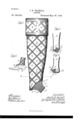
- Figure l illustrates in a side view a golf stocking or legging embodying my invention.
- Fig. 2 illustrates in a side view the application of my invention to use with a low-cut shoe.
- Figs. 3 and 4 illustrate in detached views two of a number of modifications to which the invention is applicable.
- 8o A represents the legging as a whole, and A the upper portion, which will usually be fashioned to conform to the shape of the lower leg.
- the lower section proper, B is relatively narrow, as usual, and its lower margin in- S 5 stead of terminating in a straight line, as indicated by the dotted line ZJ, (which is the old construction,) is shaped as' shown by the curved line b.
- the particular shape required may be varied to suit the slightly-different 9o measurements of various styles of slices; but the general direction of the shaping is herein indicated and will be such as will be sufficient Y to bring the lower portion B down at the front part of the legging to form a prolongation or instep portion B', which will cover and protect the instep when the article is worn.
- the shaping may be formed on a knitting-machine or by hand, as the legging is being made; but
- the strap C is preferably made of a single piece of knit fabric and of uniform width ro 5 throughout its length. It is desirable that the width be such that when the ends of the ⁇ strap C are stretched laterally the width will be coincident with the length of the rear edge b of the instep part or prolongation, to which each end of the strap C may be secured by sewing or otherwise, as clearly shown in the drawings.
- the ends c of the strap C are thus stretched beyond their norm al width, or, more properly speaking, position, the central portion c will be contracted, as indicated, whereby the minimum amount of obstruction to the foot of the wearer is presented, especially to the hollow of the foot, under which the strap C will be passed.
- the strap C may be of two portions united together on the line indicated at c2; but it is preferable to make the strap C in one continuous piece. It will also be manifest that as the rear margins c3 are not secured together a suitable opening for the heel of the wearer is thus formed, and, similarly, by not uniting the margins c4 of the strap C a suitable opening is provided for the foot.
- the strap O (indicated by dotted lines in said figure) draws the margins 1)/ well down below the upper edge of the lowcut shoe, causing the front prolongation or instep portion B to extend over and cover the instep, and thus indicating to the observer that the legging proper extends down into the shoe, or, more properlyT speaking, he construction shown not only protects the foot of the wearer, but makes it impossible for the observer to detect that the article worn is not a stocking but is simply a legging with heel and toe portions omitted.
- B indicates the lower portion of the legging; B, the instep portion, and h' the curved lower edge, shaped in any convenient manner.
- said curved margin instead of being shaped in a diagonal direction from the rear downwardly toward the front of the legging the rear portion of the edge is shaped at a point as low or about as low as the front portion thereof, while the central portion of the margin takes the general direction of an inverted U, thus forming a front prolongation to cover the instep substantiallylike that before described.
- the strap C is constructed and secured as above stated.
- the margin of the ends of the strap C may be shaped somewhat, if desired,or may be left square and inserted within the lower end of the legging, as indicated by dotted lines at c5 in said Fig. 8, the margin b in this instance being sewed to the strap, while the extreme ends c6 may be simply tacked to the legging.
- the margins c3 c4 indicate the toe and heel openings, as before.
- the legging proper, B is fashioned with a heel portion B2, as well as an instep portion B', said heel portion being provided, preferably, with a vertical front margin or edge Z22.
- b indicates the shaped margin or lower end of the legging, although in some methods of knitting the legging the front margin b2 of the heel portion may be formed by cutting or otherwise at the same time that the shape is given to the margin b.
- C indicates the strap. Its front margin c1 forlns a toe opening, as usual.
- the rear margins c7 are united to the vertical margins b2 of thc heel-section, while the end of the strap C is stretched, as before described, to the shaped margin b', which latter forms the rear margin of the front prolongation which coversthc instep.
- These two modifications will serve to illustrate the variety of shapes that may be given to the lower end of the legging in practicing my invention.
- the front part of the legging is prolonged in a straight line without shaping of the fabric and that the strap is attached to the rear margins of the front prolongation, so that when the latter is bent forwardly over the instep the strap will hold or draw said prolongation closely over the instep and thereby afford a smooth and close lit.
- My invention is not only simple, but very cheap and easily constructed, is comfortable to the wearer, and possesses many advantages over prior constructions not necessary here to enumerate.
- a legging comprising a tubular leg portion which is eX- tended at its front part to form a straight prolongation adapted to be drawn forward to cover the instep, and a knit foot-strap, the ends of which are spread and attached to the rear margins of said instep prolongation, whereby the said instep prolongation is drawn or held over the instep by the said strap, substantially as described.
Landscapes
- Engineering & Computer Science (AREA)
- Textile Engineering (AREA)
- Footwear And Its Accessory, Manufacturing Method And Apparatuses (AREA)
Description
A(No Model.)
J. R. BARROLL. LBGGING.
No. 560,831.l Y Patented May 26, 1896.
ANDREW BABRAHAM, PHUTUUTHQWASHINGTUN. D C j UNITED STATES PATENT OEErcE.
JOSEPH ROLLINSON BARROLL, OF CHICAGO, ILLINOIS.
LEGGING.
SPECIFICATION forming partof Letters Patent NO. 560,831, dated May 26, 1896.
Application filed December 19, 1895. Serial No. 572,685. (No model-l T0 all whom t may concern.-
Be it known that I, JOSEPH RoLLrNsoN BARROLL, of Chicago, in the county of Cook and State of Illinois, have invented certain new and useful Improvements in Leggings; and I do hereby declare that the following is a f ull,clear, and exact description thereof, reference being had to the accompanying drawings, and to the letters 'of reference marked thereon, which form a part of this specification.
This invention relates to improvements in leggings, and more particularly to that class known to the trade as feetless, golf, or bicycle stockings. IIeretofore such articles have usually been made of some heavy knit fabric, suitably fashioned to fit the leg, with or Without the turned-over portion at the top near the knee and without any heel or toe portion. The lower portion of the leg-section proper has usually been cutoff on a straight line or terminated by a straight edge at a point above the ankle, and a strap of sufficient length to pass under the foot and engage the hollow thereof has been secured at its ends to the lower margins of said lower leg-section. Sometimes these straps have been of knitted material and have not been of uniform width, one side being fashioned by dropping stitches, so that the lower portions of the straps would be narrower than the end portions thereof, the latter being of a width equal to about onehalf the diameter of the lower section proper of the stocking, the straps on each side being turned off in joining. A Such straps have also been picked on or otherwise suitably secured to said lower margin of the stocking. IV ith all such constructions it is necessary to wear a high shoe, for if a low shoe is worn no part of the strap or lower portion of the stocking proper reaches down sufficiently to cover and protect the instep, and, moreover, when such prior constructions have been Worn with a low shoe a portion of the foot of the wearer has been exposed to view, thus making such construction very undesirable.
It is the object of this invention, therefore, to provide an article of the general character referred to that may be worn with low shoes and which will have the double advantage of being sightly in appearance and of protecting the instep of the wearer, or, in other words, which shall be so `constructed that when a low shoe is to be worn it will be iinpossible for an observer to detect that the article is simply a legging without heel and toe portions.
To this end the invention consists in a legging the lower end of which is plain or cylindric and is extended at its front part to form 6o a prolongation, to the rear edges of which are attached the ends of an obliquely-arranged foot-strap, the construction being such that when the legging is placed on the foot and leg the instep prolongation will be drawn forward to cover the instep and will be held in place over the same by the tension of the strap acting on the rear margins thereof. These features of construction will be better understood by reference to the following description and 7o the drawings to which it refers.
In the accompanying drawings, Figure l illustrates in a side view a golf stocking or legging embodying my invention. Fig. 2 illustrates in a side view the application of my invention to use with a low-cut shoe. Figs. 3 and 4 illustrate in detached views two of a number of modifications to which the invention is applicable.
Referring to Figs. l and 2 of the drawings, 8o A represents the legging as a whole, and A the upper portion, which will usually be fashioned to conform to the shape of the lower leg. The lower section proper, B, is relatively narrow, as usual, and its lower margin in- S 5 stead of terminating in a straight line, as indicated by the dotted line ZJ, (which is the old construction,) is shaped as' shown by the curved line b. The particular shape required may be varied to suit the slightly-different 9o measurements of various styles of slices; but the general direction of the shaping is herein indicated and will be such as will be sufficient Y to bring the lower portion B down at the front part of the legging to form a prolongation or instep portion B', which will cover and protect the instep when the article is worn. The shaping may be formed on a knitting-machine or by hand, as the legging is being made; but
it is very much cheaper to simply cut the fabrco ric, leaving the cut edges to be properly secured when the strap C is united to the said fashioned edge b. y
The strap C is preferably made of a single piece of knit fabric and of uniform width ro 5 throughout its length. It is desirable that the width be such that when the ends of the` strap C are stretched laterally the width will be coincident with the length of the rear edge b of the instep part or prolongation, to which each end of the strap C may be secured by sewing or otherwise, as clearly shown in the drawings. When the ends c of the strap C are thus stretched beyond their norm al width, or, more properly speaking, position, the central portion c will be contracted, as indicated, whereby the minimum amount of obstruction to the foot of the wearer is presented, especially to the hollow of the foot, under which the strap C will be passed. As will be manifest, the strap C may be of two portions united together on the line indicated at c2; but it is preferable to make the strap C in one continuous piece. It will also be manifest that as the rear margins c3 are not secured together a suitable opening for the heel of the wearer is thus formed, and, similarly, by not uniting the margins c4 of the strap C a suitable opening is provided for the foot.
As willbe noticed by referring to the illustration in Fig. 2, the strap O (indicated by dotted lines in said figure) draws the margins 1)/ well down below the upper edge of the lowcut shoe, causing the front prolongation or instep portion B to extend over and cover the instep, and thus indicating to the observer that the legging proper extends down into the shoe, or, more properlyT speaking, he construction shown not only protects the foot of the wearer, but makes it impossible for the observer to detect that the article worn is not a stocking but is simply a legging with heel and toe portions omitted.
Inasmuch, as above stated, as the proper shape or direction of the curved margin indicated at b' may be varied to suit different requirements, I have herein undertaken to illustrate in Figs. 3 and 4 only two of such modifications.
Referring to Fig. 3, B indicates the lower portion of the legging; B, the instep portion, and h' the curved lower edge, shaped in any convenient manner. In this instance said curved margin instead of being shaped in a diagonal direction from the rear downwardly toward the front of the legging the rear portion of the edge is shaped at a point as low or about as low as the front portion thereof, while the central portion of the margin takes the general direction of an inverted U, thus forming a front prolongation to cover the instep substantiallylike that before described. The strap C is constructed and secured as above stated. The margin of the ends of the strap C may be shaped somewhat, if desired,or may be left square and inserted within the lower end of the legging, as indicated by dotted lines at c5 in said Fig. 8, the margin b in this instance being sewed to the strap, while the extreme ends c6 may be simply tacked to the legging. The margins c3 c4 indicate the toe and heel openings, as before.
In the illustration shown in Fig. 4L the legging proper, B, is fashioned with a heel portion B2, as well as an instep portion B', said heel portion being provided, preferably, with a vertical front margin or edge Z22. b indicates the shaped margin or lower end of the legging, although in some methods of knitting the legging the front margin b2 of the heel portion may be formed by cutting or otherwise at the same time that the shape is given to the margin b. C indicates the strap. Its front margin c1 forlns a toe opening, as usual. In this instance the rear margins c7 are united to the vertical margins b2 of thc heel-section, while the end of the strap C is stretched, as before described, to the shaped margin b', which latter forms the rear margin of the front prolongation which coversthc instep. These two modifications will serve to illustrate the variety of shapes that may be given to the lower end of the legging in practicing my invention. In each instance illustrated it will be seen that the front part of the legging is prolonged in a straight line without shaping of the fabric and that the strap is attached to the rear margins of the front prolongation, so that when the latter is bent forwardly over the instep the strap will hold or draw said prolongation closely over the instep and thereby afford a smooth and close lit.
The material of which these garments are made is not of especialimportance; butwhere the ordinary knit golf stocking or legging is used I prefer that the strap C shall be constructed of what is known as knit ribbed fabric, since such fabric may be cut to the precise length required, and while it has very little longitudinal strain or tension it may be spread laterally at its ends to give the required width thereto, whereby said ends may be united, as desired, to the margin b, and at the same time a strong and narrow strap may be used.
My invention is not only simple, but very cheap and easily constructed, is comfortable to the wearer, and possesses many advantages over prior constructions not necessary here to enumerate.
I claim as my invention and cure by Letters Patent- As a new article of manufacture, a legging comprising a tubular leg portion which is eX- tended at its front part to form a straight prolongation adapted to be drawn forward to cover the instep, and a knit foot-strap, the ends of which are spread and attached to the rear margins of said instep prolongation, whereby the said instep prolongation is drawn or held over the instep by the said strap, substantially as described.
In testimony that I claim the foregoing as my invention I affix my signature, in presence of two witnesses, this 16th day of December, A. D. 1895.
JOSEPH ROLLINSON BARROLL.
Viitnesses:
TAYLOR E. BROWN, WILLIAM L. HALL.
desire to se- IOO IIO
Publications (1)
| Publication Number | Publication Date |
|---|---|
| US560831A true US560831A (en) | 1896-05-26 |
Family
ID=2629553
Family Applications (1)
| Application Number | Title | Priority Date | Filing Date |
|---|---|---|---|
| US560831D Expired - Lifetime US560831A (en) | Legging |
Country Status (1)
| Country | Link |
|---|---|
| US (1) | US560831A (en) |
Cited By (12)
| Publication number | Priority date | Publication date | Assignee | Title |
|---|---|---|---|---|
| US5417091A (en) * | 1994-06-10 | 1995-05-23 | Knit-Tech, Inc. | Reverse pattern turn cuff sock and method of forming same |
| USD374764S (en) | 1994-12-13 | 1996-10-22 | Penn Deborah M | Sock dickie |
| USD426375S (en) * | 1999-05-12 | 2000-06-13 | Marshall James B | Moisture absorbent sock |
| US6440172B1 (en) | 1999-09-16 | 2002-08-27 | Rx Textiles | Reinforced prosthetic sleeve |
| USD509652S1 (en) * | 2004-10-04 | 2005-09-20 | Defeet International, Inc. | Sock |
| USD580557S1 (en) * | 2008-02-28 | 2008-11-11 | Mueller Sports Medicine, Inc. | Ankle support |
| USD581057S1 (en) * | 2008-02-28 | 2008-11-18 | Mueller Sports Medicine, Inc. | Ankle support |
| USD598642S1 (en) * | 2008-04-15 | 2009-08-25 | Diane Plumert | Boot cuff accessory |
| USD601708S1 (en) * | 2006-04-26 | 2009-10-06 | Bauerfeind Ag | Ankle joint bandage |
| USD625085S1 (en) * | 2010-05-19 | 2010-10-12 | Nancy Frase | Cuff for boot |
| US20130227856A1 (en) * | 2012-03-04 | 2013-09-05 | Fayshonda Cooks | Boot Filler/Contour Liner |
| USD1100477S1 (en) * | 2023-08-04 | 2025-11-04 | Beijing Fengheling E-commerce Co., Ltd | Sock |
-
0
- US US560831D patent/US560831A/en not_active Expired - Lifetime
Cited By (12)
| Publication number | Priority date | Publication date | Assignee | Title |
|---|---|---|---|---|
| US5417091A (en) * | 1994-06-10 | 1995-05-23 | Knit-Tech, Inc. | Reverse pattern turn cuff sock and method of forming same |
| USD374764S (en) | 1994-12-13 | 1996-10-22 | Penn Deborah M | Sock dickie |
| USD426375S (en) * | 1999-05-12 | 2000-06-13 | Marshall James B | Moisture absorbent sock |
| US6440172B1 (en) | 1999-09-16 | 2002-08-27 | Rx Textiles | Reinforced prosthetic sleeve |
| USD509652S1 (en) * | 2004-10-04 | 2005-09-20 | Defeet International, Inc. | Sock |
| USD601708S1 (en) * | 2006-04-26 | 2009-10-06 | Bauerfeind Ag | Ankle joint bandage |
| USD580557S1 (en) * | 2008-02-28 | 2008-11-11 | Mueller Sports Medicine, Inc. | Ankle support |
| USD581057S1 (en) * | 2008-02-28 | 2008-11-18 | Mueller Sports Medicine, Inc. | Ankle support |
| USD598642S1 (en) * | 2008-04-15 | 2009-08-25 | Diane Plumert | Boot cuff accessory |
| USD625085S1 (en) * | 2010-05-19 | 2010-10-12 | Nancy Frase | Cuff for boot |
| US20130227856A1 (en) * | 2012-03-04 | 2013-09-05 | Fayshonda Cooks | Boot Filler/Contour Liner |
| USD1100477S1 (en) * | 2023-08-04 | 2025-11-04 | Beijing Fengheling E-commerce Co., Ltd | Sock |
Similar Documents
| Publication | Publication Date | Title |
|---|---|---|
| US482095A (en) | Stocking | |
| US6226800B1 (en) | Thonged hosiery garment | |
| JP6335072B2 (en) | Foot cover | |
| US1434941A (en) | Hosiery | |
| US2613520A (en) | Knitted footwear | |
| US20070000029A1 (en) | Hosiery having a toe notch and bubble for accommodating a sandal strap | |
| US155968A (en) | Improvement in inlays for sandal boots and shoes | |
| US801899A (en) | Shoe-dress. | |
| US20160278439A1 (en) | Leg garment with expansive panel | |
| US904383A (en) | Combination sleeping-garment. | |
| US1162820A (en) | Stocking. | |
| US1220209A (en) | Stocking. | |
| US2724195A (en) | Foot protector and blank therefor | |
| US20190029330A1 (en) | Leg garment with expansive panel | |
| US338341A (en) | Stocking | |
| US590295A (en) | Felt boot | |
| US243425A (en) | Eobeet m | |
| US1293399A (en) | Hosiery. | |
| US454736A (en) | Drawers | |
| US1731696A (en) | Stocking | |
| US268734A (en) | Stocking and the method of making the same | |
| JPH05132802A (en) | Air-passing stockings | |
| US732603A (en) | Nether garment. | |
| US732045A (en) | Detachable plug for shoes. | |
| US328543A (en) | John j |