US5414248A - Grease and moisture absorbing inserts for microwave cooking - Google Patents
Grease and moisture absorbing inserts for microwave cooking Download PDFInfo
- Publication number
- US5414248A US5414248A US07/981,348 US98134892A US5414248A US 5414248 A US5414248 A US 5414248A US 98134892 A US98134892 A US 98134892A US 5414248 A US5414248 A US 5414248A
- Authority
- US
- United States
- Prior art keywords
- fiber
- insert
- fibers
- section
- layer
- Prior art date
- Legal status (The legal status is an assumption and is not a legal conclusion. Google has not performed a legal analysis and makes no representation as to the accuracy of the status listed.)
- Expired - Fee Related
Links
Images




Classifications
-
- B—PERFORMING OPERATIONS; TRANSPORTING
- B65—CONVEYING; PACKING; STORING; HANDLING THIN OR FILAMENTARY MATERIAL
- B65D—CONTAINERS FOR STORAGE OR TRANSPORT OF ARTICLES OR MATERIALS, e.g. BAGS, BARRELS, BOTTLES, BOXES, CANS, CARTONS, CRATES, DRUMS, JARS, TANKS, HOPPERS, FORWARDING CONTAINERS; ACCESSORIES, CLOSURES, OR FITTINGS THEREFOR; PACKAGING ELEMENTS; PACKAGES
- B65D81/00—Containers, packaging elements, or packages, for contents presenting particular transport or storage problems, or adapted to be used for non-packaging purposes after removal of contents
- B65D81/34—Containers, packaging elements, or packages, for contents presenting particular transport or storage problems, or adapted to be used for non-packaging purposes after removal of contents for packaging foodstuffs or other articles intended to be cooked or heated within the package
-
- B—PERFORMING OPERATIONS; TRANSPORTING
- B32—LAYERED PRODUCTS
- B32B—LAYERED PRODUCTS, i.e. PRODUCTS BUILT-UP OF STRATA OF FLAT OR NON-FLAT, e.g. CELLULAR OR HONEYCOMB, FORM
- B32B27/00—Layered products comprising a layer of synthetic resin
- B32B27/12—Layered products comprising a layer of synthetic resin next to a fibrous or filamentary layer
-
- B—PERFORMING OPERATIONS; TRANSPORTING
- B32—LAYERED PRODUCTS
- B32B—LAYERED PRODUCTS, i.e. PRODUCTS BUILT-UP OF STRATA OF FLAT OR NON-FLAT, e.g. CELLULAR OR HONEYCOMB, FORM
- B32B27/00—Layered products comprising a layer of synthetic resin
- B32B27/32—Layered products comprising a layer of synthetic resin comprising polyolefins
-
- B—PERFORMING OPERATIONS; TRANSPORTING
- B32—LAYERED PRODUCTS
- B32B—LAYERED PRODUCTS, i.e. PRODUCTS BUILT-UP OF STRATA OF FLAT OR NON-FLAT, e.g. CELLULAR OR HONEYCOMB, FORM
- B32B5/00—Layered products characterised by the non- homogeneity or physical structure, i.e. comprising a fibrous, filamentary, particulate or foam layer; Layered products characterised by having a layer differing constitutionally or physically in different parts
- B32B5/02—Layered products characterised by the non- homogeneity or physical structure, i.e. comprising a fibrous, filamentary, particulate or foam layer; Layered products characterised by having a layer differing constitutionally or physically in different parts characterised by structural features of a fibrous or filamentary layer
- B32B5/022—Non-woven fabric
-
- B—PERFORMING OPERATIONS; TRANSPORTING
- B32—LAYERED PRODUCTS
- B32B—LAYERED PRODUCTS, i.e. PRODUCTS BUILT-UP OF STRATA OF FLAT OR NON-FLAT, e.g. CELLULAR OR HONEYCOMB, FORM
- B32B7/00—Layered products characterised by the relation between layers; Layered products characterised by the relative orientation of features between layers, or by the relative values of a measurable parameter between layers, i.e. products comprising layers having different physical, chemical or physicochemical properties; Layered products characterised by the interconnection of layers
- B32B7/04—Interconnection of layers
- B32B7/12—Interconnection of layers using interposed adhesives or interposed materials with bonding properties
-
- B—PERFORMING OPERATIONS; TRANSPORTING
- B65—CONVEYING; PACKING; STORING; HANDLING THIN OR FILAMENTARY MATERIAL
- B65D—CONTAINERS FOR STORAGE OR TRANSPORT OF ARTICLES OR MATERIALS, e.g. BAGS, BARRELS, BOTTLES, BOXES, CANS, CARTONS, CRATES, DRUMS, JARS, TANKS, HOPPERS, FORWARDING CONTAINERS; ACCESSORIES, CLOSURES, OR FITTINGS THEREFOR; PACKAGING ELEMENTS; PACKAGES
- B65D81/00—Containers, packaging elements, or packages, for contents presenting particular transport or storage problems, or adapted to be used for non-packaging purposes after removal of contents
- B65D81/24—Adaptations for preventing deterioration or decay of contents; Applications to the container or packaging material of food preservatives, fungicides, pesticides or animal repellants
- B65D81/26—Adaptations for preventing deterioration or decay of contents; Applications to the container or packaging material of food preservatives, fungicides, pesticides or animal repellants with provision for draining away, or absorbing, or removing by ventilation, fluids, e.g. exuded by contents; Applications of corrosion inhibitors or desiccators
- B65D81/264—Adaptations for preventing deterioration or decay of contents; Applications to the container or packaging material of food preservatives, fungicides, pesticides or animal repellants with provision for draining away, or absorbing, or removing by ventilation, fluids, e.g. exuded by contents; Applications of corrosion inhibitors or desiccators for absorbing liquids
-
- B—PERFORMING OPERATIONS; TRANSPORTING
- B65—CONVEYING; PACKING; STORING; HANDLING THIN OR FILAMENTARY MATERIAL
- B65D—CONTAINERS FOR STORAGE OR TRANSPORT OF ARTICLES OR MATERIALS, e.g. BAGS, BARRELS, BOTTLES, BOXES, CANS, CARTONS, CRATES, DRUMS, JARS, TANKS, HOPPERS, FORWARDING CONTAINERS; ACCESSORIES, CLOSURES, OR FITTINGS THEREFOR; PACKAGING ELEMENTS; PACKAGES
- B65D81/00—Containers, packaging elements, or packages, for contents presenting particular transport or storage problems, or adapted to be used for non-packaging purposes after removal of contents
- B65D81/34—Containers, packaging elements, or packages, for contents presenting particular transport or storage problems, or adapted to be used for non-packaging purposes after removal of contents for packaging foodstuffs or other articles intended to be cooked or heated within the package
- B65D81/3446—Containers, packaging elements, or packages, for contents presenting particular transport or storage problems, or adapted to be used for non-packaging purposes after removal of contents for packaging foodstuffs or other articles intended to be cooked or heated within the package specially adapted to be heated by microwaves
-
- B—PERFORMING OPERATIONS; TRANSPORTING
- B32—LAYERED PRODUCTS
- B32B—LAYERED PRODUCTS, i.e. PRODUCTS BUILT-UP OF STRATA OF FLAT OR NON-FLAT, e.g. CELLULAR OR HONEYCOMB, FORM
- B32B2307/00—Properties of the layers or laminate
- B32B2307/70—Other properties
- B32B2307/726—Permeability to liquids, absorption
-
- B—PERFORMING OPERATIONS; TRANSPORTING
- B32—LAYERED PRODUCTS
- B32B—LAYERED PRODUCTS, i.e. PRODUCTS BUILT-UP OF STRATA OF FLAT OR NON-FLAT, e.g. CELLULAR OR HONEYCOMB, FORM
- B32B2439/00—Containers; Receptacles
-
- B—PERFORMING OPERATIONS; TRANSPORTING
- B65—CONVEYING; PACKING; STORING; HANDLING THIN OR FILAMENTARY MATERIAL
- B65D—CONTAINERS FOR STORAGE OR TRANSPORT OF ARTICLES OR MATERIALS, e.g. BAGS, BARRELS, BOTTLES, BOXES, CANS, CARTONS, CRATES, DRUMS, JARS, TANKS, HOPPERS, FORWARDING CONTAINERS; ACCESSORIES, CLOSURES, OR FITTINGS THEREFOR; PACKAGING ELEMENTS; PACKAGES
- B65D2581/00—Containers, packaging elements, or packages, for contents presenting particular transport or storage problems, or adapted to be used for non-packaging purposes after removal of contents
- B65D2581/34—Containers, packaging elements, or packages, for contents presenting particular transport or storage problems, or adapted to be used for non-packaging purposes after removal of contents for packaging foodstuffs or other articles intended to be cooked or heated within
- B65D2581/3437—Containers, packaging elements, or packages, for contents presenting particular transport or storage problems, or adapted to be used for non-packaging purposes after removal of contents for packaging foodstuffs or other articles intended to be cooked or heated within specially adapted to be heated by microwaves
- B65D2581/3486—Dielectric characteristics of microwave reactive packaging
- B65D2581/3494—Microwave susceptor
-
- Y—GENERAL TAGGING OF NEW TECHNOLOGICAL DEVELOPMENTS; GENERAL TAGGING OF CROSS-SECTIONAL TECHNOLOGIES SPANNING OVER SEVERAL SECTIONS OF THE IPC; TECHNICAL SUBJECTS COVERED BY FORMER USPC CROSS-REFERENCE ART COLLECTIONS [XRACs] AND DIGESTS
- Y10—TECHNICAL SUBJECTS COVERED BY FORMER USPC
- Y10S—TECHNICAL SUBJECTS COVERED BY FORMER USPC CROSS-REFERENCE ART COLLECTIONS [XRACs] AND DIGESTS
- Y10S99/00—Foods and beverages: apparatus
- Y10S99/14—Induction heating
-
- Y—GENERAL TAGGING OF NEW TECHNOLOGICAL DEVELOPMENTS; GENERAL TAGGING OF CROSS-SECTIONAL TECHNOLOGIES SPANNING OVER SEVERAL SECTIONS OF THE IPC; TECHNICAL SUBJECTS COVERED BY FORMER USPC CROSS-REFERENCE ART COLLECTIONS [XRACs] AND DIGESTS
- Y10—TECHNICAL SUBJECTS COVERED BY FORMER USPC
- Y10T—TECHNICAL SUBJECTS COVERED BY FORMER US CLASSIFICATION
- Y10T428/00—Stock material or miscellaneous articles
- Y10T428/24—Structurally defined web or sheet [e.g., overall dimension, etc.]
- Y10T428/24479—Structurally defined web or sheet [e.g., overall dimension, etc.] including variation in thickness
- Y10T428/24521—Structurally defined web or sheet [e.g., overall dimension, etc.] including variation in thickness with component conforming to contour of nonplanar surface
- Y10T428/24537—Parallel ribs and/or grooves
-
- Y—GENERAL TAGGING OF NEW TECHNOLOGICAL DEVELOPMENTS; GENERAL TAGGING OF CROSS-SECTIONAL TECHNOLOGIES SPANNING OVER SEVERAL SECTIONS OF THE IPC; TECHNICAL SUBJECTS COVERED BY FORMER USPC CROSS-REFERENCE ART COLLECTIONS [XRACs] AND DIGESTS
- Y10—TECHNICAL SUBJECTS COVERED BY FORMER USPC
- Y10T—TECHNICAL SUBJECTS COVERED BY FORMER US CLASSIFICATION
- Y10T428/00—Stock material or miscellaneous articles
- Y10T428/24—Structurally defined web or sheet [e.g., overall dimension, etc.]
- Y10T428/24479—Structurally defined web or sheet [e.g., overall dimension, etc.] including variation in thickness
- Y10T428/2457—Parallel ribs and/or grooves
Definitions
- This invention relates to inserts useful in microwavable containers.
- the invention can further comprise fibers which are capable of spontaneously transporting fluid on the surface thereof.
- U.S. Pat. Nos. 4,954,356 and 4,857,342 disclose a microwavable package for storing and cooking a food product including an absorbent bed enclosed within a sealed plastic sleeve.
- U.S. Pat. No. 4,950,524 discloses a bacon pad made of liquid absorbent wood fibers.
- U.S. Pat. No. 4,786,513 discloses a package of sliced bacon containing an absorbent blotter means.
- U.S. Pat. No. 4,873,101 discloses a package of food containing a substantial amount of water and solidified grease that can be cooked within the package in a microwave oven.
- the package further comprises a pad adjacent the food comprising microwave radiation transparent generally hydrophobic liquid grease absorbing materials that are capable of holding the amount of grease in the food when it is melted.
- U.S. Pat. No. 5,094,869 describes a food degreaser which uses a layer of absorbent fiber on the inside of a wicking material envelope.
- pads of blown microfibers which are constructed of a composition comprising a blend containing substantially equal parts by weight of polypropylene and poly 4-methylpentene-1 (PMP), 0.16 cm (0.062 inch) in thickness and thermally embossed on both sides with a 0.40 cm (0.156 inch) hexagonal pattern and having densities in the range of nine and one half (91/2) to six (6) times their weight in grease.
- PMP poly 4-methylpentene-1
- microwavable inserts comprising a plastic film with a thin metal coating or "metallized film".
- the metallized film is generally used in direct contact with a food item. Part of the microwave energy passes through to heat the food item dielectrically while part is converted to heat by the metallized film to sear the coating in contact therewith.
- U.S. Pat. No. 4,703,148 describes this particular art in detail.
- microwavable inserts having two layers, the first of which is a top layer consisting of an absorbent layer made from fibers, the second of which is a metallized susceptor layer. These inserts are known as "Wavealites”.
- fibers are disclosed which are capable of spontaneously transporting water and other hydrophilic fluids on their surfaces. Additionally, other fibers of sufficient chemical composition and geometry are capable of spontaneously transporting n-decane and other hydrophobic fluids.
- Such fibers will be referred to herein as “spontaneously transportable fibers” or, alternatively, “spontaneously wettable fibers.”
- spontaneously transportable fibers when incorporated into microwavable cooking structures, results in improved wetting and aids in aqueous and/or nonaqueous transport of fluids released during microwave cooking with appropriate surface energetics.
- the present invention which relates to an insert useful in a microwavable food container comprising first and second outer layers, and an intermediate layer between and bonded to said first and second outer layer, wherein said first outer layer comprises a plastic layer further comprising openings and is in position to be adjacent to food, 14, in said container, said intermediate layer comprises an absorbent material comprising fibers, and said second outer layer is a substrate which is stable to microwave heating conditions.
- the first outer layer can, preferably, comprise a metallized coating of heat susceptor thickness.
- the invention also relates to an insert useful in a microwavable food container comprising a first layer and a second layer bonded thereto, wherein the first layer comprises a plastic layer, and the second layer comprises absorbent material comprising fibers and is in position to be adjacent to food in said container, wherein said second layer comprises at least one fiber having at least one continuous groove oriented axially along the fiber wherein said fiber satisfies the following equation:
- ⁇ a is the advancing contact angle of water measured on a flat film made from the same material as the fiber and having the same surface treatment, if any,
- X is a shape factor of the fiber cross-section that satisfies the following equation: ##EQU1## wherein
- the plastic layer can, preferably, comprise a metallized coating of heat susceptor thickness.
- the invention also relates to an insert wherein said second layer comprises at least one fiber having at least one continuous groove oriented axially along the fiber wherein said fiber satisfies the following equation:
- ⁇ a is the advancing contact angle of n-decane measured on a flat film made from the same material as the fiber and having the same surface treatment, if any,
- X is a shape factor of the fiber cross-section that satisfies the following equation: ##EQU2## wherein
- P w is the wetted perimeter of the fiber and r is the radius of the circumscribed circle circumscribing the fiber cross-section and D is the minor axis dimension across the fiber cross-section.
- the invention further relates to an insert useful in microwavable food container comprising an absorbing pad.
- the pad further comprises microwave radiation transparent and grease absorbing fibers wherein at least one fiber has at least one continuous groove oriented axially along the fiber and wherein the fiber has a cross-section having a shape factor X that satisfies the equation or formula as described above.
- X is greater than 1.2, more preferably greater than about 2.5, most preferably greater than about 4. Also, it is preferred that 2r/D is greater than 1. It is more preferred that 2r/D be between 1.5 and 5.
- X For fibers to be able to spontaneously wet one fluid and not another, X must lie between the minimum required values for X for the two fluids. For example, to have a fiber with no lubricant which will spontaneously transport canola oil and not water requires an X-factor higher than 1.09 but lower than 2.75.
- the fiber of the invention satisfies the formula: ##EQU3## wherein ⁇ LA is the surface tension of water in air in dynes/cm, ⁇ is the fiber density in grams/cc, and dpf is the denier of the single fiber.
- the fiber of the invention satisfies the formula: ##EQU4## wherein ⁇ LA is the surface tension of n-decane in air in dynes/cm, ⁇ is the fiber density in grams/cc, and dpf is the denier of the single fiber.
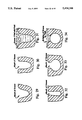
- FIG. 1- an enlarged cross-sectional view of a preferred embodiment of the invention, i.e., Insert B, as described herein.
- FIG. 2- a perspective view of a preferred embodiment of the invention, Insert A, as described herein.
- FIG. 4- an enlarged cross-sectional view of a preferred embodiment of the invention, Insert C, as described herein.
- FIG. 6- a perspective view of a preferred embodiment of the invention, Insert B, as described herein.
- FIG. 8 -schematic representation of a three dimensional view of an absorbant fiber of the invention illustrating the swelling of superabsorbant material out of a fiber groove upon transport of a fluid.
- the arrows labelled "LFA" indicate the location of the liquid-fiber-air interface.
- the arrows labelled "LFA" indicate the location of the liquid-fiber-air interface.
- the arrows labelled "LFA" indicate the location of the liquid-fiber-air interface.
- FIG. 12- schematic representation of an orifice of a spinneret useful for producing a spontaneously transportable fiber.
- FIG. 13 --schematic representation of an orifice of a spinneret useful for producing a spontaneously transportable fiber.
- FIG. 14 --schematic representation of an orifice of a spinneret useful for producing a spontaneously transportable fiber.
- FIG. 15 --schematic representation of an orifice of a spinneret useful for producing a spontaneously transportable fiber.
- FIG. 16 --schematic representation of an orifice of a spinneret useful for producing a spontaneously transportable fiber.
- FIG. 17 --schematic representation of an orifice of a spinneret having 2 repeating units, joined end to end, of the orifice as shown in FIG. 12.
- FIG. 18 --schematic representation of an orifice of a spinneret having 4 repeating units, joined end to end, of the orifice as shown in FIG. 12.
- FIG. 19 --photomicrograph of a poly(ethylene terephthalate) fiber cross-section made using a spinneret having an orifice as illustrated in FIG. 3 (specific dimensions of spinneret orifice described in Example 1).
- FIG. 20 --photomicrograph of a polypropylene fiber cross-section made using a spinneret having an orifice as illustrated in FIG. 12 (specific dimensions of spinneret orifice described in Example 2).
- FIG. 21 --photomicrograph of a nylon 66 fiber cross-section made using a spinneret having an orifice as illustrated in FIG. 12 (specific dimensions of spinneret orifice described in Example 2).
- FIG. 22 --schematic representation of a poly(ethylene terephthalate) fiber cross-section made using a spinneret having an orifice as illustrated in FIG. 13 (specific dimensions of spinneret orifice described in Example 8).
- FIG. 23 --photomicrograph of a poly(ethylene terephthalate) fiber cross-section made using a spinneret having an orifice as illustrated in FIG. 14 (specific dimensions of spinneret orifice described in Example 9).
- FIG. 26 --schematic representation of a fiber cross-section made using a spinneret having an orifice as illustrated in FIG. 12 (Example 1). Exemplified is a typical means of determining the shape factor X.
- FIG. 27 --photomicrograph of a poly(ethylene terephthalate) fiber cross-section made using a spinneret having an orifice as illustrated in FIG. 15 (specific dimensions of spinneret orifice described in Example 12).
- FIG. 28 --schematic representation of a poly(ethylene terephthalate) fiber cross-section made using a spinneret having an orifice as illustrated in FIG. 16 (specific dimensions of spinneret orifice described in Example 13).
- FIG. 30- a schematic representation of a desirable groove in a fiber cross-section.
- FIG. 31 -a schematic representation of a desirable groove in a fiber cross-section illustrating the groove completely filled with fluid.
- FIG. 32 -a schematic representation of a groove where bridging is possible in the fiber cross-section.
- FIG. 33 -a schematic representation of a groove where bridging is possible in the fiber cross-section.
- FIG. 34 -a schematic representation of a groove illustrating bridging of the groove by a fluid.
- FIG. 35 -a schematic representation of a preferred "H" shape orifice of a spinneret useful for producing a spontaneously transportable fiber.
- FIG. 36 -a schematic representation of a poly(ethylene terephthalate) fiber cross-section made using a spinneret having an orifice as illustrated in FIG. 35.
- FIG. 38 -a schematic representation of a preferred "H" shape orifice of a spinneret useful for producing a spontaneously transportable fiber.
- FIG. 40 -a schematic representation of a spinneret having dimensions as specified.
- FIG. 41 -a schematic representation of Spinneret I1045 wherein the spinneret holes are oriented such that the cross-flow quench air is directed toward the open end of the H. All dimensions are in units of inches except those containing the letter "W".
- FIG. 42 -a schematic representation of Spinneret I1039 wherein the spinneret holes are oriented in a radial pattern on the face of the spinneret. All dimensions are in units of inches except those containing the letter "W".
- FIG. 44 -a schematic representation of Spinneret I 1046 wherein the spinneret holes are oriented such that the cross-flow quench air is directed toward the open end of the H.
- FIG. 45 -a schematic representation of quench air direction relative to the spinneret holes.
- FIG. 46 -a schematic representation of Spinneret 1047 wherein spinneret holes are oriented such that the cross-flow quench air was directed toward one side of the H.
- FIG. 48 -a photomicrograph of stuffer box crimped fiber having a distorted cross-section.
- FIGS. 49 and 50 -a schematic representation of a spinneret wherein the spinneret holes are oriented in a diagonal pattern on the face of the spinneret with cross-flow quenching directed toward the fiber bundle.
- FIG. 52 -a graphical representation of absorption times for various microwavable inserts.
- the invention relates to an insert useful in a microwavable food container comprising first and second outer layers and an intermediate layer bonded thereto, and a third outer layer bonded to said second layer wherein
- said first outer layer comprises a plastic layer, 8, 12 and 26, further comprising openings 6 and 28, said plastic layer being in position to be adjacent to food, 14, in said container,
- said intermediate layer, 10 and 30, comprises an absorbent material comprising fibers
- the plastic layer may comprise polyester, nylon or the like.
- the plastic layer is made from polyolefins, such as polypropylene or polyethylene.
- Preferred examples useful in making the plastic layer are heat set polyesters such as polyethylene terephthalate.
- Further examples are Mylar polyethylene terephthalate film sold by Du Pont or THERMX polyester sold by Eastman Kodak Company.
- THERMX is a polyester film comprising a copolyester of terephthalic acid and isophthalic acid with 1,4-cyclohexanedimethanol.
- the thickness of the plastic layer can be readily determined by one skilled in the art.
- the plastic layer comprises a metallized layer of heat susceptor thickness.
- the metallized layer is a microwave interactive layer which has been incorporated into disposable laminate materials used to cook the food. Such laminates are characterized by their ability to absorb microwave energy and convert it to heat which may be conductively and radiantly transmitted to the food. Semiconductive materials, ferro-magnetic metals, metal oxides, and thin elemental metals are some of the materials used to form the microwave interactive layer.
- the metallized layer may comprise any electroconductive metal which is capable of converting microwave energy to thermal energy in the form of thin films.
- the method of forming the metal film comprises any convenient film-forming procedure, consistent with the metal employed. For example, for aluminum conventional vapor deposition is the most convenient. Other materials, such as copper, stainless steel, tin oxide, chromium, magnesium, silver and gold can be used. However, aluminum is very inexpensive and has been widely used in the form of aluminum foil as far as the general packaging of food is concerned.
- the plastic layer is in direct physical contact with food providing the maximum amount of heat transfer and browning. Such contact is maintained by the construction and sizing of the container to provide holding pressure in view of the size of the food pieces to be packaged and optionally spacers. Such intimate contact is important to the heating and crisping benefits provided by the present invention.
- the susceptor layer or plastic layer contains a perforation feature comprising a plurality of openings therethrough or a perforated sheet, which allows escape or release of any oil or moisture vapor which the food pieces release during heating.
- the openings may be formed by any method known in the art, such as needle punch or calender roll.
- the openings may be in the form of an organized array as depicted or may be randomly although preferably evenly distributed.
- the openings can be modified either by hole density, size, or placement to add further control over grease and moisture drainage.
- the openings may have an effective diameter in the range of 0.5 mm to 5 mm. They may be shaped in any fashion including circular or elongated. Openings elongated in shape typically have a major axis length of about 1/4 to about 1/2 inch and a minor axis of less than 2 mm.
- the openings allow oil and/or moisture released during microwave heating to be absorbed by the panel or drain therethrough and thus drawn away from the portions thereby further reducing the undesirable softening of the coating and oiliness of the final product as well as substantially reducing excessive oil buildup and heating on the heating panels and thus reduces both spattering and the generation of undesirable burned oil flavor. Also, the oil drainage is important since released oil in contact with the heating panel absorbs excessive amounts of the heat generated which in turn can result in uneven browning.
- the heating layer Preferred for use herein as the heating layer are the metallized films described in U.S. Pat. No. 4,267,420 (issued May 12, 1981 to W. A. Brastad) or, less desirably, in U.S. Pat. No. 4,258,086 (issued Mar. 24, 1981 to N. J. Beall) each of which are incorporated herein by reference. These materials are widely known and a variety of suitable materials are available from, for example, the 3M Co., James River or from Deposition Technology Inc. (San Diego, Calif.).
- the metallized layer comprises a plastic sheet or thin films 20, which typically has a thickness of approximately 0.005 to 0.001 inch.
- the plastic film, 20, is made from a polyester.
- the plastic sheet or thin film, 20, has applied thereto a very thin coating, 22, having a surface resistivity of approximately about 1 to 300 ohms per square inch, and preferably about 1 to about 10 ohms per square inch when aluminum is the applied metal. It will be understood that a resistivity of 1 ohm per square denotes a heavier or thicker coating than a coating of the same material having a 10 ohms per square resistivity. The greater the resistivity, the more microwave energy which is converted to heat. The practical upper limit to the resistivity is determined by the scorch temperature of the mounting board and the plate separation as described below.
- the thickness of the metal film should be such that the metal film converts a portion of microwave energy incident thereon to thermal energy.
- the thickness varies with the metal employed.
- the metal film generally has a thickness corresponding to an optical density of about 0.08 to about 0.8.
- the amount of susceptor material(s) must be adequate to allow said materials to absorb a portion of both the electric and the magnetic components of said microwave energy and convert said energy to heat to rapidly brown or crispen the surface of the foil item adjacent thereto without substantially impeding the ability of the microwave energy to penetrate the susceptor material and cook the food item.
- Various methods may be used to measure the amount of susceptor coated on or imbibed in the substrate material to form the composites of this invention.
- D.C. surface resistivities are commonly used.
- Optical density measurements may also be used.
- a number of methods may be used to apply the susceptor materials to the substrate.
- the specific resistance of a coating is susceptible to variation and that within limits the thicker such coating is the less pervious or more opaque it is the passage of microwave energy therethrough.
- the coating would be thicker than when a less degree of browning is desired, In this way, the browning or crisping can be correlated with the actual dielectric heating of the food piece.
- an additional protective sheet or film of plastic can be laminated onto the side of the metallized layer which is coated with metal.
- the top protective film is preferably of polyester, having substantially the same thickness and properties as the plastic sheet or thin film comprising the metallized layer.
- the metallized layer as described above is substituted by a heating body further comprising a supporting sheet and a non-metal active microwave absorber which has been applied to said supporting sheet.
- These particles are dispersed in a nonmetallic (e.g., polymeric) binder which deposit has a thickness within the range from 10 to 300 micrometers, with the particles comprising at least 10% by weight of the deposit as is taught in U.S. Pat. No. 4,640,838 incorporated herein by reference.
- a nonmetallic binder e.g., polymeric binder which deposit has a thickness within the range from 10 to 300 micrometers, with the particles comprising at least 10% by weight of the deposit as is taught in U.S. Pat. No. 4,640,838 incorporated herein by reference.
- the metal-coated material may be selectively demetallized to provide a pattern of metal of desired form. Suitable selective demetallization procedures are described in U.S. Pat. Nos. 4,398,994, 4,552,614 and 4,610,755.
- the metal-coated material next can be adhered to a nonconductive sheet.
- This sheet may comprise structural fibrous stock material, 24, particularly paper or paperboard by conventional laminating procedures using a suitable laminating adhesive, such as a thermosetting resin. It may also be adhered to the fibrous stock material, 24, by using thermal bonding techniques known in the art.
- Patches of microwave interactive material can be formed on a web of plastic.
- This web can be laminated to one side of a web of structural stock material to form a composite web having a plastic layer and a structural stock material layer so that the microwave interactive material is sandwiched between the web of plastic and the web of structural stock material.
- the microwave interactive layer is bonded to and arranged to cover entirely one of the surfaces of a semi-rigid, microwave transparent material, such as paperboard.
- a lamination process can be used wherein the metal side of the susceptor or microwave interactive layer is bonded to paperboard using an adhesive in the same manner that a conventional susceptor is understood by a person of ordinary skill in the art to be bonded to paperboard.
- Microwave heating conditions generally include temperatures generally as high as 110° C. and above,.
- “Susceptor materials” are materials which are capable of absorbing the electric or magnetic portion of microwave field energy to convert that energy to heat.
- the fibers useful in the present invention have a complex cross-section geometry that results in a surface area that allows for more efficient wetting of the fiber, aqueous or grease transport or a combination of grease and moisture absorption if the appropriate surface energetics are applied.
- surface energetics it is meant that the fibers useful in the invention must satisfy the requirements of the equations described herein which apply to "spontaneously transporting" fibers.
- the fibers are preferably spontaneously transportable.
- the preferred fibers are ones having a hydrophilic lubricant applied thereto or intermittently therein and that are capable of spontaneous transporting of water on the surfaces thereof.
- preferred fibers are also ones having a hydrophobic lubricant applied thereto or intermittently therein and that are capable of spontaneously transporting n-decane on the surfaces thereof.
- some of the fibers useful in the present invention preferably have at least one continuous groove oriented axially along the fiber wherein said fiber satisfies the following equation:
- ⁇ a is the advancing contact angle of water measured on a flat film made from the same material as the fiber and having the same surface treatment, if any,
- X is a shape factor of the fiber cross-section that satisfies the following equation: ##EQU5## wherein
- P w is the wetted perimeter of the fiber and r is the radius of the circumscribed circle circumscribing the fiber cross-section and D is the minor axis dimension across the fiber cross-section.
- some of the fibers useful in the present invention have at least one continuous groove oriented axially along the fiber wherein said fiber satisfies the following equation:
- ⁇ a is the advancing contact angle of n-decane measured on a flat film made from the same material as the fiber and having the same surface treatment, if any,
- X is a shape factor of the fiber cross-section that satisfies the following equation: ##EQU6## wherein
- P w is the wetted perimeter of the fiber and r is the radius of the circumscribed circle circumscribing the fiber cross-section and D is the minor axis dimension across the fiber cross-section.
- the second outer layer is selected from the group consisting of a plastic film layer, paper or paperboard.
- a plastic film layer is preferred. More preferably, the films can be made from polyolefins, such as polypropylene or polyethylene.
- Preferred polyesters useful in making the plastic film layer are heat set polyesters such as heat set PET. Further examples are Mylar sold by DuPont or THERMX sold by Eastman Kodak Company. Also, nylon could be used to form the plastic film layer.
- the second outer layer prevents leakthrough and helps spontaneous transport by providing extra wettable surface area.
- the second outer layer is bonded to the intermediate layer.
- the bonding could either be by thermal methods or cohesive methods as described herein.
- the first outer and intermediate layers are bonded together either by any adhesive known in the art or by thermal bonding procedures known in the art.
- the preferred bonding procedure is described by Veratec, Inc. and disclosed in EP-A-0360 929 A1.
- the thermal embossing technique includes films of polyethylene being secured to nonwovens while at the same time having apertures in the film for good fluid penetration.
- the absorbent material of the intermediate layer comprises fibers.
- the geometry of the pore-structure in the fabrics (capillarity), the nature of the solid surface (surface free energy, contact angle), the geometry of the solid surface (surface roughness, grooves, etc.), the chemical/physical treatment of the solid surface (caustic hydrolysis, plasma treatment, grafting, application of hydrophobic/hydrophilic finishes), and the chemical nature of the fluid all can influence liquid transport phenomena in fibrous structures.
- the wettability of a solid surface by a liquid can be characterized by the contact angle that the liquid surface (gas-liquid interface) makes with the solid surface (gas-solid surface).
- a drop of liquid placed on a solid surface makes a contact angle, ⁇ , with the solid surface, as seen in FIG. 1A. If this contact angle is less than 90°, then the solid is considered to be wet by the liquid. However, if the contact angle is greater than 90° such as with water on Teflon surface, the solid is not wet by the liquid.
- the contact angle also depends on surface inhomogeneities (chemical and physical, such as roughness), contamination, chemical/physical treatment of the solid surface, as well as the nature of the liquid surface and its contamination.
- Surface free energy of the solid also influences the wetting behavior. The lower the surface energy of the solid, the more difficult it is to wet the solid by liquids having high surface tension. Thus, for example, Teflon, which has low surface energy does not wet with water. (Contact angle for Teflon-water system is 112°.) However, it is possible to treat the surface of Teflon with a monomolecular film of protein, which significantly enhances the wetting behavior.
- the contact angle of polyethylene terephthalate (PET), Nylon 66, and polypropylene with water is 80°, 71°, and 108°, respectively.
- PET polyethylene terephthalate
- Nylon 66 is more wettable than PET.
- the contact angle is >90°, and thus is nonwettable with water.
- the particular geometry of the deep and narrow grooves is very important, for example, grooves which have the feature that the width of the groove at any depth is equal to or less than the width of the groove at the mouth of the groove. If the preferred groove is not achieved, "bridging" of the liquid across the restriction is possible and thereby the effective wetted perimeter (Pw) is reduced.
- the fluid used to wet the fiber to determine the wetted perimeter is reduced.
- the fluid used to wet the fiber to determine the wetted perimeter is, accordingly, water in the case of fibers which spontaneously transport water, and n-decane in the case of fibers which spontaneously transport n-decane. In any case, it is preferred that Pw is substantially equal to the geometric perimeter.
- the number of continuous grooves present in the fiber of the present invention is not critical as long as the required geometry is present (i.e., the fiber satisfies the equation (1-X cos ⁇ a ) ⁇ 0).
- “Spontaneously transportable” and derivative terms thereof refer to the behavior of a fluid in general and in particular a drop of fluid, such as water or n-decane, when it is brought into contact with a single fiber such that the drop spreads along the fiber. Such behavior is contrasted with the normal behavior of the drop which forms a static ellipsoidal shape with a unique contact angle at the intersection of the liquid and the solid fiber. It is obvious that the formation of the ellipsoidal drop takes a very short time but remains stationary thereafter.
- FIGS. 2A, 2B, and 2C illustrate spontaneous fluid transport on a fiber surface. The key factor is the movement of the location of the air, liquid, solid interface with time.
- the fiber is spontaneously transportable; if such interface is stationary, the fiber is not spontaneously transportable.
- the spontaneously transportable phenomenon is easily visible to the naked eye for large filaments (>20 denier per filament (dpf)) but a microscope may be necessary to view the fibers if they are less than 20 dpf. Colored fluids are more easily seen but the spontaneously transportable phenomenon is not dependent on the color. It is possible to have sections of the circumference of the fiber on which the fluid moves faster than other sections. In such case the air, liquid, solid interface actually extends over a length of the fiber. Thus, such fibers are also spontaneously transportable in that the air, liquid, solid interface is moving as opposed to stationary.
- Spontaneous transportability is basically a surface phenomenon; that is the movement of the fluid occurs on the surface of the fiber. However, it is possible and may in some cases be desirable to have the spontaneously transportable phenomenon occur in conjunction with absorption of the fluid into the fiber.
- the behavior visible to the naked eye will depend on the relative rate of absorption vs. spontaneous transportability. For example, if the relative rate of absorption is large such that most of the fluid is absorbed into the fiber, the liquid drop will disappear with very little movement of the air, liquid, solid interface along the fiber surface whereas if the rate of absorption is small compared to the rate of spontaneous transportability the observed behavior will be that of wicking or transport as exemplified in FIGS. 2A through 2C. In FIG.
- the fibers useful in the invention achieve high fluid transport by varying the fiber cross-section, there are few if any limitations on the material used to make the fibers. Hybrids are also possible. This allows one to vary the fiber type to meet different packaging needs whether it be to maintain a homogenous packaging structure for recycling purposes (for example, the use of a cellulose-based fiber for an absorber in a paper tray package) or to meet certain cooking conditions such as very high oven temperatures.
- a designed calender roll which will provide better, more uniform bonding of the fibers.
- Another method useful in the invention is the application of a spun-bonded polyester layer to the top of the fiber nonwoven during calendering. This layer is made of continuous, small denier PET fibers and is very thin. It acts as a net to trap and hold the other fibers.
- Another advantage to the spun bonded layer is that calender bonding need not be as heavily compressed since the spun bonded layer acts to hold the fibers together. This improves transport and holding capacity.
- Adhesion tension is the product of the surface tension ⁇ and cos ⁇ a .
- certain surface treatments have the undesirable feature of reducing the effective surface tension of aqueous fluids such that it is substantially reduced from its theoretical potential.
- preferred surface treatments are those which result in the effective adhesion tension of the fluid to be transported to be as close to the theoretical adhesion tension as possible.
- the effective adhesion tension is measured by the method described in Example 22 hereof using the appropriate fluid.
- Preferred fibers of the invention have an effective adhesion tension in water of greater than 38 dynes/cm. More preferred is greater than 45 dynes/cm.
- Plasma treatment is a preferred surface treatment since the effective adhesion tension is close to the theoretical adhesion tension. It is not desired to be bound by any particular theory or mechanism; however, it is believed that for some surface treatments, such as use of potassium lauryl phosphate and/or PEG 600 monolaurate, a portion of the deposited surface treatment material partially solubilizes in the fluid, at least at the fluid/surface interface, substantially reducing the surface tension of the liquid, thereby reducing the effective adhesion tension but not substantially affecting the contact angle ( ⁇ a ).
- a fiber of the invention can be characterized as having one or more "channels" or "unit cells".
- the fiber cross-section shown in FIG. 40 depicts a unit cell.
- a unit cell is the smallest effective transporting unit contained within a fiber.
- the total fiber is the sum of all unit cells.
- each unit cell has a height, H, and a width, W.
- S l is the leg thickness and S b is the backbone thickness.
- the other dimensional parameters of the cross-section are important for obtaining the desired type of spontaneous transportability. For example, it has been found that the number of channels and the thickness of the areas between unit cells, among other things, are important for optimizing the uphill flux value of the fiber.
- the following equations are useful: ##EQU7## wherein:
- ⁇ f fiber density (gm/cm 3 )
- a f fiber cross-sectional area per channel (cm 2 )
- ⁇ fluid surface tension (dynes/cm - gm/sec 2 )
- A fluid cross-sectional area per channel (cm 2 )
- n number of channels (d' less)
- the equation for q is useful for predicting flux for a channeled fiber horizontally inclined at an angle ⁇ .
- This equation contains all the important variables related to fiber geometry, fiber physical properties, physical properties of the fluid being transported, the effects of gravity, and surface properties related to the three-way interaction of the surfactant, the material from which the fiber is made, and the transported fluid.
- the equations for M f , A f , p, ⁇ , h, and A can be substituted into the equation for q to obtain a single functional equation containing all the important system variables, or, for mathematical calculations, the equations can be used individually to calculate the necessary quantities for flux prediction.
- the equation for q (including the additional equations mentioned above) is particularly useful for determining the optimum channel width to maximize uphill flux (fluid movement against the adverse effects of gravity; sin ⁇ >0 in the equation for h).
- the equation for q is also useful for calculating values for downhill flux (fluid movement enhanced by gravity; sin ⁇ 0 in the equation for h) for which there is no optimum channel width.
- the equation for q and the equations for p, A, and A f were derived for a fiber containing one or more rectangularly-shaped channels, but the basic principles used to derive these equations could be applied to channels having a wide variety of geometries.
- a fiber of the present invention is capable of spontaneously transporting water on the surface thereof.
- Distilled water can be employed to test the spontaneous transportability phenomenon; however, it is often desirable to incorporate a minor amount of a colorant into the water to better visualize the spontaneous transport of the water, so long as the water with colorant behaves substantially the same as pure water under test conditions.
- aqueous Syltint Poly Red from Milliken Chemicals to be a useful solution to test the spontaneous transportability phenomenon.
- the Syltint Poly Red solution can be used undiluted or diluted significantly, e.g., up to about 50 ⁇ with water.
- a fiber of the present invention is also capable of spontaneously transporting a multitude of other aqueous fluids.
- Aqueous fluids are those fluids comprising about 50% or more water by weight, preferred is about 75% or more water by weight, most preferred is about 90% or more water by weight.
- Another class of preferred fibers useful in the present invention is capable of spontaneously transporting n-decane on the surface thereof.
- the n-decane can be colored for better visualization.
- such a fiber is also typically capable of spontaneously transporting other hydrophobic fluids such as various types of grease, cyclohexane, xylene or ⁇ -pinene.
- the fibers useful in the present invention have both a major and a minor axis of symmetry and that these fibers be helically crimped so that quenching by air occurs perpendicular to the major axis of the fiber.
- the process involves the following steps: extruding a conventional PET fiber forming polymer; passing the polymer through spinneret hole shapes; orienting said spinneret hole shapes to the cross-flow quench air so that quenching occurs perpendicular to the major axis of the fiber; controlling the quench air; applying hydrophilic lubricants; taking up the fibers at conventional speeds; drafting the fibers using conventional drafting (single steam stage in steam or two stage in water and steam); adding an additional amount of hydrophilic lubricant; and relaxing the drawn fibers in a heated chamber to develop the helical crimp.
- the full development of the helical crimp in the fibers useful in the present invention is realized by relaxing the fibers in heat.
- the temperature of the heating step is above the T g of the fibers.
- the helical crimp is formed due to differences in the orientation of the fiber across the diameter of the cross section. This difference in orientation is built into the fiber by following the steps listed in the process previously described. The higher the difference in orientation, the more likely that the filament will form a helical crimp.
- One method of determining the rate of fluid transport of a single fiber includes measuring single filament wetting perimeters as shown in Example 19 herein.
- hydrophilic lubricants which can be used to lubricate the fibers useful in this invention include the following:
- Lubricant (M) comprising 49% polyethylene glycol (PEG) 600 monolaurate, polyoxyethylene (13.64) monolaurate, 49% polyethylene glycol (PEG) 400 monolaurate, polyoxyethylene (9.09) monolaurate, and 2% of a 35% active 4-cetyl-4-ethylmorpholinium ethosulfate (antistat), hereinafter referred to as Lubriant M;
- Milease T sold by ICI Americas, Inc. which is a soil release agent comprising polyester, water, and other ingredients;
- Brij 35 sold by ICI Americas, Inc. which is a polyoxyethylene (23) lauryl ether;
- G-1300 sold by ICI Americas, Inc. which is a polyoxyethylene glyceride ester, a nonionic surfactant
- a potassium lauryl phosphate based lubricant comprising about 70 weight % poly(ethylene glycol) 600 monolaurate
- Lubricant (M) comprising 49% polyethylene glycol (PEG) 600 monolaurate, polyoxyethylene (13.64) monolaurate, 49% polyethylene glycol (PEG) 400 monolaurate, polyoxyethylene (9.09) monolaurate, 2% of a 20% active 4-cetyl-4-ethylmorpholinium ethosulfate (antistat), and a refrigerant, the lubricant hereinafter referred to as Raycalube.
- the fibers of the present invention preferably have a surface treatment applied thereto.
- Such surface treatment may or may not be critical to obtain the required spontaneous transportability property.
- the nature and criticality of such surface treatment for any given fiber can be determined by a skilled artisan through routine experimentation using techniques known in the art and/or disclosed herein.
- a preferred surface treatment is a coating of a hydrophilic lubricant on the surface of the fiber. Such coating is typically uniformly applied at about a level of at least 0.05 weight percent, with about 0.1 to about 2 weight percent being preferred.
- Preferred hydrophobic lubricants include mineral oil based ones.
- a particularly preferred mineral oil based lubricant hereinafter referred to as Lubricant N comprises about 80-83% mineral oil, about 7-9% ethoxylated sorbitan monolaurate, about 9.5-11.5% sorbitan monolaurate, and about 80-90 ppm of chlorine dioxide.
- Yet another preferred hydrophobic lubricant is peanut oil based.
- PET poly(ethylene) terephthalate
- the number of crimps/inch in the fiber is greater than 4 and the crimp amplitude is less than 2 mm.
- the fibers of the invention can be tailored to work either as a grease absorber, a moisture absorber, or a combination of both just by varying the fiber lubricant. This allows the nonwoven fibers to be optimized for the food item being cooked.
- polyesters or copolyesters that are well known in the art and can be prepared using standard techniques, such as, by polymerizing dicarboxylic acids or esters thereof and glycols.
- the dicarboxylic acid compounds used in the production of polyesters and copolyesters are well known to those skilled in the art and illustratively include terephthalic acid, isophthalic acid, p,p'-diphenyldicarboxylic acid, p,p'-dicarboxydiphenylethane, p,p'-dicarboxydiphenylhexane, p,p'-dicarboxydiphenyl ether, p,p'-dicarboxyphenoxyethane, and the like, and the dialkylesters thereof that contain from 1 to about 5 carbon atoms in the alkyl groups thereof.
- Lubricant M and Raycalube are preferred lubricants for both oil (and n-decane) and water. Where both transport of oil and water are desired, Lubricant or Raycalube are the lubricants of choice. Where transport of oil is exclusively desired, Lubricant N is the preferred lubricant.
- Suitable aliphatic glycols for the production of polyesters and copolyesters are the acyclic and alicyclic aliphatic glycols having from 2 to 10 carbon atoms, especially those represented by the general formula HO(CH 2 ) p OH, wherein p is an integer having a value of from 2 to about 10, such as ethylene glycol, trimethylene glycol, tetramethylene glycol, and pentamethylene glycol, decamethylene glycol, and the like.
- Suitable aliphatic glycols include 1,4-cyclohexanedimethanol, 3-ethyl-1,5-pentanediol, 1,4-xylylene, glycol, 2,2,4,4-tetramethyl-1,3-cyclo-butanediol, and the like.
- One can also have present a hydroxylcarboxyl compound such as 4,-hydroxybenzoic acid, 4-hydroxyethoxybenzoic acid, or any of the other hydroxylcarboxyl compounds known as useful to those skilled in the art.
- mixtures of the above dicarboxylic acid compounds or mixtures of the aliphatic glycols can be used and that a minor amount of the dicarboxylic acid component, generally up to about 10 mole percent, can be replaced by other acids or modifiers such as adipic acid, sebacic acid, or the esters thereof.
- polyester poly(ethylene terephthalate) (PET).
- polyamides such as a nylon, e.g., nylon 66 or nylon 6
- polypropylene such as polyethylene
- cellulose esters such as cellulose triacetate or cellulose diacetate.
- a single fiber of the present invention preferably has a denier of between about 1 and about 1,000, more preferred is between about 5 and about 70.
- Fiber shape and fiber/fluid interface variables can be manipulated to increase fluid transport rate per unit weight of fiber (flux) by accomplishing the following:
- surfactants provide very good wetting of surfaces by lowering fluid surface tension and decreasing contact angle and thereby yield low adhesion tension at the surface. Therefore, it is important that the surfactant possess some attraction for the polyester surface (hydrophobic) and also for water (hydrophilic). It is also preferred that the surfactant bind tightly to the polyester surface and at the same time present high hydrophilicity to the water side of the interface.
- Another surface treatment is to subject the fibers to oxygen plasma treatment, as taught in, for example, Plastics Finishing and Decoration, Chapter 4, Ed. Don Satas, Van Nostrand Reinhold Company (1986).
- FIGS. 12-18 illustrate spinneret orifices which will prepare fibers of a geometry suitable for use in the present invention.
- W is between 0.064 millimeters (mm) and 0.12 mm.
- X 2 is 4W -1W +4W ;
- X 4 is 2W ⁇ 0.5 W;
- X 6 is 6 -2W '4W ;
- X 8 is 6W -2W +5W ;
- X 10 is 7W -2 W +5W ;
- X 12 is 9W -1W +5W ;
- X 14 is 10W -2W +5W ;
- X 16 is 11W -2W +5W ;
- X 18 is 6W -2W +5W ;
- ⁇ 2 is 30° ⁇ 30 °;
- ⁇ 4 is 45° ⁇ 45°;
- ⁇ 6 is 30° ⁇ 30°; and
- ⁇ 8 is 45° ⁇ 45°.
- W is between 0.064 mm and 0.12 mm; X 20 is 17W -2W +5W ; X 22 is 3W ⁇ W; X 24 is 4W ⁇ 2W; X 26 is 60W -4 W +8W ; X 28 is 17W -2W +5W ; X 30 is 2W ⁇ 0.5W; X 32 is 72W -5W +10W ; and ⁇ 10 is 45° ⁇ 15°.
- each Leg B can vary in length from 0 to X 26 /2; and each Leg A can vary in length from 0 to tan ##EQU8##
- W is between 0.064 mm and 0.12 mm;
- X 34 is 2W ⁇ 0.5W;
- X 36 is 58W -10W +20W ;
- X 38 is 24W -6W +20W ;
- ⁇ 12 is 20° -10 ° +15 ° ;
- W is between 0.064 mm and 0.12 mm;
- X 42 is 6W -2W +4W ;
- X 44 is 11W ⁇ 5W;
- X 46 is 11W ⁇ 5W;
- X 48 is is 24W ⁇ 10W;
- X 50 is 38W ⁇ 13W;
- X 52 is 3W -1W +3W ;
- X 54 is 6W -2W +6W ;
- X 56 is 11W ⁇ 5W;
- X 58 is 7W ⁇ 5W;
- X 60 is 17W ⁇ 7W;
- X 62 is 28W ⁇ 11W;
- X 64 is 24W ⁇ 10W;
- X 66 is 17W ⁇ 7W;
- X 68 is 2W ⁇ 0.5W;
- ⁇ 16 is 45° -15 ° +30 ° ;
- ⁇ 18 is 45° ⁇ 15°; and
- ⁇ 20 is 45° ⁇ 15°.
- W is between 0.064 mm and 0.12 mm
- X 72 is 8W -2W +4W
- X 74 is 8W -2W +4W
- X 76 is 12W ⁇ 4W
- X 78 is 8W ⁇ 4W
- X 80 is 24W ⁇ 12W
- X 82 is 18W ⁇ 6W
- X 84 is 8W -2W +4W
- X 86 is 16W ⁇ 6W
- X 88 is 24W ⁇ 12W
- X 90 is 18W ⁇ 6W
- X 92 is 2W ⁇ 0.5W
- ⁇ 22 is 135° ⁇ 30°
- ⁇ 24 is 90° ⁇ 30 ° 45 °
- ⁇ 26 is 45° ⁇ 15°
- ⁇ 28 is 45° ⁇ 15°
- ⁇ 30 is 45° ⁇ 15°
- ⁇ 32 is 45° ⁇ 15°
- ⁇ 34 is 45° ⁇ 15°
- ⁇ 36 is 45° ⁇ 15°
- ⁇ 38 is 45° ⁇ 15
- the depicted spinneret orifice contains two repeat units of the spinneret orifice depicted in FIG. 12, therefore, the same dimensions for FIG. 12 apply to FIG. 17.
- the depicted spinneret orifice contains four repeat units of the spinneret orifice depicted in FIG. 12, therefore, the same dimension for FIG. 12 applies to FIG. 18.
- FIG. 35 depicts a preferred "H" shape spinneret orifice of the invention.
- W 1 is between 60 and 150 ⁇
- ⁇ is between 80° and 120°S is between 1 and 20
- R is between 10 and 100
- T is between 10 and 300
- U is between 1 and 25
- V is between 10 and 100.
- W 1 is between 65 and 100 ⁇
- ⁇ is between 90° and 110°
- S is between 5 and 10
- R is between 30 and 75
- T is between 30 and 80
- U is between 1.5 and 2
- V is between 30 and 75.
- FIG. 36 depicts a poly(ethylene terephthalate fiber cross-section made from the spinneret orifice of FIG. 35.
- W 2 is less than 20 ⁇
- W 3 is between 10 and 300 ⁇
- W 4 is between 20 and 200 ⁇
- W 5 is between 5 and 50 ⁇
- W 6 is between 20 and 200 ⁇ .
- W 2 is less than 10 ⁇
- W 3 is between 20 and 100 ⁇
- W 4 is between 20 and 100 ⁇
- W 5 is between 5 and 20 ⁇ .
- FIG. 26 illustrates the method for determining the shape factor, X, of the fiber cross-section.
- r 37.5 mm
- P w 355.1 mm
- D 49.6 mm; thus, for the fiber cross-section of FIG. 26: ##EQU10##
- the invention further comprises an insert useful in a microwavable food container comprising a first layer and a second layer bonded thereto, wherein
- said first layer comprises a susceptor layer or a plastic layer
- said second layer comprises absorbent material comprising fibers and is in position to be adjacent to food in said container, wherein said second layer comprises at least one fiber having at least one continuous groove oriented axially along the fiber and wherein said fiber satisfies the equations as described hereinabove.
- Insert B This insert ishereinafter referred to as "Insert B”.
- the first layer and the absorbent layer of Insert B are virtually identical to the first outer layer and the intermediate layer as described for Insert A with the exception that the susceptor or plastic layer does not comprise openings.
- the absorbent layer, 2 and 30, of Insert B is the layer positioned to contact the food.
- the first layer, 4 and 26, of Insert B can be bonded conventionally to paperboard or properly adhered to another flexible substrate such as paper or to a plastic sheet.
- the invention further comprises an insert useful in microwavable food container comprising an absorbing pad, said pad comprising:
- microwave radiation transparent and grease absorbing fibers wherein at least one said fiber has at least one continuous groove oriented axially along the fiber and wherein said fiber satisfies the equations as previously described herein for spontaneously transporting n-decane or water.
- the fibers used in the pad are identical to the fibers used in Inserts A and B.
- the absorbing pad as described hereinafter is referred to as "Insert C",18. It is preferred that a vapor tight microwave radiation transparent enclosures surrounds Insert C.
- the pad material it is preferred to select a pad material that can have about the same surface area as the food which is supported on the pad and can still so completely adsorb or otherwise hold all the grease contained in that food, that after the food is cooked and removed from the enclosure, the enclosure will not drip grease even when the opening through which the food was removed is lowermost on the enclosure.
- a pad material that can hold in the range of about 0.1 to 0.15 grams of grease per square centimeter of surface area have been found useful for packaging conventional bacon strips.
- the enclosure may be made from one or more conventional polymeric packaging materials such as nylon/ionomer composites of the type available from Curwood, Inc., New London, Wisc.; or a polyester/polyethylene laminate such as is sold under the trade designation "Scotchpak" by Minnesota Mining and Manufacturing Company, St. Paul, Minn. Also the enclosure could be made from a metal foil.
- conventional polymeric packaging materials such as nylon/ionomer composites of the type available from Curwood, Inc., New London, Wisc.
- a polyester/polyethylene laminate such as is sold under the trade designation "Scotchpak" by Minnesota Mining and Manufacturing Company, St. Paul, Minn.
- the enclosure could be made from a metal foil.
- the package according to the present invention could be vented by puncturing, as with a fork, to allow the escape of steam and other vapors during cooking
- the package includes means that, will automatically vent the package during cooking.
- That means for venting the enclosure could comprise preformed openings in the enclosure that are initially closed by a manually removable cover (e.g., a piece of pressure sensitive adhesive coated tape).
- that means for venting comprises a deposit of microwave radiation absorbing material adhered to a heat sensitive material forming at least a portion of the enclosure, which microwave radiation absorbing material will be heated by exposure to microwave radiation and will automatically cause a vent to form or open in the heat sensitive material during microwave cooking of the food.
- the inserts of this invention can conform to a number of different packaging geometries. For instance, they can be used in the conventional flat sheet form for an "as is" cooking sheet. They can be incorporated into the bottom of a package, again as a flat cooking surface. These inserts can also be incorporated into three dimensional package structures such as cooking sleeves for the "pocket” sandwiches, as cooking bags for popcorn and similar foods, boxes for microwave french fries and tater tots, and as pouches for chicken, bacon, etc.
- the absorbing pads conforming to the structure of Insert C of this invention can be used as stand-alone absorbers to be inserted into packages as needed. It could also be produced as a roll stock and then cut and modified to fit various package structures.
- flavorants such as spices, smoke flavorings, butter, etc. could be dispersed in the fibers useful in the invention. The flavorants would then be released into food during microwave heatup. For effective flavor delivery, the fibers should be in good contact with the food.
- flavorants can be useful to provide more pleasant food aromas when opening a microwave food oven door. It is believed that the same theories applying to the spontaneous transport of fluids would apply to transport of a flavorant such as those exemplified herein.
- the fibers of the present invention can be in the form of crimped or uncrimped tows or staple fibers comprising a plurality of the fibers of the present invention.
- the fibers of the present invention can be prepared by techniques known in the art and/or disclosed herein using a novel spinneret of the present invention or other spinneret that will result in a fiber cross-section of the appropriate geometry and properties.
- a process useful in the present invention can be described as a process comprising heating a material capable of forming a fiber at or above its melting point followed by extruding said heated material through at least one spinneret having at least one orifice capable of forming the desired fiber.
- the fiber may be drafted and/or thermally stabilized.
- the fiber thus formed may then optionally be treated with a surface treatment such as a hydrophilic coating or plasma treatment as described hereinbefore.
- microwavable inserts of the invention are particularly useful in the microwave oven cooking of pan-fried frozen food items such as fish, chicken and vegetables. They are sometimes useful in the heating of breaded food.
- the present invention also finds use in connection with pizza rolls, potatoes, e.g., hashbrown patties, sausages, corn dogs and the like.
- inserts of the invention typically are rectangularly shaped, other shapes, whether regular such as oval, wedge, log, circular or irregular or combinations thereof, can also be employed.
- Poly(ethylene terephthalate) (PET) polymer of 0.6 I.V. was used in this example.
- I.V. is the inherent viscosity as measured at 25° C. at a polymer concentration of 0.50 g/100 milliliters (mL) in a suitable solvent such as a mixture of 60% phenol and 40% tetra-chloroethane by weight.
- the polymer was dried to a moisture level of ⁇ 0.003 weight percent in a Patterson Conaform dryer at 120° C. for a period of 8 hours.
- the polymer was extruded at 283° C. through an Egan extruder, 1.5-inch diameter, with a length to diameter ratio of 28:1.
- the fiber was extruded through an eight orifice spinneret wherein each orifice is as shown in FIG. 12 wherein W is 0.084 mm, X 2 is 4W, X 4 is 2W, X 6 is 6W, X 8 is 6W, X 10 is 7W, X 12 is 9W, X 14 is 10W, X 16 is 11W, X 18 is 6W, ⁇ 2 is 0° ⁇ 4 is 45°, ⁇ 6 is 30°, and ⁇ 8 is 45°.
- the polymer throughput was about 7 pounds (lb)/hour.
- the air quench system has a cross-flow configuration. The quench air velocity at the top of the screen was an average of 294 feet (ft)/minute.
- the lubricant has a general composition as follows: it is a potassium lauryl phosphate (PLP) based lubricant having poly(ethylene glycol) 600 monolaurate (70% by weight) and polyoxyethylene (5) potassium lauryl phosphate (30% by weight).
- PRP potassium lauryl phosphate
- Polyhexamethylene adipamide (nylon 66) was obtained from Du Pont (Zytel 42). The polymer was extruded at 279° C. A spinneret as shown in FIG. 12 was used to form 46 dpf fiber at 255 meters/minute speed. The specific dimensions of the spinneret orifices were the same as described in Example 1 except that ⁇ 2 was 30° instead of 0°. The quenching conditions were the same as those for obtaining PET fiber as in Example 1. A photomicrograph of the fiber cross-section is shown in FIG. 21 (150 ⁇ magnification). The lubricant level on the fiber was about 1.8% by weight. The same lubricant as used in the PET fiber was used (Example 1).
- This nylon 66 fiber spontaneously transported the aqueous Syltint Poly Red solution on the fiber surface.
- the value of the "X" parameter for this fiber was about 1.9.
- Nylon 66 film of 0.02 inch thickness was compression molded from the same polymer as that used for making the fiber of Example 2.
- Contact angle of distilled water on the above film was measured in air with a contact angle goniometer. The contact angle was 64°.
- Another sample of the same film as above was sprayed with the same lubricant as used for making the fiber in this example at about the 1.8% level.
- the contact angle of distilled water on the nylon 66 film sprayed with the lubricant was about 2°.
- Polypropylene polymer was obtained from Shell Company (Grade 5C14). It was extruded at 279° C. A spinneret as shown in FIG. 3 was used to form 51 dpf fiber at 2,000 MPM speed. The specific dimensions of the spinneret orifices were the same as in Example 2. The quenching conditions were the same as those for obtaining PET fiber. A photomicrograph of the fiber cross-section is shown in FIG. 10 (375 ⁇ magnification). The lubricant level on the fiber was 2.6%. The same lubricant as used in PET fiber was used (Example 1). The polypropylene fiber spontaneously transported the aqueous Syltint Poly Red solution on the fiber surface.
- Cellulose acetate was blended with PEG 400 polymer and small quantities of antioxidant and thermal stabilizer. The blend was melt extruded at 270° C. A spinneret as shown in FIG. 3 was used to form 115 dpf fiber at 540 meters/minute speed. The specific dimensions of the spinneret orifices were the same as in Example 2. No forced quench air was used. The lubricant level on the fiber was 1.6%. The same lubricant as used in the PET fibers (Example 1) was used. The cellulose acetate fiber spontaneously transported the aqueous Syltint Poly Red solution on the fiber surface. The value of the "X" parameter for this fiber was about 1.8.
- PET fiber of Example 1 was made without any spinning lubricant at 20 dpf. A single fiber did not spontaneously transport the aqueous Syltint Poly Red solution along the fiber surface.
- PET fiber of circular cross-section was made.
- the denier per filament of the fiber was 20. It had about 1.5% of the lubricant used in Example 1.
- a single fiber did not spontaneously transport the aqueous Syltint Poly Red solution along the fiber surface.
- PET fiber of Example 5 was treated with oxygen plasma for 30 seconds.
- Model "Plasmod" oxygen plasma equipment was used. Exciter power is provided by the RF generator operating at 13.56 MHz frequency.
- the plasma treatment was conducted at a constant level of 50 watts power.
- the oxygen plasma treated fiber spontaneously transported the aqueous Syltint Poly Red solution along the fiber. This fiber was tested again after washing five times and after 3 days and the spontaneously transportable behavior with the above aqueous solution was still observed.
- a PET film of the same material as that of the fiber was subjected to the oxygen plasma treatment under the same conditions as those used for the fiber sample.
- the average contact angle of the oxygen plasma treated film with distilled water in air was observed to be 26° as measured by a contact angle goniometer.
- the corresponding contact angle for the control PET film (not exposed to the oxygen plasma) was 70°.
- the significant reduction in contact angle upon subjecting the untreated PET fiber to the oxygen plasma treatment renders it to be spontaneously surface transportable for aqueous solutions.
- PET Poly(ethylene terephthalate) (PET) polymer of 0.6 IV was used in this example. It was extruded through a spinneret having eight orifices as shown in FIG. 13 wherein W is 0.084 mm, X 20 is 17W, X 22 is 3W, X 24 is 4W, X 26 is 60W, X 28 is 17W, X 30 is 2W, X 32 is 72W, ⁇ 10 is 45°, Leg B is 30W, and Leg A is 26W.
- the rest of the processing conditions were the same as those described in Example 1.
- a 100 dpf fiber was spun at 600 MPM.
- a sketch of the cross-section of the fiber is shown in FIG. 22.
- the lubricant level on the fiber was about 1%.
- the same lubricant as used in Example 1 was used.
- the above fiber spontaneously transported the aqueous Syltint Poly Red solution along the fiber surface.
- the value of the "X" parameter for this fiber was
- Poly(ethylene terephthalate) polymer of 0.6 IV was used in this example. It was extruded through a spinneret having eight orifices as shown in FIG. 14 wherein W is 0.10 mm, X 34 is 2W, X 36 is 58W, X 38 is 24W, ⁇ 12 is 20°, ⁇ 14 is 28°, and n is 6. The rest of the extruding and spinning conditions were the same as those described in Example 1. A photomicrograph of the fiber cross-section is shown in FIG. 23 (585 ⁇ magnification). A 20 dpf fiber was spun at 3000 MPM. The lubricant level on the fiber was about 1.7%. The same lubricant as used in Example 1 was used. The above fiber spontaneously transported the aqueous Syltint Poly Red solution along the fiber surface. The value of the "X" parameter for this fiber was about 2.4.
- PET Poly(ethylene terephthalate) (PET) polymer of about 0.6 IV was used in this example.
- the polymer was extruded through a spinneret having four orifices as shown in FIG. 17 wherein the dimensions of the orifices are repeats of the dimensions described in Example 2.
- the rest of the processing conditions were the same as those described in Example 1 unless otherwise stated.
- a 200 dpf fiber was spun at 600 MPM.
- the polymer throughput was about 7 lbs/hr.
- An optical photomicrograph of the fiber is shown in FIG. 14 (150 ⁇ magnification).
- the lubricant level on the fiber was 2.0%.
- the same lubricant as used in Example 1 was used.
- the above fiber spontaneously transported the aqueous Syltint Poly Red solution along the fiber surface.
- the value of the "X" parameter for this fiber was about 2.2.
- PET Poly(ethylene terephthalate) (PET) polymer of 0.6 IV was used in this example.
- the polymer was extruded through a spinneret having two orifices as shown in FIG. 18 wherein the dimensions of the orifices are repeats of the dimensions described in Example 2.
- the rest of the processing conditions were the same as those described in Example 1.
- a 364 dpf fiber was spun at 600 MPM.
- the cross-section of the fiber is shown in FIG. 25 (150 ⁇ magnification).
- the lubricant level on the fiber was about 2.7%.
- the same lubricant as used in Example 1 was used.
- the above fiber spontaneously transported the aqueous Syltint Poly Red solution along the fiber surface.
- the value of the "X" parameter for this fiber was 2.1.
- PET Poly(ethylene terephthalate) (PET) polymer of 0.6 IV was used in this example. It was extruded through a spinneret having eight orifices as shown in FIG. 15 wherein W is 0.10 mm, X 42 is 6W, X 44 is 11W, X 46 is 11W, X 48 is 24W, X 50 is 38W, X 52 is 3W, X 54 is 6W, X 56 is 11W, X 58 is 7W, X 60 is 17W, X 62 is 28W, X 64 is 24W, X 66 is 17W X 68 is 2W, ⁇ 16 is 45°, ⁇ 18 is 45°, and ⁇ 20 is 45°.
- W 0.10 mm
- X 42 is 6W
- X 44 is 11W
- X 46 is 11W
- X 48 24W
- X 50 is 38W
- X 52 is 3W
- X 54 is 6W
- X 56 is 11W
- Example 2 The rest of the processing conditions were the same as those described in Example 1.
- a 100 dpf fiber was spun at 600 MPM.
- the cross-section of the fiber is shown in FIG. 27.
- the lubricant level on the fiber was about 1%.
- the same lubricant as used in Example 1 was used.
- the above fiber spontaneously transported the aqueous Syltint Poly Red solution along the fiber surface.
- the value of the "X" parameter for this fiber was 1.3.
- PET polymer of 0.6 I.V. is used in this example. It is extruded through a spinneret having 8 orifices as shown in FIG. 16 wherein W is 0.10 mm, X 72 is 8W, X 74 is 8W, X 76 is 12W, X 78 is 8W, X 80 is 24W, X 82 is 18W, X 84 is 8W, X 86 is 16W, X 88 is 24W, X 90 is 18W, X 92 is 2W, ⁇ 22 is 135°, ⁇ 24 is 90°, ⁇ 26 is 45°, is ⁇ 28 is 45°, ⁇ 30 is 45°, ⁇ 32 is 45°, ⁇ 34 is 45°, ⁇ 36 is 45° and ⁇ 38 is 45°.
- a 20 dpf fiber is spun at 3,000 m/min. The rest of the processing conditions are the same as those used in Example 1.
- the lubricant level on the fiber is about 1%.
- the cross-section of the fiber is shown in FIG. 28. This fiber spontaneously transports the aqueous Syltint Poly Red solution along the fiber surface.
- the "X" value for this fiber is about 2.1.
- the first set of samples produced consisted of various laminate structures.
- Samples 1 and 2 consist of 3 layer structures with a perforated pinholed susceptor on top, the spontaneously wettable nonwoven fibers (fibers which satisfy the equations as described herein) in the middle and Mylar film on the back.
- the 8-lobe polyester spontaneously wettable fibers were 10 denier per filament with Lubricant as defined herein hydrophilic lubricant.
- the Mylar film was 1.2 mils thick.
- the nonwoven weight was 35 g/yd 2 while 2 had a nonwoven weight of 70 g/yd 2 .
- Samples 3 and 4, Insert B type structures were two layered structures with the nonwoven bonded to the top of the susceptor.
- Sample 3 had a nonwoven weight of 35 g/yd 2 while Sample 4 had a weight of 70 g/yd 2 (fabric doubled over prior to bonding).
- Thermal bonding of the sheets was performed using a polyester powder adhesive. Pinholes were placed into the susceptor sheet using a nonwoven needler and had a density of about 50/inch 2 while being about 1/32 inch in diameter.
- Microwave tests could not be performed due to problems with the available susceptor film.
- the susceptor sheet had a metallized density much greater than specified causing it to overheat quickly during cooking resulting in curled up film due to poor heat stability. Therefore, only cold static tests were preferred.
- Samples 1-4 were cut to 4.7 in. square and tested by placing a fixed quantity of colored water or soybean oil on the center of the sheet using a pipette and measuring the time required for absorption. Five ml of colored water were used while only 3 ml of soybean oil were administered. Results are tabulated in Table I. As seen, the lower nonwoven weight of 35 g/yd 2 was insufficient and did not produce any transport.
- Lubricant N (mineral oil based lubricant comprising about 80-83% mineral oil, about
- Samples were prepared by thermal bonding as described in Example 15 at 190° C. for 60 seconds with two different nonwovens. Both consist of 80% spontaneously wettable polyester fibers and 20% binder fibers as described above. Samples 7-10 consisted of spontaneously wettable polyester fibers which were 5.5 denier/filament ⁇ 2.0 inches long, having a hydrophobic lubricant N applied thereto, and weighing 27.8 g/yd 2 . Sample 11 consisted of 17 denier/filament ⁇ 2.0 inch helical crimped "H" cross-section fibers with Lubricant M as defined herein and a nonwoven weight of 49.8 g/yd 2 . This nonwoven also has a high level of directionality in the machine direction. All samples tested used two layers of the nonwoven giving sample weights of 55.6 and 99.5 g/yd 2 for the Lubricant M coated and "H" cross-sectioned samples, respectively.
- the nonwovens were bonded into the standard 3-layer (Insert A type) and 2-layer (Insert B type) absorber structure as before except this time a different susceptor was used.
- 3-layer samples MicroCrisp susceptor film was used with a needled hole density of about 65 holes/inch 2 and a slightly more clumped pattern.
- 2-layer samples regular susceptor film was laminated to a paperboard substrate which reduced the curling and cracking. Samples used were approximately 5 inches square. Two half-strips of bacon were laid on the sample and cooked in the microwave oven for varying times. Observations and results are tabulated in Table II.
- the 3-layer structures worked well for both fibers although the "H" section seemed to work much better even with the hydrophilic lubricant. This is most likely due to the fact that the fiber denier and the sheet weight are higher.
- one of the 3-layer "H” sheets was administered with 3 ml of colored water via a pipette as in previous tests. This liquid was completely absorbed in 25 seconds, far superior to any of the previous samples. Water transport for this sample is superior to other spontaneously wettable polyester fiber samples although it should be pointed out that the increased hole density and nonwoven weight also contributed to the improved performance.
- the Hormel microwave bacon pad was included in this testing.
- the denier per filament of the Hormel pad was 1.6.
- samples of each of the nonwovens was saturated in fluid (canola oil or water) for 1 minute, removed, and held in air for one minute to allow dripping to complete. Samples were weighed before and after to determine saturation liquid content. This data is tabulated in Table III.
- the Hormel pad is superior in holding capacity, but it is also a much thicker pad being about 1/8 inch thick which gives more internal void space for retaining the fluids.
- the spontaneously wettable polyester fiber samples were all basically 1 layer of nonwoven folded and creased except for the last one in the table. Proper formation and bulking of the nonwoven should give much improved holding capacity which would more than likely be superior to the Hormel sheet.
- the Hormel absorbing pad was removed and various nonwovens of approximately the same size replaced and the pouch then microwaved.
- the average denier filament of-the cross-section of the fibers used in the Hormel absorbing pad was 2.5.
- the Hormel pad prior to cooking was 6.6 grams. After cooking, it weighed 36.9 g indicating a fluid absorption of 30.3 grams. No dripping occurred after microwaving with this pad. Cooking time is 3-4 minutes which is much longer than with the susceptor sheets used in Example 16.
- the last test involved placing two ShurWipe paper towels purchased from Fort Howard Company, Sample 5, trimmed down in size slightly, into the pouch and microwaving.
- the dry weight of the two towels was 5.8 g
- the after-cooking weight was 32.2 g
- the net fluid absorption was around 26 grams.
- the towels from the pouch there was excessive dripping of the grease.
- Various polyester fibers were tested to determine aqueous fluid transport velocities.
- a single drop of aqueous Syltint PolyRed was applied to a single fiber as in Example 1 and the transport monitored using a microscope with an image analysis system. The velocity of the fluid front as it moved along the fiber was then determined from the image analyzer and compared for different fibers which are listed in Table 4.
- Sample A is a standard round cross-section, low denier fiber produced commercially. The fiber was made from standard polyethylene terephthalate. It did not spontaneously wet so no velocity was obtained.
- Samples D and E are the same fiber with different crimping methods. The helical crimp was found to be less detrimental than the stufferbox crimp on transport properties. As seen in the table, velocity goes up as denier increases. This is due to the enlarged channels providing more surface area for the fluid. Tests with n-decane and hydrophobic lubricants were not performed.
- Samples were produced conforming to the description of Insert B as described for the invention using a calender bonding system.
- the fibers were 5.5 by 2 inch denier, 8-leg, spontaneously wettable with Lubricant N hydrophobic lubricant (same as Sample 7 above).
- Mylar and Thermx films were run in-line with the nonwoven through the calender roll.
- Calender roll temperatures were 230° C.
- system pressure was 300 pli
- throughput speed was 60 ft/minute.
- the calender roll had an embossing pattern consisting of squares 1/32 inch on each side and a hole density of about 250/sq. inch. No binder fiber was used in this bonding.
- Thermx film had less well defined embossing sites but also exhibited better fluid transport.
- the Thermx film as also not heatset. Fluid transport with these samples was slightly worse than non-calendered samples. This is most likely due to the crushing and compacting of void space and transport channels. It is also believed that much of the lubricant was "burned off" in the calender rolls which would lower oil transport. Bonding between the film and fibers was good. Addition of a perforated top layer as described for the invention for Insert A resulted in very good fluid transport.
- a sample of the laminate was trimmed and placed in the bottom of a box of Kirt fried chicken (ConAgra Foods) and microwaved. The laminate successfully wicked up the grease as it ran down to the bottom resulting in chicken with much better taste and texture over chicken which was cooked alone or with paper towels only.
- Adhesion tension tests were performed using water, n-decane, and canola oil as the test fluids. Adhesion tensions were measured using a wetting balance. Samples were prepared from a high inherent viscosity poly(ethylene terephthalate homopolymer) film coated with the various lubricants. The values of adhesion tensions and contact angles for the different lubricants and the different test fluids are listed in Table IV. Surface tensions for the water, n-decane and canola oil measured on a Wilhelmy Plate were 72.4 dynes/cm, 24.5 dynes/cm, and 34.4 dynes/cm, respectively. Adhesion tension is defined herein as the surface tension (liquid-vapor) multiplied by the cosine of the contact angle.
- Lubricant N is a preferred hydrophobic lubricant. It exhibits lower adhesion tensions for water and reasonably high values for the oil and n-decane.
- uncoated PET 10388 alone is one of the more hydrophobic surfaces tested. This translates to good transport of oily substances and poor transport of aqueous fluids.
- Lubricant M and Raycalube both show high adhesion tensions for both oil (and n-decane) and water. Based on the data, however, Lubricant M and Raycalube are good transporters of aqueous and oily substances. In fact, the Lubricant M and Raycalube appear to be better at oil transport than the Lubricant N.
- Lubricant M or Raycalube are lubricants of choice for these applications. If selective transport of oil is desired exclusively, then Lubricant N is the lubricant of choice.
- X is a geometry factor and ⁇ a is the advancing contact angle of the fluid being transported. If the quantity on the left hand side is greater than 0 then spontaneous wetting does not occur.
- X is defined as ##EQU11## where P w is the wetted perimeter of the fiber, r is the radius of the circle which circumscribes the fiber cross-section and D is the minor axis dimension across the fiber cross-section. If these equations are used in conjunction with the contact angles in Table IV, the minimum shape factors needed for spontaneous wetting can be determined. These are listed in Table V. To have a fiber which will spontaneously wet one fluid and not another, the X-factor for the fiber ideally must lie between the minimum required factors for the two fluids.
- the backsheets used in Examples 21 et seq. were either metallized PET or plain THERMX.
- the metallized PET is commercial, oriented and heatset PET susceptor which is 1 mil thick.
- the THERMX is as cast and is 0.5 mils thick.
- One important difference between these two films is the level of crystallinity.
- the PET is oriented and heatset (which provides considerable crystallinity) in order to give it the necessary thermal and dimensional stability. Because THERMX crystallizes so quickly, it can be used in its cast, amorphous state.
- Applications for THERMX as a susceptor base are currently being pursued in the laboratory because of its rapid crystallization rate which provides excellent dimensional stability at high temperatures.
- the X-factor for these fibers is around 1.9 to 2.1 which is sufficiently close to 2.12 that it can be assumed that the fiber meets the criteria for spontaneous wetting (with Lubricant M) within experimental error. It is sufficiently below the 2.75 for the Lubricant N so here spontaneous wetting is not predicted.
- Saturation capacities listed in Table VII show Sample 1 to have a slightly larger holding capacity. Note that the difference between the saturation capacities is fairly small and could be attributable to other circumstances.
- sample 3 has twice as much fiber as Sample 1 but its absorption rate is 3 times faster. Saturation capacities for the two structures are about the same. Note, however, that Sample 3 can hold more oil by weight since the capacities listed are based on the original dry weight (and the dry weight of Sample 3 is larger since it contains more fiber).
- Sample 4 is an example of a THERMX backed structure. It has a very low nonwoven weight (only 33 g/yd 2 ) and uses a high denier fiber (12 denier). Absorption times with this sample are longer than with Samples 1 through 3 but still less than the Wavealites. In addition, its nonwoven weight is less than half that of the Wavealites sample. Its saturation capacity is lower than any of the other samples. This is believed to be attributable to the lower nonwoven weight and higher denier. Also note that all of Samples 1 through 3 have higher saturation capacities than the Wavealites.
- french fries were packaged in small single-serve paperboard containers.
- a susceptor film was bonded to the bottom of the package to enhance browning.
- french fries were soggy and greasy even with the standard susceptor.
- the susceptor film was replaced with a piece of the Sample 2 absorber described earlier. After cooking with this film, the french fries were much crispier and not soggy, enhancing overall flavor.
- the normal french bread pizza is packaged in a film wrap and comes with a metallized susceptor/carton for cooking.
- Cooking with the original carton produced a pizza crust which was browned but soggy in some places, particularly the bottom center where moisture could not escape. Since the susceptor film could not be removed from this carton, a layer of the susceptor absorber was placed over it.
- the modified structure produced a slightly more brown crust, no sogginess on the bottom and more uniform melting of the cheese on top. All of this was done with 30 seconds less cooking time.
- the normal package for this product is a metallized paper sleeve which fits around the sandwich. Cooking with this structure produced a fairly good sandwich although some cold spots were prevalent. A film of grease was noticeable on the metallized paperboard sleeve after cooking. To modify the package, a susceptor absorber was placed inside the sleeve over the standard metallized film. There was noticeable fluid absorption on the pad after cooking. Both samples were dry but the modified package was slightly better. The modified package also produced a more uniformly heated and browned sandwich in the same cooking time.
- a plain English muffin was cooked on both a piece of conventional susceptor film and a susceptor absorber like Sample 2.
- the muffin was more crispy on the standard susceptor structure. Also there was very little moisture absorbed on the susceptor absorber film. For breads, it is probably better that the food be in direct contact with the metallized film so that sufficient browning may occur.
Landscapes
- Engineering & Computer Science (AREA)
- Food Science & Technology (AREA)
- Mechanical Engineering (AREA)
- Life Sciences & Earth Sciences (AREA)
- Textile Engineering (AREA)
- Laminated Bodies (AREA)
- Cookers (AREA)
- Nonwoven Fabrics (AREA)
- Packages (AREA)
- General Preparation And Processing Of Foods (AREA)
- Food-Manufacturing Devices (AREA)
Priority Applications (8)
| Application Number | Priority Date | Filing Date | Title |
|---|---|---|---|
| US07/981,348 US5414248A (en) | 1991-12-24 | 1992-11-25 | Grease and moisture absorbing inserts for microwave cooking |
| PCT/US1992/011135 WO1993012990A1 (en) | 1991-12-24 | 1992-12-14 | Grease and moisture absorbing inserts for microwave cooking |
| EP93901889A EP0617686B1 (de) | 1991-12-24 | 1992-12-14 | Fett und feuchtigkeit absorbierende einlagen fuer das kochen mit mikrowellen |
| DE69204473T DE69204473T2 (de) | 1991-12-24 | 1992-12-14 | Fett und feuchtigkeit absorbierende einlagen fuer das kochen mit mikrowellen. |
| AT93901889T ATE127090T1 (de) | 1991-12-24 | 1992-12-14 | Fett und feuchtigkeit absorbierende einlagen fuer das kochen mit mikrowellen. |
| CA002125993A CA2125993A1 (en) | 1991-12-24 | 1992-12-14 | Grease and moisture absorbing inserts for microwave cooking |
| KR1019940702214A KR940703773A (ko) | 1991-12-24 | 1992-12-14 | 초단파 요리용 유지 및 수분 흡수성 삽입물(grease and moisture absorbing inserts for microwave cooking) |
| JP5511851A JPH07507442A (ja) | 1991-12-24 | 1992-12-14 | マイクロ波調理のための油脂および水分吸収インサート |
Applications Claiming Priority (2)
| Application Number | Priority Date | Filing Date | Title |
|---|---|---|---|
| US81293391A | 1991-12-24 | 1991-12-24 | |
| US07/981,348 US5414248A (en) | 1991-12-24 | 1992-11-25 | Grease and moisture absorbing inserts for microwave cooking |
Related Parent Applications (1)
| Application Number | Title | Priority Date | Filing Date |
|---|---|---|---|
| US81293391A Continuation-In-Part | 1991-12-24 | 1991-12-24 |
Publications (1)
| Publication Number | Publication Date |
|---|---|
| US5414248A true US5414248A (en) | 1995-05-09 |
Family
ID=27123678
Family Applications (1)
| Application Number | Title | Priority Date | Filing Date |
|---|---|---|---|
| US07/981,348 Expired - Fee Related US5414248A (en) | 1991-12-24 | 1992-11-25 | Grease and moisture absorbing inserts for microwave cooking |
Country Status (8)
| Country | Link |
|---|---|
| US (1) | US5414248A (de) |
| EP (1) | EP0617686B1 (de) |
| JP (1) | JPH07507442A (de) |
| KR (1) | KR940703773A (de) |
| AT (1) | ATE127090T1 (de) |
| CA (1) | CA2125993A1 (de) |
| DE (1) | DE69204473T2 (de) |
| WO (1) | WO1993012990A1 (de) |
Cited By (63)
| Publication number | Priority date | Publication date | Assignee | Title |
|---|---|---|---|---|
| US5972505A (en) * | 1989-04-04 | 1999-10-26 | Eastman Chemical Company | Fibers capable of spontaneously transporting fluids |
| USD426427S (en) * | 1998-10-02 | 2000-06-13 | Bestfoods | Bowl |
| USD432914S (en) * | 1999-05-27 | 2000-10-31 | Pactiv Corporation | Bottom for a container |
| USD433334S (en) * | 1999-05-27 | 2000-11-07 | Pactiv Corporation | Cover for a container |
| US6147337A (en) * | 1998-12-10 | 2000-11-14 | Aladdin Industries, Llc | Microwaveable heat retentive receptacle |
| US6175105B1 (en) | 1998-10-02 | 2001-01-16 | Bestfoods | Container for microwave cooking of food products containing liquids |
| USD439160S1 (en) | 1999-09-03 | 2001-03-20 | Tenneco Packaging Inc. | Container |
| US6217918B1 (en) | 1998-05-08 | 2001-04-17 | Bestfoods | Microwavable pasta in a bowl |
| USD443205S1 (en) | 1999-05-14 | 2001-06-05 | Tenneco Packaging Inc. | Bottom for a container |
| USD444382S1 (en) | 1999-10-06 | 2001-07-03 | Pactiv Corporation | Cover for a container |
| US6257401B1 (en) | 1999-05-14 | 2001-07-10 | Pactiv Corporation | Vented container with handles and embossment |
| US6274232B1 (en) | 1999-06-18 | 2001-08-14 | The Procter & Gamble Company | Absorbent sheet material having cut-resistant layer and method for making the same |
| US6365214B1 (en) | 1999-07-23 | 2002-04-02 | David E. Kirk | Cooking oil sponge |
| US20020127369A1 (en) * | 2000-10-02 | 2002-09-12 | Ackerman Bryan L. | Processing substrate and/or support surface |
| US6455084B2 (en) | 2000-05-18 | 2002-09-24 | John Jay Johns | Microwavable steamer bags |
| US6468646B2 (en) | 1999-06-18 | 2002-10-22 | The Procter & Gamble Company | Multi-purpose absorbent and cut-resistant sheet materials |
| GB2377906A (de) * | 2001-07-23 | 2003-01-29 | ||
| US6534174B1 (en) | 2000-08-21 | 2003-03-18 | The Procter & Gamble Company | Surface bonded entangled fibrous web and method of making and using |
| USD475206S1 (en) | 2002-02-12 | 2003-06-03 | S.C. Johnson Home Storage, Inc. | Disposable sheet |
| USD475856S1 (en) | 2002-02-12 | 2003-06-17 | S. C. Johnson Home Storage, Inc. | Disposable sheet |
| US6592983B1 (en) | 1999-06-18 | 2003-07-15 | The Procter & Gamble Company | Absorbent sheet material having cut-resistant particles and methods for making the same |
| US20030203087A1 (en) * | 2001-07-20 | 2003-10-30 | Goldman Boris E. | Method and apparatus for a food delivery container |
| US6673158B1 (en) | 2000-08-21 | 2004-01-06 | The Procter & Gamble Company | Entangled fibrous web of eccentric bicomponent fibers and method of using |
| US20040023000A1 (en) * | 2002-08-02 | 2004-02-05 | Robert C. Young | Microwave susceptor with fluid absorbent structure |
| US20040262301A1 (en) * | 2003-06-27 | 2004-12-30 | Robert C Young | Microwave oven cooking process |
| US20050184065A1 (en) * | 2004-01-08 | 2005-08-25 | Tucker Sterling W.Jr. | Flexible microwave cooking pouch containing a raw frozen protein portion and method of making |
| USD508819S1 (en) | 1999-05-14 | 2005-08-30 | Pactiv Corporation | Cover for a container |
| US6979485B2 (en) | 2000-10-02 | 2005-12-27 | S.C. Johnson Home Storage, Inc. | Processing substrate and/or support surface |
| US6991844B2 (en) | 2000-10-02 | 2006-01-31 | S.C. Johnson Home Storage, Inc. | Disposable cutting sheet |
| US7001628B1 (en) * | 1999-06-24 | 2006-02-21 | Guy Darrell Unwin | Food container |
| US20060049190A1 (en) * | 2004-08-25 | 2006-03-09 | Middleton Scott W | Absorbent microwave interactive packaging |
| US7022395B2 (en) | 2000-10-02 | 2006-04-04 | S.C. Johnson Home Storage, Inc. | Disposable cutting sheet |
| US7026034B2 (en) | 2003-02-11 | 2006-04-11 | S.C. Johnson Home Storage, Inc. | Processing substrate and method of manufacturing same |
| US7056569B2 (en) | 2000-10-02 | 2006-06-06 | S.C. Johnson Home Storage, Inc. | Disposable cutting sheet |
| US7063879B2 (en) | 2000-10-02 | 2006-06-20 | S.C. Johnson Home Storage, Inc. | Disposable cutting sheet |
| US7063880B2 (en) | 2000-10-02 | 2006-06-20 | S.C. Johnson Home Storage, Inc. | Sheet material and manufacturing method and apparatus therefor |
| US7078088B2 (en) | 2000-10-02 | 2006-07-18 | S.C. Johnson Home Storage, Inc. | Disposable cutting sheet |
| US20060204621A1 (en) * | 2005-03-14 | 2006-09-14 | Piepenbrink Arthur W | Hot cooking liquids absorbing container |
| US20070000568A1 (en) * | 2005-06-29 | 2007-01-04 | Bohme Reinhard D | Packaging material for food items containing permeating oils |
| US20070166512A1 (en) * | 2004-08-25 | 2007-07-19 | Jesch Norman L | Absorbent Release Sheet |
| US20070292569A1 (en) * | 2005-06-29 | 2007-12-20 | Bohme Reinhard D | Packaging material for food items containing permeating oils |
| WO2007146649A3 (en) * | 2006-06-14 | 2008-05-08 | Glad Products Co | Microwavable bag or sheet material |
| WO2007146650A3 (en) * | 2006-06-14 | 2008-05-08 | Glad Products Co | Microwavable bag or sheet material |
| US20080110878A1 (en) * | 2006-11-09 | 2008-05-15 | 3M Innovative Properties Company | Nonwoven microwave thawing apparatus |
| US20090263048A1 (en) * | 2008-04-16 | 2009-10-22 | Iannelli Ii Michael Louis | Bag Structures And Methods Of Assembling The Same |
| US20100162948A1 (en) * | 2007-06-19 | 2010-07-01 | Azarian Donna J | Cooking wipes and dispensers for same |
| US20100195939A1 (en) * | 2009-01-26 | 2010-08-05 | Sterling Tucker | Multi-layer laminated film for making a retail-ready microwave oven cooking pouch |
| US20100213191A1 (en) * | 2009-02-23 | 2010-08-26 | Middleton Scott W | Low Crystallinity Susceptor Films |
| US20100263332A1 (en) * | 2006-06-29 | 2010-10-21 | Graphic Packaging International, Inc. | Heat Sealing Systems and Methods, and Related Articles and Materials |
| US20100270309A1 (en) * | 2006-06-29 | 2010-10-28 | Files John C | High Strength Packages and Packaging Materials |
| US20110011854A1 (en) * | 2009-02-23 | 2011-01-20 | Middleton Scott W | Low crystallinity susceptor films |
| US20130105471A1 (en) * | 2011-10-27 | 2013-05-02 | Maik Hach | System and apparatus for a flexible moisture absorbent microwave package |
| US8540074B1 (en) | 2011-07-28 | 2013-09-24 | Lewis Matthews, III | Reusable multi-functional pad/filter device |
| US20130302475A1 (en) * | 2008-05-06 | 2013-11-14 | The Hillshire Brands Company | Packaging for food product |
| US20140010927A1 (en) * | 2007-05-10 | 2014-01-09 | The Hillshire Brands Company | Packaging for food product |
| EP2286151A4 (de) * | 2008-06-09 | 2015-01-28 | Graphic Packaging Int Inc | Interaktive mikrowellenenergiestruktur mit mikroöffnungen |
| USD749895S1 (en) | 2014-07-01 | 2016-02-23 | Hattie Williams | Protective microwave covers |
| US9284108B2 (en) | 2009-02-23 | 2016-03-15 | Graphic Packaging International, Inc. | Plasma treated susceptor films |
| US9744738B2 (en) | 2011-10-13 | 2017-08-29 | Smart Packaging, LLC | Embossed sheet and method of making and using same |
| US10314429B2 (en) | 2011-10-13 | 2019-06-11 | Smart Packaging, LLC | Embossed paper-based bakeable tray |
| USD854780S1 (en) | 2018-04-30 | 2019-07-30 | The J. M. Smucker Company | Sandwich |
| US10486885B2 (en) | 2014-12-12 | 2019-11-26 | Bemis Company, Inc. | Flexible package with embossed liquid containment cells |
| US10624485B2 (en) * | 2017-06-12 | 2020-04-21 | Judith Ann Dudney | Vegetable skin removal system and method |
Families Citing this family (7)
| Publication number | Priority date | Publication date | Assignee | Title |
|---|---|---|---|---|
| US6227041B1 (en) * | 1998-09-17 | 2001-05-08 | Cem Corporation | Method and apparatus for measuring volatile content |
| WO2008028222A1 (en) * | 2006-09-05 | 2008-03-13 | Thermapak Pty. Ltd. | Improvements in containment of food |
| US8338766B2 (en) * | 2007-08-31 | 2012-12-25 | The Hillshire Brands Company | Microwaveable package for food products |
| JP2010110600A (ja) * | 2008-11-07 | 2010-05-20 | Aoki Ryutsu Kk | 調味料付き落とし蓋 |
| US11273969B2 (en) | 2013-03-08 | 2022-03-15 | Bemis Company, Inc. | Peelable absorbent food package |
| BR112015022708B1 (pt) | 2013-03-14 | 2021-07-20 | Bemis Company, Inc | Laminado absorvente adesivo de múltiplas camadas |
| MX2015011904A (es) * | 2013-03-14 | 2016-01-08 | Graphic Packaging Int Inc | Peliculas suceptoras tratadas con plasma. |
Citations (34)
| Publication number | Priority date | Publication date | Assignee | Title |
|---|---|---|---|---|
| US4190757A (en) * | 1976-10-08 | 1980-02-26 | The Pillsbury Company | Microwave heating package and method |
| US4230924A (en) * | 1978-10-12 | 1980-10-28 | General Mills, Inc. | Method and material for prepackaging food to achieve microwave browning |
| US4258086A (en) * | 1978-10-12 | 1981-03-24 | General Mills, Inc. | Method of reproduction metallized patterns with microwave energy |
| US4267420A (en) * | 1978-05-30 | 1981-05-12 | General Mills, Inc. | Packaged food item and method for achieving microwave browning thereof |
| US4398994A (en) * | 1981-09-11 | 1983-08-16 | Beckett Donald E | Formation of packaging material |
| US4552614A (en) * | 1984-06-18 | 1985-11-12 | Beckett Packaging Limited | Demetallizing method and apparatus |
| US4592914A (en) * | 1983-06-15 | 1986-06-03 | James River-Dixie/Northern, Inc. | Two-blank disposable container for microwave food cooking |
| US4594492A (en) * | 1984-06-04 | 1986-06-10 | James River Corporation | Microwave package including a resiliently biased browning layer |
| US4610755A (en) * | 1985-04-16 | 1986-09-09 | Beckett Donald E | Demetallizing method |
| US4640838A (en) * | 1984-09-06 | 1987-02-03 | Minnesota Mining And Manufacturing Company | Self-venting vapor-tight microwave oven package |
| US4656325A (en) * | 1984-02-15 | 1987-04-07 | Keefer Richard M | Microwave heating package and method |
| US4703148A (en) * | 1986-10-17 | 1987-10-27 | General Mills, Inc. | Package for frozen foods for microwave heating |
| US4720410A (en) * | 1986-12-05 | 1988-01-19 | Conagra, Inc. | Heat-activated blotter |
| US4780587A (en) * | 1987-07-30 | 1988-10-25 | James River Corporation | Overlap seam for microwave interactive package insert |
| US4786513A (en) * | 1986-12-05 | 1988-11-22 | Conagra, Inc. | Package for sliced bacon adapted for microwave cooking |
| EP0303428A2 (de) * | 1987-08-10 | 1989-02-15 | Minnesota Mining And Manufacturing Company | Mikrowellen fettabsorbierendes Polster |
| US4825025A (en) * | 1979-03-16 | 1989-04-25 | James River Corporation | Food receptacle for microwave cooking |
| US4833007A (en) * | 1987-04-13 | 1989-05-23 | E. I. Du Pont De Nemours And Company | Microwave susceptor packaging material |
| EP0320314A2 (de) * | 1987-12-10 | 1989-06-14 | Japan Exlan Company, Ltd. | Wasserabsorbierender Bogen für Nahrungsmittel |
| US4857342A (en) * | 1987-09-11 | 1989-08-15 | Milprint Inc. | Ovenable package for bacon and the like |
| US4865854A (en) * | 1985-09-26 | 1989-09-12 | Minnesota Mining And Manufacturing Company | Microwave food package |
| US4890439A (en) * | 1988-11-09 | 1990-01-02 | James River Corporation | Flexible disposable material for forming a food container for microwave cooking |
| US4892782A (en) * | 1987-04-13 | 1990-01-09 | E. I. Dupont De Nemours And Company | Fibrous microwave susceptor packaging material |
| US4894247A (en) * | 1987-12-11 | 1990-01-16 | E. I. Du Pont De Nemours And Company | Fibrous microwave susceptor package |
| EP0360929A1 (de) * | 1988-09-02 | 1990-04-04 | VERATEC, INC. (a Delaware corp.) | Faser-Filmschichtstoff |
| US4935282A (en) * | 1989-05-03 | 1990-06-19 | James River Corporation Of Virginia | Absorbent insert for food packages |
| US4935276A (en) * | 1988-12-16 | 1990-06-19 | James River Corporation Of Virginia | Absorbent pad and method of manufacture |
| US4936935A (en) * | 1988-05-20 | 1990-06-26 | Beckett Industries Inc. | Microwave heating material |
| US4940867A (en) * | 1988-09-01 | 1990-07-10 | The Stouffer Corporation | Microwave composite sheet stock |
| US4950524A (en) * | 1988-02-16 | 1990-08-21 | Hacker Robert L | Bacon pad |
| US4954356A (en) * | 1987-09-11 | 1990-09-04 | Milprint, Inc. | Ovenable package for bacon and the like |
| WO1990012130A2 (en) * | 1989-04-04 | 1990-10-18 | Eastman Kodak Company | Fibers capable of spontaneously transporting fluids |
| US5094869A (en) * | 1987-10-15 | 1992-03-10 | Zorbit Corporation | Method for degreasing a substance such as food |
| US5124519A (en) * | 1990-01-23 | 1992-06-23 | International Paper Company | Absorbent microwave susceptor composite and related method of manufacture |
-
1992
- 1992-11-25 US US07/981,348 patent/US5414248A/en not_active Expired - Fee Related
- 1992-12-14 CA CA002125993A patent/CA2125993A1/en not_active Abandoned
- 1992-12-14 DE DE69204473T patent/DE69204473T2/de not_active Expired - Fee Related
- 1992-12-14 EP EP93901889A patent/EP0617686B1/de not_active Expired - Lifetime
- 1992-12-14 AT AT93901889T patent/ATE127090T1/de active
- 1992-12-14 JP JP5511851A patent/JPH07507442A/ja active Pending
- 1992-12-14 KR KR1019940702214A patent/KR940703773A/ko not_active Withdrawn
- 1992-12-14 WO PCT/US1992/011135 patent/WO1993012990A1/en not_active Ceased
Patent Citations (36)
| Publication number | Priority date | Publication date | Assignee | Title |
|---|---|---|---|---|
| US4190757A (en) * | 1976-10-08 | 1980-02-26 | The Pillsbury Company | Microwave heating package and method |
| US4267420A (en) * | 1978-05-30 | 1981-05-12 | General Mills, Inc. | Packaged food item and method for achieving microwave browning thereof |
| US4230924A (en) * | 1978-10-12 | 1980-10-28 | General Mills, Inc. | Method and material for prepackaging food to achieve microwave browning |
| US4258086A (en) * | 1978-10-12 | 1981-03-24 | General Mills, Inc. | Method of reproduction metallized patterns with microwave energy |
| US4825025A (en) * | 1979-03-16 | 1989-04-25 | James River Corporation | Food receptacle for microwave cooking |
| US4398994A (en) * | 1981-09-11 | 1983-08-16 | Beckett Donald E | Formation of packaging material |
| US4592914A (en) * | 1983-06-15 | 1986-06-03 | James River-Dixie/Northern, Inc. | Two-blank disposable container for microwave food cooking |
| US4656325A (en) * | 1984-02-15 | 1987-04-07 | Keefer Richard M | Microwave heating package and method |
| US4594492A (en) * | 1984-06-04 | 1986-06-10 | James River Corporation | Microwave package including a resiliently biased browning layer |
| US4552614A (en) * | 1984-06-18 | 1985-11-12 | Beckett Packaging Limited | Demetallizing method and apparatus |
| US4640838A (en) * | 1984-09-06 | 1987-02-03 | Minnesota Mining And Manufacturing Company | Self-venting vapor-tight microwave oven package |
| US4610755A (en) * | 1985-04-16 | 1986-09-09 | Beckett Donald E | Demetallizing method |
| US4873101A (en) * | 1985-09-26 | 1989-10-10 | Minnesota Mining And Manufacturing Company | Microwave food package and grease absorbent pad therefor |
| US4865854A (en) * | 1985-09-26 | 1989-09-12 | Minnesota Mining And Manufacturing Company | Microwave food package |
| US4703148A (en) * | 1986-10-17 | 1987-10-27 | General Mills, Inc. | Package for frozen foods for microwave heating |
| US4720410A (en) * | 1986-12-05 | 1988-01-19 | Conagra, Inc. | Heat-activated blotter |
| US4786513A (en) * | 1986-12-05 | 1988-11-22 | Conagra, Inc. | Package for sliced bacon adapted for microwave cooking |
| US4892782A (en) * | 1987-04-13 | 1990-01-09 | E. I. Dupont De Nemours And Company | Fibrous microwave susceptor packaging material |
| US4833007A (en) * | 1987-04-13 | 1989-05-23 | E. I. Du Pont De Nemours And Company | Microwave susceptor packaging material |
| US4780587A (en) * | 1987-07-30 | 1988-10-25 | James River Corporation | Overlap seam for microwave interactive package insert |
| EP0303428A2 (de) * | 1987-08-10 | 1989-02-15 | Minnesota Mining And Manufacturing Company | Mikrowellen fettabsorbierendes Polster |
| US5041325A (en) * | 1987-08-10 | 1991-08-20 | Minnesota Mining And Manufacturing Company | Microwave food package and grease absorbent pad therefor |
| US4857342A (en) * | 1987-09-11 | 1989-08-15 | Milprint Inc. | Ovenable package for bacon and the like |
| US4954356A (en) * | 1987-09-11 | 1990-09-04 | Milprint, Inc. | Ovenable package for bacon and the like |
| US5094869A (en) * | 1987-10-15 | 1992-03-10 | Zorbit Corporation | Method for degreasing a substance such as food |
| EP0320314A2 (de) * | 1987-12-10 | 1989-06-14 | Japan Exlan Company, Ltd. | Wasserabsorbierender Bogen für Nahrungsmittel |
| US4894247A (en) * | 1987-12-11 | 1990-01-16 | E. I. Du Pont De Nemours And Company | Fibrous microwave susceptor package |
| US4950524A (en) * | 1988-02-16 | 1990-08-21 | Hacker Robert L | Bacon pad |
| US4936935A (en) * | 1988-05-20 | 1990-06-26 | Beckett Industries Inc. | Microwave heating material |
| US4940867A (en) * | 1988-09-01 | 1990-07-10 | The Stouffer Corporation | Microwave composite sheet stock |
| EP0360929A1 (de) * | 1988-09-02 | 1990-04-04 | VERATEC, INC. (a Delaware corp.) | Faser-Filmschichtstoff |
| US4890439A (en) * | 1988-11-09 | 1990-01-02 | James River Corporation | Flexible disposable material for forming a food container for microwave cooking |
| US4935276A (en) * | 1988-12-16 | 1990-06-19 | James River Corporation Of Virginia | Absorbent pad and method of manufacture |
| WO1990012130A2 (en) * | 1989-04-04 | 1990-10-18 | Eastman Kodak Company | Fibers capable of spontaneously transporting fluids |
| US4935282A (en) * | 1989-05-03 | 1990-06-19 | James River Corporation Of Virginia | Absorbent insert for food packages |
| US5124519A (en) * | 1990-01-23 | 1992-06-23 | International Paper Company | Absorbent microwave susceptor composite and related method of manufacture |
Non-Patent Citations (4)
| Title |
|---|
| "Plastics Finishing and Decoration", Edited by Donatas Satas, Plasma Treatment, Rose & Kaplan, pp. 90-100, van Nostrand Reinhold Company. |
| Derwent Abstract WPI Accession No. 89 048205/07 (EP 0 303 428 Corresponding to U.S. 4,873,101). * |
| Derwent Abstract WPI Accession No. 89-048205/07 (EP 0 303 428 Corresponding to U.S. 4,873,101). |
| Plastics Finishing and Decoration , Edited by Donatas Satas, Plasma Treatment, Rose & Kaplan, pp. 90 100, van Nostrand Reinhold Company. * |
Cited By (82)
| Publication number | Priority date | Publication date | Assignee | Title |
|---|---|---|---|---|
| US5972505A (en) * | 1989-04-04 | 1999-10-26 | Eastman Chemical Company | Fibers capable of spontaneously transporting fluids |
| US6217918B1 (en) | 1998-05-08 | 2001-04-17 | Bestfoods | Microwavable pasta in a bowl |
| US6175105B1 (en) | 1998-10-02 | 2001-01-16 | Bestfoods | Container for microwave cooking of food products containing liquids |
| USD426427S (en) * | 1998-10-02 | 2000-06-13 | Bestfoods | Bowl |
| US6147337A (en) * | 1998-12-10 | 2000-11-14 | Aladdin Industries, Llc | Microwaveable heat retentive receptacle |
| US6257401B1 (en) | 1999-05-14 | 2001-07-10 | Pactiv Corporation | Vented container with handles and embossment |
| USD508819S1 (en) | 1999-05-14 | 2005-08-30 | Pactiv Corporation | Cover for a container |
| US6349847B1 (en) | 1999-05-14 | 2002-02-26 | Pactiv Corporation | Vented container with handles and embossment |
| USD443205S1 (en) | 1999-05-14 | 2001-06-05 | Tenneco Packaging Inc. | Bottom for a container |
| USD432914S (en) * | 1999-05-27 | 2000-10-31 | Pactiv Corporation | Bottom for a container |
| USD433334S (en) * | 1999-05-27 | 2000-11-07 | Pactiv Corporation | Cover for a container |
| US6274232B1 (en) | 1999-06-18 | 2001-08-14 | The Procter & Gamble Company | Absorbent sheet material having cut-resistant layer and method for making the same |
| US6383614B1 (en) | 1999-06-18 | 2002-05-07 | The Procter & Gamble Company | Multi-purpose absorbent and cut-resistant sheet materials |
| US6468646B2 (en) | 1999-06-18 | 2002-10-22 | The Procter & Gamble Company | Multi-purpose absorbent and cut-resistant sheet materials |
| US6592983B1 (en) | 1999-06-18 | 2003-07-15 | The Procter & Gamble Company | Absorbent sheet material having cut-resistant particles and methods for making the same |
| US7001628B1 (en) * | 1999-06-24 | 2006-02-21 | Guy Darrell Unwin | Food container |
| US6365214B1 (en) | 1999-07-23 | 2002-04-02 | David E. Kirk | Cooking oil sponge |
| USD439160S1 (en) | 1999-09-03 | 2001-03-20 | Tenneco Packaging Inc. | Container |
| USD444382S1 (en) | 1999-10-06 | 2001-07-03 | Pactiv Corporation | Cover for a container |
| US6455084B2 (en) | 2000-05-18 | 2002-09-24 | John Jay Johns | Microwavable steamer bags |
| US7128789B2 (en) | 2000-08-21 | 2006-10-31 | The Procter & Gamble Company | Surface bonded entangled fibrous web and method of making and using |
| US6673158B1 (en) | 2000-08-21 | 2004-01-06 | The Procter & Gamble Company | Entangled fibrous web of eccentric bicomponent fibers and method of using |
| US6534174B1 (en) | 2000-08-21 | 2003-03-18 | The Procter & Gamble Company | Surface bonded entangled fibrous web and method of making and using |
| US20030168153A1 (en) * | 2000-08-21 | 2003-09-11 | Ouellette William Robert | Surface bonded entangled fibrous web and method of making and using |
| US7078088B2 (en) | 2000-10-02 | 2006-07-18 | S.C. Johnson Home Storage, Inc. | Disposable cutting sheet |
| US7063880B2 (en) | 2000-10-02 | 2006-06-20 | S.C. Johnson Home Storage, Inc. | Sheet material and manufacturing method and apparatus therefor |
| US7063879B2 (en) | 2000-10-02 | 2006-06-20 | S.C. Johnson Home Storage, Inc. | Disposable cutting sheet |
| US20020127369A1 (en) * | 2000-10-02 | 2002-09-12 | Ackerman Bryan L. | Processing substrate and/or support surface |
| US7022395B2 (en) | 2000-10-02 | 2006-04-04 | S.C. Johnson Home Storage, Inc. | Disposable cutting sheet |
| US6991844B2 (en) | 2000-10-02 | 2006-01-31 | S.C. Johnson Home Storage, Inc. | Disposable cutting sheet |
| US7056569B2 (en) | 2000-10-02 | 2006-06-06 | S.C. Johnson Home Storage, Inc. | Disposable cutting sheet |
| US6986931B2 (en) * | 2000-10-02 | 2006-01-17 | S.C. Johnson & Son, Inc. | Disposable cutting sheet |
| US6979485B2 (en) | 2000-10-02 | 2005-12-27 | S.C. Johnson Home Storage, Inc. | Processing substrate and/or support surface |
| US20030203087A1 (en) * | 2001-07-20 | 2003-10-30 | Goldman Boris E. | Method and apparatus for a food delivery container |
| GB2377906A (de) * | 2001-07-23 | 2003-01-29 | ||
| GB2377906B (en) * | 2001-07-23 | 2004-03-24 | Abdul Aziz Okhai | Packaging film |
| USD475206S1 (en) | 2002-02-12 | 2003-06-03 | S.C. Johnson Home Storage, Inc. | Disposable sheet |
| USD475856S1 (en) | 2002-02-12 | 2003-06-17 | S. C. Johnson Home Storage, Inc. | Disposable sheet |
| US7601408B2 (en) | 2002-08-02 | 2009-10-13 | Robert C. Young | Microwave susceptor with fluid absorbent structure |
| WO2004013015A1 (en) | 2002-08-02 | 2004-02-12 | Young Robert C | Microwave susceptor with fluid absorbent structure |
| US20040023000A1 (en) * | 2002-08-02 | 2004-02-05 | Robert C. Young | Microwave susceptor with fluid absorbent structure |
| US7026034B2 (en) | 2003-02-11 | 2006-04-11 | S.C. Johnson Home Storage, Inc. | Processing substrate and method of manufacturing same |
| US7038182B2 (en) | 2003-06-27 | 2006-05-02 | Robert C. Young | Microwave oven cooking process |
| US20040262301A1 (en) * | 2003-06-27 | 2004-12-30 | Robert C Young | Microwave oven cooking process |
| US7015442B2 (en) * | 2004-01-08 | 2006-03-21 | Food Talk, Inc. | Flexible microwave cooking pouch containing a raw frozen protein portion and method of making |
| US20050184065A1 (en) * | 2004-01-08 | 2005-08-25 | Tucker Sterling W.Jr. | Flexible microwave cooking pouch containing a raw frozen protein portion and method of making |
| US20070166512A1 (en) * | 2004-08-25 | 2007-07-19 | Jesch Norman L | Absorbent Release Sheet |
| US20060049190A1 (en) * | 2004-08-25 | 2006-03-09 | Middleton Scott W | Absorbent microwave interactive packaging |
| WO2006026345A3 (en) * | 2004-08-25 | 2006-05-26 | Graphic Packaging Int Inc | Absorbent microwave interactive packaging |
| US20060204621A1 (en) * | 2005-03-14 | 2006-09-14 | Piepenbrink Arthur W | Hot cooking liquids absorbing container |
| US20070292569A1 (en) * | 2005-06-29 | 2007-12-20 | Bohme Reinhard D | Packaging material for food items containing permeating oils |
| US20070000568A1 (en) * | 2005-06-29 | 2007-01-04 | Bohme Reinhard D | Packaging material for food items containing permeating oils |
| WO2007146649A3 (en) * | 2006-06-14 | 2008-05-08 | Glad Products Co | Microwavable bag or sheet material |
| WO2007146650A3 (en) * | 2006-06-14 | 2008-05-08 | Glad Products Co | Microwavable bag or sheet material |
| US20090200293A1 (en) * | 2006-06-14 | 2009-08-13 | Scott Binger | Microwavable bag or sheet material |
| US20100012651A1 (en) * | 2006-06-14 | 2010-01-21 | Dorsey Robert T | Microwavable bag or sheet material |
| US20100263332A1 (en) * | 2006-06-29 | 2010-10-21 | Graphic Packaging International, Inc. | Heat Sealing Systems and Methods, and Related Articles and Materials |
| US9522499B2 (en) | 2006-06-29 | 2016-12-20 | Graphic Packaging International, Inc. | Heat sealing systems and methods, and related articles and materials |
| US8753012B2 (en) | 2006-06-29 | 2014-06-17 | Graphic Flexible Packaging, Llc | High strength packages and packaging materials |
| US8826959B2 (en) | 2006-06-29 | 2014-09-09 | Graphic Packaging International, Inc. | Heat sealing systems and methods, and related articles and materials |
| US20100270309A1 (en) * | 2006-06-29 | 2010-10-28 | Files John C | High Strength Packages and Packaging Materials |
| US20080110878A1 (en) * | 2006-11-09 | 2008-05-15 | 3M Innovative Properties Company | Nonwoven microwave thawing apparatus |
| US20140010927A1 (en) * | 2007-05-10 | 2014-01-09 | The Hillshire Brands Company | Packaging for food product |
| US20100162948A1 (en) * | 2007-06-19 | 2010-07-01 | Azarian Donna J | Cooking wipes and dispensers for same |
| US20090263048A1 (en) * | 2008-04-16 | 2009-10-22 | Iannelli Ii Michael Louis | Bag Structures And Methods Of Assembling The Same |
| US9988200B2 (en) * | 2008-05-06 | 2018-06-05 | The Hillshire Brands Company | Packaging for food product |
| US20130302475A1 (en) * | 2008-05-06 | 2013-11-14 | The Hillshire Brands Company | Packaging for food product |
| EP2286151A4 (de) * | 2008-06-09 | 2015-01-28 | Graphic Packaging Int Inc | Interaktive mikrowellenenergiestruktur mit mikroöffnungen |
| US9936542B2 (en) | 2008-06-09 | 2018-04-03 | Graphic Packaging International, Llc | Microwave energy interactive structure with venting microapertures |
| US20100195939A1 (en) * | 2009-01-26 | 2010-08-05 | Sterling Tucker | Multi-layer laminated film for making a retail-ready microwave oven cooking pouch |
| US20110011854A1 (en) * | 2009-02-23 | 2011-01-20 | Middleton Scott W | Low crystallinity susceptor films |
| US9284108B2 (en) | 2009-02-23 | 2016-03-15 | Graphic Packaging International, Inc. | Plasma treated susceptor films |
| US20100213191A1 (en) * | 2009-02-23 | 2010-08-26 | Middleton Scott W | Low Crystallinity Susceptor Films |
| US8540074B1 (en) | 2011-07-28 | 2013-09-24 | Lewis Matthews, III | Reusable multi-functional pad/filter device |
| US9744738B2 (en) | 2011-10-13 | 2017-08-29 | Smart Packaging, LLC | Embossed sheet and method of making and using same |
| US10314429B2 (en) | 2011-10-13 | 2019-06-11 | Smart Packaging, LLC | Embossed paper-based bakeable tray |
| EP2586726A3 (de) * | 2011-10-27 | 2013-06-12 | Mondi Jackson, Inc. | System und Vorrichtung für eine flexible, saugfähige Mikrowellenverpackung |
| US20130105471A1 (en) * | 2011-10-27 | 2013-05-02 | Maik Hach | System and apparatus for a flexible moisture absorbent microwave package |
| USD749895S1 (en) | 2014-07-01 | 2016-02-23 | Hattie Williams | Protective microwave covers |
| US10486885B2 (en) | 2014-12-12 | 2019-11-26 | Bemis Company, Inc. | Flexible package with embossed liquid containment cells |
| US10624485B2 (en) * | 2017-06-12 | 2020-04-21 | Judith Ann Dudney | Vegetable skin removal system and method |
| USD854780S1 (en) | 2018-04-30 | 2019-07-30 | The J. M. Smucker Company | Sandwich |
Also Published As
| Publication number | Publication date |
|---|---|
| WO1993012990A1 (en) | 1993-07-08 |
| DE69204473T2 (de) | 1996-02-15 |
| ATE127090T1 (de) | 1995-09-15 |
| KR940703773A (ko) | 1994-12-12 |
| CA2125993A1 (en) | 1993-07-08 |
| JPH07507442A (ja) | 1995-08-24 |
| EP0617686B1 (de) | 1995-08-30 |
| DE69204473D1 (de) | 1995-10-05 |
| EP0617686A1 (de) | 1994-10-05 |
Similar Documents
| Publication | Publication Date | Title |
|---|---|---|
| US5414248A (en) | Grease and moisture absorbing inserts for microwave cooking | |
| US5124519A (en) | Absorbent microwave susceptor composite and related method of manufacture | |
| EP0443402B1 (de) | Lebensmittelverpackung | |
| EP0287323B1 (de) | Faseriges, mikrowellenempfindliches Verpackungsmaterial | |
| US5310977A (en) | Configured microwave susceptor | |
| US4434197A (en) | Non-stick energy-modifying cooking liner and method of making same | |
| CA1281007C (en) | Microwave heating package | |
| EP1537031B1 (de) | Mikrowellensuszeptor mit fluidabsorbierender struktur | |
| US4935276A (en) | Absorbent pad and method of manufacture | |
| EP1796988B1 (de) | Absorbierende mikrowellen-interaktive verpackung | |
| CA2420030C (en) | Surface bonded entangled fibrous web and method of making and using | |
| EP0271269B1 (de) | Durch Hitze aktivierte absorbierende Unterlage | |
| EP0499476A1 (de) | Lebensmittelverpackung zum Mikrowellenkochen | |
| WO1997010161A1 (en) | Absorbent packaging for food products | |
| WO2004105663A1 (en) | Absorbent pads | |
| KR20190089177A (ko) | 전자레인지용 패키지 및 식품 | |
| US6673158B1 (en) | Entangled fibrous web of eccentric bicomponent fibers and method of using | |
| JPH11292152A (ja) | 吸油吸水性包装材料 | |
| US6274229B1 (en) | Grease absorbing pad with anti-stick coating | |
| JPH0512653Y2 (de) | ||
| EP1725395A1 (de) | Mehrlagige folie oder auskleidung zur verpackung von warmen speisen | |
| JP4548877B2 (ja) | 不織布製電子レンジ用成形トレー | |
| JP3383382B2 (ja) | 食品加熱調理用包装体 | |
| JP3120545B2 (ja) | 油性食品用包装材料およびこの包装材料を用いた容器 | |
| WO2003039861A1 (en) | Grease absorbent sheet |
Legal Events
| Date | Code | Title | Description |
|---|---|---|---|
| FEPP | Fee payment procedure |
Free format text: PAYOR NUMBER ASSIGNED (ORIGINAL EVENT CODE: ASPN); ENTITY STATUS OF PATENT OWNER: LARGE ENTITY |
|
| AS | Assignment |
Owner name: EASTMAN KODAK COMPANY, NEW YORK Free format text: ASSIGNMENT OF ASSIGNORS INTEREST;ASSIGNORS:SHELBY, M. DAVID;LANE, BILLIE G.;PHILLIPS, BOBBY M.;REEL/FRAME:006853/0024;SIGNING DATES FROM 19921123 TO 19921201 |
|
| AS | Assignment |
Owner name: EASTMAN CHEMICAL COMPANY, TENNESSEE Free format text: ASSIGNMENT OF ASSIGNORS INTEREST;ASSIGNOR:EASTMAN KODAK COMPANY;REEL/FRAME:007115/0754 Effective date: 19940223 |
|
| CC | Certificate of correction | ||
| REMI | Maintenance fee reminder mailed | ||
| FPAY | Fee payment |
Year of fee payment: 4 |
|
| SULP | Surcharge for late payment | ||
| AS | Assignment |
Owner name: CLEMSON UNIVERSITY RESEARCH FOUNDATION, SOUTH CARO Free format text: ASSIGNMENT OF ASSIGNORS INTEREST;ASSIGNOR:EASTMAN CHEMICAL COMPANY;REEL/FRAME:010776/0071 Effective date: 20000331 |
|
| FPAY | Fee payment |
Year of fee payment: 8 |
|
| FEPP | Fee payment procedure |
Free format text: PAYER NUMBER DE-ASSIGNED (ORIGINAL EVENT CODE: RMPN); ENTITY STATUS OF PATENT OWNER: LARGE ENTITY Free format text: PAYOR NUMBER ASSIGNED (ORIGINAL EVENT CODE: ASPN); ENTITY STATUS OF PATENT OWNER: LARGE ENTITY |
|
| REMI | Maintenance fee reminder mailed | ||
| LAPS | Lapse for failure to pay maintenance fees | ||
| STCH | Information on status: patent discontinuation |
Free format text: PATENT EXPIRED DUE TO NONPAYMENT OF MAINTENANCE FEES UNDER 37 CFR 1.362 |
|
| FP | Lapsed due to failure to pay maintenance fee |
Effective date: 20070509 |