US540606A - William h - Google Patents
William h Download PDFInfo
- Publication number
- US540606A US540606A US540606DA US540606A US 540606 A US540606 A US 540606A US 540606D A US540606D A US 540606DA US 540606 A US540606 A US 540606A
- Authority
- US
- United States
- Prior art keywords
- stay
- strands
- stays
- strand
- wire
- Prior art date
- Legal status (The legal status is an assumption and is not a legal conclusion. Google has not performed a legal analysis and makes no representation as to the accuracy of the status listed.)
- Expired - Lifetime
Links
- 238000010276 construction Methods 0.000 description 3
- 239000002184 metal Substances 0.000 description 2
- 241000283690 Bos taurus Species 0.000 description 1
- 238000006748 scratching Methods 0.000 description 1
- 230000002393 scratching effect Effects 0.000 description 1
Images
Classifications
-
- E—FIXED CONSTRUCTIONS
- E04—BUILDING
- E04H—BUILDINGS OR LIKE STRUCTURES FOR PARTICULAR PURPOSES; SWIMMING OR SPLASH BATHS OR POOLS; MASTS; FENCING; TENTS OR CANOPIES, IN GENERAL
- E04H17/00—Fencing, e.g. fences, enclosures, corrals
- E04H17/02—Wire fencing, e.g. made of wire mesh
- E04H17/055—Pickets for wire fencing
Definitions
- This invention is an improvement in wire fences, and has especial reference to the manner of fastening the wires to the stays and the construction of such stays.
- the object of the invention is to simplify the construction and expedite the fastening of the stays to the strand wires so that the latter can be braced at any and at as many points in the length of the fence desired with great rapidity, and at little expense, in a substantial, and neat manner.
- the invention therefore consists in the constructions and combinations of parts set 'forth in the claim, and is-particularly described as follows:
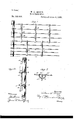
- Figure 1 is a side elevation of a wire fence provided with my improved stays.
- Fig. 2 is a detail enlarged vertical section through a stay, showing the fastenings and the mode of using the fastener-tool.
- Fig. 3 is a transverse section on line 3 3, Fig. 2, looking downward.
- the fence consists of a series of horizontal wire strands A, of any desired make and kind,
- the strands are generally braced or connected in someway so as to prevent their spreading apart, and to stiffen the fence panels (between posts), and my invention relates particularly to such stays and the fastenings thereof to the strands.
- Each stay is formed of metal and is preferably semitubular in cross section, so that it will be Serial No. 540,184. (No model.)
- the edges of the stays are transversely notched as at a, for the reception of the strands, and adjoining each pair of notches, but below the strand which may lie therein is a perforation in the stay, just large enough to allow the fasteners B to pass through.
- These'fasteners are or may be ordinary wire nails. Their heads I) prevent their being pulled clear through the perforation, while their bodies are bent around the strands, as indicated in Figs. 2 and 3 holding the strand firmly in the notches.
- the tool is then removed, leaving the strand securely fastened to the stay, while the rough or pointed end of the fastener is concealed within the hollow stay, and not only prevents cattle scratch-- ing themselves thereagainst but makes a neater finish, and the stays protect the fastener.
- the tool E has a bifurcated hook D at one end as shown in Fig. 2;
- my invention differs therefrom and is far simpler and cheaper and much more easily put up.
- the wire fasteners ordinary wire nails or headed lengths of soft wire, are simply stuck through the perforations in the stays, and are not fastened to the stays until bent,
Landscapes
- Engineering & Computer Science (AREA)
- Architecture (AREA)
- Civil Engineering (AREA)
- Structural Engineering (AREA)
- Fencing (AREA)
Description
(No Model.)
W. H. BOGGS. WIRBFENGE STAY.
No; 540,606. Patented'Jun 4, 1895.
Unir'rno TATES WILLIAM H. BOGGS, OF COVINGTON, OHIO, ASSIGNOR TO THE COVINGTON CRESCENT METALLIC FENCE STAY COMPANY, OF SAME PLACE.
WQIRE-FENCE STAY.
SPECIFICATION forming part of Letters Patent No. 540,606, dated June 4, 1895.
Application filed March 1, 1895.
T0 at whom it may concern.-
Be it known that I, WILLIAM H. BOGGS, of Covington, in the county of Miami and State of Ohio, have invented certain new and useful Improvements in Wire Fences; and I do hereby declare that the following is a full, clear, and exact description thereof, reference being had to the accompanying drawings, and to the letters of reference marked thereon, which form part of this specification.
This invention is an improvement in wire fences, and has especial reference to the manner of fastening the wires to the stays and the construction of such stays.
The object of the invention is to simplify the construction and expedite the fastening of the stays to the strand wires so that the latter can be braced at any and at as many points in the length of the fence desired with great rapidity, and at little expense, in a substantial, and neat manner.
The invention therefore consists in the constructions and combinations of parts set 'forth in the claim, and is-particularly described as follows:
Referring to the drawings, Figure 1 is a side elevation of a wire fence provided with my improved stays. Fig. 2 is a detail enlarged vertical section through a stay, showing the fastenings and the mode of using the fastener-tool. Fig. 3 is a transverse section on line 3 3, Fig. 2, looking downward.
The fence consists of a series of horizontal wire strands A, of any desired make and kind,
fastened at intervals to supporting posts, as
usual. Intermediate the posts the strands are generally braced or connected in someway so as to prevent their spreading apart, and to stiffen the fence panels (between posts), and my invention relates particularly to such stays and the fastenings thereof to the strands.
B, B, designate the stays, which are arranged vertically, or about at right angles to the fence strands, and are long enough to cross at least two strands, and may be made long enough to cross every strand in the panel, but I prefer to make them shorter and arrange them as indicated in Fig. 1. Each stay is formed of metal and is preferably semitubular in cross section, so that it will be Serial No. 540,184. (No model.)
light and stiff and can be stamped or rolled from sheet metal. At intervals (corresponding to the distance apart of the strands A) the edges of the stays are transversely notched as at a, for the reception of the strands, and adjoining each pair of notches, but below the strand which may lie therein is a perforation in the stay, just large enough to allow the fasteners B to pass through. These'fasteners are or may be ordinary wire nails. Their heads I) prevent their being pulled clear through the perforation, while their bodies are bent around the strands, as indicated in Figs. 2 and 3 holding the strand firmly in the notches. By using ordinary wire nails, riveting of the fasteners to the stays, and special tools for, or labor in, making them is obviated, and the cost of erection of fence lessen ed accordingly.
In applying the stays they are set against the strands, so that each strand rests in a proper set of notches. Then a fastener B is slipped through the perforation in the stay adjoining the strand to be secured. Then the bifurcated end of tool E is slipped under the nail, so as. to embrace it, while the hooked ends of the bifurcations are caught on the strand. Then by turning the toolE upward, (as indicated in the dotted lines Fig. 2) the fastener'is bent'closely over the strand, and back into the hollow of the stay. The tool is then removed, leaving the strand securely fastened to the stay, while the rough or pointed end of the fastener is concealed within the hollow stay, and not only prevents cattle scratch-- ing themselves thereagainst but makes a neater finish, and the stays protect the fastener.
The tool E has a bifurcated hook D at one end as shown in Fig. 2;
I am aware that hollow posts and stays have been made with notches for retaining the strands proper distances apart, and with various fastening devices, generally such as eye bolts or hooks provided with nutswhich are tightened up to bind the wire in place; but
my invention differs therefrom and is far simpler and cheaper and much more easily put up. The wire fasteners, ordinary wire nails or headed lengths of soft wire, are simply stuck through the perforations in the stays, and are not fastened to the stays until bent,
and when bent lock the stay to the strand as well as the strand to the stay. I do not, however, claim broadlya notched stay, .norsuch a stay in combination with strands and fasteners, but
What I do claim as new, and as my invention is- In a wire fence, thecombination of the,
strands A, and the semi-tubular stays B notched on their edges as at a, a to receive two or more strands, and perforated below each strand; with the wire nails B passed through the perforations in the stay and secured thereto by their heads only and bent back-11p over and partly around the adjoining 15 .strandinto the hollow stay thereby holding the strands in the notches While their ends are concealed in the stay, all substantially as and for the purpose described.
In testimony thanLclaim the foregoing as 20 my .own I aifiX my signature. ,in presence of two witnesses.
WILLIAM H. BOGGS.
a gWitnesses:
T. H. ALEXANDER, JAMES R. MANSFIELD.
Publications (1)
| Publication Number | Publication Date |
|---|---|
| US540606A true US540606A (en) | 1895-06-04 |
Family
ID=2609364
Family Applications (1)
| Application Number | Title | Priority Date | Filing Date |
|---|---|---|---|
| US540606D Expired - Lifetime US540606A (en) | William h |
Country Status (1)
| Country | Link |
|---|---|
| US (1) | US540606A (en) |
-
0
- US US540606D patent/US540606A/en not_active Expired - Lifetime
Similar Documents
| Publication | Publication Date | Title |
|---|---|---|
| US328392A (en) | Panel picket fence | |
| US962632A (en) | Post and wire-fence construction. | |
| US540606A (en) | William h | |
| US1036447A (en) | Fence-post. | |
| US417383A (en) | Fence-post | |
| US803706A (en) | Cement-post fastening. | |
| US962523A (en) | Fence-post. | |
| US597583A (en) | Fence | |
| US557017A (en) | Wire fence | |
| US257194A (en) | waters | |
| US554683A (en) | Fence | |
| US519435A (en) | Roller-staple | |
| US256880A (en) | Barbed fetfce wire | |
| US265518A (en) | Fence | |
| US1674459A (en) | Steel fence post | |
| US660595A (en) | Fence. | |
| US192592A (en) | Improvement in iron posts for wire fences | |
| US677396A (en) | Fence-post. | |
| US367664A (en) | Barb-fence signal | |
| US619030A (en) | Fence-post | |
| US571049A (en) | Fence | |
| US541273A (en) | Wire fastener and stretcher | |
| US485741A (en) | Metallic fencing | |
| US805349A (en) | Fence-post. | |
| US181328A (en) | Improvement in barbed fences |