US5390901A - Energetic material feeder - Google Patents
Energetic material feeder Download PDFInfo
- Publication number
- US5390901A US5390901A US08/126,855 US12685593A US5390901A US 5390901 A US5390901 A US 5390901A US 12685593 A US12685593 A US 12685593A US 5390901 A US5390901 A US 5390901A
- Authority
- US
- United States
- Prior art keywords
- furnace
- waste
- molten salt
- feed hopper
- tube
- Prior art date
- Legal status (The legal status is an assumption and is not a legal conclusion. Google has not performed a legal analysis and makes no representation as to the accuracy of the status listed.)
- Expired - Fee Related
Links
- 239000000463 material Substances 0.000 title description 17
- 150000003839 salts Chemical class 0.000 claims description 44
- 239000002699 waste material Substances 0.000 claims description 43
- 239000002360 explosive Substances 0.000 claims description 21
- 230000004888 barrier function Effects 0.000 claims description 19
- 239000003380 propellant Substances 0.000 claims description 19
- 239000007787 solid Substances 0.000 claims description 14
- 238000005474 detonation Methods 0.000 claims description 13
- 238000000034 method Methods 0.000 claims description 3
- 239000002910 solid waste Substances 0.000 claims description 2
- 238000007599 discharging Methods 0.000 claims 4
- CDBYLPFSWZWCQE-UHFFFAOYSA-L Sodium Carbonate Chemical compound [Na+].[Na+].[O-]C([O-])=O CDBYLPFSWZWCQE-UHFFFAOYSA-L 0.000 description 8
- 230000006378 damage Effects 0.000 description 6
- 239000000203 mixture Substances 0.000 description 4
- BWHMMNNQKKPAPP-UHFFFAOYSA-L potassium carbonate Chemical compound [K+].[K+].[O-]C([O-])=O BWHMMNNQKKPAPP-UHFFFAOYSA-L 0.000 description 4
- 229910000029 sodium carbonate Inorganic materials 0.000 description 4
- HEMHJVSKTPXQMS-UHFFFAOYSA-M Sodium hydroxide Chemical compound [OH-].[Na+] HEMHJVSKTPXQMS-UHFFFAOYSA-M 0.000 description 3
- IJGRMHOSHXDMSA-UHFFFAOYSA-N Atomic nitrogen Chemical compound N#N IJGRMHOSHXDMSA-UHFFFAOYSA-N 0.000 description 2
- CURLTUGMZLYLDI-UHFFFAOYSA-N Carbon dioxide Chemical compound O=C=O CURLTUGMZLYLDI-UHFFFAOYSA-N 0.000 description 2
- 229910000288 alkali metal carbonate Inorganic materials 0.000 description 2
- 150000008041 alkali metal carbonates Chemical class 0.000 description 2
- -1 by weight Chemical compound 0.000 description 2
- 238000000354 decomposition reaction Methods 0.000 description 2
- 239000007789 gas Substances 0.000 description 2
- XGZVUEUWXADBQD-UHFFFAOYSA-L lithium carbonate Chemical compound [Li+].[Li+].[O-]C([O-])=O XGZVUEUWXADBQD-UHFFFAOYSA-L 0.000 description 2
- 229910052808 lithium carbonate Inorganic materials 0.000 description 2
- 230000003647 oxidation Effects 0.000 description 2
- 238000007254 oxidation reaction Methods 0.000 description 2
- 230000035515 penetration Effects 0.000 description 2
- 229910000027 potassium carbonate Inorganic materials 0.000 description 2
- 239000004449 solid propellant Substances 0.000 description 2
- XLYOFNOQVPJJNP-UHFFFAOYSA-N water Chemical compound O XLYOFNOQVPJJNP-UHFFFAOYSA-N 0.000 description 2
- 229910002651 NO3 Inorganic materials 0.000 description 1
- 150000008044 alkali metal hydroxides Chemical class 0.000 description 1
- PNEYBMLMFCGWSK-UHFFFAOYSA-N aluminium oxide Inorganic materials [O-2].[O-2].[O-2].[Al+3].[Al+3] PNEYBMLMFCGWSK-UHFFFAOYSA-N 0.000 description 1
- IVRMZWNICZWHMI-UHFFFAOYSA-N azide group Chemical group [N-]=[N+]=[N-] IVRMZWNICZWHMI-UHFFFAOYSA-N 0.000 description 1
- 238000006243 chemical reaction Methods 0.000 description 1
- 229910001026 inconel Inorganic materials 0.000 description 1
- XIXYJCCQFKSBHG-UHFFFAOYSA-L lithium sodium hydrogen carbonate Chemical compound C([O-])([O-])=O.[Na+].C(O)(O)=O.[Li+] XIXYJCCQFKSBHG-UHFFFAOYSA-L 0.000 description 1
- 239000002923 metal particle Substances 0.000 description 1
- NHNBFGGVMKEFGY-UHFFFAOYSA-N nitrate group Chemical group [N+](=O)([O-])[O-] NHNBFGGVMKEFGY-UHFFFAOYSA-N 0.000 description 1
- 229910052757 nitrogen Inorganic materials 0.000 description 1
- 239000002245 particle Substances 0.000 description 1
- 239000011343 solid material Substances 0.000 description 1
Images
Classifications
-
- A—HUMAN NECESSITIES
- A62—LIFE-SAVING; FIRE-FIGHTING
- A62D—CHEMICAL MEANS FOR EXTINGUISHING FIRES OR FOR COMBATING OR PROTECTING AGAINST HARMFUL CHEMICAL AGENTS; CHEMICAL MATERIALS FOR USE IN BREATHING APPARATUS
- A62D3/00—Processes for making harmful chemical substances harmless or less harmful, by effecting a chemical change in the substances
- A62D3/30—Processes for making harmful chemical substances harmless or less harmful, by effecting a chemical change in the substances by reacting with chemical agents
- A62D3/32—Processes for making harmful chemical substances harmless or less harmful, by effecting a chemical change in the substances by reacting with chemical agents by treatment in molten chemical reagent, e.g. salts or metals
-
- B—PERFORMING OPERATIONS; TRANSPORTING
- B01—PHYSICAL OR CHEMICAL PROCESSES OR APPARATUS IN GENERAL
- B01J—CHEMICAL OR PHYSICAL PROCESSES, e.g. CATALYSIS OR COLLOID CHEMISTRY; THEIR RELEVANT APPARATUS
- B01J4/00—Feed or outlet devices; Feed or outlet control devices
- B01J4/001—Feed or outlet devices as such, e.g. feeding tubes
-
- F—MECHANICAL ENGINEERING; LIGHTING; HEATING; WEAPONS; BLASTING
- F23—COMBUSTION APPARATUS; COMBUSTION PROCESSES
- F23G—CREMATION FURNACES; CONSUMING WASTE PRODUCTS BY COMBUSTION
- F23G5/00—Incineration of waste; Incinerator constructions; Details, accessories or control therefor
- F23G5/44—Details; Accessories
- F23G5/442—Waste feed arrangements
- F23G5/444—Waste feed arrangements for solid waste
-
- A—HUMAN NECESSITIES
- A62—LIFE-SAVING; FIRE-FIGHTING
- A62D—CHEMICAL MEANS FOR EXTINGUISHING FIRES OR FOR COMBATING OR PROTECTING AGAINST HARMFUL CHEMICAL AGENTS; CHEMICAL MATERIALS FOR USE IN BREATHING APPARATUS
- A62D2101/00—Harmful chemical substances made harmless, or less harmful, by effecting chemical change
- A62D2101/06—Explosives, propellants or pyrotechnics, e.g. rocket fuel or napalm
-
- A—HUMAN NECESSITIES
- A62—LIFE-SAVING; FIRE-FIGHTING
- A62D—CHEMICAL MEANS FOR EXTINGUISHING FIRES OR FOR COMBATING OR PROTECTING AGAINST HARMFUL CHEMICAL AGENTS; CHEMICAL MATERIALS FOR USE IN BREATHING APPARATUS
- A62D2203/00—Aspects of processes for making harmful chemical substances harmless, or less harmful, by effecting chemical change in the substances
- A62D2203/10—Apparatus specially adapted for treating harmful chemical agents; Details thereof
-
- F—MECHANICAL ENGINEERING; LIGHTING; HEATING; WEAPONS; BLASTING
- F23—COMBUSTION APPARATUS; COMBUSTION PROCESSES
- F23G—CREMATION FURNACES; CONSUMING WASTE PRODUCTS BY COMBUSTION
- F23G2205/00—Waste feed arrangements
- F23G2205/12—Waste feed arrangements using conveyors
- F23G2205/125—Vibrating conveyor
-
- F—MECHANICAL ENGINEERING; LIGHTING; HEATING; WEAPONS; BLASTING
- F23—COMBUSTION APPARATUS; COMBUSTION PROCESSES
- F23G—CREMATION FURNACES; CONSUMING WASTE PRODUCTS BY COMBUSTION
- F23G2205/00—Waste feed arrangements
- F23G2205/14—Waste feed arrangements using hopper or bin
-
- F—MECHANICAL ENGINEERING; LIGHTING; HEATING; WEAPONS; BLASTING
- F23—COMBUSTION APPARATUS; COMBUSTION PROCESSES
- F23G—CREMATION FURNACES; CONSUMING WASTE PRODUCTS BY COMBUSTION
- F23G2205/00—Waste feed arrangements
- F23G2205/16—Waste feed arrangements using chute
-
- F—MECHANICAL ENGINEERING; LIGHTING; HEATING; WEAPONS; BLASTING
- F23—COMBUSTION APPARATUS; COMBUSTION PROCESSES
- F23G—CREMATION FURNACES; CONSUMING WASTE PRODUCTS BY COMBUSTION
- F23G2205/00—Waste feed arrangements
- F23G2205/18—Waste feed arrangements using airlock systems
-
- Y—GENERAL TAGGING OF NEW TECHNOLOGICAL DEVELOPMENTS; GENERAL TAGGING OF CROSS-SECTIONAL TECHNOLOGIES SPANNING OVER SEVERAL SECTIONS OF THE IPC; TECHNICAL SUBJECTS COVERED BY FORMER USPC CROSS-REFERENCE ART COLLECTIONS [XRACs] AND DIGESTS
- Y10—TECHNICAL SUBJECTS COVERED BY FORMER USPC
- Y10S—TECHNICAL SUBJECTS COVERED BY FORMER USPC CROSS-REFERENCE ART COLLECTIONS [XRACs] AND DIGESTS
- Y10S588/00—Hazardous or toxic waste destruction or containment
- Y10S588/90—Apparatus
Definitions
- This invention relates to the destruction of energetic materials, such as propellants and explosives, and is particularly directed to an improved feed system for feeding solid propellant or explosive materials, e.g. in the form of chunks, into a waste destruction system, such as a molten salt furnace, while preventing detonation of such propellant or explosive material.
- a waste destruction system such as a molten salt furnace
- Propellants and explosives are energetic systems containing energetic groups such as nitrate and azide groups, and finely-divided metal particles. The problem is to dispose of these materials as a waste, safely.
- the use of a molten salt bath containing alkali metal carbonate for destroying propellant and explosive waste has been developed.
- energetic materials, such as propellants or explosives potentially can detonate if located near a hot surface such as a molten salt bath, during waste disposal. High friction devices can also cause detonations or ignition.
- the feed system for propellant or explosive energetic materials used for feeding into a waste treatment device must be located in a separate area from the furnace, to avoid detonation of such material during feeding.
- a physical barrier such as a concrete wall, is used to separate the feeder from the furnace.
- the feed device comprises a feed hopper which is preferably vibrated, to move chunks or pieces of energetic waste material into an inclined chute.
- the inclined chute passes through a penetration in the wall to the furnace.
- the chute is preferably vibrated to facilitate transport of the feed material which can be dropped directly into the molten salt furnace, or added in increments thereto by means of a lock hopper, e.g. comprising a double lock-valve arrangement.
- the present invention is directed to a feed system for feeding propellant or explosive energetic waste into a molten salt-containing furnace while avoiding detonation of such waste, which comprises a feed hopper for receiving solid pieces of such waste, a furnace containing a molten salt, separated from said feed hopper, a barrier between the feed hopper and the furnace, the barrier having an aperture therein, and an inclined chute communicating with the feed hopper and the furnace for transporting the solid pieces of waste to said furnace and into the molten salt therein, the chute passing through the aperture in the barrier.
- Another object is the provision of a system for feeding solid propellant or explosive materials into a molten salt bath for destruction of the propellant or explosive, while avoiding or substantially reducing the danger of detonation of such energetic materials during transport of such materials from the feeding device and into the hot environment adjacent the molten salt furnace.
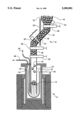
- the feed system 10 of the invention is designed to safely transport solid explosive or propellant waste to a molten salt bath 12 contained in an electric furnace 14, for destruction of such energetic material while eliminating or substantially reducing the potential for detonation of such material during transport into the environment of the hot furnace.
- a feed hopper 16 for receiving propellant or explosive chunks, indicated at 18 is located in a zone separated and remote from the electric furnace containing the molten salt bath 12, by providing a barrier 20 such as a concrete wall between the feed hopper 16 and the furnace 14.
- a vibrator device indicated at 22 is provided on the feed hopper 16 to facilitate movement of the energetic waste material chunks 18 out of the feed hopper and into an inclined chute 24 communicating with the bottom of the feed hopper 16.
- the vibrator device 22 can be any well known type of vibrator such as a pneumatic or electromechanical vibrator. Incremental passage of the waste chunks 18 from feed hopper 16 into the inclined chute 24 is controlled by means of a control valve 26.
- the upper end of the downwardly inclined chute 24 passes through a penetration or aperture 26 in the barrier wall 20 and terminates at its lower end in a lock hopper 28 having a double lock valve arrangement as indicated at 30.
- the inclined chute 24 is preferably vibrated by means of a vibrator at 32 similar to vibrator 22, to facilitate transport of the energetic chunks 18 downwardly through the inclined chute 24.
- the lock hopper 28 By means of the lock hopper 28, the feed chunks 18 introduced therein from the chute 24 can be dropped in increments via valve 30 into the molten salt bath 12 in furnace 14.
- the molten salt bath 12 into which the propellant or explosive waste chunks 18 are dropped from the lock hopper 28, is contained in an alumina tube 34 located within a furnace liner 36, e.g. of Inconel, within the electric furnace.
- the molten salt bath 12 contains an alkali metal carbonate such as sodium carbonate, potassium carbonate or lithium carbonate, or mixtures thereof.
- Representative molten salt baths can contain 50% sodium carbonate and 50% potassium carbonate, by weight, or a lithium carbonate-sodium carbonate mixture containing 42 mol % lithium carbonate and 58 mol % sodium carbonate.
- mixtures of sodium carbonate and alkali metal hydroxide such as sodium hydroxide, can be employed.
- Temperature of the molten salt bath 12 can be maintained from about 300° to about 1100° C., preferably about 700° to about 900° C.
- the waste propellant or explosive feed chunks 18 are fed incrementally from lock hopper 28 and drop through a downcomer 37 into the molten salt bath 12 in tube 34 for submerged reactive contact of the waste feed chunks 18 with the molten salt and decomposition or oxidation of the waste feed chunks to form essentially CO 2 , nitrogen and water vapor.
- process air is introduced at 40 and passed downwardly through a narrow tube 42 provided within tube 34 and into the molten salt bath 12.
- the product gas formed in the reaction, a mixture of CO 2 , N 2 and water vapor passes upwardly through an annulus 44 between the wall of tube 34 and downcomer 37 to the gas vent 38.
- the feed chunks maintained and stored in the feed hopper 16 are separated from the furnace 14 by the barrier 20, and hence are maintained at a sufficiently low temperature in relation to the environment of furnace 14, to substantially avoid the danger of detonation of the feed chunks in the hopper 16.
- the feed chunks in the lower end of the inclined chute 24 and in the lock hopper 28 are positioned on the same side of the barrier 20 as the furnace 14, and hence pass through a zone adjacent to the hot furnace 14, the passage of the feed chunks through the lower portion of the inclined chute and through the lock hopper 28 is sufficiently rapid so that the temperature of the feed chunks 18 therein do not rise sufficiently prior to being dropped into the salt bath 12, so as to substantially avoid potential detonation.
- lock hopper and valve arrangement 28, 30 for incremental feeding of the waste chunks 18 from chute 24 to the molten salt bath 12
- lock hopper and associated valve can be omitted and the feed chunks 18 dropped directly from the lower end of the inclined chute 24 through downcomer 37 and into the molten salt bath 12 in tube 34.
- solid energetic waste material can often be in the form of chunks, such solid material can be in the form of smaller pieces, e.g. particles.
- the invention provides an improved energetic feed system for feeding solid explosive or propellant waste material into a molten salt bath while eliminating or substantially reducing the potential for detonation of such solid waste material during transport from a feed hopper into a molten salt bath for destruction of such waste material.
Landscapes
- Engineering & Computer Science (AREA)
- Chemical & Material Sciences (AREA)
- Chemical Kinetics & Catalysis (AREA)
- General Engineering & Computer Science (AREA)
- Mechanical Engineering (AREA)
- Organic Chemistry (AREA)
- Environmental & Geological Engineering (AREA)
- Health & Medical Sciences (AREA)
- General Health & Medical Sciences (AREA)
- Toxicology (AREA)
- General Chemical & Material Sciences (AREA)
- Business, Economics & Management (AREA)
- Emergency Management (AREA)
- Processing Of Solid Wastes (AREA)
Abstract
Description
Claims (7)
Priority Applications (1)
| Application Number | Priority Date | Filing Date | Title |
|---|---|---|---|
| US08/126,855 US5390901A (en) | 1993-09-27 | 1993-09-27 | Energetic material feeder |
Applications Claiming Priority (1)
| Application Number | Priority Date | Filing Date | Title |
|---|---|---|---|
| US08/126,855 US5390901A (en) | 1993-09-27 | 1993-09-27 | Energetic material feeder |
Publications (1)
| Publication Number | Publication Date |
|---|---|
| US5390901A true US5390901A (en) | 1995-02-21 |
Family
ID=22427037
Family Applications (1)
| Application Number | Title | Priority Date | Filing Date |
|---|---|---|---|
| US08/126,855 Expired - Fee Related US5390901A (en) | 1993-09-27 | 1993-09-27 | Energetic material feeder |
Country Status (1)
| Country | Link |
|---|---|
| US (1) | US5390901A (en) |
Cited By (8)
| Publication number | Priority date | Publication date | Assignee | Title |
|---|---|---|---|---|
| US6489532B1 (en) | 1999-01-25 | 2002-12-03 | The Regents Of The University Of California | Delivery system for molten salt oxidation of solid waste |
| WO2009003436A1 (en) * | 2007-07-04 | 2009-01-08 | Dinano Ecotechnology Llc | Device for loading an installation for treating raw materials containing carbon |
| RU2398998C1 (en) * | 2009-06-09 | 2010-09-10 | Общество с ограниченной ответственностью "Эко-Прогтех" | Installation for utilisation of organic wastes and oil slime |
| RU2403499C1 (en) * | 2009-07-03 | 2010-11-10 | Владимир Васильевич Масленников | Installation for recycling organic wastes and oil sludge |
| RU2406031C1 (en) * | 2009-08-11 | 2010-12-10 | Владимир Васильевич Масленников | Reactor for processing of organic wastes and oil sludges |
| MD4188C1 (en) * | 2011-11-07 | 2013-06-30 | Валерий ДИНТОВ | Plant for processing carbon-bearing raw material |
| CN111589374A (en) * | 2020-07-03 | 2020-08-28 | 河北兰升生物科技有限公司 | Vibration feeding device and reaction equipment with same |
| EP4098942A1 (en) * | 2021-05-29 | 2022-12-07 | François Hustache | Method for processing organic waste by pyrolysis |
Citations (3)
| Publication number | Priority date | Publication date | Assignee | Title |
|---|---|---|---|---|
| US3472431A (en) * | 1967-07-24 | 1969-10-14 | Bodine Albert G | Sonic method and apparatus for facilitating gravity flow of granular material |
| US3899322A (en) * | 1972-06-20 | 1975-08-12 | Rockwell International Corp | Noble-type metal recovery process by use of molten salt bath |
| US4431612A (en) * | 1982-06-03 | 1984-02-14 | Electro-Petroleum, Inc. | Apparatus for the decomposition of hazardous materials and the like |
-
1993
- 1993-09-27 US US08/126,855 patent/US5390901A/en not_active Expired - Fee Related
Patent Citations (3)
| Publication number | Priority date | Publication date | Assignee | Title |
|---|---|---|---|---|
| US3472431A (en) * | 1967-07-24 | 1969-10-14 | Bodine Albert G | Sonic method and apparatus for facilitating gravity flow of granular material |
| US3899322A (en) * | 1972-06-20 | 1975-08-12 | Rockwell International Corp | Noble-type metal recovery process by use of molten salt bath |
| US4431612A (en) * | 1982-06-03 | 1984-02-14 | Electro-Petroleum, Inc. | Apparatus for the decomposition of hazardous materials and the like |
Cited By (11)
| Publication number | Priority date | Publication date | Assignee | Title |
|---|---|---|---|---|
| US6489532B1 (en) | 1999-01-25 | 2002-12-03 | The Regents Of The University Of California | Delivery system for molten salt oxidation of solid waste |
| WO2009003436A1 (en) * | 2007-07-04 | 2009-01-08 | Dinano Ecotechnology Llc | Device for loading an installation for treating raw materials containing carbon |
| GB2463444A (en) * | 2007-07-04 | 2010-03-17 | Dinano Ecotechnology Llc | Device for loading an installation for treating raw materials containing carbon |
| US20110064544A1 (en) * | 2007-07-04 | 2011-03-17 | Dinano Ecotechnology Llc | feed arrangement of a system for the processing of carbon containing raw material |
| RU2398998C1 (en) * | 2009-06-09 | 2010-09-10 | Общество с ограниченной ответственностью "Эко-Прогтех" | Installation for utilisation of organic wastes and oil slime |
| RU2403499C1 (en) * | 2009-07-03 | 2010-11-10 | Владимир Васильевич Масленников | Installation for recycling organic wastes and oil sludge |
| RU2406031C1 (en) * | 2009-08-11 | 2010-12-10 | Владимир Васильевич Масленников | Reactor for processing of organic wastes and oil sludges |
| MD4188C1 (en) * | 2011-11-07 | 2013-06-30 | Валерий ДИНТОВ | Plant for processing carbon-bearing raw material |
| CN111589374A (en) * | 2020-07-03 | 2020-08-28 | 河北兰升生物科技有限公司 | Vibration feeding device and reaction equipment with same |
| CN111589374B (en) * | 2020-07-03 | 2021-06-04 | 河北兰升生物科技有限公司 | Vibratory feeding device and reaction equipment with the same |
| EP4098942A1 (en) * | 2021-05-29 | 2022-12-07 | François Hustache | Method for processing organic waste by pyrolysis |
Similar Documents
| Publication | Publication Date | Title |
|---|---|---|
| US5582119A (en) | Treatment of explosive waste | |
| US2718453A (en) | Method for reducing sulfur compounds from flue gases | |
| US5884569A (en) | Method and apparatus for containing and suppressing explosive detonations | |
| SE451033B (en) | SET AND DEVICE FOR CONVERSION OF WASTE MATERIALS WITH PLASMA MAGAZINE | |
| WO1990013774A1 (en) | Fluidized bed combustion of aluminum smelting waste | |
| GB1392586A (en) | Metal recovery process | |
| US5527983A (en) | Method for the destruction of noxious materials | |
| WO1997021058A1 (en) | Reactive waste deactivation facility and method | |
| US2839435A (en) | Method of reactor product removal by explosive means | |
| WO1994024513A1 (en) | A method and a device for the destruction of objects or bodies filled with explosives | |
| US3905272A (en) | Munition destruct apparatus | |
| EP0238581A1 (en) | Method for waste treatment. | |
| US3352498A (en) | Explosive shattering method and apparatus | |
| US4475965A (en) | Shale oil explosives | |
| US2870002A (en) | Method of fluidization | |
| van Ham | Recycling and disposal of munitions and explosives | |
| RU2134782C1 (en) | Drilling-and-blasting charge | |
| Badjukov et al. | Shock behavior of calcite, anhydrite, and gypsum | |
| US1283483A (en) | Cement material and method of producing. | |
| US2872305A (en) | Liquid oxygen explosive and methods for preparing same | |
| RU2815668C1 (en) | Method of destruction of wastes by explosion | |
| RU2141101C1 (en) | Process of loading of holes with ammunition | |
| RU2100773C1 (en) | Method of charging of descending blast holes with hot-flowing water-containing explosives | |
| SU622975A1 (en) | Metering device for pneumatic charging of blast holes | |
| RU2059594C1 (en) | Composition of explosive |
Legal Events
| Date | Code | Title | Description |
|---|---|---|---|
| AS | Assignment |
Owner name: ROCKWELL INTERNATIONAL CORPORATION, CALIFORNIA Free format text: ASSIGNMENT OF ASSIGNORS INTEREST;ASSIGNORS:GAY, R. L.;STEWART, A. E.;GUON, J.;AND OTHERS;REEL/FRAME:006724/0734 Effective date: 19930922 |
|
| FEPP | Fee payment procedure |
Free format text: PAYOR NUMBER ASSIGNED (ORIGINAL EVENT CODE: ASPN); ENTITY STATUS OF PATENT OWNER: LARGE ENTITY |
|
| FPAY | Fee payment |
Year of fee payment: 4 |
|
| REMI | Maintenance fee reminder mailed | ||
| LAPS | Lapse for failure to pay maintenance fees | ||
| STCH | Information on status: patent discontinuation |
Free format text: PATENT EXPIRED DUE TO NONPAYMENT OF MAINTENANCE FEES UNDER 37 CFR 1.362 |
|
| FP | Lapsed due to failure to pay maintenance fee |
Effective date: 20030221 |