US5344722A - Phosphoric acid fuel cell - Google Patents

Phosphoric acid fuel cell Download PDF

Info

Publication number
US5344722A
US5344722A US07/903,903 US90390392A US5344722A US 5344722 A US5344722 A US 5344722A US 90390392 A US90390392 A US 90390392A US 5344722 A US5344722 A US 5344722A
Authority
US
United States
Prior art keywords
phosphoric acid
fuel cell
electrolyte
additive
gas
Prior art date
Legal status (The legal status is an assumption and is not a legal conclusion. Google has not performed a legal analysis and makes no representation as to the accuracy of the status listed.)
Expired - Fee Related
Application number
US07/903,903
Inventor
Niels J. Bjerrum
Xiao Gang
Hans A. Hjuler
Christian Olsen
Rolf W. Berg
Current Assignee (The listed assignees may be inaccurate. Google has not performed a legal analysis and makes no representation or warranty as to the accuracy of the list.)
Topsoe AS
Original Assignee
Haldor Topsoe AS
Priority date (The priority date is an assumption and is not a legal conclusion. Google has not performed a legal analysis and makes no representation as to the accuracy of the date listed.)
Filing date
Publication date
Application filed by Haldor Topsoe AS filed Critical Haldor Topsoe AS
Assigned to HALDOR TOPSOE A/S reassignment HALDOR TOPSOE A/S ASSIGNMENT OF ASSIGNORS INTEREST. Assignors: BERG, ROLF W., BJERRUM, NIELS J., GANG, XIAO, HJULER, HANS A., OLSEN, CHRISTIAN
Application granted granted Critical
Publication of US5344722A publication Critical patent/US5344722A/en
Anticipated expiration legal-status Critical
Expired - Fee Related legal-status Critical Current

Links

Images

Classifications

    • HELECTRICITY
    • H01ELECTRIC ELEMENTS
    • H01MPROCESSES OR MEANS, e.g. BATTERIES, FOR THE DIRECT CONVERSION OF CHEMICAL ENERGY INTO ELECTRICAL ENERGY
    • H01M8/00Fuel cells; Manufacture thereof
    • H01M8/08Fuel cells with aqueous electrolytes
    • YGENERAL TAGGING OF NEW TECHNOLOGICAL DEVELOPMENTS; GENERAL TAGGING OF CROSS-SECTIONAL TECHNOLOGIES SPANNING OVER SEVERAL SECTIONS OF THE IPC; TECHNICAL SUBJECTS COVERED BY FORMER USPC CROSS-REFERENCE ART COLLECTIONS [XRACs] AND DIGESTS
    • Y02TECHNOLOGIES OR APPLICATIONS FOR MITIGATION OR ADAPTATION AGAINST CLIMATE CHANGE
    • Y02EREDUCTION OF GREENHOUSE GAS [GHG] EMISSIONS, RELATED TO ENERGY GENERATION, TRANSMISSION OR DISTRIBUTION
    • Y02E60/00Enabling technologies; Technologies with a potential or indirect contribution to GHG emissions mitigation
    • Y02E60/30Hydrogen technology
    • Y02E60/50Fuel cells

Definitions

  • the present invention is directed to phosphoric acid fuel cells, and more particularly, to a phosphoric acid fuel cell with an improved electrolyte,
  • a conventional fuel cell comprises an anode, a cathode, and an electrolyte impregnated matrix disposed between the electrodes.
  • a hydrogen containing gas is fed to the anode and an oxygen containing gas to the cathode.
  • the gases diffuse through the electrodes and react with the electrolyte in the presence of a catalyst on the electrodes to yield water, heat and electrical energy.
  • Phosphoric acid is the conventional electrolyte for acidic hydrogen-oxygen fuel cells because of its high stability at elevated temperatures, the ease of removal of CO 2 and water, and its high ionic conductivity.
  • phosphoric acid has several undesirable properties. Its low oxygen solubility at high acid concentrations and relatively slow oxygen reduction rate lead to a very high polarization of the cathode.
  • the oxygen reduction rate in trifluoromethane-sulphonic acid is substantially higher than in phosphoric acid because of the higher oxygen solubility resulting in improved limiting current of the cell (R. C. Bhardway, N. G. Smart and J. O Bockris; Proc. Intersot. Energy Convers. Eng. Conf., 1991, Vol. 26, No. 3; pages 546-569; P. Zellenay, B. R. Scharifker and J. O. Bockris; J. Electrochem. Soc., 1986, Vol. 133, No. 11; pages 2262-2267).
  • trifluromethanesulphonic acid is limited to temperatures below the operation temperature of practical phosphoric acid fuel cells, because of its high vapour pressure.
  • trifluromethanesulphonic acid it absorbs very easily in the porous electrodes resulting in low gas diffusion and thereby a higher electrode polarization.
  • this invention provides a phosphoric acid fuel cell comprising within a housing a gas diffusion cathode utilizing an oxygen-containing oxidant gas, a gas diffusion anode using a hydrogen-containing fuel gas, and an electrolyte comprising phosphoric acid and at least 0.1 percent by weight of an additive selected from the group of fluorinated compounds and silicone compounds with a vapour pressure not higher than that of phosphoric acid, thereby decreasing polarization of the cathode and increasing efficiency of the cell.
  • the above electrolyte additives form a physically adsorbed layer on the electrode/electrolyte interface, in which layer the concentration of oxygen is higher than in the bulk phosphoric acid and, thereby, increases the rate of oxygen reduction on the cathode and thus the thermal efficiency of the cell.
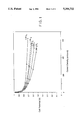
  • FIG. 1-FIG. 3 show cell polarization curves obtained with different electrolyte additives according to the invention in comparison with 100% phosphoric acid electrolyte.
  • a phosphoric acid fuel cell having within a housing a gas diffusion cathode utilizing an oxygen-containing oxidant gas, a gas diffusion anode using a hydrogen-containing fuel gas, and an electrolyte.
  • the electrolyte includes phosphoric acid and at least 0.1% by weight of an additive selected from the group of fluorinated compounds and silicone compounds with a vapor pressure not higher than that of phosphoric acid.
  • the additive in the phosphoric acid decreases polarization of the cathode and increases the efficiency of the phosphoric acid fuel cell.
  • the additive may be a salt of nonafluorobutanesulphonate.
  • the salt of nonafluorobutanesulphonate is potassium nonafluorobutanesulphonate (C 4 F 9 KO 3 S).
  • the additive may be a salt of perfluorohexanesulphonic acid.
  • the salt of perfluorohexanesulphonic acid is potassium perfluorohexanesulphonate (C 6 F 13 KO 3 S).
  • the additive may also be a perfluorinated trialkylamine having the general formula R 1 R 2 R 3 N, or the salts thereof. R 1 , R 2 , and R 3 being independent fluorocarbon groups.
  • the perfluorinated trialkylamine is perfluorotributylamine [(C 4 F 9 ) 3 N].
  • the additive may be a polyalkylsiloxane.
  • the polyalkylsiloxane is polymethylsiloxane [(--Si(CH 3 ) 2 O--) n ].
  • the invention provides a series of modified phosphoric acid electrolytes containing fluorinated carbon compounds and silicone fluids as additives.
  • the modified electrolytes improve the fuel cell performance due to enhanced oxygen reduction kinetics.
  • the additives may be added in an amount of 0.1 to 5 weight percent, preferably 0.1 weight percent, with respect to the phosphoric acid electrolyte.
  • the electrodes used were Pt-catalyzed carbon gas diffusion electrodes (0.5 mg/cm 2 Pt loading on both anode and cathode). All the experiments were carried out with 100% H 3 PO 4 as electrolyte, at a temperature of 190° C., by using pure hydrogen as fuel and pure oxygen as oxidant.
  • the fuel cell housing used to test the electrolyte additives was a product from Giner, Inc. (General License GLV).
  • the temperature was controlled by a controller (Dowty TC-48, Dowty Electronics Company) and heat was provided to the cell by two flexible electrical heaters glued one to each steel end plate of the housing.
  • the temperature in the cell was maintained within ⁇ 1° C.
  • the fuel gas was passed through a saturator containing distilled water at 72° C.
  • C 6 F 13 KO 3 S potassium perfluorohexanesulphonate
  • C 6 F 13 KO 3 S is a white powder purchased from Riedel-de Haen (98% pure).
  • Phosphoric acid 85%, Riedel-de Haen
  • a modified electrolyte was prepared by adding potassium perfluorohexanesulphonate to 100% phosphoric acid giving a weight ratio of 0.5:99.5, respectively.
  • Potassium nonafluorobutanesulphonate (C 4 F 9 KO 3 S; C 4 ) was used as electrolyte additive.
  • C 4 F 9 KO 3 S is a white powder purchased from Aldrich Chemical Company, Inc. with 98% purity.
  • 100% phosphoric acid was prepared as in Example 1.
  • Modified electrolytes were prepared by adding potassium nonafluorobutanesulphonate to 100% phosphoric acid giving weight ratios of 0.5:99.5, 1.0:99.0 and 1.5:98.5, respectively. When agitated with a magnetic stirrer at about 100° C., milk-white emulsions were achieved which were used immediately as electrolytes in the tests. The cell test results are shown in FIG. 1.
  • Perfluorotributylamine; [(C 4 F 9 ) 3 N; amine] was used as electrolyte additive.
  • (C 4 F 9 ) 3 N is a transparent liquid (technical grade) purchased from PCR Incorporated.
  • 100% phosphoric acid was prepared according to Example 1. Modified electrolytes were prepared by adding perfluorotributylamine to 100% phosphoric acid giving weight ratios of 0.5:99.5, 1.0:99.0 and 1.5:98.5, respectively. When agitated with a magnetic stirrer at about 100° C., emulsions were achieved which were used immediately as electrolytes in the tests. The cell test results are shown in FIG. 2.
  • Silicone DC-550 (Si-550), [--Si(CH 3 ) 2 O--] n was used as electrolyte additives.
  • Silicone DC-550 is a transparent liquid purchased from Dow Co. 100% phosphoric acid was prepared according to Example 1. A modified electrolyte was prepared by adding silicone DC-550 to 100% phosphoric acid in a weight ratio of 1.0:99.0. When agitated with a magnetic stirrer at about 100° C., an emulsion was achieved, which was used immediately as electrolyte in the tests. The cell test results are shown in FIG. 3.
  • ⁇ H is about ⁇ 280 kJ/mole H 2 O. It can be converted to a thermal voltage equivalent:
  • V TERM the thermal efficiency of a fuel cell is V TERM /1.45, where V TERM is the cell terminal voltage.
  • the cell thermal efficiencies can be calculated as follows:

Landscapes

  • Life Sciences & Earth Sciences (AREA)
  • Engineering & Computer Science (AREA)
  • Manufacturing & Machinery (AREA)
  • Sustainable Development (AREA)
  • Sustainable Energy (AREA)
  • Chemical & Material Sciences (AREA)
  • Chemical Kinetics & Catalysis (AREA)
  • Electrochemistry (AREA)
  • General Chemical & Material Sciences (AREA)
  • Fuel Cell (AREA)

Abstract

A series of modified phosphoric acid electrolytes containing fluorinated carbon compounds and silicone fluids as additives are disclosed. The modified electrolytes can improve the fuel cell performance due to the enhanced oxygen reduction kinetics. These additives are, preferably, potassium perfluorohexanesulphonate (C6 F13 KO3 S), potassium nonafluorobutanesulphonate (C4 F9 KO3 S), perfluorotributylamine [(C4 F9)3 N] and polymethylsiloxanes [(--Si(CH3)2 O--)n ]. The additives are added in an amount of 0.1-5 wt % with respect to the phosphoric acid electrolyte.

Description

BACKGROUND OF THE INVENTION
1. Field of the Invention
The present invention is directed to phosphoric acid fuel cells, and more particularly, to a phosphoric acid fuel cell with an improved electrolyte,
In a fuel cell, chemical energy of gaseous fuel is converted into electrical power. A conventional fuel cell comprises an anode, a cathode, and an electrolyte impregnated matrix disposed between the electrodes.
In the operation of a phosphoric acid fuel cell, a hydrogen containing gas is fed to the anode and an oxygen containing gas to the cathode. The gases diffuse through the electrodes and react with the electrolyte in the presence of a catalyst on the electrodes to yield water, heat and electrical energy.
At the anode, hydrogen in the feed gas gives up electrons by electrochemical oxidation reaction. The electrical current so generated is conducted from the anode through an external circuit to the cathode. At the cathode, the electrons are then electrochemically combined with oxygen. A flow of ions through the electrolyte completes the circuit.
The electrochemical reactions proceeding in a phosphoric acid fuel cell are thus:
H.sub.2 →2H.sup.+ +2e.sup.-
at the anode, and
1/2O.sub.2 +2H.sup.+ +2e.sup.- →H.sub.2 O
at the cathode.
Phosphoric acid is the conventional electrolyte for acidic hydrogen-oxygen fuel cells because of its high stability at elevated temperatures, the ease of removal of CO2 and water, and its high ionic conductivity. However, phosphoric acid has several undesirable properties. Its low oxygen solubility at high acid concentrations and relatively slow oxygen reduction rate lead to a very high polarization of the cathode.
2. Description of the Related Art
To enhance the oxygen reduction rate and thereby improve the efficiency of phosphoric acid fuel cells, it has been suggested to substitute trifluoromethanesulphonic acid for the phosphoric acid electrolyte in the cells.
The oxygen reduction rate in trifluoromethane-sulphonic acid is substantially higher than in phosphoric acid because of the higher oxygen solubility resulting in improved limiting current of the cell (R. C. Bhardway, N. G. Smart and J. O Bockris; Proc. Intersot. Energy Convers. Eng. Conf., 1991, Vol. 26, No. 3; pages 546-569; P. Zellenay, B. R. Scharifker and J. O. Bockris; J. Electrochem. Soc., 1986, Vol. 133, No. 11; pages 2262-2267).
Despite of its better performance, the use of trifluromethanesulphonic acid is limited to temperatures below the operation temperature of practical phosphoric acid fuel cells, because of its high vapour pressure. As a further disadvantage of trifluromethanesulphonic acid, it absorbs very easily in the porous electrodes resulting in low gas diffusion and thereby a higher electrode polarization.
SUMMARY OF THE INVENTION
We have now found that addition of small amounts of fluorinated organic compounds or silicone compound, having a vapour pressure not higher than that of phosphoric acid, to the phosphoric acid electrolyte of a phosphoric acid fuel cell enhances oxygen solubility and diffusitivity of the electrolyte without detrimental absorption of the electrolyte in the electrodes of the cell and thus improves the performance of conventional operated phosphoric acid fuel cells.
Accordingly, this invention provides a phosphoric acid fuel cell comprising within a housing a gas diffusion cathode utilizing an oxygen-containing oxidant gas, a gas diffusion anode using a hydrogen-containing fuel gas, and an electrolyte comprising phosphoric acid and at least 0.1 percent by weight of an additive selected from the group of fluorinated compounds and silicone compounds with a vapour pressure not higher than that of phosphoric acid, thereby decreasing polarization of the cathode and increasing efficiency of the cell.
As a theoretical explanation, the above electrolyte additives form a physically adsorbed layer on the electrode/electrolyte interface, in which layer the concentration of oxygen is higher than in the bulk phosphoric acid and, thereby, increases the rate of oxygen reduction on the cathode and thus the thermal efficiency of the cell.
BRIEF DESCRIPTION OF THE DRAWINGS
In the following examples, the invention will be illustrated in detail by reference to preferred embodiments thereof and to the drawings in which
FIG. 1-FIG. 3 show cell polarization curves obtained with different electrolyte additives according to the invention in comparison with 100% phosphoric acid electrolyte.
DETAILED DESCRIPTION OF THE PREFERRED EMBODIMENTS
A phosphoric acid fuel cell is disclosed having within a housing a gas diffusion cathode utilizing an oxygen-containing oxidant gas, a gas diffusion anode using a hydrogen-containing fuel gas, and an electrolyte. The electrolyte includes phosphoric acid and at least 0.1% by weight of an additive selected from the group of fluorinated compounds and silicone compounds with a vapor pressure not higher than that of phosphoric acid. The additive in the phosphoric acid decreases polarization of the cathode and increases the efficiency of the phosphoric acid fuel cell.
The additive may be a salt of nonafluorobutanesulphonate. Preferably, the salt of nonafluorobutanesulphonate is potassium nonafluorobutanesulphonate (C4 F9 KO3 S). Alternatively the additive may be a salt of perfluorohexanesulphonic acid. Preferably, the salt of perfluorohexanesulphonic acid is potassium perfluorohexanesulphonate (C6 F13 KO3 S). The additive may also be a perfluorinated trialkylamine having the general formula R1 R2 R3 N, or the salts thereof. R1, R2, and R3 being independent fluorocarbon groups. Preferably, the perfluorinated trialkylamine is perfluorotributylamine [(C4 F9)3 N]. Additionally, the additive may be a polyalkylsiloxane. Preferably, the polyalkylsiloxane is polymethylsiloxane [(--Si(CH3)2 O--)n ].
The invention provides a series of modified phosphoric acid electrolytes containing fluorinated carbon compounds and silicone fluids as additives. The modified electrolytes improve the fuel cell performance due to enhanced oxygen reduction kinetics. The additives may be added in an amount of 0.1 to 5 weight percent, preferably 0.1 weight percent, with respect to the phosphoric acid electrolyte.
In the Examples, the electrodes used were Pt-catalyzed carbon gas diffusion electrodes (0.5 mg/cm2 Pt loading on both anode and cathode). All the experiments were carried out with 100% H3 PO4 as electrolyte, at a temperature of 190° C., by using pure hydrogen as fuel and pure oxygen as oxidant.
The fuel cell housing used to test the electrolyte additives was a product from Giner, Inc. (General License GLV). The temperature was controlled by a controller (Dowty TC-48, Dowty Electronics Company) and heat was provided to the cell by two flexible electrical heaters glued one to each steel end plate of the housing. The temperature in the cell was maintained within ±1° C. To maintain the water balance in the cell, the fuel gas was passed through a saturator containing distilled water at 72° C.
EXAMPLE 1
In this Example, potassium perfluorohexanesulphonate (C6 F13 KO3 S; C6) was used as electrolyte additive. C6 F13 KO3 S is a white powder purchased from Riedel-de Haen (98% pure). Phosphoric acid (85%, Riedel-de Haen) was purified by treatment with hydrogen peroxide and concentrated to 100% by heating. A modified electrolyte was prepared by adding potassium perfluorohexanesulphonate to 100% phosphoric acid giving a weight ratio of 0.5:99.5, respectively. When agitated with a magnetic stirrer at about 100° C., a milk-white emulsion was achieved, which was used immediately as electrolyte. The cell test results are shown in FIG. 1.
EXAMPLE 2
Potassium nonafluorobutanesulphonate, (C4 F9 KO3 S; C4) was used as electrolyte additive. C4 F9 KO3 S is a white powder purchased from Aldrich Chemical Company, Inc. with 98% purity. 100% phosphoric acid was prepared as in Example 1. Modified electrolytes were prepared by adding potassium nonafluorobutanesulphonate to 100% phosphoric acid giving weight ratios of 0.5:99.5, 1.0:99.0 and 1.5:98.5, respectively. When agitated with a magnetic stirrer at about 100° C., milk-white emulsions were achieved which were used immediately as electrolytes in the tests. The cell test results are shown in FIG. 1.
EXAMPLE 3
Perfluorotributylamine; [(C4 F9)3 N; amine] was used as electrolyte additive. (C4 F9)3 N is a transparent liquid (technical grade) purchased from PCR Incorporated. 100% phosphoric acid was prepared according to Example 1. Modified electrolytes were prepared by adding perfluorotributylamine to 100% phosphoric acid giving weight ratios of 0.5:99.5, 1.0:99.0 and 1.5:98.5, respectively. When agitated with a magnetic stirrer at about 100° C., emulsions were achieved which were used immediately as electrolytes in the tests. The cell test results are shown in FIG. 2.
EXAMPLE 4
Silicone DC-550 (Si-550), [--Si(CH3)2 O--]n was used as electrolyte additives. Silicone DC-550 is a transparent liquid purchased from Dow Co. 100% phosphoric acid was prepared according to Example 1. A modified electrolyte was prepared by adding silicone DC-550 to 100% phosphoric acid in a weight ratio of 1.0:99.0. When agitated with a magnetic stirrer at about 100° C., an emulsion was achieved, which was used immediately as electrolyte in the tests. The cell test results are shown in FIG. 3.
For a hydrogen-oxygen fuel cell operating at 190° C., ΔH is about ÷280 kJ/mole H2 O. It can be converted to a thermal voltage equivalent:
(280 kJ/mole)/2×96.5 kA·s)=1.45 V.
Therefore, the thermal efficiency of a fuel cell is VTERM /1.45, where VTERM is the cell terminal voltage.
According to FIGS. 1-3, at the same current density of 400 mA/cm2, the cell thermal efficiencies can be calculated as follows:
When 100% H3 PO4 was the electrolyte (as the reference),
Eff.sub.T =0.54/1.45=37.2%.
When 0.5% C6 F13 KO3 S was used as the additive (Example 1),
Eff.sub.T =0.72/1.45=49.7%, (12.5% increase in efficiency compared to 100% H.sub.3 PO.sub.4).
When 1.5% C4 F9 KO3 S was used as the additive (Example 2),
Eff.sub.T =0.67/1.45=46.2%, (9.0% increase in efficiency compared to 100% H.sub.3 PO.sub.4).
When 1.5% (C4 F9)3 N was used as the additive (Example 3),
Eff.sub.T =0.65/1.45=44.8%, (7.6% increase in efficiency compared to 100% H.sub.3 PO.sub.4).
When 1.0% silicone DC-550 was used as the additive (Example 4),
Eff.sub.T =0.66/1.45=45.5%, (8.3% increase in efficiency compared to 100% H.sub.3 PO.sub.4).
Although the present invention has been described in relation to particular embodiments thereof, many other variations and modifications and other uses will become apparent to those skilled in the art. It is preferred, therefore, that the present invention be limited not by the specific disclosure herein, but only by the appended claims.
Claims (11)

We claim:
1. A phosphoric acid fuel cell comprising within a housing a gas diffusion cathode utilizing an oxygen-containing oxidant gas, a gas diffusion anode using a hydrogen-containing fuel gas, and an electrolyte comprising phosphoric acid and at least 0.1 percent by weight of an additive selected from the group consisting of salts of nonafluoro-butane-sulphonic acid, salts of perfluoro-hexane-sulphonic acid, perfluorinated trialkyl amines having the general formula R1 R2 R3 N and salts thereof wherein R1, R2 and R3 are independent fluorocarbon groups and.
2. The phosphoric acid fuel cell of claim 1, wherein the additive consists of a salt of nonafluorobutanesulphonate.
3. The phosphoric acid fuel cell of claim 2, wherein the salt of nonafluorobutanesulphonate is potassium nonafluorobutanesulphonate.
4. The phosphoric acid fuel cell of claim 1, wherein the additive consists of a salt of perfluorohexanesulphonic acid.
5. The phosphoric acid fuel cell of claim 4, wherein the salt of perfluorohexanesulphonic acid is potassium perfluorohexanesulphonate.
6. The phosphoric acid fuel cell of claim 1, wherein the additive is a perfluorinated trialkylamine having the general formula R1 R2 R3 N, or salts thereof, where R1, R2 and R3 are independent fluorocarbon groups.
7. The phosphoric acid fuel cell of claim 6, wherein the perfluorinated trialkylamine is perfluorotributylamine.
8. The phosphoric acid fuel cell of claim 1, wherein the additive consists of a polyalkylsiloxane.
9. The phosphoric acid fuel cell of claim 8, wherein the polyalkylsiloxane is polymethylsiloxane.
10. A phosphoric acid fuel cell comprising within a housing a gas diffusion cathode utilizing an oxygen-containing oxidant gas, a gas diffusion anode using a hydrogen-containing fuel gas, and a liquid electrolyte comprising phosphoric acid and at least 0.1 percent by weight of an additive selected from the group consisting of fluorinated compounds and silicone compounds with a vapor pressure not higher than that of phosphoric acid, wherein the electrolyte is an emulsion of the phosphoric acid and the additive.
11. A phosphoric acid fuel cell comprising within a housing a gas diffusion cathode utilizing an oxygen-containing oxidant gas, a gas diffusion anode using a hydrogen-containing fuel gas, and an electrolyte consisting of phosphoric acid and at least 0.1 percent by weight of an additive selected from the group consisting of fluorinated compounds and silicone compounds with a vapor pressure not higher than that of phosphoric acid.
US07/903,903 1991-06-28 1992-06-25 Phosphoric acid fuel cell Expired - Fee Related US5344722A (en)

Applications Claiming Priority (2)

Application Number Priority Date Filing Date Title
DK127291A DK167946B1 (en) 1991-06-28 1991-06-28 PHOSPHORIC ACID COMBUSTION CELL WITH IMPROVED ELECTRIC EFFICIENCY
DK1272/91 1991-06-28

Publications (1)

Publication Number Publication Date
US5344722A true US5344722A (en) 1994-09-06

Family

ID=8102990

Family Applications (1)

Application Number Title Priority Date Filing Date
US07/903,903 Expired - Fee Related US5344722A (en) 1991-06-28 1992-06-25 Phosphoric acid fuel cell

Country Status (8)

Country Link
US (1) US5344722A (en)
EP (1) EP0520469B1 (en)
JP (1) JP3354960B2 (en)
AT (1) ATE157817T1 (en)
DE (1) DE69221958T2 (en)
DK (1) DK167946B1 (en)
ES (1) ES2107482T3 (en)
TW (1) TW231378B (en)

Cited By (7)

* Cited by examiner, † Cited by third party
Publication number Priority date Publication date Assignee Title
US20060027789A1 (en) * 2004-08-03 2006-02-09 Ivanov Sergei V Proton conducting mediums for electrochemical devices and electrochemical devices comprising the same
EP1763099A2 (en) 2005-08-23 2007-03-14 Air Products And Chemicals, Inc. Stable electrolyte counteranions for electrochemical devices
US20070269710A1 (en) * 2004-11-09 2007-11-22 Ube Industries, Ltd. Liquid Electrolyte
US20090011287A1 (en) * 2006-11-14 2009-01-08 Sung-Chul Lee High temperature fuel cell stack and fuel cell having the same
US20090042093A1 (en) * 2007-08-06 2009-02-12 Samsung Electronics Co., Ltd. Proton conductor for fuel cell and fuel cell including the same
US20190165401A1 (en) * 2017-11-30 2019-05-30 Doosan Fuel Cell America, Inc. Fuel cell assembly including varied flow resistance
US10991957B2 (en) 2017-11-30 2021-04-27 Doosan Fuel Cell America, Inc. Fuel cell assembly including multiple flow capacities in a condensation zone

Families Citing this family (4)

* Cited by examiner, † Cited by third party
Publication number Priority date Publication date Assignee Title
US6548202B2 (en) 1998-03-06 2003-04-15 Ballard Power System, Inc. Carbon-supported catalysts for fuel cells
US6074773A (en) * 1998-03-06 2000-06-13 Ballard Power Systems Inc. Impregnation of microporous electrocatalyst particles for improving performance in an electrochemical fuel cell
DE19930875B4 (en) * 1999-07-05 2004-03-25 Siemens Ag High temperature polymer electrolyte membrane (HTM) fuel cell system
RU2462797C1 (en) * 2011-07-13 2012-09-27 Государственное учебно-научное учреждение Физический факультет Московского государственного университета имени М.В. Ломоносова Membrane-electrode unit for fuel cell

Citations (3)

* Cited by examiner, † Cited by third party
Publication number Priority date Publication date Assignee Title
US4639401A (en) * 1986-02-26 1987-01-27 The United States Of America As Represented By The United States Department Of Energy Surfactant addition to phosphoric acid electrolyte
US4780954A (en) * 1986-08-19 1988-11-01 Japan Gore-Tex, Inc. Fuel cell electrolyte matrix and a method for manufacturing the same
WO1990007513A1 (en) * 1989-01-03 1990-07-12 Gas Research Institute Fluorinated phosphonic sulfonic acids and derivatives thereof

Family Cites Families (4)

* Cited by examiner, † Cited by third party
Publication number Priority date Publication date Assignee Title
US3403055A (en) * 1964-12-31 1968-09-24 Exxon Research Engineering Co Method of adding organic surface active agent to fuel cell electrolyte
US3379573A (en) * 1965-05-06 1968-04-23 American Cyanamid Co Fluorinated polymer matrix with fluorinated surfactant and fuel cell therewith
US3719529A (en) * 1971-09-30 1973-03-06 Gen Motors Corp Voltaic cell and method using dilute fuel gases for generate electrical power
JPH0334266A (en) * 1989-06-30 1991-02-14 Yamaha Motor Co Ltd Electrolyte for phosphoric acid type fuel battery

Patent Citations (3)

* Cited by examiner, † Cited by third party
Publication number Priority date Publication date Assignee Title
US4639401A (en) * 1986-02-26 1987-01-27 The United States Of America As Represented By The United States Department Of Energy Surfactant addition to phosphoric acid electrolyte
US4780954A (en) * 1986-08-19 1988-11-01 Japan Gore-Tex, Inc. Fuel cell electrolyte matrix and a method for manufacturing the same
WO1990007513A1 (en) * 1989-01-03 1990-07-12 Gas Research Institute Fluorinated phosphonic sulfonic acids and derivatives thereof

Non-Patent Citations (3)

* Cited by examiner, † Cited by third party
Title
Chemical Abstract, vol. 109 (14), 113411x. 1988. *
J. Electrochem. Soc. Electrochemical Science and Technology, vol. 133 (11), pp. 2262 2267, Nov. 1986. *
J. Electrochem. Soc. Electrochemical Science and Technology, vol. 133 (11), pp. 2262-2267, Nov. 1986.

Cited By (11)

* Cited by examiner, † Cited by third party
Publication number Priority date Publication date Assignee Title
US20060027789A1 (en) * 2004-08-03 2006-02-09 Ivanov Sergei V Proton conducting mediums for electrochemical devices and electrochemical devices comprising the same
US7419623B2 (en) 2004-08-03 2008-09-02 Air Products And Chemicals, Inc. Proton conducting mediums for electrochemical devices and electrochemical devices comprising the same
US7591964B2 (en) 2004-08-03 2009-09-22 Air Products And Chemicals, Inc. Electrochemical devices comprising proton conducting mediums
US20070269710A1 (en) * 2004-11-09 2007-11-22 Ube Industries, Ltd. Liquid Electrolyte
US8137852B2 (en) 2004-11-09 2012-03-20 Ube Industries, Ltd. Liquid electrolyte
EP1763099A2 (en) 2005-08-23 2007-03-14 Air Products And Chemicals, Inc. Stable electrolyte counteranions for electrochemical devices
US20090011287A1 (en) * 2006-11-14 2009-01-08 Sung-Chul Lee High temperature fuel cell stack and fuel cell having the same
US20090042093A1 (en) * 2007-08-06 2009-02-12 Samsung Electronics Co., Ltd. Proton conductor for fuel cell and fuel cell including the same
US20190165401A1 (en) * 2017-11-30 2019-05-30 Doosan Fuel Cell America, Inc. Fuel cell assembly including varied flow resistance
US10991957B2 (en) 2017-11-30 2021-04-27 Doosan Fuel Cell America, Inc. Fuel cell assembly including multiple flow capacities in a condensation zone
US11133519B2 (en) * 2017-11-30 2021-09-28 Doosan Fuel Cell America, Inc. Fuel cell assembly including varied flow resistance

Also Published As

Publication number Publication date
ATE157817T1 (en) 1997-09-15
EP0520469A2 (en) 1992-12-30
DK127291A (en) 1993-02-23
EP0520469A3 (en) 1995-05-24
TW231378B (en) 1994-10-01
JP3354960B2 (en) 2002-12-09
DK127291D0 (en) 1991-06-28
JPH05258757A (en) 1993-10-08
DE69221958D1 (en) 1997-10-09
ES2107482T3 (en) 1997-12-01
DE69221958T2 (en) 1998-01-02
DK167946B1 (en) 1994-01-03
EP0520469B1 (en) 1997-09-03

Similar Documents

Publication Publication Date Title
US6773470B2 (en) Suspensions for use as fuel for electrochemical fuel cells
US4910099A (en) Preventing CO poisoning in fuel cells
US4610938A (en) Acid fuel cell
US5344722A (en) Phosphoric acid fuel cell
JP3812581B2 (en) Hydrogen production method and hydrogen production apparatus used in the method
CN100503361C (en) diving boat
US7476456B2 (en) Submarine boat
CN1748332B (en) fuel cell stack
JP3818313B2 (en) Submarine
US8142954B2 (en) Fuel composition for fuel cell and fuel cell using the same
JP4958058B2 (en) Fuel cell power generator
US7939210B2 (en) Electric automobile
KR100508672B1 (en) Fuel cell cosuming liquid fuel included sodium borohydride
JP3818312B2 (en) Electric car
CN1311583C (en) Suspensions used as fuel for electrochemical fuel cells
JPH04272664A (en) How to operate a molten carbonate fuel cell
UA79475C2 (en) Fuel composition for electrochemical cells and fuel cell
JPS607064A (en) Operation of fuel cell
JPS61168875A (en) Fuel cell

Legal Events

Date Code Title Description
AS Assignment

Owner name: HALDOR TOPSOE A/S, DENMARK

Free format text: ASSIGNMENT OF ASSIGNORS INTEREST.;ASSIGNORS:BJERRUM, NIELS J.;GANG, XIAO;HJULER, HANS A.;AND OTHERS;REEL/FRAME:006174/0270

Effective date: 19920602

FEPP Fee payment procedure

Free format text: PAYOR NUMBER ASSIGNED (ORIGINAL EVENT CODE: ASPN); ENTITY STATUS OF PATENT OWNER: SMALL ENTITY

Free format text: PAT HOLDER CLAIMS SMALL ENTITY STATUS - SMALL BUSINESS (ORIGINAL EVENT CODE: SM02); ENTITY STATUS OF PATENT OWNER: SMALL ENTITY

FPAY Fee payment

Year of fee payment: 4

REMI Maintenance fee reminder mailed
LAPS Lapse for failure to pay maintenance fees
STCH Information on status: patent discontinuation

Free format text: PATENT EXPIRED DUE TO NONPAYMENT OF MAINTENANCE FEES UNDER 37 CFR 1.362

FP Lapsed due to failure to pay maintenance fee

Effective date: 20020906