US5223687A - Method of forming electrode pattern - Google Patents

Method of forming electrode pattern Download PDF

Info

Publication number
US5223687A
US5223687A US07/753,053 US75305391A US5223687A US 5223687 A US5223687 A US 5223687A US 75305391 A US75305391 A US 75305391A US 5223687 A US5223687 A US 5223687A
Authority
US
United States
Prior art keywords
conductive film
etching
substrate
metal electrode
electrode
Prior art date
Legal status (The legal status is an assumption and is not a legal conclusion. Google has not performed a legal analysis and makes no representation as to the accuracy of the status listed.)
Expired - Fee Related
Application number
US07/753,053
Inventor
Kimihiro Yuasa
Kenji Hashimoto
Current Assignee (The listed assignees may be inaccurate. Google has not performed a legal analysis and makes no representation or warranty as to the accuracy of the list.)
Idemitsu Kosan Co Ltd
Original Assignee
Idemitsu Kosan Co Ltd
Priority date (The priority date is an assumption and is not a legal conclusion. Google has not performed a legal analysis and makes no representation as to the accuracy of the date listed.)
Filing date
Publication date
Application filed by Idemitsu Kosan Co Ltd filed Critical Idemitsu Kosan Co Ltd
Assigned to IDEMITSU KOSAN CO., LTD. reassignment IDEMITSU KOSAN CO., LTD. ASSIGNMENT OF ASSIGNORS INTEREST. Assignors: HASHIMOTO, KENJI, YUASA, KIMIHIRO
Application granted granted Critical
Publication of US5223687A publication Critical patent/US5223687A/en
Anticipated expiration legal-status Critical
Expired - Fee Related legal-status Critical Current

Links

Images

Classifications

    • HELECTRICITY
    • H05ELECTRIC TECHNIQUES NOT OTHERWISE PROVIDED FOR
    • H05KPRINTED CIRCUITS; CASINGS OR CONSTRUCTIONAL DETAILS OF ELECTRIC APPARATUS; MANUFACTURE OF ASSEMBLAGES OF ELECTRICAL COMPONENTS
    • H05K3/00Apparatus or processes for manufacturing printed circuits
    • H05K3/02Apparatus or processes for manufacturing printed circuits in which the conductive material is applied to the surface of the insulating support and is thereafter removed from such areas of the surface which are not intended for current conducting or shielding
    • H05K3/08Apparatus or processes for manufacturing printed circuits in which the conductive material is applied to the surface of the insulating support and is thereafter removed from such areas of the surface which are not intended for current conducting or shielding the conductive material being removed by electric discharge, e.g. by spark erosion
    • BPERFORMING OPERATIONS; TRANSPORTING
    • B23MACHINE TOOLS; METAL-WORKING NOT OTHERWISE PROVIDED FOR
    • B23HWORKING OF METAL BY THE ACTION OF A HIGH CONCENTRATION OF ELECTRIC CURRENT ON A WORKPIECE USING AN ELECTRODE WHICH TAKES THE PLACE OF A TOOL; SUCH WORKING COMBINED WITH OTHER FORMS OF WORKING OF METAL
    • B23H9/00Machining specially adapted for treating particular metal objects or for obtaining special effects or results on metal objects
    • B23H9/06Marking or engraving
    • CCHEMISTRY; METALLURGY
    • C23COATING METALLIC MATERIAL; COATING MATERIAL WITH METALLIC MATERIAL; CHEMICAL SURFACE TREATMENT; DIFFUSION TREATMENT OF METALLIC MATERIAL; COATING BY VACUUM EVAPORATION, BY SPUTTERING, BY ION IMPLANTATION OR BY CHEMICAL VAPOUR DEPOSITION, IN GENERAL; INHIBITING CORROSION OF METALLIC MATERIAL OR INCRUSTATION IN GENERAL
    • C23FNON-MECHANICAL REMOVAL OF METALLIC MATERIAL FROM SURFACE; INHIBITING CORROSION OF METALLIC MATERIAL OR INCRUSTATION IN GENERAL; MULTI-STEP PROCESSES FOR SURFACE TREATMENT OF METALLIC MATERIAL INVOLVING AT LEAST ONE PROCESS PROVIDED FOR IN CLASS C23 AND AT LEAST ONE PROCESS COVERED BY SUBCLASS C21D OR C22F OR CLASS C25
    • C23F1/00Etching metallic material by chemical means
    • C23F1/10Etching compositions
    • C23F1/14Aqueous compositions
    • C23F1/16Acidic compositions
    • C23F1/18Acidic compositions for etching copper or alloys thereof
    • GPHYSICS
    • G02OPTICS
    • G02FOPTICAL DEVICES OR ARRANGEMENTS FOR THE CONTROL OF LIGHT BY MODIFICATION OF THE OPTICAL PROPERTIES OF THE MEDIA OF THE ELEMENTS INVOLVED THEREIN; NON-LINEAR OPTICS; FREQUENCY-CHANGING OF LIGHT; OPTICAL LOGIC ELEMENTS; OPTICAL ANALOGUE/DIGITAL CONVERTERS
    • G02F1/00Devices or arrangements for the control of the intensity, colour, phase, polarisation or direction of light arriving from an independent light source, e.g. switching, gating or modulating; Non-linear optics
    • G02F1/01Devices or arrangements for the control of the intensity, colour, phase, polarisation or direction of light arriving from an independent light source, e.g. switching, gating or modulating; Non-linear optics for the control of the intensity, phase, polarisation or colour 
    • G02F1/13Devices or arrangements for the control of the intensity, colour, phase, polarisation or direction of light arriving from an independent light source, e.g. switching, gating or modulating; Non-linear optics for the control of the intensity, phase, polarisation or colour  based on liquid crystals, e.g. single liquid crystal display cells
    • G02F1/133Constructional arrangements; Operation of liquid crystal cells; Circuit arrangements
    • G02F1/1333Constructional arrangements; Manufacturing methods
    • G02F1/1343Electrodes
    • G02F1/13439Electrodes characterised by their electrical, optical, physical properties; materials therefor; method of making
    • HELECTRICITY
    • H10SEMICONDUCTOR DEVICES; ELECTRIC SOLID-STATE DEVICES NOT OTHERWISE PROVIDED FOR
    • H10FINORGANIC SEMICONDUCTOR DEVICES SENSITIVE TO INFRARED RADIATION, LIGHT, ELECTROMAGNETIC RADIATION OF SHORTER WAVELENGTH OR CORPUSCULAR RADIATION
    • H10F71/00Manufacture or treatment of devices covered by this subclass
    • H10F71/138Manufacture of transparent electrodes, e.g. transparent conductive oxides [TCO] or indium tin oxide [ITO] electrodes
    • HELECTRICITY
    • H05ELECTRIC TECHNIQUES NOT OTHERWISE PROVIDED FOR
    • H05KPRINTED CIRCUITS; CASINGS OR CONSTRUCTIONAL DETAILS OF ELECTRIC APPARATUS; MANUFACTURE OF ASSEMBLAGES OF ELECTRICAL COMPONENTS
    • H05K2201/00Indexing scheme relating to printed circuits covered by H05K1/00
    • H05K2201/03Conductive materials
    • H05K2201/032Materials
    • H05K2201/0326Inorganic, non-metallic conductor, e.g. indium-tin oxide [ITO]
    • HELECTRICITY
    • H05ELECTRIC TECHNIQUES NOT OTHERWISE PROVIDED FOR
    • H05KPRINTED CIRCUITS; CASINGS OR CONSTRUCTIONAL DETAILS OF ELECTRIC APPARATUS; MANUFACTURE OF ASSEMBLAGES OF ELECTRICAL COMPONENTS
    • H05K2203/00Indexing scheme relating to apparatus or processes for manufacturing printed circuits covered by H05K3/00
    • H05K2203/01Tools for processing; Objects used during processing
    • H05K2203/0104Tools for processing; Objects used during processing for patterning or coating
    • H05K2203/0121Patterning, e.g. plating or etching by moving electrode
    • YGENERAL TAGGING OF NEW TECHNOLOGICAL DEVELOPMENTS; GENERAL TAGGING OF CROSS-SECTIONAL TECHNOLOGIES SPANNING OVER SEVERAL SECTIONS OF THE IPC; TECHNICAL SUBJECTS COVERED BY FORMER USPC CROSS-REFERENCE ART COLLECTIONS [XRACs] AND DIGESTS
    • Y02TECHNOLOGIES OR APPLICATIONS FOR MITIGATION OR ADAPTATION AGAINST CLIMATE CHANGE
    • Y02EREDUCTION OF GREENHOUSE GAS [GHG] EMISSIONS, RELATED TO ENERGY GENERATION, TRANSMISSION OR DISTRIBUTION
    • Y02E10/00Energy generation through renewable energy sources
    • Y02E10/50Photovoltaic [PV] energy

Definitions

  • the present invention relates to a method of forming an electrode pattern in an electrode layer which is used in liquid crystal optical devices, touch panels, EL elements, or the like.
  • an electrode pattern is formed by carrying out sequential steps including coating a conductive film covering a substrate with a photoresist, placing a circuit pattern film thereon, printing the pattern onto the photoresist by exposure, etching the conductive film in the areas other than the areas under the developed pattern of the photoresist, and removing the developed pattern of the photoresist.
  • this method includes many steps, and development and etching are liable to go amiss when a fine pattern is formed in a conductive film of a large area, thereby decreasing the yield.
  • An object of the present invention is to provide a method of forming an electrode pattern, which can largely reduce the number of steps in forming an electrode pattern, thereby increasing the yield, can be performed by using simplified equipments with a decreased cost and enables the production of fine electrode patterns of large areas.
  • the present invention provides a method of forming an electrode pattern in a conductive film covering a surface of a substrate, comprising:
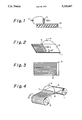
  • FIG. 1 is a sectional view illustrating an embodiment of the method of forming an electrode pattern according to the present invention.
  • FIG. 2 is a perspective view illustrating an embodiment of the method of forming an electrode pattern according to the present invention which was carried out in Example 1.
  • FIG. 3 is a plane view of the electrode film which was patterned in Example 1.
  • FIG. 4 is a perspective view illustrating another embodiment of the method of forming an electrode pattern according to the present invention which was carried out in Example 2.
  • the preferred examples of the conductive film which is formed into a patterned electrode by the present invention are those having transparency, such as indium oxide (NESA) film and indium tin oxide (ITO) film.
  • Various kinds of metal films, such as aluminum film or magnesium film, and organic conductive films may also be used.
  • the conductive film preferably has a surface resistivity of 1 to 2,000 ⁇ / ⁇ .
  • the thickness of the conductive film is preferably 10 nm to 1 ⁇ m. When the thickness of the conductive film is less than 10 nm, the substrate under the conductive film may be scarred by the tip of the metal electrode for etching. When the conductive film is thicker than 1 ⁇ m, reduction of the moving speed of the contacting area between the metal electrode for etching and the conductive film may become necessary for the removal of the conductive film, thereby causing a decrease in the productivity.
  • the substrate covered by the conductive film may be any kind of substrate generally used in this art, such as a glass substrate or a plastic substrate.
  • the method of coating the substrate with the conductive film may be any known method, for example, deposition technique, spattering technique, or coating technique.
  • substrates covered with conductive films such as glass substrates covered with ITO films, glass substrates covered with NESA films, and plastic substrates covered with ITO films, may be suitably used in the method of forming an electrode pattern according to the present invention.
  • FIG. 1 is a sectional view illustrating an embodiment of the method of forming an electrode pattern according to the present invention.
  • a metal electrode for etching 3 is made to contact a conductive film 2 covering a surface of a substrate 1, and an voltage is applied between the metal electrode for etching 3 and the conductive film 2 to remove the conductive film 2 at and in the vicinity of the area where the metal electrode for etching 3 contacts the conductive film 2. While the voltage is applied, the contacting area between the metal electrode for etching 3 and the conductive film 2 is moved to form an electrode pattern in the conductive film 2.
  • the metal electrode for etching is used to make an electric contact between the metal electrode for etching and the conductive film.
  • the contacting area between the metal electrode for etching and the conductive film is generally small in area, the current density is high at the contacting area, so that Joule heat is generated.
  • the conductive film is etched and removed by the repetition of the generation of Joule heat and electric discharge.
  • the material of the metal electrode for etching is not particularly limited so far as it does not crack or change shape during the removal of the conductive film. Generally, almost all metals, such as iron, aluminum, gold, silver and copper, and various kinds of alloys may be used without any problems.
  • the shape and size of the metal electrode for etching are not particularly limited, but when a fine pattern is formed, it is preferable to use a metal electrode for etching which has a needle-like tip and contacts the conductive film in an area of 1 mm 2 or less.
  • a plurality of metal electrodes for etching may be used simultaneously, and one metal electrode for etching having a plurality of tips for contacting the conductive film at a plurality of areas also may be used.
  • the latter type of a metal electrode for etching makes it easy to form a plurality of line patterns simultaneously.
  • FIG. 2 and FIG. 3 an example of the latter type of metal electrode for etching is shown.
  • the metal electrode for etching has a comb-like shape where a plurality of needle-like metal teeth extend in parallel from a metal axis for connecting all the metal teeth.
  • the means of making the metal electrode for etching contact the conductive film is not particularly limited so far as the means ensures an electric contact therebetween.
  • the contacting pressure also is not particularly limited, and generally, a pressure made by the weight of the metal electrode for etching is sufficient for the electric contact.
  • the preferred contacting pressure is 100 g/mm 2 or less since an extremely high contacting pressure might injure the substrate under the conductive film.
  • a flexible substrate such as a plastic substrate, it is preferable to give proper tension to the substrate to make stable contact between the metal electrode for etching and the conductive film.
  • the metal electrode for etching may be inclined to the direction in which the contacting area with the conductive film moves.
  • the preferred range of the voltage applied between the metal electrode for etching and the conductive film is 5 to 60 V.
  • a voltage lower than 5 V may result in insufficient etching which causes undesired continuity in the obtained patterned electrodes.
  • a voltage higher than 60 V may extend the width of the etched area unnecessarily.
  • the particularly preferred range of the voltage is 10 to 40 V.
  • the preferred wave form of the applied voltage is a direct current, an alternating or a combination thereof.
  • a direct current voltage is sufficient for general purposes.
  • the voltage is an alternating current voltage, even complicated patterns, such as patterns including dotted lines, can be made easily by the mere movement of the contacting area between the metal electrode for etching and the conductive film.
  • the conductive film at or in the vicinity of the contacting area between the metal electrode for etching and the conductive film is etched and removed.
  • the removed conductive film evaporates or scatters in the air in a form of fine particles. Therefore, it is preferable to wash the substrate bearing the patterned electrode after the completion of etching. Since the purpose of washing is the mere removal of the scattered fine particles, simple washing, for example washing with air-blowing or water, is sufficient.
  • the size of the area where the conductive film is removed depends upon the etching conditions including the surface resistivity and thickness of the conductive film, applied voltage and the moving speed of the area where the metal electrode for etching contacts the conductive film, it generally extends several ⁇ m to 10 ⁇ m around the contacting area. In general, the more the applied voltage is reduced, the more the area where the conductive film is removed is decreased.
  • the contacting area between the metal electrode for etching and the conductive film is moved to follow a predetermined pattern, so that the area of the conductive film unnecessary for the desired electrode pattern is removed.
  • a proper moving stage is suitable for moving the contacting area between the metal electrode for etching and the conductive film.
  • X-Y stages enable the formation of complicated electrode patterns.
  • the preferred moving speed of the contacting area is 5 to 1,000 mm/sec. A moving speed of less than 5 mm/sec may drop the productivity, and a moving speed of more than 1,000 mm/sec may cause insufficient etching.
  • the particularly preferred moving speed is 10 to 300 mm/sec.
  • the method includes few steps and the yield is high. Further, simple equipments are enough for the method, with costs of production lowered. In addition, the method enables easy formation of an electrode pattern in an electrode of a large area or easy formation of a fine electrode pattern.
  • the electrode which is patterned as described above is suitably used as a driving electrode in various instruments, for example, liquid crystal optical devices, touch panels and EL elements, together with other components, such as liquid crystal materials and opposite electrodes.
  • a striped electrode pattern was formed by using a substrate 1 (glass plate: 300 mm in width, 400 mm in length, 0.8 mm in thickness) covered with an ITO film 5 having a surface resistivity of 20 ⁇ / ⁇ and a thickness of 100 nm and etching the ITO film by the method according to the present invention.
  • the etching of the ITO film was carried out in the manner as shown in FIG. 2.
  • the metal electrode for etching 3 used in this Example was made of iron and had a comb-like shape where 250 needle-like teeth extended in parallel at intervals of 1/20 inches (about 1.27 mm) from an axis for connecting all the teeth, each tooth being 0.5 mm in diameter and 10 mm in length and having a spherical tip of 100 ⁇ m in diameter.
  • the spherical tips were made to contact the exposed surface of the ITO film 5 at the left edge of the substrate 1, and a voltage supplied from a power source 4 was applied between the comb-like metal electrode for etching 3 and the ITO film 5 to remove the ITO film 5 at and in the vicinity of the areas where the comb-like metal electrode for etching 3 contacts the ITO film 5.
  • the comb-like metal electrode for etching 3 was moved in the longitudinal direction of the substrate 1 while a load of about 200 g was applied to the comb-like metal electrode for etching 3.
  • the voltage applied between the comb-like metal electrode for etching 3 and the ITO film 5 was a direct current of 30 V, and the moving speed of the comb-like metal electrode for etching 3 was 400 mm/sec.
  • the comb-like metal electrode 3 being in contact with the ITO film 5 was inclined to its moving direction so that the needle-like teeth and the surface of the ITO film 5 made an angle of 45°.
  • the inclined comb-like metal electrode for etching 3 made the movement of the contacting areas smooth.
  • the etching process decribed above was completed in about one minute.
  • the movement of the comb-like metal electrode for etching 3 was stopped 1 cm short of the un-etched edge of the substrate 1 (in FIG. 2, the right edge), and the comb-like metal electrode for etching 3, subsequently, was moved several centimeters in a right angle to the previous moving direction, namely in the width direction of the substrate 1 (in FIG. 2, to the lower right on the substrate 1).
  • Electrode pattern as shown in FIG. 3, comprised etched lines 6 in a form of parallel stripes, which extended from the left edge of the substrate 1 to the longitudinal direction 1 cm short of the right edge of the substrate 1, and an etching line 6 which connected the right ends of the striped etching lines 6 in a right angle and extended to the width direction of the substrate 1.
  • the patterned electrode was tested for continuity, and continuity was not obtained at the clocked area because the ITO film was removed completely at the etched area. After an observation of the patterned electrode by an electromicroscope, it was found that the edge of the etched section was satisfactorily sharp and the gap between each couple of electrode lines next to each other was about 30 ⁇ m.
  • a striped electrode pattern was formed continuously by using a PES substrate 1 (polyethersulfone substrate, produced by Sumitomo Bakelite Co., Ltd., Trademark: FST, 300 mm in width, 50 m in length, 100 ⁇ m in thickness) covered with an ITO film 5 having a surface resistivity of 300 ⁇ / ⁇ and a thickness of 50 nm and etching the ITO film 5 while the substrate 1 was moved at a uniform speed.
  • PES substrate 1 polyethersulfone substrate, produced by Sumitomo Bakelite Co., Ltd., Trademark: FST, 300 mm in width, 50 m in length, 100 ⁇ m in thickness
  • ITO film 5 having a surface resistivity of 300 ⁇ / ⁇ and a thickness of 50 nm
  • the ITO film 5 was etched while the substrate 1 covered with the ITO film 5 was supplied from a supply roll 7 which had been wound with the substrate 1, moved at a uniform speed v and was wound up on a winding roll 8.
  • the same comb-like metal electrode for etching 3 as that used in Example 1 was used.
  • the anode of a power source 4 was connected to the metal electrode for etching 3, the cathode to an opposite electrode 9, which was made in contact with the surface of the ITO film 5, and a voltage was then applied between the metal electrode for etching 3 and the ITO film 5.
  • the opposite electrode 9 was a copper plate of 10 mm in width, which ensured constant application of a uniform voltage.
  • the moving speed of the substrate 1, v, was 500 mm/sec, the tension given to the substrate 1 was 1 kg, and the load applied to the metal electrode for etching 3 was 300 g.
  • the applied voltage was a direct current voltage of 40 V.
  • the etching of the ITO film 5 of 50 m in full length was completed in about 100 seconds, with high speed productivity proved.
  • the obtained patterned electrode was of good quality without any deficiencies.
  • the edge of the etched section was satisfactorily sharp and the gap between each couple of electrode lines next to each other was 70 ⁇ m.
  • a striped electrode pattern was formed by using the same apparatus as that used in Example 2 and a PET substrate (polyethylene terephthalate substrate, produced by PANAC INDUSTRIES, INC., Trademark: METALMEE: 450 mm in width, 10 m in length, 100 ⁇ m in thickness) covered with an deposited aluminum film having a surface resistivity of 0.1 ⁇ / ⁇ and a thickness of 100 nm.
  • a PET substrate polyethylene terephthalate substrate, produced by PANAC INDUSTRIES, INC., Trademark: METALMEE: 450 mm in width, 10 m in length, 100 ⁇ m in thickness
  • METALMEE 450 mm in width, 10 m in length, 100 ⁇ m in thickness
  • the moving speed of the substrate, v, was 300 mm/sec, the tension given to the substrate was 1.5 kg, and the load applied to the metal electrode for etching was 250 g.
  • the applied voltage was a direct current voltage of 15 V.
  • the etching of the deposited aluminum film was completed in about 30 seconds. After an observation of the etched area by an optical microscope, it was found that the gap between each couple of electrode lines next to each other was about 100 ⁇ m.
  • the gap between each couple of electrode lines next to each other was about 150 ⁇ m.
  • the gap was 60 ⁇ m. The lower the applied voltage was, the sharper the etched section was.

Landscapes

  • Physics & Mathematics (AREA)
  • Engineering & Computer Science (AREA)
  • Chemical & Material Sciences (AREA)
  • Mechanical Engineering (AREA)
  • Nonlinear Science (AREA)
  • Materials Engineering (AREA)
  • Thermal Sciences (AREA)
  • Chemical Kinetics & Catalysis (AREA)
  • General Chemical & Material Sciences (AREA)
  • General Physics & Mathematics (AREA)
  • Crystallography & Structural Chemistry (AREA)
  • Mathematical Physics (AREA)
  • Metallurgy (AREA)
  • Organic Chemistry (AREA)
  • Optics & Photonics (AREA)
  • Manufacturing & Machinery (AREA)
  • Microelectronics & Electronic Packaging (AREA)
  • Manufacturing Of Printed Circuit Boards (AREA)
  • Liquid Crystal (AREA)
  • Manufacturing Of Electric Cables (AREA)
  • ing And Chemical Polishing (AREA)
  • Electroluminescent Light Sources (AREA)

Abstract

A method of forming a pattern in a conductive film of the group consisting of indium oxide film, indium tin oxide film, and aluminum film, covering a surface of a substrate of glass or a plastic material. This is accomplished by contacting a metal electrode with the surface of the substrate, and moving the area where the electrode contacts the conductive film at a speed of 5 to 1000 mm/sec while a voltage of 5 to 60 volts is applied between the electrode and the film.

Description

BACKGROUND OF THE INVENTION
(a) Field of the Invention
The present invention relates to a method of forming an electrode pattern in an electrode layer which is used in liquid crystal optical devices, touch panels, EL elements, or the like.
(b) Description of the Related Art
In the conventional method of forming an electrode pattern, there has generally been employed photolithography technique where an electrode pattern is formed by carrying out sequential steps including coating a conductive film covering a substrate with a photoresist, placing a circuit pattern film thereon, printing the pattern onto the photoresist by exposure, etching the conductive film in the areas other than the areas under the developed pattern of the photoresist, and removing the developed pattern of the photoresist. However, this method includes many steps, and development and etching are liable to go amiss when a fine pattern is formed in a conductive film of a large area, thereby decreasing the yield.
As a means of dissolving the problem, in Japanese Patent Application Kokai Koho (Laid-open) No. 63-18330, there is proposed a method where a laser beam is applied to a conductive film in vacuum to remove the conductive film in the areas where the laser beam is applied. This method, however, also involves some problems. For example, scalping up of equipments is inevitable because of the necessity for applying a laser beam in vacuum, and high power sources of laser beam and the optical system for moving the areas applied with the laser beam are very expensive. Furthermore, when plastic substrates are used, destruction is not limited in conductive films on the plastic substrates but extends into the plastics substrates.
SUMMARY OF THE INVENTION
An object of the present invention is to provide a method of forming an electrode pattern, which can largely reduce the number of steps in forming an electrode pattern, thereby increasing the yield, can be performed by using simplified equipments with a decreased cost and enables the production of fine electrode patterns of large areas.
As the results of the inventor's diligent research, they found that the object can be achieved by removing the unnecessary area of a conductive film by means of etching using an electric current, and the finding led them to complete the present invention.
That is, the present invention provides a method of forming an electrode pattern in a conductive film covering a surface of a substrate, comprising:
making a metal electrode for etching contact the conductive film at an area on an exposed surface of the conductive film; and
moving the area where the metal electrode for etching contacts with the conductive film while a voltage is applied between the metal electrode for etching and the conductive film to remove the conductive film at and in the vicinity of the area where the metal electrode for etching contacts the electrode film and form an electrode pattern in the conductive film.
BRIEF DESCRIPTION OF THE DRAWINGS
FIG. 1 is a sectional view illustrating an embodiment of the method of forming an electrode pattern according to the present invention.
FIG. 2 is a perspective view illustrating an embodiment of the method of forming an electrode pattern according to the present invention which was carried out in Example 1.
FIG. 3 is a plane view of the electrode film which was patterned in Example 1.
FIG. 4 is a perspective view illustrating another embodiment of the method of forming an electrode pattern according to the present invention which was carried out in Example 2.
DESCRIPTION OF THE PREFERRED EMBODIMENTS
The preferred examples of the conductive film which is formed into a patterned electrode by the present invention are those having transparency, such as indium oxide (NESA) film and indium tin oxide (ITO) film. Various kinds of metal films, such as aluminum film or magnesium film, and organic conductive films may also be used. From the view point of the easiness in patterning using an electric current, the conductive film preferably has a surface resistivity of 1 to 2,000 Ω/□. The thickness of the conductive film is preferably 10 nm to 1 μm. When the thickness of the conductive film is less than 10 nm, the substrate under the conductive film may be scarred by the tip of the metal electrode for etching. When the conductive film is thicker than 1 μm, reduction of the moving speed of the contacting area between the metal electrode for etching and the conductive film may become necessary for the removal of the conductive film, thereby causing a decrease in the productivity.
In the present invention, the substrate covered by the conductive film may be any kind of substrate generally used in this art, such as a glass substrate or a plastic substrate.
The method of coating the substrate with the conductive film may be any known method, for example, deposition technique, spattering technique, or coating technique.
Commercially available substrates covered with conductive films, such as glass substrates covered with ITO films, glass substrates covered with NESA films, and plastic substrates covered with ITO films, may be suitably used in the method of forming an electrode pattern according to the present invention.
FIG. 1 is a sectional view illustrating an embodiment of the method of forming an electrode pattern according to the present invention.
In the method of forming an electrode pattern according to the present invention, a metal electrode for etching 3 is made to contact a conductive film 2 covering a surface of a substrate 1, and an voltage is applied between the metal electrode for etching 3 and the conductive film 2 to remove the conductive film 2 at and in the vicinity of the area where the metal electrode for etching 3 contacts the conductive film 2. While the voltage is applied, the contacting area between the metal electrode for etching 3 and the conductive film 2 is moved to form an electrode pattern in the conductive film 2.
The metal electrode for etching is used to make an electric contact between the metal electrode for etching and the conductive film.
Since the contacting area between the metal electrode for etching and the conductive film is generally small in area, the current density is high at the contacting area, so that Joule heat is generated. The conductive film is etched and removed by the repetition of the generation of Joule heat and electric discharge.
The material of the metal electrode for etching is not particularly limited so far as it does not crack or change shape during the removal of the conductive film. Generally, almost all metals, such as iron, aluminum, gold, silver and copper, and various kinds of alloys may be used without any problems.
The shape and size of the metal electrode for etching are not particularly limited, but when a fine pattern is formed, it is preferable to use a metal electrode for etching which has a needle-like tip and contacts the conductive film in an area of 1 mm2 or less.
A plurality of metal electrodes for etching may be used simultaneously, and one metal electrode for etching having a plurality of tips for contacting the conductive film at a plurality of areas also may be used. The latter type of a metal electrode for etching makes it easy to form a plurality of line patterns simultaneously. In FIG. 2 and FIG. 3, an example of the latter type of metal electrode for etching is shown. The metal electrode for etching has a comb-like shape where a plurality of needle-like metal teeth extend in parallel from a metal axis for connecting all the metal teeth.
The means of making the metal electrode for etching contact the conductive film is not particularly limited so far as the means ensures an electric contact therebetween. The contacting pressure also is not particularly limited, and generally, a pressure made by the weight of the metal electrode for etching is sufficient for the electric contact. The preferred contacting pressure is 100 g/mm2 or less since an extremely high contacting pressure might injure the substrate under the conductive film. When a flexible substrate, such as a plastic substrate, is used, it is preferable to give proper tension to the substrate to make stable contact between the metal electrode for etching and the conductive film.
In order to make the movement of the contacting area smooth, the metal electrode for etching may be inclined to the direction in which the contacting area with the conductive film moves. Metal electrodes for etching the tips of which are rounded off, for example metal electrodes for etching having round tips, do not need to be inclined.
The preferred range of the voltage applied between the metal electrode for etching and the conductive film is 5 to 60 V. A voltage lower than 5 V may result in insufficient etching which causes undesired continuity in the obtained patterned electrodes. On the contrary, a voltage higher than 60 V may extend the width of the etched area unnecessarily. The particularly preferred range of the voltage is 10 to 40 V.
Generally, the smaller the surface resistivity of the conductive film is, the smaller the voltage required for etching is.
The preferred wave form of the applied voltage is a direct current, an alternating or a combination thereof. A direct current voltage is sufficient for general purposes. When the voltage is an alternating current voltage, even complicated patterns, such as patterns including dotted lines, can be made easily by the mere movement of the contacting area between the metal electrode for etching and the conductive film.
By applying the voltage as described above between the metal electrode for etching and the conductive film, the conductive film at or in the vicinity of the contacting area between the metal electrode for etching and the conductive film is etched and removed. The removed conductive film evaporates or scatters in the air in a form of fine particles. Therefore, it is preferable to wash the substrate bearing the patterned electrode after the completion of etching. Since the purpose of washing is the mere removal of the scattered fine particles, simple washing, for example washing with air-blowing or water, is sufficient.
Although the size of the area where the conductive film is removed depends upon the etching conditions including the surface resistivity and thickness of the conductive film, applied voltage and the moving speed of the area where the metal electrode for etching contacts the conductive film, it generally extends several μm to 10 μm around the contacting area. In general, the more the applied voltage is reduced, the more the area where the conductive film is removed is decreased.
The lower the applied voltage is and the faster the moving speed of the contacting area is, the sharper the shape of the etched section caused by the removal of the conductive film by etching is.
The contacting area between the metal electrode for etching and the conductive film is moved to follow a predetermined pattern, so that the area of the conductive film unnecessary for the desired electrode pattern is removed.
The use of a proper moving stage is suitable for moving the contacting area between the metal electrode for etching and the conductive film. For example, X-Y stages enable the formation of complicated electrode patterns.
The preferred moving speed of the contacting area is 5 to 1,000 mm/sec. A moving speed of less than 5 mm/sec may drop the productivity, and a moving speed of more than 1,000 mm/sec may cause insufficient etching. The particularly preferred moving speed is 10 to 300 mm/sec.
Since, in the method of the present invention, as described above, etching with electric current is employed for the removal of unnecessary area of a conductive film to form an electrode pattern, the method includes few steps and the yield is high. Further, simple equipments are enough for the method, with costs of production lowered. In addition, the method enables easy formation of an electrode pattern in an electrode of a large area or easy formation of a fine electrode pattern.
The electrode which is patterned as described above is suitably used as a driving electrode in various instruments, for example, liquid crystal optical devices, touch panels and EL elements, together with other components, such as liquid crystal materials and opposite electrodes.
The present invention will be described in more detail with reference to the following Examples. These Examples, however, are not to be construed to limit the scope of the invention.
EXAMPLES 1 TO 3 EXAMPLE 1
In the manner as shown in FIG. 2, a striped electrode pattern was formed by using a substrate 1 (glass plate: 300 mm in width, 400 mm in length, 0.8 mm in thickness) covered with an ITO film 5 having a surface resistivity of 20 Ω/□ and a thickness of 100 nm and etching the ITO film by the method according to the present invention.
The etching of the ITO film was carried out in the manner as shown in FIG. 2. The metal electrode for etching 3 used in this Example was made of iron and had a comb-like shape where 250 needle-like teeth extended in parallel at intervals of 1/20 inches (about 1.27 mm) from an axis for connecting all the teeth, each tooth being 0.5 mm in diameter and 10 mm in length and having a spherical tip of 100 μm in diameter.
The spherical tips were made to contact the exposed surface of the ITO film 5 at the left edge of the substrate 1, and a voltage supplied from a power source 4 was applied between the comb-like metal electrode for etching 3 and the ITO film 5 to remove the ITO film 5 at and in the vicinity of the areas where the comb-like metal electrode for etching 3 contacts the ITO film 5. During application of the voltage, the comb-like metal electrode for etching 3 was moved in the longitudinal direction of the substrate 1 while a load of about 200 g was applied to the comb-like metal electrode for etching 3. The voltage applied between the comb-like metal electrode for etching 3 and the ITO film 5 was a direct current of 30 V, and the moving speed of the comb-like metal electrode for etching 3 was 400 mm/sec. The comb-like metal electrode 3 being in contact with the ITO film 5 was inclined to its moving direction so that the needle-like teeth and the surface of the ITO film 5 made an angle of 45°. The inclined comb-like metal electrode for etching 3 made the movement of the contacting areas smooth.
The etching process decribed above was completed in about one minute.
The movement of the comb-like metal electrode for etching 3 was stopped 1 cm short of the un-etched edge of the substrate 1 (in FIG. 2, the right edge), and the comb-like metal electrode for etching 3, subsequently, was moved several centimeters in a right angle to the previous moving direction, namely in the width direction of the substrate 1 (in FIG. 2, to the lower right on the substrate 1).
Thus formed electrode pattern, as shown in FIG. 3, comprised etched lines 6 in a form of parallel stripes, which extended from the left edge of the substrate 1 to the longitudinal direction 1 cm short of the right edge of the substrate 1, and an etching line 6 which connected the right ends of the striped etching lines 6 in a right angle and extended to the width direction of the substrate 1.
The patterned electrode was tested for continuity, and continuity was not obtained at the clocked area because the ITO film was removed completely at the etched area. After an observation of the patterned electrode by an electromicroscope, it was found that the edge of the etched section was satisfactorily sharp and the gap between each couple of electrode lines next to each other was about 30 μm.
EXAMPLE 2
In the manner as shown in FIG. 4, a striped electrode pattern was formed continuously by using a PES substrate 1 (polyethersulfone substrate, produced by Sumitomo Bakelite Co., Ltd., Trademark: FST, 300 mm in width, 50 m in length, 100 μm in thickness) covered with an ITO film 5 having a surface resistivity of 300 Ω/□ and a thickness of 50 nm and etching the ITO film 5 while the substrate 1 was moved at a uniform speed.
As shown in FIG. 4, the ITO film 5 was etched while the substrate 1 covered with the ITO film 5 was supplied from a supply roll 7 which had been wound with the substrate 1, moved at a uniform speed v and was wound up on a winding roll 8. The same comb-like metal electrode for etching 3 as that used in Example 1 was used. The anode of a power source 4 was connected to the metal electrode for etching 3, the cathode to an opposite electrode 9, which was made in contact with the surface of the ITO film 5, and a voltage was then applied between the metal electrode for etching 3 and the ITO film 5. The opposite electrode 9 was a copper plate of 10 mm in width, which ensured constant application of a uniform voltage. The moving speed of the substrate 1, v, was 500 mm/sec, the tension given to the substrate 1 was 1 kg, and the load applied to the metal electrode for etching 3 was 300 g. The applied voltage was a direct current voltage of 40 V.
The etching of the ITO film 5 of 50 m in full length was completed in about 100 seconds, with high speed productivity proved.
The obtained patterned electrode was of good quality without any deficiencies. The edge of the etched section was satisfactorily sharp and the gap between each couple of electrode lines next to each other was 70 μm.
EXAMPLE 3
A striped electrode pattern was formed by using the same apparatus as that used in Example 2 and a PET substrate (polyethylene terephthalate substrate, produced by PANAC INDUSTRIES, INC., Trademark: METALMEE: 450 mm in width, 10 m in length, 100 μm in thickness) covered with an deposited aluminum film having a surface resistivity of 0.1 Ω/□ and a thickness of 100 nm.
The moving speed of the substrate, v, was 300 mm/sec, the tension given to the substrate was 1.5 kg, and the load applied to the metal electrode for etching was 250 g. The applied voltage was a direct current voltage of 15 V.
The etching of the deposited aluminum film was completed in about 30 seconds. After an observation of the etched area by an optical microscope, it was found that the gap between each couple of electrode lines next to each other was about 100 μm.
When the applied voltage was altered to a direct current voltage of 20 V, the gap between each couple of electrode lines next to each other was about 150 μm. When the applied voltage was altered to a direct current voltage of 10 V, the gap was 60 μm. The lower the applied voltage was, the sharper the etched section was.
Claims (10)

What is claimed is:
1. A method of forming an electrode pattern in a conductive film covering a surface of a substrate, comprising:
causing a metal electrode for etching to contact the conductive film covering a surface of the substrate at an area on an exposed surface of the conducting film, the metal electrode for etching having a needle-like tip, the conductive film being selected from the group consisting of an indium oxide film and an indium tin oxide film, the substrate being made of a plastic material, and the conductive film covering the surface of the substrate having a surface resistivity of 1 to 2,000 Ω/□; and
moving the area where the metal electrode for etching contacts the conductive film at a speed of 5 to 1,000 mm/sec while a voltage of 5 to 60 V is applied between the metal electrode for etching and the conductive film to remove the conductive film at and in the vicinity of the area where the metal electrode for etching contacts the conductive film and to form an electrode pattern in the conductive film.
2. The method as claimed in claim 1, wherein the conductive film has a thickness of 10 nm to 1 μm.
3. The method as claimed in claim 1, wherein the conductive film is a conductive film having transparency.
4. The method as claimed in claim 1, wherein the substrate is a flexible substrate.
5. The method as claimed in claim 1, wherein the metal electrode for etching is made of a metal selected from the group consisting of iron, aluminum, gold, silver, copper and an alloy.
6. The method as claimed in claim 1, wherein the metal electrode for etching has a plurality of needle-like tips for contacting the conductive film at a plurality of areas on the exposed surface of the conductive film.
7. The method as claimed in claim 1, further comprising washing the substrate having the electrode pattern after completion of the etching to remove scattered fine particles of the conductive film formed during etching.
8. The method as claimed in claim 1, wherein the conductive film has a thickness of 10 nm to 1 μm, and the metal electrode for etching is made of a metal selected from the group consisting of iron, aluminum, gold, silver, copper and an alloy.
9. The method as claimed in claim 8, wherein the metal electrode for etching has a plurality of needle-like tips for contacting the conductive film at a plurality of areas on the exposed surface of the conductive film.
10. The method as claimed in claim 8, further comprising washing the substrate having the electrode pattern after completion of the etching to remove scattered fine particles of the conductive film formed during etching.
US07/753,053 1990-09-03 1991-08-30 Method of forming electrode pattern Expired - Fee Related US5223687A (en)

Applications Claiming Priority (2)

Application Number Priority Date Filing Date Title
JP2-230648 1990-09-03
JP2230648A JP2874986B2 (en) 1990-09-03 1990-09-03 Electrode pattern formation method

Publications (1)

Publication Number Publication Date
US5223687A true US5223687A (en) 1993-06-29

Family

ID=16911089

Family Applications (1)

Application Number Title Priority Date Filing Date
US07/753,053 Expired - Fee Related US5223687A (en) 1990-09-03 1991-08-30 Method of forming electrode pattern

Country Status (6)

Country Link
US (1) US5223687A (en)
EP (1) EP0476856B1 (en)
JP (1) JP2874986B2 (en)
KR (1) KR940008181B1 (en)
DE (1) DE69102380T2 (en)
TW (1) TW209329B (en)

Cited By (9)

* Cited by examiner, † Cited by third party
Publication number Priority date Publication date Assignee Title
US5504338A (en) * 1993-06-30 1996-04-02 The United States Of America As Represented By The Secretary Of The Navy Apparatus and method using low-voltage and/or low-current scanning probe lithography
US5757125A (en) * 1995-11-09 1998-05-26 Astronics Corporation, Inc. Electroluminescent lamp with lead attachment isolation structure, and rotary abrasion method of manufacture thereof
WO1998047183A1 (en) * 1997-04-11 1998-10-22 Robert Bosch Gmbh Method for structuring transparent conductive layer
US6066830A (en) * 1998-06-04 2000-05-23 Astronics Corporation Laser etching of electroluminescent lamp electrode structures, and electroluminescent lamps produced thereby
US6379509B2 (en) * 1998-01-20 2002-04-30 3M Innovative Properties Company Process for forming electrodes
US20070018158A1 (en) * 2003-10-31 2007-01-25 Takashi Nagashima Apparatus for separating metal coating film and method for separating metal coating film
WO2014197164A1 (en) 2013-06-03 2014-12-11 Carestream Health, Inc. Methods for improving electrical isolation of patterned transparent conductive films
US20190243191A1 (en) * 2018-02-08 2019-08-08 Boe Technology Group Co., Ltd. Liquid crystal phase shifter, phase shifting method, and method of fabricating the liquid crystal phase shifter
CN114816105A (en) * 2006-06-09 2022-07-29 苹果公司 Touch screen LCD monitor

Families Citing this family (4)

* Cited by examiner, † Cited by third party
Publication number Priority date Publication date Assignee Title
DE4229578A1 (en) * 1992-09-04 1994-03-10 Licentia Gmbh Liquid crystal display device for mounting with others in panel - has control electrodes applied to insulating foil attached to inside face of glass plate
JP2826470B2 (en) * 1994-05-13 1998-11-18 日本電気株式会社 Car phone equipment
JP4660354B2 (en) 2005-01-18 2011-03-30 新光電気工業株式会社 Method and apparatus for processing conductive thin film
CN110936001A (en) * 2019-12-16 2020-03-31 浙江正泰太阳能科技有限公司 Solar cell string welding machine and solar cell string welding method

Citations (10)

* Cited by examiner, † Cited by third party
Publication number Priority date Publication date Assignee Title
US2680184A (en) * 1951-02-07 1954-06-01 Duncan B Cox Method for severing or slitting metal foil
US3119919A (en) * 1961-01-30 1964-01-28 Daystrom Inc Apparatus for the removal of portions of deposited metal films
US3305666A (en) * 1963-08-28 1967-02-21 Zaromb Solomon Methods and apparatus for treating conductive surfaces
US3649801A (en) * 1970-04-29 1972-03-14 Gen Electric Film resistor trimmer
SU475094A1 (en) * 1972-12-12 1979-10-15 Ордена Ленина Физико-Технический Институт Им. А.Ф.Иоффе Ан Ссср Method of alloying chalcogenide glass
JPS56163843A (en) * 1980-05-16 1981-12-16 Mitsubishi Electric Corp Electric discharge machining apparatus
US4634826A (en) * 1984-02-20 1987-01-06 Solems S.A. Method for producing electric circuits in a thin layer, the tool to implement the method, and products obtained therefrom
US4931613A (en) * 1987-05-08 1990-06-05 Allegheny Ludlum Corporation Electrical discharge scribing for improving core loss of grain-oriented silicon steel
EP0421429A2 (en) * 1989-10-03 1991-04-10 Sharp Kabushiki Kaisha Electrode pattern forming method
US5090121A (en) * 1990-10-30 1992-02-25 Texas Instruments Incorporated Apparatus and method for fabricating cirucit pattern on conductive surface of circuit board

Patent Citations (10)

* Cited by examiner, † Cited by third party
Publication number Priority date Publication date Assignee Title
US2680184A (en) * 1951-02-07 1954-06-01 Duncan B Cox Method for severing or slitting metal foil
US3119919A (en) * 1961-01-30 1964-01-28 Daystrom Inc Apparatus for the removal of portions of deposited metal films
US3305666A (en) * 1963-08-28 1967-02-21 Zaromb Solomon Methods and apparatus for treating conductive surfaces
US3649801A (en) * 1970-04-29 1972-03-14 Gen Electric Film resistor trimmer
SU475094A1 (en) * 1972-12-12 1979-10-15 Ордена Ленина Физико-Технический Институт Им. А.Ф.Иоффе Ан Ссср Method of alloying chalcogenide glass
JPS56163843A (en) * 1980-05-16 1981-12-16 Mitsubishi Electric Corp Electric discharge machining apparatus
US4634826A (en) * 1984-02-20 1987-01-06 Solems S.A. Method for producing electric circuits in a thin layer, the tool to implement the method, and products obtained therefrom
US4931613A (en) * 1987-05-08 1990-06-05 Allegheny Ludlum Corporation Electrical discharge scribing for improving core loss of grain-oriented silicon steel
EP0421429A2 (en) * 1989-10-03 1991-04-10 Sharp Kabushiki Kaisha Electrode pattern forming method
US5090121A (en) * 1990-10-30 1992-02-25 Texas Instruments Incorporated Apparatus and method for fabricating cirucit pattern on conductive surface of circuit board

Non-Patent Citations (2)

* Cited by examiner, † Cited by third party
Title
Japan Patent Abstract of Japan Patent document 63 18330, Section P., vol. 12, No. 224, Jun. 25, 1988. *
Japan Patent Abstract of Japan Patent document 63-18330, Section P., vol. 12, No. 224, Jun. 25, 1988.

Cited By (12)

* Cited by examiner, † Cited by third party
Publication number Priority date Publication date Assignee Title
US5504338A (en) * 1993-06-30 1996-04-02 The United States Of America As Represented By The Secretary Of The Navy Apparatus and method using low-voltage and/or low-current scanning probe lithography
US5757125A (en) * 1995-11-09 1998-05-26 Astronics Corporation, Inc. Electroluminescent lamp with lead attachment isolation structure, and rotary abrasion method of manufacture thereof
WO1998047183A1 (en) * 1997-04-11 1998-10-22 Robert Bosch Gmbh Method for structuring transparent conductive layer
US6379509B2 (en) * 1998-01-20 2002-04-30 3M Innovative Properties Company Process for forming electrodes
US7303809B2 (en) 1998-01-20 2007-12-04 3M Innovative Properties Company Process for forming electrodes
US6066830A (en) * 1998-06-04 2000-05-23 Astronics Corporation Laser etching of electroluminescent lamp electrode structures, and electroluminescent lamps produced thereby
US20070018158A1 (en) * 2003-10-31 2007-01-25 Takashi Nagashima Apparatus for separating metal coating film and method for separating metal coating film
US7838791B2 (en) * 2003-10-31 2010-11-23 Panasonic Corporation Metal coating removing apparatus and metal coating removing method
CN114816105A (en) * 2006-06-09 2022-07-29 苹果公司 Touch screen LCD monitor
WO2014197164A1 (en) 2013-06-03 2014-12-11 Carestream Health, Inc. Methods for improving electrical isolation of patterned transparent conductive films
US20190243191A1 (en) * 2018-02-08 2019-08-08 Boe Technology Group Co., Ltd. Liquid crystal phase shifter, phase shifting method, and method of fabricating the liquid crystal phase shifter
US10866466B2 (en) * 2018-02-08 2020-12-15 Boe Technology Group Co., Ltd. Liquid crystal phase shifter, phase shifting method, and method of fabricating the liquid crystal phase shifter

Also Published As

Publication number Publication date
EP0476856B1 (en) 1994-06-08
JP2874986B2 (en) 1999-03-24
KR940008181B1 (en) 1994-09-07
TW209329B (en) 1993-07-11
DE69102380D1 (en) 1994-07-14
KR920007510A (en) 1992-04-28
EP0476856A1 (en) 1992-03-25
JPH04113321A (en) 1992-04-14
DE69102380T2 (en) 1995-01-12

Similar Documents

Publication Publication Date Title
US5223687A (en) Method of forming electrode pattern
TW201804302A (en) Nanowire contact pads with enhanced adhesion to metal interconnects
JP2004240142A (en) Liquid crystal display device and method for manufacturing the same
JP4660354B2 (en) Method and apparatus for processing conductive thin film
JPH0279494A (en) Printed circuit board and its manufacture
JP2000031013A (en) Circuit pattern repair method and device, and circuit pattern repair transfer plate
KR20210138197A (en) Methods for manufacturing nano-pattern metal mesh using imprinting
US20090147195A1 (en) Method and apparatus to reduce dielectric discharge in liquid crystal devices driven with high voltages
CN1652284A (en) Method of manufacturing field emitter
JPH10319402A (en) Alignment processing apparatus for liquid crystal display element and alignment processing method using the apparatus
KR102487098B1 (en) Patterning method of electrode having metal nanowire
TW201230436A (en) Organic EL elements for lighting and method for manufacturing same
JPH06148660A (en) Method and apparatus for etching transparent conductive film
JP2001318380A (en) Liquid crystal display device
JPS60189939A (en) Method of forming thin layer electric circuit
JPH06214705A (en) Analog-type transparent touch panel
KR20190062943A (en) Manufacturing method of transflective conductive metal mesh film and transflective conductive metal mesh film thereby
CN107342220B (en) Metal material patterning method
JP3217717B2 (en) Antistatic device and rubbing device used in liquid crystal panel manufacturing process
JPH06260089A (en) Formation of transparent electrode pattern
JP4696945B2 (en) Wiring board correction method and wiring board correction apparatus
KR100573542B1 (en) Liquid crystal display alignment film forming method and apparatus
JPS5927408A (en) Method of forming electrode for display
JPH08297284A (en) Rubbing mask for alignment film
JP2015055883A (en) Method and apparatus for manufacturing touch panel

Legal Events

Date Code Title Description
AS Assignment

Owner name: IDEMITSU KOSAN CO., LTD., JAPAN

Free format text: ASSIGNMENT OF ASSIGNORS INTEREST.;ASSIGNORS:YUASA, KIMIHIRO;HASHIMOTO, KENJI;REEL/FRAME:005831/0644

Effective date: 19910722

FEPP Fee payment procedure

Free format text: PAYOR NUMBER ASSIGNED (ORIGINAL EVENT CODE: ASPN); ENTITY STATUS OF PATENT OWNER: LARGE ENTITY

FEPP Fee payment procedure

Free format text: PAT HOLDER CLAIMS SMALL ENTITY STATUS - SMALL BUSINESS (ORIGINAL EVENT CODE: SM02); ENTITY STATUS OF PATENT OWNER: LARGE ENTITY

FPAY Fee payment

Year of fee payment: 4

REFU Refund

Free format text: REFUND PROCESSED. MAINTENANCE FEE HAS ALREADY BEEN PAID (ORIGINAL EVENT CODE: R160); ENTITY STATUS OF PATENT OWNER: LARGE ENTITY

FEPP Fee payment procedure

Free format text: PAT HLDR NO LONGER CLAIMS SMALL ENT STAT AS SMALL BUSINESS (ORIGINAL EVENT CODE: LSM2); ENTITY STATUS OF PATENT OWNER: LARGE ENTITY

REMI Maintenance fee reminder mailed
LAPS Lapse for failure to pay maintenance fees
FP Lapsed due to failure to pay maintenance fee

Effective date: 20010629

STCH Information on status: patent discontinuation

Free format text: PATENT EXPIRED DUE TO NONPAYMENT OF MAINTENANCE FEES UNDER 37 CFR 1.362