US4978649A - Porous carbonaceous material - Google Patents
Porous carbonaceous material Download PDFInfo
- Publication number
- US4978649A US4978649A US07/340,893 US34089389A US4978649A US 4978649 A US4978649 A US 4978649A US 34089389 A US34089389 A US 34089389A US 4978649 A US4978649 A US 4978649A
- Authority
- US
- United States
- Prior art keywords
- carbonaceous material
- porous carbonaceous
- carbon
- present
- material according
- Prior art date
- Legal status (The legal status is an assumption and is not a legal conclusion. Google has not performed a legal analysis and makes no representation as to the accuracy of the status listed.)
- Expired - Lifetime
Links
- 239000003575 carbonaceous material Substances 0.000 title claims description 55
- 239000011148 porous material Substances 0.000 claims abstract description 59
- OKTJSMMVPCPJKN-UHFFFAOYSA-N Carbon Chemical compound [C] OKTJSMMVPCPJKN-UHFFFAOYSA-N 0.000 claims abstract description 26
- 229910052799 carbon Inorganic materials 0.000 claims abstract description 26
- 238000009826 distribution Methods 0.000 claims abstract description 24
- 239000011159 matrix material Substances 0.000 claims abstract description 18
- 239000000463 material Substances 0.000 claims abstract description 10
- 239000006229 carbon black Substances 0.000 claims description 15
- 238000000034 method Methods 0.000 claims description 13
- 239000000203 mixture Substances 0.000 claims description 12
- 239000008187 granular material Substances 0.000 claims description 9
- 230000008569 process Effects 0.000 claims description 9
- 239000012190 activator Substances 0.000 claims description 3
- 229930195733 hydrocarbon Natural products 0.000 claims description 3
- 150000002430 hydrocarbons Chemical class 0.000 claims description 3
- 238000010438 heat treatment Methods 0.000 claims 1
- 238000003756 stirring Methods 0.000 claims 1
- 239000003054 catalyst Substances 0.000 abstract description 23
- 238000004519 manufacturing process Methods 0.000 abstract description 5
- WPYMKLBDIGXBTP-UHFFFAOYSA-N benzoic acid Chemical compound OC(=O)C1=CC=CC=C1 WPYMKLBDIGXBTP-UHFFFAOYSA-N 0.000 description 13
- KDLHZDBZIXYQEI-UHFFFAOYSA-N Palladium Chemical compound [Pd] KDLHZDBZIXYQEI-UHFFFAOYSA-N 0.000 description 10
- HOWJQLVNDUGZBI-UHFFFAOYSA-N butane;propane Chemical compound CCC.CCCC HOWJQLVNDUGZBI-UHFFFAOYSA-N 0.000 description 8
- 238000006243 chemical reaction Methods 0.000 description 8
- 238000001179 sorption measurement Methods 0.000 description 8
- 241000872198 Serjania polyphylla Species 0.000 description 7
- 239000003463 adsorbent Substances 0.000 description 7
- 230000000694 effects Effects 0.000 description 7
- 238000012916 structural analysis Methods 0.000 description 7
- 239000005711 Benzoic acid Substances 0.000 description 6
- 235000010233 benzoic acid Nutrition 0.000 description 6
- 239000011230 binding agent Substances 0.000 description 6
- 239000002245 particle Substances 0.000 description 6
- NDZJSUCUYPZXPR-UHFFFAOYSA-N 1-nitro-2-(trifluoromethyl)benzene Chemical compound [O-][N+](=O)C1=CC=CC=C1C(F)(F)F NDZJSUCUYPZXPR-UHFFFAOYSA-N 0.000 description 5
- UFHFLCQGNIYNRP-UHFFFAOYSA-N Hydrogen Chemical compound [H][H] UFHFLCQGNIYNRP-UHFFFAOYSA-N 0.000 description 5
- 239000001257 hydrogen Substances 0.000 description 5
- 229910052739 hydrogen Inorganic materials 0.000 description 5
- 238000005984 hydrogenation reaction Methods 0.000 description 5
- 229910052763 palladium Inorganic materials 0.000 description 5
- NINIDFKCEFEMDL-UHFFFAOYSA-N Sulfur Chemical compound [S] NINIDFKCEFEMDL-UHFFFAOYSA-N 0.000 description 3
- 239000000969 carrier Substances 0.000 description 3
- 150000001875 compounds Chemical class 0.000 description 3
- XPFVYQJUAUNWIW-UHFFFAOYSA-N furfuryl alcohol Chemical compound OCC1=CC=CO1 XPFVYQJUAUNWIW-UHFFFAOYSA-N 0.000 description 3
- 238000012546 transfer Methods 0.000 description 3
- VBLXCTYLWZJBKA-UHFFFAOYSA-N 2-(trifluoromethyl)aniline Chemical compound NC1=CC=CC=C1C(F)(F)F VBLXCTYLWZJBKA-UHFFFAOYSA-N 0.000 description 2
- CDAWCLOXVUBKRW-UHFFFAOYSA-N 2-aminophenol Chemical compound NC1=CC=CC=C1O CDAWCLOXVUBKRW-UHFFFAOYSA-N 0.000 description 2
- GOUHYARYYWKXHS-UHFFFAOYSA-N 4-formylbenzoic acid Chemical compound OC(=O)C1=CC=C(C=O)C=C1 GOUHYARYYWKXHS-UHFFFAOYSA-N 0.000 description 2
- XKRFYHLGVUSROY-UHFFFAOYSA-N Argon Chemical compound [Ar] XKRFYHLGVUSROY-UHFFFAOYSA-N 0.000 description 2
- PXHVJJICTQNCMI-UHFFFAOYSA-N Nickel Chemical compound [Ni] PXHVJJICTQNCMI-UHFFFAOYSA-N 0.000 description 2
- 239000005864 Sulphur Substances 0.000 description 2
- KKEYFWRCBNTPAC-UHFFFAOYSA-N Terephthalic acid Chemical compound OC(=O)C1=CC=C(C(O)=O)C=C1 KKEYFWRCBNTPAC-UHFFFAOYSA-N 0.000 description 2
- 239000002253 acid Substances 0.000 description 2
- 239000011324 bead Substances 0.000 description 2
- 239000001273 butane Substances 0.000 description 2
- 238000001311 chemical methods and process Methods 0.000 description 2
- NZNMSOFKMUBTKW-UHFFFAOYSA-N cyclohexanecarboxylic acid Chemical compound OC(=O)C1CCCCC1 NZNMSOFKMUBTKW-UHFFFAOYSA-N 0.000 description 2
- 230000007547 defect Effects 0.000 description 2
- -1 e.g. Chemical class 0.000 description 2
- 239000007789 gas Substances 0.000 description 2
- 239000012535 impurity Substances 0.000 description 2
- 229910052751 metal Inorganic materials 0.000 description 2
- 239000002184 metal Substances 0.000 description 2
- 150000002739 metals Chemical class 0.000 description 2
- BDAGIHXWWSANSR-UHFFFAOYSA-N methanoic acid Natural products OC=O BDAGIHXWWSANSR-UHFFFAOYSA-N 0.000 description 2
- OFBQJSOFQDEBGM-UHFFFAOYSA-N n-pentane Natural products CCCCC OFBQJSOFQDEBGM-UHFFFAOYSA-N 0.000 description 2
- BASFCYQUMIYNBI-UHFFFAOYSA-N platinum Chemical compound [Pt] BASFCYQUMIYNBI-UHFFFAOYSA-N 0.000 description 2
- 239000000843 powder Substances 0.000 description 2
- 238000002360 preparation method Methods 0.000 description 2
- 238000012360 testing method Methods 0.000 description 2
- XLYOFNOQVPJJNP-UHFFFAOYSA-N water Substances O XLYOFNOQVPJJNP-UHFFFAOYSA-N 0.000 description 2
- OSWFIVFLDKOXQC-UHFFFAOYSA-N 4-(3-methoxyphenyl)aniline Chemical compound COC1=CC=CC(C=2C=CC(N)=CC=2)=C1 OSWFIVFLDKOXQC-UHFFFAOYSA-N 0.000 description 1
- VGGSQFUCUMXWEO-UHFFFAOYSA-N Ethene Chemical compound C=C VGGSQFUCUMXWEO-UHFFFAOYSA-N 0.000 description 1
- 239000005977 Ethylene Substances 0.000 description 1
- KRHYYFGTRYWZRS-UHFFFAOYSA-M Fluoride anion Chemical compound [F-] KRHYYFGTRYWZRS-UHFFFAOYSA-M 0.000 description 1
- 239000004280 Sodium formate Substances 0.000 description 1
- 238000010521 absorption reaction Methods 0.000 description 1
- 238000006137 acetoxylation reaction Methods 0.000 description 1
- 230000004913 activation Effects 0.000 description 1
- 238000013019 agitation Methods 0.000 description 1
- 150000001336 alkenes Chemical class 0.000 description 1
- 150000001448 anilines Chemical class 0.000 description 1
- 238000013459 approach Methods 0.000 description 1
- 229910052786 argon Inorganic materials 0.000 description 1
- 230000015572 biosynthetic process Effects 0.000 description 1
- 239000011233 carbonaceous binding agent Substances 0.000 description 1
- 238000003763 carbonization Methods 0.000 description 1
- 230000003197 catalytic effect Effects 0.000 description 1
- 238000006555 catalytic reaction Methods 0.000 description 1
- 239000003610 charcoal Substances 0.000 description 1
- 239000003153 chemical reaction reagent Substances 0.000 description 1
- 239000000460 chlorine Substances 0.000 description 1
- 229910052801 chlorine Inorganic materials 0.000 description 1
- 239000011300 coal pitch Substances 0.000 description 1
- 229910017052 cobalt Inorganic materials 0.000 description 1
- 239000010941 cobalt Substances 0.000 description 1
- GUTLYIVDDKVIGB-UHFFFAOYSA-N cobalt atom Chemical compound [Co] GUTLYIVDDKVIGB-UHFFFAOYSA-N 0.000 description 1
- MLUCVPSAIODCQM-NSCUHMNNSA-N crotonaldehyde Chemical compound C\C=C\C=O MLUCVPSAIODCQM-NSCUHMNNSA-N 0.000 description 1
- MLUCVPSAIODCQM-UHFFFAOYSA-N crotonaldehyde Natural products CC=CC=O MLUCVPSAIODCQM-UHFFFAOYSA-N 0.000 description 1
- VZFUCHSFHOYXIS-UHFFFAOYSA-N cycloheptane carboxylic acid Natural products OC(=O)C1CCCCCC1 VZFUCHSFHOYXIS-UHFFFAOYSA-N 0.000 description 1
- 230000003247 decreasing effect Effects 0.000 description 1
- 238000000151 deposition Methods 0.000 description 1
- 238000001035 drying Methods 0.000 description 1
- 238000001493 electron microscopy Methods 0.000 description 1
- 125000002534 ethynyl group Chemical group [H]C#C* 0.000 description 1
- 235000019253 formic acid Nutrition 0.000 description 1
- 150000002334 glycols Chemical class 0.000 description 1
- 230000006872 improvement Effects 0.000 description 1
- 229910052500 inorganic mineral Inorganic materials 0.000 description 1
- 238000010907 mechanical stirring Methods 0.000 description 1
- QSHDDOUJBYECFT-UHFFFAOYSA-N mercury Chemical compound [Hg] QSHDDOUJBYECFT-UHFFFAOYSA-N 0.000 description 1
- 229910052753 mercury Inorganic materials 0.000 description 1
- 239000011707 mineral Substances 0.000 description 1
- 230000004048 modification Effects 0.000 description 1
- 238000012986 modification Methods 0.000 description 1
- 238000000465 moulding Methods 0.000 description 1
- IJDNQMDRQITEOD-UHFFFAOYSA-N n-butane Chemical compound CCCC IJDNQMDRQITEOD-UHFFFAOYSA-N 0.000 description 1
- 229910052759 nickel Inorganic materials 0.000 description 1
- 230000003647 oxidation Effects 0.000 description 1
- 238000007254 oxidation reaction Methods 0.000 description 1
- HIJDQYZZPATXAO-UHFFFAOYSA-N palladium hydrochloride Chemical compound Cl.[Pd] HIJDQYZZPATXAO-UHFFFAOYSA-N 0.000 description 1
- YJVFFLUZDVXJQI-UHFFFAOYSA-L palladium(ii) acetate Chemical compound [Pd+2].CC([O-])=O.CC([O-])=O YJVFFLUZDVXJQI-UHFFFAOYSA-L 0.000 description 1
- 230000000737 periodic effect Effects 0.000 description 1
- 239000003208 petroleum Substances 0.000 description 1
- 150000002989 phenols Chemical class 0.000 description 1
- 229910052697 platinum Inorganic materials 0.000 description 1
- 239000002574 poison Substances 0.000 description 1
- 231100000614 poison Toxicity 0.000 description 1
- 229920000642 polymer Polymers 0.000 description 1
- 230000008092 positive effect Effects 0.000 description 1
- QQONPFPTGQHPMA-UHFFFAOYSA-N propylene Natural products CC=C QQONPFPTGQHPMA-UHFFFAOYSA-N 0.000 description 1
- 125000004805 propylene group Chemical group [H]C([H])([H])C([H])([*:1])C([H])([H])[*:2] 0.000 description 1
- 238000000197 pyrolysis Methods 0.000 description 1
- 239000002296 pyrolytic carbon Substances 0.000 description 1
- 239000010453 quartz Substances 0.000 description 1
- 230000009467 reduction Effects 0.000 description 1
- 238000004621 scanning probe microscopy Methods 0.000 description 1
- VYPSYNLAJGMNEJ-UHFFFAOYSA-N silicon dioxide Inorganic materials O=[Si]=O VYPSYNLAJGMNEJ-UHFFFAOYSA-N 0.000 description 1
- HLBBKKJFGFRGMU-UHFFFAOYSA-M sodium formate Chemical compound [Na+].[O-]C=O HLBBKKJFGFRGMU-UHFFFAOYSA-M 0.000 description 1
- 235000019254 sodium formate Nutrition 0.000 description 1
- 239000000725 suspension Substances 0.000 description 1
- 150000003568 thioethers Chemical class 0.000 description 1
Images
Classifications
-
- B—PERFORMING OPERATIONS; TRANSPORTING
- B01—PHYSICAL OR CHEMICAL PROCESSES OR APPARATUS IN GENERAL
- B01J—CHEMICAL OR PHYSICAL PROCESSES, e.g. CATALYSIS OR COLLOID CHEMISTRY; THEIR RELEVANT APPARATUS
- B01J20/00—Solid sorbent compositions or filter aid compositions; Sorbents for chromatography; Processes for preparing, regenerating or reactivating thereof
- B01J20/02—Solid sorbent compositions or filter aid compositions; Sorbents for chromatography; Processes for preparing, regenerating or reactivating thereof comprising inorganic material
- B01J20/20—Solid sorbent compositions or filter aid compositions; Sorbents for chromatography; Processes for preparing, regenerating or reactivating thereof comprising inorganic material comprising free carbon; comprising carbon obtained by carbonising processes
-
- B—PERFORMING OPERATIONS; TRANSPORTING
- B01—PHYSICAL OR CHEMICAL PROCESSES OR APPARATUS IN GENERAL
- B01J—CHEMICAL OR PHYSICAL PROCESSES, e.g. CATALYSIS OR COLLOID CHEMISTRY; THEIR RELEVANT APPARATUS
- B01J21/00—Catalysts comprising the elements, oxides, or hydroxides of magnesium, boron, aluminium, carbon, silicon, titanium, zirconium, or hafnium
- B01J21/18—Carbon
Definitions
- the present invention relates to physical chemistry and, more particularly, to porous carbonaceous materials.
- the present invention can be useful in the production of carbon adsorbents and catalysts for various chemical processes.
- porous carbonaceous materials-active carbons employed as carriers and adsorbents.
- Active carbons are produced from charcoal by way of moulding thereof with a binder, followed by carbonization of the binder and a high-temperature vapour-gas activation. For example, large-size carbon particles with a low specific surface area are mixed with disintegrated coal pitch. The mixture is granulated in the form of beads, dried, carbonized and activated by steam.
- Such active carbons have but limited applications as carriers and adsorbents due to low mechanical-strength characteristics, a high content of ash and a broad pore-size distribution with a high proportion of pores with a size of less than 20 ⁇ (U.S., A, No. 3533961).
- porous carbonaceous material comprising a three-dimentional matrix formed by spherically-shaped particles of carbon black bonded by a carbonaceous binder.
- the porous carbonaceous material has a pore volume of at least 0.2 cm 3 /g, a specific surface area of over 100 m 2 /g, a narrow pore size distribution in which at least 45% of their total surface area are accounted for by pores with a size of 20 ⁇ and more, and the distribution maximum is within the range of 40 to 60 ⁇ (U.S., A, No. 4029600).
- This prior art carbonaceous material has a disadvantage residing in a low mechanical strength comparable with that of active carbons.
- the mechanical strength of a carbonaceous material at a binder content of up to 50% by mass exceeds that of granulated carbon black without a binder only by 6-6.5 times.
- impurities can be introduced into the carbonaceous material in the preparation thereof along with the binder.
- a binder based on polymers of furfuryl alcohol can also incorporate sulphur which is a strong catalytic poison.
- pores with a size of 20 to 200 ⁇ account for 40% of the specific surface area.
- the reference teaches that the maximum of pore size distribution is within the range of from 25 to 190 ⁇ . Therefore, the known carbonaceous material has lower mechanical strength characteristics and a smaller volume of pores with a size above 200 ⁇ that play an important role in processes of mass transfer in catalysis and absorption.
- a porous carbonaceous material in the form of a three-dimensional matrix with a pore volume of 0.2-1.7 cm 3 /g, and wherein according to the present invention, the matrix is formed by bent carbon layers with a thickness of 100 to 10,000 ⁇ and a radius of curvature of from 100 to 10,000 ⁇ , a true density of 1.80 to 2.10 g/cm 3 , an X-ray density of 2.112-2.236 g/cm 3 and the pore size distribution has its maximum within the range of from 200 to 2,000 ⁇ .
- the pore size distribution would have an additional maximum within the range of 40-200 ⁇ .
- the porous carbonaceous material according to the present invention has improved mechanical strength characteristics at an increased volume of pores with a size exceeding 200 ⁇ .
- the porous carbonaceous material according to the present invention is heat-resistant and retains a porous structure in an inert atmosphere at a temperature of up to 1,000°-1,500° C., it is not pyrophoric and has a reduced content of mineral impurities and sulphur.
- the material according to the present invention can have pores with an additional maximum of pore size distribution within the range of 40 to 200 ⁇ pore size.
- the material according to the present invention has a biporous structure, e.g. large-size pores are formed by bent layers of carbon, while small ones are located within the bent layers of the carbonaceous materials.
- the porous carbonaceous material according to the present invention is distinguished by a combination of a high-adsorption surface formed by pores with a size of 40-200 ⁇ with the ability of a rapid transportation of reacting molecules along large-size pores with a size of from 200 to 2,000 ⁇ which provides an additional positive effect in comparison with monoporous adsorbents.
- the porous carbonaceous material according to the present invention can be prepared in the form of fine powders, granules, particles of a sophisticated shape (beads, tablets, cylinders and the like) of a different size.
- the porous carbonaceous material can be used as a carrier for the preparation of a wide range of supported catalysts with different active components such as metals of Group VIII of the periodic system, namely: palladium, platinum, nickel, cobalt and the like, as well as other active metals and compounds thereof.
- active components such as metals of Group VIII of the periodic system, namely: palladium, platinum, nickel, cobalt and the like, as well as other active metals and compounds thereof.
- catalysts are prepared on the basis of the porous carbonaceous material according to the present invention which have been studied in the following chemical reactions:
- the catalyst based on the carbonaceous carried according to the present invention can be also used in a number of other chemical processes.
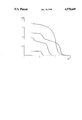
- the drawing illustrates curves of the logarithm of pore size distribution plotted against specific pore volume.
- the porous carbonaceous material according to the present invention comprises a three-dimensional matrix formed by bent layers of carbon of a thickness ranging from 100 to 10,000 ⁇ and a radius of curvature of 100 to 10,000 ⁇ .
- the porous carbonaceous material of the present invention has a true density of 1.80 to 2.10 g/cm 3 and an X-ray density of 2.112 to 2.236 g/cm 3 .
- the matrix formed by bent carbon layers with a radius of curvature of from 100 to 10,000 ⁇ ensures a narrow pore distribution and has its maximum within the range of from 200 to 2,000 ⁇ .
- porous carbonaceous material in the form of a matrix formed by bent carbon layers with a thickness of less than 100 ⁇ and a radius of curvature less than 100 ⁇ would have low exploitation properties, e.g. an insufficient mechanical strength, thus resulting in a shortened service life of adsorbents and catalysts.
- the porous carbonaceous material in the form of a matrix formed by bent carbon layers with a thickness of above 10,000 ⁇ and a curvature radius of over 10,000 ⁇ has low adsorption characteristics and a small pore volume.
- the porous carbonaceous material according to the present invention in the form of a matrix formed by bent carbon layers of 100-10,000 ⁇ thickness and a curvature radius of 100-10,000 ⁇ has a maximum efficiency owing to an optimal combination of adsorption and mechanical-strength characteristics.
- Pores with a size of more than 2,000 ⁇ perform mainly transportation functions, since their surface area is insignificant as compared to the total surface area of the pores of the material according to the present invention.
- a monoporous adsorbent with a pore size of less than 100 ⁇ the efficiency of utilization of the surface and of the deposited active components is decreased due to intradiffusion complications.
- porous carbonaceous material according to the present invention with a true density of 1.80-2.10 cm 3 /g an X-ray density of 2.112-2.236 g/cm 3 ensures both maximum mechanical-strength characteristics and a specific character of the surface contributing to improvement of adsorption characteristics of materials and adsorbents, as well as exploitation characteristics of catalysts (activity, selectivity, stability).
- the porous carbonaceous material with a true density of below 1.80 g/cm 3 and an X-ray density of less than 2.112 g/cm 3 has low mechanical-strength characteristics due to the origination, in its structure, of a great number of defects. Furthermore, the presence of numerous defects (and of amorphous phase of carbon) impairs exploitation properties of the porous carbonaceous material and the activity of the components deposited on its surface.
- the porous carbonaceous material according to the present invention is produced in any kind of reaction apparatus at a temperature within the range of from 750° to 1,200° C. having means for agitation of particles (fluidized bed, mechanical stirring, moving bed and the like).
- Gaseous or vaporous carbon-containing compounds e.g., hydrocarbons
- gaseous or vaporous carbon-containing compounds e.g., hydrocarbons
- a temperature within the range of from 750° to 1,200° C As a result of pyrolysis, pyrolytic carbon is deposited onto the surface of the carbonaceous material.
- a vapour-gas activator such as steam or steam-air mixture is fed into the intermixed layer of the carbonaceous material instead of the carbon-containing compounds and the carbonaceous material is treated therewith till the formation of the porous carbonaceous material according to the present invention, whereafter its structural and mechanical-strength characteristics are determined.
- the radius of curvature and the thickness of carbon layers are determined by the method of electron microscopy.
- the total volume of pores and the distribution of pore sizes are determined by the method of mercury porometry.
- the relative crushing resistance is determined as the ratio of the mechanical strength of the material according to the present invention to the mechanical strength of granules of carbon black (with the particle diameter of 120 ⁇ ) produced under conditions similar to those of the prior art process (U.S., A, No. 4029600).
- the crushing strength of granules of the formed carbon black is equal to 0.25-0.30 MPa which was assumed as 100% in the determination of a relative mechanical strength of carbonaceous materials.
- the catalyst produced on the basis of the porous carbonaceous material according to the present invention were tested in two model reactions of hydrogenation: of benzoic acid into cyclohexanecarboxylic acid and of nitrobenzotrifluoride into aminobenzotrifluoride.
- the catalysts for the reaction of hydrogenation of benzoic acid were prepared according to the following procedure: to a suspension of a carbon carrier in water at the temperature of 20° C. a calculated amount of a solution of palladium hydrochloric acid was added, the solution pH was brought to 8.5 and palladium was reduced by sodium formate for 1 hour at the temperature of 60° C. The catalyst was washed with water to remove chlorine ions and dried. The content of palladium in the catalysts was 2% by mass.
- the catalyst tests for activity were carried out in an autoclave at the temperature of 170° under the pressure of hydrogen of 1.8 MPa.
- the amount of charged benzoic acid was 10 g, that of the catalyst -0.2 g.
- the activity was determined according to the relationship of the amount of adsorbed hydrogen vs. time in conversion of benzoic acid which was equal to 50% and expressed in the following units: g of benzoic acid/g of the catalyst per minute.
- the catalyst for the reaction of hydrogenation of nitrobenzotrifluoride was prepared by depositing palladium acetate onto the porous carbonaceous material according to the present invention, followed by reduction of palladium with formic acid, rinsing and drying of the catalyst, wherein the content of palladium was 4% by mass.
- the activity tests of the catalyst were carried out according to the following procedure. Charged into an autoclave were 0.2 g of the catalyst and 10 g of nitrobenzotrifluoride and hydrogenation was conducted under the constant pressure of hydrogen of 2.0 MPa and at the temperature of 80° C. The catalyst activity was determined by the rate of adsorption of hydrogen per 1 g of the catalyst in conversion of nitrobenzotrifluoride equal to 50% and was expressed in the following units: g-mol of hydrogen/g of the catalyst per minute.
- Charged into the reactor are 100 g of carbon black with the predominant particle size of 200 ⁇ and then the reactor is set into a rotating motion at the angular speed of 2 ⁇ rad/min.
- the reactor with carbon black is heated, by means of an external heater, to the temperature of 900° C.
- a porous carbonaceous material according to the present invention in the form of a three-dimensional matrix with the pore volume of 1.54 cm 3 /g formed by bent layers of carbon of 500-10,000 ⁇ thickness and a radius of curvature of from 1,500 to 7,000 ⁇ , the true density of 1.80 g/cm 3 , the X-ray density of 2.112 g/cm 3 and with the pore size having its maximum at 2,000 ⁇ is produced, analyzed and tested in a manner similar to that of Example 1, but the time of treatment of the carbon black with the propane-butane mixture is 0.5 hour.
- the results of the structural analysis and mechanical strength characteristics of the thus-produced porous carbonaceous material according to the present invention are shown in the Table hereinbelow.
- a porous carbonaceous material according to the present invention in the form of a three-dimensional matrix with the pore volume of 1.6 cm 3 /g formed by bent layers of carbon of 100-3,000 ⁇ thickness and a radius of curvature of 100 to 10,000 ⁇ , with the true density of 2.00 g/cm 3 , the X-ray density of 2.212 g/cm 3 and with the pore size distribution having its maximum at 1,500 ⁇ is produced, analyzed and tested in a manner similar to that described in Example 1 hereinbefore, except that the time of treatment of the carbon black with the propane-butane mixture is 2 hours.
- the results of the structural analysis and mechanical strength characteristics of the thus-produced porous carbonaceous material according to the present invention are shown in the Table hereinbelow.
- the results of the structural analysis and mechanical strength characteristics of the porous carbonaceous material according to the present invention are shown in the Table hereinbelow.
- a porous carbonaceous material according to the present invention in the form of a three-dimensional matrix with the pore volume of 0.93 cm 3 /g formed by bent layers of carbon of 100 to 5,000 ⁇ thickness and a radius of curvature of 200 to 5,000 ⁇ , the true density of 2.00 g/cm 3 the X-ray density of 2.210 g/cm 3 and with the pore size distribution having its maximum at 480 ⁇ and an additional maximum at 50 ⁇ is produced, analyzed and tested in a manner similar to that of Example 1, except that the time of treatment of the carbon black with the propane-butane mixture is 5 hours and with steam--7 hours.
- the results of the structural analysis and mechanical strength characteristics of the thus-produced porous carbonaceous material according to the present invention are shown in the Table hereinbelow.
- the pore size distribution curve is shown in FIG. 3.
- a porous carbonaceous material according to the present invention in the form of a three-dimensional matrix with the pore volume of 1.23 cm 3 /g formed by bent layers of carbon of 200 to 9,000 ⁇ thickness and a radius of curvature of 200 to 5,000 ⁇ , the true density of 1.99 g/cm 3 , X-ray density of 2.221 g/cm 3 and with the pore size distribution having its maximum at 2,000 ⁇ and an additional maximum at 200 ⁇ is produced, analyzed and tested in a manner similar to that described in Example 1 hereinbefore, except that the time of treatment of the carbon black with the propane-butane mixture is 5 hours and with steam--2 hours.
- the results of the structural analysis and mechanical strength characteristics of the thus-obtained porous carbonaceous material according to the present invention are shown in the Table hereinbelow.
- the pore size distribution curve is shown in FIG. 4.
Landscapes
- Chemical & Material Sciences (AREA)
- Organic Chemistry (AREA)
- Chemical Kinetics & Catalysis (AREA)
- Inorganic Chemistry (AREA)
- Analytical Chemistry (AREA)
- Engineering & Computer Science (AREA)
- Materials Engineering (AREA)
- Carbon And Carbon Compounds (AREA)
- Catalysts (AREA)
- Solid-Sorbent Or Filter-Aiding Compositions (AREA)
- Organic Low-Molecular-Weight Compounds And Preparation Thereof (AREA)
Abstract
The present invention relates to physical chemistry.
The material is made as a three-dimensional matrix with a pore volume of from 0.2 to 1.7 cm3 /g. The matrix is formed by bent layers of carbon of 100-10,000 Å thickness and 100-10000 Å radius of curvature. The true density of the material according to the present invention is 1.80-2.10 g/cm3, its X-ray density is 2.112-2.236 g/cm3, the pore size distribution has its maximum within the range of 200-2,000 Å.
The present invention can be useful in, for example, in the production of catalysts.
Description
(1) Field of the Invention
The present invention relates to physical chemistry and, more particularly, to porous carbonaceous materials.
The present invention can be useful in the production of carbon adsorbents and catalysts for various chemical processes.
(2) Description of the Related Art
Known in the art are porous carbonaceous materials-active carbons employed as carriers and adsorbents. Active carbons are produced from charcoal by way of moulding thereof with a binder, followed by carbonization of the binder and a high-temperature vapour-gas activation. For example, large-size carbon particles with a low specific surface area are mixed with disintegrated coal pitch. The mixture is granulated in the form of beads, dried, carbonized and activated by steam. Such active carbons have but limited applications as carriers and adsorbents due to low mechanical-strength characteristics, a high content of ash and a broad pore-size distribution with a high proportion of pores with a size of less than 20 Å (U.S., A, No. 3533961).
Known in the art is a porous carbonaceous material comprising a three-dimentional matrix formed by spherically-shaped particles of carbon black bonded by a carbonaceous binder. The porous carbonaceous material has a pore volume of at least 0.2 cm3 /g, a specific surface area of over 100 m2 /g, a narrow pore size distribution in which at least 45% of their total surface area are accounted for by pores with a size of 20 Å and more, and the distribution maximum is within the range of 40 to 60 Å (U.S., A, No. 4029600).
This prior art carbonaceous material has a disadvantage residing in a low mechanical strength comparable with that of active carbons. The mechanical strength of a carbonaceous material at a binder content of up to 50% by mass exceeds that of granulated carbon black without a binder only by 6-6.5 times. Furthermore, impurities can be introduced into the carbonaceous material in the preparation thereof along with the binder. In particular, a binder based on polymers of furfuryl alcohol can also incorporate sulphur which is a strong catalytic poison. In the known carbonaceous material pores with a size of 20 to 200 Å account for 40% of the specific surface area. However, the reference teaches that the maximum of pore size distribution is within the range of from 25 to 190 Å. Therefore, the known carbonaceous material has lower mechanical strength characteristics and a smaller volume of pores with a size above 200 Å that play an important role in processes of mass transfer in catalysis and absorption.
It is an object of the present invention to improve mechanical strength characteristics of a porous carbonaceous material at an increased proportion, therein, of pores with a size of more than 200 Å.
This object is accomplished by providing in a porous carbonaceous material in the form of a three-dimensional matrix with a pore volume of 0.2-1.7 cm3 /g, and wherein according to the present invention, the matrix is formed by bent carbon layers with a thickness of 100 to 10,000 Å and a radius of curvature of from 100 to 10,000 Å, a true density of 1.80 to 2.10 g/cm3, an X-ray density of 2.112-2.236 g/cm3 and the pore size distribution has its maximum within the range of from 200 to 2,000 Å.
It is advisable that the pore size distribution would have an additional maximum within the range of 40-200 Å.
The porous carbonaceous material according to the present invention has improved mechanical strength characteristics at an increased volume of pores with a size exceeding 200 Å.
Moreover, the porous carbonaceous material according to the present invention is heat-resistant and retains a porous structure in an inert atmosphere at a temperature of up to 1,000°-1,500° C., it is not pyrophoric and has a reduced content of mineral impurities and sulphur.
The material according to the present invention can have pores with an additional maximum of pore size distribution within the range of 40 to 200 Å pore size. In this case the material according to the present invention has a biporous structure, e.g. large-size pores are formed by bent layers of carbon, while small ones are located within the bent layers of the carbonaceous materials.
The porous carbonaceous material according to the present invention is distinguished by a combination of a high-adsorption surface formed by pores with a size of 40-200 Å with the ability of a rapid transportation of reacting molecules along large-size pores with a size of from 200 to 2,000 Å which provides an additional positive effect in comparison with monoporous adsorbents. The porous carbonaceous material according to the present invention can be prepared in the form of fine powders, granules, particles of a sophisticated shape (beads, tablets, cylinders and the like) of a different size.
The porous carbonaceous material can be used as a carrier for the preparation of a wide range of supported catalysts with different active components such as metals of Group VIII of the periodic system, namely: palladium, platinum, nickel, cobalt and the like, as well as other active metals and compounds thereof. At the present time catalysts are prepared on the basis of the porous carbonaceous material according to the present invention which have been studied in the following chemical reactions:
processes of a selective hydrogenation (nitrobenzotrifluoride into aminobenzotrifluoride; -o-nitrophenol into o-aminophenol; crotonaldehyde; benzoic acid into cycloxehanecarboxylic acid);
hydropurification of olefins from acetylene compounds, terephthalic acid from p-carboxybenzaldehyde, petroleum fractions from sulphur compounds;
oxidation of sulphide compounds in the manufacture of pulp, acetoxylation of ethylene and propylene in the production of glycols;
processes for producing anilines from phenols.
The catalyst based on the carbonaceous carried according to the present invention can be also used in a number of other chemical processes.
The drawing illustrates curves of the logarithm of pore size distribution plotted against specific pore volume.
The porous carbonaceous material according to the present invention has the following characteristics:
appearance: powder or rounded granules of 0.1 to 10.0 mm in diameter;
bulk density, g/cm3 : 0.2-1.0
crushing strength, MPa: 2.0-80.0
specific surface area, as for argon adsorption, m2 /g: 20-1,200
ash content, % max.: 1.0.
According to the data obtained by transmitting and scanning microscopy, the porous carbonaceous material according to the present invention comprises a three-dimensional matrix formed by bent layers of carbon of a thickness ranging from 100 to 10,000 Å and a radius of curvature of 100 to 10,000 Å. The porous carbonaceous material of the present invention has a true density of 1.80 to 2.10 g/cm3 and an X-ray density of 2.112 to 2.236 g/cm3.
The matrix formed by bent carbon layers with a radius of curvature of from 100 to 10,000 Å ensures a narrow pore distribution and has its maximum within the range of from 200 to 2,000 Å.
The porous carbonaceous material in the form of a matrix formed by bent carbon layers with a thickness of less than 100 Å and a radius of curvature less than 100 Å would have low exploitation properties, e.g. an insufficient mechanical strength, thus resulting in a shortened service life of adsorbents and catalysts.
The porous carbonaceous material in the form of a matrix formed by bent carbon layers with a thickness of above 10,000 Å and a curvature radius of over 10,000 Å has low adsorption characteristics and a small pore volume.
Therefore, the porous carbonaceous material according to the present invention in the form of a matrix formed by bent carbon layers of 100-10,000 Å thickness and a curvature radius of 100-10,000 Å has a maximum efficiency owing to an optimal combination of adsorption and mechanical-strength characteristics.
In the processes of adsorption and catalysts based, to a great extent, on phenomena of mass transfer of the reagents the most effective are porous materials with a range of the pore size of from 200 to 2,000 Å, since in this range the processes of mass transfer of reacting molecules occur most effectively and the carbonaceous carriers simultaneously exhibit high adsorption characteristics.
Pores with a size of more than 2,000 Å perform mainly transportation functions, since their surface area is insignificant as compared to the total surface area of the pores of the material according to the present invention. In the case of a monoporous adsorbent with a pore size of less than 100 Å the efficiency of utilization of the surface and of the deposited active components is decreased due to intradiffusion complications.
The use of the porous carbonaceous material according to the present invention with a true density of 1.80-2.10 cm3 /g an X-ray density of 2.112-2.236 g/cm3 ensures both maximum mechanical-strength characteristics and a specific character of the surface contributing to improvement of adsorption characteristics of materials and adsorbents, as well as exploitation characteristics of catalysts (activity, selectivity, stability).
The production of a porous carbonaceous material with a true density of more than 2.10 g/cm3 and an X-ray density of more than 2.236 g/cm3 is associated with certain difficulties, since in this case values of density will approach those theoretically possible (2.260 and 2.267 g/cm3 respectively) for a given modification of the carbonaceous material.
The porous carbonaceous material with a true density of below 1.80 g/cm3 and an X-ray density of less than 2.112 g/cm3 has low mechanical-strength characteristics due to the origination, in its structure, of a great number of defects. Furthermore, the presence of numerous defects (and of amorphous phase of carbon) impairs exploitation properties of the porous carbonaceous material and the activity of the components deposited on its surface.
The porous carbonaceous material according to the present invention is produced in any kind of reaction apparatus at a temperature within the range of from 750° to 1,200° C. having means for agitation of particles (fluidized bed, mechanical stirring, moving bed and the like).
Gaseous or vaporous carbon-containing compounds, e.g., hydrocarbons, are supplied into the intermixed layer of the starting carbonaceous material in the particulated or granulated form and heated to a temperature within the range of from 750° to 1,200° C. As a result of pyrolysis, pyrolytic carbon is deposited onto the surface of the carbonaceous material. Then a vapour-gas activator such as steam or steam-air mixture is fed into the intermixed layer of the carbonaceous material instead of the carbon-containing compounds and the carbonaceous material is treated therewith till the formation of the porous carbonaceous material according to the present invention, whereafter its structural and mechanical-strength characteristics are determined.
The radius of curvature and the thickness of carbon layers are determined by the method of electron microscopy.
The total volume of pores and the distribution of pore sizes are determined by the method of mercury porometry.
The relative crushing resistance is determined as the ratio of the mechanical strength of the material according to the present invention to the mechanical strength of granules of carbon black (with the particle diameter of 120 Å) produced under conditions similar to those of the prior art process (U.S., A, No. 4029600). The crushing strength of granules of the formed carbon black is equal to 0.25-0.30 MPa which was assumed as 100% in the determination of a relative mechanical strength of carbonaceous materials.
The catalyst produced on the basis of the porous carbonaceous material according to the present invention were tested in two model reactions of hydrogenation: of benzoic acid into cyclohexanecarboxylic acid and of nitrobenzotrifluoride into aminobenzotrifluoride.
The catalysts for the reaction of hydrogenation of benzoic acid were prepared according to the following procedure: to a suspension of a carbon carrier in water at the temperature of 20° C. a calculated amount of a solution of palladium hydrochloric acid was added, the solution pH was brought to 8.5 and palladium was reduced by sodium formate for 1 hour at the temperature of 60° C. The catalyst was washed with water to remove chlorine ions and dried. The content of palladium in the catalysts was 2% by mass. The catalyst tests for activity were carried out in an autoclave at the temperature of 170° under the pressure of hydrogen of 1.8 MPa. The amount of charged benzoic acid was 10 g, that of the catalyst -0.2 g. The activity was determined according to the relationship of the amount of adsorbed hydrogen vs. time in conversion of benzoic acid which was equal to 50% and expressed in the following units: g of benzoic acid/g of the catalyst per minute.
The catalyst for the reaction of hydrogenation of nitrobenzotrifluoride was prepared by depositing palladium acetate onto the porous carbonaceous material according to the present invention, followed by reduction of palladium with formic acid, rinsing and drying of the catalyst, wherein the content of palladium was 4% by mass.
The activity tests of the catalyst were carried out according to the following procedure. Charged into an autoclave were 0.2 g of the catalyst and 10 g of nitrobenzotrifluoride and hydrogenation was conducted under the constant pressure of hydrogen of 2.0 MPa and at the temperature of 80° C. The catalyst activity was determined by the rate of adsorption of hydrogen per 1 g of the catalyst in conversion of nitrobenzotrifluoride equal to 50% and was expressed in the following units: g-mol of hydrogen/g of the catalyst per minute.
The present invention is further illustrated by the following specific examples given with reference to the accompanying drawing, wherein there are shown integral curves of the pore size distribution; plotted against the axis of abscissae is the logarithm of the pore size and against the axis of ordinates-specific pore volume.
A porous carbonaceous material according to the present invention in the form of a three-dimensional matrix with the pore volume of 1.7 cm3 /g formed by bent carbon layers of 200-5,000 Å thickness with a radius of curvature of 200-5,000 Å, the true density of 2.028 g/cm3, X-ray density of 2.217 g/cm3 and with the pore size distribution having its maximum at 1,000 Å is obtained in a quartz reactor with the inside diameter of 90 mm. Charged into the reactor are 100 g of carbon black with the predominant particle size of 200 Å and then the reactor is set into a rotating motion at the angular speed of 2 π rad/min. The reactor with carbon black is heated, by means of an external heater, to the temperature of 900° C. and into the bed of a continuously agitated carbon black a propane-butane mixture containing 50% by mass of butane is supplied at the flow rate of 176 l/h After treatment of carbon black for one hour steam is fed instead of the propane-butane mixture at the supply rate of 1 kg/kg of carbon per hour. As a result, the porous carbonaceous material according to the present invention is obtained. The results of its structural analysis and mechanical strength characteristics are shown in the Table hereinbelow. The pore size distribution curve is shown in FIG. 1.
A porous carbonaceous material according to the present invention in the form of a three-dimensional matrix with the pore volume of 0.2 cm3 /g formed by bent layers of carbon of 1,000-5,000 Å thickness, a redius of curvature of 100 to 5,000 Å, the true density of the material of 2.10 g/cm3, its X-ray density of 2.236 g/cm3 and with the pore size distribution having maximum at 200 Å is produced, analyzed and tested in a manner similar to that described in Example 1 hereinabove, except that the time of treatment of the carbon black with the propane-butane mixture is 6 hours and with steam -0.5 h.
The results of the structural analysis and mechanical strength characteristics of the thus-obtained porous carbonaceous material according to the present invention are shown in the Table hereinbelow. The pore size distribution curve is shown in FIG. 2.
A porous carbonaceous material according to the present invention in the form of a three-dimensional matrix with the pore volume of 1.54 cm3 /g formed by bent layers of carbon of 500-10,000 Å thickness and a radius of curvature of from 1,500 to 7,000 Å, the true density of 1.80 g/cm3, the X-ray density of 2.112 g/cm3 and with the pore size having its maximum at 2,000 Å is produced, analyzed and tested in a manner similar to that of Example 1, but the time of treatment of the carbon black with the propane-butane mixture is 0.5 hour. The results of the structural analysis and mechanical strength characteristics of the thus-produced porous carbonaceous material according to the present invention are shown in the Table hereinbelow.
A porous carbonaceous material according to the present invention in the form of a three-dimensional matrix with the pore volume of 1.6 cm3 /g formed by bent layers of carbon of 100-3,000 Å thickness and a radius of curvature of 100 to 10,000 Å, with the true density of 2.00 g/cm3, the X-ray density of 2.212 g/cm3 and with the pore size distribution having its maximum at 1,500 Å is produced, analyzed and tested in a manner similar to that described in Example 1 hereinbefore, except that the time of treatment of the carbon black with the propane-butane mixture is 2 hours. The results of the structural analysis and mechanical strength characteristics of the thus-produced porous carbonaceous material according to the present invention are shown in the Table hereinbelow.
A porous carbonaceous material in the form of a three-dimensional matrix with the pore volume of 0.22 cm3 /g formed by bent layers of carbon of 500-5,000 Å thickness and a radius of curvature of 100 to 1,000 Å, the true density of 1.97 g/cm3, X-ray density of 2.193 g/cm3 and the pore size distribution having its maximum at 480 Å and an additional maximum at 40 Å is obtained, analyzed and tested in a manner similar to that of Example 1, except that the time of treatment of the carbon black with the propane-butane mixture is 5 hours. The results of the structural analysis and mechanical strength characteristics of the porous carbonaceous material according to the present invention are shown in the Table hereinbelow.
A porous carbonaceous material according to the present invention in the form of a three-dimensional matrix with the pore volume of 0.93 cm3 /g formed by bent layers of carbon of 100 to 5,000 Å thickness and a radius of curvature of 200 to 5,000 Å, the true density of 2.00 g/cm3 the X-ray density of 2.210 g/cm3 and with the pore size distribution having its maximum at 480 Å and an additional maximum at 50 Å is produced, analyzed and tested in a manner similar to that of Example 1, except that the time of treatment of the carbon black with the propane-butane mixture is 5 hours and with steam--7 hours. The results of the structural analysis and mechanical strength characteristics of the thus-produced porous carbonaceous material according to the present invention are shown in the Table hereinbelow. The pore size distribution curve is shown in FIG. 3.
A porous carbonaceous material according to the present invention in the form of a three-dimensional matrix with the pore volume of 1.23 cm3 /g formed by bent layers of carbon of 200 to 9,000 Å thickness and a radius of curvature of 200 to 5,000 Å, the true density of 1.99 g/cm3, X-ray density of 2.221 g/cm3 and with the pore size distribution having its maximum at 2,000 Å and an additional maximum at 200 Å is produced, analyzed and tested in a manner similar to that described in Example 1 hereinbefore, except that the time of treatment of the carbon black with the propane-butane mixture is 5 hours and with steam--2 hours. The results of the structural analysis and mechanical strength characteristics of the thus-obtained porous carbonaceous material according to the present invention are shown in the Table hereinbelow. The pore size distribution curve is shown in FIG. 4.
                                  TABLE
__________________________________________________________________________
Porous                                             Catalyst activity in
                                                   the
carbo-
     Time of treat-                                reaction of
                                                   hydrogena-
naceous
     ment with               Radius of             tion of
material
     Propane- Relative
                   Pore
                       Layer curvature
                                   Maximum pore    benzoic
                                                        nitrobenzotri-
of Exam-
     butane   crushing
                   volume,
                       thickness,
                             of the
                                   size distri-
                                           Density, g/cm.sup.3
                                                   acid,
                                                        fluoride,
ple No.
     mixture
          Steam
              strength
                   cm.sup.3 /g
                       Å layer, Å
                                   bution, Å
                                           True
                                               X-ray
                                                   g/g ·
                                                        g-mol/g
                                                        · min
1    2    3   4    5   6     7     8       9   10  11   12
__________________________________________________________________________
1    1    1   43   1.70
                       200-5000
                             200-5000
                                   1000    2.02
                                               2.217
                                                   0.24 0.063
2    6      0.5
              160  0.21
                       1000-5000
                             100-5000
                                    200    2.10
                                               2.236
                                                   0.12 0.016
3      0.5
          1   14   1.54
                        500-10000
                             1500-7000
                                   2000    1.80
                                               2.112
                                                   0.14 0.040
4    2    1   38   1.60
                       100-3000
                              100-10000
                                   1500    2.00
                                               2.212
                                                   0.20 0.051
5    5    1   167  0.22
                       500-5000
                             100-1000
                                   40; 480 1.97
                                               2.193
                                                   0.33 0.047
6    5    7   47   0.93
                       100-5000
                             200-5000
                                   50; 480 2.00
                                               2.210
                                                   0.35 0.068
7    5    2   126  1.23
                       200-9000
                             200-5000
                                   200; 2000
                                           1.99
                                               2.221
                                                   0.23 0.066
__________________________________________________________________________
Claims (4)
1. A process for producing a porous carbonaceous material, comprising heating a mass of granules of carbon black, to between 750° and 1,200° C., while continuously stirring the heated granules to prevent their sticking together, passing hydrocarbons through the mass of granules under conditions wherein said hydrocarbons decompose into carbon and deposit the carbon on the surface of the granules, and treating said granules with an activator gas comprising steam for 0.5 to 7 hours to form a pore volume of 0.2 to 1.7 cm3 /g and to increase the proportion of pores of a size of more than 200 Å.
2. A process as claimed in claim 1, wherein said activator gas is steam or a steam-air mixture.
3. A porous carbonaceous material prepared by the process of claim 1 in the form of a three-dimensional matrix with a pore volume of 0.2-1.7 cm3 /g formed by bent layers of carbon of 100-10,000 Å thickness and a radius of curvature of 100-10,000 Å, a true density of said material being equal to 1.80-2.10 g/cm3, X-ray density--2.112-2.236 g/cm3 and the pore size distribution having its maximum within the range of 200-2,000 Å.
4. A porous carbonaceous material according to claim 3, which is biporous and wherein the pore size distribution has an additional maximum within the range of 40-200 Å.
Applications Claiming Priority (2)
| Application Number | Priority Date | Filing Date | Title |
|---|---|---|---|
| SU884443666A SU1706690A1 (en) | 1988-04-19 | 1988-04-19 | Porous carbon material |
| SU4443666[U] | 1988-04-19 |
Publications (1)
| Publication Number | Publication Date |
|---|---|
| US4978649A true US4978649A (en) | 1990-12-18 |
Family
ID=21382602
Family Applications (1)
| Application Number | Title | Priority Date | Filing Date |
|---|---|---|---|
| US07/340,893 Expired - Lifetime US4978649A (en) | 1988-04-19 | 1989-04-19 | Porous carbonaceous material |
Country Status (10)
| Country | Link |
|---|---|
| US (1) | US4978649A (en) |
| JP (1) | JPH0717368B2 (en) |
| AT (1) | AT398912B (en) |
| BE (1) | BE1001878A3 (en) |
| DE (1) | DE3912886A1 (en) |
| FR (1) | FR2630101B1 (en) |
| GB (1) | GB2217701B (en) |
| IT (1) | IT1233767B (en) |
| SE (1) | SE465876B (en) |
| SU (1) | SU1706690A1 (en) |
Cited By (71)
| Publication number | Priority date | Publication date | Assignee | Title |
|---|---|---|---|---|
| US5155081A (en) * | 1990-07-18 | 1992-10-13 | Basf Aktiengesellschaft | Platinum-on-graphite catalysts |
| US5358634A (en) * | 1991-07-11 | 1994-10-25 | Mobil Oil Corporation | Process for treating heavy oil |
| US5426006A (en) * | 1993-04-16 | 1995-06-20 | Sandia Corporation | Structural micro-porous carbon anode for rechargeable lithium-ion batteries |
| WO1997030932A1 (en) * | 1996-02-21 | 1997-08-28 | E.I. Du Pont De Nemours And Company | Phosgene manufacturing process |
| US5726118A (en) * | 1995-08-08 | 1998-03-10 | Norit Americas, Inc. | Activated carbon for separation of fluids by adsorption and method for its preparation |
| US5759508A (en) * | 1996-06-28 | 1998-06-02 | E. I. Du Pont De Nemours And Company | Process for producing oxochlorides of sulfur |
| US5879652A (en) * | 1996-06-28 | 1999-03-09 | E. I. Du Pont De Nemours And Company | Process for producing oxochlorides of sulfur |
| AU709156B2 (en) * | 1995-10-11 | 1999-08-19 | Prysmian Cavi E Sistemi Energia S.R.L. | Process to make miniaturized multipolar flame-propagation- resistant cables having a reduced emission of toxic and noxious gases and cables obtained thereby |
| RU2140879C1 (en) * | 1998-10-23 | 1999-11-10 | Институт катализа им.Г.К.Борескова Сибирского отделения РАН | Method of separation of aromatic compounds from aqueous solutions |
| US6005140A (en) * | 1998-02-12 | 1999-12-21 | Monsanto Company | Process for making glyphosate by oxidizing N-substituted glyphosates |
| US6018083A (en) * | 1998-04-03 | 2000-01-25 | E. I. Du Pont De Nemours And Company | Process for the production of fluorocarbons |
| US6033506A (en) * | 1997-09-02 | 2000-03-07 | Lockheed Martin Engery Research Corporation | Process for making carbon foam |
| US6054612A (en) * | 1996-12-20 | 2000-04-25 | E. I. Du Pont De Nemours And Company | Phosgene manufacturing process |
| US6060032A (en) * | 1998-07-27 | 2000-05-09 | Air Products And Chemicals, Inc. | Layered adsorbent bed for carbon monoxide production |
| US6096932A (en) * | 1999-07-27 | 2000-08-01 | E. I. Du Pont De Nemours And Company | Fluorocarbon manufacturing process |
| US6166273A (en) * | 1998-07-28 | 2000-12-26 | E.I. Du Pont De Nemours And Company | Processes for fluorinating aromatic ring compounds |
| US6225257B1 (en) | 1999-09-14 | 2001-05-01 | Niagara Mohawk Power Corporation | Post-carbonization treatment of microporous carbons for enhancement of methane and natural gas storage properties |
| US6232494B1 (en) | 1998-02-12 | 2001-05-15 | Monsanto Company | Process for the preparation of N-(phosphonomethyl)glycine by oxidizing N-substituted N-(phosphonomethyl)glycine |
| US6262321B1 (en) | 1996-11-21 | 2001-07-17 | E. I. Du Pont De Nemours And Company | Catalytic manufacture of vinyl fluoride |
| US6281395B1 (en) | 1998-04-03 | 2001-08-28 | E. I. Du Pont De Nemours And Company | 1,1,1,2,3,3,3-heptafluoropropane manufacturing process |
| US6369284B1 (en) | 1997-01-31 | 2002-04-09 | E. I. Du Pont De Nemours And Company | Catalytic manufacture of pentafluoropropenes |
| US6399149B1 (en) | 1997-09-02 | 2002-06-04 | Ut-Battelle, Llc | Pitch-based carbon foam heat sink with phase change material |
| US6399823B1 (en) | 2001-04-30 | 2002-06-04 | General Electric Company | Method for producing phosgene |
| US6417133B1 (en) | 1998-02-25 | 2002-07-09 | Monsanto Technology Llc | Deeply reduced oxidation catalyst and its use for catalyzing liquid phase oxidation reactions |
| US20020141932A1 (en) * | 1997-09-02 | 2002-10-03 | Klett James W. | Pitch-based carbon foam and composites and use thereof |
| RU2191070C1 (en) * | 2001-04-19 | 2002-10-20 | Институт катализа им. Г.К.Борескова СО РАН | Catalyst, method of preparation thereof, and method for treatment of hydrogen- rich gas mixtures to remove carbon monoxide |
| US20030015811A1 (en) * | 1997-09-02 | 2003-01-23 | Klett James W. | Pitch-based carbon foam heat sink with phase change material |
| EP1205241A4 (en) * | 1999-07-29 | 2003-08-27 | Boreskova Inst Kataliza Sibir | CATALYTIC COMPOSITION, METHOD FOR MANUFACTURING SAME, AND METHOD FOR PURIFYING TEREPHTHALIC ACID |
| US20030175201A1 (en) * | 2000-01-24 | 2003-09-18 | Klett James W. | Humidifier for fuel cell using high conductivity carbon foam |
| US6624337B1 (en) | 1999-06-04 | 2003-09-23 | E. I. Du Pont De Nemours And Company | Process for the manufacture of fluoroolefins |
| US6838070B1 (en) * | 1999-04-22 | 2005-01-04 | Degussa Ag | Method of producing cyanuric chloride |
| RU2250802C1 (en) * | 2004-02-26 | 2005-04-27 | Институт Катализа Им. Г.К. Борескова Сибирского Отделения Российской Академии Наук | Catalyst, a method of its preparation and a method of isomerization of olefins with use of this catalyst |
| US20050115870A1 (en) * | 2003-11-28 | 2005-06-02 | Hidetsugu Fukuyama | Hydrocracking catalyst and method of hydrocracking heavy oil |
| US7015351B2 (en) | 2000-05-22 | 2006-03-21 | Monsanto Technology Llc | Reaction systems for making N-(phosphonomethyl) glycine compounds |
| US20060106263A1 (en) * | 2004-10-29 | 2006-05-18 | Miller Ralph N | Processes for production and purification of hydrofluoroolefins |
| US20070100175A1 (en) * | 2005-11-01 | 2007-05-03 | Miller Ralph N | Azeotrope compositions comprising 2,3,3,3-tetrafluoropropene and hydrogen fluoride and uses thereof |
| US20070099811A1 (en) * | 2005-11-01 | 2007-05-03 | Miller Ralph N | Azeotrope compositions comprising nonafluoropentene and hydrogen fluoride and uses thereof |
| US20070100174A1 (en) * | 2005-11-01 | 2007-05-03 | Miller Ralph N | Azeotrope compositions comprising 1,1,1,2,3- pentafluoropropene and hydrogen fluoride and uses thereof |
| US20070177656A1 (en) * | 2004-02-27 | 2007-08-02 | Yasushi Maruta | Cdma receiving apparatus and method |
| US20070292337A1 (en) * | 2004-04-01 | 2007-12-20 | Startsev Anatolii N | Method for Hydrogen Sulphide and/or Mercaptans Decomposition |
| WO2008002500A1 (en) | 2006-06-27 | 2008-01-03 | E. I. Du Pont De Nemours And Company | Tetrafluoropropene production processes |
| US20080182745A1 (en) * | 2007-01-30 | 2008-07-31 | More Energy Ltd. | Supported platinum and palladium catalysts and preparation method thereof |
| US20090018375A1 (en) * | 2006-03-31 | 2009-01-15 | Mario Joseph Nappa | Coproduction of hydrofluoroolefins |
| US20090044606A1 (en) * | 2004-02-03 | 2009-02-19 | Ut-Battelle, Llc | Robust Carbon Monolith Having Hierarchical Porosity |
| WO2009049662A1 (en) * | 2007-10-15 | 2009-04-23 | Evonik Degussa Gmbh | Fast filtering powder catalytic mixtures |
| US20090278075A1 (en) * | 2008-05-07 | 2009-11-12 | E. I. Du Pont De Nemours And Company | Compositions comprising 1,1,1,2,3-pentafluoropropane or 2,3,3,3- tetrafluoropropene |
| US20090306438A1 (en) * | 2006-09-05 | 2009-12-10 | E.I. Du Pont De Nemours And Company | 1,2,3,3,3-pentafluoropropene production processes |
| US20090326262A1 (en) * | 2008-05-01 | 2009-12-31 | Monsanto Technology Llc | Metal utilization in supported, metal-containing catalysts |
| US20100010277A1 (en) * | 2006-07-13 | 2010-01-14 | E.I. Dupont De Nemours And Company | Catalytic Isomerization Between E and Z Isomers of 1,2,3,3,3-Pentafluoropropene |
| US20100130774A1 (en) * | 2004-09-15 | 2010-05-27 | Monsanto Technology Llc | Oxidation catalyst and its use for catalyzing liquid phase oxidation reactions |
| US20100174116A1 (en) * | 2007-05-29 | 2010-07-08 | Evonik Degussa Gmbh | Activated Base Metal Catalysts |
| US20100185026A1 (en) * | 2007-05-29 | 2010-07-22 | Evonik Degussa Gmbh | Activated Base Metal Catalysts |
| US20100185029A1 (en) * | 2007-06-27 | 2010-07-22 | Arkema Inc. | Two step process for the manufacture of hydrofluoroolefins |
| US20100204517A1 (en) * | 2007-05-29 | 2010-08-12 | Evonik Degussa Gmbh | Activated Base Metal Catalysts |
| EP2433921A1 (en) | 2006-08-24 | 2012-03-28 | E. I. du Pont de Nemours and Company | Processes for separation of fluoroolefins from hydrogen fluoride by azeotropic distillation |
| RU2447934C1 (en) * | 2010-08-03 | 2012-04-20 | Учреждение Российской академии наук Иркутский институт химии им. А.Е. Фаворского Сибирского отделения РАН | Method of producing modified granulated carbon active sorbent of noble metals |
| WO2012115930A1 (en) | 2011-02-21 | 2012-08-30 | E. I. Du Pont De Nemours And Company | Catalytic dehydrochlorination of hydrochlorofluorocarbons |
| WO2012115934A1 (en) | 2011-02-21 | 2012-08-30 | E. I. Du Pont De Nemours And Company | Selective catalytic dehydrochlorination of hydrochlorofluorocarbons |
| WO2012115957A1 (en) | 2011-02-21 | 2012-08-30 | E. I. Du Pont De Nemours And Company | Catalytic dehydrochlorination of hydrochlorofluorocarbons |
| CN102701903A (en) * | 2012-06-11 | 2012-10-03 | 常熟三爱富中昊化工新材料有限公司 | Method for preparing 3, 3, 3-trifluoropropene |
| RU2464089C1 (en) * | 2011-04-15 | 2012-10-20 | Российская Федерация, От Имени Которой Выступает Министерство Промышленности И Торговли Российской Федерации | Catalyst and method of producing vinyl acetate from acetic acid and acetylene |
| WO2012158848A2 (en) | 2011-05-16 | 2012-11-22 | E. I. Du Pont De Nemours And Company | Catalytic hydrogenation of fluoroolefins, alpha-alumina supported palladium compositions and their use as hydrogenation catalysts |
| EP2527313A1 (en) | 2005-11-01 | 2012-11-28 | E. I. du Pont de Nemours and Company | Azeotrope compositions comprising E-1,3,3,3-tetrafluoropropene and hydrogen fluoride and uses thereof |
| US8658846B2 (en) | 2008-02-21 | 2014-02-25 | E I Du Pont De Nemours And Company | Processes for separation of 2,3,3,3-tetrafluoropropene from hydrogen fluoride by azeotropic distillation |
| US8822739B2 (en) | 2012-03-22 | 2014-09-02 | E I Du Pont De Nemours And Company | Catalytic isomerization of 2,3,3,3-tetrafluoropropene |
| WO2015105686A1 (en) | 2014-01-07 | 2015-07-16 | E. I. Du Pont De Nemours And Company | Perfluoropolyether extraction processes |
| EP3345888A1 (en) | 2006-09-08 | 2018-07-11 | The Chemours Company FC, LLC | Extractive distillation processes to separate e-1,2,3,3,3-pentafluoropropene from z-1,2,3,3,3-pentafluoropropene |
| WO2020247423A1 (en) | 2019-06-04 | 2020-12-10 | The Chemours Company Fc, Llc | 2-chloro-3,3,3-trifluoropropene (1233xf) compositions and methods for making and using the compositions |
| WO2022225830A1 (en) | 2021-04-19 | 2022-10-27 | The Chemours Company Fc, Llc | Compositions containing 3,3,3-trifluoropropene (1243zf) and methods for making and using the compositions |
| US11701639B2 (en) * | 2018-08-06 | 2023-07-18 | King Abdullah University Of Science And Technology | Single metal atom or bimetallic alloy heterogeneous catalysts on a carbonaceous support produced by metal precursor deposition on exoelectrogen bacteria and pyrolyzing |
| WO2024205836A1 (en) | 2023-03-29 | 2024-10-03 | The Chemours Company Fc, Llc | Method for producing 1,1,1-trifluoropropene from the dehydrochlorination of 3-chloro-1,1,1-trifluoropropane |
Families Citing this family (10)
| Publication number | Priority date | Publication date | Assignee | Title |
|---|---|---|---|---|
| RU2057709C1 (en) * | 1993-07-09 | 1996-04-10 | Омский филиал Института катализа СО РАН | Carbon article and method for its production |
| JPH09505521A (en) * | 1993-11-23 | 1997-06-03 | インスティテュト カタリザ イメニ ゲー.カー.ボレスコバ シビルスコゴ オトデレニア ロシイスコイ アカデミイ ナウク | Composite porous material |
| US6653509B2 (en) | 1996-09-06 | 2003-11-25 | MAX-PLANCK-Gesellschaft zur Förderung der Wissenschaften e.V. | Method for the liquid-phase hydrogenation of organic materials |
| DE19636269C2 (en) * | 1996-09-06 | 1999-12-30 | Max Planck Gesellschaft | Catalyst and process for its manufacture |
| MXPA05007014A (en) * | 2002-12-27 | 2005-10-18 | Lg Household & Health Care Ltd | Carbon nanoball for deodorization. |
| RU2281328C2 (en) * | 2004-09-09 | 2006-08-10 | Институт Катализа Им. Г.К. Борескова Сибирского Отделения Российской Академии Наук | Biocatalyst for dextrin saccharification, method for production thereof and method for dextrin saccharification |
| RU2451547C2 (en) * | 2010-08-31 | 2012-05-27 | Российская Федерация, От Имени Которой Выступает Министерство Промышленности И Торговли Российской Федерации | Method of producing porous carbon support |
| JP5700983B2 (en) * | 2010-09-10 | 2015-04-15 | 川研ファインケミカル株式会社 | Method for producing carbon nanotubes using palladium carboxylate |
| US20240266553A1 (en) * | 2021-06-30 | 2024-08-08 | The Carbon Studio Inc. | Porous carbon support, method for manufacturing porous carbon support, and fuel cell catalyst using same |
| CN116654894B (en) * | 2023-05-21 | 2024-01-19 | 中国矿业大学 | Preparation method and application of binary composite porous carbon material |
Citations (4)
| Publication number | Priority date | Publication date | Assignee | Title |
|---|---|---|---|---|
| US2719779A (en) * | 1950-01-11 | 1955-10-04 | Cabot Godfrey L Inc | Process of making hard carbon black pellets |
| US3260664A (en) * | 1963-12-13 | 1966-07-12 | Exxon Research Engineering Co | Fluid bed process for coking hydrocarbons |
| US3533961A (en) * | 1966-02-07 | 1970-10-13 | Huber Corp J M | Method of producing spherical pellets of activated carbon |
| US4029600A (en) * | 1975-03-19 | 1977-06-14 | American Cyanamid Company | Carbon particulates with controlled density |
Family Cites Families (8)
| Publication number | Priority date | Publication date | Assignee | Title |
|---|---|---|---|---|
| JPS5135558B2 (en) * | 1973-06-18 | 1976-10-02 | ||
| US4122040A (en) * | 1974-09-02 | 1978-10-24 | The British Petroleum Company Limited | Platinum group metal catalyst |
| US3978000A (en) * | 1975-03-19 | 1976-08-31 | American Cyanamid Company | Catalysts based on carbon supports |
| US4081370A (en) * | 1976-05-20 | 1978-03-28 | American Cyanamid Company | Use of carbon particulates with controlled density as adsorbents |
| JPS565313A (en) * | 1979-06-26 | 1981-01-20 | Kureha Chem Ind Co Ltd | Detoxificating spherical active carbon and preparing the same |
| GB2056423B (en) * | 1979-08-16 | 1983-02-23 | Lancashire Tar Distillers Ltd | Porous carbon |
| GB8321255D0 (en) * | 1983-08-06 | 1983-09-07 | British Petroleum Co Plc | Methanol conversion process |
| US4591578A (en) * | 1985-02-04 | 1986-05-27 | American Cyanamid Company | Catalyst of molybdenum on wide-pore carbon support |
-
1988
- 1988-04-19 SU SU884443666A patent/SU1706690A1/en active
-
1989
- 1989-04-17 AT AT0091189A patent/AT398912B/en not_active IP Right Cessation
- 1989-04-18 BE BE8900419A patent/BE1001878A3/en not_active IP Right Cessation
- 1989-04-18 SE SE8901404A patent/SE465876B/en not_active IP Right Cessation
- 1989-04-19 IT IT8941575A patent/IT1233767B/en active
- 1989-04-19 FR FR898905225A patent/FR2630101B1/en not_active Expired - Lifetime
- 1989-04-19 US US07/340,893 patent/US4978649A/en not_active Expired - Lifetime
- 1989-04-19 DE DE3912886A patent/DE3912886A1/en not_active Ceased
- 1989-04-19 JP JP1099922A patent/JPH0717368B2/en not_active Expired - Lifetime
- 1989-04-19 GB GB8908813A patent/GB2217701B/en not_active Expired - Lifetime
Patent Citations (4)
| Publication number | Priority date | Publication date | Assignee | Title |
|---|---|---|---|---|
| US2719779A (en) * | 1950-01-11 | 1955-10-04 | Cabot Godfrey L Inc | Process of making hard carbon black pellets |
| US3260664A (en) * | 1963-12-13 | 1966-07-12 | Exxon Research Engineering Co | Fluid bed process for coking hydrocarbons |
| US3533961A (en) * | 1966-02-07 | 1970-10-13 | Huber Corp J M | Method of producing spherical pellets of activated carbon |
| US4029600A (en) * | 1975-03-19 | 1977-06-14 | American Cyanamid Company | Carbon particulates with controlled density |
Non-Patent Citations (2)
| Title |
|---|
| Carbon (1978) Pergarmon Press Ltd. vol. 16, No. 2, pp. 149 152 Etude Du Depot De Pyrocarbone Sur Des Noirs De Carbone, by Henri Colin & Georges Guichon. * |
| Carbon (1978) Pergarmon Press Ltd.--vol. 16, No. 2, pp. 149-152--"Etude Du Depot De Pyrocarbone Sur Des Noirs De Carbone," by Henri Colin & Georges Guichon. |
Cited By (149)
| Publication number | Priority date | Publication date | Assignee | Title |
|---|---|---|---|---|
| US5155081A (en) * | 1990-07-18 | 1992-10-13 | Basf Aktiengesellschaft | Platinum-on-graphite catalysts |
| US5358634A (en) * | 1991-07-11 | 1994-10-25 | Mobil Oil Corporation | Process for treating heavy oil |
| US5426006A (en) * | 1993-04-16 | 1995-06-20 | Sandia Corporation | Structural micro-porous carbon anode for rechargeable lithium-ion batteries |
| US5726118A (en) * | 1995-08-08 | 1998-03-10 | Norit Americas, Inc. | Activated carbon for separation of fluids by adsorption and method for its preparation |
| AU709156B2 (en) * | 1995-10-11 | 1999-08-19 | Prysmian Cavi E Sistemi Energia S.R.L. | Process to make miniaturized multipolar flame-propagation- resistant cables having a reduced emission of toxic and noxious gases and cables obtained thereby |
| WO1997030932A1 (en) * | 1996-02-21 | 1997-08-28 | E.I. Du Pont De Nemours And Company | Phosgene manufacturing process |
| US6022993A (en) * | 1996-02-21 | 2000-02-08 | E. I. Du Pont De Nemours And Company | Phosgene manufacturing process |
| US5759508A (en) * | 1996-06-28 | 1998-06-02 | E. I. Du Pont De Nemours And Company | Process for producing oxochlorides of sulfur |
| US5879652A (en) * | 1996-06-28 | 1999-03-09 | E. I. Du Pont De Nemours And Company | Process for producing oxochlorides of sulfur |
| US6262321B1 (en) | 1996-11-21 | 2001-07-17 | E. I. Du Pont De Nemours And Company | Catalytic manufacture of vinyl fluoride |
| US6054612A (en) * | 1996-12-20 | 2000-04-25 | E. I. Du Pont De Nemours And Company | Phosgene manufacturing process |
| US6369284B1 (en) | 1997-01-31 | 2002-04-09 | E. I. Du Pont De Nemours And Company | Catalytic manufacture of pentafluoropropenes |
| US6033506A (en) * | 1997-09-02 | 2000-03-07 | Lockheed Martin Engery Research Corporation | Process for making carbon foam |
| US7166237B2 (en) | 1997-09-02 | 2007-01-23 | Ut-Battelle, Llc | Pitch-based carbon foam heat sink with phase change material |
| US20030017100A1 (en) * | 1997-09-02 | 2003-01-23 | Klett James W. | Pitch-based carbon foam heat sink with phase change material |
| US20030017101A1 (en) * | 1997-09-02 | 2003-01-23 | Klett James W. | Pitch-based carbon foam heat sink with phase change material |
| US7014151B2 (en) | 1997-09-02 | 2006-03-21 | Ut-Battelle, Llc | Pitch-based carbon foam heat sink with phase change material |
| US20030015811A1 (en) * | 1997-09-02 | 2003-01-23 | Klett James W. | Pitch-based carbon foam heat sink with phase change material |
| US6663842B2 (en) | 1997-09-02 | 2003-12-16 | James W. Klett | Pitch-based carbon foam and composites |
| US20020141932A1 (en) * | 1997-09-02 | 2002-10-03 | Klett James W. | Pitch-based carbon foam and composites and use thereof |
| US6261485B1 (en) | 1997-09-02 | 2001-07-17 | Ut-Battelle, Llc | Pitch-based carbon foam and composites |
| US6780505B1 (en) | 1997-09-02 | 2004-08-24 | Ut-Battelle, Llc | Pitch-based carbon foam heat sink with phase change material |
| US7070755B2 (en) | 1997-09-02 | 2006-07-04 | Ut-Battelle, Llc | Pitch-based carbon foam and composites and use thereof |
| US6656443B2 (en) | 1997-09-02 | 2003-12-02 | Ut-Battelle, Llc | Pitch-based carbon foam and composites |
| US6387343B1 (en) | 1997-09-02 | 2002-05-14 | Ut-Battelle, Llc | Pitch-based carbon foam and composites |
| US6399149B1 (en) | 1997-09-02 | 2002-06-04 | Ut-Battelle, Llc | Pitch-based carbon foam heat sink with phase change material |
| US7157019B2 (en) | 1997-09-02 | 2007-01-02 | Ut-Battelle, Llc | Pitch-based carbon foam heat sink with phase change material |
| US6232494B1 (en) | 1998-02-12 | 2001-05-15 | Monsanto Company | Process for the preparation of N-(phosphonomethyl)glycine by oxidizing N-substituted N-(phosphonomethyl)glycine |
| US7297657B2 (en) | 1998-02-12 | 2007-11-20 | Monsanto Technology Llc | Process for the preparation of N-(phosphonomethyl)glycine by oxidizing N-substituted N-(phosphonomethyl)glycine |
| US6005140A (en) * | 1998-02-12 | 1999-12-21 | Monsanto Company | Process for making glyphosate by oxidizing N-substituted glyphosates |
| US20040143134A1 (en) * | 1998-02-12 | 2004-07-22 | Monsanto Technology Llc | Process for the preparation of N-(phosphonomethyl)glycine by oxidizing N-substituted N-(phosphonomethyl)glycine |
| US6417133B1 (en) | 1998-02-25 | 2002-07-09 | Monsanto Technology Llc | Deeply reduced oxidation catalyst and its use for catalyzing liquid phase oxidation reactions |
| US7067693B1 (en) | 1998-02-25 | 2006-06-27 | Monsanto Technology Llc | Deeply reduced oxidation catalyst and its use in preparing N-(phosphonomethyl) glycine compounds |
| US20070100161A1 (en) * | 1998-02-25 | 2007-05-03 | Monsanto Technology Llc | Deeply reduced oxidation catalyst and its use in preparing N-(phosphonomethyl) glycine compounds |
| US6603039B1 (en) | 1998-02-25 | 2003-08-05 | Monsanto Technology Llc | Deeply reduced oxidation catalyst and its use for catalyzing liquid phase oxidation reactions |
| US8143441B2 (en) | 1998-02-25 | 2012-03-27 | Monsanto Technology Llc | Deeply reduced oxidation catalyst and its use in preparing N-(phosphonomethyl) glycine compounds |
| US6281395B1 (en) | 1998-04-03 | 2001-08-28 | E. I. Du Pont De Nemours And Company | 1,1,1,2,3,3,3-heptafluoropropane manufacturing process |
| US6018083A (en) * | 1998-04-03 | 2000-01-25 | E. I. Du Pont De Nemours And Company | Process for the production of fluorocarbons |
| US6060032A (en) * | 1998-07-27 | 2000-05-09 | Air Products And Chemicals, Inc. | Layered adsorbent bed for carbon monoxide production |
| US6252099B1 (en) | 1998-07-28 | 2001-06-26 | E. I. Du Pont De Nemours And Company | Fluorocarbon manufacturing process |
| US6166273A (en) * | 1998-07-28 | 2000-12-26 | E.I. Du Pont De Nemours And Company | Processes for fluorinating aromatic ring compounds |
| RU2140879C1 (en) * | 1998-10-23 | 1999-11-10 | Институт катализа им.Г.К.Борескова Сибирского отделения РАН | Method of separation of aromatic compounds from aqueous solutions |
| US6838070B1 (en) * | 1999-04-22 | 2005-01-04 | Degussa Ag | Method of producing cyanuric chloride |
| US6624337B1 (en) | 1999-06-04 | 2003-09-23 | E. I. Du Pont De Nemours And Company | Process for the manufacture of fluoroolefins |
| US6096932A (en) * | 1999-07-27 | 2000-08-01 | E. I. Du Pont De Nemours And Company | Fluorocarbon manufacturing process |
| EP1205241A4 (en) * | 1999-07-29 | 2003-08-27 | Boreskova Inst Kataliza Sibir | CATALYTIC COMPOSITION, METHOD FOR MANUFACTURING SAME, AND METHOD FOR PURIFYING TEREPHTHALIC ACID |
| US6225257B1 (en) | 1999-09-14 | 2001-05-01 | Niagara Mohawk Power Corporation | Post-carbonization treatment of microporous carbons for enhancement of methane and natural gas storage properties |
| US20030175201A1 (en) * | 2000-01-24 | 2003-09-18 | Klett James W. | Humidifier for fuel cell using high conductivity carbon foam |
| US7147214B2 (en) | 2000-01-24 | 2006-12-12 | Ut-Battelle, Llc | Humidifier for fuel cell using high conductivity carbon foam |
| US6673328B1 (en) | 2000-03-06 | 2004-01-06 | Ut-Battelle, Llc | Pitch-based carbon foam and composites and uses thereof |
| US20090259068A1 (en) * | 2000-05-22 | 2009-10-15 | Monsanto Technology Llc | Reaction systems for making n-(phosphonomethyl) glycine compounds |
| US7015351B2 (en) | 2000-05-22 | 2006-03-21 | Monsanto Technology Llc | Reaction systems for making N-(phosphonomethyl) glycine compounds |
| US20060079712A1 (en) * | 2000-05-22 | 2006-04-13 | Monsanto Technology Llc | Reaction systems for making N-(phosphonomethyl) glycine compounds |
| US7504534B2 (en) | 2000-05-22 | 2009-03-17 | Monsanto Technology Llc | Reaction systems for making N-(phosphonomethyl) glycine compounds |
| RU2191070C1 (en) * | 2001-04-19 | 2002-10-20 | Институт катализа им. Г.К.Борескова СО РАН | Catalyst, method of preparation thereof, and method for treatment of hydrogen- rich gas mixtures to remove carbon monoxide |
| US6500984B1 (en) | 2001-04-30 | 2002-12-31 | General Electric Company | Method for producing phosgene |
| US6399823B1 (en) | 2001-04-30 | 2002-06-04 | General Electric Company | Method for producing phosgene |
| EP1537912A1 (en) * | 2003-11-28 | 2005-06-08 | Toyo Engineering Corporation | Hydrocracking catalyst comprising activated carbon and method of hydrocracking heavy oil |
| US7727381B2 (en) | 2003-11-28 | 2010-06-01 | Toyo Engineering Corporation | Hydrocracking catalyst and method of hydrocracking heavy oil |
| US20050115870A1 (en) * | 2003-11-28 | 2005-06-02 | Hidetsugu Fukuyama | Hydrocracking catalyst and method of hydrocracking heavy oil |
| US20070131587A1 (en) * | 2003-11-28 | 2007-06-14 | Toyo Engineering Corporation | Hydrocracking catalyst and method of hydrocracking heavy oil |
| US8366979B2 (en) | 2004-02-03 | 2013-02-05 | Ut-Battelle, Llc | Robust carbon monolith having hierarchical porosity |
| US20110140296A1 (en) * | 2004-02-03 | 2011-06-16 | Ut-Battelle, Llc | Robust carbon monolith having hierarchical porosity |
| US7892516B2 (en) * | 2004-02-03 | 2011-02-22 | Ut-Battelle, Llc | Robust carbon monolith having hierarchical porosity |
| US8628705B2 (en) | 2004-02-03 | 2014-01-14 | Ut-Battelle, Llc | Robust carbon monolith having hierarchical porosity |
| US20090044606A1 (en) * | 2004-02-03 | 2009-02-19 | Ut-Battelle, Llc | Robust Carbon Monolith Having Hierarchical Porosity |
| RU2250802C1 (en) * | 2004-02-26 | 2005-04-27 | Институт Катализа Им. Г.К. Борескова Сибирского Отделения Российской Академии Наук | Catalyst, a method of its preparation and a method of isomerization of olefins with use of this catalyst |
| US20070177656A1 (en) * | 2004-02-27 | 2007-08-02 | Yasushi Maruta | Cdma receiving apparatus and method |
| US20070292337A1 (en) * | 2004-04-01 | 2007-12-20 | Startsev Anatolii N | Method for Hydrogen Sulphide and/or Mercaptans Decomposition |
| US7611685B2 (en) | 2004-04-01 | 2009-11-03 | Institu Kataliza Imeni G. K. Boreskova Sibirskogo Otdeleniya Rossiiskoi Akademii Nauk | Method for hydrogen sulphide and/or mercaptans decomposition |
| US20100130774A1 (en) * | 2004-09-15 | 2010-05-27 | Monsanto Technology Llc | Oxidation catalyst and its use for catalyzing liquid phase oxidation reactions |
| US8703639B2 (en) | 2004-09-15 | 2014-04-22 | Monsanto Technology Llc | Oxidation catalyst and its use for catalyzing liquid phase oxidation reactions |
| US8399723B2 (en) | 2004-10-29 | 2013-03-19 | E I Du Pont De Nemours And Company | Processes for production and purification of hydrofluoroolefins |
| US7897823B2 (en) | 2004-10-29 | 2011-03-01 | E. I. Du Pont De Nemours And Company | Process for production of azeotrope compositions comprising hydrofluoroolefin and hydrogen fluoride and uses of said azeotrope compositions in separation processes |
| US20060106263A1 (en) * | 2004-10-29 | 2006-05-18 | Miller Ralph N | Processes for production and purification of hydrofluoroolefins |
| US20110118512A1 (en) * | 2004-10-29 | 2011-05-19 | E.I. Du Pont De Nemours And Company | Processes for production and purification of hydrofluoroolefins |
| US20070099811A1 (en) * | 2005-11-01 | 2007-05-03 | Miller Ralph N | Azeotrope compositions comprising nonafluoropentene and hydrogen fluoride and uses thereof |
| EP2508499A1 (en) | 2005-11-01 | 2012-10-10 | E. I. du Pont de Nemours and Company | Process for the manufacture of 2,3,3,3-tetrafluoropropene |
| EP2292575A1 (en) | 2005-11-01 | 2011-03-09 | E. I. du Pont de Nemours and Company | Process for the separation of 1,1,1,2,3,3-hexafluoropropane (HFC-236ea) from an azeotropic or near-azeotropic composition of HFC-236ea with hydrogen fluoride |
| US7709438B2 (en) | 2005-11-01 | 2010-05-04 | E. I. Du Pont De Nemours And Company | Azeotrope compositions comprising nonafluoropentene and hydrogen fluoride and uses thereof |
| US7388117B2 (en) | 2005-11-01 | 2008-06-17 | E.I. Du Pont De Nemours And Company | Azeotrope compositions comprising 1,2,3,3,3-pentafluoropropene and hydrogen fluoride and uses thereof |
| US7476771B2 (en) | 2005-11-01 | 2009-01-13 | E.I. Du Pont De Nemours + Company | Azeotrope compositions comprising 2,3,3,3-tetrafluoropropene and hydrogen fluoride and uses thereof |
| US20070100175A1 (en) * | 2005-11-01 | 2007-05-03 | Miller Ralph N | Azeotrope compositions comprising 2,3,3,3-tetrafluoropropene and hydrogen fluoride and uses thereof |
| EP2476661A1 (en) | 2005-11-01 | 2012-07-18 | E. I. du Pont de Nemours and Company | Process for the manufacture of 2,3,3,3-tetrafluoropropene |
| US20070100174A1 (en) * | 2005-11-01 | 2007-05-03 | Miller Ralph N | Azeotrope compositions comprising 1,1,1,2,3- pentafluoropropene and hydrogen fluoride and uses thereof |
| EP2527313A1 (en) | 2005-11-01 | 2012-11-28 | E. I. du Pont de Nemours and Company | Azeotrope compositions comprising E-1,3,3,3-tetrafluoropropene and hydrogen fluoride and uses thereof |
| US20100203167A1 (en) * | 2005-11-01 | 2010-08-12 | E. I. Du Pont De Nemours And Company | Azeotrope compositions comprising decafluoropentane and hydrogen fluoride and uses thereof |
| US20090018375A1 (en) * | 2006-03-31 | 2009-01-15 | Mario Joseph Nappa | Coproduction of hydrofluoroolefins |
| US7687670B2 (en) | 2006-03-31 | 2010-03-30 | E.I. Du Pont De Nemours And Company | Coproduction of hydrofluoroolefins |
| WO2008002500A1 (en) | 2006-06-27 | 2008-01-03 | E. I. Du Pont De Nemours And Company | Tetrafluoropropene production processes |
| US20100010277A1 (en) * | 2006-07-13 | 2010-01-14 | E.I. Dupont De Nemours And Company | Catalytic Isomerization Between E and Z Isomers of 1,2,3,3,3-Pentafluoropropene |
| US8044252B2 (en) | 2006-07-13 | 2011-10-25 | E.I. Du Pont De Nemours And Company | Catalytic isomerization between E and Z isomers of 1,2,3,3,3-pentafluoropropene |
| EP2433921A1 (en) | 2006-08-24 | 2012-03-28 | E. I. du Pont de Nemours and Company | Processes for separation of fluoroolefins from hydrogen fluoride by azeotropic distillation |
| US8232435B2 (en) | 2006-09-05 | 2012-07-31 | E I Du Pont De Nemours And Company | 1,2,3,3,3-pentafluoropropene production processes |
| US20090306438A1 (en) * | 2006-09-05 | 2009-12-10 | E.I. Du Pont De Nemours And Company | 1,2,3,3,3-pentafluoropropene production processes |
| EP3345888A1 (en) | 2006-09-08 | 2018-07-11 | The Chemours Company FC, LLC | Extractive distillation processes to separate e-1,2,3,3,3-pentafluoropropene from z-1,2,3,3,3-pentafluoropropene |
| US20080182745A1 (en) * | 2007-01-30 | 2008-07-31 | More Energy Ltd. | Supported platinum and palladium catalysts and preparation method thereof |
| US8889910B2 (en) | 2007-05-29 | 2014-11-18 | Evonik Degussa Gmbh | Activated base metal catalysts |
| US20100204517A1 (en) * | 2007-05-29 | 2010-08-12 | Evonik Degussa Gmbh | Activated Base Metal Catalysts |
| US20100174116A1 (en) * | 2007-05-29 | 2010-07-08 | Evonik Degussa Gmbh | Activated Base Metal Catalysts |
| US20100185026A1 (en) * | 2007-05-29 | 2010-07-22 | Evonik Degussa Gmbh | Activated Base Metal Catalysts |
| US9643162B2 (en) | 2007-05-29 | 2017-05-09 | Evonik Degussa Gmbh | Activated base metal catalysts |
| US8889911B2 (en) | 2007-05-29 | 2014-11-18 | Evonik Degussa Gmbh | Activated base metal catalysts |
| US20100185029A1 (en) * | 2007-06-27 | 2010-07-22 | Arkema Inc. | Two step process for the manufacture of hydrofluoroolefins |
| US20100249460A1 (en) * | 2007-10-15 | 2010-09-30 | Evonik Degussa Gmbh | Fast Filtering Powder Catalytic Mixtures |
| WO2009049662A1 (en) * | 2007-10-15 | 2009-04-23 | Evonik Degussa Gmbh | Fast filtering powder catalytic mixtures |
| US9108182B2 (en) | 2007-10-15 | 2015-08-18 | Evonik Degussa Gmbh | Fast filtering powder catalytic mixtures |
| US8658846B2 (en) | 2008-02-21 | 2014-02-25 | E I Du Pont De Nemours And Company | Processes for separation of 2,3,3,3-tetrafluoropropene from hydrogen fluoride by azeotropic distillation |
| US8252953B2 (en) | 2008-05-01 | 2012-08-28 | Monsanto Technology Llc | Metal utilization in supported, metal-containing catalysts |
| US9163041B2 (en) | 2008-05-01 | 2015-10-20 | Monsanto Technology Llc | Metal utilization in supported, metal-containing catalysts |
| US9944667B2 (en) | 2008-05-01 | 2018-04-17 | Monsanto Technology Llc | Metal utilization in supported, metal-containing catalysts |
| US20090326262A1 (en) * | 2008-05-01 | 2009-12-31 | Monsanto Technology Llc | Metal utilization in supported, metal-containing catalysts |
| USRE47862E1 (en) | 2008-05-07 | 2020-02-18 | The Chemours Company Fc, Llc | Compositions comprising 1,1,1,2,3-pentafluoropropane or 2,3,3,3-tetrafluoropropene |
| US8333902B2 (en) | 2008-05-07 | 2012-12-18 | E I Du Pont De Nemours And Company | Compositions comprising 1,1,1,2,3-pentafluoropropane or 2,3,3,3- tetrafluoropropene |
| EP4477691A2 (en) | 2008-05-07 | 2024-12-18 | The Chemours Company FC, LLC | Compositions comprising 2,3,3,3- tetrafluoropropene |
| US8147709B2 (en) | 2008-05-07 | 2012-04-03 | E. I. Du Pont De Nemours And Company | Compositions comprising 3,3,3-trifluoropropyne |
| EP2617794A2 (en) | 2008-05-07 | 2013-07-24 | E. I. du Pont de Nemours and Company | Compositions comprising 2,3,3,3- tetrafluoropropene |
| US8692037B2 (en) | 2008-05-07 | 2014-04-08 | E I Du Pont De Nemours And Company | Compositions comprising 1,1,1,2,3-pentafluoropropane or 2,3,3,3-tetrafluoropropene |
| US20090278075A1 (en) * | 2008-05-07 | 2009-11-12 | E. I. Du Pont De Nemours And Company | Compositions comprising 1,1,1,2,3-pentafluoropropane or 2,3,3,3- tetrafluoropropene |
| RU2447934C1 (en) * | 2010-08-03 | 2012-04-20 | Учреждение Российской академии наук Иркутский институт химии им. А.Е. Фаворского Сибирского отделения РАН | Method of producing modified granulated carbon active sorbent of noble metals |
| EP3470387A1 (en) | 2011-02-21 | 2019-04-17 | The Chemours Company FC, LLC | Composition comprising hydrochlorofluoroolefins |
| EP4206170A1 (en) | 2011-02-21 | 2023-07-05 | The Chemours Company FC, LLC | Composition comprising hydrofluorocarbons |
| US9012702B2 (en) | 2011-02-21 | 2015-04-21 | E. I. Du Pont De Nemours And Company | Catalytic dehydrochlorination of hydrochlorofluorocarbons |
| WO2012115930A1 (en) | 2011-02-21 | 2012-08-30 | E. I. Du Pont De Nemours And Company | Catalytic dehydrochlorination of hydrochlorofluorocarbons |
| US8884082B2 (en) | 2011-02-21 | 2014-11-11 | E. I. Du Pont De Nemours And Company | Selective catalytical dehydrochlorination of hydrochlorofluorocarbons |
| US8884083B2 (en) | 2011-02-21 | 2014-11-11 | E. I. Du Pont De Nemours And Company | Selective catalytical dehydrochlorination of hydrochlorofluorocarbons |
| WO2012115934A1 (en) | 2011-02-21 | 2012-08-30 | E. I. Du Pont De Nemours And Company | Selective catalytic dehydrochlorination of hydrochlorofluorocarbons |
| WO2012115957A1 (en) | 2011-02-21 | 2012-08-30 | E. I. Du Pont De Nemours And Company | Catalytic dehydrochlorination of hydrochlorofluorocarbons |
| EP3260439A1 (en) | 2011-02-21 | 2017-12-27 | The Chemours Company FC, LLC | A carbon-supported catalyst comprising an alkali metal salt of formula my |
| RU2464089C1 (en) * | 2011-04-15 | 2012-10-20 | Российская Федерация, От Имени Которой Выступает Министерство Промышленности И Торговли Российской Федерации | Catalyst and method of producing vinyl acetate from acetic acid and acetylene |
| EP3792238A1 (en) | 2011-05-16 | 2021-03-17 | The Chemours Company FC, LLC | Catalytic hydrogenation of fluoroolefins with supported palladium catalysts |
| US11124469B2 (en) | 2011-05-16 | 2021-09-21 | The Chemours Company Fc, Llc | Catalytic hydrogenation of fluoroolefins, alpha-alumina supported palladium compositions and their use as hydrogenation catalysts |
| EP4368605A1 (en) | 2011-05-16 | 2024-05-15 | The Chemours Company FC, LLC | Catalytic hydrogenation of fluoroolefins with supported palladium catalysts |
| WO2012158848A2 (en) | 2011-05-16 | 2012-11-22 | E. I. Du Pont De Nemours And Company | Catalytic hydrogenation of fluoroolefins, alpha-alumina supported palladium compositions and their use as hydrogenation catalysts |
| US10221113B2 (en) | 2011-05-16 | 2019-03-05 | The Chemours Company Fc, Llc | Catalytic hydrogenation of fluoroolefins, alpha-alumina supported palladium compositions and their use as hydrogenation catalysts |
| US9598336B2 (en) | 2011-05-16 | 2017-03-21 | E I Du Pont De Nemours And Company | Catalytic hydrogenation of fluoroolefins, alpha-alumina supported palladium compositions and their use as hydrogenation catalysts |
| US11702378B2 (en) | 2011-05-16 | 2023-07-18 | The Chemours Company Fc, Llc | Catalytic hydrogenation of fluoroolefins, alpha-alumina supported palladium compositions and their use as hydrogenation catalysts |
| US10633311B2 (en) | 2011-05-16 | 2020-04-28 | The Chemours Company Fc, Llc | Catalytic hydrogenation of fluoroolefins, alhpa-alumina supported palladium compositions and their use as hydrogenation catalysts |
| US8822739B2 (en) | 2012-03-22 | 2014-09-02 | E I Du Pont De Nemours And Company | Catalytic isomerization of 2,3,3,3-tetrafluoropropene |
| CN102701903A (en) * | 2012-06-11 | 2012-10-03 | 常熟三爱富中昊化工新材料有限公司 | Method for preparing 3, 3, 3-trifluoropropene |
| US10093880B2 (en) | 2014-01-07 | 2018-10-09 | The Chemours Company Fc, Llc | Perfluoropolyether extraction processes |
| WO2015105685A1 (en) | 2014-01-07 | 2015-07-16 | E. I. Du Pont De Nemours And Company | Recovery of perfluorinated polyether oils from grease matrices incorporating extraction aids by carbon dioxide extraction |
| US10087393B2 (en) | 2014-01-07 | 2018-10-02 | The Chemours Company Fc, Llc | Recovery of perfluorinated polyether oils from grease matrices incorporating extraction aids by carbon dioxide extraction |
| WO2015105686A1 (en) | 2014-01-07 | 2015-07-16 | E. I. Du Pont De Nemours And Company | Perfluoropolyether extraction processes |
| US11701639B2 (en) * | 2018-08-06 | 2023-07-18 | King Abdullah University Of Science And Technology | Single metal atom or bimetallic alloy heterogeneous catalysts on a carbonaceous support produced by metal precursor deposition on exoelectrogen bacteria and pyrolyzing |
| WO2020247423A1 (en) | 2019-06-04 | 2020-12-10 | The Chemours Company Fc, Llc | 2-chloro-3,3,3-trifluoropropene (1233xf) compositions and methods for making and using the compositions |
| US12319636B2 (en) | 2019-06-04 | 2025-06-03 | The Chemours Company Fc, Llc | 2-chloro-3,3,3-trifluoropropene (1233XF) compositions and methods for making and using the compositions |
| WO2022225830A1 (en) | 2021-04-19 | 2022-10-27 | The Chemours Company Fc, Llc | Compositions containing 3,3,3-trifluoropropene (1243zf) and methods for making and using the compositions |
| WO2024205836A1 (en) | 2023-03-29 | 2024-10-03 | The Chemours Company Fc, Llc | Method for producing 1,1,1-trifluoropropene from the dehydrochlorination of 3-chloro-1,1,1-trifluoropropane |
Also Published As
| Publication number | Publication date |
|---|---|
| IT8941575A0 (en) | 1989-04-19 |
| AT398912B (en) | 1995-02-27 |
| IT1233767B (en) | 1992-04-14 |
| ATA91189A (en) | 1994-07-15 |
| GB2217701B (en) | 1991-10-30 |
| FR2630101A1 (en) | 1989-10-20 |
| FR2630101B1 (en) | 1990-12-28 |
| GB8908813D0 (en) | 1989-06-07 |
| JPH0251411A (en) | 1990-02-21 |
| DE3912886A1 (en) | 1989-11-02 |
| SE465876B (en) | 1991-11-11 |
| SE8901404L (en) | 1989-10-20 |
| SU1706690A1 (en) | 1992-01-23 |
| JPH0717368B2 (en) | 1995-03-01 |
| GB2217701A (en) | 1989-11-01 |
| SE8901404D0 (en) | 1989-04-18 |
| BE1001878A3 (en) | 1990-04-03 |
Similar Documents
| Publication | Publication Date | Title |
|---|---|---|
| JPH0251411A (en) | Porous carbonacrous material | |
| US6057262A (en) | Activated carbon and process for making same | |
| EP0120604A1 (en) | Metal-containing active carbon and methods for making and using same | |
| CN107413362B (en) | Fischer-Tropsch synthesis process with ultrahigh activity | |
| US2686195A (en) | Hydrocarbon synthesis | |
| JPH105586A (en) | Granular activated carbon formed body, carrier and catalyst | |
| CN107442147B (en) | Iron carbide catalyst wrapped by high-iron-content graphite layer and synthesis method and application thereof | |
| JPH0624633B2 (en) | Catalyst particles and method for producing the same | |
| CA1153753A (en) | Methanation catalyst and process for its preparation | |
| JPS60238144A (en) | Arsenic compound removing agent | |
| CN116920852B (en) | Fe-based integral catalyst based on 3D printing, preparation method thereof and application of catalyst in preparing low-carbon olefin through CO2 hydrogenation | |
| US2891094A (en) | New catalyst for reducing nitrobenzene and the process of reducing nitrobenzene thereover | |
| JP3099976B2 (en) | Carbon-based shape-selective catalyst and method for producing the same | |
| CN121927590A (en) | Pd-Ba/C catalyst and preparation method and application thereof | |
| US2951815A (en) | Catalytic conversion with high density catalyst | |
| CA1209804A (en) | Methanol conversion process | |
| RU2064831C1 (en) | Catalyst for hydrocarbons decomposition for hydrogen and carbon material and method of its production | |
| RU2036718C1 (en) | Porous carbonic material | |
| EP0082222A1 (en) | Catalytic process for converting carbon monoxide to a high energy gas | |
| CN1049161C (en) | High-temperature nickel/magnesia catalyst and preparation method thereof | |
| JP3197020B2 (en) | Method for producing molecular sieve carbon | |
| CN118874521B (en) | A kind of iron aluminum spinel nitrogen doped biochar catalyst for plastic pyrolysis hydrogen production and its preparation method and application | |
| CN117582968B (en) | Catalyst for preparing olefin from synthetic gas, preparation method and application thereof | |
| US2643266A (en) | Production of nitrogen containing compounds from ammonia and olefins | |
| CN115212885B (en) | A cobalt-based catalyst derived from cobalt silicate used for directly producing low-carbon alcohols from syngas, its preparation method and pretreatment method |
Legal Events
| Date | Code | Title | Description |
|---|---|---|---|
| STCF | Information on status: patent grant |
Free format text: PATENTED CASE |
|
| FEPP | Fee payment procedure |
Free format text: PAYOR NUMBER ASSIGNED (ORIGINAL EVENT CODE: ASPN); ENTITY STATUS OF PATENT OWNER: LARGE ENTITY |
|
| FPAY | Fee payment |
Year of fee payment: 4 |
|
| SULP | Surcharge for late payment | ||
| REMI | Maintenance fee reminder mailed | ||
| FPAY | Fee payment |
Year of fee payment: 8 |
|
| SULP | Surcharge for late payment | ||
| FPAY | Fee payment |
Year of fee payment: 12 |