US493725A - ifiwin - Google Patents
ifiwin Download PDFInfo
- Publication number
- US493725A US493725A US493725DA US493725A US 493725 A US493725 A US 493725A US 493725D A US493725D A US 493725DA US 493725 A US493725 A US 493725A
- Authority
- US
- United States
- Prior art keywords
- gate
- braces
- rails
- bolts
- rail
- Prior art date
- Legal status (The legal status is an assumption and is not a legal conclusion. Google has not performed a legal analysis and makes no representation as to the accuracy of the status listed.)
- Expired - Lifetime
Links
- 238000010276 construction Methods 0.000 description 4
- 241000283690 Bos taurus Species 0.000 description 2
- 230000000694 effects Effects 0.000 description 2
- 230000008961 swelling Effects 0.000 description 2
- 241001465754 Metazoa Species 0.000 description 1
- 238000006073 displacement reaction Methods 0.000 description 1
- 230000005484 gravity Effects 0.000 description 1
- 238000004519 manufacturing process Methods 0.000 description 1
- 230000003014 reinforcing effect Effects 0.000 description 1
- 238000007665 sagging Methods 0.000 description 1
- 230000002459 sustained effect Effects 0.000 description 1
Images

Classifications
-
- E—FIXED CONSTRUCTIONS
- E06—DOORS, WINDOWS, SHUTTERS, OR ROLLER BLINDS IN GENERAL; LADDERS
- E06B—FIXED OR MOVABLE CLOSURES FOR OPENINGS IN BUILDINGS, VEHICLES, FENCES OR LIKE ENCLOSURES IN GENERAL, e.g. DOORS, WINDOWS, BLINDS, GATES
- E06B11/00—Means for allowing passage through fences, barriers or the like, e.g. stiles
- E06B11/02—Gates; Doors
Definitions
- This invention relates to improvements in flexible farm-gates and consists of the construction, arrangement, and combination of the several parts hereinafter described and claimed.
- the object of the invention is to provide a gate of the character set forth, having a more positive and uniform action and wherein the leverage of the sustaining parts is increased, and when adjusted a bearing between the rails and the sustaining parts is obtained to bind the same against movement accidentally, the parts being simple and effective in their construction and operation, strong and durable, and comparatively inexpensive in manufacture and sale.
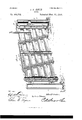
- Figure 1 is a perspective view of the improved gate shown in normal position.
- Fig. 2 is a side elevation of the gate shown raised.
- Fig. 3 is atransverse vertical section on the line 01;. as. Fig. 2.
- Figs. 4 and 5 are detail sectional views of the rails and cross bars and braces showing a slight addition to the same.
- the numeral 1 designates the rails of the gate, 2 the parallel embracing cross-bars arranged on opposite sides of the rails and at the ends and central portions of the same,3 the pairs of diagonally arranged parallel braces arranged on opposite sides of the central cross-bar 2, and 4 and 5 the posts.
- the rails and cross bars are fastened to each other by means of lateral bolts 6, one bolt being used at the center of each crossing. These bolts serve as pivots, so that the free end of the gate may be tilted in a vertical plane.
- the cross-bars at the rear end of the gate are made sufficiently large for attaching the hinges 7, that connect the gate with the post 5, which in this instance consist of a pair of clamping plates 8, with angular ends having eye bolts extending centrally therethrough and movably engaging angular pintles or clips 9, secured to the post 5.
- the braces 3 are arranged in parallel pairs as before stated and engage the opposite sides of the rails, their tops inclining toward the rear end of the gate, and are pivoted by bolts 10, passing therethroughand through the rail 1*, next to the bottom rail of the gate. They are connected above and below the said pivot bolts 10, by clamping or binding bolts 11 and 12, the bolts 11 being all located above the pivot bolts 10, and the bolts 12 below the latter.
- the bolts 11, in the adjustment of the braces bear against the top edges of the rails which are located between the pivot bolts 10, and the topmost rail of the gate, and the lower bolts 12, have bearing against the lower edge of the lowermost rail of the gate, and by this means it will be seen that a clamping effect is bad throughout the length of the braces, and the gate thereby sustained against accidental displacement after adjustment at any angle that may be desired.
- the upper ends of the braces are connected by a clamping bar 13, through the medium of the topmost bolts 11, which pass through the upper ends of said braces above the topmost rail of the gate and through the said clamping bar.
- the said end When it is desired to elevate the forward end of the gate, in order that the same may swing over snow or other obstructions, or to allow small animals to pass thereunder, the said end is elevated until the desired angle is obtained the braces are turned on their axes, and the top portion of the same is moved rearward until the clamping bar 13, is brought down against the upper edge of the top rail 1, and the bolts 11 and 12 engaged with the several rails below the top rail in the manner heretofore set forth.
- the rails in cold weather frequently become coated with ice, and thereby obstruct or retard the movement of the braces on their axes.
- the gate may be elevated, leaving the braces free to follow the spaces on the rails that, having been protected .by the braces, are free from ice, and by tightening the bolts 11, the elevation of the gate may be maintained.
- the free or forward end of the gate herein set forth may be let down upon the ground to hold the gate open, or may be let down when the gate is closed to relieve the strain on the hinges and on post 5.
- gravity latch and catch In connection with the gate hereinbefore set forth, a convenient form of gravity latch and catch is to be employed, and may be either of the form shown or of some other well-known form.
- a construction and arrangement in two forms are provided to overcome the binding effect produced by the warping or swelling of the rails at the points where they are attached to the cross-bars and braces.
- washers 24 are interposed between the rail 1 and the cross-bars and braces and located on the several bolts, thereby causing said cross-bars and braces to stand away from the rails and making it possible to compensate for warping or swelling of the rails at these points.
- the parts of the cross-bars and braces bearing against the rail l are increased in thickness, as at 25, to prevent the binding of the several parts from the causes set forth.
- the upper edge of the upper rail 1, and the lower edge of the clamping-rail13 are provided with registering half notches 25 into any pair of which a removable lockingpin may be inserted to lockthe gate securely at any point of elevation and therefore I do not depend solely upon the binding efiect or action of the bar 13, upon the rail 1.
- the top rail of a gate is subject to breakage by being run into by teams and by cattle rushing against it; this also I avoid by reinforcing this rail by the clamping rail or bar 13. Furthermore, the gate is greatly strengthened throughout its length by the diagonal bars 3.
- the sagging of the gate may be compensated for and the same adjusted relatively to the hinge-post as well as vertically.
- a gate of the character set forth the combination of pairs of end and intermediate cross-bars; rails movably connected thereto; braces arranged in pairs to embrace the gate and located on opposite sides of the intermediate cross-bars, and pivoted to one of the rails nearer the bottom ends thereof, and a clamping bar pivotally secured to the upper ends of the braces and adapted to bear on the upper edge of the topmost rail; said clamping bar and upper rail having their meeting edges half notched and a removable locking pin located therein, substantially as described.
Landscapes
- Engineering & Computer Science (AREA)
- Civil Engineering (AREA)
- Structural Engineering (AREA)
- Housing For Livestock And Birds (AREA)
Description
2-SheetsSheet '1.. J. P. IRWIN.
GATE.
(No Model.)
No. 493,725, Patented Mar. 21, 1893.
' 2 Sheets-Sheet 2. J. P. IRWIN.
GATE.
(No Model.)
No. 493,725. Patented Mar. 21, 1893.
writ-En STATE PATENT Enron,
JOHN P. IRWIN, OF NEWARK, OHIO.
GATE.
SPECIFICATION forming part of Letters Patent No. 493,725, dated March 21, 1893.
Application filed July 20, 1892- Serial No. 440,620. (No model.)
To all whom it may concern:
Be it known that I, JOHN P. IRWIN, a citizen of the United States, residing at Newark,
in the county of Licking and State of Ohio,
have invented a new and useful Gate, of which the following is a specification.
This invention relates to improvements in flexible farm-gates and consists of the construction, arrangement, and combination of the several parts hereinafter described and claimed.
The object of the invention is to provide a gate of the character set forth, having a more positive and uniform action and wherein the leverage of the sustaining parts is increased, and when adjusted a bearing between the rails and the sustaining parts is obtained to bind the same against movement accidentally, the parts being simple and effective in their construction and operation, strong and durable, and comparatively inexpensive in manufacture and sale.
In the drawings:Figure 1 is a perspective view of the improved gate shown in normal position. Fig. 2 is a side elevation of the gate shown raised. Fig. 3 is atransverse vertical section on the line 01;. as. Fig. 2. Figs. 4 and 5 are detail sectional views of the rails and cross bars and braces showing a slight addition to the same.
Similar numerals of reference are employed to indicate corresponding parts in the several figures.
Referring to the drawings, the numeral 1 designates the rails of the gate, 2 the parallel embracing cross-bars arranged on opposite sides of the rails and at the ends and central portions of the same,3 the pairs of diagonally arranged parallel braces arranged on opposite sides of the central cross-bar 2, and 4 and 5 the posts. The rails and cross bars are fastened to each other by means of lateral bolts 6, one bolt being used at the center of each crossing. These bolts serve as pivots, so that the free end of the gate may be tilted in a vertical plane. The cross-bars at the rear end of the gate are made sufficiently large for attaching the hinges 7, that connect the gate with the post 5, which in this instance consist of a pair of clamping plates 8, with angular ends having eye bolts extending centrally therethrough and movably engaging angular pintles or clips 9, secured to the post 5. The braces 3 are arranged in parallel pairs as before stated and engage the opposite sides of the rails, their tops inclining toward the rear end of the gate, and are pivoted by bolts 10, passing therethroughand through the rail 1*, next to the bottom rail of the gate. They are connected above and below the said pivot bolts 10, by clamping or binding bolts 11 and 12, the bolts 11 being all located above the pivot bolts 10, and the bolts 12 below the latter. The bolts 11, in the adjustment of the braces bear against the top edges of the rails which are located between the pivot bolts 10, and the topmost rail of the gate, and the lower bolts 12, have bearing against the lower edge of the lowermost rail of the gate, and by this means it will be seen that a clamping effect is bad throughout the length of the braces, and the gate thereby sustained against accidental displacement after adjustment at any angle that may be desired. The upper ends of the braces are connected by a clamping bar 13, through the medium of the topmost bolts 11, which pass through the upper ends of said braces above the topmost rail of the gate and through the said clamping bar. This provides a pivotal connection for the said clamping bar and the latter normally binds or bears against the upper edge of the top rail 1, and holds the gate in adjusted position either in a true horizontal line or at an angle above or below said horizontal line. By means of the bolts 11 and 12 and the clamping bar 13, the braces may be clamped to the gate and held firmly in position, so that cattle in rubbing against the gate can not move the braces; also when the gate is left elevated for some length of time, the strain is brought to bear on all the rails and not solely on the top and bottom rails.
When it is desired to elevate the forward end of the gate, in order that the same may swing over snow or other obstructions, or to allow small animals to pass thereunder, the said end is elevated until the desired angle is obtained the braces are turned on their axes, and the top portion of the same is moved rearward until the clamping bar 13, is brought down against the upper edge of the top rail 1, and the bolts 11 and 12 engaged with the several rails below the top rail in the manner heretofore set forth. The rails in cold weather frequently become coated with ice, and thereby obstruct or retard the movement of the braces on their axes. In such case the gate may be elevated, leaving the braces free to follow the spaces on the rails that, having been protected .by the braces, are free from ice, and by tightening the bolts 11, the elevation of the gate may be maintained. Like other flexible gates, the free or forward end of the gate herein set forth, may be let down upon the ground to hold the gate open, or may be let down when the gate is closed to relieve the strain on the hinges and on post 5.
In connection with the gate hereinbefore set forth, a convenient form of gravity latch and catch is to be employed, and may be either of the form shown or of some other well-known form.
As shown in Figs. 4 and 5, a construction and arrangement in two forms are provided to overcome the binding effect produced by the warping or swelling of the rails at the points where they are attached to the cross-bars and braces. In the form shown in Fig. 4, washers 24 are interposed between the rail 1 and the cross-bars and braces and located on the several bolts, thereby causing said cross-bars and braces to stand away from the rails and making it possible to compensate for warping or swelling of the rails at these points. In Fig. 5, the parts of the cross-bars and braces bearing against the rail l are increased in thickness, as at 25, to prevent the binding of the several parts from the causes set forth.
The upper edge of the upper rail 1, and the lower edge of the clamping-rail13 are provided with registering half notches 25 into any pair of which a removable lockingpin may be inserted to lockthe gate securely at any point of elevation and therefore I do not depend solely upon the binding efiect or action of the bar 13, upon the rail 1.
As is well known, the top rail of a gate is subject to breakage by being run into by teams and by cattle rushing against it; this also I avoid by reinforcing this rail by the clamping rail or bar 13. Furthermore, the gate is greatly strengthened throughout its length by the diagonal bars 3.
By the construction of the hinge, the sagging of the gate may be compensated for and the same adjusted relatively to the hinge-post as well as vertically.
Having thus described the invention, what is claimed as new is- In a gate of the character set forth, the combination of pairs of end and intermediate cross-bars; rails movably connected thereto; braces arranged in pairs to embrace the gate and located on opposite sides of the intermediate cross-bars, and pivoted to one of the rails nearer the bottom ends thereof, and a clamping bar pivotally secured to the upper ends of the braces and adapted to bear on the upper edge of the topmost rail; said clamping bar and upper rail having their meeting edges half notched and a removable locking pin located therein, substantially as described.
In testimony that I claim the foregoing as my own I have hereto affixed my signature in the presence of two witnesses.
JOHN P. IRWIN.
Witnesses:
J OHN H. SIGGERS, E. G. SIGGERs.
Publications (1)
| Publication Number | Publication Date |
|---|---|
| US493725A true US493725A (en) | 1893-03-21 |
Family
ID=2562565
Family Applications (1)
| Application Number | Title | Priority Date | Filing Date |
|---|---|---|---|
| US493725D Expired - Lifetime US493725A (en) | ifiwin |
Country Status (1)
| Country | Link |
|---|---|
| US (1) | US493725A (en) |
-
0
- US US493725D patent/US493725A/en not_active Expired - Lifetime
Similar Documents
| Publication | Publication Date | Title |
|---|---|---|
| US493725A (en) | ifiwin | |
| US231907A (en) | goodwin | |
| US1296034A (en) | Gate. | |
| US180823A (en) | Improvement in farm-gates | |
| US396558A (en) | aodfeey | |
| US848222A (en) | Farm-gate. | |
| US265526A (en) | Fence-gate | |
| US1001976A (en) | Farm-gate. | |
| US381694A (en) | Judson jst | |
| US613455A (en) | Manly e | |
| US286092A (en) | Thomas ubie | |
| US323476A (en) | Farm-gate | |
| US578604A (en) | Farm-gate | |
| US462985A (en) | John h | |
| US608330A (en) | Edwin j | |
| US883960A (en) | Gate-hinge. | |
| US335630A (en) | Peter robinson | |
| US222786A (en) | Improvement in sliding and swinging gate hinges | |
| US329276A (en) | Daniel i | |
| US527765A (en) | Gate-hinge | |
| US629075A (en) | Gate. | |
| US222806A (en) | Improvement in gates | |
| US270957A (en) | Israel l | |
| US1167828A (en) | Locking-clamp for gates and the like. | |
| US754758A (en) | Farm-gate. |