US4804479A - Process for detoxifying a bottoms draw-off from a high temperature chlorination reactor - Google Patents
Process for detoxifying a bottoms draw-off from a high temperature chlorination reactor Download PDFInfo
- Publication number
- US4804479A US4804479A US07/171,995 US17199588A US4804479A US 4804479 A US4804479 A US 4804479A US 17199588 A US17199588 A US 17199588A US 4804479 A US4804479 A US 4804479A
- Authority
- US
- United States
- Prior art keywords
- bottoms
- reactor
- ppm
- stream
- concentration
- Prior art date
- Legal status (The legal status is an assumption and is not a legal conclusion. Google has not performed a legal analysis and makes no representation as to the accuracy of the status listed.)
- Expired - Lifetime
Links
Images
Classifications
-
- B—PERFORMING OPERATIONS; TRANSPORTING
- B01—PHYSICAL OR CHEMICAL PROCESSES OR APPARATUS IN GENERAL
- B01J—CHEMICAL OR PHYSICAL PROCESSES, e.g. CATALYSIS OR COLLOID CHEMISTRY; THEIR RELEVANT APPARATUS
- B01J38/00—Regeneration or reactivation of catalysts, in general
- B01J38/48—Liquid treating or treating in liquid phase, e.g. dissolved or suspended
- B01J38/50—Liquid treating or treating in liquid phase, e.g. dissolved or suspended using organic liquids
- B01J38/54—Liquid treating or treating in liquid phase, e.g. dissolved or suspended using organic liquids halogen-containing
-
- C—CHEMISTRY; METALLURGY
- C07—ORGANIC CHEMISTRY
- C07C—ACYCLIC OR CARBOCYCLIC COMPOUNDS
- C07C17/00—Preparation of halogenated hydrocarbons
- C07C17/013—Preparation of halogenated hydrocarbons by addition of halogens
- C07C17/02—Preparation of halogenated hydrocarbons by addition of halogens to unsaturated hydrocarbons
-
- Y—GENERAL TAGGING OF NEW TECHNOLOGICAL DEVELOPMENTS; GENERAL TAGGING OF CROSS-SECTIONAL TECHNOLOGIES SPANNING OVER SEVERAL SECTIONS OF THE IPC; TECHNICAL SUBJECTS COVERED BY FORMER USPC CROSS-REFERENCE ART COLLECTIONS [XRACs] AND DIGESTS
- Y10—TECHNICAL SUBJECTS COVERED BY FORMER USPC
- Y10S—TECHNICAL SUBJECTS COVERED BY FORMER USPC CROSS-REFERENCE ART COLLECTIONS [XRACs] AND DIGESTS
- Y10S210/00—Liquid purification or separation
- Y10S210/902—Materials removed
- Y10S210/911—Cumulative poison
- Y10S210/912—Heavy metal
Definitions
- This invention relates to breaking an emulsion formed when a predominantly 1,2-dichloroethane (ethylene dichloride, "EDC") stream containing at least 15% by weight (wt) of highboiling chlorinated hydrocarbons (also referred to as highboils, or “CHC” for brevity), and contaminated with iron salts, is acidified with aqueous hydrochloric acid. If the emulsion is not broken, the aqueous and organic phases cannot be separated by gravity, allowing the mixture of phases to settle. Since other methods of phase separation of such a mixture are not economical, the ability to break the emulsion and make the separation is critical in a commercially viable process.
- EDC ethylene dichloride
- This invention is directed to demulsifying an acidified bottoms draw-off from a high temperature chlorination (HTC) reactor, which draw-off is predominantly EDC containing about 2000 ppm to about 4000 ppm of Fe present as a salt, and at least 15% by wt highboils, then separating the aqueous and organic phases.
- the organic phase contains less than 10 ppm Fe which is concentrated in an organic waste stream to be incinerated by contact with a fluid-bed catalyst without poisoning it.
- the catalyst is held in a catalytic oxidation ("Catoxid”) reactor in a commercial plant for the production of more than 600 million pounds per year of vinyl chloride.
- Catoxid catalytic oxidation
- the "direct chlorination of ethylene” is the basis for the widely used commercial catalytic process for the production of EDC.
- the reaction is controlled by mass transfer, with absorption of ethylene as the limiting factor whether the reaction is carried out with a slight excess of ethylene, or as an alternative option, a slight excess of chlorine, fed to the reactor.
- the heat of reaction is dissipated either through conventional water cooling of a typical low temperature chlorination ("LTC") also referred to as a "non-boiling" reactor because it operates in the range from about 50° C.
- LTC typical low temperature chlorination
- a HTC reactor also referred to as a "boiling reactor” when it is operated at the boiling point of EDC.
- the direct chlorination reaction may be written:
- HCl formed depends upon the type of catalyst used in the HTC reactor, upon the liquid medium in which the reaction is carried out (typically a chlorinated hydrocarbon such as EDC), and upon the conditions of reaction.
- a chlorinated hydrocarbon typically a chlorinated hydrocarbon such as EDC
- the direct chlorination reaction is carried out with a variety of iron-containing catalysts such as ferric chloride, sodium or potassium tetrachloroferrate, and ammonium tetrachloroferrate which must be maintained in a specified concentration in the reaction mass.
- iron-containing catalysts such as ferric chloride, sodium or potassium tetrachloroferrate, and ammonium tetrachloroferrate which must be maintained in a specified concentration in the reaction mass.
- numerous chlorinated byproducts are formed which must be removed to avoid stifling the efficient formation of the desired EDC.
- the byproducts could be removed without removing the catalyst, but since this is not possible, the catalyst is depleted when the byproducts are purged from the reactor.
- the draw-off is predominantly EDC, which may be present in the range from about 50% to about 98% by wt of the liquid reaction medium in the HTC reactor, typically from 60 to 95% by wt, the remainder being “heavies”.
- heavies we refer to polychlorinated CHC which are higher boiling than EDC. These heavies include polymeric materials some of which are solid or semi-solid. Economics dictate that the EDC in the draw-off be recovered in a distillation column for the heavies ("heavies column”).
- the draw-off from the bottom of the heavies column (“heavies" draw-off) is to be disposed of by combustion in a catalytic oxidation reactor using a catalyst which is progressively deactivated by the presence of metals, particularly iron, sodium, potassium and the like, the metals content of the feed to the oxidation reactor must be decreased to a level at which the deactivation of the oxidation catalyst is tolerable.
- This invention relates particularly to the use of such salts as the tetrachloroferrates and FeCl 3 which must be removed from the bottoms draw-off of the HTC reactor if the draw-off is to be concentrated, and the concentrate oxidized in a specific type of catalytic oxidation reactor, namely the "Catoxid" reactor.
- the Catoxid reactor uses a gamma alumina catalyst which is deactivated by contact with metals such as iron, sodium and potassium even when they are present in minimal concentration.
- the heavies draw-off is typically neutralized with ammonium hydroxide or ammonia before being fed to the Catoxid reactor.
- the catalyst When the neutralized and concentrated draw-off contains more than 50 ppm Fe present as FeCl 3 or a ferrate salt, the catalyst is deactivated in an unacceptably short period of time.
- more than 50 ppm Fe in a wastestream fed to the Catoxid reactor is said to be toxic to the oxidation catalyst, and the catalyst is said to be adversely sensitive to the presence of metals, because it is uneconomical to replenish the deactivated catalyst.
- the iron concentration (computed as ppm of Fe) in the bottoms draw-off is tied to the concentration of FeCl 3 after acidification of the draw-off, because it has been found that, when the operation of the heavies column and/or tar still, the HTC reactor, and the Catoxid reactor are combined under carefully regulated conditions, a concentration of from 2000 ppm to 4000 ppm Fe (which may be present as FeCl 3 or a tetrachloroferrate salt) in the HTC bottoms draw-off essentially eliminates its emulsification provided (1) the draw-off is contacted with an aqueous hydrochloric acid having a concentration of from 2% to 4% by wt; (2) the draw-off is mixed with at least a fifty-fold excess of the aqueous HCl acid over the amount of HTC bottoms draw-off; and, (3) only the draw-off from a LTC reactor, if one is operated in the plant, and no other chlorocarbon stream containing Fe contaminants, may be added to acid
- the concentration of catalyst in the HTC reactor must be replenished so as to result in a concentration of from 2000 ppm to about 4000 ppm Fe in the bottoms draw-off stream from the HTC reactor before it is acidified with aqueous hydrochloric acid. It is equally evident that, since the goal of the detoxification process is to provide a draw-off from the heavies column and/or a tar still with less than 50 ppm Fe, and the waste heavies from the HTC reactor eventually finds its way to the heavies column, it would seem desirable to minimize the concentration of Fe in the HTC bottoms, not deliberately run it in the 2000-4000 ppm range.
- the rate of withdrawal of the bottoms draw-off from the HTC reactor is such as to control the build-up (concentration) of heavy, high-boiling chlorinated byproducts in the HTC reactor.
- EDC in the HTC bottoms draw-off must be recovered in the overhead of the heavies column, and the remaining heavies bottoms further stripped of EDC and desirable CHC, then disposed off by incineration in a fluid bed oxidation reactor.
- the particular make-up of the bottoms draw-off with particular respect to the emulsionforming CHC solids and polymers depends upon the concentration of chlorination catalyst used in the HTC reactor and its process operating conditions.
- the bottoms draw-off contains in excess of 60%, preferably about 80%, by weight EDC, and also about 15% by wt of higher-boiling (than EDC) liquid CHC byproducts ("highboils”) including a semi-solid mass of polychlorinated CHC and other unidentified relatively high molecular weight compounds collectively referred to as "tar" because it is an unfiltrable muck.
- highboils liquid CHC byproducts
- tar so it is an unfiltrable muck.
- unfiltrable is meant that it can be filtered through a basket filter having a coarse mesh size larger than about 0.0625 inch (1.59 mm), say about 12 mesh U.S.
- the aqueous phase is led to waste water treatment.
- the separated organic phase (hereafter “separated waste organic stream” because it is phase separated) is neutralized with alkali, usually caustic soda, ammonia or ammonium hydroxide, to convert the ferric chloride to ferric hydroxide, and the neutralized separated waste stream is led to a light ends column.
- alkali usually caustic soda, ammonia or ammonium hydroxide
- the neutralized separated waste stream is led to a light ends column.
- the bottoms from the light ends column is led to a heavies column, then preferably to a tar still, for recovery of the EDC.
- This residue includes EDC, 1,1-dichloroethane, dichloroethylenes, trichloroethylene, perchloroethylene, pentachloroethylene, 1,1,2-trichloroethane (triane), chloroform, 1,1,1-trichloroethane (methylchloroform), 1,1,2,2-tetrachloroethane; penta- and hexachloroethanes, and chlorobutadienes such as chloroprene.
- the '473 patent particularly sets out to teach how to detoxify any CHC stream, before or after concentration, or, any one or more of combined waste streams from (i) a HTC reactor in a process for making EDC, and (ii) other processes for the production of chlorinated hydrocarbons such as chlorinated benzenes and various chloromethanes, described and schematically illustrated in FIGS. 1-4 of the reference.
- the dilute aqueous solution contains preferably from 2 to about 10 percent by wt of acid, the volume ratio of dilute acid to organic material in the waste stream being at least 1:1 to dissolve the FeCl 3 in the residue.
- German patent No. 2,540,292 states that an ordinary washing of EDC with water is not generally satisfactory for removing FeCl 3 , therefore uses a multi-stage side channel pump.
- the '473 and '643 patents both refer to the teachings of Japanese Patent Publication No. 13606/1966 which discloses that dilute acid is preferred over water for washing a product EDC stream because of the emulsification problem (when using water).
- product EDC even if it is the bottoms from a LTC reactor, has much less than 100 ppm Fe; if the EDC is the overhead from the HTC column, or any other column in the process train, the EDC contains less than 10 ppm Fe, more typically less than 1 ppm.
- Our invention avoids filtering the bottoms draw-off stream, except for gross tarry material which can be removed in a basket filter with a mesh size large enough to avoid being blinded, allows separation of the unfltrable acidified organic and aqueous phases by decantation because no emulsion is formed, and permits directly flowing a non-toxic, neutralized but slightly alkaline acidtreated organic phase to a heavies column for recovery of EDC, and permits the bottoms from the heavies column or a tar still to be incinerated in a Catoxid reactor, thus providing a simple and practical solution to a difficult problem.
- an emulsion of an acidified unfiltrable tarry bottoms stream from a HTC reactor can be demulsified and separated in a phase separation tank.
- a separated organic waste stream drawn from the lower layer of the phase separation tank is found to consist essentially of at least 50%, preferably 60-70% by wt, of EDC, the remainder being chlorocarbons contaminated with no more than 5 ppm of Fe in it.
- the presence of FeCl 3 in an amount more than 5 ppm Fe in the separated organic waste fouls the reboiler and lower internals of a "heavies" column in which the separated organic waste is concentrated, and deactivates the catalyst in a Catoxid fluid bed reactor in which the concentrate is burned.
- Formation of an emulsion is avoided by mixing each volume of the HTC bottoms drawoff with at least 50 volumes of dilute aqueous HCl in a concentration range from 2 to 4% so as to produce an emulsion-free mixture of aqueous and organic phases.
- the mixture is gravity-separated in a phase separation tank by decantation.
- the upper layer is a waste water stream sent for further treatment before disposing of it, and the lower layer of heavies contains no more than than 5 ppm Fe.
- This lower layer is sent to a heavies column to be concentrated by recovering EDC overhead and producing a bottoms concentrate in which the Fe may be concentrated to no more than 50 ppm.
- the concentrate may be economically disposed of in a Catoxid reactor using a support-free gamma alumina catalyst found to be highly sensitive to iron.
- this invention is based on the discovery that, if the HTC reactor is operated as specified, taking a drawoff containing at least 60% by wt of EDC and 15% by wt heavies, and the concentration of iron salt catalyst maintained in the reactor to yield an acidified drawoff having a Fe concentration in the range from 2000-4000 ppm, then such organic complexes as are formed with solid, or semi-solid byproducts, polymeric chlorocarbons and the like, result in an emulsion which can be demulsified for gravity separation.
- the emulsion is demulsified when the HTC reactor bottoms drawoff is mixed with a 50-fold, or more, excess of dilute aqueous hydrochloric acid wash having a concentration in the range from 2 to 4 percent by wt, computed as the weight of HCl per 100 parts of water.
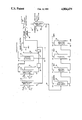
- the drawing is a simplified schematic flow diagram illustrating the relationship of a typical boiling reactor which is a particular embodiment of a high temperature chlorination (HTC) reactor, a phase separation tank with recycle, a recovery scheme for EDC in the separated organic waste, and a "Catoxid" fluid bed reactor.
- HTC high temperature chlorination
- the bottoms stream draw-off from the HTC reactor is acidified, separated into two phases and disposed of without unacceptably posioning the catalyst in the Catoxid reactor.
- the invention is described particularly with respect to the operating relationship of the HTC reactor (which is a boiling reactor), and a fluid bed catalytic oxidation reactor in which the oxidation catalyst is a support-free gamma alumina catalyst.
- the alumina catalyst is adversely sensitive to ferric chloride, particularly if it (FeCl 3 ) is present in a concentration resulting in more than 50 ppm Fe in a waste organic stream to be oxidized in the reactor.
- the invention is equally applicable to any direct chlorination reactor in which the reaction of chlorine and ethylene is catalyzed by controlling the concentration of iron salt so that Fe is in the range from 2000 ppm to 4000 ppm, and which requires a bottoms draw-off to purge the reactor of an otherwise continuous increase of catalyst and highboils.
- the HTC reactor produces a substantially pure (99.
- EDC effluent containing from about 100 ppm to about 0.5% by wt of chlorine, and relatively small amounts (relative to the volume of draw-off from the HTC reactor), of nitrogen, HCl, ethylene, oxygen and water vapor, a buildup of polychlorinated highboils in the liquid 1,2-dichloroethane reaction medium is unavoidable if not controlled by the bottoms draw-off.
- the EDC effluent contains ethylene in the range from about 500 ppm to about 1.0%; polychlorinated compounds in the range from about 50 ppm to about 0.1%; HCl in the range from about 0.5% to about 7%; nitrogen in the range from about 0.4% to about 20%; and oxygen in the range from about 0.1% to about 5% by wt based on the combined components of the HTC effluent, along with small amounts of carbon dioxide and ethane.
- a schematic flow diagram of a HTC reactor indicated generally by reference numeral 10, in which liquid EDC containing FeCl 3 or other ferric salt in a concentration sufficient to provide the aforespecified concentration of Fe, is held under elevated pressure, preferably from about 9 psig to about 15 psig, at its boiling point.
- Excess ethylene A slight molar excess of ethylene, from about 1% to about 5% over the stoichiometric amount necessary to react with chlorine and form EDC, referred to herein as "excess ethylene", is fed through an ethylene feed line 11, and chlorine is fed through a chlorine feed line 12, both near the bottom, so that they react exothermically within hot liquid chlorinated hydrocarbons (chlorohydrocarbon or chlorocarbon "CHC" liquid), mainly EDC, held as the liquid reaction medium in the reactor.
- chlorinated hydrocarbons chlorohydrocarbon or chlorocarbon "CHC” liquid
- the liquid CHC normally includes minor amounts of 1,1,2-trichloroethane ("triane"), 1,1,1,2- or 1,1,2,2-tetrachloroethane, and pentachloroethane, and other CHC impurities formed in the HTC reactor due to side reactions.
- triane 1,1,2-trichloroethane
- 1,1,1,2- or 1,1,2,2-tetrachloroethane 1,1,2,2-tetrachloroethane
- pentachloroethane and other CHC impurities formed in the HTC reactor due to side reactions.
- the heat of reaction boils off EDC while the reaction is controlled so that the reaction mass is maintained at a temperature of about 115° C. in the range of pressure stated hereinabove.
- LTC low temperature chlorination
- the LTC bottoms stream 18, by itself, may be acidifed with dilute aqueous HCl in essentially any concentration, and in any amount, provided the amount is large enough to react with and dissolve all the ferric salt in the stream, then easily separated by decantation because there is not enough, if any, emulsion formed to interfere with the separation.
- the chlorine is deliberately "doctored” with oxygen present in the range from about 0.1% to about 1% by wt of the combined flow of ethylene, chlorine and oxygen, to increase the selectivity to EDC, and to inhibit the free radical reactions which produce triane and other polychlorinated highboils having more than two Cl atoms in each molecule.
- the rate of withdrawal of HTC reactor bottoms draw-off 13 is such as to maintain a deliberately high concentration of at least 15% by weight liquid highboils (CHC which do not boil at the operating temperature and pressure of the HTC reactor), and semi-solid tar which latter would not be fluent at the HTC operating conditions if the tar was not suspended or dissolved in the EDC.
- Such semi-solid tarry material free of EDC, characteristically can be spooned into a mound onto a flat surface and the mound retains its overall shape at room temperature. Since a concentration of 2000 ppm to 4000 ppm Fe is to be maintained in the reaction medium in the HTC, this is the concentration of Fe in the draw-off.
- the oxygen is conveniently introduced by injecting air into either the chlorine feed line, or into a separate sparger.
- This injection of air introduces a relatively large amount of nitrogen, comparable in volume to the amount of excess ethylene present in the effluent, which nitrogen simply "rides through” the system.
- the presence of this oxygen though beneficial for the reaction producing EDC, also produces an unavoidably large amount of highboils boiling in the range above 130° C., including semi-solids which of course cannot be boiled off.
- the chlorine feed is not dry, for one reason or the other.
- the moisture is present because the chlorine is derived from electrolytic cells.
- the level of moisture varies, ranging from about 20 parts per million (ppm) to about 1% by wt of the chlorine, more likely in the range from about 50 ppm to about 300 ppm.
- ppm parts per million
- a lesser amount in the range from 1 ppm to about 50 ppm may come in with the ethylene, depending upon its source.
- a small amount of water may be generated by side reactions in the reactor. All the water introduced is distributed, when it leaves the reactor, between the overhead effluent leaving the reactor near its top, through line 14, and the bottoms line 13.
- the concentration of water in the bottoms draw-off is in the range from about 0 ppm to about 10 ppm. Though the concentration of water is of no particular importance for the purpose of treating the bottoms stream prior to incinerating it, the concentration of water provides an excellent indication of the operating characteristics of the HTC reactor.
- the effluent in line 14 is led into a product column 20, near its bottom and the overhead from the column is product EDC, at least 98% pure, which leaves the product column through line 23 and is recovered in a conventional manner, for example, as described in copending U. S. application Ser. No. 908,744 to Cowfer, the disclosure of which is incorporated by reference thereto as if fully set forth herein.
- the product column is a distillation column fitted with trays or other conventional vapor-liquid equilibria staging means, and a portion of the bottoms from the product column is recycled through recycle line 21 to the HTC reactor.
- This recycle from the product column is only of interest in this invention because the recycle tends to increase the concentration of highboils and tar in the bottoms draw-off from the HTC reactor.
- the bottoms from the product column is led through line 22 to further purification for recovery of specific chlorocarbons, or, if desired, may be led into the heavies column 70 or tar still 80 to recover additional EDC.
- the bottoms stream 13 a mixture of organic and aqueous phases which is flowed through a basket filter 30 to remove agglomerates larger than about 10 mesh (2 mm), so that the semi-solid tar is present as a fine suspension in the predominantly EDC stream contaminated with from about 15% to as much as 40% by weight of highboils, flowing through line 31. It is this stream, with its high concentration of Fe and the presence of liquid and semisolid emulsifiers which forms the emulsion which, until this invention, successivefully defied being broken.
- phase separation drum 40 This stream 31 is pumped by pump 32 through line 33 to phase separation drum 40.
- the phase separation drum is sized so as to provide a residence time of no more than 30 min, preferably less than 15 min, during which time the mixed phases separate into an upper aqueous layer and a lower organic layer.
- a longer residence time is of no benefit if an emulsion forms, and, it will be evident that, efficiency demands as short a residence time as is practical.
- the short residence time is an indication of how effectively the emulsion is broken up.
- the upper layer is withdrawn as a recycle stream through line 43 into which HCl acid is flowed through line 42.
- the concentration and amount of HCl acid flowed is controlled so that the concentration of HCl acid in the aqueous phase in line 43 is in the range from 2% to 4% by weight.
- Make-up water is added through line 46 in about the same amount as the bottoms draw-off from the HTC, namely about 5 gpm (gals per min) to about 15 gpm, this amount also being sufficient to replace the volume of waste water withdrawn from the upper aqueous acid phase in the drum, and sent to waste water treatment. It is a particular advantage that the volume of make-up water is no more than that of the HTC bottoms withdrawn because the low make-up permits the concentration of dilute HCl in the recycle to be maintained within the specified limits more easily.
- the flow ratio of the acidified aqueous recycle stream in line 43 to the flow of HTC bottoms in line 31 is at least 50, and preferably in the range from 75 to 150. It is obvious that, since less than 1 gpm of aqueous acid will be more than enough to dissolve the 2000 -4000 ppm of Fe in the HTC bottoms stream which is less than 20 gpm, this (recycle) : (HTC bottoms) ratio is very large in relation to the amount of Fe salt to be extracted into aqueous solution. But the high ratio is necessary to break the emulsion. When this ratio is maintained in the specified range, and the concentration of HCl is maintained in the 2%-4% range, the mixed recycle and bottoms streams in lines 31 and 43 separate into aqueous acid and organic phases within the specified residence time.
- the lower layer of CHC from the drum 40 is the separated waste organic stream led through line 45 to a caustic wash drum 50 into which is also introduced EDC through line 52 from an oxychlorination ("oxy") reactor in another part of the plant.
- EDC oxychlorination
- the combined streams in 45 and 52 are contacted with enough alkali flowing through line 51 to neutralize the HCl acid. It is preferred to use a slight excess of alkali, typically aqueous sodium hydroxide.
- the slightly alkaline stream flowing through line 53 now contains no more than 10 ppm, and preferably less than 5 ppm Fe, and is pumped directly to a concentration zone in a recovery train including plural separation zones, the first of which is a light ends column 60, where components boiling lower than EDC, along with traces of alkaline water are taken overhead through line 61.
- the bottoms from the light ends column 60 are flowed through line 62 to heavies column 70 in which EDC, at least 98% pure, is taken overhead through line 71.
- the bottoms from the heavies column is flowed through line 72 to tar still 80, where again, an overhead which is at least 98% EDC is taken through line 81.
- the effect of stripping valuable EDC from the stream 53 is to concentrate the Fe in the bottoms stream 82 from the tar still. It is in this stream 82 that the level of Fe is to be kept at 50 ppm, or lower, before it is flowed to the Catoxid reactor 90, or the gamma alumina catalyst in the reactor is poisoned.
- the feed to the Catoxid reactor consists essentially of a major proportion by wt of CHC heavies and a minor proportion of EDC.
- the reactor is operated under pressure in the range from about 50 psig to about 100 psig, and a temperature in the range from about 450° F. to about 550° F. with an excess of air. Air is flowed through line 91 into the reactor 90, near its bottom to fluidize the catalyst and oxidize the waste CHC in stream 54. The vent from the Catoxid reactor is led through line 92 for further treatment before disposing of it.
- Residence time in separation drum less than 30 min.
- Waste water from upper layer of separation drum 8-12 gpm
- 10 gpm of bottoms draw-off from a HTC reactor operating within the parameters set forth hereinabove is filtered through a basket filter fitted with a 10 mesh (2 mm) screen to remove very large solids and agglomerates, before the draw-off is treated further, unless specified otherwise.
- the bottoms draw-off, without being acidified, is filtered through a 18" ⁇ 18" filter press fitted with 80 mesh screen.
- the 80 mesh screen is blinded within 1 hr.
- the bottoms draw-off is thoroughly mixed with (a) 160 gpm of product EDC from a LTC reactor operating as described hereinbefore, the EDC containing about 20 ppm Fe present as FeCl 3 , (b) 10 gpm of combined heavies CHC streams together containing about 100-200 ppm of Fe present as FeCl 3 , and (c) 900 gpm of 3% dil HCl, and allowed to settle by gravity.
- the aqueous and organic phases do not separate after 24 hr.
- a portion of the filtrate obtained before the 80 mesh screen is blinded is filtered through a 325 mesh screen (44 microns).
- the 325 mesh screen is blinded within 1 hr.
Landscapes
- Chemical & Material Sciences (AREA)
- Organic Chemistry (AREA)
- Engineering & Computer Science (AREA)
- Materials Engineering (AREA)
- Chemical Kinetics & Catalysis (AREA)
- Organic Low-Molecular-Weight Compounds And Preparation Thereof (AREA)
- Fire-Extinguishing Compositions (AREA)
- Processing Of Solid Wastes (AREA)
- Catalysts (AREA)
- Treatment Of Water By Oxidation Or Reduction (AREA)
Abstract
Description
CH.sub.2 ═CH.sub.2 +Cl.sub.2 →ClCH.sub.2 CH.sub.2 Cl
ClCH.sub.2 CH.sub.2 Cl+Cl.sub.2 →ClCH.sub.2 CHCl.sub.2 +HCl
Claims (4)
Priority Applications (10)
| Application Number | Priority Date | Filing Date | Title |
|---|---|---|---|
| US07/171,995 US4804479A (en) | 1988-03-23 | 1988-03-23 | Process for detoxifying a bottoms draw-off from a high temperature chlorination reactor |
| CA000588323A CA1313884C (en) | 1988-03-23 | 1989-01-16 | Process for detoxifying a bottoms draw-off from a high temperature chlorination reactor |
| NO890183A NO170325C (en) | 1988-03-23 | 1989-01-16 | PROCEDURE FOR THE DETOXIFICATION OF BOTTOM OUTLETS FROM A HIGH-TEMPERATURE CHLORING REACTOR |
| EP89100708A EP0333985A3 (en) | 1988-03-23 | 1989-01-17 | Process for detoxifying a bottoms draw-off from a high temperature chlorination reactor |
| AU28573/89A AU608683B2 (en) | 1988-03-23 | 1989-01-17 | Process for detoxifying a bottoms draw-off from a high temperature chlorination reactor |
| BR898900269A BR8900269A (en) | 1988-03-23 | 1989-01-23 | CONTINUOUS PROCESS FOR THE DESTOXIFICATION OF A FLOW OF CHLOROCARBONATE SPEND |
| MX014693A MX165403B (en) | 1988-03-23 | 1989-01-27 | PROCEDURE TO DETOXIFY A BOTTOM REMOVED FROM A HIGH TEMPERATURE CHLORINATION REACTOR |
| JP1016534A JPH01242078A (en) | 1988-03-23 | 1989-01-27 | Removal of toxin from residual liquid draw-off from high temperature chlorination reactor |
| KR1019890002531A KR890014166A (en) | 1988-03-23 | 1989-02-28 | Method for Detoxing Bottom Effluent from Hot Chlorination Reactor |
| CN89101601A CN1020588C (en) | 1988-03-23 | 1989-03-21 | Process for detoxifying bottoms draw-off from high temp. chlorination reactor |
Applications Claiming Priority (1)
| Application Number | Priority Date | Filing Date | Title |
|---|---|---|---|
| US07/171,995 US4804479A (en) | 1988-03-23 | 1988-03-23 | Process for detoxifying a bottoms draw-off from a high temperature chlorination reactor |
Publications (1)
| Publication Number | Publication Date |
|---|---|
| US4804479A true US4804479A (en) | 1989-02-14 |
Family
ID=22625931
Family Applications (1)
| Application Number | Title | Priority Date | Filing Date |
|---|---|---|---|
| US07/171,995 Expired - Lifetime US4804479A (en) | 1988-03-23 | 1988-03-23 | Process for detoxifying a bottoms draw-off from a high temperature chlorination reactor |
Country Status (10)
| Country | Link |
|---|---|
| US (1) | US4804479A (en) |
| EP (1) | EP0333985A3 (en) |
| JP (1) | JPH01242078A (en) |
| KR (1) | KR890014166A (en) |
| CN (1) | CN1020588C (en) |
| AU (1) | AU608683B2 (en) |
| BR (1) | BR8900269A (en) |
| CA (1) | CA1313884C (en) |
| MX (1) | MX165403B (en) |
| NO (1) | NO170325C (en) |
Cited By (2)
| Publication number | Priority date | Publication date | Assignee | Title |
|---|---|---|---|---|
| CN114147033A (en) * | 2020-09-05 | 2022-03-08 | 中国石油化工股份有限公司 | High-boiling-point substance continuous washing system and process |
| CN114425175A (en) * | 2020-09-05 | 2022-05-03 | 中国石油化工股份有限公司 | High-boiling-point substance metal ion extraction and removal system and process |
Families Citing this family (3)
| Publication number | Priority date | Publication date | Assignee | Title |
|---|---|---|---|---|
| DE19546070A1 (en) * | 1995-12-09 | 1997-06-12 | Hoechst Ag | Process for purifying wastewater from 1,2-dichloroethane production |
| CN114149051B (en) * | 2020-09-05 | 2023-04-11 | 中国石油化工股份有限公司 | High-boiling-point substance metal ion ultrasonic removal system and process |
| CN114147052B (en) * | 2020-09-05 | 2023-01-24 | 中国石油化工股份有限公司 | High-boiling-point substance metal ion adsorption renewable system and process |
Citations (9)
| Publication number | Priority date | Publication date | Assignee | Title |
|---|---|---|---|---|
| US3115528A (en) * | 1960-12-08 | 1963-12-24 | Pittsburgh Plate Glass Co | Purification of methyl chloroform |
| GB1380497A (en) * | 1972-02-14 | 1975-01-15 | Ici Ltd | Purification process |
| US4307261A (en) * | 1980-02-19 | 1981-12-22 | Vulcan Materials Company | Process for separating ferric iron from chlorinated hydrocarbons |
| US4412086A (en) * | 1980-02-19 | 1983-10-25 | Vulcan Materials Company | Process for separating ferric iron from chlorinated hydrocarbons |
| US4415460A (en) * | 1979-07-30 | 1983-11-15 | The Lummus Company | Oxidation of organics in aqueous salt solutions |
| US4533473A (en) * | 1982-05-14 | 1985-08-06 | Stauffer Chemical Company | Process for treating liquid chlorinated hydrocarbon wastes containing iron |
| US4543190A (en) * | 1980-05-08 | 1985-09-24 | Modar, Inc. | Processing methods for the oxidation of organics in supercritical water |
| US4614643A (en) * | 1982-12-08 | 1986-09-30 | Stauffer Chemical Company | Process for treating liquid chlorinated hydrocarbon wastes containing iron |
| US4758352A (en) * | 1985-07-02 | 1988-07-19 | Bayer Aktiengesellschaft | Process for the treatment of hydrolysis residues from organo chlorosilane synthesis |
Family Cites Families (3)
| Publication number | Priority date | Publication date | Assignee | Title |
|---|---|---|---|---|
| DE2540292C3 (en) * | 1975-09-10 | 1978-06-01 | Hoechst Ag, 6000 Frankfurt | Process for the pre-purification of 1,2-dichloroethane |
| EP0094527B1 (en) * | 1982-05-14 | 1987-08-19 | Stauffer Chemical Company | Process for treating liquid chlorinated hydrocarbon wastes containing iron |
| US4760207A (en) * | 1986-09-18 | 1988-07-26 | B.F. Goodrich Company | Recovery of ethylene, chlorine and HCl from vented waste gas from direct chlorination reactor |
-
1988
- 1988-03-23 US US07/171,995 patent/US4804479A/en not_active Expired - Lifetime
-
1989
- 1989-01-16 CA CA000588323A patent/CA1313884C/en not_active Expired - Fee Related
- 1989-01-16 NO NO890183A patent/NO170325C/en unknown
- 1989-01-17 AU AU28573/89A patent/AU608683B2/en not_active Ceased
- 1989-01-17 EP EP89100708A patent/EP0333985A3/en not_active Withdrawn
- 1989-01-23 BR BR898900269A patent/BR8900269A/en not_active IP Right Cessation
- 1989-01-27 JP JP1016534A patent/JPH01242078A/en active Pending
- 1989-01-27 MX MX014693A patent/MX165403B/en unknown
- 1989-02-28 KR KR1019890002531A patent/KR890014166A/en not_active Withdrawn
- 1989-03-21 CN CN89101601A patent/CN1020588C/en not_active Expired - Fee Related
Patent Citations (9)
| Publication number | Priority date | Publication date | Assignee | Title |
|---|---|---|---|---|
| US3115528A (en) * | 1960-12-08 | 1963-12-24 | Pittsburgh Plate Glass Co | Purification of methyl chloroform |
| GB1380497A (en) * | 1972-02-14 | 1975-01-15 | Ici Ltd | Purification process |
| US4415460A (en) * | 1979-07-30 | 1983-11-15 | The Lummus Company | Oxidation of organics in aqueous salt solutions |
| US4307261A (en) * | 1980-02-19 | 1981-12-22 | Vulcan Materials Company | Process for separating ferric iron from chlorinated hydrocarbons |
| US4412086A (en) * | 1980-02-19 | 1983-10-25 | Vulcan Materials Company | Process for separating ferric iron from chlorinated hydrocarbons |
| US4543190A (en) * | 1980-05-08 | 1985-09-24 | Modar, Inc. | Processing methods for the oxidation of organics in supercritical water |
| US4533473A (en) * | 1982-05-14 | 1985-08-06 | Stauffer Chemical Company | Process for treating liquid chlorinated hydrocarbon wastes containing iron |
| US4614643A (en) * | 1982-12-08 | 1986-09-30 | Stauffer Chemical Company | Process for treating liquid chlorinated hydrocarbon wastes containing iron |
| US4758352A (en) * | 1985-07-02 | 1988-07-19 | Bayer Aktiengesellschaft | Process for the treatment of hydrolysis residues from organo chlorosilane synthesis |
Cited By (4)
| Publication number | Priority date | Publication date | Assignee | Title |
|---|---|---|---|---|
| CN114147033A (en) * | 2020-09-05 | 2022-03-08 | 中国石油化工股份有限公司 | High-boiling-point substance continuous washing system and process |
| CN114425175A (en) * | 2020-09-05 | 2022-05-03 | 中国石油化工股份有限公司 | High-boiling-point substance metal ion extraction and removal system and process |
| CN114147033B (en) * | 2020-09-05 | 2023-04-07 | 中国石油化工股份有限公司 | High-boiling-point substance continuous washing system and process |
| CN114425175B (en) * | 2020-09-05 | 2023-04-07 | 中国石油化工股份有限公司 | High-boiling-point substance metal ion extraction and removal system and process |
Also Published As
| Publication number | Publication date |
|---|---|
| NO890183L (en) | 1989-09-25 |
| NO890183D0 (en) | 1989-01-16 |
| CA1313884C (en) | 1993-02-23 |
| KR890014166A (en) | 1989-10-23 |
| NO170325B (en) | 1992-06-29 |
| AU608683B2 (en) | 1991-04-11 |
| BR8900269A (en) | 1990-03-01 |
| MX165403B (en) | 1992-11-10 |
| NO170325C (en) | 1992-10-07 |
| JPH01242078A (en) | 1989-09-27 |
| EP0333985A2 (en) | 1989-09-27 |
| EP0333985A3 (en) | 1990-01-31 |
| AU2857389A (en) | 1989-09-28 |
| CN1020588C (en) | 1993-05-12 |
| CN1036557A (en) | 1989-10-25 |
Similar Documents
| Publication | Publication Date | Title |
|---|---|---|
| US4307261A (en) | Process for separating ferric iron from chlorinated hydrocarbons | |
| JPH09176058A (en) | Production of chlorinated hydrocarbon | |
| JP3821514B2 (en) | Method for producing 1,3,3,3-tetrafluoropropene | |
| US4804479A (en) | Process for detoxifying a bottoms draw-off from a high temperature chlorination reactor | |
| WO2008085122A1 (en) | Process for the production of chlorine dioxide | |
| GB2096013A (en) | Improvements in or relating to the recovery of chlorine values | |
| US7112709B2 (en) | Method for reusing heavy end by-products in the manufacture of polychlorinated alkanes | |
| RU2171249C2 (en) | Method of preparing 1,1-difluoroethane | |
| EP0094527B1 (en) | Process for treating liquid chlorinated hydrocarbon wastes containing iron | |
| CN1269726C (en) | Process for preparing chlorine gas | |
| US4243650A (en) | Heat and volatized salt recovery from reaction effluent | |
| CA1169885A (en) | Recovery of chlorine values in integrated process for oxychlorination and combustion of chlorinated hydrocarbons | |
| US4614643A (en) | Process for treating liquid chlorinated hydrocarbon wastes containing iron | |
| US4533473A (en) | Process for treating liquid chlorinated hydrocarbon wastes containing iron | |
| US4827060A (en) | Removal and recycling of catalysts in chlorinated pricess streams | |
| JP2894627B2 (en) | Method for recovering solid molybdenum compound | |
| CA1069943A (en) | Aqueous stream treatment in chlorinated hydrocarbon production | |
| US6204418B1 (en) | Process for the chlornation of hydrocarbons | |
| US5569798A (en) | Chlorination of halogenated carbon compounds for purification purposes | |
| US5696309A (en) | Purification of halogenated carbon compounds | |
| JPH10330300A (en) | Purification of chlorinated aromatic hydrocarbon | |
| JP3796631B2 (en) | Removal of acid impurities | |
| CA1227496A (en) | Process for making 1,2-dichloroethane | |
| US20050277782A1 (en) | Method for removal of acid contaminants in a process for the synthesis of dimethyl carbonate | |
| US3595928A (en) | Process for purifying vinylidene chloride |
Legal Events
| Date | Code | Title | Description |
|---|---|---|---|
| AS | Assignment |
Owner name: GOODRICH B. F. COMPANY, THE, 3925 EMBASSY PARKWAY, Free format text: ASSIGNMENT OF ASSIGNORS INTEREST.;ASSIGNORS:SCHNEIDER, WOLFGANG W.;WAGNER, WILLIAM A.;REEL/FRAME:004973/0913;SIGNING DATES FROM 19880318 TO 19880322 Owner name: GOODRICH B. F. COMPANY, THE, A NEW YORK CORP., OHI Free format text: ASSIGNMENT OF ASSIGNORS INTEREST;ASSIGNORS:SCHNEIDER, WOLFGANG W.;WAGNER, WILLIAM A.;SIGNING DATES FROM 19880318 TO 19880322;REEL/FRAME:004973/0913 |
|
| STCF | Information on status: patent grant |
Free format text: PATENTED CASE |
|
| FEPP | Fee payment procedure |
Free format text: PAYOR NUMBER ASSIGNED (ORIGINAL EVENT CODE: ASPN); ENTITY STATUS OF PATENT OWNER: LARGE ENTITY |
|
| FPAY | Fee payment |
Year of fee payment: 4 |
|
| AS | Assignment |
Owner name: GEON COMPANY, THE Free format text: ASSIGNMENT OF ASSIGNORS INTEREST;ASSIGNOR:B. F. GOODRICH COMPANY, THE;REEL/FRAME:006655/0825 Effective date: 19930709 |
|
| FEPP | Fee payment procedure |
Free format text: PAYER NUMBER DE-ASSIGNED (ORIGINAL EVENT CODE: RMPN); ENTITY STATUS OF PATENT OWNER: LARGE ENTITY Free format text: PAYOR NUMBER ASSIGNED (ORIGINAL EVENT CODE: ASPN); ENTITY STATUS OF PATENT OWNER: LARGE ENTITY |
|
| FPAY | Fee payment |
Year of fee payment: 8 |
|
| AS | Assignment |
Owner name: OXY VINYLS, L.P., TEXAS Free format text: ASSIGNMENT OF ASSIGNORS INTEREST;ASSIGNOR:GEON COMPANY, THE;REEL/FRAME:010404/0630 Effective date: 19991122 |
|
| FPAY | Fee payment |
Year of fee payment: 12 |