US4761925A - Anti-seismic rubber bearing - Google Patents

Anti-seismic rubber bearing Download PDF

Info

Publication number
US4761925A
US4761925A US07/027,283 US2728387A US4761925A US 4761925 A US4761925 A US 4761925A US 2728387 A US2728387 A US 2728387A US 4761925 A US4761925 A US 4761925A
Authority
US
United States
Prior art keywords
rubber
seismic
rubber bearing
flanges
plates
Prior art date
Legal status (The legal status is an assumption and is not a legal conclusion. Google has not performed a legal analysis and makes no representation as to the accuracy of the status listed.)
Expired - Lifetime
Application number
US07/027,283
Inventor
Yoshihide Fukahori
Wataru Seki
Toshikazu Yoshizawa
Shigenobu Suzuki
Takeshi Suga
Mitsuaki Maeda
Akihiko Ogino
Current Assignee (The listed assignees may be inaccurate. Google has not performed a legal analysis and makes no representation or warranty as to the accuracy of the list.)
Bridgestone Corp
Original Assignee
Bridgestone Corp
Priority date (The priority date is an assumption and is not a legal conclusion. Google has not performed a legal analysis and makes no representation as to the accuracy of the date listed.)
Filing date
Publication date
Priority claimed from JP61074040A external-priority patent/JPH0730281B2/en
Priority claimed from JP61082852A external-priority patent/JPH0784814B2/en
Application filed by Bridgestone Corp filed Critical Bridgestone Corp
Assigned to BRIDGESTONE CORPORATION, 10-01, KYOBASHI 1-CHOME, CHUO-KU, TOKYO, JAPAN A CORP. OF JAPAN reassignment BRIDGESTONE CORPORATION, 10-01, KYOBASHI 1-CHOME, CHUO-KU, TOKYO, JAPAN A CORP. OF JAPAN ASSIGNMENT OF ASSIGNORS INTEREST. Assignors: MAEDA, MITSUAKI, SUGA, TAKESHI, SUZUKI, SHIGENOBU, YOSHIZAWA, TOSHIKAZU, FUKAHORI, YOSHIHIDE, OGINO, AKIHIKO, SEKI, WATARU
Application granted granted Critical
Publication of US4761925A publication Critical patent/US4761925A/en
Anticipated expiration legal-status Critical
Expired - Lifetime legal-status Critical Current

Links

Images

Classifications

    • BPERFORMING OPERATIONS; TRANSPORTING
    • B32LAYERED PRODUCTS
    • B32BLAYERED PRODUCTS, i.e. PRODUCTS BUILT-UP OF STRATA OF FLAT OR NON-FLAT, e.g. CELLULAR OR HONEYCOMB, FORM
    • B32B25/00Layered products comprising a layer of natural or synthetic rubber
    • B32B25/04Layered products comprising a layer of natural or synthetic rubber comprising rubber as the main or only constituent of a layer, which is next to another layer of the same or of a different material
    • BPERFORMING OPERATIONS; TRANSPORTING
    • B32LAYERED PRODUCTS
    • B32BLAYERED PRODUCTS, i.e. PRODUCTS BUILT-UP OF STRATA OF FLAT OR NON-FLAT, e.g. CELLULAR OR HONEYCOMB, FORM
    • B32B7/00Layered products characterised by the relation between layers; Layered products characterised by the relative orientation of features between layers, or by the relative values of a measurable parameter between layers, i.e. products comprising layers having different physical, chemical or physicochemical properties; Layered products characterised by the interconnection of layers
    • B32B7/02Physical, chemical or physicochemical properties
    • B32B7/022Mechanical properties
    • EFIXED CONSTRUCTIONS
    • E02HYDRAULIC ENGINEERING; FOUNDATIONS; SOIL SHIFTING
    • E02DFOUNDATIONS; EXCAVATIONS; EMBANKMENTS; UNDERGROUND OR UNDERWATER STRUCTURES
    • E02D27/00Foundations as substructures
    • E02D27/32Foundations for special purposes
    • E02D27/34Foundations for sinking or earthquake territories
    • EFIXED CONSTRUCTIONS
    • E02HYDRAULIC ENGINEERING; FOUNDATIONS; SOIL SHIFTING
    • E02DFOUNDATIONS; EXCAVATIONS; EMBANKMENTS; UNDERGROUND OR UNDERWATER STRUCTURES
    • E02D31/00Protective arrangements for foundations or foundation structures; Ground foundation measures for protecting the soil or the subsoil water, e.g. preventing or counteracting oil pollution
    • E02D31/08Protective arrangements for foundations or foundation structures; Ground foundation measures for protecting the soil or the subsoil water, e.g. preventing or counteracting oil pollution against transmission of vibrations or movements in the foundation soil
    • FMECHANICAL ENGINEERING; LIGHTING; HEATING; WEAPONS; BLASTING
    • F16ENGINEERING ELEMENTS AND UNITS; GENERAL MEASURES FOR PRODUCING AND MAINTAINING EFFECTIVE FUNCTIONING OF MACHINES OR INSTALLATIONS; THERMAL INSULATION IN GENERAL
    • F16FSPRINGS; SHOCK-ABSORBERS; MEANS FOR DAMPING VIBRATION
    • F16F1/00Springs
    • F16F1/36Springs made of rubber or other material having high internal friction, e.g. thermoplastic elastomers
    • F16F1/40Springs made of rubber or other material having high internal friction, e.g. thermoplastic elastomers consisting of a stack of similar elements separated by non-elastic intermediate layers
    • FMECHANICAL ENGINEERING; LIGHTING; HEATING; WEAPONS; BLASTING
    • F16ENGINEERING ELEMENTS AND UNITS; GENERAL MEASURES FOR PRODUCING AND MAINTAINING EFFECTIVE FUNCTIONING OF MACHINES OR INSTALLATIONS; THERMAL INSULATION IN GENERAL
    • F16FSPRINGS; SHOCK-ABSORBERS; MEANS FOR DAMPING VIBRATION
    • F16F2228/00Functional characteristics, e.g. variability, frequency-dependence
    • F16F2228/001Specific functional characteristics in numerical form or in the form of equations
    • F16F2228/005Material properties, e.g. moduli

Definitions

  • the present invention relates to an anti-seismic rubber bearing of such a structure that a plurality of rigid plates and a plurality of flexible plates having visoelastic properties are bonded to each other alternately. More particularly, it relates to an anti-seismic rubber bearing which is superior in anti-seismic performance and durability and is capable of being stably fixed to both the building and the foundation on account of the structure to reduce the local strain which occurs near the flanges.
  • anti-seismic rubber bearing formed by laminating alternately rigid plates such as steel plates and flexible plates such as rubber plates having the viscoelastic properties, because it satisfies the vibration insulating and absorbing properties required for the anti-seismic bearing member.
  • the anti-seismic rubber bearing has flexibility or has a low shear modulus in the horizontal direction. Because of this property, it shifts own frequency of a rigid concrete building from the seismic frequency when it is interposed between the concrete building and the foundation thereof. For this reason, the anti-seismic rubber bearing greatly reduces the acceleration of earthquake the building receives.
  • the anti-seismic rubber bearing has a bearing member interposed between a building and a foundation thereof so that it supports the entire building. Therefore, once it is installed, its replacement is technically difficult or economically unrealistic. This requires the anti-seismic structure to have the same service life (50-60 years) as concrete structures.
  • the anti-seismic rubber bearing 10 is made up of a laminate structure 1 and flanges 4 and 5.
  • the laminate structure 1 is made up of flexible plates R 1 , R 2 , R 3 , . . . and rigid plates S 1 , S 2 , S 3 , . . . placed on top of the other.
  • the flanges 4 and 5 are thick steel plates firmly bonded to the top and bottom of the laminate structure 1, respectively.
  • the flange 4 is in contact with a building, and the flange 5 is in contact with a foundation.
  • the anti-seismic rubber bearing 10 is characterized by its elastic deformation or its ability to recover its original shape after deformation by earthquake. Because of this property, the anti-seismic rubber bearing 10 undergoes great shear deformation as the building shakes during a big earthquake, as shown in FIG. 2(b).
  • the flexible plates R 1 , R 2 , . . . interposed between the rigid plates S 1 , S 2 , . . . undergo tensile deformation as great as hundreds percent.
  • the one (R 2 ) adjacent to the flange undergoes an extremely great local deformation at the part (X) where the rigid plate S 1 is bent in the direction of arrow in consequence of shear deformation.
  • the local deformation has long been thought to be the cause of damage or break the anti-seismic structure.
  • FIG. 9 is a longitudinal sectional view of a conventional rubber bearing member.
  • Making the side of each flexible plate concave is disadvantageous in the case of anti-seismic rubber bearing composed of rigid plates and flexible plates laminated alternately, because it causes poor demolding and needs an expensive mold. This drawback is more serious in the case where the flexible plates are thin.
  • a disadvantage of the conventional anti-seismic rubber bearing of laminate structure is that the edges of the rigid plates such as steel plates are exposed and they are subject to corrosion. In the case of rubber vibration isolator, the exposed side of the metal plate is covered with coating; but this coating is not adequate for the anti-seismic rubber bearing which is required to be durable over a long period of time (e.g., 60 years for concrete buildings).
  • the anti-seismic rubber bearing Since the anti-seismic rubber bearing is exposed to the atmosphere at all times while it is in use, it is degraded by air, moisture, ozone, ultraviolet light, radiation (when used for a nuclear power station), and sea wind (when used for a seacoast building) over a long period of time.
  • the anti-seismic rubber bearing supporting a building is under compressive load at all times, which in turn exerts a considerably large amount of tensile stress to the surface of the rubber layer. Compressive strain up to 10% may cause tensile strain of 100-300% on the surface if there is a large amount of creep after use for a long period. This surface strain is magnified by the shear strain amounting to 100-200% that takes place at the time of earthquake.
  • FIGS. 11 and 12 there are two types of anti-seismic rubber bearings as shown in FIGS. 11 and 12.
  • the one shown in FIG. 11 is composed of rubber layers 21 and metal plates 22 laminated on top of the other, with the edge 22a of the metal plate 22 exposed or covered with a thin (0.5-1 mm) rubber layer.
  • the one shown in FIG. 12 is composed of rubber layers 21 and metal plates 22 laminated on top of the other, with the edge 22a of metal plates 22 covered with a thick rubber layer 23.
  • the rubber material used for these anti-seismic structure is either natural rubber in England and New Zealand where importance is directed to fracture resistance or chloroprene in France where importance is directed to weather resistance.
  • the anti-seismic rubber bearing is covered with a thick rubber layer to compensate the poor weather resistance (heat aging resistance, ozone resistance, and oxidation resistance) of natural rubber as shown in FIG. 12.
  • the surface rubber layer is 75 mm thick in the case of anti-seismic rubber bearing used for a courthouse built in the suburbs of Los Angeles.
  • the conventional anti-seismic rubber bearing made of chloroprene rubber with good weather resistance has a drawback of being poor in creep properties. This is because chloroprene rubber has a great hysteresis loss. In addition, it becomes stiffer at low temperatures because chloroprene easily crystallizes at low temperatures. The high price of chloroprene rubber is another disadvantage.
  • natural rubber is poor in weather resistance as well known. Degraded natural rubber is noticed by its visible change such as ozone cracking; it is also characterized by a greatly increased modulus and a greatly decreased strength and elongation at break. After degradation over a long period of time in the atmosphere, natural rubber has a myriad of ozone crackings on the surface thereof and becomes brittle.
  • the poor weather resistance of natural rubber causes a problem in the case of anti-seismic rubber bearing constructed as shown in FIG. 12.
  • the degraded surface layer easily breaks when the anti-seismic rubber bearing undergoes great deformation repeatedly at the time of earthquake, even though the inner rubber is not degraded. Then the broke surface layer triggers the rupture of all the rubber layers. (This is experimentally demonstrated by the fact that a specimen of rubber having good heat aging characteristics is easily broken when merely bent if it is coated thin with another rubber poor in heat aging characteristics, followed by heat aging.)
  • the anti-seismic rubber bearing should be as resistant to degradation as possible in the environment where it is used.
  • the anti-seismic rubber bearing is required to have a long durability over a period of about 60 years as mentioned above.
  • the anti-seismic rubber bearing might be entirely broken even when a small part is degraded. Even the slightest degradation should not be neglected because the anti-seismic rubber bearing would receive an unexpected deformation.
  • the anti-seismic rubber bearing should have the perfect safety becasue it supports a building and men living therein.
  • the anti-seismic rubber bearing should be produced at a reasonably low cost. Therefore, the anti-seismic rubber bearing made of natural rubber, which is poor in weather resistance, should be covered with a special rubber with good weather resistance.
  • the anti-seismic rubber bearing of the present invention comprises a laminate structure composed of a plurality of rigid plates and a plurality of flexible plates having viscoelastic properties bonded to each other alternately, and flanges each attached to the upper and lower surfaces of the laminate structure, characterized by that the local strain is evenly distributed throughout the structure by lowering the local strain which occurs near the flanges.
  • the present inventors studied the foundation-fixed type anti-seismic rubber bearing which is not damaged or broken by local strain.
  • the study has begun with the analysis of a great deformation stress applied to a rubber material. Such an analysis is considered to give a clue to the location and magnitude of local strain which occurs in an anti-seismic rubber bearing as a result of compressive deformation exerted by a building and the shear deformation exerted by the horizontal movement of earthquake.
  • the analysis of stress on a material is usually carried out by the finite element method (FEM) using a computer. Since the FEM analysis represents originally the stress-strain relationship of a material by the aid of linear approximation, the calculated values agree with the actual values in the case of very small deformation. However, this is not correct for large deformation.
  • FEM finite element method
  • the present inventors employed a method of representing the non-linearity as faithfully as possible for such a rubber material as anti-seismic rubber bearing which undergoes extraordinary deformation. As the result, they obtained the results of analyses in which the calculated deformation (solid line) almost completely agrees with the measured deformation (broken line) when the compressive strain is 8.5% and the shear strain is 100%, as shown in FIG. 4.
  • the present inventors investigated the deformation and strain of each part by applying 6% compressive strain and 100% shear strain to an anti-seismic rubber bearing composed of five rubber layers (R 11 , R 12 , R 13 , R 12 , R 11 ), four steel plates (S 11 , S 12 , S 13 , S 12 , S 11 ), and flanges 4 and 5, as shown in FIG. 5.
  • the analyses carried out by the present inventors produced a very important knowledge on local strain.
  • the dowel-type anti-seismic rubber bearing used in England and New Zealand is not completely safe from breakage by local strain near the flange; rather it is prone to danger of rocking.
  • the flange under tension bends as shown in FIGS. 3(a) and 3(b), relieving the local strain at part A.
  • This structure increases the local strain at part B, resulting in breakage at part B.
  • the present invention is based on the analyses which were carried out successfully for the first time in the world.
  • FIG. 1 is a longitudinal sectional view of the anti-seismic rubber bearing pertaining to one example of the invention.
  • FIGS. 2 and 3 are longitudinal sectional views of conventional examples of anti-seismic rubber bearing.
  • FIGS. 2(a) and 3(a) show the normal state and
  • FIGS. 2(b) and 3(b) show the deformed state at the time of earthquake.
  • FIG. 4 is a diagram showing the results of FEM analysis of an anti-seismic rubber bearing.
  • FIG. 5 is a sectional view of an anti-seismic rubber bearing used for the analysis of principal strain.
  • FIG. 6 is a schematic diagram showing the deformation of the anti-seismic rubber bearing shown in FIG. 5.
  • FIG. 7 is an enlarged view of part VII in FIG. 1.
  • FIGS. 8(a), (b), (c) show the curvature in the vicinity of flange.
  • FIG. 9 is a partial sectional view of a conventional anti-seismic rubber bearing.
  • FIG. 10(a), (b), (c) show the examples of the round edge of the rigid plate.
  • FIGS. 11 and 12 are sectional views of conventional anti-seismic rubber bearings.
  • FIG. 13 is a sectional view of a laminate structure pertaining to another example of the invention.
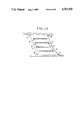
  • FIG. 14 is a schematic diagram showing the deformation of the anti-seismic rubber bearing of the invention which occurs in the experiment example.
  • FIG. 1 is a longitudinal sectional view of the anti-seismic rubber bearing 20 pertaining to one example of the invention.
  • the anti-seismic rubber bearing consists of a laminate structure 13 and flanges 4 and 5 attached to the top and bottom thereof.
  • the laminate structure 13 is composed of flexible plates 11 of rubber or the like having the viscoelastic property and rigid plates 12 of steel or the like having the rigid property, said plates being laminated alternately.
  • the laminate structure 13 has, in a sectional view, inward curvatures at four corners in contact with the flanges 4 and 5.
  • the radius of the curvature should be properly selected. If it is too small, the curvature produces only little effect of reducing the local strain; and if it is too great, the production of anti-seismic rubber bearing is very difficult.
  • the radius (L) of the curvature should preferably be established such that the following equations are satisfied.
  • FIG. 7 is an enlarged sectional view of part VII in FIG. 1.
  • the curvature is not limited to the one shown in FIG. 7; but it may be of any other form such as the one shown in FIG. 8(a) or 8(b) which is a straight line or a combination of two or more straight lines or the one shown in FIG. 8(c) which is a combination of arcs and straight liens.
  • the rigid plate 12 has the outwardly rounded edge and the periphery of the rigid plates is covered with the outer layer of special rubber 14.
  • the rounded edge of the rigid plate 12 should have a radius of curvature (r) greater than 0.1 mm, preferably greater than 0.3 mm, and more preferably greater than 0.5 mm.
  • the curvature of the rounded edge of the rigid plate is not limited to the one shown in FIG. 1; but it may be of any other form so long as it reduces the local stress.
  • the ones shown in FIGS. 10(a) and 10(b) are composed of a plurality of short straight lines, and the one shown in FIG. 10(c) is a combination of arcs and straight lines.
  • the smoothly rounded edge of the rigid plate 12 greatly reduces the stress or strain that occurs at that part of the flexible plate 11 which is in contact with the edge.
  • the present inventors studied the surface rubber 23 that covers the laminate structure as shown in FIG. 12. (The part extending from the edge of the rigid plate to the external surface (or the layer having a thickness of T in FIG. 12) is referred to as the covering layer.)
  • the local strain that occurs in the surface layer exposed to the atmosphere decreases as the thickness T of the covering layer increases.
  • the reduction of local stress levels off when exceeding a certain thickness of the covering layer is not limited.
  • the anti-seismic rubber bearing requires a more amount of material and a prolonged vulcanization time, which leads to an increased cost.
  • the thickness T of the covering layer should be 1 to 30 mm, preferably 2 to 20 mm, and most desirably 3 to 15 mm.
  • the covering layer may be thicker than 30 mm.
  • the anti-seismic rubber bearing in one example of the invention as shown in FIG. 1 is covered with a special rubber 14 having superior weather resistance.
  • the special rubber include butyl rubber, acryl rubber, polyurethane, silicone rubber, fluororubber, polysulfide rubber, ethylene-propylene rubber (EPR and EPDM), Hypalon, chlorinated polyethylene, ethylene-vinyl acetate rubber, epichlorohydrin rubber, and chloroprene rubber.
  • butyl rubber Preferable among them from the standpoint of weather resistance are butyl rubber, polyurethane, ethylene-propylene rubber, Hypalon, chlorinated polyethylene, ethylene-vinyl acetate rubber, and chloroprene rubber.
  • Preferable among them from the standpoint of adhesion to the rubber constituting the flexible plates are butyl rubber, ethylene-propylene rubber, and chloroprene rubber.
  • These rubber materials may be used individually or in combination with one another. For the improvement of their elongation and other physical properties, they may be blended with commercial rubber such as natural rubber, isoprene rubber, styrene butadiene rubber, butadiene rubber, and nitrile rubber. In addition, these rubber materials may be incorporated with additives such as filler, antioxidant, plasticizer, softener, and oil which are commonly used for rubber processing.
  • a preferred rubber compound is composed of 100 parts by weight of ethylene-propylene rubber, 5-50 parts by weight of cyclopentadiene or dicyclopentadiene resin, and 2-30 parts by weight of rosin. This rubber compound is greatly improved in fracture properties and adhesion to metals.
  • ethylene-propylene rubber is superior in ozone resistance, radiation resistance, oxidation resistance, UV light resistance, heat aging resistance, and low temperature performance.
  • it is not necessarily satisfactory in adhesion to rubber flexible plates, adhesion to metal rigid plates, processability, and rupture properties such as elongation at break.
  • the properties of ethylene propylene rubber are improved when it is incorporated with cyclopentadiene resin and/or dicyclopentadiene resin and rosin derivative. These additives are also effective in the improvement of weather resistance.
  • cyclopentadiene resin or dicyclopentadiene resin improves the processability of the rubber and also improves the physical properties of the rubber through the mutual chemical and physical reactions with rubber that take place during vulcanization.
  • cyclopentadiene resin or dicyclopentadiene resin is superior to ordinary process oil. It can be readily blended with rubber with a less amount of heat generated. It affects little the rupture properties of the rubber compound blended with it. It provides a rubber compound superior in adhesion to metals. (This is true particularly for ethylene-propylene rubber-based compounds.) It does not migrate from the rubber compound but ensures the properties of the rubber compound over a long period of time.
  • the cyclopentadiene resin or dicyclopentadiene resin to be incorporated into ethylene-propylene rubber-based compounds is a petroleum resin composed mainly of cyclopentadiene or dicyclopentadiene. It includes copolymers of cyclopentadiene or dicyclopentadiene with a polymerizable olefin hydrocarbon and also includes polymers of cyclopentadiene and/or dicyclopentadiene. These results should contain more than 30 wt%, preferably more than 50 wt% of cyclopentadiene or dicyclopentadiene or a mixture thereof.
  • the olefin hydrocarbon copolymerizable with cyclopentadiene or dicyclopentadiene includes olefin hydrocarbons such as 1-butene, 2-butene, isobutylene, 1-pentene, 2-pentene, 2-methyl-1-butene, 3-methyl-1-butene, and 2-methyl-2-butene; diolefin hydrocarbons such as butadiene, isoprene, and 3-methyl-1,2-butadiene; and vinyl-substituted aromatic hydrocarbons such as styrene, ⁇ -methylstyrene, and vinyltoluene. They can be copolymerized with cyclopentadiene or dicyclopentadiene through Friedel-Crafts reaction in the presence of a proper catalyst.
  • the cyclopentadiene resin or dicyclopentadiene resin should preferably have a softening point of 50°-200° C. (measured by ring and ball method according to JIS K-5902) and a bromine number of 40-150 (measured according to ASTM D-1158-57T) so that they produce a desired effect on the physical properties of the vulcanized rubber.
  • the amount of the cyclopentadiene and/or dicyclopentadiene to be incorporated should be 5 to 50 parts by weight, preferably 15 to 35 parts by weight for 100 parts by weight of ethylene-propylene rubber-based compound.
  • the rosin derivative is composed mainly of a mixture of carboxylic acids such as abietic acid and pimaric acids, and it includes, for example, rosin ester, polymeric rosin, hydrogenated rosin, hardened rosin, high rosin, zinc resinate, and modified rosin.
  • the rosin derivative is added in an amount of 2-30 parts by weight for 100 parts by weight of ethylene-propylene rubber-based compound.
  • the ethylene-propylene rubber includes ethylene-propylene diene rubber (EPDM) containing diene as a third component, ethylene-propylene rubber (EPR) not containing a third component, oil-extended ethylene-propylene diene rubber, and oil-extended EPR.
  • EPDM ethylene-propylene diene rubber
  • EPR ethylene-propylene rubber
  • the ethylene-propylene rubber may be blended with general-purpose rubber such as NR, BR, and SBR according to need for the improvement of processability.
  • the rubber compound may be incorporated with a vulcanization accelerator selected according to the application.
  • a vulcanization accelerator selected according to the application.
  • the vulcanization accelerator include thiazole type accelerators, guanine type accelerators, thiuram type accelerators, and thiocarbamate type accelerators.
  • N-cyclohexyl-2-benzothiazole sulfenamide Preferable among them are N-cyclohexyl-2-benzothiazole sulfenamide, dibenzothiazyl disulfide, tetramethylthiuram monosulfide, 2-mercaptobenzothiazole, 2-mercaptobenzothiazole cyclohexylamine salt, tetra-2-ethylhexylthiuram disulfide, zinc di-2-ethylhexyldicarbamate, and diphenylguanidine. Particularly desirable among them are N-cyclohexyl-2-benzothiazole sulfenamide and diphenyl guanidine.
  • the desired amount of the vulcanization accelerator is 0.5 to 5 parts by weight.
  • the rubber compound may further contain a filler, antioxidant, plasticizer, softener, and oil which are commonly used for rubber processing.
  • the above-mentioned covering layer should be made of a special rubber compound superior in weather resistance, and it should have a thickness of T specified above. If this is impossible to realize for technical or other reasons, it is not always necessary that the thickness t in FIG. 7 be equal to the thickness T of the covering layer.
  • the thickness t of the special rubber compound may be 1-20 mm, preferably 2-20 mm, and most preferably 2-15 mm.
  • the special rubber compound B is required to firmly bond to the flexible plates 11, rigid plates 12, and flanges 4 and 5. Bonding may be easily accomplished by any one of the following methods.
  • the bonding of the inner rubber and the special rubber compound may be promoted by interposing a third rubber layer between them which adheres well to both of them.
  • the inner rubber and/or the special rubber compound may be incorporated with additives for the improvement of adhesion.
  • the anti-seismic rubber bearing of the invention is characterized by that the rigid plates have the outwardly rounded edge and the edge of the rigid plates are covered with a special rubber compound in an adequate thickness. This construction decreases local strain that occurs near the flanges, distributes strain evenly throughout the anti-seismic rubber bearing, and lowers the absolute value of local strain.
  • the rigid plates 12 may be made of metal, ceramics, plastics, FRP, polyurethane, wood, paperboard, slate, and decorative laminate, with steel plate being preferable.
  • the flexible plates 11 may be made of vulcanized rubber, unvulcanized rubber, foams thereof, and any other materials having rubbery resilience, with vulcanized rubber being preferable.
  • the shape of the rigid plates and flexible plates may be circle, square, pentagon, hexagon, or polygon.
  • the bonding of the rigid plates to the flexible plates may be accomplished with an adhesive or by covulcanization.
  • the anti-seismic rubber bearing undergoes great shear deformation as the building rocks when an earthquake occurs. This shear deformation leads to an extremely great local strain at the surface layer of the flexible plate adjacent to the flange of the laminate structure. This local strain leads to damage and rupture of the anti-seismic rubber bearing. Since this local strain results from the flexural deformation of the rigid plate adjacent to the flange, it should be avoided by at least one of the following provisions in the present invention.
  • the rigid plates are not uniform in flexural rigidity and/or the flexible plates are not uniform in tensile strength; the rigid plates do not undergo flexural deformation easily. This reduces local strain caused by the flexural deformation of the rigid plate adjacent to the flange. As the result, the anti-seismic rubber bearing is safe with certainty from damage and fracture cuased by local strain.
  • the rigid plates of varied flexural rigidity should be arranged as shown in FIG. 13 so that the following conditions are satisfied.
  • the flexural rigidity E S .sbsb.3 of the rigid plate S 3 may be greater than the flexural rigidity E SM of the rigid plate S M .
  • the respective values of flexural rigidity E S .sbsb.1, E S .sbsb.2, E S .sbsb.3, . . . E SM of the rigid plates S 1 , S 2 , S 3 , . . . S M may be set up so as to satisfy the following conditions.
  • each of E S .sbsb.1, E S .sbsb.3, and E S .sbsb.7 (the flexural rigidity of the 7th rigid plate S 7 counted from the flange side) is greater than E SM .
  • the rigid plate adjacent to the flange should have a higher flexural rigidity than the rigid plate closer to the center.
  • the flexural rigidity of the individual rigid plates should be properly established according to the estimated direction and magnitude of shocks applied to the anti-seismic rubber bearing.
  • the rigid plate adjacent to the flange and the rigid plate closer to the center are made of the same material but the former is thicker than the latter.
  • the rigid plate adjacent to the flange and the rigid plate closer to the center are made of different materials, the material for the former having a higher flexural rigidity than that for the latter.
  • the plate thickness to give a flexural rigidity required is easily calculated because doubling the plate thickness increases the flexural rigidity 2 3 -fold.
  • the flexible plates of varied tensile strength should be arranged so as to satisfy the following conditions.
  • the flexible plates are designated R 1 , R 2 , R 3 , . . . R M (R M being at the center) and their respective values of tensile strength at 100% elongation (modulus 100) at 25° C. are E R .sbsb.1, E R .sbsb.2, E R .sbsb.3, . . . E RM , the following relation should be established between the tensile strength E R .sbsb.1 of the flexible plate R 1 and the stress E RM of the flexible plate R M .
  • the tensile strength E R .sbsb.3 of the flexible plate R 3 may be made greater than the tensile strength E RM of the flexible plate R M .
  • the respective values of tensile strength E R .sbsb.1, E R .sbsb.2, E R .sbsb.3, . . . E RM of the flexible plates R 1 , R 2 , R 3 , . . . R M may be set up so as to satisfy the following conditions.
  • each of E R .sbsb.1, E R .sbsb.3, and E R .sbsb.7 (the tensile strength of the 7th flexible plate R 7 counted from the flange side) is greater than E RM .
  • the flexible plate adjacent to the flange and the flexible plate closer to the center are made of the same base material but the base material for the former contains more filler than that for the latter.
  • the flexible plate adjacent to the flange and the flexible plate closer to the center are made of different base materials, the base material for the former having a higher tensile stress than that for the latter.
  • the flexible plate R M at the center should have a tensile strength E RM of 5-40 kg/cm 2 at 100% elongation at 25° C.
  • the laminate structure is constructed according to the above-mentioned provision I or II or both. If both of the above-mentioned provisions I and II are adopted, the rigid plate adjacent to the flange is by far less subject to flexural deformation. Therefore, local strain caused by the flexural deformation of the rigid plate is certainly reduced.
  • the anti-seismic rubber bearing of the present invention not only isolates the motions of earthquake but also performs damping and vibration proofing. It has the following features.
  • the anti-seismic rubber bearing of the invention is safe from damage and rupture caused by local strain.
  • the anti-seismic rubber bearing of the invention is subject very little to damage and rupture caused by local strain on account of the remarkable reduction of local strain. Therefore, it is very durable. Since it can be fixed to the building and foundation through the flanges, it can stably support the building.
  • the durability and safety of the anti-seismic rubber bearing are enhanced if the laminate structure of the anti-seismic rubber bearing is covered with a special rubber compound.
  • the anti-seismic rubber bearing of the present invention was realized as the result of quantitative analysis of local strain that occurs when the anti-seismic rubber bearing undergoes deformation. Therefore, it should be clearly distinguished from the conventional ones, and the present invention is of great scientific and industrial significance.
  • the anti-seismic rubber bearing of the invention as shown in FIG. 1 was examined for principal strain at each position that occurs at the time of deformation.
  • the flexible plates were made of vulcanized natural rubber-based compound, and the rigid plates were made of steel plate.
  • This special rubber was vulcanized rubber composed of 100 parts by weight of EPDM-based rubber, 21 parts by weight of dicyclopentadiene resin, 9 parts by weight of high rosin, and carbon black.
  • the anti-seismic rubber bearing has the following dimensions.
  • the anti-seismic rubber bearing of this structure was subjected to 6% compressive strain and 100% shear strain.
  • the deformed shape under such strain is schematically shown in FIG. 14.
  • the values of FEM analysis for the principal strain at each position indicated in FIG. 14 are shown in Table 1.
  • an anti-seismic rubber bearing as shown in FIG. 5 was prepared (the material, shape factor, rubber thickness, and steel plate thickness are the same as those in the example). It was also examined in the same manner as in the example. The principal strain at each position indicatd in FIG. 6 was measured, and the measured values are shown in Table 1.
  • the rubber compounds Nos. 1 and 2 were examined for weather resistance, and the results were compared with those of a natural rubber compound No. 6 (composed of 100 parts by weight of natural rubber, 20 parts by weight of HAF carbon, 10 parts by weight of spindle oil, 1.5 parts of sulfur, and 1 part by weight of antioxidant). The results are shown in Table 4.
  • rubber compounds Nos. 4 and 5 are small in elongation at break, poor in adhesion to steel plates, and extremely poor in adhesion to natural rubber, whereas rubber compounds Nos. 1 to 3 blended with dicyclopentadiene resin and high rosin are superior in strength at break and elongation at break and are also superior in adhesion to natural rubber and metal.
  • rubber compounds Nos. 1 and 2 are excellent in ozone resistance, retention of strength at break and elongation at break after heat deterioration,. and flex resistance after heat deterioration. Apparently they are superior in resistance to heat deterioration.

Landscapes

  • Engineering & Computer Science (AREA)
  • General Engineering & Computer Science (AREA)
  • Structural Engineering (AREA)
  • Life Sciences & Earth Sciences (AREA)
  • Environmental & Geological Engineering (AREA)
  • General Life Sciences & Earth Sciences (AREA)
  • Mining & Mineral Resources (AREA)
  • Paleontology (AREA)
  • Civil Engineering (AREA)
  • Mechanical Engineering (AREA)
  • Hydrology & Water Resources (AREA)
  • Architecture (AREA)
  • Buildings Adapted To Withstand Abnormal External Influences (AREA)
  • Vibration Prevention Devices (AREA)
  • Springs (AREA)

Abstract

There is provided an anti-seismic rubber bearing made up of a laminate structure formed by bonding a plurality of rigid plates having stiffness properties and a plurality of flexible plates having viscoelastic properties each other alternately, and flanges each attached to the upper and lower surfaces of the laminate structure, characterized by that the local strain is evenly distributed throughout the structure by lowering the local strain which occurs near the flanges.

Description

FIELD OF THE INVENTION AND RELATED ART STATEMENT
The present invention relates to an anti-seismic rubber bearing of such a structure that a plurality of rigid plates and a plurality of flexible plates having visoelastic properties are bonded to each other alternately. More particularly, it relates to an anti-seismic rubber bearing which is superior in anti-seismic performance and durability and is capable of being stably fixed to both the building and the foundation on account of the structure to reduce the local strain which occurs near the flanges.
Much attention is now focused on the structure (anti-seismic rubber bearing) formed by laminating alternately rigid plates such as steel plates and flexible plates such as rubber plates having the viscoelastic properties, because it satisfies the vibration insulating and absorbing properties required for the anti-seismic bearing member.
The anti-seismic rubber bearing has flexibility or has a low shear modulus in the horizontal direction. Because of this property, it shifts own frequency of a rigid concrete building from the seismic frequency when it is interposed between the concrete building and the foundation thereof. For this reason, the anti-seismic rubber bearing greatly reduces the acceleration of earthquake the building receives.
As mentioned above, the anti-seismic rubber bearing has a bearing member interposed between a building and a foundation thereof so that it supports the entire building. Therefore, once it is installed, its replacement is technically difficult or economically unrealistic. This requires the anti-seismic structure to have the same service life (50-60 years) as concrete structures.
As shown in FIG. 2(a), the anti-seismic rubber bearing 10 is made up of a laminate structure 1 and flanges 4 and 5. The laminate structure 1 is made up of flexible plates R1, R2, R3, . . . and rigid plates S1, S2, S3, . . . placed on top of the other. The flanges 4 and 5 are thick steel plates firmly bonded to the top and bottom of the laminate structure 1, respectively. The flange 4 is in contact with a building, and the flange 5 is in contact with a foundation.
The anti-seismic rubber bearing 10 is characterized by its elastic deformation or its ability to recover its original shape after deformation by earthquake. Because of this property, the anti-seismic rubber bearing 10 undergoes great shear deformation as the building shakes during a big earthquake, as shown in FIG. 2(b). In other words, the flexible plates R1, R2, . . . interposed between the rigid plates S1, S2, . . . undergo tensile deformation as great as hundreds percent. Among the flexible plates, the one (R2) adjacent to the flange undergoes an extremely great local deformation at the part (X) where the rigid plate S1 is bent in the direction of arrow in consequence of shear deformation. The local deformation has long been thought to be the cause of damage or break the anti-seismic structure.
Up to now, no careful analyses have been made relative to the local stress and strain which, when a great shear force is applied to the anti-seismic rubber bearing at the time of earthquake, occur in the anti-seismic rubber bearing supporting the weight of a building over a long period of time. It has been inferred from the approximate shape observed when an anti-seismic rubber bearing is actually deformed that the maximum strain takes place in the part X.
This inference led people in England and New Zealand to a belief that it is possible to prevent the great local strain from occurring in part A of the anti-seismic rubber bearing and thereby to prevent an anti-seismic rubber bearing 10' from being damaged and broken, if flanges 8 and 9 of the anti-seismic rubber bearing 10' are provided with recesses 8a, 8b, 9a, and 9b which are engaged with bolts 2a, 2b, 3a, and 3b attached to the building 2 and the foundation 3, as shown in FIG. 3(a). (This is called "dowel system".) This system permits the flanges 8 and 9 to bend in the directions of arrows as shown in FIG. 3(b) during earthquake, so that no great local strain occurs in part A of the anti-seismic rubber bearing.
It is well known that a rigid building like a concrete building placed on a flexible structure like an anti-seismic rubber bearing is subject to not only simple horizontal motion but also vertical motion and rotating motion, when it is shaken vertically and horizontally by an earthquake. These complex motions cause the rocking of a building. Therefore, the anti-seismic rubber bearing should be firmly and completely fixed to the sill and foundation through the flanges.
This principle, however, is not applied to the conventional technology shown in FIGS. 3(a) and 3(b), in which the flanges 8 and 9 are fixed to neither the building 2 nor the foundation 3 but are constructed such that they bend in proportion to shear deformation. This construction makes the building extremely unstable and subject to tilting induced by strong rocking. It may be said, therefore, that in England and New Zealand great importance is directed to the reduction of local strain near the flange rather than the stability of a building.
For reasons mentioned above, there has been a need for an anti-seismic rubber bearing which is subject to very little local stress and local strain even when it is fixed to a building or foundation through the flanges. (In this specification, this type of anti-seismic rubber bearing is referred to as "foundation-fixed anti-seismic rubber bearing).
In the case of a bearing member compound of rigid plates (such as steel plate) and flexible plates (such as rubber plates) laminated on top of the other, excessive stress and strain occur at that part of the flexible plate which is in contact with the edge of the rigid plate, and that part is subject to damage. This is a well known fact.
A known way of reducing the local stress in that part of a flexible plate which is in contact with the edge of a rigid plate is to make the side of the flexible plate 21 concave as shown in FIG. 9 which is a longitudinal sectional view of a conventional rubber bearing member. Making the side of each flexible plate concave is disadvantageous in the case of anti-seismic rubber bearing composed of rigid plates and flexible plates laminated alternately, because it causes poor demolding and needs an expensive mold. This drawback is more serious in the case where the flexible plates are thin.
A disadvantage of the conventional anti-seismic rubber bearing of laminate structure is that the edges of the rigid plates such as steel plates are exposed and they are subject to corrosion. In the case of rubber vibration isolator, the exposed side of the metal plate is covered with coating; but this coating is not adequate for the anti-seismic rubber bearing which is required to be durable over a long period of time (e.g., 60 years for concrete buildings).
Since the anti-seismic rubber bearing is exposed to the atmosphere at all times while it is in use, it is degraded by air, moisture, ozone, ultraviolet light, radiation (when used for a nuclear power station), and sea wind (when used for a seacoast building) over a long period of time. In addition, the anti-seismic rubber bearing supporting a building is under compressive load at all times, which in turn exerts a considerably large amount of tensile stress to the surface of the rubber layer. Compressive strain up to 10% may cause tensile strain of 100-300% on the surface if there is a large amount of creep after use for a long period. This surface strain is magnified by the shear strain amounting to 100-200% that takes place at the time of earthquake. Such tensile stress and tensile strain promote the degradation of the anti-seismic rubber bearing by the atmosphere. For this reason, it is important to minimize the tensile strain in the surface of the anti-seismic rubber bearing and to make the anti-seismic rubber bearing from a rubber of good weather resistance.
With the foregoing in mind, the present inventors reviewed the structure of the conventional anti-seismic rubber bearing from the standpoint of the surface tensile strain and weather resistance. At present, there are two types of anti-seismic rubber bearings as shown in FIGS. 11 and 12. The one shown in FIG. 11 is composed of rubber layers 21 and metal plates 22 laminated on top of the other, with the edge 22a of the metal plate 22 exposed or covered with a thin (0.5-1 mm) rubber layer. The one shown in FIG. 12 is composed of rubber layers 21 and metal plates 22 laminated on top of the other, with the edge 22a of metal plates 22 covered with a thick rubber layer 23.
The rubber material used for these anti-seismic structure is either natural rubber in England and New Zealand where importance is directed to fracture resistance or chloroprene in France where importance is directed to weather resistance. In the former two countries, the anti-seismic rubber bearing is covered with a thick rubber layer to compensate the poor weather resistance (heat aging resistance, ozone resistance, and oxidation resistance) of natural rubber as shown in FIG. 12. (For example, the surface rubber layer is 75 mm thick in the case of anti-seismic rubber bearing used for a courthouse built in the suburbs of Los Angeles.)
The conventional anti-seismic rubber bearing made of chloroprene rubber with good weather resistance has a drawback of being poor in creep properties. This is because chloroprene rubber has a great hysteresis loss. In addition, it becomes stiffer at low temperatures because chloroprene easily crystallizes at low temperatures. The high price of chloroprene rubber is another disadvantage.
On the other hand, natural rubber is poor in weather resistance as well known. Degraded natural rubber is noticed by its visible change such as ozone cracking; it is also characterized by a greatly increased modulus and a greatly decreased strength and elongation at break. After degradation over a long period of time in the atmosphere, natural rubber has a myriad of ozone crackings on the surface thereof and becomes brittle.
The poor weather resistance of natural rubber causes a problem in the case of anti-seismic rubber bearing constructed as shown in FIG. 12. The degraded surface layer easily breaks when the anti-seismic rubber bearing undergoes great deformation repeatedly at the time of earthquake, even though the inner rubber is not degraded. Then the broke surface layer triggers the rupture of all the rubber layers. (This is experimentally demonstrated by the fact that a specimen of rubber having good heat aging characteristics is easily broken when merely bent if it is coated thin with another rubber poor in heat aging characteristics, followed by heat aging.)
The degradation of the surface rubber layer of the anti-seismic rubber bearing causes another problem. Ozone cracking on the surface permits the infiltration of water, and water corrodes the rigid plates (or metal plates), giving rise to the delamination of metal plates and rubber layers.
In consideration of the following, the anti-seismic rubber bearing should be as resistant to degradation as possible in the environment where it is used. The anti-seismic rubber bearing is required to have a long durability over a period of about 60 years as mentioned above. The anti-seismic rubber bearing might be entirely broken even when a small part is degraded. Even the slightest degradation should not be neglected because the anti-seismic rubber bearing would receive an unexpected deformation. The anti-seismic rubber bearing should have the perfect safety becasue it supports a building and men living therein.
In common with all industrial products, the anti-seismic rubber bearing should be produced at a reasonably low cost. Therefore, the anti-seismic rubber bearing made of natural rubber, which is poor in weather resistance, should be covered with a special rubber with good weather resistance.
OBJECT AND SUMMARY OF THE INVENTION
It is an object of the present invention to provide an anti-seismic rubber bearing which can be stably and fixedly attached to a building and a foundation thereof.
It is another object of the invention to provide an improved anti-seismic rubber bearing characterized by that local strain is reduced and damage and breakage caused by local strain are greatly reduced while it is fixedly attached to a building and a foundation thereof.
The anti-seismic rubber bearing of the present invention comprises a laminate structure composed of a plurality of rigid plates and a plurality of flexible plates having viscoelastic properties bonded to each other alternately, and flanges each attached to the upper and lower surfaces of the laminate structure, characterized by that the local strain is evenly distributed throughout the structure by lowering the local strain which occurs near the flanges.
The present inventors studied the foundation-fixed type anti-seismic rubber bearing which is not damaged or broken by local strain. The study has begun with the analysis of a great deformation stress applied to a rubber material. Such an analysis is considered to give a clue to the location and magnitude of local strain which occurs in an anti-seismic rubber bearing as a result of compressive deformation exerted by a building and the shear deformation exerted by the horizontal movement of earthquake.
In order for an anti-seismic rubber bearing to support a building over a long period of time and to be quite safe against the motions of big earthquakes, theoretical designs are indispensable in place of conventional empirical designs.
The analysis of stress on a material is usually carried out by the finite element method (FEM) using a computer. Since the FEM analysis represents originally the stress-strain relationship of a material by the aid of linear approximation, the calculated values agree with the actual values in the case of very small deformation. However, this is not correct for large deformation.
In their studies, the present inventors employed a method of representing the non-linearity as faithfully as possible for such a rubber material as anti-seismic rubber bearing which undergoes extraordinary deformation. As the result, they obtained the results of analyses in which the calculated deformation (solid line) almost completely agrees with the measured deformation (broken line) when the compressive strain is 8.5% and the shear strain is 100%, as shown in FIG. 4.
In the next step, the present inventors investigated the deformation and strain of each part by applying 6% compressive strain and 100% shear strain to an anti-seismic rubber bearing composed of five rubber layers (R11, R12, R13, R12, R11), four steel plates (S11, S12, S13, S12, S11), and flanges 4 and 5, as shown in FIG. 5. In the case of deformation schematically shown in FIG. 6, the strain values at points A to E were as follows: Points A and B=138%, Points C and D=51%, and Point E=80%. (See column of Comparative Example in Table 1 given later.) This result indicates that a larger strain occurs in R11 near the flange than in R13 at the center.
As mentioned above, it has been empirically believed that great local stain occurs in the stretched side (part A in FIG. 6) near the flange when an anti-seismic rubber bearing undergoes shear deformation. However, the analyses carried out by the present inventors indicate that the great local strain in the rubber layer R11 near the flange occurs not only at the stretched side A but also at the compressed side B.
Further investigation revealed the following. When an anti-seismic rubber bearing undergoes compression deformation and shear deformation, great local strain occurs at the stretched side A and the compressed side B near the flange. Such uneven distribution of local strain influences the adjacent rubber layer R12. (If there are more rubber layers, those closer to the center are also influenced.) It was found that the reduction of local strain that occurs near the flange is indispensable for the development of the foundation-fixed type anti-seismic rubber bearing which receives very little damage and rupture caused by local strain. The present invention was completed on the basis of this finding.
The analyses carried out by the present inventors produced a very important knowledge on local strain. The dowel-type anti-seismic rubber bearing used in England and New Zealand is not completely safe from breakage by local strain near the flange; rather it is prone to danger of rocking. In the case of dowel-type one, the flange under tension bends as shown in FIGS. 3(a) and 3(b), relieving the local strain at part A. This structure, however, increases the local strain at part B, resulting in breakage at part B. The present invention is based on the analyses which were carried out successfully for the first time in the world.
BRIEF DESCRIPTION OF THE DRAWINGS
FIG. 1 is a longitudinal sectional view of the anti-seismic rubber bearing pertaining to one example of the invention.
FIGS. 2 and 3 are longitudinal sectional views of conventional examples of anti-seismic rubber bearing. FIGS. 2(a) and 3(a) show the normal state and FIGS. 2(b) and 3(b) show the deformed state at the time of earthquake.
FIG. 4 is a diagram showing the results of FEM analysis of an anti-seismic rubber bearing.
FIG. 5 is a sectional view of an anti-seismic rubber bearing used for the analysis of principal strain.
FIG. 6 is a schematic diagram showing the deformation of the anti-seismic rubber bearing shown in FIG. 5.
FIG. 7 is an enlarged view of part VII in FIG. 1.
FIGS. 8(a), (b), (c) show the curvature in the vicinity of flange.
FIG. 9 is a partial sectional view of a conventional anti-seismic rubber bearing.
FIG. 10(a), (b), (c) show the examples of the round edge of the rigid plate.
FIGS. 11 and 12 are sectional views of conventional anti-seismic rubber bearings.
FIG. 13 is a sectional view of a laminate structure pertaining to another example of the invention.
FIG. 14 is a schematic diagram showing the deformation of the anti-seismic rubber bearing of the invention which occurs in the experiment example.
DESCRIPTION OF THE PREFERRED EMBODIMENTS
FIG. 1 is a longitudinal sectional view of the anti-seismic rubber bearing 20 pertaining to one example of the invention. The anti-seismic rubber bearing consists of a laminate structure 13 and flanges 4 and 5 attached to the top and bottom thereof. The laminate structure 13 is composed of flexible plates 11 of rubber or the like having the viscoelastic property and rigid plates 12 of steel or the like having the rigid property, said plates being laminated alternately.
The laminate structure 13 has, in a sectional view, inward curvatures at four corners in contact with the flanges 4 and 5. The radius of the curvature should be properly selected. If it is too small, the curvature produces only little effect of reducing the local strain; and if it is too great, the production of anti-seismic rubber bearing is very difficult.
Therefore, the radius (L) of the curvature should preferably be established such that the following equations are satisfied.
(1/15)(h+K)≦L≦5(h+k),
more preferably:
(1/12)(h+K)≦L≦4(h+K), and
most desirably:
(1/10)(h+K)≦L≦3(h+k)
where k is the thickness of the flexible plate 11 and h is the thickness of the rigid plate 12 shown in FIG. 7 which is an enlarged sectional view of part VII in FIG. 1.
The curvature is not limited to the one shown in FIG. 7; but it may be of any other form such as the one shown in FIG. 8(a) or 8(b) which is a straight line or a combination of two or more straight lines or the one shown in FIG. 8(c) which is a combination of arcs and straight liens.
In the case of the anti-seismic rubber bearing shown in FIG. 1, the rigid plate 12 has the outwardly rounded edge and the periphery of the rigid plates is covered with the outer layer of special rubber 14. The rounded edge of the rigid plate 12 should have a radius of curvature (r) greater than 0.1 mm, preferably greater than 0.3 mm, and more preferably greater than 0.5 mm.
The curvature of the rounded edge of the rigid plate is not limited to the one shown in FIG. 1; but it may be of any other form so long as it reduces the local stress. For example, the ones shown in FIGS. 10(a) and 10(b) are composed of a plurality of short straight lines, and the one shown in FIG. 10(c) is a combination of arcs and straight lines.
The smoothly rounded edge of the rigid plate 12 greatly reduces the stress or strain that occurs at that part of the flexible plate 11 which is in contact with the edge.
In an attempt to reduce the tensile strain that occurs in the surface layer of the anti-seismic rubber bearing under the static load and at the time of earthquake, the present inventors studied the surface rubber 23 that covers the laminate structure as shown in FIG. 12. (The part extending from the edge of the rigid plate to the external surface (or the layer having a thickness of T in FIG. 12) is referred to as the covering layer.)
The local strain that occurs in the surface layer exposed to the atmosphere decreases as the thickness T of the covering layer increases. However, the reduction of local stress levels off when exceeding a certain thickness of the covering layer. On the other hand, as the thickness of the covering layer increases, the anti-seismic rubber bearing requires a more amount of material and a prolonged vulcanization time, which leads to an increased cost.
For reasons mentioned above, the thickness T of the covering layer should be 1 to 30 mm, preferably 2 to 20 mm, and most desirably 3 to 15 mm. In the case where the anti-seismic rubber bearing is required to have fireproof and other special performance, the covering layer may be thicker than 30 mm.
Since the anti-seismic rubber bearing is exposed to the atmosphere at all times, it should be protected with rubber having outstanding weather resistance. The anti-seismic rubber bearing in one example of the invention as shown in FIG. 1 is covered with a special rubber 14 having superior weather resistance. Examples of the special rubber include butyl rubber, acryl rubber, polyurethane, silicone rubber, fluororubber, polysulfide rubber, ethylene-propylene rubber (EPR and EPDM), Hypalon, chlorinated polyethylene, ethylene-vinyl acetate rubber, epichlorohydrin rubber, and chloroprene rubber. Preferable among them from the standpoint of weather resistance are butyl rubber, polyurethane, ethylene-propylene rubber, Hypalon, chlorinated polyethylene, ethylene-vinyl acetate rubber, and chloroprene rubber. Preferable among them from the standpoint of adhesion to the rubber constituting the flexible plates are butyl rubber, ethylene-propylene rubber, and chloroprene rubber.
These rubber materials may be used individually or in combination with one another. For the improvement of their elongation and other physical properties, they may be blended with commercial rubber such as natural rubber, isoprene rubber, styrene butadiene rubber, butadiene rubber, and nitrile rubber. In addition, these rubber materials may be incorporated with additives such as filler, antioxidant, plasticizer, softener, and oil which are commonly used for rubber processing. A preferred rubber compound is composed of 100 parts by weight of ethylene-propylene rubber, 5-50 parts by weight of cyclopentadiene or dicyclopentadiene resin, and 2-30 parts by weight of rosin. This rubber compound is greatly improved in fracture properties and adhesion to metals.
Among the above-mentioned rubber materials, ethylene-propylene rubber is superior in ozone resistance, radiation resistance, oxidation resistance, UV light resistance, heat aging resistance, and low temperature performance. However, it is not necessarily satisfactory in adhesion to rubber flexible plates, adhesion to metal rigid plates, processability, and rupture properties such as elongation at break. The properties of ethylene propylene rubber are improved when it is incorporated with cyclopentadiene resin and/or dicyclopentadiene resin and rosin derivative. These additives are also effective in the improvement of weather resistance.
The cyclopentadiene resin or dicyclopentadiene resin improves the processability of the rubber and also improves the physical properties of the rubber through the mutual chemical and physical reactions with rubber that take place during vulcanization. To be more specific, cyclopentadiene resin or dicyclopentadiene resin is superior to ordinary process oil. It can be readily blended with rubber with a less amount of heat generated. It affects little the rupture properties of the rubber compound blended with it. It provides a rubber compound superior in adhesion to metals. (This is true particularly for ethylene-propylene rubber-based compounds.) It does not migrate from the rubber compound but ensures the properties of the rubber compound over a long period of time.
The cyclopentadiene resin or dicyclopentadiene resin to be incorporated into ethylene-propylene rubber-based compounds is a petroleum resin composed mainly of cyclopentadiene or dicyclopentadiene. It includes copolymers of cyclopentadiene or dicyclopentadiene with a polymerizable olefin hydrocarbon and also includes polymers of cyclopentadiene and/or dicyclopentadiene. These results should contain more than 30 wt%, preferably more than 50 wt% of cyclopentadiene or dicyclopentadiene or a mixture thereof.
The olefin hydrocarbon copolymerizable with cyclopentadiene or dicyclopentadiene includes olefin hydrocarbons such as 1-butene, 2-butene, isobutylene, 1-pentene, 2-pentene, 2-methyl-1-butene, 3-methyl-1-butene, and 2-methyl-2-butene; diolefin hydrocarbons such as butadiene, isoprene, and 3-methyl-1,2-butadiene; and vinyl-substituted aromatic hydrocarbons such as styrene, α-methylstyrene, and vinyltoluene. They can be copolymerized with cyclopentadiene or dicyclopentadiene through Friedel-Crafts reaction in the presence of a proper catalyst.
In view of the molecular weight and the reactivity of the double bond, the cyclopentadiene resin or dicyclopentadiene resin should preferably have a softening point of 50°-200° C. (measured by ring and ball method according to JIS K-5902) and a bromine number of 40-150 (measured according to ASTM D-1158-57T) so that they produce a desired effect on the physical properties of the vulcanized rubber.
The amount of the cyclopentadiene and/or dicyclopentadiene to be incorporated should be 5 to 50 parts by weight, preferably 15 to 35 parts by weight for 100 parts by weight of ethylene-propylene rubber-based compound.
The rosin derivative is composed mainly of a mixture of carboxylic acids such as abietic acid and pimaric acids, and it includes, for example, rosin ester, polymeric rosin, hydrogenated rosin, hardened rosin, high rosin, zinc resinate, and modified rosin. The rosin derivative is added in an amount of 2-30 parts by weight for 100 parts by weight of ethylene-propylene rubber-based compound.
The ethylene-propylene rubber includes ethylene-propylene diene rubber (EPDM) containing diene as a third component, ethylene-propylene rubber (EPR) not containing a third component, oil-extended ethylene-propylene diene rubber, and oil-extended EPR. The ethylene-propylene rubber may be blended with general-purpose rubber such as NR, BR, and SBR according to need for the improvement of processability.
The rubber compound may be incorporated with a vulcanization accelerator selected according to the application. Examples of the vulcanization accelerator include thiazole type accelerators, guanine type accelerators, thiuram type accelerators, and thiocarbamate type accelerators. Preferable among them are N-cyclohexyl-2-benzothiazole sulfenamide, dibenzothiazyl disulfide, tetramethylthiuram monosulfide, 2-mercaptobenzothiazole, 2-mercaptobenzothiazole cyclohexylamine salt, tetra-2-ethylhexylthiuram disulfide, zinc di-2-ethylhexyldicarbamate, and diphenylguanidine. Particularly desirable among them are N-cyclohexyl-2-benzothiazole sulfenamide and diphenyl guanidine. The desired amount of the vulcanization accelerator is 0.5 to 5 parts by weight. The rubber compound may further contain a filler, antioxidant, plasticizer, softener, and oil which are commonly used for rubber processing.
According to the present invention, the above-mentioned covering layer should be made of a special rubber compound superior in weather resistance, and it should have a thickness of T specified above. If this is impossible to realize for technical or other reasons, it is not always necessary that the thickness t in FIG. 7 be equal to the thickness T of the covering layer. In such a case, the thickness t of the special rubber compound may be 1-20 mm, preferably 2-20 mm, and most preferably 2-15 mm. The special rubber compound B is required to firmly bond to the flexible plates 11, rigid plates 12, and flanges 4 and 5. Bonding may be easily accomplished by any one of the following methods.
(a) The rubber material for the flexible plates 11 (referred to as inner rubber) and the special rubber compound are vulcanized simultaneously.
(b) The inner rubber is vulcanized first and subsequently the special rubber compound is vulcanized.
(c) The inner rubber and the special rubber compound are vulcanized separately and then they are bonded together with an adhesive.
The bonding of the inner rubber and the special rubber compound may be promoted by interposing a third rubber layer between them which adheres well to both of them. In addition, the inner rubber and/or the special rubber compound may be incorporated with additives for the improvement of adhesion.
As shown in FIG. 1, the anti-seismic rubber bearing of the invention is characterized by that the rigid plates have the outwardly rounded edge and the edge of the rigid plates are covered with a special rubber compound in an adequate thickness. This construction decreases local strain that occurs near the flanges, distributes strain evenly throughout the anti-seismic rubber bearing, and lowers the absolute value of local strain.
There may be an instance where local strain near the flanges is reduced owing to the construction as shown in FIG. 1 but local strain in other parts becomes great and the maximum local strain remains unreduced. To avoid such an instance, the following factors should be properly balanced with one another.
(1) The curvature at the corner formed by the flange and the exterior face of the laminate structure.
(2) The shape of the outwardly rounded edge of the rigid plates.
(3) The thickness of the covering layer covering the laminate structure.
It has become possible to balance these factors by the aid of FEM calculations for great deformation which was developed by the present inventors.
The rigid plates 12 may be made of metal, ceramics, plastics, FRP, polyurethane, wood, paperboard, slate, and decorative laminate, with steel plate being preferable. The flexible plates 11 may be made of vulcanized rubber, unvulcanized rubber, foams thereof, and any other materials having rubbery resilience, with vulcanized rubber being preferable. The shape of the rigid plates and flexible plates may be circle, square, pentagon, hexagon, or polygon. The bonding of the rigid plates to the flexible plates may be accomplished with an adhesive or by covulcanization.
The anti-seismic rubber bearing undergoes great shear deformation as the building rocks when an earthquake occurs. This shear deformation leads to an extremely great local strain at the surface layer of the flexible plate adjacent to the flange of the laminate structure. This local strain leads to damage and rupture of the anti-seismic rubber bearing. Since this local strain results from the flexural deformation of the rigid plate adjacent to the flange, it should be avoided by at least one of the following provisions in the present invention.
(I) Make the flexural rigidity of the rigid plate adjacent to the flange higher than that of the rigid plate closer to the center.
(II) Make the tensile strength of the flexible plate adjacent to the flange higher than that of the flexible plate closer to the center.
When the rigid plates are not uniform in flexural rigidity and/or the flexible plates are not uniform in tensile strength; the rigid plates do not undergo flexural deformation easily. This reduces local strain caused by the flexural deformation of the rigid plate adjacent to the flange. As the result, the anti-seismic rubber bearing is safe with certainty from damage and fracture cuased by local strain.
In the case of the above provision (I), the rigid plates of varied flexural rigidity should be arranged as shown in FIG. 13 so that the following conditions are satisfied.
Assuming that the rigid plates are designated S1, S2, S3, . . . SM (SM being at the center) and their respective values of flexural rigidity at 25° C. are ES.sbsb.1, ES.sbsb.2, ES.sbsb.3, . . . ESM, the following relation should be established between the flexural ridigity ES.sbsb.1 of the rigid plate S1 and the flexural rigidity ESM of the rigid plate SM.
1≦E.sub.S.sbsb.1 /E.sub.SM ≦200
preferably
1≦E.sub.S.sbsb.1 /E.sub.SM ≦75
more preferably
1≦E.sub.S.sbsb.1 /E.sub.SM ≦50
In addition, the following relation should be established between the flexural rigidity ES.sbsb.2 of the rigid plate S2 and the flexural rigidity ESM of the rigid plate SM.
1≦E.sub.S.sbsb.2 /E.sub.SM ≦50
preferably
1≦E.sub.S.sbsb.2 /E.sub.SM ≦30
If necessary, the flexural rigidity ES.sbsb.3 of the rigid plate S3 may be greater than the flexural rigidity ESM of the rigid plate SM.
In this case, the respective values of flexural rigidity ES.sbsb.1, ES.sbsb.2, ES.sbsb.3, . . . ESM of the rigid plates S1, S2, S3, . . . SM may be set up so as to satisfy the following conditions. ES.sbsb.1 ≧ES.sbsb.2 ≧ES.sbsb.3 ≧ . . . ≧ESM (provided that the case in which ES.sbsb.1 =ES.sbsb.2 =ES.sbsb.3 = . . . =ESM is excluded). It is also possible to set up randomly such that each of ES.sbsb.1, ES.sbsb.3, and ES.sbsb.7 (the flexural rigidity of the 7th rigid plate S7 counted from the flange side) is greater than ESM. In short, according to the present invention, the rigid plate adjacent to the flange should have a higher flexural rigidity than the rigid plate closer to the center. The flexural rigidity of the individual rigid plates should be properly established according to the estimated direction and magnitude of shocks applied to the anti-seismic rubber bearing.
There are several possible ways to make the flexural rigidity of the rigid plate adjacent to the flange higher than that of the rigid plate closer to the center. The following two ways are adequate.
(1) The rigid plate adjacent to the flange and the rigid plate closer to the center are made of the same material but the former is thicker than the latter.
(2) The rigid plate adjacent to the flange and the rigid plate closer to the center are made of different materials, the material for the former having a higher flexural rigidity than that for the latter.
In the case of (1), the plate thickness to give a flexural rigidity required is easily calculated because doubling the plate thickness increases the flexural rigidity 23 -fold.
In the case of the above provision (II), the flexible plates of varied tensile strength should be arranged so as to satisfy the following conditions.
Assuming that the flexible plates are designated R1, R2, R3, . . . RM (RM being at the center) and their respective values of tensile strength at 100% elongation (modulus 100) at 25° C. are ER.sbsb.1, ER.sbsb.2, ER.sbsb.3, . . . ERM, the following relation should be established between the tensile strength ER.sbsb.1 of the flexible plate R1 and the stress ERM of the flexible plate RM.
1≦E.sub.R.sbsb.1 /E.sub.RM ≦50
preferably
1≦E.sub.R.sbsb.1 /E.sub.RM ≦30
more preferably
1≦E.sub.R.sbsb.1 /E.sub.RM ≦15
In addition, the following relation should be established between the tensile stress ER.sbsb.2 of the flexible plate R2 and the tensile strength ERM of the flexible plate RM.
1≦E.sub.R.sbsb.2 /E.sub.RM ≦15
preferably
1≦E.sub.R.sbsb.2 /E.sub.RM ≦10
If necessary, the tensile strength ER.sbsb.3 of the flexible plate R3 may be made greater than the tensile strength ERM of the flexible plate RM.
In this case, the respective values of tensile strength ER.sbsb.1, ER.sbsb.2, ER.sbsb.3, . . . ERM of the flexible plates R1, R2, R3, . . . RM may be set up so as to satisfy the following conditions. ER.sbsb.1 ≧ER.sbsb.2 ≧ER.sbsb.3 ≧ . . . ≧ERM (provided that the case in which ER.sbsb.1 =ER.sbsb.2 =ER.sbsb.3 = . . . =ERM is excluded). It is also possible to set up such that each of ER.sbsb.1, ER.sbsb.3, and ER.sbsb.7 (the tensile strength of the 7th flexible plate R7 counted from the flange side) is greater than ERM.
There are several possible ways to make the tensile strength the flexible plate adjacent to the flange higher than that of the flexible plate closer to the center. The following two ways are adequate.
(1) The flexible plate adjacent to the flange and the flexible plate closer to the center are made of the same base material but the base material for the former contains more filler than that for the latter.
(2) The flexible plate adjacent to the flange and the flexible plate closer to the center are made of different base materials, the base material for the former having a higher tensile stress than that for the latter.
According to the present invention, it is desirable that the flexible plate RM at the center should have a tensile strength ERM of 5-40 kg/cm2 at 100% elongation at 25° C.
The above-mentioned provisions I and/or II reduces local strain resulting from the flexural deformation of the rigid plate adjacent to the flange. This protects the anti-seismic rubber bearing from damage and rupture by local strain.
The laminate structure is constructed according to the above-mentioned provision I or II or both. If both of the above-mentioned provisions I and II are adopted, the rigid plate adjacent to the flange is by far less subject to flexural deformation. Therefore, local strain caused by the flexural deformation of the rigid plate is certainly reduced.
The anti-seismic rubber bearing of the present invention not only isolates the motions of earthquake but also performs damping and vibration proofing. It has the following features.
(1) Local strain does not concentrate near the flange but distributes evenly throughout the anti-seismic rubber bearing.
(2) The maximum local strain that occurs in the anti-seismic rubber bearing is greatly reduced.
Because of these features, the anti-seismic rubber bearing of the invention is safe from damage and rupture caused by local strain.
As mentioned above, the anti-seismic rubber bearing of the invention is subject very little to damage and rupture caused by local strain on account of the remarkable reduction of local strain. Therefore, it is very durable. Since it can be fixed to the building and foundation through the flanges, it can stably support the building.
The durability and safety of the anti-seismic rubber bearing are enhanced if the laminate structure of the anti-seismic rubber bearing is covered with a special rubber compound.
The anti-seismic rubber bearing of the present invention was realized as the result of quantitative analysis of local strain that occurs when the anti-seismic rubber bearing undergoes deformation. Therefore, it should be clearly distinguished from the conventional ones, and the present invention is of great scientific and industrial significance.
The invention is now described in more detail with reference to the following examples.
EXPERIMENT EXAMPLE 1
The anti-seismic rubber bearing of the invention as shown in FIG. 1 was examined for principal strain at each position that occurs at the time of deformation. The flexible plates were made of vulcanized natural rubber-based compound, and the rigid plates were made of steel plate. This special rubber was vulcanized rubber composed of 100 parts by weight of EPDM-based rubber, 21 parts by weight of dicyclopentadiene resin, 9 parts by weight of high rosin, and carbon black.
The anti-seismic rubber bearing has the following dimensions.
______________________________________                                    
Thickness of flexible plate:                                              
                 k = 10 mm                                                
Thickness of rigid plate:                                                 
                 h = 2 mm                                                 
Length of rigid plate:                                                    
                 l = 70 mm                                                
Thickness of special rubber:                                              
                 t = 5 mm                                                 
Shape factor:    l/4k = 1.75                                              
Radius of curvature of                                                    
                 r = 1 R (arc having a radius of                          
edge of rigid plate:                                                      
                 1 mm)                                                    
Radius of curvature at                                                    
                 L = 0.92 × (h + k) = 11.04 mm                      
corners of laminate structure:                                            
______________________________________                                    
The anti-seismic rubber bearing of this structure was subjected to 6% compressive strain and 100% shear strain. The deformed shape under such strain is schematically shown in FIG. 14. The values of FEM analysis for the principal strain at each position indicated in FIG. 14 are shown in Table 1.
In a comparative example, an anti-seismic rubber bearing as shown in FIG. 5 was prepared (the material, shape factor, rubber thickness, and steel plate thickness are the same as those in the example). It was also examined in the same manner as in the example. The principal strain at each position indicatd in FIG. 6 was measured, and the measured values are shown in Table 1.
              TABLE 1                                                     
______________________________________                                    
             Comparative                                                  
Position     Example    Example                                           
______________________________________                                    
A            138%    (*1)   62%                                           
B            138%    (*1)   73%                                           
C            51%            38%                                           
D            51%            85%                                           
E            80%            108%     (*2)                                 
______________________________________                                    
 (*1) Maximum strain in Comparative Example                               
 (*2) Maximum strain in Example                                           
It is noted from Table 1 that the following are achieved with anti-seismic rubber bearing of the invention and the effect of the invention is quite apparent.
(1) Great reduction of local strain at the tensile side and compressive side near the flange.
(2) Even distribution of local strain throughout the anti-seismic rubber bearing.
(3) Great reduction of the maximum local strain.
EXPERIMENT EXAMPLE 2
The following two kinds of rubber sheets were examined for heat deterioration by heating at 100° C. in an air oven for 10 days.
(i) NR-based rubber sheet (2 mm thick)
(ii) NR-based rubber sheet covered (on both sides) with EPDM rubber (4 mm thick)
The physical properties measured after heating are shown in Table 2. For comparison, the physical properties of the first sample were also measured without heating.
              TABLE 2                                                     
______________________________________                                    
               NR      EPDM-coated                                        
               rubber  NR rubber   NR rubber                              
Properties     heated  heated      not heated                             
______________________________________                                    
Strength at break                                                         
               28      216         263                                    
(kg/cm.sup.2)                                                             
Elongation at  270     670         700                                    
break (%)                                                                 
Number of flexings                                                        
to break                                                                  
with 100% strain (× 10.sup.4)                                       
               3.4      15          15                                    
with 200% strain (× 10.sup.2)                                       
               4.5     250         200                                    
______________________________________                                    
EXPERIMENT EXAMPLE 3
The same specimens of NR rubber and EPDM-coated NR rubber as used in Experiment Example 2 were examined for ozone resistance. They were exposed to 100 pphm ozone at 40° C. with 50% stretching, and the time required for cracks to occur was measured. In the case of NR rubber, cracking occurred within 1 hour; whereas in the case of EPDM-coated NR rubber, no cracking occurred even after 2000 hours.
The results of Experiment Examples 2 and 3 indicate that ordinary rubber can be protected almost completely form deterioration if it is coated with weather-resistant rubber.
EXPERIMENT EXAMPLE 4
Five rubber compounds of the formulation as shown in Table 3 were prepared and examined for physical properties. The results are also shown in Table 3. (The measurement of physical properties was carried out at 25° C.)
The rubber compounds Nos. 1 and 2 were examined for weather resistance, and the results were compared with those of a natural rubber compound No. 6 (composed of 100 parts by weight of natural rubber, 20 parts by weight of HAF carbon, 10 parts by weight of spindle oil, 1.5 parts of sulfur, and 1 part by weight of antioxidant). The results are shown in Table 4.
It is noted from Table 3 that rubber compounds Nos. 4 and 5 are small in elongation at break, poor in adhesion to steel plates, and extremely poor in adhesion to natural rubber, whereas rubber compounds Nos. 1 to 3 blended with dicyclopentadiene resin and high rosin are superior in strength at break and elongation at break and are also superior in adhesion to natural rubber and metal.
It is noted from Table 4 that rubber compounds Nos. 1 and 2 are excellent in ozone resistance, retention of strength at break and elongation at break after heat deterioration,. and flex resistance after heat deterioration. Apparently they are superior in resistance to heat deterioration.
              TABLE 3                                                     
______________________________________                                    
Rubber compound No.                                                       
                  1      2      3    4    5                               
______________________________________                                    
Formulation (parts by weight)                                             
Rubber                                                                    
EPDM alone        --     --     --   --   100                             
EPDM/NR = 70/30   100    100    100  100  --                              
ISAF carbon       40     40     40   30   30                              
Cyclopentadiene resin*.sup.1                                              
                  18     14     21   --   --                              
High rosin        9      14     9    --   --                              
Spindle oil       --     --     --   20   20                              
Sulfur            1.5    1.5    1.5  1.5  1.5                             
Vulcanization accelerator*.sup.2                                          
CZ                2.7    2.5    2.5  --   --                              
TS                --     --     --   2.3  2.3                             
DPG               --     --     1    --   --                              
Antioxidant 810NA 1      1      1    1    1                               
Physical properties                                                       
Modulus (M.sub.100) at 100%                                               
                  17     14     14   23   19                              
elongation (kg/cm.sup.2)                                                  
Elongation at break (%)                                                   
                  700    800    780  370  280                             
Strength at break (kg/cm.sup.2)                                           
                  141    152    156  78   80                              
Rubber/rubber bond strength                                               
                  70     70     80   20   6                               
(kg/inch)*.sup.3                                                          
Rubber/metal bond strength                                                
                  87     80     87   40   35                              
(kg/inch)*.sup.4                                                          
______________________________________                                    
 *.sup.1 Polymer of dicyclopentadiene. Softening point: 116° C.,   
 iodine value: 65                                                         
 *.sup.2 CZ: N--cyclohexyl2-benzothiazolesulfenamide                      
 TS: Tetramethylthiuram monosulfide                                       
 DPG: Diphenyl guanidine                                                  
 Antioxidant 810NA: N--isopropylN'--phenylp-phenylenediamine              
 *.sup.3 Bond strength between the specimen and the natural rubber        
 compound.                                                                
 *.sup.4 Bond strength between the specimen and the metal plate.          
              TABLE 4                                                     
______________________________________                                    
Rubber compound No.                                                       
              1         2         7                                       
______________________________________                                    
Ozone resistance*.sup.1                                                   
              No cracking occurred                                        
                              Many cracks                                 
              after 2000 hours                                            
                              after 2 hrs                                 
Resistance to heat aging*.sup.2                                           
Retention of elongation                                                   
              0.7       0.75      0.30                                    
at break                                                                  
Retention of strength                                                     
              0.74      0.72      0.09                                    
at break                                                                  
Number of flexings                                                        
              7 × 10.sup.3                                          
                        5 × 10.sup.3                                
                                  20                                      
to break                                                                  
______________________________________                                    
 *.sup.1 Tested in 90 pphm ozone at 40° C. with 50% stretching.    
 *.sup.2 Measured at 25° C. after heat deterioration in an air oven
 at 100° C. for 20 days.                                           

Claims (12)

What is claimed is:
1. An anti-seismic rubber bearing adapted to be fixed to a building and foundation, comprising:
two flanges,
a laminate structure securely connected between the flanges, said laminate structure including a plurality of rigid plates with stiff properties, each rigid plate having a rounded edge around an outer periphery thereof, and a plurality of flexible plates with viscoelastic properties, said rigid plates and flexible plates being laminated alternately so that upper most and lower most plates are flexible plates and fixedly bonded together, upper and lower peripheries of the laminate structure having curved corners smoothly extending from the outer periphery to the flanges so that local strain, when occurred around the flanges, is evenly distributed throughout the structure, and
a rubber compound covering the laminate structure.
2. Am anti-seismic rubber bearing as claimed in claim 1 wherein the curvature formed near the flanges is an arc having a radius L defined as follows:
(1/15)(h+k)≦L≦5(h+k)
where h denotes the thickness of the rigid plate and k denotes the thickness of the flexible plate.
3. An anti-seismic rubber bearing as claimed in claim 1, wherein the edge of the rigid plate is an arc having a radius of r defined by r≦0.1R where R is an arc having a radius of 1 mm.
4. An anti-seismic rubber bearing as claimed in claim 1, wherein the special rubber is one which is superior in weather resistance.
5. An anti-seismic rubber bearing in claim 4, wherein the special rubber is composed of 100 parts by weight of rubber whose principal component is ethylene-propylene rubber, 5 to 50 parts by weight of cyclopentadiene resin and/or dicyclopentadiene resin, and 2 to 30 parts by weight of rosin derivative.
6. An anti-seismic rubber bearing as claimed in claim 1, wherein the special rubber layer covering the exterior face of the laminate structure has s thickness of 1 to 30 mm.
7. An anti-seismic rubber bearing as claimed in claim 1, wherein the rigid plate adjacent to the flange has a higher flex rigidity than that closer to a center.
8. An anti-seismic rubber bearing as claimed in claim 1, wherein the flexible plate adjacent to the flange has a higher tensile strength than that closer to a center.
9. An anti-seismic rubber bearing as claimed in claim 1 wherein the rubber compound covering the laminate structure is different from a material of the flexible plates.
10. An anti-seismic rubber bearing adapted to be situated between a building and foundation, comprising:
two flanges fixed to the building and foundation, respectively,
a laminate structure securely connected between the flanges, said laminate structure including a plurality of rigid plates with stiff properties, each rigid plate having a rounded edge around an outer periphery thereof, and a plurality of flexible plates with viscoelastic properties, said rigid plates and flexible plates being laminated alternately so that upper most and lower most plates are flexible plates and fixedly bonded together, said laminate structure having a size smaller than the flanges so that the flanges extend laterally outwardly beyond the flanges, and
covering means securely connected to the laminate structure to entirely cover the same, said covering means having curved corner portions adjacent the flanges to smoothly extend from an outer periphery of the covering means to the flanges so that local strain, when occurred around the flanges, is entirely distributed throughout the laminate structure.
11. An anti-seismic rubber bearing as claimed in claim 10, wherein each curved corner portion of the covering means has an arc having a radius L defined as follows:
(1/15)(h+k)≦L≦5(h+k)
wherein h denotes thickness of the rigid plate and k denotes thickness of the flexible plate.
12. An anti-seismic rubber bearing as claimed in claim 11, wherein the edge of the rigid plate has an arc having a radium of r defined by r≦0.1R, where R is an arc having a radius of 1 mm.
US07/027,283 1986-03-31 1987-03-17 Anti-seismic rubber bearing Expired - Lifetime US4761925A (en)

Applications Claiming Priority (4)

Application Number Priority Date Filing Date Title
JP61074040A JPH0730281B2 (en) 1986-03-31 1986-03-31 Rubber composition for coating
JP61-74040 1986-03-31
JP61082852A JPH0784814B2 (en) 1986-04-10 1986-04-10 Seismic isolation rubber
JP61-82852 1986-04-10

Publications (1)

Publication Number Publication Date
US4761925A true US4761925A (en) 1988-08-09

Family

ID=26415180

Family Applications (1)

Application Number Title Priority Date Filing Date
US07/027,283 Expired - Lifetime US4761925A (en) 1986-03-31 1987-03-17 Anti-seismic rubber bearing

Country Status (2)

Country Link
US (1) US4761925A (en)
FR (1) FR2596435B1 (en)

Cited By (32)

* Cited by examiner, † Cited by third party
Publication number Priority date Publication date Assignee Title
US4887788A (en) * 1988-01-15 1989-12-19 The Gates Rubber Company Base isolation pad
US4933238A (en) * 1986-02-07 1990-06-12 Bridgestone Corporation Anti-seismic bearing assembly
US4950528A (en) * 1988-01-26 1990-08-21 Bridgestone Corporation Anti-seismic rubber
US4978581A (en) * 1986-02-07 1990-12-18 Bridgestone Construction Anti-seismic bearing
US5134818A (en) * 1989-12-06 1992-08-04 Wim Van Parera Shock absorber for buildings
US5177915A (en) * 1987-03-06 1993-01-12 Kajima Corporation Elasto-plastic damper
US5368914A (en) * 1993-03-03 1994-11-29 The United States Of America As Represented By The Secretary Of The Navy Vibration-damping structural component
US5373670A (en) * 1988-05-06 1994-12-20 Sumitomo Gomu Kogyo Kabushiki Kaisha Shakeproof bearing
US5478044A (en) * 1994-03-09 1995-12-26 Hyde; Merle D. Engine mount
US5489180A (en) * 1993-04-05 1996-02-06 Toyota Jidosha Kabushiki Kaisha Vibration damping body and method for fabricating same
WO1997004193A1 (en) * 1995-07-21 1997-02-06 Minnesota Mining And Manufacturing Company Modular damper and structure with this damper
EP1031680A1 (en) 1999-02-26 2000-08-30 Campenon Bernard SGE Articulated paraseismic elastoplastic device for civil engineering construction and bridge with such a device
US6152722A (en) * 1996-08-03 2000-11-28 Wacker-Werke Gmbh & Co., Kg Device for receiving formwork elements for concrete building elements when manufacturing said building elements
US6216991B1 (en) * 1997-03-07 2001-04-17 Fujitsu Limited Foot structure for apparatus
KR20010085005A (en) * 2001-07-12 2001-09-07 이 상 준 Vertical load supporting butyl rubber, which is used for the prevention of resonance of isolator
US6517062B2 (en) * 1999-03-08 2003-02-11 Tokai Rubber Industries, Ltd. Vibration isolator
US20040245690A1 (en) * 2003-02-21 2004-12-09 Gerold Winkler Hydro-mount
US20060237378A1 (en) * 2005-04-11 2006-10-26 Pellegrino John B Storage Rack Vibration Isolators and Related Storage Rack Systems
US20060254997A1 (en) * 2005-04-11 2006-11-16 Ridg-U-Rak, Inc. Storage Rack Vibration Isolators and Related Storage Racks
US20080307722A1 (en) * 2005-10-26 2008-12-18 Constantin Christopoulos Fork Configuration Dampers and Method of Using Same
RU2393298C1 (en) * 2009-04-14 2010-06-27 Михаил Аронович Дашевский Vibration isolator for buildings, structures
US20120103739A1 (en) * 2010-11-01 2012-05-03 University Of Houston Pounding tune mass damper with viscoelastic material
US20130001844A1 (en) * 2010-12-08 2013-01-03 Tokai Rubber Industries, Ltd. Anti-vibration rubber device
US20140001310A1 (en) * 2012-06-27 2014-01-02 The Boeing Company Damping mechanical linkage
US8851460B2 (en) 2008-04-04 2014-10-07 Martin A. Muska System and method for tuning the resonance frequency of an energy absorbing device for a structure in response to a disruptive force
US8863784B2 (en) 2010-04-22 2014-10-21 Cameron International Corporation Viscoelastic damped jumpers
US8881491B2 (en) 2011-01-14 2014-11-11 Constantin Christopoulos Coupling member for damping vibrations in building structures
US9074368B2 (en) * 2007-10-30 2015-07-07 Martin A. Muska Energy absorbing system for safeguarding structures from disruptive forces
CN104895120A (en) * 2014-09-17 2015-09-09 国家电网公司 Basic shock isolating system for interconnecting electric equipment
RU2614822C2 (en) * 2012-09-03 2017-03-29 Оилз Корпорейшн Seismic isolation device
US20200130967A1 (en) * 2018-10-24 2020-04-30 Produits Hevea Inc. Dock bumpers and/or vehicles bumpers
US11479274B2 (en) * 2018-06-13 2022-10-25 Zhuzhou Times New Material Technology Co., Ltd. Method for improving fatigue resistance performance of locomotive rubber-metal pad and locomotive rubber-metal pad

Families Citing this family (2)

* Cited by examiner, † Cited by third party
Publication number Priority date Publication date Assignee Title
JP5373274B2 (en) * 2006-09-22 2013-12-18 株式会社ブリヂストン Anti-vibration structure
RU2539475C2 (en) * 2012-07-30 2015-01-20 Фёдор Анатольевич Жарков Earthquake-isolating support

Citations (2)

* Cited by examiner, † Cited by third party
Publication number Priority date Publication date Assignee Title
US3544176A (en) * 1968-12-11 1970-12-01 Conenco Intern Ltd Bridge bearings with plates having nonplanar ends
US4527365A (en) * 1981-09-10 1985-07-09 Bridgestone Tire Co., Ltd. Earthquake insulating bearing assembly

Family Cites Families (2)

* Cited by examiner, † Cited by third party
Publication number Priority date Publication date Assignee Title
FR2316412A1 (en) * 1975-07-01 1977-01-28 Spie Batignolles Earthquake proof protection for buildings - consisting of composite blocks of metals and elastomer between base and foundations
FR2560265A1 (en) * 1984-02-28 1985-08-30 Ciccolini Jacques ANISISMIC DEVICE COMPRISING ELASTOMER SPRINGS AND WIND STABILIZERS AND BUILDING USING SUCH A DEVICE

Patent Citations (2)

* Cited by examiner, † Cited by third party
Publication number Priority date Publication date Assignee Title
US3544176A (en) * 1968-12-11 1970-12-01 Conenco Intern Ltd Bridge bearings with plates having nonplanar ends
US4527365A (en) * 1981-09-10 1985-07-09 Bridgestone Tire Co., Ltd. Earthquake insulating bearing assembly

Cited By (41)

* Cited by examiner, † Cited by third party
Publication number Priority date Publication date Assignee Title
US4933238A (en) * 1986-02-07 1990-06-12 Bridgestone Corporation Anti-seismic bearing assembly
US4978581A (en) * 1986-02-07 1990-12-18 Bridgestone Construction Anti-seismic bearing
US5177915A (en) * 1987-03-06 1993-01-12 Kajima Corporation Elasto-plastic damper
US4887788A (en) * 1988-01-15 1989-12-19 The Gates Rubber Company Base isolation pad
US4950528A (en) * 1988-01-26 1990-08-21 Bridgestone Corporation Anti-seismic rubber
US5373670A (en) * 1988-05-06 1994-12-20 Sumitomo Gomu Kogyo Kabushiki Kaisha Shakeproof bearing
US5134818A (en) * 1989-12-06 1992-08-04 Wim Van Parera Shock absorber for buildings
US5368914A (en) * 1993-03-03 1994-11-29 The United States Of America As Represented By The Secretary Of The Navy Vibration-damping structural component
US5489180A (en) * 1993-04-05 1996-02-06 Toyota Jidosha Kabushiki Kaisha Vibration damping body and method for fabricating same
US5478044A (en) * 1994-03-09 1995-12-26 Hyde; Merle D. Engine mount
WO1997004193A1 (en) * 1995-07-21 1997-02-06 Minnesota Mining And Manufacturing Company Modular damper and structure with this damper
US5946866A (en) * 1995-07-21 1999-09-07 Minnesota Mining And Manufacturing Company Modular damper
US6152722A (en) * 1996-08-03 2000-11-28 Wacker-Werke Gmbh & Co., Kg Device for receiving formwork elements for concrete building elements when manufacturing said building elements
US6216991B1 (en) * 1997-03-07 2001-04-17 Fujitsu Limited Foot structure for apparatus
EP1031680A1 (en) 1999-02-26 2000-08-30 Campenon Bernard SGE Articulated paraseismic elastoplastic device for civil engineering construction and bridge with such a device
US6517062B2 (en) * 1999-03-08 2003-02-11 Tokai Rubber Industries, Ltd. Vibration isolator
KR20010085005A (en) * 2001-07-12 2001-09-07 이 상 준 Vertical load supporting butyl rubber, which is used for the prevention of resonance of isolator
US20040245690A1 (en) * 2003-02-21 2004-12-09 Gerold Winkler Hydro-mount
US7249442B2 (en) 2005-04-11 2007-07-31 Ridg-U-Rak, Inc. Storage rack vibration isolators and related storage rack systems
US20060254997A1 (en) * 2005-04-11 2006-11-16 Ridg-U-Rak, Inc. Storage Rack Vibration Isolators and Related Storage Racks
US20060237378A1 (en) * 2005-04-11 2006-10-26 Pellegrino John B Storage Rack Vibration Isolators and Related Storage Rack Systems
US7263806B2 (en) 2005-04-11 2007-09-04 Ridg-U-Rak, Inc. Storage rack vibration isolators and related storage racks
US20080307722A1 (en) * 2005-10-26 2008-12-18 Constantin Christopoulos Fork Configuration Dampers and Method of Using Same
US7987639B2 (en) * 2005-10-26 2011-08-02 The Governing Council Of The University Of Toronto Fork configuration dampers and method of using same
US8516753B2 (en) * 2005-10-26 2013-08-27 The Governing Council Of The University Of Toronto Fork configuration dampers and method of using same
US9074368B2 (en) * 2007-10-30 2015-07-07 Martin A. Muska Energy absorbing system for safeguarding structures from disruptive forces
US8851460B2 (en) 2008-04-04 2014-10-07 Martin A. Muska System and method for tuning the resonance frequency of an energy absorbing device for a structure in response to a disruptive force
RU2393298C1 (en) * 2009-04-14 2010-06-27 Михаил Аронович Дашевский Vibration isolator for buildings, structures
US8863784B2 (en) 2010-04-22 2014-10-21 Cameron International Corporation Viscoelastic damped jumpers
US20120103739A1 (en) * 2010-11-01 2012-05-03 University Of Houston Pounding tune mass damper with viscoelastic material
US9500247B2 (en) * 2010-11-01 2016-11-22 University Of Houston Pounding tune mass damper with viscoelastic material
US20130001844A1 (en) * 2010-12-08 2013-01-03 Tokai Rubber Industries, Ltd. Anti-vibration rubber device
US8881491B2 (en) 2011-01-14 2014-11-11 Constantin Christopoulos Coupling member for damping vibrations in building structures
US8827586B2 (en) * 2012-06-27 2014-09-09 The Boeing Company Damping mechanical linkage
US9353819B2 (en) 2012-06-27 2016-05-31 The Boeing Company Damping mechanical linkage
US20140001310A1 (en) * 2012-06-27 2014-01-02 The Boeing Company Damping mechanical linkage
RU2614822C2 (en) * 2012-09-03 2017-03-29 Оилз Корпорейшн Seismic isolation device
CN104895120A (en) * 2014-09-17 2015-09-09 国家电网公司 Basic shock isolating system for interconnecting electric equipment
US11479274B2 (en) * 2018-06-13 2022-10-25 Zhuzhou Times New Material Technology Co., Ltd. Method for improving fatigue resistance performance of locomotive rubber-metal pad and locomotive rubber-metal pad
US20200130967A1 (en) * 2018-10-24 2020-04-30 Produits Hevea Inc. Dock bumpers and/or vehicles bumpers
US11084672B2 (en) * 2018-10-24 2021-08-10 Produits Hevea Inc. Dock bumpers and/or vehicles bumpers

Also Published As

Publication number Publication date
FR2596435A1 (en) 1987-10-02
FR2596435B1 (en) 1991-06-14

Similar Documents

Publication Publication Date Title
US4761925A (en) Anti-seismic rubber bearing
US4830927A (en) Anti-seismic bearing and assembly of anti-seismic bearings
US4978581A (en) Anti-seismic bearing
JP3125103B2 (en) Rubber composition for seismic isolation laminate
JP2623584B2 (en) Seismic isolation device
JP2570340B2 (en) Seismic isolation structure
JP2576520B2 (en) Seismic isolation structure
JP2570341B2 (en) Seismic isolation structure
NZ227706A (en) Seismic bearing with laminated rubber and rigid plates: one rubber plate having different elasticity to other rubber plate(s)
JPS62184256A (en) Vibration isolating device
JPH1081787A (en) Vibration-damping member
JPH0729395B2 (en) Seismic isolation structure
JPH09177370A (en) Vibration isolation structure
JP3125710B2 (en) Seismic isolation rubber
JP2623585B2 (en) Seismic isolation structure
JP3754530B2 (en) Rubber composition for seismic isolation laminate
JP4082841B2 (en) Rubber bearing
JP2001200103A (en) Vibration damping vtscoelastic material for building
JP3845500B2 (en) Rubber composition for seismic isolation laminate
JPH08267631A (en) Vibration releasing structural body
JP3845499B2 (en) Rubber composition for seismic isolation laminate
JPH0893845A (en) Base isolation structural body for light load
JPH01103637A (en) High-loss rubber composition
JPS6283138A (en) Earthquakeproof structure
JPH09317822A (en) Base isolation device

Legal Events

Date Code Title Description
AS Assignment

Owner name: BRIDGESTONE CORPORATION, 10-01, KYOBASHI 1-CHOME,

Free format text: ASSIGNMENT OF ASSIGNORS INTEREST.;ASSIGNORS:FUKAHORI, YOSHIHIDE;SEKI, WATARU;YOSHIZAWA, TOSHIKAZU;AND OTHERS;REEL/FRAME:004680/0093;SIGNING DATES FROM 19870225 TO 19870228

STCF Information on status: patent grant

Free format text: PATENTED CASE

FEPP Fee payment procedure

Free format text: PAYOR NUMBER ASSIGNED (ORIGINAL EVENT CODE: ASPN); ENTITY STATUS OF PATENT OWNER: LARGE ENTITY

FEPP Fee payment procedure

Free format text: PAYER NUMBER DE-ASSIGNED (ORIGINAL EVENT CODE: RMPN); ENTITY STATUS OF PATENT OWNER: LARGE ENTITY

Free format text: PAYOR NUMBER ASSIGNED (ORIGINAL EVENT CODE: ASPN); ENTITY STATUS OF PATENT OWNER: LARGE ENTITY

FPAY Fee payment

Year of fee payment: 4

FPAY Fee payment

Year of fee payment: 8

FPAY Fee payment

Year of fee payment: 12