US4632363A - Winch having a drive disc connectable to a rope drum in dependence upon the load applied to the rope - Google Patents

Winch having a drive disc connectable to a rope drum in dependence upon the load applied to the rope Download PDF

Info

Publication number
US4632363A
US4632363A US06/762,107 US76210785A US4632363A US 4632363 A US4632363 A US 4632363A US 76210785 A US76210785 A US 76210785A US 4632363 A US4632363 A US 4632363A
Authority
US
United States
Prior art keywords
rope
disc
winch
drive disc
rope drum
Prior art date
Legal status (The legal status is an assumption and is not a legal conclusion. Google has not performed a legal analysis and makes no representation as to the accuracy of the status listed.)
Expired - Lifetime
Application number
US06/762,107
Inventor
Egon Frommherz
Current Assignee (The listed assignees may be inaccurate. Google has not performed a legal analysis and makes no representation or warranty as to the accuracy of the list.)
Rotzler GmbH and Co Spezialfabrik fuer Seilwinden und Hebezeuge
Original Assignee
Rotzler GmbH and Co Spezialfabrik fuer Seilwinden und Hebezeuge
Priority date (The priority date is an assumption and is not a legal conclusion. Google has not performed a legal analysis and makes no representation as to the accuracy of the date listed.)
Filing date
Publication date
Application filed by Rotzler GmbH and Co Spezialfabrik fuer Seilwinden und Hebezeuge filed Critical Rotzler GmbH and Co Spezialfabrik fuer Seilwinden und Hebezeuge
Assigned to ROTZLER GMBH & CO.. SPEZIALFABRIK FUR SEILWINDEN UN HEBEZEUGE, BAHNHOFSTRASSE 12, 7853 STEINEN, GERMANY, A CORP. OF GERMANY reassignment ROTZLER GMBH & CO.. SPEZIALFABRIK FUR SEILWINDEN UN HEBEZEUGE, BAHNHOFSTRASSE 12, 7853 STEINEN, GERMANY, A CORP. OF GERMANY ASSIGNMENT OF ASSIGNORS INTEREST. Assignors: FROMMHERZ, EGON
Application granted granted Critical
Publication of US4632363A publication Critical patent/US4632363A/en
Anticipated expiration legal-status Critical
Expired - Lifetime legal-status Critical Current

Links

Images

Classifications

    • BPERFORMING OPERATIONS; TRANSPORTING
    • B66HOISTING; LIFTING; HAULING
    • B66DCAPSTANS; WINCHES; TACKLES, e.g. PULLEY BLOCKS; HOISTS
    • B66D1/00Rope, cable, or chain winding mechanisms; Capstans
    • B66D1/60Rope, cable, or chain winding mechanisms; Capstans adapted for special purposes
    • B66D1/74Capstans
    • B66D1/7405Capstans having two or more drums providing tractive force

Definitions

  • the invention relates to a winch with at least one rope drum and a member defining a run-out groove for guiding the rope.
  • the run-out groove is bounded by a tightening disc pressable against the rope.
  • the known winches of this kind are most often equipped with at least two drums arranged so as to be spaced from each other and parallel to each other.
  • a wire rope is slung about the rope drums and is guided in grooves formed on the peripheral surface of the rope drums.
  • Both rope drums are driven by a motor via a corresponding branching gear transmission.
  • One of the two rope drums has a run-out groove for the rope which is bounded by a tightening disc. This tightening disc is configured so that it is pressable against the one side of the rope.
  • the rope to which the load is attachable can be run out via the drive motor which most often is configured as an oil motor and by means of corresponding switching of the transmission. If the rope is unloaded so that no load is suspended from the rope, the rope must be pulled out by hand. If this does not happen, the rope runs against a hydraulic contact switch which actuates a hydraulic valve. Hydraulic oil is transmitted into a piston-cylinder displacement unit through the hydraulic valve. The tightening disc is pulled away from the cable rope via the displacement unit whereby the force flow or frictional engagement is interrupted.
  • the hydraulic piston-cylinder displacement unit is most expensive and difficult to produce because tight tolerances and precise workmanship must be maintained.
  • a further disadvantage is that, for example, because of inadequate sealing in the hydraulic displacement unit, the operational reliability is affected so that a large residual frictional engagement remains in the region of the run-out groove so that this can lead to the undesired formation of loops when the rope is run out. Such a formation of loops can often not be prevented also with respect to a dirty rope because of the frictional engagement conditions utilized in the region of the run-out groove.
  • the winch of the invention includes a frame housing; and, at least one rope drum assembly mounted in the frame housing.
  • the rope drum assembly includes a rope drum rotatably mounted in the housing and defining groove means for guiding a rope thereon; a drive disc disposed adjacent the rope drum and defining a run-out groove for the rope; free runner means for establishing an operative connection between the drive disc and the rope drum when the rope is pulled out under load from the run-out groove and for interrupting the operative connection when the rope becomes unloaded; and, tightening means for pressing against the rope as it is run out from the run-out groove.
  • FIG. 1 is a perspective view of the winch according to the invention
  • FIG. 2 is a side elevation view, partially in section, of the winch of FIG. 1;
  • FIG. 3 is a section view taken along lines III--III of FIG. 2;
  • FIG. 4 is an enlarged view in the region of the run-out groove of a rope drum of the winch of FIGS. 3 and 5;
  • FIG. 5 is a horizontal section view taken through the winch of FIG. 1.
  • the winch of FIG. 1 includes a frame housing 2 wherein two rope drums 3, 4 are rotatably journalled and are arranged so as to be mutually parallel and in spaced relationship to each other.
  • the two rope drums 3, 4 are driven via a motor M which is preferably configured as an oil motor.
  • a branching gear transmission G is mounted after the drive motor.
  • the transmission G is preferably configured as a gear wheel transmission for a mecnanically rigid drive connection and both rope drums 3, 4 are moved with the same rotational speed.
  • the rope drums 3, 4 have peripheral grooves 5 in which the rope 6 is guided.
  • a load L (not shown) is attachable to the rope 6 which is slung around both rope drums 3, 4.
  • the rope 6 first runs in on the rope drum 3.
  • the rope 6 leaves the rope drum 3 at the other side in the region of a run-out groove 7.
  • the run-out groove 7 is configured on the periphery of a drive disc 8 which is configured to be separate from the rope drum 3 and is, however, journalled thereon.
  • the run-out groove 7 is bounded by a tightening disc 9 which is pressable against the side of the rope 6.
  • the rope 6 can, for example, become intensely dirtied with mud or the like.
  • the dirt is deposited in the peripheral grooves 5 when pulling in the rope 6, a change of the diameter of the rope drum occurs.
  • a dirt layer 10 builds up in the peripheral grooves 5, different peripheral velocities then occur as a consequence thereof on the rope drums 3, 4 in the region where the rope 6 is slung about the drums, the rope drums 3, 4 being driven at the same rotational speed.
  • Such a slip clutch can be mounted on either rope drum 3 or rope drum 4 or also on both rope drums 3, 4 and is preferably configured as a laminar coupling.
  • a free-runner 11 is provided pursuant to the invention on which the drive disc 8 is journalled.
  • the free runner 11 is located on an axial projection 12 of the rope drum 3 and is so configured that an operative connection for an unloaded rope 6 is immediately discontinued, the operative connection existing when the rope 6 is run out under load.
  • the drive disc 8 comes to an immediate standstill when the rope 6 is unloaded since sufficient friction is no longer provided via the free runner 11 for driving the rope drum 3. Only when an adequate tension force acts on rope 6, is the frictive engagement on the free runner 11 so large that the drive disc 8 rotates therewith to run out the rope 6.
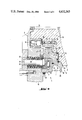
  • FIG. 4 shows that the axial projection 12 with the free runner 11 disposed thereon and the drive disc 8 mounted on the free runner 11 is arranged in the region between an axial bearing support 13 and an end wall 14 of the rope drum 3.
  • a self-aligning bearing 15 is mounted on the bearing support 13 by means of which the rope drum 3 is journalled in a housing wall 16.
  • the free runner 11 has a bearing 17 mounted on each side thereof and is located with these bearings 17 in an annular gap 18 located between the axial projection 12 and the drive disc 8.
  • the annular gap 18 is bounded on the side facing toward end wall 14 by a spacer ring 19.
  • a disc 20 is located on the side of the annular gap 18 opposite to self-aligning bearing 15.
  • a bearing 22 is mounted and is configured as a needle thrust bearing.
  • two radial sealing rings 23, 24 are provided of which one radial sealing ring 23 is journalled under the bearing 22 also between the end wall 14 of the drum 3 and the end face 21 of the drive disc 8 whereas, the other radial sealing ring 24 is located on the opposite side between the drive disc 8 and the housing wall 16.
  • a sealing ring 26 is journalled above the bearing 22 in a separation gap 25 near the peripheral groove 5 between the end wall 14 and the end face 21 so that the bearing 22 is shielded from the outside against dirt.
  • the axially displaceable tightening disc 9 is journalled on a collar 27 formed on the drive disc 8.
  • a further sealing ring 28 is provided on the outside between the tightening disc 9 and the housing wall 16.
  • the tightening disc 9 is pressed in a direction against the rope 6 by means of the force of a spring-loaded biasing unit 29.
  • the spring-loaded biasing unit 29 includes multi-layered saucer springs 30 through which a pin 31 passes.
  • the pin 31 is journalled in an annular disc 32 which is fixedly attached outside on the housing wall 16.
  • the pin 31 presses against a pressure disc 33 which, in turn, acts against the needle bearing 34 which is journalled in a recess of the tightening disc 9 between the latter and the pressure disc 33.
  • the pressure disc 8 includes a peripheral projection 35 which has a concave lateral surface 36 defining a portion of the run-out groove 7.
  • the tightening disc 9 has a likewise concave surface portion 37 which defines a portion of the run-out groove 7.
  • the peripheral projection 35 On the side lying opposite the lateral surface 36, the peripheral projection 35 has a concave surface 38 which defines in part the peripheral groove 5 of the rope drum 3 disposed next to the run-out groove 7.
  • the separately configured drive disc 8 and the interposition of the free runner 11 assure that the rope 6 will form no loops when pulled out also when it is dirty; instead, it will atuomatically come to a standstill if no tension force is applied forward on the rope 6 during pull-out.
  • the drive disc and free runner configuration according to the invention provide a substantially simpler solution with respect to known measures which is substantially free of maintenance and failure. It is understood that the foregoing description is that of the preferred embodiments of the invention and that various changes and modifications may be made thereto without departing from the spirit and scope of the invention as defined in the appended claims.

Landscapes

  • Engineering & Computer Science (AREA)
  • Mechanical Engineering (AREA)
  • Pulleys (AREA)
  • Transmission Devices (AREA)
  • Devices For Conveying Motion By Means Of Endless Flexible Members (AREA)
  • Gear Transmission (AREA)
  • Manufacture Of Motors, Generators (AREA)
  • Windings For Motors And Generators (AREA)

Abstract

A winch is disclosed having at least one rope drum which includes a run-out groove on its periphery in which a rope is guided. The run-out groove is bounded in part by a tightening disc which is pressable against one side of the rope. The run-out groove for the rope is configured on a drive disc which is configured so as to be separate from the rope drum. The drive disc is coupled with the rope drum via a free runner and in such a manner that an operative connection existing when the rope is run out under load is interrupted when the load is removed from the rope.

Description

FIELD OF THE INVENTION
The invention relates to a winch with at least one rope drum and a member defining a run-out groove for guiding the rope. The run-out groove is bounded by a tightening disc pressable against the rope.
BACKGROUND OF THE INVENTION
The known winches of this kind are most often equipped with at least two drums arranged so as to be spaced from each other and parallel to each other. A wire rope is slung about the rope drums and is guided in grooves formed on the peripheral surface of the rope drums. Both rope drums are driven by a motor via a corresponding branching gear transmission. One of the two rope drums has a run-out groove for the rope which is bounded by a tightening disc. This tightening disc is configured so that it is pressable against the one side of the rope.
The rope to which the load is attachable, can be run out via the drive motor which most often is configured as an oil motor and by means of corresponding switching of the transmission. If the rope is unloaded so that no load is suspended from the rope, the rope must be pulled out by hand. If this does not happen, the rope runs against a hydraulic contact switch which actuates a hydraulic valve. Hydraulic oil is transmitted into a piston-cylinder displacement unit through the hydraulic valve. The tightening disc is pulled away from the cable rope via the displacement unit whereby the force flow or frictional engagement is interrupted. The hydraulic piston-cylinder displacement unit is most expensive and difficult to produce because tight tolerances and precise workmanship must be maintained.
A further disadvantage is that, for example, because of inadequate sealing in the hydraulic displacement unit, the operational reliability is affected so that a large residual frictional engagement remains in the region of the run-out groove so that this can lead to the undesired formation of loops when the rope is run out. Such a formation of loops can often not be prevented also with respect to a dirty rope because of the frictional engagement conditions utilized in the region of the run-out groove.
SUMMARY OF THE INVENTION
It is an object of the invention to provide a winch which makes it unnecessary to utilize a costly hydraulic displacement unit and to provide a trouble-free run-out of the rope from the winch without the formation of loops dependent upon the tension in the rope.
The winch of the invention includes a frame housing; and, at least one rope drum assembly mounted in the frame housing. The rope drum assembly includes a rope drum rotatably mounted in the housing and defining groove means for guiding a rope thereon; a drive disc disposed adjacent the rope drum and defining a run-out groove for the rope; free runner means for establishing an operative connection between the drive disc and the rope drum when the rope is pulled out under load from the run-out groove and for interrupting the operative connection when the rope becomes unloaded; and, tightening means for pressing against the rope as it is run out from the run-out groove.
Preferred embodiments of the invention as well as the advantages and the essential details thereof are disclosed in the drawing and the description and the claims which follow.
BRIEF DESCRIPTION OF THE DRAWING
The invention will now be described with reference to the drawing wherein:
FIG. 1 is a perspective view of the winch according to the invention;
FIG. 2 is a side elevation view, partially in section, of the winch of FIG. 1;
FIG. 3 is a section view taken along lines III--III of FIG. 2;
FIG. 4 is an enlarged view in the region of the run-out groove of a rope drum of the winch of FIGS. 3 and 5;
FIG. 5 is a horizontal section view taken through the winch of FIG. 1.
DESCRIPTION OF THE PREFERRED EMBODIMENTS OF THE INVENTION
The winch of FIG. 1 includes a frame housing 2 wherein two rope drums 3, 4 are rotatably journalled and are arranged so as to be mutually parallel and in spaced relationship to each other. The two rope drums 3, 4 are driven via a motor M which is preferably configured as an oil motor. A branching gear transmission G is mounted after the drive motor. The transmission G is preferably configured as a gear wheel transmission for a mecnanically rigid drive connection and both rope drums 3, 4 are moved with the same rotational speed. The rope drums 3, 4 have peripheral grooves 5 in which the rope 6 is guided. A load L (not shown) is attachable to the rope 6 which is slung around both rope drums 3, 4.
If the load L is pulled in as indicated by arrow F, the rope 6 first runs in on the rope drum 3. The rope 6 leaves the rope drum 3 at the other side in the region of a run-out groove 7. The run-out groove 7 is configured on the periphery of a drive disc 8 which is configured to be separate from the rope drum 3 and is, however, journalled thereon. The run-out groove 7 is bounded by a tightening disc 9 which is pressable against the side of the rope 6.
During work with the winch 1, the rope 6 can, for example, become intensely dirtied with mud or the like. When the dirt is deposited in the peripheral grooves 5 when pulling in the rope 6, a change of the diameter of the rope drum occurs. Once a dirt layer 10 builds up in the peripheral grooves 5, different peripheral velocities then occur as a consequence thereof on the rope drums 3, 4 in the region where the rope 6 is slung about the drums, the rope drums 3, 4 being driven at the same rotational speed. In order to compensate for the different conditions in the region of the winch 1 occurring when the rope 6 becomes dirty, it is advantageous to provide a slip clutch for use when pulling in the rope 6. Such a slip clutch can be mounted on either rope drum 3 or rope drum 4 or also on both rope drums 3, 4 and is preferably configured as a laminar coupling. In this connection, reference may be had to my copending application entitled "Winch having a Slip Clutch".
When working in the opposite direction, that is when the rope 6 is run out of the winch 1 and it is desired to make certain that no loops form when the rope tension becomes inadequate, and that, instead, the rope is caused to stop immediately, a free-runner 11 is provided pursuant to the invention on which the drive disc 8 is journalled. The free runner 11 is located on an axial projection 12 of the rope drum 3 and is so configured that an operative connection for an unloaded rope 6 is immediately discontinued, the operative connection existing when the rope 6 is run out under load. The drive disc 8 comes to an immediate standstill when the rope 6 is unloaded since sufficient friction is no longer provided via the free runner 11 for driving the rope drum 3. Only when an adequate tension force acts on rope 6, is the frictive engagement on the free runner 11 so large that the drive disc 8 rotates therewith to run out the rope 6.
FIG. 4 shows that the axial projection 12 with the free runner 11 disposed thereon and the drive disc 8 mounted on the free runner 11 is arranged in the region between an axial bearing support 13 and an end wall 14 of the rope drum 3. A self-aligning bearing 15 is mounted on the bearing support 13 by means of which the rope drum 3 is journalled in a housing wall 16.
The free runner 11 has a bearing 17 mounted on each side thereof and is located with these bearings 17 in an annular gap 18 located between the axial projection 12 and the drive disc 8. The annular gap 18 is bounded on the side facing toward end wall 14 by a spacer ring 19. A disc 20 is located on the side of the annular gap 18 opposite to self-aligning bearing 15.
Further, between an end face 21 of the drive disc 8 and the end wall 14 of the rope drum 3, a bearing 22 is mounted and is configured as a needle thrust bearing. In addition, two radial sealing rings 23, 24 are provided of which one radial sealing ring 23 is journalled under the bearing 22 also between the end wall 14 of the drum 3 and the end face 21 of the drive disc 8 whereas, the other radial sealing ring 24 is located on the opposite side between the drive disc 8 and the housing wall 16. A sealing ring 26 is journalled above the bearing 22 in a separation gap 25 near the peripheral groove 5 between the end wall 14 and the end face 21 so that the bearing 22 is shielded from the outside against dirt.
The axially displaceable tightening disc 9 is journalled on a collar 27 formed on the drive disc 8. On the outside between the tightening disc 9 and the housing wall 16, a further sealing ring 28 is provided to prevent the ingress of dirt.
The tightening disc 9 is pressed in a direction against the rope 6 by means of the force of a spring-loaded biasing unit 29. The spring-loaded biasing unit 29 includes multi-layered saucer springs 30 through which a pin 31 passes. The pin 31 is journalled in an annular disc 32 which is fixedly attached outside on the housing wall 16. The pin 31 presses against a pressure disc 33 which, in turn, acts against the needle bearing 34 which is journalled in a recess of the tightening disc 9 between the latter and the pressure disc 33.
The pressure disc 8 includes a peripheral projection 35 which has a concave lateral surface 36 defining a portion of the run-out groove 7. The tightening disc 9 has a likewise concave surface portion 37 which defines a portion of the run-out groove 7. On the side lying opposite the lateral surface 36, the peripheral projection 35 has a concave surface 38 which defines in part the peripheral groove 5 of the rope drum 3 disposed next to the run-out groove 7.
The separately configured drive disc 8 and the interposition of the free runner 11 assure that the rope 6 will form no loops when pulled out also when it is dirty; instead, it will atuomatically come to a standstill if no tension force is applied forward on the rope 6 during pull-out. Also, the drive disc and free runner configuration according to the invention provide a substantially simpler solution with respect to known measures which is substantially free of maintenance and failure. It is understood that the foregoing description is that of the preferred embodiments of the invention and that various changes and modifications may be made thereto without departing from the spirit and scope of the invention as defined in the appended claims.
Claims (11)

What is claimed is:
1. A winch comprising:
a frame housing;
at least one rope drum assembly mounted in said frame housing and including;
a rope drum rotatably mounted in said housing and defining groove means for guiding a rope thereon;
a drive disc disposed adjacent said rope drum and defining a run-out groove for the rope;
bearing means for rotatably journalling said drive disc on said rope drum so as to cause said drive disc and said rope drum to conjointly define an interface region therebetween;
free runner means for establishing an operative connection between said drive disc and said rope when the rope is pulled out under load from said run-out groove and for interrupting said operative connection when the rope becomes unloaded, said free runner means being a free runner assembly including a free runner disposed in said interface region for developing a frictive engaging force between said drive disc and said rope drum in response to an adequate tension applied to the rope so as to cause said drive disc to rotate with said rope drum for running out the rope; and, tightening means for pressing against the rope as it is run out from said run-out groove.
2. A winch comprising:
a frame housing;
at least one rope drum assembly mounted in said frame housing and including:
a rope drum rotatably mounted in said housing and defining groove means for guiding a rope thereon, said rope drum having an axial shoulder formed thereon;
a drive disc rotatably journalled on said rope drum and defining a run-out groove for the rope;
free runner means for establishing an operative connection between said drive disc and said rope drum when the rope is pulled out under load from said run-out groove and for interrupting said operative connection when the rope becomes unloaded, said free runner means being a free runner assembly including a free runner disposed between said drive disc and said mounting shoulder for developing a frictive engaging force between said drive disc and said rope drum in response to an adequate tension applied to the rope so as to cause said drive disc to rotate with the rope drum for running out the rope; and,
tightening means for pressing against the rope as it is run out from said run-out groove.
3. The winch of claim 2, said tightening means comprising a tightening disc mounted on said frame housing and bounding said run-out groove; and, biasing means for biasing said tightening disc against the rope.
4. The winch of claim 3, said rope drum having an end wall extending radially outwardly from said axial mounting shoulder; said axial mounting shoulder having a bearing support for said rope drum extending therefrom and said mounting shoulder being disposed between said end wall and said bearing support.
5. The winch of claim 4, said free runner assembly including two end bearings disposed on respective lateral sides of said free runner, said drive disc and said mounting shoulder conjointly defining a gap therebetween for accommodating said end bearings and said free runner therein; and, said winch further comprising a spacer ring bounding said gap on the side thereof facing said end wall of said rope drum; a self-aligning bearing disposed between said housing and said bearing support for supporting said rope drum on said housing; and, a disc bounding said gap on the side thereof facing toward said self-aligning bearing.
6. The winch of claim 5, said drive disc having an end face facing said end wall of said rope drum; and, said winch further comprising bearing means disposed between said end face of said drive disc and said end wall of said rope drum.
7. The winch of claim 6, said housing having a wall adjacent said drive disc, said winch further comprising a first radial seal disposed between said last-mentioned wall and said drive disc; and, a second radial seal disposed between said end face of said drive disc and said end wall of said rope drum.
8. The winch of claim 7, said groove means including a groove next to said run-out groove, said winch further comprising a sealing ring disposed near said groove of said groove means and between said end face of said drive disc and said end wall of said rope drum, said bearing means being mounted in the region between said last-mentioned sealing ring and said second radial seal.
9. The winch of claim 3, said drive disc having a shoulder formed thereon, said tightening disc being mounted on said last-mentioned shoulder so as to be displaceable against the rope, said biasing means comprising spring means mounted in said housing for resiliently biasing said tightening disc against said rope.
10. The winch of claim 9, said biasing means comprising a press disc for pressing said tightening disc toward the rope, and a pin spring-loaded by said spring means for pressing said press disc against said tightening disc; and, needle bearing means disposed between said press disc and said tightening disc.
11. The winch of claim 8, said drive disc having a peripheral projection having a first lateral wall surface defining a portion of said groove next to said run-out groove and having a second lateral wall surface defining a portion of said run-out groove.
US06/762,107 1984-08-04 1985-08-02 Winch having a drive disc connectable to a rope drum in dependence upon the load applied to the rope Expired - Lifetime US4632363A (en)

Applications Claiming Priority (2)

Application Number Priority Date Filing Date Title
DE19843428875 DE3428875A1 (en) 1984-08-04 1984-08-04 CONTINUOUS WINCH
DE3428875 1984-08-04

Publications (1)

Publication Number Publication Date
US4632363A true US4632363A (en) 1986-12-30

Family

ID=6242415

Family Applications (1)

Application Number Title Priority Date Filing Date
US06/762,107 Expired - Lifetime US4632363A (en) 1984-08-04 1985-08-02 Winch having a drive disc connectable to a rope drum in dependence upon the load applied to the rope

Country Status (9)

Country Link
US (1) US4632363A (en)
JP (1) JPS6145893A (en)
CA (1) CA1254877A (en)
CH (1) CH667074A5 (en)
DE (1) DE3428875A1 (en)
FR (1) FR2568558B1 (en)
GB (1) GB2164621B (en)
IT (1) IT1215297B (en)
SE (1) SE8503659L (en)

Cited By (2)

* Cited by examiner, † Cited by third party
Publication number Priority date Publication date Assignee Title
US5314166A (en) * 1991-10-07 1994-05-24 Muir Engineering Pty. Limited Self-tailing winch with free-fall capacity
US20230135307A1 (en) * 2021-10-29 2023-05-04 Hall Labs Llc Winch

Families Citing this family (1)

* Cited by examiner, † Cited by third party
Publication number Priority date Publication date Assignee Title
NL1012187C1 (en) * 1999-05-31 2000-12-01 Leppink Kampen Beheer Hoist.

Citations (8)

* Cited by examiner, † Cited by third party
Publication number Priority date Publication date Assignee Title
US3120043A (en) * 1962-06-01 1964-02-04 Henley J Carl Self locking cleat
GB1335659A (en) * 1969-11-21 1973-10-31 W C Coombs Winch
US3776519A (en) * 1972-01-11 1973-12-04 Fairey Winches Ltd Cable handling apparatus
US3887164A (en) * 1969-11-21 1975-06-03 William Charles Coombs Winch
US3968953A (en) * 1975-01-27 1976-07-13 Barient Company Self-tailing winch
DE2517796A1 (en) * 1975-04-22 1976-11-04 Rotzler Ohg Continuous winch with two discs of multi-grooved construction - unloaded cable can be tensioned in run off groove transverse to run off direction
US4193311A (en) * 1975-05-17 1980-03-18 Greifzug Gesellschaft Fur Hebezeugbau M.B.H. Driving pulley mechanism
US4225119A (en) * 1977-09-01 1980-09-30 Rotzler Gmbh & Co. Spezialfabrik Fur Seilwinden Und Hebezeuge Continuous winch

Family Cites Families (12)

* Cited by examiner, † Cited by third party
Publication number Priority date Publication date Assignee Title
FR1105165A (en) * 1952-10-17 1955-11-28 Entpr S Soc Gen Winch improvements
DE1221413B (en) * 1961-10-25 1966-07-21 Nautec Corp Cable winch with two traction sheaves and a storage drum
FR1381295A (en) * 1963-07-31 1964-12-14 Entpr S Soc Gen Winch for unwinding cables
GB1148995A (en) * 1967-10-25 1969-04-16 Theodore J Koenig Cable Winch Assembly
GB1238290A (en) * 1967-11-14 1971-07-07
GB1305899A (en) * 1969-03-11 1973-02-07
US3966170A (en) * 1971-05-19 1976-06-29 Ocean Systems, Inc. Traction winch
GB1345124A (en) * 1972-03-17 1974-01-30 Schat Davits Ltd Winch mechanism for lowring a lifeboat launach or the like suspended from two falls into the water and hoisting it out of the water
US3915433A (en) * 1974-10-10 1975-10-28 Caterpillar Tractor Co Disconnect clutch assembly for winch drum
CH644083A5 (en) * 1980-01-18 1984-07-13 Schneider August Co Ag Capstan winch
GB2127917B (en) * 1982-09-28 1986-01-29 Eric Southam Two speed reduction gearbox
DE3428874A1 (en) * 1984-08-04 1986-02-13 Rotzler GmbH + Co Spezialfabrik für Seilwinden und Hebezeuge, 7853 Steinen CONTINUOUS WINCH

Patent Citations (8)

* Cited by examiner, † Cited by third party
Publication number Priority date Publication date Assignee Title
US3120043A (en) * 1962-06-01 1964-02-04 Henley J Carl Self locking cleat
GB1335659A (en) * 1969-11-21 1973-10-31 W C Coombs Winch
US3887164A (en) * 1969-11-21 1975-06-03 William Charles Coombs Winch
US3776519A (en) * 1972-01-11 1973-12-04 Fairey Winches Ltd Cable handling apparatus
US3968953A (en) * 1975-01-27 1976-07-13 Barient Company Self-tailing winch
DE2517796A1 (en) * 1975-04-22 1976-11-04 Rotzler Ohg Continuous winch with two discs of multi-grooved construction - unloaded cable can be tensioned in run off groove transverse to run off direction
US4193311A (en) * 1975-05-17 1980-03-18 Greifzug Gesellschaft Fur Hebezeugbau M.B.H. Driving pulley mechanism
US4225119A (en) * 1977-09-01 1980-09-30 Rotzler Gmbh & Co. Spezialfabrik Fur Seilwinden Und Hebezeuge Continuous winch

Cited By (3)

* Cited by examiner, † Cited by third party
Publication number Priority date Publication date Assignee Title
US5314166A (en) * 1991-10-07 1994-05-24 Muir Engineering Pty. Limited Self-tailing winch with free-fall capacity
US20230135307A1 (en) * 2021-10-29 2023-05-04 Hall Labs Llc Winch
US12391524B2 (en) * 2021-10-29 2025-08-19 Hall Logic, Inc. Winch

Also Published As

Publication number Publication date
GB2164621A (en) 1986-03-26
SE8503659L (en) 1986-02-05
GB8519514D0 (en) 1985-09-11
IT8521861A0 (en) 1985-08-02
SE8503659D0 (en) 1985-07-31
GB2164621B (en) 1987-09-16
DE3428875A1 (en) 1986-02-13
FR2568558A1 (en) 1986-02-07
CH667074A5 (en) 1988-09-15
JPS6145893A (en) 1986-03-05
IT1215297B (en) 1990-01-31
CA1254877A (en) 1989-05-30
FR2568558B1 (en) 1989-03-03

Similar Documents

Publication Publication Date Title
CA2225887C (en) Power take-off unit with selectively engaged brake
US2428336A (en) Fluid operated clutch
US4078770A (en) Winch with free-wheeling drum
JPS6159405B2 (en)
US3889785A (en) Disc brake unit
US5299780A (en) Rope traction device
GB2164620A (en) Winch
US4903806A (en) Hydraulically actuated release mechanism for a clutch
US4632363A (en) Winch having a drive disc connectable to a rope drum in dependence upon the load applied to the rope
EP0107329B1 (en) Hydraulically actuated starting clutch assembly
US3685371A (en) Reversing transmission
US3853303A (en) Winch brake assembly
KR100508017B1 (en) Wiping cylinder drive of intaglio printing machine
US4463933A (en) Clutch/brake mechanism
US4650162A (en) Winch having a compact housing
JPH08219296A (en) Slip ring type seal device
JPH01236189A (en) Winding machine for elevator
US3071222A (en) Winch
US3042169A (en) Transmission
JPH0523858Y2 (en)
KR100543018B1 (en) Winch
KR940008074Y1 (en) Press
SU1094837A1 (en) Disc brake of hoisting machine
CA1155778A (en) Clutch/brake mechanism
JPH0668307B2 (en) Anti-rotation structure for wet multi-plate clutch

Legal Events

Date Code Title Description
AS Assignment

Owner name: ROTZLER GMBH & CO.. SPEZIALFABRIK FUR SEILWINDEN U

Free format text: ASSIGNMENT OF ASSIGNORS INTEREST.;ASSIGNOR:FROMMHERZ, EGON;REEL/FRAME:004468/0164

Effective date: 19850925

STCF Information on status: patent grant

Free format text: PATENTED CASE

CC Certificate of correction
FEPP Fee payment procedure

Free format text: PAT HOLDER CLAIMS SMALL ENTITY STATUS - SMALL BUSINESS (ORIGINAL EVENT CODE: SM02); ENTITY STATUS OF PATENT OWNER: SMALL ENTITY

FPAY Fee payment

Year of fee payment: 4

FPAY Fee payment

Year of fee payment: 8

FPAY Fee payment

Year of fee payment: 12