US4048017A - Introduction of nutrient medium into a fermenter - Google Patents
Introduction of nutrient medium into a fermenter Download PDFInfo
- Publication number
- US4048017A US4048017A US05/601,494 US60149475A US4048017A US 4048017 A US4048017 A US 4048017A US 60149475 A US60149475 A US 60149475A US 4048017 A US4048017 A US 4048017A
- Authority
- US
- United States
- Prior art keywords
- culture
- nutrient
- fermenter
- limiting nutrient
- supplied
- Prior art date
- Legal status (The legal status is an assumption and is not a legal conclusion. Google has not performed a legal analysis and makes no representation as to the accuracy of the status listed.)
- Expired - Lifetime
Links
Images


Classifications
-
- C—CHEMISTRY; METALLURGY
- C12—BIOCHEMISTRY; BEER; SPIRITS; WINE; VINEGAR; MICROBIOLOGY; ENZYMOLOGY; MUTATION OR GENETIC ENGINEERING
- C12N—MICROORGANISMS OR ENZYMES; COMPOSITIONS THEREOF; PROPAGATING, PRESERVING, OR MAINTAINING MICROORGANISMS; MUTATION OR GENETIC ENGINEERING; CULTURE MEDIA
- C12N1/00—Microorganisms; Compositions thereof; Processes of propagating, maintaining or preserving microorganisms or compositions thereof; Processes of preparing or isolating a composition containing a microorganism; Culture media therefor
- C12N1/32—Processes using, or culture media containing, lower alkanols, i.e. C1 to C6
-
- C—CHEMISTRY; METALLURGY
- C12—BIOCHEMISTRY; BEER; SPIRITS; WINE; VINEGAR; MICROBIOLOGY; ENZYMOLOGY; MUTATION OR GENETIC ENGINEERING
- C12M—APPARATUS FOR ENZYMOLOGY OR MICROBIOLOGY; APPARATUS FOR CULTURING MICROORGANISMS FOR PRODUCING BIOMASS, FOR GROWING CELLS OR FOR OBTAINING FERMENTATION OR METABOLIC PRODUCTS, i.e. BIOREACTORS OR FERMENTERS
- C12M27/00—Means for mixing, agitating or circulating fluids in the vessel
- C12M27/18—Flow directing inserts
- C12M27/24—Draft tube
-
- C—CHEMISTRY; METALLURGY
- C12—BIOCHEMISTRY; BEER; SPIRITS; WINE; VINEGAR; MICROBIOLOGY; ENZYMOLOGY; MUTATION OR GENETIC ENGINEERING
- C12N—MICROORGANISMS OR ENZYMES; COMPOSITIONS THEREOF; PROPAGATING, PRESERVING, OR MAINTAINING MICROORGANISMS; MUTATION OR GENETIC ENGINEERING; CULTURE MEDIA
- C12N1/00—Microorganisms; Compositions thereof; Processes of propagating, maintaining or preserving microorganisms or compositions thereof; Processes of preparing or isolating a composition containing a microorganism; Culture media therefor
-
- Y—GENERAL TAGGING OF NEW TECHNOLOGICAL DEVELOPMENTS; GENERAL TAGGING OF CROSS-SECTIONAL TECHNOLOGIES SPANNING OVER SEVERAL SECTIONS OF THE IPC; TECHNICAL SUBJECTS COVERED BY FORMER USPC CROSS-REFERENCE ART COLLECTIONS [XRACs] AND DIGESTS
- Y10—TECHNICAL SUBJECTS COVERED BY FORMER USPC
- Y10S—TECHNICAL SUBJECTS COVERED BY FORMER USPC CROSS-REFERENCE ART COLLECTIONS [XRACs] AND DIGESTS
- Y10S435/00—Chemistry: molecular biology and microbiology
- Y10S435/813—Continuous fermentation
-
- Y—GENERAL TAGGING OF NEW TECHNOLOGICAL DEVELOPMENTS; GENERAL TAGGING OF CROSS-SECTIONAL TECHNOLOGIES SPANNING OVER SEVERAL SECTIONS OF THE IPC; TECHNICAL SUBJECTS COVERED BY FORMER USPC CROSS-REFERENCE ART COLLECTIONS [XRACs] AND DIGESTS
- Y10—TECHNICAL SUBJECTS COVERED BY FORMER USPC
- Y10S—TECHNICAL SUBJECTS COVERED BY FORMER USPC CROSS-REFERENCE ART COLLECTIONS [XRACs] AND DIGESTS
- Y10S435/00—Chemistry: molecular biology and microbiology
- Y10S435/818—Aeration or oxygen transfer technique
-
- Y—GENERAL TAGGING OF NEW TECHNOLOGICAL DEVELOPMENTS; GENERAL TAGGING OF CROSS-SECTIONAL TECHNOLOGIES SPANNING OVER SEVERAL SECTIONS OF THE IPC; TECHNICAL SUBJECTS COVERED BY FORMER USPC CROSS-REFERENCE ART COLLECTIONS [XRACs] AND DIGESTS
- Y10—TECHNICAL SUBJECTS COVERED BY FORMER USPC
- Y10S—TECHNICAL SUBJECTS COVERED BY FORMER USPC CROSS-REFERENCE ART COLLECTIONS [XRACs] AND DIGESTS
- Y10S435/00—Chemistry: molecular biology and microbiology
- Y10S435/8215—Microorganisms
- Y10S435/822—Microorganisms using bacteria or actinomycetales
- Y10S435/874—Pseudomonas
Definitions
- nutrient medium comprising a carbon source and sources or organic and/or inorganic nutrients being continuously supplied to a fermenter at a rate substantially the same as that at which culture is removed from the fermenter.
- the carbon source and the various organic and/or inorganic nutrients may be supplied to the fermenter as separate feeds or all or most of them may be supplied as a single feed.
- ammonia is a suitable nitrogen source and may be supplied to the fermenter as a separate feed, the other inorganic nutrients and the carbon source being supplied as a single feed.
- microbial cells are separated from the culture removed from the fermenter and the remaining medium may be combined with fresh nutrients which are being supplied to the fermenter.
- the culture medium into which an organism is inoculated may be designed such that any of the required nutrients, eg nitrogen, phosphorus, magnesium or iron or the carbon source may be present in such quantities as to be limiting to growth with respect to the other constituents of the medium. This may be used to regulate the growth of the culture.
- the nutrient present in growth limiting quantities is referred to as the limiting nutrient.
- Industrial fermentation processes are preferably performed in large fermenters.
- the limiting nutrient is supplied to the culture at one or at a small number of possitions such that substantial amounts of the limiting nutrient enter the culture at these positions.
- concentration of the limiting nutrient in the culture is greater than it is elsewhere.
- another nutrient, particularly oxygen in aerobic fermentations is completely used up by the microorganisms present in the culture before all the designed limiting nutrient is consumed.
- the other nutrient eg oxygen in an aerobic fermentation, effectively becomes the limiting nutrient often to the detriment of the growth of the culture.
- the present invention we provide a method for the continuous fermentation of a culture comprising a nutrient medium, one of the constituents of which is a growth limiting nutrient, and microorganisms capable of utilizing the medium for growth wherein the growth limiting nutrient is supplied to the culture at sufficient positions and in such amounts at each position that substantially all the limiting nutrient supplied at each position is consumed by the microorganisms present in the culture in the vicinity of that position before another nutrient available to them in the culture in the vicinity of that position is exhausted and becomes the limiting nutrient.
- a fermenter having means for continuously supplying a nutrient medium thereinto, means for continuously removing culture therefrom, the means for supplying nutrient medium thereinto including means whereby a limiting nutrient is supplied to the fermenter at sufficient positions and in such amounts at each position that substantially all the limiting nutrient supplied at each position is consumed by microorganisms present in a culture in the fermenter in the vicinity of that position before another nutrient available to the microorganisms in the vicinity of that position is exhausted and becomes the limiting nutrient.
- the fermenter may be any type of fermenter eg a tank wherein circulation of the culture is induced by mechanical stirring or, in the case of an aerobic fermentation, by blowing air thereinto.
- a fermenter such as those described in our UK Specification No. 1,353,008 or our co-pending UK Applications Nos. 23330/73, 24266/75 and 52430/74 comprising a riser and a downcomer connected at their upper and lower ends and wherein circulation of culture around the system is caused by injecting an oxygen-containing gas such as air into the lower part of the riser.
- the present invention is very suitable for use in aerobic fermentations and may be usefully employed in bacterial fermentations such as the process of our UK Specification No.
- the invention has the main advantage that it avoids regions developing in the fermenter wherein the culture grows in effective oxygen limitation, ie all the oxygen available to the microorganisms has been used up in a region in which supplies of the limiting nutrient, usually the carbon source are still available. In the specification such regions will be termed regions of "oxygen shadow".
- the limiting nutrient is suitably supplied to the fermenter at an average of at least one position per cubic meter of the effective volume of the fermenter, preferably at 3 to 6 positions per cubic meter.
- the effective volume of the fermenter we mean that volume which is occupied by the culture and in which gasification of, nutrient utilization by and growth of the microorganisms present in the culture is taking place.
- the effective volume for microorganism growth is that part of the volume in which, through mass transfer from gas bubbles, a positive dissolved oxygen tension (partial pressure of oxygen) can be maintained.
- the effective volume is effectively the whole volume of the tank occupied by the culture.
- a fermenter such as those of our UK Specification No. 1,353,008 or UK Applications Nos. 23330/73, 24266/75 or 52430/74 it comprises the riser of the fermenter and can in some cases include all or part of the downcomer.
- the amount of nutrient supplied to the culture at any position is that which corresponds stoichiometrically with the locally available supply of any nutrient such as oxygen which is available to microorganisms present in the culture and the exhaustion of the supply of which, thus making it effectively the limiting nutrient, would be detrimental to the growth of the culture.
- any nutrient such as oxygen which is available to microorganisms present in the culture and the exhaustion of the supply of which, thus making it effectively the limiting nutrient, would be detrimental to the growth of the culture.
- the amount of nutrient supplied at any position would usually be that which corresponds stoichiometrically with the amount of oxygen that can be taken up by the culture.
- the amount of methanol supplied through any single dispersing means such as a nozzle or other orifice at any position suitably does not exceed 15 l/hr, being preferably 2 to 6 l/hr.
- the rate of methanol injection from each dispersing means is designed with reference to the local availability of oxygen which will depend on the pressure and hence on the position in the fermenter.
- the methanol is mixed with recycle nutrient medium before being supplied to the fermenter. It is also preferred that the methanol containing medium is supplied to the culture through narrow orifices, eg within the size range 2mm to 6mm diameter at a velocity above 3 meters/sec. especially above 6 meters/sec.
- the limiting nutrient may be supplied to the culture through a wide variety of sparging systems made up of tubes.
- One suitable arrangement comprises a plurality of substantially vertical tubes distributed within the fermenter at the corners of one or more regular polygons and connected to at least one common source of nutrient medium or limiting nutrient, the wall of each vertical tube being perforated by holes whose frequency varies suitably along the line of flow of upwardly -- or downwardly -- flowing culture, successive holes in the line of flow being spaced around the circumference of the tube in a regular pattern.
- the number of substantially vertical tubes is preferably from 4 to 16 distributed at the corners of one or more coaxial regular figures.
- These tubes are preferably connected to one or more circular tubes of larger bore which encircle the regular polygon or polygons and are connected to a source of medium containing the limiting nutrient.
- the vertical tubes may also be connected to a plurality of such circular supply tube systems, eg 3, spaced at regular intervals along the height of the vertical tubes and connected to different supply sources.
- the circular tubes are preferably positioned at the lower ends of the vertical tubes.
- each vertical tube may contain 50 to 200 holes, especially about 100 holes.
- the number of holes per tube may suitably be 55, 30 and 15 in the three levels respectively.
- the diameter of the outer polygon is preferably between 0.4 and 0.65 times that of the riser whilst the diameter of the outer polygon is between 0.65 and 0.9 times.
- the riser contains baffles or other internal fittings these are preferably arranged to present no obstacle to the vertical tubes.
- the holes in the tubes are preferably of diameter between 2 and 6mm and are preferably disposed around the tube walls in a regular pattern eg a spiral or alternatively pointing inward and outward relative to the axis of the fermenter vessel.
- the spargers are located at a series of levels along the length of the main tube, there being a plurality of spargers at each level.
- the spargers are located in radial slots in the baffles thereby ensuring that the limiting nutrient is introduced into the culture in regions where there is a high velocity of flow due to the restriction in the cross-sectional area of the riser caused by the baffles.
- the risers of the fermenters of the UK Specification No. 1,353,008 and co-pending UK Applications Nos. 23330/73, 24266/75 and 52430/74 preferably contain series of baffles to control the flow of culture. These baffles may be for example at intervals of 1.2 meters in the riser. Preferably each baffle closes about five-sixths of the cross-sectional area of the riser leaving only one-sixth of the area open for culture to flow through. The open area may be distributed over a number of radial slots, eg 16, each of which may be bridged to close off half of its area thereby obtaining a reasonable slot width.
- the openings in the solid baffles need not be radial slots but can be openings of any shape provided that the baffle constrains the flow through the riser of the fermenter to a cross-sectional area small enough to achieve the required increase in velocity, suitably to a velocity above 1 meter/second.
- the openings in the baffles could be circular.
- the spargers are arranged to inject the limiting nutrient into the regions of high velocity flow through the baffle openings.
- the riser is divided into sections one vertically above the other, said sections having different cross-sectional areas and forming a ⁇ pot ⁇ and a ⁇ spout ⁇ the baffles are installed in both sections.
- the limiting nutrient is introduced into the fermenter in regions of high velocity flow, i.e., flow velocity greater than 1 meter/second. This can be done by introducing the limiting nutrient into the culture through injection nozzles or multiple nozzles such as spargers into the slots or other gaps in the baffles.
- FIG. 1 is a perspective view of one arrangement.
- FIG. 2 is a diagrammatic representation of one fermenter in which the apparatus may be installed.
- FIG. 3 is a diagramatic representation of a second fermenter in which the apparatus of the invention may be installed.
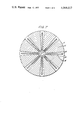
- FIG. 4 is a plan view of the riser of the fermenter shown in FIG. 3 having the arrangement of FIG. 1 installed within it.
- FIG. 5 is a sectional elevation along the line y-y of FIG. 4.
- FIG. 6 is a cross-section through the fermenter shown in FIG. 2 fitted with baffles and having the preferred arrangement installed within it.
- FIG. 6a is an enlarged view of the area within the circle C shown in FIG. 6.
- FIG. 7 is a cross-section through the riser of the fermenter shown in FIG. 3 fitted with baffles and having the preferred arrangement installed within it.
- the apparatus shown in FIG. 1 comprises six vertical medium distribution tubes 1 located at the corners of a regular hexagon and connected to three medium supply tubes 2 located at different levels along the heights of distribution tubes 1, the lowest supply tube being connected to the lower ends of distribution tubes 1.
- Each of supply tubes 2 comprises a circular portion connected to distribution tubes 1 with an outwardly extending portion which is connected to a medium supply (not shown in the drawing).
- Distribution tubes 1 and the circular parts of supply tubes 2 are perforated by a plurality of holes, (not shown in the drawing). These holes occur at intervals along the entire heights of distribution tubes 1 being closer together towards the lower ends of the tubes than at the upper ends, the vertical distance between successive holes increasing up the tubes.
- Successive holes are not located vertically above one another along the tubes 1 but are spaced around the circumference of the tubes forming a suitable pattern, eg a spiral.
- On the circular portions of supply tubes 2 holes are located at substantially equal horizontal distances apart and may also be distributed around the vertical section of the tube, eg by pointing alternatively inward and outward relative to the axis of the fermenter vessel.
- the fermenters shown in FIGS. 2 and 3 each have a riser 6 and a downcomer 5.
- riser 6 is divided into two sections one vertically above the other, the lower section or ⁇ pot ⁇ 4 being of greater cross-sectional area than the upper section or ⁇ spout ⁇ 3.
- ⁇ Pot ⁇ 4 and ⁇ spout ⁇ 3 are linked by connecting piece 7.
- downcomer 5 has two sections one vertically above the other, the upper section or ⁇ choke ⁇ 8 being of greater cross-sectional area than the lower section or ⁇ sink ⁇ 10.
- ⁇ Spout ⁇ 3 opens into ⁇ choke ⁇ 8 whilst the lower end of ⁇ sink ⁇ 10 communicates with ⁇ pot ⁇ 4. Air is sparged into the lower part of ⁇ pot ⁇ 4 through spargers 11 causing culture contained in each fermenter to rise upwardly in the riser and to flow over into ⁇ choke ⁇ 8 and thence pass into ⁇ sink ⁇ 10. Culture fills each fermenter up to the level A--A, the region above level B--B in the ⁇ choke ⁇ being occupied by bubbly culture. It is from the region above level B--B in ⁇ choke ⁇ 8 that gas disengages from the culture to escape through port 12 at the upper end of each fermenter.
- the ⁇ spout ⁇ 3 and ⁇ choke ⁇ 8 and also the ⁇ sink ⁇ 10 and ⁇ pot ⁇ 4 are coaxially located.
- ⁇ spout ⁇ 3 surrounds ⁇ choke ⁇ 8 and ⁇ pot ⁇ 4 surrounds ⁇ sink ⁇ 10 whilst in the fermenter of FIG. 3 the reverse is the case and the ⁇ choke ⁇ and the ⁇ sink ⁇ surround the riser 6.
- FIGS. 4 and 5 show part of riser 6 of the fermenter of FIG. 3 having an apparatus according to the invention installed within it.
- the apparatus has only one supply tube which enters the fermenter at point 9.
- culture medium containing the carbon source and inorganic nutrients is supplied to the culture in riser 6 through supply tube 2 and distribution tubes 1 -- passing into the culture through the holes in the supply tube 2 and distribution tubes 1 at substantially the same rate as culture is removed at a point or points not shown in the drawings.
- riser 6 contains a series of layers of baffles 13 spaced apart vertically, each baffle being divided into segments by slots 14.
- the main vertical tube through which the limiting nutrient enters the fermenter is shown as 17 and is located centrally in riser 6.
- Spargers 15 radiate out from tube 17 at each baffle and are located in slots 14. Limiting nutrient passes from spargers 15 through holes 16 into the culture as it flows at increased velocity through slots 14.
- riser 6 surrounds downcomer 5 and the geometrical arrangement of baffles and spargers differs from that shown in FIG. 7 because of this.
- That of FIGS. 6 and 6a contains a series of layers of baffles 18 spaced apart vertically, each baffle being divided into segments by slots 19.
- the limiting nutrient enters the fermenter through a plurality of vertical tubes 21, two of which pass through each slot 19, being connected in each slot by a sparger 20.
- Limiting nutrient passes from spargers 20 through holes 22 (shown in FIG. 6a) into the culture as it flows at increased velocity through slots 19.
- successive layers of baffles may be staggered with respect to one another as described in our co-pending UK Application No. 13559/74.
- vertical tubes 21 must be bent to accommodate the staggering of the layers of baffles.
Landscapes
- Life Sciences & Earth Sciences (AREA)
- Chemical & Material Sciences (AREA)
- Engineering & Computer Science (AREA)
- Health & Medical Sciences (AREA)
- Organic Chemistry (AREA)
- Zoology (AREA)
- Bioinformatics & Cheminformatics (AREA)
- Wood Science & Technology (AREA)
- Genetics & Genomics (AREA)
- Biotechnology (AREA)
- General Engineering & Computer Science (AREA)
- Microbiology (AREA)
- Biomedical Technology (AREA)
- Biochemistry (AREA)
- General Health & Medical Sciences (AREA)
- Virology (AREA)
- Tropical Medicine & Parasitology (AREA)
- Medicinal Chemistry (AREA)
- Sustainable Development (AREA)
- Micro-Organisms Or Cultivation Processes Thereof (AREA)
- Apparatus Associated With Microorganisms And Enzymes (AREA)
- Preparation Of Compounds By Using Micro-Organisms (AREA)
Applications Claiming Priority (4)
| Application Number | Priority Date | Filing Date | Title |
|---|---|---|---|
| GB3575474A GB1523583A (en) | 1974-08-14 | 1974-08-14 | Introduction of nutrient medium into a continuous fermentation |
| UK35754/74 | 1974-08-14 | ||
| GB2128875 | 1975-05-19 | ||
| UK21288/75 | 1975-05-19 |
Publications (1)
| Publication Number | Publication Date |
|---|---|
| US4048017A true US4048017A (en) | 1977-09-13 |
Family
ID=26255248
Family Applications (1)
| Application Number | Title | Priority Date | Filing Date |
|---|---|---|---|
| US05/601,494 Expired - Lifetime US4048017A (en) | 1974-08-14 | 1975-08-04 | Introduction of nutrient medium into a fermenter |
Country Status (14)
| Country | Link |
|---|---|
| US (1) | US4048017A (enExample) |
| JP (1) | JPS5144686A (enExample) |
| AU (1) | AU501601B2 (enExample) |
| BR (1) | BR7505172A (enExample) |
| CA (1) | CA1052715A (enExample) |
| DE (1) | DE2535925C2 (enExample) |
| DK (1) | DK144642C (enExample) |
| ES (1) | ES440263A1 (enExample) |
| FR (1) | FR2281980A1 (enExample) |
| IT (1) | IT1044662B (enExample) |
| NL (1) | NL182492C (enExample) |
| NO (1) | NO144022C (enExample) |
| NZ (1) | NZ178293A (enExample) |
| SE (1) | SE430789B (enExample) |
Cited By (12)
| Publication number | Priority date | Publication date | Assignee | Title |
|---|---|---|---|---|
| US4306026A (en) * | 1976-04-02 | 1981-12-15 | Imperial Chemical Industries Limited | Process for culturing cells |
| US4782024A (en) * | 1985-11-06 | 1988-11-01 | Imperial Chemical Industries Plc | Fermentation process and fermenter |
| US5013665A (en) * | 1988-11-17 | 1991-05-07 | Idemitsu Kosan Company Limited | Method for regenerating deactivated microorganisms |
| US5219750A (en) * | 1986-02-19 | 1993-06-15 | Imperial Chemical Industries Plc | Production of cyanide hydratase |
| US5714348A (en) * | 1993-11-05 | 1998-02-03 | Hoechst Aktiengesellschaft | Oxygen-dependent fermentation of microorganisms |
| US20070269583A1 (en) * | 2006-05-19 | 2007-11-22 | Mcmindes Matthew K | Protein composition and its use in restructured meat and food products |
| US20080063768A1 (en) * | 2006-09-11 | 2008-03-13 | Vasuhi Rasanayagam | Quick chilling of fry oil under modified atmosphere |
| US20080254199A1 (en) * | 2007-04-05 | 2008-10-16 | Solae, Llc | Colored Structured Protein Products |
| CN102640697A (zh) * | 2011-02-21 | 2012-08-22 | 宏观能源科技有限公司 | 直立式藻类养殖装置 |
| US9907322B2 (en) | 2006-05-19 | 2018-03-06 | Solae Llc | Structured protein product |
| WO2021163217A1 (en) * | 2020-02-11 | 2021-08-19 | Arbela Laboratories, Inc. | Integrated methanol synthesis and fermentation system |
| US11434461B2 (en) * | 2018-03-20 | 2022-09-06 | Keck Graduate Institute Of Applied Life Sciences | Airlift perfusion bioreactor for the culture of cells |
Families Citing this family (4)
| Publication number | Priority date | Publication date | Assignee | Title |
|---|---|---|---|---|
| AT360940B (de) * | 1975-12-23 | 1981-02-10 | Vysoka Skola Chem Tech | Verfahren zur kontinuierlichen herstellung von mikrobieller hefebiomasse aus aethanol und vorrichtung zur durchfuehrung des verfahrens |
| JPS5692781A (en) | 1979-12-25 | 1981-07-27 | Kyowa Hakko Kogyo Co Ltd | Draft device for foam column |
| BG32191A1 (en) * | 1980-07-11 | 1982-06-15 | Kostadinov | Method and apparatus for cultivation of aerobic microorganisms |
| FR2515206B1 (fr) * | 1981-10-23 | 1988-10-14 | Ici Plc | Fermenteur |
Citations (2)
| Publication number | Priority date | Publication date | Assignee | Title |
|---|---|---|---|---|
| US2822319A (en) * | 1954-08-17 | 1958-02-04 | Monod Jacques | Methods for the cultivation of micro-organisms |
| US3405920A (en) * | 1963-08-12 | 1968-10-15 | Louis Alfred Auguste Lefrancois | Process and device for stirring and methodically circulating liquid masses by blowing gases therethrough |
Family Cites Families (2)
| Publication number | Priority date | Publication date | Assignee | Title |
|---|---|---|---|---|
| DE1967739U (de) | 1966-07-04 | 1967-09-07 | Process Engineering Co | Vorrichtung zur herstellung feinstdurchmischung gasfoermiger und fluessiger stoffe untereinander. |
| GB1347577A (en) * | 1971-06-24 | 1974-02-27 | Kanegafuchi Chemical Ind | Method of aerobic culture of microbe and apparatus therefor |
-
1975
- 1975-08-04 US US05/601,494 patent/US4048017A/en not_active Expired - Lifetime
- 1975-08-04 NZ NZ178293A patent/NZ178293A/xx unknown
- 1975-08-06 AU AU83719/75A patent/AU501601B2/en not_active Expired
- 1975-08-08 DK DK360075A patent/DK144642C/da not_active IP Right Cessation
- 1975-08-12 NL NLAANVRAGE7509582,A patent/NL182492C/xx not_active IP Right Cessation
- 1975-08-12 DE DE2535925A patent/DE2535925C2/de not_active Expired
- 1975-08-13 FR FR7525278A patent/FR2281980A1/fr active Granted
- 1975-08-13 IT IT7526344A patent/IT1044662B/it active
- 1975-08-13 NO NO75752820A patent/NO144022C/no unknown
- 1975-08-13 SE SE7509081A patent/SE430789B/xx not_active IP Right Cessation
- 1975-08-13 BR BR7505172*A patent/BR7505172A/pt unknown
- 1975-08-14 JP JP50099058A patent/JPS5144686A/ja active Granted
- 1975-08-14 ES ES440263A patent/ES440263A1/es not_active Expired
- 1975-08-14 CA CA233,478A patent/CA1052715A/en not_active Expired
Patent Citations (2)
| Publication number | Priority date | Publication date | Assignee | Title |
|---|---|---|---|---|
| US2822319A (en) * | 1954-08-17 | 1958-02-04 | Monod Jacques | Methods for the cultivation of micro-organisms |
| US3405920A (en) * | 1963-08-12 | 1968-10-15 | Louis Alfred Auguste Lefrancois | Process and device for stirring and methodically circulating liquid masses by blowing gases therethrough |
Non-Patent Citations (1)
| Title |
|---|
| 1,370,892 10001974 UK * |
Cited By (13)
| Publication number | Priority date | Publication date | Assignee | Title |
|---|---|---|---|---|
| US4306026A (en) * | 1976-04-02 | 1981-12-15 | Imperial Chemical Industries Limited | Process for culturing cells |
| US4782024A (en) * | 1985-11-06 | 1988-11-01 | Imperial Chemical Industries Plc | Fermentation process and fermenter |
| US5219750A (en) * | 1986-02-19 | 1993-06-15 | Imperial Chemical Industries Plc | Production of cyanide hydratase |
| US5013665A (en) * | 1988-11-17 | 1991-05-07 | Idemitsu Kosan Company Limited | Method for regenerating deactivated microorganisms |
| US5714348A (en) * | 1993-11-05 | 1998-02-03 | Hoechst Aktiengesellschaft | Oxygen-dependent fermentation of microorganisms |
| US9907322B2 (en) | 2006-05-19 | 2018-03-06 | Solae Llc | Structured protein product |
| US20070269583A1 (en) * | 2006-05-19 | 2007-11-22 | Mcmindes Matthew K | Protein composition and its use in restructured meat and food products |
| US20080063768A1 (en) * | 2006-09-11 | 2008-03-13 | Vasuhi Rasanayagam | Quick chilling of fry oil under modified atmosphere |
| US20080254199A1 (en) * | 2007-04-05 | 2008-10-16 | Solae, Llc | Colored Structured Protein Products |
| CN102640697A (zh) * | 2011-02-21 | 2012-08-22 | 宏观能源科技有限公司 | 直立式藻类养殖装置 |
| US11434461B2 (en) * | 2018-03-20 | 2022-09-06 | Keck Graduate Institute Of Applied Life Sciences | Airlift perfusion bioreactor for the culture of cells |
| WO2021163217A1 (en) * | 2020-02-11 | 2021-08-19 | Arbela Laboratories, Inc. | Integrated methanol synthesis and fermentation system |
| US12698464B2 (en) | 2020-02-11 | 2026-08-04 | Arbela Laboratories, Inc. | Integrated methanol synthesis and fermentation system |
Also Published As
| Publication number | Publication date |
|---|---|
| FR2281980A1 (fr) | 1976-03-12 |
| DE2535925C2 (de) | 1986-08-21 |
| DK360075A (da) | 1976-02-15 |
| NO144022C (no) | 1981-06-10 |
| NO144022B (no) | 1981-02-23 |
| FR2281980B1 (enExample) | 1979-03-09 |
| AU501601B2 (en) | 1979-06-28 |
| ES440263A1 (es) | 1977-03-01 |
| AU8371975A (en) | 1977-02-10 |
| JPS5144686A (en) | 1976-04-16 |
| NL182492C (nl) | 1988-03-16 |
| DK144642B (da) | 1982-04-26 |
| SE7509081L (sv) | 1976-02-16 |
| IT1044662B (it) | 1980-04-21 |
| JPS5741231B2 (enExample) | 1982-09-02 |
| NO752820L (enExample) | 1976-02-17 |
| SE430789B (sv) | 1983-12-12 |
| NL182492B (nl) | 1987-10-16 |
| NZ178293A (en) | 1978-04-28 |
| CA1052715A (en) | 1979-04-17 |
| NL7509582A (nl) | 1976-02-17 |
| BR7505172A (pt) | 1976-08-03 |
| DE2535925A1 (de) | 1976-02-26 |
| DK144642C (da) | 1982-10-04 |
Similar Documents
| Publication | Publication Date | Title |
|---|---|---|
| CA1052715A (en) | Introduction of nutrient medium into a fermenter | |
| CA1285513C (en) | Fermentation process and fermenter | |
| US3910826A (en) | Cultivation apparatus for micro-organisms | |
| US4036699A (en) | Fermentation apparatus and method | |
| CN218561429U (zh) | 一种用于将气泡注入液体的喷射器系统 | |
| EP0829534B1 (en) | Gas driven fermentation system | |
| US4643972A (en) | Method and apparatus for multiphase contacting between gas, solid and liquid phases | |
| RU2236451C1 (ru) | Аппарат для аэробной жидкофазной ферментации | |
| RU2741346C1 (ru) | Устройство для выращивания микроорганизмов | |
| US4282328A (en) | Apparatus for cultivating aerobic microorganisms and process for cultivation using the same | |
| EP1341898B1 (en) | Aerobic fermentation method | |
| CN107058087B (zh) | 硝化菌连续培养装置及其培养方法 | |
| CN111662803B (zh) | 一种气升式发酵罐气液循环系统 | |
| SU747435A3 (ru) | Способ непрерывного выращивани микроорганизмов | |
| GB2108151A (en) | Fermenter | |
| KR102592116B1 (ko) | 오폐수 처리용 미생물 배양장치 및 이를 이용한 오폐수 처리용 미생물의 배양방법 | |
| CN221275497U (zh) | 一种污水处理曝气装置 | |
| SU1726505A1 (ru) | Аппарат дл выращивани микроорганизмов | |
| KR100859550B1 (ko) | 배양액 처리장치 및 이를 이용한 수경 재배 장치 | |
| SU562569A1 (ru) | Аппарат дл выращивани микроорганизмов | |
| SU939539A1 (ru) | Аппарат дл выращивани микроорганизмов | |
| JPS58155079A (ja) | 醗酵槽装置 | |
| KR850003238Y1 (ko) | 기포탑용 통풍장치 | |
| RU28870U1 (ru) | Ферментатор | |
| SU745930A1 (ru) | Установка дл выращивани микроорганизмов |
Legal Events
| Date | Code | Title | Description |
|---|---|---|---|
| AS | Assignment |
Owner name: ZENECA LIMITED, ENGLAND Free format text: ASSIGNMENT OF ASSIGNORS INTEREST;ASSIGNOR:IMPERIAL CHEMICAL INDUSTRIES PLC;REEL/FRAME:006965/0039 Effective date: 19931102 |