US3749763A - Processing of silicate ores and product thereof - Google Patents
Processing of silicate ores and product thereof Download PDFInfo
- Publication number
- US3749763A US3749763A US00168687A US3749763DA US3749763A US 3749763 A US3749763 A US 3749763A US 00168687 A US00168687 A US 00168687A US 3749763D A US3749763D A US 3749763DA US 3749763 A US3749763 A US 3749763A
- Authority
- US
- United States
- Prior art keywords
- particles
- zircon
- silica
- ore
- zirconia
- Prior art date
- Legal status (The legal status is an assumption and is not a legal conclusion. Google has not performed a legal analysis and makes no representation as to the accuracy of the status listed.)
- Expired - Lifetime
Links
- BPQQTUXANYXVAA-UHFFFAOYSA-N Orthosilicate Chemical compound [O-][Si]([O-])([O-])[O-] BPQQTUXANYXVAA-UHFFFAOYSA-N 0.000 title description 13
- VYPSYNLAJGMNEJ-UHFFFAOYSA-N Silicium dioxide Chemical compound O=[Si]=O VYPSYNLAJGMNEJ-UHFFFAOYSA-N 0.000 abstract description 113
- 239000002245 particle Substances 0.000 abstract description 85
- 229910052845 zircon Inorganic materials 0.000 abstract description 75
- GFQYVLUOOAAOGM-UHFFFAOYSA-N zirconium(iv) silicate Chemical compound [Zr+4].[O-][Si]([O-])([O-])[O-] GFQYVLUOOAAOGM-UHFFFAOYSA-N 0.000 abstract description 75
- MCMNRKCIXSYSNV-UHFFFAOYSA-N Zirconium dioxide Chemical compound O=[Zr]=O MCMNRKCIXSYSNV-UHFFFAOYSA-N 0.000 abstract description 62
- 239000000377 silicon dioxide Substances 0.000 abstract description 54
- 238000000034 method Methods 0.000 abstract description 52
- 238000010494 dissociation reaction Methods 0.000 abstract description 20
- 230000005593 dissociations Effects 0.000 abstract description 20
- 238000002386 leaching Methods 0.000 abstract description 16
- 238000010438 heat treatment Methods 0.000 abstract description 5
- 238000010791 quenching Methods 0.000 abstract description 5
- 230000000171 quenching effect Effects 0.000 abstract description 5
- 229910052914 metal silicate Inorganic materials 0.000 abstract description 4
- 239000003513 alkali Substances 0.000 abstract description 3
- HEMHJVSKTPXQMS-UHFFFAOYSA-M Sodium hydroxide Chemical compound [OH-].[Na+] HEMHJVSKTPXQMS-UHFFFAOYSA-M 0.000 description 111
- 239000000243 solution Substances 0.000 description 26
- 150000008044 alkali metal hydroxides Chemical class 0.000 description 10
- 239000000047 product Substances 0.000 description 10
- 229910044991 metal oxide Inorganic materials 0.000 description 9
- 150000004706 metal oxides Chemical class 0.000 description 9
- 239000000463 material Substances 0.000 description 8
- IJGRMHOSHXDMSA-UHFFFAOYSA-N Atomic nitrogen Chemical compound N#N IJGRMHOSHXDMSA-UHFFFAOYSA-N 0.000 description 6
- 238000009835 boiling Methods 0.000 description 6
- 239000000203 mixture Substances 0.000 description 6
- 239000004115 Sodium Silicate Substances 0.000 description 5
- 239000012159 carrier gas Substances 0.000 description 5
- 229910010293 ceramic material Inorganic materials 0.000 description 5
- 238000000926 separation method Methods 0.000 description 5
- 229910052911 sodium silicate Inorganic materials 0.000 description 5
- XKRFYHLGVUSROY-UHFFFAOYSA-N Argon Chemical compound [Ar] XKRFYHLGVUSROY-UHFFFAOYSA-N 0.000 description 4
- 239000000919 ceramic Substances 0.000 description 4
- 238000000227 grinding Methods 0.000 description 4
- 238000007654 immersion Methods 0.000 description 4
- 238000002347 injection Methods 0.000 description 4
- 239000007924 injection Substances 0.000 description 4
- NTHWMYGWWRZVTN-UHFFFAOYSA-N sodium silicate Chemical compound [Na+].[Na+].[O-][Si]([O-])=O NTHWMYGWWRZVTN-UHFFFAOYSA-N 0.000 description 4
- 239000007858 starting material Substances 0.000 description 4
- OKTJSMMVPCPJKN-UHFFFAOYSA-N Carbon Chemical compound [C] OKTJSMMVPCPJKN-UHFFFAOYSA-N 0.000 description 3
- 229910052910 alkali metal silicate Inorganic materials 0.000 description 3
- 239000003086 colorant Substances 0.000 description 3
- 238000001816 cooling Methods 0.000 description 3
- 238000001035 drying Methods 0.000 description 3
- 230000005484 gravity Effects 0.000 description 3
- XLYOFNOQVPJJNP-UHFFFAOYSA-M hydroxide Chemical compound [OH-] XLYOFNOQVPJJNP-UHFFFAOYSA-M 0.000 description 3
- 238000002156 mixing Methods 0.000 description 3
- 229910052757 nitrogen Inorganic materials 0.000 description 3
- 239000000843 powder Substances 0.000 description 3
- 229910001220 stainless steel Inorganic materials 0.000 description 3
- 239000010935 stainless steel Substances 0.000 description 3
- XLYOFNOQVPJJNP-UHFFFAOYSA-N water Substances O XLYOFNOQVPJJNP-UHFFFAOYSA-N 0.000 description 3
- VEXZGXHMUGYJMC-UHFFFAOYSA-N Hydrochloric acid Chemical compound Cl VEXZGXHMUGYJMC-UHFFFAOYSA-N 0.000 description 2
- XEEYBQQBJWHFJM-UHFFFAOYSA-N Iron Chemical compound [Fe] XEEYBQQBJWHFJM-UHFFFAOYSA-N 0.000 description 2
- 229910001209 Low-carbon steel Inorganic materials 0.000 description 2
- GWEVSGVZZGPLCZ-UHFFFAOYSA-N Titan oxide Chemical compound O=[Ti]=O GWEVSGVZZGPLCZ-UHFFFAOYSA-N 0.000 description 2
- 229910006501 ZrSiO Inorganic materials 0.000 description 2
- PNEYBMLMFCGWSK-UHFFFAOYSA-N aluminium oxide Inorganic materials [O-2].[O-2].[O-2].[Al+3].[Al+3] PNEYBMLMFCGWSK-UHFFFAOYSA-N 0.000 description 2
- 229910052786 argon Inorganic materials 0.000 description 2
- 238000004581 coalescence Methods 0.000 description 2
- 239000000498 cooling water Substances 0.000 description 2
- 230000007423 decrease Effects 0.000 description 2
- -1 e.g. Substances 0.000 description 2
- 239000007789 gas Substances 0.000 description 2
- 229910002804 graphite Inorganic materials 0.000 description 2
- 239000010439 graphite Substances 0.000 description 2
- 229910052735 hafnium Inorganic materials 0.000 description 2
- VBJZVLUMGGDVMO-UHFFFAOYSA-N hafnium atom Chemical compound [Hf] VBJZVLUMGGDVMO-UHFFFAOYSA-N 0.000 description 2
- 238000005495 investment casting Methods 0.000 description 2
- 238000004519 manufacturing process Methods 0.000 description 2
- 239000008188 pellet Substances 0.000 description 2
- 235000012239 silicon dioxide Nutrition 0.000 description 2
- 239000011734 sodium Substances 0.000 description 2
- 239000007787 solid Substances 0.000 description 2
- 239000012798 spherical particle Substances 0.000 description 2
- 238000005406 washing Methods 0.000 description 2
- GDTSJMKGXGJFGQ-UHFFFAOYSA-N 3,7-dioxido-2,4,6,8,9-pentaoxa-1,3,5,7-tetraborabicyclo[3.3.1]nonane Chemical compound O1B([O-])OB2OB([O-])OB1O2 GDTSJMKGXGJFGQ-UHFFFAOYSA-N 0.000 description 1
- RYGMFSIKBFXOCR-UHFFFAOYSA-N Copper Chemical compound [Cu] RYGMFSIKBFXOCR-UHFFFAOYSA-N 0.000 description 1
- 239000004593 Epoxy Substances 0.000 description 1
- 241000588731 Hafnia Species 0.000 description 1
- DGAQECJNVWCQMB-PUAWFVPOSA-M Ilexoside XXIX Chemical compound C[C@@H]1CC[C@@]2(CC[C@@]3(C(=CC[C@H]4[C@]3(CC[C@@H]5[C@@]4(CC[C@@H](C5(C)C)OS(=O)(=O)[O-])C)C)[C@@H]2[C@]1(C)O)C)C(=O)O[C@H]6[C@@H]([C@H]([C@@H]([C@H](O6)CO)O)O)O.[Na+] DGAQECJNVWCQMB-PUAWFVPOSA-M 0.000 description 1
- BQCADISMDOOEFD-UHFFFAOYSA-N Silver Chemical compound [Ag] BQCADISMDOOEFD-UHFFFAOYSA-N 0.000 description 1
- 239000004809 Teflon Substances 0.000 description 1
- 229920006362 Teflon® Polymers 0.000 description 1
- 238000005162 X-ray Laue diffraction Methods 0.000 description 1
- 238000002441 X-ray diffraction Methods 0.000 description 1
- QCWXUUIWCKQGHC-UHFFFAOYSA-N Zirconium Chemical compound [Zr] QCWXUUIWCKQGHC-UHFFFAOYSA-N 0.000 description 1
- 239000002253 acid Substances 0.000 description 1
- 150000001447 alkali salts Chemical class 0.000 description 1
- 230000000712 assembly Effects 0.000 description 1
- 238000000429 assembly Methods 0.000 description 1
- 239000002585 base Substances 0.000 description 1
- 239000011324 bead Substances 0.000 description 1
- 229910052614 beryl Inorganic materials 0.000 description 1
- 239000006227 byproduct Substances 0.000 description 1
- 229940105847 calamine Drugs 0.000 description 1
- 229910052799 carbon Inorganic materials 0.000 description 1
- 238000005266 casting Methods 0.000 description 1
- 239000003518 caustics Substances 0.000 description 1
- 238000006243 chemical reaction Methods 0.000 description 1
- 229910052681 coesite Inorganic materials 0.000 description 1
- 239000000356 contaminant Substances 0.000 description 1
- 239000002826 coolant Substances 0.000 description 1
- 239000000112 cooling gas Substances 0.000 description 1
- 229910052802 copper Inorganic materials 0.000 description 1
- 239000010949 copper Substances 0.000 description 1
- 230000007797 corrosion Effects 0.000 description 1
- 238000005260 corrosion Methods 0.000 description 1
- 229910052906 cristobalite Inorganic materials 0.000 description 1
- 229910002026 crystalline silica Inorganic materials 0.000 description 1
- PSHMSSXLYVAENJ-UHFFFAOYSA-N dilithium;[oxido(oxoboranyloxy)boranyl]oxy-oxoboranyloxyborinate Chemical compound [Li+].[Li+].O=BOB([O-])OB([O-])OB=O PSHMSSXLYVAENJ-UHFFFAOYSA-N 0.000 description 1
- ASTZLJPZXLHCSM-UHFFFAOYSA-N dioxido(oxo)silane;manganese(2+) Chemical compound [Mn+2].[O-][Si]([O-])=O ASTZLJPZXLHCSM-UHFFFAOYSA-N 0.000 description 1
- 239000006185 dispersion Substances 0.000 description 1
- 230000000694 effects Effects 0.000 description 1
- 238000010891 electric arc Methods 0.000 description 1
- 239000000706 filtrate Substances 0.000 description 1
- 230000004927 fusion Effects 0.000 description 1
- 239000011521 glass Substances 0.000 description 1
- WIHZLLGSGQNAGK-UHFFFAOYSA-N hafnium(4+);oxygen(2-) Chemical class [O-2].[O-2].[Hf+4] WIHZLLGSGQNAGK-UHFFFAOYSA-N 0.000 description 1
- CJNBYAVZURUTKZ-UHFFFAOYSA-N hafnium(IV) oxide Inorganic materials O=[Hf]=O CJNBYAVZURUTKZ-UHFFFAOYSA-N 0.000 description 1
- 229910052864 hemimorphite Inorganic materials 0.000 description 1
- 239000006246 high-intensity magnetic separator Substances 0.000 description 1
- 239000012535 impurity Substances 0.000 description 1
- 239000012212 insulator Substances 0.000 description 1
- 229910052742 iron Inorganic materials 0.000 description 1
- 239000007788 liquid Substances 0.000 description 1
- 230000013011 mating Effects 0.000 description 1
- 238000000465 moulding Methods 0.000 description 1
- 238000005191 phase separation Methods 0.000 description 1
- 238000011084 recovery Methods 0.000 description 1
- 238000009877 rendering Methods 0.000 description 1
- 229910052883 rhodonite Inorganic materials 0.000 description 1
- 229910052710 silicon Inorganic materials 0.000 description 1
- 239000010703 silicon Substances 0.000 description 1
- 229910052709 silver Inorganic materials 0.000 description 1
- 239000004332 silver Substances 0.000 description 1
- 229910052708 sodium Inorganic materials 0.000 description 1
- 229910052682 stishovite Inorganic materials 0.000 description 1
- 229910052847 thorite Inorganic materials 0.000 description 1
- XSSPKPCFRBQLBU-UHFFFAOYSA-N thorium(iv) orthosilicate Chemical compound [Th+4].[O-][Si]([O-])([O-])[O-] XSSPKPCFRBQLBU-UHFFFAOYSA-N 0.000 description 1
- 229910052905 tridymite Inorganic materials 0.000 description 1
- WFKWXMTUELFFGS-UHFFFAOYSA-N tungsten Chemical compound [W] WFKWXMTUELFFGS-UHFFFAOYSA-N 0.000 description 1
- 229910052721 tungsten Inorganic materials 0.000 description 1
- 239000010937 tungsten Substances 0.000 description 1
- UONOETXJSWQNOL-UHFFFAOYSA-N tungsten carbide Chemical compound [W+]#[C-] UONOETXJSWQNOL-UHFFFAOYSA-N 0.000 description 1
- 238000005493 welding type Methods 0.000 description 1
- 238000004876 x-ray fluorescence Methods 0.000 description 1
- 239000011787 zinc oxide Substances 0.000 description 1
- 235000014692 zinc oxide Nutrition 0.000 description 1
- CPYIZQLXMGRKSW-UHFFFAOYSA-N zinc;iron(3+);oxygen(2-) Chemical compound [O-2].[O-2].[O-2].[O-2].[Fe+3].[Fe+3].[Zn+2] CPYIZQLXMGRKSW-UHFFFAOYSA-N 0.000 description 1
- 229910052726 zirconium Inorganic materials 0.000 description 1
- 150000003755 zirconium compounds Chemical class 0.000 description 1
Images
Classifications
-
- C—CHEMISTRY; METALLURGY
- C01—INORGANIC CHEMISTRY
- C01G—COMPOUNDS CONTAINING METALS NOT COVERED BY SUBCLASSES C01D OR C01F
- C01G25/00—Compounds of zirconium
- C01G25/02—Oxides
-
- C—CHEMISTRY; METALLURGY
- C01—INORGANIC CHEMISTRY
- C01B—NON-METALLIC ELEMENTS; COMPOUNDS THEREOF; METALLOIDS OR COMPOUNDS THEREOF NOT COVERED BY SUBCLASS C01C
- C01B33/00—Silicon; Compounds thereof
- C01B33/20—Silicates
- C01B33/32—Alkali metal silicates
-
- C—CHEMISTRY; METALLURGY
- C09—DYES; PAINTS; POLISHES; NATURAL RESINS; ADHESIVES; COMPOSITIONS NOT OTHERWISE PROVIDED FOR; APPLICATIONS OF MATERIALS NOT OTHERWISE PROVIDED FOR
- C09C—TREATMENT OF INORGANIC MATERIALS, OTHER THAN FIBROUS FILLERS, TO ENHANCE THEIR PIGMENTING OR FILLING PROPERTIES ; PREPARATION OF CARBON BLACK ; PREPARATION OF INORGANIC MATERIALS WHICH ARE NO SINGLE CHEMICAL COMPOUNDS AND WHICH ARE MAINLY USED AS PIGMENTS OR FILLERS
- C09C1/00—Treatment of specific inorganic materials other than fibrous fillers; Preparation of carbon black
-
- C—CHEMISTRY; METALLURGY
- C01—INORGANIC CHEMISTRY
- C01P—INDEXING SCHEME RELATING TO STRUCTURAL AND PHYSICAL ASPECTS OF SOLID INORGANIC COMPOUNDS
- C01P2002/00—Crystal-structural characteristics
- C01P2002/02—Amorphous compounds
-
- C—CHEMISTRY; METALLURGY
- C01—INORGANIC CHEMISTRY
- C01P—INDEXING SCHEME RELATING TO STRUCTURAL AND PHYSICAL ASPECTS OF SOLID INORGANIC COMPOUNDS
- C01P2002/00—Crystal-structural characteristics
- C01P2002/60—Compounds characterised by their crystallite size
-
- C—CHEMISTRY; METALLURGY
- C01—INORGANIC CHEMISTRY
- C01P—INDEXING SCHEME RELATING TO STRUCTURAL AND PHYSICAL ASPECTS OF SOLID INORGANIC COMPOUNDS
- C01P2004/00—Particle morphology
- C01P2004/30—Particle morphology extending in three dimensions
- C01P2004/32—Spheres
-
- C—CHEMISTRY; METALLURGY
- C01—INORGANIC CHEMISTRY
- C01P—INDEXING SCHEME RELATING TO STRUCTURAL AND PHYSICAL ASPECTS OF SOLID INORGANIC COMPOUNDS
- C01P2004/00—Particle morphology
- C01P2004/50—Agglomerated particles
-
- C—CHEMISTRY; METALLURGY
- C01—INORGANIC CHEMISTRY
- C01P—INDEXING SCHEME RELATING TO STRUCTURAL AND PHYSICAL ASPECTS OF SOLID INORGANIC COMPOUNDS
- C01P2004/00—Particle morphology
- C01P2004/60—Particles characterised by their size
- C01P2004/62—Submicrometer sized, i.e. from 0.1-1 micrometer
-
- C—CHEMISTRY; METALLURGY
- C01—INORGANIC CHEMISTRY
- C01P—INDEXING SCHEME RELATING TO STRUCTURAL AND PHYSICAL ASPECTS OF SOLID INORGANIC COMPOUNDS
- C01P2004/00—Particle morphology
- C01P2004/80—Particles consisting of a mixture of two or more inorganic phases
- C01P2004/82—Particles consisting of a mixture of two or more inorganic phases two phases having the same anion, e.g. both oxidic phases
-
- C—CHEMISTRY; METALLURGY
- C01—INORGANIC CHEMISTRY
- C01P—INDEXING SCHEME RELATING TO STRUCTURAL AND PHYSICAL ASPECTS OF SOLID INORGANIC COMPOUNDS
- C01P2006/00—Physical properties of inorganic compounds
- C01P2006/10—Solid density
-
- C—CHEMISTRY; METALLURGY
- C01—INORGANIC CHEMISTRY
- C01P—INDEXING SCHEME RELATING TO STRUCTURAL AND PHYSICAL ASPECTS OF SOLID INORGANIC COMPOUNDS
- C01P2006/00—Physical properties of inorganic compounds
- C01P2006/80—Compositional purity
Definitions
- This invention relates to the processing of silicate ores, and particularly to the separation and recovery of zirconia from zircon.
- Metal silicates of which the metal oxide is insoluble in silica and does not decompose at'molten silica temperatures dissociate at elevated temperatures to form a slush of metal oxide particles in silica.
- zircon, ZrSiO has been reported to dissociate when heated to about 1775 C. into a zirconia-rich phase and a silica-rich phase.
- silica Following dissociation with separation of the metal oxide from the silica would appear to present a process for recovering metal oxides from silicate ores. However, the silica has not generally heretofore been reduced to a state where it can be readily removed.
- the zirconia produced is not sufficiently small to be of use, e.g., in producing colored ceramic materials Where zirconia, and a colorant are mixed and fused to a colored zircon ceramic material.
- Another object is to provide a novel dissociated zircon of improved leachability as well as improved phase separation between the zirconia and silica phases.
- Another object is to provide a novel process and apparatus for the production of substantially pure zirconia from zircon.
- Another object is to provide improved zirconia-containing ceramic materials, which are improved, e.g., in ease of molding, ease of removal from molded articles, density, and uniformity of color and composition.
- a further object is to provide a novel process and apparatus for treating naturally occurring zircon ore to render it of greater commercial utility, both as a dissociated zircon and as a source of substantially pure zirconia.
- the invention features a process for separating silica from a metal silicate ore of the type which dissociates into silica and a metal oxide at an elevated dissociation temperature comprising the steps of providing particles of the ore having maximum dimensions less than 1000 microns, injecting a stream of the particulate silicate ore at a positive injection velocity through a zone of intense heat sufficient to raise the temperature of the particles throughout above the dissociation temperature of the ore without substantial coalescence of the particles, quenching the heated particles immediately on exiting the zone from a temperature above the dissociation temperature to a temperature beneath the dissociation temperature in less than 0.1 second, and collecting the resultant dissociated particles.
- the total elapsed time during which particles are above the dissociation temperature is not longer than about 0.2 seconds.
- the heating to above 1775 C. and rapid quenching of zircon ore in accordance with this process produces dissociated zircon comprising monoclinic zirconia containing less than 1% by weight silica and fused amorphous silica.
- the monoclinic zirconia is in the form of extremely small crystallites, of which have dimensions less than about 0.5 micron and preferably even less than about 0.2 micron.
- a particulate zircon ore in which at least about 90% of the particles have maximum dimensions of about to 250 microns is a preferred starting material.
- the dissociated zircon so produced can be leached in an aqueous alkali medium to remove some or substantially all of the silica, to leave porous particles which, with only 10% or less silica by weight remaining (whereas the dissociated zircon generally contains about 30 to 35% silica by weight), are quite friable. Particles containing less than 1% by weight, and even less than 0.5% by weight can be produced, and readily crushed to provide zirconia, in the form of tiny separated crystallites having maximum dimensions of 0.2 micron.
- These fine zirconia particles are particularly useful for mixing with silica and a colorant to make colored ceramic materials, as well as, because of the high purity of these zirconia in these particles, as a Starting material for making other zirconium compounds.
- the particles retain their porosity even when crushed to 325 mesh, and hence are not only chemically very reactive but also, when used to form ceramic materials, form products of lighter weight.
- the dissociated zircon particles because of the easy leachability of the silica phase, are also quite useful in investment casting, since the mold formed of the dissociated zircon particles may be readily leached to an easily fractured friable zirconia mass.
- the dissociated zircon is leached in aqueous alkali metal hydroxide solution maintained at an elevated temperature at or beneath its boiling point and at atmospheric pressure and which contains at least the stoichiometric amount of alkali metal hydroxide needed to convert all of the silica in the dissociated zircon to the corresponding alkali metal silicate.
- a preferred leaching medium is a 10% to 60% by weight aqueous sodium hydroxide solution maintained at a temperature of about 250 to 290 F., and containing about 1.5 to 2.5 times the required stoichiometric amount of sodium hydroxide.
- At least two leaches are carried out, of which the first is with partially spent sodium hydroxide, and the second and subsequent are with fresh sodium hydroxide; the second and subsequent leaches then serve to provide partiallyspent sodium hydroxide for processing additional dissociated material.
- the zone of intense heat is provided by disposing a plurality of anode electrodes so that their respective end surfaces define a passage having an axis perpendicular to those end surfaces, positioning a cathode electrode structure so that its effective end surface is on the axis, and energizing the anode and cathode electrodes at a current density sufficient to produce a spacially stable cathode jet that extends through the passage and a tail flame that extends along the axis away from the cathode jet as an extension thereof.
- the ore particles are introduced toward a point on the axis between the anode and cathode electrodes for flow through the passage so that the cathode jet and the tail flame heat the particles throughout to their dissociation temperature.
- the ore particles are introduced to this zone in a carrier gas (nitrogen is suitable for zircon ore) to impart the positive velocity thereto.
- a carrier gas nitrogen is suitable for zircon ore
- the current density and mass flow rate are preferably chosen to provide a power level between the electrodes of 0.6 to 1.0 kwh per pound of zircon ore processed, and zircon is introduced to the heating zone by flow passages arranged around the cathode which are at an angle less than 30 (preferably, 23 or less) to the passage axis.
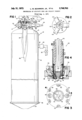
- FIG. 1 is a diagrammatic elevational view, in partial section, of apparatus for practicing the invention
- FIG. 2 is a sectional view of the arc head assembly taken along line 22 of FIG. 1;
- FIG. 3 is a top view of the material feed assembly of the apparatus.
- FIG. 4 is a sectional view of the material feed assembly, taken along line 44 of FIG. 3, wth the cathode assembly inserted and also shown in section.
- apparatus for practicing the invention includes a main chamber having an inner wall constructed of a corrosion resistant material such as stainless steel and a spaced outer wall of mild steel.
- the chember includes a domed upper wall 12 having a central opening therein in which an arc head assembly 14 is mounted; cylindrical main section 16 is five feet in diameter and twenty feet long.
- An exhaust passage 18 has a heat exchanger 20 mounted on it and a check valve 22 downstream from exchanger 20, thus enabling system operation at a pressure slightly greater than atmospheric.
- the collection chamber 24 at the base of main section 16 is secured by flange 26 to the cylindrical section 16. Cooling water is criculated through the sections 12, 16 and 24 of the chamber assembly 10 and battles between the stainless steel inner walls and the mild steel outer walls direct the circulation of that cooling water.
- the are head assembly includes a cylindrical housing 30 of sixteen inches inner diameter which has a lower flange 32 mounted on a mating surface of domed section 12 of chamber 10 and an upper flange 34 on which is secured a glass epoxy insulator disc 36 and plate 38 which carries a cathode electrode assembly 40 and material feed assembly 42.
- Extending radially outward from housing 30 are three anode assemblies, each of which includes a carbon electrode 44, an electrode drive assembly 46 and an electrical connection assembly 48.
- the tops of the anodes 44 are located in a plane about 1 /2 inch below the tip of the cathode 40 and the end of each anode is spaced about one inch from the axis of the furnace thus defining a passage approximately two inches in diameter.
- Particulate zircon to be heat-treated is injected so that the zircon particles have a trajectory that crosses the furnace axis approximately at the top of the anodes.
- Six material feed passages 50 are formed of copper tubing 51, silver soldered into appropriate bores in nozzle insert 52, and each terminating at counterbore sections 53, which define exit ports 54.
- Each'passage 50 is disposed at an angle of 23 to the vertical, and the centers of exit ports 54 (FIG. 2) are each located about /2 inch from the furnace axis.
- Each passage is connected via upper passages 55 (disposed at 37 /2" to the vertical) and feed tube 56 to powder feeder 57.
- the angle of injection of the axes of passages 50 is such that extensions of the passage axes intersect each other and the axis of the cathode 40 above the plane of the top surfaces of the anodes 44 at a point about 1% inch down from the lower edge of nozzle insert 52.
- the nozzle insert 52 provides a taper from the main bore of plate 60 (1% inch in diameter) to an axis diameter of /2 inch at nozzle exit 74. Cooling chamber 76 in nozzle insert 52 is supplied with coolant through passages
- the cathode electrode 40 is water cooled and includes a conical tungsten nose 80 that tapers to fiat tip 82, inch in diameter.
- a conical nose angle of 60 is preferred for the cathode although satisfactory results have been obtained with cathode nose angles in the range of 40- l00.
- a nozzle structure supplies a shielding gas, e.g., argon, for flow past nose 80 of cathode 40. Additional details of the furnace may be had with reference to the assignees copending U.S. application Ser. No. 876,741, now U.S. Pat. 3,661,764, filed Nov. 14, 1969, in the name of Lawrence W. Scammon, J r.
- a main DC. power supply applies an open circuit voltage of one hundred thirty-five volts between the cathode 40 and anodes 44.
- An auxiliary, 300-volt open circuit, starting power supply is connected between cathode 40 and nozzle plate 60, and an arc is initiated with a welding type are starter in the conical space between cathode nose 80 and the surrounding nozzle.
- Argon shielding gas blows the arc downwardly from the tip 82 of the cathode 40 to strike the anodes 44.
- the auxiliary power supply is then disconnected and the current supplied by the main power supply increased to establish an arc that includes a cathode jet 62 and a tail flame 64 that extends from the anodes 44 down the tank 10.
- a typical temperature of the cathode jet 62 is about 20,000 P.
- the temperature at a power of 300 kilowatts volts, 2250 amps) was measured thirty inches below the graphite anodes 44 with an unshielded thermocouple.
- the temperature near the tank wall is about 900 F. and increases to at least 3,000 F. at the center of the tail flame.
- the tank 10 is initially cleaned of all previous run material and each powder feeder (one coupled to each passage 54) is charged with an equal amount of particulate zircon.
- the electrode system is energized, carrier gas flows are adjusted to the desired values and the powder feeders are turned on at preset feed rates.
- a suitable carrier gas is nitrogen (80 s.c.f.h. in each feed passage 50), and a preferred power feed rate is 300-750 lbs./hr., and most preferably for maximum dissociation of zircon, about 300 to 500 lbs/hr. (about 0.6 to 1 kwhr./lb. at 300 kilowatts).
- the cahode jet 62 entrains the particles and sweeps them down through the passage defined by the incandescent sublimating end surfaces of the anodes 44 and along the high enthalpy zone of the tail flame 64.
- a conveyor means may be provided for continuous particle removal.
- the zircon particles are rapidly heated (about 0.1 second) to above the dissociation temperature of 1775 C. in the cathode jet and tail flame zones, and are rapidly cooled or quenched (in less than about 0.1 second) from those elevated temperatures to temperatures below the dissociation temperature.
- the resultant dissociated zircon particles are of generally spheroidal configuration, and in the form of tiny (generally, 95% less than 0.2 micron in diameter) crystallites of monoclinic (determined by X-ray diffraction analysis) zirconia dispersed in a substantially zirconiafree fused amorphous silica mass. There is no evidence that either residual zorconium silicate or crystalline silica remains.
- the zirconia phase also contains hafnium which, since it does not interfere with the ceramic properties of zirconia, is usually not separated therefrom.
- the hafnium remains in the zirconia phase and the word zirconia will be used to indicate a mixture of zirconium and hafnium oxides.
- starting natural zircon ores contain on the order of 1.5% hafnia. Since alumina will interfere With the desired ceramic properties of both zircon and zirconia, the starting zircon material is preferably largely free of alumina, a suitable starting ore being Australian zircon.
- the iron and titania is preferably largely removed from the zircon ore by a high intensity magnetic separator prior to introducing the ore into the furnace.
- the size, specific gravity, and silica content of the resultant dissociated zircon particles is a function of the energy input per pound.
- Table 41 below shows the effect of increasing the feed rate of starting zircon ore from 300 to 600 lbs./hr., while maintaining an energy input of 300 kw. Silica was measured by a gravimetric procedure.
- a presently preferred starting particle size for zircon ore is 100 to 250 microns.
- the resulting dissociated zircon has been found to be surprisingly leachable--i.e., the silica is present in a state which is readily separable from the zircon. Removing the silica as hereinafter described renders the particles friable so that they can be crushed more readily to yield submicron sized particles, useful in ceramic processes, composed mostly of zirconia. In general, particles having less than 10% silica, and preferably 5% or less silica remaining are crushable to submicron sizes.
- a particular example of a preferred leaching process for separating zirconia from the dissociated zircon is as follows:
- An 18.75 g. sample of dissociated zircon is placed in a Teflon beaker and 30 gms. of 50% aqueous sodium hydroxide (about two times the stoichiometric amount of sodium hydroxide required to convert all of the silica of the dissociated zircon to sodium silicate) is added.
- the beaker is placed in a stainless steel container with a heavy, but not sealed, cover and heated at 290 F. (at or just below the boiling point of the sodium hydroxide solution) for two hours.
- the half-spent sodium hydroxide is then decanted, and the solid residue of partially leached dissociated zircon is Washed with water until the pH of the efiluent decreases to 9.0, rinsed with warm 1% hydrochloric acid, Washed with water until the pH of the effluent rises to 5.5, and dried at 140 C.
- the acid washing reduces the residual sodium to less than 0.01% by Weight.
- the partially leached zircon (either before or after washing and drying) is leached one or more additional times with 50% sodium hydroxide in the same amount and at the same heating conditions.
- the solid residue is washed and dried as before, at least after the final leaching.
- the silica content of the dried product is determined by mixing the sample with 1.1 gm. lithium tetraborate (0.9 gm. of sample per 1.1 gm. of tetraborate) and grinding these in a tungsten carbide grinding vial.
- the ground mixture is fused for 30 minutes at 1150 C. in a graphite crucible. After fusion, the bead is ground and pressed to form a pellet. This pellet is placed in the sample port of an X-ray fluorescent spectrometer, and the X-ray intensity for silicon is measured during a 100- second counting interval.
- Standards for the X-ray fluorescence procedure covering the range 0 to 10% SiO are prepared by mixing appropriate amounts of high purity ZrO and silica. A straight line calibration over this concentration range is obtained.
- Table 2 below shows the silica remaining after a number of leaches performed on zircon dissociated at the power levels listed.
- the starting zircon ore was by weight 150-250 micron particles. Only the sample at 0.73 kwhr./ lb. was not washed and dried between each leaching. Only one sample was leached four times, and no additional silica removal was noted.
- the resultant zirconia particles are friable, crushable porous spheres, and are observed, when photographed at 26,000 magnification, to consist primarily of tiny crystallites, of which at least about have maximum diameters of 0.2 micron or less. These crystallite diameters were confirmed by X-ray Laue photographs. The crystallites were generally of uniform size and purity. The density of the particles containing less than 0.5 silica, when freely packed, is less than 3 gms./cc. (as compared to the theoretical density of 5.6 gms./cc. for zirconia).
- At least the first leach may be conducted with partially-spent sodium hydroxide.
- the zircon particles recovered from this leach contain about silica, and are hence crushable and useful for many ceramic processes. Further silica can be removed in a second leach with fresh sodium hydroxide, to produce a zirconia product containing less than 1% silica and partially-spent sodium hydroxide to serve as the first leach for additional dissociated zircon from the furnace.
- the liquid portion of the first leach can be filtered (e.g., at 175 F.) and the filtrate evaporated to produce, as a by-product of the leaching process, sodium silicate (Na SiO 5H O).
- sodium silicate Na SiO 5H O
- ZrO -SiO dissociated zircon
- the fresh sodium hydroxide solution is preferably about to 60% by weight sodium hydroxide. Too concentrated hydroxide solutions are viscous and hence do not penetrate the zircon as well as less concentrated solutions. However, since the boiling points of the more concentrated solutions are higher, the leaching can be carried out (at preferred temperatures near the boiling point of the hydroxide) at higher temperatures with the more concentrated solutions (e.g., about 250 to 290 F. with 50% sodium hydroxide solution). At least the stoichiometric amount of hydroxide required to convert silica to the silicate is preferably present during leaching. 1.5 to 2.5 times this stoichiometric amount is preferred for sodium hydroxide leaching solutions.
- the leaching procedures may also be carried out at atmospheric pressures, rendering handling easier, but greater than atmospheric pressures may also be used.
- silicate ores may be similarly dissociated and leached, so long as the metal oxide remains stable in fused silica-i.e., neither dissolves, decomposes, nor vaporizes.
- silicate ores to which this process could be applicable are thorite, rhodonite, sillirnanite, garnierite, chrysocolla, braunite, calamine and beryl.
- a process for separating silica from a metal silicate ore of the type in which the ore is dissociated into silica and a metal oxide and the metal oxide does not dissolve in the silica at an elevated dissociation temperature comprising the steps of providing particles of said silicate ore having maximum dimensions less than 1000 microns,
- a process according to claim 1 including the additional steps of contacting said resultant particles with aqueous alkali metal hydroxide solution to separate silica.
- said sodium hydroxide solution contains about 10% to 60% by weight sodium hydroxide.
- a process according to claim 8 wherein said sodium hydroxide solution is at a temperature of about 250 F. to 290 F.
- a process according to claim 8 including the steps of contacting the dissociated particles with a partially spent aqueous sodium hydroxide solution, separating said particles from said solution, thereafter additionally contacting said particles at least once with fresh aqueous sodium hydroxide solution to separate additional silica from said particles recovering partially spent sodium hydroxide from said additional immersions for use in separating silica from additional dissociated particles, and collecting and drying the particles from the last said additional immersions.
- a process according to claim 1 including the steps of providing said zone of intense heat by disposing a plurality of anode electrodes so that their respective end surfaces define a passage having an axis perpendicular to said end surfaces, positioning a cathode electrode structure so that its effective end surface is on said axis, and energizing said anode and cathode electrodes at a current density sufficient to produce a spatially stable cathode jet that extends through said passage and a tail flame that extends along said axis away from said cathode jet as an extension thereof, said cathode jet and said tail flame defining said zone of intense heat, said ore particles being introduced toward a point on said axis between said anode and cathode electrodes for flow through said passage so that said cathode jet and said tail flame heat said particles throughout to said dissociation temperature.
- a process according to claim 22 including the additional steps of contacting said resultant particles with aqueous alkali metal hydroxide solution to separate silica.
- a process according to claim 27 including the steps of contacting the dissociated particles with a partially spent aqueous sodium hydroxide solution, separating said particles from said solution, thereafter additionally contacting said particles at least once with fresh aqueous sodium hydroxide solution to separate additional silica from said particles recovering partially spent sodium hydroxide from said additional immersions for use in separating silica from additional dissociated particles, and collecting and drying the particles from the last said additional immersions.
- silicate ore particles are zircon particles and at least about by weight of said zircon particles have dimensions in the range of about -250 microns, and the current density between said electrodes and mass flow rate of zircon particles are chosen to provide a minimum power between said electrodes of 0.6 kwh per pound of zircon.
Landscapes
- Chemical & Material Sciences (AREA)
- Organic Chemistry (AREA)
- Inorganic Chemistry (AREA)
- Inorganic Compounds Of Heavy Metals (AREA)
- Compositions Of Oxide Ceramics (AREA)
- Mold Materials And Core Materials (AREA)
- Silicates, Zeolites, And Molecular Sieves (AREA)
- Oxygen, Ozone, And Oxides In General (AREA)
- Manufacture And Refinement Of Metals (AREA)
- Silicon Compounds (AREA)
Applications Claiming Priority (1)
| Application Number | Priority Date | Filing Date | Title |
|---|---|---|---|
| US16868771A | 1971-08-03 | 1971-08-03 |
Publications (1)
| Publication Number | Publication Date |
|---|---|
| US3749763A true US3749763A (en) | 1973-07-31 |
Family
ID=22612521
Family Applications (1)
| Application Number | Title | Priority Date | Filing Date |
|---|---|---|---|
| US00168687A Expired - Lifetime US3749763A (en) | 1971-08-03 | 1971-08-03 | Processing of silicate ores and product thereof |
Country Status (8)
| Country | Link |
|---|---|
| US (1) | US3749763A (enExample) |
| JP (3) | JPS5415554B1 (enExample) |
| AU (1) | AU474164B2 (enExample) |
| CA (1) | CA1004830A (enExample) |
| DE (1) | DE2238277C2 (enExample) |
| FR (1) | FR2148236B1 (enExample) |
| GB (1) | GB1389585A (enExample) |
| IT (1) | IT964870B (enExample) |
Cited By (17)
| Publication number | Priority date | Publication date | Assignee | Title |
|---|---|---|---|---|
| US3925177A (en) * | 1973-01-30 | 1975-12-09 | Boeing Co | Method and apparatus for heating solid and liquid particulate material to vaporize or disassociate the material |
| US4047970A (en) * | 1975-01-27 | 1977-09-13 | Keeling And Walker, Limited | Production of calcined ceramic pigments |
| US4071588A (en) * | 1975-08-11 | 1978-01-31 | Westinghouse Electric Corporation | Process for production of magnetite spheres with an arc heater |
| US4146670A (en) * | 1976-05-21 | 1979-03-27 | Foseco Trading A.G. | Manufacture of ceramic articles |
| WO1985004158A1 (en) * | 1984-03-21 | 1985-09-26 | Ici Australia Limited | Treatment of zircon |
| DE3527289A1 (de) * | 1984-08-01 | 1986-02-13 | Cookson Group Plc, London | Verfahren zum behandeln von dissoziiertem zirkoniumsilikat |
| US4829028A (en) * | 1985-10-25 | 1989-05-09 | The Japan Carlit Co., Ltd. | Process for producing an alumina-zirconia composite sintered material |
| US6511739B2 (en) | 1997-04-18 | 2003-01-28 | 3M Innovative Properties Company | Transparent beads and their production method |
| US6514892B1 (en) | 1997-04-18 | 2003-02-04 | 3M Innovative Properties Company | Transparent beads and their production method |
| US20050143248A1 (en) * | 2003-06-11 | 2005-06-30 | 3M Innovative Properties Company | Microspheres having a high index of refraction |
| US20080280034A1 (en) * | 2007-05-11 | 2008-11-13 | 3M Innovative Properties Company | Pavement marking and reflective elements having microspheres comprising lanthanum oxide and aluminum oxide with zirconia, titania, or mixtures thereof |
| US7947616B2 (en) | 2005-11-14 | 2011-05-24 | 3M Innovative Properties Company | Pavement marking, reflective elements, and methods of making microspheres |
| US8591045B2 (en) | 2009-08-21 | 2013-11-26 | 3M Innovative Properties Company | Pavement markings, reflective elements, and methods of making microspheres |
| CN103818957A (zh) * | 2014-03-17 | 2014-05-28 | 山东理工大学 | 水淬法制备碎木状中空氧化锆粉体的方法 |
| CN103818956A (zh) * | 2014-03-17 | 2014-05-28 | 山东理工大学 | 水淬法合成片状纳米氧化锆的制备工艺 |
| CN103864145A (zh) * | 2014-03-26 | 2014-06-18 | 山东理工大学 | 水淬法合成棒状氧化锆粉体的制备工艺 |
| CN104148057A (zh) * | 2014-07-31 | 2014-11-19 | 南京师范大学 | 基于单斜相纳米氧化锆载体的低温scr催化剂及制备方法 |
Families Citing this family (2)
| Publication number | Priority date | Publication date | Assignee | Title |
|---|---|---|---|---|
| JPS60122242U (ja) * | 1984-01-25 | 1985-08-17 | ヤンマー農機株式会社 | コンバインの表示器 |
| DE102012020509A1 (de) * | 2012-10-19 | 2014-06-12 | Ask Chemicals Gmbh | Formstoffmischungen auf der Basis anorganischer Bindemittel und Verfahren zur Herstellung von Formen und Kerne für den Metallguss |
-
1971
- 1971-08-03 US US00168687A patent/US3749763A/en not_active Expired - Lifetime
-
1972
- 1972-07-28 GB GB3545572A patent/GB1389585A/en not_active Expired
- 1972-07-31 CA CA148,338A patent/CA1004830A/en not_active Expired
- 1972-08-02 JP JP7701272A patent/JPS5415554B1/ja active Pending
- 1972-08-02 IT IT69533/72A patent/IT964870B/it active
- 1972-08-02 AU AU45231/72A patent/AU474164B2/en not_active Expired
- 1972-08-03 FR FR7228044A patent/FR2148236B1/fr not_active Expired
- 1972-08-03 DE DE2238277A patent/DE2238277C2/de not_active Expired
-
1977
- 1977-04-14 JP JP4210577A patent/JPS5373496A/ja active Granted
-
1978
- 1978-02-15 JP JP53015493A patent/JPS5818329B2/ja not_active Expired
Cited By (23)
| Publication number | Priority date | Publication date | Assignee | Title |
|---|---|---|---|---|
| US3925177A (en) * | 1973-01-30 | 1975-12-09 | Boeing Co | Method and apparatus for heating solid and liquid particulate material to vaporize or disassociate the material |
| US4047970A (en) * | 1975-01-27 | 1977-09-13 | Keeling And Walker, Limited | Production of calcined ceramic pigments |
| US4071588A (en) * | 1975-08-11 | 1978-01-31 | Westinghouse Electric Corporation | Process for production of magnetite spheres with an arc heater |
| US4146670A (en) * | 1976-05-21 | 1979-03-27 | Foseco Trading A.G. | Manufacture of ceramic articles |
| WO1985004158A1 (en) * | 1984-03-21 | 1985-09-26 | Ici Australia Limited | Treatment of zircon |
| DE3527289A1 (de) * | 1984-08-01 | 1986-02-13 | Cookson Group Plc, London | Verfahren zum behandeln von dissoziiertem zirkoniumsilikat |
| US4840774A (en) * | 1984-08-01 | 1989-06-20 | Tam Ceramics Inc. | Process for the production of zirconium tetrachloride from dissociated zircon |
| US4829028A (en) * | 1985-10-25 | 1989-05-09 | The Japan Carlit Co., Ltd. | Process for producing an alumina-zirconia composite sintered material |
| US6511739B2 (en) | 1997-04-18 | 2003-01-28 | 3M Innovative Properties Company | Transparent beads and their production method |
| US6514892B1 (en) | 1997-04-18 | 2003-02-04 | 3M Innovative Properties Company | Transparent beads and their production method |
| US20050143248A1 (en) * | 2003-06-11 | 2005-06-30 | 3M Innovative Properties Company | Microspheres having a high index of refraction |
| US20060293161A1 (en) * | 2003-06-11 | 2006-12-28 | Frey Matthew H | Microspheres comprising titania and bismuth oxide |
| US7524779B2 (en) | 2003-06-11 | 2009-04-28 | 3M Innovative Properties Company | Microspheres having a high index of refraction |
| US7585799B2 (en) | 2003-06-11 | 2009-09-08 | 3M Innovative Properties Company | Microspheres having a high index of refraction |
| US7947616B2 (en) | 2005-11-14 | 2011-05-24 | 3M Innovative Properties Company | Pavement marking, reflective elements, and methods of making microspheres |
| US20080280034A1 (en) * | 2007-05-11 | 2008-11-13 | 3M Innovative Properties Company | Pavement marking and reflective elements having microspheres comprising lanthanum oxide and aluminum oxide with zirconia, titania, or mixtures thereof |
| US8591045B2 (en) | 2009-08-21 | 2013-11-26 | 3M Innovative Properties Company | Pavement markings, reflective elements, and methods of making microspheres |
| CN103818957A (zh) * | 2014-03-17 | 2014-05-28 | 山东理工大学 | 水淬法制备碎木状中空氧化锆粉体的方法 |
| CN103818956A (zh) * | 2014-03-17 | 2014-05-28 | 山东理工大学 | 水淬法合成片状纳米氧化锆的制备工艺 |
| CN103818956B (zh) * | 2014-03-17 | 2017-06-20 | 山东理工大学 | 水淬法合成片状纳米氧化锆的制备工艺 |
| CN103864145A (zh) * | 2014-03-26 | 2014-06-18 | 山东理工大学 | 水淬法合成棒状氧化锆粉体的制备工艺 |
| CN103864145B (zh) * | 2014-03-26 | 2017-06-20 | 山东理工大学 | 水淬法合成棒状氧化锆粉体的制备工艺 |
| CN104148057A (zh) * | 2014-07-31 | 2014-11-19 | 南京师范大学 | 基于单斜相纳米氧化锆载体的低温scr催化剂及制备方法 |
Also Published As
| Publication number | Publication date |
|---|---|
| DE2238277A1 (de) | 1973-04-12 |
| JPS5649846B2 (enExample) | 1981-11-25 |
| DE2238277C2 (de) | 1985-11-14 |
| JPS5818329B2 (ja) | 1983-04-12 |
| JPS5415554B1 (enExample) | 1979-06-15 |
| JPS5722113A (en) | 1982-02-05 |
| JPS5373496A (en) | 1978-06-29 |
| FR2148236B1 (enExample) | 1974-12-27 |
| FR2148236A1 (enExample) | 1973-03-11 |
| AU474164B2 (en) | 1976-07-15 |
| CA1004830A (en) | 1977-02-08 |
| IT964870B (it) | 1974-01-31 |
| GB1389585A (en) | 1975-04-03 |
| AU4523172A (en) | 1974-02-07 |
Similar Documents
| Publication | Publication Date | Title |
|---|---|---|
| US3749763A (en) | Processing of silicate ores and product thereof | |
| US3811907A (en) | Processing of silicate ores and product thereof | |
| EP0711217B1 (en) | Method and apparatus for making nanostructured materials | |
| US4356029A (en) | Titanium product collection in a plasma reactor | |
| US5623725A (en) | Process for producing very pure platinum materials, semi-finished parts and foils dispersion-reinforced with Y203 | |
| US6939389B2 (en) | Method and apparatus for manufacturing fine powders | |
| US5972065A (en) | Purification of tantalum by plasma arc melting | |
| Marden et al. | Metallic thorium1 | |
| Syamaprasad et al. | Studies on plasma dissociation of Indian zircon in a specially developed plasma reactor | |
| US2983600A (en) | Purifying titanium sponge | |
| EP0205443B1 (en) | Treatment of zircon | |
| RU2742575C1 (ru) | Способ получения альфа-оксида алюминия для последующего выращивания монокристаллического сапфира | |
| NO130813B (enExample) | ||
| US3849532A (en) | Method of preparing a zirconium oxide that is crystallized mostly or completely in cubic form | |
| Syamaprasad et al. | Zirconia ceramics by thermal plasma | |
| JPH0416504A (ja) | シリコンの精製方法 | |
| Syamaprasad et al. | Application Of Thermal Plasma Technology For The Preparation Of Monoclinic And Partially Stabilized | |
| CA2115013C (en) | Process for extracting aluminum from ore | |
| US3607005A (en) | Process of extracting vanadium | |
| US2778725A (en) | Method for making powdered vanadium metal | |
| RU2448809C2 (ru) | Способ получения порошка вольфрама | |
| CA1202472A (en) | Method of producing tungsten oxide | |
| Yugeswaran et al. | Inflight dissociation of zircon in air plasma | |
| Simmons et al. | The Production and Arc Melting of Titanium | |
| US3199947A (en) | Method of purifying refractory sulfides |
Legal Events
| Date | Code | Title | Description |
|---|---|---|---|
| STCF | Information on status: patent grant |
Free format text: PATENTED FILE - (OLD CASE ADDED FOR FILE TRACKING PURPOSES) |
|
| AS | Assignment |
Owner name: FERRO CORPORATION, ONE ERIEVIEW PLAZA, CLEVELAND, Free format text: ASSIGNMENT OF ASSIGNORS INTEREST.;ASSIGNOR:ASSOCIATED MINERALS CONSOLIDATED LIMITED, A CORP. OF NEW SOUTH WALES, AUSTRALIA;REEL/FRAME:004262/0625 Effective date: 19840503 |
|
| AS | Assignment |
Owner name: X-TECH CORPORATION A CORP. OF DE. Free format text: ASSIGNMENT OF ASSIGNORS INTEREST.;ASSIGNOR:FERRO CORPORATION, ONE ERIEVIEW PLAZA, CLEVELAND, OH. A CORP. OF OH.;REEL/FRAME:004676/0145 Effective date: 19860828 |