US3717226A - Disc brake, actuator, and resilient retaining means - Google Patents
Disc brake, actuator, and resilient retaining means Download PDFInfo
- Publication number
- US3717226A US3717226A US00114791A US3717226DA US3717226A US 3717226 A US3717226 A US 3717226A US 00114791 A US00114791 A US 00114791A US 3717226D A US3717226D A US 3717226DA US 3717226 A US3717226 A US 3717226A
- Authority
- US
- United States
- Prior art keywords
- push
- cam
- pressure plates
- rod
- brake
- Prior art date
- Legal status (The legal status is an assumption and is not a legal conclusion. Google has not performed a legal analysis and makes no representation as to the accuracy of the status listed.)
- Expired - Lifetime
Links
- 230000009471 action Effects 0.000 claims description 5
- 230000000295 complement effect Effects 0.000 claims description 5
- 238000000926 separation method Methods 0.000 claims description 4
- 230000007480 spreading Effects 0.000 abstract description 2
- 230000007246 mechanism Effects 0.000 description 4
- 210000000887 face Anatomy 0.000 description 3
- 210000001331 nose Anatomy 0.000 description 3
- 230000004048 modification Effects 0.000 description 2
- 238000012986 modification Methods 0.000 description 2
- 230000004323 axial length Effects 0.000 description 1
- 239000002783 friction material Substances 0.000 description 1
Images


Classifications
-
- F—MECHANICAL ENGINEERING; LIGHTING; HEATING; WEAPONS; BLASTING
- F16—ENGINEERING ELEMENTS AND UNITS; GENERAL MEASURES FOR PRODUCING AND MAINTAINING EFFECTIVE FUNCTIONING OF MACHINES OR INSTALLATIONS; THERMAL INSULATION IN GENERAL
- F16D—COUPLINGS FOR TRANSMITTING ROTATION; CLUTCHES; BRAKES
- F16D55/00—Brakes with substantially-radial braking surfaces pressed together in axial direction, e.g. disc brakes
- F16D55/02—Brakes with substantially-radial braking surfaces pressed together in axial direction, e.g. disc brakes with axially-movable discs or pads pressed against axially-located rotating members
- F16D55/04—Brakes with substantially-radial braking surfaces pressed together in axial direction, e.g. disc brakes with axially-movable discs or pads pressed against axially-located rotating members by moving discs or pads away from one another against radial walls of drums or cylinders
- F16D55/14—Brakes with substantially-radial braking surfaces pressed together in axial direction, e.g. disc brakes with axially-movable discs or pads pressed against axially-located rotating members by moving discs or pads away from one another against radial walls of drums or cylinders with self-tightening action, e.g. by means of coacting helical surfaces or balls and inclined surfaces
-
- F—MECHANICAL ENGINEERING; LIGHTING; HEATING; WEAPONS; BLASTING
- F16—ENGINEERING ELEMENTS AND UNITS; GENERAL MEASURES FOR PRODUCING AND MAINTAINING EFFECTIVE FUNCTIONING OF MACHINES OR INSTALLATIONS; THERMAL INSULATION IN GENERAL
- F16D—COUPLINGS FOR TRANSMITTING ROTATION; CLUTCHES; BRAKES
- F16D2125/00—Components of actuators
- F16D2125/18—Mechanical mechanisms
- F16D2125/20—Mechanical mechanisms converting rotation to linear movement or vice versa
- F16D2125/34—Mechanical mechanisms converting rotation to linear movement or vice versa acting in the direction of the axis of rotation
- F16D2125/36—Helical cams, Ball-rotating ramps
Definitions
- ABSTRACT In a brake of the spreading disc type in which relative 30 Foreign Application priority Data angular movement of the pressure plates to initiate the application of the brake is effected by push-rods of Feb. 19, 1970 Great Britain ..7,991/70 which the outer ends are 111 rocking engagement with lugs on the pressure plates and the inner ends are [52] US. Cl. ..l88/7l.4, 188/722, 192/70 eceived in pockets in the cam, the push-rods are [51] Int. Cl ..F16d 55/04 resiliently urged into the pockets by pre-stressed [58] Field of Search ..l88/7l.3, 71.4, 72.2; 197/70 spring clips engaging the push-rods.
- This invention relates to improvements in disc brakes of the kind in which rotatable friction discs are adapted to be brought into engagement with opposed radial surfaces in a stationary housing by pressure plates located between the friction discs. Balls are located in cooperating oppositely inclined recesses in the adjacent faces of the pressure plates and the application of the brake is initiated by moving the pressure plates angularly in opposite directions, the pressure plates then moving apart into engagement with the friction discs which are urged into engagement with the radial surfaces in the housing. The pressure plates are carried round with the friction discs until one is arrested by the engagement of a lug on the plate with a stop aubtment in the housing and the continued angular movement of the other pressure plate provides a servo action.
- angular movement of the pressure plates in opposite directions to initiate the application of the brake is effected by a cam through push-rods of which the outer ends are in rocking engagement with radially projecting lugs on the pressure plates and the inner ends are received in pockets in the cam, and each push-rod is engaged by a resilient clip which biasses it in a direction to retain its inner end in its pocket in the cam.
- Each clip is conveniently arranged to embrace a push-rod and to be engaged in a stressed condition with the lug on the pressure plate between which the cam the tappet or push-rod is located.
- This arrangement has the advantages that it prevents any risk of the push-rod dropping out of the pocket in the cam which could happen in the event of excessive angular movement of the cam in the reverse direction, and it allows the angular dimension of the pocket in the cam to be increased so that the cam can safely be rotated through a greater angle with consequent greater maximum separation of the lugs on the pressure plates. This allows the use of thicker friction linings and a longer working life of the brake if there is room within the housing to increase the axial length of the brake assembly.
- FIG. 1 is a section of a part of a brake of the kind set forth showing the actuating mechanism, the section being taken in a radial plane containing the axis of the brake;
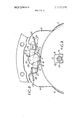
- FIG. 2 is an end elevation of the actuating mechanism and the adjacent parts of the pressure plates
- FIG. 3 is a fragmentary section on the line 3-3 of FIG. 2;
- FIG. 4 is a plan of a spring clip
- FIG. 5 is an end view of the clip
- FIG. 6 is a side elevation of the clip
- FIG. 7 is a view similar to FIG. 1 but showing a modified form of clip.
- brake discs splined or otherwise slidably keyed (in a rotatable shaft (not shown) passing axially through a stationary housing 3.
- the housing comprises a bell-shaped member closed at the open end by a detachable end plate 4.
- the discs carry rings or pads 5 of friction material for engagement with plane inner faces of the housing and end plate and with the outer faces of cooperating pressure plates 6, 7 located between the discs.
- Balls 8 are located in complementary conical or inclined recesses 9 in the adjacent faces of the pressure plates so that when there is relative angular movement between the pressure plates they are urged apart to grip the rotatable discs frictionally between the pressure plates and the housing.
- Relative angular movement between the pressure plates to initiate the application of the brake is produced by partial rotation of a camshaft 10 rotatably mounted in the housing with its axis parallel to that of the camshaft and carrying or incorporating a cam part 11 which acts through push-rods 12, 13 on lugs 14, 15 extending radially from the pressure plates.
- the other ends of the push-rods l2, 13 are partspherical and are received in complementary recesses in the lugs 14, 15 and the inner ends of the push-rods terminate in tapered noses 16, 17.
- the nose of the push-rod 12 is received in a pocket 19 in the cam 11 on its radially inner side and the nose of the push-rod 13 is received in a similar pocket 20 in the cam on its radially outer side.
- the cam is rotated in a clockwise direction from the position shown in FIG. 2 to apply the brake, and to accommodate the inner end of the right-hand push-rod 13 as the cam moves angularly, the pocket 20 for that push-rod is of the substantially L-shaped form shown in FIG. 2 with a long bottom face 21 inclined at a small angle to the horizontal and a shorter upper face 22 inclined at a small angle to the vertical.
- the clip is made from a length of spring wire and the wire is first formed at the center of its length into a part-circular loop 23 of such a diameter as to fit snugly into an annular groove in a push-rod.
- the ends are extended a short distance in the plane of the loop and then are bent outwardly and then bent again to form two parallel limbs 24 lying in a plane at right angles to the plane of the loop. Finally the extremities of the limbs are bent inwardly to form two aligned fingers 25 at right angles to the limbs 24.
- the spacing between the limbs 24 is substantially equal to the thickness of a lug on a pressure plate.
- the loop on the clip is fitted over the push-rod and as the push-rod is fitted into position the limbs 24 of the clip are fitted over the lug 15 on the pressure plate 7. In their free state the limbs are in the position shown in dotted lines in FIG. 2 and they are pressed outwardly and the fingers 25 are engaged in a hole 26 in the lug. The clip is then under stress and maintains a bias on the push-rod pressing its inner end downwardly into the pocket.
- a similar clip is fitted to the push-rod l2 and the limbs of that clip are engaged in a hole 27 in the lug 14,
- the clip being biassed to urge the inner end of the pushrod upwardly into the pocket 19 in the cam.
- the angular dimensions of the egockets can be increased as indicated by the dotted line 26 in FIG. 2 to allow greater angular movement of the cam.
- two clips 28, 29 each engaging one of the push-rods and the corresponding lug on a pressure plate are formed from opposite ends of a single length of resilient wire of which the central part is formed into a coil 30 fitting around the cam.
- Each of the clips so formed has a single stressed limb lying on one side of the lug.
- a disc brake as in claim 1 including a second limb parallel to the first mentioned limb, both of said limbs lying in a plane angularly related to the plane of the looped part, said second limb having an inturned finger at the end thereof remote from said loop and received in an opening in said lug.
Landscapes
- Engineering & Computer Science (AREA)
- General Engineering & Computer Science (AREA)
- Mechanical Engineering (AREA)
- Braking Arrangements (AREA)
Applications Claiming Priority (1)
| Application Number | Priority Date | Filing Date | Title |
|---|---|---|---|
| GB7991/70A GB1298995A (en) | 1970-02-19 | 1970-02-19 | Improvements relating to disc brakes |
Publications (1)
| Publication Number | Publication Date |
|---|---|
| US3717226A true US3717226A (en) | 1973-02-20 |
Family
ID=9843673
Family Applications (1)
| Application Number | Title | Priority Date | Filing Date |
|---|---|---|---|
| US00114791A Expired - Lifetime US3717226A (en) | 1970-02-19 | 1971-02-12 | Disc brake, actuator, and resilient retaining means |
Country Status (7)
| Country | Link |
|---|---|
| US (1) | US3717226A (OSRAM) |
| BR (1) | BR7101151D0 (OSRAM) |
| CS (1) | CS149431B2 (OSRAM) |
| DE (1) | DE2107885C3 (OSRAM) |
| FR (1) | FR2078765A5 (OSRAM) |
| GB (1) | GB1298995A (OSRAM) |
| PL (1) | PL70896B1 (OSRAM) |
Cited By (2)
| Publication number | Priority date | Publication date | Assignee | Title |
|---|---|---|---|---|
| US4653614A (en) * | 1984-08-18 | 1987-03-31 | Lucas Industries Public Limited Company | Self-energizing disc brakes |
| EP2988016A1 (de) * | 2014-08-13 | 2016-02-24 | KNORR-BREMSE Systeme für Nutzfahrzeuge GmbH | Zuspannvorrichtung für eine drehhebelbetätigte scheibenbremse |
Citations (2)
| Publication number | Priority date | Publication date | Assignee | Title |
|---|---|---|---|---|
| US3203507A (en) * | 1963-01-11 | 1965-08-31 | Girling Ltd | Spreading type disc brakes |
| US3318420A (en) * | 1963-11-12 | 1967-05-09 | Dunlop Rubber Co | Spot type disc brakes |
-
1970
- 1970-02-19 GB GB7991/70A patent/GB1298995A/en not_active Expired
-
1971
- 1971-02-12 US US00114791A patent/US3717226A/en not_active Expired - Lifetime
- 1971-02-17 CS CS1201A patent/CS149431B2/cs unknown
- 1971-02-18 FR FR7105533A patent/FR2078765A5/fr not_active Expired
- 1971-02-18 DE DE2107885A patent/DE2107885C3/de not_active Expired
- 1971-02-18 PL PL1971146337A patent/PL70896B1/pl unknown
- 1971-02-19 BR BR1151/71A patent/BR7101151D0/pt unknown
Patent Citations (2)
| Publication number | Priority date | Publication date | Assignee | Title |
|---|---|---|---|---|
| US3203507A (en) * | 1963-01-11 | 1965-08-31 | Girling Ltd | Spreading type disc brakes |
| US3318420A (en) * | 1963-11-12 | 1967-05-09 | Dunlop Rubber Co | Spot type disc brakes |
Cited By (2)
| Publication number | Priority date | Publication date | Assignee | Title |
|---|---|---|---|---|
| US4653614A (en) * | 1984-08-18 | 1987-03-31 | Lucas Industries Public Limited Company | Self-energizing disc brakes |
| EP2988016A1 (de) * | 2014-08-13 | 2016-02-24 | KNORR-BREMSE Systeme für Nutzfahrzeuge GmbH | Zuspannvorrichtung für eine drehhebelbetätigte scheibenbremse |
Also Published As
| Publication number | Publication date |
|---|---|
| GB1298995A (en) | 1972-12-06 |
| BR7101151D0 (pt) | 1973-04-05 |
| CS149431B2 (OSRAM) | 1973-07-05 |
| FR2078765A5 (OSRAM) | 1971-11-05 |
| DE2107885C3 (de) | 1974-07-25 |
| DE2107885A1 (de) | 1971-11-18 |
| DE2107885B2 (de) | 1974-01-03 |
| PL70896B1 (OSRAM) | 1974-04-30 |
Similar Documents
| Publication | Publication Date | Title |
|---|---|---|
| US3625314A (en) | Sliding caliper-type disk brake | |
| US3915263A (en) | Disc brake caliper and support structure | |
| US4279331A (en) | Floating-caliper disc brake | |
| US3403756A (en) | Resilient supporting means for calipertype disc brake | |
| US4311219A (en) | Caliper guiding mechanism for disc brake | |
| US3972393A (en) | Friction pad and support for a disc brake | |
| JPS51123474A (en) | Disk blake | |
| GB1502016A (en) | Disc brake | |
| ES270063U (es) | Un conjunto de pastilla de friccion para uso en un disco de freno. | |
| JPS597849B2 (ja) | 乗物用円板ブレ−キ | |
| US3592301A (en) | Floating caliper disc brake | |
| US5706916A (en) | Pad and disc brake using it | |
| JPS51123475A (en) | Disk blake | |
| US3705641A (en) | Disc brake | |
| GB1462381A (en) | Disc brakes for vehicles | |
| US3680664A (en) | Brake adjusters | |
| US3952844A (en) | Helical cam actuator for a disc brake | |
| US3743060A (en) | Servo action parking brake with rotary actuator | |
| GB1461939A (en) | Spot type disc brake pad carriers | |
| GB1327558A (en) | Disc brake with automatic adjuster mechanism | |
| GB1028950A (en) | Disc type brakes | |
| US3732952A (en) | Brake adjusters | |
| GB1366446A (en) | Disc brake assembly | |
| JP2004176927A (ja) | 電気機械的なブレーキ | |
| GB1350792A (en) | Self-adjusting disc brakes |