US3699208A - Extraction of beryllium from ores - Google Patents
Extraction of beryllium from ores Download PDFInfo
- Publication number
- US3699208A US3699208A US100354A US3699208DA US3699208A US 3699208 A US3699208 A US 3699208A US 100354 A US100354 A US 100354A US 3699208D A US3699208D A US 3699208DA US 3699208 A US3699208 A US 3699208A
- Authority
- US
- United States
- Prior art keywords
- solution
- beryllium
- leach
- acid
- leaching
- Prior art date
- Legal status (The legal status is an assumption and is not a legal conclusion. Google has not performed a legal analysis and makes no representation as to the accuracy of the status listed.)
- Expired - Lifetime
Links
- 229910052790 beryllium Inorganic materials 0.000 title abstract description 78
- ATBAMAFKBVZNFJ-UHFFFAOYSA-N beryllium atom Chemical compound [Be] ATBAMAFKBVZNFJ-UHFFFAOYSA-N 0.000 title abstract description 76
- 238000000605 extraction Methods 0.000 title abstract description 8
- 238000002386 leaching Methods 0.000 claims abstract description 48
- 239000002253 acid Substances 0.000 claims abstract description 38
- KRHYYFGTRYWZRS-UHFFFAOYSA-M Fluoride anion Chemical compound [F-] KRHYYFGTRYWZRS-UHFFFAOYSA-M 0.000 claims abstract description 28
- 238000000034 method Methods 0.000 claims description 46
- 230000008569 process Effects 0.000 claims description 32
- QAOWNCQODCNURD-UHFFFAOYSA-N Sulfuric acid Chemical compound OS(O)(=O)=O QAOWNCQODCNURD-UHFFFAOYSA-N 0.000 claims description 31
- PUZPDOWCWNUUKD-UHFFFAOYSA-M sodium fluoride Chemical compound [F-].[Na+] PUZPDOWCWNUUKD-UHFFFAOYSA-M 0.000 claims description 13
- 229910052500 inorganic mineral Inorganic materials 0.000 claims description 11
- 239000011707 mineral Substances 0.000 claims description 11
- KLZUFWVZNOTSEM-UHFFFAOYSA-K Aluminium flouride Chemical compound F[Al](F)F KLZUFWVZNOTSEM-UHFFFAOYSA-K 0.000 claims 2
- 229910017665 NH4HF2 Inorganic materials 0.000 claims 1
- LDDQLRUQCUTJBB-UHFFFAOYSA-N ammonium fluoride Chemical compound [NH4+].[F-] LDDQLRUQCUTJBB-UHFFFAOYSA-N 0.000 claims 1
- BFXAWOHHDUIALU-UHFFFAOYSA-M sodium;hydron;difluoride Chemical compound F.[F-].[Na+] BFXAWOHHDUIALU-UHFFFAOYSA-M 0.000 claims 1
- 239000012535 impurity Substances 0.000 abstract description 34
- 239000011701 zinc Substances 0.000 abstract description 32
- XEEYBQQBJWHFJM-UHFFFAOYSA-N Iron Chemical compound [Fe] XEEYBQQBJWHFJM-UHFFFAOYSA-N 0.000 abstract description 31
- 229910052782 aluminium Inorganic materials 0.000 abstract description 30
- XAGFODPZIPBFFR-UHFFFAOYSA-N aluminium Chemical compound [Al] XAGFODPZIPBFFR-UHFFFAOYSA-N 0.000 abstract description 28
- 229910052725 zinc Inorganic materials 0.000 abstract description 26
- HCHKCACWOHOZIP-UHFFFAOYSA-N Zinc Chemical compound [Zn] HCHKCACWOHOZIP-UHFFFAOYSA-N 0.000 abstract description 23
- 229910052742 iron Inorganic materials 0.000 abstract description 16
- 238000011084 recovery Methods 0.000 abstract description 6
- 238000004090 dissolution Methods 0.000 abstract description 3
- 239000012633 leachable Substances 0.000 abstract description 3
- 239000000654 additive Substances 0.000 abstract description 2
- 230000000996 additive effect Effects 0.000 abstract 1
- 239000000243 solution Substances 0.000 description 120
- HEMHJVSKTPXQMS-UHFFFAOYSA-M Sodium hydroxide Chemical compound [OH-].[Na+] HEMHJVSKTPXQMS-UHFFFAOYSA-M 0.000 description 59
- 238000001556 precipitation Methods 0.000 description 39
- 239000000706 filtrate Substances 0.000 description 31
- 239000002244 precipitate Substances 0.000 description 28
- XLYOFNOQVPJJNP-UHFFFAOYSA-N water Chemical compound O XLYOFNOQVPJJNP-UHFFFAOYSA-N 0.000 description 25
- 239000002002 slurry Substances 0.000 description 24
- 238000001914 filtration Methods 0.000 description 22
- 229910052731 fluorine Inorganic materials 0.000 description 22
- KCXVZYZYPLLWCC-UHFFFAOYSA-N EDTA Chemical compound OC(=O)CN(CC(O)=O)CCN(CC(O)=O)CC(O)=O KCXVZYZYPLLWCC-UHFFFAOYSA-N 0.000 description 18
- 239000011737 fluorine Substances 0.000 description 18
- YCKRFDGAMUMZLT-UHFFFAOYSA-N Fluorine atom Chemical compound [F] YCKRFDGAMUMZLT-UHFFFAOYSA-N 0.000 description 17
- -1 fluoride ions Chemical class 0.000 description 17
- XLYOFNOQVPJJNP-UHFFFAOYSA-M hydroxide Chemical compound [OH-] XLYOFNOQVPJJNP-UHFFFAOYSA-M 0.000 description 17
- 229960001484 edetic acid Drugs 0.000 description 16
- 239000012065 filter cake Substances 0.000 description 16
- 238000011282 treatment Methods 0.000 description 16
- UCKMPCXJQFINFW-UHFFFAOYSA-N Sulphide Chemical compound [S-2] UCKMPCXJQFINFW-UHFFFAOYSA-N 0.000 description 13
- 229910001865 beryllium hydroxide Inorganic materials 0.000 description 12
- XTIMETPJOMYPHC-UHFFFAOYSA-M beryllium monohydroxide Chemical compound O[Be] XTIMETPJOMYPHC-UHFFFAOYSA-M 0.000 description 12
- 238000004458 analytical method Methods 0.000 description 10
- 235000010755 mineral Nutrition 0.000 description 10
- 239000007787 solid Substances 0.000 description 10
- QAOWNCQODCNURD-UHFFFAOYSA-L Sulfate Chemical compound [O-]S([O-])(=O)=O QAOWNCQODCNURD-UHFFFAOYSA-L 0.000 description 9
- 238000009835 boiling Methods 0.000 description 9
- 239000011734 sodium Substances 0.000 description 9
- 238000005406 washing Methods 0.000 description 8
- QGZKDVFQNNGYKY-UHFFFAOYSA-N Ammonia Chemical compound N QGZKDVFQNNGYKY-UHFFFAOYSA-N 0.000 description 7
- 238000006243 chemical reaction Methods 0.000 description 7
- 239000008367 deionised water Substances 0.000 description 7
- 229910021641 deionized water Inorganic materials 0.000 description 7
- 230000000694 effects Effects 0.000 description 7
- AQYSYJUIMQTRMV-UHFFFAOYSA-N hypofluorous acid Chemical compound FO AQYSYJUIMQTRMV-UHFFFAOYSA-N 0.000 description 7
- 239000000463 material Substances 0.000 description 7
- 239000000203 mixture Substances 0.000 description 7
- 239000011031 topaz Substances 0.000 description 7
- 229910052853 topaz Inorganic materials 0.000 description 7
- KWYUFKZDYYNOTN-UHFFFAOYSA-M Potassium hydroxide Chemical compound [OH-].[K+] KWYUFKZDYYNOTN-UHFFFAOYSA-M 0.000 description 6
- 239000003513 alkali Substances 0.000 description 6
- 239000011575 calcium Substances 0.000 description 6
- 229910001385 heavy metal Inorganic materials 0.000 description 6
- 150000002500 ions Chemical class 0.000 description 6
- 229910052749 magnesium Inorganic materials 0.000 description 6
- 239000011777 magnesium Substances 0.000 description 6
- 229910052748 manganese Inorganic materials 0.000 description 6
- 239000000047 product Substances 0.000 description 6
- 239000011775 sodium fluoride Substances 0.000 description 6
- 235000013024 sodium fluoride Nutrition 0.000 description 6
- VYPSYNLAJGMNEJ-UHFFFAOYSA-N Silicium dioxide Chemical compound O=[Si]=O VYPSYNLAJGMNEJ-UHFFFAOYSA-N 0.000 description 5
- 229910052791 calcium Inorganic materials 0.000 description 5
- 239000000920 calcium hydroxide Substances 0.000 description 5
- 235000011116 calcium hydroxide Nutrition 0.000 description 5
- 239000003518 caustics Substances 0.000 description 5
- 239000002738 chelating agent Substances 0.000 description 5
- PCHJSUWPFVWCPO-UHFFFAOYSA-N gold Chemical compound [Au] PCHJSUWPFVWCPO-UHFFFAOYSA-N 0.000 description 5
- 229910052737 gold Inorganic materials 0.000 description 5
- 239000010931 gold Substances 0.000 description 5
- 229910052739 hydrogen Inorganic materials 0.000 description 5
- DGAQECJNVWCQMB-PUAWFVPOSA-M Ilexoside XXIX Chemical compound C[C@@H]1CC[C@@]2(CC[C@@]3(C(=CC[C@H]4[C@]3(CC[C@@H]5[C@@]4(CC[C@@H](C5(C)C)OS(=O)(=O)[O-])C)C)[C@@H]2[C@]1(C)O)C)C(=O)O[C@H]6[C@@H]([C@H]([C@@H]([C@H](O6)CO)O)O)O.[Na+] DGAQECJNVWCQMB-PUAWFVPOSA-M 0.000 description 4
- FYYHWMGAXLPEAU-UHFFFAOYSA-N Magnesium Chemical compound [Mg] FYYHWMGAXLPEAU-UHFFFAOYSA-N 0.000 description 4
- KQHXBDOEECKORE-UHFFFAOYSA-L beryllium sulfate Chemical compound [Be+2].[O-]S([O-])(=O)=O KQHXBDOEECKORE-UHFFFAOYSA-L 0.000 description 4
- 150000001768 cations Chemical class 0.000 description 4
- GTKRFUAGOKINCA-UHFFFAOYSA-M chlorosilver;silver Chemical compound [Ag].[Ag]Cl GTKRFUAGOKINCA-UHFFFAOYSA-M 0.000 description 4
- 230000029087 digestion Effects 0.000 description 4
- 230000007062 hydrolysis Effects 0.000 description 4
- 238000006460 hydrolysis reaction Methods 0.000 description 4
- 238000000746 purification Methods 0.000 description 4
- 150000003467 sulfuric acid derivatives Chemical class 0.000 description 4
- 229910021529 ammonia Inorganic materials 0.000 description 3
- BFNBIHQBYMNNAN-UHFFFAOYSA-N ammonium sulfate Chemical compound N.N.OS(O)(=O)=O BFNBIHQBYMNNAN-UHFFFAOYSA-N 0.000 description 3
- 229910052921 ammonium sulfate Inorganic materials 0.000 description 3
- 235000011130 ammonium sulphate Nutrition 0.000 description 3
- 150000001573 beryllium compounds Chemical class 0.000 description 3
- 239000013522 chelant Substances 0.000 description 3
- 238000000975 co-precipitation Methods 0.000 description 3
- 150000001875 compounds Chemical class 0.000 description 3
- 239000010949 copper Substances 0.000 description 3
- 230000001419 dependent effect Effects 0.000 description 3
- 239000001257 hydrogen Substances 0.000 description 3
- 229910052708 sodium Inorganic materials 0.000 description 3
- UOFGSWVZMUXXIY-UHFFFAOYSA-N 1,5-Diphenyl-3-thiocarbazone Chemical compound C=1C=CC=CC=1N=NC(=S)NNC1=CC=CC=C1 UOFGSWVZMUXXIY-UHFFFAOYSA-N 0.000 description 2
- VHUUQVKOLVNVRT-UHFFFAOYSA-N Ammonium hydroxide Chemical compound [NH4+].[OH-] VHUUQVKOLVNVRT-UHFFFAOYSA-N 0.000 description 2
- OYPRJOBELJOOCE-UHFFFAOYSA-N Calcium Chemical compound [Ca] OYPRJOBELJOOCE-UHFFFAOYSA-N 0.000 description 2
- VTYYLEPIZMXCLO-UHFFFAOYSA-L Calcium carbonate Chemical compound [Ca+2].[O-]C([O-])=O VTYYLEPIZMXCLO-UHFFFAOYSA-L 0.000 description 2
- KRHYYFGTRYWZRS-UHFFFAOYSA-N Fluorane Chemical compound F KRHYYFGTRYWZRS-UHFFFAOYSA-N 0.000 description 2
- VEXZGXHMUGYJMC-UHFFFAOYSA-N Hydrochloric acid Chemical compound Cl VEXZGXHMUGYJMC-UHFFFAOYSA-N 0.000 description 2
- XUIMIQQOPSSXEZ-UHFFFAOYSA-N Silicon Chemical compound [Si] XUIMIQQOPSSXEZ-UHFFFAOYSA-N 0.000 description 2
- PTFCDOFLOPIGGS-UHFFFAOYSA-N Zinc dication Chemical compound [Zn+2] PTFCDOFLOPIGGS-UHFFFAOYSA-N 0.000 description 2
- 238000010306 acid treatment Methods 0.000 description 2
- 239000012670 alkaline solution Substances 0.000 description 2
- 239000000908 ammonium hydroxide Substances 0.000 description 2
- 239000002585 base Substances 0.000 description 2
- 230000008901 benefit Effects 0.000 description 2
- 230000015572 biosynthetic process Effects 0.000 description 2
- 230000009920 chelation Effects 0.000 description 2
- 238000007796 conventional method Methods 0.000 description 2
- 229910052802 copper Inorganic materials 0.000 description 2
- 238000006073 displacement reaction Methods 0.000 description 2
- 230000008030 elimination Effects 0.000 description 2
- 238000003379 elimination reaction Methods 0.000 description 2
- 229910000040 hydrogen fluoride Inorganic materials 0.000 description 2
- 230000014759 maintenance of location Effects 0.000 description 2
- BASFCYQUMIYNBI-UHFFFAOYSA-N platinum Chemical compound [Pt] BASFCYQUMIYNBI-UHFFFAOYSA-N 0.000 description 2
- 230000008929 regeneration Effects 0.000 description 2
- 238000011069 regeneration method Methods 0.000 description 2
- 238000000926 separation method Methods 0.000 description 2
- 229910052710 silicon Inorganic materials 0.000 description 2
- 239000010703 silicon Substances 0.000 description 2
- 239000000377 silicon dioxide Substances 0.000 description 2
- 239000012086 standard solution Substances 0.000 description 2
- 239000002699 waste material Substances 0.000 description 2
- WKBPZYKAUNRMKP-UHFFFAOYSA-N 1-[2-(2,4-dichlorophenyl)pentyl]1,2,4-triazole Chemical compound C=1C=C(Cl)C=C(Cl)C=1C(CCC)CN1C=NC=N1 WKBPZYKAUNRMKP-UHFFFAOYSA-N 0.000 description 1
- QGZKDVFQNNGYKY-UHFFFAOYSA-O Ammonium Chemical compound [NH4+] QGZKDVFQNNGYKY-UHFFFAOYSA-O 0.000 description 1
- RYGMFSIKBFXOCR-UHFFFAOYSA-N Copper Chemical compound [Cu] RYGMFSIKBFXOCR-UHFFFAOYSA-N 0.000 description 1
- UFHFLCQGNIYNRP-UHFFFAOYSA-N Hydrogen Chemical compound [H][H] UFHFLCQGNIYNRP-UHFFFAOYSA-N 0.000 description 1
- PMZURENOXWZQFD-UHFFFAOYSA-L Sodium Sulfate Chemical compound [Na+].[Na+].[O-]S([O-])(=O)=O PMZURENOXWZQFD-UHFFFAOYSA-L 0.000 description 1
- XSQUKJJJFZCRTK-UHFFFAOYSA-N Urea Chemical compound NC(N)=O XSQUKJJJFZCRTK-UHFFFAOYSA-N 0.000 description 1
- 239000003929 acidic solution Substances 0.000 description 1
- 108010063123 alfare Proteins 0.000 description 1
- 229910052783 alkali metal Chemical class 0.000 description 1
- 150000001340 alkali metals Chemical class 0.000 description 1
- 229910052784 alkaline earth metal Inorganic materials 0.000 description 1
- 150000001342 alkaline earth metals Chemical class 0.000 description 1
- AZDRQVAHHNSJOQ-UHFFFAOYSA-N alumane Chemical class [AlH3] AZDRQVAHHNSJOQ-UHFFFAOYSA-N 0.000 description 1
- 230000009286 beneficial effect Effects 0.000 description 1
- 229910052614 beryl Inorganic materials 0.000 description 1
- 229910052793 cadmium Inorganic materials 0.000 description 1
- BDOSMKKIYDKNTQ-UHFFFAOYSA-N cadmium atom Chemical compound [Cd] BDOSMKKIYDKNTQ-UHFFFAOYSA-N 0.000 description 1
- 238000001354 calcination Methods 0.000 description 1
- 229910000019 calcium carbonate Inorganic materials 0.000 description 1
- 239000004202 carbamide Substances 0.000 description 1
- 150000004649 carbonic acid derivatives Chemical class 0.000 description 1
- 125000002091 cationic group Chemical group 0.000 description 1
- 238000009993 causticizing Methods 0.000 description 1
- 230000008859 change Effects 0.000 description 1
- 239000004927 clay Substances 0.000 description 1
- 230000000052 comparative effect Effects 0.000 description 1
- 230000000536 complexating effect Effects 0.000 description 1
- 238000010276 construction Methods 0.000 description 1
- 238000011109 contamination Methods 0.000 description 1
- 238000001816 cooling Methods 0.000 description 1
- 238000010908 decantation Methods 0.000 description 1
- QZVSYHUREAVHQG-UHFFFAOYSA-N diberyllium;silicate Chemical compound [Be+2].[Be+2].[O-][Si]([O-])([O-])[O-] QZVSYHUREAVHQG-UHFFFAOYSA-N 0.000 description 1
- 238000009792 diffusion process Methods 0.000 description 1
- 238000010790 dilution Methods 0.000 description 1
- 239000012895 dilution Substances 0.000 description 1
- 239000000945 filler Substances 0.000 description 1
- 239000012467 final product Substances 0.000 description 1
- 150000002222 fluorine compounds Chemical class 0.000 description 1
- 125000001153 fluoro group Chemical group F* 0.000 description 1
- 230000004927 fusion Effects 0.000 description 1
- 239000007789 gas Substances 0.000 description 1
- 230000005484 gravity Effects 0.000 description 1
- 238000010438 heat treatment Methods 0.000 description 1
- 230000036571 hydration Effects 0.000 description 1
- 238000006703 hydration reaction Methods 0.000 description 1
- 150000004679 hydroxides Chemical class 0.000 description 1
- 230000006872 improvement Effects 0.000 description 1
- 235000012204 lemonade/lime carbonate Nutrition 0.000 description 1
- 239000004571 lime Substances 0.000 description 1
- 239000007788 liquid Substances 0.000 description 1
- 239000011572 manganese Substances 0.000 description 1
- 238000004519 manufacturing process Methods 0.000 description 1
- 230000007246 mechanism Effects 0.000 description 1
- 229910052751 metal Inorganic materials 0.000 description 1
- 239000002184 metal Substances 0.000 description 1
- 229910021645 metal ion Inorganic materials 0.000 description 1
- 150000002739 metals Chemical class 0.000 description 1
- 230000007935 neutral effect Effects 0.000 description 1
- 238000006386 neutralization reaction Methods 0.000 description 1
- 150000007530 organic bases Chemical class 0.000 description 1
- 238000010979 pH adjustment Methods 0.000 description 1
- 230000000737 periodic effect Effects 0.000 description 1
- 229910052697 platinum Inorganic materials 0.000 description 1
- 230000001376 precipitating effect Effects 0.000 description 1
- 238000002360 preparation method Methods 0.000 description 1
- 238000004064 recycling Methods 0.000 description 1
- 230000000717 retained effect Effects 0.000 description 1
- 150000003839 salts Chemical class 0.000 description 1
- 229910000275 saponite Inorganic materials 0.000 description 1
- 238000005245 sintering Methods 0.000 description 1
- 159000000000 sodium salts Chemical class 0.000 description 1
- 229910052938 sodium sulfate Inorganic materials 0.000 description 1
- 229910052979 sodium sulfide Inorganic materials 0.000 description 1
- GRVFOGOEDUUMBP-UHFFFAOYSA-N sodium sulfide (anhydrous) Chemical compound [Na+].[Na+].[S-2] GRVFOGOEDUUMBP-UHFFFAOYSA-N 0.000 description 1
- 235000011152 sodium sulphate Nutrition 0.000 description 1
- 238000005063 solubilization Methods 0.000 description 1
- 230000007928 solubilization Effects 0.000 description 1
- 238000003756 stirring Methods 0.000 description 1
- 239000000126 substance Substances 0.000 description 1
- 150000004763 sulfides Chemical class 0.000 description 1
- 239000010414 supernatant solution Substances 0.000 description 1
Images

Classifications
-
- C—CHEMISTRY; METALLURGY
- C22—METALLURGY; FERROUS OR NON-FERROUS ALLOYS; TREATMENT OF ALLOYS OR NON-FERROUS METALS
- C22B—PRODUCTION AND REFINING OF METALS; PRETREATMENT OF RAW MATERIALS
- C22B35/00—Obtaining beryllium
Definitions
- This invention relates to a process for the extraction and recovery of beryllium in the form of substantially pure beryllium compounds from beryllium bearing ores. More particularly, this invention relates to a process for the extraction of acid-leachable beryllium values from ores in a manner permitting easy separation of those values from other mineral components in the ores. The process of this invention is particularly suitable for recovering beryllium values from low and intermediate'grade ores.
- the process of the present invention comprises treating a beryllium bearing material containing aluminum, iron, fluorine, and other impurities with a mineral acid at a pH below 2.0, but not below 1.2, to extract the beryllium and a minimum of impurities from the material, the pH of the leach solution being maintained in this range throughout the leaching operation by gradual (periodic or steady) acid addition. Throughout a major portion of the leaching operation the pH best is maintained above about 1.3. It is desirable to hold the pH in the narrow range from 1.3 to 1.5 throughout the leaching operation if possible. It is also advantageous to add a soluble fluoride to the leach solution, for by so doing the leaching time can be substantially reduced.
- the acid slurry with a controlled limited amount of impurities dissolved therein then is heated and its pH carefully raised to above 3.0 but below about 4.5, and preferably below 4.0, to' cause the precipitation of fluoro compounds of aluminum and compounds of iron.
- the precipitates are separated from the leach liquor by filtration and the pH of the filtrate is then further raised to above 7.5 but below 9.0 causing the precipitation of beryllium from the solution.
- a minor amount of impurities are also concurrently precipitated.
- the beryllium precipitate is recovered and digested in a sodium hydroxide solution.
- the beryllium in the sodium hydroxide solution is then hydrolyzed and reprecipitated as beryllium hydoxide thus precipitating values rich in beryllium.
- the beryllium precipitate is treated with a strong sulfuric acid and the beryllium values are subsequently recovered as a hydroxide precipitate.
- the zinc impurities are removed by treating the leach liquor with a soluble sulfide after the initial pH-raising step or before the hydrolysis of the digested beryllium hydroxide.
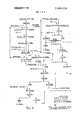
- FIGS. 1 and 2 taken together, are a flow sheet of the process in accordance with the present invention and its alternatives for producing substantially pure Be(OH) DESCRIPTION OF THE PREFERRED EMBODIMENT
- a number of beryllium ores are suitable for treatment by the method of the present invention, such as Spor Mountain and Topaz Mountain ores.
- the beryllium in Spor-Topaz ores is thought to be contained in the mineral bertrandite, Be Si O (OH), and in beryliferous saponite, a clay-like mineral, both of which are soluble in moderate concentrations of mineral acid.
- beryl (3BeO.Al O .6SiO and phenacite (Be SiO other forms of naturally occurring beryllium, are not readily soluble in moderate acid concentrations, but may be rendered acid soluble by prior art processes including fluoride sintering or alkali fusion.
- Spor-Topaz ores are thus susceptible to leaching directly by mineral acid and may therefore be advantageously used in the process of this invention.
- Other ores containing beryllium values, when rendered acid-soluble by prior art methods, may also be used in the process herein.
- the beryllium ore (after it is ground to the desired size) is acid-leached with sulfuric acid.
- sulfuric acid hydrochloric acid may be used although sulfuric acid is preferable because of lower costs.
- Spor-Topaz ores may be leached with conventional acid leach liquids having a pH substantially below 1.0, but in accordance with the invention, the ore is leached preferably with H the pH of the leach solution being maintained above about 1.2 and below about 2.0 throughout the duration of the leaching operation.
- the temperature of the leach solution is in the range from about F. to just below the boiling point of the leach liquor, and the leaching operation proceeds for a period sufficient to dissolve substantially all the beryllium values in the material.
- Leaching may be at a temperature higher than boiling,
- the pH of the acid solution is maintained above about 1.3 during one or more major portions of the leaching period, e.g., for periods of 2 to 3 hours at a time, so that the amount of impurities which leach from the ore and enter the leach solution, such as aluminum, iron and fluorine, are kept at a desirably low and controlled level.
- the pregnant acid solution then may be recovered for further'treatment to extract highpurity beryllium therefrom.
- the leaching operation is carried out in a controlled manner so that the pH values are maintained throughout its-duration in the range from about 1.3 to about 1.5.
- the leaching is conducted at a pH of about 1.4, it requires, typically, using about 450 pounds of H 80, per ton of ore. This amount of acid-leach solution used should be sufficient to result in a slurry containing fromabout 25% to about-33%of solids.
- the time required to leach the ores may vary within a wide range depending on leaching conditions which include the pH, the leaching temperature, and the solids concentration. We have found that the amount of available fluoride in the leach solution has a direct bearing on the rate of leaching. Leaching Spor-Topaz ores using an acid-leaching solution at the preferred pH of about.l.4 and at a temperature in the range between 160 and 200 F., and a slurry containing about 25% solids by weight, a period of about 20 hours is normally required for the leaching operation. This period, however, can be drastically reduced if the available fluoride content in the leach solution is raised by the addition of a soluble fluoride. By providing as little as 0.3 g/l of excess fluoride in the liquor, the leaching time may be reduced to about 6 hours.
- H2804 CaF C350 then'the diffusion rate of I-I SO. and HF through the CaSO layer on the fluoride is an inherent limitation of the leach rate.
- a soluble fluoride,-such as NaF releases hydrogen fluoride which in combination with sulfuric acid allows the beryllium dissolution to take place at a faster rate.
- any soluble fluoride which can be readily dissolved in the acid leach solution and which does not materially contribute to the impurities in the final BeO product may be used.
- NaF, NI-LF, NaHF NI-I HF HF and AlF are eminently suitable.
- the amount of soluble fluoride that. can be added to the solution is not especially critical, and depends to a large extent on the amount of available fluoride in the leach liquor. In general, even a trace amount provides beneficial results.
- 3 g/l, preferably in the range of 3 to 5 g/l, of the leach liquor based on the weight of the fluorine seems. to be effective for reducing the leaching time to the suitable short duration.
- the upper limit as to the amount of fluoride that can be added is not critical. An amount far above that required for the combination with the beryllium values usually is not required. Spor-Topaz ores, the fluoride addition required to combine with the beryllium values therein seldom exceeds 10 g/l of the leach liquor based on the weight of the fluorine.
- the fluoride may be added directly into the ore prior to the addition thereto of the acid leach solution, or it may be added directly to the leach solution. Preferably, the fluoride addition is made soon after the major acid addition to form the resultant slurry.
- the time at which the fluoride may be added to the leach liquor, however, is not very critical as long as its addition provides free fluoride ions for the formation of beryllium fluorocomplexes.
- certain soluble aluminum salts particularly AlF may be used as additives to facilitate the leaching operation.
- AlF when added into the acid leach liquor formsAlF and All ions, the presence of which decrease the solubility of aluminum and have the added benefit of supplying the fluoride ions required for the leaching.
- the lowering of the aluminum solubility is due to the offset of the equilibrium conditions within the leach liquor wherein both the beryllium and the aluminum compete for the fluoride ions to form the soluble fluoro-complexes.
- the preferred leaching method of this invention as described is superior to the conventional leaching methods which use more strongly acid leach solutions having pI-ls substantially below l.2 (typically about 1,000 pounds of acid per tonof ore).
- the lower con-v centration of acid in the leach solution also provides savings of alkali required in the subsequent pI-I raising step of the process and has the additional advantage of maximizing the extraction of beryllium values while minimizing the solubilization of other mineral impurities which would otherwise be soluble in a more concentrated acidic solution.
- the slurry at this point can be filtered or it may be further processed without filtering- (The filtering step is not shown in the accompanying flowsheet.) Filtering and washing at this stage are generally more rapid and have theadvantage of requiring less alkali in a subsequent partial neutralization step. If filtration is used, the residue is treated with a series of displacement and repulp washes using hot leaching solution. The residue washings are used advantageously as make-up solutions for the subsequent leaching operation.
- the leach solution recovered from the ore contains in solution substantially all the beryllium of the ore (approximately together with a substantial amount of impurities leached from the ore (but, as indicated above, a notably lower concentration of impurities than would be present in a conventional high-acid leach solution).
- a typical leach liquor at this stage contains about substantially the following (in g/l):
- This part of the process comprises raising the pH of a leach solution containing beryllium together with aluminum, iron, fluorine, and other impurities to above 3.0 but below about 4.5, and preferably above 3.8 and below 4.2, tocause the precipitation of fluoro-compounds of aluminum and compounds of iron.
- the precipitates are separated from the leach liquor'by filtration and the pH of the filtrate is then further raised to above 7.5 but below 9.0 causing the precipitation of beryllium hydroxide from the solution.
- a base chosen from NH;,, NH,,0H, NaOH, KOH, milk of lime or equivalent carbonates or oxides, and organic bases such as urea is introduced gradually into the heated acid leach solution until its pH has been uniformly raised to a value below about 4.5'but above 3.0, preferably in the range from about 38m about 4.2.
- the pH used here is inversely temperature dependent.
- At this pH almost all the iron is precipitated as a basic ferric salt and a substantial portion of the aluminum is precipitated as a hydroxyfluoride.
- the stability of aluminum hydroxyfluoride is dependent on the temperature and the pH of the leach solution. Apparently, the higher the temperature, the more stable is the aluminum hydroxyfluoride over awider pH range. Thus, in our prior process, the removal of the aluminum and fluoride impurities in the leach solution required autoclaving the leach solution at a temperature in the range between 300 and 600 F. At lower temperatures, e.g., below 212 F., as now contemplated, the precipitation of the aluminum hydroxyfluoride, unless carefully controlled in accordance with the invention, tends to be incomplete and takes longer. We found that a higher pH is required if a sufficient amount of aluminum is to be recovered, in other words, to be removed from the leach solution. However, the pH of the solution should not be so high as to cause undesirable co-precipitation of beryllium.
- precipitation according to the present invention is not to be confused with the prior art fractional hydrolysis for the removal of aluminum in acid leach solution which will not work in the present case because of the presence of fluoride ions in the leach solution.
- a typical clear leach solution contains substantially the following (in g/l):
- the filter cake is washed and then discarded. It has been found that if the ore residue is not filtered from the leach solution prior to adjusting the pH to near 4, more of the dissolved beryllium appears to be absorbed by the clayey material in the filter cake than if the filtration were made. In such instances, complete washing is difficult. By cationic displacement using such chemicals as sulfuric acid and/or ammonium sulfate in the wash water, the absorbed beryllium can be more easily washed from the clay. A considerable amount of wash water may be employed since the washing can be used in making up the next batch of acid leach solution.
- a typical clear leach solution contains substantially the following (in g/l):
- the sodium in the leach solution required for the ralstonite precipitation may be provided by the soluble sodium fluoride used for facilitating the leaching operation. It may also be provided by adding to the filtered leach solution a sodium salt which will not interfere with the formation of the ralstonite or with the subsequent recovery of beryllium values. Sodium sulfate or sodium fluoride (the latter may be used for the leaching) are found to be eminently suitable.
- the leach solution is filtered and the filter cake may be treated in the same manner as described for the hydroxyfluoride precipitation.
- ammonia or another suitable base is again used to raise the pH of the clarified filtrate to a higher pH between 7.5 and 9.0 and preferably in the range of 8.0 to 8.5.
- beryllium in the form of beryllium hydroxide is precipitated.
- Co-precipitated with the beryllium is the residual aluminum and some magnesium. The exact composition of these precipitates, however, is obscure.
- the precipitates preferably are recovered by filtration.
- a typical dried precipitate recovered from this filtration has substantially the following composition:
- a number of alkalies e.g., sodium or potassium hydroxide, or even lime or calcium carbonate
- ammonia e.g., sodium or potassium hydroxide, or even lime or calcium carbonate
- the beryllium precipitation may be carried out at a temperature above about 160 F. but preferably below the boiling point of the solution.
- Heavy metal ions particularly Zm remaining in the leach solution after the initial pH raising step and subsequent filtration may be removed prior to the second pH raising step using soluble sulfide to precipitate the heavy metal ions as sulfides as shown by the dotted line in the accompanying flow sheet.
- the sulfide precipitation step removes substantially all zinc ions in the solution (solutions containing 50 parts per million zinc before treatment with a soluble sulfide treatment typically containingless than 1 part per million afterwards) as well as other heavy metal ions such as copper, cadmium, and lead.
- the zinc level of BeO is preferably less than 1,000 ppm which corresponds to a zinc concentration less than 0.001 g/l in the pregnant solution after initial precipitation at a pH of about 4.0.
- the removal of the zinc ion by the addition of the sulfide ion is readily controlled by measuring the electromotive force (EMF) of the solution.
- EMF electromotive force
- a preferred procedure for zinc and other heavy metals removal from the pregnant pH 4.0 solution is to heat the solution in the sulfidi'zation tank to about 140 F. and thereafter to introduce the gaseous H S into the solution until the EMF of the gold and silver-silver chloride electrodes reaches 250 millivolts and is maintained at that level for one-half hour.
- the level of zinc in the solution can be checked in a conventional manner such as with dithizone. When the zinc level is within the requirement (below 0.001 g/l), the solution is filtered and thereafter the filtrate is tested again with dithizone to assure the zinc level therein is less than 0.001 g/l. If the zinc level is above the required level, additional sulfide is used to bring the level down to requirement. Additional filtering is used to remove the precipitates therein.
- a chelating agent preferably ethylene diamine tetraacetic acid (EDTA)
- EDTA ethylene diamine tetraacetic acid
- the chelating agent is added after the sulfide precipitation since most of the heavy metal ions removed in the earlier treatment chelates with EDTA to form stable soluble chelates which cannot be readily broken up in the subsequent regeneration step forthe recovery of EDTA.
- the sulfide precipitation reduces the concentration of cations which chelate with EDTA to form stable complexes.
- the pregnant solution contains only a low concentration of Mn and Fe cations whose chelates cannot be broken up.
- impurities present only fluorine, sodium, and silica do not chelate with EDTA.
- EDTA is first dissolved in a pH 5.5 solution prior to its addition to the pH 4.0 pregnant solution. An excess amount of EDTA is used to insure complete complexing of all chelatable cations therein to form the soluble complexes. A retentiontime of several hours (2 to 10 hours) at the temperature range of 100 to 160 F. is preferably used to allow the slow chelating cations such as Al and F e** to form the complexes.
- the pH of the solution is raised to the desired pH range above 7.5 but below about 9.0 in the manner described. It is noted that the presence of the fluorine ions has retained the beryllium values in the solution until the higher pH values are reached at which time the beryllium is precipitated as hydroxide.
- the filtrate containing the EDTA complexes is treated to regenerate EDTA for recycling.
- the filtrate generally contains the EDTA complexes of'Ca, Mg, Al, Mn, and Fe andsome free EDTA.
- the alkaline earth and alkali metal complexes are regenerated easily by acidifying the filtrate to a pH of about 1.8.
- the aluminum chelate can be regenerated by lowering the pH to about 1.4.
- the complexes of Mn*** and Fe which cannot be regenerated are not recovered, the amount of which, however, is small compared to the total amount of EDTA recovered.
- the regenerated as well as the excess EDTA is precipitated from the acidified solution and is recovered by filtration.
- the successive pH raising steps remove a major amount of impurities from the original leach solution.
- the beryllium filter cake may be further treated by conventional methods for removing the impurities. Further purification treatment, however, should be selected according to the impurities in the beryllium filter cake.
- One of the treatments which is particularly suitable for use in combination with the double pH raising steps without the chelating treatment, comprises the steps of digesting the impure hydroxide in a strong alkali solution for a period sufficient to dissolve substantially all the beryllium values in the solution. After the insolubles are separated from the digesting solution, the beryllium solution is hydrolyzed to cause the precipitation of beryllium hydroxide. The precipitated beryllium hydroxide is then recovered from the solution.
- the filter cake containing beryllium recovered from the double pH raising steps is digested in a 50% solution of sodium hydroxide.
- the temperature of the slurry, which tends to increase during digestion, advantageously is controlled by external cooling.
- the slurry is filtered, and the recovered filter cake is further treated with more 50% sodium hydroxide solution and refiltered.
- This second filtrate after addition of solid sodium hydroxide to bring the concentration of 50%, is recycled and is used to make up part of the solution for digestion of the next batch of crude hydroxide precipitates.
- the filter cake is repulped with deionized water and refiltered to recover the small amount of beryllium therein.
- the filtrate is used in the next subsequent step ofthe process to dilute the filtrate from the first NaOH treatment.
- the new filter cake is discarded.
- a typical cake obtained at this stage analyzes substantially as follows (in percent by weight):
- the cake is composed chiefly of crystallized NaF and NaF Na SO4, and is discarded.
- the first strong sodium hydroxide leach filtrate preferably is combined with the water repulp filtrate, and additional deionized water is added to bring the NaOH concentration to about 1.5N.
- This diluted sodium hydroxide solution usually contains 4 to 5 g/l BeO together with some aluminum and a very small amount of zinc (if the prior sulfide precipitation is not used or the step has not completely eliminated it). Because zinc and beryllium have a tendency to coprecipitate, the small amount of zinc must be eliminated before the final hydrolysis step if low zinc content in the final beryllium product is to be achieved.
- the zinc elimination step may be carried out by adding a solution of a sulfide such as 10% sodium sulfide solution to the diluted NaOH solution to cause the precipitation of ZnS.
- a sulfide such as 10% sodium sulfide solution
- the zinc precipitate is filtered or otherwise separated by conventional methods and is discarded.
- the solution in a suitable holding tank is brought to boiling by external heating for a period of time sufficient for all Na BeO to hydrolyze to on which precipitates out of the solution while the aluminum remains therein.
- boiling for two hours is generally adequate.
- the precipitate which is readily filtered because it is granular in character, is subjected to a series of decantings, washings, and filterings as shown in the accompanying flow sheet to remove traces of impurities.
- Deionized water preferably is used to wash the settlings from the decantation tank after deberyllization as well as from the washer.
- the cake recovered may be dried to Be(OH)
- the final produce meets the following specification:
- the Be(OI-I) recovered may be fired at about l,600
- the overall recovery by this process is, in a typical pilot plant run on ore containing 1% BeO, approximately of the assayed BeO in the ore.
- the crude beryllium hydroxide recovered as the precipitate from the second pH raising step may be subjected to a number of other alternative treatments as shown in the flow sheet to produce the high purities required.
- the filter cake containing the impure beryllium hydroxide is added to a concentrated sulfuric acid (98% H SO or higher) in an amount sufficient or slightly in excess to convert stoichiometrically all the metals to sulfates (sulfate conversion).
- the conversion step is highly exothermic, and the heat of the reaction will cause continuous fuming at 300 F. to 600 F. until a semi-dry cake is obtained.
- the hydrogen fluoride as well as S0 generated from the conversion reaction may be recycled to the leaching solution to facilitate the dissolution of the beryllium in the leaching process described hereinabove.
- the semi-dry sulfate cake is dissolved in water and the pH of the resultant solution is adjusted to about 7.0 and 8.0 by the addition of caustic therein.
- the ph raising step causes the precipitation of the hydroxide which is recovered by filtration.
- the cake may be washed with water.
- the hydroxide cake is reslurried in a sufficient amount of water to prepare a relatively thin slurry (10 percent by weight of solids).
- the slurry of hydroxide is then added rapidly to concentrated sulfuric acid to produce boiling aggregates containing beryllium sulfate. Additional boiling for 30 minutes to an hour or even more may be used to insure the complete conversion of the hydroxide to the soluble sulfate.
- the fluorine in the slurry is volatized to some extent, and silicon is mostly dehydrated.
- the impurities remaining in the form of insolubles are removed by filtration.
- the filter cake may be washed once or more to recover the soluble beryllium. After washing, the filter cake may be discarded.
- the initial H fuming step and the sulfuric acid boiling operation may be interchanged.
- the fuming step is used in the second stage of the process, the semi-dry sulfate cake obtained is redissolved in water before it is subjected to further purification treatment.
- chelating agent such as EDTA
- it is preferably added at this time to form soluble complexes with other impurities before the sulfate solution is subjected to a pH raising operation with a caustic to precipitate beryllium as a hydroxide.
- EDTA may be recovered by acidifying the neutral or slightly alkaline solution to a pH of about 1.0 to 2.0 and followed by filtration to remove the precipitated EDTA which may be redissolved in an alkaline solution for subsequent use.
- the dried or moistened beryllium hydroxide recovered from the double pH raising process is treated with a large excess amount of H SO (preferably 98% or higher) to produce a slurry of insoluble sulfates (identified as Procedure B in the flow sheet).'To insure complete conversion, the slurry is heated for about 1 hour or more at about 300 F.'to below about 500 F.
- the substantially anhydrous sulfates thus formed together with dehydrated silica are removed by filtration.
- the filtrate may be recycled for treating another batch of impure beryllium hydroxide.
- the anhydrous sulfates are heated to volatilize the sil icon and fluorine as SiF 'and HF.
- the HF and 80 may be recovered for use in the leaching operation. Subsequent to the volatilization step, beryllium sulfate is dissolvedinwater and is precipitated in the form of hydroxide in a manner described hereinabove. EDTA or another chelating agent may also be used for the preparation of an extremely high purity product.
- the impurities in the resultant filter cake may be sufficiently.
- the impurities remaining in the form of insolubles I are removed by filtration.
- the clear filtrate then is subjected to a pH raising operation as described hereinabove to precipitate the beryllium values. Since fluorine has been'substantially removed in prior purification steps, the precipitation may be carried out at a lower pH value.. We found a pH of about 7.2 to be suitable.
- EXAMPLE I This example represents an average pilot plant run involving a 2-ton batch of ore.
- four thousand pounds of Spor-Topaz ore assaying 0.67% BeO' is ground in a rodmill to minus 14 mesh.
- Water (usually wash water from a previous leach residue filtration) is added to the mill to make up a slurry of about 30% solids.
- the slurry is allowed to run to a steam-jacketed, 1,000-gallon, lead-lined tank equipped with an agitator.
- Sulfuric acid is gradually added tothe tank as needed to maintain a pH continually as close as feasible at about 1.4.
- the charge is heated to about l-200 F. and is held at this temperature for about 20 hours.
- About 900 pounds of acid is added.
- ammonia gas is introduced to the leach solution slowly overa 4-hour period to bring the pH to about 3.8.
- the slurry isheld at about 180 F. or above for a period of 5 hours.
- the slurry is subsequently filtered-on a Moorefilter and is washed thoroughly with a 0.1 M solution of ammonium sulfate to which sulfuric acid has been added to bring the pH to about 3.5.
- the used wash water is saved for slurrying another batch of ore.
- the filler cake contains 0.10% BeO, a loss ofabout 14% of-the Be in the ore.
- the filtrate is placed in a heated tank and brought to an EMF between -l00 and -300 millivolts (as measured by a gold and silver-silver chloride electrode) using H 8 gas.
- AnEMF of about 250 millivolts is preferred at a temperature'of F. After this EMF and this temperature are attained, the temperature is allowed to drop gradually while the EMF is maintained at the same level.
- Theprecipitate thus formed contains substantially all'of the zinc in the original filtrate.
- the precipitate is removed in a plate and frame filter, the filtrate from which contains less than 1 part per million zinc.
- the filtrate is subjected to a second pH raising step wherein ammonia is against gradually introduced into it to bring the pHxto about 8.5. During thisoperation, the temperature is held at F. The slurry from this operation is filteredon a drum filter. The filtrate containing 0.013 grams per liter BeO is discarded resulting in a loss of 0.7% ofthe Be in the ore. v
- the hydroxide precipitate containing about 70% water is next mixed with 24 pounds of cold 50% NaOH solution per pound of BeO in the solution in a waterjacketed tank, and its temperature is kept as close as possible to room temperature.
- the slurry is filtered in a plate and frame filter press.
- the recovered filter cake is repulped with a sufficient amount of 50% NaOH solution to make a pumpable slurry and then is refiltered on a drum filter.
- This filter cake is repulped with deionized water and filtered once more on a drum filter.
- the cake containing 0.7% BeO is discarded. This represents a loss of 4.3% of the Be in the ore.
- the first strong caustic filtrate and the water rep ulp filtrate are combined with a sufficient amount of deionized water to make the specific gravity equivalent to a NaOH contentof about l.5N.
- the solution is filtered in a plate and frame filter press.
- the cake consisting substantially of CaSO is discarded.
- the clear filtrate is boiled in a steam-jacketed tank for 2 hours.
- the precipitate .of Be(OH) is allowed to settle.
- the supernatant solution is decanted off, and the precipitate is washed twice with deionized water (filtered on a pan filter and washed once more on the filter).
- the filtrate and washings containing 0.73 pounds of BeO (2.7% of the Be in the ore) are discarded.
- EXAMPLE Ill This example compares leaching of beryllium ores at various pH values from 0.9 to 1.4. Six leaching operations were carried out at pH intervals of 0.1 from 0.9 to 1.4. Each of the leaching operations followed the procedure described below.
- a quantity of ore was ground to pass 14 mesh and divided into six approximately equal portions. Each portion was leached with sufficient water to make a slurry of density 1.260 to 1.270, which is equivalent to approximately 35% solids. Sulfuric acid was added to bring the pH to the desired value, and additional acid was added gradually as required to maintain the pH approximately constant throughout the duration of the leaching operation. At the outset of this operation the temperature of the slurry was raised to approximately F. The temperature and the pH was maintained for 20 hours at which time the slurry was drained from the leaching tank to a filter. The six resultant leach solutions were found to have the compositions shown in Table 1 after adjusting volumes to show the same 8120 content:
- the impurity content of the leach solution was notably less when the leach was conducted at the preferred pH value of 1.4 than when conducted at the value of 1.0. Moreover, only two-thirds as much acid was required for the leaching operation at the preferred pH as was used for leaching at the lower pH.
- a process of extracting beryllium values from beryllium bearing material containing aluminum, iron, fluorine, zinc and other impurities which comprises contacting said beryllium bearing material with a mineral acid solution having a pH value in the range between 1.2 and 2.0 for a period sufficient to dissolve a substantial portion of the beryllium values in said material, gradually adding said acid to maintain the pH of the solution at above about 1.3 andbelow about 2 during a major portion of said period thereby controlling the amount of impurities dissolved therein, and recovering the impregnated acid solution having beryllium and a controlled amount of impurities dissolved therein.
Landscapes
- Engineering & Computer Science (AREA)
- Chemical & Material Sciences (AREA)
- Manufacturing & Machinery (AREA)
- Materials Engineering (AREA)
- Mechanical Engineering (AREA)
- Metallurgy (AREA)
- Organic Chemistry (AREA)
- Manufacture And Refinement Of Metals (AREA)
Abstract
The extraction and the recovery of beryllium substantially devoid of zinc and other impurities from low and medium grade acid-leachable berllium bearing ores, e.g., bertrandite, is accomplished by acid leaching at a pH below about 2 but above about 1.2, preferably between 1.3 and 1.5, and advantageously with the aid of a soluble fluoride additive to recover the beryllium in solution with relatively small dissolution of such impurities as iron and aluminum.
Description
United States Patent Grunig et al.
[451 Oct. 17,1972
EXTRACTION OF BERYLLIUM FROM ORES Inventors:
Assignee:
Filed:
Appl. No.:
James K. Grunig;WiIliam B. Davis, both of Tucson, Ariz.; William C. Aitkenhead, Belige City, British Honduras The Anacanda York, NY.
Dec. 21, 1970 Company, New
Related U.S. Application Data Continuation-in-part of Ser. No. 710,984, March 6, 1968, abandoned, which is a continuation-impart of Ser. No. 316,474, Oct. 15, 1963, Pat. No. 3,395,975.
U.S. Cl.
Int. Cl.
Field of Search .....23/l5, 18-20, 22-24,
References Cited UNITED STATES PATENTS Windecker ..23/24 B Adams et al. ..23/52 X CRUSHED B20 ORE ROD MILL p H 14 BATCH ACID LEACH BATQH P RE IF ITATION FILTER LCAD TANK Camillam F RATE 3,059,998 10/1962 Mod et al. ..23/183 3,116,110 12/1963 Morana et a1. ..23/183 3,116,111 12/1963 Morana et a1. ..23/183 3,177,068 4/1965 Mod et al ..23/19 X FOREIGN PATENTS OR APPLICATIONS 926,392 5/1963 Great Britain ..23/24 B OTHER PUBLICATIONS Crocker et al., U.S. Dept. of Interior, Business of Mines R.I. 6322, 1963, pp. l- 16. Hessinger, Industrial & Engineering Chemistry, Vol. 54, 1962, pp. 16- 21.
Primary Examiner-Herbert T. Carter AttorneyDean S. Edmonds et a1.
57 ABSTRACT 6 Claims, 2 Drawing Figures PREGNANT SOLUTION CRUDE HYDROXIDE HYDROLYSIS u. I'RATE CAKE REGENERATION cAus'nc D IGESTION UMP To WASTE WASHINGS SOLID RESIDUE To TAILINGS 50% N OH CAKE DEIONIZED WATERj RE P ULPER FILTER SULFIDE 'PRECIPITATION 1 FILTER I L'L EEL L iEJ L4 1 FILTRATE J FILTER CAKE FILTRATE REPU LPER FILTER C KE T- WAST Tu E
PATENTEnIIcI I1 I972 SHEEI 1 BF 2 .CRUSHED BeO ORE PREGNANT SOLUTION NR3 ROD MILL I SOLUBLE 4 r 93% H2804 CRUDE HYDRQXIDE HYDROLYSISN p H 1.4 BATCH ACID LEACH FILTER ---EDTA ---1 BATCH PRECIPITATION I Fl LT ATE E on CAKYE P"REGENERATIONY FILTER LOAD TANK 50% Na OH SUMP 0.1 M (NH4)2SO4 Cu(0H)2---I I N T WASTE CAUSTIC V F'LTRATE DIGESTION WASH TANK I-1L R T E WASH'NGS 7 SULFI DE. PRECIPITATION LTER I SOLID RESIDUE l To TAILINGS HLTER k I I I LE E L LI EQJ l r CAKE FILTRATE 50%NOOH REPULPER A I[ ILTER CAKE ILTRATE DEIONIZED WATER I v l J FLAKE NaOH BELiLEii FILTER INVENTORS JAMES K. GRUNIG CAKE FILTRATE WILLIAM B. DAVIS 1; vyILLIAM C.AITKENHEAD To INASTE BY 7,7
I- 1" if )JdMwAT'ToRNEMS 67/ 1 EXTRACTION OF BERYLLIUM FROM 'ORES CROSS-REFERENCE TO A RELATED APPLICATION This is a continuation-in-part application of our application Ser. No. 710,984, filed Mar. 6, 1968, now abandoned, which in turn is a continuation-in-part of our application Ser. No. 316,474, filed Oct. 15, 1963, entitled, Precipitation of Beryllium From Ore, new U.S. Pat. No. 3,395,975.
BACKGROUND OF THE INVENTION I. Field of the invention This invention relates to a process for the extraction and recovery of beryllium in the form of substantially pure beryllium compounds from beryllium bearing ores. More particularly, this invention relates to a process for the extraction of acid-leachable beryllium values from ores in a manner permitting easy separation of those values from other mineral components in the ores. The process of this invention is particularly suitable for recovering beryllium values from low and intermediate'grade ores.
11. Description of the Prior Art Several processes for the extraction of beryllium values from ores have been developed, some of which are only suitable for acid-leachable beryllium values. In these prior art processes, it has been difficult to separate compounds of aluminum, iron, magnesium, and calcium from the beryllium compound component. Hence, the final beryllium product is rather pure. It has, heretofore, been proposed to extract beryllium compounds from beryllium bearing ores by leaching with acid, and then causticizing the leach liquor and autoclaving it at high temperature and pressure for the elimination of impurities such as aluminum, iron and calcium from the beryllium bearing solution. While such prior method is economically attractive for the high yield production of substantially pure beryllium hydroxide, for a commercial scale operation itbecomes necessary to provide a large autoclave capacity to handle the large volume of leach liquor. The cost for the construction of the autoclaves, therefore, requires a large capital expenditure.
SU MMARY OF THE INVENTION The process of the present invention comprises treating a beryllium bearing material containing aluminum, iron, fluorine, and other impurities with a mineral acid at a pH below 2.0, but not below 1.2, to extract the beryllium and a minimum of impurities from the material, the pH of the leach solution being maintained in this range throughout the leaching operation by gradual (periodic or steady) acid addition. Throughout a major portion of the leaching operation the pH best is maintained above about 1.3. It is desirable to hold the pH in the narrow range from 1.3 to 1.5 throughout the leaching operation if possible. It is also advantageous to add a soluble fluoride to the leach solution, for by so doing the leaching time can be substantially reduced. The acid slurry with a controlled limited amount of impurities dissolved therein then is heated and its pH carefully raised to above 3.0 but below about 4.5, and preferably below 4.0, to' cause the precipitation of fluoro compounds of aluminum and compounds of iron. The precipitates are separated from the leach liquor by filtration and the pH of the filtrate is then further raised to above 7.5 but below 9.0 causing the precipitation of beryllium from the solution. A minor amount of impurities are also concurrently precipitated. The beryllium precipitate is recovered and digested in a sodium hydroxide solution. The beryllium in the sodium hydroxide solution is then hydrolyzed and reprecipitated as beryllium hydoxide thus precipitating values rich in beryllium. Alternatively, the beryllium precipitate is treated with a strong sulfuric acid and the beryllium values are subsequently recovered as a hydroxide precipitate.
The zinc impurities, preferably, are removed by treating the leach liquor with a soluble sulfide after the initial pH-raising step or before the hydrolysis of the digested beryllium hydroxide.
BRIEF DESCRIPTION OF THE DRAWINGS FIGS. 1 and 2, taken together, are a flow sheet of the process in accordance with the present invention and its alternatives for producing substantially pure Be(OH) DESCRIPTION OF THE PREFERRED EMBODIMENT A number of beryllium ores are suitable for treatment by the method of the present invention, such as Spor Mountain and Topaz Mountain ores. The beryllium in Spor-Topaz ores is thought to be contained in the mineral bertrandite, Be Si O (OH), and in beryliferous saponite, a clay-like mineral, both of which are soluble in moderate concentrations of mineral acid. In contrast to bertrandite, beryl (3BeO.Al O .6SiO and phenacite (Be SiO other forms of naturally occurring beryllium, are not readily soluble in moderate acid concentrations, but may be rendered acid soluble by prior art processes including fluoride sintering or alkali fusion. Spor-Topaz ores are thus susceptible to leaching directly by mineral acid and may therefore be advantageously used in the process of this invention. Other ores containing beryllium values, when rendered acid-soluble by prior art methods, may also be used in the process herein.
Following is a detailed description of a beryllium recovery operation embodying the invention, presented with reference to the accompanying two sheets of drawings which together show a single flowsheet of a specific procedure and its alternatives for producing substantially pure Be(OH) The dotted line shows the alternative procedures.
Referring to the drawing, the beryllium ore (after it is ground to the desired size) is acid-leached with sulfuric acid. Instead of sulfuric acid, hydrochloric acid may be used although sulfuric acid is preferable because of lower costs. Spor-Topaz ores may be leached with conventional acid leach liquids having a pH substantially below 1.0, but in accordance with the invention, the ore is leached preferably with H the pH of the leach solution being maintained above about 1.2 and below about 2.0 throughout the duration of the leaching operation. The temperature of the leach solution is in the range from about F. to just below the boiling point of the leach liquor, and the leaching operation proceeds for a period sufficient to dissolve substantially all the beryllium values in the material. Leaching may be at a temperature higher than boiling,
in which'case pressurized equipment is used. In the process the pH of the acid solution is maintained above about 1.3 during one or more major portions of the leaching period, e.g., for periods of 2 to 3 hours at a time, so that the amount of impurities which leach from the ore and enter the leach solution, such as aluminum, iron and fluorine, are kept at a desirably low and controlled level. The pregnant acid solution then may be recovered for further'treatment to extract highpurity beryllium therefrom.
Preferably, the leaching operation is carried out in a controlled manner so that the pH values are maintained throughout its-duration in the range from about 1.3 to about 1.5. When the leaching is conducted at a pH of about 1.4, it requires, typically, using about 450 pounds of H 80, per ton of ore. This amount of acid-leach solution used should be sufficient to result in a slurry containing fromabout 25% to about-33%of solids.
The time required to leach the ores may vary within a wide range depending on leaching conditions which include the pH, the leaching temperature, and the solids concentration. We have found that the amount of available fluoride in the leach solution has a direct bearing on the rate of leaching. Leaching Spor-Topaz ores using an acid-leaching solution at the preferred pH of about.l.4 and at a temperature in the range between 160 and 200 F., and a slurry containing about 25% solids by weight, a period of about 20 hours is normally required for the leaching operation. This period, however, can be drastically reduced if the available fluoride content in the leach solution is raised by the addition of a soluble fluoride. By providing as little as 0.3 g/l of excess fluoride in the liquor, the leaching time may be reduced to about 6 hours.
The exact reason for the dramatic improvement in the leaching time is not yet certain. It may be due to the fact that, in leaching, beryllium goes into the solution as a fluoro-complex, and, therefore, the rate of leaching is dependent on the fluoride ion activity. If a fluoride is made available only through the following reaction:
H2804 CaF C350 then'the diffusion rate of I-I SO. and HF through the CaSO layer on the fluoride is an inherent limitation of the leach rate. The addition of a soluble fluoride,-such as NaF, releases hydrogen fluoride which in combination with sulfuric acid allows the beryllium dissolution to take place at a faster rate.
Any soluble fluoride which can be readily dissolved in the acid leach solution and which does not materially contribute to the impurities in the final BeO product may be used. Among them, NaF, NI-LF, NaHF NI-I HF HF and AlF are eminently suitable. The amount of soluble fluoride that. can be added to the solution is not especially critical, and depends to a large extent on the amount of available fluoride in the leach liquor. In general, even a trace amount provides beneficial results. Usually an addition above 3 g/l, preferably in the range of 3 to 5 g/l, of the leach liquor based on the weight of the fluorine seems. to be effective for reducing the leaching time to the suitable short duration.
The upper limit as to the amount of fluoride that can be added is not critical. An amount far above that required for the combination with the beryllium values usually is not required. Spor-Topaz ores, the fluoride addition required to combine with the beryllium values therein seldom exceeds 10 g/l of the leach liquor based on the weight of the fluorine.
The fluoride may be added directly into the ore prior to the addition thereto of the acid leach solution, or it may be added directly to the leach solution. Preferably, the fluoride addition is made soon after the major acid addition to form the resultant slurry. The time at which the fluoride may be added to the leach liquor, however, is not very critical as long as its addition provides free fluoride ions for the formation of beryllium fluorocomplexes.
In addition to the aforesaid soluble alkali fluorides, certain soluble aluminum salts, particularly AlF may be used as additives to facilitate the leaching operation. AlF when added into the acid leach liquor formsAlF and All ions, the presence of which decrease the solubility of aluminum and have the added benefit of supplying the fluoride ions required for the leaching. The lowering of the aluminum solubility is due to the offset of the equilibrium conditions within the leach liquor wherein both the beryllium and the aluminum compete for the fluoride ions to form the soluble fluoro-complexes.
The preferred leaching method of this invention as described is superior to the conventional leaching methods which use more strongly acid leach solutions having pI-ls substantially below l.2 (typically about 1,000 pounds of acid per tonof ore). The lower con-v centration of acid in the leach solution also provides savings of alkali required in the subsequent pI-I raising step of the process and has the additional advantage of maximizing the extraction of beryllium values while minimizing the solubilization of other mineral impurities which would otherwise be soluble in a more concentrated acidic solution.
The slurry at this point can be filtered or it may be further processed without filtering- (The filtering step is not shown in the accompanying flowsheet.) Filtering and washing at this stage are generally more rapid and have theadvantage of requiring less alkali in a subsequent partial neutralization step. If filtration is used, the residue is treated with a series of displacement and repulp washes using hot leaching solution. The residue washings are used advantageously as make-up solutions for the subsequent leaching operation. With or without filtering, the leach solution recovered from the ore contains in solution substantially all the beryllium of the ore (approximately together with a substantial amount of impurities leached from the ore (but, as indicated above, a notably lower concentration of impurities than would be present in a conventional high-acid leach solution).
A typical leach liquor at this stage contains about substantially the following (in g/l):
BeO A1 0,, 2.3 6.5
Zn F .16 6.4
tially pure beryllium therefrom. This part of the process comprises raising the pH of a leach solution containing beryllium together with aluminum, iron, fluorine, and other impurities to above 3.0 but below about 4.5, and preferably above 3.8 and below 4.2, tocause the precipitation of fluoro-compounds of aluminum and compounds of iron. The precipitates are separated from the leach liquor'by filtration and the pH of the filtrate is then further raised to above 7.5 but below 9.0 causing the precipitation of beryllium hydroxide from the solution.
For the initial pH raising operation, a base chosen from NH;,, NH,,0H, NaOH, KOH, milk of lime or equivalent carbonates or oxides, and organic bases such as urea, is introduced gradually into the heated acid leach solution until its pH has been uniformly raised to a value below about 4.5'but above 3.0, preferably in the range from about 38m about 4.2. (The pH used here is inversely temperature dependent.) At this pH, almost all the iron is precipitated as a basic ferric salt and a substantial portion of the aluminum is precipitated as a hydroxyfluoride.
The stability of aluminum hydroxyfluoride is dependent on the temperature and the pH of the leach solution. Apparently, the higher the temperature, the more stable is the aluminum hydroxyfluoride over awider pH range. Thus, in our prior process, the removal of the aluminum and fluoride impurities in the leach solution required autoclaving the leach solution at a temperature in the range between 300 and 600 F. At lower temperatures, e.g., below 212 F., as now contemplated, the precipitation of the aluminum hydroxyfluoride, unless carefully controlled in accordance with the invention, tends to be incomplete and takes longer. We found that a higher pH is required if a sufficient amount of aluminum is to be recovered, in other words, to be removed from the leach solution. However, the pH of the solution should not be so high as to cause undesirable co-precipitation of beryllium.
Using lower temperatures, the precipitation of aluminum hydroxyfluoride is further complicated by the competing activities of fluoride and hydrogen ions. It has been found that higher fluoride activity tends to promote precipitation. In leach solutions with a pH in the range of 1.0 to 4.5, the fluoride activity is inversely proportional to the activity of the hydrogen ions. Increasing the activity of the fluoride ions accompanies an increase in pH and in the activity of hydroxy ion which tends to promote precipitation of beryllium. We found that below this pH range, the amount of aluminum hydroxyfluoride precipitation is very small unless the temperature of the solution is greatly increased as to require autoclaving, and above this range undesirable co-precipitation of beryllium is observed.
It is important to note that precipitation according to the present invention is not to be confused with the prior art fractional hydrolysis for the removal of aluminum in acid leach solution which will not work in the present case because of the presence of fluoride ions in the leach solution.
The leach solution, after 4 or 5 hours of hot (180 F. or greater) precipitation at a pH of about 4, is filtered clear to eliminate all residual and precipitated impurities. A typical clear leach solution contains substantially the following (in g/l):
Eco A1 0, 1.6 1.4
The filter cake is washed and then discarded. It has been found that if the ore residue is not filtered from the leach solution prior to adjusting the pH to near 4, more of the dissolved beryllium appears to be absorbed by the clayey material in the filter cake than if the filtration were made. In such instances, complete washing is difficult. By cationic displacement using such chemicals as sulfuric acid and/or ammonium sulfate in the wash water, the absorbed beryllium can be more easily washed from the clay. A considerable amount of wash water may be employed since the washing can be used in making up the next batch of acid leach solution.
If milk of lime (Ca(OH) is used to raise the pH initially to above 3.0 but below 4.5 and in the presence of Na, aluminum will precipitate not only as hydroxyfluoride of the formula.
but also coprecipitate with sodium, magnesium and fluorine in the form of the mineral ralstonite of the following formula wherein x Al =1 .6 and y =0. l.
The optimal conditions for precipitation with milk of lime in the presence of Na vary with the process variables. We found precipitation of impurities at a pH of about 4.0 and at a temperature about 200 F. to be eminently suitable. The retention time at this temperature is about 6 hours. The retention can be reduced at a higher temperature. A typical clear leach solution contains substantially the following (in g/l):
BeO A1 0 3.0 0.5
MgO 1.5
Using milk of lime for the pH raising together with Na", it is possible to obtain Eco/A1 0 ratio in the range between 5 to 10 as compared to the ratio of l to 3 for the pH raising operation wherein aluminum is precipitated only as hydroxy-fluoride.
The sodium in the leach solution required for the ralstonite precipitation may be provided by the soluble sodium fluoride used for facilitating the leaching operation. It may also be provided by adding to the filtered leach solutiona sodium salt which will not interfere with the formation of the ralstonite or with the subsequent recovery of beryllium values. Sodium sulfate or sodium fluoride (the latter may be used for the leaching) are found to be eminently suitable.
After the precipitation, the leach solution is filtered and the filter cake may be treated in the same manner as described for the hydroxyfluoride precipitation.
Subsequent tothe removal of the ore residue, ammonia or another suitable base is again used to raise the pH of the clarified filtrate to a higher pH between 7.5 and 9.0 and preferably in the range of 8.0 to 8.5. At this pH range, beryllium in the form of beryllium hydroxide is precipitated. Co-precipitated with the beryllium is the residual aluminum and some magnesium. The exact composition of these precipitates, however, is obscure. The precipitates preferably are recovered by filtration.
The filtrate, which contains the important amounts of the Zn, Mg, Ca, Cu, Mn and other impurities originally present, is discarded. A typical dried precipitate recovered from this filtration has substantially the following composition:
BeO 22.0
Fe MgO Mn Zn F 00617.16 0.08 0.06 24.1
In the second pH raising step, a number of alkalies (e.g., sodium or potassium hydroxide, or even lime or calcium carbonate) may be used, of which ammonia, however, is preferred because of its low cost and its ability to complex with a number of metal ions, particularly zinc, to form soluble complexes. The beryllium precipitation may be carried out at a temperature above about 160 F. but preferably below the boiling point of the solution.
Heavy metal ions particularly Zm remaining in the leach solution after the initial pH raising step and subsequent filtration may be removed prior to the second pH raising step using soluble sulfide to precipitate the heavy metal ions as sulfides as shown by the dotted line in the accompanying flow sheet. The sulfide precipitation step removes substantially all zinc ions in the solution (solutions containing 50 parts per million zinc before treatment with a soluble sulfide treatment typically containingless than 1 part per million afterwards) as well as other heavy metal ions such as copper, cadmium, and lead.
For many applications, the zinc level of BeO is preferably less than 1,000 ppm which corresponds to a zinc concentration less than 0.001 g/l in the pregnant solution after initial precipitation at a pH of about 4.0. At this low level of zinc concentration, and at the pH range between 3.5 to 4.0, the removal of the zinc ion by the addition of the sulfide ion (desirably but not exclusively H 8) is readily controlled by measuring the electromotive force (EMF) of the solution. For example, we found a gold electrode with a silver-silver chloride reference can be used to monitor the change in EMF. When the gold electrode and its reference are tested in a ferrocyanide-ferriccyanide standard solution, an EMF of 172 millivolts'is obtained, and using a platinum electrode and a hydrogen reference, the EMF is 428 millivolts. We found that the zinc precipitation is substantially completed when the EMF between the gold electrode and the silver-silver chloride reference electrode is -250 millivolts. Of course, it is understood that the EMF would be different if a different pair of electrodes were used. In such cases, the difference between the new EMF and 250 millivolts would equal the difference between the reading of the new electrode pair in the standard solution and 172 millivolts.
A preferred procedure for zinc and other heavy metals removal from the pregnant pH 4.0 solution is to heat the solution in the sulfidi'zation tank to about 140 F. and thereafter to introduce the gaseous H S into the solution until the EMF of the gold and silver-silver chloride electrodes reaches 250 millivolts and is maintained at that level for one-half hour. The level of zinc in the solution can be checked in a conventional manner such as with dithizone. When the zinc level is within the requirement (below 0.001 g/l), the solution is filtered and thereafter the filtrate is tested again with dithizone to assure the zinc level therein is less than 0.001 g/l. If the zinc level is above the required level, additional sulfide is used to bring the level down to requirement. Additional filtering is used to remove the precipitates therein.
After the removal of the heavy metal ions and prior to the second pH raising step, a chelating agent, preferably ethylene diamine tetraacetic acid (EDTA), may be used to complex with thefiltrate (pregnant solution) from the sulfide precipitation tank as shown bythe dotted line in the accompanying flow sheet. It is important that the chelating agent is added after the sulfide precipitation since most of the heavy metal ions removed in the earlier treatment chelates with EDTA to form stable soluble chelates which cannot be readily broken up in the subsequent regeneration step forthe recovery of EDTA. The sulfide precipitation reduces the concentration of cations which chelate with EDTA to form stable complexes. Normally, after sulfide treatment, the pregnant solution contains only a low concentration of Mn and Fe cations whose chelates cannot be broken up. We have found that of the impurities present only fluorine, sodium, and silica do not chelate with EDTA. Advantageously, EDTA is first dissolved in a pH 5.5 solution prior to its addition to the pH 4.0 pregnant solution. An excess amount of EDTA is used to insure complete complexing of all chelatable cations therein to form the soluble complexes. A retentiontime of several hours (2 to 10 hours) at the temperature range of 100 to 160 F. is preferably used to allow the slow chelating cations such as Al and F e** to form the complexes.
Following chelation, the pH of the solution is raised to the desired pH range above 7.5 but below about 9.0 in the manner described. It is noted that the presence of the fluorine ions has retained the beryllium values in the solution until the higher pH values are reached at which time the beryllium is precipitated as hydroxide.
After the beryllium hydroxide precipitate is recovered by filtration, the filtrate containing the EDTA complexes is treated to regenerate EDTA for recycling. The filtrate generally contains the EDTA complexes of'Ca, Mg, Al, Mn, and Fe andsome free EDTA. The alkaline earth and alkali metal complexes are regenerated easily by acidifying the filtrate to a pH of about 1.8. The aluminum chelate can be regenerated by lowering the pH to about 1.4. The complexes of Mn*** and Fe which cannot be regenerated are not recovered, the amount of which, however, is small compared to the total amount of EDTA recovered. The regenerated as well as the excess EDTA is precipitated from the acidified solution and is recovered by filtration.
The successive pH raising steps remove a major amount of impurities from the original leach solution. The beryllium filter cake may be further treated by conventional methods for removing the impurities. Further purification treatment, however, should be selected according to the impurities in the beryllium filter cake.
One of the treatments, which is particularly suitable for use in combination with the double pH raising steps without the chelating treatment, comprises the steps of digesting the impure hydroxide in a strong alkali solution for a period sufficient to dissolve substantially all the beryllium values in the solution. After the insolubles are separated from the digesting solution, the beryllium solution is hydrolyzed to cause the precipitation of beryllium hydroxide. The precipitated beryllium hydroxide is then recovered from the solution.
Advantageously, the filter cake containing beryllium recovered from the double pH raising steps is digested in a 50% solution of sodium hydroxide. The temperature of the slurry, which tends to increase during digestion, advantageously is controlled by external cooling. The slurry is filtered, and the recovered filter cake is further treated with more 50% sodium hydroxide solution and refiltered. This second filtrate, after addition of solid sodium hydroxide to bring the concentration of 50%, is recycled and is used to make up part of the solution for digestion of the next batch of crude hydroxide precipitates. After the second NaOH treatment, the filter cake is repulped with deionized water and refiltered to recover the small amount of beryllium therein. The filtrate is used in the next subsequent step ofthe process to dilute the filtrate from the first NaOH treatment. The new filter cake is discarded. A typical cake obtained at this stage analyzes substantially as follows (in percent by weight):
Water BeO Na F MgO A1 CaO Fe S0, of Hydration 0.7 35 25 7 2 0.2 15
The cake is composed chiefly of crystallized NaF and NaF Na SO4, and is discarded. As stated hereinabove, the first strong sodium hydroxide leach filtrate preferably is combined with the water repulp filtrate, and additional deionized water is added to bring the NaOH concentration to about 1.5N. This diluted sodium hydroxide solution usually contains 4 to 5 g/l BeO together with some aluminum and a very small amount of zinc (if the prior sulfide precipitation is not used or the step has not completely eliminated it). Because zinc and beryllium have a tendency to coprecipitate, the small amount of zinc must be eliminated before the final hydrolysis step if low zinc content in the final beryllium product is to be achieved. The zinc elimination step may be carried out by adding a solution of a sulfide such as 10% sodium sulfide solution to the diluted NaOH solution to cause the precipitation of ZnS. The zinc precipitate is filtered or otherwise separated by conventional methods and is discarded. Subsequent to dilution and Zinc removal, the solution in a suitable holding tank is brought to boiling by external heating for a period of time sufficient for all Na BeO to hydrolyze to on which precipitates out of the solution while the aluminum remains therein. In the beryllium precipitation (deberyllization) step, boiling for two hours is generally adequate. The precipitate, which is readily filtered because it is granular in character, is subjected to a series of decantings, washings, and filterings as shown in the accompanying flow sheet to remove traces of impurities. Deionized water preferably is used to wash the settlings from the decantation tank after deberyllization as well as from the washer. The cake recovered may be dried to Be(OH) The final produce meets the following specification:
%Ca %Ti %Be(OH), .056 .027 99.3
The Be(OI-I) recovered may be fired at about l,600
F or higher, to produce BeO. The overall recovery by this process is, in a typical pilot plant run on ore containing 1% BeO, approximately of the assayed BeO in the ore.
The crude beryllium hydroxide recovered as the precipitate from the second pH raising step may be subjected to a number of other alternative treatments as shown in the flow sheet to produce the high purities required. Thus, in one preferred procedure identified in the flow sheet as Procedure A, the filter cake containing the impure beryllium hydroxide is added to a concentrated sulfuric acid (98% H SO or higher) in an amount sufficient or slightly in excess to convert stoichiometrically all the metals to sulfates (sulfate conversion). The conversion step is highly exothermic, and the heat of the reaction will cause continuous fuming at 300 F. to 600 F. until a semi-dry cake is obtained. The hydrogen fluoride as well as S0 generated from the conversion reaction may be recycled to the leaching solution to facilitate the dissolution of the beryllium in the leaching process described hereinabove.
The semi-dry sulfate cake is dissolved in water and the pH of the resultant solution is adjusted to about 7.0 and 8.0 by the addition of caustic therein. The ph raising step causes the precipitation of the hydroxide which is recovered by filtration. Optionally, the cake may be washed with water. After washing, the hydroxide cake is reslurried in a sufficient amount of water to prepare a relatively thin slurry (10 percent by weight of solids). The slurry of hydroxide is then added rapidly to concentrated sulfuric acid to produce boiling aggregates containing beryllium sulfate. Additional boiling for 30 minutes to an hour or even more may be used to insure the complete conversion of the hydroxide to the soluble sulfate. The fluorine in the slurry is volatized to some extent, and silicon is mostly dehydrated. The impurities remaining in the form of insolubles are removed by filtration. The filter cake may be washed once or more to recover the soluble beryllium. After washing, the filter cake may be discarded. In these successive sulfuric acid treatments, the initial H fuming step and the sulfuric acid boiling operation may be interchanged. When the fuming step is used in the second stage of the process, the semi-dry sulfate cake obtained is redissolved in water before it is subjected to further purification treatment.
In the next purification step, if chelating agent such as EDTA has not been used in an earlier process step, it is preferably added at this time to form soluble complexes with other impurities before the sulfate solution is subjected to a pH raising operation with a caustic to precipitate beryllium as a hydroxide. As described, EDTA may be recovered by acidifying the neutral or slightly alkaline solution to a pH of about 1.0 to 2.0 and followed by filtration to remove the precipitated EDTA which may be redissolved in an alkaline solution for subsequent use.
Alternatively, the dried or moistened beryllium hydroxide recovered from the double pH raising process is treated with a large excess amount of H SO (preferably 98% or higher) to produce a slurry of insoluble sulfates (identified as Procedure B in the flow sheet).'To insure complete conversion, the slurry is heated for about 1 hour or more at about 300 F.'to below about 500 F. The substantially anhydrous sulfates thus formed together with dehydrated silica are removed by filtration. The filtrate may be recycled for treating another batch of impure beryllium hydroxide. The anhydrous sulfates are heated to volatilize the sil icon and fluorine as SiF 'and HF. The HF and 80;, may be recovered for use in the leaching operation. Subsequent to the volatilization step, beryllium sulfate is dissolvedinwater and is precipitated in the form of hydroxide in a manner described hereinabove. EDTA or another chelating agent may also be used for the preparation of an extremely high purity product.
The alternative procedures of high concentration H,SO treatments in combination with the hydroxide precipitation of beryllium, particularly when it is carried out in the presence of a chelating agent, produce a product with an extremely low silica contamination and also meet low impurity requirements for all other con-v taminants.
For the process in which the initial pH raising step is carried out with milk of lime and in the presence of Na and the subsequent pH raising step is conducted after the chelation treatment, the impurities in the resultant filter cake (beryllium hydroxide) may be sufficiently.
low thataa simplified sulfuric acid treatment can'be used (Pr'ocedure'C). In the simplified treatment, the hydroxide cake is initially slurried with water. The. slurry of hydroxide is then added rapidly to a concentrated sulfuric acid (98% H 80 or higher). The acid and water used advantageously are maintained in stoichiometric relations with the amount of Be(OH) in the slurry for conversion of the latter to BeSO 41-120. The strong sulfate solution is diluted with water to a concentration preferably about 10 g/l based:on the weight'of BeO. The diluted solution is then heated to a range of about 150 F. to. just below boiling and preferably to about 170 F.
The impurities remaining in the form of insolubles I are removed by filtration. The clear filtrate then is subjected to a pH raising operation as described hereinabove to precipitate the beryllium values. Since fluorine has been'substantially removed in prior purification steps, the precipitation may be carried out at a lower pH value.. We found a pH of about 7.2 to be suitable.
Precipitation of Be (OH), from the sulfate solution with NH; resultsin a certain amount of (NI-1,),SO, entrainment in the precipitates which preferably is washed out with either NH Cl of water. A small amount of sulfate, which may remain in the final product, is removed in the subsequent calcining operation for converting Be(0H), to BeO. The resultant BeO is devoid of sulfate .im purity.
. Further to illustrate thisinvention, specific examples are described hereinbelow with further reference to the accompanying flow sheet.
EXAMPLE I This example represents an average pilot plant run involving a 2-ton batch of ore. In this example, four thousand pounds of Spor-Topaz ore assaying 0.67% BeO' is ground in a rodmill to minus 14 mesh. Water (usually wash water from a previous leach residue filtration) is added to the mill to make up a slurry of about 30% solids. The slurry is allowed to run to a steam-jacketed, 1,000-gallon, lead-lined tank equipped with an agitator. Sulfuric acid is gradually added tothe tank as needed to maintain a pH continually as close as feasible at about 1.4. The charge is heated to about l-200 F. and is held at this temperature for about 20 hours. About 900 pounds of acid is added.
After leaching is completed, ammonia gas is introduced to the leach solution slowly overa 4-hour period to bring the pH to about 3.8. The slurry isheld at about 180 F. or above for a period of 5 hours. The slurry is subsequently filtered-on a Moorefilter and is washed thoroughly with a 0.1 M solution of ammonium sulfate to which sulfuric acid has been added to bring the pH to about 3.5. The used wash water is saved for slurrying another batch of ore. The filler cake contains 0.10% BeO, a loss ofabout 14% of-the Be in the ore.
The filtrate is placed in a heated tank and brought to an EMF between -l00 and -300 millivolts (as measured by a gold and silver-silver chloride electrode) using H 8 gas. AnEMF of about 250 millivolts is preferred at a temperature'of F. After this EMF and this temperature are attained, the temperature is allowed to drop gradually while the EMF is maintained at the same level. Theprecipitate thus formed contains substantially all'of the zinc in the original filtrate. The precipitate is removed in a plate and frame filter, the filtrate from which contains less than 1 part per million zinc.
The filtrate is subjected toa second pH raising step wherein ammonia is against gradually introduced into it to bring the pHxto about 8.5. During thisoperation, the temperature is held at F. The slurry from this operation is filteredon a drum filter. The filtrate containing 0.013 grams per liter BeO is discarded resulting in a loss of 0.7% ofthe Be in the ore. v
The hydroxide precipitate containing about 70% water is next mixed with 24 pounds of cold 50% NaOH solution per pound of BeO in the solution in a waterjacketed tank, and its temperature is kept as close as possible to room temperature. After digestion for at least 1 hour, the slurry is filtered in a plate and frame filter press. The recovered filter cake is repulped with a sufficient amount of 50% NaOH solution to make a pumpable slurry and then is refiltered on a drum filter. This filter cake is repulped with deionized water and filtered once more on a drum filter. The cake containing 0.7% BeO is discarded. This represents a loss of 4.3% of the Be in the ore.
To the filtrate, from the repulping with 50% NaOH, solid NaOH is added to bring the NaOH content up to about 50%, and this solution isreserved for use as part of the caustic for digesting-the next batch'of crude hydroxides.
The first strong caustic filtrate and the water rep ulp filtrate are combined with a sufficient amount of deionized water to make the specific gravity equivalent to a NaOH contentof about l.5N. After stirring for one-half hour, the solution is filtered in a plate and frame filter press. The cake consisting substantially of CaSO is discarded. The clear filtrate is boiled in a steam-jacketed tank for 2 hours. The precipitate .of Be(OH), is allowed to settle. The supernatant solution is decanted off, and the precipitate is washed twice with deionized water (filtered on a pan filter and washed once more on the filter). The filtrate and washings containing 0.73 pounds of BeO (2.7% of the Be in the ore) are discarded. The cake is dried and packaged. The dried product contains over 99% Be(OH) EXAMPLE ll Analysis ofOre (500 gms) 901366 %A1,o,., %Fe %CaO %MgO%SiO %Mn %F 0.94 8.13 1.75 7.90 2.97 48.20 0.03 4.39
Ammonium hydroxide was then added until a constant pH of 4.3 was attained. This step required 3 hours. The leach was then filtered and the residue washed. The leach solution and the residue after pH adjustment to 4.3 had the following analysis:
Analysis of Leach Solution (2660 ml) in g/l Zn F 0.02 1.8
MgO 2.62
Analysis of Residue (485 gms) 0.08% BeO The process precipitates the hydroxyfluorides in the leach itself so a separate analysis is impossible. The following is an analysis of this precipitate made from a leach solution which was filtered after the acid leach (pH 1.5). The solution was brought to a constant pH 4.3 with ammonium hydroxide keeping the temperature at 90-100 C. About 12 gms of this precipitate is produced in a test like the one under consideration.
Analysis %Bc %A1,0,, %Fe %Mg0 %Mn %Zn %F 2.15 30.15 2.61 4.71 Ni] 0.01 34.2
Subsequent to the separation of insolubles, the pH of the leach solution was further raised by the addition of ammonium to a final pH of 8.5. The beryllium was precipitated in the form of hydroxide which had the following analysis:
Analysis of the pH 8.5 Filtrate (2660 ml) in g/l BeO A110, Fe MgO Mn Zn F 0.03 0.09 Tr 1.51 0.14 0.02 0.1
Analysis of the pH 8.5 Precipitate (18.1 gms) 961360 %A1,0 %Fe %MgO %Mn %Zn %F 22.0 5.60 0.60 17.16 0.09 0.06 24.1
EXAMPLE Ill This example compares leaching of beryllium ores at various pH values from 0.9 to 1.4. Six leaching operations were carried out at pH intervals of 0.1 from 0.9 to 1.4. Each of the leaching operations followed the procedure described below.
A quantity of ore was ground to pass 14 mesh and divided into six approximately equal portions. Each portion was leached with sufficient water to make a slurry of density 1.260 to 1.270, which is equivalent to approximately 35% solids. Sulfuric acid was added to bring the pH to the desired value, and additional acid was added gradually as required to maintain the pH approximately constant throughout the duration of the leaching operation. At the outset of this operation the temperature of the slurry was raised to approximately F. The temperature and the pH was maintained for 20 hours at which time the slurry was drained from the leaching tank to a filter. The six resultant leach solutions were found to have the compositions shown in Table 1 after adjusting volumes to show the same 8120 content:
It is evident from a comparison of the solution compositions of the several leaches shown in Table 1 that when the pH during leaching is maintained below 1.2, the amount of impurities, especially aluminum, magnesium, iron and fluorine, is much greater in relation to the beryllium extracted than when the pH during leaching is maintained at or above 1.2. It is also evident that the impurity content of the leach solution is notably less if the leach is conducted at the preferred pH of 1.4 than when it is conducted at 1.1 or below.
In another pair of comparative leaching operations, at pH values of 1.0 and 1.4, the leach solutions were found to have the compositions shown in Table 11:
TABLE II Leach Acid Used Concentration in g/l pH Lbs./Ton Ore BeO A1 0, MgO Fe Mn Zn F 1.0 576 2.77 22.2 9.24 0.61 0.02 0.16 10.7 1.4 394 2.31 6.5 7.21 0.42 0.02 0.16 6.4
Here again the impurity content of the leach solution was notably less when the leach was conducted at the preferred pH value of 1.4 than when conducted at the value of 1.0. Moreover, only two-thirds as much acid was required for the leaching operation at the preferred pH as was used for leaching at the lower pH.
These two leach solutions, after filtration from the insoluble ore residue, were heated to about 190 F. and the pH was raised'to 4.0. After holding at this temperature and pH for 4 to 6 hours the major part of the aluminum was precipitated as aluminum hydroxyfluoride. After filtering off the precipitates, the solution was found to have the compositions shown in TABLE I11:
Table lll Solution from Concentration in g/l Leach at pH BeO A1 0 MgO Fe Mn Zn F v1.0 1.95 0.72 3.61 0.1 0.2 0.16 0.24 l.4 2.18 0.36 2.64 0.1 0.2 0.16 0.25
Itwill be noted by a comparison of Tables II and III that substantially all the fluorine and much of the aluminum was removed from both solutions by the hydroxyfluorides precipitation (although significantly more aluminumremained in the solution from the pH 1.0
leach than in the solution from the pH 1.4 leach). But
whereas very'little BeO was lost with the precipitates from the solution leached at pH 1.4, about 30% was lost from the solution leached at pH 1.0.
While the exact mechanism of the aluminum hydroxyfluoride precipitation is not completely clear, the above data tends to show the dependence of the precipitation on the fluorine content in the leach solution. The compositions after aluminum hydroxyfluoride precipitation, as tabulated in Table III, show that substantially. all the fluorine content and most of the aluminum content was eliminated in the hydroxyfluoride precipitate. However, the pH 1.0 leach filtrate evidently had insufficient fluorine relative to the high percentages of aluminum in the solution, which resulted in undesirable co-precipitation of beryllium. As described hereinabove, the addition of anexcess amount of fluorine to the leach solution tends to complete the removal of the dissolved aluminum.
We claim:
1. A process of extracting beryllium values from beryllium bearing material containing aluminum, iron, fluorine, zinc and other impurities which comprises contacting said beryllium bearing material with a mineral acid solution having a pH value in the range between 1.2 and 2.0 for a period sufficient to dissolve a substantial portion of the beryllium values in said material, gradually adding said acid to maintain the pH of the solution at above about 1.3 andbelow about 2 during a major portion of said period thereby controlling the amount of impurities dissolved therein, and recovering the impregnated acid solution having beryllium and a controlled amount of impurities dissolved therein.
2. A process according to claim 1 'wherein said mineral acid is sulfuric acid.
3. A process according to claim 1 wherein the pH of the acid solution is maintained in the range of about 1.3 to 1.5.
4. A process according to claim 1 wherein a soluble fluoride is added to the leach liquor to increase the rate of leaching.
5. A process according to claim 4 wherein the amount of fluoride added therein is above about 3 I grams per liter of the solution.
Claims (5)
- 2. A process according to claim 1 wherein said mineral acid is sulfuric acid.
- 3. A process according to claim 1 wherein the pH of the acid solution is maintained in the range of about 1.3 to 1.5.
- 4. A process according to claim 1 wherein a soluble fluoride is added to the leach liquor to increase the rate of leaching.
- 5. A process according to claim 4 wherein the amount of fluoride added therein is above about 3 grams per liter of the solution.
- 6. A process according to claim 4 wherein the soluble fluoride is at least one of the group consisting of NaF, NH4F, NaHF2, NH4HF2, HF, and AlF3.
Applications Claiming Priority (1)
| Application Number | Priority Date | Filing Date | Title |
|---|---|---|---|
| US10035470A | 1970-12-21 | 1970-12-21 |
Publications (1)
| Publication Number | Publication Date |
|---|---|
| US3699208A true US3699208A (en) | 1972-10-17 |
Family
ID=22279325
Family Applications (1)
| Application Number | Title | Priority Date | Filing Date |
|---|---|---|---|
| US100354A Expired - Lifetime US3699208A (en) | 1970-12-21 | 1970-12-21 | Extraction of beryllium from ores |
Country Status (1)
| Country | Link |
|---|---|
| US (1) | US3699208A (en) |
Cited By (10)
| Publication number | Priority date | Publication date | Assignee | Title |
|---|---|---|---|---|
| US5063477A (en) * | 1988-11-07 | 1991-11-05 | Knurr-Mechanik Fur Die Elektronik Aktiengesellschaft | Frame for circuit boards with electronic components |
| US5091160A (en) * | 1990-11-05 | 1992-02-25 | Her Majesty The Queen In Right Of Canada, As Represented By The Minister Of Energy | Use of microwave radiation to eliminate foam in ore leaching |
| WO2002068731A3 (en) * | 2001-02-22 | 2002-11-07 | Reytech Corp | Nonlinear optical (nlo) crystals with a beryllium oxide (beo2) structure |
| WO2004044253A3 (en) * | 2002-11-12 | 2004-07-15 | Mti Metal Technologies Israel | Method of leaching beryllium from beryllium-containing ores using fluosilicic acid |
| US20140314642A1 (en) * | 2012-04-18 | 2014-10-23 | Habibulla Kusainovich OSPANOV | Method for extraction of beryllium from raw genthelvite (danalite, genthelvite, helvite) and bertrandite (chryosberl, euclase, bertrandite) mineral groups when processing the raw minerals (ores, concentrates) |
| US20140314640A1 (en) * | 2012-04-18 | 2014-10-23 | Habibulla Kusainovich OSPANOV | Method for extraction of beryllium from the minerals of genthelvite group when processing the raw minerals (ores, concentrates) |
| US20160177417A1 (en) * | 2013-04-17 | 2016-06-23 | Ospanov Habibulla Kusainovich | Method for extraction of beryllium from the minerals of genthelvite group when processing the raw Method for extraction of beryllium from minerals of bertrandite and phenakite groups when processing the raw minerals (ores, concentrates) |
| WO2016201558A1 (en) * | 2015-06-17 | 2016-12-22 | Innord Inc. | A system and a method for metallurgical extraction of rare earth elements and niobium |
| US20170107596A1 (en) * | 2013-04-17 | 2017-04-20 | Habibulla Kusainovich OSPANOV | Method for extracting beryllium from bertrandite and phenakite mineral groups |
| US10400306B2 (en) | 2014-05-12 | 2019-09-03 | Summit Mining International Inc. | Brine leaching process for recovering valuable metals from oxide materials |
Citations (7)
| Publication number | Priority date | Publication date | Assignee | Title |
|---|---|---|---|---|
| US2148520A (en) * | 1937-05-12 | 1939-02-28 | Robert E Windecker | Method of making beryllium oxide |
| US2885261A (en) * | 1956-07-02 | 1959-05-05 | Kaiser Aluminium Chem Corp | Improved process of removing zinc contaminants from sodium aluminate liquors |
| US3059998A (en) * | 1961-11-08 | 1962-10-23 | Dow Chemical Co | Recovery of beryllium from acid leach solutions |
| GB926392A (en) * | 1960-09-06 | 1963-05-15 | Elizabeth Napier | Process for the extraction of beryllium |
| US3116110A (en) * | 1960-07-25 | 1963-12-31 | Beryllium Corp | Production of beryllium hydroxide |
| US3116111A (en) * | 1960-07-25 | 1963-12-31 | Beryllium Corp | Production of beryllium hydroxide |
| US3177068A (en) * | 1963-02-06 | 1965-04-06 | Dow Chemical Co | Recovery of beryllium from bertrandite ore |
-
1970
- 1970-12-21 US US100354A patent/US3699208A/en not_active Expired - Lifetime
Patent Citations (7)
| Publication number | Priority date | Publication date | Assignee | Title |
|---|---|---|---|---|
| US2148520A (en) * | 1937-05-12 | 1939-02-28 | Robert E Windecker | Method of making beryllium oxide |
| US2885261A (en) * | 1956-07-02 | 1959-05-05 | Kaiser Aluminium Chem Corp | Improved process of removing zinc contaminants from sodium aluminate liquors |
| US3116110A (en) * | 1960-07-25 | 1963-12-31 | Beryllium Corp | Production of beryllium hydroxide |
| US3116111A (en) * | 1960-07-25 | 1963-12-31 | Beryllium Corp | Production of beryllium hydroxide |
| GB926392A (en) * | 1960-09-06 | 1963-05-15 | Elizabeth Napier | Process for the extraction of beryllium |
| US3059998A (en) * | 1961-11-08 | 1962-10-23 | Dow Chemical Co | Recovery of beryllium from acid leach solutions |
| US3177068A (en) * | 1963-02-06 | 1965-04-06 | Dow Chemical Co | Recovery of beryllium from bertrandite ore |
Non-Patent Citations (2)
| Title |
|---|
| Crocker et al., U.S. Dept. of Interior, Business of Mines R.I. 6322, 1963, pp. 1 16. * |
| Hessinger, Industrial & Engineering Chemistry, Vol. 54, 1962, pp. 16 21. * |
Cited By (14)
| Publication number | Priority date | Publication date | Assignee | Title |
|---|---|---|---|---|
| US5063477A (en) * | 1988-11-07 | 1991-11-05 | Knurr-Mechanik Fur Die Elektronik Aktiengesellschaft | Frame for circuit boards with electronic components |
| US5091160A (en) * | 1990-11-05 | 1992-02-25 | Her Majesty The Queen In Right Of Canada, As Represented By The Minister Of Energy | Use of microwave radiation to eliminate foam in ore leaching |
| WO2002068731A3 (en) * | 2001-02-22 | 2002-11-07 | Reytech Corp | Nonlinear optical (nlo) crystals with a beryllium oxide (beo2) structure |
| WO2004044253A3 (en) * | 2002-11-12 | 2004-07-15 | Mti Metal Technologies Israel | Method of leaching beryllium from beryllium-containing ores using fluosilicic acid |
| US8945492B2 (en) * | 2012-04-18 | 2015-02-03 | Kazakh National University named after Al-Farabi | Method for extraction of beryllium from the minerals of genthelvite group when processing the raw minerals (ores, concentrates) |
| US20140314640A1 (en) * | 2012-04-18 | 2014-10-23 | Habibulla Kusainovich OSPANOV | Method for extraction of beryllium from the minerals of genthelvite group when processing the raw minerals (ores, concentrates) |
| US20140314642A1 (en) * | 2012-04-18 | 2014-10-23 | Habibulla Kusainovich OSPANOV | Method for extraction of beryllium from raw genthelvite (danalite, genthelvite, helvite) and bertrandite (chryosberl, euclase, bertrandite) mineral groups when processing the raw minerals (ores, concentrates) |
| US8945493B2 (en) * | 2012-04-18 | 2015-02-03 | Kazakh National University named after Al-Farabi | Method for extraction of beryllium from raw genthelvite (danalite, genthelvite, helvite) and bertrandite (chryosberl, euclase, bertrandite) mineral groups when processing the raw minerals (ores, concentrates) |
| US20160177417A1 (en) * | 2013-04-17 | 2016-06-23 | Ospanov Habibulla Kusainovich | Method for extraction of beryllium from the minerals of genthelvite group when processing the raw Method for extraction of beryllium from minerals of bertrandite and phenakite groups when processing the raw minerals (ores, concentrates) |
| US20170107596A1 (en) * | 2013-04-17 | 2017-04-20 | Habibulla Kusainovich OSPANOV | Method for extracting beryllium from bertrandite and phenakite mineral groups |
| US9834826B2 (en) * | 2013-04-17 | 2017-12-05 | Al-Farabi Kazakh National University | Method for extracting beryllium from bertrandite and phenakite mineral groups |
| US10400306B2 (en) | 2014-05-12 | 2019-09-03 | Summit Mining International Inc. | Brine leaching process for recovering valuable metals from oxide materials |
| WO2016201558A1 (en) * | 2015-06-17 | 2016-12-22 | Innord Inc. | A system and a method for metallurgical extraction of rare earth elements and niobium |
| US10718036B2 (en) | 2015-06-17 | 2020-07-21 | Geomega Resources Inc. | System and a method for metallurgical extraction of rare earth elements and niobium |
Similar Documents
| Publication | Publication Date | Title |
|---|---|---|
| US2783125A (en) | Treatment of monazite | |
| JP3756687B2 (en) | Method for removing and fixing arsenic from arsenic-containing solutions | |
| US2576314A (en) | Extracting of nickel values from nickeliferous sulfide material | |
| US3083085A (en) | Liquid-liquid extraction recovery of vanadium and molybdenum values using a quaternary ammonium extractant | |
| US4405569A (en) | Hydrometallurgical process for extracting metal values from complex ores containing arsenic and sulfur | |
| US2398493A (en) | Production of magnesium chloride from serpentine | |
| US2813003A (en) | Alkaline carbonate leaching process for uranium extraction | |
| US4489043A (en) | Manufacture of manganous sulfate solutions | |
| US4272490A (en) | Hydrometallurgical process for the treatment of ores | |
| US2176610A (en) | Process of working ores of vanadium and uranium | |
| US2835558A (en) | Recovery of selenium | |
| US3685961A (en) | Extraction of beryllium from ores | |
| US4071422A (en) | Process for concentrating and recovering gallium | |
| US2089180A (en) | Production of titanium dioxide | |
| US2797143A (en) | Uranium-vanadium recovery and separation by phosphate precipitation | |
| US3063795A (en) | Preparation of ammonium metavanadate | |
| US3704091A (en) | Extraction of beryllium from ores | |
| US2199696A (en) | Process for the recovery of uranium and vanadium from carnotite ores | |
| US2193092A (en) | Recovery of vanadium | |
| US2894804A (en) | Process of extracting uranium and radium from ores | |
| US3146063A (en) | Process for separating scandium from mixtures containing scandium and thorium values | |
| US3252754A (en) | Process for extraction of thoria and ceria from rare earth ores | |
| US2096846A (en) | Process for treating molybdenite concentrates | |
| US2780519A (en) | Recovery of uranium from ores | |
| CN116005000B (en) | Arsenic removal method for crude lead smelting smoke dust |
Legal Events
| Date | Code | Title | Description |
|---|---|---|---|
| AS | Assignment |
Owner name: ATLANTIC RICHFIELD COMPANY, A PA CORP. Free format text: ASSIGNMENT OF ASSIGNORS INTEREST.;ASSIGNOR:ANACONDA COMPANY THE, A DE CORP;REEL/FRAME:003992/0218 Effective date: 19820115 |