US3629565A - Improved decimal adder for directly implementing bcd addition utilizing logic circuitry - Google Patents
Improved decimal adder for directly implementing bcd addition utilizing logic circuitry Download PDFInfo
- Publication number
- US3629565A US3629565A US11246A US3629565DA US3629565A US 3629565 A US3629565 A US 3629565A US 11246 A US11246 A US 11246A US 3629565D A US3629565D A US 3629565DA US 3629565 A US3629565 A US 3629565A
- Authority
- US
- United States
- Prior art keywords
- decimal
- bit
- binary
- carry
- signals
- Prior art date
- Legal status (The legal status is an assumption and is not a legal conclusion. Google has not performed a legal analysis and makes no representation as to the accuracy of the status listed.)
- Expired - Lifetime
Links
Images

Classifications
-
- G—PHYSICS
- G06—COMPUTING OR CALCULATING; COUNTING
- G06F—ELECTRIC DIGITAL DATA PROCESSING
- G06F7/00—Methods or arrangements for processing data by operating upon the order or content of the data handled
- G06F7/38—Methods or arrangements for performing computations using exclusively denominational number representation, e.g. using binary, ternary, decimal representation
- G06F7/48—Methods or arrangements for performing computations using exclusively denominational number representation, e.g. using binary, ternary, decimal representation using non-contact-making devices, e.g. tube, solid state device; using unspecified devices
- G06F7/491—Computations with decimal numbers radix 12 or 20.
- G06F7/492—Computations with decimal numbers radix 12 or 20. using a binary weighted representation within each denomination
- G06F7/493—Computations with decimal numbers radix 12 or 20. using a binary weighted representation within each denomination the representation being the natural binary coded representation, i.e. 8421-code
- G06F7/494—Adding; Subtracting
-
- G—PHYSICS
- G06—COMPUTING OR CALCULATING; COUNTING
- G06F—ELECTRIC DIGITAL DATA PROCESSING
- G06F2207/00—Indexing scheme relating to methods or arrangements for processing data by operating upon the order or content of the data handled
- G06F2207/492—Indexing scheme relating to groups G06F7/492 - G06F7/496
- G06F2207/4924—Digit-parallel adding or subtracting
Definitions
- the decimal carry for the addition is then generated by a novel carry look-ahead technique by employing these signals: P 6,, and the binary carry C,.
- the binary coded decimal bit signals representative of the decimal sum are also generated directly from these signals and, hence, the adder differs from prior art decimal adders which first performed binary addition in each bit and then added 6 to these binary sums whenever a decimal carry occurred so as to produce corrected binary signals representative of the coded decimal number.
- Several systems are disclosed employing this method and include a four-logic level, two-digit decimal adder, a three-logic level, two-digit decimal adder; and a six-logic level, eight-digit decimal adder.
- the sixlogic level, eight-digit decimal adder combines concepts of the disclosed novel method for implementing decimal carries, as well as conventional group carry techniques used in parallel binary adders.
- decimal adders are well known in the prior art wherein the decimal numbers employed are represented in binary codes. Most decimal adders employ the 842l-weighted code because, with this code, simple binary addition techniques may be generally employed. This code allows a decimal number to be represented by binary signals; four bits are required to achieve full decimal representation from -9. Therefore, the decimal number 9 is represented by a l in the eight-order bit, and a l in the one-order bit, that is, lO0l.
- a decimal adder employing such a code is disclosed in R. K. Richards, Arithmetic Operations and Digital Computers" at page 210.
- decimal carry signal should be sent from a first digit to the next higher order digit when the sum of the first digit is equal to or greater than 10, but such an indication cannot be obtained solely by a binary carry from the eight-order bit since a sum value of or greater may also be indicated by various combinations of ones in the eight-, four-, two-, and one-order bits of the augend and addend.
- Another problem is that a binary carry from the eight-order bit has the effect of carrying l6 rather than the desired value of 10.
- a decimal adder normally includes the binary addition of each bit, the generation of a decimal carry, if any, from the binary sums so produced, and finally a correction to the binary sums so generated to produce corrected binary sums whenever a decimal carry has been produced.
- all decimal adders have followed this traditional design.
- Another object of the invention is to employ a novel carry look-ahead technique to produce a decimal carry without first producing the binary sums of each bit.
- An additional object of the invention is to provide a decimal adder which obviates the necessity for producing the binary sums of each input bit.
- a further object of this invention is to provide a method for generating the decimal carry in a decimal adder employing decimal numbers coded in a four-bit binary code wherein the decimal carry is generated from logic functions independently produced from the first bit inputs and from the remaining bit inputs.
- the invention may thus be summarized as an improved method and logic system for performing decimal addition wherein the digits of the augend and the addend are each represented in an 8, 4, 2, l, four-bit binary code.
- the system accepts as inputs the binary coded augend, addend, and a loworder input carry C,,,. It basically generates a propagate carry signal P, for each bit, a generate carry signal G, for each bit and a binary carry C, from the first bit of the binary coded inputs, from which a decimal carry signal and the four-bit binary signals are generated at its output, thereby representing the decimal sum of the addition.
- the propagate signal P, for any bit i is equal to A, +B, where A, and B, are the binary coded inputs of the augend and addend respectively.
- the generate signal G, for any bit 1' is equal to A,B,.
- the binary carry C is conventionally generated and equals G, +P,C,,,.
- the decimal carry is generated from logic functions produced from the propagate and generate signals from the eight-, four-, and twoorder bits, and from the binary carry from the first bit.
- the decimal carry is generated by grouping the 8, 4, 2, I group into two groups, that is, a first group comprising the eight-, four-, two-order bits and a second group comprising the oneorder bit.
- the binary signals representing the sum of the decimal addition in a four-bit form are formed directly from the propagate and generate signals of each bit rather than performing binary addition and then adding six to correct these binary sum signals whenever a decimal carry has been made.
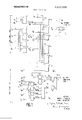
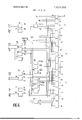
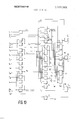
- FIG. I illustrates an implementation of the decimal carries in a four-logic level, two-digit decimal adder
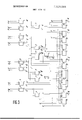
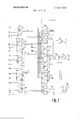
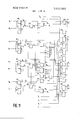
- FIG. 2 illustrates an implementation of the binary coded signals representing the decimal sum of the lower digit in a four-logic level, two-digit decimal adder
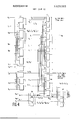
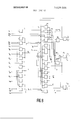
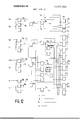
- FIG. 3 illustrates a logic implementation of the binary signals representing the decimal sum of the high-order digit in a four-logic level, two-digit decimal adder
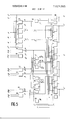
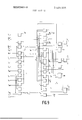
- FIG. 4 illustrates a logic implementation of the decimal carries in a three-logic level, two-digit decimal adder
- FIG. 5 illustrates an implementation of the binary signals representing the decimal sum of the lower order digits in a three-logic level, two-digit decimal adder
- FIG. 6 illustrates a logic implementation of the binary signals representing the decimal sum of the high-order digits in a three-logic level, two-digit decimal adder
- FIGS. 7 through 10 illustrate an implementation of the byte generate and propagate carry signals in a six-logic level, eightdigit decimal adder
- FIG. 11 illustrates a logic implementation of the binary signals representing the decimal sum of the lower order digits in any byte of a six-logic level, eight-digit decimal adder
- FIG. 12 illustrates a logic implementation of the binary signals representing the decimal sum of the high-order digits in any byte of a six-level, eight-digit decimal adder.
- FIGS. 1, 2 and 3 illustrate a four-logic level, two-digit decimal adder which implements the techniques of the present invention. Since it is a two-digit adder, it may employ any twodigit decimal numbers as inputs, for example 31 and 65. Hereinafter, the two digits will be referred to as a high-order and a low-order l.
- the low-order digit is the decimal oneorder digit and the high-order digit is the decimal lO-order digit.
- Both the lowand high-order digits are coded in a fourbit binary code comprising an eight-,four-,twoand a oneorder bit.
- FIG. 1 illustrated the circuitry for generating the decimal carries of both the highand low-order decimal digits.
- FIG. 2 illustrates the logic circuitry for developing the sum of the low-order digits of the augend and addend.
- FIG. 3 illustrates the logic circuitry for generating the sum of the high-order digits of the augend and addend.
- the logic circuits employed are conventional; they have emitter follower outputs and the top output generates the NOR function of the inputs and the bottom output produces the OR function of the inputs.
- the NOR output functions may be externally wired together at their outputs to produce the OR function. This is commonly referred to as wire-OR-ing or emitter dotting, since the emitters of the logic output transistors are connected together.
- emitter dotting is not considered a logic level. Therefore, the four-bit binary coded decimal numbers A B A are inputs at the first level and the generated sum is produced at the outputs of the fourth level.
- FIG. 1 illustrates an implementation of the highand loworder decimal carries generated in accordance with the present invention.
- the decimal carry is to be generated from the generate carry signals, the propagate carry signals, and the binary carry signal from the first bit of the digit, where a propagate carry signal P, represents the propagate signal for any bit 1' and equals A,+B,, and G, represents any bit-generate carry signal and equals A,-B,-.
- tat G will be positive only when A, and B, are positive, that is, whenever a binary carry is generated in bit i.
- FIG. 1 The operation of FIG. 1 can best be understood by a mathematical analysis of the generaton of a decimal carry.
- a decimal carry, C should be produced whenever the four-bit binary code equals or more or whenever the four-bit binary code equals 9 and there is a decimal carry from the next lower order digit. This truism is represented by the following equation:
- four-bit binary code 8, 4, 2 and 1 can be grouped in two groups consisting of the eight-, four-, two-order bits and the one-order bit, since K and L are dependent solely upon the generate and propagate signals from the eight-, four-, and two-order bits and C, is dependent only upon the inputs to the one-order bit.
- the low-decimal carry C has been generated from the logic function K, and L derived from the propagate and generate signals of the eight, four-, and two-order bits and from the binary carry C, from the one-order bit.
- the eight-, four-, two-order, one-order bits into two groups, one comprising the eight-, four-, and two-order bits, and the second comprising the one-order bit.
- the high-order decimal carry C is similarly generated.
- the gates 28, 30 and 32 generate the function G i which is used in gate 34 to generate the binary carry of the first bit of the higher order digit C,,,.
- the gates 36, 38, 40, 42 generate, respectively, the functions P G P P P,,,,,P and G ,,P
- the gates 44 and 46 then generate the K and L functions.
- the gate 48 NOR's the I and C functions to generate the L C, function and the gate 50 is similarly used to generate the K function. These outputs are then ORed by the emitter dot S1 to generate the high-order decimal carry rlli- Now turning to the development of the bit sum signals for each digit as illustrated in FIGS. 2 and 3, a few definitions are in order before discussing the de elopmgntgf the equations.
- lffsifii is the uncorrected binary sum of a bit i; and S,- is the corrected sum signal of bit 1' and is necessary since the binary sum signals must be corrected whenever a decimal carry is made. In prior art decimal adders, this correction was normally made by adding 6.
- the corrected sum signal of the first bit, S equals the binary sum ofthe first bit, S,,,, since a decimal carry will not affect this bit. Using the half-sum signal of the first bit, this sum signal may be gen erated by emp l9yin g the equation:
- the four-order bit corrected sum signal, 8, should be one when the binary value of A,,, B A,, B A B C, totals 4, 5, 6, 7, l4, l5, 16 or 17. This can be represented in equation form as;
- the gates 52, 54, 56, 58 generate tl' functions P H G and C from the inputs A B,, I B and C,,,.
- the gates 60 and 62 then employ these functions as inputs to generate the first bit sum signal, S as an output.
- the gate 64 develops the function C from the inputs H C and G,
- the gates 66, 68, 70, 72, 74, 76, generate the propagate and generate carry signals for the second, third and fourth bit.
- the gates 78, 80 and 82 generate the half-sum signal for these bits and the gate 84 generates the function H H
- the gates 86 and 88 generate the functions H, H +G,,, and
- FIG. 3 illustrates the generation of the binary coded bit signals representing the sum of the high-order decimal digits.
- the equations employed are substantially the same as those used in the generation of the bit sum signals for the lower order decimal digits.
- the first level logic gates 92 generate the propagate and generate signals from the four-bit binary coded inputs.
- the gates 94 generate the half-sum signals for each bit and the gate 96 generates the function High Order Low Order m m m IL n 32 0 I I 0 0 I 0 95 m m m BIII ur. 41. 21. BIL
- the digital value of 32 is represented in four-bit binary form by placing the value of 3 in the higher order digit and a value of 2 in the lower order digit. Thus, A and A and A are ones and the remaining A,- values are zero. In a similar fashion the digital value 95 is represented by the B,- values.
- These fourbit binary coded decimal numbers are inputs to the decimal carry circuit, the low-order decimal digit circuit, and the highorder decimal digit circuit as shown in FIGS. 1, 2 and 3.
- FIGS. 4, 5 and 6 illustrate a three logic level, two-digit decimal adder. It is similar to the above described four-logic level, two-digit decimal adder, differing essentially in that the binary coded bit signals and the decimal carries are generated after three levels of logic rather than four. The overall operation and the type of logic gates employed are identical to the four-level adder. Again, the decimal inputs and outputs are coded in a four-bit binary form.
- FIG. 4 illustrates the circuitry necessary to generate the highand low-order decimaic' rries.
- the logic gates I10 and 112 generate the function P G from the input fourbit binary coded augend and adde nd signals.
- the logic gates 114-118 generate the function G F F, +P,, P These ftgictions are then used in combination with the values C G and P which are generated in the low-order decimal digit circuitry shown in FIG.
- FIG. 5 illustrates the three-level logic necessary to generate the low-order decimal sum.
- the equations to be implemented are derived as described above and are similar to those employed in the fo u r level adder. They are as follows:
- the first column of logic circuits 166-188 are employed to generate the propagate and generate signals for each bit as well as the binary carry from the first bit.
- the second column of logic gates -206 are employed to generate the half-sum signals H, as well as the functions P P F G a fi fia I7
- These functions, in addition to the lower order carry C,,, as generated in the circuitry shown in FIG. 4, are employed in the third level logic gates 208-232 to generate the binary coded decimal sum signals S S S and S
- FIG. 6 illustrates the logic circuitry employed to generate the high-order decimal sum.
- the equations to be implemented are derived similarly to that of the four-level adder described above and are identical to those used in the low-order digit except for the twoand ight-grde su n signals which are:
- the first level comprising logic gates 234-252 generates the propagate and generate signals for each bit as well as the halfsum signal for the two-order bit H
- the logic gate 254 generates the half-sum signal for the first bit H
- the logic gates 256-260 generate the functions P G P ,,P E G respectively.
- the logic gates 262-266 are employed to generate the function G H +G,, H.
- the logic gate 268 generates the function H
- These signals plus the lower order decimal carry and the carry from the first binary bit C are employed in the third level of logic gates 270-298 to generate the binary coded decimal sum signals S S S and S
- FIGS. 7 through 12 illustrate how the inventive concept employed in the design of the above two-digit decimal adders may be extended to an eight-digit decimal adder.
- This eightdigit adder generates the decimal sum after six levels of logic and comprises basically four repeated versions of the above described two-digit adders connected in parallel. That is, each eight-digit number is subdivided into four groups of two digits. Hereinafter, each two-digit group is referred to as a byte, the byte containing the lowest order digits is referred to as the first byte and the byte containing the highest order digits is referred to as the fourth byte.
- FIGS. 7 through 10 illustrate the circuit employed to generate the binary carries C,- for the first bit input values in each decimal digit. Each FIG. refers to only one byte, for example, FIG. 7 illustrates this binary carry generation for the first byte.
- FIG. 11 illustrates the logic circuitry employed to generate the decimal sum of the lower order digits of any byte; therefore, the circuitry as illustrated in FIG. 11 is reproduced four times in actual operation of the eight-digit adder, once for each digit.
- FIG. l2 illustrates the circuitry employed to generate the binary coded binary signals representative of the decimal sum of the high-order digits of any byte. It also is reproduced four times in the eight-digit adder, once for each byte.
- the logic gates employed are NOR gates, the top output being the NOR function and the bottom output being the OR function; emitter dotting is also employed.
- each group comprises two digits and is referred to as a byte, therefore these signals are referred to as byte generate or propagate signals.
- byte generate or propagate signals The need for these byte generate and propagate signals is well described in an article by M. S. Schmookler, entitled Microelectronics Opens the Gate to Faster Digital Computer," in Electronic Design, July 5,1966, at page 52.
- M. S. Schmookler entitled Microelectronics Opens the Gate to Faster Digital Computer
- C +P ,C G +P, G,,+P P G +P, P P G,+P,P,,P G,C,,, where C is the carry out of the adder, P,- is the propagate carry signal for each bit, G, is the generate carry signal for each bit, and C, is the input binary carry. Examining the terms of the expression for C this bit has a carry if it generates l, or if it can propagate it and the third bit generates it, or if the last two bits can propagate it and the second bit generates it, and so on.
- each byte comprises two decimal digits in a four-bit binary code.
- a byte generate signal G must be generated whenever there is a decimal carry from the decimal addition performed in the byte. This may occur either if there is a decimal carry from the high-order digit in the byte or a value of 9 in the high-order digit coupled with a carry from the low-order digit. In equa tion form this may be represented as follows:
- a byte propagate signal must be generated whenever the two decimal digits will propagate a decimal carry into the byte to the next higher byte, that is, whenever an addition produces the value of nine in each digit of the byte since in this situation, an input carry would be propagated through the byte to the next order byte. This is represented in equation form as follows:
- FIG. 7 illustrates the circuitry employed to generate the K and L signals for both the highand low-order digit, the byte generate G,, and propagate signals P and the first bit binary carry C, for the highand low-order digits in the first order byte of the eight-digit decimal adder.
- the K and L functions as described above are defined as follows:
- the circuitry implements the byte generate signal for the first byte, G As described above, this signal is employed in the circuits shown in FIGS. 8 through 10 to generate the first bit binary carry C, for the higher order bytes.
- the operation of the circuit is as follows. The propagate and generate signals for each bit of each digit are generated in the first level oflogic as shown in FIGS. 11 and 12 from the input four bit binary coded decimal signals. These signals are thus available to the first column of logic gates shown in FIG.
- the NOR-gates 300 and 302 employ the signals C, and G,, to generate the binary carry for the first bit of the low-order decimal digit according to the equation:
- the NOR-gate 304 generates the function P,, and the NOR- gate 306 generates the P, G which are subsequently ORed together by the emitter dot 307.
- the OR-gates 322-328 and the emitter dot 330 generate the K function for the higher order digit.
- the NOR- gates 334-336 and the emitter dot 338 generate the function P rl-G P, which is then ORed with the function G, in logic gate 340 to produce the function L for the high-order digit according to the equation IF 8H+G4H+P 414 211
- the logic gate 342 generates the function C,, +K, from the inputs C, and K
- the logic gates 344-350 and the emitter dot 354 generate the bit generate function for the first bit G,,, according to the equation m n( KH+PIH KH+G1H+LL KH+GIH+KL+CIL) This function is then employed in the circuits shown in FIGS.
- FIG. 8 illustrates the circuitry employed for the next higher order byte, that is, the second byte. Its operation is identical to the operation of FIG. 7 with the following exceptions.
- FIG. 9 illustrates the circuitry used to implement the bit propagate and generate signals and the first bit binary carry for both the highand low-decimal digits in the third byte of the eight-decimal adder. This operation is identical to that of the second byte illustrated in FIG. 8 except that additional logic circuits 384 and 386 are employed since the first bit binary carries are now dependent upon both the byte generate and propagate signals generated from both the first and second bytes as described above.
- logic gate 384 allows the byte propagate signal from the second byte to be used in generating the C,, signal according to the equation Similarly, a binary carry occurs in the first bit of the highorder decimal digit whenever a carry from the second byte with a value of9 in the lower digit and a propagate in this bit or a generate from the first byte propagated in the second byte, a 9 in the low-order digit and a propagate in this bit.
- logic gate 386 allows the byte generate from the first byte G and the byte propagate P from the second byte to be employed in generating this binary carry in the first bit of the high-order digit according to the equation CIIFGIH+PIHLL4GIL+KL)+(PIIILLPII.)GI)2+(PIHLLPIL)PD2GM
- FIG. 10 illustrates the logic circuitry employed in the highest order byte, byte number four. Because this is the highest order byte, the byte generate and propagate signals G, and P are not employed since there are no additional stages. Therefore, a decimal carry from the byte is generated by the logic gate 388 according to the equation m n( H+ iH) Thus, it represents the decimal carry from the entire addition.
- the logic gate 390 allows the binary carry from the first bit in the low-order decimal digit to be generated in accordance with the equation This means that the carry will be generated in the first bit if it is generated in that bit or it is generated in the third byte and propagated by that bit or if it is generated in the second byte propagated by the third byte and propagated by that bit or ifit is generated in the first byte propagated by the second byte and propagated by the third byte and propagated in that bit.
- the binary carry from the high-order decimal digit is generated in accordance with the equation G,, +(AHII-IL P, )P P G,,,
- a binary carry is generated in the first bit of the highorder digit if it is generated in that bit, or if there is a carry from the lower order digit and it is propagated by the bit or if a carry is generated in the third byte and propagated by the loworder digit and propagated by the bit or generated in the second byte and propagated by the third byte and propagated by the low-order digit and that bit or if it is generated in the first byte propagated in the second byte propagated in the third byte and propagated in the low-order digit and that bit.
- FIGS. 11 and 12 illustrate the logic circuitry employed to generate the binary code signals representative of the decimal sum. Only one byte, that is, two digits, are illustrated. In actuality there will be four, each associated with one of the circuits as illustrated in FIGS. 7 through 10; however, they are identical and the explanation of one will suffice.
- FIG. 11 illustrates the logic circuitry employed to generate the binary coded signals representative of the decimal sum of the lower-order digit in one of the four bytes.
- the decimal numbers as coded in four-bit binary signals are inputs to the logic gates comprising'the first column of logic.
- the logic gates 406-422 similarly generate these functions for the remaining bits in the low-order digit.
- the logic gates 424 through 430 in the second level of logic merely invert the G functions to the positive G functions.
- the logic gates 440-444 and the emitter dot 445 generate the function P P P +G,, G +P,,, P., and the logic gate 446 merely inverts this function.
- the logic gates 448-450 and the emitter dot 452 generate the function G,,+H,H
- the logic gates 454-458 and the emitter dot 460 employ the input carry signals C,,,, the binary carry from the first bit of the low-order digit as generated in a circuit as shown in FIG.
- the logic gates 464-470 and the emitter dot 472 are used to generate the second bit signal of the low-order digit from the inputs C L and K generated from a circuit shown in FIG. 7 and the half-sum signal from this bit HgL as generated in logic gate 434 accgrdgig to the equ ation
- the logic gates 474-480 and the emitter dot 482 generate the four-order binary bit of the low-order digit from the inputs C as generated in the circuit as illustrated in FIG.
- FIG. 12 illustrates the circuitry to generate the binary bit signals representative of the decimal sum of the high-order digit of any byte, that is, any two digits.
- the circuit shown in FIG. 12, as in FIG. 11, is associated with one of the byte circuits as illustrated in FIGS. 7 through 10.
- the first bit binary signal S is generated a ccording to the equation by the logic gates 454-458 and the emitter dot 462.
- a method for performing decimal addition in a logic system including a plurality of logic circuits, wherein the augend and the addend each are represented in a four-bit binary code and said logic system has a low-order input carry signal C comprising:
- logic means for implementing the decimal carry signal for said decimal addition from said propagate signals, said generated signals, said binary carry of the first bit
- logic means for generating binary signals representative of the decimal sum of said augend and addend from said propagate signals, said generate signals, and said decimal carry signal, whereby said decimal sum is represented at the output of said logic system by four-bit binary coded signals and said decimal carry signal.
Landscapes
- Engineering & Computer Science (AREA)
- Theoretical Computer Science (AREA)
- Computing Systems (AREA)
- Physics & Mathematics (AREA)
- General Physics & Mathematics (AREA)
- Computational Mathematics (AREA)
- Mathematical Optimization (AREA)
- Pure & Applied Mathematics (AREA)
- General Engineering & Computer Science (AREA)
- Mathematical Analysis (AREA)
- Compression, Expansion, Code Conversion, And Decoders (AREA)
- Logic Circuits (AREA)
- Complex Calculations (AREA)
Applications Claiming Priority (1)
| Application Number | Priority Date | Filing Date | Title |
|---|---|---|---|
| US1124670A | 1970-02-13 | 1970-02-13 |
Publications (1)
| Publication Number | Publication Date |
|---|---|
| US3629565A true US3629565A (en) | 1971-12-21 |
Family
ID=21749503
Family Applications (1)
| Application Number | Title | Priority Date | Filing Date |
|---|---|---|---|
| US11246A Expired - Lifetime US3629565A (en) | 1970-02-13 | 1970-02-13 | Improved decimal adder for directly implementing bcd addition utilizing logic circuitry |
Country Status (5)
| Country | Link |
|---|---|
| US (1) | US3629565A (enExample) |
| JP (1) | JPS531615B1 (enExample) |
| DE (1) | DE2106069A1 (enExample) |
| FR (1) | FR2080412A5 (enExample) |
| GB (1) | GB1270909A (enExample) |
Cited By (9)
| Publication number | Priority date | Publication date | Assignee | Title |
|---|---|---|---|---|
| US3935438A (en) * | 1973-10-20 | 1976-01-27 | Vereinigte Flugtechnische Werke-Fokker Gmbh. | Decimal adder |
| US3983382A (en) * | 1975-06-02 | 1976-09-28 | International Business Machines Corporation | Adder with fast detection of sum equal to zeroes or radix minus one |
| US4118786A (en) * | 1977-01-10 | 1978-10-03 | International Business Machines Corporation | Integrated binary-BCD look-ahead adder |
| US4644489A (en) * | 1984-02-10 | 1987-02-17 | Prime Computer, Inc. | Multi-format binary coded decimal processor with selective output formatting |
| EP0298717A3 (en) * | 1987-07-09 | 1991-01-16 | Digital Equipment Corporation | Bcd adder circuit |
| US20050114423A1 (en) * | 2003-11-24 | 2005-05-26 | International Business Machines Corporation | Binary coded decimal addition |
| US20060179099A1 (en) * | 2005-02-10 | 2006-08-10 | International Business Machines Corporation | System and method for performing decimal floating point addition |
| US7475104B2 (en) | 2005-02-09 | 2009-01-06 | International Business Machines Corporation | System and method for providing a double adder for decimal floating point operations |
| US7519647B2 (en) | 2005-02-09 | 2009-04-14 | International Business Machines Corporation | System and method for providing a decimal multiply algorithm using a double adder |
Citations (2)
| Publication number | Priority date | Publication date | Assignee | Title |
|---|---|---|---|---|
| US3304418A (en) * | 1964-03-02 | 1967-02-14 | Olivetti & Co Spa | Binary-coded decimal adder with radix correction |
| US3308284A (en) * | 1963-06-28 | 1967-03-07 | Ibm | Qui-binary adder and readout latch |
-
1970
- 1970-02-13 US US11246A patent/US3629565A/en not_active Expired - Lifetime
-
1971
- 1971-01-07 FR FR7100856A patent/FR2080412A5/fr not_active Expired
- 1971-01-18 GB GB2320/71A patent/GB1270909A/en not_active Expired
- 1971-02-09 DE DE19712106069 patent/DE2106069A1/de active Pending
- 1971-02-12 JP JP566271A patent/JPS531615B1/ja active Pending
Patent Citations (2)
| Publication number | Priority date | Publication date | Assignee | Title |
|---|---|---|---|---|
| US3308284A (en) * | 1963-06-28 | 1967-03-07 | Ibm | Qui-binary adder and readout latch |
| US3304418A (en) * | 1964-03-02 | 1967-02-14 | Olivetti & Co Spa | Binary-coded decimal adder with radix correction |
Non-Patent Citations (4)
| Title |
|---|
| Kahn & Melan Magnetic Arithmetic Matrix Giving Simultaneous Results IBM Technical Disclosure Bulletin Vol. 4 No. 1 June 61 pp. 46 47 * |
| Schmookler & Weinberger Decimal Adder Carry Circuits IBM Technical Disclosure Bulletin Vol. 12 No. 3 Aug. 1969 pp. 382 383. * |
| Schmookler & Weinberger Decimal Adder IBM Technical Disclosure Bulletin Vol. 12 No. 3 Aug. 1969 pp. 380 381. * |
| W. S. Ang Parallel BCD Adder IBM Technical Disclosure Bulletin Vol. 4 No. 2 July 1961 pp. 41. * |
Cited By (19)
| Publication number | Priority date | Publication date | Assignee | Title |
|---|---|---|---|---|
| US3935438A (en) * | 1973-10-20 | 1976-01-27 | Vereinigte Flugtechnische Werke-Fokker Gmbh. | Decimal adder |
| US3983382A (en) * | 1975-06-02 | 1976-09-28 | International Business Machines Corporation | Adder with fast detection of sum equal to zeroes or radix minus one |
| US4118786A (en) * | 1977-01-10 | 1978-10-03 | International Business Machines Corporation | Integrated binary-BCD look-ahead adder |
| US4644489A (en) * | 1984-02-10 | 1987-02-17 | Prime Computer, Inc. | Multi-format binary coded decimal processor with selective output formatting |
| EP0298717A3 (en) * | 1987-07-09 | 1991-01-16 | Digital Equipment Corporation | Bcd adder circuit |
| US20080016140A1 (en) * | 2003-11-24 | 2008-01-17 | Neelamekakannan Alagarsamy | Binary Coded Decimal Addition |
| US7991819B2 (en) * | 2003-11-24 | 2011-08-02 | International Business Machines Corporation | Binary coded decimal addition |
| US7299254B2 (en) * | 2003-11-24 | 2007-11-20 | International Business Machines Corporation | Binary coded decimal addition |
| US20050114423A1 (en) * | 2003-11-24 | 2005-05-26 | International Business Machines Corporation | Binary coded decimal addition |
| US7475104B2 (en) | 2005-02-09 | 2009-01-06 | International Business Machines Corporation | System and method for providing a double adder for decimal floating point operations |
| US7519647B2 (en) | 2005-02-09 | 2009-04-14 | International Business Machines Corporation | System and method for providing a decimal multiply algorithm using a double adder |
| US20090112960A1 (en) * | 2005-02-09 | 2009-04-30 | International Business Machines Corporation | System and Method for Providing a Double Adder for Decimal Floating Point Operations |
| US20090132629A1 (en) * | 2005-02-09 | 2009-05-21 | International Business Machines Corporation | Method for Providing a Decimal Multiply Algorithm Using a Double Adder |
| US8140607B2 (en) | 2005-02-09 | 2012-03-20 | International Business Machines Corporation | Method for providing a decimal multiply algorithm using a double adder |
| US8219604B2 (en) | 2005-02-09 | 2012-07-10 | International Business Machines Corporation | System and method for providing a double adder for decimal floating point operations |
| US7519645B2 (en) | 2005-02-10 | 2009-04-14 | International Business Machines Corporation | System and method for performing decimal floating point addition |
| US20090132627A1 (en) * | 2005-02-10 | 2009-05-21 | International Business Machines Corporation | Method for Performing Decimal Floating Point Addition |
| US20060179099A1 (en) * | 2005-02-10 | 2006-08-10 | International Business Machines Corporation | System and method for performing decimal floating point addition |
| US8161091B2 (en) | 2005-02-10 | 2012-04-17 | International Business Machines Corporation | Method for performing decimal floating point addition |
Also Published As
| Publication number | Publication date |
|---|---|
| GB1270909A (en) | 1972-04-19 |
| DE2106069A1 (de) | 1971-08-19 |
| FR2080412A5 (enExample) | 1971-11-12 |
| JPS531615B1 (enExample) | 1978-01-20 |
Similar Documents
| Publication | Publication Date | Title |
|---|---|---|
| US5724276A (en) | Logic block structure optimized for sum generation | |
| US4866656A (en) | High-speed binary and decimal arithmetic logic unit | |
| US6301600B1 (en) | Method and apparatus for dynamic partitionable saturating adder/subtractor | |
| US3629565A (en) | Improved decimal adder for directly implementing bcd addition utilizing logic circuitry | |
| US3711693A (en) | Modular bcd and binary arithmetic and logical system | |
| FI862883A0 (fi) | Krets foer komplementering av binaera tal. | |
| US4878192A (en) | Arithmetic processor and divider using redundant signed digit arithmetic | |
| JPH0421889B2 (enExample) | ||
| US4709346A (en) | CMOS subtractor | |
| Guild | Some cellular logic arrays for non-restoring binary division | |
| US3816734A (en) | Apparatus and method for 2{40 s complement subtraction | |
| GB963429A (en) | Electronic binary parallel adder | |
| US4866655A (en) | Arithmetic processor and divider using redundant signed digit | |
| GB990557A (en) | Electronic adding system | |
| US3249746A (en) | Data processing apparatus | |
| US4873660A (en) | Arithmetic processor using redundant signed digit arithmetic | |
| KR100324313B1 (ko) | n비트와n/2비트를연산하는곱셈기 | |
| US6546411B1 (en) | High-speed radix 100 parallel adder | |
| US6484193B1 (en) | Fully pipelined parallel multiplier with a fast clock cycle | |
| US4118786A (en) | Integrated binary-BCD look-ahead adder | |
| US5206825A (en) | Arithmetic processor using signed-digit representation of external operands | |
| US5153847A (en) | Arithmetic processor using signed digit representation of internal operands | |
| US3056552A (en) | Asynchronous parallel adder deriving intermediate sums and carries by repeated additions and multiplications | |
| US3786490A (en) | Reversible 2{40 s complement to sign-magnitude converter | |
| EP0610259B1 (en) | 1-bit adder |