US3097789A - Accumulator readout device - Google Patents
Accumulator readout device Download PDFInfo
- Publication number
- US3097789A US3097789A US781779A US78177958A US3097789A US 3097789 A US3097789 A US 3097789A US 781779 A US781779 A US 781779A US 78177958 A US78177958 A US 78177958A US 3097789 A US3097789 A US 3097789A
- Authority
- US
- United States
- Prior art keywords
- counting
- impulse
- impulses
- accumulator
- control elements
- Prior art date
- Legal status (The legal status is an assumption and is not a legal conclusion. Google has not performed a legal analysis and makes no representation as to the accuracy of the status listed.)
- Expired - Lifetime
Links
Images




Classifications
-
- G—PHYSICS
- G06—COMPUTING OR CALCULATING; COUNTING
- G06M—COUNTING MECHANISMS; COUNTING OF OBJECTS NOT OTHERWISE PROVIDED FOR
- G06M1/00—Design features of general application
- G06M1/08—Design features of general application for actuating the drive
- G06M1/10—Design features of general application for actuating the drive by electric or magnetic means
- G06M1/102—Design features of general application for actuating the drive by electric or magnetic means by magnetic or electromagnetic means
-
- B—PERFORMING OPERATIONS; TRANSPORTING
- B41—PRINTING; LINING MACHINES; TYPEWRITERS; STAMPS
- B41J—TYPEWRITERS; SELECTIVE PRINTING MECHANISMS, i.e. MECHANISMS PRINTING OTHERWISE THAN FROM A FORME; CORRECTION OF TYPOGRAPHICAL ERRORS
- B41J7/00—Type-selecting or type-actuating mechanisms
- B41J7/48—Type carrier arrested in selected position by electromagnetic means
-
- G—PHYSICS
- G06—COMPUTING OR CALCULATING; COUNTING
- G06M—COUNTING MECHANISMS; COUNTING OF OBJECTS NOT OTHERWISE PROVIDED FOR
- G06M1/00—Design features of general application
- G06M1/27—Design features of general application for representing the result of count in the form of electric signals, e.g. by sensing markings on the counter drum
-
- H—ELECTRICITY
- H03—ELECTRONIC CIRCUITRY
- H03K—PULSE TECHNIQUE
- H03K21/00—Details of pulse counters or frequency dividers
- H03K21/08—Output circuits
Definitions
- FIG. 10a AccuMuLA'roR READouT DEVICE Filed nec. 19, 195e 11 sheets-sheet a FIG. 10a
- the present invention refers to electronic calculating machines, and more particularly lto a method and apparatus for transferring numerical values accumulated in an electronic accumulator including at least one counting stage, to a mechanical counting, indicating or printing apparatus.
- the present invention applies to transferring the above mentioned numerical values from any types of an electronic accumulator in which at a given moment certain numerical values are stored and have to be transferred from this accumulator into apparatus of the type set forth.
- the numerical value is transmitted to the mechanical control elements only upon the tenth step (in a decimal counting system) from the counting stages of the electronic accumulator, which, in turn, entails the necessity that for the purpose of correctly printing the numerical values the individual type wheels must be shifted one step as compared with the ordinary and conventional construction and operation of ordinary printing apparatus, so that the otherwise conventional idle step is made ineffective.
- the otherwise conventional arrangements and structure of the mechanical control elements is specifically modified, then it is not possible anymore to use a standard keyboard or totalizing device of conventional office machines because in such machines it is common practice to arrange numerical values and to transfer them in the sequence from 0 to k9.5,
- lt is still a further object of this invention to provide a method and apparatus that would permit using an electronic accumulator arrangement alternatively either for counting or printing the actual values of certain numbers, or, in turn, print or count the complement values of said numbers.
- the method according to the present invention serves to transfer numerical values accumulated in van electronic accumulator including at least one counting stage, to a mechanical counting, indicating or printing apparatus having at least one set of incrementally movable digit-determining control elements capable of sequentially -assuming positions respectively associated with a series of digits forming part of a numerical value lto be indicated or printed, and mainly comprises the steps of first incrementally moving said set of control elements through said series of positions; simultaneously gener-ating a series of electric impulses respectively synchronous with the passing of sa-id control elements through said individual positions; injecting said electrical impulses sequentially into said accumulator for accordingly changing incrementally the numerical value stored therein before the start of the transferring operation and for causing said accumulator to furnish a control impulse when during said incrementally changing operation the counting capacity of said counting stages is exhausted; and arresting said set of control elements by means of said control impulse in the particular position occupied thereby at the time when said control impulse occurs.
- an arrangement for transferring numerical values accumulated in an electronic accumulator' including at least one counting stage, to a mechanical counting, indicating or printing apparatus having at least one set of incrementally movable digitdetermining control elements capable ⁇ of sequentially assuming positions respectively associated with a series of digits forming part yof a numerical value to be indicated or printed comprises, in combination, drive means for advancing said set of control elements incrementally through said sequence of positions; impulse generator means operatively connected with said set of control elements and capable of generating a sequence of counting impulses respectively synchronous with the passing of said set of control elements through said individual positions; circuit means connecting said impulse generator means with said counting stage for injecting said counting impulse into the latter; arresting means operatively connected with said set of control means, said arresting means being responsive to a contro-l impulse applied thereto and capable of arresting said set of control elements in any one of said positions Ithereof upon application of such a control impulse; and circuit means connecting said counting stage with said ⁇ arresting means and capable of transmit
- a preferred method for transferring accumulated multi-order numerical values from an electronic accumulator composed of a plurality of counting stages into a mechanical counting, indicating or printing apparatus mainly consists in a first step of injecting consecutively a plurality of series of simultaneous stepping impulses respectively into each of said stages for step-wise increasing the stored numerical values, the number of impulses constituting said individual series being predetermined for tobtaining at the end of at least one of such series a plurality of numerical values stored in said elements, respectively, which are respectively reduced by one numerical uni-t relatively to the respective values stored before injection of said particular series of impulses; a second step of preventing during the injection of each of said series of impulses the transmission of carry-over impulses upon exhaustion of the counting capacity of any one of said accumulator stages, except where such exhaustion of counting capacity occurs in any one of said elements upon the last impulse of the particular series of said stepping impulses; and a last step of transmitting Ito said mechanical ⁇ apparatus only such carryover
- a preferred arrangement for transferring multi-order numerical values from an electronic calculator or accumulator into a mechanical counting, indicating or printing apparatus mainly comprises a plurality of control elements moving step- Wise between consecutive digit-determining positions and forming part of said mechanical apparatus, each of said control elements being associated with one order uni-t of said apparatus and being capable of being arrested in any one of its digit-determining positions; an electronic accumulator means including a plurality of counting stages, gate means 'and locking magnet means respectively associated with each other for being capable of being actuated alternatively: for the oper-ation yof Iaccumulating multi-order numerical values in accordance with counting impulses injected into said accumulator means, tor for the operation of selectively arresting selected ones of said control elements in one of said positions by impulses emitted from respective counting stages into associated gate means and locking magnet means in accordance with series of consecutive impulses simultaneously injected into said counting units; shift register means including a plurality of counting stages and first impulse generator means and being capable of producing
- the intended result of restoring the stored digit value after a predetermined number of counting steps without having to carry ⁇ out the counting operation in reverse direction can be achieved by injecting into all units or counting stages of the electronic accumulator simultaneously series of consecutive impulses which are adapted to shift the stored values in positive or forward direction, in such a manner that at the termination ⁇ of each individual series of consecutive impulses, the values stored in the accumulator appear to be shifted in reverse direction; during this operation it is necessary to prevent carry-over operations from being effected between consecutive order units so that only those carry-over or transfer impulses are utilized for operating the mechanical apparatus, which have been caused by the last mechanical impulse of one particular series of impulses in a particular unit or Stage of the electronic accumulator.
- the present invention provides for a modification of the above outlined method in such a manner that with the iirst step of the control elements of the mechanical apparatus one ysingle series of ten impulses (in the case of a IO-digit numerical System) is injected simultaneously into all the counting stages of the accumulator, fand ⁇ only after this first series of ten impulses the above mentioned further ten series of 9 impulses each are injected.
- An eleventh step is provided in conjunction with a last series of 9 impulses although this step does not correspond to a step or movement of the control elements of the mechanical apparatus, but this ⁇ step is necessary for the purpose of restoring the originally stored numerical values in the various counting stages of the electronic accumulator. Now in this manner it is possible to transmit the regular lor actual numerical value of the stored numbers to the mechanical control elements of the mechanical apparatus without omitting the requirement of having the numerical value 0 transferred with the first step of the control elements.
- the mode of operation of the arrangement which carries lout the above-described function can be changed in a rather simple manner according to the invention for operating in such a way that the complement values of the originally stored numbers are transmitted.
- This change of operation is obtained by carrying out the read-out operation not by means of series of impulses but by injecting with every step of the control elements of the mechanical apparatus only one impulse into the electronic accumulator. In this case, with the iirst step of the control elements the complement value of 9 namely 0 is transmitted to the control elements of the mechanical apparatus.
- FIG. 1 is -a diagrammatic perspective view of one embodiment of the apparatus according to the invention.
- FIG. 2 is a similar perspective diagrammatic illustration of a modied embodiment of the apparatus according to the invention.
- FIG. 3 is a diagrammatic partial illustration of certain components characteristic of another embodiment of the invention.
- FIGS. 4 and 5 illustrate in front elevation and sectional end view, taken along lines V-V of FIG. 4, a component of the apparatus according to the invention
- FIGS. 4a ⁇ and 5a illustrate in front elevation and end view a modified form of the component illustrated by FIGS. 4 and 5;
- FIG. 6 is a diagrammatic perspective view of another form of a component of the apparatus according to the invention.
- FIG. 7 illustrates in diagrammatic and perspective manner still another modication of the component illustrated by FIG. 6;
- FIG. 8 is an enlarged plan view of an element of the component illustrated in FIG. 7; j
- FIG. 9 is a block diagram illustrating a preferred ernbodiment of the lapparatus according to the invention, this apparatus being suitable for deriving from a live-order electronic or magnetic accumulator the controls for a printing apparatus intended to reproduce the numerical value of numbers stored in the accumulator, as well as the complement values of those numbers;
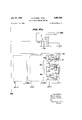
- FIG. 10 is a diagrammatic perspective view of an apparatus according to the invention, including a printing mechanism and the circuit diagram of pertaining electric components.
- FIGS. 10a-10d are electric circuit diagrams of circuit components of counting devices showing their operative -connections wit-h the printing mechanism.
- the accumulator consists of -a plurality of interconnected counting stages, usually in a number equal to the number of orders of the numerical values to be handled.
- the numerical values may be of the type occurring in a decimal number system or in any other number system.
- the individual counting stage is capable of storing, for instance in a decimal number system, digits ranging from 0 to 9.
- the arrangement is analogous. In either case, the stored numerical value in each stage is changed by the injection of a counting impulse into that stage, 'and after the injection of a number of such counting impulses a situation will be reached in which the storage or counting capacity of the particular stage is exhausted.
- an impulse is emitted from the particular stage which is usually a so-called 0 impulse, also called a carry-over or resetting impulse.
- 0 impulse also called a carry-over or resetting impulse.
- the accumulator is used in the normal manner for accumulating values, the last mentioned 0 impulse is used to carry-over one numerical unit to the next Ifollowing counting stage of the accumulator. It is however necessary that in the case when values have lto be ltransferred from the accumulator to an indicating or printing mechanism the 0 impulse is not transferred or carried over to the neXt following counting stage but is used as a control impulse for inuencing the mechanical apparatus to which the above mentioned numerical values are to be transferred. A method and means for carrying out this utilization of O impulses in a transferring operation are described herebelow with reference to FIG. 9.
- a printing mechanisrn capable of handling ten-order numbers consists mainly of several type wheels 101 to 110, arranged for rotation about a common axle, not shown, the -aXis of which is indicated at 100.
- the type wheels are driven in known manner, via intermediate gears, by toothed bars 111 or 120, respectively, the so-called type wheel driving bars.
- Each type wheel with its associated intermediate gears and the pertaining driving bar constitutes one set of control elements of the mechanical apparatus in question. It is evident that the type wheels and gears are supported for rotation, ⁇ and that the driving bars are guided for movement in longitudinal direction Within a lframe-work not shown.
- the individual driving bars 111 to 120 are continuously urged by springs for movement in the direction of the arrow B.
- each of the driving bars has a slot parallel to the forward toothed section thereof and ya common collecting bar 131 is passed through all of the slots of all the driving bars 111 to 120. In the position shown which is not the position of rest of the whole arrangement the movement of the driving bars is stopped by the collecting bar 131 abutting against the rearward end of the slots of the bars.
- the collecting bar 131 is moved in the direction of the arrow B by means of a drive motor 132 which via intermediate gears moves a toothed bar 131a, attached to the bar 131, in the direction of the arrow B. It is clear that as the bar 131a moves the driving bars 111 to 120 are in a position to ⁇ follow this movement under the action of the springs 121 to 130.
- the fbars 111 to 120l are each provided with stop teeth 133. Assuming that the mechanism is to be used for handling numerical values ybelonging to a decimal number system so that the type Wheels 101 .to 110 carry each the 10 digit symbols ⁇ from 0 to 9, the number of stop teeth 133 is ten.
- each of the driving bars 111 to 120 has associated therewith arresting means comprising a pawl 134 movable in substantially vertical direction so as to be capable of engaging any one of the teeth 133 of the associated driving bar.
- the pawl 134 is associated with the bar 111 and similarly .the other pawls are associated with the other bars, the last pawl 143 being associated with the bar 120.
- the various pawls .134 to 143 are respectively under the inuence olf pawl springs 134 to 143', respectively, which tend to pull the respective pawls into engagement with the teeth 133.
- the arresting means further comprise for each one combination of a pawl and driving bar, a locking magnet 144 to 153, respectively, which when energized is capable o-f interrupting, by the .attraction of its armature, the holding engagement between the corresponding holding pawl and the associated pawl.
- the accumulator from which the numerical values are to be transferred tothe printing apparatus is diagrammatically indicated -by three counting stages 154, 155, 156 forming part of the whole accumulator comprising a series of such counting stages 154 to i163.
- the control impulses required for energizing the various locking magnets 144 to 153 are derived from the associated counting stages of the group 4154 to 163, respectively.
- electric impulses must be -injected into the accumulator in such a manner that the numerical values stored in the respective counting .stages are incrementally changed by a series of consecutive impulses, ten impulses in the present example, and which are generated by impulse generator means operatively connected with the printing apparatus.
- Accumulators of this general type are well known and usually composed of counting stages comprising each an electronic ⁇ decimal counting tube, e.g., the type known as Philips EIT.
- the impulse generator means mainly consists of a generator bar 16-4 which is connected with the collect-ing ⁇ bar 131 so as to move together with the latter under the driving action of the motor 132 as explained above.
- the generator bar 164 is provided with a series of cam portions 1164', ten .in number in this particular case, and a stationary pair of resilient contacts 174, the lower contact being equipped with a teeler piece A1'74 which slidingly travels over the consecutive cam portions 164.
- AIt . therefore clear that as the generator bar 164 moves in the direction of the arrow B the contact pair -174 is moved into conductive position everytime when the feeler 174' rides on the crest of one of the cam portions 164.
- the spacing between the individual cam portions 164 is such that the contact closing occurs everytime when during the rotation of the type wheels 1161 to one of the numerals arranged thereon is in indicating position, or, which means the same, anyone of the teeth 133 of any one of the bars is in register with the associated pawl .134 to 143, respectively.
- the accumulator is assumed to contain therein an accumulated or stored numerical value. Therefore the injection of the consecutive impulses created by the generator means as described, will change the numerical value stored in each one of the .counting stages of the electronic accumulator so that, depending upon the composition of the numerical value initially stored therein, at certain times the counting capacity of one or the other counting stage will 4be exhausted so that then the so called O ⁇ impulse is emitted from the particular lcounting stage where this exhaustion of storage or counting capacity occurs.
- the entire ten-order number can be printed from the type wheels, for instance by swinging the type Wheels -onto a platen in known manner.
- the toothed bars lll to 120 and simultaneously the type wheels 101 to 110 are returned to their initial positions, respectively, by reversing the driving direction of the motor 132.
- the pawls 134 to 143 are returned to their normal position in a way known generally in the art and therefore not requiring 1a detailed description.
- FIG. 2 generally resembles the embodiment described with reference to FIG. l. Therefore all those parts which are equal or equivalent to the components of the embodiment of FIG. 1 are designated by the same numerals except that the individual numeral is increased by 100. Therefore, e.g., the first driving bar marked 111 in FIG. l is identied by the numeral 211 in FIG. 2. The design of the pawls 234 slightly differs from that of the pawls 134 in FIG.
- FIG. 3 serves to move the type wheels in a somewhat different manner into their indicating or printing positions in accor-dance with a regular, non-complementary counting procedure.
- the parts shown in FIG. 3 and corresponding or being equivalent to those shown in FIGS. 1 and 2 are designated by numerals which diier from the numerals used in FIG. l by the addition of 200.
- the driving bars in FIG. 3 corresponding to the driving bars '111 to 1Z0 in FIG. l, are indica-ted by numerals 311 to 320.
- every one of the driving bars 311 to 320 carries on one side a contact bar 364 connected to a source of electrical energy and Ibeing provided with projecting contact points 364 spaced from each other in the same manner as the cam portions 164 in FIG. 1.
- a stationary pickup contact 374 is so positioned that during the travel of the bars 311 to 320 the respective contact points 364 -will consecutively pass by and engage the stationary contact 374 whereby a circuit through an impulse forming stage 384 is closed from where the impulse generated by the closing of the contact between the elements 364 and 374 is injected into the associated one of the counting stages 354 to 363, respectively, ⁇ of the per-taining electronic accumulator.
- rl ⁇ hc control impulse derived from the individual counting stage is transmitted to the associated electro-magnet 34d to 353, respectively, which in turn actuates the type wheel arrangement.
- energization of one of the magnets 344 to 353 will cause the intermediate gears of the associated type wheel 301 to 310 to be pulled in direction of the arrow Z into engagement with the corresponding teeth 335 of the associated driving bar. Consequently as the movement of the particular driving bar under the drive of the motor 332 proceeds after the electromagnet has caused the engagement between the type wheel arrangement and the particular driving bar, the respective drive wheel will be turned into a position which corresponds to the amount of travel of the particular driving bar after the above mentioned moment of engage-ment.
- the individual type Wheels will be positioned in such a manner that in the course of the movement of the pertaining drive bars the individual type wheels are in the desired indicating or printing position. Then, if desired, the printing operation can be carried out as mentioned above.
- the engagement between the type Wheel arrangement and the driving bars is eliminated as the electromagnets are cle-energized, so that the type Wheels as well as the driving bars can be returned to their starting or 0 position in a generally known manner, particularly the latter by reversing the direction of rotation of the motor 332.
- this control impulse is otiset in time by one impulse against the regular numerical value stored in the particular 1counting stages, it is necessary to suppress one step of the step-wise or increm-ental movement of the driving bars. For this reason, an arrangement ⁇ can be made for the driving bars to be in their normal or starting position one step backward as compared with the position used in the above described embodiments.
- the driving bars when in position of rest are in such a position that they have to make at least one step in order to get into the position corresponding to the value of 0 associated with the corresponding 0 position of the associated drive Wheel.
- impulse generator means fundamentally solve the problem of generating impulses synchronously with the stepwise or incremental movement ofthe drive bars
- the particular arrange-ments shown and described could cause disturbances or failure 4because the rapidly operated contacts 174, 274 or 3x74, may tend to bounce so that the disturbing consequences of such bouncing would have to be suppressed by means of special switching devices or methods.
- the use of metallic contacts could cause other diilculties due to changes in the contact resistance for instance due to oxidation or contamination of the contac-t tips.
- One suitable way is to generate the electrical impulses by magnetic means.
- FIGS. 4, 5 and FIGS. 4a, 5a Two modifications of such a magnetic impulse gener-ator are illustrated by FIGS. 4, 5 and FIGS. 4a, 5a.
- a generator bar 489 is used instead of the generator bar 164.
- the ybar 439 consists of ferro-magnetic material and is provided with a series of notches delining between each other pole tips 489. Preferably, the anks of the notches are lformed in accordance with an exponential curve.
- a C-shaped magnet struc- Iture, preferably including a permanent magnet portion 488 is positioned so that the bar 489 can be moved along a slot in the lower portion of the magnet frame y4% as can be seen in FIG. 5.
- the opposite end of the C-shaped frame 486 terminates in a similar pole tip 485.
- the vbar 489 if moved in longitudinal direction along the slot of the magnet will pass through a sequence .of positions in which the pole tip 486' is opposite one of the notches, and through positions where the stationary -pole tip 436 is in register with one ofthe pole tips 489 of the bar. It is therefore evident that every time when pole tips are in register with each other as just stated, the magnetic flux in the magnet is at a maximum while it is substantially reduced while one of the notches is opposed to the tip 486.
- a coil 487 is mounted around the yoke portion of the magnetic frame 486. Therefore the various changes of ux in the magnet are bound to induce electric impulses in the coil 487 which can then be used as electrical impulses to be injected into the accumulator.
- FIG. 4 shows that the spacings between consecutive pole tips 489 of the generator bar 489 are not equal. For instance at the right hand end of the bar 489 the spacing a0 is considerably smaller than the spacing a9 ⁇ at the left hand end of the bar. It is of quite some importance in many cases to space the pole tips 489 not equi-distantly for the following reasons.
- This ⁇ delay factor may be taken care of by correspondingly offsetting the generator bar
- the speed of movement ⁇ of the associated driving bars necessarily will increase from 0 to a certain maximum, thus the time required for the individual driving bars to move between say the position l and Z will be different from the time required to move between the positions 5 and 6.
- the different spacing of the pole tips 439 will compensate for the differences in the moving speed of the associated driving bar.
- the arrangement may have to be modified, for instance if the movement of the driving bars is not only accelerated after the start ⁇ but is decelerated after reaching a Imaximum and before the bar comes to -a full stop. In that ⁇ case the non-equidistant spacing between the pole tips 489 can be chosen accordingly.
- FIGS. 4a and 5a A modified version of the magnetic impulse generator of FIGS. 4 and 5, is illustrated by FlGS. 4a and 5a: in this case the magnet frame 486'" does not carry a coil in ⁇ which electrical impulses aire induced.
- the generator bar 489 is not shown in FIGS. 4a and 5a because it can be used in the same manner also in this modified version of the magnet impulse generator.
- the induction coil 487 is not used in this modified version because evidently the induced impulse depends also upon the speed of the movement of the bar 4S@ ybecause the speed of change of the magnetic flux controls the induction of electric current in the coil.
- 4a and 5a is based on the fact that the electric resistance of certain semi-conducting matemal-s as for instance bismuth, germanium, and especially that of AIHBV compounds, as for instance indium antimonide depends on the force of the surrounding magnetic iield. Based on this fact, a small plate 4.26" .preferably of indium antimonide is arranged according to the invention on the pole tip 436 as can be rseen FIGS. 4a, 5a.
- a very substantial impulse can -be tapped off the load 487 when the generator bar 489 is moved through the slot of the magnet yoke 486, 483.
- FIGS. 6 to 8 illustrate two versions of this type of impulse generator means.
- a generator bar 589 may be used instead of any 'one of the other generator bars described above.
- the bar 539 is provided with a series of slots S39' which are not equidistantly spaced from each other for the reasons stated above.
- the bar 539 is arranged to move in such a manner that the individual slots 589 consecutively pass across a :beam of light 600' furnished by a light source oli@ and directed at a photo electric cell 6%. It is evident that every time when one 13 of the slots passes through the beam of light 600 an impulse lwill tbe generated in generally known manner by the photo cell 6504i". This impulse can then be used as the electrical impulse to be injected into the electronic accumulator'.
- a generator bar 689 which has a set of gear teeth 639'. These teeth mesh with a small gear 69o mounted on a shaft which carries a disc 691 provided with a number of slots 69T. As can be seen the slots 691 are circumferentially spaced from each other non-equidistantly for the same reasons which have been explained above. It is evident that by moving the generator bar 689 conjointly with any one of the drivin-g bars the disc 691 will be caused to rotate.
- the disc 691 is so located that the slots 691 ccnlsecutively .pass across the beam of light 690 coming from the source of light 60u and directed at a photo electric cell 600". In the same manner as in the example illustrated by FIG. 6 the passing of any one of the slots through the beam will cause the generation of an impulse in the cell 6W" which impulses are then fed into the electronic accumulator as described above.
- FIGS. 1 and 4-8 can be advantageously combined with the method and apparatus described with reference to FIG. 9.
- the advantage is obtained that without changing the standard or conventional arrangement of the typ-e Wheel mechanism, the transferring operation concerning certain numerical values stored in the electronic accumulator can be carried out in a simple manner in two alternative Ways, namely either in such a manner that the numerical values stored initially in the electronic accumulator are made to appear in the type wheel mechanism in the same form or in the form of the complementary values based on that initially stored numerical value.
- An electronic accumulator 1li adapted to handle five-order numbers of a iti-digit number system ⁇ comprises five counting stages or order units indicated by numbers 11-15.
- An impulse forming device 4 is provided tor receiving from a suitable source counting impulses and for transmitting them into the accumulator lo.
- Impulse forming devices are known, eg., in the form of a monovibrator which upon application of a counting impulse delivers to the electronic accumulator or counter a precisely dened impulse of predetermined amplitude 14 and duration.
- Such impulse forming devices are dcscribed, eg., in Waveforrns, published 1949 by McGraw- I-Iill Book Co., Inc., in section 5.5, pages 16S-171.
- the impulse forming device @i and the individual counting stages 2li-15 are interconnected by a plurality of switches 51-55. When these switches are in open position as shown, then it is impossible for counting impulses to reach any one of the counting stages 11 to 15 or for any one oi these stages to transmit carry-over impulses from stage to stage.
- the individu-al counting stages 11-15 are connected with .a common line 10a which will be described later.
- every one of the counting stages il-l is associated with a locking magnet 33t-3S, respectively, adapted to arrest lthe corresponding control elements of the associated order unit of the mechanical printing or indicating apparatus, respectively, as described above in reference to FIGS. 1, 2 and 3.
- interposed between each of the counting stages 11-15 and the associated locking magnets 31-3S, respectively are gate circuits 21-25, respectively, which, depending upon their blocking or non-blocking condition will open or close a path between the individual counting stage and the associated locking magnet.
- Every one of the gate circuits 21-25 has a control input and all oi Ithese inputs vare connected to a common supply line lub.
- a switch '73 at one end of the line 10b is arranged for providing the line 10b with potential from either one of two different sources as will be explained further below.
- the accumulator is adapted to perform in two different Ways. It may be operated as an accumulator for accumulating numerical values stored in the various counting stages 1145. In this case, counting impulses are injected into the impulse transforming device 4 while all the switches Sil-55 are in closed position. At the same ltime the switch 73 is in the position shown in the drawing in which case the line 10b is connected with a source of potential feeding a negative voltage of l() volts into the gate circuits 21a-25 with the resuit that all these gates are caused to be in blocking condition so that the carry-over impulses occurring in the accumulator i@ are unable to cause any effect on the locking magnets 31-35.
- the accumulator 1t) can however be operated in a second manner in which case all the switches 51-55 are moved into open position and the switch 73 is moved into the position in which the source of supply mentioned above is disconnected from the gate circuits.
- the line 1Gb is now connected with the line 71a which will be explained further below.
- the ywhole arrangement is adapted for transferring any numerical value-s stored in the counting stages 11-15 into the mechanical apparatus connected therewith, or more specifically the control elements of the respective or asy sociated order units of that apparatus.
- An impulse generator means '72 is associated and operatively connected with the control elements of the mechanical apparatus.
- the function of that impulse generator is such that with every step of the step-wise moving control elements (as shown diagrammatically next to magnet 31 in FIG. 9) of any one of the order units of the mechanical apparatus, one impulse is generated in the impulse generator 72.
- this impulse generator 72 may be a photo-electric impulse generator device of the types described above in reference to FIGS. 7 and 8 and as shown next to bloc!L '72 in FIG. 9, and with every step of the type wheels a change in the illumination of the photo-cell may be produced thus generating a corresponding impulse.
- the control impulses from the generator 72 are applied to the rest of the arrangement by means of a selector switch 7S with which the generator 72 is connected.
- selector switch 78' can be moved between two positions, preferably mechanically, one position being used when the true or regular numerical values are to be transmitted to the mechanical apparatus from the accumulator 10, the other position being used when the complement values of the stored values are to be transmitted to the mechanical apparatus.
- the switch 7 8 opens a gate 77, while in the second case the gate 76 is opened.
- the gate 76 is connected by a conductor 76a and via a diode 76b to an impulse forming device y63 the output of which is connected with the above mentioned supply line 10a of the accumulator. The operation of this particular circuit will be described further below.
- the gate 77 is connected with another switching means which may consist of a flip-flop device 711 which is capable of assuming two stable positions depending upon impulses injected into the flip-flop.
- the ip-flop 71 has one input connected with the gate 77 and a second input connected with a generator 64 described further below.
- the flipflop has two outputs, one of which ⁇ is connected by the conductor 71a to the above-mentioned switch 73.
- the other output leads to a multi-vibrator 70 which in turn is connected with a shifting impulse generator 75 which may be of any conventional type capable of responding to an input impulse by delivering a shifting impulse and which serves to inject shifting impulses into a shift register 61 composed of counting stages 610-619;
- the individual counting stages 610-619 are respectively connected with a common conductor 69 which leads to delay circuit 62 and from there through a second diode 62a to the abovementioned impulse forming device 63.
- the register 61 serves as a read-out device and has ten elements.
- the register 61 is constructed in a generally known manner as a chain of magnetic counting stages having each a single coil.
- the auxiliary generator 68 is actuated by mechanically closing the starting switch 74 so that the first stage 610 of the register 61 can be pre-energized by the generator 68.
- the magnetic condition of the first stage 610 is changed by the impulse coming from the generator 68.
- the magnetic condition of the first stage 610 is now shifted in a generally known manner in ten steps from the stage 610 to the stage 619 o-f the register 61.
- the flip-flop 71 Since the switch 73 is, as mentioned above, now in its lower position connecting line 10b with line 71a, the flip-flop 71 is capable, during the time when the above mentioned shifting impulses are delivered to the register 61, to apply a suitable voltage to the gates 21-25 so that these gates are changed to their blocking position whereby any carry-over pulses from any one of the stages 11-15 are prevented from reaching fthe respectively associated locking magnets 31-35.
- the last shifting impulse of the register 61 derived from the last stage 619, reaches via the above-mentioned line 61a the flip-flop 71 whereby the flip-flop is caused to swing into its opposite stable condition so that now the gates 21-25 obtain a voltage by which they are changed back into unblocking condition.
- the last impulse emanating from the stage 619 travels via the auxiliary impulse generator 64 and line 64a to a second input of the second stage 611 of the register 61.
- the magnetic condition of this stage is changed whereby the register 61 is prepared for the arrival of the next impulse coming from the impulse generator 72.
- this impulse arrives via gate 77 at the llip-op 71 and again changes the condition of the latter so as to permit passage of this impulse to the multi-vibrator 70 with the result that again a shifting impulse is injected into the register 61.
- the impulse generator 72 has to function in synchronism with the stepwise movement of the control elements of the mechanical apparatus or with the stepwise movement of the type wheels of the printing apparatus, details of which are explained and described above, it is to be mentioned here that the required eleventh impulse is to be supplied to the Hip-flop 71 from a source A, not described in detail in this specification, but which may be any suitable impulse source that may be connected with the present arrangement and may be mechanically actuated at the termination of the ten steps of the control elements of the mechanical apparatus. For instance, this impulse may be released simultaneously with the return movement of the control elements or type bars into their original position after the completion of the ten forward steps thereof.
- the eleventh impulse injected into fthe flip-flop 71 operates exactly as the previous impulses furnished by the impulse generator 72 so that an eleventh sequence of nine limpulses are produced in and furnished by the shift register 61.
- the ip-iiop 71 must be actuated before the start of this operation of the arrangement by a preliminary impulse in such a manner that the gates 21-25 are in non-blocking condition,
- This primary or preparatory impulse is furnished to the flipflop 71 by operation of a separate switch 74 which may be operated by suitable mechanical means and maintains the applied voltage yin the ilip-op 71 in such a manner that the gates ZI-ZS remm'n in their non-blocking condition throughout the operation of the arrangement.
- the .arrangement according to the invention vintroduces the advantage that in either case the Value 0 is transmitted to the mechanical yapparatus talready with the iirst step of the control elements thereof.
- the time delay occurring between .an impulse fur-nished by ythe impulse generator 72, and the lcorresponding actuation of one or more of the locking magnets 31-35 can in no case amount to more than the time required yfor a sequence of 10 pulses. This is already the most unfavorable case. Assuming a pulse ifrequency of the multi-vibrator 70 of l() kilocy-cles the delay cannot amount to more than one msec. This delay is very well compatible with the requirements existing in the operation of a mechanical indicating or printing apparatus.
Landscapes
- Physics & Mathematics (AREA)
- Electromagnetism (AREA)
- General Physics & Mathematics (AREA)
- Engineering & Computer Science (AREA)
- Theoretical Computer Science (AREA)
- Character Spaces And Line Spaces In Printers (AREA)
- Inking, Control Or Cleaning Of Printing Machines (AREA)
- Displays For Variable Information Using Movable Means (AREA)
Applications Claiming Priority (4)
| Application Number | Priority Date | Filing Date | Title |
|---|---|---|---|
| DEK25871A DE1054257B (de) | 1955-05-21 | 1955-05-21 | Verfahren zur UEbertragung von in elektronischen Zaehlwerken vorhandenen Zaehlwerten in mechanische Druck- und/oder Zaehlwerke |
| DE585866 | 1955-05-21 | ||
| DEK31505A DE1061102B (de) | 1955-05-21 | 1957-03-26 | Verfahren und Anordnung zur UEbertragung von in elektronischen Zaehlwerken vorhandenen Zaehlwerten in mechanische Zaehl-, Anzeige- und/oder Druckwerke |
| DEK34230A DE1063841B (de) | 1955-05-21 | 1958-03-04 | Verfahren und Anordnung zum UEbertragen von Zaehlwerten aus elektronischen Zaehlwerken in mechanische Zaehl- und/oder Druckwerke |
Publications (1)
| Publication Number | Publication Date |
|---|---|
| US3097789A true US3097789A (en) | 1963-07-16 |
Family
ID=62597000
Family Applications (1)
| Application Number | Title | Priority Date | Filing Date |
|---|---|---|---|
| US781779A Expired - Lifetime US3097789A (en) | 1955-05-21 | 1958-12-19 | Accumulator readout device |
Country Status (4)
| Country | Link |
|---|---|
| US (1) | US3097789A (de) |
| CH (1) | CH344581A (de) |
| DE (3) | DE1054257B (de) |
| FR (1) | FR1154471A (de) |
Cited By (2)
| Publication number | Priority date | Publication date | Assignee | Title |
|---|---|---|---|---|
| US3165017A (en) * | 1962-07-16 | 1965-01-12 | Saint Gobain | Method and apparatus for automatically cutting a strip of glass |
| US3929276A (en) * | 1973-04-17 | 1975-12-30 | Hugin Kassaregister Ab | Device for setting type carrying means in a printing device having at least one printing position, especially for cash registers |
Families Citing this family (7)
| Publication number | Priority date | Publication date | Assignee | Title |
|---|---|---|---|---|
| DE1235994B (de) * | 1962-02-26 | 1967-03-09 | Dr Gerhard Quietzsch | Anordnung zur Auslesung von Impulsspeichern und Zaehlwerken mit Zaehlmagneten oder Schrittschaltern als Steuereinheiten innerhalb der Speicher |
| DE1265464B (de) * | 1964-07-15 | 1968-04-04 | Licentia Gmbh | Einrichtung zur elektrischen Serienabfrage von Zaehlwerken |
| DE1262649B (de) * | 1965-03-10 | 1968-03-07 | Theod Wagner A G C | Einrichtung zur Nullstellung eines mehrstelligen, aus einzelnen elektromagnetisch angetriebenen Impulszaehldekaden aufgebauten Impulszaehlwerks |
| DE1256928B (de) * | 1965-11-08 | 1967-12-21 | Buchungsmaschinenwerk Veb | Einrichtung zur UEbertragung von digital verschluesselten Zahlenwerten aus einem elektronischen Matrixspeicher in mechanische Ausgabewerke |
| BE705981A (de) * | 1966-11-04 | 1968-03-01 | ||
| DE1919404B1 (de) * | 1969-04-17 | 1970-10-22 | Hermann Kittel | Druckvorrichtung |
| CH663848A5 (de) * | 1982-10-04 | 1988-01-15 | Frama Ag | Einstelleinrichtung fuer typenraeder. |
Citations (4)
| Publication number | Priority date | Publication date | Assignee | Title |
|---|---|---|---|---|
| US2783939A (en) * | 1954-03-15 | 1957-03-05 | Clary Corp | Recording device for electronic counters or the like |
| US2793807A (en) * | 1952-10-18 | 1957-05-28 | Bell Telephone Labor Inc | Pulse code resolution |
| US2914759A (en) * | 1955-03-04 | 1959-11-24 | Burroughs Corp | Data storage, read-out, and transfer apparatus |
| US2966671A (en) * | 1957-08-05 | 1960-12-27 | Electronics Corp America | Data transformation systems |
Family Cites Families (2)
| Publication number | Priority date | Publication date | Assignee | Title |
|---|---|---|---|---|
| DE656497C (de) * | 1933-04-21 | 1938-02-09 | D Instr De Prec Soc Ind | Verfahren und Tabelliermaschine zur Auswertung von Karten mit Lochkombinationen |
| NL83274C (de) * | 1944-12-27 |
-
1955
- 1955-05-21 DE DEK25871A patent/DE1054257B/de active Pending
-
1956
- 1956-05-22 FR FR1154471D patent/FR1154471A/fr not_active Expired
- 1956-05-22 CH CH344581D patent/CH344581A/de unknown
-
1957
- 1957-03-26 DE DEK31505A patent/DE1061102B/de active Pending
-
1958
- 1958-03-04 DE DEK34230A patent/DE1063841B/de active Pending
- 1958-12-19 US US781779A patent/US3097789A/en not_active Expired - Lifetime
Patent Citations (4)
| Publication number | Priority date | Publication date | Assignee | Title |
|---|---|---|---|---|
| US2793807A (en) * | 1952-10-18 | 1957-05-28 | Bell Telephone Labor Inc | Pulse code resolution |
| US2783939A (en) * | 1954-03-15 | 1957-03-05 | Clary Corp | Recording device for electronic counters or the like |
| US2914759A (en) * | 1955-03-04 | 1959-11-24 | Burroughs Corp | Data storage, read-out, and transfer apparatus |
| US2966671A (en) * | 1957-08-05 | 1960-12-27 | Electronics Corp America | Data transformation systems |
Cited By (2)
| Publication number | Priority date | Publication date | Assignee | Title |
|---|---|---|---|---|
| US3165017A (en) * | 1962-07-16 | 1965-01-12 | Saint Gobain | Method and apparatus for automatically cutting a strip of glass |
| US3929276A (en) * | 1973-04-17 | 1975-12-30 | Hugin Kassaregister Ab | Device for setting type carrying means in a printing device having at least one printing position, especially for cash registers |
Also Published As
| Publication number | Publication date |
|---|---|
| CH344581A (de) | 1960-02-15 |
| DE1063841B (de) | 1959-08-20 |
| FR1154471A (fr) | 1958-04-10 |
| DE1054257B (de) | 1959-04-02 |
| DE1061102B (de) | 1959-07-09 |
Similar Documents
| Publication | Publication Date | Title |
|---|---|---|
| US3097789A (en) | Accumulator readout device | |
| US2682814A (en) | Photocomposing apparatus | |
| US2369430A (en) | Key controlled calculating mechanism | |
| US3099206A (en) | High speed printing apparatus with input control network | |
| US3230508A (en) | System for the simultaneous step-by-step setting of a number of movable elements | |
| US3072047A (en) | Printing apparatus | |
| GB1076363A (en) | Printing apparatus | |
| US2761620A (en) | Computing system | |
| US2901540A (en) | Non-resetting decoding and printing apparatus | |
| US3218966A (en) | Apparatus for decoding and printing digital data | |
| US3021066A (en) | Electronic calculator | |
| US3100440A (en) | Line printer | |
| US3159759A (en) | Electromagnetic stepping device or the like | |
| US3541307A (en) | Selection circuit | |
| US2512860A (en) | Control means for electric typewriters | |
| US3127507A (en) | Electronic storage and calculating arrangement | |
| US3099004A (en) | Arrangement for series-transmission of coded signals | |
| US2848708A (en) | Printing control means for electronic computers and the like | |
| US2427214A (en) | Keyboard-controlled ideographic printer having permutation type selection | |
| US2192351A (en) | Selecting and printing apparatus | |
| US3017080A (en) | Read-out system | |
| US3009635A (en) | Reset | |
| US3302005A (en) | Impulse totalizer using solid state components | |
| US2983828A (en) | Switching circuits | |
| US3599773A (en) | Device for selectively positioning a member in a series of operative positions |