US20250041228A1 - Oral formulation of a pyridinone derivate and use thereof in prophylaxis and/or treatment of intestinal fibrosis - Google Patents
Oral formulation of a pyridinone derivate and use thereof in prophylaxis and/or treatment of intestinal fibrosis Download PDFInfo
- Publication number
- US20250041228A1 US20250041228A1 US18/704,228 US202218704228A US2025041228A1 US 20250041228 A1 US20250041228 A1 US 20250041228A1 US 202218704228 A US202218704228 A US 202218704228A US 2025041228 A1 US2025041228 A1 US 2025041228A1
- Authority
- US
- United States
- Prior art keywords
- methyl
- coated
- hpmcas
- oral formulation
- eudragit
- Prior art date
- Legal status (The legal status is an assumption and is not a legal conclusion. Google has not performed a legal analysis and makes no representation as to the accuracy of the status listed.)
- Pending
Links
Images

Classifications
-
- A—HUMAN NECESSITIES
- A61—MEDICAL OR VETERINARY SCIENCE; HYGIENE
- A61K—PREPARATIONS FOR MEDICAL, DENTAL OR TOILETRY PURPOSES
- A61K9/00—Medicinal preparations characterised by special physical form
- A61K9/20—Pills, tablets, discs, rods
- A61K9/2072—Pills, tablets, discs, rods characterised by shape, structure or size; Tablets with holes, special break lines or identification marks; Partially coated tablets; Disintegrating flat shaped forms
- A61K9/2077—Tablets comprising drug-containing microparticles in a substantial amount of supporting matrix; Multiparticulate tablets
- A61K9/2081—Tablets comprising drug-containing microparticles in a substantial amount of supporting matrix; Multiparticulate tablets with microcapsules or coated microparticles according to A61K9/50
-
- A—HUMAN NECESSITIES
- A61—MEDICAL OR VETERINARY SCIENCE; HYGIENE
- A61K—PREPARATIONS FOR MEDICAL, DENTAL OR TOILETRY PURPOSES
- A61K31/00—Medicinal preparations containing organic active ingredients
- A61K31/33—Heterocyclic compounds
- A61K31/395—Heterocyclic compounds having nitrogen as a ring hetero atom, e.g. guanethidine or rifamycins
- A61K31/435—Heterocyclic compounds having nitrogen as a ring hetero atom, e.g. guanethidine or rifamycins having six-membered rings with one nitrogen as the only ring hetero atom
- A61K31/44—Non condensed pyridines; Hydrogenated derivatives thereof
- A61K31/4427—Non condensed pyridines; Hydrogenated derivatives thereof containing further heterocyclic ring systems
- A61K31/4439—Non condensed pyridines; Hydrogenated derivatives thereof containing further heterocyclic ring systems containing a five-membered ring with nitrogen as a ring hetero atom, e.g. omeprazole
-
- A—HUMAN NECESSITIES
- A61—MEDICAL OR VETERINARY SCIENCE; HYGIENE
- A61K—PREPARATIONS FOR MEDICAL, DENTAL OR TOILETRY PURPOSES
- A61K9/00—Medicinal preparations characterised by special physical form
- A61K9/20—Pills, tablets, discs, rods
- A61K9/2072—Pills, tablets, discs, rods characterised by shape, structure or size; Tablets with holes, special break lines or identification marks; Partially coated tablets; Disintegrating flat shaped forms
-
- A—HUMAN NECESSITIES
- A61—MEDICAL OR VETERINARY SCIENCE; HYGIENE
- A61K—PREPARATIONS FOR MEDICAL, DENTAL OR TOILETRY PURPOSES
- A61K9/00—Medicinal preparations characterised by special physical form
- A61K9/20—Pills, tablets, discs, rods
- A61K9/28—Dragees; Coated pills or tablets, e.g. with film or compression coating
- A61K9/2806—Coating materials
- A61K9/2833—Organic macromolecular compounds
- A61K9/286—Polysaccharides, e.g. gums; Cyclodextrin
- A61K9/2866—Cellulose; Cellulose derivatives, e.g. hydroxypropyl methylcellulose
-
- A—HUMAN NECESSITIES
- A61—MEDICAL OR VETERINARY SCIENCE; HYGIENE
- A61K—PREPARATIONS FOR MEDICAL, DENTAL OR TOILETRY PURPOSES
- A61K9/00—Medicinal preparations characterised by special physical form
- A61K9/48—Preparations in capsules, e.g. of gelatin, of chocolate
- A61K9/50—Microcapsules having a gas, liquid or semi-solid filling; Solid microparticles or pellets surrounded by a distinct coating layer, e.g. coated microspheres, coated drug crystals
- A61K9/5005—Wall or coating material
- A61K9/501—Inorganic compounds
-
- A—HUMAN NECESSITIES
- A61—MEDICAL OR VETERINARY SCIENCE; HYGIENE
- A61K—PREPARATIONS FOR MEDICAL, DENTAL OR TOILETRY PURPOSES
- A61K9/00—Medicinal preparations characterised by special physical form
- A61K9/48—Preparations in capsules, e.g. of gelatin, of chocolate
- A61K9/50—Microcapsules having a gas, liquid or semi-solid filling; Solid microparticles or pellets surrounded by a distinct coating layer, e.g. coated microspheres, coated drug crystals
- A61K9/5005—Wall or coating material
- A61K9/5015—Organic compounds, e.g. fats, sugars
-
- A—HUMAN NECESSITIES
- A61—MEDICAL OR VETERINARY SCIENCE; HYGIENE
- A61K—PREPARATIONS FOR MEDICAL, DENTAL OR TOILETRY PURPOSES
- A61K9/00—Medicinal preparations characterised by special physical form
- A61K9/48—Preparations in capsules, e.g. of gelatin, of chocolate
- A61K9/50—Microcapsules having a gas, liquid or semi-solid filling; Solid microparticles or pellets surrounded by a distinct coating layer, e.g. coated microspheres, coated drug crystals
- A61K9/5005—Wall or coating material
- A61K9/5021—Organic macromolecular compounds
- A61K9/5026—Organic macromolecular compounds obtained by reactions only involving carbon-to-carbon unsaturated bonds, e.g. polyvinyl pyrrolidone, poly(meth)acrylates
-
- A—HUMAN NECESSITIES
- A61—MEDICAL OR VETERINARY SCIENCE; HYGIENE
- A61K—PREPARATIONS FOR MEDICAL, DENTAL OR TOILETRY PURPOSES
- A61K9/00—Medicinal preparations characterised by special physical form
- A61K9/48—Preparations in capsules, e.g. of gelatin, of chocolate
- A61K9/50—Microcapsules having a gas, liquid or semi-solid filling; Solid microparticles or pellets surrounded by a distinct coating layer, e.g. coated microspheres, coated drug crystals
- A61K9/5005—Wall or coating material
- A61K9/5021—Organic macromolecular compounds
- A61K9/5036—Polysaccharides, e.g. gums, alginate; Cyclodextrin
- A61K9/5042—Cellulose; Cellulose derivatives, e.g. phthalate or acetate succinate esters of hydroxypropyl methylcellulose
-
- A—HUMAN NECESSITIES
- A61—MEDICAL OR VETERINARY SCIENCE; HYGIENE
- A61K—PREPARATIONS FOR MEDICAL, DENTAL OR TOILETRY PURPOSES
- A61K9/00—Medicinal preparations characterised by special physical form
- A61K9/48—Preparations in capsules, e.g. of gelatin, of chocolate
- A61K9/50—Microcapsules having a gas, liquid or semi-solid filling; Solid microparticles or pellets surrounded by a distinct coating layer, e.g. coated microspheres, coated drug crystals
- A61K9/5073—Microcapsules having a gas, liquid or semi-solid filling; Solid microparticles or pellets surrounded by a distinct coating layer, e.g. coated microspheres, coated drug crystals having two or more different coatings optionally including drug-containing subcoatings
- A61K9/5078—Microcapsules having a gas, liquid or semi-solid filling; Solid microparticles or pellets surrounded by a distinct coating layer, e.g. coated microspheres, coated drug crystals having two or more different coatings optionally including drug-containing subcoatings with drug-free core
-
- A—HUMAN NECESSITIES
- A61—MEDICAL OR VETERINARY SCIENCE; HYGIENE
- A61P—SPECIFIC THERAPEUTIC ACTIVITY OF CHEMICAL COMPOUNDS OR MEDICINAL PREPARATIONS
- A61P1/00—Drugs for disorders of the alimentary tract or the digestive system
Definitions
- the present invention relates to an oral formulation adapted for selective delivery of a drug to the small intestine of a mammal comprising or consisting of: a plurality of particles in form of coated granules, coated pellets, coated beads, coated minicapsules, or coated minitablets, each particle containing (S,E)-methyl-7-(1-(2-(2-ethylbutylamino)-2-oxoethyl)-2-oxo-1,2-dihydro-pyridin-3-ylamino)-6-(1-methyl-1H-imidazole-5-carboxamido)-7-oxohept-2-enoate of formula (I), or an enantiomer, a solvate, a hydrate or a pharmaceutically acceptable salt thereof as the drug, a core material, and an enteric coating polymer, wherein each particle is coated with at least one coating layer containing or consisting of the enteric coating polymer; a preparation method of said oral formulation; and a
- IBD inflammatory bowel disease
- Crohn's disease is a form of inflammatory bowel disease, which results in areas of chronic inflammation at any point in the gastrointestinal tract. In particular Crohn's disease mainly affects the small and large intestine.
- Fibrosis occurs due to excessive deposition of extracellular matrix (ECM), particularly fibrous collagen, and dysregulated turnover of ECM.
- ECM extracellular matrix
- Transgluaminase 2 (TG2) is activated in the inflamed intestine of IBD patients, as significantly high levels of TG2 autoantibody have been detected in the serum of Crohn's disease.
- (S,E)-methyl-7-(1-(2-(2-ethylbutylamino)-2-oxoethyl)-2-oxo-1,2-dihydro-pyridin-3-ylamino)-6-(1-methyl-1H-imidazole-5-carboxamido)-7-oxohept-2-enoate of formula (I) is an effective inhibitor against transglutaminase 2.
- an oral formulation comprising (S,E)-methyl-7-(1-(2-(2-ethylbutylamino)-2-oxoethyl)-2-oxo-1,2-dihydro-pyridin-3-ylamino)-6-(1-methyl-1H-imidazole-5-carboxamido)-7-oxohept-2-enoate of formula (I), or an enantiomer, a solvate, a hydrate or a pharmaceutically acceptable salt thereof as a drug adapted for selective delivery of said drug to the small intestine of a mammal for the prophylaxis or treatment of intestinal fibrosis, in particular, fibrostenotic Crohn's disease.
- an oral formulation adapted for selective delivery of a drug to the small intestine of a mammal comprising or consisting of:
- the enteric coating polymer has an average molecular mass>100,000 g/mol and is selected from methacrylic acid—methacrylic acid ester copolymers, acrylic acid-methacrylic acid ester copolymers, methacrylic acid-acrylic acid ester copolymers, acrylic acid-acrylic acid ester copolymers, acrylic acid ester-methacrylic acid ester-methacrylic acid copolymers, wherein the ester is a methyl ester, ethyl ester, propyl ester, iso-propyl ester, or butyl ester and preferably a methyl or ethyl ester, and most preferably a methyl ester.
- the enteric coating polymer is selected from methacrylic acid-methyl methacrylate copolymers, acrylic acid-methyl methacrylate copolymers, methacrylic acid-methyl acrylate copolymers, methacrylic acid-ethyl acrylate copolymers, acrylic acid-methyl acrylate copolymers, methyl acrylate-methyl methacrylate-methacrylic acid copolymers, hypromellose acetate succinate (HPMCAS), hypromellose phthalate, polyvinyl acetate phthalate, cellulose acetate phthalate (CAP), shellac and a mixture of two or more of said enteric coating polymers.
- HPMCAS hypromellose acetate succinate
- CAP cellulose acetate phthalate
- shellac a mixture of two or more of said enteric coating polymers.
- the enteric coating polymer is selected from the group comprising or consisting of: hypromellose acetate succinate (HPMCAS), hypromellose phthalate, methacrylic acid-methyl methacrylate copolymers such as Eudragit® L100, Eudragit® L12.5, Eudragit® L12.5P, Eudragit® L30D-55, Eudragit® L100-55, Eudragit® S100, Eudragit® S12.5, Eudragit® S12.5P, Eudragit® RS100, Eudragit® RL100, Eudragit® RL12.5, Eudragit® RS12.5, Eudragit® FS30D, methacrylic acid-ethyl acrylate copolymers, methyl acrylate-methyl methacrylate-methacrylic acid copolymers, polyvinyl acetate phthalate, cellulose acetate phthalate (CAP), shellac and a mixture of two or more of said enteric coating polymers.
- HPMCAS hyprome
- the hypromellose acetate succinate is selected from the group consisting of: hypromellose acetate succinates HPMCAS-LF, HPMCAS-MF, HPMCAS-HF, HPMCAS-LMP, HPMCAS-MMP, HPMCAS-HMP, HPMCAS-LG, HPMCAS-MG, HPMCAS-HG, and a mixture thereof, preferably HPMCAS-HF, HPMCAS-HMP, more preferably HPMCAS-HF; the methacrylic acid-methyl methacrylate copolymer is selected from the group consisting of: Eudragit® L100, Eudragit® S100, and a mixture thereof.
- the core material is preferably in form of a core pellet and is preferably selected from the group comprising or consisting: tartaric acid, lactose, sugar, maize starch, starch hydrolysates, silica, or microcrystalline cellulose, and preferably, microcrystalline cellulose.
- the present invention refers to the oral formulation as mentioned above, wherein each particle is coated in addition to the enteric coating comprising or consisting of the enteric coating polymner with a further coating layer comprising or consisting of a sustained-release polymer.
- This sustained-release layer contains or consists of the sustained-release polymer which is preferably selected from hypromellose (HPMC), ethylcellulose, ammonio methacrylate co-polymers such as Eudragit® RL100 and Eudragit® RS100, Eudragit® RL12.5, Eudragit® RS12.5, and a mixture thereof.
- sustained-release polymer is ethylcellulose
- PEG polyethylene glycol
- plasticizer preferably Macrogol® 6000.
- the oral formulation of the present invention starts to release (S,E)-methyl-7-(1-(2-(2-ethylbutylamino)-2-oxoethyl)-2-oxo-1,2-dihydro-pyridin-3-ylamino)-6-(1-methyl-1H-imidazole-5-carboxamido)-7-oxohept-2-enoate, an enantiomer, a solvate, a hydrate, or a pharmaceutically acceptable salt thereof in the jejunum and completing the release in the ileum.
- the oral formulation of the present invention is useful in the prophylaxis and/or treatment of intestinal fibrosis, in particular, fibrostenotic Crohn's disease.
- the oral formulation of the present invention is produced by the following method comprising:
- inventive method further comprises:
- the present invention relates to an oral formulation adapted for selective delivery of a drug to the small intestine of a mammal comprising or consisting of:
- oral formulation refers to a formulation being a medication which is administered through the mouth.
- “selective delivery of a drug to the small intestine” means that the formulation is gastro-resistant and can resist the fluid in the stomach and release the active ingredient in the intestine.
- a mammal refers to an animal, or a human, preferably a patient suffering from intestinal fibrosis, in particular fibrostenotic Crohn's disease.
- pharmaceutically acceptable salts refers to salts of certain ingredient(s) which possess the same activity as the unmodified compound(s) and which are neither biologically nor otherwise undesirable.
- a pharmaceutically acceptable salt can be formed with, for example, organic or inorganic acids.
- Suitable acids include acetic acid, acetylsalicylic acid, organic di-carboxylic acid such as oxalic acid, malonic acid, succinic acid, glutaric acid, tartaric acid, fumaric acid, maleic acid, malic acid, adipic acid, or glutamic acid, and organic tri-carboxylic acid such as citric acid, or sodium hydrogen citrate alginic acid, ascorbic acid, aspartic acid, benzoic acid, benzenesulfonic acid, bisulfic acid, boric acid, butyric acid, camphoric acid, camphorsulfonic acid, carbonic acid, citric acid, cyclopentanepropionic acid, digluconic acid, dodecylsulfic acid, ethanesulfonic acid, formic acid, fumaric acid, glyceric acid, glycerophosphoric acid, glycine
- solvates refers to those forms of a compound in particular the (S,E)-methyl-7-(1-(2-(2-ethylbutylamino)-2-oxoethyl)-2-oxo-1,2-dihydro-pyridin-3-ylamino)-6-(1-methyl-1H-imidazole-5-carboxamido)-7-oxohept-2-enoate which form a complex through coordination with solvent molecules.
- hydrates refers to those forms of a compound in particular the (S,E)-methyl-7-(1-(2-(2-ethylbutylamino)-2-oxoethyl)-2-oxo-1,2-dihydro-pyridin-3-ylamino)-6-(1-methyl-1H-imidazole-5-carboxamido)-7-oxohept-2-enoate which form a complex through coordination with water molecules.
- the term “effective amount” or “therapeutically effective amount” of an active agent or a pharmaceutically active agent or a drug or an active pharmaceutical ingredient refers to an amount of the active agent or pharmaceutically active agent or drug or active pharmaceutical ingredient, sufficient enough to have a positive effect. Accordingly, these amounts are sufficient to treat the intended diseases, but still sufficiently low to avoid serious side effects.
- a therapeutically effective amount of the pharmaceutically active agent will cause a substantial relief of symptoms when applied repeatedly over time. Effective amounts of the pharmaceutically active agent will vary with the particular condition or conditions being treated, the severity of the condition, the duration of the treatment, the specific components of the composition being used, and like factors.
- active agent refers to a compound exhibiting a therapeutic effect upon a mammal in particular a human.
- the “enteric coating polymer” refers to a polymer applied to oral medication that prevents its dissolution or disintegration in the gastric environment, and helps by either protecting drugs from the acidity of the stomach, the stomach from the detrimental effects of the drug, and to release the drug after the stomach usually in the intestine, preferably in the small intestine.
- Granules, pellets, beads, minicapsules and minitablets are preferred enteric-polymer-coated dosage forms in the present invention.
- the oral formulation of the present invention comprises the enteric coating polymer in a range of 1 wt % to 40 wt %, preferably 1 wt % to 35 wt %, more preferably 1 wt % to 30 wt %, most preferably 1 wt % to 26 wt %.
- the oral formulation should be retained in the acidic gastric environment and can be dissolved in the small intestine.
- the oral formulation of the present invention comprises the enteric coating polymer and the enteric coating polymer is dissolved at a pH-value in a range of 5.0 to 7.5, preferably 5.0 to 7.0, more preferably 5.5 to 7.0, most preferably 5.5 to 6.8.
- the eneric coating polymer is selected from the group comprising or consisting of: methacrylic acid-methyl methacrylate copolymers, acrylic acid-methyl methacrylate copolymers, methacrylic acid-methyl acrylate copolymers, methacrylic acid-ethyl acrylate copolymers, acrylic acid-methyl acrylate copolymers, methyl acrylate-methyl methacrylate-methacrylic acid copolymers, hypromellose acetate succinate (HPMCAS), hypromellose phthalate, polyvinyl acetate phthalate, cellulose acetate phthalate (CAP), shellac and mixtures of two or more of said enteric coating polymers.
- HPMCAS hypromellose acetate succinate
- CAP cellulose acetate phthalate
- the invention is directed to the oral formulation adapted for selective delivery of a drug to the small intestine of a mammal comprising or consisting of:
- Hypromellose is also known as Hydroxypropylmethylcellulose (HPMC), and thus hypromellose acetate succinate (hydroxypropyl methylcellulose acetate succinate, or HPMCAS) is acetic acid/succinic acid ester of hydroxypropyl methylcellulose.
- HPMC Hydroxypropylmethylcellulose
- HPMCAS hypromellose acetate succinate
- Hypromellose phthalate (hydroxypropyl methylcellulose phthalate, or HPMCP) is a phthalic acid ester of hydroxypropyl methylcellulose.
- Hypromellose HPMC
- HPMCAS hypromellose acetate succinate
- HPMCP hypromellose phthalate
- HPMCAS is a cellulosic polymer with four types of substituents semirandomly substituted on the hydroxyls: methoxy, with a mass content of 12-28 wt %; hydroxypropyl, with a mass content of 4-23 wt %; acetate, with a mass content of 2-16 wt %; and succinate, with a mass content of 4-28 wt %.
- the succinate groups of HPMCAS have a pKa of about 5, and therefore, the polymer is less than 10% ionized at pH values below about 4 and is at least 50% ionized at pH values of about 5 or higher. Due to the presence of relatively hydrophobic methoxy and acetate substituents, HPMCAS is water-insoluble when un-ionized (about pH ⁇ 5) and remains predominantly colloidal at intestinal pH (that is, pH 6.0-7.5).
- the enteric coating polymer is the hypromellose acetate succinate (HPMCAS) and said HPMCAS is selected from the group consisting of: hypromellose acetate succinates HPMCAS-LF, HPMCAS-MF, HPMCAS-HF, HPMCAS-LMP, HPMCAS-MMP, HPMCAS-HMP, HPMCAS-LG, HPMCAS-MG, HPMCAS-HG, and a mixture thereof, preferably HPMCAS-HF, HPMCAS-HMP, more preferably HPMCAS-HF.
- HPMCAS-LF hypromellose acetate succinate
- the invention refers to the oral formulation adapted for selective delivery of a drug to the small intestine of a mammal comprising or consisting of:
- CAP Cellulose acetate phthalate
- INN cellacefate
- (meth)acrylic acid-(meth)acrylate copolymers refers to copolymers of acrylic acid or acrylic acid ester and methacrylic acid or methacrylic acid ester. Such copolymers have a molecular mass (abbreviated Mr), formerly also called molecular weight of M r ⁇ 100 000 and have the following general formula:
- Eudragit® copolymers such as Eudragit® L100, Eudragit® L12.5, Eudragit® L12.5P, Eudragit® L30D-55, Eudragit® L100-55, Eudragit® S100, Eudragit® S12.5, Eudragit® S12.5P, Eudragit® RS100, Eudragit® RL100, Eudragit® RL12.5, Eudragit® RS12.5, Eudragit® FS30D and a mixture of two or three of these Eudragit® copolymers, more preferred are Eudragit® L100, Eudragit® S100, and a mixture thereof.
- the ratio of carboxylic groups to ester groups is about 1:2.
- Between 25% and 35% of the residues R 2 and R 3 are —H in the Eudragit® S copolymers, that means between 25% and 35% of the carbonyloxy moieties are carboxyl groups (—COOH).
- the content of carboxyl groups in the Eudragit® S copolymers is preferably 30% ⁇ 1%.
- the ratio of carboxylic groups to ester groups is about 1:1.
- the ratio of carboxylic groups to ester groups is about 1:1.
- Eudragit® FS30D (Evonik) have a ratio of methyl acrylate, methyl methacrylate, and methacrylic acid of 7:3:1 and a mean average molar mass of 280 000 g/mol.
- the ratio of the free carboxyl groups to the ester groups is about 1:10.
- These polymers are gastroresistant and enterosoluble polymers. Their polymer films are insoluble in pure water and diluted acids. They dissolve at higher pHs, depending on their content of carboxylic acid.
- Eudragit® S copolymers and Eudragit® L copolymers can be used as single components in the polymer coating or in combination in any ratio. By using a combination of the polymers, the polymeric material can exhibit solubility at a pH between the pHs at which Eudragit® L copolymers and Eudragit® S copolymers are separately soluble.
- the enteric coating polymer is a methacrylic acid-methacrylic acid ester copolymer, a acrylic acid-methacrylic acid ester copolymer, a methacrylic acid-acrylic acid ester copolymer, a acrylic acid-acrylic acid ester copolymer, and more preferably a methacrylic acid-methyl methacrylate copolymer, a acrylic acid-methyl methacrylate copolymer, a methacrylic acid-methyl acrylate copolymer, a acrylic acid-methyl acrylate copolymer, still more preferably Eudragit® L100, Eudragit® L12.5, Eudragit® L12.5P, Eudragit® L30D-55, Eudragit® L100-55, Eudragit® S100, Eudragit® S12.5, Eudragit® S12.5P, Eudragit® FS30D and a mixture of two or three of these Eudragit® copolymers,
- Eudragit® L100-x:y 1:1 (ratio of metacrylic acid:methyl metacrylate units);
- n degree of polymerization
- the invention refers to an oral formulation adapted for selective delivery of the drug (i.e. Comp. 1) to the small intestine of a mammal comprising or consisting of:
- the methacrylate co-polymers can be combined in any desired ratio, and the ratio can be modified to modify the rate of drug release.
- a ratio of Eudragit® L100:Eudragit® S100 can be in a range of 100:0 to 50:50, preferably 100:0 to 60:40, 100:0 to 70:30, more preferably 100:0 to 80:20, or any ratio in between, most preferably, a ratio of Eudragit® L100:Eudragit® S100 is 100:0 to 85:15.
- the core material is preferably in form of a core pellet or a granule and is preferably selected from the group comprising or consisting: tartaric acid, lactose, sugar, maize starch, starch hydrolysates, silica, or microcrystalline cellulose, and preferably, microcrystalline cellulose.
- core material in form of a core pellet means that core pellets are prepared which consist only of the core material or a mixture of the cited core materials. These core pellets do not contain the drug (i.e. Comp. 1) and do not contain the enteric coating polymer or a sustained-release polymer. These core pellets are coated with a drug containing layer, an enteric coating layer and optionally a sustained-release layer. Instead of the term “layer”, the term “coating” could alternatively be used. If present the sustained-release layer could be on top of the enteric coating layer or below the enteric coating layer.
- core material in form of a granule means that the core material or a mixture of the cited core materials as main component(s) together with the drug and optionally further components are mixed together to obtain a composition of which granules are formed.
- These granules contain Comp. 1 most probably in a homogeneously distributed manner and are coated with an enteric coating layer and optionally a sustained-release layer. If present the sustained-release layer could be on top of the enteric coating layer or below the enteric coating layer.
- the invention refers to an oral formulation adapted for selective delivery of the drug (i.e. Comp. 1) to the small intestine of a mammal comprising or consisting of:
- the invention refers to the oral formulation adapted for selective delivery of a drug to the small intestine of a mammal comprises or consists of:
- the mixture of Eudragit® L100, Eudragit® S100 may have a ratio in a range of 100:0 to 50:50, preferably 95:5 to 60:40, 90:10 to 70:30, more preferably 90:10 to 80:20, or any ratio in between, most preferably, a ratio of Eudragit® L100:Eudragit® S100 is 85:15.
- the administered drug dose After the administration of the oral formulation of the present invention, the administered drug dose has to dissolve quickly and completely.
- the pH variations in the stomach after the oral administration have to be regulated and it should be ensured that the administered drug dose is dissolved.
- each particle further comprises one or more binder(s), buffering agent(s), colorant(s), glidant(s), plasticiser(s), disintegrants(s), pH-modifier(s), surfactant(s) and/or filler(s).
- the enteric coating layer contains or consists of the enteric coating polymer.
- enteric coating polymer is contained in or forms the outer layer of the oral formulations disclosed herein.
- compound 1 is either contained in the core material without an additional drug (i.e. Comp. 1) layer or not in the core material and only in a drug layer covering the core material.
- the enteric coating layer covers the core material or the drug layer.
- a further sustained-release layer might be present for the fine-tuning of the release of compound 1 as outermost layer on the enteric coating layer or below the enteric coating layer but above the drug layer or the drug containing core.
- the enteric coating polymer is contained in or forms the outer layer of the coating enclosing the core material.
- the invention refers to the oral formulation adapted for selective delivery of a drug to the small intestine of a mammal comprising or consisting of:
- the oral formulation adapted for selective delivery of a drug to the small intestine of a mammal comprises or consists of:
- said oral formulation adapted for selective delivery of a drug to the small intestine of a mammal comprises or consists of:
- the invention is directed to the oral formulation, wherein the enteric coating polymer is contained in or forms the outer layer of the coating enclosing the core material.
- said oral formulation adapted for selective delivery of a drug to the small intestine of a mammal comprises or consists of:
- multiparticulate formulations also comprise minitablets with typical diameters of one to four millimetres. They are obtained by different manufacturing operations than the spherical particles but they provide the same advantages. They are especially preferred for pediatric applications.
- the invention is directed to the oral formulation, wherein in case the particle is in form of a coated minitablet, the core material comprises one or more binder(s), disintegrants(s), glidant(s), pH-modifier(s), and/or filler(s).
- said oral formulation adapted for selective delivery of a drug to the small intestine of a mammal comprises or consists of:
- the binder is selected from the group consisting of: sugar, sucrose, polysaccharides, xanthan gum, guar gum, carrageenan, starches derived from wheat, corn, rice and potatoes, preagglutinated (modified) starch derived from wheat, corn, rice and potatoes, sodium starch glycolate, natural gums, acacia gum, gelatin, tragacanth, derivatives of sea weed, alginic acid, sodium alginate, ammonium calcium alginate, cellulose, cellulose derivatives, hydroxypropyl cellulose, L-hydroxypropyl cellulose, low-substituted hydroxypropyl cellulose, methyl cellulose, sodium carboxymethylcellulose, hydroxypropyl methylcellulose, polyvinylpyrrolidone such as povidone K25, and mixtures thereof.
- the binder is hydroxypropyl cellulose, L-hydroxypropyl cellulose, low-substituted hydroxypropyl cellulose, or polyvinylpyrrolidone such as povidone K25. Most preferably, the binder is low-substituted hydroxypropyl cellulose or povidone K25.
- said oral formulation adapted for selective delivery of a drug to the small intestine of a mammal comprises or consists of:
- Hydroxypropyl cellulose is a partially substituted poly(hydroxypropyl) ether of cellulose. It may contain not more than 0.6% of silica or another suitable anticaking agent. Hydroxypropyl cellulose is commercially available in a number of different grades that have various solution viscosities. Molecular weight ranges from 50000-1250000. Hydroxypropylcellulose is partly O-(2-hydroxypropylated) cellulose. It contains 53.4% to 80.5% of hydroxypropoxy groups with reference to the dried substance. The average grade of polymerization ranges from 200 to 300. The molar grade of substitution is around 4.
- L-HPC Low-substituted hydroxypropyl cellulose
- Low-substituted hydroxypropyl cellulose contains 5% to 16% hydroxypropoxy groups with reference to the dried substance.
- the molar grade of substitution is ⁇ 1.
- low-substituted hydroxypropyl cellulose is a low-substituted O-(2-hydroxypropylated) cellulose contains hydroxyproxy groups (—OCH 2 CHOHCH 3 ) in a range of 5 wt % to 16 wt′′%, preferably 7 wt % to 13 wt % calculated on the dried basis.
- Low-substituted hydroxypropyl cellulose has a mean particle size in a range of 15 ⁇ m to 65 ⁇ m, preferably 25 ⁇ m to 60 ⁇ m, more preferably 25 ⁇ m to 60 ⁇ m.
- Pordone is synonymously used for polyvinylpyrrolidone (PVP).
- Polyvinylpyrrolidone consists of linear polymers of 1-ethenylpyrollidin-2-one. The different types of polyvinylpyrrolidone are characterized by the viscosity of their solutions, expressed by the K value. Polyvinylpyrrolidone is present as a white to yellowish white powder or flake and is readily soluble in water. The K value is a common classification in the plastics industry and is directly related to the average molar mass of the polymer. This makes it possible to deduce indirectly from the K value the degree of polymerization and thus the chain length.
- Povidone K25, povidone K30 or povidone K90 are commercially available. Preferably, povidone K25 is used as a binder. The approximate average molecular weight of povidone K25 is 30,000 g/mol (Da) between 28,000 g/mol (Da) to 34,000 g/mol (Da
- the pH-modifier is selected from the group consisting of: ascorbic acid, oxalic acid, malonic acid, succinic acid, glutaric acid, tartaric acid, fumaric acid, maleic acid, malic acid, adipic acid, glutamic acid, citric acid, and sodium hydrogen citrate, more preferably adipic acid.
- a preferred embodiment of the invention is therefore directed to the oral formulation, wherein in case the particle is in form of a coated minitablet, the core material comprises one or more binder(s), disintegrants(s), glidant(s), pH-modifier(s), and/or filler(s), wherein
- said oral formulation adapted for selective delivery of a drug to the small intestine of a mammal comprises or consists of:
- the enteric coating polymer is selected from the group comprising or consisting of: methacrylic acid-methyl methacrylate copolymers, acrylic acid-methyl methacrylate copolymers, methacrylic acid-methyl acrylate copolymers, methacrylic acid-ethyl acrylate copolymers, acrylic acid-methyl acrylate copolymers, methyl acrylate-methyl methacrylate-methacrylic acid copolymers, hypromellose acetate succinate (HPMCAS), hypromellose phthalate, polyvinyl acetate phthalate, cellulose acetate phthalate (CAP), shellac and mixtures of two or more of said enteric coating polymers; preferably the enteric coating polymer is selected from the group comprising or consisting of: hypromellose acetate succinate (HPMCAS), hypromellose phthalate, methacrylic acid-methyl methacrylate copolymers, methacrylic acid-ethyl acrylate
- the enteric coating polymer is hypromellose acetate succinate and said hypromellose acetate succinate is selected from the group consisting of: hypromellose acetate succinates HPMCAS-LF, HPMCAS-MF, HPMCAS-HF, HPMCAS-LMP, HPMCAS-MMP, HPMCAS-HMP, HPMCAS-LG, HPMCAS-MG, HPMCAS-HG, and a mixture thereof, preferably HPMCAS-HF, HPMCAS-HMP, more preferably HPMCAS-HF; and/or the methacrylic acid-methyl methacrylate copolymer is selected from the group consisting of: Eudragit® L100, Eudragit® S100, and a mixture thereof.
- the present invention refers to the oral formulation, wherein the at least one coating layer further comprises at least one buffering agent, plasticiser, and/or glidant.
- said oral formulation adapted for selective delivery of a drug to the small intestine of a mammal comprises or consists of:
- the enteric coating polymer is selected from the group comprising or consisting of: methacrylic acid-methyl methacrylate copolymers, acrylic acid-methyl methacrylate copolymers, methacrylic acid-methyl acrylate copolymers, methacrylic acid-ethyl acrylate copolymers, acrylic acid-methyl acrylate copolymers, methyl acrylate-methyl methacrylate-methacrylic acid copolymers, hypromellose acetate succinate (HPMCAS), hypromellose phthalate, polyvinyl acetate phthalate, cellulose acetate phthalate (CAP), shellac and mixtures of two or more of said enteric coating polymers; and
- HPMCAS hypromellose acetate succinate
- CAP cellulose acetate phthalate
- the enteric coating polymer is selected from the group comprising or consisting of: hypromellose acetate succinate (HPMCAS), hypromellose phthalate, methacrylic acid-methyl methacrylate copolymers, methacrylic acid-ethyl acrylate copolymers, methyl acrylate-methyl methacrylate-methacrylic acid copolymers, polyvinyl acetate phthalate, cellulose acetate phthalate (CAP), shellac and a mixture of two or more of said enteric coating polymers.
- HPMCAS hypromellose acetate succinate
- CAP cellulose acetate phthalate
- the hypromellose acetate succinate is preferably selected from the group consisting of: hypromellose acetate succinates HPMCAS-LF, HPMCAS-MF, HPMCAS-HF, HPMCAS-LMP, HPMCAS-MMP, HPMCAS-HMP, HPMCAS-LG, HPMCAS-MG, HPMCAS-HG, and a mixture thereof, preferably HPMCAS-HF, HPMCAS-HMP, more preferably HPMCAS-HF; and/or the methacrylic acid-methyl methacrylate copolymer is selected from the group consisting of: Eudragit® L100, Eudragit® S100, and a mixture thereof.
- said oral formulation adapted for selective delivery of a drug to the small intestine of a mammal comprises or consists of:
- the hypromellose acetate succinate is preferably selected from the group consisting of: hypromellose acetate succinates HPMCAS-LF, HPMCAS-MF, HPMCAS-HF, HPMCAS-LMP, HPMCAS-MMP, HPMCAS-HMP, HPMCAS-LG, HPMCAS-MG, HPMCAS-HG, and a mixture thereof, preferably HPMCAS-HF, HPMCAS-HMP, more preferably HPMCAS-HF; and/or the methacrylic acid-methyl methacrylate copolymer is selected from the group consisting of: Eudragit® L100, Eudragit® S100, and a mixture thereof.
- the buffering agent is ammonium hydrogen carbonate; the plasticiser is triethyl citrate; and/or the glidant is talc.
- said oral formulation adapted for selective delivery of a drug to the small intestine of a mammal comprises or consists of:
- the hypromellose acetate succinate is preferably selected from the group consisting of: hypromellose acetate succinates HPMCAS-LF, HPMCAS-MF, HPMCAS-HF, HPMCAS-LMP, HPMCAS-MMP, HPMCAS-HMP, HPMCAS-LG, HPMCAS-MG, HPMCAS-HG, and a mixture thereof, preferably HPMCAS-HF, HPMCAS-HMP, more preferably HPMCAS-HF; and/or the methacrylic acid-methyl methacrylate copolymer is selected from the group consisting of: Eudragit® L100, Eudragit® S100, and a mixture thereof.
- the present invention is directed to the oral formulation as described above, wherein each particle contains
- the present invention is directed to the oral formulation as described above, wherein each particle in form of a coated minitablet contains
- the present invention is directed to the oral formulation as described above, wherein each particle comprises or consists of:
- each particle in form of a coated minitablet comprises or consists of:
- the present invention is directed to the oral formulation as described above, wherein each particle comprises or consists of:
- each particle in form of a coated minitablet comprises or consists of:
- each particle in form of a coated minitablet and each particle consists of:
- each particle in form of a coated minitablet and each particle consists of:
- the present invention is directed to the oral formulation as described above, wherein each particle in form of a coated minitablet and
- the present invention is directed to the oral formulation as described above, wherein each particle in form of a coated minitablet and
- each particle in form of a coated minitablet and each particle consists of:
- the oral formulation of the present invention contains a core material in form of a core pellet consisting of: tartaric acid, lactose, sugar, maize starch, starch hydrolysates, silica, or microcrystalline cellulose, preferred, microcrystalline cellulose.
- the invention refers to the oral formulation adapted for selective delivery of a drug to the small intestine of a mammal comprising or consisting of:
- the core material is in form of a core pellet consisting of microcrystalline cellulose.
- the enteric coating polymer is selected from the group comprising or consisting of: methacrylic acid-methyl methacrylate copolymers, acrylic acid-methyl methacrylate copolymers, methacrylic acid-methyl acrylate copolymers, methacrylic acid-ethyl acrylate copolymers, acrylic acid-methyl acrylate copolymers, methyl acrylate-methyl methacrylate-methacrylic acid copolymers, hypromellose acetate succinate (HPMCAS), hypromellose phthalate, polyvinyl acetate phthalate, cellulose acetate phthalate (CAP), shellac and mixtures of two or more of said enteric coating polymers.
- HPMCAS hypromellose acetate succinate
- CAP cellulose acetate phthalate
- the hypromellose acetate succinate is preferably selected from the group consisting of: hypromellose acetate succinates HPMCAS-LF, HPMCAS-MF, HPMCAS-HF, HPMCAS-LMP, HPMCAS-MMP, HPMCAS-HMP, HPMCAS-LG, HPMCAS-MG, HPMCAS-HG, and a mixture thereof, preferably HPMCAS-HF, HPMCAS-HMP, more preferably HPMCAS-HF; and/or the methacrylic acid-methyl methacrylate copolymer is selected from the group consisting of: Eudragit® L100, Eudragit® S100, and a mixture thereof.
- the present invention is directed to the oral formulation, wherein in case the particle is in form of a coated granule, a coated pellet, a coated bead, or a coated minicapsule, the core material is in form of the core pellet consisting of: tartaric acid, lactose, sugar, maize starch, starch hydrolysates, silica, or microcrystalline cellulose, preferably microcrystalline.
- the present invention is directed to the oral formulation, wherein in case the particle is in form of a coated granule, a coated pellet, a coated bead, or a coated minicapsule, the core material is in form of the core pellet consisting of: tartaric acid, lactose, sugar, maize starch, starch hydrolysates, silica, or microcrystalline cellulose, preferably microcrystalline; and
- the core pellet is coated with (S,E)-methyl-7-(1-(2-(2-ethylbutylamino)-2-oxoethyl)-2-oxo-1,2-dihydro-pyridin-3-ylamino)-6-(1-methyl-1H-imidazole-5-carboxamido)-7-oxohept-2-enoate, an enantiomer, a solvate, a hydrate, or a pharmaceutically acceptable salt thereof, together with at least one binder(s), colorant(s), glidant(s), surfactant(s) and/or filler(s).
- the enteric coating polymer is contained in or forms the outer layer of the coating enclosing the core material.
- the present invention is directed to the oral formulation adapted for selective delivery of a drug to the small intestine of a mammal comprising or consisting of:
- the oral formulation containing the core material in form of a core pellet as described herein, may further comprise at least one binder, colorant, glidant, surfactant and/or filler.
- the present invention is directed to an oral formulation adapted for selective delivery of a drug to the small intestine of a mammal comprising or consisting of:
- the core material is in form of a core pellet consisting of microcrystalline cellulose, more preferably Cellets.
- Cellets are highly spherical core pellets consisting of 100% microcrystalline cellulose.
- the size of the microcrystalline cellulose core pellets can range from 100 to 200 ⁇ m (Cellets 100), 200 to 355 ⁇ m (Cellets 200), 350 to 500 ⁇ m (Cellets 350), 500 to 710 ⁇ m (Cellets 500), 700 to 1000 ⁇ m (Cellets 700) and from 1000 to 14000 ⁇ m (Cellets 1000).
- the particle size of the microcrystalline cellulose core pellets range from 200 ⁇ m to 710 ⁇ m (Cellets 200, 350, 500), still more preferably, 350 ⁇ m to 710 ⁇ m (Cellet 350, 500), and most preferably 500 ⁇ m to 710 ⁇ m (Cellet 500).
- the present invention refers to the oral formulation, wherein the core material is in form of a core pellet as described above, the size of the core pellet is in a range from 100 ⁇ m to 14000 ⁇ m.
- the present invention refers to the oral formulation, wherein the core material is in form of a core pellet as described above, the core pellet consists of microcrystalline cellulose and the size of the core pellet is in a range from 500 ⁇ m to 710 ⁇ m (Cellet 500).
- the colorant is selected from titanium dioxide, iron(III)oxide, iron(II,III) oxide, hydrated ferric oxide, lactose monohydrate, carnauba wax, and a mixture thereof.
- the surfactant is preferably anionic surfactants contain anionic functional groups such as sulfate, sulfonate, phosphate, and carboxylate.
- anionic surfactants include but not limited to ammonium lauryl sulfate, sodium dodecyl sulfate (sodium lauryl sulfate), sodium laureth sulfate, and sodium myreth sulfate, preferably, sodium dodecyl sulfate.
- the oral formulation wherein the core material is in form of a core pellet as described above, and said oral formulation further comprises at least one binder(s), colorant(s), glidant(s), surfactant(s) and/or filler(s),
- the present invention is directed to the oral formulation adapted for selective delivery of a drug to the small intestine of a mammal comprising or consisting of:
- Povidone K25, povidone K30 or povidone K90 is commercially available and preferably, povidone K25 is used as a binder.
- the approximate average molecular weight of povidone K25 is 30,000 g/mol (Da) between 28,000 g/mol (Da) to 34,000 g/mol (Da).
- the layer containing the enteric coating polymer may further comprise at least one buffering agent, plasticiser, and/or glidant.
- the present invention is directed to the oral formulation adapted for selective delivery of a drug to the small intestine of a mammal comprising or consisting of:
- the buffering agent is ammonium hydrogen carbonate
- the oral formulation adapted for selective delivery of a drug to the small intestine of a mammal comprises or consists of:
- the oral formulation adapted for selective delivery of a drug to the small intestine of a mammal comprises or consists of:
- the oral formulation wherein the core material is in form of a core pellet as described above, comprises the binder(s), the colorant(s), the surfactant (s), the filler(s), the buffering agent(s), the plasticiser(s), and/or the glidant(s), and
- the oral formulation adapted for selective delivery of a drug to the small intestine of a mammal comprises or consists of:
- the oral formulation adapted for selective delivery of a drug to the small intestine of a mammal comprises or consists of:
- the oral formulation adapted for selective delivery of a drug to the small intestine of a mammal comprises or consists of:
- the present invention refers to the oral formulation as mentioned above, wherein each particle is coated further with a coating layer comprising or consisting of a sustained-release polymer.
- the invention refers to the oral formulation adapted for selective delivery of a drug to the small intestine of a mammal comprising or consisting of:
- the sustained-release polymer may be firstly coated under the coating layer containing or consisting of the enteric coating polymer; or the sustained-release polymer may be later coated on the coating layer containing or consisting of the enteric coating polymer.
- the sustained-release polymer is selected from hypromellose (HPMC), ethylcellulose, ammonio methacrylate co-polymers such as Eudragit® RL100, Eudragit® RS100, Eudragit® RL12.5, Eudragit® RS12.5, and a mixture thereof.
- HPMC hypromellose
- ethylcellulose ethylcellulose
- ammonio methacrylate co-polymers such as Eudragit® RL100, Eudragit® RS100, Eudragit® RL12.5, Eudragit® RS12.5, and a mixture thereof.
- sustained-release polymer is ethylcellulose
- PEG polyethylene glycol
- plasticizer preferably Macrogol® 6000.
- Hypromellose may be firstly coated under the coating layer containing or consisting of the enteric coating polymer.
- Ethylcellulose, Eudragit® RL100, Eudragit® RS100, Eudragit® RL12.5, Eudragit® RS12.5 may be later coated on the coating layer containing or consisting of the enteric coating polymer.
- sustained-release polymer is ethylcellulose
- PEG polyethylene glycol
- plasticizer preferably Macrogol® 6000.
- Ammonio methacrylate co-polymers such as Eudragit® RL100 and Eudragit® RS100 may be suitable for use in the modified release formulations of the present invention.
- polymers are insoluble in pure water, dilute acids, buffer solutions, or digestive fluids over the entire physiological pH range.
- the polymers swell in water and digestive fluids independently of pH. In the swollen state, they are then permeable to water and dissolved active agents.
- the permeability of the polymers depends on the ratio of ethylacrylate (EA), methyl methacrylate (MMA), and trimethylammonioethyl methacrylate chloride (TAMCI) groups in the polymer.
- EA ethylacrylate
- MMA methyl methacrylate
- TAMCI trimethylammonioethyl methacrylate chloride
- Polymers of Eudragit® RL100 are insoluble polymers of high permeability.
- Polymers of Eudragit® RS100 are insoluble films of low permeability.
- the ammonio methacrylate co-polymers can be combined in any desired ratio, and the ratio can be modified to modify the rate of drug release.
- a ratio of Eudragit® RS100:Eudragit® RL100 of 90:10 can be used.
- the ratio of Eudragit® RS100:Eudragit® RL100 can be about 100:0 to about 80:20, or about 100:0 to about 90:10, or any ratio in between.
- the less permeable polymer Eudragit® RS100 would generally comprise the majority of the polymeric material with the more permeable RL, permitting and creating gaps through which solutes can enter the core and dissolved pharmaceutical active ingredients can escape in a controlled manner.
- ammonio methacrylate co-polymers can be combined with the methacrylic acid copolymers within the polymeric material in order to achieve the desired delay in the release of the drug.
- Ratios of amino methacrylate co-polymer (e.g., Eudragit® RS100) to methacrylic acid co-polymer in the range of about 99:1 to about 20:80 can be used.
- the two types of polymers can also be combined into the same polymeric material, or provided as separate coats that are applied to the core.
- the ratio of ethyl acrylate groups to methyl methacrylate groups to ammonio methacrylate groups is about 1:2:0.2.
- the ratio of ethyl acrylate groups to methyl methacrylate groups to ammonio methacrylate groups is about 1:2:0.1.
- the present invention is directed to the oral formulation adapted for selective delivery of a drug to the small intestine of a mammal comprising or consisting of:
- the present invention is directed to the oral formulation adapted for selective delivery of a drug to the small intestine of a mammal comprising or consisting of:
- the oral formulation adapted for selective delivery of a drug to the small intestine of a mammal comprises or consists of:
- the represent invention is directed to the oral formulation adapted for selective delivery of the drug to the small intestine of a mammal comprising or consisting of:
- the oral formulation adapted for selective delivery of a drug to the small intestine of a mammal comprises or consists of:
- the present invention is directed to the oral formulation adapted for selective delivery of a drug to the small intestine of a mammal comprising or consisting of:
- the oral formulation adapted for selective delivery of the drug to the small intestine of a mammal comprises or consists of:
- the present invention is directed to the oral formulation adapted for selective delivery of a drug to the small intestine of a mammal comprising or consisting of:
- the oral formulation adapted for selective delivery of a drug to the small intestine of a mammal comprises or consists of:
- each core material is firstly coated with the coating layer comprising or consisting of a sustained-release polymer, and subsequently further coated with the at least one coating layer containing or consisting of the enteric coating polymer; or
- each core material is firstly coated with the at least one coating layer containing or consisting of the enteric coating polymer; and subsequently coated with the coating layer comprising or consisting of a sustained-release polymer.
- oral formulations consisting of: a plurality of particles in form of coated granules, coated pellets, coated beads, coated minicapsules; wherein
- each particle comprises:
- the present invention is directed to the oral formulation adapted for selective delivery of Compound 1 to the small intestine of a mammal comprising or consisting of:
- oral formulations consisting of: a plurality of particles in form of coated granules, coated pellets, coated beads, coated minicapsules; wherein
- each particle comprises:
- each particle comprises:
- oral formulations as described herein consisting of: a plurality of particles in form of coated granules, coated pellets, coated beads, coated minicapsules; wherein the core material is in form of a core pellet consisting of microcrystalline cellulose; each particle comprises:
- each core material is firstly coated with the coating layer comprising or consisting of HPMC and subsequently further coated with the at least one coating layer containing or consisting of HPMCAS.
- each particle comprises:
- each core material is firstly coated with the coating layer comprising or consisting of Eudragit® L100 and Eudragit® S100, and subsequently further coated with the at least one coating layer containing or consisting of ethylcellulose and PEG.
- each core material is firstly coated with the coating layer comprising or consisting of Eudragit® L100 and Eudragit® S100, and subsequently further coated with the at least one coating layer containing or consisting of ethylcellulose and PEG, preferably PEG is Macrogol® 6000.
- the enteric coating polymer is dissolved at a pH-value in a range of 5.0 to 7.5, preferably 5.0 to 7.0, more preferably 5.5 to 7.0, most preferably 5.5 to 6.8.
- the size of each particle is in a range from 0.5 mm to 5 mm.
- the coated minitablets are preferably in the size of 1 mm to 4 mm.
- the oral formulations in form of coated granules, coated pellets, coated beads, coated minicapsules have a size of each particle is in a range from 0.5 mm to 1.3 mm, preferably 0.6 mm-1.2 mm, more preferably 0.7 mm-1.1 mm, more preferably 0.8 mm-1.0 mm.
- the plurality of particles is contained in a capsule, sachet, or stick pack or is formed as a tablet.
- the oral formulations of the present invention is in a form of a capsule, sachet, or stick pack, or a tablet.
- the inventive oral solid formulation exhibits gastro-resistance and that releases (S,E)-methyl-7-(1-(2-(2-ethylbutylamino)-2-oxoethyl)-2-oxo-1,2-dihydro-pyridin-3-ylamino)-6-(1-methyl-1H-imidazole-5-carboxamido)-7-oxohept-2-enoate or an enantiomer, a solvate, a hydrate or a pharmaceutically acceptable salt thereof in the ileum after a certain lag-time required to pass or transit the stomach and duodenum.
- Gastro-resistant oral solid formulations utilizing the described release profile are also often classified as delayed release dosage forms. Delayed release dosage forms require a specific trigger for drug release such as a target pH value or enzymes. A time-dependent release is also an option to facilitate the delay.
- the preferred embodiment according to this invention refers to an oral solid dosage form that releases the drug in the jejunum and ileum after a certain pH value has been reached. The pH value that triggers the release should range from 6.2 to 6.8.
- the oral solid formulation suitable for delayed release can comprise either single unit non-disintegrating dosage forms such as tablets or disintegrating dosage forms containing multiple units of granules/pellets/beads also known as multiple unit pellets systems or MUPS.
- An embodiment according to the invention is preferably a multiparticulate dosage form that provides several advantages over non-disintegrating dosage forms such as a predictable residence time in the fasted and fed stomach with a low risk of dose dumping, a reliable and robust release pattern through a homogeneous distribution of the drug over a relative high particle surface and the potential to flexibly transform the units into a variety of different dose strengths.
- granules/pellets/beads designates comparatively small spherical particles having a diameter ranging from about 0.2 to about 1.8 mm, preferably from about 0.5 to about 1.5 mm, which contain (S,E)-methyl-7-(1-(2-(2-ethylbutylamino)-2-oxoethyl)-2-oxo-1,2-dihydro-pyridin-3-ylamino)-6-(1-methyl-1H-imidazole-5-carboxamido)-7-oxohept-2-enoate or an enantiomer, a solvate, a hydrate or a pharmaceutically acceptable salt thereof and suitable excipients.
- One embodiment according to the invention is related to a systemic formulation for use in the prophylaxis and/or treatment of fibrostenotic Crohn's disease containing (S,E)-methyl-7-(1-(2-(2-ethylbutylamino)-2-oxoethyl)-2-oxo-1,2-dihydro-pyridin-3-ylamino)-6-(1-methyl-1H-imidazole-5-carboxamido)-7-oxohept-2-enoate or an enantiomer, a solvate, a hydrate or a pharmaceutically acceptable salt thereof, wherein the systemic formulation is in form of an enteral formulation.
- the enteral formulation is an oral solid formulation for tailored drug release, i.e. delivering (S,E)-methyl-7-(1-(2-(2-ethylbutylamino)-2-oxoethyl)-2-oxo-1,2-dihydro-pyridin-3-ylamino)-6-(1-methyl-1H-imidazole-5-carboxamido)-7-oxohept-2-enoate or an enantiomer, a solvate, a hydrate or a pharmaceutically acceptable salt thereof to the proximal and distal ileum.
- tailored drug release i.e. delivering (S,E)-methyl-7-(1-(2-(2-ethylbutylamino)-2-oxoethyl)-2-oxo-1,2-dihydro-pyridin-3-ylamino)-6-(1-methyl-1H-imidazole-5-carboxamido)-7-oxohept-2-en
- Ileal targeting refers to the property of an oral formulation to facilitate the local availability and local action of (S,E)-methyl-7-(1-(2-(2-ethylbutylamino)-2-oxoethyl)-2-oxo-1,2-dihydro-pyridin-3-ylamino)-6-(1-methyl-1H-imidazole-5-carboxamido)-7-oxohept-2-enoate or an enantiomer, a solvate, a hydrate or a pharmaceutically acceptable salt thereof at a predefined segment of the small intestine avoiding premature release in the upper parts of the gastrointestinal tract (i.e. stomach and duodenum).
- the present invention is directed to the oral formulation of the present invention for use in the prophylaxis and/or treatment of intestinal fibrosis.
- the oral formulation is adapted for starting release of (S,E)-methyl-7-(1-(2-(2-ethylbutylamino)-2-oxoethyl)-2-oxo-1,2-dihydro-pyridin-3-ylamino)-6-(1-methyl-1H-imidazole-5-carboxamido)-7-oxohept-2-enoate, an enantiomer, a solvate, a hydrate, or a pharmaceutically acceptable salt thereof in the jejunum and completing the release in the ileum.
- the oral formulation is useful for the prophylaxis and/or treatment of fibrostenotic Crohn's disease.
- the present invention refers to a method for the preparation of the oral formulations as described above, comprising:
- the preparation method further comprises the Step C):
- Step A)-Step B)-Step C) are performed.
- Step A)-Step C)-Step B) can also performed.
- the present invention refers to a method for the preparation of the oral formulations as described above, comprising:
- a method for the preparation of the oral formulations as described above comprises
- the core material comprises one or more binder(s), disintegrants(s), glidant(s), pH-modifier(s), and/or filler(s).
- the pH-modifier may be optionally used.
- the core material comprises one or more binder(s), disintegrants(s), glidant(s), pH-modifier(s), and/or filler(s) and
- the core material comprises one or more binder(s), disintegrants(s), glidant(s), pH-modifier(s), and/or filler(s) and
- the present invention is directed to a method for preparation of an oral formulation containing a core material in form of a core pellet consisting of: tartaric acid, lactose, sugar, maize starch, starch hydrolysates, silica, or microcrystalline cellulose, preferred, microcrystalline collulose.
- the invention refers to a method for preparation of the oral formulation adapted for selective delivery of a drug to the small intestine of a mammal comprising or consisting of:
- the core material is in form of a core pellet consisting of microcrystalline cellulose.
- the invention refers to a method for preparation of said oral formulation comprising
- the preparation method further comprises the Step C):
- Step A)-Step B)-Step C) are performed.
- Step A)-Step C)-Step B) can also performed.
- the present invention refers to a method for the preparation of the oral formulations as described above, comprising:
- a method for the preparation of the oral formulations as described above comprises
- the core material is in form of a core pellet consisting of tartaric acid, lactose, sugar, maize starch, starch hydroxylates, silica, or microcrystalline cellulose which is coated with (S,E)-methyl-7-(1-(2-(2-ethylbutylamino)-2-oxoethyl)-2-oxo-1,2-dihydro-pyridin-3-ylamino)-6-(1-methyl-1H-imidazole-5-carboxamido)-7-oxohept-2-enoate, an enantiomer, a solvate, a hydrate, or a pharmaceutically acceptable salt thereof, together with at least one binder(s), colorant(s), glidant(s), surfactant(s) and/or filler(s).
- a core pellet consisting of tartaric acid, lactose, sugar, maize starch, starch hydroxylates, silica, or microcrystalline cellulose which is coated with (
- Hypromellose may firstly be coated under the coating layer containing or consisting of the enteric coating polymer.
- Ethylcellulose, Eudragit® RL100, Eudragit® RS100, Eudragit® RL12.5, Eudragit® RS12.5 may be subsequently coated on the coating layer containing or consisting of the enteric coating polymer.
- sustained-release polymer is ethylcellulose
- PEG polyethylene glycol
- plasticizer preferably Macrogol® 6000.
- Step A) may be replaced with the following steps A-1) and A-2) and the oral formulation of the present invention can be prepared as follows;
- the oral formulation of the present invention can be prepared as follows:
- the core material is in form of a core pellet consisting of microcrystalline cellulose, more preferably, the particle size of the microcrystalline cellulose core pellets is range from 100 to 355 ⁇ m (Cellet 100, Cellet 200).
- Step A) may be replaced with the following steps A-1) and A-2) and the oral formulation of the present invention can be prepared as follows:
- the one or more coating solution further comprises at least one buffering agent, plasticiser, and/or glidant.
- the buffering agent is ammonium hydrogen carbonate
- the enteric coating polymer is selected from the group consisting of: methacrylic acid-methyl methacrylate copolymers, acrylic acid-methyl methacrylate copolymers, methacrylic acid-methyl acrylate copolymers, methacrylic acid-ethyl acrylate copolymers, acrylic acid-methyl acrylate copolymers, methyl acrylate-methyl methacrylate-methacrylic acid copolymers, hypromellose acetate succinate (HPMCAS), hypromellose phthalate, polyvinyl acetate phthalate, cellulose acetate phthalate (CAP), shellac and mixtures of two or more of said enteric coating polymers.
- HPMCAS hypromellose acetate succinate
- CAP cellulose acetate phthalate
- the hypromellose acetate succinate is preferably selected from the group consisting of: hypromellose acetate succinates HPMCAS-LF, HPMCAS-MF, HPMCAS-HF, HPMCAS-LMP, HPMCAS-MMP, HPMCAS-HMP, HPMCAS-LG, HPMCAS-MG, HPMCAS-HG, and a mixture thereof, preferably HPMCAS-HF, HPMCAS-HMP, more preferably HPMCAS-HF; and/or the methacrylic acid-methyl methacrylate copolymer is selected from the group consisting of: Eudragit® L100, Eudragit® S100, and a mixture thereof.
- Step B) of the method as described above water or a mixture of water and isopropyl alcohol is used for preparing the one or more coating solution(s).
- the sustained-release polymer is selected from hypromellose (HPMC), ethylcellulose, ammonio methacrylate co-polymers such as Eudragit® RL100, Eudragit® RS100, Eudragit® RL12.5, Eudragit® RS12.5, or a mixture thereof; preferably hypromellose (HPMC).
- HPMC hypromellose
- ethylcellulose ammonio methacrylate co-polymers
- Eudragit® RL100 such as Eudragit® RS100, Eudragit® RL12.5, Eudragit® RS12.5, or a mixture thereof
- HPMC hypromellose
- sustained-release polymer is ethylcellulose
- PEG polyethylene glycol
- plasticizer preferably Macrogol® 6000.
- the coating solution comprises the sustained-release polymer selected from ethylcellulose, ammonio methacrylate co-polymers such as Eudragit® RL100, Eudragit® RS100, Eudragit® RL12.5, Eudragit® RS12.5, or a mixture thereof; preferred, ethylcellulose, and a mixture thereof.
- the sustained-release polymer is ethylcellulose, optionally polyethylene glycol (PEG) is further comprised as plasticizer, preferably Macrogol® 6000.
- the coating solution comprises hypromellose (HPMC) as the sustained-release polymer.
- An embodiment according to the invention refers to delayed release granules/pellets/beads that are obtained by a continuous two-step coating process in a fluidized bed system.
- Inert starter granules/pellets/beads are mobilised in the fluidized bed of the coater and sprayed with the coating or feeding solutions.
- Inert starter granules/pellets/beads are neutral uniform spheres for coating and layering. They are available in different but reproducible sizes.
- Inert starter granules/pellets/beads include tartaric acid core pellets, lactose core pellets, sugar core pellets, silica core pellets and microcrystalline cellulose core pellets.
- the core pellets are microcrystalline cellulose pellets.
- the size of the microcrystalline cellulose core pellets can range from 100 to 200 ⁇ m (Cellets 100), 200 to 355 ⁇ m (Cellets 200), 350 to 500 ⁇ m (Cellets 350), 500 to 710 ⁇ m (Cellets 500), 700 to 1000 ⁇ m (Cellets 700) and from 1000 to 1400 ⁇ m (Cellets 1000).
- the particle size of the microcrystalline cellulose core pellets ranges from 500 to 710 ⁇ m (Cellets 500).
- the particle size of the microcrystalline cellulose core pellets ranges from 200 ⁇ m to 710 ⁇ m (Cellets 200, 350, 500), still more preferably from 350 ⁇ m to 710 ⁇ m (Cellet 350, 500), and most preferably from 500 ⁇ m to 710 ⁇ m (Cellet 500).
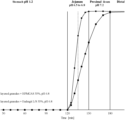
- FIG. 1 shows in vitro dissolution profiles of compound 1 (50 mg) from delayed release granules: Drug-layered granules with 35% HPCMAS means HPCMAS-HF and Drug-layered granules with 35% Eudragit® L/S refers to Eudragit® L100/S100).
- One or more coatings can be layered on the neutral core pellets in the fluidized bed. During this process each coating forms a thin film or layer adhering to the surface of the pellets. Each layer can provide a certain functionality to the granules/pellets/beads such as layering, sealing, protecting, release controlling, taste masking or improving ease of swallowing.
- the inert core pellets are layered with (S,E)-methyl-7-(1-(2-(2-ethylbutylamino)-2-oxoethyl)-2-oxo-1,2-dihydro-pyridin-3-ylamino)-6-(1-methyl-1H-imidazole-5-carboxamido)-7-oxohept-2-enoate or an enantiomer, a solvate, a hydrate or a pharmaceutically acceptable salt thereof, a binder, a filler and a lubricant/glidant in order to obtain the drug layered pellets.
- the inert core pellets are sprayed with the coating or feeding solution that consists of the solute and the solvent in a preferred ratio of 25% w/w for the solute to 75% w/w for the solvent.
- the solute comprises a quaternary mixture of (S,E)-methyl-7-(1-(2-(2-ethylbutylamino)-2-oxoethyl)-2-oxo-1,2-dihydro-pyridin-3-ylamino)-6-(1-methyl-1H-imidazole-5-carboxamido)-7-oxohept-2-enoate or an enantiomer, a solvate, a hydrate or a pharmaceutically acceptable salt thereof, povidone K25 used as a binder, lactose monohydrate used as a filler and talc used as a lubricant/glidant in a preferred ratio of about 28% for (S,E)-methyl-7-(1-(2-(2-eth
- the solvent of the spraying or feeding solution is a binary mixture of isopropyl alcohol and purified water in a ratio of 20% w/w (isopropyl alcohol) to 80% w/w (purified water).
- the mass of the pellets has increased by approximately 90% (weight gain) and the drug (Comp. 1) concentration of the granules/pellets/beads is approximately 132 mg/g (i.e. 13.2%).
- Comp. 1 concentration of the granules/pellets/beads is approximately 132 mg/g (i.e. 13.2%).
- the drug layered granules/pellets/beads can be further coated with a seal layer to protect the surface of the particles against chemical or physical stress or with a layer that improves taste masking or ease of swallowing of the pellets.
- a seal layer to protect the surface of the particles against chemical or physical stress or with a layer that improves taste masking or ease of swallowing of the pellets.
- excipients such as derivatives of cellulose, cellulose ether such as hydroxypropyl methylcellulose (HMPC), synthetic polymers, shellac, corn protein zein or other polysaccharides and amino methacrylate copolymers are used.
- the coating can further comprise colorants such as titanium dioxide, iron(III)oxide, iron(II,III) oxide or hydrated ferric oxide, lactose monohydrate, and or carnauba wax.
- Such layered granules/pellets/beads can be presented in different dose strengths by either encapsulating the required amount of pellets into a hard capsule or by filling the required amount of pellets into sachets or stick packs. These products are fast, conventional or immediate release dosage forms.
- the drug-layered granules/pellets/beads are further coated with at least one of the release-modifying polymers in order to obtain the required delayed release profile selected from the group consisting of hypromellose acetate succinate (HPMCAS), hypromellose phthalate, methacrylic acid-methyl methacrylate copolymers, methacrylic acid-ethyl acrylate copolymers, methyl acrylate-methyl methacrylate-methacrylic acid copolymers, polyvinyl acetate phthalate, cellulose acetate phthalate (CAP), shellac or mixtures thereof.
- HPMCAS hypromellose acetate succinate
- CAP cellulose acetate phthalate
- the coating can further comprise buffering agents, plasticisers, glidants/lubricants and colorants such as titanium dioxide, iron(III)oxide, iron(II,III) oxide or hydrated ferric oxide, lactose monohydrate, and or carnauba wax.
- buffering agents plasticisers, glidants/lubricants and colorants such as titanium dioxide, iron(III)oxide, iron(II,III) oxide or hydrated ferric oxide, lactose monohydrate, and or carnauba wax.
- enteric coating polymers of hypromellose acetate succinate available in different grades such as HPMCAS-LF, HPMCAS-MF, HPMCAS-HF, HPMCAS-LMP, HPMCAS-MMP, HPMCAS-HMP, HPMCAS-LG, HPMCAS-MG, HPMCAS-HG, and a mixture thereof, preferably HPMCAS-HF, HPMCAS-HMP, more preferably HPMCAS-HF, and methacrylic acid-methyl methacrylate copolymers either alone or in various combinations.
- HPMCAS-LF hypromellose acetate succinate
- These coatings can also further comprise buffering agents, plasticisers, glidants/lubricants and colorants such as titanium dioxide, iron(III)oxide, iron(II,III) oxide or hydrated ferric oxide, lactose monohydrate, and or carnauba wax.
- buffering agents plasticisers, glidants/lubricants and colorants such as titanium dioxide, iron(III)oxide, iron(II,III) oxide or hydrated ferric oxide, lactose monohydrate, and or carnauba wax.
- the drug layered pellets are coated with the coating or feeding solution that consists of the solute and the solvent in a preferred ratio of 10% w/w for the solute to 90% w/w for the solvent.
- the solute comprises a quaternary mixture of HPMCAS used as enteric polymer, ammonium hydrogen carbonate (NH 4 HCO 3 ) used as buffering agent, triethyl citrate used as plasticiser and talc used as glidant/lubricant in a in a preferred ratio of about 68% for HPMCAS, 2% for ammonium hydrogen carbonate, 11% triethyl citrate and 20% for talc.
- the solvent of the spraying or feeding solution is purified water.
- the mass of the pellets has increased by 25% to 40% (preferred 35%) and the drug (Comp. 1) concentration of the granules/pellets/beads is approximately 98 mg/g (i.e. 9.8%).
- the obtained particles of the embodiment have a mean diameter of about 0.9 mm.
- the drug layered pellets are coated with the coating or feeding solution that consists of the solute and the solvent in a preferred ratio of 15% w/w for the solute to 85% w/w for the solvent.
- the solute comprises a quaternary mixture of Eudragit® L100 and Eudragit® S100 used as enteric polymers, triethyl citrate used as plasticiser and talc used as glidant/lubricant in a in a preferred ratio of about 63% for Eudragit® L100, 10% for Eudragit® S100, 7% for triethyl citrate and 19% for talc.
- the solvent of the spraying or feeding solution is a binary mixture of isopropyl alcohol and purified water in a ratio of 92% w/w (isopropyl alcohol) to 8% w/w (purified water).
- the mass of the pellets has increased by 45% (weight gain) and the drug concentration of the granules/pellets/beads is approximately 91 mg/g (i.e. 9.1%).
- the obtained particles of the embodiment have a mean diameter ranging of about 0.9.
- Eudragit® L100 and Eudragit® S100 enables the particles to deliver Compound 1 to lower parts of the gastrointestinal tract.
- the lag time or delay can be increased to 15 to 30 minutes. This allows for granules/pellets/beads starting the drug release in the jejunum and completing the release in the ileum.
- the preferred weight gain in order to adjust the required lag time ranges from 35% to 55%.
- enteric layered drug granules/pellets/beads can be presented in different dose strengths by either encapsulating the required amount of pellets into a hard capsule or by filling the required amount of pellets into sachets or stick packs. These products are delayed release dosage forms.
- Compound 1 is formulated into coated minitablets. While the coating options are the same as described for the spherical multiparticulates the manufacturing of the minitablets applies different operations such as blending, granulation and compression.
- the powder blend is wet granulated by slowly adding a solution of hydroxypropylcellulose in ethanol 96%. Then, the moistened granules are mixed until the desired granulate structure has been reached. Afterwards, the wet granules are wet-sieved and subsequently dried at 70° C. ⁇ 5° C. until the required loss on drying has been reached. The dried granules are sieved and mixed with sieved adipic acid and silicon dioxide. After addition of talc the final blend is compressed into minitablets using multi-tip minitablet punches. The weight of the resulting tablets is approximately 13 mg.
- the qualitative and quantitative composition of the embodiment is presented below:
- Powder blend Granulation liquid: Compound 1 11.2% Hydroxypropylcellulose 14.6% Hydroxypropylcellulose, 28.6% Ethanol 96% 85.4% low-substituted Croscarmellose sodium 29.8% Mannitol 29.8% Granulate: Compound 1 11.2% Hydroxypropylcellulose, low- 27.0% substituted Croscarmellose sodium 28.1% Mannitol 28.1% Hydroxypropylcellulose 5.6% ⁇ Final blend Granulate 85.6% Adipic acid 8.7% Talc 4.8% Silicon dioxide 1.0% ⁇ Minitablets Minitablet mass: 12.9 mg 1 minitablet with a mass of 12.87 mg contains 1.25 mg compound 1 or a dose of 10 mg compound 1 requires 8 minitablets
- the minitablets can also be coated with HPMCAS-HF or a mixture of Eudragit® L100 and Eudragit® S100 in order to achieve the desired delayed release properties.
- HPMCAS-HF a mixture of Eudragit® L100 and Eudragit® S100 in order to achieve the desired delayed release properties.
- the qualitative and quantitative composition of the film-coated minitablets is presented below.
- Solvent Solute: Purified water 100.0% HPMCAS-HF 67.6% Ammonium 1.5% hydrogen carbonate Triethyl citrate 10.6% Talc 20.3% Coating solution: HPMCAS-HF 6.9% Ammonium hydrogen carbonate 0.2% Triethyl citrate 1.1% Talc 2.1% Water 89.8% ⁇ Enteric or delayed-release coated compound 1 mini tablets: Compound 1 mini tablets 66.4% HPMCAS-HF 22.7% Ammonium hydrogen carbonate 0.5% Triethyl citrate 3.6% Talc 6.8% ⁇ Compound 1 concentration: 6.4% or 63.8 mg/g Weight gain: 50%
- the minitablets can also be obtained by hot melt extrusion.
- copovidone copolymer of 1-vinyl-2-pyrrolidone and vinyl acetate in a ratio of 6:4 by mass
- the melt is cooled to room temperature and milled with a hammer mill.
- the milled extrudate is blended with croscarmellose sodium, silicon dioxide and finally magnesium stearate.
- the final blend is compressed into minitablets using multi-tip tablet punches.
- Example 1 Qualitative and Quantitative Composition of Compound 1 (50 mg) Delayed Release Granules Presented in Stick Packs Based on Pellets as Core Material and HPMCAS as Enteric Polymer
- One stick pack with 510.28 mg delayed release granules contains: Cellets 500 200.00 mg 39.19% Compound 1 50.00 mg 9.80% Povidone K25 8.50 mg 1.67% Lactose monohydrate 79.50 mg 15.58% HPMCAS-HF 89.64 mg 17.57% Enteric Ammonium hydrogen 1.67 mg 0.33% coating carbonate Triethyl citrate 14.08 mg 2.76% Talc 66.89 mg 13.11% 510.28 mg 100.00%
- Example 2 Qualitative and Quantitative Composition of Compound 1 (50 mg) Delayed Release Granules Presented in Stick Packs Based on Pellets as Core Material and HPMCAS as Enteric Polymer Plus Sodium Docecylsulfate as Surfactant
- One stick pack with 510.28 mg delayed release granules contains: Cellets 500 200.00 mg 39.19% Compound 1 50.00 mg 9.80% Povidone K25 7.60 mg 1.49% Lactose monohydrate 73.50 mg 14.40% Sodium dodecylsulfate 6.90 mg 1.35% HPMCAS-HF 89.64 mg 17.57% Enteric Ammonium hydrogen 1.67 mg 0.33% coating carbonate Triethyl citrate 14.08 mg 2.76% Talc 66.89 mg 13.11% 510.28 mg 100.00%
- Example 3 Qualitative and Quantitative Composition of Compound 1 (50 mg) Delayed Release Granules Presented in Stick Packs Based on Pellets as Core Material and Hypromellose (HPMC) as Sustained-Release Polymer Plus HPMCAS as Enteric Polymer
- One stick pack with 516.74 mg delayed release granules contains: Cellets 500 200.00 mg 38.70% Compound 1 50.00 mg 9.68% Povidone K25 8.50 mg 1.64% Lactose monohydrate 79.50 mg 15.38% HPMC 4.76 mg 0.92% Sustained- release coating HPMCAS-HF 90.78 mg 17.57% Enteric coating Ammonium hydrogen 1.69 mg 0.33% carbonate Triethyl citrate 14.27 mg 2.76% Talc 67.24 mg 13.01% 516.74 mg 100.00%
- Example 4 Qualitative and Quantitative Composition of Compound 1 (50 mg) Delayed Release Granules Presented in Stick Packs Based on Pellets as Core Material and Methacrylic Acid-Methyl Methacrylate Copolymers as Enteric Polymers
- One stick pack with 575.53 mg delayed release granules contains: Cellets 500 200.00 mg 34.75% Compound 1 50.00 mg 8.89% Povidone K25 8.50 mg 1.48% Lactose monohydrate 79.50 mg 13.81% Eudragit ® L100 123.37 mg 21.44% Enteric Eudragit ® S100 21.77 mg 3.78% coating Triethyl citrate 14.42 mg 2.51% Talc 77.97 mg 13.55% 575.53 mg 100.00%
- Example 5 Qualitative and Quantitative Composition of Compound 1 (50 mg) Delayed Release Granules Presented in Stick Packs Based on Pellets as Core Material and Methacrylic Acid-Methyl Methacrylate Copolymer as Enteric Polymer and Ethylcellulose as Sustained-Release Polymer
- One stick pack with 575.53 mg delayed release granules contains: Cellets 500 237.00 mg 37.58% Compound 1 50.00 mg 7.93% Povidone K25 8.50 mg 1.35% Lactose monohydrate 79.50 mg 12.61% Eudragit ® L100 156.75 mg 24.86% Enteric Triethyl citrate 15.67 mg 2.48% coating Talc 82.06 mg 13.01% Ethylcellulose 0.74 mg 0.12% Sustained- Macrogol 6000 0.40 mg 0.06% release coating 630.62 mg 100.00%
- Example 6 Qualitative and Quantitative Composition of Compound 1 (50 mg) Delayed Release Minitablets Presented in Stick Packs Based on Minitablets as Core Material and HPMCAS as Enteric Polymer
- One stick pack with 542.45 mg delayed release minitablets contains: Compound 1 50.00 mg 9.22% Hydroxypropylcellulose, low- 120.00 mg 22.12% substituted Croscarmellose sodium 125.00 mg 23.04% Mannitol 125.00 mg 23.04% Hydroxypropylcellulose 15.00 mg 2.77% Adipic acid 45.00 mg 8.30% Talc 31.60 mg 5.83% Silicon dioxide 5.00 mg 0.92% HPMCAS-HF 22.00 mg 4.06% Enteric Ammonium hydrogen 0.40 mg 0.07% coating carbonate Triethyl citrate 3.45 mg 0.64% 542.45 mg 100.00%
- Example 7 Qualitative and Quantitative Composition of Compound 1 (50 mg) Delayed Release Minitablets Presented in Stick Packs Based on Minitablets as Core Material and HPMCAS as Enteric Polymer
- One stick pack with 542.45 mg delayed release minitablets contains: Compound 1 50.00 mg 10.05% Hydroxypropylcellulose, low- 120.00 mg 24.12% substituted Croscarmellose sodium 125.00 mg 25.13% Mannitol 125.00 mg 25.13% Hydroxypropylcellulose 15.00 mg 3.02% Talc 31.60 mg 6.35% Silicon dioxide 5.00 mg 1.01% HPMCAS-HF 22.00 mg 4.42% Enteric Ammonium hydrogen 0.40 mg 0.08% coating carbonate Triethyl citrate 3.45 mg 0.69% 497.45 mg 100.00%
- Example 8 Qualitative and Quantitative Composition of Compound 1 (50 mg) Delayed Release Minitablets Presented in Stick Packs Based on Minitablets as Core Material and Methacrylic Acid-Methyl Methacrylate Copolymers as Enteric Polymers
- One stick pack with 542.45 mg delayed release minitablets contains: Compound 1 50.00 mg 9.22% Hydroxypropylcellulose, low- 120.00 mg 22.12% substituted Croscarmellose sodium 125.00 mg 23.04% Mannitol 125.00 mg 23.04% Hydroxypropylcellulose 15.00 mg 2.76%
- Example 9 Qualitative and Quantitative Composition of Compound 1 (50 mg) Delayed Release Miniutablets Presented in Stick Packs Based on Minitablets as Core Material and Methacrylic Acid-Methyl Methacrylate Copolymers as Enteric Polymers
- One stick pack with 542.45 mg delayed release minitablets contains: Compound 1 50.00 mg 10.05% Hydroxypropylcellulose, low- 120.00 mg 24.12% substituted Croscarmellose sodium 125.00 mg 25.13% Mannitol 125.00 mg 25.13% Hydroxypropylcellulose 15.00 mg 3.02% Talc 31.25 mg 6.28% Silicon dioxide 5.00 mg 1.01% Eudragit ® L100 20.30 mg 4.08% Enteric Eudragit ® S100 3.60 mg 0.72% coating Triethyl citrate 2.35 mg 0.47% 497.45 mg 100.00%
- the oral formulations of the present invention can be evaluated in vitro by a dissolution test method under conditions that reflect the physicochemical characteristics of Comp. 1 and of the oral solid formulation considering the required delayed release. Based on these characteristics and considering the requirements of the European and United States Pharmacopoeia a two-stage, full change dissolution method has been developed using the paddle apparatus (i.e. apparatus II) operating with a stirring rate of 100 rpm. Gastro-resistance of the oral solid dosage form can be verified in 500 mL of simulated gastric fluid (0.1 N HCl, pH 1.2) for 2 hours.
- simulated gastric fluid 0.1 N HCl, pH 1.2
- Drug release can be tested after transferring the dosage form to 900 mL of simulated intestinal fluid (50 mM phosphate buffer adjusted to a pH values of either 6.2, 6.5 or 6.8) containing 0.5% of sodium dodecylsulphate as a surfactant.
- the dissolution tests are conducted at 37° C. and under sink conditions to reflect in vivo conditions.
- An HPLC/UV method with a detection wavelength of 316 nm can be used to quantity the released amount of Comp. 1 in the dissolution media ( FIG. 1 .).
Landscapes
- Health & Medical Sciences (AREA)
- Bioinformatics & Cheminformatics (AREA)
- Chemical & Material Sciences (AREA)
- Engineering & Computer Science (AREA)
- Medicinal Chemistry (AREA)
- Pharmacology & Pharmacy (AREA)
- Life Sciences & Earth Sciences (AREA)
- Animal Behavior & Ethology (AREA)
- General Health & Medical Sciences (AREA)
- Public Health (AREA)
- Veterinary Medicine (AREA)
- Epidemiology (AREA)
- Chemical Kinetics & Catalysis (AREA)
- General Chemical & Material Sciences (AREA)
- Nuclear Medicine, Radiotherapy & Molecular Imaging (AREA)
- Organic Chemistry (AREA)
- Inorganic Chemistry (AREA)
- Medicinal Preparation (AREA)
- Pharmaceuticals Containing Other Organic And Inorganic Compounds (AREA)
Applications Claiming Priority (3)
| Application Number | Priority Date | Filing Date | Title |
|---|---|---|---|
| WOPCT/EP2021/079584 | 2021-10-25 | ||
| PCT/EP2021/079584 WO2023072368A1 (en) | 2021-10-25 | 2021-10-25 | Oral formulation of a pyridinone derivate and use thereof in prophylaxis and/or treatment of intestinal fibrosis |
| PCT/EP2022/079666 WO2023072878A1 (en) | 2021-10-25 | 2022-10-24 | Oral formulation of a pyridinone derivate and use thereof in prophylaxis and/or treatment of intestinal fibrosis |
Publications (1)
| Publication Number | Publication Date |
|---|---|
| US20250041228A1 true US20250041228A1 (en) | 2025-02-06 |
Family
ID=78536154
Family Applications (1)
| Application Number | Title | Priority Date | Filing Date |
|---|---|---|---|
| US18/704,228 Pending US20250041228A1 (en) | 2021-10-25 | 2022-10-24 | Oral formulation of a pyridinone derivate and use thereof in prophylaxis and/or treatment of intestinal fibrosis |
Country Status (11)
| Country | Link |
|---|---|
| US (1) | US20250041228A1 (cg-RX-API-DMAC7.html) |
| EP (1) | EP4312994A1 (cg-RX-API-DMAC7.html) |
| JP (1) | JP2024536609A (cg-RX-API-DMAC7.html) |
| KR (1) | KR20240093898A (cg-RX-API-DMAC7.html) |
| CN (1) | CN118234489A (cg-RX-API-DMAC7.html) |
| AU (1) | AU2022374695A1 (cg-RX-API-DMAC7.html) |
| CA (1) | CA3230682A1 (cg-RX-API-DMAC7.html) |
| IL (1) | IL312176A (cg-RX-API-DMAC7.html) |
| MX (1) | MX2024005076A (cg-RX-API-DMAC7.html) |
| WO (2) | WO2023072368A1 (cg-RX-API-DMAC7.html) |
| ZA (1) | ZA202402786B (cg-RX-API-DMAC7.html) |
Families Citing this family (3)
| Publication number | Priority date | Publication date | Assignee | Title |
|---|---|---|---|---|
| IL297020A (en) | 2020-04-24 | 2022-12-01 | Dr Falk Pharma Gmbh | A systemic preparation of a pyridonone derivative related to tg2 |
| HRP20231072T1 (hr) | 2020-04-24 | 2023-12-22 | Dr. Falk Pharma Gmbh | Sustavna formulacija derivata piridinona za celijakiju |
| WO2025153465A1 (en) * | 2024-01-15 | 2025-07-24 | UCB Biopharma SRL | Method for the treatment of fibrotic-related disorder associated to ibd |
Family Cites Families (2)
| Publication number | Priority date | Publication date | Assignee | Title |
|---|---|---|---|---|
| DE102006052755A1 (de) * | 2006-11-08 | 2008-05-15 | N-Zyme Biotec Gmbh | Michaelsysteme als Transglutaminaseinhibitoren |
| EP2687511A1 (de) * | 2012-07-17 | 2014-01-22 | Zedira GmbH | Pyridinonderivate als Gewebetransglutaminaseinhibitoren |
-
2021
- 2021-10-25 WO PCT/EP2021/079584 patent/WO2023072368A1/en not_active Ceased
-
2022
- 2022-10-24 CN CN202280071095.9A patent/CN118234489A/zh active Pending
- 2022-10-24 JP JP2024524678A patent/JP2024536609A/ja active Pending
- 2022-10-24 US US18/704,228 patent/US20250041228A1/en active Pending
- 2022-10-24 CA CA3230682A patent/CA3230682A1/en active Pending
- 2022-10-24 EP EP22809386.0A patent/EP4312994A1/en active Pending
- 2022-10-24 MX MX2024005076A patent/MX2024005076A/es unknown
- 2022-10-24 KR KR1020247017206A patent/KR20240093898A/ko active Pending
- 2022-10-24 AU AU2022374695A patent/AU2022374695A1/en active Pending
- 2022-10-24 IL IL312176A patent/IL312176A/en unknown
- 2022-10-24 WO PCT/EP2022/079666 patent/WO2023072878A1/en not_active Ceased
-
2024
- 2024-04-10 ZA ZA2024/02786A patent/ZA202402786B/en unknown
Also Published As
| Publication number | Publication date |
|---|---|
| IL312176A (en) | 2024-06-01 |
| JP2024536609A (ja) | 2024-10-04 |
| KR20240093898A (ko) | 2024-06-24 |
| WO2023072368A1 (en) | 2023-05-04 |
| WO2023072878A1 (en) | 2023-05-04 |
| CN118234489A (zh) | 2024-06-21 |
| EP4312994A1 (en) | 2024-02-07 |
| AU2022374695A1 (en) | 2024-03-21 |
| CA3230682A1 (en) | 2023-05-04 |
| ZA202402786B (en) | 2025-07-30 |
| MX2024005076A (es) | 2024-05-13 |
Similar Documents
| Publication | Publication Date | Title |
|---|---|---|
| RU2403015C2 (ru) | Гастрорезистентные фармацевтические композиции, содержащие рифаксимин | |
| KR100535954B1 (ko) | 장용 피복된 약학 정제 및 이의 제조방법 | |
| CN102458117B (zh) | 含有非阿片样和阿片样止痛药的组合的口腔崩解片组合物 | |
| JP3902228B2 (ja) | 結腸デリバリー用の医薬投与形態 | |
| JP5671609B2 (ja) | ヒドロモルホンおよびナロキソンを含む医薬組成物 | |
| WO2023072878A1 (en) | Oral formulation of a pyridinone derivate and use thereof in prophylaxis and/or treatment of intestinal fibrosis | |
| CN101312716A (zh) | 具有速释和/或控释特征的药物剂型 | |
| CN103269691A (zh) | 用于控制释放美沙拉嗪的口服药物片剂和其获得方法 | |
| CN101287443B (zh) | pH控制的脉冲释放系统、其制备方法和用途 | |
| WO2022245307A1 (en) | Composition of mesalazine enteric tablet formulation | |
| TW201742621A (zh) | 包含經黏膜黏附性材料包覆之個別核心單元之核心及核心腸衣之多單元劑型 | |
| CN104739819A (zh) | 新型制剂 | |
| EP2533766B1 (en) | Pharmaceutical mini-tablets for sustained release of flecainide acetate | |
| US20050147663A1 (en) | Method of treatment for improved bioavailability | |
| US20100280035A1 (en) | Solid pharmaceutical composition comprising 1-(4-chloroanilino)-4-(4-pyridylmethyl)phthalazine and a ph modifier | |
| EA051945B1 (ru) | Пероральный препарат производного пиридинона и его применение для профилактики и/или лечения фиброза кишечника | |
| EP3380084B1 (en) | Omeprazole formulations |
Legal Events
| Date | Code | Title | Description |
|---|---|---|---|
| STPP | Information on status: patent application and granting procedure in general |
Free format text: APPLICATION UNDERGOING PREEXAM PROCESSING |
|
| STPP | Information on status: patent application and granting procedure in general |
Free format text: DOCKETED NEW CASE - READY FOR EXAMINATION |
|
| STPP | Information on status: patent application and granting procedure in general |
Free format text: NON FINAL ACTION COUNTED, NOT YET MAILED |
|
| STPP | Information on status: patent application and granting procedure in general |
Free format text: NON FINAL ACTION MAILED |