US20120249496A1 - Pixel array of fringe field switching liquid crystal display panel and driving method thereof - Google Patents
Pixel array of fringe field switching liquid crystal display panel and driving method thereof Download PDFInfo
- Publication number
- US20120249496A1 US20120249496A1 US13/447,309 US201213447309A US2012249496A1 US 20120249496 A1 US20120249496 A1 US 20120249496A1 US 201213447309 A US201213447309 A US 201213447309A US 2012249496 A1 US2012249496 A1 US 2012249496A1
- Authority
- US
- United States
- Prior art keywords
- pixel
- common
- lines
- sub
- electrodes
- Prior art date
- Legal status (The legal status is an assumption and is not a legal conclusion. Google has not performed a legal analysis and makes no representation as to the accuracy of the status listed.)
- Granted
Links
- 239000004973 liquid crystal related substance Substances 0.000 title claims abstract description 100
- 238000000034 method Methods 0.000 title claims description 53
- 239000004020 conductor Substances 0.000 claims description 15
- 238000013459 approach Methods 0.000 claims description 11
- 229910052751 metal Inorganic materials 0.000 claims description 6
- 239000002184 metal Substances 0.000 claims description 6
- 230000009189 diving Effects 0.000 claims description 2
- 238000010586 diagram Methods 0.000 description 28
- 238000013461 design Methods 0.000 description 18
- 230000000694 effects Effects 0.000 description 11
- 239000000758 substrate Substances 0.000 description 4
- 239000010409 thin film Substances 0.000 description 4
- 230000001447 compensatory effect Effects 0.000 description 3
- 230000003247 decreasing effect Effects 0.000 description 3
- 229910021417 amorphous silicon Inorganic materials 0.000 description 2
- AMGQUBHHOARCQH-UHFFFAOYSA-N indium;oxotin Chemical compound [In].[Sn]=O AMGQUBHHOARCQH-UHFFFAOYSA-N 0.000 description 2
- 229910021420 polycrystalline silicon Inorganic materials 0.000 description 2
- OKTJSMMVPCPJKN-UHFFFAOYSA-N Carbon Chemical compound [C] OKTJSMMVPCPJKN-UHFFFAOYSA-N 0.000 description 1
- 230000004075 alteration Effects 0.000 description 1
- 229910052799 carbon Inorganic materials 0.000 description 1
- 230000005684 electric field Effects 0.000 description 1
- 230000002708 enhancing effect Effects 0.000 description 1
- 238000011068 loading method Methods 0.000 description 1
- 238000004519 manufacturing process Methods 0.000 description 1
- 238000012986 modification Methods 0.000 description 1
- 230000004048 modification Effects 0.000 description 1
- 229920005591 polysilicon Polymers 0.000 description 1
- 238000012545 processing Methods 0.000 description 1
- 230000000750 progressive effect Effects 0.000 description 1
- 239000004065 semiconductor Substances 0.000 description 1
Images






Classifications
-
- G—PHYSICS
- G02—OPTICS
- G02F—OPTICAL DEVICES OR ARRANGEMENTS FOR THE CONTROL OF LIGHT BY MODIFICATION OF THE OPTICAL PROPERTIES OF THE MEDIA OF THE ELEMENTS INVOLVED THEREIN; NON-LINEAR OPTICS; FREQUENCY-CHANGING OF LIGHT; OPTICAL LOGIC ELEMENTS; OPTICAL ANALOGUE/DIGITAL CONVERTERS
- G02F1/00—Devices or arrangements for the control of the intensity, colour, phase, polarisation or direction of light arriving from an independent light source, e.g. switching, gating or modulating; Non-linear optics
- G02F1/01—Devices or arrangements for the control of the intensity, colour, phase, polarisation or direction of light arriving from an independent light source, e.g. switching, gating or modulating; Non-linear optics for the control of the intensity, phase, polarisation or colour
- G02F1/13—Devices or arrangements for the control of the intensity, colour, phase, polarisation or direction of light arriving from an independent light source, e.g. switching, gating or modulating; Non-linear optics for the control of the intensity, phase, polarisation or colour based on liquid crystals, e.g. single liquid crystal display cells
- G02F1/133—Constructional arrangements; Operation of liquid crystal cells; Circuit arrangements
- G02F1/1333—Constructional arrangements; Manufacturing methods
- G02F1/1343—Electrodes
-
- G—PHYSICS
- G09—EDUCATION; CRYPTOGRAPHY; DISPLAY; ADVERTISING; SEALS
- G09G—ARRANGEMENTS OR CIRCUITS FOR CONTROL OF INDICATING DEVICES USING STATIC MEANS TO PRESENT VARIABLE INFORMATION
- G09G3/00—Control arrangements or circuits, of interest only in connection with visual indicators other than cathode-ray tubes
- G09G3/20—Control arrangements or circuits, of interest only in connection with visual indicators other than cathode-ray tubes for presentation of an assembly of a number of characters, e.g. a page, by composing the assembly by combination of individual elements arranged in a matrix no fixed position being assigned to or needed to be assigned to the individual characters or partial characters
- G09G3/34—Control arrangements or circuits, of interest only in connection with visual indicators other than cathode-ray tubes for presentation of an assembly of a number of characters, e.g. a page, by composing the assembly by combination of individual elements arranged in a matrix no fixed position being assigned to or needed to be assigned to the individual characters or partial characters by control of light from an independent source
- G09G3/36—Control arrangements or circuits, of interest only in connection with visual indicators other than cathode-ray tubes for presentation of an assembly of a number of characters, e.g. a page, by composing the assembly by combination of individual elements arranged in a matrix no fixed position being assigned to or needed to be assigned to the individual characters or partial characters by control of light from an independent source using liquid crystals
- G09G3/3611—Control of matrices with row and column drivers
- G09G3/3648—Control of matrices with row and column drivers using an active matrix
- G09G3/3655—Details of drivers for counter electrodes, e.g. common electrodes for pixel capacitors or supplementary storage capacitors
-
- G—PHYSICS
- G02—OPTICS
- G02F—OPTICAL DEVICES OR ARRANGEMENTS FOR THE CONTROL OF LIGHT BY MODIFICATION OF THE OPTICAL PROPERTIES OF THE MEDIA OF THE ELEMENTS INVOLVED THEREIN; NON-LINEAR OPTICS; FREQUENCY-CHANGING OF LIGHT; OPTICAL LOGIC ELEMENTS; OPTICAL ANALOGUE/DIGITAL CONVERTERS
- G02F1/00—Devices or arrangements for the control of the intensity, colour, phase, polarisation or direction of light arriving from an independent light source, e.g. switching, gating or modulating; Non-linear optics
- G02F1/01—Devices or arrangements for the control of the intensity, colour, phase, polarisation or direction of light arriving from an independent light source, e.g. switching, gating or modulating; Non-linear optics for the control of the intensity, phase, polarisation or colour
- G02F1/13—Devices or arrangements for the control of the intensity, colour, phase, polarisation or direction of light arriving from an independent light source, e.g. switching, gating or modulating; Non-linear optics for the control of the intensity, phase, polarisation or colour based on liquid crystals, e.g. single liquid crystal display cells
- G02F1/133—Constructional arrangements; Operation of liquid crystal cells; Circuit arrangements
- G02F1/136—Liquid crystal cells structurally associated with a semi-conducting layer or substrate, e.g. cells forming part of an integrated circuit
- G02F1/1362—Active matrix addressed cells
- G02F1/136286—Wiring, e.g. gate line, drain line
-
- G—PHYSICS
- G09—EDUCATION; CRYPTOGRAPHY; DISPLAY; ADVERTISING; SEALS
- G09G—ARRANGEMENTS OR CIRCUITS FOR CONTROL OF INDICATING DEVICES USING STATIC MEANS TO PRESENT VARIABLE INFORMATION
- G09G3/00—Control arrangements or circuits, of interest only in connection with visual indicators other than cathode-ray tubes
- G09G3/20—Control arrangements or circuits, of interest only in connection with visual indicators other than cathode-ray tubes for presentation of an assembly of a number of characters, e.g. a page, by composing the assembly by combination of individual elements arranged in a matrix no fixed position being assigned to or needed to be assigned to the individual characters or partial characters
- G09G3/34—Control arrangements or circuits, of interest only in connection with visual indicators other than cathode-ray tubes for presentation of an assembly of a number of characters, e.g. a page, by composing the assembly by combination of individual elements arranged in a matrix no fixed position being assigned to or needed to be assigned to the individual characters or partial characters by control of light from an independent source
- G09G3/36—Control arrangements or circuits, of interest only in connection with visual indicators other than cathode-ray tubes for presentation of an assembly of a number of characters, e.g. a page, by composing the assembly by combination of individual elements arranged in a matrix no fixed position being assigned to or needed to be assigned to the individual characters or partial characters by control of light from an independent source using liquid crystals
-
- G—PHYSICS
- G09—EDUCATION; CRYPTOGRAPHY; DISPLAY; ADVERTISING; SEALS
- G09G—ARRANGEMENTS OR CIRCUITS FOR CONTROL OF INDICATING DEVICES USING STATIC MEANS TO PRESENT VARIABLE INFORMATION
- G09G5/00—Control arrangements or circuits for visual indicators common to cathode-ray tube indicators and other visual indicators
-
- G—PHYSICS
- G02—OPTICS
- G02F—OPTICAL DEVICES OR ARRANGEMENTS FOR THE CONTROL OF LIGHT BY MODIFICATION OF THE OPTICAL PROPERTIES OF THE MEDIA OF THE ELEMENTS INVOLVED THEREIN; NON-LINEAR OPTICS; FREQUENCY-CHANGING OF LIGHT; OPTICAL LOGIC ELEMENTS; OPTICAL ANALOGUE/DIGITAL CONVERTERS
- G02F1/00—Devices or arrangements for the control of the intensity, colour, phase, polarisation or direction of light arriving from an independent light source, e.g. switching, gating or modulating; Non-linear optics
- G02F1/01—Devices or arrangements for the control of the intensity, colour, phase, polarisation or direction of light arriving from an independent light source, e.g. switching, gating or modulating; Non-linear optics for the control of the intensity, phase, polarisation or colour
- G02F1/13—Devices or arrangements for the control of the intensity, colour, phase, polarisation or direction of light arriving from an independent light source, e.g. switching, gating or modulating; Non-linear optics for the control of the intensity, phase, polarisation or colour based on liquid crystals, e.g. single liquid crystal display cells
- G02F1/133—Constructional arrangements; Operation of liquid crystal cells; Circuit arrangements
- G02F1/1333—Constructional arrangements; Manufacturing methods
- G02F1/1343—Electrodes
- G02F1/134309—Electrodes characterised by their geometrical arrangement
- G02F1/134372—Electrodes characterised by their geometrical arrangement for fringe field switching [FFS] where the common electrode is not patterned
-
- G—PHYSICS
- G09—EDUCATION; CRYPTOGRAPHY; DISPLAY; ADVERTISING; SEALS
- G09G—ARRANGEMENTS OR CIRCUITS FOR CONTROL OF INDICATING DEVICES USING STATIC MEANS TO PRESENT VARIABLE INFORMATION
- G09G2300/00—Aspects of the constitution of display devices
- G09G2300/04—Structural and physical details of display devices
- G09G2300/0421—Structural details of the set of electrodes
- G09G2300/0426—Layout of electrodes and connections
-
- G—PHYSICS
- G09—EDUCATION; CRYPTOGRAPHY; DISPLAY; ADVERTISING; SEALS
- G09G—ARRANGEMENTS OR CIRCUITS FOR CONTROL OF INDICATING DEVICES USING STATIC MEANS TO PRESENT VARIABLE INFORMATION
- G09G2310/00—Command of the display device
- G09G2310/08—Details of timing specific for flat panels, other than clock recovery
-
- G—PHYSICS
- G09—EDUCATION; CRYPTOGRAPHY; DISPLAY; ADVERTISING; SEALS
- G09G—ARRANGEMENTS OR CIRCUITS FOR CONTROL OF INDICATING DEVICES USING STATIC MEANS TO PRESENT VARIABLE INFORMATION
- G09G2330/00—Aspects of power supply; Aspects of display protection and defect management
- G09G2330/02—Details of power systems and of start or stop of display operation
- G09G2330/021—Power management, e.g. power saving
-
- G—PHYSICS
- G09—EDUCATION; CRYPTOGRAPHY; DISPLAY; ADVERTISING; SEALS
- G09G—ARRANGEMENTS OR CIRCUITS FOR CONTROL OF INDICATING DEVICES USING STATIC MEANS TO PRESENT VARIABLE INFORMATION
- G09G3/00—Control arrangements or circuits, of interest only in connection with visual indicators other than cathode-ray tubes
- G09G3/20—Control arrangements or circuits, of interest only in connection with visual indicators other than cathode-ray tubes for presentation of an assembly of a number of characters, e.g. a page, by composing the assembly by combination of individual elements arranged in a matrix no fixed position being assigned to or needed to be assigned to the individual characters or partial characters
- G09G3/34—Control arrangements or circuits, of interest only in connection with visual indicators other than cathode-ray tubes for presentation of an assembly of a number of characters, e.g. a page, by composing the assembly by combination of individual elements arranged in a matrix no fixed position being assigned to or needed to be assigned to the individual characters or partial characters by control of light from an independent source
- G09G3/36—Control arrangements or circuits, of interest only in connection with visual indicators other than cathode-ray tubes for presentation of an assembly of a number of characters, e.g. a page, by composing the assembly by combination of individual elements arranged in a matrix no fixed position being assigned to or needed to be assigned to the individual characters or partial characters by control of light from an independent source using liquid crystals
- G09G3/3611—Control of matrices with row and column drivers
- G09G3/3614—Control of polarity reversal in general
Definitions
- the disclosure relates to a pixel array of a fringe field switching liquid crystal display panel and a driving method thereof, and more particularly, to a pixel array of a fringe field switching liquid crystal display panel with a plurality of common lines and a driving method thereof.
- FFS liquid crystal display panels are applied in many kinds of consumer electronics such as flat TVs, laptop computers, and cell phones.
- Fringe field switching (FFS) liquid crystal display panels have been developed for improving narrow viewing angle issues in liquid crystal display panels.
- the main features of the FFS liquid crystal display panel include that common electrodes and pixel electrodes are disposed in different layers of an array substrate (also called a thin film transistor substrate), and a wide viewing angle effect may be achieved by an electrical field generated by the common electrode and the pixel electrode.
- an array substrate also called a thin film transistor substrate
- a wide viewing angle effect may be achieved by an electrical field generated by the common electrode and the pixel electrode.
- a plurality of common lines which connect to the common electrodes, are electrically connected to each other and may not be driven independently.
- driving methods of the array substrate have to be more complicated for presenting different display driving effects, such as a dot inversion driving effect. This results in driving up the cost of integrated circuits (ICs) and high power consumption for driving the array substrate, also leads away from goals of energy saving and carbon reduction.
- ICs integrated circuits
- An embodiment provides a pixel array of a fringe field switching liquid crystal display panel.
- the pixel array of the fringe field switching liquid crystal display panel comprises a plurality of gate lines, a plurality of data lines, a plurality of pixel electrodes, and a plurality of common lines.
- the gate lines are disposed parallel to each other substantially along a first direction.
- the data lines are disposed parallel to each other substantially along a second direction.
- a plurality of pixel units, which are aligned in an array configuration, are defined by the gate lines and the data lines.
- Each of the pixel units includes at least one sub-pixel region.
- Each of the pixel electrodes is respectively disposed in each of the sub-pixel regions.
- the common lines are disposed substantially along the first direction and electrically isolated from each other.
- Each of the common lines includes a plurality of common electrodes extending along the second direction. The two adjacent common electrodes of each common line are respectively disposed in the two adjacent pixel units located in different rows.
- the driving method of the fringe field switching liquid crystal display panel comprises the following steps. Firstly a pixel array is provided.
- the pixel array includes a plurality of gate lines, a plurality of data lines, a plurality of pixel units aligned in an array configuration, a plurality of pixel electrodes, and a plurality of common lines.
- Each of the pixel units includes at least one sub-pixel region, and each of the pixel electrodes is disposed respectively in each of the sub-pixel regions.
- the common lines are electrically isolated from each other.
- Each of the common lines includes a plurality of common electrodes.
- the two adjacent common electrodes of each common line are respectively disposed in the two adjacent pixel regions located in different rows.
- a plurality of common signals is then provided to the common lines for driving the pixel array. Within one frame time, a level of the common signals provided to the odd common lines is different from a level of the common signals provided to the even common lines.
- the pixel array of the fringe field switching liquid crystal display panel comprises a plurality of gate lines, a plurality of data lines, a plurality of pixel units, a plurality of pixel electrodes, and a plurality of common lines.
- the gate lines are disposed parallel to each other substantially along a first direction.
- the data lines are disposed parallel to each other substantially along a second direction.
- the pixel units are aligned in an array configuration.
- Each of the pixel units includes at least one sub-pixel region, and two adjacent pixel units located in an identical row are disposed and shifted relatively along the second direction.
- Each of the pixel electrodes is respectively disposed in each of the sub-pixel regions.
- the common lines are disposed substantially along the first direction and are electrically isolated from each other.
- Each of the common lines includes a plurality of common electrodes extending along the second direction.
- the two adjacent common electrodes of each common line are respectively disposed in the two adjacent pixel units located in different rows.
- the common lines which may be driven independently, are employed with the allocation approaches of the common electrodes in the sub-pixel regions for presenting a dot inversion driving effect by a simplified driving method. Costs of the driving ICs may then be reduced, and the power consumption of the fringe field switching liquid crystal display panel may be also improved.
- FIG. 1 is a schematic diagram illustrating a pixel array of a fringe field switching liquid crystal display panel according to a first embodiment.
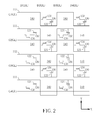
- FIG. 2 is a schematic diagram illustrating electrical circuits of a pixel array of a fringe field switching liquid crystal display panel according to the first embodiment.
- FIG. 3 is a schematic diagram illustrating common lines and common electrodes of a fringe field switching liquid crystal display panel according to the first embodiment.
- FIG. 4 is a schematic diagram illustrating timings of a driving method of a fringe field switching liquid crystal display panel according to the first embodiment.
- FIG. 5 is a schematic diagram illustrating a pixel array of a fringe field switching liquid crystal display panel according to a second embodiment.
- FIG. 6 is a schematic diagram illustrating electrical circuits of a pixel array of a fringe field switching liquid crystal display panel according to the second embodiment.
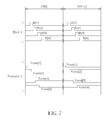
- FIG. 7 is a schematic diagram illustrating timings of a driving method of a fringe field switching liquid crystal display panel according to the second embodiment.
- FIG. 8 is a schematic diagram illustrating timings of a driving method of a fringe field switching liquid crystal display panel according to another embodiment.
- FIG. 9 is a schematic diagram illustrating a pixel array of a fringe field switching liquid crystal display panel according to a third embodiment.
- FIG. 10 is a schematic diagram illustrating a pixel array of a fringe field switching liquid crystal display panel according to a fourth embodiment.
- FIG. 11 is a schematic diagram illustrating a pixel array of a fringe field switching liquid crystal display panel according to a fifth embodiment.
- FIG. 12 is a schematic diagram illustrating a pixel array of a fringe field switching liquid crystal display panel according to a sixth embodiment.
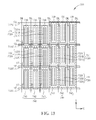
- FIG. 13 is a schematic diagram illustrating a pixel array of a fringe field switching liquid crystal display panel according to a seventh embodiment.
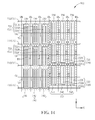
- FIG. 14 is a schematic diagram illustrating a pixel array of a fringe field switching liquid crystal display panel according to an eighth embodiment.
- FIG. 1 is a schematic diagram illustrating a pixel array of a fringe field switching liquid crystal display panel according to a first embodiment.
- FIG. 2 is a schematic diagram illustrating electrical circuits of the pixel array of the fringe field switching liquid crystal display panel according to this embodiment.
- FIG. 3 is a schematic diagram illustrating common lines and common electrodes of the fringe field switching liquid crystal display panel according to this embodiment.
- the figures are only for illustration and the figures may not be to scale. The scale may be further modified according to different design considerations.
- a pixel array 100 of a fringe field switching liquid crystal display panel is provided.
- the pixel array 100 includes a plurality of gate lines GL, a plurality of data lines DL, a plurality of pixel electrodes 130 , and a plurality of common lines 110 .
- the gate lines GL are disposed parallel to each other substantially along a first direction X.
- the data lines DL are disposed parallel to each other substantially along a second direction Y.
- a plurality of pixel units 140 which are aligned in an array configuration, are defined by the gate lines GL and the data lines DL.
- Each of the pixel units 140 includes one sub-pixel region 141 .
- Each of the pixel electrodes 130 is respectively disposed in each of the sub-pixel regions 141 . As shown in FIG.
- each of the pixel electrodes 130 includes a plurality of stripe structures for driving the fringe field switching liquid crystal display panel, but the pixel electrode 130 is not limited to this and may be other appropriate structures.
- the common lines 110 are disposed substantially along the first direction X and electrically isolated from each other.
- Each of the common lines 110 includes a plurality of common electrodes 120 extending along the second direction Y.
- the two adjacent common electrodes 120 of each common line 110 are respectively disposed in the two adjacent pixel units 140 located in different rows.
- the two adjacent common electrodes 120 of each common line 110 in this embodiment are respectively disposed in the two adjacent sub-pixel regions 141 located in different rows. It is worth noticing that, as shown in FIG.
- the common line 110 may include a common lead 190 and a plurality of common electrodes 120 .
- each of the common lines 110 may consist of at least one transparent conductive material such as indium tin oxide (ITO), but the embodiment is not limited to this.
- the common lead 190 and the common electrode 120 may be made of an identical transparent conductive material, or the common lead 190 may be made of a non-transparent conductive material while the common electrode 120 is made of a transparent conductive material.
- metal conductive materials with lower electrical resistance may be used to form the common leads 190 .
- the common leads 190 made of metal conductive materials are electrically connected to the common electrode 120 made of transparent conductive materials for forming the common lines 110 .
- the electrical resistance of the common lines 110 can be reduced.
- the common lead 190 and the common electrode 120 may be made of an identical transparent conductive material for enhancing the aperture ratio of the pixel array. Purposes of design simplification and process reduction may also be achieved because no additional designs and processes are required for electrically connecting the common leads 190 and the common electrodes 120 . In addition, as shown in FIGS.
- the gate lines include a gate line G 1 , a gate line G 2 , a gate line G 3 , and a gate line G 4 .
- the data lines include a data line D 1 , a data line D 2 , a data line D 3 , and a data line D 4 .
- an area between the gate line G 1 and the gate line G 2 is defined as an odd row
- an area between the gate line G 2 and the gate line G 3 is defined as an even row
- an area between the gate line G 3 and the gate line G 4 is also defined as an odd row
- other areas between the gate lines are also defined by this rule.
- the common lines 110 include a plurality of first common lines 111 and a plurality of second common lines 112 .
- Each of the first common lines 111 includes a plurality of first common electrodes 121 disposed respectively in the pixel units 140 located in all odd columns of a corresponding odd row and the pixel unit 140 located in all even columns of a corresponding even row.
- Each of the second common lines 112 includes a plurality of second common electrodes 122 disposed respectively in the pixel units 140 located in all odd columns of a corresponding even row and the pixel units 140 located in all even columns of a corresponding odd row.
- each of the first common lines 111 includes a plurality of first common electrodes 121 disposed respectively in the sub-pixel regions 141 located in all odd columns of a corresponding odd row and the sub-pixel regions 141 located in all even columns of a corresponding even row.
- Each of the second common lines 112 includes a plurality of second common electrodes 122 disposed respectively in the sub-pixel regions 141 located in all odd columns of a corresponding even row and the sub-pixel regions 141 located in all even columns of a corresponding odd row. Additionally, it is worth noticing that each of the gate lines GL includes a plurality of gate electrodes 150 , the two adjacent gate electrodes 150 of each gate line GL are respectively disposed in the two adjacent sub-pixel regions 141 located in different rows. The pixel electrodes 130 disposed in the sub-pixel regions 141 in an identical column are electrically connected to an identical data line DL. In other words, as shown in FIG.
- the pixel array 100 may further include a plurality of switching devices T 1 respectively disposed in each of the sub-pixel regions 141 .
- Each of the switching devices T 1 is electrically connected to the gate lines GL, the data lines DL, and the pixel electrodes 130 .
- Each of the pixel electrodes 130 may be controlled by providing signals to each of the corresponding switching devices T 1 via the gate lines GL and the data lines DL.
- the switching device T 1 may include an amorphous silicon thin film transistor (a-Si TFT), a poly silicon thin film transistor (poly-Si TFT), an oxide semiconductor thin film transistor (oxide TFT), or other appropriate switching devices.
- the two adjacent switching devices T 1 which are electrically connected to an identical gate line GL, are electrically connected to the two adjacent pixel electrodes 130 in different rows.
- the two adjacent switching devices T 1 which are electrically connected to an identical data line DL, are electrically connected to the two adjacent pixel electrodes 130 in an identical column.
- the pixel electrodes 130 connected to the gate line GL may correspond with the common electrodes 120 of the common line 110 adjacent to the gate line GL, and designs of driving signals via the gate lines GL and the common lines 110 may then become more simplified.
- FIG. 4 is a schematic diagram illustrating timings of a driving method of a fringe field switching liquid crystal display panel according to the first embodiment.
- the driving method of the fringe field switching liquid crystal display panel of this embodiment the structure and properties of the pixel array 100 have been detailed above and will not be redundantly described. As shown in FIG. 4 and FIGS.
- the driving method of the fringe field switching liquid crystal display panel includes providing a plurality of common signals Vcom[m] to the common lines 110 for driving the pixel array 100 , wherein within one frame time F[N], a level of the common signals Vcom[m] provided to the odd common lines 110 is different from a level of the common signals Vcom[m] provided to the even common lines 110 . Additionally, a condition of high/low level of the common signals Vcom[m] provided to the common lines 110 in one frame time F[N] is opposite to a condition of high/low level of the common signals Vcom[m] provided to the common lines 110 in a next frame time F[N+1].
- common signals Vcom[ 1 ], Vcom[ 3 ], and Vcom[ 5 ] are provided to the odd common lines 110
- common signals Vcom[ 2 ], Vcom[ 4 ], and Vcom[ 6 ] are provided to the even common lines 110 , and so forth.
- Vcom[ 1 ], Vcom[ 3 ], and Vcom[ 5 ] are orderly provided to the corresponding odd common lines 110 in high level
- Vcom[ 1 ], Vcom[ 3 ], and Vcom[ 5 ] are orderly provided to the corresponding odd common lines 110 in low level within a next frame time F[N+1].
- Vcom[ 2 ], Vcom[ 4 ], and Vcom[ 6 ] are orderly provided to the corresponding even common lines 110 in low level, and Vcom[ 2 ], Vcom[ 4 ], and Vcom[ 6 ] are orderly provided to the corresponding even common lines 110 in high level within a next frame time F[N+1].
- the driving method of the fringe field switching liquid crystal display panel may further include: diving the frame time F[N] into a first sub frame time F 1 [N] and a second sub frame time F 2 [N]; orderly providing the common signals Vcom[m], such as Vcom[ 1 ], Vcom[ 3 ], and Vcom[ 5 ], to the odd common lines 110 within the first sub frame time F 1 [N]; and orderly providing the common signals Vcom[m], such as Vcom[ 2 ], Vcom[ 4 ], and Vcom[ 6 ], to the even common lines 110 within the second sub frame time F 2 [N].
- a plurality of gate signals R[m], such as a gate signal R[ 1 ], a gate signal R[ 3 ], and a gate signal R[ 5 ], are orderly provided to the odd gate lines GL within the first frame time F 1 [N]
- a plurality of gate signals R[m], such as a gate signal R[ 2 ], a gate signal R[ 4 ], and a gate signal R[ 6 ] are orderly provided to the even gate lines GL within the second frame time F 2 [N].
- the driving method of the fringe field switching liquid crystal display panel in the disclosure is not limited to this and may include orderly providing the common signals and the gate signals in a progressive (row-by-row) mode. Additionally, the driving method of the fringe field switching liquid crystal display panel provided in this embodiment may further include providing a plurality of data signals (not shown) to the data lines by a frame inversion driving approach.
- the common lines 110 which are electrically isolated from each other, are employed for providing different common signals, and the structure of the pixel array 100 is employed to coordinate the common signals and the gate signals. Therefore, the data signals may be provided by the frame inversion driving approach for generating a dot inversion driving effect in the pixel array 100 of the fringe field switching liquid crystal display panel.
- FIG. 5 is a schematic diagram illustrating a pixel array of a fringe field switching liquid crystal display panel according to a second embodiment.
- FIG. 6 is a schematic diagram illustrating electrical circuits of a pixel array of a fringe field switching liquid crystal display panel according to the second embodiment.
- the figures are only for illustration and the figures may not be to scale. The scale may be further modified according to different design considerations.
- a pixel array 200 of a fringe field switching liquid crystal display panel is provided in this embodiment.
- the pixel array 200 may further include a plurality of switching devices T 2 respectively disposed in each of the sub-pixel regions 141 .
- Each of the switching devices T 2 is electrically connected to the gate lines GL, the data lines DL, and the pixel electrodes 230 .
- Each of the pixel electrodes 230 may be controlled by providing signals to each of the corresponding switching devices T 2 via the gate lines GL and the data lines DL.
- the two adjacent switching devices T 2 which are electrically connected to an identical gate line GL, are electrically connected to the two adjacent pixel electrodes 230 in an identical row.
- the two adjacent switching devices T 2 which are electrically connected to an identical data line DL, are electrically connected to the two adjacent pixel electrodes 230 in different rows or in different columns.
- the pixel electrodes 230 connected to the data line DL may correspond with the common electrodes 120 of the corresponding common line 110 in two adjacent columns, and designs of driving signals via the data lines DL and the common lines 110 may then become more simplified.
- FIG. 7 is a schematic diagram illustrating timings of a driving method of a fringe field switching liquid crystal display panel according to the second embodiment.
- the driving method of the fringe field switching liquid crystal display panel of this embodiment the structure and properties of the pixel array 200 have been detailed above and will not be redundantly described. As shown in FIG. 7 and FIG.
- the driving method of the fringe field switching liquid crystal display panel includes providing a plurality of common signals Vcom[m] to the common lines 110 for driving the pixel array 200 , wherein within one frame time F[N], a level of the common signals Vcom[m] provided to the odd common lines 110 is different from a level of the common signals Vcom[m] provided to the even common lines 110 . Additionally, a condition of high/low level of the common signals Vcom[m] provided to the common lines 110 in one frame time F[N] is opposite to a condition of high/low level of the common signals Vcom[m] provided to the common lines 110 in a next frame time F[N+1].
- a common signal Vcom[ 1 ] and a common signal Vcom[ 3 ] are provided to the odd common lines 110
- a common signal Vcom[ 2 ] and a common signal Vcom[ 4 ] are provided to the even common line 110 , and so forth.
- the common signals Vcom[m] such as the common signal Vcom[ 2 ] and the common signal Vcom[ 4 ]
- the common signal Vcom[m] are orderly provided to the corresponding even common lines 110 in high level within a next frame time F[N+1].
- the common signals Vcom[m], such as the common signal Vcom[ 1 ] and the common signal Vcom[ 3 ], are orderly provided to the corresponding odd common lines 110 in high level
- the common signals, such as common signal Vcom[ 1 ] and the common signal Vcom[ 3 ] are orderly provided to the corresponding odd common lines 110 in low level within a next frame time F[N+1].
- the driving method of the fringe field switching liquid crystal display panel provided in this embodiment may further include orderly providing a plurality of gate signals R[m], such as a gate signal R[ 1 ], a gate signal R[ 2 ], a gate signal R[ 3 ], and a gate signal R[ 4 ], to the corresponding gate lines GL.
- the driving method of the fringe field switching liquid crystal display panel provided in this embodiment may further include providing a plurality of data signals (not shown) to the data lines by a column inversion driving approach.
- a column inversion driving approach may be provided by the column inversion driving approach for generating a dot inversion driving effect in the pixel array 200 of the fringe field switching liquid crystal display panel.
- FIG. 8 is a schematic diagram illustrating timings of a driving method of a fringe field switching liquid crystal display panel according to another embodiment. Both of the pixel array 100 and the pixel array 200 are compatible with the driving method of a fringe field switching liquid crystal display panel in this embodiment. The structures and properties of the pixel array 100 and the pixel array 200 have been detailed above and will not be redundantly described. As shown in FIG. 8 , FIG. 1 and FIG. 5 , in this embodiment, the driving method of the fringe field switching liquid crystal display panel includes providing a plurality of common signals Vcom[m] to the common lines 110 , and the details are similar to those in the above-mentioned embodiments and will not be redundantly described.
- the driving method of the fringe field switching liquid crystal display panel further includes orderly providing a plurality of gate signals R[m] to the gate lines GL, wherein a timing of each common signal Vcom[m] is earlier than a timing of the corresponding gate signals R[m].
- the common signal Vcom[m] transfers from high level to low level before the corresponding gate signal R[m] arrives, and a corresponding pixel voltage Vp[m] is accordingly decreased for maintaining a condition of negative voltage difference ( ⁇ V).
- a pixel is then charged by the gate signal R[m] after one compensatory time Tc, and the pixel voltage Vp[m] is accordingly increased for generating a condition of positive voltage difference (+ ⁇ V) within the frame time F[N].
- the common signal Vcom[m] transfers from low level to high level before the corresponding gate signal R[m] arrives, and a corresponding pixel voltage Vp[m] is accordingly increased for maintaining a condition of positive voltage difference (+ ⁇ V).
- a pixel is then discharged by the gate signal R[m] after one compensatory time Tc, and the pixel voltage Vp[m] is accordingly decreased for generating a condition of negative voltage difference ( ⁇ V) within the next frame time F[N+1].
- the driving method described above is developed mainly for a consideration that a transferring time of the common signal and a display quality of the fringe field switching liquid crystal display panel may be influenced by a conductive material, which is employed to form the common lines 110 , with higher resistivity, especially when the common lines 110 are formed by a transparent conductive material, such as indium tin oxide.
- the driving method in this embodiment is not limited to this and may be employed for improving other issues. Therefore, the display quality of the fringe field switching liquid crystal display panel may be effectively ensured by the driving method with the compensatory time Tc in this embodiment.
- FIG. 9 is a schematic diagram illustrating a pixel array of a fringe field switching liquid crystal display panel according to a third embodiment.
- a pixel array 300 of a fringe field switching liquid crystal display panel is provided.
- the pixel array 300 includes a plurality of gate lines GL, a plurality of data lines DL, a plurality of pixel electrodes 330 , and a plurality of common lines 310 .
- a plurality of pixel units 340 which are aligned in an array configuration, is defined by the gate lines GL and the data lines DL.
- the common lines 310 are disposed substantially along the first direction X and are electrically isolated from each other.
- Each of the common lines 310 includes a plurality of common electrodes 320 extending along the second direction Y.
- the two adjacent common electrodes 320 of each common line 310 are respectively disposed in the two adjacent pixel units 340 located in different rows.
- the difference between the pixel array 300 of this embodiment and the pixel array 100 of the first embodiment is that, in this embodiment, each of the pixel units 340 preferably includes a plurality of sub-pixel regions, and the each of the common electrodes 320 preferably includes a plurality of sub common electrodes respectively disposed in each of the corresponding sub-pixel regions.
- each of the pixel units 340 may include one sub-pixel region 341 , one sub-pixel region 342 , and one sub-pixel region 343 disposed adjacently along the first direction X, but not limited thereto.
- the common lines 310 may include a first common line 311 and a second common line 312 .
- the first common line 311 includes a plurality of first common electrodes 321 disposed respectively in the pixel units 340 located in all odd columns of a corresponding odd row and the pixel unit 340 located in all even columns of a corresponding even row.
- the second common line 312 includes a plurality of second common electrodes 322 disposed respectively in the pixel units 340 located in all odd columns of a corresponding even row and the pixel units 340 located in all even columns of a corresponding odd row.
- a pixel unit 340 located in an odd column may be defined as one sub-pixel region 342 located in an even column along with two adjacent sub-pixel regions (one sub-pixel region 341 and one sub-pixel region 343 ), and a pixel unit 340 located in an even column may be defined as one sub-pixel region 342 located in an odd column along with two adjacent sub-pixel regions (one sub-pixel region 341 and one sub-pixel region 343 ), but not limited thereto.
- the first common electrode 321 may include one sub common electrode 321 A, one sub common electrode 321 B, and one sub common electrode 321 C respectively disposed in the corresponding sub-pixel region 341 , the sub-pixel region 342 , and the sub-pixel region 343 .
- the second common electrode 322 may include one sub common electrode 322 A, one sub common electrode 322 B, and one sub common electrode 322 C respectively disposed in the corresponding sub-pixel region 341 , the sub-pixel region 342 , and the sub-pixel region 343 .
- each of the pixel electrodes 330 in this embodiment is respectively disposed in each of the sub-pixel regions 341 , each of the sub-pixel regions 342 , and each of the sub-pixel regions 343 .
- the pixel array 300 may further include a plurality of switching devices T 3 respectively disposed in each of the sub-pixel regions 341 , each of the sub-pixel regions 342 , and each of the sub-pixel regions 343 .
- Each of the switching devices T 3 is electrically connected to the gate lines GL, the data lines DL, and the pixel electrodes 330 .
- Each of the pixel electrodes 330 may be controlled by providing signals to each of the corresponding switching devices T 3 via the gate lines GL and the data lines DL.
- the pixel electrodes 330 connected to the gate line GL may correspond with the common electrodes 320 of the common line 310 adjacent to the gate line GL, and the designs of driving signals via the gate lines GL and the common lines 310 may then become more simplified. More specifically, it is worth noting that because each of the sub common electrodes of each common line 310 is disposed correspondingly to each of the sub-pixel regions of the pixel units 340 , which are disposed interlacedly, the common lines 310 , which are electrically isolated from each other, may be employed to provide different common signals, and the structure of the pixel array 300 may be employed to coordinate the common signals and the gate signals.
- the data signals may be provided by the frame inversion driving approach to generate a pixel inversion driving effect in the pixel array 300 of the fringe field switching liquid crystal display panel.
- the driving method of this embodiment is similar to the driving method of the first embodiment detailed above and will not be redundantly described.
- FIG. 10 is a schematic diagram illustrating a pixel array of a fringe field switching liquid crystal display panel according to a fourth embodiment.
- a pixel array 400 of a fringe field switching liquid crystal display panel is provided.
- the pixel array 400 includes a plurality of gate lines GL, a plurality of data lines DL, a plurality of pixel electrodes 230 , and a plurality of common lines 310 .
- the difference between the pixel array 400 of this embodiment and the pixel array 300 of the third embodiment is that, in the pixel array 400 , the two pixel electrodes 230 disposed in the two adjacent sub-pixel regions 341 (which may also be the sub-pixel regions 342 and the sub-pixel regions 343 ) in an identical column are electrically connected respectively to different data lines DL.
- the other components are similar to those of the pixel array 300 in the third embodiment detailed above and will not be redundantly described.
- the driving method of this embodiment is similar to the driving method of the second embodiment.
- the common lines 310 which are electrically isolated from each other, are employed to provide different common signals, three adjacent data lines DL are defined as one set, and the structure of the pixel array 400 is employed to coordinate the common signals and the data signals. Therefore, the data signals may be provided to each set, which includes three adjacent data lines DL, by the column inversion driving approach to generate a pixel inversion driving effect in the pixel array 400 of the fringe field switching liquid crystal display panel.
- FIG. 11 is a schematic diagram illustrating a pixel array of a fringe field switching liquid crystal display panel according to a fifth embodiment.
- a pixel array 500 of a fringe field switching liquid crystal display panel is provided.
- the pixel array 500 includes a plurality of gate lines GL, a plurality of data lines DL, a plurality of pixel electrodes 530 , a plurality of common lines 510 , and a plurality of pixel units 540 .
- the gate lines GL are disposed parallel to each other substantially along a first direction X.
- the data lines DL are disposed parallel to each other substantially along a second direction Y.
- the pixel units 540 are aligned in an array configuration.
- Two adjacent pixel units 540 located in an identical row are disposed and shifted relatively along the second direction Y.
- the pixel units 540 located in an identical row are disposed and aligned in a zigzag configuration along the first direction X.
- each of the pixel units 540 in this embodiment includes one sub-pixel region 541 .
- the common lines 510 are disposed substantially along the first direction X and electrically isolated from each other.
- Each of the common lines 510 includes a plurality of common electrodes 520 extending along the second direction Y.
- the two adjacent common electrodes 520 of each common line 510 are respectively disposed in the two adjacent pixel units 540 located in different rows.
- the two adjacent common electrodes 520 of each common line 510 are respectively disposed in the two adjacent sub-pixel regions 541 located in different rows.
- Each of the pixel electrodes 530 is respectively disposed in each of the sub-pixel regions 541 .
- the pixel array 500 in this embodiment may further include a plurality of switching devices T 5 respectively disposed in each of the sub-pixel regions 541 .
- Each of the switching devices T 5 is electrically connected to the gate lines GL, the data lines DL, and the pixel electrodes 530 .
- Each of the pixel electrodes 530 may be controlled by providing signals to each of the corresponding switching devices T 5 via the gate lines GL and the data lines DL.
- Each of the common lines 510 in this embodiment may preferably include a metal conductive material with low electrical resistance, but not limited thereto.
- the difference between the pixel array 100 of the first embodiment and the pixel array 500 of this embodiment is that, in this embodiment, each of the common lines 510 may be a straight line because the sub-pixel regions 541 located in an identical row and the corresponding pixel electrodes 530 are disposed and shifted relatively along the second direction Y, and the influence on the aperture ratio may be accordingly lowered.
- the common lines 510 include a plurality of first common lines 511 and a plurality of second common lines 512 .
- Each of the first common lines 511 includes a plurality of first common electrodes 521 disposed respectively in the pixel units 540 located in all odd columns of a corresponding odd row and the pixel unit 540 located in all even columns of a corresponding even row.
- Each of the second common lines 512 includes a plurality of second common electrodes 522 disposed respectively in the pixel units 540 located in all odd columns of a corresponding even row and the pixel units 540 located in all even columns of a corresponding odd row.
- each of the first common lines 511 includes a plurality of first common electrodes 521 disposed respectively in the sub-pixel regions 541 located in all odd columns of a corresponding odd row and the sub-pixel regions 541 located in all even columns of a corresponding even row.
- Each of the second common lines 512 includes a plurality of second common electrodes 522 disposed respectively in the sub-pixel regions 541 located in all odd columns of a corresponding even row and the sub-pixel regions 541 located in all even columns of a corresponding odd row.
- the pixel electrodes 530 in two adjacent sub-pixel regions 541 located in an identical row are electrically connected to different gate lines GL respectively through one switching device T 5 .
- the pixel electrodes 530 in the sub-pixel regions 541 located in an identical column are electrically connected to an identical data line DL.
- the two adjacent switching devices T 5 which are electrically connected to an identical gate line GL, are electrically connected to the two adjacent pixel electrodes 530 in different rows.
- the two adjacent switching devices T 5 which are electrically connected to an identical data line DL, are electrically connected to the two adjacent pixel electrodes 530 in an identical column.
- the pixel electrodes 530 connected to the gate line GL may correspond to the common electrodes 520 of the common line 510 adjacent to the gate line GL, and designs of driving signals via the gate lines GL and the common lines 510 may then become more simplified.
- the driving method of the pixel array 500 in this embodiment is similar to the driving method of the first embodiment and will not be redundantly described.
- FIG. 12 is a schematic diagram illustrating a pixel array of a fringe field switching liquid crystal display panel according to a sixth embodiment.
- a pixel array 600 of a fringe field switching liquid crystal display panel is provided.
- the difference between the pixel array 600 in this embodiment and the pixel array 500 in the fifth embodiment is that, in the pixel array 600 , two pixel electrodes 530 disposed in the two adjacent sub-pixel regions 541 in an identical column are electrically connected respectively to different data lines DL.
- the pixel array 600 in this embodiment may further include a plurality of switching devices T 6 disposed correspondingly to each of the sub-pixel regions 541 .
- Each of the switching devices T 6 is electrically connected to the gate lines GL, the data lines DL, and the pixel electrodes 530 .
- Each of the pixel electrodes 530 may be controlled by providing signals to each of the corresponding switching devices T 6 via the gate lines GL and the data lines DL.
- the two adjacent switching devices T 6 which are electrically connected to an identical gate line GL, are electrically connected to the two adjacent pixel electrodes 530 in an identical row.
- the two adjacent switching devices T 6 which are electrically connected to an identical data line DL, are electrically connected to the two adjacent pixel electrodes 530 in different columns.
- each the common lines 510 is a straight line in this embodiment, and the common lines 510 may be made of metal conductive materials with low electrical resistance so as to enhance the electrical properties of the pixel array 600 with minor influence on the aperture ratio.
- the pixel electrodes 530 connected to the odd data lines DL may correspond with the common electrodes 520 connected to the odd common lines 510
- the pixel electrodes 530 connected to the even data lines DL may correspond with the common electrodes 520 connected to the even common lines 510 .
- the designs of the driving signals via the data lines DL and the common lines 510 may then become more simplified.
- the common lines 510 which are electrically isolated from each other, may be employed to provide different common signals
- the different common signals from the odd common lines 510 and the even common lines 510 may cooperate with the different data signals from the odd data lines DL and the even data lines DL
- the structure of the pixel array 600 may be employed to coordinate the common signals and the data signals. Therefore, the data signals may be provided by a column inversion driving approach to generate a dot inversion driving effect in the pixel array 600 of the fringe field switching liquid crystal display panel.
- the driving method of the pixel array 600 in this embodiment is similar to the driving method of the second embodiment and will not be redundantly described.
- each of the gate lines GL in this embodiment is disposed to penetrate through the sub-pixel regions 541 in an identical row, and the switching devices T 6 connected to an identical gate line GL may be disposed on the same side or on different sides of the gate line GL according to different design considerations.
- FIG. 13 is a schematic diagram illustrating a pixel array of a fringe field switching liquid crystal display panel according to a seventh embodiment.
- a pixel array 700 of a fringe field switching liquid crystal display panel is provided.
- the pixel array 700 includes a plurality of gate lines GL, a plurality of data lines DL, a plurality of pixel electrodes 730 , a plurality of common lines 710 , and a plurality of pixel units 740 .
- the pixel units 7540 are aligned in an array configuration. Two adjacent pixel units 740 located in an identical row are disposed and shifted relatively along the second direction Y.
- the common lines 710 are disposed substantially along the first direction X and electrically isolated from each other.
- Each of the common lines 710 includes a plurality of common electrodes 720 extending along the second direction Y.
- the two adjacent common electrodes 720 of each common line 710 are respectively disposed in the two adjacent pixel units 740 located in different rows.
- the difference between the pixel array 700 in this embodiment and the pixel array 500 in the fifth embodiment is that each of the pixel units 740 in this embodiment preferably includes a plurality of sub-pixel regions, and the each of the common electrodes 720 preferably includes a plurality of sub common electrodes respectively disposed in each of the corresponding sub-pixel regions.
- each of the pixel units 740 may include one sub-pixel region 741 , one sub-pixel region 742 , and one sub-pixel region 743 disposed adjacently along the first direction X, but not limited thereto.
- the common lines 710 may include a first common line 711 and a second common line 712 .
- the first common line 711 includes a plurality of first common electrodes 721 disposed respectively in the pixel units 740 located in all odd columns of a corresponding odd row and the pixel unit 740 located in all even columns of a corresponding even row.
- the second common line 712 includes a plurality of second common electrodes 722 disposed respectively in the pixel units 740 located in all odd columns of a corresponding even row and the pixel units 740 located in all even columns of a corresponding odd row.
- a pixel unit 740 located in an odd column may be defined as one sub-pixel region 742 located in an even column along with two adjacent sub-pixel regions (one sub-pixel region 741 and one sub-pixel region 743 ), and a pixel unit 740 located in an even column may be defined as one sub-pixel region 742 located in an odd column along with two adjacent sub-pixel regions (one sub-pixel region 741 and one sub-pixel region 743 ), but not limited thereto.
- the first common electrode 721 may include one sub common electrode 721 A, one sub common electrode 721 B, and one sub common electrode 721 C respectively disposed correspondingly in the sub-pixel region 741 , the sub-pixel region 742 , and the sub-pixel region 743 .
- the second common electrode 722 may include one sub common electrode 722 A, one sub common electrode 722 B, and one sub common electrode 722 C respectively disposed correspondingly in the sub-pixel region 741 , the sub-pixel region 742 , and the sub-pixel region 743 .
- each of the pixel electrodes 730 in this embodiment is respectively disposed in each of the sub-pixel regions 741 , each of the sub-pixel regions 742 , and each of the sub-pixel regions 743 .
- the pixel array 700 may further include a plurality of switching devices T 7 respectively disposed correspondingly to each of the sub-pixel regions 741 , each of the sub-pixel regions 742 , and each of the sub-pixel regions 743 .
- Each of the switching devices T 7 is electrically connected to the gate lines GL, the data lines DL, and the pixel electrodes 730 .
- Each of the pixel electrodes 730 may be controlled by providing signals to each of the corresponding switching devices T 7 via the gate lines GL and the data lines DL.
- the pixel electrodes 730 connected to the gate line GL may correspond with the common electrodes 720 of the common line 710 adjacent to the gate line GL, and designs of driving signals via the gate lines GL and the common lines 710 may then become more simplified.
- the driving method of the pixel array 700 in this embodiment is similar to the driving method of the third embodiment detail above and will not be redundantly described.
- FIG. 14 is a schematic diagram illustrating a pixel array of a fringe field switching liquid crystal display panel according to an eighth embodiment.
- a pixel array 800 of a fringe field switching liquid crystal display panel is provided.
- the difference between the pixel array 800 in this embodiment and the pixel array 700 in the seventh embodiment is that, in the pixel array 800 , two pixel electrodes 730 disposed in the two adjacent sub-pixel regions 741 in an identical column are electrically connected respectively to different data lines DL.
- the pixel array 800 in this embodiment may further include a plurality of switching devices T 8 disposed correspondingly to each of the sub-pixel regions 741 .
- Each of the switching devices T 8 is electrically connected to the gate lines GL, the data lines DL, and the pixel electrodes 730 .
- Each of the pixel electrodes 730 may be controlled by providing signals to each of the corresponding switching devices T 8 via the gate lines GL and the data lines DL.
- the two adjacent switching devices T 8 which are electrically connected to an identical gate line GL, are electrically connected to the two adjacent pixel electrodes 730 in an identical row.
- the two adjacent switching devices T 8 which are electrically connected to an identical data line DL, are electrically connected to the two adjacent pixel electrodes 730 in different columns.
- the pixel electrodes 730 in two adjacent sub-pixel regions 741 located in an identical row are electrically connected to an identical gate line GL through the switching device T 8 .
- the pixel electrodes 730 in the sub-pixel regions 741 located in an identical column are electrically connected to different data lines DL respectively through one switching device T 8 .
- each common line 710 is a straight line in this embodiment, and the common lines 710 may be made of metal conductive materials with low electrical resistance so as to enhance the electrical properties of the pixel array 800 with minor influence on the aperture ratio.
- the switching devices T 8 and the allocation of the corresponding pixel electrodes 730 in the pixel array 800 the properties of other components and the allocations of other components are similar to those of the pixel array 700 in the seventh embodiment detailed above and will not be redundantly described.
- the driving method of the pixel array 800 in this embodiment is similar to the driving method of the fourth embodiment detail above and will not be redundantly described.
- each of the gate lines GL in this embodiment is disposed to pass through the sub-pixel regions 741 in an identical row, and the switching devices T 8 connected to an identical gate line GL may be disposed on the same side or on different sides of the gate line GL according to different design considerations.
- the common lines which may be driven independently, are employed with the interlace allocation approaches of the common electrodes in the adjacent sub-pixel regions for presenting a dot inversion driving effect by a simplified driving method.
- the power consumption of the fringe field switching liquid crystal display panel may then be improved.
- the limitation of the required specifications of the driving ICs may be eliminated, and the purpose of lowering the manufacturing cost may then be achieved.
- the allocations of the sub-pixel regions may be further modified to lower the influence of common lines on the aperture ratio. The display quality may accordingly be enhanced.
Landscapes
- Physics & Mathematics (AREA)
- Engineering & Computer Science (AREA)
- General Physics & Mathematics (AREA)
- Crystallography & Structural Chemistry (AREA)
- Chemical & Material Sciences (AREA)
- Nonlinear Science (AREA)
- Computer Hardware Design (AREA)
- Theoretical Computer Science (AREA)
- Mathematical Physics (AREA)
- Optics & Photonics (AREA)
- Power Engineering (AREA)
- Microelectronics & Electronic Packaging (AREA)
- Liquid Crystal (AREA)
Abstract
Description
- This application is a continuation in part of U.S. application Ser. No. 13/172,766, filed 2011 Jun. 29.
- 1. Technical Field
- The disclosure relates to a pixel array of a fringe field switching liquid crystal display panel and a driving method thereof, and more particularly, to a pixel array of a fringe field switching liquid crystal display panel with a plurality of common lines and a driving method thereof.
- 2. Description of the Related Art
- Liquid crystal display panels are applied in many kinds of consumer electronics such as flat TVs, laptop computers, and cell phones. Fringe field switching (FFS) liquid crystal display panels have been developed for improving narrow viewing angle issues in liquid crystal display panels. The main features of the FFS liquid crystal display panel include that common electrodes and pixel electrodes are disposed in different layers of an array substrate (also called a thin film transistor substrate), and a wide viewing angle effect may be achieved by an electrical field generated by the common electrode and the pixel electrode. However, in conventional fringe field switching liquid crystal display panels, a plurality of common lines, which connect to the common electrodes, are electrically connected to each other and may not be driven independently. Therefore, driving methods of the array substrate have to be more complicated for presenting different display driving effects, such as a dot inversion driving effect. This results in driving up the cost of integrated circuits (ICs) and high power consumption for driving the array substrate, also leads away from goals of energy saving and carbon reduction.
- An embodiment provides a pixel array of a fringe field switching liquid crystal display panel. The pixel array of the fringe field switching liquid crystal display panel comprises a plurality of gate lines, a plurality of data lines, a plurality of pixel electrodes, and a plurality of common lines. The gate lines are disposed parallel to each other substantially along a first direction. The data lines are disposed parallel to each other substantially along a second direction. A plurality of pixel units, which are aligned in an array configuration, are defined by the gate lines and the data lines. Each of the pixel units includes at least one sub-pixel region. Each of the pixel electrodes is respectively disposed in each of the sub-pixel regions. The common lines are disposed substantially along the first direction and electrically isolated from each other. Each of the common lines includes a plurality of common electrodes extending along the second direction. The two adjacent common electrodes of each common line are respectively disposed in the two adjacent pixel units located in different rows.
- Another embodiment provides a driving method of a fringe field switching liquid crystal display panel. The driving method of the fringe field switching liquid crystal display panel comprises the following steps. Firstly a pixel array is provided. The pixel array includes a plurality of gate lines, a plurality of data lines, a plurality of pixel units aligned in an array configuration, a plurality of pixel electrodes, and a plurality of common lines. Each of the pixel units includes at least one sub-pixel region, and each of the pixel electrodes is disposed respectively in each of the sub-pixel regions. The common lines are electrically isolated from each other. Each of the common lines includes a plurality of common electrodes. The two adjacent common electrodes of each common line are respectively disposed in the two adjacent pixel regions located in different rows. A plurality of common signals is then provided to the common lines for driving the pixel array. Within one frame time, a level of the common signals provided to the odd common lines is different from a level of the common signals provided to the even common lines.
- Another embodiment provides a pixel array of a fringe field switching liquid crystal display panel. The pixel array of the fringe field switching liquid crystal display panel comprises a plurality of gate lines, a plurality of data lines, a plurality of pixel units, a plurality of pixel electrodes, and a plurality of common lines. The gate lines are disposed parallel to each other substantially along a first direction. The data lines are disposed parallel to each other substantially along a second direction. The pixel units are aligned in an array configuration. Each of the pixel units includes at least one sub-pixel region, and two adjacent pixel units located in an identical row are disposed and shifted relatively along the second direction. Each of the pixel electrodes is respectively disposed in each of the sub-pixel regions. The common lines are disposed substantially along the first direction and are electrically isolated from each other. Each of the common lines includes a plurality of common electrodes extending along the second direction. The two adjacent common electrodes of each common line are respectively disposed in the two adjacent pixel units located in different rows.
- In the pixel array of the fringe field switching liquid crystal display panel, the common lines, which may be driven independently, are employed with the allocation approaches of the common electrodes in the sub-pixel regions for presenting a dot inversion driving effect by a simplified driving method. Costs of the driving ICs may then be reduced, and the power consumption of the fringe field switching liquid crystal display panel may be also improved.
- These and other objectives of the disclosure will no doubt become obvious to those of ordinary skill in the art after reading the following detailed description of the preferred embodiment that is illustrated in the various figures and drawings.
-
FIG. 1 is a schematic diagram illustrating a pixel array of a fringe field switching liquid crystal display panel according to a first embodiment. -
FIG. 2 is a schematic diagram illustrating electrical circuits of a pixel array of a fringe field switching liquid crystal display panel according to the first embodiment. -
FIG. 3 is a schematic diagram illustrating common lines and common electrodes of a fringe field switching liquid crystal display panel according to the first embodiment. -
FIG. 4 is a schematic diagram illustrating timings of a driving method of a fringe field switching liquid crystal display panel according to the first embodiment. -
FIG. 5 is a schematic diagram illustrating a pixel array of a fringe field switching liquid crystal display panel according to a second embodiment. -
FIG. 6 is a schematic diagram illustrating electrical circuits of a pixel array of a fringe field switching liquid crystal display panel according to the second embodiment. -
FIG. 7 is a schematic diagram illustrating timings of a driving method of a fringe field switching liquid crystal display panel according to the second embodiment. -
FIG. 8 is a schematic diagram illustrating timings of a driving method of a fringe field switching liquid crystal display panel according to another embodiment. -
FIG. 9 is a schematic diagram illustrating a pixel array of a fringe field switching liquid crystal display panel according to a third embodiment. -
FIG. 10 is a schematic diagram illustrating a pixel array of a fringe field switching liquid crystal display panel according to a fourth embodiment. -
FIG. 11 is a schematic diagram illustrating a pixel array of a fringe field switching liquid crystal display panel according to a fifth embodiment. -
FIG. 12 is a schematic diagram illustrating a pixel array of a fringe field switching liquid crystal display panel according to a sixth embodiment. -
FIG. 13 is a schematic diagram illustrating a pixel array of a fringe field switching liquid crystal display panel according to a seventh embodiment. -
FIG. 14 is a schematic diagram illustrating a pixel array of a fringe field switching liquid crystal display panel according to an eighth embodiment. - To provide a better understanding to skilled users in the technology, the embodiments will be detailed as follows. The embodiments are illustrated in the accompanying drawings with numbered elements to elaborate the contents and effects to be achieved.
- Please refer to
FIGS. 1-3 .FIG. 1 is a schematic diagram illustrating a pixel array of a fringe field switching liquid crystal display panel according to a first embodiment.FIG. 2 is a schematic diagram illustrating electrical circuits of the pixel array of the fringe field switching liquid crystal display panel according to this embodiment.FIG. 3 is a schematic diagram illustrating common lines and common electrodes of the fringe field switching liquid crystal display panel according to this embodiment. Please note that the figures are only for illustration and the figures may not be to scale. The scale may be further modified according to different design considerations. As shown inFIG. 1 , in this embodiment, apixel array 100 of a fringe field switching liquid crystal display panel is provided. Thepixel array 100 includes a plurality of gate lines GL, a plurality of data lines DL, a plurality ofpixel electrodes 130, and a plurality ofcommon lines 110. The gate lines GL are disposed parallel to each other substantially along a first direction X. The data lines DL are disposed parallel to each other substantially along a second direction Y. A plurality ofpixel units 140, which are aligned in an array configuration, are defined by the gate lines GL and the data lines DL. Each of thepixel units 140 includes onesub-pixel region 141. Each of thepixel electrodes 130 is respectively disposed in each of thesub-pixel regions 141. As shown inFIG. 1 , in this embodiment, each of thepixel electrodes 130 includes a plurality of stripe structures for driving the fringe field switching liquid crystal display panel, but thepixel electrode 130 is not limited to this and may be other appropriate structures. As shown inFIG. 1 andFIG. 3 , thecommon lines 110 are disposed substantially along the first direction X and electrically isolated from each other. Each of thecommon lines 110 includes a plurality ofcommon electrodes 120 extending along the second direction Y. The two adjacentcommon electrodes 120 of eachcommon line 110 are respectively disposed in the twoadjacent pixel units 140 located in different rows. In other words, the two adjacentcommon electrodes 120 of eachcommon line 110 in this embodiment are respectively disposed in the twoadjacent sub-pixel regions 141 located in different rows. It is worth noticing that, as shown inFIG. 3 , thecommon line 110 may include acommon lead 190 and a plurality ofcommon electrodes 120. In the embodiment, each of thecommon lines 110 may consist of at least one transparent conductive material such as indium tin oxide (ITO), but the embodiment is not limited to this. In other words, thecommon lead 190 and thecommon electrode 120 may be made of an identical transparent conductive material, or thecommon lead 190 may be made of a non-transparent conductive material while thecommon electrode 120 is made of a transparent conductive material. For example, if a concern of electrical resistances of the common lines in the fringe field switching liquid crystal display panel is relatively important, metal conductive materials with lower electrical resistance may be used to form the common leads 190. The common leads 190 made of metal conductive materials are electrically connected to thecommon electrode 120 made of transparent conductive materials for forming thecommon lines 110. The electrical resistance of thecommon lines 110 can be reduced. On the other hand, if a concern of an aperture ratio of the pixel array in the fringe field switching liquid crystal display panel is relatively important, thecommon lead 190 and thecommon electrode 120 may be made of an identical transparent conductive material for enhancing the aperture ratio of the pixel array. Purposes of design simplification and process reduction may also be achieved because no additional designs and processes are required for electrically connecting the common leads 190 and thecommon electrodes 120. In addition, as shown inFIGS. 1-2 , the gate lines include a gate line G1, a gate line G2, a gate line G3, and a gate line G4. The data lines include a data line D1, a data line D2, a data line D3, and a data line D4. In this embodiment, an area between the gate line G1 and the gate line G2 is defined as an odd row, an area between the gate line G2 and the gate line G3 is defined as an even row, an area between the gate line G3 and the gate line G4 is also defined as an odd row, and other areas between the gate lines are also defined by this rule. Additionally, an area between the data line D1 and the data line D2 is defined as an odd column, an area between the data line D2 and the data line D3 is defined as an even column, an area between the data line D3 and the data line D4 is also defined as an odd column, and other areas between the data lines are also defined by this rule. In this embodiment, thecommon lines 110 include a plurality of firstcommon lines 111 and a plurality of secondcommon lines 112. Each of the firstcommon lines 111 includes a plurality of firstcommon electrodes 121 disposed respectively in thepixel units 140 located in all odd columns of a corresponding odd row and thepixel unit 140 located in all even columns of a corresponding even row. Each of the secondcommon lines 112 includes a plurality of secondcommon electrodes 122 disposed respectively in thepixel units 140 located in all odd columns of a corresponding even row and thepixel units 140 located in all even columns of a corresponding odd row. In other words, in this embodiment, each of the firstcommon lines 111 includes a plurality of firstcommon electrodes 121 disposed respectively in thesub-pixel regions 141 located in all odd columns of a corresponding odd row and thesub-pixel regions 141 located in all even columns of a corresponding even row. Each of the secondcommon lines 112 includes a plurality of secondcommon electrodes 122 disposed respectively in thesub-pixel regions 141 located in all odd columns of a corresponding even row and thesub-pixel regions 141 located in all even columns of a corresponding odd row. Additionally, it is worth noticing that each of the gate lines GL includes a plurality ofgate electrodes 150, the twoadjacent gate electrodes 150 of each gate line GL are respectively disposed in the twoadjacent sub-pixel regions 141 located in different rows. Thepixel electrodes 130 disposed in thesub-pixel regions 141 in an identical column are electrically connected to an identical data line DL. In other words, as shown inFIG. 1 , thepixel array 100 may further include a plurality of switching devices T1 respectively disposed in each of thesub-pixel regions 141. Each of the switching devices T1 is electrically connected to the gate lines GL, the data lines DL, and thepixel electrodes 130. Each of thepixel electrodes 130 may be controlled by providing signals to each of the corresponding switching devices T1 via the gate lines GL and the data lines DL. In the embodiment, the switching device T1 may include an amorphous silicon thin film transistor (a-Si TFT), a poly silicon thin film transistor (poly-Si TFT), an oxide semiconductor thin film transistor (oxide TFT), or other appropriate switching devices. In this embodiment, the two adjacent switching devices T1, which are electrically connected to an identical gate line GL, are electrically connected to the twoadjacent pixel electrodes 130 in different rows. The two adjacent switching devices T1, which are electrically connected to an identical data line DL, are electrically connected to the twoadjacent pixel electrodes 130 in an identical column. Based on the design of allocation described above, thepixel electrodes 130 connected to the gate line GL may correspond with thecommon electrodes 120 of thecommon line 110 adjacent to the gate line GL, and designs of driving signals via the gate lines GL and thecommon lines 110 may then become more simplified. - Please refer to
FIG. 4 and refer toFIGS. 1-2 together.FIG. 4 is a schematic diagram illustrating timings of a driving method of a fringe field switching liquid crystal display panel according to the first embodiment. In the driving method of the fringe field switching liquid crystal display panel of this embodiment, the structure and properties of thepixel array 100 have been detailed above and will not be redundantly described. As shown inFIG. 4 andFIGS. 1-2 , in this embodiment, the driving method of the fringe field switching liquid crystal display panel includes providing a plurality of common signals Vcom[m] to thecommon lines 110 for driving thepixel array 100, wherein within one frame time F[N], a level of the common signals Vcom[m] provided to the oddcommon lines 110 is different from a level of the common signals Vcom[m] provided to the evencommon lines 110. Additionally, a condition of high/low level of the common signals Vcom[m] provided to thecommon lines 110 in one frame time F[N] is opposite to a condition of high/low level of the common signals Vcom[m] provided to thecommon lines 110 in a next frame time F[N+1]. For example, common signals Vcom[1], Vcom[3], and Vcom[5] are provided to the oddcommon lines 110, common signals Vcom[2], Vcom[4], and Vcom[6] are provided to the evencommon lines 110, and so forth. In this embodiment, within one frame time F[N], Vcom[1], Vcom[3], and Vcom[5] are orderly provided to the corresponding oddcommon lines 110 in high level, and Vcom[1], Vcom[3], and Vcom[5] are orderly provided to the corresponding oddcommon lines 110 in low level within a next frame time F[N+1]. Meanwhile, within the frame time F[N], Vcom[2], Vcom[4], and Vcom[6] are orderly provided to the corresponding evencommon lines 110 in low level, and Vcom[2], Vcom[4], and Vcom[6] are orderly provided to the corresponding evencommon lines 110 in high level within a next frame time F[N+1]. In addition, the driving method of the fringe field switching liquid crystal display panel provided in this embodiment may further include: diving the frame time F[N] into a first sub frame time F1[N] and a second sub frame time F2[N]; orderly providing the common signals Vcom[m], such as Vcom[1], Vcom[3], and Vcom[5], to the oddcommon lines 110 within the first sub frame time F1[N]; and orderly providing the common signals Vcom[m], such as Vcom[2], Vcom[4], and Vcom[6], to the evencommon lines 110 within the second sub frame time F2[N]. Relatively, in this embodiment, a plurality of gate signals R[m], such as a gate signal R[1], a gate signal R[3], and a gate signal R[5], are orderly provided to the odd gate lines GL within the first frame time F1[N], and a plurality of gate signals R[m], such as a gate signal R[2], a gate signal R[4], and a gate signal R[6], are orderly provided to the even gate lines GL within the second frame time F2[N]. In this embodiment, because the frame time F[N] is divided into the first frame time F1[N] and the second frame time F2[N], a frequency of switching high/low level of the common signals Vcom[m] may become slow and loadings of signal processing may then be decreased, but the driving method of the fringe field switching liquid crystal display panel in the disclosure is not limited to this and may include orderly providing the common signals and the gate signals in a progressive (row-by-row) mode. Additionally, the driving method of the fringe field switching liquid crystal display panel provided in this embodiment may further include providing a plurality of data signals (not shown) to the data lines by a frame inversion driving approach. It is worth noticing that thecommon lines 110, which are electrically isolated from each other, are employed for providing different common signals, and the structure of thepixel array 100 is employed to coordinate the common signals and the gate signals. Therefore, the data signals may be provided by the frame inversion driving approach for generating a dot inversion driving effect in thepixel array 100 of the fringe field switching liquid crystal display panel. - The following description will detail the different embodiments of the pixel array of the fringe field switching liquid crystal display panel and the driving method thereof in the disclosure. To simplify the description, the identical components in each of the following embodiments are marked with identical symbols. For making it easier to compare the difference between the embodiments, the following description will detail the dissimilarities among different embodiments and the identical features will not be redundantly described.
- Please refer to
FIGS. 5-6 .FIG. 5 is a schematic diagram illustrating a pixel array of a fringe field switching liquid crystal display panel according to a second embodiment.FIG. 6 is a schematic diagram illustrating electrical circuits of a pixel array of a fringe field switching liquid crystal display panel according to the second embodiment. Please note that the figures are only for illustration and the figures may not be to scale. The scale may be further modified according to different design considerations. As shown inFIGS. 5-6 , apixel array 200 of a fringe field switching liquid crystal display panel is provided in this embodiment. The differences between thepixel array 200 and thepixel array 100 mentioned above is that in thepixel array 200 of this embodiment, the twopixel electrodes 230 disposed in the twoadjacent sub-pixel regions 141 in an identical column are electrically connected respectively to different data lines DL, each of the gate lines GL includes a plurality ofgate electrodes 250, and thegate electrodes 250 of each gate line GL are disposed in thesub-pixel regions 141 located in an identical row. In other words, as shown inFIG. 5 , thepixel array 200 may further include a plurality of switching devices T2 respectively disposed in each of thesub-pixel regions 141. Each of the switching devices T2 is electrically connected to the gate lines GL, the data lines DL, and thepixel electrodes 230. Each of thepixel electrodes 230 may be controlled by providing signals to each of the corresponding switching devices T2 via the gate lines GL and the data lines DL. In this embodiment, the two adjacent switching devices T2, which are electrically connected to an identical gate line GL, are electrically connected to the twoadjacent pixel electrodes 230 in an identical row. The two adjacent switching devices T2, which are electrically connected to an identical data line DL, are electrically connected to the twoadjacent pixel electrodes 230 in different rows or in different columns. Based on the design of allocation described above, thepixel electrodes 230 connected to the data line DL may correspond with thecommon electrodes 120 of the correspondingcommon line 110 in two adjacent columns, and designs of driving signals via the data lines DL and thecommon lines 110 may then become more simplified. - Please refer to
FIG. 7 , and refer toFIGS. 5-6 together.FIG. 7 is a schematic diagram illustrating timings of a driving method of a fringe field switching liquid crystal display panel according to the second embodiment. In the driving method of the fringe field switching liquid crystal display panel of this embodiment, the structure and properties of thepixel array 200 have been detailed above and will not be redundantly described. As shown inFIG. 7 andFIG. 5 , in this embodiment, the driving method of the fringe field switching liquid crystal display panel includes providing a plurality of common signals Vcom[m] to thecommon lines 110 for driving thepixel array 200, wherein within one frame time F[N], a level of the common signals Vcom[m] provided to the oddcommon lines 110 is different from a level of the common signals Vcom[m] provided to the evencommon lines 110. Additionally, a condition of high/low level of the common signals Vcom[m] provided to thecommon lines 110 in one frame time F[N] is opposite to a condition of high/low level of the common signals Vcom[m] provided to thecommon lines 110 in a next frame time F[N+1]. For example, a common signal Vcom[1] and a common signal Vcom[3] are provided to the oddcommon lines 110, a common signal Vcom[2] and a common signal Vcom[4] are provided to the evencommon line 110, and so forth. In this embodiment, within one frame time F[N], the common signals Vcom[m], such as the common signal Vcom[2] and the common signal Vcom[4], are orderly provided to the corresponding evencommon lines 110 in low level, and the common signal Vcom[m], such as the common signal Vcom[2] and the common signal Vcom[4], are orderly provided to the corresponding evencommon lines 110 in high level within a next frame time F[N+1]. Meanwhile, within one frame time F[N], the common signals Vcom[m], such as the common signal Vcom[1] and the common signal Vcom[3], are orderly provided to the corresponding oddcommon lines 110 in high level, and the common signals, such as common signal Vcom[1] and the common signal Vcom[3], are orderly provided to the corresponding oddcommon lines 110 in low level within a next frame time F[N+1]. In addition, the driving method of the fringe field switching liquid crystal display panel provided in this embodiment may further include orderly providing a plurality of gate signals R[m], such as a gate signal R[1], a gate signal R[2], a gate signal R[3], and a gate signal R[4], to the corresponding gate lines GL. Additionally, the driving method of the fringe field switching liquid crystal display panel provided in this embodiment may further include providing a plurality of data signals (not shown) to the data lines by a column inversion driving approach. It is worth noticing that thecommon lines 110, which are electrically isolated from each other, are employed for providing different common signals, and the structure of thepixel array 200 is employed to coordinate the common signals and the data signals. Therefore, the data signals may be provided by the column inversion driving approach for generating a dot inversion driving effect in thepixel array 200 of the fringe field switching liquid crystal display panel. - Please refer to
FIG. 8 , and refer toFIG. 1 andFIG. 5 together.FIG. 8 is a schematic diagram illustrating timings of a driving method of a fringe field switching liquid crystal display panel according to another embodiment. Both of thepixel array 100 and thepixel array 200 are compatible with the driving method of a fringe field switching liquid crystal display panel in this embodiment. The structures and properties of thepixel array 100 and thepixel array 200 have been detailed above and will not be redundantly described. As shown inFIG. 8 ,FIG. 1 andFIG. 5 , in this embodiment, the driving method of the fringe field switching liquid crystal display panel includes providing a plurality of common signals Vcom[m] to thecommon lines 110, and the details are similar to those in the above-mentioned embodiments and will not be redundantly described. Additionally, in this embodiment, the driving method of the fringe field switching liquid crystal display panel further includes orderly providing a plurality of gate signals R[m] to the gate lines GL, wherein a timing of each common signal Vcom[m] is earlier than a timing of the corresponding gate signals R[m]. As shown inFIG. 8 , within the frame time F[N], the common signal Vcom[m] transfers from high level to low level before the corresponding gate signal R[m] arrives, and a corresponding pixel voltage Vp[m] is accordingly decreased for maintaining a condition of negative voltage difference (−ΔV). A pixel is then charged by the gate signal R[m] after one compensatory time Tc, and the pixel voltage Vp[m] is accordingly increased for generating a condition of positive voltage difference (+ΔV) within the frame time F[N]. Within a next frame time F[N+1], the common signal Vcom[m] transfers from low level to high level before the corresponding gate signal R[m] arrives, and a corresponding pixel voltage Vp[m] is accordingly increased for maintaining a condition of positive voltage difference (+ΔV). A pixel is then discharged by the gate signal R[m] after one compensatory time Tc, and the pixel voltage Vp[m] is accordingly decreased for generating a condition of negative voltage difference (−ΔV) within the next frame time F[N+1]. It is worth noticing that the driving method described above is developed mainly for a consideration that a transferring time of the common signal and a display quality of the fringe field switching liquid crystal display panel may be influenced by a conductive material, which is employed to form thecommon lines 110, with higher resistivity, especially when thecommon lines 110 are formed by a transparent conductive material, such as indium tin oxide. However, the driving method in this embodiment is not limited to this and may be employed for improving other issues. Therefore, the display quality of the fringe field switching liquid crystal display panel may be effectively ensured by the driving method with the compensatory time Tc in this embodiment. - Please refer to
FIG. 9 .FIG. 9 is a schematic diagram illustrating a pixel array of a fringe field switching liquid crystal display panel according to a third embodiment. As shown inFIG. 9 , in this embodiment, apixel array 300 of a fringe field switching liquid crystal display panel is provided. Thepixel array 300 includes a plurality of gate lines GL, a plurality of data lines DL, a plurality ofpixel electrodes 330, and a plurality ofcommon lines 310. A plurality ofpixel units 340, which are aligned in an array configuration, is defined by the gate lines GL and the data lines DL. Thecommon lines 310 are disposed substantially along the first direction X and are electrically isolated from each other. Each of thecommon lines 310 includes a plurality ofcommon electrodes 320 extending along the second direction Y. The two adjacentcommon electrodes 320 of eachcommon line 310 are respectively disposed in the twoadjacent pixel units 340 located in different rows. The difference between thepixel array 300 of this embodiment and thepixel array 100 of the first embodiment is that, in this embodiment, each of thepixel units 340 preferably includes a plurality of sub-pixel regions, and the each of thecommon electrodes 320 preferably includes a plurality of sub common electrodes respectively disposed in each of the corresponding sub-pixel regions. For example, each of thepixel units 340 may include onesub-pixel region 341, onesub-pixel region 342, and onesub-pixel region 343 disposed adjacently along the first direction X, but not limited thereto. Thecommon lines 310 may include a firstcommon line 311 and a secondcommon line 312. The firstcommon line 311 includes a plurality of firstcommon electrodes 321 disposed respectively in thepixel units 340 located in all odd columns of a corresponding odd row and thepixel unit 340 located in all even columns of a corresponding even row. The secondcommon line 312 includes a plurality of secondcommon electrodes 322 disposed respectively in thepixel units 340 located in all odd columns of a corresponding even row and thepixel units 340 located in all even columns of a corresponding odd row. In this embodiment, apixel unit 340 located in an odd column may be defined as onesub-pixel region 342 located in an even column along with two adjacent sub-pixel regions (onesub-pixel region 341 and one sub-pixel region 343), and apixel unit 340 located in an even column may be defined as onesub-pixel region 342 located in an odd column along with two adjacent sub-pixel regions (onesub-pixel region 341 and one sub-pixel region 343), but not limited thereto. - The first
common electrode 321 may include one subcommon electrode 321A, one subcommon electrode 321B, and one subcommon electrode 321C respectively disposed in the correspondingsub-pixel region 341, thesub-pixel region 342, and thesub-pixel region 343. The secondcommon electrode 322 may include one subcommon electrode 322A, one subcommon electrode 322B, and one subcommon electrode 322C respectively disposed in the correspondingsub-pixel region 341, thesub-pixel region 342, and thesub-pixel region 343. Additionally, each of thepixel electrodes 330 in this embodiment is respectively disposed in each of thesub-pixel regions 341, each of thesub-pixel regions 342, and each of thesub-pixel regions 343. Thepixel array 300 may further include a plurality of switching devices T3 respectively disposed in each of thesub-pixel regions 341, each of thesub-pixel regions 342, and each of thesub-pixel regions 343. Each of the switching devices T3 is electrically connected to the gate lines GL, the data lines DL, and thepixel electrodes 330. Each of thepixel electrodes 330 may be controlled by providing signals to each of the corresponding switching devices T3 via the gate lines GL and the data lines DL. Based on the design of the allocation described above, thepixel electrodes 330 connected to the gate line GL may correspond with thecommon electrodes 320 of thecommon line 310 adjacent to the gate line GL, and the designs of driving signals via the gate lines GL and thecommon lines 310 may then become more simplified. More specifically, It is worth noting that because each of the sub common electrodes of eachcommon line 310 is disposed correspondingly to each of the sub-pixel regions of thepixel units 340, which are disposed interlacedly, thecommon lines 310, which are electrically isolated from each other, may be employed to provide different common signals, and the structure of thepixel array 300 may be employed to coordinate the common signals and the gate signals. Therefore, the data signals may be provided by the frame inversion driving approach to generate a pixel inversion driving effect in thepixel array 300 of the fringe field switching liquid crystal display panel. The driving method of this embodiment is similar to the driving method of the first embodiment detailed above and will not be redundantly described. - Please refer to
FIG. 10 .FIG. 10 is a schematic diagram illustrating a pixel array of a fringe field switching liquid crystal display panel according to a fourth embodiment. As shown inFIG. 10 , in this embodiment, apixel array 400 of a fringe field switching liquid crystal display panel is provided. Thepixel array 400 includes a plurality of gate lines GL, a plurality of data lines DL, a plurality ofpixel electrodes 230, and a plurality ofcommon lines 310. The difference between thepixel array 400 of this embodiment and thepixel array 300 of the third embodiment is that, in thepixel array 400, the twopixel electrodes 230 disposed in the two adjacent sub-pixel regions 341 (which may also be thesub-pixel regions 342 and the sub-pixel regions 343) in an identical column are electrically connected respectively to different data lines DL. In other words, apart from the switching devices T3 and thepixel electrodes 230 in thepixel array 400, which are similar to those of thepixel array 200 in the second embodiment, the other components are similar to those of thepixel array 300 in the third embodiment detailed above and will not be redundantly described. Additionally, the driving method of this embodiment is similar to the driving method of the second embodiment. Thecommon lines 310, which are electrically isolated from each other, are employed to provide different common signals, three adjacent data lines DL are defined as one set, and the structure of thepixel array 400 is employed to coordinate the common signals and the data signals. Therefore, the data signals may be provided to each set, which includes three adjacent data lines DL, by the column inversion driving approach to generate a pixel inversion driving effect in thepixel array 400 of the fringe field switching liquid crystal display panel. - Please refer to
FIG. 11 .FIG. 11 is a schematic diagram illustrating a pixel array of a fringe field switching liquid crystal display panel according to a fifth embodiment. As shown inFIG. 11 , in this embodiment, apixel array 500 of a fringe field switching liquid crystal display panel is provided. Thepixel array 500 includes a plurality of gate lines GL, a plurality of data lines DL, a plurality ofpixel electrodes 530, a plurality ofcommon lines 510, and a plurality ofpixel units 540. The gate lines GL are disposed parallel to each other substantially along a first direction X. The data lines DL are disposed parallel to each other substantially along a second direction Y. Thepixel units 540 are aligned in an array configuration. Twoadjacent pixel units 540 located in an identical row are disposed and shifted relatively along the second direction Y. In other words, thepixel units 540 located in an identical row are disposed and aligned in a zigzag configuration along the first direction X. Additionally, each of thepixel units 540 in this embodiment includes onesub-pixel region 541. Thecommon lines 510 are disposed substantially along the first direction X and electrically isolated from each other. Each of thecommon lines 510 includes a plurality ofcommon electrodes 520 extending along the second direction Y. The two adjacentcommon electrodes 520 of eachcommon line 510 are respectively disposed in the twoadjacent pixel units 540 located in different rows. In other words, the two adjacentcommon electrodes 520 of eachcommon line 510 are respectively disposed in the twoadjacent sub-pixel regions 541 located in different rows. Each of thepixel electrodes 530 is respectively disposed in each of thesub-pixel regions 541. In addition, thepixel array 500 in this embodiment may further include a plurality of switching devices T5 respectively disposed in each of thesub-pixel regions 541. Each of the switching devices T5 is electrically connected to the gate lines GL, the data lines DL, and thepixel electrodes 530. Each of thepixel electrodes 530 may be controlled by providing signals to each of the corresponding switching devices T5 via the gate lines GL and the data lines DL. Each of thecommon lines 510 in this embodiment may preferably include a metal conductive material with low electrical resistance, but not limited thereto. The difference between thepixel array 100 of the first embodiment and thepixel array 500 of this embodiment is that, in this embodiment, each of thecommon lines 510 may be a straight line because thesub-pixel regions 541 located in an identical row and thecorresponding pixel electrodes 530 are disposed and shifted relatively along the second direction Y, and the influence on the aperture ratio may be accordingly lowered. - In this embodiment, the
common lines 510 include a plurality of firstcommon lines 511 and a plurality of secondcommon lines 512. Each of the firstcommon lines 511 includes a plurality of firstcommon electrodes 521 disposed respectively in thepixel units 540 located in all odd columns of a corresponding odd row and thepixel unit 540 located in all even columns of a corresponding even row. Each of the secondcommon lines 512 includes a plurality of secondcommon electrodes 522 disposed respectively in thepixel units 540 located in all odd columns of a corresponding even row and thepixel units 540 located in all even columns of a corresponding odd row. In other words, in this embodiment, each of the firstcommon lines 511 includes a plurality of firstcommon electrodes 521 disposed respectively in thesub-pixel regions 541 located in all odd columns of a corresponding odd row and thesub-pixel regions 541 located in all even columns of a corresponding even row. Each of the secondcommon lines 512 includes a plurality of secondcommon electrodes 522 disposed respectively in thesub-pixel regions 541 located in all odd columns of a corresponding even row and thesub-pixel regions 541 located in all even columns of a corresponding odd row. Additionally, it is worth noting that, in this embodiment, thepixel electrodes 530 in twoadjacent sub-pixel regions 541 located in an identical row are electrically connected to different gate lines GL respectively through one switching device T5. Thepixel electrodes 530 in thesub-pixel regions 541 located in an identical column are electrically connected to an identical data line DL. In other words, the two adjacent switching devices T5, which are electrically connected to an identical gate line GL, are electrically connected to the twoadjacent pixel electrodes 530 in different rows. The two adjacent switching devices T5, which are electrically connected to an identical data line DL, are electrically connected to the twoadjacent pixel electrodes 530 in an identical column. Based on the design of allocation described above, thepixel electrodes 530 connected to the gate line GL may correspond to thecommon electrodes 520 of thecommon line 510 adjacent to the gate line GL, and designs of driving signals via the gate lines GL and thecommon lines 510 may then become more simplified. The driving method of thepixel array 500 in this embodiment is similar to the driving method of the first embodiment and will not be redundantly described. - Please refer to
FIG. 12 .FIG. 12 is a schematic diagram illustrating a pixel array of a fringe field switching liquid crystal display panel according to a sixth embodiment. As shown inFIG. 12 , in this embodiment, apixel array 600 of a fringe field switching liquid crystal display panel is provided. The difference between thepixel array 600 in this embodiment and thepixel array 500 in the fifth embodiment is that, in thepixel array 600, twopixel electrodes 530 disposed in the twoadjacent sub-pixel regions 541 in an identical column are electrically connected respectively to different data lines DL. Additionally, thepixel array 600 in this embodiment may further include a plurality of switching devices T6 disposed correspondingly to each of thesub-pixel regions 541. Each of the switching devices T6 is electrically connected to the gate lines GL, the data lines DL, and thepixel electrodes 530. Each of thepixel electrodes 530 may be controlled by providing signals to each of the corresponding switching devices T6 via the gate lines GL and the data lines DL. The two adjacent switching devices T6, which are electrically connected to an identical gate line GL, are electrically connected to the twoadjacent pixel electrodes 530 in an identical row. The two adjacent switching devices T6, which are electrically connected to an identical data line DL, are electrically connected to the twoadjacent pixel electrodes 530 in different columns. In other words, thepixel electrodes 530 in twoadjacent sub-pixel regions 541 located in an identical row are electrically connected to an identical gate line GL through the switching device T6. Thepixel electrodes 530 in thesub-pixel regions 541 located in an identical column are electrically connected to different data lines DL respectively through one switching device T6. In addition, each thecommon lines 510 is a straight line in this embodiment, and thecommon lines 510 may be made of metal conductive materials with low electrical resistance so as to enhance the electrical properties of thepixel array 600 with minor influence on the aperture ratio. Apart from the switching devices T6 and the allocation of thecorresponding pixel electrodes 530 in thepixel array 600, the properties of other components and the allocations of other components are similar to those of thepixel array 500 in the fifth embodiment detailed above and will not be redundantly described. - Based on the design of allocation described above, the
pixel electrodes 530 connected to the odd data lines DL may correspond with thecommon electrodes 520 connected to the oddcommon lines 510, and thepixel electrodes 530 connected to the even data lines DL may correspond with thecommon electrodes 520 connected to the evencommon lines 510. The designs of the driving signals via the data lines DL and thecommon lines 510 may then become more simplified. Therefore, in thepixel array 600 of this embodiment, thecommon lines 510, which are electrically isolated from each other, may be employed to provide different common signals, the different common signals from the oddcommon lines 510 and the evencommon lines 510 may cooperate with the different data signals from the odd data lines DL and the even data lines DL, and the structure of thepixel array 600 may be employed to coordinate the common signals and the data signals. Therefore, the data signals may be provided by a column inversion driving approach to generate a dot inversion driving effect in thepixel array 600 of the fringe field switching liquid crystal display panel. The driving method of thepixel array 600 in this embodiment is similar to the driving method of the second embodiment and will not be redundantly described. It is worth noting that each of the gate lines GL in this embodiment is disposed to penetrate through thesub-pixel regions 541 in an identical row, and the switching devices T6 connected to an identical gate line GL may be disposed on the same side or on different sides of the gate line GL according to different design considerations. - Please refer to
FIG. 13 .FIG. 13 is a schematic diagram illustrating a pixel array of a fringe field switching liquid crystal display panel according to a seventh embodiment. As shown inFIG. 13 , in this embodiment, apixel array 700 of a fringe field switching liquid crystal display panel is provided. Thepixel array 700 includes a plurality of gate lines GL, a plurality of data lines DL, a plurality ofpixel electrodes 730, a plurality ofcommon lines 710, and a plurality ofpixel units 740. The pixel units 7540 are aligned in an array configuration. Twoadjacent pixel units 740 located in an identical row are disposed and shifted relatively along the second direction Y. Thecommon lines 710 are disposed substantially along the first direction X and electrically isolated from each other. Each of thecommon lines 710 includes a plurality ofcommon electrodes 720 extending along the second direction Y. The two adjacentcommon electrodes 720 of eachcommon line 710 are respectively disposed in the twoadjacent pixel units 740 located in different rows. The difference between thepixel array 700 in this embodiment and thepixel array 500 in the fifth embodiment is that each of thepixel units 740 in this embodiment preferably includes a plurality of sub-pixel regions, and the each of thecommon electrodes 720 preferably includes a plurality of sub common electrodes respectively disposed in each of the corresponding sub-pixel regions. For example, each of thepixel units 740 may include onesub-pixel region 741, onesub-pixel region 742, and onesub-pixel region 743 disposed adjacently along the first direction X, but not limited thereto. Thecommon lines 710 may include a firstcommon line 711 and a secondcommon line 712. The firstcommon line 711 includes a plurality of firstcommon electrodes 721 disposed respectively in thepixel units 740 located in all odd columns of a corresponding odd row and thepixel unit 740 located in all even columns of a corresponding even row. The secondcommon line 712 includes a plurality of secondcommon electrodes 722 disposed respectively in thepixel units 740 located in all odd columns of a corresponding even row and thepixel units 740 located in all even columns of a corresponding odd row. In this embodiment, apixel unit 740 located in an odd column may be defined as onesub-pixel region 742 located in an even column along with two adjacent sub-pixel regions (onesub-pixel region 741 and one sub-pixel region 743), and apixel unit 740 located in an even column may be defined as onesub-pixel region 742 located in an odd column along with two adjacent sub-pixel regions (onesub-pixel region 741 and one sub-pixel region 743), but not limited thereto. - The first
common electrode 721 may include one subcommon electrode 721A, one subcommon electrode 721B, and one subcommon electrode 721C respectively disposed correspondingly in thesub-pixel region 741, thesub-pixel region 742, and thesub-pixel region 743. The secondcommon electrode 722 may include one subcommon electrode 722A, one subcommon electrode 722B, and one subcommon electrode 722C respectively disposed correspondingly in thesub-pixel region 741, thesub-pixel region 742, and thesub-pixel region 743. Additionally, each of thepixel electrodes 730 in this embodiment is respectively disposed in each of thesub-pixel regions 741, each of thesub-pixel regions 742, and each of thesub-pixel regions 743. Thepixel array 700 may further include a plurality of switching devices T7 respectively disposed correspondingly to each of thesub-pixel regions 741, each of thesub-pixel regions 742, and each of thesub-pixel regions 743. Each of the switching devices T7 is electrically connected to the gate lines GL, the data lines DL, and thepixel electrodes 730. Each of thepixel electrodes 730 may be controlled by providing signals to each of the corresponding switching devices T7 via the gate lines GL and the data lines DL. Based on the design of allocation described above, thepixel electrodes 730 connected to the gate line GL may correspond with thecommon electrodes 720 of thecommon line 710 adjacent to the gate line GL, and designs of driving signals via the gate lines GL and thecommon lines 710 may then become more simplified. The driving method of thepixel array 700 in this embodiment is similar to the driving method of the third embodiment detail above and will not be redundantly described. - Please refer to
FIG. 14 .FIG. 14 is a schematic diagram illustrating a pixel array of a fringe field switching liquid crystal display panel according to an eighth embodiment. As shown inFIG. 14 , in this embodiment, apixel array 800 of a fringe field switching liquid crystal display panel is provided. The difference between thepixel array 800 in this embodiment and thepixel array 700 in the seventh embodiment is that, in thepixel array 800, twopixel electrodes 730 disposed in the twoadjacent sub-pixel regions 741 in an identical column are electrically connected respectively to different data lines DL. Additionally, thepixel array 800 in this embodiment may further include a plurality of switching devices T8 disposed correspondingly to each of thesub-pixel regions 741. Each of the switching devices T8 is electrically connected to the gate lines GL, the data lines DL, and thepixel electrodes 730. Each of thepixel electrodes 730 may be controlled by providing signals to each of the corresponding switching devices T8 via the gate lines GL and the data lines DL. The two adjacent switching devices T8, which are electrically connected to an identical gate line GL, are electrically connected to the twoadjacent pixel electrodes 730 in an identical row. The two adjacent switching devices T8, which are electrically connected to an identical data line DL, are electrically connected to the twoadjacent pixel electrodes 730 in different columns. In other words, thepixel electrodes 730 in twoadjacent sub-pixel regions 741 located in an identical row are electrically connected to an identical gate line GL through the switching device T8. Thepixel electrodes 730 in thesub-pixel regions 741 located in an identical column are electrically connected to different data lines DL respectively through one switching device T8. - In addition, each
common line 710 is a straight line in this embodiment, and thecommon lines 710 may be made of metal conductive materials with low electrical resistance so as to enhance the electrical properties of thepixel array 800 with minor influence on the aperture ratio. Apart from the switching devices T8 and the allocation of thecorresponding pixel electrodes 730 in thepixel array 800, the properties of other components and the allocations of other components are similar to those of thepixel array 700 in the seventh embodiment detailed above and will not be redundantly described. Additionally, the driving method of thepixel array 800 in this embodiment is similar to the driving method of the fourth embodiment detail above and will not be redundantly described. It is worth noting that each of the gate lines GL in this embodiment is disposed to pass through thesub-pixel regions 741 in an identical row, and the switching devices T8 connected to an identical gate line GL may be disposed on the same side or on different sides of the gate line GL according to different design considerations. - To summarize the above descriptions, in the pixel array of the fringe field switching liquid crystal display panel, the common lines, which may be driven independently, are employed with the interlace allocation approaches of the common electrodes in the adjacent sub-pixel regions for presenting a dot inversion driving effect by a simplified driving method. The power consumption of the fringe field switching liquid crystal display panel may then be improved. The limitation of the required specifications of the driving ICs may be eliminated, and the purpose of lowering the manufacturing cost may then be achieved. Additionally, the allocations of the sub-pixel regions may be further modified to lower the influence of common lines on the aperture ratio. The display quality may accordingly be enhanced.
- Those skilled in the art will readily observe that numerous modifications and alterations of the device and method may be made while retaining the teachings of the invention. Accordingly, the above disclosure should be construed as limited only by the metes and bounds of the appended claims.
Claims (22)
Priority Applications (1)
| Application Number | Priority Date | Filing Date | Title |
|---|---|---|---|
| US13/447,309 US8953132B2 (en) | 2011-03-30 | 2012-04-16 | Pixel array of fringe field switching liquid crystal display panel and driving method thereof |
Applications Claiming Priority (8)
| Application Number | Priority Date | Filing Date | Title |
|---|---|---|---|
| TW100110955 | 2011-03-30 | ||
| TW100110955A | 2011-03-30 | ||
| TW100110955 | 2011-03-30 | ||
| US13/172,766 US8446552B2 (en) | 2011-03-30 | 2011-06-29 | Pixel array of fringe field switching liquid crystal display panel and driving method thereof |
| TW100149957A | 2011-12-30 | ||
| TW100149957 | 2011-12-30 | ||
| TW100149957A TWI454812B (en) | 2011-03-30 | 2011-12-30 | Pixel array of fringe field switching liquid crystal display panel and driving method thereof |
| US13/447,309 US8953132B2 (en) | 2011-03-30 | 2012-04-16 | Pixel array of fringe field switching liquid crystal display panel and driving method thereof |
Related Parent Applications (1)
| Application Number | Title | Priority Date | Filing Date |
|---|---|---|---|
| US13/172,766 Continuation-In-Part US8446552B2 (en) | 2011-03-30 | 2011-06-29 | Pixel array of fringe field switching liquid crystal display panel and driving method thereof |
Publications (2)
| Publication Number | Publication Date |
|---|---|
| US20120249496A1 true US20120249496A1 (en) | 2012-10-04 |
| US8953132B2 US8953132B2 (en) | 2015-02-10 |
Family
ID=46926562
Family Applications (1)
| Application Number | Title | Priority Date | Filing Date |
|---|---|---|---|
| US13/447,309 Active 2032-04-01 US8953132B2 (en) | 2011-03-30 | 2012-04-16 | Pixel array of fringe field switching liquid crystal display panel and driving method thereof |
Country Status (1)
| Country | Link |
|---|---|
| US (1) | US8953132B2 (en) |
Cited By (9)
| Publication number | Priority date | Publication date | Assignee | Title |
|---|---|---|---|---|
| US20120249943A1 (en) * | 2011-03-30 | 2012-10-04 | Cheng-Chiu Pai | Pixel array of fringe field switching liquid crystal display panel and driving method thereof |
| US20140070221A1 (en) * | 2012-09-13 | 2014-03-13 | Beijing Boe Optoelectronics Technology Co., Ltd. | Array Substrate And Manufacturing Method Thereof And Display Device |
| US20140209932A1 (en) * | 2013-01-30 | 2014-07-31 | Au Optronics Corp. | Pixel unit and pixel array |
| US20150029431A1 (en) * | 2013-07-25 | 2015-01-29 | Semiconductor Energy Laboratory Co., Ltd. | Liquid Crystal Display Device and Electronic Device |
| WO2018176483A1 (en) | 2017-04-01 | 2018-10-04 | Boe Technology Group Co., Ltd. | Array substrate, liquid crystal display panel and liquid crystal display apparatus |
| US11043174B2 (en) | 2019-03-22 | 2021-06-22 | Au Optronics Corporation | Pixel structure, pixel array structure, and related driving method |
| WO2021238868A1 (en) * | 2020-05-29 | 2021-12-02 | 京东方科技集团股份有限公司 | Array substrate and drive method therefor, and display apparatus |
| JP2022503257A (en) * | 2018-10-25 | 2022-01-12 | 京東方科技集團股▲ふん▼有限公司 | Array board, display panel and display device |
| WO2026092084A1 (en) * | 2024-10-29 | 2026-05-07 | 惠科股份有限公司 | Array substrate and driving method therefor, and electronic paper display panel |
Citations (3)
| Publication number | Priority date | Publication date | Assignee | Title |
|---|---|---|---|---|
| US20070165171A1 (en) * | 2003-12-29 | 2007-07-19 | Yun-Bok Lee | Liquid crystal display device and driving method thereof |
| US20080297676A1 (en) * | 2007-05-17 | 2008-12-04 | Semiconductor Energy Laboratory Co., Ltd. | Liquid crystal display device |
| US8174655B2 (en) * | 2006-12-22 | 2012-05-08 | Lg Display Co., Ltd. | Liquid crystal display device and method of fabricating the same |
Family Cites Families (17)
| Publication number | Priority date | Publication date | Assignee | Title |
|---|---|---|---|---|
| EP0287055B1 (en) | 1987-04-15 | 1993-09-29 | Sharp Kabushiki Kaisha | Liquid crystal display device |
| US20010011981A1 (en) | 1996-12-27 | 2001-08-09 | Tsunenori Yamamoto | Active matrix addressed liquid crystal display device |
| KR100338012B1 (en) | 2000-07-27 | 2002-05-24 | 윤종용 | Liquid Crystal Display apparatus using a swing common voltage and driving method therefor the same |
| JP4718712B2 (en) | 2001-04-17 | 2011-07-06 | Nec液晶テクノロジー株式会社 | Active matrix liquid crystal display device |
| US7602465B2 (en) | 2002-10-31 | 2009-10-13 | Lg Display Co., Ltd. | In-plane switching mode liquid crystal display device |
| KR100652215B1 (en) | 2003-06-27 | 2006-11-30 | 엘지.필립스 엘시디 주식회사 | LCD Display |
| JP2005037763A (en) | 2003-07-17 | 2005-02-10 | Toshiba Matsushita Display Technology Co Ltd | Liquid crystal display device |
| KR101112551B1 (en) | 2005-02-07 | 2012-02-15 | 삼성전자주식회사 | LCD and its driving method |
| KR101175561B1 (en) | 2005-06-30 | 2012-08-21 | 엘지디스플레이 주식회사 | Liquid crystal display device having common electrode reducing resistance and method for fabricating the same |
| JP2007047349A (en) | 2005-08-09 | 2007-02-22 | Sanyo Epson Imaging Devices Corp | Electrooptic apparatus, driving method and electronic equipment |
| JP4797740B2 (en) | 2006-03-27 | 2011-10-19 | ソニー株式会社 | Liquid crystal display |
| JP4241850B2 (en) | 2006-07-03 | 2009-03-18 | エプソンイメージングデバイス株式会社 | Liquid crystal device, driving method of liquid crystal device, and electronic apparatus |
| JP4407690B2 (en) | 2006-11-20 | 2010-02-03 | ソニー株式会社 | Liquid crystal display |
| TWI410939B (en) | 2008-12-26 | 2013-10-01 | Au Optronics Corp | Liquid display panel driving method |
| CN101458915B (en) | 2009-01-09 | 2010-07-28 | 友达光电股份有限公司 | Liquid crystal display panel driving method |
| US8018399B2 (en) | 2009-11-18 | 2011-09-13 | Century Display(ShenZhen) Co., Ltd. | Pixel array |
| TWI426496B (en) | 2011-03-17 | 2014-02-11 | Au Optronics Corp | Liquid crystal display device without upper substrate electrode and driving method thereof |
-
2012
- 2012-04-16 US US13/447,309 patent/US8953132B2/en active Active
Patent Citations (3)
| Publication number | Priority date | Publication date | Assignee | Title |
|---|---|---|---|---|
| US20070165171A1 (en) * | 2003-12-29 | 2007-07-19 | Yun-Bok Lee | Liquid crystal display device and driving method thereof |
| US8174655B2 (en) * | 2006-12-22 | 2012-05-08 | Lg Display Co., Ltd. | Liquid crystal display device and method of fabricating the same |
| US20080297676A1 (en) * | 2007-05-17 | 2008-12-04 | Semiconductor Energy Laboratory Co., Ltd. | Liquid crystal display device |
Cited By (17)
| Publication number | Priority date | Publication date | Assignee | Title |
|---|---|---|---|---|
| US8446552B2 (en) * | 2011-03-30 | 2013-05-21 | Au Optronics Corp. | Pixel array of fringe field switching liquid crystal display panel and driving method thereof |
| US20120249943A1 (en) * | 2011-03-30 | 2012-10-04 | Cheng-Chiu Pai | Pixel array of fringe field switching liquid crystal display panel and driving method thereof |
| US9196736B2 (en) * | 2012-09-13 | 2015-11-24 | Beijing Boe Optoelectronics Technology Co., Ltd. | Array substrate and manufacturing method thereof and display device |
| US20140070221A1 (en) * | 2012-09-13 | 2014-03-13 | Beijing Boe Optoelectronics Technology Co., Ltd. | Array Substrate And Manufacturing Method Thereof And Display Device |
| US20140209932A1 (en) * | 2013-01-30 | 2014-07-31 | Au Optronics Corp. | Pixel unit and pixel array |
| US8916879B2 (en) * | 2013-01-30 | 2014-12-23 | Au Optronics Corp. | Pixel unit and pixel array |
| TWI473057B (en) * | 2013-01-30 | 2015-02-11 | Au Optronics Corp | Pixel element and pixel array |
| US9500916B2 (en) * | 2013-07-25 | 2016-11-22 | Semiconductor Energy Laboratory Co., Ltd. | Liquid crystal display device and electronic device |
| US20150029431A1 (en) * | 2013-07-25 | 2015-01-29 | Semiconductor Energy Laboratory Co., Ltd. | Liquid Crystal Display Device and Electronic Device |
| US10338419B2 (en) | 2013-07-25 | 2019-07-02 | Semiconductor Energy Laboratory Co., Ltd. | Liquid crystal display device and electronic device |
| WO2018176483A1 (en) | 2017-04-01 | 2018-10-04 | Boe Technology Group Co., Ltd. | Array substrate, liquid crystal display panel and liquid crystal display apparatus |
| EP3607398A4 (en) * | 2017-04-01 | 2020-09-02 | Boe Technology Group Co. Ltd. | ARRAY SUBSTRATE, LIQUID CRYSTAL DISPLAY PANEL AND LIQUID CRYSTAL DISPLAY DEVICE |
| JP2022503257A (en) * | 2018-10-25 | 2022-01-12 | 京東方科技集團股▲ふん▼有限公司 | Array board, display panel and display device |
| JP7390895B2 (en) | 2018-10-25 | 2023-12-04 | 京東方科技集團股▲ふん▼有限公司 | Array substrates, display panels and display devices |
| US11043174B2 (en) | 2019-03-22 | 2021-06-22 | Au Optronics Corporation | Pixel structure, pixel array structure, and related driving method |
| WO2021238868A1 (en) * | 2020-05-29 | 2021-12-02 | 京东方科技集团股份有限公司 | Array substrate and drive method therefor, and display apparatus |
| WO2026092084A1 (en) * | 2024-10-29 | 2026-05-07 | 惠科股份有限公司 | Array substrate and driving method therefor, and electronic paper display panel |
Also Published As
| Publication number | Publication date |
|---|---|
| US8953132B2 (en) | 2015-02-10 |
Similar Documents
| Publication | Publication Date | Title |
|---|---|---|
| US8446552B2 (en) | Pixel array of fringe field switching liquid crystal display panel and driving method thereof | |
| US8953132B2 (en) | Pixel array of fringe field switching liquid crystal display panel and driving method thereof | |
| US11163391B2 (en) | Display panel with touch detection function | |
| CN104317121B (en) | Dot structure, array base palte, display panel and display device and its driving method | |
| US8643802B2 (en) | Pixel array, polymer stablized alignment liquid crystal display panel, and pixel array driving method | |
| CN103049155A (en) | Embedded touch screen and display device | |
| CN104317122B (en) | Dot structure, array base palte, display panel and display device and its driving method | |
| CN102629052B (en) | Liquid crystal display panel, driving method of liquid crystal display panel and liquid crystal display device | |
| US10121804B2 (en) | TFT substrate and manufacturing method thereof | |
| CN103279217A (en) | Built-in touch screen and display device | |
| CN103460122A (en) | Liquid crystal display panel and liquid crystal display device | |
| CN103698949A (en) | Array substrate, display device and driving method thereof | |
| US8115878B2 (en) | Thin film transistor array substrate and liquid crystal display | |
| KR102605983B1 (en) | Display apparatus | |
| CN105093599A (en) | Display panel, display panel forming method and display device | |
| US20170336682A1 (en) | Liquid crystal display panel | |
| CN110737141A (en) | Array substrate, liquid crystal display panel and display device | |
| US20090121991A1 (en) | Array Substrate and Liquid Crystal Display | |
| US20220115407A1 (en) | Array substrate and display panel | |
| JP2005189614A (en) | Liquid crystal display | |
| US8928829B2 (en) | Display device | |
| CN204314581U (en) | A kind of array base palte, display panel and display device | |
| CN203786433U (en) | Array substrate and display device | |
| KR20150033146A (en) | Liquid crystal display device | |
| CN202948425U (en) | Embedded touch screen and display place |
Legal Events
| Date | Code | Title | Description |
|---|---|---|---|
| AS | Assignment |
Owner name: AU OPTRONICS CORP., TAIWAN Free format text: ASSIGNMENT OF ASSIGNORS INTEREST;ASSIGNOR:PAI, CHENG-CHIU;REEL/FRAME:028048/0294 Effective date: 20120405 |
|
| STCF | Information on status: patent grant |
Free format text: PATENTED CASE |
|
| MAFP | Maintenance fee payment |
Free format text: PAYMENT OF MAINTENANCE FEE, 4TH YEAR, LARGE ENTITY (ORIGINAL EVENT CODE: M1551) Year of fee payment: 4 |
|
| MAFP | Maintenance fee payment |
Free format text: PAYMENT OF MAINTENANCE FEE, 8TH YEAR, LARGE ENTITY (ORIGINAL EVENT CODE: M1552); ENTITY STATUS OF PATENT OWNER: LARGE ENTITY Year of fee payment: 8 |