US20040192001A1 - Bipolar device and method of manufacturing the same including pre-treatment using germane gas - Google Patents
Bipolar device and method of manufacturing the same including pre-treatment using germane gas Download PDFInfo
- Publication number
- US20040192001A1 US20040192001A1 US10/795,175 US79517504A US2004192001A1 US 20040192001 A1 US20040192001 A1 US 20040192001A1 US 79517504 A US79517504 A US 79517504A US 2004192001 A1 US2004192001 A1 US 2004192001A1
- Authority
- US
- United States
- Prior art keywords
- crystalline silicon
- single crystalline
- layer
- silicon layer
- forming
- Prior art date
- Legal status (The legal status is an assumption and is not a legal conclusion. Google has not performed a legal analysis and makes no representation as to the accuracy of the status listed.)
- Granted
Links
Images


Classifications
-
- H—ELECTRICITY
- H10—SEMICONDUCTOR DEVICES; ELECTRIC SOLID-STATE DEVICES NOT OTHERWISE PROVIDED FOR
- H10D—INORGANIC ELECTRIC SEMICONDUCTOR DEVICES
- H10D10/00—Bipolar junction transistors [BJT]
-
- H—ELECTRICITY
- H10—SEMICONDUCTOR DEVICES; ELECTRIC SOLID-STATE DEVICES NOT OTHERWISE PROVIDED FOR
- H10D—INORGANIC ELECTRIC SEMICONDUCTOR DEVICES
- H10D10/00—Bipolar junction transistors [BJT]
- H10D10/01—Manufacture or treatment
- H10D10/051—Manufacture or treatment of vertical BJTs
- H10D10/054—Forming extrinsic base regions on silicon substrate after insulating device isolation in vertical BJTs having single crystalline emitter, collector or base regions
-
- H—ELECTRICITY
- H10—SEMICONDUCTOR DEVICES; ELECTRIC SOLID-STATE DEVICES NOT OTHERWISE PROVIDED FOR
- H10D—INORGANIC ELECTRIC SEMICONDUCTOR DEVICES
- H10D10/00—Bipolar junction transistors [BJT]
- H10D10/80—Heterojunction BJTs
- H10D10/821—Vertical heterojunction BJTs
- H10D10/861—Vertical heterojunction BJTs having an emitter region comprising one or more non-monocrystalline elements of Group IV, e.g. amorphous silicon
-
- H—ELECTRICITY
- H10—SEMICONDUCTOR DEVICES; ELECTRIC SOLID-STATE DEVICES NOT OTHERWISE PROVIDED FOR
- H10D—INORGANIC ELECTRIC SEMICONDUCTOR DEVICES
- H10D10/00—Bipolar junction transistors [BJT]
- H10D10/80—Heterojunction BJTs
- H10D10/821—Vertical heterojunction BJTs
- H10D10/891—Vertical heterojunction BJTs comprising lattice-mismatched active layers, e.g. SiGe strained-layer transistors
-
- H—ELECTRICITY
- H10—SEMICONDUCTOR DEVICES; ELECTRIC SOLID-STATE DEVICES NOT OTHERWISE PROVIDED FOR
- H10D—INORGANIC ELECTRIC SEMICONDUCTOR DEVICES
- H10D62/00—Semiconductor bodies, or regions thereof, of devices having potential barriers
- H10D62/10—Shapes, relative sizes or dispositions of the regions of the semiconductor bodies; Shapes of the semiconductor bodies
- H10D62/13—Semiconductor regions connected to electrodes carrying current to be rectified, amplified or switched, e.g. source or drain regions
- H10D62/133—Emitter regions of BJTs
Definitions
- the present invention relates to a method of manufacturing a semiconductor device, and more particularly, to a bipolar device and a method of manufacturing the same including pre-treatment using germane (GeH 4 ) gas on a single crystalline silicon layer before formation of a polysilicon emitter region on the single crystalline silicon layer.
- germane GeH 4
- a bipolar device is a transistor including a collector, a base, and an emitter and functions as a switching device or an amplifier in a logic device.
- a bipolar device employed in mobile phones or the like requires high operating speed and stable dispersion of current gains.
- FIG. 1 is a schematic cross-sectional view of a typical bipolar device in which an undesired oxide layer is formed.
- FIG. 2 is a schematic cross-sectional view of a typical bipolar device in which undesired Si-rearrangement occurs.
- the typical bipolar device comprises a collector region 20 formed on a silicon substrate and a base region 30 and an emitter region ( 40 of FIG. 2), which are formed on the collector region 20 .
- the emitter region 40 is formed of a polysilicon layer
- the base region 30 is formed of a single crystalline silicon layer.
- spacers 50 for insulation may be formed on sides of the emitter region 40 .
- the characteristics of an interface between the emitter region 40 formed of polysilicon and the base region 30 formed of single crystalline silicon affect the operating characteristics of the bipolar device, such as operating speed and/or dispersion of current gains.
- a spacer layer is formed using silicon nitride on the single crystalline silicon layer.
- the spacer layer is patterned so as to form a contact hole 51 exposing a portion of the base region 30 formed of single crystalline silicon.
- an undesired oxide layer 60 i.e., a natural oxide layer or a residual oxide layer, may remain on the exposed portion of the base region 30 .
- a polysilicon layer for the emitter region ( 40 of FIG. 2) is formed on this oxide layer 60 , contact resistance between the polysilicon layer for the emitter region 40 and the single crystalline silicon layer for the base region 30 adversely increases due to the oxide layer 60 .
- Such an increase in the contact resistance may increase dispersion of current gains and 1/f noise and cause a voltage drop in the operation of the bipolar device. Accordingly, a method of removing the oxide layer 60 is needed.
- a polysilicon layer for the emitter region 40 is formed to contact a single crystalline silicon layer for the base region 30 .
- Si-rearrangement may unfortunately occur in an interface between the polysilicon layer and the single crystalline silicon layer.
- the Si-rearrangement may occur while the polysilicon layer is being deposited to fill the contact hole 51 formed in spacers 50 or during a subsequent thermal process.
- the Si-rearrangement refers to a phenomenon that silicon atoms in a contact area between the silicon crystalline silicon layer 30 and the polysilicon layer 40 are rearranged in the same arrangement as single crystalline atoms.
- a single crystalline silicon region grows in the polysilicon layer 40 .
- the thickness of the single crystalline silicon layer 30 becomes thicker in the same manner as when the single crystalline silicon layer 30 is re-grown.
- the Si-rearrangement when a bipolar transistor operates, the effective emitter region 40 decreases and the effective base region 30 expands. This reduces current gains in the bipolar transistor, thus lowering the hFE value of the resulting transistor. For this reason, the Si-rearrangement must be prevented.
- the present invention provides a method of manufacturing a bipolar device. Before a polysilicon layer is formed on a single crystalline silicon layer, this method can effectively remove an undesired oxide layer, which may be formed on the single crystalline silicon layer during a process of forming a contact hole that selectively exposes the single crystalline silicon layer. Also, this method can effectively prevent single crystalline silicon atoms from re-growing due to Si-rearrangement in an interface between the single crystalline silicon layer and the polysilicon layer, so as not to reduce the area of an emitter region.
- a method of manufacturing a bipolar device comprising pre-treating a surface of a single crystalline silicon layer using germane (GeH 4 ) gas before a polysilicon layer is formed on the single crystalline silicon layer.
- the method comprises forming a single crystalline silicon layer for a base region on a collector region; forming a polysilicon layer for an emitter region on the single crystalline silicon layer; and pre-treating the surface of the single crystalline silicon layer using germane gas before forming-the polysilicon layer.
- the method further comprises forming spacers on the single crystalline silicon layer to have a contact hole that exposes a portion of the single crystalline silicon layer.
- the germane gas reacts on an undesired layer that may be formed on the exposed portion of the single crystalline silicon layer during the forming of the contact hole, thus removing the oxide layer. This allows the polysilicon layer to fill the contact hole and directly contact the single crystalline silicon layer.
- the method of the present invention comprises forming a single crystalline silicon layer for a base region on a collector region; forming a polysilicon layer for an emitter region on the single crystalline silicon layer; and pre-treating the surface of the single crystalline silicon layer using germane gas before forming the polysilicon layer, such that a layer containing germanium (Ge) is formed between the single crystalline silicon layer and the polysilicon layer.
- the method can further comprise forming spacers on the single crystalline silicon layer to have a contact hole that exposes a portion of the single crystalline silicon layer.
- the germane gas reacts on an undesired oxide layer that may be formed on the exposed portion of the single crystalline silicon layer during the forming of the contact hole, thus removing the oxide layer. Further, the germane gas may be used to form the layer containing germanium (Ge).
- the pre-treating of the single crystalline silicon layer using the germane gas and the forming of the polysilicon layer can be performed in situ, i.e., at the same location of the same deposition apparatus and in the same range of temperature.
- temperature may range from about 500° C. to 700° C.
- the germane gas may be diluted with hydrogen gas .
- the layer containing germanium (Ge) may be formed on the single crystalline silicon layer in an island shape or in a continuously layered shape.
- the method of the present invention may further comprise growing a capping single crystalline silicon layer on the single crystalline silicon layer by doping impurity ions of which conductivity type is opposite to that of the base region.
- a bipolar device manufactured by the method of the present invention comprises a collector region; a base region formed using a single crystalline silicon layer on the collector region; an emitter region formed using a polysilicon layer on the base region; and a layer containing germanium (Ge) formed in an interface region between the single crystalline silicon layer and the polysilicon layer.
- the present invention when a polysilicon layer is formed on a single crystalline silicon layer, an oxide layer formed therebetween can be easily removed. Also, a layer containing germanium (Ge) is formed in an interface between the single crystalline silicon layer and the polysilicon layer, thus preventing single crystalline silicon atoms from rearranging or re-growing in the polysilicon layer. As a result, the present invention improves the characteristics of a bipolar device.
- germanium germanium
- FIG. 1 is a schematic cross-sectional view of a typical bipolar device in which an undesired oxide layer is formed.
- FIG. 2 is a schematic cross-sectional view of a typical bipolar device in which undesired Si-rearrangement occurs.
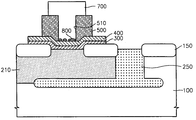
- FIGS. 3 and 4 are schematic cross-sectional views illustrating a method of manufacturing a bipolar device according to a first embodiment of the present invention.
- FIGS. 5 and 6 are schematic cross-sectional views illustrating a method of manufacturing a bipolar device according to a second embodiment of the present invention.
- pre-treatment using germane gas on the single crystalline silicon layer followed by deposition of the polysilicon layer is preferably performed in situ.
- germane gas By the pre-treatment using the germane gas, an undesired oxide layer can be effectively removed from the surface of the single crystalline silicon layer.
- this pre-treatment may be performed for a longer duration of time, thus leaving a thin or island-shaped germanium (Ge) layer on the surface of the single crystalline silicon layer.
- a bipolar transistor in a base region and a first emitter region, which are formed of a single crystalline silicon layer, are sequentially stacked and a second emitter region formed of a polysilicon layer is then formed, will be described.
- the single crystalline silicon layer contacts the polysilicon layer in the bipolar transistor.
- FIGS. 3 and 4 are schematic cross-sectional views illustrating a method of manufacturing a bipolar device according to a first embodiment of the present invention.
- a bipolar transistor comprises first and second collector regions 210 and 250 , a base region 300 , and an emitter region 700 , which are stacked on a silicon substrate 100 .
- the collector regions 210 and 250 are preferably formed by doping impurity ions into the silicon substrate 100 .
- the bipolar transistor is an npn-type transistor
- the collector regions 210 and 250 are formed by doping n-type impurity ions, such as P and As.
- the second collector region 250 is a heavily doped region.
- the first collector region 210 and the second collector region 250 may be an n-collector region and an n + -collector region, respectively.
- the second collector region 250 extends to the surface of the substrate 100 and is connected to a collector electrode (not shown).
- An isolation region 150 is formed on the substrate 100 and defines individual bipolar transistors.
- a single crystalline silicon layer is grown by epitaxial growth on the collector regions 210 and 250 , which are exposed by the isolation region 150 , thereby forming a base region 300 .
- the base region 300 is formed by doping impurity ions of which conductivity type is opposite to that of the collector regions 210 and 250 .
- the base region 300 may be a p-base region by doping impurity ions, such as boron (B), into the single crystalline silicon layer.
- a capping silicon layer 400 may be further formed on the base region 300 .
- the capping silicon layer 400 may function as a junction in an interface between the base region 300 and an emitter region ( 700 of FIG. 4).
- the capping silicon layer 400 also may be formed of single crystalline silicon by doping impurity ions of which conductivity type is opposite to that of the base region 300 , for example, n-type impurity ions, at a lower concentration than in the emitter region ( 700 of FIG. 4).
- spacers 500 are formed to have a contact hole 510 , which exposes a portion of the single crystalline silicon layer for the base region 300 . If the capping silicon layer 400 is adopted, the contact hole 510 exposes a portion of the single crystalline silicon layer for the capping silicon layer 400 instead of the base region 300 .
- the spacers 500 can be formed of silicon nitride or silicon oxide.
- an undesired oxide layer 600 i.e., a natural oxide layer or a residual oxide layer, may be disposed thereon to a thickness of about 10 ⁇ to 20 ⁇ .
- This oxide layer 600 is preferably removed to prevent degradation of the characteristics of the bipolar transistor, as described with reference to FIG. 1.
- the surface of the exposed single crystalline silicon layer ( 400 of FIG. 3) is pre-treated using germane (GeH 4 ) gas. This pre-treatment and subsequent deposition of a polysilicon layer are preferably performed in situ.
- germane gas When the germane gas is activated, it reacts on silicon oxide as shown in Chemical reaction formula ( 1 ), generating germanium dioxide (GeO 2 ) so as to remove the silicon oxide.
- the oxide layer 600 is effectively removed from the bottom of the contact hole 510 , i.e., the exposed surface of the single crystalline silicon layer 400 .
- a polysilicon layer for an emitter region 700 is deposited to fill the contact hole 510 .
- the emitter region 700 is preferably an n + -emitter region obtained by doping high-concentration impurity ions.
- a polysilicon layer is deposited by doping phosphorous ions or arsenic ions at a high concentration of about 1 e2O/cm 3 or higher so as to form the emitter region 700 .
- the polysilicon layer for the emitter region 700 is deposited using a tube furnace or a single-wafer-type CVD apparatus.
- the deposition process is carried out using a mixture of SiH 4 gas with one of PH 4 gas and AsH 3 gas instead of PH 4 gas as a reaction gas at a temperature of 500° C. to 700° C. under a pressure of about 10 mTorr to 100 Torr.
- the pre-treatment using germane gas can be performed in situ in an apparatus to be used for forming the polysilicon layer. That is, conditions used in forming the polysilicon layer are held constant, and the germane gas is injected in a hydrogen atmosphere of about 10 ppm to 100 ppm for about 5 minutes or less. Then, the oxide layer 600 formed on the silicon substrate 100 is effectively removed. Since the pre-treatment is performed in the same apparatus as when the polysilicon layer is formed, an additional chamber or the like is not required, thus facilitating the pre-treatment.
- the pre-treatment can constantly hold contact resistance between the polysilicon layer for the emitter region 700 and the single crystalline silicon layer 400 for the base region 300 (or the capping silicon layer 400 ).
- the oxide layer ( 600 of FIG. 3) may increase not only the contact resistance but also the dispersion of current gains in the bipolar device. Accordingly, if the oxide layer 600 is removed, the dispersion of current gains can be minimized in the bipolar device. This facilitates mass production of bipolar devices.
- FIGS. 5 and 6 are schematic cross-sectional views illustrating a method of manufacturing a bipolar device according to a second embodiment of the present invention.
- the pre-treatment using germane gas is performed for a longer duration of time so as to allow deposition of a germanium layer on a single crystalline silicon layer ( 400 of FIG. 5) exposed by a contact hole 510 .
- germane gas is supplied to the single crystalline silicon layer 400 and thus reacts on the oxide layer ( 600 of FIG. 3), as shown in the formula (1).
- the oxide layer 600 is removed. If the supply of the germane gas continues, silicon oxide constituting the oxide layer 600 is entirely removed and then the germane gas directly reacts on the single crystalline silicon layer 400 . After the oxide layer 600 is entirely removed, the germane gas does not show the reaction as shown in the formula (1) any more. Instead, a germanium layer 800 is deposited on the exposed single crystalline silicon layer 400 .
- the bipolar device has advantages. As described with reference to FIG. 2, Si-rearrangement may occur in an interface between the polysilicon layer ( 40 of FIG. 2) and the single crystalline silicon layer ( 30 of FIG. 2) due to the deposition of the polysilicon layer ( 40 of FIG. 2) for the emitter region or a subsequent process. As describe above, the Si-rearrangement may cause undesired effects when the bipolar device operates, i.e., when high-voltage current is supplied. Thus, the area of the effective emitter region ( 40 of FIG. 2) may decrease or the effective base region may extend.
- the oxide layer ( 600 of FIG. 3) can be removed and the germanium layer 800 can be formed on the cleaned single crystalline silicon layer ( 400 of FIG. 5).
- the germanium layer 800 exists in the interface between the polysilicon layer for the emitter region 700 and the single crystalline silicon layer for the base region 300 or the capping silicon layer 400 .
- the germanium layer 800 may be formed in an island shape or in a continuously layered shape to a very thin thickness.
- The-germanium layer 800 disposed between the polysilicon layer ( 700 of FIG. 6) and the single crystalline silicon layer ( 300 and 400 of FIG. 6), can prevent the Si-rearrangement. That is, the germanium layer 800 prevents single crystalline silicon from re-growing in the polysilicon layer 700 .
- the area of the emitter region ( 40 of FIG. 2) does not decrease and the base region ( 30 of FIG. 2) does not expand. As a result, a reduction in current gains can be prevented.
- pre-treatment using germane gas is carried out to effectively clean the surface of a single crystalline silicon layer for a base region and/or a capping silicon layer, which is disposed under the polysilicon layer.
- the pre-treatment using germane gas can be performed in situ in the same apparatus as when the polysilicon layer will be formed. Thus, an additional apparatus is not required, thus facilitating the pre-treatment.
- a natural oxide layer or a residual oxide layer can be removed from the surface of the single crystalline silicon layer.
- an increase in contact resistance between the single crystalline silicon layer and the polysilicon layer can be prevented.
- an increase in dispersion of current gains or an increase in 1/f noise can be suppressed in a bipolar device.
- the pre-treatment using germane gas may be performed for a longer duration of time.
- the undesired oxide layer can be removed and a germanium layer is formed so as to prevent Si-rearrangement or re-growth of single crystalline silicon in the polysilicon layer. This can prevent a reduction of current gains in the bipolar device.
Landscapes
- Bipolar Transistors (AREA)
Abstract
Description
- This application claims the priority of Korean Patent Application No. 2003-13978, filed on Mar. 6, 2003, in the Korean Intellectual Property Office, the disclosure of which is incorporated herein by reference in their entirety.
- 1. Field of the Invention
- The present invention relates to a method of manufacturing a semiconductor device, and more particularly, to a bipolar device and a method of manufacturing the same including pre-treatment using germane (GeH 4) gas on a single crystalline silicon layer before formation of a polysilicon emitter region on the single crystalline silicon layer.
- 2. Description of the Related Art
- A bipolar device is a transistor including a collector, a base, and an emitter and functions as a switching device or an amplifier in a logic device. In particular, a bipolar device employed in mobile phones or the like requires high operating speed and stable dispersion of current gains.
- FIG. 1 is a schematic cross-sectional view of a typical bipolar device in which an undesired oxide layer is formed. FIG. 2 is a schematic cross-sectional view of a typical bipolar device in which undesired Si-rearrangement occurs.
- Referring to FIG. 1, the typical bipolar device comprises a
collector region 20 formed on a silicon substrate and abase region 30 and an emitter region (40 of FIG. 2), which are formed on thecollector region 20. While theemitter region 40 is formed of a polysilicon layer, thebase region 30 is formed of a single crystalline silicon layer. Here,spacers 50 for insulation may be formed on sides of theemitter region 40. - The characteristics of an interface between the
emitter region 40 formed of polysilicon and thebase region 30 formed of single crystalline silicon affect the operating characteristics of the bipolar device, such as operating speed and/or dispersion of current gains. - More specifically; after forming a single crystalline silicon layer for the
base region 30, a spacer layer is formed using silicon nitride on the single crystalline silicon layer. Next, the spacer layer is patterned so as to form acontact hole 51 exposing a portion of thebase region 30 formed of single crystalline silicon. Here, an undesired oxide layer 60, i.e., a natural oxide layer or a residual oxide layer, may remain on the exposed portion of thebase region 30. - If a polysilicon layer for the emitter region ( 40 of FIG. 2) is formed on this oxide layer 60, contact resistance between the polysilicon layer for the
emitter region 40 and the single crystalline silicon layer for thebase region 30 adversely increases due to the oxide layer 60. Such an increase in the contact resistance may increase dispersion of current gains and 1/f noise and cause a voltage drop in the operation of the bipolar device. Accordingly, a method of removing the oxide layer 60 is needed. - Referring to FIG. 2, a polysilicon layer for the
emitter region 40 is formed to contact a single crystalline silicon layer for thebase region 30. Thus, Si-rearrangement may unfortunately occur in an interface between the polysilicon layer and the single crystalline silicon layer. The Si-rearrangement may occur while the polysilicon layer is being deposited to fill thecontact hole 51 formed inspacers 50 or during a subsequent thermal process. - The Si-rearrangement refers to a phenomenon that silicon atoms in a contact area between the silicon
crystalline silicon layer 30 and thepolysilicon layer 40 are rearranged in the same arrangement as single crystalline atoms. Thus, a single crystalline silicon region grows in thepolysilicon layer 40. As a result, the thickness of the singlecrystalline silicon layer 30 becomes thicker in the same manner as when the singlecrystalline silicon layer 30 is re-grown. - By the Si-rearrangement, when a bipolar transistor operates, the
effective emitter region 40 decreases and theeffective base region 30 expands. This reduces current gains in the bipolar transistor, thus lowering the hFE value of the resulting transistor. For this reason, the Si-rearrangement must be prevented. - The present invention provides a method of manufacturing a bipolar device. Before a polysilicon layer is formed on a single crystalline silicon layer, this method can effectively remove an undesired oxide layer, which may be formed on the single crystalline silicon layer during a process of forming a contact hole that selectively exposes the single crystalline silicon layer. Also, this method can effectively prevent single crystalline silicon atoms from re-growing due to Si-rearrangement in an interface between the single crystalline silicon layer and the polysilicon layer, so as not to reduce the area of an emitter region.
- According to one aspect of the present invention, there is provided a method of manufacturing a bipolar device, the method comprising pre-treating a surface of a single crystalline silicon layer using germane (GeH 4) gas before a polysilicon layer is formed on the single crystalline silicon layer.
- The method comprises forming a single crystalline silicon layer for a base region on a collector region; forming a polysilicon layer for an emitter region on the single crystalline silicon layer; and pre-treating the surface of the single crystalline silicon layer using germane gas before forming-the polysilicon layer.
- In one embodiment, the method further comprises forming spacers on the single crystalline silicon layer to have a contact hole that exposes a portion of the single crystalline silicon layer. The germane gas reacts on an undesired layer that may be formed on the exposed portion of the single crystalline silicon layer during the forming of the contact hole, thus removing the oxide layer. This allows the polysilicon layer to fill the contact hole and directly contact the single crystalline silicon layer.
- In another aspect, the method of the present invention comprises forming a single crystalline silicon layer for a base region on a collector region; forming a polysilicon layer for an emitter region on the single crystalline silicon layer; and pre-treating the surface of the single crystalline silicon layer using germane gas before forming the polysilicon layer, such that a layer containing germanium (Ge) is formed between the single crystalline silicon layer and the polysilicon layer.
- The method can further comprise forming spacers on the single crystalline silicon layer to have a contact hole that exposes a portion of the single crystalline silicon layer. The germane gas reacts on an undesired oxide layer that may be formed on the exposed portion of the single crystalline silicon layer during the forming of the contact hole, thus removing the oxide layer. Further, the germane gas may be used to form the layer containing germanium (Ge).
- The pre-treating of the single crystalline silicon layer using the germane gas and the forming of the polysilicon layer can be performed in situ, i.e., at the same location of the same deposition apparatus and in the same range of temperature. Here, temperature may range from about 500° C. to 700° C. The germane gas may be diluted with hydrogen gas .
- The layer containing germanium (Ge) may be formed on the single crystalline silicon layer in an island shape or in a continuously layered shape. The method of the present invention may further comprise growing a capping single crystalline silicon layer on the single crystalline silicon layer by doping impurity ions of which conductivity type is opposite to that of the base region.
- A bipolar device manufactured by the method of the present invention comprises a collector region; a base region formed using a single crystalline silicon layer on the collector region; an emitter region formed using a polysilicon layer on the base region; and a layer containing germanium (Ge) formed in an interface region between the single crystalline silicon layer and the polysilicon layer.
- According to the present invention, when a polysilicon layer is formed on a single crystalline silicon layer, an oxide layer formed therebetween can be easily removed. Also, a layer containing germanium (Ge) is formed in an interface between the single crystalline silicon layer and the polysilicon layer, thus preventing single crystalline silicon atoms from rearranging or re-growing in the polysilicon layer. As a result, the present invention improves the characteristics of a bipolar device.
- The foregoing and other objects, features and advantages of the invention will be apparent from the more particular description of a preferred embodiment of the invention, as illustrated in the accompanying drawings in which like reference characters refer to the sarne parts throughout the different views. The drawings are not necessarily to scale, emphasis instead being placed upon illustrating the principles of the invention.
- FIG. 1 is a schematic cross-sectional view of a typical bipolar device in which an undesired oxide layer is formed.
- FIG. 2 is a schematic cross-sectional view of a typical bipolar device in which undesired Si-rearrangement occurs.
- FIGS. 3 and 4 are schematic cross-sectional views illustrating a method of manufacturing a bipolar device according to a first embodiment of the present invention.
- FIGS. 5 and 6 are schematic cross-sectional views illustrating a method of manufacturing a bipolar device according to a second embodiment of the present invention.
- The present invention will now be described more fully with reference to the accompanying drawings, in which a exemplary embodiment of the invention is shown. This invention may, however, be embodied in many different forms and should not be construed as being limited to the embodiment set forth herein. In the drawings, the thicknesses of layers may be exaggerated for clarity.
- In the embodiments of the present invention, before a second emitter region formed of a polysilicon layer is formed on a base region and/or a first emitter region, which are formed of a single crystalline silicon layer and constitute a bipolar transistor, pre-treatment using germane gas on the single crystalline silicon layer followed by deposition of the polysilicon layer is preferably performed in situ. By the pre-treatment using the germane gas, an undesired oxide layer can be effectively removed from the surface of the single crystalline silicon layer. Also, this pre-treatment may be performed for a longer duration of time, thus leaving a thin or island-shaped germanium (Ge) layer on the surface of the single crystalline silicon layer.
- Hereinafter, a bipolar transistor, in a base region and a first emitter region, which are formed of a single crystalline silicon layer, are sequentially stacked and a second emitter region formed of a polysilicon layer is then formed, will be described. Preferably, the single crystalline silicon layer contacts the polysilicon layer in the bipolar transistor.
- FIGS. 3 and 4 are schematic cross-sectional views illustrating a method of manufacturing a bipolar device according to a first embodiment of the present invention. Referring to FIGS. 3 and 4, a bipolar transistor comprises first and
second collector regions base region 300, and anemitter region 700, which are stacked on asilicon substrate 100. Specifically, as shown in FIG. 3, thecollector regions silicon substrate 100. Here, if the bipolar transistor is an npn-type transistor, thecollector regions - While the
first collector region 210 is a lightly doped region, thesecond collector region 250 is a heavily doped region. For example, thefirst collector region 210 and thesecond collector region 250 may be an n-collector region and an n+-collector region, respectively. As shown in FIG. 4, thesecond collector region 250 extends to the surface of thesubstrate 100 and is connected to a collector electrode (not shown). Anisolation region 150 is formed on thesubstrate 100 and defines individual bipolar transistors. A single crystalline silicon layer is grown by epitaxial growth on thecollector regions isolation region 150, thereby forming abase region 300. Here, thebase region 300 is formed by doping impurity ions of which conductivity type is opposite to that of thecollector regions base region 300 may be a p-base region by doping impurity ions, such as boron (B), into the single crystalline silicon layer. - A
capping silicon layer 400 may be further formed on thebase region 300. The cappingsilicon layer 400 may function as a junction in an interface between thebase region 300 and an emitter region (700 of FIG. 4). The cappingsilicon layer 400 also may be formed of single crystalline silicon by doping impurity ions of which conductivity type is opposite to that of thebase region 300, for example, n-type impurity ions, at a lower concentration than in the emitter region (700 of FIG. 4). - Thereafter,
spacers 500 are formed to have acontact hole 510, which exposes a portion of the single crystalline silicon layer for thebase region 300. If thecapping silicon layer 400 is adopted, thecontact hole 510 exposes a portion of the single crystalline silicon layer for thecapping silicon layer 400 instead of thebase region 300. - The
spacers 500 can be formed of silicon nitride or silicon oxide. As described above, when the surface of the single crystalline silicon layer, i.e., thebase region 300 or thecapping silicon layer 400 as shown in FIG. 3, is exposed by thecontact hole 510, anundesired oxide layer 600, i.e., a natural oxide layer or a residual oxide layer, may be disposed thereon to a thickness of about 10 Å to 20 Å. Thisoxide layer 600 is preferably removed to prevent degradation of the characteristics of the bipolar transistor, as described with reference to FIG. 1. - To remove the
oxide layer 600, before a polysilicon layer for an emitter region (700 of FIG. 4) is deposited to fill thecontact hole 510, the surface of the exposed single crystalline silicon layer (400 of FIG. 3) is pre-treated using germane (GeH4) gas. This pre-treatment and subsequent deposition of a polysilicon layer are preferably performed in situ. - When the germane gas is activated, it reacts on silicon oxide as shown in Chemical reaction formula ( 1), generating germanium dioxide (GeO2) so as to remove the silicon oxide.
- GeH4(g)+SiO2(s)→GeO2(g)+Si(s)+2H2 (1)
- As shown in the
formula 1, by the pre-treatment using the germane gas, theoxide layer 600 is effectively removed from the bottom of thecontact hole 510, i.e., the exposed surface of the singlecrystalline silicon layer 400. - Referring to FIG. 4, after the pre-treatment is performed to remove the
oxide layer 600, a polysilicon layer for anemitter region 700 is deposited to fill thecontact hole 510. Theemitter region 700 is preferably an n+-emitter region obtained by doping high-concentration impurity ions. Thus, a polysilicon layer is deposited by doping phosphorous ions or arsenic ions at a high concentration of about 1 e2O/cm3 or higher so as to form theemitter region 700. - The polysilicon layer for the
emitter region 700 is deposited using a tube furnace or a single-wafer-type CVD apparatus. Here, the deposition process is carried out using a mixture of SiH4 gas with one of PH4 gas and AsH3 gas instead of PH4 gas as a reaction gas at a temperature of 500° C. to 700° C. under a pressure of about 10 mTorr to 100 Torr. - The pre-treatment using germane gas can be performed in situ in an apparatus to be used for forming the polysilicon layer. That is, conditions used in forming the polysilicon layer are held constant, and the germane gas is injected in a hydrogen atmosphere of about 10 ppm to 100 ppm for about 5 minutes or less. Then, the
oxide layer 600 formed on thesilicon substrate 100 is effectively removed. Since the pre-treatment is performed in the same apparatus as when the polysilicon layer is formed, an additional chamber or the like is not required, thus facilitating the pre-treatment. - The pre-treatment can constantly hold contact resistance between the polysilicon layer for the
emitter region 700 and the singlecrystalline silicon layer 400 for the base region 300 (or the capping silicon layer 400). The oxide layer (600 of FIG. 3) may increase not only the contact resistance but also the dispersion of current gains in the bipolar device. Accordingly, if theoxide layer 600 is removed, the dispersion of current gains can be minimized in the bipolar device. This facilitates mass production of bipolar devices. - FIGS. 5 and 6 are schematic cross-sectional views illustrating a method of manufacturing a bipolar device according to a second embodiment of the present invention.
- Referring to FIGS. 5 and 6, the pre-treatment using germane gas, as described with reference to FIG. 3 in the first embodiment, is performed for a longer duration of time so as to allow deposition of a germanium layer on a single crystalline silicon layer ( 400 of FIG. 5) exposed by a
contact hole 510. - Specifically, as described with reference to FIG. 3, germane gas is supplied to the single
crystalline silicon layer 400 and thus reacts on the oxide layer (600 of FIG. 3), as shown in the formula (1). Thus, theoxide layer 600 is removed. If the supply of the germane gas continues, silicon oxide constituting theoxide layer 600 is entirely removed and then the germane gas directly reacts on the singlecrystalline silicon layer 400. After theoxide layer 600 is entirely removed, the germane gas does not show the reaction as shown in the formula (1) any more. Instead, agermanium layer 800 is deposited on the exposed singlecrystalline silicon layer 400. - By deliberately forming the
germanium layer 800, the bipolar device has advantages. As described with reference to FIG. 2, Si-rearrangement may occur in an interface between the polysilicon layer (40 of FIG. 2) and the single crystalline silicon layer (30 of FIG. 2) due to the deposition of the polysilicon layer (40 of FIG. 2) for the emitter region or a subsequent process. As describe above, the Si-rearrangement may cause undesired effects when the bipolar device operates, i.e., when high-voltage current is supplied. Thus, the area of the effective emitter region (40 of FIG. 2) may decrease or the effective base region may extend. - However, as shown in FIG. 5, through the pre-treatment using the germane gas, the oxide layer ( 600 of FIG. 3) can be removed and the
germanium layer 800 can be formed on the cleaned single crystalline silicon layer (400 of FIG. 5). As a result, thegermanium layer 800 exists in the interface between the polysilicon layer for theemitter region 700 and the single crystalline silicon layer for thebase region 300 or thecapping silicon layer 400. Thegermanium layer 800 may be formed in an island shape or in a continuously layered shape to a very thin thickness. - The-
germanium layer 800, disposed between the polysilicon layer (700 of FIG. 6) and the single crystalline silicon layer (300 and 400 of FIG. 6), can prevent the Si-rearrangement. That is, thegermanium layer 800 prevents single crystalline silicon from re-growing in thepolysilicon layer 700. - Thus, when the bipolar device operates, the area of the emitter region ( 40 of FIG. 2) does not decrease and the base region (30 of FIG. 2) does not expand. As a result, a reduction in current gains can be prevented.
- As explained thus far, before a polysilicon layer for an emitter region is formed in a bipolar device, pre-treatment using germane gas is carried out to effectively clean the surface of a single crystalline silicon layer for a base region and/or a capping silicon layer, which is disposed under the polysilicon layer. The pre-treatment using germane gas can be performed in situ in the same apparatus as when the polysilicon layer will be formed. Thus, an additional apparatus is not required, thus facilitating the pre-treatment.
- By the pre-treatment using germane gas, a natural oxide layer or a residual oxide layer can be removed from the surface of the single crystalline silicon layer. Thus, an increase in contact resistance between the single crystalline silicon layer and the polysilicon layer can be prevented. Also, an increase in dispersion of current gains or an increase in 1/f noise can be suppressed in a bipolar device.
- Alternatively, the pre-treatment using germane gas may be performed for a longer duration of time. Thus, the undesired oxide layer can be removed and a germanium layer is formed so as to prevent Si-rearrangement or re-growth of single crystalline silicon in the polysilicon layer. This can prevent a reduction of current gains in the bipolar device.
- While the present invention has been particularly shown and described with reference to exemplary embodiments thereof, it will be understood by those of ordinary skill in the art that various changes in form and details may be made therein without departing from the spirit and scope of the present invention as defined by the following claims.
Claims (16)
Applications Claiming Priority (2)
| Application Number | Priority Date | Filing Date | Title |
|---|---|---|---|
| KR03-13978 | 2003-03-06 | ||
| KR10-2003-0013978A KR100518561B1 (en) | 2003-03-06 | 2003-03-06 | Method for manufacturing bipolar device including germane gas pre-treatment on single crystalline silicon layer and apparatus by the same |
Publications (2)
| Publication Number | Publication Date |
|---|---|
| US20040192001A1 true US20040192001A1 (en) | 2004-09-30 |
| US7084041B2 US7084041B2 (en) | 2006-08-01 |
Family
ID=32985752
Family Applications (1)
| Application Number | Title | Priority Date | Filing Date |
|---|---|---|---|
| US10/795,175 Expired - Fee Related US7084041B2 (en) | 2003-03-06 | 2004-03-05 | Bipolar device and method of manufacturing the same including pre-treatment using germane gas |
Country Status (2)
| Country | Link |
|---|---|
| US (1) | US7084041B2 (en) |
| KR (1) | KR100518561B1 (en) |
Cited By (2)
| Publication number | Priority date | Publication date | Assignee | Title |
|---|---|---|---|---|
| US8056257B2 (en) * | 2006-11-21 | 2011-11-15 | Tokyo Electron Limited | Substrate processing apparatus and substrate processing method |
| CN103177962A (en) * | 2011-12-20 | 2013-06-26 | 中芯国际集成电路制造(上海)有限公司 | Method for forming transistor |
Citations (5)
| Publication number | Priority date | Publication date | Assignee | Title |
|---|---|---|---|---|
| US5238849A (en) * | 1990-08-30 | 1993-08-24 | Nec Corporation | Method of fabricating semiconductor device |
| US6235568B1 (en) * | 1999-01-22 | 2001-05-22 | Intel Corporation | Semiconductor device having deposited silicon regions and a method of fabrication |
| US6440810B1 (en) * | 1999-11-26 | 2002-08-27 | Telefonaktiebolaget Lm Ericsson (Publ) | Method in the fabrication of a silicon bipolar transistor |
| US20020132438A1 (en) * | 2001-03-16 | 2002-09-19 | Dunn James Stuart | Epitaxial base bipolar transistor with raised extrinsic base |
| US20030080394A1 (en) * | 2001-10-31 | 2003-05-01 | Babcock Jeffrey A. | Control of dopant diffusion from polysilicon emitters in bipolar integrated circuits |
Family Cites Families (3)
| Publication number | Priority date | Publication date | Assignee | Title |
|---|---|---|---|---|
| JP2701793B2 (en) | 1995-06-15 | 1998-01-21 | 日本電気株式会社 | Method for manufacturing semiconductor device |
| JPH1012580A (en) | 1996-06-25 | 1998-01-16 | Mitsubishi Heavy Ind Ltd | Cleaning method of silicon substrate surface and equipment therefor |
| KR20000018992A (en) | 1998-09-08 | 2000-04-06 | 윤종용 | Low temperature cleaning method for epitaxial layer growth and low temperature cleaning device |
-
2003
- 2003-03-06 KR KR10-2003-0013978A patent/KR100518561B1/en not_active Expired - Fee Related
-
2004
- 2004-03-05 US US10/795,175 patent/US7084041B2/en not_active Expired - Fee Related
Patent Citations (5)
| Publication number | Priority date | Publication date | Assignee | Title |
|---|---|---|---|---|
| US5238849A (en) * | 1990-08-30 | 1993-08-24 | Nec Corporation | Method of fabricating semiconductor device |
| US6235568B1 (en) * | 1999-01-22 | 2001-05-22 | Intel Corporation | Semiconductor device having deposited silicon regions and a method of fabrication |
| US6440810B1 (en) * | 1999-11-26 | 2002-08-27 | Telefonaktiebolaget Lm Ericsson (Publ) | Method in the fabrication of a silicon bipolar transistor |
| US20020132438A1 (en) * | 2001-03-16 | 2002-09-19 | Dunn James Stuart | Epitaxial base bipolar transistor with raised extrinsic base |
| US20030080394A1 (en) * | 2001-10-31 | 2003-05-01 | Babcock Jeffrey A. | Control of dopant diffusion from polysilicon emitters in bipolar integrated circuits |
Cited By (2)
| Publication number | Priority date | Publication date | Assignee | Title |
|---|---|---|---|---|
| US8056257B2 (en) * | 2006-11-21 | 2011-11-15 | Tokyo Electron Limited | Substrate processing apparatus and substrate processing method |
| CN103177962A (en) * | 2011-12-20 | 2013-06-26 | 中芯国际集成电路制造(上海)有限公司 | Method for forming transistor |
Also Published As
| Publication number | Publication date |
|---|---|
| KR20040079065A (en) | 2004-09-14 |
| US7084041B2 (en) | 2006-08-01 |
| KR100518561B1 (en) | 2005-10-04 |
Similar Documents
| Publication | Publication Date | Title |
|---|---|---|
| US6455871B1 (en) | SiGe MODFET with a metal-oxide film and method for fabricating the same | |
| JP4917051B2 (en) | Manufacturing method of silicon germanium bipolar transistor | |
| US6391749B1 (en) | Selective epitaxial growth method in semiconductor device | |
| US6828602B2 (en) | Bipolar transistor and method manufacture thereof | |
| US7611973B2 (en) | Methods of selectively forming epitaxial semiconductor layer on single crystalline semiconductor and semiconductor devices fabricated using the same | |
| US6365479B1 (en) | Method for independent control of polycrystalline silicon-germanium in a silicon-germanium HBT and related structure | |
| JPH0744189B2 (en) | In-situ doped n-type silicon layer deposition method and NPN transistor | |
| US20050250298A1 (en) | In situ doped epitaxial films | |
| US6806158B2 (en) | Mixed crystal layer growing method and device, and semiconductor device | |
| JPH0785476B2 (en) | Emitter-embedded bipolar transistor structure | |
| JP2003297844A (en) | Semiconductor device and method of manufacturing semiconductor device | |
| US8058124B2 (en) | Method of manufacturing a semiconductor device | |
| US20090075447A1 (en) | Method and fabricating a mono-crystalline emitter | |
| US7084041B2 (en) | Bipolar device and method of manufacturing the same including pre-treatment using germane gas | |
| US7012009B2 (en) | Method for improving the electrical continuity for a silicon-germanium film across a silicon/oxide/polysilicon surface using a novel two-temperature process | |
| US7863162B2 (en) | Semiconductor device and manufacturing method thereof | |
| US7556048B2 (en) | In-situ removal of surface impurities prior to arsenic-doped polysilicon deposition in the fabrication of a heterojunction bipolar transistor | |
| KR100364813B1 (en) | Method for Forming Epitaxial Layer of Semiconductor Device | |
| CN100358110C (en) | Method of manufacturing a semiconductor device | |
| JP2005277255A (en) | Semiconductor device | |
| JP2008186899A (en) | Semiconductor device, bipolar transistor and manufacturing method thereof | |
| JP2001126989A (en) | Method of forming semiconductor thin film | |
| KR20020008535A (en) | Method of manufacturing a semiconductor device |
Legal Events
| Date | Code | Title | Description |
|---|---|---|---|
| AS | Assignment |
Owner name: SAMSUNG ELECTRONICS, CO., LTD., KOREA, REPUBLIC OF Free format text: ASSIGNMENT OF ASSIGNORS INTEREST;ASSIGNORS:RHEE, HWA-SUNG;YOO, JAE-YOON;LEE, HO;AND OTHERS;REEL/FRAME:015435/0710;SIGNING DATES FROM 20040523 TO 20040525 |
|
| AS | Assignment |
Owner name: SAMSUNG ELECTRONICS CO., LTD., KOREA, REPUBLIC OF Free format text: CORRECTIVE ASSIGNMENT TO CORRECT THE EXECUTION DATE, PREVIOUSLY RECORDED AT REEL 015435, FRAME 0710;ASSIGNORS:RHEE, HWA-SUNG;YOO, JAE-YOON;LEE, HO;AND OTHERS;REEL/FRAME:016549/0444;SIGNING DATES FROM 20040323 TO 20040325 |
|
| FEPP | Fee payment procedure |
Free format text: PAYOR NUMBER ASSIGNED (ORIGINAL EVENT CODE: ASPN); ENTITY STATUS OF PATENT OWNER: LARGE ENTITY |
|
| FPAY | Fee payment |
Year of fee payment: 4 |
|
| REMI | Maintenance fee reminder mailed | ||
| LAPS | Lapse for failure to pay maintenance fees | ||
| STCH | Information on status: patent discontinuation |
Free format text: PATENT EXPIRED DUE TO NONPAYMENT OF MAINTENANCE FEES UNDER 37 CFR 1.362 |
|
| STCH | Information on status: patent discontinuation |
Free format text: PATENT EXPIRED DUE TO NONPAYMENT OF MAINTENANCE FEES UNDER 37 CFR 1.362 |
|
| FP | Lapsed due to failure to pay maintenance fee |
Effective date: 20140801 |