US20030190499A1 - Lithium secondary battery and battery device comprising same - Google Patents
Lithium secondary battery and battery device comprising same Download PDFInfo
- Publication number
- US20030190499A1 US20030190499A1 US09/734,568 US73456800A US2003190499A1 US 20030190499 A1 US20030190499 A1 US 20030190499A1 US 73456800 A US73456800 A US 73456800A US 2003190499 A1 US2003190499 A1 US 2003190499A1
- Authority
- US
- United States
- Prior art keywords
- battery
- secondary battery
- lithium secondary
- lithium
- polyvinylidene fluoride
- Prior art date
- Legal status (The legal status is an assumption and is not a legal conclusion. Google has not performed a legal analysis and makes no representation as to the accuracy of the status listed.)
- Granted
Links
- 229910052744 lithium Inorganic materials 0.000 title claims abstract description 86
- WHXSMMKQMYFTQS-UHFFFAOYSA-N Lithium Chemical compound [Li] WHXSMMKQMYFTQS-UHFFFAOYSA-N 0.000 title claims abstract description 85
- 239000002033 PVDF binder Substances 0.000 claims abstract description 72
- 229920002981 polyvinylidene fluoride Polymers 0.000 claims abstract description 72
- 239000011347 resin Substances 0.000 claims abstract description 32
- 229920005989 resin Polymers 0.000 claims abstract description 32
- HBBGRARXTFLTSG-UHFFFAOYSA-N Lithium ion Chemical compound [Li+] HBBGRARXTFLTSG-UHFFFAOYSA-N 0.000 claims abstract description 16
- 229910001416 lithium ion Inorganic materials 0.000 claims abstract description 16
- 239000000463 material Substances 0.000 claims abstract description 12
- 238000009831 deintercalation Methods 0.000 claims abstract description 10
- 238000009830 intercalation Methods 0.000 claims abstract description 10
- 229910044991 metal oxide Inorganic materials 0.000 claims abstract description 9
- 150000004706 metal oxides Chemical class 0.000 claims abstract description 9
- 239000011255 nonaqueous electrolyte Substances 0.000 claims abstract description 8
- 238000007600 charging Methods 0.000 claims description 21
- 238000006243 chemical reaction Methods 0.000 claims description 17
- 239000012528 membrane Substances 0.000 claims description 15
- 239000000203 mixture Substances 0.000 claims description 13
- -1 polyethylene terephthalate Polymers 0.000 claims description 12
- 239000004698 Polyethylene Substances 0.000 claims description 11
- 239000000805 composite resin Substances 0.000 claims description 11
- 229920000573 polyethylene Polymers 0.000 claims description 11
- 239000008151 electrolyte solution Substances 0.000 claims description 10
- 229920000139 polyethylene terephthalate Polymers 0.000 claims description 10
- 239000005020 polyethylene terephthalate Substances 0.000 claims description 10
- 239000007774 positive electrode material Substances 0.000 claims description 8
- 230000005611 electricity Effects 0.000 claims description 7
- OKTJSMMVPCPJKN-UHFFFAOYSA-N Carbon Chemical compound [C] OKTJSMMVPCPJKN-UHFFFAOYSA-N 0.000 claims description 5
- 239000003575 carbonaceous material Substances 0.000 claims description 5
- 239000004744 fabric Substances 0.000 claims description 5
- 238000004519 manufacturing process Methods 0.000 claims description 5
- 229910002804 graphite Inorganic materials 0.000 claims description 4
- 239000010439 graphite Substances 0.000 claims description 4
- 229910000428 cobalt oxide Inorganic materials 0.000 claims description 3
- IVMYJDGYRUAWML-UHFFFAOYSA-N cobalt(ii) oxide Chemical compound [Co]=O IVMYJDGYRUAWML-UHFFFAOYSA-N 0.000 claims description 3
- 150000001875 compounds Chemical class 0.000 claims description 3
- 238000000354 decomposition reaction Methods 0.000 claims description 3
- 238000003487 electrochemical reaction Methods 0.000 claims description 3
- 239000011532 electronic conductor Substances 0.000 claims description 2
- 150000002500 ions Chemical class 0.000 claims description 2
- 238000006479 redox reaction Methods 0.000 claims description 2
- 239000002904 solvent Substances 0.000 claims description 2
- AMWRITDGCCNYAT-UHFFFAOYSA-L hydroxy(oxo)manganese;manganese Chemical compound [Mn].O[Mn]=O.O[Mn]=O AMWRITDGCCNYAT-UHFFFAOYSA-L 0.000 claims 4
- 230000003449 preventive effect Effects 0.000 claims 3
- 229910000480 nickel oxide Inorganic materials 0.000 claims 2
- GNRSAWUEBMWBQH-UHFFFAOYSA-N oxonickel Chemical compound [Ni]=O GNRSAWUEBMWBQH-UHFFFAOYSA-N 0.000 claims 2
- 230000001681 protective effect Effects 0.000 description 34
- 239000003960 organic solvent Substances 0.000 description 11
- 230000000052 comparative effect Effects 0.000 description 8
- 238000012360 testing method Methods 0.000 description 8
- SECXISVLQFMRJM-UHFFFAOYSA-N N-Methylpyrrolidone Chemical compound CN1CCCC1=O SECXISVLQFMRJM-UHFFFAOYSA-N 0.000 description 7
- 238000002360 preparation method Methods 0.000 description 6
- 239000007789 gas Substances 0.000 description 5
- 238000010438 heat treatment Methods 0.000 description 5
- 230000007246 mechanism Effects 0.000 description 5
- 239000007773 negative electrode material Substances 0.000 description 5
- WYURNTSHIVDZCO-UHFFFAOYSA-N Tetrahydrofuran Chemical compound C1CCOC1 WYURNTSHIVDZCO-UHFFFAOYSA-N 0.000 description 4
- 230000002159 abnormal effect Effects 0.000 description 4
- 239000011162 core material Substances 0.000 description 4
- 229910003005 LiNiO2 Inorganic materials 0.000 description 3
- 229910002097 Lithium manganese(III,IV) oxide Inorganic materials 0.000 description 3
- 229910052782 aluminium Inorganic materials 0.000 description 3
- XAGFODPZIPBFFR-UHFFFAOYSA-N aluminium Chemical compound [Al] XAGFODPZIPBFFR-UHFFFAOYSA-N 0.000 description 3
- 230000008859 change Effects 0.000 description 3
- 239000003792 electrolyte Substances 0.000 description 3
- 239000002648 laminated material Substances 0.000 description 3
- 229910003002 lithium salt Inorganic materials 0.000 description 3
- 159000000002 lithium salts Chemical class 0.000 description 3
- 229910052751 metal Inorganic materials 0.000 description 3
- 239000002184 metal Substances 0.000 description 3
- 229910021382 natural graphite Inorganic materials 0.000 description 3
- 238000004806 packaging method and process Methods 0.000 description 3
- BQCIDUSAKPWEOX-UHFFFAOYSA-N 1,1-Difluoroethene Chemical compound FC(F)=C BQCIDUSAKPWEOX-UHFFFAOYSA-N 0.000 description 2
- OIFBSDVPJOWBCH-UHFFFAOYSA-N Diethyl carbonate Chemical compound CCOC(=O)OCC OIFBSDVPJOWBCH-UHFFFAOYSA-N 0.000 description 2
- VGGSQFUCUMXWEO-UHFFFAOYSA-N Ethene Chemical compound C=C VGGSQFUCUMXWEO-UHFFFAOYSA-N 0.000 description 2
- 239000005977 Ethylene Substances 0.000 description 2
- KMTRUDSVKNLOMY-UHFFFAOYSA-N Ethylene carbonate Chemical compound O=C1OCCO1 KMTRUDSVKNLOMY-UHFFFAOYSA-N 0.000 description 2
- 229910011297 LiCox Inorganic materials 0.000 description 2
- 229910010584 LiFeO2 Inorganic materials 0.000 description 2
- 229910001290 LiPF6 Inorganic materials 0.000 description 2
- 238000010521 absorption reaction Methods 0.000 description 2
- 239000000853 adhesive Substances 0.000 description 2
- 230000001070 adhesive effect Effects 0.000 description 2
- 239000011230 binding agent Substances 0.000 description 2
- 238000007606 doctor blade method Methods 0.000 description 2
- 238000010292 electrical insulation Methods 0.000 description 2
- 239000010410 layer Substances 0.000 description 2
- WABPQHHGFIMREM-UHFFFAOYSA-N lead(0) Chemical compound [Pb] WABPQHHGFIMREM-UHFFFAOYSA-N 0.000 description 2
- 229920000642 polymer Polymers 0.000 description 2
- RUOJZAUFBMNUDX-UHFFFAOYSA-N propylene carbonate Chemical compound CC1COC(=O)O1 RUOJZAUFBMNUDX-UHFFFAOYSA-N 0.000 description 2
- 239000012779 reinforcing material Substances 0.000 description 2
- 239000000126 substance Substances 0.000 description 2
- HXJUTPCZVOIRIF-UHFFFAOYSA-N sulfolane Chemical compound O=S1(=O)CCCC1 HXJUTPCZVOIRIF-UHFFFAOYSA-N 0.000 description 2
- YLQBMQCUIZJEEH-UHFFFAOYSA-N tetrahydrofuran Natural products C=1C=COC=1 YLQBMQCUIZJEEH-UHFFFAOYSA-N 0.000 description 2
- 150000003623 transition metal compounds Chemical class 0.000 description 2
- 238000004804 winding Methods 0.000 description 2
- GEWWCWZGHNIUBW-UHFFFAOYSA-N 1-(4-nitrophenyl)propan-2-one Chemical compound CC(=O)CC1=CC=C([N+]([O-])=O)C=C1 GEWWCWZGHNIUBW-UHFFFAOYSA-N 0.000 description 1
- NIXOWILDQLNWCW-UHFFFAOYSA-M Acrylate Chemical compound [O-]C(=O)C=C NIXOWILDQLNWCW-UHFFFAOYSA-M 0.000 description 1
- 229920000049 Carbon (fiber) Polymers 0.000 description 1
- RYGMFSIKBFXOCR-UHFFFAOYSA-N Copper Chemical compound [Cu] RYGMFSIKBFXOCR-UHFFFAOYSA-N 0.000 description 1
- PYVHTIWHNXTVPF-UHFFFAOYSA-N F.F.F.F.C=C Chemical compound F.F.F.F.C=C PYVHTIWHNXTVPF-UHFFFAOYSA-N 0.000 description 1
- UFHFLCQGNIYNRP-UHFFFAOYSA-N Hydrogen Chemical compound [H][H] UFHFLCQGNIYNRP-UHFFFAOYSA-N 0.000 description 1
- 229910015028 LiAsF5 Inorganic materials 0.000 description 1
- 229910011638 LiCrO2 Inorganic materials 0.000 description 1
- 229910002993 LiMnO2 Inorganic materials 0.000 description 1
- 229910013528 LiN(SO2 CF3)2 Inorganic materials 0.000 description 1
- 229910013385 LiN(SO2C2F5)2 Inorganic materials 0.000 description 1
- 229910012524 LiScO2 Inorganic materials 0.000 description 1
- 229910012675 LiTiO2 Inorganic materials 0.000 description 1
- 229910012981 LiVO2 Inorganic materials 0.000 description 1
- 229910013058 LiYO2 Inorganic materials 0.000 description 1
- 239000004743 Polypropylene Substances 0.000 description 1
- 239000012790 adhesive layer Substances 0.000 description 1
- QVGXLLKOCUKJST-UHFFFAOYSA-N atomic oxygen Chemical compound [O] QVGXLLKOCUKJST-UHFFFAOYSA-N 0.000 description 1
- OJIJEKBXJYRIBZ-UHFFFAOYSA-N cadmium nickel Chemical compound [Ni].[Cd] OJIJEKBXJYRIBZ-UHFFFAOYSA-N 0.000 description 1
- 238000001354 calcination Methods 0.000 description 1
- 229910052799 carbon Inorganic materials 0.000 description 1
- 239000006229 carbon black Substances 0.000 description 1
- 239000004917 carbon fiber Substances 0.000 description 1
- DZUDZSQDKOESQQ-UHFFFAOYSA-N cobalt hydrogen peroxide Chemical compound [Co].OO DZUDZSQDKOESQQ-UHFFFAOYSA-N 0.000 description 1
- 239000000571 coke Substances 0.000 description 1
- 239000004020 conductor Substances 0.000 description 1
- 238000010277 constant-current charging Methods 0.000 description 1
- 239000000470 constituent Substances 0.000 description 1
- 229920001577 copolymer Polymers 0.000 description 1
- 239000011889 copper foil Substances 0.000 description 1
- 230000007423 decrease Effects 0.000 description 1
- 238000004925 denaturation Methods 0.000 description 1
- 230000036425 denaturation Effects 0.000 description 1
- 230000006866 deterioration Effects 0.000 description 1
- 230000000694 effects Effects 0.000 description 1
- UHESRSKEBRADOO-UHFFFAOYSA-N ethyl carbamate;prop-2-enoic acid Chemical compound OC(=O)C=C.CCOC(N)=O UHESRSKEBRADOO-UHFFFAOYSA-N 0.000 description 1
- 239000000835 fiber Substances 0.000 description 1
- 239000011888 foil Substances 0.000 description 1
- HCDGVLDPFQMKDK-UHFFFAOYSA-N hexafluoropropylene Chemical compound FC(F)=C(F)C(F)(F)F HCDGVLDPFQMKDK-UHFFFAOYSA-N 0.000 description 1
- 229920001519 homopolymer Polymers 0.000 description 1
- 239000001257 hydrogen Substances 0.000 description 1
- 229910052739 hydrogen Inorganic materials 0.000 description 1
- 230000002401 inhibitory effect Effects 0.000 description 1
- 239000010416 ion conductor Substances 0.000 description 1
- 150000002641 lithium Chemical class 0.000 description 1
- MCVFFRWZNYZUIJ-UHFFFAOYSA-M lithium;trifluoromethanesulfonate Chemical compound [Li+].[O-]S(=O)(=O)C(F)(F)F MCVFFRWZNYZUIJ-UHFFFAOYSA-M 0.000 description 1
- 238000012423 maintenance Methods 0.000 description 1
- 238000005259 measurement Methods 0.000 description 1
- VNWKTOKETHGBQD-UHFFFAOYSA-N methane Chemical compound C VNWKTOKETHGBQD-UHFFFAOYSA-N 0.000 description 1
- 238000000034 method Methods 0.000 description 1
- 238000012544 monitoring process Methods 0.000 description 1
- 239000001301 oxygen Substances 0.000 description 1
- 229910052760 oxygen Inorganic materials 0.000 description 1
- 239000002245 particle Substances 0.000 description 1
- 229920001155 polypropylene Polymers 0.000 description 1
- 238000001556 precipitation Methods 0.000 description 1
- 230000009467 reduction Effects 0.000 description 1
- 150000003839 salts Chemical class 0.000 description 1
- 229910001220 stainless steel Inorganic materials 0.000 description 1
- 239000010935 stainless steel Substances 0.000 description 1
- 238000003860 storage Methods 0.000 description 1
- 239000000725 suspension Substances 0.000 description 1
- 229910052720 vanadium Inorganic materials 0.000 description 1
- XLYOFNOQVPJJNP-UHFFFAOYSA-N water Substances O XLYOFNOQVPJJNP-UHFFFAOYSA-N 0.000 description 1
- 230000037303 wrinkles Effects 0.000 description 1
Images




Classifications
-
- H—ELECTRICITY
- H01—ELECTRIC ELEMENTS
- H01M—PROCESSES OR MEANS, e.g. BATTERIES, FOR THE DIRECT CONVERSION OF CHEMICAL ENERGY INTO ELECTRICAL ENERGY
- H01M10/00—Secondary cells; Manufacture thereof
- H01M10/05—Accumulators with non-aqueous electrolyte
- H01M10/052—Li-accumulators
- H01M10/0525—Rocking-chair batteries, i.e. batteries with lithium insertion or intercalation in both electrodes; Lithium-ion batteries
-
- H—ELECTRICITY
- H01—ELECTRIC ELEMENTS
- H01M—PROCESSES OR MEANS, e.g. BATTERIES, FOR THE DIRECT CONVERSION OF CHEMICAL ENERGY INTO ELECTRICAL ENERGY
- H01M10/00—Secondary cells; Manufacture thereof
- H01M10/42—Methods or arrangements for servicing or maintenance of secondary cells or secondary half-cells
- H01M10/4235—Safety or regulating additives or arrangements in electrodes, separators or electrolyte
-
- H—ELECTRICITY
- H01—ELECTRIC ELEMENTS
- H01M—PROCESSES OR MEANS, e.g. BATTERIES, FOR THE DIRECT CONVERSION OF CHEMICAL ENERGY INTO ELECTRICAL ENERGY
- H01M4/00—Electrodes
- H01M4/02—Electrodes composed of, or comprising, active material
- H01M4/13—Electrodes for accumulators with non-aqueous electrolyte, e.g. for lithium-accumulators; Processes of manufacture thereof
- H01M4/131—Electrodes based on mixed oxides or hydroxides, or on mixtures of oxides or hydroxides, e.g. LiCoOx
-
- H—ELECTRICITY
- H01—ELECTRIC ELEMENTS
- H01M—PROCESSES OR MEANS, e.g. BATTERIES, FOR THE DIRECT CONVERSION OF CHEMICAL ENERGY INTO ELECTRICAL ENERGY
- H01M4/00—Electrodes
- H01M4/02—Electrodes composed of, or comprising, active material
- H01M4/13—Electrodes for accumulators with non-aqueous electrolyte, e.g. for lithium-accumulators; Processes of manufacture thereof
- H01M4/133—Electrodes based on carbonaceous material, e.g. graphite-intercalation compounds or CFx
-
- H—ELECTRICITY
- H01—ELECTRIC ELEMENTS
- H01M—PROCESSES OR MEANS, e.g. BATTERIES, FOR THE DIRECT CONVERSION OF CHEMICAL ENERGY INTO ELECTRICAL ENERGY
- H01M4/00—Electrodes
- H01M4/02—Electrodes composed of, or comprising, active material
- H01M4/36—Selection of substances as active materials, active masses, active liquids
- H01M4/48—Selection of substances as active materials, active masses, active liquids of inorganic oxides or hydroxides
- H01M4/50—Selection of substances as active materials, active masses, active liquids of inorganic oxides or hydroxides of manganese
- H01M4/505—Selection of substances as active materials, active masses, active liquids of inorganic oxides or hydroxides of manganese of mixed oxides or hydroxides containing manganese for inserting or intercalating light metals, e.g. LiMn2O4 or LiMn2OxFy
-
- H—ELECTRICITY
- H01—ELECTRIC ELEMENTS
- H01M—PROCESSES OR MEANS, e.g. BATTERIES, FOR THE DIRECT CONVERSION OF CHEMICAL ENERGY INTO ELECTRICAL ENERGY
- H01M4/00—Electrodes
- H01M4/02—Electrodes composed of, or comprising, active material
- H01M4/36—Selection of substances as active materials, active masses, active liquids
- H01M4/48—Selection of substances as active materials, active masses, active liquids of inorganic oxides or hydroxides
- H01M4/52—Selection of substances as active materials, active masses, active liquids of inorganic oxides or hydroxides of nickel, cobalt or iron
- H01M4/525—Selection of substances as active materials, active masses, active liquids of inorganic oxides or hydroxides of nickel, cobalt or iron of mixed oxides or hydroxides containing iron, cobalt or nickel for inserting or intercalating light metals, e.g. LiNiO2, LiCoO2 or LiCoOxFy
-
- H—ELECTRICITY
- H01—ELECTRIC ELEMENTS
- H01M—PROCESSES OR MEANS, e.g. BATTERIES, FOR THE DIRECT CONVERSION OF CHEMICAL ENERGY INTO ELECTRICAL ENERGY
- H01M4/00—Electrodes
- H01M4/02—Electrodes composed of, or comprising, active material
- H01M4/36—Selection of substances as active materials, active masses, active liquids
- H01M4/58—Selection of substances as active materials, active masses, active liquids of inorganic compounds other than oxides or hydroxides, e.g. sulfides, selenides, tellurides, halogenides or LiCoFy; of polyanionic structures, e.g. phosphates, silicates or borates
- H01M4/583—Carbonaceous material, e.g. graphite-intercalation compounds or CFx
- H01M4/587—Carbonaceous material, e.g. graphite-intercalation compounds or CFx for inserting or intercalating light metals
-
- H—ELECTRICITY
- H01—ELECTRIC ELEMENTS
- H01M—PROCESSES OR MEANS, e.g. BATTERIES, FOR THE DIRECT CONVERSION OF CHEMICAL ENERGY INTO ELECTRICAL ENERGY
- H01M50/00—Constructional details or processes of manufacture of the non-active parts of electrochemical cells other than fuel cells, e.g. hybrid cells
- H01M50/40—Separators; Membranes; Diaphragms; Spacing elements inside cells
- H01M50/409—Separators, membranes or diaphragms characterised by the material
- H01M50/411—Organic material
- H01M50/414—Synthetic resins, e.g. thermoplastics or thermosetting resins
- H01M50/417—Polyolefins
-
- H—ELECTRICITY
- H01—ELECTRIC ELEMENTS
- H01M—PROCESSES OR MEANS, e.g. BATTERIES, FOR THE DIRECT CONVERSION OF CHEMICAL ENERGY INTO ELECTRICAL ENERGY
- H01M50/00—Constructional details or processes of manufacture of the non-active parts of electrochemical cells other than fuel cells, e.g. hybrid cells
- H01M50/40—Separators; Membranes; Diaphragms; Spacing elements inside cells
- H01M50/409—Separators, membranes or diaphragms characterised by the material
- H01M50/411—Organic material
- H01M50/414—Synthetic resins, e.g. thermoplastics or thermosetting resins
- H01M50/426—Fluorocarbon polymers
-
- H—ELECTRICITY
- H01—ELECTRIC ELEMENTS
- H01M—PROCESSES OR MEANS, e.g. BATTERIES, FOR THE DIRECT CONVERSION OF CHEMICAL ENERGY INTO ELECTRICAL ENERGY
- H01M50/00—Constructional details or processes of manufacture of the non-active parts of electrochemical cells other than fuel cells, e.g. hybrid cells
- H01M50/40—Separators; Membranes; Diaphragms; Spacing elements inside cells
- H01M50/409—Separators, membranes or diaphragms characterised by the material
- H01M50/44—Fibrous material
-
- H—ELECTRICITY
- H01—ELECTRIC ELEMENTS
- H01M—PROCESSES OR MEANS, e.g. BATTERIES, FOR THE DIRECT CONVERSION OF CHEMICAL ENERGY INTO ELECTRICAL ENERGY
- H01M50/00—Constructional details or processes of manufacture of the non-active parts of electrochemical cells other than fuel cells, e.g. hybrid cells
- H01M50/40—Separators; Membranes; Diaphragms; Spacing elements inside cells
- H01M50/409—Separators, membranes or diaphragms characterised by the material
- H01M50/449—Separators, membranes or diaphragms characterised by the material having a layered structure
-
- H—ELECTRICITY
- H01—ELECTRIC ELEMENTS
- H01M—PROCESSES OR MEANS, e.g. BATTERIES, FOR THE DIRECT CONVERSION OF CHEMICAL ENERGY INTO ELECTRICAL ENERGY
- H01M50/00—Constructional details or processes of manufacture of the non-active parts of electrochemical cells other than fuel cells, e.g. hybrid cells
- H01M50/40—Separators; Membranes; Diaphragms; Spacing elements inside cells
- H01M50/489—Separators, membranes, diaphragms or spacing elements inside the cells, characterised by their physical properties, e.g. swelling degree, hydrophilicity or shut down properties
-
- H—ELECTRICITY
- H01—ELECTRIC ELEMENTS
- H01M—PROCESSES OR MEANS, e.g. BATTERIES, FOR THE DIRECT CONVERSION OF CHEMICAL ENERGY INTO ELECTRICAL ENERGY
- H01M50/00—Constructional details or processes of manufacture of the non-active parts of electrochemical cells other than fuel cells, e.g. hybrid cells
- H01M50/40—Separators; Membranes; Diaphragms; Spacing elements inside cells
- H01M50/489—Separators, membranes, diaphragms or spacing elements inside the cells, characterised by their physical properties, e.g. swelling degree, hydrophilicity or shut down properties
- H01M50/491—Porosity
-
- H—ELECTRICITY
- H01—ELECTRIC ELEMENTS
- H01M—PROCESSES OR MEANS, e.g. BATTERIES, FOR THE DIRECT CONVERSION OF CHEMICAL ENERGY INTO ELECTRICAL ENERGY
- H01M2200/00—Safety devices for primary or secondary batteries
-
- Y—GENERAL TAGGING OF NEW TECHNOLOGICAL DEVELOPMENTS; GENERAL TAGGING OF CROSS-SECTIONAL TECHNOLOGIES SPANNING OVER SEVERAL SECTIONS OF THE IPC; TECHNICAL SUBJECTS COVERED BY FORMER USPC CROSS-REFERENCE ART COLLECTIONS [XRACs] AND DIGESTS
- Y02—TECHNOLOGIES OR APPLICATIONS FOR MITIGATION OR ADAPTATION AGAINST CLIMATE CHANGE
- Y02E—REDUCTION OF GREENHOUSE GAS [GHG] EMISSIONS, RELATED TO ENERGY GENERATION, TRANSMISSION OR DISTRIBUTION
- Y02E60/00—Enabling technologies; Technologies with a potential or indirect contribution to GHG emissions mitigation
- Y02E60/10—Energy storage using batteries
Definitions
- the present invention relates to a lithium secondary battery, for example a lithium secondary battery comprising a negative electrode capable of intercalating/deintercalating lithium ion, a positive electrode made of a lithium-containing metal oxide as an active positive material, a nonaqueous electrolyte and a separator for separating the positive electrode and the negative electrode from each other and a battery device comprising same.
- a lithium secondary battery such as lithium ion battery has been put to practical use as rechargeable battery having a small weight and high capacity.
- Such a lithium secondary battery has been used for portable electronic and communications apparatus such as small-sized video camera, portable telephone and note type personal computer.
- This type of a lithium secondary battery comprises as an active negative electrode material a carbon-based material capable of intercalating/deintercalating lithium ion, as an active positive electrode material a lithium-containing metal oxide such as LiCoO 2 , LiNiO 2 , LiMn 2 O 4 and LiFeO 2 , and an electrolytic solution obtained by dissolving a lithium salt as a solute in an organic solvent.
- a lithium-containing metal oxide such as LiCoO 2 , LiNiO 2 , LiMn 2 O 4 and LiFeO 2
- electrolytic solution obtained by dissolving a lithium salt as a solute in an organic solvent.
- a nickel-cadmium storage battery or the like is arranged to prevent overcharging through subtle utilization of a gas absorption mechanism that oxygen produced at the positive electrode side during overcharging is reacted with hydrogen at the negative electrode side to produce water.
- a lithium secondary battery comprising an organic solvent is almost unable to utilize such a gas absorption mechanism in principle at present. It is thus inevitably necessary that a lithium secondary battery comprising an organic solvent comprise a protective circuit for preventing overcharging incorporated therein.
- the protective circuit for preventing overcharging requires a complicated control technique and thus becomes a cause that adds to the total cost of the battery.
- the occupying volume and weight of the protective circuit also becomes a cause that reduces the substantial energy density, particularly volume energy density (Wh/m 3 ), of the battery.
- the lithium secondary battery of the invention comprises a negative electrode capable of intercalating/deintercalating lithium ion, a positive electrode made of a lithium-containing metal oxide as an active positive material, and a nonaqueous electrolyte, wherein a polyvinylidene fluoride resin is disposed between said negative electrode and positive electrode so that the battery voltage doesn't rise beyond a predetermined value even when said battery is overcharged.
- the lithium secondary battery of the invention comprises a negative electrode capable of intercalating/deintercalating lithium ion, a positive electrode made of a lithium-containing metal oxide as an active positive material, a nonaqueous electrolyte and a separator comprising a polyvinylidene fluoride resin for separating the positive electrode and the negative electrode from each other, whereby the battery voltage doesn't rise beyond a predetermined value, i.e., 5.0 V, even when the lithium secondary battery is overcharged.
- a predetermined value i.e., 5.0 V
- a lithium secondary battery was prepared by disposing a negative electrode capable of intercalating/deintercalating lithium ion (e.g., graphite) and a lithium-containing metal oxide (e.g., lithium-containing cobalt oxide) with a separator comprising a polyvinylidene fluoride (PVdF) provided interposed therebetween, and then injecting a non-aqueous electrolyte there into.
- a negative electrode capable of intercalating/deintercalating lithium ion e.g., graphite
- a lithium-containing metal oxide e.g., lithium-containing cobalt oxide
- PVdF polyvinylidene fluoride
- PVdF polyvinylidene fluoride
- a battery prepared from such a polyvinylidene fluoride (PVdF) resin as a separator material shows a change of the chemical or electrical properties of the polyvinylidene fluoride (PVdF) resin when the battery voltage shows an abnormal rise to about 4.5 V upon overcharging. In this manner, current flowing upon overcharging is consumed through a reaction process different from the inherent charging reaction of active positive electrode material or active negative electrode material.
- PVdF polyvinylidene fluoride
- FIG. 1 is a perspective view diagrammatically illustrating how a positive electrode plate and a negative electrode plate are laminated with a separator provided interposed therebetween.
- FIG. 2 is a perspective view diagrammatically illustrating a lithium secondary battery formed by winding the laminate of FIG. 1 and then receiving the laminate thus wound in a laminate outer case.
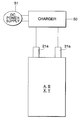
- FIG. 3 is a view diagrammatically illustrating how such a lithium secondary battery received in a battery device for portable telephone is connected to a charger.
- FIG. 4 is a view diagrammatically illustrating how a battery pack obtained by adding a protective circuit to such a lithium secondary battery is received in a battery device for portable telephone and connected to a charger.
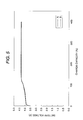
- FIG. 5 is a graph illustrating the battery voltage (V) versus the charge capacity (%) in the case where a battery of the invention is overcharged free from any overcharging protective circuit.
- FIG. 6 is a graph illustrating the battery voltage (V) versus the charge capacity (%) in the case where a battery of conventional example (comparative example) is overcharged free from any overcharging protective circuit.
- FIG. 7 is a graph illustrating the battery voltage (V) versus the charge capacity (%) in the case where batteries of the invention and conventional example (comparative example) are overcharged with an overcharging protective circuit added thereto.
- 10 . . . Separator (composite resin membrane) 20 . . . Positive electrode plate, 21 a . . . Positive electrode collector tab, 30 . . . Negative electrode plate, 31 a . . . Negative electrode collector tab, 40 . . . Laminate outer case, 50 . . . Charging circuit, 51 . . . DC power supply, 60 . . . Battery pack, 61 . . . Circuit board comprising protective circuit, 62 . . . Battery pack container
- FIG. 1 is a perspective view diagrammatically illustrating how a positive electrode plate and a negative electrode plate are laminated with a separator provided interposed therebetween.
- FIG. 2 is a perspective view diagrammatically illustrating a lithium secondary battery formed by winding the laminate and then receiving the laminate thus wound in a laminate outer case.
- FIG. 3 is a view diagrammatically illustrating how such a lithium secondary battery received in a battery device for portable telephone is connected to a charger.
- FIG. 4 is a view diagrammatically illustrating how a battery pack obtained by adding a protective circuit to such a lithium secondary battery is received in a battery device for portable telephone and connected to a charger.
- a reinforcing material there was used a non-woven cloth of polyethylene terephthalate (PET) having a thickness of 30 ⁇ m.
- the non-woven cloth of polyethylene terephthalate (PET) was then impregnated with a polyvinylidene fluoride (PVdF) resin to give an integrated body.
- PVdF polyvinylidene fluoride
- a separator 10 made of composite resin film was prepared.
- the separator 10 was then used as a separator a in Example 1.
- a reinforcing material there was used a mircoporous membrane of polyethylene (PE).
- a polyvinylidene fluoride (PVdF) resin was then bonded to the mircoporous membrane of polyethylene (PE) on both surfaces thereof to give an integrated laminate.
- PVdF polyvinylidene fluoride
- a separator 10 made of composite resin film was prepared. The separator 10 was then used as a separator b in Example 2.
- PVdF polyvinylidene fluoride
- PET polyethylene terephthalate
- PVdF polyvinylidene fluoride
- PE polyethylene
- polyvinylidene fluoride there may be used a vinylidene fluoride homopolymer or a vinylidene fluoride copolymer of vinylidene fluoride with one or more selected from the group consisting of ethylene trifluorochloride, ethylene tetrafluoride, propylene hexafluoride and ethylene.
- An active positive electrode material made of a lithium-containing cobalt dioxide (LiCoO 2 ) which had been subjected to heat treatment at a temperature of from 700° C. to 900° C., graphite and kitchen black as an electrically conducting material and a fluororesin as a binder were mixed at a weight ratio of 90:32:5. The mixture was then dissolved in an organic solvent comprising N-methyl-2-pyrrolidone (NMP) to prepare a paste.
- NMP N-methyl-2-pyrrolidone
- the paste thus prepared was uniformly applied to a metal core (e.g., aluminum foil having a thickness of 20 ⁇ m) 21 on both surfaces thereof by doctor blade method. Subsequently, the coated material was passed through a dryer which had been heated, subjected to vacuum heat treatment at a temperature of from 100° C. to 150° C. to remove the organic solvent which had been needed during the preparation of paste, and then rolled to a thickness of 0.17 mm through a roll press to prepare a positive electrode plate 20 .
- a metal core e.g., aluminum foil having a thickness of 20 ⁇ m
- the mixture was then dissolved in an organic solvent comprising N-methyl-2-pyrolidone (NMP) to prepare a paste.
- NMP N-methyl-2-pyrolidone
- the paste thus prepared was then uniformly applied entirely to a metal core (e.g., copper foil having a thickness of 20 ⁇ m) 31 on both surfaces thereof by doctor blade method.
- the coated material was passed through a dryer which had been heated, subjected to vacuum heat treatment at a temperature of from 100° C. to 150° C. to remove the organic solvent which had been needed during the preparation of paste, and then rolled to a thickness of 0.14 mm through a roll press to prepare a negative electrode plate 30.
- a positive electrode collector tab 21 a To the core material 21 of the positive electrode plate 20 thus prepared was attached a positive electrode collector tab 21 a . To the core material 31 of the negative electrode plate 30 was attached a negative electrode collector tab 31 a . The two electrode plates were then laminated with the separators 10 made of resin membranes a, b, x and y provided interposed therebetween. Thereafter, the laminate thus prepared was wound by a winder (not shown). The laminate thus wound was then fixed on the periphery thereof with a tape to prepare a spirally wound electrode body. The spirally wound electrode body was then squeezed to flatness to prepare a tabular body.
- LiPF 6 and LiN(SO 2 C 2 F,) 2 were dissolved as electrolyte salts in a 3:7 (by volume) mixture of ethylene carbonate (EC) and diethyl carbonate (DEC) in a concentration of 0.05 mol/l and 0.95 mol/l, respectively, to prepare an electrolytic solution.
- EC ethylene carbonate
- DEC diethyl carbonate
- a 5-layer laminate material comprising a polyethylene terephthalate (PET), an adhesive, aluminum, an adhesive and an adhesive layer made of polypropylene as viewed from outside was laminated at the edge thereof.
- the pair of laminates were heat-sealed at the edge thereof to form sealed portions 41 and 42 .
- a cylindrical outer case 40 was prepared.
- the tabular body formed by squeezing a spirally wound electrode body was inserted into the outer case 40 in an arrangement such that the positive electrode collector tab 21 a and the negative electrode collector tab 31 a come out of one of the openings of the outer case 40 .
- the one opening of the outer case 40 was then heat-sealed with the positive electrode collector tab 21 a and the negative electrode collector 31 a being put between the edges of the opening to form a sealed portion 43 .
- the electrolytic solution thus prepared was injected into the outer case through the other opening of the outer case.
- the opening was heat-sealed to form a sealed portion 44 .
- the outer case was sealed.
- four secondary lithium batteries A, B, X and Y were prepared.
- the secondary lithium batteries A, B, X and Y thus prepared each had a capacity of 500 mAh.
- the lithium secondary battery prepared from the composite resin membrane a of Example 1 was designated as battery A
- the lithium secondary battery prepared from the composite resin membrane b of Example 2 was designated as battery B
- the lithium secondary battery prepared from the composite resin membrane x of Comparative Example 1 was designated as battery X
- the lithium secondary battery prepared from the composite resin membrane y of Comparative Example 2 was designated as battery Y.
- the secondary lithium batteries A, B, X and Y thus prepared were each received in a battery housing of various battery devices (not shown) (e.g., electronic apparatus such as portable telephone and note type personal computer) to prepare battery devices comprising a single battery, respectively. Thereafter, to the terminal formed at the battery housing of these battery devices was connected a lead wire extending from a charger 50 . To the charger 50 was connected a DC power supply 51 . By switching the power supply 51 on, the secondary lithium batteries A, B, X and Y begin to be charged.
- various battery devices e.g., electronic apparatus such as portable telephone and note type personal computer
- the battery device comprising a single battery may be in a form comprising a single battery received in a battery housing, a form comprising a battery block consisting of a series combination of these single batteries received in a battery housing, a form comprising a battery block consisting of a parallel combination of these single batteries received in a battery housing or a form comprising a battery block consisting of a series combination of these single batteries and a parallel combination of these single batteries received in a battery housing.
- the charger 50 may be either incorporated in the electronic apparatus or provided separately of the electronic apparatus.
- the secondary lithium batteries A, B, X and Y thus prepared were each connected to the connecting portion of a protective circuit board 61 provided with a protective circuit for preventing overcharging at the collector tabs (positive and negative electrode terminals) 21 a and 31 a thereof. These batteries were each received in a battery pack container 62 which was then sealed to prepare a battery pack 60 .
- these battery packs 60 were each received in the housing of various battery devices (not shown)(e.g., electronic apparatus such as portable telephone and note type personal computer) to prepare battery devices comprising battery pack. Thereafter, to the positive electrode terminal 63 and the negative electrode terminal 64 of these battery packs 60 was connected a lead wire extending from the charger 50 .
- various battery devices e.g., electronic apparatus such as portable telephone and note type personal computer
- the battery pack 60 may be not only in a form comprising a single battery received in a battery pack container 62 but also in a form comprising a series combination of single batteries received in a battery pack container 62 , a form comprising a parallel combination of single batteries received in a battery pack container 62 or a form comprising a series combination of single batteries and a parallel combination of single batteries received in a battery pack container 62 .
- the protective circuit is an overcharging protective circuit arranged to detect when the battery voltage reaches a predetermined value (e.g., 4.35 V) upon charging and then suspend the subsequent charging operation.
- charging circuit as used herein is meant to indicate a circuit capable of supplying charging current into a battery (single battery, battery block, battery pack, etc.) and provided with functional circuits necessary for charging such as control circuit for monitoring the time elapsed from the beginning of charging, charge capacity, output voltage, etc. and comparing it with a predetermined value and a switch circuit for receiving charging suspension order from the control circuit and suspending the supply of current to the battery.
- the charger 50 indicates a part of such a charging circuit or a packaging of all these functions.
- the batteries were each continuously subjected to constant current charging with a current of 500 mA (1C) for 4 hours (amount of electricity charged corresponds to 40% of the battery capacity).
- the batteries were each measured for battery voltage at a predetermined time interval (every a certain charge capacity).
- the measurements were graphically plotted with charge capacity (%) as abscissa and battery voltage (V) as ordinate.
- the results are as shown in FIGS. 5 to 7 .
- the secondary lithium batteries A, B, X and Y were each measured for change of thickness between before and after overcharging test.
- the secondary lithium batteries A, B, X and Y were also each subjected to discharge test after overcharging test. The results are set forth in Table 1 below.
- D,E,F,G polyvinylidene fluoride (PVdF) resin is bonded to both surfaces of the mircoporous membrane to form an integrated laminate at each PVdF ratio as follows.
- PVdF PE C 100 D 80 20 E 20 80 F 10 90 G 5 95
- the batteries A and B despite being free of protective circuit, showed no rise of battery voltage beyond 4.5 V and no increase of battery thickness even when overcharged with electricity corresponding to 400% of the battery capacity.
- these batteries were then discharged with current of 500 mA (1C). When the battery voltage reached 2.75 V, discharge was then terminated. The discharge capacity was then determined from the discharge time. The results show that 70% of the initial battery capacity can be discharged, demonstrating that these batteries are little liable to deterioration of battery capacity.
- PVdF polyvinylidene fluoride
- the batteries showed a sudden rise of battery voltage when overcharged with electricity corresponding to more than 250% of the battery capacity, and then immediately showed a battery voltage of 0 V and an increase of battery thickness. This is presumably because the sudden rise of battery voltage is immediately followed by internal short-circuiting that causes the battery voltage to drop to 0 V and the electrolytic solution to decompose and produce gas. This made it impossible for these batteries to be subsequently charged and discharged.
- a composition ratio of polyvinylidene fluoride (PVdF) resin in the separator is preferably 5-100 wt %, more preferably 20-80 wt %.
- the separator is not useful. Since the separator whose composition ration is near to PVdF monolithic membrane is too weak in mechanical strength, mass production cannot be performed. And since separator is easy to have a wrinkle, battery characteristics is easy to be lowered.
- PVdF polyvinylidene fluoride
- Maximum voltage is defined as a maximum voltage of the battery at overcharging. As shown in FIG. 5, in batteries A and B the battery voltage gets flat on overcharging and effect of overcharge inhibiting effect can be confirmed. Contrary that, as shown in FIG. 6, in batteries X and Y the battery voltage suddenly rise to 12 V at one point. This is the reason why inner resistance of the battery rises to the maximum voltage ,12V, and after that, inner short circuit caused by abnormal accident(for example shrink of the separator) of the battery is occurred.
- Overcharging protective circuit is set to 4.35 V. Therefore maximum voltage of all batteries with overcharging protective circuit is 4.35 V. And in the case of the battery without overcharging protective circuit, maximum voltage of the battery using a separator in which the composition ratio of polyvinylidene fluoride (PVdF) resin is less than 50 wt %, is about 4.38 V (constant). Further while the composition ratio of polyvinylidene fluoride (PVdF) resin decreases, the maximum voltage becomes higher. The increase quantity of thickness of the separator increases accompanied with the voltage increase. This is the reason why velocity of the dissolving reaction of the electrolyte is accelerated rapidly, while the composition ratio of polyvinylidene fluoride (PVdF) resin is lowered.
- PVdF polyvinylidene fluoride
- the lithium secondary battery of the invention shows no rise of battery voltage beyond 5.0 V even when overcharged.
- the lithium secondary battery of the invention can be drastically prevented from being damaged during overcharging, making it possible for themselves to be subsequently charged and discharged. This makes it possible to reduce the space for receiving the battery and hence further reduce the size of this type of battery devices.
- LiCoO 2 A lithium-containing transition metal compound which receives lithium ion as a guest may be used besides LiCoO 2 .
- LiNiO 2 , LiCo x Ni( 1 ⁇ x )O 2 , LiCrO 2 , LiVO 2 , LiMnO 2 , LiFeO 2 , LiTiO 2 , LiScO2, LiYO 2 , and LiMn 2 O 4 LiCoO 2 , LiNiO 2 LiCo x Ni 2 ⁇ x )C 2 , and LiMn 2 O 4 be used singly or in combination of two or more thereof.
- the electrolytic solution there may be used any ionic conductor obtained by dissolving a lithium salt as a solute in an organic solvent so far as it has a high ionic conductivity, behaves inertly chemically and electrochemically to the positive and negative electrodes and is inexpensive.
- the organic solvent there may be preferably used propylene carbonate (PC), sulfolan (SL), tetrahydrofuran (THF), ⁇ -butyrolactone (GBL) or mixture thereof besides the foregoing organic solvent.
- a gel-like electrolyte containing a polymerizable compound such as acrylate-based polymer and urethane acrylate-based polymer may be used.
- the solute there may be used a lithium salt having a strong electrophilicity.
- LiPF 6 or LiN(SO 2 C 2 F 5 ) 2
- a polyvinylidene fluoride resin can be included between the positive electrode and negative electrode, not as a separator.
Landscapes
- Chemical & Material Sciences (AREA)
- Chemical Kinetics & Catalysis (AREA)
- Electrochemistry (AREA)
- General Chemical & Material Sciences (AREA)
- Engineering & Computer Science (AREA)
- Manufacturing & Machinery (AREA)
- Materials Engineering (AREA)
- Inorganic Chemistry (AREA)
- Secondary Cells (AREA)
Abstract
A lithium secondary battery comprises a negative electrode capable of intercalating/deintercalating lithium ion, a positive electrode made of a lithium-containing metal oxide as an active positive material, and a nonaqueous electrolyte, and a polyvinylidene fluoride resin is disposed between said negative electrode and positive electrode so that the battery voltage doesn't rise beyond a predetermined value even when said battery is overcharged.
Description
- 1. Field of the Invention
- The present invention relates to a lithium secondary battery, for example a lithium secondary battery comprising a negative electrode capable of intercalating/deintercalating lithium ion, a positive electrode made of a lithium-containing metal oxide as an active positive material, a nonaqueous electrolyte and a separator for separating the positive electrode and the negative electrode from each other and a battery device comprising same.
- 2.Description of the related Art
- Recently, electronic apparatus have shown a remarkable reduction of size and weight thereof. Under these circumstances, it has been keenly desired to reduce the size and weight of battery as power supply. Accordingly, a lithium secondary battery such as lithium ion battery has been put to practical use as rechargeable battery having a small weight and high capacity. Such a lithium secondary battery has been used for portable electronic and communications apparatus such as small-sized video camera, portable telephone and note type personal computer.
- This type of a lithium secondary battery comprises as an active negative electrode material a carbon-based material capable of intercalating/deintercalating lithium ion, as an active positive electrode material a lithium-containing metal oxide such as LiCoO 2, LiNiO2, LiMn2O4 and LiFeO2, and an electrolytic solution obtained by dissolving a lithium salt as a solute in an organic solvent. These components are assembled Into a battery. When this battery is charged for the first time, lithium ions eluted from the active positive electrode material enter in the carbon particles to make the battery chargeable and dischargeable.
- As such a lithium secondary battery is overcharged, excess lithium ions are extracted from the positive electrode while excess lithium ions are intercalated in the negative electrode, causing the precipitation of metallic lithium. Extremely unstable high oxides are produced on the positive electrode side, where lithium ions have been lost. Further, when the battery voltage reaches higher than about 5.0 V during overcharging, the battery undergoes decomposition reaction of the organic solvent of the electrolytic solution that causes the production of a large amount of combustible gas and sudden exothermic reaction that causes abnormal heating of the battery, impairing the battery safety. These circumstances cause an important problem as the energy density of the lithium secondary battery increases.
- As mentioned above, when a phenomenon involving abnormal heating of battery occurs, the constituent materials of battery such as positive electrode, negative electrode and electrolytic solution undergo denaturation that makes it impossible to maintain the desired battery properties. Further, this phenomenon should be avoided from the standpoint of maintenance of battery safety. Accordingly, at present, this type of secondary lithium batteries are always used with a protective circuit for preventing overcharging incorporated therein.
- A nickel-cadmium storage battery or the like is arranged to prevent overcharging through subtle utilization of a gas absorption mechanism that oxygen produced at the positive electrode side during overcharging is reacted with hydrogen at the negative electrode side to produce water. However, a lithium secondary battery comprising an organic solvent is almost unable to utilize such a gas absorption mechanism in principle at present. It is thus inevitably necessary that a lithium secondary battery comprising an organic solvent comprise a protective circuit for preventing overcharging incorporated therein.
- However, the protective circuit for preventing overcharging requires a complicated control technique and thus becomes a cause that adds to the total cost of the battery. Further, since practically used secondary lithium batteries have a protective circuit device provided in a battery pack, the occupying volume and weight of the protective circuit also becomes a cause that reduces the substantial energy density, particularly volume energy density (Wh/m 3), of the battery.
- Under these circumstances, the inventors made studies. As a result, it was found that if a lithium secondary battery which cannot be overcharged is obtained, it is not necessary to provide a protective circuit for preventing overcharging. The present invention has been worked out on the basis of this knowledge. It is therefore an object of the invention to provide a lithium secondary battery which cannot be overcharged and a battery device which comprises such a lithium secondary battery to eliminate the necessity of providing a protective circuit therein.
- In order to accomplish the foregoing object of the invention, the lithium secondary battery of the invention comprises a negative electrode capable of intercalating/deintercalating lithium ion, a positive electrode made of a lithium-containing metal oxide as an active positive material, and a nonaqueous electrolyte, wherein a polyvinylidene fluoride resin is disposed between said negative electrode and positive electrode so that the battery voltage doesn't rise beyond a predetermined value even when said battery is overcharged.
- Preferably the lithium secondary battery of the invention comprises a negative electrode capable of intercalating/deintercalating lithium ion, a positive electrode made of a lithium-containing metal oxide as an active positive material, a nonaqueous electrolyte and a separator comprising a polyvinylidene fluoride resin for separating the positive electrode and the negative electrode from each other, whereby the battery voltage doesn't rise beyond a predetermined value, i.e., 5.0 V, even when the lithium secondary battery is overcharged.
- A lithium secondary battery was prepared by disposing a negative electrode capable of intercalating/deintercalating lithium ion (e.g., graphite) and a lithium-containing metal oxide (e.g., lithium-containing cobalt oxide) with a separator comprising a polyvinylidene fluoride (PVdF) provided interposed therebetween, and then injecting a non-aqueous electrolyte there into. When the inventors made an overcharging test (overcharging with electricity corresponding to at least 400% of the battery capacity) on this lithium secondary battery, a surprising phenomenon was shown that the battery voltage doesn't rise beyond a predetermined value (particularly 5.0 V) (see FIG. 5).
- The reason for this phenomenon is not made obvious at present. However, it can be presumed as follows. In other words, a polyvinylidene fluoride (PVdF) resin has excellent electrical insulation properties and is highly capable of retaining an electrolytic solution there inside to exhibit a high ionic conductivity. Thus, a polyvinylidene fluoride (PVdF) resin provides an excellent separator material. A battery prepared from such a polyvinylidene fluoride (PVdF) resin as a separator material shows a change of the chemical or electrical properties of the polyvinylidene fluoride (PVdF) resin when the battery voltage shows an abnormal rise to about 4.5 V upon overcharging. In this manner, current flowing upon overcharging is consumed through a reaction process different from the inherent charging reaction of active positive electrode material or active negative electrode material.
- The mechanism of the establishment of such a separate reaction process can be considered as follows, though being inference:
- i) When the battery is overcharged, the polyvinylidene fluoride (PVdF) partly reacts with a part of lithium or electrolytic solution to form a reaction seed taking part in a reversal electrochemical reaction (redox reaction). The reaction seed migrates between the positive electrode and the negative electrode to inhibit other reactions (charge reaction).
- ii) The same participation as in the mechanism (i) causes decomposition reaction of solvent accompanied by no production of gas.
- iii) When the battery is overcharged, the electrical insulation of the polyvinylidene fluoride (FVdF) is destroyed to form an electronic conductor having a certain resistivity. Thus, there occurs an internal short-circuiting only when the battery is overcharged. Accordingly, an ordinary electrochemical reaction (reaction of electron with ion) doesn't occur. Therefore, the polyvinylidene fluoride (FVdF) acts as a mere resistor.
- From the standpoint of the foregoing mechanism, when a battery device is formed by a lithium secondary battery which shows no rise of battery voltage beyond a predetermined value even when overcharge, the same overcharging properties as obtained with a protective circuit for preventing overcharging can be obtained without being provided with any such a protective circuit. This eliminates the necessity of packaging the battery with such a protective circuit as practiced conventionally. Thus, the volume of the protective circuit required to occupy in the container or battery packaging container becomes unnecessary. Accordingly, the substantial energy density of the battery (particularly volume energy density: Wh/m 3) can be enhanced.
- By thus making the protective circuit unnecessary, this type of battery devices can be produced through less production steps and hence at a reduced cost.
- FIG. 1 is a perspective view diagrammatically illustrating how a positive electrode plate and a negative electrode plate are laminated with a separator provided interposed therebetween.
- FIG. 2 is a perspective view diagrammatically illustrating a lithium secondary battery formed by winding the laminate of FIG. 1 and then receiving the laminate thus wound in a laminate outer case.
- FIG. 3 is a view diagrammatically illustrating how such a lithium secondary battery received in a battery device for portable telephone is connected to a charger.
- FIG. 4 is a view diagrammatically illustrating how a battery pack obtained by adding a protective circuit to such a lithium secondary battery is received in a battery device for portable telephone and connected to a charger.
- FIG. 5 is a graph illustrating the battery voltage (V) versus the charge capacity (%) in the case where a battery of the invention is overcharged free from any overcharging protective circuit.
- FIG. 6 is a graph illustrating the battery voltage (V) versus the charge capacity (%) in the case where a battery of conventional example (comparative example) is overcharged free from any overcharging protective circuit.
- FIG. 7 is a graph illustrating the battery voltage (V) versus the charge capacity (%) in the case where batteries of the invention and conventional example (comparative example) are overcharged with an overcharging protective circuit added thereto. 10 . . . Separator (composite resin membrane) , 20 . . . Positive electrode plate, 21 a . . . Positive electrode collector tab, 30 . . . Negative electrode plate, 31 a. . . Negative electrode collector tab, 40 . . . Laminate outer case, 50 . . . Charging circuit, 51 . . . DC power supply, 60 . . . Battery pack, 61 . . . Circuit board comprising protective circuit, 62 . . . Battery pack container
- An embodiment of implication of the lithium secondary battery and battery device according to the present invention will be described hereinafter in connection with FIGS. 1 to 4. FIG. 1 is a perspective view diagrammatically illustrating how a positive electrode plate and a negative electrode plate are laminated with a separator provided interposed therebetween. FIG. 2 is a perspective view diagrammatically illustrating a lithium secondary battery formed by winding the laminate and then receiving the laminate thus wound in a laminate outer case. FIG. 3 is a view diagrammatically illustrating how such a lithium secondary battery received in a battery device for portable telephone is connected to a charger. FIG. 4 is a view diagrammatically illustrating how a battery pack obtained by adding a protective circuit to such a lithium secondary battery is received in a battery device for portable telephone and connected to a charger.
- 1. Preparation of Separator
- As a reinforcing material there was used a non-woven cloth of polyethylene terephthalate (PET) having a thickness of 30 μm. The non-woven cloth of polyethylene terephthalate (PET) was then impregnated with a polyvinylidene fluoride (PVdF) resin to give an integrated body. Thus, a
separator 10 made of composite resin film was prepared. Theseparator 10 was then used as a separator a in Example 1. - As a reinforcing material there was used a mircoporous membrane of polyethylene (PE). A polyvinylidene fluoride (PVdF) resin was then bonded to the mircoporous membrane of polyethylene (PE) on both surfaces thereof to give an integrated laminate. Thus, a
separator 10 made of composite resin film was prepared. Theseparator 10 was then used as a separator b in Example 2. - No polyvinylidene fluoride (PVdF) resin was used. Only a non-woven cloth of polyethylene terephthalate (PET) having a thickness of 30 μm was used to prepare a
separator 10. Theseparator 10 was then used as a separator x in Comparative Example 1. - No polyvinylidene fluoride (PVdF) resin was used. Only a mircoporous membrane of polyethylene (PE) having a thickness of 30 μm was used to prepare a
separator 10. Theseparator 10 was then used as a separator y in Comparative Example 2. - As the foregoing polyvinylidene fluoride there may be used a vinylidene fluoride homopolymer or a vinylidene fluoride copolymer of vinylidene fluoride with one or more selected from the group consisting of ethylene trifluorochloride, ethylene tetrafluoride, propylene hexafluoride and ethylene.
- 2. Preparation of Positive Electrode Plate
- An active positive electrode material made of a lithium-containing cobalt dioxide (LiCoO 2) which had been subjected to heat treatment at a temperature of from 700° C. to 900° C., graphite and kitchen black as an electrically conducting material and a fluororesin as a binder were mixed at a weight ratio of 90:32:5. The mixture was then dissolved in an organic solvent comprising N-methyl-2-pyrrolidone (NMP) to prepare a paste.
- The paste thus prepared was uniformly applied to a metal core (e.g., aluminum foil having a thickness of 20 μm) 21 on both surfaces thereof by doctor blade method. Subsequently, the coated material was passed through a dryer which had been heated, subjected to vacuum heat treatment at a temperature of from 100° C. to 150° C. to remove the organic solvent which had been needed during the preparation of paste, and then rolled to a thickness of 0.17 mm through a roll press to prepare a
positive electrode plate 20. - 3. Preparation of Negative Electrode Plate
- Separately, an active negative electrode material made of natural graphite (d=3.36 Å) and a fluororesin as a binder were mixed at a weight ratio of 95:5. The mixture was then dissolved in an organic solvent comprising N-methyl-2-pyrolidone (NMP) to prepare a paste. The paste thus prepared was then uniformly applied entirely to a metal core (e.g., copper foil having a thickness of 20 μm) 31 on both surfaces thereof by doctor blade method. Subsequently, the coated material was passed through a dryer which had been heated, subjected to vacuum heat treatment at a temperature of from 100° C. to 150° C. to remove the organic solvent which had been needed during the preparation of paste, and then rolled to a thickness of 0.14 mm through a roll press to prepare a
negative electrode plate 30. - 4. Preparation of Lithium Secondary Battery
- To the
core material 21 of thepositive electrode plate 20 thus prepared was attached a positiveelectrode collector tab 21 a. To thecore material 31 of thenegative electrode plate 30 was attached a negativeelectrode collector tab 31 a. The two electrode plates were then laminated with theseparators 10 made of resin membranes a, b, x and y provided interposed therebetween. Thereafter, the laminate thus prepared was wound by a winder (not shown). The laminate thus wound was then fixed on the periphery thereof with a tape to prepare a spirally wound electrode body. The spirally wound electrode body was then squeezed to flatness to prepare a tabular body. Subsequently, LiPF6 and LiN(SO2C2F,)2 were dissolved as electrolyte salts in a 3:7 (by volume) mixture of ethylene carbonate (EC) and diethyl carbonate (DEC) in a concentration of 0.05 mol/l and 0.95 mol/l, respectively, to prepare an electrolytic solution. - Subsequently, a 5-layer laminate material comprising a polyethylene terephthalate (PET), an adhesive, aluminum, an adhesive and an adhesive layer made of polypropylene as viewed from outside was laminated at the edge thereof. The pair of laminates were heat-sealed at the edge thereof to form sealed
portions outer case 40 was prepared. - Subsequently, as shown in FIG. 2, the tabular body formed by squeezing a spirally wound electrode body was inserted into the
outer case 40 in an arrangement such that the positiveelectrode collector tab 21 a and the negativeelectrode collector tab 31 a come out of one of the openings of theouter case 40. The one opening of theouter case 40 was then heat-sealed with the positiveelectrode collector tab 21 a and thenegative electrode collector 31 a being put between the edges of the opening to form a sealedportion 43. - Subsequently, the electrolytic solution thus prepared was injected into the outer case through the other opening of the outer case. The opening was heat-sealed to form a sealed
portion 44. Thus, the outer case was sealed. As a result, four secondary lithium batteries A, B, X and Y were prepared. The secondary lithium batteries A, B, X and Y thus prepared each had a capacity of 500 mAh. - In some detail, the lithium secondary battery prepared from the composite resin membrane a of Example 1 was designated as battery A, the lithium secondary battery prepared from the composite resin membrane b of Example 2 was designated as battery B, the lithium secondary battery prepared from the composite resin membrane x of Comparative Example 1 was designated as battery X, and the lithium secondary battery prepared from the composite resin membrane y of Comparative Example 2 was designated as battery Y.
- 5. Battery Device
- (1) Battery Device Comprising Single Battery
- Subsequently, as shown in FIG. 3, the secondary lithium batteries A, B, X and Y thus prepared were each received in a battery housing of various battery devices (not shown) (e.g., electronic apparatus such as portable telephone and note type personal computer) to prepare battery devices comprising a single battery, respectively. Thereafter, to the terminal formed at the battery housing of these battery devices was connected a lead wire extending from a
charger 50. To thecharger 50 was connected aDC power supply 51. By switching thepower supply 51 on, the secondary lithium batteries A, B, X and Y begin to be charged. - The battery device comprising a single battery may be in a form comprising a single battery received in a battery housing, a form comprising a battery block consisting of a series combination of these single batteries received in a battery housing, a form comprising a battery block consisting of a parallel combination of these single batteries received in a battery housing or a form comprising a battery block consisting of a series combination of these single batteries and a parallel combination of these single batteries received in a battery housing. The
charger 50 may be either incorporated in the electronic apparatus or provided separately of the electronic apparatus. - (2) Battery Device Comprising Battery Pack
- Separately, the secondary lithium batteries A, B, X and Y thus prepared were each connected to the connecting portion of a
protective circuit board 61 provided with a protective circuit for preventing overcharging at the collector tabs (positive and negative electrode terminals) 21 a and 31 a thereof. These batteries were each received in abattery pack container 62 which was then sealed to prepare abattery pack 60. - Subsequently, these battery packs 60 were each received in the housing of various battery devices (not shown)(e.g., electronic apparatus such as portable telephone and note type personal computer) to prepare battery devices comprising battery pack. Thereafter, to the
positive electrode terminal 63 and thenegative electrode terminal 64 of these battery packs 60 was connected a lead wire extending from thecharger 50. - The comparison of the volume of the single batteries A, B, X and Y with that of the
battery pack 60 shows that thebattery pack 60 has a volume of as great as 64% greater than that of the single battery because the volume of theprotective circuit board 61 and the volume of the thickness of thebattery pack container 62 are added to that of the single battery. - The
battery pack 60 may be not only in a form comprising a single battery received in abattery pack container 62 but also in a form comprising a series combination of single batteries received in abattery pack container 62, a form comprising a parallel combination of single batteries received in abattery pack container 62 or a form comprising a series combination of single batteries and a parallel combination of single batteries received in abattery pack container 62. The protective circuit is an overcharging protective circuit arranged to detect when the battery voltage reaches a predetermined value (e.g., 4.35 V) upon charging and then suspend the subsequent charging operation. - The term “charging circuit” as used herein is meant to indicate a circuit capable of supplying charging current into a battery (single battery, battery block, battery pack, etc.) and provided with functional circuits necessary for charging such as control circuit for monitoring the time elapsed from the beginning of charging, charge capacity, output voltage, etc. and comparing it with a predetermined value and a switch circuit for receiving charging suspension order from the control circuit and suspending the supply of current to the battery. The
charger 50 indicates a part of such a charging circuit or a packaging of all these functions. - 6. Continuous Overcharging Test
- Subsequently, by switching the
DC power supply 51 connected to thevarious chargers 50 on, the following overcharging test was effected. - In some detail, the batteries were each continuously subjected to constant current charging with a current of 500 mA (1C) for 4 hours (amount of electricity charged corresponds to 40% of the battery capacity). During charging, the batteries were each measured for battery voltage at a predetermined time interval (every a certain charge capacity). The measurements were graphically plotted with charge capacity (%) as abscissa and battery voltage (V) as ordinate. The results are as shown in FIGS. 5 to 7. The secondary lithium batteries A, B, X and Y were each measured for change of thickness between before and after overcharging test. The secondary lithium batteries A, B, X and Y were also each subjected to discharge test after overcharging test. The results are set forth in Table 1 below.
TABLE 1 Maximum Increase Maximum Increase of Type of Voltage Voltage of thickness Can be battery rise (V) thickness (mm) discharged No A None 4.38 No 0.00 Yes protective B None 4.38 No 0.00 Yes circuit X Some 12.00 Yes 2.85 No Y Some 12.00 Yes 2.80 No Provided A None 4.35 No 0.00 Yes with B None 4.35 No 0.00 Yes protective X None 4.35 No 0.00 Yes circuit Y None 4.35 No 0.00 Yes No C None 4.36 No 0.00 Yes protective D None 4.37 No 0.00 Yes circuit E None 4.39 No 0.01 Yes F None 4.42 No 0.12 Yes G None 4.95 No 0.35 Yes Provided C None 4.35 No 0.00 Yes with D None 4.35 No 0.00 Yes protective E None 4.35 No 0.00 Yes circuit F None 4.35 No 0.00 Yes G None 4.35 No 0.00 Yes - *C:PVdF monorisic mircoporous membrane
- D,E,F,G: polyvinylidene fluoride (PVdF) resin is bonded to both surfaces of the mircoporous membrane to form an integrated laminate at each PVdF ratio as follows.
PVdF PE C 100 D 80 20 E 20 80 F 10 90 G 5 95 - As can be seen in FIG. 5 and Table 1, the batteries A and B, despite being free of protective circuit, showed no rise of battery voltage beyond 4.5 V and no increase of battery thickness even when overcharged with electricity corresponding to 400% of the battery capacity. After the termination of overcharging test, these batteries were then discharged with current of 500 mA (1C). When the battery voltage reached 2.75 V, discharge was then terminated. The discharge capacity was then determined from the discharge time. The results show that 70% of the initial battery capacity can be discharged, demonstrating that these batteries are little liable to deterioration of battery capacity.
- The reason for this phenomenon is presumably because when the voltage of the lithium secondary battery of the invention reaches a range of from 4.2 V to 4.3 V, the polyvinylidene fluoride (PVdF) resin shows a change of chemical or electrical properties that causes overcharging current during overcharging is consumed through a reaction process different from the inherent charging reaction of active positive electrode material or active negative electrode material. However, the true reason is not made obvious at present.
- On the contrary, as can be seen in FIG. 6 and Table 1, the batteries showed a sudden rise of battery voltage when overcharged with electricity corresponding to more than 250% of the battery capacity, and then immediately showed a battery voltage of 0 V and an increase of battery thickness. This is presumably because the sudden rise of battery voltage is immediately followed by internal short-circuiting that causes the battery voltage to drop to 0 V and the electrolytic solution to decompose and produce gas. This made it impossible for these batteries to be subsequently charged and discharged.
- As can be seen in FIG. 7 and Table 1, even if the batteries A, B, X and Y with a protective circuit for preventing overcharging added thereto were overcharged with electricity corresponding to 400% of the battery capacity, charging current was interrupted when the battery voltage reached 4.35 V, which is the predetermined voltage of the protective circuit. After the termination of overcharging test, these batteries were then discharged with current of 500 mA (1C). When the battery voltage reached 2.75 V, discharge was then terminated. The discharge capacity was then determined from the discharge time. The results show that 70% of the initial battery capacity can be discharged.
- A composition ratio of polyvinylidene fluoride (PVdF) resin in the separator is preferably 5-100 wt %, more preferably 20-80 wt %. In the case that the composition ratio of polyvinylidene fluoride (PVdF) resin is in excess of 80 wt %, the separator is not useful. Since the separator whose composition ration is near to PVdF monolithic membrane is too weak in mechanical strength, mass production cannot be performed. And since separator is easy to have a wrinkle, battery characteristics is easy to be lowered.
- Further, as explained in example 2, a polyvinylidene fluoride (PVdF) resin bonded to the mircoporous membrane of polyethylene (PE) on both surfaces thereof to give an integrated laminate is used as a
separator 10 to construct a lot of batteries varying a composition ration of PVdF. - And then maximum voltage, maximum thickness increase, discharge ability, and voltage rise are measured for each of the batteries(C, D, E, F, and G). A part of the result is shown in FIGS. 5 and 6.
- Maximum voltage is defined as a maximum voltage of the battery at overcharging. As shown in FIG. 5, in batteries A and B the battery voltage gets flat on overcharging and effect of overcharge inhibiting effect can be confirmed. Contrary that, as shown in FIG. 6, in batteries X and Y the battery voltage suddenly rise to 12 V at one point. This is the reason why inner resistance of the battery rises to the maximum voltage ,12V, and after that, inner short circuit caused by abnormal accident(for example shrink of the separator) of the battery is occurred.
- Overcharging protective circuit is set to 4.35 V. Therefore maximum voltage of all batteries with overcharging protective circuit is 4.35 V. And in the case of the battery without overcharging protective circuit, maximum voltage of the battery using a separator in which the composition ratio of polyvinylidene fluoride (PVdF) resin is less than 50 wt %, is about 4.38 V (constant). Further while the composition ratio of polyvinylidene fluoride (PVdF) resin decreases, the maximum voltage becomes higher. The increase quantity of thickness of the separator increases accompanied with the voltage increase. This is the reason why velocity of the dissolving reaction of the electrolyte is accelerated rapidly, while the composition ratio of polyvinylidene fluoride (PVdF) resin is lowered.
- As mentioned above, the lithium secondary battery of the invention shows no rise of battery voltage beyond 5.0 V even when overcharged. Thus, even free of any protective circuit for preventing overcharging, the lithium secondary battery of the invention can be drastically prevented from being damaged during overcharging, making it possible for themselves to be subsequently charged and discharged. This makes it possible to reduce the space for receiving the battery and hence further reduce the size of this type of battery devices.
- The foregoing embodiment has been described with reference to the case where a 5-layer laminate material is used as an outer case. However, as the outer case there may be used an outer case made of metal such as stainless steel and aluminum besides the foregoing laminate material.
- The foregoing embodiment has also been described with reference to the case where as an active negative electrode material there is used natural graphite (d=3.36 Å) . However, a carbon material capable of intercalating/deintercalating lithium ion may be used besides natural graphite. Preferred examples of such a carbon material include carbon black, coke, glassy fiber, carbon fiber, and calcination product thereof.
- The foregoing embodiment has also been described with reference to the case where as an active positive electrode material there is used LiCoO 2. A lithium-containing transition metal compound which receives lithium ion as a guest may be used besides LiCoO2. Preferred examples of such a lithium-containing transition metal compound include LiNiO2, LiCox Ni(1−x)O2, LiCrO2, LiVO2, LiMnO2, LiFeO2, LiTiO2, LiScO2, LiYO2, and LiMn2O4. It is particularly preferred that LiCoO2, LiNiO2LiCox Ni2−x)C2, and LiMn2O4 be used singly or in combination of two or more thereof.
- As the electrolytic solution there may be used any ionic conductor obtained by dissolving a lithium salt as a solute in an organic solvent so far as it has a high ionic conductivity, behaves inertly chemically and electrochemically to the positive and negative electrodes and is inexpensive. As the organic solvent there may be preferably used propylene carbonate (PC), sulfolan (SL), tetrahydrofuran (THF), γ-butyrolactone (GBL) or mixture thereof besides the foregoing organic solvent.
- Alternatively, a gel-like electrolyte containing a polymerizable compound such as acrylate-based polymer and urethane acrylate-based polymer may be used.
- As the solute there may be used a lithium salt having a strong electrophilicity. Besides LiPF 6, or LiN(SO2C2F5)2, there may be preferably used LiAsF5, LiSO3CF3, LiN (SO2CF3)2 and LiSO3C4F9, singly or in combination of two or more thereof.
- A polyvinylidene fluoride resin can be included between the positive electrode and negative electrode, not as a separator.
Claims (19)
1. A lithium secondary battery comprising a negative electrode capable of intercalating/deintercalating lithium ion, a positive electrode made of a lithium-containing metal oxide as an active positive material, and a nonaqueous electrolyte, wherein a polyvinylidene fluoride (PVdF) resin is disposed between said negative electrode and positive electrode so that the battery voltage doesn't rise beyond a predetermined value even when said battery is overcharged.
2. The lithium secondary battery according to claim 1 , wherein said polyvinylidene fluoride(PVdF) resin constitutes separator for separating said positive electrode and said negative electrode from each other.
3. The lithium secondary battery according to claim 2 , wherein said separator is a composite resin made of a non-woven cloth which is filled with said polyvinylidene fluoride (PVdF) resin.
4. The lithium secondary battery according to claim 2 , wherein said separator is a composite resin made of a non-woven cloth of polyethylene terephthalate (PET) which is filled with said polyvinylidene fluoride resin.
5. The lithium secondary battery according to claim 2 , wherein said separator is a composite resin in which the polyvinylidene fluoride (PVdF) resin is bonded to both surfaces of the mircoporous membrane to form an integrated laminate.
6. The lithium secondary battery according to claim 2 , wherein said separator is a composite resin in which the polyvinylidene fluoride (PVdF) resin is bonded to both surfaces of the mircoporous membrane of polyethylene (PE) to form an integrated laminate.
7. The lithium secondary battery according to claim 1 , wherein said polyvinylidene fluoride (PVdF) resin is comprised so that the polyvinylidene fluoride (PVdF) reacts with a part of lithium or electrolytic solution, partly to generate a reaction seed taking part in a reversal electrochemical reaction (redox reaction) and the reaction seed migrates between the positive electrode and the negative electrode to inhibit charge reaction when said battery is overcharged.
8. The lithium secondary battery according to claim 1 , wherein said polyvinylidene fluoride (PVdF) resin is comprised so that ion conductivity is reduced so as to inhibit charge reaction, by decomposition reaction of solvent accompanied by no production of gas when said battery is overcharged.
9. The lithium secondary battery according to claim 1 , wherein said polyvinylidene fluoride (PVdF) resin is formed so as to be changed to an electronic conductor having a certain resistivity so as to inhibit charge reaction when said battery is overcharged.
10. The lithium secondary battery according to claim 1 , wherein said overcharging involves charging with electricity corresponding to at least 400% of the battery capacity.
11. The lithium secondary battery according to claim 1 , wherein said predetermined voltage value is 5.0 V.
12. The lithium secondary battery according to claim 1 , wherein said active positive electrode material comprises at least one compound selected from the group consisting of lithium-containing cobalt oxide, lithium-containing nickel oxide and lithium-containing manganese oxide and said negative electrode comprises a carbon material mainly composed of graphite.
13. The lithium secondary battery according to claim 6 , wherein a composition ratio of polyvinylidene fluoride (PVdF) resin in the separator is within a range of 5-100 wt %.
14. The lithium secondary battery according to claim 6 , wherein a composition ratio of polyvinylidene fluoride (FVdF) resin in the separator is within a range of 20-80 wt %.
15. A battery device comprising a lithium secondary battery and a charging circuit, characterized in that said lithium secondary battery comprises a negative electrode capable of intercalating/deintercalating lithium ion, a positive electrode made of a lithium-containing metal oxide as an active positive material, a nonaqueous electrolyte and a separator comprising a polyvinylidene fluoride for separating said positive electrode and said negative electrode from each other and said charging circuit comprises a charging circuit having no overcharging preventive function so that the battery voltage doesn't rise beyond a predetermined value even when said lithium secondary battery is overcharged.
16. A battery device comprising a lithium secondary battery and a charging circuit, characterized in that said lithium secondary battery comprises a negative electrode capable of intercalating/deintercalating lithium ion, a positive electrode made of a lithium-containing metal oxide as an active positive material, a nonaqueous electrolyte and a separator comprising a polyvinylidene fluoride for separating said positive electrode and said negative electrode from each other and said charging circuit comprises a charging circuit having an overcharging preventive function so that the battery voltage doesn't rise beyond a predetermined value even when said overcharging preventive function doesn't operate upon overcharging of said lithium secondary battery.
17. The battery device according to claim 15 , wherein said overcharging involves charging with electricity corresponding to at least 400% of the battery capacity.
18. The battery device according to claim 15 , wherein said predetermined voltage value is 5.0 V.
19. The battery device according to claim 15 , wherein said active positive electrode material comprises at least one compound selected from the group consisting of lithium containing cobalt oxide, lithium-containing nickel oxide and lithium-containing manganese oxide and said negative electrode comprises a carbon material mainly composed of graphite.
Applications Claiming Priority (3)
| Application Number | Priority Date | Filing Date | Title |
|---|---|---|---|
| JPP.HEI.11-354388 | 1999-12-14 | ||
| JP35438899 | 1999-12-14 | ||
| JPP.11-354388 | 1999-12-14 |
Publications (2)
| Publication Number | Publication Date |
|---|---|
| US20030190499A1 true US20030190499A1 (en) | 2003-10-09 |
| US6660433B2 US6660433B2 (en) | 2003-12-09 |
Family
ID=18437234
Family Applications (1)
| Application Number | Title | Priority Date | Filing Date |
|---|---|---|---|
| US09/734,568 Expired - Fee Related US6660433B2 (en) | 1999-12-14 | 2000-12-13 | Lithium secondary battery and battery device comprising same |
Country Status (6)
| Country | Link |
|---|---|
| US (1) | US6660433B2 (en) |
| KR (1) | KR100587436B1 (en) |
| CN (1) | CN1171349C (en) |
| FR (1) | FR2802341B1 (en) |
| GB (1) | GB2357896B (en) |
| TW (1) | TW480758B (en) |
Cited By (4)
| Publication number | Priority date | Publication date | Assignee | Title |
|---|---|---|---|---|
| US20080254344A1 (en) * | 2002-02-04 | 2008-10-16 | Nissan Chemical Industries , Ltd. | Lithium Secondary Battery Having Internal Protection Circuit |
| WO2011038521A1 (en) | 2009-10-02 | 2011-04-07 | Oxyphen Ag | Electrochemical energy store comprising a separator |
| US8623539B2 (en) | 2010-12-06 | 2014-01-07 | Industrial Technology Research Institute | Multilayer battery separator and method for manufacturing the same |
| US20180226688A1 (en) * | 2015-10-06 | 2018-08-09 | Fdk Corporation | Laminated rechargeable element |
Families Citing this family (13)
| Publication number | Priority date | Publication date | Assignee | Title |
|---|---|---|---|---|
| US6881438B2 (en) | 2000-03-07 | 2005-04-19 | Teijin Limited | Process for production of composite porous film |
| AU779797B2 (en) | 2000-03-07 | 2005-02-10 | Teijin Limited | Lithium ion secondary cell, separator, cell pack, and charging method |
| US7094497B2 (en) | 2000-03-07 | 2006-08-22 | Teijin Limited | Separator for lithium ion secondary battery |
| DE10219424A1 (en) * | 2002-05-02 | 2003-11-20 | Varta Microbattery Gmbh | Galvanic element with thin electrodes |
| KR100664113B1 (en) * | 2004-02-28 | 2007-01-04 | 엘지전자 주식회사 | Soft Cell Internal Battery |
| JP2010097891A (en) * | 2008-10-20 | 2010-04-30 | Nec Tokin Corp | Stacked lithium-ion secondary battery |
| CN104364957B (en) * | 2012-06-04 | 2017-09-12 | 日本电气株式会社 | Lithium rechargeable battery |
| JP2014017074A (en) * | 2012-07-06 | 2014-01-30 | Toyota Motor Corp | Device for controlling precipitation and dissolution of reaction involving substance in secondary battery |
| CN103579561B (en) | 2012-07-25 | 2017-08-15 | 三星Sdi株式会社 | For the dividing plate of lithium rechargeable battery and the lithium rechargeable battery including it |
| CN103022399A (en) * | 2012-10-19 | 2013-04-03 | 昆山美好新能源科技有限公司 | Electrolyte diaphragm |
| DE102013200848A1 (en) * | 2013-01-21 | 2014-07-24 | Robert Bosch Gmbh | Safety improved galvanic element |
| US9761854B2 (en) | 2013-12-13 | 2017-09-12 | Samsug SDI Co., Ltd. | Spirally-wound electrode assembly for rechargeable lithium battery and rechargeable lithium battery including same |
| JP6305961B2 (en) * | 2015-08-04 | 2018-04-04 | オートモーティブエナジーサプライ株式会社 | Lithium ion secondary battery |
Family Cites Families (22)
| Publication number | Priority date | Publication date | Assignee | Title |
|---|---|---|---|---|
| JPS6174267A (en) * | 1984-09-18 | 1986-04-16 | Shin Kobe Electric Mach Co Ltd | Manufacture of spiral plate group for battery |
| JP2751624B2 (en) | 1990-11-05 | 1998-05-18 | 松下電器産業株式会社 | Non-aqueous electrolyte secondary battery |
| US5429891A (en) | 1993-03-05 | 1995-07-04 | Bell Communications Research, Inc. | Crosslinked hybrid electrolyte film and methods of making and using the same |
| US5460904A (en) * | 1993-08-23 | 1995-10-24 | Bell Communications Research, Inc. | Electrolyte activatable lithium-ion rechargeable battery cell |
| US5296318A (en) | 1993-03-05 | 1994-03-22 | Bell Communications Research, Inc. | Rechargeable lithium intercalation battery with hybrid polymeric electrolyte |
| JP3669024B2 (en) * | 1995-05-26 | 2005-07-06 | ソニー株式会社 | Non-aqueous electrolyte secondary battery |
| JP3184071B2 (en) * | 1995-09-06 | 2001-07-09 | キヤノン株式会社 | Lithium secondary battery |
| JP2992598B2 (en) | 1996-06-12 | 1999-12-20 | 東洋クロス株式会社 | Lithium ion battery |
| US5853916A (en) * | 1996-10-28 | 1998-12-29 | Motorola, Inc. | Multi-layered polymeric gel electrolyte and electrochemical cell using same |
| JP3223824B2 (en) | 1996-12-26 | 2001-10-29 | 三菱電機株式会社 | Lithium ion secondary battery |
| JP3225871B2 (en) | 1996-12-26 | 2001-11-05 | 三菱電機株式会社 | Manufacturing method of lithium ion secondary battery |
| JP3997573B2 (en) | 1997-01-28 | 2007-10-24 | 三菱電機株式会社 | Lithium ion secondary battery and manufacturing method thereof |
| JPH10255760A (en) | 1997-03-14 | 1998-09-25 | Hitachi Maxell Ltd | Lithium secondary battery |
| CA2205683C (en) * | 1997-05-16 | 2001-05-15 | Moli Energy (1990) Limited | Polymerizable additives for making non-aqueous rechargeable lithium batteries safe after overcharge |
| GB2327293A (en) | 1997-06-23 | 1999-01-20 | Solvay | Novel lithium batteries |
| JPH1116561A (en) | 1997-06-23 | 1999-01-22 | Elf Atochem Japan Kk | Battery separator, manufacturing method thereof, and non-aqueous secondary battery |
| JPH11204139A (en) | 1998-01-09 | 1999-07-30 | Furukawa Battery Co Ltd:The | Ion type lithium polymer secondary battery |
| US6322923B1 (en) * | 1998-01-30 | 2001-11-27 | Celgard Inc. | Separator for gel electrolyte battery |
| FR2777698B1 (en) * | 1998-04-16 | 2000-05-12 | Alsthom Cge Alcatel | SEPARATOR COMPRISING A MACROPOROUS MATRIX AND A POROUS POLYMER, ITS MANUFACTURING METHOD, ELECTROCHEMICAL GENERATOR COMPRISING SAME AND THE MANUFACTURING METHOD THEREOF |
| JPH11329443A (en) | 1998-05-15 | 1999-11-30 | Hitachi Maxell Ltd | Lithium secondary battery |
| JP2000030742A (en) | 1998-07-10 | 2000-01-28 | Asahi Chem Ind Co Ltd | Lithium-ion secondary battery element |
| US6489061B1 (en) * | 2000-05-24 | 2002-12-03 | Litech, L.L.C. | Secondary non-aquenous electrochemical cell configured to improve overcharge and overdischarge acceptance ability |
-
2000
- 2000-12-13 KR KR1020000075781A patent/KR100587436B1/en not_active Expired - Fee Related
- 2000-12-13 US US09/734,568 patent/US6660433B2/en not_active Expired - Fee Related
- 2000-12-13 CN CNB001321021A patent/CN1171349C/en not_active Expired - Fee Related
- 2000-12-13 TW TW089126558A patent/TW480758B/en not_active IP Right Cessation
- 2000-12-14 FR FR0016292A patent/FR2802341B1/en not_active Expired - Fee Related
- 2000-12-14 GB GB0030461A patent/GB2357896B/en not_active Expired - Fee Related
Cited By (6)
| Publication number | Priority date | Publication date | Assignee | Title |
|---|---|---|---|---|
| US20080254344A1 (en) * | 2002-02-04 | 2008-10-16 | Nissan Chemical Industries , Ltd. | Lithium Secondary Battery Having Internal Protection Circuit |
| US7701169B2 (en) * | 2002-02-04 | 2010-04-20 | Byd Company Limited | Lithium secondary battery having internal protection circuit |
| WO2011038521A1 (en) | 2009-10-02 | 2011-04-07 | Oxyphen Ag | Electrochemical energy store comprising a separator |
| US8623539B2 (en) | 2010-12-06 | 2014-01-07 | Industrial Technology Research Institute | Multilayer battery separator and method for manufacturing the same |
| US20180226688A1 (en) * | 2015-10-06 | 2018-08-09 | Fdk Corporation | Laminated rechargeable element |
| US10741880B2 (en) * | 2015-10-06 | 2020-08-11 | Fdk Corporation | Laminated rechargeable element |
Also Published As
| Publication number | Publication date |
|---|---|
| GB0030461D0 (en) | 2001-01-24 |
| CN1171349C (en) | 2004-10-13 |
| FR2802341A1 (en) | 2001-06-15 |
| GB2357896A (en) | 2001-07-04 |
| GB2357896B (en) | 2004-03-17 |
| US6660433B2 (en) | 2003-12-09 |
| CN1305238A (en) | 2001-07-25 |
| KR100587436B1 (en) | 2006-06-08 |
| FR2802341B1 (en) | 2008-12-05 |
| TW480758B (en) | 2002-03-21 |
| KR20010062362A (en) | 2001-07-07 |
Similar Documents
| Publication | Publication Date | Title |
|---|---|---|
| US6566013B2 (en) | Nonaqueous secondary battery | |
| US10559843B2 (en) | Non-aqueous electrolyte battery, non-aqueous electrolyte battery pack, and vehicle | |
| EP2262037B1 (en) | Lithium secondary battery using ionic liquid | |
| JP4072126B2 (en) | Electrode active material, electrode, lithium ion secondary battery, method for producing electrode active material, and method for producing lithium ion secondary battery | |
| CN103268936B (en) | Lithium rechargeable battery | |
| US6579648B2 (en) | Nonaqueous secondary battery | |
| US6660433B2 (en) | Lithium secondary battery and battery device comprising same | |
| JP4454950B2 (en) | Nonaqueous electrolyte secondary battery | |
| US20060197496A1 (en) | Combination of lithium ion batteries | |
| JP4236308B2 (en) | Lithium ion battery | |
| US8841025B2 (en) | Positive electrode with heteropoly and phosphorous additives and nonaqueous electrolyte battery | |
| US10797341B2 (en) | Battery module, battery pack, vehicle, and stationary power supply | |
| JP2002324585A (en) | Non-aqueous electrolyte secondary battery and method for recovering its capacity | |
| US20160036090A1 (en) | Nonaqueous electrolyte battery and battery pack | |
| US20070037049A1 (en) | Auxiliary power unit | |
| JP2008130458A (en) | Batteries and battery units | |
| JP5010250B2 (en) | Battery stack and battery pack | |
| JP4245429B2 (en) | Battery with spiral electrode group | |
| JP2001185213A (en) | Nonaqueous electrolyte battery and method for manufacturing the same. | |
| JP6903683B2 (en) | Non-aqueous electrolyte batteries and battery packs | |
| JP2002075460A (en) | Lithium secondary battery | |
| JP2001236939A (en) | Lithium secondary battery and battery device provided with this battery | |
| JP2004297974A (en) | Charger | |
| JP4115006B2 (en) | Lithium ion battery | |
| JPH11162522A (en) | Nonaqueous electrolytic solution secondary battery |
Legal Events
| Date | Code | Title | Description |
|---|---|---|---|
| AS | Assignment |
Owner name: SANYO ELECTRIC CO., LTD., JAPAN Free format text: ASSIGNMENT OF ASSIGNORS INTEREST;ASSIGNORS:WATANABE, HIROSHI;NAKAMIZO, SHIORI;NARUKAWA, SATOSHI;REEL/FRAME:011370/0202 Effective date: 20001206 |
|
| FEPP | Fee payment procedure |
Free format text: PAYOR NUMBER ASSIGNED (ORIGINAL EVENT CODE: ASPN); ENTITY STATUS OF PATENT OWNER: LARGE ENTITY |
|
| FPAY | Fee payment |
Year of fee payment: 4 |
|
| REMI | Maintenance fee reminder mailed | ||
| LAPS | Lapse for failure to pay maintenance fees | ||
| STCH | Information on status: patent discontinuation |
Free format text: PATENT EXPIRED DUE TO NONPAYMENT OF MAINTENANCE FEES UNDER 37 CFR 1.362 |
|
| FP | Lapsed due to failure to pay maintenance fee |
Effective date: 20111209 |