US1968024A - Method of treating vegetable tanning agents or composition therefor - Google Patents
Method of treating vegetable tanning agents or composition therefor Download PDFInfo
- Publication number
- US1968024A US1968024A US492955A US49295530A US1968024A US 1968024 A US1968024 A US 1968024A US 492955 A US492955 A US 492955A US 49295530 A US49295530 A US 49295530A US 1968024 A US1968024 A US 1968024A
- Authority
- US
- United States
- Prior art keywords
- tanning
- solution
- alkali
- hydrosulfite
- vegetable tanning
- Prior art date
- Legal status (The legal status is an assumption and is not a legal conclusion. Google has not performed a legal analysis and makes no representation as to the accuracy of the status listed.)
- Expired - Lifetime
Links
- 235000013311 vegetables Nutrition 0.000 title description 25
- 238000000034 method Methods 0.000 title description 19
- 239000000203 mixture Substances 0.000 title description 12
- RAHZWNYVWXNFOC-UHFFFAOYSA-N Sulphur dioxide Chemical compound O=S=O RAHZWNYVWXNFOC-UHFFFAOYSA-N 0.000 description 38
- 239000003795 chemical substances by application Substances 0.000 description 32
- 239000000243 solution Substances 0.000 description 26
- WSFSSNUMVMOOMR-UHFFFAOYSA-N Formaldehyde Chemical compound O=C WSFSSNUMVMOOMR-UHFFFAOYSA-N 0.000 description 24
- 239000003513 alkali Substances 0.000 description 22
- XLYOFNOQVPJJNP-UHFFFAOYSA-N water Substances O XLYOFNOQVPJJNP-UHFFFAOYSA-N 0.000 description 20
- 229910001868 water Inorganic materials 0.000 description 20
- 239000000463 material Substances 0.000 description 17
- 238000007792 addition Methods 0.000 description 15
- HEMHJVSKTPXQMS-UHFFFAOYSA-M Sodium hydroxide Chemical compound [OH-].[Na+] HEMHJVSKTPXQMS-UHFFFAOYSA-M 0.000 description 12
- HCHKCACWOHOZIP-UHFFFAOYSA-N Zinc Chemical compound [Zn] HCHKCACWOHOZIP-UHFFFAOYSA-N 0.000 description 12
- GRWZHXKQBITJKP-UHFFFAOYSA-L dithionite(2-) Chemical compound [O-]S(=O)S([O-])=O GRWZHXKQBITJKP-UHFFFAOYSA-L 0.000 description 12
- 230000008569 process Effects 0.000 description 11
- 229920001864 tannin Polymers 0.000 description 10
- 239000001648 tannin Substances 0.000 description 10
- 235000018553 tannin Nutrition 0.000 description 10
- 235000019256 formaldehyde Nutrition 0.000 description 8
- 229960004279 formaldehyde Drugs 0.000 description 8
- 239000003153 chemical reaction reagent Substances 0.000 description 7
- 239000000126 substance Substances 0.000 description 7
- 239000011701 zinc Substances 0.000 description 7
- PENRVBJTRIYHOA-UHFFFAOYSA-L zinc dithionite Chemical compound [Zn+2].[O-]S(=O)S([O-])=O PENRVBJTRIYHOA-UHFFFAOYSA-L 0.000 description 7
- 235000017343 Quebracho blanco Nutrition 0.000 description 6
- 241000065615 Schinopsis balansae Species 0.000 description 6
- 230000009471 action Effects 0.000 description 6
- 239000007787 solid Substances 0.000 description 6
- 239000000725 suspension Substances 0.000 description 6
- 229910052725 zinc Inorganic materials 0.000 description 6
- 239000007795 chemical reaction product Substances 0.000 description 5
- 238000006243 chemical reaction Methods 0.000 description 4
- 239000002184 metal Substances 0.000 description 4
- 239000000047 product Substances 0.000 description 4
- 235000002639 sodium chloride Nutrition 0.000 description 4
- 235000011121 sodium hydroxide Nutrition 0.000 description 4
- 238000013019 agitation Methods 0.000 description 3
- 238000004061 bleaching Methods 0.000 description 3
- 238000001816 cooling Methods 0.000 description 3
- 239000006185 dispersion Substances 0.000 description 3
- 238000010438 heat treatment Methods 0.000 description 3
- 229910044991 metal oxide Inorganic materials 0.000 description 3
- 150000004706 metal oxides Chemical class 0.000 description 3
- WSFSSNUMVMOOMR-NJFSPNSNSA-N methanone Chemical compound O=[14CH2] WSFSSNUMVMOOMR-NJFSPNSNSA-N 0.000 description 3
- 239000002245 particle Substances 0.000 description 3
- 238000003756 stirring Methods 0.000 description 3
- FAPWRFPIFSIZLT-UHFFFAOYSA-M Sodium chloride Chemical compound [Na+].[Cl-] FAPWRFPIFSIZLT-UHFFFAOYSA-M 0.000 description 2
- -1 alkali metal hydrosulfite Chemical class 0.000 description 2
- 239000007864 aqueous solution Substances 0.000 description 2
- 239000003518 caustics Substances 0.000 description 2
- 239000003086 colorant Substances 0.000 description 2
- 230000000694 effects Effects 0.000 description 2
- 239000010985 leather Substances 0.000 description 2
- 239000007788 liquid Substances 0.000 description 2
- 150000003839 salts Chemical class 0.000 description 2
- 239000010802 sludge Substances 0.000 description 2
- 239000011780 sodium chloride Substances 0.000 description 2
- UGZADUVQMDAIAO-UHFFFAOYSA-L zinc hydroxide Chemical compound [OH-].[OH-].[Zn+2] UGZADUVQMDAIAO-UHFFFAOYSA-L 0.000 description 2
- 229940007718 zinc hydroxide Drugs 0.000 description 2
- 229910021511 zinc hydroxide Inorganic materials 0.000 description 2
- 238000003723 Smelting Methods 0.000 description 1
- DWAQJAXMDSEUJJ-UHFFFAOYSA-M Sodium bisulfite Chemical compound [Na+].OS([O-])=O DWAQJAXMDSEUJJ-UHFFFAOYSA-M 0.000 description 1
- 230000002378 acidificating effect Effects 0.000 description 1
- 230000006978 adaptation Effects 0.000 description 1
- 229910001854 alkali hydroxide Inorganic materials 0.000 description 1
- 229910052783 alkali metal Inorganic materials 0.000 description 1
- 150000008044 alkali metal hydroxides Chemical class 0.000 description 1
- 239000012670 alkaline solution Substances 0.000 description 1
- 239000007900 aqueous suspension Substances 0.000 description 1
- 238000009835 boiling Methods 0.000 description 1
- 230000008859 change Effects 0.000 description 1
- 238000004040 coloring Methods 0.000 description 1
- 238000010790 dilution Methods 0.000 description 1
- 239000012895 dilution Substances 0.000 description 1
- 230000003467 diminishing effect Effects 0.000 description 1
- 238000004043 dyeing Methods 0.000 description 1
- 238000001914 filtration Methods 0.000 description 1
- 238000005187 foaming Methods 0.000 description 1
- 229910052739 hydrogen Inorganic materials 0.000 description 1
- 239000001257 hydrogen Substances 0.000 description 1
- XLYOFNOQVPJJNP-UHFFFAOYSA-M hydroxide Chemical compound [OH-] XLYOFNOQVPJJNP-UHFFFAOYSA-M 0.000 description 1
- 229910052500 inorganic mineral Inorganic materials 0.000 description 1
- 229910052751 metal Inorganic materials 0.000 description 1
- 235000010755 mineral Nutrition 0.000 description 1
- 239000011707 mineral Substances 0.000 description 1
- 238000012986 modification Methods 0.000 description 1
- 230000004048 modification Effects 0.000 description 1
- 230000007935 neutral effect Effects 0.000 description 1
- 239000012255 powdered metal Substances 0.000 description 1
- 238000001556 precipitation Methods 0.000 description 1
- 230000001737 promoting effect Effects 0.000 description 1
- 230000009467 reduction Effects 0.000 description 1
- 238000000926 separation method Methods 0.000 description 1
- 235000010267 sodium hydrogen sulphite Nutrition 0.000 description 1
- 239000004753 textile Substances 0.000 description 1
- 235000014692 zinc oxide Nutrition 0.000 description 1
- XLOMVQKBTHCTTD-UHFFFAOYSA-N zinc oxide Inorganic materials [Zn]=O XLOMVQKBTHCTTD-UHFFFAOYSA-N 0.000 description 1
- 229960001296 zinc oxide Drugs 0.000 description 1
Images
Classifications
-
- C—CHEMISTRY; METALLURGY
- C14—SKINS; HIDES; PELTS; LEATHER
- C14C—CHEMICAL TREATMENT OF HIDES, SKINS OR LEATHER, e.g. TANNING, IMPREGNATING, FINISHING; APPARATUS THEREFOR; COMPOSITIONS FOR TANNING
- C14C3/00—Tanning; Compositions for tanning
- C14C3/02—Chemical tanning
- C14C3/08—Chemical tanning by organic agents
- C14C3/10—Vegetable tanning
- C14C3/12—Vegetable tanning using purified or modified vegetable tanning agents
Definitions
- the solution may be effectively bleached with a solution prepared by the reaction of a reducing metal and sulfur dioxide in aqueous solution.
- the solution may be used as freshly prepared; it may also be partially stabilized and improved by the addition of 5 a small quantity of formaldehyde, if desired.
- the tanned leather product shall 5 be of a light color and also of a uniform shade throughout its surface. This may be accomplished by employing mineral tanning agents, but natural or vegetable tanning agents 'are associated with substances which effectively darken the materials treated therewith and hence make it substantially impossible to produce a tanned product which islight in color.
- the natural tanning agents are frequently composed of or contain solid particles which are of necessity left in the tanning liquor on account of their fineness and the impracticablity of removing them, and these tend to eifect a concentration of the coloring agent upon the surface being tanned, so that the darkening may be greatly enhanced in such areas, giving the tanned surface an uneven appearance.
- an object of the present invention to treat such natural tanning agents so as to control or substantially to overcome their coloring or dyeing propensities without diminishing their effectiveness as tanning agents.
- Another object is to provide and preserve a uniform dispersion of the finely divided solid particles of the tanning material. It is also an ob- 5 ject to bring about these results in a simple operation or treatment which may be easily applied in the usual course of preparing or using the tanning agent.
- the method of the invention includes the treatment of natural vegetable tanning reagents with an alkaline solution of a hydrosulfite-or with hydrosulfite and an alkali hydroxide-preferably with an alkali and. a solution of zinc hydrosulfite,either as freshly prepared by the addition of zinc and sulfur dioxide in the presence of water or such a solution which has been partially stabilized by the addition of a small amount of formaldehyde, as disclosed more fully in my United States patent above referred to,whereby the coloration of the tanning material is effectivelyreduced or removed and products subsequently tanned therewith may be finished with lighter and more uniform colors accordingly.
- a suitable treating solution may be prepared by adding 28 pounds of a reducing metal such as zinc dust to 42 gallons of water and stirring vigorously (in a vessel containing a cooling coil) to produce a fairly uniform suspension of the powdered metal.
- a stream of sulfur dioxide (preferably liquid) may then be introduced into the bottom of the suspension mixture, to the ultimate amount of 40 pounds, with agitation but preferably without frothing or foaming.
- the solution as thus obtained may be used satisfactorily if shortly after it has been freshly prepared. If it is to be kept in storage before use, however, it is advantageous to treat the solution with a relatively small proportion of formaldehyde of the order of 19% or less upon the weight of the sulfur dioxide content, e. g., 1 pounds of formaldehyde, with vigorous stirring for five minutes.
- an alkali metal hydrosulfite instead of the zinc hydrosulfite solution above described, it may be obtained by adding a chemical equivalent of the hydroxide of the alkali, such as sodium hydroxide to the zinc hydrosulfite solution, whereupon a metathetical reaction takes place, forming the alkali hydrosulfite and zinc hydroxide. The latter may be removed by filtering.
- a chemical equivalent of the hydroxide of the alkali such as sodium hydroxide
- the freshly prepared solution or the solution 100 partially stabilized with formaldehyde may then be added directly to the vegetable tanning agent, which preferably has been previously or simultaneously treated (as with alkali hydroxide or an alkali bisulflte) to render it soluble.
- the suspension or solution of the tanning material may be heated before or after the addition 110 of the hydrosulfite solution, e. g., to 150 F. or above.
- the hydrosulfite solution is run in slowly and with constant agitation and heating until the desired lightening or loss of color is attained or until further additions are not accompanied by further lightening of the tanning agent.
- the material should preferably be treated with an alkali (caustic soda, for example when zinc hydrosulfite is to be used) preliminary to the bleaching treatment.
- alkali caustic soda, for example when zinc hydrosulfite is to be used
- the amount added is directly determined by the tannin content of the material and on the one hand is insuflicient to render the charge alkaline or even neutral to litmus, but on.
- the other serves to reduce appreciably its concentration of free hydrogen ions, or acidity, and to prevent precipitation of the tannin materials.
- the resulting treated liquor which is thus partially neutralized, also promotes a finer subdivision and preserves a more uniform dispersion of the solid matter which it contains. It also facilitates and controls the bleaching action of the hydrosulfite, which may be added simultaneously with or after the addition of the alkali.
- the treated tanning extract has been diluted with water which is customary in preparing the tanning bath.
- the diluted, treated solution is characterized by having a light color, varying from orange to yellow (in proportion to the amount of caustic alkali added) as distinguished from the original red or pink coloration which the un treated quebracho extract usually exhibits.
- 100 pounds of common salt may first be dissolved in 130 gallons of water in tank 1, to which approximately 1000 pounds of quebracho 2, in lump form (containing, for example, 63% of tannins) may then be added.
- the quebracho lumps are preferably supported by a false bottom 3, below which may be provided an agitating paddle 4 which is rotated by any appropriate means while live steam is introduced through the perforated coil 5.
- the salt promotes the separation and dispersion of the quebracho throughout the solution to form a relatively finely divided suspension of the same while the steam heats the charge substantially to boiling, thus promoting the solution of the soluble components.
- Such heating and agitation may be continued for several hours, and the charge then allowed to cool to approximately 180 F.
- Such procedure is common to the art as now practiced and, instead of common salt, other salts such as sodium bisulfite may be employed, with like results.
- the solid tanning materials separate from such suspension, to form a sludge.
- the alkaline reagent is preferably dissolved in a suitable amount of water, in a separate vessel, and allowed to cool.
- a suitable amount of water in a separate vessel, and allowed to cool.
- 32.5 pounds of caustic soda (which is approximately 5% by weight of the tannin content) may be dissolved in 8.25 gallons of water and allowed to cool over night to room temperature.
- the absolute amount or proportion of alkali employed will be varied in proportion to the tannin content of the material and also to control the color of the bleached product and may, for example, be 10 above or below the amount mentioned. Such variations produce a range from orange to yellow,
- hydrosulfite solution prepared by the reaction of 31.1 pounds of zinc and 50 pounds of sulfur dioxide in water, and 2.6 pounds formalde hyde
- the charge is constantly and thoroughly agitated (preferably by stirring the same, by hand, with wooden paddles '7) and may be heated to 200 F. (by the further introduction of steam) which temperature is maintained for approximately one-half hour.
- the charge may then be cooled, as by cooling coils 6.
- the batch After heating and before cooling, the batch is brought to a volume of 200 gallons by the addition of water.
- the treated extract as thus obtained, is concentrated and of relatively thick consistency, resemblingmolasses in appearance. It may be used immediately, or may be stored and shipped in this condition, as desired, without undergoing any appreciable change.
- it is to be used for tanning, however, it is'diluted with ten to twenty parts of water, or more, and forms a thin, light colored, uniform tanning bath.
- the zinc hydrosulfite in the solution of modified acidity as thus obtained, hydrolyses appreciably upon dilution with water to form colloidal zinc hydroxide. The latter, without separating out, increases the density of the solution as a whole and serves to maintain the suspension of the solid particles of tanning material.
- the uniformity of the tanning liquid is preserved and its effects upon material tanned therewith are entirely uniform.
- the finely divided solids of the tanning material are thus utilized instead of forming a wasteful and annoying sludge in the bottom of the tanning bath.
- Process of preparing tanning agents which comprises the step of subjecting a vegetable tanning agent to the chemical action of a freshly made solution resulting from the addition of zinc dust and sulfur dioxide to water.
- Process of preparing tanning agents which comprises the step of subjecting a vegetable tanning agent to the chemical action of a solution resulting from the addition of zinc dust and sulfur dioxide to water and formaldehyde in an amount less than 10% by weight of the sulfur dioxide component.
- Process of preparing tanning agents which comprises the step of subjecting a vegetable tanning agent to the chemical action of a freshly made solution resulting from the addition of one part of zinc dust and one and one-half parts of sulfur dioxide to water.
- Process of preparing tanning agents which comprises the step of subjecting a vegetable tan-' ning agent to the chemical action of a solution resulting from the addition of one part of zinc dust and one and one-half parts of sulfur dioxide to water, and formaldehyde in an amount less than 10% by weight of the sulfur dioxide component.
- Process of preparing tanning agents which comprises the step of subjecting a vegetable tanning agent to the chemical action of a solution resulting from the addition of a reducing metal and sulfur dioxide to water.
- a tanning composition comprising a vegetable tanning agent bleached by the reaction products of metallic 'zinc, sulfur dioxide and water.
- a tanning composition comprising a vegetable tanning agent bleached by the reaction products of metallic zinc, sulfur dioxide and water, and formaldehyde in an amount less-than 10% by weight of the sulfur dioxide. 7, Y
- a tanning composition comprising quebracho extract bleached by the reaction products 7 of metallic zinc, sulfur dioxide and water.
- a tanning composition comprising quebracho extract bleached by the reaction products of metallic zinc, sulfur dioxide and water, and
- Process of preparing vegetable tanning agents which comprises the step of treating the same with an alkali hydrosulfite.
- Process of preparing vegetable tanning I agents which comprises the step of treating the 4 same with an alkali to control theacidity and with an alkali hydrosulfite.
- Process of preparing vegetable tanning agents which comprises the step of treating the same with approximately 5% by weight of an 1 alkali upon the weight of the tannin content, to control the acidity, and with an alkali hydrosulfite.
- Process of preparing vegetable tanning 7 15. Process of preparing vegetable tanning agents, which comprises the step of treating the same with an alkali to control the acidity and with an alkali hydrosulfite and formaldehyde.
- Process of preparing vegetable tanning agents which comprises the step of treating the same with an alkali to control the acidity and with the reaction product of a reducing metal and sulfur dioxide in water.
- a tanning composition comprising a vegetable tanning agent to which an alkali reagent has been added in an amount approximately 5% by weight of the tannin content and an alkali hydrosulfite.
- a tanning composition comprising a vegetable tanning agent to which an alkali reagent has been added in an amount approximately 5% by weight of the tannin content and zinc hydrosulfite.
- a tanning composition comprising a vegetable tanning agent to which caustic has been' of the tannin content and zinc hydrosulfite.
- a tanning composition comprising a vegetable tanning agent to which caustic soda has been added in a mount approximately 5% by weight of/ the tannin content and zinc hydro- FREDERICK W. BINNS.
Landscapes
- Chemical & Material Sciences (AREA)
- Chemical Kinetics & Catalysis (AREA)
- General Chemical & Material Sciences (AREA)
- Organic Chemistry (AREA)
- Treatment And Processing Of Natural Fur Or Leather (AREA)
Description
July 31, 1934. F, w INNS 1,968,024
METHOD OF TREATING VEGETABLE TANNING AGENTS OR COMPOSITION THEREFOR Filed Nov. 3, I950 Patented July 31, 1934 METHOD OF TREATING VEGETABLE TAN- ugao norms on COMPOSITION THERE- Frederick W. Binns, Quincy,
Virginia, smelting Company,. a corporation of Maine Mass., asslgnor to lfortland, Maine,
Application November 3, 1930, Serial No. 492,955
20 Claims.
This invention relates to tanning and pro= vides a method of treating natural tanning materials whereby their properties and the properties of materials subsequently tanned therewith are improved.
As disclosed in my previously issued United States Patent, No. 1,741,496, dated December 31, 1929, I have shown that textile goods which have been dyed, such as colored rags and the like, may
be effectively bleached with a solution prepared by the reaction of a reducing metal and sulfur dioxide in aqueous solution. The solution may be used as freshly prepared; it may also be partially stabilized and improved by the addition of 5 a small quantity of formaldehyde, if desired.
Goods which have been bleached with such solu= tions are not only free from color but are in an especially favorablecondition for redyeing.
I have now extended my research upon the subject matter of said patent and find that it may be effectively employed in respect of the reagents used in tanning.
In the art of tanning leather, it is frequently desirable that the tanned leather product shall 5 be of a light color and also of a uniform shade throughout its surface. This may be accomplished by employing mineral tanning agents, but natural or vegetable tanning agents 'are associated with substances which effectively darken the materials treated therewith and hence make it substantially impossible to produce a tanned product which islight in color. Moreover, the natural tanning agents are frequently composed of or contain solid particles which are of necessity left in the tanning liquor on account of their fineness and the impracticablity of removing them, and these tend to eifect a concentration of the coloring agent upon the surface being tanned, so that the darkening may be greatly enhanced in such areas, giving the tanned surface an uneven appearance.
Accordingly, it is an object of the present invention to treat such natural tanning agents so as to control or substantially to overcome their coloring or dyeing propensities without diminishing their effectiveness as tanning agents. Another object is to provide and preserve a uniform dispersion of the finely divided solid particles of the tanning material. It is also an ob- 5 ject to bring about these results in a simple operation or treatment which may be easily applied in the usual course of preparing or using the tanning agent. Other objects will appear from the following disclosure.
Stated in general terms, the method of the invention includes the treatment of natural vegetable tanning reagents with an alkaline solution of a hydrosulfite-or with hydrosulfite and an alkali hydroxide-preferably with an alkali and. a solution of zinc hydrosulfite,either as freshly prepared by the addition of zinc and sulfur dioxide in the presence of water or such a solution which has been partially stabilized by the addition of a small amount of formaldehyde, as disclosed more fully in my United States patent above referred to,whereby the coloration of the tanning material is effectivelyreduced or removed and products subsequently tanned therewith may be finished with lighter and more uniform colors accordingly.
For example, a suitable treating solution may be prepared by adding 28 pounds of a reducing metal such as zinc dust to 42 gallons of water and stirring vigorously (in a vessel containing a cooling coil) to produce a fairly uniform suspension of the powdered metal. A stream of sulfur dioxide (preferably liquid) may then be introduced into the bottom of the suspension mixture, to the ultimate amount of 40 pounds, with agitation but preferably without frothing or foaming.
The solution as thus obtained may be used satisfactorily if shortly after it has been freshly prepared. If it is to be kept in storage before use, however, it is advantageous to treat the solution with a relatively small proportion of formaldehyde of the order of 19% or less upon the weight of the sulfur dioxide content, e. g., 1 pounds of formaldehyde, with vigorous stirring for five minutes.
If an alkali metal hydrosulfite is to be employed, instead of the zinc hydrosulfite solution above described, it may be obtained by adding a chemical equivalent of the hydroxide of the alkali, such as sodium hydroxide to the zinc hydrosulfite solution, whereupon a metathetical reaction takes place, forming the alkali hydrosulfite and zinc hydroxide. The latter may be removed by filtering.
The freshly prepared solution or the solution 100 partially stabilized with formaldehyde may then be added directly to the vegetable tanning agent, which preferably has been previously or simultaneously treated (as with alkali hydroxide or an alkali bisulflte) to render it soluble. The tanning 105 agent'is ordinarily" disintegrated and treated in the condition of an aqueous suspension or solution.
The suspension or solution of the tanning material may be heated before or after the addition 110 of the hydrosulfite solution, e. g., to 150 F. or above. The hydrosulfite solution is run in slowly and with constant agitation and heating until the desired lightening or loss of color is attained or until further additions are not accompanied by further lightening of the tanning agent.
It is now further found that whereas vegetable tanning materials are usually intrinsically acidic, and whereas the procedure above described may be satisfactorily carried out upon materials which have been extracted with the aid of alkaline reagents, the material should preferably be treated with an alkali (caustic soda, for example when zinc hydrosulfite is to be used) preliminary to the bleaching treatment. In such treatment with alkali, the amount added is directly determined by the tannin content of the material and on the one hand is insuflicient to render the charge alkaline or even neutral to litmus, but on.
the other serves to reduce appreciably its concentration of free hydrogen ions, or acidity, and to prevent precipitation of the tannin materials. The resulting treated liquor, which is thus partially neutralized, also promotes a finer subdivision and preserves a more uniform dispersion of the solid matter which it contains. It also facilitates and controls the bleaching action of the hydrosulfite, which may be added simultaneously with or after the addition of the alkali. It
likewise controls, to an appreciable extent, the
degree of bleaching to be effected and consequently the color of the tanning material. This reduction of color is especially notable after the treated tanning extract has been diluted with water which is customary in preparing the tanning bath. The diluted, treated solution is characterized by having a light color, varying from orange to yellow (in proportion to the amount of caustic alkali added) as distinguished from the original red or pink coloration which the un treated quebracho extract usually exhibits.
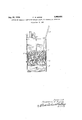
This aspect of the invention will be described with reference to the accompanying drawing, in which the figure is a side elevation of suitable apparatus for carrying it out in actual practice.
Thus, 100 pounds of common salt may first be dissolved in 130 gallons of water in tank 1, to which approximately 1000 pounds of quebracho 2, in lump form (containing, for example, 63% of tannins) may then be added. The quebracho lumps are preferably supported by a false bottom 3, below which may be provided an agitating paddle 4 which is rotated by any appropriate means while live steam is introduced through the perforated coil 5. The salt promotes the separation and dispersion of the quebracho throughout the solution to form a relatively finely divided suspension of the same while the steam heats the charge substantially to boiling, thus promoting the solution of the soluble components. Such heating and agitation may be continued for several hours, and the charge then allowed to cool to approximately 180 F. Such procedure is common to the art as now practiced and, instead of common salt, other salts such as sodium bisulfite may be employed, with like results. On standing, the solid tanning materials separate from such suspension, to form a sludge.
The alkaline reagent is preferably dissolved in a suitable amount of water, in a separate vessel, and allowed to cool. In the instant case 32.5 pounds of caustic soda (which is approximately 5% by weight of the tannin content) may be dissolved in 8.25 gallons of water and allowed to cool over night to room temperature. The absolute amount or proportion of alkali employed will be varied in proportion to the tannin content of the material and also to control the color of the bleached product and may, for example, be 10 above or below the amount mentioned. Such variations produce a range from orange to yellow,
ing'additions of the hydrosulfite solution to avoid excessive reaction or local concentrations of the alkali. In this way, approximately 25 gallons of hydrosulfite solution (prepared by the reaction of 31.1 pounds of zinc and 50 pounds of sulfur dioxide in water, and 2.6 pounds formalde hyde) may be added to the charge. During such additions, the charge is constantly and thoroughly agitated (preferably by stirring the same, by hand, with wooden paddles '7) and may be heated to 200 F. (by the further introduction of steam) which temperature is maintained for approximately one-half hour. The charge may then be cooled, as by cooling coils 6.
After heating and before cooling, the batch is brought to a volume of 200 gallons by the addition of water.
The treated extract, as thus obtained, is concentrated and of relatively thick consistency, resemblingmolasses in appearance. It may be used immediately, or may be stored and shipped in this condition, as desired, without undergoing any appreciable change. When it is to be used for tanning, however, it is'diluted with ten to twenty parts of water, or more, and forms a thin, light colored, uniform tanning bath. The zinc hydrosulfite, in the solution of modified acidity as thus obtained, hydrolyses appreciably upon dilution with water to form colloidal zinc hydroxide. The latter, without separating out, increases the density of the solution as a whole and serves to maintain the suspension of the solid particles of tanning material. Thus the uniformity of the tanning liquid is preserved and its effects upon material tanned therewith are entirely uniform.
Moreover, the finely divided solids of the tanning material are thus utilized instead of forming a wasteful and annoying sludge in the bottom of the tanning bath.
, Other modifications and adaptations of the invention may be made, not only with other vegetable tanning agents but with the addition or in the presence of other reagents which may sometimes be employed for the obtainment of special conditions or effects in the specific procedure to be followed. Such applications of the invention, however, are to be considered as comprehended by the specification and included by the following claims.
This application is a continuation in part of my application Serial No. 475,635, filed August 15, 1930.
I claim:
1. Process of preparing tanning agents, which comprises the step of subjecting a vegetable tanning agent to the chemical action of a freshly made solution resulting from the addition of zinc dust and sulfur dioxide to water.
2. Process of preparing tanning agents, which comprises the step of subjecting a vegetable tanning agent to the chemical action of a solution resulting from the addition of zinc dust and sulfur dioxide to water and formaldehyde in an amount less than 10% by weight of the sulfur dioxide component.
3. Process of preparing tanning agents, which comprises the step of subjecting a vegetable tanning agent to the chemical action of a freshly made solution resulting from the addition of one part of zinc dust and one and one-half parts of sulfur dioxide to water.
4. Process of preparing tanning agents, which comprises the step of subjecting a vegetable tan-' ning agent to the chemical action of a solution resulting from the addition of one part of zinc dust and one and one-half parts of sulfur dioxide to water, and formaldehyde in an amount less than 10% by weight of the sulfur dioxide component.
5. Process of preparing tanning agents, which comprises the step of subjecting a vegetable tanning agent to the chemical action of a solution resulting from the addition of a reducing metal and sulfur dioxide to water. v
6. A tanning composition, comprising a vegetable tanning agent bleached by the reaction products of metallic 'zinc, sulfur dioxide and water. r
7. A tanning composition, comprising a vegetable tanning agent bleached by the reaction products of metallic zinc, sulfur dioxide and water, and formaldehyde in an amount less-than 10% by weight of the sulfur dioxide. 7, Y
8. A tanning composition, comprising quebracho extract bleached by the reaction products 7 of metallic zinc, sulfur dioxide and water.
9. A tanning composition, comprising quebracho extract bleached by the reaction products of metallic zinc, sulfur dioxide and water, and
formaldehyde in an amount less than 10% by weight of the sulfur dioxide.
10. Process of preparing vegetable tanning agents, which comprises the step of treating the same with an alkali hydrosulfite.
11. Process of preparing vegetable tanning I agents, which comprises the step of treating the 4 same with an alkali to control theacidity and with an alkali hydrosulfite.
12. Process of preparing vegetable tanning agents, which comprises the step of treating the same with approximately 5% by weight of an 1 alkali upon the weight of the tannin content, to control the acidity, and with an alkali hydrosulfite.
13. Process of preparing vegetable tanning 7 15. Process of preparing vegetable tanning agents, which comprises the step of treating the same with an alkali to control the acidity and with an alkali hydrosulfite and formaldehyde.
16. Process of preparing vegetable tanning agents, which comprises the step of treating the same with an alkali to control the acidity and with the reaction product of a reducing metal and sulfur dioxide in water.
17. A tanning composition, comprising a vegetable tanning agent to which an alkali reagent has been added in an amount approximately 5% by weight of the tannin content and an alkali hydrosulfite.
18. A tanning composition, comprising a vegetable tanning agent to which an alkali reagent has been added in an amount approximately 5% by weight of the tannin content and zinc hydrosulfite.
19. A tanning composition, comprising a vegetable tanning agent to which caustic has been' of the tannin content and zinc hydrosulfite.
20. A tanning composition,.,comprising a vegetable tanning agent to which caustic soda has been added in a mount approximately 5% by weight of/ the tannin content and zinc hydro- FREDERICK W. BINNS.
Priority Applications (1)
| Application Number | Priority Date | Filing Date | Title |
|---|---|---|---|
| US492955A US1968024A (en) | 1930-11-03 | 1930-11-03 | Method of treating vegetable tanning agents or composition therefor |
Applications Claiming Priority (1)
| Application Number | Priority Date | Filing Date | Title |
|---|---|---|---|
| US492955A US1968024A (en) | 1930-11-03 | 1930-11-03 | Method of treating vegetable tanning agents or composition therefor |
Publications (1)
| Publication Number | Publication Date |
|---|---|
| US1968024A true US1968024A (en) | 1934-07-31 |
Family
ID=23958279
Family Applications (1)
| Application Number | Title | Priority Date | Filing Date |
|---|---|---|---|
| US492955A Expired - Lifetime US1968024A (en) | 1930-11-03 | 1930-11-03 | Method of treating vegetable tanning agents or composition therefor |
Country Status (1)
| Country | Link |
|---|---|
| US (1) | US1968024A (en) |
Cited By (2)
| Publication number | Priority date | Publication date | Assignee | Title |
|---|---|---|---|---|
| US2702789A (en) * | 1952-04-02 | 1955-02-22 | Texaco Development Corp | Inhibiting degradation of quebracho drilling fluids |
| US20060118009A1 (en) * | 2004-12-07 | 2006-06-08 | Hubbs Jonathan W | Soil conditioner |
-
1930
- 1930-11-03 US US492955A patent/US1968024A/en not_active Expired - Lifetime
Cited By (2)
| Publication number | Priority date | Publication date | Assignee | Title |
|---|---|---|---|---|
| US2702789A (en) * | 1952-04-02 | 1955-02-22 | Texaco Development Corp | Inhibiting degradation of quebracho drilling fluids |
| US20060118009A1 (en) * | 2004-12-07 | 2006-06-08 | Hubbs Jonathan W | Soil conditioner |
Similar Documents
| Publication | Publication Date | Title |
|---|---|---|
| US2368527A (en) | Treatment of cellulosic pulp | |
| US2430674A (en) | Method of bleaching | |
| US30390A (en) | Improvement in tanning | |
| US4403993A (en) | Preparation of water-soluble or self-dispersing resin tanning agents | |
| US2640052A (en) | Alkali-lignin tanning agents and method of preparation | |
| CH691062A5 (en) | An aqueous composition for pre-tanning of hide pelts or retanning leather. | |
| US2090396A (en) | Fixing composition and method of aftertreating dyed materials | |
| US2115562A (en) | Method of tanning skins | |
| DE687066C (en) | Process for the production of synthetic tanning agents | |
| US2178983A (en) | Production of magnesium hydroxide | |
| US2062442A (en) | Method for making paper | |
| GB468306A (en) | Improvements in or relating to the refining of wood pulp | |
| US1882680A (en) | Sizing fibrous materials | |
| US2293385A (en) | Casein product and process of making | |
| US1557011A (en) | Process of tanning hides or skins | |
| US2110961A (en) | Tanning of hides and skins | |
| US1741496A (en) | Process for stripping rags with sulphur dioxide | |
| US1895446A (en) | Glue product and method of preparing the same | |
| US2891020A (en) | Lignin sulfonate-phenol-formaldehyde tanning extract and process of making same | |
| US2130550A (en) | Tanning matter | |
| SU54833A1 (en) | The method of obtaining pulp for skin substitutes | |
| US1897773A (en) | Colloidal suspension and method of use | |
| US1744634A (en) | Process of treating shells for making a decorative material | |
| US2268127A (en) | Manufacture of sulphated and phosphated oils | |
| US164684A (en) | Improvement in compounds for sizing pacer |