US1854027A - June bug bait - Google Patents
June bug bait Download PDFInfo
- Publication number
- US1854027A US1854027A US480398A US48039830A US1854027A US 1854027 A US1854027 A US 1854027A US 480398 A US480398 A US 480398A US 48039830 A US48039830 A US 48039830A US 1854027 A US1854027 A US 1854027A
- Authority
- US
- United States
- Prior art keywords
- shank
- bait
- streamers
- tabs
- secured
- Prior art date
- Legal status (The legal status is an assumption and is not a legal conclusion. Google has not performed a legal analysis and makes no representation as to the accuracy of the status listed.)
- Expired - Lifetime
Links
- 241000251468 Actinopterygii Species 0.000 description 14
- XLYOFNOQVPJJNP-UHFFFAOYSA-N water Substances O XLYOFNOQVPJJNP-UHFFFAOYSA-N 0.000 description 11
- 239000011324 bead Substances 0.000 description 5
- 210000002105 tongue Anatomy 0.000 description 3
- 241000594009 Phoxinus phoxinus Species 0.000 description 2
- 238000010276 construction Methods 0.000 description 2
- 239000000463 material Substances 0.000 description 2
- 230000000284 resting effect Effects 0.000 description 2
- 244000025254 Cannabis sativa Species 0.000 description 1
- VVNCNSJFMMFHPL-VKHMYHEASA-N D-penicillamine Chemical compound CC(C)(S)[C@@H](N)C(O)=O VVNCNSJFMMFHPL-VKHMYHEASA-N 0.000 description 1
- 241000196324 Embryophyta Species 0.000 description 1
- 239000003086 colorant Substances 0.000 description 1
- 229940075911 depen Drugs 0.000 description 1
- VKYKSIONXSXAKP-UHFFFAOYSA-N hexamethylenetetramine Chemical compound C1N(C2)CN3CN1CN2C3 VKYKSIONXSXAKP-UHFFFAOYSA-N 0.000 description 1
- 238000005476 soldering Methods 0.000 description 1
- 238000003466 welding Methods 0.000 description 1
Images
Classifications
-
- A—HUMAN NECESSITIES
- A01—AGRICULTURE; FORESTRY; ANIMAL HUSBANDRY; HUNTING; TRAPPING; FISHING
- A01K—ANIMAL HUSBANDRY; AVICULTURE; APICULTURE; PISCICULTURE; FISHING; REARING OR BREEDING ANIMALS, NOT OTHERWISE PROVIDED FOR; NEW BREEDS OF ANIMALS
- A01K85/00—Artificial bait for fishing
- A01K85/10—Artificial bait for fishing with at least one flat rotating body having its axis of rotation substantially non-coincident with the longitudinal axis of the body, e.g. spinners
Definitions
- This invention relates to a bait, and par! ticularly to an artificial fish bait. It is desirable, in a bait or lure, to have means simulating a live minnow, and for this purpose, various colors are used on artificial baits, the most commonly used combination being red and white. It is desirable, also, to have means for causing a flash of light caused by a rotating member as the bait moves through the water. It is also desirable to have a bait which can be made at comparatively small expense, which is simple in construction; It is also a desideratum to have a hook'device used with the bait more or less concealed.
- It is another object of the invention to provide a bait comprising a shank having a spoon device at its upper or further end, and an inverted cup shaped member below or in the rear of said spoon, said cup shaped member having a plurality of tabs or streamers secured thereto, together with a hook device carried between said tabs or streamers.
- It is still another object of the invention to provide a bait or lure comprising an inverted cup shaped member to which tabs or streamers are applied, said member being of novel and eflicient construction.
- It is further an object of the invention to provide a bait comprising a shank reversely bent to form an eye, and having a helix or wire spring embracingv the shank and the reversely bent portion thereof.
- It is still another object of the invention to provide a bait or lure comprising a shank to whichthe line is attached, a spoon device rotatably mounted on said shank, an inverted hook device secured tosaid s ank and dis posed below said cup shaped member.
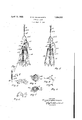
- Fig. 2 is bait
- Fig. 3 is a central vertical section through an element showing the same before the bait is completed;
- Fig. 4 is an inverted plan view of said element showing the same before the same is completed;
- Fig. 5 is used;
- Fig. 6 is a central vertical section through the cup shaped member with the guide means secured thereto;
- Fig. 7 is 9. pers ective view of the cup shaped member an guide member, showing the same as they are placed in their final orm;
- FIG. 8 is avertical section taken on line 88 of Fig. 5;
- a plan view of the guide member Fig. 9 is a central vertical section at the a central vertical section of the head or small ball 13 has a diametral opening through which shank 10 passes, said head resting on top of the helix 12.
- a member 14 has an opening at its top through which the shank 10 passes, said member 14 resting on bead 13 so as to be easily rotatable thereon about said shank.
- Member 14 is of inverted cup shape or of semi-elipsoidal shape. Member 14 has openings 14a formed in the sides thereof, and
- Tongues 14? are struck or punched from the sides of member 14.
- Tongues 14?) are of substantially triangular shape, having points at their free ends, and these points 1 c are bent inwardly substantially at a right angle as shown in Fi s. 3, 4 and 7
- the lugs 14b are bent outwar ly and downwardly against the lower annular portion of member 14 and the upper ends of tabs or streamers 15 are secured between said tongues and the lower portion of member 14, the points 140 piercing these tabs or streamers.
- member 14 comprises a lower annular portion with circumferentially spaced arms extending upwardly and inwardly therefrom, connected at their upper ends by means pierced by the shank 10.
- the tabs or streamers 15 are somewhat fish shape, as shown in Figs. 1 and 2, having diverging tapering portions at their lower ends.
- the members 15 are formed of some easily flexible material, and while various materials may be used for this purpose, in practice the bait has been made with tabs or streamers of red and white flannel or felt.
- the member 14 has a guide ring 16 for shank 10, and member 12 secured therein, the same being shown as disposed substantially at the lower ed e of member 14.
- Member 16 as shown inTigs. 5 and 8 has a central ring portion and arm 16a at each side thereof, the ends of which are bent at right angles and secured to member 14 by soldering or welding.
- An other ball or head 17 is pierced by the shank 10 and disposed above member 14.
- An arm 18a is pierced by the shank 10-and rests on the ball 17 said arm being soldered or otherwise suitably secured to the inner side of -a spoon member 18 which extends downwardly and outwardly at one side of the shank 10.
- the spoon 18 is connected to a rounded conical member 186, the same being shown as integral with s con 18.
- Member 186 is substantially cylindrical at its lower side, and the edge is scalloped as shown in Figs. 1 and 2.
- the shank 10 passes through the top portion of member 186, and a hole through said member, and the hole through arm 18a are so arranged that conical member 18?) is eccentrically disposed on shank 10, or in other words, is more at one side of said shank than rear 0 applicants the other.
- the hook device shown as a triple hook 19, is swingingly mounted in the loop 10?) at the lower end of shank 10.
- the bait will be drawn throu h the water by the line attached to the swivel 1.
- the action of the water on spoon 18 causes the same to revolve with the cone 18b.
- This gyration gives the agpearance of lateral vibration, or side to si e movement due to the fact that member 18b is wider at one side than the other, which adds'greatly to the lure of the bait.
- the rotation about shank 10 is uneven.
- the cone 18b acts to deflect weeds and grass and thus to form a path therethrou h for the bait.
- the water passes over mem r 14 and will pass through the openings 14a and through the inside of said member between the streamers 15.
- the streamers 15 are vibrated or fluttered in the water as the bait is drawn therethrou h, and member 14 can rotate on the shank 10 1f there is any tendency for it to rotate.
- the hook 19 moves in the g or below the member 14 and between the streamers 15. The hook is thus largely obscured as the bait is in operation, and when the fish strikes at the streamers 15, he is practically sure to be caught on the hook.
- the member 18 can be moved upwardly on shank 10, together with members 17 14 and 13 so that spoon 12 can'be moved oli of the end of shank 10 and the hook 19 released from loop 10b.
- a single hook can be substituted for the hook 19 and the bait used as a June bug spinner, or as a bait spoon. A minnow or frog would be placed on the single hook.
- An artificial fish bait having in combination, a shank, a conical member eccentrically supported for rotation on said shank,
- An artificial fish bait having in combinatlon, a conical member, a spoon carried nally of said conical member at one side of said conical member, a member secured to said spoon through which said shank passes, said shank passing longitudiat one side of the axis thereof.
- An artificial fish bait having in combination, an annular member having an opening of comparatively large area adjacent its periphery through which water can freely pass, and a plurality of flexible tabs or streamers secured in circumferential relation to and depending from said member, between which water passes through said annular member to hold said streamers in separated position and a hook device below said annular member.
- An artificial fish bait having in combination, a shank,'a member of substantially semi-ellipsoidal form mounted substantially axially on said shank, circumferentially spaced openings in the sides of said member, and a plurality of flexible tabs or streamers secured to the lower portion' of said member and depending therefrom, and a hook device supported by said shank.
- An artificial fish bait having in combination, a shank, an inverted cup shaped member mounted substantially axially on said rod, the same having lugs struck up from its sides, and a plurality of tabs or streamers secured to said member, said lu being bent to clamp said tabs or streamers etween the same and said member.
- An artificial fish having in combination, a shank, an inverted cup shaped member through the top of which said shank passes sai member-havingcircumferentially spaced openings through its sides and having 1n ta secured at its edge a plurality. of circumfer entially arranged tabs or streamers secured to the lower portion of said member and depending therefrom, and a hook device carried by said shank below said member.
- An artificial fish bait having in combination, a shank having an eye at its lower end, a hook device swingingly mounted in said eye, a sleeve member encircling said shank above said eye, a bead on said shank supported by said sleeve, an inverted hollow cup shaped member mounted on said shank and supportedv on said bead, streamers carried by the lower edge of said cup shaped member, said cup-shaped member having comparatively large openings in its sides through which water may pass to the inner side of said streamers, and means for securing a line at the top of said shank.
- An artificial fish bait having in combination, a shank, an annular member surrounding said shank, circumferenti'ally spaced arms extending upwardly from said member, means to which the upper ends of said arms are connected, and through which said shank passes, and streamers carried by said annular member.
- An artificial fish bait having in combination, a shank, a conical member having an aperture in its top through which said shank passes; a spoon extending downwardly and outwardly from one sideof said member and having an arm extendin inwardly with an aperture therein throng which said shank passes, said aperture being so disposed that said 'cone is eccentrically. mounted on said shank whereby rotation of said cone simulates a lateral vibration thereof.
- An artificial fish lure having in combination, an annular member, means extending from the periphery of said member upwardly and inwardly and formin a supporting means for said member, therebeing openin between said means for water to. ass free y through said annular member, a p iurali of tabs or streamers secured to and depen 'ng from said annular member, said tabs or streamers being maintained in separated connular member, means on which said annular member is supported, and a hook disposed ad acent said tabs.
Landscapes
- Life Sciences & Earth Sciences (AREA)
- Environmental Sciences (AREA)
- Marine Sciences & Fisheries (AREA)
- Animal Husbandry (AREA)
- Biodiversity & Conservation Biology (AREA)
Description
April 12, 1932. w. H. GRUENHAGEN JUNE BUG BAIT Filed Sept. 8, 1930 INVENTOR M fFI E/V/IAG-EIY Mun/v ATTORNEY Patented Apr. 12,1932
PATENT orrlcr.
wnmmu a. (monument, or s'r. rum. ammo ma nue'nm y Application fled se amb'eia 1980. Serial 1 0 mm.
This invention relates to a bait, and par! ticularly to an artificial fish bait. It is desirable, in a bait or lure, to have means simulating a live minnow, and for this purpose, various colors are used on artificial baits, the most commonly used combination being red and white. It is desirable, also, to have means for causing a flash of light caused by a rotating member as the bait moves through the water. It is also desirable to have a bait which can be made at comparatively small expense, which is simple in construction; It is also a desideratum to have a hook'device used with the bait more or less concealed.
It is an object of this invention, therefore, to provide a bait or lure comprising a mem-i ber of general annular shape, from which depend or trail a plurality of circumferentially spaced flexible tabs or streamers, preferably of different color.
It is another object of the invention to pro vide a bait or lure having a shank with a spoon mounted thereon, constructed and arranged to gyrate rather than to rotate uniformly.
It is another object of the invention to provide a bait comprising a shank having a spoon device at its upper or further end, and an inverted cup shaped member below or in the rear of said spoon, said cup shaped member having a plurality of tabs or streamers secured thereto, together with a hook device carried between said tabs or streamers.
It is still another object of the invention to provide a bait or lure comprising an inverted cup shaped member to which tabs or streamers are applied, said member being of novel and eflicient construction.
It is further an object of the invention to provide a bait comprising a shank reversely bent to form an eye, and having a helix or wire spring embracingv the shank and the reversely bent portion thereof.
It is still another object of the invention to provide a bait or lure comprising a shank to whichthe line is attached, a spoon device rotatably mounted on said shank, an inverted hook device secured tosaid s ank and dis posed below said cup shaped member.
' These and other ob ects and advan of the invention will be fully set forth 1n the following description made in connection with the accompanying drawings, in which like reference characters refer to similar parts throughout the several views, and in which Fig. 1 is a view in side elevation of the bait;
. Fig. 2 is bait;
Fig. 3 is a central vertical section through an element showing the same before the bait is completed;
Fig. 4 is an inverted plan view of said element showing the same before the same is completed;
Fig. 5 is used;
Fig. 6 is a central vertical section through the cup shaped member with the guide means secured thereto;
Fig. 7 is 9. pers ective view of the cup shaped member an guide member, showing the same as they are placed in their final orm;
'Fig. 8 is avertical section taken on line 88 of Fig. 5; and
a plan view of the guide member Fig. 9 is a central vertical section at the a central vertical section of the head or small ball 13 has a diametral opening through which shank 10 passes, said head resting on top of the helix 12. A member 14 has an opening at its top through which the shank 10 passes, said member 14 resting on bead 13 so as to be easily rotatable thereon about said shank. Member 14 is of inverted cup shape or of semi-elipsoidal shape. Member 14 has openings 14a formed in the sides thereof, and
In operation the bait will be drawn throu h the water by the line attached to the swivel 1. The action of the water on spoon 18 causes the same to revolve with the cone 18b. Owing to the eccentric mounting of the cone 186, the same and the spring 18 gyrate around'the shank 10 instead of rotating uniformly. This gyration gives the agpearance of lateral vibration, or side to si e movement due to the fact that member 18b is wider at one side than the other, which adds'greatly to the lure of the bait. In other words, the rotation about shank 10 is uneven. The cone 18b acts to deflect weeds and grass and thus to form a path therethrou h for the bait. The water passes over mem r 14 and will pass through the openings 14a and through the inside of said member between the streamers 15. The streamers 15 are vibrated or fluttered in the water as the bait is drawn therethrou h, and member 14 can rotate on the shank 10 1f there is any tendency for it to rotate. The water passing through member 14'holds the streamers 15 substantially in the position shown in the Fi s. 1 and 2. The hook 19 moves in the g or below the member 14 and between the streamers 15. The hook is thus largely obscured as the bait is in operation, and when the fish strikes at the streamers 15, he is practically sure to be caught on the hook. The member 18 can be moved upwardly on shank 10, together with members 17 14 and 13 so that spoon 12 can'be moved oli of the end of shank 10 and the hook 19 released from loop 10b. A single hook can be substituted for the hook 19 and the bait used as a June bug spinner, or as a bait spoon. A minnow or frog would be placed on the single hook.
From the above description it is seen that applicant has provided a simple and efiicient bait or lure. The same can be made at comparatively small expense, and is also strong and durable. The same has been ampl demonstrated in actual practice and found to be very successful.
It will, of course, be understood that various changes may be made in the form, details, arrangement and proportions of the parts, without departing from the scope of invention, which, generally stated, consists in a device capable of 'ca ing out the objects above set forth, in e novel parts and combinations of parts disclosed and defined in the appended claims.
What is claimed is 1. An artificial fish bait having in combination, a shank, a conical member eccentrically supported for rotation on said shank,
a spoon carried at one side of said member,-
and a hook device supported on said shank. 2. An artificial fish bait having in combinatlon, a conical member, a spoon carried nally of said conical member at one side of said conical member, a member secured to said spoon through which said shank passes, said shank passing longitudiat one side of the axis thereof.
3. An artificial fish bait having in combination, an annular member having an opening of comparatively large area adjacent its periphery through which water can freely pass, and a plurality of flexible tabs or streamers secured in circumferential relation to and depending from said member, between which water passes through said annular member to hold said streamers in separated position and a hook device below said annular member.
4. Thestructure set forth in claim 3, a
- shank extending through said annular member, and a guide means for said shank carried by and enclosed by said annular member and spaced from the wall thereof, said hook device being swingingly secured to the end of said shank between said tabs or streamers.
5. An artificial fish bait having in combination, a shank,'a member of substantially semi-ellipsoidal form mounted substantially axially on said shank, circumferentially spaced openings in the sides of said member, and a plurality of flexible tabs or streamers secured to the lower portion' of said member and depending therefrom, and a hook device supported by said shank.
6. The structure set forth in claim 5, said tabs or streamers being secured respectively below each of said openings.
7. An artificial fish bait having in combination, a shank, an inverted cup shaped member mounted substantially axially on said rod, the same having lugs struck up from its sides, and a plurality of tabs or streamers secured to said member, said lu being bent to clamp said tabs or streamers etween the same and said member.
8. The structure set forth in claim 7, said lugs being pointed at their free ends and havthe bends thereof turned in slightly, said %s or streamers being ierced by said points. 9. An artificial fish ait having in combination, a shank, an inverted cup shaped member through the top of which said shank passes sai member-havingcircumferentially spaced openings through its sides and having 1n ta secured at its edge a plurality. of circumfer entially arranged tabs or streamers secured to the lower portion of said member and depending therefrom, and a hook device carried by said shank below said member.
10. An artificial fish bait having in combination, a shank having an eye at its lower end, a hook device swingingly mounted in said eye, a sleeve member encircling said shank above said eye, a bead on said shank supported by said sleeve, an inverted hollow cup shaped member mounted on said shank and supportedv on said bead, streamers carried by the lower edge of said cup shaped member, said cup-shaped member having comparatively large openings in its sides through which water may pass to the inner side of said streamers, and means for securing a line at the top of said shank.
11. The structure set forth in claim 10, and a .bead above and supported by said cupshaped member, a cone shaped member having a spoon extending outwardly and downwardly at one side having an inwardly extending arm through which said shank passes, supported on said last mentioned bead above said inverted cu' shaped member for rotation on said shan the lower end of said spoon beinggi'sposed at the side of said cup-shaped mem r.
12. An artificial fish bait having in combination, a shank, an annular member surrounding said shank, circumferenti'ally spaced arms extending upwardly from said member, means to which the upper ends of said arms are connected, and through which said shank passes, and streamers carried by said annular member. l 13. An artificial fish bait havin in combination, a ring, a shank passing su stantially axially through said ring, means carried by said ring above the same through which said shank passes and by which said ring is supported on said shank, and a plurality of arcumferentiall arranged flexible tabs depending from sai ring.
14. The structure set forth in claim 13, a guide means supported by said ring adjacent the center thereof embracing said shank and spaced from the wall of said rin 15. An artificial fish bait having in combination, a shank, a conical member having an aperture in its top through which said shank passes; a spoon extending downwardly and outwardly from one sideof said member and having an arm extendin inwardly with an aperture therein throng which said shank passes, said aperture being so disposed that said 'cone is eccentrically. mounted on said shank whereby rotation of said cone simulates a lateral vibration thereof.
7 16. An artificial fish lure having in combination, an annular member, means extending from the periphery of said member upwardly and inwardly and formin a supporting means for said member, therebeing openin between said means for water to. ass free y through said annular member, a p iurali of tabs or streamers secured to and depen 'ng from said annular member, said tabs or streamers being maintained in separated connular member, means on which said annular member is supported, and a hook disposed ad acent said tabs.
WILLIAM H. GRUENHAGEP'.
'dition by the water passing through said an-
Priority Applications (1)
| Application Number | Priority Date | Filing Date | Title |
|---|---|---|---|
| US480398A US1854027A (en) | 1930-09-08 | 1930-09-08 | June bug bait |
Applications Claiming Priority (1)
| Application Number | Priority Date | Filing Date | Title |
|---|---|---|---|
| US480398A US1854027A (en) | 1930-09-08 | 1930-09-08 | June bug bait |
Publications (1)
| Publication Number | Publication Date |
|---|---|
| US1854027A true US1854027A (en) | 1932-04-12 |
Family
ID=23907809
Family Applications (1)
| Application Number | Title | Priority Date | Filing Date |
|---|---|---|---|
| US480398A Expired - Lifetime US1854027A (en) | 1930-09-08 | 1930-09-08 | June bug bait |
Country Status (1)
| Country | Link |
|---|---|
| US (1) | US1854027A (en) |
Cited By (10)
| Publication number | Priority date | Publication date | Assignee | Title |
|---|---|---|---|---|
| US2559434A (en) * | 1948-10-02 | 1951-07-03 | Daniel F Hyland | Cutting guide for cutting fishing bait |
| US2780022A (en) * | 1955-05-09 | 1957-02-05 | Arntzen Arnt | Fish lures |
| US4736542A (en) * | 1986-10-16 | 1988-04-12 | Floyd John F | Scented fishing lure |
| US5950345A (en) * | 1998-03-25 | 1999-09-14 | Kilander; Holger | Streamer devices especially useful as fishing lures |
| US20050160658A1 (en) * | 2004-01-24 | 2005-07-28 | Andrzej Buczkowski | Fishing lure |
| US20050172536A1 (en) * | 2001-06-21 | 2005-08-11 | King Bobby D. | Flexible fishing lure tails and appendages |
| US20090133314A1 (en) * | 2007-11-26 | 2009-05-28 | Mayer James D | Blood-simulating fishing lure |
| US8397425B1 (en) * | 2010-11-24 | 2013-03-19 | Jason L. Alzamora | Fishing hook device |
| US20150047248A1 (en) * | 2013-08-14 | 2015-02-19 | Arc9, Llc. | Weed deflector and system for use with fishing hooks and lures |
| US20150264903A1 (en) * | 2014-03-24 | 2015-09-24 | George P. Korteweg | Self-designed fishing lure |
-
1930
- 1930-09-08 US US480398A patent/US1854027A/en not_active Expired - Lifetime
Cited By (14)
| Publication number | Priority date | Publication date | Assignee | Title |
|---|---|---|---|---|
| US2559434A (en) * | 1948-10-02 | 1951-07-03 | Daniel F Hyland | Cutting guide for cutting fishing bait |
| US2780022A (en) * | 1955-05-09 | 1957-02-05 | Arntzen Arnt | Fish lures |
| US4736542A (en) * | 1986-10-16 | 1988-04-12 | Floyd John F | Scented fishing lure |
| US5950345A (en) * | 1998-03-25 | 1999-09-14 | Kilander; Holger | Streamer devices especially useful as fishing lures |
| US7080476B2 (en) * | 2001-06-21 | 2006-07-25 | King Bobby D | Flexible fishing lure tails and appendages |
| US20050172536A1 (en) * | 2001-06-21 | 2005-08-11 | King Bobby D. | Flexible fishing lure tails and appendages |
| US20050160658A1 (en) * | 2004-01-24 | 2005-07-28 | Andrzej Buczkowski | Fishing lure |
| US20090133314A1 (en) * | 2007-11-26 | 2009-05-28 | Mayer James D | Blood-simulating fishing lure |
| US8091271B2 (en) * | 2007-11-26 | 2012-01-10 | Mayer James D | Blood-simulating fishing lure |
| US20120079758A1 (en) * | 2007-11-26 | 2012-04-05 | Mayer James D | Blood simulating add-on for fishing lures |
| US8458950B2 (en) * | 2007-11-26 | 2013-06-11 | James D. Mayer | Blood simulating add-on for fishing lures |
| US8397425B1 (en) * | 2010-11-24 | 2013-03-19 | Jason L. Alzamora | Fishing hook device |
| US20150047248A1 (en) * | 2013-08-14 | 2015-02-19 | Arc9, Llc. | Weed deflector and system for use with fishing hooks and lures |
| US20150264903A1 (en) * | 2014-03-24 | 2015-09-24 | George P. Korteweg | Self-designed fishing lure |
Similar Documents
| Publication | Publication Date | Title |
|---|---|---|
| US2229239A (en) | Fishing plug | |
| US1768033A (en) | Weed guard for fishing lines | |
| US2493431A (en) | Fish lure | |
| CA2046926C (en) | Tandem double offset fishhook | |
| JP2017518773A (en) | Simulated bait system | |
| US1888641A (en) | Artificial fish bait | |
| US4914852A (en) | Tandem double offset fishhook | |
| US1842127A (en) | Fish lure | |
| US20170042134A1 (en) | Fishing Lure | |
| US2223922A (en) | Spreader | |
| US2576795A (en) | Fishhook | |
| US2281809A (en) | Fish lure | |
| US1364949A (en) | Flycatcher | |
| US261194A (en) | wylly | |
| US9339019B2 (en) | Fishing lure device | |
| US1934158A (en) | Fish lure | |
| US2473564A (en) | Weedless fishhook | |
| US1033281A (en) | Fishing-tackle. | |
| US2277350A (en) | Fishing lure | |
| US2180822A (en) | Fishing bait | |
| US4885866A (en) | Spoon and mount | |
| US1304397A (en) | Insect-trap | |
| US2007496A (en) | Floral spray display cross | |
| US1689027A (en) | Fish bait | |
| US1601267A (en) | Fish bait |