US1853390A - Low temperature dispensing container - Google Patents
Low temperature dispensing container Download PDFInfo
- Publication number
- US1853390A US1853390A US262443A US26244328A US1853390A US 1853390 A US1853390 A US 1853390A US 262443 A US262443 A US 262443A US 26244328 A US26244328 A US 26244328A US 1853390 A US1853390 A US 1853390A
- Authority
- US
- United States
- Prior art keywords
- low temperature
- dispensing container
- container
- jar
- temperature dispensing
- Prior art date
- Legal status (The legal status is an assumption and is not a legal conclusion. Google has not performed a legal analysis and makes no representation as to the accuracy of the status listed.)
- Expired - Lifetime
Links
Images
Classifications
-
- F—MECHANICAL ENGINEERING; LIGHTING; HEATING; WEAPONS; BLASTING
- F25—REFRIGERATION OR COOLING; COMBINED HEATING AND REFRIGERATION SYSTEMS; HEAT PUMP SYSTEMS; MANUFACTURE OR STORAGE OF ICE; LIQUEFACTION SOLIDIFICATION OF GASES
- F25D—REFRIGERATORS; COLD ROOMS; ICE-BOXES; COOLING OR FREEZING APPARATUS NOT OTHERWISE PROVIDED FOR
- F25D3/00—Devices using other cold materials; Devices using cold-storage bodies
- F25D3/12—Devices using other cold materials; Devices using cold-storage bodies using solidified gases, e.g. carbon-dioxide snow
- F25D3/14—Devices using other cold materials; Devices using cold-storage bodies using solidified gases, e.g. carbon-dioxide snow portable, i.e. adapted to be carried personally
-
- F—MECHANICAL ENGINEERING; LIGHTING; HEATING; WEAPONS; BLASTING
- F25—REFRIGERATION OR COOLING; COMBINED HEATING AND REFRIGERATION SYSTEMS; HEAT PUMP SYSTEMS; MANUFACTURE OR STORAGE OF ICE; LIQUEFACTION SOLIDIFICATION OF GASES
- F25D—REFRIGERATORS; COLD ROOMS; ICE-BOXES; COOLING OR FREEZING APPARATUS NOT OTHERWISE PROVIDED FOR
- F25D2303/00—Details of devices using other cold materials; Details of devices using cold-storage bodies
- F25D2303/08—Devices using cold storage material, i.e. ice or other freezable liquid
- F25D2303/084—Position of the cold storage material in relationship to a product to be cooled
- F25D2303/0844—Position of the cold storage material in relationship to a product to be cooled above the product
Definitions
- My present invention relates to containers and more particularly those intended to dispense articles which must be kept at temperatures below room temperature.
- My present invention contemplates a container or receptacle ofthe same general character as the broad mouthed display jar used for countless commodities where the temperature made no difference.
- My jar while apparently of that simple type and i while operable with the same simplicity is in M fact an insulated ⁇ iar refrigerated by its stopper or closure which is in effect a refrigerating unit capable of maintaining the ar contents at a low temperature for a considerable 35 period of time.
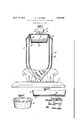
- FIG. 2 is a view of the stopper orclosure reioved from the refrigerating container', an y Fig. 3 ak section bottom fragment ofthe same showing by way of modiiicationaplurality of the permeable'discs. .4 1
- able porous material as for example, a porous natura-lor artificial stone, or a ycomposite disc of libre, or may -Ifind be made up of paper or cardboard discs.
- This is avery inexpensive way of effecting a predetermined penetration of the solidified carbon dioxide which I prefer to( use as theV refrigerant'in the chamber 4 and which I have indicated by the reference letter I.
- VI show a singlev disfcV in ⁇ Fig. l anda pair'of 'discs in FigQB.
- this member 4 could be made with 'an integralbottoin of permeable material which could be rendered more or less impermeable by coa-ting or otherwise and in some cases I wouldactually use such a combined container and closure. I find in practice, however, that the paperk disc principle is so simple,so inexpensive and ⁇ so sanitary actingfbothfpas a filter and an absorber that I giveit preference for ordinary purposes. Y
- the upper part of this chamber is closed by a detachable disc 5 having any suitable handle 51.
- the so-called dry ice or other refrigerant may be replaced in the stopper member 4 as required or an interchangeable stopper may be used to avoid any substantial cooling of the interior of the container2.
- a temperature within the container during the ispensing of an average content may be maintained at 22 F., the refrigerating medium lasting about 74 hours.
- the solidiiied carbon dioxide on account of its potential low temperatures requires very little space and the slight amount of moisture generated may be taken up by the disc D for Awhich purpose the very well.
- My container may be made of any desired material, as for example, metal, glass or composite, but glass ⁇ is preferable for many reasons, especially on accountJ of its transparency and its ductility.
- a low temperature counter display comprising an insulatedvwall vessel having an. open mouth, acombmation vessel closure and refrigerant holder comprising a hollow cupllkemember set Within the open mouth of the Vto contain a refrigerant, said holder having a displaceable cover and having a gas-permeable bottom of porous material.
- said holder having an annular side wall de-
Landscapes
- Engineering & Computer Science (AREA)
- Chemical & Material Sciences (AREA)
- Chemical Kinetics & Catalysis (AREA)
- Combustion & Propulsion (AREA)
- Physics & Mathematics (AREA)
- Mechanical Engineering (AREA)
- Thermal Sciences (AREA)
- General Engineering & Computer Science (AREA)
- Table Devices Or Equipment (AREA)
- Packages (AREA)
Description
April l2, 1932. G, R, WEBBER 1,853,390
LOW TEMPERATURE 'DISPENSING CONTAINER Filed March 17, 1928 .zifelaol' Golye Wbbel' y ttorlggy Patented Apr. 12, 1932 UNiTED *STATESv PATENT orifice@l f i,
GEORGE E. WEBBEE, oE AUGUSTA, MAINE, AssIGNoE 'ro POLAR VEND CORPORATION; Y Y 0E AUGUSTA, MAINE, A ooRPoRA'rIoN 0E MAINE Y 1 LOW TEMPERATURE DISPEN SING CONTAINER 'App'iication filed March 17, 1928. seriai'NaaeaMa.
My present invention relates to containers and more particularly those intended to dispense articles which must be kept at temperatures below room temperature.
In the merchandising of certain frozen or perishable articles much difficulty has been experienced in providing any convenient or inexpensive way of displaying the articles while at the same time protecting them from f store temperatures. The result has been that such articles have usually been inconveniently stored in refrigerators, ice boxes or kother low temperature containers which were relatively unaccessible to the store clerk and l5 being out ofk sight `of the prospective customer afforded him no purchasing urge. The display of such articles as on the counter or otherwise in plain sight of customers has long been recognizedV as desirable but except "fl in connection with rather elaborate refrigerated display devices tlie same has not been deemed possible.
My present invention contemplates a container or receptacle ofthe same general character as the broad mouthed display jar used for countless commodities where the temperature made no difference. My jar, however, while apparently of that simple type and i while operable with the same simplicity is in M fact an insulated `iar refrigerated by its stopper or closure which is in effect a refrigerating unit capable of maintaining the ar contents at a low temperature for a considerable 35 period of time.
As illustrative of my invention I have shown in the accompanying drawings a simple form by which the desired results may be attained which is inexpensive but capable m' of being produced in attractive form and which provides for that visible and intimate dislay which the old counter jar afforded with no hope of refrigerating protection. Throughout the specification and drawings #i5 like reference characters are employed to indicate corresponding parts, and in the `drawings: v
50 Fig. 2 is a view of the stopper orclosure reioved from the refrigerating container', an y Fig. 3 ak section bottom fragment ofthe same showing by way of modiiicationaplurality of the permeable'discs. .4 1
In tlie'drawings I have indicatedpat l :the base on which is supportedin any desired manner a container 2 formed with 'double walls and an annular space 21 from which the air maybe exhausted so. that it isin effect an inverted vacuum bell or what might be called an open mouth jar.. About the mouth ofthis 'jar is an insulating ringB intowhich fits a stopper or closure. This stopper coinprises a depending tapered member 4 adapted to be supported within the liipt'urned mouth of tliecontainer Q'and having abottom flange 41'on whichk rests one or more permeable cio discs D. These'discs D may be of any suit.- t
able porous material, as for example, a porous natura-lor artificial stone, or a ycomposite disc of libre, or may -Ifind be made up of paper or cardboard discs. This is avery inexpensive way of effecting a predetermined penetration of the solidified carbon dioxide which I prefer to( use as theV refrigerant'in the chamber 4 and which I have indicated by the reference letter I. VI show a singlev disfcV in `Fig. l anda pair'of 'discs in FigQB. By
increasing orl decreasing the vnumber of these discs. or by substituting discs of different thickness,.the rate of escape of the carbon dioxide isregulated to suit the contents and Y the .local conditions and the season. vOff course, this member 4 could be made with 'an integralbottoin of permeable material which could be rendered more or less impermeable by coa-ting or otherwise and in some cases I wouldactually use such a combined container and closure. I find in practice, however, that the paperk disc principle is so simple,so inexpensive and` so sanitary actingfbothfpas a filter and an absorber that I giveit preference for ordinary purposes. Y
The upper part of this chamber is closed by a detachable disc 5 having any suitable handle 51. vThe handle 51 and the supporting element-s llare merely shown Ain decorative Y ratherthan purely mechanical form merely to illustrate they potential eifectivenessl of such a device as a sa-les factor. The so-called dry ice or other refrigerant may be replaced in the stopper member 4 as required or an interchangeable stopper may be used to avoid any substantial cooling of the interior of the container2. On account of the insulating values of the container 2 it is found that a temperature within the container during the ispensing of an average content may be maintained at 22 F., the refrigerating medium lasting about 74 hours. The solidiiied carbon dioxide on account of its potential low temperatures requires very little space and the slight amount of moisture generated may be taken up by the disc D for Awhich purpose the very well. A
My container may be made of any desired material, as for example, metal, glass or composite, but glass `is preferable for many reasons, especially on accountJ of its transparency and its ductility.
, Inasmuch as vacuum containers are of somewhat delicate character and somewhat paper. above described serves susceptible to jar and impact, I provide a Y tothe outside of kthe j ar and -allowed to dry withy a shrinkinor effect resulting from the evaporation ofits solvent. In this way I am able to puta transparent skin or coating on the outside of the jar which by reason of its tight fit and coherence holds or forces inward all articles of glass that might otherwise be reed inv case the jar is shattered. While these jars do not in practice suffer more breakage than the ordinary jar, this protective feature is highly important as it is a safety factor making possible the use of theser vacuum bells of relatively inexpensive structure which otherwise might require a much more expensive factor of stability.
While I have shown a device of Ysimple and inexpensive form it has proven to be a very practical and inexpensive device with a relatively high sales efficiency. It is of course capableA of an infinite variety of design and ornamentation and may be variously constructed in accordance with vmy invention as defined by my claims.
What therefore claim and desire to secure by Letters Patent is: Y
l. A low temperature counter display comprising an insulatedvwall vessel having an. open mouth, acombmation vessel closure and refrigerant holder comprising a hollow cupllkemember set Within the open mouth of the Vto contain a refrigerant, said holder having a displaceable cover and having a gas-permeable bottom of porous material.
In testimony whereof I aiiix my signature.
GEORGE R. WEBBER.
vessel and adapted to contain a refrigerant,
said holder having an annular side wall de-
Priority Applications (1)
| Application Number | Priority Date | Filing Date | Title |
|---|---|---|---|
| US262443A US1853390A (en) | 1928-03-17 | 1928-03-17 | Low temperature dispensing container |
Applications Claiming Priority (1)
| Application Number | Priority Date | Filing Date | Title |
|---|---|---|---|
| US262443A US1853390A (en) | 1928-03-17 | 1928-03-17 | Low temperature dispensing container |
Publications (1)
| Publication Number | Publication Date |
|---|---|
| US1853390A true US1853390A (en) | 1932-04-12 |
Family
ID=22997533
Family Applications (1)
| Application Number | Title | Priority Date | Filing Date |
|---|---|---|---|
| US262443A Expired - Lifetime US1853390A (en) | 1928-03-17 | 1928-03-17 | Low temperature dispensing container |
Country Status (1)
| Country | Link |
|---|---|
| US (1) | US1853390A (en) |
Cited By (2)
| Publication number | Priority date | Publication date | Assignee | Title |
|---|---|---|---|---|
| US2501905A (en) * | 1947-08-13 | 1950-03-28 | Leathers Ward | Individual drink refrigerator |
| WO2018002826A1 (en) * | 2016-06-28 | 2018-01-04 | Dryce S.R.L. | Isothermal container |
-
1928
- 1928-03-17 US US262443A patent/US1853390A/en not_active Expired - Lifetime
Cited By (2)
| Publication number | Priority date | Publication date | Assignee | Title |
|---|---|---|---|---|
| US2501905A (en) * | 1947-08-13 | 1950-03-28 | Leathers Ward | Individual drink refrigerator |
| WO2018002826A1 (en) * | 2016-06-28 | 2018-01-04 | Dryce S.R.L. | Isothermal container |
Similar Documents
| Publication | Publication Date | Title |
|---|---|---|
| US662541A (en) | Refrigerating article. | |
| US2000419A (en) | Advertising condiment shaker | |
| US3243068A (en) | Food container | |
| US2162162A (en) | Quick freezing ice tray | |
| US2606586A (en) | Container | |
| US1939824A (en) | Easel box | |
| ES2083276T3 (en) | TRAY-CONTAINER FOR FOOD PRODUCTS CONTAINING LIQUIDS SUCH AS MEAT. | |
| US653211A (en) | Box for spool goods. | |
| US2187559A (en) | Container | |
| US1864040A (en) | Container | |
| US1313865A (en) | Counter display case and cabinet | |
| US701401A (en) | Combined packing and displaying box. | |
| US2303724A (en) | Refrigerating device | |
| US1245203A (en) | Show-case. | |
| US1832473A (en) | Refrigerating device | |
| US558432A (en) | Leopold sonn | |
| US384062A (en) | Eugene a | |
| US751137A (en) | Display-case | |
| US1556866A (en) | Advertising novelty | |
| US1411475A (en) | Container | |
| US1028289A (en) | Container for small articles. | |
| US1654828A (en) | Eskimo-pie cabinet | |
| US1778408A (en) | Vacuum jar protective device | |
| US2083093A (en) | Showcase | |
| US672995A (en) | Display-jar. |