US185131A - Improvement in steam-cars - Google Patents
Improvement in steam-cars Download PDFInfo
- Publication number
- US185131A US185131A US185131DA US185131A US 185131 A US185131 A US 185131A US 185131D A US185131D A US 185131DA US 185131 A US185131 A US 185131A
- Authority
- US
- United States
- Prior art keywords
- car
- engine
- casing
- truck
- boiler
- Prior art date
- Legal status (The legal status is an assumption and is not a legal conclusion. Google has not performed a legal analysis and makes no representation as to the accuracy of the status listed.)
- Expired - Lifetime
Links
Images
Classifications
-
- B—PERFORMING OPERATIONS; TRANSPORTING
- B61—RAILWAYS
- B61C—LOCOMOTIVES; MOTOR RAILCARS
- B61C5/00—Locomotives or motor railcars with IC engines or gas turbines
Definitions
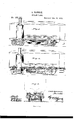
- Figure l is a side elevation of a car embodying my improvements; Fig. 2, an axial seetion, and Fig. 3, a cross-section on the line a: a: of Fig. 2.
- the drawing represents a six-wheeled car, wherein a boiler, A, is suspended over the forward truck, consisting of four wheels.
- the king-bolt B is located well forward of the center of the truck for two reasons rst, to permit the boiler or its ash-pan to extend down below the level of the car-door and, second, in case of derailment, to cause the truck to be drawn along rather than pushed. This latter feature is very important as a safeguard against accidents in a class of cars so liable to leave the track.
- a boiler A
- the drawing represents a six-wheeled car, wherein a boiler, A, is suspended over the forward truck, consisting of four wheels.
- the king-bolt B is located well forward of the center of the truck for two reasons rst, to permit the boiler or its ash-pan to extend down below the level of the car-door and, second, in case of derailment, to cause the truck to be drawn along rather than pushed. This latter feature is very important as a safeguard
- said truck upon leaving the track has a tend ⁇ ency to twist or turn out of line withthe axis of the car, and thus cause the car to be overturned.
- the king-bolt passes through the front boiler-transom, making it the bolster for the forward end of the car, and through the thwart D upon the ⁇ truck, which is directly beneath, and supports, the transom or bolster, and the boiler attached to it, by the bearing b.
- the back boiler-transom E may be supported by a heavy spring resting upon the truck-frame.
- the boiler which is the most awkward burden to dispose of in designing a steam streetcar, is carried easily and securely by a truck whose center is but little removed from the axis of said boiler, and may, if desired, be made to coincide or fall in the same line.
- the boiler is shown as having a peculiar ash-pan, for which I propose hereafter to apply for Letters Patent covering the same.
- the engine as indicated in Figs. 2 and 3, is located beneath the body of the car, and is intended to be constructed substantially as set forth in a previous application for patent.
- the cylinder end of said engine is supported by a bail, w, similar to that shown in said application 5 and the second feature of my present invention has relation to the manner of suspending said bail from the car-frame,
- a bar, F sufficiently -large and strong for the purpose, in the axis
- This bar may be attached to, or
- the transoms rested upon, the transoms in any suitable way, preferably by providing sockets or seats for the ends thereof, and upon this the bail fw is swung.
- This arrangement aords an effective means of suspending the cylinder end of the engine, and one convenient and desirable for adjusting or loosening said bail.
- a casing constructed substantially as follows: rllhe two'parts L and M are attached to each other by tianges c d ef, which receive suitable removable bolts, or in any equivalent manner, it being only necessary that the lower section M be capable of being easily detached from the upper section L.
- the side bars K of the engine-frame extend beyond the line ofthe end of the casing, and upon these the back end ot' said casing rest-s. rlhe forward end is supported upon the same bars, but by means of a lug, g, upon the interior of the casing, or equivalent means.
- Suitable dust-tight doors O O cover the engine, and forni a portion or the whole of' the car-Hoor, thus affording access to the working parts from above.
- the casing being attached to the engine-frame will necessarily vibrate with the same, and a liexible dust-tight joint between it and some portion of the car above will be essential.
- cloth or canvas is believed to be most desirable, and, accordingly, I place a strip of this material between the casing and the car. (Shown in the drawing at r.) This strip 1 ⁇ is shown as attached to the doors O 0; but it is obvious that this particular location is more a matter of convenience than an essential feature ofthe invention.
- the casing shall be made ⁇ of4 metal, but woodwill answer thel purpose, and vthe flexibleiportion 'may be of leather, as' well as of cloth or canvas.
- the necessary connections vbetween the boiler and the engine are passed through suitable openings in the casing.
- a lexible joint attached to said casing and to some portion o't' the bottom of the' car, as and for the purposes explained.
Landscapes
- Engineering & Computer Science (AREA)
- Transportation (AREA)
- Mechanical Engineering (AREA)
- Body Structure For Vehicles (AREA)
Description
L. RANsoM.
STEAM CARS.
Patented Dec.5, 1876.
'l my.
THE GRAPH IC CD, Nk.
LOUIS RANSOM, OF STRATFORD, NEW YORK.
IMPROVEMENT IN STEAM-CARS.
Specification forming part of Letters Patent No. 185, E3B., dated December 5, 1876; applicationliled November l, 1876.
To all whom it may concern Be it known that I, LOUIS RANSOM, of Stratford, county of Fulton, and State of New York, have invented certain new and useful Improvements in Steam-Cars, of which the fol lowing is a full, clear, and exact description, reference being had to the accompanyin g drawing, and to the letters of reference marked thereon.
Figure lis a side elevation of a car embodying my improvements; Fig. 2, an axial seetion, and Fig. 3, a cross-section on the line a: a: of Fig. 2.
Like letters of reference in all the figures refer to corresponding parts.
ties of construction and arrangements of parts,
to be hereinafter fully described, and then pointed out in the claims.
The drawing represents a six-wheeled car, wherein a boiler, A, is suspended over the forward truck, consisting of four wheels. The king-bolt B is located well forward of the center of the truck for two reasons rst, to permit the boiler or its ash-pan to extend down below the level of the car-door and, second, in case of derailment, to cause the truck to be drawn along rather than pushed. This latter feature is very important as a safeguard against accidents in a class of cars so liable to leave the track. As ordinarilyT constructed, with the king-bolt in the center of the t-ruck,
said truck upon leaving the track has a tend` ency to twist or turn out of line withthe axis of the car, and thus cause the car to be overturned.
In the present instance the king-bolt passes through the front boiler-transom, making it the bolster for the forward end of the car, and through the thwart D upon the` truck, which is directly beneath, and supports, the transom or bolster, and the boiler attached to it, by the bearing b. The back boiler-transom E may be supported by a heavy spring resting upon the truck-frame.
The boiler, which is the most awkward burden to dispose of in designing a steam streetcar, is carried easily and securely by a truck whose center is but little removed from the axis of said boiler, and may, if desired, be made to coincide or fall in the same line.
I am aware of certain car-trucks, particularly those invented by Walter Youmans, wherein the king-bolt is located forward of the truck-center as part of an arrangement by which the axles are cramped to a position radial with the curve they are describing, and it may be placed for this purpose indifferently before or behind the center; but I am aware of no truck in which the king-bolt is located forward of the center, as in my invention, for the purpose of keeping the truck in position in the event of derailment, and of supporting the boiler in the strong and secure way described above, where the boiler-weight falls directly upon the truck instead of being transferred to said truck from the car-frame.
The boiler is shown as having a peculiar ash-pan, for which I propose hereafter to apply for Letters Patent covering the same.
The engine, as indicated in Figs. 2 and 3, is located beneath the body of the car, and is intended to be constructed substantially as set forth in a previous application for patent. The cylinder end of said engine is supported by a bail, w, similar to that shown in said application 5 and the second feature of my present invention has relation to the manner of suspending said bail from the car-frame, Between the rear boiler-transom E and a similar transom, Gr, located at a convenient distance therefrom, I suspend a bar, F, sufficiently -large and strong for the purpose, in the axis This bar may be attached to, or
of the car. rested upon, the transoms in any suitable way, preferably by providing sockets or seats for the ends thereof, and upon this the bail fw is swung.
This arrangement aords an effective means of suspending the cylinder end of the engine, and one convenient and desirable for adjusting or loosening said bail.
The engine being suspended beneath the car, it is of the utmost importance that it should be thoroughly incased to prevent dust and dirt from interfering with and cutting out the working parts and this easing should be substantial and durable, and possess certain features of removability andconvenience, which are the objects of the third .feature `of my invention.
I am fully aware of previous attempts to ex. clude dust, Ste., from engines in situations similar to mine. These, in my opinion, have failed to accomplish the necessary-and desirable ends, mainly from the fact that they have been made rather as housings thanV casings, which necessitated a bungling and inconvenient protector, and added considerably to-theexpense of constructing the car. These housings, have never, to my knowledge, more than partially covered the engine, leaving more or less ot' it exposed to dust and dirt.
I propose to overcome these objections, and secure the desired advantages, by use of a casing constructed substantially as follows: rllhe two'parts L and M are attached to each other by tianges c d ef, which receive suitable removable bolts, or in any equivalent manner, it being only necessary that the lower section M be capable of being easily detached from the upper section L. The side bars K of the engine-frame extend beyond the line ofthe end of the casing, and upon these the back end ot' said casing rest-s. rlhe forward end is supported upon the same bars, but by means of a lug, g, upon the interior of the casing, or equivalent means.
From this construction it will be observed that the casing is bodily supported by the engine-frame, and that its two sections are separable from each other and easily removed or detached (when necessary for cleaning or repairing) from said frame.
Suitable dust-tight doors O O cover the engine, and forni a portion or the whole of' the car-Hoor, thus affording access to the working parts from above. The casing being attached to the engine-frame will necessarily vibrate with the same, and a liexible dust-tight joint between it and some portion of the car above will be essential. For this purpose cloth or canvas is believed to be most desirable, and, accordingly, I place a strip of this material between the casing and the car. (Shown in the drawing at r.) This strip 1^ is shown as attached to the doors O 0; but it is obvious that this particular location is more a matter of convenience than an essential feature ofthe invention.
I prefer that the casing shall be made `of4 metal, but woodwill answer thel purpose, and vthe flexibleiportion 'may be of leather, as' well as of cloth or canvas. The necessary connections vbetween the boiler and the engine are passed through suitable openings in the casing.
When constructed in a thorough and workmanlike manner, and substantially as above indicated, the dust-casing, it is believed, will be found to be cheap, el'ective, and convenient, and will obviate the heretofore serious -objections urged against this class of cars on account of the liability to which their machinery is exposed to be damaged by dust and dirt. Having now fully described my invention, what I claim as new, and desire to secure by Letters Patent, is
1. In a steam-car, the combination, with the forward truck thereof, ot' the front and rear boiler-transoms B and E, carrying a steamtially in the manner explained.
2. In combination with a bail which supports the cylinder end of an engine located beneath a car, a bar, F, resting upon the two transoms E and G, substantially as set forth.
3. The combination, with an engine located beneath the body o'f a car, ot' a dust-tight casing supported upon and movable with said engine, substantially as described.
4. The dust-tight doors O O, in the bottom of a car, combined with a dust-casing for an engine below, for the purpose of excluding dust and affording access to the engine, as set forth.
5. In combination with a dust-casing for an engine located beneath a car, a lexible joint attached to said casing and to some portion o't' the bottom of the' car, as and for the purposes explained.
6. The combination ot' the two sections L and M, the flexible joint r, and the doors 0 O, forming a dust-casing for an engine, the whole being constructed and arranged substantially as shown and described. y
In testimony that I claim the foregoing I have hereunto set my hand in the presence of two witnesses.
LOUIS ltANSOM.
Witnesses GEO. A. WATERS,
GEO. CUsHINe, J r.
boiler and connected`with said truck, substan-
Publications (1)
| Publication Number | Publication Date |
|---|---|
| US185131A true US185131A (en) | 1876-12-05 |
Family
ID=2254536
Family Applications (1)
| Application Number | Title | Priority Date | Filing Date |
|---|---|---|---|
| US185131D Expired - Lifetime US185131A (en) | Improvement in steam-cars |
Country Status (1)
| Country | Link |
|---|---|
| US (1) | US185131A (en) |
Cited By (1)
| Publication number | Priority date | Publication date | Assignee | Title |
|---|---|---|---|---|
| US20090161042A1 (en) * | 2005-06-10 | 2009-06-25 | Iichiro Inoue | Display element and display device |
-
0
- US US185131D patent/US185131A/en not_active Expired - Lifetime
Cited By (1)
| Publication number | Priority date | Publication date | Assignee | Title |
|---|---|---|---|---|
| US20090161042A1 (en) * | 2005-06-10 | 2009-06-25 | Iichiro Inoue | Display element and display device |
Similar Documents
| Publication | Publication Date | Title |
|---|---|---|
| US1095017A (en) | Fender. | |
| US1377700A (en) | Side frame and journal-box | |
| US296809A (en) | Railway-car cover | |
| US556382A (en) | Street-car bridge for protection of fire-hose | |
| US241104A (en) | Gar-truck | |
| US638442A (en) | Street-car-truck fender. | |
| US364008A (en) | Caleb e | |
| US1306685A (en) | Supporting frame for motor trucks | |
| US496144A (en) | Henry b | |
| US400545A (en) | Axle-box for locomotives | |
| US319643A (en) | James timms | |
| US401068A (en) | Island | |
| US773048A (en) | Trolley-wheel. | |
| US560780A (en) | Freight-car truck | |
| US136248A (en) | Improvement in railway-car trucks | |
| US194213A (en) | Improvement in car-axle boxes | |
| US561457A (en) | Axle-box | |
| US1179798A (en) | Car-truck. | |
| US330372A (en) | Sumnee a | |
| US476480A (en) | Motor-truck for cars | |
| US247236A (en) | Car-axle box | |
| US299484A (en) | laezelere | |
| US995949A (en) | Truck side frame. | |
| US625745A (en) | Passenger-car truck | |
| US504541A (en) | Tramway-locomotive |