BACKGROUND
Field
The present invention relates to the fields of chemistry and medicine. More particularly, the present invention relates to MEK inhibitors, techniques for designing and synthesizing such MEK inhibitors, compositions comprising MEK inhibitors, and methods of treating disease comprising administering MEK inhibitors.
Description of the Related Technology
Cancer is among the most common causes of death in the United States. In the United States, cancer has accounted for approximately one of every four deaths. The 5-year relative survival rate for cancer patients diagnosed in 1996-2003 is approximately two-thirds, up from about one half in 1975-1977 (Cancer Facts & Figures, American Cancer Society: Atlanta, Ga. (2008)). The rate of new cancer cases decreased by an average 0.6% per year among men between 2000 and 2009, but stayed the same for women. From 2000 through 2009, death rates from all cancers combined decreased on average 1.8% per year among men and 1.4% per year among women. This improvement in survival reflects progress in diagnosing at an earlier stage as well as improvements in treatment, for which there remain a need. Discovering highly effective anticancer agents with low toxicity is a primary goal of cancer research.
Furthermore, cancer-related cachexia is a debilitating condition associated with loss of muscle mass, fatigue, weakness, and loss of appetite in cancer patients. Cachexia is also associated with severe clinical consequences including muscle weakness which can result in ambulation difficulties, and pulmonary complications. Cachexia is a significant contributing factor in the death of cancer patients.
Cachexia has been characterized, in part, by depletion of skeletal muscle mass that is not reversed by conventional nutritional support, leading to pronounced weight loss that severely impacts patient morbidity and mortality. Cachexia has been identified in more than 80% of patients with gastric, pancreatic, and esophageal cancer; approximately 70% of those with head and neck cancer; and approximately 60% of patients with lung, colorectal, and prostate cancer. See, Muscle (2012) 3, 245-51. Despite the impact of cachexia on mortality among cancer patients, effective therapies have not been developed to prevent or impede the progression of cachexia. For example, more than 85% of pancreatic cancer patients, including early stage patients, are estimated to lose an average of 14% of their pre-illness weight. See, BMC Cancer, 2010 Jul. 8; 10:363. Cachectic pancreatic cancer patients are often weak and fatigued, and have a lower tolerance to therapy and more adverse outcomes to surgery. Consequently, cachexia is the main driver for mortality in pancreas cancer. Unfortunately, the 5-year survival rate for pancreatic cancer has not exceeded 6% for the last four decades, which is the lowest survival rate among all malignancies.
Substantial efforts have been invested in designing a treatment for the cachectic syndrome, but unfortunately there is no single, fully satisfactory treatment for reversing weight loss associated with cancer cachexia. The development of different therapeutic strategies has focused on two targets: counteracting anorexia and neutralizing metabolic disturbances. However, providing complete nutritional requirements by way of total parenteral nutrition does not abrogate weight loss. Instead, many drugs have been proposed and used in clinical trials, while others are still under investigation using experimental animals in order to revert metabolic alterations. See, Toledo, et al. 2014 PloS One. In one study, Selumetinib, an MEK inhibitor, was found to promote muscle gain in patients with cholangiocarcinoma. See, British Journal of Cancer, (2012), 106, 1583-1586. In another study, binimetinib, an MEK inhibitor, was found to promote muscle gain in patients with BTC. See, Inv New Drugs (2018) 36, 1037-1043.
In addition to its potential role in cachexia, MEK is a critical signaling intermediate in the MAPK/ERK pathway, which is inappropriately activated across a broad spectrum of human tumors, including those derived from lung, pancreas, ovary, skin and colon. While several MEK inhibitors have achieved regulatory approval to date, these MEK inhibitors have yet to deliver against clinical efficacy expectations. Indentification of a new class of MEK inhibitors that maximize pathologic reversal of the MAPK/ERK pathway, while limiting drug-related toxicity would have a significant impact on cancer patient morbidity and mortality.
SUMMARY OF THE DISCLOSURE
The compounds disclosed in the present application have been discovered to exhibit surprising and unexpected biological effects. These compounds are MEK inhibitors that maximize pathologic reversal of the MAPK/ERK pathway, and are effective anti-cancer and anti-cancer cachexia agents suitable for use in anti-cancer and anti-cancer cachexia pharmaceutical formulations.
Some embodiments provide for a compound having the structure of Formula (I):
including pharmaceutically acceptable salts thereof, wherein:
-
- R1, R2, R3, R4 and R6 are each independently selected from the group consisting of H, deuterium, hydroxyl, halogen, cyano, nitro, optionally substituted amino, optionally substituted C-amido, optionally substituted N-amido, optionally substituted ester, optionally substituted sulfonyl, optionally substituted S-sulfonamido, optionally substituted N-sulfonamido, optionally substituted sulfonate, optionally substituted O-thiocarbamyl, optionally substituted N-thiocarbamyl, optionally substituted N-carbamyl, optionally substituted O-carbamyl, optionally substituted urea, optionally substituted C1 to C6 alkoxy, optionally substituted C1 to C6 alkyl, optionally substituted C2 to C6 alkenyl, optionally substituted C2 to C6 alkynyl, optionally substituted C3 to C8 cycloalkyl, optionally substituted C6 to C10 aryl, optionally substituted C3 to C8 heterocyclyl, optionally substituted C3 to C10 heteroaryl, or L;
- X is C(R5)2, CH(R5), CH2, —O—,
-
- L is —Z1—Z2 or —Z1—Z2—Z3;
- Z1, Z2, and Z3 are independently —CH2—, —O—, —S—, S═O, —SO2—, C═O, —CO2—, —NO2, —NH—, —CH2CCH, —CH2CN, —NR5R5, —NH(CO)—, —(CO)NH—, —(CO)NR5R5—, —NH—SO2—, —SO2—NH—, —R5CH2—, —R5O—, —R5S—, R5—S═O, —R5SO2—, R5—C═O, —R5CO2—, —R5NH—, —R5NH(CO)—, —R5(CO)NH—, —R5NH—SO2—, —R5SO2—NH—, —CH2R5—, —OR5—, —SR5—, S═O—R5, —SO2R5—, C═O—R5, —CO2R5—, —NHR5—, —NH(CO)R5—, —(CO)NHR5—, —NH—SO2R5—, —SO2—NHR5—, optionally substituted C1 to C6 alkyl, optionally substituted C3 to C8 cycloalkyl, optionally substituted C6 to C10 aryl, optionally substituted C3 to C8 heterocyclyl, optionally substituted C3 to C10 heteroaryl, —CH2-(optionally substituted aryl), —CH2-(optionally substituted C3 to C8 cycloalkyl) or —CH2-(optionally substituted C3 to C10 heteroaryl);
- each R5 is independently H, deuterium, optionally substituted C1 to C6 alkyl, optionally substituted C2 to C6 alkenyl, optionally substituted C2 to C6 alkynyl, optionally substituted C3 to C8 carbocyclyl, optionally substituted C6 to C10 aryl, optionally substituted C3 to C8 heterocyclyl, or optionally substituted C3 to C10 heteroaryl; and
- Y is CH2, NH or O,
- with the proviso that R1 is not pyrimidyl.
In some embodiments of Formula (I), the Ring A is
In some embodiments, R
2 is —CH
3. In some embodiments, R
2 is L. In some embodiments, L is —Z
1—Z
2. In some embodiments, Z
1 is —CH
2—. In some embodiments, Z
2 is selected from optionally substituted C
3 to C
8 cycloalkyl, optionally substituted C
3 to C
8 heterocyclyl, optionally substituted C
3 to C
8 heteroaryl, —NR
5R
5, —CH
2CH, or —CH
2CN. In some embodiments, R
5 is selected from H or CH
3. In some embodiments, L is —Z
1—Z
2—Z
3. In some embodiments, Z
1 is —CH
2— and Z
2 is optionally substituted C
3 to C
8 heterocyclyl, and Z
3 is —CH
2-(optionally substituted aryl). In some embodiments, Z
1 is —CH
2— and Z
2 is optionally substituted
wherein n is 1, 2, 3 or 4. In some embodiments, Z
1 is —CH
2— and Z
2 is optionally substituted
Some embodiments provide a compound of Formula (Ia):
-
- including pharmaceutically acceptable salts thereof, wherein:
- Ring A is
-
- R2, R3, R4 and R6 are each independently selected from the group consisting of H, deuterium, hydroxyl, halogen, cyano, nitro, optionally substituted amino, optionally substituted C-amido, optionally substituted N-amido, optionally substituted ester, optionally substituted sulfonyl, optionally substituted S-sulfonamido, optionally substituted N-sulfonamido, optionally substituted sulfonate, optionally substituted O-thiocarbamyl, optionally substituted N-thiocarbamyl, optionally substituted N-carbamyl, optionally substituted O-carbamyl, optionally substituted urea, optionally substituted C1 to C6 alkoxy, optionally substituted C1 to C6 alkyl, optionally substituted C2 to C6 alkenyl, optionally substituted C2 to C6 alkynyl, optionally substituted C3 to C8 cycloalkyl, optionally substituted C6 to C10 aryl, optionally substituted C3 to C8 heterocyclyl, optionally substituted C3 to C10 heteroaryl, or L;
- X is C(R5)2, CH(R5), CH2, —O—,
-
- L is —Z1—Z2 or —Z1—Z2—Z3;
- Z1, Z2, and Z3 are independently —CH2—, —O—, —S—, S═O, —SO2—, C═O, —CO2—, —NO2, —NH—, —CH2CCH, —CH2CN, —NR5R5, —NH(CO)—, —(CO)NH—, —(CO)NR5R5—, —NH—SO2—, —SO2—NH—, —R5CH2—, —R5O—, —R5S—, R5—S═O, —R5SO2—, R5—C═O, —R5CO2—, —R5NH—, —R5NH(CO)—, —R5(CO)NH—, —R5NH—SO2—, —R5SO2—NH—, —CH2R5—, —OR5—, —SR5—, S═O—R5, —SO2R5—, C═O—R5, —CO2R5—, —NHR5—, —NH(CO)R5—, —(CO)NHR5—, —NH—SO2R5—, —SO2—NHR5—, optionally substituted C3 to C8 cycloalkyl, optionally substituted C6 to C10 aryl, optionally substituted C3 to C8 heterocyclyl, optionally substituted C3 to C10 heteroaryl, —CH2-(optionally substituted aryl), —CH2-(optionally substituted C3 to C8 cycloalkyl) or —CH2-(optionally substituted C3 to C10 heteroaryl);
- each R5 is independently H, deuterium, optionally substituted C1 to C6 alkyl, optionally substituted C2 to C6 alkenyl, optionally substituted C2 to C6 alkynyl, optionally substituted C3 to C8 carbocyclyl, optionally substituted C6 to C10 aryl, optionally substituted C3 to C8 heterocyclyl, or optionally substituted C3 to C10 heteroaryl; and
- Y is CH2, NH or O,
- with the proviso that R1 is not pyrimidyl.
In some embodiments of Formula (Ia), the Ring A is
In some embodiments, R
2 is —CH
3. In some embodiments, R
2 is L. In some embodiments, L is —Z
1—Z
2. In some embodiments, Z
1 is —CH
2—. In some embodiments, Z
2 is selected from optionally substituted C
3 to C
8 cycloalkyl, optionally substituted C
3 to C
8 heterocyclyl, optionally substituted C
3 to C
8 heteroaryl, —NR
5R
5, —CH
2CH, or —CH
2CN. In some embodiments, R
5 is selected from H or CH
3. In some embodiments, L is —Z
1—Z
2—Z
3. In some embodiments, Z
1 is —CH
2—, Z
2 is optionally substituted C
3 to C
8 heterocyclyl, and Z
3 is —CH
2-(optionally substituted aryl). In some embodiments, Z
1 is —CH
2— and Z
2 is optionally substituted
wherein n is 1, 2, 3 or 4. In some embodiments, Z
1 is —CH
2— and Z
2 is optionally substituted
Some embodiments provide a compound of Formula (Ib):
including pharmaceutically acceptable salts thereof, wherein:
-
- R2, R3, R4 and R6 are each independently selected from the group consisting of H, deuterium, hydroxyl, halogen, cyano, nitro, optionally substituted amino, optionally substituted C-amido, optionally substituted N-amido, optionally substituted ester, optionally substituted sulfonyl, optionally substituted S-sulfonamido, optionally substituted N-sulfonamido, optionally substituted sulfonate, optionally substituted O-thiocarbamyl, optionally substituted N-thiocarbamyl, optionally substituted N-carbamyl, optionally substituted O-carbamyl, optionally substituted urea, optionally substituted C1 to C6 alkoxy, optionally substituted C1 to C6 alkyl, optionally substituted C2 to C6 alkenyl, optionally substituted C2 to C6 alkynyl, optionally substituted C3 to C8 cycloalkyl, optionally substituted C6 to C10 aryl, optionally substituted C3 to C8 heterocyclyl, optionally substituted C3 to C10 heteroaryl, or L;
- L is —Z1—Z2 or —Z1—Z2—Z3;
- Z1, Z2, and Z3 are independently —CH2, —O—, —S—, S═O, —SO2—, C═O, —CO2—, —NO2, —NH—, —CH2CCH, —CH2CN, —NR5R5, —NH(CO)—, —(CO)NH—, —(CO)NR5R5—, —NH—SO2—, —SO2—NH—, —R5CH2—, —R5O—, —R5S—, R5—S═O, —R5SO2—, R5—C═O, —R5CO2—, —R5NH—, —R5NH(CO)—, —R5(CO)NH—, —R5NH—SO2—, —R5SO2—NH—, —CH2R5—, —OR5—, —SR5—, S═O—R5, —SO2R5—, C═O—R5, —CO2R5—, —NHR5—, —NH(CO)R5—, —(CO)NHR5—, —NH—SO2R5—, —SO2—NHR5—, optionally substituted C3 to C8 cycloalkyl, optionally substituted C6 to C10 aryl, optionally substituted C3 to C8 heterocyclyl, optionally substituted C3 to C10 heteroaryl, —CH2-(optionally substituted aryl), —CH2-(optionally substituted C3 to C8 cycloalkyl) or —CH2-(optionally substituted C3 to C10 heteroaryl);
- each R5 is independently H, deuterium, optionally substituted C1 to C6 alkyl, optionally substituted C2 to C6 alkenyl, optionally substituted C2 to C6 alkynyl, optionally substituted C3 to C8 carbocyclyl, optionally substituted C6 to C10 aryl, optionally substituted C3 to C8 heterocyclyl, or optionally substituted C3 to C10 heteroaryl; and
- with the proviso that R1 is not pyrimidyl.
In some embodiments of Formula (Ib), the Ring A is
In some embodiments, R
2 is —CH
3. In some embodiments, R
2 is L. In some embodiments, L is —Z
1—Z
2. In some embodiments, Z
1 is —CH
2—. In some embodiments, Z
2 is selected from optionally substituted C
3 to C
8 cycloalkyl, optionally substituted C
3 to C
8 heterocyclyl, optionally substituted C
3 to C
8 heteroaryl, —NR
5R
5, —CH
2CH, or —CH
2CN. In some embodiments, R
5 is selected from H or CH
3. In some embodiments, L is —Z
1—Z
2—Z
3. In some embodiments, Z
1 is —CH
2—, Z
2 is optionally substituted C
3 to C
8 heterocyclyl, and Z
3 is —CH
2-(optionally substituted aryl).
Some embodiments provide a compound of Formula (Ic):
-
- including pharmaceutically acceptable salts thereof, wherein:
- Ring A is
-
- R1, R2, R3, R4, and R6 are each independently selected from the group consisting of H, deuterium, hydroxyl, halogen, cyano, nitro, optionally substituted amino, optionally substituted C-amido, optionally substituted N-amido, optionally substituted ester, optionally substituted sulfonyl, optionally substituted S-sulfonamido, optionally substituted N-sulfonamido, optionally substituted sulfonate, optionally substituted O-thiocarbamyl, optionally substituted N-thiocarbamyl, optionally substituted N-carbamyl, optionally substituted O-carbamyl, optionally substituted urea, optionally substituted C1 to C6 alkoxy, optionally substituted C1 to C6 alkyl, optionally substituted C2 to C6 alkenyl, optionally substituted C2 to C6 alkynyl, optionally substituted C3 to C8 cycloalkyl, optionally substituted C6 to C10 aryl, optionally substituted C3 to C8 heterocyclyl, optionally substituted C3 to C10 heteroaryl, or L;
- X is C(R5)2, CH(R5), CH2, —O—,
-
- L is —Z1—Z2 or —Z1—Z2—Z3;
- Z1, Z2, and Z3 are independently —CH2—, —O—, —S—, S═O, —SO2—, C═O, —CO2—, —NO2, —NH—, —CH2CCH, —CH2CN, —NR5R5, —NH(CO)—, —(CO)NH—, —(CO)NR5R5—, —NH—SO2—, —SO2—NH—, —R5CH2—, —R5O—, —R5S—, R5—S═O, —R5SO2—, R5—C═O, —R5CO2—, —R5NH—, —R5NH(CO)—, —R5(CO)NH—, —R5NH—SO2—, —R5SO2—NH—, —CH2R5—, —OR5—, —SR5—, S═O—R5, —SO2R5—, C═O—R5, —CO2R5—, —NHR5—, —NH(CO)R5—, —(CO)NHR5—, —NH—SO2R5—, —SO2—NHR5—, optionally substituted C3 to C8 cycloalkyl, optionally substituted C6 to C10 aryl, optionally substituted C3 to C8 heterocyclyl, optionally substituted C3 to C10 heteroaryl, —CH2-(optionally substituted aryl), —CH2-(optionally substituted C3 to C8 cycloalkyl) or —CH2-(optionally substituted C3 to C10 heteroaryl);
- each R5 is independently H, deuterium, optionally substituted C1 to C6 alkyl, optionally substituted C2 to C6 alkenyl, optionally substituted C2 to C6 alkynyl, optionally substituted C3 to C8 carbocyclyl, optionally substituted C6 to C10 aryl, optionally substituted C3 to C8 heterocyclyl, or optionally substituted C3 to C10 heteroaryl; and
- Y is CH2, NH or O,
- with the proviso that R1 is not pyrimidyl.
In some embodiments of Formula (Ic), the Ring A is
In some embodiments, R
2 is —CH
3. In some embodiments, R
2 is L. In some embodiments, L is —Z
1—Z
2. In some embodiments, Z
1 is —CH
2—. In some embodiments, Z
2 is selected from optionally substituted C
3 to C
8 cycloalkyl, optionally substituted C
3 to C
8 heterocyclyl, optionally substituted C
3 to C
8 heteroaryl, —NR
5R
5, —CH
2CH, or —CH
2CN. In some embodiments, R
5 is selected from H or CH
3. In some embodiments, L is —Z
1—Z
2—Z
3. In some embodiments, Z
1 is —CH
2—, Z
2 is optionally substituted C
3 to C
8 heterocyclyl, and Z
3 is —CH
2-(optionally substituted aryl). In some embodiments, Z
1 is —CH
2— and Z
2 is optionally substituted
wherein n is an integer selected from 1, 2, 3 and 4. In some embodiments, Z
1 is —CH
2— and Z
2 is optionally substituted
A compound of Formula (I), having the structure depicted in Formula (Id):
including pharmaceutically acceptable salts thereof, wherein:
-
- R3 and R4 are each independently selected from the group consisting of H, deuterium, hydroxyl, halogen, cyano, nitro, optionally substituted amino, optionally substituted C-amido, optionally substituted N-amido, optionally substituted ester, optionally substituted sulfonyl, optionally substituted S-sulfonamido, optionally substituted N-sulfonamido, optionally substituted sulfonate, optionally substituted O-thiocarbamyl, optionally substituted N-thiocarbamyl, optionally substituted N-carbamyl, optionally substituted O-carbamyl, optionally substituted urea, optionally substituted C1 to C6 alkoxy, optionally substituted C1 to C6 alkyl, optionally substituted C2 to C6 alkenyl, optionally substituted C2 to C6 alkynyl, optionally substituted C3 to C8 cycloalkyl, optionally substituted C6 to C10 aryl, optionally substituted C3 to C8 heterocyclyl, optionally substituted C3 to C10 heteroaryl, and L;
- R6 is selected from the group consisting of H, deuterium, hydroxyl, halogen, cyano, nitro, optionally substituted amino, optionally optionally substituted C1 to C6 alkoxy, optionally substituted C1 to C6 alkyl, optionally substituted C2 to C6 alkenyl, and optionally substituted C2 to C6 alkynyl;
- R9 and R10 are each independently selected from hydrogen, deuterium, optionally substituted C1 to C6 alkyl, optionally substituted C3 to C8 cycloalkyl, optionally substituted C6 to C10 aryl, optionally substituted C3 to C8 heterocyclyl, optionally substituted C3 to C10 heteroaryl, —CH2-(optionally substituted aryl), —CH2-(optionally substituted C3 to C8 cycloalkyl) or —CH2-(optionally substituted C3 to C10 heteroaryl);
- X1 is selected from the group consisting of CH, B, N, or PO4;
- n is selected from 1, 2, 3, or 4;
- each R5 and R5′ is independently selected from H, deuterium, optionally substituted C1 to C6 alkyl, optionally substituted C2 to C6 alkenyl, optionally substituted C2 to C6 alkynyl, optionally substituted C3 to C8 carbocyclyl, optionally substituted C6 to C10 aryl, optionally substituted C3 to C8 heterocyclyl, and optionally substituted C3 to C10 heteroaryl; and
- Y is CH2, NH, or O,
- with the proviso that R1 is not pyrimidyl.
In some embodiments, n is 1 or 2. In some embodiments, wherein X1 is CH or N. In some embodiments, R9 is selected from optionally substituted C1 to C6 alkyl, optionally substituted C3 to C8 cycloalkyl, optionally substituted C6 to C10 aryl, optionally substituted C3 to C8 heterocyclyl, optionally substituted C3 to C10 heteroaryl. In some embodiments, R10 is selected from optionally substituted C1 to C6 alkyl, optionally substituted C3 to C8 cycloalkyl, optionally substituted C6 to C10 aryl, optionally substituted C3 to C8 heterocyclyl, optionally substituted C3 to C10 heteroaryl.
Some embodiments provide a compound of Formula (II):
-
- including pharmaceutically acceptable salts thereof, wherein:
- QA, QB, QC are independently C or N;
- R1, R2, R3, R6, and R7 are each independently selected from the group consisting of H, deuterium, hydroxyl, halogen, cyano, nitro, optionally substituted amino, optionally substituted C-amido, optionally substituted N-amido, optionally substituted ester, optionally substituted sulfonyl, optionally substituted S-sulfonamido, optionally substituted N-sulfonamido, optionally substituted sulfonate, optionally substituted O-thiocarbamyl, optionally substituted N-thiocarbamyl, optionally substituted N-carbamyl, optionally substituted O-carbamyl, optionally substituted urea, optionally substituted C1 to C6 alkoxy, optionally substituted C1 to C6 alkyl, optionally substituted C2 to C6 alkenyl, optionally substituted C2 to C6 alkynyl, optionally substituted C3 to C8 cycloalkyl, optionally substituted C6 to C10 aryl, optionally substituted C3 to C8 heterocyclyl, optionally substituted C3 to C10 heteroaryl, or L;
- X is C(R5)2, CH(R5), CH2, —O—,
-
- L is —Z1—Z2 or —Z1—Z2—Z3;
- Z1, Z2, and Z3 are independently —CH2—, —O—, —S—, S═O, —SO2—, C═O, —CO2—, —NO2, —NH—, —CH2CCH, —CH2CN, —NR5R5, —NH(CO)—, —(CO)NH—, —(CO)NR5R5—, —NH—SO2—, —SO2—NH—, —R5CH2—, —R5O—, —R5S—, R5—S═O, —R5SO2—, R5—C═O, —R5CO2—, —R5NH—, —R5NH(CO)—, —R5(CO)NH—, —R5NH—SO2—, —R5SO2—NH—, —CH2R5—, —OR5—, —SR5—, S═O—R5, —SO2R5—, C═O—R5, —CO2R5—, —NHR5—, —NH(CO)R5—, —(CO)NHR5—, —NH—SO2R5—, —SO2—NHR5—, optionally substituted C3 to C8 cycloalkyl, optionally substituted C6 to C10 aryl, optionally substituted C3 to C8 heterocyclyl, optionally substituted C3 to C10 heteroaryl, —CH2-(optionally substituted aryl), —CH2-(optionally substituted C3 to C8 cycloalkyl) or —CH2-(optionally substituted C3 to C10 heteroaryl);
- each R5 is independently H, deuterium, optionally substituted C1 to C6 alkyl, optionally substituted C2 to C6 alkenyl, optionally substituted C2 to C6 alkynyl, optionally substituted C3 to C8 carbocyclyl, optionally substituted C6 to C10 aryl, optionally substituted C3 to C8 heterocyclyl, or optionally substituted C3 to C10 heteroaryl;
- Y is CH2, NH or O; and
- Z is C or N,
- with the proviso that R1 is not pyrimidyl.
In some embodiments of Formula (II), R2 is —CH3. In some embodiments, R2 is L. In some embodiments, L is —Z1—Z2. In some embodiments, Z1 is —CH2—. In some embodiments, Z2 is selected from optionally substituted C3 to C8 cycloalkyl, optionally substituted C3 to C8 heterocyclyl, optionally substituted C3 to C8 heteroaryl, —NR5R5, —CH2CH, or —CH2CN. In some embodiments, R5 is selected from H or CH3. In some embodiments, L is —Z1—Z2—Z3. In some embodiments, Z1 is —CH2—, Z2 is optionally substituted C3 to C8 heterocyclyl, and Z3 is —CH2-(optionally substituted aryl). In some embodiments, Z1 is —CH2— and Z2 is optionally substituted
wherein n an integer selected from is 1, 2, 3, and 4. In some embodiments, Z
1 is —CH
2— and Z
2 is optionally substituted
Some embodiments provide a compound of Formula (IIa):
-
- including pharmaceutically acceptable salts thereof, wherein:
- R2, R3, R6 and R8 are each independently selected from the group consisting of H, deuterium, hydroxyl, halogen, cyano, nitro, optionally substituted amino, optionally substituted C-amido, optionally substituted N-amido, optionally substituted ester, optionally substituted sulfonyl, optionally substituted S-sulfonamido, optionally substituted N-sulfonamido, optionally substituted sulfonate, optionally substituted O-thiocarbamyl, optionally substituted N-thiocarbamyl, optionally substituted N-carbamyl, optionally substituted O-carbamyl, optionally substituted urea, optionally substituted C1 to C6 alkoxy, optionally substituted C1 to C6 alkyl, optionally substituted C2 to C6 alkenyl, optionally substituted C2 to C6 alkynyl, optionally substituted C3 to C8 cycloalkyl, optionally substituted C6 to C10 aryl, optionally substituted C3 to C8 heterocyclyl, optionally substituted C3 to C10 heteroaryl, or L;
- X is C(R5)2, CH(R5), CH2, —O—,
-
- L is —Z1—Z2 or —Z1—Z2—Z3;
- Z1, Z2, and Z3 are independently selected from halo, —CH2, —O—, —S—, S═O, —SO2—, C═O, —CO2—, —NO2, —NH—, —CH2CCH, —CH2CN, —NR5R5′, —NH(CO)—, —(CO)NH—, —(CO)NR5R5′, —NH—SO2—, —SO2—NH—, —R5CH2—, —R5O—, —R5S—, R5—S═O, —R5SO2—, R5—C═O, —R5CO2—, —R5NH—, —R5NH(CO)—, —R5(CO)NH—, —R5NH—SO2—, —R5SO2—NH—, —CH2R5—, —OR5—, —SR5—, S═O—R5, —SO2R5—, C═O—R5, —CO2R5—, —NHR5—, —NH(CO)R5—, —(CO)NHR5—, —NH—SO2R5—, —SO2—NHR5—, optionally substituted C3 to C8 cycloalkyl, optionally substituted C6 to C10 aryl, optionally substituted C3 to C8 heterocyclyl, optionally substituted C3 to C10 heteroaryl, —CH2-(optionally substituted aryl), —CH2-(optionally substituted C3 to C8 cycloalkyl) or —CH2-(optionally substituted C3 to C10 heteroaryl);
- each of R5 and R5′ is independently selected from H, deuterium, optionally substituted C1 to C6 alkyl, optionally substituted C2 to C6 alkenyl, optionally substituted C2 to C6 alkynyl, optionally substituted C3 to C8 carbocyclyl, optionally substituted C6 to C10 aryl, optionally substituted C3 to C8 heterocyclyl, or optionally substituted C3 to C10 heteroaryl;
- Y is CH2, NH or O; and
- Z is C or N.
In some embodiments of Formula (IIa), R2 is —CH3. In some embodiments, R2 is L. In some embodiments, L is —Z1—Z2. In some embodiments, Z1 is —CH2—. In some embodiments, Z2 is selected from optionally substituted C3 to C8 cycloalkyl, optionally substituted C3 to C8 heterocyclyl, optionally substituted C3 to C8 heteroaryl, —NR5R5, —CH2CCH, or —CH2CN. In some embodiments, R5 is selected from H or CH3. In some embodiments, L is —Z1—Z2—Z3. In some embodiments, Z1 is —CH2—, Z2 is optionally substituted C3 to C8 heterocyclyl, and Z3 is —CH2-(optionally substituted aryl). In some embodiments, Z1 is —CH2— and Z2 is optionally substituted
wherein n is selected from 1, 2, 3 and 4. In some embodiments, Z
1 is —CH
2— and Z
2 is optionally substituted
Some embodiments provide a structure depicted in Formula (IIb):
-
- including pharmaceutically acceptable salts thereof, wherein:
- R2 is L;
- R6 is H, deuterium, halo, or optionally substituted C1 to C6 alkyl;
- L is —Z1—Z2 or —Z1—Z2—Z3;
- Z1, Z2, and Z3 are independently —CH2—, —O—, —S—, S═O, —SO2—, C═O, —CO2—, —NO2, —NH—, —CH2CCH, —CH2CN, —NR5R5, —NH(CO)—, —(CO)NH—, —(CO)NR5R5—, —NH—SO2—, —SO2—NH—, —R5CH2—, —R5O—, —R5S—, R5—S═O, —R5SO2—, R5—C═O, —R5CO2—, —R5NH—, —R5NH(CO)—, —R5(CO)NH—, —R5NH—SO2—, —R5SO2—NH—, —CH2R5—, —OR5—, —SR5—, S═O—R5, —SO2R5—, C═O—R5, —CO2R5—, —NHR5—, —NH(CO)R5—, —(CO)NHR5—, —NH—SO2R5—, —SO2—NHR5—, optionally substituted C3 to C8 cycloalkyl, optionally substituted C6 to C10 aryl, optionally substituted C3 to C8 heterocyclyl, optionally substituted C3 to C10 heteroaryl, —CH2-(optionally substituted aryl), —CH2-(optionally substituted C3 to C8 cycloalkyl) or —CH2-(optionally substituted C3 to C10 heteroaryl);
- each R5 is independently H, deuterium, optionally substituted C1 to C6 alkyl, optionally substituted C2 to C6 alkenyl, optionally substituted C2 to C6 alkynyl, optionally substituted C3 to C8 carbocyclyl, optionally substituted C6 to C10 aryl, optionally substituted C3 to C8 heterocyclyl, or optionally substituted C3 to C10 heteroaryl;
- Z is C or N.
In some embodiments of Formula (IIb), L is —Z1—Z2. In some embodiments, Z1 is —CH2—. In some embodiments, Z2 is selected from optionally substituted C3 to C8 cycloalkyl, optionally substituted C3 to C8 heterocyclyl, optionally substituted C3 to C8 heteroaryl, —NR5R5, —CH2CCH, or —CH2CN. In some embodiments, R5 is selected from H or CH3. In some embodiments, L is —Z1—Z2—Z3. In some embodiments, Z1 is —CH2—, Z2 is optionally substituted C3 to C8 heterocyclyl, and Z3 is —CH2-(optionally substituted aryl). In some embodiments, Z1 is —CH2— and Z2 is optionally substituted
wherein n is 1, 2, 3 or 4. In some embodiments, Z
1 is —CH
2— and Z
2 is optionally substituted
In some embodiments, a compound of Formula (II) is represented by the structure of Formula (IIc):
-
- including pharmaceutically acceptable salts thereof, wherein:
- R1 and R2 are each independently selected from the group consisting of H, deuterium, hydroxyl, halogen, cyano, nitro, optionally substituted amino, optionally substituted C-amido, optionally substituted N-amido, optionally substituted ester, optionally substituted sulfonyl, optionally substituted S-sulfonamido, optionally substituted N-sulfonamido, optionally substituted sulfonate, optionally substituted O-thiocarbamyl, optionally substituted N-thiocarbamyl, optionally substituted N-carbamyl, optionally substituted O-carbamyl, optionally substituted urea, optionally substituted C1 to C6 alkoxy, optionally substituted C1 to C6 alkyl, optionally substituted C2 to C6 alkenyl, optionally substituted C2 to C6 alkynyl, optionally substituted C3 to C8 cycloalkyl, optionally substituted C6 to C10 aryl, optionally substituted C3 to C8 heterocyclyl, optionally substituted C3 to C10 heteroaryl, or L;
- L is —Z1—Z2 or —Z1—Z2—Z3;
- Z1, Z2, and Z3 are independently —CH2, —O—, —S—, S═O, —SO2—, C═O, —CO2—, —NO2, —NH—, —CH2CCH, —CH2CN, —NR5R5′, —NH(CO)—, —(CO)NH—, —(CO)NR5R5′—, —NH—SO2—, —SO2—NH—, —R5CH2—, —R5O—, —R5S—, R5—S═O, —R5SO2—, R5—C═O, —R5CO2—, —R5NH—, —R5NH(CO)—, —R5(CO)NH—, —NHCH2CO—, —R5NH—SO2—, —R5SO2—NH—, —CH2R5—, —OR5—, —SR5—, S═O—R5, —SO2R5—, C═O—R5, —CO2R5—, —NHR5—, —NH(CO)R5—, —(CO)NHR5—, —NH—SO2R5—, —SO2—NHR5—, optionally substituted C3 to C8 cycloalkyl, optionally substituted C6 to C10 aryl, optionally substituted C3 to C8 heterocyclyl, optionally substituted C3 to C10 heteroaryl, —CH2-(optionally substituted aryl), —CH2-(optionally substituted C3 to C8 cycloalkyl) or —CH2-(optionally substituted C3 to C10 heteroaryl);
- each R5 and R5′ is independently H, deuterium, optionally substituted C1 to C6 alkyl, optionally substituted C2 to C6 alkenyl, optionally substituted C2 to C6 alkynyl, optionally substituted C3 to C8 carbocyclyl, optionally substituted C6 to C10 aryl, optionally substituted C3 to C8 heterocyclyl, or optionally substituted C3 to C10 heteroaryl; and
- Z is C or N,
- with the proviso that R1 is not pyrimidyl.
In some embodiments, R2 is not —CH3. In some embodiments, R2 is L. In some embodiments, L is —Z1—Z2. In some embodiments, Z1 is —CH2—. In some embodiments, Z2 is selected from optionally substituted C3 to C8 cycloalkyl, optionally substituted C3 to C8 heterocyclyl, optionally substituted C3 to C8 heteroaryl, —NR5R5′, —CH2CCH, or —CH2CN. In some embodiments, R5 and R5′ are each selected from H or CH3. In some embodiments, L is —Z1—Z2—Z3. In some embodiments, Z1 is —CH2—, Z2 is selected from N or an optionally substituted C3 to C8 heterocyclyl, and Z3 is selected optionally substituted C1 to C6 alkyl, optionally substituted C2 to C6 alkenyl, optionally substituted C2 to C6 alkynyl, optionally substituted C3 to C8 cycloalkyl, optionally substituted C6 to C10 aryl, optionally substituted C3 to C8 heterocyclyl, optionally substituted C3 to C10 heteroaryl.
In some embodiments, a compound of Formula (II) is represented by the structure of Formula (IId):
-
- including pharmaceutically acceptable salts thereof, wherein:
- R3 is selected from the group consisting of H, deuterium, hydroxyl, halogen, cyano, nitro, optionally substituted amino, optionally substituted C-amido, optionally substituted N-amido, optionally substituted ester, optionally substituted sulfonyl, optionally substituted S-sulfonamido, optionally substituted N-sulfonamido, optionally substituted sulfonate, optionally substituted O-thiocarbamyl, optionally substituted N-thiocarbamyl, optionally substituted N-carbamyl, optionally substituted O-carbamyl, optionally substituted urea, optionally substituted C1 to C6 alkoxy, optionally substituted C1 to C6 alkyl, optionally substituted C2 to C6 alkenyl, optionally substituted C2 to C6 alkynyl, optionally substituted C3 to C8 cycloalkyl, optionally substituted C6 to C10 aryl, optionally substituted C3 to C8 heterocyclyl, optionally substituted C3 to C10 heteroaryl;
- R6 is selected from the group consisting of H, deuterium, hydroxyl, halogen, cyano, nitro, optionally substituted amino, optionally optionally substituted C1 to C6 alkoxy, optionally substituted C1 to C6 alkyl, optionally substituted C2 to C6 alkenyl, and optionally substituted C2 to C6 alkynyl;
- R8 selected from H, deuterium, optionally substituted C1 to C6 alkyl, optionally substituted C2 to C6 alkenyl, optionally substituted C2 to C6 alkynyl, optionally substituted C3 to C8 carbocyclyl, optionally substituted C6 to C10 aryl, optionally substituted C3 to C8 heterocyclyl, optionally substituted C3 to C10 heteroaryl;
- R9 and R10 are each independently selected from hydrogen, deuterium, optionally substituted C1 to C6 alkyl, optionally substituted C3 to C8 cycloalkyl, optionally substituted C6 to C10 aryl, optionally substituted C3 to C8 heterocyclyl, optionally substituted C3 to C10 heteroaryl, —CH2-(optionally substituted aryl), —CH2-(optionally substituted C3 to C8 cycloalkyl) or —CH2-(optionally substituted C3 to C10 heteroaryl); and
- X1 is selected from the group consisting of CH, B, N.
In some embodiments, R3 is selected from H, deuterium, halogen, C1 to C6 alkyl, optionally substituted C2 to C6 alkenyl, optionally substituted C2 to C6 alkynyl, optionally substituted C3 to C8 cycloalkyl, optionally substituted C6 to C10 aryl, optionally substituted C3 to C8 heterocyclyl, optionally substituted C3 to C10 heteroaryl.
In some embodiments, R6 is selected from H, deuterium, hydroxyl, halogen, cyano, nitro, optionally substituted amino, optionally optionally substituted C1 to C6 alkoxy, optionally substituted C1 to C6 alkyl.
In some embodiments, R8 is selected from H, deuterium, hydroxyl, halogen, cyano, nitro, optionally substituted amino, optionally optionally substituted C1 to C6 alkoxy, optionally substituted C1 to C6 alkyl.
In some embodiments, R9 is selected from H, deuterium, halogen, C1 to C6 alkyl, optionally substituted C2 to C6 alkenyl, optionally substituted C2 to C6 alkynyl, optionally substituted C3 to C8 cycloalkyl, optionally substituted C6 to C10 aryl, optionally substituted C3 to C8 heterocyclyl, optionally substituted C3 to C10 heteroaryl.
In some embodiments, R10 is selected from H, deuterium, halogen, C1 to C6 alkyl, optionally substituted C2 to C6 alkenyl, optionally substituted C2 to C6 alkynyl, optionally substituted C3 to C8 cycloalkyl, optionally substituted C6 to C10 aryl, optionally substituted C3 to C8 heterocyclyl, optionally substituted C3 to C10 heteroaryl.
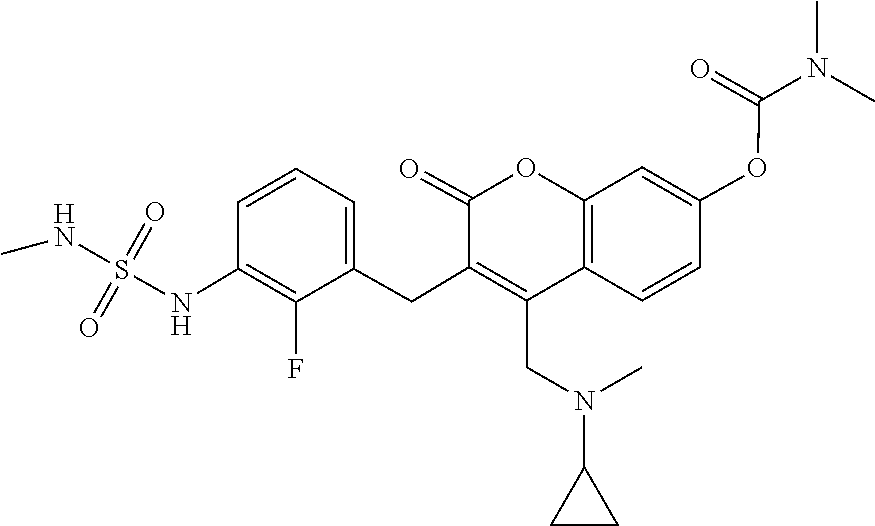
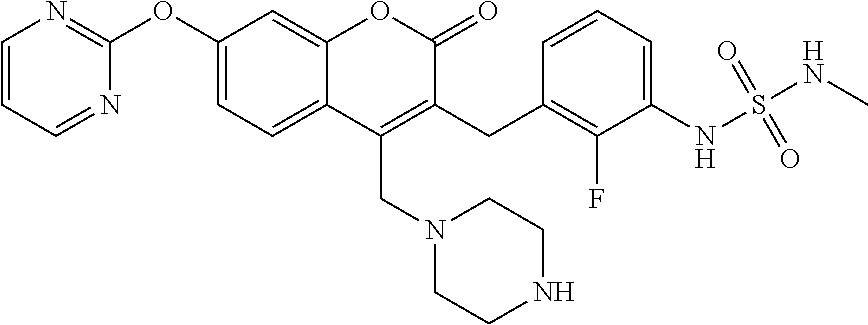
In some embodiments, a compound Formula (I), (Ia), (Ib), (Ic), (Id), (II), (IIa), (IIb), (IIc), or (IId) is selected from a compound of Table A. In some embodiments, a compound of Formula (I) or Formula (II) is selected from the group consisting of:
-
- and pharmaceutically acceptable salts thereof.
In some embodiments, the pharmaceutically acceptable salt is an alkaline metal salt or an ammonium salt.
Some embodiments provide a pharmaceutical composition comprising a therapeutically effective amount of at least one compound having the structure of the Formula (I):
-
- including pharmaceutically acceptable salts thereof, wherein:
- Ring A is
-
- R1, R2, R3, R4, and R6 are each independently selected from the group consisting of H, deuterium, hydroxyl, halogen, cyano, nitro, optionally substituted amino, optionally substituted C-amido, optionally substituted N-amido, optionally substituted ester, optionally substituted sulfonyl, optionally substituted S-sulfonamido, optionally substituted N-sulfonamido, optionally substituted sulfonate, optionally substituted O-thiocarbamyl, optionally substituted N-thiocarbamyl, optionally substituted N-carbamyl, optionally substituted O-carbamyl, optionally substituted urea, optionally substituted C1 to C6 alkoxy, optionally substituted C1 to C6 alkyl, optionally substituted C2 to C6 alkenyl, optionally substituted C2 to C6 alkynyl, optionally substituted C3 to C8 cycloalkyl, optionally substituted C6 to C10 aryl, optionally substituted C3 to C8 heterocyclyl, optionally substituted C3 to C10 heteroaryl, or L;
- X is C(R5)2, CH(R5), CH2, —O—,
-
- L is —Z1—Z2 or —Z1—Z2—Z3;
- Z1, Z2, and Z3 are independently —CH2—, —O—, —S—, S═O, —SO2—, C═O, —CO2—, —NO2, —NH—, —CH2CCH, —CH2CN, —NR5R5, —NH(CO)—, —(CO)NH—, —(CO)NR5R5—, —NH—SO2—, —SO2—NH—, —R5CH2—, —R5O—, —R5S—, R5—S═O, —R5SO2—, R5—C═O, —R5CO2—, —R5NH—, —R5NH(CO)—, —R5(CO)NH—, —R5NH—SO2—, —R5SO2—NH—, —CH2R5—, —OR5—, —SR5—, S═O—R5, —SO2R5—, C═O—R5, —CO2R5—, —NHR5—, —NH(CO)R5—, —(CO)NHR5—, —NH—SO2R5—, —SO2—NHR5—, optionally substituted C3 to C8 cycloalkyl, optionally substituted C6 to C10 aryl, optionally substituted C3 to C8 heterocyclyl, optionally substituted C3 to C10 heteroaryl, —CH2-(optionally substituted aryl), —CH2-(optionally substituted C3 to C8 cycloalkyl) or —CH2-(optionally substituted C3 to C10 heteroaryl);
- each R5 is independently H, deuterium, optionally substituted C1 to C6 alkyl, optionally substituted C2 to C6 alkenyl, optionally substituted C2 to C6 alkynyl, optionally substituted C3 to C8 carbocyclyl, optionally substituted C6 to C10 aryl, optionally substituted C3 to C8 heterocyclyl, or optionally substituted C3 to C10 heteroaryl; and
- Y is CH2, NH or O,
- with the proviso that R1 is not pyrimidyl.
Some embodiments provide a pharmaceutical composition comprising a therapeutically effective amount of at least one compound having the structure of the Formula (II):
-
- including pharmaceutically acceptable salts thereof, wherein:
- QA, QB, QC are independently C or N;
- R1, R2, R3, R6, and R7 are each independently selected from the group consisting of H, deuterium, hydroxyl, halogen, cyano, nitro, optionally substituted amino, optionally substituted C-amido, optionally substituted N-amido, optionally substituted ester, optionally substituted sulfonyl, optionally substituted S-sulfonamido, optionally substituted N-sulfonamido, optionally substituted sulfonate, optionally substituted O-thiocarbamyl, optionally substituted N-thiocarbamyl, optionally substituted N-carbamyl, optionally substituted O-carbamyl, optionally substituted urea, optionally substituted C1 to C6 alkoxy, optionally substituted C1 to C6 alkyl, optionally substituted C2 to C6 alkenyl, optionally substituted C2 to C6 alkynyl, optionally substituted C3 to C8 cycloalkyl, optionally substituted C6 to C10 aryl, optionally substituted C3 to C8 heterocyclyl, optionally substituted C3 to C10 heteroaryl, or L;
- X is C(R5)2, CH(R5), CH2, —O—,
-
- L is —Z1—Z2 or —Z1—Z2—Z3;
- Z1, Z2, and Z3 are independently —CH2—, —O—, —S—, S═O, —SO2—, C═O, —CO2—, —NO2, —NH—, —CH2CCH, —CH2CN, —NR5R5, —NH(CO)—, —(CO)NH—, —(CO)NR5R5—, —NH—SO2—, —SO2—NH—, —R5CH2—, —R5O—, —R5S—, R5—S═O, —R5SO2—, R5—C═O, —R5CO2—, —R5NH—, —R5NH(CO)—, —R5(CO)NH—, —R5NH—SO2—, —R5SO2—NH—, —CH2R5—, —OR5—, —SR5—, S═O—R5, —SO2R5—, C═O—R5, —CO2R5—, —NHR5—, —NH(CO)R5—, —(CO)NHR5—, —NH—SO2R5—, —SO2—NHR5—, optionally substituted C3 to C8 cycloalkyl, optionally substituted C6 to C10 aryl, optionally substituted C3 to C8 heterocyclyl, optionally substituted C3 to C10 heteroaryl, —CH2-(optionally substituted aryl), —CH2-(optionally substituted C3 to C8 cycloalkyl) or —CH2-(optionally substituted C3 to C10 heteroaryl);
- each R5 is independently H, deuterium, optionally substituted C1 to C6 alkyl, optionally substituted C2 to C6 alkenyl, optionally substituted C2 to C6 alkynyl, optionally substituted C3 to C8 carbocyclyl, optionally substituted C6 to C10 aryl, optionally substituted C3 to C8 heterocyclyl, or optionally substituted C3 to C10 heteroaryl;
- Y is CH2, NH or O; and
- Z is C or N,
- with the proviso that R1 is not pyrimidyl.
Some embodiments relate to a method of treating a mammal having a disease or disorder. In some embodiments, the method includes administering to the mammal a therapeutically effective amount of a compound as described herein. Some embodiments relate to a method of treating a mammal having a disease or disorder. In some embodiments, the method includes administering to the mammal a therapeutically effective amount of a pharmaceutical composition as described herein. In some embodiments, the mammal is a human. In some embodiments, the method further includes administering to the mammal an additional medicament. In some embodiments, the method includes administering to a subject suffering from said disease or disorder an effective amount of a compound of any one of the compounds as described herein or a pharmaceutically acceptable salt thereof.
Some embodiments relate to a method of treating a disease. In some embodiments, the method includes administering to a subject suffering from said disease an effective amount of a pharmaceutical composition as described herein. In some embodiments, the disease is cancer. In some embodiments, cancer is selected from the group consisting of brain cancer, breast cancer, lung cancer, non-small cell lung cancer, ovarian cancer, pancreatic cancer, stomach cancer, prostate cancer, renal cancer, colorectal cancer or leukemia. In further or additional embodiments, the fibrogenetic disorder is scleroderma, polymyositis, systemic lupus, rheumatoid arthritis, liver cirrhosis, keloid formation, interstitial nephritis or pulmonary fibrosis. In some embodiments, the cancer is associated with a RAS mutation. In some embodiments, the RAS mutation is a KRAS mutation selected from the group consisting of G12C, G12S, G12R, G12F, G12L, G12N, G12A, G12D, G12V, G13C, G13S, G13D, G13V, G13P, S17G, P34S, A59E, A59G, A59T, Q61K, Q61L, Q61R, and Q61H. In some embodiments, the disease is cancer cachexia.
Some embodiments relate to a method of inhibiting proliferation of a cell. In some embodiments, the method includes contacting the cell with an effective amount of a compound as described herein or a pharmaceutical composition as described herein. In some embodiments, the cell has a RAS mutation.
Some embodiments relate to a method of inducing apoptosis in a cell. In some embodiments, the method includes contacting the cell with an effective amount of a compound as described herein or a pharmaceutical composition as described herein.
Some embodiments relate to a method of treating a subject with cancer resistant to treatment of a MEK protein kinase inhibitor. In some embodiments, the method includes contacting the cell with an effective amount of a compound as described herein or a pharmaceutical composition as described herein.
Some embodiments relate to a method of treating a subject with cancer resistant to treatment of a RAF protein kinase inhibitor. In some embodiments, the method includes contacting the cell with an effective amount of a compound as described herein or a pharmaceutical composition as described herein.
Some embodiments relate to a method of treating cancer cachexia in a mammal with cancer. In some embodiments, the method includes administering an effective amount of a compound as described herein or a pharmaceutical composition as described herein.
In some embodiments, the compound as described herein or a pharmaceutical composition as described herein may be administered in a single dose. In some embodiments, the compound as described herein or a pharmaceutical composition as described herein may be administered a single dose, once daily.
In some embodiments, the compound as described herein or a pharmaceutical composition as described herein may be administered in multiple doses, more than once per day. In some embodiments, the compound as described herein or a pharmaceutical composition as described herein may be administered twice a day. In some embodiments, the compound as described herein or a pharmaceutical composition as described herein may be administered three times a day. In some embodiments, the compound as described herein or a pharmaceutical composition as described herein may be administered as a dose between 0.1 mg and 2000 mg. In some embodiments, the compound as described herein or a pharmaceutical composition as described herein may be administered as a dose between from about 0.001 to about 1000 mg/kg body weight/day.
In some embodiments, a compound as described herein a drug profile of RAF resistant, BID dosing, balance metabolism, and active between about 3 and about 6 hours.
In some embodiments, the compound as described herein interacts with a first region comprising L115, L118, V127, and M143 of an MEK Kinase.
In some embodiments, the compound interacts with a second region comprising K97 of an MEK Kinase.
In some embodiments, a compound as described herein interacts with a third region comprising S212, 1215 and M219 of an MEK Kinase.
In some embodiments, a method of developing molecules based on evaluation and balance of two downstream molecular targets is described herein.
In some embodiments, the method may include administering a compound targeting pERK (T202/Y204) and pSTAT3(5727).
In some embodiments, a method for preventing re-activation of MEK by CRAF-bypass is described herein.
In some embodiments, the method may include administering an effective amount of any one of compounds or pharmaceutical composition as described herein.
In some embodiments, a method for designing a drug therapeutic window for dual RAF/MEK inhibitors is described herein.
In some embodiments, the method may include administering a therapeutic agent with a plasma half-life of less than 12 hours, QD or BID dosing, resistant to MEK reactivation by CRAF-bypass, and optimal metabolic balance between pERK and pSTAT3(S727) inhibition.
BRIEF DESCRIPTION OF THE DRAWINGS
FIG. 1 illustrates pERK(T202/Y204):total-ERK vs pSTAT3(S727):total-STAT3 ratio in A549 KRAS mutant lung cancer for Reference-1, Reference-2, Compound (Cmpd)-7, Compound-10, Compound-9, Compound-11, Compound-12, Compound-13, Compound-14, Compound-15, and Compound-16.
FIG. 2 illustrates CRAF-bypass through elevated pMEK:total-MEK ratios in A549 KRAS mutant lung cancer following treatment with select reference MEK inhibitors.
FIG. 3 illustrates a gastrocnemius pharmacokinetic (PK) results from a single 2 hour timepoint in a C26 tumor model for Reference-1, Reference-2, Compound-7, Compound-10, Compound-9, Compound-11, Compound-12, Compound-13, Compound-14, Compound-15, and Compound-16.
FIG. 4 illustrates a tumor pharmacokinetic (PK) results from a single 2 hour timepoint in a C26 tumor model for Reference-1, Reference-2, Compound-7, Compound-10, Compound-9, Compound-11, Compound-12, Compound-13, Compound-14, Compound-15, and Compound-16.
FIG. 5 illustrates a plasma pharmacokinetic (PK) results from a single 2 hour timepoint in a C26 tumor model for Reference-1, Reference-2, Compound-7, Compound-10, Compound-9, Compound-11, Compound-12, Compound-13, Compound-14, Compound-15, and Compound-16.
FIG. 6 illustrates a liver pharmacokinetic (PK) results from a single 2 h timepoint in a C26 tumor model for Reference-1, Reference-2, Compound-7, Compound-10, Compound-9, Compound-11, Compound-12, Compound-13, Compound-14, Compound-15, and Compound-16.
FIG. 7A illustrates a C26 tumor-bearing MTD study comparison between Reference-1 and Compound-9 100 mg/kg QD.
FIG. 7B illustrates a C26 tumor-bearing MTD study comparison between Compound 13 and Compound 14 100 mg/kg QD.
FIG. 8A illustrates a C26 tumor-bearing MTD study comparison between Reference-1 and Compound-9 at 100 mg/kg BID.
FIG. 8B illustrates a C26 tumor-bearing MTD study comparison between Compound-13 and Compound-14 100 mg/kg BID.
FIG. 9 illustrates an A549 (KRAS-G12S) pERK dose response.
FIG. 10 illustrates a graph of a colon-26 model for KRAS G12D CRC efficacy and safety.
FIG. 11A illustrates a graph of C-26 pharmacology study KRAS G12D CRC tumor growth; FIG. 11B illustrates a graph of C-26 pharmacology study KRAS G12D CRC weight loss.
FIG. 12 illustrates a graph of activity in a Colon-26 KRAS mutant CRC model.
FIG. 13 illustrates a graph of dual-RAF/MEK resistance to CRAF-bypass.
FIG. 14A illustrates a graph of a dual-RAF/MEK: CRAF-bypass time course for A459 KRAS pERK:total ERK; FIG. 14B illustrates pMEK:total MEK in the NSCLC model A549 KRAS(G12S).
FIG. 15A illustrates a graph of pERK:total ERK (activation) in the BRAF V600E mutant A375 melanoma model; FIG. 15B illustrates pERK:total ERK in the KRAS G12S mutant A549 model and paradoxical activation by a RAF inhibitor.
FIG. 16 illustrates a graph of a single dose pharmacokinetic profile in plasma.
FIG. 17 illustrates a graph of a single dose pharmacokinetic profile in the CRC model Colon-26 tumor.
FIG. 18 illustrates a graph of relative body weight corrected for the NSCLC model A549 tumor volume.
DETAILED DESCRIPTION
In some embodiments, MEK inhibitors are provided. Various embodiments of these compounds include compounds having the structure of Formula I as described herein or pharmaceutically acceptable salts thereof. In some embodiments, prodrugs, metabolites, stereoisomers, hydrates, solvates, polymorphs, and pharmaceutically acceptable salts of the compounds disclosed herein are provided.
In certain aspects, therapeutic methods or uses are providing herein for the treatment, prevention, or amelioration of a disease or condition in a subject, these methods comprising administering at least one compound disclosed herein to the subject. In some embodiments, therapeutic methods or uses are provided for the treatment, prevention or amelioration of cancer comprising administering of a compound having the structures of Formula (I), (Ia), (Ib), (Ic), (Id) (II), (IIa), (IIb), (IIc), or (IId) as described herein. In some embodiments, therapeutic methods or uses are provided for the treatment of cancer cachexia comprising administering a compound having the structures of Formula (I), (Ia), (Ib), (Ic), (Id) (II), (IIa), (IIb), (IIc), or (IId) as described herein.
Definitions
Unless expressly defined otherwise, technical and/or scientific terms used herein have the same meaning as is commonly understood by one of ordinary skill in the art. In the event that there are a plurality of definitions for a term herein, those in this section prevail unless stated otherwise. As used in the specification and the appended claims, the singular forms “a,” “an,” and “the” include plural referents unless the context clearly dictates otherwise. Unless otherwise indicated, conventional methods of mass spectroscopy, NMR, HPLC, protein chemistry, biochemistry, and pharmacology are employed. The use of either the conjunction “or” or “and” means “and/or” unless stated otherwise. Furthermore, use of the term “including” as well as other forms, such as “include”, “includes,” and “included,” is not limiting. As used in this specification, whether in a transitional phrase or in the body of the claim, the terms “comprise(s)” and “comprising” are to be interpreted as having an open-ended meaning. That is, the terms are to be interpreted synonymously with the phrases “having at least” or “including at least.” When used in the context of a process, the term “comprising” means that the process includes at least the recited steps, but may include additional steps. When used in the context of a compound, composition, or device, the term “comprising” means that the compound, composition, or device includes at least the recited features or components, but may also include additional features or components.
While the disclosure has been illustrated and described in detail in the foregoing description, such description is to be considered illustrative or exemplary and not restrictive. The disclosure is not limited to the disclosed embodiments. Variations to the disclosed embodiments can be understood and effected by those skilled in the art in practicing the claimed disclosure, from a study of the disclosure and the appended claims.
With respect to the use of substantially any plural and/or singular terms herein, those having skill in the art can translate from the plural to the singular and/or from the singular to the plural as is appropriate to the context and/or application. The various singular/plural permutations may be expressly set forth herein for sake of clarity. The indefinite article “a” or “an” does not exclude a plurality. The mere fact that certain measures are recited in mutually different dependent claims does not indicate that a combination of these measures cannot be used to advantage.
All references cited herein are incorporated herein by reference in their entirety. To the extent publications and patents or patent applications incorporated by reference contradict the disclosure contained in the specification, the specification is intended to supersede and/or take precedence over any such contradictory material.
Unless otherwise defined, all terms (including technical and scientific terms) are to be given their ordinary and customary meaning to a person of ordinary skill in the art, and are not to be limited to a special or customized meaning unless expressly so defined herein. It should be noted that the use of particular terminology when describing certain features or aspects of the disclosure should not be taken to imply that the terminology is being re-defined herein to be restricted to include any specific characteristics of the features or aspects of the disclosure with which that terminology is associated.
Where a range of values is provided, it is understood that the upper and lower limit, and each intervening value between the upper and lower limit of the range is encompassed within the embodiments.
The term “prodrug,” as used herein, refers to an agent that is converted into the parent drug in vivo. Prodrugs are often useful because, in some situations, they may be easier to administer than the parent drug. They may, for instance, be bioavailable by oral administration whereas the parent is not. The prodrug may also have improved solubility in pharmaceutical compositions over the parent drug. An example, without limitation, of a prodrug would be a compound which is administered as an ester (the “prodrug”) to facilitate transmittal across a cell membrane where water solubility is detrimental to mobility but which then is metabolically hydrolyzed to the carboxylic acid, the active entity, once inside the cell where water-solubility is beneficial. A further example of a prodrug might be a short peptide (polyaminoacid) bonded to an acid group where the peptide is metabolized to reveal the active moiety. Conventional procedures for the selection and preparation of suitable prodrug derivatives are described, for example, in Design of Prodrugs, (ed. H. Bundgaard, Elsevier, 1985), which is hereby incorporated herein by reference in its entirety.
Metabolites of the compounds disclosed herein include active species that are produced upon introduction of the compounds into the biological milieu.
Compounds disclosed herein having at least one chiral center they may exist as a racemate or as each enantiomer, and may exist as enantiomeric-enriched mixtures of the enantimoers. It should be noted that all such isomers and mixtures thereof are included in the scope of the present invention. Furthermore, the crystalline forms for the compounds disclosed herein may exist as alternative polymorphs. Such polymorphs are included in one embodiment of the present invention. In addition, some of the compounds of the present invention may form solvates with water (i.e., hydrates) or common organic solvents. Such solvates are included in one embodiment of the present invention.
The term “pharmaceutically acceptable salt,” as used herein, refers to a salt of a compound that does not cause significant irritation to an organism to which it is administered and does not abrogate the biological activity and properties of the compound. In some embodiments, the salt is an acid addition salt of the compound. Pharmaceutical salts can be obtained by reacting a compound with inorganic acids such as hydrohalic acid (e.g., hydrochloric acid or hydrobromic acid), sulfuric acid, nitric acid, phosphoric acid and the like. Pharmaceutical salts can also be obtained by reacting a compound with an organic acid such as aliphatic or aromatic carboxylic or sulfonic acids, for example acetic, succinic, lactic, malic, tartaric, citric, ascorbic, nicotinic, methanesulfonic, ethanesulfonic, p-toluensulfonic, salicylic or naphthalenesulfonic acid. Pharmaceutical salts can also be obtained by reacting a compound with a base to form a salt such as an ammonium salt, an alkali metal salt, such as a sodium or a potassium salt, an alkaline earth metal salt, such as a calcium or a magnesium salt, a salt of organic bases such as dicyclohexylamine, N-methyl-D-glucamine, tris(hydroxymethyl)methylamine, C1-C7 alkylamine, cyclohexylamine, triethanolamine, ethylenediamine, and salts with amino acids such as arginine, lysine, and the like.
If the manufacture of pharmaceutical formulations involves intimate mixing of the pharmaceutical excipients and the active ingredient in its salt form, then it may be desirable to use pharmaceutical excipients which are non-basic, that is, either acidic or neutral excipients.
In various embodiments, the compounds disclosed herein can be used alone, in combination with other compounds disclosed herein, or in combination with one or more other agents active in the therapeutic areas described herein.
The term “halogen atom,” as used herein, means any one of the radio-stable atoms of column 7 of the Periodic Table of the Elements, e.g., fluorine, chlorine, bromine, or iodine, with fluorine and chlorine being preferred.
The term “ester,” as used herein, refers to a chemical moiety with formula —(R)n—COOR′, where R and R′ are independently selected from the group consisting of alkyl, cycloalkyl, aryl, heteroaryl (bonded through a ring carbon) and heteroalicyclic (bonded through a ring carbon), and where n is 0 or 1.
The term “amide,” as used herein, refers to a chemical moiety with formula —(R)n—C(O)NHR′ or —(R)n—NHC(O)R′, where R and R′ are independently selected from the group consisting of alkyl, cycloalkyl, aryl, heteroaryl (bonded through a ring carbon) and heteroalicyclic (bonded through a ring carbon), and where n is 0 or 1. An amide may be an amino acid or a peptide molecule attached to a molecule of the present invention, thereby forming a prodrug.
Any amine, hydroxyl, or carboxyl side chain on the compounds disclosed herein can be esterified or amidified. The procedures and specific groups to be used to achieve this end are known to those of skill in the art and can readily be found in reference sources such as Greene and Wuts, Protective Groups in Organic Synthesis, 3rd Ed., John Wiley & Sons, New York, NY, 1999, which is incorporated herein in its entirety.
The term “aromatic,” as used herein, refers to an aromatic group which has at least one ring having a conjugated pi electron system and includes both carbocyclic aryl (e.g., phenyl) and heterocyclic aryl groups (e.g., pyridine). The term includes monocyclic or fused-ring polycyclic (i.e., rings which share adjacent pairs of carbon atoms) groups. The term “carbocyclic” refers to a compound which contains one or more covalently closed ring structures, and that the atoms forming the backbone of the ring are all carbon atoms. The term thus distinguishes carbocyclic from heterocyclic rings in which the ring backbone contains at least one atom which is different from carbon. The term “heteroaromatic” refers to an aromatic group which contains at least one heterocyclic ring.
As used herein, “Ca to Cb” in which “a” and “b” are integers refer to the number of carbon atoms in an alkyl, alkenyl or alkynyl group, or the number of carbon atoms in the ring of a cycloalkyl, aryl, heteroaryl or heterocyclyl group. That is, the alkyl, alkenyl, alkynyl, ring of the cycloalkyl, ring of the aryl, ring of the heteroaryl or ring of the heterocyclyl can contain from “a” to “b”, inclusive, carbon atoms. Thus, for example, a “C1 to C4 alkyl” group or a “C1-C4 alkyl” group refers to all alkyl groups having from 1 to 4 carbons, that is, CH3—, CH3CH2—, CH3CH2CH2—, (CH3)2CH—, CH3CH2CH2CH2—, CH3CH2CH(CH3)— and (CH3)3C—. Likewise, for example, cycloalkyl group may contain from “a” to “b”, inclusive, total atoms, such as a C3-C8 cycloalkyl group, 3 to 8 carbon atoms in the ring(s). If no “a” and “b” are designated with regard to an alkyl, cycloalkyl, or cycloalkenyl, the broadest range described in these definitions is to be assumed. Similarly, a “4 to 7 membered heterocyclyl” group refers to all heterocyclyl groups with 4 to 7 total ring atoms, for example, azetidine, oxetane, oxazoline, pyrrolidine, piperidine, piperazine, morpholine, and the like. As used herein, the term “C1-C6” includes C1, C2, C3, C4, C5 and C6, and a range defined by any of the two preceding numbers. For example, C1-C6 alkyl includes C1, C2, C3, C4, C5 and C6 alkyl, C2-C6 alkyl, C1-C3 alkyl, etc. Similarly, C3-C8 carbocyclyl or cycloalkyl each includes hydrocarbon ring containing 3, 4, 5, 6, 7 and 8 carbon atoms, or a range defined by any of the two numbers, such as C3-C7 cycloalkyl or C5-C6 cycloalkyl. As another example, 3 to 10 membered heterocyclyl includes 3, 4, 5, 6, 7, 8, 9, or 10 ring atoms, or a range defined by any of the two preceding numbers, such as 4 to 6 membered or 5 to 7 membered heterocyclyl.
As used herein, “alkyl” refers to a straight or branched hydrocarbon chain fully saturated (no double or triple bonds) hydrocarbon group. The alkyl group may have 1 to 20 carbon atoms (whenever it appears herein, a numerical range such as “1 to 20” refers to each integer in the given range; e.g., “1 to 20 carbon atoms” means that the alkyl group may consist of 1 carbon atom, 2 carbon atoms, 3 carbon atoms, etc., up to and including 20 carbon atoms, although the present definition also covers the occurrence of the term “alkyl” where no numerical range is designated). The alkyl group may also be a medium size alkyl having 1 to 10 carbon atoms. The alkyl group could also be a lower alkyl having 1 to 5 carbon atoms. The alkyl group of the compounds may be designated as “C1-C4 alkyl” or similar designations. By way of example only, “C1-C4 alkyl” indicates that there are one to four carbon atoms in the alkyl chain, i.e., the alkyl chain is selected from the group consisting of methyl, ethyl, propyl, iso-propyl, n-butyl, iso-butyl, sec-butyl, and t-butyl. Typical alkyl groups include, but are in no way limited to, methyl, ethyl, propyl, isopropyl, butyl, isobutyl, tertiary butyl, pentyl, hexyl, ethenyl, propenyl, butenyl, and the like.
The alkyl group may be substituted or unsubstituted. When substituted, the substituent group(s) is(are) one or more group(s) individually and independently selected from alkenyl, alkynyl, cycloalkyl, cycloalkenyl, cycloalkynyl, aryl, heteroaryl, heteroalicyclyl, aralkyl, heteroaralkyl, (heteroalicyclyl)alkyl, hydroxy, protected hydroxyl, alkoxy, aryloxy, acyl, ester, mercapto, alkylthio, arylthio, cyano, halogen, carbonyl, thiocarbonyl, O-carbamyl, N-carbamyl, O-thiocarbamyl, N-thiocarbamyl, C-amido, N-amido, S-sulfonamido, N-sulfonamido, C-carboxy, protected C-carboxy, O-carboxy, isocyanato, thiocyanato, isothiocyanato, nitro, silyl, sulfenyl, sulfinyl, sulfonyl, haloalkyl, haloalkoxy, trihalomethanesulfonyl, trihalomethanesulfonamido, and amino, including mono- and di-substituted amino groups, and the protected derivatives thereof. Wherever a substituent is described as being “optionally substituted” that substituent may be substituted with one of the above substituents.
As used herein, “alkenyl” refers to an alkyl group that contains in the straight or branched hydrocarbon chain one or more double bonds. An alkenyl group may be unsubstituted or substituted. When substituted, the substituent(s) may be selected from the same groups disclosed above with regard to alkyl group substitution. The alkenyl group may have 2 to 20 carbon atoms, although the present definition also covers the occurrence of the term “alkenyl” where no numerical range is designated. The alkenyl group may also be a medium size alkenyl having 2 to 9 carbon atoms. The alkenyl group could also be a lower alkenyl having 2 to 4 carbon atoms. The alkenyl group of the compounds may be designated as “C2-4 alkenyl” or similar designations. By way of example only, “C2-4 alkenyl” indicates that there are two to four carbon atoms in the alkenyl chain, i.e., the alkenyl chain is selected from the group consisting of ethenyl, propen-1-yl, propen-2-yl, propen-3-yl, buten-1-yl, buten-2-yl, buten-3-yl, buten-4-yl, 1-methyl-propen-1-yl, 2-methyl-propen-1-yl, 1-ethyl-ethen-1-yl, 2-methyl-propen-3-yl, buta-1,3-dienyl, buta-1,2,-dienyl, and buta-1,2-dien-4-yl. Typical alkenyl groups include, but are in no way limited to, ethenyl, propenyl, butenyl, pentenyl, and hexenyl, and the like.
As used herein, “alkynyl” refers to an alkyl group that contains in the straight or branched hydrocarbon chain one or more triple bonds. An alkynyl group may be unsubstituted or substituted. When substituted, the substituent(s) may be selected from the same groups disclosed above with regard to alkyl group substitution. The alkynyl group may have 2 to 20 carbon atoms, although the present definition also covers the occurrence of the term “alkynyl” where no numerical range is designated. The alkynyl group may also be a medium size alkynyl having 2 to 9 carbon atoms. The alkynyl group could also be a lower alkynyl having 2 to 4 carbon atoms. The alkynyl group of the compounds may be designated as “C2-4 alkynyl” or similar designations. By way of example only, “C2-4 alkynyl” indicates that there are two to four carbon atoms in the alkynyl chain, i.e., the alkynyl chain is selected from the group consisting of ethynyl, propyn-1-yl, propyn-2-yl, butyn-1-yl, butyn-3-yl, butyn-4-yl, and 2-butynyl. Typical alkynyl groups include, but are in no way limited to, ethynyl, propynyl, butynyl, pentynyl, and hexynyl, and the like.
As used herein, “heteroalkyl” refers to a straight or branched hydrocarbon chain containing one or more heteroatoms, that is, an element other than carbon, including but not limited to, nitrogen, oxygen and sulfur, in the chain backbone. The heteroalkyl group may have 1 to 20 carbon atoms although the present definition also covers the occurrence of the term “heteroalkyl” where no numerical range is designated. The heteroalkyl group may also be a medium size heteroalkyl having 1 to 9 carbon atoms. The heteroalkyl group could also be a lower heteroalkyl having 1 to 4 carbon atoms. The heteroalkyl group of the compounds may be designated as “C1-4 heteroalkyl” or similar designations. The heteroalkyl group may contain one or more heteroatoms. By way of example only, “C1-4 heteroalkyl” indicates that there are one to four carbon atoms in the heteroalkyl chain and additionally one or more heteroatoms in the backbone of the chain.
As used herein, “aryl” refers to a carbocyclic (all carbon) ring or two or more fused rings (rings that share two adjacent carbon atoms) that have a fully delocalized pi-electron system. Examples of aryl groups include, but are not limited to, benzene, naphthalene and azulene. An aryl group may be substituted or unsubstituted. When substituted, hydrogen atoms are replaced by substituent group(s) that is(are) one or more group(s) independently selected from alkyl, alkenyl, alkynyl, cycloalkyl, cycloalkenyl, cycloalkynyl, aryl, heteroaryl, heteroalicyclyl, aralkyl, heteroaralkyl, (heteroalicyclyl)alkyl, hydroxy, protected hydroxyl, alkoxy, aryloxy, acyl, ester, mercapto, alkylthio, arylthio, cyano, halogen, carbonyl, thiocarbonyl, O-carbamyl, N-carbamyl, O-thiocarbamyl, N-thiocarbamyl, C-amido, N-amido, S-sulfonamido, N-sulfonamido, C-carboxy, protected C-carboxy, O-carboxy, isocyanato, thiocyanato, isothiocyanato, nitro, silyl, sulfenyl, sulfinyl, sulfonyl, haloalkyl, haloalkoxy, trihalomethanesulfonyl, trihalomethanesulfonamido, and amino, including mono- and di-substituted amino groups, and the protected derivatives thereof. When substituted, substituents on an aryl group may form a non-aromatic ring fused to the aryl group, including a cycloalkyl, cycloalkenyl, cycloalkynyl, and heterocyclyl.
As used herein, “heteroaryl” refers to a monocyclic or multicyclic aromatic ring system (a ring system with fully delocalized pi-electron system), one or two or more fused rings that contain(s) one or more heteroatoms, that is, an element other than carbon, including but not limited to, nitrogen, oxygen and sulfur. Examples of heteroaryl rings include, but are not limited to, furan, thiophene, phthalazine, pyrrole, oxazole, thiazole, imidazole, pyrazole, isoxazole, isothiazole, triazole, thiadiazole, pyridine, pyridazine, pyrimidine, pyrazine and triazine. A heteroaryl group may be substituted or unsubstituted. When substituted, hydrogen atoms are replaced by substituent group(s) that is(are) one or more group(s) independently selected from alkyl, alkenyl, alkynyl, cycloalkyl, cycloalkenyl, cycloalkynyl, aryl, heteroaryl, heteroalicyclyl, aralkyl, heteroaralkyl, (heteroalicyclyl)alkyl, hydroxy, protected hydroxyl, alkoxy, aryloxy, acyl, ester, mercapto, alkylthio, arylthio, cyano, halogen, carbonyl, thiocarbonyl, O-carbamyl, N-carbamyl, O-thiocarbamyl, N-thiocarbamyl, C-amido, N-amido, S-sulfonamido, N-sulfonamido, C-carboxy, protected C-carboxy, O-carboxy, isocyanato, thiocyanato, isothiocyanato, nitro, silyl, sulfenyl, sulfinyl, sulfonyl, haloalkyl, haloalkoxy, trihalomethanesulfonyl, trihalomethanesulfonamido, and amino, including mono- and di-substituted amino groups, and the protected derivatives thereof. When substituted, substituents on a heteroaryl group may form a non-aromatic ring fused to the aryl group, including a cycloalkyl, cycloalkenyl, cycloalkynyl, and heterocyclyl.
As used herein, an “aralkyl” or “arylalkyl” refers to an aryl group connected, as a substituent, via an alkylene group. The alkylene and aryl group of an aralkyl may be substituted or unsubstituted. Examples include but are not limited to benzyl, substituted benzyl, 2-phenylethyl, 3-phenylpropyl, and naphtylalkyl. In some cases, the alkylene group is a lower alkylene group.
As used herein, a “heteroaralkyl” or “heteroarylalkyl” is heteroaryl group connected, as a substituent, via an alkylene group. The alkylene and heteroaryl group of heteroaralkyl may be substituted or unsubstituted. Examples include but are not limited to 2-thienylmethyl, 3-thienylmethyl, furylmethyl, thienylethyl, pyrrolylalkyl, pyridylalkyl, isoxazollylalkyl, and imidazolylalkyl, and their substituted as well as benzo-fused analogs. In some cases, the alkylene group is a lower alkylene group.
As used herein, a “alkylene” refers to a branched, or straight chain fully saturated di-radical chemical group containing only carbon and hydrogen that is attached to the rest of the molecule via two points of attachment (i.e., an alkanediyl). The alkylene group may have 1 to 20 carbon atoms, although the present definition also covers the occurrence of the term alkylene where no numerical range is designated. The alkylene group may also be a medium size alkylene having 1 to 9 carbon atoms. The alkylene group could also be a lower alkylene having 1 to 4 carbon atoms. The alkylene group may be designated as “C1-4 alkylene” or similar designations. By way of example only, “C1-4 alkylene” indicates that there are one to four carbon atoms in the alkylene chain, i.e., the alkylene chain is selected from the group consisting of methylene, ethylene, ethan-1,1-diyl, propylene, propan-1,1-diyl, propan-2,2-diyl, 1-methyl-ethylene, butylene, butan-1,1-diyl, butan-2,2-diyl, 2-methyl-propan-1,1-diyl, 1-methyl-propylene, 2-methyl-propylene, 1,1-dimethyl-ethylene, 1,2-dimethyl-ethylene, and 1-ethyl-ethylene.
As used herein, “alkenylene” refers to a straight or branched chain di-radical chemical group containing only carbon and hydrogen and containing at least one carbon-carbon double bond that is attached to the rest of the molecule via two points of attachment. The alkenylene group may have 2 to 20 carbon atoms, although the present definition also covers the occurrence of the term alkenylene where no numerical range is designated. The alkenylene group may also be a medium size alkenylene having 2 to 9 carbon atoms. The alkenylene group could also be a lower alkenylene having 2 to 4 carbon atoms. The alkenylene group may be designated as “C2-4 alkenylene” or similar designations. By way of example only, “C2-4 alkenylene” indicates that there are two to four carbon atoms in the alkenylene chain, i.e., the alkenylene chain is selected from the group consisting of ethenylene, ethen-1,1-diyl, propenylene, propen-1,1-diyl, prop-2-en-1,1-diyl, 1-methyl-ethenylene, but-1-enylene, but-2-enylene, but-1,3-dienylene, buten-1,1-diyl, but-1,3-dien-1,1-diyl, but-2-en-1,1-diyl, but-3-en-1,1-diyl, 1-methyl-prop-2-en-1,1-diyl, 2-methyl-prop-2-en-1,1-diyl, 1-ethyl-ethenylene, 1,2-dimethyl-ethenylene, 1-methyl-propenylene, 2-methyl-propenylene, 3-methyl-propenylene, 2-methyl-propen-1,1-diyl, and 2,2-dimethyl-ethen-1,1-diyl.
As used herein, “alkylidene” refers to a divalent group, such as ═CR′R″, which is attached to one carbon of another group, forming a double bond, alkylidene groups include, but are not limited to, methylidene (═CH2) and ethylidene (═CHCH3). As used herein, “arylalkylidene” refers to an alkylidene group in which either R′ and R″ is an aryl group. An alkylidene group may be substituted or unsubstituted.
As used herein, “alkoxy” refers to the formula —OR wherein R is an alkyl is defined as above, e.g. methoxy, ethoxy, n-propoxy, 1-methylethoxy (isopropoxy), n-butoxy, iso-butoxy, sec-butoxy, tert-butoxy, amoxy, tert-amoxy and the like. An alkoxy may be substituted or unsubstituted.
As used herein, “alkylthio” refers to the formula —SR wherein R is an alkyl is defined as above, e.g. methylmercapto, ethylmercapto, n-propylmercapto, 1-methylethylmercapto (isopropylmercapto), n-butylmercapto, iso-butylmercapto, sec-butylmercapto, tert-butylmercapto, and the like. An alkylthio may be substituted or unsubstituted.
As used herein, “aryloxy” and “arylthio” refers to RO— and RS—, respectively, in which R is an aryl, such as but not limited to phenyl. Both an aryloxyl and arylthio may be substituted or unsubstituted.
As used herein, “acyl” refers to —C(═O)R, wherein R is hydrogen, C1-6 alkyl, C2-6 alkenyl, C2-6 alkynyl, C3-7 carbocyclyl, aryl, 5-10 membered heteroaryl, and 5-10 membered heterocyclyl, as defined herein. Non-limiting examples include formyl, acetyl, propanoyl, benzoyl, and acryl.
As used herein, “cycloalkyl” refers to a completely saturated (no double bonds) mono- or multi-cyclic hydrocarbon ring system. When composed of two or more rings, the rings may be joined together in a fused, bridged or spiro-connected fashion. Cycloalkyl groups may range from C3 to C10, in other embodiments it may range from C3 to C6. A cycloalkyl group may be unsubstituted or substituted. Typical cycloalkyl groups include, but are in no way limited to, cyclopropyl, cyclobutyl, cyclopentyl, cyclohexyl, and the like. If substituted, the substituent(s) may be an alkyl or selected from those indicated above with regard to substitution of an alkyl group unless otherwise indicated. When substituted, substituents on a cycloalkyl group may form an aromatic ring fused to the cycloalkyl group, including an aryl and a heteroaryl.
As used herein, “cycloalkenyl” refers to a cycloalkyl group that contains one or more double bonds in the ring although, if there is more than one, they cannot form a fully delocalized pi-electron system in the ring (otherwise the group would be “aryl,” as defined herein). When composed of two or more rings, the rings may be connected together in a fused, bridged or spiro-connected fashion. A cycloalkenyl group may be unsubstituted or substituted. When substituted, the substituent(s) may be an alkyl or selected from the groups disclosed above with regard to alkyl group substitution unless otherwise indicated. When substituted, substituents on a cycloalkenyl group may form an aromatic ring fused to the cycloalkenyl group, including an aryl and a heteroaryl.
As used herein, “cycloalkynyl” refers to a cycloalkyl group that contains one or more triple bonds in the ring. When composed of two or more rings, the rings may be joined together in a fused, bridged or spiro-connected fashion. A cycloalkynyl group may be unsubstituted or substituted. When substituted, the substituent(s) may be an alkyl or selected from the groups disclosed above with regard to alkyl group substitution unless otherwise indicated. When substituted, substituents on a cycloalkynyl group may form an aromatic ring fused to the cycloalkynyl group, including an aryl and a heteroaryl.
As used herein, “heteroalicyclic” or “heteroalicyclyl” refers to a stable 3- to 18 membered ring which consists of carbon atoms and from one to five heteroatoms selected from the group consisting of nitrogen, oxygen and sulfur. The “heteroalicyclic” or “heteroalicyclyl” may be monocyclic, bicyclic, tricyclic, or tetracyclic ring system, which may be joined together in a fused, bridged or spiro-connected fashion; and the nitrogen, carbon and sulfur atoms in the “heteroalicyclic” or “heteroalicyclyl” may be optionally oxidized; the nitrogen may be optionally quaternized; and the rings may also contain one or more double bonds provided that they do not form a fully delocalized pi-electron system throughout all the rings. Heteroalicyclyl groups may be unsubstituted or substituted. When substituted, the substituent(s) may be one or more groups independently selected from the group consisting of alkyl, alkenyl, alkynyl, cycloalkyl, cycloalkenyl, cycloalkynyl, aryl, heteroaryl, heteroalicyclyl, aralkyl, heteroaralkyl, (heteroalicyclyl)alkyl, hydroxy, protected hydroxyl, alkoxy, aryloxy, acyl, ester, mercapto, alkylthio, arylthio, cyano, halogen, carbonyl, thiocarbonyl, O-carbamyl, N-carbamyl, O-thiocarbamyl, N-thiocarbamyl, C-amido, N-amido, S-sulfonamido, N-sulfonamido, C-carboxy, protected C-carboxy, O-carboxy, isocyanato, thiocyanato, isothiocyanato, nitro, silyl, haloalkyl, haloalkoxy, trihalomethanesulfonyl, trihalomethanesulfonamido, and amino, including mono- and di-substituted amino groups, and the protected derivatives thereof. Examples of such “heteroalicyclic” or “heteroalicyclyl” include but are not limited to, azepinyl, acridinyl, carbazolyl, cinnolinyl, dioxolanyl, imidazolinyl, morpholinyl, oxiranyl, piperidinyl N-oxide, piperidinyl, piperazinyl, pyrrolidinyl, 4-piperidonyl, pyrazolidinyl, 2-oxopyrrolidinyl, thiamorpholinyl, thiamorpholinyl sulfoxide, and thiamorpholinyl sulfone. When substituted, substituents on a heteroalicyclyl group may form an aromatic ring fused to the heteroalicyclyl group, including an aryl and a heteroaryl.
As used herein, the term “(cycloalkenyl)alkyl” refers to a cycloalkenyl group connected, as a substituent, via an alkylene group. The alkylene and cycloalkenyl of a (cycloalkenyl)alkyl may be substituted or unsubstituted. In some cases, the alkylene group is a lower alkylene group.
As used herein, the term “(cycloalkynyl)alkyl” to a cycloalkynyl group connected, as a substituent, via an alkylene group. The alkylene and cycloalkynyl of a (cycloalkynyl)alkyl may be substituted or unsubstituted. In some cases, the alkylene group is a lower alkylene group.
As used herein, the term “O-carboxy” refers to a “RC(═O)O—” group in which R can be hydrogen, alkyl, alkenyl, alkynyl, cycloalkyl, cycloalkenyl, cycloalkynyl, aryl, heteroaryl, heteroalicyclyl, aralkyl, or (heteroalicyclyl)alkyl, as defined herein. An O-carboxy may be substituted or unsubstituted.
As used herein, the term “C-carboxy” refers to a “—C(═O)R” group in which R can be the same as defined with respect to O-carboxy. A C-carboxy may be substituted or unsubstituted.
As used herein, the term “trihalomethanesulfonyl” refers to an “X3CSO2—” group wherein X is a halogen.
As used herein, the term “cyano” refers to a “—CN” group.
As used herein, the term “cyanato” refers to an “—OCN” group.
As used herein, the term “isocyanato” refers to a “—NCO” group.
As used herein, the term “thiocyanato” refers to a “—SCN” group.
As used herein, the term “isothiocyanato” refers to an “—NCS” group.
As used herein, the term “sulfinyl” refers to a “—S(═O)—R” group in which R can be the same as defined with respect to O-carboxy. A sulfinyl may be substituted or unsubstituted.
As used herein, the term “sulfonyl” refers to an “—SO2R” group in which R can be the same as defined with respect to O-carboxy. A sulfonyl may be substituted or unsubstituted.
As used herein, the term “S-sulfonamido” refers to a “—SO2NRARB” group in which RA and RB can be the same as defined with respect to O-carboxy. An S-sulfonamido may be substituted or unsubstituted.
As used herein, the term “N-sulfonamido” refers to a “—SO2N(RA)(RB)” group in which R, RA, and RB can be the same as defined with respect to O-carboxy. A sulfonyl may be substituted or unsubstituted.
As used herein, the term “trihalomethanesulfonamido” refers to an “X3CSO2N(R)—” group with X as halogen and R can be the same as defined with respect to O-carboxy. A trihalomethanesulfonamido may be substituted or unsubstituted.
As used herein, the term “O-carbamyl” refers to a “—OC(═O)NRARB” group in which RA and RB can be the same as defined with respect to O-carboxy. An O-carbamyl may be substituted or unsubstituted.
As used herein, the term “N-carbamyl” refers to an “ROC(═O)NRA—” group in which R and RA can be the same as defined with respect to O-carboxy. An N-carbamyl may be substituted or unsubstituted.
As used herein, the term “O-thiocarbamyl” refers to a “—OC(═S)—NRARB” group in which RA and RB can be the same as defined with respect to O-carboxy. An O-thiocarbamyl may be substituted or unsubstituted.
As used herein, the term “N-thiocarbamyl” refers to an “ROC(═S)NRA—” group in which R and RA can be the same as defined with respect to O-carboxy. An N-thiocarbamyl may be substituted or unsubstituted.
As used herein, the term “C-amido” refers to a “—C(═O)NRARB” group in which RA and RB can be the same as defined with respect to O-carboxy. A C-amido may be substituted or unsubstituted.
As used herein, the term “N-amido” refers to a “RC(═O)NRA—” group in which R and RA can be the same as defined with respect to O-carboxy. An N-amido may be substituted or unsubstituted.
As used herein, the term “amino” refers to a “—NRARB” group in which RA and RB are each independently selected from hydrogen, C1-6 alkyl, C2-6 alkenyl, C2-6 alkynyl, C3-7 carbocyclyl, C6-10 aryl, 5-10 membered heteroaryl, and 5-10 membered heterocyclyl, as defined herein.
As used herein, the term “aminoalkyl” refers to an amino group connected via an alkylene group.
As used herein, the term “ester” refers to a “—C(═O)OR” group in which R can be the same as defined with respect to O-carboxy. An ester may be substituted or unsubstituted.
As used herein, the term “lower aminoalkyl” refers to an amino group connected via a lower alkylene group. A lower aminoalkyl may be substituted or unsubstituted.
As used herein, the term “lower alkoxyalkyl” refers to an alkoxy group connected via a lower alkylene group. A lower alkoxyalkyl may be substituted or unsubstituted.
As used herein, the term “acetyl” refers to a —C(═O)CH3, group.
As used herein, the term “trihalomethanesulfonyl” refers to a X3CS(═O)2— group where X is a halogen.
As used herein, the term “O-carbamyl” refers to a —OC(═O)—NR, in which R can be hydrogen, alkyl, alkenyl, alkynyl, cycloalkyl, cycloalkenyl, cycloalkynyl, aryl, heteroaryl, heteroalicyclyl, aralkyl, or (heteroalicyclyl)alkyl, as defined herein. An O-carbamyl can be substituted or unsubstituted.
As used herein, the term “N-carbamyl” refers to a ROC(═O)NH— group, in which R can be hydrogen, alkyl, alkenyl, alkynyl, cycloalkyl, cycloalkenyl, cycloalkynyl, aryl, heteroaryl, heteroalicyclyl, aralkyl, or (heteroalicyclyl)alkyl, as defined herein. An N-carbamyl can be substituted or unsubstituted.
As used herein, the term “O-thiocarbamyl” refers to a —OC(═S)—NR, in which R can be hydrogen, alkyl, alkenyl, alkynyl, cycloalkyl, cycloalkenyl, cycloalkynyl, aryl, heteroaryl, heteroalicyclyl, aralkyl, or (heteroalicyclyl)alkyl, as defined herein. An O-thiocarbamyl can be substituted or unsubstituted.
As used herein, the term “N-thiocarbamyl” refers to an ROC(═S)NH— group, in which R can be hydrogen, alkyl, alkenyl, alkynyl, cycloalkyl, cycloalkenyl, cycloalkynyl, aryl, heteroaryl, heteroalicyclyl, aralkyl, or (heteroalicyclyl)alkyl, as defined herein. An N-thiocarbamyl can be substituted or unsubstituted.
As used herein, the term “perhaloalkyl” refers to an alkyl group where all of the hydrogen atoms are replaced by halogen atoms.
As used herein, the term “halogen” or “halo,” refer to any one of the radio-stable atoms of column 7 of the Periodic Table of the Elements, e.g., fluorine, chlorine, bromine, or iodine, with fluorine and chlorine being preferred.
As used herein, the term “carbocyclyl” refers to a non-aromatic cyclic ring or ring system containing only carbon atoms in the ring system backbone. When the carbocyclyl is a ring system, two or more rings may be joined together in a fused, bridged or spiro-connected fashion. Carbocyclyls may have any degree of saturation provided that at least one ring in a ring system is not aromatic. Thus, carbocyclyls include cycloalkyls, cycloalkenyls, and cycloalkynyls. The carbocyclyl group may have 3 to 20 carbon atoms, although the present definition also covers the occurrence of the term “carbocyclyl” where no numerical range is designated. The carbocyclyl group may also be a medium size carbocyclyl having 3 to 10 carbon atoms. The carbocyclyl group could also be a carbocyclyl having 3 to 6 carbon atoms. The carbocyclyl group may be designated as “C3-6 carbocyclyl” or similar designations. Examples of carbocyclyl rings include, but are not limited to, cyclopropyl, cyclobutyl, cyclopentyl, cyclohexyl, cyclohexenyl, 2,3-dihydro-indene, bicycle[2.2.2]octanyl, adamantyl, and spiro[4.4]nonanyl.
As used herein, the term “(cycloalkyl)alkyl” refers to a cycloalkyl group connected, as a substituent, via an alkylene group. The alkylene and cycloalkyl of a (cycloalkyl)alkyl may be substituted or unsubstituted. Examples include but are not limited cyclopropylmethyl, cyclobutylmethyl, cyclopropylethyl, cyclopropylbutyl, cyclobutylethyl, cyclopropylisopropyl, cyclopentylmethyl, cyclopentylethyl, cyclohexylmethyl, cyclohexylethyl, cycloheptylmethyl, and the like. In some cases, the alkylene group is a lower alkylene group.
As used herein, the term “cycloalkyl” refers to a fully saturated carbocyclyl ring or ring system. Examples include cyclopropyl, cyclobutyl, cyclopentyl, and cyclohexyl.
As used herein, the term “cycloalkenyl” means a carbocyclyl ring or ring system having at least one double bond, wherein no ring in the ring system is aromatic. An example is cyclohexenyl.
As used herein, the term “heterocyclyl” refers to three-, four-, five-, six-, seven-, and eight- or more membered rings wherein carbon atoms together with from 1 to 3 heteroatoms constitute said ring. A heterocyclyl can optionally contain one or more unsaturated bonds situated in such a way, however, that an aromatic pi-electron system does not arise. The heteroatoms are independently selected from oxygen, sulfur, and nitrogen.
A heterocyclyl can further contain one or more carbonyl or thiocarbonyl functionalities, so as to make the definition include oxo-systems and thio-systems such as lactams, lactones, cyclic imides, cyclic thioimides, cyclic carbamates, and the like.
As used herein, “heterocyclyl” refers to a non-aromatic cyclic ring or ring system containing at least one heteroatom in the ring backbone. Heterocyclyls may be joined together in a fused, bridged or spiro-connected fashion. Heterocyclyls may have any degree of saturation provided that at least one ring in the ring system is not aromatic. The heteroatom(s) may be present in either a non-aromatic or aromatic ring in the ring system. The heterocyclyl group may have 3 to 20 ring members (i.e., the number of atoms making up the ring backbone, including carbon atoms and heteroatoms), although the present definition also covers the occurrence of the term “heterocyclyl” where no numerical range is designated. The heterocyclyl group may also be a medium size heterocyclyl having 3 to 10 ring members. The heterocyclyl group could also be a heterocyclyl having 3 to 6 ring members. The heterocyclyl group may be designated as “3-6 membered heterocyclyl” or similar designations. In preferred six membered monocyclic heterocyclyls, the heteroatom(s) are selected from one up to three of O, N or S, and in preferred five membered monocyclic heterocyclyls, the heteroatom(s) are selected from one or two heteroatoms selected from O, N, or S. Examples of heterocyclyl rings include, but are not limited to, azepinyl, acridinyl, carbazolyl, cinnolinyl, dioxolanyl, imidazolinyl, imidazolidinyl, morpholinyl, oxiranyl, oxepanyl, thiepanyl, piperidinyl, piperazinyl, dioxopiperazinyl, pyrrolidinyl, pyrrolidonyl, pyrrolidionyl, 4-piperidonyl, pyrazolinyl, pyrazolidinyl, 1,3-dioxinyl, 1,3-dioxanyl, 1,4-dioxinyl, 1,4-dioxanyl, 1,3-oxathianyl, 1,4-oxathiinyl, 1,4-oxathianyl, 2H-1,2-oxazinyl, trioxanyl, hexahydro-1,3,5-triazinyl, 1,3-dioxolyl, 1,3-dioxolanyl, 1,3-dithiolyl, 1,3-dithiolanyl, isoxazolinyl, isoxazolidinyl, oxazolinyl, oxazolidinyl, oxazolidinonyl, thiazolinyl, thiazolidinyl, 1,3-oxathiolanyl, indolinyl, isoindolinyl, tetrahydrofuranyl, tetrahydropyranyl, tetrahydrothiophenyl, tetrahydrothiopyranyl, tetrahydro-1,4-thiazinyl, thiamorpholinyl, dihydrobenzofuranyl, benzimidazolidinyl, and tetrahydroquinoline.
As used herein, the term “(heterocyclyl)alkyl” refers to a heterocyclyl group connected, as a substituent, via an alkylene group. Examples include, but are not limited to, imidazolinylmethyl and indolinylethyl.
The terms “purified,” “substantially purified,” and “isolated” as used herein, refer to compounds disclosed herein being free of other, dissimilar compounds with which the compounds of the invention are normally associated in their natural state, so that the compounds of the invention comprise at least 0.5%, 1%, 5%, 10%, or 20%, and most preferably at least 50% or 75% of the mass, by weight, of a given sample.
Substituted groups are based upon or derived from the unsubstituted parent group in which there has been an exchange of one or more hydrogen atoms for another atom or group. Unless otherwise indicated, when a group is deemed to be “substituted,” the group is substituted with one or more substituents independently selected from C1-C6 alkyl, C1-C6 alkenyl, C1-C6 alkynyl, C1-C6 heteroalkyl, C3-C7 carbocyclyl (optionally substituted with halo, C1-C6 alkyl, C1-C6 alkoxy, C1-C6 haloalkyl, and C1-C6 haloalkoxy), C3-C7-carbocyclyl-C1-C6-alkyl (optionally substituted with halo, C1-C6 alkyl, C1-C6 alkoxy, C1-C6 haloalkyl, and C1-C6 haloalkoxy), 5-10 membered heterocyclyl (optionally substituted with halo, C1-C6 alkyl, C1-C6 alkoxy, C1-C6 haloalkyl, and C1-C6 haloalkoxy), 5-10 membered heterocyclyl-C1-C6-alkyl (optionally substituted with halo, C1-C6 alkyl, C1-C6 alkoxy, C1-C6 haloalkyl, and C1-C6 haloalkoxy), aryl (optionally substituted with halo, C1-C6 alkyl, C1-C6 alkoxy, C1-C6 haloalkyl, and C1-C6 haloalkoxy), aryl(C1-C6)alkyl (optionally substituted with halo, C1-C6 alkyl, C1-C6 alkoxy, C1-C6 haloalkyl, and C1-C6 haloalkoxy), 5-10 membered heteroaryl (optionally substituted with halo, C1-C6 alkyl, C1-C6 alkoxy, C1-C6 haloalkyl, and C1-C6 haloalkoxy), 5-10 membered heteroaryl(C1-C6)alkyl (optionally substituted with halo, C1-C6 alkyl, C1-C6 alkoxy, C1-C6 haloalkyl, and C1-C6 haloalkoxy), halo, cyano, hydroxy, C1-C6 alkoxy, C1-C6 alkoxy(C1-C6)alkyl (i.e., ether), aryloxy, sulfhydryl (mercapto), halo(C1-C6)alkyl (e.g., —CF3), halo(C1-C6)alkoxy (e.g., —OCF3), C1-C6 alkylthio, arylthio, amino, amino(C1-C6)alkyl, nitro, O-carbamyl, N-carbamyl, O-thiocarbamyl, N-thiocarbamyl, C-amido, N-amido, S-sulfonamido, N-sulfonamido, C-carboxy, O-carboxy, acyl, cyanato, isocyanato, thiocyanato, isothiocyanato, sulfinyl, sulfonyl, and oxo (═O). Wherever a group is described as “optionally substituted” that group can be substituted with the above substituents.
In some embodiments, a substituted group is substituted with one or more substituent(s) individually and independently selected from C1-C4 alkyl, amino, hydroxy, and halogen.
It is to be understood that certain radical naming conventions can include either a mono-radical or a di-radical, depending on the context. For example, where a substituent requires two points of attachment to the rest of the molecule, it is understood that the substituent is a di-radical. For example, a substituent identified as alkyl that requires two points of attachment includes di-radicals such as —CH2—, —CH2CH2—, —CH2CH(CH3)CH2—, and the like. Other radical naming conventions clearly indicate that the radical is a di-radical such as “alkylene” or “alkenylene.”
Unless otherwise indicated, when a substituent is deemed to be “optionally substituted,” it is meant that the substituent” is a group that may be substituted with one or more group(s) individually and independently selected from alkyl, alkenyl, alkynyl, cycloalkyl, aryl, heteroaryl, heteroalicyclic, hydroxyl, alkoxy, aryloxy, mercapto, alkylthio, arylthio, cyano, halo, carbonyl, thiocarbonyl, O-carbamyl, N-carbamyl, O-thiocarbamyl, N-thiocarbamyl, C-amido, N-amido, S-sulfonamido, N-sulfonamido, C-carboxy, O-carboxy, isocyanato, thiocyanato, isothiocyanato, nitro, silyl, trihalomethanesulfonyl, and amino, including mono- and di-substituted amino groups, and the protected derivatives thereof. The protecting groups that may form the protective derivatives of the above substituents are known to those of skill in the art and may be found in references such as Greene and Wuts, above.
The term “agent” or “test agent,” as used herein, includes any substance, molecule, element, compound, entity, or a combination thereof. It includes, but is not limited to, e.g., protein, polypeptide, peptide or mimetic, small organic molecule, polysaccharide, polynucleotide, and the like. It can be a natural product, a synthetic compound, or a chemical compound, or a combination of two or more substances. Unless otherwise specified, the terms “agent”, “substance”, and “compound” are used interchangeably herein.
The term “analog,” as used herein, refers to a molecule that structurally resembles a reference molecule but which has been modified in a targeted and controlled manner, by replacing a specific substituent of the reference molecule with an alternate substituent. Compared to the reference molecule, an analog would be expected, by one skilled in the art, to exhibit the same, similar, or improved utility. Synthesis and screening of analogs, to identify variants of known compounds having improved characteristics (such as higher binding affinity for a target molecule) is an approach that is well known in pharmaceutical chemistry.
The term “mammal,” as used herein, is used in its usual biological sense. Thus, it specifically includes, but is not limited to, primates, including simians (chimpanzees, apes, monkeys) and humans, cattle, horses, sheep, goats, swine, rabbits, dogs, cats, rats and mice but also includes many other species.
The term “microbial infection,” as used herein, refers to the invasion of the host organism, whether the organism is a vertebrate, invertebrate, fish, plant, bird, or mammal, by pathogenic microbes. This includes the excessive growth of microbes that are normally present in or on the body of a mammal or other organism. More generally, a microbial infection can be any situation in which the presence of a microbial population(s) is damaging to a host mammal. Thus, a mammal is “suffering” from a microbial infection when excessive numbers of a microbial population are present in or on a mammal's body, or when the effects of the presence of a microbial population(s) is damaging the cells or other tissue of a mammal. Specifically, this description applies to a bacterial infection. Note that the compounds of preferred embodiments are also useful in treating microbial growth or contamination of cell cultures or other media, or inanimate surfaces or objects, and nothing herein should limit the preferred embodiments only to treatment of higher organisms, except when explicitly so specified in the claims.
The term “pharmaceutically acceptable carrier” or “pharmaceutically acceptable excipient,” as used herein, includes any and all solvents, dispersion media, coatings, antibacterial and antifungal agents, isotonic and absorption delaying agents and the like. The use of such media and agents for pharmaceutically active substances is well known in the art. Except insofar as any conventional media or agent is incompatible with the active ingredient, its use in the therapeutic compositions is contemplated. In addition, various adjuvants such as are commonly used in the art may be included. Considerations for the inclusion of various components in pharmaceutical compositions are described, e.g., in Gilman et al. (Eds.) (1990); Goodman and Gilman's: The Pharmacological Basis of Therapeutics, 8th Ed., Pergamon Press, which is incorporated herein by reference in its entirety.
The term “subject,” as used herein, refers to a human or a non-human mammal, e.g., a dog, a cat, a mouse, a rat, a cow, a sheep, a pig, a goat, a non-human primate or a bird, e.g., a chicken, as well as any other vertebrate or invertebrate.
The term “effective amount” or a “therapeutically effective amount.” as used herein, refers to an amount of a therapeutic agent that is effective to relieve, to some extent, or to reduce the likelihood of onset of, one or more of the symptoms of a disease or condition, and includes curing a disease or condition. “Curing” means that the symptoms of a disease or condition are eliminated; however, certain long-term or permanent effects may exist even after a cure is obtained (such as extensive tissue damage).
The term “treat,” “treatment,” or “treating,” as used herein, refers to administering a pharmaceutical composition for prophylactic and/or therapeutic purposes. The term “prophylactic treatment” refers to treating a subject who does not yet exhibit symptoms of a disease or condition, but who is susceptible to, or otherwise at risk of, a particular disease or condition, whereby the treatment reduces the likelihood that the patient will develop the disease or condition. The term “therapeutic treatment” refers to administering treatment to a subject.
It is to be understood that where compounds disclosed herein have unfilled valencies, then the valencies are to be filled with hydrogens and/or deuteriums.
It is understood that the compounds described herein can be labeled isotopically or by another other means, including, but not limited to, the use of chromophores or fluorescent moieties, bioluminescent labels, or chemiluminescent labels. Substitution with isotopes such as deuterium may afford certain therapeutic advantages resulting from greater metabolic stability, such as, for example, increased in vivo half-life or reduced dosage requirements. Each chemical element as represented in a compound structure may include any isotope of said element. For example, in a compound structure a hydrogen atom may be explicitly disclosed or understood to be present in the compound. At any position of the compound that a hydrogen atom may be present, the hydrogen atom can be any isotope of hydrogen, including but not limited to hydrogen-1 (protium), hydrogen-2 (deuterium), and hydrogen-3 (tritium). Thus, reference herein to a compound encompasses all potential isotopic forms unless the context clearly dictates otherwise.
The term “about,” as used herein, refers to a quantity, level, value, number, frequency, percentage, dimension, size, amount, weight or length that varies by as much as 30, 25, 20, 15, 10, 9, 8, 7, 6, 5, 4, 3, 2 or 1% to a reference quantity, level, value, number, frequency, percentage, dimension, size, amount, weight or length. When a value is preceded by the term about, the component is not intended to be limited strictly to that value, but it is intended to include amounts that vary from the value.
Compounds
Some embodiments provide a compound of Formula (I):
In some embodiments, Formula (I) is a pharmaceutically acceptable salt as described herein.
In some embodiments, Formula (I) is represented by Formula (Ia), Formula (Ib), Formula (Ic), or Formula (Id):
In some embodiments, Formula (Ia), Formula (Ib), Formula (Ic), or Formula (Id) are a pharmaceutically acceptable salt as described herein.
In some embodiments, Ring A is
In some embodiments of the compounds of Formula (I) or (Ic), R1 may be selected from H, deuterium, hydroxyl, halogen, cyano, nitro, optionally substituted amino, optionally substituted C-amido, optionally substituted N-amido, optionally substituted ester, optionally substituted sulfonyl, optionally substituted S-sulfonamido, optionally substituted N-sulfonamido, optionally substituted sulfonate, optionally substituted O-thiocarbamyl, optionally substituted N-thiocarbamyl, optionally substituted N-carbamyl, optionally substituted O-carbamyl, O-aryl, O-heteroaryl, optionally substituted urea, optionally substituted C1 to C6 alkoxy, optionally substituted C1 to C6 alkyl, optionally substituted C2 to C6 alkenyl, optionally substituted C2 to C6 alkynyl, optionally substituted C3 to C8 cycloalkyl, optionally substituted C6 to C10 aryl, optionally substituted C3 to C8 heterocyclyl, optionally substituted C3 to C10 heteroaryl, or L.
In some embodiments, R1 is not O-pyrimidinyl. In some embodiments, R1 is not an ether-linked pyrimidyl.
In some embodiments of the compounds of Formula (I), (Ia), or (Ib), R2 may be selected from H, deuterium, hydroxyl, halogen, cyano, nitro, optionally substituted amino, optionally substituted C-amido, optionally substituted N-amido, optionally substituted ester, optionally substituted sulfonyl, optionally substituted S-sulfonamido, optionally substituted N-sulfonamido, optionally substituted sulfonate, optionally substituted O-thiocarbamyl, optionally substituted N-thiocarbamyl, optionally substituted N-carbamyl, optionally substituted O-carbamyl, optionally substituted urea, optionally substituted C1 to C6 alkoxy, optionally substituted C1 to C6 alkyl, optionally substituted C2 to C6 alkenyl, optionally substituted C2 to C6 alkynyl, optionally substituted C3 to C8 cycloalkyl, optionally substituted C6 to C10 aryl, optionally substituted C3 to C8 heterocyclyl, optionally substituted C3 to C10 heteroaryl, or L. In some further embodiments, R2 is L. In some further embodiments, R2 is —CH3.
In some embodiments of the compounds Formula (I), (Ia), (Ib), (Ic) or (Id), R3 may be selected from H, deuterium, hydroxyl, halogen, cyano, nitro, optionally substituted amino, optionally substituted C-amido, optionally substituted N-amido, optionally substituted ester, optionally substituted sulfonyl, optionally substituted S-sulfonamido, optionally substituted N-sulfonamido, optionally substituted sulfonate, optionally substituted O-thiocarbamyl, optionally substituted N-thiocarbamyl, optionally substituted N-carbamyl, optionally substituted O-carbamyl, optionally substituted urea, optionally substituted C1 to C6 alkoxy, optionally substituted C1 to C6 alkyl, optionally substituted C2 to C6 alkenyl, optionally substituted C2 to C6 alkynyl, optionally substituted C3 to C8 cycloalkyl, optionally substituted C6 to C10 aryl, optionally substituted C3 to C8 heterocyclyl, optionally substituted C3 to C10 heteroaryl, or L.
In some embodiments of the compounds of Formula (I), (Ia), (Ib), (Ic), or (Id), R4 may be selected from H, deuterium, hydroxyl, halogen, cyano, nitro, optionally substituted amino, optionally substituted C-amido, optionally substituted N-amido, optionally substituted ester, optionally substituted sulfonyl, optionally substituted S-sulfonamido, optionally substituted N-sulfonamido, optionally substituted sulfonate, optionally substituted O-thiocarbamyl, optionally substituted N-thiocarbamyl, optionally substituted N-carbamyl, optionally substituted O-carbamyl, optionally substituted urea, optionally substituted C1 to C6 alkoxy, optionally substituted C1 to C6 alkyl, optionally substituted C2 to C6 alkenyl, optionally substituted C2 to C6 alkynyl, optionally substituted C3 to C8 cycloalkyl, optionally substituted C6 to C10 aryl, optionally substituted C3 to C8 heterocyclyl, optionally substituted C3 to C10 heteroaryl, or L.
In some embodiments of the compounds of Formula (I), (Ia), (Ib), or (Ic), R5 may be selected from H, deuterium, hydroxyl, halogen, cyano, nitro, optionally substituted amino, optionally optionally substituted C1 to C6 alkoxy, optionally substituted C1 to C6 alkyl, optionally substituted C2 to C6 alkenyl, optionally substituted C2 to C6 alkynyl. In some embodiments, R5 is H, deuterium, halo, or an optionally substituted C1 to C6 alkyl.
In some embodiments of the compounds of Formula (I), (Ia), (Ib), or (Ic), R5′ may be selected from H, deuterium, hydroxyl, halogen, cyano, nitro, optionally substituted amino, optionally optionally substituted C1 to C6 alkoxy, optionally substituted C1 to C6 alkyl, optionally substituted C2 to C6 alkenyl, optionally substituted C2 to C6 alkynyl. In some embodiments, R5′ is H, deuterium, halo, or an optionally substituted C1 to C6 alkyl.
In some embodiments of the compounds of Formula (I), (Ia), (Ib), or (Ic), R6 may be selected from H, deuterium, hydroxyl, halogen, cyano, nitro, optionally substituted amino, optionally optionally substituted C1 to C6 alkoxy, optionally substituted C1 to C6 alkyl, optionally substituted C2 to C6 alkenyl, optionally substituted C2 to C6 alkynyl. In some embodiments, R6 is H, deuterium, halo, or an optionally substituted C1 to C6 alkyl.
In some embodiments of the compounds of Formula (I) or (Ia), X may be selected from C(R5)2, CH(R5), CH2, —O—,
In some further embodiments, X is CH
2 or —O—. In some further embodiments, X is —O—.
In some embodiments of the compounds of Formula (I), (Ia), (Ib), or (Ic), L may be selected from —Z1—Z2. In some embodiments of the compounds of Formula (I), (Ia), (Ib), or (Ic), L may be selected from —Z1—Z2—Z3.
In some embodiments of the compounds of Formula (I), (Ia), (Ib), or (Ic), Z1 may be selected from —CH2, —O—, —S—, S═O, —SO2—, C═O, —CO2—, —NO2, —NH—, —CH2CCH, —CH2CN, —NR5R5′, —NH(CO)—, —(CO)NH—, —(CO)NR5R5′, —NH—SO2—, —SO2—NH—, —R5CH2—, —R5O—, —R5S—, R5—S═O, —R5SO2—, R5—C═O, —R5CO2—, —R5NH—, —R5NH(CO)—, —NHCH2CO—, —R5(CO)NH—, —R5NH—SO2—, —R5SO2—NH—, —CH2R5—, —OR5—, —SR5—, S═O—R5, —SO2R5—, C═O—R5, —CO2R5—, —NHR5—, —NH(CO)R5—, —(CO)NHR5—, —NH—SO2R5—, —SO2—NHR5—, optionally substituted C1 to C6 alkyl, optionally substituted C3 to C8 cycloalkyl, optionally substituted C6 to C10 aryl, optionally substituted C3 to C8 heterocyclyl, optionally substituted C3 to C10 heteroaryl, —CH2-(optionally substituted aryl), —CH2-(optionally substituted C3 to C8 cycloalkyl) or —CH2-(optionally substituted C3 to C10 heteroaryl). In some further embodiments, Z1 is —CH2—.
In some embodiments of the compounds of Formula (I), (Ia), (Ib), or (Ic), Z2 may be selected from hydrogen, deuterium, halo, —CH2, —O—, —S—, S═O, —SO2—, C═O, —CO2—, —NO2, —NH—, —CH2CCH, —CH2CN, —NR5R5′, —NH(CO)—, —(CO)NH—, —(CO)NR5R5—, —NHCH2CO—, —NH—SO2—, —SO2—NH—, —R5CH2—, —R5O—, —R5S—, R5—S═O, —R5SO2—, R5—C═O, —R5CO2—, —R5NH—, —R5NH(CO)—, —R5(CO)NH—, —R5NH—SO2—, —R5SO2—NH—, —CH2R5—, —OR5—, —SR5—, S═O—R5, —SO2R5—, C═O—R5, —CO2R5—, —NHR5—, —NH(CO)R5—, —(CO)NHR5—, —NH—SO2R5—, —SO2—NHR5—, optionally substituted C1 to C6 alkyl, optionally substituted C3 to C8 cycloalkyl, optionally substituted C6 to C10 aryl, optionally substituted C3 to C8 heterocyclyl, optionally substituted C3 to C10 heteroaryl, —CH2-(optionally substituted aryl), —CH2-(optionally substituted C3 to C8 cycloalkyl) or —CH2-(optionally substituted C3 to C10 heteroaryl). In some further embodiments, Z2 is C3 to C8 cycloalkyl, optionally substituted C3 to C8 heterocyclyl, optionally substituted C3 to C8 heteroaryl, —NR5R5, —CH2CH, or —CH2CN. In some further embodiments, Z2 is optionally substituted C3 to C8 heterocyclyl. In some embodiments, Z2 is —CH2— and Z2 is —NR5R5′. In some embodiments, Z2 is an optionally substituted C3 to C8 heterocycyl.
In some embodiments of the compounds of Formula (I), (Ia), (Ib), or (Ic), Z3 may be selected from hydrogen, deuterium, halo, —COH, —CO2H, —NO2, —CH2CCH, —CH2CN, —NR5R5′, —(CO)NH2, —(CO)NR5R5′, —SO2—NH2, —R5CH3, —R5—COH, —R5CO2H, —R5NH2, —R5NH(COH), —R5(CO)NH2, —R5NH—SO2H, —R5SO2—NH2, —CH2R5, —OR5, —SO2R5—, —CO2R5, —NHR5, —NH(CO)R5, —(CO)NHR5, —NH—SO2R5, —SO2—NHR5, optionally substituted amino, optionally substituted C1 to C4 alkyl, optionally substituted C3 to C8 cycloalkyl, optionally substituted C6 to C10 aryl, optionally substituted C3 to C8 heterocyclyl, optionally substituted C3 to C10 heteroaryl, —CH2-(optionally substituted aryl), —CH2-(optionally substituted C3 to C8 cycloalkyl) or —CH2-(optionally substituted C3 to C10 heteroaryl).
In some embodiments of the compounds of Formula (Id), n is 1, 2, 3, or 4. In some embodiments, n is 1, 2 or 3. In some embodiments, n is 1 or 2. In some embodiments, n is 2 or 3. In some embodiments, n is 1. In some embodiments, n is 2. In some embodiments, n is 3. In some embodiments, n is 4.
In some embodiments of the compounds of Formula (Id), X1 may be selected from —CH, B, N, or PO4. In some embodiments, X1 is —CO2—, N, or —SO2—. In some embodiments, X1 is N.
In some embodiments of the compounds of Formula (Id), R9 may be selected from hydrogen, deuterium, optionally substituted C1 to C6 alkyl, optionally substituted C3 to C8 cycloalkyl, optionally substituted C6 to C10 aryl, optionally substituted C3 to C8 heterocyclyl, optionally substituted C3 to C10 heteroaryl, —CH2-(optionally substituted aryl), —CH2-(optionally substituted C3 to C8 cycloalkyl) or —CH2-(optionally substituted C3 to C10 heteroaryl). In some further embodiments, Z2 is C3 to C8 cycloalkyl, optionally substituted C3 to C8 heterocyclyl, optionally substituted C3 to C8 heteroaryl, —NR5R5′, —CH2CH, or —CH2CN.
In some embodiments of the compounds of Formula (Id), R10 may be selected from hydrogen, deuterium, optionally substituted C1 to C6 alkyl, optionally substituted C3 to C8 cycloalkyl, optionally substituted C6 to C10 aryl, optionally substituted C3 to C8 heterocyclyl, optionally substituted C3 to C10 heteroaryl, —CH2-(optionally substituted aryl), —CH2-(optionally substituted C3 to C8 cycloalkyl) or —CH2-(optionally substituted C3 to C10 heteroaryl). In some further embodiments, Z2 is C3 to C8 cycloalkyl, optionally substituted C3 to C8 heterocyclyl, optionally substituted C3 to C8 heteroaryl, —NR5R5′, —CH2CH, or —CH2CN.
In some embodiments, the optionally substituted C3 to C8 heterocyclyl is
In some embodiments, n is 1, 2, 3 or 4. In some embodiments, n is 1, 2 or 3. In some embodiments, n is 1 or 2. In some embodiments, n is 1. In some embodiments, n is 2. In some embodiments, n is 3. In some embodiments, the optionally substituted C
3 to C
8 heterocyclyl is
In some embodiments, the optionally substituted C
3 to C
8 heterocyclyl is
In some embodiments, the optionally substituted C
3 to C
8 heterocyclyl is
In some embodiments, the optionally substituted C
3 to C
8 heterocyclyl is
In some embodiments, Z
2 is
In some embodiments, the optionally substituted C
3 to C
8 heterocyclyl is
In some embodiments, Z1 is —CH2— and Z2 is an optionally substituted C3 to C8 heterocyclyl, and Z3 is an optionally substituted aryl. In some embodiments, Z1 is —CH2— and Z2 is an optionally substituted C3 to C8 heterocyclyl, and Z3 is hydrogen. In some embodiments, Z1 is —CH2— and Z2 is an optionally substituted C3 to C8 heterocyclyl, and Z3 is an optionally substituted alkyl. In some embodiments, Z1 is —CH2— and Z2 is an optionally substituted C3 to C8 heterocyclyl, and Z3 is —CH2-(optionally substituted aryl). In some embodiments, Z1 is —CH2— and Z2 is
In some embodiments of the compounds of Formula (I), or (Ia), Y is CH2, NH or O.
In some embodiments, Formula (I) is a compound of a disclosed formula, for example Formula (I), Formula (Ia), Formula (Ib), Formula (Ic), Formula (Id), Formula (II), Formula (IIa), Formula (IIb), Formula (IIc), or Formula (IId) but excluding the compounds:
In some embodiments, Formula (I) is a compound of a disclosed formula, for example Formula (I), Formula (Ia), Formula (Ib), Formula (Ic), Formula (Id), Formula (II), Formula (IIa), Formula (IIb), Formula (IIc), or Formula (IId) but excluding R
2 as C
1 to C
6 alkyl. In some embodiments, Formula (I) is a compound of a disclosed formula, for example Formula (I), Formula (Ia), Formula (Ib), Formula (Ic), Formula (Id), Formula (II), Formula (IIa), Formula (IIb), Formula (IIc), or Formula (IId) but excluding R
2 as methyl. In some embodiments, Formula (I) is a compound of a disclosed formula, for example Formula (I), Formula (Ia), Formula (Ib), Formula (Ic), Formula (Id), Formula (II), Formula (IIa), Formula (IIb), Formula (IIc), or Formula (IId) but excluding R
2 as ethyl.
Some embodiments provide a compound of Formula (II):
In some embodiments, Formula (II) is a pharmaceutically acceptable salt as described herein.
In some embodiments, Formula (II) is represented by Formula (IIa), Formula (IIb), Formula (IIc):
In some embodiments, Formula (IIa), Formula (IIb), Formula (IIc), Formula (IId) may be a pharmaceutically acceptable salt as described herein.
In some embodiments of Formula (II), QA, QB, QC are independently C or N.
In some embodiments of the compounds of Formula (II) or (IIc), R1 may be selected from H, deuterium, hydroxyl, halogen, cyano, nitro, optionally substituted amino, optionally substituted C-amido, optionally substituted N-amido, optionally substituted ester, optionally substituted sulfonyl, optionally substituted S-sulfonamido, optionally substituted N-sulfonamido, optionally substituted sulfonate, optionally substituted O-thiocarbamyl, optionally substituted N-thiocarbamyl, optionally substituted N-carbamyl, optionally substituted O-carbamyl, O-aryl, O-heteroaryl, optionally substituted urea, optionally substituted C1 to C6 alkoxy, optionally substituted C1 to C6 alkyl, optionally substituted C2 to C6 alkenyl, optionally substituted C2 to C6 alkynyl, optionally substituted C3 to C8 cycloalkyl, optionally substituted C6 to C10 aryl, optionally substituted C3 to C8 heterocyclyl, optionally substituted C3 to C10 heteroaryl, or L.
In some embodiments, R1 is not O-pyrimidinyl. In some embodiments, R1 is not an ether-linked pyrimidyl.
In some embodiments of the compounds of Formula (II), (IIa), or (IIb), R2 may be selected from H, deuterium, hydroxyl, halogen, cyano, nitro, optionally substituted amino, optionally substituted C-amido, optionally substituted N-amido, optionally substituted ester, optionally substituted sulfonyl, optionally substituted S-sulfonamido, optionally substituted N-sulfonamido, optionally substituted sulfonate, optionally substituted O-thiocarbamyl, optionally substituted N-thiocarbamyl, optionally substituted N-carbamyl, optionally substituted O-carbamyl, optionally substituted urea, optionally substituted C1 to C6 alkoxy, optionally substituted C1 to C6 alkyl, optionally substituted C2 to C6 alkenyl, optionally substituted C2 to C6 alkynyl, optionally substituted C3 to C8 cycloalkyl, optionally substituted C6 to C10 aryl, optionally substituted C3 to C8 heterocyclyl, optionally substituted C3 to C10 heteroaryl, or L. In some further embodiments, R2 is L. In some further embodiments, R2 is —CH3.
In some embodiments of the compounds Formula (II), (IIa), or (IId), R3 is H, deuterium, hydroxyl, halogen, cyano, nitro, optionally substituted amino, optionally substituted C-amido, optionally substituted N-amido, optionally substituted ester, optionally substituted sulfonyl, optionally substituted S-sulfonamido, optionally substituted N-sulfonamido, optionally substituted sulfonate, optionally substituted O-thiocarbamyl, optionally substituted N-thiocarbamyl, optionally substituted N-carbamyl, optionally substituted O-carbamyl, optionally substituted urea, optionally substituted C1 to C6 alkoxy, optionally substituted C1 to C6 alkyl, optionally substituted C2 to C6 alkenyl, optionally substituted C2 to C6 alkynyl, optionally substituted C3 to C8 cycloalkyl, optionally substituted C6 to C10 aryl, optionally substituted C3 to C8 heterocyclyl, optionally substituted C3 to C10 heteroaryl, or L.
In some embodiments of the compounds of Formula (II) or (IIa), R4 may be selected from H, deuterium, hydroxyl, halogen, cyano, nitro, optionally substituted amino, optionally substituted C-amido, optionally substituted N-amido, optionally substituted ester, optionally substituted sulfonyl, optionally substituted S-sulfonamido, optionally substituted N-sulfonamido, optionally substituted sulfonate, optionally substituted O-thiocarbamyl, optionally substituted N-thiocarbamyl, optionally substituted N-carbamyl, optionally substituted O-carbamyl, optionally substituted urea, optionally substituted C1 to C6 alkoxy, optionally substituted C1 to C6 alkyl, optionally substituted C2 to C6 alkenyl, optionally substituted C2 to C6 alkynyl, optionally substituted C3 to C8 cycloalkyl, optionally substituted C6 to C10 aryl, optionally substituted C3 to C8 heterocyclyl, optionally substituted C3 to C10 heteroaryl, or L.
In some embodiments of the compounds of Formula (II), (IIa), (IIb), or (IIc), R5 is H, deuterium, hydroxyl, halogen, cyano, nitro, optionally substituted amino, optionally optionally substituted C1 to C6 alkoxy, optionally substituted C1 to C6 alkyl, optionally substituted C2 to C6 alkenyl, optionally substituted C2 to C6 alkynyl. In some embodiments, R5 is H, deuterium, halo, or an optionally substituted C1 to C6 alkyl.
In some embodiments of the compounds of Formula (II), (IIa), (IIb), or (IIc), R5′ is H, deuterium, hydroxyl, halogen, cyano, nitro, optionally substituted amino, optionally optionally substituted C1 to C6 alkoxy, optionally substituted C1 to C6 alkyl, optionally substituted C2 to C6 alkenyl, optionally substituted C2 to C6 alkynyl. In some embodiments, R5 is H, deuterium, halo, or an optionally substituted C1 to C6 alkyl.
In some embodiments of the compounds of Formula (II), (IIa), (IIb), (IIc), or (IId), R6 is H, deuterium, hydroxyl, halogen, cyano, nitro, optionally substituted amino, optionally optionally substituted C1 to C6 alkoxy, optionally substituted C1 to C6 alkyl, optionally substituted C2 to C6 alkenyl, optionally substituted C2 to C6 alkynyl. In some embodiments, R6 is H, deuterium, halo, or an optionally substituted C1 to C6 alkyl.
In some embodiments of the compounds of Formula (II) or (IIa), X is C(R5)2, CH(R5), CH2, —O—,
In some further embodiments, X is CH
2 or —O—. In some further embodiments, X is —O—.
In some embodiments of the compounds of Formula (II), (IIa), (IIb), or (IIc), L is —Z1—Z2. In some embodiments of the compounds of Formula (II), (IIa) or (IIb) —Z1—Z2—Z3.
In some embodiments of the compounds of Formula (II), (IIa), (IIb), or (IIc), Z1 is —CH2—, —O—, —S—, S═O, —SO2—, C═O, —CO2—, —NO2, —NH—, —CH2CCH, —CH2CN, —NR5R5, —NH(CO)—, —(CO)NH—, —(CO)NR5R5—, —NH—SO2—, —SO2—NH—, —R5CH2—, —R5O—, —R5S—, R5—S═O, —R5SO2—, R5—C═O, —R5CO2—, —R5NH—, —R5NH(CO)—, —R5(CO)NH—, —R5NH—SO2—, —R5SO2—NH—, —CH2R5—, —OR5—, —SR5—, S═O—R5, —SO2R5—, C═O—R5, —CO2R5—, —NHR5—, —NH(CO)R5—, —(CO)NHR5—, —NH—SO2R5—, —SO2—NHR5—, optionally substituted C3 to C8 cycloalkyl, optionally substituted C6 to C10 aryl, optionally substituted C3 to C8 heterocyclyl, optionally substituted C3 to C10 heteroaryl, —CH2-(optionally substituted aryl), —CH2-(optionally substituted C3 to C8 cycloalkyl) or —CH2-(optionally substituted C3 to C10 heteroaryl). In some further embodiments, Z1 is —CH2—.
In some embodiments of the compounds of Formula (II), (IIa), (IIb), or (IIc), Z2 is halo, —CH2, —O—, —S—, S═O, —SO2—, C═O, —CO2—, —NO2, —NH—, —CH2CCH, —CH2CN, —NR5R5, —NH(CO)—, —(CO)NH—, —(CO)NR5R5—, —NH—SO2—, —SO2—NH—, —R5CH2—, —R5O—, —R5S—, R5—S═O, —R5SO2—, R5—C═O, —R5CO2—, —R5NH—, —R5NH(CO)—, —R5(CO)NH—, —R5NH—SO2—, —R5SO2—NH—, —CH2R5—, —OR5—, —SR5—, S═O—R5, —SO2R5—, C═O—R5, —CO2R5—, —NHR5—, —NH(CO)R5—, —(CO)NHR5—, —NH—SO2R5—, —SO2—NHR5—, optionally substituted C3 to C8 cycloalkyl, optionally substituted C6 to C10 aryl, optionally substituted C3 to C8 heterocyclyl, optionally substituted C3 to C10 heteroaryl, —CH2-(optionally substituted aryl), —CH2-(optionally substituted C3 to C8 cycloalkyl) or —CH2-(optionally substituted C3 to C10 heteroaryl). In some further embodiments, Z2 is C3 to C8 cycloalkyl, optionally substituted C3 to C8 heterocyclyl, optionally substituted C3 to C8 heteroaryl, —NR5R5, —CH2CH, or —CH2CN. In some further embodiments, Z2 is optionally substituted C3 to C8 heterocyclyl. In some embodiments, Z1 is —CH2— and Z2 is —NR5R5. In some embodiments, Z2 an optionally an optionally substituted C3 to C7 heterocyclyl.
In some embodiments of the compounds of Formula (II), (IIa), (IIb), or (IIc), Z3 is hydrogen, halo, —COH, —CO2H, —NO2, —CH2CCH, —CH2CN, —NR5R5, —(CO)NH2, —(CO)NR5R5, —SO2—NH2, —R5CH3, —R5—COH, —R5CO2H, —R5NH2, —R5NH(COH), —R5(CO)NH2, —R5NH—SO2H, —R5SO2—NH2, —CH2R5, —OR5, —SO2R5—, —CO2R5, —NHR5, —NH(CO)R5, —(CO)NHR5, —NH—SO2R5, —SO2—NHR5, optionally substituted amino, optionally substituted C1 to C4 alkyl, optionally substituted C3 to C8 cycloalkyl, optionally substituted C6 to C10 aryl, optionally substituted C3 to C8 heterocyclyl, optionally substituted C3 to C10 heteroaryl, —CH2-(optionally substituted aryl), —CH2-(optionally substituted C3 to C8 cycloalkyl) or —CH2-(optionally substituted C3 to C10 heteroaryl).
In some embodiments, Z1 is —CH2— and Z2 is an optionally substituted C3 to C8 heterocyclyl, and Z3 is an optionally substituted aryl. In some embodiments, Z1 is —CH2— and Z2 is an optionally substituted C3 to C8 heterocyclyl, and Z3 is hydrogen. In some embodiments, Z1 is —CH2— and Z2 is an optionally substituted C3 to C8 heterocyclyl, and Z3 is an optionally substituted alkyl. In some embodiments, Z1 is —CH2— and Z2 is an optionally substituted C3 to C8 heterocyclyl, and Z3 is —CH2-(optionally substituted aryl). In some embodiments, the optionally substituted C3 to C8 heterocyclyl is
In some embodiments, n is 1, 2, 3 or 4. In some embodiments, n is 1, 2 or 3. In some embodiments, n is 1 or 2. In some embodiments, n is 1. In some embodiments, n is 2. In some embodiments, n is 3. In some embodiments, the optionally substituted C
3 to C
8 heterocyclyl is
In some embodiments, the optionally substituted C
3 to C
8 heterocyclyl is optionally substituted
In some embodiments, the optionally substituted C
3 to C
8 heterocyclyl is optionally substituted
In some embodiments, the optionally substituted C
3 to C
8 heterocyclyl is
In some embodiments, the optionally substituted C
3 to C
8 heterocyclyl is
In some embodiments, the optionally substituted C
3 to C
8 heterocyclyl is
In some embodiments, Z
2 is
In some embodiments, the optionally substituted C
3 to C
8 heterocyclyl is
In some embodiments of the compounds of Formula (II), R7 is independently H, deuterium, optionally substituted C1 to C6 alkyl, optionally substituted C2 to C6 alkenyl, optionally substituted C2 to C6 alkynyl, optionally substituted C3 to C8 carbocyclyl, optionally substituted C6 to C10 aryl, optionally substituted C3 to C8 heterocyclyl, optionally substituted C3 to C10 heteroaryl, or L. In some further embodiments, R7 is selected from halo, H or CH3.
In some embodiments of the compounds of Formula (IIa), R8 selected from H, deuterium, optionally substituted C1 to C6 alkyl, optionally substituted C2 to C6 alkenyl, optionally substituted C2 to C6 alkynyl, optionally substituted C3 to C8 carbocyclyl, optionally substituted C6 to C10 aryl, optionally substituted C3 to C8 heterocyclyl, optionally substituted C3 to C10 heteroaryl. In some further embodiments, R8 is selected from halo, H, deuterium, or CH3.
In some embodiments of the compounds of Formula (Id), X1 may be selected from —CH, —CO2—, N, or —SO2—. In some embodiments, X1 is —CO2—, N, or —SO2—. In some embodiments, X1 is N.
In some embodiments of the compounds of Formula (Id), R9 may be selected from hydrogen, deuterium, optionally substituted C1 to C6 alkyl, optionally substituted C3 to C8 cycloalkyl, optionally substituted C6 to C10 aryl, optionally substituted C3 to C8 heterocyclyl, optionally substituted C3 to C10 heteroaryl, —CH2-(optionally substituted aryl), —CH2-(optionally substituted C3 to C8 cycloalkyl) or —CH2-(optionally substituted C3 to C10 heteroaryl). In some further embodiments, Z2 is C3 to C8 cycloalkyl, optionally substituted C3 to C8 heterocyclyl, optionally substituted C3 to C8 heteroaryl, —NR5R5′, —CH2CH, or —CH2CN.
In some embodiments of the compounds of Formula (Id), R10 may be selected from hydrogen, deuterium, optionally substituted C1 to C6 alkyl, optionally substituted C3 to C8 cycloalkyl, optionally substituted C6 to C10 aryl, optionally substituted C3 to C8 heterocyclyl, optionally substituted C3 to C10 heteroaryl, —CH2-(optionally substituted aryl), —CH2-(optionally substituted C3 to C8 cycloalkyl) or —CH2-(optionally substituted C3 to C10 heteroaryl). In some further embodiments, Z2 is C3 to C8 cycloalkyl, optionally substituted C3 to C8 heterocyclyl, optionally substituted C3 to C8 heteroaryl, —NR5R5′, —CH2CH, or —CH2CN.
In some embodiments of the compounds of Formula (II), or (IIa), Y is CH2, NH or O.
In some embodiments of the compounds of Formula (II), or (IIa), X is CH2 or O.
In some embodiments of the compounds of Formula (II), (IIa), or (IId), Z is C or N.
In some embodiments, Formula (II) excludes
In some embodiments, Formula (II), (IIa), (IIb), or (IIc) excludes R
2 as CH
3.
In some embodiments of the compounds of Formula (I), (Ia), (Ib), (Ic), (II), (IIa), (IIb), or (IIc) are selected from Compounds of Table A, and pharmaceutically acceptable salts thereof.
Table A. Exemplary Compounds of Formula (I), (Ia), (Ib), (Ic), (Id), (II), (IIa), (IIb), (IIc), or (IId):
| TABLE A |
| |
| No. |
Structure |
| |
| 7 |
|
| |
| 9 |
|
| |
| 10 |
|
| |
| 11 |
|
| |
| 12 |
|
| |
| 13 |
|
| |
| 14 |
|
| |
| 15 |
|
| |
| 16 |
|
| |
| 17 |
|
| |
| 18 |
|
| |
| 19 |
|
| |
| 20 |
|
| |
| 21 |
|
| |
| 22 |
|
| |
| 23 |
|
| |
| 24 |
|
| |
| 25 |
|
| |
| 26 |
|
| |
| 27 |
|
| |
| 28 |
|
| |
| 29 |
|
| |
| 30 |
|
| |
| 31 |
|
| |
| 32 |
|
| |
| 33 |
|
| |
| 34 |
|
| |
| 35 |
|
| |
| 36 |
|
| |
| 37 |
|
| |
| 38 |
|
| |
| 39 |
|
| |
| 40 |
|
| |
| 41 |
|
| |
| 42 |
|
| |
| 43 |
|
| |
| 44 |
|
| |
| 45 |
|
| |
| 46 |
|
| |
| 47 |
|
| |
| 48 |
|
| |
| 49 |
|
| |
| 50 |
|
| |
| 51 |
|
| |
| 52 |
|
| |
| 53 |
|
| |
| 54 |
|
| |
| 55 |
|
| |
| 56 |
|
| |
| 57 |
|
| |
| 58 |
|
| |
| 59 |
|
| |
| 60 |
|
| |
| 61 |
|
| |
| 62 |
|
| |
| 63 |
|
| |
| 64 |
|
| |
| 65 |
|
| |
| 66 |
|
| |
| 67 |
|
| |
| 68 |
|
| |
| 69 |
|
| |
| 70 |
|
| |
| 71 |
|
| |
| 72 |
|
| |
| 73 |
|
| |
| 74 |
|
| |
| 75 |
|
| |
| 76 |
|
| |
| 77 |
|
| |
| 78 |
|
| |
| 79 |
|
| |
| 80 |
|
| |
| 81 |
|
| |
| 82 |
|
| |
| 83 |
|
| |
| 84 |
|
| |
| 85 |
|
| |
| 86 |
|
| |
| 87 |
|
| |
| 88 |
|
| |
| 89 |
|
| |
| 90 |
|
| |
| 91 |
|
| |
| 92 |
|
| |
| 93 |
|
| |
| 94 |
|
| |
| 95 |
|
| |
| 96 |
|
| |
| 97 |
|
| |
| 98 |
|
| |
| 99 |
|
| |
| 100 |
|
| |
| 101 |
|
| |
| 102 |
|
| |
| 103 |
|
| |
| 104 |
|
| |
| 105 |
|
| |
| 106 |
|
| |
| 107 |
|
| |
| 108 |
|
| |
| 109 |
|
| |
| 110 |
|
| |
| 111 |
|
| |
| 112 |
|
| |
| 113 |
|
| |
| 114 |
|
| |
| 115 |
|
| |
| 116 |
|
| |
| 117 |
|
| |
| 118 |
|
| |
| 119 |
|
| |
| 120 |
|
| |
| 121 |
|
| |
| 122 |
|
| |
| 123 |
|
| |
| 124 |
|
| |
| 125 |
|
| |
| 126 |
|
| |
| 127 |
|
| |
| 128 |
|
| |
| 129 |
|
| |
| 130 |
|
| |
| 131 |
|
| |
| 132 |
|
| |
| 133 |
|
| |
| 134 |
|
| |
| 135 |
|
| |
| 136 |
|
| |
| 137 |
|
| |
| 138 |
|
| |
| 139 |
|
| |
| 140 |
|
| |
| 141 |
|
| |
| 142 |
|
| |
| 143 |
|
| |
| 144 |
|
| |
| 145 |
|
| |
| 146 |
|
| |
| 147 |
|
| |
| 148 |
|
| |
| 149 |
|
| |
| 150 |
|
| |
| 151 |
|
| |
| 152 |
|
| |
| 153 |
|
| |
| 154 |
|
| |
| 155 |
|
| |
| 156 |
|
| |
| 157 |
|
| |
| 158 |
|
| |
| 159 |
|
| |
| 160 |
|
| |
| 161 |
|
| |
| 162 |
|
| |
| 163 |
|
| |
| 164 |
|
| |
| 165 |
|
| |
| 166 |
|
| |
| 167 |
|
| |
| 168 |
|
| |
| 169 |
|
| |
| 170 |
|
| |
| 171 |
|
| |
| 172 |
|
| |
| 173 |
|
| |
| 174 |
|
| |
| 175 |
|
| |
| 176 |
|
| |
| 177 |
|
| |
| 178 |
|
| |
| 179 |
|
| |
| 180 |
|
| |
| 181 |
|
| |
| 182 |
|
| |
| 183 |
|
| |
| 184 |
|
| |
| 185 |
|
| |
| 186 |
|
| |
| 187 |
|
| |
| 188 |
|
| |
| 189 |
|
| |
| 190 |
|
| |
| 191 |
|
| |
| 192 |
|
| |
| 193 |
|
| |
| 194 |
|
| |
| 195 |
|
| |
| 196 |
|
| |
| 197 |
|
| |
| 198 |
|
| |
| 199 |
|
| |
| 200 |
|
| |
| 201 |
|
| |
| 202 |
|
| |
| 203 |
|
| |
| 204 |
|
| |
| 205 |
|
| |
| 206 |
|
| |
| 207 |
|
| |
| 208 |
|
| |
| 209 |
|
| |
| 210 |
|
| |
| 211 |
|
| |
| 212 |
|
| |
| 213 |
|
| |
| 214 |
|
| |
| 215 |
|
| |
| 216 |
|
| |
| 217 |
|
| |
| 218 |
|
| |
| 219 |
|
| |
| 220 |
|
| |
| 221 |
|
| |
| 222 |
|
| |
| 223 |
|
| |
| 224 |
|
| |
| 225 |
|
| |
| 226 |
|
| |
| 227 |
|
| |
| 228 |
|
| |
| 229 |
|
| |
| 230 |
|
| |
| 231 |
|
| |
| 232 |
|
| |
| 233 |
|
| |
| 234 |
|
| |
| 235 |
|
| |
In some embodiments, the pharmaceutically acceptable salt can be an alkaline metal salt. In some embodiments, the pharmaceutically acceptable salt can be an alkali metal salt. In some embodiments, the pharmaceutically acceptable salt can be an alkali earth metal salt. In some embodiments, the pharmaceutically acceptable salt can be an ammonium salt.
Syntheses
Compounds of Formula (I), (Ia), (Ib), (Ic), (Id), (II), (IIa), (IIb), (IIc), (IId), or pharmaceutically acceptable salts thereof, described herein may be prepared in various ways, including those known to those skilled in the art. The routes shown and described herein are illustrative only and are not intended, nor are they to be construed, to limit the scope of the claims in any manner whatsoever. Those skilled in the art will be able to recognize modifications of the disclosed syntheses and to devise alternate routes based on the disclosures herein; all such modifications and alternate routes are within the scope of the claims. Examples of methods are described in the Examples below.
Methods of Preparation
The compounds disclosed herein may be synthesized by methods described below, or by modification of these methods. Ways of modifying the methodology include, among others, temperature, solvent, reagents etc., and will be obvious to those skilled in the art. In general, during any of the processes for preparation of the compounds disclosed herein, it may be necessary and/or desirable to protect sensitive or reactive groups on any of the molecules concerned. This may be achieved by means of conventional protecting groups, such as those described in Protective Groups in Organic Chemistry (ed. J. F. W. McOmie, Plenum Press, 1973); and Greene & Wuts, Protective Groups in Organic Synthesis, John Wiley & Sons, 1991, which are both hereby incorporated herein by reference in their entirety. The protecting groups may be removed at a convenient subsequent stage using methods known from the art. Synthetic chemistry transformations useful in synthesizing applicable compounds are known in the art and include e.g. those described in R. Larock, Comprehensive Organic Transformations, VCH Publishers, 1989, or L. Paquette, ed., Encyclopedia of Reagents for Organic Synthesis, John Wiley and Sons, 1995, which are both hereby incorporated herein by reference in their entirety.
Where the processes for the preparation of the compounds disclosed herein give rise to mixtures of stereoisomers, such isomers may be separated by conventional techniques such as preparative chiral chromatography. The compounds may be prepared in racemic form or individual enantiomers may be prepared by stereoselective synthesis or by resolution. The compounds may be resolved into their component enantiomers by standard techniques, such as the formation of diastereomeric pairs by salt formation with an optically active acid, such as (−)-di-p-toluoyl-d-tartaric acid and/or (+)-di-p-toluoyl-1-tartaric acid, followed by fractional crystallization and regeneration of the free base. The compounds may also be resolved using a chiral auxiliary by formation of diastereomeric derivatives such as esters, amides or ketals followed by chromatographic separation and removal of the chiral auxiliary.
Pharmaceutical Compositions
In another aspect, pharmaceutical compositions are disclosed that comprise a physiologically acceptable surface active agents, carriers, diluents, excipients, smoothing agents, suspension agents, film forming substances, and coating assistants, or a combination thereof; and a compound disclosed herein. Acceptable carriers or diluents for therapeutic use are well known in the pharmaceutical art, and are described, for example, in Remington's Pharmaceutical Sciences, 18th Ed., Mack Publishing Co., Easton, PA (1990), which is incorporated herein by reference in its entirety. Preservatives, stabilizers, dyes, sweeteners, fragrances, flavoring agents, and the like may be provided in the pharmaceutical composition. For example, sodium benzoate, ascorbic acid and esters of p-hydroxybenzoic acid may be added as preservatives. In addition, antioxidants and suspending agents may be used. In various embodiments, alcohols, esters, sulfated aliphatic alcohols, and the like may be used as surface active agents; sucrose, glucose, lactose, starch, crystallized cellulose, mannitol, light anhydrous silicate, magnesium aluminate, magnesium methasilicate aluminate, synthetic aluminum silicate, calcium carbonate, sodium acid carbonate, calcium hydrogen phosphate, calcium carboxymethyl cellulose, and the like may be used as excipients; magnesium stearate, talc, hardened oil and the like may be used as smoothing agents; coconut oil, olive oil, sesame oil, peanut oil, soya may be used as suspension agents or lubricants; cellulose acetate phthalate as a derivative of a carbohydrate such as cellulose or sugar, or methylacetate-methacrylate copolymer as a derivative of polyvinyl may be used as suspension agents; and plasticizers such as ester phthalates and the like may be used as suspension agents.
The term “pharmaceutical composition,” as used herein, refers to a mixture of a compound disclosed herein with other chemical components, such as diluents or carriers. The pharmaceutical composition facilitates administration of the compound to an organism. Multiple techniques of administering a compound exist in the art including, but not limited to, oral, injection, aerosol, parenteral, and topical administration. Pharmaceutical compositions can also be obtained by reacting compounds with inorganic or organic acids such as hydrochloric acid, hydrobromic acid, sulfuric acid, nitric acid, phosphoric acid, methanesulfonic acid, ethanesulfonic acid, p-toluenesulfonic acid, salicylic acid and the like.
The term “carrier,” as used herein, refers to a chemical compound that facilitates the incorporation of a compound into cells or tissues. For example dimethyl sulfoxide (DMSO) is a commonly utilized carrier as it facilitates the uptake of many organic compounds into the cells or tissues of an organism.
The term “diluent,” as used herein, refers to chemical compounds diluted in water that will dissolve the compound of interest as well as stabilize the biologically active form of the compound. Salts dissolved in buffered solutions are utilized as diluents in the art. One commonly used buffered solution is phosphate buffered saline because it mimics the salt conditions of human blood. Since buffer salts can control the pH of a solution at low concentrations, a buffered diluent rarely modifies the biological activity of a compound.
The term “physiologically acceptable,” as used herein, refers to a carrier or diluent that does not abrogate the biological activity and properties of the compound.
As used herein, an “excipient” refers to an inert substance that is added to a pharmaceutical composition to provide, without limitation, bulk, consistency, stability, binding ability, lubrication, disintegrating ability etc., to the composition. A “diluent” is a type of excipient.
For each of the compounds described herein, and for each genus or sub-genus of compounds described herein, also described are pharmaceutical compositions comprising the compound, alone or in a mixture with other compounds of the genus or sub-genus, or with alternative compounds described herein, or with one or more alternative pharmaceutically active compounds, and one or more pharmaceutically acceptable carrier, diluent, excipient or combination thereof. The pharmaceutical compositions described herein can be administered to a human patient per se, or in pharmaceutical compositions where they are mixed with other active ingredients, as in combination therapy, or carriers, diluents, excipients or combinations thereof. Proper formulation is dependent upon the route of administration chosen. Techniques for formulation and administration of the compounds described herein are known to those skilled in the art.
The pharmaceutical compositions disclosed herein may be manufactured in any manner that is itself known, e.g., by means of conventional mixing, dissolving, granulating, dragee-making, levigating, emulsifying, encapsulating, entrapping or tableting processes. Additionally, the active ingredients are contained in an amount effective to achieve its intended purpose. Many of the compounds used in the pharmaceutical combinations disclosed herein may be provided as salts with pharmaceutically compatible counterions.
The pharmaceutical compositions described herein can be administered to a human patient per se, or in pharmaceutical compositions where they are mixed with other active ingredients, as in combination therapy, or suitable carriers or excipient(s). Techniques for formulation and administration of the compounds of the instant application may be found in “Remington's Pharmaceutical Sciences,” Mack Publishing Co., Easton, PA, 18th edition, 1990.
Suitable routes of administration may, for example, include oral, rectal, transmucosal, topical, or intestinal administration; parenteral delivery, including intramuscular, subcutaneous, intravenous, intramedullary injections, as well as intrathecal, direct intraventricular, intraperitoneal, intranasal, or intraocular injections. The compounds can also be administered in sustained or controlled release dosage forms, including depot injections, osmotic pumps, pills, transdermal (including electrotransport) patches, and the like, for prolonged and/or timed, pulsed administration at a predetermined rate.
The pharmaceutical compositions of the present invention may be manufactured in a manner that is itself known, e.g., by means of conventional mixing, dissolving, granulating, dragee-making, levigating, emulsifying, encapsulating, entrapping or tabletting processes.
Pharmaceutical compositions for use in accordance with the present invention thus may be formulated in conventional manner using one or more physiologically acceptable carriers comprising excipients and auxiliaries which facilitate processing of the active compounds into preparations which can be used pharmaceutically. Proper formulation is dependent upon the route of administration chosen. Any of the well-known techniques, carriers, and excipients may be used as suitable and as understood in the art; e.g., in Remington's Pharmaceutical Sciences, above.
Injectables can be prepared in conventional forms, either as liquid solutions or suspensions, solid forms suitable for solution or suspension in liquid prior to injection, or as emulsions. Suitable excipients are, for example, water, saline, dextrose, mannitol, lactose, lecithin, albumin, sodium glutamate, cysteine hydrochloride, and the like. In addition, if desired, the injectable pharmaceutical compositions may contain minor amounts of nontoxic auxiliary substances, such as wetting agents, pH buffering agents, and the like. Physiologically compatible buffers include, but are not limited to, Hanks's solution, Ringer's solution, or physiological saline buffer. If desired, absorption enhancing preparations (for example, liposomes), may be utilized.
For transmucosal administration, penetrants appropriate to the barrier to be permeated may be used in the formulation.
Pharmaceutical formulations for parenteral administration, e.g., by bolus injection or continuous infusion, include aqueous solutions of the active compounds in water-soluble form. Additionally, suspensions of the active compounds may be prepared as appropriate oily injection suspensions. Suitable lipophilic solvents or vehicles include fatty oils such as sesame oil, or other organic oils such as soybean, grapefruit or almond oils, or synthetic fatty acid esters, such as ethyl oleate or triglycerides, or liposomes. Aqueous injection suspensions may contain substances which increase the viscosity of the suspension, such as sodium carboxymethyl cellulose, sorbitol, or dextran. Optionally, the suspension may also contain suitable stabilizers or agents that increase the solubility of the compounds to allow for the preparation of highly concentrated solutions. Formulations for injection may be presented in unit dosage form, e.g., in ampoules or in multi-dose containers, with an added preservative. The compositions may take such forms as suspensions, solutions or emulsions in oily or aqueous vehicles, and may contain formulatory agents such as suspending, stabilizing and/or dispersing agents. Alternatively, the active ingredient may be in powder form for constitution with a suitable vehicle, e.g., sterile pyrogen-free water, before use.
For oral administration, the compounds can be formulated readily by combining the active compounds with pharmaceutically acceptable carriers well known in the art. Such carriers enable the compounds of the invention to be formulated as tablets, pills, dragees, capsules, liquids, gels, syrups, slurries, suspensions and the like, for oral ingestion by a patient to be treated. Pharmaceutical preparations for oral use can be obtained by combining the active compounds with solid excipient, optionally grinding a resulting mixture, and processing the mixture of granules, after adding suitable auxiliaries, if desired, to obtain tablets or dragee cores. Suitable excipients are, in particular, fillers such as sugars, including lactose, sucrose, mannitol, or sorbitol; cellulose preparations such as, for example, maize starch, wheat starch, rice starch, potato starch, gelatin, gum tragacanth, methyl cellulose, hydroxypropylmethyl-cellulose, sodium carboxymethylcellulose, and/or polyvinylpyrrolidone (PVP). If desired, disintegrating agents may be added, such as the cross-linked polyvinyl pyrrolidone, agar, or alginic acid or a salt thereof such as sodium alginate. Dragee cores are provided with suitable coatings. For this purpose, concentrated sugar solutions may be used, which may optionally contain gum arabic, talc, polyvinyl pyrrolidone, carbopol gel, polyethylene glycol, and/or titanium dioxide, lacquer solutions, and suitable organic solvents or solvent mixtures. Dyestuffs or pigments may be added to the tablets or dragee coatings for identification or to characterize different combinations of active compound doses. For this purpose, concentrated sugar solutions may be used, which may optionally contain gum arabic, talc, polyvinyl pyrrolidone, carbopol gel, polyethylene glycol, and/or titanium dioxide, lacquer solutions, and suitable organic solvents or solvent mixtures. Dyestuffs or pigments may be added to the tablets or dragee coatings for identification or to characterize different combinations of active compound doses.
Pharmaceutical preparations which can be used orally include push-fit capsules made of gelatin, as well as soft, sealed capsules made of gelatin and a plasticizer, such as glycerol or sorbitol. The push-fit capsules can contain the active ingredients in admixture with filler such as lactose, binders such as starches, and/or lubricants such as talc or magnesium stearate and, optionally, stabilizers. In soft capsules, the active compounds may be dissolved or suspended in suitable liquids, such as fatty oils, liquid paraffin, or liquid polyethylene glycols. In addition, stabilizers may be added. All formulations for oral administration should be in dosages suitable for such administration.
For buccal administration, the compositions may take the form of tablets or lozenges formulated in conventional manner.
For administration by inhalation, the compounds for use according to the present invention are conveniently delivered in the form of an aerosol spray presentation from pressurized packs or a nebulizer, with the use of a suitable propellant, e.g., dichlorodifluoromethane, trichlorofluoromethane, dichlorotetrafluoroethane, carbon dioxide or other suitable gas. In the case of a pressurized aerosol the dosage unit may be determined by providing a valve to deliver a metered amount. Capsules and cartridges of, e.g., gelatin for use in an inhaler or insufflator may be formulated containing a powder mix of the compound and a suitable powder base such as lactose or starch.
Further disclosed herein are various pharmaceutical compositions well known in the pharmaceutical art for uses that include intraocular, intranasal, and intraauricular delivery. Suitable penetrants for these uses are generally known in the art. Pharmaceutical compositions for intraocular delivery include aqueous ophthalmic solutions of the active compounds in water-soluble form, such as eyedrops, or in gellan gum (Shedden et al., Clin. Ther., 23(3):440-50 (2001)) or hydrogels (Mayer et al., Ophthalmologica, 210(2):101-3 (1996)); ophthalmic ointments; ophthalmic suspensions, such as microparticulates, drug-containing small polymeric particles that are suspended in a liquid carrier medium (Joshi, A., J. Ocul. Pharmacol., 10(1):29-45 (1994)), lipid-soluble formulations (Alm et al., Prog. Clin. Biol. Res., 312:447-58 (1989)), and microspheres (Mordenti, Toxicol. Sci., 52(1):101-6 (1999)); and ocular inserts. All of the above-mentioned references, are incorporated herein by reference in their entireties. Such suitable pharmaceutical formulations are most often and preferably formulated to be sterile, isotonic and buffered for stability and comfort. Pharmaceutical compositions for intranasal delivery may also include drops and sprays often prepared to simulate in many respects nasal secretions to ensure maintenance of normal ciliary action. As disclosed in Remington's Pharmaceutical Sciences, 18th Ed., Mack Publishing Co., Easton, PA (1990), which is incorporated herein by reference in its entirety, and well-known to those skilled in the art, suitable formulations are most often and preferably isotonic, slightly buffered to maintain a pH of 5.5 to 6.5, and most often and preferably include antimicrobial preservatives and appropriate drug stabilizers. Pharmaceutical formulations for intraauricular delivery include suspensions and ointments for topical application in the ear. Common solvents for such aural formulations include glycerin and water.
The compounds may also be formulated in rectal compositions such as suppositories or retention enemas, e.g., containing conventional suppository bases such as cocoa butter or other glycerides.
In addition to the formulations described previously, the compounds may also be formulated as a depot preparation. Such long acting formulations may be administered by implantation (for example subcutaneously or intramuscularly) or by intramuscular injection. Thus, for example, the compounds may be formulated with suitable polymeric or hydrophobic materials (for example as an emulsion in an acceptable oil) or ion exchange resins, or as sparingly soluble derivatives, for example, as a sparingly soluble salt.
For hydrophobic compounds, a suitable pharmaceutical carrier may be a cosolvent system comprising benzyl alcohol, a nonpolar surfactant, a water-miscible organic polymer, and an aqueous phase. A common cosolvent system used is the VPD co-solvent system, which is a solution of 3% w/v benzyl alcohol, 8% w/v of the nonpolar surfactant Polysorbate 80™, and 65% w/v polyethylene glycol 300, made up to volume in absolute ethanol. Naturally, the proportions of a co-solvent system may be varied considerably without destroying its solubility and toxicity characteristics. Furthermore, the identity of the co-solvent components may be varied: for example, other low-toxicity nonpolar surfactants may be used instead of POLYSORBATE 80™; the fraction size of polyethylene glycol may be varied; other biocompatible polymers may replace polyethylene glycol, e.g., polyvinyl pyrrolidone; and other sugars or polysaccharides may substitute for dextrose.
Alternatively, other delivery systems for hydrophobic pharmaceutical compounds may be employed. Liposomes and emulsions are well known examples of delivery vehicles or carriers for hydrophobic drugs. Certain organic solvents such as dimethylsulfoxide also may be employed, although usually at the cost of greater toxicity. Additionally, the compounds may be delivered using a sustained-release system, such as semipermeable matrices of solid hydrophobic polymers containing the therapeutic agent. Various sustained-release materials have been established and are well known by those skilled in the art. Sustained-release capsules may, depending on their chemical nature, release the compounds for a few weeks up to over 100 days. Depending on the chemical nature and the biological stability of the therapeutic reagent, additional strategies for protein stabilization may be employed.
Agents intended to be administered intracellularly may be administered using techniques well known to those of ordinary skill in the art. For example, such agents may be encapsulated into liposomes. All molecules present in an aqueous solution at the time of liposome formation are incorporated into the aqueous interior. The liposomal contents are both protected from the external micro-environment and, because liposomes fuse with cell membranes, are efficiently delivered into the cell cytoplasm. The liposome may be coated with a tissue-specific antibody. The liposomes will be targeted to and taken up selectively by the desired organ. Alternatively, small hydrophobic organic molecules may be directly administered intracellularly.
Additional therapeutic or diagnostic agents may be incorporated into the pharmaceutical compositions. Alternatively or additionally, pharmaceutical compositions may be combined with other compositions that contain other therapeutic or diagnostic agents.
Parenteral Pharmaceutical Composition
To prepare a parenteral pharmaceutical composition suitable for administration by injection (subcutaneous, intravenous, or the like), 0.1 mg to 120 mg of a water-soluble salt/soluble material itself/solubilized complex of a compound of a preferred embodiment is dissolved in sterile water and then mixed with 10 μL of 0.9% sterile saline. The mixture is incorporated into a dosage unit form suitable for administration by injection.
Injectable Pharmaceutical Composition
To prepare an injectable formulation, 0.1 mg to 100 mg of a compound of Formula (I), (Ia), (Ib), (Ic), (II), (IIa), (IIb), or (IIc), 2.0 mL of sodium acetate buffer solution (0.4 M), HCl (1 N) or NaOH (1 M) (q.s. to suitable pH), water (distilled, sterile) (q.s. to 20 mL) are mixed. All of the above ingredients, except water, are combined and stirred and if necessary, with slight heating if necessary. A sufficient quantity of water is then added.
Oral Pharmaceutical Composition
To prepare a pharmaceutical composition for oral delivery, 0.1 mg to 120 mg of a compound of an embodiment is mixed with 750 mg of starch. The mixture is incorporated into an oral dosage unit, such as a hard gelatin capsule, or 0.1 mg to 120 mg of compound is granulated with binder solution such as starch solution along with suitable diluents such as microcrystalline cellulose or like, disintegrants such as croscaramellose sodium, dry the resultant mixture and add lubricant and compress into tablet which is suitable for oral administration.
Sublingual (Hard Lozenge) Pharmaceutical Composition
To prepare a pharmaceutical composition for buccal delivery, such as a hard lozenge, 0.1 mg to 120 mg of a compound of a preferred embodiment is mixed with 420 mg of powdered sugar/mannitol/xylitol or such sugars that provide negative heat of solution to the system, 1.6 mL of light corn syrup, 2.4 mL distilled water, and 0.42 mL mint extract or other flavorants. The mixture is blended and poured into a mold to form a lozenge suitable for buccal administration.
Fast-Disintegrating Sublingual Tablet
A fast-disintegrating sublingual tablet is prepared by mixing 48.5% by weight of a compound of a preferred embodiment, 20% by weight of microcrystalline cellulose (KG-802), 24.5% by weight of either mannitol or modified dextrose or combination that help dissolve the compressed tablet faster in the mouth, 5% by weight of low-substituted hydroxypropyl cellulose (50 μm), and 2% by weight of magnesium stearate. Tablets are prepared by direct compression (AAPS PharmSciTech. 2006; 7(2):E41). The total weight of the compressed tablets is maintained at 150 mg. The formulation is prepared by mixing the amount of the compound of a preferred embodiment with the total quantity of microcrystalline cellulose (MCC) and mannitol/modified dextrose or combination, and two-thirds of the quantity of low-substituted hydroxypropyl cellulose (L-HPC) by using a three dimensional manual mixer (Inversina, Bioengineering AG, Switzerland) for 4.5 minutes. All of the magnesium stearate (MS) and the remaining one-third of the quantity of L-HPC are added 30 seconds before the end of mixing.
Inhalation Pharmaceutical Composition
To prepare a pharmaceutical composition for inhalation delivery, 0.1 mg to 100 mg of a compound of a preferred embodiment is mixed with 50 mg of anhydrous citric acid and 100 mL of 0.9% sodium chloride solution. The mixture is incorporated into an inhalation delivery unit, such as a nebulizer, which is suitable for inhalation administration.
Nebulizer Suspension Pharmaceutical Composition
In another embodiment, a compound of a preferred embodiment (0.1 mg to 100 mg) is suspended in sterile water (100 mL); Span 85 (1 g) is added followed by addition of dextrose (5.5 g) and ascorbic acid (10 mg). Benzalkonium chloride (3 mL of a 1:750 aqueous solution) is added and the pH is adjusted to 7 with phosphate buffer. The suspension is packaged in sterile nebulizers.
Transdermal Patch Pharmaceutical Composition
To prepare a pharmaceutical composition for transdermal delivery, 0.1 mg to 100 mg of a compound of a preferred embodiment is embedded in, or deposited on, a patch with a single adhesive face. The resulting patch is then attached to the skin via the adhesive face for transdermal administration.
Topical Gel Pharmaceutical Composition
To prepare a pharmaceutical topical gel composition, 0.1 mg to 100 mg of a compound of a preferred embodiment is mixed with 1.75 g of hydroxypropyl cellulose, 10 mL of propylene glycol, 10 mL of isopropyl myristate and 100 mL of purified alcohol USP. The resulting gel mixture is then incorporated into containers, such as tubes, which are suitable for topical administration.
Ophthalmic Solution
To prepare a pharmaceutical ophthalmic solution composition, 0.1 mg to 100 mg of a compound of a preferred embodiment is mixed with 0.9 g of NaCl in 100 mL of purified water and filtered using a 0.2 micron filter. The resulting isotonic solution is then incorporated into ophthalmic delivery units, such as eye drop containers, which are suitable for ophthalmic administration.
Nasal Spray Solution
To prepare a pharmaceutical nasal spray solution, 0.1 mg to 100 mg of a compound of a preferred embodiment is mixed with 30 mL of a 0.05M phosphate buffer solution (pH 4.4). The solution is placed in a nasal administrator designed to deliver 100 μl of spray for each application.
Methods of Treatment/Uses
Aspects disclosed herein relate to administering to a subject in need an effective amount of a compound of Formula (I), (Ia), (Ib), (Ic), (Id), (II), (IIa), (IIb), (IIc), (IId), or a pharmaceutically acceptable salt thereof), or a pharmaceutical composition that includes one or more compounds as described herein (such as one or more compounds of Formula (I), (Ia), (Ib), (Ic), (Id), (II), (IIa), (IIb), (IIc), (IId), or a pharmaceutically acceptable salt thereof).
As disclosed elsewhere herein, some embodiments pertain to treating a disease or condition, such as cancer, through administration of a compound or composition as disclosed herein. A subject in need of receiving a compound or composition as disclosed herein to improve the subject's health need not always be identified prior to receiving a first treatment with the compound or composition. For example, a subject may be predetermined that they will develop a disease or condition, such as cancer, prior to showing any signs of the disease or condition. Alternatively, the subject may receive treatment prophylactically if he or she is at risk or not developing a disease or condition, such as cancer, (e.g., once a patient shows symptoms of another disease or condition associated with a cancer). Accordingly, in some embodiments, the compound or composition may be administered to the subject after the subject receives an early stage diagnosis. In some embodiments, not every subject is a candidate for such administration and identification of treatment subjects may be desirable. It is understood that patient selection depends upon a number of factors within the skill of the ordinarily skilled physician. Thus, some embodiments disclosed herein further comprise identifying a subject as one that will benefit from administering an effective amount of at least one compound or composition to increase longevity, increase survival time or increase life span.
In other aspects, the present disclosure is directed to a method for the treatment, prevention or prophylaxis of cancer can include administering to a subject in need thereof an effective amount of one or more compound described herein (such as a compound of Formula (I), (Ia), (Ib), (Ic), (Id), (II), (IIa), (IIb), (IIc), (IId), or a pharmaceutically acceptable salt thereof), or a pharmaceutical composition that includes a compound described herein (such as a compound of Formula (I), (Ia), (Ib), (Ic), (Id), (II), (IIa), (IIb), (IIc), (IId), or a pharmaceutically acceptable salt thereof). In certain embodiments, the cancer may be selected from brain cancer, breast cancer, lung cancer, ovarian cancer, pancreatic cancer, stomach cancer, prostate cancer, renal cancer, colorectal cancer or leukemia. In further or additional embodiments, the cancer is brain cancer or ach-enocortical carcinoma. In further or additional embodiments, the cancer is breast cancer. In further or additional embodiments, the cancer is ovarian cancer. In further or additional embodiments, the cancer is pancreatic cancer. In further or additional embodiments, the cancer is stomach cancer. In further or additional embodiments, the cancer is prostate cancer. In further or additional embodiments, the cancer is renal cancer. In further or additional embodiments, the cancer is colorectal cancer. In further or additional embodiments, the cancer is myeloid leukemia. In further or additional embodiments, the cancer is glioblastoma. In further or additional embodiments, the cancer is follicular lymphoma. In further or additional embodiments, the cancer is pre-B acute leukemia. In further or additional embodiments, the cancer is chronic lymphocytic B-leukemia. In further or additional embodiments, the cancer is mesothelioma. In further or additional embodiments, the cancer is small cell line cancer.
Some embodiments relate to a method of inhibiting proliferation of a cell having a RAS mutation, comprising administering a compound of Formula (I), (Ia), (Ib), (Ic), (Id), (II), (IL), (IIb), (IIc), (IId), or a pharmaceutically acceptable salt thereof). In some embodiments, the cancer has associated with a RAS mutation. Some embodiments relate to a method of inducing apoptosis in a cell in a cell having a RAS mutation, comprising administering a compound of Formula (I), (Ia), (Ib), (Ic), (Id), (II), (IIa), (IIb), (IIc), (IId), or a pharmaceutically acceptable salt thereof). Some embodiments relate to a method of inhibiting proliferation of a cell having a KRAS mutation, comprising administering a compound of Formula (I), (Ia), (Ib), (Ic), (Id), (II), (IL), (IIb), (IIc), (IId), or a pharmaceutically acceptable salt thereof). In some embodiments, the cancer has associated with a KRAS mutation. Some embodiments relate to a method of inducing apoptosis in a cell in a cell having a KRAS mutation, comprising administering a compound of Formula (I), (I), (Ia), (Ib), (Ic), (Id), (II), (IL), (IIb), (IIc), (IId), or a pharmaceutically acceptable salt thereof). Some embodiments relate to a method of inhibiting proliferation of a cell having a NRAS mutation, comprising administering a compound of Formula (I), (Ia), (Ib), (Ic), (Id), (II), (IIa), (IIb), (IIc), (IId), or a pharmaceutically acceptable salt thereof). In some embodiments, the cancer has associated with a NRAS mutation. Some embodiments relate to a method of inducing apoptosis in a cell in a cell having a RAS mutation, comprising administering a compound of Formula (I), (Ia), (Ib), (Ic), (Id), (II), (IL), (IIb), (IIc), (IId), or a pharmaceutically acceptable salt thereof). In some embodiments, the KRAS mutation is at codons 12, 13, 59, 61 and/or 146. In some embodiments, the mutant form of the KRAS protein has one or more amino acid substitutions selected from the group consisting of G12C, G12S, G12R, G12F, G12L, G12N, G12A, G12D, G12V, G13C, G13S, G13D, G13V, G13P, S17G, P34S, A59E, A59G, A59T, Q61K, Q61L, Q61R, and Q61H. In some embodiments, the mutant form of the KRAS protein has one or more amino acid substitutions selected from the group consisting of G12C, G12R, G12S, G12A, G12D, G12V, G13C, G13R, G13S, G13A, G13D, G13V, A59E, A59G, A59T, Q61K, Q61L, Q61R, Q61H, K117N, K117R, K117E, A146P, A146T and A146V.
In certain embodiments, the cancer is resistant to treatment of a MEK protein kinase inhibitor. In other embodiments, the cancer is resistant to treatment of a RAF protein kinase inhibitor. In still further embodiments, the resistance is acquired resistance. In other embodiments, the resistance is de novo resistance. In further or additional embodiments, the cancer is resistant to an anticancer agent.
In some aspects provided herein are a compounds or pharmaceutical compositions and methods for treating cancer comprising a therapeutically effective amount of a dual-RAF/MEK protein kinase inhibitor. In some embodiments, the administration of the dual-RAF/MEK protein kinase inhibitor provides an increase in the area under the serum concentration time curve (AUC) of the dual-RAF/MEK protein kinase inhibitor. In some embodiments, the cancer is resistant to treatment of a RAF protein kinase inhibitor. In further embodiments, the cancer is resistant to a RAF protein kinase inhibitor and the RAF protein kinase inhibitor comprises an A-RAF inhibitor, a B-RAF inhibitor, or a C-RAF inhibitor. In further embodiments, the cancer is resistant to a RAF protein kinase inhibitor, and the RAF protein kinase inhibitor comprises a B-RAF inhibitor.
In some embodiments, the resistant cancer is pancreatic, melanoma, colon, lung, or stomach cancer. In further embodiments, the resistant cancer is pancreatic. In additional embodiments, the resistant cancer is stomach. In alternative embodiments, provided are pharmaceutical combinations and methods for resensitizing cancer cells to treatment in a patient having or suspected of having a cancer resistant to an anticancer agent, comprising the step of administering to the patient a therapeutically effective amount of a dual-MEK/RAF inhibitor as disclosed herein.
Some embodiments disclosed herein relate to a method of treating a mammal having a disease that can include administering to a subject in need thereof an effective amount of one or more compound described herein (such as a compound of Formula (I), (Ia), (Ib), (Ic), (Id), (II), (IIa), (IIb), (IIc), (IId), or a pharmaceutically acceptable salt thereof), or a pharmaceutical composition that includes a compound described herein (such as a compound of Formula (I), (Ia), (Ib), (Ic), (Id), (II), (IIa), (IIb), (IIc), (IId), or a pharmaceutically acceptable salt thereof). Other embodiments disclosed herein relate to a method of treating a subject with cancer cachexia that can include administering to a subject an effective amount of one or more compounds described herein (such as a compound of Formula (I), (Ia), (Ib), (Ic), (Id), (II), (IIa), (IIb), (IIc), (IId), or a pharmaceutically acceptable salt thereof), or a pharmaceutically acceptable salt of any of the foregoing), or a pharmaceutical composition that includes a compound described herein such as a compound of Formula (I), (Ia), (Ib), (Ic), (Id), (II), (IIa), (IIb), (IIc), (IId), or a pharmaceutically acceptable salt thereof).
Some embodiments described herein relate to using one or more compounds described herein (such as a compound of Formula (I), (Ia), (Ib), (Ic), (Id), (II), (IIa), (IIb), (IIc), (IId), or a pharmaceutically acceptable salt thereof), in the manufacture of a medicament for ameliorating and/or treating cancer or conditions of cancer, such as cancer cachexia, that can include administering to a subject an effective amount of one or more compounds described herein (such as a compound of Formula (I), (Ia), (Ib), (Ic), (Id), (II), (IIa), (IIb), (IIc), (IId), or a pharmaceutically acceptable salt thereof). Still other embodiments described herein relate to one or more compounds described herein (such as a compound of Formula (I), (Ia), (Ib), (Ic), (Id), (II), (IIa), (IIb), (IIc), (IId), or a pharmaceutically acceptable salt thereof) that can be used for ameliorating and/or treating cancer or conditions of cancer, such as cancer cachexia, by administering to a subject an effective amount of one or more compounds described herein, or a pharmaceutically acceptable salt thereof.
Some embodiments disclosed herein relate to methods of ameliorating and/or treating cancer that can include contacting a cancerous cell an effective amount of one or more compounds described herein (such as a compound of Formula (I), (Ia), (Ib), (Ic), (Id), (II), (IIa), (IIb), (IIc), (IId), or a pharmaceutically acceptable salt thereof), or a pharmaceutical composition that includes one or more compounds described herein (such as a compound of Formula (I), (Ia), (Ib), (Ic), (Id), (II), (IIa), (IIb), (IIc), (IId), or a pharmaceutically acceptable salt thereof). In some embodiments, a compound of Formula (I), (Ia), (Ib), (Ic), (Id), (II), (IIa), (IIb), (IIc), (IId), or a pharmaceutically acceptable salt thereof, can act as an inhibitor of MEK. In some embodiments, a compound of Formula (I), (Ia), (Ib), (Ic), (Id), (II), (IIa), (IIb), (IIc), (IId), or a pharmaceutically acceptable salt thereof, can act as an inhibitor of ERK. In some embodiments, a compound of Formula (I), (Ia), (Ib), (Ic), (Id), (II), (IIa), (IIb), (IIc), (IId), or a pharmaceutically acceptable salt thereof, may act as a mitoSTAT3 inhibitor. In some embodiments, a compound of Formula (I), (Ia), (Ib), (Ic), (Id), (II), (IIa), (IIb), (IIc), (IId), or a pharmaceutically acceptable salt thereof, may reduce inflammatory cachexia and muscle wasting.
In some embodiments, the compound of Formula (I), (Ia), (Ib), (Ic), (Id), (II), (IIa), (IIb), (IIc), (IId), or a pharmaceutically acceptable salt thereof, may be administered in a single dose, once daily. In some embodiments, the compound of Formula (I), (Ia), (Ib), (Ic), (Id), (II), (IIa), (IIb), (IIc), (IId), or a pharmaceutically acceptable salt thereof, may be administered in multiple doses, more than once per day. In some embodiments, the compound of Formula (I), (Ia), (Ib), (Ic), (Id), (II), (IIa), (IIb), (IIc), (IId), or a pharmaceutically acceptable salt thereof, may be administered once a day. In some embodiments, the compound of Formula (I), (Ia), (Ib), (Ic), (Id), (II), (IIa), (IIb), (IIc), (IId), or a pharmaceutically acceptable salt thereof, may be administered twice a day. In some embodiments, the compound of Formula (I), (Ia), (Ib), (Ic), (Id), (II), (IIa), (IIb), (IIc), (IId), or a pharmaceutically acceptable salt thereof, may be administered trice a day. In some embodiments, the compound of Formula (I), (Ia), (Ib), (Ic), (Id), (II), (IIa), (IIb), (IIc), (IId), or a pharmaceutically acceptable salt thereof, may be administered four times a day.
In some aspects, a compound of Formula (I), (Ia), (Ib), (Ic), (Id), (II), (IIa), (IIb), (IIc), (IId), or a pharmaceutically acceptable salt thereof, may inhibit abnormal cell growth. In some embodiments, the abnormal cell growth occurs in a mammal. Methods for inhibiting abnormal cell growth may comprise administering an effective amount of a compound of Formula (I), (Ia), (Ib), (Ic), (Id), (II), (IIa), (IIb), (IIc), (IId), or a pharmaceutically acceptable salt thereof, wherein abnormal cell growth is inhibited. Methods for inhibiting abnormal cell growth in a mammal may comprise administering to the mammal a compound of Formula (I), (Ia), (Ib), (Ic), (Id), (II), (IIa), (IIb), (IIc), (IId), or a pharmaceutically acceptable salt thereof, wherein the amounts of the compound is effective in inhibiting abnormal cell growth in the mammal.
In other aspects, the present invention is directed to a method for degrading, inhibiting the growth of or killing a cancer cell comprising contacting said cell with a compound of Formula (I), (Ia), (Ib), (Ic), (Id), (II), (IIa), (IIb), (IIc), (IId), or a pharmaceutically acceptable salt thereof, effective to degrade, inhibit the growth of or to kill said cell. In some embodiments, the cancer cells comprise brain, breast, lung, ovarian, pancreatic, stomach, prostate, renal, or colorectal cancer cells.
In some embodiments, the cancer cells are degraded. In some embodiments, 1% of the cancer cells are degraded. In further or additional embodiments, 2% of the cancer cells are degraded. In further or additional embodiments, 3% of the cancer cells are degraded. In further or additional embodiments, 4% of the cancer cells are degraded. In further or additional embodiments, 5% of the cancer cells are degraded. In further or additional embodiments, 10% of the cancer cells are degraded. In further or additional embodiments, 20% of the cancer cells are degraded. In further or additional embodiments, 25% of the cancer cells are degraded. In further or additional embodiments, 30% of the cancer cells are degraded. In further or additional embodiments, 40% of the cancer cells are degraded. In further or additional embodiments, 50% of the cancer cells are degraded. In further or additional embodiments, 60% of the cancer cells are degraded. In further or additional embodiments, 70% of the cancer cells are degraded. In further or additional embodiments, 75% of the cancer cells are degraded. In further or additional embodiments, 80% of the cancer cells are degraded. In further or additional embodiments, 90% of the cancer cells are degraded. In further or additional embodiments, 100% of the cancer cells are degraded. In further or additional embodiments, essentially all of the cancer cells are degraded.
In some embodiments, the cancer cells are killed. In further or additional embodiments, 1% of the cancer cells are killed. In further or additional embodiments, 2% of the cancer cells are killed. In further or additional embodiments, 3% of the cancer cells are killed. In further or additional embodiments, 4% of the cancer cells are killed. In further or additional embodiments, 5% of the cancer cells are killed. In further or additional embodiments, 1.0% of the cancer cells are killed. In further or additional embodiments, 20% of the cancer cells are killed. In further or additional embodiments, 25% of the cancer cells are killed. In further or additional embodiments, 30% of the cancer cells are killed. In further or =Page 70—additional embodiments, 40% of the cancer cells are killed. In further or additional embodiments, 50% of the cancer cells are killed. In further or additional embodiments, 60% of the cancer cells are killed. In further or additional embodiments, 70% of the cancer cells are killed. In further or additional embodiments, 75% of the cancer cells are killed. In further or additional embodiments, 80% of the cancer cells are killed. In further or additional embodiments, 90% of the cancer cells are killed. In further or additional embodiments, 100% of the cancer cells are killed. In farther or additional embodiments, essentially all of the cancer cells are killed.
In further or additional embodiments, the growth of the cancer cells is inhibited. In further or additional embodiments, the growth of the cancer cells is about 1% inhibited. In further or additional embodiments, the growth of the cancer cells is about 2% inhibited. In further or additional embodiments, the growth of the cancer cells is about 3% inhibited. In further or additional embodiments, the growth of the cancer cells is about 4% inhibited. In further or additional embodiments, the growth of the cancer cells is about 5% inhibited. In further or additional embodiments, the growth of the cancer cells is about 10% inhibited. In further or additional embodiments, the growth of the cancer cells is about 20% inhibited. In further or additional embodiments, the growth of the cancer cells is about 25% inhibited. In further or additional embodiments, the growth of the cancer cells is about 30% inhibited, hi further or additional embodiments, the growth of the cancer cells is about 40% inhibited. In further or additional embodiments, the growth of the cancer cells is about 50% inhibited. In further or additional embodiments, the growth of the cancer cells is about 60% inhibited. In further or additional embodiments, the growth of the cancer cells is about 70% inhibited. In further or additional embodiments, the growth of the cancer cells is about 75% inhibited. In further or additional embodiments, the growth of the cancer cells is about 80% inhibited. In further or additional embodiments, the growth of the cancer cells is about 90% inhibited. In further or additional embodiments, the growth of the cancer cells is about 100% inhibited.
In some embodiments, the size of a tumor is reduced by administering a therapeutically effective amount of a compound of Formula (I), (Ia), (Ib), (Ic), (Id), (II), (IIa), (IIb), (IIc), (IId), or a pharmaceutically acceptable salt thereof. In further or additional embodiments, the size of a tumor is reduced by at least 1%. In further or additional embodiments, the size of a tumor is reduced by at least 2%. In further or additional embodiments, the size of a tumor is reduced by at least 3%. In further or additional embodiments, the size of a tumor is reduced by at least 4%. In further or additional embodiments, the size of a tumor is reduced by at least 5%. In further or additional embodiments, the size of a tumor is reduced by at least 10%. In further or additional embodiments, the size of a tumor is reduced by at least 20%. In further or additional embodiments, the size of a tumor is reduced by at least 25%. In further or additional embodiments, the size of a tumor is reduced by at least 30%. In further or additional embodiments, the size of a tumor is reduced by at least 40%. In further or additional embodiments, the size of a tumor is reduced by at least 50%. In further or additional embodiments, the size of a tumor is reduced by at least 60%. In further or additional embodiments, the size of a tumor is reduced by at least 70%. In further or additional embodiments, the size of a tumor is reduced by at least 75%. In further or additional embodiments, the size of a tumor is reduced by at least 80%. In further or additional embodiments, the size of a tumor is reduced by at least 85%. In further or additional embodiments, the size of a tumor is reduced by at least 90%. In further or additional embodiments, the size of a tumor is reduced by at least 95%. In further or additional embodiments, the tumor is eradicated. In some embodiments, the size of a tumor does not increase.
In some embodiments, tumor proliferation is reduced by administering a compound of Formula (I), (Ia), (Ib), (Ic), (Id), (II), (IIa), (IIb), (IIc), (IId), or a pharmaceutically acceptable salt thereof. In some embodiments, tumor proliferation is reduced by at least 1%. In some embodiments, tumor proliferation is reduced by at least 2%. In some embodiments, tumor proliferation is reduced by at least 3%. In some embodiments, tumor proliferation is reduced by at least 4%. In some embodiments, tumor proliferation is reduced by at least 5%. In some embodiments, tumor proliferation is reduced by at least 10%. In some embodiments, tumor proliferation is reduced by at least 20%. In some embodiments, tumor proliferation is reduced by at least 25%. In some embodiments, tumor proliferation is reduced by at least 30%. In some embodiments, tumor proliferation is reduced by at least 40%. In some embodiments, tumor proliferation is reduced by at least 50%. In some embodiments, tumor proliferation is reduced by at least 60%. In some embodiments, tumor proliferation is reduced by at least 70%. In some embodiments, tumor proliferation is reduced by at least 75%. In some embodiments, tumor proliferation is reduced by at least 75%. In some embodiments, tumor proliferation is reduced by at least 80%. In some embodiments, tumor proliferation is reduced by at least 90%. In some embodiments, tumor proliferation is reduced by at least 95%. In some embodiments, tumor proliferation is prevented.
Methods of Administration
The compounds or pharmaceutical compositions may be administered to the patient by any suitable means. Non-limiting examples of methods of administration include, among others, (a) administration though oral pathways, which administration includes administration in capsule, tablet, granule, spray, syrup, or other such forms; (b) administration through non-oral pathways such as rectal, vaginal, intraurethral, intraocular, intranasal, or intraauricular, which administration includes administration as an aqueous suspension, an oily preparation or the like or as a drip, spray, suppository, salve, ointment or the like; (c) administration via injection, subcutaneously, intraperitoneally, intravenously, intramuscularly, intradermally, intraorbitally, intracapsularly, intraspinally, intrasternally, or the like, including infusion pump delivery; (d) administration locally such as by injection directly in the renal or cardiac area, e.g., by depot implantation; as well as (e) administration topically; as deemed appropriate by those of skill in the art for bringing the compound of the invention into contact with living tissue.
Pharmaceutical compositions suitable for administration include compositions where the active ingredients are contained in an amount effective to achieve its intended purpose. The therapeutically effective amount of the compounds disclosed herein required as a dose will depend on the route of administration, the type of animal, including human, being treated, and the physical characteristics of the specific animal under consideration. The dose can be tailored to achieve a desired effect, but will depend on such factors as weight, diet, concurrent medication and other factors which those skilled in the medical arts will recognize. More specifically, a therapeutically effective amount means an amount of compound effective to prevent, alleviate or ameliorate symptoms of disease or prolong the survival of the subject being treated. Determination of a therapeutically effective amount is well within the capability of those skilled in the art, especially in light of the detailed disclosure provided herein.
As will be readily apparent to one skilled in the art, the useful in vivo dosage to be administered and the particular mode of administration will vary depending upon the age, weight and mammalian species treated, the particular compounds employed, and the specific use for which these compounds are employed. The determination of effective dosage levels, that is the dosage levels necessary to achieve the desired result, can be accomplished by one skilled in the art using routine pharmacological methods. Typically, human clinical applications of products are commenced at lower dosage levels, with dosage level being increased until the desired effect is achieved. Alternatively, acceptable in vitro studies can be used to establish useful doses and routes of administration of the compositions identified by the present methods using established pharmacological methods.
In non-human animal studies, applications of potential products are commenced at higher dosage levels, with dosage being decreased until the desired effect is no longer achieved or adverse side effects disappear. The dosage may range broadly, depending upon the desired effects and the therapeutic indication. Typically, dosages may be between about 10 microgram/kg and 100 mg/kg body weight, preferably between about 100 microgram/kg and 10 mg/kg body weight. Alternatively dosages may be based and calculated upon the surface area of the patient, as understood by those of skill in the art.
The exact formulation, route of administration and dosage for the pharmaceutical compositions of the present invention can be chosen by the individual physician in view of the patient's condition. (See e.g., Fingl et al. 1975, in “The Pharmacological Basis of Therapeutics”, which is hereby incorporated herein by reference in its entirety, with particular reference to Ch. 1, p. 1). Typically, the dose range of the composition administered to the patient can be from about 0.5 to 1000 mg/kg of the patient's body weight. The dosage may be a single one or a series of two or more given in the course of one or more days, as is needed by the patient. In instances where human dosages for compounds have been established for at least some condition, the present invention will use those same dosages, or dosages that are between about 0.1% and 500%, more preferably between about 25% and 250% of the established human dosage. Where no human dosage is established, as will be the case for newly-discovered pharmaceutical compounds, a suitable human dosage can be inferred from ED50 or ID50 values, or other appropriate values derived from in vitro or in vivo studies, as qualified by toxicity studies and efficacy studies in animals.
It should be noted that the attending physician would know how to and when to terminate, interrupt, or adjust administration due to toxicity or organ dysfunctions. Conversely, the attending physician would also know to adjust treatment to higher levels if the clinical response were not adequate (precluding toxicity). The magnitude of an administrated dose in the management of the disorder of interest will vary with the severity of the condition to be treated and to the route of administration. The severity of the condition may, for example, be evaluated, in part, by standard prognostic evaluation methods. Further, the dose and perhaps dose frequency, will also vary according to the age, body weight, and response of the individual patient. A program comparable to that discussed above may be used in veterinary medicine.
Although the exact dosage will be determined on a drug-by-drug basis, in most cases, some generalizations regarding the dosage can be made. The daily dosage regimen for an adult human patient may be, for example, an oral dose of between 0.1 mg and 2000 mg of each active ingredient, preferably between 1 mg and 500 mg, e.g. 5 to 200 mg. In other embodiments, an intravenous, subcutaneous, or intramuscular dose of each active ingredient of between 0.01 mg and 100 mg, preferably between 0.1 mg and 60 mg, e.g. 1 to 40 mg is used. In cases of administration of a pharmaceutically acceptable salt, dosages may be calculated as the free base. In some embodiments, the composition is administered 1 to 4 times per day. Alternatively the compositions of the invention may be administered by continuous intravenous infusion, preferably at a dose of each active ingredient up to 1000 mg per day. As will be understood by those of skill in the art, in certain situations it may be necessary to administer the compounds disclosed herein in amounts that exceed, or even far exceed, the above-stated, preferred dosage range in order to effectively and aggressively treat particularly aggressive diseases or infections. In some embodiments, the compounds will be administered for a period of continuous therapy, for example for a week or more, or for months or years.
In further or additional embodiments the amount of a compound of Formula (I), (Ia), (Ib), (Ic), (Id), (II), (IIa), (IIb), (IIc), (IId), or a pharmaceutically acceptable salt thereof, may be administered in a range from about 0.001 to about 1000 mg/kg body weight/day. In further or additional embodiments, the amount a compound of Formula (I), (Ia), (Ib), (Ic), (Id), (II), (IIa), (IIb), (IIc), (IId), or a pharmaceutically acceptable salt thereof, may be administered the range of about 0.5 to about 50 mg/kg/day. In further or additional embodiments the amount a compound of Formula (I), (Ia), (Ib), (Ic), (Id), (II), (IIa), (IIb), (IIc), (IId), or a pharmaceutically acceptable salt thereof, may be administered from about 0.001 to about 7 g/day. In further or additional embodiments the amount a compound of Formula (I), (Ia), (Ib), (Ic), (Id), (II), (IIa), (IIb), (IIc), (IId), or a pharmaceutically acceptable salt thereof, may be administered from about 0.002 to about 6 g/day. In further or additional embodiments the amount a compound of Formula (I), (Ia), (Ib), (Ic), (Id), (II), (IIa), (IIb), (IIc), (IId), or a pharmaceutically acceptable salt thereof, may be administered from about 0.005 to about 5 g/day. In further or additional embodiments, the amount a compound of Formula (I), (Ia), (Ib), (Ic), (Id), (II), (IIa), (IIb), (IIc), (IId), or a pharmaceutically acceptable salt thereof, may be administered from about 0.01 to about 5 g/day. In further or additional embodiments, the amount a compound of Formula (I), (Ia), (Ib), (Ic), (Id), (II), (IIa), (IIb), (IIc), (IId), or a pharmaceutically acceptable salt thereof, may be administered from about 0.02 to about 5 g/day. In further or additional embodiments, the amount a compound of Formula (I), (Ia), (Ib), (Ic), (Id), (II), (IIa), (IIb), (IIc), (IId), or a pharmaceutically acceptable salt thereof, may be administered from about 0.05 to about 2.5 g/day. In further or additional embodiments, the amount a compound of Formula (I), (Ia), (Ib), (Ic), (Id), (II), (IIa), (IIb), (IIc), (IId), or a pharmaceutically acceptable salt thereof, may be administered from about 0.1 to about 1 g/day. In further or additional embodiments, dosage levels below the lower limit of the aforesaid range may be more than adequate.
Dosage amount and interval may be adjusted individually to provide plasma levels of the active moiety which are sufficient to maintain the modulating effects, or minimal effective concentration (MEC). The MEC will vary for each compound but can be estimated from in vitro data. Dosages necessary to achieve the MEC will depend on individual characteristics and route of administration. However, HPLC assays or bioassays can be used to determine plasma concentrations.
Dosage intervals can also be determined using MEC value. Compositions should be administered using a regimen which maintains plasma levels above the MEC for 10-90% of the time, preferably between 30-90% and most preferably between 50-90%.
In cases of local administration or selective uptake, the effective local concentration of the drug may not be related to plasma concentration.
The amount of composition administered may be dependent on the subject being treated, on the subject's weight, the severity of the affliction, the manner of administration and the judgment of the prescribing physician.
Compounds disclosed herein can be evaluated for efficacy and toxicity using known methods. For example, the toxicology of a particular compound, or of a subset of the compounds, sharing certain chemical moieties, may be established by determining in vitro toxicity towards a cell line, such as a mammalian, and preferably human, cell line. The results of such studies are often predictive of toxicity in animals, such as mammals, or more specifically, humans. Alternatively, the toxicity of particular compounds in an animal model, such as mice, rats, rabbits, or monkeys, may be determined using known methods. The efficacy of a particular compound may be established using several recognized methods, such as in vitro methods, animal models, or human clinical trials. Recognized in vitro models exist for nearly every class of condition, including but not limited to cancer, cardiovascular disease, and various immune dysfunction. Similarly, acceptable animal models may be used to establish efficacy of chemicals to treat such conditions. When selecting a model to determine efficacy, the skilled artisan can be guided by the state of the art to choose an appropriate model, dose, and route of administration, and regime. Of course, human clinical trials can also be used to determine the efficacy of a compound in humans.
The compositions may, if desired, be presented in a pack or dispenser device which may contain one or more unit dosage forms containing the active ingredient. The pack may for example comprise metal or plastic foil, such as a blister pack. The pack or dispenser device may be accompanied by instructions for administration. The pack or dispenser may also be accompanied with a notice associated with the container in form prescribed by a governmental agency regulating the manufacture, use, or sale of pharmaceuticals, which notice is reflective of approval by the agency of the form of the drug for human or veterinary administration. Such notice, for example, may be the labeling approved by the U.S. Food and Drug Administration for prescription drugs, or the approved product insert. Compositions comprising a compound of the invention formulated in a compatible pharmaceutical carrier may also be prepared, placed in an appropriate container, and labeled for treatment of an indicated condition.
Administration and Pharmaceutical Compositions
The compounds are administered at a therapeutically effective dosage. While human dosage levels have yet to be specifically identified for the compounds described herein, generally, a daily dose may be from about 0.25 mg/kg to about 120 mg/kg or more of body weight, from about 0.5 mg/kg or less to about 70 mg/kg, from about 1.0 mg/kg to about 50 mg/kg of body weight, or from about 1.5 mg/kg to about 10 mg/kg of body weight. Thus, for administration to a 70 kg person, the dosage range would be from about 17 mg per day to about 8000 mg per day, from about 35 mg per day or less to about 7000 mg per day or more, from about 70 mg per day to about 6000 mg per day, from about 100 mg per day to about 5000 mg per day, or from about 200 mg to about 3000 mg per day. The amount of active compound administered will, of course, be dependent on the subject and disease state being treated, the severity of the affliction, the manner and schedule of administration and the judgment of the prescribing physician.
Administration of the compounds disclosed herein or the pharmaceutically acceptable salts thereof can be via any of the accepted modes of administration for agents that serve similar utilities including, but not limited to, orally, subcutaneously, intravenously, intranasally, topically, transdermally, intraperitoneally, intramuscularly, intrapulmonarilly, vaginally, rectally, or intraocularly. Oral and parenteral administrations are customary in treating the indications that are the subject of the preferred embodiments.
The compounds useful as described above can be formulated into pharmaceutical compositions for use in treatment of these conditions. Standard pharmaceutical formulation techniques are used, such as those disclosed in Remington's The Science and Practice of Pharmacy, 21st Ed., Lippincott Williams & Wilkins (2005), incorporated by reference in its entirety. Accordingly, some embodiments include pharmaceutical compositions comprising: (a) a safe and therapeutically effective amount of a compound described herein (including enantiomers, diastereoisomers, tautomers, polymorphs, and solvates thereof), or pharmaceutically acceptable salts thereof; and (b) a pharmaceutically acceptable carrier, diluent, excipient or combination thereof.
In addition to the selected compound useful as described above, come embodiments include compositions containing a pharmaceutically-acceptable carrier. The term “pharmaceutically acceptable carrier” or “pharmaceutically acceptable excipient” includes any and all solvents, dispersion media, coatings, antibacterial and antifungal agents, isotonic and absorption delaying agents and the like. The use of such media and agents for pharmaceutically active substances is well known in the art. Except insofar as any conventional media or agent is incompatible with the active ingredient, its use in the therapeutic compositions is contemplated. In addition, various adjuvants such as are commonly used in the art may be included. Considerations for the inclusion of various components in pharmaceutical compositions are described, e.g., in Gilman et al. (Eds.) (1990); Goodman and Gilman's: The Pharmacological Basis of Therapeutics, 8th Ed., Pergamon Press, which is incorporated herein by reference in its entirety.
Some examples of substances, which can serve as pharmaceutically-acceptable carriers or components thereof, are sugars, such as lactose, glucose and sucrose; starches, such as corn starch and potato starch; cellulose and its derivatives, such as sodium carboxymethyl cellulose, ethyl cellulose, and methyl cellulose; powdered tragacanth; malt; gelatin; talc; solid lubricants, such as stearic acid and magnesium stearate; calcium sulfate; vegetable oils, such as peanut oil, cottonseed oil, sesame oil, olive oil, corn oil and oil of theobroma; polyols such as propylene glycol, glycerine, sorbitol, mannitol, and polyethylene glycol; alginic acid; emulsifiers, such as the TWEENS; wetting agents, such sodium lauryl sulfate; coloring agents; flavoring agents; tableting agents, stabilizers; antioxidants; preservatives; pyrogen-free water; isotonic saline; and phosphate buffer solutions.
The choice of a pharmaceutically-acceptable carrier to be used in conjunction with the subject compound is basically determined by the way the compound is to be administered.
The compositions described herein are preferably provided in unit dosage form. As used herein, a “unit dosage form” is a composition containing an amount of a compound that is suitable for administration to an animal, preferably mammal subject, in a single dose, according to good medical practice. The preparation of a single or unit dosage form however, does not imply that the dosage form is administered once per day or once per course of therapy. Such dosage forms are contemplated to be administered once, twice, thrice or more per day and may be administered as infusion over a period of time (e.g., from about 30 minutes to about 2-6 hours), or administered as a continuous infusion, and may be given more than once during a course of therapy, though a single administration is not specifically excluded. The skilled artisan will recognize that the formulation does not specifically contemplate the entire course of therapy and such decisions are left for those skilled in the art of treatment rather than formulation.
The compositions useful as described above may be in any of a variety of suitable forms for a variety of routes for administration, for example, for oral, nasal, rectal, topical (including transdermal), ocular, intracerebral, intracranial, intrathecal, intra-arterial, intravenous, intramuscular, or other parental routes of administration. The skilled artisan will appreciate that oral and nasal compositions comprise compositions that are administered by inhalation, and made using available methodologies. Depending upon the particular route of administration desired, a variety of pharmaceutically-acceptable carriers well-known in the art may be used. Pharmaceutically-acceptable carriers include, for example, solid or liquid fillers, diluents, hydrotropies, surface-active agents, and encapsulating substances. Optional pharmaceutically-active materials may be included, which do not substantially interfere with the inhibitory activity of the compound. The amount of carrier employed in conjunction with the compound is sufficient to provide a practical quantity of material for administration per unit dose of the compound. Techniques and compositions for making dosage forms useful in the methods described herein are described in the following references, all incorporated by reference herein: Modern Pharmaceutics, 4th Ed., Chapters 9 and 10 (Banker & Rhodes, editors, 2002); Lieberman et al., Pharmaceutical Dosage Forms: Tablets (1989); and Ansel, Introduction to Pharmaceutical Dosage Forms 8th Edition (2004).
Various oral dosage forms can be used, including such solid forms as tablets, capsules, granules and bulk powders. Tablets can be compressed, tablet triturates, enteric-coated, sugar-coated, film-coated, or multiple-compressed, containing suitable binders, lubricants, diluents, disintegrating agents, coloring agents, flavoring agents, flow-inducing agents, and melting agents. Liquid oral dosage forms include aqueous solutions, emulsions, suspensions, solutions and/or suspensions reconstituted from non-effervescent granules, and effervescent preparations reconstituted from effervescent granules, containing suitable solvents, preservatives, emulsifying agents, suspending agents, diluents, sweeteners, melting agents, coloring agents and flavoring agents.
The pharmaceutically-acceptable carrier suitable for the preparation of unit dosage forms for peroral administration is well-known in the art. Tablets typically comprise conventional pharmaceutically-compatible adjuvants as inert diluents, such as calcium carbonate, sodium carbonate, mannitol, lactose and cellulose; binders such as starch, gelatin and sucrose; disintegrants such as starch, alginic acid and croscarmelose; lubricants such as magnesium stearate, stearic acid and talc. Glidants such as silicon dioxide can be used to improve flow characteristics of the powder mixture. Coloring agents, such as the FD&C dyes, can be added for appearance. Sweeteners and flavoring agents, such as aspartame, saccharin, menthol, peppermint, and fruit flavors, are useful adjuvants for chewable tablets. Capsules typically comprise one or more solid diluents disclosed above. The selection of carrier components depends on secondary considerations like taste, cost, and shelf stability, which are not critical, and can be readily made by a person skilled in the art.
Peroral compositions also include liquid solutions, emulsions, suspensions, and the like. The pharmaceutically-acceptable carriers suitable for preparation of such compositions are well known in the art. Typical components of carriers for syrups, elixirs, emulsions and suspensions include ethanol, glycerol, propylene glycol, polyethylene glycol, liquid sucrose, sorbitol and water. For a suspension, typical suspending agents include methyl cellulose, sodium carboxymethyl cellulose, AVICEL RC-591, tragacanth and sodium alginate; typical wetting agents include lecithin and polysorbate 80; and typical preservatives include methyl paraben and sodium benzoate. Peroral liquid compositions may also contain one or more components such as sweeteners, flavoring agents and colorants disclosed above.
Such compositions may also be coated by conventional methods, typically with pH or time-dependent coatings, such that the subject compound is released in the gastrointestinal tract in the vicinity of the desired topical application, or at various times to extend the desired action. Such dosage forms typically include, but are not limited to, one or more of cellulose acetate phthalate, polyvinylacetate phthalate, hydroxypropyl methyl cellulose phthalate, ethyl cellulose, Eudragit coatings, waxes and shellac.
Compositions described herein may optionally include other drug actives.
Other compositions useful for attaining systemic delivery of the subject compounds include sublingual, buccal and nasal dosage forms. Such compositions typically comprise one or more of soluble filler substances such as sucrose, sorbitol and mannitol; and binders such as acacia, microcrystalline cellulose, carboxymethyl cellulose and hydroxypropyl methyl cellulose. Glidants, lubricants, sweeteners, colorants, antioxidants and flavoring agents disclosed above may also be included.
A liquid composition, which is formulated for topical ophthalmic use, is formulated such that it can be administered topically to the eye. The comfort should be maximized as much as possible, although sometimes formulation considerations (e.g. drug stability) may necessitate less than optimal comfort. In the case that comfort cannot be maximized, the liquid should be formulated such that the liquid is tolerable to the patient for topical ophthalmic use. Additionally, an ophthalmically acceptable liquid should either be packaged for single use, or contain a preservative to prevent contamination over multiple uses.
For ophthalmic application, solutions or medicaments are often prepared using a physiological saline solution as a major vehicle. Ophthalmic solutions should preferably be maintained at a comfortable pH with an appropriate buffer system. The formulations may also contain conventional, pharmaceutically acceptable preservatives, stabilizers and surfactants.
Preservatives that may be used in the pharmaceutical compositions disclosed herein include, but are not limited to, benzalkonium chloride, PHMB, chlorobutanol, thimerosal, phenylmercuric, acetate and phenylmercuric nitrate. A useful surfactant is, for example, Tween 80. Likewise, various useful vehicles may be used in the ophthalmic preparations disclosed herein. These vehicles include, but are not limited to, polyvinyl alcohol, povidone, hydroxypropyl methyl cellulose, poloxamers, carboxymethyl cellulose, hydroxyethyl cellulose and purified water.
Tonicity adjustors may be added as needed or convenient. They include, but are not limited to, salts, particularly sodium chloride, potassium chloride, mannitol and glycerin, or any other suitable ophthalmically acceptable tonicity adjustor.
Various buffers and means for adjusting pH may be used so long as the resulting preparation is ophthalmically acceptable. For many compositions, the pH will be between 4 and 9. Accordingly, buffers include acetate buffers, citrate buffers, phosphate buffers and borate buffers. Acids or bases may be used to adjust the pH of these formulations as needed.
In a similar vein, an ophthalmically acceptable antioxidant includes, but is not limited to, sodium metabisulfite, sodium thiosulfate, acetylcysteine, butylated hydroxyanisole and butylated hydroxytoluene.
Other excipient components, which may be included in the ophthalmic preparations, are chelating agents. A useful chelating agent is edetate disodium, although other chelating agents may also be used in place or in conjunction with it.
For topical use, creams, ointments, gels, solutions or suspensions, etc., containing the compound disclosed herein are employed. Topical formulations may generally be comprised of a pharmaceutical carrier, co-solvent, emulsifier, penetration enhancer, preservative system, and emollient.
For intravenous administration, the compounds and compositions described herein may be dissolved or dispersed in a pharmaceutically acceptable diluent, such as a saline or dextrose solution. Suitable excipients may be included to achieve the desired pH, including but not limited to NaOH, sodium carbonate, sodium acetate, HCl, and citric acid. In various embodiments, the pH of the final composition ranges from 2 to 8, or preferably from 4 to 7. Antioxidant excipients may include sodium bisulfite, acetone sodium bisulfite, sodium formaldehyde, sulfoxylate, thiourea, and EDTA. Other non-limiting examples of suitable excipients found in the final intravenous composition may include sodium or potassium phosphates, citric acid, tartaric acid, gelatin, and carbohydrates such as dextrose, mannitol, and dextran. Further acceptable excipients are described in Powell, et al., Compendium of Excipients for Parenteral Formulations, PDA J Pharm Sci and Tech 1998, 52 238-311 and Nema et al., Excipients and Their Role in Approved Injectable Products: Current Usage and Future Directions, PDA J Pharm Sci and Tech 2011, 65 287-332, both of which are incorporated herein by reference in their entirety. Antimicrobial agents may also be included to achieve a bacteriostatic or fungistatic solution, including but not limited to phenylmercuric nitrate, thimerosal, benzethonium chloride, benzalkonium chloride, phenol, cresol, and chlorobutanol.
The compositions for intravenous administration may be provided to caregivers in the form of one more solids that are reconstituted with a suitable diluent such as sterile water, saline or dextrose in water shortly prior to administration. In other embodiments, the compositions are provided in solution ready to administer parenterally. In still other embodiments, the compositions are provided in a solution that is further diluted prior to administration. In embodiments that include administering a combination of a compound described herein and another agent, the combination may be provided to caregivers as a mixture, or the caregivers may mix the two agents prior to administration, or the two agents may be administered separately.
The actual dose of the active compounds described herein depends on the specific compound, and on the condition to be treated; the selection of the appropriate dose is well within the knowledge of the skilled artisan.
Second (or Other Additional) Agents
In some embodiments, the second therapeutic agent is anti-inflammatory agent. In some embodiments, the second therapeutic agent is a non-steroidal anti-inflammatory agent. In some embodiments, the second therapeutic agent is anti-cancer agent.
In some embodiments, the methods comprise administering an effective amount of a compound of Formula (I), (Ia), (Ib), (Ic), (Id), (II), (IIa), (IIb), (IIc), (IId), or a pharmaceutically acceptable salt thereof, in combination with an amount of a chemotherapeutic, wherein the amounts of the combination and the chemotherapeutic are together effective in inhibiting abnormal cell growth. Many chemotherapeutics are presently known in the art and can be used in combination. In some embodiments, the chemotherapeutic is selected from the group consisting of mitotic inhibitors, alkylating agents, anti-metabolites, intercalating antibiotics, growth factor inhibitors, cell cycle inhibitors, enzymes, topoisomerase inhibitors, biological response modifiers, anti-hormones, angiogenesis inhibitors, and anti-androgens. Also described are methods for inhibiting abnormal cell growth in a mammal comprising administering to the mammal an amount of a MEK protein kinase inhibitor and/or Raf protein kinase inhibitor in combination with radiation therapy, wherein the amounts of the MEK protein kinase inhibitor and/or Raf protein kinase inhibitor in combination with the radiation therapy effective in inhibiting abnormal cell growth or treating the hyperproliferative disorder in the mammal. Techniques for administering radiation therapy are known in the art, and these techniques can be used in the combination therapy described herein.
In some embodiments, the disclosure also relates to a method of inhibiting abnormal cell growth in a mammal which may comprises a compound of Formula (I), (Ia), (Ib), (Ic), (II), (IIa), (IIb), (IIc), or a pharmaceutically acceptable salt thereof, and an amount of one or more substances selected from anti-angiogenesis agents, signal transduction inhibitors, and antiproliferative agents. Anti-angiogenesis agents, such as MMP-2 (matrix-metalloprotienase 2) inhibitors, MMP-9 (matrix-metalloprotienase 9) inhibitors, and COX-11 (cyclooxygenase 11) inhibitors, can be used in conjunction with a compound of the present invention and pharmaceutical compositions described herein. Examples of useful COX-II inhibitors include CELEBREX™ (alecoxib), valdecoxib, and rofecoxib. Examples of useful matrix metalloproteinase inhibitors are described in WO 96/33172 (published Oct. 24, 1996), WO 96/27583 (published Mar. 7, 1996), European Patent Application No. 97304971.1 (filed Jul. 8, 1997), European Patent Application No. 99308617.2 (filed Oct. 29, 1999), WO 98/07697 (published Feb. 26, 1998), WO 98/03516 (published Jan. 29, 1998), WO 98/34918 (published Aug. 13, 1998), WO 98/34915 (published Aug. 13, 1998), WO 98/33768 (published Aug. 6, 1998), WO 98/30566 (published Jul. 16, 1998), European Patent Publication 606,046 (published Jul. 13, 1994), European Patent Publication 931, 788 (published Jul. 28, 1999), WO 90/05719 (published May 31, 1990), WO 99/52910 (published Oct. 21, 1999), WO 99/52889 (published Oct. 21, 1999), WO 99/29667 (published Jun. 17, 1999), PCT International Application No. PCT/IB98/01113 (filed Jul. 21, 19911), European Patent Application No. 99302232.1 (filed Mar. 25, 1999), Great Britain Patent Application No. 9912961.1 (filed Jun. 3, 1999), U.S. Provisional Application No. 60/148,464 (filed Aug. 12, 1999), U.S. Pat. No. 5,863,949 (issued Jan. 26, 1999), U.S. Pat. No. 5,861,510 (issued Jan. 19, 1999), and European Patent Publication 780,386 (published Jun. 25, 1997). Some MMP-2 and MMP-9 inhibitors have little or no activity inhibiting MMP-1, while some selectively inhibit MMP-2 and/or AMP-9 relative to the other matrix-motalloproteinases (L e., MAP-1, NEMP-3, MMP-4, M7v1P-5, MMP-6, MMP-7, MMP-8, MMP-10, MMP-11, and MMP-13). Some specific examples of M1v1P inhibitors useful in the present invention are AG-3340, RU 32-3555, and RS 13-0830.
In some embodiments, a compound of Formula (I), (Ia), (Ib), (Ic), (Id), (II), (IIa), (IIb), (IIc), (IId), or a pharmaceutically acceptable salt thereof, is administered with at least one additional therapeutic agent. In some embodiments, the therapeutic agent is a taxol, bortezornib or both. In further or additional embodiments, the therapeutic agent is selected from the group consisting of cytotoxic agents, anti-angiogenesis agents and anti-neoplastic agents. In further or additional embodiments, the anti-neoplastic agents selected from the group of consisting of alkylating agents, anti-metabolites, epiclophyllotoxims; antineoplastic enzymes, topoisomerase inhibitors, procarbazine, mitoxantrone, platinum coordination complexes, biological response modifiers and growth inhibitors, hormonal/anti-hormonal therapeutic agents, and baematopoietic growth factors.
Many chemotherapeutics are presently known in the art and can be used in combination with the compounds and compositions of the disclosure. In some embodiments, the chemotherapeutic is selected from the group consisting of mitotic inhibitors, alkylating agents, anti-metabolites, intercalating antibiotics, growth factor inhibitors, cell cycle inhibitors, enzymes, topoisomerase inhibitors, biological response modifiers, anti-hormones, angiogenesis inhibitors, and anti-androgens.
In some embodiments, the combination is administered in combination with an additional therapy. In further or additional embodiments, the additional therapy is radiation therapy, chemotherapy, surgery or any combination thereof. In further or additional embodiments, the combination is administered in combination with at least one additional therapeutic agent. In further or additional embodiments, the therapeutic agent is selected from the group of cytotoxic agents, anti-angiogenesis agents and anti-neopiastic agents. In further or additional embodiments, the anti-neoplastic agent is selected from the group of consisting of alkylating agents, anti-metabolites, epidophyllotoxins; antineoplastic enzymes, topoisomerase inhibitors, procarbazines, mitoxantrones, platinum coordination complexes, biological response modifiers and growth inhibitors, hormonal/anti-hormonal therapeutic agents, and haematopoietic growth factors.
In some embodiments, the second therapeutic is an agent for co-regulating MEKor RAF pathways. In some embodiments, the second therapeutic agent is a MEKor RAF inhibitor. In some embodiments, the RAF inhibitor is vemurafenib, dabrafenib, XL-281, LGX-818, CEP-32496, ARQ-736, MEK-162, Selumetinib, refametinib, E-6201, pimasertib. WX-554, and GDC-0973.
In some embodiments, the second therapeutic agent is selected from aspirin; diflunisal; salsalate; acetaminophen; ibuprofen; dexibuprofen; naproxen; fenoprofen; ketoprofen; dexketoprofen; flurbiprofen; oxaprozin; loxoprofen; indomethacin; tolmetin; sulindac; etodolac; ketorolac; diclofenac; aceclofenac; nabumetone; enolic acid; piroxicam; meloxicam; tenoxicam; droxicam; lornoxicam; isoxicam; mefenamic acid; meclofenamic acid; flufenamic acid; tolfenamic acid; sulfonanilides; clonixin; licofelone; dexamethasone; and prednisone.
In some embodiments, the second therapeutic agent is selected from mechlorethamine; cyclophosphamide; melphalan; chlorambucil; ifosfamide; busulfan; N-nitroso-N-methylurea (MNU); carmustine (BCNU); lomustine (CCNU); semustine (MeCCNU); fotemustine; streptozotocin; dacarbazine; mitozolomide; temozolomide; thiotepa; mytomycin; diaziquone (AZQ); cisplatin; carboplatin; and oxaliplatin.
In some embodiments, the second therapeutic agent is selected from vincristine; vinblastine; vinorelbine; vindesine; vinflunine; paclitaxel; docetaxel; etoposide; teniposide; tofacitinib; ixabepilone; irinotecan; topotecan; camptothecin; doxorubicin; mitoxantrone; and teniposide.
In some embodiments, the second therapeutic agent is selected from actinomycin; bleomycin; plicamycin; mitomycin; daunorubicin; epirubicin; idarubicin; pirarubicin; aclarubicin; mitoxantrone; cyclophosphamide; methotrexate; 5-fluorouracil; prednisolone; folinic acid; methotrexate; melphalan; capecitabine; mechlorethamine; uramustine; melphalan; chlorambucil; ifosfamide; bendamustine; 6-mercaptopurine; and procarbazine.
In some embodiments, the second therapeutic agent is selected from cladribine; pemetrexed; fludarabine; gemcitabine; hydroxyurea; nelarabine; cladribine; clofarabine; ytarabine; decitabine; cytarabine; cytarabine liposomal; pralatrexate; floxuridine; fludarabine; colchicine; thioguanine; cabazitaxel; larotaxel; ortataxel; tesetaxel; aminopterin; pemetrexed; pralatrexate; raltitrexed; pemetrexed; carmofur; and floxuridine.
In some embodiments, the second therapeutic agent is selected from azacitidine; decitabine; hydroxycarbamide; topotecan; irinotecan; belotecan; teniposide; aclarubicin; epirubicin; idarubicin; amrubicin; pirarubicin; valrubicin; zorubicin; mitoxantrone; pixantrone; mechlorethamine; chlorambucil; prednimustine; uramustine; estramustine; carmustine; lomustine; fotemustine; nimustine; ranimustine; carboquone; thioTEPA; triaziquone; and triethylenemelamine.
In some embodiments, the second therapeutic agent is selected from nedaplatin; satraplatin; procarbazine; dacarbazine; temozolomide; altretamine; mitobronitol; pipobroman; actinomycin; bleomycin; plicamycin; aminolevulinic acid; methyl aminolevulinate; efaproxiral; talaporfin; temoporfin; verteporfin; alvocidib; seliciclib; palbociclib; bortezomib; carfilzomib; anagrelide; masoprocol; olaparib; belinostat; panobinostat; romidepsin; vorinosta; idelalisib; atrasentan; bexarotene; testolactone; amsacrine; trabectedin; alitretinoin; tretinoin; demecolcine; elsamitrucin; etoglucid; lonidamine; lucanthone; mitoguazone; mitotane; oblimersen; omacetaxine mepesuccinate; and eribulin.
In some embodiments, the second therapeutic agent is selected from azathioprine; Mycophenolic acid; leflunomide; teriflunomide; tacrolimus; cyclosporin; pimecrolimus; abetimus; gusperimus; lenalidomide; pomalidomide; thalidomide; anakinra; sirolimus; everolimus; ridaforolimus; temsirolimus; umirolimus; zotarolimus; eculizumab; adalimumab; afelimomab; certolizumab pegol; golimumab; infliximab; nerelimomab; mepolizumab; omalizumab; faralimomab; elsilimomab; lebrikizumab; ustekinumab; etanercept; otelixizumab; teplizumab; visilizumab; clenoliximab; keliximab; zanolimumab; efalizumab; erlizumab; obinutuzumab; rituximab; and ocrelizumab.
In some embodiments, the second therapeutic agent is selected from pascolizumab; gomiliximab; lumiliximab; teneliximab; toralizumab; aselizumab; galiximab; gavilimomab; ruplizumab; belimumab; blisibimod; ipilimumab; tremelimumab; bertilimumab; lerdelimumab; metelimumab; natalizumab; tocilizumab; odulimomab; basiliximab; daclizumab; inolimomab; zolimoma; atorolimumab; cedelizumab; fontolizumab; maslimomab; morolimumab; pexelizumab; reslizumab; rovelizumab; siplizumab; talizumab; telimomab; vapaliximab; vepalimomab; abatacept; belatacept; pegsunercept; aflibercept; alefacept; and rilonacept.
EXAMPLES
General Procedures
Additional embodiments are disclosed in further detail in the following examples, which are not in any way intended to limit the scope of the claims.
Materials used in preparing compounds of Formula (I), (Ia), (Ib), or (Ic), described herein may be made by known methods or are commercially available. In these reactions, it is also possible to make use of variants which are themselves known to those of ordinary skill in this art, but are not mentioned in greater detail. The skilled artisan given the literature and this disclosure is well equipped to prepare any of the compounds.
It is recognized that the skilled artisan in the art of organic chemistry can readily carry out manipulations without further direction, that is, it is well within the scope and practice of the skilled artisan to carry out these manipulations. These include reduction of carbonyl compounds to their corresponding alcohols, oxidations, acylations, aromatic substitutions, both electrophilic and nucleophilic, etherifications, esterification and saponification and the like. These manipulations are discussed in standard texts such as March's Advanced Organic Chemistry (Wiley), Carey and Sundberg, Advanced Organic Chemistry (incorporated herein by reference in their entirety) and the like.
The skilled artisan will readily appreciate that certain reactions are best carried out when other functionality is masked or protected in the molecule, thus avoiding any undesirable side reactions and/or increasing the yield of the reaction. Often the skilled artisan utilizes protecting groups to accomplish such increased yields or to avoid the undesired reactions. These reactions are found in the literature and are also well within the scope of the skilled artisan. Examples of many of these manipulations can be found for example in T. Greene and P. Wuts Protecting Groups in Organic Synthesis, 4th Ed., John Wiley & Sons (2007), incorporated herein by reference in its entirety.
The following example schemes are provided for the guidance of the reader, and represent preferred methods for making the compounds exemplified herein. These methods are not limiting, and it will be apparent that other routes may be employed to prepare these compounds. Such methods specifically include solid phase based chemistries, including combinatorial chemistry. The skilled artisan is thoroughly equipped to prepare these compounds by those methods given the literature and this disclosure. The compound numberings used in the synthetic schemes depicted below are meant for those specific schemes only, and should not be construed as or confused with same numberings in other sections of the application.
Trademarks used herein are examples only and reflect illustrative materials used at the time of the invention. The skilled artisan will recognize that variations in lot, manufacturing processes, and the like, are expected. Hence the examples, and the trademarks used in them are non-limiting, and they are not intended to be limiting, but are merely an illustration of how a skilled artisan may choose to perform one or more of the embodiments of the invention.
The following example schemes are provided for the guidance of the reader, and collectively represent an example method for making the compounds provided herein. Furthermore, other methods for preparing compounds described herein will be readily apparent to the person of ordinary skill in the art in light of the following reaction schemes and examples. Unless otherwise indicated, all variables are as defined above.
Example 1
General Synthesis A
Compound 2: To a solution of 2-Fluoro-3-nitrotoluene 1 (153.9 g, 268 mmol, 1.0 eq.) and NBS (57.8 g, 321 mmol, 1.20 eq.) in MeCN (1340 mL) under nitrogen atmosphere was added 1,1-azobis(cyclohexanecarbonitrile) (8.0 g, 32.1 mmol, 0.12 eq.). The formed reaction mixture was stirred at 80° C. for 16 h. The reaction mixture was allowed to cool to rt and concentrated under reduced pressure to give an orange suspension. Et2O was added and the formed suspension was stirred for 18 hours at rt. The suspension was filtered and the residue was washed with some extra Et2O. Combined organic layers were washed with aqueous saturated NaHCO3 and brine, dried over Na2SO4, filtered and concentrated under reduced pressure to obtain a dark red oil that crystalized upon standing. The product was recrystallized using heptane to obtain 1-(bromomethyl)-2-fluoro-3-nitrobenzene 2 (43.8 g, 186.7 mmol, yield: 70%, purity: 99%) as a white solid. LCMS (Method K): tR=1.95 min; m/z calculated for [M+H]+=234.0. found=no mass; 1H NMR (400 MHz, DMSO) δ 8.14 (td, J=7.8, 7.3, 1.7 Hz, 1H), 8.01-7.93 (m, 1H), 7.50-7.40 (m, 1H), 4.81 (d, J=1.4 Hz, 2H).
Compound 3: To a solution of ethyl 2-(2-fluoro-3-nitrobenzyl) oxobutanoate 3 (1.0 eq.) in perchloric acid (10-20 eq.) the diol (1.20 eq.) was added. The formed reaction mixture was stirred for 1-18 h at rt. Water was added to the reaction mixture and the product was filtered, washed with water and Et2O. The residue was dried to obtain the coumarin as a solid.
Compound 4: To a solution of the coumarin (1.0 eq.) in N,N-Dimethylformamide (dry) (0.13-0.2 M) at 0° C. under N2 atmosphere, sodium hydride 60% dispersion on mineral oil (1.60 eq.) was added. The formed reaction mixture was left to stir for 10 min before dimethyl carbamoyl chloride (1.50-1.60 eq.) was added. The formed reaction mixture was allowed to warm to room temperature and left to stir for 2-60 h. Water was added to quench the reaction mixture. The formed suspension was filtered, washed with water and Et2O. The residue was dried to obtain the dimethylcarbamate as a solid.
Compound 5: The dimethylcarbamate (1.0 eq.) was suspended in Methanol (0.2 M), in some cases some CH2Cl2 was added to get a solution. Argon was bubbled through the solution for 10 min. Then a 50% Raney®-Nickel slurry in water (1.0 eq.) or 10% palladium on activated carbon (0.05 eq.) was added. The formed reaction mixture was purged with hydrogen and stirred for 2-18 h at rt. The reaction mixture was filtered over kieselguhr and washed with MeCN, CH2Cl2 and MeOH. The filtrate was concentrated under reduced pressure to obtain the primary amine as a solid.
Compound 6: To an ice bath cooled (0° C.) suspension of the primary amine (1.0 eq.) and pyridine (3.00 eq.) in N,N-Dimethylformamide (0.2 M), a transparent solution of methylsulfamoyl chloride (2.50 eq.) in Acetonitrile (anhydrous) (0.2 M) was added dropwise. After complete addition the formed reaction mixture was allowed to warm-up to room temperature and stirred for 1-16 h. Water was added to the reaction mixture and the formed suspension was stirred for 1 hour. The suspension was filtered, washed with water and Et2O. The residue was dried to obtain the sulfamoyl as a solid.
Compound 7: A solution of the sulfamoyl (1.0 eq.) in Tetrahydrofuran (dry) (0.06-0.10 M) under nitrogen atmosphere was cooled to −78° C. and LiHMDS 1M in THF (3.00 eq.) was slowly added. After full addition the formed reaction mixture was in some cases diluted with some extra tetrahydrofuran (dry) and stirred for 30 min, allowed to warm to 0° C. This was added to a cooled (−78° C.) solution of NCS or NBS (1.20 eq.) in Tetrahydrofuran (dry) (0.04 M), drop-wise via a cannula over 15 minutes. The formed reaction mixture was stirred for 1 hour at −78° C. At −78° C. the reaction mixture was quenched with HCl 1M and allowed to warm to rt. Some extra water was added and the product was extracted with EtOAc. Combined organic layers were washed with brine, dried over Na2SO4, filtered and concentrated under reduced pressure. The impure product was purified by column chromatography with method ‘flash’ (heptane/EtOAc=1:0→0:1) to obtain the bromine or chlorine as a solid.
Example 2
General Synthesis B
Compound B.1: To a solution of ethyl 2-(2-fluoro-3-nitrobenzyl)-3-oxobutanoate 3 (6.54 g, 23.09 mmol, 1.0 eq.) in perchloric acid (29.8 mL, 346 mmol, 15.0 eq.), resorcinol (3.05 g, 27.7 mmol, 1.20 eq.) was added. The formed reaction mixture was stirred for 1 h at rt. Water was added to the reaction mixture and the product was filtered, washed with water and Et2O. The residue was dried overnight at 40° C. under reduced pressure to obtain 3-(2-fluoro-3-nitrobenzyl)-7-hydroxy-4-methyl-2H-chromen-2-one (15.224 g, 45.8 mmol, yield: 112%) as an off-white solid.
LCMS (Method I): tR=1.92 min; m/z calculated for [M+H]+=330.1. found=330.0; 1H NMR (400 MHz, DMSO) δ 10.51 (s, 1H), 8.03-7.92 (m, 1H), 7.69 (d, J=8.8 Hz, 1H), 7.60-7.51 (m, 1H), 7.32 (t, J=8.0 Hz, 1H), 6.83 (dd, J=8.8, 2.4 Hz, 1H), 6.72 (d, J=2.4 Hz, 1H), 4.02 (s, 2H), 2.43 (s, 3H).
Compound B.2: To a suspension of 3-(2-fluoro-3-nitrobenzyl)-7-hydroxy-4-methyl-2H-chromen-2-one (3 g, 7.74 mmol, 1.0 eq.) in CH2Cl2 (0.6 M) was added DIPEA (5 ml, 28.6 mmol, 3.70 eq.). MEM-Cl (1.8 ml, 15.90 mmol, 2.05 eq.) was added and the formed reaction mixture was stirred for 18 hours at rt. The reaction mixture was purified by column chromatography with method ‘flash’ (heptane/EtOAc 3:1→1:3) to obtain 3-(2-fluoro-3-nitrobenzyl)-7-((2-methoxyethoxy)methoxy)-4-methyl-2H-chromen-2-one (2.71 g, 6.49 mmol, yield: 84%) as a colorless oil.
LCMS (Method I): tR=2.08 min; m/z calculated for [M+H]+=418.0. found=418.0.
Compound B.3: A solution of 3-(2-fluoro-3-nitrobenzyl)-7-((2-methoxyethoxy)methoxy)-4-methyl-2H-chromen-2-one (2.71 g, 6.49 mmol, 1.0 eq.) in Tetrahydrofuran (dry) (0.04 M) was cooled to −78° C. and LiHMDS (1 M in THF, 7.79 ml, 7.79 mmol, 1.20 eq.) was slowly added. The formed reaction mixture was stirred for 30 min at −78° C. prior to slow addition of NBS (1.156 g, 6.49 mmol, 1.0 eq.) dissolved in Tetrahydrofuran (dry) (75 ml). The formed yellow solution was stirred for 30 minutes at −78° C. The reaction mixture was quenched with sat. aq. NH4Cl at −78° C. and allowed to warm to rt. The product was extracted with EtOAc. The combined organic layers were washed with brine, dried over Na2SO4, filtered and concentrated under reduced pressure to obtain a yellow oil. The impure product was purified by column chromatography with method ‘flash’ (heptane/EtOAc 1:0→1:3) to obtain 4-(bromomethyl)-3-(2-fluoro-3-nitrobenzyl)-7-((2-methoxyethoxy)methoxy)-2H-chromen-2-one (2.1 g, 4.23 mmol, yield: 65%) as an off-white fluffy solid.
LCMS (Method K): tR=1.94 min; m/z calculated for [M+H]+=496.0/498.0. found=496.0/498.0.
Compound B.4: 4-(bromomethyl)-3-(2-fluoro-3-nitrobenzyl)-7-((2-methoxyethoxy)methoxy)-2H-chromen-2-one (1.5 g, 3.02 mmol, 1.0 eq.) was suspended in dimethylamine (2.0 M in MeOH, 15 ml, 30.0 mmol, 10.0 eq.) at rt. The formed reaction mixture was stirred for 30 minutes at rt. The reaction mixture was concentrated under reduced pressure. The impure product was suspended in Et2O. The solids were filtered off and the residue was washed with Et2O and dried to obtain 4-((dimethylamino)methyl)-3-(2-fluoro-3-nitrobenzyl)-7-((2-methoxyethoxy)methoxy)-2H-chromen-2-one (1.27 g, 2.59 mmol, yield: 86%) an off-white solid.
LCMS (Method I): tR=2.11 min; m/z calculated for [M+H]+=461.1. found=461.1.
Compound B.5: To a mixture of 4-((dimethylamino)methyl)-3-(2-fluoro-3-nitrobenzyl)-7-((2-methoxyethoxy)methoxy)-2H-chromen-2-one (1.27 g, 2.59 mmol, 1.0 eq.) in Methanol (0.26 M) was added Raney®-Nickel (50% slurry in water, 0.5 ml, 2.59 mmol, 1.0 eq.) and the formed reaction mixture was placed under a hydrogen atmosphere for 4 h. The reaction mixture was diluted with MeOH and the formed solution was filtered. The filtrate was concentrated under reduced pressure and twice stripped with toluene to obtain 3-(3-amino-2-fluorobenzyl)-4-((dimethylamino)methyl)-7-((2-methoxyethoxy)methoxy)-2H-chromen-2-one (1.116 g, 2.59 mmol, yield: 100%) as a sticky solid.
LCMS (Method U): tR=2.02 min; m/z calculated for [M+H]+=430.8. found=430.8.
Compound B.6: To a solution of 3-(3-amino-2-fluorobenzyl)-4-((dimethylamino)methyl)-7-((2-methoxyethoxy)methoxy)-2H-chromen-2-one (1.1 g, 2.56 mmol, 1.0 eq.) in N,N-Dimethylformamide (dry) (1.2 M) was added pyridine (0.413 ml, 5.11 mmol, 2.0 eq.) and a solution of methylsulfamoyl chloride (0.268 ml, 3.07 mmol, 1.2 eq.) in Acetonitrile (anhydrous) (1.2 M). The formed reaction mixture was stirred at rt for 1 h. 50% aq. NaHCO3 was added to the reaction mixture and the product was extracted with EtOAc. The combined organic layers were washed with brine, dried over Na2SO4, filtered and concentrated under reduced pressure. The impure product was purified by column chromatography with method ‘flash’ (heptane/EtOAc 3:2→1:9) to obtain sulfamide (1.35 g, 2.58 mmol, yield: 101%) as a yellow oil.
LCMS (Method U): tR=1.94 min; m/z calculated for [M+H]+=524.2. found=524.1.
Compound B.7: To a solution of sulfamide (910 mg, 1.738 mmol, 1.0 eq.) in Methanol/THF (1:1) (0.17 mL) was added sulfuric acid (1.5 ml, 28.1 mmol, 16 eq.). The formed reaction mixture was stirred at rt for 1 h. The reaction mixture was quenched in sat. aq. NaHCO3 and extracted with EtOAc. The combined organic layers were washed with brine, dried over Na2SO4, filtered and concentrated under reduced pressure. The impure product was purified by column chromatography with method ‘flash’ (CH2Cl2/MeOH 1:0→95:5). Desired fractions were combined and concentrated under reduced pressure. The residue was dissolved in MeCN/water and lyophilized to obtain phenol (510 mg, 1.171 mmol, yield: 67%) as a yellow solid.
LCMS (Method J): tR=2.68 min; m/z calculated for [M+H]+=436.1. found=436.0.
Example 3
General Synthesis C
Compound C.2: A solution of C1 (3.0 g, 7.49 mmol) in Tetrahydrofuran (dry) (100 mL) under nitrogen atmosphere was cooled to −78° C. and LiHMDS 1M in THF (9.7 mL, 9.7 mmol, 1.3 eq.) was slowly added. After full addition the formed reaction mixture was stirred for 30 min at −78° C. and then for 30 min at 0° C. Then, paraformaldehyde (3.4 g, 112 mmol, 15 eq.). The reaction mixture was stirred for 1 hour at 0° C. Then, the reaction mixture was quenched with HCl 1M and allowed to warm to rt and the product was extracted with EtOAc. Combined organic layers were washed with brine, dried over Na2SO4, filtered and concentrated under reduced pressure. The impure product was purified by flash column chromatography (heptane/EtOAc=1:0→3:7) to obtain C.2 (1.67 g, 3.41 mmol, purity: 88%, yield: 46%) as an off-white solid.
Compound C.3: Tert-Butyldimethylsilyl chloride (338 mg, 2.24 mmol) and imidazole (162 mg, 2.37 mmol) were dissolved in N,N-Dimethylformamide (20 mL) and 3-(2-fluoro-3-nitrobenzyl)-4-(2-hydroxyethyl)-2-oxo-2H-chromen-7-yl dimethylcarbamate (645 mg, 1.32 mmol) was added and mixture was stirred overnight. Then, the reaction mixture was quenched water and the product was extracted with EtOAc. Combined organic layers were washed with brine, dried over Na2SO4, filtered and concentrated under reduced pressure. The impure product was purified by flash column chromatography (heptane/EtOAc=1:0→1:1) to obtain C.3 (502 mg, 0.92 mmol, yield: 70%) as a colorless oil.
Compound C.4: The C.3 (2.3 g, 4.22 mmol) was dissolved in 150 mL of MeOH and argon was bubbled through the solution for 10 min. Then, 50% Raney-Ni slurry in water (2 mL, 8.44 mmol) was added. The mixture was purged with hydrogen and stirred for 1.5 h at rt. Then the reaction was quenched by purging with argon and the mixture was filtered over celite and concentrated and stripped with EtOAc and DCM to afford C.4 (2.41 g, 4.21 mmol, purity: 90%, yield: 100%) as a brown oil.
Compound C.5: To an ice bath cooled (0° C.) suspension of the primary amine (1.0 eq.) and pyridine (3.00 eq.) in N,N-Dimethylformamide (0.2 M), a transparent solution of methylsulfamoyl chloride (2.50 eq.) in Acetonitrile (anhydrous) (0.2 M) was added dropwise. After complete addition the formed reaction mixture was allowed to warm-up to room temperature and stirred for 1-16 h. Water was added to the reaction mixture and the formed suspension was stirred for 1 hour. The suspension was filtered, washed with water and Et2O. The residue was dried to obtain the sulfamoyl as a solid. 727 mg, 5.61 mmol of C.4 afforded C.5 (1.97 g, 3.24 mmol, purity: 95%, yield: 87%) as an orange foam.
Compound 100: To a stirred solution of C,5 (1.97 g, 2.92 mmol) in 5 mL of 1,4-dioxane, 2 mL of 4N HCl in 1,4-dioxane was added. After 30 min, the solvents were evaporated and stripped with DCM and purified by flash column chromatography (heptane/EtOAc=1:0→0:1) to obtain 100 (1.45 g, 2.79 mmol, yield: 96%) as an off-white foam.
Analysis: LCMS (Method P): tR=1.19 min; m/z calculated for [M+H]+=494.1. found=494.1; 1H NMR 1H NMR (400 MHz, CDCl3) δ 7.65 (d, J=8.7 Hz, 1H), 7.34 (dt, 1H), 7.14-7.07 (m, 2H), 7.02-6.90 (m, 2H), 6.81-6.73 (m, 1H), 4.79 (q, J=5.3 Hz, 1H), 4.09 (s, 2H), 3.67 (t, J=7.3 Hz, 2H), 3.17-3.08 (m, 5H), 3.03 (s, 3H), 2.75 (d, J=5.3 Hz, 3H), 2.27 (s, 1H).
Compound 101: To an ice-cooled stirred solution of 100 (100 mg, 203 mmol) and carbon tetrabromide (161 mg, 0.487 mmol, 2.4 eq) in 4 mL of DCM was added triphenylphosphine (117 mg, 0.446 mmol 2.2 eq) and the reaction was allowed to warm to rt and stirred for 5 h. The solvent was evaporated and the residue redissolved in 1 mL of DCM and purified with method ‘flash’ column chromatography (heptane/EtOAc=1:0→2:8) to obtain 101 (146 mg, 0.186 mmol, purity: 71% yield: 92%) as a white foam.
Example 4
General Synthesis D
Compound D.2: 2-chloro-3-fluoroisonicotinaldehyde hydrate (56.13 g, 316 mmol, 1.0 eq.) was dissolved in Methanol (630 ml) after which the solution was cooled to 0° C. sodium borohydride (11.96 g, 316 mmol, 1.0 eq.) was added in a portion-wise fashion, the formed reaction mixture was stirred for 1 hour at rt. The reaction mixture was quenched in 1000 mL of an ice water slurry and slowly acidified. The reaction mixture was extracted with EtOAc. Combined organic layers were washed with brine, dried over Na2SO4 and concentrated under reduced pressure to obtain (2-chloro-3-fluoropyridin-4-yl)methanol (66.25 g, 410 mmol, 98% yield) as an off white solid.
LCMS (Method K): tR=1.20 min; m/z calculated for [M+H]+=162.0. found=162.0.
Compound D.3: (2-chloro-3-fluoropyridin-4-yl)methanol (30 g, 186 mmol, 1.0 eq.) was dissolved in anhydrous Tetrahydrofuran (460 ml) and placed under a nitrogen atmosphere and cooled to 0° C. Lithium tert-butoxide (2.2 M, 89 ml, 195 mmol, 1.05 eq.) in THF was added dropwise, after which mesyl chloride (17.25 ml, 223 mmol, 1.20 eq.) was added dropwise. The formed reaction mixture was stirred for 1 hour at rt. The reaction mixture was added to a cooled (0° C.) solution of sodium iodide (27.8 g, 186 mmol, 1.0 eq.), Lithium tert-butoxide (93 ml, 204 mmol, 1.10 eq.) and Ethyl acetoacetate (47.2 ml, 371 mmol, 2.00 eq.) in 300 mL of anhydrous THF. The formed reaction mixture was stirred for 30 minutes at 0° C. and then for 3 hours at 50° C. After cooling to rt, the reaction mixture was diluted with EtOAc and washed with 0.2 M LiCl and once using brine. The organic phase was dried over Na2SO4 and concentrated under reduced pressure to obtain ethyl 2-((2-chloro-3-fluoropyridin-4-yl)methyl)-3-oxobutanoate (54.5 g, 199 mmol, 107% yield) as a yellow oil.
LCMS (Method K): tR=1.91 and 2.12 min; m/z calculated for [M+H]+=274.1. found=274.0.
Compound D.4: To a solution of ethyl 2-((2-chloro-3-fluoropyridin-4-yl)methyl)-3-oxobutanoate (51.2 g, 187 mmoll 1.0 eq.) in sulfuric acid (3-20 eq.) the diol 4 (2.00 eq.) was added. The formed reaction mixture was stirred for 2-18 h at rt. Water was added to the reaction mixture and the product was filtered, washed with water and Et2O. The residue was recrystallized from EtOH:H2O 8:2 to obtain the coumarin as a solid.
Compound D.5: To a solution of the coumarin (1.0 eq.) in N,N-Dimethylformamide (dry) (0.15-0.4 M) at 0° C. under N2 atmosphere, sodium hydride 60% dispersion on mineral oil (1.40-1.60 eq.) was added. The formed reaction mixture was left to stir for 10-20 min before dimethyl carbamoyl chloride (1.25-1.60 eq.) was added. The formed reaction mixture was allowed to warm to room temperature and left to stir for 1-24 h. Water was added to quench the reaction mixture. The formed suspension was stirred for 1 hour, filtered, washed with water and heptane. The residue was dried to obtain the dimethylcarbamate as a solid.
Compound D.6: To a solution of the dimethylcarbamate (1.0 eq.) and tert-butyl carbamate (1.40-10.0 eq.) in 1,4-Dioxane (0.1-0.2 M) under nitrogen atmosphere were added Xantphos (0.10-0.20 eq.), ceasium carbonate (1.20-1.50 eq.) and PdOAc2 (0.10 eq.). after 5 additional minutes of nitrogen purging the formed reaction mixture was stirred for 18 hours at 90° C. The reaction mixture was filtered over celite and washed with CH2Cl2. The filtrated was concentrated under reduced pressure after which the residue was dissolved in CH2Cl2 (0.3-0.5 M). TFA (0.30-10.00 eq.) were added and the formed reaction mixture was stirred for 1 hour at rt. The reaction mixture was concentrated under reduced pressure and twice co-evaporated with CH2Cl2 to give an oil. The oil was purified by reversed phase chromatography method ‘flash acid’ to obtain the amino pyridine as a solid.
Compound D.7: To an ice bath cooled (0° C.) suspension of the amino pyridine (1.0 eq.) and pyridine (3.00 eq.) in N,N-Dimethylformamide (0.2-0.30 M), a transparent solution of methylsulfamoyl chloride (2.50 eq.) in Acetonitrile (anhydrous) (0.2 M) was added dropwise. After complete addition the formed reaction mixture was allowed to warm-up to room temperature and stirred for 16 h. Water was added to the reaction mixture and the formed suspension was stirred for 1 hour. The suspension was filtered, washed with water and Et2O. The residue was dried to obtain the sulfamoyl as a solid
Compound D.8: A solution of the sulfamoyl (1.0 eq.) in Tetrahydrofuran (dry) (0.06 M) under nitrogen atmosphere was cooled to −78° C. and LiHMDS 1M in THF (3.00 eq.) was slowly added. After full addition the formed reaction mixture was in some cases diluted with some extra tetrahydrofuran (dry) and stirred for 30 min, allowed to warm to 0° C. This was added to a cooled (−78° C.) solution of NCS or NBS (1.20 eq.) in Tetrahydrofuran (dry) (0.04 M), drop-wise via a cannula over 15 minutes. The formed reaction mixture was stirred for 1 hour at −78° C. At −78° C. the reaction mixture was quenched with HCl 1M and allowed to warm to rt. Some extra water was added and the product was extracted with EtOAc. Combined organic layers were washed with brine, dried over Na2SO4, filtered and concentrated under reduced pressure to obtain the bromine or chlorine as a solid.
Example 5
General Synthesis E
Compound E.2: The bromine or chlorine (1.0 eq.) was suspended in methanol (0.10-0.20 M). The amine (1-10 eq.) was added and the formed reaction mixture was stirred for 2-16 h at rt. The reaction mixture was filtered and purified by preparative HPLC (method: prep acid or prep base) to obtain the desired amine after freeze drying or Genevac™ as a solid.
Compound E.3: Di-methylamine E.2 (1.0 eq.) and pyridine (1.1-1.5 eq.) were dissolved in CH2Cl2 (0.2-0.8 M). The sulfonyl chloride (1.2-1.7 eq.) was added and the formed reaction mixture was stirred at rt for 2-18 h. The reaction mixture was concentrated under reduced pressure. The residue was purified by column chromatography with method ‘flash’ (CH2Cl2/EtOAc=1:0→6:4) to obtain the sulfamoyl E.3 as a solid.
Compound E.4: A solution of the sulfamoyl E.3 (1.0 eq.) in Tetrahydrofuran (dry) (0.06 M) under nitrogen atmosphere was cooled to −78° C. and LiHMDS 1M in THF (1-3 eq.) was slowly added. After full addition the formed reaction mixture was in some cases diluted with some extra tetrahydrofuran (dry) and stirred for 30 min, allowed to warm to 0° C. This was added to a cooled (−78° C.) solution of NCS or NBS (1.2 eq.) in Tetrahydrofuran (dry) (0.04 M), drop-wise via a cannula over 15 minutes. The formed reaction mixture was stirred for 1 hour at −78° C. At −78° C. the reaction mixture was quenched with H2SO4 1M and allowed to warm to rt. Some extra water was added and the product was extracted with EtOAc. Combined organic layers were washed with brine, dried over Na2SO4, filtered and concentrated under reduced pressure to obtain the bromine or chlorine E.4 as a solid.
Compound E.5: The bromine or chlorine E.4 (1.0 eq.) was suspended in methanol (0.10-0.20 M). The amine (1-10 eq.) was added and the formed reaction mixture was stirred for 2-16 h at rt. The reaction mixture was filtered and purified by preparative HPLC (method: prep acid or prep base) to obtain the desired amine E.5 after freeze drying or Genevac™ as a solid.
Example 6
General Synthesis F
The phenol F.1 (1.0 eq.) and potassium carbonate (2.0 eq.) were dissolved in DMF (0.03-0.2 M). The acid chloride (1.0 eq.) was added and stirred for 1-18 hours at rt. The reaction mixtures were purified by preparative HPLC (method: “prep acid” or “prep basei”) to obtain the desired F.2 after freeze drying or Genevac™ as a solid.
Example 7
General Synthesis G
Compound G.2 To a solutions of G.1 (1.0 eq.) in DMF (0.1-0.2 M) were added the respective amines (1.5 eq.) and Et3N (2-5 eq.); each in one separate vial. The reaction mixtures were stirred for 2-18 h at rt. The reaction mixtures were then filtered and purified by preparative HPLC (method: prep acid or prep base) to obtain the desired products G.2 as solids after evaporation under vacuum at 40° C. in a Genevac™.
Example 8
Synthesis of Compound 102
Compound 102 was prepared in 5 steps:
-
- Step 1: Starting from ethyl 2-(2-fluoro-3-nitrobenzyl)-3-oxobutanoate 3 (48.9 g, 173 mmol) and resorcinol (1.04 eq.) following procedure General Synthesis A. After the filtration the residue was stirred in a aq. Sat. NaHCO3 solution until bubbling had stopped. The suspension was again filtered washed with water, Et2O and dried to obtain the corresponding coumarin 5 (50.3 g, 153 mmol, yield: 98%) as a yellow solid.
- Step 2: Following the procedure for the synthesis of Compound 4 to obtain the corresponding dimethylcarbamate 6 (70.7 g, 166 mmol, yield: 109%) as a yellow solid.
- Step 3: Following the procedure for the synthesis of Compound 5, with Pd/C and EtOH/THF 1:2 (0.05 M) as solvents to obtain the corresponding primary amine 7 (50.83 g, 130 mmol, yield: 77%) as a light pink solid.
- Step 4: Following the procedure for the synthesis of Compound 6 starting with 35 g, 90 mmol of 7. Methylsulfamoyl chloride was added in 2.5 eq. to obtain the corresponding sulfamoyl 8 (37.8 g, 76 mmol, yield: 84%) as a beige solid.
- Step 5: Following procedure General Procedure E, using NBS and with the exception that 1N H2SO4 was used instead of 1N HCl, to obtain the title compound (23.9 g, 40.5 mmol, yield: 56%) as a white solid.
Yield: The title compound was isolated as a white solid (40% over 5 steps)
Analysis: LCMS (Method U): tR=1.97 min; m/z calculated for [M+H2O]+=559.0/561.0. found=559.0/561.0.
Example 9
Synthesis of Compound 7
Compound 7 was prepared in 4 steps:
-
- Step 1: Starting from ethyl 2-(2-fluoro-3-nitrobenzyl)-3-oxobutanoate (48.9 g, 173 mmol) and resorcinol (1.04 eq.) following the general synthesis of Compound 4. After the filtration the residue was stirred in a aq. Sat. NaHCO3 solution until bubbling had stopped. The suspension was again filtered washed with water, Et2O and dried to obtain the corresponding coumarin 5 (50.3 g, 153 mmol, yield: 98%) as a yellow solid.
- Step 2: Following the general synthesis of Compound 5 to obtain the corresponding dimethylcarbamate (70.7 g, 166 mmol, yield: 109%) as a yellow solid.
- Step 3: Following the general synthesis of Compound 6, with Pd/C and EtOH/THF 1:2 (0.05 M) as solvents to obtain the corresponding primary amine (50.83 g, 130 mmol, yield: 77%) as a light pink solid.
- Step 4: Following the general synthesis of Compound 7 starting with 35 g, 90 mmol of 7. Methylsulfamoyl chloride was added in 2.5 eq. to obtain the title compound (37.8 g, 76 mmol, yield: 84%) as a beige solid.
Yield: The title compound was isolated as a beige solid (69% over 4 steps).
Analysis: LCMS (Method I): tR=1.98 min; m/z calculated for [M+H]+=464.1. found=464.1; 1H NMR (400 MHz, CDCl3) δ 7.65-7.59 (m, 1H), 7.39 (td, J=7.8, 1.7 Hz, 1H), 7.15-7.08 (m, 2H), 7.01 (t, J=7.8 Hz, 1H), 6.95 (td, J=7.9, 7.4, 1.8 Hz, 1H), 6.60 (d, J=3.0 Hz, 1H), 4.44 (q, J=5.4 Hz, 1H), 4.06 (s, 2H), 3.13 (s, 3H), 3.03 (s, 3H), 2.75 (d, J=5.3 Hz, 3H), 2.44 (s, 3H).
Example 10
Synthesis of Compound 9
Compound 9 was prepared in 1 step:
-
- Step 1: Starting with 4-(bromomethyl)-3-(2-fluoro-3-((N-methylsulfamoyl)amino)benzyl)-2-oxo-2H-chromen-7-yl dimethylcarbamate (22.22 g, 34.79 mmol) and dimethylamine 2M in MeOH, following the general synthesis of Compound E.2. After full conversion the reaction was concentrated under reduced pressure. 1M HCl was added to the residue and the water layer was extracted with CH2Cl2. The water layer was made basic with solid Na2CO3. The basic water layer was extracted with CH2Cl2. The organic layer from the basic extraction was washed with brine, dried over Na2SO4, filtered and concentrated under reduced pressure to obtain the title compound (13.23 g, 25.7 mmol, yield: 74%) as a light yellow solid.
Yield: Compound 9 was isolated as a light yellow solid (74% over 1 step)
Analysis: LCMS (Method T): tR=1.53 min; m/z calculated for [M−H]+=507.2. found=507.2; 1H NMR (400 MHz, DMSO) δ 9.38 (s, 1H), 8.08 (d, J=8.8 Hz, 1H), 7.28 (td, J=8.0, 1.6 Hz, 1H), 7.25-7.18 (m, 2H), 7.15 (dd, J=8.8, 2.4 Hz, 1H), 7.00 (t, J=7.9 Hz, 1H), 6.90-6.77 (m, 1H), 4.04 (s, 2H), 3.64 (s, 2H), 3.06 (s, 3H), 2.93 (s, 3H), 2.52 (d, J=4.9 Hz, 3H), 2.19 (s, 6H).
Example 11
Synthesis of Compound 10
Compound 10 was prepared in 2 steps:
-
- Step 1: Starting with 4-(bromomethyl)-3-(2-fluoro-3-((N-methylsulfamoyl)amino)benzyl)-2-oxo-2H-chromen-7-yl dimethylcarbamate (0.35 g, 0.59 mmol) and N-Boc piperazine, following the general synthesis of Compound E.2, with the addition that NEt3 (1.0 eq) was added. The product was purified by prep basic. Desired fractions were combined and concentrated under reduced pressure to obtain the amine (0.414 g, 0.486 mmol, yield: 82%, purity: 76%) as a colorless oil.
- Step 2: The amine was dissolved in 1,4-dioxane (3 mL) and HCl in dioxane (4M, 16.7 eq, 2.0 mL, 8.00 mmol) was added and stirred for 1 hour at rt. The reaction mixture was concentrated under reduced pressure and the twice co-evaporated with CH2Cl2. The residue was dissolved in MeCN/water and lyophilized to obtain the title compound (304 mg, 0.49 mmol, yield: 102%) as a white solid.
Yield: Compound 10 was isolated as a white solid (84% over 2 steps).
Analysis: LCMS (Method S): tR=1.00 min; m/z calculated for [M−H]+=548.2. found=548.2; 1H NMR (400 MHz, DMSO) δ 9.37 (s, 1H), 8.88 (s, 2H), 8.09 (d, J=8.8 Hz, 1H), 7.32-7.19 (m, 3H), 7.17 (dd, J=8.9, 2.4 Hz, 1H), 7.00 (t, J=7.8 Hz, 1H), 6.86-6.78 (m, 1H), 4.04 (s, 2H), 3.86 (s, 2H), 3.07 (s, 3H), 2.95 (d, J=14.4 Hz, 7H), 2.73 (s, 4H), 2.54 (d, J=2.8 Hz, 3H).
Example 12
Synthesis of Compound 103
Compound 103 was prepared in 5 steps:
-
- Step 1: To a solution of 3-(2-fluoro-3-nitrobenzyl)-7-hydroxy-4-methyl-2H-chromen-2-one (700 mg, 2.126 mmol, 1.0 eq.) and 2-Bromopyrimidine (2467 mg, 15.52 mmol, 7.3 eq.) in N,N-Dimethylformamide (0.1 M) at room temperature was added potassium carbonate (588 mg, 4.25 mmol, 2.00 eq.) and the formed reaction mixture was stirred at 80° C. for 1 h. The solvent was evaporated under reduced pressure. Water was added and the product was extracted with EtOAc. Combined organic layers were washed with brine, dried over Na2SO4, filtered and concentrated under reduced pressure. The impure product was purified by column chromatography with method ‘flash’ (heptane/EtOAc 4:1→1:4) to obtain 3-(2-fluoro-3-nitrobenzyl)-4-methyl-7-(pyrimidin-2-yloxy)-2H-chromen-2-one (470 mg, 1.154 mmol, yield: 51%) as a light yellow solid.
- Step 2: To a suspension of 3-(2-fluoro-3-nitrobenzyl)-4-methyl-7-(pyrimidin-2-yloxy)-2H-chromen-2-one (470 mg, 1.154 mmol, 1.0 eq.) in N,N-Dimethylformamide (dry) (0.11 M) was added tin(II) chloride dihydrate (1302 mg, 5.77 mmol, 5.00 eq.). The formed reaction mixture was stirred at 70° C. for 1.5 h. Reaction mixture was concentrated under reduced pressure and water was added to the residue. The product was extracted with EtOAc. Combined organic layers were washed with brine, dried over Na2SO4, filtered and concentrated under reduced pressure to obtain 3-(3-amino-2-fluorobenzyl)-4-methyl-7-(pyrimidin-2-yloxy)-2H-chromen-2-one (430 mg, 1.026 mmol, yield: 84%) as an orange oil.
- Step 3: To a solution of 3-(3-amino-2-fluorobenzyl)-4-methyl-7-(pyrimidin-2-yloxy)-2H-chromen-2-one (430 mg, 1.026 mmol, 1.0 eq.) and pyridine (0.373 ml, 4.61 mmol, 4.50 eq.) in N,N-Dimethylformamide (dry) (0.1 M) at 0° C. was added a solution of methylsulfamoyl chloride (0.203 ml, 2.359 mmol, 2.30 eq.) in Acetonitrile (3 ml) and the formed reaction mixture was stirred at room temperature for 2 hours. Water was added and the product was extracted with EtOAc. Combined organic layers were washed with brine, dried over Na2SO4, filtered and concentrated under reduced pressure to obtain the sulfamoyl (493 mg, 0.912 mmol, yield: 89%) as an orange solid.
- Step 4: The sulfamoyl (30 mg, 0.064 mmol, 1.0 eq.) was dissolved in Tetrahydrofuran (dry) (0.04 M), purged with argon and cooled to −78° C. Then, LiHMDS (1 M in THF, 0.191 ml, 0.191 mmol, 3.00 eq.) was added and mixture was stirred for 30 min. A solution of N-bromosuccinimide (13.62 mg, 0.077 mmol, 1.20 eq.) in Tetrahydrofuran (dry) (0.5 ml) was added dropwise. Mixture was left to stir for 30 min at −78° C. Water was added to the reaction mixture. The product was extracted with EtOAc. Combined organic layers were washed with brine, dried over Na2SO4, filtered and concentrated under reduced pressure to obtain the bromide (30 mg, 0.034 mmol, yield: 53%) as an orange solid.
- Step 5: Starting with the bromine (0.02 g, 0.037 mmol) and piperazine, following procedure General Procedure P, with prep basic to obtain the title compound (11.1 mg, 0.02 mmol, yield: 54%) as a white solid.
Yield: The title compound was isolated as a white solid (11% over 5 steps)
Analysis: LCMS (Method P): tR=1.12 min; m/z calculated for [M−H]+=555.2. found=555.2.
Example 13
Synthesis of Compound 104
Compound 104 was prepared in 2 steps:
-
- Step 1: Sulfamide, N-[3-fluoro-4-[[4-methyl-2-oxo-7-(2-pyrimidinyloxy)-2H-1-benzopyran-3-yl]methyl]-2-pyridinyl]-N′-methyl-(20 mg, 0.042 mmol, 1.0 eq.) was dissolved in Tetrahydrofuran (dry) (0.02 M), purged with argon and cooled to −78° C. Then, LiHMDS (1 M in THF, 0.169 ml, 0.169 mmol, 4.00 eq.) was added and mixture was stirred for 30 min. A solution of N-bromosuccinimide (9 mg, 0.051 mmol, 1.20 eq.) in Tetrahydrofuran (dry) (0.5 ml) was added dropwise. Mixture was left to stir for 30 min at −78° C. 1M HCl was added to the reaction mixture. The product was extracted with EtOAc. Combined organic layers were washed with brine, dried over Na2SO4, filtered and concentrated under reduced pressure to obtain the bromide (27 mg, 0.028 mmol, yield: 66%) as an orange oil.
- Step 2: Starting with the bromine (0.02 g, 0.037 mmol) and piperazine, following the general synthesis of Compound G.2, with prep basic to obtain the title compound (7.8 mg, 0.0140 mmol, yield: 38%) as a white solid.
Yield: The title compound was isolated as a white solid (25% over 2 steps)
Analysis: LCMS (Method P): tR=0.83 min; m/z calculated for [M−H]+=556.2. found=556.2.
Example 14
Synthesis of Compound 105
Compound 105 was prepared in 2 steps:
-
- Step 1: 4-(bromomethyl)-3-(2-fluoro-3-((N-methylsulfamoyl)amino)benzyl)-2-oxo-2H-chromen-7-yl dimethylcarbamate (0.3 g, 0.553 mmol, 1.0 eq.) was dissolved in ammonia (0.5 M in THF, 20 mL, 10.0 mmol, 18 eq.) and stirred for 18 hours at rt. The reaction mixture was concentrated under reduced pressure to obtain 4-(aminomethyl)-3-(2-fluoro-3-((N-methylsulfamoyl)amino)benzyl)-2-oxo-2H-chromen-7-yl dimethylcarbamate hydrobromide (331 mg, 0.592 mmol, yield: 107%) as an off-white solid.
- Step 2: 4-(aminomethyl)-3-(2-fluoro-3-((N-methylsulfamoyl)amino)benzyl)-2-oxo-2H-chromen-7-yl dimethylcarbamate hydrobromide (40 mg, 0.072 mmol, 1.0 eq.) was dissolved in CH2Cl2 (0.04 M). Et3N (0.08 mL, 0.572 mmol, 8.0 eq.) and Trimethylsilyl isocyanate (0.077 mL, 0.572 mmol, 8.0 eq.) were added and the formed reaction mixture was stirred for 18 hours at rt. The product was purified by prep acid to obtain the title compound (6.5 mg, 0.012 mmol, yield: 17%) as a white solid after lyophilization.
Yield: Compound 105 was isolated as a white solid (18% over 2 step)
Analysis: LCMS (Method T): tR=1.20 min; m/z calculated for [M+H]+=522.2. found=522.4.
Example 15
Synthesis of Compound 106
Compound 106 was prepared in 3 steps:
-
- Step 1: 4-(bromomethyl)-3-(2-fluoro-3-((N-methylsulfamoyl)amino)benzyl)-2-oxo-2H-chromen-7-yl dimethylcarbamate (0.3 g, 0.553 mmol, 1.0 eq.) was dissolved in ammonia (0.5 M in THF, 20 mL, 10.0 mmol, 18 eq.) and stirred for 18 hours at rt. The reaction mixture was concentrated under reduced pressure to obtain 4-(aminomethyl)-3-(2-fluoro-3-((N-methylsulfamoyl)amino)benzyl)-2-oxo-2H-chromen-7-yl dimethylcarbamate hydrobromide (331 mg, 0.592 mmol, yield: 107%) as an off-white solid.
- Step 2: To a solution of 4-(aminomethyl)-3-(2-fluoro-3-((N-methylsulfamoyl)amino)benzyl)-2-oxo-2H-chromen-7-yl dimethylcarbamate hydrobromide (40 mg, 0.072 mmol, 1.0 eq.) and 2-((tert-butyldimethylsilyl)oxy)ethyl (4-nitrophenyl) carbonate (31.7 mg, 0.093 mmol, 1.3 eq.) in N,N-Dimethylformamide (dry) (2 mL) was added triethylamine (0.030 mL, 0.215 mmol, 3.0 eq.) and the formed reaction mixture was stirred at room temperature for 3 days. The mixture was diluted with EtOAc and water, the layers were separated and the aqueous layer was extracted with EtOAc once. The combined organic layer was washed with water twice and brine, dried over Na2SO4 and concentrated. Water was added to the reaction mixture. The product was extracted with EtOAc. Combined organic layers were washed with brine, dried over Na2SO4, filtered and concentrated under reduced pressure. The impure product was purified by column chromatography with method ‘flash’ (heptane/EtOAc 4:1→1:4) to obtain 3-(2-fluoro-3-((N-methylsulfamoyl)amino)benzyl)-2-oxo-4-(8,8,9,9-tetramethyl-3-oxo-4,7-dioxa-2-aza-8-siladecyl)-2H-chromen-7-yl dimethylcarbamate (25 mg, 0.033 mmol, yield: 46%) as a white solid.
- Step 3: To a solution of 3-(2-fluoro-3-((N-methylsulfamoyl)amino)benzyl)-2-oxo-4-(8,8,9,9-tetramethyl-3-oxo-4,7-dioxa-2-aza-8-siladecyl)-2H-chromen-7-yl dimethylcarbamate (25 mg, 0.037 mmol, 1.0 eq.) in Tetrahydrofuran (0.5 mL) was added hydrochloric acid (4N in dioxane, 0.092 mL, 0.367 mmol, 10 eq.) and the formed reaction mixture was stirred at room temperature for 30 minutes. The product was purified by prep basic to obtain the title compound (9.6 mg, 0.017 mmol, yield: 46%) as a white solid after lyophilization.
Yield: The title compound was isolated as a white solid (23% over 3 step).
Analysis: LCMS (Method T): tR=1.25 min; m/z calculated for [M+H]+=567.2. found=567.4; 1H NMR (400 MHz, DMSO) δ 9.38 (s, 1H), 7.94 (d, J=8.9 Hz, 1H), 7.85 (t, J=5.7 Hz, 1H), 7.32-7.22 (m, 2H), 7.19 (dd, J=8.8, 2.4 Hz, 1H), 6.97 (t, J=8.0 Hz, 1H), 6.81 (s, 1H), 4.71 (t, J=5.3 Hz, 1H), 4.41 (d, J=5.6 Hz, 2H), 4.12 (s, 2H), 3.96 (t, J=5.1 Hz, 2H), 3.50 (q, J=5.2 Hz, 2H), 3.07 (s, 3H), 2.93 (s, 3H).
Example 16
Synthesis of Compound 107
Compound 107 was prepared in 1 step:
-
- Step 1: Starting with 3-(3-amino-2-fluorobenzyl)-4-methyl-2-oxo-2H-chromen-7-yl dimethylcarbamate (0.1 g, 0.27 mmol) and Ethanesulfonyl chloride, following the general synthesis E.3 to obtain the title compound (46.8 mg, 0.10 mmol, yield: 37%) as a white solid.
Yield: Compound 107 was isolated as a white solid (37% over 1 step)
Analysis: LCMS (Method R): tR=1.57 min; m/z calculated for [M+H2O]+=480.2. found=480.1; 1H NMR (400 MHz, DMSO) δ 9.60 (s, 1H), 7.86 (d, J=8.7 Hz, 1H), 7.29-7.22 (m, 2H), 7.19 (dd, J=8.8, 2.3 Hz, 1H), 7.03 (t, J=7.9 Hz, 1H), 6.95 (td, J=7.9, 7.5, 1.7 Hz, 1H), 3.99 (s, 2H), 3.15-3.02 (m, 5H), 2.93 (s, 3H), 2.45 (s, 3H), 1.26 (t, J=7.4 Hz, 3H).
Example 17
Synthesis of Compound 108
Compound 108 was prepared in 4 steps:
-
- Step 1: Starting from ethyl 2-(2-fluoro-3-nitrobenzyl)-3-oxobutanoate (1.0 g, 3.53 mmol) and 4-methylbenzene-1,3-diol (1.20 eq.) following the general synthesis of Compound 4 to obtain the corresponding coumarin as an off white solid (1.32 g, 3.68 mmol, yield: 104%).
- Step 2: Following procedure the general synthesis of Compound 5 to obtain the corresponding dimethylcarbamate (0.91 g, 2.06 mmol, yield: 54%) as a light yellow solid.
- Step 3: Following the general synthesis of Compound 6. After filtration the product was purified by column chromatography with method ‘flash’ (CH2Cl2/MeOH=1:0→95:5) to obtain the corresponding primary amine (0.54 g, 0.79 mmol, purity: 56% yield: 35%) as a light yellow solid.
- Step 4: Following the general synthesis of Compound 7. After filtration 576 mg of impure compound was obtained. 50 mg was further purified by preparative LC (basic) to obtain the title compound (13.2 mg, 0.027 mmol, yield: 66%) after freeze drying as a white solid.
Yield: Compound 108 was isolated as a white solid (13% over 4 steps)
Analysis: LCMS (Method T): tR=1.58 min; m/z calculated for [M−H]+=476.1. found=476.2; 1H NMR (400 MHz, DMSO) δ 9.38 (s, 1H), 7.76 (s, 1H), 7.30-7.24 (m, 1H), 7.22 (s, 1H), 7.13 (s, 1H), 6.99 (t, J=7.9 Hz, 1H), 6.82 (t, J=7.2 Hz, 1H), 3.96 (s, 2H), 3.09 (s, 3H), 2.94 (s, 3H), 2.44 (s, 3H), 2.23 (s, 3H).
Example 18
Synthesis of Compound 109
Compound 109 was prepared in 4 steps:
-
- Step 1: Starting from ethyl 2-(2-fluoro-3-nitrobenzyl)-3-oxobutanoate 3 (1.0 g, 3.53 mmol) and 4-chlorobenzene-1,3-diol (1.20 eq.) following the general synthesis of Compound 4 to obtain the corresponding coumarin 5 (0.95 g, 2.57 mmol, yield: 73%) as an off white solid.
- Step 2: Following the procedure of the general synthesis of Compound 5 to obtain the corresponding dimethylcarbamate (0.88 g, 1.95 mmol, yield: 75%) as a light yellow solid.
- Step 3: Following the procedure of the general synthesis of Compound 6 to obtain the corresponding primary amine (0.51 g, 1.22 mmol, yield: 60%) as a light yellow solid.
- Step 4: Following the procedure of the general synthesis of Compound 7 to obtain. After filtration, 588 mg of impure compound was obtained. 50 mg was further purified by preparative LC (basic) to obtain the title compound (28.9 mg, 0.027 mmol, yield: 44%) after freeze-drying as a white solid.
Yield: Compound 109 was isolated as a white solid (14% over 4 steps)
Analysis: LCMS (Method T): tR=1.63 min; m/z calculated for [M−H]+=496.1. found=496.2; 1H NMR (400 MHz, DMSO) δ 9.40 (s, 1H), 8.03 (s, 1H), 7.50 (s, 1H), 7.28 (td, J=7.9, 1.8 Hz, 1H), 7.10 (s, 1H), 6.98 (t, J=7.9 Hz, 1H), 6.84 (t, J=7.0 Hz, 1H), 3.97 (s, 2H), 3.10 (s, 3H), 2.95 (s, 3H), 2.45 (s, 3H).
Example 19
Synthesis of Compound 19
Compound 19 was prepared in 1 step:
Step 1: Starting with 4-(bromomethyl)-3-(2-fluoro-3-((N-methylsulfamoyl)amino)benzyl)-2-oxo-2H-chromen-7-yl dimethylcarbamate (23.9 g, 44.1 mmol) and azetidine, following procedure of the general synthesis of Compound E.2, with the addition that DIPEA (2.0 eq) was added during the reaction. After full conversion the reaction mixture was concentrated under reduced pressure. The residue was purified by column chromatography with method ‘flash’ (heptane/EtOAc=1:0→0:1). Desired fractions were combined and concentrated under reduced pressure to obtain the title compound (11.8 g, 22.17 mmol, yield: 50%) as an off white solid.
Yield: Compound 19 was isolated as an off white solid (50% over 1 step).
Analysis: LCMS (Method T): tR=1.53 min; m/z calculated for [M−H]+=519.2. found=519.2; 1H NMR (400 MHz, CDCl3) δ 8.01 (d, J=8.8 Hz, 1H), 7.38 (td, J=7.8, 1.6 Hz, 1H), 7.15-7.03 (m, 2H), 6.99 (t, J=8.1 Hz, 1H), 6.86 (t, J=7.7 Hz, 1H), 6.68 (s, 1H), 4.58 (q, J=5.3 Hz, 1H), 4.15 (s, 2H), 3.60 (s, 2H), 3.12 (s, 3H), 3.03 (s, 3H), 2.73 (d, J=5.3 Hz, 3H), 2.26 (s, 6H).
Example 20
Synthesis of Compound 21
Compound 21 was prepared in 1 step:
-
- Step 1: Starting with 6-chloro-4-(chloromethyl)-3-(2-fluoro-3-((N-methylsulfamoyl)amino)benzyl)-2-oxo-2H-chromen-7-yl dimethylcarbamate (50 mg, 0.094 mmol) and piperazine, following the general synthesis of Compound E.2. The impure product was combined with other batches and purified by prep basic to obtain the title compound (22 mg, 0.037 mmol, yield: 39%) after freeze drying as a white solid.
Yield: Compound 21 was isolated as a white solid (65% over 1 step).
Analysis: LCMS (Method R): tR=1.43 min; m/z calculated for [M+H]+=582.2. found=582.2; 1H NMR (400 MHz, DMSO) δ 8.30 (s, 1H), 8.27 (s, 1H), 7.48 (s, 1H), 7.31-7.19 (m, 2H), 6.99 (t, J=7.9 Hz, 1H), 6.83 (t, J=7.2 Hz, 1H), 4.03 (s, 2H), 3.70 (s, 2H), 3.10 (s, 3H), 2.95 (s, 3H), 2.64 (t, J=4.6 Hz, 4H), 2.53 (d, J=2.9 Hz, 3H), 2.40 (s, 4H).
Example 21
Synthesis of Compound 110
Compound 110 was prepared in 4 steps:
-
- Step 1: Starting from ethyl 2-((2-chloro-3-fluoropyridin-4-yl)methyl)-3-oxobutanoate (1.18 g, 4.31 mmol) and 4-methylbenzene-1,3-diol (1.20 eq.) following procedure of the general synthesis of Compound D.4. After complete reaction water was added and the formed suspension was filtered. The residue co-evaporated with Et2O. The residue was dried overnight at 40° C. under reduced pressure to obtain the corresponding coumarin (1.7 g, 4.53 mmol, yield: 105%, purity: 89%) as a beige solid.
- Step 2: Following the procedure of the general synthesis of Compound D.5 to obtain the corresponding dimethylcarbamate (1.94 g, 4.32 mmol, yield: 95%, purity: 90%) as beige solid.
- Step 3: Following the procedure of the general synthesis of Compound D.6 starting with 0.9 g, 2.22 mmol of compound D.5. The deprotection with TFA was not performed. The reaction mixture was filtered and concentrated under reduced pressure. The impure product was combined with another batch and purified by column chromatography with method ‘flash’ (CH2Cl2/MeOH 1:0→94:6) to obtain the corresponding primary amine D.6 (0.22 g, 0.303 mmol, yield: 14%, purity: 53%) as a brown solid.
- Step 4: Following the procedure of the general synthesis of Compound D.7 After full conversion the reaction mixture was quenched with water and the product was extracted with EtOAc. Combined organic layers were washed with brine, dried over Na2SO4, filtered and concentrated under reduced pressure. The impure product was diluted with CH2Cl2 and purified by column chromatography with method ‘flash’ (CH2Cl2/MeOH 1:0→96:4) to give 141 mg of a yellow oil. 25 mg of the impure product was purified by prep basic to obtain the title compound (13.7 mg, 0.029 mmol, yield: 59%) after lyophilization as a white solid.
Yield: Compound 110 was isolated as a white solid (8% over 4 steps).
Analysis: LCMS (Method T): tR=1.58 min; m/z calculated for [M−H]+=479.1. found=479.2; 1H NMR (400 MHz, DMSO) δ 10.34 (s, 1H), 7.89 (s, 1H), 7.78 (s, 1H), 7.23 (s, 1H), 6.94 (s, 1H), 6.77 (s, 1H), 4.00 (s, 2H), 3.10 (s, 3H), 2.94 (s, 3H), 2.46 (s, 3H), 2.23 (s, 3H).
Example 22
Synthesis of Compound 111
Compound 111 was prepared in 4 steps:
-
- Step 1: Starting from ethyl 2-((2-chloro-3-fluoropyridin-4-yl)methyl)-3-oxobutanoate (15.0 g, 46.0 mmol) and 4-chlorobenzene-1,3-diol (1.20 eq.) following the procedure of the general synthesis of Compound D.4. After complete reaction water was added and the formed suspension was filtered. The residue co-evaporated with EtOH and triturated in EtOH/Et2O. The solids were filtered off to obtain the corresponding coumarin (4.8 g, 13.55 mmol, yield: 29%) as a white solid.
- Step 2: Following the procedure the general synthesis of Compound D.5 to obtain the corresponding dimethylcarbamate (5.48 g, 11.86 mmol, yield: 87%, purity: 92%) as a light yellow solid.
- Step 3: Following the procedure of the general synthesis of Compound D.6 starting with 1.0 g, 2.35 mmol of compound D.5. The deprotection with TFA was not performed. The reaction mixture was filtered and concentrated under reduced pressure. The impure product was purified by column chromatography with method ‘flash’ (heptane/EtOAc 9:1→1:4) to obtain the corresponding primary amine (0.12 g, 0.281 mmol, yield: 12%) as a beige solid.
- Step 4: Following procedure the general synthesis of Compound D.7 starting with 400 mg, 0.789 mmol of primary amine. After full conversion the reaction mixture was quenched with water. The product was extract with EtOAc, combined organic layers were washed with brine, dried over Na2SO4, filtered and concentrated under reduced pressure. The impure product was purified by column chromatography with method ‘flash’ (CH2Cl2/MeOH=1:0→96:4). The impure product was purified by prep basic to obtain the title compound (27.5 mg, 0.054 mmol, yield: 7%) after lyophilization as a white solid.
Yield: Compound 111 was isolated as a white solid (0.2% over 4 steps).
Analysis: LCMS (Method T): tR=1.20 min; m/z calculated for [M+H]+=499.1. found=499.2; 1H NMR (400 MHz, DMSO) δ 10.34 (s, 1H), 8.04 (s, 1H), 7.95-7.86 (m, 1H), 7.51 (s, 1H), 6.95 (s, 1H), 6.81 (s, 1H), 4.01 (s, 2H), 3.11 (s, 3H), 2.95 (s, 3H), 2.47 (s, 3H).
Example 23
Synthesis of Compound 112
Compound 112 was prepared in 3 step:
-
- Step 1: Starting from ethyl 2-((2-chloro-3-fluoropyridin-4-yl)methyl)-3-oxobutanoate (10.0 g, 24.12 mmol) and resorcinol (2.00 eq.) following the general synthesis of Compound D.4. Instead of perchloric acid, sulfuric acid was used. After complete conversion the reaction mixture was cooled (0° C.) and quenched with sat. aq. NaHCO3 until basic pH. The formed white suspension was washed with water, Et2O and dried to obtain the corresponding coumarin (8.61 g, 23.4 mmol, yield: 97%, purity: 87%) as an off-white solid.
- Step 2: Following the procedure of the general synthesis of Compound D.5 to obtain the corresponding dimethylcarbamate (9.33 g, 23.16 mmol, yield: 99%) as a beige solid.
- Step 3: To an solution of dimethylcarbamate (200 mg, 0.512 mmol, 1.0 eq.) and cyclopropanesulfonamide (93 mg, 0.768 mmol, 1.5 eq.) in 1,4-Dioxane (extra dry) (0.1 M) under N2 atmosphere were added Xantphos (59.2 mg, 0.102 mmol, 0.2 eq.), cesium carbonate (250 mg, 0.768 mmol, 1.5 eq.) and PdOAc2 (11.49 mg, 0.051 mmol, 0.1 eq.). The formed reaction mixture was stirred at 100° C. for 16 hours. The reaction mixture was filtered over a celite plug eluting with CH2Cl2. The filtrate was concentrated and purified by column chromatography with method ‘flash’ (CH2Cl2/EtOAc=1:0→6:4). The impure product was further purified by prep basic to obtain the title compound (89 mg, 0.208 mmol, yield: 41%) after lyophilization as a white solid.
Yield: Compound 112 was isolated as a white solid (39% over 3 steps).
Analysis: LCMS (Method R): tR=1.43 min; m/z calculated for [M+H]+=476.1. found=476.2; 1H NMR (400 MHz, DMSO) δ 10.62 (s, 1H), 7.94 (d, J=5.1 Hz, 1H), 7.88 (d, J=8.8 Hz, 1H), 7.27 (d, J=2.3 Hz, 1H), 7.20 (dd, J=8.8, 2.4 Hz, 1H), 6.88 (d, J=6.0 Hz, 1H), 4.02 (s, 2H), 3.17 (s, 1H), 3.07 (s, 3H), 2.93 (s, 3H), 2.48 (s, 3H), 1.16-0.93 (m, 4H).
Example 24
Synthesis of Compound 113
Compound 113 was prepared in 1 step:
-
- Step 1: Starting with 3-(3-amino-2-fluorobenzyl)-4-methyl-2-oxo-2H-chromen-7-yl dimethylcarbamate (0.1 g, 0.27 mmol) and Cyclopropanesulfonyl chloride, following the general synthesis of Compound E.3 to obtain the title compound (71.4 mg, 0.15 mmol, yield: 56%) as a white solid.
Yield: Compound 113 was isolated as a white solid (56% over 1 step).
Analysis: LCMS (Method R): tR=1.58 min; m/z calculated for [M+H2O]+=492.4. found=492.1; 1H NMR (400 MHz, DMSO) δ 9.58 (s, 1H), 7.86 (d, J=8.8 Hz, 1H), 7.31-7.22 (m, 2H), 7.19 (dd, J=8.7, 2.3 Hz, 1H), 7.09-6.94 (m, 2H), 3.99 (s, 2H), 3.07 (s, 3H), 2.93 (s, 3H), 2.64 (tt, J=7.9, 4.8 Hz, 1H), 2.45 (s, 3H), 1.00-0.80 (m, 4H).
Example 25
Synthesis of Compound 114
Compound 114 was prepared in 3 step:
-
- Step 1: Starting from ethyl 2-((2-chloro-3-fluoropyridin-4-yl)methyl)-3-oxobutanoate (10.0 g, 24.12 mmol) and resorcinol (2.00 eq.) following the general synthesis of Compound D.4. Instead of perchloric acid, sulfuric acid was used. After complete conversion the reaction mixture was cooled (0° C.) and quenched with sat. aq. NaHCO3 till basic pH. The formed white suspension was washed with water, Et2O and dried to obtain the corresponding coumarin (8.61 g, 23.4 mmol, yield: 97%, purity: 87%) as an off white solid.
- Step 2: Following the procedure of the general synthesis of Compound D.5 to obtain the corresponding dimethylcarbamate (9.33 g, 23.16 mmol, yield: 99%) as a beige solid.
- Step 3: To an solution of dimethylcarbamate (100 mg, 0.256 mmol, 1.0 eq.) and isopropylsulfonamide (47 mg, 0.384 mmol, 1.5 eq.) in 1,4-Dioxane (extra dry) (0.1 M) under N2 atmosphere were added Xantphos (29.6 mg, 0.051 mmol, 0.2 eq.), cesium carbonate (125 mg, 0.384 mmol, 1.5 eq.) and PdOAc2 (5.7 mg, 0.026 mmol, 0.1 eq.). The formed reaction mixture was stirred at 100° C. for 16 hours. The reaction mixture was filtered over a celite plug eluting with CH2Cl2. The filtrate was concentrated and purified by column chromatography with method ‘flash’ (CH2Cl2/EtOAc=1:0→6:4). The impure product was further purified by prep basic to obtain the title compound (37 mg, 0.077 mmol, yield: 30%) after lyophilization as a white solid.
Yield: Compound 114 was isolated as a white solid (29% over 3 steps).
Analysis: LCMS (Method R): tR=1.47 min; m/z calculated for [M+H]+=478.1. found=478.2; 1H NMR (400 MHz, DMSO) δ 10.49 (s, 1H), 8.05-7.82 (m, 2H), 7.27 (d, J=2.3 Hz, 1H), 7.20 (dd, J=8.8, 2.3 Hz, 1H), 6.88 (s, 1H), 4.08-3.86 (m, 3H), 3.07 (s, 3H), 2.93 (s, 3H), 2.47 (s, 3H), 1.31 (d, J=6.8 Hz, 6H).
Example 26
Synthesis of Compound 115
Compound 115 was prepared in 1 step:
-
- Step 1: Starting with 3-(3-amino-2-fluorobenzyl)-4-methyl-2-oxo-2H-chromen-7-yl dimethylcarbamate (0.1 g, 0.27 mmol) and 2-Propanesulfonyl chloride, following the general synthesis of Compound E.3. Reaction time was 3 days and the product was purified by column chromatography with method ‘flash’ (CH2Cl2/EtOAc=1:0→6:4). to obtain the title compound (35.8 mg, 0.074 mmol, yield: 27%) as a white solid.
Yield: Compound 115 was isolated as a white solid (27% over 1 step).
Analysis: LCMS (Method R): tR=1.62 min; m/z calculated for [M+H]+=477.1. found=477.2; 1H NMR (400 MHz, DMSO) δ 9.58 (s, 1H), 7.86 (d, J=8.8 Hz, 1H), 7.31-7.22 (m, 2H), 7.19 (dd, J=8.8, 2.3 Hz, 1H), 7.02 (t, J=7.9 Hz, 1H), 6.97-6.88 (m, 1H), 3.98 (s, 2H), 3.22 (p, J=6.8 Hz, 1H), 3.07 (s, 3H), 2.93 (s, 3H), 2.45 (s, 3H), 1.27 (d, J=6.8 Hz, 6H)
Example 27
Synthesis of Compound 116
Compound 116 was prepared in 1 step:
-
- Step 1: Starting with 4-(bromomethyl)-6-chloro-3-(2-fluoro-3-((N-methylsulfamoyl)amino)benzyl)-2-oxo-2H-chromen-7-yl dimethylcarbamate (45 mg, 0.075 mmol, py:40%) and N-Methylbenzylamine, following the general synthesis of Compound E.2, with addition of Net3 3.0 eq. The product was purified by prep basic to obtain the title compound (12.8 mg, 0.021 mmol, y: 66%) after freeze drying as a white solid.
Yield: Compound 116 was isolated as a white solid (66% over 1 step).
Analysis: LCMS (Method T): tR=1.98 min; m/z calculated for [M+H]+=617.2/619.2. found=617.4/619.4; 1H NMR (400 MHz, DMSO) δ 9.41 (s, 1H), 8.25 (s, 1H), 7.47 (s, 1H), 7.37-7.21 (m, 6H), 7.15 (s, 1H), 6.97 (t, J=7.9 Hz, 1H), 6.80 (t, J=7.2 Hz, 1H), 4.05 (s, 2H), 3.76 (s, 2H), 3.56 (s, 2H), 3.11 (s, 3H), 2.95 (s, 3H), 2.52 (d, J=4.0 Hz, 3H), 2.06 (s, 3H).
Example 28
Synthesis of Compound 117
Compound 117 was prepared in 1 step:
-
- Step 1: Starting with 4-(bromomethyl)-6-chloro-3-(2-fluoro-3-((N-methylsulfamoyl)amino)benzyl)-2-oxo-2H-chromen-7-yl dimethylcarbamate (45 mg, 0.075 mmol, py:40%) and N-Methylpropylamine, following the general synthesis of Compound E.2, with addition of Net3 3.0 eq. The product was purified by prep basic followed by prep acid to obtain the title compound (3.8 mg, 0.007 mmol, y: 21%) after freeze drying as a white solid.
Yield: Compound 117 was isolated as a white solid (21% over 1 step).
Analysis: LCMS (Method T): tR=1.94 min; m/z calculated for [M+H]+=569.2/571.2. found=569.4/571.4; 1H NMR (400 MHz, DMSO) δ 9.41 (s, 1H), 8.29 (s, 1H), 7.48 (s, 1H), 7.28 (t, J=7.7 Hz, 1H), 7.15 (s, 1H), 6.98 (t, J=7.9 Hz, 1H), 6.81 (t, J=7.2 Hz, 1H), 4.04 (s, 2H), 3.71 (s, 2H), 3.10 (s, 3H), 2.95 (s, 3H), 2.52 (s, 3H), 2.35 (t, J=7.0 Hz, 2H), 2.06 (s, 3H), 1.44 (h, J=7.3 Hz, 2H), 0.82 (t, J=7.3 Hz, 3H).
Example 29
Synthesis of Compound 118
Compound 117 was prepared in 1 step:
-
- Step 1: Starting with 3-(3-amino-2-fluorobenzyl)-4-methyl-2-oxo-2H-chromen-7-yl dimethylcarbamate (0.1 g, 0.27 mmol) and cyclobutanesulfonyl chloride, following the general synthesis of Compound E.3. Reaction mixture was purified with method ‘prep base’ to obtain the title compound (8.0 mg, 0.016 mmol, yield: 6%) after lyophilization as a white solid.
Yield: Compound 117 was isolated as a white solid (6% over 1 step).
Analysis: LCMS (Method R): tR=1.65 min; m/z calculated for [M+H]+=489.1. found=489.4; 1H NMR (400 MHz, DMSO) δ 9.51 (s, 1H), 7.86 (d, J=8.8 Hz, 1H), 7.28-7.15 (m, 3H), 7.06-6.88 (m, 2H), 3.98 (s, 2H), 3.90 (p, J=8.2 Hz, 1H), 3.07 (s, 3H), 2.93 (s, 3H), 2.45 (s, 3H), 2.36-2.13 (m, 4H), 1.97-1.80 (m, 2H).
Example 30
Synthesis of Compound 119
Compound 119 was prepared in 1 step:
-
- Step 1: Starting with 3-((2-amino-3-fluoropyridin-4-yl)methyl)-4-methyl-2-oxo-2H-chromen-7-yl dimethylcarbamate (0.05 g, 0.135 mmol) and Ethanesulfonyl chloride, following the general synthesis of Compound E.3. Reaction mixture was purified with method ‘prep base’ to obtain the title compound (3.6 mg, 0.007 mmol, yield: 6%) after lyophilization as a white solid.
Yield: Compound 119 was isolated as a white solid (6% over 1 step).
Analysis: LCMS (Method R): tR=1.42 min; m/z calculated for [M+H]+=464.1. found=464.2; 1H NMR (400 MHz, DMSO) δ 10.54 (s, 1H), 8.01-7.80 (m, 2H), 7.27 (d, J=2.3 Hz, 1H), 7.20 (dd, J=8.8, 2.4 Hz, 1H), 6.88 (s, 1H), 4.02 (s, 2H), 3.63-3.42 (m, 2H), 3.07 (s, 3H), 2.93 (s, 3H), 2.47 (s, 3H), 1.26 (t, J=7.4 Hz, 3H).
Example 31
Synthesis of Compound 120
Compound 120 was prepared in 3 steps:
-
- Step 1: Starting with 3-(3-amino-2-fluorobenzyl)-4-methyl-2-oxo-2H-chromen-7-yl dimethylcarbamate (0.516 g, 1.115 mmol) and ethanesulfonyl chloride, following the general synthesis of Compound E.3 to obtain the sulfamoyl (320 mg, 0.678 mmol, yield: 61%) as a white solid.
- Step 2: Following the procedure of the general synthesis of Compound E.4 using NBS. After extraction the impure product was purified by column chromatography with method ‘flash’ (heptane/EtOAc=1:0→0:1) to obtain the corresponding bromine compound (324 mg, 0.53 mmol, yield: 79%, purity: 89%) as a white solid.
- Step 3: Following the procedure of the general synthesis of Compound E.5 starting with 10 mg, 0.016 mmol of the bromine compound and dimethylamine 2M in MeOH. The impure product was purified by prep basic followed by SFC CEL-2 gradient to obtain the title compound (2.8 mg, 0.005 mmol, yield: 33%) as a white solid.
Yield: Compound 120 was isolated as a white solid (16% over 3 steps).
Analysis: LCMS (Method T): tR=1.61 min; m/z calculated for [M+H]+=506.2. found=506.4; 1H NMR (400 MHz, CDCl3) δ 8.01 (d, J=8.8 Hz, 1H), 7.44 (td, J=7.7, 1.2 Hz, 1H), 7.14-7.05 (m, 2H), 7.01 (t, J=7.9 Hz, 1H), 6.90 (t, J=7.2 Hz, 1H), 6.49-6.43 (m, 1H), 4.16 (s, 2H), 3.60 (s, 2H), 3.16 (q, J=7.4 Hz, 3H), 3.13 (s, 2H), 3.04 (s, 3H), 2.27 (s, 6H), 1.40 (t, J=7.4 Hz, 3H).
Example 32
Synthesis of Compound 121
Compound 121 was prepared in 1 step:
-
- Step 1: Starting with phenol (20 mg, 0.046 mmol) and 4-Morpholinecarbonyl chloride, following the general synthesis of Compound F.2. Purification with method ‘prep base’ to obtain the title compound (16 mg, 0.029 mmol, yield: 64%) as a white solid after lyophilization.
Yield: Compound 121 was isolated as a white solid (64% over 1 step).
Analysis: LCMS (Method P): tR=1.39 min; m/z calculated for [M+H]+=549.2. found=549.1; 1H NMR (400 MHz, CDCl3) δ 8.03 (d, J=8.8 Hz, 1H), 7.39 (td, J=7.9, 1.6 Hz, 1H), 7.14-7.05 (m, 2H), 7.00 (td, J=8.0, 1.2 Hz, 1H), 6.92-6.84 (m, 1H), 6.61 (d, J=3.2 Hz, 1H), 4.43 (t, J=5.3 Hz, 1H), 4.15 (s, 2H), 3.77 (dd, J=5.5, 4.0 Hz, 4H), 3.70 (d, J=7.4 Hz, 2H), 3.60 (d, J=12.2 Hz, 4H), 2.76 (d, J=5.3 Hz, 3H), 2.28 (s, 6H).
Example 33
Synthesis of Compound 122
Compound 122 was prepared in 1 step:
-
- Step 1: Starting with phenol (20 mg, 0.046 mmol) and 4-Morpholinecarbonyl chloride, following the general synthesis of Compound F.2. Purification with method ‘prep base’ to obtain the title compound (16 mg, 0.029 mmol, yield: 64%) as a white solid after lyophilization.
Yield: Compound 122 was isolated as a white solid (64% over 1 step).
Analysis: LCMS (Method P): tR=1.39 min; m/z calculated for [M+H]+=549.2. found=549.1; 1H NMR (400 MHz, CDCl3) δ 8.03 (d, J=8.8 Hz, 1H), 7.39 (td, J=7.9, 1.6 Hz, 1H), 7.14-7.05 (m, 2H), 7.00 (td, J=8.0, 1.2 Hz, 1H), 6.92-6.84 (m, 1H), 6.61 (d, J=3.2 Hz, 1H), 4.43 (t, J=5.3 Hz, 1H), 4.15 (s, 2H), 3.77 (dd, J=5.5, 4.0 Hz, 4H), 3.70 (d, J=7.4 Hz, 2H), 3.60 (d, J=12.2 Hz, 4H), 2.76 (d, J=5.3 Hz, 3H), 2.28 (s, 6H).
Example 34
Synthesis of Compound 123
Compound 123 was prepared in 1 step.
-
- Step 1: Starting at general synthesis step D.4 (155 mg, 0.356 mmol) was dissolved in MeCN (1.8 mL) and DMAP (130 mg, 1.07 mmol, 3 eq) and dimethylthiocarbamoyl chloride (66 mg, 0.53 mmol, 1.5 eq) were added. This mixture was stirred overnight at rt and for 4 h at 40° C. The reaction as such was purified with method “prep acid” to give the title compound (163 mg, 0.31 mmol, yield: 86%) as a white solid after lyophilzation.
Analysis: LCMS (Method R): tR=0.951 min; m/z calculated for [M−H]+=523.2. found=523.4; 1H NMR (400 MHz, DMSO) δ 9.38 (s, 1H), 8.08 (d, J=8.9 Hz, 1H), 7.33-7.16 (m, 3H), 7.11 (dd, J=8.8, 2.4 Hz, 1H), 7.00 (t, J=7.9 Hz, 1H), 6.84 (t, J=7.1 Hz, 1H), 4.05 (s, 2H), 3.65 (s, 2H), 3.41-3.30 (m, 6H), 2.55-2.52 (m, 3H), 2.20 (s, 6H).
Example 35
Synthesis of Compound 124
Compound 124 was prepared in 1 step:
-
- Step 1: Starting with 4-(chloromethyl)-3-((3-fluoro-2-((N-methylsulfamoyl)amino)pyridin-4-yl)methyl)-2-oxo-2H-chromen-7-yl dimethylcarbamate (390 mg g, 0.391 mmol, purity: 50%) and dimethylamine 2M in MeOH, following the general synthesis of Compound E.2. The product was purified with method “prep acid” to obtain the title compound (80 g, 0.155 mmol, yield: 40%) as an off white solid after lyophilization.
Yield: Compound 124 was isolated as an off white solid (40% over 1 step).
Analysis: LCMS (Method R): tR=0.80 min; m/z calculated for [M−H]+=508.2. found=508.4; 1H NMR (400 MHz, DMSO) δ 10.34 (s, 1H), 8.09 (d, J=8.9 Hz, 1H), 7.90 (d, J=5.1 Hz, 1H), 7.24 (d, J=2.3 Hz, 1H), 7.16 (dd, J=8.8, 2.4 Hz, 1H), 6.96 (s, 1H), 6.79 (t, J=5.1 Hz, 1H), 4.07 (s, 2H), 3.66 (s, 2H), 3.07 (s, 3H), 2.93 (s, 3H), 2.20 (s, 6H).
Example 36
Synthesis of Compound 125
Compound 125 was prepared in 3 step:
-
- Step 1: Starting from ethyl 2-((2-chloro-3-fluoropyridin-4-yl)methyl)-3-oxobutanoate (10.0 g, 24.12 mmol) and resorcinol (2.00 eq.) following the general synthesis of Compound D.4. Instead of perchloric acid, sulfuric acid was used. After complete conversion the reaction mixture was cooled (0° C.) and quenched with sat. aq. NaHCO3 till basic pH. The formed white suspension was washed with water, Et2O and dried to obtain the corresponding coumarin (8.61 g, 23.4 mmol, yield: 97%, purity: 87%) as an off white solid.
- Step 2: Following the procedure of the general synthesis of Compound D.5 to obtain the corresponding dimethylcarbamate (9.33 g, 23.16 mmol, yield: 99%) as a beige solid.
- Step 3: To an solution of dimethylcarbamate (200 mg, 0.512 mmol, 1.0 eq.) and cyclobutanesulfonamide (104 mg, 0.768 mmol, 1.5 eq.) in 1,4-Dioxane (extra dry) (0.1 M) under N2 atmosphere were added Xantphos (59.2 mg, 0.102 mmol, 0.2 eq.), cesium carbonate (250 mg, 0.768 mmol, 1.5 eq.) and PdOAc2 (11.5 mg, 0.051 mmol, 0.1 eq.). The formed reaction mixture was stirred at 100° C. for 16 hours. The reaction mixture was filtered over a celite plug eluting with CH2Cl2. The filtrate was concentrated and purified by prep basic to obtain the title compound (53 mg, 0.107 mmol, yield: 21%) after lyophilization as a white solid.
Yield: Compound 125 was isolated as a white solid (20% over 3 steps).
Analysis: LCMS (Method L): tR=3.71 min; m/z calculated for [M+H]+=490.2. found=490.1; 1H NMR (400 MHz, DMSO) δ 10.53 (bs, 1H), 8.00-7.79 (m, 2H), 7.26 (d, J=2.3 Hz, 1H), 7.20 (dd, J=8.7, 2.3 Hz, 1H), 6.84 (s, 1H), 4.50 (bs, 1H), 4.00 (s, 2H), 3.07 (s, 3H), 2.93 (s, 3H), 2.48-2.34 (m, 5H), 2.29-2.17 (m, 2H), 2.01-1.83 (m, 2H).
Example 37
Synthesis of Compound 126
Compound 125 was prepared in 1 step:
-
- Step 1: Starting with phenol (20 mg, 0.046 mmol) and diethylcarbamyl chloride, following the general synthesis of Compound F.2. Purification with method ‘prep base’ to obtain the title compound (9.7 mg, 0.018 mmol, yield: 39%) as a white solid after lyophilization.
Yield: Compound 125 was isolated as a white solid (39% over 1 step)
Analysis: LCMS (Method P): tR=1.65 min; m/z calculated for [M+H]+=535.2. found=535.1; no HNMR, compound was made in library.
Example 38
Synthesis of Compound 127
Compound 126 was prepared in 1 step:
-
- Step 1: Starting with phenol (20 mg, 0.046 mmol) and 4-Methyl-1-piperazinecarbonyl chloride, following the general synthesis of Compound F.2. Purification with method ‘prep base’ to obtain the title compound (17.8 mg, 0.032 mmol, yield: 70%) as a white solid after lyophilization.
Yield: Compound 126 was isolated as a white solid (70% over 1 step).
Analysis: LCMS (Method P): tR=1.33 min; m/z calculated for [M+H]+=562.2. found=562.1; no HNMR, compound was made in library.
Example 39
Synthesis of Compound 128
Compound 128 was prepared in 1 step:
-
- Step 1: Starting with phenol (50 mg, 0.115 mmol) and azetidine-1-carbonyl chloride, following the general synthesis of Compound F.2, DMAP (0.6 eq.) and Et3N (1.1 eq.) were added and the reaction was performed in CH2Cl2 (0.11 M). After full conversion the reaction mixture was concentrated and water was added to the residue. The product was extracted with CH2Cl2. Combined organic layers were washed with brine, dried over Na2SO4, filtered and concentrated under reduced pressure. The impure product was purified with method ‘prep base’ to obtain the title compound (6 mg, 0.012 mmol, yield: 10%) as a white solid after lyophilization.
Yield: Compound 128 was isolated as a white solid (10% over 1 step).
Analysis: LCMS (Method T): tR=1.44 min; m/z calculated for [M+H]+=519.2. found=519.1; 1H NMR (400 MHz, CDCl3) δ 8.00 (d, J=8.8 Hz, 1H), 7.39 (td, J=7.9, 1.6 Hz, 1H), 7.15-7.05 (m, 2H), 7.03-6.96 (m, 1H), 6.90-6.83 (m, 1H), 6.61 (s, 1H), 4.44 (q, J=5.4 Hz, 1H), 4.25 (s, 2H), 4.15 (s, 4H), 3.59 (s, 2H), 2.75 (d, J=5.3 Hz, 3H), 2.36 (p, J=7.7 Hz, 2H), 2.27 (s, 6H).
Example 40
Synthesis of Compound 129
Compound 129 was prepared in 1 step:
-
- Step 1: To a solution of Phenol derivate (50 mg, 0,115 mmol, 1.0 eq.) and 2-Bromopyrimidine (30 mg, 0.19 mmol, 1.6 eq.) in N,N-Dimethylformamide (dry) (2 ml) was added potassium carbonate (26 mg, 0.19 mmol, 1.6 eq.) The formed reaction mixture was stirred for 5 hours at 80° C. Water was added and the product was extracted with EtOAc. Combined organic layers were washed with brine, dried over Na2SO4, filtered and concentrated under reduced pressure. The impure product was purified with method ‘prep base’ to obtain the title compound (8.0 mg, 0.016 mmol, yield: 14%) as a white solid after lyophilization.
Yield: The title compound was isolated as a white solid (14% over 1 step).
Analysis: LCMS (Method T): tR=1.34 min; m/z calculated for [M+H]+=514.2. found=514.1; 1H NMR (400 MHz, CDCl3) δ 8.60 (d, J=4.7 Hz, 2H), 8.11 (d, J=8.8 Hz, 1H), 7.40 (td, J=7.8, 1.6 Hz, 1H), 7.22 (d, J=2.4 Hz, 1H), 7.17 (dd, J=8.8, 2.4 Hz, 1H), 7.12 (t, J=4.8 Hz, 1H), 7.01 (t, J=8.0 Hz, 1H), 6.91-6.81 (m, 1H), 6.61 (s, 1H), 4.43 (q, J=5.4 Hz, 1H), 4.17 (s, 2H), 3.62 (s, 2H), 2.77 (d, J=5.2 Hz, 3H), 2.29 (s, 6H).
Example 41
Synthesis of Compound 130
Compound 130 was prepared in 4 steps:
-
- Step 1: Starting from ethyl 2-(2-fluoro-3-nitrobenzyl)-3-oxobutanoate (2.0 g, 7.06 mmol) and 4-fluorobenzene-1,3-diol (1.20 eq.) following the general synthesis of Compound 4 to obtain the corresponding coumarin compound (2.85 g, 8.13 mmol, yield: 115%) as an off white solid.
- Step 2: Following the procedure of the general synthesis of Compound 5. With a reaction time of 2.5 days, to obtain the corresponding dimethylcarbamate (2.28 g, 5.01 mmol, purity: 92%, yield: 61%) as a beige solid.
- Step 3: Following the procedure of the general synthesis of Compound 6 to obtain the corresponding primary amine (1.28 g, 3.11 mmol, yield: 57%) as a light yellow solid.
- Step 4: Following the procedure of the general synthesis of Compound 7. After filtration the impure product was purified by flash column chromatography (CH2Cl2/MeOH=1:0→97:3) to obtain the title compound (1.043 g, 2.15 mmol, yield: 65%) as an off white solid.
Yield: Compound 130 was isolated as an off white solid (26% over 4 steps).
Analysis: LCMS (Method R): tR=1.55 min; m/z calculated for [M−H]+=480.1. found=480.2; 1H NMR (400 MHz, DMSO) δ 9.37 (s, 1H), 7.86 (d, J=11.2 Hz, 1H), 7.49 (d, J=6.8 Hz, 1H), 7.28 (td, J=7.8, 1.6 Hz, 1H), 7.21 (q, J=5.1 Hz, 1H), 7.01 (t, J=7.9 Hz, 1H), 6.91-6.83 (m, 1H), 3.98 (s, 2H), 3.08 (s, 3H), 2.94 (s, 3H), 2.53 (s, 3H), 2.43 (s, 3H).
Example 42
Synthesis of Compound 131
Compound 131 was prepared in 1 step:
-
- Step 1: Starting with 6-chloro-4-(chloromethyl)-3-(2-fluoro-3-((N-methylsulfamoyl)amino)benzyl)-2-oxo-2H-chromen-7-yl dimethylcarbamate (20 mg, 0.038 mmol) and azetidine, following procedure the general synthesis of Compound E.2, with addition of potassium carbonate 3.0 eq. The impure product was combined with other batches and purified by prep basic to obtain the title compound (44 mg, 0.076 mmol, yield: 65%) after freeze drying as a white solid.
Yield: The title compound was isolated as a white solid (65% over 1 step)
Analysis: LCMS (Method R): tR=0.95 min; m/z calculated for [M+H]+=553.1. found=553.2; 1H NMR (400 MHz, DMSO) δ 9.39 (s, 1H), 8.20 (s, 1H), 7.48 (s, 1H), 7.33-7.19 (m, 2H), 7.00 (t, J=8.0 Hz, 1H), 6.81 (t, J=7.1 Hz, 1H), 4.09 (s, 2H), 3.82 (s, 2H), 3.16 (t, J=6.9 Hz, 4H), 3.10 (s, 3H), 2.95 (s, 3H), 2.53 (d, J=4.8 Hz, 3H), 1.91 (p, J=7.0 Hz, 2H).
Example 43
Synthesis of Compound 132
Compound 132 was prepared in 3 steps:
-
- Step 1: Starting with 3-(3-amino-2-fluorobenzyl)-6-chloro-4-methyl-2-oxo-2H-chromen-7-yl dimethylcarbamate (0.320 g, 0.585 mmol) and ethanesulfonyl chloride, following the general synthesis of Compound E.3. During work-up the reaction mixture was combined with another batch to obtain the sulfamoyl (350 mg, 0.704 mmol, yield: 92%) as a white solid.
- Step 2: Following the procedure of the general synthesis of Compound E.4 using NBS. After extraction the impure product was purified by column chromatography with method ‘flash’ (heptane/EtOAc=1:0→0:1) followed by prep acid to obtain the corresponding bromine (65 mg, 0.113 mmol, yield: 19%) as a beige solid.
- Step 3: Following the procedure of the general synthesis of Compound E.5 using dimethylamine 2M in MeOH. The reaction mixture was quenched with water and the product was extracted with CH2Cl2. Combined organic layers were dried over Na2SO4, filtered and concentrated under reduced pressure. The residue was purified by prep acid to obtain the title compound (39 mg, 0.073 mmol, yield: 65%) as a white solid after lyophilization.
Yield: Compound 132 was isolated as a white solid (11% over 3 steps).
Analysis: LCMS (Method V): tR=3.92 min; m/z calculated for [M+H]+=540.1/542.1. found=540.1/542.1; 1H NMR (400 MHz, DMSO) δ 9.67 (s, 1H), 8.21 (s, 1H), 7.48 (s, 1H), 7.25 (td, J=7.8, 1.7 Hz, 1H), 7.03 (t, J=7.8 Hz, 1H), 6.98-6.88 (m, 1H), 4.05 (s, 2H), 3.66 (s, 2H), 3.14-3.07 (m, 5H), 2.95 (s, 3H), 2.18 (s, 6H), 1.26 (t, J=7.3 Hz, 3H).
Example 44
Synthesis of Compound 133
Compound 133 was prepared analogously to compound 225 with the chloride instead of the bromide.
-
- Step-1: 6-chloro-4-(chloromethyl)-3-(2-fluoro-3-((N-methylsulfamoyl)amino)benzyl)-2-oxo-2H-chromen-7-yl dimethylcarbamate (300 mg, 0.564 mmol) and triethylamine (236 uL, 1.69 mmol, 3 eq) was stirred at 40° C. in DCM (7 mL) and tert-butyl glycinate (308 uL, 2.25 mmol, 4 eq) was added. The next day, water was added and the product was extracted with DCM (2×). The combined extract was dried over brine and sodium sulfate and evaporated. The residue was redissolved in 1 mL of DCM and purified by column chromatography with method ‘prep base’ to obtain the intermediate tert-butylester (126 mg, 0.20 mmol, yield: 35%).
- Step-2: The intermediate of the previous step (126 mg, 0.20 mmol) was stirred in 2 mL of DCM and 2 mL of 4 N HCl in dioxane (58 mmol, 287 eq). The next day, the volatiles were evaporated and the residue was stripped with DCM and the crude product was redissolved in MeCN and purifined with method ‘prep base’ to give the title compound (94 mg, 0.16 mmol, yield: 81%) as an off-white solid.
Example 45
Synthesis of Compound 134
Compound 134 was prepared in 1 step:
-
- Step 1: Starting with 4-(chloromethyl)-6-fluoro-3-(2-fluoro-3-((N-methylsulfamoyl)amino)benzyl)-2-oxo-2H-chromen-7-yl dimethylcarbamate (30 mg, 0.058 mmol) and piperazine, following the general synthesis of Compound E.2. With the addition of Et3N 3.0 eq. The impure product was purified by prep basic to obtain the title compound (17.3 mg, 0.029 mmol, yield: 51%) after freeze drying as a white solid.
Yield: Compound 134 was isolated as a white solid (51% over 1 step)
Analysis: LCMS (Method T): tR=1.39 min; m/z calculated for [M+H]+=566.2. found=566.4; 1H NMR (400 MHz, DMSO) δ 8.04 (d, J=11.8 Hz, 1H), 7.47 (d, J=6.9 Hz, 1H), 7.28 (td, J=7.9, 1.7 Hz, 1H), 7.24-7.12 (m, 1H), 6.99 (t, J=7.9 Hz, 1H), 6.82 (t, J=7.1 Hz, 1H), 4.03 (s, 2H), 3.66 (s, 2H), 3.08 (s, 3H), 2.94 (s, 3H), 2.63-2.55 (m, 4H), 2.55-2.52 (m, 3H), 2.41-2.28 (m, 4H).
Example 46
Synthesis of Compound 135
Compound 135 was prepared in 1 step:
-
- Step 1: Starting with 4-(chloromethyl)-6-fluoro-3-(2-fluoro-3-((N-methylsulfamoyl)amino)benzyl)-2-oxo-2H-chromen-7-yl dimethylcarbamate (50 mg, 0.097 mmol) and dimethylamine 2M in MeOH, following the general synthesis of Compound E.2. The product was combined with another batch and purified by prep basic to obtain the title compound (9.1 mg, 0.017 mmol, yield: 18%) after freeze drying as a white solid.
Yield: The title compound was isolated as a white solid (18% over 1 step).
Analysis: LCMS (Method T): tR=1.63 min; m/z calculated for [M+H]+=525.2. found=525.2; 1H NMR (400 MHz, DMSO) δ 9.38 (s, 1H), 8.00 (d, J=11.7 Hz, 1H), 7.46 (d, J=6.9 Hz, 1H), 7.32-7.25 (m, 1H), 7.18 (s, 1H), 6.99 (t, J=7.9 Hz, 1H), 6.82 (t, J=7.2 Hz, 1H), 4.04 (s, 2H), 3.63 (s, 2H), 3.08 (s, 3H), 2.94 (s, 3H), 2.54-2.51 (m, 3H), 2.18 (s, 6H).
Example 47
Synthesis of Compound 136
Compound 136 was prepared in 1 step:
-
- Step 1: Starting with 4-(bromomethyl)-6-chloro-3-((3-fluoro-2-((N-methylsulfamoyl)amino)pyridin-4-yl)methyl)-2-oxo-2H-chromen-7-yl dimethylcarbamate (151 mg, 0.055 mmol, purity: 21%) and dimethylamine 2M in MeOH (109 eq.), following the general synthesis of Compound E.2. The reaction was performed neat. The product was purified by prep acid to obtain the title compound (12 mg, 0.022 mmol, yield: 40%) after lyophilization as a light yellow solid.
Yield: Compound 136 was isolated as a light yellow solid (40% over 1 step)
Analysis: LCMS (Method V): tR=2.96 min; m/z calculated for [M+H]+=542.1. found=542.1; 1H NMR (400 MHz, DMSO) δ 8.22 (s, 1H), 7.89 (d, J=5.2 Hz, 1H), 7.50 (s, 1H), 6.78 (t, J=5.1 Hz, 1H), 4.07 (s, 2H), 3.67 (s, 2H), 3.10 (s, 3H), 2.95 (s, 3H), 2.51 (s, 3H), 2.20 (s, 6H).
Example 48
Synthesis of Compound 205
Compound 205 was prepared in 3 steps:
-
- Step 1: To a solution of 3-((2-chloro-3-fluoropyridin-4-yl)methyl)-4-methyl-2-oxo-2H-chromen-7-yl dimethylcarbamate (0.5 g, 1.279 mmol, 1.0 eq.) and ethanesulfonamide (1.41 g, 12.92 mmol, 10.1 eq.) in 1,4-dioxane (0.1 M) under inert atmosphere were added Xantphos (0.148 g, 0.256 mmol, 0.2 eq.), cesium carbonate (0.625 g, 1.919 mmol, 1.5 eq.) and PdOAc2 (0.049 g, 0.218 mmol, 0.17 eq.). The formed reaction mixture was stirred for 24 hours at 100° C. The reaction mixture was filtered over celite and washed with H2O and CH2Cl2. The layers of the filtrate were separated and the organic layer was washed with brine. Dried over Na2SO4, filtered and concentrated under reduced pressure. The impure product was purified by column chromatography with method ‘flash’ (CH2Cl2/MeOH=1:0→9:1). The still impure product was purified by prep basic to obtain 3-((2-(ethylsulfonamido)-3-fluoropyridin-4-yl)methyl)-4-methyl-2-oxo-2H-chromen-7-yl dimethylcarbamate (32 mg, 0.068 mmol, yield: 5.3%) as an off-white solid.
- Step 2: Following the procedure of the general synthesis of Compound E.4 using NBS. The reaction was quenched with 1N H2SO4 and the THF was removed under reduced pressure. The product was extracted with EtOAc. Combined organic layers were washed with brine, dried over Na2SO4, filtered and concentrated under reduced pressure to obtain the corresponding bromine (42 mg, 0.046 mmol, yield: 64%, purity: 59%) as a sticky yellow solid.
- Step 3: Following the procedure of the general synthesis of Compound E.5 starting with 33 mg, 0.040 mmol of bromine and dimethylamine 2M in MeOH. The impure product was purified prep acid to obtain the title compound (8.4 mg, 0.016 mmol, yield: 40%) as a white solid.
Yield: Compound 205 was isolated as a white solid (1% over 3 steps).
Analysis: LCMS (Method L): tR=2.32 min; m/z calculated for [M+H]+=519.2. found=519.2; 1H NMR (400 MHz, DMSO-d6) δ 8.25 (s, 1H), 8.08 (d, J=8.9 Hz, 1H), 7.78 (s, 1H), 7.24 (d, J=2.3 Hz, 1H), 7.15 (dd, J=8.8, 2.4 Hz, 1H), 6.57 (s, 1H), 4.03 (s, 2H), 3.65 (s, 2H), 3.07 (s, 3H), 2.93 (s, 3H), 2.21 (s, 7H), 0.92 (d, J=41.0 Hz, 4H).
Example 49
Synthesis of Compound 137
Compound 137 was prepared in 3 steps:
-
- Step 1: To a solution of 3-((2-chloro-3-fluoropyridin-4-yl)methyl)-4-methyl-2-oxo-2H-chromen-7-yl dimethylcarbamate (0.5 g, 1.279 mmol, 1.0 eq.) and ethanesulfonamide (1.41 g, 12.92 mmol, 10.1 eq.) in 1,4-dioxane (0.1 M) under inert atmosphere were added Xantphos (0.148 g, 0.256 mmol, 0.2 eq.), cesium carbonate (0.625 g, 1.919 mmol, 1.5 eq.) and PdOAc2 (0.049 g, 0.218 mmol, 0.17 eq.). The formed reaction mixture was stirred for 24 hours at 100° C. The reaction mixture was filtered over celite and washed with H2O and CH2Cl2. The layers of the filtrate were separated and the organic layer was washed with brine. Dried over Na2SO4, filtered and concentrated under reduced pressure. The impure product was purified by column chromatography with method ‘flash’ (CH2Cl2/MeOH=1:0→9:1). The still impure product was purified by prep basic to obtain 3-((2-(ethylsulfonamido)-3-fluoropyridin-4-yl)methyl)-4-methyl-2-oxo-2H-chromen-7-yl dimethylcarbamate (32 mg, 0.068 mmol, yield: 5.3%) as an off-white solid.
- Step 2: Following the procedure of the general synthesis of Compound E.4 using NBS. The reaction was quenched with 1N H2SO4 and the THF was removed under reduced pressure. The product was extracted with EtOAc. Combined organic layers were washed with brine, dried over Na2SO4, filtered and concentrated under reduced pressure to obtain the corresponding bromine (42 mg, 0.046 mmol, yield: 64%, purity: 59%) as a sticky yellow solid.
- Step 3: Following the procedure of the general synthesis of Compound E.5 starting with 106 mg, 0.078 mmol of bromine and dimethylamine 2M in MeOH. The impure product was purified twice with prep acid to obtain the title compound (23 mg, 0.044 mmol, yield: 57%) as a white solid.
Yield: Compound 137 was isolated as a white solid (1% over 3 steps)
Analysis: LCMS (Method L): tR=2.38 min; m/z calculated for [M+H]+=521.2. found=521.2; 1H NMR (400 MHz, DMSO-d6) δ 8.09 (d, J=8.8 Hz, 1H), 7.87 (d, J=5.0 Hz, 1H), 7.24 (d, J=2.3 Hz, 1H), 7.16 (dd, J=8.7, 2.4 Hz, 1H), 6.76 (s, 1H), 4.06 (s, 2H), 3.91 (s, 1H), 3.66 (s, 2H), 3.07 (s, 3H), 2.93 (s, 3H), 2.54 (s, 1H), 2.20 (s, 6H), 1.29 (d, J=6.8 Hz, 6H).
Example 50
Synthesis of Compound 138
Compound 138 was prepared in 2 steps:
-
- Step 1: Starting with 4-(bromomethyl)-3-(2-fluoro-3-((N-methylsulfamoyl)amino)benzyl)-2-oxo-2H-chromen-7-yl dimethylcarbamate (100 mg, 0.184 mmol) and tert-butyl 2,5-diazabicyclo[2.2.1]heptane-2-carboxylate, following the general synthesis of Compound E.2, with the exception that the reaction was performed in CH2Cl2 and Et3N (1.8 eq) was added. After full conversion water was added and the product was extracted with CH2Cl2. Combined organic layers were washed with brine, dried over Na2SO4, filtered and concentrated under reduced pressure. The impure product was purified by column chromatography with method ‘flash’ (heptane/EtOAc=1:0→1:9). Desired fractions were combined and concentrated under reduced pressure to obtain the Boc-amine (73 mg, 0.111 mmol, 120%) as a colorless oil.
- Step 2: The Boc-amine was dissolved in CH2Cl2 (0.05 M) and TFA (341 μL, 4.43 mmol, 40 eq.) was added. The formed reaction mixture was stirred for 18 hours at rt. Water was added to the reaction mixture followed by some sat. aq. Na2CO3. The product was extracted with CH2Cl2. Combined organic layers were washed with brine, dried over Na2SO4, filtered and concentrated under reduced pressure. The impure product was purified by prep acid to obtain the title compound (25.4 mg, 0.045 mmol, yield: 40%) after lyophilization as a white solid.
Yield: Compound 138 was isolated as a white solid (83% over 2 steps).
Analysis: LCMS (Method T): tR=1.28 min; m/z calculated for [M+H]+=560.2. found=560.2; 1H NMR (400 MHz, CDCl3) δ 8.49 (s, 1H), 7.94 (d, J=8.8 Hz, 1H), 7.33 (dd, J=8.3, 6.5 Hz, 1H), 7.14 (d, J=2.3 Hz, 1H), 7.08 (dd, J=8.9, 2.4 Hz, 1H), 6.99 (t, J=7.9 Hz, 1H), 6.92 (t, J=6.9 Hz, 1H), 4.22-4.08 (m, 2H), 4.06-3.94 (m, 2H), 3.85 (d, J=13.6 Hz, 1H), 3.26 (s, 1H), 3.13 (s, 3H), 3.03 (s, 3H), 2.93 (t, J=11.5 Hz, 2H), 2.87-2.79 (m, 2H), 2.77 (s, 3H), 1.88-1.73 (m, 2H).
Example 51
Synthesis of Compound 139
Compound 139 was prepared in 1 step:
-
- Step 1: Starting with 6-chloro-4-(chloromethyl)-3-((3-fluoro-2-((N-methylsulfamoyl)amino)pyridin-4-yl)methyl)-2-oxo-2H-chromen-7-yl dimethylcarbamate (100 mg, 0.12 mmol, purity: 64%) and azetidine, following the general synthesis of Compound E.2. The reaction was performed in THF 0.12 M and with the addition of NaI 2.0 eq. The product was purified by prep acid followed by an purification on prep basic to obtain the title compound (6.5 mg, 0.011 mmol, yield: 9%) after lyophilization as a white solid.
Yield: Compound 139 was isolated as a white solid (9% over 1 step).
Analysis: LCMS (Method T): tR=1.25 min; m/z calculated for [M+H]+=554.1. found=554.2; 1H NMR (400 MHz, DMSO) δ 8.21 (s, 1H), 7.83 (s, 1H), 7.49 (s, 1H), 7.09-6.43 (m, 2H), 4.09 (s, 2H), 3.84 (s, 2H), 3.18 (t, J=6.9 Hz, 4H), 3.11 (s, 3H), 2.95 (s, 3H), 2.47 (s, 3H), 1.91 (p, J=6.8 Hz, 2H).
Example 52
Synthesis of Compound 140
Compound 140 was prepared in 1 step:
-
- Step 1: Starting with 4-(bromomethyl)-6-fluoro-3-((3-fluoro-2-((N-methylsulfamoyl)amino)pyridin-4-yl)methyl)-2-oxo-2H-chromen-7-yl dimethylcarbamate (50 mg, 0.050 mmol, purity: 56%) and dimethylamine 2M in MeOH, following the general synthesis of Compound E.2. The reaction was performed in THF instead of MeOH. The product was purified by prep acid followed by purification by prep basic to obtain the title compound (5.8 mg, 0.011 mmol, yield: 22%) after lyophilization as a white solid.
Yield: Compound 140 was isolated as a white solid (22% over 1 step).
Analysis: LCMS (Method T): tR=1.17 min; m/z calculated for [M+H]+=526.2. found=526.2; 1H NMR (400 MHz, DMSO) δ 10.35 (s, 1H), 8.02 (d, J=11.7 Hz, 1H), 7.91 (d, J=5.1 Hz, 1H), 7.48 (d, J=6.8 Hz, 1H), 6.98 (d, J=5.4 Hz, 1H), 6.81 (t, J=5.1 Hz, 1H), 4.07 (s, 2H), 3.65 (s, 2H), 3.08 (s, 3H), 2.94 (s, 3H), 2.20 (s, 6H).
Example 53
Synthesis of Compound 141
Compound 141 was prepared in 1 step:
-
- Step 1: Starting with 4-(bromomethyl)-6-fluoro-3-((3-fluoro-2-((N-methylsulfamoyl)amino)pyridin-4-yl)methyl)-2-oxo-2H-chromen-7-yl dimethylcarbamate (50 mg, 0.05 mmol, purity: 56%) and azetidine, following the general synthesis of Compound E.2. The reaction was performed in THF 0.05 M. The product was purified by prep acid followed by an purification on prep basic to obtain the title compound (4.6 mg, 0.008 mmol, yield: 16%) after lyophilization as a white solid.
Yield: Compound 141 was isolated as a white solid (16% over 1 step).
Analysis: LCMS (Method T): tR=1.16 min; m/z calculated for [M+H]+=538.2. found=538.2; 1H NMR (400 MHz, DMSO) δ 10.36 (s, 1H), 8.03 (d, J=11.6 Hz, 1H), 7.89 (s, 1H), 7.47 (d, J=6.8 Hz, 1H), 6.95 (s, 1H), 6.75 (s, 1H), 4.11 (s, 2H), 3.82 (s, 2H), 3.18 (t, J=6.9 Hz, 4H), 3.09 (s, 3H), 2.95 (s, 3H), 1.90 (dd, J=7.9, 6.0 Hz, 2H).
Example 54
Synthesis of Compound 142
Compound 142 was prepared in 1 step:
-
- Step 1: Starting with 4-(bromomethyl)-3-(2-fluoro-3-((N-methylsulfamoyl)amino)benzyl)-2-oxo-2H-chromen-7-yl dimethylcarbamate (33 mg, 0.061 mmol) and 3-methylazetidine hydrochloride, following the general synthesis of Compound E.2 with the exception that the reaction was performed in MeCN and potassium carbonate (1.3 eq) was added. The product was purified by prep acid to obtain the title compound (24 mg, 0.045 mmol, yield: 74%) after lyophilization as a white solid.
Yield: Compound 142 was isolated as a white solid (74% over 1 step).
Analysis: LCMS (Method L): tR=2.44 min; m/z calculated for [M+H]+=533.2. found=533.2; 1H NMR (400 MHz, DMSO-d6) δ 9.39 (s, 1H), 8.06 (d, J=8.9 Hz, 1H), 7.32-7.25 (m, 1H), 7.25-7.19 (m, 2H), 7.00 (t, J=7.9 Hz, 1H), 6.81 (t, J=7.2 Hz, 1H), 4.07 (s, 2H), 3.80 (s, 2H), 3.06 (s, 3H), 2.93 (s, 3H), 2.74 (t, J=6.8 Hz, 2H), 2.53 (d, J=5.0 Hz, 3H), 2.42-2.34 (m, 1H), 1.04 (d, J=6.7 Hz, 3H).
Example 55
Synthesis of Compound 143
Compound 143 was prepared in 1 step:
-
- Step 1: Starting with 4-(bromomethyl)-3-(2-fluoro-3-((N-methylsulfamoyl)amino)benzyl)-2-oxo-2H-chromen-7-yl dimethylcarbamate (33 mg, 0.061 mmol) and 3,3-dimethylazetidine hydrochloride, following the general synthesis of Compound E.2, with the exception that the reaction was performed in MeCN and potassium carbonate (1.3 eq) was added. The product was purified by prep acid to obtain the title compound (26.2 mg, 0.048 mmol, yield: 78%) after lyophilization as a white solid.
Yield: Compound 143 was isolated as a white solid (78% over 1 step).
Analysis: LCMS (Method L): tR=2.52 min; m/z calculated for [M+H]+=547.2. found=547.2; 1H NMR (400 MHz, DMSO-d6) δ 8.10 (d, J=8.8 Hz, 1H), 7.31-7.25 (m, 1H), 7.22 (t, J=2.9 Hz, 2H), 7.17 (dd, J=8.8, 2.4 Hz, 1H), 6.99 (t, J=7.9 Hz, 1H), 6.81 (t, J=7.1 Hz, 1H), 4.06 (s, 2H), 3.83 (s, 2H), 3.06 (s, 3H), 2.92 (d, J=9.8 Hz, 7H), 2.53 (s, 3H), 1.09 (s, 6H).
Example 56
Synthesis of Compound 144
Compound 144 was prepared in 1 step:
-
- Step 1: Starting with 4-(bromomethyl)-3-(2-fluoro-3-((N-methylsulfamoyl)amino)benzyl)-2-oxo-2H-chromen-7-yl dimethylcarbamate (33 mg, 0.061 mmol) and 3-fluoroazetidine, hydrochloride, following the general synthesis of Compound E.2, with the exception that the reaction was performed in MeCN and potassium carbonate (1.3 eq) was added. The product was purified by prep acid to obtain the title compound (23.8 mg, 0.044 mmol, yield: 72%) after lyophilization as a white solid.
Yield: Compound 144 was isolated as a white solid (72% over 1 step).
Analysis: LCMS (Method L): tR=2.69 min; m/z calculated for [M+H]+=537.2. found=537.1; 1H NMR (1H NMR (400 MHz, DMSO-d6) δ 9.39 (s, 1H), 8.06 (d, J=8.8 Hz, 1H), 7.31-7.25 (m, 1H), 7.23 (d, J=2.4 Hz, 1H), 7.16 (dd, J=8.8, 2.4 Hz, 1H), 6.99 (t, J=7.9 Hz, 1H), 6.80 (s, 1H), 5.08 (dt, J=57.6, 5.1 Hz, 1H), 4.08 (s, 2H), 3.94 (s, 2H), 3.61-3.51 (m, 2H), 3.25 (dd, J=9.1, 4.5 Hz, 3H), 3.22-3.14 (m, 2H), 3.06 (s, 3H), 2.93 (s, 3H), 2.53 (s, 1H).
Example 57
Synthesis of Compound 145
Compound 145 was prepared in 1 step:
-
- Step 1: Starting with 4-(bromomethyl)-3-(2-fluoro-3-((N-methylsulfamoyl)amino)benzyl)-2-oxo-2H-chromen-7-yl dimethylcarbamate (33 mg, 0.061 mmol) and 3-chloroazetidine hydrochloride, following the general synthesis of Compound E.2, with the exception that the reaction was performed in MeCN and potassium carbonate (1.3 eq) was added. The product was purified by prep acid to obtain the title compound (10.9 mg, 0.019 mmol, yield: 32%) after lyophilization as a white solid.
Yield: Compound 145 was isolated as a white solid (32% over 1 step).
Analysis: LCMS (Method L): tR=3.08 min; m/z calculated for [M+H]+=553.2/555.2. found=553.1/555.1; 1H NMR (400 MHz, DMSO-d6) δ 8.04 (d, J=8.8 Hz, 1H), 7.27 (t, J=7.9 Hz, 1H), 7.23 (d, J=2.3 Hz, 1H), 7.17 (dd, J=8.7, 2.4 Hz, 1H), 6.96 (s, 1H), 6.75 (s, 1H), 4.51 (t, J=5.9 Hz, 1H), 4.07 (s, 2H), 3.94 (s, 2H), 3.72 (dd, J=8.3, 6.3 Hz, 2H), 3.29-3.23 (m, 7H), 3.06 (s, 3H), 2.93 (s, 3H).
Example 58
Synthesis of Compound 146
Compound 146 was prepared in 1 step:
-
- Step 1: Starting with 4-(bromomethyl)-3-(2-fluoro-3-((N-methylsulfamoyl)amino)benzyl)-2-oxo-2H-chromen-7-yl dimethylcarbamate (26 mg, 0.048 mmol) and 3,3-Difluoroazetidine hydrochloride, following the general synthesis of Compound E.2, with the exception that the reaction was performed in MeCN and potassium carbonate (1.4 eq) was added. The product was purified by SFC 2-PIC gradient to obtain the title compound (7 mg, 0.013 mmol, yield: 26%) after lyophilization as a white solid.
Yield: Compound 146 was isolated as a white solid (26% over 1 step).
Analysis: LCMS (Method L): tR=3.67 min; m/z calculated for [M+H]+=555.2. found=555.1; 1H-NMR (400 MHz, DMSO-d6) δ 9.30 (s, 1H), 8.10 (d, J=8.9 Hz, 1H), 7.28 (t, J=7.8 Hz, 1H), 7.23 (d, J=2.4 Hz, 1H), 7.18 (dd, J=8.8, 2.4 Hz, 1H), 6.97 (t, J=8.0 Hz, 1H), 6.76 (s, 1H), 4.08 (d, J=12.0 Hz, 4H), 3.65 (t, J=12.1 Hz, 4H), 3.07 (s, 3H), 2.93 (s, 3H), 2.54 (s, 3H), 1.25 (d, J=8.9 Hz, 1H).
Example 59
Synthesis of Compound 147
Compound 147 was prepared in 3 steps:
-
- Step 1: Starting with 3-(3-amino-2-fluorobenzyl)-6-chloro-4-methyl-2-oxo-2H-chromen-7-yl dimethylcarbamate (0.320 g, 0.585 mmol) and ethanesulfonyl chloride, following the general synthesis of Compound E.3. During work-up the reaction mixture was combined with another batch to obtain the sulfamoyl (350 mg, 0.704 mmol, yield: 92%) as a white solid.
- Step 2: Following the procedure of the general synthesis of Compound E.4 using NBS. After extraction the impure product was purified by column chromatography with method ‘flash’ (heptane/EtOAc=1:0→0:1) followed by prep acid to obtain the corresponding bromine (65 mg, 0.113 mmol, yield: 19%) as a beige solid.
- Step 3: Following the procedure of the general synthesis of Compound E.5, starting with 0.2 g, 0.16 mmol of bromine using piperazine and Et3N (2.0 eq.). The impure product was purified by prep basic followed by prep acid to obtain the title compound (21 mg, 0.036 mmol, yield: 22%) as a white solid after lyophilization.
Yield: Compound 147 was isolated as a white solid (4% over 3 steps).
Analysis: LCMS (Method T): tR=1.47 min; m/z calculated for [M+H]+=581.2/583.2. found=581.2/583.2; 1H NMR (400 MHz, DMSO) δ 8.25 (d, J=3.1 Hz, 2H), 7.49 (s, 1H), 7.25 (td, J=7.8, 1.7 Hz, 1H), 7.02 (t, J=7.9 Hz, 1H), 6.95-6.88 (m, 1H), 4.04 (s, 2H), 3.74 (s, 2H), 3.13-3.07 (m, 6H), 2.95 (s, 3H), 2.71 (t, J=4.9 Hz, 4H), 2.46 (s, 4H), 1.26 (t, J=7.3 Hz, 3H).
Example 60
Synthesis of Compound 148
Compound 148 was prepared in 3 steps:
-
- Step 1: To a solution of 3-((2-chloro-3-fluoropyridin-4-yl)methyl)-4-methyl-2-oxo-2H-chromen-7-yl dimethylcarbamate (0.5 g, 1.279 mmol, 1.0 eq.) and ethanesulfonamide (1.41 g, 12.92 mmol, 10.1 eq.) in 1,4-dioxane (0.1 M) under inert atmosphere were added Xantphos (0.148 g, 0.256 mmol, 0.2 eq.), cesium carbonate (0.625 g, 1.919 mmol, 1.5 eq.) and PdOAc2 (0.049 g, 0.218 mmol, 0.17 eq.). The formed reaction mixture was stirred for 24 hours at 100° C. The reaction mixture was filtered over celite and washed with H2O and CH2Cl2. The layers of the filtrate were separated and the organic layer was washed with brine. Dried over Na2SO4, filtered and concentrated under reduced pressure. The impure product was purified by column chromatography with method ‘flash’ (CH2Cl2/MeOH=1:0→9:1). The still impure product was purified by prep basic to obtain 3-((2-(ethylsulfonamido)-3-fluoropyridin-4-yl)methyl)-4-methyl-2-oxo-2H-chromen-7-yl dimethylcarbamate (32 mg, 0.068 mmol, yield: 5.3%) as an off-white solid.
- Step 2: Following the procedure of the general synthesis of Compound E.4 using NBS. The reaction was quenched with 1N H2SO4 and the THF was removed under reduced pressure. The product was extracted with EtOAc. Combined organic layers were washed with brine, dried over Na2SO4, filtered and concentrated under reduced pressure to obtain the corresponding bromine (42 mg, 0.046 mmol, yield: 64%, purity: 59%) as a sticky yellow solid.
- Step 3: Following the procedure of the general synthesis of Compound E.5 starting with 27 mg, 0.029 mmol of bromine and dimethylamine 2M in MeOH. The impure product was purified by SFC 2-PIC gradient followed by prep basic to obtain the title compound (3.5 mg, 0.007 mmol, yield: 24%) as a white solid.
Yield: Compound 148 was isolated as a white solid (1% over 3 steps).
Analysis: LCMS (Method R): tR=0.83 min; m/z calculated for [M+H]+=507.2. found=507.2; 1H NMR (400 MHz, DMSO-d6) δ 8.37 (s, 2H), 8.06 (d, J=8.9 Hz, 1H), 7.59 (s, 1H), 7.22 (d, J=2.4 Hz, 1H), 7.14 (dd, J=8.8, 2.4 Hz, 1H), 6.23 (s, 1H), 3.96 (s, 2H), 3.63 (s, 2H), 3.07 (s, 4H), 2.93 (s, 3H), 2.20 (s, 6H), 1.10 (t, J=7.4 Hz, 3H).
Example 61
Synthesis of Compound 149
Compound 149 was prepared in 1 step:
-
- Step 1: Starting with 4-(bromomethyl)-3-((3-fluoro-2-((N-methylsulfamoyl)amino)pyridin-4-yl)methyl)-2-oxo-2H-chromen-7-yl dimethylcarbamate (30 mg, 0.055 mmol) and 3,3-difluoroazetidine hydrochloride, following the general synthesis of Compound E.2. With the exception that the reaction was performed in CH2Cl2 and Et3N was added. After stirring for 24 hours NaI (2.00 eq.), 3,3-difluoroazetidine hydrochloride (1.00 eq.) and Et3N (1.00 eq.) were added and stirred for 1 hour at rt. K2CO3 (1.00 eq.) and 3,3-difluoroazetidine hydrochloride (1.00 eq.) were added and stirred for 24 hours at rt. The product was purified by SFC 2-PIC gradient to obtain the title compound (3.4 mg, 0.006 mmol, y: 11%) after freeze drying as a white solid.
Yield: Compound 149 was isolated as a white solid (11% over 1 step).
Analysis: LCMS (Method R): tR=1.52 min; m/z calculated for [M+H]+=556.2. found=556.2; 1H NMR (400 MHz, DMSO-d6) δ 8.45 (s, 2H), 8.08 (d, J=8.8 Hz, 1H), 7.56 (d, J=5.3 Hz, 1H), 7.23 (d, J=2.4 Hz, 1H), 7.17 (dd, J=8.8, 2.4 Hz, 1H), 6.14 (s, 1H), 4.03 (d, J=16.4 Hz, 4H), 3.66 (t, J=12.1 Hz, 4H), 3.07 (s, 3H), 2.93 (s, 3H), 2.31 (s, 3H), 1.24 (s, 1H).
Example 62
Synthesis of Compound 150
Compound 150 was prepared in 3 steps:
-
- Step 1: To a solution of 3-((2-chloro-3-fluoropyridin-4-yl)methyl)-4-methyl-2-oxo-2H-chromen-7-yl dimethylcarbamate (0.5 g, 1.279 mmol, 1.0 eq.) and ethanesulfonamide (1.41 g, 12.92 mmol, 10.1 eq.) in 1,4-dioxane (0.1 M) under inert atmosphere were added Xantphos (0.148 g, 0.256 mmol, 0.2 eq.), cesium carbonate (0.625 g, 1.919 mmol, 1.5 eq.) and PdOAc2 (0.049 g, 0.218 mmol, 0.17 eq.). The formed reaction mixture was stirred for 24 hours at 100° C. The reaction mixture was filtered over celite and washed with H2O and CH2Cl2. The layers of the filtrate were separated and the organic layer was washed with brine. Dried over Na2SO4, filtered and concentrated under reduced pressure. The impure product was purified by column chromatography with method ‘flash’ (CH2Cl2/MeOH=1:0→9:1). The still impure product was purified by prep basic to obtain 3-((2-(ethylsulfonamido)-3-fluoropyridin-4-yl)methyl)-4-methyl-2-oxo-2H-chromen-7-yl dimethylcarbamate (32 mg, 0.068 mmol, yield: 5.3%) as an off-white solid.
- Step 2: Following the procedure of the general synthesis of Compound E.4 using NBS. The reaction was quenched with 1N H2SO4 and the THF was removed under reduced pressure. The product was extracted with EtOAc. Combined organic layers were washed with brine, dried over Na2SO4, filtered and concentrated under reduced pressure to obtain the corresponding bromine (42 mg, 0.046 mmol, yield: 64%, purity: 59%) as a sticky yellow solid.
- Step 3: Following the procedure of the general synthesis of Compound E.5, starting with 33 mg, 0.040 mmol of bromine and piperazine in THF. The impure product was purified by SFC BEH gradient followed by prep acid to obtain the title compound (5.75 mg, 0.010 mmol, yield: 25%) as a white solid.
Yield: Compound 150 was isolated as a white solid (1% over 3 steps).
Analysis: LCMS (Method R): tR=0.91 min; m/z calculated for [M+H]+=560.2. found=560.2; 1H NMR (400 MHz, DMSO-d6) δ 8.33 (s, 2H), 8.08 (d, J=8.9 Hz, 1H), 7.66 (d, J=5.3 Hz, 1H), 7.24 (d, J=2.3 Hz, 1H), 7.16 (dd, J=8.8, 2.4 Hz, 1H), 6.33 (s, 1H), 3.97 (s, 2H), 3.71 (s, 2H), 3.07 (s, 3H), 2.93 (s, 3H), 2.73-2.63 (m, 4H), 0.88 (s, 2H), 0.75 (d, J=8.4 Hz, 2H).
Example 63
Synthesis of Compound 151
Compound 151 was prepared in 1 step:
-
- Step 1: Starting with 4-(chloromethyl)-3-((3-fluoro-2-((N-methylsulfamoyl)amino)pyridin-4-yl)methyl)-2-oxo-2H-chromen-7-yl dimethylcarbamate (50 mg g, 0.064 mmol, purity: 70%) and piperazine, following the general synthesis of Compound E.2. With the exception that THF was used. The product was purified with SFC BEH gradient followed by prep acid to obtain the title compound (4 mg, 0.007 mmol, yield: 10%) as an off white solid after lyophilization.
Yield: Compound 151 was isolated as an off white solid (10% over 1 step).
Analysis: LCMS (Method R): tR=1.01 min; m/z calculated for [M+H]+=549.2. found=549.2; 1H NMR (400 MHz, DMSO-d6) δ 8.38 (s, 2H), 8.08 (d, J=8.9 Hz, 1H), 7.66 (d, J=5.2 Hz, 1H), 7.24 (d, J=2.3 Hz, 1H), 7.16 (dd, J=8.9, 2.3 Hz, 1H), 6.34 (s, 1H), 3.98 (s, 2H), 3.69 (s, 2H), 3.07 (s, 3H), 2.93 (s, 3H), 2.37 (s, 3H).
Example 64
Synthesis of Compound 152
Compound 152 was prepared in 1 step:
-
- Step 1: Starting with 4-(bromomethyl)-3-(2-fluoro-3-((N-methylsulfamoyl)amino)benzyl)-2-oxo-2H-chromen-7-yl dimethylcarbamate (18 mg, 0.033 mmol) and 2-Oxa-6-azaspiro[3.3]heptane, following the general synthesis of Compound E.2, with the exception that the reaction was performed in CH2Cl2 and Et3N (1.8 eq) was added. The product was purified by prep acid to obtain the title compound (13.2 mg, 0.023 mmol, yield: 68%) after lyophilization as a white solid.
Yield: Compound 162 was isolated as a white solid (68% over 1 step).
Analysis: LCMS (Method T): tR=1.37 min; m/z calculated for [M+H]+=561.2. found=561.2; 1H NMR (400 MHz, DMSO-d6) δ 8.02 (d, J=8.8 Hz, 1H), 7.36-7.24 (m, 1H), 7.24-7.12 (m, 3H), 6.99 (t, J=7.9 Hz, 1H), 6.79 (t, J=7.1 Hz, 1H), 4.52 (s, 4H), 4.06 (s, 2H), 3.80 (s, 2H), 3.06 (s, 3H), 2.93 (s, 3H), 2.54 (s, 2H), 2.53 (s, 2H).
Example 65
Synthesis of Compound 153
Compound 153 was prepared in 1 step:
-
- Step 1: Starting with 4-(bromomethyl)-3-(2-fluoro-3-((N-methylsulfamoyl)amino)benzyl)-2-oxo-2H-chromen-7-yl dimethylcarbamate (40 mg, 0.074 mmol) and 2-azaspiro[3.3]heptane hydrochloride, following the general synthesis of Compound E.2, with the exception that the reaction was performed in MeCN and potassium carbonate (1.3 eq) was added. The product was purified by prep basic followed by prep acid to obtain the title compound (15.8 mg, 0.028 mmol, yield: 38%) after lyophilization as a white solid.
Yield: Compound 153 was isolated as a white solid (38% over 1 step).
Analysis: LCMS (Method R): tR=0.96 min; m/z calculated for [M+H]+=559.2. found=559.2; 1H NMR (400 MHz, DMSO) δ 9.38 (s, 1H), 8.04 (d, J=8.9 Hz, 1H), 7.31-7.20 (m, 3H), 7.16 (dd, J=8.8, 2.4 Hz, 1H), 6.99 (t, J=7.8 Hz, 1H), 6.84-6.76 (m, 1H), 4.05 (s, 2H), 3.78 (s, 2H), 3.14 (s, 4H), 3.06 (s, 3H), 2.93 (s, 3H), 2.53 (d, J=4.8 Hz, 3H), 1.96 (t, J=7.6 Hz, 4H), 1.74-1.63 (m, 2H).
Example 66
Synthesis of Compound 154
Compound 154 was prepared in 1 step:
-
- Step 1: Starting with 4-(bromomethyl)-3-(2-fluoro-3-((N-methylsulfamoyl)amino)benzyl)-2-oxo-2H-chromen-7-yl dimethylcarbamate (40 mg, 0.074 mmol) and N,N-dimethylazetidin-3-amine dihydrochloride, following the general synthesis of Compound E.2, with the exception that the reaction was performed in MeCN and potassium carbonate (1.3 eq) was added. The product was purified by prep basic followed by prep acid to obtain the title compound (19.5 mg, 0.035 mmol, yield: 47%) after lyophilization as a white solid.
Yield: Compound 154 was isolated as a white solid (47% over 1 step).
Analysis: LCMS (Method R): tR=0.92 min; m/z calculated for [M+H]+=562.2. found=562.2; 1H NMR (400 MHz, DMSO) δ 9.38 (s, 1H), 8.30 (s, 1H), 8.05 (d, J=8.9 Hz, 1H), 7.35-7.25 (m, 2H), 7.23 (d, J=2.3 Hz, 1H), 7.16 (dd, J=8.8, 2.4 Hz, 1H), 7.00 (t, J=7.9 Hz, 1H), 6.86-6.77 (m, 1H), 4.06 (s, 2H), 3.81 (s, 2H), 3.31 (d, J=6.4 Hz, 2H), 3.07 (s, 3H), 2.93 (s, 3H), 2.75 (d, J=6.6 Hz, 2H), 2.66 (p, J=6.3 Hz, 1H), 2.55 (d, J=4.7 Hz, 3H), 1.92 (s, 6H).
Example 67
Synthesis of Compound 155
Compound 155 was prepared in 3 steps:
-
- Step 1: To a solution of 3-((2-chloro-3-fluoropyridin-4-yl)methyl)-4-methyl-2-oxo-2H-chromen-7-yl dimethylcarbamate (0.5 g, 1.279 mmol, 1.0 eq.) and ethanesulfonamide (1.41 g, 12.92 mmol, 10.1 eq.) in 1,4-dioxane (0.1 M) under inert atmosphere were added Xantphos (0.148 g, 0.256 mmol, 0.2 eq.), cesium carbonate (0.625 g, 1.919 mmol, 1.5 eq.) and PdOAc2 (0.049 g, 0.218 mmol, 0.17 eq.). The formed reaction mixture was stirred for 24 hours at 100° C. The reaction mixture was filtered over celite and washed with H2O and CH2Cl2. The layers of the filtrate were separated and the organic layer was washed with brine. Dried over Na2SO4, filtered and concentrated under reduced pressure. The impure product was purified by column chromatography with method ‘flash’ (CH2Cl2/MeOH=1:0→9:1). The still impure product was purified by prep basic to obtain 3-((2-(ethylsulfonamido)-3-fluoropyridin-4-yl)methyl)-4-methyl-2-oxo-2H-chromen-7-yl dimethylcarbamate (32 mg, 0.068 mmol, yield: 5.3%) as an off-white solid.
- Step 2: Following the procedure of the general synthesis of Compound E.4 using NBS. The reaction was quenched with 1N H2SO4 and the THF was removed under reduced pressure. The product was extracted with EtOAc. Combined organic layers were washed with brine, dried over Na2SO4, filtered and concentrated under reduced pressure to obtain the corresponding bromine (42 mg, 0.046 mmol, yield: 64%, purity: 59%) as a sticky yellow solid.
- Step 3: Following the procedure of the general synthesis of Compound E.5, starting with 33 mg, 0.040 mmol of bromine and azetidine. The impure product was purified prep acid followed by SFC BEH gradient to obtain the title compound (17.4 mg, 0.030 mmol, yield: 73%, purity: 90%) as a white solid.
Yield: Compound 155 was isolated as a white solid (2.5% over 3 steps).
Analysis: LCMS (Method T): tR=1.09 min; m/z calculated for [M+H]+=531.2. found=531.2; 1H NMR (400 MHz, Chloroform-d) δ 8.03-7.95 (m, 1H), 7.90 (s, 1H), 7.14-7.09 (m, 2H), 6.76 (t, J=5.3 Hz, 1H), 4.18 (s, 2H), 3.73 (s, 2H), 3.25 (t, J=6.9 Hz, 4H), 3.19 (d, J=7.1 Hz, 1H), 3.13 (d, J=2.2 Hz, 3H), 3.03 (d, J=2.4 Hz, 3H), 2.04 (p, J=6.9 Hz, 2H), 1.40 (dt, J=7.0, 3.4 Hz, 2H), 1.12-1.05 (m, 2H), 0.86 (d, J=18.2 Hz, 1H).
Example 68
Synthesis of Compound 156
Compound 156 was prepared in 1 step:
-
- Step 1: Starting with 4-(bromomethyl)-3-(2-fluoro-3-((N-methylsulfamoyl)amino)benzyl)-2-oxo-2H-chromen-7-yl dimethylcarbamate (50 mg, 0.092 mmol) and 1,4-Diazepan-2-one, following the general synthesis of Compound E.2, with the exception that the reaction was performed in MeCN and Et3N (1.8 eq) was added. The product was purified by prep acid to obtain the title compound (29.3 mg, 0.051 mmol, yield: 55%) after lyophilization as a white solid.
Yield: Compound 156 was isolated as a white solid (55% over 1 step)
Analysis: LCMS (Method R): tR=1.33 min; m/z calculated for [M−H]+=574.2. found=574.2; 1H NMR (400 MHz, Chloroform-d) δ 7.92 (d, J=8.9 Hz, 1H), 7.33 (td, J=7.9, 1.7 Hz, 1H), 7.14 (d, J=2.3 Hz, 1H), 7.09 (dd, J=8.9, 2.4 Hz, 1H), 7.05-6.95 (m, 1H), 6.84 (t, J=7.3 Hz, 1H), 6.59 (s, 1H), 6.14 (s, 1H), 5.38 (q, J=5.2 Hz, 1H), 4.14 (s, 2H), 3.91 (s, 2H), 3.47 (s, 2H), 3.20 (q, J=5.2 Hz, 2H), 3.13 (s, 3H), 3.04 (s, 3H), 2.78 (dd, J=15.3, 5.5 Hz, 5H), 0.83 (s, 1H).
Example 69
Synthesis of Compound 157
Compound 157 was prepared in 1 step:
-
- Step 1: Starting with 4-(bromomethyl)-3-(2-fluoro-3-((N-methylsulfamoyl)amino)benzyl)-2-oxo-2H-chromen-7-yl dimethylcarbamate (50 mg, 0.092 mmol) and piperazin-2-one, following the general synthesis of Compound E.2, with the exception that the reaction was performed in MeCN and Et3N (1.8 eq) was added. The product was purified by prep acid to obtain the title compound (27.3 mg, 0.049 mmol, yield: 53%) after lyophilization as a white solid.
Yield: Compound 157 was isolated as a white solid (53% over 1 step)
Analysis: LCMS (Method R): tR=1.27 min; m/z calculated for [M+H]+=562.2. found=562.2; 1H NMR (400 MHz, Chloroform-d) δ 7.93 (d, J=8.9 Hz, 1H), 7.40 (td, J=7.9, 1.7 Hz, 1H), 7.14 (d, J=2.3 Hz, 1H), 7.09 (dd, J=8.9, 2.4 Hz, 1H), 7.05-6.98 (m, 1H), 6.97-6.90 (m, 1H), 5.92 (s, 1H), 4.92 (d, J=5.3 Hz, 1H), 4.14 (s, 2H), 3.78 (s, 2H), 3.21-3.14 (m, 2H), 3.13 (s, 3H), 3.09 (s, 2H), 3.04 (s, 3H), 2.75 (d, J=5.2 Hz, 3H), 2.60 (t, J=5.4 Hz, 2H).
Example 70
Synthesis of Compound 158
Compound 158 was prepared in 1 step:
-
- Step 1: Starting with 4-(bromomethyl)-3-(2-fluoro-3-((N-methylsulfamoyl)amino)benzyl)-2-oxo-2H-chromen-7-yl dimethylcarbamate (19 mg, 0.035 mmol) and 1,4-diazepan-5-one, following the general synthesis of Compound E.2, with the exception that the reaction was performed in MeCN and K2CO3 (1.8 eq) was added. The product was purified by prep acid followed by a second prep acid to obtain the title compound (5.1 mg, 0.009 mmol, yield: 25%) after lyophilization as a white solid.
Yield: Compound 158 was isolated as a white solid (25% over 1 step).
Analysis: LCMS (Method T): tR=1.30 min; m/z calculated for [M+H]+=576.2. found=576.2; 1H NMR (400 MHz, DMSO-d6) δ 9.36 (s, 1H), 8.50 (s, 1H), 8.11 (d, J=8.9 Hz, 1H), 7.53 (t, J=5.6 Hz, 1H), 7.29-7.21 (m, 2H), 7.15 (dd, J=8.8, 2.4 Hz, 1H), 6.95 (s, 1H), 6.74 (s, 1H), 4.02 (s, 2H), 3.81 (s, 2H), 3.06 (s, 3H), 2.99 (s, 2H), 2.93 (s, 3H), 2.63-2.51 (m, 7H), 2.29 (d, J=7.5 Hz, 2H).
Example 71
Synthesis of Compound 159
Compound 159 was prepared in 1 step:
-
- Step 1: Starting with 4-(bromomethyl)-3-(2-fluoro-3-((N-methylsulfamoyl)amino)benzyl)-2-oxo-2H-chromen-7-yl dimethylcarbamate (50 mg, 0.092 mmol) and 2-methyl-2,6-diazaspiro[3.4]octane dihydrochloride, following the general synthesis of Compound E.2, with the exception that the reaction was performed in MeCN and K2CO3 (1.8 eq) was added. After full conversion the reaction mixture was diluted with MeOH and CH2Cl2. Solids were filtered off and the filtrate was concentrated under reduced pressure. Water was added and the product was extracted with CH2Cl2. Combined organic layers were washed with brine, dried over Na2sO4, filtered and concentrated under reduced pressure. The product was purified with method ‘prep base’ to obtain the title compound (4.7 mg, 0.008 mmol, yield: 8%) after lyophilization as a white solid.
Yield: Compound 159 was isolated as a white solid (8% over 1 step).
Analysis: LCMS (Method R): tR=0.84 min; m/z calculated for [M+H]+=588.2. found=588.4; 1H NMR (400 MHz, DMSO-d6) δ 8.09 (d, J=8.9 Hz, 1H), 7.31-7.19 (m, 2H), 7.14 (dd, J=8.8, 2.4 Hz, 1H), 6.97 (t, J=8.0 Hz, 1H), 6.79 (s, 1H), 4.04 (s, 2H), 3.80 (s, 2H), 3.06 (s, 3H), 2.99 (d, J=6.8 Hz, 2H), 2.93 (s, 3H), 2.88 (d, J=6.8 Hz, 2H), 2.61 (s, 2H), 2.47 (d, J=7.1 Hz, 4H), 2.11 (s, 3H), 1.79 (t, J=6.9 Hz, 2H).
Example 72
Synthesis of Compound 160
Compound 160 was prepared in 3 steps:
-
- Step 1: A suspension of 3-(3-amino-2-fluorobenzyl)-6-chloro-4-methyl-2-oxo-2H-chromen-7-yl dimethylcarbamate (0.500 g, 0.914 mmol, 1.0 eq.) and propane-1-sulfonyl chloride (257 μL, 2.285 mmol, 2.50 eq.) in pyridine (2.8 mL, 34.7 mmol, 38 eq.) was stirred for 18 hours at rt. 1M HCl was added and the product was extracted with EtOAc. Combined organic layers were washed with brine, dried over Na2SO4, filtered and concentrated under reduced pressure. The impure product was purified by column chromatography with method ‘flash’ (heptane/EtOAc=1:0→0:1). Desired fractions were combined and concentrated under reduced pressure to obtain 6-chloro-3-(2-fluoro-3-(propylsulfonamido)benzyl)-4-methyl-2-oxo-2H-chromen-7-yl dimethylcarbamate (476 mg, 0.932 mmol, yield: 102%) as a light yellow foam.
- Step 2: Following the procedure of the general synthesis of Compound E.4 using NBS. Reaction mixture was quenched with HCl 1M. After extraction the impure product was purified by column chromatography with method ‘flash’ (heptane/EtOAc=1:0→1:1) to obtain a mixture of chloride and bromine (110 mg, 0.186 mmol, yield: 20%) as a light yellow solid.
- Step 3: Following the procedure of the general synthesis of Compound E.5, starting with 50 mg, 0.092 mmol of Compound E.4 and using dimethylamine 2M in MeOH. The reaction mixture stirred for 2 days. The product was purified with method ‘prep acid’ to obtain the title compound (12 mg, 0.022 mmol, yield: 23%) as a white solid after lyophilization.
Yield: Compound 160 was isolated as a white solid (5% over 3 steps).
Analysis: LCMS (Method R): tR=1.09 min; m/z calculated for [M+H]+=554.1/556.1. found=554.2/556.2; 1H NMR (400 MHz, DMSO) δ 9.67 (s, 1H), 8.21 (s, 1H), 7.48 (s, 1H), 7.29-7.20 (m, 1H), 7.01 (t, J=7.8 Hz, 1H), 6.91 (t, J=6.8 Hz, 1H), 4.05 (s, 2H), 3.65 (s, 2H), 3.10 (s, 3H), 3.08-3.01 (m, 2H), 2.95 (s, 3H), 2.18 (s, 6H), 1.81-1.67 (m, 2H), 0.96 (t, J=7.4 Hz, 3H).
Example 73
Synthesis of Compound 161
Compound 161 was prepared in 3 steps:
-
- Step 1: A suspension of 3-(3-amino-2-fluorobenzyl)-6-chloro-4-methyl-2-oxo-2H-chromen-7-yl dimethylcarbamate (0.500 g, 0.914 mmol, 1.0 eq.) and propane-1-sulfonyl chloride (257 μL, 2.285 mmol, 2.50 eq.) in pyridine (2.8 mL, 34.7 mmol, 38 eq.) was stirred for 18 hours at rt. 1M HCl was added and the product was extracted with EtOAc. Combined organic layers were washed with brine, dried over Na2SO4, filtered and concentrated under reduced pressure. The impure product was purified by column chromatography with method ‘flash’ (heptane/EtOAc=1:0→0:1). Desired fractions were combined and concentrated under reduced pressure to obtain 6-chloro-3-(2-fluoro-3-(propylsulfonamido)benzyl)-4-methyl-2-oxo-2H-chromen-7-yl dimethylcarbamate (476 mg, 0.932 mmol, yield: 102%) as a light yellow foam.
- Step 2: Following the procedure of the general synthesis of Compound E.4 using NBS. Reaction mixture was quenched with HCl 1M. After extraction the impure product was purified by column chromatography with method ‘flash’ (heptane/EtOAc=1:0→1:1) to obtain a mixture of chloride and bromine (110 mg, 0.186 mmol, yield: 20%) as a light yellow solid.
- Step 3: Following the procedure of the general synthesis of Compound E.5 starting with 50 mg, 0.092 mmol of Compound E.4 and using n-ethylamine. The reaction mixture stirred for 2 days. The product was purified with method ‘prep acid’ to obtain the title compound (2 mg, 0.003 mmol, yield: 4%) as a white solid after lyophilization.
Yield: Compound 161 was isolated as a white solid (1% over 3 steps).
Analysis: LCMS (Method R): tR=1.13 min; m/z calculated for [M+H]+=568.1/570.1. found=568.2/570.2; 1H NMR (400 MHz, DMSO) δ 9.66 (s, 1H), 8.26 (s, 1H), 7.48 (s, 1H), 7.23 (t, J=7.7 Hz, 1H), 6.99 (t, J=7.8 Hz, 1H), 6.86 (s, 1H), 4.04 (s, 2H), 3.71 (s, 2H), 3.10 (s, 3H), 3.02 (t, J=7.6 Hz, 2H), 2.95 (s, 3H), 2.44 (t, J=7.1 Hz, 2H), 2.09 (s, 3H), 1.72 (h, J=7.5 Hz, 2H), 1.01 (t, J=7.1 Hz, 3H), 0.95 (t, J=7.5 Hz, 3H).
Example 74
Synthesis of Compound 162
Compound 162 was prepared in 1 step:
-
- Step 1: Starting with 4-(bromomethyl)-3-(2-fluoro-3-((N-methylsulfamoyl)amino)benzyl)-2-oxo-2H-chromen-7-yl dimethylcarbamate (50 mg, 0.092 mmol) and N-ethylmethylamine, in CH2Cl2 and with DIPEA (1.0 eq.) following procedure the general synthesis of Compound E.2. After full conversion the reaction was concentrated under reduced pressure. The impure product was purified by column chromatography with method ‘flash’ (heptane/EtOAc=4:1→3:7) to obtain the title compound (30 mg, 0.058 mmol, yield: 62%) as a white solid.
Yield: Compound 162 was isolated as a white solid (62% over 1 step).
Analysis: LCMS (Method H): tR=2.34 min; m/z calculated for [M−H]+=521.4. found=521.4; 1H NMR (400 MHz, DMSO) δ 9.38 (s, 1H), 8.11 (d, J=8.9 Hz, 1H), 7.28 (td, J=7.8, 1.6 Hz, 1H), 7.24-7.18 (m, 2H), 7.15 (dd, J=8.8, 2.4 Hz, 1H), 6.99 (t, J=7.9 Hz, 1H), 6.85-6.79 (m, 1H), 4.04 (s, 2H), 3.69 (s, 2H), 3.06 (s, 3H), 2.93 (s, 3H), 2.52 (d, J=4.8 Hz, 3H), 2.45 (q, J=7.1 Hz, 2H), 2.10 (s, 3H), 1.00 (t, J=7.1 Hz, 3H).
Example 75
Synthesis of Compound 163
Compound 163 was prepared in 2 steps:
-
- Step 1: Starting with 4-(bromomethyl)-3-(2-fluoro-3-((N-methylsulfamoyl)amino)benzyl)-2-oxo-2H-chromen-7-yl dimethylcarbamate (100 mg, 0.184 mmol) and tert-butyl 3,6-diazabicyclo[3.1.1]heptane-6-carboxylate, following procedure the general synthesis of Compound E.2, with the exception that the reaction was performed in CH2Cl2 and Et3N (1.8 eq) was added. After full conversion water was added and the product was extracted with CH2Cl2. Combined organic layers were washed with brine, dried over Na2SO4, filtered and concentrated under reduced pressure to obtain the Boc-amine (100.8 mg, 0.153 mmol, 83%) as an off-white solid.
- Step 2: The Boc-amine was dissolved in CH2Cl2 (0.05 M) and TFA (374 μL, 4.85 mmol, 40 eq.) was added. The formed reaction mixture was stirred for 2 hours at rt. Water was added to the reaction mixture and the product was extracted with EtOAc. Combined organic layers were washed with brine, dried over Na2SO4, filtered and concentrated under reduced pressure. The impure product was purified with method ‘prep acid’ to obtain the title compound (56 mg, 0.100 mmol, yield: 83%) after lyophilization as a white solid.
Yield: Compound 163 was isolated as a white solid (69% over 2 steps).
Analysis: LCMS (Method R): tR=0.95 min; m/z calculated for [M+H]+=560.2. found=560.2; 1H NMR (400 MHz, DMSO) δ 8.35 (d, J=1.6 Hz, 1H), 8.08 (d, J=8.9 Hz, 1H), 7.33-7.18 (m, 3H), 7.18-7.12 (m, 1H), 7.00 (t, J=7.9 Hz, 1H), 6.82 (t, J=7.2 Hz, 1H), 4.09 (s, 2H), 3.99 (s, 2H), 3.79 (d, J=5.7 Hz, 2H), 3.10 (d, J=10.8 Hz, 2H), 3.06 (s, 3H), 2.93 (s, 3H), 2.90 (d, J=11.2 Hz, 2H), 2.53 (s, 3H).
Example 76
Synthesis of Compound 164
Compound 164 was prepared in 2 steps:
-
- Step 1: Starting with 4-(bromomethyl)-3-(2-fluoro-3-((N-methylsulfamoyl)amino)benzyl)-2-oxo-2H-chromen-7-yl dimethylcarbamate (50 mg, 0.092 mmol) and tert-butyl azetidin-3-yl(methyl)carbamate, following the general synthesis of Compound E.2, with the exception that the reaction was performed in CH2Cl2 and Et3N (1.8 eq) was added. After full conversion water was added and the product was extracted with CH2Cl2. Combined organic layers were washed with brine, dried over Na2SO4, filtered and concentrated under reduced pressure. The impure product was purified by column chromatography with method ‘flash’ (heptane/EtOAc=1:0→1:9) to obtain the Boc-protected amine 10 (44 mg, 0.068 mmol, yield: 74%) as a colorless oil.
- Step 2: The Boc-protected amine 10 was dissolved in CH2Cl2 (0.05 M) and TFA (40 eq.) was added. The formed reaction mixture was 18 hours at rt. Water was added to the reaction mixture and made basic with solid Na2CO3. The product was extracted with CH2Cl2. Combined organic layers were washed with brine, dried over Na2SO4, filtered and concentrated under reduced pressure. The impure product was purified with method ‘prep acid’ to obtain the title compound (16 mg, 0.029 mmol, yield: 43%) after lyophilization as a white solid.
Yield: Compound 164 was isolated as a white solid (35% over 1 step).
Analysis: LCMS (Method R): tR=1.98 min; m/z calculated for [M+H]+=592.2. found=592.2; 1H NMR (400 MHz, CDCl3) δ 8.35 (s, 1H), 7.99 (d, J=8.8 Hz, 1H), 7.35-7.29 (m, 1H), 7.12 (d, J=2.3 Hz, 1H), 7.09-7.01 (m, 3H), 4.13 (s, 2H), 3.79 (s, 2H), 3.44-3.31 (m, 3H), 3.13 (s, 3H), 3.03 (s, 3H), 2.86 (s, 3H), 2.60 (t, J=6.7 Hz, 2H).
Example 77
Synthesis of Compound 165
Compound 165 was prepared in 2 steps:
-
- Step 1: Starting with 4-(bromomethyl)-3-(2-fluoro-3-((N-methylsulfamoyl)amino)benzyl)-2-oxo-2H-chromen-7-yl dimethylcarbamate (50 mg, 0.069 mmol, py:75%) and tert-butyl azetidin-3-ylcarbamate hydrochloride, following the general synthesis of Compound E.2, with addition of K2CO3 (1.80 eq.). The formed reaction mixture was stirred for 3 days at rt. The reaction mixture was filtered and concentrated under reduced pressure to obtain the Boc-protected amine as a yellow oil. Used as such in subsequent reaction.
- Step 2: The yellow oil from step 1 (unknown purity and mass) was dissolved in CH2Cl2 and TFA (0.209 mL, 2.71 mmol) was added and stirred for 18 hours at rt. The reaction mixture was purified by prep basic to obtain the title compound (13.7 mg, 0.025 mmol, y: 37%) after freeze drying as a white solid.
Yield: Compound 165 was isolated as a white solid (37% over 2 steps)
Analysis: LCMS (Method R): tR=0.87 min; m/z calculated for [M+H]+=534.2. found=534.2; 1H-NMR (400 MHz, DMSO-d6) δ 8.04 (d, J=8.8 Hz, 1H), 7.26 (t, J=7.8 Hz, 1H), 7.21 (d, J=2.4 Hz, 1H), 7.16 (dd, J=8.8, 2.4 Hz, 1H), 6.92 (t, J=7.9 Hz, 1H), 6.66 (s, 1H), 4.06 (s, 2H), 3.80 (s, 2H), 3.46 (t, J=6.6 Hz, 3H), 3.29-3.25 (m, 4H), 3.06 (s, 3H), 2.93 (s, 3H), 2.72 (t, J=6.9 Hz, 2H), 2.51 (s, 3H).
Example 78
Synthesis of Compound 166
Compound 166 was prepared in 3 steps:
-
- Step 1: A suspension of 3-(3-amino-2-fluorobenzyl)-6-chloro-4-methyl-2-oxo-2H-chromen-7-yl dimethylcarbamate (0.250 g, 0.457 mmol, 1.0 eq.) and ethanesulfonyl chloride (59.9 mg, 0.548 mmol, 1.20 eq.) in pyridine (1.4 mL, 17.37 mmol, 38 eq.) was stirred for 18 hours at rt. 1M HCl was added and the product was extracted with EtOAc. Combined organic layers were washed with brine, dried over Na2SO4, filtered and concentrated under reduced pressure. The impure product was purified by column chromatography with method ‘flash’ (heptane/EtOAc=1:0→0:1). Desired fractions were combined and concentrated under reduced pressure to obtain 6-chloro-3-(3-(ethylsulfonamido)-2-fluorobenzyl)-4-methyl-2-oxo-2H-chromen-7-yl dimethylcarbamate (183 mg, 0.368 mmol, yield: 81%) as a light yellow foam.
- Step 2: Following the procedure of the general synthesis of Compound E.4 using NBS. After extraction the impure product was purified by column chromatography with method ‘flash’ (heptane/EtOAc=1:0→1:1) to obtain the corresponding bromine (213 mg, 0.370 mmol, yield: 100%) as a light yellow solid.
- Step 3: Following the procedure of the general synthesis of Compound E.5, using N-ethylmethylamine. The product was purified with method ‘prep acid’ to obtain the title compound (25 mg, 0.045 mmol, yield: 12%) as a white solid after lyophilization.
Yield: Compound 166 was isolated as a white solid (10% over 3 steps).
Analysis: LCMS (Method R): tR=1.06 min; m/z calculated for [M+H]+=554.1/556.1. found=554.2/556.2; 1H NMR (400 MHz, DMSO) δ 9.68 (s, 1H), 8.27 (s, 1H), 7.48 (s, 1H), 7.25 (td, J=7.8, 1.8 Hz, 1H), 7.01 (t, J=7.9 Hz, 1H), 6.96-6.85 (m, 1H), 4.05 (s, 2H), 3.71 (s, 2H), 3.09 (d, J=8.6 Hz, 5H), 2.95 (s, 3H), 2.45 (q, J=7.0 Hz, 2H), 2.09 (s, 3H), 1.26 (t, J=7.3 Hz, 3H), 1.01 (t, J=7.0 Hz, 3H).
Example 79
Synthesis of Compound 167
Compound 167 was prepared in 3 steps:
-
- Step 1: Starting with 3-(3-amino-2-fluorobenzyl)-6-chloro-4-methyl-2-oxo-2H-chromen-7-yl dimethylcarbamate (0.300 g, 0.548 mmol, py: 74%) and propane-1-sulfonyl chloride, following the general synthesis of Compound E.3. Pyridine was used as solvent in 38 eq. After full conversion water was added to the reaction mixture and the product was extracted with CH2Cl2. The layers were separated using a phase separator. The organic layer was concentrated under reduced pressure and the residue was purified by column chromatography with method ‘flash’ (heptane/EtOAc=1:0→0:1). Desired fraction were combined and concentrated under reduced pressure to obtain the sulfamoyl (273 mg, 0.534 mmol, y: 97%) as a white solid.
- Step 2: Following the procedure of the general synthesis of Compound E.4 using NBS. After extraction the impure product was purified with method ‘prep acid’ to obtain the corresponding bromine (115 mg, 0.195 mmol, y: 36%) as a white solid.
- Step 3: Following the procedure of the general synthesis of Compound E.5, starting with 41 mg, 0.070 mmol of the bromine and tert-butyl piperazine-1-carboxylate. The reaction was performed in THF. After full conversion HCl (4M in dioxane, 8.00 eq.) was added and the formed reaction mixture was stirred for 1 hour at rt. The impure product was purified by prep basic to obtain the title compound (34 mg, 0.057 mmol, y: 82%) as a white solid.
Yield: Compound 167 was isolated as a white solid (29% over 3 steps).
Analysis: LCMS (Method T): tR=1.57 min; m/z calculated for [M+H]+=595.2/597.2. found=595.2/597.2; 1H NMR (400 MHz, DMSO) δ 8.23 (d, J=5.2 Hz, 1H), 7.50 (s, 1H), 7.25 (td, J=7.8, 1.7 Hz, 1H), 7.02 (t, J=7.9 Hz, 1H), 6.93 (t, J=6.8 Hz, 1H), 4.04 (s, 2H), 3.78 (s, 2H), 3.10 (s, 3H), 3.10-3.04 (m, 3H), 2.95 (s, 3H), 2.80 (d, J=5.1 Hz, 4H), 2.58-2.53 (m, 4H), 1.80-1.68 (m, 2H), 0.97 (t, J=7.4 Hz, 3H).
Example 80
Synthesis of Compound 168
Compound 168 was prepared in 3 steps:
-
- Step 1: Starting with 3-(3-amino-2-fluorobenzyl)-6-chloro-4-methyl-2-oxo-2H-chromen-7-yl dimethylcarbamate (0.300 g, 0.548 mmol, py: 74%) and 2-methylpropane-1-sulfonyl chloride, following the general synthesis of Compound E.3. Pyridine was used as solvent in 38 eq. After full conversion water was added to the reaction mixture and the product was extracted with CH2Cl2. The layers were separated using a phase separator. The organic layer was concentrated under reduced pressure and the residue was purified by column chromatography with method ‘flash’ (heptane/EtOAc=1:0→1:9). Desired fraction were combined and concentrated under reduced pressure to obtain the sulfamoyl (253 mg, 0.482 mmol, y: 88%) as a yellow solid.
- Step 2: Following the procedure of the general synthesis of Compound E.4 using NBS. After extraction the impure product was purified by prep acid to obtain the corresponding bromine (104 mg, 0.172 mmol, y: 36%) as a white solid.
- Step 3: Following the procedure of the general synthesis of Compound E.5 starting with 50 mg, 0.083 mmol of the bromine and tert-butyl piperazine-1-carboxylate. The reaction was performed in THF. After full conversion HCl (4M in dioxane, 8.00 eq.) was added and the formed reaction mixture was stirred for 1 hour at rt. The impure product was purified by prep basic to obtain the title compound (33 mg, 0.054 mmol, y: 65%) as a white solid.
Yield: Compound 168 was isolated as a white solid (17% over 3 steps)
Analysis: LCMS (Method T): tR=1.68 min; m/z calculated for [M+H]+=609.2/611.2. found=609.4/611.4; 1H NMR (400 MHz, DMSO) δ 8.24 (d, J=5.0 Hz, 2H), 7.49 (s, 1H), 7.25 (td, J=7.9, 1.7 Hz, 1H), 7.02 (t, J=7.8 Hz, 1H), 6.93 (t, J=7.1 Hz, 1H), 4.04 (s, 2H), 3.75 (s, 2H), 3.10 (s, 4H), 2.98 (d, J=6.4 Hz, 2H), 2.95 (s, 3H), 2.77-2.66 (m, 4H), 2.54 (s, 1H), 2.48-2.44 (m, 3H), 2.17 (hept, J=6.5 Hz, 1H), 1.01 (d, J=6.7 Hz, 6H).
Example 81
Synthesis of Compound 169
Compound 169 was prepared in 3 steps:
-
- Step 1: Starting with 3-(3-amino-2-fluorobenzyl)-6-chloro-4-methyl-2-oxo-2H-chromen-7-yl dimethylcarbamate (0.300 g, 0.741 mmol) and 3,3,3-trifluoropropane-1-sulfonyl chloride, following the general synthesis of Compound E.3. Pyridine was used as solvent in 38 eq. After full conversion water was added to the reaction mixture and the product was extracted with CH2Cl2. The layers were separated using a phase separator. The organic layer was concentrated under reduced pressure and the residue was purified by column chromatography with method ‘flash’ (heptane/EtOAc=1:0→1:9). Desired fraction were combined and concentrated under reduced pressure to obtain the sulfamoyl (315 mg, 0.558 mmol, y: 75%) as a yellow solid.
- Step 2: Following the procedure of the general synthesis of Compound E.4 using NBS. After extraction the impure product was purified by column chromatography with method ‘flash’ (heptane/EtOAc=1:0→1:1). Desired fractions were combined and concentrated under reduced pressure to obtain the corresponding bromine (230 mg, 0.322 mmol, y: 58%, py: 90%) as a white solid.
- Step 3: Following the procedure of the general synthesis of Compound E.5, starting with 50 mg, 0.078 mmol of the bromine and piperazine. 3.00 eq of NEt3 was added to the reaction mixture. After full conversion the impure product was purified by prep basic to obtain the title compound (28 mg, 0.043 mmol, y: 55%) as a white solid.
Yield: Compound 169 was isolated as a white solid (24% over 3 steps).
Analysis: LCMS (Method T): tR=1.44 min; m/z calculated for [M+H]+=649.2/651.2. found=649.2/651.2; 1H NMR (400 MHz, DMSO) δ 8.23 (s, 1H), 7.48 (s, 1H), 7.23-7.14 (m, 1H), 6.89 (t, J=7.8 Hz, 1H), 6.66 (t, J=7.1 Hz, 1H), 4.00 (s, 2H), 3.73 (s, 2H), 3.16-3.08 (m, 5H), 2.95 (s, 3H), 2.79-2.60 (m, 6H), 2.50-2.45 (m, 4H).
Example 82
Synthesis of Compound 170
Compound 170 was prepared in 3 steps:
-
- Step 1: Starting with 3-(3-amino-2-fluorobenzyl)-6-fluoro-4-methyl-2-oxo-2H-chromen-7-yl dimethylcarbamate (1.00 g, 2.57 mmol) and ethanesulfonyl chloride, following the procedure of the general synthesis of Compound E.3. After full conversion water was added to the reaction mixture and the product was extracted with CH2Cl2. Combined organic layers were washed with brine, dried over Na2SO4, filtered and concentrated under reduced pressure. The impure product was purified by column chromatography with method ‘flash’ (heptane/EtOAc=1:0→0:1). Desired fraction were combined and concentrated under reduced pressure to obtain the sulfamoyl (997 mg, 2.013 mmol, y: 78%) as a white solid.
- Step 2: Following the procedure of the general synthesis of Compound E.4 using NBS. After extraction the impure product was purified by column chromatography with method ‘flash’ (heptane/EtOAc=1:0→0:1). Desired fractions were combined and concentrated under reduced pressure to obtain the corresponding bromine (237 mg, 0.339 mmol, y: 54%, py: 80%) as a brown solid.
- Step 3: Following the procedure of the general synthesis of Compound E.5, starting with 50 mg, 0.072 mmol (py: 80%) of bromine and dimethylamine 2M in MeOH. 3.00 eq of NEt3 was added to the reaction mixture. After full conversion the impure product was purified by prep basic to obtain the title compound (22 mg, 0.041 mmol, y: 58%) as an off-white solid.
Yield: Compound 170 was isolated as a white solid (24% over 3 steps).
Analysis: LCMS (Method T): tR=1.66 min; m/z calculated for [M+H]+=524.2. found=524.2; 1H NMR (400 MHz, DMSO) δ 9.62 (s, 1H), 8.00 (d, J=11.7 Hz, 1H), 7.46 (d, J=6.9 Hz, 1H), 7.23 (t, J=7.8 Hz, 1H), 7.03-6.91 (m, 1H), 6.88-6.72 (m, 1H), 4.04 (s, 2H), 3.63 (s, 2H), 3.08 (s, 3H), 3.06-2.99 (m, 2H), 2.94 (s, 3H), 2.18 (s, 6H), 1.24 (t, J=7.3 Hz, 3H).
Example 83
Synthesis of Compound 171
Compound 170 was prepared in 3 steps:
-
- Step 1: Starting with 3-(3-amino-2-fluorobenzyl)-6-fluoro-4-methyl-2-oxo-2H-chromen-7-yl dimethylcarbamate (1.00 g, 2.57 mmol) and ethanesulfonyl chloride, following procedure the general synthesis of Compound E.3. After full conversion water was added to the reaction mixture and the product was extracted with CH2Cl2. Combined organic layers were washed with brine, dried over Na2SO4, filtered and concentrated under reduced pressure. The impure product was purified by column chromatography with method ‘flash’ (heptane/EtOAc=1:0→0:1). Desired fraction were combined and concentrated under reduced pressure to obtain the sulfamoyl (997 mg, 2.013 mmol, y: 78%) as a white solid.
- Step 2: Following the procedure of the general synthesis of Compound E.4 using NBS. After extraction the impure product was purified by column chromatography with method ‘flash’ (heptane/EtOAc=1:0→0:1). Desired fractions were combined and concentrated under reduced pressure to obtain the corresponding bromine (237 mg, 0.339 mmol, y: 54%, py: 80%) as a brown solid.
- Step 3: Following the procedure of the general synthesis of Compound E.5, starting with 50 mg, 0.072 mmol (py: 80%) of the bromine and N-methylethanamine. 3.00 eq of NEt3 was added to the reaction mixture. After full conversion the impure product was purified by prep basic to obtain the title compound (26 mg, 0.048 mmol, y: 67%) as an off-white solid.
Yield: Compound 171 was isolated as a white solid (28% over 3 steps).
Analysis: LCMS (Method T): tR=1.79 min; m/z calculated for [M+H]+=538.2. found=538.2; 1H NMR (400 MHz, DMSO) δ 9.60 (s, 1H), 8.04 (d, J=11.8 Hz, 1H), 7.47 (d, J=6.9 Hz, 1H), 7.24 (td, J=7.9, 1.7 Hz, 1H), 7.01 (t, J=7.9 Hz, 1H), 6.93-6.85 (m, 1H), 4.05 (s, 2H), 3.69 (s, 2H), 3.13-3.03 (m, 5H), 2.94 (s, 3H), 2.46-2.39 (m, 2H), 2.09 (s, 3H), 1.25 (t, J=7.3 Hz, 3H), 0.99 (t, J=7.1 Hz, 3H).
Example 84
Synthesis of Compound 172
Compound 172 was prepared in 1 step:
-
- Step 1: Starting with 4-(bromomethyl)-3-(2-fluoro-3-((N-methylsulfamoyl)amino)benzyl)-2-oxo-2H-chromen-7-yl dimethylcarbamate (50 mg, 0.069 mmol, purity: 75%) and 3-Azetidinecarbonitrile hydrochloride, following the general synthesis of Compound E.2, with the exception that the reaction was performed in MeCN and potassium carbonate (1.3 eq) was added. The product was purified by prep basic followed with method ‘prep acid’ to obtain the title compound (6.2 mg, 0.011 mmol, yield: 16%) after lyophilization as a white solid.
Yield: Compound 172 was isolated as a white solid (16% over 1 step).
Analysis: LCMS (Method T): tR=1.48 min; m/z calculated for [M+H]+=544.2. found=544.2; 1H NMR (400 MHz, Chloroform-d) δ 7.92 (d, J=8.7 Hz, 1H), 7.45-7.34 (m, 1H), 7.16-7.08 (m, 2H), 7.03 (dd, J=15.8, 7.8 Hz, 1H), 6.91 (t, J=7.3 Hz, 1H), 6.58 (s, 1H), 4.52 (d, J=5.3 Hz, 1H), 4.15 (s, 2H), 3.83 (s, 2H), 3.53 (t, J=7.2 Hz, 2H), 3.28 (t, J=7.0 Hz, 2H), 3.19 (d, J=7.3 Hz, 1H), 3.13 (s, 3H), 3.04 (s, 3H), 2.79 (d, J=5.3 Hz, 3H).
Example 85
Synthesis of Compound 173
Compound 173 was prepared in 1 step:
-
- Step 1: Starting with 4-(bromomethyl)-3-(2-fluoro-3-((N-methylsulfamoyl)amino)benzyl)-2-oxo-2H-chromen-7-yl dimethylcarbamate (70 mg, 0.129 mmol) and azetidine-3-carboxamide, following the general synthesis of Compound E.2, with the exception that the reaction was performed in CH2CL2 and Et3N (1.8 eq) was added. After full conversion sat. aq. NaHCO3 was added and the product was extracted with CH2Cl2. Combined organic layers were washed with brine, dried over Na2SO4, filtered and concentrated under reduced pressure. The impure product was purified by prep basic to obtain the title compound (29.5 mg, 0.052 mmol, yield: 41%) after lyophilization as a white solid.
Yield: Compound 173 was isolated as a white solid (41% over 1 step).
Analysis: LCMS (Method T): tR=1.22 min; m/z calculated for [M+H]+=562.2. found=562.2; 1H NMR (400 MHz, Chloroform-d) δ 7.99 (d, J=8.8 Hz, 1H), 7.41 (td, J=7.9, 1.8 Hz, 1H), 7.16-7.05 (m, 2H), 7.04-6.98 (m, 1H), 6.95 (d, J=7.2 Hz, 1H), 6.72 (s, 1H), 5.62 (s, 1H), 5.29 (s, 1H), 4.97 (d, J=5.4 Hz, 1H), 4.15 (s, 2H), 3.84 (s, 2H), 3.40 (t, J=7.4 Hz, 2H), 3.19 (t, J=6.7 Hz, 2H), 3.13 (s, 3H), 3.04 (s, 4H), 2.81 (d, J=5.3 Hz, 3H).
Example 86
Synthesis of Compound 174
Compound 173 was prepared in 3 steps:
-
- Step 1: Starting with 3-(3-amino-2-fluorobenzyl)-6-fluoro-4-methyl-2-oxo-2H-chromen-7-yl dimethylcarbamate (0.700 g, 1.802 mmol) and 3,3,3-trifluoropropane-1-sulfonyl chloride, following the general synthesis of Compound E.3. After full conversion water was added to the reaction mixture and the product was extracted with CH2Cl2. Combined organic layers were washed with brine, dried over Na2SO4, filtered and concentrated under reduced pressure. The residue was purified by flash column chromatography (heptane/EtOAc=1:0→0:1). Desired fraction were combined and concentrated under reduced pressure to obtain the sulfamoyl (526 mg, 0.959 mmol, yield: 53%) as a white solid.
- Step 2: Following the procedure of the general synthesis of Compound E.4 using NBS. After extraction the impure product was purified by flash column chromatography (heptane/EtOAc=1:0→0:1). Desired fractions were combined and concentrated under reduced pressure to obtain the corresponding bromine (675 mg, 0.570 mmol, yield: 66%, purity: 53%) as a brown solid.
- Step 3: Following the procedure of the general synthesis of Compound E.5, starting with 100 mg, 0.084 mmol of the bromine and piperazine. 3.00 eq of NEt3 was added to the reaction mixture. After full conversion the impure product was purified by prep basic to obtain the title compound (36 mg, 0.056 mmol, yield: 67%) as an off-white solid.
Yield: Compound 174 was isolated as an off-white solid (23% over 3 steps).
Analysis: LCMS (Method T): tR=1.34 min; m/z calculated for [M+H]+=633.2. found=633.4; 1H NMR (400 MHz, DMSO) δ 8.01 (d, J=11.7 Hz, 1H), 7.47 (d, J=6.9 Hz, 1H), 7.22-7.13 (m, 1H), 6.89 (t, J=7.8 Hz, 1H), 6.65 (t, J=7.1 Hz, 1H), 4.00 (s, 2H), 3.70 (s, 2H), 3.15-3.10 (m, 2H), 3.08 (s, 3H), 2.94 (s, 3H), 2.78-2.71 (m, 4H), 2.71-2.61 (m, 2H), 2.48-2.44 (m, 4H).
Example 87
Synthesis of Compound 175
Compound 175 was prepared in 3 steps:
-
- Step 1: Starting with 3-(3-amino-2-fluorobenzyl)-6-fluoro-4-methyl-2-oxo-2H-chromen-7-yl dimethylcarbamate (1.00 g, 2.57 mmol) and propane-1-sulfonyl chloride, following the general synthesis of Compound E.3. After full conversion water was added to the reaction mixture and the product was extracted with CH2Cl2. Combined organic layers were washed with brine, dried over Na2SO4, filtered and concentrated under reduced pressure. The residue was purified by flash column chromatography (heptane/EtOAc=1:0→0:1). Desired fraction were combined and concentrated under reduced pressure to obtain the sulfamoyl (973 mg, 1.948 mmol, yield: 76%) as a white solid.
- Step 2: Following the procedure of the general synthesis of Compound E.4 using NBS. After extraction the impure product was purified by flash column chromatography (heptane/EtOAc=1:0→0:1). Desired fractions were combined and concentrated under reduced pressure to obtain the corresponding bromine (661 mg, 0.980 mmol, yield: 50%, purity: 85%) as a white solid.
- Step 3: Following the procedure of the general synthesis of Compound E.5, starting with 220 mg, 0.384 mmol of the bromine and dimethylamine 2M in MeOH. After full conversion the impure product was purified by prep basic to obtain the title compound (92.5 mg, 0.172 mmol, yield: 45%) as an off-white solid.
Yield: Compound 175 was isolated as an off-white solid (17% over 3 steps)
Analysis: LCMS (Method T): tR=1.75 min; m/z calculated for [M+H]+=538.2. found=538.2; 1H NMR (400 MHz, CDCl3) δ 7.89 (d, J=11.3 Hz, 1H), 7.45 (td, J=7.8, 1.6 Hz, 1H), 7.19 (d, J=6.6 Hz, 1H), 7.06-6.98 (m, 1H), 6.91-6.85 (m, 1H), 6.47 (s, 1H), 4.15 (s, 2H), 3.56 (s, 2H), 3.15 (s, 3H), 3.13-3.06 (m, 2H), 3.04 (s, 3H), 2.25 (s, 6H), 1.92-1.82 (m, 2H), 1.05 (t, J=7.4 Hz, 3H).
Example 88
Synthesis of Compound 176
Compound 176 was prepared in 3 steps:
Step 1: Starting with 3-(3-amino-2-fluorobenzyl)-6-fluoro-4-methyl-2-oxo-2H-chromen-7-yl dimethylcarbamate (1.00 g, 2.57 mmol) and propane-1-sulfonyl chloride, following the general synthesis of Compound E.3. After full conversion water was added to the reaction mixture and the product was extracted with CH2Cl2. Combined organic layers were washed with brine, dried over Na2SO4, filtered and concentrated under reduced pressure. The residue was purified by flash column chromatography (heptane/EtOAc=1:0→0:1). Desired fraction were combined and concentrated under reduced pressure to obtain the sulfamoyl (973 mg, 1.948 mmol, yield: 76%) as a white solid.
-
- Step 2: Following the procedure of the general synthesis of Compound E.4 using NBS. After extraction the impure product was purified by flash column chromatography (heptane/EtOAc=1:0→0:1). Desired fractions were combined and concentrated under reduced pressure to obtain the corresponding bromine (661 mg, 0.980 mmol, yield: 50%, purity: 85%) as a white solid.
- Step 3: Following the procedure of the general synthesis of Compound E.5, starting with 220 mg, 0.384 mmol of the bromine and piperazine. After full conversion the impure product was purified by prep basic to obtain the title compound (147.2 mg, 0.247 mmol, yield: 64%) as an off-white solid.
Yield: Compound 176 was isolated as an off-white solid (24% over 3 steps).
Analysis: LCMS (Method T): tR=1.45 min; m/z calculated for [M+H]+=579.2. found=579.4; 1H NMR (400 MHz, CDCl3) δ 7.90 (d, J=11.3 Hz, 1H), 7.44 (td, J=7.9, 1.6 Hz, 1H), 7.19 (d, J=6.6 Hz, 1H), 7.02 (td, J=8.0, 1.2 Hz, 1H), 6.92-6.85 (m, 1H), 4.14 (s, 2H), 3.62 (s, 2H), 3.15 (s, 3H), 3.13-3.07 (m, 2H), 3.05 (s, 3H), 2.82 (t, J=4.8 Hz, 4H), 2.44 (s, 5H), 1.94-1.82 (m, 3H), 1.05 (t, J=7.4 Hz, 3H).
Example 89
Synthesis of Compound 177
Compound 177 was prepared in 3 steps:
-
- Step 1: Starting with 3-(3-amino-2-fluorobenzyl)-6-fluoro-4-methyl-2-oxo-2H-chromen-7-yl dimethylcarbamate (1.00 g, 2.57 mmol) and propane-1-sulfonyl chloride, following the general synthesis of Compound E.3. After full conversion water was added to the reaction mixture and the product was extracted with CH2Cl2. Combined organic layers were washed with brine, dried over Na2SO4, filtered and concentrated under reduced pressure. The residue was purified by flash column chromatography (heptane/EtOAc=1:0→0:1). Desired fraction were combined and concentrated under reduced pressure to obtain the sulfamoyl (973 mg, 1.948 mmol, yield: 76%) as a white solid.
- Step 2: Following the procedure of the general synthesis of Compound E.4 using NBS. After extraction the impure product was purified by flash column chromatography (heptane/EtOAc=1:0→0:1). Desired fractions were combined and concentrated under reduced pressure to obtain the corresponding bromine (661 mg, 0.980 mmol, yield: 50%, purity: 85%) as a white solid.
- Step 3: Following the procedure of the general synthesis of Compound E.5, starting with 220 mg, 0.384 mmol of the bromine and N-methylethanamine. After full conversion the impure product was purified by prep basic to obtain the title compound (146.5 mg, 0.266 mmol, yield: 69%) as an off-white solid.
Yield: Compound 177 was isolated as an off-white solid (26% over 3 steps).
Analysis: LCMS (Method T): tR=1.87 min; m/z calculated for [M+H]+=552.2. found=552.4; 1H NMR (400 MHz, CDCl3) δ 7.97 (d, J=11.3 Hz, 1H), 7.44 (td, J=7.9, 1.6 Hz, 1H), 7.19 (d, J=6.7 Hz, 1H), 7.05-6.98 (m, 1H), 6.91-6.84 (m, 1H), 6.47 (s, 1H), 4.15 (s, 2H), 3.61 (s, 2H), 3.15 (s, 3H), 3.12-3.06 (m, 2H), 3.05 (s, 3H), 2.47 (q, J=7.1 Hz, 2H), 2.16 (s, 3H), 1.94-1.82 (m, 2H), 1.09 (t, J=7.1 Hz, 3H), 1.05 (t, J=7.4 Hz, 3H).
Example 90
Synthesis of Compound 178
Compound 178 was prepared in 3 steps:
-
- Step 1: Starting with 3-(3-amino-2-fluorobenzyl)-6-fluoro-4-methyl-2-oxo-2H-chromen-7-yl dimethylcarbamate (0.70 g, 1.802 mmol) and 2-methylpropane-1-sulfonyl chloride, following the general synthesis of Compound E.3. After full conversion water was added to the reaction mixture and the product was extracted with CH2Cl2. Combined organic layers were washed with brine, dried over Na2SO4, filtered and concentrated under reduced pressure. The residue was purified by flash column chromatography (heptane/EtOAc=1:0→0:1). Desired fraction were combined and concentrated under reduced pressure to obtain the sulfamoyl (648 mg, 1.274 mmol, yield: 71%) as a beige solid.
- Step 2: Following the procedure of the general synthesis of Compound E.4 using NBS. After extraction the impure product was purified by flash column chromatography (heptane/EtOAc=1:0→0:1). Desired fractions were combined and concentrated under reduced pressure to obtain the corresponding bromine (162 mg, 0.207 mmol, yield: 18%, purity: 75%) as a white solid.
- Step 3: Following the procedure of the general synthesis of Compound E.5, starting with 220 mg, 0.375 mmol of the bromine and dimethylamine 2M in MeOH. After full conversion the impure product was purified by prep basic to obtain the title compound (43 mg, 0.078 mmol, yield: 21%) as an off-white solid.
Yield: Compound 178 was isolated as an off-white solid (3% over 3 steps).
Analysis: LCMS (Method T): tR=1.84 min; m/z calculated for [M+H]+=552.2. found=552.4; 1H NMR (400 MHz, CDCl3) δ 7.89 (d, J=11.3 Hz, 1H), 7.44 (td, J=7.9, 1.6 Hz, 1H), 7.19 (d, J=6.6 Hz, 1H), 7.02 (td, J=8.0, 1.2 Hz, 1H), 6.92-6.85 (m, 1H), 6.48 (s, 1H), 4.15 (s, 2H), 3.56 (s, 2H), 3.15 (s, 3H), 3.04 (s, 3H), 3.01 (d, J=6.6 Hz, 2H), 2.32 (dt, J=13.3, 6.7 Hz, 1H), 2.25 (s, 6H), 1.10 (d, J=6.7 Hz, 6H).
Example 91
Synthesis of Compound 179
Compound 179 was prepared in 3 steps:
-
- Step 1: Starting with 3-(3-amino-2-fluorobenzyl)-6-fluoro-4-methyl-2-oxo-2H-chromen-7-yl dimethylcarbamate (0.70 g, 1.802 mmol) and 2-methylpropane-1-sulfonyl chloride, following the general synthesis of Compound E.3. After full conversion water was added to the reaction mixture and the product was extracted with CH2Cl2. Combined organic layers were washed with brine, dried over Na2SO4, filtered and concentrated under reduced pressure. The residue was purified by flash column chromatography (heptane/EtOAc=1:0→0:1). Desired fraction were combined and concentrated under reduced pressure to obtain the sulfamoyl (648 mg, 1.274 mmol, yield: 71%) as a beige solid.
- Step 2: Following the procedure of the general synthesis of Compound E.4 using NBS. After extraction the impure product was purified by flash column chromatography (heptane/EtOAc=1:0→0:1). Desired fractions were combined and concentrated under reduced pressure to obtain the corresponding bromine (162 mg, 0.207 mmol, yield: 18%, purity: 75%) as a white solid.
- Step 3: Following the procedure of the general synthesis of Compound E.5, starting with 220 mg, 0.375 mmol of the bromine and piperazine. After full conversion the impure product was purified by prep basic to obtain the title compound (51 mg, 0.084 mmol, yield: 22%) as an off-white solid.
Yield: Compound 179 was isolated as an off-white solid (3% over 3 steps).
Analysis: LCMS (Method T): tR=1.56 min; m/z calculated for [M+H]+=593.2. found=593.4; 1H NMR (400 MHz, CDCl3) δ 7.90 (d, J=11.2 Hz, 1H), 7.43 (t, J=7.5 Hz, 1H), 7.19 (d, J=6.7 Hz, 1H), 7.03 (t, J=7.9 Hz, 1H), 6.88 (t, J=7.4 Hz, 1H), 4.14 (s, 2H), 3.62 (s, 2H), 3.15 (s, 3H), 3.05 (s, 3H), 3.01 (d, J=6.5 Hz, 2H), 2.82 (t, J=4.8 Hz, 4H), 2.44 (s, 4H), 2.32 (dt, J=13.3, 6.6 Hz, 1H), 1.10 (d, J=6.7 Hz, 6H).
Example 92
Synthesis of Compound 180
Compound 180 was prepared in 2 steps:
-
- Step-1: 4-(bromomethyl)-3-(2-fluoro-3-((N-methylsulfamoyl)amino)benzyl)-2-oxo-2H-chromen-7-yl dimethylcarbamate (2.715 g, 3.30 mmol) was suspended in MeCN (60 mL) and silver acetate (1 g, 5.99 mmol, 1.8 eq) was added. The next day, water was added and the product was extracted with DCM (2×). The combined extract was dried over brine and sodium sulfate and evaporated. The crude was purified with method ‘flash’ column chromatography (heptane/EtOAc=9:1→5:5) to obtain the intermediate acetate (1.40 g, 2.68 mmol, yield: 81%) as an off-white solid.
- Step-2: To a solution of the above acetate (1.21 g, 2.52 mmol) in MeOH (27 mL), potassium carbonate (0.445 g, 3.22 mmol, 1.2 eq) was added. After 2 h, HCl (1 N in water) was added until the mixture was slightly acidic. Then water and DCM were added. The aqueous layer was extracted with DCM (2×), the combined extract was dried over brine and sodium sulfate and evaporated to give the title compound (1.21 g, 2.52 mmol, yield: 94%) as an off-white solid.
Example 93
Synthesis of Compound 181
Compound 181 was prepared in one step:
-
- Step 1: Sodium hydride (60% w/w/in mineral oil, 8 mg, 0.20 mmol, 2.1 eq) was suspended in dry DMF (1 mL) and morpholin-3-one (20 mg, 0.198 mmol, 2.1 eq) was added. After 30 min, this solution was slowly added to 4-(bromomethyl)-3-(2-fluoro ((N-methylsulfamoyl)amino)benzyl)-2-oxo-2H-chromen-7-yl dimethylcarbamate (50 mg, 0.092 mmol) in dry DMF (1 mL). After 30 min, the reaction was quenched with 1 N HCl and the product extracted with EtOAc (2×). The combined extract was dried over brine and sodium sulfate evaporated and purified with method ‘flash’ column chromatography (heptane/EtOAc=9:1→0:1). Product fractions were collected and evaporated and stripped with Et2O to give the title compound (33 mg, 0.059 mmol, yield: 64%) as a white solid.
Analysis: LCMS (Method R): tR=1.31 min; m/z calculated for [M+H]+=563.1. found=563.4; 1H NMR (400 MHz, DMSO) δ 9.37 (s, 1H), 7.91 (d, J=8.9 Hz, 1H), 7.33-7.25 (m, 2H), 7.24-7.15 (m, 2H), 7.00 (t, J=7.9 Hz, 1H), 6.86 (t, J=6.4 Hz, 1H), 4.95 (s, 2H), 4.06 (s, 2H), 3.96 (s, 2H), 3.66-3.57 (m, 2H), 3.17 (t, J=5.2 Hz, 2H), 3.06 (s, 3H), 2.93 (s, 3H), 2.52 (d, J=4.9 Hz, 3H).
Example 94
Synthesis of Compound 182
Compound 182 was prepared in two steps:
-
- Step-1: The first step was executed analogous to that of the preparation of compound 180 taking tert-butyl 3-oxopiperazine-1-carboxylate (40 mg, 0.20 mmol, 2.2 eq) instead of the morpholin-3-one giving the Boc-protected intermediate (35 mg, 0.048 mmol, purity: 90%, yield: 52%) as a white solid.
- Step-2: The Boc-protected intermediate (32 mg, 0.048 mmol) was dissolved in dry dioxane (2 mL) and 4 N HCl in dioxane (0.48 mL, 1.90 mmol, 40 eq) was added. After 1 h, the volatiles were evaporated and the residue was redissolved in water/MeCN and lyophillized to give the title compound (20 mg, 0.033 mmol, purity: 94%, yield: 70%) as an off-white solid.
Analysis: LCMS (Method T): tR=1.17 min; m/z calculated for [M+H]+=562.1. found=562.4 (free base); 1H NMR (400 MHz, DMSO) δ 9.38 (s, 1H), 9.33 (s, 2H), 7.86 (d, J=8.9 Hz, 1H), 7.33-7.26 (m, 2H), 7.23 (q, J=5.0 Hz, 1H), 7.17 (dd, J=8.8, 2.4 Hz, 1H), 7.01 (t, J=7.9 Hz, 1H), 6.89 (t, J=6.9 Hz, 1H), 4.94 (s, 2H), 4.07 (s, 2H), 3.72 (s, 2H), 3.18 (t, J=5.6 Hz, 2H), 3.06 (s, 3H), 2.93 (s, 3H), 2.52 (d, J=4.9 Hz, 3H).
Example 95
Synthesis of Compound 183
Compound 183 was prepared in one step:
-
- Step 1: To a stirred solution of Compound 17 (30 mg, 0.038 mmol) in N,N-dimethylformamide (1.0 mL), propargylamone (3.1 uL, 0.049 mmol, 1.3 eq) and triethylamine (16 uL, 0.113 mmol, 3 eq) were added. The next day, the mixture was purified with method ‘prep base’. Product fractions were lyophillized to obtain the title compound (3.5 mg, 6.60 umol, yield: 17%).
Analysis: LCMS (Method P): tR=1.30 min; m/z calculated for [M+H]+=531.2. found=531.1; 1H NMR (400 MHz, CDCl3) δ 7.67 (d, J=8.6 Hz, 1H), 7.39 (td, J=7.7, 1.8 Hz, 1H), 7.16-7.09 (m, 2H), 7.08-6.90 (m, 2H), 5.05-4.82 (m, 1H), 4.11 (s, 2H), 3.41 (d, J=2.5 Hz, 2H), 3.13 (s, 3H), 3.06-2.97 (m, 5H), 2.81-2.71 (m, 5H), 2.21 (t, J=2.4 Hz, 1H).
Example 96
Synthesis of Compound 184
Compound 184 was prepared in one step:
-
- Step 1: To a solution of compound 182 (40 mg, 0.072 mmol) in DCM (2 mL) and triethylamine (80 uL, 0.57 mmol, 8 eq) was added trimethylsilyl isocyanate (77 uL, 0.57 mmol, 8 eq). The next day, the solvents were evaporated and the residue redissolved in DMSO abd purified by method ‘prep acid’. Product fractions were lyophillized to obtain the title compound (6.5 mg, 0.012 mmol, yield: 17%).
Example 97
Synthesis of Compound 185
Compound 185 was prepared in three steps:
-
- Step-1: To a solution of bis(4-nitrophenyl) carbonate (500 mg, 1.64 mmol) and triethylamine (344 uL, 2.47 mmol, 1.5 eq) in DCM (10 mL) was slowly added 2-(t-Butyldimethylsiloxy)ethanol. The next day, water was added and the product was extracted with DCM. The extract was dried over brine and sodium sulfate and evaporated. The impure product was purified by column chromatography with method ‘flash’ (heptane/EtOAc=98:2→6:4) to give 2-((tert-butyldimethylsilyl)oxy)ethyl (4-nitrophenyl) carbonate (360 mg, 1.05 mmol, yield: 64%).
- Step-2: To a solution of Compound 181 (40 mg, 0.072 mmol) and triethylamine (30 uL, 0.22 mmol, 3 eq) in dry DMF (2 mL) was added 2-((tert-butyldimethylsilyl)oxy)ethyl (4-nitrophenyl) carbonate (39 mg, 0.11 mmol, 1.5 eq). The next day, the reaction was diluted with water and extracted with EtOAc. The extract was washed with water (2×) and dried over brine and sodium sulfate and evaporated. The impure product was purified by column chromatography with method ‘flash’ (heptane/EtOAc=8:2→2:8) to give the protected product 3-(2-fluoro-3-((N-methylsulfamoyl)amino)benzyl)-2-oxo (8,8,9,9-tetramethyl-3-oxo-4,7-dioxa-2-aza-8-siladecyl)-2H-chromen-7-yl dimethylcarbamate (25 mg, 0.033 mmol, purity: 89%, yield: 46%).
- Step-3: To a solution of the protected product (25 mg, 0.033 mmol) was added 4N HCl in dioxane (92 uL, 0.37 mmol, 10 eq). After 1 h, the solvent was evaporated and the crude product was purified with method ‘prep acid’ to obtain the title compound (9.6 mg, 0.017 mmol, yield: 46%) as a white solid after lyophilization.
Analysis: LCMS (Method T): tR=1.25 min; m/z calculated for [M+H]+=567.1. found=567.4; 1H NMR (400 MHz, DMSO): δ 9.38 (s, 1H), 7.94 (d, J=8.9 Hz, 1H), 7.85 (t, J=5.7 Hz, 1H), 7.31-7.23 (m, 2H), 7.19 (dd, J=8.8, 2.4 Hz, 1H), 6.97 (t, J=8.0 Hz, 1H), 6.81 (s, 1H), 4.71 (t, J=5.3 Hz, 1H), 4.41 (d, J=5.6 Hz, 2H), 4.12 (s, 2H), 3.96 (t, J=5.1 Hz, 2H), 3.50 (q, J=5.2 Hz, 2H), 3.07 (s, 3H), 2.93 (s, 3H), 2.52 (s, 3H).
Example 98
Synthesis of Compound 186
To a stirred solution of Compound 100 (30 mg, 0.055 mmol) in dichloromethane (1.0 mL), Dess-Martin periodane (35 mg, 0.082 mmol, 1.5 eq.) was added at rt. After 1 h, the reaction was quenched with MeOH (1 mL). After 30 min, aminomethylcyclopropane (7.8 mg, 0.11 mmol, 2 eq.) was added. After 20 min, sodium triacetoxy borohydride (46 mg, 0.22 mmol) was added. The next day, sodium borohydride (1.0 mg, 0.27 mmol) was added. After 30 min, the solvent was evaporated and the residue was redissolved in DMSO and purified by method ‘prep base’. Product fractions were lyophillized to obtain the title compound (2.7 mg, 4.94 umol, yield: 9%).
Analysis: LCMS (Method P): tR=1.38 min; m/z calculated for [M+H]+=547.2. found=547.2; 1H NMR (400 MHz, CDCl3) δ 7.63 (d, J=8.7 Hz, 1H), 7.42-7.35 (m, 1H), 7.16-7.09 (m, 2H), 7.02 (t, J=7.9 Hz, 1H), 6.94 (t, J=7.0 Hz, 1H), 5.22 (s, 1H), 4.11 (s, 2H), 3.13 (s, 3H), 3.06-2.96 (m, 5H), 2.78 (s, 3H), 2.65-2.58 (m, 2H), 2.43 (d, J=6.9 Hz, 2H), 0.91-0.86 (m, 1H), 0.52-0.44 (m, 2H), 0.13-0.06 (m, 2H).
Example 99
Synthesis of Compound 187
Compound 187 was prepared in one step:
-
- Step 1: To a stirred solution of Compound 100 (30 mg, 0.055 mmol) in dichloromethane (1.0 mL), Dess-Martin periodane (46 mg, 0.109 mmol, 2.0 eq.) was added at rt. After 1 h, the reaction was quenched with MeOH (1 mL). After 30 min, dimethylamine 2M in THF (219 uL, 0.22 mmol, 4 eq.) was added. After 20 min sodium borohydride (27 mg, 0.711 mmol, 13 eq) was added. The next day, solvent was evaporated and the residue was redissolved in DMSO and purified with method ‘prep base’. Product fractions were lyophillized to obtain the title compound (2.1 mg, 3.74 umol, purity: 92.6%, yield: 6.8%).
Analysis: LCMS (Method P): tR=1.30 min; m/z calculated for [M+H]+=521.2. found=521.2; 1H NMR (400 MHz, CDCl3) δ 7.59 (d, J=8.7 Hz, 1H), 7.41 (td, J=7.8, 1.7 Hz, 1H), 7.17-7.09 (m, 2H), 7.07-7.00 (m, 1H), 6.99-6.92 (m, 1H), 5.40-5.25 (m, 1H), 4.10 (s, 2H), 3.13 (s, 3H), 3.04 (s, 3H), 2.99-2.90 (m, 2H), 2.78 (d, J=4.5 Hz, 3H), 2.24-2.16 (m, 8H).
Example 100
Synthesis of Compound 188
Compound 188 was prepared in one step:
-
- Step 1: To a stirred solution of Compound 17 (30 mg, 0.038 mmol) in N,N-dimethylformamide (1.0 mL), propargylamone (3.1 uL, 0.049 mmol, 1.3 eq) and triethylamine (16 uL, 0.113 mmol, 3 eq) were added. The next day, the mixture was purified with method ‘prep base’. Product fractions were lyophillized to obtain the title compound (3.5 mg, 6.60 umol, yield: 17%).
Analysis: LCMS (Method P): tR=1.30 min; m/z calculated for [M+H]+=531.2. found=531.1; 1H NMR (400 MHz, CDCl3) δ 7.67 (d, J=8.6 Hz, 1H), 7.39 (td, J=7.7, 1.8 Hz, 1H), 7.16-7.09 (m, 2H), 7.08-6.90 (m, 2H), 5.05-4.82 (m, 1H), 4.11 (s, 2H), 3.41 (d, J=2.5 Hz, 2H), 3.13 (s, 3H), 3.06-2.97 (m, 5H), 2.81-2.71 (m, 5H), 2.21 (t, J=2.4 Hz, 1H).
Example 101
Synthesis of Compound 189
Compound 189 was prepared in one step:
-
- Step 1: The amide-product was formed by amide-coupling of Compound C.6 (20 mg, 0.039 mmol) with the respective amines (1.2 eq) using EDC-HCl (1.1 eq) and HOAt (0.2 eq) in DCM. After reaction, the DCM was evaporated and the residues were redissolved in DMSO and purified with method ‘prep base’. The products were obtained as solids after evaporation under vacuum at 40° C. in a Genevac™.
Example 102
Synthesis of Compound 190
Compound 190 was prepared in one step:
-
- Step 1: The amide-products were formed by amide-coupling of Compound 182-HBr salt (34 mg, 0.047 mmol) with the respective acids (1.4 eq) using EDC-HCl (1.1 eq) and Ethyl cyano(hydroxyimino)acetate (0.2 eq) abd triethylamine 3 eq) in DCM. After reaction, the DCM was evaporated and the residues were redissolved in DMSO and purified with method ‘prep base’. The products were obtained as solids after evaporation under vacuum at 40° C. in a Genevac™.
Analysis: LCMS (Method T): tR=1.27 min; m/z calculated for [M+H]+=521.1. found=521.2; 1H NMR (400 MHz, CDCl3) δ 7.68 (d, J=8.7 Hz, 1H), 7.38 (td, J=7.8, 1.7 Hz, 1H), 7.14 (d, J=2.3 Hz, 1H), 7.10 (dd, J=8.7, 2.4 Hz, 1H), 7.02 (t, J=6.5 Hz, 1H), 6.94 (t, J=6.5 Hz, 1H), 6.64 (s, 1H), 5.53 (t, J=5.2 Hz, 1H), 4.90 (q, J=5.3 Hz, 1H), 4.62 (d, J=5.4 Hz, 2H), 4.14 (s, 2H), 3.13 (s, 3H), 3.03 (s, 3H), 2.78 (d, J=5.2 Hz, 3H), 1.83 (s, 3H).
Example 103
Synthesis of Compound 191
Compound 191 was prepared in three steps:
-
- Step 1: 4-(bromomethyl)-3-(2-fluoro-3-((N-methylsulfamoyl)amino)benzyl)-2-oxo-2H-chromen-7-yl dimethylcarbamate (900 mg, 1.00 mmol) and triethylamine (416 uL, 3.00 mmol, 3 eq) was stirred in DCM (5 mL) and tert-butyl glycinate (680 uL, 5.00 mmol, 5 eq) was added. The next day, water was added and the product was extracted with DCM (2×). The combined extract was dried over brine and sodium sulfate and evaporated. The residue was redissolved in 1 mL of DCM and purified by column chromatography with method ‘flash’ (heptane/EtOAc=0:0→3:7) to obtain the intermediate tert-butylester (480 mg, 0.61 mmol, purity: 75%, yield: 61%).
- Step 2: The intermediate of the previous step (480 mg, 0.61 mmol) was stirred in 4 N HCl in dioxane (7.6 mL, 30.4 mmol, 50 eq). The next day, the volatiles were evaporated and the residue was stripped with DCM to give the glyceryl HCl-salt (540 mg, 0.57 mmol, purity: 60%, yield: 93%) as an off-white solid. This was used as such.
- Step 3: The amide-product was formed by glyceryl HCL-salt of step 2 (20 mg, 0.041 mmol) with the respective amines (1.2 eq) using HATU (1.2 eq) and DIPEA (4 eq) in DMF. After reaction, the reaction solutions were purified with method ‘prep base’. The products were obtained as solids after evaporation under vacuum at 40° C. in a Genevac™.
Analysis: LCMS (Method P): tR=1.06 min; m/z calculated for [M+H]+=605.2. found=605.1; 1H NMR (400 MHz, CDCl3) δ 7.99 (d, J=8.6 Hz, 1H), 7.43-7.36 (m, 1H), 7.15-7.08 (m, 2H), 7.05-6.96 (m, 2H), 5.02 (s, 1H), 4.15 (s, 2H), 3.96 (s, 2H), 3.58 (t, J=5.2 Hz, 2H), 3.37 (s, 2H), 3.31-3.23 (m, 2H), 3.13 (s, 3H), 3.03 (s, 3H), 2.89-2.79 (m, 4H), 2.74 (s, 3H).
Example 104
Synthesis of Compound 205
Compound 205 was prepared in 3 steps:
-
- Step 1: To a solution of 3-((2-chloro-3-fluoropyridin-4-yl)methyl)-4-methyl-2-oxo-2H-chromen-7-yl dimethylcarbamate (0.5 g, 1.279 mmol, 1.0 eq.) and ethanesulfonamide (1.41 g, 12.92 mmol, 10.1 eq.) in 1,4-dioxane (0.1 M) under inert atmosphere were added Xantphos (0.148 g, 0.256 mmol, 0.2 eq.), cesium carbonate (0.625 g, 1.919 mmol, 1.5 eq.) and PdOAc2 (0.049 g, 0.218 mmol, 0.17 eq.). The formed reaction mixture was stirred for 24 hours at 100° C. The reaction mixture was filtered over celite and washed with H2O and CH2Cl2. The layers of the filtrate were separated and the organic layer was washed with brine. Dried over Na2SO4, filtered and concentrated under reduced pressure. The impure product was purified by column chromatography with method ‘flash’ (CH2Cl2/MeOH=1:0→9:1). The still impure product was purified by prep basic to obtain 3-((2-(ethylsulfonamido)-3-fluoropyridin-4-yl)methyl)-4-methyl-2-oxo-2H-chromen-7-yl dimethylcarbamate (32 mg, 0.068 mmol, yield: 5.3%) as an off-white solid.
- Step 2: Following the procedure of the general synthesis of Compound E.4 using NBS. The reaction was quenched with 1N H2SO4 and the THF was removed under reduced pressure. The product was extracted with EtOAc. Combined organic layers were washed with brine, dried over Na2SO4, filtered and concentrated under reduced pressure to obtain the corresponding bromine (42 mg, 0.046 mmol, yield: 64%, purity: 59%) as a sticky yellow solid.
- Step 3: Following the procedure of the general synthesis of Compound E.5 starting with 33 mg, 0.040 mmol of bromine and dimethylamine 2M in MeOH. The impure product was purified prep acid to obtain the title compound (8.4 mg, 0.016 mmol, yield: 40%) as a white solid.
Yield: Compound 205 was isolated as a white solid (1% over 3 steps).
Analysis: LCMS (Method L): tR=2.32 min; m/z calculated for [M+H]+=519.2. found=519.2; 1H NMR (400 MHz, DMSO-d6) δ 8.25 (s, 1H), 8.08 (d, J=8.9 Hz, 1H), 7.78 (s, 1H), 7.24 (d, J=2.3 Hz, 1H), 7.15 (dd, J=8.8, 2.4 Hz, 1H), 6.57 (s, 1H), 4.03 (s, 2H), 3.65 (s, 2H), 3.07 (s, 3H), 2.93 (s, 3H), 2.21 (s, 7H), 0.92 (d, J=41.0 Hz, 4H).
Example 105
Synthesis of Compound 228
Compound 228 was prepared in 3 steps:
-
- Step 1: Starting from ethyl 2-(2-fluoro-3-nitrobenzyl)-3-oxobutanoate 3 (48.9 g, 173 mmol) and resorcinol (1.04 eq.) following the general synthesis of Compound 4. After the filtration the residue was stirred in a aq. Sat. NaHCO3 solution until bubbling had stopped. The suspension was again filtered washed with water, Et2O and dried to obtain the corresponding coumarin 5 (50.3 g, 153 mmol, yield: 98%) as a yellow solid.
- Step 2: Following the general synthesis of Compound 5 to obtain the corresponding dimethylcarbamate 6 (70.7 g, 166 mmol, yield: 109%) as a yellow solid.
- Step 3: Following procedure General Procedure C, with Pd/C and EtOH/THF 1:2 (0.05 M) as solvents to obtain the title compound (50.83 g, 130 mmol, yield: 77%) as a light pink solid.
Yield: Compound 228 was isolated as a white solid (43% over 3 steps)
Analysis: LCMS (Method U): tR=1.95 min; m/z calculated for [M+H]+=371.1. found=371.2.
Example 106
Synthesis of Compound 227
Compound 229 was prepared in 5 steps:
-
- Step 1: Starting from ethyl 2-(2-fluoro-3-nitrobenzyl)-3-oxobutanoate 3 (1.0 g, 3.53 mmol) and 4-chlorobenzene-1,3-diol (1.20 eq.) following the general synthesis of Compound 4 to obtain the corresponding coumarin 5 (0.95 g, 2.57 mmol, yield: 73%) as an off white solid.
- Step 2: Following the general synthesis of Compound 5 to obtain the corresponding dimethylcarbamate 6 (0.88 g, 1.95 mmol, yield: 75%) as a light yellow solid.
- Step 3: Following the general synthesis of Compound 6 to obtain the corresponding primary amine 7 (0.51 g, 1.22 mmol, yield: 60%) as a light yellow solid.
- Step 4: Following the general synthesis of Compound 7 to obtain the corresponding sulfamoyl 8 (0.54 g, 1.03 mmol, yield: 81%) as a beige solid.
- Step 5: Following procedure the general synthesis of Compound 8, starting with 280 mg, 0.56 mmol of 8 and using NBS to obtain the title compound (0.17 g, 0.12 mmol, purity: 40%, yield: 20%) as an off white solid.
Yield: Compound 229 was isolated as an off white solid (5% over 5 steps).
Analysis: LCMS (Method I): tR=2.06 min; m/z calculated for [M+H2O]+=574.0/576.0. found=573.9/575.9.
Example 107
Synthesis of Compound 228
Compound 230 was prepared in 3 steps:
-
- Step 1: Starting from ethyl 2-(2-fluoro-3-nitrobenzyl)-3-oxobutanoate 3 (1.0 g, 3.53 mmol) and 4-chlorobenzene-1,3-diol (1.20 eq.) following the general synthesis of Compound 4 to obtain the corresponding coumarin 5 (0.95 g, 2.57 mmol, yield: 73%) as an off white solid.
- Step 2: Following the general synthesis of Compound 5 to obtain the corresponding dimethylcarbamate 6 (0.88 g, 1.95 mmol, yield: 75%) as a light yellow solid.
- Step 3: Following the general synthesis of Compound 6 to obtain the title compound (0.51 g, 1.22 mmol, yield: 60%) as a light yellow solid.
Yield: The title compound was isolated as a white solid (33% over 3 steps).
Analysis: LCMS (Method U): tR=2.08 min; m/z calculated for [M+H]+=405.1/407.1. found=405.1/407.1.
Example 108
Synthesis of Compound 229
Compound 231 was prepared in 5 steps:
-
- Step 1: Starting from ethyl 2-(2-fluoro-3-nitrobenzyl)-3-oxobutanoate 3 (2.0 g, 7.06 mmol) and 4-fluorobenzene-1,3-diol (1.20 eq.) following the general synthesis of Compound 4 to obtain the corresponding coumarin 5 (2.85 g, 8.13 mmol, yield: 115%) as an off white solid.
- Step 2: Following the general synthesis of Compound 5. With a reaction time of 2.5 days, to obtain the corresponding dimethylcarbamate 6 (2.28 g, 5.01 mmol, purity: 92%, yield: 61%) as a beige solid.
- Step 3: Following the general synthesis of Compound 6 to obtain the corresponding primary amine 7 (1.28 g, 3.11 mmol, yield: 57%) as a light yellow solid.
- Step 4: Following the general synthesis of Compound 7. After filtration the impure product was purified by column chromatography with method ‘flash’ (CH2Cl2/MeOH=1:0→97:3) to obtain the corresponding sulfamoyl 8 (1.04 g, 2.15 mmol, yield: 65%) as a beige solid.
- Step 5: Following the general synthesis of Compound 8, using NCS and without flash column chromatography to obtain the title compound (1.22 g, 2.13 mmol, purity: 90%, yield: 98%) as an off-white solid.
Yield: The title compound was isolated as an off-white solid (25% over 5 steps)
Analysis: LCMS (Method I): tR=2.06 min; m/z calculated for [M+H2O]+=533.1/535.1. found=533.1/535.0.
Example 109
Synthesis of Compound 230
Compound 232 was prepared in 5 steps:
-
- Step 1: Starting from ethyl 2-((2-chloro-3-fluoropyridin-4-yl)methyl)-3-oxobutanoate (10.0 g, 24.12 mmol) and resorcinol (2.00 eq.) following the general synthesis of Compound D.4. Instead of perchloric acid, sulfuric acid was used. After complete conversion the reaction mixture was cooled (0° C.) and quenched with sat. aq. NaHCO3 till basic pH. The formed white suspension was washed with water, Et2O and dried to obtain the corresponding coumarin (8.61 g, 23.4 mmol, yield: 97%, purity: 87%) as an off-white solid.
- Step 2: Following the general synthesis of Compound D.5 to obtain the corresponding dimethylcarbamate (9.33 g, 23.16 mmol, yield: 99%) as a beige solid.
- Step 3: Following the general synthesis of Compound D.6, starting with 0.7 g, 1.79 mmol of compound D.5. In the second step first 4N HCl in 1,4-dioxane was used but later TFA was added to give full conversion. After concentrating the reaction mixture the residue was coated onto hydro matrix and purified by column chromatography with method ‘flash’ (CH2Cl2/MeOH+1.5% (v/v) Et3N=1:0→9:1) to obtain the corresponding primary amine (0.37 g, 0.986 mmol, yield: 55%) as a beige solid.
- Step 4: Following the general synthesis of Compound D.7. After full conversion the reaction mixture was quenched with water. The product was extract with EtOAc, combined organic layers were washed with brine, dried over Na2SO4, filtered and concentrated under reduced pressure. The impure product was purified by column chromatography with method ‘flash’ (CH2Cl2/MeOH=1:0→9:1) to obtain the corresponding sulfamoyl 0.236 g, 0.462 mmol, yield: 49%) as a green/white solid.
- Step 5: Following the general synthesis of Compound D.8, using NBS and with the exception that 1N H2SO4 was used instead of 1N HCl to quench the reaction, to obtain the title compound (0.265 g, 0.341 mmol, yield: 67%, purity: 70%) as a yellow sticky solid.
Yield: The title compound was isolated as sticky yellow solid (17% over 5 steps)
Analysis: LCMS (Method K): tR=1.91 min; m/z calculated for [M+H]+=543.0/545.0. found=543.0/545.0.
Example 110
Synthesis of Compound 231
Compound 233 was prepared in 3 steps:
-
- Step 1: Starting from ethyl 2-((2-chloro-3-fluoropyridin-4-yl)methyl)-3-oxobutanoate (10.0 g, 24.12 mmol) and resorcinol (2.00 eq.) following the general synthesis of Compound D.4. Instead of perchloric acid, sulfuric acid was used. After complete conversion the reaction mixture was cooled (0° C.) and quenched with sat. aq. NaHCO3 till basic pH. The formed white suspension was washed with water, Et2O and dried to obtain the corresponding coumarin (8.61 g, 23.4 mmol, yield: 97%, purity: 87%) as an off white solid.
- Step 2: Following the general synthesis of Compound D.5 to obtain the corresponding dimethylcarbamate (9.33 g, 23.16 mmol, yield: 99%) as a beige solid.
- Step 3: Following the general synthesis of Compound D.6, starting with 0.7 g, 1.79 mmol of compound D.5. In the second step first 4N HCl in 1,4-dioxane was used but later TFA was added to give full conversion. After concentrating the reaction mixture the residue was coated onto hydro matrix and purified by column chromatography with method ‘flash’ (CH2Cl2/MeOH+1.5% (v/v) Et3N=1:0→9:1) to obtain the compound 108 (0.37 g g, 0.986 mmol, yield: 55%) as a beige solid.
Yield: The title compound was isolated as a beige solid (53% over 3 steps)
Analysis: LCMS (Method I): tR=1.85 min; m/z calculated for [M+H]+=372.1. found=372.1.
Example 111
Synthesis of Compound 22
Compound 234 was prepared in 5 steps:
-
- Step 1: Starting from ethyl 2-((2-chloro-3-fluoropyridin-4-yl)methyl)-3-oxobutanoate (15.0 g, 46.0 mmol) and 4-chlorobenzene-1,3-diol (1.20 eq.) following the general synthesis of Compound D.4. After complete reaction water was added and the formed suspension was filtered. The residue co-evaporated with EtOH and triturated in EtOH/Et2O. The solids were filtered off to obtain the corresponding coumarin (4.8 g, 13.55 mmol, yield: 29%) as a white solid.
- Step 2: Following the general synthesis of Compound D.5 to obtain the corresponding dimethylcarbamate (5.48 g, 11.86 mmol, yield: 87%, purity: 92%) as a light yellow solid.
- Step 3: Following the general synthesis of Compound D.6, starting with 1.0 g, 2.35 mmol of compound. The deprotection with TFA was not performed. The reaction mixture was filtered and concentrated under reduced pressure. The impure product was purified by column chromatography with method ‘flash’ (heptane/EtOAc 9:1→1:4) to obtain the corresponding primary amine (0.12 g, 0.281 mmol, yield: 12%) as a beige solid.
- Step 4: Following the general synthesis of Compound D.7. After full conversion the reaction mixture was quenched with water. The product was extract with EtOAc, combined organic layers were washed with brine, dried over Na2SO4, filtered and concentrated under reduced pressure. The impure product was purified by column chromatography with method ‘flash’ (CH2Cl2/MeOH=1:0→96:4) to obtain the corresponding sulfamoyl (0.100 g, 0.198 mmol, yield: 67%) as a clear oil.
- Step 5: Following the general synthesis of Compound D.8, starting with 200 mg, 0.401 mmol of D.7 and using NBS. For work-up the reaction mixture was quenched with potassium hydrogen sulfate (0.5 M) at −78° C. Some extra water was added and the product was extracted with EtOAc. Combined organic layers were washed with brine, dried over Na2SO4, filtered and concentrated under reduced pressure to obtain the Compound 109 (0.151 g, 0.055 mmol, yield: 14%, purity: 21%) as a yellow oil.
Yield: The title compound was isolated as a beige solid (0.3% over 5 steps)
Analysis: LCMS (Method I): tR=1.77 min; m/z calculated for [M+H]+=577.0/579.0. found=576.9/578.9.
Example 112
Synthesis of Compound 233
Compound 235 was prepared in 3 steps:
-
- Step 1: Starting from ethyl 2-((2-chloro-3-fluoropyridin-4-yl)methyl)-3-oxobutanoate (15.0 g, 46.0 mmol) and 4-chlorobenzene-1,3-diol (1.20 eq.) following the general synthesis of Compound D.4. After complete reaction water was added and the formed suspension was filtered. The residue co-evaporated with EtOH and triturated in EtOH/Et2O. The solids were filtered off to obtain the corresponding coumarin (4.8 g, 13.55 mmol, yield: 29%) as a white solid.
- Step 2: Following the general synthesis of Compound D.5 to obtain the corresponding dimethylcarbamate (5.48 g, 11.86 mmol, yield: 87%, purity: 92%) as a light yellow solid.
- Step 3: Following the general synthesis of Compound D.6, starting with 1.0 g, 2.35 mmol of compound D.5. The deprotection with TFA was not performed. The reaction mixture was filtered and concentrated under reduced pressure. The impure product was purified by column chromatography with method ‘flash’ (heptane/EtOAc 9:1→1:4) to obtain the title compound (0.12 g, 0.281 mmol, yield: 12%) as a beige solid.
Yield: The title compound was isolated as a beige solid (3% over 3 steps)
Analysis: LCMS (Method I): tR=1.92 min; m/z calculated for [M+H]+=406.1/408.1. found=406.0/408.0.
Example 113
Synthesis of Compound 234
Compound 236 was prepared in 5 steps:
-
- Step 1: Starting from ethyl 2-((2-chloro-3-fluoropyridin-4-yl)methyl)-3-oxobutanoate (15.0 g, 46.0 mmol) and 4-chlorobenzene-1,3-diol (1.20 eq.) following the general synthesis of Compound D.4. After complete reaction water was added and the formed suspension was filtered. The residue co-evaporated with EtOH and triturated in EtOH/Et2O. The solids were filtered off to obtain the corresponding coumarin (4.8 g, 13.55 mmol, yield: 29%) as a white solid.
- Step 2: Following the general synthesis of Compound D.5 to obtain the corresponding dimethylcarbamate (5.48 g, 11.86 mmol, yield: 87%, purity: 92%) as a light yellow solid.
- Step 3: Following the general synthesis of Compound D.6, starting with 1.0 g, 2.35 mmol of compound D.5. The deprotection with TFA was not performed. The reaction mixture was filtered and concentrated under reduced pressure. The impure product was purified by column chromatography with method ‘flash’ (heptane/EtOAc 9:1→1:4) to obtain the corresponding primary amine (0.12 g, 0.281 mmol, yield: 12%) as a beige solid.
- Step 4: Following the general synthesis of Compound D.7. After full conversion the reaction mixture was quenched with water. The product was extract with EtOAc, combined organic layers were washed with brine, dried over Na2SO4, filtered and concentrated under reduced pressure. The impure product was purified by column chromatography with method ‘flash’ (CH2Cl2/MeOH=1:0→96:4) to obtain the corresponding sulfamoyl (0.100 g, 0.198 mmol, yield: 67%) as a clear oil.
- Step 5: Following the general synthesis of Compound D.8, starting with 80 mg, 0.16 mmol of D.7 and using NCS to obtain the title compound (0.044 g, 0.064 mmol, yield: 40%, purity: 77%) as a beige solid.
Yield: Compound 236 was isolated as a beige solid (1% over 5 steps)
Analysis: LCMS (Method I): tR=1.76 min; m/z calculated for [M+H]+=561.2/563.2. found=561.0/563.0.
Example 114
Synthesis of Compound 235
Compound 237 was prepared in 5 steps:
-
- Step 1: Starting from ethyl 2-((2-chloro-3-fluoropyridin-4-yl)methyl)-3-oxobutanoate (6.0 g, 18.42 mmol) and 4-fluorobenzene-1,3-diol (1.27 eq.) following the general synthesis of Compound D.4. After complete reaction water was added and the formed suspension was filtered. The residue co-evaporated with EtOH and triturated in EtOH/Et2O. The solids were filtered off to obtain the corresponding coumarin (1.89 g, 4.53 mmol, yield: 25%, purity: 81%) as an off white solid.
- Step 2: Following the general synthesis of Compound D.5, starting with 2.0 g, 5.92 mmol of coumarin. After full conversion the reaction mixture was poured into 0.1 M HCl. The formed suspension was filtered, and the residue was co-evaporated with EtOH. The residue was triturated with DIPE overnight and filtered to obtain the corresponding dimethylcarbamate (1.54 g, 3.77 mmol, yield: 64%) as a beige solid.
- Step 3: Following the general synthesis of Compound D.6, starting with 0.75 g, 1.83 mmol of compound D.5. The deprotection with TFA was stirred for 48 hours. The reaction mixture was poured into sat. aq. NaHCO3 and was extracted with EtOAc. The combined organic layers were washed with brine, dried over Na2SO4, filtered and concentrated under reduced pressure to obtain a yellow oil. The product was purified by column chromatography with method ‘flash’ (MeOH/DCM 1:0→96:4) to obtain a yellow oil. This was dissolved in CH2Cl2 (0.12 M) and TFA (5.0 eq) was added and stirred for 1 hour at rt. The reaction mixture was concentrated and twice stripped with CH2Cl2 to obtain the corresponding primary amine (0.45 g, 1.05 mmol, yield: 58%, purity: 91%) as a yellow solid.
- Step 4: Following the general synthesis of Compound D.7. After full conversion the reaction mixture was quenched with sat. aq. NH4Cl. The product was extract with EtOAc, combined organic layers were washed with brine, dried over Na2SO4, filtered and concentrated under reduced pressure. The impure product was purified by column chromatography with method ‘flash’ (heptane/EtOAc 9:1→0:1) to obtain the corresponding sulfamoyl 17 (0.100 g, 0.203 mmol, yield: 17%) as a yellow solid.
- Step 5: Following the general synthesis of Compound D.8. Reaction was quenched with 1 M sulfuric acid instead of 1 M HCl. After extraction the compound was purified by column chromatography with method ‘flash’ (heptane/EtOAc 9:1→0:1 to obtain the title compound (0.10 g, 0,102 mmol, yield: 49%, purity: 57%) as a beige solid.
Yield: Compound 237 was isolated as a beige solid (1% over 5 steps)
Analysis: LCMS (Method I): tR=1.91 min; m/z calculated for [M+H]+=533.0/535.0. found=533.0/535.0.
Example 115
Materials & Methods
Media components, reagents and buffers for Western Blot: All cell culture media components were obtained from ThermoFisher Scientific. Cell lysis/Protein Extraction Reagent (Cell Signal Technology, Cat No: 9803). 20 mM Tris-HCl (pH 7.5), 150 mM NaCl, 1 mM Na2EDTA, 1 mM EGTA, 1% Triton, 2.5 mM sodium pyrophosphate, 1 mM beta-glycerophosphate, 1 mM Na, VO4, 1 μg/ml leupeptin, Protease inhibitors (Roche, Cat no. 11873580001), Phosphatase inhibitors (Cell Signaling Technologies, Cat No. 5870). Coomassie protein assay reagent (ThermoFisher Scientific, Cat. No. 1856209). Laemmli sample loading 4× buffer (ThermoFisher Scientific, Cat No. NP0007). MOPS/SDS electrophoresis running buffer (GenScript, Cat No. M00138). Tris-buffered saline with Tween 20 (TBST buffer): 20 mM Tris-HCl (pH 7.5), 150 mM NaCl, 0.1% Tween 20 NuPAGE gels, 4-12% (ThermoFisher Scientific, Cat No. NP0322BOX). iBLOT nitrocellulose transfer kit (ThermoFisher Scientific Cat No. IB301002). Blocking Buffer (LICOR Cat No. 927-50000).
Antibodies: Phospho-STAT3 (S727), mouse polyclonal antibodies were obtained from BD Biosciences (Cat No. 612542), following 5 antibodies were obtained from Cell Signaling Technologies. Anti-STAT3, rabbit monoclonal antibodies (Cat No. 12640), Anti-phospho-MEK1/2 (S218/S222), rabbit polyclonal antibodies (Cat No: 9121), Anti MEK-1/2, rabbit monoclonal antibodies (Cat No: 9122), Anti-ERK, mouse monoclonal antibodies (Cat No: 9107), and Anti-phospho-ERK, rabbit monoclonal antibodies (Cat No. 4377).
Secondary antibodies: IRDye 800CW goat anti-rabbit antibodies (LICOR Cat No. 926-32211), IRDye 680RD goat anti-rabbit antibodies (LICOR Cat No. 926-68071), IRDye 800CW goat anti-mouse antibodies (LICOR Cat No. 926-32210) and IRDye 680RD goat anti-mouse antibodies (LICOR Cat No. 926-68070).
Tumor Cell Lines: Cell Lines and Tissue Culture conditions: The A549 (Cat No. CCL-185) cell line was obtained from American Type Culture Collection (ATCC) and grown in T75 flasks in DMEM containing 10% FBS and Pen-Strep at 37° C. in a humidified, 5% CO2 incubator.
The Colon26 syngeneic adenocarcinoma cell line was obtained from the National Cancer Institute. Colon26 tumor cells were maintained as exponentially growing cultures in RPMI-1640 medium containing 10% fetal bovine serum, 2 mM glutamine, 100 units/mL penicillin G sodium, 100 μg/mL streptomycin sulfate, 25
g/mL gentamicin, 10 mM HEPES, and 0.075% sodium bicarbonate. The tumor cells were grown in tissue culture flasks in a humidified incubator at 37° C., in an atmosphere of 5% CO2 and 95% air.
Subculture conditions: Adherent cells were grown to approximately 90% confluency, culture medium was aspirated and the cell layer was rinsed with PBS. Two mL trypsin solution (0.25%) was added to the flask and observed under an inverted microscope until cell layer is dispersed. Eight mL media was added, cells were spun down at 1000×g for 5 minutes. Cell pellet was re-suspended in 10 mL media and an appropriate volume was inoculated into a new culture flask.
Compound (drug) treatment: Cells were plated in a 6-well plate at a density of 250,000-300,000 cells/well in 3 mL media and incubated 37.0 in a humidified, 5% CO2 incubator. Next day, 10 mM stock solutions of compounds were diluted 10- and 100-fold in DMSO to yield 100 and 10 uM solutions, respectively. These solutions were added to the cells (3 uL/well), mixed by swirling the plate, and incubated at 37° C. in a humidified, 5% CO2 incubator for 2 hours.
Cell lysis and protein estimation: Cells were washed with PBS, and scraped in 50 uL of lysis buffer containing protease and phosphatase inhibitors. Cell lysates were stored at −20° C. Cell lysates were thawed and spun at 12,000 rpm for one minute, 3 ul of the supernatant was added to 500 uL of Coomassie blue reagent following by 500 uL of water. Absorbance was read at 595 nm after 10 minutes of incubation. Protein standards were used (0-20 mg/mL) to calculate protein concentrations of test samples.
Western Blotting: For electrophoresis 20 ug of protein was mixed with 5 ul of 4× Laemmle's sample buffer and 1 ul of 0.4 M DTT in a volume of 20 ul made up with lysis buffer. All samples were heated at 95° C. for 5 minutes, cooled to room temperature and spun down. Protein samples were loaded onto 4-12% polyacrylamide gels and run at 100V for approximately 1.5 hours till the blue dye reached the bottom. After the run, gel was removed and protein transfer was done using iBlot for 7 minutes, as per manufacturer's recommendations. After the transfer, nitrocellulose membrane was incubated on a shaker in 5 mL of blocking buffer at room temperature for 1 hr. The blot was then incubated overnight on a shaker in 5 ml of blocking buffer containing 0.2% Tween-20 and primary antibody, at room temperature. Anti-phospho-STAT3 antibody was used at a dilution of 1:500, the other 3 primary antibodies were used at a dilution of 1:1000.
Next day, the blot was washed 3 times for 10 min each with 10 mL of TBST followed by incubation on a shaker in 5 ml of blocking buffer containing 0.2% Tween-20 and 0.5 ul of the IRDye labeled secondary antibodies, diluted 1:10000, at room temperature for 1 hr. The blot was then washed 3 times for 10 min each with 10 mL of TBST and dried between sheets of paper towels. Imaging was done using LICOR's Odyssey imaging system, quantitation was done using their software, Image Studio version 3.1.
Animal Studies: Female BALB/c mice (BALB/cAnNCrl, Charles River) were eleven weeks old on Day 1 of the study and had a body weight (BW) range of 15.8 to 21.4 g. The animals were fed ad libitum water (reverse osmosis, 1 ppm Cl) and NIH 31 Modified and Irradiated Lab Diet® consisting of 18.0% crude protein, 5.0% crude fat, and 5.0% crude fiber. The mice were housed on irradiated Enrich-o'Cobs™ bedding in static microisolators on a 12-hour light cycle at 20-22° C. (68-72° F.) and 40-60% humidity. Charles River Discovery Services North Carolina (CR Discovery Services) specifically complies with the recommendations of the Guide for Care and Use of Laboratory Animals with respect to restraint, husbandry, surgical procedures, feed and fluid regulation, and veterinary care. The animal care and use program at CR Discovery Services is accredited by the Association for Assessment and Accreditation of Laboratory Animal Care International (AAALAC), which assures compliance with accepted standards for the care and use of laboratory animals.
In Vivo Implantation and Growth: Colon26 tumor cells used for implantation were harvested during log phase growth and re-suspended at a concentration of 1×10⁷ cells/mL in cold phosphate buffered saline (PBS). Each mouse was injected subcutaneously in the right flank with 1×10⁶ tumor cells (in a 0.1 mL cell suspension). The tumors were measured with a caliper in two dimensions to monitor size as the mean volume approached the desired 80 to 120 mm3 range. Tumor size was calculated using the formula: Tumor volume (mm3)=w2·l)/2, where w=width and l=length, in mm, of a tumor. Tumor weight may be estimated with the assumption that 1 mg is equivalent to 1 mm3 of tumor volume. Tumors were measured with a caliper twice weekly for the duration of the study.
Treatment: Tumor bearing BALB/c mice were randomized into treatment groups once target range was reached (n=5 per group). All treatments were administered orally (p.o.) once a day for fourteen days (QD×14) in a volume of 10 mL/kg (0.2 mL per 20 g mouse), adjusted to the BW of each animal.
Sampling for Pharmacokinetic analysis: Blood, skeletal muscle, livers and tumors were collected from three animals each from the designated groups two hours after animals received a single dose. Full blood volume was collected by terminal cardiac puncture under isoflurane anesthesia, processed for plasma and the presence of K2EDTA anti-coagulant and stored at −80° C. Skeletal muscle groups composed of right and left gastrocnemius, tibialis and soleus muscles were collected as a unit, snap frozen and stored at −80° C. Livers were collected were snap frozen and shipped to CRL-Worcester for bioanalytical analysis. Sample inventories are appended.
Data Analysis: Tumors were measured using calipers twice per week with the data being expressed as either median+/−interquartile range or as individual plots in days. Tumor growth inhibition (TGI) was calculated as follows: % TGI=1−(T/C)×100, where: T=median Tumor volume for a treatment group, and C=median Tumor volume for the designated control group.
Example 116
Pharmacokinetic Properties
FIG. 3 illustrates a gastrocnemius pharmacokinetic (PK) results from a single 2 hour timepoint in a C26 tumor model for Reference-1, Reference-2, Compound-7, Compound-10, Compound-9, Compound-11, Compound-12, Compound-13, Compound-14, Compound-15, and Compound-16. Colon26 tumor bearing mice received a single dose (3 mice/treatment) and 2 hour post dose humanely euthanized. Blood was obtained through cardiac puncture into K+EDTA tubes, mixed by inversion and centrifuged to obtain the plasma. Tissues were excised, cleaned of surrounding tissues. All samples immediately snap frozen in liquid N2 prior to LC-MS/MS analysis (using Waters HSS T3 2.1×50 mm (1.8 um) LC column, and an API-6500 Electrospray MS unit).
FIG. 4 illustrates a tumor pharmacokinetic (PK) results from a single 2 hour timepoint in a C26 tumor model for Reference-1, Reference-2, Compound-7, Compound-10, Compound-9, Compound-11, Compound-12, Compound-13, Compound-14, Compound-15, and Compound-16. Colon26 tumor bearing mice received a single dose (3 mice/treatment) and 2 hour post dose humanely euthanized. Blood was obtained through cardiac puncture into K+EDTA tubes, mixed by inversion and centrifuged to obtain the plasma. Tissues were excised, cleaned of surrounding tissues. All samples immediately snap frozen in liquid N2 prior to LC-MS/MS analysis (using Waters HSS T3 2.1×50 mm (1.8 um) LC column, and an API-6500 Electrospray MS unit).
FIG. 5 illustrates a plasma pharmacokinetic (PK) results from a single 2 hour timepoint in a C26 tumor model for Reference-1, Reference-2, Compound-7, Compound-10, Compound-9, Compound-11, Compound-12, Compound-13, Compound-14, Compound-15, and Compound-16. Colon26 tumor bearing mice received a single dose (3 mice/treatment) and 2 hour post dose humanely euthanized. Blood was obtained through cardiac puncture into K+EDTA tubes, mixed by inversion and centrifuged to obtain the plasma. Tissues were excised, cleaned of surrounding tissues. All samples immediately snap frozen in liquid N2 prior to LC-MS/MS analysis (using Waters HSS T3 2.1×50 mm (1.8 um) LC column, and an API-6500 Electrospray MS unit).
FIG. 6 illustrates a liver pharmacokinetic (PK) results from a single 2 h timepoint in a C26 tumor model for Reference-1, Reference-2, Compound-7, Compound-10, Compound-9, Compound-11, Compound-12, Compound-13, Compound-14, Compound-15, and Compound-16. Colon26 tumor bearing mice received a single dose (3 mice/treatment) and 2 hour post dose humanely euthanized. Blood was obtained through cardiac puncture into K+EDTA tubes, mixed by inversion and centrifuged to obtain the plasma. Tissues were excised, cleaned of surrounding tissues. All samples immediately snap frozen in liquid N2 prior to LC-MS/MS analysis (using Waters HSS T3 2.1×50 mm (1.8 um) LC column, and an API-6500 Electrospray MS unit).
FIG. 7A illustrates a C-26 tumor-bearing MTD study comparison between Reference-1 and Compound-9 100 mg/kg QD. Efficacy of Reference-1 and Compound-9 in established Colon26 syngeneic (C26) tumor allograft after p.o. administration (once daily (QD) for 14 days to mice at 100 mg/kg. Each solid bold line is median tumor volumes±interquartile range of n=5 animals. Dotted lines of the same color (with the same smaller data symbols) represent the individual tumor volumes of mice corresponding to the same treatment group. Shaded area under x-axis is the days of dosing. Tumor growth inhibition (TGI) calculated as 1−T/C, where T=median tumor volume of treated group and C=median tumor volume of control treated group and expressed as a percentage.
FIG. 7B illustrates a C26 tumor-bearing MTD study comparison between Compound-13 and Compound-14 100 mg/kg QD. Efficacy of Compound-13 and Compound-14 in established Colon26 syngeneic (C26) tumor allograft after p.o. administration (once daily (QD) for 14 days to mice at 100 mg/kg. Each solid bold line is median tumor volumes±interquartile range of n=5 animals. Dotted lines of the same color (with the same smaller data symbols) represent the individual tumor volumes of mice corresponding to the same treatment group. Shaded area under x-axis is the days of dosing. Tumor growth inhibition (TGI) calculated as 1−T/C, where T=median tumor volume of treated group and C=median tumor volume of control treated group and expressed as a percentage.
FIG. 8A illustrates a C26 tumor-bearing MTD study comparison between Reference-1 and Compound-9 at 100 mg/kg BID. Efficacy of Reference-1 and Compound-9 in established Colon26 syngeneic (C26) tumor allograft after p.o. administration (twice daily (BID) for 14 days to mice at 100 mg/kg (200 mg/kg total daily dose, with a minimum of 8 h between daily doses). Each solid bold line is median tumor volumes±interquartile range of n=5 animals. Dotted lines of the same color (with the same smaller data symbols) represent the individual tumor volumes of mice corresponding to the same treatment group. Shaded area under x-axis is the days of dosing. Tumor growth inhibition (TGI) calculated as 1−T/C, where T=median tumor volume of treated group and C=median tumor volume of control treated group and expressed as a percentage.
FIG. 8B illustrates a C26 tumor-bearing MTD study comparison between Compound-13 and Compound-14 100 mg/kg BID. Efficacy of Compound-13 and Compound-14 in established Colon26 syngeneic (C26) tumor allograft after p.o. administration (twice daily (BID) for 14 days to mice at 100 mg/kg (200 mg/kg total daily dose, with a minimum of 8 h between daily doses). Each solid bold line is median tumor volumes±interquartile range of n=5 animals. Dotted lines of the same color (with the same smaller data symbols) represent the individual tumor volumes of mice corresponding to the same treatment group. Shaded area under x-axis is the days of dosing. Tumor growth inhibition (TGI) calculated as 1−T/C, where T=median tumor volume of treated group and C=median tumor volume of control treated group and expressed as a percentage.
| TABLE 1 |
| |
| Physicochemical Properties: Absorption & Efflux |
| Compound |
Mean Papp |
Mean Papp |
Mean |
A-B |
| (10 μM; |
A-B |
B-A |
(B-A/A-B) |
Permeability |
| Caco-2; 2 hrs) |
(10−6 cm/s) |
(10−6 cm/s) |
(Efflux Ratio)∧ |
Ranking* |
| |
| Reference-1 |
8.83 |
28.2 |
3.19 |
High |
| Reference-2 |
18.1 |
20.9 |
1.16 |
High |
| Reference-7 |
14.4 |
10.0 |
0.695 |
High |
| Compound |
| 9 |
13.0 |
21.0 |
1.62 |
High |
| Compound |
| 10 |
0.0676 |
3.80 |
56.3 |
Low |
| Compound |
| 11 |
9.18 |
19.7 |
2.15 |
High |
| Compound |
| 12 |
1.06 |
17.9 |
16.9 |
High |
| Compound |
| 13 |
3.59 |
20.0 |
5.57 |
High |
| Compound |
| 14 |
9.34 |
26.1 |
2.80 |
High |
| Compound |
| 15 |
1.19 |
34.9 |
29.3 |
High |
| Compound |
| 16 |
7.55 |
5.61 |
0.743 |
High |
| Ranitidine |
0.347 |
1.41 |
4.06 |
Low |
| Talinolal |
0.375 |
8.20 |
21.8 |
Effluxed |
| Talinolal + |
0.766 |
3.07 |
4.01 |
Inhibited |
| Verapamil |
|
|
|
Efflux |
| (2.5 uM) |
|
|
|
|
| Warfarin |
36.6 |
26.6 |
0.726 |
High |
| |
| Reference |
| 1 is Selumetinib. |
| Reference 2 is |
| ∧An efflux ratio > 2 indicates potential for the compound to be a substrate for Pgp or other active transporter. |
| *Permeability Ranking: lower is <1 × 10 = 6 cm/s; higher is >1 × 10⁻⁶ cm/s |
| TABLE 2 |
| |
| Physicochemical Properties: hERG Channel |
| Compound (30 to 0.01 μM dose range) |
hERG IC50 [μM] |
| |
| Reference-1 |
>30 |
| Reference-2 |
>30 |
| Compound 7 |
28.6 |
| Compound 9 |
26.2 |
| Compound 10 |
>30 |
| Compound 11 |
1.1 |
| Compound 12 |
>30 |
| Compound 13 |
>30 |
| Compound 14 |
19.4 |
| Compound 15 |
6.5 |
| Compound 16 |
0.1 |
| Cisapride |
0.01 |
| |
| Reference 1 is Selumetinib. |
| Reference 2 is |
|
|
| TABLE 3 |
| |
| Physicochemical Properties: Microsome Stability |
| |
|
Beagle |
|
CD-1 |
| |
Human (% |
Dog (% |
SD Rat (% |
Mouse (% |
| Compound |
Reamining |
Reamining |
Remaining |
Reamining |
| [2 μM] |
@ 1 hour) |
@ 1 hour) |
@ 1 hour) |
@ 1 hour) |
| |
| Reference-1 |
75.8 |
97.5 |
54.6 |
13.9 |
| Reference-2 |
107.1 |
111.6 |
102.0 |
96.0 |
| Compound 7 |
61.1 |
57.0 |
2.7 |
29.6 |
| Compound 9 |
51.7 |
76.5 |
28.8 |
54.3 |
| Compound 10 |
80.1 |
73.9 |
83.1 |
91.3 |
| Compound 11 |
28.9 |
4.9 |
1.1 |
7.0 |
| Compound 12 |
32.9 |
42.8 |
7.9 |
28.2 |
| Compound 13 |
57.7 |
69.6 |
18.0 |
16.8 |
| Compound 14 |
38.1 |
51.6 |
2.6 |
13.2 |
| Compound 15 |
75.8 |
46.0 |
57.4 |
77.6 |
| Compound 16 |
1.4 |
0.4 |
0.5 |
0.6 |
| Verapamil |
5.8 |
6.0 |
0.7 |
0.8 |
| |
| Reference 1 is Selumetinib. |
| Reference 2 is |
|
|
| TABLE 4 |
| |
| Physicochemical Properties: Plasma Stability |
| |
Human (% |
Beagle Dog |
SD Rat (% |
CD-1 Mouse |
| Compound |
Reamining |
(% Reamining |
Remaining |
(% Reamining |
| [2 μM] |
@ 2 hour) |
@ 2 hour) |
@ 2 hour) |
@ 2 hour) |
| |
| Reference-1 |
98.1 |
100.4 |
94.9 |
104.8 |
| Reference-2 |
91.1 |
99.8 |
99.8 |
92.9 |
| Compound 7 |
88.1 |
99.8 |
77.3 |
56.5 |
| Compound 9 |
95.1 |
96.8 |
106.4 |
90.6 |
| Compound 10 |
92.1 |
96.2 |
97.2 |
97.7 |
| Compound 11 |
93.7 |
97.8 |
97.4 |
81.4 |
| Compound 12 |
100.5 |
102.6 |
98.4 |
86.6 |
| Compound 13 |
87.3 |
95.9 |
100.5 |
87.1 |
| Compound 14 |
96.0 |
91.2 |
106.0 |
95.0 |
| Compound 15 |
98.1 |
89.1 |
90.7 |
87.1 |
| Compound 16 |
99.0 |
101.2 |
96.5 |
92.7 |
| Propantheline |
5.7 |
58.4 |
92.6 |
27.1 |
| Lovastatin |
81.8 |
94.1 |
0.6 |
0.6 |
| |
| Reference 1 is Selumetinib. |
| Reference 2 is |
|
|
| TABLE 5 |
| |
| Physicochemical Properties: CYP450 Panel |
| Compound [10 μM] |
1A2* |
2B6* |
2C8* |
2C9* |
2C19* |
2D6* |
3A4* |
3A4∧ |
| |
| Reference-1 |
8.3 |
30.2 |
18.9 |
14.1 |
13.9 |
5.0 |
25.9 |
21.4 |
| Reference-2 |
0.8 |
13.6 |
41.5 |
−1.6 |
−0.9 |
3.4 |
16.6 |
15.7 |
| Compound 7 |
0.3 |
28.5 |
14.4 |
33.8 |
11.6 |
−7.4 |
29.9 |
59.7 |
| Compound 9 |
4.8 |
14.8 |
4.0 |
6.8 |
8.2 |
−3.7 |
16.3 |
26.8 |
| Compound 10 |
0.4 |
22.4 |
−1.0 |
1.8 |
4.8 |
−3.4 |
17.3 |
16.2 |
| Compound 11 |
6.9 |
12.1 |
0.8 |
12.9 |
9.7 |
9.8 |
36.1 |
44.8 |
| Compound 12 |
13.0 |
14.9 |
2.4 |
8.4 |
16.0 |
4.5 |
29.2 |
31.9 |
| Compound 13 |
6.5 |
15.8 |
6.2 |
−4.6 |
6.2 |
−2.6 |
25.7 |
34.9 |
| Compound 14 |
6.3 |
15.6 |
8.4 |
8.2 |
4.0 |
6.6 |
26.7 |
39.3 |
| Compound 15 |
7.8 |
16.3 |
−16.9 |
3.0 |
4.3 |
0.5 |
21.3 |
20.5 |
| Compound 16 |
6.9 |
11.6 |
45.5 |
42.4 |
88.4 |
55.0 |
75.1 |
92.1 |
| Fluvoxamine |
100.2 |
— |
— |
— |
— |
— |
— |
— |
| Ticlopidine |
— |
101.5 |
— |
— |
— |
— |
— |
— |
| Quercetin |
— |
— |
93.1 |
— |
— |
— |
— |
— |
| Sulfaphenazole |
— |
— |
— |
101.2 |
— |
— |
— |
— |
| Omeprazole |
— |
— |
— |
— |
61.6 |
— |
— |
— |
| Quinidine |
— |
— |
— |
— |
— |
99.7 |
— |
— |
| Ketoconazole |
— |
— |
— |
— |
— |
— |
110.1 |
— |
| Ketoconazole |
— |
— |
— |
— |
— |
— |
— |
105.5 |
| |
| Reference 1 is Selumetinib. |
| Reference 2 is |
|
*1A2 (phenacetin), 2B6 (bupropion), 2C8 (amodiaquine), 2C9 (Diclofenac), 2C19 (mephenytoin), 2D6 (dextromethophan), 3A4 (midazolam) |
| ∧3A4 (testosterone) |
Example 117
Cell-Based pERK Dose Response Study
Materials and Methods: A549 or A375 cells were seeded in 6-well plates at an appropriate seeding density on day 0. On day 2 or 3, after checking the health and confluency of cells, the media was aspirated and replaced with 1 mL media containing a predetermined concentration of compound and incubated for 2 hours. After 2 hours, the media was aspirated, and the cells washed 2 times with cold PBS. Cells were lysed on ice, with 50 uL 1×CST lysis buffer+1 mM PMSF for 5 minutes. After 5 minutes, cells were removed using a scraper and transferred to cold 1.5 mL tubes, and centrifuged for 10 min, 4° C., 14,000×g. Supernatant was gently removed and snap frozen in liquid nitrogen. Protein concentration of the lysate was determined using Bradford Reagent (analyzed using SpectraMax M2E) and diluted to 1 mg/mL or pERK or 1.5 mg/mL for pMEK analysis. Cell lysates were then analyzed for phosphor-ERK/total-ERK levels on a Jess system (ProteinSimple; Cat #J53346) using the following antibodies: tERK1/2 (CST 4696; 1:50) and pERK1/2 (CST 4377; 1:50). For pMEK/tMEK, the following antibodies were used: tMEK1/2 (CST 4694; 1:15) and pMEK1/2 (CST 9154; 1:400). All dilutions were in Milk-free antibody diluent.
Mouse & Human Microsome (t1/2 Min), Mouse & Human Clint (μl/Min/Mg)
Test compounds were dissolved in DMSO to a concentration of 10 mM and further diluted to 100 μM using acetonitrile. Liver microsomes from selected species were incubated in duplicate with the test compound at a final concentration of 1 μM in 0.1 M potassium phosphate buffer (pH 7.4) containing 3.3 mM MgCl2, 0.5 mg/ml microsomal protein, in the presence or absence of NADPH (1 mM). Incubations were performed at 37° C. in a total volume of 500 μl. Control incubations with reference substances were included for each experiment.
At different time points (t=0, 5, 15, 30, 45 min), 50 μl of the incubation mixture was transferred into a quench plate containing acetonitrile and internal standard (200 nM labetalol) cooled to 4° C. After the last time point, the quench plates were mixed thoroughly and centrifuged for 15 minutes at 3700 rpm and 10° C. (Eppendorf 5804R). The supernatant was transferred to new 96 well plates and subjected to LC-MS analysis. The disappearance of the parent compound was determined.
All sample analysis was performed using a Vanquish Horizon UHPLC-system equipped with an autosampler, a binary pump, a column compartment and a diode array detector coupled to a Q Exactive focus hybrid quadrupole-Orbitrap mass spectrometer (Thermo Fisher Scientific) equipped with heated electrospray ion source.
The percentage of test compound remaining was defined as the ratio of test compound peak area at a specific time point and the peak area in the t=0 min samples multiplied by 100%.
The metabolic stability was evaluated by plotting the natural logarithm of the percentage test compound remaining versus time and performing linear regression. Using this graph, the following parameters were calculated: elimination constant k (min−1)=−slope, in vitro half-life (t1/2)=ln(2)/k, in vitro intrinsic clearance Clint (in μl/min/mg protein)=[ln(2)×incubation volume in μl/mg protein]/t1/2.
Kinetic Solubility (PBS pH=7.4; 4 hr)
Test compounds were dissolved in DMSO to a concentration of 10 mM and further diluted to 100 μM in buffer (10 mM PBS, pH 7.4) in a 96 well plate at a final DMSO concentration of 1%. The plates were shaken for 4 h at room temperature in an Eppendorf Thermomixer. After incubation, the plates were centrifuged for 20 minutes at 4680 rpm. From the supernatant, 150 μL was transferred to a new 96 well plate and 50 μL DMSO was added to ensure continued dissolution. Samples were measured on LC-UV at injection volumes of 1 and 8 μL. Peak areas were determined and compared to peak areas obtained using calibration curves of the test compounds in DMSO. All sample analysis was performed using an Agilent 1290 HPLC-system equipped with an autosampler, a binary pump, a column compartment and a diode array detector.
e Log D (Lipophilicity; pH=7.4)
Test compounds were dissolved in DMSO at a concentration of 10 mM and further diluted with methanol:water 1:1. Samples were analyzed using gradient HPLC with three different isocratic mobile phases of 0.25% octanol in methanol (60, 65 and 70%) and 20 mM MOPS buffer (pH 7.4) with decylamine. If needed, (for low E log Doct compounds) the isocratic mobile phases were adjusted to e.g. 40, 45 and 50% methanol. Peaks were detected using a diode array at absorbance 220-320 nm.
Capacity factors data (k′_=(tr−_t0)/t0) obtained at various amounts of methanol were extrapolated to 0% methanol and k′w values are determined using a linear procedure. E log Doct (7.4) is calculated using a series of reference standards with known Log D values. Each experiment was performed in triplicate.
All sample analysis was performed using an Agilent HPLC-system equipped with an autosampler, a binary pump, a column compartment and a diode array detector.
PAMPA (pH=7.4; Papp 10-6 cm/s)
PAMPA studies were conducted using the PAMPA Explorer kit (pION Inc.) and the double sink protocol (Avdeef, 2005). Stock solutions of all test compounds were dissolved in DMSO to a concentration of 10 mM. Each stock solution was diluted to 50 μM in pH 7.4 Prisma HT buffer (pION) and 200 μl was added to each well of the donor plate in triplicate. The polyvinylidene fluoride (PVDF, 0.45 μm) filter membrane on the acceptor plate was coated with 5 μl gastrointestinal tract lipid formulation (GIT-0, pION) and to each well of the acceptor plate, 200 μl of acceptor sink buffer (pION) was added. The acceptor filter plate was then carefully placed on top of the donor plate to form a sandwich. The sandwich was incubated at 25° C. for 4 h without stirring. UV-vis spectra of the solutions in the blank, reference, acceptor and donor plates were measured using a microplate reader (Tecan Infinite 200PRO M Nano Plus). Permeability values were calculated using the PAMPA explorer software v. 3.8.0.2 (pION). Control incubations with ketoprofen (low permeability) and verapamil (high permeability) were included in each experiment.
FIG. 9 illustrates a A549 (KRAS-G125) pERK Dose Response study. The results are also represented in Table 6.
| TABLE 6 |
| |
| |
|
Compound |
Compound |
| Attribute |
Reference |
| 1 |
9 |
197 |
| |
| pERK IC50 (A549) [12-point |
7.2 nM |
19.8 nM |
4.3 nM |
| dose] |
|
|
|
| A549 pERK:tERK ratio [10 |
0.56 |
0.62 |
0.32 |
| nM; 2 hr] |
|
|
|
| A375 pERK:tERK ratio |
0.59 |
0.71 |
0.44 |
| [10 nM; 2 hr] |
|
|
|
| CRAF A549 pMEK:tMEK |
2.09 |
0.47 |
0.49 |
| [100 nM; 2 hr] |
|
|
|
| Mouse Microsome (t1/2 min) |
18 min |
44 min |
53 min |
| Mouse Clint (μl/min/mg) |
78 |
32 |
26 |
| Human Microsome (t1/2 min) |
>90 min |
35 min |
38 min |
| Kinetic Solubility (PBS pH = |
36 μM |
>80 μM |
>80 μM |
| 7.4; 4 hr) |
|
|
|
| eLogD (lipophilicity; pH = |
3.6 |
3.0 |
2.9 |
| 7.4) |
|
|
|
| PAMPA (pH = 7.4; P app 10−6 |
29 |
37 |
51 |
| cm/s) |
|
|
|
| |
| Reference 1 is Selumetinib |
The results of a phospho-ERK Screen in A549 (KRAS G12S) study is described in Table 7, 7A, 7B, and 8 below.
| TABLE 7 |
| |
| Phospho-ERK Screen in A549 |
| (KRAS G12S): 10 μM for 2 hours |
| Compound |
pERK: total ERK (% relative to vehicle) |
| |
| Vehicle |
100.00% |
| Reference |
| 1 |
0.48% |
| Reference |
| 2 |
1.26% |
| Compound |
| 7 |
0.53% |
| Compound |
| 9 |
0.60% |
| Compound |
| 100 |
0.82% |
| Compound 106 |
27.88% |
| Compound 181 |
22.23% |
| Compound 182 |
6.77% |
| Compound 185 |
7.39% |
| Compound 186 |
0.74% |
| Compound 187 |
0.91% |
| Compound 188 |
0.82% |
| Compound 190 |
15.28% |
| Compound 191 |
7.34% |
| Compound 207 |
11.35% |
| Compound 208 |
23.64% |
| Compound 209 |
34.23% |
| Compound 210 |
78.26% |
| Compound 211 |
70.75% |
| Compound 212 |
13.03% |
| Compound 215 |
11.77% |
| Compound 216 |
4.51% |
| |
| Reference |
| 1 is Selumetinib. |
| Reference 2 is |
|
|
| TABLE 7A |
| |
| Phospho-ERK Screen in A549 (KRAS G12S): 10 μM for 2 hours |
| Compound |
pERK: total ERK (% relative to vehicle) |
| |
| Vehicle |
100.00% |
| Reference |
| 1 |
2.40% |
| Reference |
| 2 |
2.59% |
| Compound |
| 7 |
3.33% |
| Compound |
| 9 |
1.81% |
| Compound 57 |
7.33% |
| Compound 134 |
23.41% |
| Compound 191 |
8.60% |
| Compound 213 |
70.14% |
| Compound 217 |
11.20% |
| Compound 218 |
9.46% |
| Compound 219 |
13.94% |
| Compound 220 |
4.28% |
| Compound 221 |
17.24% |
| Compound 222 |
9.32% |
| Compound 223 |
3.04% |
| Compound 224 |
28.27% |
| |
| Reference |
| 1 is Selumetinib |
| Reference |
| 2 is |
|
|
Example 118
Metabolite ID Study
Animal Studies: Compound 9 was tested using six species hepatocytes in a metabolite ID study (T=60 min). The results of the study are represented in Table 8.
| TABLE 8 |
| |
| m/z of |
Retention Time |
% of total compound related material based on peak area |
| [M + H] + ion |
Rt (min) |
Mouse |
Rat |
Rabbit |
Dog |
Monkey |
Human |
| |
| Parent |
4.2 |
97 |
95 |
93 |
96 |
95 |
99 |
| Molecule |
| Met-ID 1 |
3.8 |
0.8* |
0.8* |
0.2* |
0.8* |
* |
* |
| Met-ID 2 |
2.9 |
0.4* |
0.3* |
* |
0.8* |
0.5 |
0.7* |
| Met-ID 3 |
3.7 |
0.4 |
1.0 |
0.1 |
0.0 |
0.9
|
0.3 |
| Met-ID 4 |
3.4 |
0.2 |
0.3 |
2.1 |
0.2 |
0.7 |
0.2 |
| Met-ID 5 |
3.6 |
0.1 |
0.2 |
0.0 |
0.0 |
0.0 |
0.0 |
| Met-ID 6 |
3.9 |
0.0 |
0.1 |
0.0 |
0.0 |
0.0 |
0.2 |
| Met-ID 7 |
2.7 |
* |
* |
1.0* |
* |
0.5 |
* |
| Met-ID 8 |
3.5 |
0.3* |
0.5* |
0.5* |
0.4* |
0.4 |
0.4* |
| |
| Bold and italic: main mass observed in that species |
| *also present in buffer incubations |
Test compounds were dissolved in DMSO to a concentration of 10 mM, and further diluted to a 100 μM solution in DMSO:MQ 1:1. Cryopreserved hepatocytes from a selected species were thawed and incubated in duplicate with 10 μM compound 9 in Krebs-Henseleit buffer. Incubations were performed in a total volume of 350 μl, with 0.5×10⁶ cells/ml. Control incubations with the reference substances verapamil, 7-hydroxycoumarin, propranolol and diltiazem were included for each species. Viability of hepatocytes was >70% after thawing.
At different time points, 50 μl of the incubation mixture was transferred into a quench plate containing acetonitrile and internal standard and cooled to 4° C. After the last time point (t=60 minutes), the quench plates were mixed thoroughly and centrifuged for 15 minutes at 3700 rpm and 10° C. (Eppendorf 5804R). The supernatant was transferred to new 96 well plates and subjected to LC-MS analysis. The disappearance of the parent compound was determined, and the formation of metabolites was evaluated. Metabolites present at >1% of total compound related material (based on peak area) were identified by interpretation of the LC-MS/MS data.
All sample analysis was performed using a Vanquish Horizon UHPLC-system equipped with an autosampler, a binary pump, a column compartment and a diode array detector coupled to a Q Exactive focus hybrid quadrupole-Orbitrap mass spectrometer (Thermo Fisher Scientific) equipped with heated electrospray ion source. MS settings were optimized for the flow rate. Full scan spectra were acquired in combination with data dependent MS2.
The formation and identification of metabolites was evaluated according to the following approach:
The spectra obtained from all samples were screened for the presence of m/z values that are absent in the blank incubations (incubations with hepatocytes without compound and with vehicle control, and incubations of compound in buffer without hepatocytes). T=60 min incubations were used as an initial screening. All possible metabolites observed were semi-quantified by MS response (peak area). MS2 spectra were interpreted to determine possible location of the metabolism reaction. The presence of metabolites identified was compared across the selected species.
Compound 9 was not extensively metabolized in hepatocytes from different species. As a percentage of total compound-related material in MS chromatograms of the hepatocyte incubations, approximately 92 to 98% of the parent compound was remaining (based on peak area). Primary metabolite shown for each species in bold font. Several masses found were also present in incubations with compound in buffer and were considered not to be metabolites.
Example 119
Colon-26 Model (KRAS G12D CRC): Efficacy & Safety
Female athymic BALB/c nude or BALB/c mice (Beijing Vital River Laboratory Animal Technology Co., Ltd.), approximately 8-10 weeks old were used in these studies. Animals were maintained in individually vented cages on a 12-h light-dark cycle. Food and water were available ad libitum. The Colon-26 tumor cells were maintained in vitro with RPMI1640 medium supplemented with 10% fetal bovine serum at 37° C. in an atmosphere of 5% CO2 in air. The cells in exponential growth phase were harvested and quantitated by cell counter before tumor inoculation. Each mouse was inoculated subcutaneously in the right flank region with Colon-26 tumor cells (5×10⁵) in 0.1 mL of PBS. Randomization was started when the mean tumor size reached approximately 125 mm3. A total of 84 tumor-bearing mice were enrolled in the study and allocated into 7 treatment groups (12 mice per group). Also 12 non-tumor-bearing mice were assigned as un-treated group.
Animals were treated with either vehicle (10% DMSO/90% [20% SBE-β-CD in saline], pH 5) or vehicle containing compounds at the indicated doses by gavage (p.o.) twice daily for approximately 28-42 days (BID×28-42 p.o.), or to ethical endpoints (BWL>20%; Median Tumor Volume (MTV)>2000 mm3; Individual TV>3000 mm3; clinical signs of unwell). Clinical signs of unwell was characterized, but not limited to the following. Severe dehydration, hypothermia, abnormal/labored respiration, lethargy, obvious pain, diarrhea, skin lesions, neurological symptoms, impaired mobility (not able to eat or drink) due to significant ascites and enlarged abdomen, astasia, continuous prone or lateral position, signs of muscular atrophy, paralytic gait, clonic convulsions, tonic convulsions, persistent bleeding from body orifice. Dosing as well as tumor and body weight measurements were conducted in a Laminar Flow Cabinet.
Animals were checked daily for morbidity and mortality. During routine monitoring, the animals were checked for any effects of tumor growth and treatments on behavior such as mobility, food and water consumption, body weight gain/loss (body weights were measured twice per week after randomization), eye/hair matting and any other abnormalities. Mortality and observed clinical signs were recorded for individual animals in detail.
Tumor volumes were measured twice per week after randomization in two dimensions using a caliper, and the volume was expressed in mm3 using the formula: V=(L×W×W)/2, where V is tumor volume, L is tumor length (the longest tumor dimension) and W is tumor width (the longest tumor dimension perpendicular to L). Results were presented as the median tumor volume, expressed in mm3+/−interquartile range, of each group. Tumor Growth Inhibition; TGI %=[1−(Ti/(Ci)]×100; where Ti as the median tumor volume of the treatment group on the measurement day, Ci as the median tumor volume of control group at the measurement day.
The body weights and tumor volumes were measured by using StudyDirector™ software (version 3.1.399.19).
The protocol and any amendment(s) or procedures involving the care and use of animals in this study were reviewed and approved by the Institutional Animal Care and Use Committee (IACUC) of CrownBio prior to execution. During the study, the care and use of animals were conducted in accordance with the regulations of the Association for Assessment and Accreditation of Laboratory Animal Care (AAALAC).
Table 9 and FIGS. 10, 11A, 11B, and 12 illustrate the results of this study.
| TABLE 9 |
| |
| Colon-26 KRAS-G12D in Balb/c |
| |
Dose (mg/kg |
TGI |
BWL |
BWL |
| Drug |
BID po) |
(Day 10) |
(Day 14) |
(Day 17) |
| |
| Vehicle |
0 |
n/a |
−26% |
n/a |
| Reference 1 |
50 |
60.0% |
0% |
−2% |
| Reference |
| 2 |
50 |
61.6% |
−2% |
−2% |
| Compound |
| 9 |
150 |
93.9% |
0% |
0% |
| |
| Reference |
| 1 is Selumetinib. |
| Reference 2 is |
|
|
Example 120
Dual-RAF/MEK Resistant to CRAF-bypass
A549 or 375 cells were treated in duplicate for two hours with compounds at varying concentrations. After two hours, the cells were lysed, snap frozen, and stored at −80° C. After storage, the lysate was quantified with the Bradford assay. Before the lysates were prepared to run on the Jess, the lysates were diluted to 1 mg/mL for pERK analysis and 1.5 mg/mL pMEK analysis using quantitative Western blotting. ERK and MEK phosphorylation levels were estimated by taking the ratio of phospho-protein to total protein and normalizing to the DMSO control. FIGS. 13, 14A, 14B, 15A, and 15B illustrate the results of this study.
Example 121
Dose-Response Curves
A549 (Cat No. CCL-185) cell line was obtained from American Type Culture Collection (ATCC). They were grown in T75 flasks in DMEM containing 10% FBS and Pen-Strep. at 37° C. in a humidified, 5% CO2 incubator. The adherent cells were grown to about 90% confluency, culture medium was aspirated, and the cell layer was rinsed with PBS. Two mL trypsin solution (0.25%) was added to the flask and observed under an inverted microscope until cell layer is dispersed. Eight mL media was added, cells were spun down at 1000 g for 5 minutes. Cell pellet was re-suspended in 10 mL media and an appropriate volume was inoculated into a new culture flask. Cells were plated in a 6-well plate at a density of 250,000-300,000 cells/well in 3 mL media and incubated 37° C. in a humidified, 5% CO2 incubator. Next day, 10 mM stock solutions of compounds were diluted 10- and 100-fold in DMSO to yield 100 and 10 μM solutions, respectively. These solutions were added to the cells (3 μL/well), mixed by swirling the plate, and incubated at 37° C. in a humidified, 5% CO2 incubator for 2 hours. Cells were washed with PBS and scraped in 50 μL of lysis buffer containing protease and phosphatase inhibitors. Cell lysates were stored at −20° C. Cell lysates were thawed and spun at 12,000 rpm for one minute, 3 l of the supernatant was added to 500 μL of Coomassie blue reagent following by 500 μL of water. Absorbance was read at 595 nm after 10 minutes of incubation. Protein standards were used (0-20 mg/mL) to calculate protein concentrations of test samples. For electrophoresis 20 μg of protein was mixed with 5 μl of 4× Laemmle's sample buffer and 1 μl of 0.4 M DTT in a volume of 20 μl made up with lysis buffer. All samples were heated at 95° C. for 5 minutes, cooled to room temperature and spun down. Protein samples were loaded onto 4-12% polyacrylamide gels and run at 100V for about 1.5 hours till the blue dye reached the bottom. After the run, gel was removed and protein transfer was done using iBlot for 7 minutes, as per manufacturer's recommendations. After the transfer, nitrocellulose membrane was incubated on a shaker in 5 mL of blocking buffer at room temperature for 1 hr. The blot was then incubated overnight on a shaker in 5 ml of blocking buffer containing 0.2% Tween-20 and primary antibody, at room temperature. Anti-phospho-STAT3 antibody was used at a dilution of 1:500, the other 3 primary antibodies were used at a dilution of 1:1000. Next day, the blot was washed 3 times for 10 min each with 10 mL of TBST followed by incubation on a shaker in 5 ml of blocking buffer containing 0.2% Tween-20 and 0.5 μl of the IRDye labeled secondary antibodies, diluted 1:10000, at room temperature for 1 hr. The blot was then washed 3 times for 10 min each with 10 mL of TBST and dried between sheets of paper towels.
Antibodies: Phospho-STAT3 (S727), mouse polyclonal antibodies were obtained from BD Biosciences (Cat No. 612542), following 3 antibodies were obtained from Cell Signaling Technologies. Anti-STAT3, rabbit monoclonal antibodies (Cat No. 12640), Anti-ERK, mouse monoclonal antibodies (Cat No: 9107), and Anti-phospho-ERK, rabbit monoclonal antibodies (Cat No. 4377).
Secondary antibodies: IRDye 800CW goat anti-rabbit antibodies (LICOR Cat No. 926-32211), IRDye 680RD goat anti-rabbit antibodies (LICOR Cat No. 926-68071), IRDye 800CW goat anti-mouse antibodies (LICOR Cat No. 926-32210) and IRDye 680RD goat anti-mouse antibodies (LICOR Cat No. 926-68070)
Imaging was done using LICOR's Odyssey imaging system, quantitation was done using their software, Image Studio version 3.1.
Example 122
Pharmacokinetics
Female mice (either athymic BALC/c nude, or BALB/c mice) were inoculated with a single subcutaneous injection of 0.2 ml of mouse Colon-26 cell suspension (1×10⁵ cells per animal) in the inguinal region. Colon26 (C26) tumor bearing mice received a single dose (3 mice/treatment) of vehicle (10% DMSO/90% [20% SBE-β-CD in saline], pH 5) containing compounds at 100 mg/kg by gavage (p.o.) and 2-hour post dose humanely euthanized.
Blood was obtained through cardiac puncture into K+EDTA tubes, mixed by inversion and centrifuged to obtain the plasma. Tissues were excised, cleaned of surrounding tissues. All samples immediately snap frozen in liquid N2 prior to LC-MS/MS analysis (using Waters HSS T3 2.1×50 mm (1.8 um) LC column, and an API-6500 Electrospray MS unit). The results of this study are represented in Table 10.
| TABLE 10 |
| |
| Pharmacokinetics Summary |
| Compound |
Plasma |
Liver |
Tumor | Muscle |
| |
| Reference |
| 2 |
5670 ng/ml |
1990 ng/g |
819 ng/g |
550 ng/g |
| Compound |
| 9 |
407 ng/ml |
1260 ng/g |
1350 ng/g |
363 ng/g |
| Compound |
| 13 |
BQL |
36.65 ng/g |
26 ng/g | BQL |
| Compound |
| 14 |
18.46 ng/ml |
17.8 ng/g |
2.68 ng/g |
19 ng/g |
| |
| Reference |
| 2 is |
|
|
Example 123
Pharmacokinetic Profile for Compound 9 and 197
Female mice (either athymic BALC/c nude, or BALB/c mice) were inoculated with a single subcutaneous injection of 0.1 ml of mouse Colon-26 cell suspension (1×10⁵ cells per animal) in the right flank region. Colon26 (C26) tumor bearing mice received a single dose (3-4 mice/treatment) of vehicle (10% DMSO/90% [20% SBE-β-CD in saline], pH 5) containing compounds at indicated dose by gavage (p.o.) or intravenous administration (i.v.) and at various time points (0.16, 0.5, 1, 2, 4, 8, 12, 16, 24-hour) post dose humanely euthanized. Blood was obtained through cardiac puncture into K+EDTA tubes, mixed by inversion and centrifuged to obtain the plasma. Tissues were excised, cleaned of surrounding tissues. All samples immediately snap frozen in liquid N2 prior to LC-MS/MS analysis (using Agilent Poroshell-120 EC-C18 (4.0 μm) 2.1×50 mm, and a Water+ API-4000 Electrospray MS unit). The results of this study are illustrated in FIGS. 16 , and 17. Tables 11 describes a single does PK profile (plasma) and Table 12 describes a single dose PK profile (tumor).
| TABLE 11 |
| |
| Single Dose PK Profile (Plasma), compound 9/compound 197 |
| PK Parameter |
25 mpk i.v. |
25 mpk p.o. |
100 mpk p.o. |
| |
| T1/2 (hr) |
0.63/2.39 |
1.32/1.23 |
1.22/1.38 |
| Tmax (hr) |
0.50/0.16 |
0.50/0.50 |
0.50/0.16 |
| Cmax (ng/mL) |
6,520/10,930 |
4,640/2,317 |
30,067/14,200 |
| AUC0-4 (ng · hr/mL) |
5,807/7,730 |
4,392/3,645 |
44,548/31,063 |
| AUC0-∞ (ng · hr/mL) |
5,808/7,735 |
4,404/3,650 |
44,566/31,071 |
| Bioavailability (%) |
n/a/n/a |
75.6/47.0 |
191.8/100.0 |
| |
| TABLE 12 |
| |
| Single Dose PK Profile (Tumor), Compound 9/Compound 197 |
| PK Parameter |
25 mpk i.v. |
25 mpk p.o. |
100 mpk p.o. |
| |
| T1/2 (hr) |
3.46/— |
1.28/— |
1.97/— |
| Tmax (hr) |
0.50/0.50 |
0.50/1.00 |
0.50/1.00 |
| Cmax (ng/mL) |
7,790/6,750 |
4,577/1,917 |
30,333/12,560 |
| AUC0-4 (ng · hr/mL) |
8,278/8,315 |
4,892/3,461 |
51,661/36,856 |
| AUC0-∞ (ng · hr/mL) |
8,288/8,363 |
4,903/— |
51,711/37,087 |
| Bioavailability (%) |
n/a/n/a |
59.1/42.0 |
156.0/111.0 |
| |
Example 124
A549 Xenograft Body Weight (23 Days BID p.o. Dosing
Female, athymic BALB/c nude mice (Beijing Anikeeper Biotech Co., Ltd (Beijing, China)), approximately 8-9 weeks old were used in these studies. Animals were maintained in individually vented cages on a 12-h light-dark cycle. Food and water were available ad libitum. The A549 tumor cells were maintained in vitro with Ham's F12K medium supplemented with 10% fetal bovine serum at 37° C. in an atmosphere of 5% CO2 in air. The cells in exponential growth phase were harvested and quantitated by cell counter before tumor inoculation. Each mouse was inoculated subcutaneously in the right flank region with A549 tumor cells (5×10⁵) in 0.1 mL of PBS. Randomization for inoculation was started when the mean tumor size reaches approximately 144 mm3. A total of 48 mice were enrolled in the study and allocated into 8 groups as shown in Section 4, with 6 mice per group.
Animals were treated with either vehicle (10% DMSO/90% [20% SBE-β-CD in saline], pH 5) or vehicle containing compounds at the indicated doses by gavage (p.o.) twice daily for 23 days (BID×23 p.o.), or to ethical endpoints (BWL>20%; Median Tumor Volume (MTV)>2000 mm3; Individual TV>3000 mm3; clinical signs of unwell). Clinical signs of unwell was characterized, but not limited to the following. Severe dehydration, hypothermia, abnormal/labored respiration, lethargy, obvious pain, diarrhea, skin lesions, neurological symptoms, impaired mobility (not able to eat or drink) due to significant ascites and enlarged abdomen, astasia, continuous prone or lateral position, signs of muscular atrophy, paralytic gait, clonic convulsions, tonic convulsions, persistent bleeding from body orifice. Dosing as well as tumor and body weight measurements were conducted in a Laminar Flow Cabinet.
Animals were checked daily for morbidity and mortality. During routine monitoring, the animals were checked for any effects of tumor growth and treatments on behavior such as mobility, food and water consumption, body weight gain/loss (body weights were measured twice per week after randomization), eye/hair matting and any other abnormalities. Mortality and observed clinical signs were recorded for individual animals in detail.
Tumor volumes were measured twice per week after randomization in two dimensions using a caliper, and the volume was expressed in mm3 using the formula: V=(L×W×W)/2, where V is tumor volume, L is tumor length (the longest tumor dimension) and W is tumor width (the longest tumor dimension perpendicular to L). Results were presented as the median tumor volume, expressed in mm3+/−interquartile range, of each group. Tumor Growth Inhibition; TGI %=[1−(Ti/(Ci)]×100; where Ti as the median tumor volume of the treatment group on the measurement day, Ci as the median tumor volume of control group at the measurement day.
The body weights and tumor volumes were measured by using StudyDirector™ software (version 3.1.399.19).
The protocol and any amendment(s) or procedures involving the care and use of animals in this study were reviewed and approved by the Institutional Animal Care and Use Committee (IACUC) of CrownBio prior to execution. During the study, the care and use of animals were conducted in accordance with the regulations of the Association for Assessment and Accreditation of Laboratory Animal Care (AAALAC). The results are described in FIG. 18 .
Example 125
Drug Profiles
Table 13 describes the attributes of two compounds and a reference compound.
| TABLE 13 |
| |
| Attribute | Reference | 2 |
Compound 9 |
Compound 19 |
| |
| pERK IC50 (A549) [12-point dose] |
7.2 nM |
19.8 nM |
40-50 nM |
| A549 pERK:tERK ratio [10 nm; 2 hr] |
0.56 |
0.62 |
n.t. |
| A375 pERK:tERK ratio [10 nM; 2 hr] |
0.59 |
0.71 |
n.t. |
| CRAF A549 pMEK:tMEK [100 nM; 2 hr] |
2.09 |
0.47 |
n.t. |
| Mouse Microsome (t1/2 min) |
18 min |
44 min |
53 min |
| Mouse Clint (μl/min/mg) |
78 |
32 |
26 |
| Human Microsome (t1/2 min) |
>90 min |
35 min |
38 min |
| Human Clint (μl/min/mg) |
<15 |
40 |
37 |
| Kinetic Solubility (PBS pH = 7.4; 4 hr) |
36 μM |
>80 μM |
>80 μM |
| eLogD (lipophilicity; pH = 7.4) |
3.6 |
3.0 |
2.9 |
| PAMPA (pH = 7.4; Papp 10-6 cm/s) |
29 |
37 |
51 |
| |
Example 126
A549-pERK 10 nM
A549 or 375 cells were treated in duplicate for two hours with compounds at varying concentrations. After two hours, the cells were lysed, snap frozen, and stored at −80° C. After storage, the lysate was quantified with the Bradford assay. Before the lysates were prepared to run on the Jess, the lysates were diluted to 1 mg/mL for pERK analysis and 1.5 mg/mL pMEK analysis using quantitative Western blotting. ERK and MEK phosphorylation levels were estimated by taking the ratio of phospho-protein to total protein and normalizing to the DMSO control. The results of this study are described in Tables 14-16.
| TABLE 14 |
| |
| A549-pERK 10 nM, 2 h |
| |
|
A549-pERK |
| |
Compound |
(10 nM, 2 h) |
| |
|
| |
Compound 9 |
63.0 (mean, n = 20) |
| |
Compound 10 |
27.7 (mean, n = 2) |
| |
Compound 14 |
64 |
| |
Compound 15 |
73.8 |
| |
Compound 16 |
91.6 |
| |
Compound 19 |
59.9 |
| |
Compound 21 |
20.4 (mean, n = 2) |
| |
Compound 24 |
42.4 (mean, n = 3) |
| |
Compound 25 |
66.2 (mean, n = 2) |
| |
Compound 26 |
94.2 |
| |
Compound 29 |
96 |
| |
Compound 30 |
54.3 |
| |
Compound 31 |
66.7 |
| |
Compound 33 |
55.4 |
| |
Compound 48 |
94.3 |
| |
Compound 50 |
103 |
| |
Compound 56 |
92.9 |
| |
Compound 57 |
106 |
| |
Compound 57 |
119 |
| |
Compound 58 |
98.7 |
| |
Compound 58 |
108 |
| |
Compound 59 |
105 |
| |
Compound 60 |
91.1 |
| |
Compound 62 |
73 |
| |
Compound 63 |
88 |
| |
Compound 64 |
73 |
| |
Compound 65 |
100 |
| |
Compound 66 |
104 |
| |
Compound 67 |
112 |
| |
Compound 68 |
68.9 |
| |
Compound 69 |
101 |
| |
Compound 70 |
103 |
| |
Compound 71 |
99.4 |
| |
Compound 72 |
85.4 |
| |
Compound 73 |
77.7 |
| |
Compound 74 |
75.3 |
| |
Compound 75 |
69.3 |
| |
Compound 76 |
62.1 |
| |
Compound 77 |
67.2 |
| |
Compound 78 |
78.6 |
| |
Compound 79 |
49.4 |
| |
Compound 79 |
75.6 (mean, n = 2) |
| |
Compound 80 |
56.4 |
| |
Compound 81 |
57.6 |
| |
Compound 82 |
64.9 |
| |
Compound 83 |
59.5 |
| |
Compound 84 |
83.2 |
| |
Compound 86 |
96.4 |
| |
Compound 87 |
63.8 |
| |
Compound 88 |
142 |
| |
Compound 89 |
83.7 |
| |
Compound 90 |
72.4 (mean, n = 2) |
| |
Compound 91 |
74.6 |
| |
Compound 92 |
93.8 |
| |
Compound 93 |
108 |
| |
Compound 94 |
93.5 |
| |
Compound 95 |
80.2 |
| |
Compound 96 |
102 |
| |
Compound 97 |
56.5 (mean, n = 2) |
| |
Compound 99 |
98.9 |
| |
Compound 100 |
63.1 (mean, n = 2) |
| |
Compound 104 |
77.3 |
| |
Compound 107 |
18.0 (mean, n = 2) |
| |
Compound 108 |
5.78 (mean, n = 2) |
| |
Compound 109 |
4.51 (mean, n = 2) |
| |
Compound 110 |
5.92 (mean, n = 2) |
| |
Compound 111 |
4.63 (mean, n = 2) |
| |
Compound 112 |
46.3 (mean, n = 2) |
| |
Compound 113 |
24.7 (mean, n = 2) |
| |
Compound 114 |
36.6 (mean, n = 2) |
| |
Compound 115 |
13.5 (mean, n = 2) |
| |
Compound 116 |
52.8 (mean, n = 2) |
| |
Compound 117 |
58.6 (mean, n = 3) |
| |
Compound 118 |
21.1 (mean, n = 2) |
| |
Compound 119 |
64.8 (mean, n = 2) |
| |
Compound 120 |
77.2 |
| |
Compound 121 |
92.5 |
| |
Compound 122 |
116 |
| |
Compound 124 |
94.6 |
| |
Compound 125 |
54.4 (mean, n = 2) |
| |
Compound 126 |
91.4 |
| |
Compound 127 |
110 |
| |
Compound 128 |
66.3 (mean, n = 2) |
| |
Compound 129 |
92.2 |
| |
Compound 130 |
10.7 (mean, n = 2) |
| |
Compound 132 |
62.6 |
| |
Compound 133 |
88.1 |
| |
Compound 134 |
33.1 (mean, n = 2) |
| |
Compound 136 |
50.7 (mean, n = 2) |
| |
Compound 137 |
69.3 |
| |
Compound 138 |
96.9 |
| |
Compound 139 |
53.5 (mean, n = 2) |
| |
Compound 140 |
65.0 (mean, n = 2) |
| |
Compound 141 |
77.8 (mean, n = 2) |
| |
Compound 142 |
94.6 |
| |
Compound 143 |
104 |
| |
Compound 144 |
129 |
| |
Compound 145 |
104 |
| |
Compound 146 |
114 |
| |
Compound 147 |
21.7 |
| |
Compound 148 |
49.6 |
| |
Compound 149 |
69.1 |
| |
Compound 150 |
47.4 |
| |
Compound 151 |
54.2 |
| |
Compound 152 |
70.5 |
| |
Compound 153 |
50.2 |
| |
Compound 154 |
64 |
| |
Compound 155 |
84.9 |
| |
Compound 156 |
94.4 |
| |
Compound 157 |
63.9 |
| |
Compound 158 |
80 |
| |
Compound 159 |
82.7 |
| |
Compound 160 |
72.9 |
| |
Compound 161 |
79.6 |
| |
Compound 162 |
72.9 |
| |
Compound 163 |
104 |
| |
Compound 164 |
102 |
| |
Compound 165 |
104 |
| |
Compound 166 |
60.9 |
| |
Compound 172 |
111 |
| |
Compound 173 |
97.7 |
| |
Compound 180 |
75 |
| |
Compound 181 |
100 |
| |
Compound 182 |
117 |
| |
Compound 183 |
32.4 (mean, n = 2) |
| |
Compound 187 |
85.9 (mean, n = 2) |
| |
Compound 190 |
107 |
| |
Compound 186 |
80.1 (mean, n = 2) |
| |
Compound 191 |
131 |
| |
Compound 193 |
90.7 |
| |
Compound 194 |
83 |
| |
Compound 195 |
113 |
| |
Compound 196 |
106 |
| |
Compound 197 |
31.7 (mean, n = 2) |
| |
Compound 198 |
109 |
| |
Compound 199 |
118 |
| |
Compound 200 |
112 |
| |
Compound 201 |
119 |
| |
Compound 202 |
119 |
| |
Compound 203 |
115 |
| |
Compound 204 |
83.4 |
| |
Compound 205 |
73.7 |
| |
Compound 207 |
97.4 |
| |
Compound 208 |
105 |
| |
Compound 209 |
78.5 |
| |
Compound 210 |
81.9 |
| |
Compound 211 |
121 |
| |
Compound 212 |
100 |
| |
Compound 213 |
100 |
| |
Compound 214 |
98.6 |
| |
Compound 215 |
100 |
| |
Compound 216 |
89.5 |
| |
Compound 217 |
96.7 |
| |
Compound 218 |
113 |
| |
Compound 219 |
85.9 |
| |
Compound 220 |
109 |
| |
Compound 221 |
114 |
| |
Compound 222 |
150 |
| |
Compound 223 |
119 |
| |
Compound 224 |
119 |
| |
|
| TABLE 15 |
| |
| A549-pERK 10 μM, 2 h |
| |
|
A549-pERK 10 uM, |
| |
Compound |
2 h |
| |
|
| 9 |
1.205 (mean, n = 2) |
| |
Compound 57 |
7.33 |
| |
Compound 100 |
0.82 |
| |
Compound 105 |
7.39 |
| |
Compound 106 |
27.88 |
| |
Compound 133 |
23.41 |
| |
Compound 181 |
22.23 |
| |
Compound 182 |
6.77 |
| |
Compound 183 |
0.82 |
| |
Compound 186 |
0.74 |
| |
Compound 187 |
0.91 |
| |
Compound 190 |
15.28 |
| |
Compound 191 |
8.6 |
| |
Compound 207 |
11.35 |
| |
Compound 208 |
23.64 |
| |
Compound 209 |
34.23 |
| |
Compound 210 |
78.26 |
| |
Compound 211 |
70.75 |
| |
Compound 212 |
13.03 |
| |
Compound 213 |
70.14 |
| |
Compound 214 |
7.34 |
| |
Compound 215 |
11.77 |
| |
Compound 216 |
4.51 |
| |
Compound 217 |
11.2 |
| |
Compound 218 |
9.46 |
| |
Compound 219 |
13.94 |
| |
Compound 220 |
4.28 |
| |
Compound 221 |
17.24 |
| |
Compound 222 |
9.32 |
| |
Compound 223 |
3.04 |
| |
Compound 224 |
28.27 |
| |
|
| TABLE 16 |
| |
| A549-CAR BP 100 nM, 2 h |
| |
|
A549-CRAF BP |
| |
Compound |
100 nM, 2 h |
| |
|
| |
Compound 9 |
44.9 (mean, n = 8) |
| |
Compound 10 |
42.2 |
| |
Compound 14 |
59.1 |
| |
Compound 19 |
51.9 |
| |
Compound 21 |
47.9 (mean, n = 2) |
| |
Compound 24 |
55.9 (mean, n = 2) |
| |
Compound 25 |
71 |
| |
Compound 33 |
51.4 |
| |
Compound 73 |
33.9 |
| |
Compound 74 |
59.2 |
| |
Compound 75 |
66.5 |
| |
Compound 76 |
53.9 |
| |
Compound 77 |
78 |
| |
Compound 78 |
64.2 |
| |
Compound 79 |
45.2 |
| |
Compound 79 |
64.9 |
| |
Compound 80 |
56.1 |
| |
Compound 81 |
78.3 |
| |
Compound 82 |
72.3 |
| |
Compound 83 |
68.4 |
| |
Compound 84 |
87.3 |
| |
Compound 86 |
53.2 |
| |
Compound 87 |
95.8 |
| |
Compound 88 |
53.6 |
| |
Compound 90 |
71 |
| |
Compound 91 |
84.2 |
| |
Compound 97 |
52.1 (mean, n = 2) |
| |
Compound 100 |
65.3 |
| |
Compound 107 |
39.9 |
| |
Compound 108 |
47.9 (mean, n = 2) |
| |
Compound 109 |
41.9 (mean, n = 2) |
| |
Compound 110 |
56.6 (mean, n = 2) |
| |
Compound 111 |
48.6 (mean, n = 2) |
| |
Compound 112 |
52.9 (mean, n = 2) |
| |
Compound 113 |
48.0 (mean, n = 2) |
| |
Compound 114 |
59.9 (mean, n = 3) |
| |
Compound 115 |
39.2 (mean, n = 2) |
| |
Compound 116 |
53.9 (mean, n = 2) |
| |
Compound 117 |
56.8 (mean, n = 2) |
| |
Compound 118 |
39.1 (mean, n = 2) |
| |
Compound 119 |
66.1 |
| |
Compound 125 |
41.7 |
| |
Compound 128 |
37.7 |
| |
Compound 130 |
36.9 |
| |
Compound 132 |
57.8 |
| |
Compound 134 |
26.9 |
| |
Compound 136 |
44.4 (mean, n = 2) |
| |
Compound 139 |
62.1 |
| |
Compound 140 |
70.3 |
| |
Compound 144 |
80.3 |
| |
Compound 147 |
46.4 |
| |
Compound 148 |
56.5 |
| |
Compound 150 |
90.2 |
| |
Compound 151 |
70.9 |
| |
Compound 153 |
54.1 |
| |
Compound 183 |
65.9 (mean, n = 2) |
| |
Compound 197 |
48.5 (mean, n = 2) |
| |
|
Accordingly, some aspects described herein relate to the following numbered alternatives:
1. A compound having the structure of Formula (I):
-
- including pharmaceutically acceptable salts thereof, wherein:
- Ring A is
-
- R1, R2, R3, and R4 are each independently selected from the group consisting of H, deuterium, hydroxyl, halogen, cyano, nitro, optionally substituted amino, optionally substituted C-amido, optionally substituted N-amido, optionally substituted ester, optionally substituted sulfonyl, optionally substituted S-sulfonamido, optionally substituted N-sulfonamido, optionally substituted sulfonate, optionally substituted O-thiocarbamyl, optionally substituted N-thiocarbamyl, optionally substituted N-carbamyl, optionally substituted O-carbamyl, optionally substituted urea, optionally substituted C1 to C6 alkoxy, optionally substituted C1 to C6 alkyl, optionally substituted C2 to C6 alkenyl, optionally substituted C2 to C6 alkynyl, optionally substituted C3 to C8 cycloalkyl, optionally substituted C6 to C10 aryl, optionally substituted C3 to C8 heterocyclyl, optionally substituted C3 to C10 heteroaryl, and L;
- R6 is selected from the group consisting of H, deuterium, hydroxyl, halogen, cyano, nitro, optionally substituted amino, optionally optionally substituted C1 to C6 alkoxy, optionally substituted C1 to C6 alkyl, optionally substituted C2 to C6 alkenyl, and optionally substituted C2 to C6 alkynyl;
- X is C(R5)2, CH(R5), CH2, —O—,
-
- L is —Z1—Z2 or —Z1—Z2—Z3;
- Z1, Z2, and Z3 are independently selected from the group consisting of —CH2—, —O—, —S—, S═O, —SO2—, C═O, —CO2—, —NO2, —NH—, —CH2CCH, —CH2CN, —NR5R5′, —NH(CO)—, —(CO)NH—, —(CO)NR5R5′, —NH—SO2—, —SO2—NH—, —R5CH2—, —R5O—, —R5S—, R5—S═O, —R5SO2—, R5—C═O, —R5CO2—, —R5NH—, —R5NH(CO)—, —R5(CO)NH—, —R5NH—SO2—, —R5SO2—NH—, —NHCH2CO—, —CH2R5—, —OR5—, —SR5—, S═O—R5, —SO2R5—, C═O—R5, —CO2R5—, —NHR5—, —NH(CO)R5—, —(CO)NHR5—, —NH—SO2R5—, —SO2—NHR5—, optionally substituted C1 to C6 alkyl, optionally substituted C3 to C8 cycloalkyl, optionally substituted C6 to C10 aryl, optionally substituted C3 to C8 heterocyclyl, optionally substituted C3 to C10 heteroaryl, —CH2-(optionally substituted aryl), —CH2-(optionally substituted C3 to C8 cycloalkyl), and —CH2-(optionally substituted C3 to C10 heteroaryl);
- each R5 and R5′ are independently selected from H, deuterium, optionally substituted C1 to C6 alkyl, optionally substituted C2 to C6 alkenyl, optionally substituted C2 to C6 alkynyl, optionally substituted C3 to C8 carbocyclyl, optionally substituted C6 to C10 aryl, optionally substituted C3 to C8 heterocyclyl, and optionally substituted C3 to C10 heteroaryl; and
- Y is CH2, NH, or O,
- with the proviso that R1 is not pyrimidyl.
2. The compound of alternative 1, wherein the Ring A is
3. The compound of alternative 1 or 2, wherein R2 is —CH3.
4. The compound of alternative 1 or 2, wherein R2 is L.
5. The compound of alternative 4, wherein L is —Z1—Z2.
6. The compound of alternative 5, wherein Z1 is —CH2—.
7. The compound of alternative 5 or 6, wherein Z2 is selected from optionally substituted C3 to C8 cycloalkyl, optionally substituted C3 to C8 heterocyclyl, optionally substituted C3 to C8 heteroaryl, —NR5R5′, —CH2CCH, or —CH2CN.
8. The compound of alternative 7, wherein R5 and R5′ are each independently selected from H or CH3.
9. The compound of alternative 4, wherein L is —Z1—Z2—Z3.
10. The compound of alternative 9, wherein Z1 is —CH2—, Z2 is selected from the group consisting of —NR5R5′, —NHCH2CO—, C3 to C8 cycloalkyl, optionally substituted C3 to C8 heterocyclyl, optionally substituted C3 to C8 heteroaryl and Z3 is selected from the group consisting of H, deuterium, halo, optionally substituted C1 to C6 alkyl, optionally substituted C3 to C8 cycloalkyl, optionally substituted C6 to C10 aryl, or —CH2-(optionally substituted aryl).
11. The compound of alternative 4, wherein Z1 is —CH2— and Z2 is optionally substituted C3 to C8 heterocyclyl.
12. The compound of alternative 11, wherein the optionally substituted C3 to C8 heterocyclyl is
wherein n is 1, 2, 3 or 4.
13. The compound of alternative 11 or 12, wherein the optionally substituted C3 to C8 heterocyclyl is
14. The compound of alternative 1, wherein R6 is selected from the group consisting of H, deuterium, hydroxyl, halogen, and optionally substituted C1 to C6 alkyl.
15. The compound of alternative 1, having the structure depicted in Formula (Ia):
-
- including pharmaceutically acceptable salts thereof, wherein:
- Ring A is
-
- R2, R3, and R4 are each independently selected from the group consisting of H, deuterium, hydroxyl, halogen, cyano, nitro, optionally substituted amino, optionally substituted C-amido, optionally substituted N-amido, optionally substituted ester, optionally substituted sulfonyl, optionally substituted S-sulfonamido, optionally substituted N-sulfonamido, optionally substituted sulfonate, optionally substituted O-thiocarbamyl, optionally substituted N-thiocarbamyl, optionally substituted N-carbamyl, optionally substituted O-carbamyl, optionally substituted urea, optionally substituted C1 to C6 alkoxy, optionally substituted C1 to C6 alkyl, optionally substituted C2 to C6 alkenyl, optionally substituted C2 to C6 alkynyl, optionally substituted C3 to C8 cycloalkyl, optionally substituted C6 to C10 aryl, optionally substituted C3 to C8 heterocyclyl, optionally substituted C3 to C10 heteroaryl, or L;
- R6 is selected from the group consisting of H, deuterium, hydroxyl, halogen, cyano, nitro, optionally substituted amino, optionally optionally substituted C1 to C6 alkoxy, optionally substituted C1 to C6 alkyl, optionally substituted C2 to C6 alkenyl, and optionally substituted C2 to C6 alkynyl;
- X is C(R5)2, CH(R5), CH2, —O—,
-
- L is —Z1—Z2 or —Z1—Z2—Z3;
- Z1, Z2, and Z3 are independently —CH2—, —O—, —S—, S═O, —SO2—, C═O, —CO2—, —NO2, —NH—, —CH2CCH, —CH2CN, —NR5R5′, —NH(CO)—, —(CO)NH—, —(CO)NR5R5′—, —NH—SO2—, —SO2—NH—, —R5CH2—, —R5O—, —R5S—, R5—S═O, —R5SO2—, R5—C═O, —R5CO2—, —R5NH—, —R5NH(CO)—, —NHCH2CO—, —R5(CO)NH—, —R5NH—SO2—, —R5SO2—NH—, —CH2R5—, —OR5—, —SR5—, S═O—R5, —SO2R5—, C═O—R5, —CO2R5—, —NHR5—, —NH(CO)R5—, —(CO)NHR5—, —NH—SO2R5—, —SO2—NHR5—, optionally substituted C1 to C6 alkyl, optionally substituted C3 to C8 cycloalkyl, optionally substituted C6 to C10 aryl, optionally substituted C3 to C8 heterocyclyl, optionally substituted C3 to C10 heteroaryl, —CH2-(optionally substituted aryl), —CH2-(optionally substituted C3 to C8 cycloalkyl) or —CH2-(optionally substituted C3 to C10 heteroaryl);
- each R5 and R5′ are each independently selected from H, deuterium, optionally substituted C1 to C6 alkyl, optionally substituted C2 to C6 alkenyl, optionally substituted C2 to C6 alkynyl, optionally substituted C3 to C8 carbocyclyl, optionally substituted C6 to C10 aryl, optionally substituted C3 to C8 heterocyclyl, or optionally substituted C3 to C10 heteroaryl; and
- Y is CH2, NH or O,
- with the proviso that R1 is not pyrimidyl.
16. The compound of alternative 15, wherein the Ring A is
17. The compound of alternative 15 or 16, wherein R2 is —CH3.
18. The compound of alternative 15 or 16, wherein R2 is L.
19. The compound of alternative 18, wherein L is —Z1—Z2.
20. The compound of alternative 19, wherein Z1 is —CH2—.
21. The compound of alternative 19 or 20, wherein Z2 is selected from optionally substituted C3 to C8 cycloalkyl, optionally substituted C3 to C8 heterocyclyl, optionally substituted C3 to C8 heteroaryl, —NR5R5′, —CH2CH, or —CH2CN.
22. The compound of alternative 21, wherein R5 is selected from H or CH3.
23. The compound of alternative 18, wherein L is —Z1—Z2—Z3.
24. The compound of alternative 23, wherein Z1 is —CH2—, Z2 is selected from the group consisting of —NR5R5′, C3 to C8 cycloalkyl, optionally substituted C3 to C8 heterocyclyl, optionally substituted C3 to C8 heteroaryl and Z3 is selected from the group consisting of H, deuterium, halo, optionally substituted C1 to C6 alkyl, optionally substituted C3 to C8 cycloalkyl, optionally substituted C6 to C10 aryl, or —CH2-(optionally substituted aryl).
25. The compound of alternative 19, wherein Z1 is —CH2— and Z2 is optionally substituted C3 to C8 heterocyclyl.
26. The compound of alternative 25, wherein the optionally substituted C3 to C8 heterocyclyl is
wherein n is 1, 2, 3 or 4.
27. The compound of alternative 25 or 26, wherein the optionally substituted C3 to C8 heterocyclyl is
28. The compound of alternative 1, having the structure depicted in Formula (Ib):
-
- including pharmaceutically acceptable salts thereof, wherein:
- Ring A is
-
- R2, R3, and R4 are each independently selected from the group consisting of H, deuterium, hydroxyl, halogen, cyano, nitro, optionally substituted amino, optionally substituted C-amido, optionally substituted N-amido, optionally substituted ester, optionally substituted sulfonyl, optionally substituted S-sulfonamido, optionally substituted N-sulfonamido, optionally substituted sulfonate, optionally substituted O-thiocarbamyl, optionally substituted N-thiocarbamyl, optionally substituted N-carbamyl, optionally substituted O-carbamyl, optionally substituted urea, optionally substituted C1 to C6 alkoxy, optionally substituted C1 to C6 alkyl, optionally substituted C2 to C6 alkenyl, optionally substituted C2 to C6 alkynyl, optionally substituted C3 to C8 cycloalkyl, optionally substituted C6 to C10 aryl, optionally substituted C3 to C8 heterocyclyl, optionally substituted C3 to C10 heteroaryl, or L;
- R6 is selected from the group consisting of H, deuterium, hydroxyl, halogen, cyano, nitro, optionally substituted amino, optionally optionally substituted C1 to C6 alkoxy, optionally substituted C1 to C6 alkyl, optionally substituted C2 to C6 alkenyl, optionally substituted C2 to C6 alkynyl;
- L is —Z1—Z2 or —Z1—Z2—Z3;
- Z1, Z2, and Z3 are independently —CH2, —O—, —S—, S═O, —SO2—, C═O, —CO2—, —NO2, —NH—, —CH2CCH, —CH2CN, —NR5R5, —NH(CO)—, —(CO)NH—, —(CO)NR5R5—, —NH—SO2—, —SO2—NH—, —R5CH2—, —R5O—, —R5S—, R5—S═O, —R5SO2—, R5—C═O, —R5CO2—, —R5NH—, —NHCH2CO—, —R5NH(CO)—, —R5(CO)NH—, —R5NH—SO2—, —R5SO2—NH—, —CH2R5—, —OR5—, —SR5—, S═O—R5, —SO2R5—, C═O—R5, —CO2R5—, —NHR5—, —NH(CO)R5—, —(CO)NHR5—, —NH—SO2R5—, —SO2—NHR5—, optionally substituted C1 to C6 alkyl, optionally substituted C3 to C8 cycloalkyl, optionally substituted C6 to C10 aryl, optionally substituted C3 to C8 heterocyclyl, optionally substituted C3 to C10 heteroaryl, —CH2-(optionally substituted aryl), —CH2-(optionally substituted C3 to C8 cycloalkyl) or —CH2-(optionally substituted C3 to C10 heteroaryl);
- each R5 and R5′ are each independently H, deuterium, optionally substituted C1 to C6 alkyl, optionally substituted C2 to C6 alkenyl, optionally substituted C2 to C6 alkynyl, optionally substituted C3 to C8 carbocyclyl, optionally substituted C6 to C10 aryl, optionally substituted C3 to C8 heterocyclyl, or optionally substituted C3 to C10 heteroaryl; and
- with the proviso that R1 is not pyrimidyl.
29. The compound of alternative 28, wherein the Ring A is
30. The compound of alternative 28 or 29, wherein R2 is —CH3.
31. The compound of alternative 28 or 29, wherein R2 is L.
32. The compound of alternative 31, wherein L is —Z1—Z2.
33. The compound of alternative 32, wherein Z1 is —CH2—.
34. The compound of alternative 32 or 33, wherein Z2 is selected from optionally substituted C3 to C8 cycloalkyl, optionally substituted C3 to C8 heterocyclyl, optionally substituted C3 to C8 heteroaryl, —NR5R5′, —CH2CH, or —CH2CN.
35. The compound of alternative 34, wherein R5 and R5′ are each selected from H or CH3.
36. The compound of alternative 31, wherein L is —Z1—Z2—Z3.
37. The compound of alternative 36, wherein Z1 is —CH2—, Z2 is selected from the group consisting of —NR5R5′, —NHCH2CO—, C3 to C8 cycloalkyl, optionally substituted C3 to C8 heterocyclyl, optionally substituted C3 to C8 heteroaryl, and Z3 is selected from the group consisting of H, deuterium, halo, optionally substituted C1 to C6 alkyl, optionally substituted C3 to C8 cycloalkyl, optionally substituted C6 to C10 aryl, or —CH2-(optionally substituted aryl).
38. The compound of alternative 32, wherein Z1 is —CH2— and Z2 is optionally substituted C3 to C8 heterocyclyl.
39. The compound of alternative 38, wherein the optionally substituted C3 to C8 heterocyclyl is
wherein n is 1, 2, 3 or 4.
40. The compound of alternative 38 or 39, wherein the optionally substituted C3 to C8 heterocyclyl is
41. The compound of alternative 1, having the structure depicted in Formula (Ic):
-
- including pharmaceutically acceptable salts thereof, wherein:
- Ring A is
-
- R1, R2, R3, and R4 are each independently selected from the group consisting of H, deuterium, hydroxyl, halogen, cyano, nitro, optionally substituted amino, optionally substituted C-amido, optionally substituted N-amido, optionally substituted ester, optionally substituted sulfonyl, optionally substituted S-sulfonamido, optionally substituted N-sulfonamido, optionally substituted sulfonate, optionally substituted O-thiocarbamyl, optionally substituted N-thiocarbamyl, optionally substituted N-carbamyl, optionally substituted O-carbamyl, optionally substituted urea, optionally substituted C1 to C6 alkoxy, optionally substituted C1 to C6 alkyl, optionally substituted C2 to C6 alkenyl, optionally substituted C2 to C6 alkynyl, optionally substituted C3 to C8 cycloalkyl, optionally substituted C6 to C10 aryl, optionally substituted C3 to C8 heterocyclyl, optionally substituted C3 to C10 heteroaryl, or L;
- R6 is selected from the group consisting of H, deuterium, hydroxyl, halogen, cyano, nitro, optionally substituted amino, optionally optionally substituted C1 to C6 alkoxy, optionally substituted C1 to C6 alkyl, optionally substituted C2 to C6 alkenyl, optionally substituted C2 to C6 alkynyl;
- X is C(R5)2, CH(R5), CH2, —O—,
-
- L is —Z1—Z2 or —Z1—Z2—Z3;
- Z1, Z2, and Z3 are independently —CH2—, —O—, —S—, S═O, —SO2—, C═O, —CO2—, —NO2, —NH—, —CH2CCH, —CH2CN, —NR5R5, —NH(CO)—, —(CO)NH—, —(CO)NR5R5—, —NH—SO2—, —SO2—NH—, —R5CH2—, —R5O—, —R5S—, R5—S═O, —R5SO2—, R5—C═O, —R5CO2—, —R5NH—, —R5NH(CO)—, —NHCH2CO—, —R5(CO)NH—, —R5NH—SO2—, —R5SO2—NH—, —CH2R5—, —OR5—, —SR5—, S═O—R5, —SO2R5—, C═O—R5, —CO2R5—, —NHR5—, —NH(CO)R5—, —(CO)NHR5—, —NH—SO2R5—, —SO2—NHR5—, optionally substituted C1 to C6 alkyl, optionally substituted C3 to C8 cycloalkyl, optionally substituted C6 to C10 aryl, optionally substituted C3 to C8 heterocyclyl, optionally substituted C3 to C10 heteroaryl, —CH2-(optionally substituted aryl), —CH2-(optionally substituted C3 to C8 cycloalkyl) or —CH2-(optionally substituted C3 to C10 heteroaryl);
- each R5 and R5′ are each independently H, deuterium, optionally substituted C1 to C6 alkyl, optionally substituted C2 to C6 alkenyl, optionally substituted C2 to C6 alkynyl, optionally substituted C3 to C8 carbocyclyl, optionally substituted C6 to C10 aryl, optionally substituted C3 to C8 heterocyclyl, or optionally substituted C3 to C10 heteroaryl; and
- Y is CH2, NH or O,
- with the proviso that R1 is not pyrimidyl.
42. The compound of alternative 41, wherein the Ring A is
43. The compound of alternative 41 or 42, wherein R2 is —CH3.
44. The compound of alternative 41 or 42, wherein R2 is L.
45. The compound of alternative 44, wherein L is —Z1—Z2.
46. The compound of alternative 45, wherein Z1 is —CH2—.
47. The compound of alternative 45 or 46, wherein Z2 is selected from optionally substituted C3 to C8 cycloalkyl, optionally substituted C3 to C8 heterocyclyl, optionally substituted C3 to C8 heteroaryl, —NR5R5, —CH2CH, or —CH2CN.
48. The compound of alternative 47, wherein R5 and R5′ are each selected from H or CH3.
49. The compound of alternative 44, wherein L is —Z1—Z2—Z3.
50. The compound of alternative 45, wherein Z1 is —CH2—, Z2 is selected from the group consisting of —NR5R5′, —NHCH2CO—, C3 to C8 cycloalkyl, optionally substituted C3 to C8 heterocyclyl, optionally substituted C3 to C8 heteroaryl and Z3 is selected from the group consisting of H, deuterium, halo, optionally substituted C1 to C6 alkyl, optionally substituted C3 to C8 cycloalkyl, optionally substituted C6 to C10 aryl, or —CH2-(optionally substituted aryl).
51. The compound of alternative 45, wherein Z1 is —CH2— and Z2 is optionally substituted C3 to C8 heterocyclyl.
52. The compound of alternative 45, wherein the optionally substituted C3 to C8 heterocyclyl is
wherein n is 1, 2, 3 or 4.
53. The compound of alternative 45 or 46, wherein the optionally substituted C3 to C8 heterocyclyl is
54. The compound of alternative 1, having the structure depicted in Formula (Id):
-
- including pharmaceutically acceptable salts thereof, wherein:
- Ring A is
-
- R3 and R4 are each independently selected from the group consisting of H, deuterium, hydroxyl, halogen, cyano, nitro, optionally substituted amino, optionally substituted C-amido, optionally substituted N-amido, optionally substituted ester, optionally substituted sulfonyl, optionally substituted S-sulfonamido, optionally substituted N-sulfonamido, optionally substituted sulfonate, optionally substituted O-thiocarbamyl, optionally substituted N-thiocarbamyl, optionally substituted N-carbamyl, optionally substituted O-carbamyl, optionally substituted urea, optionally substituted C1 to C6 alkoxy, optionally substituted C1 to C6 alkyl, optionally substituted C2 to C6 alkenyl, optionally substituted C2 to C6 alkynyl, optionally substituted C3 to C8 cycloalkyl, optionally substituted C6 to C10 aryl, optionally substituted C3 to C8 heterocyclyl, optionally substituted C3 to C10 heteroaryl, and L;
- R6 is selected from the group consisting of H, deuterium, hydroxyl, halogen, cyano, nitro, optionally substituted amino, optionally optionally substituted C1 to C6 alkoxy, optionally substituted C1 to C6 alkyl, optionally substituted C2 to C6 alkenyl, and optionally substituted C2 to C6 alkynyl;
- R9 and R10 are each independently selected from hydrogen, deuterium, optionally substituted C1 to C6 alkyl, optionally substituted C3 to C8 cycloalkyl, optionally substituted C6 to C10 aryl, optionally substituted C3 to C8 heterocyclyl, optionally substituted C3 to C10 heteroaryl, —CH2-(optionally substituted aryl), —CH2-(optionally substituted C3 to C8 cycloalkyl) or —CH2-(optionally substituted C3 to C10 heteroaryl);
- X1 is selected from the group consisting of CH, B, N, or PO4;
- n is selected from 1, 2, 3, or 4;
- each R5 and R5′ is independently selected from H, deuterium, optionally substituted C1 to C6 alkyl, optionally substituted C2 to C6 alkenyl, optionally substituted C2 to C6 alkynyl, optionally substituted C3 to C8 carbocyclyl, optionally substituted C6 to C10 aryl, optionally substituted C3 to C8 heterocyclyl, and optionally substituted C3 to C10 heteroaryl; and
- Y is CH2, NH, or O,
- with the proviso that R1 is not pyrimidyl.
55. The compound of alternative 54, wherein n is 1 or 2.
56. The compound of alternative 54 or 55, wherein X1 is CH or N.
57. The compound of any one of alternatives 54 to 56, wherein R9 is selected from optionally substituted C1 to C6 alkyl, optionally substituted C3 to C8 cycloalkyl, optionally substituted C6 to C10 aryl, optionally substituted C3 to C8 heterocyclyl, optionally substituted C3 to C10 heteroaryl.
58. The compound of any one of alternatives 54 to 56, wherein R10 is selected from optionally substituted C1 to C6 alkyl, optionally substituted C3 to C8 cycloalkyl, optionally substituted C6 to C10 aryl, optionally substituted C3 to C8 heterocyclyl, optionally substituted C3 to C10 heteroaryl.
59. The compound of alternative 1, wherein the compound is selected from a compound of Table A.
60. A compound having the structure of Formula (II):
-
- including pharmaceutically acceptable salts thereof, wherein:
- QA, QB, QC are independently C or N;
- R1, R2, R3, and R7 are each independently selected from the group consisting of H, deuterium, hydroxyl, halogen, cyano, nitro, optionally substituted amino, optionally substituted C-amido, optionally substituted N-amido, optionally substituted ester, optionally substituted sulfonyl, optionally substituted S-sulfonamido, optionally substituted N-sulfonamido, optionally substituted sulfonate, optionally substituted O-thiocarbamyl, optionally substituted N-thiocarbamyl, optionally substituted N-carbamyl, optionally substituted O-carbamyl, optionally substituted urea, optionally substituted C1 to C6 alkoxy, optionally substituted C1 to C6 alkyl, optionally substituted C2 to C6 alkenyl, optionally substituted C2 to C6 alkynyl, optionally substituted C3 to C8 cycloalkyl, optionally substituted C6 to C10 aryl, optionally substituted C3 to C8 heterocyclyl, optionally substituted C3 to C10 heteroaryl, or L;
- R6 is selected from the group consisting of H, deuterium, hydroxyl, halogen, cyano, nitro, optionally substituted amino, optionally optionally substituted C1 to C6 alkoxy, optionally substituted C1 to C6 alkyl, optionally substituted C2 to C6 alkenyl, optionally substituted C2 to C6 alkynyl;
- X is C(R5)2, CH(R5), CH2, —O—,
-
- L is —Z1—Z2 or —Z1—Z2—Z3;
- Z1, Z2, and Z3 are independently —CH2—, —O—, —S—, S═O, —SO2—, C═O, —CO2—, —NO2, —NH—, —CH2CCH, —CH2CN, —NR5R5′, —NH(CO)—, —(CO)NH—, —(CO)NR5R5′—, —NH—SO2—, —SO2—NH—, —R5CH2—, —R5O—, —R5S—, R5—S═O, —R5SO2—, R5—C═O, —R5CO2—, —R5NH—, —R5NH(CO)—, —R5(CO)NH—, —NHCH2CO—, —R5NH—SO2—, —R5SO2—NH—, —CH2R5—, —OR5—, —SR5—, S═O—R5, —SO2R5—, C═O—R5, —CO2R5—, —NHR5—, —NH(CO)R5—, —(CO)NHR5—, —NH—SO2R5—, —SO2—NHR5—, optionally substituted C1 to C6 alkyl, optionally substituted C3 to C8 cycloalkyl, optionally substituted C6 to C10 aryl, optionally substituted C3 to C8 heterocyclyl, optionally substituted C3 to C10 heteroaryl, —CH2-(optionally substituted aryl), —CH2-(optionally substituted C3 to C8 cycloalkyl) or —CH2-(optionally substituted C3 to C10 heteroaryl);
- each R5 and R5′ are each independently H, deuterium, optionally substituted C1 to C6 alkyl, optionally substituted C2 to C6 alkenyl, optionally substituted C2 to C6 alkynyl, optionally substituted C3 to C8 carbocyclyl, optionally substituted C6 to C10 aryl, optionally substituted C3 to C8 heterocyclyl, or optionally substituted C3 to C10 heteroaryl;
- Y is CH2, NH or O; and
- Z is C or N,
- with the proviso that R1 is not pyrimidyl.
61. The compound of alternative 60, wherein R2 is —CH3.
62. The compound of alternative 60, wherein R2 is L.
63. The compound of alternative 62, wherein L is —Z1—Z2.
64. The compound of alternative 63, wherein Z1 is —CH2—.
65. The compound of alternative 63 or 64, wherein Z2 is selected from optionally substituted C3 to C8 cycloalkyl, optionally substituted C3 to C8 heterocyclyl, optionally substituted C3 to C8 heteroaryl, —NR5R5, —CH2CH, or —CH2CN.
66. The compound of alternative 65, wherein R5 and R5′ are each selected from H or CH3.
67. The compound of alternative 62, wherein L is —Z1—Z2—Z3.
68. The compound of alternative 67, wherein Z1 is —CH2—, Z2 is optionally substituted C3 to C8 heterocyclyl, and Z3 is —CH2-(optionally substituted aryl).
69. The compound of alternative 63, wherein Z1 is —CH2— and Z2 is optionally substituted C3 to C8 heterocyclyl.
70. The compound of alternative 69, wherein the optionally substituted C3 to C8 heterocyclyl is
wherein n is 1, 2, 3 or 4.
71. The compound of alternative 69 or 70, wherein the optionally substituted C3 to C8 heterocyclyl is
72. The compound of alternative 60, having the structure depicted in Formula (IIa):
-
- including pharmaceutically acceptable salts thereof, wherein:
- R2, R3, R6 and R8 are each independently selected from the group consisting of H, deuterium, hydroxyl, halogen, cyano, nitro, optionally substituted amino, optionally substituted C-amido, optionally substituted N-amido, optionally substituted ester, optionally substituted sulfonyl, optionally substituted S-sulfonamido, optionally substituted N-sulfonamido, optionally substituted sulfonate, optionally substituted O-thiocarbamyl, optionally substituted N-thiocarbamyl, optionally substituted N-carbamyl, optionally substituted O-carbamyl, optionally substituted urea, optionally substituted C1 to C6 alkoxy, optionally substituted C1 to C6 alkyl, optionally substituted C2 to C6 alkenyl, optionally substituted C2 to C6 alkynyl, optionally substituted C3 to C8 cycloalkyl, optionally substituted C6 to C10 aryl, optionally substituted C3 to C8 heterocyclyl, optionally substituted C3 to C10 heteroaryl, or L;
- X is C(R5)2, CH(R5), CH2, —O—,
-
- L is —Z1—Z2 or —Z1—Z2—Z3;
- Z1, Z2, and Z3 are independently halo, —CH2, —O—, —S—, S═O, —SO2—, C═O, —CO2—, —NO2, —NH—, —CH2CCH, —CH2CN, —NR5R5′, —NH(CO)—, —(CO)NH—, —(CO)NR5R5′—, —NH—SO2—, —SO2—NH—, —R5CH2—, —R5O—, —R5S—, R5—S═O, —R5SO2—, R5—C═O, —R5CO2—, —R5NH—, —R5NH(CO)—, —NHCH2CO— —R5(CO)NH—, —R5NH—SO2—, —R5SO2—NH—, —CH2R5—, —OR5—, —SR5—, S═O—R5, —SO2R5—, C═O—R5, —CO2R5—, —NHR5—, —NH(CO)R5—, —(CO)NHR5—, —NH—SO2R5—, —SO2—NHR5—, optionally substituted C1 to C6 alkyl, optionally substituted C3 to C8 cycloalkyl, optionally substituted C6 to C10 aryl, optionally substituted C3 to C8 heterocyclyl, optionally substituted C3 to C10 heteroaryl, —CH2-(optionally substituted aryl), —CH2-(optionally substituted C3 to C8 cycloalkyl) or —CH2-(optionally substituted C3 to C10 heteroaryl);
- each R5 and R5′ are each independently H, deuterium, optionally substituted C1 to C6 alkyl, optionally substituted C2 to C6 alkenyl, optionally substituted C2 to C6 alkynyl, optionally substituted C3 to C8 carbocyclyl, optionally substituted C6 to C10 aryl, optionally substituted C3 to C8 heterocyclyl, or optionally substituted C3 to C10 heteroaryl;
- Y is CH2, NH or O; and
- Z is C or N.
73. The compound of alternative 72, wherein R2 is —CH3.
74. The compound of alternative 72, wherein R2 is L.
75. The compound of alternative 74, wherein L is —Z1—Z2.
76. The compound of alternative 75, wherein Z1 is —CH2—.
77. The compound of alternative 75 or 76, wherein Z2 is selected from optionally substituted C3 to C8 cycloalkyl, optionally substituted C3 to C8 heterocyclyl, optionally substituted C3 to C8 heteroaryl, —NR5R5′, —CH2CCH, or —CH2CN.
78. The compound of alternative 77, wherein R5 and R5′ are each selected from H or CH3.
79. The compound of alternative 74, wherein L is —Z1—Z2—Z3.
80. The compound of alternative 75, wherein Z1 is —CH2—, Z2 is selected from the group consisting of —NR5R5′, —NHCH2CO—, C3 to C8 cycloalkyl, optionally substituted C3 to C8 heterocyclyl, optionally substituted C3 to C8 heteroaryl and Z3 is selected from the group consisting of H, deuterium, halo, optionally substituted C1 to C6 alkyl, optionally substituted C3 to C8 cycloalkyl, optionally substituted C6 to C10 aryl, or —CH2-(optionally substituted aryl).
81. The compound of alternative 75, wherein Z1 is —CH2— and Z2 is optionally substituted C3 to C8 heterocyclyl.
82. The compound of alternative 81, wherein the optionally substituted C3 to C8 heterocyclyl is
wherein n is 1, 2, 3 or 4.
83. The compound of alternative 81 to 82, wherein the optionally substituted C3 to C8 heterocyclyl is
84. The compound of alternative 51, wherein the compound is selected from a compound of Table A.
85. The compound of alternative 51, selected from the group consisting of:
-
- and pharmaceutically acceptable salts thereof.
86. The compound of alternative 60, having the structure depicted in Formula (IIb):
-
- including pharmaceutically acceptable salts thereof, wherein:
- R2 is L;
- L is —Z1—Z2 or —Z1—Z2—Z3;
- Z1, Z2, and Z3 are independently —CH2—, —O—, —S—, S═O, —SO2—, C═O, —CO2—, —NO2, —NH—, —CH2CCH, —CH2CN, —NR5R5′, —NH(CO)—, —(CO)NH—, —(CO)NR5R5′, —NH—SO2—, —SO2—NH—, —R5CH2—, —R5O—, —R5S—, R5—S═O, —R5SO2—, R5—C═O, —R5CO2—, — R5NH—, —R5NH(CO)—, —NHCH2CO—, —R5(CO)NH—, —R5NH—SO2—, —R5SO2—NH—, —CH2R5—, —OR5—, —SR5—, S═O—R5, —SO2R5—, C═O—R5, —CO2R5—, —NHR5—, —NH(CO)R5—, —(CO)NHR5—, —NH—SO2R5—, —SO2—NHR5—, optionally substituted C1 to C6 alkyl, optionally substituted C3 to C8 cycloalkyl, optionally substituted C6 to C10 aryl, optionally substituted C3 to C8 heterocyclyl, optionally substituted C3 to C10 heteroaryl, —CH2-(optionally substituted aryl), —CH2-(optionally substituted C3 to C8 cycloalkyl) or —CH2-(optionally substituted C3 to C10 heteroaryl);
- each R5 and R5′ are each independently H, deuterium, optionally substituted C1 to C6 alkyl, optionally substituted C2 to C6 alkenyl, optionally substituted C2 to C6 alkynyl, optionally substituted C3 to C8 carbocyclyl, optionally substituted C6 to C10 aryl, optionally substituted C3 to C8 heterocyclyl, or optionally substituted C3 to C10 heteroaryl; and
- Z is C or N.
87. The compound of alternative 86, wherein L is —Z1—Z2.
88. The compound of alternative 87, wherein Z1 is —CH2—.
89. The compound of alternative 86 or 87, wherein Z2 is selected from optionally substituted C3 to C8 cycloalkyl, optionally substituted C3 to C8 heterocyclyl, optionally substituted C3 to C8 heteroaryl, —NR5R5′, —CH2CCH, or —CH2CN.
90. The compound of alternative 89, wherein R5 and R5′ are each selected from H or CH3.
91. The compound of alternative 86, wherein L is —Z1—Z2—Z3.
92. The compound of alternative 87, wherein Z1 is —CH2—, Z2 is optionally substituted C3 to C8 heterocyclyl, and Z3 is —CH2-(optionally substituted aryl).
93. The compound of alternative 87, wherein Z1 is —CH2— and Z2 is optionally substituted C3 to C8 heterocyclyl.
94. The compound of alternative 93, wherein the optionally substituted C3 to C8 heterocyclyl is
wherein n is 1, 2, 3 or 4.
95. The compound of alternative 93 or 94, wherein the optionally substituted C3 to C8 heterocyclyl is
96. The compound of alternative 86, selected from the group consisting of:
-
- and pharmaceutically acceptable salts thereof.
97. The compound of alternative 60 having the structure of Formula (IIc):
-
- including pharmaceutically acceptable salts thereof, wherein:
- R1 and R2 are each independently selected from the group consisting of H, deuterium, hydroxyl, halogen, cyano, nitro, optionally substituted amino, optionally substituted C-amido, optionally substituted N-amido, optionally substituted ester, optionally substituted sulfonyl, optionally substituted S-sulfonamido, optionally substituted N-sulfonamido, optionally substituted sulfonate, optionally substituted O-thiocarbamyl, optionally substituted N-thiocarbamyl, optionally substituted N-carbamyl, optionally substituted O-carbamyl, optionally substituted urea, optionally substituted C1 to C6 alkoxy, optionally substituted C1 to C6 alkyl, optionally substituted C2 to C6 alkenyl, optionally substituted C2 to C6 alkynyl, optionally substituted C3 to C8 cycloalkyl, optionally substituted C6 to C10 aryl, optionally substituted C3 to C8 heterocyclyl, optionally substituted C3 to C10 heteroaryl, or L;
- L is —Z1—Z2 or —Z1—Z2—Z3;
- Z1, Z2, and Z3 are independently —CH2, —O—, —S—, S═O, —SO2—, C═O, —CO2—, —NO2, —NH—, —CH2CCH, —CH2CN, —NR5R5′, —NH(CO)—, —(CO)NH—, —(CO)NR5R5′—, —NH—SO2—, —SO2—NH—, —R5CH2—, —R5O—, —R5S—, R5—S═O, —R5SO2—, R5—C═O, —R5CO2—, —R5NH—, —R5NH(CO)—, —R5(CO)NH—, —NHCH2CO—, —R5NH—SO2—, —R5SO2—NH—, —CH2R5—, —OR5—, —SR5—, S═O—R5, —SO2R5—, C═O—R5, —CO2R5—, —NHR5—, —NH(CO)R5—, —(CO)NHR5—, —NH—SO2R5—, —SO2—NHR5—, optionally substituted C3 to C8 cycloalkyl, optionally substituted C6 to C10 aryl, optionally substituted C3 to C8 heterocyclyl, optionally substituted C3 to C10 heteroaryl, —CH2-(optionally substituted aryl), —CH2-(optionally substituted C3 to C8 cycloalkyl) or —CH2-(optionally substituted C3 to C10 heteroaryl);
- each R5 and R5′ is independently H, deuterium, optionally substituted C1 to C6 alkyl, optionally substituted C2 to C6 alkenyl, optionally substituted C2 to C6 alkynyl, optionally substituted C3 to C8 carbocyclyl, optionally substituted C6 to C10 aryl, optionally substituted C3 to C8 heterocyclyl, or optionally substituted C3 to C10 heteroaryl; and
- Z is C or N,
- with the proviso that R1 is not pyrimidyl.
98. The compound of alternative 97, wherein R2 is —CH3.
99. The compound of alternative 97, wherein R2 is L.
100. The compound of alternative 97 or 99, wherein L is —Z1—Z2.
101. The compound of alternative 101, wherein Z1 is —CH2—.
102. The compound of alternative 100 or 101, wherein Z2 is selected from optionally substituted C3 to C8 cycloalkyl, optionally substituted C3 to C8 heterocyclyl, optionally substituted C3 to C8 heteroaryl, —NR5R5′, —CH2CCH, or —CH2CN.
103. The compound of alternative 102, wherein R5 and R5′ are each selected from H or CH3.
104. The compound of alternative 99, wherein L is —Z1—Z2—Z3.
105. The compound of alternative 104, wherein Z1 is —CH2—, Z2 is selected from N or an optionally substituted C3 to C8 heterocyclyl, and Z3 is selected optionally substituted C1 to C6 alkyl, optionally substituted C2 to C6 alkenyl, optionally substituted C2 to C6 alkynyl, optionally substituted C3 to C8 cycloalkyl, optionally substituted C6 to C10 aryl, optionally substituted C3 to C8 heterocyclyl, optionally substituted C3 to C10 heteroaryl.
106. The compound of alternative 60 having the structure of Formula (IId):
-
- including pharmaceutically acceptable salts thereof, wherein:
- R3 is selected from the group consisting of H, deuterium, hydroxyl, halogen, cyano, nitro, optionally substituted amino, optionally substituted C-amido, optionally substituted N-amido, optionally substituted ester, optionally substituted sulfonyl, optionally substituted S-sulfonamido, optionally substituted N-sulfonamido, optionally substituted sulfonate, optionally substituted O-thiocarbamyl, optionally substituted N-thiocarbamyl, optionally substituted N-carbamyl, optionally substituted O-carbamyl, optionally substituted urea, optionally substituted C1 to C6 alkoxy, optionally substituted C1 to C6 alkyl, optionally substituted C2 to C6 alkenyl, optionally substituted C2 to C6 alkynyl, optionally substituted C3 to C8 cycloalkyl, optionally substituted C6 to C10 aryl, optionally substituted C3 to C8 heterocyclyl, optionally substituted C3 to C10 heteroaryl;
- R6 is selected from the group consisting of H, deuterium, hydroxyl, halogen, cyano, nitro, optionally substituted amino, optionally optionally substituted C1 to C6 alkoxy, optionally substituted C1 to C6 alkyl, optionally substituted C2 to C6 alkenyl, and optionally substituted C2 to C6 alkynyl;
- R8 selected from H, deuterium, optionally substituted C1 to C6 alkyl, optionally substituted C2 to C6 alkenyl, optionally substituted C2 to C6 alkynyl, optionally substituted C3 to C8 carbocyclyl, optionally substituted C6 to C10 aryl, optionally substituted C3 to C8 heterocyclyl, optionally substituted C3 to C10 heteroaryl;
- R9 and R10 are each independently selected from hydrogen, deuterium, optionally substituted C1 to C6 alkyl, optionally substituted C3 to C8 cycloalkyl, optionally substituted C6 to C10 aryl, optionally substituted C3 to C8 heterocyclyl, optionally substituted C3 to C10 heteroaryl, —CH2-(optionally substituted aryl), —CH2-(optionally substituted C3 to C8 cycloalkyl) or —CH2-(optionally substituted C3 to C10 heteroaryl); and X1 is selected from the group consisting of CH, B, N, or PO4.
107. The compound of alternative 106, wherein R3 is selected from H, deuterium, halogen, C1 to C6 alkyl, optionally substituted C2 to C6 alkenyl, optionally substituted C2 to C6 alkynyl, optionally substituted C3 to C8 cycloalkyl, optionally substituted C6 to C10 aryl, optionally substituted C3 to C8 heterocyclyl, optionally substituted C3 to C10 heteroaryl.
108. The compound of any one of alternatives 106 to 107, wherein R6 is selected from H, deuterium, hydroxyl, halogen, cyano, nitro, optionally substituted amino, optionally optionally substituted C1 to C6 alkoxy, optionally substituted C1 to C6 alkyl.
109. The compound of any one of alternatives 106 to 18, wherein R8 is selected from H, deuterium, hydroxyl, halogen, cyano, nitro, optionally substituted amino, optionally optionally substituted C1 to C6 alkoxy, optionally substituted C1 to C6 alkyl.
110. The compound of any one of alternatives 106 to 109, wherein R9 is selected from H, deuterium, halogen, C1 to C6 alkyl, optionally substituted C2 to C6 alkenyl, optionally substituted C2 to C6 alkynyl, optionally substituted C3 to C8 cycloalkyl, optionally substituted C6 to C10 aryl, optionally substituted C3 to C8 heterocyclyl, optionally substituted C3 to C10 heteroaryl.
111. The compound of any one of alternatives 106 to 110, wherein R10 is selected from H, deuterium, halogen, C1 to C6 alkyl, optionally substituted C2 to C6 alkenyl, optionally substituted C2 to C6 alkynyl, optionally substituted C3 to C8 cycloalkyl, optionally substituted C6 to C10 aryl, optionally substituted C3 to C8 heterocyclyl, optionally substituted C3 to C10 heteroaryl.
112. The compound of any one of alternatives 1 to 111, wherein the pharmaceutically acceptable salt is an alkaline metal salt or an ammonium salt.
113. A pharmaceutical composition comprising a therapeutically effective amount of at least one compound having the structure of the Formula (I):
-
- including pharmaceutically acceptable salts thereof, wherein:
- Ring A is
-
- R1, R2, R3, and R4 are each independently selected from the group consisting of H, deuterium, hydroxyl, halogen, cyano, nitro, optionally substituted amino, optionally substituted C-amido, optionally substituted N-amido, optionally substituted ester, optionally substituted sulfonyl, optionally substituted S-sulfonamido, optionally substituted N-sulfonamido, optionally substituted sulfonate, optionally substituted O-thiocarbamyl, optionally substituted N-thiocarbamyl, optionally substituted N-carbamyl, optionally substituted O-carbamyl, optionally substituted urea, optionally substituted C1 to C6 alkoxy, optionally substituted C1 to C6 alkyl, optionally substituted C2 to C6 alkenyl, optionally substituted C2 to C6 alkynyl, optionally substituted C3 to C8 cycloalkyl, optionally substituted C6 to C10 aryl, optionally substituted C3 to C8 heterocyclyl, optionally substituted C3 to C10 heteroaryl, or L;
- R6 is selected from the group consisting of H, deuterium, hydroxyl, halogen, cyano, nitro, optionally substituted amino, optionally optionally substituted C1 to C6 alkoxy, optionally substituted C1 to C6 alkyl, optionally substituted C2 to C6 alkenyl, optionally substituted C2 to C6 alkynyl;
- X is C(R5)2, CH(R5), CH2, —O—,
-
- L is —Z1—Z2 or —Z1—Z2—Z3;
- Z1, Z2, and Z3 are independently —CH2—, —O—, —S—, S═O, —SO2—, C═O, —CO2—, —NO2, —NH—, —CH2CCH, —CH2CN, —NR5R5′, —NH(CO)—, —(CO)NH—, —(CO)NR5R5′—, —NH—SO2—, —SO2—NH—, —R5CH2—, —R5O—, —R5S—, R5—S═O, —R5SO2—, R5—C═O, —R5CO2—, —R5NH—, —R5NH(CO)—, —R5(CO)NH—, —R5NH—SO2—, —NHCH2CO—, —R5SO2—NH—, —CH2R5—, —OR5—, —SR5—, S═O—R5, —SO2R5—, C═O—R5, —CO2R5—, —NHR5—, —NH(CO)R5—, —(CO)NHR5—, —NH—SO2R5—, —SO2—NHR5—, optionally substituted C1 to C6 alkyl, optionally substituted C3 to C8 cycloalkyl, optionally substituted C6 to C10 aryl, optionally substituted C3 to C8 heterocyclyl, optionally substituted C3 to C10 heteroaryl, —CH2-(optionally substituted aryl), —CH2-(optionally substituted C3 to C8 cycloalkyl) or —CH2-(optionally substituted C3 to C10 heteroaryl);
- each R5 and R5′ are each independently H, deuterium, optionally substituted C1 to C6 alkyl, optionally substituted C2 to C6 alkenyl, optionally substituted C2 to C6 alkynyl, optionally substituted C3 to C8 carbocyclyl, optionally substituted C6 to C10 aryl, optionally substituted C3 to C8 heterocyclyl, or optionally substituted C3 to C10 heteroaryl; and
- Y is CH2, NH or O,
- with the proviso that R1 is not pyrimidyl.
114. The pharmaceutical composition of alternative 113, wherein R2 is —CH3.
115. The pharmaceutical composition of alternative 113, wherein R2 is L.
116. The pharmaceutical composition of alternative 115, wherein L is —Z1—Z2.
117. The pharmaceutical composition of alternative 116, wherein Z1 is —CH2—.
118. The pharmaceutical composition of alternative 116 or 117, wherein Z2 is selected from optionally substituted C3 to C8 cycloalkyl, optionally substituted C3 to C8 heterocyclyl, optionally substituted C3 to C8 heteroaryl, —NR5R5′, —CH2CCH, or —CH2CN.
119. The pharmaceutical composition of alternative 118, wherein R5 and R5′ are each selected from H or CH3.
120. The pharmaceutical composition of alternative 113, wherein L is —Z1—Z2—Z3.
121. The pharmaceutical composition of alternative 113, wherein Z1 is —CH2—, Z2 is selected from the group consisting of —NR5R5′, C3 to C8 cycloalkyl, optionally substituted C3 to C8 heterocyclyl, optionally substituted C3 to C8 heteroaryl and Z3 is selected from the group consisting of H, deuterium, halo, optionally substituted C1 to C6 alkyl, optionally substituted C3 to C8 cycloalkyl, optionally substituted C6 to C10 aryl, or —CH2-(optionally substituted aryl).
122. The pharmaceutical composition of alternative 116, wherein Z1 is —CH2— and Z2 is optionally substituted C3 to C8 heterocyclyl.
123. The pharmaceutical composition of alternative 122, wherein the optionally substituted C3 to C8 heterocyclyl is
wherein n is 1, 2, 3 or 4.
124. The pharmaceutical composition of alternative 122 or 123, wherein the optionally substituted C3 to C8 heterocyclyl is
125. The pharmaceutical composition of alternative 113, comprising a therapeutically effective amount of at least one compound selected from Table A.
126. The pharmaceutical composition of alternative 113, comprising a therapeutically effective amount of at least one compound selected from the group consisting of:
-
- and pharmaceutically acceptable salts thereof, together with at least one pharmaceutically acceptable excipient.
127. A pharmaceutical composition comprising a therapeutically effective amount of at least one compound having the structure of the Formula (II):
-
- including pharmaceutically acceptable salts thereof, wherein:
- QA, QB, QC are independently C or N;
- R1, R2, R3, and R7 are each independently selected from the group consisting of H, deuterium, hydroxyl, halogen, cyano, nitro, optionally substituted amino, optionally substituted C-amido, optionally substituted N-amido, optionally substituted ester, optionally substituted sulfonyl, optionally substituted S-sulfonamido, optionally substituted N-sulfonamido, optionally substituted sulfonate, optionally substituted O-thiocarbamyl, optionally substituted N-thiocarbamyl, optionally substituted N-carbamyl, optionally substituted O-carbamyl, optionally substituted urea, optionally substituted C1 to C6 alkoxy, optionally substituted C1 to C6 alkyl, optionally substituted C2 to C6 alkenyl, optionally substituted C2 to C6 alkynyl, optionally substituted C3 to C8 cycloalkyl, optionally substituted C6 to C10 aryl, optionally substituted C3 to C8 heterocyclyl, optionally substituted C3 to C10 heteroaryl, or L;
- R6 is selected from the group consisting of H, deuterium, hydroxyl, halogen, cyano, nitro, optionally substituted amino, optionally optionally substituted C1 to C6 alkoxy, optionally substituted C1 to C6 alkyl, optionally substituted C2 to C6 alkenyl, optionally substituted C2 to C6 alkynyl;
- X is C(R5)2, CH(R5), CH2, —O—,
-
- L is —Z1—Z2 or —Z1—Z2—Z3;
- Z1, Z2, and Z3 are independently —CH2—, —O—, —S—, S═O, —SO2—, C═O, —CO2—, —NO2, —NH—, —CH2CCH, —CH2CN, —NR5R5′, —NH(CO)—, —(CO)NH—, —(CO)NR5R5′, —NH—SO2—, —SO2—NH—, —R5CH2—, —R5O—, —R5S—, R5—S═O, —R5SO2—, R5—C═O, —R5CO2—, — R5NH—, —R5NH(CO)—, —NHCH2CO—, —R5(CO)NH—, —R5NH—SO2—, —R5SO2—NH—, —CH2R5—, —OR5—, —SR5—, S═O—R5, —SO2R5—, C═O—R5, —CO2R5—, —NHR5—, —NH(CO)R5—, —(CO)NHR5—, —NH—SO2R5—, —SO2—NHR5—, optionally substituted C1 to C6 alkyl, optionally substituted C3 to C8 cycloalkyl, optionally substituted C6 to C10 aryl, optionally substituted C3 to C8 heterocyclyl, optionally substituted C3 to C10 heteroaryl, —CH2-(optionally substituted aryl), —CH2-(optionally substituted C3 to C8 cycloalkyl) or —CH2-(optionally substituted C3 to C10 heteroaryl);
- each R5 and R5′ are each independently H, deuterium, optionally substituted C1 to C6 alkyl, optionally substituted C2 to C6 alkenyl, optionally substituted C2 to C6 alkynyl, optionally substituted C3 to C8 carbocyclyl, optionally substituted C6 to C10 aryl, optionally substituted C3 to C8 heterocyclyl, or optionally substituted C3 to C10 heteroaryl;
- Y is CH2, NH or O; and
- Z is C or N,
- with the proviso that R1 is not pyrimidyl.
128. The pharmaceutical composition of alternative 127, wherein R2 is —CH3.
129. The pharmaceutical composition of alternative 127, wherein R2 is L.
130. The pharmaceutical composition of alternative 129, wherein L is —Z1—Z2.
131. The pharmaceutical composition of alternative 129, wherein Z1 is —CH2—.
132. The pharmaceutical composition of alternative 129 or 130, wherein Z2 is selected from optionally substituted C3 to C8 cycloalkyl, optionally substituted C3 to C8 heterocyclyl, optionally substituted C3 to C8 heteroaryl, —NR5R5, —CH2CCH, or —CH2CN.
133. The pharmaceutical composition of alternative 132, wherein R5 and R5′ are each selected from H or CH3.
134. The pharmaceutical composition of alternative 129, wherein L is —Z1—Z2—Z3.
135. The pharmaceutical composition of alternative 134, wherein Z1 is —CH2—, Z2 selected from the group consisting of —NR5R5′, C3 to C8 cycloalkyl, optionally substituted C3 to C8 heterocyclyl, optionally substituted C3 to C8 heteroaryl and Z3 is selected from the group consisting of H, deuterium, halo, optionally substituted C1 to C6 alkyl, optionally substituted C3 to C8 cycloalkyl, optionally substituted C6 to C10 aryl, or —CH2-(optionally substituted aryl)
136. The pharmaceutical composition of alternative 130, wherein Z1 is —CH2— and Z2 is optionally substituted C3 to C8 heterocyclyl.
137. The pharmaceutical composition of alternative 136, wherein the optionally substituted C3 to C8 heterocyclyl is
wherein n is 1, 2, 3 or 4.
138. The pharmaceutical composition of alternative 136 or 137, wherein the optionally substituted C3 to C8 heterocyclyl is
139. The pharmaceutical composition of alternative 126, comprising a therapeutically effective amount of at least one compound selected from Table A.
140. The pharmaceutical composition of alternative 127, comprising a therapeutically effective amount of at least one compound selected from the group consisting of:
-
- and pharmaceutically acceptable salts thereof, together with at least one pharmaceutically acceptable excipient.
141. A method of treating a mammal having a disease or disorder, comprising administering to the mammal a therapeutically effective amount of a compound of any of alternative 1 to 140.
142. A method of treating a mammal having a disease or disorder, comprising administering to the mammal a therapeutically effective amount of a pharmaceutical composition of any one of alternative 113 to 140.
143. The method of alternative 141 or 142, wherein the mammal is a human.
144. The method of any one of alternative 141 or 142, further comprising administering to the subject an additional medicament.
145. A method of treating a disease or disorder, comprising administering to a subject suffering from said disease or disorder an effective amount of a compound of any one of alternatives 1 to 140, or a pharmaceutically acceptable salt thereof.
146. A method of treating a disease, comprising administering to a subject suffering from said disease an effective amount of a pharmaceutical composition of any one of alternatives 113 to 140.
147. The method of alternative 141 or 142, wherein the disease is cancer.
148. The method of alternative 147, wherein the cancer is selected from the group consisting of brain cancer, breast cancer, lung cancer, non-small cell lung cancer, ovarian cancer, pancreatic cancer, stomach cancer, prostate cancer, renal cancer, colorectal cancer or leukemia. In further or additional embodiments, the fibrogenetic disorder is scleroderma, polymyositis, systemic lupus, rheumatoid arthritis, liver cirrhosis, keloid formation, interstitial nephritis or pulmonary fibrosis.
149. The method of alternative 147 or 148, wherein the cancer is associated with a RAS mutation.
150. The method of alternative 149, wherein the RAS mutation is a KRAS mutation selected from the group consisting of G12C, G12S, G12R, G12F, G12L, G12N, G12A, G12D, G12V, G13C, G13S, G13D, G13V, G13P, S17G, P34S, A59E, A59G, A59T, Q61K, Q61L, Q61R, and Q61H.
151. The method of alternative 141 or 142, wherein the disease is cancer cachexia.
152. A method of inhibiting proliferation of a cell, the method comprising contacting the cell with an effective amount of a compound of any one alternatives 1 to 112 or a pharmaceutical composition of any one of alternatives 113 to 140.
153. The method of alternative 152, wherein the cell has a RAS mutation.
154. A method of inducing apoptosis in a cell, the method comprising contacting the cell with an effective amount of a compound of any one alternatives 1 to 112 or a pharmaceutical composition of any one of alternatives 113 to 140.
155. A method of treating a subject with cancer resistant to treatment of a MEK protein kinase inhibitor, the method comprising contacting the cell with an effective amount of a compound of any one alternatives 1 to 112 or a pharmaceutical composition of any one of alternatives 113 to 140.
156. A method of treating a subject with cancer resistant to treatment of a RAF protein kinase inhibitor, the method comprising contacting the cell with an effective amount of a compound of any one alternatives 1 to 112 or a pharmaceutical composition of any one of alternatives 113 to 140.
157. A method of treating cancer cachexia in a mammal with cancer comprising administering an effective amount of a compound of any one alternatives 1 to 112 or a pharmaceutical composition of any one of alternatives 113 to 140.
158. The method according to any one of alternatives 141 to 157, wherein the compound of any one alternatives 1 to 112 or a pharmaceutical composition of any one of alternatives 113 to 140 is administered in a single dose.
159. The method according to any one of alternatives 43 to 47, wherein the compound of any one alternatives 1 to 112 or a pharmaceutical composition of any one of alternatives 113 to 140 is administered in a single dose.
160. The method according to any one of alternatives 141 to 157, wherein the compound of any one alternatives 1 to 112 or a pharmaceutical composition of any one of alternatives 113 to 140 is administered in a single dose, once daily.
161. The method according to any one of alternatives 141 to 157, wherein the compound of any one alternatives 1 to 112 or a pharmaceutical composition of any one of alternatives 113 to 140 is administered in multiple doses, more than once per day.
162. The method according to any one of alternatives 141 to 157, wherein the compound of any one alternatives 1 to 112 or a pharmaceutical composition of any one of alternatives 113 to 140 is administered twice a day.
163. The method according to any one of alternatives 141 to 157, wherein the compound of any one alternatives 1 to 112 or a pharmaceutical composition of any one of alternatives 113 to 140 is administered three times a day.
164. The method according to any one of alternatives 141 to 157, wherein the compound of any one alternatives 1 to 112 or a pharmaceutical composition of any one of alternatives 113 to 140 is administered as a dose between 0.1 mg and 2000 mg.
165. The method according to any one of alternatives 141 to 157, wherein the compound of any one alternatives 1 to 112 or a pharmaceutical composition of any one of alternatives 113 to 140 is administered as a dose between from about 0.001 to about 1000 mg/kg body weight/day.
166. The compound of any one alternatives 1 to 112 or a pharmaceutical composition of any one of alternatives 113 to 140, wherein the compound has a drug profile of RAF resistant, BID dosing, balance metabolism, and active between about 3 and about 6 hours.
167. The compound of any one alternatives 1 to 112 or a pharmaceutical composition of any one of alternatives 113 to 140, wherein the compound interacts with a first region comprising L115, L118, V127, and M143 of an MEK Kinase.
168. The compound of alternative 167, wherein the compound interacts with a second region comprising K97 of an MEK Kinase.
169. The compound of alternative 167 or 168, wherein the compound interacts with a third region comprising S212, 1215 and M219 of an MEK Kinase.
170. A method of developing molecules based on evaluation and balance of two downstream molecular targets, the method comprising:
-
- administering a compound targeting pERK (T202/Y204) and pSTAT3(S727).
171. A method for preventing re-activation of MEK by CRAF-bypass, the method comprising:
-
- administering an effective amount of any one alternatives 1 to 112 or a pharmaceutical composition of any one of alternatives 113 to 140.
172. A method for designing a drug therapeutic window for dual RAF/MEK inhibitors, the method comprising:
-
- administering a therapeutic agent with a plasma half-life of less than 12 hours, QD or BID dosing, resistant to MEK reactivation by CRAF-bypass, and optimal metabolic balance between pERK and pSTAT3(S727) inhibition.
Although the foregoing has been described in some detail by way of illustrations and examples for purposes of clarity and understanding, it will be understood by those of skill in the art that numerous and various modifications can be made without departing from the spirit of the present disclosure. Therefore, it should be clearly understood that the forms disclosed herein are illustrative only and are not intended to limit the scope of the present disclosure, but rather to also cover all modification and alternatives coming with the true scope and spirit of the invention.