US12349103B2 - Reporting granularity and measurement period for positioning reference signal (PRS) measurements - Google Patents
Reporting granularity and measurement period for positioning reference signal (PRS) measurements Download PDFInfo
- Publication number
- US12349103B2 US12349103B2 US17/314,258 US202117314258A US12349103B2 US 12349103 B2 US12349103 B2 US 12349103B2 US 202117314258 A US202117314258 A US 202117314258A US 12349103 B2 US12349103 B2 US 12349103B2
- Authority
- US
- United States
- Prior art keywords
- prs
- periodicity
- resources
- positioning
- resource
- Prior art date
- Legal status (The legal status is an assumption and is not a legal conclusion. Google has not performed a legal analysis and makes no representation as to the accuracy of the status listed.)
- Active, expires
Links
Images




Classifications
-
- H—ELECTRICITY
- H04—ELECTRIC COMMUNICATION TECHNIQUE
- H04W—WIRELESS COMMUNICATION NETWORKS
- H04W64/00—Locating users or terminals or network equipment for network management purposes, e.g. mobility management
- H04W64/006—Locating users or terminals or network equipment for network management purposes, e.g. mobility management with additional information processing, e.g. for direction or speed determination
-
- G—PHYSICS
- G01—MEASURING; TESTING
- G01S—RADIO DIRECTION-FINDING; RADIO NAVIGATION; DETERMINING DISTANCE OR VELOCITY BY USE OF RADIO WAVES; LOCATING OR PRESENCE-DETECTING BY USE OF THE REFLECTION OR RERADIATION OF RADIO WAVES; ANALOGOUS ARRANGEMENTS USING OTHER WAVES
- G01S5/00—Position-fixing by co-ordinating two or more direction or position line determinations; Position-fixing by co-ordinating two or more distance determinations
- G01S5/02—Position-fixing by co-ordinating two or more direction or position line determinations; Position-fixing by co-ordinating two or more distance determinations using radio waves
- G01S5/0205—Details
- G01S5/0221—Receivers
-
- G—PHYSICS
- G01—MEASURING; TESTING
- G01S—RADIO DIRECTION-FINDING; RADIO NAVIGATION; DETERMINING DISTANCE OR VELOCITY BY USE OF RADIO WAVES; LOCATING OR PRESENCE-DETECTING BY USE OF THE REFLECTION OR RERADIATION OF RADIO WAVES; ANALOGOUS ARRANGEMENTS USING OTHER WAVES
- G01S5/00—Position-fixing by co-ordinating two or more direction or position line determinations; Position-fixing by co-ordinating two or more distance determinations
- G01S5/02—Position-fixing by co-ordinating two or more direction or position line determinations; Position-fixing by co-ordinating two or more distance determinations using radio waves
- G01S5/0205—Details
- G01S5/0236—Assistance data, e.g. base station almanac
-
- H—ELECTRICITY
- H04—ELECTRIC COMMUNICATION TECHNIQUE
- H04L—TRANSMISSION OF DIGITAL INFORMATION, e.g. TELEGRAPHIC COMMUNICATION
- H04L5/00—Arrangements affording multiple use of the transmission path
- H04L5/003—Arrangements for allocating sub-channels of the transmission path
- H04L5/0048—Allocation of pilot signals, i.e. of signals known to the receiver
-
- H—ELECTRICITY
- H04—ELECTRIC COMMUNICATION TECHNIQUE
- H04L—TRANSMISSION OF DIGITAL INFORMATION, e.g. TELEGRAPHIC COMMUNICATION
- H04L5/00—Arrangements affording multiple use of the transmission path
- H04L5/003—Arrangements for allocating sub-channels of the transmission path
- H04L5/0048—Allocation of pilot signals, i.e. of signals known to the receiver
- H04L5/0051—Allocation of pilot signals, i.e. of signals known to the receiver of dedicated pilots, i.e. pilots destined for a single user or terminal
-
- H—ELECTRICITY
- H04—ELECTRIC COMMUNICATION TECHNIQUE
- H04W—WIRELESS COMMUNICATION NETWORKS
- H04W24/00—Supervisory, monitoring or testing arrangements
- H04W24/08—Testing, supervising or monitoring using real traffic
-
- H—ELECTRICITY
- H04—ELECTRIC COMMUNICATION TECHNIQUE
- H04W—WIRELESS COMMUNICATION NETWORKS
- H04W24/00—Supervisory, monitoring or testing arrangements
- H04W24/10—Scheduling measurement reports ; Arrangements for measurement reports
-
- H—ELECTRICITY
- H04—ELECTRIC COMMUNICATION TECHNIQUE
- H04W—WIRELESS COMMUNICATION NETWORKS
- H04W72/00—Local resource management
- H04W72/04—Wireless resource allocation
- H04W72/044—Wireless resource allocation based on the type of the allocated resource
- H04W72/0453—Resources in frequency domain, e.g. a carrier in FDMA
-
- H—ELECTRICITY
- H04—ELECTRIC COMMUNICATION TECHNIQUE
- H04W—WIRELESS COMMUNICATION NETWORKS
- H04W64/00—Locating users or terminals or network equipment for network management purposes, e.g. mobility management
Definitions
- aspects of the disclosure relate generally to wireless communications.
- Wireless communication systems have developed through various generations, including a first-generation analog wireless phone service (1G), a second-generation (2G) digital wireless phone service (including interim 2.5G and 2.75G networks), a third-generation (3G) high speed data, Internet-capable wireless service and a fourth-generation (4G) service (e.g., Long Term Evolution (LTE) or WiMax).
- 1G first-generation analog wireless phone service
- 2G second-generation digital wireless phone service
- 3G high speed data
- 4G fourth-generation
- 4G fourth-generation
- LTE Long Term Evolution
- PCS personal communications service
- Examples of known cellular systems include the cellular analog advanced mobile phone system (AMPS), and digital cellular systems based on code division multiple access (CDMA), frequency division multiple access (FDMA), time division multiple access (TDMA), the Global System for Mobile communications (GSM), etc.
- CDMA code division multiple access
- FDMA frequency division multiple access
- TDMA time division multiple access
- GSM Global System for Mobile communications
- a fifth generation (5G) wireless standard referred to as New Radio (NR) calls for higher data transfer speeds, greater numbers of connections, and better coverage, among other improvements.
- the 5G standard according to the Next Generation Mobile Networks Alliance, is designed to provide data rates of several tens of megabits per second to each of tens of thousands of users, with 1 gigabit per second to tens of workers on an office floor. Several hundreds of thousands of simultaneous connections should be supported in order to support large sensor deployments. Consequently, the spectral efficiency of 5G mobile communications should be significantly enhanced compared to the current 4G standard. Furthermore, signaling efficiencies should be enhanced and latency should be substantially reduced compared to current standards.
- a method of wireless positioning performed by a user equipment includes receiving, from a network entity, a configuration of one or more positioning reference signal (PRS) resources to measure during a positioning session, the one or more PRS resources having a PRS periodicity TPRS and a PRS occasion length LPRS; and measuring the one or more PRS resources during a measurement period, wherein the measurement period is based on a number of measurement instances of the one or more PRS resources the UE is expected to process multiplied by a periodicity parameter, wherein the periodicity parameter is based on a PRS processing window of ‘T’ milliseconds, the PRS periodicity TPRS, and a measurement gap periodicity of at least one measurement gap.
- PRS positioning reference signal
- a method of wireless positioning performed by a user equipment includes receiving, from a network entity, a recommendation of a first granularity for reporting positioning measurements of one or more positioning reference signal (PRS) resources during a positioning session; performing one or more positioning measurements of the one or more PRS resources; and reporting the one or more positioning measurements at a second granularity, wherein the second granularity is less than or equal to the first granularity and greater than or equal to a minimum granularity, and wherein the minimum granularity is based on a PRS bandwidth parameter associated with the one or more PRS resources.
- PRS positioning reference signal
- a user equipment includes a memory; at least one transceiver; and at least one processor communicatively coupled to the memory and the at least one transceiver, the at least one processor configured to: receive, via the at least one transceiver, from a network entity, a configuration of one or more positioning reference signal (PRS) resources to measure during a positioning session, the one or more PRS resources having a PRS periodicity TPRS and a PRS occasion length LPRS; and measure the one or more PRS resources during a measurement period, wherein the measurement period is based on a number of measurement instances of the one or more PRS resources the UE is expected to process multiplied by a periodicity parameter, wherein the periodicity parameter is based on a PRS processing window of ‘T’ milliseconds, the PRS periodicity TPRS, and a measurement gap periodicity of at least one measurement gap.
- PRS positioning reference signal
- a user equipment includes a memory; at least one transceiver; and at least one processor communicatively coupled to the memory and the at least one transceiver, the at least one processor configured to: receive, via the at least one transceiver, from a network entity, a recommendation of a first granularity for reporting positioning measurements of one or more positioning reference signal (PRS) resources during a positioning session; perform one or more positioning measurements of the one or more PRS resources; and report the one or more positioning measurements at a second granularity, wherein the second granularity is less than or equal to the first granularity and greater than or equal to a minimum granularity, and wherein the minimum granularity is based on a PRS bandwidth parameter associated with the one or more PRS resources.
- PRS positioning reference signal
- a user equipment includes means for receiving, from a network entity, a configuration of one or more positioning reference signal (PRS) resources to measure during a positioning session, the one or more PRS resources having a PRS periodicity TPRS and a PRS occasion length LPRS; and means for measuring the one or more PRS resources during a measurement period, wherein the measurement period is based on a number of measurement instances of the one or more PRS resources the UE is expected to process multiplied by a periodicity parameter, wherein the periodicity parameter is based on a PRS processing window of ‘T’ milliseconds, the PRS periodicity TPRS, and a measurement gap periodicity of at least one measurement gap.
- PRS positioning reference signal
- a user equipment includes means for receiving, from a network entity, a recommendation of a first granularity for reporting positioning measurements of one or more positioning reference signal (PRS) resources during a positioning session; means for performing one or more positioning measurements of the one or more PRS resources; and means for reporting the one or more positioning measurements at a second granularity, wherein the second granularity is less than or equal to the first granularity and greater than or equal to a minimum granularity, and wherein the minimum granularity is based on a PRS bandwidth parameter associated with the one or more PRS resources.
- PRS positioning reference signal
- a non-transitory computer-readable medium stores computer-executable instructions that, when executed by a user equipment (UE), cause the UE to: receive, from a network entity, a configuration of one or more positioning reference signal (PRS) resources to measure during a positioning session, the one or more PRS resources having a PRS periodicity TPRS and a PRS occasion length LPRS; and measure the one or more PRS resources during a measurement period, wherein the measurement period is based on a number of measurement instances of the one or more PRS resources the UE is expected to process multiplied by a periodicity parameter, wherein the periodicity parameter is based on a PRS processing window of ‘T’ milliseconds, the PRS periodicity TPRS, and a measurement gap periodicity of at least one measurement gap.
- PRS positioning reference signal
- a non-transitory computer-readable medium stores computer-executable instructions that, when executed by a user equipment (UE), cause the UE to: receive, from a network entity, a recommendation of a first granularity for reporting positioning measurements of one or more positioning reference signal (PRS) resources during a positioning session; perform one or more positioning measurements of the one or more PRS resources; and report the one or more positioning measurements at a second granularity, wherein the second granularity is less than or equal to the first granularity and greater than or equal to a minimum granularity, and wherein the minimum granularity is based on a PRS bandwidth parameter associated with the one or more PRS resources.
- PRS positioning reference signal
- FIG. 1 illustrates an example wireless communications system, according to aspects of the disclosure.
- FIGS. 2 A and 2 B illustrate example wireless network structures, according to aspects of the disclosure.
- FIGS. 4 A and 4 B are diagrams illustrating example frame structures and channels within the frame structures, according to aspects of the disclosure.
- FIGS. 6 to 8 illustrate various information elements (IEs) for reporting positioning measurements.
- IEs information elements
- FIG. 9 is a diagram of several DL-PRS resources spanning a given time duration in milliseconds, according to aspects of the disclosure.
- FIGS. 10 and 11 illustrate example methods of wireless positioning, according to aspects of the disclosure.
- sequences of actions to be performed by, for example, elements of a computing device. It will be recognized that various actions described herein can be performed by specific circuits (e.g., application specific integrated circuits (ASICs)), by program instructions being executed by one or more processors, or by a combination of both. Additionally, the sequence(s) of actions described herein can be considered to be embodied entirely within any form of non-transitory computer-readable storage medium having stored therein a corresponding set of computer instructions that, upon execution, would cause or instruct an associated processor of a device to perform the functionality described herein.
- ASICs application specific integrated circuits
- a communication link through which UEs can send signals to a base station is called an uplink (UL) channel (e.g., a reverse traffic channel, a reverse control channel, an access channel, etc.).
- a communication link through which the base station can send signals to UEs is called a downlink (DL) or forward link channel (e.g., a paging channel, a control channel, a broadcast channel, a forward traffic channel, etc.).
- DL downlink
- forward link channel e.g., a paging channel, a control channel, a broadcast channel, a forward traffic channel, etc.
- traffic channel can refer to either an uplink/reverse or downlink/forward traffic channel.
- the physical TRPs may be a distributed antenna system (DAS) (a network of spatially separated antennas connected to a common source via a transport medium) or a remote radio head (RRH) (a remote base station connected to a serving base station).
- DAS distributed antenna system
- RRH remote radio head
- the non-co-located physical TRPs may be the serving base station receiving the measurement report from the UE and a neighbor base station whose reference radio frequency (RF) signals the UE is measuring.
- RF radio frequency
- a base station may not support wireless access by UEs (e.g., may not support data, voice, and/or signaling connections for UEs), but may instead transmit reference signals to UEs to be measured by the UEs, and/or may receive and measure signals transmitted by the UEs.
- a base station may be referred to as a positioning beacon (e.g., when transmitting signals to UEs) and/or as a location measurement unit (e.g., when receiving and measuring signals from UEs).
- the communication links 120 between the base stations 102 and the UEs 104 may include uplink (also referred to as reverse link) transmissions from a UE 104 to a base station 102 and/or downlink (DL) (also referred to as forward link) transmissions from a base station 102 to a UE 104 .
- the communication links 120 may use MIMO antenna technology, including spatial multiplexing, beamforming, and/or transmit diversity.
- the communication links 120 may be through one or more carrier frequencies. Allocation of carriers may be asymmetric with respect to downlink and uplink (e.g., more or less carriers may be allocated for downlink than for uplink).
- the small cell base station 102 ′ may operate in a licensed and/or an unlicensed frequency spectrum. When operating in an unlicensed frequency spectrum, the small cell base station 102 ′ may employ LTE or NR technology and use the same 5 GHz unlicensed frequency spectrum as used by the WLAN AP 150 . The small cell base station 102 ′, employing LTE/5G in an unlicensed frequency spectrum, may boost coverage to and/or increase capacity of the access network.
- NR in unlicensed spectrum may be referred to as NR-U.
- LTE in an unlicensed spectrum may be referred to as LTE-U, licensed assisted access (LAA), or MulteFire.
- the wireless communications system 100 may further include a millimeter wave (mmW) base station 180 that may operate in mmW frequencies and/or near mmW frequencies in communication with a UE 182 .
- Extremely high frequency (EHF) is part of the RF in the electromagnetic spectrum. EHF has a range of 30 GHz to 300 GHz and a wavelength between 1 millimeter and 10 millimeters. Radio waves in this band may be referred to as a millimeter wave.
- Near mmW may extend down to a frequency of 3 GHz with a wavelength of 100 millimeters.
- the super high frequency (SHF) band extends between 3 GHz and 30 GHz, also referred to as centimeter wave.
- the mmW base station 180 and the UE 182 may utilize beamforming (transmit and/or receive) over a mmW communication link 184 to compensate for the extremely high path loss and short range.
- one or more base stations 102 may also transmit using mmW or near mmW and beamforming. Accordingly, it will be appreciated that the foregoing illustrations are merely examples and should not be construed to limit the various aspects disclosed herein.
- Transmit beamforming is a technique for focusing an RF signal in a specific direction.
- a network node e.g., a base station
- transmit beamforming the network node determines where a given target device (e.g., a UE) is located (relative to the transmitting network node) and projects a stronger downlink RF signal in that specific direction, thereby providing a faster (in terms of data rate) and stronger RF signal for the receiving device(s).
- a network node can control the phase and relative amplitude of the RF signal at each of the one or more transmitters that are broadcasting the RF signal.
- a network node may use an array of antennas (referred to as a “phased array” or an “antenna array”) that creates a beam of RF waves that can be “steered” to point in different directions, without actually moving the antennas.
- the RF current from the transmitter is fed to the individual antennas with the correct phase relationship so that the radio waves from the separate antennas add together to increase the radiation in a desired direction, while cancelling to suppress radiation in undesired directions.
- Transmit beams may be quasi-co-located, meaning that they appear to the receiver (e.g., a UE) as having the same parameters, regardless of whether or not the transmitting antennas of the network node themselves are physically co-located.
- the receiver e.g., a UE
- QCL relation of a given type means that certain parameters about a second reference RF signal on a second beam can be derived from information about a source reference RF signal on a source beam.
- the receiver can use the source reference RF signal to estimate the Doppler shift, Doppler spread, average delay, and delay spread of a second reference RF signal transmitted on the same channel.
- the receiver can use the source reference RF signal to estimate the Doppler shift and Doppler spread of a second reference RF signal transmitted on the same channel. If the source reference RF signal is QCL Type C, the receiver can use the source reference RF signal to estimate the Doppler shift and average delay of a second reference RF signal transmitted on the same channel. If the source reference RF signal is QCL Type D, the receiver can use the source reference RF signal to estimate the spatial receive parameter of a second reference RF signal transmitted on the same channel.
- the receiver uses a receive beam to amplify RF signals detected on a given channel.
- the receiver can increase the gain setting and/or adjust the phase setting of an array of antennas in a particular direction to amplify (e.g., to increase the gain level of) the RF signals received from that direction.
- a receiver is said to beamform in a certain direction, it means the beam gain in that direction is high relative to the beam gain along other directions, or the beam gain in that direction is the highest compared to the beam gain in that direction of all other receive beams available to the receiver. This results in a stronger received signal strength (e.g., reference signal received power (RSRP), reference signal received quality (RSRQ), signal-to-interference-plus-noise ratio (SINR), etc.) of the RF signals received from that direction.
- RSRP reference signal received power
- RSRQ reference signal received quality
- SINR signal-to-interference-plus-noise ratio
- Transmit and receive beams may be spatially related.
- a spatial relation means that parameters for a second beam (e.g., a transmit or receive beam) for a second reference signal can be derived from information about a first beam (e.g., a receive beam or a transmit beam) for a first reference signal.
- a UE may use a particular receive beam to receive a reference downlink reference signal (e.g., synchronization signal block (SSB)) from a base station.
- the UE can then form a transmit beam for sending an uplink reference signal (e.g., sounding reference signal (SRS)) to that base station based on the parameters of the receive beam.
- an uplink reference signal e.g., sounding reference signal (SRS)
- a “downlink” beam may be either a transmit beam or a receive beam, depending on the entity forming it. For example, if a base station is forming the downlink beam to transmit a reference signal to a UE, the downlink beam is a transmit beam. If the UE is forming the downlink beam, however, it is a receive beam to receive the downlink reference signal.
- an “uplink” beam may be either a transmit beam or a receive beam, depending on the entity forming it. For example, if a base station is forming the uplink beam, it is an uplink receive beam, and if a UE is forming the uplink beam, it is an uplink transmit beam.
- the frequency spectrum in which wireless nodes is divided into multiple frequency ranges, FR 1 (from 450 to 6000 MHz), FR 2 (from 24250 to 52600 MHz), FR 3 (above 52600 MHz), and FR 4 (between FR 1 and FR 2 ).
- mmW frequency bands generally include the FR 2 , FR 3 , and FR 4 frequency ranges. As such, the terms “mmW” and “FR 2 ” or “FR 3 ” or “FR 4 ” may generally be used interchangeably.
- the anchor carrier is the carrier operating on the primary frequency (e.g., FR 1 ) utilized by a UE 104 / 182 and the cell in which the UE 104 / 182 either performs the initial radio resource control (RRC) connection establishment procedure or initiates the RRC connection re-establishment procedure.
- RRC radio resource control
- one of the frequencies utilized by the macro cell base stations 102 may be an anchor carrier (or “PCell”) and other frequencies utilized by the macro cell base stations 102 and/or the mmW base station 180 may be secondary carriers (“SCells”).
- PCell anchor carrier
- SCells secondary carriers
- the simultaneous transmission and/or reception of multiple carriers enables the UE 104 / 182 to significantly increase its data transmission and/or reception rates.
- two 20 MHz aggregated carriers in a multi-carrier system would theoretically lead to a two-fold increase in data rate (i.e., 40 MHz), compared to that attained by a single 20 MHz carrier.
- the wireless communications system 100 may further include a UE 164 that may communicate with a macro cell base station 102 over a communication link 120 and/or the mmW base station 180 over a mmW communication link 184 .
- the macro cell base station 102 may support a PCell and one or more SCells for the UE 164 and the mmW base station 180 may support one or more SCells for the UE 164 .
- one or more Earth orbiting satellite positioning system (SPS) space vehicles (SVs) 112 may be used as an independent source of location information for any of the illustrated UEs (shown in FIG. 1 as a single UE 104 for simplicity).
- a UE 104 may include one or more dedicated SPS receivers specifically designed to receive SPS signals 124 for deriving geo location information from the SVs 112 .
- An SPS typically includes a system of transmitters (e.g., SVs 112 ) positioned to enable receivers (e.g., UEs 104 ) to determine their location on or above the Earth based, at least in part, on signals (e.g., SPS signals 124 ) received from the transmitters.
- a transmitter typically transmits a signal marked with a repeating pseudo-random noise (PN) code of a set number of chips. While typically located in SVs 112 , transmitters may sometimes be located on ground-based control stations, base stations 102 , and/or other UEs 104 .
- PN pseudo-random noise
- SPS signals 124 can be augmented by various satellite-based augmentation systems (SBAS) that may be associated with or otherwise enabled for use with one or more global and/or regional navigation satellite systems.
- SBAS satellite-based augmentation systems
- an SBAS may include an augmentation system(s) that provides integrity information, differential corrections, etc., such as the Wide Area Augmentation System (WAAS), the European Geostationary Navigation Overlay Service (EGNOS), the Multi-functional Satellite Augmentation System (MSAS), the Global Positioning System (GPS) Aided Geo Augmented Navigation or GPS and Geo Augmented Navigation system (GAGAN), and/or the like.
- WAAS Wide Area Augmentation System
- GNOS European Geostationary Navigation Overlay Service
- MSAS Multi-functional Satellite Augmentation System
- GPS Global Positioning System Aided Geo Augmented Navigation or GPS and Geo Augmented Navigation system
- GAGAN Global Positioning System
- an SPS may include any combination of one or more global and/or regional navigation satellite systems and/or augmentation systems
- FIG. 2 A illustrates an example wireless network structure 200 .
- a 5GC 210 also referred to as a Next Generation Core (NGC)
- C-plane control plane
- U-plane user plane
- User plane interface (NG-U) 213 and control plane interface (NG-C) 215 connect the gNB 222 to the 5GC 210 and specifically to the user plane functions 212 and control plane functions 214 , respectively.
- an ng-eNB 224 may also be connected to the 5GC 210 via NG-C 215 to the control plane functions 214 and NG-U 213 to user plane functions 212 . Further, ng-eNB 224 may directly communicate with gNB 222 via a backhaul connection 223 .
- a Next Generation RAN (NG-RAN) 220 may have one or more gNBs 222 , while other configurations include one or more of both ng-eNBs 224 and gNBs 222 . Either (or both) gNB 222 or ng-eNB 224 may communicate with one or more UEs 204 (e.g., any of the UEs described herein).
- the location server 230 may be in communication with the 5GC 210 to provide location assistance for UE(s) 204 .
- the location server 230 can be implemented as a plurality of separate servers (e.g., physically separate servers, different software modules on a single server, different software modules spread across multiple physical servers, etc.), or alternately may each correspond to a single server.
- the location server 230 can be configured to support one or more location services for UEs 204 that can connect to the location server 230 via the core network, 5GC 210 , and/or via the Internet (not illustrated). Further, the location server 230 may be integrated into a component of the core network, or alternatively may be external to the core network (e.g., a third party server, such as an original equipment manufacturer (OEM) server or service server).
- OEM original equipment manufacturer
- FIG. 2 B illustrates another example wireless network structure 250 .
- a 5GC 260 (which may correspond to 5GC 210 in FIG. 2 A ) can be viewed functionally as control plane functions, provided by an access and mobility management function (AMF) 264 , and user plane functions, provided by a user plane function (UPF) 262 , which operate cooperatively to form the core network (i.e., 5GC 260 ).
- AMF access and mobility management function
- UPF user plane function
- the functions of the AMF 264 include registration management, connection management, reachability management, mobility management, lawful interception, transport for session management (SM) messages between one or more UEs 204 (e.g., any of the UEs described herein) and a session management function (SMF) 266 , transparent proxy services for routing SM messages, access authentication and access authorization, transport for short message service (SMS) messages between the UE 204 and the short message service function (SMSF) (not shown), and security anchor functionality (SEAF).
- the AMF 264 also interacts with an authentication server function (AUSF) (not shown) and the UE 204 , and receives the intermediate key that was established as a result of the UE 204 authentication process.
- AUSF authentication server function
- the SLP 272 may support similar functions to the LMF 270 , but whereas the LMF 270 may communicate with the AMF 264 , NG-RAN 220 , and UEs 204 over a control plane (e.g., using interfaces and protocols intended to convey signaling messages and not voice or data), the SLP 272 may communicate with UEs 204 and external clients (not shown in FIG. 2 B ) over a user plane (e.g., using protocols intended to carry voice and/or data like the transmission control protocol (TCP) and/or IP).
- TCP transmission control protocol
- User plane interface 263 and control plane interface 265 connect the 5GC 260 , and specifically the UPF 262 and AMF 264 , respectively, to one or more gNBs 222 and/or ng-eNBs 224 in the NG-RAN 220 .
- the interface between gNB(s) 222 and/or ng-eNB(s) 224 and the AMF 264 is referred to as the “N2” interface
- the interface between gNB(s) 222 and/or ng-eNB(s) 224 and the UPF 262 is referred to as the “N3” interface.
- the gNB(s) 222 and/or ng-eNB(s) 224 of the NG-RAN 220 may communicate directly with each other via backhaul connections 223 , referred to as the “Xn-C” interface.
- One or more of gNBs 222 and/or ng-eNBs 224 may communicate with one or more UEs 204 over a wireless interface, referred to as the “Uu” interface.
- a gNB 222 The functionality of a gNB 222 is divided between a gNB central unit (gNB-CU) 226 and one or more gNB distributed units (gNB-DUs) 228 .
- the interface 232 between the gNB-CU 226 and the one or more gNB-DUs 228 is referred to as the “F1” interface.
- a gNB-CU 226 is a logical node that includes the base station functions of transferring user data, mobility control, radio access network sharing, positioning, session management, and the like, except for those functions allocated exclusively to the gNB-DU(s) 228 .
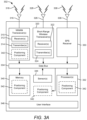
- FIGS. 3 A, 3 B, and 3 C illustrate several example components (represented by corresponding blocks) that may be incorporated into a UE 302 (which may correspond to any of the UEs described herein), a base station 304 (which may correspond to any of the base stations described herein), and a network entity 306 (which may correspond to or embody any of the network functions described herein, including the location server 230 and the LMF 270 , or alternatively may be independent from the NG-RAN 220 and/or 5GC 210 / 260 infrastructure depicted in FIGS. 2 A and 2 B , such as a private network) to support the file transmission operations as taught herein.
- a UE 302 which may correspond to any of the UEs described herein
- a base station 304 which may correspond to any of the base stations described herein
- a network entity 306 which may correspond to or embody any of the network functions described herein, including the location server 230 and the LMF 270 , or alternatively may be independent from the
- these components may be implemented in different types of apparatuses in different implementations (e.g., in an ASIC, in a system-on-chip (SoC), etc.).
- the illustrated components may also be incorporated into other apparatuses in a communication system.
- other apparatuses in a system may include components similar to those described to provide similar functionality.
- a given apparatus may contain one or more of the components.
- an apparatus may include multiple transceiver components that enable the apparatus to operate on multiple carriers and/or communicate via different technologies.
- the transmitter 354 and the receiver 352 may implement Layer-1 (L1) functionality associated with various signal processing functions.
- Layer-1 which includes a physical (PHY) layer, may include error detection on the transport channels, forward error correction (FEC) coding/decoding of the transport channels, interleaving, rate matching, mapping onto physical channels, modulation/demodulation of physical channels, and MIMO antenna processing.
- FEC forward error correction
- the transmitter 354 handles mapping to signal constellations based on various modulation schemes (e.g., binary phase-shift keying (BPSK), quadrature phase-shift keying (QPSK), M-phase-shift keying (M-PSK), M-quadrature amplitude modulation (M-QAM)).
- BPSK binary phase-shift keying
- QPSK quadrature phase-shift keying
- M-PSK M-phase-shift keying
- M-QAM M-quadrature amplitude modulation
- the receiver 312 receives a signal through its respective antenna(s) 316 .
- the receiver 312 recovers information modulated onto an RF carrier and provides the information to the one or more processors 332 .
- the transmitter 314 and the receiver 312 implement Layer-1 functionality associated with various signal processing functions.
- the receiver 312 may perform spatial processing on the information to recover any spatial streams destined for the UE 302 . If multiple spatial streams are destined for the UE 302 , they may be combined by the receiver 312 into a single OFDM symbol stream.
- the receiver 312 then converts the OFDM symbol stream from the time-domain to the frequency domain using a fast Fourier transform (FFT).
- FFT fast Fourier transform
- the symbols on each subcarrier, and the reference signal are recovered and demodulated by determining the most likely signal constellation points transmitted by the base station 304 . These soft decisions may be based on channel estimates computed by a channel estimator. The soft decisions are then decoded and de-interleaved to recover the data and control signals that were originally transmitted by the base station 304 on the physical channel. The data and control signals are then provided to the one or more processors 332 , which implements Layer-3 (L3) and Layer-2 (L2) functionality.
- L3 Layer-3
- L2 Layer-2
- the one or more processors 332 provides demultiplexing between transport and logical channels, packet reassembly, deciphering, header decompression, and control signal processing to recover IP packets from the core network.
- the one or more processors 332 are also responsible for error detection.
- the one or more processors 332 provides RRC layer functionality associated with system information (e.g., MIB, SIBs) acquisition, RRC connections, and measurement reporting; PDCP layer functionality associated with header compression/decompression, and security (ciphering, deciphering, integrity protection, integrity verification); RLC layer functionality associated with the transfer of upper layer PDUs, error correction through ARQ, concatenation, segmentation, and reassembly of RLC SDUs, re-segmentation of RLC data PDUs, and reordering of RLC data PDUs; and MAC layer functionality associated with mapping between logical channels and transport channels, multiplexing of MAC SDUs onto transport blocks (TBs), demultiplexing of MAC SDUs from TBs, scheduling information reporting, error correction through hybrid automatic repeat request (HARQ), priority handling, and logical channel prioritization.
- RRC layer functionality associated with system information (e.g., MIB, SIBs) acquisition, RRC connections, and measurement reporting
- Channel estimates derived by the channel estimator from a reference signal or feedback transmitted by the base station 304 may be used by the transmitter 314 to select the appropriate coding and modulation schemes, and to facilitate spatial processing.
- the spatial streams generated by the transmitter 314 may be provided to different antenna(s) 316 .
- the transmitter 314 may modulate an RF carrier with a respective spatial stream for transmission.
- the uplink transmission is processed at the base station 304 in a manner similar to that described in connection with the receiver function at the UE 302 .
- the receiver 352 receives a signal through its respective antenna(s) 356 .
- the receiver 352 recovers information modulated onto an RF carrier and provides the information to the one or more processors 384 .
- the one or more processors 384 provides demultiplexing between transport and logical channels, packet reassembly, deciphering, header decompression, control signal processing to recover IP packets from the UE 302 .
- IP packets from the one or more processors 384 may be provided to the core network.
- the one or more processors 384 are also responsible for error detection.
- FIGS. 3 A, 3 B, and 3 C For convenience, the UE 302 , the base station 304 , and/or the network entity 306 are shown in FIGS. 3 A, 3 B, and 3 C as including various components that may be configured according to the various examples described herein. It will be appreciated, however, that the illustrated components may have different functionality in different designs. In particular, various components in FIGS. 3 A to 3 C are optional in alternative configurations and the various aspects include configurations that may vary due to design choice, costs, use of the device, or other considerations. For example, in case of FIG.
- a particular implementation of UE 302 may omit the WWAN transceiver(s) 310 (e.g., a wearable device or tablet computer or PC or laptop may have Wi-Fi and/or Bluetooth capability without cellular capability), or may omit the short-range wireless transceiver(s) 320 (e.g., cellular-only, etc.), or may omit the SPS receiver 330 , or may omit the sensor(s) 344 , and so on.
- WWAN transceiver(s) 310 e.g., a wearable device or tablet computer or PC or laptop may have Wi-Fi and/or Bluetooth capability without cellular capability
- the short-range wireless transceiver(s) 320 e.g., cellular-only, etc.
- SPS receiver 330 e.g., cellular-only, etc.
- a particular implementation of the base station 304 may omit the WWAN transceiver(s) 350 (e.g., a Wi-Fi “hotspot” access point without cellular capability), or may omit the short-range wireless transceiver(s) 360 (e.g., cellular-only, etc.), or may omit the SPS receiver 370 , and so on.
- WWAN transceiver(s) 350 e.g., a Wi-Fi “hotspot” access point without cellular capability
- the short-range wireless transceiver(s) 360 e.g., cellular-only, etc.
- SPS receiver 370 e.g., cellular-only, etc.
- the various components of the UE 302 , the base station 304 , and the network entity 306 may be communicatively coupled to each other over data buses 334 , 382 , and 392 , respectively.
- the data buses 334 , 382 , and 392 may form, or be part of, a communication interface of the UE 302 , the base station 304 , and the network entity 306 , respectively.
- the data buses 334 , 382 , and 392 may provide communication between them.
- FIGS. 3 A, 3 B, and 3 C may be implemented in various ways.
- the components of FIGS. 3 A, 3 B, and 3 C may be implemented in one or more circuits such as, for example, one or more processors and/or one or more ASICs (which may include one or more processors).
- each circuit may use and/or incorporate at least one memory component for storing information or executable code used by the circuit to provide this functionality.
- some or all of the functionality represented by blocks 310 to 346 may be implemented by processor and memory component(s) of the UE 302 (e.g., by execution of appropriate code and/or by appropriate configuration of processor components).
- some or all of the functionality represented by blocks 350 to 388 may be implemented by processor and memory component(s) of the base station 304 (e.g., by execution of appropriate code and/or by appropriate configuration of processor components). Also, some or all of the functionality represented by blocks 390 to 398 may be implemented by processor and memory component(s) of the network entity 306 (e.g., by execution of appropriate code and/or by appropriate configuration of processor components). For simplicity, various operations, acts, and/or functions are described herein as being performed “by a UE,” “by a base station,” “by a network entity,” etc.
- the network entity 306 may be implemented as a core network component. In other designs, the network entity 306 may be distinct from a network operator or operation of the cellular network infrastructure (e.g., NG RAN 220 and/or 5GC 210 / 260 ). For example, the network entity 306 may be a component of a private network that may be configured to communicate with the UE 302 via the base station 304 or independently from the base station 304 (e.g., over a non-cellular communication link, such as WiFi).
- a non-cellular communication link such as WiFi
- NR supports a number of cellular network-based positioning technologies, including downlink-based, uplink-based, and downlink-and-uplink-based positioning methods.
- Downlink-based positioning methods include observed time difference of arrival (OTDOA) in LTE, downlink time difference of arrival (DL-TDOA) in NR, and downlink angle-of-departure (DL-AoD) in NR.
- OTDOA observed time difference of arrival
- DL-TDOA downlink time difference of arrival
- DL-AoD downlink angle-of-departure
- a UE measures the differences between the times of arrival (ToAs) of reference signals (e.g., positioning reference signals (PRS)) received from pairs of base stations, referred to as reference signal time difference (RSTD) or time difference of arrival (TDOA) measurements, and reports them to a positioning entity.
- ToAs times of arrival
- PRS positioning reference signals
- RSTD reference signal time difference
- TDOA time difference of arrival
- the UE receives the identifiers (IDs) of a reference base station (e.g., a serving base station) and multiple non-reference base stations in assistance data.
- the UE measures the RSTD between the reference base station and each of the non-reference base stations. Based on the known locations of the involved base stations and the RSTD measurements, the positioning entity can estimate the UE's location.
- the positioning entity uses a beam report from the UE of received signal strength measurements of multiple downlink transmit beams to determine the angle(s) between the UE and the transmitting base station(s). The positioning entity can then estimate the location of the UE based on the determined angle(s) and the known location(s) of the transmitting base station(s).
- Uplink-based positioning methods include uplink time difference of arrival (UL-TDOA) and uplink angle-of-arrival (UL-AoA).
- UL-TDOA is similar to DL-TDOA, but is based on uplink reference signals (e.g., sounding reference signals (SRS)) transmitted by the UE.
- uplink reference signals e.g., sounding reference signals (SRS)
- SRS sounding reference signals
- one or more base stations measure the received signal strength of one or more uplink reference signals (e.g., SRS) received from a UE on one or more uplink receive beams.
- the positioning entity uses the signal strength measurements and the angle(s) of the receive beam(s) to determine the angle(s) between the UE and the base station(s). Based on the determined angle(s) and the known location(s) of the base station(s), the positioning entity can then estimate the location of the UE.
- Downlink-and-uplink-based positioning methods include enhanced cell-ID (E-CID) positioning and multi-round-trip-time (RTT) positioning (also referred to as “multi-cell RTT”).
- E-CID enhanced cell-ID
- RTT multi-round-trip-time
- an initiator a base station or a UE
- transmits an RTT measurement signal e.g., a PRS or SRS
- a responder a UE or base station
- RTT response signal e.g., an SRS or PRS
- the RTT response signal includes the difference between the ToA of the RTT measurement signal and the transmission time of the RTT response signal, referred to as the reception-to-transmission (Rx-Tx) time difference.
- the initiator calculates the difference between the transmission time of the RTT measurement signal and the ToA of the RTT response signal, referred to as the transmission-to-reception (Tx-Rx) time difference.
- the propagation time also referred to as the “time of flight”
- the distance between the initiator and the responder can be determined.
- a UE performs an RTT procedure with multiple base stations to enable its location to be determined (e.g., using multilateration) based on the known locations of the base stations.
- RTT and multi-RTT methods can be combined with other positioning techniques, such as UL-AoA and DL-AoD, to improve location accuracy.
- the E-CID positioning method is based on radio resource management (RRM) measurements.
- RRM radio resource management
- the UE reports the serving cell ID, the timing advance (TA), and the identifiers, estimated timing, and signal strength of detected neighbor base stations.
- the location of the UE is then estimated based on this information and the known locations of the base station(s).
- a location server may provide assistance data to the UE.
- the assistance data may include identifiers of the base stations (or the cells/TRPs of the base stations) from which to measure reference signals, the reference signal configuration parameters (e.g., the number of consecutive positioning subframes, periodicity of positioning subframes, muting sequence, frequency hopping sequence, reference signal identifier, reference signal bandwidth, etc.), and/or other parameters applicable to the particular positioning method.
- the assistance data may originate directly from the base stations themselves (e.g., in periodically broadcasted overhead messages, etc.). in some cases, the UE may be able to detect neighbor network nodes itself without the use of assistance data.
- the assistance data may further include an expected RSTD value and an associated uncertainty, or search window, around the expected RSTD.
- the value range of the expected RSTD may be +/ ⁇ 500 microseconds ( ⁇ s).
- the value range for the uncertainty of the expected RSTD may be +/ ⁇ 32 ⁇ s.
- the value range for the uncertainty of the expected RSTD may be +/ ⁇ 8 ⁇ s.
- a location estimate may be referred to by other names, such as a position estimate, location, position, position fix, fix, or the like.
- a location estimate may be geodetic and comprise coordinates (e.g., latitude, longitude, and possibly altitude) or may be civic and comprise a street address, postal address, or some other verbal description of a location.
- a location estimate may further be defined relative to some other known location or defined in absolute terms (e.g., using latitude, longitude, and possibly altitude).
- a location estimate may include an expected error or uncertainty (e.g., by including an area or volume within which the location is expected to be included with some specified or default level of confidence).
Landscapes
- Engineering & Computer Science (AREA)
- Signal Processing (AREA)
- Computer Networks & Wireless Communication (AREA)
- Physics & Mathematics (AREA)
- General Physics & Mathematics (AREA)
- Radar, Positioning & Navigation (AREA)
- Remote Sensing (AREA)
- Mobile Radio Communication Systems (AREA)
- Position Fixing By Use Of Radio Waves (AREA)
Priority Applications (10)
| Application Number | Priority Date | Filing Date | Title |
|---|---|---|---|
| US17/314,258 US12349103B2 (en) | 2020-05-15 | 2021-05-07 | Reporting granularity and measurement period for positioning reference signal (PRS) measurements |
| EP23206488.1A EP4290953B1 (de) | 2020-05-15 | 2021-05-10 | Auswahl der granularität und meldung von ortungsmessungen |
| CN202180033975.2A CN115606268A (zh) | 2020-05-15 | 2021-05-10 | 用于定位参考信号(prs)测量的报告粒度和测量时段 |
| BR112022022334A BR112022022334A2 (pt) | 2020-05-15 | 2021-05-10 | Granularidade de relatório e período de medição para medições de sinal de referência de posicionamento (prs) |
| PCT/US2021/031624 WO2021231325A1 (en) | 2020-05-15 | 2021-05-10 | Reporting granularity and measurement period for positioning reference signal (prs) measurements |
| EP21729167.3A EP4150987B1 (de) | 2020-05-15 | 2021-05-10 | Granularität und messzeitraum für die positionierung von referenzsignal(prs)-messungen berichten |
| KR1020227038963A KR20230011286A (ko) | 2020-05-15 | 2021-05-10 | 포지셔닝 기준 신호(prs) 측정들을 위한 보고 입도 및 측정 기간 |
| PH1/2022/552471A PH12022552471A1 (en) | 2020-05-15 | 2021-05-10 | Reporting granularity and measurement period for positioning reference signal (prs) meaasurements |
| JP2022566690A JP7657241B2 (ja) | 2020-05-15 | 2021-05-10 | 測位基準信号(prs)測定のための粒度と測定期間とを報告すること |
| US19/216,527 US20250287350A1 (en) | 2020-05-15 | 2025-05-22 | Reporting granularity and measurement period for positioning reference signal (prs) measurements |
Applications Claiming Priority (2)
| Application Number | Priority Date | Filing Date | Title |
|---|---|---|---|
| US202063025510P | 2020-05-15 | 2020-05-15 | |
| US17/314,258 US12349103B2 (en) | 2020-05-15 | 2021-05-07 | Reporting granularity and measurement period for positioning reference signal (PRS) measurements |
Related Child Applications (1)
| Application Number | Title | Priority Date | Filing Date |
|---|---|---|---|
| US19/216,527 Division US20250287350A1 (en) | 2020-05-15 | 2025-05-22 | Reporting granularity and measurement period for positioning reference signal (prs) measurements |
Publications (2)
| Publication Number | Publication Date |
|---|---|
| US20210360578A1 US20210360578A1 (en) | 2021-11-18 |
| US12349103B2 true US12349103B2 (en) | 2025-07-01 |
Family
ID=78512251
Family Applications (2)
| Application Number | Title | Priority Date | Filing Date |
|---|---|---|---|
| US17/314,258 Active 2041-12-10 US12349103B2 (en) | 2020-05-15 | 2021-05-07 | Reporting granularity and measurement period for positioning reference signal (PRS) measurements |
| US19/216,527 Pending US20250287350A1 (en) | 2020-05-15 | 2025-05-22 | Reporting granularity and measurement period for positioning reference signal (prs) measurements |
Family Applications After (1)
| Application Number | Title | Priority Date | Filing Date |
|---|---|---|---|
| US19/216,527 Pending US20250287350A1 (en) | 2020-05-15 | 2025-05-22 | Reporting granularity and measurement period for positioning reference signal (prs) measurements |
Country Status (8)
| Country | Link |
|---|---|
| US (2) | US12349103B2 (de) |
| EP (2) | EP4150987B1 (de) |
| JP (1) | JP7657241B2 (de) |
| KR (1) | KR20230011286A (de) |
| CN (1) | CN115606268A (de) |
| BR (1) | BR112022022334A2 (de) |
| PH (1) | PH12022552471A1 (de) |
| WO (1) | WO2021231325A1 (de) |
Families Citing this family (16)
| Publication number | Priority date | Publication date | Assignee | Title |
|---|---|---|---|---|
| US11765769B2 (en) * | 2021-07-30 | 2023-09-19 | Qualcomm Incorporated | Supplemental positioning reference signal transmission |
| US20240267873A1 (en) * | 2021-08-06 | 2024-08-08 | Sony Group Corporation | Positioning measurement with low latency |
| US12126497B2 (en) * | 2021-09-01 | 2024-10-22 | Parsa Wireless Communications Llc | Prediction-based data transmission by internet of things (IoT) devices |
| US12015941B2 (en) * | 2021-09-30 | 2024-06-18 | Qualcomm Incorporated | Processing window design for positioning |
| CN118044140A (zh) * | 2021-09-30 | 2024-05-14 | 中兴通讯股份有限公司 | 用于对定位参考信号的测量的系统和方法 |
| US12276743B2 (en) | 2021-12-17 | 2025-04-15 | Lenovo (United States) Inc. | Configuration and reporting in a non-terrestrial network |
| US12363664B2 (en) * | 2021-12-17 | 2025-07-15 | Lenovo (Singapore) Pte. Ltd. | Positioning in a non-terrestrial network |
| CN116456367B (zh) * | 2022-01-07 | 2026-04-17 | 大唐移动通信设备有限公司 | 一种信息配置方法、传输方法、装置、基站、lmf及终端 |
| CN116456267A (zh) * | 2022-01-07 | 2023-07-18 | 北京三星通信技术研究有限公司 | 定位信号测量方法和装置 |
| US12413364B2 (en) * | 2022-01-07 | 2025-09-09 | Intel Corporation | User equipment behavior and requirements for positioning measurement without gap |
| CN116506941B (zh) * | 2022-01-18 | 2026-01-02 | 大唐移动通信设备有限公司 | Dl-tdoa定位的方法及装置 |
| CA3251874A1 (en) | 2022-02-14 | 2023-08-17 | Nokia Technologies Oy | APPARATUS, METHODS AND COMPUTER PROGRAMS RELATED TO POSITIONING REFERENCE SIGNALS |
| EP4503784A4 (de) * | 2022-03-31 | 2025-06-11 | Beijing Xiaomi Mobile Software Co., Ltd. | Verfahren und vorrichtung zur bestimmung der messzeit |
| KR20240170913A (ko) * | 2022-04-02 | 2024-12-05 | 삼성전자주식회사 | 사용자 장치 및 사용자 장치에 의해 실행되는 방법 |
| EP4595609A1 (de) * | 2022-09-28 | 2025-08-06 | Nokia Technologies Oy | Verbesserung der positionierungsmessgenauigkeit mit trägeraggregation |
| WO2024211783A1 (en) * | 2023-04-06 | 2024-10-10 | Intel Corporation | Methods and arrangements for measurement gaps |
Citations (13)
| Publication number | Priority date | Publication date | Assignee | Title |
|---|---|---|---|---|
| US20130237247A1 (en) * | 2010-11-17 | 2013-09-12 | Lg Electronics Inc | Positioning method and apparatus in wireless communication system |
| US20140112180A1 (en) * | 2011-06-21 | 2014-04-24 | Telefonaktiebolaget L M Ericsson (Publ) | Methods and apparatuses for performing measurements in a wireless network |
| US20160050534A1 (en) | 2012-03-13 | 2016-02-18 | Lg Electronics Inc. | Method for measuring location of user equipment in wireless access system and apparatus therefor |
| US20180217228A1 (en) | 2017-02-02 | 2018-08-02 | Qualcomm Incorporated | Method and/or system for acquisition of a positioning signal |
| US20190037338A1 (en) | 2017-07-31 | 2019-01-31 | Qualcomm Incorporated | Methods and systems for on-demand resource allocation for location determination of a mobile device |
| US20190052996A1 (en) | 2017-08-10 | 2019-02-14 | Qualcomm Incorporated | Provision and use of gaps for reference signal time difference measurements |
| WO2019162513A1 (en) | 2018-02-26 | 2019-08-29 | Telefonaktiebolaget Lm Ericsson (Publ) | Managing parallel measurement gap patterns for radio resource management and positioning measurements |
| WO2020027604A1 (en) | 2018-08-02 | 2020-02-06 | Samsung Electronics Co., Ltd. | Method and apparatus for providing a positional reference signal in a mobile communication system |
| US20210058891A1 (en) * | 2019-11-04 | 2021-02-25 | Intel Corporation | Positioning reference signal (prs)-based reference signal time difference (rstd) measurements |
| US20210329618A1 (en) * | 2020-05-14 | 2021-10-21 | Andrey Chervyakov | Apparatus for ue measurement delay and granularity for new radio positioning measurement |
| US20220006589A1 (en) * | 2018-11-09 | 2022-01-06 | Telefonaktiebolaget Lm Ericsson (Publ) | System and method for phase noise-based signal design for positioning in a communication system |
| US20220095265A1 (en) | 2019-01-11 | 2022-03-24 | Lg Electronics Inc. | Method for transmitting or receiving positioning information, and device therefor |
| US20230037478A1 (en) * | 2020-04-10 | 2023-02-09 | Huawei Technologies Co., Ltd. | Positioning signal processing method and apparatus |
-
2021
- 2021-05-07 US US17/314,258 patent/US12349103B2/en active Active
- 2021-05-10 EP EP21729167.3A patent/EP4150987B1/de active Active
- 2021-05-10 CN CN202180033975.2A patent/CN115606268A/zh active Pending
- 2021-05-10 KR KR1020227038963A patent/KR20230011286A/ko active Pending
- 2021-05-10 WO PCT/US2021/031624 patent/WO2021231325A1/en not_active Ceased
- 2021-05-10 JP JP2022566690A patent/JP7657241B2/ja active Active
- 2021-05-10 EP EP23206488.1A patent/EP4290953B1/de active Active
- 2021-05-10 BR BR112022022334A patent/BR112022022334A2/pt unknown
- 2021-05-10 PH PH1/2022/552471A patent/PH12022552471A1/en unknown
-
2025
- 2025-05-22 US US19/216,527 patent/US20250287350A1/en active Pending
Patent Citations (16)
| Publication number | Priority date | Publication date | Assignee | Title |
|---|---|---|---|---|
| JP2014503799A (ja) | 2010-11-17 | 2014-02-13 | エルジー エレクトロニクス インコーポレイティド | 無線通信システムにおける測位方法及び装置 |
| US20130237247A1 (en) * | 2010-11-17 | 2013-09-12 | Lg Electronics Inc | Positioning method and apparatus in wireless communication system |
| US20140112180A1 (en) * | 2011-06-21 | 2014-04-24 | Telefonaktiebolaget L M Ericsson (Publ) | Methods and apparatuses for performing measurements in a wireless network |
| US20160050534A1 (en) | 2012-03-13 | 2016-02-18 | Lg Electronics Inc. | Method for measuring location of user equipment in wireless access system and apparatus therefor |
| US20180217228A1 (en) | 2017-02-02 | 2018-08-02 | Qualcomm Incorporated | Method and/or system for acquisition of a positioning signal |
| US20190037338A1 (en) | 2017-07-31 | 2019-01-31 | Qualcomm Incorporated | Methods and systems for on-demand resource allocation for location determination of a mobile device |
| US20190052996A1 (en) | 2017-08-10 | 2019-02-14 | Qualcomm Incorporated | Provision and use of gaps for reference signal time difference measurements |
| US20210120513A1 (en) * | 2018-02-26 | 2021-04-22 | Telefonaktiebolaget Lm Ericsson (Publ) | Managing parallel measurement gap patterns for radio resource management and positioning measurements |
| WO2019162513A1 (en) | 2018-02-26 | 2019-08-29 | Telefonaktiebolaget Lm Ericsson (Publ) | Managing parallel measurement gap patterns for radio resource management and positioning measurements |
| WO2020027604A1 (en) | 2018-08-02 | 2020-02-06 | Samsung Electronics Co., Ltd. | Method and apparatus for providing a positional reference signal in a mobile communication system |
| US20210176022A1 (en) * | 2018-08-02 | 2021-06-10 | Samsung Electronics Co., Ltd. | Method and apparatus for providing a positional reference signal in a mobile communication system |
| US20220006589A1 (en) * | 2018-11-09 | 2022-01-06 | Telefonaktiebolaget Lm Ericsson (Publ) | System and method for phase noise-based signal design for positioning in a communication system |
| US20220095265A1 (en) | 2019-01-11 | 2022-03-24 | Lg Electronics Inc. | Method for transmitting or receiving positioning information, and device therefor |
| US20210058891A1 (en) * | 2019-11-04 | 2021-02-25 | Intel Corporation | Positioning reference signal (prs)-based reference signal time difference (rstd) measurements |
| US20230037478A1 (en) * | 2020-04-10 | 2023-02-09 | Huawei Technologies Co., Ltd. | Positioning signal processing method and apparatus |
| US20210329618A1 (en) * | 2020-05-14 | 2021-10-21 | Andrey Chervyakov | Apparatus for ue measurement delay and granularity for new radio positioning measurement |
Non-Patent Citations (13)
| Title |
|---|
| Apple: "On Remaining Issues of NR RSTD Measurement Report Mapping," 3GPP Draft, 3GPP TSG-RAN4 Meeting #94bis-e, R4-2003401, 3rd Generation Partnership Project (3GPP), Mobile Competence Centre, 650, Route Des Lucioles, F-06921, Sophia-Antipolis Cedex, France, vol. RAN WG4. No. Online Meeting, Apr. 20, 2020-Apr. 30, 2020, Apr. 10, 2020 (Apr. 10, 2020), XP051872017, 10 pages, Retrieved from the Internet: URL: https://ftp.3gpp.org/tsg_ran/WG4_Radio/TSGR4_94_eBis/Docs/R4-2003401.zip R4-2003401 on remaining issues of NR RSTD measurement report mapping.docx [retrieved on Apr. 10, 2020] p. 4-p. 5. |
| CATT: "Discussion on RSTD Measurement Requirements", 3GPP RAN WG4 Meeting #94-e-bis, R4-2003285, Electronic Meeting, Apr. 20-30, 2020, Apr. 10, 2020, 8 Pages. |
| Ericsson: "On PRS RSTD Measurement Report Mapping," 3GPP Draft, 3GPP TSG-RAN WG4 Meeting #94-e, R4-2001942, 3rd Generation Partnership Project (3GPP), Mobile Competence Centre, 650, Route Des Lucioles, F-06921, Sophia-Antipolis Cedex, France, vol. RAN WG4. No. Electronic Meeting, Feb. 24, 2020-Mar. 6, 2020, Feb. 14, 2020 (Feb. 14, 2020), XP051851801, 7 pages, Retrieved from the Internet: URL: https://ftp.3gpp.org/tsg_ran/WG4_Radio/TSGR4_94_e/Docs/R4-2001942.zip R4-2001942 on PRS-RSTD measurement report mapping.doc [retrieved on Feb. 14, 2020] p. 1-p. 2. |
| Ericsson: "UE Positioning Measurements: RSTD", R4-2017144, 3GPP TSG-RAN WG4 Meeting #97-e, Electronic Meeting, Nov. 2-13, 2020, 4 Pages. |
| European Search Report—EP23206488—Search Authority—Berlin—Feb. 2, 2024. |
| Fischer S., "Observed Time Difference of Arrival (OTDOA) Positioning in 3GPP LTE", Jun. 6, 2014, XP055549372, pp. 1-62, section 7, figures 6-4, pp. 32-33, points 1-5, chapters 6 and 7. |
| Intel Corporation: "Remaining Details of Physical Layer Measurements for NR Positioning," 3GPP Draft, 3GPP TSG RAN WG1 Meeting #98bis, R1-1910676 Intel—NRPOS_Measurements, 3rd Generation Partnership Project (3GPP), Mobile Competence Centre, 650, Route Des Lucioles, F-06921, Sophia-Antipolis Cedex, France, vol. RAN WG1. No. Chongqing, China, Oct. 14, 2019-Oct. 20, 2019, Oct. 5, 2019 (Oct. 5, 2019), XP051808641, 21 pages, Retrieved from the Internet: URL: https://ftp.3gpp.org/tsg_ran/WG1_RL1/TSGR1_98b/Docs/R1-1910676.zip R1-1910676 Intel—NRPOS Measurements.docx [retrieved on—Oct. 5, 2019] Section 3.1. |
| International Search Report and Written Opinion—PCT/US2021/031624—ISA/EPO—Sep. 13, 2021. |
| Mediatek: "Discussion on PRS-RSTD Measurement", R4-2003508, 3GPP TSG-RAN WG4 Meeting #94-e-bis, Electronic Meeting, Apr. 20-30, 2020, 6 Pages. |
| Moderator (Qualcomm Inc): "Email Discussion Summary for [94e Bis][115] NR_pos_RRM_Part_1", 3GPP Draft, 3GPP TSG-RAN WG4 Meeting # 94-e-Bis, R4-2005294, 3rd Generation Partnership Project (3GPP), Mobile Competence Centre, 650, Route Des Lucioles, F-06921, Sophia-Antipolis Cedex, France, vol. RAN WG4. No. Online Meeting, Apr. 20, 2020-Apr. 30, 2020, May 4, 2020 (May 5, 2020), XP051880252, 89 pages, Retrieved from the Internet: URL: https://ftp.3gpp.org/tsg_ran/WG4_Radio/TSGR4_94_eBis/Docs/R4-2005294.zip R4-2005294 [94e Bis] [115] NR_pos_RRM_Part_1_1st_round final.docx [retrieved—on May 4, 2020] p. 4. |
| Moderator (Qualcomm): "Email Discussion Summary for RAN4#94e_#56_NR_pos_RRM_Part_1," 3GPP Draft, 3GPP TSG-RAN WG4 Meeting #94-e, R4-2002310, 3rd Generation Partnership Project (3GPP), Mobile Competence Centre, 650, Route Des Lucioles, F-06921, Sophia-Antipolis Cedex, France, vol. RAN WG4. No. Electronic Meeting, Feb. 24, 2020-Mar. 6, 2020, Mar. 10, 2020 (Mar. 10, 2020), XP051863347, 103 pages, Retrieved from the Internet: URL:https://ftp.3gpp.org/tsg_ran/WG4_Radio/TSGR4_94_e/Docs/R4-2002310.zip R4-2002310 RAN4#94e email discussion #56-NR_positioning_Part1_2nd_round_summary_final.docx [retrieved on Mar. 10, 2020] p. 7. |
| Partial International Search Report—PCT/US2021/031624—ISA/EPO—Jul. 16, 2021. |
| Qualcomm Incorporated: "On PRS-RSTD Measurements in NR Positioning", 3GPP TSG-RAN WG4 Meeting #95-e, R4-2006168, Online, May 25-Jun. 5, 2020, May 15, 2020, pp. 1-10. |
Also Published As
| Publication number | Publication date |
|---|---|
| EP4150987A1 (de) | 2023-03-22 |
| CN115606268A (zh) | 2023-01-13 |
| EP4290953C0 (de) | 2025-08-27 |
| US20210360578A1 (en) | 2021-11-18 |
| JP2023525700A (ja) | 2023-06-19 |
| KR20230011286A (ko) | 2023-01-20 |
| EP4150987C0 (de) | 2025-07-09 |
| US20250287350A1 (en) | 2025-09-11 |
| EP4290953A3 (de) | 2024-03-06 |
| EP4150987B1 (de) | 2025-07-09 |
| PH12022552471A1 (en) | 2024-01-03 |
| BR112022022334A2 (pt) | 2022-12-13 |
| JP7657241B2 (ja) | 2025-04-04 |
| EP4290953B1 (de) | 2025-08-27 |
| WO2021231325A1 (en) | 2021-11-18 |
| EP4290953A2 (de) | 2023-12-13 |
Similar Documents
| Publication | Publication Date | Title |
|---|---|---|
| US12328610B2 (en) | Measurement period formulation for reference signal time difference (RSTD) measurements | |
| US12225630B2 (en) | Minimum positioning reference signal (PRS) processing when measurement gaps are not configured | |
| US20250287350A1 (en) | Reporting granularity and measurement period for positioning reference signal (prs) measurements | |
| US20230362699A1 (en) | Dynamic configuration of measurement gaps | |
| US20220046444A1 (en) | Measurement gap sharing between radio resource management and positioning reference signal measurements | |
| US11722273B2 (en) | Calculation of downlink positioning reference signal (PRS) symbol duration for PRS buffering purposes | |
| US12615613B2 (en) | Signalling for requesting preferred on-demand positioning reference signal (PRS) configurations or parameters from a transmitting device | |
| EP4435472A2 (de) | Verringerung des overheads von berichtsmessungen und sende-empfangspunkt (trp)-identifikatoren in positionierungszustandsinformationen (psi) | |
| US11463221B2 (en) | Measurement period formulation for positioning reference signal (PRS) processing | |
| US20250105966A1 (en) | Configuration of on-demand sounding reference signals (srs) through association with on-demand positioning reference signal (prs) for user equipment (ue) positioning | |
| US20230180174A1 (en) | Positioning optimizations for multiplexing low latency downlink traffic | |
| US11924801B2 (en) | Determining factors for splitting positioning state information (PSI) between uplink control information (UCI) and medium access control control elements (MAC-CE) | |
| US20240244567A1 (en) | Reporting the number of samples and positioning reference signal (prs) instances associated with a positioning measurement | |
| WO2023059950A1 (en) | Positioning reference signal transmission in new radio unlicensed using guard bands |
Legal Events
| Date | Code | Title | Description |
|---|---|---|---|
| FEPP | Fee payment procedure |
Free format text: ENTITY STATUS SET TO UNDISCOUNTED (ORIGINAL EVENT CODE: BIG.); ENTITY STATUS OF PATENT OWNER: LARGE ENTITY |
|
| AS | Assignment |
Owner name: QUALCOMM INCORPORATED, CALIFORNIA Free format text: ASSIGNMENT OF ASSIGNORS INTEREST;ASSIGNORS:MANOLAKOS, ALEXANDROS;MIRBAGHERI, ARASH;OPSHAUG, GUTTORM RINGSTAD;SIGNING DATES FROM 20210508 TO 20210514;REEL/FRAME:056482/0341 |
|
| STPP | Information on status: patent application and granting procedure in general |
Free format text: DOCKETED NEW CASE - READY FOR EXAMINATION |
|
| STPP | Information on status: patent application and granting procedure in general |
Free format text: NON FINAL ACTION MAILED |
|
| STPP | Information on status: patent application and granting procedure in general |
Free format text: RESPONSE TO NON-FINAL OFFICE ACTION ENTERED AND FORWARDED TO EXAMINER |
|
| STPP | Information on status: patent application and granting procedure in general |
Free format text: RESPONSE TO NON-FINAL OFFICE ACTION ENTERED AND FORWARDED TO EXAMINER |
|
| STPP | Information on status: patent application and granting procedure in general |
Free format text: FINAL REJECTION MAILED |
|
| STPP | Information on status: patent application and granting procedure in general |
Free format text: RESPONSE AFTER FINAL ACTION FORWARDED TO EXAMINER |
|
| STPP | Information on status: patent application and granting procedure in general |
Free format text: ADVISORY ACTION MAILED |
|
| STPP | Information on status: patent application and granting procedure in general |
Free format text: DOCKETED NEW CASE - READY FOR EXAMINATION |
|
| STPP | Information on status: patent application and granting procedure in general |
Free format text: NON FINAL ACTION MAILED |
|
| STPP | Information on status: patent application and granting procedure in general |
Free format text: RESPONSE TO NON-FINAL OFFICE ACTION ENTERED AND FORWARDED TO EXAMINER |
|
| STPP | Information on status: patent application and granting procedure in general |
Free format text: NOTICE OF ALLOWANCE MAILED -- APPLICATION RECEIVED IN OFFICE OF PUBLICATIONS |
|
| STCF | Information on status: patent grant |
Free format text: PATENTED CASE |