US12148564B2 - Manufacturing method of an integrally formed inductor - Google Patents

Manufacturing method of an integrally formed inductor Download PDF

Info

Publication number
US12148564B2
US12148564B2 US17/322,920 US202117322920A US12148564B2 US 12148564 B2 US12148564 B2 US 12148564B2 US 202117322920 A US202117322920 A US 202117322920A US 12148564 B2 US12148564 B2 US 12148564B2
Authority
US
United States
Prior art keywords
coils
magnetic core
core plate
integrally formed
soft magnetic
Prior art date
Legal status (The legal status is an assumption and is not a legal conclusion. Google has not performed a legal analysis and makes no representation as to the accuracy of the status listed.)
Active, expires
Application number
US17/322,920
Other versions
US20220157519A1 (en
Inventor
Xinshu Yu
Youyun Li
Shengcheng XIA
Zehong YAO
Yupeng HONG
Yingying Wang
Qiang Su
Wanhe YI
Xin Che
Current Assignee (The listed assignees may be inaccurate. Google has not performed a legal analysis and makes no representation or warranty as to the accuracy of the list.)
Shenzhen Sunlord Electronics Co Ltd
Original Assignee
Shenzhen Sunlord Electronics Co Ltd
Priority date (The priority date is an assumption and is not a legal conclusion. Google has not performed a legal analysis and makes no representation as to the accuracy of the date listed.)
Filing date
Publication date
Application filed by Shenzhen Sunlord Electronics Co Ltd filed Critical Shenzhen Sunlord Electronics Co Ltd
Assigned to SHENZHEN SUNLORD ELECTRONICS CO., LTD. reassignment SHENZHEN SUNLORD ELECTRONICS CO., LTD. ASSIGNMENT OF ASSIGNORS INTEREST (SEE DOCUMENT FOR DETAILS). Assignors: LI, Youyun, CHE, Xin, HONG, Yupeng, XIA, Shengcheng, YAO, Zehong, SU, Qiang, YI, Wanhe, YU, Xinshu, WANG, YINGYING
Publication of US20220157519A1 publication Critical patent/US20220157519A1/en
Application granted granted Critical
Publication of US12148564B2 publication Critical patent/US12148564B2/en
Active legal-status Critical Current
Adjusted expiration legal-status Critical

Links

Images

Classifications

    • HELECTRICITY
    • H01ELECTRIC ELEMENTS
    • H01FMAGNETS; INDUCTANCES; TRANSFORMERS; SELECTION OF MATERIALS FOR THEIR MAGNETIC PROPERTIES
    • H01F41/00Apparatus or processes specially adapted for manufacturing or assembling magnets, inductances or transformers; Apparatus or processes specially adapted for manufacturing materials characterised by their magnetic properties
    • HELECTRICITY
    • H01ELECTRIC ELEMENTS
    • H01FMAGNETS; INDUCTANCES; TRANSFORMERS; SELECTION OF MATERIALS FOR THEIR MAGNETIC PROPERTIES
    • H01F27/00Details of transformers or inductances, in general
    • H01F27/02Casings
    • H01F27/027Casings specially adapted for combination of signal type inductors or transformers with electronic circuits, e.g. mounting on printed circuit boards
    • HELECTRICITY
    • H01ELECTRIC ELEMENTS
    • H01FMAGNETS; INDUCTANCES; TRANSFORMERS; SELECTION OF MATERIALS FOR THEIR MAGNETIC PROPERTIES
    • H01F1/00Magnets or magnetic bodies characterised by the magnetic materials therefor; Selection of materials for their magnetic properties
    • H01F1/01Magnets or magnetic bodies characterised by the magnetic materials therefor; Selection of materials for their magnetic properties of inorganic materials
    • H01F1/03Magnets or magnetic bodies characterised by the magnetic materials therefor; Selection of materials for their magnetic properties of inorganic materials characterised by their coercivity
    • H01F1/12Magnets or magnetic bodies characterised by the magnetic materials therefor; Selection of materials for their magnetic properties of inorganic materials characterised by their coercivity of soft-magnetic materials
    • H01F1/14Magnets or magnetic bodies characterised by the magnetic materials therefor; Selection of materials for their magnetic properties of inorganic materials characterised by their coercivity of soft-magnetic materials metals or alloys
    • H01F1/20Magnets or magnetic bodies characterised by the magnetic materials therefor; Selection of materials for their magnetic properties of inorganic materials characterised by their coercivity of soft-magnetic materials metals or alloys in the form of particles, e.g. powder
    • H01F1/22Magnets or magnetic bodies characterised by the magnetic materials therefor; Selection of materials for their magnetic properties of inorganic materials characterised by their coercivity of soft-magnetic materials metals or alloys in the form of particles, e.g. powder pressed, sintered, or bound together
    • H01F1/24Magnets or magnetic bodies characterised by the magnetic materials therefor; Selection of materials for their magnetic properties of inorganic materials characterised by their coercivity of soft-magnetic materials metals or alloys in the form of particles, e.g. powder pressed, sintered, or bound together the particles being insulated
    • HELECTRICITY
    • H01ELECTRIC ELEMENTS
    • H01FMAGNETS; INDUCTANCES; TRANSFORMERS; SELECTION OF MATERIALS FOR THEIR MAGNETIC PROPERTIES
    • H01F17/00Fixed inductances of the signal type
    • H01F17/04Fixed inductances of the signal type with magnetic core
    • H01F17/045Fixed inductances of the signal type with magnetic core with core of cylindric geometry and coil wound along its longitudinal axis, i.e. rod or drum core
    • HELECTRICITY
    • H01ELECTRIC ELEMENTS
    • H01FMAGNETS; INDUCTANCES; TRANSFORMERS; SELECTION OF MATERIALS FOR THEIR MAGNETIC PROPERTIES
    • H01F27/00Details of transformers or inductances, in general
    • H01F27/24Magnetic cores
    • H01F27/255Magnetic cores made from particles
    • HELECTRICITY
    • H01ELECTRIC ELEMENTS
    • H01FMAGNETS; INDUCTANCES; TRANSFORMERS; SELECTION OF MATERIALS FOR THEIR MAGNETIC PROPERTIES
    • H01F27/00Details of transformers or inductances, in general
    • H01F27/28Coils; Windings; Conductive connections
    • H01F27/2847Sheets; Strips
    • H01F27/2852Construction of conductive connections, of leads
    • HELECTRICITY
    • H01ELECTRIC ELEMENTS
    • H01FMAGNETS; INDUCTANCES; TRANSFORMERS; SELECTION OF MATERIALS FOR THEIR MAGNETIC PROPERTIES
    • H01F27/00Details of transformers or inductances, in general
    • H01F27/28Coils; Windings; Conductive connections
    • H01F27/29Terminals; Tapping arrangements for signal inductances
    • H01F27/292Surface mounted devices
    • HELECTRICITY
    • H01ELECTRIC ELEMENTS
    • H01FMAGNETS; INDUCTANCES; TRANSFORMERS; SELECTION OF MATERIALS FOR THEIR MAGNETIC PROPERTIES
    • H01F41/00Apparatus or processes specially adapted for manufacturing or assembling magnets, inductances or transformers; Apparatus or processes specially adapted for manufacturing materials characterised by their magnetic properties
    • H01F41/005Impregnating or encapsulating
    • HELECTRICITY
    • H01ELECTRIC ELEMENTS
    • H01FMAGNETS; INDUCTANCES; TRANSFORMERS; SELECTION OF MATERIALS FOR THEIR MAGNETIC PROPERTIES
    • H01F41/00Apparatus or processes specially adapted for manufacturing or assembling magnets, inductances or transformers; Apparatus or processes specially adapted for manufacturing materials characterised by their magnetic properties
    • H01F41/02Apparatus or processes specially adapted for manufacturing or assembling magnets, inductances or transformers; Apparatus or processes specially adapted for manufacturing materials characterised by their magnetic properties for manufacturing cores, coils, or magnets
    • H01F41/0206Manufacturing of magnetic cores by mechanical means
    • HELECTRICITY
    • H01ELECTRIC ELEMENTS
    • H01FMAGNETS; INDUCTANCES; TRANSFORMERS; SELECTION OF MATERIALS FOR THEIR MAGNETIC PROPERTIES
    • H01F41/00Apparatus or processes specially adapted for manufacturing or assembling magnets, inductances or transformers; Apparatus or processes specially adapted for manufacturing materials characterised by their magnetic properties
    • H01F41/02Apparatus or processes specially adapted for manufacturing or assembling magnets, inductances or transformers; Apparatus or processes specially adapted for manufacturing materials characterised by their magnetic properties for manufacturing cores, coils, or magnets
    • H01F41/0206Manufacturing of magnetic cores by mechanical means
    • H01F41/0246Manufacturing of magnetic circuits by moulding or by pressing powder
    • HELECTRICITY
    • H01ELECTRIC ELEMENTS
    • H01FMAGNETS; INDUCTANCES; TRANSFORMERS; SELECTION OF MATERIALS FOR THEIR MAGNETIC PROPERTIES
    • H01F41/00Apparatus or processes specially adapted for manufacturing or assembling magnets, inductances or transformers; Apparatus or processes specially adapted for manufacturing materials characterised by their magnetic properties
    • H01F41/02Apparatus or processes specially adapted for manufacturing or assembling magnets, inductances or transformers; Apparatus or processes specially adapted for manufacturing materials characterised by their magnetic properties for manufacturing cores, coils, or magnets
    • H01F41/04Apparatus or processes specially adapted for manufacturing or assembling magnets, inductances or transformers; Apparatus or processes specially adapted for manufacturing materials characterised by their magnetic properties for manufacturing cores, coils, or magnets for manufacturing coils
    • H01F41/06Coil winding
    • HELECTRICITY
    • H01ELECTRIC ELEMENTS
    • H01FMAGNETS; INDUCTANCES; TRANSFORMERS; SELECTION OF MATERIALS FOR THEIR MAGNETIC PROPERTIES
    • H01F41/00Apparatus or processes specially adapted for manufacturing or assembling magnets, inductances or transformers; Apparatus or processes specially adapted for manufacturing materials characterised by their magnetic properties
    • H01F41/02Apparatus or processes specially adapted for manufacturing or assembling magnets, inductances or transformers; Apparatus or processes specially adapted for manufacturing materials characterised by their magnetic properties for manufacturing cores, coils, or magnets
    • H01F41/04Apparatus or processes specially adapted for manufacturing or assembling magnets, inductances or transformers; Apparatus or processes specially adapted for manufacturing materials characterised by their magnetic properties for manufacturing cores, coils, or magnets for manufacturing coils
    • H01F41/06Coil winding
    • H01F41/076Forming taps or terminals while winding, e.g. by wrapping or soldering the wire onto pins, or by directly forming terminals from the wire
    • HELECTRICITY
    • H01ELECTRIC ELEMENTS
    • H01FMAGNETS; INDUCTANCES; TRANSFORMERS; SELECTION OF MATERIALS FOR THEIR MAGNETIC PROPERTIES
    • H01F41/00Apparatus or processes specially adapted for manufacturing or assembling magnets, inductances or transformers; Apparatus or processes specially adapted for manufacturing materials characterised by their magnetic properties
    • H01F41/02Apparatus or processes specially adapted for manufacturing or assembling magnets, inductances or transformers; Apparatus or processes specially adapted for manufacturing materials characterised by their magnetic properties for manufacturing cores, coils, or magnets
    • H01F41/04Apparatus or processes specially adapted for manufacturing or assembling magnets, inductances or transformers; Apparatus or processes specially adapted for manufacturing materials characterised by their magnetic properties for manufacturing cores, coils, or magnets for manufacturing coils
    • H01F41/10Connecting leads to windings
    • HELECTRICITY
    • H01ELECTRIC ELEMENTS
    • H01FMAGNETS; INDUCTANCES; TRANSFORMERS; SELECTION OF MATERIALS FOR THEIR MAGNETIC PROPERTIES
    • H01F41/00Apparatus or processes specially adapted for manufacturing or assembling magnets, inductances or transformers; Apparatus or processes specially adapted for manufacturing materials characterised by their magnetic properties
    • H01F41/02Apparatus or processes specially adapted for manufacturing or assembling magnets, inductances or transformers; Apparatus or processes specially adapted for manufacturing materials characterised by their magnetic properties for manufacturing cores, coils, or magnets
    • H01F41/04Apparatus or processes specially adapted for manufacturing or assembling magnets, inductances or transformers; Apparatus or processes specially adapted for manufacturing materials characterised by their magnetic properties for manufacturing cores, coils, or magnets for manufacturing coils
    • H01F41/12Insulating of windings
    • HELECTRICITY
    • H01ELECTRIC ELEMENTS
    • H01FMAGNETS; INDUCTANCES; TRANSFORMERS; SELECTION OF MATERIALS FOR THEIR MAGNETIC PROPERTIES
    • H01F17/00Fixed inductances of the signal type
    • H01F17/04Fixed inductances of the signal type with magnetic core
    • H01F2017/048Fixed inductances of the signal type with magnetic core with encapsulating core, e.g. made of resin and magnetic powder

Definitions

  • the disclosure relates to an electronic element, in particular to an integrally formed inductor and a manufacturing method thereof.
  • the traditional inductor is limited in its forming mode, large pressure intensity is needed, the size is too small, the service life of a corresponding die is low, and it is difficult for the die to be smaller than 2 mm. Powder loading limits product thickness and it is difficult to achieve below 0.8 mm.
  • the disclosure mainly aims to overcome the defects of the background technology, and provides an integrally formed inductor which is subminiature in size, ultra-thin and high in reliability and a manufacturing method thereof.
  • a manufacturing method of an integrally formed inductor comprising the following steps of:
  • a sintering temperature of the magnetic core plate being sintered from the soft magnetic material is 600-1000° C.
  • the soft magnetic material sintered to the magnetic core plate is one of or a mixture of more than one of carbonyl iron powder, iron silicon, iron silicon chromium, iron nickel, iron nickel molybdenum, iron silicon aluminum, amorphous, nanocrystalline and nanocrystalline.
  • the magnetic core plate is a rectangular plate
  • the plurality of grooves are distributed on the magnetic core plate in an array
  • the semi-finished inductor obtained by cutting is a rectangular parallelepiped
  • two terminals of the coils are formed on a same main surface of the integrally formed inductor.
  • the hollow coils are coils formed in a pair-wound, vertically wound, fly-fork-wound or outer-wound manner, and a structure of the coils is circular, flat, square or multi-strand combination.
  • the hollow coils are circular, racetrack-shaped or rectangular, and a shape of the grooves is matched with a shape of the hollow coils.
  • adding a soft magnetic material in a fluid state, and integrally forming the soft magnetic material in the fluid state on the magnetic core plate through pressing specifically comprises:
  • the soft magnetic material in the fluid state is one of or a mixture of more than one of carbonyl iron powder, iron silicon, iron silicon chromium, iron nickel, iron nickel molybdenum, iron silicon aluminum, amorphous, nanocrystalline, and nanocrystalline.
  • the insulating material is a resin, preferably an epoxy resin, a phenolic resin or a silicone resin.
  • metallization forms a metal layer, which is a combination of one or more layers of Cr, Ni, Ag, Cu, Ti and a Sn layer, preferably by means of PVD or electroplating, wherein the metallized layer is preferably a combination of Cu/Ni/Sn, and a total thickness of the coating layer is 3-15 ⁇ m.
  • An integrally formed inductor which is an integrally formed inductor manufactured using the manufacturing method.
  • the disclosure has the following beneficial effects.
  • the disclosure provides a manufacturing method of an integrally formed inductor, which can efficiently manufacture a high-quality subminiature inductor, wherein a full plate model, namely a magnetic core plate, which is manufactured by sintering a soft magnetic material is used, the magnetic core plate is provided with a plurality of grooves, a magnetic core middle column is formed in each groove, after a plurality of coils are loaded, the full plate is integrally formed on the magnetic core plate by using the soft magnetic material in a fluid state, and then the full plate is cut into single inductor products for realizing subminiature size.
  • the magnetic core of the inductor is integrally formed by combining two soft magnetic materials with different forms.
  • the manufacturing efficiency of the integrally formed inductor of the present disclosure is extremely high, the production efficiency of products can be remarkably improved and the cost can be reduced through full-plate forming and batch cutting.
  • the present disclosure also has the advantages that the two terminals of the coils are directly led to the main surface of the inductor, namely the electrode surface. During pasting, the terminals of the coils can be directly contacted with the PCB, the structure is simple, the risk of open circuit is avoided, and the reliability is extremely high. By using the manufacturing method of an integrally formed inductor of the present disclosure, the inductor product is easier to realize ultra-miniaturization, and particularly can be made thinner.
  • FIG. 1 is a schematic diagram showing a structure of a pair-wound prefabricated hollow coils according to an embodiment of the present disclosure.
  • FIG. 2 is a schematic diagram showing a structure of a vertically wound prefabricated hollow coils according to an embodiment of the present disclosure.
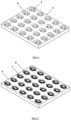
  • FIG. 3 is a schematic diagram showing a structure of a sintered magnetic core with a plurality of grooves according to an embodiment of the present disclosure.
  • FIG. 4 is a schematic diagram showing a structure of a magnetic core in which grooves are implanted into pair-wound hollow coils according to an embodiment of the present disclosure.
  • FIG. 5 is a schematic diagram showing a structure of a magnetic core in which grooves are implanted into vertically wound hollow coils according to an embodiment of the present disclosure.
  • FIG. 6 is a schematic diagram showing a structure of a magnetic core formed after coils are implanted according to an embodiment of the present disclosure.
  • FIG. 7 is a schematic diagram showing a structure in which a tail wire of coils is exposed after grinding a formed magnetic plate according to an embodiment of the present disclosure.
  • FIG. 8 is a schematic diagram showing a cut structure of a formed magnetic plate according to an embodiment of the present disclosure.
  • FIG. 9 is a schematic diagram showing a structure of a cut semi-finished product according to an embodiment of the present disclosure.
  • FIG. 10 is a schematic diagram of a structure of a metallized product according to an embodiment of the present disclosure.
  • connection may be for either fixation or coupling or communication.
  • first and second are used for descriptive purposes only and are not to be construed as indicating or implying relative importance or implicitly indicating the number of technical features indicated. Thus, features defined with “first” and “second” may explicitly or implicitly include one or more such features.
  • “plurality” means two or more, unless specifically defined otherwise.
  • the embodiment of the disclosure provides a manufacturing method of an integrally formed inductor, comprising the following steps of:
  • a sintering temperature of the magnetic core plate being sintered from the soft magnetic material is 600-1000° C.
  • the soft magnetic material sintered to the magnetic core plate is one of or a mixture of more than one of carbonyl iron powder, iron silicon, iron silicon chromium, iron nickel, iron nickel molybdenum, iron silicon aluminum, amorphous, nanocrystalline and nanocrystalline.
  • the magnetic core plate is a rectangular plate
  • the plurality of grooves are distributed on the magnetic core plate in an array
  • the semi-finished inductor obtained by cutting is a rectangular parallelepiped
  • two terminals of the coils are formed on a same main surface of the integrally formed inductor.
  • the hollow coils are coils formed in a pair-wound, vertically wound, fly-fork-wound or outer-wound manner, and a structure of the coils is circular, flat, square or multi-strand combination.
  • the hollow coils are circular, racetrack-shaped or rectangular, and a shape of the grooves is matched with a shape of the hollow coils.
  • adding a soft magnetic material in a fluid state, and integrally forming the soft magnetic material in the fluid state on the magnetic core plate through pressing specifically comprises:
  • the soft magnetic material in the fluid state is one of or a mixture of more than one of carbonyl iron powder, iron silicon, iron silicon chromium, iron nickel, iron nickel molybdenum, iron silicon aluminum, amorphous, nanocrystalline, and nanocrystalline.
  • the insulating material is a resin, preferably an epoxy resin, a phenolic resin or a silicone resin.
  • metallization forms a metal layer, which is a combination of one or more layers of Cr, Ni, Ag, Cu, Ti and a Sn layer, preferably by means of PVD or electroplating, wherein the metallized layer is preferably a combination of Cu/Ni/Sn, and a total thickness of the coating layer is 3-15 ⁇ m.
  • the magnet is formed by combining two different forms of soft magnetic materials.
  • a shape of soft magnetic material is magnetic conductivity high-density sintered magnetic core.
  • the material of the magnetic core is made of one of or a mixture of more than one of carbonyl iron powder, iron silicon, iron silicon chromium, iron nickel, iron nickel molybdenum, iron silicon aluminum, amorphous, nanocrystalline and nanocrystalline.
  • Another material is a soft magnetic material with low forming pressure (liquefiable under 120-200° C.), the material of which is one of or a mixture of more than one of carbonyl iron powder, iron silicon, iron silicon chromium, iron nickel, iron nickel molybdenum, iron silicon aluminum, amorphous, nanocrystalline and nanocrystalline.
  • the disclosure also provides a manufacturing method of the subminiature inductor, comprising the following steps of:
  • the manufacturing method of the subminiature inductor comprises the following steps:
  • the self-adhesive flat wires are adopted to wind up the pair-wound hollow coils in FIG. 1 and the vertically wound hollow coils in FIG. 2 with the tail wires wound up, and self-adhesive enameled wires with temperature resistance grade of no less than 200° C. are preferred in consideration of the temperature resistance grade requirement of the pasting inductor.
  • the hollow coils shown in FIG. 1 are implanted into a plurality of middle columns and groove cores as shown in FIG. 3 , an inner diameter of the hollow coils is matched with the middle columns of the magnetic core one by one, and the assembling is as shown in FIG. 4 .
  • the hollow coils shown in FIG. 2 are implanted into a plurality of middle columns and groove magnetic core as shown in FIG. 3 , the inner diameter of the hollow coils is matched with the middle columns of the magnetic core one by one, and the assembling is as shown in FIG. 5 .
  • a soft magnetic material is added, the low-voltage forming process is adopted, the pressure is less than 20 MPa.
  • the magnetic core is prevented from being crushed, and the added soft magnetic material is well combined with the sintered magnetic core to prevent falling off.
  • a transfer molding plastic packaging material is preferably adopted, and the coils and the magnetic core are coated to form a full plate magnetic sheet as shown in FIG. 6 . Baking is performed at 150-200° C. for 1-5 hours to ensure resin solidifying to maximum strength.
  • Tail wires of the coated coils are exposed by grinding to form a ground magnetic plate, as shown in FIG. 7 .
  • the magnetic plate can be ground to a very thin size, and the thickness can be 0.5 mm.
  • a semi-finished product with a corresponding size is cut out via cutting, and the cutting precision requirement is ⁇ 0.01 mm, so that the length and the width there can be 1.0*0.5 mm, and the subminiature inductor can be manufactured.
  • the semi-finished product is treated via coating, so that the insulation property and pressure resistance of the product are improved.
  • Organic coating can be selected according to the insulation property, wherein the coating layer is 3-15 ⁇ m.
  • Inorganic coatings may be preferred in view of aging issues, the coating is in nanoscale.
  • the coating layer coated on the tail wires of the coils is removed via a laser to expose the copper wires.
  • the metallized layer is preferably Cu/Ni/Sn, the total thickness of the plating layer is 3-15 ⁇ m, metallization is carried out at the bottom of the inductor, complete contact between the metallized layer and the tail wires of the coils is ensured, and a finished product is manufactured, as shown in FIG. 10 .
  • the inductor provided by the embodiment of the disclosure can be made smaller in size, higher in product yield and better in comprehensive electrical characteristics.
  • the inductor provided by the embodiment of the disclosure is large in one-time forming quantity, high in production efficiency and low in manufacturing cost.
  • the electrodes of the inductor of the embodiment of the disclosure are formed as bottom electrodes, and the risk of open circuit is lower.
  • the inductor provided by the embodiment of the disclosure is used on the PCB, the distance between components can be smaller, and the integration level is higher.
  • the integrally formed inductor provided by the embodiment of the disclosure has the advantages of low EMI and high reliability.
  • the Background of the present disclosure may contain background information regarding the problem or environment of the present disclosure and does not necessarily describe the prior art. Accordingly, nothing contained in the Background is admitted by the applicant as the prior art.

Landscapes

  • Engineering & Computer Science (AREA)
  • Power Engineering (AREA)
  • Manufacturing & Machinery (AREA)
  • Chemical & Material Sciences (AREA)
  • Dispersion Chemistry (AREA)
  • Microelectronics & Electronic Packaging (AREA)
  • Coils Or Transformers For Communication (AREA)
  • Manufacturing Cores, Coils, And Magnets (AREA)

Abstract

A manufacturing method of an integrally formed inductor, comprises: sintering a soft magnetic material to prepare a magnetic core plate with a plurality of grooves; respectively putting hollow coils into the plurality of grooves; putting a magnetic core plate provided with coils into a forming die, adding a soft magnetic material in a fluid state, and integrally forming the soft magnetic material in the fluid state on the magnetic core plate through pressing; coating semi-finished inductors with an insulating material to form an insulating coating layer, and exposing only two terminals of the coils; areas where the coil terminals are exposed on a surface of the insulating coating layer being metallized to form electrodes of the integrally formed inductor. Therefore, the disclosure provides a manufacturing method of an integrally formed inductor which is subminiature in size, ultra-thin and high in reliability.

Description

CROSS REFERENCE TO RELATED APPLICATIONS
This application is a continuation application of PCT/CN2020/129432, filed on 2020 Nov. 17. The contents of PCT/CN2020/129432 are all hereby incorporated by reference.
BACKGROUND OF THE INVENTION 1. Field of the Invention
The disclosure relates to an electronic element, in particular to an integrally formed inductor and a manufacturing method thereof.
2. Description of the Prior Art
With the advent of 5G era, electronic information and AI intelligence have become an indispensable part of people's life, and people's experience requirements for electronic products are constantly improving. The intelligent wearable product is smaller and smaller, and the accompanying electronic components also need to be developed towards miniaturization, thinness and high reliability. In the prior art, it is difficult to manufacture too small integrally formed inductor, and the progress of many products is limited. The integration requirement of synchronous PCB board is higher and higher, the gap between components is smaller and smaller, and the reliability of electrodes and the requirement of bottom electrodes are very urgent.
The traditional inductor is limited in its forming mode, large pressure intensity is needed, the size is too small, the service life of a corresponding die is low, and it is difficult for the die to be smaller than 2 mm. Powder loading limits product thickness and it is difficult to achieve below 0.8 mm.
The background art is only used for assisting in understanding the inventive concept and technical solution of the present disclosure, and does not necessarily belong to the prior art of the present patent application. Insofar as there is no explicit evidence that the above-mentioned contents have been disclosed before the filing date of the present patent application, the above-mentioned background art should not be used for evaluating the novelty and inventive step of the present application.
SUMMARY OF THE INVENTION
The disclosure mainly aims to overcome the defects of the background technology, and provides an integrally formed inductor which is subminiature in size, ultra-thin and high in reliability and a manufacturing method thereof.
In order to achieve the object, the disclosure adopts the following technical solutions.
A manufacturing method of an integrally formed inductor, comprising the following steps of:
    • sintering a soft magnetic material to prepare a magnetic core plate, wherein the magnetic core plate is provided with a plurality of grooves, and a magnetic core middle column is formed in each groove;
    • respectively putting prefabricated hollow coils into the plurality of grooves, wherein the magnetic core middle column penetrates into the coils, and two terminals of the coils are left outside the grooves;
    • putting the magnetic core plate provided with the coils into a forming die, adding a soft magnetic material in a fluid state, and integrally forming the soft magnetic material in the fluid state on the magnetic core plate through pressing;
    • exposing two terminals of the coils contained in the pressed magnetic core plate by removing a part of the soft magnetic material, and cutting the magnetic core plate into a plurality of corresponding semi-finished inductors corresponding to each coil;
    • coating the semi-finished inductor with an insulating material to form an insulating coating layer, and exposing only two terminals of the coils;
    • the electrodes of the integrally formed inductor being formed by metallizing areas where two terminals of the coils are exposed on a surface of the insulating coating layer.
Furthermore, a sintering temperature of the magnetic core plate being sintered from the soft magnetic material is 600-1000° C., and the soft magnetic material sintered to the magnetic core plate is one of or a mixture of more than one of carbonyl iron powder, iron silicon, iron silicon chromium, iron nickel, iron nickel molybdenum, iron silicon aluminum, amorphous, nanocrystalline and nanocrystalline.
Further, the magnetic core plate is a rectangular plate, the plurality of grooves are distributed on the magnetic core plate in an array, the semi-finished inductor obtained by cutting is a rectangular parallelepiped, and two terminals of the coils are formed on a same main surface of the integrally formed inductor.
Furthermore, the hollow coils are coils formed in a pair-wound, vertically wound, fly-fork-wound or outer-wound manner, and a structure of the coils is circular, flat, square or multi-strand combination.
Further, the hollow coils are circular, racetrack-shaped or rectangular, and a shape of the grooves is matched with a shape of the hollow coils.
Furthermore, adding a soft magnetic material in a fluid state, and integrally forming the soft magnetic material in the fluid state on the magnetic core plate through pressing specifically comprises:
    • enabling a temperature of the forming die to reach 120-200° C., adding the soft magnetic material liquefiable at 120-200° C., integrally forming the soft magnetic material in the fluid state on the magnetic core plate by using the pressure of less than 20 MPa, and baking at 100-300° C. for no less than 1 hour to completely solidify organic resin in the soft magnetic material in the fluid state.
Further, the soft magnetic material in the fluid state is one of or a mixture of more than one of carbonyl iron powder, iron silicon, iron silicon chromium, iron nickel, iron nickel molybdenum, iron silicon aluminum, amorphous, nanocrystalline, and nanocrystalline.
Further, the insulating material is a resin, preferably an epoxy resin, a phenolic resin or a silicone resin.
Further, metallization forms a metal layer, which is a combination of one or more layers of Cr, Ni, Ag, Cu, Ti and a Sn layer, preferably by means of PVD or electroplating, wherein the metallized layer is preferably a combination of Cu/Ni/Sn, and a total thickness of the coating layer is 3-15 μm.
An integrally formed inductor, which is an integrally formed inductor manufactured using the manufacturing method.
The disclosure has the following beneficial effects.
The disclosure provides a manufacturing method of an integrally formed inductor, which can efficiently manufacture a high-quality subminiature inductor, wherein a full plate model, namely a magnetic core plate, which is manufactured by sintering a soft magnetic material is used, the magnetic core plate is provided with a plurality of grooves, a magnetic core middle column is formed in each groove, after a plurality of coils are loaded, the full plate is integrally formed on the magnetic core plate by using the soft magnetic material in a fluid state, and then the full plate is cut into single inductor products for realizing subminiature size. The magnetic core of the inductor is integrally formed by combining two soft magnetic materials with different forms. Since the forming pressure of the liquid-phase soft magnetic material is low, the sintered magnetic core plate cannot be crushed when being integrally formed with the liquid-phase soft magnetic material, and the film damage of the coils is also avoided. Due to the fact that the magnetic core obtained by sintering the soft magnetic material and the liquid-phase soft magnetic material are solidified and formed to be combined together, the bonding force between the magnetic core and the liquid-phase soft magnetic material is strong, the high performance of the product can be achieved, and the yield of the product can be guaranteed by utilizing a low-pressure forming process. Meanwhile, the manufacturing efficiency of the integrally formed inductor of the present disclosure is extremely high, the production efficiency of products can be remarkably improved and the cost can be reduced through full-plate forming and batch cutting. The present disclosure also has the advantages that the two terminals of the coils are directly led to the main surface of the inductor, namely the electrode surface. During pasting, the terminals of the coils can be directly contacted with the PCB, the structure is simple, the risk of open circuit is avoided, and the reliability is extremely high. By using the manufacturing method of an integrally formed inductor of the present disclosure, the inductor product is easier to realize ultra-miniaturization, and particularly can be made thinner.
These and other objectives of the present invention will no doubt become obvious to those of ordinary skill in the art after reading the following detailed description of the preferred embodiment that is illustrated in the various figures and drawings.
BRIEF DESCRIPTION OF THE DRAWINGS
FIG. 1 is a schematic diagram showing a structure of a pair-wound prefabricated hollow coils according to an embodiment of the present disclosure.
FIG. 2 is a schematic diagram showing a structure of a vertically wound prefabricated hollow coils according to an embodiment of the present disclosure.
FIG. 3 is a schematic diagram showing a structure of a sintered magnetic core with a plurality of grooves according to an embodiment of the present disclosure.
FIG. 4 is a schematic diagram showing a structure of a magnetic core in which grooves are implanted into pair-wound hollow coils according to an embodiment of the present disclosure.
FIG. 5 is a schematic diagram showing a structure of a magnetic core in which grooves are implanted into vertically wound hollow coils according to an embodiment of the present disclosure.
FIG. 6 is a schematic diagram showing a structure of a magnetic core formed after coils are implanted according to an embodiment of the present disclosure.
FIG. 7 is a schematic diagram showing a structure in which a tail wire of coils is exposed after grinding a formed magnetic plate according to an embodiment of the present disclosure.
FIG. 8 is a schematic diagram showing a cut structure of a formed magnetic plate according to an embodiment of the present disclosure.
FIG. 9 is a schematic diagram showing a structure of a cut semi-finished product according to an embodiment of the present disclosure.
FIG. 10 is a schematic diagram of a structure of a metallized product according to an embodiment of the present disclosure.
DETAILED DESCRIPTION
Hereinafter, embodiments of the present disclosure will be described in detail. It should be emphasized that the following description is exemplary only and is not intended to limit the scope of the disclosure and its application.
It should be noted that when an element is referred to as being “fixed to” or “disposed on” another element, it can be directly on the other element or indirectly on the other element. When an element is referred to as being “connected to” another element, it can be directly connected to the other element or indirectly connected to the other element. In addition, the connection may be for either fixation or coupling or communication.
It is to be understood that the terms “length”, “width”, “upper”, “lower”, “front”, “rear”, “left”, “right”, “vertical”, “horizontal”, “top”, “bottom”, “inner”, “outer”, and the like, refer to orientations or positional relationships based on the orientations or positional relationships shown in the figures. It is merely convenient to describe the embodiments of the disclosure and to simplify the description, rather than to indicate or imply that a device or element referred to must have a particular orientation, be constructed and operated in a particular orientation, and thus should not be construed as limiting the disclosure.
Furthermore, the terms “first” and “second” are used for descriptive purposes only and are not to be construed as indicating or implying relative importance or implicitly indicating the number of technical features indicated. Thus, features defined with “first” and “second” may explicitly or implicitly include one or more such features. In the description of the embodiments of the disclosure, “plurality” means two or more, unless specifically defined otherwise.
With reference to FIGS. 1 to 10 , the embodiment of the disclosure provides a manufacturing method of an integrally formed inductor, comprising the following steps of:
    • sintering a soft magnetic material to prepare a magnetic core plate 3, wherein the magnetic core plate 3 is provided with a plurality of grooves 5, and a magnetic core middle column 4 is formed in each groove 5;
    • respectively putting prefabricated hollow coils 1 or 2 into the plurality of grooves 5, wherein the magnetic core middle column 4 penetrates into the coils, and two terminals 6 of the coils are left outside the grooves 5;
    • putting the magnetic core plate 3 provided with the coils into a forming die, adding a soft magnetic material in a fluid state, and integrally forming the soft magnetic material 7 in the fluid state on the magnetic core plate through pressing;
    • exposing two terminals 6 of the coils contained in the pressed magnetic core plate by removing a part of the soft magnetic material, and cutting the magnetic core plate into a plurality of corresponding semi-finished inductors 9 corresponding to each coil;
    • coating the semi-finished inductor 9 with an insulating material to form an insulating coating layer 10, and exposing only two terminals of the coils;
    • the electrodes 11 of the integrally formed inductor being formed by metallizing areas where two terminals of the coils are exposed on a surface of the insulating coating layer 10.
In a preferred embodiment, a sintering temperature of the magnetic core plate being sintered from the soft magnetic material is 600-1000° C., and the soft magnetic material sintered to the magnetic core plate is one of or a mixture of more than one of carbonyl iron powder, iron silicon, iron silicon chromium, iron nickel, iron nickel molybdenum, iron silicon aluminum, amorphous, nanocrystalline and nanocrystalline.
In a preferred embodiment, the magnetic core plate is a rectangular plate, the plurality of grooves are distributed on the magnetic core plate in an array, the semi-finished inductor obtained by cutting is a rectangular parallelepiped, and two terminals of the coils are formed on a same main surface of the integrally formed inductor.
In a preferred embodiment, the hollow coils are coils formed in a pair-wound, vertically wound, fly-fork-wound or outer-wound manner, and a structure of the coils is circular, flat, square or multi-strand combination.
In a preferred embodiment, the hollow coils are circular, racetrack-shaped or rectangular, and a shape of the grooves is matched with a shape of the hollow coils.
In a preferred embodiment, adding a soft magnetic material in a fluid state, and integrally forming the soft magnetic material in the fluid state on the magnetic core plate through pressing specifically comprises:
    • enabling a temperature of the forming die to reach 120-200° C., adding the soft magnetic material liquefiable at 120-200° C., integrally forming the soft magnetic material in the fluid state on the magnetic core plate by using the pressure of less than 20 MPa, and baking at 100-300° C. for no less than 1 hour to completely solidify organic resin in the soft magnetic material in the fluid state.
In a preferred embodiment, the soft magnetic material in the fluid state is one of or a mixture of more than one of carbonyl iron powder, iron silicon, iron silicon chromium, iron nickel, iron nickel molybdenum, iron silicon aluminum, amorphous, nanocrystalline, and nanocrystalline.
In a preferred embodiment, the insulating material is a resin, preferably an epoxy resin, a phenolic resin or a silicone resin.
In a preferred embodiment, metallization forms a metal layer, which is a combination of one or more layers of Cr, Ni, Ag, Cu, Ti and a Sn layer, preferably by means of PVD or electroplating, wherein the metallized layer is preferably a combination of Cu/Ni/Sn, and a total thickness of the coating layer is 3-15 μm.
The features and advantages of specific embodiments of the present disclosure are further described below with reference to the accompanying drawings.
The magnet is formed by combining two different forms of soft magnetic materials. A shape of soft magnetic material is magnetic conductivity high-density sintered magnetic core. The material of the magnetic core is made of one of or a mixture of more than one of carbonyl iron powder, iron silicon, iron silicon chromium, iron nickel, iron nickel molybdenum, iron silicon aluminum, amorphous, nanocrystalline and nanocrystalline. Another material is a soft magnetic material with low forming pressure (liquefiable under 120-200° C.), the material of which is one of or a mixture of more than one of carbonyl iron powder, iron silicon, iron silicon chromium, iron nickel, iron nickel molybdenum, iron silicon aluminum, amorphous, nanocrystalline and nanocrystalline.
The disclosure also provides a manufacturing method of the subminiature inductor, comprising the following steps of:
    • S1: prefabricating a sintered magnetic core comprising a plurality of middle columns and grooves;
    • S2: prefabricating coils, wherein hollow coils with a predetermined shape are formed by winding copper wires;
    • S3: implanting the prefabricated hollow coils into the magnetic core with the middle column and the grooves, wherein the middle column of the magnetic core is matched with an inner ring of the coils, and a tail end of the coils is upwards exposed out of the grooves;
    • S4: putting the magnetic core implanted with the coils into a forming die, wherein the forming die has reached a certain temperature (120-200° C.), then adding a soft magnetic material formed by low-pressure forming, pressing the two materials into a whole by using a low pressure (<20 Mpa), and baking at 100-300° C. for no less than one hour to completely solidify the organic resin in the low-pressure soft magnetic material;
    • S5: exposing the tail terminals of the coils by grinding the pressed magnetic plate containing the coils;
    • S6: cutting a corresponding semi-finished inductor according to the size of the products;
    • S7: coating the semi-finished inductor with resin;
    • S8: removing the resin coating auxiliary layer on the tail wires of the coils to expose the terminals of the tail wires of the coils;
    • S9: forming the inductor by metallization on the two tail terminals of the coils.
In a specific embodiment, the manufacturing method of the subminiature inductor comprises the following steps:
    • manufacturing a sintered magnetic core in FIG. 3 with a plurality of middle columns and grooves by using alloy magnetic powder, wherein the effective magnetic conductivity of the magnetic core is >50; and the sintering temperature of the magnetic core made of the alloy magnetic powder is 600-1000° C.
According to the design specification, the self-adhesive flat wires are adopted to wind up the pair-wound hollow coils in FIG. 1 and the vertically wound hollow coils in FIG. 2 with the tail wires wound up, and self-adhesive enameled wires with temperature resistance grade of no less than 200° C. are preferred in consideration of the temperature resistance grade requirement of the pasting inductor.
The hollow coils shown in FIG. 1 are implanted into a plurality of middle columns and groove cores as shown in FIG. 3 , an inner diameter of the hollow coils is matched with the middle columns of the magnetic core one by one, and the assembling is as shown in FIG. 4 .
The hollow coils shown in FIG. 2 are implanted into a plurality of middle columns and groove magnetic core as shown in FIG. 3 , the inner diameter of the hollow coils is matched with the middle columns of the magnetic core one by one, and the assembling is as shown in FIG. 5 .
A soft magnetic material is added, the low-voltage forming process is adopted, the pressure is less than 20 MPa. The magnetic core is prevented from being crushed, and the added soft magnetic material is well combined with the sintered magnetic core to prevent falling off. Considering the optimal characteristic can only be achieved with the high density, a transfer molding plastic packaging material is preferably adopted, and the coils and the magnetic core are coated to form a full plate magnetic sheet as shown in FIG. 6 . Baking is performed at 150-200° C. for 1-5 hours to ensure resin solidifying to maximum strength.
Tail wires of the coated coils are exposed by grinding to form a ground magnetic plate, as shown in FIG. 7 . The magnetic plate can be ground to a very thin size, and the thickness can be 0.5 mm.
According to the dividing line shown in FIG. 8 , a semi-finished product with a corresponding size is cut out via cutting, and the cutting precision requirement is ±0.01 mm, so that the length and the width there can be 1.0*0.5 mm, and the subminiature inductor can be manufactured.
The semi-finished product is treated via coating, so that the insulation property and pressure resistance of the product are improved. Organic coating can be selected according to the insulation property, wherein the coating layer is 3-15 μm. Inorganic coatings may be preferred in view of aging issues, the coating is in nanoscale.
The coating layer coated on the tail wires of the coils is removed via a laser to expose the copper wires.
PVD or electroplating is adopted, wherein the metallized layer is preferably Cu/Ni/Sn, the total thickness of the plating layer is 3-15 μm, metallization is carried out at the bottom of the inductor, complete contact between the metallized layer and the tail wires of the coils is ensured, and a finished product is manufactured, as shown in FIG. 10 .
Compared with a traditional inductor, the inductor provided by the embodiment of the disclosure can be made smaller in size, higher in product yield and better in comprehensive electrical characteristics. The inductor provided by the embodiment of the disclosure is large in one-time forming quantity, high in production efficiency and low in manufacturing cost. The electrodes of the inductor of the embodiment of the disclosure are formed as bottom electrodes, and the risk of open circuit is lower. When the inductor provided by the embodiment of the disclosure is used on the PCB, the distance between components can be smaller, and the integration level is higher. The integrally formed inductor provided by the embodiment of the disclosure has the advantages of low EMI and high reliability.
The Background of the present disclosure may contain background information regarding the problem or environment of the present disclosure and does not necessarily describe the prior art. Accordingly, nothing contained in the Background is admitted by the applicant as the prior art.
The foregoing is a further detailed description of the disclosure in connection with specific/preferred embodiments, and is not to be construed as limiting the disclosure to such specific embodiments. It will be apparent to those skilled in the art that various substitutions and modifications can be made to the described embodiments without departing from the conception of the disclosure, and it is intended that such substitutions and modifications fall within the scope of protection of the disclosure. In the description of this specification, the description of the reference terms “an embodiment”, “some embodiments”, “preferred embodiments”, “examples”, “specific examples”, or “some examples”, etc., means that a particular feature, structure, material, or characteristic described in connection with the embodiment or example is included in at least one embodiment or example of the disclosure. In the present specification, schematic representations of the terms are not necessarily directed to the same embodiments or examples. Furthermore, the particular feature, structure, material, or characteristic described may be combined in any one or more embodiments or examples in a suitable manner. Various embodiments or examples described in this specification, as well as features of various embodiments or examples, may be combined and assembled by those skilled in the art without conflicting with each other. Although embodiments of the present disclosure and advantages thereof have been described in detail, it should be understood that various changes, substitutions and alterations can be made herein without departing from the scope of protection of the patent application.
Those skilled in the art will readily observe that numerous modifications and alterations of the device and method may be made while retaining the teachings of the invention. Accordingly, the above disclosure should be construed as limited only by the metes and bounds of the appended claims.

Claims (8)

What is claimed is:
1. A manufacturing method of an integrally formed inductor, comprising the following steps of:
sintering a soft magnetic material to prepare a magnetic core plate, wherein the magnetic core plate is provided with a plurality of grooves, and a magnetic core middle column is formed in each groove;
respectively putting prefabricated hollow coils into the plurality of grooves, wherein the magnetic core middle column penetrates into the coils, and two terminals of the coils are left outside the grooves;
putting the magnetic core plate provided with the coils into a forming die, adding a soft magnetic material in a fluid state, and integrally forming the soft magnetic material in the fluid state on the magnetic core plate through pressing; wherein enabling a temperature of the forming die to reach 120-200° C., adding the soft magnetic material liquefiable at 120-200° C., integrally forming the soft magnetic material in the fluid state on the magnetic core plate by using the pressure of less than 20 MPa, and baking at 100-300° C. for no less than 1 hour to completely solidify organic resin in the soft magnetic material in the fluid state;
exposing two terminals of the coils contained in the pressed magnetic core plate by removing a part of the soft magnetic material, and cutting the magnetic core plate into a plurality of corresponding semi-finished inductors corresponding to each coil;
coating the semi-finished inductor with an insulating material to form an insulating coating layer, and exposing only two terminals of the coils;
forming electrodes of the integrally formed inductor by metallizing areas where two terminals of the coils are exposed on a surface of the insulating coating layer.
2. The manufacturing method of an integrally formed inductor according to claim 1, wherein a sintering temperature of the magnetic core plate being sintered from the soft magnetic material is 600-1000° C., and the soft magnetic material sintered to the magnetic core plate is one of or a mixture of more than one of carbonyl iron powder, iron silicon, iron silicon chromium, iron nickel, iron nickel molybdenum, iron silicon aluminum, amorphous, nanocrystalline and nanocrystalline.
3. The manufacturing method of an integrally formed inductor according to claim 1, wherein the magnetic core plate is a rectangular plate, the plurality of grooves are distributed on the magnetic core plate in an array, the semi-finished inductor obtained by cutting is a rectangular parallelepiped, and two terminals of the coils are formed on a same main surface of the integrally formed inductor.
4. The manufacturing method of an integrally formed inductor according to claim 1, wherein the hollow coils are coils formed in a pair-wound, vertically wound, fly-fork-wound or outer-wound manner, and a structure of the coils is circular, flat, square or multi-strand combination.
5. The manufacturing method of an integrally formed inductor according to claim 1, wherein the hollow coils are circular, racetrack-shaped or rectangular, and a shape of the grooves is matched with a shape of the hollow coils.
6. The manufacturing method of an integrally formed inductor according to claim 1, wherein the soft magnetic material in the fluid state is one of or a mixture of more than one of carbonyl iron powder, iron silicon, iron silicon chromium, iron nickel, iron nickel molybdenum, iron silicon aluminum, amorphous, nanocrystalline, and nanocrystalline.
7. The manufacturing method of an integrally formed inductor according to claim 1, wherein the insulating material is a resin, preferably an epoxy resin, a phenolic resin or a silicone resin.
8. The manufacturing method of an integrally formed inductor according to claim 1, wherein metallization forms a metal layer, which is a combination of one or more layers of Cr, Ni, Ag, Cu, Ti and a Sn layer, preferably by means of PVD or electroplating, wherein the metallized layer is preferably a combination of Cu/Ni/Sn, and a total thickness of the coating layer is 3-15 μm.
US17/322,920 2020-11-17 2021-05-18 Manufacturing method of an integrally formed inductor Active 2042-11-01 US12148564B2 (en)

Applications Claiming Priority (1)

Application Number Priority Date Filing Date Title
PCT/CN2020/129432 WO2021043343A2 (en) 2020-11-17 2020-11-17 Integrally formed inductor and manufacturing method therefor

Related Parent Applications (1)

Application Number Title Priority Date Filing Date
PCT/CN2020/129432 Continuation WO2021043343A2 (en) 2020-11-17 2020-11-17 Integrally formed inductor and manufacturing method therefor

Publications (2)

Publication Number Publication Date
US20220157519A1 US20220157519A1 (en) 2022-05-19
US12148564B2 true US12148564B2 (en) 2024-11-19

Family

ID=74853453

Family Applications (1)

Application Number Title Priority Date Filing Date
US17/322,920 Active 2042-11-01 US12148564B2 (en) 2020-11-17 2021-05-18 Manufacturing method of an integrally formed inductor

Country Status (3)

Country Link
US (1) US12148564B2 (en)
CN (1) CN112655060B (en)
WO (1) WO2021043343A2 (en)

Families Citing this family (15)

* Cited by examiner, † Cited by third party
Publication number Priority date Publication date Assignee Title
CN113410037B (en) * 2021-05-28 2022-09-13 深圳顺络电子股份有限公司 Magnetic device and method for manufacturing the same
CN113488305B (en) * 2021-06-08 2024-04-09 昆山磁通新材料科技有限公司 Adhesive, integrated inductor and preparation method
CN113871125B (en) * 2021-09-23 2025-11-14 中国科学院宁波材料技术与工程研究所 Integrated flexible micro/nano inductors and their fabrication methods
CN113889323A (en) * 2021-09-30 2022-01-04 江苏蓝沛新材料科技有限公司 Preparation method of etched circuit ultra-small integrally-formed inductor and inductor
CN113963927A (en) * 2021-11-24 2022-01-21 横店集团东磁股份有限公司 Integrally formed inductor and preparation method thereof
CN113963928B (en) * 2021-11-30 2022-11-25 横店集团东磁股份有限公司 Power inductor and preparation method thereof
CN114360861A (en) * 2021-12-31 2022-04-15 宁波中科毕普拉斯新材料科技有限公司 SMD power inductor and preparation method thereof
CN115206643B (en) * 2022-05-17 2023-05-30 东莞市三体微电子技术有限公司 Integrated small-size power inductor and manufacturing method thereof
CN115064344B (en) * 2022-06-24 2025-09-23 横店集团东磁股份有限公司 A cast power inductor and its preparation method
CN115295302A (en) * 2022-06-27 2022-11-04 深圳市信维通信股份有限公司 A kind of multilayer nanocrystalline inductor and preparation method thereof
CN115547657A (en) * 2022-10-17 2022-12-30 横店集团东磁股份有限公司 A kind of power inductor and preparation method thereof
CN115642030A (en) * 2022-10-18 2023-01-24 宁波磁性材料应用技术创新中心有限公司 A method of manufacturing an inductor
CN116168942A (en) * 2022-12-07 2023-05-26 江苏蓝沛新材料科技有限公司 A kind of preparation method of power inductor
CN115966379A (en) * 2022-12-26 2023-04-14 东莞顺络电子有限公司 Flexible inductor and preparation method thereof
CN117790165A (en) * 2023-12-12 2024-03-29 北半球技术(苏州)有限公司 Manufacturing method of coupled inductor and coupled inductor

Citations (19)

* Cited by examiner, † Cited by third party
Publication number Priority date Publication date Assignee Title
CN2831355Y (en) 2005-09-29 2006-10-25 川部股份有限公司 Inductive element
CN101354947A (en) * 2007-07-27 2009-01-28 台达电子工业股份有限公司 Magnetic element and method for manufacturing the same
CN101412292A (en) 2007-10-19 2009-04-22 德伟国际股份有限公司 Metal coil embedded powder compression molding machine and method for molding inductor by using same
US20120132847A1 (en) * 2010-11-26 2012-05-31 Samsung Electro-Mechanics Co., Ltd. Magnetic material composition for ceramic electronic component, method of manufacturing the same, and ceramic electronic component using the same
CN103050224A (en) 2012-12-26 2013-04-17 王向群 Power inductor and manufacturing method thereof
CN103208343A (en) 2012-01-12 2013-07-17 株式会社神户制钢所 Iron-based Soft Magnetic Powder And Production Method Thereof
CN104240898A (en) 2014-09-30 2014-12-24 黄伟嫦 Integrally formed inducer and manufacturing method thereof
CN104269252A (en) 2014-10-17 2015-01-07 湖南创一电子科技有限公司 High-precision all-in-one soft magnetic core
CN104616878A (en) 2014-12-30 2015-05-13 深圳顺络电子股份有限公司 Miniature compression molding inductance element and manufacturing method thereof
KR20150105087A (en) 2014-03-07 2015-09-16 삼성전기주식회사 Chip electronic component and manufacturing method thereof
US20160012962A1 (en) * 2014-07-10 2016-01-14 Cyntec Co., Ltd. Electrode structure and the corresponding electrical component using the same and the fabrication method thereof
CN105355409A (en) 2015-11-18 2016-02-24 韵升控股集团有限公司 Surface mounting inductor manufacture method
CN105355408A (en) 2015-11-18 2016-02-24 韵升控股集团有限公司 Moulding surface mounting inductor manufacture method
JP2017011042A (en) 2015-06-18 2017-01-12 アルプス・グリーンデバイス株式会社 Inductance element and electronic / electrical equipment
US20170062115A1 (en) 2015-08-24 2017-03-02 Samsung Electro-Mechanics Co., Ltd. Coil component assembly and coil component
CN206893416U (en) 2017-06-12 2018-01-16 美磊科技股份有限公司 Multi-winding inductor
US20180204657A1 (en) * 2017-01-12 2018-07-19 Tdk Corporation Soft magnetic material, core, and inductor
CN109036779A (en) 2018-09-04 2018-12-18 湖南创电子科技股份有限公司 Die perfusion forms winding inductor and preparation method thereof
CN109545505A (en) 2018-11-29 2019-03-29 深圳顺络电子股份有限公司 A kind of high reliability inductance and preparation method thereof

Family Cites Families (4)

* Cited by examiner, † Cited by third party
Publication number Priority date Publication date Assignee Title
CN102176367A (en) * 2011-01-20 2011-09-07 唐山尚新融大电子产品有限公司 Method for manufacturing metal magnetic powder core can-type magnetic core and magnetic core with high direct current superposition characteristics
CN104681267A (en) * 2013-11-26 2015-06-03 昆山玛冀电子有限公司 Manufacturing method of chip type inductor
CN107768069B (en) * 2017-11-22 2025-02-18 深圳顺络电子股份有限公司 An inductor and a method for manufacturing the same
CN109979727B (en) * 2018-12-24 2022-09-02 珠海维特龙电子科技有限公司 Surface mount type compression molding inductor and manufacturing method thereof

Patent Citations (19)

* Cited by examiner, † Cited by third party
Publication number Priority date Publication date Assignee Title
CN2831355Y (en) 2005-09-29 2006-10-25 川部股份有限公司 Inductive element
CN101354947A (en) * 2007-07-27 2009-01-28 台达电子工业股份有限公司 Magnetic element and method for manufacturing the same
CN101412292A (en) 2007-10-19 2009-04-22 德伟国际股份有限公司 Metal coil embedded powder compression molding machine and method for molding inductor by using same
US20120132847A1 (en) * 2010-11-26 2012-05-31 Samsung Electro-Mechanics Co., Ltd. Magnetic material composition for ceramic electronic component, method of manufacturing the same, and ceramic electronic component using the same
CN103208343A (en) 2012-01-12 2013-07-17 株式会社神户制钢所 Iron-based Soft Magnetic Powder And Production Method Thereof
CN103050224A (en) 2012-12-26 2013-04-17 王向群 Power inductor and manufacturing method thereof
KR20150105087A (en) 2014-03-07 2015-09-16 삼성전기주식회사 Chip electronic component and manufacturing method thereof
US20160012962A1 (en) * 2014-07-10 2016-01-14 Cyntec Co., Ltd. Electrode structure and the corresponding electrical component using the same and the fabrication method thereof
CN104240898A (en) 2014-09-30 2014-12-24 黄伟嫦 Integrally formed inducer and manufacturing method thereof
CN104269252A (en) 2014-10-17 2015-01-07 湖南创一电子科技有限公司 High-precision all-in-one soft magnetic core
CN104616878A (en) 2014-12-30 2015-05-13 深圳顺络电子股份有限公司 Miniature compression molding inductance element and manufacturing method thereof
JP2017011042A (en) 2015-06-18 2017-01-12 アルプス・グリーンデバイス株式会社 Inductance element and electronic / electrical equipment
US20170062115A1 (en) 2015-08-24 2017-03-02 Samsung Electro-Mechanics Co., Ltd. Coil component assembly and coil component
CN105355409A (en) 2015-11-18 2016-02-24 韵升控股集团有限公司 Surface mounting inductor manufacture method
CN105355408A (en) 2015-11-18 2016-02-24 韵升控股集团有限公司 Moulding surface mounting inductor manufacture method
US20180204657A1 (en) * 2017-01-12 2018-07-19 Tdk Corporation Soft magnetic material, core, and inductor
CN206893416U (en) 2017-06-12 2018-01-16 美磊科技股份有限公司 Multi-winding inductor
CN109036779A (en) 2018-09-04 2018-12-18 湖南创电子科技股份有限公司 Die perfusion forms winding inductor and preparation method thereof
CN109545505A (en) 2018-11-29 2019-03-29 深圳顺络电子股份有限公司 A kind of high reliability inductance and preparation method thereof

Also Published As

Publication number Publication date
CN112655060B (en) 2024-04-12
US20220157519A1 (en) 2022-05-19
WO2021043343A3 (en) 2021-09-30
WO2021043343A2 (en) 2021-03-11
CN112655060A (en) 2021-04-13

Similar Documents

Publication Publication Date Title
US12148564B2 (en) Manufacturing method of an integrally formed inductor
JP7089576B2 (en) Manufacturing method of integrated chip inductor consisting of metal magnetic powder core
US9899143B2 (en) Chip electronic component and manufacturing method thereof
CN1627457B (en) Magnetic component and its making method
CN100403462C (en) Thin transformer and manufacturing method thereof
US10878988B2 (en) Method of manufacturing a coil electronic component
US12340937B2 (en) Coil component and manufacturing method therefor
CN106605281A (en) Surface-mounted inductor and method for manufacturing same
JP7578464B2 (en) Coil parts
JP7404744B2 (en) Manufacturing method of coil parts
JP2007165779A (en) Coil-enclosed magnetic parts
CN107452466B (en) Electronic component
JP2013098282A (en) Plane mounting inductor
CN102122563B (en) Wire wound inductor and manufacturing method thereof
JP2017201718A (en) Surface mounting inductor and manufacturing method thereof
US20160307693A1 (en) Electronic component and manufacturing method thereof
JP7463837B2 (en) Electronic Components
CN115206643B (en) Integrated small-size power inductor and manufacturing method thereof
CN111834105B (en) Coil component and method for manufacturing same
KR20100048249A (en) Power inductor using embedded coils and the manufacturing method thereof
WO2015098355A1 (en) Method for producing electronic component, and electronic component
WO2015090054A1 (en) Novel power inductor and manufacturing method therefor
US20240274347A1 (en) Inductor and method for manufacturing the same
US20230008016A1 (en) Coil component
JPS58132907A (en) Inductor manufacturing method

Legal Events

Date Code Title Description
AS Assignment

Owner name: SHENZHEN SUNLORD ELECTRONICS CO., LTD., CHINA

Free format text: ASSIGNMENT OF ASSIGNORS INTEREST;ASSIGNORS:YU, XINSHU;LI, YOUYUN;XIA, SHENGCHENG;AND OTHERS;SIGNING DATES FROM 20210507 TO 20210517;REEL/FRAME:056266/0227

FEPP Fee payment procedure

Free format text: ENTITY STATUS SET TO UNDISCOUNTED (ORIGINAL EVENT CODE: BIG.); ENTITY STATUS OF PATENT OWNER: LARGE ENTITY

STPP Information on status: patent application and granting procedure in general

Free format text: DOCKETED NEW CASE - READY FOR EXAMINATION

STPP Information on status: patent application and granting procedure in general

Free format text: NON FINAL ACTION MAILED

STPP Information on status: patent application and granting procedure in general

Free format text: RESPONSE TO NON-FINAL OFFICE ACTION ENTERED AND FORWARDED TO EXAMINER

STPP Information on status: patent application and granting procedure in general

Free format text: NON FINAL ACTION MAILED

STPP Information on status: patent application and granting procedure in general

Free format text: RESPONSE TO NON-FINAL OFFICE ACTION ENTERED AND FORWARDED TO EXAMINER

STPP Information on status: patent application and granting procedure in general

Free format text: NOTICE OF ALLOWANCE MAILED -- APPLICATION RECEIVED IN OFFICE OF PUBLICATIONS

STPP Information on status: patent application and granting procedure in general

Free format text: PUBLICATIONS -- ISSUE FEE PAYMENT VERIFIED

STCF Information on status: patent grant

Free format text: PATENTED CASE