US12098623B2 - Oriented-perforation tool - Google Patents
Oriented-perforation tool Download PDFInfo
- Publication number
- US12098623B2 US12098623B2 US18/252,593 US202118252593A US12098623B2 US 12098623 B2 US12098623 B2 US 12098623B2 US 202118252593 A US202118252593 A US 202118252593A US 12098623 B2 US12098623 B2 US 12098623B2
- Authority
- US
- United States
- Prior art keywords
- shaped charge
- electrical conductor
- charge frame
- frame
- tubular electrical
- Prior art date
- Legal status (The legal status is an assumption and is not a legal conclusion. Google has not performed a legal analysis and makes no representation as to the accuracy of the status listed.)
- Active
Links
Images




Classifications
-
- E—FIXED CONSTRUCTIONS
- E21—EARTH OR ROCK DRILLING; MINING
- E21B—EARTH OR ROCK DRILLING; OBTAINING OIL, GAS, WATER, SOLUBLE OR MELTABLE MATERIALS OR A SLURRY OF MINERALS FROM WELLS
- E21B43/00—Methods or apparatus for obtaining oil, gas, water, soluble or meltable materials or a slurry of minerals from wells
- E21B43/11—Perforators; Permeators
- E21B43/116—Gun or shaped-charge perforators
- E21B43/117—Shaped-charge perforators
-
- E—FIXED CONSTRUCTIONS
- E21—EARTH OR ROCK DRILLING; MINING
- E21B—EARTH OR ROCK DRILLING; OBTAINING OIL, GAS, WATER, SOLUBLE OR MELTABLE MATERIALS OR A SLURRY OF MINERALS FROM WELLS
- E21B43/00—Methods or apparatus for obtaining oil, gas, water, soluble or meltable materials or a slurry of minerals from wells
- E21B43/11—Perforators; Permeators
- E21B43/116—Gun or shaped-charge perforators
-
- E—FIXED CONSTRUCTIONS
- E21—EARTH OR ROCK DRILLING; MINING
- E21B—EARTH OR ROCK DRILLING; OBTAINING OIL, GAS, WATER, SOLUBLE OR MELTABLE MATERIALS OR A SLURRY OF MINERALS FROM WELLS
- E21B43/00—Methods or apparatus for obtaining oil, gas, water, soluble or meltable materials or a slurry of minerals from wells
- E21B43/11—Perforators; Permeators
- E21B43/119—Details, e.g. for locating perforating place or direction
Definitions
- Perforation tools and components used in hydrocarbon production are described herein. Specifically, new apparatus and methods for orienting charges in a perforation tool are described.
- Perforation tools are tools used in oil and gas production to form holes, passages, and/or fractures in hydrocarbon-bearing geologic formations to promote flow of hydrocarbons from the formation into the well for production.
- the tools generally have explosive charges shaped to project a jet of reaction products, including hot gases and molten metal, into the formation.
- the tool has a generally tubular profile, and includes support frames, ignition circuits, and potentially wiring for activating the charges and communicating signals and/or data along the tool.
- the charges are generally shaped like a cone or a bell, and the charges are generally activated by delivering energy, such as thermochemical energy and/or electrical energy, to an apex region of the charge.
- the shaped charges are installed in the perforation tool before lowering the tool into a well.
- perforation in a specific direction at a specific location is desired.
- the tool is typically oriented to point the blast vector from the shaped charges in the desired direction. Mispositioning of the perforation tool, even slightly, can result in a sub-optimal perforation. Thus, methods and apparatus for orienting perforation tools are needed.
- Embodiments described herein provide a shaped charge frame assembly, comprising a tubular electrical conductor and a shaped charge frame disposed around the tubular electrical conductor and rotatably engaged with the tubular electrical conductor.
- a perforation tool comprising a shaped charge frame assembly, comprising a shaped charge frame having at least one shaped charge receptacle and a longitudinal axis that does not intersect the shaped charge receptacle; a frame electrical conductor disposed along the longitudinal axis of the shaped charge frame, wherein the shaped charge frame is rotatable about the frame electrical conductor; and a bulkhead assembly, comprising a bulkhead member having a longitudinal axis and a conduit along the longitudinal axis of the bulkhead member; and a bulkhead electrical conductor disposed in the conduit and coupled to the frame electrical conductor, wherein the shaped charge frame is spaced apart from the bulkhead member.
- a shaped charge frame assembly comprising a shaped charge frame having at least one shaped charge receptacle and a longitudinal axis that does not intersect the shaped charge receptacle; an electrical conductor disposed through the shaped charge frame along the longitudinal axis of the shaped charge frame; and at least two cylindrical bearings disposed around the electrical conductor, wherein the at least two bearings are freely rotatable between the electrical conductor and the shaped charge frame.
- FIG. 1 is a cross-sectional view of a perforation tool according to one embodiment.
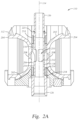
- FIG. 2 A is a cross-sectional view of the shaped charge frame assembly of FIG. 1 .
- FIG. 2 B is a cross-sectional view of a shaped charge frame assembly according to another embodiment.
- FIG. 2 C is a cross-sectional view of a shaped charge frame assembly according to another embodiment.
- FIG. 3 A is an isometric view of the shaped charge frame assembly of FIG. 1 .
- FIG. 3 B is an isometric view of a shaped charge frame assembly according to another embodiment.
- FIG. 3 C is an isometric view of a shaped charge frame assembly according to another embodiment.
- FIG. 4 A is a cross-sectional view of a perforation apparatus according to one embodiment.
- FIG. 4 B is a detail view of the bulkhead member of FIG. 4 A .
- the perforation tools described herein use shaped charges to project jets of hot material outward from a wellbore into a subterranean formation.
- the shaped charges are housed in a frame that orients the shaped charges to direct the jets of hot material in a desired direction.
- the shaped charge frames described herein are self-orienting within the perforation tool.
- FIG. 1 is a cross-sectional view of a perforation tool 100 according to one embodiment.
- the perforation tool 100 has a housing 102 with a bulkhead section 104 , a charge section 106 , and an initiator section 108 .
- the charge section 106 of the housing 102 has an inner radius that is less than an inner radius of either the bulkhead section 104 or the initiator section 108 .
- the charge section 106 is loaded first, and then the bulkhead section 104 and initiator section 108 are loaded afterward.
- At least one shaped charge frame assembly 110 is disposed in the charge section 106 of the housing 102 .
- the shaped charge frame assembly 110 has a shaped charge frame 112 with a longitudinal axis 114 and a central conduit 116 along the longitudinal axis 114 .
- a frame electrical conductor 118 is disposed along the longitudinal axis 114 to provide electrical connectivity from a first end 120 of the shaped charge frame assembly 110 to a second end 122 of the shaped charge frame assembly 110 opposite from the first end 120 .
- Each of the first end 120 and the second end 122 has a beveled edge 124 in the embodiments shown herein.
- the beveled edge 124 is optional. In this case, the beveled edge 124 can be helpful in assembling the shaped charge frames 110 into the housing 102 .
- Each shaped charge frame 112 is freely rotatable within the housing 102 by operation of one or more bearings disposed between the shaped charge frame 112 and the frame electrical conductor 118 , to be discussed further below.
- the frame electrical conductor 118 in this case, is disposed through the conduit 116 and protrudes from both ends of the shaped charge frame 112 to provide electrical connectivity with other members of the perforation tool 100 .
- the frame electrical conductor 118 has a first connector 126 for connecting with an initiator assembly 128 housed in the initiator section 108 of the housing 102 .
- the first connector 126 has an opening 127 for receiving an electrical connector of another member of the perforation tool.
- the initiator assembly 128 has an initiator housing 130 with a longitudinal axis 132 that, when assembled in the perforation tool 100 is substantially coaxial with the longitudinal axis 114 of the shaped charge frame 112 .
- the initiator housing 130 has a central conduit 134 in which an initiator electrical conductor 136 is disposed.
- the initiator housing 130 may be made of a material that is not electrically conductive. Alternately, the initiator housing 130 may be made of an electrically conductive material, and an insulator may be disposed in the central conduit 134 between an interior wall of the central conduit 134 and the initiator electrical conductor 136 .
- the initiator electrical conductor 136 is hollow for housing a detonator 138 , shown here inserted into the initiator electrical conductor 136 for operation.
- a first end 142 of the initiator electrical conductor 136 protrudes from a first end 139 of the initiator housing 130 , defining a first end 140 of the initiator assembly 128 .
- the first end 142 of the initiator electrical conductor 136 has an opening 144 to provide fluid connectivity from the initiator assembly 128 to other portions of the perforation tool 100 .
- the first end 142 of the initiator electrical conductor 136 is inserted into the first connector 126 of the frame electrical conductor 118 .
- the frame electrical conductor 118 is hollow, so the opening 144 of the initiator electrical conductor 136 provides fluid connectivity to the interior of the frame electrical conductor 118 .
- the detonator 138 When assembled into the initiator electrical conductor 136 , the detonator 138 is electrically connected to an initiator switch assembly 146 disposed in the initiator housing 130 at or near a second end 148 of the initiator assembly 128 , opposite from the first end 140 .
- the initiator switch assembly 146 has a switch connector 150 that is electrically connected to the detonator 138 , which may be through the initiator electrical conductor 136 or may be through another electrical conductor.
- the initiator assembly 128 has an electrical connector 152 at the second end 148 of the initiator assembly 128 , which protrudes beyond the initiator housing 130 and defines the second end 148 .
- the electrical connector 152 is typically electrically coupled to the initiator switch assembly 146 to provide electrical continuity from the first end 140 of the initiator assembly 128 to the second end 148 .
- the electrical connector 152 is electrically coupled to the switch connector 150 through a switch circuit 154 positioned in a transverse orientation in the initiator housing 130 near the second end 148 of the initiator assembly 128 .
- the frame electrical conductor 118 has a second connector 156 for connecting with a bulkhead assembly 158 .
- the bulkhead assembly 158 includes a bulkhead member 160 with a longitudinal axis 162 that, when assembled in the perforation tool 100 is substantially coaxial with the longitudinal axis 114 of the shaped charge frame 112 and the longitudinal axis 132 of the initiator housing 130 .
- the bulkhead member 160 has a central conduit 164 disposed along the longitudinal axis 162 .
- the bulkhead member 160 is typically made of a dense material, such as metal, to provide protection from the ballistic discharge of the shaped charges.
- an insulator lining 166 is disposed in the central conduit 164 and a bulkhead electrical conductor 168 is routed through the insulator lining 166 .
- the bulkhead electrical conductor 168 has a first connector 170 at a first end 172 of the bulkhead electrical conductor 168 for connecting with the second connector 156 of the frame electrical conductor 118 .
- the bulkhead electrical conductor 168 has a second connector 174 at a second end 176 of the bulkhead electrical conductor 168 for electrical continuity across the bulkhead assembly 158 .
- the hollow electrical conductors 136 and 118 also provide ballistic continuity along the central conduits of the initiator housing 130 and the shaped charge frames 112 .
- FIG. 2 A is a cross-sectional view of the shaped charge frame assembly 110 .
- the shaped charge frame 112 in this case, has two shaped charge receptacles 202 .
- a shaped charge 204 is shown inserted into each shaped charge receptacle 202 .
- the receptacles are located at an azimuthal displacement, one to the other, of 180°.
- the shaped charge frame could have three shaped charge receptacles 202 , each with azimuthal displacement from the other two of 120°.
- Each shaped charge receptacle 202 has an opening 206 at the central conduit 116 , the opening 206 providing a fluid pathway from the central conduit 116 to the shaped charge receptacle 202 .
- the shaped charges 204 generally have openings 208 to expose explosive materials therein to the central conduit 116 through the openings 206 in the shaped charge receptacles 202 .
- the frame electrical conductor 118 is hollow, with an interior 210 to accommodate ballast members (not shown), which function to receive a ballistic transmission into the interior 210 from an adjacent member of the perforation tool 100 ( FIG. 1 ) and transmit ballistic energy along the interior 210 to another adjacent member of the perforation tool 100 .
- the frame electrical conductor 118 has a plurality of lateral openings 212 formed through an outer wall thereof to provide a fluid pathway from the interior 210 of the frame electrical conductor 118 through the openings 206 to the interior of the shaped charge receptacles 202 . Where a shaped charge 204 occupies one of the shaped charge receptacles 202 , the ballistic energy translates through the opening 208 of the shaped charge to activate the explosive material therein.
- the frame electrical conductor 118 does not contact the shaped charge frame 112 .
- At least one bearing 214 is disposed around the frame electrical conductor 118 to provide rotational motion of the shaped charge frame 112 with respect to the frame electrical conductor 118 .
- there are two bearings 214 disposed on either side of the openings 212 but a single bearing could be used spanning across the openings 212 if the bearing also has openings to allow ballistic transfer into the shaped charge receptacles 202 . More than two bearings could also be used, for example if instead of one of the bearings 214 two or more bearings are used.
- the bearings 214 are cylindrical bands that are disposed between the frame electrical conductor 118 and the shaped charge frame 112 .
- a space is provided between each bearing 214 and both the frame electrical conductor 118 and the central conduit 116 of the shaped charge frame 112 such that each bearing has complete rotational freedom of movement between the frame electrical conductor 118 and the shaped charge frame 112 .
- each shaped charge frame 112 has complete rotational freedom of movement within the housing 102 ( FIG. 1 ) of the perforation tool 100 .
- the first connector 126 of the frame electrical conductor 118 has an outer radius that is greater than an outer radius of a central portion 216 of the frame electrical conductor 118 .
- the frame electrical conductor 118 has a shoulder 218 between the first connector 126 and the central portion 216 that functions to restrain one of the bearings 214 in an axial direction.
- a bridge portion 220 of the shaped charge frame 112 extends around the frame electrical conductor 118 between the two shaped charge receptacles 202 .
- the bridge portion 220 extends between the two bearings 214 , so one of the bearings 214 is captured between the bridge portion 220 and the shoulder 218 , preventing axial motion the bearing 214 between the bridge portion 220 and the shoulder 218 .
- a snap ring 221 is disposed around the electrical conductor 118 at the second end 122 to restrain axial movement of another of the bearings 214 between the snap ring 221 and the bridge portion 220 .
- the frame electrical conductor 118 , the shaped charge frame 112 , and the bearings 214 are shaped and sized to provide a small space between the bearings 214 and the frame electrical conductor 118 and the shaped charge frame 112 so the bearings 214 and the shaped charge frame 112 can rotate freely with respect to the frame electrical conductor 118 . Rotation of the frame electrical conductor 118 is prevented by physical coupling with the other electrical connectors of the other members of the perforation tool 100 .
- FIG. 2 B is a cross-sectional view of a shaped charge frame assembly 250 according to another embodiment.
- the shaped charge frame assembly 250 is similar to the shaped charge frame assembly 110 of FIG. 2 A .
- the chief differences are in the type of bearings used, and in the configuration of the openings 212 of the electrical conductor.
- the shaped charge frame assembly 250 has two bearings 252 , each of which is disposed within a recess of a shaped charge frame 254 .
- the shaped charge frame 254 is similar to the shaped charge frame 112 .
- the chief difference between the two shaped charge frames is that the shaped charge frame 254 is molded over the bearings 252 , so the bearings 252 do not move with respect to the shaped charge frame 254 .
- the bearings 252 are otherwise similar to the bearings 214 .
- the bearings 252 are generally cylindrical, with an end flange 256 that facilitates retaining the bearing 252 within a recess 258 of the shaped
- the shaped charge frame 254 has a first end 260 and a second end 262 opposite from the first end 260 .
- the shaped charge frame assembly 250 includes a frame electrical conductor 259 disposed in a central conduit 264 that extends along a longitudinal axis 266 of the shaped charge frame 254 .
- the frame electrical conductor 259 has the first connector 126 for seating in the conduit 264 at the first end 260 .
- the bearing 252 at the first end 260 of the shaped charge frame 254 contacts the first connector 126 of the frame electrical conductor 259 to provide rotational support for the shaped charge frame 254 to rotate about the frame electrical conductor 259 .
- the bearing 252 at the second end 262 is spaced apart from the frame electrical conductor 259 at the second end 262 , such that the bearing 252 and the frame electrical conductor 259 define an annular gap 268 for receiving an electrical connector of another tool. In such cases, the bearing 252 at the second end 262 contacts the electrical connector of the connected tool to provide rotational support for the shaped charge frame 254 .
- the electrical conductor 259 of FIG. 2 B has the openings 212 described above in connection with FIG. 2 A , but in this case the openings 212 are aligned to provide a continuous open pathway from one shaped charge recess to the other on the opposite side of the shaped charge frame 254 .
- the openings 212 of the electrical conductors herein are large such that the exact configuration of the openings does not substantially impede ballistic continuity from the interior of the electrical conductors to the shaped charge recesses of the shaped charge frames.
- FIG. 2 C is a cross-sectional view of a shaped charge frame assembly 280 according to another embodiment.
- a bearingless shaped charge frame 286 is rotatable about an electrical conductor 290 .
- the electrical conductor 290 has one or more external ridges 292 that reduce radial movement freedom for the frame 286 while allowing a small tolerance for rotational movement.
- the bearingless shaped charge frame 286 has a collar 282 along the central conduit 116 thereof with a shelf 296 that protrudes radially inward from the collar 282 to engage with a groove 284 formed in an outer wall of the electrical conductor 290 .
- the collar 282 and shelf 296 engage with the groove 284 to prevent movement of the frame 286 in an axial direction with respect to the conductor 290 .
- the shaped charge frames described herein are engaged with a tubular electrical conductor to rotate freely about the tubular electrical conductor.
- the engagement may be mediated by bearings, or as in FIG. 2 C may be bearingless where the frame rotates freely about the tubular electrical conductor without the use of bearings.
- the engagement generally includes one or more restraints, such as the snap rings described in connection with FIGS. 2 A and 2 B , or the collar and shelf described in connection with FIG. 2 C , to maintain the rotatable engagement of the shaped charge frame with the tubular electrical conductor.
- the tubular electrical conductor provides electrical continuity through the shaped charge frame and provides a location to place ballast members for ballistic continuity through the shaped charge frame.
- Weight members are disposed into recesses in the shaped charge frames to give a mass centroid displaced from the axis of rotation. Placement and mass of the weight members provides control of the position of the centroid so that the shaped charge frame self-orients to a desired orientation in a non-axial gravitational field.
- FIG. 3 A is an isometric view of the shaped charge frame assembly 110 .
- the shaped charge receptacles 202 are formed as channels in the bulk material of the shaped charge frame 112 .
- the shaped charge frame assembly 110 uses one or more weight members 302 coupled to the shaped charge frame 112 to provide self-orientation of the rotatable shaped charge frame 112 . In this case, two weight member 302 are shown.
- the weight members 302 are each disposed in a recess 304 of the shaped charge frame 112 .
- the recesses 304 extend from the first end 120 to the second end 122 of the shaped charge frame assembly 110 .
- the one or more weight members 302 displace the center of mass radially away from the rotational axis of the shaped charge frame 112 , which in this case substantially coincides with the longitudinal axis 114 of the shaped charge frame 112 .
- the mass moment of the shaped charge frame 112 due to the weight member 302 , causes the shaped charge frame 112 to rotate to an orientation defined by the mass distribution of the shaped charge frame 112 influenced by the position and mass of the weight member 302 . In this way, any non-parallel gravitational field causes self-orientation of the shaped charge frame 112 .
- two weight member 302 are used.
- the two weight member 302 are positioned such that a line from a longitudinal axis of one weight member 302 to a longitudinal axis of the other weight member 302 does not intersect the longitudinal axis 114 of the shaped charge frame 112 .
- additional recesses can be provided in the shaped charge frame 112 for additional weight members 302 .
- a series of discrete recesses can be provided in the bulk of the shaped charge frame 112 to allow insertion of multiple weight members 302 with positions selected to provide a desired orientation.
- 3 A includes two channels having rectangular profiles formed in the bulk of the shaped charge frame 112 on diametrically opposite sides thereof and extending from the first end 120 to the second end 122 . Instead of cutting such rectangular channels, additional recesses can be provided in this area for weight members 302 .
- the weight members 302 are cylindrical bars that extend substantially from the first end 120 to the second end 122 .
- partial weight members can be inserted into the recesses 304 having different weights to provide any desired mass moment.
- one weight member half the size of the weight members 302 in FIG. 3 A could be used along with a low density plug.
- Weight members can be provided to extend any fraction of the length of the recesses 304 , and can be secured in the recesses 304 with plugs, to provide a continuous distribution of mass moments for the shaped charge frame 112 .
- Such methods can provide a continuous distribution of orientations for the shaped charge frame 112 , and can self-orient the shaped charge frame 112 to point the shaped charges in any desired direction under the influence of a non-parallel gravitational field.
- the shaped charge receptacles 202 are formed as channels in the bulk of the shaped charge frame 112 . Adjacent to the first end 120 , each shaped charge receptacle 202 features a stop 306 that limits axial movement of the shaped charge 204 . Adjacent to the second end 122 , each shaped charge receptacle 202 features an opening 308 for inserting and extracting shaped charges 204 . The shaped charges 204 slide laterally into the shaped charge receptacles 202 to the stop 306 , and restraints engage with the shaped charges 204 to secure them in place.
- FIG. 3 B is an isometric view of a shaped charge frame 330 according to another embodiment.
- the shaped charge frame 330 is similar to other shaped charge frames described herein.
- the shaped charge frame 330 receives a tubular electrical conductor in a central conduit 334 thereof, like the other shaped charge frames described herein.
- the chief difference in FIG. 3 B is that the shaped charge frame 330 has three shaped charge recesses 332 .
- Two weight member recesses 304 are located between adjacent shaped charge recesses 332 such that weight members disposed therein provide a mass centroid of the shaped charge frame 330 that is spaced apart from the axis of rotation through the central conduit 334 .
- the weight member recesses 304 extend from end to end of the shaped charge frame 330 in a direction parallel to the longitudinal axis of the shaped charge frame 330 .
- Any of the specific designs exemplified herein can be configured with three shaped charge recesses as shown in FIG. 3 B .
- FIG. 3 C is an isometric view of a shaped charge frame 360 according to yet another embodiment.
- the shaped charge frame 360 receives a tubular electrical conductor similar to the other embodiments herein.
- the shaped charge frame 360 features two weight member recesses 364 formed on one side of the frame 360 between the shaped charge receptacles 362 thereof (two, in this example), and one recess 364 formed on the other side of the frame 360 .
- Each of the weight member recesses 364 has a tab 366 formed in an outer wall thereof for engaging with a feature, such as a groove, in an outer surface of a weight member disposed in the weight member recess 364 .
- the tab 366 has an internal ridge that fits into the feature of the weight member inserted into the recess 364 .
- the ridge engaged with the feature prevents axial movement of the weight member within the recess 364 to maintain position of the weight member within the recess 364 .
- Such tabs can be implemented in any of the embodiments described herein.
- weight members are used to move the mass centroid of the shaped charge frame away from the axis of rotation so that the shaped charge frame will self-orient in the presence of a non-axial gravitational field. Free rotation of the shaped charge frame allows the shaped charge frame to adopt a position with lowest gravitational potential as the orientation of the perforation tool with respect to the gravitational field changes.
- the positions of the weight member recesses generally are not changed, different weight members with different sizes (i.e. lengths) and densities can be disposed in the recesses to change where the mass centroid of the frame is located, thus changing the self-orientation angle of the frame.
- using different sizes and densities of weight members allows the frame 330 to be pre-oriented to assume any orientation in a 360° range.
- FIG. 4 A is a cross-sectional view of a perforation apparatus 400 according to one embodiment.
- the perforation apparatus 400 has a loading tube 402 for holding explosive charges, an initiator module 404 that initiates discharge of the explosive charges, and a bulkhead member 406 that separates the explosive charges of the loading tube 402 from sensitive electronics in the initiator module 404 .
- the loading tube 402 has a plurality of recesses 408 for receiving explosive charges and orienting the charges in a phased orientation.
- the perforation apparatus 400 activates a plurality of shaped charges using one initiator module 404 and one bulkhead member 406 .
- each recess 408 are arranged in a spiral arrangement pointing in various directions from the central axis of the perforation apparatus 400 to provide phased discharge.
- each recess 408 points in a different direction than the other recesses 408 , but some of the recesses 408 could point in the same direction.
- each recess 408 points in a direction, and the direction of each recess 408 forms a constant angle with the direction of neighboring recesses 408 . That is to say, in this case, the direction of each recess i and the direction of the neighboring recess i+1 forms an angle that is constant for all recesses i.
- FIG. 4 B is a detail view of the bulkhead member 406 of FIG. 4 A .
- the bulkhead member 406 has a generally cylindrical body 410 , or a shape conducive to housing in a desired casing.
- the body 410 of the bulkhead member 406 may be solid, or may be mostly hollow, as in this case.
- the body 410 has an outer shell 411 with a central plate 412 transverse to a longitudinal axis of the body 410 .
- the outer surface of the outer shell 411 has conveniently placed grooves 413 to receive seal members 415 for sealing against an outer casing.
- the central plate 412 provides structural support for components of the bulkhead member 406 , while the hollow configuration of the body 410 reduces weight.
- the central plate 412 defines a first cavity 414 , generally facing a first end 416 of the body 410 , and a second cavity 418 , generally facing a second end 420 of the body 410 .
- the central plate 412 separates the first cavity 414 from the second cavity 418 such that when the bulkhead member 406 is assembled into a perforating tool, the first cavity 414 faces a first tool member and the second cavity 418 faces a second tool member.
- the first cavity 414 faces the initiator module 404 and the second cavity 418 faces the loading tube 402 .
- the bulkhead member 406 may connect to the housing 402
- the central plate 412 supports a feedthrough 422 , which provides a conduit for electrical conductivity from the first end 416 to the second end 420 of the bulkhead member 406 .
- the feedthrough 422 has a central bore 425 , oriented along the longitudinal axis of the bulkhead member 406 , that extends through the central plate 412 from the first cavity 414 to the second cavity 418 .
- a first protrusion 424 extends from a first side 426 of the central plate 412 into the first cavity 414
- a second protrusion 428 extends from a second side 430 of the central plate 412 into the second cavity 418 .
- the central bore 425 extends along and within the first protrusion 424 , through the central plate 412 , and along and within the second protrusion 428 to provide a pathway through the central plate 412 from the first cavity 414 to the second cavity 418 .
- the bulkhead member 406 here, is non-symmetric.
- the bulkhead member 406 has a generally cylindrical shape with a central longitudinal axis 401 that generally resembles a cylindrical axis.
- a center of mass of the bulkhead member 406 is closer to the first end 416 of the bulkhead member 406 than to the second end 420 of the bulkhead member 406 .
- the bulkhead member 406 has no plane of symmetry that intersects the central longitudinal axis 401 .
- the bulkhead member 406 has no transverse plane of symmetry.
- An electrical conductor 432 is disposed in the central bore 425 to provide electrical conductivity from the first end 416 to the second end 420 of the bulkhead member 406 .
- the electrical conductor 432 has a pin connection 434 at a first end thereof and a box connection 436 at a second end thereof opposite from the first end.
- the pin connection 434 is disposed in the first protrusion 424 and the box connection 436 extends beyond the second protrusion 428 .
- the electrical conductor 432 is a rod-like member that extends from the pin connection 434 at the first end to the box connection 436 at the other end
- the box connection 436 is a hollow cylindrical member with diameter larger than a diameter of the rest of the electrical conductor 432 so that the box connection 436 can receive an electrical connector of another tool into the hollow cylindrical box connection 436 .
- the box connection 436 may be described as a “female” electrical connection, while the pin connection 434 may be described as a “male” electrical connection.
- the pin connection 434 is axially rigid with no axial movement capability such as spring-loading or extension/retraction.
- An electrical insulator 438 is disposed within the central bore 425 around the electrical conductor 432 to prevent electrical connection between the electrical conductor 432 and the body 410 .
- the body 410 is typically made of steel to provide pressure insulation between the loading tube 402 , where the charges discharge, and the initiator module 404 , where sensitive electronics are located to control operation of the tool. In some embodiments, where the body 410 can be made from a dense, hard, non-conducive material, such as hard plastic, the electrical insulator 438 might not be needed.
- the electrical insulator 438 has a seal portion 440 that inserts into a throat 442 of the central bore that extends into the central plate 425 .
- the seal portion 440 has a groove 444 that accommodates a seal member 446 to provide a secure fit for the electrical conductor 432 within the central bore 425 .
- the electrical insulator 438 extends from the seal portion 440 to an entry portion 447 that houses the box connection 436 of the electrical conductor 432 .
- the entry portion 447 has a shape similar to the shape of the box connection 436 , in this case a hollow cylindrical shape with an inner diameter approximately equal to an outer diameter of the box connection 436 so that an inner surface of the electrical insulator 438 contacts an outer surface of the box connection 436 .
- the seal members 415 and 446 provide pressure seal against the hydrostatic pressure of the well environment, as well as pressure seal between adjacent tools.
- the electrical conductor 432 extends beyond the seal portion 440 of the electrical insulator 438 through the central plate 412 , where the central bore 425 defines an annular gap 450 around the electrical conductor 438 .
- a wall 452 extends radially inward from an interior wall of the central bore 425 toward the electrical conductor 432 to define the gap 450 .
- the electrical conductor 432 further extends into the first protrusion 424 to the pin connection 434 .
- the electrical insulator 438 thus extends from the box connection 438 partway along the length of the electrical conductor 432 to the annular gap 450 .
- Each of the electrical insulator 438 and the electrical conductor 432 extends beyond the second protrusion into the second cavity 418 and beyond the second end of the body 410 to provide an accessible electrical connection to accommodate another tool.
- the loading tube 402 has a connector 452 that can be inserted into the box connection 438 of the bulkhead member 406 .
- the connector 452 has a metal pin 454 and a metal stub 456 over the metal pin 454 , with an overmolded plastic body 458 that locates the metal pin 454 and metal stub 456 at the end of the loading tube 402 . Inserting the metal stub 456 into the box connection 438 of the bulkhead member 406 establishes electrical connection between the bulkhead member 406 and the loading tube 402 .
- a plug connector 460 is disposed within the end of the first protrusion 424 around the pin connection 436 of the electrical conductor 432 .
- the plug connector 460 provides electrical connection to a wire contact 462 of the initiator module 404 .
- the plug connector 460 can be an RCA connector, or another convenient type of connector.
- the wire contact 462 connecting with the plug connector 460 electrically connects the bulkhead member 406 with the initiator module 404 . In this way, electrical connection is established from the initiator module 404 , through the bulkhead member 406 , to the loading tube 402 .
- electrical conductivity is established along the loading tube 402 by connecting a wire (not shown) to the connector 452 .
- the connector 452 is a first connector of the loading tube 402 , located at a first end 466 thereof.
- the loading tube 402 has a second connector 464 located at a second end 468 thereof, opposite from the first end.
- the wire is connected from the first connector 452 to the second connector 464 , traversing the length of the loading tube 402 according to any convenient path.
- a second loading tube 402 is shown in FIG. 4 A to illustrate connection of the loading tube 402 , at the second end 468 thereof, to the initiator module 404 .
- a band connector 470 is disposed in a central recess 472 of the second connector 464 .
- the band connector 470 makes electrical contact with a housing 474 of the initiator module 404 .
- the housing provides electrical connection to the wire contact 462 ( FIG. 4 B ) of the initiator module 404 and a circuit board 476 disposed at an end of the initiator module 404 that connects to the bulkhead member 406 , and oriented generally transverse to the longitudinal axis of the perforation tool 400 .
- an electrical contact can be provided for connecting with the band connector 470 , and an electrical conductor can be routed through the housing 474 for connection with the wire contact 462 and the circuit board 476 .
- the loading tube 402 , initiator module 404 , and bulkhead member 406 all fit within a housing 407 .
- the housings 407 of two adjacent and connected perforation assemblies are shown connected by a threaded connection 409 , each end of each housing 407 having threads.
- Each housing 407 has a first end 403 and a second end 405 , opposite from the first end 403 , with each end 403 and 405 having threads.
- the bulkhead member 406 is shown connecting with each end 403 and 405 of a housing 407 .
- the first end 416 of the bulkhead member 406 engages with a first end 403 of a first housing 407 while the second end 420 of the bulkhead member 406 engages with a second end 405 of a second housing 407 , which is coupled to the first housing 407 .
- the bulkhead member 406 connects with each housing using a friction fit, with a non-threaded connection, but a threaded connection can be used to connect the bulkhead member 406 with either the first end 403 or the second end 405 of a housing 407 .
- a detonator 480 ( FIG. 4 A ) is disposed in a recess of the initiator module 404 .
- the detonator 480 extends into the central recess 472 of the second connector 464 of the loading tube 402 .
- a booster (not shown) is also disposed in the central recess 472 of the second connector 464 .
- Detonation cord is connected to the booster and routed along the loading tube 402 to the charges held therein.
- An electrical signal received at the circuit board 476 causes the circuit board to send an electrical signal that activates the detonator 480 , which in turn discharges the booster.
- the ballistic discharge of the booster is transmitted by the detonation cord to the charges held in the loading tube 402 .
Landscapes
- Life Sciences & Earth Sciences (AREA)
- Engineering & Computer Science (AREA)
- Geology (AREA)
- Mining & Mineral Resources (AREA)
- Physics & Mathematics (AREA)
- Environmental & Geological Engineering (AREA)
- Fluid Mechanics (AREA)
- General Life Sciences & Earth Sciences (AREA)
- Geochemistry & Mineralogy (AREA)
- Charge And Discharge Circuits For Batteries Or The Like (AREA)
- Centrifugal Separators (AREA)
Abstract
Description
Claims (13)
Priority Applications (1)
| Application Number | Priority Date | Filing Date | Title |
|---|---|---|---|
| US18/252,593 US12098623B2 (en) | 2020-11-13 | 2021-11-15 | Oriented-perforation tool |
Applications Claiming Priority (3)
| Application Number | Priority Date | Filing Date | Title |
|---|---|---|---|
| US202063198792P | 2020-11-13 | 2020-11-13 | |
| US18/252,593 US12098623B2 (en) | 2020-11-13 | 2021-11-15 | Oriented-perforation tool |
| PCT/US2021/059400 WO2022104220A1 (en) | 2020-11-13 | 2021-11-15 | Oriented-perforation tool |
Related Parent Applications (1)
| Application Number | Title | Priority Date | Filing Date |
|---|---|---|---|
| PCT/US2021/059400 A-371-Of-International WO2022104220A1 (en) | 2020-11-13 | 2021-11-15 | Oriented-perforation tool |
Related Child Applications (1)
| Application Number | Title | Priority Date | Filing Date |
|---|---|---|---|
| US18/893,243 Continuation US12529293B2 (en) | 2020-11-13 | 2024-09-23 | Oriented-perforation tool |
Publications (2)
| Publication Number | Publication Date |
|---|---|
| US20240018851A1 US20240018851A1 (en) | 2024-01-18 |
| US12098623B2 true US12098623B2 (en) | 2024-09-24 |
Family
ID=81601810
Family Applications (2)
| Application Number | Title | Priority Date | Filing Date |
|---|---|---|---|
| US18/252,593 Active US12098623B2 (en) | 2020-11-13 | 2021-11-15 | Oriented-perforation tool |
| US18/893,243 Active US12529293B2 (en) | 2020-11-13 | 2024-09-23 | Oriented-perforation tool |
Family Applications After (1)
| Application Number | Title | Priority Date | Filing Date |
|---|---|---|---|
| US18/893,243 Active US12529293B2 (en) | 2020-11-13 | 2024-09-23 | Oriented-perforation tool |
Country Status (4)
| Country | Link |
|---|---|
| US (2) | US12098623B2 (en) |
| CN (1) | CN116472395A (en) |
| CA (1) | CA3201629A1 (en) |
| WO (1) | WO2022104220A1 (en) |
Cited By (2)
| Publication number | Priority date | Publication date | Assignee | Title |
|---|---|---|---|---|
| US12338718B2 (en) | 2021-03-03 | 2025-06-24 | DynaEnergetics Europe GmbH | Orienting perforation gun assembly |
| US12385369B2 (en) | 2019-06-14 | 2025-08-12 | DynaEngergetics Europe GmbH | Perforating gun assembly with rotating shaped charge holder |
Families Citing this family (1)
| Publication number | Priority date | Publication date | Assignee | Title |
|---|---|---|---|---|
| US11795790B2 (en) * | 2021-04-15 | 2023-10-24 | Schlumberger Technology Corporation | Slide-in frame for shaped charges |
Citations (129)
| Publication number | Priority date | Publication date | Assignee | Title |
|---|---|---|---|---|
| US2062974A (en) | 1932-11-12 | 1936-12-01 | Technicraft Engineering Corp | Well casing perforator |
| US2252270A (en) | 1938-11-05 | 1941-08-12 | American Oil Tool Company | Perforating device |
| US2980017A (en) | 1953-07-28 | 1961-04-18 | Pgac Dev Company | Perforating devices |
| US3067679A (en) | 1954-10-08 | 1962-12-11 | Halliburton Co | Well perforating assembly and perforating unit therefor |
| US3173992A (en) | 1962-11-16 | 1965-03-16 | Technical Drilling Service Inc | Resilient, high temperature resistant multiple conductor seal for conical ports |
| SU258201A1 (en) | 1968-03-27 | 1969-12-03 | Раменское отделение Всесоюзного научно исследовательского института | Casing Cumulative Perforator |
| US3612189A (en) | 1969-10-24 | 1971-10-12 | Exxon Production Research Co | Well perforating and treating apparatus |
| US3836843A (en) | 1971-10-26 | 1974-09-17 | E Yonce | Electric circuit tester connector for highway vehicles |
| US3965993A (en) | 1974-09-20 | 1976-06-29 | Schlumberger Technology Corporation | Well bore perforating apparatus |
| US3991836A (en) | 1974-09-20 | 1976-11-16 | Schlumberger Technology Corporation | Well bore perforating apparatus |
| US4004643A (en) | 1976-03-03 | 1977-01-25 | Newman James L | Mechanical drilling jar |
| US4191265A (en) | 1978-06-14 | 1980-03-04 | Schlumberger Technology Corporation | Well bore perforating apparatus |
| US4296481A (en) | 1979-12-17 | 1981-10-20 | Exploration Company | Streamer bulkhead |
| USD265335S (en) | 1980-04-07 | 1982-07-06 | General Electric Company | Rotor |
| EP0132330A2 (en) | 1983-07-21 | 1985-01-30 | Halliburton Company | Tubing conveyed well perforating system |
| US4519313A (en) | 1984-03-21 | 1985-05-28 | Jet Research Center, Inc. | Charge holder |
| US4523649A (en) | 1983-05-25 | 1985-06-18 | Baker Oil Tools, Inc. | Rotational alignment method and apparatus for tubing conveyed perforating guns |
| EP0175439A2 (en) | 1984-09-17 | 1986-03-26 | Halliburton Company | Shaped charge carrier assembly |
| US4619333A (en) | 1983-03-31 | 1986-10-28 | Halliburton Company | Detonation of tandem guns |
| US4759291A (en) | 1987-07-06 | 1988-07-26 | Halliburton Company | Through bulkhead explosive initiator for oil well usage |
| US4850438A (en) | 1984-04-27 | 1989-07-25 | Halliburton Company | Modular perforating gun |
| US4909320A (en) | 1988-10-14 | 1990-03-20 | Drilex Systems, Inc. | Detonation assembly for explosive wellhead severing system |
| US5007486A (en) | 1990-02-02 | 1991-04-16 | Dresser Industries, Inc. | Perforating gun assembly and universal perforating charge clip apparatus |
| US5237136A (en) | 1990-10-01 | 1993-08-17 | Langston Thomas J | Hydrostatic pressure responsive bypass safety switch |
| EP0601880A2 (en) | 1992-12-10 | 1994-06-15 | Halliburton Company | Perforating gun detonator package incorporating exploding foil |
| US5351622A (en) | 1992-01-29 | 1994-10-04 | Bofors Ab | Securement of liner for shaped charge |
| CN2244095Y (en) | 1995-12-08 | 1997-01-01 | 胜利石油管理局测井公司 | Automatic control blasting and explosive insulation device |
| US5756926A (en) | 1995-04-03 | 1998-05-26 | Hughes Electronics | EFI detonator initiation system and method |
| US5785130A (en) | 1995-10-02 | 1998-07-28 | Owen Oil Tools, Inc. | High density perforating gun system |
| US5816343A (en) | 1997-04-25 | 1998-10-06 | Sclumberger Technology Corporation | Phased perforating guns |
| EP0919694A2 (en) | 1997-11-26 | 1999-06-02 | Halliburton Energy Services, Inc. | Method and apparatus for perforating a well |
| US6082265A (en) | 1995-07-26 | 2000-07-04 | Asahi Kasei Kogyo Kabushiki Kaisha | Electronic delay detonator |
| US6311621B1 (en) | 1996-11-01 | 2001-11-06 | The Ensign-Bickford Company | Shock-resistant electronic circuit assembly |
| WO2001096807A2 (en) | 2000-05-20 | 2001-12-20 | Baker Hughes Incorporated | Sintered tungsten liners for shaped charges |
| US6412388B1 (en) | 1999-10-19 | 2002-07-02 | Lynn Frazier | Safety arming device and method, for perforation guns and similar devices |
| US6412338B2 (en) | 1999-03-11 | 2002-07-02 | The Lubrizol Corporation | On-board rotational viscometers |
| US6412415B1 (en) | 1999-11-04 | 2002-07-02 | Schlumberger Technology Corp. | Shock and vibration protection for tools containing explosive components |
| US6595290B2 (en) | 2001-11-28 | 2003-07-22 | Halliburton Energy Services, Inc. | Internally oriented perforating apparatus |
| US6655289B1 (en) | 1999-01-08 | 2003-12-02 | Orica Explosives Technology Pty Limited | Two-piece capsule trigger unit for initiating pyrotechnic elements |
| US6752083B1 (en) | 1998-09-24 | 2004-06-22 | Schlumberger Technology Corporation | Detonators for use with explosive devices |
| US20040216866A1 (en) | 2003-05-02 | 2004-11-04 | Barlow Darren R. | Perforating gun |
| US20040216632A1 (en) | 2003-04-10 | 2004-11-04 | Finsterwald Mark A. | Detonating cord interrupt device and method for transporting an explosive device |
| US20050211467A1 (en) | 2004-03-24 | 2005-09-29 | Schlumberger Technology Corporation | Shaped Charge Loading Tube for Perforating Gun |
| US7013977B2 (en) | 2003-06-11 | 2006-03-21 | Halliburton Energy Services, Inc. | Sealed connectors for automatic gun handling |
| CN2823548Y (en) | 2005-09-09 | 2006-10-04 | 中国航天科技集团公司川南机械厂 | Non-gun body pressure-resistance perforating bullet |
| US7347278B2 (en) | 1998-10-27 | 2008-03-25 | Schlumberger Technology Corporation | Secure activation of a downhole device |
| RU73390U1 (en) | 2008-02-14 | 2008-05-20 | Общество с ограниченной ответственностью "Кумулятивные заряды Зоненко" (ООО ЗКЗ) | CASE CUMULATIVE PUNCHER |
| EP1930541A2 (en) | 2006-12-06 | 2008-06-11 | Halliburton Energy Services, Inc. | Thermally activated well perforating safety system |
| RU78521U1 (en) | 2008-07-24 | 2008-11-27 | ЗАО "НТФ ПерфоТех" | MODULAR PUNCHES WITH ORIENTED CUMULATIVE CHARGES FOR HORIZONTAL WELLS |
| US20090151589A1 (en) | 2007-12-17 | 2009-06-18 | Schlumberger Technology Corporation | Explosive shock dissipater |
| US20090159285A1 (en) | 2007-12-21 | 2009-06-25 | Schlumberger Technology Corporation | Downhole initiator |
| CA2532088C (en) | 2003-07-10 | 2009-07-07 | Baker Hughes Incorporated | Connector for perforating gun tandem |
| CN101498209A (en) | 2008-01-28 | 2009-08-05 | 普拉德研究及开发股份有限公司 | Charging pipe for polyenergy perforating bomb |
| CN101575965A (en) | 2009-04-02 | 2009-11-11 | 西安近代化学研究所 | Perforating explosion-proof gun device |
| US20100005992A1 (en) | 2008-07-11 | 2010-01-14 | Halliburton Energy Services, Inc. | Surface Safe Explosive Tool |
| US20100011945A1 (en) | 2008-07-17 | 2010-01-21 | Baker Hughes Incorporated | Adapter for shaped charge casing |
| US20100024674A1 (en) | 2004-12-13 | 2010-02-04 | Roland Peeters | Reliable propagation of ignition in perforation systems |
| US7762331B2 (en) | 2006-12-21 | 2010-07-27 | Schlumberger Technology Corporation | Process for assembling a loading tube |
| US20100300750A1 (en) | 2009-05-28 | 2010-12-02 | Halliburton Energy Services, Inc. | Perforating Apparatus for Enhanced Performance in High Pressure Wellbores |
| US20110024116A1 (en) | 2009-07-29 | 2011-02-03 | Baker Hughes Incorporated | Electric and Ballistic Connection Through A Field Joint |
| USD633166S1 (en) | 2010-01-15 | 2011-02-22 | Olin Corporation | Disc-shaped projectile for a shot shell |
| CN102031952A (en) | 2010-11-26 | 2011-04-27 | 中国航天科技集团公司川南机械厂 | Multi-stage perforation supercharging method |
| WO2011080291A2 (en) | 2009-12-29 | 2011-07-07 | Welltec A/S | Downhole perforation tool |
| USD642235S1 (en) | 2010-07-23 | 2011-07-26 | The United States Of America As Represented By The Secretary Of The Army | Housing for flash-bang grenade |
| US8002035B2 (en) | 2009-03-13 | 2011-08-23 | Halliburton Energy Services, Inc. | System and method for dynamically adjusting the center of gravity of a perforating apparatus |
| US20120018157A1 (en) | 2010-07-06 | 2012-01-26 | Schlumberger Technology Corporation | Ballistic transfer delay device |
| US8127848B2 (en) | 2008-03-26 | 2012-03-06 | Baker Hughes Incorporated | Selectively angled perforating |
| US20120138286A1 (en) | 2010-12-01 | 2012-06-07 | Halliburton Energy Services, Inc. | Perforating safety system and assembly |
| US20120152542A1 (en) | 2010-12-17 | 2012-06-21 | Halliburton Energy Services, Inc. | Well perforating with determination of well characteristics |
| US20120180678A1 (en) | 2006-03-31 | 2012-07-19 | Schlumberger Technology Corporation | Seismic Explosive System |
| US20120199352A1 (en) | 2011-02-03 | 2012-08-09 | Baker Hughes Incorporated | Connection cartridge for downhole string |
| US8256337B2 (en) | 2008-03-07 | 2012-09-04 | Baker Hughes Incorporated | Modular initiator |
| CN202417452U (en) | 2011-12-05 | 2012-09-05 | 西安物华巨能爆破器材有限责任公司 | Bidirectional energizing explosion propagating device |
| US20120247769A1 (en) | 2011-04-01 | 2012-10-04 | Halliburton Energy Services, Inc. | Selectable, internally oriented and/or integrally transportable explosive assemblies |
| US20120247771A1 (en) | 2011-03-29 | 2012-10-04 | Francois Black | Perforating gun and arming method |
| RU121054U1 (en) | 2012-04-06 | 2012-10-10 | Открытое акционерное общество "Новосибирский институт программных систем" | DISTRIBUTED WELL CHARGE |
| US20130043074A1 (en) | 2011-07-22 | 2013-02-21 | Tassaroli S.A. | Electromechanical assembly for connecting a series of guns used in the perforation of wells |
| US20130048376A1 (en) | 2011-08-31 | 2013-02-28 | Halliburton Energy Services, Inc. | Perforating gun with internal shock mitigation |
| US8408132B2 (en) | 2010-03-12 | 2013-04-02 | Alliant Techsystems Inc. | Initiator modules, munitions systems including initiator modules, and related methods |
| US8443886B2 (en) | 2010-08-12 | 2013-05-21 | CCS Leasing and Rental, LLC | Perforating gun with rotatable charge tube |
| US20130153205A1 (en) | 2011-12-20 | 2013-06-20 | Christine Borgfeld | Electrical connector modules for wellbore devices and related assemblies |
| WO2013180765A1 (en) | 2012-02-06 | 2013-12-05 | Schlumberger Canada Limited | Method and device for initiating an explosive train |
| WO2014089194A1 (en) | 2012-12-04 | 2014-06-12 | Schlumberger Canada Limited | Perforating gun with integrated initiator |
| US20140312752A1 (en) | 2011-11-24 | 2014-10-23 | Schlumberger Technology Corporation | Longitudinal Absorber for Downhole Tool Chassis |
| WO2014179669A1 (en) | 2013-05-03 | 2014-11-06 | Schlumberger Canada Limited | Cohesively enhanced modular perforating gun |
| US20140338552A1 (en) | 2012-01-13 | 2014-11-20 | Los Alamos National Security, Llc | Detonation command and control |
| US8943943B2 (en) | 2011-11-11 | 2015-02-03 | Tassaroli S.A. | Explosive carrier end plates for charge-carriers used in perforating guns |
| USD723647S1 (en) | 2013-09-25 | 2015-03-03 | Russell Oliver | Compression module for firearm suppressors |
| US9115572B1 (en) | 2015-01-16 | 2015-08-25 | Geodynamics, Inc. | Externally-orientated internally-corrected perforating gun system and method |
| RU2561828C2 (en) | 2013-11-21 | 2015-09-10 | Александр Игорьевич Тулаев | Perforation system sequential initiation device |
| US9494021B2 (en) | 2013-07-18 | 2016-11-15 | Dynaenergetics Gmbh & Co. Kg | Perforation gun components and system |
| US20160356132A1 (en) | 2014-03-07 | 2016-12-08 | Dynaenergetics Gmbh & Co. Kg | Device and method for positioning a detonator within a perforating gun assembly |
| US9581422B2 (en) | 2013-08-26 | 2017-02-28 | Dynaenergetics Gmbh & Co. Kg | Perforating gun and detonator assembly |
| US20170176152A1 (en) | 2015-12-18 | 2017-06-22 | Schlumberger Technology Corporation | Rf attenuating switch |
| US9702680B2 (en) | 2013-07-18 | 2017-07-11 | Dynaenergetics Gmbh & Co. Kg | Perforation gun components and system |
| US20170211363A1 (en) | 2014-05-23 | 2017-07-27 | Hunting Titan, Inc. | Box by Pin Perforating Gun System and Methods |
| US20170275976A1 (en) | 2014-09-04 | 2017-09-28 | Hunting Titan, Inc. | Zinc One Piece Link System |
| WO2018026952A1 (en) | 2016-08-02 | 2018-02-08 | Hunting Titan, Inc. | Box by pin perforating gun system |
| US9903185B2 (en) | 2014-02-12 | 2018-02-27 | Owen Oil Tools Lp | Perforating gun with eccentric rotatable charge tube |
| CA3044516A1 (en) | 2016-12-30 | 2018-07-05 | Halliburton Energy Services, Inc. | Modular charge holder segment |
| CN108351192A (en) | 2015-10-05 | 2018-07-31 | 欧文石油工具有限合伙公司 | Oilfield perforators designed for high volume casing removal |
| US20180299239A1 (en) | 2017-04-18 | 2018-10-18 | Dynaenergetics Gmbh & Co. Kg | Pressure bulkhead structure with integrated selective electronic switch circuitry, pressure-isolating enclosure containing such selective electronic switch circuitry, and methods of making such |
| WO2018213782A1 (en) | 2017-05-19 | 2018-11-22 | Hunting Titan, Inc. | Pressure bulkhead |
| US10190398B2 (en) | 2013-06-28 | 2019-01-29 | Schlumberger Technology Corporation | Detonator structure and system |
| US20190040722A1 (en) | 2017-08-02 | 2019-02-07 | Geodynamics, Inc. | High density cluster based perforating system and method |
| US10338030B2 (en) | 2012-12-31 | 2019-07-02 | Halliburton Energy Services, Inc. | Defects inspection through detection of magnetic fields |
| US20190257181A1 (en) | 2016-09-23 | 2019-08-22 | Hunting Titan, Inc. | Select Fire Perforating Cartridge System |
| US20190292887A1 (en) | 2018-03-26 | 2019-09-26 | Schlumberger Technology Corporation | Universal initiator and packaging |
| US10458213B1 (en) * | 2018-07-17 | 2019-10-29 | Dynaenergetics Gmbh & Co. Kg | Positioning device for shaped charges in a perforating gun module |
| US20190353013A1 (en) * | 2018-01-25 | 2019-11-21 | Hunting Titan, Inc. | Cluster Gun System |
| US20200018139A1 (en) | 2018-05-31 | 2020-01-16 | Dynaenergetics Gmbh & Co. Kg | Autonomous perforating drone |
| US20200048996A1 (en) | 2018-08-10 | 2020-02-13 | Gr Energy Services Management, Lp | Quick-locking detonation assembly of a downhole perforating tool and method of using same |
| US20200072029A1 (en) | 2018-08-10 | 2020-03-05 | Gr Energy Services Management, Lp | Downhole perforating tool with integrated detonation assembly and method of using same |
| USD881322S1 (en) | 2017-11-09 | 2020-04-14 | Noah Systems, Llc | Self-righting disruption grenade |
| US20200217635A1 (en) * | 2015-03-18 | 2020-07-09 | DynaEnergetics Europe GmbH | Electrical connector |
| US20200256167A1 (en) | 2019-02-08 | 2020-08-13 | Schlumberger Technology Corporation | Integrated loading tube |
| WO2020232242A1 (en) | 2019-05-16 | 2020-11-19 | Schlumberger Technology Corporation | Modular perforation tool |
| US10900334B2 (en) | 2019-02-08 | 2021-01-26 | G&H Diversified Manufacturing Lp | Reusable perforating gun system and method |
| WO2021122797A1 (en) | 2019-12-17 | 2021-06-24 | DynaEnergetics Europe GmbH | Modular perforating gun system |
| US11078762B2 (en) | 2019-03-05 | 2021-08-03 | Swm International, Llc | Downhole perforating gun tube and components |
| US20210247771A1 (en) | 2018-10-15 | 2021-08-12 | Mitsubishi Electric Corporation | Information processing device |
| US20220074719A1 (en) | 2020-03-03 | 2022-03-10 | Geodynamics, Inc. | Asymmetric initiated shaped charge and method for making a slot-like perforation |
| US11293737B2 (en) | 2019-04-01 | 2022-04-05 | XConnect, LLC | Detonation system having sealed explosive initiation assembly |
| US20220154559A1 (en) | 2020-11-18 | 2022-05-19 | Raytheon Company | Sympathetically detonated self-centering explosive device |
| US20220290960A1 (en) | 2021-03-12 | 2022-09-15 | Schlumberger Technology Corporation | Shaped charge integrated canister |
| US20220333906A1 (en) | 2021-04-15 | 2022-10-20 | Schlumberger Technology Corporation | Slide-in frame for shaped charges |
| US20230131652A1 (en) | 2021-10-25 | 2023-04-27 | DynaEnergetics Europe GmbH | Adapter and shaped charge apparatus for optimized perforation jet |
| US11641371B2 (en) | 2021-02-17 | 2023-05-02 | Saudi Arabian Oil Company | Systems, methods and computer-readable media for monitoring a computer network for threats using OLAP cubes |
| US20230323759A1 (en) | 2021-03-03 | 2023-10-12 | DynaEnergetics Europe GmbH | Orienting perforation gun assembly |
Family Cites Families (12)
| Publication number | Priority date | Publication date | Assignee | Title |
|---|---|---|---|---|
| US9145764B2 (en) | 2011-11-22 | 2015-09-29 | International Strategic Alliance, Lc | Pass-through bulkhead connection switch for a perforating gun |
| US10914145B2 (en) | 2019-04-01 | 2021-02-09 | PerfX Wireline Services, LLC | Bulkhead assembly for a tandem sub, and an improved tandem sub |
| NO20171107A1 (en) * | 2017-07-05 | 2018-12-27 | Tco As | Gun for oriented perforation |
| US10816311B2 (en) | 2018-11-07 | 2020-10-27 | DynaEnergetics Europe GmbH | Electronic time delay fuse |
| AU2019403470A1 (en) * | 2018-12-20 | 2021-07-01 | Owen Oil Tools Lp | Perforating gun with switch cartridge |
| US11255162B2 (en) | 2019-04-01 | 2022-02-22 | XConnect, LLC | Bulkhead assembly for a tandem sub, and an improved tandem sub |
| US11402190B2 (en) | 2019-08-22 | 2022-08-02 | XConnect, LLC | Detonation system having sealed explosive initiation assembly |
| WO2020249744A2 (en) * | 2019-06-14 | 2020-12-17 | DynaEnergetics Europe GmbH | Perforating gun assembly with rotating shaped charge holder |
| CN211287646U (en) * | 2019-12-27 | 2020-08-18 | 中国石油集团测井有限公司长庆分公司 | Bridge-shooting combined self-orienting horizontal well perforating gun |
| US11808116B2 (en) | 2020-06-23 | 2023-11-07 | Halliburton Energy Services, Inc. | Connector for perforating gun system |
| AR126773A1 (en) | 2021-08-12 | 2023-11-15 | Schlumberger Technology Bv | PRESSURE BULKHEAD |
| US12264561B2 (en) | 2023-02-23 | 2025-04-01 | Halliburton Energy Services, Inc. | Perforating gun |
-
2021
- 2021-11-15 WO PCT/US2021/059400 patent/WO2022104220A1/en not_active Ceased
- 2021-11-15 CN CN202180078458.7A patent/CN116472395A/en active Pending
- 2021-11-15 CA CA3201629A patent/CA3201629A1/en active Pending
- 2021-11-15 US US18/252,593 patent/US12098623B2/en active Active
-
2024
- 2024-09-23 US US18/893,243 patent/US12529293B2/en active Active
Patent Citations (148)
| Publication number | Priority date | Publication date | Assignee | Title |
|---|---|---|---|---|
| US2062974A (en) | 1932-11-12 | 1936-12-01 | Technicraft Engineering Corp | Well casing perforator |
| US2252270A (en) | 1938-11-05 | 1941-08-12 | American Oil Tool Company | Perforating device |
| US2980017A (en) | 1953-07-28 | 1961-04-18 | Pgac Dev Company | Perforating devices |
| US3067679A (en) | 1954-10-08 | 1962-12-11 | Halliburton Co | Well perforating assembly and perforating unit therefor |
| US3173992A (en) | 1962-11-16 | 1965-03-16 | Technical Drilling Service Inc | Resilient, high temperature resistant multiple conductor seal for conical ports |
| SU258201A1 (en) | 1968-03-27 | 1969-12-03 | Раменское отделение Всесоюзного научно исследовательского института | Casing Cumulative Perforator |
| US3612189A (en) | 1969-10-24 | 1971-10-12 | Exxon Production Research Co | Well perforating and treating apparatus |
| US3836843A (en) | 1971-10-26 | 1974-09-17 | E Yonce | Electric circuit tester connector for highway vehicles |
| US3965993A (en) | 1974-09-20 | 1976-06-29 | Schlumberger Technology Corporation | Well bore perforating apparatus |
| US3991836A (en) | 1974-09-20 | 1976-11-16 | Schlumberger Technology Corporation | Well bore perforating apparatus |
| US4004643A (en) | 1976-03-03 | 1977-01-25 | Newman James L | Mechanical drilling jar |
| US4191265A (en) | 1978-06-14 | 1980-03-04 | Schlumberger Technology Corporation | Well bore perforating apparatus |
| US4296481A (en) | 1979-12-17 | 1981-10-20 | Exploration Company | Streamer bulkhead |
| USD265335S (en) | 1980-04-07 | 1982-07-06 | General Electric Company | Rotor |
| US4619333A (en) | 1983-03-31 | 1986-10-28 | Halliburton Company | Detonation of tandem guns |
| US4523649A (en) | 1983-05-25 | 1985-06-18 | Baker Oil Tools, Inc. | Rotational alignment method and apparatus for tubing conveyed perforating guns |
| EP0132330A2 (en) | 1983-07-21 | 1985-01-30 | Halliburton Company | Tubing conveyed well perforating system |
| US4519313A (en) | 1984-03-21 | 1985-05-28 | Jet Research Center, Inc. | Charge holder |
| US4850438A (en) | 1984-04-27 | 1989-07-25 | Halliburton Company | Modular perforating gun |
| EP0175439A2 (en) | 1984-09-17 | 1986-03-26 | Halliburton Company | Shaped charge carrier assembly |
| US4759291A (en) | 1987-07-06 | 1988-07-26 | Halliburton Company | Through bulkhead explosive initiator for oil well usage |
| US4909320A (en) | 1988-10-14 | 1990-03-20 | Drilex Systems, Inc. | Detonation assembly for explosive wellhead severing system |
| US5007486A (en) | 1990-02-02 | 1991-04-16 | Dresser Industries, Inc. | Perforating gun assembly and universal perforating charge clip apparatus |
| US5237136A (en) | 1990-10-01 | 1993-08-17 | Langston Thomas J | Hydrostatic pressure responsive bypass safety switch |
| US5351622A (en) | 1992-01-29 | 1994-10-04 | Bofors Ab | Securement of liner for shaped charge |
| EP0601880A2 (en) | 1992-12-10 | 1994-06-15 | Halliburton Company | Perforating gun detonator package incorporating exploding foil |
| US5756926A (en) | 1995-04-03 | 1998-05-26 | Hughes Electronics | EFI detonator initiation system and method |
| US6082265A (en) | 1995-07-26 | 2000-07-04 | Asahi Kasei Kogyo Kabushiki Kaisha | Electronic delay detonator |
| US5785130A (en) | 1995-10-02 | 1998-07-28 | Owen Oil Tools, Inc. | High density perforating gun system |
| CN2244095Y (en) | 1995-12-08 | 1997-01-01 | 胜利石油管理局测井公司 | Automatic control blasting and explosive insulation device |
| US6311621B1 (en) | 1996-11-01 | 2001-11-06 | The Ensign-Bickford Company | Shock-resistant electronic circuit assembly |
| US5816343A (en) | 1997-04-25 | 1998-10-06 | Sclumberger Technology Corporation | Phased perforating guns |
| EP0919694A2 (en) | 1997-11-26 | 1999-06-02 | Halliburton Energy Services, Inc. | Method and apparatus for perforating a well |
| US6752083B1 (en) | 1998-09-24 | 2004-06-22 | Schlumberger Technology Corporation | Detonators for use with explosive devices |
| US7347278B2 (en) | 1998-10-27 | 2008-03-25 | Schlumberger Technology Corporation | Secure activation of a downhole device |
| US6655289B1 (en) | 1999-01-08 | 2003-12-02 | Orica Explosives Technology Pty Limited | Two-piece capsule trigger unit for initiating pyrotechnic elements |
| US6412338B2 (en) | 1999-03-11 | 2002-07-02 | The Lubrizol Corporation | On-board rotational viscometers |
| US6412388B1 (en) | 1999-10-19 | 2002-07-02 | Lynn Frazier | Safety arming device and method, for perforation guns and similar devices |
| US6412415B1 (en) | 1999-11-04 | 2002-07-02 | Schlumberger Technology Corp. | Shock and vibration protection for tools containing explosive components |
| WO2001096807A2 (en) | 2000-05-20 | 2001-12-20 | Baker Hughes Incorporated | Sintered tungsten liners for shaped charges |
| US6595290B2 (en) | 2001-11-28 | 2003-07-22 | Halliburton Energy Services, Inc. | Internally oriented perforating apparatus |
| US20040216632A1 (en) | 2003-04-10 | 2004-11-04 | Finsterwald Mark A. | Detonating cord interrupt device and method for transporting an explosive device |
| US20040216866A1 (en) | 2003-05-02 | 2004-11-04 | Barlow Darren R. | Perforating gun |
| US7013977B2 (en) | 2003-06-11 | 2006-03-21 | Halliburton Energy Services, Inc. | Sealed connectors for automatic gun handling |
| CA2532088C (en) | 2003-07-10 | 2009-07-07 | Baker Hughes Incorporated | Connector for perforating gun tandem |
| US20050211467A1 (en) | 2004-03-24 | 2005-09-29 | Schlumberger Technology Corporation | Shaped Charge Loading Tube for Perforating Gun |
| US20100024674A1 (en) | 2004-12-13 | 2010-02-04 | Roland Peeters | Reliable propagation of ignition in perforation systems |
| CN2823548Y (en) | 2005-09-09 | 2006-10-04 | 中国航天科技集团公司川南机械厂 | Non-gun body pressure-resistance perforating bullet |
| US20120180678A1 (en) | 2006-03-31 | 2012-07-19 | Schlumberger Technology Corporation | Seismic Explosive System |
| EP1930541A2 (en) | 2006-12-06 | 2008-06-11 | Halliburton Energy Services, Inc. | Thermally activated well perforating safety system |
| US7762331B2 (en) | 2006-12-21 | 2010-07-27 | Schlumberger Technology Corporation | Process for assembling a loading tube |
| US20090151589A1 (en) | 2007-12-17 | 2009-06-18 | Schlumberger Technology Corporation | Explosive shock dissipater |
| US20090159285A1 (en) | 2007-12-21 | 2009-06-25 | Schlumberger Technology Corporation | Downhole initiator |
| US8056632B2 (en) | 2007-12-21 | 2011-11-15 | Schlumberger Technology Corporation | Downhole initiator for an explosive end device |
| CN101498209A (en) | 2008-01-28 | 2009-08-05 | 普拉德研究及开发股份有限公司 | Charging pipe for polyenergy perforating bomb |
| RU73390U1 (en) | 2008-02-14 | 2008-05-20 | Общество с ограниченной ответственностью "Кумулятивные заряды Зоненко" (ООО ЗКЗ) | CASE CUMULATIVE PUNCHER |
| US8256337B2 (en) | 2008-03-07 | 2012-09-04 | Baker Hughes Incorporated | Modular initiator |
| EP2268893B1 (en) | 2008-03-26 | 2018-11-14 | Baker Hughes, a GE company, LLC | Selectively angled perforating |
| US8127848B2 (en) | 2008-03-26 | 2012-03-06 | Baker Hughes Incorporated | Selectively angled perforating |
| US20100005992A1 (en) | 2008-07-11 | 2010-01-14 | Halliburton Energy Services, Inc. | Surface Safe Explosive Tool |
| US8113119B2 (en) | 2008-07-11 | 2012-02-14 | Halliburton Energy Services, Inc. | Surface safe explosive tool |
| US20100011945A1 (en) | 2008-07-17 | 2010-01-21 | Baker Hughes Incorporated | Adapter for shaped charge casing |
| RU78521U1 (en) | 2008-07-24 | 2008-11-27 | ЗАО "НТФ ПерфоТех" | MODULAR PUNCHES WITH ORIENTED CUMULATIVE CHARGES FOR HORIZONTAL WELLS |
| US8002035B2 (en) | 2009-03-13 | 2011-08-23 | Halliburton Energy Services, Inc. | System and method for dynamically adjusting the center of gravity of a perforating apparatus |
| US8066083B2 (en) | 2009-03-13 | 2011-11-29 | Halliburton Energy Services, Inc. | System and method for dynamically adjusting the center of gravity of a perforating apparatus |
| CN101575965A (en) | 2009-04-02 | 2009-11-11 | 西安近代化学研究所 | Perforating explosion-proof gun device |
| US20100300750A1 (en) | 2009-05-28 | 2010-12-02 | Halliburton Energy Services, Inc. | Perforating Apparatus for Enhanced Performance in High Pressure Wellbores |
| US20110024116A1 (en) | 2009-07-29 | 2011-02-03 | Baker Hughes Incorporated | Electric and Ballistic Connection Through A Field Joint |
| WO2011080291A2 (en) | 2009-12-29 | 2011-07-07 | Welltec A/S | Downhole perforation tool |
| USD633166S1 (en) | 2010-01-15 | 2011-02-22 | Olin Corporation | Disc-shaped projectile for a shot shell |
| US8408132B2 (en) | 2010-03-12 | 2013-04-02 | Alliant Techsystems Inc. | Initiator modules, munitions systems including initiator modules, and related methods |
| US20120018157A1 (en) | 2010-07-06 | 2012-01-26 | Schlumberger Technology Corporation | Ballistic transfer delay device |
| USD642235S1 (en) | 2010-07-23 | 2011-07-26 | The United States Of America As Represented By The Secretary Of The Army | Housing for flash-bang grenade |
| US8443886B2 (en) | 2010-08-12 | 2013-05-21 | CCS Leasing and Rental, LLC | Perforating gun with rotatable charge tube |
| CN102031952A (en) | 2010-11-26 | 2011-04-27 | 中国航天科技集团公司川南机械厂 | Multi-stage perforation supercharging method |
| US8596378B2 (en) | 2010-12-01 | 2013-12-03 | Halliburton Energy Services, Inc. | Perforating safety system and assembly |
| US20120138286A1 (en) | 2010-12-01 | 2012-06-07 | Halliburton Energy Services, Inc. | Perforating safety system and assembly |
| US20120152542A1 (en) | 2010-12-17 | 2012-06-21 | Halliburton Energy Services, Inc. | Well perforating with determination of well characteristics |
| US20120199352A1 (en) | 2011-02-03 | 2012-08-09 | Baker Hughes Incorporated | Connection cartridge for downhole string |
| WO2012135101A2 (en) | 2011-03-29 | 2012-10-04 | Schlumberger Canada Limited | Perforating gun and arming method |
| US20120247771A1 (en) | 2011-03-29 | 2012-10-04 | Francois Black | Perforating gun and arming method |
| US20120247769A1 (en) | 2011-04-01 | 2012-10-04 | Halliburton Energy Services, Inc. | Selectable, internally oriented and/or integrally transportable explosive assemblies |
| US20130043074A1 (en) | 2011-07-22 | 2013-02-21 | Tassaroli S.A. | Electromechanical assembly for connecting a series of guns used in the perforation of wells |
| US20130048376A1 (en) | 2011-08-31 | 2013-02-28 | Halliburton Energy Services, Inc. | Perforating gun with internal shock mitigation |
| US8943943B2 (en) | 2011-11-11 | 2015-02-03 | Tassaroli S.A. | Explosive carrier end plates for charge-carriers used in perforating guns |
| US20140312752A1 (en) | 2011-11-24 | 2014-10-23 | Schlumberger Technology Corporation | Longitudinal Absorber for Downhole Tool Chassis |
| CN202417452U (en) | 2011-12-05 | 2012-09-05 | 西安物华巨能爆破器材有限责任公司 | Bidirectional energizing explosion propagating device |
| US20130153205A1 (en) | 2011-12-20 | 2013-06-20 | Christine Borgfeld | Electrical connector modules for wellbore devices and related assemblies |
| US20140338552A1 (en) | 2012-01-13 | 2014-11-20 | Los Alamos National Security, Llc | Detonation command and control |
| WO2013180765A1 (en) | 2012-02-06 | 2013-12-05 | Schlumberger Canada Limited | Method and device for initiating an explosive train |
| RU121054U1 (en) | 2012-04-06 | 2012-10-10 | Открытое акционерное общество "Новосибирский институт программных систем" | DISTRIBUTED WELL CHARGE |
| US20150330192A1 (en) | 2012-12-04 | 2015-11-19 | Schlumberger Technology Corporation | Perforating Gun With Integrated Initiator |
| WO2014089194A1 (en) | 2012-12-04 | 2014-06-12 | Schlumberger Canada Limited | Perforating gun with integrated initiator |
| US10338030B2 (en) | 2012-12-31 | 2019-07-02 | Halliburton Energy Services, Inc. | Defects inspection through detection of magnetic fields |
| WO2014179669A1 (en) | 2013-05-03 | 2014-11-06 | Schlumberger Canada Limited | Cohesively enhanced modular perforating gun |
| US10190398B2 (en) | 2013-06-28 | 2019-01-29 | Schlumberger Technology Corporation | Detonator structure and system |
| US10429161B2 (en) | 2013-07-18 | 2019-10-01 | Dynaenergetics Gmbh & Co. Kg | Perforation gun components and systems |
| US9494021B2 (en) | 2013-07-18 | 2016-11-15 | Dynaenergetics Gmbh & Co. Kg | Perforation gun components and system |
| US9702680B2 (en) | 2013-07-18 | 2017-07-11 | Dynaenergetics Gmbh & Co. Kg | Perforation gun components and system |
| US10472938B2 (en) | 2013-07-18 | 2019-11-12 | Dynaenergetics Gmbh & Co. Kg | Perforation gun components and system |
| US9581422B2 (en) | 2013-08-26 | 2017-02-28 | Dynaenergetics Gmbh & Co. Kg | Perforating gun and detonator assembly |
| US9605937B2 (en) | 2013-08-26 | 2017-03-28 | Dynaenergetics Gmbh & Co. Kg | Perforating gun and detonator assembly |
| USD723647S1 (en) | 2013-09-25 | 2015-03-03 | Russell Oliver | Compression module for firearm suppressors |
| RU2561828C2 (en) | 2013-11-21 | 2015-09-10 | Александр Игорьевич Тулаев | Perforation system sequential initiation device |
| US9903185B2 (en) | 2014-02-12 | 2018-02-27 | Owen Oil Tools Lp | Perforating gun with eccentric rotatable charge tube |
| US10188990B2 (en) | 2014-03-07 | 2019-01-29 | Dynaenergetics Gmbh & Co. Kg | Device and method for positioning a detonator within a perforating gun assembly |
| US20160356132A1 (en) | 2014-03-07 | 2016-12-08 | Dynaenergetics Gmbh & Co. Kg | Device and method for positioning a detonator within a perforating gun assembly |
| US20170211363A1 (en) | 2014-05-23 | 2017-07-27 | Hunting Titan, Inc. | Box by Pin Perforating Gun System and Methods |
| US10273788B2 (en) | 2014-05-23 | 2019-04-30 | Hunting Titan, Inc. | Box by pin perforating gun system and methods |
| US20170275976A1 (en) | 2014-09-04 | 2017-09-28 | Hunting Titan, Inc. | Zinc One Piece Link System |
| US9115572B1 (en) | 2015-01-16 | 2015-08-25 | Geodynamics, Inc. | Externally-orientated internally-corrected perforating gun system and method |
| US9382784B1 (en) | 2015-01-16 | 2016-07-05 | Geodynamics, Inc. | Externally-orientated internally-corrected perforating gun system and method |
| US20200217635A1 (en) * | 2015-03-18 | 2020-07-09 | DynaEnergetics Europe GmbH | Electrical connector |
| CN108351192A (en) | 2015-10-05 | 2018-07-31 | 欧文石油工具有限合伙公司 | Oilfield perforators designed for high volume casing removal |
| US20170176152A1 (en) | 2015-12-18 | 2017-06-22 | Schlumberger Technology Corporation | Rf attenuating switch |
| US20190195054A1 (en) | 2016-08-02 | 2019-06-27 | Hunting Titan, Inc. | Box by Pin Perforating Gun System |
| WO2018026952A1 (en) | 2016-08-02 | 2018-02-08 | Hunting Titan, Inc. | Box by pin perforating gun system |
| US20190257181A1 (en) | 2016-09-23 | 2019-08-22 | Hunting Titan, Inc. | Select Fire Perforating Cartridge System |
| US20180306010A1 (en) | 2016-12-30 | 2018-10-25 | Halliburton Energy Services, Inc. | Modular charge holder segment |
| CA3044516A1 (en) | 2016-12-30 | 2018-07-05 | Halliburton Energy Services, Inc. | Modular charge holder segment |
| US20180299239A1 (en) | 2017-04-18 | 2018-10-18 | Dynaenergetics Gmbh & Co. Kg | Pressure bulkhead structure with integrated selective electronic switch circuitry, pressure-isolating enclosure containing such selective electronic switch circuitry, and methods of making such |
| WO2018213782A1 (en) | 2017-05-19 | 2018-11-22 | Hunting Titan, Inc. | Pressure bulkhead |
| US20190040722A1 (en) | 2017-08-02 | 2019-02-07 | Geodynamics, Inc. | High density cluster based perforating system and method |
| US20190186241A1 (en) | 2017-08-02 | 2019-06-20 | Geodynamics, Inc. | High density cluster based perforating system and method |
| USD881322S1 (en) | 2017-11-09 | 2020-04-14 | Noah Systems, Llc | Self-righting disruption grenade |
| US20190353013A1 (en) * | 2018-01-25 | 2019-11-21 | Hunting Titan, Inc. | Cluster Gun System |
| US20190292887A1 (en) | 2018-03-26 | 2019-09-26 | Schlumberger Technology Corporation | Universal initiator and packaging |
| US20200018139A1 (en) | 2018-05-31 | 2020-01-16 | Dynaenergetics Gmbh & Co. Kg | Autonomous perforating drone |
| US20200024935A1 (en) | 2018-07-17 | 2020-01-23 | Dynaenergetics Gmbh & Co. Kg | Single charge perforating gun |
| US10458213B1 (en) * | 2018-07-17 | 2019-10-29 | Dynaenergetics Gmbh & Co. Kg | Positioning device for shaped charges in a perforating gun module |
| US20200024934A1 (en) | 2018-07-17 | 2020-01-23 | Dynaenergetics Gmbh & Co. Kg | Positioning device for shaped charges in a perforating gun module |
| US20200048996A1 (en) | 2018-08-10 | 2020-02-13 | Gr Energy Services Management, Lp | Quick-locking detonation assembly of a downhole perforating tool and method of using same |
| US20200072029A1 (en) | 2018-08-10 | 2020-03-05 | Gr Energy Services Management, Lp | Downhole perforating tool with integrated detonation assembly and method of using same |
| US20210247771A1 (en) | 2018-10-15 | 2021-08-12 | Mitsubishi Electric Corporation | Information processing device |
| US20200256167A1 (en) | 2019-02-08 | 2020-08-13 | Schlumberger Technology Corporation | Integrated loading tube |
| US10900334B2 (en) | 2019-02-08 | 2021-01-26 | G&H Diversified Manufacturing Lp | Reusable perforating gun system and method |
| US11078762B2 (en) | 2019-03-05 | 2021-08-03 | Swm International, Llc | Downhole perforating gun tube and components |
| US11293737B2 (en) | 2019-04-01 | 2022-04-05 | XConnect, LLC | Detonation system having sealed explosive initiation assembly |
| US20220213767A1 (en) * | 2019-05-16 | 2022-07-07 | Schlumberger Technology Corporation | Modular perforation tool |
| WO2020232242A1 (en) | 2019-05-16 | 2020-11-19 | Schlumberger Technology Corporation | Modular perforation tool |
| WO2021122797A1 (en) | 2019-12-17 | 2021-06-24 | DynaEnergetics Europe GmbH | Modular perforating gun system |
| US20220074719A1 (en) | 2020-03-03 | 2022-03-10 | Geodynamics, Inc. | Asymmetric initiated shaped charge and method for making a slot-like perforation |
| US20220154559A1 (en) | 2020-11-18 | 2022-05-19 | Raytheon Company | Sympathetically detonated self-centering explosive device |
| US11641371B2 (en) | 2021-02-17 | 2023-05-02 | Saudi Arabian Oil Company | Systems, methods and computer-readable media for monitoring a computer network for threats using OLAP cubes |
| US20230323759A1 (en) | 2021-03-03 | 2023-10-12 | DynaEnergetics Europe GmbH | Orienting perforation gun assembly |
| US20220290960A1 (en) | 2021-03-12 | 2022-09-15 | Schlumberger Technology Corporation | Shaped charge integrated canister |
| US20220333906A1 (en) | 2021-04-15 | 2022-10-20 | Schlumberger Technology Corporation | Slide-in frame for shaped charges |
| US20230131652A1 (en) | 2021-10-25 | 2023-04-27 | DynaEnergetics Europe GmbH | Adapter and shaped charge apparatus for optimized perforation jet |
Non-Patent Citations (50)
| Title |
|---|
| "Shaped Charges, engineered for your rock" [online]. JRC designs. [Retrieved on Oct. 2, 2023]. Retrieved from the Internet: <https ://www.jetresearch.com/en/energetics/shaped-charges>. |
| "Stimulation-Optimized Shaped Charges" [online]. slb.com. [Retrieved on Oct. 2, 2023]. Retrieved from the Internet: <https://www.slb.com/products-and-services/innovating-in-oil-and-gas/completions/well-completions/perforating/perforating-guns-and-charges/stimulation-optimized-shaped-charges>. |
| Advisory Action issued in U.S. Appl. No. 14/888,882 dated Sep. 21, 2021, 6 pages. |
| Communication article 94-3 issued in the related EP application 13860417.8, dated Jan. 19, 2018 (5 pages). |
| Communication article 94-3 issued in the related EP application 13860417.8, dated Mar. 8, 2017 (6 pages). |
| Communication article 94-3 issued in the related EP application 13860417.8, dated Mar. 9, 2016 (6 pages). |
| Decision of Grant issued in the related RU application 2015126872, dated Dec. 1, 2016 (12 pages). |
| English translation of Exam Report issued in the related AR Patent Application No. 20140101829, dated Aug. 30, 2021, 2 pages. |
| European Search Report issued in the related EP application 13860417.8, dated Feb. 22, 2016 (6 pages). |
| Exam Report issued in the related AR Patent Application No. 20140101829 dated Apr. 16, 2020, 5 pages. |
| Exam Report issued in the related CA Application 2892378 dated Nov. 15, 2019, 4 pages. |
| Extended Search issued in European Patent Application No. 20752538.7 dated Sep. 30, 2022, 8 pages. |
| First Office Action issued in Chinese Patent ApplicationNo. 202080041837.4 dated Mar. 27, 2024, 21 pages. |
| Geodynamics, Hellfire perforating system, 2019, 2 pages. |
| H-2 Perforating System, Titan division, 2019 (1 page). |
| Hunting introduces H-2 Perforating System, downloaded from https://www.oilfieldtechnology.com/product-news/07022019/hunting-introduces-h-2-perforating-system/, Oilfield Technology, Feb. 7, 2019, 2 pages. |
| International Preliminary Report on Patentability issued in the PCT Application No. PCT/US2021/059400 dated May 25, 2023, 7 pages. |
| International Preliminary Report on Patentability issued in the PCT Application PCT/US2020/017262 dated Aug. 19, 2021, 11 pages. |
| International Preliminary Report on Patentability issued in the PCT Application PCT/US2020/032879 dated Nov. 25, 2021, 8 pages. |
| International Preliminary Report on Patentability issued in the PCT Application PCT/US2021/059401 dated May 25, 2023, 8 pages. |
| International Preliminary Report on Patentability issued in the related PCT application PCT/US2013/073094, dated Jun. 9, 2015 (5 pages). |
| International Preliminary Report on Patentability issued in the related PCT application PCT/US2014/036541, dated Nov. 3, 2015 (09 pages). |
| International Search Report and Written Opinion issued in the PCT Application No. PCT/US/2021/059401 on Feb. 24, 2022, 11 pages. |
| International Search Report and Written Opinion issued in the PCT Application No. PCT/US2021/059400 dated Feb. 24, 2022, 8 pages. |
| International Search Report and Written Opinion issued in the PCT Application PCT/US2020/017262 dated Jun. 19, 2020, 13 pages. |
| International Search Report and Written Opinion issued in the PCT Application PCT/US2020/032879, dated Aug. 28, 2020 (10 pages). |
| International Search Report and Written Opinion issued in the related PCT application PCT/US2013/073094, dated Mar. 20, 2014 (9 pages). |
| International Search Report and Written Opinion issued in the related PCT application PCT/US2014/036541, dated Sep. 12, 2014 (13 pages). |
| Merriam-Webster Dictionary, multiple various definitions for the term "bulkhead", published in Jan. 2013. (Year: 2013). |
| Notice of Allowance issued in Chinese Patent Appl. No. 202080021773.1 on Sep. 5, 2023; 8 pages. |
| Notice of Allowance issued in Design U.S. Appl. No. 29/750,153 on Oct. 17, 2023; 9 pages. |
| Notice of Allowance issued in U.S. Appl. No. 14/888,882 dated Jun. 20, 2022, 8 pages. |
| Notice of Allowance issued in U.S. Appl. No. 16/021,061 dated Aug. 11, 2021, 8 pages. |
| Office Action and Search Report issued in Russian Patent Appl. No. 2021136889 on Sep. 4, 2023; 14 pages (with English translation). |
| Office action issued in the related CN application 201380062953.4, dated Feb. 27, 2018 (11 pages). |
| Office action issued in the related CN application 201380062953.4, dated Jun. 15, 2017 (20 pages). |
| Office action issued in the related CN application 201380062953.4, dated Sep. 1, 2016 (22 pages). |
| Office action issued in the related RU application 2015126872, dated Aug. 19, 2016 (8 pages). |
| Office Action issued in the related U.S. Appl. No. 14/888,882 dated Apr. 13, 2021, 16 pages. |
| Office Action issued in the related U.S. Appl. No. 14/888,882 dated Dec. 3, 2021, 16 pages. |
| Office Action issued in the related U.S. Appl. No. 14/888,882 dated Jan. 30, 2020, 26 pages. |
| Office Action issued in the related U.S. Appl. No. 14/888,882 dated May 25, 2018 (36 pages). |
| Office Action issued in the related U.S. Appl. No. 14/888,882 dated Nov. 2, 2018 (24 pages). |
| Office Action issued in the related U.S. Appl. No. 14/888,882 dated Nov. 24, 2017 (28 pages). |
| Office Action issued in the related U.S. Appl. No. 16/021,061 dated Apr. 20, 2020, 20 pages. |
| Office Action issued in the related U.S. Appl. No. 16/021,061 dated Sep. 9, 2020, 11 pages. |
| Office Action issued in U.S. Appl. No. 17/235,616 on Mar. 16, 2022, 8 pages. |
| Office Action issued in U.S. Appl. No. 17/595,411 dated Jul. 28, 2023, 55 pages. |
| Office Action issued in U.S. Appl. No. 18/252,575 dated Aug. 2, 2024, 74 pages. |
| Titan H2 Perforating Gun System, (2019) 2 pages, Link: https://www.oilfieldtechnology.com/product-news/07022019/hunting-introduces-h-2-perforating-system/. |
Cited By (2)
| Publication number | Priority date | Publication date | Assignee | Title |
|---|---|---|---|---|
| US12385369B2 (en) | 2019-06-14 | 2025-08-12 | DynaEngergetics Europe GmbH | Perforating gun assembly with rotating shaped charge holder |
| US12338718B2 (en) | 2021-03-03 | 2025-06-24 | DynaEnergetics Europe GmbH | Orienting perforation gun assembly |
Also Published As
| Publication number | Publication date |
|---|---|
| US12529293B2 (en) | 2026-01-20 |
| WO2022104220A1 (en) | 2022-05-19 |
| CA3201629A1 (en) | 2022-05-19 |
| CN116472395A (en) | 2023-07-21 |
| US20250084738A1 (en) | 2025-03-13 |
| US20240018851A1 (en) | 2024-01-18 |
Similar Documents
| Publication | Publication Date | Title |
|---|---|---|
| US12529293B2 (en) | Oriented-perforation tool | |
| US12398626B2 (en) | Modular perforation tool | |
| US10900334B2 (en) | Reusable perforating gun system and method | |
| US12378848B2 (en) | Initiator assemblies for perforating gun systems | |
| US12584385B2 (en) | Large shaped charge perforation tool | |
| US10858920B2 (en) | In-line adapter for a perforating gun | |
| US9581422B2 (en) | Perforating gun and detonator assembly | |
| WO2022184654A1 (en) | Modular perforating gun system | |
| EP2756567B1 (en) | High temperature, high pressure subsea electrical connector system | |
| US12168916B2 (en) | Detonator assemblies for perforating gun systems | |
| US12428940B2 (en) | Pressure bulkhead | |
| US20250043665A9 (en) | Modular perforating gun system | |
| RU2812325C2 (en) | Device for perforation of well and perforation tool for perforation of well (embodiments) | |
| US20250146388A1 (en) | Tandem subs for perforating gun systems |
Legal Events
| Date | Code | Title | Description |
|---|---|---|---|
| FEPP | Fee payment procedure |
Free format text: ENTITY STATUS SET TO UNDISCOUNTED (ORIGINAL EVENT CODE: BIG.); ENTITY STATUS OF PATENT OWNER: LARGE ENTITY |
|
| AS | Assignment |
Owner name: SCHLUMBERGER TECHNOLOGY CORPORATION, TEXAS Free format text: ASSIGNMENT OF ASSIGNORS INTEREST;ASSIGNORS:LOWE, ERICK;PRISBELL, ANDREW;SIGNING DATES FROM 20211121 TO 20211207;REEL/FRAME:063746/0158 |
|
| STPP | Information on status: patent application and granting procedure in general |
Free format text: DOCKETED NEW CASE - READY FOR EXAMINATION |
|
| STPP | Information on status: patent application and granting procedure in general |
Free format text: NON FINAL ACTION MAILED |
|
| STPP | Information on status: patent application and granting procedure in general |
Free format text: RESPONSE TO NON-FINAL OFFICE ACTION ENTERED AND FORWARDED TO EXAMINER |
|
| STPP | Information on status: patent application and granting procedure in general |
Free format text: NON FINAL ACTION MAILED |
|
| STPP | Information on status: patent application and granting procedure in general |
Free format text: RESPONSE TO NON-FINAL OFFICE ACTION ENTERED AND FORWARDED TO EXAMINER |
|
| STPP | Information on status: patent application and granting procedure in general |
Free format text: NOTICE OF ALLOWANCE MAILED -- APPLICATION RECEIVED IN OFFICE OF PUBLICATIONS |
|
| STPP | Information on status: patent application and granting procedure in general |
Free format text: AWAITING TC RESP, ISSUE FEE PAYMENT VERIFIED |
|
| STCF | Information on status: patent grant |
Free format text: PATENTED CASE |