US12087874B2 - Mounting board, electronic device, and electronic module - Google Patents

Mounting board, electronic device, and electronic module Download PDF

Info

Publication number
US12087874B2
US12087874B2 US17/771,661 US202017771661A US12087874B2 US 12087874 B2 US12087874 B2 US 12087874B2 US 202017771661 A US202017771661 A US 202017771661A US 12087874 B2 US12087874 B2 US 12087874B2
Authority
US
United States
Prior art keywords
mounting board
frame portion
electronic device
light
film
Prior art date
Legal status (The legal status is an assumption and is not a legal conclusion. Google has not performed a legal analysis and makes no representation as to the accuracy of the status listed.)
Active, expires
Application number
US17/771,661
Other versions
US20230268453A1 (en
Inventor
Akihiko Funahashi
Current Assignee (The listed assignees may be inaccurate. Google has not performed a legal analysis and makes no representation or warranty as to the accuracy of the list.)
Kyocera Corp
Original Assignee
Kyocera Corp
Priority date (The priority date is an assumption and is not a legal conclusion. Google has not performed a legal analysis and makes no representation as to the accuracy of the date listed.)
Filing date
Publication date
Application filed by Kyocera Corp filed Critical Kyocera Corp
Assigned to KYOCERA CORPORATION reassignment KYOCERA CORPORATION ASSIGNMENT OF ASSIGNORS INTEREST (SEE DOCUMENT FOR DETAILS). Assignors: FUNAHASHI, AKIHIKO
Publication of US20230268453A1 publication Critical patent/US20230268453A1/en
Application granted granted Critical
Publication of US12087874B2 publication Critical patent/US12087874B2/en
Active legal-status Critical Current
Adjusted expiration legal-status Critical

Links

Images

Classifications

    • HELECTRICITY
    • H10SEMICONDUCTOR DEVICES; ELECTRIC SOLID-STATE DEVICES NOT OTHERWISE PROVIDED FOR
    • H10FINORGANIC SEMICONDUCTOR DEVICES SENSITIVE TO INFRARED RADIATION, LIGHT, ELECTROMAGNETIC RADIATION OF SHORTER WAVELENGTH OR CORPUSCULAR RADIATION
    • H10F55/00Radiation-sensitive semiconductor devices covered by groups H10F10/00, H10F19/00 or H10F30/00 being structurally associated with electric light sources and electrically or optically coupled thereto
    • H10F55/20Radiation-sensitive semiconductor devices covered by groups H10F10/00, H10F19/00 or H10F30/00 being structurally associated with electric light sources and electrically or optically coupled thereto wherein the electric light source controls the radiation-sensitive semiconductor devices, e.g. optocouplers
    • H01L31/12
    • HELECTRICITY
    • H10SEMICONDUCTOR DEVICES; ELECTRIC SOLID-STATE DEVICES NOT OTHERWISE PROVIDED FOR
    • H10FINORGANIC SEMICONDUCTOR DEVICES SENSITIVE TO INFRARED RADIATION, LIGHT, ELECTROMAGNETIC RADIATION OF SHORTER WAVELENGTH OR CORPUSCULAR RADIATION
    • H10F55/00Radiation-sensitive semiconductor devices covered by groups H10F10/00, H10F19/00 or H10F30/00 being structurally associated with electric light sources and electrically or optically coupled thereto
    • HELECTRICITY
    • H10SEMICONDUCTOR DEVICES; ELECTRIC SOLID-STATE DEVICES NOT OTHERWISE PROVIDED FOR
    • H10FINORGANIC SEMICONDUCTOR DEVICES SENSITIVE TO INFRARED RADIATION, LIGHT, ELECTROMAGNETIC RADIATION OF SHORTER WAVELENGTH OR CORPUSCULAR RADIATION
    • H10F77/00Constructional details of devices covered by this subclass
    • H10F77/50Encapsulations or containers
    • H01L31/02327
    • HELECTRICITY
    • H05ELECTRIC TECHNIQUES NOT OTHERWISE PROVIDED FOR
    • H05KPRINTED CIRCUITS; CASINGS OR CONSTRUCTIONAL DETAILS OF ELECTRIC APPARATUS; MANUFACTURE OF ASSEMBLAGES OF ELECTRICAL COMPONENTS
    • H05K1/00Printed circuits
    • H05K1/02Details
    • HELECTRICITY
    • H05ELECTRIC TECHNIQUES NOT OTHERWISE PROVIDED FOR
    • H05KPRINTED CIRCUITS; CASINGS OR CONSTRUCTIONAL DETAILS OF ELECTRIC APPARATUS; MANUFACTURE OF ASSEMBLAGES OF ELECTRICAL COMPONENTS
    • H05K3/00Apparatus or processes for manufacturing printed circuits
    • H05K3/46Manufacturing multilayer circuits
    • HELECTRICITY
    • H10SEMICONDUCTOR DEVICES; ELECTRIC SOLID-STATE DEVICES NOT OTHERWISE PROVIDED FOR
    • H10FINORGANIC SEMICONDUCTOR DEVICES SENSITIVE TO INFRARED RADIATION, LIGHT, ELECTROMAGNETIC RADIATION OF SHORTER WAVELENGTH OR CORPUSCULAR RADIATION
    • H10F77/00Constructional details of devices covered by this subclass
    • H10F77/40Optical elements or arrangements
    • H10F77/413Optical elements or arrangements directly associated or integrated with the devices, e.g. back reflectors
    • HELECTRICITY
    • H10SEMICONDUCTOR DEVICES; ELECTRIC SOLID-STATE DEVICES NOT OTHERWISE PROVIDED FOR
    • H10HINORGANIC LIGHT-EMITTING SEMICONDUCTOR DEVICES HAVING POTENTIAL BARRIERS
    • H10H20/00Individual inorganic light-emitting semiconductor devices having potential barriers, e.g. light-emitting diodes [LED]
    • H10H20/80Constructional details
    • H10H20/85Packages
    • H10H20/8506Containers
    • H10W70/60
    • H10W76/10
    • H10W76/15
    • H10W90/00
    • H10W74/016
    • H10W99/00

Definitions

  • the present disclosure relates to a mounting board on which light receiving and emitting elements and the like are mounted, an electronic device, and an electronic module.
  • a mounting board on which a light receiving element and a light emitting element are mounted is known. (see WO 2017/203953). In such a mounting board, the light emitted by the light emitting element is reflected by a detection target and then received by the light receiving element to be detected.
  • the light receiving element and the light emitting element may be mounted on an upper surface of a substrate and on the same flat surface.
  • a wall is provided with a housing or the like.
  • a mounting board includes a base portion and a frame portion.
  • the base portion includes a first upper surface including a first mounting region.
  • the frame portion surrounds the first mounting region, and includes an inner wall surface extending upward from the first upper surface and a second upper surface that intersects with the inner wall surface and includes a second mounting region.
  • the inner wall surface of the frame portion includes: a first portion connecting with the second upper surface; and a second portion located opposite to the first portion with the first mounting region interposed therebetween.
  • a first film having a reflectance lower than a reflectance of the inner wall surface of the frame portion is located.
  • An electronic device includes a mounting board, a light receiving element mounted in a first mounting region, and a light emitting element mounted in a second mounting region.
  • An electronic module includes an electronic device and a lid located on the electronic device.
  • FIG. 1 A is a top view illustrating the outer appearance of a mounting board and an electronic device according to a first embodiment of the present disclosure.
  • FIG. 1 B is a vertical cross-sectional view corresponding to the line X 1 -X 1 in FIG. 1 A .
  • FIG. 2 A is a top view illustrating the outer appearance of a mounting board and an electronic module according to the first embodiment of the present disclosure.
  • FIG. 2 B is a vertical cross-sectional view corresponding to the line X 2 -X 2 in FIG. 2 A .
  • FIG. 3 A is a top view illustrating the outer appearance of a mounting board and an electronic module according to a second embodiment of the present disclosure.
  • FIG. 3 B is a vertical cross-sectional view corresponding to the line X 3 -X 3 in FIG. 3 A .
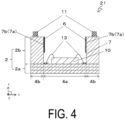
  • FIG. 4 is a vertical cross-sectional view illustrating a mounting board and an electronic device according to another aspect of the first embodiment of the present disclosure.
  • FIG. 5 is a vertical cross-sectional view illustrating a mounting board and an electronic device according to another aspect of the first embodiment of the present disclosure.
  • FIG. 6 is a vertical cross-sectional view illustrating a mounting board and an electronic device according to another aspect of the second embodiment of the present disclosure.
  • FIG. 7 is a vertical cross-sectional view illustrating a mounting board and an electronic device according to another aspect of the second embodiment of the present disclosure.
  • FIG. 8 is a vertical cross-sectional view illustrating a mounting board and an electronic device according to another aspect of the second embodiment of the present disclosure.
  • FIG. 9 is a vertical cross-sectional view illustrating a mounting board and an electronic device according to another aspect of the second embodiment of the present disclosure.
  • FIG. 10 is a vertical cross-sectional view illustrating a mounting board and an electronic device according to another aspect of the second embodiment of the present disclosure.
  • a configuration in which a light receiving element and a light emitting element are mounted on a mounting board, and in which the mounting board is covered with a lid is defined as an electronic device or an electronic module. Any direction may be defined as upward or downward for the mounting board and the electronic device, but for the sake of simplicity, an xyz orthogonal coordinate system is defined and a positive side in the z direction is defined as upward.
  • FIG. 1 A illustrates a top view of the electronic device 21
  • FIG. 1 B illustrates a vertical cross-sectional view of the electronic device 21
  • FIGS. 4 and 5 illustrate vertical cross-sectional views of the device.
  • a lid 12 is not illustrated in FIGS. 1 A to 2 B .
  • the mounting board 1 includes a base portion 2 a and a frame portion 2 b .
  • the base portion 2 a includes a first upper surface 6 a including a first mounting region 4 a .
  • the first mounting region 4 a may include a first electrode pad 3 a electrically connected to a light receiving element 10 .
  • the frame portion 2 b includes a second upper surface 6 b including a second mounting region 4 b and an inner wall surface 7 intersecting with the second upper surface 6 b , and the frame portion is located on the first upper surface 6 a of the base portion 2 a so as to surround the first mounting region 4 a .
  • the frame portion 2 b is on the first upper surface 6 a of the base portion 2 a and is located so as to surround the first mounting region 4 a .
  • the inner wall surface 7 of the frame portion 2 b includes: a first portion 7 a connecting with the second upper surface 6 b ; and a second portion 7 b located opposite to the first portion 7 a with the first mounting region 4 a interposed therebetween.
  • the mounting board 1 includes the base portion 2 a and the frame portion 2 b .
  • the base portion 2 a includes the first mounting region 4 a in which the first electrode pad 3 a is located that is electrically connected to the light receiving element 10 on the first upper surface 6 a .
  • At least one light emitting element 11 is mounted on the second upper surface 6 b of the frame portion 2 b .
  • the frame portion 2 b includes at least one second mounting region 4 b in which at least one second electrode pad 3 b is located that is electrically connected to the light emitting element 11 on the second upper surface 6 b .
  • the first mounting region 4 a is a region on which at least one or more light receiving elements 10 are mounted, and can be appropriately defined, for example, an inner side of the outermost periphery of the first electrode pad 3 a , which will be described later, or an inner portion of the frame portion 2 b . Further, as a component mounted on the first mounting region 4 a , an electronic component may be further mounted other than the light receiving element 10 , and the number of the light receiving elements 10 and/or the electronic components is not specified.
  • the second mounting region 4 b is a region on which at least one or more light emitting elements 11 are mounted, and can be appropriately defined, for example, an inside of the outermost periphery of the second electrode pad 3 b , which will be described later, or an inner portion of the frame portion 2 b . Further, in this case, an electronic component other than the light emitting element 11 may be further mounted. Further, the number of the light emitting elements 11 and the electronic components is not specified.
  • a combination of the base portion 2 a and the frame portion 2 b is referred to as a substrate 2 .
  • the base portion 2 a and the frame portion 2 b are formed of a plurality of layers.
  • These plurality of layers are a plurality of insulating layers, and as in the example illustrated in FIG. 4 and FIG. 5 , for example, a configuration formed with a mold, a configuration formed by pressing using a metal mold or the like, a configuration having only a single layer of the like may be adopted.
  • Examples of the material of the insulating layers forming the substrate 2 include an electrically insulating ceramic and a resin.
  • Examples of the electrically insulating ceramic used as the material of the insulating layers included in the substrate 2 include an aluminum oxide-based sintered compact, a mullite-based sintered compact, a silicon carbide-based sintered compact, an aluminum nitride-based sintered compact, a silicon nitride-based sintered compact, and a glass ceramic sintered compact.
  • Examples of the resin used as the material of the insulating layers forming the substrate 2 include a thermoplastic resin, an epoxy resin, a polyimide resin, an acrylic resin, a phenol resin, a fluorine-based resin, and the like.
  • Examples of the fluorine-based resin include an ethylene tetrafluoride resin.
  • the substrate 2 may be formed of nine layers as illustrated in FIG. 1 B and FIG. 2 B , or may be formed of eight or less or ten or more of the plurality of layers. When the number of the plurality of layers is eight or less, the thickness of the mounting board 1 can be reduced. On the other hand, when the number of the plurality of layers is ten or more, the rigidity of the mounting board 1 can be increased. Further, an opening portion may be provided in each layer, a stepped portion may be formed on an upper surface of the provided opening portion having a different size, and the first electrode pad 3 a and other electrodes described below may be provided in the stepped portion.
  • one side of an outermost periphery of the mounting board 1 may have a size of from 0.3 mm to 10 cm, and when the mounting board 1 has a quadrilateral shape in a top view, the shape may be square or rectangular. Further, for example, the thickness of the mounting board 1 may be 0.2 mm or more.
  • An external circuit connection electrode may be provided on the side surface or the lower surface of the base portion 2 a and the second upper surface 6 b or the side surface of the frame portion 2 b .
  • the external circuit connection electrode may electrically connect the mounting board 1 to an external circuit board or the electronic device 21 to an external circuit board.
  • electrodes formed between insulating layers, internal wiring electrical conductors, and internal through-hole conductors vertically connecting the internal wiring electrical conductors to each other may be provided on the first upper surface 6 a or lower surface of the substrate 2 . These electrodes, internal wiring electrical conductors, or internal through-hole conductors may be exposed on the surface of the substrate 2 .
  • the first electrode pad 3 a , the second electrode pad 3 b , and/or the external circuit connection electrode may each be electrically connected by the electrodes, the internal wiring electrical conductors, or the internal through-hole conductors.
  • the first electrode pad 3 a , the second electrode pad 3 b , the external circuit connection electrode, the electrodes, the internal wiring electrical conductors, and/or the internal through-hole conductors contain tungsten (W), molybdenum (Mo), manganese (Mn), palladium (Pd), silver (Ag), or copper (Cu), or an alloy containing at least one metal material selected from these metals, or the like. Further, those may contain only copper (Cu).
  • the first electrode pad 3 a , the second electrode pad 3 b , the external circuit connection electrode, the electrodes, the internal wiring electrical conductors, and/or the internal through-hole conductors contain copper (Cu), gold (Au), aluminum (Al), nickel (Ni), molybdenum (Mo), palladium (Pd), or titanium (Ti), or an alloy containing at least one metal material selected from these metals, or the like.
  • a plated layer may be further provided on the exposed surface of the first electrode pad 3 a , the second electrode pad 3 b , the external circuit connection electrode, the electrodes, the internal wiring electrical conductor, and/or the through-hole conductor. According to this configuration, oxidation can be suppressed by protecting the exposed surfaces of the external circuit connection electrode, the electrical conductor layer, and the through-hole conductors. Further, according to this configuration, the first electrode pad 3 a and the light receiving element 10 can be favorably electrically connected via a bonding member 13 such as wire bonding.
  • the plated layer may be formed by depositing a nickel (Ni) plated layer having a thickness of from 0.5 ⁇ m to 10 ⁇ m, or by sequentially depositing the nickel plated layer and a gold (Au) plated layer having a thickness of from 0.5 ⁇ m to 3 ⁇ m.
  • Ni nickel
  • Au gold
  • the frame portion 2 b is on the first upper surface 6 a of the base portion 2 a and is located so as to surround the first mounting region 4 a .
  • the substrate 2 includes the recessed portion between the frame portion 2 b and the base portion 2 a , and the light receiving element 10 mounted in the first mounting region 4 a is mounted on the inner side of the recessed portion.
  • the mounting board 1 includes the base portion 2 a and the frame portion 2 b .
  • the base portion 2 a includes the first mounting region 4 a in which the light receiving element 10 is mounted on the first upper surface 6 a .
  • the frame portion 2 b includes at least one second mounting region 4 b in which at least one light emitting element 11 is mounted on the second upper surface 6 b .
  • the frame portion 2 b is on the upper surface of the base portion 2 a and is located so as to surround the first mounting region 4 a .
  • a first film 6 which is a coating that absorbs light, is located in the second portion 7 b provided opposite to the first portion 7 a connecting with the second upper surface 6 b in which the second mounting region 4 b of the frame portion 2 b is located.
  • Absorbing light means that the reflectance of the first film 6 is lower than the reflectance of the inner wall surface 7 of the frame portion 2 b .
  • This reflectance is the reflectance regarding the light emitted from the light emitting element 11 .
  • the reflectance may be the reflectance regarding visible light, which is scattered light.
  • the reflectance can be identified based on the material of the target object, or may be measured with a colorimeter or the like.
  • the recessed portion is provided in the mounting board so as to narrow a space between the light receiving element and the light emitting element as much as possible, the light receiving element is mounted in the recessed portion, and the light emitting element is mounted on the recessed portion (surface of the mounting board).
  • an electronic device malfunctions.
  • deepening of the recessed portion in the mounting board in order to reduce malfunctions is an obstacle to downsizing of the electronic device.
  • the mounting board 1 has the first film 6 that absorbs light, in the second portion 7 b of the frame portion 2 b . Accordingly, even in a case where a portion of the light from the light emitting element 11 reaches the inner wall surface 7 of the frame portion 2 b , the light is absorbed by the first film 6 that absorbs light, whereby the occurrence of the reflection in the frame portion 2 b can be reduced. Thus, it is possible to reduce the possibility of the light reflected by the inner wall surface 7 of the frame portion 2 b reaching the light receiving element 10 and the electronic device 21 malfunctioning. Further, since it is possible to reduce malfunctions of the electronic device 21 without providing a wall with the housing or the like between the light emitting element 11 and the light receiving element 10 , the electronic device 21 can be downsized.
  • the first film 6 that absorbs light is located in the second portion 7 b located opposite to the first portion 7 a in the inner wall surface 7 .
  • There may be a plurality of the second mounting regions 4 b and in this case, similarly there may be a plurality of the first films 6 that absorbs light.
  • the second mounting regions 4 b may be located at four sides, and in this case, the first films 6 that absorb light are located on all of the inner wall surfaces 7 of the frame portion 2 b , in other words, on the entire circumference.
  • the second mounting region 4 b is one surface, there may be a plurality of surfaces of the first films 6 that absorb light.
  • the number of the first films 6 may be equal to or greater than the number of the second mounting regions 4 b.
  • the frame portion 2 b may be, for example, molding processed using a mold as in the examples illustrated in FIG. 4 and FIG. 5 , or may be composed of a plurality of layers as in the example illustrated in FIG. 1 B .
  • the effect of the present embodiment can be achieved by applying the first film 6 that absorbs light as compared with at least the inner wall surface 7 of the frame portion 2 b.
  • the first film 6 may extend to the upper surface of the frame portion 2 b .
  • the frame portion 2 b includes a plurality of layers as in the example illustrated in FIG. 1 B and FIG. 2 B as well as FIG. 3 B illustrating a second embodiment described below
  • internal wiring can be provided between the layers in the frame portion 2 b .
  • the wiring of the mounting board 1 can have a degree of freedom, and electrical characteristics of the electronic device 21 can be improved.
  • the thickness of the frame portion 2 b can be easily changed by the thickness and/or the number of layers.
  • the first film 6 may be provided on a part of the second portion 7 b of the frame portion 2 b in a cross-sectional view, or may be provided on all layers of the frame portion 2 b in a cross-sectional view. With the first film 6 provided at least in the second portion 7 b opposite to the first portion 7 a in the inner wall surface 7 , the effect of the present embodiment can be achieved.
  • the first layer 8 a that is the uppermost layer may include the first film 6 .
  • the first film 6 may be located over the first layer 8 a and the second layer 8 b . According to this configuration, the second mounting region 4 b can be ensured without increasing the size of the mounting board 1 even when the first film 6 is located in the frame portion 2 b , and the effect of the present embodiment can be achieved.
  • the height of the frame portion 2 b has a height at which the light receiving element 10 is housed within the frame portion 2 b .
  • the first film 6 may be located on the entire circumference of the inner wall surface 7 . Accordingly, even in a case where the light from the light emitting element 11 reaches a portion other than the opposing surface side, when a portion of the light is reflected at the inner wall surface 7 of the frame portion 2 b , it is possible to reduce the reflection of the light to the light receiving element 10 . Thus, it is possible to reduce the possibility of the light reflected by the inner wall surface 7 of the frame portion 2 b reaching the light receiving element 10 and the electronic device 21 malfunctioning.
  • the base portion 2 a and the frame portion 2 b may be composed of a ceramic material as a main component, and the ceramic material may be black in this case.
  • the base portion 2 a and the frame portion 2 b are composed of the ceramic material as the main component, and thus it possible to process the frame portion 2 b by punching with a metal mold or the like. Thus, it is possible to reduce the occurrence of dusts from the frame portion 2 b . Thus, it is possible to reduce the possibility that the dusts stick to the surface of the light receiving element 10 to generate a noise. Further, it is possible to reduce the roughness of the surface of the inner wall surface 7 of the frame portion 2 b .
  • the ceramic material is black, and thus it is possible to reduce the possibility of the light being reflected when the light generated from the light emitting element 11 reaches the inner wall surface 7 of the frame portion 2 b .
  • the effect of the present embodiment can be achieved.
  • the base portion 2 a and the frame portion 2 b may be composed of a resin material as a main component.
  • the frame portion 2 b can be manufactured by a molding process such as a mold.
  • the resin material can reduce a glass component included in the frame portion 2 b .
  • the frame portion 2 b and the first film 6 that absorbs light can be more tightly bonded to each other by glass sintering.
  • the possibility of separation of the first film 6 from the frame portion 2 b due to aging of the electronic device 21 can be reduced, whereby the effect of the present embodiment can be provided for an extended period of time.
  • the ceramic material may be black. Examples of the ceramic material of the first film 6 include a silicon carbide sintered compact.
  • the first film 6 being a black ceramic material, it is possible to further reduce the possibility of the light being reflected when the light generated from the light emitting element 11 reaches the inner wall surface 7 of the frame portion 2 b . Therefore, it is possible to further improve the effect of the present embodiment.
  • the glass component included in the frame portion 2 b can be reduced. Thus, it is possible to reduce the generation of the reflection of the light at the inner wall surface 7 of the frame portion 2 b . Thus, it is possible to improve the effect of the present embodiment.
  • FIGS. 1 A to 2 B An example of the electronic device 21 is illustrated in FIGS. 1 A to 2 B as well as FIGS. 3 A and 3 B illustrating the second embodiment described below.
  • the electronic device 21 includes the mounting board 1 , the light receiving element 10 mounted in the first mounting region 4 a of the mounting board 1 , and the light emitting element 11 mounted in the second mounting region 4 b.
  • the electronic device 21 includes the mounting board 1 , the light receiving element 10 mounted in the first mounting region 4 a , and the light emitting element 11 mounted in the second mounting region 4 b .
  • An example of the light receiving element 10 is, for example, a reflective CMOS sensor or a PD sensor.
  • An example of the light emitting element 11 is a Light Emitting Diode (LED) or a VCSEL element.
  • the light receiving element 10 and the mounting board 1 , and the light emitting element 11 and the mounting board 1 may be electrically connected to each other by, for example, the bonding member 13 .
  • the electronic device 21 includes the mounting board 1 illustrated in the present embodiment, and thus a space between the light receiving element 10 and the light emitting element 11 can be made smaller in a top view, and the electronic device 21 can be downsized.
  • an upper end of the light receiving element 10 is located below a lower end of the light emitting element 11 . Accordingly, even in a case where a portion of the light from the light emitting element 11 is reflected by the inner wall surface 7 of the frame portion 2 b , it is possible to further reduce the reflection of the light to the light receiving element 10 . Therefore, it is possible to further improve the effect of the present embodiment. Further, the first film 6 may be located above an upper end of the light receiving element 10 .
  • the first film 6 is located at a location on which the light from the light emitting element 11 is more likely to be incident, even in a case where a portion of the light from the light emitting element 11 is reflected by the inner wall surface 7 of the frame portion 2 b , it is possible to further reduce the possibility of the reflection of the light to the light receiving element 10 .
  • the second upper surface 6 b of the frame portion 2 b in particular, the inner end of the second upper surface 6 b of the frame portion 2 b may be located above an imaginary line A connecting the center of the light receiving element 10 and the center of the light emitting element 11 . Accordingly, even in a case where a portion of the light from the light emitting element 11 is reflected by the inner wall surface 7 of the frame portion 2 b , it is possible to further reduce the reflection of the light to the light receiving element 10 . Therefore, it is possible to further improve the effect of the present embodiment.
  • An electronic module 31 includes the electronic device 21 and the lid 12 located on an upper surface of the electronic device 21 .
  • the electronic module 31 may include the lid 12 covering the electronic device 21 .
  • the lid 12 may have a flat plate shape, or may be shaped like a housing (lens holder).
  • the lid 12 may have a shape in which a housing made of a metal or a resin as a material and a plate-like transparent member made of a resin or a glass material as a material are combined, or may have a flat plate shape such as a glass plate.
  • the lid 12 has a shape in which the housing and the plate material are combined, and thus it is possible to further improve airtightness or reduce the direct application of stress from the outside to the electronic device 21 .
  • the electronic module 31 may have the lid 12 bonded to the electronic device 21 , and further have a housing covering the electronic device 21 .
  • the housing and the lid 12 are made of, for example, a resin, a metal material, or the like.
  • the lid 12 is a lens holder, one or more lenses made of a resin, a liquid, glass, a crystal, or the like may be incorporated into the lid 12 .
  • the lid 12 may be equipped with a drive device or the like configured to drive up, down, left, and right, and may be electrically connected to a pad or the like located on the front surface of the mounting board 1 via a bonding member such as solder.
  • the lid 12 in a top view, may be provided with an opening portion on at least one side in any of four directions. Further, an external circuit board may be inserted through the opening portion of the lid 12 and electrically connected to the mounting board 1 . In addition, after the external circuit board has been electrically connected to the mounting board 1 , the opening portion of the lid 12 may be sealed with a sealing material such as a resin or the like, such that the inside of the electronic module 31 may be hermetically sealed.
  • the electronic module 31 may separately include a lid that further covers the light receiving element 10 .
  • the housing may include an opening portion. Also in this case, the opening portion may be similarly sealed with a sealing material such as a resin or the like, such that the inside of the electronic module 31 may be hermetically sealed.
  • ceramic green sheets that form the substrate 2 are formed.
  • the substrate 2 that is an aluminum oxide (Al 2 O 3 )-based sintered compact
  • a powder such as silica (SiO 2 ), magnesia (MgO), or calcia (CaO) is added as a sintering aid to the Al 2 O 3 powder.
  • a suitable binder, a solvent, and a plasticizer are furthermore added to this, and the mixture is kneaded together into a slurry.
  • multipiece ceramic green sheets are obtained by a formation method, such as a doctor blade method or a calendar roll method.
  • the substrate 2 when the substrate 2 is made of a resin, for example, the substrate 2 can be formed by a transfer molding method, an injection molding method, pressing with a metal mold, or the like, using a metal mold capable of forming the resin into a predetermined shape.
  • the material of the substrate 2 may be a base material made of glass fibers impregnated with a resin, such as a glass epoxy resin.
  • the substrate 2 can be formed by impregnating a base material made of glass fibers with an epoxy resin precursor and thermally curing the epoxy resin precursor at a predetermined temperature.
  • a metal paste is applied to or caused to fill portions of the ceramic green sheets obtained in the above step (1), the portions being expected to serve as the first electrode pad 3 a , the second electrode pad 3 b , the external circuit connection electrode, the electrodes, the internal wiring electrical conductors, and/or the internal through-hole conductors.
  • This metal paste is created so as to have appropriate viscosity by adding a suitable solvent and binder to the metal powder formed of the above-described metal materials, and kneading the mixture. Note that a glass or ceramics may also be included in the metal paste in order to increase the bonding strength with the substrate 2 .
  • the first electrode pad 3 a , the second electrode pad 3 b , the external circuit connection electrode, the electrodes, the internal wiring electrical conductors, and/or the internal through-hole conductors can be manufactured by sputtering, vaporizing, or the like. Furthermore, those may be manufactured by using a plating method after providing a metal film on the surface.
  • the aforementioned green sheet is processed using a metal mold or the like.
  • the opening portion, the cutout section or the like may be formed at a predetermined portion of the green sheet to be the substrate 2 .
  • the ceramic green sheets to be respective insulating layers of the substrate 2 are layered and placed under pressure.
  • the ceramic green sheets to be insulating layers may be layered to produce a ceramic green sheet laminated body to be the substrate 2 .
  • an opening portion of the frame portion 2 b may be provided at predetermined positions by using a metal mold, a punching, a laser, or the like, in the ceramic green sheet in which the plurality of layers are layered.
  • the first film 6 which is a coating that absorbs light, can be produced by being applied at least to the second portion 7 b of the inner wall surface 7 of the frame portion 2 b.
  • the ceramic green sheet laminated body is fired at a temperature of from approximately 1500° C. to 1800° C. to obtain the multipiece wiring board in which a plurality of the mounting boards 1 are arrayed.
  • the above-described metal paste is fired at the same time as the ceramic green sheets forming the mounting board 1 , and forms the first electrode pad 3 a , the second electrode pad 3 b , the external circuit connection electrode, the electrodes, the internal wiring electrical conductors, and/or the internal through-hole conductors.
  • the multipiece wiring board obtained by the firing may be divided into the plurality of mounting boards 1 .
  • a method can be used in which split grooves are formed in the multipiece wiring board in locations that will serve as the outer edges of the mounting boards 1 , and the multipiece wiring board may then be divided along those split grooves.
  • a method can be used in which the multipiece wiring board is cut, by slicing and the like, along the locations that will serve as the outer edges of the mounting boards 1 .
  • the split grooves can be formed by using a slicing device to cut to a depth less than the thickness of the multipiece wiring board after firing.
  • the split grooves can be formed by pressing a cutter blade against the ceramic green sheet laminated body used as the multipiece wiring board, or by using a slicing device to form cuts having a depth less than the thickness of the ceramic green sheet laminated body.
  • the plating may be applied to the first electrode pad 3 a , the second electrode pad 3 b , external connection pads, and the exposed wiring conductors using an electrolytic or electroless plating method, respectively.
  • the light receiving element 10 and the light emitting element 11 of the mounting board 1 are mounted in the first mounting region 4 a and in the second mounting region 4 b , respectively.
  • the light receiving element 10 is electrically bonded to the mounting board 1 by the bonding member 13 such as wire bonding or the like.
  • an adhesive or the like may be provided on the light receiving element 10 or the mounting board 1 to fix the light receiving element 10 to the mounting board 1 .
  • the lid 12 may be bonded to the mounting board 1 .
  • the electronic device 21 can be manufactured by manufacturing the mounting board 1 as described in steps (1) to (7) and mounting the light receiving element 10 and the light emitting element 11 on the mounting board 1 . Note that the order of the above-described steps (1) to (7) can be changed to another order in which the process can be performed.
  • the mounting board 1 according to the present embodiment is different from the mounting board 1 according to the first embodiment in that the second portion 7 b has an inclined surface 5 and the surface of the inclined surface 5 has the first film 6 that absorbs light.
  • the first film 6 that absorbs light is located on the inclined surface 5 of the mounting board 1 .
  • the inner wall surface 7 of the frame portion 2 b in which the first film 6 that absorbs light is located, has the inclined surface 5 inclined away from the first portion 7 a as it goes away from the first upper surface 6 a of the base portion 2 a , and the diameter (width) of an opening in the inner wall surface 7 having the inclined surface 5 increases upward.
  • the frame portion 2 b may have a plurality of layers, and the inclined surface 5 may be located over a plurality of layers as in the example illustrated in FIG. 3 B , FIG. 6 , and FIGS. 8 to 10 .
  • the first film 6 is easy to apply, and an angle with which the light from the light emitting element 11 is hardly reflected to the light receiving element 10 side can be easily produced, whereby the effect of the present embodiment can be further improved.
  • the inclination angle of the inclined surface 5 of the mounting board 1 may be from 30° to 60° with respect to the first upper surface 6 a .
  • the angle of the inclined surface 5 is from 30° to 60° with respect to the first upper surface 6 a , so that it is possible to have the effect of reflecting the light to the upward side of the frame portion 2 b when the light from the light emitting element 11 reaches the inclined surface 5 , and the second mounting region 4 b on which the light emitting element 11 is mounted is easily ensured on the second upper surface 6 b of the frame portion 2 b .
  • the effect of the present embodiment can be achieved, and it is possible to downsize the electronic device 21 .
  • the first film 6 that absorbs light may be located on the entire surface of the inclined surface 5 , and as in the example illustrated in FIG. 6 , the first film 6 that absorbs light may be located only on a part of the inclined surface 5 .
  • the effect of the present embodiment can be achieved even in a case where the light from the light emitting element 11 reaches the inner wall surface 7 of the frame portion 2 b at various angles or locations.
  • the first film 6 that absorbs light being located only on a part of the inclined surface 5 as in the example illustrated in FIG.
  • the electronic device 21 it is possible to reduce the possibility of the bonding member 13 and the first film 6 coming into contact with each other even in a case where the electronic device 21 has a lower height.
  • the electronic device 21 in a case where the electronic device 21 is downsized and has a lower height, it is possible to reduce the possibility of the reflected light that should reach the light receiving element 10 being blocked due to the first film 6 casting a shadow.
  • the electronic device 21 can be downsized and have a lower height.
  • the first film 6 is located along the inclined surface 5 .
  • the effect of the present embodiment can be achieved as well.
  • the thickness of the first film 6 may be constant. This makes it possible to uniformly absorb the light from the light emitting element 11 , and to reduce the difference in the degree of absorption of light depending on the angle of the light from the light emitting element 11 . Thus, it is possible to further stabilize the operation of the electronic device 21 .
  • a part of the first film 6 may be thicker. With a part of the first film 6 being thicker, the first film 6 at which the light from the light emitting element 11 is likely to be concentrated can be made thicker, whereby the effect of the present embodiment can be further improved.
  • the second upper surface 6 b of the frame portion 2 b in particular, the inner end of the second upper surface 6 b of the frame portion 2 b may be located above the imaginary line A connecting the center of the light receiving element 10 and the center of the light emitting element 11 . Accordingly, even in a case where a portion of the light from the light emitting element 11 is reflected by the inner wall surface 7 of the frame portion 2 b , it is possible to further reduce the reflection of the light to the light receiving element 10 . Therefore, it is possible to further improve the effect of the present embodiment.
  • the first film 6 may extend farther downward than the imaginary line A connecting the center of the light receiving element 10 and the center of the light emitting element 11 . Thus, it is possible to further improve the effect of the present embodiment.
  • the manufacturing method of the mounting board 1 and the electronic device 21 illustrated in FIGS. 3 A and 3 B , FIGS. 6 to 10 can be achieved by combining the steps of the first embodiment and the second embodiment. That is, it is possible to produce the inclined surface 5 along the steps of the first embodiment, and to produce the first film 6 that absorbs light by being applied or printed on the surface of the inclined surface 5 .
  • the present disclosure is not limited to the above-described embodiments, and various modifications can be made to numerical values and the like.
  • the first electrode pad 3 a and the second electrode pad 3 b have a rectangular shape in a top view, but may be circular or have another polygonal shape.
  • the arrangement, number, and shape of the first electrode pad 3 a and the second electrode pad 3 b , the mounting method of the electronic element, and the like in the present embodiments are not specified.
  • various combinations of characteristic portions of the present embodiments are not limited to the examples in the embodiments. Further, combinations of the respective embodiments are also possible.

Landscapes

  • Engineering & Computer Science (AREA)
  • Microelectronics & Electronic Packaging (AREA)
  • Manufacturing & Machinery (AREA)
  • Led Device Packages (AREA)
  • Photo Coupler, Interrupter, Optical-To-Optical Conversion Devices (AREA)
  • Structure Of Printed Boards (AREA)

Abstract

A mounting board includes a base portion and a frame portion. The base portion includes a first upper surface including a first mounting region. The frame portion includes a second upper surface including a second mounting region and an inner wall surface intersecting with the second upper surface. The inner wall surface of the frame portion includes a first portion connecting with the second upper surface, and a second portion located opposite to the first portion with the first mounting region interposed therebetween. In the second portion, a first film that absorbs light and having a reflectance lower than a reflectance of the inner wall surface of the frame portion is located.

Description

TECHNICAL FIELD
The present disclosure relates to a mounting board on which light receiving and emitting elements and the like are mounted, an electronic device, and an electronic module.
BACKGROUND ART
A mounting board on which a light receiving element and a light emitting element are mounted is known. (see WO 2017/203953). In such a mounting board, the light emitted by the light emitting element is reflected by a detection target and then received by the light receiving element to be detected.
Generally, in the mounting board including the light receiving element and the light emitting element, the light receiving element and the light emitting element may be mounted on an upper surface of a substrate and on the same flat surface. In this case, in order to prevent the light receiving element from directly receiving the light emitted by the light emitting element, a wall is provided with a housing or the like.
However, in recent years, downsizing of the mounting board has been required. Thus, a structure is conceivable in which a recessed portion is provided in the mounting board so as to narrow a space between the light receiving element and the light emitting element as much as possible, the light receiving element is mounted in the recessed portion, and the light emitting element is mounted on the recessed portion (front surface of the mounting board). However, with this structure, it is difficult to provide the wall with the housing or the like between the light receiving element and the light emitting element. As a result, there is a concern that a portion of the light from the light emitting element is reflected by a side wall of the recessed portion, and the reflected light reaches the light receiving element. Thus, there has been a concern that an electronic device malfunctions. Further, there has been concern that deepening of the recessed portion in the mounting board in order to reduce the malfunction is an obstacle to downsizing of the electronic device.
SUMMARY OF INVENTION
A mounting board according to one aspect of the present disclosure includes a base portion and a frame portion. The base portion includes a first upper surface including a first mounting region. The frame portion surrounds the first mounting region, and includes an inner wall surface extending upward from the first upper surface and a second upper surface that intersects with the inner wall surface and includes a second mounting region. The inner wall surface of the frame portion includes: a first portion connecting with the second upper surface; and a second portion located opposite to the first portion with the first mounting region interposed therebetween. In the second portion, a first film having a reflectance lower than a reflectance of the inner wall surface of the frame portion is located.
An electronic device according to one aspect of the present disclosure includes a mounting board, a light receiving element mounted in a first mounting region, and a light emitting element mounted in a second mounting region.
An electronic module according to one aspect of the present disclosure includes an electronic device and a lid located on the electronic device.
BRIEF DESCRIPTION OF DRAWINGS
FIG. 1A is a top view illustrating the outer appearance of a mounting board and an electronic device according to a first embodiment of the present disclosure.
FIG. 1B is a vertical cross-sectional view corresponding to the line X1-X1 in FIG. 1A.
FIG. 2A is a top view illustrating the outer appearance of a mounting board and an electronic module according to the first embodiment of the present disclosure.
FIG. 2B is a vertical cross-sectional view corresponding to the line X2-X2 in FIG. 2A.
FIG. 3A is a top view illustrating the outer appearance of a mounting board and an electronic module according to a second embodiment of the present disclosure.
FIG. 3B is a vertical cross-sectional view corresponding to the line X3-X3 in FIG. 3A.
FIG. 4 is a vertical cross-sectional view illustrating a mounting board and an electronic device according to another aspect of the first embodiment of the present disclosure.
FIG. 5 is a vertical cross-sectional view illustrating a mounting board and an electronic device according to another aspect of the first embodiment of the present disclosure.
FIG. 6 is a vertical cross-sectional view illustrating a mounting board and an electronic device according to another aspect of the second embodiment of the present disclosure.
FIG. 7 is a vertical cross-sectional view illustrating a mounting board and an electronic device according to another aspect of the second embodiment of the present disclosure.
FIG. 8 is a vertical cross-sectional view illustrating a mounting board and an electronic device according to another aspect of the second embodiment of the present disclosure.
FIG. 9 is a vertical cross-sectional view illustrating a mounting board and an electronic device according to another aspect of the second embodiment of the present disclosure.
FIG. 10 is a vertical cross-sectional view illustrating a mounting board and an electronic device according to another aspect of the second embodiment of the present disclosure.
DESCRIPTION OF EMBODIMENTS
Configuration of Mounting Board and Electronic Device
Several exemplary embodiments of the present disclosure will be described hereinafter with reference to the drawings. In the following description, a configuration in which a light receiving element and a light emitting element are mounted on a mounting board, and in which the mounting board is covered with a lid is defined as an electronic device or an electronic module. Any direction may be defined as upward or downward for the mounting board and the electronic device, but for the sake of simplicity, an xyz orthogonal coordinate system is defined and a positive side in the z direction is defined as upward.
First Embodiment
A mounting board 1 and an electronic device 21 provided with the mounting board 1 according to a first embodiment of the present disclosure will be described with reference to FIGS. 1A to 2B, and FIGS. 4 and 5 . Note that FIG. 1A illustrates a top view of the electronic device 21, FIG. 1B illustrates a vertical cross-sectional view of the electronic device 21, and FIGS. 4 and 5 illustrate vertical cross-sectional views of the device. Note that a lid 12 is not illustrated in FIGS. 1A to 2B.
The mounting board 1 includes a base portion 2 a and a frame portion 2 b. The base portion 2 a includes a first upper surface 6 a including a first mounting region 4 a. The first mounting region 4 a may include a first electrode pad 3 a electrically connected to a light receiving element 10. The frame portion 2 b includes a second upper surface 6 b including a second mounting region 4 b and an inner wall surface 7 intersecting with the second upper surface 6 b, and the frame portion is located on the first upper surface 6 a of the base portion 2 a so as to surround the first mounting region 4 a. In the second mounting region 4 b, at least one light emitting element 11 is mounted, and at least one second electrode pad 3 b electrically connected to the light emitting element 11 is located. The frame portion 2 b is on the first upper surface 6 a of the base portion 2 a and is located so as to surround the first mounting region 4 a. The inner wall surface 7 of the frame portion 2 b includes: a first portion 7 a connecting with the second upper surface 6 b; and a second portion 7 b located opposite to the first portion 7 a with the first mounting region 4 a interposed therebetween.
The mounting board 1 includes the base portion 2 a and the frame portion 2 b. The base portion 2 a includes the first mounting region 4 a in which the first electrode pad 3 a is located that is electrically connected to the light receiving element 10 on the first upper surface 6 a. At least one light emitting element 11 is mounted on the second upper surface 6 b of the frame portion 2 b. The frame portion 2 b includes at least one second mounting region 4 b in which at least one second electrode pad 3 b is located that is electrically connected to the light emitting element 11 on the second upper surface 6 b. The first mounting region 4 a is a region on which at least one or more light receiving elements 10 are mounted, and can be appropriately defined, for example, an inner side of the outermost periphery of the first electrode pad 3 a, which will be described later, or an inner portion of the frame portion 2 b. Further, as a component mounted on the first mounting region 4 a, an electronic component may be further mounted other than the light receiving element 10, and the number of the light receiving elements 10 and/or the electronic components is not specified. The second mounting region 4 b is a region on which at least one or more light emitting elements 11 are mounted, and can be appropriately defined, for example, an inside of the outermost periphery of the second electrode pad 3 b, which will be described later, or an inner portion of the frame portion 2 b. Further, in this case, an electronic component other than the light emitting element 11 may be further mounted. Further, the number of the light emitting elements 11 and the electronic components is not specified. Here, a combination of the base portion 2 a and the frame portion 2 b is referred to as a substrate 2.
In the mounting board 1 illustrated in FIG. 1B and FIG. 2B, the base portion 2 a and the frame portion 2 b are formed of a plurality of layers. These plurality of layers are a plurality of insulating layers, and as in the example illustrated in FIG. 4 and FIG. 5 , for example, a configuration formed with a mold, a configuration formed by pressing using a metal mold or the like, a configuration having only a single layer of the like may be adopted. Examples of the material of the insulating layers forming the substrate 2 include an electrically insulating ceramic and a resin.
Examples of the electrically insulating ceramic used as the material of the insulating layers included in the substrate 2 include an aluminum oxide-based sintered compact, a mullite-based sintered compact, a silicon carbide-based sintered compact, an aluminum nitride-based sintered compact, a silicon nitride-based sintered compact, and a glass ceramic sintered compact. Examples of the resin used as the material of the insulating layers forming the substrate 2 include a thermoplastic resin, an epoxy resin, a polyimide resin, an acrylic resin, a phenol resin, a fluorine-based resin, and the like. Examples of the fluorine-based resin include an ethylene tetrafluoride resin.
The substrate 2 may be formed of nine layers as illustrated in FIG. 1B and FIG. 2B, or may be formed of eight or less or ten or more of the plurality of layers. When the number of the plurality of layers is eight or less, the thickness of the mounting board 1 can be reduced. On the other hand, when the number of the plurality of layers is ten or more, the rigidity of the mounting board 1 can be increased. Further, an opening portion may be provided in each layer, a stepped portion may be formed on an upper surface of the provided opening portion having a different size, and the first electrode pad 3 a and other electrodes described below may be provided in the stepped portion.
For example, one side of an outermost periphery of the mounting board 1 may have a size of from 0.3 mm to 10 cm, and when the mounting board 1 has a quadrilateral shape in a top view, the shape may be square or rectangular. Further, for example, the thickness of the mounting board 1 may be 0.2 mm or more.
An external circuit connection electrode may be provided on the side surface or the lower surface of the base portion 2 a and the second upper surface 6 b or the side surface of the frame portion 2 b. The external circuit connection electrode may electrically connect the mounting board 1 to an external circuit board or the electronic device 21 to an external circuit board.
Further, in addition to the first electrode pad 3 a, the second electrode pad 3 b and/or the external circuit connection electrode, electrodes formed between insulating layers, internal wiring electrical conductors, and internal through-hole conductors vertically connecting the internal wiring electrical conductors to each other may be provided on the first upper surface 6 a or lower surface of the substrate 2. These electrodes, internal wiring electrical conductors, or internal through-hole conductors may be exposed on the surface of the substrate 2. The first electrode pad 3 a, the second electrode pad 3 b, and/or the external circuit connection electrode may each be electrically connected by the electrodes, the internal wiring electrical conductors, or the internal through-hole conductors.
When the substrate 2 is made of an electrically insulating ceramic, the first electrode pad 3 a, the second electrode pad 3 b, the external circuit connection electrode, the electrodes, the internal wiring electrical conductors, and/or the internal through-hole conductors contain tungsten (W), molybdenum (Mo), manganese (Mn), palladium (Pd), silver (Ag), or copper (Cu), or an alloy containing at least one metal material selected from these metals, or the like. Further, those may contain only copper (Cu). When the substrate 2 is made of a resin, the first electrode pad 3 a, the second electrode pad 3 b, the external circuit connection electrode, the electrodes, the internal wiring electrical conductors, and/or the internal through-hole conductors contain copper (Cu), gold (Au), aluminum (Al), nickel (Ni), molybdenum (Mo), palladium (Pd), or titanium (Ti), or an alloy containing at least one metal material selected from these metals, or the like.
A plated layer may be further provided on the exposed surface of the first electrode pad 3 a, the second electrode pad 3 b, the external circuit connection electrode, the electrodes, the internal wiring electrical conductor, and/or the through-hole conductor. According to this configuration, oxidation can be suppressed by protecting the exposed surfaces of the external circuit connection electrode, the electrical conductor layer, and the through-hole conductors. Further, according to this configuration, the first electrode pad 3 a and the light receiving element 10 can be favorably electrically connected via a bonding member 13 such as wire bonding. The plated layer may be formed by depositing a nickel (Ni) plated layer having a thickness of from 0.5 μm to 10 μm, or by sequentially depositing the nickel plated layer and a gold (Au) plated layer having a thickness of from 0.5 μm to 3 μm.
The frame portion 2 b is on the first upper surface 6 a of the base portion 2 a and is located so as to surround the first mounting region 4 a. In other words, the substrate 2 includes the recessed portion between the frame portion 2 b and the base portion 2 a, and the light receiving element 10 mounted in the first mounting region 4 a is mounted on the inner side of the recessed portion.
The mounting board 1 includes the base portion 2 a and the frame portion 2 b. The base portion 2 a includes the first mounting region 4 a in which the light receiving element 10 is mounted on the first upper surface 6 a. The frame portion 2 b includes at least one second mounting region 4 b in which at least one light emitting element 11 is mounted on the second upper surface 6 b. The frame portion 2 b is on the upper surface of the base portion 2 a and is located so as to surround the first mounting region 4 a. A first film 6, which is a coating that absorbs light, is located in the second portion 7 b provided opposite to the first portion 7 a connecting with the second upper surface 6 b in which the second mounting region 4 b of the frame portion 2 b is located. Absorbing light means that the reflectance of the first film 6 is lower than the reflectance of the inner wall surface 7 of the frame portion 2 b. This reflectance is the reflectance regarding the light emitted from the light emitting element 11. The reflectance may be the reflectance regarding visible light, which is scattered light. The reflectance can be identified based on the material of the target object, or may be measured with a colorimeter or the like.
Generally, in recent years, downsizing of electronic devices has been required. In response to this, a structure is conceivable in which the recessed portion is provided in the mounting board so as to narrow a space between the light receiving element and the light emitting element as much as possible, the light receiving element is mounted in the recessed portion, and the light emitting element is mounted on the recessed portion (surface of the mounting board). However, with this structure, it is difficult to provide the wall with the housing or the like between the light receiving element and the light emitting element, and there is a concern that a portion of the light from the light emitting element is reflected by a side wall of the recessed portion, and the reflected light reaches the light receiving element. Thus, there has been a concern that an electronic device malfunctions. Further, there has been a concern that deepening of the recessed portion in the mounting board in order to reduce malfunctions is an obstacle to downsizing of the electronic device.
In view of this, in the present embodiment, the mounting board 1 has the first film 6 that absorbs light, in the second portion 7 b of the frame portion 2 b. Accordingly, even in a case where a portion of the light from the light emitting element 11 reaches the inner wall surface 7 of the frame portion 2 b, the light is absorbed by the first film 6 that absorbs light, whereby the occurrence of the reflection in the frame portion 2 b can be reduced. Thus, it is possible to reduce the possibility of the light reflected by the inner wall surface 7 of the frame portion 2 b reaching the light receiving element 10 and the electronic device 21 malfunctioning. Further, since it is possible to reduce malfunctions of the electronic device 21 without providing a wall with the housing or the like between the light emitting element 11 and the light receiving element 10, the electronic device 21 can be downsized.
The first film 6 that absorbs light is located in the second portion 7 b located opposite to the first portion 7 a in the inner wall surface 7. There may be a plurality of the second mounting regions 4 b, and in this case, similarly there may be a plurality of the first films 6 that absorbs light. For example, in a case where the mounting board 1 has a rectangular shape, the second mounting regions 4 b may be located at four sides, and in this case, the first films 6 that absorb light are located on all of the inner wall surfaces 7 of the frame portion 2 b, in other words, on the entire circumference. Further, even in a case where the second mounting region 4 b is one surface, there may be a plurality of surfaces of the first films 6 that absorb light. In other words, the number of the first films 6 may be equal to or greater than the number of the second mounting regions 4 b.
The frame portion 2 b may be, for example, molding processed using a mold as in the examples illustrated in FIG. 4 and FIG. 5 , or may be composed of a plurality of layers as in the example illustrated in FIG. 1B. In any of these cases, the effect of the present embodiment can be achieved by applying the first film 6 that absorbs light as compared with at least the inner wall surface 7 of the frame portion 2 b.
As in the example illustrated in FIG. 1B, FIG. 2B, and FIG. 5 , the first film 6 may extend to the upper surface of the frame portion 2 b. This makes it possible to reduce the possibility of irregular reflection of light on the second upper surface 6 b of the frame portion 2 b, whereby the occurrence of reflection of light on the inner wall surface 7 of the frame portion 2 b can be further reduced. Thus, it is possible to improve the effect of the present embodiment.
In a case where the frame portion 2 b includes a plurality of layers as in the example illustrated in FIG. 1B and FIG. 2B as well as FIG. 3B illustrating a second embodiment described below, internal wiring can be provided between the layers in the frame portion 2 b. Thus, the wiring of the mounting board 1 can have a degree of freedom, and electrical characteristics of the electronic device 21 can be improved. Further, when the frame portion 2 b has a plurality of layers, the thickness of the frame portion 2 b can be easily changed by the thickness and/or the number of layers. Thus, it is possible to more appropriately design and produce the height of the frame portion 2 b under conditions such as the position of the light emitting element 11.
In a case where the frame portion 2 b includes a plurality of insulating layers as in the examples illustrated in FIGS. 1B and 2B, as well as FIG. 3B and FIGS. 6 to 10 illustrating the second embodiment described below, the first film 6 may be provided on a part of the second portion 7 b of the frame portion 2 b in a cross-sectional view, or may be provided on all layers of the frame portion 2 b in a cross-sectional view. With the first film 6 provided at least in the second portion 7 b opposite to the first portion 7 a in the inner wall surface 7, the effect of the present embodiment can be achieved.
When the frame portion 2 b is layered with a plurality of layers including a first layer 8 a and a second layer 8 b in this order from the top, the first layer 8 a that is the uppermost layer may include the first film 6. Further, as illustrated in FIG. 8 , the first film 6 may be located over the first layer 8 a and the second layer 8 b. According to this configuration, the second mounting region 4 b can be ensured without increasing the size of the mounting board 1 even when the first film 6 is located in the frame portion 2 b, and the effect of the present embodiment can be achieved.
The height of the frame portion 2 b has a height at which the light receiving element 10 is housed within the frame portion 2 b. With the frame portion 2 b having the height at which the light receiving element 10 is housed within the frame portion 2 b, light picked up from the outside can be reduced.
The first film 6 may be located on the entire circumference of the inner wall surface 7. Accordingly, even in a case where the light from the light emitting element 11 reaches a portion other than the opposing surface side, when a portion of the light is reflected at the inner wall surface 7 of the frame portion 2 b, it is possible to reduce the reflection of the light to the light receiving element 10. Thus, it is possible to reduce the possibility of the light reflected by the inner wall surface 7 of the frame portion 2 b reaching the light receiving element 10 and the electronic device 21 malfunctioning.
The base portion 2 a and the frame portion 2 b may be composed of a ceramic material as a main component, and the ceramic material may be black in this case. The base portion 2 a and the frame portion 2 b are composed of the ceramic material as the main component, and thus it possible to process the frame portion 2 b by punching with a metal mold or the like. Thus, it is possible to reduce the occurrence of dusts from the frame portion 2 b. Thus, it is possible to reduce the possibility that the dusts stick to the surface of the light receiving element 10 to generate a noise. Further, it is possible to reduce the roughness of the surface of the inner wall surface 7 of the frame portion 2 b. Accordingly, even in a case where the light generated from the light emitting element 11 reaches the inner wall surface 7 of the frame portion 2 b, it is possible to reduce the possibility that the light is irregularly reflected to reach the light receiving element 10. Further, the ceramic material is black, and thus it is possible to reduce the possibility of the light being reflected when the light generated from the light emitting element 11 reaches the inner wall surface 7 of the frame portion 2 b. Thus the effect of the present embodiment can be achieved.
The base portion 2 a and the frame portion 2 b may be composed of a resin material as a main component. As a result, the frame portion 2 b can be manufactured by a molding process such as a mold. Further, the resin material can reduce a glass component included in the frame portion 2 b. Thus, it is possible to reduce the generation of the reflection of the light at the inner wall surface 7 of the frame portion 2 b.
When the main component of the first film 6 that absorbs light is a ceramic material and when the main component of the frame portion 2 b is a ceramic material, the frame portion 2 b and the first film 6 that absorbs light can be more tightly bonded to each other by glass sintering. Thus, the possibility of separation of the first film 6 from the frame portion 2 b due to aging of the electronic device 21 can be reduced, whereby the effect of the present embodiment can be provided for an extended period of time. When the main component of the first film 6 that absorbs light is a ceramic material, the ceramic material may be black. Examples of the ceramic material of the first film 6 include a silicon carbide sintered compact. With the first film 6 being a black ceramic material, it is possible to further reduce the possibility of the light being reflected when the light generated from the light emitting element 11 reaches the inner wall surface 7 of the frame portion 2 b. Therefore, it is possible to further improve the effect of the present embodiment.
When the main component of the first film 6 that absorbs light is a resin material. the glass component included in the frame portion 2 b can be reduced. Thus, it is possible to reduce the generation of the reflection of the light at the inner wall surface 7 of the frame portion 2 b. Thus, it is possible to improve the effect of the present embodiment.
Configuration of Electronic Device
An example of the electronic device 21 is illustrated in FIGS. 1A to 2B as well as FIGS. 3A and 3B illustrating the second embodiment described below. The electronic device 21 includes the mounting board 1, the light receiving element 10 mounted in the first mounting region 4 a of the mounting board 1, and the light emitting element 11 mounted in the second mounting region 4 b.
The electronic device 21 includes the mounting board 1, the light receiving element 10 mounted in the first mounting region 4 a, and the light emitting element 11 mounted in the second mounting region 4 b. An example of the light receiving element 10 is, for example, a reflective CMOS sensor or a PD sensor. An example of the light emitting element 11 is a Light Emitting Diode (LED) or a VCSEL element. The light receiving element 10 and the mounting board 1, and the light emitting element 11 and the mounting board 1 may be electrically connected to each other by, for example, the bonding member 13.
The electronic device 21 includes the mounting board 1 illustrated in the present embodiment, and thus a space between the light receiving element 10 and the light emitting element 11 can be made smaller in a top view, and the electronic device 21 can be downsized.
In the electronic device 21, in a cross-sectional view, an upper end of the light receiving element 10 is located below a lower end of the light emitting element 11. Accordingly, even in a case where a portion of the light from the light emitting element 11 is reflected by the inner wall surface 7 of the frame portion 2 b, it is possible to further reduce the reflection of the light to the light receiving element 10. Therefore, it is possible to further improve the effect of the present embodiment. Further, the first film 6 may be located above an upper end of the light receiving element 10. Accordingly, since the first film 6 is located at a location on which the light from the light emitting element 11 is more likely to be incident, even in a case where a portion of the light from the light emitting element 11 is reflected by the inner wall surface 7 of the frame portion 2 b, it is possible to further reduce the possibility of the reflection of the light to the light receiving element 10.
In a cross-sectional view, as illustrated in FIG. 10 , in the electronic device 21, the second upper surface 6 b of the frame portion 2 b, in particular, the inner end of the second upper surface 6 b of the frame portion 2 b may be located above an imaginary line A connecting the center of the light receiving element 10 and the center of the light emitting element 11. Accordingly, even in a case where a portion of the light from the light emitting element 11 is reflected by the inner wall surface 7 of the frame portion 2 b, it is possible to further reduce the reflection of the light to the light receiving element 10. Therefore, it is possible to further improve the effect of the present embodiment.
Configuration of Electronic Module
An electronic module 31 includes the electronic device 21 and the lid 12 located on an upper surface of the electronic device 21.
The electronic module 31 may include the lid 12 covering the electronic device 21. The lid 12 may have a flat plate shape, or may be shaped like a housing (lens holder). The lid 12 may have a shape in which a housing made of a metal or a resin as a material and a plate-like transparent member made of a resin or a glass material as a material are combined, or may have a flat plate shape such as a glass plate. The lid 12 has a shape in which the housing and the plate material are combined, and thus it is possible to further improve airtightness or reduce the direct application of stress from the outside to the electronic device 21. Note that the electronic module 31 may have the lid 12 bonded to the electronic device 21, and further have a housing covering the electronic device 21. With the housing further included, airtightness can be improved or the direct application of stress from the outside to the electronic device 21 can be reduced. The housing and the lid 12 are made of, for example, a resin, a metal material, or the like. When the lid 12 is a lens holder, one or more lenses made of a resin, a liquid, glass, a crystal, or the like may be incorporated into the lid 12. In addition, the lid 12 may be equipped with a drive device or the like configured to drive up, down, left, and right, and may be electrically connected to a pad or the like located on the front surface of the mounting board 1 via a bonding member such as solder.
Note that the lid 12, in a top view, may be provided with an opening portion on at least one side in any of four directions. Further, an external circuit board may be inserted through the opening portion of the lid 12 and electrically connected to the mounting board 1. In addition, after the external circuit board has been electrically connected to the mounting board 1, the opening portion of the lid 12 may be sealed with a sealing material such as a resin or the like, such that the inside of the electronic module 31 may be hermetically sealed. Note that the electronic module 31 may separately include a lid that further covers the light receiving element 10. When the electronic module 31 includes a housing separately from the lid 12, the housing may include an opening portion. Also in this case, the opening portion may be similarly sealed with a sealing material such as a resin or the like, such that the inside of the electronic module 31 may be hermetically sealed.
Method of Manufacturing Mounting Board and Electronic Device
Next, an example of a method of manufacturing the mounting board 1 and the electronic device 21 according to the present embodiment will be described. Note that as the example of the manufacturing method, a method of manufacturing the substrate 2 using a multipiece wiring board will be described below.
(1) First, ceramic green sheets that form the substrate 2 (the base portion 2 a and the frame portion 2 b) are formed. For example, in the case of obtaining the substrate 2 that is an aluminum oxide (Al2O3)-based sintered compact, a powder such as silica (SiO2), magnesia (MgO), or calcia (CaO) is added as a sintering aid to the Al2O3 powder. A suitable binder, a solvent, and a plasticizer are furthermore added to this, and the mixture is kneaded together into a slurry. Then, multipiece ceramic green sheets are obtained by a formation method, such as a doctor blade method or a calendar roll method.
Note that when the substrate 2 is made of a resin, for example, the substrate 2 can be formed by a transfer molding method, an injection molding method, pressing with a metal mold, or the like, using a metal mold capable of forming the resin into a predetermined shape. Further, the material of the substrate 2 may be a base material made of glass fibers impregnated with a resin, such as a glass epoxy resin. In this case, the substrate 2 can be formed by impregnating a base material made of glass fibers with an epoxy resin precursor and thermally curing the epoxy resin precursor at a predetermined temperature.
(2) Next, by a screen printing method or the like, a metal paste is applied to or caused to fill portions of the ceramic green sheets obtained in the above step (1), the portions being expected to serve as the first electrode pad 3 a, the second electrode pad 3 b, the external circuit connection electrode, the electrodes, the internal wiring electrical conductors, and/or the internal through-hole conductors. This metal paste is created so as to have appropriate viscosity by adding a suitable solvent and binder to the metal powder formed of the above-described metal materials, and kneading the mixture. Note that a glass or ceramics may also be included in the metal paste in order to increase the bonding strength with the substrate 2.
Further, when the substrate 2 is made of a resin, the first electrode pad 3 a, the second electrode pad 3 b, the external circuit connection electrode, the electrodes, the internal wiring electrical conductors, and/or the internal through-hole conductors can be manufactured by sputtering, vaporizing, or the like. Furthermore, those may be manufactured by using a plating method after providing a metal film on the surface.
(3) Next, the aforementioned green sheet is processed using a metal mold or the like. Here, when the substrate 2 has an opening portion, a cutout section or the like, the opening portion, the cutout section or the like may be formed at a predetermined portion of the green sheet to be the substrate 2.
(4) Subsequently, the ceramic green sheets to be respective insulating layers of the substrate 2 are layered and placed under pressure. In this way, the ceramic green sheets to be insulating layers may be layered to produce a ceramic green sheet laminated body to be the substrate 2. Further, in this case, an opening portion of the frame portion 2 b may be provided at predetermined positions by using a metal mold, a punching, a laser, or the like, in the ceramic green sheet in which the plurality of layers are layered. Note that after an opening portion is provided in the ceramic green sheet or the ceramic green sheet laminated body, the first film 6, which is a coating that absorbs light, can be produced by being applied at least to the second portion 7 b of the inner wall surface 7 of the frame portion 2 b.
(5) Subsequently, the ceramic green sheet laminated body is fired at a temperature of from approximately 1500° C. to 1800° C. to obtain the multipiece wiring board in which a plurality of the mounting boards 1 are arrayed. Note that, in this step, the above-described metal paste is fired at the same time as the ceramic green sheets forming the mounting board 1, and forms the first electrode pad 3 a, the second electrode pad 3 b, the external circuit connection electrode, the electrodes, the internal wiring electrical conductors, and/or the internal through-hole conductors.
(6) Next, the multipiece wiring board obtained by the firing may be divided into the plurality of mounting boards 1. In this division, a method can be used in which split grooves are formed in the multipiece wiring board in locations that will serve as the outer edges of the mounting boards 1, and the multipiece wiring board may then be divided along those split grooves. Alternatively, a method can be used in which the multipiece wiring board is cut, by slicing and the like, along the locations that will serve as the outer edges of the mounting boards 1. Note that the split grooves can be formed by using a slicing device to cut to a depth less than the thickness of the multipiece wiring board after firing. Furthermore, the split grooves can be formed by pressing a cutter blade against the ceramic green sheet laminated body used as the multipiece wiring board, or by using a slicing device to form cuts having a depth less than the thickness of the ceramic green sheet laminated body. Note that, before or after dividing the multipiece wiring board described above into the plurality of mounting boards 1, the plating may be applied to the first electrode pad 3 a, the second electrode pad 3 b, external connection pads, and the exposed wiring conductors using an electrolytic or electroless plating method, respectively.
(7) Next, the light receiving element 10 and the light emitting element 11 of the mounting board 1 are mounted in the first mounting region 4 a and in the second mounting region 4 b, respectively. The light receiving element 10 is electrically bonded to the mounting board 1 by the bonding member 13 such as wire bonding or the like. In this case, an adhesive or the like may be provided on the light receiving element 10 or the mounting board 1 to fix the light receiving element 10 to the mounting board 1. Further, after the light receiving element 10 and the light emitting element 11 are mounted on the mounting board 1, the lid 12 may be bonded to the mounting board 1.
The electronic device 21 can be manufactured by manufacturing the mounting board 1 as described in steps (1) to (7) and mounting the light receiving element 10 and the light emitting element 11 on the mounting board 1. Note that the order of the above-described steps (1) to (7) can be changed to another order in which the process can be performed.
Second Embodiment
The mounting board 1 according to the present embodiment is different from the mounting board 1 according to the first embodiment in that the second portion 7 b has an inclined surface 5 and the surface of the inclined surface 5 has the first film 6 that absorbs light.
In the example illustrated in FIG. 3B, and FIGS. 6 to 10 , the first film 6 that absorbs light is located on the inclined surface 5 of the mounting board 1. In other words, in a cross-sectional view, the inner wall surface 7 of the frame portion 2 b, in which the first film 6 that absorbs light is located, has the inclined surface 5 inclined away from the first portion 7 a as it goes away from the first upper surface 6 a of the base portion 2 a, and the diameter (width) of an opening in the inner wall surface 7 having the inclined surface 5 increases upward. With such a structure, even in a case where a portion of the light from the light emitting element 11 reaches the inner wall surface 7 of the frame portion 2 b, the light is absorbed by the first film 6 that absorbs light, and even when a portion of the light from the light emitting element 11 is failed to be fully absorbed and is reflected due to the inclined surface 5, the light that has failed to be absorbed is reflected in such a direction as not to enter the light receiving element 10. As a result, it is possible to reduce the possibility of direct light and scattered light from the light emitting element 11 reaching the light receiving element 10. Thus, it is possible to reduce the possibility of the light reflected by the inner wall surface 7 of the frame portion 2 b reaching the light receiving element 10 and the electronic device 21 malfunctioning. Further, since it is possible to reduce malfunctions of the electronic device 21 without providing a wall with the housing between the light emitting element 11 and the light receiving element 10, the electronic device 21 can be downsized. In this case, the frame portion 2 b may have a plurality of layers, and the inclined surface 5 may be located over a plurality of layers as in the example illustrated in FIG. 3B, FIG. 6 , and FIGS. 8 to 10 . This makes it easy to set the size and inclination of the inclined surface 5 as desired. Thus, the first film 6 is easy to apply, and an angle with which the light from the light emitting element 11 is hardly reflected to the light receiving element 10 side can be easily produced, whereby the effect of the present embodiment can be further improved.
The inclination angle of the inclined surface 5 of the mounting board 1 may be from 30° to 60° with respect to the first upper surface 6 a. The angle of the inclined surface 5 is from 30° to 60° with respect to the first upper surface 6 a, so that it is possible to have the effect of reflecting the light to the upward side of the frame portion 2 b when the light from the light emitting element 11 reaches the inclined surface 5, and the second mounting region 4 b on which the light emitting element 11 is mounted is easily ensured on the second upper surface 6 b of the frame portion 2 b. Thus, the effect of the present embodiment can be achieved, and it is possible to downsize the electronic device 21.
As illustrated in FIG. 3B, and FIGS. 7 to 9 , the first film 6 that absorbs light may be located on the entire surface of the inclined surface 5, and as in the example illustrated in FIG. 6 , the first film 6 that absorbs light may be located only on a part of the inclined surface 5. With the first film 6 that absorbs light being located on the entire surface of the inclined surface 5 as in the examples illustrated in FIG. 3B, and FIGS. 7 to 9 , the effect of the present embodiment can be achieved even in a case where the light from the light emitting element 11 reaches the inner wall surface 7 of the frame portion 2 b at various angles or locations. With the first film 6 that absorbs light being located only on a part of the inclined surface 5 as in the example illustrated in FIG. 6 , it is possible to reduce the possibility of the bonding member 13 and the first film 6 coming into contact with each other even in a case where the electronic device 21 has a lower height. In addition, in a case where the electronic device 21 is downsized and has a lower height, it is possible to reduce the possibility of the reflected light that should reach the light receiving element 10 being blocked due to the first film 6 casting a shadow. Thus, the electronic device 21 can be downsized and have a lower height.
The first film 6 is located along the inclined surface 5. In such a case, the effect of the present embodiment can be achieved as well. In this case, the thickness of the first film 6 may be constant. This makes it possible to uniformly absorb the light from the light emitting element 11, and to reduce the difference in the degree of absorption of light depending on the angle of the light from the light emitting element 11. Thus, it is possible to further stabilize the operation of the electronic device 21.
A part of the first film 6 may be thicker. With a part of the first film 6 being thicker, the first film 6 at which the light from the light emitting element 11 is likely to be concentrated can be made thicker, whereby the effect of the present embodiment can be further improved.
In a cross-sectional view, as in the example illustrated in FIG. 10 , in the electronic device 21, the second upper surface 6 b of the frame portion 2 b, in particular, the inner end of the second upper surface 6 b of the frame portion 2 b may be located above the imaginary line A connecting the center of the light receiving element 10 and the center of the light emitting element 11. Accordingly, even in a case where a portion of the light from the light emitting element 11 is reflected by the inner wall surface 7 of the frame portion 2 b, it is possible to further reduce the reflection of the light to the light receiving element 10. Therefore, it is possible to further improve the effect of the present embodiment. In the electronic device 21, the first film 6 may extend farther downward than the imaginary line A connecting the center of the light receiving element 10 and the center of the light emitting element 11. Thus, it is possible to further improve the effect of the present embodiment.
The manufacturing method of the mounting board 1 and the electronic device 21 illustrated in FIGS. 3A and 3B, FIGS. 6 to 10 can be achieved by combining the steps of the first embodiment and the second embodiment. That is, it is possible to produce the inclined surface 5 along the steps of the first embodiment, and to produce the first film 6 that absorbs light by being applied or printed on the surface of the inclined surface 5.
The present disclosure is not limited to the above-described embodiments, and various modifications can be made to numerical values and the like. Further, for example, in the examples illustrated in the respective figures, the first electrode pad 3 a and the second electrode pad 3 b have a rectangular shape in a top view, but may be circular or have another polygonal shape. The arrangement, number, and shape of the first electrode pad 3 a and the second electrode pad 3 b, the mounting method of the electronic element, and the like in the present embodiments are not specified. Note that various combinations of characteristic portions of the present embodiments are not limited to the examples in the embodiments. Further, combinations of the respective embodiments are also possible.
REFERENCE SIGNS LIST
  • 1 Mounting board
  • 2 Substrate
  • 2 a Base portion
  • 2 b Frame portion
  • 3 a First electrode pad
  • 3 b Second electrode pad
  • 4 a First mounting region
  • 4 b Second mounting region
  • 5 Inclined surface
  • 6 First film
  • 6 a First upper surface
  • 6 b Second upper surface
  • 7 Inner wall surface
  • 7 a First portion
  • 7 b Second portion
  • 8 a First layer
  • 8 b Second layer
  • 10 Light receiving element
  • 11 Light emitting element
  • 12 Lid
  • 13 Bonding member
  • 21 Electronic device
  • 31 Electronic module
  • A Virtual line

Claims (16)

The invention claimed is:
1. A mounting board comprising:
a base portion comprising a first upper surface comprising a first mounting region;
a frame portion surrounding the first mounting region, the frame portion comprising
an inner wall surface extending upward from the first upper surface and
a second upper surface intersecting with the inner wall surface and comprising a second mounting region,
wherein the inner wall surface of the frame portion comprises a first portion connecting with the second upper surface, and a second portion located opposite to the first portion with the first mounting region interposed between the first portion and the second portion, and
in the second portion, a first film having a reflectance lower than a reflectance of the inner wall surface of the frame portion is located.
2. The mounting board according to claim 1,
wherein the first film extends to the second upper surface of the frame portion.
3. The mounting board according to claim 1,
wherein the second portion comprises an inclined surface inclined away from the first portion as the inclined surface gets away from the first upper surface of the base portion.
4. The mounting board according to claim 3,
wherein the first film is located on the inclined surface.
5. The mounting board according to claim 1,
wherein the frame portion comprises a plurality of layers layered,
the plurality of layers comprise a first layer and a second layer in order from the second upper surface of the frame portion,
the second portion is located over the first layer and the second layer, and
in a cross-sectional view, the first film is located over the first layer and the second layer.
6. The mounting board according to claim 3,
wherein the frame portion comprises a plurality of layers layered, and
the inclined surface is located over at least two layers of the plurality of layers.
7. The mounting board according to claim 3,
wherein an inclination angle of the inclined surface with respect to the first upper surface is from 30° to 60°.
8. The mounting board according to claim 1,
wherein the first film has a uniform thickness.
9. The mounting board according to claim 1,
wherein the first film is located on an entire circumference of the inner wall surface.
10. The mounting board according to claim 1,
wherein the first film is composed of a ceramic material as a main component.
11. The mounting board according to claim 10,
wherein the ceramic material is black.
12. An electronic device comprising:
the mounting board described in claim 1;
a light receiving element mounted in the first mounting region; and
a light emitting element mounted in the second mounting region.
13. The electronic device according to claim 12,
wherein an upper end of the light receiving element is located below a lower end of the light emitting element.
14. The electronic device according to claim 12,
wherein an upper surface of the frame portion is located above an imaginary line connecting a center of the light receiving element and a center of the light emitting element.
15. The electronic device according to claim 12,
wherein the first film is located above an upper end of the light receiving element.
16. An electronic module comprising:
the electronic device described in claim 12; and
a lid located on the electronic device.
US17/771,661 2019-10-30 2020-10-27 Mounting board, electronic device, and electronic module Active 2041-09-10 US12087874B2 (en)

Applications Claiming Priority (3)

Application Number Priority Date Filing Date Title
JP2019-197453 2019-10-30
JP2019197453 2019-10-30
PCT/JP2020/040233 WO2021085413A1 (en) 2019-10-30 2020-10-27 Mount board, electronic device, and electronic module

Publications (2)

Publication Number Publication Date
US20230268453A1 US20230268453A1 (en) 2023-08-24
US12087874B2 true US12087874B2 (en) 2024-09-10

Family

ID=75715998

Family Applications (1)

Application Number Title Priority Date Filing Date
US17/771,661 Active 2041-09-10 US12087874B2 (en) 2019-10-30 2020-10-27 Mounting board, electronic device, and electronic module

Country Status (4)

Country Link
US (1) US12087874B2 (en)
JP (2) JP7273179B2 (en)
CN (1) CN114600241A (en)
WO (1) WO2021085413A1 (en)

Citations (18)

* Cited by examiner, † Cited by third party
Publication number Priority date Publication date Assignee Title
US20020014581A1 (en) * 2000-05-09 2002-02-07 Olympus Optical Co., Ltd. Optical encoder and optical rotary encoder
US20030103686A1 (en) * 2001-12-04 2003-06-05 Canon Kabushiki Kaisha Image input device
JP2008235864A (en) 2007-02-21 2008-10-02 Kyocera Corp Electronic equipment
US20090020778A1 (en) * 2007-07-19 2009-01-22 Nichia Corporation Light emitting device and method of manufacturing the same
US20120286310A1 (en) * 2011-05-09 2012-11-15 Lumirich Co., Ltd. Light emitting diode device
US20130292705A1 (en) * 2011-01-20 2013-11-07 Rohm Co., Ltd. Optical apparatus
US20160011111A1 (en) * 2014-03-14 2016-01-14 Avago Technologies General Ip (Singapore) Pte.Ltd. Compact systems, compact devices, and methods for sensing luminescent activity
US20160187483A1 (en) * 2014-12-24 2016-06-30 Stmicroelectronics Pte Ltd Molded proximity sensor
US20160240575A1 (en) * 2015-02-13 2016-08-18 Novatek Microelectronics Corp. Optical device
US20170207352A1 (en) * 2016-01-14 2017-07-20 Advanced Semiconductor Engineering, Inc. Electronic device, package structure and method of manufacturing the same
JP2017152530A (en) 2016-02-24 2017-08-31 京セラ株式会社 Imaging device package, imaging device, and imaging module
WO2017203953A1 (en) 2016-05-27 2017-11-30 ローム株式会社 Semiconductor device
US20180114875A1 (en) * 2016-10-24 2018-04-26 Lite-On Opto Technology (Changzhou) Co., Ltd. Optical sensor module and a wearable device including the same
JP2018164021A (en) 2017-03-27 2018-10-18 イビデン株式会社 Wiring board with cavity
US20190035701A1 (en) * 2017-07-26 2019-01-31 Kyocera Corporation Electronic component mounting board, electronic device, and electronic module
JP2019129224A (en) 2018-01-24 2019-08-01 京セラ株式会社 Package and electronic apparatus
US20190259917A1 (en) * 2016-11-04 2019-08-22 Panasonic Intellectual Property Management Co., Ltd. Light source device
US20200150404A1 (en) * 2015-10-14 2020-05-14 Novatek Microelectronics Corp. Optical device for fingerprint collection

Family Cites Families (2)

* Cited by examiner, † Cited by third party
Publication number Priority date Publication date Assignee Title
JP2977338B2 (en) * 1990-09-28 1999-11-15 株式会社東芝 Semiconductor module
WO2018079644A1 (en) * 2016-10-27 2018-05-03 京セラ株式会社 Substrate for imaging element mounting, imaging device and imaging module

Patent Citations (20)

* Cited by examiner, † Cited by third party
Publication number Priority date Publication date Assignee Title
US20020014581A1 (en) * 2000-05-09 2002-02-07 Olympus Optical Co., Ltd. Optical encoder and optical rotary encoder
US20030103686A1 (en) * 2001-12-04 2003-06-05 Canon Kabushiki Kaisha Image input device
JP2008235864A (en) 2007-02-21 2008-10-02 Kyocera Corp Electronic equipment
US20090020778A1 (en) * 2007-07-19 2009-01-22 Nichia Corporation Light emitting device and method of manufacturing the same
US20130292705A1 (en) * 2011-01-20 2013-11-07 Rohm Co., Ltd. Optical apparatus
US20120286310A1 (en) * 2011-05-09 2012-11-15 Lumirich Co., Ltd. Light emitting diode device
US20160011111A1 (en) * 2014-03-14 2016-01-14 Avago Technologies General Ip (Singapore) Pte.Ltd. Compact systems, compact devices, and methods for sensing luminescent activity
US20160187483A1 (en) * 2014-12-24 2016-06-30 Stmicroelectronics Pte Ltd Molded proximity sensor
US20160240575A1 (en) * 2015-02-13 2016-08-18 Novatek Microelectronics Corp. Optical device
US20200150404A1 (en) * 2015-10-14 2020-05-14 Novatek Microelectronics Corp. Optical device for fingerprint collection
US20170207352A1 (en) * 2016-01-14 2017-07-20 Advanced Semiconductor Engineering, Inc. Electronic device, package structure and method of manufacturing the same
JP2017152530A (en) 2016-02-24 2017-08-31 京セラ株式会社 Imaging device package, imaging device, and imaging module
US20190207051A1 (en) 2016-05-27 2019-07-04 Rohm Co., Ltd. Semiconductor device
WO2017203953A1 (en) 2016-05-27 2017-11-30 ローム株式会社 Semiconductor device
US20200303583A1 (en) 2016-05-27 2020-09-24 Rohm Co., Ltd. Semiconductor device
US20180114875A1 (en) * 2016-10-24 2018-04-26 Lite-On Opto Technology (Changzhou) Co., Ltd. Optical sensor module and a wearable device including the same
US20190259917A1 (en) * 2016-11-04 2019-08-22 Panasonic Intellectual Property Management Co., Ltd. Light source device
JP2018164021A (en) 2017-03-27 2018-10-18 イビデン株式会社 Wiring board with cavity
US20190035701A1 (en) * 2017-07-26 2019-01-31 Kyocera Corporation Electronic component mounting board, electronic device, and electronic module
JP2019129224A (en) 2018-01-24 2019-08-01 京セラ株式会社 Package and electronic apparatus

Also Published As

Publication number Publication date
JPWO2021085413A1 (en) 2021-05-06
WO2021085413A1 (en) 2021-05-06
US20230268453A1 (en) 2023-08-24
CN114600241A (en) 2022-06-07
JP7273179B2 (en) 2023-05-12
JP2023109770A (en) 2023-08-08

Similar Documents

Publication Publication Date Title
US10468316B2 (en) Electronic component mounting board, electronic device, and electronic module
CN112020771B (en) Electronic component mounting substrate, electronic device, and electronic module
JP2018121005A (en) Electronic element mounting substrate, electronic device, and electronic module
JP2018032704A (en) Substrate for electronic element mounting, electronic device and electronic module
JP7610654B2 (en) Substrate for mounting electronic elements, electronic device, and electronic module
JP2019096778A (en) Lid and optical device
US10879184B2 (en) Electronic device mounting board, electronic package, and electronic module
US20220302355A1 (en) Mounting board and electronic device
US12087874B2 (en) Mounting board, electronic device, and electronic module
JP7163409B2 (en) Substrate for mounting electronic device and electronic device
US10681831B2 (en) Electronic component mounting board, electronic device, and electronic module
JP2019079987A (en) Electronic element mounting substrate, electronic device, and electronic module
JP7565700B2 (en) Mounting board, electronic device, and electronic module
JP7212783B2 (en) Electronic device mounting substrate, electronic device, electronic module, and method for manufacturing electronic device mounting substrate
JP2021034554A (en) Lid and optics
JP7227019B2 (en) Electronic device mounting board, electronic device, and electronic module
JP2017055056A (en) Optical device mounting package and electronic device

Legal Events

Date Code Title Description
AS Assignment

Owner name: KYOCERA CORPORATION, JAPAN

Free format text: ASSIGNMENT OF ASSIGNORS INTEREST;ASSIGNOR:FUNAHASHI, AKIHIKO;REEL/FRAME:059699/0514

Effective date: 20201104

FEPP Fee payment procedure

Free format text: ENTITY STATUS SET TO UNDISCOUNTED (ORIGINAL EVENT CODE: BIG.); ENTITY STATUS OF PATENT OWNER: LARGE ENTITY

STPP Information on status: patent application and granting procedure in general

Free format text: DOCKETED NEW CASE - READY FOR EXAMINATION

STPP Information on status: patent application and granting procedure in general

Free format text: NOTICE OF ALLOWANCE MAILED -- APPLICATION RECEIVED IN OFFICE OF PUBLICATIONS

STPP Information on status: patent application and granting procedure in general

Free format text: PUBLICATIONS -- ISSUE FEE PAYMENT VERIFIED

STCF Information on status: patent grant

Free format text: PATENTED CASE