US11999740B2 - Fused pyrazine derivatives as A2A / A2B inhibitors - Google Patents
Fused pyrazine derivatives as A2A / A2B inhibitors Download PDFInfo
- Publication number
- US11999740B2 US11999740B2 US17/500,140 US202117500140A US11999740B2 US 11999740 B2 US11999740 B2 US 11999740B2 US 202117500140 A US202117500140 A US 202117500140A US 11999740 B2 US11999740 B2 US 11999740B2
- Authority
- US
- United States
- Prior art keywords
- alkyl
- cycloalkyl
- independently selected
- membered heterocycloalkyl
- aryl
- Prior art date
- Legal status (The legal status is an assumption and is not a legal conclusion. Google has not performed a legal analysis and makes no representation as to the accuracy of the status listed.)
- Active
Links
- 239000003112 inhibitor Substances 0.000 title description 10
- 150000003216 pyrazines Chemical class 0.000 title description 2
- 150000001875 compounds Chemical class 0.000 claims abstract description 147
- 208000037265 diseases, disorders, signs and symptoms Diseases 0.000 claims abstract description 67
- 150000003839 salts Chemical class 0.000 claims abstract description 50
- 201000010099 disease Diseases 0.000 claims abstract description 37
- 102000009346 Adenosine receptors Human genes 0.000 claims abstract description 21
- 108050000203 Adenosine receptors Proteins 0.000 claims abstract description 21
- 230000000694 effects Effects 0.000 claims abstract description 11
- 125000004169 (C1-C6) alkyl group Chemical group 0.000 claims description 1192
- 125000000592 heterocycloalkyl group Chemical group 0.000 claims description 639
- 125000001313 C5-C10 heteroaryl group Chemical group 0.000 claims description 520
- 125000000171 (C1-C6) haloalkyl group Chemical group 0.000 claims description 375
- 125000000882 C2-C6 alkenyl group Chemical group 0.000 claims description 351
- 125000003601 C2-C6 alkynyl group Chemical group 0.000 claims description 351
- -1 aminocarbonyloxy Chemical group 0.000 claims description 307
- 125000000041 C6-C10 aryl group Chemical group 0.000 claims description 280
- 125000006376 (C3-C10) cycloalkyl group Chemical group 0.000 claims description 272
- 125000001424 substituent group Chemical group 0.000 claims description 219
- 125000006719 (C6-C10) aryl (C1-C6) alkyl group Chemical group 0.000 claims description 217
- 125000005843 halogen group Chemical group 0.000 claims description 199
- 125000006273 (C1-C3) alkyl group Chemical group 0.000 claims description 165
- 125000006570 (C5-C6) heteroaryl group Chemical group 0.000 claims description 150
- 125000006568 (C4-C7) heterocycloalkyl group Chemical group 0.000 claims description 135
- 125000001997 phenyl group Chemical group [H]C1=C([H])C([H])=C(*)C([H])=C1[H] 0.000 claims description 113
- 125000004191 (C1-C6) alkoxy group Chemical group 0.000 claims description 87
- 125000004737 (C1-C6) haloalkoxy group Chemical group 0.000 claims description 87
- 125000000217 alkyl group Chemical group 0.000 claims description 87
- 125000004433 nitrogen atom Chemical group N* 0.000 claims description 86
- 125000004429 atom Chemical group 0.000 claims description 68
- 229910052796 boron Inorganic materials 0.000 claims description 62
- 238000000034 method Methods 0.000 claims description 59
- 125000005913 (C3-C6) cycloalkyl group Chemical group 0.000 claims description 58
- 125000001072 heteroaryl group Chemical group 0.000 claims description 49
- 229910052739 hydrogen Inorganic materials 0.000 claims description 40
- 229910004749 OS(O)2 Inorganic materials 0.000 claims description 38
- 229910052805 deuterium Inorganic materials 0.000 claims description 38
- 125000006272 (C3-C7) cycloalkyl group Chemical group 0.000 claims description 34
- 208000035475 disorder Diseases 0.000 claims description 30
- 125000006582 (C5-C6) heterocycloalkyl group Chemical group 0.000 claims description 28
- 125000006598 aminocarbonylamino group Chemical group 0.000 claims description 24
- 125000004397 aminosulfonyl group Chemical group NS(=O)(=O)* 0.000 claims description 24
- 125000002924 primary amino group Chemical group [H]N([H])* 0.000 claims description 22
- 125000006559 (C1-C3) alkylamino group Chemical group 0.000 claims description 17
- 125000006698 (C1-C3) dialkylamino group Chemical group 0.000 claims description 17
- 125000003917 carbamoyl group Chemical group [H]N([H])C(*)=O 0.000 claims description 17
- 125000006601 (C1-C3) alkylcarbamyl group Chemical group 0.000 claims description 16
- 125000004178 (C1-C4) alkyl group Chemical group 0.000 claims description 14
- 125000004453 alkoxycarbonyl group Chemical group 0.000 claims description 12
- 125000005195 alkyl amino carbonyloxy group Chemical group 0.000 claims description 12
- 125000003178 carboxy group Chemical group [H]OC(*)=O 0.000 claims description 12
- 125000004802 cyanophenyl group Chemical group 0.000 claims description 12
- 102000005962 receptors Human genes 0.000 claims description 12
- 108020003175 receptors Proteins 0.000 claims description 12
- 125000000446 sulfanediyl group Chemical group *S* 0.000 claims description 12
- 125000006555 (C3-C5) cycloalkyl group Chemical group 0.000 claims description 11
- 125000004765 (C1-C4) haloalkyl group Chemical group 0.000 claims description 10
- 125000004438 haloalkoxy group Chemical group 0.000 claims description 10
- 125000004466 alkoxycarbonylamino group Chemical group 0.000 claims description 9
- 125000004448 alkyl carbonyl group Chemical group 0.000 claims description 9
- 229910052799 carbon Inorganic materials 0.000 claims description 9
- 125000002887 hydroxy group Chemical group [H]O* 0.000 claims description 9
- 125000004527 pyrimidin-4-yl group Chemical group N1=CN=C(C=C1)* 0.000 claims description 9
- 125000006599 (C1-C3) alkylaminocarbonylamino group Chemical group 0.000 claims description 8
- 125000006603 (C1-C3) alkylaminosulfonyl group Chemical group 0.000 claims description 8
- 125000006597 (C1-C3) alkylcarbonylamino group Chemical group 0.000 claims description 8
- 125000006596 (C1-C3) alkylcarbonyloxy group Chemical group 0.000 claims description 8
- 125000006595 (C1-C3) alkylsulfinyl group Chemical group 0.000 claims description 8
- 125000006594 (C1-C3) alkylsulfony group Chemical group 0.000 claims description 8
- 125000006602 (C1-C3) alkylsulfonylamino group Chemical group 0.000 claims description 8
- 125000004455 (C1-C3) alkylthio group Chemical group 0.000 claims description 8
- 125000004767 (C1-C4) haloalkoxy group Chemical group 0.000 claims description 8
- 125000000229 (C1-C4)alkoxy group Chemical group 0.000 claims description 8
- 230000002401 inhibitory effect Effects 0.000 claims description 8
- 125000006583 (C1-C3) haloalkyl group Chemical group 0.000 claims description 7
- 125000006274 (C1-C3)alkoxy group Chemical group 0.000 claims description 7
- 125000006592 (C2-C3) alkenyl group Chemical group 0.000 claims description 7
- 125000006593 (C2-C3) alkynyl group Chemical group 0.000 claims description 7
- 206010060862 Prostate cancer Diseases 0.000 claims description 7
- 125000002496 methyl group Chemical group [H]C([H])([H])* 0.000 claims description 7
- 208000002154 non-small cell lung carcinoma Diseases 0.000 claims description 7
- 208000029729 tumor suppressor gene on chromosome 11 Diseases 0.000 claims description 7
- 206010009944 Colon cancer Diseases 0.000 claims description 6
- 208000001333 Colorectal Neoplasms Diseases 0.000 claims description 6
- 206010006187 Breast cancer Diseases 0.000 claims description 5
- 208000026310 Breast neoplasm Diseases 0.000 claims description 5
- 206010005003 Bladder cancer Diseases 0.000 claims description 4
- 206010058467 Lung neoplasm malignant Diseases 0.000 claims description 4
- 206010061902 Pancreatic neoplasm Diseases 0.000 claims description 4
- 208000000236 Prostatic Neoplasms Diseases 0.000 claims description 4
- 208000007097 Urinary Bladder Neoplasms Diseases 0.000 claims description 4
- 125000004949 alkyl amino carbonyl amino group Chemical group 0.000 claims description 4
- 125000005115 alkyl carbamoyl group Chemical group 0.000 claims description 4
- 125000003806 alkyl carbonyl amino group Chemical group 0.000 claims description 4
- 125000005196 alkyl carbonyloxy group Chemical group 0.000 claims description 4
- 125000004435 hydrogen atom Chemical group [H]* 0.000 claims description 4
- 201000005202 lung cancer Diseases 0.000 claims description 4
- 208000020816 lung neoplasm Diseases 0.000 claims description 4
- 208000015486 malignant pancreatic neoplasm Diseases 0.000 claims description 4
- 201000002528 pancreatic cancer Diseases 0.000 claims description 4
- 208000008443 pancreatic carcinoma Diseases 0.000 claims description 4
- 201000005112 urinary bladder cancer Diseases 0.000 claims description 4
- 125000006624 (C1-C6) alkoxycarbonylamino group Chemical group 0.000 claims description 3
- 125000004738 (C1-C6) alkyl sulfinyl group Chemical group 0.000 claims description 3
- 125000004890 (C1-C6) alkylamino group Chemical group 0.000 claims description 3
- 125000004750 (C1-C6) alkylaminosulfonyl group Chemical group 0.000 claims description 3
- 125000004916 (C1-C6) alkylcarbonyl group Chemical group 0.000 claims description 3
- 125000004739 (C1-C6) alkylsulfonyl group Chemical group 0.000 claims description 3
- 125000004845 (C1-C6) alkylsulfonylamino group Chemical group 0.000 claims description 3
- 125000006700 (C1-C6) alkylthio group Chemical group 0.000 claims description 3
- 125000006619 (C1-C6) dialkylamino group Chemical group 0.000 claims description 3
- 206010033128 Ovarian cancer Diseases 0.000 claims description 3
- 206010061535 Ovarian neoplasm Diseases 0.000 claims description 3
- 201000010536 head and neck cancer Diseases 0.000 claims description 3
- 208000014829 head and neck neoplasm Diseases 0.000 claims description 3
- 230000001394 metastastic effect Effects 0.000 claims description 3
- 206010061289 metastatic neoplasm Diseases 0.000 claims description 3
- 125000003170 phenylsulfonyl group Chemical group C1(=CC=CC=C1)S(=O)(=O)* 0.000 claims description 3
- 201000001514 prostate carcinoma Diseases 0.000 claims description 3
- 125000006514 pyridin-2-ylmethyl group Chemical group [H]C1=C([H])C([H])=C([H])C(=N1)C([H])([H])* 0.000 claims description 3
- 201000009030 Carcinoma Diseases 0.000 claims description 2
- 208000000102 Squamous Cell Carcinoma of Head and Neck Diseases 0.000 claims description 2
- 201000010989 colorectal carcinoma Diseases 0.000 claims description 2
- 201000000459 head and neck squamous cell carcinoma Diseases 0.000 claims description 2
- 125000004304 oxazol-5-yl group Chemical group O1C=NC=C1* 0.000 claims description 2
- 125000004431 deuterium atom Chemical group 0.000 claims 3
- PLZPCHXKFQBBGL-UHFFFAOYSA-N 3-[8-amino-2-[(2,6-difluorophenyl)-hydroxymethyl]-5-(2,6-dimethylpyridin-4-yl)-[1,2,4]triazolo[1,5-a]pyrazin-6-yl]benzonitrile Chemical compound FC1=C(C(C=2N=C3C(=NC(C4=CC(C#N)=CC=C4)=C(N3N=2)C2=CC(C)=NC(=C2)C)N)O)C(F)=CC=C1 PLZPCHXKFQBBGL-UHFFFAOYSA-N 0.000 claims 2
- UDHRZPXDBKETGI-UHFFFAOYSA-N 3-[8-amino-2-[(2,6-difluorophenyl)-hydroxymethyl]-5-pyrimidin-4-yl-[1,2,4]triazolo[1,5-a]pyrazin-6-yl]benzonitrile Chemical compound FC1=C(C(C=2N=C3C(=NC(C4=CC(C#N)=CC=C4)=C(N3N=2)C2=CC=NC=N2)N)O)C(F)=CC=C1 UDHRZPXDBKETGI-UHFFFAOYSA-N 0.000 claims 2
- VAZQLKLWNFTTFT-UHFFFAOYSA-N 3-[8-amino-5-(1-methyl-6-oxopyridazin-3-yl)-2-(pyridin-2-ylmethyl)-[1,2,4]triazolo[1,5-a]pyrazin-6-yl]benzonitrile Chemical compound N1=C(C=2N(N=C(N=2)CC2=CC=CC=N2)C(=C1C1=CC(C#N)=CC=C1)C=1C=CC(=O)N(N=1)C)N VAZQLKLWNFTTFT-UHFFFAOYSA-N 0.000 claims 2
- WODTYHYXZGLWKV-SSEXGKCCSA-N (3R)-1-[[2-[[8-amino-6-(3-cyanophenyl)-5-(4-methyl-1,3-oxazol-5-yl)-[1,2,4]triazolo[1,5-a]pyrazin-2-yl]methyl]-3-fluorophenyl]methyl]-3-methylpyrrolidine-3-carboxylic acid Chemical compound NC=1C=2N(C(=C(N=1)C1=CC(=CC=C1)C#N)C1=C(N=CO1)C)N=C(N=2)CC1=C(CN2C[C@@](CC2)(C(=O)O)C)C=CC=C1F WODTYHYXZGLWKV-SSEXGKCCSA-N 0.000 claims 1
- PCNKPVZAIONNOU-SSEXGKCCSA-N (3R)-1-[[2-[[8-amino-6-(3-cyanophenyl)-5-pyrimidin-4-yl-[1,2,4]triazolo[1,5-a]pyrazin-2-yl]methyl]-3-fluorophenyl]methyl]-3-methylpyrrolidine-3-carboxylic acid Chemical compound FC1=C(CC=2N=C3C(=NC(C4=CC(C#N)=CC=C4)=C(N3N=2)C2=CC=NC=N2)N)C(CN2CC[C@@](C2)(C)C(=O)O)=CC=C1 PCNKPVZAIONNOU-SSEXGKCCSA-N 0.000 claims 1
- IRGHIQPGRNOEMU-FQEVSTJZSA-N (3S)-1-[[2-[[8-amino-6-(3-cyanophenyl)-5-pyrimidin-4-yl-[1,2,4]triazolo[1,5-a]pyrazin-2-yl]methyl]-3-fluorophenyl]methyl]pyrrolidine-3-carboxylic acid Chemical compound FC1=C(CC=2N=C3C(=NC(C4=CC(C#N)=CC=C4)=C(N3N=2)C2=CC=NC=N2)N)C(CN2CC[C@@H](C2)C(=O)O)=CC=C1 IRGHIQPGRNOEMU-FQEVSTJZSA-N 0.000 claims 1
- PZAMAXHGXOLNGL-UHFFFAOYSA-N 1-[[2-[[8-amino-6-(3-cyanophenyl)-5-pyrimidin-4-yl-[1,2,4]triazolo[1,5-a]pyrazin-2-yl]methyl]-3-fluorophenyl]methyl]azetidine-3-carboxylic acid Chemical compound FC1=C(CC=2N=C3C(=NC(C4=CC(C#N)=CC=C4)=C(N3N=2)C2=CC=NC=N2)N)C(CN2CC(C2)C(=O)O)=CC=C1 PZAMAXHGXOLNGL-UHFFFAOYSA-N 0.000 claims 1
- PPTKCNQCSHHRBN-UHFFFAOYSA-N 2-[4-[2-[[8-amino-6-(3-cyano-2-fluorophenyl)-[1,2,4]triazolo[1,5-a]pyrazin-2-yl]methyl]-3-fluorophenyl]pyrazol-1-yl]-N,N-dimethylacetamide Chemical compound FC1=C(CC=2N=C3C(=NC(C4=CC=CC(C#N)=C4F)=CN3N=2)N)C(C=2C=NN(C=2)CC(=O)N(C)C)=CC=C1 PPTKCNQCSHHRBN-UHFFFAOYSA-N 0.000 claims 1
- JUBCPAAGWVTLIV-UHFFFAOYSA-N 2-[4-[2-[[8-amino-6-(3-cyano-2-fluorophenyl)-[1,2,4]triazolo[1,5-a]pyrazin-2-yl]methyl]-3-fluorophenyl]pyrazol-1-yl]acetamide Chemical compound FC1=C(CC=2N=C3C(=NC(C4=CC=CC(C#N)=C4F)=CN3N=2)N)C(C=2C=NN(C=2)CC(=O)N)=CC=C1 JUBCPAAGWVTLIV-UHFFFAOYSA-N 0.000 claims 1
- FQOHOPWNHPSBPG-UHFFFAOYSA-N 2-[[2-[[8-amino-6-(3-cyanophenyl)-5-pyrimidin-4-yl-[1,2,4]triazolo[1,5-a]pyrazin-2-yl]methyl]-3-fluorophenyl]methylamino]acetamide Chemical compound FC1=C(CC=2N=C3C(=NC(C4=CC(C#N)=CC=C4)=C(N3N=2)C2=CC=NC=N2)N)C(CNCC(=O)N)=CC=C1 FQOHOPWNHPSBPG-UHFFFAOYSA-N 0.000 claims 1
- JHHBIFTZTBKNSJ-UHFFFAOYSA-N 3-(8-amino-5-imidazo[1,2-a]pyridin-6-yl-[1,2,4]triazolo[1,5-a]pyrazin-6-yl)benzonitrile Chemical compound N1=C(C=2N(N=CN=2)C(=C1C1=CC(C#N)=CC=C1)C=1C=CC2=NC=CN2C=1)N JHHBIFTZTBKNSJ-UHFFFAOYSA-N 0.000 claims 1
- DOEJFUVYPPFCDU-UHFFFAOYSA-N 3-[2-[[2-[(1-acetylpiperidin-4-yl)methyl]-6-fluorophenyl]methyl]-8-amino-[1,2,4]triazolo[1,5-a]pyrazin-6-yl]-2-fluorobenzonitrile Chemical compound FC1=C(CC=2N=C3C(=NC(C4=C(C(C#N)=CC=C4)F)=CN3N=2)N)C(CC2CCN(CC2)C(=O)C)=CC=C1 DOEJFUVYPPFCDU-UHFFFAOYSA-N 0.000 claims 1
- HIWUODHVMORWMG-UHFFFAOYSA-N 3-[8-amino-2-(1,3-benzoxazol-4-ylmethyl)-5-pyrimidin-4-yl-[1,2,4]triazolo[1,5-a]pyrazin-6-yl]benzonitrile Chemical compound C1=CC=C2C(=C1CC=1N=C3C(=NC(C4=CC(C#N)=CC=C4)=C(N3N=1)C1=CC=NC=N1)N)N=CO2 HIWUODHVMORWMG-UHFFFAOYSA-N 0.000 claims 1
- ZXCYLVCXZWOLMY-UHFFFAOYSA-N 3-[8-amino-2-(2-fluorophenoxy)-5-pyrimidin-4-yl-[1,2,4]triazolo[1,5-a]pyrazin-6-yl]benzonitrile Chemical compound N1=C(C=2N(N=C(N=2)OC2=C(F)C=CC=C2)C(C1=C1C=C(C#N)C=C[CH]1)=C1C=CN=C[N]1)N ZXCYLVCXZWOLMY-UHFFFAOYSA-N 0.000 claims 1
- XKVISXMQPFAKHO-UHFFFAOYSA-N 3-[8-amino-2-(azetidine-1-carbonyl)-5-(3-fluoropyridin-4-yl)-[1,2,4]triazolo[1,5-a]pyrazin-6-yl]benzonitrile Chemical compound N1(CCC1)C(=O)C=1N=C2C(=NC(C3=CC(C#N)=CC=C3)=C(N2N=1)C1=CC=NC=C1F)N XKVISXMQPFAKHO-UHFFFAOYSA-N 0.000 claims 1
- SMCVWRZODRDPND-UHFFFAOYSA-N 3-[8-amino-2-(azetidine-1-carbonyl)-5-(4-methyl-1,3-oxazol-5-yl)-[1,2,4]triazolo[1,5-a]pyrazin-6-yl]benzonitrile Chemical compound NC=1C=2N(C(=C(N=1)C=1C=C(C#N)C=CC=1)C1=C(N=CO1)C)N=C(N=2)C(=O)N1CCC1 SMCVWRZODRDPND-UHFFFAOYSA-N 0.000 claims 1
- FWKOJNHDWIABLF-UHFFFAOYSA-N 3-[8-amino-2-(benzenesulfonyl)-5-pyrimidin-4-yl-[1,2,4]triazolo[1,5-a]pyrazin-6-yl]benzonitrile Chemical compound NC=1C=2N(C(=C(N=1)C=1C=C(C#N)C=CC=1)C1=NC=NC=C1)N=C(N=2)S(=O)(=O)C1=CC=CC=C1 FWKOJNHDWIABLF-UHFFFAOYSA-N 0.000 claims 1
- BLXHUFUCFFZSBQ-UHFFFAOYSA-N 3-[8-amino-2-(imidazo[1,2-a]pyridin-8-ylmethyl)-5-pyrimidin-4-yl-[1,2,4]triazolo[1,5-a]pyrazin-6-yl]benzonitrile Chemical compound C=1(CC=2C3=NC=CN3C=CC=2)N=C2C(=NC(C3=CC(C#N)=CC=C3)=C(N2N=1)C1=CC=NC=N1)N BLXHUFUCFFZSBQ-UHFFFAOYSA-N 0.000 claims 1
- CRLKPQOSBORTRN-UHFFFAOYSA-N 3-[8-amino-2-(indazol-1-ylmethyl)-5-pyrimidin-4-yl-[1,2,4]triazolo[1,5-a]pyrazin-6-yl]benzonitrile Chemical compound N1(C2=CC=CC=C2C=N1)CC=1N=C2C(=NC(C3=CC(C#N)=CC=C3)=C(N2N=1)C1=CC=NC=N1)N CRLKPQOSBORTRN-UHFFFAOYSA-N 0.000 claims 1
- IJAKLNRXXQKZKV-UHFFFAOYSA-N 3-[8-amino-2-(indazol-2-ylmethyl)-5-pyrimidin-4-yl-[1,2,4]triazolo[1,5-a]pyrazin-6-yl]benzonitrile Chemical compound N1=C(C=2N(N=C(N=2)CN2N=C3C(=C2)C=CC=C3)C(C1=C1C=C(C#N)C=C[CH]1)=C1C=CN=C[N]1)N IJAKLNRXXQKZKV-UHFFFAOYSA-N 0.000 claims 1
- VRMYTMNZVUUAHI-UHFFFAOYSA-N 3-[8-amino-2-(pyrazolo[1,5-a]pyridin-7-ylmethyl)-5-pyrimidin-4-yl-[1,2,4]triazolo[1,5-a]pyrazin-6-yl]benzonitrile Chemical compound C=1(CC=2N3C(C=CC=2)=CC=N3)N=C2C(=NC(C3=CC(C#N)=CC=C3)=C(N2N=1)C1=CC=NC=N1)N VRMYTMNZVUUAHI-UHFFFAOYSA-N 0.000 claims 1
- QPUWZKXDYSXROM-UHFFFAOYSA-N 3-[8-amino-2-(pyridin-2-ylmethyl)-5-pyrimidin-4-yl-[1,2,4]triazolo[1,5-a]pyrazin-6-yl]benzonitrile Chemical compound N1=C(C=2N(N=C(N=2)CC2=CC=CC=N2)C(C1=C1C=C(C#N)C=C[CH]1)=C1C=CN=C[N]1)N QPUWZKXDYSXROM-UHFFFAOYSA-N 0.000 claims 1
- GJHVRONFVFEMNQ-UHFFFAOYSA-N 3-[8-amino-2-[(2,3-difluorophenyl)-hydroxymethyl]-5-pyrimidin-4-yl-[1,2,4]triazolo[1,5-a]pyrazin-6-yl]benzonitrile Chemical compound C1(C(C=2N=C3C(=NC(C4=CC(C#N)=CC=C4)=C(N3N=2)C2=CC=NC=N2)N)O)=C(F)C(F)=CC=C1 GJHVRONFVFEMNQ-UHFFFAOYSA-N 0.000 claims 1
- PAQDLJRURWUTLF-UHFFFAOYSA-N 3-[8-amino-2-[(2,5-difluorophenyl)-hydroxymethyl]-5-pyrimidin-4-yl-[1,2,4]triazolo[1,5-a]pyrazin-6-yl]benzonitrile Chemical compound C1(=CC(C(C=2N=C3C(=NC(C4=CC(C#N)=CC=C4)=C(N3N=2)C2=CC=NC=N2)N)O)=C(F)C=C1)F PAQDLJRURWUTLF-UHFFFAOYSA-N 0.000 claims 1
- DLNDNKXMMZOPIB-UHFFFAOYSA-N 3-[8-amino-2-[(2,6-difluorophenyl)-(2-hydroxyethylamino)methyl]-5-(4-methyl-1,3-oxazol-5-yl)-[1,2,4]triazolo[1,5-a]pyrazin-6-yl]benzonitrile Chemical compound NC=1C=2N(C(=C(N=1)C=1C=C(C#N)C=CC=1)C1=C(N=CO1)C)N=C(N=2)C(NCCO)C1=C(C=CC=C1F)F DLNDNKXMMZOPIB-UHFFFAOYSA-N 0.000 claims 1
- WEIKPKAKVYIXMB-UHFFFAOYSA-N 3-[8-amino-2-[(2,6-difluorophenyl)-(methylamino)methyl]-5-(4-methyl-1,3-oxazol-5-yl)-[1,2,4]triazolo[1,5-a]pyrazin-6-yl]benzonitrile Chemical compound NC=1C=2N(C(=C(N=1)C=1C=C(C#N)C=CC=1)C1=C(N=CO1)C)N=C(N=2)C(NC)C1=C(C=CC=C1F)F WEIKPKAKVYIXMB-UHFFFAOYSA-N 0.000 claims 1
- PIIVIKPEFJPUIH-UHFFFAOYSA-N 3-[8-amino-2-[(2,6-difluorophenyl)-hydroxymethyl]-5-(1,3-oxazol-5-yl)-[1,2,4]triazolo[1,5-a]pyrazin-6-yl]benzonitrile Chemical compound FC1=C(C(C=2N=C3C(=NC(C4=CC(C#N)=CC=C4)=C(N3N=2)C2=CN=CO2)N)O)C(F)=CC=C1 PIIVIKPEFJPUIH-UHFFFAOYSA-N 0.000 claims 1
- DWTCDOBGKRPOFB-UHFFFAOYSA-N 3-[8-amino-2-[(2,6-difluorophenyl)-hydroxymethyl]-5-(2,6-dimethylpyridin-4-yl)-[1,2,4]triazolo[1,5-a]pyrazin-6-yl]-2-fluorobenzonitrile Chemical compound FC1=C(C(C=2N=C3C(=NC(C4=C(C(C#N)=CC=C4)F)=C(N3N=2)C2=CC(C)=NC(=C2)C)N)O)C(F)=CC=C1 DWTCDOBGKRPOFB-UHFFFAOYSA-N 0.000 claims 1
- CFVWBRAURJJFJF-UHFFFAOYSA-N 3-[8-amino-2-[(2,6-difluorophenyl)-hydroxymethyl]-5-(2-ethylpyrazol-3-yl)-[1,2,4]triazolo[1,5-a]pyrazin-6-yl]benzonitrile Chemical compound FC1=C(C(C=2N=C3C(=NC(C4=CC=CC(C#N)=C4)=C(N3N=2)C2=CC=NN2CC)N)O)C(F)=CC=C1 CFVWBRAURJJFJF-UHFFFAOYSA-N 0.000 claims 1
- TUQTWVLTJJRMKG-UHFFFAOYSA-N 3-[8-amino-2-[(2,6-difluorophenyl)-hydroxymethyl]-5-(3-methylpyridin-4-yl)-[1,2,4]triazolo[1,5-a]pyrazin-6-yl]benzonitrile Chemical compound C1(=CC=CC(=C1C(C=1N=C2C(=NC(C3=CC(C#N)=CC=C3)=C(N2N=1)C1=CC=NC=C1C)N)O)F)F TUQTWVLTJJRMKG-UHFFFAOYSA-N 0.000 claims 1
- FHOLLJNWHJWWTF-UHFFFAOYSA-N 3-[8-amino-2-[(2,6-difluorophenyl)-hydroxymethyl]-5-(5-methyl-1H-pyrazol-4-yl)-[1,2,4]triazolo[1,5-a]pyrazin-6-yl]benzonitrile Chemical compound FC1=C(C(C=2N=C3C(=NC(C4=CC(C#N)=CC=C4)=C(N3N=2)C2=CNN=C2C)N)O)C(F)=CC=C1 FHOLLJNWHJWWTF-UHFFFAOYSA-N 0.000 claims 1
- LJESWHSHXLZNNZ-UHFFFAOYSA-N 3-[8-amino-2-[(2,6-difluorophenyl)-hydroxymethyl]-5-([1,2,4]triazolo[4,3-a]pyridin-6-yl)-[1,2,4]triazolo[1,5-a]pyrazin-6-yl]benzonitrile Chemical compound FC1=C(C(C=2N=C3C(=NC(C4=CC(C#N)=CC=C4)=C(N3N=2)C=2C=CC3=NN=CN3C=2)N)O)C(F)=CC=C1 LJESWHSHXLZNNZ-UHFFFAOYSA-N 0.000 claims 1
- ZLTPEDFFLRXYJA-UHFFFAOYSA-N 3-[8-amino-2-[(2-chlorophenyl)-hydroxymethyl]-5-pyrimidin-4-yl-[1,2,4]triazolo[1,5-a]pyrazin-6-yl]benzonitrile Chemical compound C=1(C(O)C2=C(Cl)C=CC=C2)N=C2C(=NC(C3=CC(C#N)=CC=C3)=C(N2N=1)C1=CC=NC=N1)N ZLTPEDFFLRXYJA-UHFFFAOYSA-N 0.000 claims 1
- JVTMATVAXBRJFK-UHFFFAOYSA-N 3-[8-amino-2-[(2-fluorophenyl)-hydroxymethyl]-5-pyrimidin-4-yl-[1,2,4]triazolo[1,5-a]pyrazin-6-yl]benzonitrile Chemical compound C=1(C(O)C2=C(F)C=CC=C2)N=C2C(=NC(C3=CC(C#N)=CC=C3)=C(N2N=1)C1=CC=NC=N1)N JVTMATVAXBRJFK-UHFFFAOYSA-N 0.000 claims 1
- UJMOMKZOXSXBEZ-UHFFFAOYSA-N 3-[8-amino-2-[(3-methylpyridin-2-yl)methoxy]-5-pyrimidin-4-yl-[1,2,4]triazolo[1,5-a]pyrazin-6-yl]benzonitrile Chemical compound NC=1C=2N(C(=C(N=1)C=1C=C(C#N)C=CC=1)C1=NC=NC=C1)N=C(N=2)OCC1=NC=CC=C1C UJMOMKZOXSXBEZ-UHFFFAOYSA-N 0.000 claims 1
- LBWLZTPVDNSUFI-UHFFFAOYSA-N 3-[8-amino-2-[(6-methoxypyridin-2-yl)methyl]-5-(1-methyl-6-oxopyridazin-3-yl)-[1,2,4]triazolo[1,5-a]pyrazin-6-yl]benzonitrile Chemical compound N1=C(C=2N(N=C(N=2)CC2=CC=CC(OC)=N2)C(=C1C1=CC(C#N)=CC=C1)C=1C=CC(=O)N(N=1)C)N LBWLZTPVDNSUFI-UHFFFAOYSA-N 0.000 claims 1
- XJWFHGGFVPKHCV-UHFFFAOYSA-N 3-[8-amino-2-[[1-(1-methylimidazol-4-yl)sulfonylpyrrolidin-2-yl]methyl]-[1,2,4]triazolo[1,5-a]pyrazin-6-yl]-2-fluorobenzonitrile Chemical compound C1C(CC=2N=C3C(=NC(C4=C(C(C#N)=CC=C4)F)=CN3N=2)N)N(CC1)S(=O)(=O)C=1N=CN(C=1)C XJWFHGGFVPKHCV-UHFFFAOYSA-N 0.000 claims 1
- JRUYQAGBDVVPLF-UHFFFAOYSA-N 3-[8-amino-2-[[2-(1-methylpyrazol-4-yl)phenyl]methyl]-5-pyrimidin-4-yl-[1,2,4]triazolo[1,5-a]pyrazin-6-yl]benzonitrile Chemical compound NC=1C=2N(C(=C(N=1)C=1C=C(C#N)C=CC=1)C1=NC=NC=C1)N=C(N=2)CC1=C(C=CC=C1)C=1C=NN(C=1)C JRUYQAGBDVVPLF-UHFFFAOYSA-N 0.000 claims 1
- UDNYKTAGBHXHSK-UHFFFAOYSA-N 3-[8-amino-2-[[2-(difluoromethoxy)-6-fluorophenyl]-hydroxymethyl]-5-pyrimidin-4-yl-[1,2,4]triazolo[1,5-a]pyrazin-6-yl]benzonitrile Chemical compound NC=1C=2N(C(=C(N=1)C=1C=C(C#N)C=CC=1)C1=NC=NC=C1)N=C(N=2)C(O)C1=C(C=CC=C1F)OC(F)F UDNYKTAGBHXHSK-UHFFFAOYSA-N 0.000 claims 1
- VFQQJWUCFJDTPP-UHFFFAOYSA-N 3-[8-amino-2-[[2-[(dimethylamino)methyl]-6-fluorophenyl]-hydroxymethyl]-5-pyrimidin-4-yl-[1,2,4]triazolo[1,5-a]pyrazin-6-yl]benzonitrile Chemical compound FC1=C(C(C=2N=C3C(=NC(C4=CC(C#N)=CC=C4)=C(N3N=2)C2=CC=NC=N2)N)O)C(CN(C)C)=CC=C1 VFQQJWUCFJDTPP-UHFFFAOYSA-N 0.000 claims 1
- PFVGZKGGIWQAPR-UHFFFAOYSA-N 3-[8-amino-2-[[2-[1-(2-cyanoethyl)pyrazol-4-yl]-6-fluorophenyl]methyl]-[1,2,4]triazolo[1,5-a]pyrazin-6-yl]-2-fluorobenzonitrile Chemical compound FC1=C(CC=2N=C3C(=NC(C4=CC=CC(C#N)=C4F)=CN3N=2)N)C(C=2C=NN(C=2)CCC#N)=CC=C1 PFVGZKGGIWQAPR-UHFFFAOYSA-N 0.000 claims 1
- KJXGXDQUCOKQNK-QFIPXVFZSA-N 3-[8-amino-2-[[2-[[(3S)-3-hydroxypyrrolidin-1-yl]methyl]phenyl]methyl]-5-pyrimidin-4-yl-[1,2,4]triazolo[1,5-a]pyrazin-6-yl]benzonitrile Chemical compound NC=1C=2N(C(=C(N=1)C=1C=C(C#N)C=CC=1)C1=NC=NC=C1)N=C(N=2)CC1=C(C=CC=C1)CN1C[C@H](CC1)O KJXGXDQUCOKQNK-QFIPXVFZSA-N 0.000 claims 1
- BMWVEQFESDCEHX-QFIPXVFZSA-N 3-[8-amino-2-[[2-[[[(3S)-2-oxopyrrolidin-3-yl]amino]methyl]phenyl]methyl]-5-pyrimidin-4-yl-[1,2,4]triazolo[1,5-a]pyrazin-6-yl]benzonitrile Chemical compound NC=1C=2N(C(=C(N=1)C=1C=C(C#N)C=CC=1)C1=NC=NC=C1)N=C(N=2)CC1=C(C=CC=C1)CN[C@@H]1C(NCC1)=O BMWVEQFESDCEHX-QFIPXVFZSA-N 0.000 claims 1
- VJMLZMNWLVKRBY-UHFFFAOYSA-N 3-[8-amino-2-[[2-fluoro-6-(1-methylpyrazol-4-yl)phenyl]methyl]-[1,2,4]triazolo[1,5-a]pyrazin-6-yl]-2-fluorobenzonitrile Chemical compound FC1=C(CC=2N=C3C(=NC(C4=CC=CC(C#N)=C4F)=CN3N=2)N)C(C=2C=NN(C=2)C)=CC=C1 VJMLZMNWLVKRBY-UHFFFAOYSA-N 0.000 claims 1
- GHXFLPKCLWJNRF-UHFFFAOYSA-N 3-[8-amino-2-[[2-fluoro-6-(2-methylpyrazol-3-yl)phenyl]methyl]-5-pyrimidin-4-yl-[1,2,4]triazolo[1,5-a]pyrazin-6-yl]benzonitrile Chemical compound FC1=C(CC=2N=C3C(=NC(C4=CC(C#N)=CC=C4)=C(N3N=2)C2=CC=NC=N2)N)C(C2=CC=NN2C)=CC=C1 GHXFLPKCLWJNRF-UHFFFAOYSA-N 0.000 claims 1
- ZYFUYHYUQMNZMF-UHFFFAOYSA-N 3-[8-amino-2-[[2-fluoro-6-(pyrrolidin-1-ylmethyl)phenyl]-hydroxymethyl]-5-pyrimidin-4-yl-[1,2,4]triazolo[1,5-a]pyrazin-6-yl]benzonitrile Chemical compound NC=1C=2N(C(=C(N=1)C=1C=C(C#N)C=CC=1)C1=NC=NC=C1)N=C(N=2)C(O)C1=C(C=CC=C1CN1CCCC1)F ZYFUYHYUQMNZMF-UHFFFAOYSA-N 0.000 claims 1
- VKDKYHBYVFKPFW-UHFFFAOYSA-N 3-[8-amino-2-[[2-fluoro-6-[(3-oxopiperazin-1-yl)methyl]phenyl]methyl]-5-pyrimidin-4-yl-[1,2,4]triazolo[1,5-a]pyrazin-6-yl]benzonitrile Chemical compound FC1=C(CC=2N=C3C(=NC(C4=CC(C#N)=CC=C4)=C(N3N=2)C2=CC=NC=N2)N)C(CN2CCNC(=O)C2)=CC=C1 VKDKYHBYVFKPFW-UHFFFAOYSA-N 0.000 claims 1
- BHQRZUNMGRBDNB-UHFFFAOYSA-N 3-[8-amino-2-[[2-fluoro-6-[(6-methyl-5-oxo-2,6-diazaspiro[3.4]octan-2-yl)methyl]phenyl]methyl]-5-pyrimidin-4-yl-[1,2,4]triazolo[1,5-a]pyrazin-6-yl]benzonitrile Chemical compound NC=1C=2N(C(=C(N=1)C=1C=C(C#N)C=CC=1)C1=NC=NC=C1)N=C(N=2)CC1=C(C=CC=C1CN1CC2(C1)C(N(CC2)C)=O)F BHQRZUNMGRBDNB-UHFFFAOYSA-N 0.000 claims 1
- YMNGTFKKNDUJJX-UHFFFAOYSA-N 3-[8-amino-2-[[2-fluoro-6-[(6-methyl-5-oxo-2,6-diazaspiro[3.4]octan-2-yl)methyl]phenyl]methyl]-[1,2,4]triazolo[1,5-a]pyrazin-6-yl]-2-fluorobenzonitrile Chemical compound FC1=C(CC=2N=C3C(=NC(C4=CC=CC(C#N)=C4F)=CN3N=2)N)C(CN2CC3(C2)C(=O)N(CC3)C)=CC=C1 YMNGTFKKNDUJJX-UHFFFAOYSA-N 0.000 claims 1
- DKSBEYXKUPXWMY-UHFFFAOYSA-N 3-[8-amino-2-[[2-fluoro-6-[(6-oxo-1,3,4,7,8,8a-hexahydropyrrolo[1,2-a]pyrazin-2-yl)methyl]phenyl]-hydroxymethyl]-[1,2,4]triazolo[1,5-a]pyrazin-6-yl]-2-fluorobenzonitrile Chemical compound FC1=C(C(C=2N=C3C(=NC(C4=CC=CC(C#N)=C4F)=CN3N=2)N)O)C(CN2CCN3C(=O)CCC3C2)=CC=C1 DKSBEYXKUPXWMY-UHFFFAOYSA-N 0.000 claims 1
- ADYJSSZOJZHYRD-UHFFFAOYSA-N 3-[8-amino-2-[[2-fluoro-6-[(6-oxo-1,3,4,7,8,8a-hexahydropyrrolo[1,2-a]pyrazin-2-yl)methyl]phenyl]methyl]-5-pyrimidin-4-yl-[1,2,4]triazolo[1,5-a]pyrazin-6-yl]benzonitrile Chemical compound FC1=C(CC=2N=C3C(=NC(C4=CC(C#N)=CC=C4)=C(N3N=2)C2=CC=NC=N2)N)C(CN2CCN3C(=O)CCC3C2)=CC=C1 ADYJSSZOJZHYRD-UHFFFAOYSA-N 0.000 claims 1
- ANTXXYHARVBZSO-UHFFFAOYSA-N 3-[8-amino-2-[[2-fluoro-6-[1-(2-methylsulfonylethyl)pyrazol-4-yl]phenyl]methyl]-[1,2,4]triazolo[1,5-a]pyrazin-6-yl]-2-fluorobenzonitrile Chemical compound C1(=CC=CC(=C1CC=1N=C2C(=NC(C3=CC=CC(C#N)=C3F)=CN2N=1)N)C=1C=NN(C=1)CCS(=O)(=O)C)F ANTXXYHARVBZSO-UHFFFAOYSA-N 0.000 claims 1
- UIFVDWPNHDVAAJ-UHFFFAOYSA-N 3-[8-amino-2-[[2-fluoro-6-[1-(pyridin-2-ylmethyl)pyrazol-4-yl]phenyl]methyl]-[1,2,4]triazolo[1,5-a]pyrazin-6-yl]-2-fluorobenzonitrile Chemical compound FC1=C(CC=2N=C3C(=NC(C4=C(C(C#N)=CC=C4)F)=CN3N=2)N)C(C=2C=NN(C=2)CC2=NC=CC=C2)=CC=C1 UIFVDWPNHDVAAJ-UHFFFAOYSA-N 0.000 claims 1
- QJCWVQAJEAXNQU-UHFFFAOYSA-N 3-[8-amino-2-[[2-fluoro-6-[1-[(1-methylpyrazol-4-yl)methyl]pyrazol-4-yl]phenyl]methyl]-[1,2,4]triazolo[1,5-a]pyrazin-6-yl]-2-fluorobenzonitrile Chemical compound FC1=C(CC=2N=C3C(=NC(C4=C(C(C#N)=CC=C4)F)=CN3N=2)N)C(C=2C=NN(C=2)CC=2C=NN(C=2)C)=CC=C1 QJCWVQAJEAXNQU-UHFFFAOYSA-N 0.000 claims 1
- YLNALWLFQRWXJW-UHFFFAOYSA-N 3-[8-amino-2-[[2-fluoro-6-[1-[2-(3-hydroxyazetidin-1-yl)-2-oxoethyl]pyrazol-4-yl]phenyl]methyl]-[1,2,4]triazolo[1,5-a]pyrazin-6-yl]-2-fluorobenzonitrile Chemical compound FC1=C(CC=2N=C3C(=NC(C4=CC=CC(C#N)=C4F)=CN3N=2)N)C(C=2C=NN(C=2)CC(=O)N2CC(C2)O)=CC=C1 YLNALWLFQRWXJW-UHFFFAOYSA-N 0.000 claims 1
- SQTJNQPJSOCICX-UHFFFAOYSA-N 3-[8-amino-2-[[2-fluoro-6-[[(1-methyl-2-oxopyrrolidin-3-yl)amino]methyl]phenyl]methyl]-5-pyrimidin-4-yl-[1,2,4]triazolo[1,5-a]pyrazin-6-yl]benzonitrile Chemical compound FC1=C(CC=2N=C3C(=NC(C4=CC(C#N)=CC=C4)=C(N3N=2)C2=CC=NC=N2)N)C(CNC2CCN(C2=O)C)=CC=C1 SQTJNQPJSOCICX-UHFFFAOYSA-N 0.000 claims 1
- KNLCDSJENCTMMV-UHFFFAOYSA-N 3-[8-amino-2-[[2-fluoro-6-[[(2-methyltriazol-4-yl)amino]methyl]phenyl]methyl]-5-pyrimidin-4-yl-[1,2,4]triazolo[1,5-a]pyrazin-6-yl]benzonitrile Chemical compound FC1=C(CC=2N=C3C(=NC(C4=CC(C#N)=CC=C4)=C(N3N=2)C2=CC=NC=N2)N)C(CNC=2C=NN(N=2)C)=CC=C1 KNLCDSJENCTMMV-UHFFFAOYSA-N 0.000 claims 1
- ZDXMHXZUAZEZPY-IBGZPJMESA-N 3-[8-amino-2-[[2-fluoro-6-[[[(3S)-1-methyl-2-oxopyrrolidin-3-yl]amino]methyl]phenyl]methyl]-[1,2,4]triazolo[1,5-a]pyrazin-6-yl]-2-fluorobenzonitrile Chemical compound FC1=C(CC=2N=C3C(=NC(C4=CC=CC(C#N)=C4F)=CN3N=2)N)C(CN[C@H]2CCN(C2=O)C)=CC=C1 ZDXMHXZUAZEZPY-IBGZPJMESA-N 0.000 claims 1
- QSVWXPILYJEKDC-QFIPXVFZSA-N 3-[8-amino-2-[[2-fluoro-6-[[[(3S)-2-oxopyrrolidin-3-yl]amino]methyl]phenyl]methyl]-5-pyrimidin-4-yl-[1,2,4]triazolo[1,5-a]pyrazin-6-yl]benzonitrile Chemical compound FC1=C(CC=2N=C3C(=NC(C4=CC(C#N)=CC=C4)=C(N3N=2)C2=CC=NC=N2)N)C(CN[C@@H]2C(=O)NCC2)=CC=C1 QSVWXPILYJEKDC-QFIPXVFZSA-N 0.000 claims 1
- GPGBUHKOSWEIRJ-UHFFFAOYSA-N 3-[8-amino-2-[[3-(1,3-oxazol-5-yl)pyridin-2-yl]methyl]-5-pyrimidin-4-yl-[1,2,4]triazolo[1,5-a]pyrazin-6-yl]benzonitrile Chemical compound C1=NC(=C(C=C1)C=1OC=NC=1)CC=1N=C2C(=NC(C3=CC(C#N)=CC=C3)=C(N2N=1)C1=CC=NC=N1)N GPGBUHKOSWEIRJ-UHFFFAOYSA-N 0.000 claims 1
- KACNXXXTPCKQOB-UHFFFAOYSA-N 3-[8-amino-2-[[3-(1-methylpyrazol-4-yl)pyridin-2-yl]methyl]-5-pyrimidin-4-yl-[1,2,4]triazolo[1,5-a]pyrazin-6-yl]benzonitrile Chemical compound NC=1C=2N(C(=C(N=1)C=1C=C(C#N)C=CC=1)C1=NC=NC=C1)N=C(N=2)CC1=NC=CC=C1C=1C=NN(C=1)C KACNXXXTPCKQOB-UHFFFAOYSA-N 0.000 claims 1
- AFWGTKAMNCJZKH-UHFFFAOYSA-N 3-[8-amino-2-[[3-[[1-(oxan-4-yl)pyrazol-4-yl]amino]pyridin-2-yl]methyl]-[1,2,4]triazolo[1,5-a]pyrazin-6-yl]-2-fluorobenzonitrile Chemical compound NC=1C=2N(C=C(N=1)C=1C(=C(C#N)C=CC=1)F)N=C(N=2)CC1=NC=CC=C1NC=1C=NN(C=1)C1CCOCC1 AFWGTKAMNCJZKH-UHFFFAOYSA-N 0.000 claims 1
- KPNAIANSMPDAKG-UHFFFAOYSA-N 3-[8-amino-2-[[3-[[1-(pyridin-4-ylmethyl)pyrazol-4-yl]amino]pyridin-2-yl]methyl]-[1,2,4]triazolo[1,5-a]pyrazin-6-yl]-2-fluorobenzonitrile Chemical compound NC=1C=2N(C=C(N=1)C=1C(=C(C#N)C=CC=1)F)N=C(N=2)CC1=NC=CC=C1NC=1C=NN(C=1)CC1=CC=NC=C1 KPNAIANSMPDAKG-UHFFFAOYSA-N 0.000 claims 1
- IXEGPDYERGABRC-UHFFFAOYSA-N 3-[8-amino-2-[amino-(2,6-difluorophenyl)methyl]-5-(1-methyl-6-oxopyridazin-3-yl)-[1,2,4]triazolo[1,5-a]pyrazin-6-yl]benzonitrile Chemical compound N1=C(C=2N(N=C(N=2)C(C2=C(F)C=CC=C2F)N)C(=C1C1=CC(C#N)=CC=C1)C=1C=CC(=O)N(N=1)C)N IXEGPDYERGABRC-UHFFFAOYSA-N 0.000 claims 1
- KZAQSNJJLYBWHO-UHFFFAOYSA-N 3-[8-amino-2-[amino-(2,6-difluorophenyl)methyl]-5-(4-methyl-1,3-oxazol-5-yl)-[1,2,4]triazolo[1,5-a]pyrazin-6-yl]benzonitrile Chemical compound NC=1C=2N(C(=C(N=1)C=1C=C(C#N)C=CC=1)C1=C(N=CO1)C)N=C(N=2)C(C1=C(C=CC=C1F)F)N KZAQSNJJLYBWHO-UHFFFAOYSA-N 0.000 claims 1
- DMYKDQWTOSYHLF-UHFFFAOYSA-N 3-[8-amino-2-[amino-(2-fluorophenyl)methyl]-5-(4-methyl-1,3-oxazol-5-yl)-[1,2,4]triazolo[1,5-a]pyrazin-6-yl]benzonitrile Chemical compound N1=C(C=2N(N=C(N=2)C(C2=C(F)C=CC=C2)N)C(=C1C1=CC(C#N)=CC=C1)C=1OC=NC=1C)N DMYKDQWTOSYHLF-UHFFFAOYSA-N 0.000 claims 1
- YZDHTDZJSCBHSE-UHFFFAOYSA-N 3-[8-amino-2-[hydroxy(phenyl)methyl]-5-pyrimidin-4-yl-[1,2,4]triazolo[1,5-a]pyrazin-6-yl]benzonitrile Chemical compound C1(C(C=2N=C3C(=NC(C4=CC(C#N)=CC=C4)=C(N3N=2)C2=CC=NC=N2)N)O)=CC=CC=C1 YZDHTDZJSCBHSE-UHFFFAOYSA-N 0.000 claims 1
- XGGPZUSGXXACMD-UHFFFAOYSA-N 3-[8-amino-2-[hydroxy(pyridin-2-yl)methyl]-5-(4-methyl-1,3-oxazol-5-yl)-[1,2,4]triazolo[1,5-a]pyrazin-6-yl]benzonitrile Chemical compound C=1(C(O)C2=NC=CC=C2)N=C2C(=NC(C3=CC(C#N)=CC=C3)=C(N2N=1)C=1OC=NC=1C)N XGGPZUSGXXACMD-UHFFFAOYSA-N 0.000 claims 1
- BJNKWVDAHFDTLC-UHFFFAOYSA-N 3-[8-amino-5-(1-methyl-6-oxopyridin-3-yl)-2-(pyridin-2-ylmethyl)-[1,2,4]triazolo[1,5-a]pyrazin-6-yl]-2-fluorobenzonitrile Chemical compound N=1C(=NN2C=1C(=NC(C1=C(C(C#N)=CC=C1)F)=C2C=1C=CC(=O)N(C=1)C)N)CC1=NC=CC=C1 BJNKWVDAHFDTLC-UHFFFAOYSA-N 0.000 claims 1
- AEDWLEVHEZNPPR-UHFFFAOYSA-N 3-[8-amino-5-(1-methyl-6-oxopyridin-3-yl)-2-(pyridin-2-ylmethyl)-[1,2,4]triazolo[1,5-a]pyrazin-6-yl]benzonitrile Chemical compound N1=C(C=2N(N=C(N=2)CC2=NC=CC=C2)C(=C1C1=CC(C#N)=CC=C1)C=1C=CC(=O)N(C=1)C)N AEDWLEVHEZNPPR-UHFFFAOYSA-N 0.000 claims 1
- IZBIKXXYZQRXNI-UHFFFAOYSA-N 3-[8-amino-5-(3-methylpyridin-4-yl)-2-(pyridin-2-ylmethyl)-[1,2,4]triazolo[1,5-a]pyrazin-6-yl]benzonitrile Chemical compound C=1(CC2=NC=CC=C2)N=C2C(=NC(C3=CC(C#N)=CC=C3)=C(N2N=1)C1=CC=NC=C1C)N IZBIKXXYZQRXNI-UHFFFAOYSA-N 0.000 claims 1
- NWDANPRPXLUGCN-UHFFFAOYSA-N 3-[8-amino-5-(4-ethyl-1,3-oxazol-5-yl)-2-(pyridin-2-ylmethyl)-[1,2,4]triazolo[1,5-a]pyrazin-6-yl]benzonitrile Chemical compound C1=C(CC=2N=C3C(=NC(C4=CC(C#N)=CC=C4)=C(N3N=2)C=2OC=NC=2CC)N)N=CC=C1 NWDANPRPXLUGCN-UHFFFAOYSA-N 0.000 claims 1
- IDWHALIDTOQSKI-UHFFFAOYSA-N 3-[8-amino-5-(4-methyl-1,3-oxazol-5-yl)-2-(pyridin-2-ylmethyl)-[1,2,4]triazolo[1,5-a]pyrazin-6-yl]-2-fluorobenzonitrile Chemical compound NC=1C=2N(C(=C(N=1)C=1C(=C(C#N)C=CC=1)F)C1=C(N=CO1)C)N=C(N=2)CC1=NC=CC=C1 IDWHALIDTOQSKI-UHFFFAOYSA-N 0.000 claims 1
- LZEHNKLQHSNJTC-UHFFFAOYSA-N 3-[8-amino-5-(4-methyl-1,3-oxazol-5-yl)-2-(pyridin-2-ylmethyl)-[1,2,4]triazolo[1,5-a]pyrazin-6-yl]benzonitrile Chemical compound NC=1C=2N(C(=C(N=1)C=1C=C(C#N)C=CC=1)C1=C(N=CO1)C)N=C(N=2)CC1=NC=CC=C1 LZEHNKLQHSNJTC-UHFFFAOYSA-N 0.000 claims 1
- SSTGPQGVVMTCLZ-UHFFFAOYSA-N 3-[8-amino-5-(6-oxo-1H-pyridin-3-yl)-2-(pyridin-2-ylmethyl)-[1,2,4]triazolo[1,5-a]pyrazin-6-yl]benzonitrile Chemical compound C=1(CC2=NC=CC=C2)N=C2C(=NC(C3=CC(C#N)=CC=C3)=C(N2N=1)C1=CC=C(O)N=C1)N SSTGPQGVVMTCLZ-UHFFFAOYSA-N 0.000 claims 1
- IHHCGYNJBQACRM-UHFFFAOYSA-N 3-[8-amino-5-(6-oxo-1H-pyridin-3-yl)-[1,2,4]triazolo[1,5-a]pyrazin-6-yl]benzonitrile Chemical compound N1=C(C=2N(N=CN=2)C(=C1C1=CC=CC(C#N)=C1)C=1C=CC(=O)NC=1)N IHHCGYNJBQACRM-UHFFFAOYSA-N 0.000 claims 1
- FMHFIYGQZHRVSQ-UHFFFAOYSA-N 3-[8-amino-5-[2-methyl-4-(2,2,2-trifluoro-1-hydroxyethyl)-1,3-oxazol-5-yl]-2-(pyridin-2-ylmethyl)-[1,2,4]triazolo[1,5-a]pyrazin-6-yl]-2-fluorobenzonitrile Chemical compound NC=1C=2N(C(=C(N=1)C=1C(=C(C#N)C=CC=1)F)C1=C(N=C(O1)C)C(C(F)(F)F)O)N=C(N=2)CC1=NC=CC=C1 FMHFIYGQZHRVSQ-UHFFFAOYSA-N 0.000 claims 1
- PBBRZTNDCPNISI-UHFFFAOYSA-N 3-[8-amino-5-[4-(2,2-difluoro-1-hydroxyethyl)-2-methyl-1,3-oxazol-5-yl]-2-(pyridin-2-ylmethyl)-[1,2,4]triazolo[1,5-a]pyrazin-6-yl]-2-fluorobenzonitrile Chemical compound C1=CC=CN=C1CC=1N=C2C(=NC(C3=C(C(C#N)=CC=C3)F)=C(N2N=1)C=1OC(=NC=1C(C(F)F)O)C)N PBBRZTNDCPNISI-UHFFFAOYSA-N 0.000 claims 1
- VAZQLKLWNFTTFT-FIBGUPNXSA-N 3-[8-amino-5-[6-oxo-1-(trideuteriomethyl)pyridazin-3-yl]-2-(pyridin-2-ylmethyl)-[1,2,4]triazolo[1,5-a]pyrazin-6-yl]benzonitrile Chemical compound NC=1C=2N(C(=C(N=1)C=1C=C(C#N)C=CC=1)C1=NN(C(C=C1)=O)C([2H])([2H])[2H])N=C(N=2)CC1=NC=CC=C1 VAZQLKLWNFTTFT-FIBGUPNXSA-N 0.000 claims 1
- KOLINYXCHIZCKO-UHFFFAOYSA-N 3-[8-amino-5-pyrimidin-4-yl-2-(pyrrolo[2,3-b]pyridin-1-ylmethyl)-[1,2,4]triazolo[1,5-a]pyrazin-6-yl]benzonitrile Chemical compound N1(C=CC2=C1N=CC=C2)CC=1N=C2C(=NC(C3=CC(C#N)=CC=C3)=C(N2N=1)C1=CC=NC=N1)N KOLINYXCHIZCKO-UHFFFAOYSA-N 0.000 claims 1
- PPTDIUJLLSYUIH-UHFFFAOYSA-N 3-[8-amino-5-pyrimidin-4-yl-2-(pyrrolo[2,3-b]pyridin-7-ylmethyl)-[1,2,4]triazolo[1,5-a]pyrazin-6-yl]benzonitrile Chemical compound N1(C=CC=C2C1=NC=C2)CC=1N=C2C(=NC(C3=CC(C#N)=CC=C3)=C(N2N=1)C1=CC=NC=N1)N PPTDIUJLLSYUIH-UHFFFAOYSA-N 0.000 claims 1
- GIMKUYRUMNKDAA-IYARVYRRSA-N NC=1C=2N(C=C(N=1)C=1C(=C(C#N)C=CC=1)F)N=C(N=2)CC1=C(C=CC=C1C=1C=NN(C=1)[C@@H]1C[C@H](C1)NC)F Chemical compound NC=1C=2N(C=C(N=1)C=1C(=C(C#N)C=CC=1)F)N=C(N=2)CC1=C(C=CC=C1C=1C=NN(C=1)[C@@H]1C[C@H](C1)NC)F GIMKUYRUMNKDAA-IYARVYRRSA-N 0.000 claims 1
- TXWOGHSRPAYOML-UHFFFAOYSA-N cyclobutanecarboxylic acid Chemical compound OC(=O)C1CCC1 TXWOGHSRPAYOML-UHFFFAOYSA-N 0.000 claims 1
- GMMFVQAVZGSNBP-UHFFFAOYSA-N ethyl N-[8-amino-6-(3-cyanophenyl)-[1,2,4]triazolo[1,5-a]pyrazin-2-yl]carbamate Chemical compound N1=C(C=2N(N=C(N=2)NC(=O)OCC)C=C1C1=CC(C#N)=CC=C1)N GMMFVQAVZGSNBP-UHFFFAOYSA-N 0.000 claims 1
- 206010028980 Neoplasm Diseases 0.000 abstract description 26
- 201000011510 cancer Diseases 0.000 abstract description 16
- 101150078577 Adora2b gene Proteins 0.000 abstract description 15
- 238000011282 treatment Methods 0.000 abstract description 13
- 101150051188 Adora2a gene Proteins 0.000 abstract description 10
- 208000024172 Cardiovascular disease Diseases 0.000 abstract description 6
- 208000027866 inflammatory disease Diseases 0.000 abstract description 6
- 230000004770 neurodegeneration Effects 0.000 abstract description 5
- 208000015122 neurodegenerative disease Diseases 0.000 abstract description 5
- 125000004432 carbon atom Chemical group C* 0.000 description 70
- KDLHZDBZIXYQEI-UHFFFAOYSA-N Palladium Chemical compound [Pd] KDLHZDBZIXYQEI-UHFFFAOYSA-N 0.000 description 54
- OIRDTQYFTABQOQ-KQYNXXCUSA-N adenosine Chemical compound C1=NC=2C(N)=NC=NC=2N1[C@@H]1O[C@H](CO)[C@@H](O)[C@H]1O OIRDTQYFTABQOQ-KQYNXXCUSA-N 0.000 description 38
- 239000003054 catalyst Substances 0.000 description 27
- 229910052763 palladium Inorganic materials 0.000 description 27
- 125000006239 protecting group Chemical group 0.000 description 27
- 125000005842 heteroatom Chemical group 0.000 description 25
- 239000003153 chemical reaction reagent Substances 0.000 description 24
- 239000002126 C01EB10 - Adenosine Substances 0.000 description 19
- 229960005305 adenosine Drugs 0.000 description 19
- 125000004076 pyridyl group Chemical group 0.000 description 18
- 125000000753 cycloalkyl group Chemical group 0.000 description 17
- 238000006880 cross-coupling reaction Methods 0.000 description 16
- 125000003118 aryl group Chemical group 0.000 description 15
- 239000002585 base Substances 0.000 description 14
- 210000004027 cell Anatomy 0.000 description 14
- 229910052760 oxygen Inorganic materials 0.000 description 14
- 229910052717 sulfur Inorganic materials 0.000 description 13
- 125000002947 alkylene group Chemical group 0.000 description 12
- 125000002393 azetidinyl group Chemical group 0.000 description 12
- 125000002950 monocyclic group Chemical group 0.000 description 12
- XHXFXVLFKHQFAL-UHFFFAOYSA-N phosphoryl trichloride Chemical compound ClP(Cl)(Cl)=O XHXFXVLFKHQFAL-UHFFFAOYSA-N 0.000 description 12
- 238000006243 chemical reaction Methods 0.000 description 11
- 150000002148 esters Chemical group 0.000 description 11
- 238000005658 halogenation reaction Methods 0.000 description 11
- 125000005647 linker group Chemical group 0.000 description 11
- 229910052751 metal Inorganic materials 0.000 description 11
- 239000002184 metal Substances 0.000 description 11
- 150000001412 amines Chemical class 0.000 description 10
- 229910052801 chlorine Inorganic materials 0.000 description 10
- 229910052731 fluorine Inorganic materials 0.000 description 10
- 239000000203 mixture Substances 0.000 description 10
- 102100022464 5'-nucleotidase Human genes 0.000 description 9
- 101000678236 Homo sapiens 5'-nucleotidase Proteins 0.000 description 9
- PCLIMKBDDGJMGD-UHFFFAOYSA-N N-bromosuccinimide Chemical compound BrN1C(=O)CCC1=O PCLIMKBDDGJMGD-UHFFFAOYSA-N 0.000 description 9
- 238000005700 Stille cross coupling reaction Methods 0.000 description 9
- 238000006069 Suzuki reaction reaction Methods 0.000 description 9
- ZADPBFCGQRWHPN-UHFFFAOYSA-N boronic acid Chemical compound OBO ZADPBFCGQRWHPN-UHFFFAOYSA-N 0.000 description 9
- 230000001965 increasing effect Effects 0.000 description 9
- 239000002253 acid Substances 0.000 description 8
- 229910052794 bromium Inorganic materials 0.000 description 8
- 238000002360 preparation method Methods 0.000 description 8
- 239000000047 product Substances 0.000 description 8
- LFQSCWFLJHTTHZ-UHFFFAOYSA-N Ethanol Chemical compound CCO LFQSCWFLJHTTHZ-UHFFFAOYSA-N 0.000 description 7
- 150000004820 halides Chemical class 0.000 description 7
- 238000007339 nucleophilic aromatic substitution reaction Methods 0.000 description 7
- 239000007858 starting material Substances 0.000 description 7
- WEVYAHXRMPXWCK-UHFFFAOYSA-N Acetonitrile Chemical compound CC#N WEVYAHXRMPXWCK-UHFFFAOYSA-N 0.000 description 6
- 102000037982 Immune checkpoint proteins Human genes 0.000 description 6
- 108091008036 Immune checkpoint proteins Proteins 0.000 description 6
- 230000015572 biosynthetic process Effects 0.000 description 6
- 230000008878 coupling Effects 0.000 description 6
- 238000010168 coupling process Methods 0.000 description 6
- 238000005859 coupling reaction Methods 0.000 description 6
- 125000001559 cyclopropyl group Chemical group [H]C1([H])C([H])([H])C1([H])* 0.000 description 6
- 230000026030 halogenation Effects 0.000 description 6
- 210000002865 immune cell Anatomy 0.000 description 6
- 238000004519 manufacturing process Methods 0.000 description 6
- 125000004043 oxo group Chemical group O=* 0.000 description 6
- 125000003226 pyrazolyl group Chemical group 0.000 description 6
- 238000003786 synthesis reaction Methods 0.000 description 6
- 241000699670 Mus sp. Species 0.000 description 5
- 125000002915 carbonyl group Chemical group [*:2]C([*:1])=O 0.000 description 5
- 206010012601 diabetes mellitus Diseases 0.000 description 5
- 230000014509 gene expression Effects 0.000 description 5
- 230000007170 pathology Effects 0.000 description 5
- 125000003367 polycyclic group Chemical group 0.000 description 5
- 125000000714 pyrimidinyl group Chemical group 0.000 description 5
- 238000012552 review Methods 0.000 description 5
- 238000006467 substitution reaction Methods 0.000 description 5
- 229940076838 Immune checkpoint inhibitor Drugs 0.000 description 4
- 206010061218 Inflammation Diseases 0.000 description 4
- 102000037984 Inhibitory immune checkpoint proteins Human genes 0.000 description 4
- 108091008026 Inhibitory immune checkpoint proteins Proteins 0.000 description 4
- 206010022489 Insulin Resistance Diseases 0.000 description 4
- 108060000200 adenylate cyclase Proteins 0.000 description 4
- 102000030621 adenylate cyclase Human genes 0.000 description 4
- 125000003342 alkenyl group Chemical group 0.000 description 4
- 125000000304 alkynyl group Chemical group 0.000 description 4
- 239000003795 chemical substances by application Substances 0.000 description 4
- 238000006482 condensation reaction Methods 0.000 description 4
- 239000012467 final product Substances 0.000 description 4
- 125000001207 fluorophenyl group Chemical group 0.000 description 4
- 239000012274 immune-checkpoint protein inhibitor Substances 0.000 description 4
- 230000004054 inflammatory process Effects 0.000 description 4
- 201000009020 malignant peripheral nerve sheath tumor Diseases 0.000 description 4
- 201000001441 melanoma Diseases 0.000 description 4
- 210000004985 myeloid-derived suppressor cell Anatomy 0.000 description 4
- 208000029974 neurofibrosarcoma Diseases 0.000 description 4
- 125000001544 thienyl group Chemical group 0.000 description 4
- 210000001519 tissue Anatomy 0.000 description 4
- 208000001072 type 2 diabetes mellitus Diseases 0.000 description 4
- 125000000339 4-pyridyl group Chemical group N1=C([H])C([H])=C([*])C([H])=C1[H] 0.000 description 3
- USFZMSVCRYTOJT-UHFFFAOYSA-N Ammonium acetate Chemical compound N.CC(O)=O USFZMSVCRYTOJT-UHFFFAOYSA-N 0.000 description 3
- 239000005695 Ammonium acetate Substances 0.000 description 3
- 201000003076 Angiosarcoma Diseases 0.000 description 3
- 229940045513 CTLA4 antagonist Drugs 0.000 description 3
- IVOMOUWHDPKRLL-KQYNXXCUSA-N Cyclic adenosine monophosphate Chemical compound C([C@H]1O2)OP(O)(=O)O[C@H]1[C@@H](O)[C@@H]2N1C(N=CN=C2N)=C2N=C1 IVOMOUWHDPKRLL-KQYNXXCUSA-N 0.000 description 3
- 102100029722 Ectonucleoside triphosphate diphosphohydrolase 1 Human genes 0.000 description 3
- XEKOWRVHYACXOJ-UHFFFAOYSA-N Ethyl acetate Chemical compound CCOC(C)=O XEKOWRVHYACXOJ-UHFFFAOYSA-N 0.000 description 3
- 101001012447 Homo sapiens Ectonucleoside triphosphate diphosphohydrolase 1 Proteins 0.000 description 3
- 101000831007 Homo sapiens T-cell immunoreceptor with Ig and ITIM domains Proteins 0.000 description 3
- 101000851370 Homo sapiens Tumor necrosis factor receptor superfamily member 9 Proteins 0.000 description 3
- 108090001005 Interleukin-6 Proteins 0.000 description 3
- 206010027476 Metastases Diseases 0.000 description 3
- 241001465754 Metazoa Species 0.000 description 3
- OKKJLVBELUTLKV-UHFFFAOYSA-N Methanol Chemical compound OC OKKJLVBELUTLKV-UHFFFAOYSA-N 0.000 description 3
- JCXJVPUVTGWSNB-UHFFFAOYSA-N Nitrogen dioxide Chemical compound O=[N]=O JCXJVPUVTGWSNB-UHFFFAOYSA-N 0.000 description 3
- HEMHJVSKTPXQMS-UHFFFAOYSA-M Sodium hydroxide Chemical compound [OH-].[Na+] HEMHJVSKTPXQMS-UHFFFAOYSA-M 0.000 description 3
- 102100024834 T-cell immunoreceptor with Ig and ITIM domains Human genes 0.000 description 3
- 210000001744 T-lymphocyte Anatomy 0.000 description 3
- 102100036856 Tumor necrosis factor receptor superfamily member 9 Human genes 0.000 description 3
- IVOMOUWHDPKRLL-UHFFFAOYSA-N UNPD107823 Natural products O1C2COP(O)(=O)OC2C(O)C1N1C(N=CN=C2N)=C2N=C1 IVOMOUWHDPKRLL-UHFFFAOYSA-N 0.000 description 3
- 230000004913 activation Effects 0.000 description 3
- 150000001299 aldehydes Chemical class 0.000 description 3
- 230000029936 alkylation Effects 0.000 description 3
- 238000005804 alkylation reaction Methods 0.000 description 3
- 229940043376 ammonium acetate Drugs 0.000 description 3
- 235000019257 ammonium acetate Nutrition 0.000 description 3
- 239000005557 antagonist Substances 0.000 description 3
- 150000001721 carbon Chemical group 0.000 description 3
- 229940095074 cyclic amp Drugs 0.000 description 3
- 210000004443 dendritic cell Anatomy 0.000 description 3
- 125000001495 ethyl group Chemical group [H]C([H])([H])C([H])([H])* 0.000 description 3
- 125000001188 haloalkyl group Chemical group 0.000 description 3
- 125000000623 heterocyclic group Chemical group 0.000 description 3
- 210000003630 histaminocyte Anatomy 0.000 description 3
- 229940126546 immune checkpoint molecule Drugs 0.000 description 3
- 210000000987 immune system Anatomy 0.000 description 3
- 230000001506 immunosuppresive effect Effects 0.000 description 3
- 210000002540 macrophage Anatomy 0.000 description 3
- 230000009401 metastasis Effects 0.000 description 3
- 230000037361 pathway Effects 0.000 description 3
- IPNPIHIZVLFAFP-UHFFFAOYSA-N phosphorus tribromide Chemical compound BrP(Br)Br IPNPIHIZVLFAFP-UHFFFAOYSA-N 0.000 description 3
- UBQKCCHYAOITMY-UHFFFAOYSA-N pyridin-2-ol Chemical compound OC1=CC=CC=N1 UBQKCCHYAOITMY-UHFFFAOYSA-N 0.000 description 3
- 238000006722 reduction reaction Methods 0.000 description 3
- 230000011664 signaling Effects 0.000 description 3
- 210000000130 stem cell Anatomy 0.000 description 3
- 238000002560 therapeutic procedure Methods 0.000 description 3
- KWGRBVOPPLSCSI-WPRPVWTQSA-N (-)-ephedrine Chemical compound CN[C@@H](C)[C@H](O)C1=CC=CC=C1 KWGRBVOPPLSCSI-WPRPVWTQSA-N 0.000 description 2
- MZOFCQQQCNRIBI-VMXHOPILSA-N (3s)-4-[[(2s)-1-[[(2s)-1-[[(1s)-1-carboxy-2-hydroxyethyl]amino]-4-methyl-1-oxopentan-2-yl]amino]-5-(diaminomethylideneamino)-1-oxopentan-2-yl]amino]-3-[[2-[[(2s)-2,6-diaminohexanoyl]amino]acetyl]amino]-4-oxobutanoic acid Chemical compound OC[C@@H](C(O)=O)NC(=O)[C@H](CC(C)C)NC(=O)[C@H](CCCN=C(N)N)NC(=O)[C@H](CC(O)=O)NC(=O)CNC(=O)[C@@H](N)CCCCN MZOFCQQQCNRIBI-VMXHOPILSA-N 0.000 description 2
- UWYZHKAOTLEWKK-UHFFFAOYSA-N 1,2,3,4-tetrahydroisoquinoline Chemical compound C1=CC=C2CNCCC2=C1 UWYZHKAOTLEWKK-UHFFFAOYSA-N 0.000 description 2
- 125000004217 4-methoxybenzyl group Chemical group [H]C1=C([H])C(=C([H])C([H])=C1OC([H])([H])[H])C([H])([H])* 0.000 description 2
- NSPMIYGKQJPBQR-UHFFFAOYSA-N 4H-1,2,4-triazole Chemical compound C=1N=CNN=1 NSPMIYGKQJPBQR-UHFFFAOYSA-N 0.000 description 2
- 102100035984 Adenosine receptor A2b Human genes 0.000 description 2
- 201000001320 Atherosclerosis Diseases 0.000 description 2
- IJGRMHOSHXDMSA-UHFFFAOYSA-N Atomic nitrogen Chemical compound N#N IJGRMHOSHXDMSA-UHFFFAOYSA-N 0.000 description 2
- 102100029822 B- and T-lymphocyte attenuator Human genes 0.000 description 2
- 102100038078 CD276 antigen Human genes 0.000 description 2
- 101710185679 CD276 antigen Proteins 0.000 description 2
- 101150013553 CD40 gene Proteins 0.000 description 2
- 108010021064 CTLA-4 Antigen Proteins 0.000 description 2
- 102000008203 CTLA-4 Antigen Human genes 0.000 description 2
- RTZKZFJDLAIYFH-UHFFFAOYSA-N Diethyl ether Chemical compound CCOCC RTZKZFJDLAIYFH-UHFFFAOYSA-N 0.000 description 2
- 102000004190 Enzymes Human genes 0.000 description 2
- 108090000790 Enzymes Proteins 0.000 description 2
- 208000001258 Hemangiosarcoma Diseases 0.000 description 2
- 102100034458 Hepatitis A virus cellular receptor 2 Human genes 0.000 description 2
- 241000282412 Homo Species 0.000 description 2
- 241000282414 Homo sapiens Species 0.000 description 2
- 101000783756 Homo sapiens Adenosine receptor A2b Proteins 0.000 description 2
- 101000864344 Homo sapiens B- and T-lymphocyte attenuator Proteins 0.000 description 2
- 101001068133 Homo sapiens Hepatitis A virus cellular receptor 2 Proteins 0.000 description 2
- 101001137987 Homo sapiens Lymphocyte activation gene 3 protein Proteins 0.000 description 2
- 101000914514 Homo sapiens T-cell-specific surface glycoprotein CD28 Proteins 0.000 description 2
- 101000801234 Homo sapiens Tumor necrosis factor receptor superfamily member 18 Proteins 0.000 description 2
- 101000666896 Homo sapiens V-type immunoglobulin domain-containing suppressor of T-cell activation Proteins 0.000 description 2
- 206010020751 Hypersensitivity Diseases 0.000 description 2
- 206010021143 Hypoxia Diseases 0.000 description 2
- KFZMGEQAYNKOFK-UHFFFAOYSA-N Isopropanol Chemical compound CC(C)O KFZMGEQAYNKOFK-UHFFFAOYSA-N 0.000 description 2
- 208000008839 Kidney Neoplasms Diseases 0.000 description 2
- 102000017578 LAG3 Human genes 0.000 description 2
- 206010027406 Mesothelioma Diseases 0.000 description 2
- YNAVUWVOSKDBBP-UHFFFAOYSA-N Morpholine Chemical compound C1COCCN1 YNAVUWVOSKDBBP-UHFFFAOYSA-N 0.000 description 2
- JGFZNNIVVJXRND-UHFFFAOYSA-N N,N-Diisopropylethylamine (DIPEA) Chemical compound CCN(C(C)C)C(C)C JGFZNNIVVJXRND-UHFFFAOYSA-N 0.000 description 2
- LRHPLDYGYMQRHN-UHFFFAOYSA-N N-Butanol Chemical compound CCCCO LRHPLDYGYMQRHN-UHFFFAOYSA-N 0.000 description 2
- 102000038030 PI3Ks Human genes 0.000 description 2
- 108091007960 PI3Ks Proteins 0.000 description 2
- 208000031839 Peripheral nerve sheath tumour malignant Diseases 0.000 description 2
- 101710089372 Programmed cell death protein 1 Proteins 0.000 description 2
- 102100040678 Programmed cell death protein 1 Human genes 0.000 description 2
- KYQCOXFCLRTKLS-UHFFFAOYSA-N Pyrazine Chemical class C1=CN=CC=N1 KYQCOXFCLRTKLS-UHFFFAOYSA-N 0.000 description 2
- 206010038389 Renal cancer Diseases 0.000 description 2
- 206010039491 Sarcoma Diseases 0.000 description 2
- 208000000453 Skin Neoplasms Diseases 0.000 description 2
- 102100027213 T-cell-specific surface glycoprotein CD28 Human genes 0.000 description 2
- 208000007536 Thrombosis Diseases 0.000 description 2
- 108060008682 Tumor Necrosis Factor Proteins 0.000 description 2
- 102000000852 Tumor Necrosis Factor-alpha Human genes 0.000 description 2
- 102100033728 Tumor necrosis factor receptor superfamily member 18 Human genes 0.000 description 2
- 102100040245 Tumor necrosis factor receptor superfamily member 5 Human genes 0.000 description 2
- 208000002495 Uterine Neoplasms Diseases 0.000 description 2
- 108010079206 V-Set Domain-Containing T-Cell Activation Inhibitor 1 Proteins 0.000 description 2
- 102100038929 V-set domain-containing T-cell activation inhibitor 1 Human genes 0.000 description 2
- 102100038282 V-type immunoglobulin domain-containing suppressor of T-cell activation Human genes 0.000 description 2
- BAWFJGJZGIEFAR-DQQFMEOOSA-N [[(2r,3s,4r,5r)-5-(6-aminopurin-9-yl)-3,4-dihydroxyoxolan-2-yl]methoxy-hydroxyphosphoryl] [(2s,3r,4s,5s)-5-(3-carbamoylpyridin-1-ium-1-yl)-3,4-dihydroxyoxolan-2-yl]methyl phosphate Chemical compound NC(=O)C1=CC=C[N+]([C@@H]2[C@H]([C@@H](O)[C@H](COP([O-])(=O)O[P@@](O)(=O)OC[C@@H]3[C@H]([C@@H](O)[C@@H](O3)N3C4=NC=NC(N)=C4N=C3)O)O2)O)=C1 BAWFJGJZGIEFAR-DQQFMEOOSA-N 0.000 description 2
- 230000002159 abnormal effect Effects 0.000 description 2
- 230000002378 acidificating effect Effects 0.000 description 2
- 150000007513 acids Chemical class 0.000 description 2
- 230000009471 action Effects 0.000 description 2
- ORILYTVJVMAKLC-UHFFFAOYSA-N adamantane Chemical compound C1C(C2)CC3CC1CC2C3 ORILYTVJVMAKLC-UHFFFAOYSA-N 0.000 description 2
- 239000000556 agonist Substances 0.000 description 2
- 125000003545 alkoxy group Chemical group 0.000 description 2
- 230000000259 anti-tumor effect Effects 0.000 description 2
- 125000005605 benzo group Chemical group 0.000 description 2
- 125000002619 bicyclic group Chemical group 0.000 description 2
- 150000001602 bicycloalkyls Chemical group 0.000 description 2
- 229960000074 biopharmaceutical Drugs 0.000 description 2
- 230000000903 blocking effect Effects 0.000 description 2
- 125000001246 bromo group Chemical group Br* 0.000 description 2
- 239000011203 carbon fibre reinforced carbon Substances 0.000 description 2
- 210000000170 cell membrane Anatomy 0.000 description 2
- 210000003169 central nervous system Anatomy 0.000 description 2
- 239000003638 chemical reducing agent Substances 0.000 description 2
- 125000001995 cyclobutyl group Chemical group [H]C1([H])C([H])([H])C([H])(*)C1([H])[H] 0.000 description 2
- 125000000113 cyclohexyl group Chemical group [H]C1([H])C([H])([H])C([H])([H])C([H])(*)C([H])([H])C1([H])[H] 0.000 description 2
- 125000001511 cyclopentyl group Chemical group [H]C1([H])C([H])([H])C([H])([H])C([H])(*)C1([H])[H] 0.000 description 2
- 230000003247 decreasing effect Effects 0.000 description 2
- 230000001419 dependent effect Effects 0.000 description 2
- NKLCNNUWBJBICK-UHFFFAOYSA-N dess–martin periodinane Chemical compound C1=CC=C2I(OC(=O)C)(OC(C)=O)(OC(C)=O)OC(=O)C2=C1 NKLCNNUWBJBICK-UHFFFAOYSA-N 0.000 description 2
- 125000006001 difluoroethyl group Chemical group 0.000 description 2
- VYFYYTLLBUKUHU-UHFFFAOYSA-N dopamine Chemical compound NCCC1=CC=C(O)C(O)=C1 VYFYYTLLBUKUHU-UHFFFAOYSA-N 0.000 description 2
- 230000009977 dual effect Effects 0.000 description 2
- 239000012636 effector Substances 0.000 description 2
- 229940088598 enzyme Drugs 0.000 description 2
- IJJVMEJXYNJXOJ-UHFFFAOYSA-N fluquinconazole Chemical compound C=1C=C(Cl)C=C(Cl)C=1N1C(=O)C2=CC(F)=CC=C2N=C1N1C=NC=N1 IJJVMEJXYNJXOJ-UHFFFAOYSA-N 0.000 description 2
- 125000002541 furyl group Chemical group 0.000 description 2
- 230000007954 hypoxia Effects 0.000 description 2
- 230000008105 immune reaction Effects 0.000 description 2
- 230000028993 immune response Effects 0.000 description 2
- 230000008595 infiltration Effects 0.000 description 2
- 238000001764 infiltration Methods 0.000 description 2
- 230000005764 inhibitory process Effects 0.000 description 2
- 230000003834 intracellular effect Effects 0.000 description 2
- 125000001449 isopropyl group Chemical group [H]C([H])([H])C([H])(*)C([H])([H])[H] 0.000 description 2
- 201000010982 kidney cancer Diseases 0.000 description 2
- JVTAAEKCZFNVCJ-UHFFFAOYSA-N lactic acid Chemical compound CC(O)C(O)=O JVTAAEKCZFNVCJ-UHFFFAOYSA-N 0.000 description 2
- 201000007270 liver cancer Diseases 0.000 description 2
- 208000014018 liver neoplasm Diseases 0.000 description 2
- 210000004072 lung Anatomy 0.000 description 2
- 150000007522 mineralic acids Chemical class 0.000 description 2
- 210000000066 myeloid cell Anatomy 0.000 description 2
- 125000004123 n-propyl group Chemical group [H]C([H])([H])C([H])([H])C([H])([H])* 0.000 description 2
- 125000001624 naphthyl group Chemical group 0.000 description 2
- 210000000822 natural killer cell Anatomy 0.000 description 2
- 230000009826 neoplastic cell growth Effects 0.000 description 2
- 231100000252 nontoxic Toxicity 0.000 description 2
- 230000003000 nontoxic effect Effects 0.000 description 2
- 150000007524 organic acids Chemical class 0.000 description 2
- SYQBFIAQOQZEGI-UHFFFAOYSA-N osmium atom Chemical compound [Os] SYQBFIAQOQZEGI-UHFFFAOYSA-N 0.000 description 2
- 125000002971 oxazolyl group Chemical group 0.000 description 2
- 125000005476 oxopyrrolidinyl group Chemical group 0.000 description 2
- 239000008194 pharmaceutical composition Substances 0.000 description 2
- 230000000144 pharmacologic effect Effects 0.000 description 2
- 230000004962 physiological condition Effects 0.000 description 2
- 125000003386 piperidinyl group Chemical group 0.000 description 2
- 230000000770 proinflammatory effect Effects 0.000 description 2
- 125000003373 pyrazinyl group Chemical group 0.000 description 2
- 230000009467 reduction Effects 0.000 description 2
- 210000003289 regulatory T cell Anatomy 0.000 description 2
- 238000000926 separation method Methods 0.000 description 2
- 201000000849 skin cancer Diseases 0.000 description 2
- JQWHASGSAFIOCM-UHFFFAOYSA-M sodium periodate Chemical compound [Na+].[O-]I(=O)(=O)=O JQWHASGSAFIOCM-UHFFFAOYSA-M 0.000 description 2
- 210000002536 stromal cell Anatomy 0.000 description 2
- 239000000126 substance Substances 0.000 description 2
- 125000004089 sulfido group Chemical group [S-]* 0.000 description 2
- 125000000999 tert-butyl group Chemical group [H]C([H])([H])C(*)(C([H])([H])[H])C([H])([H])[H] 0.000 description 2
- CXWXQJXEFPUFDZ-UHFFFAOYSA-N tetralin Chemical compound C1=CC=C2CCCCC2=C1 CXWXQJXEFPUFDZ-UHFFFAOYSA-N 0.000 description 2
- 125000000335 thiazolyl group Chemical group 0.000 description 2
- 125000001425 triazolyl group Chemical group 0.000 description 2
- 210000004981 tumor-associated macrophage Anatomy 0.000 description 2
- 206010046766 uterine cancer Diseases 0.000 description 2
- 230000002792 vascular Effects 0.000 description 2
- 125000000391 vinyl group Chemical group [H]C([*])=C([H])[H] 0.000 description 2
- XLYOFNOQVPJJNP-UHFFFAOYSA-N water Substances O XLYOFNOQVPJJNP-UHFFFAOYSA-N 0.000 description 2
- 229910001868 water Inorganic materials 0.000 description 2
- FMCGSUUBYTWNDP-ONGXEEELSA-N (1R,2S)-2-(dimethylamino)-1-phenyl-1-propanol Chemical compound CN(C)[C@@H](C)[C@H](O)C1=CC=CC=C1 FMCGSUUBYTWNDP-ONGXEEELSA-N 0.000 description 1
- QBYIENPQHBMVBV-HFEGYEGKSA-N (2R)-2-hydroxy-2-phenylacetic acid Chemical compound O[C@@H](C(O)=O)c1ccccc1.O[C@@H](C(O)=O)c1ccccc1 QBYIENPQHBMVBV-HFEGYEGKSA-N 0.000 description 1
- DNISEZBAYYIQFB-PHDIDXHHSA-N (2r,3r)-2,3-diacetyloxybutanedioic acid Chemical compound CC(=O)O[C@@H](C(O)=O)[C@H](C(O)=O)OC(C)=O DNISEZBAYYIQFB-PHDIDXHHSA-N 0.000 description 1
- BJEPYKJPYRNKOW-REOHCLBHSA-N (S)-malic acid Chemical compound OC(=O)[C@@H](O)CC(O)=O BJEPYKJPYRNKOW-REOHCLBHSA-N 0.000 description 1
- 125000005919 1,2,2-trimethylpropyl group Chemical group 0.000 description 1
- 125000004502 1,2,3-oxadiazolyl group Chemical group 0.000 description 1
- 125000004511 1,2,3-thiadiazolyl group Chemical group 0.000 description 1
- 125000001399 1,2,3-triazolyl group Chemical group N1N=NC(=C1)* 0.000 description 1
- 125000004504 1,2,4-oxadiazolyl group Chemical group 0.000 description 1
- 125000004514 1,2,4-thiadiazolyl group Chemical group 0.000 description 1
- 125000001376 1,2,4-triazolyl group Chemical group N1N=C(N=C1)* 0.000 description 1
- 238000011925 1,2-addition Methods 0.000 description 1
- 125000001781 1,3,4-oxadiazolyl group Chemical group 0.000 description 1
- 125000004520 1,3,4-thiadiazolyl group Chemical group 0.000 description 1
- RQEUFEKYXDPUSK-UHFFFAOYSA-N 1-phenylethylamine Chemical compound CC(N)C1=CC=CC=C1 RQEUFEKYXDPUSK-UHFFFAOYSA-N 0.000 description 1
- QWENRTYMTSOGBR-UHFFFAOYSA-N 1H-1,2,3-Triazole Chemical compound C=1C=NNN=1 QWENRTYMTSOGBR-UHFFFAOYSA-N 0.000 description 1
- RAXXELZNTBOGNW-UHFFFAOYSA-N 1H-imidazole Chemical compound C1=CNC=N1 RAXXELZNTBOGNW-UHFFFAOYSA-N 0.000 description 1
- YBYIRNPNPLQARY-UHFFFAOYSA-N 1H-indene Natural products C1=CC=C2CC=CC2=C1 YBYIRNPNPLQARY-UHFFFAOYSA-N 0.000 description 1
- LFHLEABTNIQIQO-UHFFFAOYSA-N 1H-isoindole Chemical compound C1=CC=C2CN=CC2=C1 LFHLEABTNIQIQO-UHFFFAOYSA-N 0.000 description 1
- RABZMSPTIUSCKP-UHFFFAOYSA-N 1h-1,2$l^{2}-azaborinine Chemical compound [B]1NC=CC=C1 RABZMSPTIUSCKP-UHFFFAOYSA-N 0.000 description 1
- UZYQSNQJLWTICD-UHFFFAOYSA-N 2-(n-benzoylanilino)-2,2-dinitroacetic acid Chemical compound C=1C=CC=CC=1N(C(C(=O)O)([N+]([O-])=O)[N+]([O-])=O)C(=O)C1=CC=CC=C1 UZYQSNQJLWTICD-UHFFFAOYSA-N 0.000 description 1
- IJXJGQCXFSSHNL-UHFFFAOYSA-N 2-amino-2-phenylethanol Chemical compound OCC(N)C1=CC=CC=C1 IJXJGQCXFSSHNL-UHFFFAOYSA-N 0.000 description 1
- KMGUEILFFWDGFV-UHFFFAOYSA-N 2-benzoyl-2-benzoyloxy-3-hydroxybutanedioic acid Chemical compound C=1C=CC=CC=1C(=O)C(C(C(O)=O)O)(C(O)=O)OC(=O)C1=CC=CC=C1 KMGUEILFFWDGFV-UHFFFAOYSA-N 0.000 description 1
- 125000004493 2-methylbut-1-yl group Chemical group CC(C*)CC 0.000 description 1
- VHMICKWLTGFITH-UHFFFAOYSA-N 2H-isoindole Chemical compound C1=CC=CC2=CNC=C21 VHMICKWLTGFITH-UHFFFAOYSA-N 0.000 description 1
- HAEQAUJYNHQVHV-UHFFFAOYSA-N 3-[4-(aminomethyl)-6-(trifluoromethyl)pyridin-2-yl]oxy-N-phenylbenzamide Chemical compound NCC1=CC(=NC(=C1)C(F)(F)F)OC=1C=C(C(=O)NC2=CC=CC=C2)C=CC=1 HAEQAUJYNHQVHV-UHFFFAOYSA-N 0.000 description 1
- 125000003349 3-pyridyl group Chemical group N1=C([H])C([*])=C([H])C([H])=C1[H] 0.000 description 1
- 125000006163 5-membered heteroaryl group Chemical group 0.000 description 1
- HBAQYPYDRFILMT-UHFFFAOYSA-N 8-[3-(1-cyclopropylpyrazol-4-yl)-1H-pyrazolo[4,3-d]pyrimidin-5-yl]-3-methyl-3,8-diazabicyclo[3.2.1]octan-2-one Chemical class C1(CC1)N1N=CC(=C1)C1=NNC2=C1N=C(N=C2)N1C2C(N(CC1CC2)C)=O HBAQYPYDRFILMT-UHFFFAOYSA-N 0.000 description 1
- 102100031585 ADP-ribosyl cyclase/cyclic ADP-ribose hydrolase 1 Human genes 0.000 description 1
- 102100035990 Adenosine receptor A2a Human genes 0.000 description 1
- 102000002260 Alkaline Phosphatase Human genes 0.000 description 1
- 108020004774 Alkaline Phosphatase Proteins 0.000 description 1
- 208000037540 Alveolar soft tissue sarcoma Diseases 0.000 description 1
- 206010002198 Anaphylactic reaction Diseases 0.000 description 1
- 206010002383 Angina Pectoris Diseases 0.000 description 1
- 206010065558 Aortic arteriosclerosis Diseases 0.000 description 1
- 101100059333 Arabidopsis thaliana CYCA1-2 gene Proteins 0.000 description 1
- 102000004452 Arginase Human genes 0.000 description 1
- 108700024123 Arginases Proteins 0.000 description 1
- 208000017925 Askin tumor Diseases 0.000 description 1
- 208000037260 Atherosclerotic Plaque Diseases 0.000 description 1
- 102100022005 B-lymphocyte antigen CD20 Human genes 0.000 description 1
- 108010074708 B7-H1 Antigen Proteins 0.000 description 1
- 101000840545 Bacillus thuringiensis L-isoleucine-4-hydroxylase Proteins 0.000 description 1
- 108010006654 Bleomycin Proteins 0.000 description 1
- 241000283690 Bos taurus Species 0.000 description 1
- 102100027207 CD27 antigen Human genes 0.000 description 1
- OYPRJOBELJOOCE-UHFFFAOYSA-N Calcium Chemical compound [Ca] OYPRJOBELJOOCE-UHFFFAOYSA-N 0.000 description 1
- 241000282472 Canis lupus familiaris Species 0.000 description 1
- OKTJSMMVPCPJKN-UHFFFAOYSA-N Carbon Chemical compound [C] OKTJSMMVPCPJKN-UHFFFAOYSA-N 0.000 description 1
- 206010008342 Cervix carcinoma Diseases 0.000 description 1
- 208000005243 Chondrosarcoma Diseases 0.000 description 1
- 125000006605 Cn-m alkenyl group Chemical group 0.000 description 1
- 206010010099 Combined immunodeficiency Diseases 0.000 description 1
- XDTMQSROBMDMFD-UHFFFAOYSA-N Cyclohexane Chemical compound C1CCCCC1 XDTMQSROBMDMFD-UHFFFAOYSA-N 0.000 description 1
- 102000004127 Cytokines Human genes 0.000 description 1
- 108090000695 Cytokines Proteins 0.000 description 1
- 208000008334 Dermatofibrosarcoma Diseases 0.000 description 1
- 206010057070 Dermatofibrosarcoma protuberans Diseases 0.000 description 1
- 206010059352 Desmoid tumour Diseases 0.000 description 1
- 208000008743 Desmoplastic Small Round Cell Tumor Diseases 0.000 description 1
- 206010064581 Desmoplastic small round cell tumour Diseases 0.000 description 1
- FEWJPZIEWOKRBE-JCYAYHJZSA-N Dextrotartaric acid Chemical compound OC(=O)[C@H](O)[C@@H](O)C(O)=O FEWJPZIEWOKRBE-JCYAYHJZSA-N 0.000 description 1
- 206010014733 Endometrial cancer Diseases 0.000 description 1
- 206010014759 Endometrial neoplasm Diseases 0.000 description 1
- 201000005231 Epithelioid sarcoma Diseases 0.000 description 1
- 241000283086 Equidae Species 0.000 description 1
- 208000000461 Esophageal Neoplasms Diseases 0.000 description 1
- 208000006168 Ewing Sarcoma Diseases 0.000 description 1
- 201000003364 Extraskeletal myxoid chondrosarcoma Diseases 0.000 description 1
- 206010015848 Extraskeletal osteosarcomas Diseases 0.000 description 1
- 241000282326 Felis catus Species 0.000 description 1
- 201000008808 Fibrosarcoma Diseases 0.000 description 1
- 206010055008 Gastric sarcoma Diseases 0.000 description 1
- 108091006068 Gq proteins Proteins 0.000 description 1
- 102000052606 Gq-G11 GTP-Binding Protein alpha Subunits Human genes 0.000 description 1
- 108091006065 Gs proteins Proteins 0.000 description 1
- 239000007821 HATU Substances 0.000 description 1
- 206010019280 Heart failures Diseases 0.000 description 1
- 208000006050 Hemangiopericytoma Diseases 0.000 description 1
- 101000777636 Homo sapiens ADP-ribosyl cyclase/cyclic ADP-ribose hydrolase 1 Proteins 0.000 description 1
- 101000783751 Homo sapiens Adenosine receptor A2a Proteins 0.000 description 1
- 101000897405 Homo sapiens B-lymphocyte antigen CD20 Proteins 0.000 description 1
- 101000914511 Homo sapiens CD27 antigen Proteins 0.000 description 1
- 101001037256 Homo sapiens Indoleamine 2,3-dioxygenase 1 Proteins 0.000 description 1
- 101001055145 Homo sapiens Interleukin-2 receptor subunit beta Proteins 0.000 description 1
- 101000868279 Homo sapiens Leukocyte surface antigen CD47 Proteins 0.000 description 1
- 101001138062 Homo sapiens Leukocyte-associated immunoglobulin-like receptor 1 Proteins 0.000 description 1
- 101000916644 Homo sapiens Macrophage colony-stimulating factor 1 receptor Proteins 0.000 description 1
- 101001059991 Homo sapiens Mitogen-activated protein kinase kinase kinase kinase 1 Proteins 0.000 description 1
- 101000596234 Homo sapiens T-cell surface protein tactile Proteins 0.000 description 1
- 102100040061 Indoleamine 2,3-dioxygenase 1 Human genes 0.000 description 1
- 102100026879 Interleukin-2 receptor subunit beta Human genes 0.000 description 1
- 102000042838 JAK family Human genes 0.000 description 1
- 108091082332 JAK family Proteins 0.000 description 1
- 102000002698 KIR Receptors Human genes 0.000 description 1
- 108010043610 KIR Receptors Proteins 0.000 description 1
- 208000007766 Kaposi sarcoma Diseases 0.000 description 1
- 208000018142 Leiomyosarcoma Diseases 0.000 description 1
- 102100032913 Leukocyte surface antigen CD47 Human genes 0.000 description 1
- 102100020943 Leukocyte-associated immunoglobulin-like receptor 1 Human genes 0.000 description 1
- 208000004852 Lung Injury Diseases 0.000 description 1
- 108091054455 MAP kinase family Proteins 0.000 description 1
- 102000043136 MAP kinase family Human genes 0.000 description 1
- 102100028198 Macrophage colony-stimulating factor 1 receptor Human genes 0.000 description 1
- 241000124008 Mammalia Species 0.000 description 1
- 206010027480 Metastatic malignant melanoma Diseases 0.000 description 1
- 102100028199 Mitogen-activated protein kinase kinase kinase kinase 1 Human genes 0.000 description 1
- 241001529936 Murinae Species 0.000 description 1
- 101100407308 Mus musculus Pdcd1lg2 gene Proteins 0.000 description 1
- FMCGSUUBYTWNDP-UHFFFAOYSA-N N-Methylephedrine Natural products CN(C)C(C)C(O)C1=CC=CC=C1 FMCGSUUBYTWNDP-UHFFFAOYSA-N 0.000 description 1
- 150000001204 N-oxides Chemical class 0.000 description 1
- 206010061309 Neoplasm progression Diseases 0.000 description 1
- 208000015914 Non-Hodgkin lymphomas Diseases 0.000 description 1
- 206010030155 Oesophageal carcinoma Diseases 0.000 description 1
- 241000283973 Oryctolagus cuniculus Species 0.000 description 1
- 102000016979 Other receptors Human genes 0.000 description 1
- 229910019142 PO4 Inorganic materials 0.000 description 1
- 208000018737 Parkinson disease Diseases 0.000 description 1
- 241001494479 Pecora Species 0.000 description 1
- 206010073144 Peripheral primitive neuroectodermal tumour of soft tissue Diseases 0.000 description 1
- 208000037581 Persistent Infection Diseases 0.000 description 1
- 102000004160 Phosphoric Monoester Hydrolases Human genes 0.000 description 1
- 108090000608 Phosphoric Monoester Hydrolases Proteins 0.000 description 1
- 208000002163 Phyllodes Tumor Diseases 0.000 description 1
- 206010071776 Phyllodes tumour Diseases 0.000 description 1
- 206010035664 Pneumonia Diseases 0.000 description 1
- 241000288906 Primates Species 0.000 description 1
- 108700030875 Programmed Cell Death 1 Ligand 2 Proteins 0.000 description 1
- 102100024216 Programmed cell death 1 ligand 1 Human genes 0.000 description 1
- 102100024213 Programmed cell death 1 ligand 2 Human genes 0.000 description 1
- 102000001253 Protein Kinase Human genes 0.000 description 1
- WTKZEGDFNFYCGP-UHFFFAOYSA-N Pyrazole Chemical compound C=1C=NNC=1 WTKZEGDFNFYCGP-UHFFFAOYSA-N 0.000 description 1
- JUJWROOIHBZHMG-UHFFFAOYSA-N Pyridine Chemical group C1=CC=NC=C1 JUJWROOIHBZHMG-UHFFFAOYSA-N 0.000 description 1
- IWYDHOAUDWTVEP-UHFFFAOYSA-N R-2-phenyl-2-hydroxyacetic acid Natural products OC(=O)C(O)C1=CC=CC=C1 IWYDHOAUDWTVEP-UHFFFAOYSA-N 0.000 description 1
- 241000700159 Rattus Species 0.000 description 1
- 208000006265 Renal cell carcinoma Diseases 0.000 description 1
- 206010063837 Reperfusion injury Diseases 0.000 description 1
- 241000283984 Rodentia Species 0.000 description 1
- 101001037255 Saccharomyces cerevisiae (strain ATCC 204508 / S288c) Indoleamine 2,3-dioxygenase Proteins 0.000 description 1
- 206010040047 Sepsis Diseases 0.000 description 1
- 208000005718 Stomach Neoplasms Diseases 0.000 description 1
- NINIDFKCEFEMDL-UHFFFAOYSA-N Sulfur Chemical group [S] NINIDFKCEFEMDL-UHFFFAOYSA-N 0.000 description 1
- UCKMPCXJQFINFW-UHFFFAOYSA-N Sulphide Chemical compound [S-2] UCKMPCXJQFINFW-UHFFFAOYSA-N 0.000 description 1
- 241000282898 Sus scrofa Species 0.000 description 1
- 101100215487 Sus scrofa ADRA2A gene Proteins 0.000 description 1
- 102100035268 T-cell surface protein tactile Human genes 0.000 description 1
- FEWJPZIEWOKRBE-UHFFFAOYSA-N Tartaric acid Natural products [H+].[H+].[O-]C(=O)C(O)C(O)C([O-])=O FEWJPZIEWOKRBE-UHFFFAOYSA-N 0.000 description 1
- DHXVGJBLRPWPCS-UHFFFAOYSA-N Tetrahydropyran Chemical compound C1CCOCC1 DHXVGJBLRPWPCS-UHFFFAOYSA-N 0.000 description 1
- 208000024770 Thyroid neoplasm Diseases 0.000 description 1
- 208000032109 Transient ischaemic attack Diseases 0.000 description 1
- 102100022153 Tumor necrosis factor receptor superfamily member 4 Human genes 0.000 description 1
- 101710165473 Tumor necrosis factor receptor superfamily member 4 Proteins 0.000 description 1
- 102000014384 Type C Phospholipases Human genes 0.000 description 1
- 108010079194 Type C Phospholipases Proteins 0.000 description 1
- 208000015778 Undifferentiated pleomorphic sarcoma Diseases 0.000 description 1
- 208000006105 Uterine Cervical Neoplasms Diseases 0.000 description 1
- SAHIZENKTPRYSN-UHFFFAOYSA-N [2-[3-(phenoxymethyl)phenoxy]-6-(trifluoromethyl)pyridin-4-yl]methanamine Chemical compound O(C1=CC=CC=C1)CC=1C=C(OC2=NC(=CC(=C2)CN)C(F)(F)F)C=CC=1 SAHIZENKTPRYSN-UHFFFAOYSA-N 0.000 description 1
- 238000007259 addition reaction Methods 0.000 description 1
- 201000009628 adenosine deaminase deficiency Diseases 0.000 description 1
- 150000001298 alcohols Chemical class 0.000 description 1
- 239000003513 alkali Substances 0.000 description 1
- 150000001336 alkenes Chemical class 0.000 description 1
- 125000004450 alkenylene group Chemical group 0.000 description 1
- 125000003282 alkyl amino group Chemical group 0.000 description 1
- 125000004471 alkyl aminosulfonyl group Chemical group 0.000 description 1
- 125000004644 alkyl sulfinyl group Chemical group 0.000 description 1
- 125000004390 alkyl sulfonyl group Chemical group 0.000 description 1
- 125000004656 alkyl sulfonylamino group Chemical group 0.000 description 1
- 125000004414 alkyl thio group Chemical group 0.000 description 1
- 125000004419 alkynylene group Chemical group 0.000 description 1
- 208000026935 allergic disease Diseases 0.000 description 1
- HSFWRNGVRCDJHI-UHFFFAOYSA-N alpha-acetylene Natural products C#C HSFWRNGVRCDJHI-UHFFFAOYSA-N 0.000 description 1
- BJEPYKJPYRNKOW-UHFFFAOYSA-N alpha-hydroxysuccinic acid Natural products OC(=O)C(O)CC(O)=O BJEPYKJPYRNKOW-UHFFFAOYSA-N 0.000 description 1
- 208000008524 alveolar soft part sarcoma Diseases 0.000 description 1
- 150000001408 amides Chemical class 0.000 description 1
- CHKQALUEEULCPZ-UHFFFAOYSA-N amino 2,4,6-trimethylbenzenesulfonate Chemical compound CC1=CC(C)=C(S(=O)(=O)ON)C(C)=C1 CHKQALUEEULCPZ-UHFFFAOYSA-N 0.000 description 1
- 230000036783 anaphylactic response Effects 0.000 description 1
- 208000003455 anaphylaxis Diseases 0.000 description 1
- 125000002178 anthracenyl group Chemical group C1(=CC=CC2=CC3=CC=CC=C3C=C12)* 0.000 description 1
- 229940124599 anti-inflammatory drug Drugs 0.000 description 1
- 239000000427 antigen Substances 0.000 description 1
- 108091007433 antigens Proteins 0.000 description 1
- 102000036639 antigens Human genes 0.000 description 1
- 208000007474 aortic aneurysm Diseases 0.000 description 1
- 201000001962 aortic atherosclerosis Diseases 0.000 description 1
- 125000006615 aromatic heterocyclic group Chemical group 0.000 description 1
- 125000002029 aromatic hydrocarbon group Chemical group 0.000 description 1
- 208000036556 autosomal recessive T cell-negative B cell-negative NK cell-negative due to adenosine deaminase deficiency severe combined immunodeficiency Diseases 0.000 description 1
- 125000003725 azepanyl group Chemical group 0.000 description 1
- XYOVOXDWRFGKEX-UHFFFAOYSA-N azepine Chemical compound N1C=CC=CC=C1 XYOVOXDWRFGKEX-UHFFFAOYSA-N 0.000 description 1
- 125000003943 azolyl group Chemical group 0.000 description 1
- 230000009286 beneficial effect Effects 0.000 description 1
- 230000008901 benefit Effects 0.000 description 1
- 125000004603 benzisoxazolyl group Chemical group O1N=C(C2=C1C=CC=C2)* 0.000 description 1
- 125000000499 benzofuranyl group Chemical group O1C(=CC2=C1C=CC=C2)* 0.000 description 1
- 125000004196 benzothienyl group Chemical group S1C(=CC2=C1C=CC=C2)* 0.000 description 1
- BVCRERJDOOBZOH-UHFFFAOYSA-N bicyclo[2.2.1]heptanyl Chemical group C1C[C+]2CC[C-]1C2 BVCRERJDOOBZOH-UHFFFAOYSA-N 0.000 description 1
- 229960001561 bleomycin Drugs 0.000 description 1
- OYVAGSVQBOHSSS-UAPAGMARSA-O bleomycin A2 Chemical compound N([C@H](C(=O)N[C@H](C)[C@@H](O)[C@H](C)C(=O)N[C@@H]([C@H](O)C)C(=O)NCCC=1SC=C(N=1)C=1SC=C(N=1)C(=O)NCCC[S+](C)C)[C@@H](O[C@H]1[C@H]([C@@H](O)[C@H](O)[C@H](CO)O1)O[C@@H]1[C@H]([C@@H](OC(N)=O)[C@H](O)[C@@H](CO)O1)O)C=1N=CNC=1)C(=O)C1=NC([C@H](CC(N)=O)NC[C@H](N)C(N)=O)=NC(N)=C1C OYVAGSVQBOHSSS-UAPAGMARSA-O 0.000 description 1
- 210000004369 blood Anatomy 0.000 description 1
- 239000008280 blood Substances 0.000 description 1
- 210000001185 bone marrow Anatomy 0.000 description 1
- 201000009480 botryoid rhabdomyosarcoma Diseases 0.000 description 1
- 125000004106 butoxy group Chemical group [*]OC([H])([H])C([H])([H])C(C([H])([H])[H])([H])[H] 0.000 description 1
- 239000011575 calcium Substances 0.000 description 1
- 229910052791 calcium Inorganic materials 0.000 description 1
- MIOPJNTWMNEORI-UHFFFAOYSA-N camphorsulfonic acid Chemical class C1CC2(CS(O)(=O)=O)C(=O)CC1C2(C)C MIOPJNTWMNEORI-UHFFFAOYSA-N 0.000 description 1
- 150000001732 carboxylic acid derivatives Chemical class 0.000 description 1
- 150000001735 carboxylic acids Chemical class 0.000 description 1
- 230000015556 catabolic process Effects 0.000 description 1
- 238000006555 catalytic reaction Methods 0.000 description 1
- 230000003915 cell function Effects 0.000 description 1
- 230000001413 cellular effect Effects 0.000 description 1
- 208000026106 cerebrovascular disease Diseases 0.000 description 1
- 201000010881 cervical cancer Diseases 0.000 description 1
- 125000003636 chemical group Chemical group 0.000 description 1
- 238000002648 combination therapy Methods 0.000 description 1
- 230000002153 concerted effect Effects 0.000 description 1
- 238000009833 condensation Methods 0.000 description 1
- 230000005494 condensation Effects 0.000 description 1
- 239000000470 constituent Substances 0.000 description 1
- 208000029078 coronary artery disease Diseases 0.000 description 1
- TXWRERCHRDBNLG-UHFFFAOYSA-N cubane Chemical compound C12C3C4C1C1C4C3C12 TXWRERCHRDBNLG-UHFFFAOYSA-N 0.000 description 1
- 125000002188 cycloheptatrienyl group Chemical group C1(=CC=CC=CC1)* 0.000 description 1
- 125000000582 cycloheptyl group Chemical group [H]C1([H])C([H])([H])C([H])([H])C([H])([H])C([H])(*)C([H])([H])C1([H])[H] 0.000 description 1
- 125000003678 cyclohexadienyl group Chemical group C1(=CC=CCC1)* 0.000 description 1
- SSJXIUAHEKJCMH-UHFFFAOYSA-N cyclohexane-1,2-diamine Chemical compound NC1CCCCC1N SSJXIUAHEKJCMH-UHFFFAOYSA-N 0.000 description 1
- 125000000596 cyclohexenyl group Chemical group C1(=CCCCC1)* 0.000 description 1
- 125000002433 cyclopentenyl group Chemical group C1(=CCCC1)* 0.000 description 1
- 231100000135 cytotoxicity Toxicity 0.000 description 1
- 230000003013 cytotoxicity Effects 0.000 description 1
- KWGRBVOPPLSCSI-UHFFFAOYSA-N d-ephedrine Natural products CNC(C)C(O)C1=CC=CC=C1 KWGRBVOPPLSCSI-UHFFFAOYSA-N 0.000 description 1
- 230000006378 damage Effects 0.000 description 1
- 125000002704 decyl group Chemical group [H]C([H])([H])C([H])([H])C([H])([H])C([H])([H])C([H])([H])C([H])([H])C([H])([H])C([H])([H])C([H])([H])C([H])([H])* 0.000 description 1
- 230000007812 deficiency Effects 0.000 description 1
- 230000007850 degeneration Effects 0.000 description 1
- 201000006827 desmoid tumor Diseases 0.000 description 1
- 150000001975 deuterium Chemical group 0.000 description 1
- 238000011161 development Methods 0.000 description 1
- ZJULYDCRWUEPTK-UHFFFAOYSA-N dichloromethyl Chemical compound Cl[CH]Cl ZJULYDCRWUEPTK-UHFFFAOYSA-N 0.000 description 1
- 125000004786 difluoromethoxy group Chemical group [H]C(F)(F)O* 0.000 description 1
- DLNKOYKMWOXYQA-UHFFFAOYSA-N dl-pseudophenylpropanolamine Natural products CC(N)C(O)C1=CC=CC=C1 DLNKOYKMWOXYQA-UHFFFAOYSA-N 0.000 description 1
- 229960003638 dopamine Drugs 0.000 description 1
- 239000002552 dosage form Substances 0.000 description 1
- 239000003814 drug Substances 0.000 description 1
- 239000003937 drug carrier Substances 0.000 description 1
- 230000003028 elevating effect Effects 0.000 description 1
- 238000010828 elution Methods 0.000 description 1
- 239000012156 elution solvent Substances 0.000 description 1
- 210000002889 endothelial cell Anatomy 0.000 description 1
- 230000002255 enzymatic effect Effects 0.000 description 1
- 229960002179 ephedrine Drugs 0.000 description 1
- 201000004101 esophageal cancer Diseases 0.000 description 1
- 235000019439 ethyl acetate Nutrition 0.000 description 1
- 229940093499 ethyl acetate Drugs 0.000 description 1
- 125000002534 ethynyl group Chemical group [H]C#C* 0.000 description 1
- 230000008622 extracellular signaling Effects 0.000 description 1
- 201000008815 extraosseous osteosarcoma Diseases 0.000 description 1
- 210000002950 fibroblast Anatomy 0.000 description 1
- VUWZPRWSIVNGKG-UHFFFAOYSA-N fluoromethane Chemical compound F[CH2] VUWZPRWSIVNGKG-UHFFFAOYSA-N 0.000 description 1
- 238000001640 fractional crystallisation Methods 0.000 description 1
- 238000010575 fractional recrystallization Methods 0.000 description 1
- 230000006870 function Effects 0.000 description 1
- HNJBEVLQSNELDL-UHFFFAOYSA-N gamma-butyrolactam Natural products O=C1CCCN1 HNJBEVLQSNELDL-UHFFFAOYSA-N 0.000 description 1
- 206010017758 gastric cancer Diseases 0.000 description 1
- 201000011243 gastrointestinal stromal tumor Diseases 0.000 description 1
- 210000001035 gastrointestinal tract Anatomy 0.000 description 1
- 230000009546 growth abnormality Effects 0.000 description 1
- DMEGYFMYUHOHGS-UHFFFAOYSA-N heptamethylene Natural products C1CCCCCC1 DMEGYFMYUHOHGS-UHFFFAOYSA-N 0.000 description 1
- 150000004677 hydrates Chemical class 0.000 description 1
- 150000002430 hydrocarbons Chemical group 0.000 description 1
- 230000007062 hydrolysis Effects 0.000 description 1
- 238000006460 hydrolysis reaction Methods 0.000 description 1
- 125000002632 imidazolidinyl group Chemical group 0.000 description 1
- 125000002883 imidazolyl group Chemical group 0.000 description 1
- 230000002519 immonomodulatory effect Effects 0.000 description 1
- 230000006028 immune-suppresssive effect Effects 0.000 description 1
- 230000003308 immunostimulating effect Effects 0.000 description 1
- 238000000338 in vitro Methods 0.000 description 1
- 238000001727 in vivo Methods 0.000 description 1
- 125000003392 indanyl group Chemical group C1(CCC2=CC=CC=C12)* 0.000 description 1
- 125000003453 indazolyl group Chemical group N1N=C(C2=C1C=CC=C2)* 0.000 description 1
- 125000003454 indenyl group Chemical group C1(C=CC2=CC=CC=C12)* 0.000 description 1
- 125000001041 indolyl group Chemical group 0.000 description 1
- 210000004969 inflammatory cell Anatomy 0.000 description 1
- 230000002757 inflammatory effect Effects 0.000 description 1
- 230000028709 inflammatory response Effects 0.000 description 1
- 230000004941 influx Effects 0.000 description 1
- 229910052500 inorganic mineral Inorganic materials 0.000 description 1
- 230000007794 irritation Effects 0.000 description 1
- 125000000959 isobutyl group Chemical group [H]C([H])([H])C([H])(C([H])([H])[H])C([H])([H])* 0.000 description 1
- 229960004592 isopropanol Drugs 0.000 description 1
- 125000000555 isopropenyl group Chemical group [H]\C([H])=C(\*)C([H])([H])[H] 0.000 description 1
- 125000003253 isopropoxy group Chemical group [H]C([H])([H])C([H])(O*)C([H])([H])[H] 0.000 description 1
- 125000002183 isoquinolinyl group Chemical group C1(=NC=CC2=CC=CC=C12)* 0.000 description 1
- 125000004628 isothiazolidinyl group Chemical group S1N(CCC1)* 0.000 description 1
- 125000001786 isothiazolyl group Chemical group 0.000 description 1
- 125000003965 isoxazolidinyl group Chemical group 0.000 description 1
- 125000000842 isoxazolyl group Chemical group 0.000 description 1
- 230000002147 killing effect Effects 0.000 description 1
- 238000011813 knockout mouse model Methods 0.000 description 1
- 239000004310 lactic acid Substances 0.000 description 1
- 235000014655 lactic acid Nutrition 0.000 description 1
- 230000023404 leukocyte cell-cell adhesion Effects 0.000 description 1
- 239000003446 ligand Substances 0.000 description 1
- 206010024627 liposarcoma Diseases 0.000 description 1
- 208000012804 lymphangiosarcoma Diseases 0.000 description 1
- 208000025036 lymphosarcoma Diseases 0.000 description 1
- 239000001630 malic acid Substances 0.000 description 1
- 235000011090 malic acid Nutrition 0.000 description 1
- 229960002510 mandelic acid Drugs 0.000 description 1
- 239000000463 material Substances 0.000 description 1
- 230000007246 mechanism Effects 0.000 description 1
- 230000001404 mediated effect Effects 0.000 description 1
- AUHZEENZYGFFBQ-UHFFFAOYSA-N mesitylene Substances CC1=CC(C)=CC(C)=C1 AUHZEENZYGFFBQ-UHFFFAOYSA-N 0.000 description 1
- 230000004060 metabolic process Effects 0.000 description 1
- 208000021039 metastatic melanoma Diseases 0.000 description 1
- 230000005012 migration Effects 0.000 description 1
- 238000013508 migration Methods 0.000 description 1
- 235000010755 mineral Nutrition 0.000 description 1
- 239000011707 mineral Substances 0.000 description 1
- 210000001616 monocyte Anatomy 0.000 description 1
- 230000037023 motor activity Effects 0.000 description 1
- 208000010125 myocardial infarction Diseases 0.000 description 1
- SYSQUGFVNFXIIT-UHFFFAOYSA-N n-[4-(1,3-benzoxazol-2-yl)phenyl]-4-nitrobenzenesulfonamide Chemical class C1=CC([N+](=O)[O-])=CC=C1S(=O)(=O)NC1=CC=C(C=2OC3=CC=CC=C3N=2)C=C1 SYSQUGFVNFXIIT-UHFFFAOYSA-N 0.000 description 1
- 125000004370 n-butenyl group Chemical group [H]\C([H])=C(/[H])C([H])([H])C([H])([H])* 0.000 description 1
- 125000006606 n-butoxy group Chemical group 0.000 description 1
- 125000004108 n-butyl group Chemical group [H]C([H])([H])C([H])([H])C([H])([H])C([H])([H])* 0.000 description 1
- AGVKXDPPPSLISR-UHFFFAOYSA-N n-ethylcyclohexanamine Chemical compound CCNC1CCCCC1 AGVKXDPPPSLISR-UHFFFAOYSA-N 0.000 description 1
- 125000001280 n-hexyl group Chemical group C(CCCCC)* 0.000 description 1
- 229940073569 n-methylephedrine Drugs 0.000 description 1
- 125000000740 n-pentyl group Chemical group [H]C([H])([H])C([H])([H])C([H])([H])C([H])([H])C([H])([H])* 0.000 description 1
- 125000003506 n-propoxy group Chemical group [H]C([H])([H])C([H])([H])C([H])([H])O* 0.000 description 1
- 210000005036 nerve Anatomy 0.000 description 1
- 210000004498 neuroglial cell Anatomy 0.000 description 1
- 210000002569 neuron Anatomy 0.000 description 1
- 210000000440 neutrophil Anatomy 0.000 description 1
- 229910052757 nitrogen Inorganic materials 0.000 description 1
- 125000006574 non-aromatic ring group Chemical group 0.000 description 1
- 239000012457 nonaqueous media Substances 0.000 description 1
- 125000002868 norbornyl group Chemical group C12(CCC(CC1)C2)* 0.000 description 1
- 125000005482 norpinyl group Chemical group 0.000 description 1
- 150000007523 nucleic acids Chemical class 0.000 description 1
- 108020004707 nucleic acids Proteins 0.000 description 1
- 102000039446 nucleic acids Human genes 0.000 description 1
- 238000010534 nucleophilic substitution reaction Methods 0.000 description 1
- 239000002773 nucleotide Substances 0.000 description 1
- 235000005985 organic acids Nutrition 0.000 description 1
- 239000003960 organic solvent Substances 0.000 description 1
- 229910052762 osmium Inorganic materials 0.000 description 1
- 201000008968 osteosarcoma Diseases 0.000 description 1
- 230000002018 overexpression Effects 0.000 description 1
- 125000000160 oxazolidinyl group Chemical group 0.000 description 1
- 125000003566 oxetanyl group Chemical group 0.000 description 1
- 239000007800 oxidant agent Substances 0.000 description 1
- 230000001590 oxidative effect Effects 0.000 description 1
- 125000004430 oxygen atom Chemical group O* 0.000 description 1
- 230000036961 partial effect Effects 0.000 description 1
- 230000001575 pathological effect Effects 0.000 description 1
- RGSFGYAAUTVSQA-UHFFFAOYSA-N pentamethylene Natural products C1CCCC1 RGSFGYAAUTVSQA-UHFFFAOYSA-N 0.000 description 1
- 125000003538 pentan-3-yl group Chemical group [H]C([H])([H])C([H])([H])C([H])(*)C([H])([H])C([H])([H])[H] 0.000 description 1
- 208000030613 peripheral artery disease Diseases 0.000 description 1
- 230000035699 permeability Effects 0.000 description 1
- 239000008177 pharmaceutical agent Substances 0.000 description 1
- 125000001792 phenanthrenyl group Chemical group C1(=CC=CC=2C3=CC=CC=C3C=CC12)* 0.000 description 1
- DLNKOYKMWOXYQA-APPZFPTMSA-N phenylpropanolamine Chemical compound C[C@@H](N)[C@H](O)C1=CC=CC=C1 DLNKOYKMWOXYQA-APPZFPTMSA-N 0.000 description 1
- 229960000395 phenylpropanolamine Drugs 0.000 description 1
- 235000021317 phosphate Nutrition 0.000 description 1
- 125000002467 phosphate group Chemical group [H]OP(=O)(O[H])O[*] 0.000 description 1
- 150000003013 phosphoric acid derivatives Chemical class 0.000 description 1
- 230000035790 physiological processes and functions Effects 0.000 description 1
- 230000007505 plaque formation Effects 0.000 description 1
- 125000004585 polycyclic heterocycle group Chemical group 0.000 description 1
- 102000054765 polymorphisms of proteins Human genes 0.000 description 1
- 231100000683 possible toxicity Toxicity 0.000 description 1
- 230000001737 promoting effect Effects 0.000 description 1
- 210000002307 prostate Anatomy 0.000 description 1
- 108060006633 protein kinase Proteins 0.000 description 1
- 108090000623 proteins and genes Proteins 0.000 description 1
- 230000005588 protonation Effects 0.000 description 1
- 208000005069 pulmonary fibrosis Diseases 0.000 description 1
- 125000000561 purinyl group Chemical group N1=C(N=C2N=CNC2=C1)* 0.000 description 1
- 125000004309 pyranyl group Chemical group O1C(C=CC=C1)* 0.000 description 1
- 125000003072 pyrazolidinyl group Chemical group 0.000 description 1
- 125000002098 pyridazinyl group Chemical group 0.000 description 1
- HNJBEVLQSNELDL-YZRHJBSPSA-N pyrrolidin-2-one Chemical group O=C1CC[14CH2]N1 HNJBEVLQSNELDL-YZRHJBSPSA-N 0.000 description 1
- 125000000719 pyrrolidinyl group Chemical group 0.000 description 1
- 125000000168 pyrrolyl group Chemical group 0.000 description 1
- 125000002943 quinolinyl group Chemical group N1=C(C=CC2=CC=CC=C12)* 0.000 description 1
- 230000008844 regulatory mechanism Effects 0.000 description 1
- 208000023504 respiratory system disease Diseases 0.000 description 1
- 230000004044 response Effects 0.000 description 1
- 201000009410 rhabdomyosarcoma Diseases 0.000 description 1
- 238000005096 rolling process Methods 0.000 description 1
- 229920006395 saturated elastomer Polymers 0.000 description 1
- 229930195734 saturated hydrocarbon Natural products 0.000 description 1
- 125000002914 sec-butyl group Chemical group [H]C([H])([H])C([H])([H])C([H])(*)C([H])([H])[H] 0.000 description 1
- 150000003333 secondary alcohols Chemical class 0.000 description 1
- 230000035945 sensitivity Effects 0.000 description 1
- 230000019491 signal transduction Effects 0.000 description 1
- 239000012279 sodium borohydride Substances 0.000 description 1
- 229910000033 sodium borohydride Inorganic materials 0.000 description 1
- 239000012453 solvate Substances 0.000 description 1
- 239000002904 solvent Substances 0.000 description 1
- 230000000707 stereoselective effect Effects 0.000 description 1
- 230000004936 stimulating effect Effects 0.000 description 1
- 201000011549 stomach cancer Diseases 0.000 description 1
- 125000000472 sulfonyl group Chemical group *S(*)(=O)=O 0.000 description 1
- 208000024891 symptom Diseases 0.000 description 1
- 206010042863 synovial sarcoma Diseases 0.000 description 1
- 235000002906 tartaric acid Nutrition 0.000 description 1
- 239000011975 tartaric acid Substances 0.000 description 1
- 125000004213 tert-butoxy group Chemical group [H]C([H])([H])C(O*)(C([H])([H])[H])C([H])([H])[H] 0.000 description 1
- 125000003718 tetrahydrofuranyl group Chemical group 0.000 description 1
- NQRYJNQNLNOLGT-UHFFFAOYSA-N tetrahydropyridine hydrochloride Natural products C1CCNCC1 NQRYJNQNLNOLGT-UHFFFAOYSA-N 0.000 description 1
- 125000005958 tetrahydrothienyl group Chemical group 0.000 description 1
- 125000003831 tetrazolyl group Chemical group 0.000 description 1
- 125000001113 thiadiazolyl group Chemical group 0.000 description 1
- 125000001984 thiazolidinyl group Chemical group 0.000 description 1
- 201000002510 thyroid cancer Diseases 0.000 description 1
- 231100000419 toxicity Toxicity 0.000 description 1
- 230000001988 toxicity Effects 0.000 description 1
- 231100000583 toxicological profile Toxicity 0.000 description 1
- 230000009466 transformation Effects 0.000 description 1
- 201000010875 transient cerebral ischemia Diseases 0.000 description 1
- 125000004306 triazinyl group Chemical group 0.000 description 1
- ZBZJXHCVGLJWFG-UHFFFAOYSA-N trichloromethyl(.) Chemical compound Cl[C](Cl)Cl ZBZJXHCVGLJWFG-UHFFFAOYSA-N 0.000 description 1
- 125000000876 trifluoromethoxy group Chemical group FC(F)(F)O* 0.000 description 1
- 210000004881 tumor cell Anatomy 0.000 description 1
- 230000004614 tumor growth Effects 0.000 description 1
- 230000005751 tumor progression Effects 0.000 description 1
- 210000003932 urinary bladder Anatomy 0.000 description 1
- 230000006442 vascular tone Effects 0.000 description 1
Classifications
-
- C—CHEMISTRY; METALLURGY
- C07—ORGANIC CHEMISTRY
- C07D—HETEROCYCLIC COMPOUNDS
- C07D487/00—Heterocyclic compounds containing nitrogen atoms as the only ring hetero atoms in the condensed system, not provided for by groups C07D451/00 - C07D477/00
- C07D487/02—Heterocyclic compounds containing nitrogen atoms as the only ring hetero atoms in the condensed system, not provided for by groups C07D451/00 - C07D477/00 in which the condensed system contains two hetero rings
- C07D487/04—Ortho-condensed systems
-
- A—HUMAN NECESSITIES
- A61—MEDICAL OR VETERINARY SCIENCE; HYGIENE
- A61K—PREPARATIONS FOR MEDICAL, DENTAL OR TOILETRY PURPOSES
- A61K31/00—Medicinal preparations containing organic active ingredients
- A61K31/33—Heterocyclic compounds
- A61K31/395—Heterocyclic compounds having nitrogen as a ring hetero atom, e.g. guanethidine or rifamycins
- A61K31/495—Heterocyclic compounds having nitrogen as a ring hetero atom, e.g. guanethidine or rifamycins having six-membered rings with two or more nitrogen atoms as the only ring heteroatoms, e.g. piperazine or tetrazines
- A61K31/4985—Pyrazines or piperazines ortho- or peri-condensed with heterocyclic ring systems
-
- A—HUMAN NECESSITIES
- A61—MEDICAL OR VETERINARY SCIENCE; HYGIENE
- A61P—SPECIFIC THERAPEUTIC ACTIVITY OF CHEMICAL COMPOUNDS OR MEDICINAL PREPARATIONS
- A61P25/00—Drugs for disorders of the nervous system
-
- A—HUMAN NECESSITIES
- A61—MEDICAL OR VETERINARY SCIENCE; HYGIENE
- A61P—SPECIFIC THERAPEUTIC ACTIVITY OF CHEMICAL COMPOUNDS OR MEDICINAL PREPARATIONS
- A61P25/00—Drugs for disorders of the nervous system
- A61P25/28—Drugs for disorders of the nervous system for treating neurodegenerative disorders of the central nervous system, e.g. nootropic agents, cognition enhancers, drugs for treating Alzheimer's disease or other forms of dementia
-
- A—HUMAN NECESSITIES
- A61—MEDICAL OR VETERINARY SCIENCE; HYGIENE
- A61P—SPECIFIC THERAPEUTIC ACTIVITY OF CHEMICAL COMPOUNDS OR MEDICINAL PREPARATIONS
- A61P29/00—Non-central analgesic, antipyretic or antiinflammatory agents, e.g. antirheumatic agents; Non-steroidal antiinflammatory drugs [NSAID]
-
- A—HUMAN NECESSITIES
- A61—MEDICAL OR VETERINARY SCIENCE; HYGIENE
- A61P—SPECIFIC THERAPEUTIC ACTIVITY OF CHEMICAL COMPOUNDS OR MEDICINAL PREPARATIONS
- A61P3/00—Drugs for disorders of the metabolism
- A61P3/08—Drugs for disorders of the metabolism for glucose homeostasis
- A61P3/10—Drugs for disorders of the metabolism for glucose homeostasis for hyperglycaemia, e.g. antidiabetics
-
- A—HUMAN NECESSITIES
- A61—MEDICAL OR VETERINARY SCIENCE; HYGIENE
- A61P—SPECIFIC THERAPEUTIC ACTIVITY OF CHEMICAL COMPOUNDS OR MEDICINAL PREPARATIONS
- A61P35/00—Antineoplastic agents
-
- A—HUMAN NECESSITIES
- A61—MEDICAL OR VETERINARY SCIENCE; HYGIENE
- A61P—SPECIFIC THERAPEUTIC ACTIVITY OF CHEMICAL COMPOUNDS OR MEDICINAL PREPARATIONS
- A61P9/00—Drugs for disorders of the cardiovascular system
-
- A—HUMAN NECESSITIES
- A61—MEDICAL OR VETERINARY SCIENCE; HYGIENE
- A61P—SPECIFIC THERAPEUTIC ACTIVITY OF CHEMICAL COMPOUNDS OR MEDICINAL PREPARATIONS
- A61P9/00—Drugs for disorders of the cardiovascular system
- A61P9/10—Drugs for disorders of the cardiovascular system for treating ischaemic or atherosclerotic diseases, e.g. antianginal drugs, coronary vasodilators, drugs for myocardial infarction, retinopathy, cerebrovascula insufficiency, renal arteriosclerosis
-
- C—CHEMISTRY; METALLURGY
- C07—ORGANIC CHEMISTRY
- C07D—HETEROCYCLIC COMPOUNDS
- C07D519/00—Heterocyclic compounds containing more than one system of two or more relevant hetero rings condensed among themselves or condensed with a common carbocyclic ring system not provided for in groups C07D453/00 or C07D455/00
Definitions
- the present invention provides fused pyrazine derivatives that modulate the activity of adenosine receptors, such as subtypes A2A and A2B, and are useful in the treatment of diseases related to the activity of adenosine receptors including, for example, cancer, inflammatory diseases, cardiovascular diseases, and neurodegenerative diseases.
- Adenosine is an extracellular signaling molecule that can modulate immune responses through many immune cell types.
- Adenosine was first recognized as a physiologic regulator of coronary vascular tone by Drury and Szent-Györgyu (Sachdeva, S. and Gupta, M. Saudi Pharmaceutical Journal, 2013, 21, 245-253), however it was not until 1970 that Sattin and Rall showed that adenosine regulates cell function via occupancy of specific receptors on the cell surface (Sattin, A., and Rall, T. W., 1970. Mol. Pharmacol. 6, 13-23; Hasko', G., at al., 2007 , Pharmacol. Ther. 113, 264-275).
- Adenosine plays a vital role in various other physiological functions. It is involved in the synthesis of nucleic acids, when linked to three phosphate groups; it forms ATP, the integral component of the cellular energy system. Adenosine can be generated by the enzymatic breakdown of extracellular ATP, or can be also released from injured neurons and glial cells by passing the damaged plasma membrane (Tautenhahn, M. et al. Neuropharmacology, 2012, 62, 1756-1766). Adenosine produces various pharmacological effects, both in periphery and in the central nervous system, through an action on specific receptors localized on cell membranes (Matsumoto, T. et al. Pharmacol. Res., 2012, 65, 81-90).
- adenosine generation Alternative pathways for extracellular adenosine generation have been described. These pathways include the production of adenosine from nicotinamide dinucleotide (NAD) instead of ATP by the concerted action of CD38, CD203a and CD73. CD73-independent production of adenosine can also occur by other phosphates such as alkaline phosphatase or prostate-specific phosphatase.
- NAD nicotinamide dinucleotide
- CD73-independent production of adenosine can also occur by other phosphates such as alkaline phosphatase or prostate-specific phosphatase.
- Adenosine receptor There are four known subtypes of adenosine receptor in humans including A1, A2A, A2B and A3 receptors. A1 and A2A are high affinity receptors, whereas A2B and A3 are low affinity receptors. Adenosine and its agonists can act via one or more of these receptors and can modulate the activity of adenylate cyclase, the enzyme responsible for increasing cyclic AMP (cAMP). The different receptors have differential stimulatory and inhibitory effects on this enzyme. Increased intracellular concentrations of cAMP can suppress the activity of immune and inflammatory cells (Livingston, M. et al., Inflamm. Res., 2004, 53, 171-178).
- the A2A adenosine receptor can signal in the periphery and the CNS, with agonists explored as anti-inflammatory drugs and antagonists explored for neurodegenerative diseases (Carlsson, J. et al., J. Med. Chem., 2010, 53, 3748-3755). In most cell types the A2A subtype inhibits intracellular calcium levels whereas the A2B potentiates them. The A2A receptor generally appears to inhibit inflammatory response from immune cells (Borrmann, T. et al., J. Med. Chem., 2009, 52(13), 3994-4006).
- A2B receptors are highly expressed in the gastrointestinal tract, bladder, lung and on mast cells (Antonioli, L. et al., Nature Reviews Cancer, 2013, 13, 842-857).
- the A2B receptor although structurally closely related to the A2A receptor and able to activate adenylate cyclase, is functionally different. It has been postulated that this subtype may utilize signal transduction systems other than adenylate cyclase (Livingston, M. et al., Inflamm. Res., 2004, 53, 171-178).
- the A2B adenosine receptor is a low affinity receptor that is thought to remain silent under physiological conditions and to be activated in consequence of increased extracellular adenosine levels (Ryzhov, S. et al. Neoplasia, 2008, 10, 987-995). Activation of A2B adenosine receptor can stimulate adenylate cyclase and phospholipase C through activation of Gs and Gq proteins, respectively. Coupling to mitogen activated protein kinases has also been described (Borrmann, T. et al., J. Med. Chem., 2009, 52(13), 3994-4006).
- Adenosine In the immune system, engagement of adenosine signaling can be a critical regulatory mechanism that protects tissues against excessive immune reactions. Adenosine can negatively modulate immune responses through many immune cell types, including T-cells, natural-killer cells, macrophages, dendritic cells, mast cells and myeloid-derived suppressor cells (Allard, B. et al. Current Opinion in Pharmacology, 2016, 29, 7-16).
- adenosine was mainly generated from extracellular ATP by CD39 and CD73.
- Multiple cell types can generate adenosine by expressing CD39 and CD73. This is the case for tumor cells, T-effector cells, T-regulatory cells, tumor associated macrophages, myeloid derived suppressive cells (MDSCs), endothelial cells, cancer-associated fibroblast (CAFs) and mesenchymal stromal/stem cells (MSCs).
- adenosine level in solid tumors is unusually high compared to normal physiological conditions.
- A2A are mostly expressed on lymphoid-derived cells, including T-effector cells, T regulatory cells and nature killing cells. Blocking A2A receptor can prevent downstream immunosuppressive signals that temporarily inactivate T cells.
- A2B receptors are mainly expressed on monocyte-derived cells including dendritic cells, tumor-associated macrophages, myeloid derived suppressive cells (MDSCs), and mesenchymal stromal/stem cells (MSCs). Blocking A2B receptor in preclinical models can suppress tumor growth, block metastasis, and increase the presentation of tumor antigens.
- A2A/A2B In terms of safety profile of ADORA2A/ADORA2B (A2A/A2B) blockage, the A2A and A2B receptor knockout mice are all viable, showing no growth abnormalities and are fertile (Allard, B. et al. Current Opinion in Pharmacology, 2016, 29, 7-16).
- A2A KO mice displayed increased levels of pro-inflammatory cytokines only upon challenge with LPS and no evidence of inflammation at baseline (Antonioli, L. et al., Nature Reviews Cancer, 2013, 13, 842-857).
- A2B KO mice exhibited normal platelet, red blood, and white cell counts but increased inflammation at baseline (TNF-alpha, IL-6) in naive A2B KO mice (Antonioli, L.
- mice also exhibited increased vascular adhesion molecules that mediate inflammation as well leukocyte adhesion/rolling; enhanced mast-cell activation; increased sensitivity to IgE-mediated anaphylaxis and increased vascular leakage and neutrophil influx under hypoxia (Antonioli, L. et al., Nature Reviews Cancer, 2013, 13, 842-857).
- the present invention relates to, inter alia, compounds of Formula (I):
- the present invention further provides pharmaceutical compositions comprising a compound of Formula (I), or a pharmaceutically acceptable salt thereof, and a pharmaceutically acceptable carrier.
- the present invention further provides methods of inhibiting an activity of an adenosine receptor, comprising contacting the receptor with a compound of Formula (I), or a pharmaceutically acceptable salt thereof.
- the present invention further provides methods of treating a disease or a disorder associated with abnormal expression of adenosine receptors, comprising administering to said patient a therapeutically effective amount of a compound of Formula (I), or a pharmaceutically acceptable salt thereof.
- the present invention further provides a compound of Formula (I), or a pharmaceutically acceptable salt thereof, for use in any of the methods described herein.
- the present invention further provides use of a compound of Formula (I), or a pharmaceutically acceptable salt thereof, for the preparation of a medicament for use in any of the methods described herein.
- 1, 2, 3, 4, 5, 6, 7, or 8 hydrogen atoms, attached to carbon atoms of any “alkyl”, “alkenyl”, “alkynyl”, “aryl”, “cycloalkyl”, “heterocycloalkyl”, or “heteroaryl” substituents or “—C 1-6 alkyl-”, “alkylene”, “alkenylene”, and “alkynylene” linking groups, are each optionally replaced by a deuterium atom.
- the compound of Formula (I) provided herein, or a pharmaceutically acceptable salt thereof is a compound of Formula (II):
- R 1 is selected from H, C 1-6 alkyl, C 2-6 alkenyl, C 2-6 alkynyl, and C 1-6 haloalkyl, wherein the C 1-6 alkyl, C 2-6 alkenyl, C 2-6 alkynyl, and C 1-6 haloalkyl of R 1 are each optionally substituted with 1, 2, 3, or 4 independently selected R 1A substituents.
- R 1 is selected from H, C 1-6 alkyl, C 2-6 alkenyl, C 2-6 alkynyl, and C 1-6 haloalkyl.
- R 1 is H or C 1-3 alkyl.
- R 1 is H.
- R 3 is selected from H, D, halo, OH, CN, NO 2 , C 1-6 alkyl, C 1-6 haloalkyl, C 2-6 alkenyl, C 2-6 alkynyl, C 1-6 alkoxy, C 1-6 haloalkoxy, cyano-C 1-3 alkyl, HO—C 1-3 alkyl, C 1-3 alkoxy-C 1-3 alkyl, C 3-5 cycloalkyl, amino, C 1-3 alkylamino, di(C 1-3 alkyl)amino, thio, C 1-3 alkylthio, C 1-3 alkylsulfinyl, C 1-3 alkylsulfonyl, carbamyl, C 1-3 alkylcarbamyl, di(C 1-3 alkyl)carbamyl, carboxy, C 1-3 alkylcarbonyl, C 1-4 alkoxycarbonyl, C 1-3 alkyl
- R 3 is selected from H, D, halo, OH, CN, NO 2 , C 1-6 alkyl, C 1-6 haloalkyl, C 2-6 alkenyl, and C 2-6 alkynyl.
- R 3 is CN or H.
- R 3 is H.
- R 2 is selected from H, halo, C 1-6 alkyl, C 2-6 alkenyl, C 2-6 alkynyl, C 1-6 haloalkyl, CN, OR a2 , SR a2 , C 6-10 aryl, C 3-10 cycloalkyl, 5-10 membered heteroaryl, 4-10 membered heterocycloalkyl, and C 6-10 aryl-C 1-6 alkyl-, wherein the C 6-10 aryl, C 3-10 cycloalkyl, 5-10 membered heteroaryl, 4-10 membered heterocycloalkyl, and C 6-10 aryl-C 1-6 alkyl-, of R 2 are each optionally substituted with 1, 2, 3, or 4 independently selected R 2A substituents.
- R 2 is selected from C 6-10 aryl, C 3-10 cycloalkyl, 5-10 membered heteroaryl and 4-10 membered heterocycloalkyl, wherein the C 6-10 aryl, C 3-10 cycloalkyl, 5-10 membered heteroaryl and 4-10 membered heterocycloalkyl of R 2 are each optionally substituted with 1, 2, 3, or 4 independently selected R 2A substituents.
- each R 2A is independently selected from D, halo, C 1-6 alkyl, C 1-6 haloalkyl, C 2-6 alkenyl, C 2-6 alkynyl, C 6-10 aryl, C 3-10 cycloalkyl, 5-10 membered heteroaryl, 4-10 membered heterocycloalkyl, CN, NO 2 , OR a21 , SR a21 , NHOR a21 , C(O)R b21 , C(O)NR c21 R d21 , C(O)OR a21 , OC(O)R b21 , OC(O)NR c21 R d21 , NR c21 R d21 , NR c21 C(O)R b21 , NR c21 C(O)OR a21 , NR c21 C(O)NR c21 R d21 , S(O)R
- each R a21 , R b21 , R c21 , and R d21 is independently selected from H, C 1-6 alkyl, C 1-6 haloalkyl, C 2-6 alkenyl, C 2-6 alkynyl, C 6-10 aryl, C 3-10 cycloalkyl, 5-10 membered heteroaryl, and 4-10 membered heterocycloalkyl.
- R 2 is selected from C 6-10 aryl, C 3-10 cycloalkyl, 5-10 membered heteroaryl and 4-10 membered heterocycloalkyl, wherein the C 6-10 aryl, C 3-10 cycloalkyl, 5-10 membered heteroaryl and 4-10 membered heterocycloalkyl of R 2 are each optionally substituted with 1, 2, 3, or 4 independently selected R 2A substituents; and each R 2A is independently selected from D, halo, C 1-6 alkyl, C 1-6 haloalkyl, C 2-6 alkenyl, C 2-6 alkynyl, C 6-10 aryl, C 3-10 cycloalkyl, 5-10 membered heteroaryl, 4-10 membered heterocycloalkyl, CN, NO 2 , OR a1 , SR a1 , NHOR a21 , C(O)R b21 , C(O)NR c21
- R 2 is selected from C 3-6 cycloalkyl, 5-6 membered heteroaryl, and 4-6 membered heterocycloalkyl, wherein the C 3-6 cycloalkyl, 5-6 membered heteroaryl, and 4-6 membered heterocycloalkyl of R 2 are each optionally substituted with 1 or 2 independently selected R 2A substituents.
- each R 2A is independently selected from D, halo, C 1-6 alkyl, C 1-6 haloalkyl, C 2-6 alkenyl, C 2-6 alkynyl, C 6-10 aryl, C 3-10 cycloalkyl, 5-10 membered heteroaryl, 4-10 membered heterocycloalkyl, CN, NO 2 , OR a21 , SR a21 , NHOR a21 , C(O)R b21 , C(O)NR c21 R d21 , C(O)OR a21 , OC(O)R b21 , OC(O)NR c21 R d21 , NR c21 R d21 , NR c21 C(O)R b21 , NR c21 C(O)OR a21 , NR c21 C(O)NR c21 R d21 , and S(O)R
- each R a21 , R b21 , R c21 , and R d21 is independently selected from H, C 1-6 alkyl, C 1-6 haloalkyl, C 2-6 alkenyl, C 2-6 alkynyl, C 6-10 aryl, C 3-10 cycloalkyl, 5-10 membered heteroaryl, and 4-10 membered heterocycloalkyl.
- R 2 is selected from C 3-6 cycloalkyl, 5-6 membered heteroaryl, and 4-6 membered heterocycloalkyl, wherein the C 3-6 cycloalkyl, 5-6 membered heteroaryl, and 4-6 membered heterocycloalkyl of R 2 are each optionally substituted with 1 or 2 independently selected R 2A substituents; each R 2A is independently selected from D, halo, C 1-6 alkyl, C 1-6 haloalkyl, C 2-6 alkenyl, C 2-6 alkynyl, C 6-10 aryl, C 3-10 cycloalkyl, 5-10 membered heteroaryl, 4-10 membered heterocycloalkyl, CN, NO 2 , OR a1 , SR a1 , NHOR a21 , C(O)R b21 , C(O)NR c21 R d21 , C(O)OR a21
- R 2 is selected from cyclopropyl, pyrazolyl, pyridyl, pyrimidinyl, dihydropyridin-(2H)-yl, and pyridinonyl, each of which is optionally substituted with 1 or 2 independently selected R 2A substituents.
- each R 2A is independently selected from D, halo, C 1-6 alkyl, C 1-6 haloalkyl, C 2-6 alkenyl, C 2-6 alkynyl, CN, NO 2 , OR a21 , SR a21 , NHOR a21 , C(O)R b21 , C(O)NR c21 R d21 , C(O)OR a1 , OC(O)R b21 , OC(O)NR c21 R d21 , NR c21 R d21 , NR c21 C(O)R b21 , NR c21 C(O)OR a21 , NR c21 C(O)NR c21 R d21 , and S(O)R b21 .
- each R a21 , R b21 , R c21 , and R d21 is independently selected from H, C 1-6 alkyl, C 1-6 haloalkyl, C 2-6 alkenyl, and C 2-6 alkynyl.
- R 2 is selected from cyclopropyl, pyrazolyl, pyridyl, pyrimidinyl, dihydropyridin-(2H)-yl, and pyridinonyl, each of which is optionally substituted with 1 or 2 independently selected R 2A substituents;
- R 2 is selected from phenyl, C 3-7 cycloalkyl, 5-6 membered heteroaryl and 4-7 membered heterocycloalkyl, wherein the phenyl, C 3-7 cycloalkyl, 5-6 membered heteroaryl and 4-7 membered heterocycloalkyl of R 2 are each optionally substituted with 1, 2, or 3 independently selected R 2A substituents;
- R 2 is selected from C 3-6 cycloalkyl, 5-6 membered heteroaryl, and 4-6 membered heterocycloalkyl, wherein the C 3-6 cycloalkyl, 5-6 membered heteroaryl, and 4-6 membered heterocycloalkyl of R 2 are each optionally substituted with 1 or 2 independently selected R 2A substituents;
- R 2 is selected from cyclopropyl, oxazolyl, triazolyl, pyrazolyl, pyridyl, pyrimidinyl, dihydropyridin-(2H)-yl, and pyridinonyl, each of which is optionally substituted with 1 or 2 independently selected R 2A substituents;
- R 2 is selected from 1-(trifluoromethyl)cycloprop-1-yl, 1-ethyl-1H-pyrazol-5-yl, 1-propyl-1H-pyrazol-5-yl, 1-methyl-6-oxo-1,6-dihydropyridin-3-yl, pyrimidin-4-yl, 3,6-dihydropyridin-4-yl-1(2H)-carboxamide, pyridin-4-yl, 4-(1-hydroxyethyl)-2-methyloxazol-5-yl, 2,2-difluoro-1-hydroxyethyl)-2-methyloxazol-5-yl, 1-ethyl-1H-1,2,3-triazol-5-yl, and 1-methyl-1H-1,2,3-triazol-5-yl.
- R 2 is selected from 1-(trifluoromethyl)cycloprop-1-yl, 1-ethyl-1H-pyrazol-5-yl, 1-propyl-1H-pyrazol-5-yl, 1-methyl-6-oxo-1,6-dihydropyridin-3-yl, pyrimidin-4-yl, 3,6-dihydropyridin-4-yl-1(2H)-carboxamide, pyridin-4-yl, 4-(1-hydroxyethyl)-2-methyloxazol-5-yl, 2,2-difluoro-1-hydroxyethyl)-2-methyloxazol-5-yl, 1-ethyl-1H-1,2,3-triazol-5-yl, and 1-methyl-1H-1,2,3-triazol-5-yl.
- R 2 is selected from 1-(trifluoromethyl)cycloprop-1-yl, 1-ethyl-1H-pyrazol-5-yl, 1-propyl-1H-pyrazol-5-yl, 1-methyl-6-oxo-1,6-dihydropyridin-3-yl, pyrimidin-4-yl, 3,6-dihydropyridin-4-yl-1(2H)-carboxamide, and pyridin-4-yl.
- R 4 is selected from H, D, halo, C 1-6 alkyl, C 1-6 haloalkyl, C 2-6 alkenyl, C 2-6 alkynyl, C 6-10 aryl, C 3-10 cycloalkyl, 5-10 membered heteroaryl, 4-10 membered heterocycloalkyl, C 6-10 aryl-C 1-6 alkyl-, C 3-10 cycloalkyl-C 1-6 alkyl-, (5-10 membered heteroaryl)-C 1-6 alkyl-, (4-10 membered heterocycloalkyl)-C 1-6 alkyl-, CN, NO 2 , OR a4 , SR a4 , NHOR a4 , C(O)R b4 , C(O)NR c4 R d4 , C(O)OR a4 , OC(O)R b4 , OC(O)NR c4 R
- each R 4A is independently selected from D, halo, C 1-6 alkyl, C 1-6 haloalkyl, C 2-6 alkenyl, C 2-6 alkynyl, C 6-10 aryl, C 3-10 cycloalkyl, 5-10 membered heteroaryl, 4-10 membered heterocycloalkyl, CN, NO 2 , OR a41 , SR a41 , NHOR a41 , C(O)R b41 , C(O)NR c41 R d41 , C(O)OR a41 , OC(O)R b41 , OC(O)NR c41 R d41 , NR c41 R d41 , NR c41 R d41 , NR c41 C(O)R b41 , NR c41 C(O)OR a41 , NR c41 C(O)NR c41 R d41 , S(O)R
- each R 4B is independently selected from C 1-6 alkyl, C 1-6 haloalkyl, C 2-6 alkenyl, C 2-6 alkynyl, C 6-10 aryl, C 3-10 cycloalkyl, 5-10 membered heteroaryl, 4-10 membered heterocycloalkyl, C 6-10 aryl-C 1-6 alkyl-, C 3-10 cycloalkyl-C 1-6 alkyl-, (5-10 membered heteroaryl)-C 1-6 alkyl-, and (4-10 membered heterocycloalkyl)-C 1-6 alkyl-.
- each R 4A is independently selected from D, halo, C 1-6 alkyl, C 1-6 haloalkyl, C 2-6 alkenyl, C 2-6 alkynyl, C 6-10 aryl, C 3-10 cycloalkyl, 5-10 membered heteroaryl, 4-10 membered heterocycloalkyl, CN, NO 2 , OR a41 , SR a41 , NHOR a41 , C(O)R b41 , C(O)NR c41 R d41 , C(O)OR a41 , OC(O)R b41 , OC(O)NR c41 R d41 , NR c41 R d41 , NR c41 R d41 , NR c41 C(O)R b41 , NR c41 C(O)OR a41 , NR c41 C(O)NR c41 R d41 , S(O)R
- R 4 is selected from H, D, halo, C 1-6 alkyl, C 1-6 haloalkyl, C 2-6 alkenyl, C 2-6 alkynyl, C 6-10 aryl, C 3-10 cycloalkyl, 5-10 membered heteroaryl, 4-10 membered heterocycloalkyl, C 6-10 aryl-C 1-6 alkyl-, C 3-10 cycloalkyl-C 1-6 alkyl-, (5-10 membered heteroaryl)-C 1-6 alkyl-, (4-10 membered heterocycloalkyl)-C 1-6 alkyl-, CN, NO 2 , OR a4 , SR a4 , NHOR a4 , C(O)R b4 , C(O)NR c4 R d4 , C(O)OR a4 , OC(O)R b4 , OC(O)NR c4 R
- R 4 is selected from H, D, halo, C 1-6 alkyl, C 1-6 haloalkyl, C 2-6 alkenyl, C 2-6 alkynyl, phenyl, 5-6 membered heteroaryl, phenyl-C 1-6 alkyl-, (5-6 membered heteroaryl)-C 1-6 alkyl-, C(O)R b4 , C(O)NR c4 R d4 , C(O)OR a4 , NR c4 C(O)R b4 NR c4 C(O)OR a4 , and NR c4 C(O)NR c4 R d4 , wherein the C 1-6 alkyl, C 2-6 alkenyl, C 2-6 alkynyl, phenyl, 5-6 membered heteroaryl, phenyl-C 1-6 alkyl-, and (5-6 membered heteroaryl)-C
- each R 4A is independently selected from D, halo, C 1-6 alkyl, C 1-6 haloalkyl, C 2-6 alkenyl, C 2-6 alkynyl, C 6-10 aryl, C 3-10 cycloalkyl, 5-10 membered heteroaryl, 4-10 membered heterocycloalkyl, CN, NO 2 , and OR a41 .
- each R a4 , R b4 , R c4 , and R d4 is independently selected from H, C 1-6 alkyl, C 1-6 haloalkyl, C 2-6 alkenyl, and C 2-6 alkynyl.
- each R a41 is independently selected from H, C 1-6 alkyl, C 1-6 haloalkyl, C 2-6 alkenyl, and C 2-6 alkynyl.
- any R c4 and R d4 attached to the same N atom, together with the N atom to which they are attached, form a 4-10 membered heterocycloalkyl group, wherein the 4-10 membered heterocycloalkyl group is optionally substituted with 1, 2, 3, or 4 independently selected R 4A substituents.
- any R c4 and R d4 attached to the same N atom, together with the N atom to which they are attached, form a 4-10 membered heterocycloalkyl group, wherein the 4-10 membered heterocycloalkyl group is optionally substituted with 1 or 2 independently selected R 4A substituents.
- R 4 is selected from H, D, halo, C 1-6 alkyl, C 1-6 haloalkyl, C 2-6 alkenyl, C 2-6 alkynyl, phenyl, 5-6 membered heteroaryl, phenyl-C 1-6 alkyl-, (5-6 membered heteroaryl)-C 1-6 alkyl-, C(O)R b4 , C(O)NR c4 R d4 , C(O)OR a4 , NR c4 C(O)R b4 NR c4 C(O)OR a4 , and NR c4 C(O)NR c4 R d4 , wherein the C 1-6 alkyl, C 2-6 alkenyl, C 2-6 alkynyl, phenyl, 5-6 membered heteroaryl, phenyl-C 1-6 alkyl-, and (5-6 membered heteroaryl)-C
- R 4 is selected from C 1-6 alkyl, phenyl-C 1-6 alkyl-, (5-6 membered heteroaryl)-C 1-6 alkyl-, C(O)NR c4 R d4 , and NR c4 C(O)OR a4 , wherein the C 1-6 alkyl, phenyl-C 1-6 alkyl-, and (5-6 membered heteroaryl)-C 1-6 alkyl- of R 4 are each optionally substituted with 1 or 2 independently selected R 4A substituents;
- each R 4A is independently selected from D, halo, C 1-6 alkyl, C 1-6 haloalkyl, C 2-6 alkenyl, C 2-6 alkynyl, C 6-10 aryl, C 3-10 cycloalkyl, 5-10 membered heteroaryl, 4-10 membered heterocycloalkyl, CN, NO 2 , and OR a41 .
- each R a4 , R c4 , and R d4 is independently selected from H, C 1-6 alkyl, C 1-6 haloalkyl, C 2-6 alkenyl, and C 2-6 alkynyl;
- each R a41 is independently selected from H, C 1-6 alkyl, C 1-6 haloalkyl, C 2-6 alkenyl, and C 2-6 alkynyl.
- R 4 is selected from H, D, halo, C 1-6 alkyl, C 1-6 haloalkyl, C 2-6 alkenyl, C 2-6 alkynyl, C 6-10 aryl, C 3-10 cycloalkyl, 5-10 membered heteroaryl, 4-10 membered heterocycloalkyl, C 6-10 aryl-C 1-6 alkyl-, C 3-10 cycloalkyl-C 1-6 alkyl-, (5-10 membered heteroaryl)-C 1-6 alkyl-, (4-10 membered heterocycloalkyl)-C 1-6 alkyl-, CN, NO 2 , OR a4 , SR a4 , NHOR a4 , C(O)R b4 , C(O)NR c4 R d4 , C(O)OR a4 , OC(O)R b4 , OC(O)NR c4 R
- R 4 is selected from phenyl, 5-6 membered heteroaryl, 4-7 membered heterocycloalkyl, phenyl-C 1-3 alkyl-, (5-10 membered heteroaryl)-C 1-3 alkyl-, (4-7 membered heterocycloalkyl)-C 1-3 alkyl-, C(O)R b4 , C(O)NR c4 R d4 , and NR c4 R d4 , wherein the phenyl, 5-6 membered heteroaryl, 4-7 membered heterocycloalkyl, phenyl-C 1-3 alkyl-, (5-10 membered heteroaryl)-C 1-3 alkyl-, and (4-7 membered heterocycloalkyl)-C 1-3 alkyl- of R 4 are each optionally substituted with 1 or 2 independently selected R 4A substituents;
- R 4 is selected from phenyl-C 1-6 alkyl-, (5-6 membered heteroaryl)-C 1-6 alkyl-, C(O)NR c4 R d4 , and NR c4 C(O)OR a4 , wherein the C 1-6 alkyl, phenyl-C 1-6 alkyl-, and (5-6 membered heteroaryl)-C 1-6 alkyl- of R 4 are each optionally substituted with 1 or 2 independently selected R 4A substituents;
- R 4 is selected from C(O)NHC 1-6 alkyl, C(O)-azetidinyl, C(O)-pyrrolidinyl, C(O)-piperidinyl, C(O)N(C 1-6 alkyl) 2 , NHC(O)OC 1-6 alkyl, (azetidinyl)-C 1-6 alkyl, (pyridyl)-C 1-6 alkyl, (phenyl)-C 1-6 alkyl, (fluorophenyl)-C 1-6 alkyl, 3,6-dihydro-2H-pyranyl, NH-(phenyl), and pyridyl.
- R 4 is selected from C(O)NHC 1-6 alkyl, C(O)-azetidinyl, C(O)-pyrrolidinyl, C(O)-piperidinyl, C(O)N(C 1-6 alkyl) 2 , NHC(O)OC 1-6 alkyl, (azetidinyl)-C 1-6 alkyl, (pyridyl)-C 1-6 alkyl, (phenyl)-C 1-6 alkyl, (fluorophenyl)-C 1-6 alkyl, 3,6-dihydro-2H-pyranyl, NH-(phenyl), pyridyl, and (pyrrolo[3,2-b]pyridinyl)-C 1-6 alkyl, wherein each C 1-6 alkyl and azetidinyl group is optionally substituted by 1 or 2 OH groups; and each pyridyl is optionally substituted
- R 4 is selected from C(O)NHC 1-6 alkyl, C(O)-azetidinyl, C(O)-pyrrolidinyl, C(O)-piperidinyl, C(O)N(C 1-6 alkyl) 2 , NHC(O)OC 1-6 alkyl, (azetidinyl)-C 1-6 alkyl, (pyridyl)-C 1-6 alkyl, (phenyl)-C 1-6 alkyl, (fluorophenyl)-C 1-6 alkyl, 3,6-dihydro-2H-pyranyl, NH-(phenyl), and pyridyl,
- R 4 is selected from C(O)NHCH 2 CH 3 , C(O)N(CH 3 )(CH 2 CH 3 ), C(O)N(CH 2 CH 3 ) 2 , NHC(O)OCH 2 CH 3 , C(O)-azetidinyl, C(O)-hydroxyazetidinyl, C(O)-pyrrolidinyl, C(O)-piperidinyl, CH 2 -azetidinyl, CH 2 -pyridyl, CH 2 -fluorophenyl, CH(OH)-flurophenyl, NH-phenyl, 3,6-dihydro-2H-pyranyl, (methylpiperazinyl)pyridinyl, and (1H-pyrrolo[3,2-b]pyridin-3-yl)methyl
- R 4 is selected from C(O)NHCH 2 CH 3 , C(O)N(CH 3 )(CH 2 CH 3 ), C(O)N(CH 2 CH 3 ) 2 , NHC(O)OCH 2 CH 3 , C(O)-azetidinyl, C(O)-hydroxyazetidinyl, C(O)-pyrrolidinyl, C(O)-piperidinyl, CH 2 -azetidinyl, CH 2 -pyridyl, CH 2 -fluorophenyl, CH(OH)-flurophenyl, NH-phenyl, 3,6-dihydro-2H-pyranyl, and (methylpiperazinyl)pyridinyl.
- R 2 is selected from H, D, halo, C 1-6 alkyl, C 1-6 haloalkyl, C 2-6 alkenyl, C 2-6 alkynyl, CN, NO 2 , OR a2 , SR a , C(O)R b2 , C(O)NR c2 R d2 , C(O)OR a2 , OC(O)R b2 , OC(O)NR c2 R d2 , NR c2 R d2 , NR c2 C(O)R b2 , NR c2 C(O)OR a2 NR c2 C(O)NR c2 R d2 S(O)R b2 , and S(O) 2 R b2 .
- each R a2 , R b2 , R c2 , and R d2 is independently selected from H, C 1-6 alkyl, C 1-6 haloalkyl, C 2-6 alkenyl, and C 2-6 alkynyl.
- R 2 is selected from H, D, halo, C 1-6 alkyl, C 1-6 haloalkyl, C 2-6 alkenyl, C 2-6 alkynyl, CN, NO 2 , OR a2 , SR a , C(O)R b2 , C(O)NR c2 R d2 , C(O)OR a2 , OC(O)R b2 , OC(O)NR c2 R d2 , NR c2 R d2 , NR c2 C(O)R b2 , NR c2 C(O)OR a2 NR c2 C(O)NR c2 R d2 S(O)R b2 , and S(O) 2 R b2 ; and
- R 2 is selected from H, D, halo, C 1-6 alkyl, C 1-6 haloalkyl, and CN.
- R 2 is selected from H, difluoroethyl, bromo, and CN.
- R 4 is selected from C 6-10 aryl-C 1-6 alkyl-, C 3-10 cycloalkyl-C 1-6 alkyl-, (5-10 membered heteroaryl)-C 1-6 alkyl-, (4-10 membered heterocycloalkyl)-C 1-6 alkyl-, C(O)R b4 , C(O)NR c4 R d4 , C(O)OR a4 , OC(O)R b4 , OC(O)NR c4 R d4 , NR c4 R d4 , NR c4 C(O)R b4 , NR c4 C(O)OR a4 , NR c4 C(O)NR c4 R d4 , S(O)R b4 and S(O) 2 R b4 , wherein the C 6-10 aryl-C 1-6 alkyl-, C 3-10 cycloalkyl-C 1-6 alkyl-, (5
- each R a4 , R c4 , and R d4 is independently selected from H and C 1-6 alkyl.
- each R 4A is independently selected from D, halo, C 1-6 alkyl, C 1-6 haloalkyl, C 2-6 alkenyl, C 2-6 alkynyl, C 6-10 aryl, C 3-10 cycloalkyl, 5-10 membered heteroaryl, 4-10 membered heterocycloalkyl, CN, NO 2 , OR a41 , SR a41 , NHOR a41 , C(O)R b41 , C(O)NR c41 R d41 , C(O)OR a41 , OC(O)R b41 , OC(O)NR c41 R d41 , NR c41 R d41 , NR c41 R d41 , NR c41 C(O)R b41 , NR c41 C(O)OR a41 , NR c41 C(O)NR c41 R d41 , S(O)R
- R 4 is selected from C 6-10 aryl-C 1-6 alkyl-, C 3-10 cycloalkyl-C 1-6 alkyl-, (5-10 membered heteroaryl)-C 1-6 alkyl-, (4-10 membered heterocycloalkyl)-C 1-6 alkyl-, C(O)R b4 , C(O)NR c4 R d4 , C(O)OR a4 , OC(O)R b4 , OC(O)NR c4 R d4 , NR c4 R d4 NR c4 C(O)R b4 NR c4 C(O)OR a4 , NR c4 C(O)NR c4 R d4 , S(O)R b4 and S(O) 2 R b4 , wherein the C 6-10 aryl-C 1-6 alkyl-, C 3-10 cycloalkyl-, 5-10 membered heteroaryl)-C
- R 4 is selected from phenyl-C 1-6 alkyl-, (5-6 membered heteroaryl)-C 1-6 alkyl-, C(O)NR c4 R d4 , and NR c4 C(O)OR a4 , wherein each C 1-6 alkyl is optionally substituted by 1 or 2 OH groups; and the phenyl-C 1-6 alkyl- is optionally substituted with 1 or 2 independently selected halo groups.
- each R a4 , R b4 , R c4 , and R d4 is independently selected from H and C 1-6 alkyl.
- each R 4 is selected from phenyl-C 1-6 alkyl-, (5-6 membered heteroaryl)-C 1-6 alkyl-, and C(O)NR c4 R d4 , wherein the phenyl-C 1-6 alkyl- and (5-6 membered heteroaryl)-C 1-6 alkyl- of R 4 are each optionally substituted with 1 or 2 substituents independently selected from OH and halo; and
- R 4 is selected from phenyl-C 1-6 alkyl-, (5-6 membered heteroaryl)-C 1-6 alkyl-, C(O)NR c4 R d4 , NR c4 C(O)OR a4 , wherein each C 1-6 alkyl is optionally substituted by 1 or 2 OH groups; and the phenyl-C 1-6 alkyl- is optionally substituted with 1 or 2 independently selected halo groups; and
- R 4 is selected from C(O)NHCH 2 CH 3 , —CH 2 -pyridyl, CH 2 -fluorophenyl, and CH(OH)-fluorophenyl.
- R 2 is selected from H, D, halo, C 1-6 alkyl, C 1-6 haloalkyl, C 2-6 alkenyl, C 2-6 alkynyl, C 6-10 aryl, C 3-10 cycloalkyl, 5-10 membered heteroaryl, 4-10 membered heterocycloalkyl, C 6-10 aryl-C 1-6 alkyl-, C 3-10 cycloalkyl-C 1-6 alkyl-, (5-10 membered heteroaryl)-C 1-6 alkyl-, (4-10 membered heterocycloalkyl)-C 1-6 alkyl-, CN, NO 2 , OR a2 , SR a2 , NHOR a2 , C(O)R b2 , C(O)NR c2 R d2 , C(O)NR c2 (OR a2 ), C(O)OR a2 , OC(O)R b2 ,
- Cy 1 is C 6-10 aryl which is optionally substituted by 1, 2, 3, or 4 independently selected R 7 substituents.
- Cy 1 is phenyl which is optionally substituted by 1 or 2 independently selected R 7 substituents.
- each R 7 is independently selected from halo, C 1-6 alkyl, C 1-6 haloalkyl, C 2-6 alkenyl, C 2-6 alkynyl, CN, and NO 2 .
- Cy 1 is phenyl which is optionally substituted by 1 or 2 independently selected R 7 substituents; and each R 7 is independently selected from halo, C 1-6 alkyl, C 1-6 haloalkyl, C 2-6 alkenyl, C 2-6 alkynyl, CN, and NO 2 .
- Cy 1 is phenyl which is substituted by 1 or 2 independently selected R 7 substituents; and each R 7 is independently selected from halo and CN.
- Cy 1 is unsubstituted phenyl.
- Cy 1 is cyanophenyl.
- Cy 1 is 3-cyanophenyl.
- Cy 1 is 3-cyanophenyl or 3-cyano-2-fluorophenyl.
- Cy 1 is phenyl substituted by C(O)NR c7 R d7 , wherein R C7 and R d7 are each independently selected from H and C 1-6 alkyl.
- Cy 1 is phenyl substituted by C(O)NH 2 .
- Cy 1 is 3-formylphenyl.
- the compound is a compound of Formula (IIa):
- variables R 2 , R 3 , R 4 , and Cy 1 are defined according to the definitions provided herein for compounds of Formulas (I) and (II).
- the compound is a compound of Formula (IIb):
- n is an integer from 0 to 4, and wherein variables R 2 , R 4 , and R 7 are defined according to the definitions provided herein for compounds of Formulas (I) and (II).
- the compound is a compound of Formula (IIc):
- variables R 2 , R 4 , and R 7 are defined according to the definitions provided herein for compounds of Formulas (I) and (II).
- the compound of Formula (I) provided herein, or a pharmaceutically acceptable salt thereof is a compound of Formula (III):
- R 1 is selected from H, C 1-6 alkyl, C 2-6 alkenyl, C 2-6 alkynyl, and C 1-6 haloalkyl, wherein the C 1-6 alkyl, C 2-6 alkenyl, C 2-6 alkynyl, and C 1-6 haloalkyl of R 1 are each optionally substituted with 1, 2, 3, or 4 independently selected R 1A substituents.
- R 1 is selected from H, C 1-6 alkyl, C 2-6 alkenyl, C 2-6 alkynyl, and C 1-6 haloalkyl.
- R 1 is H or C 1-6 alkyl.
- R 1 is H.
- R 2 is selected from H, C 6-10 aryl, C 3-10 cycloalkyl, 5-10 membered heteroaryl, and 4-10 membered heterocycloalkyl, wherein the C 6-10 aryl, C 3-10 cycloalkyl, 5-10 membered heteroaryl, and 4-10 membered heterocycloalkyl of R 2 are each optionally substituted with 1, 2, 3, or 4 independently selected R 2A substituents.
- R 2 is selected from C 6-10 aryl, C 3-10 cycloalkyl, 5-10 membered heteroaryl, and 4-10 membered heterocycloalkyl, wherein the C 6-10 aryl, C 3-10 cycloalkyl, 5-10 membered heteroaryl, and 4-10 membered heterocycloalkyl of R 2 are each optionally substituted with 1, 2, 3, or 4 independently selected R 2A substituents.
- each R 2A is independently selected from D, halo, C 1-6 alkyl, C 1-6 haloalkyl, C 2-6 alkenyl, C 2-6 alkynyl, C 6-10 aryl, C 3-10 cycloalkyl, 5-10 membered heteroaryl, 4-10 membered heterocycloalkyl, CN, NO 2 , OR a21 , SR a21 , NHOR a21 , C(O)R b21 , C(O)NR c21 R d21 , C(O)OR a21 , OC(O)R b21 , OC(O)NR c21 R d21 , NR c21 R d21 , NR c21 C(O)R b21 , NR c21 C(O)OR a21 , NR c21 C(O)NR c21 R d21 , S(O)R b
- R 2 is selected from C 6-10 aryl, C 3-10 cycloalkyl, 5-10 membered heteroaryl and 4-10 membered heterocycloalkyl, wherein the C 6-10 aryl, C 3-10 cycloalkyl, 5-10 membered heteroaryl and 4-10 membered heterocycloalkyl of R 2 are each optionally substituted with 1, 2, 3, or 4 independently selected R 2A substituents;
- R 2 is selected from C 6-10 aryl, C 3-10 cycloalkyl, 5-10 membered heteroaryl and 4-10 membered heterocycloalkyl, wherein the C 6-10 aryl, C 3-10 cycloalkyl, 5-10 membered heteroaryl and 4-10 membered heterocycloalkyl of R 2 are each optionally substituted with 1, 2, 3, or 4 independently selected R 2A substituents; and
- R 2 is selected from 5-10 membered heteroaryl and 4-7 membered heterocycloalkyl, wherein the 5-10 membered heteroaryl and 4-7 membered heterocycloalkyl of R 2 are each optionally substituted with 1, 2, or 3 independently selected R 2A substituents;
- R 2 is selected from 5-6 membered heteroaryl and 4-6 membered heterocycloalkyl, wherein the 5-6 membered heteroaryl and 4-6 membered heterocycloalkyl of R 2 are each optionally substituted with 1 or 2 independently selected R 2A substituents.
- each R 2A is independently selected from D, halo, C 1-6 alkyl, C 1-6 haloalkyl, C 2-6 alkenyl, C 2-6 alkynyl, CN, NO 2 , OR a21 , SR a21 , NHOR a21 , C(O)R b21 , C(O)NR c21 R d21 , C(O)OR a21 , OC(O)R b21 , OC(O)NR c21 R d21 , NR c21 R d21 , NR c21 C(O)R b21 , NR c21 C(O)OR a21 , NR c21 C(O)NR c21 R d21 , and S(O)R b21 .
- each R a21 , R b21 , R c21 , and R d21 is independently selected from H, C 1-6 alkyl, C 1-6 haloalkyl, C 2-6 alkenyl, and C 2-6 alkynyl.
- R 2 is selected from 5-6 membered heteroaryl and 4-6 membered heterocycloalkyl, wherein the 5-6 membered heteroaryl and 4-6 membered heterocycloalkyl of R 2 are each optionally substituted with 1 or 2 independently selected R 2A substituents;
- R 2 is a 5-6 membered heteroaryl, optionally substituted with 1, 2, or 3 independently selected R 2A substituents.
- R 2 is a 5-6 membered heteroaryl.
- R 2 is a 5-6 membered heterocycloalkyl.
- R 2 is selected from 6-oxo-1,6-dihydropyridin-3-yl, pyrimidin-4-yl, 1-methyl-6-oxo-1,6-dihydropyridin-3-yl, 1-methyl-6-oxo-1,6-dihydropyridazin-3-yl, 4-methyloxazol-5-yl, 4-ethyloxazol-5-yl, 3-methylpyridin-4-yl, 4-(2,2-difluoro-1-hydroxyethyl)-2-methyloxazol-5-yl, 2-methyl-4-(2,2,2-trifluoro-1-hydroxyethyl)oxazol-5-yl, 1-ethyl-1H-pyrazol-5-yl, 6-hydroxypyridin-3-yl, 2,6-dimethylpyridin-4-yl, 3-methyl-1H-pyrazol-4-yl, [1,2,4]triazolo[4,3-a]
- R 2 is selected from 6-oxo-1,6-dihydropyridin-3-yl, pyrimidin-4-yl, 1-methyl-6-oxo-1,6-dihydropyridin-3-yl, 1-methyl-6-oxo-1,6-dihydropyridazin-3-yl, 4-methyloxazol-5-yl, 4-ethyloxazol-5-yl, and 3-methylpyridin-4-yl.
- R 2 is pyridinonyl
- R 2 is 6-oxo-1,6-dihydropyridin-3-yl.
- R 2 is pyrimidin-4-yl.
- R 2 is selected from the group consisting of 1-methyl-6-oxo-1,6-dihydropyridazin-3-yl, pyrimidin-4-yl, and 2,6-dimethylpyridin-4-yl.
- R 4 is selected from H, D, halo, C 1-6 alkyl, C 1-6 haloalkyl, C 2-6 alkenyl, C 2-6 alkynyl, C 6-10 aryl, C 3-10 cycloalkyl, 5-10 membered heteroaryl, 4-10 membered heterocycloalkyl, C 6-10 aryl-C 1-6 alkyl-, C 3-10 cycloalkyl-C 1-6 alkyl-, (5-10 membered heteroaryl)-C 1-6 alkyl-, (4-10 membered heterocycloalkyl)-C 1-6 alkyl-, wherein the C 1-6 alkyl, C 2-6 alkenyl, C 2-6 alkynyl, C 6-10 aryl, C 3-10 cycloalkyl, 5-10 membered heteroaryl, 4-10 membered heterocycloalkyl, C 6-10 aryl-C 1-6 alkyl-, C 3-10
- each R 4A is independently selected from D, halo, C 1-6 alkyl, C 1-6 haloalkyl, C 2-6 alkenyl, C 2-6 alkynyl, C 6-10 aryl, C 3-10 cycloalkyl, 5-10 membered heteroaryl, 4-10 membered heterocycloalkyl, CN, NO 2 , OR a41 , SR a41 , NHOR a41 , C(O)R b41 , C(O)NR c41 R d41 , C(O)OR a41 , OC(O)R b41 , OC(O)NR c41 R d41 , NR c41 R d41 , NR c41 C(O)R b41 , NR c41 C(O)OR a41 , NR c41 C(O)NR c41 R d41 , S(O)R b
- R 4 is selected from H, D, halo, C 1-6 alkyl, C 1-6 haloalkyl, C 2-6 alkenyl, and C 2-6 alkynyl.
- R 4 is H.
- R 2 is selected from H, D, halo, C 1-6 alkyl, C 1-6 haloalkyl, C 2-6 alkenyl, and C 2-6 alkynyl.
- R 2 is H.
- R 2 is 6-oxo-1,6-dihydropyridin-3-yl or imidazo[1,2-a]pyridin-6-yl; and R 4 is H.
- R 2 is H; and R 4 is —NHC(O)OC 1-6 alkyl.
- R 4 is selected from C(O)R b4 , C(O)NR c4 R d4 , C(O)OR a4 , OC(O)R b4 , OC(O)NR c4 R d4 , NR c4 R d4 NR c4 C(O)R b4 , NR c4 C(O)OR a4 , NR c4 C(O)NR c4 R d4 S(O)R b4 , and S(O) 2 R b4 .
- each R a4 , R b4 , R c4 , and R d4 is independently selected from H, C 1-6 alkyl, C 1-6 haloalkyl, C 2-6 alkenyl, and C 2-6 alkynyl.
- R 4 is selected from C(O)R b4 , C(O)NR c4 R d4 , C(O)OR a4 , OC(O)R b4 , OC(O)NR c4 R d4 , NR c4 R d4 NR c4 C(O)R b4 , NR c4 C(O)OR a4 NR c4 C(O)NR c4 R d4 S(O)R b4 , and S(O) 2 R b4 ; and
- R 4 is selected from C(O)NR c4 R d4 , and NR c4 C(O)OR a4 .
- R 4 is NR c4 C(O)OR a4 .
- each R a4 , R c4 , and R d4 is independently selected from H and C 1-6 alkyl.
- R 4 is selected from C(O)NR c4 R d4 , and NR c4 C(O)OR a4 ;
- R 4 is —NHC(O)OC 1-6 alkyl.
- R 4 is —NHC(O)OCH 2 CH 3 .
- R 4 is selected from C 6-10 aryl-C 1-6 alkyl-, C 3-10 cycloalkyl-C 1-6 alkyl-, (5-10 membered heteroaryl)-C 1-6 alkyl-, (4-10 membered heterocycloalkyl)-C 1-6 alkyl-, OR a4 , C(O)R b4 , C(O)NR c4 R d4 , C(O)OR a4 , NR c4 R d4 , S(O) 2 NR c4 R d4 , and S(O) 2 R b4 , wherein the C 6-10 aryl-C 1-6 alkyl-, C 3-10 cycloalkyl-C 1-6 alkyl-, (5-10 membered heteroaryl)-C 1-6 alkyl-, and (4-10 membered heterocycloalkyl)-C 1-6 alkyl- of R 4 are each optionally substituted with
- R 4 is selected from phenyl-C 1-3 alkyl-, (4-7 membered heterocycloalkyl)-C 1-3 alkyl-, (5-10 membered heteroaryl)-C 1-3 alkyl-, OR a4 , C(O)R b4 , and S(O) 2 R b4 , wherein the phenyl-C 1-3 alkyl-, (4-7 membered heterocycloalkyl)-C 1-3 alkyl- and (5-10 membered heteroaryl)-C 1-3 alkyl- of R 4 are each optionally substituted with 1, 2, or 3 independently selected R 4A substituents;
- R 4 is selected from C 6-10 aryl-C 1-6 alkyl-, (5-10 membered heteroaryl)-C 1-6 alkyl-, OR a4 , C(O)R b4 , and S(O) 2 R b4 , wherein the C 6-10 aryl-C 1-6 alkyl- and (5-10 membered heteroaryl)-C 1-6 alkyl- of R 4 are each optionally substituted with 1, 2, 3, or 4 independently selected R 4A substituents; and
- R 4 is selected from C 6-10 aryl-C 1-3 alkyl-, (5-10 membered heteroaryl)-C 1-3 alkyl-, OR a4 , C(O)R b4 , and S(O) 2 R b4 , wherein the C 6-10 aryl-C 1-6 alkyl- and (5-10 membered heteroaryl)-C 1-3 alkyl- of R 4 are each optionally substituted with 1, 2, 3, or 4 independently selected R 4A substituents;
- R 4 is selected from C 6-10 aryl-C 1-3 alkyl- and (5-10 membered heteroaryl)-C 1-3 alkyl- wherein the C 6-10 aryl-C 1-3 alkyl- and (5-10 membered heteroaryl)-C 1-3 alkyl- of R 4 are each optionally substituted with 1, 2, 3, or 4 independently selected R 4A substituents;
- R 4 is C 6 aryl-C 1-3 alkyl-optionally substituted with 1, 2, or 3 substituents independently selected from OH and halo.
- R 4 is selected from pyridin-2-ylmethyl, 1H-Pyrrolo[2,3-b]pyridin-1-yl, 7H-pyrrolo[2,3-b]pyridin-7-yl, 2-fluorophenoxy, hydroxy(pyridin-2-yl)methyl, 2-(1-methyl-1H-pyrazol-4-yl)benzyl, (imidazo[1,2-a]pyridin-8-yl)methyl, (pyrazolo[1,5-a]pyridin-7-yl)methyl, (2H-indazol-2-yl)methyl, (1H-indazol-1-yl)methyl, (2,6-difluorophenyl)(hydroxy)methyl, (2,5-difluorophenyl)(hydroxy)methyl, (2,3-difluorophenyl)(hydroxy)methyl, (2-fluorophenyl)(hydroxy)methyl, (2-chlorophenyl
- R 4 is selected from pyridin-2-ylmethyl, 1H-pyrrolo[2,3-b]pyridin-1-yl, 7H-pyrrolo[2,3-b]pyridin-7-yl, 2-fluorophenoxy, hydroxy(pyridin-2-yl)methyl, 2-(1-methyl-1H-pyrazol-4-yl)benzyl, imidazo[1,2-a]pyridin-8-ylmethyl, pyrazolo[1,5-a]pyridin-7-ylmethyl, (2H-Indazol-2-yl)methyl, 1H-indazol-1-yl)methyl, (2,6-difluorophenyl)(hydroxy)methyl, (2,5-difluorophenyl)(hydroxy)methyl, (2,3-difluorophenyl)(hydroxy)methyl, (2-fluorophenyl)(hydroxy)methyl, (2-chlorophenyl)(hydroxy)methyl
- Cy 1 is C 6-10 aryl which is optionally substituted by 1, 2, 3, or 4 independently selected R 7 substituents.
- Cy 1 is phenyl which is optionally substituted by 1 or 2 independently selected R 7 substituents.
- each R 7 is independently selected from halo, C 1-6 alkyl, C 1-6 haloalkyl, C 2-6 alkenyl, C 2-6 alkynyl, CN, and NO 2 .
- Cy 1 is phenyl which is optionally substituted by 1 or 2 independently selected R 7 substituents;
- Cy 1 is phenyl which is substituted by 1 or 2 independently selected R 7 substituents;
- Cy 1 is phenyl which is optionally substituted by 1 or 2 substituents independently selected from C 1-6 alkyl, halo, and CN.
- Cy 1 is phenyl which is optionally substituted by 1 or 2 substituents independently selected from C 1-6 alkyl and CN.
- Cy 1 is unsubstituted phenyl.
- Cy 1 is cyanophenyl or cyanofluorophenyl.
- Cy 1 is cyanophenyl
- Cy 1 is 3-cyanophenyl or 3-cyano-2-fluorophenyl.
- the compound is a compound of Formula (IIIa):
- variables R 2 , R 4 , and Cy 1 are defined according to the definitions provided herein for compounds of Formulas (I) and (III).
- Cy 1 is phenyl which is substituted by 1 or 2 independently selected R 7 substituents;
- the compound is a compound of Formula (IIIb):
- n is an integer from 0 to 4, and wherein variables R 2 , R 4 , and R 7 are defined according to the definitions provided herein for compounds of Formulas (I) and (III).
- the compound is a compound of Formula (IIIc):
- variables R 2 , R 4 , and R 7 are defined according to the definitions provided herein for compounds of Formulas (I) and (III).
- the compound is the (S)-enantiomer of one of the preceding compounds, or a pharmaceutically acceptable salt thereof. In some embodiments, the compound is the (R)-enantiomer of one of the preceding compounds, or a pharmaceutically acceptable salt thereof.
- divalent linking substituents are described. It is specifically intended that each divalent linking substituent include both the forward and backward forms of the linking substituent.
- —NR(CR′R′′) n -includes both —NR(CR′R′′) n — and —(CR′R′′) n NR—.
- the Markush variables listed for that group are understood to be linking groups.
- n-membered where n is an integer typically describes the number of ring-forming atoms in a moiety where the number of ring-forming atoms is n.
- piperidinyl is an example of a 6-membered heterocycloalkyl ring
- pyrazolyl is an example of a 5-membered heteroaryl ring
- pyridyl is an example of a 6-membered heteroaryl ring
- 1,2,3,4-tetrahydro-naphthalene is an example of a 10-membered cycloalkyl group.
- the phrase “optionally substituted” means unsubstituted or substituted.
- the substituents are independently selected, and substitution may be at any chemically accessible position.
- substituted means that a hydrogen atom is removed and replaced by a substituent.
- a single divalent substituent, e.g., oxo, can replace two hydrogen atoms. It is to be understood that substitution at a given atom is limited by valency.
- each ‘variable’ is independently selected from means substantially the same as wherein “at each occurrence ‘variable’ is selected from.”
- Cn-m indicates a range which includes the endpoints, wherein n and m are integers and indicate the number of carbons. Examples include C 1-3 , C 1-4 , C 1-6 , and the like.
- Cn-m alkyl refers to a saturated hydrocarbon group that may be straight-chain or branched, having n to m carbons.
- alkyl moieties include, but are not limited to, chemical groups such as methyl (Me), ethyl (Et), n-propyl (n-Pr), isopropyl (iPr), n-butyl, tert-butyl, isobutyl, sec-butyl; higher homologs such as 2-methyl-1-butyl, n-pentyl, 3-pentyl, n-hexyl, 1,2,2-trimethylpropyl, and the like.
- the alkyl group contains from 1 to 6 carbon atoms, from 1 to 4 carbon atoms, from 1 to 3 carbon atoms, or 1 to 2 carbon atoms.
- Cn-m alkenyl refers to an alkyl group having one or more double carbon-carbon bonds and having n to m carbons.
- Example alkenyl groups include, but are not limited to, ethenyl, n-propenyl, isopropenyl, n-butenyl, sec-butenyl, and the like.
- the alkenyl moiety contains 2 to 6, 2 to 4, or 2 to 3 carbon atoms.
- C n-m alkynyl refers to an alkyl group having one or more triple carbon-carbon bonds and having n to m carbons.
- Example alkynyl groups include, but are not limited to, ethynyl, propyn-1-yl, propyn-2-yl, and the like.
- the alkynyl moiety contains 2 to 6, 2 to 4, or 2 to 3 carbon atoms.
- C n-m alkoxy refers to a group of formula —O-alkyl, wherein the alkyl group has n to m carbons.
- Example alkoxy groups include, but are not limited to, methoxy, ethoxy, propoxy (e.g., n-propoxy and isopropoxy), butoxy (e.g., n-butoxy and tert-butoxy), and the like.
- the alkyl group has 1 to 6, 1 to 4, or 1 to 3 carbon atoms.
- amino refers to a group of formula —NH 2 .
- aryl refers to an aromatic hydrocarbon group, which may be monocyclic or polycyclic (e.g., having 2, 3 or 4 fused rings).
- C n-m aryl refers to an aryl group having from n to m ring carbon atoms.
- Aryl groups include, e.g., phenyl, naphthyl, anthracenyl, phenanthrenyl, indanyl, indenyl, and the like. In some embodiments, aryl groups have from 5 to 10 carbon atoms. In some embodiments, the aryl group is phenyl or naphthyl. In some embodiments, the aryl is phenyl.
- halo refers to F, Cl, Br, or I. In some embodiments, a halo is F, Cl, or Br. In some embodiments, a halo is F or Cl. In some embodiments, a halo is F. In some embodiments, a halo is Cl.
- C n-m haloalkoxy refers to a group of formula —O-haloalkyl having n to m carbon atoms.
- Example haloalkoxy groups include OCF 3 and OCHF 2 .
- the haloalkoxy group is fluorinated only.
- the alkyl group has 1 to 6, 1 to 4, or 1 to 3 carbon atoms.
- C n-m haloalkyl refers to an alkyl group having from one halogen atom to 2s+1 halogen atoms which may be the same or different, where “s” is the number of carbon atoms in the alkyl group, wherein the alkyl group has n to m carbon atoms.
- the haloalkyl group is fluorinated only.
- the alkyl group has 1 to 6, 1 to 4, or 1 to 3 carbon atoms.
- Example haloalkyl groups include CF 3 , C 2 F 5 , CH 1 F 2 , CH 2 F, CCl 3 , CHCl 2 , C 2 Cl 5 and the like.
- thio refers to a group of formula —SH.
- carbonyl employed alone or in combination with other terms, refers to a —C(O)— group.
- C n-m alkylamino refers to a group of formula —NH(alkyl), wherein the alkyl group has n to m carbon atoms. In some embodiments, the alkyl group has 1 to 6, 1 to 4, or 1 to 3 carbon atoms.
- C n-m alkoxycarbonyl refers to a group of formula —C(O)O-alkyl, wherein the alkyl group has n to m carbon atoms. In some embodiments, the alkyl group has 1 to 6, 1 to 4, or 1 to 3 carbon atoms.
- C n-m alkylcarbonyl refers to a group of formula —C(O)— alkyl, wherein the alkyl group has n to m carbon atoms. In some embodiments, the alkyl group has 1 to 6, 1 to 4, or 1 to 3 carbon atoms.
- C n-m alkylcarbonylamino refers to a group of formula —NHC(O)-alkyl, wherein the alkyl group has n to m carbon atoms. In some embodiments, the alkyl group has 1 to 6, 1 to 4, or 1 to 3 carbon atoms.
- C n-m alkylsulfonylamino refers to a group of formula —NHS(O) 2 -alkyl, wherein the alkyl group has n to m carbon atoms. In some embodiments, the alkyl group has 1 to 6, 1 to 4, or 1 to 3 carbon atoms.
- aminosulfonyl refers to a group of formula —S(O) 2 NH 2 .
- C n-m alkylaminosulfonyl refers to a group of formula —S(O) 2 NH(alkyl), wherein the alkyl group has n to m carbon atoms. In some embodiments, the alkyl group has 1 to 6, 1 to 4, or 1 to 3 carbon atoms.
- di(C n-m alkyl)aminosulfonyl refers to a group of formula —S(O) 2 N(alkyl) 2 , wherein each alkyl group independently has n to m carbon atoms. In some embodiments, each alkyl group has, independently, 1 to 6, 1 to 4, or 1 to 3 carbon atoms.
- aminosulfonylamino refers to a group of formula —NHS(O) 2 NH 2 .
- C n-m alkylaminosulfonylamino refers to a group of formula —NHS(O) 2 NH(alkyl), wherein the alkyl group has n to m carbon atoms. In some embodiments, the alkyl group has 1 to 6, 1 to 4, or 1 to 3 carbon atoms.
- di(C n-m alkyl)aminosulfonylamino refers to a group of formula —NHS(O) 2 N(alkyl) 2 , wherein each alkyl group independently has n to m carbon atoms. In some embodiments, each alkyl group has, independently, 1 to 6, 1 to 4, or 1 to 3 carbon atoms.
- aminocarbonylamino employed alone or in combination with other terms, refers to a group of formula —NHC(O)NH 2 .
- C n-m alkylaminocarbonylamino refers to a group of formula —NHC(O)NH(alkyl), wherein the alkyl group has n to m carbon atoms. In some embodiments, the alkyl group has 1 to 6, 1 to 4, or 1 to 3 carbon atoms.
- di(C n-m alkyl)aminocarbonylamino refers to a group of formula —NHC(O)N(alkyl) 2 , wherein each alkyl group independently has n to m carbon atoms. In some embodiments, each alkyl group has, independently, 1 to 6, 1 to 4, or 1 to 3 carbon atoms.
- C n-m alkylcarbamyl refers to a group of formula —C(O)—NH(alkyl), wherein the alkyl group has n to m carbon atoms. In some embodiments, the alkyl group has 1 to 6, 1 to 4, or 1 to 3 carbon atoms.
- C n-m alkylthio refers to a group of formula —S-alkyl, wherein the alkyl group has n to m carbon atoms. In some embodiments, the alkyl group has 1 to 6, 1 to 4, or 1 to 3 carbon atoms.
- C n-m alkylsulfinyl refers to a group of formula —S(O)— alkyl, wherein the alkyl group has n to m carbon atoms. In some embodiments, the alkyl group has 1 to 6, 1 to 4, or 1 to 3 carbon atoms.
- C n-m alkylsulfonyl refers to a group of formula —S(O) 2 -alkyl, wherein the alkyl group has n to m carbon atoms. In some embodiments, the alkyl group has 1 to 6, 1 to 4, or 1 to 3 carbon atoms.
- cyano-C 1-n alkyl refers to a group of formula —(C 1-n alkylene)-CN, wherein the alkyl group has 1 to n carbon atoms. In some embodiments, the alkyl group has 1 to 6, 1 to 4, or 1 to 3 carbon atoms, e.g., —(C 1-3 alkylene)-CN.
- HO—C 1-n alkyl refers to a group of formula —(C 1-n alkylene)-OH, wherein the alkyl group has 1 to n carbon atoms. In some embodiments, the alkyl group has 1 to 6, 1 to 4, or 1 to 3 carbon atoms, e.g., —(C 1-3 alkylene)-OH.
- C 1-n alkoxy-C 1-n alkyl refers to a group of formula —(C 1-n alkylene)-O(C 1-n alkyl), wherein the alkyl group has 1 to n carbon atoms. In some embodiments, the alkyl group has 1 to 6, 1 to 4, or 1 to 3 carbon atoms, e.g., —(C 1-6 alkylene)-O(C 1-6 alkyl).
- carboxy refers to a group of formula —C(O)OH.
- di(C n-m -alkyl)amino refers to a group of formula —N(alkyl) 2 , wherein the two alkyl groups each has, independently, n to m carbon atoms. In some embodiments, each alkyl group independently has 1 to 6, 1 to 4, or 1 to 3 carbon atoms.
- di(C n-m -alkyl)carbamyl refers to a group of formula —C(O)N(alkyl) 2 , wherein the two alkyl groups each has, independently, n to m carbon atoms. In some embodiments, each alkyl group independently has 1 to 6, 1 to 4, or 1 to 3 carbon atoms.
- C n-m alkylcarbonyloxy is a group of formula —OC(O)— alkyl, wherein the alkyl group has n to m carbon atoms.
- aminocarbonyloxy is a group of formula —OC(O)—NH 2 .
- C n-m alkylaminocarbonyloxy is a group of formula —OC(O)—NH— alkyl, wherein the alkyl group has n to m carbon atoms.
- di(C n-m alkyl)aminocarbonyloxy is a group of formula —OC(O)—N(alkyl) 2 , wherein each alkyl group has, independently, n to m carbon atoms.
- C n-m alkoxycarbonylamino refers to a group of formula —NHC(O)O(C n-m alkyl), wherein the alkyl group has n to m carbon atoms.
- cycloalkyl refers to non-aromatic cyclic hydrocarbons including cyclized alkyl and alkenyl groups.
- Cycloalkyl groups can include mono- or polycyclic (e.g., having 2 fused rings) groups, spirocycles, and bridged rings (e.g., a bridged bicycloalkyl group). Ring-forming carbon atoms of a cycloalkyl group can be optionally substituted by oxo or sulfido (e.g., C(O) or C(S)).
- cycloalkyl moieties that have one or more aromatic rings fused (i.e., having a bond in common with) to the cycloalkyl ring, for example, benzo or thienyl derivatives of cyclopentane, cyclohexane, and the like.
- a cycloalkyl group containing a fused aromatic ring can be attached through any ring-forming atom including a ring-forming atom of the fused aromatic ring.
- Cycloalkyl groups can have 3, 4, 5, 6, 7, 8, 9, or 10 ring-forming carbons (i.e., C 3-10 ).
- the cycloalkyl is a C 3-10 monocyclic or bicyclic cycloalkyl.
- the cycloalkyl is a C 3-7 monocyclic cycloalkyl.
- the cycloalkyl is a C 4-7 monocyclic cycloalkyl. In some embodiments, the cycloalkyl is a C 4-10 spirocycle or bridged cycloalkyl (e.g., a bridged bicycloalkyl group).
- Example cycloalkyl groups include cyclopropyl, cyclobutyl, cyclopentyl, cyclohexyl, cycloheptyl, cyclopentenyl, cyclohexenyl, cyclohexadienyl, cycloheptatrienyl, norbornyl, norpinyl, norcarnyl, cubane, adamantane, bicyclo[1.1.1]pentyl, bicyclo[2.1.1]hexyl, bicyclo[2.2.1]heptanyl, bicyclo[3.1.1]heptanyl, bicyclo[2.2.2]octanyl, spiro[3.3]heptanyl, and the like.
- cycloalkyl is cyclopropyl, cyclobutyl, cyclopentyl, or cyclohexyl.
- heteroaryl refers to a monocyclic or polycyclic (e.g., having 2 fused rings) aromatic heterocycle having at least one heteroatom ring member selected from N, O, S and B.
- the heteroaryl ring has 1, 2, 3, or 4 heteroatom ring members independently selected from N, O, S and B.
- any ring-forming N in a heteroaryl moiety can be an N-oxide.
- the heteroaryl is a 5-10 membered monocyclic or bicyclic heteroaryl having 1, 2, 3, or 4 heteroatom ring members independently selected from N, O, S, and B.
- the heteroaryl is a 5-10 membered monocyclic or bicyclic heteroaryl having 1, 2, 3, or 4 heteroatom ring members independently selected from N, O, and S. In some embodiments, the heteroaryl is a 5-6 monocyclic heteroaryl having 1 or 2 heteroatom ring members independently selected from N, O, S, and B. In some embodiments, the heteroaryl is a 5-6 monocyclic heteroaryl having 1 or 2 heteroatom ring members independently selected from N, O, and S. In some embodiments, the heteroaryl group contains 3 to 10, 4 to 10, 5 to 10, 5 to 7, 3 to 7, or 5 to 6 ring-forming atoms. In some embodiments, the heteroaryl group has 1 to 4 ring-forming heteroatoms, 1 to 3 ring-forming heteroatoms, 1 to 2 ring-forming heteroatoms or 1 ring-forming heteroatom.
- heteroaryl groups include, but are not limited to, thienyl (or thiophenyl), furyl (or furanyl), pyrrolyl, imidazolyl, thiazolyl, oxazolyl, pyrazolyl, isothiazolyl, isoxazolyl, 1,2,3-triazolyl, tetrazolyl, 1,2,3-thiadiazolyl, 1,2,3-oxadiazolyl, 1,2,4-triazolyl, 1,2,4-thiadiazolyl, 1,2,4-oxadiazolyl, 1,3,4-triazolyl, 1,3,4-thiadiazolyl, 1,3,4-oxadiazolyl and 1,2-dihydro-1,2-azaborine, pyridinyl, pyrimidinyl, pyrazinyl, pyridazinyl, azolyl, triazo
- heterocycloalkyl refers to monocyclic or polycyclic heterocycles having at least one non-aromatic ring (saturated or partially unsaturated ring), wherein one or more of the ring-forming carbon atoms of the heterocycloalkyl is replaced by a heteroatom selected from N, O, S, and B, and wherein the ring-forming carbon atoms and heteroatoms of a heterocycloalkyl group can be optionally substituted by one or more oxo or sulfido (e.g., C(O), S(O), C(S), or S(O) 2 , etc.).
- oxo or sulfido e.g., C(O), S(O), C(S), or S(O) 2 , etc.
- a ring-forming carbon atom or heteroatom of a heterocycloalkyl group is optionally substituted by one or more oxo or sulfide
- the O or S of said group is in addition to the number of ring-forming atoms specified herein (e.g., a 1-methyl-6-oxo-1,6-dihydropyridazin-3-yl is a 6-membered heterocycloalkyl group, wherein a ring-forming carbon atom is substituted with an oxo group, and wherein the 6-membered heterocycloalkyl group is further substituted with a methyl group).
- Heterocycloalkyl groups include monocyclic and polycyclic (e.g., having 2 fused rings) systems. Included in heterocycloalkyl are monocyclic and polycyclic 3 to 10, 4 to 10, 5 to 10, 4 to 7, 5 to 7, or 5 to 6 membered heterocycloalkyl groups. Heterocycloalkyl groups can also include spirocycles and bridged rings (e.g., a 5 to 10 membered bridged biheterocycloalkyl ring having one or more of the ring-forming carbon atoms replaced by a heteroatom independently selected from N, O, S, and B). The heterocycloalkyl group can be attached through a ring-forming carbon atom or a ring-forming heteroatom. In some embodiments, the heterocycloalkyl group contains 0 to 3 double bonds. In some embodiments, the heterocycloalkyl group contains 0 to 2 double bonds.
- heterocycloalkyl moieties that have one or more aromatic rings fused (i.e., having a bond in common with) to the non-aromatic heterocyclic ring, for example, benzo or thienyl derivatives of piperidine, morpholine, azepine, etc.
- a heterocycloalkyl group containing a fused aromatic ring can be attached through any ring-forming atom including a ring-forming atom of the fused aromatic ring.
- the heterocycloalkyl group contains 3 to 10 ring-forming atoms, 4 to 10 ring-forming atoms, 3 to 7 ring-forming atoms, or 5 to 6 ring-forming atoms.
- the heterocycloalkyl group has 1 to 4 heteroatoms, 1 to 3 heteroatoms, 1 to 2 heteroatoms or 1 heteroatom.
- the heterocycloalkyl is a monocyclic 4-6 membered heterocycloalkyl having 1 or 2 heteroatoms independently selected from N, O, S and B and having one or more oxidized ring members.
- the heterocycloalkyl is a monocyclic or bicyclic 5-10 membered heterocycloalkyl having 1, 2, 3, or 4 heteroatoms independently selected from N, O, S, and B and having one or more oxidized ring members.
- the heterocycloalkyl is a monocyclic or bicyclic 5 to 10 membered heterocycloalkyl having 1, 2, 3, or 4 heteroatoms independently selected from N, O, and S and having one or more oxidized ring members. In some embodiments, the heterocycloalkyl is a monocyclic 5 to 6 membered heterocycloalkyl having 1, 2, 3, or 4 heteroatoms independently selected from N, O, and S and having one or more oxidized ring members.
- Example heterocycloalkyl groups include pyrrolidin-2-one (or 2-oxopyrrolidinyl), 1,3-isoxazolidin-2-one, pyranyl, tetrahydropyran, oxetanyl, azetidinyl, morpholino, thiomorpholino, piperazinyl, tetrahydrofuranyl, tetrahydrothienyl, piperidinyl, pyrrolidinyl, isoxazolidinyl, isothiazolidinyl, pyrazolidinyl, oxazolidinyl, thiazolidinyl, imidazolidinyl, azepanyl, 1,2,3,4-tetrahydroisoquinoline, benzazapene, azabicyclo[3.1.0]hexanyl, diazabicyclo[3.1.0]hexanyl, oxobicyclo[2.1.1]hexanyl, azabicyclo
- C o-p cycloalkyl-C n-m alkyl- refers to a group of formula cycloalkyl-alkylene-, wherein the cycloalkyl has o to p carbon atoms and the alkylene linking group has n to m carbon atoms.
- C o-p aryl-C n-m alkyl- refers to a group of formula aryl-alkylene-, wherein the aryl has o to p carbon atoms and the alkylene linking group has n to m carbon atoms.
- heteroaryl-C n-m alkyl- refers to a group of formula heteroaryl-alkylene-, wherein alkylene linking group has n to m carbon atoms.
- heterocycloalkyl-C n-m alkyl- refers to a group of formula heterocycloalkyl-alkylene-, wherein alkylene linking group has n to m carbon atoms.
- an “alkyl linking group” is a bivalent straight chain or branched alkyl linking group (“alkylene group”).
- alkylene group a bivalent straight chain or branched alkyl linking group.
- alkyl linking groups or “alkylene groups” include methylene, ethan-1,1-diyl, ethan-1,2-diyl, propan-1,3-dilyl, propan-1,2-diyl, propan-1,1-diyl and the like.
- the definitions or embodiments refer to specific rings (e.g., an azetidine ring, a pyridine ring, etc.). Unless otherwise indicated, these rings can be attached to any ring member provided that the valency of the atom is not exceeded. For example, an azetidine ring may be attached at any position of the ring, whereas a pyridin-3-yl ring is attached at the 3-position.
- oxo refers to an oxygen atom (i.e., ⁇ O) as a divalent substituent, forming a carbonyl group when attached to a carbon (e.g., C ⁇ O or C(O)), or attached to a nitrogen or sulfur heteroatom forming a nitroso, sulfinyl, or sulfonyl group.
- the term “independently selected from” means that each occurrence of a variable or substituent, e.g., R 7 or R 2A , are independently selected at each occurrence from the applicable list.
- the compounds described herein can be asymmetric (e.g., having one or more stereocenters). All stereoisomers, such as enantiomers and diastereomers, are intended unless otherwise indicated.
- Compounds of the present disclosure that contain asymmetrically substituted carbon atoms can be isolated in optically active or racemic forms. Methods on how to prepare optically active forms from optically inactive starting materials are known in the art, such as by resolution of racemic mixtures or by stereoselective synthesis. Many geometric isomers of olefins, C ⁇ N double bonds, and the like can also be present in the compounds described herein, and all such stable isomers are contemplated in the present invention.
- Cis and trans geometric isomers of the compounds of the present disclosure are described and may be isolated as a mixture of isomers or as separated isomeric forms.
- the compound has the (R)-configuration.
- the compound has the (S)-configuration.
- the Formulas e.g., Formula (I), (II), etc. provided herein include stereoisomers of the compounds.
- An example method includes fractional recrystallizaion using a chiral resolving acid which is an optically active, salt-forming organic acid.
- Suitable resolving agents for fractional recrystallization methods are, for example, optically active acids, such as the D and L forms of tartaric acid, diacetyltartaric acid, dibenzoyltartaric acid, mandelic acid, malic acid, lactic acid or the various optically active camphorsulfonic acids such as ⁇ -camphorsulfonic acid.
- resolving agents suitable for fractional crystallization methods include stereoisomerically pure forms of ⁇ -methylbenzylamine (e.g., S and R forms, or diastereomerically pure forms), 2-phenylglycinol, norephedrine, ephedrine, N-methylephedrine, cyclohexylethylamine, 1,2-diaminocyclohexane, and the like.
- Resolution of racemic mixtures can also be carried out by elution on a column packed with an optically active resolving agent (e.g., dinitrobenzoylphenylglycine).
- an optically active resolving agent e.g., dinitrobenzoylphenylglycine
- Suitable elution solvent composition can be determined by one skilled in the art.
- Tautomeric forms result from the swapping of a single bond with an adjacent double bond together with the concomitant migration of a proton.
- Tautomeric forms include prototropic tautomers which are isomeric protonation states having the same empirical formula and total charge.
- Example prototropic tautomers include ketone-enol pairs, amide-imidic acid pairs, lactam-lactim pairs, enamine-imine pairs, and annular forms where a proton can occupy two or more positions of a heterocyclic system, for example, 1H- and 3H-imidazole, 1H-, 2H- and 4H-1,2,4-triazole, 1H- and 2H-isoindole, 2-hydroxypyridine and 2-pyridone, and 1H- and 2H-pyrazole.
- Tautomeric forms can be in equilibrium or sterically locked into one form by appropriate substitution.
- All compounds, and pharmaceutically acceptable salts thereof, can be found together with other substances such as water and solvents (e.g. hydrates and solvates) or can be isolated.
- preparation of compounds can involve the addition of acids or bases to affect, for example, catalysis of a desired reaction or formation of salt forms such as acid addition salts.
- the compounds provided herein, or salts thereof are substantially isolated.
- substantially isolated is meant that the compound is at least partially or substantially separated from the environment in which it was formed or detected.
- Partial separation can include, for example, a composition enriched in the compounds provided herein.
- Substantial separation can include compositions containing at least about 50%, at least about 60%, at least about 70%, at least about 80%, at least about 90%, at least about 95%, at least about 97%, or at least about 99% by weight of the compounds provided herein, or salt thereof. Methods for isolating compounds and their salts are routine in the art.
- phrases “pharmaceutically acceptable” is employed herein to refer to those compounds, materials, compositions, and/or dosage forms which are, within the scope of sound medical judgment, suitable for use in contact with the tissues of human beings and animals without excessive toxicity, irritation, allergic response, or other problem or complication, commensurate with a reasonable benefit/risk ratio.
- the present application also includes pharmaceutically acceptable salts of the compounds described herein.
- pharmaceutically acceptable salts refers to derivatives of the disclosed compounds wherein the parent compound is modified by converting an existing acid or base moiety to its salt form.
- examples of pharmaceutically acceptable salts include, but are not limited to, mineral or organic acid salts of basic residues such as amines; alkali or organic salts of acidic residues such as carboxylic acids; and the like.
- the pharmaceutically acceptable salts of the present disclosure include the conventional non-toxic salts of the parent compound formed, for example, from non-toxic inorganic or organic acids.
- the pharmaceutically acceptable salts of the present disclosure can be synthesized from the parent compound which contains a basic or acidic moiety by conventional chemical methods.
- such salts can be prepared by reacting the free acid or base forms of these compounds with a stoichiometric amount of the appropriate base or acid in water or in an organic solvent, or in a mixture of the two; generally, non-aqueous media like ether, ethyl acetate, alcohols (e.g., methanol, ethanol, iso-propanol, or butanol) or acetonitrile (ACN) are preferred.
- non-aqueous media like ether, ethyl acetate, alcohols (e.g., methanol, ethanol, iso-propanol, or butanol) or acetonitrile (ACN) are preferred.
- non-aqueous media like ether, ethyl acetate, alcohols (e.g., methanol, ethanol, iso-propanol, or butanol) or acetonitrile (ACN) are preferred.
- ACN acetonitrile
- the compounds provided herein can be prepared using known organic synthesis techniques and can be synthesized according to any of numerous possible synthetic routes.
- a nucleophilic aromatic substitution (S N Ar) reaction of intermediate 1-4 with amine adduct 1-5 (PG is a suitable protecting group, such as 2,4-dimethoxybenzyl), followed by reduction of the ester functionality with a suitable reductant (e.g., DIBAL-H), affords alcohol 1-6.
- PG is a suitable protecting group, such as 2,4-dimethoxybenzyl
- a suitable reductant e.g., DIBAL-H
- Halogenation of 1-6 with an appropriate reagent, such as phosphorous tribromide (PBr 3 ) generates intermediate 1-7.
- Compound 1-7 can then be cross-coupled with an adduct of formula 1-8, in which M is a boronic acid, boronic ester or an appropriately substituted metal [e.g., M is B(OR) 2 , Sn(Alkyl) 3 , or Zn-Hal], under standard Suzuki cross-coupling conditions (e.g., in the presence of a palladium catalyst and a suitable base), or standard Stille cross-coupling conditions (e.g., in the presence of a palladium catalyst), or standard Negishi cross-coupling conditions (e.g., in the presence of a palladium catalyst) to afford the cross-coupling product, which undergoes protecting group removal to generate intermediate 1-9.
- M is a boronic acid, boronic ester or an appropriately substituted metal
- M is B(OR) 2 , Sn(Alkyl) 3 , or Zn-Hal
- Suzuki cross-coupling conditions e.g., in the presence of a palla
- Cy 4 can be a R 4 or a R 4 -R 4a .
- Halogenation of 1-9 with an appropriate reagent, such as N-bromosuccinimide (NBS) affords two isomers 1-10 and 1-11.
- NBS N-bromosuccinimide
- the final products 1-14 and 1-15 can then be prepared by reacting the two isomers 1-10 and 1-11 with either adduct 1-12 or 1-13 using reaction conditions similar to that described for the preparation of 1-9 from 1-7.
- Compounds of formula 2-7 can be prepared via the synthetic route outlined in Scheme 2. Alkylation of commercially available starting material 2-1 (Hal is a halide, such as F, Cl, Br, or I) with carbonyl adduct 1-2, followed by condensation using an appropriate reagent, such as ammonium acetate, at elevated temperature generates bicyclic compound 2-2. Compound 2-2 can then react with a suitable reagent, such as phosphoryl chloride (POCl 3 ), to give intermediate 2-3. A nucleophilic aromatic substitution (S N Ar) reaction of intermediate 2-3 with amine adduct 1-5 (PG is a suitable protecting group, such as 2,4-dimethoxybenzyl), followed by removal of the protecting group, affords compound 2-4.
- PG is a suitable protecting group, such as 2,4-dimethoxybenzyl
- N-bromosuccinimide N-bromosuccinimide
- Intermediate 2-5 can be cross-coupled with an adduct of formula 1-12, in which M is a boronic acid, boronic ester or an appropriately substituted metal [e.g., M is B(OR) 2 , Sn(Alkyl) 3 , or Zn-Hal], under standard Suzuki cross-coupling conditions (e.g., in the presence of a palladium catalyst and a suitable base), or standard Stille cross-coupling conditions (e.g., in the presence of a palladium catalyst), or standard Negishi cross-coupling conditions (e.g., in the presence of a palladium catalyst) to afford compound 2-6.
- Intermediate 2-6 then undergoes a second cross-coupling reaction with compound 1-8, using a similar procedure as described for the preparation of 2-6 from 2-5, to generate the product 2-7.
- M 1 is a metal group, such as MgBr or Li
- the final product 3-6 can be prepared via a cross-coupling reaction between intermediate 3-5 and an adduct of formula 1-12, in which M is a boronic acid, boronic ester or an appropriately substituted metal [e.g., M is B(OR) 2 , Sn(Alkyl) 3 , or Zn-Hal], under standard Suzuki cross-coupling conditions (e.g., in the presence of a palladium catalyst and a suitable base), or standard Stille cross-coupling conditions (e.g., in the presence of a palladium catalyst), or standard Negishi cross-coupling conditions (e.g., in the presence of a palladium catalyst).
- Compound of formula 4-5 can be prepared via the synthetic route outlined in Scheme 4.
- a halogenation reaction of compound 3-1 (prepared using procedures from Scheme 3) with an appropriate reagent, such as N-bromosuccinimide (NBS), affords compound 4-1 (Hal is a halide, such as F, Cl, Br, or I).
- Compound 4-1 can then be cross-coupled with an adduct of formula 1-12, in which M is a boronic acid, boronic ester or an appropriately substituted metal [e.g., M is B(OR) 2 , Sn(Alkyl) 3 , or Zn-Hal], under standard Suzuki cross-coupling conditions (e.g., in the presence of a palladium catalyst and a suitable base), or standard Stille cross-coupling conditions (e.g., in the presence of a palladium catalyst), or standard Negishi cross-coupling conditions (e.g., in the presence of a palladium catalyst) to generate intermediate 4-2.
- M is a boronic acid, boronic ester or an appropriately substituted metal
- M is B(OR) 2 , Sn(Alkyl) 3 , or Zn-Hal
- Suzuki cross-coupling conditions e.g., in the presence of a palladium catalyst and a suitable base
- Stille cross-coupling conditions
- Compound 5-2 can then be cross-coupled with an adduct of formula 5-3, in which M is a boronic acid, boronic ester or an appropriately substituted metal [e.g., M is B(OR) 2 , Sn(Alkyl) 3 , or Zn-Hal], under standard Suzuki cross-coupling conditions (e.g., in the presence of a palladium catalyst and a suitable base), or standard Stille cross-coupling conditions (e.g., in the presence of a palladium catalyst), or standard Negishi cross-coupling conditions (e.g., in the presence of a palladium catalyst) to generate intermediate 5-4.
- the protecting group in 5-4 can be removed to give compound 5-5.
- Compound 6-6 can then be prepared via a cross-coupling reaction between intermediate 6-5 and an adduct of formula 5-3, in which M is a boronic acid, boronic ester or an appropriately substituted metal [e.g., M is B(OR) 2 , Sn(Alkyl) 3 , or Zn-Hal], under standard Suzuki cross-coupling conditions (e.g., in the presence of a palladium catalyst and a suitable base), or standard Stille cross-coupling conditions (e.g., in the presence of a palladium catalyst), or standard Negishi cross-coupling conditions (e.g., in the presence of a palladium catalyst).
- M is a boronic acid, boronic ester or an appropriately substituted metal
- M is B(OR) 2 , Sn(Alkyl) 3 , or Zn-Hal
- Suzuki cross-coupling conditions e.g., in the presence of a palladium catalyst and a suitable base
- the protecting group in 6-6 can be removed to afford compound 6-7, which undergoes a halogenation reaction using an appropriate reagent, such as N-bromosuccinimide (NBS), to form compound 6-8.
- NBS N-bromosuccinimide
- the final product 6-9 can be synthesized by coupling 6-8 with an adduct of formula 1-12, using similar procedures as described for the preparation of compound 6-6 from 6-5.
- Compound 7-5 can then be cross-coupled with an adduct of formula 7-6, in which M is a boronic acid, boronic ester or an appropriately substituted metal [e.g., M is B(OR) 2 , Sn(Alkyl) 3 , or Zn-Hal], under standard Suzuki Cross-Coupling conditions (e.g., in the presence of a palladium catalyst and a suitable base), or standard Stille cross-coupling conditions (e.g., in the presence of a palladium catalyst), or standard Negishi cross-coupling conditions (e.g., in the presence of a palladium catalyst) to generate compound 7-7.
- M is a boronic acid, boronic ester or an appropriately substituted metal
- M is B(OR) 2 , Sn(Alkyl) 3 , or Zn-Hal
- Suzuki Cross-Coupling conditions e.g., in the presence of a palladium catalyst and a suitable base
- the protecting groups in 7-7 are removed, and the resulting intermediate undergoes a halogenation reaction with an appropriate reagent, such as N-Bromosuccinimide (NBS), to afford adduct 7-8.
- NBS N-Bromosuccinimide
- the final product 7-9 can then be synthesized by coupling 7-8 with an adduct of formula 1-12, using similar procedures as described for the preparation of compound 7-7 from 7-5.
- Compounds of formula 8-7, 8-10, and 8-11 can be prepared via the synthetic route outlined in Scheme 8.
- Compound 7-5 (can be prepared as described in Scheme 7) can first be cross-coupled with reagent of formula 8-1, in which M is a boronic acid, boronic ester or an appropriately substituted metal [e.g., M is B(OR) 2 , Sn(Alkyl) 3 , or Zn-Hal], under standard Suzuki Cross-Coupling conditions (e.g., in the presence of a palladium catalyst and a suitable base), or standard Stille cross-coupling conditions (e.g., in the presence of a palladium catalyst), or standard Negishi cross-coupling conditions (e.g., in the presence of a palladium catalyst) to generate compound 8-2.
- M is a boronic acid, boronic ester or an appropriately substituted metal
- M is B(OR) 2 , Sn(Alkyl) 3 , or Zn-Hal
- a halogenation reaction of 8-2 can then be carried out using an appropriate reagent, such as 1-bromopyrrolidine-2,5-dione, to afford intermediate 8-3.
- Another cross-coupling reaction between 8-3 and reagent 1-12 can then be performed using similar conditions as described for the transformation from 7-5 to 8-2 to deliver compound 8-4.
- the vinyl group in 8-4 is cleaved under suitable conditions, such as using osmium (VIII) oxide and sodium periodate, and the resulting aldehyde 8-5 is reacted with 3-4 in an 1,2-addition reaction (M 1 is a metal group, such as MgCl or Li) to generate alcohol 8-6.
- the protecting group (PG) in 8-6 can then be removed to generate the desired product 8-7.
- aldehyde 8-5 can undergo a reduction reaction using appropriate reagents, such as NaBH 4 , to afford alcohol 8-8.
- a halogenation reaction of 8-8 then affords intermediate 8-9 using reagents such as PBr 3 .
- a cross-coupling reaction between 8-9 and 1-8 (using conditions described for the synthesis of 8-2 from 7-5), followed by the removal of protecting groups (PG), will generate product 8-10.
- 8-9 can react with amine 4-4 in a nucleophilic substitution (S N 2) reaction, followed by removal of protecting groups (PG), to afford product 8-11.
- S N 2 nucleophilic substitution
- PG protecting groups
- Compound 9-6 can then be prepared using a cross-coupling reaction between intermediate 9-5 and an intermediate of formula 5-3, in which M is a boronic acid, boronic ester or an appropriately substituted metal [e.g., M is B(OR) 2 , Sn(Alkyl) 3 , or Zn-Hal], under standard Suzuki cross-coupling conditions (e.g., in the presence of a palladium catalyst and a suitable base), or standard Stille cross-coupling conditions (e.g., in the presence of a palladium catalyst), or standard Negishi cross-coupling conditions (e.g., in the presence of a palladium catalyst).
- M is a boronic acid, boronic ester or an appropriately substituted metal
- M is B(OR) 2 , Sn(Alkyl) 3 , or Zn-Hal
- Suzuki cross-coupling conditions e.g., in the presence of a palladium catalyst and a suitable base
- Stille cross-coupling conditions
- Compound 9-6 can undergo halogenation using an appropriate reagent, such as N-bromosuccinimide (NBS), to form compound 9-7.
- Compound 9-8 can be synthesized by coupling 9-7 with an intermediate of formula 1-12, using similar procedures as described for the preparation of compound 9-6 from 9-5.
- the final product 9-9 can be formed after removal of the protecting group in intermediate 9-8. Certain synthetic steps described herein can be rearranged, and/or omitted, to prepare different analogues.
- the compounds of the present disclosure can modulate the activity of adenosine receptors, such as subtypes A2A and A2B receptors. Accordingly, the compounds, salts or stereoisomers described herein can be used in methods of inhibiting adenosine receptors (e.g., A2A and/or A2B receptors) by contacting the receptor with any one or more of the compounds, salts, or compositions described herein. In some embodiments, the compounds or salts can be used in methods of inhibiting activity of an adenosine receptor in an individual/patient in need of the inhibition by administering an effective amount of a compound or salt of described herein. In some embodiments, modulating is inhibiting. In some embodiments, the contacting is in vivo. In some embodiments, the contacting is ex vivo or in vitro.
- the compounds or salts described herein can be selective.
- selective it is meant that the compound binds to or inhibits an adenosine receptor with greater affinity or potency, respectively, compared to at least one other receptor, kinase, etc.
- the compounds of the present disclosure can also be dual antagonists (i.e., inhibitors) of adenosine receptors, e.g., A2A and A2B adenosine receptors.
- Another aspect of the present disclosure pertains to methods of treating an adenosine receptor associated disease or disorder in an individual (e.g., patient) by administering to the individual in need of such treatment a therapeutically effective amount or dose of one or more compounds of the present disclosure or a pharmaceutical composition thereof.
- An adenosine receptor associated disease or disorder can include any disease, disorder or condition that is directly or indirectly linked to expression or activity of the adenosine receptor, including overexpression and/or abnormal activity levels.
- the compounds of the present disclosure are useful in the treatment of diseases related to the activity of adenosine receptors including, for example, cancer, inflammatory diseases, cardiovascular diseases, neurodegenerative diseases, immunomodulatory disorders, central nerve system diseases, and diabetes.
- Adenosine receptor inhibitors can be used to treat, alone or in combination with other therapies, bladder cancer, lung cancer (e.g., non-small cell lung cancer (NSCLC), lung metastasis), melanoma (e.g., metastatic melanoma), breast cancer, cervical cancer, ovarian cancer, colorectal cancer, pancreatic cancer, esophageal cancer, prostate cancer, kidney cancer, skin cancer, thyroid cancer, liver cancer, uterine cancer, head and neck cancer, and renal cell carcinoma (Antonioli, L.
- NSCLC non-small cell lung cancer
- melanoma e.g., metastatic melanoma
- breast cancer cervical cancer
- ovarian cancer colorectal cancer
- pancreatic cancer esophageal cancer
- prostate cancer kidney cancer
- skin cancer thyroid cancer
- liver cancer uterine cancer
- head and neck cancer and renal cell carcinoma
- the prostate cancer is metastatic castrate-resistant prostate carcinoma (mCRPC).
- the colorectal cancer is colorectal carcinoma (CRC).
- the disease or disorder is lung cancer (e.g., non-small cell lung cancer), melanoma, pancreatic cancer, breast cancer, head and neck squamous cell carcinoma, prostate cancer, liver cancer, color cancer, endometrial cancer, bladder cancer, skin cancer, cancer of the uterus, renal cancer, gastric cancer, or sarcoma.
- lung cancer e.g., non-small cell lung cancer
- melanoma pancreatic cancer
- breast cancer head and neck squamous cell carcinoma
- prostate cancer liver cancer
- color cancer endometrial cancer
- bladder cancer skin cancer
- cancer of the uterus cancer of the uterus
- renal cancer gastric cancer
- sarcoma sarcoma
- the sarcoma is Askin's tumor, sarcoma botryoides, chondrosarcoma, Ewing's sarcoma, malignant hemangioendothelioma, malignant schwannoma, osteosarcoma, alveolar soft part sarcoma, angiosarcoma, cystosarcoma phyllodes, dermatofibrosarcoma protuberans, desmoid tumor, desmoplastic small round cell tumor, epithelioid sarcoma, extraskeletal chondrosarcoma, extraskeletal osteosarcoma, fibrosarcoma, gastrointestinal stromal tumor (GIST), hemangiopericytoma, hemangiosarcoma, Kaposi's sarcoma, leiomyosarcoma, liposarcoma, lymphangiosarcoma, lymphosarcoma, malignant peripheral nerve sheath tumor (MPNST), neurofibrosarcom
- the disease or disorder is mesothelioma or adrenocarcinoma. In some embodiments, the disease or disorder is mesothelioma. In some embodiments, the disease or disorder is adrenocarcinoma.
- MDSC myeloid-derived suppressor cells
- myeloid lineage a family of cells that originate from bone marrow stem cells.
- MDSCs strongly expand in pathological situations such as chronic infections and cancer, as a result of an altered haematopoiesis.
- MDSCs are discriminated from other myeloid cell types in which they possess strong immunosuppressive activities rather than immunostimulatory properties. Similar to other myeloid cells, MDSCs interact with other immune cell types including T cells, dendritic cells, macrophages and natural killer cells to regulate their functions.
- the compounds, etc. described herein can be used in methods related to cancer tissue (e.g., tumors) with high infiltration of MDSCs, including Solid tumors with high basal level of macrophage and/or MDSC infiltration.
- the compounds of the disclosure can be used in treating pulmonary inflammation, including bleomycin-induced pulmonary fibrosis and injury related to adenosine deaminase deficiency (Baraldi, et al., Chem. Rev., 2008, 108, 238-263).
- the compounds of the disclosure can be used as a treatment for inflammatory disease such as allergic reactions (e.g., A2B adenosine receptor dependent allergic reactions) and other adenosine receptor dependent immune reactions.
- inflammatory diseases such as allergic reactions (e.g., A2B adenosine receptor dependent allergic reactions) and other adenosine receptor dependent immune reactions.
- Further inflammatory diseases that can be treated by compounds of the disclosure include respiratory disorders, sepsis, reperfusion injury, and thrombosis.
- the compounds of the disclosure can be used as a treatment for cardiovascular disease such as coronary artery disease (myocardial infarction, angina pectoris, heart failure), cerebrovascular disease (stroke, transient ischemic attack), peripheral artery disease, and aortic atherosclerosis and aneurysm.
- cardiovascular disease such as coronary artery disease (myocardial infarction, angina pectoris, heart failure), cerebrovascular disease (stroke, transient ischemic attack), peripheral artery disease, and aortic atherosclerosis and aneurysm.
- Atherosclerosis is an underlying etiologic factor in many types of cardiovascular disease. Atherosclerosis begins in adolescence with fatty streaks, which progress to plaques in adulthood and finally results in thrombotic events that cause occlusion of vessels leading to clinically significant morbidity and mortality.
- Antagonists to the A2B adenosine receptor and A2A adenosine receptor may be beneficial in preventing atherosclerotic plaque formation (Eisenstein, A. et al., J. Cell Physiol., 2015, 230(12), 2891-2897).
- the compounds of the disclosure can be used as a treatment for disorders in motor activity; deficiency caused by degeneration of the striatonigral dopamine system; and Parkinson's disease; some of the motivational symptoms of depression (Collins, L. E. et al. Pharmacol. Biochem. Behav., 2012, 100, 498-505).
- the compounds of the disclosure can be used as a treatment for diabetes and related disorders, such as insulin resistance.
- Diabetes affects the production of adenosine and the expression of A2B adenosine receptors (A2BRs) that stimulate IL-6 and CRP production, insulin resistance, and the association between A 2B R gene single-nucleotide polymorphisms (ADORA2B SNPs) and inflammatory markers.
- A2BRs A2B adenosine receptors
- ADORA2B SNPs A 2B R gene single-nucleotide polymorphisms
- Selective A2BR blockers may be useful to treat insulin resistance (Figler, R. A. et al. Diabetes, 2011, 60 (2), 669-679).
- compounds provided herein e.g., compounds of Formula (I), or any of the embodiments thereof, may possess satisfactory pharmacological profile and promising biopharmaceutical properties, such as toxicological profile, metabolism and pharmacokinetic properties, solubility, and permeability. It will be understood that determination of appropriate biopharmaceutical properties is within the knowledge of a person skilled in the art, e.g., determination of cytotoxicity in cells or inhibition of certain targets or channels to determine potential toxicity.
- mice refer to any animal, including mammals, preferably mice, rats, other rodents, rabbits, dogs, cats, swine, cattle, sheep, horses, or primates, and most preferably humans.
- terapéuticaally effective amount refers to the amount of active compound or pharmaceutical agent that elicits the biological or medicinal response in a tissue, system, animal, individual or human that is being sought by a researcher, veterinarian, medical doctor or other clinician.
- treating refers to one or more of (1) inhibiting the disease; e.g., inhibiting a disease, condition or disorder in an individual who is experiencing or displaying the pathology or symptomatology of the disease, condition or disorder (i.e., arresting further development of the pathology and/or symptomatology); and (2) ameliorating the disease; e.g., ameliorating a disease, condition or disorder in an individual who is experiencing or displaying the pathology or symptomatology of the disease, condition or disorder (i.e., reversing the pathology and/or symptomatology) such as decreasing the severity of disease.
- the compounds of the invention are useful in preventing or reducing the risk of developing any of the diseases referred to herein; e.g., preventing or reducing the risk of developing a disease, condition or disorder in an individual who may be predisposed to the disease, condition or disorder but does not yet experience or display the pathology or symptomatology of the disease.
- A2A and A2B dual inhibitors provided herein can be used in combination with one or more immune checkpoint inhibitors for the treatment of cancer as described herein.
- the combination with one or more immune checkpoint inhibitors as described herein can be used for the treatment of melanoma.
- Compounds of the present disclosure can be used in combination with one or more immune checkpoint inhibitors.
- immune checkpoint inhibitors include inhibitors against immune checkpoint molecules such as CD20, CD28, CD40, CD122, CD96, CD73, CD47, GITR, CSF1R, JAK, PI3K delta, PI3K gamma, TAM, arginase, HPK1, CD137 (also known as 4-1BB), ICOS, B7-H3, B7-H4, BTLA, CTLA-4, LAG3, TIM3, VISTA, TIGIT, PD-1, PD-L1 and PD-L2.
- the immune checkpoint molecule is a stimulatory checkpoint molecule selected from CD27, CD28, CD40, ICOS, OX40, GITR and CD137.
- the immune checkpoint molecule is an inhibitory checkpoint molecule selected from A2AR, B7-H3, B7-H4, BTLA, CTLA-4, IDO, KIR, LAG3, PD-1, TIM3, TIGIT, and VISTA.
- the compounds of the disclosure provided herein can be used in combination with one or more agents selected from KIR inhibitors, TIGIT inhibitors, LAIR1 inhibitors, CD160 inhibitors, 2B4 inhibitors and TGFR beta inhibitors.
- the A2A and A2B dual inhibitors provided herein can be used in combination with one or more agonists of immune checkpoint molecules, e.g., OX40, CD27, OX40, GITR, and CD137 (also known as 4-1BB).
- one or more agonists of immune checkpoint molecules e.g., OX40, CD27, OX40, GITR, and CD137 (also known as 4-1BB).
- the inhibitor of an immune checkpoint molecule is anti-PD1 antibody, anti-PD-L1 antibody, or anti-CTLA-4 antibody.
- the inhibitor of an immune checkpoint molecule is an inhibitor of PD-1, e.g., an anti-PD-1 monoclonal antibody.
- the anti-PD-1 monoclonal antibody is nivolumab, pembrolizumab (also known as MK-3475), durvalumab (Imfinzi®), pidilizumab, SHR-1210, PDR001, MGA012, PDR001, AB122, or AMP-224.
- the anti-PD-1 monoclonal antibody is nivolumab or pembrolizumab.
- the anti-PD1 antibody is pembrolizumab.
- the anti-PD-1 monoclonal antibody is MGA012. In some embodiments, the anti-PD1 antibody is SHR-1210.
- Other anti-cancer agent(s) include antibody therapeutics such as 4-1BB (e.g. urelumab or utomilumab).
- the inhibitor of an immune checkpoint molecule is an inhibitor of PD-L1, e.g., an anti-PD-L1 monoclonal antibody.
- the anti-PD-L1 monoclonal antibody is BMS-935559, MEDI4736, MPDL3280A (also known as RG7446), or MSB0010718C.
- the anti-PD-L1 monoclonal antibody is MPDL3280A or MEDI4736.
- the inhibitor of an immune checkpoint molecule is an inhibitor of PD-1 and PD-L1, e.g., an anti-PD-1/PD-L1 monoclonal antibody.
- the anti-PD-1/PD-L1 is MCLA-136.
- the inhibitor is INCB086550.
- the inhibitor is MCLA-145.
- the inhibitor of an immune checkpoint molecule is an inhibitor of CTLA-4, e.g., an anti-CTLA-4 antibody.
- the anti-CTLA-4 antibody is ipilimumab, tremelimumab, AGEN1884, or CP-675,206.
- the inhibitor of an immune checkpoint molecule is an inhibitor of LAG3, e.g., an anti-LAG3 antibody.
- the anti-LAG3 antibody is BMS-986016, LAG525, or INCAGN2385.
- the inhibitor of an immune checkpoint molecule is an inhibitor of TIM3, e.g., an anti-TIM3 antibody.
- the anti-TIM3 antibody is INCAGN2390, MBG453, or TSR-022.
- the inhibitor of an immune checkpoint molecule is an inhibitor of GITR, e.g., an anti-GITR antibody.
- the anti-GITR antibody is TRX518, MK-4166, INCAGN1876, MK-1248, AMG228, BMS-986156, GWN323, or MEDI1873.
- the inhibitor of an immune checkpoint molecule is an agonist of OX40, e.g., OX40 agonist antibody or OX40L fusion protein.
- OX40 e.g., OX40 agonist antibody or OX40L fusion protein.
- the anti-OX40 antibody is MEDI0562, MOXR-0916, PF-04518600, GSK3174998, or BMS-986178.
- the OX40L fusion protein is MEDI6383.
- the inhibitor of an immune checkpoint molecule is an inhibitor of CD20, e.g., an anti-CD20 antibody.
- the anti-CD20 antibody is obinutuzumab or rituximab.
- one of the domains of the bispecific antibody targets PD-1, PD-L1, CTLA-4, GITR, OX40, TIM3, LAG3, CD137, ICOS, CD3, tumor specific antigens (e.g., CD70) or TGF ⁇ receptor.
- the compounds of the disclosure can be used in combination with one or more metabolic enzyme inhibitors.
- the metabolic enzyme inhibitor is an inhibitor of IDO1, TDO, or arginase.
- IDO1 inhibitors include epacadostat, NLG919, BMS-986205, PF-06840003, IOM2983, RG-70099 and LY338196.
- the additional compounds, inhibitors, agents, etc. can be combined with the present compound in a single or continuous dosage form, or they can be administered simultaneously or sequentially as separate dosage forms.
- Cancer cell growth and survival can be impacted by multiple signaling pathways.
- Targeting more than one signaling pathway (or more than one biological molecule involved in a given signaling pathway) may reduce the likelihood of drug-resistance arising in a cell population, and/or reduce the toxicity of treatment.
- the compounds of the present disclosure can be used in combination with one or more other enzyme/protein/receptor inhibitors or one or more therapies for the treatment of diseases, such as cancer.
- diseases and indications treatable with combination therapies include those as described herein.
- the compounds of the present disclosure can be used in combination with one or more additional pharmaceutical agents such as, for example, chemotherapeutics, immune-oncology agents, metabolic enzyme inhibitors, chemokine receptor inhibitors, and phosphatase inhibitors, as well as targeted therapies such as Bcr-Abl, Flt-3, EGFR, HER2, JAK, c-MET, VEGFR, PDGFR, c-Kit, IGF-1R, RAF and FAK kinase inhibitors.
- the one or more additional pharmaceutical agents can be administered to a patient simultaneously or sequentially.
- the compounds as disclosed herein can be combined with one or more inhibitors of the following kinases for the treatment of cancer and other diseases or disorders described herein: Akt1, Akt2, Akt3, TGF- ⁇ R, PKA, PKG, PKC, CaM-kinase, phosphorylase kinase, MEKK, ERK, MAPK, mTOR, EGFR, HER2, HER3, HER4, INS-R, IGF-1R, IR-R, PDGF ⁇ R, PDGF ⁇ R, CSFIR, KIT, FLK-II, KDR/FLK-1, FLK-4, fit-1, FGFR1, FGFR2, FGFR3, FGFR4, c-Met, Ron, Sea, TRKA, TRKB, TRKC, FLT3, VEGFR/Flt2, Flt4, EphA1, EphA2, EphA3, EphB2, EphB4, Tie2, Src, Fyn, Lck, Fgr, Btk, Fak,
- Non-limiting examples of inhibitors that can be combined with the compounds of the present disclosure for treatment of cancer and other diseases and disorders described herein include an FGFR inhibitor (FGFR1, FGFR2, FGFR3 or FGFR4, e.g., INCB54828, INCB62079 and INCB63904), a JAK inhibitor (JAK1 and/or JAK2, e.g., ruxolitinib, baricitinib or INCB39110), an IDO inhibitor (e.g., epacadostat, NLG919, or BMS-986205), an LSD1 inhibitor (e.g., INCB59872 and INCB60003), a TDO inhibitor, a PI3K-delta inhibitor (e.g., INCB50797 and INCB50465), a Pim inhibitor, a CSF1R inhibitor, a TAM receptor tyrosine kinases (Tyro-3, Axl, and Mer), a histone deacetylase inhibitor
- Example antibodies for use in combination therapy include but are not limited to Trastuzumab (e.g. anti-HER2), Ranibizumab (e.g. anti-VEGF-A), Bevacizumab (trade name Avastin, e.g. anti-VEGF, Panitumumab (e.g. anti-EGFR), Cetuximab (e.g. anti-EGFR), Rituxan (anti-CD20) and antibodies directed to c-MET.
- Trastuzumab e.g. anti-HER2
- Ranibizumab e.g. anti-VEGF-A
- Bevacizumab trade name Avastin, e.g. anti-VEGF, Panitumumab (e.g. anti-EGFR), Cetuximab (e.g. anti-EGFR), Rituxan (anti-CD20) and antibodies directed to c-MET.
- cytostatic agent a cytostatic agent, cisplatin, doxorubicin, taxotere, taxol, etoposide, irinotecan, camptostar, topotecan, paclitaxel, docetaxel, epothilones, tamoxifen, 5-fluorouracil, methoxtrexate, temozolomide, cyclophosphamide, SCH 66336, R115777, L778,123, BMS 214662, IRESSATM (gefitinib), TARCEVATM (erlotinib), antibodies to EGFR, intron, ara-C, adriamycin, cytoxan, gemcitabine, uracil mustard, chlormethine, ifosfamide, melphalan, chlorambucil, pipobroman, triethylenemelamine, triethylenethi
- the compounds of the present disclosure can further be used in combination with other methods of treating cancers, for example by chemotherapy, irradiation therapy, tumortargeted therapy, adjuvant therapy, immunotherapy or surgery.
- immunotherapy include cytokine treatment (e.g., interferons, GM-CSF, G-CSF, IL-2), CRS-207 immunotherapy, cancer vaccine, monoclonal antibody, adoptive T cell transfer, Toll receptor agonists, STING agonists, oncolytic virotherapy and immunomodulating small molecules, including thalidomide or JAK1/2 inhibitor and the like.
- the compounds can be administered in combination with one or more anti-cancer drugs, such as a chemotherapeutics.
- Example chemotherapeutics include any of abarelix, aldesleukin, alemtuzumab, alitretinoin, allopurinol, altretamine, anastrozole, arsenic trioxide, asparaginase, azacitidine, bevacizumab, bexarotene, baricitinib, bleomycin, bortezombi, bortezomib, busulfan intravenous, busulfan oral, calusterone, capecitabine, carboplatin, carmustine, cetuximab, chlorambucil, cisplatin, cladribine, clofarabine, cyclophosphamide, cytarabine, dacarbazine, dactinomycin, dalteparin sodium, daunorubicin, decitabine, denileukin, denileukin diftitox, dexrazoxane, docetaxel
- chemotherapeutics include proteosome inhibitors (e.g., bortezomib), thalidomide, revlimid, and DNA-damaging agents such as melphalan, doxorubicin, cyclophosphamide, vincristine, etoposide, carmustine, and the like.
- proteosome inhibitors e.g., bortezomib
- thalidomide thalidomide
- revlimid thalidomide
- DNA-damaging agents such as melphalan, doxorubicin, cyclophosphamide, vincristine, etoposide, carmustine, and the like.
- Example Bcr-Abl inhibitors include imatinib mesylate (GLEEVACTM), nilotinib, dasatinib, bosutinib, and ponatinib, and pharmaceutically acceptable salts.
- Other example suitable Bcr-Abl inhibitors include the compounds, and pharmaceutically acceptable salts thereof, of the genera and species disclosed in U.S. Pat. No. 5,521,184, WO 04/005281, and U.S. Ser. No. 60/578,491.
- Example suitable Flt-3 inhibitors include midostaurin, lestaurtinib, linifanib, sunitinib, sunitinib, maleate, sorafenib, quizartinib, crenolanib, pacritinib, tandutinib, PLX3397 and ASP2215, and their pharmaceutically acceptable salts.
- Other example suitable Flt-3 inhibitors include compounds, and their pharmaceutically acceptable salts, as disclosed in WO 03/037347, WO 03/099771, and WO 04/046120.
- Example suitable RAF inhibitors include dabrafenib, sorafenib, and vemurafenib, and their pharmaceutically acceptable salts.
- Other example suitable RAF inhibitors include compounds, and their pharmaceutically acceptable salts, as disclosed in WO 00/09495 and WO 05/028444.
- Example suitable FAK inhibitors include VS-4718, VS-5095, VS-6062, VS-6063, BI853520, and GSK2256098, and their pharmaceutically acceptable salts.
- Other example suitable FAK inhibitors include compounds, and their pharmaceutically acceptable salts, as disclosed in WO 04/080980, WO 04/056786, WO 03/024967, WO 01/064655, WO 00/053595, and WO 01/014402.
- the compounds of the disclosure can be used in combination with one or more other kinase inhibitors including imatinib, particularly for treating patients resistant to imatinib or other kinase inhibitors.
- the compounds of the disclosure can be used in combination with a chemotherapeutic in the treatment of cancer, and may improve the treatment response as compared to the response to the chemotherapeutic agent alone, without exacerbation of its toxic effects.
- the compounds of the disclosure can be used in combination with a chemotherapeutic provided herein.
- additional pharmaceutical agents used in the treatment of multiple myeloma can include, without limitation, melphalan, melphalan plus prednisone [MP], doxorubicin, dexamethasone, and Velcade (bortezomib).
- the agent is an alkylating agent, a proteasome inhibitor, a corticosteroid, or an immunomodulatory agent.
- an alkylating agent include cyclophosphamide (CY), melphalan (MEL), and bendamustine.
- the proteasome inhibitor is carfilzomib.
- the corticosteroid is dexamethasone (DEX).
- the immunomodulatory agent is lenalidomide (LEN) or pomalidomide (POM). Additive or synergistic effects are desirable outcomes of combining a PI3K inhibitor of the present disclosure with an additional agent.
- the compounds of the disclosure can be used in combination with an inhibitor of JAK or PI3K ⁇ .
- the agents can be combined with the present compound in a single or continuous dosage form, or the agents can be administered simultaneously or sequentially as separate dosage forms.
- the compounds of the present disclosure can be used in combination with one or more other inhibitors or one or more therapies for the treatment of infections.
- infections include viral infections, bacterial infections, fungus infections or parasite infections.
- a corticosteroid such as dexamethasone is administered to a patient in combination with the compounds of the disclosure where the dexamethasone is administered intermittently as opposed to continuously.
- the compounds of Formula (I) or any of the formulas as described herein, a compound as recited in any of the claims and described herein, or salts thereof can be combined with another immunogenic agent, such as cancerous cells, purified tumor antigens (including recombinant proteins, peptides, and carbohydrate molecules), cells, and cells transfected with genes encoding immune stimulating cytokines.
- tumor vaccines include peptides of melanoma antigens, such as peptides of gp100, MAGE antigens, Trp-2, MARTI and/or tyrosinase, or tumor cells transfected to express the cytokine GM-CSF.
- tumor vaccines include the proteins from viruses implicated in human cancers such as Human Papilloma Viruses (HPV), Hepatitis Viruses (HBV and HCV) and Kaposi's Herpes Sarcoma Virus (KHSV).
- HPV Human Papilloma Viruses
- HBV and HCV Hepatitis Viruses
- KHSV Kaposi's Herpes Sarcoma Virus
- the compounds of the present disclosure can be used in combination with tumor specific antigen such as heat shock proteins isolated from tumor tissue itself.
- the compounds of Formula (I) or any of the formulas as described herein, a compound as recited in any of the claims and described herein, or salts thereof can be combined with dendritic cells immunization to activate potent anti-tumor responses.
- the compounds of the present disclosure can be used in combination with bispecific macrocyclic peptides that target Fe alpha or Fe gamma receptor-expressing effectors cells to tumor cells.
- the compounds of the present disclosure can also be combined with macrocyclic peptides that activate host immune responsiveness.
- combinations of the compounds of the disclosure with other therapeutic agents can be administered to a patient prior to, during, and/or after a bone marrow transplant or stem cell transplant.
- the compounds of the present disclosure can be used in combination with bone marrow transplant for the treatment of a variety of tumors of hematopoietic origin.
- the compounds of Formula (I) or any of the formulas as described herein, a compound as recited in any of the claims and described herein, or salts thereof can be used in combination with vaccines, to stimulate the immune response to pathogens, toxins, and self antigens.
- pathogens for which this therapeutic approach may be particularly useful include pathogens for which there is currently no effective vaccine, or pathogens for which conventional vaccines are less than completely effective. These include, but are not limited to, HIV, Hepatitis (A, B, & C), Influenza, Herpes, Giardia , Malaria, Leishmania, Staphylococcus aureus, Pseudomonas Aeruginosa.
- Viruses causing infections treatable by methods of the present disclosure include, but are not limit to human papillomavirus, influenza, hepatitis A, B, C or D viruses, adenovirus, poxyirus, herpes simplex viruses, human cytomegalovirus, severe acute respiratory syndrome virus, ebola virus, measles virus, herpes virus (e.g., VZV, HSV-1, HAV-6, HSV-II, and CMV, Epstein Barr virus), flaviviruses, echovirus, rhinovirus, coxsackie virus, cornovirus, respiratory syncytial virus, mumpsvirus, rotavirus, measles virus, rubella virus, parvovirus, vaccinia virus, HTLV virus, dengue virus, papillomavirus, molluscum virus, poliovirus, rabies virus, JC virus and arboviral encephalitis virus.
- human papillomavirus influenza, hepatitis
- Pathogenic bacteria causing infections treatable by methods of the disclosure include, but are not limited to, chlamydia, rickettsial bacteria, mycobacteria, staphylococci, streptococci, pneumonococci, meningococci and conococci, klebsiella, proteus, serratia, pseudomonas, legionella, diphtheria, salmonella, bacilli, cholera, tetanus, botulism, anthrax, plague, leptospirosis, and Lyme's disease bacteria.
- Pathogenic fungi causing infections treatable by methods of the disclosure include, but are not limited to, Candida ( albicans, krusei, glabrata, tropicalis , etc.), Cryptococcus neoformans, Aspergillus ( fumigatus, niger , etc.), Genus Mucorales ( mucor, absidia, rhizophus ), Sporothrix schenkii, Blastomyces dermatitidis, Paracoccidioides brasiliensis, Coccidioides immitis and Histoplasma capsulatum .
- Candida albicans, krusei, glabrata, tropicalis , etc.
- Cryptococcus neoformans Aspergillus ( fumigatus, niger , etc.)
- Genus Mucorales mucor, absidia, rhizophus
- Sporothrix schenkii Blastomyces dermatitidis
- Pathogenic parasites causing infections treatable by methods of the disclosure include, but are not limited to, Entamoeba histolytica, Balantidium coli , Naegleriafowleri, Acanthamoeba sp., Giardia lambia, Cryptosporidium sp., Pneumocystis carinii, Plasmodium vivax, Babesia microti, Trypanosoma brucei, Trypanosoma cruzi, Leishmania donovani, Toxoplasma gondi , and Nippostrongylus brasiliensis.
- the compounds of the disclosure can be administered in the form of pharmaceutical compositions.
- These compositions can be prepared in a manner well known in the pharmaceutical art, and can be administered by a variety of routes, depending upon whether local or systemic treatment is desired and upon the area to be treated. Administration may be topical (including transdermal, epidermal, ophthalmic and to mucous membranes including intranasal, vaginal and rectal delivery), pulmonary (e.g., by inhalation or insufflation of powders or aerosols, including by nebulizer; intratracheal or intranasal), oral, or parenteral.
- topical including transdermal, epidermal, ophthalmic and to mucous membranes including intranasal, vaginal and rectal delivery
- pulmonary e.g., by inhalation or insufflation of powders or aerosols, including by nebulizer; intratracheal or intranasal
- oral or parenteral.
- Parenteral administration includes intravenous, intraarterial, subcutaneous, intraperitoneal intramuscular or injection or infusion; or intracranial, e.g., intrathecal or intraventricular, administration.
- Parenteral administration can be in the form of a single bolus dose, or may be, for example, by a continuous perfusion pump.
- Pharmaceutical compositions and formulations for topical administration may include transdermal patches, ointments, lotions, creams, gels, drops, suppositories, sprays, liquids and powders. Conventional pharmaceutical carriers, aqueous, powder or oily bases, thickeners and the like may be necessary or desirable.
- compositions which contain, as the active ingredient, the compound of the disclosure or a pharmaceutically acceptable salt thereof, in combination with one or more pharmaceutically acceptable carriers (excipients).
- the composition is suitable for topical administration.
- the active ingredient is typically mixed with an excipient, diluted by an excipient or enclosed within such a carrier in the form of, for example, a capsule, sachet, paper, or other container.
- the excipient serves as a diluent, it can be a solid, semi-solid, or liquid material, which acts as a vehicle, carrier or medium for the active ingredient.
- compositions can be in the form of tablets, pills, powders, lozenges, sachets, cachets, elixirs, suspensions, emulsions, solutions, syrups, aerosols (as a solid or in a liquid medium), ointments containing, for example, up to 10% by weight of the active compound, soft and hard gelatin capsules, suppositories, sterile injectable solutions, and sterile packaged powders.
- the active compound can be milled to provide the appropriate particle size prior to combining with the other ingredients. If the active compound is substantially insoluble, it can be milled to a particle size of less than 200 mesh. If the active compound is substantially water soluble, the particle size can be adjusted by milling to provide a substantially uniform distribution in the formulation, e.g., about 40 mesh.
- the compounds of the disclosure may be milled using known milling procedures such as wet milling to obtain a particle size appropriate for tablet formation and for other formulation types.
- Finely divided (nanoparticulate) preparations of the compounds of the disclosure can be prepared by processes known in the art, e.g., see International App. No. WO 2002/000196.
- excipients include lactose, dextrose, sucrose, sorbitol, mannitol, starches, gum acacia, calcium phosphate, alginates, tragacanth, gelatin, calcium silicate, microcrystalline cellulose, polyvinylpyrrolidone, cellulose, water, syrup, and methyl cellulose.
- the formulations can additionally include: lubricating agents such as talc, magnesium stearate, and mineral oil; wetting agents; emulsifying and suspending agents; preserving agents such as methyl- and propylhydroxy-benzoates; sweetening agents; and flavoring agents.
- the compositions of the disclosure can be formulated so as to provide quick, sustained or delayed release of the active ingredient after administration to the patient by employing procedures known in the art.
- compositions can be formulated in a unit dosage form, each dosage containing from about 5 to about 1000 mg (1 g), more usually about 100 to about 500 mg, of the active ingredient.
- unit dosage forms refers to physically discrete units suitable as unitary dosages for human subjects and other mammals, each unit containing a predetermined quantity of active material calculated to produce the desired therapeutic effect, in association with a suitable pharmaceutical excipient.
- compositions of the disclosure contain from about 5 to about 50 mg of the active ingredient.
- the compositions of the disclosure contain from about 5 to about 50 mg of the active ingredient.
- One having ordinary skill in the art will appreciate that this embodies compositions containing about 5 to about 10, about 10 to about 15, about 15 to about 20, about 20 to about 25, about 25 to about 30, about 30 to about 35, about 35 to about 40, about 40 to about 45, or about 45 to about 50 mg of the active ingredient.
- compositions of the disclosure contain from about 50 to about 500 mg of the active ingredient.
- compositions of the disclosure contain from about 500 to about 1000 mg of the active ingredient.
- the active compound can be effective over a wide dosage range and is generally administered in a pharmaceutically effective amount. It will be understood, however, that the amount of the compound actually administered will usually be determined by a physician, according to the relevant circumstances, including the condition to be treated, the chosen route of administration, the actual compound administered, the age, weight, and response of the individual patient, the severity of the patient's symptoms, and the like.
- the principal active ingredient is mixed with a pharmaceutical excipient to form a solid preformulation composition containing a homogeneous mixture of a compound of the present disclosure.
- a solid preformulation composition containing a homogeneous mixture of a compound of the present disclosure.
- the active ingredient is typically dispersed evenly throughout the composition so that the composition can be readily subdivided into equally effective unit dosage forms such as tablets, pills and capsules.
- This solid preformulation is then subdivided into unit dosage forms of the type described above containing from, for example, about 0.1 to about 1000 mg of the active ingredient of the present disclosure.
- the tablets or pills of the present disclosure can be coated or otherwise compounded to provide a dosage form affording the advantage of prolonged action.
- the tablet or pill can comprise an inner dosage and an outer dosage component, the latter being in the form of an envelope over the former.
- the two components can be separated by an enteric layer which serves to resist disintegration in the stomach and permit the inner component to pass intact into the duodenum or to be delayed in release.
- enteric layers or coatings such materials including a number of polymeric acids and mixtures of polymeric acids with such materials as shellac, cetyl alcohol, and cellulose acetate.
- liquid forms in which the compounds and compositions of the present disclosure can be incorporated for administration orally or by injection include aqueous solutions, suitably flavored syrups, aqueous or oil suspensions, and flavored emulsions with edible oils such as cottonseed oil, sesame oil, coconut oil, or peanut oil, as well as elixirs and similar pharmaceutical vehicles.
- compositions for inhalation or insufflation include solutions and suspensions in pharmaceutically acceptable, aqueous or organic solvents, or mixtures thereof, and powders.
- the liquid or solid compositions may contain suitable pharmaceutically acceptable excipients as described supra.
- the compositions are administered by the oral or nasal respiratory route for local or systemic effect.
- Compositions can be nebulized by use of inert gases. Nebulized solutions may be breathed directly from the nebulizing device or the nebulizing device can be attached to a face mask, tent, or intermittent positive pressure breathing machine. Solution, suspension, or powder compositions can be administered orally or nasally from devices which deliver the formulation in an appropriate manner.
- Topical formulations can contain one or more conventional carriers.
- ointments can contain water and one or more hydrophobic carriers selected from, for example, liquid paraffin, polyoxyethylene alkyl ether, propylene glycol, white Vaseline, and the like.
- Carrier compositions of creams can be based on water in combination with glycerol and one or more other components, e.g. glycerinemonostearate, PEG-glycerinemonostearate and cetylstearyl alcohol.
- Gels can be formulated using isopropyl alcohol and water, suitably in combination with other components such as, for example, glycerol, hydroxyethyl cellulose, and the like.
- topical formulations contain at least about 0.1, at least about 0.25, at least about 0.5, at least about 1, at least about 2, or at least about 5 wt % of the compound of the disclosure.
- the topical formulations can be suitably packaged in tubes of, for example, 100 g which are optionally associated with instructions for the treatment of the select indication, e.g., psoriasis or other skin condition.
- compositions can be administered to a patient already suffering from a disease in an amount sufficient to cure or at least partially arrest the symptoms of the disease and its complications. Effective doses will depend on the disease condition being treated as well as by the judgment of the attending clinician depending upon factors such as the severity of the disease, the age, weight and general condition of the patient, and the like.
- compositions administered to a patient can be in the form of pharmaceutical compositions described above. These compositions can be sterilized by conventional sterilization techniques, or may be sterile filtered. Aqueous solutions can be packaged for use as is, or lyophilized, the lyophilized preparation being combined with a sterile aqueous carrier prior to administration.
- the pH of the compound preparations typically will be between 3 and 11, more preferably from 5 to 9 and most preferably from 7 to 8. It will be understood that use of certain of the foregoing excipients, carriers, or stabilizers will result in the formation of pharmaceutical salts.
- the therapeutic dosage of a compound of the present disclosure can vary according to, for example, the particular use for which the treatment is made, the manner of administration of the compound, the health and condition of the patient, and the judgment of the prescribing physician.
- the proportion or concentration of a compound of the disclosure in a pharmaceutical composition can vary depending upon a number of factors including dosage, chemical characteristics (e.g., hydrophobicity), and the route of administration.
- the compounds of the disclosure can be provided in an aqueous physiological buffer solution containing about 0.1 to about 10% w/v of the compound for parenteral administration. Some typical dose ranges are from about 1 ⁇ g/kg to about 1 g/kg of body weight per day.
- the dose range is from about 0.01 mg/kg to about 100 mg/kg of body weight per day.
- the dosage is likely to depend on such variables as the type and extent of progression of the disease or disorder, the overall health status of the particular patient, the relative biological efficacy of the compound selected, formulation of the excipient, and its route of administration. Effective doses can be extrapolated from dose-response curves derived from in vitro or animal model test systems.
- compositions of the disclosure can further include one or more additional pharmaceutical agents such as a chemotherapeutic, steroid, anti-inflammatory compound, or immunosuppressant, examples of which are listed herein.
- additional pharmaceutical agents such as a chemotherapeutic, steroid, anti-inflammatory compound, or immunosuppressant, examples of which are listed herein.
- Another aspect of the present disclosure relates to labeled compounds of the disclosure (radio-labeled, fluorescent-labeled, etc.) that would be useful not only in imaging techniques but also in assays, both in vitro and in vivo, for localizing and quantitating A2A and/or A2B receptors in tissue samples, including human, and for identifying A2A and/or A2B antagonists by inhibition binding of a labeled compound.
- labeled compounds of the disclosure radio-labeled, fluorescent-labeled, etc.
- the present disclosure includes adenosine receptor (e.g., A2A and/or A2B) assays that contain such labeled or substituted compounds.
- adenosine receptor e.g., A2A and/or A2B
- the present disclosure further includes isotopically-labeled compounds of the disclosure.
- An “isotopically” or “radio-labeled” compound is a compound of the disclosure where one or more atoms are replaced or substituted by an atom having an atomic mass or mass number different from the atomic mass or mass number typically found in nature (i.e., naturally occurring).
- Suitable radionuclides that may be incorporated in compounds of the present disclosure include but are not limited to 2 H (also written as D for deuterium), 3 H (also written as T for tritium), 11 C, 13 C, 14 C, 13 N, 15 N, 15 O, 17 O, 18 O, 18 F, 35 S, 36 Cl, 82 Br, 75 Br, 76 Br, 77 Br, 123 I, 124 I, 125 I and 131 I.
- one or more hydrogen atoms in a compound of the present disclosure can be replaced by deuterium atoms (e.g., one or more hydrogen atoms of a C 1-6 alkyl group of Formula (I) can be optionally substituted with deuterium atoms, such as —CD 3 being substituted for —CH 3 ).
- alkyl groups in any of the disclosed Formulas, e.g., Formula (I) can be perdeuterated.
- the compound includes at least one deuterium atom.
- one or more hydrogen atoms in a compound presented herein can be replaced or substituted by deuterium (e.g., one or more hydrogen atoms of a C 1-6 alkyl group can be replaced by deuterium atoms, such as —CD 3 being substituted for —CH 3 ).
- the compound includes two or more deuterium atoms.
- the compound includes 1-2, 1-3, 1-4, 1-5, or 1-6 deuterium atoms.
- all of the hydrogen atoms in a compound can be replaced or substituted by deuterium atoms.
- substitution with heavier isotopes may afford certain therapeutic advantages resulting from greater metabolic stability, for example, increased in vivo half-life or reduced dosage requirements, and hence may be preferred in some circumstances.
- substitution at one or more metabolism sites may afford one or more of the therapeutic advantages.
- radionuclide that is incorporated in the instant radio-labeled compounds will depend on the specific application of that radio-labeled compound. For example, for in vitro adenosine receptor labeling and competition assays, compounds that incorporate 3 H, 14 C, 82 Br, 125 I, 131 I or 35 S can be useful. For radio-imaging applications 11 C, 18 F, 125 I, 123 I, 124 I, 131 I, 75 Br, 76 Br or 77 Br can be useful.
- a “radio-labeled” or “labeled compound” is a compound that has incorporated at least one radionuclide.
- the radionuclide is selected from the group consisting of 3 H, 14 C, 125 , 35 S and 82 Br.
- the present disclosure can further include synthetic methods for incorporating radio-isotopes into compounds of the disclosure. Synthetic methods for incorporating radio-isotopes into organic compounds are well known in the art, and an ordinary skill in the art will readily recognize the methods applicable for the compounds of disclosure.
- a labeled compound of the disclosure can be used in a screening assay to identify/evaluate compounds.
- a newly synthesized or identified compound (i.e., test compound) which is labeled can be evaluated for its ability to bind an adenosine receptor by monitoring its concentration variation when contacting with the adenosine receptor, through tracking of the labeling.
- a test compound (labeled) can be evaluated for its ability to reduce binding of another compound which is known to bind to a an adenosine receptor (i.e., standard compound). Accordingly, the ability of a test compound to compete with the standard compound for binding to the adenosine receptor directly correlates to its binding affinity.
- the standard compound is labeled and test compounds are unlabeled. Accordingly, the concentration of the labeled standard compound is monitored in order to evaluate the competition between the standard compound and the test compound, and the relative binding affinity of the test compound is thus ascertained.
- kits useful for example, in the treatment or prevention of adenosine receptor-associated diseases or disorders (such as, e.g., cancer, an inflammatory disease, a cardiovascular disease, or a neurodegenerative disease) which include one or more containers containing a pharmaceutical composition comprising a therapeutically effective amount of a compound of the disclosure.
- kits can further include, if desired, one or more of various conventional pharmaceutical kit components, such as, for example, containers with one or more pharmaceutically acceptable carriers, additional containers, etc., as will be readily apparent to those skilled in the art.
- Instructions, either as inserts or as labels, indicating quantities of the components to be administered, guidelines for administration, and/or guidelines for mixing the components can also be included in the kit.
- Preparatory LC-MS purifications of some of the compounds prepared were performed on Waters mass directed fractionation systems.
- the basic equipment setup, protocols, and control software for the operation of these systems have been described in detail in the literature (see e.g. “Two-Pump At Column Dilution Configuration for Preparative LC-MS”, K. Blom, J. Combi. Chem., 4, 295 (2002); “Optimizing Preparative LC-MS Configurations and Methods for Parallel Synthesis Purification”, K. Blom, R. Sparks, J. Doughty, G. Everlof, T. Haque, A. Combs, J. Combi.
- Typical preparative reverse-phase high performance liquid chromatography (RP-HPLC) column conditions are as follows:
- Step 1 Diethyl 1-(2-(3-cyanophenyl)-2-oxoethyl)-1H-pyrazole-3,5-dicarboxylate
- Step 2 Ethyl 6-(3-cyanophenyl)-4-oxo-4,5-dihydropyrazolo[1,5-a]pyrazine-2-carboxylate
- Step 3 Ethyl 4-chloro-6-(3-cyanophenyl)pyrazolo[1,5-a]pyrazine-2-carboxylate
- Step 5 6-(3-Cyanophenyl)-4-((2,4-dimethoxybenzyl)amino)pyrazolo[1,5-a]pyrazine-2-carboxylic acid
- Step 8 4-Amino-6-(3-cyanophenyl)-N-ethyl-7-(1-ethyl-1H-pyrazol-5-yl)pyrazolo[1,5-a]pyrazine-2-carboxamide
- the title compound was prepared using similar procedures as described for Example 5 with sodium 1-(trifluoromethyl)cyclopropane-1-sulfinate replacing sodium 1,1-difluoroethane-1-sulfinate.
- the resulting white suspension was vigorously stirred at ambient temperature for 5 min.
- Step 1 3-(4-(2,4-Dimethoxybenzylamino)-2-(hydroxymethyl)pyrazolo[1,5-a]pyrazin-6-yl)benzonitrile
- Step 2 3-(2-(Bromomethyl)-4-(2,4-dimethoxybenzylamino)pyrazolo[1,5-a]pyrazin-6-yl)benzonitrile
- Step 3 3-(4-(2,4-Dimethoxybenzylamino)-2-(pyridin-2-ylmethyl)pyrazolo[1,5-a]pyrazin-6-yl)benzonitrile
- Step 1 3-(4-Amino-7-bromo-2-(pyridin-2-ylmethyl)pyrazolo[1,5-a]pyrazin-6-yl)benzonitrile
- Step 3 3-(4-Amino-7-bromo-2-(2-fluorobenzyl)pyrazolo[1,5-a]pyrazin-6-yl)benzonitrile and 3-(4-amino-3-bromo-2-(2-fluorobenzyl)pyrazolo[1,5-a]pyrazin-6-yl)benzonitrile
- Step 1 3-(4-Amino-2-chloro-7-(pyridin-4-yl)pyrazolo[1,5-a]pyrazin-6-yl)benzonitrile
- Step 2 3-(4-Amino-2-(phenylamino)-7-(pyridin-4-yl)pyrazolo[1,5-a]pyrazin-6-yl)benzonitrile
- Step 1 Methyl 3-bromo-1-(2-(3-cyanophenyl)-2-oxoethyl)-1H-1,2,4-triazole-5-carboxylate
- Step 5 3-(8-(Bis(4-methoxybenzyl)amino)-2-(pyridin-2-ylmethyl)-[1,2,4]triazolo[1,5-a]pyrazin-6-yl)benzonitrile
- Step 1 3-(8-(Bis(4-methoxybenzyl)amino)-2-(2-chloro-6-fluorobenzyl)-[1,2,4]triazolo[1,5-a]pyrazin-6-yl)benzonitrile
- a microwave vial was charged with 3-(8-(bis(4-methoxybenzyl)amino)-2-bromo-[1,2,4]triazolo[1,5-a]pyrazin-6-yl)benzonitrile (Example 27, Step 4; 0.15 g, 0.270 mmol), palladium acetate (1.1 mg, 4.7 ⁇ mol), and 2′-(dicyclohexylphosphino)-N,N,N′,N′-tetramethylbiphenyl-2,6-diamine (4.1 mg, 9.5 ⁇ mol), the vial was then evacuated under high vacuum and backfilled with nitrogen. THE (2.0 mL) was then added to the reaction vial. The mixture was cooled to 0° C.
- Step 2 3-(8-Amino-5-bromo-2-(2-chloro-6-fluorobenzyl)-[1,2,4]triazolo[1,5-a]pyrazin-6-yl)benzonitrile
- Step 3 3-(8-Amino-2-(2-chloro-6-fluorobenzyl)-5-(pyrimidin-4-yl)-[1,2,4]triazolo[1,5-a]pyrazin-6-yl)benzonitrile
- Step 4 3-(8-Amino-2-(2-fluoro-6-vinylbenzyl)-5-(pyrimidin-4-yl)-[1,2,4]triazolo[1,5-a]pyrazin-6-yl)benzonitrile
- Step 5 3-(8-Amino-2-(2-fluoro-6-formylbenzyl)-5-(pyrimidin-4-yl)-[1,2,4]triazolo[1,5-a]pyrazin-6-yl)benzonitrile
- Step 6 (S)-1-(2-((8-amino-6-(3-cyanophenyl)-5-(pyrimidin-4-yl)-[1,2,4]triazolo[1,5-a]pyrazin-2-yl)methyl)-3-fluorobenzyl)pyrrolidine-3-carboxylic acid
- Example 32 and Example 33 3-(2-((1H-Pyrrolo[2,3-b]pyridin-1-yl)methyl)-8-amino-5-(pyrimidin-4-yl)-[1,2,4]triazolo[1,5-a]pyrazin-6-yl)benzonitrile and 3-(2-((7H-pyrrolo[2,3-b]pyridin-7-yl)methyl)-8-amino-5-(pyrimidin-4-yl)-[1,2,4]triazolo[1,5-a]pyrazin-6-yl)benzonitrile
- Step 1 3-(8-(Bis(4-methoxybenzyl)amino)-2-vinyl-[1,2,4]triazolo[1,5-a]pyrazin-6-yl)benzonitrile
- Step 2 3-(8-(Bis(4-methoxybenzyl)amino)-5-bromo-2-vinyl-[1,2,4]triazolo[1,5-a]pyrazin-6-yl)benzonitrile
- Step 3 3-(8-(Bis(4-methoxybenzyl)amino)-5-bromo-2-(hydroxymethyl)-[1,2,4]triazolo[1,5-a]pyrazin-6-yl)benzonitrile
- Step 4 3-(8-(Bis(4-methoxybenzyl)amino)-2-(hydroxymethyl)-5-(pyrimidin-4-yl)-[1,2,4]triazolo[1,5-a]pyrazin-6-yl)benzonitrile
- Step 5 3-(8-(Bis(4-methoxybenzyl)amino)-2-(bromomethyl)-5-(pyrimidin-4-yl)-[1,2,4]triazolo[1,5-a]pyrazin-6-yl)benzonitrile
- Step 6 3-(2-((1H-pyrrolo[2,3-b]pyridin-1-yl)methyl)-8-amino-5-(pyrimidin-4-yl)-[1,2,4]triazolo[1,5-a]pyrazin-6-yl)benzonitrile and 3-(2-((7H-pyrrolo[2,3-b]pyridin-7-yl)methyl)-8-amino-5-(pyrimidin-4-yl)-[1,2,4]triazolo[1,5-a]pyrazin-6-yl)benzonitrile
- Step 1 4-(1-((tert-Butyldimethylsily)oxy ethyl-2-methyloxazole
- Step 2 4-(1-((tert-Butyldimethylsilyl)oxy)ethyl)-2-methyl-5-(4,4,5,5-tetramethyl-1,3,2-dioxaborolan-2-yl)oxazole
- Step 3 3-(4-Amino-7-(4-(1-hydroxyethyl)-2-methyloxazol-5-yl)-2-(pyridin-2-ylmethyl)pyrazolo[1,5-a]pyrazin-6-yl)benzonitrile
- Step 2 4-(1-((tert-butyldimethylsilyl)oxy)-2,2-difluoroethyl)-2-methyloxazole
- Step 3 4-(1-((tert-Butyldimethylsilyl)oxy)-2,2-difluoroethyl)-2-methyl-5-(4,4,5,5-tetramethyl-1,3,2-dioxaborolan-2-yl)oxazole
- Step 4 3-(4-Amino-7-(4-(2,2-difluoro-1-hydroxyethyl)-2-methyloxazol-5-yl)-2-(pyridin-2-ylmethyl)pyrazolo[1,5-a]pyrazin-6-yl)benzonitrile
- Step 2 3-(4-Amino-7-(1-ethyl-1H-1,2,3-triazol-5-yl)-2-(pyridin-2-ylmethyl)pyrazolo[1,5-a]pyrazin-6-yl)benzonitrile
- the title compound an enatiomeric pure compound, was prepared by separating a racemic mixture of Example 23. The chiral separation was conducted with chiral HPLC using Phenomenex Lux Cellulose-4, 21.2 ⁇ 250 mm, 5 um column and 40% EtOH in hexanes (20 ml/min) solvent system. Peak 1 was collected as the title compound.
- Step 1 3-(8-(Bis(4-methoxybenzyl)amino)-2-(3-fluorophenoxy)-[1,2,4]triazolo[1,5-a]pyrazin-6-yl)benzonitrile
- a reaction vial was charged with 3-(8-(bis(4-methoxybenzyl)amino)-2-bromo-[1,2,4]triazolo[1,5-a]pyrazin-6-yl)benzonitrile (25 mg, 0.045 mmol) (from Example 27, Step 4), 3-fluorophenol (7.6 mg, 0.068 mmol), dimethylglycine (4.2 mg, 0.041 mmol), CuI (2.6 mg, 0.014 mmol), cesium carbonate (29 mg, 0.090 mmol) and dioxane (1 mL). The reaction mixture was purged with nitrogen for 5 min before heating to 100° C. and stirring for 15 h.
- Step 2 3-(8-(Bis(4-methoxybenzyl)amino)-2-(2-fluorophenoxy)-5-(pyrimidin-4-yl)-[1,2,4]triazolo[1,5-a]pyrazin-6-yl)benzonitrile
- the crude brominated product was added LiCl (1.3 mg, 0.030 mmol), CuI (5.8 mg, 0.030 mmol), Pd 2 (dba) 3 (2.3 mg, 0.003 mmol), PPh 3 (1.3 mg, 0.005 mmol) and 4-(tributylstannyl)pyrimidine (14 mg, 0.038 mmol).
- the reaction mixture was dissolved in dioxane, and purged with nitrogen for 5 min, before heating to 100° C. for 15 h.
- the reaction mixture was then cooled to rt, filtered, concentrated, and purified via flash chromatography to give the desired product as a white solid (10 mg, 60%).
- LC-MS calculated for C 38 H 30 FN 8 O 3 (M+H) + : m/z 665.2; found 665.2.
- Step 3 3-(8-Amino-2-(2-fluorophenoxy)-5-(pyrimidin-4-yl)-[1,2,4]triazolo[1,5-a]pyrazin-6-yl)benzonitrile
- Step 1 3-(8-(Bis(4-methoxybenzyl)amino)-2-formyl-[1,2,4]triazolo[1,5-a]pyrazin-6-yl)benzonitrile
- Step 2 3-(8-(Bis(4-methoxybenzyl)amino)-2-(hydroxy(pyridin-2-yl)methyl)-[1,2,4]triazolo[1,5-a]pyrazin-6-yl)benzonitrile
- Step 3 3-(8-(Bis(4-methoxybenzyl)amino)-5-bromo-2-(hydroxy(pyridin-2-yl)methyl)-[1,2,4]triazolo[1,5-a]pyrazin-6-yl)benzonitrile
- Step 4 3-(8-Amino-2-(hydroxy(pyridin-2-yl)methyl)-5-(4-methyloxazol-5-yl)-[1,2,4]triazolo[1,5-a]pyrazin-6-yl)benzonitrile
- the reaction mixture was stirred at 100° C. for 1 h.
- the reaction mixture was then diluted with water and DCM.
- the layers were separated, the aqueous layer was extracted with DCM, and the combined organic fractions were dried over MgSO 4 , filtered and concentrated.
- the crude material was dissolved in TFA (1 mL) and heated to 80° C. for 20 minutes.
- Step 1 3-(8-(Bis(4-methoxybenzyl)amino)-2-(2-chlorobenzyl)-[1,2,4]triazolo[1,5-a]pyrazin-6-yl)benzonitrile
- a microwave vial was charge with 3-(8-(bis(4-methoxybenzyl)amino)-2-bromo-[1,2,4]triazolo[1,5-a]pyrazin-6-yl)benzonitrile (350 mg, 0.630 mmol) (from example 27 step 4), palladium acetate (7.07 mg, 0.032 mmol), and 2′-(dicyclohexylphosphino)-N,N,N′,N′-tetramethylbiphenyl-2,6-diamine (27.5 mg, 0.063 mmol) was evacuated under high vacuum and backfilled with nitrogen.
- Step 1 3-(8-(Bis(4-methoxybenzyl)amino)-5-bromo-2-(pyridin-2-ylmethyl)-[1,2,4]triazolo[1,5-a]pyrazin-6-yl)benzonitrile
- the title compound was prepared using similar procedures as described for Example 45 with 7-(4,4,5,5-tetramethyl-1,3,2-dioxaborolan-2-yl)pyrazolo[1,5-a]pyridine replacing 8-(4,4,5,5-tetramethyl-1,3,2-dioxaborolan-2-yl)imidazo[1,2-a]pyridine.
- Example 47 and Example 48 3-(2-((2H-Indazol-2-yl)methyl)-8-amino-5-(pyrimidin-4-yl)-[1,2,4]triazolo[1,5-a]pyrazin-6-yl)benzonitrile and 3-(2-((1H-Indazol-1-yl)methyl)-8-amino-5-(pyrimidin-4-yl)-[1,2,4]triazolo[1,5-a]pyrazin-6-yl)benzonitrile
- Step 1 Methyl 3-bromo-1-(2-(3-cyanophenyl)-2-oxoethyl)-1H-1,2,4-triazole-5-carboxylate
- Step 4 3-(8-(Bis(4-methoxybenzyl)amino)-2-bromo-[1,2,4]triazolo[1,5-a]pyrazin-6-yl)benzonitrile
- Step 5 3-(8-(Bis(4-methoxybenzyl)amino)-2-vinyl-[1,2,4]triazolo[1,5-a]pyrazin-6-yl)benzonitrile
- Step 7 3-(8-(Bis(4-methoxybenzyl)amino)-5-(pyrimidin-4-yl)-2-vinyl-[1,2,4]triazolo[1,5-a]pyrazin-6-yl)benzonitrile
- Step 8 3-(8-(Bis(4-methoxybenzyl)amino)-2-formyl-5-(pyrimidin-4-yl)-[1,2,4]triazolo[1,5-a]pyrazin-6-yl)benzonitrile
- Step 9 3-(8-Amino-2-((2,6-difluorophenyl)(hydroxy)methyl)-5-(pyrimidin-4-yl)-[1,2,4]triazolo[1,5-a]pyrazin-6-yl)benzonitrile
- the reaction mixture was then cooled to room temperature, concentrated, and basified by adding aqeuous NaHCO 3 solution.
- the crude material was directly purified by a silica gel column to afford the desired product (60 mg, 64%) as a racemic mixture.
- the product was then separated with chiral HPLC using a chiral column (Phenomenex Lux 5 um Cellulose-4, 21.2 ⁇ 250 mm) and 75% EtOH in hexanes (20 mL/min) solvent system.
- LC-MS calculated for C 23 H 15 F 2 N 8 O (M+H) + : m/z 457.1; found 457.0.
- LC-MS calculated for C 23 H 15 F 2 N 8 O (M+H) + : m/z 457.1; found 457.0.
- the reaction mixture was stirred for 30 min, quenched with ammonium chloride solution (4 mL), and extracted with dichloromethane. The combined organic layers were concentrated under vacuum. The resulting material was dissolved in TFA (5 mL), and stirred at 80° C. for 20 min. The reaction mixture was then cooled to room temperature, concentrated, and basified by adding aqeuous NaHCO 3 solution. The crude material was directly purified by a silica gel column to afford the desired product (30 mg, 70%) as a racemic mixture.
- the combined organic layers were concentrated under vacuum.
- the resulting material was dissolved in TFA (5 mL), and stirred at 80° C. for 20 min.
- the reaction mixture was then cooled to room temperature, concentrated, and basified by adding aqeuous NaHCO 3 solution.
- the crude material was directly purified by a silica gel column to afford the desired product (60 mg, 50%) as a racemic mixture.
- the resulting product was then separated with chiral HPLC using a chiral column (Phenomenex Lux 5 um Cellulose-4, 21.2 ⁇ 250 mm) and 60% EtOH in hexanes (20 mL/min) as the mobile phase.
- LC-MS calculated for C 23 H 16 FN 8 O (M+H) + : m/z 439.1; found 439.0.
- the combined organic layers were concentrated under vacuum.
- the resulting material was dissolved in TFA (5 mL), and stirred at 80° C. for 20 min.
- the reaction mixture was then cooled to room temperature, concentrated, and basified by adding aqeuous NaHCO 3 solution.
- the crude material was directly purified by a silica gel column to afford the desired product (50 mg, 64%) as a racemic mixture.
- the resulting product was then separated with chiral HPLC using a chiral column (Phenomenex Lux 5 um Cellulose-4, 21.2 ⁇ 250 mm) and 45% EtOH in hexanes (20 mL/min) as the mobile phase.
- LC-MS calculated for C 23 H 16 ClN 8 O (M+H) + : m/z 455.1; found 455.1.
- Step 1 3-(8-Amino-2-(phenylsulfonyl)-[1,2,4]triazolo[1,5-a]pyrazin-6-yl)benzonitrile
- Step 2 3-(8-(Bis(4-methoxybenzyl)amino)-5-bromo-2-(phenylsulfonyl)-[1,2,4]triazolo[1,5-a]pyrazin-6-yl)benzonitrile
- Step 3 3-(8-Amino-2-(phenylsulfonyl)-5-(pyrimidin-4-yl)-[1,2,4]triazolo[1,5-a]pyrazin-6-yl)benzonitrile
- Step 1 3-(2-(Azetidine-1-carbonyl)-8-(bis(4-methoxybenzyl)amino)-[1,2,4]triazolo[1,5-a]pyrazin-6-yl)benzonitrile
- Step 2 3-(2-(Azetidine-1-carbonyl)-8-(bis(4-methoxybenzyl)amino)-5-bromo-[1,2,4]triazolo[1,5-a]pyrazin-6-yl)benzonitrile
- Step 3 3-(8-Amino-2-(azetidine-1-carbonyl)-5-(4-methyloxazol-5-yl)-[1,2,4]triazolo[1,5-a]pyrazin-6-yl)benzonitrile
- Example 66 3-(8-amino-2-(2-fluoro-6-((6-methyl-5-oxo-2,6-diazaspiro[3.4]octan-2-yl)methyl)benzyl)-5-(pyrimidin-4-yl)-[1,2,4]triazolo[1,5-a]pyrazin-6-yl)benzonitrile
- Example 70 3-(8-amino-2-(2-fluoro-6-((3-oxopiperazin-1-yl)methyl)benzyl)-5-(pyrimidin-4-yl)-[1,2,4]triazolo[1,5-a]pyrazin-6-yl)benzonitrile
Landscapes
- Health & Medical Sciences (AREA)
- Chemical & Material Sciences (AREA)
- Organic Chemistry (AREA)
- Medicinal Chemistry (AREA)
- Veterinary Medicine (AREA)
- Public Health (AREA)
- General Health & Medical Sciences (AREA)
- Animal Behavior & Ethology (AREA)
- Life Sciences & Earth Sciences (AREA)
- Pharmacology & Pharmacy (AREA)
- Chemical Kinetics & Catalysis (AREA)
- Nuclear Medicine, Radiotherapy & Molecular Imaging (AREA)
- General Chemical & Material Sciences (AREA)
- Bioinformatics & Cheminformatics (AREA)
- Engineering & Computer Science (AREA)
- Neurosurgery (AREA)
- Neurology (AREA)
- Biomedical Technology (AREA)
- Cardiology (AREA)
- Heart & Thoracic Surgery (AREA)
- Rheumatology (AREA)
- Pain & Pain Management (AREA)
- Diabetes (AREA)
- Psychiatry (AREA)
- Hospice & Palliative Care (AREA)
- Emergency Medicine (AREA)
- Vascular Medicine (AREA)
- Urology & Nephrology (AREA)
- Endocrinology (AREA)
- Hematology (AREA)
- Obesity (AREA)
- Epidemiology (AREA)
- Pharmaceuticals Containing Other Organic And Inorganic Compounds (AREA)
- Nitrogen Condensed Heterocyclic Rings (AREA)
- Nitrogen And Oxygen Or Sulfur-Condensed Heterocyclic Ring Systems (AREA)
- Heterocyclic Carbon Compounds Containing A Hetero Ring Having Oxygen Or Sulfur (AREA)
Abstract
Description

-
- or a pharmaceutically acceptable salt thereof, wherein constituent members are defined herein.

or a pharmaceutically acceptable salt thereof, wherein:
-
- R1 is selected from H, C1-6 alkyl, C2-6 alkenyl, C2-6 alkynyl, C1-6 haloalkyl, C(O)Rb1, C(O)NRc1Rd1, C(O)ORa1, C(═NRe1)Rb1, C(═NRe1)NRc1Ra1, S(O)2Rb1, and S(O)2NRc1Rd1, wherein the C1-6 alkyl, C2-6 alkenyl, C2-6 alkynyl, and C1-6 haloalkyl of R1 are each optionally substituted with 1, 2, 3, or 4 independently selected R1A substituents;
- each Ra1, Rb1, Rc1, and Rd1 is independently selected from H, C1-6 alkyl, C1-6 haloalkyl, C2-6 alkenyl, and C2-6 alkynyl, wherein the C1-6 alkyl, C1-6 haloalkyl, C2-6 alkenyl, and C2-6 alkynyl of Ra1, Rb1, Rc1, and Rd1 are each optionally substituted with 1, 2, 3, or 4 independently selected R1A substituents;
- each Re1 is independently selected from H, OH, CN, C1-6 alkyl, C1-6 alkoxy, C1-6 haloalkyl, C1-6 haloalkoxy, C2-6 alkenyl, and C2-6 alkynyl;
- each R1A is independently selected from OH, CN, halo, C1-3 alkyl, C2-3 alkenyl, C2-3 alkynyl, C1-3 haloalkyl, C1-3 alkoxy, C1-3 haloalkoxy, amino, C1-3 alkylamino, and di(C1-3 alkyl)amino;
- X3 is N or CR3;
- R3 is selected from H, D, halo, OH, CN, NO2, C1-6 alkyl, C1-6 haloalkyl, C2-6 alkenyl, C2-6 alkynyl, C1-6 alkoxy, C1-6 haloalkoxy, cyano-C1-3 alkyl, HO—C1-3 alkyl, C1-3 alkoxy-C1-3 alkyl, C3-5 cycloalkyl, amino, C1-3 alkylamino, di(C1-3 alkyl)amino, thio, C1-3 alkylthio, C1-3 alkylsulfinyl, C1-3 alkylsulfonyl, carbamyl, C1-3 alkylcarbamyl, di(C1-3 alkyl)carbamyl, carboxy, C1-3 alkylcarbonyl, C1-4 alkoxycarbonyl, C1-3 alkylcarbonylamino, C1-3 alkoxycarbonylamino, C1-3 alkylcarbonyloxy, aminocarbonyloxy, C1-3 alkylaminocarbonyloxy, di(C1-3 alkyl)aminocarbonyloxy, C1-3 alkylsulfonylamino, aminosulfonyl, C1-3 alkylaminosulfonyl, di(C1-3 alkyl)aminosulfonyl, aminosulfonylamino, C1-3 alkylaminosulfonylamino, di(C1-3 alkyl)aminosulfonylamino, aminocarbonylamino, C1-3 alkylaminocarbonylamino, and di(C1-3 alkyl)aminocarbonylamino;
- Cy1 is selected from C6-10 aryl, C3-10 cycloalkyl, 5-10 membered heteroaryl, and 4-10 membered heterocycloalkyl, wherein the C6-10 aryl, C3-10 cycloalkyl, 5-10 membered heteroaryl, and 4-10 membered heterocycloalkyl of Cy1 are each optionally substituted with 1, 2, 3, 4, 5, or 6 independently selected R7 substituents;
- each R7 is independently selected from D, halo, C1-6 alkyl, C1-6 haloalkyl, C2-6 alkenyl, C2-6 alkynyl, C6-10 aryl, C3-10 cycloalkyl, 5-10 membered heteroaryl, 4-10 membered heterocycloalkyl, C6-10 aryl-C1-6 alkyl-, C3-10 cycloalkyl-C1-6 alkyl-, (5-10 membered heteroaryl)-C1-6 alkyl-, (4-10 membered heterocycloalkyl)-C1-6 alkyl-, CN, NO2, ORa7, SRa7, NHORa7, C(O)Rb7, C(O)NRc7Rd7, C(O)NRc7(ORa7), C(O)ORa7, OC(O)Rb7, OC(O)NRc7Rd7, NRc7Rd7, NRc7NRc7Rd7, NRc7C(O)Rb7, NRc7C(O)ORa7, NRc7C(O)NRc7Rd7, C(═NRe7)Rb7, C(═NOH)Rb7, C(═NCN)Rb7, C(═NRc7)NRc7Rd7, NRc7C(═NRe7)NRc7Rd7, NRc7C(═NOH)NRc7Rd7, NRc7C(═NCN)NRc7Rd7, NRc7C(═NRe7)Rb7, NRc7S(O)NRc7Rd7, NRc7S(O)Rb7, NRc7S(O)2Rb7, NRc7S(O)(═NRe7)Rb7, NRc7S(O)2NRc7Rd7, S(O)Rb7, S(O)NRc7Rd7, S(O)2Rb7, S(O)2NRc7Rd7, OS(O)(═NRe7)Rb7, OS(O)2Rb7, SF5, P(O)Rf7Rg7, OP(O)(ORh7)(ORi7), P(O)(ORh7)(ORi7), and BRj7Rk7, wherein the C1-6 alkyl, C2-6 alkenyl, C2-6 alkynyl, C6-10 aryl, C3-10 cycloalkyl, 5-10 membered heteroaryl, 4-10 membered heterocycloalkyl, C6-10 aryl-C1-6 alkyl-, C3-10 cycloalkyl-C1-6 alkyl-, (5-10 membered heteroaryl)-C1-6 alkyl-, and (4-10 membered heterocycloalkyl)-C1-6 alkyl- of R7 are each optionally substituted with 1, 2, 3, or 4 independently selected R7A substituents;
- each Ra7, Rb7, RC7, and Rd7 is independently selected from H, C1-6 alkyl, C1-6 haloalkyl, C2-6 alkenyl, C2-6 alkynyl, C6-10 aryl, C3-10 cycloalkyl, 5-10 membered heteroaryl, 4-10 membered heterocycloalkyl, C6-10 aryl-C1-6 alkyl-, C3-10 cycloalkyl-C1-6 alkyl-, (5-10 membered heteroaryl)-C1-6 alkyl-, and (4-10 membered heterocycloalkyl)-C1-6 alkyl-, wherein the C1-6 alkyl, C2-6 alkenyl, C2-6 alkynyl, C6-10 aryl, C3-10 cycloalkyl, 5-10 membered heteroaryl, 4-10 membered heterocycloalkyl, C6-10 aryl-C1-6 alkyl-, C3-10 cycloalkyl-C1-6 alkyl-, (5-10 membered heteroaryl)-C1-6 alkyl-, and (4-10 membered heterocycloalkyl)-C1-6 alkyl- of Ra7, Rb7, RC7 and Rd7 are each optionally substituted with 1, 2, 3, or 4 independently selected R7A substituents;
- or, any Rc7 and Rd7, attached to the same N atom, together with the N atom to which they are attached, form a 4-10 membered heterocycloalkyl group, wherein the 4-10 membered heterocycloalkyl group is optionally substituted with 1, 2, 3, or 4 independently selected R7A substituents;
- each R7 is independently selected from H, OH, CN, C1-6 alkyl, C1-6 alkoxy, C1-6 haloalkyl, C1-6 haloalkoxy, C2-6 alkenyl, and C2-6 alkynyl;
- each Rf7 and Rg7 is independently selected from H, C1-6 alkyl, C1-6 alkoxy, C1-6 haloalkyl, C1-6 haloalkoxy, C2-6 alkenyl, C2-6 alkynyl, C6-10 aryl, C3-10 cycloalkyl, 5-10 membered heteroaryl, 4-10 membered heterocycloalkyl, C6-10 aryl-C1-6 alkyl-, C3-10 cycloalkyl-C1-6 alkyl-, (5-10 membered heteroaryl)-C1-6 alkyl-, and (4-10 membered heterocycloalkyl)-C1-6 alkyl-;
- each Rh7 and Ri7 is independently selected from H, C1-6 alkyl, C1-6 haloalkyl, C2-6 alkenyl, C2-6 alkynyl, C6-10 aryl, C3-10 cycloalkyl, 5-10 membered heteroaryl, 4-10 membered heterocycloalkyl, C6-10 aryl-C1-6 alkyl-, C3-10 cycloalkyl-C1-6 alkyl-, (5-10 membered heteroaryl)-C1-6 alkyl-, and (4-10 membered heterocycloalkyl)-C1-6 alkyl-;
- each Rj7 and Rk7 is independently selected from OH, C1-6 alkoxy, and C1-6 haloalkoxy;
- or any Rj7 and Rk7 attached to the same B atom, together with the B atom to which they are attached, form a 5- or 6-membered heterocycloalkyl group optionally substituted with 1, 2, 3, or 4 substituents independently selected from C1-6 alkyl and C1-6 haloalkyl;
- each R7A is independently selected from OH, NO2, CN, halo, C1-6 alkyl, C2-6 alkenyl, C2-6 alkynyl, C1-6 haloalkyl, cyano-C1-6 alkyl, HO—C1-6 alkyl, C1-6 alkoxy-C1-6 alkyl, C3-5 cycloalkyl, C1-6 alkoxy, C1-6 haloalkoxy, amino, C1-6 alkylamino, di(C1-6 alkyl)amino, thio, C1-6 alkylthio, C1-6 alkylsulfinyl, C1-6 alkylsulfonyl, carbamyl, C1-6 alkylcarbamyl, di(C1-6 alkyl)carbamyl, carboxy, C1-6 alkylcarbonyl, C1-4 alkoxycarbonyl, C1-6 alkylcarbonylamino, C1-6 alkoxycarbonylamino, C1-6 alkylcarbonyloxy, aminocarbonyloxy, C1-6 alkylaminocarbonyloxy, di(C1-6 alkyl)aminocarbonyloxy, C1-6 alkylsulfonylamino, aminosulfonyl, C1-6 alkylaminosulfonyl, di(C1-6 alkyl)aminosulfonyl, aminosulfonylamino, C1-6 alkylaminosulfonylamino, di(C1-6 alkyl)aminosulfonylamino, aminocarbonylamino, C1-6 alkylaminocarbonylamino, and di(C1-6 alkyl)aminocarbonylamino;
- R2 is selected from H, D, halo, C1-6 alkyl, C1-6 haloalkyl, C2-6 alkenyl, C2-6 alkynyl, C6-10 aryl, C3-10 cycloalkyl, 5-10 membered heteroaryl, 4-10 membered heterocycloalkyl, C6-10 aryl-C1-6 alkyl-, C3-10 cycloalkyl-C1-6 alkyl-, (5-10 membered heteroaryl)-C1-6 alkyl-, (4-10 membered heterocycloalkyl)-C1-6 alkyl-, CN, NO2, ORa2SRa2, NHORa2, C(O)Rb2, C(O)NRc2Ra2, C(O)NRc2(ORa2), C(O)ORa2, OC(O)Rb2, OC(O)NRc2Rd2, NRc2Rd2, NRc2NRc2Rd2, NRc2C(O)Rb2, NRc2C(O)ORa2, NRc2C(O)NRc2Rd2, C(═NRe2)Rb2, C(═NOH)Rb2, C(═NCN)Rb2, C(═NRe2)NRc2Rd2, NRc2C(═NRe2)NRc2Rd2, NRc2C(═NOH)NRc2Rd2, NRc2C(═NCN)NRc2Rd2, NRc2C(═NRe2)Rb2, NRc2S(O)NRc2Rd2, NRc2S(O)Rb2, NRc2S(O)2Rb2, NRc2S(O)(═NRe2)Rb2, NRc2S(O)2NRc2Rd2, S(O)Rb2, S(O)NRc2Rd2, S(O)2Rb2, S(O)2NRc2Rd2, OS(O)(═NRe2)Rb2, OS(O)2Rb2, SF5, P(O)Rf2Rg2, OP(O)(ORh2)(ORi2), P(O)(ORh2)(ORi2), and BRj2Rk2, wherein the C1-6 alkyl, C2-6 alkenyl, C2-6 alkynyl, C6-10 aryl, C3-10 cycloalkyl, 5-10 membered heteroaryl, 4-10 membered heterocycloalkyl, C6-10 aryl-C1-6 alkyl-, C3-10 cycloalkyl-C1-6 alkyl-, (5-10 membered heteroaryl)-C1-6 alkyl-, and (4-10 membered heterocycloalkyl)-C1-6 alkyl- of R2 are each optionally substituted with 1, 2, 3, 4, 5, or 6 independently selected R2A substituents;
- R4 is selected from H, D, halo, C1-6 alkyl, C1-6 haloalkyl, C2-6 alkenyl, C2-6 alkynyl, C6-10 aryl, C3-10 cycloalkyl, 5-10 membered heteroaryl, 4-10 membered heterocycloalkyl, C6-10 aryl-C1-6 alkyl-, C3-10 cycloalkyl-C1-6 alkyl-, (5-10 membered heteroaryl)-C1-6 alkyl-, (4-10 membered heterocycloalkyl)-C1-6 alkyl-, CN, NO2, ORa4, SRa4, NHORa4, C(O)Rb4, C(O)NRc4Rd4, C(O)NRc4(ORa4), C(O)ORa4, OC(O)Rb4, OC(O)NRc4Rd4, NRc4Rd4 NR4NRc4Rd4 NRc4C(O)Rb4 NRc4C(O)ORa4, NRc4C(O)NRc4Rd4, C(═NRc4)Rb4, C(═NOH)Rb4, C(═NCN)Rb4, C(═NRc4)NRc4Rd4, NRc4C(═NRc4)NRc4Rd4, NRc4C(═NOH)NRc4Rd4, NRc4C(═NCN)NRc4Rd4, NRc4C(═NR4)Rb4, NRc4S(O)NRc4Rd4, NRc4S(O)Rb4, NRc4S(O)2Rb4, NRc4S(O)(═NRc4)Rb4, NRc4S(O)2NRc4Rd4, S(O)Rb4, S(O)NRc4Rd4, S(O)2Rb4, S(O)2NRc4Rd4, OS(O)(═NRc4)Rb4, OS(O)2Rb4, SF5, P(O)Rf4Rg4, OP(O)(ORh4)(ORi4), P(O)(ORh4)(ORi4), and BRj4Rk4, wherein the C1-6 alkyl, C2-6 alkenyl, C2-6 alkynyl, C6-10 aryl, C3-10 cycloalkyl, 5-10 membered heteroaryl, 4-10 membered heterocycloalkyl, C6-10 aryl-C1-6 alkyl-, C3-10 cycloalkyl-C1-6 alkyl-, (5-10 membered heteroaryl)-C1-6 alkyl-, and (4-10 membered heterocycloalkyl)-C1-6 alkyl- of R4 are each optionally substituted with 1, 2, 3, 4, 5, or 6 independently selected R4A substituents;
- provided that:
- (a) when R2 is selected from C6-10 aryl, C3-10 cycloalkyl, 5-10 membered heteroaryl and 4-10 membered heterocycloalkyl, wherein the C6-10 aryl, C3-10 cycloalkyl, 5-10 membered heteroaryl and 4-10 membered heterocycloalkyl of R2 are each optionally substituted with 1, 2, 3, 4, 5, or 6 independently selected R2A substituents;
- then R4 is selected from H, D, halo, C1-6 alkyl, C1-6 haloalkyl, C2-6 alkenyl, C2-6 alkynyl, C6-10 aryl, C3-10 cycloalkyl, 5-10 membered heteroaryl, 4-10 membered heterocycloalkyl, C6-10 aryl-C1-6 alkyl-, C3-10 cycloalkyl-C1-6 alkyl-, (5-10 membered heteroaryl)-C1-6 alkyl-, (4-10 membered heterocycloalkyl)-C1-6 alkyl-, CN, NO2, ORa4, SRa4, NHORa4, C(O)Rb4, C(O)NRc4Rd4, C(O)NRc4(ORa4) C(O)ORa4, OC(O)Rb4, OC(O)NRc4Rd4, NRc4Rd4 NRc4NRc4Rd4 NRc4C(O)Rb4, NRc4C(O)ORa4 NRc4C(O)NRc4Rd4, C(═NRe4)Rb4, C(═NOH)Rb4, C(═NCN)Rb4, C(═NRe4)NRc4Rd4, NRc4C(═NRe4)NRc4Rd4, NRc4C(═NOH)NRc4Rd4, NRc4C(═NCN)NRc4Rd4, NRc4C(═NRe4)Rb4, NRc4S(O)NRc4Rd4, NRc4S(O)Rb4, NRc4S(O)2Rb4, NRc4S(O)(═NRe4)Rb4, NRc4S(O)2NRc4Rd4, S(O)Rb4, S(O)NRc4Rd4, S(O)2Rb4, S(O)2NRc4Rd4, OS(O)(═NRe4)Rb4, OS(O)2Rb4, SF5, P(O)Rf4Rg4, OP(O)(ORh4)(ORi4), P(O)(ORh4)(ORi4), and BRj4Rk4, wherein the C1-6 alkyl, C2-6 alkenyl, C2-6 alkynyl, C6-10 aryl, C3-10 cycloalkyl, 5-10 membered heteroaryl, 4-10 membered heterocycloalkyl, C6-10 aryl-C1-6 alkyl-, C3-10 cycloalkyl-C1-6 alkyl-, (5-10 membered heteroaryl)-C1-6 alkyl-, and (4-10 membered heterocycloalkyl)-C1-6 alkyl- of R4 are each optionally substituted with 1, 2, 3, 4, 5, or 6 independently selected R4A substituents;
or, alternatively,
- then R4 is selected from H, D, halo, C1-6 alkyl, C1-6 haloalkyl, C2-6 alkenyl, C2-6 alkynyl, C6-10 aryl, C3-10 cycloalkyl, 5-10 membered heteroaryl, 4-10 membered heterocycloalkyl, C6-10 aryl-C1-6 alkyl-, C3-10 cycloalkyl-C1-6 alkyl-, (5-10 membered heteroaryl)-C1-6 alkyl-, (4-10 membered heterocycloalkyl)-C1-6 alkyl-, CN, NO2, ORa4, SRa4, NHORa4, C(O)Rb4, C(O)NRc4Rd4, C(O)NRc4(ORa4) C(O)ORa4, OC(O)Rb4, OC(O)NRc4Rd4, NRc4Rd4 NRc4NRc4Rd4 NRc4C(O)Rb4, NRc4C(O)ORa4 NRc4C(O)NRc4Rd4, C(═NRe4)Rb4, C(═NOH)Rb4, C(═NCN)Rb4, C(═NRe4)NRc4Rd4, NRc4C(═NRe4)NRc4Rd4, NRc4C(═NOH)NRc4Rd4, NRc4C(═NCN)NRc4Rd4, NRc4C(═NRe4)Rb4, NRc4S(O)NRc4Rd4, NRc4S(O)Rb4, NRc4S(O)2Rb4, NRc4S(O)(═NRe4)Rb4, NRc4S(O)2NRc4Rd4, S(O)Rb4, S(O)NRc4Rd4, S(O)2Rb4, S(O)2NRc4Rd4, OS(O)(═NRe4)Rb4, OS(O)2Rb4, SF5, P(O)Rf4Rg4, OP(O)(ORh4)(ORi4), P(O)(ORh4)(ORi4), and BRj4Rk4, wherein the C1-6 alkyl, C2-6 alkenyl, C2-6 alkynyl, C6-10 aryl, C3-10 cycloalkyl, 5-10 membered heteroaryl, 4-10 membered heterocycloalkyl, C6-10 aryl-C1-6 alkyl-, C3-10 cycloalkyl-C1-6 alkyl-, (5-10 membered heteroaryl)-C1-6 alkyl-, and (4-10 membered heterocycloalkyl)-C1-6 alkyl- of R4 are each optionally substituted with 1, 2, 3, 4, 5, or 6 independently selected R4A substituents;
- (b) when R2 is selected from H, D, halo, C1-6 alkyl, C1-6 haloalkyl, C2-6 alkenyl, C2-6 alkynyl, C6-10 aryl-C1-6 alkyl-, C3-10 cycloalkyl-C1-6 alkyl-, (5-10 membered heteroaryl)-C1-6 alkyl-, (4-10 membered heterocycloalkyl)-C1-6 alkyl-, CN, NO2, ORa2, SRa2, NHORa2, C(O)Rb2, C(O)NRc2Rd2, C(O)NRc2(ORa2), C(O)ORa2, OC(O)Rb2, OC(O)NRc2Rd2, NRc2Rd2, NRc2NRc2Rd2, NRc2C(O)Rb2, NRc2C(O)ORa2, NRc2C(O)NRc2Rd2, C(═NRe2)Rb2, C(═NOH)Rb2, C(═NCN)Rb2, C(═NRe2)NRc2Rd2, NRc2C(═NRe2)NRc2Rd2, NRc2C(═NOH)NRc2Rd2, NRc2C(═NCN)NRc2Rd2, NRc2C(═NRe2)Rb2, NRc2S(O)NRc2Rd2, NRc2S(O)Rb2, NR2S(O)2Rb2, NR2S(O)(═NRe2)Rb2, NRc2S(O)2NRc2Rd2 S(O)Rb2, S(O)NRc2Rd2, S(O)2Rb2, S(O)2NRc2Rd2, OS(O)(═NRe2)Rb2, OS(O)2Rb2, SF5, P(O)Rf2Rg2, OP(O)(ORh2)(ORi2), P(O)(ORh2)(ORi2), and BRj2Rk2, wherein the C1-6 alkyl, C2-6 alkenyl, C2-6 alkynyl, C6-10 aryl-C1-6 alkyl-, C3-10 cycloalkyl-C1-6 alkyl-, (5-10 membered heteroaryl)-C1-6 alkyl-, and (4-10 membered heterocycloalkyl)-C1-6 alkyl- of R2 are each optionally substituted with 1, 2, 3, 4, 5, or 6 independently selected R2A substituents;
- then R4 is selected from D, halo, C1-6 alkyl, C1-6 haloalkyl, C2-6 alkenyl, C2-6 alkynyl, C6-10 aryl-C1-6 alkyl-, C3-10 cycloalkyl-C1-6 alkyl-, (5-10 membered heteroaryl)-C1-6 alkyl-, (4-10 membered heterocycloalkyl)-C1-6 alkyl-, CN, NO2, ORa4, SRa4, NHORa4, C(O)Rb4, C(O)NRc4Rd4, C(O)NRc4(ORa4), C(O)ORa4, OC(O)Rb4, OC(O)NRc4Rd4, NRc4Rd4 NRc4NRc4Rd4 NRc4C(O)Rb4, NRc4C(O)ORa4 NRc4C(O)NRc4Rd4, C(═NRe4)Rb4, C(═NOH)Rb4, C(═NCN)Rb4, C(═NRe4)NRc4Rd4, NRc4C(═NRe4)NRc4Rd4, NRc4C(═NOH)NRc4Rd4, NRc4C(═NCN)NRc4Rd4, NRc4C(═NRe4)Rb4, NRc4S(O)NRc4Rd4, NRc4S(O)Rb4, NRc4S(O)2Rb4, NRc4S(O)(═NRe4)Rb4, NRc4S(O)2NRc4Rd4, S(O)Rb4, S(O)NRc4Rd4, S(O)2Rb4, S(O)2NRc4Rd4, OS(O)(═NRe4)Rb4, OS(O)2Rb4, SF5, P(O)Rf4Rg4, OP(O)(ORh4)(ORi4), P(O)(ORh4)(ORi4), and BRj4Rk4, wherein the C1-6 alkyl, C2-6 alkenyl, C2-6 alkynyl, C6-10 aryl-C1-6 alkyl-, C3-10 cycloalkyl-C1-6 alkyl-, (5-10 membered heteroaryl)-C1-6 alkyl-, and (4-10 membered heterocycloalkyl)-C1-6 alkyl- of R4 are each optionally substituted with 1, 2, 3, 4, 5, or 6 independently selected R4A substituents;
- each Ra2, Rb2, Rc2, and Rd2 is independently selected from H, C1-6 alkyl, C1-6 haloalkyl, C2-6 alkenyl, C2-6 alkynyl, C6-10 aryl, C3-10 cycloalkyl, 5-10 membered heteroaryl, 4-10 membered heterocycloalkyl, C6-10 aryl-C1-6 alkyl-, C3-10 cycloalkyl-C1-6 alkyl-, (5-10 membered heteroaryl)-C1-6 alkyl-, and (4-10 membered heterocycloalkyl)-C1-6 alkyl-, wherein the C1-6 alkyl, C2-6 alkenyl, C2-6 alkynyl, C6-10 aryl, C3-10 cycloalkyl, 5-10 membered heteroaryl, 4-10 membered heterocycloalkyl, C6-10 aryl-C1-6 alkyl-, C3-10 cycloalkyl-C1-6 alkyl-, (5-10 membered heteroaryl)-C1-6 alkyl-, and (4-10 membered heterocycloalkyl)-C1-6 alkyl- of Ra2, Rb2, Rc2 and Rd2 are each optionally substituted with 1, 2, 3, 4, 5, or 6 independently selected R2A substituents;
- or, any Rc2 and Rd2, attached to the same N atom, together with the N atom to which they are attached, form a 4-10 membered heterocycloalkyl group, wherein the 4-10 membered heterocycloalkyl group is optionally substituted with 1, 2, 3, 4, 5, or 6 independently selected R2A substituents;
- each Re2 is independently selected from H, OH, CN, C1-6 alkyl, C1-6 alkoxy, C1-6 haloalkyl, C1-6 haloalkoxy, C2-6 alkenyl, and C2-6 alkynyl;
- each Rf2 and Rg2 is independently selected from H, C1-6 alkyl, C1-6 alkoxy, C1-6 haloalkyl, C1-6 haloalkoxy, C2-6 alkenyl, C2-6 alkynyl, C6-10 aryl, C3-10 cycloalkyl, 5-10 membered heteroaryl, 4-10 membered heterocycloalkyl, C6-10 aryl-C1-6 alkyl-, C3-10 cycloalkyl-C1-6 alkyl-, (5-10 membered heteroaryl)-C1-6 alkyl-, and (4-10 membered heterocycloalkyl)-C1-6 alkyl-;
- each Rh2 and Ri2 is independently selected from H, C1-6 alkyl, C1-6 haloalkyl, C2-6 alkenyl, C2-6 alkynyl, C6-10 aryl, C3-10 cycloalkyl, 5-10 membered heteroaryl, 4-10 membered heterocycloalkyl, C6-10 aryl-C1-6 alkyl-, C3-10 cycloalkyl-C1-6 alkyl-, (5-10 membered heteroaryl)-C1-6 alkyl-, and (4-10 membered heterocycloalkyl)-C1-6 alkyl-; each Rj2 and Rk2 is independently selected from OH, C1-6 alkoxy, and C1-6 haloalkoxy;
- or any Rj2 and Rk2 attached to the same B atom, together with the B atom to which they are attached, form a 5- or 6-membered heterocycloalkyl group optionally substituted with 1, 2, 3, or 4 substituents independently selected from C1-6 alkyl and C1-6 haloalkyl;
- each R2A is independently selected from D, halo, C1-6 alkyl, C1-6 haloalkyl, C2-6 alkenyl, C2-6 alkynyl, C6-10 aryl, C3-10 cycloalkyl, 5-10 membered heteroaryl, 4-10 membered heterocycloalkyl, C6-10 aryl-C1-6 alkyl-, C3-10 cycloalkyl-C1-6 alkyl-, (5-10 membered heteroaryl)-C1-6 alkyl-, (4-10 membered heterocycloalkyl)-C1-6 alkyl-, CN, NO2, ORa21, SRa21, NHORa21, C(O)Rb21, C(O)NRc21Rd21, C(O)NRc21(ORa21), C(O)ORa21, OC(O)Rb21, OC(O)NRc21Rd21, NRc21Rd21, NRc21NRc21Rd21, NRc21C(O)Rb21, NRc21C(O)ORa21, NRc21C(O)NRc21Rd21, C(═NRe21)Rb21, C(═NOH)Rb21, C(═NCN)Rb21, C(═NRe21)NRc21Rd21, NRc21C(═NRe21)NRc21Rd21, NRc21C(═NOH)NRc21Rd21, NRc21C(═NCN)NRc21Rd21, NRc21C(═NRe21)Rb21, NRc21S(O)NRc21Rd21, NRc21S(O)Rb21, NRc21S(O)2Rb21, NRc21S(O)(═NRe21)Rb21, NRc21S(O)2NRc21Rd21, S(O)Rb21, S(O)NRc21Ra21, S(O)2Rb21, S(O)2NRc21Rd21, OS(O)(═NRe21)Rb21, OS(O)2Rb21, SF5, P(O)Rf21Rg21, OP(O)(ORh21)(ORi21), P(O)(ORh21)(ORi21), and BRj21Rk21, wherein the C1-6 alkyl, C2-6 alkenyl, C2-6 alkynyl, C6-10 aryl, C3-10 cycloalkyl, 5-10 membered heteroaryl, 4-10 membered heterocycloalkyl, C6-10 aryl-C1-6 alkyl-, C3-10 cycloalkyl-C1-6 alkyl-, (5-10 membered heteroaryl)-C1-6 alkyl-, and (4-10 membered heterocycloalkyl)-C1-6 alkyl- of R2A are each optionally substituted with 1, 2, 3, or 4 independently selected R2B substituents;
- each Ra21, Rb21, Rc21 and Rd21 is independently selected from H, C1-6 alkyl, C1-6 haloalkyl, C2-6 alkenyl, C2-6 alkynyl, C6-10 aryl, C3-10 cycloalkyl, 5-10 membered heteroaryl, 4-10 membered heterocycloalkyl, C6-10 aryl-C1-6 alkyl-, C3-10 cycloalkyl-C1-6 alkyl-, (5-10 membered heteroaryl)-C1-6 alkyl-, and (4-10 membered heterocycloalkyl)-C1-6 alkyl-, wherein the C1-6 alkyl, C2-6 alkenyl, C2-6 alkynyl, C6-10 aryl, C3-10 cycloalkyl, 5-10 membered heteroaryl, 4-10 membered heterocycloalkyl, C6-10 aryl-C1-6 alkyl-, C3-10 cycloalkyl-C1-6 alkyl-, (5-10 membered heteroaryl)-C1-6 alkyl-, and (4-10 membered heterocycloalkyl)-C1-6 alkyl- of Ra21, Rb21, Rc21 and Rd21 are each optionally substituted with 1, 2, 3, or 4 independently selected R2B substituents;
- or, any Rc21 and Rd21, attached to the same N atom, together with the N atom to which they are attached, form a 4-10 membered heterocycloalkyl group, wherein 4-10 membered heterocycloalkyl group is optionally substituted with 1, 2, 3, or 4 independently selected R2B substituents;
- each Re21 is independently selected from H, OH, CN, C1-6 alkyl, C1-6 alkoxy, C1-6 haloalkyl, C1-6 haloalkoxy, C2-6 alkenyl, and C2-6 alkynyl;
- each Rf21 and Rg21 is independently selected from H, C1-6 alkyl, C1-6 alkoxy, C1-6 haloalkyl, C1-6 haloalkoxy, C2-6 alkenyl, C2-6 alkynyl, C6-10 aryl, C3-10 cycloalkyl, 5-10 membered heteroaryl, 4-10 membered heterocycloalkyl, C6-10 aryl-C1-6 alkyl-, C3-10 cycloalkyl-C1-6 alkyl-, (5-10 membered heteroaryl)-C1-6 alkyl-, and (4-10 membered heterocycloalkyl)-C1-6 alkyl-;
- each Rh21 and Ri21 is independently selected from H, C1-6 alkyl, C1-6 haloalkyl, C2-6 alkenyl, C2-6 alkynyl, C6-10 aryl, C3-10 cycloalkyl, 5-10 membered heteroaryl, 4-10 membered heterocycloalkyl, C6-10 aryl-C1-6 alkyl-, C3-10 cycloalkyl-C1-6 alkyl-, (5-10 membered heteroaryl)-C1-6 alkyl-, and (4-10 membered heterocycloalkyl)-C1-6 alkyl-;
- each Rj21 and Rk21 is independently selected from OH, C1-6 alkoxy, and C1-6 haloalkoxy;
- or any Rj21 and Rk21 attached to the same B atom, together with the B atom to which they are attached, form a 5- or 6-membered heterocycloalkyl group optionally substituted with 1, 2, 3, or 4 substituents independently selected from C1-6 alkyl and C1-6 haloalkyl;
- each R2B is independently selected from D, halo, C1-6 alkyl, C1-6 haloalkyl, C2-6 alkenyl, C2-6 alkynyl, C6-10 aryl, C3-10 cycloalkyl, 5-10 membered heteroaryl, 4-10 membered heterocycloalkyl, C6-10 aryl-C1-6 alkyl-, C3-10 cycloalkyl-C1-6 alkyl-, (5-10 membered heteroaryl)-C1-6 alkyl-, (4-10 membered heterocycloalkyl)-C1-6 alkyl-, CN, NO2, ORa22, SRa22, NHORa22, C(O)Rb22, C(O)NRc22Rd22, C(O)NRc22(ORa22), C(O)ORa22 OC(O)Rb22, OC(O)NRc22Rd22, NRc22Rd22, NRc22NRc22Rd22, NRc22C(O)Rb22, NRc22C(O)ORa22, NRc22C(O)NRc22Rd22, C(═NRe22)Rb22, C(═NOH)Rb22, C(═NCN)Rb22, C(═NRe22)NRc22Rd22, NRc22C(═NRe22)NRc22Rd22, NRc22C(═NOH)NRc22Rd22, NRc22C(═NCN)NRc22Rd22, NRc22C(═NRe22)Rb22, NRc22S(O)NR22R22, NRc22S(O)Rb22, NRc22S(O)2Rb22, NRc22S(O)(═NRe22)Rb22, NR22S(O)2NRc22Rd22, S(O)Rb22, S(O)NRc22Rd22, S(O)2Rb22, S(O)2NRc22Rd22, OS(O)(═NRe22)Rb22, OS(O)2Rb22, SF5, P(O)Rf22Rg22, OP(O)(ORh22)(ORi22), P(O)(ORh22)(ORi22), and BRj22R22, wherein the C1-6 alkyl, C2-6 alkenyl, C2-6 alkynyl, C6-10 aryl, C3-10 cycloalkyl, 5-10 membered heteroaryl, 4-10 membered heterocycloalkyl, C6-10 aryl-C1-6 alkyl-, C3-10 cycloalkyl-C1-6 alkyl-, (5-10 membered heteroaryl)-C1-6 alkyl-, and (4-10 membered heterocycloalkyl)-C1-6 alkyl- of R2B are each optionally substituted with 1, 2, 3, or 4 independently selected R2C substituents;
- each Ra22, Rb22, Rc22 and Rd22 is independently selected from H, C1-6 alkyl, C1-6 haloalkyl, C2-6 alkenyl, C2-6 alkynyl, C6-10 aryl, C3-10 cycloalkyl, 5-10 membered heteroaryl, 4-10 membered heterocycloalkyl, C6-10 aryl-C1-6 alkyl-, C3-10 cycloalkyl-C1-6 alkyl-, (5-10 membered heteroaryl)-C1-6 alkyl-, and (4-10 membered heterocycloalkyl)-C1-6 alkyl-, wherein the C1-6 alkyl, C2-6 alkenyl, C2-6 alkynyl, C6-10 aryl, C3-10 cycloalkyl, 5-10 membered heteroaryl, 4-10 membered heterocycloalkyl, C6-10 aryl-C1-6 alkyl-, C3-10 cycloalkyl-C1-6 alkyl-, (5-10 membered heteroaryl)-C1-6 alkyl-, and (4-10 membered heterocycloalkyl)-C1-6 alkyl- of Ra22, Rb22, Rc22 and Rd22 are each optionally substituted with 1, 2, 3, or 4 independently selected R2C substituents;
- or, any Rc22 and Rd22, attached to the same N atom, together with the N atom to which they are attached, form a 4-, 5-, 6-, or 7-membered heterocycloalkyl group, wherein the 4-, 5-, 6-, or 7-membered heterocycloalkyl group is optionally substituted with 1, 2, 3, or 4 independently selected R2C substituents;
- each Re22 is independently selected from H, OH, CN, C1-6 alkyl, C1-6 alkoxy, C1-6 haloalkyl, C1-6 haloalkoxy, C2-6 alkenyl, and C2-6 alkynyl;
- each Rf22 and Rg22 is independently selected from H, C1-6 alkyl, C1-6 alkoxy, C1-6 haloalkyl, C1-6 haloalkoxy, C2-6 alkenyl, C2-6 alkynyl, C6-10 aryl, C3-10 cycloalkyl, 5-10 membered heteroaryl, 4-10 membered heterocycloalkyl, C6-10 aryl-C1-6 alkyl-, C3-10 cycloalkyl-C1-6 alkyl-, (5-10 membered heteroaryl)-C1-6 alkyl-, and (4-10 membered heterocycloalkyl)-C1-6 alkyl-;
- each Rh22 and Ri22 is independently selected from H, C1-6 alkyl, C1-6 haloalkyl, C2-6 alkenyl, C2-6 alkynyl, C6-10 aryl, C3-10 cycloalkyl, 5-10 membered heteroaryl, 4-10 membered heterocycloalkyl, C6-10 aryl-C1-6 alkyl-, C3-10 cycloalkyl-C1-6 alkyl-, (5-10 membered heteroaryl)-C1-6 alkyl-, and (4-10 membered heterocycloalkyl)-C1-6 alkyl-; each Rj22 and Rk22 is independently selected from OH, C1-6 alkoxy, and C1-6 haloalkoxy;
- or any Rj22 and Rk22 attached to the same B atom, together with the B atom to which they are attached, form a 5- or 6-membered heterocycloalkyl group optionally substituted with 1, 2, 3, or 4 substituents independently selected from C1-6 alkyl and C1-6 haloalkyl;
- each R2C is independently selected from OH, NO2, CN, halo, C1-3 alkyl, C2-3 alkenyl, C2-3 alkynyl, C1-3 haloalkyl, cyano-C1-3 alkyl, HO—C1-3 alkyl, C1-3 alkoxy-C1-3 alkyl, C3-5 cycloalkyl, C1-3 alkoxy, C1-3 haloalkoxy, amino, C1-3 alkylamino, di(C1-3 alkyl)amino, thio, C1-3 alkylthio, C1-3 alkylsulfinyl, C1-3 alkylsulfonyl, carbamyl, C1-3 alkylcarbamyl, di(C1-3 alkyl)carbamyl, carboxy, C1-3 alkylcarbonyl, C1-4 alkoxycarbonyl, C1-3 alkylcarbonylamino, C1-3 alkoxycarbonylamino, C1-3 alkylcarbonyloxy, aminocarbonyloxy, C1-3 alkylaminocarbonyloxy, di(C1-3 alkyl)aminocarbonyloxy, C1-3 alkylsulfonylamino, aminosulfonyl, C1-3 alkylaminosulfonyl, di(C1-3 alkyl)aminosulfonyl, aminosulfonylamino, C1-3 alkylaminosulfonylamino, di(C1-3 alkyl)aminosulfonylamino, aminocarbonylamino, C1-3 alkylaminocarbonylamino, and di(C1-3 alkyl)aminocarbonylamino;
- each Ra4, Rb4, Rc4, and Rd4 is independently selected from H, C1-6 alkyl, C1-6 haloalkyl, C2-6 alkenyl, C2-6 alkynyl, C6-10 aryl, C3-10 cycloalkyl, 5-10 membered heteroaryl, 4-10 membered heterocycloalkyl, C6-10 aryl-C1-6 alkyl-, C3-10 cycloalkyl-C1-6 alkyl-, (5-10 membered heteroaryl)-C1-6 alkyl-, and (4-10 membered heterocycloalkyl)-C1-6 alkyl-, wherein the C1-6 alkyl, C2-6 alkenyl, C2-6 alkynyl, C6-10 aryl, C3-10 cycloalkyl, 5-10 membered heteroaryl, 4-10 membered heterocycloalkyl, C6-10 aryl-C1-6 alkyl-, C3-10 cycloalkyl-C1-6 alkyl-, (5-10 membered heteroaryl)-C1-6 alkyl-, and (4-10 membered heterocycloalkyl)-C1-6 alkyl- of Ra4, Rb4, Rc4 and Rd4 are each optionally substituted with 1, 2, 3, or 4 independently selected R4A substituents;
- or, any Rc4 and Rd4, attached to the same N atom, together with the N atom to which they are attached, form a 4-10 membered heterocycloalkyl group, wherein the 4-10 membered heterocycloalkyl group is optionally substituted with 1, 2, 3, 4, 5, or 6 independently selected R4A substituents;
- each Re4 is independently selected from H, OH, CN, C1-6 alkyl, C1-6 alkoxy, C1-6 haloalkyl, C1-6 haloalkoxy, C2-6 alkenyl, and C2-6 alkynyl;
- each Rf4 and Rg4 is independently selected from H, C1-6 alkyl, C1-6 alkoxy, C1-6 haloalkyl, C1-6 haloalkoxy, C2-6 alkenyl, C2-6 alkynyl, C6-10 aryl, C3-10 cycloalkyl, 5-10 membered heteroaryl, 4-10 membered heterocycloalkyl, C6-10 aryl-C1-6 alkyl-, C3-10 cycloalkyl-C1-6 alkyl-, (5-10 membered heteroaryl)-C1-6 alkyl-, and (4-10 membered heterocycloalkyl)-C1-6 alkyl-;
- each Rh4 and Ri4 is independently selected from H, C1-6 alkyl, C1-6 haloalkyl, C2-6 alkenyl, C2-6 alkynyl, C6-10 aryl, C3-10 cycloalkyl, 5-10 membered heteroaryl, 4-10 membered heterocycloalkyl, C6-10 aryl-C1-6 alkyl-, C3-10 cycloalkyl-C1-6 alkyl-, (5-10 membered heteroaryl)-C1-6 alkyl-, and (4-10 membered heterocycloalkyl)-C1-6 alkyl-;
- each Rj4 and Rk4 is independently selected from OH, C1-6 alkoxy, and C1-6 haloalkoxy;
- or any Rj4 and Rk4 attached to the same B atom, together with the B atom to which they are attached, form a 5- or 6-membered heterocycloalkyl group optionally substituted with 1, 2, 3, or 4 substituents independently selected from C1-6 alkyl and C1-6 haloalkyl;
- each R4A is independently selected from D, halo, C1-6 alkyl, C1-6 haloalkyl, C2-6 alkenyl, C2-6 alkynyl, C6-10 aryl, C3-10 cycloalkyl, 5-10 membered heteroaryl, 4-10 membered heterocycloalkyl, C6-10 aryl-C1-6 alkyl-, C3-10 cycloalkyl-C1-6 alkyl-, (5-10 membered heteroaryl)-C1-6 alkyl-, (4-10 membered heterocycloalkyl)-C1-6 alkyl-, CN, NO2, ORa41, SRa41, NHORa41, C(O)Rb41, C(O)NRc41Rd41, C(O)NRc41(ORa41), C(O)ORa41, OC(O)Rb41, OC(O)NRc41Rd41, NRc41Rd41, NRc41NRc41Rd41, NRc41C(O)Rb41, NRc41C(O)ORa41, NRc41C(O)NRc41Rd41, C(═NRe41)Rb41, C(═NOH)Rb41, C(═NCN)Rb41, C(═NRe41)NRc41Rd41, NRc41C(═NRe41)NRc41Rd41, NRc41C(═NOH)NRc41Rd41, NRc41C(═NCN)NRc41Rd41, NRc41C(═NRe41)Rb41, NRc41S(O)NRc41Rd41, NRc41S(O)R41, NRc41S(O)2Rb41, NRc41S(O)(═NRe41)Rb41, NRc41S(O)2NRc41Rd41, S(O)Rb41, S(O)NRc41Rd41, S(O)2Rb41, S(O)2NRc41Rd41, OS(O)(═NRe41)Rb41, OS(O)2Rb41, SF5, P(O)Rf41Rg41, OP(O)(ORh41)(ORc41), P(O)(ORh41)(ORi41), and BRj41Rk41, wherein the C1-6 alkyl, C2-6 alkenyl, C2-6 alkynyl, C6-10 aryl, C3-10 cycloalkyl, 5-10 membered heteroaryl, 4-10 membered heterocycloalkyl, C6-10 aryl-C1-6 alkyl-, C3-10 cycloalkyl-C1-6 alkyl-, (5-10 membered heteroaryl)-C1-6 alkyl-, and (4-10 membered heterocycloalkyl)-C1-6 alkyl- of R4A are each optionally substituted with 1, 2, 3, or 4 independently selected R4B substituents;
- each Ra41, Rb41, Rc41 and Rd41 is independently selected from H, C1-6 alkyl, C1-6 haloalkyl, C2-6 alkenyl, C2-6 alkynyl, C6-10 aryl, C3-10 cycloalkyl, 5-10 membered heteroaryl, 4-10 membered heterocycloalkyl, C6-10 aryl-C1-6 alkyl-, C3-10 cycloalkyl-C1-6 alkyl-, (5-10 membered heteroaryl)-C1-6 alkyl-, and (4-10 membered heterocycloalkyl)-C1-6 alkyl-, wherein the C1-6 alkyl, C2-6 alkenyl, C2-6 alkynyl, C6-10 aryl, C3-10 cycloalkyl, 5-10 membered heteroaryl, 4-10 membered heterocycloalkyl, C6-10 aryl-C1-6 alkyl-, C3-10 cycloalkyl-C1-6 alkyl-, (5-10 membered heteroaryl)-C1-6 alkyl-, and (4-10 membered heterocycloalkyl)-C1-6 alkyl- of Ra41, Rb41, Rc41 and Rd41 are each optionally substituted with 1, 2, 3, or 4 independently selected R4B substituents;
- or, any Rc41 and Rd41, attached to the same N atom, together with the N atom to which they are attached, form a 4-10 membered heterocycloalkyl group, wherein the 4-10 membered heterocycloalkyl group is optionally substituted with 1, 2, 3, 4, 5, or 6 independently selected R4B substituents;
- each Re41 is independently selected from H, OH, CN, C1-6 alkyl, C1-6 alkoxy, C1-6 haloalkyl, C1-6 haloalkoxy, C2-6 alkenyl, and C2-6 alkynyl;
- each Rf41 and Rg41 is independently selected from H, C1-6 alkyl, C1-6 alkoxy, C1-6 haloalkyl, C1-6 haloalkoxy, C2-6 alkenyl, C2-6 alkynyl, C6-10 aryl, C3-10 cycloalkyl, 5-10 membered heteroaryl, 4-10 membered heterocycloalkyl, C6-10 aryl-C1-6 alkyl-, C3-10 cycloalkyl-C1-6 alkyl-, (5-10 membered heteroaryl)-C1-6 alkyl-, and (4-10 membered heterocycloalkyl)-C1-6 alkyl-;
- each Rh41 and Ri41 is independently selected from H, C1-6 alkyl, C1-6 haloalkyl, C2-6 alkenyl, C2-6 alkynyl, C6-10 aryl, C3-10 cycloalkyl, 5-10 membered heteroaryl, 4-10 membered heterocycloalkyl, C6-10 aryl-C1-6 alkyl-, C3-10 cycloalkyl-C1-6 alkyl-, (5-10 membered heteroaryl)-C1-6 alkyl-, and (4-10 membered heterocycloalkyl)-C1-6 alkyl-;
- each Rj41 and Rk41 is independently selected from OH, C1-6 alkoxy, and C1-6 haloalkoxy;
- or any Rj41 and Rk41 attached to the same B atom, together with the B atom to which they are attached, form a 5- or 6-membered heterocycloalkyl group optionally substituted with 1, 2, 3, or 4 substituents independently selected from C1-6 alkyl and C1-6 haloalkyl;
- each R4B is independently selected from D, halo, C1-6 alkyl, C1-6 haloalkyl, C2-6 alkenyl, C2-6 alkynyl, C6-10 aryl, C3-10 cycloalkyl, 5-10 membered heteroaryl, 4-10 membered heterocycloalkyl, C6-10 aryl-C1-6 alkyl-, C3-10 cycloalkyl-C1-6 alkyl-, (5-10 membered heteroaryl)-C1-6 alkyl-, (4-10 membered heterocycloalkyl)-C1-6 alkyl-, CN, NO2, ORa42, SRa42, NHORa42, C(O)Rb42, C(O)NRc42Rd42, C(O)NRc42(ORa42), C(O)ORa42 OC(O)Rb42, OC(O)NRc42Rd42, NRc42Rd42, NRc42NRc42Rd42, NRc42C(O)Rb42, NRc42C(O)ORa42, NRc42C(O)NRc42Rd42, C(═NRe42)Rb42, C(═NOH)Rb42, C(═NCN)Rb42, C(═NRe42)NRc42Rd42, NRc42C(═NRe42)NRc42Rd42, NRc42C(═NOH)NRc42Rd42, NRc42C(═NCN)NRc42Rd42, NRc42C(═NRe42)Rb42, NRc42S(O)NRc42Rd42, NRc42S(O)Rb42, NRc42S(O)2Rb42, NRc42S(O)(═NRe42)Rb42, NRc42S(O)2NRc42Rd42, S(O)Rb42, S(O)NRc42Rd42, S(O)2Rb42, S(O)2NRc42Rd42, OS(O)(═NRe42)Rb42, OS(O)2Rb42, SF5, P(O)Rf42Rg42, OP(O)(ORh42)(ORi42), P(O)(ORh42)(ORi42), and BRj42Rk42, wherein the C1-6 alkyl, C2-6 alkenyl, C2-6 alkynyl, C6-10 aryl, C3-10 cycloalkyl, 5-10 membered heteroaryl, 4-10 membered heterocycloalkyl, C6-10 aryl-C1-6 alkyl-, C3-10 cycloalkyl-C1-6 alkyl-, (5-10 membered heteroaryl)-C1-6 alkyl-, and (4-10 membered heterocycloalkyl)-C1-6 alkyl- of R4B are each optionally substituted with 1, 2, 3, or 4 independently selected R4C substituents;
- each Ra42, Rb42, Rc42 and Rd42 is independently selected from H, C1-6 alkyl, C1-6 haloalkyl, C2-6 alkenyl, C2-6 alkynyl, C6-10 aryl, C3-10 cycloalkyl, 5-10 membered heteroaryl, 4-10 membered heterocycloalkyl, C6-10 aryl-C1-6 alkyl-, C3-10 cycloalkyl-C1-6 alkyl-, (5-10 membered heteroaryl)-C1-6 alkyl-, and (4-10 membered heterocycloalkyl)-C1-6 alkyl-, wherein the C1-6 alkyl, C2-6 alkenyl, C2-6 alkynyl, C6-10 aryl, C3-10 cycloalkyl, 5-10 membered heteroaryl, 4-10 membered heterocycloalkyl, C6-10 aryl-C1-6 alkyl-, C3-10 cycloalkyl-C1-6 alkyl-, (5-10 membered heteroaryl)-C1-6 alkyl-, and (4-10 membered heterocycloalkyl)-C1-6 alkyl- of Ra42, Rb42, Rc42 and Rd42 are each optionally substituted with 1, 2, 3, or 4 independently selected R4C substituents;
- or, any Rc42 and Rd42, attached to the same N atom, together with the N atom to which they are attached, form a 4-, 5-, 6-, or 7-membered heterocycloalkyl group, wherein the 4-, 5-, 6-, or 7-membered heterocycloalkyl group is optionally substituted with 1, 2, 3, or 4 independently selected R4C substituents;
- each Re42 is independently selected from H, OH, CN, C1-6 alkyl, C1-6 alkoxy, C1-6 haloalkyl, C1-6 haloalkoxy, C2-6 alkenyl, and C2-6 alkynyl;
- each Rf42 and Rg42 is independently selected from H, C1-6 alkyl, C1-6 alkoxy, C1-6 haloalkyl, C1-6 haloalkoxy, C2-6 alkenyl, C2-6 alkynyl, C6-10 aryl, C3-10 cycloalkyl, 5-10 membered heteroaryl, 4-10 membered heterocycloalkyl, C6-10 aryl-C1-6 alkyl-, C3-10 cycloalkyl-C1-6 alkyl-, (5-10 membered heteroaryl)-C1-6 alkyl-, and (4-10 membered heterocycloalkyl)-C1-6 alkyl-;
- each Rh42 and Ri42 is independently selected from H, C1-6 alkyl, C1-6 haloalkyl, C2-6 alkenyl, C2-6 alkynyl, C6-10 aryl, C3-10 cycloalkyl, 5-10 membered heteroaryl, 4-10 membered heterocycloalkyl, C6-10 aryl-C1-6 alkyl-, C3-10 cycloalkyl-C1-6 alkyl-, (5-10 membered heteroaryl)-C1-6 alkyl-, and (4-10 membered heterocycloalkyl)-C1-6 alkyl-;
- each Rj42 and Rk42 is independently selected from OH, C1-6 alkoxy, and C1-6 haloalkoxy;
- or any Rj42 and Rk42 attached to the same B atom, together with the B atom to which they are attached, form a 5- or 6-membered heterocycloalkyl group optionally substituted with 1, 2, 3, or 4 substituents independently selected from C1-6 alkyl and C1-6 haloalkyl;
- each R4C is independently selected from D, halo, C1-6 alkyl, C1-6 haloalkyl, C2-6 alkenyl, C2-6 alkynyl, C6-10 aryl, C3-10 cycloalkyl, 5-10 membered heteroaryl, 4-10 membered heterocycloalkyl, C6-10 aryl-C1-6 alkyl-, C3-10 cycloalkyl-C1-6 alkyl-, (5-10 membered heteroaryl)-C1-6 alkyl-, (4-10 membered heterocycloalkyl)-C1-6 alkyl-, CN, NO2, ORa43, SRa43, NHORa43, C(O)Rb43, C(O)NRc43Rd43, C(O)NRc43(ORa43), C(O)ORa43, OC(O)Rb43, OC(O)NRc43Rd43, NRc43Rd43, NRc43NRc43Rd43, NRc43C(O)Rb43, NRc43C(O)ORa43, NRc43C(O)NRc43Rd43, C(═NRe43)Rb43, C(═NOH)Rb43, C(═NCN)Rb43, C(═NRe43)NRc43Rd43, NRc43C(═NRe43)NRc43Rd43, NRc43C(═NOH)NRc43Rd43, NRc43C(═NCN)NRc43Rd43, NRc43C(═NRe43)Rb43, NRc43S(O)NRc43Rd43, NRc43S(O)Rb43, NRc43S(O)2Rb43, NRc43S(O)(═NRe43)Rb43, NRc43S(O)2NRc43Rd43, S(O)Rb43, S(O)NRc43Rd43, S(O)2Rb43, S(O)2NRc43Rd43, OS(O)(═NRe43)Rb43, OS(O)2Rb43, SF5, P(O)Rf43Rg43, OP(O)(ORh43)(ORi43), P(O)(ORh43)(ORi43), and BRj43Rk43, wherein the C1-6 alkyl, C2-6 alkenyl, C2-6 alkynyl, C6-10 aryl, C3-10 cycloalkyl, 5-10 membered heteroaryl, 4-10 membered heterocycloalkyl, C6-10 aryl-C1-6 alkyl-, C3-10 cycloalkyl-C1-6 alkyl-, (5-10 membered heteroaryl)-C1-6 alkyl-, and (4-10 membered heterocycloalkyl)-C1-6 alkyl- of R4C are each optionally substituted with 1, 2, 3, or 4 independently selected R4D substituents;
- each Ra43, Rb43, Rc43 and Rd43 is independently selected from H, C1-6 alkyl, C1-6 haloalkyl, C2-6 alkenyl, C2-6 alkynyl, C6-10 aryl, C3-10 cycloalkyl, 5-10 membered heteroaryl, 4-10 membered heterocycloalkyl, C6-10 aryl-C1-6 alkyl-, C3-10 cycloalkyl-C1-6 alkyl-, (5-10 membered heteroaryl)-C1-6 alkyl-, and (4-10 membered heterocycloalkyl)-C1-6 alkyl-, wherein the C1-6 alkyl, C2-6 alkenyl, C2-6 alkynyl, C6-10 aryl, C3-10 cycloalkyl, 5-10 membered heteroaryl, 4-10 membered heterocycloalkyl, C6-10 aryl-C1-6 alkyl-, C3-10 cycloalkyl-C1-6 alkyl-, (5-10 membered heteroaryl)-C1-6 alkyl-, and (4-10 membered heterocycloalkyl)-C1-6 alkyl- of Ra43, Rb43, Rc43 and Rd43 are each optionally substituted with 1, 2, 3, or 4 independently selected R4D substituents;
- or, any Rc43 and Rd43, attached to the same N atom, together with the N atom to which they are attached, form a 4-, 5-, 6-, or 7-membered heterocycloalkyl group, wherein the 4-, 5-, 6-, or 7-membered heterocycloalkyl group is optionally substituted with 1, 2, 3, or 4 independently selected R4D substituents;
- each Re43 is independently selected from H, OH, CN, C1-6 alkyl, C1-6 alkoxy, C1-6 haloalkyl, C1-6 haloalkoxy, C2-6 alkenyl, and C2-6 alkynyl;
- each Rf43 and Rg43 is independently selected from H, C1-6 alkyl, C1-6 alkoxy, C1-6 haloalkyl, C1-6 haloalkoxy, C2-6 alkenyl, C2-6 alkynyl, C6-10 aryl, C3-10 cycloalkyl, 5-10 membered heteroaryl, 4-10 membered heterocycloalkyl, C6-10 aryl-C1-6 alkyl-, C3-10 cycloalkyl-C1-6 alkyl-, (5-10 membered heteroaryl)-C1-6 alkyl-, and (4-10 membered heterocycloalkyl)-C1-6 alkyl-;
- each Rh43 and Ri43 is independently selected from H, C1-6 alkyl, C1-6 haloalkyl, C2-6 alkenyl, C2-6 alkynyl, C6-10 aryl, C3-10 cycloalkyl, 5-10 membered heteroaryl, 4-10 membered heterocycloalkyl, C6-10 aryl-C1-6 alkyl-, C3-10 cycloalkyl-C1-6 alkyl-, (5-10 membered heteroaryl)-C1-6 alkyl-, and (4-10 membered heterocycloalkyl)-C1-6 alkyl-;
- each Rj43 and Rk43 is independently selected from OH, C1-6 alkoxy, and C1-6 haloalkoxy;
- or any Rj43 and Rk43 attached to the same B atom, together with the B atom to which they are attached, form a 5- or 6-membered heterocycloalkyl group optionally substituted with 1, 2, 3, or 4 substituents independently selected from C1-6 alkyl and C1-6 haloalkyl;
- each R4D is independently selected from D, halo, C1-6 alkyl, C1-6 haloalkyl, C2-6 alkenyl, C2-6 alkynyl, phenyl, C3-7 cycloalkyl, 5-7 membered heteroaryl, 4-7 membered heterocycloalkyl, phenyl-C1-6 alkyl-, C3-7 cycloalkyl-C1-6 alkyl-, (5-7 membered heteroaryl)-C1-6 alkyl-, (4-7 membered heterocycloalkyl)-C1-6 alkyl-, CN, NO2, ORa44, SRa44, NHORa44, C(O)Rb44, C(O)NRc44Rd44, C(O)NRc44(ORa44), C(O)ORa44, OC(O)Rb44, OC(O)NRc44Rd44, NRc44Rd44, NRc44NRc44Rd44, NRc44C(O)Rb44, NRc44C(O)ORa44, NRc44C(O)NRc44Rd44, C(═NRe44)Rb44, C(═NOH)Rb44, C(═NCN)Rb44, C(═NRe44)NRc44Rd44, NR44C(═NRe44)NRc44Rd44, NRc44C(═NOH)NRc44Rd44, NRc44C(═NCN)NRc44Rd44, NR44C(═NRe44)Rb44, NRc44S(O)NRc44Rd44, NRc44S(O)Rb44, NRc44S(O)2Rb44, NRc44S(O)(═NRe44)Rb44, NRc44S(O)2NRc44Rd44, S(O)Rb44, S(O)NRc44Rd44, S(O)2Rb44, S(O)2NRc44Rd44, OS(O)(═NRe44)Rb44, OS(O)2Rb44, SF5, P(O)Rf44Rg44, OP(O)(ORh44)(ORi44), P(O)(ORh44)(ORi44) and BRj44Rk44, wherein the C1-6 alkyl, C2-6 alkenyl, C2-6 alkynyl, phenyl, C3-7 cycloalkyl, 5-7 membered heteroaryl, 4-7 membered heterocycloalkyl, phenyl-C1-6 alkyl-, C3-7 cycloalkyl-C1-6 alkyl-, (5-7 membered heteroaryl)-C1-6 alkyl-, and (4-7 membered heterocycloalkyl)-C1-6 alkyl- of R4D are each optionally substituted with 1, 2, 3, or 4 independently selected R4E substituents;
- each Ra44, Rb44, Rc44 and Rd44 is independently selected from H, C1-6 alkyl, C1-6 haloalkyl, C2-6 alkenyl, C2-6 alkynyl, phenyl, C3-7 cycloalkyl, 5-7 membered heteroaryl, 4-7 membered heterocycloalkyl, phenyl-C1-6 alkyl-, C3-7 cycloalkyl-C1-6 alkyl-, (5-7 membered heteroaryl)-C1-6 alkyl-, and (4-7 membered heterocycloalkyl)-C1-6 alkyl-, wherein the C1-6 alkyl, C2-6 alkenyl, C2-6 alkynyl, phenyl, C3-7 cycloalkyl, 5-7 membered heteroaryl, 4-10 membered heterocycloalkyl, phenyl-C1-6 alkyl-, C3-7 cycloalkyl-C1-6 alkyl-, (5-7 membered heteroaryl)-C1-6 alkyl-, and (4-7 membered heterocycloalkyl)-C1-6 alkyl- of Ra44, Rb44, Rc44 and Rd44 are each optionally substituted with 1, 2, 3, or 4 independently selected R4E substituents;
- or, any Rc44 and Rd44, attached to the same N atom, together with the N atom to which they are attached, form a 4-, 5-, 6-, or 7-membered heterocycloalkyl group, wherein the 4-, 5-, 6-, or 7-membered heterocycloalkyl group is optionally substituted with 1, 2, 3, or 4 independently selected R4E substituents;
- each Re44 is independently selected from H, OH, CN, C1-6 alkyl, C1-6 alkoxy, C1-6 haloalkyl, C1-6 haloalkoxy, C2-6 alkenyl, and C2-6 alkynyl;
- each Rf44 and Rg44 is independently selected from H, C1-6 alkyl, C1-6 alkoxy, C1-6 haloalkyl, C1-6 haloalkoxy, C2-6 alkenyl, C2-6 alkynyl, phenyl, C3-7 cycloalkyl, 5-7 membered heteroaryl, 4-7 membered heterocycloalkyl, phenyl-C1-6 alkyl-, C3-7 cycloalkyl-C1-6 alkyl-, (5-7 membered heteroaryl)-C1-6 alkyl-, and (4-7 membered heterocycloalkyl)-C1-6 alkyl-;
- each Rh44 and Ri44 is independently selected from H, C1-6 alkyl, C1-6 haloalkyl, C2-6 alkenyl, C2-6 alkynyl, phenyl, C3-7 cycloalkyl, 5-7 membered heteroaryl, 4-7 membered heterocycloalkyl, phenyl-C1-6 alkyl-, C3-7 cycloalkyl-C1-6 alkyl-, (5-7 membered heteroaryl)-C1-6 alkyl-, and (4-7 membered heterocycloalkyl)-C1-6 alkyl-;
- each Rj44 and Rk44 is independently selected from OH, C1-6 alkoxy, and C1-6 haloalkoxy;
- or any Rj44 and Rk44 attached to the same B atom, together with the B atom to which they are attached, form a 5- or 6-membered heterocycloalkyl group optionally substituted with 1, 2, 3, or 4 substituents independently selected from C1-6 alkyl and C1-6 haloalkyl; and
- each R4E is independently selected from OH, NO2, CN, halo, C1-3 alkyl, C2-3 alkenyl, C2-3 alkynyl, C1-3 haloalkyl, cyano-C1-3 alkyl, HO—C1-3 alkyl, C1-3 alkoxy-C1-3 alkyl, C3-5 cycloalkyl, C1-3 alkoxy, C1-3 haloalkoxy, amino, C1-3 alkylamino, di(C1-3 alkyl)amino, thio, C1-3 alkylthio, C1-3 alkylsulfinyl, C1-3 alkylsulfonyl, carbamyl, C1-3 alkylcarbamyl, di(C1-3 alkyl)carbamyl, carboxy, C1-3 alkylcarbonyl, C1-4 alkoxycarbonyl, C1-3 alkylcarbonylamino, C1-3 alkoxycarbonylamino, C1-3 alkylcarbonyloxy, aminocarbonyloxy, C1-3 alkylaminocarbonyloxy, di(C1-3 alkyl)aminocarbonyloxy, C1-3 alkylsulfonylamino, aminosulfonyl, C1-3 alkylaminosulfonyl, di(C1-3 alkyl)aminosulfonyl, aminosulfonylamino, C1-3 alkylaminosulfonylamino, di(C1-3 alkyl)aminosulfonylamino, aminocarbonylamino, C1-3 alkylaminocarbonylamino, and di(C1-3 alkyl)aminocarbonylamino.

or a pharmaceutically acceptable salt thereof.
-
- each R2A is independently selected from D, halo, C1-6 alkyl, C1-6 haloalkyl, C2-6 alkenyl, C2-6 alkynyl, CN, NO2, ORa21, SRa21, NHORa21, C(O)Rb21, C(O)NRc21Rd21, C(O)ORa21, OC(O)Rb21, OC(O)NRc21Rd21, NRc21Rd21, NRc21C(O)Rb21, NRc21C(O)ORa21, NRc21C(O)NRc21Rd21, and S(O)Rb21; and
- each Ra21, Rb21, Rc21, and Rd21 is independently selected from H, C1-6 alkyl, C1-6 haloalkyl, C2-6 alkenyl, and C2-6 alkynyl.
-
- each R2A is independently selected from D, halo, C1-6 alkyl, C1-6 haloalkyl, C2-6 alkenyl, C2-6 alkynyl, phenyl, C3-7 cycloalkyl, 5-6 membered heteroaryl, 4-7 membered heterocycloalkyl, CN, NO2, ORa21, SRa21, NHORa21, C(O)Rb21, C(O)NRc21Rd21, C(O)ORa21, OC(O)Rb21, OC(O)NRc21Rd21, NRc21Rd21, NRc21C(O)Rb21, NRc21C(O)ORa21, NRc21C(O)NRc21Rd21, S(O)Rb21, and S(O)2Rb21, wherein said phenyl, C3-7 cycloalkyl, 5-6 membered heteroaryl and 4-7 membered heterocycloalkyl of R2A are optionally substituted with 1, 2, or 3 independently selected R2B substitutents;
- each Ra21, Rb21, Rc21, and Rd21 is independently selected from H, C1-6 alkyl, and C1-6 haloalkyl; and
- each R2B is independently selected from halo, OH, C1-4 alkoxy, C1-4 haloalkoxy, C1-4 alkyl, C1-4 haloalkyl, amino, C1-3 alkylamino, and di(C1-3 alkyl)amino.
-
- each R2A is independently selected from halo, C1-4 alkyl, C1-4 haloalkyl, and C(O)NRc21Rd21, wherein said C1-4 alkyl of R2A is optionally substituted with 1, 2, or 3 independently selected R2B substitutents;
- each Ra21, Rb21, Rc21, and Rd21 is independently selected from H, C1-6 alkyl, and C1-6 haloalkyl; and
- each R2B is independently selected from halo and OH.
-
- each R2A is independently selected from halo, C1-6 alkyl, C1-6 haloalkyl, C2-6 alkenyl, C2-6 alkynyl, CN, NO2, ORa21, SRa21, NHORa21, C(O)Rb21, C(O)NRc2Rd2, C(O)ORa21, OC(O)Rb21, OC(O)NRc21Rd21, NRc21Rd21, NRc21C(O)Rb21, NRc21C(O)ORa21, NRc21C(O)NRc21Rd21 and S(O)Rb21, wherein said C1-6 alkyl of R2A is optionally substituted with 1, 2, or 3 independently selected R2B substituents;
- each Ra21, Rb21, Rc21, and Rd21 is independently selected from H, C1-6 alkyl, C1-6 haloalkyl, C2-6 alkenyl, and C2-6 alkynyl; and
- each R2B is independently selected from halo and OH.
-
- each R4A is independently selected from D, halo, C1-6 alkyl, C1-6 haloalkyl, C2-6 alkenyl, C2-6 alkynyl, C6-10 aryl, C3-10 cycloalkyl, 5-10 membered heteroaryl, 4-10 membered heterocycloalkyl, CN, NO2, ORa41, SRa41, NHORa41, C(O)Rb41, C(O)NRc41Rd41, C(O)ORa41, OC(O)Rb41, OC(O)NRc41Rd41, NRc41Rd41, NRc41C(O)Rb41, NRc41C(O)ORa41, NRc41C(O)NRc41Rd41, S(O)Rb41, and S(O)2Rb41.
-
- each R4A is independently selected from D, halo, C1-6 alkyl, C1-6 haloalkyl, C2-6 alkenyl, C2-6 alkynyl, C6-10 aryl, C3-10 cycloalkyl, 5-10 membered heteroaryl, 4-10 membered heterocycloalkyl, CN, NO2, and ORa41;
- each Ra4, Rb4, Rc4, and Rd4 is independently selected from H, C1-6 alkyl, C1-6 haloalkyl, C2-6 alkenyl, and C2-6 alkynyl; and
- each Ra41 is independently selected from H, C1-6 alkyl, C1-6 haloalkyl, C2-6 alkenyl, and C2-6 alkynyl.
-
- or, any Rc4 and Rd4, attached to the same N atom, together with the N atom to which they are attached, form a 4-6 membered heterocycloalkyl group.
-
- each Ra4, Rb4, Rc4, and Rd4 is independently selected from H, C1-6 alkyl, C1-6 haloalkyl, phenyl, C3-7 cycloalkyl, 5-6 membered heteroaryl, and 4-7 membered heterocycloalkyl, wherein said C1-6 alkyl, phenyl, C3-7 cycloalkyl, 5-6 membered heteroaryl, and 4-7 membered heterocycloalkyl of Ra4, Rb4, Rc4, and Rd4 are each optionally substituted by 1, 2, or 3 independently selected R4A substituents;
- each R4A is independently selected from D, halo, C1-6 alkyl, C1-6 haloalkyl, C2-6 alkenyl, C2-6 alkynyl, phenyl, C3-7 cycloalkyl, 5-6 membered heteroaryl, 4-7 membered heterocycloalkyl, CN, NO2, ORa41, SRa41, NHORa41, C(O)Rb41, C(O)NRc41Rd41, C(O)ORa41, OC(O)Rb41, OC(O)NRc41Rd41, NRc41Rd41, NRc41C(O)Rb41, NRc41C(O)ORa41, NRc41C(O)NRc41Rd41, S(O)Rb41, and S(O)2Rb41, wherein said C1-6 alkyl, C2-6 alkenyl, C2-6 alkynyl, phenyl, C3-7 cycloalkyl, 5-6 membered heteroaryl, and 4-7 membered heterocycloalkyl of R4A are each optionally substituted by 1 or 2 independently selected R4B substituents;
- each Ra41, Rb41, Rc41, and Rd41 is independently selected from H, C1-6 alkyl, and C1-6 haloalkyl, wherein said C1-6 alkyl of Ra41, Rb41, Rc41, and Rd41 is optionally substituted by 1, 2, or 3 independently selected R4B substituents; and
- each R4B is independently selected from halo, OH, C1-4 alkoxy, C1-4 haloalkoxy, C1-4 alkyl, C1-4 haloalkyl, amino, C1-3 alkylamino, and di(C1-3 alkyl)amino.
-
- each Ra4, Rb4, Rc4, and Rd4 is independently selected from H, C1-6 alkyl, phenyl, and 4-7 membered heterocycloalkyl, wherein said C1-6 alkyl, phenyl, and 4-7 membered heterocycloalkyl of Ra4, Rb4, Rc4, and Rd4 are optionally substituted with 1, 2, or 3 independently selected R4A substituents;
- each R4A is independently selected from halo, 4-7 membered heterocycloalkyl, and OH, wherein said 4-7 membered heterocycloalkyl of R4A is optionally substituted with 1 or 2 independently selected R4B substituents; and
- each R4B is independently selected from halo, OH, and C1-4 alkyl
-
- each R4A is independently selected from D, halo, C1-6 alkyl, C1-6 haloalkyl, C2-6 alkenyl, C2-6 alkynyl, C6-10 aryl, C3-10 cycloalkyl, 5-10 membered heteroaryl, 4-10 membered heterocycloalkyl, CN, NO2, and ORa41;
- each Ra4, Rc4, and Rd4 is independently selected from H, C1-6 alkyl, C1-6 haloalkyl, C2-6 alkenyl, and C2-6 alkynyl;
- or, any Rc4 and Rd4, attached to the same N atom, together with the N atom to which they are attached, form a 4-6 membered heterocycloalkyl group; and
- each Ra41 is independently selected from H, C1-6 alkyl, C1-6 haloalkyl, C2-6 alkenyl, and C2-6 alkynyl.
-
- wherein each C1-6 alkyl and azetidinyl group is optionally substituted by 1 or 2 OH groups; and each pyridyl is optionally substituted by a methylpiperazinyl group.
-
- each Ra2, Rb2, Rc2, and Rd2 is independently selected from H, C1-6 alkyl, C1-6 haloalkyl, C2-6 alkenyl, and C2-6 alkynyl.
-
- each Ra4, Rb4, Rc4, and Rd4 is independently selected from H and C1-6 alkyl; and
- each R4A is independently selected from D, halo, C1-6 alkyl, C1-6 haloalkyl, C2-6 alkenyl, C2-6 alkynyl, C6-10 aryl, C3-10 cycloalkyl, 5-10 membered heteroaryl, 4-10 membered heterocycloalkyl, CN, NO2, ORa41, SRa41, NHORa41, C(O)Rb41, C(O)NRc41Rd41, C(O)ORa41, OC(O)Rb41, OC(O)NRc41Rd41, NRc41Rd41, NRc41C(O)Rb41, NRc41C(O)ORa41, NRc41C(O)NRc41Rd41, S(O)Rb41, and S(O)2Rb41.
-
- each Ra4, Rc4, and Rd4 is independently selected from H and C1-6 alkyl.
-
- each Ra4, Rc4, and Rd4 is independently selected from H and C1-6 alkyl.
-
- R4 is selected from H, D, halo, C1-6 alkyl, C1-6 haloalkyl, C2-6 alkenyl, C2-6 alkynyl, C6-10 aryl, C3-10 cycloalkyl, 5-10 membered heteroaryl, 4-10 membered heterocycloalkyl, C6-10 aryl-C1-6 alkyl-, C3-10 cycloalkyl-C1-6 alkyl-, (5-10 membered heteroaryl)-C1-6 alkyl-, (4-10 membered heterocycloalkyl)-C1-6 alkyl-, CN, NO2, ORa4, SRa4, NHORa4, C(O)Rb4, C(O)NRc4Rd4, C(O)NRc4(ORa4), C(O)ORa4, OC(O)Rb4, OC(O)NRc4Rd4, NRc4Rd4, NR4NRc4Rd4, NRc4C(O)Rb4, NRc4C(O)ORa4, NRc4C(O)NRc4Rd4, C(═NRc4)Rb4, C(═NOH)Rb4, C(═NCN)Rb4, C(═NRc4)NRc4Rd4, NRc4C(═NRe4)NRc4Rd4, NRc4C(═NOH)NRc4Rd4, NRc4C(═NCN)NRc4Rd4, NRc4C(═NRe4)Rb4, NRc4S(O)NRc4Rd4, NRc4S(O)Rb4, NRc4S(O)2Rb4, NRc4S(O)(═NR4)Rb4, NRc4S(O)2NRc4Rd4, S(O)Rb4, S(O)NRc4Rd4, S(O)2Rh4, S(O)2NRc4Rd4, OS(O)(═NRc4)Rb4, OS(O)2Rb4, SF5, P(O)Rf4Rg4, OP(O)(ORh4)(ORi4), P(O)(ORh4)(ORi4), and BRj4Rk4, wherein the C1-6 alkyl, C2-6 alkenyl, C2-6 alkynyl, C6-10 aryl, C3-10 cycloalkyl, 5-10 membered heteroaryl, 4-10 membered heterocycloalkyl, C6-10 aryl-C1-6 alkyl-, C3-10 cycloalkyl-C1-6 alkyl-, (5-10 membered heteroaryl)-C1-6 alkyl-, and (4-10 membered heterocycloalkyl)-C1-6 alkyl- of R4 are each optionally substituted with 1, 2, 3, 4, 5, or 6 independently selected R4A substituents.
-
- R1 is H;
- Cy1 is C6-10 aryl which is optionally substituted by 1, 2, 3, or 4 independently selected R7 substituents; and
- R2 is selected from C6-10 aryl, C3-10 cycloalkyl, 5-10 membered heteroaryl, 4-10 membered heterocycloalkyl, wherein the C6-10 aryl, C3-10 cycloalkyl, 5-10 membered heteroaryl, and 4-10 membered heterocycloalkyl of R2 are each optionally substituted with 1, 2, 3, or 4 independently selected R2A substituents.
-
- R1 is H;
- Cy1 is phenyl which is optionally substituted by 1 or 2 independently selected R7 substituents; and
- R2 is selected from C6-10 aryl, C3-10 cycloalkyl, 5-10 membered heteroaryl, 4-10 membered heterocycloalkyl, wherein the C6-10 aryl, C3-10 cycloalkyl, 5-10 membered heteroaryl, and 4-10 membered heterocycloalkyl of R2 are each optionally substituted with 1, 2, 3, or 4 independently selected R2A substituents.
-
- R1 is selected from H, C1-6 alkyl, C2-6 alkenyl, C2-6 alkynyl, and C1-6 haloalkyl;
- R2 is selected from C6-10 aryl, C3-10 cycloalkyl, 5-10 membered heteroaryl and 4-10 membered heterocycloalkyl, wherein the C6-10 aryl, C3-10 cycloalkyl, 5-10 membered heteroaryl and 4-10 membered heterocycloalkyl of R2 are each optionally substituted with 1, 2, 3, or 4 independently selected R2A substituents;
- R4 is selected from H, D, halo, C1-6 alkyl, C1-6 haloalkyl, C2-6 alkenyl, C2-6 alkynyl, C6-10 aryl, C3-10 cycloalkyl, 5-10 membered heteroaryl, 4-10 membered heterocycloalkyl, C6-10 aryl-C1-6 alkyl-, C3-10 cycloalkyl-C1-6 alkyl-, (5-10 membered heteroaryl)-C1-6 alkyl-, (4-10 membered heterocycloalkyl)-C1-6 alkyl-, CN, NO2, ORa4, SRa4, NHORa4, C(O)Rb4, C(O)NRc4Rd4, C(O)ORa4, OC(O)Rb4, OC(O)NRc4Rd4, NRc4Rd4, NRc4C(O)Rb4, NRc4C(O)ORa4, NRc4C(O)NRc4Rd4 S(O)Rb4, and S(O)2Rb4, wherein the C1-6 alkyl, C2-6 alkenyl, C2-6 alkynyl, C6-10 aryl, C3-10 cycloalkyl, 5-10 membered heteroaryl, 4-10 membered heterocycloalkyl, C6-10 aryl-C1-6 alkyl-, C3-10 cycloalkyl-C1-6 alkyl-, (5-10 membered heteroaryl)-C1-6 alkyl-, and (4-10 membered heterocycloalkyl)-C1-6 alkyl- of R4 are each optionally substituted with 1, 2, 3, or 4 independently selected R4A substituents;
- each R2A is independently selected from D, halo, C1-6 alkyl, C1-6 haloalkyl, C2-6 alkenyl, C2-6 alkynyl, C6-10 aryl, C3-10 cycloalkyl, 5-10 membered heteroaryl, 4-10 membered heterocycloalkyl, CN, NO2, ORa1, SRa1, NHORa21, C(O)Rb21, C(O)NRc21Rd21, C(O)ORa21, OC(O)Rb21, OC(O)NRc21Rd21, NRc21Rd21, NRc21C(O)Rb21, NRc21C(O)ORa21, NRc21C(O)NRc21Rd21, S(O)Rb21, and S(O)2Rb21;
- each Rc21 and Rd21 is independently selected from H, C1-6 alkyl, C1-6 haloalkyl, C2-6 alkenyl, C2-6 alkynyl, C6-10 aryl, C3-10 cycloalkyl, 5-10 membered heteroaryl, and 4-10 membered heterocycloalkyl;
- each R4A is independently selected from D, halo, C1-6 alkyl, C1-6 haloalkyl, C2-6 alkenyl, C2-6 alkynyl, C6-10 aryl, C3-10 cycloalkyl, 5-10 membered heteroaryl, 4-10 membered heterocycloalkyl, CN, NO2, ORa41, SRa41, NHORa41, C(O)Rb41, C(O)NRc41Rd41, C(O)ORa41, OC(O)Rb41, OC(O)NRc41Rd41, NRc41Rd41, NRc41C(O)Rb41, NRc41C(O)ORa41, NRc41C(O)NRc41Rd41, S(O)Rb41, and S(O)2Rb41;
- Cy1 is C6-10 aryl which is optionally substituted by 1, 2, 3, or 4 independently selected R7 substituents;
- each Ra4, Rb4, Rc4, and R4 is independently selected from H, C1-6 alkyl, C1-6 haloalkyl, C2-6 alkenyl, and C2-6 alkynyl;
- or, any Rc4 and Rd4, attached to the same N atom, together with the N atom to which they are attached, form a 4-6 membered heterocycloalkyl group;
- each Ra41, Rb41, Rc41, and Rd41 is independently selected from H, C1-6 alkyl, C1-6 haloalkyl, C2-6 alkenyl, and C2-6 alkynyl; and
- each R7 is independently selected from halo, C1-6 alkyl, C1-6 haloalkyl, C2-6 alkenyl, C2-6 alkynyl, CN, and NO2.
-
- R1 is selected from H, C1-6 alkyl, C2-6 alkenyl, C2-6 alkynyl, and C1-6 haloalkyl;
- R2 is selected from H, D, halo, C1-6 alkyl, C1-6 haloalkyl, C2-6 alkenyl, C2-6 alkynyl, CN, NO2, ORa2, SRa2, C(O)Rb2, C(O)NRc2Rd2, C(O)ORa2, OC(O)Rb2, OC(O)NRc2Rd2, NRc2Rd2, NRc2C(O)Rb2, NRc2C(O)ORa2, NRc2C(O)NRc2Rd2, S(O)Rb2, and S(O)2Rb2;
- R4 is selected from C6-10 aryl-C1-6 alkyl-, C3-10 cycloalkyl-C1-6 alkyl-, (5-10 membered heteroaryl)-C1-6 alkyl-, (4-10 membered heterocycloalkyl)-C1-6 alkyl-, C(O)Rb4, C(O)NRc4Rd4, C(O)ORa4, OC(O)Rb4, OC(O)NRc4Rd4, NRc4Rd4, NRc4C(O)Rb4, NRc4C(O)ORa4 NRc4C(O)NRc4Rd4, S(O)Rb4 and S(O)2Rb4, wherein the C6-10 aryl-C1-6 alkyl-, C3-10 cycloalkyl-C1-6 alkyl-, (5-10 membered heteroaryl)-C1-6 alkyl-, and (4-10 membered heterocycloalkyl)-C1-6 alkyl- of R4 are each optionally substituted with 1, 2, 3, or 4 independently selected R4A substituents;
- each R4A is independently selected from D, halo, C1-6 alkyl, C1-6 haloalkyl, C2-6 alkenyl, C2-6 alkynyl, C6-10 aryl, C3-10 cycloalkyl, 5-10 membered heteroaryl, 4-10 membered heterocycloalkyl, CN, NO2, ORa41, SRa41, NHORa41, C(O)Rb41, C(O)NRc41Rd41, C(O)ORa41, OC(O)Rb41, OC(O)NRc41Rd41, NRc41Rd41, NRc41C(O)Rb41, NRc41C(O)ORa41, NRc41C(O)NRc41Rd41, S(O)Rb41, and S(O)2Rb41;
- Cy1 is C6-10 aryl which is optionally substituted by 1, 2, 3, or 4 independently selected R7 substituents;
- each Ra4, Rb4, Rc4, and R4 is independently selected from H, C1-6 alkyl, C1-6 haloalkyl, C2-6 alkenyl, and C2-6 alkynyl;
- or, any Rc4 and Rd4, attached to the same N atom, together with the N atom to which they are attached, form a 4-6 membered heterocycloalkyl group;
- each Ra41, Rb41, Rc41, and Rd41 is independently selected from H, C1-6 alkyl, C1-6 haloalkyl, C2-6 alkenyl, and C2-6 alkynyl; and
- each R7 is independently selected from halo, C1-6 alkyl, C1-6 haloalkyl, C2-6 alkenyl, C2-6 alkynyl, CN, and NO2.
-
- R1 is H;
- R2 is selected from C3-6 cycloalkyl, 5-6 membered heteroaryl, and 4-6 membered heterocycloalkyl, wherein the C3-6 cycloalkyl, 5-6 membered heteroaryl, and 4-6 membered heterocycloalkyl of R2 are each optionally substituted with 1 or 2 independently selected R2A substituents;
- R4 is selected from C1-6 alkyl, phenyl-C1-6 alkyl-, (5-6 membered heteroaryl)-C1-6 alkyl-, C(O)NRc4Rd4, and NRc4C(O)ORa4, wherein the C1-6 alkyl, phenyl-C1-6 alkyl-, and (5-6 membered heteroaryl)-C1-6 alkyl- of R4 are each optionally substituted with 1 or 2 independently selected R4A substituents;
- each R2A is independently selected from D, halo, C1-6 alkyl, C1-6 haloalkyl, C2-6 alkenyl, C2-6 alkynyl, C6-10 aryl, C3-10 cycloalkyl, 5-10 membered heteroaryl, 4-10 membered heterocycloalkyl, CN, NO2, ORa21, SRa21, NHORa21, C(O)Rb21, C(O)NRc21Rd21, C(O)ORa21, OC(O)Rb21, OC(O)NRc21Rd21, NRc21Rd21, NRc21C(O)Rb21, NRc21C(O)ORa21, NRc21C(O)NRc21Rd21, and S(O)Rb21;
- each Ra21, Rb21, Rc21, and Rd21 is independently selected from H, C1-6 alkyl, C1-6 haloalkyl, C2-6 alkenyl, and C2-6 alkynyl;
- each R4A is independently selected from D, halo, C1-6 alkyl, C1-6 haloalkyl, C2-6 alkenyl, C2-6 alkynyl, C6-10 aryl, C3-10 cycloalkyl, 5-10 membered heteroaryl, 4-10 membered heterocycloalkyl, CN, NO2, and ORa41;
- Cy1 is phenyl which is optionally substituted by 1 or 2 independently selected R7 substituents;
- each Ra4, Rc4, and Rd4 is independently selected from H, C1-6 alkyl, C1-6 haloalkyl, C2-6 alkenyl, and C2-6 alkynyl;
- or, any Rc4 and Rd4, attached to the same N atom, together with the N atom to which they are attached, form a 4-6 membered heterocycloalkyl group;
- each Ra41 is independently selected from H, C1-6 alkyl, C1-6 haloalkyl, C2-6 alkenyl, and C2-6 alkynyl; and
- each R7 is independently selected from halo, C1-6 alkyl, C1-6 haloalkyl, C2-6 alkenyl, C2-6 alkynyl, CN, and NO2.
-
- R1 is H;
- R2 is selected from H, D, halo, C1-6 alkyl, C1-6 haloalkyl, and CN;
- R4 is selected from phenyl-C1-6 alkyl-, (5-6 membered heteroaryl)-C1-6 alkyl-, C(O)NRc4Rd4, NRc4C(O)ORa4, wherein each C1-6 alkyl is optionally substituted by 1 or 2 OH groups; and the phenyl-C1-6 alkyl- is optionally substituted with 1 or 2 independently selected halo groups;
- Cy1 is phenyl which is optionally substituted by 1 or 2 independently selected R7 substituents;
- each Ra4, Rc4, and Rd4 is independently selected from H, C1-6 alkyl, C1-6 haloalkyl, C2-6 alkenyl, and C2-6 alkynyl;
- or, any Rc4 and Rd4, attached to the same N atom, together with the N atom to which they are attached, form a 4-6 membered heterocycloalkyl group; and
- each R7 is independently selected from halo, C1-6 alkyl, C1-6 haloalkyl, C2-6 alkenyl, C2-6 alkynyl, CN, and NO2.
-
- R1 is H;
- R2 is selected from cyclopropyl, pyrazolyl, pyridyl, pyrimidinyl, dihydropyridin-(2H)-yl, and pyridinonyl, each of which is optionally substituted with 1 or 2 independently selected R2A substituents;
- R4 is selected from C(O)NHC1-6 alkyl, C(O)-azetidinyl, C(O)-pyrrolidinyl, C(O)-piperidinyl, C(O)N(C1-6 alkyl)2, NHC(O)OC1-6 alkyl, (azetidinyl)-C1-6 alkyl, (pyridyl)-C1-6 alkyl, (phenyl)-C1-6 alkyl, (fluorophenyl)-C1-6 alkyl, 3,6-dihydro-2H-pyranyl, NH-(phenyl), and pyridinyl, wherein each C1-6 alkyl and azetidinyl group is optionally substituted by 1 or 2 OH groups; and each pyridyl is optionally substituted by a methylpiperazinyl group;
- each R2A is independently selected from D, halo, C1-6 alkyl, C1-6 haloalkyl, C2-6 alkenyl, C2-6 alkynyl, CN, NO2, ORa21, SRa21, NHORa21, C(O)Rb21, C(O)NRc21Rd21, C(O)ORa21, OC(O)Rb21, OC(O)NRc21Rd21, NRc21Rd21, NRc21C(O)Rb21, NRc21C(O)ORa21, NRc21C(O)NRc21Rd21, and S(O)Rb21;
- Cy1 is cyanophenyl; and
- each Ra21, Rb21, Rc21, and Rd21 is independently selected from H, C1-6 alkyl, C1-6 haloalkyl, C2-6 alkenyl, and C2-6 alkynyl.
-
- R1 is H;
- R2 is selected from H, difluoroethyl, bromo, and CN;
- R4 is selected from phenyl-C1-6 alkyl-, (5-6 membered heteroaryl)-C1-6 alkyl-, C(O)NRc4Rd4, NRc4C(O)ORa4, wherein each C1-6 alkyl is optionally substituted by 1 or 2 OH groups; and the phenyl-C1-6 alkyl- is optionally substituted with 1 or 2 independently selected halo groups;
- Cy1 is cyanophenyl; and
- each Ra4, Rc4, and Rd4 is independently selected from H and C1-6 alkyl.

or a pharmaceutically acceptable salt thereof, wherein variables R2, R3, R4, and Cy1 are defined according to the definitions provided herein for compounds of Formulas (I) and (II).
-
- R3 is H or CN;
- Cy1 is phenyl which is substituted by 1 or 2 independently selected R7 substituents;
- each R7 is independently selected from halo and CN;
- R2 is selected from phenyl, C3-7 cycloalkyl, 5-6 membered heteroaryl and 4-7 membered heterocycloalkyl, wherein the phenyl, C3-7 cycloalkyl, 5-6 membered heteroaryl and 4-7 membered heterocycloalkyl of R2 are each optionally substituted with 1, 2, or 3 independently selected R2A substituents;
- each R2A is independently selected from D, halo, C1-6 alkyl, C1-6 haloalkyl, C2-6 alkenyl, C2-6 alkynyl, phenyl, C3-7 cycloalkyl, 5-6 membered heteroaryl, 4-7 membered heterocycloalkyl, CN, NO2, ORa21, SRa21, NHORa21, C(O)Rb21, C(O)NRc21Rd21, C(O)ORa21, OC(O)Rb21, OC(O)NRc21Rd21, NRc21Rc21 NRc21C(O)Rb21, NRc21C(O)ORa21 NRc21C(O)NRc21Rd21, S(O)Rb21, and S(O)2Rb21, wherein said phenyl, C3-7 cycloalkyl, 5-6 membered heteroaryl and 4-7 membered heterocycloalkyl of R2A are optionally substituted with 1, 2, or 3 independently selected R2B substitutents;
- each Ra21, Rb21, Rc21, and Rd21 is independently selected from H, C1-6 alkyl, and C1-6 haloalkyl;
- each R2B is independently selected from halo, OH, C1-4 alkoxy, C1-4 haloalkoxy, C1-4 alkyl, C1-4 haloalkyl, amino, C1-3 alkylamino, and di(C1-3 alkyl)amino;
- R4 is selected from H, D, halo, C1-6 alkyl, C1-6 haloalkyl, C2-6 alkenyl, C2-6 alkynyl, C6-10 aryl, C3-10 cycloalkyl, 5-10 membered heteroaryl, 4-10 membered heterocycloalkyl, C6-10 aryl-C1-6 alkyl-, C3-10 cycloalkyl-C1-6 alkyl-, (5-10 membered heteroaryl)-C1-6 alkyl-, (4-10 membered heterocycloalkyl)-C1-6 alkyl-, CN, NO2, ORa4, SRa4, NHORa4, C(O)Rb4, C(O)NRc4Rd4, C(O)ORa4, OC(O)Rb4, OC(O)NRc4Rd4, NRc4Rd4, NRc4C(O)Rb4 NRc4C(O)ORa4 NRc4C(O)NRc4Rd4 S(O)Rb4, and S(O)2Rb4, wherein the C1-6 alkyl, C2-6 alkenyl, C2-6 alkynyl, C6-10 aryl, C3-10 cycloalkyl, 5-10 membered heteroaryl, 4-10 membered heterocycloalkyl, C6-10 aryl-C1-6 alkyl-, C3-10 cycloalkyl-C1-6 alkyl-, (5-10 membered heteroaryl)-C1-6 alkyl-, and (4-10 membered heterocycloalkyl)-C1-6 alkyl- of R4 are each optionally substituted with 1, 2, 3, or 4 independently selected R4A substituents;
- each Ra4, Rb4, Rc4, and Rd4 is independently selected from H, C1-6 alkyl, C1-6 haloalkyl, phenyl, C3-7 cycloalkyl, 5-6 membered heteroaryl, and 4-7 membered heterocycloalkyl, wherein said C1-6 alkyl, phenyl, C3-7 cycloalkyl, 5-6 membered heteroaryl, and 4-7 membered heterocycloalkyl of Ra4, Rb4, Rc4, and Rd4 are each optionally substituted by 1, 2, or 3 independently selected R4A substituents;
- each R4A is independently selected from D, halo, C1-6 alkyl, C1-6 haloalkyl, C2-6 alkenyl, C2-6 alkynyl, phenyl, C3-7 cycloalkyl, 5-6 membered heteroaryl, 4-7 membered heterocycloalkyl, CN, NO2, ORa41, SRa41, NHORa41, C(O)Rb41, C(O)NRc41Rd41, C(O)ORa41, OC(O)Rb41, OC(O)NRc41Rd41, NRc41Rd41, NRc41C(O)Rb41, NRc41C(O)ORa41, NRc41C(O)NRC41Rd41, S(O)Rb41, and S(O)2Rb41, wherein said C1-6 alkyl, C2-6 alkenyl, C2-6 alkynyl, phenyl, C3-7 cycloalkyl, 5-6 membered heteroaryl, and 4-7 membered heterocycloalkyl of R4A are each optionally substituted by 1 or 2 independently selected R4B substituents;
- each Ra41, Rb41, Rc41, and Rd41 is independently selected from H, C1-6 alkyl, and C1-6 haloalkyl, wherein said C1-6 alkyl of Ra41, Rb41, Rc41, and Rd41 is optionally substituted by 1, 2, or 3 independently selected R4B substituents; and
- each R4B is independently selected from halo, OH, C1-4 alkoxy, C1-4 haloalkoxy, C1-4 alkyl, C1-4 haloalkyl, amino, C1-3 alkylamino, and di(C1-3 alkyl)amino.
-
- R3 is H or CN;
- Cy1 is 3-cyanophenyl or 3-cyano-2-fluorophenyl;
- R2 is selected from C3-6 cycloalkyl, 5-6 membered heteroaryl, and 4-6 membered heterocycloalkyl, wherein the C3-6 cycloalkyl, 5-6 membered heteroaryl, and 4-6 membered heterocycloalkyl of R2 are each optionally substituted with 1 or 2 independently selected R2A substituents;
- each R2A is independently selected from halo, C1-4 alkyl, C1-4 haloalkyl, and C(O)NRc21Rd21, wherein said C1-4 alkyl of R2A is optionally substituted with 1, 2, or 3 independently selected R2B substitutents;
- each Ra21, Rb21, Rc21, and Rd21 is independently selected from H, C1-6 alkyl, and C1-6 haloalkyl; and
- each R2B is independently selected from halo and OH.
- R4 is selected from phenyl, 5-6 membered heteroaryl, 4-7 membered heterocycloalkyl, phenyl-C1-3 alkyl-, (5-10 membered heteroaryl)-C1-3 alkyl-, (4-7 membered heterocycloalkyl)-C1-3 alkyl-, C(O)Rb4, C(O)NRc4Rd4, and NRc4Rd4, wherein the phenyl, 5-6 membered heteroaryl, 4-7 membered heterocycloalkyl, phenyl-C1-3 alkyl-, (5-10 membered heteroaryl)-C1-3 alkyl-, and (4-7 membered heterocycloalkyl)-C1-3 alkyl- of R4 are each optionally substituted with 1 or 2 independently selected R4A substituents;
- each Ra4, Rb4, Rc4, and Rd4 is independently selected from H, C1-6 alkyl, phenyl, and 4-7 membered heterocycloalkyl, wherein said C1-6 alkyl, phenyl, and 4-7 membered heterocycloalkyl of Ra4, Rb4, Rc4, and Rd4 are optionally substituted with 1, 2, or 3 independently selected R4A substituents;
- each R4A is independently selected from halo, 4-7 membered heterocycloalkyl, and OH, wherein said 4-7 membered heterocycloalkyl of R4A is optionally substituted with 1 or 2 independently selected R4B substituents; and
- each R4B is independently selected from halo, OH, and C1-4 alkyl.
-
- R3 is H or CN;
- Cy1 is phenyl which is substituted by 1 or 2 independently selected R7 substituents;
- each R7 is independently selected from halo and CN;
- R2 is selected from H, halo, C1-6 alkyl, C1-6 haloalkyl, and CN;
- R4 is selected from phenyl-C1-6 alkyl-, (5-6 membered heteroaryl)-C1-6 alkyl-, and C(O)NRc4Rd4, wherein the phenyl-C1-6 alkyl- and (5-6 membered heteroaryl)-C1-6 alkyl- of R4 are each optionally substituted with 1 or 2 substituents independently selected from OH and halo; and
- each Ra4, Rc4, and Rd4 is independently selected from H and C1-6 alkyl.

or a pharmaceutically acceptable salt thereof, wherein n is an integer from 0 to 4, and wherein variables R2, R4, and R7 are defined according to the definitions provided herein for compounds of Formulas (I) and (II).

or a pharmaceutically acceptable salt thereof, wherein variables R2, R4, and R7 are defined according to the definitions provided herein for compounds of Formulas (I) and (II).

or a pharmaceutically acceptable salt thereof.
-
- each R2A is independently selected from D, halo, C1-6 alkyl, C1-6 haloalkyl, C2-6 alkenyl, C2-6 alkynyl, C6-10 aryl, C3-10 cycloalkyl, 5-10 membered heteroaryl, 4-10 membered heterocycloalkyl, CN, NO2, ORa1, SRa1, NHORa21, C(O)Rb21, C(O)NRc21Rd21, C(O)ORa21, OC(O)Rb21, OC(O)NRc21Rd21, NRc21Rd21, NRc21C(O)Rb21, NRc21C(O)ORa21, NRc21C(O)NRc21Rd21, S(O)Rb21, and S(O)2Rb21, wherein said C1-6 alkyl, C1-6 haloalkyl, C2-6 alkenyl, C2-6 alkynyl, C6-10 aryl, C3-10 cycloalkyl, 5-10 membered heteroaryl, and 4-10 membered heterocycloalkyl of R2A are each optionally substituted by 1, 2, or 3 independently selected R2B substitutents;
- each Ra21, R241, Rc21, and Rd21 is independently selected from H, C1-6 alkyl, and C1-6 haloalkyl, wherein said C1-6 alkyl of Ra2, R241, Rc21, and Rd21 is optionally substituted by 1, 2, or 3 independently selected R2A substituents; and
- each R2B is independently selected from D, halo, OH, C1-4 alkoxy, C1-4 haloalkoxy, C1-4 alkyl, C1-4 haloalkyl, amino, C1-3 alkylamino, and di(C1-3 alkyl)amino.
-
- each R2A is independently selected from D, halo, C1-6 alkyl, C1-6 haloalkyl, C2-6 alkenyl, C2-6 alkynyl, C6-10 aryl, C3-10 cycloalkyl, 5-10 membered heteroaryl, 4-10 membered heterocycloalkyl, CN, NO2, ORa21, SRa21, NHORa21, C(O)Rb21, C(O)NRc21Rd21, C(O)ORa21, OC(O)Rb21, OC(O)NRb21Rc21, NRc21Rd21, NRc21C(O)Rb21, NRc21C(O)ORa21, NRc21C(O)NRc21Rd21, S(O)Rb21, and S(O)2Rb21.
-
- each R2A is independently selected from halo, C1-6 alkyl, C1-6 haloalkyl, and OH, wherein said C1-6 alkyl of R2A is optionally substituted by 1, 2, or 3 independently selected R2B substitutents; and
- each R2B is independently selected from D, halo, and OH.
-
- each R2A is independently selected from D, halo, C1-6 alkyl, C1-6 haloalkyl, C2-6 alkenyl, C2-6 alkynyl, CN, NO2, ORa21, SRa21, NHORa21, C(O)Rb21, C(O)NRc21Rd21, C(O)ORa21, OC(O)Rb21, OC(O)NRc21Rd21, NRc21Rd21, NRc21C(O)Rb21, NRc21C(O)ORa21, NRc21C(O)NRc21Rd21 and S(O)Rb21; and
- each Ra21, Rb21, Rc21, and Rd21 is independently selected from H, C1-6 alkyl, C1-6 haloalkyl, C2-6 alkenyl, and C2-6 alkynyl.
-
- each Ra4, Rb4, Rc4, and Rd4 is independently selected from H, C1-6 alkyl, C1-6 haloalkyl, C2-6 alkenyl, and C2-6 alkynyl.
-
- each Ra4, Rc4, and Rd4 is independently selected from H and C1-6 alkyl.
-
- each Ra4, Rb4, Rc4, and Rd4 is independently selected from H, C1-6 alkyl, C1-6 haloalkyl, C6-10 aryl, C3-10 cycloalkyl, 5-10 membered heteroaryl, 4-10 membered heterocycloalkyl, C6-10 aryl-C1-6 alkyl-, C3-10 cycloalkyl-C1-6 alkyl-, (5-10 membered heteroaryl)-C1-6 alkyl-, and (4-10 membered heterocycloalkyl)-C1-6 alkyl-, wherein the C1-6 alkyl, C6-10 aryl, C3-10 cycloalkyl, 5-10 membered heteroaryl, 4-10 membered heterocycloalkyl, C6-10 aryl-C1-6 alkyl-, C3-10 cycloalkyl-C1-6 alkyl-, (5-10 membered heteroaryl)-C1-6 alkyl-, and (4-10 membered heterocycloalkyl)-C1-6 alkyl- of Ra4, Rb4, Rc4 and Rd4 are each optionally substituted with 1, 2, or 3 independently selected R4A substituents;
- each R4A is independently selected from halo, C1-6 alkyl, C1-6 haloalkyl, C6-10 aryl, C3-10 cycloalkyl, 5-10 membered heteroaryl, 4-10 membered heterocycloalkyl, C6-10 aryl-C1-6 alkyl-, C3-10 cycloalkyl-C1-6 alkyl-, (5-10 membered heteroaryl)-C1-6 alkyl-, (4-10 membered heterocycloalkyl)-C1-6 alkyl-, CN, ORa41, C(O)Rb41, C(O)NRc41Rd41, C(O)ORa41, NRc41Rd41, S(O)2NRc41Rd41, and S(O)2Rb41, wherein the C1-6 alkyl, 5 C6-10 aryl, C3-10 cycloalkyl, 5-10 membered heteroaryl, 4-10 membered heterocycloalkyl, C6-10 aryl-C1-6 alkyl-, C3-10 cycloalkyl-C1-6 alkyl-, (5-10 membered heteroaryl)-C1-6 alkyl-, and (4-10 membered heterocycloalkyl)-C1-6 alkyl- of R4A are each optionally substituted with 1, 2, or 3 independently selected R4B substituents;
- each Ra41, Rb41, Rc41 and Rd41 is independently selected from H, C1-6 alkyl, C1-6 haloalkyl, phenyl, C3-6 cycloalkyl, 4-7 membered heterocycloalkyl, and 5-6 membered heteroaryl, wherein the C1-6 alkyl, phenyl, C3-6 cycloalkyl, 4-7 membered heterocycloalkyl, and 5-6 membered heteroaryl of Ra41, Rb41, Rc41 and Rd41 are each optionally substituted with 1, 2, or 3 independently selected R4B substituents;
- each R4B is independently selected from halo, C1-6 alkyl, C1-6 haloalkyl, phenyl, C3-6 cycloalkyl, 4-7 membered heterocycloalkyl, 5-6 membered heteroaryl, phenyl-C1-3 alkyl-, (C3-6 cycloalkyl)-C1-3 alkyl-, (4-7 membered heterocycloalkyl)-C1-3 alkyl-, (5-6 membered heteroaryl)-C1-3 alkyl-, CN, ORa42, C(O)Rb42, C(O)NRc42Rd42, C(O)ORa42 NRc42Rd42 S(O)2NRc42Rd42, and S(O)2Rb42, wherein the C1-6 alkyl, phenyl, C3-6 cycloalkyl, 4-7 membered heterocycloalkyl, 5-6 membered heteroaryl, phenyl-C1-3 alkyl-, (C3-6 cycloalkyl)-C1-3 alkyl-, (4-7 membered heterocycloalkyl)-C1-3 alkyl-, (5-6 membered heteroaryl)-C1-3 alkyl- of R4B are each optionally substituted with 1, 2, or 3 independently selected R4C substituents;
- each Ra42, Rb42, Rc42 and Rd42 is independently selected from H, C1-6 alkyl, C1-6 haloalkyl, phenyl, C3-6 cycloalkyl, 4-7 membered heterocycloalkyl, and 5-6 membered heteroaryl, wherein the C1-6 alkyl, phenyl, C3-6 cycloalkyl, 4-7 membered heterocycloalkyl, and 5-6 membered heteroaryl of Ra42, Rb42, Rc42 and Rd42 are each optionally substituted with 1, 2, or 3 independently selected R4C substituents;
- each R4C is independently selected from C1-6 alkyl, C1-6 haloalkyl, CN, ORa43, C(O)Rb43, C(O)NRc43Rd43, C(O)ORa43, NRc43Rd43, S(O)2NRc43Rd43, and S(O)2Rb43, wherein the C1-6 alkyl of R4C is optionally substituted with 1 or 2 independently selected R4D substituents;
- each Ra43, Rb43, Rc43 and Rd43 is independently selected from H, C1-6 alkyl, and C1-6 haloalkyl, wherein the C1-6 alkyl of Ra43, Rb43, Rc43 and Rd43 are each optionally substituted with 1 or 2 independently selected R4D substituents;
- or, any Rc43 and Rd43, attached to the same N atom, together with the N atom to which they are attached, form a 4-, 5-, or 6-membered heterocycloalkyl group, wherein the 4-, 5-, or 6-membered heterocycloalkyl group is optionally substituted with 1, 2, 3, or 4 independently selected R4D substituents; and
- each R4D is independently selected from C1-3 alkyl and OH.
-
- each Ra4, Rb4, Rc4, and Rd4 is independently selected from phenyl, 4-7 membered heterocycloalkyl, and (5-6 membered heteroaryl)-C1-3 alkyl-, wherein the phenyl, 4-7 membered heterocycloalkyl, and (5-6 membered heteroaryl)-C1-3 alkyl- of Ra4, Rb4, Rc4 and Rd4 are each optionally substituted with 1, 2, or 3 independently selected R4A substituents;
- each R4A is independently selected from halo, C1-6 alkyl, C1-6 haloalkyl, 5-6 membered heteroaryl, (4-10 membered heterocycloalkyl)-C1-3 alkyl-, ORa41, S(O)2Rb41, and NRc41Rd41, wherein the C1-6 alkyl, 5-6 membered heteroaryl, and (4-10 membered heterocycloalkyl)-C1-3 alkyl- of R4A are each optionally substituted with 1, 2, or 3 independently selected R4B substituents;
- each Ra41, Rb41, Rc41 and Rd41 is independently selected from H, C1-6 alkyl, C1-6 haloalkyl, and 5-6 membered heteroaryl, wherein the C1-6 alkyl and 5-6 membered heteroaryl of Ra41, Rb41, Rc41 and Rd41 are each optionally substituted with 1, 2, or 3 independently selected R4B substituents;
- each R4B is independently selected from halo, C1-6 alkyl, C1-6 haloalkyl, C3-6 cycloalkyl, 4-7 membered heterocycloalkyl, (5-6 membered heteroaryl)-C1-3 alkyl-, CN, ORa42, C(O)Rb42, C(O)ORa42, and NRc42Rd42, wherein the C1-6 alkyl, C3-6 cycloalkyl, 5-6 membered heteroaryl, 4-7 membered heterocycloalkyl, and (5-6 membered heteroaryl)-C1-3 alkyl- of R4B are each optionally substituted with 1, 2, or 3 independently selected R4C substituents;
- each Ra42, Rb42, Rc42 and Rd42 is independently selected from H, C1-6 alkyl, C3-6 cycloalkyl, 5-6 membered heteroaryl, and 5-7 membered heterocycloalkyl, wherein the C1-6 alkyl, C3-6 cycloalkyl, 5-6 membered heteroaryl, and 5-7 membered heterocycloalkyl of Ra42, Rb42, Rc42 and Rd42 are each optionally substituted with 1, 2, or 3 independently selected R4C substituents;
- each R4C is independently selected from C1-6 alkyl, CN, C(O)NRc43Rd43, C(O)ORa43, NRc43Rd43 and S(O)2Rb43, wherein the C1-6 alkyl of R4C is optionally substituted with 1 or 2 independently selected R4D substituents;
- each Ra43, Rb43, Rc43 and Rd43 is independently selected from H, C1-6 alkyl, and C1-6 haloalkyl, wherein the C1-6 alkyl of Ra43, Rb43, Rc43 and Rd43 are each optionally substituted with 1 or 2 independently selected R4D substituents;
- or, any Rc43 and Rd43, attached to the same N atom, together with the N atom to which they are attached, form a 4-, 5-, or 6-membered heterocycloalkyl group, wherein the 4-, 5-, or 6-membered heterocycloalkyl group is optionally substituted with 1, 2, 3, or 4 independently selected R4D substituents;
- each R4D is independently selected from C1-3 alkyl and OH.
-
- each R4A is independently selected from D, halo, C1-6 alkyl, C1-6 haloalkyl, C6-10 aryl, C3-10 cycloalkyl, 5-10 membered heteroaryl, 4-10 membered heterocycloalkyl, C6-10 aryl-C1-6 alkyl-, C3-10 cycloalkyl-C1-6 alkyl-, (5-10 membered heteroaryl)-C1-6 alkyl-, (4-10 membered heterocycloalkyl)-C1-6 alkyl-, CN, ORa41, SRa41, and NRc41Rd41, wherein the C1-6 alkyl, C6-10 aryl, C3-10 cycloalkyl, 5-10 membered heteroaryl, 4-10 membered heterocycloalkyl, C6-10 aryl-C1-6 alkyl-, C3-10 cycloalkyl-C1-6 alkyl-, (5-10 membered heteroaryl)-C1-6 alkyl-, and (4-10 membered heterocycloalkyl)-C1-6 alkyl- of R4A are each optionally substituted with 1, 2, 3, or 4 independently selected R41 substituents.
-
- each R4A is independently selected from halo, C1-6 alkyl, C1-6 haloalkyl, C6-10 aryl, C3-10 cycloalkyl, 5-10 membered heteroaryl, 4-10 membered heterocycloalkyl, C6-10 aryl-C1-3 alkyl-, C3-10 cycloalkyl-C1-3 alkyl-, (5-10 membered heteroaryl)-C1-3 alkyl-, (4-10 membered heterocycloalkyl)-C1-3 alkyl-, CN, ORa41, SRa41, and NRc41Rd41, wherein the C1-6 alkyl, C6-10 aryl, C3-10 cycloalkyl, 5-10 membered heteroaryl, 4-10 membered heterocycloalkyl, C6-10 aryl-C1-3 alkyl-, C3-10 cycloalkyl-C1-3 alkyl-, (5-10 membered heteroaryl)-C1-3 alkyl-, and (4-10 membered heterocycloalkyl)-C1-3 alkyl- of R4A are each optionally substituted with 1, 2, or 3 independently selected R4B substituents;
- each R4B is independently selected from halo, C1-6 alkyl, C1-6 haloalkyl, ORa42 COORa42, and NRc42Rd42;
- each Ra4 and Rb4 is independently selected from H, C1-6 alkyl, C1-6 haloalkyl, phenyl, and azetidinyl wherein the phenyl is optionally substituted with 1 or 2 groups selected from halo, C1-6 alkyl, and C1-6 haloalkyl;
- each Ra41, Rc41 and Rd41 is independently selected from H and C1-6 alkyl; and
- each Ra42, Rc42 and Rd42 is independently selected from H and C1-6 alkyl.
-
- each R4A is independently selected from halo, C1-6 alkyl, C1-6 haloalkyl, and ORa41; and
- each Ra41 is independently selected from H and C1-3 alkyl.
-
- each R7 is independently selected from halo, C1-6 alkyl, C1-6 haloalkyl, C2-6 alkenyl, C2-6 alkynyl, CN, and NO2.
-
- each R7 is independently selected from halo and CN.
-
- R1 is H;
- Cy1 is C6-10 aryl which is optionally substituted by 1, 2, 3, or 4 independently selected R7 substituents; and
- R2 is selected from C6-10 aryl, C3-10 cycloalkyl, 5-10 membered heteroaryl, 4-10 membered heterocycloalkyl, wherein the C6-10 aryl, C3-10 cycloalkyl, 5-10 membered heteroaryl, and 4-10 membered heterocycloalkyl of R2 are each optionally substituted with 1, 2, 3, or 4 independently selected R2A substituents.
-
- R1 is H;
- Cy1 is phenyl which is optionally substituted by 1 or 2 independently selected R7 substituents; and
- R2 is selected from C6-10 aryl, C3-10 cycloalkyl, 5-10 membered heteroaryl, and 4-10 membered heterocycloalkyl, wherein the C6-10 aryl, C3-10 cycloalkyl, 5-10 membered heteroaryl, and 4-10 membered heterocycloalkyl of R2 are each optionally substituted with 1, 2, 3, or 4 independently selected R2A substituents.
-
- R1 is H or C1-6 alkyl;
- R2 is 5-6 membered heteroaryl, optionally substituted with 1, 2, or 3 independently selected R2A substituents;
- R4 is selected from C6-10 aryl-C1-3 alkyl-, (5-10 membered heteroaryl)-C1-3 alkyl-, ORa4, C(O)Rb4, and S(O)2Rb4, wherein the C6-10 aryl-C1-3 alkyl- and (5-10 membered heteroaryl)-C1-3 alkyl- of R4 are each optionally substituted with 1, 2, 3, or 4 independently selected R4A substituents;
- each R4A is independently selected from halo, C1-6 alkyl, C1-6 haloalkyl, C6-10 aryl, C3-10 cycloalkyl, 5-10 membered heteroaryl, 4-10 membered heterocycloalkyl, C6-10 aryl-C1-3 alkyl-, C3-10 cycloalkyl-C1-3 alkyl-, (5-10 membered heteroaryl)-C1-3 alkyl-, (4-10 membered heterocycloalkyl)-C1-3 alkyl-, CN, ORa41, SRa41, and NRc41Rd41, wherein the C1-6 alkyl, C6-10 aryl, C3-10 cycloalkyl, 5-10 membered heteroaryl, 4-10 membered heterocycloalkyl, C6-10 aryl-C1-3 alkyl-, C3-10 cycloalkyl-C1-3 alkyl-, (5-10 membered heteroaryl)-C1-3 alkyl-, and (4-10 membered heterocycloalkyl)-C1-3 alkyl- of R4A are each optionally substituted with 1, 2, or 3 independently selected R4B substituents;
- each R4B is independently selected from halo, C1-6 alkyl, C1-6 haloalkyl, ORa42 COORa42, and NRc42Rd42.
- Cy1 is phenyl which is optionally substituted by 1, 2, or 3 independently selected R7 substituents;
- each Ra4 and Rb4 is independently selected from H, C1-6 alkyl, C1-6 haloalkyl, phenyl, and azetidinyl wherein the phenyl is optionally substituted with 1 or 2 groups selected from halo, C1-6 alkyl, and C1-6 haloalkyl;
- each Ra41, Rc41, and Rd41 is independently selected from H and C1-6 alkyl;
- each Ra42, Rc42, and Rd42 is independently selected from H and C1-6 alkyl; and
- each R7 is independently selected from halo, C1-6 alkyl, C1-6 haloalkyl, and CN.
-
- R1 is H or C1-6 alkyl;
- R2 is 5-6 membered heteroaryl, optionally substituted with 1, 2, or 3 independently selected R2A substituents;
- R4 is selected from C6-10 aryl-C1-3 alkyl- and (5-10 membered heteroaryl)-C1-3 alkyl-, wherein the C6-10 aryl-C1-3 alkyl- and (5-10 membered heteroaryl)-C1-3 alkyl- of R4 are each optionally substituted with 1, 2, 3, or 4 independently selected R4A substituents;
- each R4A is independently selected from halo, C1-6 alkyl, C1-6 haloalkyl, and ORa41.
- Cy1 is phenyl which is optionally substituted by 1 or 2 substituents independently selected from C1-6 alkyl and CN; and
- each Ra41 is independently selected from H and C1-3 alkyl.
-
- R1 is selected from H, C1-6 alkyl, C2-6 alkenyl, C2-6 alkynyl, and C1-6 haloalkyl;
- R2 is selected from H, D, halo, C1-6 alkyl, C1-6 haloalkyl, C2-6 alkenyl, and C2-6 alkynyl;
- R4 is selected from C(O)Rb4, C(O)NRc4Rd4, C(O)ORa4, OC(O)Rb4, OC(O)NRc4Rd4, NRc4Rd4 NRc4C(O)Rb4 NRc4C(O)ORa4, NRc4C(O)NRc4Rd4, S(O)Rb4, and S(O)2Rb4;
- Cy1 is C6-10 aryl which is optionally substituted by 1, 2, 3, or 4 independently selected R7 substituents;
- each Ra4, Rb4, Rc4, and Rd4 is independently selected from H, C1-6 alkyl, C1-6 haloalkyl, C2-6 alkenyl, and C2-6 alkynyl; and
- each R7 is independently selected from halo, C1-6 alkyl, C1-6 haloalkyl, C2-6 alkenyl, C2-6 alkynyl, CN, and NO2.
-
- R1 is selected from H, C1-6 alkyl, C2-6 alkenyl, C2-6 alkynyl, and C1-6 haloalkyl;
- R2 is selected from C6-10 aryl, C3-10 cycloalkyl, 5-10 membered heteroaryl and 4-10 membered heterocycloalkyl, wherein the C6-10 aryl, C3-10 cycloalkyl, 5-10 membered heteroaryl and 4-10 membered heterocycloalkyl of R2 are each optionally substituted with 1, 2, 3, or 4 independently selected R2A substituents;
- R4 is selected from H, D, halo, C1-6 alkyl, C1-6 haloalkyl, C2-6 alkenyl, and C2-6 alkynyl;
- each R2A is independently selected from D, halo, C1-6 alkyl, C1-6 haloalkyl, C2-6 alkenyl, C2-6 alkynyl, C6-10 aryl, C3-10 cycloalkyl, 5-10 membered heteroaryl, 4-10 membered heterocycloalkyl, CN, NO2, ORa21, SRa21, NHORa21, C(O)Rb21 C(O)NRc21Rd21, C(O)ORa21, OC(O)Rb21, OC(O)NRc21Rd21, NRc21Rd21, NRc21C(O)Rb21, NRc21C(O)ORa21, NRc21C(O)NRc21Rd21, S(O)Rb21, and S(O)2Rb21;
- Cy1 is C6-10 aryl which is optionally substituted by 1, 2, 3, or 4 independently selected R7 substituents;
- each Ra21, Rb21, Rc21, and Rd21 is independently selected from H, C1-6 alkyl, C1-6 haloalkyl, C2-6 alkenyl, and C2-6 alkynyl; and
- each R7 is independently selected from halo, C1-6 alkyl, C1-6 haloalkyl, C2-6 alkenyl, C2-6 alkynyl, CN, and NO2.
-
- R1 is H;
- R2 is selected from H, D, halo, C1-6 alkyl, C1-6 haloalkyl, C2-6 alkenyl, and C2-6 alkynyl;
- R4 is selected from C(O)NRc4Rd4 and NRc4C(O)ORa4;
- Cy1 is phenyl which is optionally substituted by 1 or 2 independently selected R7 substituents;
- each Ra4, Rc4 and Rd4 is independently selected from H and C1-6 alkyl; and
- each R7 is independently selected from halo, C1-6 alkyl, C1-6 haloalkyl, C2-6 alkenyl, C2-6 alkynyl, CN, and NO2.
-
- R1 is H;
- R2 is selected from 5-6 membered heteroaryl and 4-6 membered heterocycloalkyl, wherein the 5-6 membered heteroaryl and 4-6 membered heterocycloalkyl of R2 are each optionally substituted with 1 or 2 independently selected R2A substituents;
- R4 is selected from H, D, halo, C1-6 alkyl, C1-6 haloalkyl, C2-6 alkenyl, and C2-6 alkynyl;
- each R2A is independently selected from D, halo, C1-6 alkyl, C1-6 haloalkyl, C2-6 alkenyl, C2-6 alkynyl, CN, NO2, ORa21, SRa21, NHORa21, C(O)Rb21, C(O)NRc2Rd2, C(O)ORa21, OC(O)Rb21, OC(O)NRc21Rd21, NRc21Rd21, NRc21C(O)Rb21, NRc21C(O)ORa21, NRc21C(O)NRc21Rd21, and S(O)Rb21;
- Cy1 is phenyl which is optionally substituted by 1 or 2 independently selected R7 substituents;
- each Ra21, Rb21, Rc21, and Rd21 is independently selected from H and C1-6 alkyl; and each R7 is independently selected from halo, C1-6 alkyl, C1-6 haloalkyl, C2-6 alkenyl, C2-6 alkynyl, CN, and NO2.
-
- R1 is H;
- R2 is H;
- R4 is NRc4C(O)ORa4;
- Cy1 is cyanophenyl; and
- Ra4 and Rc4 are each independently selected from H and C1-6 alkyl.
-
- R1 is H;
- R2 is selected from 5-6 membered heteroaryl and 4-6 membered heterocycloalkyl;
- R4 is H; and
- Cy1 is cyanophenyl.
-
- R1 is H;
- R2 is selected from 5-6 membered heteroaryl and 4-6 membered heterocycloalkyl, wherein the 5-6 membered heteroaryl and 4-6 membered heterocycloalkyl are each optionally substituted with 1 or 2 C1-3 alkyl groups;
- R4 is phenyl-C1-3 alkyl- or pyridyl-C1-3 alkyl-, wherein the phenyl-C1-3 alkyl- and pyridyl-C1-3 alkyl- are each optionally substituted with 1, 2, or 3 substituents independently selected from OH and halo; and
- Cy1 is cyanophenyl.
-
- R1 is H;
- R2 is selected from 5-6 membered heteroaryl and 4-6 membered heterocycloalkyl;
- R4 is phenyl-C1-3 alkyl- optionally substituted with 1, 2, or 3 substituents independently selected from OH and halo; and
- Cy1 is cyanophenyl.
-
- R1 is H;
- R2 is pyrimidin-4-yl;
- R4 is phenyl-C1-3 alkyl- optionally substituted with 1, 2, or 3 substituents independently selected from OH and halo; and
- Cy1 is cyanophenyl.

or a pharmaceutically acceptable salt thereof, wherein variables R2, R4, and Cy1 are defined according to the definitions provided herein for compounds of Formulas (I) and (III).
-
- each R7 is independently selected from halo and CN;
- R2 is selected from H, C6-10 aryl, C3-10 cycloalkyl, 5-10 membered heteroaryl, and 4-10 membered heterocycloalkyl, wherein the C6-10 aryl, C3-10 cycloalkyl, 5-10 membered heteroaryl and 4-10 membered heterocycloalkyl of R2 are each optionally substituted with 1, 2, 3, or 4 independently selected R2A substituents;
- each R2A is independently selected from D, halo, C1-6 alkyl, C1-6 haloalkyl, C2-6 alkenyl, C2-6 alkynyl, C6-10 aryl, C3-10 cycloalkyl, 5-10 membered heteroaryl, 4-10 membered heterocycloalkyl, CN, NO2, ORa1, SRa1, NHORa21, C(O)Rb21, C(O)NRc21Rd21, C(O)ORa21, OC(O)Rb21, OC(O)NRc21Rd21, NRc21Rd21, NRc21C(O)Rb21, NRc21C(O)ORa21, NRc21C(O)NRc21Rd21, S(O)Rb21, and S(O)2Rb21, wherein said C1-6 alkyl, C1-6 haloalkyl, C2-6 alkenyl, C2-6 alkynyl, C6-10 aryl, C3-10 cycloalkyl, 5-10 membered heteroaryl, and 4-10 membered heterocycloalkyl of R2A are each optionally substituted by 1, 2, or 3 independently selected R2B substitutents;
- each Ra21, R241, Rc21 and Rd21 is independently selected from H, C1-6 alkyl, and C1-6 haloalkyl, wherein said C1-6 alkyl of Ra2, R241, Rc21, and Rd21 is optionally substituted by 1, 2, or 3 independently selected R2A substituents; and
- each R2B is independently selected from D, halo, OH, C1-4 alkoxy, C1-4 haloalkoxy, C1-4 alkyl, C1-4 haloalkyl, amino, C1-3 alkylamino, and di(C1-3 alkyl)amino.
- R4 is selected from C6-10 aryl-C1-6 alkyl-, C3-10 cycloalkyl-C1-6 alkyl-, (5-10 membered heteroaryl)-C1-6 alkyl-, (4-10 membered heterocycloalkyl)-C1-6 alkyl-, ORa4, C(O)Rb4, C(O)NRc4Rd4, C(O)ORa4, NRc4Rd4, S(O)2NRc4Rd4, and S(O)2Rb4, wherein the C6-10 aryl-C1-6 alkyl-, C3-10 cycloalkyl-C1-6 alkyl-, (5-10 membered heteroaryl)-C1-6 alkyl-, and (4-10 membered heterocycloalkyl)-C1-6 alkyl- of R4 are each optionally substituted with 1, 2, or 3 independently selected R4A substituents;
- each Ra4, Rb4, Rc4, and Rd4 is independently selected from H, C1-6 alkyl, C1-6 haloalkyl, C6-10 aryl, C3-10 cycloalkyl, 5-10 membered heteroaryl, 4-10 membered heterocycloalkyl, C6-10 aryl-C1-6 alkyl-, C3-10 cycloalkyl-C1-6 alkyl-, (5-10 membered heteroaryl)-C1-6 alkyl-, and (4-10 membered heterocycloalkyl)-C1-6 alkyl-, wherein the C1-6 alkyl, C6-10 aryl, C3-10 cycloalkyl, 5-10 membered heteroaryl, 4-10 membered heterocycloalkyl, C6-10 aryl-C1-6 alkyl-, C3-10 cycloalkyl-C1-6 alkyl-, (5-10 membered heteroaryl)-C1-6 alkyl-, and (4-10 membered heterocycloalkyl)-C1-6 alkyl- of Ra4, Rb4, Rc4 and Rd4 are each optionally substituted with 1, 2, or 3 independently selected R4A substituents;
- each R4A is independently selected from halo, C1-6 alkyl, C1-6 haloalkyl, C6-10 aryl, C3-10 cycloalkyl, 5-10 membered heteroaryl, 4-10 membered heterocycloalkyl, C6-10 aryl-C1-6 alkyl-, C3-10 cycloalkyl-C1-6 alkyl-, (5-10 membered heteroaryl)-C1-6 alkyl-, (4-10 membered heterocycloalkyl)-C1-6 alkyl-, CN, ORa41, C(O)Rb41, C(O)NRc41Rd41, C(O)ORa41, NRc41Rd41, S(O)2NRc41Rd41, and S(O)2Rb41, wherein the C1-6 alkyl, 5 C6-10 aryl, C3-10 cycloalkyl, 5-10 membered heteroaryl, 4-10 membered heterocycloalkyl, C6-10 aryl-C1-6 alkyl-, C3-10 cycloalkyl-C1-6 alkyl-, (5-10 membered heteroaryl)-C1-6 alkyl-, and (4-10 membered heterocycloalkyl)-C1-6 alkyl- of R4A are each optionally substituted with 1, 2, or 3 independently selected R4B substituents;
- each Ra41, Rb41, Rc41 and Rd41 is independently selected from H, C1-6 alkyl, C1-6 haloalkyl, phenyl, C3-6 cycloalkyl, 4-7 membered heterocycloalkyl, and 5-6 membered heteroaryl, wherein the C1-6 alkyl, phenyl, C3-6 cycloalkyl, 4-7 membered heterocycloalkyl, and 5-6 membered heteroaryl of Ra41, Rb41, Rc41 and Rd41 are each optionally substituted with 1, 2, or 3 independently selected R4B substituents;
- each R4B is independently selected from halo, C1-6 alkyl, C1-6 haloalkyl, phenyl, C3-6 cycloalkyl, 4-7 membered heterocycloalkyl, 5-6 membered heteroaryl, phenyl-C1-3 alkyl-, (C3-6 cycloalkyl)-C1-3 alkyl-, (4-7 membered heterocycloalkyl)-C1-3 alkyl-, (5-6 membered heteroaryl)-C1-3 alkyl-, CN, ORa42, C(O)Rb42, C(O)NRc42Rd42, C(O)ORa42 NRc42Rd42 S(O)2NRc42Rd42, and S(O)2Rb42, wherein the C1-6 alkyl, phenyl, C3-6 cycloalkyl, 4-7 membered heterocycloalkyl, 5-6 membered heteroaryl, phenyl-C1-3 alkyl-, (C3-6 cycloalkyl)-C1-3 alkyl-, (4-7 membered heterocycloalkyl)-C1-3 alkyl-, (5-6 membered heteroaryl)-C1-3 alkyl- of R4B are each optionally substituted with 1, 2, or 3 independently selected R4C substituents;
- each Ra42, Rb42, Rc42 and Rd42 is independently selected from H, C1-6 alkyl, C1-6 haloalkyl, phenyl, C3-6 cycloalkyl, 4-7 membered heterocycloalkyl, and 5-6 membered heteroaryl, wherein the C1-6 alkyl, phenyl, C3-6 cycloalkyl, 4-7 membered heterocycloalkyl, and 5-6 membered heteroaryl of Ra42, Rb42, Rc42 and Rd42 are each optionally substituted with 1, 2, or 3 independently selected R4C substituents;
- each R4C is independently selected from C1-6 alkyl, C1-6 haloalkyl, CN, ORa43, C(O)Rb43, C(O)NRc43Rd43, C(O)ORa43, NRc43Rd43, S(O)2NRc43Rd43, and S(O)2Rb43, wherein the C1-6 alkyl, 4-7 membered heterocycloalkyl, and (5-6 membered heteroaryl)-C1-3 alkyl- of R4C are each optionally substituted with 1 or 2 independently selected R4D substituents;
- each Ra43, Rb43, Rc43 and Rd43 is independently selected from H, C1-6 alkyl, and C1-6 haloalkyl, wherein the C1-6 alkyl of Ra43, Rb43, Rc43 and Rd43 are each optionally substituted with 1 or 2 independently selected R4D substituents;
- or, any Rc43 and Rd43, attached to the same N atom, together with the N atom to which they are attached, form a 4-, 5-, or 6-membered heterocycloalkyl group, wherein the 4-, 5-, or 6-membered heterocycloalkyl group is optionally substituted with 1, 2, 3, or 4 independently selected R4D substituents; and
- each R4D is independently selected from C1-3 alkyl and OH.
-
- Cy1 is 3-cyanophenyl or 3-cyano-2-fluorophenyl;
- R2 is selected from H, 5-10 membered heteroaryl and 4-7 membered heterocycloalkyl, wherein the 5-10 membered heteroaryl and 4-7 membered heterocycloalkyl of R2 are each optionally substituted with 1, 2, or 3 independently selected R2A substituents;
- each R2A is independently selected from halo, C1-6 alkyl, C1-6 haloalkyl, and OH, wherein said C1-6 alkyl of R2A is optionally substituted by 1, 2, or 3 independently selected R2B substitutents;
- each R2B is independently selected from D, halo, and OH;
- R4 is selected from phenyl-C1-3 alkyl-, (4-7 membered heterocycloalkyl)-C1-3 alkyl-, (5-10 membered heteroaryl)-C1-3 alkyl-, ORa4, C(O)Rb4, and S(O)2Rb4, wherein the phenyl-C1-3 alkyl-, (4-7 membered heterocycloalkyl)-C1-3 alkyl- and (5-10 membered heteroaryl)-C1-3 alkyl- of R4 are each optionally substituted with 1, 2, or 3 independently selected R4A substituents;
- each Ra4, Rb4, Rc4, and Rd4 is independently selected from phenyl, 4-7 membered heterocycloalkyl, and (5-6 membered heteroaryl)-C1-3 alkyl-, wherein the phenyl, 4-7 membered heterocycloalkyl, and (5-6 membered heteroaryl)-C1-3 alkyl- of Ra4, Rb4, Rc4 and Rd4 are each optionally substituted with 1, 2, or 3 independently selected R4A substituents;
- each R4A is independently selected from halo, C1-6 alkyl, C1-6 haloalkyl, 5-6 membered heteroaryl, (4-10 membered heterocycloalkyl)-C1-3 alkyl-, ORa41, S(O)2Rb41, and NRc41Rd41, wherein the C1-6 alkyl, 5-6 membered heteroaryl, and (4-10 membered heterocycloalkyl)-C1-3 alkyl- of R4A are each optionally substituted with 1, 2, or 3 independently selected R4B substituents;
- each Ra41, Rb41, Rc41 and Rd41 is independently selected from H, C1-6 alkyl, C1-6 haloalkyl, and 5-6 membered heteroaryl, wherein the C1-6 alkyl and 5-6 membered heteroaryl of Ra41, Rb41, Rc41 and Rd41 are each optionally substituted with 1, 2, or 3 independently selected R4B substituents;
- each R4B is independently selected from halo, C1-6 alkyl, C1-6 haloalkyl, C3-6 cycloalkyl, 4-7 membered heterocycloalkyl, (5-6 membered heteroaryl)-C1-3 alkyl-, CN, ORa42, C(O)Rb42, C(O)ORa42, and NRc42Rd42, wherein the C1-6 alkyl, C3-6 cycloalkyl, 5-6 membered heteroaryl, 4-7 membered heterocycloalkyl, and (5-6 membered heteroaryl)-C1-3 alkyl- of R4B are each optionally substituted with 1, 2, or 3 independently selected R4C substituents;
- each Ra42, Rb42, Rc42 and Rd42 is independently selected from H, C1-6 alkyl, C3-6 cycloalkyl, 5-6 membered heteroaryl, and 5-7 membered heterocycloalkyl, wherein the C1-6 alkyl, C3-6 cycloalkyl, 5-6 membered heteroaryl, and 5-7 membered heterocycloalkyl of Ra42, Rb42, Rc42 and Rd42 are each optionally substituted with 1, 2, or 3 independently selected R4C substituents;
- each R4C is independently selected from C1-6 alkyl, CN, C(O)NRc43Rd43, C(O)ORa43, NRc43Rd43 and S(O)2Rb43, wherein the C1-6 alkyl, 4-7 membered heterocycloalkyl, and (5-6 membered heteroaryl)-C1-3 alkyl- of R4C are each optionally substituted with 1 or 2 independently selected R4D substituents;
- each Ra43, Rb43, Rc43 and Rd43 is independently selected from H, C1-6 alkyl, and C1-6 haloalkyl, wherein the C1-6 alkyl of Ra43, Rb43, Rc43 and Rd43 are each optionally substituted with 1 or 2 independently selected R4D substituents;
- or, any Rc43 and Rd43, attached to the same N atom, together with the N atom to which they are attached, form a 4-, 5-, or 6-membered heterocycloalkyl group, wherein the 4-, 5-, or 6-membered heterocycloalkyl group is optionally substituted with 1, 2, 3, or 4 independently selected R4D substituents; and
- each R4D is independently selected from C1-3 alkyl and OH.
-
- R2 is selected from 5-6 membered heteroaryl and 4-6 membered heterocycloalkyl, wherein the 5-6 membered heteroaryl and 4-6 membered heterocycloalkyl are each optionally substituted with 1 or 2 C1-3 alkyl groups;
- R4 is phenyl-C1-3 alkyl- or pyridyl-C1-3 alkyl-, wherein the phenyl-C1-3 alkyl- and pyridyl-C1-3 alkyl- are each optionally substituted with 1, 2, or 3 substituents independently selected from OH and halo; and
- Cy1 is 3-cyanophenyl.

or a pharmaceutically acceptable salt thereof, wherein n is an integer from 0 to 4, and wherein variables R2, R4, and R7 are defined according to the definitions provided herein for compounds of Formulas (I) and (III).

or a pharmaceutically acceptable salt thereof, wherein variables R2, R4, and R7 are defined according to the definitions provided herein for compounds of Formulas (I) and (III).


Methods of Use
-
- pH=2 purifications: Waters Sunfire™ C18 5 μm, 30×100 mm or Waters XBridge™ C18 5 μm, 30×100 mm column, eluting with mobile phase A: 0.1% TFA (trifluoroacetic acid) in water and mobile phase B: acetonitrile; the flow rate was 60 mL/minute, the separating gradient was optimized for each compound using the Compound Specific Method Optimization protocol as described in the literature (see e.g. “Preparative LCMS Purification: Improved Compound Specific Method Optimization”, K. Blom, B. Glass, R. Sparks, A. Combs, J. Comb. Chem., 6, 874-883 (2004)).
- pH=10 purifications: Waters XBridge™ C18 5 μm, 30×100 mm column, eluting with mobile phase A: 0.1% NH4OH in water and mobile phase B: acetonitrile; the flow rate was 60 mL/minute, the separating gradient was optimized for each compound using the Compound Specific Method Optimization protocol as described in the literature (see e.g. “Preparative LCMS Purification: Improved Compound Specific Method Optimization”, K. Blom, B. Glass, R. Sparks, A. Combs, J. Comb. Chem., 6, 874-883 (2004)).


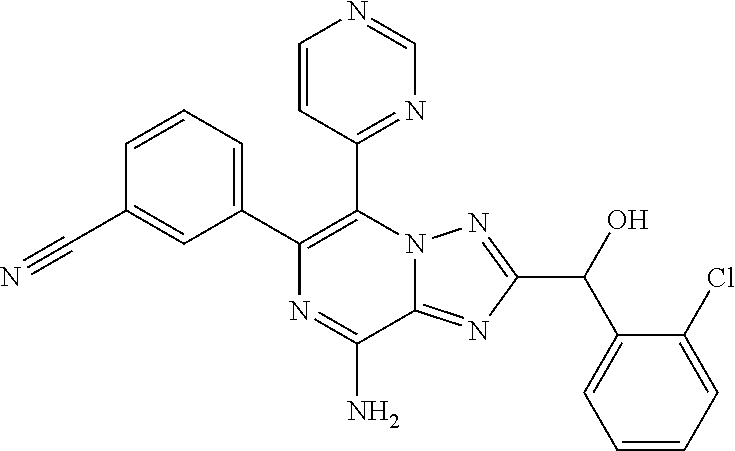


| TABLE A | ||
| Assay Component | A1 | A3 |
| SPA beads in | 3 mg/mL | 1.25 mg/mL |
| Hepes buffer | ||
| Membrane | 60 μg/mL | 20 μg/mL |
| Perkin Elmer ES-010 | Perkin Elemer ES-012 | |
| Radioligand | 1 nM [3H] DP-CPX | 0.1 nM [1251] MECA |
| (Perkin Elmer NET974) | (Perkin Elmer NEX312) | |
| KD = 1 nM | KD = 0.8 nM | |
| Control | 1 μM DPCPX | 0.1 μM IB-MECA |
| (Tocris 0439) | (Tocris 1066) | |
| TABLE 1 | ||
| A2A_Ki | A2B_cAMP_EC50 | |
| Ex. No. | (nM) | (nM) |
| 1 | † | †† |
| 2 | † | †† |
| 3 | † | ††† |
| 4 | † | †† |
| 5 | † | ††† |
| 6 | †† | †††† |
| 7 | † | † |
| 8 | † | †† |
| 9 | † | †† |
| 10 | † | † |
| 11 | † | † |
| 12 | † | †† |
| 13 | †† | ††† |
| 14 | †† | †††† |
| 15 | † | † |
| 16 | † | † |
| 17 | † | † |
| 18 | † | † |
| 19 | † | †† |
| 20 | † | † |
| 21 | † | ††† |
| 22 | † | ††† |
| 23 | † | † |
| 24 | † | †† |
| 25 | † | †† |
| 26 | † | †† |
| 27 | † | † |
| 28 | † | †† |
| 29 | † | † |
| 30 | † | †† |
| 31 | † | †† |
| 32 | † | † |
| 33 | † | † |
| 34 | † | †† |
| 35 | † | † |
| 36 | † | † |
| 37 | † | † |
| 38 | † | † |
| 39 | † | † |
| 40 | † | † |
| 41 | † | † |
| 42 | † | † |
| 43 | † | † |
| 44 | † | † |
| 45 | † | † |
| 46 | † | † |
| 47 | † | †† |
| 48 | † | †† |
| 49 | † | † |
| 50 | † | † |
| 51 | † | † |
| 52 | † | † |
| 53 | † | † |
| 54 | † | † |
| 55 | † | † |
| 56 | † | † |
| 57 | † | † |
| 58 | † | † |
| 59 | † | †† |
| 60 | † | †† |
| 61 | † | † |
| 62 | † | † |
| 63 | † | † |
| 64 | † | † |
| 65 | † | †† |
| 66 | † | † |
| 67 | † | † |
| 68 | † | †† |
| 69 | † | † |
| 70 | † | †† |
| 71 | † | † |
| 72 | † | † |
| 73 | † | † |
| 74 | † | † |
| 75 | † | † |
| 76 | † | †† |
| 77 | † | † |
| 78 | † | † |
| 79 | † | † |
| 80 | † | † |
| 81 | † | † |
| 82 | † | † |
| 83 | † | † |
| 84 | † | † |
| 85 | † | †† |
| 86 | † | † |
| 87 | † | †† |
| 88 | † | †† |
| 89 | † | †† |
| 90 | † | ††† |
| 91 | † | †† |
| 92 | † | † |
| 93 | † | † |
| 94 | † | †† |
| 95 | † | †† |
| 96 | † | †† |
| 97 | † | † |
| 98 | † | † |
| 99 | † | †† |
| 100 | † | ††† |
| 101 | † | † |
| 102 | † | † |
| 103 | † | † |
| 104 | † | †† |
| 105 | † | † |
| 106 | † | † |
| 107 | † | †† |
| 108 | † | † |
| 109 | † | † |
| 110 | † | ††† |
| 111 | † | † |
| 112 | † | † |
| 113 | † | †† |
| 114 | † | †† |
| 115 | † | † |
| 116 | † | †† |
| 117 | † | † |
| 118 | † | † |
| 119 | † | † |
| 120 | † | †† |
| 121 | † | †† |
| 122 | † | †† |
| 123 | † | †† |
| 124 | † | † |
| 125 | † | †† |
| 126 | † | †† |
| 127 | † | † |
| 128 | † | †† |
Claims (36)


Priority Applications (2)
| Application Number | Priority Date | Filing Date | Title |
|---|---|---|---|
| US17/500,140 US11999740B2 (en) | 2018-07-05 | 2021-10-13 | Fused pyrazine derivatives as A2A / A2B inhibitors |
| US18/620,225 US20240360140A1 (en) | 2018-07-05 | 2024-03-28 | Fused pyrazine derivatives as a2a / a2b inhibitors |
Applications Claiming Priority (4)
| Application Number | Priority Date | Filing Date | Title |
|---|---|---|---|
| US201862694138P | 2018-07-05 | 2018-07-05 | |
| US201862755845P | 2018-11-05 | 2018-11-05 | |
| US16/502,826 US11161850B2 (en) | 2018-07-05 | 2019-07-03 | Fused pyrazine derivatives as A2A / A2B inhibitors |
| US17/500,140 US11999740B2 (en) | 2018-07-05 | 2021-10-13 | Fused pyrazine derivatives as A2A / A2B inhibitors |
Related Parent Applications (1)
| Application Number | Title | Priority Date | Filing Date |
|---|---|---|---|
| US16/502,826 Division US11161850B2 (en) | 2018-07-05 | 2019-07-03 | Fused pyrazine derivatives as A2A / A2B inhibitors |
Related Child Applications (1)
| Application Number | Title | Priority Date | Filing Date |
|---|---|---|---|
| US18/620,225 Continuation US20240360140A1 (en) | 2018-07-05 | 2024-03-28 | Fused pyrazine derivatives as a2a / a2b inhibitors |
Publications (2)
| Publication Number | Publication Date |
|---|---|
| US20220135570A1 US20220135570A1 (en) | 2022-05-05 |
| US11999740B2 true US11999740B2 (en) | 2024-06-04 |
Family
ID=67470665
Family Applications (3)
| Application Number | Title | Priority Date | Filing Date |
|---|---|---|---|
| US16/502,826 Active US11161850B2 (en) | 2018-07-05 | 2019-07-03 | Fused pyrazine derivatives as A2A / A2B inhibitors |
| US17/500,140 Active US11999740B2 (en) | 2018-07-05 | 2021-10-13 | Fused pyrazine derivatives as A2A / A2B inhibitors |
| US18/620,225 Pending US20240360140A1 (en) | 2018-07-05 | 2024-03-28 | Fused pyrazine derivatives as a2a / a2b inhibitors |
Family Applications Before (1)
| Application Number | Title | Priority Date | Filing Date |
|---|---|---|---|
| US16/502,826 Active US11161850B2 (en) | 2018-07-05 | 2019-07-03 | Fused pyrazine derivatives as A2A / A2B inhibitors |
Family Applications After (1)
| Application Number | Title | Priority Date | Filing Date |
|---|---|---|---|
| US18/620,225 Pending US20240360140A1 (en) | 2018-07-05 | 2024-03-28 | Fused pyrazine derivatives as a2a / a2b inhibitors |
Country Status (24)
| Country | Link |
|---|---|
| US (3) | US11161850B2 (en) |
| EP (1) | EP3818063A1 (en) |
| JP (2) | JP7490631B2 (en) |
| KR (1) | KR20210049090A (en) |
| CN (2) | CN117304191A (en) |
| AU (1) | AU2019297361B2 (en) |
| BR (1) | BR112021000075A2 (en) |
| CA (1) | CA3105721A1 (en) |
| CL (1) | CL2021000004A1 (en) |
| CO (1) | CO2021001251A2 (en) |
| CR (2) | CR20240054A (en) |
| EC (1) | ECSP21007838A (en) |
| GE (4) | GEAP202315551A (en) |
| IL (2) | IL279829B2 (en) |
| JO (1) | JOP20200342A1 (en) |
| MA (1) | MA53097A (en) |
| MX (3) | MX2021000116A (en) |
| PE (1) | PE20211807A1 (en) |
| PH (1) | PH12021550019A1 (en) |
| SA (1) | SA521420965B1 (en) |
| SG (1) | SG11202013216RA (en) |
| TW (2) | TWI829716B (en) |
| UA (1) | UA128332C2 (en) |
| WO (1) | WO2020010197A1 (en) |
Families Citing this family (25)
| Publication number | Priority date | Publication date | Assignee | Title |
|---|---|---|---|---|
| WO2015123424A1 (en) | 2014-02-13 | 2015-08-20 | Incyte Corporation | Cyclopropylamines as lsd1 inhibitors |
| LT3105218T (en) | 2014-02-13 | 2019-12-10 | Incyte Corp | Cyclopropylamines as lsd1 inhibitors |
| WO2016007722A1 (en) | 2014-07-10 | 2016-01-14 | Incyte Corporation | Triazolopyridines and triazolopyrazines as lsd1 inhibitors |
| EA201792205A1 (en) | 2015-04-03 | 2018-02-28 | Инсайт Корпорейшн | HETEROCYCLIC COMPOUNDS AS LSD1 INHIBITORS |
| DK3334709T3 (en) | 2015-08-12 | 2025-02-03 | Incyte Holdings Corp | SALTS OF AN LSD1 INHIBITOR |
| AU2019227607C1 (en) | 2018-02-27 | 2023-07-20 | Incyte Corporation | Imidazopyrimidines and triazolopyrimidines as A2A / A2B inhibitors |
| EP3810610A1 (en) | 2018-05-18 | 2021-04-28 | Incyte Corporation | Fused pyrimidine derivatives as a2a / a2b inhibitors |
| CN117304191A (en) | 2018-07-05 | 2023-12-29 | 因赛特公司 | Fused pyrazine derivatives as A2A/A2B inhibitors |
| US10968200B2 (en) | 2018-08-31 | 2021-04-06 | Incyte Corporation | Salts of an LSD1 inhibitor and processes for preparing the same |
| US12414952B2 (en) | 2018-11-20 | 2025-09-16 | Merck Sharp & Dohme Llc | Substituted amino triazolopyrimidine and amino triazolopyrazine adenosine receptor antagonists, pharmaceutical compositions and their use |
| JP2022507734A (en) | 2018-11-20 | 2022-01-18 | メルク・シャープ・アンド・ドーム・コーポレーション | Substituted aminotriazolopyrimidines and aminotriazolopyrazine adenosine receptor antagonists, pharmaceutical compositions and their use |
| TWI829857B (en) | 2019-01-29 | 2024-01-21 | 美商英塞特公司 | Pyrazolopyridines and triazolopyridines as a2a / a2b inhibitors |
| CR20220317A (en) | 2020-01-03 | 2022-09-02 | Incyte Corp | Anti-cd73 antibodies and uses thereof |
| EP4084870A1 (en) | 2020-01-03 | 2022-11-09 | Incyte Corporation | Cd73 inhibitor and a2a/a2b adenosine receptor inhibitor combination therapy |
| CN115279766B (en) * | 2020-01-03 | 2025-05-02 | 因赛特公司 | Combination therapy containing A2A/A2B and PD-1/PD-L1 inhibitors |
| WO2021156439A1 (en) | 2020-02-06 | 2021-08-12 | Astrazeneca Ab | Triazole compounds as adenosine receptor antagonists |
| US12552799B2 (en) | 2020-03-26 | 2026-02-17 | Nxera Pharma Uk Limited | Triazolone compounds |
| WO2021191376A1 (en) * | 2020-03-26 | 2021-09-30 | Astrazeneca Ab | Triazolone compounds |
| IL297963A (en) | 2020-05-07 | 2023-01-01 | Adorx Therapeutics Ltd | Adenosine a2a receptor antagonists |
| GB202011996D0 (en) * | 2020-07-31 | 2020-09-16 | Adorx Therapeutics Ltd | Antagonist compounds |
| EP4337323A4 (en) * | 2021-05-14 | 2025-07-09 | Bm Pharma Consulting Pty Ltd | BICYCLIC HETEROCYCLIC COMPOUNDS FOR THE PROPHYLAXIS AND TREATMENT OF VIRUS INFECTIONS |
| KR20240101561A (en) * | 2021-10-14 | 2024-07-02 | 인사이트 코포레이션 | Quinoline compounds as inhibitors of KRAS |
| GB2615307A (en) * | 2022-01-28 | 2023-08-09 | Adorx Therapeutics Ltd | Antagonist compounds |
| KR102621694B1 (en) * | 2022-09-15 | 2024-01-08 | 주식회사 스탠다임 | Adenosine a2a receptor antagonist and use thereof |
| CN116768808B (en) * | 2023-06-14 | 2025-11-21 | 广州万联生物科技有限公司 | Triazolone hapten, artificial antigen and application thereof |
Citations (270)
| Publication number | Priority date | Publication date | Assignee | Title |
|---|---|---|---|---|
| US4399216A (en) | 1980-02-25 | 1983-08-16 | The Trustees Of Columbia University | Processes for inserting DNA into eucaryotic cells and for producing proteinaceous materials |
| US4634665A (en) | 1980-02-25 | 1987-01-06 | The Trustees Of Columbia University In The City Of New York | Processes for inserting DNA into eucaryotic cells and for producing proteinaceous materials |
| WO1990007861A1 (en) | 1988-12-28 | 1990-07-26 | Protein Design Labs, Inc. | CHIMERIC IMMUNOGLOBULINS SPECIFIC FOR p55 TAC PROTEIN OF THE IL-2 RECEPTOR |
| EP0404097A2 (en) | 1989-06-22 | 1990-12-27 | BEHRINGWERKE Aktiengesellschaft | Bispecific and oligospecific, mono- and oligovalent receptors, production and applications thereof |
| US5057313A (en) | 1986-02-25 | 1991-10-15 | The Center For Molecular Medicine And Immunology | Diagnostic and therapeutic antibody conjugates |
| US5156840A (en) | 1982-03-09 | 1992-10-20 | Cytogen Corporation | Amine-containing porphyrin derivatives |
| US5179017A (en) | 1980-02-25 | 1993-01-12 | The Trustees Of Columbia University In The City Of New York | Processes for inserting DNA into eucaryotic cells and for producing proteinaceous materials |
| WO1993011161A1 (en) | 1991-11-25 | 1993-06-10 | Enzon, Inc. | Multivalent antigen-binding proteins |
| US5521184A (en) | 1992-04-03 | 1996-05-28 | Ciba-Geigy Corporation | Pyrimidine derivatives and processes for the preparation thereof |
| US5530101A (en) | 1988-12-28 | 1996-06-25 | Protein Design Labs, Inc. | Humanized immunoglobulins |
| US5624821A (en) | 1987-03-18 | 1997-04-29 | Scotgen Biopharmaceuticals Incorporated | Antibodies with altered effector functions |
| WO1998003511A1 (en) | 1996-07-20 | 1998-01-29 | Boehringer Ingelheim Pharma Kg | New triazolopurines, method of preparing them and their use as drugs |
| US5714350A (en) | 1992-03-09 | 1998-02-03 | Protein Design Labs, Inc. | Increasing antibody affinity by altering glycosylation in the immunoglobulin variable region |
| US5731168A (en) | 1995-03-01 | 1998-03-24 | Genentech, Inc. | Method for making heteromultimeric polypeptides |
| WO1998042711A1 (en) | 1997-03-24 | 1998-10-01 | Kyowa Hakko Kogyo Co., Ltd. | [1,2,4]TRIAZOLO[1,5-c]PYRIMIDINE DERIVATIVES |
| US5849992A (en) | 1993-12-20 | 1998-12-15 | Genzyme Transgenics Corporation | Transgenic production of antibodies in milk |
| US5859205A (en) | 1989-12-21 | 1999-01-12 | Celltech Limited | Humanised antibodies |
| US5869046A (en) | 1995-04-14 | 1999-02-09 | Genentech, Inc. | Altered polypeptides with increased half-life |
| WO2000009495A1 (en) | 1998-08-11 | 2000-02-24 | Novartis Ag | Isoquinoline derivatives with angiogenesis inhibiting activity |
| WO2000053595A1 (en) | 1999-03-06 | 2000-09-14 | Astrazeneca Ab | Pyrimidine compounds |
| WO2001014402A1 (en) | 1999-08-19 | 2001-03-01 | Isis Pharmaceuticals, Inc. | Antisense modulation of focal adhesion kinase expression |
| WO2001014557A1 (en) | 1999-08-23 | 2001-03-01 | Dana-Farber Cancer Institute, Inc. | Pd-1, a receptor for b7-4, and uses therefor |
| WO2001017999A2 (en) | 1999-09-06 | 2001-03-15 | F. Hoffmann-La Roche Ag | Amino-triazolopyridine derivatives |
| WO2001039722A2 (en) | 1999-11-30 | 2001-06-07 | Mayo Foundation For Medical Education And Research | B7-h1, a novel immunoregulatory molecule |
| WO2001064655A1 (en) | 2000-03-01 | 2001-09-07 | Astrazeneca Ab | 2, 4-di(hetero-)arylamino (-oxy)-5-substituted pyrimidines as antineoplastic agents |
| US6300064B1 (en) | 1995-08-18 | 2001-10-09 | Morphosys Ag | Protein/(poly)peptide libraries |
| WO2001080884A1 (en) | 2000-04-25 | 2001-11-01 | Idec Pharmaceuticals Corporation | Intrathecal administration of rituximab for treatment of central nervous system lymphomas |
| WO2001092264A1 (en) | 2000-05-26 | 2001-12-06 | Schering Corporation | Adenosine a2a receptor antagonists |
| CN1328560A (en) | 1998-09-22 | 2001-12-26 | 协和发酵工业株式会社 | [1,2,4] triazolo [1,5-c] pyrimidine derivatives |
| WO2002000196A2 (en) | 2000-06-28 | 2002-01-03 | Smithkline Beecham P.L.C. | Wet milling process |
| US6407213B1 (en) | 1991-06-14 | 2002-06-18 | Genentech, Inc. | Method for making humanized antibodies |
| WO2002086083A2 (en) | 2001-04-20 | 2002-10-31 | Mayo Foundation For Medical Education And Research | Methods of enhancing cell responsiveness |
| US20020193376A1 (en) | 2001-05-30 | 2002-12-19 | Alteon, Inc. | Method for treating glaucoma V |
| US20030027820A1 (en) | 2001-05-30 | 2003-02-06 | Alteon, Inc. | Method for treating fibrotic diseases or other indications V |
| WO2003024967A2 (en) | 2001-09-19 | 2003-03-27 | Aventis Pharma S.A. | Indolizines as kinase protein inhibitors |
| WO2003037347A1 (en) | 2001-10-30 | 2003-05-08 | Novartis Ag | Staurosporine derivatives as inhibitors of flt3 receptor tyrosine kinase activity |
| WO2003042402A2 (en) | 2001-11-13 | 2003-05-22 | Dana-Farber Cancer Institute, Inc. | Agents that modulate immune cell activation and methods of use thereof |
| WO2003044021A2 (en) | 2001-11-16 | 2003-05-30 | Amgen Inc. | Substituted indolizine-like compounds and methods of use |
| WO2003048164A2 (en) | 2001-11-30 | 2003-06-12 | Schering Corporation | Adenosine a2a receptor antagonists |
| WO2003062236A1 (en) | 2002-01-22 | 2003-07-31 | Warner-Lambert Company Llc | 2-(PYRIDIN-2-YLAMINO)-PYRIDO[2,3d]PYRIMIDIN-7-ONES |
| US20030143199A1 (en) | 2001-10-09 | 2003-07-31 | Carson Dennis A. | Use of STAT-6 inhibitors as therapeutic agents |
| WO2003068776A1 (en) | 2002-02-15 | 2003-08-21 | Kyowa Hakko Kogyo Co., Ltd. | [1,2,4]TRIAZOLO[1,5-c]PYRIMIDINE DERIVATIVES |
| WO2003099771A2 (en) | 2002-05-29 | 2003-12-04 | Novartis Ag | Diaryl urea derivatives useful for the treatment of protein kinase dependent diseases |
| WO2004005281A1 (en) | 2002-07-05 | 2004-01-15 | Novartis Ag | Inhibitors of tyrosine kinases |
| WO2004046120A2 (en) | 2002-11-15 | 2004-06-03 | Vertex Pharmaceuticals Incorporated | Diaminotriazoles useful as inhibitors of protein kinases |
| US20040110826A1 (en) | 2001-09-28 | 2004-06-10 | Noriaki Uesaka | Receptor Antagonists |
| WO2004056786A2 (en) | 2002-12-20 | 2004-07-08 | Pfizer Products Inc. | Pyrimidine derivates for the treatment of abnormal cell growth |
| US20040142342A1 (en) | 2001-01-17 | 2004-07-22 | Intreat Pty Limited | Antibodies to non-functional P2X7 receptor diagnosis and treatment of cancers and other conditions |
| WO2004079013A1 (en) | 2003-03-03 | 2004-09-16 | Arizona Board Of Regents On Behalf Of The University Of Arizona | Ecto-5’-nucleotidase (cd73) used in the diagnosis and the treatment of pancreatic cancer |
| WO2004080980A1 (en) | 2003-03-14 | 2004-09-23 | Novartis Ag | 2, 4- di (phenylamino) pyrimidines useful in the treatment of neoplastic diseases, inflammatory and immune system disorders |
| US20040186148A1 (en) | 2003-03-20 | 2004-09-23 | Schering Corporation | Cannabinoid receptor ligands |
| US6803192B1 (en) | 1999-11-30 | 2004-10-12 | Mayo Foundation For Medical Education And Research | B7-H1, a novel immunoregulatory molecule |
| WO2004092177A1 (en) | 2003-04-09 | 2004-10-28 | Biogen Idec Ma Inc. | Triazolopyrazines and methods of making and using the same |
| WO2004092173A2 (en) | 2003-04-09 | 2004-10-28 | Biogen Idec Ma Inc. | A2a adenosine receptor antagonists |
| US20050008625A1 (en) | 2003-02-13 | 2005-01-13 | Kalobios, Inc. | Antibody affinity engineering by serial epitope-guided complementarity replacement |
| WO2005003175A2 (en) | 2003-06-13 | 2005-01-13 | Biogen Idec Ma Inc. | Aglycosyl anti-cd154 (cd40 ligand) antibodies and uses thereof |
| US20050037000A1 (en) | 2003-01-09 | 2005-02-17 | Macrogenics, Inc. | Identification and engineering of antibodies with variant Fc regions and methods of using same |
| WO2005016892A1 (en) | 2003-08-14 | 2005-02-24 | F. Hoffmann-La Roche Ag | Gabanergic modulators |
| WO2005018572A2 (en) | 2003-08-22 | 2005-03-03 | Biogen Idec Ma Inc. | Improved antibodies having altered effector function and methods for making the same |
| WO2005028444A1 (en) | 2003-09-24 | 2005-03-31 | Novartis Ag | 1,4-disubstituted isoquinilone derivatives as raf-kinase inhibitors useful for the treatment of proliferative diseases |
| US20050079574A1 (en) | 2003-01-16 | 2005-04-14 | Genentech, Inc. | Synthetic antibody phage libraries |
| EP1544200A1 (en) | 2002-09-24 | 2005-06-22 | Kyowa Hakko Kogyo Co., Ltd. | 1,2,4 -TRIAZOLO 1,5-c PYRIMIDINE DERIVATIVE |
| US20050272765A1 (en) | 2004-06-04 | 2005-12-08 | Jun Feng | Dipeptidyl peptidase inhibitors |
| US20050288502A1 (en) | 2004-06-25 | 2005-12-29 | Andersen Denise L | Substituted heterocyclic compounds and methods of use |
| US20060040944A1 (en) | 2004-06-23 | 2006-02-23 | Gilles Gosselin | 5-Aza-7-deazapurine derivatives for treating Flaviviridae |
| US20060154930A1 (en) | 2003-02-20 | 2006-07-13 | Brown Rebecca E | Substituted amino heterocycles as vr-1 antagonists for treating pain |
| US20060178399A1 (en) | 2003-03-14 | 2006-08-10 | Rena Nishizawa | Nitrogen-containing heterocyclic derivatives and drugs containing the same as the active ingredient |
| US20060211739A1 (en) | 2005-02-08 | 2006-09-21 | Arturo Perez-Medrano | Use of selective P2X7 receptor antagonists |
| WO2006129626A1 (en) | 2005-05-30 | 2006-12-07 | Kyowa Hakko Kogyo Co., Ltd. | Method for producing [1,2,4]triazolo[1,5-c]pyrimidine derivative |
| WO2006132275A1 (en) | 2005-06-07 | 2006-12-14 | Kyowa Hakko Kogyo Co., Ltd. | Prophylactic and/or therapeutic agent for motor disorder |
| US20070010522A1 (en) | 2003-04-09 | 2007-01-11 | Chi Vu | Triazolo[1,5-c]pyrimidines and pyrazolo[1,5-c]pyrimidines useful as a2a adenosine receptor antagonists |
| US20070009518A1 (en) | 2005-05-18 | 2007-01-11 | Biogen Idec Inc. | Methods for treating fibrotic conditions |
| WO2007011759A2 (en) | 2005-07-15 | 2007-01-25 | Kalypsys, Inc. | Inhibitors of mitotic kinesin |
| JP2007039633A (en) | 2005-06-30 | 2007-02-15 | Shinichiro Isobe | Marking agent |
| WO2007028051A2 (en) | 2005-09-02 | 2007-03-08 | Abbott Laboratories | Novel imidazo based heterocycles |
| US20070117804A1 (en) | 2005-11-10 | 2007-05-24 | Schering Corporation | Imidazopyrazines as protein kinase inhibitors |
| US20070149548A1 (en) | 2005-12-22 | 2007-06-28 | Alcon Manufacturing, Ltd. | (indazol-5-yl)-pyrazines and (1,3-dihydro-indol-2-one)-pyrazines for treating rho kinase-mediated diseases and conditions |
| US20070213332A1 (en) | 2004-02-20 | 2007-09-13 | Frank Burkamp | Prodrugs Of Substituted Amino Heterobicycles Which Modulate The Function Of The Vanilloid-1 Receptor (Vr1) |
| US20070225286A1 (en) | 2004-06-10 | 2007-09-27 | Pingda Ren | Compounds and Compositions as Protein Kinase Inhibitors |
| US20070281942A1 (en) | 2006-05-31 | 2007-12-06 | Cao Sheldon X | Glucokinase activators |
| US7306631B2 (en) | 2004-03-30 | 2007-12-11 | The Procter & Gamble Company | Keratin dyeing compounds, keratin dyeing compositions containing them, and use thereof |
| WO2007150025A2 (en) | 2006-06-23 | 2007-12-27 | Incyte Corporation | Purinone derivatives as hm74a agonists |
| WO2008006563A1 (en) | 2006-07-13 | 2008-01-17 | Novartis Ag | Purine derivatives as a2a agonists |
| US20080021026A1 (en) | 2006-07-20 | 2008-01-24 | Mehmet Kahraman | Benzothiophene inhibitors of rho kinase |
| DE102006041292A1 (en) | 2006-09-01 | 2008-03-06 | Henkel Kgaa | Use of optionally substituted hexagonal heterocycle with a nitrogen in the ring for activating and improving the brightening effect of the hydrogen peroxide for keratin fibers such as fur, wool, feathers and human hair |
| WO2008037607A1 (en) | 2006-09-25 | 2008-04-03 | Basf Se | Heterocyclic compounds containing carbonyl groups, and the use thereof for controlling phytopathogenic fungi |
| US20080096892A1 (en) | 2003-08-29 | 2008-04-24 | Exelixis, Inc. | C-Kit Modulators And Methods Of Use |
| WO2008056176A1 (en) | 2006-11-10 | 2008-05-15 | Scottish Biomedical Limited | Pyrazolopyrimidines as phosphodiesterase inhibitors |
| US20080132501A1 (en) | 2006-12-05 | 2008-06-05 | Chung-Ming Sun | Indazole compounds |
| WO2008113469A2 (en) | 2007-03-16 | 2008-09-25 | Bayer Schering Pharma Aktiengesellschaft | Substituted imidazopyrimidines and triazolopyrimidines |
| US7452892B2 (en) | 2005-06-17 | 2008-11-18 | Bristol-Myers Squibb Company | Triazolopyrimidine cannabinoid receptor 1 antagonists |
| US20080293739A1 (en) | 2007-04-11 | 2008-11-27 | Trede Nikolaus S | Compounds for modulating t-cells |
| WO2008149168A1 (en) | 2007-06-07 | 2008-12-11 | Sanofi-Aventis | Triazolo [1, 5-a] quinolines as adenosine a3 receptor ligands |
| US20080311117A1 (en) | 2002-12-23 | 2008-12-18 | Mary Collins | Antibodies against PD-1 and uses therefor |
| WO2008156712A1 (en) | 2007-06-18 | 2008-12-24 | N. V. Organon | Antibodies to human programmed death receptor pd-1 |
| WO2009019505A2 (en) | 2007-08-03 | 2009-02-12 | Summit Corporation Plc | Drug combinations for the treatment of duchenne muscular dystrophy |
| WO2009023179A2 (en) | 2007-08-10 | 2009-02-19 | Genelabs Technologies, Inc. | Nitrogen containing bicyclic chemical entities for treating viral infections |
| US20090055944A1 (en) | 2005-07-01 | 2009-02-26 | Medarex, Inc. | Human monoclonal antibodies to be programmed death ligand 1 (pd-l1) |
| US7501411B2 (en) | 2006-05-31 | 2009-03-10 | Galapagos, Nv | Triazolopyrazine compounds useful for the treatment of degenerative and inflammatory diseases |
| WO2009047514A1 (en) | 2007-10-10 | 2009-04-16 | Cancer Research Technology Limited | [1,2,4]triazolo[1,5-a]pyridine and [1,2,4]triazolo[1,5-c]pyrimidine compounds and their use |
| US20090110667A1 (en) | 2007-10-01 | 2009-04-30 | Children's Hospital And Reginonal Medical Center | Detection and treatment of autoimmune disorders |
| US20090118499A1 (en) | 2004-04-02 | 2009-05-07 | Osi Pharmaceuticals, Inc. | 6,6-Bicyclic Ring Substituted Heterobicyclic Protein Kinase Inhibitors |
| US20090118301A1 (en) | 2007-11-02 | 2009-05-07 | Arbor Vita Corporation | Compositions and Methods for Treating Cancer |
| US20090163489A1 (en) | 2007-12-19 | 2009-06-25 | Shon Booker | Inhibitors of PI3 kinase |
| WO2009085185A1 (en) | 2007-12-19 | 2009-07-09 | Amgen Inc. | Fused pyridine, pyrimidine and triazine compounds as cell cycle inhibitors |
| US7563788B2 (en) | 2004-03-19 | 2009-07-21 | Pfizer Inc. | Substituted Imidazo[1,2-a]pyridines as Antibacterial Agents |
| WO2009111449A1 (en) | 2008-03-04 | 2009-09-11 | Schering Corporation | 1,2,4-triazolo[4,3-c]pyrimidin-3-one and pyrazolo [4,3-e] -1,2,4-triazolo [4,3-c] pyrimidin-3-one compounds for use as adenosine a2a receptor antagonists |
| WO2009114870A2 (en) | 2008-03-14 | 2009-09-17 | Intellikine, Inc. | Kinase inhibitors and methods of use |
| WO2009117421A2 (en) | 2008-03-17 | 2009-09-24 | Kalypsys, Inc. | Heterocyclic modulators of gpr119 for treatment of disease |
| WO2009117734A1 (en) | 2008-03-21 | 2009-09-24 | Enthone Inc. | Adhesion promotion of metal to laminate with a multi-functional compound haftforderung von metall zu laminaten mit einer multifunktionellen |
| US20090258877A1 (en) | 2007-12-13 | 2009-10-15 | Bayer Healthcare Ag | Triazolotriazines and triazolopyrazines and their use |
| US20090313687A1 (en) | 2004-10-15 | 2009-12-17 | Nicolas Popp | One time password |
| US7635757B2 (en) | 1999-08-23 | 2009-12-22 | Dana-Farber Cancer Institute, Inc. | B7-4 Antibodies and uses therefor |
| EP2155747A1 (en) | 2007-05-10 | 2010-02-24 | Acadia Pharmaceuticals Inc. | Imidazol (1,2-a)pyridines and related compounds with activity at cannabinoid cb2 receptors |
| WO2010036959A2 (en) | 2008-09-26 | 2010-04-01 | Dana-Farber Cancer Institute | Human anti-pd-1, pd-l1, and pd-l2 antibodies and uses therefor |
| US7700594B2 (en) | 2005-11-17 | 2010-04-20 | Osi Pharmaceuticals, Inc. | Fused bicyclic mTOR inhibitors |
| US20100105733A1 (en) | 2006-06-23 | 2010-04-29 | Lyttle C Richard | Treatment of vasomotor symptoms with selective estrogen receptor modulators |
| US20100160355A1 (en) | 2008-12-23 | 2010-06-24 | Abbott Laboratories | Anti-Viral Compounds |
| US20100168138A1 (en) | 2008-12-23 | 2010-07-01 | Abbott Laboratories | Anti-Viral Compounds |
| WO2010075074A1 (en) | 2008-12-22 | 2010-07-01 | Eli Lilly And Company | Protein kinase inhibitors |
| WO2010089411A2 (en) | 2009-02-09 | 2010-08-12 | Universite De La Mediterranee | Pd-1 antibodies and pd-l1 antibodies and uses thereof |
| WO2010104306A2 (en) | 2009-03-07 | 2010-09-16 | 주식회사 메디젠텍 | Pharmaceutical compositions for treating or preventing diseases caused by the translocation of gsk3 from the cell nucleus to the cytoplasm, containing compounds for inhibiting the translocation of gsk3 from the cell nucleus to the cytoplasm |
| US20100261679A1 (en) | 2007-10-18 | 2010-10-14 | James Sutton | CSF-1R, Inhibitors, Compositions, and Methods of Use |
| US20100292232A1 (en) | 2007-11-09 | 2010-11-18 | Daniel Elleder | Non-nucleoside reverse transcriptase inhibitors |
| WO2011019780A1 (en) | 2009-08-11 | 2011-02-17 | Bristol-Myers Squibb Company | Azaindazoles as btk kinase modulators and use thereof |
| WO2011022439A1 (en) | 2009-08-17 | 2011-02-24 | Intellikine, Inc. | Heterocyclic compounds and uses thereof |
| US20110105457A1 (en) | 2008-04-18 | 2011-05-05 | Shionogi & Co., Ltd. | Heterocyclic compound having inhibitory activity on pi3k |
| WO2011053508A1 (en) | 2009-10-29 | 2011-05-05 | Janssen Pharmaceutica Nv | ALKYL SUBSTITUTED ARYLINDENOPYRIMIDINES AND THEIR USE AS HIGHLY SELECTIVE ADENOSINE A2a RECEPTOR ANTAGONISTS |
| WO2011060207A1 (en) | 2009-11-16 | 2011-05-19 | Schering Corporation | FUSED TRICYCLIC COMPOUNDS WITH ADENOSINE A2a RECEPTOR ANTAGONIST ACTIVITY |
| WO2011066342A2 (en) | 2009-11-24 | 2011-06-03 | Amplimmune, Inc. | Simultaneous inhibition of pd-l1/pd-l2 |
| WO2011078143A1 (en) | 2009-12-22 | 2011-06-30 | 塩野義製薬株式会社 | Pyrimidine derivatives and pharmaceutical composition containing same |
| WO2011082400A2 (en) | 2010-01-04 | 2011-07-07 | President And Fellows Of Harvard College | Modulators of immunoinhibitory receptor pd-1, and methods of use thereof |
| WO2011089004A1 (en) | 2010-01-20 | 2011-07-28 | Glycotope Gmbh | Cancer stem cell markers and uses thereof |
| US20110190269A1 (en) | 2010-02-01 | 2011-08-04 | Karlheinz Baumann | Gamma secretase modulators |
| US20110201649A1 (en) | 2008-09-19 | 2011-08-18 | Sumitomo Chemical Company, Limited | agricultural composition |
| WO2011101409A1 (en) | 2010-02-19 | 2011-08-25 | Novartis Ag | Pyrrolopyrimidine compounds as inhibitors of cdk4/6 |
| US8008449B2 (en) | 2005-05-09 | 2011-08-30 | Medarex, Inc. | Human monoclonal antibodies to programmed death 1 (PD-1) and methods for treating cancer using anti-PD-1 antibodies alone or in combination with other immunotherapeutics |
| WO2011112766A2 (en) | 2010-03-10 | 2011-09-15 | Kalypsys, Inc. | Heterocyclic inhibitors of histamine receptors for the treatment of disease |
| WO2011135303A2 (en) | 2010-04-29 | 2011-11-03 | Iti Scotland Limited | Ubiquitination modulators |
| US8053574B2 (en) | 2007-07-18 | 2011-11-08 | Novartis Ag | Organic compounds |
| US20110288074A1 (en) | 2009-01-26 | 2011-11-24 | Domain Therapeutics | New adenosine receptor ligands and uses thereof |
| US20110300136A1 (en) | 2003-04-09 | 2011-12-08 | Genentech, Inc. | Therapy of autoimmune disease in a patient with an inadequate response to a tnf-alpha inhibitor |
| WO2011153588A1 (en) | 2010-06-10 | 2011-12-15 | Biota Scientific Management Pty Ltd | Viral polymerase inhibitors |
| WO2011159877A2 (en) | 2010-06-18 | 2011-12-22 | The Brigham And Women's Hospital, Inc. | Bi-specific antibodies against tim-3 and pd-1 for immunotherapy in chronic immune conditions |
| WO2011161699A2 (en) | 2010-06-25 | 2011-12-29 | Aurigene Discovery Technologies Limited | Immunosuppression modulating compounds |
| US20120021519A1 (en) | 2008-09-19 | 2012-01-26 | Presidents And Fellows Of Harvard College | Efficient induction of pluripotent stem cells using small molecule compounds |
| US8133895B2 (en) | 2007-05-10 | 2012-03-13 | Janssen Pharmaceutica N.V. | Fused pyrazine compounds useful for the treatment of degenerative and inflammatory diseases |
| US20120083498A1 (en) | 2010-06-17 | 2012-04-05 | Fatah Kashanchi | Modulators of Viral Transcription, and Methods and Compositions Therewith |
| US8168757B2 (en) | 2008-03-12 | 2012-05-01 | Merck Sharp & Dohme Corp. | PD-1 binding proteins |
| WO2012061156A1 (en) | 2010-10-25 | 2012-05-10 | Tavares Francis X | Cdk inhibitors |
| US8202869B2 (en) | 2003-06-10 | 2012-06-19 | Kyowa Hakko Kirin Co., Ltd. | Method of treating an anxiety disorder |
| US8217149B2 (en) | 2008-12-09 | 2012-07-10 | Genentech, Inc. | Anti-PD-L1 antibodies, compositions and articles of manufacture |
| WO2012116237A2 (en) | 2011-02-23 | 2012-08-30 | Intellikine, Llc | Heterocyclic compounds and uses thereof |
| WO2012129344A1 (en) | 2011-03-23 | 2012-09-27 | Amgen Inc. | Fused tricyclic dual inhibitors of cdk 4/6 and flt3 |
| US8288536B2 (en) | 2004-10-15 | 2012-10-16 | Takeda Pharmaceutical Company Limited | Kinase inhibitors |
| WO2012147890A1 (en) | 2011-04-27 | 2012-11-01 | 持田製薬株式会社 | Novel azole derivative |
| US8349850B2 (en) | 2006-03-28 | 2013-01-08 | Atir Holding S.A. | Heterocyclic compounds and uses thereof in the treatment of sexual disorders |
| WO2013026516A1 (en) | 2011-08-23 | 2013-02-28 | Merck Patent Gmbh | Bicyclic heteroaromatic compounds |
| WO2013087943A1 (en) | 2011-12-17 | 2013-06-20 | Royal College Of Surgeons In Ireland (Rcsi) | P2x7 antagonists as frontline or adjunctive treatment against status epilepticus |
| WO2013106254A1 (en) | 2012-01-11 | 2013-07-18 | Dow Agrosciences Llc | Pesticidal compositions and processes related thereto |
| US20130225568A1 (en) | 2010-08-27 | 2013-08-29 | Merck Patent Gesellschaft Mit Beschrankter Haftung | Triazolopyrazine derivatives |
| US8575183B2 (en) | 2010-04-02 | 2013-11-05 | Amgen Inc. | Heterocyclic compounds and their uses |
| US8580812B2 (en) | 2007-04-10 | 2013-11-12 | H. Lundbeck A/S | Heteroaryl amide analogues as P2X7 antagonists |
| WO2014078479A2 (en) | 2012-11-14 | 2014-05-22 | The Board Of Regents Of The University Of Texas System | INHIBITION OF HIF-2α HETERODIMERIZATION WITH HIF1β (ARNT) |
| WO2014126580A1 (en) | 2013-02-15 | 2014-08-21 | Dow Agrosciences Llc | Pesticidal compositions and processes related thereto |
| WO2014153424A1 (en) | 2013-03-19 | 2014-09-25 | La Jolla Institute For Allergy And Immunology | Reducing diabetes in patients receiving hmg-coa reductase inhibitors (statins) |
| US8865734B2 (en) | 2010-03-18 | 2014-10-21 | Institut Pasteur Korea | Anti-infective compounds |
| US8865731B2 (en) | 2008-05-29 | 2014-10-21 | Kyowa Hakko Kirin Co., Ltd. | Inhibitor of analgesic tolerance |
| US9029389B2 (en) | 2011-04-21 | 2015-05-12 | Institut Pasteur Korea | Anti-inflammation compounds |
| US20150197503A1 (en) | 2012-07-27 | 2015-07-16 | Bial-Portela & Cª, S.A. | Process for the synthesis of substituted urea compounds |
| US9090697B2 (en) | 2013-03-15 | 2015-07-28 | Bayer Healthcare Llc | Methods for treating bleeding disorders |
| WO2015158283A1 (en) | 2014-04-17 | 2015-10-22 | Abbvie Inc. | Heterocyclic kinase inhibitors |
| WO2016007722A1 (en) | 2014-07-10 | 2016-01-14 | Incyte Corporation | Triazolopyridines and triazolopyrazines as lsd1 inhibitors |
| WO2016007235A1 (en) | 2014-07-11 | 2016-01-14 | Genentech, Inc. | Anti-pd-l1 antibodies and diagnostic uses thereof |
| US9249162B2 (en) | 2011-01-11 | 2016-02-02 | Sunovion Pharmaceuticals Inc. | Substituted [1,2,4]triazolo[1,5-a]pyridines as PDE-10 inhibitors |
| US9254283B2 (en) | 2008-07-23 | 2016-02-09 | Kyowa Hakko Kirin Co., Ltd. | Therapeutic agent for migraine |
| US20160046648A1 (en) | 2013-03-14 | 2016-02-18 | The Trustees Of Columbia University In The City Of New York | 4-phenylpiperidines, their preparation and use |
| US20160096835A1 (en) | 2014-10-06 | 2016-04-07 | Flatley Discovery Lab | Triazolopyridine compounds and methods for the treatment of cystic fibrosis |
| US9328121B1 (en) | 2012-06-22 | 2016-05-03 | Sumitomo Chemical Company, Limited | Fused heterocyclic compound |
| US20160129108A1 (en) | 2014-11-11 | 2016-05-12 | Medimmune Limited | Therapeutic combinations comprising anti-cd73 antibodies and uses thereof |
| WO2016075099A1 (en) | 2014-11-10 | 2016-05-19 | Medimmune Limited | Binding molecules specific for cd73 and uses thereof |
| US20160168154A1 (en) | 2013-07-25 | 2016-06-16 | Dana-Farber Cancer Institute, Inc. | Inhibitors of transcription factors and uses thereof |
| US9388249B2 (en) | 2006-07-10 | 2016-07-12 | Amano Enzyme Inc. | Method of classifying antibody, method of identifying antigen, method of obtaining antibody or antibody set, method of constructing antibody panel and antibody or antibody set and use of the same |
| US9394311B2 (en) | 2012-05-30 | 2016-07-19 | Hoffmann-La Roche Inc. | Triazolo compounds as PDE10 inhibitors |
| WO2016129684A1 (en) | 2015-02-12 | 2016-08-18 | 日産化学工業株式会社 | Condensed heterocyclic compound and noxious organism control agent |
| WO2016144703A1 (en) | 2015-03-06 | 2016-09-15 | Pharmakea, Inc. | Fluorinated lysyl oxidase-like 2 inhibitors and uses thereof |
| WO2016161282A1 (en) | 2015-04-03 | 2016-10-06 | Incyte Corporation | Heterocyclic compounds as lsd1 inhibitors |
| US20160354375A1 (en) | 2010-12-14 | 2016-12-08 | Electrophoretics Limited | CASEIN KINASE 1delta (CK 1delta) INHIBITORS AND THEIR USE IN THE TREATMENT OF NEURODEGENERATIVE DISEASES SUCH AS TAUOPATHIES |
| WO2017019846A1 (en) | 2015-07-30 | 2017-02-02 | Macrogenics, Inc. | Pd-1-binding molecules and methods use thereof |
| US9605080B2 (en) | 2014-11-21 | 2017-03-28 | Bristol-Myers Squibb Company | Antibodies against CD73 |
| US20170107216A1 (en) | 2015-10-19 | 2017-04-20 | Incyte Corporation | Heterocyclic compounds as immunomodulators |
| US20170145025A1 (en) | 2015-11-19 | 2017-05-25 | Incyte Corporation | Heterocyclic compounds as immunomodulators |
| WO2017100670A1 (en) | 2015-12-09 | 2017-06-15 | Corvus Pharmaceuticals, Inc. | Humanized anti-cd73 antibodies |
| US20170174679A1 (en) | 2015-12-22 | 2017-06-22 | Incyte Corporation | Heterocyclic compounds as immunomodulators |
| US20170174671A1 (en) | 2015-12-17 | 2017-06-22 | Incyte Corporation | Heterocyclic compounds as immunomodulators |
| CO2017004785A2 (en) | 2014-12-03 | 2017-08-31 | H Lundbeck As | N- [4- (2-furyl) -5- (tetrahydropyran-4-ylcarbonyl) thiazol-2-yl] -2-methylpyridine-5-carboxamide or a pharmaceutical salt as a2a receptor antagonist |
| WO2017152085A1 (en) | 2016-03-04 | 2017-09-08 | Bristol-Myers Squibb Company | Combination therapy with anti-cd73 antibodies |
| US20170320875A1 (en) | 2016-05-06 | 2017-11-09 | Incyte Corporation | Heterocyclic compounds as immunomodulators |
| WO2017205464A1 (en) | 2016-05-26 | 2017-11-30 | Incyte Corporation | Heterocyclic compounds as immunomodulators |
| US20170362253A1 (en) | 2016-06-20 | 2017-12-21 | Incyte Corporation | Heterocyclic compounds as immunomodulators |
| WO2018004478A1 (en) | 2016-06-29 | 2018-01-04 | Hayat Kimya San. A. Ş. | An improved method of soft nonwoven fabric production |
| US20180009899A1 (en) | 2016-07-11 | 2018-01-11 | Corvus Pharmaceuticals, Inc. | Anti-cd73 antibodies |
| US20180009816A1 (en) | 2016-06-24 | 2018-01-11 | Incyte Corporation | HETEROCYCLIC COMPOUNDS AS PI3K-y INHIBITORS |
| US20180016260A1 (en) | 2016-07-14 | 2018-01-18 | Incyte Corporation | Heterocyclic compounds as immunomodulators |
| US20180030144A1 (en) | 2014-10-10 | 2018-02-01 | Innate Pharma | Cd73 blockade |
| US20180057486A1 (en) | 2016-08-29 | 2018-03-01 | Incyte Corporation | Heterocyclic compounds as immunomodulators |
| WO2018110555A1 (en) | 2016-12-13 | 2018-06-21 | アステラス製薬株式会社 | Anti-human cd73 antibody |
| US20180170908A1 (en) | 2016-12-16 | 2018-06-21 | Pfizer Inc. | GLP-1 Agonists and Uses Thereof |
| US20180177870A1 (en) | 2016-12-22 | 2018-06-28 | Incyte Corporation | Immunomodulator compounds and methods of use |
| WO2018119286A1 (en) | 2016-12-22 | 2018-06-28 | Incyte Corporation | Bicyclic heteroaromatic compounds as immunomodulators |
| WO2018119221A1 (en) | 2016-12-22 | 2018-06-28 | Incyte Corporation | Pyridine derivatives as immunomodulators |
| WO2018119236A1 (en) | 2016-12-22 | 2018-06-28 | Incyte Corporation | Triazolo[1,5-a]pyridine derivatives as immunomodulators |
| US20180177784A1 (en) | 2016-12-22 | 2018-06-28 | Incyte Corporation | Heterocyclic compounds as immunomodulators |
| US20180179197A1 (en) | 2016-12-22 | 2018-06-28 | Incyte Corporation | Heterocyclic compounds as immunomodulators |
| WO2018136265A1 (en) | 2017-01-23 | 2018-07-26 | Revolution Medicines, Inc. | Bicyclic compounds as allosteric shp2 inhibitors |
| WO2018137598A1 (en) | 2017-01-24 | 2018-08-02 | I-Mab | Anti-cd73 antibodies and uses thereof |
| US20180237536A1 (en) | 2014-10-10 | 2018-08-23 | Innate Pharma | Cd73 blockade |
| US20180258043A1 (en) | 2008-04-11 | 2018-09-13 | Genentech, Inc. | Pyridyl inhibitors of hedgehog signalling |
| WO2018166493A1 (en) | 2017-03-16 | 2018-09-20 | 江苏恒瑞医药股份有限公司 | Heteroaryl[4,3-c]pyrimidine-5-amine derivative, preparation method therefor, and medical uses thereof |
| US20180264107A1 (en) | 1999-05-07 | 2018-09-20 | Genentech, Inc. | Treatment of autoimmune diseases |
| WO2018184590A1 (en) | 2017-04-07 | 2018-10-11 | 南京明德新药研发股份有限公司 | [1,2,4]triazolo[1,5-c]pyrimidine derivative as a2a receptor inhibitor |
| WO2018187512A1 (en) | 2017-04-04 | 2018-10-11 | Corvus Pharmaceuticals, Inc. | Methods for treating cd73hi tumors |
| WO2018215535A1 (en) | 2017-05-23 | 2018-11-29 | Helmholtz Zentrum München - Deutsches Forschungszentrum für Gesundheit und Umwelt (GmbH) | Novel cd73 antibody, preparation and uses thereof |
| CL2018002358A1 (en) | 2016-02-24 | 2018-11-30 | Pfizer | Pyrazolo derivatives [1,5-a] pyrazin-4-yl |
| WO2018226976A1 (en) | 2017-06-08 | 2018-12-13 | Kura Oncology, Inc. | Methods and compositions for inhibiting the interaction of menin with mll proteins |
| WO2018237173A1 (en) | 2017-06-22 | 2018-12-27 | Novartis Ag | Antibody molecules to cd73 and uses thereof |
| WO2019002606A1 (en) | 2017-06-30 | 2019-01-03 | Selvita S.A. | Imidazo[1,2-a]pyrazine modulators of the adenosine a2a receptor |
| US20190031766A1 (en) | 2017-06-22 | 2019-01-31 | Novartis Ag | Antibody molecules to cd73 and uses thereof |
| US20190076433A1 (en) | 2015-12-24 | 2019-03-14 | Corvus Pharmaceuticals, Inc. | Methods of treating cancer |
| US20190092784A1 (en) | 2016-03-16 | 2019-03-28 | Kura Oncology, Inc. | Substituted inhibitors of menin-mll and methods of use |
| CN109535161A (en) | 2017-09-22 | 2019-03-29 | 江苏恒瑞医药股份有限公司 | Triazolo pyrimidine analog derivative, preparation method and its application in medicine |
| WO2019081353A1 (en) | 2017-10-24 | 2019-05-02 | Bayer Aktiengesellschaft | SUBSTITUTED IMIDAZOPYRIDINAMIDES AND THEIR USE |
| WO2019099838A1 (en) | 2017-11-16 | 2019-05-23 | Novartis Ag | Combination therapies |
| CL2019000486A1 (en) | 2016-09-02 | 2019-06-07 | Ironwood Pharmaceuticals Inc | Sgc stimulators |
| US20190225703A1 (en) | 2015-10-12 | 2019-07-25 | Innate Pharma | Cd73 blocking agents |
| WO2019152687A1 (en) | 2018-01-31 | 2019-08-08 | Aptinyx Inc. | Spiro-lactam nmda receptor modulators and uses thereof |
| WO2019152678A1 (en) | 2018-01-31 | 2019-08-08 | Aptinyx Inc. | Spiro-lactam nmda receptor modulators and uses thereof |
| WO2019159120A1 (en) | 2018-02-17 | 2019-08-22 | Astrazeneca Ab | Arginase inhibitors and methods of use thereof |
| WO2019168847A1 (en) | 2018-02-27 | 2019-09-06 | Incyte Corporation | Imidazopyrimidines and triazolopyrimidines as a2a / a2b inhibitors |
| WO2019173291A1 (en) | 2018-03-09 | 2019-09-12 | Phanes Therapeutics, Inc. | Anti-cd73 antibodies and uses thereof |
| WO2019170131A1 (en) | 2018-03-07 | 2019-09-12 | 复旦大学 | Targeted cd73 antibody and antibody-drug conjugate, and preparation method therefor and uses thereof |
| WO2019173692A2 (en) | 2018-03-09 | 2019-09-12 | Agenus Inc. | Anti-cd73 antibodies and methods of use thereof |
| WO2019191707A1 (en) | 2018-03-30 | 2019-10-03 | Incyte Corporation | Heterocyclic compounds as immunomodulators |
| WO2019200256A1 (en) | 2018-04-12 | 2019-10-17 | Bristol-Myers Squibb Company | Anticancer combination therapy with cd73 antagonist antibody and pd-1/pd-l1 axis antagonist antibody |
| US20190337957A1 (en) | 2018-04-09 | 2019-11-07 | Incyte Corporation | Pyrrole tricyclic compounds as a2a / a2b inhibitors |
| US20190345170A1 (en) | 2018-05-11 | 2019-11-14 | Incyte Corporation | Heterocyclic compounds as immunomodulators |
| WO2019222677A1 (en) | 2018-05-18 | 2019-11-21 | Incyte Corporation | Fused pyrimidine derivatives as a2a / a2b inhibitors |
| WO2019246110A1 (en) | 2018-06-20 | 2019-12-26 | Incyte Corporation | Anti-pd-1 antibodies and uses thereof |
| WO2020010197A1 (en) | 2018-07-05 | 2020-01-09 | Incyte Corporation | Fused pyrazine derivatives as a2a / a2b inhibitors |
| WO2020035425A1 (en) | 2018-08-13 | 2020-02-20 | F. Hoffmann-La Roche Ag | New heterocyclic compounds as monoacylglycerol lipase inhibitors |
| WO2020035424A1 (en) | 2018-08-13 | 2020-02-20 | F. Hoffmann-La Roche Ag | New heterocyclic compounds as monoacylglycerol lipase inhibitors |
| WO2020039051A1 (en) | 2018-08-22 | 2020-02-27 | Key Bioscience Ag | Acylated calcitonin mimetics |
| WO2020038983A1 (en) | 2018-08-22 | 2020-02-27 | Astrazeneca Ab | Arginase inhibitors and methods of use thereof |
| WO2020052631A1 (en) | 2018-09-12 | 2020-03-19 | Dizal (Jiangsu) Pharmaceutical Co., Ltd. | Triazolo-pyrimidine compounds and uses thereof |
| WO2020069027A1 (en) | 2018-09-26 | 2020-04-02 | Kura Oncology, Inc. | Treatment of hematological malignancies with inhibitors of menin |
| WO2020073945A1 (en) | 2018-10-10 | 2020-04-16 | 江苏豪森药业集团有限公司 | Bicyclic derivative inhibitor, preparation method therefor, and application thereof |
| WO2020106560A1 (en) | 2018-11-20 | 2020-05-28 | Merck Sharp & Dohme Corp. | Substituted amino triazolopyrimidine and amino triazolopyrazine adenosine receptor antagonists, pharmaceutical compositions and their use |
| WO2020108613A1 (en) | 2018-11-30 | 2020-06-04 | 江苏豪森药业集团有限公司 | Heteroaromatic derivatives for use as regulator, preparation method therefor and use thereof |
| WO2020159905A1 (en) | 2019-01-29 | 2020-08-06 | Incyte Corporation | Pyrazolopyridines and triazolopyridines as a2a / a2b inhibitors |
| US20210040090A1 (en) | 2019-08-09 | 2021-02-11 | Incyte Corporation | Salts of a pd-1/pd-l1 inhibitor |
| US20210061809A1 (en) | 2019-08-26 | 2021-03-04 | Incyte Corporation | Triazolopyrimidines as a2a / a2b inhibitors |
| US20210094976A1 (en) | 2019-09-30 | 2021-04-01 | Incyte Corporation | Pyrido[3,2-d]pyrimidine compounds as immunomodulators |
| US20210139511A1 (en) | 2019-11-11 | 2021-05-13 | Incyte Corporation | Salts and crystalline forms of a pd-1/pd-l1 inhibitor |
| US20210205311A1 (en) | 2020-01-03 | 2021-07-08 | Incyte Corporation | Combination Therapy Comprising A2A/A2B and PD-1/PD-L1 Inhibitors |
| WO2021138467A1 (en) | 2020-01-03 | 2021-07-08 | Incyte Corporation | Anti-cd73 antibodies and uses thereof |
| CL2021001116A1 (en) | 2018-11-02 | 2021-11-05 | Aicuris Gmbh & Co Kg | Novel urea 6,7-dihydro-4h-pyrazolo[1,5-a]pyrazines active against hepatitis b virus (hbv) |
| US20220144830A1 (en) | 2020-11-06 | 2022-05-12 | Incyte Corporation | Process of preparing a pd-1/pd-l1 inhibitor |
| US20220144831A1 (en) | 2020-11-06 | 2022-05-12 | Incyte Corporation | Process for making a pd-1/pd-l1 inhibitor and salts and crystalline forms thereof |
| US20220144832A1 (en) | 2020-11-06 | 2022-05-12 | Incyte Corporation | Crystalline form of a pd-1/pd-l1 inhibitor |
| US20220233529A1 (en) | 2020-12-29 | 2022-07-28 | Incyte Corporation | Combination therapy comprising a2a/a2b inhibitors, pd-1/pd-l1 inhibitors, and anti-cd73 antibodies |
Family Cites Families (10)
| Publication number | Priority date | Publication date | Assignee | Title |
|---|---|---|---|---|
| US5356894A (en) * | 1990-05-29 | 1994-10-18 | Rodney Peter W | Morpholinyl substituted [1,2,4]-triazolo[1,5-a]triazine as antagonist |
| AU2639299A (en) * | 1998-02-24 | 1999-09-15 | Kyowa Hakko Kogyo Co. Ltd. | Remedies/preventives for parkinson's disease |
| AUPQ441499A0 (en) * | 1999-12-02 | 2000-01-06 | Fujisawa Pharmaceutical Co., Ltd. | Novel compound |
| JP2006160628A (en) * | 2004-12-03 | 2006-06-22 | Ishihara Sangyo Kaisha Ltd | COMPOSITION FOR TREATING OR PREVENTING DISEASE REQUIRING ADMINISTRATION OF ADENOSINE A2a RECEPTOR AGONIST |
| EP2822948B1 (en) * | 2012-03-07 | 2016-04-06 | Merck Patent GmbH | Triazolopyrazine derivatives |
| RU2015143517A (en) * | 2013-03-13 | 2017-04-19 | Дженентек, Инк. | Pyrazole-containing compounds and their use |
| HK1219421A1 (en) * | 2013-03-15 | 2017-04-07 | 因特利凯有限责任公司 | Combination of kinase inhibitors and uses thereof |
| WO2016145614A1 (en) * | 2015-03-17 | 2016-09-22 | Merck Sharp & Dohme Corp. | Triazolyl pyrimidinone compounds as pde2 inhibitors |
| CN109963860A (en) * | 2016-09-19 | 2019-07-02 | 拜耳作物科学股份公司 | Pyrazolo [1,5-A ] pyridine derivatives and their use as pesticides |
| KR102717072B1 (en) | 2017-10-18 | 2024-10-15 | 인사이트 코포레이션 | Condensed imidazole derivatives substituted with a tertiary hydroxyl group as PI3K-gamma inhibitors |
-
2019
- 2019-07-03 CN CN202310852285.0A patent/CN117304191A/en active Pending
- 2019-07-03 GE GEAP202315551A patent/GEAP202315551A/en unknown
- 2019-07-03 GE GEAP201915551A patent/GEP20237548B/en unknown
- 2019-07-03 CR CR20240054A patent/CR20240054A/en unknown
- 2019-07-03 US US16/502,826 patent/US11161850B2/en active Active
- 2019-07-03 CN CN201980057732.5A patent/CN113166153B/en active Active
- 2019-07-03 GE GEAP201915761A patent/GEP20237560B/en unknown
- 2019-07-03 JO JOP/2020/0342A patent/JOP20200342A1/en unknown
- 2019-07-03 TW TW108123484A patent/TWI829716B/en active
- 2019-07-03 EP EP19745853.2A patent/EP3818063A1/en active Pending
- 2019-07-03 UA UAA202100418A patent/UA128332C2/en unknown
- 2019-07-03 AU AU2019297361A patent/AU2019297361B2/en active Active
- 2019-07-03 MA MA053097A patent/MA53097A/en unknown
- 2019-07-03 GE GEAP202315761A patent/GEAP202315761A/en unknown
- 2019-07-03 WO PCT/US2019/040496 patent/WO2020010197A1/en not_active Ceased
- 2019-07-03 CA CA3105721A patent/CA3105721A1/en active Pending
- 2019-07-03 IL IL279829A patent/IL279829B2/en unknown
- 2019-07-03 JP JP2021500095A patent/JP7490631B2/en active Active
- 2019-07-03 CR CR20210071A patent/CR20210071A/en unknown
- 2019-07-03 MX MX2021000116A patent/MX2021000116A/en unknown
- 2019-07-03 SG SG11202013216RA patent/SG11202013216RA/en unknown
- 2019-07-03 KR KR1020217003641A patent/KR20210049090A/en not_active Ceased
- 2019-07-03 TW TW112138314A patent/TWI851441B/en active
- 2019-07-03 IL IL300821A patent/IL300821B2/en unknown
- 2019-07-03 BR BR112021000075-5A patent/BR112021000075A2/en unknown
- 2019-07-03 PE PE2021000005A patent/PE20211807A1/en unknown
-
2021
- 2021-01-04 CL CL2021000004A patent/CL2021000004A1/en unknown
- 2021-01-04 PH PH12021550019A patent/PH12021550019A1/en unknown
- 2021-01-05 SA SA521420965A patent/SA521420965B1/en unknown
- 2021-01-06 MX MX2023008994A patent/MX2023008994A/en unknown
- 2021-01-06 MX MX2024011913A patent/MX2024011913A/en unknown
- 2021-02-04 EC ECSENADI20217838A patent/ECSP21007838A/en unknown
- 2021-02-04 CO CONC2021/0001251A patent/CO2021001251A2/en unknown
- 2021-10-13 US US17/500,140 patent/US11999740B2/en active Active
-
2023
- 2023-10-31 JP JP2023186994A patent/JP7700196B2/en active Active
-
2024
- 2024-03-28 US US18/620,225 patent/US20240360140A1/en active Pending
Patent Citations (385)
| Publication number | Priority date | Publication date | Assignee | Title |
|---|---|---|---|---|
| US5179017A (en) | 1980-02-25 | 1993-01-12 | The Trustees Of Columbia University In The City Of New York | Processes for inserting DNA into eucaryotic cells and for producing proteinaceous materials |
| US4399216A (en) | 1980-02-25 | 1983-08-16 | The Trustees Of Columbia University | Processes for inserting DNA into eucaryotic cells and for producing proteinaceous materials |
| US4634665A (en) | 1980-02-25 | 1987-01-06 | The Trustees Of Columbia University In The City Of New York | Processes for inserting DNA into eucaryotic cells and for producing proteinaceous materials |
| US5156840A (en) | 1982-03-09 | 1992-10-20 | Cytogen Corporation | Amine-containing porphyrin derivatives |
| US5057313A (en) | 1986-02-25 | 1991-10-15 | The Center For Molecular Medicine And Immunology | Diagnostic and therapeutic antibody conjugates |
| US5624821A (en) | 1987-03-18 | 1997-04-29 | Scotgen Biopharmaceuticals Incorporated | Antibodies with altered effector functions |
| US5648260A (en) | 1987-03-18 | 1997-07-15 | Scotgen Biopharmaceuticals Incorporated | DNA encoding antibodies with altered effector functions |
| US5530101A (en) | 1988-12-28 | 1996-06-25 | Protein Design Labs, Inc. | Humanized immunoglobulins |
| US5585089A (en) | 1988-12-28 | 1996-12-17 | Protein Design Labs, Inc. | Humanized immunoglobulins |
| WO1990007861A1 (en) | 1988-12-28 | 1990-07-26 | Protein Design Labs, Inc. | CHIMERIC IMMUNOGLOBULINS SPECIFIC FOR p55 TAC PROTEIN OF THE IL-2 RECEPTOR |
| US5693762A (en) | 1988-12-28 | 1997-12-02 | Protein Design Labs, Inc. | Humanized immunoglobulins |
| US5693761A (en) | 1988-12-28 | 1997-12-02 | Protein Design Labs, Inc. | Polynucleotides encoding improved humanized immunoglobulins |
| EP0404097A2 (en) | 1989-06-22 | 1990-12-27 | BEHRINGWERKE Aktiengesellschaft | Bispecific and oligospecific, mono- and oligovalent receptors, production and applications thereof |
| US5859205A (en) | 1989-12-21 | 1999-01-12 | Celltech Limited | Humanised antibodies |
| US6407213B1 (en) | 1991-06-14 | 2002-06-18 | Genentech, Inc. | Method for making humanized antibodies |
| WO1993011161A1 (en) | 1991-11-25 | 1993-06-10 | Enzon, Inc. | Multivalent antigen-binding proteins |
| US5714350A (en) | 1992-03-09 | 1998-02-03 | Protein Design Labs, Inc. | Increasing antibody affinity by altering glycosylation in the immunoglobulin variable region |
| US6350861B1 (en) | 1992-03-09 | 2002-02-26 | Protein Design Labs, Inc. | Antibodies with increased binding affinity |
| US5521184A (en) | 1992-04-03 | 1996-05-28 | Ciba-Geigy Corporation | Pyrimidine derivatives and processes for the preparation thereof |
| US5849992A (en) | 1993-12-20 | 1998-12-15 | Genzyme Transgenics Corporation | Transgenic production of antibodies in milk |
| US5731168A (en) | 1995-03-01 | 1998-03-24 | Genentech, Inc. | Method for making heteromultimeric polypeptides |
| US5869046A (en) | 1995-04-14 | 1999-02-09 | Genentech, Inc. | Altered polypeptides with increased half-life |
| US6300064B1 (en) | 1995-08-18 | 2001-10-09 | Morphosys Ag | Protein/(poly)peptide libraries |
| WO1998003511A1 (en) | 1996-07-20 | 1998-01-29 | Boehringer Ingelheim Pharma Kg | New triazolopurines, method of preparing them and their use as drugs |
| WO1998042711A1 (en) | 1997-03-24 | 1998-10-01 | Kyowa Hakko Kogyo Co., Ltd. | [1,2,4]TRIAZOLO[1,5-c]PYRIMIDINE DERIVATIVES |
| US6222035B1 (en) | 1997-03-24 | 2001-04-24 | Kyowa Hakko Kogyo Co., Ltd. | [1,2,4] triazolo [1,5-C] pyrimidine derivatives |
| EP0976753A1 (en) | 1997-03-24 | 2000-02-02 | Kyowa Hakko Kogyo Co., Ltd. | [1,2,4]TRIAZOLO[1,5-c]PYRIMIDINE DERIVATIVES |
| WO2000009495A1 (en) | 1998-08-11 | 2000-02-24 | Novartis Ag | Isoquinoline derivatives with angiogenesis inhibiting activity |
| US6545000B1 (en) | 1998-09-22 | 2003-04-08 | Kyowa Hakko Kogyo Co., Ltd. | [1,2,4]triazolo[1,5-c]pyrimidine derivatives |
| CN1328560A (en) | 1998-09-22 | 2001-12-26 | 协和发酵工业株式会社 | [1,2,4] triazolo [1,5-c] pyrimidine derivatives |
| WO2000053595A1 (en) | 1999-03-06 | 2000-09-14 | Astrazeneca Ab | Pyrimidine compounds |
| US20180264107A1 (en) | 1999-05-07 | 2018-09-20 | Genentech, Inc. | Treatment of autoimmune diseases |
| WO2001014402A1 (en) | 1999-08-19 | 2001-03-01 | Isis Pharmaceuticals, Inc. | Antisense modulation of focal adhesion kinase expression |
| US20070202100A1 (en) | 1999-08-23 | 2007-08-30 | Genetics Institute, Llc | PD-1, a receptor for B7-4, and uses therefor |
| US7101550B2 (en) | 1999-08-23 | 2006-09-05 | Dana-Farber Cancer Institute, Inc. | PD-1, a receptor for B7-4, and uses therefor |
| WO2001014557A1 (en) | 1999-08-23 | 2001-03-01 | Dana-Farber Cancer Institute, Inc. | Pd-1, a receptor for b7-4, and uses therefor |
| US7635757B2 (en) | 1999-08-23 | 2009-12-22 | Dana-Farber Cancer Institute, Inc. | B7-4 Antibodies and uses therefor |
| US6808710B1 (en) | 1999-08-23 | 2004-10-26 | Genetics Institute, Inc. | Downmodulating an immune response with multivalent antibodies to PD-1 |
| WO2001017999A2 (en) | 1999-09-06 | 2001-03-15 | F. Hoffmann-La Roche Ag | Amino-triazolopyridine derivatives |
| JP2003528811A (en) | 1999-09-06 | 2003-09-30 | エフ.ホフマン−ラ ロシュ アーゲー | Aminotriazolopyridine derivatives |
| US6803192B1 (en) | 1999-11-30 | 2004-10-12 | Mayo Foundation For Medical Education And Research | B7-H1, a novel immunoregulatory molecule |
| US20090274666A1 (en) | 1999-11-30 | 2009-11-05 | Lieping Chen | B7-h1, a novel immunoregulatory molecule |
| US20050059051A1 (en) | 1999-11-30 | 2005-03-17 | Mayo Foundation For Medical Education And Research | B7-H1, a novel immunoregulatory molecule |
| WO2001039722A2 (en) | 1999-11-30 | 2001-06-07 | Mayo Foundation For Medical Education And Research | B7-h1, a novel immunoregulatory molecule |
| WO2001064655A1 (en) | 2000-03-01 | 2001-09-07 | Astrazeneca Ab | 2, 4-di(hetero-)arylamino (-oxy)-5-substituted pyrimidines as antineoplastic agents |
| WO2001080884A1 (en) | 2000-04-25 | 2001-11-01 | Idec Pharmaceuticals Corporation | Intrathecal administration of rituximab for treatment of central nervous system lymphomas |
| WO2001092264A1 (en) | 2000-05-26 | 2001-12-06 | Schering Corporation | Adenosine a2a receptor antagonists |
| WO2002000196A2 (en) | 2000-06-28 | 2002-01-03 | Smithkline Beecham P.L.C. | Wet milling process |
| US20040142342A1 (en) | 2001-01-17 | 2004-07-22 | Intreat Pty Limited | Antibodies to non-functional P2X7 receptor diagnosis and treatment of cancers and other conditions |
| US7794710B2 (en) | 2001-04-20 | 2010-09-14 | Mayo Foundation For Medical Education And Research | Methods of enhancing T cell responsiveness |
| WO2002086083A2 (en) | 2001-04-20 | 2002-10-31 | Mayo Foundation For Medical Education And Research | Methods of enhancing cell responsiveness |
| US20030027820A1 (en) | 2001-05-30 | 2003-02-06 | Alteon, Inc. | Method for treating fibrotic diseases or other indications V |
| US20020193376A1 (en) | 2001-05-30 | 2002-12-19 | Alteon, Inc. | Method for treating glaucoma V |
| WO2003024967A2 (en) | 2001-09-19 | 2003-03-27 | Aventis Pharma S.A. | Indolizines as kinase protein inhibitors |
| US20040110826A1 (en) | 2001-09-28 | 2004-06-10 | Noriaki Uesaka | Receptor Antagonists |
| US20030143199A1 (en) | 2001-10-09 | 2003-07-31 | Carson Dennis A. | Use of STAT-6 inhibitors as therapeutic agents |
| WO2003037347A1 (en) | 2001-10-30 | 2003-05-08 | Novartis Ag | Staurosporine derivatives as inhibitors of flt3 receptor tyrosine kinase activity |
| US7722868B2 (en) | 2001-11-13 | 2010-05-25 | Dana-Farber Cancer Institute, Inc. | Agents that modulate the interaction of B7-1 polypeptide with PD-L1 and methods of use thereof |
| WO2003042402A2 (en) | 2001-11-13 | 2003-05-22 | Dana-Farber Cancer Institute, Inc. | Agents that modulate immune cell activation and methods of use thereof |
| EP1448564A2 (en) | 2001-11-16 | 2004-08-25 | Amgen Inc. | Substituted indolizine-like compounds and methods of use |
| US6921762B2 (en) | 2001-11-16 | 2005-07-26 | Amgen Inc. | Substituted indolizine-like compounds and methods of use |
| WO2003044021A2 (en) | 2001-11-16 | 2003-05-30 | Amgen Inc. | Substituted indolizine-like compounds and methods of use |
| EP1453835A2 (en) | 2001-11-30 | 2004-09-08 | Schering Corporation | Adenosine a 2a receptor antagonists |
| JP2005511698A (en) | 2001-11-30 | 2005-04-28 | シェーリング コーポレイション | Adenosine A2a receptor antagonist |
| US7041666B2 (en) | 2001-11-30 | 2006-05-09 | Schering Corporation | Adenosine A2a receptor antagonists |
| WO2003048164A2 (en) | 2001-11-30 | 2003-06-12 | Schering Corporation | Adenosine a2a receptor antagonists |
| WO2003062236A1 (en) | 2002-01-22 | 2003-07-31 | Warner-Lambert Company Llc | 2-(PYRIDIN-2-YLAMINO)-PYRIDO[2,3d]PYRIMIDIN-7-ONES |
| WO2003068776A1 (en) | 2002-02-15 | 2003-08-21 | Kyowa Hakko Kogyo Co., Ltd. | [1,2,4]TRIAZOLO[1,5-c]PYRIMIDINE DERIVATIVES |
| WO2003099771A2 (en) | 2002-05-29 | 2003-12-04 | Novartis Ag | Diaryl urea derivatives useful for the treatment of protein kinase dependent diseases |
| WO2004005281A1 (en) | 2002-07-05 | 2004-01-15 | Novartis Ag | Inhibitors of tyrosine kinases |
| US20060058320A1 (en) | 2002-09-24 | 2006-03-16 | Kyowa Hakko Kogyo Co., Ltd. | [1,2,4] Triazolo[1,5-c]pyrimidine derivatives |
| EP1544200A1 (en) | 2002-09-24 | 2005-06-22 | Kyowa Hakko Kogyo Co., Ltd. | 1,2,4 -TRIAZOLO 1,5-c PYRIMIDINE DERIVATIVE |
| WO2004046120A2 (en) | 2002-11-15 | 2004-06-03 | Vertex Pharmaceuticals Incorporated | Diaminotriazoles useful as inhibitors of protein kinases |
| WO2004056786A2 (en) | 2002-12-20 | 2004-07-08 | Pfizer Products Inc. | Pyrimidine derivates for the treatment of abnormal cell growth |
| US20080311117A1 (en) | 2002-12-23 | 2008-12-18 | Mary Collins | Antibodies against PD-1 and uses therefor |
| US7488802B2 (en) | 2002-12-23 | 2009-02-10 | Wyeth | Antibodies against PD-1 |
| US20050037000A1 (en) | 2003-01-09 | 2005-02-17 | Macrogenics, Inc. | Identification and engineering of antibodies with variant Fc regions and methods of using same |
| US20050079574A1 (en) | 2003-01-16 | 2005-04-14 | Genentech, Inc. | Synthetic antibody phage libraries |
| US20050008625A1 (en) | 2003-02-13 | 2005-01-13 | Kalobios, Inc. | Antibody affinity engineering by serial epitope-guided complementarity replacement |
| US20060154930A1 (en) | 2003-02-20 | 2006-07-13 | Brown Rebecca E | Substituted amino heterocycles as vr-1 antagonists for treating pain |
| WO2004079013A1 (en) | 2003-03-03 | 2004-09-16 | Arizona Board Of Regents On Behalf Of The University Of Arizona | Ecto-5’-nucleotidase (cd73) used in the diagnosis and the treatment of pancreatic cancer |
| WO2004080980A1 (en) | 2003-03-14 | 2004-09-23 | Novartis Ag | 2, 4- di (phenylamino) pyrimidines useful in the treatment of neoplastic diseases, inflammatory and immune system disorders |
| US20060178399A1 (en) | 2003-03-14 | 2006-08-10 | Rena Nishizawa | Nitrogen-containing heterocyclic derivatives and drugs containing the same as the active ingredient |
| US20040186148A1 (en) | 2003-03-20 | 2004-09-23 | Schering Corporation | Cannabinoid receptor ligands |
| US20110300136A1 (en) | 2003-04-09 | 2011-12-08 | Genentech, Inc. | Therapy of autoimmune disease in a patient with an inadequate response to a tnf-alpha inhibitor |
| WO2004092177A1 (en) | 2003-04-09 | 2004-10-28 | Biogen Idec Ma Inc. | Triazolopyrazines and methods of making and using the same |
| US7674791B2 (en) | 2003-04-09 | 2010-03-09 | Biogen Idec Ma Inc. | Triazolopyrazines and methods of making and using the same |
| WO2004092173A2 (en) | 2003-04-09 | 2004-10-28 | Biogen Idec Ma Inc. | A2a adenosine receptor antagonists |
| US20070010522A1 (en) | 2003-04-09 | 2007-01-11 | Chi Vu | Triazolo[1,5-c]pyrimidines and pyrazolo[1,5-c]pyrimidines useful as a2a adenosine receptor antagonists |
| US7834014B2 (en) | 2003-04-09 | 2010-11-16 | Biogen Idec Ma Inc. | A2a adenosine receptor antagonists |
| US20120232089A1 (en) | 2003-06-10 | 2012-09-13 | Kyowa Hakko Kirin Co., Ltd. | Method of treating an anxiety disorder |
| US8202869B2 (en) | 2003-06-10 | 2012-06-19 | Kyowa Hakko Kirin Co., Ltd. | Method of treating an anxiety disorder |
| WO2005003175A2 (en) | 2003-06-13 | 2005-01-13 | Biogen Idec Ma Inc. | Aglycosyl anti-cd154 (cd40 ligand) antibodies and uses thereof |
| WO2005016892A1 (en) | 2003-08-14 | 2005-02-24 | F. Hoffmann-La Roche Ag | Gabanergic modulators |
| WO2005018572A2 (en) | 2003-08-22 | 2005-03-03 | Biogen Idec Ma Inc. | Improved antibodies having altered effector function and methods for making the same |
| US20080096892A1 (en) | 2003-08-29 | 2008-04-24 | Exelixis, Inc. | C-Kit Modulators And Methods Of Use |
| WO2005028444A1 (en) | 2003-09-24 | 2005-03-31 | Novartis Ag | 1,4-disubstituted isoquinilone derivatives as raf-kinase inhibitors useful for the treatment of proliferative diseases |
| US20070213332A1 (en) | 2004-02-20 | 2007-09-13 | Frank Burkamp | Prodrugs Of Substituted Amino Heterobicycles Which Modulate The Function Of The Vanilloid-1 Receptor (Vr1) |
| US7563788B2 (en) | 2004-03-19 | 2009-07-21 | Pfizer Inc. | Substituted Imidazo[1,2-a]pyridines as Antibacterial Agents |
| US7306631B2 (en) | 2004-03-30 | 2007-12-11 | The Procter & Gamble Company | Keratin dyeing compounds, keratin dyeing compositions containing them, and use thereof |
| US20090118499A1 (en) | 2004-04-02 | 2009-05-07 | Osi Pharmaceuticals, Inc. | 6,6-Bicyclic Ring Substituted Heterobicyclic Protein Kinase Inhibitors |
| US20050272765A1 (en) | 2004-06-04 | 2005-12-08 | Jun Feng | Dipeptidyl peptidase inhibitors |
| US20070225286A1 (en) | 2004-06-10 | 2007-09-27 | Pingda Ren | Compounds and Compositions as Protein Kinase Inhibitors |
| US20060040944A1 (en) | 2004-06-23 | 2006-02-23 | Gilles Gosselin | 5-Aza-7-deazapurine derivatives for treating Flaviviridae |
| AU2005260031A1 (en) | 2004-06-25 | 2006-01-12 | Amgen Inc. | Condensed triazoles and indazoles useful in treating citokines mediated diseases and other diseases |
| US20050288502A1 (en) | 2004-06-25 | 2005-12-29 | Andersen Denise L | Substituted heterocyclic compounds and methods of use |
| US8288536B2 (en) | 2004-10-15 | 2012-10-16 | Takeda Pharmaceutical Company Limited | Kinase inhibitors |
| US20090313687A1 (en) | 2004-10-15 | 2009-12-17 | Nicolas Popp | One time password |
| US20060211739A1 (en) | 2005-02-08 | 2006-09-21 | Arturo Perez-Medrano | Use of selective P2X7 receptor antagonists |
| US8008449B2 (en) | 2005-05-09 | 2011-08-30 | Medarex, Inc. | Human monoclonal antibodies to programmed death 1 (PD-1) and methods for treating cancer using anti-PD-1 antibodies alone or in combination with other immunotherapeutics |
| US20070009518A1 (en) | 2005-05-18 | 2007-01-11 | Biogen Idec Inc. | Methods for treating fibrotic conditions |
| WO2006129626A1 (en) | 2005-05-30 | 2006-12-07 | Kyowa Hakko Kogyo Co., Ltd. | Method for producing [1,2,4]triazolo[1,5-c]pyrimidine derivative |
| EP1902716A1 (en) | 2005-06-07 | 2008-03-26 | Kyowa Hakko Kogyo Co., Ltd. | Prophylactic and/or therapeutic agent for motor disorder |
| WO2006132275A1 (en) | 2005-06-07 | 2006-12-14 | Kyowa Hakko Kogyo Co., Ltd. | Prophylactic and/or therapeutic agent for motor disorder |
| US20090105277A1 (en) | 2005-06-07 | 2009-04-23 | Kyowa Hakko Kogyo Co., Ltd. | Agent for preventing and/or treating movement disorder |
| US7452892B2 (en) | 2005-06-17 | 2008-11-18 | Bristol-Myers Squibb Company | Triazolopyrimidine cannabinoid receptor 1 antagonists |
| JP2007039633A (en) | 2005-06-30 | 2007-02-15 | Shinichiro Isobe | Marking agent |
| US7943743B2 (en) | 2005-07-01 | 2011-05-17 | Medarex, Inc. | Human monoclonal antibodies to programmed death ligand 1 (PD-L1) |
| US20090055944A1 (en) | 2005-07-01 | 2009-02-26 | Medarex, Inc. | Human monoclonal antibodies to be programmed death ligand 1 (pd-l1) |
| WO2007011759A2 (en) | 2005-07-15 | 2007-01-25 | Kalypsys, Inc. | Inhibitors of mitotic kinesin |
| WO2007028051A2 (en) | 2005-09-02 | 2007-03-08 | Abbott Laboratories | Novel imidazo based heterocycles |
| US7709468B2 (en) | 2005-09-02 | 2010-05-04 | Abbott Laboratories | Imidazo based heterocycles |
| US20070117804A1 (en) | 2005-11-10 | 2007-05-24 | Schering Corporation | Imidazopyrazines as protein kinase inhibitors |
| WO2007058942A2 (en) | 2005-11-10 | 2007-05-24 | Schering Corporation | Imidazopyrazines as protein kinase inhibitors |
| US7700594B2 (en) | 2005-11-17 | 2010-04-20 | Osi Pharmaceuticals, Inc. | Fused bicyclic mTOR inhibitors |
| US20070149548A1 (en) | 2005-12-22 | 2007-06-28 | Alcon Manufacturing, Ltd. | (indazol-5-yl)-pyrazines and (1,3-dihydro-indol-2-one)-pyrazines for treating rho kinase-mediated diseases and conditions |
| US9034872B2 (en) | 2006-03-28 | 2015-05-19 | Atir Holding S.A. | Heterocyclic compounds and uses thereof in the treatment of sexual disorders |
| US8349850B2 (en) | 2006-03-28 | 2013-01-08 | Atir Holding S.A. | Heterocyclic compounds and uses thereof in the treatment of sexual disorders |
| US20070281942A1 (en) | 2006-05-31 | 2007-12-06 | Cao Sheldon X | Glucokinase activators |
| US7501411B2 (en) | 2006-05-31 | 2009-03-10 | Galapagos, Nv | Triazolopyrazine compounds useful for the treatment of degenerative and inflammatory diseases |
| US20100105733A1 (en) | 2006-06-23 | 2010-04-29 | Lyttle C Richard | Treatment of vasomotor symptoms with selective estrogen receptor modulators |
| WO2007150025A2 (en) | 2006-06-23 | 2007-12-27 | Incyte Corporation | Purinone derivatives as hm74a agonists |
| US7511050B2 (en) | 2006-06-23 | 2009-03-31 | Incyte Corporation | Purinone derivatives as HM74A agonists |
| US9388249B2 (en) | 2006-07-10 | 2016-07-12 | Amano Enzyme Inc. | Method of classifying antibody, method of identifying antigen, method of obtaining antibody or antibody set, method of constructing antibody panel and antibody or antibody set and use of the same |
| WO2008006563A1 (en) | 2006-07-13 | 2008-01-17 | Novartis Ag | Purine derivatives as a2a agonists |
| WO2008011560A2 (en) | 2006-07-20 | 2008-01-24 | Mehmet Kahraman | Benzothiophene inhibitors of rho kinase |
| US20080021026A1 (en) | 2006-07-20 | 2008-01-24 | Mehmet Kahraman | Benzothiophene inhibitors of rho kinase |
| US20080021217A1 (en) | 2006-07-20 | 2008-01-24 | Allen Borchardt | Heterocyclic inhibitors of rho kinase |
| DE102006041292A1 (en) | 2006-09-01 | 2008-03-06 | Henkel Kgaa | Use of optionally substituted hexagonal heterocycle with a nitrogen in the ring for activating and improving the brightening effect of the hydrogen peroxide for keratin fibers such as fur, wool, feathers and human hair |
| EP1905418A2 (en) | 2006-09-01 | 2008-04-02 | Henkel Kommanditgesellschaft auf Aktien | Hydrogen peroxide activation with N-heterocycles |
| WO2008037607A1 (en) | 2006-09-25 | 2008-04-03 | Basf Se | Heterocyclic compounds containing carbonyl groups, and the use thereof for controlling phytopathogenic fungi |
| WO2008056176A1 (en) | 2006-11-10 | 2008-05-15 | Scottish Biomedical Limited | Pyrazolopyrimidines as phosphodiesterase inhibitors |
| US20080132501A1 (en) | 2006-12-05 | 2008-06-05 | Chung-Ming Sun | Indazole compounds |
| JP2010521506A (en) | 2007-03-16 | 2010-06-24 | バイエル・シェーリング・ファルマ・アクチェンゲゼルシャフト | Substituted imidazo and triazolopyrimidines |
| WO2008113469A2 (en) | 2007-03-16 | 2008-09-25 | Bayer Schering Pharma Aktiengesellschaft | Substituted imidazopyrimidines and triazolopyrimidines |
| US8273752B2 (en) | 2007-03-16 | 2012-09-25 | Bayer Intellectual Property Gmbh | Substituted imidazopyrimidines and triazolopyrimidines |
| US8580812B2 (en) | 2007-04-10 | 2013-11-12 | H. Lundbeck A/S | Heteroaryl amide analogues as P2X7 antagonists |
| US20080293739A1 (en) | 2007-04-11 | 2008-11-27 | Trede Nikolaus S | Compounds for modulating t-cells |
| US20110206607A1 (en) | 2007-05-10 | 2011-08-25 | Roger Olsson | Imidazol (1,2-a)pyridines and related compounds with activity at cannabinoid cb2 receptors |
| US8133895B2 (en) | 2007-05-10 | 2012-03-13 | Janssen Pharmaceutica N.V. | Fused pyrazine compounds useful for the treatment of degenerative and inflammatory diseases |
| EP2155747A1 (en) | 2007-05-10 | 2010-02-24 | Acadia Pharmaceuticals Inc. | Imidazol (1,2-a)pyridines and related compounds with activity at cannabinoid cb2 receptors |
| WO2008149168A1 (en) | 2007-06-07 | 2008-12-11 | Sanofi-Aventis | Triazolo [1, 5-a] quinolines as adenosine a3 receptor ligands |
| WO2008156712A1 (en) | 2007-06-18 | 2008-12-24 | N. V. Organon | Antibodies to human programmed death receptor pd-1 |
| US8053574B2 (en) | 2007-07-18 | 2011-11-08 | Novartis Ag | Organic compounds |
| WO2009019505A2 (en) | 2007-08-03 | 2009-02-12 | Summit Corporation Plc | Drug combinations for the treatment of duchenne muscular dystrophy |
| US20120121540A1 (en) | 2007-08-10 | 2012-05-17 | Franz Ulrich Schmitz | Certain Nitrogen Containing Bicyclic Chemical Entities For Treating Viral Infections |
| US20090176778A1 (en) | 2007-08-10 | 2009-07-09 | Franz Ulrich Schmitz | Certain nitrogen containing bicyclic chemical entities for treating viral infections |
| WO2009023179A2 (en) | 2007-08-10 | 2009-02-19 | Genelabs Technologies, Inc. | Nitrogen containing bicyclic chemical entities for treating viral infections |
| US20090110667A1 (en) | 2007-10-01 | 2009-04-30 | Children's Hospital And Reginonal Medical Center | Detection and treatment of autoimmune disorders |
| US9394301B2 (en) | 2007-10-10 | 2016-07-19 | Cancer Research Technology Limited | [1,2,4]triazolo[1,5-a]pyridine and [1,2,4]triazolo[1,5-c]pyrimidine compounds and their use |
| US8431596B2 (en) | 2007-10-10 | 2013-04-30 | Cancer Research Technology Limited | [1,2,4]triazolo[1,5-a]pyridine and [1,2,4]triazolo[1,5-c]pyrimidine compounds and their use |
| WO2009047514A1 (en) | 2007-10-10 | 2009-04-16 | Cancer Research Technology Limited | [1,2,4]triazolo[1,5-a]pyridine and [1,2,4]triazolo[1,5-c]pyrimidine compounds and their use |
| US20100261679A1 (en) | 2007-10-18 | 2010-10-14 | James Sutton | CSF-1R, Inhibitors, Compositions, and Methods of Use |
| US20090118301A1 (en) | 2007-11-02 | 2009-05-07 | Arbor Vita Corporation | Compositions and Methods for Treating Cancer |
| US20100292232A1 (en) | 2007-11-09 | 2010-11-18 | Daniel Elleder | Non-nucleoside reverse transcriptase inhibitors |
| US20090258877A1 (en) | 2007-12-13 | 2009-10-15 | Bayer Healthcare Ag | Triazolotriazines and triazolopyrazines and their use |
| WO2009085185A1 (en) | 2007-12-19 | 2009-07-09 | Amgen Inc. | Fused pyridine, pyrimidine and triazine compounds as cell cycle inhibitors |
| US20090163489A1 (en) | 2007-12-19 | 2009-06-25 | Shon Booker | Inhibitors of PI3 kinase |
| JP2011513417A (en) | 2008-03-04 | 2011-04-28 | シェーリング コーポレイション | 1,2,4-Triazolo [4,3-c] pyrimidin-3-one and pyrazolo [4,3-e] -1,2,4-triazolo [4,3 for use as adenosine A2a receptor antagonists -C] pyrimidin-3-one compounds |
| WO2009111449A1 (en) | 2008-03-04 | 2009-09-11 | Schering Corporation | 1,2,4-triazolo[4,3-c]pyrimidin-3-one and pyrazolo [4,3-e] -1,2,4-triazolo [4,3-c] pyrimidin-3-one compounds for use as adenosine a2a receptor antagonists |
| US8168757B2 (en) | 2008-03-12 | 2012-05-01 | Merck Sharp & Dohme Corp. | PD-1 binding proteins |
| WO2009114870A2 (en) | 2008-03-14 | 2009-09-17 | Intellikine, Inc. | Kinase inhibitors and methods of use |
| US8637542B2 (en) | 2008-03-14 | 2014-01-28 | Intellikine, Inc. | Kinase inhibitors and methods of use |
| WO2009117421A2 (en) | 2008-03-17 | 2009-09-24 | Kalypsys, Inc. | Heterocyclic modulators of gpr119 for treatment of disease |
| WO2009117734A1 (en) | 2008-03-21 | 2009-09-24 | Enthone Inc. | Adhesion promotion of metal to laminate with a multi-functional compound haftforderung von metall zu laminaten mit einer multifunktionellen |
| US20180258043A1 (en) | 2008-04-11 | 2018-09-13 | Genentech, Inc. | Pyridyl inhibitors of hedgehog signalling |
| US20110105457A1 (en) | 2008-04-18 | 2011-05-05 | Shionogi & Co., Ltd. | Heterocyclic compound having inhibitory activity on pi3k |
| US8865731B2 (en) | 2008-05-29 | 2014-10-21 | Kyowa Hakko Kirin Co., Ltd. | Inhibitor of analgesic tolerance |
| US9254283B2 (en) | 2008-07-23 | 2016-02-09 | Kyowa Hakko Kirin Co., Ltd. | Therapeutic agent for migraine |
| US20110201649A1 (en) | 2008-09-19 | 2011-08-18 | Sumitomo Chemical Company, Limited | agricultural composition |
| US20120021519A1 (en) | 2008-09-19 | 2012-01-26 | Presidents And Fellows Of Harvard College | Efficient induction of pluripotent stem cells using small molecule compounds |
| WO2010036959A2 (en) | 2008-09-26 | 2010-04-01 | Dana-Farber Cancer Institute | Human anti-pd-1, pd-l1, and pd-l2 antibodies and uses therefor |
| US8217149B2 (en) | 2008-12-09 | 2012-07-10 | Genentech, Inc. | Anti-PD-L1 antibodies, compositions and articles of manufacture |
| WO2010075074A1 (en) | 2008-12-22 | 2010-07-01 | Eli Lilly And Company | Protein kinase inhibitors |
| US20100168138A1 (en) | 2008-12-23 | 2010-07-01 | Abbott Laboratories | Anti-Viral Compounds |
| US20100160355A1 (en) | 2008-12-23 | 2010-06-24 | Abbott Laboratories | Anti-Viral Compounds |
| US20110288074A1 (en) | 2009-01-26 | 2011-11-24 | Domain Therapeutics | New adenosine receptor ligands and uses thereof |
| US9029393B2 (en) | 2009-01-26 | 2015-05-12 | Kaldi Pharma, Sas | Adenosine receptor ligands and uses thereof |
| WO2010089411A2 (en) | 2009-02-09 | 2010-08-12 | Universite De La Mediterranee | Pd-1 antibodies and pd-l1 antibodies and uses thereof |
| WO2010104306A2 (en) | 2009-03-07 | 2010-09-16 | 주식회사 메디젠텍 | Pharmaceutical compositions for treating or preventing diseases caused by the translocation of gsk3 from the cell nucleus to the cytoplasm, containing compounds for inhibiting the translocation of gsk3 from the cell nucleus to the cytoplasm |
| WO2011019780A1 (en) | 2009-08-11 | 2011-02-17 | Bristol-Myers Squibb Company | Azaindazoles as btk kinase modulators and use thereof |
| WO2011022439A1 (en) | 2009-08-17 | 2011-02-24 | Intellikine, Inc. | Heterocyclic compounds and uses thereof |
| US9085560B2 (en) | 2009-08-17 | 2015-07-21 | Intellikine, Inc. | Heterocyclic compounds and uses thereof |
| WO2011053508A1 (en) | 2009-10-29 | 2011-05-05 | Janssen Pharmaceutica Nv | ALKYL SUBSTITUTED ARYLINDENOPYRIMIDINES AND THEIR USE AS HIGHLY SELECTIVE ADENOSINE A2a RECEPTOR ANTAGONISTS |
| WO2011060207A1 (en) | 2009-11-16 | 2011-05-19 | Schering Corporation | FUSED TRICYCLIC COMPOUNDS WITH ADENOSINE A2a RECEPTOR ANTAGONIST ACTIVITY |
| WO2011066342A2 (en) | 2009-11-24 | 2011-06-03 | Amplimmune, Inc. | Simultaneous inhibition of pd-l1/pd-l2 |
| WO2011078143A1 (en) | 2009-12-22 | 2011-06-30 | 塩野義製薬株式会社 | Pyrimidine derivatives and pharmaceutical composition containing same |
| WO2011082400A2 (en) | 2010-01-04 | 2011-07-07 | President And Fellows Of Harvard College | Modulators of immunoinhibitory receptor pd-1, and methods of use thereof |
| WO2011089004A1 (en) | 2010-01-20 | 2011-07-28 | Glycotope Gmbh | Cancer stem cell markers and uses thereof |
| US20110190269A1 (en) | 2010-02-01 | 2011-08-04 | Karlheinz Baumann | Gamma secretase modulators |
| WO2011101409A1 (en) | 2010-02-19 | 2011-08-25 | Novartis Ag | Pyrrolopyrimidine compounds as inhibitors of cdk4/6 |
| US8569300B2 (en) | 2010-03-10 | 2013-10-29 | Kalypsys Inc. | Substituted tetrazolo[1,5-A]pyrazine inhibitors of histamine receptors for the treatment of disease |
| WO2011112766A2 (en) | 2010-03-10 | 2011-09-15 | Kalypsys, Inc. | Heterocyclic inhibitors of histamine receptors for the treatment of disease |
| US8865734B2 (en) | 2010-03-18 | 2014-10-21 | Institut Pasteur Korea | Anti-infective compounds |
| US8575183B2 (en) | 2010-04-02 | 2013-11-05 | Amgen Inc. | Heterocyclic compounds and their uses |
| WO2011135303A2 (en) | 2010-04-29 | 2011-11-03 | Iti Scotland Limited | Ubiquitination modulators |
| WO2011153588A1 (en) | 2010-06-10 | 2011-12-15 | Biota Scientific Management Pty Ltd | Viral polymerase inhibitors |
| US20120083498A1 (en) | 2010-06-17 | 2012-04-05 | Fatah Kashanchi | Modulators of Viral Transcription, and Methods and Compositions Therewith |
| WO2011159877A2 (en) | 2010-06-18 | 2011-12-22 | The Brigham And Women's Hospital, Inc. | Bi-specific antibodies against tim-3 and pd-1 for immunotherapy in chronic immune conditions |
| WO2011161699A2 (en) | 2010-06-25 | 2011-12-29 | Aurigene Discovery Technologies Limited | Immunosuppression modulating compounds |
| US20130225568A1 (en) | 2010-08-27 | 2013-08-29 | Merck Patent Gesellschaft Mit Beschrankter Haftung | Triazolopyrazine derivatives |
| WO2012061156A1 (en) | 2010-10-25 | 2012-05-10 | Tavares Francis X | Cdk inhibitors |
| US20160354375A1 (en) | 2010-12-14 | 2016-12-08 | Electrophoretics Limited | CASEIN KINASE 1delta (CK 1delta) INHIBITORS AND THEIR USE IN THE TREATMENT OF NEURODEGENERATIVE DISEASES SUCH AS TAUOPATHIES |
| US9249162B2 (en) | 2011-01-11 | 2016-02-02 | Sunovion Pharmaceuticals Inc. | Substituted [1,2,4]triazolo[1,5-a]pyridines as PDE-10 inhibitors |
| US9127000B2 (en) | 2011-02-23 | 2015-09-08 | Intellikine, LLC. | Heterocyclic compounds and uses thereof |
| WO2012116237A2 (en) | 2011-02-23 | 2012-08-30 | Intellikine, Llc | Heterocyclic compounds and uses thereof |
| WO2012129344A1 (en) | 2011-03-23 | 2012-09-27 | Amgen Inc. | Fused tricyclic dual inhibitors of cdk 4/6 and flt3 |
| US9029389B2 (en) | 2011-04-21 | 2015-05-12 | Institut Pasteur Korea | Anti-inflammation compounds |
| WO2012147890A1 (en) | 2011-04-27 | 2012-11-01 | 持田製薬株式会社 | Novel azole derivative |
| WO2013026516A1 (en) | 2011-08-23 | 2013-02-28 | Merck Patent Gmbh | Bicyclic heteroaromatic compounds |
| WO2013087943A1 (en) | 2011-12-17 | 2013-06-20 | Royal College Of Surgeons In Ireland (Rcsi) | P2x7 antagonists as frontline or adjunctive treatment against status epilepticus |
| WO2013106254A1 (en) | 2012-01-11 | 2013-07-18 | Dow Agrosciences Llc | Pesticidal compositions and processes related thereto |
| US9394311B2 (en) | 2012-05-30 | 2016-07-19 | Hoffmann-La Roche Inc. | Triazolo compounds as PDE10 inhibitors |
| US9328121B1 (en) | 2012-06-22 | 2016-05-03 | Sumitomo Chemical Company, Limited | Fused heterocyclic compound |
| US20150197503A1 (en) | 2012-07-27 | 2015-07-16 | Bial-Portela & Cª, S.A. | Process for the synthesis of substituted urea compounds |
| WO2014078479A2 (en) | 2012-11-14 | 2014-05-22 | The Board Of Regents Of The University Of Texas System | INHIBITION OF HIF-2α HETERODIMERIZATION WITH HIF1β (ARNT) |
| WO2014126580A1 (en) | 2013-02-15 | 2014-08-21 | Dow Agrosciences Llc | Pesticidal compositions and processes related thereto |
| US20160046648A1 (en) | 2013-03-14 | 2016-02-18 | The Trustees Of Columbia University In The City Of New York | 4-phenylpiperidines, their preparation and use |
| US9090697B2 (en) | 2013-03-15 | 2015-07-28 | Bayer Healthcare Llc | Methods for treating bleeding disorders |
| WO2014153424A1 (en) | 2013-03-19 | 2014-09-25 | La Jolla Institute For Allergy And Immunology | Reducing diabetes in patients receiving hmg-coa reductase inhibitors (statins) |
| US20160168154A1 (en) | 2013-07-25 | 2016-06-16 | Dana-Farber Cancer Institute, Inc. | Inhibitors of transcription factors and uses thereof |
| WO2015158283A1 (en) | 2014-04-17 | 2015-10-22 | Abbvie Inc. | Heterocyclic kinase inhibitors |
| US20170114077A1 (en) | 2014-04-17 | 2017-04-27 | Abbvie Inc. | Heterocyclic kinase inhibitors |
| US9695167B2 (en) | 2014-07-10 | 2017-07-04 | Incyte Corporation | Substituted triazolo[1,5-a]pyridines and triazolo[1,5-a]pyrazines as LSD1 inhibitors |
| US20160009711A1 (en) | 2014-07-10 | 2016-01-14 | Incyte Corporation | Triazolopyridines and triazolopyrazines as lsd1 inhibitors |
| WO2016007722A1 (en) | 2014-07-10 | 2016-01-14 | Incyte Corporation | Triazolopyridines and triazolopyrazines as lsd1 inhibitors |
| WO2016007235A1 (en) | 2014-07-11 | 2016-01-14 | Genentech, Inc. | Anti-pd-l1 antibodies and diagnostic uses thereof |
| US20160096835A1 (en) | 2014-10-06 | 2016-04-07 | Flatley Discovery Lab | Triazolopyridine compounds and methods for the treatment of cystic fibrosis |
| WO2016057522A1 (en) | 2014-10-06 | 2016-04-14 | Flatley Discovery Lab | Triazolopyridine compounds and methods for the treatment of cystic fibrosis |
| US9573948B2 (en) | 2014-10-06 | 2017-02-21 | Flatley Discovery Lab | Triazolopyridine compounds and methods for the treatment of cystic fibrosis |
| US20180237536A1 (en) | 2014-10-10 | 2018-08-23 | Innate Pharma | Cd73 blockade |
| US20180030144A1 (en) | 2014-10-10 | 2018-02-01 | Innate Pharma | Cd73 blockade |
| US10287362B2 (en) | 2014-11-10 | 2019-05-14 | Medimmune Limited | Binding molecules specific for CD73 and uses thereof |
| US9938356B2 (en) | 2014-11-10 | 2018-04-10 | Medimmune Limited | Binding molecules specific for CD73 and uses thereof |
| WO2016075099A1 (en) | 2014-11-10 | 2016-05-19 | Medimmune Limited | Binding molecules specific for cd73 and uses thereof |
| US20160129108A1 (en) | 2014-11-11 | 2016-05-12 | Medimmune Limited | Therapeutic combinations comprising anti-cd73 antibodies and uses thereof |
| US9605080B2 (en) | 2014-11-21 | 2017-03-28 | Bristol-Myers Squibb Company | Antibodies against CD73 |
| US10100129B2 (en) | 2014-11-21 | 2018-10-16 | Bristol-Myers Squibb Company | Antibodies against CD73 and uses thereof |
| CO2017004785A2 (en) | 2014-12-03 | 2017-08-31 | H Lundbeck As | N- [4- (2-furyl) -5- (tetrahydropyran-4-ylcarbonyl) thiazol-2-yl] -2-methylpyridine-5-carboxamide or a pharmaceutical salt as a2a receptor antagonist |
| WO2016129684A1 (en) | 2015-02-12 | 2016-08-18 | 日産化学工業株式会社 | Condensed heterocyclic compound and noxious organism control agent |
| WO2016144703A1 (en) | 2015-03-06 | 2016-09-15 | Pharmakea, Inc. | Fluorinated lysyl oxidase-like 2 inhibitors and uses thereof |
| WO2016161282A1 (en) | 2015-04-03 | 2016-10-06 | Incyte Corporation | Heterocyclic compounds as lsd1 inhibitors |
| US9944647B2 (en) | 2015-04-03 | 2018-04-17 | Incyte Corporation | Heterocyclic compounds as LSD1 inhibitors |
| US20190055250A1 (en) | 2015-04-03 | 2019-02-21 | Incyte Corporation | Heterocyclic compounds as lsd1 inhibitors |
| US10577422B2 (en) | 2015-07-30 | 2020-03-03 | Macrogenics, Inc. | PD-1-binding molecules and methods of use thereof |
| WO2017019846A1 (en) | 2015-07-30 | 2017-02-02 | Macrogenics, Inc. | Pd-1-binding molecules and methods use thereof |
| US20190225703A1 (en) | 2015-10-12 | 2019-07-25 | Innate Pharma | Cd73 blocking agents |
| WO2017070089A1 (en) | 2015-10-19 | 2017-04-27 | Incyte Corporation | Heterocyclic compounds as immunomodulators |
| US20170107216A1 (en) | 2015-10-19 | 2017-04-20 | Incyte Corporation | Heterocyclic compounds as immunomodulators |
| US20190144439A1 (en) | 2015-10-19 | 2019-05-16 | Incyte Corporation | Heterocyclic compounds as immunomodulators |
| US20170145025A1 (en) | 2015-11-19 | 2017-05-25 | Incyte Corporation | Heterocyclic compounds as immunomodulators |
| US20210221819A1 (en) | 2015-11-19 | 2021-07-22 | Incyte Corporation | Heterocyclic compounds as immunomodulators |
| WO2017087777A1 (en) | 2015-11-19 | 2017-05-26 | Incyte Corporation | Heterocyclic compounds as immunomodulators |
| WO2017100670A1 (en) | 2015-12-09 | 2017-06-15 | Corvus Pharmaceuticals, Inc. | Humanized anti-cd73 antibodies |
| US20190077873A1 (en) | 2015-12-09 | 2019-03-14 | Corvus Pharmaceuticals, Inc. | Humanized anti-cd73 antibodies |
| US20170174671A1 (en) | 2015-12-17 | 2017-06-22 | Incyte Corporation | Heterocyclic compounds as immunomodulators |
| US20180273519A1 (en) | 2015-12-17 | 2018-09-27 | Incyte Corporation | Heterocyclic compounds as immunomodulators |
| WO2017106634A1 (en) | 2015-12-17 | 2017-06-22 | Incyte Corporation | N-phenyl-pyridine-2-carboxamide derivatives and their use as pd-1/pd-l1 protein/protein interaction modulators |
| WO2017112730A1 (en) | 2015-12-22 | 2017-06-29 | Incyte Corporation | Heterocyclic compounds as immunomodulators |
| US20170174679A1 (en) | 2015-12-22 | 2017-06-22 | Incyte Corporation | Heterocyclic compounds as immunomodulators |
| US20200407357A1 (en) | 2015-12-22 | 2020-12-31 | Incyte Corporation | Heterocyclic compounds as immunomodulators |
| US20190076433A1 (en) | 2015-12-24 | 2019-03-14 | Corvus Pharmaceuticals, Inc. | Methods of treating cancer |
| CL2018002358A1 (en) | 2016-02-24 | 2018-11-30 | Pfizer | Pyrazolo derivatives [1,5-a] pyrazin-4-yl |
| WO2017152085A1 (en) | 2016-03-04 | 2017-09-08 | Bristol-Myers Squibb Company | Combination therapy with anti-cd73 antibodies |
| US20190092784A1 (en) | 2016-03-16 | 2019-03-28 | Kura Oncology, Inc. | Substituted inhibitors of menin-mll and methods of use |
| US20210017175A1 (en) | 2016-05-06 | 2021-01-21 | Incyte Corporation | Heterocyclic compounds as immunomodulators |
| WO2017192961A1 (en) | 2016-05-06 | 2017-11-09 | Incyte Corporation | Heterocyclic compounds as immunomodulators |
| US20200172541A1 (en) | 2016-05-06 | 2020-06-04 | Incyte Corporation | Heterocyclic compounds as immunomodulators |
| US20170320875A1 (en) | 2016-05-06 | 2017-11-09 | Incyte Corporation | Heterocyclic compounds as immunomodulators |
| US20210017164A1 (en) | 2016-05-26 | 2021-01-21 | Incyte Corporation | Heterocyclic compounds as immunomodulators |
| US20170342060A1 (en) | 2016-05-26 | 2017-11-30 | Incyte Corporation | Heterocyclic compounds as immunomodulators |
| WO2017205464A1 (en) | 2016-05-26 | 2017-11-30 | Incyte Corporation | Heterocyclic compounds as immunomodulators |
| US20200181126A1 (en) | 2016-05-26 | 2020-06-11 | Incyte Corporation | Heterocyclic compounds as immunomodulators |
| US20170362253A1 (en) | 2016-06-20 | 2017-12-21 | Incyte Corporation | Heterocyclic compounds as immunomodulators |
| US20190062345A1 (en) | 2016-06-20 | 2019-02-28 | Incyte Corporation | Heterocyclic compounds as immunomodulators |
| WO2017222976A1 (en) | 2016-06-20 | 2017-12-28 | Incyte Corporation | Heterocyclic compounds as immunomodulators |
| US20200102315A1 (en) | 2016-06-24 | 2020-04-02 | Incyte Corporation | HETEROCYCLIC COMPOUNDS AS PI3K-y INHIBITORS |
| US20180009816A1 (en) | 2016-06-24 | 2018-01-11 | Incyte Corporation | HETEROCYCLIC COMPOUNDS AS PI3K-y INHIBITORS |
| WO2018004478A1 (en) | 2016-06-29 | 2018-01-04 | Hayat Kimya San. A. Ş. | An improved method of soft nonwoven fabric production |
| US20180009899A1 (en) | 2016-07-11 | 2018-01-11 | Corvus Pharmaceuticals, Inc. | Anti-cd73 antibodies |
| US20180016260A1 (en) | 2016-07-14 | 2018-01-18 | Incyte Corporation | Heterocyclic compounds as immunomodulators |
| WO2018013789A1 (en) | 2016-07-14 | 2018-01-18 | Incyte Corporation | Heterocyclic compounds as immunomodulators |
| US20210115025A1 (en) | 2016-07-14 | 2021-04-22 | Incyte Corporation | Heterocyclic compounds as immunomodulators |
| US20200283423A1 (en) | 2016-07-14 | 2020-09-10 | Incyte Corporation | Heterocyclic compounds as immunomodulators |
| US20180057486A1 (en) | 2016-08-29 | 2018-03-01 | Incyte Corporation | Heterocyclic compounds as immunomodulators |
| US20200172533A1 (en) | 2016-08-29 | 2020-06-04 | Incyte Corporation | Heterocyclic compounds as immunomodulators |
| CL2019000486A1 (en) | 2016-09-02 | 2019-06-07 | Ironwood Pharmaceuticals Inc | Sgc stimulators |
| WO2018110555A1 (en) | 2016-12-13 | 2018-06-21 | アステラス製薬株式会社 | Anti-human cd73 antibody |
| US20180170908A1 (en) | 2016-12-16 | 2018-06-21 | Pfizer Inc. | GLP-1 Agonists and Uses Thereof |
| WO2018119224A1 (en) | 2016-12-22 | 2018-06-28 | Incyte Corporation | Tetrahydro imidazo[4,5-c]pyridine derivatives as pd-l1 internalization inducers |
| US20190202824A1 (en) | 2016-12-22 | 2019-07-04 | Incyte Corporation | Heterocyclic compounds as immunomodulators |
| US20180177784A1 (en) | 2016-12-22 | 2018-06-28 | Incyte Corporation | Heterocyclic compounds as immunomodulators |
| US20200397893A1 (en) | 2016-12-22 | 2020-12-24 | Incyte Corporation | Immunomodulator compounds and methods of use |
| WO2018119286A1 (en) | 2016-12-22 | 2018-06-28 | Incyte Corporation | Bicyclic heteroaromatic compounds as immunomodulators |
| WO2018119266A1 (en) | 2016-12-22 | 2018-06-28 | Incyte Corporation | Benzooxazole derivatives as immunomodulators |
| US20210107900A1 (en) | 2016-12-22 | 2021-04-15 | Incyte Corporation | Heterocyclic compounds as immunomodulators |
| WO2018119236A1 (en) | 2016-12-22 | 2018-06-28 | Incyte Corporation | Triazolo[1,5-a]pyridine derivatives as immunomodulators |
| US20180179197A1 (en) | 2016-12-22 | 2018-06-28 | Incyte Corporation | Heterocyclic compounds as immunomodulators |
| US20200325115A1 (en) | 2016-12-22 | 2020-10-15 | Incyte Corporation | Heterocyclic compounds as immunomodulators |
| WO2018119263A1 (en) | 2016-12-22 | 2018-06-28 | Incyte Corporation | Heterocyclic compounds derivatives as pd-l1 internalization inducers |
| US20210002276A1 (en) | 2016-12-22 | 2021-01-07 | Incyte Corporation | Heterocyclic compounds as immunomodulators |
| US20180179202A1 (en) | 2016-12-22 | 2018-06-28 | Incyte Corporation | Heterocyclic compounds as immunomodulators |
| US20180177870A1 (en) | 2016-12-22 | 2018-06-28 | Incyte Corporation | Immunomodulator compounds and methods of use |
| WO2018119221A1 (en) | 2016-12-22 | 2018-06-28 | Incyte Corporation | Pyridine derivatives as immunomodulators |
| US20190225601A1 (en) | 2016-12-22 | 2019-07-25 | Incyte Corporation | Heterocyclic compounds as immunomodulators |
| US20180179201A1 (en) | 2016-12-22 | 2018-06-28 | Incyte Corporation | Heterocyclic compounds as immunomodulators |
| US20180179179A1 (en) | 2016-12-22 | 2018-06-28 | Incyte Corporation | Heterocyclic compounds as immunomodulators |
| WO2018136265A1 (en) | 2017-01-23 | 2018-07-26 | Revolution Medicines, Inc. | Bicyclic compounds as allosteric shp2 inhibitors |
| US20190256598A1 (en) | 2017-01-24 | 2019-08-22 | I-Mab | Anti-cd73 antibodies and uses thereof |
| WO2018137598A1 (en) | 2017-01-24 | 2018-08-02 | I-Mab | Anti-cd73 antibodies and uses thereof |
| WO2018166493A1 (en) | 2017-03-16 | 2018-09-20 | 江苏恒瑞医药股份有限公司 | Heteroaryl[4,3-c]pyrimidine-5-amine derivative, preparation method therefor, and medical uses thereof |
| WO2018187512A1 (en) | 2017-04-04 | 2018-10-11 | Corvus Pharmaceuticals, Inc. | Methods for treating cd73hi tumors |
| US20200131184A1 (en) | 2017-04-07 | 2020-04-30 | Medshine Discovery Inc. | [1,2,4]triazolo[1,5-c]pyrimidine derivative as a2a receptor inhibitor |
| WO2018184590A1 (en) | 2017-04-07 | 2018-10-11 | 南京明德新药研发股份有限公司 | [1,2,4]triazolo[1,5-c]pyrimidine derivative as a2a receptor inhibitor |
| WO2018215535A1 (en) | 2017-05-23 | 2018-11-29 | Helmholtz Zentrum München - Deutsches Forschungszentrum für Gesundheit und Umwelt (GmbH) | Novel cd73 antibody, preparation and uses thereof |
| WO2018226976A1 (en) | 2017-06-08 | 2018-12-13 | Kura Oncology, Inc. | Methods and compositions for inhibiting the interaction of menin with mll proteins |
| US20190031766A1 (en) | 2017-06-22 | 2019-01-31 | Novartis Ag | Antibody molecules to cd73 and uses thereof |
| WO2018237173A1 (en) | 2017-06-22 | 2018-12-27 | Novartis Ag | Antibody molecules to cd73 and uses thereof |
| WO2019002606A1 (en) | 2017-06-30 | 2019-01-03 | Selvita S.A. | Imidazo[1,2-a]pyrazine modulators of the adenosine a2a receptor |
| CN109535161A (en) | 2017-09-22 | 2019-03-29 | 江苏恒瑞医药股份有限公司 | Triazolo pyrimidine analog derivative, preparation method and its application in medicine |
| WO2019081353A1 (en) | 2017-10-24 | 2019-05-02 | Bayer Aktiengesellschaft | SUBSTITUTED IMIDAZOPYRIDINAMIDES AND THEIR USE |
| WO2019099838A1 (en) | 2017-11-16 | 2019-05-23 | Novartis Ag | Combination therapies |
| WO2019152687A1 (en) | 2018-01-31 | 2019-08-08 | Aptinyx Inc. | Spiro-lactam nmda receptor modulators and uses thereof |
| WO2019152678A1 (en) | 2018-01-31 | 2019-08-08 | Aptinyx Inc. | Spiro-lactam nmda receptor modulators and uses thereof |
| WO2019159120A1 (en) | 2018-02-17 | 2019-08-22 | Astrazeneca Ab | Arginase inhibitors and methods of use thereof |
| US11673894B2 (en) | 2018-02-27 | 2023-06-13 | Incyte Corporation | Imidazopyrimidines and triazolopyrimidines as A2A / A2B inhibitors |
| US20210139485A1 (en) | 2018-02-27 | 2021-05-13 | Incyte Corporation | Imidazopyrimidines and triazolopyrimidines as a2a / a2b inhibitors |
| WO2019168847A1 (en) | 2018-02-27 | 2019-09-06 | Incyte Corporation | Imidazopyrimidines and triazolopyrimidines as a2a / a2b inhibitors |
| CL2020002198A1 (en) | 2018-02-27 | 2021-01-29 | Incyte Corp | Imidazopyrimidines and triazolopyrimidines as a2a / a2b inhibitors. |
| US20190292188A1 (en) * | 2018-02-27 | 2019-09-26 | Incyte Corporation | Imidazopyrimidines and triazolopyrimidines as a2a / a2b inhibitors |
| WO2019170131A1 (en) | 2018-03-07 | 2019-09-12 | 复旦大学 | Targeted cd73 antibody and antibody-drug conjugate, and preparation method therefor and uses thereof |
| WO2019173692A2 (en) | 2018-03-09 | 2019-09-12 | Agenus Inc. | Anti-cd73 antibodies and methods of use thereof |
| WO2019173291A1 (en) | 2018-03-09 | 2019-09-12 | Phanes Therapeutics, Inc. | Anti-cd73 antibodies and uses thereof |
| US20200255424A1 (en) | 2018-03-30 | 2020-08-13 | Incyte Corporation | Heterocyclic compounds as immunomodulators |
| WO2019191707A1 (en) | 2018-03-30 | 2019-10-03 | Incyte Corporation | Heterocyclic compounds as immunomodulators |
| US20190300524A1 (en) | 2018-03-30 | 2019-10-03 | Incyte Corporation | Heterocyclic compounds as immunomodulators |
| US20190337957A1 (en) | 2018-04-09 | 2019-11-07 | Incyte Corporation | Pyrrole tricyclic compounds as a2a / a2b inhibitors |
| WO2019200256A1 (en) | 2018-04-12 | 2019-10-17 | Bristol-Myers Squibb Company | Anticancer combination therapy with cd73 antagonist antibody and pd-1/pd-l1 axis antagonist antibody |
| US20210115068A1 (en) | 2018-05-11 | 2021-04-22 | Incyte Corporation | Heterocyclic compounds as immunomodulators |
| US20190345170A1 (en) | 2018-05-11 | 2019-11-14 | Incyte Corporation | Heterocyclic compounds as immunomodulators |
| US20200277309A1 (en) | 2018-05-11 | 2020-09-03 | Incyte Corporation | Heterocyclic compounds as immunomodulators |
| WO2019217821A1 (en) | 2018-05-11 | 2019-11-14 | Incyte Corporation | Tetrahydro-imidazo[4,5-c]pyridine derivatives as pd-l1 immunomodulators |
| US20210261555A1 (en) | 2018-05-18 | 2021-08-26 | Incyte Corporation | Fused pyrimidine derivatives as a2a / a2b inhibitors |
| WO2019222677A1 (en) | 2018-05-18 | 2019-11-21 | Incyte Corporation | Fused pyrimidine derivatives as a2a / a2b inhibitors |
| US20190375752A1 (en) | 2018-05-18 | 2019-12-12 | Incyte Corporation | Fused pyrimidine derivatives as a2a / a2b inhibitors |
| US11168089B2 (en) | 2018-05-18 | 2021-11-09 | Incyte Corporation | Fused pyrimidine derivatives as A2A / A2B inhibitors |
| US20200095322A1 (en) | 2018-06-20 | 2020-03-26 | Incyte Corporation | Anti-pd-1 antibodies and uses thereof |
| WO2019246110A1 (en) | 2018-06-20 | 2019-12-26 | Incyte Corporation | Anti-pd-1 antibodies and uses thereof |
| US11161850B2 (en) | 2018-07-05 | 2021-11-02 | Incyte Corporation | Fused pyrazine derivatives as A2A / A2B inhibitors |
| WO2020010197A1 (en) | 2018-07-05 | 2020-01-09 | Incyte Corporation | Fused pyrazine derivatives as a2a / a2b inhibitors |
| US20200031835A1 (en) | 2018-07-05 | 2020-01-30 | Incyte Corporation | Fused pyrazine derivatives as a2a / a2b inhibitors |
| WO2020035425A1 (en) | 2018-08-13 | 2020-02-20 | F. Hoffmann-La Roche Ag | New heterocyclic compounds as monoacylglycerol lipase inhibitors |
| WO2020035424A1 (en) | 2018-08-13 | 2020-02-20 | F. Hoffmann-La Roche Ag | New heterocyclic compounds as monoacylglycerol lipase inhibitors |
| WO2020039051A1 (en) | 2018-08-22 | 2020-02-27 | Key Bioscience Ag | Acylated calcitonin mimetics |
| WO2020038983A1 (en) | 2018-08-22 | 2020-02-27 | Astrazeneca Ab | Arginase inhibitors and methods of use thereof |
| WO2020052631A1 (en) | 2018-09-12 | 2020-03-19 | Dizal (Jiangsu) Pharmaceutical Co., Ltd. | Triazolo-pyrimidine compounds and uses thereof |
| WO2020069027A1 (en) | 2018-09-26 | 2020-04-02 | Kura Oncology, Inc. | Treatment of hematological malignancies with inhibitors of menin |
| WO2020073945A1 (en) | 2018-10-10 | 2020-04-16 | 江苏豪森药业集团有限公司 | Bicyclic derivative inhibitor, preparation method therefor, and application thereof |
| CL2021001116A1 (en) | 2018-11-02 | 2021-11-05 | Aicuris Gmbh & Co Kg | Novel urea 6,7-dihydro-4h-pyrazolo[1,5-a]pyrazines active against hepatitis b virus (hbv) |
| WO2020106560A1 (en) | 2018-11-20 | 2020-05-28 | Merck Sharp & Dohme Corp. | Substituted amino triazolopyrimidine and amino triazolopyrazine adenosine receptor antagonists, pharmaceutical compositions and their use |
| WO2020108613A1 (en) | 2018-11-30 | 2020-06-04 | 江苏豪森药业集团有限公司 | Heteroaromatic derivatives for use as regulator, preparation method therefor and use thereof |
| US20200270244A1 (en) | 2019-01-29 | 2020-08-27 | Incyte Corporation | Pyrazolopyridines and triazolopyridines as a2a / a2b inhibitors |
| US11390624B2 (en) | 2019-01-29 | 2022-07-19 | Incyte Corporation | Pyrazolopyridines and triazolopyridines as A2A / A2B inhibitors |
| WO2020159905A1 (en) | 2019-01-29 | 2020-08-06 | Incyte Corporation | Pyrazolopyridines and triazolopyridines as a2a / a2b inhibitors |
| US20210040090A1 (en) | 2019-08-09 | 2021-02-11 | Incyte Corporation | Salts of a pd-1/pd-l1 inhibitor |
| US20210061809A1 (en) | 2019-08-26 | 2021-03-04 | Incyte Corporation | Triazolopyrimidines as a2a / a2b inhibitors |
| WO2021041360A1 (en) | 2019-08-26 | 2021-03-04 | Incyte Corporation | Triazolopyrimidines as a2a / a2b inhibitors |
| US20210094976A1 (en) | 2019-09-30 | 2021-04-01 | Incyte Corporation | Pyrido[3,2-d]pyrimidine compounds as immunomodulators |
| US20210139511A1 (en) | 2019-11-11 | 2021-05-13 | Incyte Corporation | Salts and crystalline forms of a pd-1/pd-l1 inhibitor |
| WO2021138467A1 (en) | 2020-01-03 | 2021-07-08 | Incyte Corporation | Anti-cd73 antibodies and uses thereof |
| US20210205311A1 (en) | 2020-01-03 | 2021-07-08 | Incyte Corporation | Combination Therapy Comprising A2A/A2B and PD-1/PD-L1 Inhibitors |
| US20220144830A1 (en) | 2020-11-06 | 2022-05-12 | Incyte Corporation | Process of preparing a pd-1/pd-l1 inhibitor |
| US20220144831A1 (en) | 2020-11-06 | 2022-05-12 | Incyte Corporation | Process for making a pd-1/pd-l1 inhibitor and salts and crystalline forms thereof |
| US20220144832A1 (en) | 2020-11-06 | 2022-05-12 | Incyte Corporation | Crystalline form of a pd-1/pd-l1 inhibitor |
| US20220233529A1 (en) | 2020-12-29 | 2022-07-28 | Incyte Corporation | Combination therapy comprising a2a/a2b inhibitors, pd-1/pd-l1 inhibitors, and anti-cd73 antibodies |
Non-Patent Citations (167)
| Title |
|---|
| Agata et al., "Expression of the PD-1 antigen on the surface of stimulated mouse T and B lymphocytes," (1996) Int. Immunol. 8(5):765-772. |
| Allard et al., "Immunosuppressive activities of adenosine in cancer," Curr Opin in Pharma., 2016, 29:7-16. |
| Allard et al., "Targeting CD73 Enhances the Antitumor Activity of Anti-PD-1 and Anti-CTLA-4 mAbs," Clin Canc Res., 2013, 19(20):5626-5635. |
| Angal et al., "A single amino acid substitution abolishes the heterogeneity of chimeric mouse/human (IgG4) antibody," Mol. Immunol., 1993, 30:105-108. |
| Antonioli et al., "Immunity, Inflammation and Cancer: a leading role for adenosine," Nature Reviews Cancer, Nov. 14, 2013, 13:842-857. |
| Baraldi et al., "Adenosine receptor antagonists: translating medicinal chemistry and pharmacology into clinical utility," Chem. Rev., Jan. 2008, 108(1):238-263. |
| Barber et al., "Restoring function in exhausted CD8 T cells during chronic viral infection," Nature, 2006, 439:682-687. |
| Beavis et al., "Blockade of A2A receptors potently suppresses the metastasis of CD73+ tumors," Proc Natl Acad Sci. USA, Sep. 3, 2013, 110(36):14711-14716. |
| Beavis et al., "Targeting the adenosine 2A receptor enhances chimeric antigen receptor T cell efficacy," Journ. of Clin Invest., Mar. 2017, 127(3):929-941. |
| Berge et al., "Pharmaceutical Salts," Journal of Pharmaceutical Science, 1977, vol. 66, 21 pages. |
| Better et al., "Escherichia coli secretion of an active chimeric antibody fragment," Science, 1988, 240:1041-1043. |
| Better et al., "Expression of engineered antibodies and antibody fragments in microorganisms," Methods in Enzymology, 1989, 178:476-496. |
| Bird et al., "Single chain antibody variable regions," TIBTECH, 1991, 9:132-137. |
| Blank et al, "PD-L1/B7H-1 inhibits the effector phase of tumor rejection by T cell receptor (TCR) transgenic CD8+ T cells," Cancer Res., 2004, 64(3):1140-1145. |
| Blank et al., "Contribution of the PD-L1/PD-1 pathway to T-cell exhaustion: an update on implications for chronic infections and tumor evasion," Immunol Immunother., 2006, 56(5):739-745. |
| Boknik et al., Frontiers in Pharmacology, 2021, 11, 18 pages. * |
| Borrmann et al., "1-alkyl-8-(piperazine-1-sulfonyl)phenylxanthines: development and characterization of adenosine A2B receptor antagonists and a new radioligand with subnanomolar affinity and subtype specificity," J. Med. Chem., 2009, 52(13):3994-4006. |
| Boyd et al., "Some Practical Considerations and Applications of the National Cancer Institute In Vitro Anticancer Drug Discovery Screen," Drug Development Research, 1995, 34(2):91-109. |
| Braganhol et al., "Ecto-5′-nucleotidase/CD73 inhibition by quercetin in the human U138MG glioma cell line," Biochim. Biophys. Acta., 2007, 1770(9):1352-1359. |
| Cardiovascular, 2023, https://www.nhsinform.scot/tests-and-treatments/medicines-and-medical-aids/types-of-medicine/heart-medicines. * |
| Carlsson et al., "Structure-based discovery of A2A adenosine receptor ligands," J. Med. Chem., 2010, 53(9):3748-3755. |
| Carter et al., "High level Escherichia coli expression and production of a bivalent humanized antibody fragment," Bio/Technology, 1992, 10:163-167. |
| Carter et al., "Humanization of an anti-p185HER2 antibody for human cancer therapy," PNAS, 1992, 89(10):4285-4289. |
| Carter et al., "PD-1:PD-L inhibitory pathway affects both CD4(+) and CD8(+) T cells and is overcome by IL-2," Eur J Immunol., 2002, 32(3):634-643. |
| CAS Reg. No. 1374853-91-4, "Pembrolizumab," retrieved on Aug. 12, 2021, retrieved from URL <https://chem.nlm.nih.gov/chemidplus/rn/1374853-91-4>, 1 page. |
| CAS Reg. No. 1380723-44-3, "Atezolizumab," retrieved on Aug. 12, 2021, retrieved from URL <https://chem.nlm.nih.gov/chemidplus/rn/1380723-44-3>, 1 page. |
| Cekic et al., "Adenosine A2B receptor blockade slows growth of bladder and breast tumors," J Immunol, Jan. 1, 2012, 188(1):198-205. |
| Chilean Office Action in Chilean Application No. 202100004, dated May 31, 2022, 14 pages. |
| Chilean Office Action in Chilean Application No. 2198-2020, dated Oct. 13, 2021, 24 pages. |
| Chothia et al., "Structural repertoire of the human VH segments," J Mol Bio., 1992, 227:799-817. |
| Co et al., "A humanized antibody specific for the platelet integrin gpIIb/IIIa," J Immunol., 1994, 152:2968-2976. |
| Collins et al., "The novel adenosine A2A antagonist Lu AA47070 reverses the motor and motivational effects produced by dopamine D2 receptor blockade," Pharmacol. Biochem. Behav., Jan. 2012, 100(3):498-505. |
| Columbian Office Action in Columbian Application No. NC2021/0001251, dated Oct. 11, 2023, 23 pages (with English Translation). |
| Columbian Office Action in Columbian Application No. NC2023/0010247, dated Oct. 23, 2023, 23 pages (with English Translation). |
| Cook et al., "The human immunoglobulin VH repertoire," Immunol Today., 1995, 16(5):237-242. |
| Davies et al., "Single antibody domains as small recognition units: design and in vitro antigen selection of camelized, human VH domains with improved protein stability," Protein Eng., 1996, 9(6):531-537. |
| Direnzo et al., "AB928 a Dual Antagonist of the A2aR and A2bR Adenosine Receptors, Relieves Adenosine-Mediated Immuno Suppression," Arcus Biosciences Poster, 2018, 1 page. |
| Dorai et al., "Aglycosylated Chimeric Mouse/Human IgG1 Antibody Retains Some Effector Function," Hybridoma, 1991, 10(2):211-217. |
| Dowling et al., "Synthesis of [1,2,4]triazolo[1,5-a]pyrazines as adenosine A2A receptor antagonists," Bioorganic & Medicinal Chemistry Letters., Nov. 1, 2005, 15(21):4809-4813. |
| Ecuador Opposition in Ecuador Application No. SENADI-2020-60827, dated Apr. 27, 2021, 20 pages. |
| Ecuador Opposition in Ecuador Application No. SENADI-2020-60827, dated Jun. 2022, 19 pages. |
| Eisenhauer et al., "New response evaluation criteria in solid tumours: revised RECIST guideline (version 1.1)," Eur J Cancer., 2009, 45(2):228-247. |
| Eisenstein et al., "The Many Faces of the A2b Adenosine Receptor in Cardiovascular and Metabolic Diseases," J Cell Physiol., Dec. 2015, 230(12):2891-2897. |
| Eurasian Office Action in Eurasian Application No. 202092016, dated Oct. 18, 2021, 7 pages. |
| Eurasian Office Action in Eurasian Application No. 202190204, dated Mar. 11, 2022, 9 pages (with English translation). |
| European Office Action in European Application No. 19733216.6, dated Feb. 23, 2023, 6 pages. |
| Figler et al. "Links Between Insulin Resistance, Adenosine A2B Receptors, and Inflammatory Markers in Mice and Humans," Diabetes, Feb. 2011, 60(2):669-679. |
| Flies et al., "The new B7s: playing a pivotal role in tumor immunity," J Immunother., 2007, 30(3):251-260. |
| Freeman et al., "Engagement of the PD-1 immunoinhibitory receptor by a novel B7 family member leads to negative regulation of lymphocyte activation," J Exp Med., 2000, 192(7):1027-1034. |
| Friend et al., "Phase I study of an engineered aglycosylated humanized CD3 antibody in renal transplant rejection," Transplantation, 1999, 68:1632-1637. |
| GenBank Accession No. NP_000667, "adenosine receptor A2b [Homo sapiens]," dated Apr. 22, 2022, 4 pages. |
| GenBank Accession No. NP_001265428, "adenosine receptor A2a [Homo sapiens]," dated May 3, 2022, 4 pages. |
| GenBank Accession No. NP_002517, "5′-nucleotidase isoform 1 preproprotein [Homo sapiens]," dated Apr. 17, 2022, 3 pages. |
| Genbank Accession No. NP_005009, "programmed cell death protein 1 precursor [Homo sapiens]," dated Aug. 2, 2021, 4 pages. |
| GenBank Accession No. NP_035981, "5′-nucleotidase preproprotein [Mus musculus]" dated May 3, 2022, 4 pages. |
| Georgian Office Action in Georgian Application No. AP 2019 15551, dated Dec. 2, 2021, 4 pages. |
| Georgian Office Action in Georgian Application No. AP 2019 15761, dated Jan. 11, 2022, 4 pages. |
| Gessi et al., "Inhibition of A2A Adenosine Receptor Signaling in Cancer Cells Proliferation by the Novel Antagonist TP455," Frontiers in Pharmacology, Dec. 2017, 8:1-13. |
| Globenewswire.com [website], "Corvus Pharmaceuticals Announces Interim Results from Ongoing Phase 1/1b Study Demonstrating Safety and Clinical Activity of Lead Checkpoint Inhibitor CPI-444 in Patients with Advanced Cancers," Apr. 4, 2017, [retrieved on Apr. 4, 2019] retrieved from URL <https://globenewswire.com/news-release/2017/04/04/954192/0/en/Corvus-Pharmaceuticals-Announces-Interim-Results-from-Ongoing-Phase-1-1b-Study-Demonstrating-Safety-and-Clinical-Activity-of-Lead-Checkpoint-Inhibitor-CPI-444-in-Patients-with-Adva.html>, 7 pages. |
| Graddis et al., "Designing proteins that work using recombinant technologies," Curr Pharm Biotechnol., 2002, 3:285-297. |
| Greene and Wuts, "Protective Groups in Organic Synthesis," Wiley & Sons, Inc., New York, 1999, 3rd Ed., 799 pages. |
| Hackam, et al., "Translation of Research Evidence From Animals to Humans," JAMA, Oct. 2006, 296(14):1731-1732. |
| Hand et al., "Comparative biological properties of a recombinant chimeric anti-carcinoma mAb and a recombinant aglycosylated variant," Cancer Immunol Immunother., 1992, 35:165-174. |
| Harmsen et al., "Properties, production, and applications of camelid single-domain antibody fragments," Appl Microbiol Biotechnol., 2007, 77(1):13-22. |
| Hasko et al., "Shaping of monocyte and macrophage function by adenosine receptors," Pharmacol. Ther., Feb. 2007, 113(2):264-275. |
| Hobbs et al., "Interaction of aglycosyl immunoglobulins with the IgG Fc transport receptor from neonatal rat gut: comparison of deglycosylation by tunicamycin treatment and genetic engineering," Mol Immunol., 1992, 29(7-8):949-956. |
| Holliger et al., ""Diabodies": small bivalent and bispecific antibody fragments," Proc Natl Acad Sci USA., 1993, 90:6444-6448. |
| Huang et al, "The prognostic significance of PD-L1 in bladder cancer," Oncol Rep., 2015, 33(6):3075-84. |
| Hudson et al., "High avidity scFv multimers; diabodies and triabodies," J Immunol Methods., 1999, 231:177-189. |
| Huston et al., "Protein engineering of antibody binding sites: recovery of specific activity in an anti-digoxin single-chain Fv analogue produced in Escherichia coli," Proc Natl Acad Sci USA., 1988, 85:5879-5883. |
| Iannone et al., "Adenosine limits the therapeutic effectiveness of anti-CTLA4 mAb in a mouse melanoma model," Am. J. Cancer Res. 2014, 4(2):172-181. |
| Iannone et al., "Blockade of A2b Adenosine Receptor Reduces Tumor Growth and Immune Suppression Mediated by Myeloid-Derived Suppressor Cells in a Mouse Model of Melanoma," Neoplasia, 2013, 15:1400-1410. |
| Indian Office Action in Indian Patent Application No. 202017041726, dated Feb. 25, 2022, 7 pages. |
| International Preliminary Report on Patentability in International Application No. PCT/US2019/019582, dated Sep. 3, 2020, 11 pages. |
| International Preliminary Report on Patentability in International Application No. PCT/US2019/032948, dated Nov. 24, 2020, 9 pages. |
| International Preliminary Report on Patentability in International Application No. PCT/US2019/040496, dated Jan. 5, 2021, 9 pages. |
| International Preliminary Report on Patentability in International Application No. PCT/US2020/015294, dated Jul. 27, 2021, 7 pages. |
| International Preliminary Report on Patentability in International Application No. PCT/US2020/047714, dated Mar. 10, 2022, 8 pages. |
| International Preliminary Report on Patentability in International Application No. PCT/US2020/067593, dated Jul. 5, 2022, pages. |
| International Preliminary Report on Patentability in International Application No. PCT/US2021/065472, dated Jul. 13, 2023, 9 pages. |
| International Search Report and Written Opinion in International Application No. PCT/US2019/019582, dated Jul. 18, 2019, 19 pages. |
| International Search Report and Written Opinion in International Application No. PCT/US2019/032948, dated Aug. 8, 2019, 15 pages. |
| International Search Report and Written Opinion in International Application No. PCT/US2019/040496, dated Sep. 17, 2019, 17 pages. |
| International Search Report and Written Opinion in International Application No. PCT/US2020/015294, dated May 6, 2020, 12 pages. |
| International Search Report and Written Opinion in International Application No. PCT/US2020/047714, dated Oct. 29, 2020, 15 pages. |
| International Search Report and Written Opinion in International Application No. PCT/US2020/067593, dated May 6, 2021, 20 pages. |
| International Search Report and Written Opinion in International Application No. PCT/US2021/065472, dated Jun. 15, 2022, 18 pages. |
| Invitation to Pay Additional Fees in International Application No. PCT/US2019/019582, dated May 20, 2019, 9 pages. |
| Isaacs et al., "Therapy with monoclonal antibodies. An in vivo model for the assessment of therapeutic potential," J Immunol., 1992, 148:3062-3071. |
| Ishida et al., "Induced expression of PD-1, a novel member of the immunoglobulin gene superfamily, upon programmed cell death," EMBO J., 1992, 11(11):3887-3895. |
| Iwai et al., "Involvement of PD-L1 on tumor cells in the escape from host immune system and tumor immunotherapy by PD-L1 blockade," PNAS., 2002, 99(19):12293-12297. |
| Japanese Office Action in Japanese Application No. 2020-564640, dated Jun. 6, 2023, 4 pages (with English translation). |
| Ji et al, "Modified toxicity probability interval design: a safer and more reliable method than the 3+3 design for practical phase I trials," J Clin Oncol., 2013, 31:1785-1791. |
| Ji et al., "A modified toxicity probability interval method for dose-finding trials," Clin Trials., 2010, 7:653-663. |
| Jordan, "Tamoxifen: a most unlikely pioneering medicine," Nature Reviews: Drug Discovery, 2003, 2:205-213. |
| Kaufman and Sharp "Amplification and expression of sequences cotransfected with a modular dihydrofolate reductase complementary dna gene," Mol Biol., 1982, 159:601-621. |
| Kerekes et al., "Aurora kinase inhibitors based on the imidazo[1,2-a]pyrazine core: fluorine and deuterium incorporation improve oral absorption and exposure," J. Med. Chem., Jan. 13, 2011, 54(1):201-210. |
| Knapp et al., "Crystal structure of the human ecto-5′-nucleotidase (CD73): insights into the regulation of purinergic signaling," Structure, 2012, 20(12):2161-2173. |
| Komiyama et al, "IL-17 plays an important role in the development of experimental autoimmune encephalomyelitis," J Immunol., 2006, 177:566-73. |
| Lamoyi, "Preparation of F(ab')2 fragments from mouse IgG of various subclasses," Methods in Enzymology, 1989, 121:652-663. |
| Latchman et al., "PD-L2 is a second ligand for PD-1 and inhibits T cell activation," Nat Immunol., 2001, 2(3):261-268. |
| Lawrence et al., "Safety and clinical activity of adenosine A2a receptor (A2aR) antagonist, CPI-444, in anti-PDI/PDLI treatment-refractory renal cell (RCC) and non-small cell lung cancer (NSCLC) patients," ASCO Annual meetings, 2017, retrieved from URL <https://www.corvuspharma.com/file.cfm/23/docs/FongASC017_3004.FINAL_6.05.2017.pdf>, 17 pages. |
| Leatherbarrow et al., "Effector functions of a monoclonal aglycosylated mouse IgG2a: Binding and activation of complement component C1 and interaction with human monocyte Fc receptor," Mol Immunol., 1985, 22(4):407-415. |
| Leatherbarrow et al., "The effect of aglycosylation on the binding of mouse IgG to staphylococcal protein A," FEBS Lett., Dec. 12, 1983, 164(2):227-230. |
| Lei et al., "Characterization of the Erwinia carotovora pelB gene and its product pectate lyase," J Bacteriol., 1987, 169:4379-4383. |
| Leone et al., "A2aR antagonists: Next generation checkpoint blockade for cancer immunotherapy," Computational and Structural Biotechnology Journal, 2015, 13:365-272. |
| Leone et al., "Inhibition of the adenosine A2a receptor modulates expression of T cell coinhibitory receptors and improves effector function for enhanced checkpoint blockade and ACT in murine cancer models," Cancer Immunol Immuother., Aug. 2018, 67(8):1271-1284. |
| Livingston et al., "Adenosine, inflammation and asthma—a review," Inflamm. Res., May 2004, 53(5):171-178. |
| Marshak et al., "Strategies for Protein Purification and Characterization: A Laboratory Course Manual," Ed Daniel R. Cold Spring Harbor Laboratory Press, 1996, 3(2/3):4 pages (Abstract and Table of Contents Only). |
| Martin-Orozco et al., "Inhibitory costimulation and anti-tumor immunity," Semin Cancer Biol., 2007, 17(4):288-298. |
| Matasi et al., "2-(2-Furanyl)-7-phenyl[1,2,4]triazolo[1,5-c]pyrimidin-5-amine analogs: Highly potent, orally active, adenosine A2A antagonists. Part 1," Bioorganic & Medicinal Chemistry Letters, Aug. 15, 2005, 15(16):3670-3674. |
| Matsumoto et al., "Alterations in vasoconstrictor responses to the endothelium-derived contracting factor uridine adenosine tetraphosphate are region specific in DOCA-salt hypertensive rats," Pharmacol. Res., Jan. 2012, 65(1):81-90. |
| Millstein et al., "Hybrid hybridomas and their use in immunohistochemistry," Nature, 1983, 305(5934):537-539. |
| Mizushima et al., "pEF-BOS, a powerful mammalian expression vector," Nucleic Acids Res., 1990, 18:5322. |
| Moller et al., "Intracellular activation of interferon regulatory factor-1 by nanobodies to the multifunctional (Mf1) domain," J Biol Chem., 2010, 285(49):38348-38361. |
| Morrison, "Transfectomas provide novel chimeric antibodies," Science, 1985, 229:1202-1207. |
| Mosely et al., "Rational Selection of Syngeneic Preclinical Tumor Models for Immunotherapeutic Drug Discovery," Cancer Immunol Res., Jan. 2017, 5(1):29-41. |
| Mulligan et al., "Synthesis of rabbit beta-globin in cultured monkey kidney cells following infection with a SV40 beta-globin recombinant genome," Nature, 1979, 277:108-114. |
| Niemelä et al., "IFN-alpha induced adenosine production on the endothelium: a mechanism mediated by CD73 (ecto-5′-nucleotidase) up-regulation," J Immunol., 2004, 172:1646-1653. |
| Nishimura et al, "Development of lupus-like autoimmune diseases by disruption of the PD-1 gene encoding an ITIM motif-carrying immunoreceptor," Immunity, 1999, 11:141-151. |
| Nishimura et al., "Autoimmune dilated cardiomyopathy in PD-1 receptor-deficient mice," Science, 2001, 291(5502):319-322. |
| Nishimura et al., "Facilitation of beta selection and modification of positive selection in the thymus of PD-1-deficient mice," J Exp Med., 2000, 191:891-898. |
| Nomoto et al., 2023, abstract of International Review of Neurobiology, 119c, 191-194. * |
| Nose and Wigzell, "Biological significance of carbohydrate chains on monoclonal antibodies," Proc Natl Acad Sci USA., Nov. 1983, 80(21):6632-6636. |
| Parry et al., "CTLA-4 and PD-1 Receptors Inhibit T-Cell Activation by Distinct Mechanisms," Mol Cell Biol., 2005, 9543-9553. |
| Pluckthun and Skerra, "Expression of Functional Antibody Fv and Fab Fragments in Escherichia Coli," Methods in Enzymology, 1989, 178:496-515. |
| Pluckthun, "Antibodies from Escherichia coli," The Pharmacology of Monoclonal Antibodies, 1994, 113:269-315 (Abstract Only). |
| Postow et al., "Immune Checkpoint Blockade in Cancer Therapy," J Clinical Oncology., Jun. 10, 2015, 33(17):1974-1982. |
| Powers et al., "Expression of single-chain Fv-Fc fusions in Pichia pastoris," J Immunol Methods., 2001, 251:123-135. |
| RA, 2023, https://www.arthritis.org/health-wellness/treatment/treatment-plan/disease-management/treatments-for-rheumatoid-arthritis. * |
| Raju "Glycosylation Variations with Expression Systems and Their Impact on Biological Activity of Therapeutic Immunoglobulins," BioProcess International, Apr. 2003, pp. 44-53. |
| Remington's Pharmaceutical Sciences, 17th ed., Mack Publishing Company, Easton, Pa., 1985, p. 1418. |
| Rousseaux et al., "Optimal conditions for the preparation of proteolytic fragments from monoclonal IgG of different rat IgG subclasses," Methods in Enzymology, 1989, 121:663-669. |
| Ryzhov et al., "Host A(2B) adenosine receptors promote carcinoma growth," Neoplasia, 2008, 10(9):987-995. |
| Sabatier et al., "Prognostic and predictive value of PDL1 expression in breast cancer," Oncotarget, 2015, 6(7):5449-5464. |
| Sachdeva et al., "Adenosine and its receptors as therapeutic targets: An overview," Saudi Pharma Journ., Jun. 23, 2012, 21(3):245-253. |
| Sadej et al., "Ecto-5′-nucleotidase (eN, CD73) is coexpressed with metastasis promoting antigens in human melanoma cells," Nucleosides Nucleotides Nucleic Acids, 2006, 25(9-11):1119-1123. |
| Salmi and Jalkanen, "Host CD73 impairs anti-tumor immunity," Oncoimmunology, Mar. 1, 2012,1(2):247-248. |
| Sattin et al., "The effect of adenosine and adenine nucleotides on the cyclic adenosine 3′, 5′-phosphate content of guinea pig cerebral cortex slices," Mol. Pharmacol., Jan. 1970, 6(1):13-23. |
| Sharpe et al, "The function of programmed cell death 1 and its ligands in regulating autoimmunity and infection," Nat Immunol., 2007, 8:239-245. |
| Shields et al., "High resolution mapping of the binding site on human IgG1 for Fc gamma RI, Fc gamma RII, Fc gamma RIII, and FcRn and design of IgG1 variants with improved binding to the Fc gamma R," J Biol Chem., Mar. 2, 2001, 276(9):6591-6604. |
| Shields et al., "Lack of fucose on human IgG1 N-linked oligosaccharide improves binding to human Fcgamma RIII and antibody-dependent cellular toxicity," J Biol Chem., 2002; 277(30):26733-26740. |
| Shinkawa et al., "The absence of fucose but not the presence of galactose or bisecting N-acetylglucosamine of human IgG1 complex-type oligosaccharides shows the critical role of enhancing antibody-dependent cellular cytotoxicity," J Biol Chem., 2003, 278(5):3466-3473. |
| Stagg and Smyth, "Extracellular adenosine triphosphate and adenosine in cancer," Oncogene, 2010, 29(39):5346-5358. |
| Stagg, "The double-edge sword effect of anti-CD73 cancer therapy," OncoImmunology, 2012, 1:217- 218. |
| STN Search Report, 2017-078, Jul. 19, 2017, 73 pages. |
| STN Search Report, 2017-133, Nov. 22, 2017, 140 pages. |
| Tamura et al., "A general synthesis of s-triazolo[1,5-x] diazines," J Hetero Chem., Feb. 1975, 12(1):107-110. |
| Tao, "Studies of aglycosylated chimeric mouse-human IgG. Role of carbohydrate in the structure and effector functions mediated by the human IgG constant region," J Immunol., Oct. 15, 1989., 143(8):2595-2601 (Abstract Only). |
| Tautenhahn et al. "Purinergic modulation of the excitatory synaptic input onto rat striatal neurons," Neuropharmacology, Mar. 2012, 62(4):1756-1766. |
| Tempest et al., "Reshaping a human monoclonal antibody to inhibit human respiratory syncytial virus infection in vivo," Biotechnology, 1991, 9:266-271. |
| Tomlinson et al., "The repertoire of human germline VH sequences reveals about fifty groups of VH segments with different hypervariable loops," J Mol Biol., 1992, 227:776-798. |
| Tomlinson et al., "The structural repertoire of the human V kappa domain," EMBO J., 1995, 14:4628-4638. |
| Umana et al., "Engineered glycoforms of an antineuroblastoma IgG1 with optimized antibody-dependent cellular cytotoxic activity," Nat Biotechnol., Feb. 1999, 17(2):176-180. |
| Urlaub and Chasin "Isolation of Chinese hamster cell mutants deficient in dihydrofolate reductase activity," Proc Natl Acad Sci USA., 1980, 77:4216-4220. |
| Vietnamese Office Action in Vietnamese Application No. 1-2020-05531, dated Jan. 11, 2021, 2 pages. |
| Vigano et al., "Targeting Adenosine in Cancer Immunotherapy to Enhance T-Cell Function," Front Immunol., Jun. 6, 2019, 2019, 10:925. |
| Walker et al., "Aglycosylation of human IgG1 and IgG3 monoclonal antibodies can eliminate recognition by human cells expressing FcγRI and/or FcγRII receptors," Biochem J., 1989, 259:347-353. |
| Wang et al., "The prognostic value of PD-L1 expression for non-small cell lung cancer patients: a meta-analysis," Eur J Surg Oncol., 2015, 41(4):450-456. |
| Ward and Ghetie, "The effector functions of immunoglobulins: implications for therapy," Therapeutic Immunology, 1995, 2:77-94. |
| Ward et al., "Binding activities of a repertoire of single immunoglobulin variable domains secreted from Escherichia coli," Nature, 1989, 341:544-546. |
| Willingham et al., "A2AR Antagonism with CPI-444 Induces Antitumor Responses and Augments Efficacy to Anti-PD-(L)1 and Anti-CTLA-4 in Preclinical Models," Cancer Immunol Res., Oct. 2018, 6(10):1136-1149. |
| Wright & Morrison, "Effect of glycosylation on antibody function: implications for genetic engineering," Trends in Biotechnology, Jan. 1997, 15(1):26-32. |
| Yamazaki et al., "Expression of programmed death 1 ligands by murine T cells and APC," J Immunol., 2002, 169:5538-5545. |
| Yao et al., "Synthesis of alkyne derivatives of a novel triazolopyrazine as A2A adenosine receptor antagonists," Bioorganic & Medicinal Chemistry Letters, 2005, 15:511-515. |
| Zhang, "CD73 promotes tumor growth and metastasis," OncoImmunology, 2012, 1(1):67-70. |
| Zhang, "CD73: a novel target for cancer immunotherapy," Cancer Res., 2010, 70:6407-6411. |
Also Published As
Similar Documents
| Publication | Publication Date | Title |
|---|---|---|
| US11161850B2 (en) | Fused pyrazine derivatives as A2A / A2B inhibitors | |
| US11673894B2 (en) | Imidazopyrimidines and triazolopyrimidines as A2A / A2B inhibitors | |
| US11884665B2 (en) | Pyrazolopyridines and triazolopyridines as A2A / A2B inhibitors | |
| EA046328B1 (en) | CONDENSED PYRAZINE DERIVATIVES AS A2A/A2B INHIBITORS | |
| EA048695B1 (en) | DERIVATIVES OF CONDENSED PYRAZINES AS A2A/A2B INHIBITORS |
Legal Events
| Date | Code | Title | Description |
|---|---|---|---|
| FEPP | Fee payment procedure |
Free format text: ENTITY STATUS SET TO UNDISCOUNTED (ORIGINAL EVENT CODE: BIG.); ENTITY STATUS OF PATENT OWNER: LARGE ENTITY |
|
| STPP | Information on status: patent application and granting procedure in general |
Free format text: DOCKETED NEW CASE - READY FOR EXAMINATION |
|
| STPP | Information on status: patent application and granting procedure in general |
Free format text: NON FINAL ACTION MAILED |
|
| AS | Assignment |
Owner name: INCYTE CORPORATION, DELAWARE Free format text: ASSIGNMENT OF ASSIGNORS INTEREST;ASSIGNORS:WANG, XIAOZHAO;CARLSEN, PETER NIELS;GAN, PEI;AND OTHERS;REEL/FRAME:064311/0684 Effective date: 20190710 |
|
| STPP | Information on status: patent application and granting procedure in general |
Free format text: RESPONSE TO NON-FINAL OFFICE ACTION ENTERED AND FORWARDED TO EXAMINER |
|
| STPP | Information on status: patent application and granting procedure in general |
Free format text: NOTICE OF ALLOWANCE MAILED -- APPLICATION RECEIVED IN OFFICE OF PUBLICATIONS |
|
| STPP | Information on status: patent application and granting procedure in general |
Free format text: NOTICE OF ALLOWANCE MAILED -- APPLICATION RECEIVED IN OFFICE OF PUBLICATIONS |
|
| STPP | Information on status: patent application and granting procedure in general |
Free format text: AWAITING TC RESP., ISSUE FEE NOT PAID |
|
| STPP | Information on status: patent application and granting procedure in general |
Free format text: PUBLICATIONS -- ISSUE FEE PAYMENT RECEIVED |
|
| STPP | Information on status: patent application and granting procedure in general |
Free format text: PUBLICATIONS -- ISSUE FEE PAYMENT VERIFIED |
|
| STPP | Information on status: patent application and granting procedure in general |
Free format text: PUBLICATIONS -- ISSUE FEE PAYMENT VERIFIED Free format text: AWAITING TC RESP, ISSUE FEE PAYMENT VERIFIED |
|
| STCF | Information on status: patent grant |
Free format text: PATENTED CASE |
|
| CC | Certificate of correction |