US11750103B2 - Three-level rectification dc/dc converter - Google Patents
Three-level rectification dc/dc converter Download PDFInfo
- Publication number
- US11750103B2 US11750103B2 US17/573,970 US202217573970A US11750103B2 US 11750103 B2 US11750103 B2 US 11750103B2 US 202217573970 A US202217573970 A US 202217573970A US 11750103 B2 US11750103 B2 US 11750103B2
- Authority
- US
- United States
- Prior art keywords
- primary
- switches
- voltage
- switch
- bridge arm
- Prior art date
- Legal status (The legal status is an assumption and is not a legal conclusion. Google has not performed a legal analysis and makes no representation as to the accuracy of the status listed.)
- Active, expires
Links
Images




Classifications
-
- H—ELECTRICITY
- H02—GENERATION; CONVERSION OR DISTRIBUTION OF ELECTRIC POWER
- H02M—APPARATUS FOR CONVERSION BETWEEN AC AND AC, BETWEEN AC AND DC, OR BETWEEN DC AND DC, AND FOR USE WITH MAINS OR SIMILAR POWER SUPPLY SYSTEMS; CONVERSION OF DC OR AC INPUT POWER INTO SURGE OUTPUT POWER; CONTROL OR REGULATION THEREOF
- H02M3/00—Conversion of DC power input into DC power output
- H02M3/22—Conversion of DC power input into DC power output with intermediate conversion into AC
- H02M3/24—Conversion of DC power input into DC power output with intermediate conversion into AC by static converters
- H02M3/28—Conversion of DC power input into DC power output with intermediate conversion into AC by static converters using discharge tubes with control electrode or semiconductor devices with control electrode to produce the intermediate AC
- H02M3/325—Conversion of DC power input into DC power output with intermediate conversion into AC by static converters using discharge tubes with control electrode or semiconductor devices with control electrode to produce the intermediate AC using devices of a triode or a transistor type requiring continuous application of a control signal
- H02M3/335—Conversion of DC power input into DC power output with intermediate conversion into AC by static converters using discharge tubes with control electrode or semiconductor devices with control electrode to produce the intermediate AC using devices of a triode or a transistor type requiring continuous application of a control signal using semiconductor devices only
- H02M3/33569—Conversion of DC power input into DC power output with intermediate conversion into AC by static converters using discharge tubes with control electrode or semiconductor devices with control electrode to produce the intermediate AC using devices of a triode or a transistor type requiring continuous application of a control signal using semiconductor devices only having several active switching elements
- H02M3/33576—Conversion of DC power input into DC power output with intermediate conversion into AC by static converters using discharge tubes with control electrode or semiconductor devices with control electrode to produce the intermediate AC using devices of a triode or a transistor type requiring continuous application of a control signal using semiconductor devices only having several active switching elements having at least one active switching element at the secondary side of an isolation transformer
- H02M3/33584—Bidirectional converters
-
- H—ELECTRICITY
- H02—GENERATION; CONVERSION OR DISTRIBUTION OF ELECTRIC POWER
- H02M—APPARATUS FOR CONVERSION BETWEEN AC AND AC, BETWEEN AC AND DC, OR BETWEEN DC AND DC, AND FOR USE WITH MAINS OR SIMILAR POWER SUPPLY SYSTEMS; CONVERSION OF DC OR AC INPUT POWER INTO SURGE OUTPUT POWER; CONTROL OR REGULATION THEREOF
- H02M1/00—Details of apparatus for conversion
- H02M1/08—Circuits specially adapted for the generation of control voltages for semiconductor devices incorporated in static converters
- H02M1/088—Circuits specially adapted for the generation of control voltages for semiconductor devices incorporated in static converters for the simultaneous control of series or parallel connected semiconductor devices
-
- H—ELECTRICITY
- H02—GENERATION; CONVERSION OR DISTRIBUTION OF ELECTRIC POWER
- H02M—APPARATUS FOR CONVERSION BETWEEN AC AND AC, BETWEEN AC AND DC, OR BETWEEN DC AND DC, AND FOR USE WITH MAINS OR SIMILAR POWER SUPPLY SYSTEMS; CONVERSION OF DC OR AC INPUT POWER INTO SURGE OUTPUT POWER; CONTROL OR REGULATION THEREOF
- H02M1/00—Details of apparatus for conversion
- H02M1/32—Means for protecting converters other than automatic disconnection
-
- H—ELECTRICITY
- H02—GENERATION; CONVERSION OR DISTRIBUTION OF ELECTRIC POWER
- H02M—APPARATUS FOR CONVERSION BETWEEN AC AND AC, BETWEEN AC AND DC, OR BETWEEN DC AND DC, AND FOR USE WITH MAINS OR SIMILAR POWER SUPPLY SYSTEMS; CONVERSION OF DC OR AC INPUT POWER INTO SURGE OUTPUT POWER; CONTROL OR REGULATION THEREOF
- H02M3/00—Conversion of DC power input into DC power output
- H02M3/01—Resonant DC/DC converters
-
- H—ELECTRICITY
- H02—GENERATION; CONVERSION OR DISTRIBUTION OF ELECTRIC POWER
- H02M—APPARATUS FOR CONVERSION BETWEEN AC AND AC, BETWEEN AC AND DC, OR BETWEEN DC AND DC, AND FOR USE WITH MAINS OR SIMILAR POWER SUPPLY SYSTEMS; CONVERSION OF DC OR AC INPUT POWER INTO SURGE OUTPUT POWER; CONTROL OR REGULATION THEREOF
- H02M3/00—Conversion of DC power input into DC power output
- H02M3/22—Conversion of DC power input into DC power output with intermediate conversion into AC
- H02M3/24—Conversion of DC power input into DC power output with intermediate conversion into AC by static converters
- H02M3/28—Conversion of DC power input into DC power output with intermediate conversion into AC by static converters using discharge tubes with control electrode or semiconductor devices with control electrode to produce the intermediate AC
- H02M3/325—Conversion of DC power input into DC power output with intermediate conversion into AC by static converters using discharge tubes with control electrode or semiconductor devices with control electrode to produce the intermediate AC using devices of a triode or a transistor type requiring continuous application of a control signal
- H02M3/335—Conversion of DC power input into DC power output with intermediate conversion into AC by static converters using discharge tubes with control electrode or semiconductor devices with control electrode to produce the intermediate AC using devices of a triode or a transistor type requiring continuous application of a control signal using semiconductor devices only
- H02M3/33507—Conversion of DC power input into DC power output with intermediate conversion into AC by static converters using discharge tubes with control electrode or semiconductor devices with control electrode to produce the intermediate AC using devices of a triode or a transistor type requiring continuous application of a control signal using semiconductor devices only with automatic control of the output voltage or current, e.g. flyback converters
- H02M3/33523—Conversion of DC power input into DC power output with intermediate conversion into AC by static converters using discharge tubes with control electrode or semiconductor devices with control electrode to produce the intermediate AC using devices of a triode or a transistor type requiring continuous application of a control signal using semiconductor devices only with automatic control of the output voltage or current, e.g. flyback converters with galvanic isolation between input and output of both the power stage and the feedback loop
-
- H—ELECTRICITY
- H02—GENERATION; CONVERSION OR DISTRIBUTION OF ELECTRIC POWER
- H02M—APPARATUS FOR CONVERSION BETWEEN AC AND AC, BETWEEN AC AND DC, OR BETWEEN DC AND DC, AND FOR USE WITH MAINS OR SIMILAR POWER SUPPLY SYSTEMS; CONVERSION OF DC OR AC INPUT POWER INTO SURGE OUTPUT POWER; CONTROL OR REGULATION THEREOF
- H02M3/00—Conversion of DC power input into DC power output
- H02M3/22—Conversion of DC power input into DC power output with intermediate conversion into AC
- H02M3/24—Conversion of DC power input into DC power output with intermediate conversion into AC by static converters
- H02M3/28—Conversion of DC power input into DC power output with intermediate conversion into AC by static converters using discharge tubes with control electrode or semiconductor devices with control electrode to produce the intermediate AC
- H02M3/325—Conversion of DC power input into DC power output with intermediate conversion into AC by static converters using discharge tubes with control electrode or semiconductor devices with control electrode to produce the intermediate AC using devices of a triode or a transistor type requiring continuous application of a control signal
- H02M3/335—Conversion of DC power input into DC power output with intermediate conversion into AC by static converters using discharge tubes with control electrode or semiconductor devices with control electrode to produce the intermediate AC using devices of a triode or a transistor type requiring continuous application of a control signal using semiconductor devices only
- H02M3/33569—Conversion of DC power input into DC power output with intermediate conversion into AC by static converters using discharge tubes with control electrode or semiconductor devices with control electrode to produce the intermediate AC using devices of a triode or a transistor type requiring continuous application of a control signal using semiconductor devices only having several active switching elements
- H02M3/33576—Conversion of DC power input into DC power output with intermediate conversion into AC by static converters using discharge tubes with control electrode or semiconductor devices with control electrode to produce the intermediate AC using devices of a triode or a transistor type requiring continuous application of a control signal using semiconductor devices only having several active switching elements having at least one active switching element at the secondary side of an isolation transformer
- H02M3/33592—Conversion of DC power input into DC power output with intermediate conversion into AC by static converters using discharge tubes with control electrode or semiconductor devices with control electrode to produce the intermediate AC using devices of a triode or a transistor type requiring continuous application of a control signal using semiconductor devices only having several active switching elements having at least one active switching element at the secondary side of an isolation transformer having a synchronous rectifier circuit or a synchronous freewheeling circuit at the secondary side of an isolation transformer
-
- Y—GENERAL TAGGING OF NEW TECHNOLOGICAL DEVELOPMENTS; GENERAL TAGGING OF CROSS-SECTIONAL TECHNOLOGIES SPANNING OVER SEVERAL SECTIONS OF THE IPC; TECHNICAL SUBJECTS COVERED BY FORMER USPC CROSS-REFERENCE ART COLLECTIONS [XRACs] AND DIGESTS
- Y02—TECHNOLOGIES OR APPLICATIONS FOR MITIGATION OR ADAPTATION AGAINST CLIMATE CHANGE
- Y02B—CLIMATE CHANGE MITIGATION TECHNOLOGIES RELATED TO BUILDINGS, e.g. HOUSING, HOUSE APPLIANCES OR RELATED END-USER APPLICATIONS
- Y02B70/00—Technologies for an efficient end-user side electric power management and consumption
- Y02B70/10—Technologies improving the efficiency by using switched-mode power supplies [SMPS], i.e. efficient power electronics conversion e.g. power factor correction or reduction of losses in power supplies or efficient standby modes
Definitions
- the present disclosure relates to a DC/DC converter, and more particularly to a three-level rectification DC/DC converter.
- Low-voltage DC/DC converter, bidirectional OBC (on-board charger), and traction inverter are three main power conversion units.
- the OBC works as an energy conversion unit between AC power and DC power to supply power for power battery, and thus the OBC is necessary in the configuration of the electric vehicle.
- the battery voltage is changing from the conventional battery voltage of 400V to 800V, and the charging for the OBC is changing from single-phase charging to three-phase charging. Accordingly, the rectification voltage from AC power to DC power would reach 800V. Therefore, the primary and secondary circuits of the DC/DC converter would both relate to the applications with 800V.
- the SiC component with the withstand voltage of 1200 may be used instead.
- the cost is higher, and the high dv/dt caused by the SiC component may lead to EMI (electromagnetic interference) problem.
- the wide-bandgap semiconductor device (GaN) is regarded as the development trend of power devices in the future, it is hard to be directly applied in the high-voltage (800V) work environment due to its limited withstand voltage.
- the multi-level technique can be utilized to overcome the said limitation, to expand the development and application of actual products.
- the PWM (pulse width modulation) control with fixed frequency based on dual-active-bridge circuit and the resonant soft-switching control with variable frequency based on LLC circuit are usually used.
- the multiple phase shift technique is taken to realize the zero-voltage switching of switches under the wide output range condition.
- the control therefor is relatively complicated, and the high turn-off current may cause high turn-off stress and EMI problem.
- variable frequency control is taken to allow all the switches to achieve zero voltage switching, and it is relatively easy to implement the variable frequency control.
- the LLC is unable to meet the bidirectional work requirement in actual applications.
- the present disclosure provides a three-level rectification DC/DC converter which has the characteristic of a resonant circuit and can meet the bidirectional work requirement.
- the three-level rectification DC/DC converter has the characteristic of storing energy through short-circuiting the secondary circuit thereof, thereby achieving the output with high voltage gain.
- a three-level rectification DC/DC converter includes a primary circuit, a resonant tank circuit, and a secondary circuit.
- the primary circuit receives an input voltage and includes a plurality of primary switches.
- the resonant tank circuit includes a resonant inductor, a resonant capacitor, and a transformer. A first primary terminal and a second primary terminal of the resonant tank circuit are coupled to the primary circuit.
- a primary winding of the transformer is coupled between the first and second primary terminals.
- a secondary winding of the transformer is coupled between a first secondary terminal and a second secondary terminal of the resonant tank circuit.
- a voltage between the first and second primary terminals is a first voltage
- a voltage between the first and second secondary terminals is a second voltage
- the secondary circuit includes a switch bridge arm and a capacitor bridge arm.
- the switch bridge arm includes a first secondary switch, a second secondary switch, a third secondary switch, and a fourth secondary switch sequentially connected in series.
- a node between the first and second secondary switches is connected to the first secondary terminal, and a node between the third and fourth secondary switches is connected to the second secondary terminal.
- the capacitor bridge arm includes a first output capacitor and a second output capacitor connected in series. A node between the first and second output capacitors is connected to a node between the second and third secondary switches.
- the first, second, third, and fourth secondary switches have a same switching frequency. There are two rising edges and two falling edges in two consecutive periods of the first voltage, the first and fourth secondary switches are at least in an on state for a preset time length after the two falling edges respectively, and the second and third secondary switches are at least in the on state for the preset time length after the two rising edges respectively.
- FIG. 1 is a schematic circuit diagram illustrating a three-level rectification DC/DC converter according to an embodiment of the present disclosure
- FIG. 2 schematically shows an equivalent circuit of the three-level rectification DC/DC converter of FIG. 1 ;
- FIG. 3 A is a schematic oscillogram showing the key waveforms of the three-level rectification DC/DC converter of FIG. 1 while applying positive sequence control to the secondary switches;
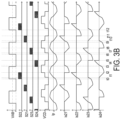
- FIG. 3 B is a schematic oscillogram showing the key waveforms of the three-level rectification DC/DC converter of FIG. 1 while applying negative sequence control to the secondary switches;
- FIGS. 4 A to 4 L show the working state of the three-level rectification DC/DC converter of FIG. 1 in one period while applying the positive sequence control to the secondary switches;
- FIG. 5 A shows an equivalent circuit of the three-level rectification DC/DC converter of FIG. 1 while the first voltage is at a high level and the secondary switches being turned on positively;
- FIG. 5 B shows an equivalent circuit of the three-level rectification DC/DC converter of FIG. 1 while the first voltage is at a low level and the secondary switches being turned on positively;
- FIG. 6 A is a schematic oscillogram showing the key waveforms of the three-level rectification DC/DC converter of FIG. 1 while applying the positive sequence control and partial synchronous rectification to the secondary switches;
- FIG. 6 B is a schematic oscillogram showing the key waveforms of the three-level rectification DC/DC converter of FIG. 1 while applying the negative sequence control and partial synchronous rectification to the secondary switches;
- FIG. 7 A is a schematic oscillogram showing the key waveforms of the three-level rectification DC/DC converter of FIG. 1 while applying the positive sequence control and complete synchronous rectification to the secondary switches;
- FIG. 7 B is a schematic oscillogram showing the key waveforms of the three-level rectification DC/DC converter of FIG. 1 while applying the negative sequence control and complete synchronous rectification to the secondary switches;
- FIG. 8 A is a schematic block diagram illustrating the variable frequency control applied to the three-level rectification DC/DC converter of FIG. 1 ;
- FIG. 8 B is a schematic block diagram illustrating the fixed-frequency control applied to the three-level rectification DC/DC converter of FIG. 1 ;
- FIG. 9 schematically shows a specific implementation of the resonant tank circuit of FIG. 1 ;
- FIG. 10 schematically shows a specific implementation of the primary circuit of FIG. 1 ;
- FIG. 11 A and FIG. 11 B are schematic oscillograms showing the key waveforms of the three-level rectification DC/DC converter of FIG. 10 while applying the positive sequence control and the negative sequence control to the secondary switches respectively;
- FIG. 12 A is a schematic oscillogram showing the key waveforms of the three-level rectification DC/DC converter of FIG. 10 while applying the positive sequence control and partial synchronous rectification to the secondary switches;
- FIG. 12 B is a schematic oscillogram showing the key waveforms of the three-level rectification DC/DC converter of FIG. 10 while applying the negative sequence control and partial synchronous rectification to the secondary switches;
- FIG. 13 A is a schematic oscillogram showing the key waveforms of the three-level rectification DC/DC converter of FIG. 10 while applying the positive sequence control and complete synchronous rectification to the secondary switches;
- FIG. 13 B is a schematic oscillogram showing the key waveforms of the three-level rectification DC/DC converter of FIG. 10 while applying the negative sequence control and complete synchronous rectification to the secondary switches;
- FIG. 14 schematically shows another specific implementation of the primary circuit of FIG. 1 ;
- FIG. 15 A and FIG. 15 B are schematic oscillograms showing the key waveforms of the three-level rectification DC/DC converter of FIG. 14 while applying the positive sequence control and the negative sequence control to the secondary switches respectively;
- FIG. 16 A is a schematic oscillogram showing the key waveforms of the three-level rectification DC/DC converter of FIG. 14 while applying the positive sequence control and partial synchronous rectification to the secondary switches;
- FIG. 16 B is a schematic oscillogram showing the key waveforms of the three-level rectification DC/DC converter of FIG. 14 while applying the negative sequence control and partial synchronous rectification to the secondary switches;
- FIG. 17 A is a schematic oscillogram showing the key waveforms of the three-level rectification DC/DC converter of FIG. 14 while applying the positive sequence control and complete synchronous rectification to the secondary switches;
- FIG. 17 B is a schematic oscillogram showing the key waveforms of the three-level rectification DC/DC converter of FIG. 14 while applying the negative sequence control and complete synchronous rectification to the secondary switches.
- FIG. 1 is a schematic circuit diagram illustrating a three-level rectification DC/DC converter according to an embodiment of the present disclosure
- FIG. 2 schematically shows an equivalent circuit of the three-level rectification DC/DC converter of FIG. 1
- the three-level rectification DC/DC converter 1 includes a primary circuit 11 , a resonant tank circuit 12 , and a secondary circuit 13 .
- the three-level rectification DC/DC converter 1 has the characteristic of a resonant circuit and can meet the bidirectional work requirement.
- the primary circuit 11 receives an input voltage Vin and includes a plurality of primary switches, and the primary circuit 11 is configured to provide a first voltage VAB. It is noted that the primary circuit 11 is represented by a voltage source which provides the first voltage VAB in this embodiment since the actual implementation of the primary circuit 11 is not limited. The specific implementation of the primary circuit 11 would be exemplified in the following descriptions.
- the resonant tank circuit 12 includes a resonant inductor Lr, a resonant capacitor Cr, and a transformer Tr.
- a first primary terminal 121 and a second primary terminal 122 of the resonant tank circuit 12 are coupled to the primary circuit 11 .
- a primary winding Np of the transformer Tr is coupled between the first primary terminal 121 and the second primary terminal 122 .
- a secondary winding Ns of the transformer Tr is coupled between a first secondary terminal 123 and a second secondary terminal 124 of the resonant tank circuit 12 .
- the voltage between the first primary terminal 121 and the second primary terminal 122 is the first voltage VAB
- the voltage between the first secondary terminal 123 and the second secondary terminal 124 is a second voltage VCD.
- Ip is the primary current
- Is is the secondary current.
- the secondary circuit 13 includes a switch bridge arm and a capacitor bridge arm.
- the switch bridge arm includes a first secondary switch S 21 , a second secondary switch S 22 , a third secondary switch S 23 , and a fourth secondary switch S 24 sequentially connected in series.
- a node C between the first secondary switch S 21 and the second secondary switch S 22 is connected to the first secondary terminal 123
- a node D between the third secondary switch S 23 and the fourth secondary switch S 24 is connected to the second secondary terminal 124 .
- the capacitor bridge arm includes a first output capacitor Co 1 and a second output capacitor Co 2 connected in series. A node between the first output capacitor Co 1 and the second output capacitor Co 2 is connected to a node between the second secondary switch S 22 and the third secondary switch S 23 .
- Two terminals of the capacitor bridge arm are connected to two terminals of the switch bridge arm respectively, and the voltage between the two terminals of the capacitor bridge arm is an output voltage Vo.
- FIG. 3 A is a schematic oscillogram showing the key waveforms of the three-level rectification DC/DC converter of FIG. 1 while applying positive sequence control to the secondary switches.
- FIG. 3 B is a schematic oscillogram showing the key waveforms of the three-level rectification DC/DC converter of FIG. 1 while applying negative sequence control to the secondary switches.
- S 21 , S 22 , S 23 , and S 24 represent the driving signals of the first secondary switch S 21 , the second secondary switch S 22 , the third secondary switch S 23 , and the fourth secondary switch S 24 respectively; and is 21 , is 22 , is 23 , and is 24 represent the currents flowing through the first secondary switch S 21 , the second secondary switch S 22 , the third secondary switch S 23 , and the fourth secondary switch S 24 respectively.
- FIG. 3 A and FIG. 3 B in any two consecutive periods of the first voltage VAB, there are two rising edges and two falling edges.
- the first secondary switch S 21 and the fourth secondary switch S 24 are in an on state for a preset time length after the two falling edges respectively.
- the second secondary switch S 22 and the third secondary switch S 23 are in an on state for the preset time length after the two rising edges respectively.
- the first secondary switch S 21 , the second secondary switch S 22 , the third secondary switch S 23 , and the fourth secondary switch S 24 have the same switching frequency equal to half of the frequency of the first voltage VAB. Further, all the secondary switches in secondary circuit 13 can be turned on with zero voltage switching.
- the said preset time length is obtained based on the input voltage Vin and the output voltage Vo. By controlling the preset time length, the duty ratio of each secondary switch can be adjusted, and the gain of the output voltage Vo can be controlled.
- the first voltage VAB is a square wave which is at a high level in one-half period and at a low level in the other half period, where the high level and the low level may be equal to +VAB/2 and ⁇ VAB/2 respectively, or equal to +VAB and 0 respectively.
- the difference between the oscillograms of FIG. 3 A and FIG. 3 B is that the control applied to the secondary switches is a positive sequence control or a negative sequence control.
- the phases of the second secondary switch S 22 , the first secondary switch S 21 , the third secondary switch S 23 , and the fourth secondary switch S 24 are sequentially out of phase by 90 degrees.
- a first rising edge, a first falling edge, a second rising edge, and a second falling edge occur sequentially.
- the first secondary switch S 21 and the fourth secondary switch S 24 are in the on state for the preset time length after the first falling edge and the second falling edge respectively.
- the second secondary switch S 22 and the third secondary switch S 23 are in the on state for the preset time length after the first rising edge and the second rising edge respectively.
- the phases of the fourth secondary switch S 24 , the third secondary switch S 23 , the first secondary switch S 21 , and the second secondary switch S 22 are sequentially out of phase by 90 degrees.
- a first rising edge, a first falling edge, a second rising edge, and a second falling edge occur sequentially.
- the first secondary switch S 21 and the fourth secondary switch S 24 are in the on state for the preset time length after the second falling edge and the first falling edge respectively.
- the second secondary switch S 22 and the third secondary switch S 23 are in the on state for the preset time length after the first rising edge and the second rising edge respectively.
- FIG. 3 A and FIG. 3 B the duration from time t 0 to t 12 is regarded as one period of the secondary switches.
- FIGS. 4 A to 4 L show the working state of the three-level rectification DC/DC converter of FIG. 1 in one period while applying the positive sequence control to the secondary switches. In specific, FIGS. 4 A to 4 L show the switching state and the current flowing direction of the three-level rectification DC/DC converter 1 within one period.
- FIGS. 4 B, 4 E, 4 H, and 4 K show the corresponding working states of the three-level rectification DC/DC converter 1 .
- the equivalent circuit of the three-level rectification DC/DC converter 1 during the duration from time t 1 to t 2 and the duration from time t 7 to t 8 is shown in FIG. 5 A .
- the equivalent circuit of the three-level rectification DC/DC converter 1 during the duration from time t 4 to t 5 and the duration from time t 10 to t 11 is shown in FIG. 5 B . From FIGS.
- the energy is stored in the resonant inductor Lr during the operating process, thereby achieving the high-gain voltage output.
- the four secondary switches since the four secondary switches are turned on by turns, the four secondary switches have the same effective current and conduction loss naturally, which makes the heat dissipation design and selection for switch components much easier.
- the secondary switches may be controlled with synchronous rectification. Namely, the secondary switch is driven during the current flowing reversely therethrough, thereby reducing the conduction loss of the secondary switches.
- FIG. 6 A is a schematic oscillogram showing the key waveforms of the three-level rectification DC/DC converter of FIG. 1 while applying the positive sequence control and partial synchronous rectification to the secondary switches.
- FIG. 6 B is a schematic oscillogram showing the key waveforms of the three-level rectification DC/DC converter of FIG. 1 while applying the negative sequence control and partial synchronous rectification to the secondary switches. As shown in FIG. 6 A and FIG. 6 B , while applying the partial synchronous rectification, in addition to the time durations of being in the on state shown in FIG. 3 A and FIG.
- the first secondary switch S 21 , the second secondary switch S 22 , the third secondary switch S 23 , and the fourth secondary switch S 24 are further in the on state during a partial duration within a duration of the currents flowing reversely through the first secondary switch S 21 , the second secondary switch S 22 , the third secondary switch S 23 , and the fourth secondary switch S 24 respectively.
- the first secondary switch S 21 , the second secondary switch S 22 , the third secondary switch S 23 , and the fourth secondary switch S 24 have the same duty ratio of 25% and still maintain a phase difference of 90 degrees, and the switching frequency thereof is still equal to a half of the frequency of the first voltage VAB.
- FIG. 7 A is a schematic oscillogram showing the key waveforms of the three-level rectification DC/DC converter of FIG. 1 while applying the positive sequence control and complete synchronous rectification to the secondary switches.
- FIG. 7 B is a schematic oscillogram showing the key waveforms of the three-level rectification DC/DC converter of FIG. 1 while applying the negative sequence control and complete synchronous rectification to the secondary switches. As shown in FIG. 7 A and FIG. 7 B , while applying the complete synchronous rectification, in addition to the durations of being in the on state shown in FIG. 3 A and FIG.
- the first secondary switch S 21 , the second secondary switch S 22 , the third secondary switch S 23 , and the fourth secondary switch S 24 are further in the on state during all durations within the duration of the currents flowing reversely through the first secondary switch S 21 , the second secondary switch S 22 , the third secondary switch S 23 , and the fourth secondary switch S 24 respectively.
- the driving signals of the first secondary switch S 21 and the second secondary switch S 22 are complementary
- the driving signals of the third secondary switch S 23 and the fourth secondary switch S 24 are complementary.
- control for the three-level rectification DC/DC converter 1 of the present disclosure may be divided into a variable frequency control and a fixed-frequency control.
- FIG. 8 A is a schematic block diagram illustrating the variable frequency control applied to the three-level rectification DC/DC converter of FIG. 1 . While applying the variable frequency control, as shown in FIG. 8 A , the three-level rectification DC/DC converter 1 further includes a control module 14 a .
- the control module 14 a is configured to acquire an input voltage signal Vin_FB, an output voltage signal Vo_FB and an output current signal Io_FB reflecting the input voltage Vin, the output voltage Vo and the output current Io respectively through detection, and to control the operation of all the primary and secondary switches.
- the control module 14 a includes a regulator 141 , and the regulator 141 generates a regulating signal according to the output voltage signal Vo_FB, the output current signal Io_FB, an output reference voltage Vo_ref and an output reference current Io_ref.
- the control module 14 a further includes a voltage-controlled oscillator 142 and a controller 143 .
- the voltage-controlled oscillator 142 is coupled to the regulator 141 and generates a switching frequency fs of all the primary switches according to the regulating signal.
- the controller 143 is coupled to the voltage-controlled oscillator 142 , and generates an on-time Ton of all the secondary switches according to the input voltage signal Vin_FB, the output voltage signal Vo_FB and the switching frequency fs of all the primary switches.
- the turns ratio n of the transformer Tr is fixed, the relations among the on-time Ton of all the secondary switches, the input voltage Vin, the output voltage Vo and the switching frequency fs of all the primary switches are conformed with the curve shown in FIG. 8 A .
- the on-time Ton of the secondary switches may be obtained through calculation or look-up table.
- FIG. 8 B is a schematic block diagram illustrating the fixed-frequency control applied to the three-level rectification DC/DC converter of FIG. 1 . While applying the fixed-frequency control, the switching frequency fs of all the primary switches is fixed and is larger than the resonant frequency of the resonant tank circuit 12 . As shown in FIG. 8 B , the three-level rectification DC/DC converter 1 further includes a control module 14 b .
- the control module 14 b is configured to acquire an input voltage signal Vin_FB, an output voltage signal Vo_FB and an output current signal Io_FB reflecting the input voltage Vin, the output voltage Vo and the output current Io respectively through detection, and to control the operation of all the primary and secondary switches.
- the control module 14 b includes a regulator 141 , and the regulator 141 generates a regulating signal according to the output voltage signal Vo_FB, the output current signal Io_FB, an output reference voltage Vo_ref, and an output reference current Io_ref.
- the control module 14 b further includes a PWM controller 144 .
- the PWM controller 144 is coupled to the regulator 141 and generates the driving signals of all the primary and secondary switches according to the regulating signal.
- FIG. 9 schematically shows a specific implementation of the resonant tank circuit 12 .
- the resonant inductor Lr, the primary winding Np, and the resonant capacitor Cr are sequentially connected between the first primary terminal 121 and the second primary terminal 122 in series, but not limited thereto.
- the resonant capacitor Cr may be connected in series between the secondary winding Ns and the second secondary terminal 124
- the resonant inductor Lr may be connected in series between the secondary winding Ns and the first secondary terminal 123 .
- the resonant inductor Lr includes a primary resonant inductor Lrp and a secondary resonant inductor Lrs, the primary resonant inductor Lrp is connected in series between the primary winding Np and the first primary terminal 121 , and the secondary resonant inductor Lrs is connected in series between the secondary winding Ns and the first secondary terminal 123 .
- the resonant capacitor Cr includes a primary resonant capacitor Crp and a secondary resonant capacitor Crs, the primary resonant capacitor Crp is connected in series between the primary winding Np and the second primary terminal 122 , and the secondary resonant capacitor Crs is connected in series between the secondary winding Ns and the second secondary terminal 124 .
- the actual circuit topology of the primary circuit is not limited, and the primary circuit is for example but not limited to a full-bridge circuit, a half-bridge circuit, a serial-half-bridge circuit, a three-level circuit with a flying capacitor, or a three-level circuit with the clamped midpoint.
- Two kinds of actual circuit topologies of the primary circuit are exemplified as follows.
- the primary circuit 11 a is a full-bridge circuit, and the primary circuit 11 a includes an input capacitor Cin, a first bridge arm, and a second bridge arm connected to each other in parallel.
- the voltage on the input capacitor Cin is the input voltage Vin.
- the first bridge arm includes a first primary switch S 11 and a second primary switch S 12 connected in series, and a node B between the first primary switch S 11 and the second primary switch S 12 is connected to the second primary terminal 122 .
- the second bridge arm includes a third primary switch S 13 and a fourth primary switch S 14 , and a node A between the third primary switch S 13 and the fourth primary switch S 14 is connected to the first primary terminal 121 .
- FIG. 11 A and FIG. 11 B are schematic oscillograms showing the key waveforms of the three-level rectification DC/DC converter of FIG. 10 while applying the positive sequence control and the negative sequence control to the secondary switches respectively.
- FIG. 12 A is a schematic oscillogram showing the key waveforms of the three-level rectification DC/DC converter of FIG. 10 while applying the positive sequence control and partial synchronous rectification to the secondary switches.
- FIG. 12 B is a schematic oscillogram showing the key waveforms of the three-level rectification DC/DC converter of FIG. 10 while applying the negative sequence control and partial synchronous rectification to the secondary switches.
- FIG. 11 A and FIG. 11 B are schematic oscillograms showing the key waveforms of the three-level rectification DC/DC converter of FIG. 10 while applying the positive sequence control and partial synchronous rectification to the secondary switches respectively.
- FIG. 12 A is a schematic oscillogram showing the key waveforms of the three-level rectification DC/DC converter of FIG. 10 while
- FIG. 13 A is a schematic oscillogram showing the key waveforms of the three-level rectification DC/DC converter of FIG. 10 while applying the positive sequence control and complete synchronous rectification to the secondary switches.
- FIG. 13 B is a schematic oscillogram showing the key waveforms of the three-level rectification DC/DC converter of FIG. 10 while applying the negative sequence control and complete synchronous rectification to the secondary switches.
- the primary circuit 11 b is a serial-half-bridge circuit, and the primary circuit 11 b includes a first bridge arm and a second bridge arm.
- the voltage between the two terminals of the first bridge arm is the input voltage Vin, and the two terminals of the first bridge arm are connected to two terminals of the second bridge arm respectively.
- the first bridge arm includes a first input capacitor C 1 and a second input capacitor C 2 connected in series.
- the second bridge arm includes a first primary switch S 11 , a second primary switch S 12 , a third primary switch S 13 , and a fourth primary switch S 14 sequentially connected in series.
- a node A between the first primary switch S 11 and the second primary switch S 12 is connected to the first primary terminal 121 .
- FIG. 15 A and FIG. 15 B are schematic oscillograms showing the key waveforms of the three-level rectification DC/DC converter of FIG. 14 while applying the positive sequence control and the negative sequence control to the secondary switches respectively.
- FIG. 16 A is a schematic oscillogram showing the key waveforms of the three-level rectification DC/DC converter of FIG.
- FIG. 16 B is a schematic oscillogram showing the key waveforms of the three-level rectification DC/DC converter of FIG. 14 while applying the negative sequence control and partial synchronous rectification to the secondary switches.
- FIG. 17 A is a schematic oscillogram showing the key waveforms of the three-level rectification DC/DC converter of FIG. 14 while applying the positive sequence control and complete synchronous rectification to the secondary switches.
- FIG. 17 B is a schematic oscillogram showing the key waveforms of the three-level rectification DC/DC converter of FIG. 14 while applying the negative sequence control and complete synchronous rectification to the secondary switches.
- the present disclosure provides a three-level rectification DC/DC converter which has the characteristic of a resonant circuit and can meet the bidirectional work requirement.
- the three-level rectification DC/DC converter has the characteristic of storing energy through short-circuiting the secondary circuit thereof, thereby achieving the output with high voltage gain. Since the highest voltage on the secondary switch equals one-half of the output voltage, the secondary switch can be implemented by switch components with low withstand voltage, which makes the selection for switch components easier and reduces the cost.
- the energy is stored in the resonant inductor during the operating process by the secondary circuit equivalent to be short-circuited, thereby achieving the high-gain voltage output.
- the four secondary switches are turned on by turns, the four secondary switches have the same effective current and conduction loss naturally, which makes the heat dissipation design and selection for switch components much easier.
Landscapes
- Engineering & Computer Science (AREA)
- Power Engineering (AREA)
- Dc-Dc Converters (AREA)
Applications Claiming Priority (2)
| Application Number | Priority Date | Filing Date | Title |
|---|---|---|---|
| CN202111463253.9 | 2021-12-02 | ||
| CN202111463253.9A CN114157157B (zh) | 2021-12-02 | 2021-12-02 | 三电平整流dc/dc变换器 |
Publications (2)
| Publication Number | Publication Date |
|---|---|
| US20230179105A1 US20230179105A1 (en) | 2023-06-08 |
| US11750103B2 true US11750103B2 (en) | 2023-09-05 |
Family
ID=80456066
Family Applications (1)
| Application Number | Title | Priority Date | Filing Date |
|---|---|---|---|
| US17/573,970 Active 2042-04-03 US11750103B2 (en) | 2021-12-02 | 2022-01-12 | Three-level rectification dc/dc converter |
Country Status (3)
| Country | Link |
|---|---|
| US (1) | US11750103B2 (de) |
| EP (1) | EP4191861B1 (de) |
| CN (1) | CN114157157B (de) |
Families Citing this family (1)
| Publication number | Priority date | Publication date | Assignee | Title |
|---|---|---|---|---|
| CN116742956B (zh) * | 2023-08-15 | 2024-07-12 | 深圳市高斯宝电气技术有限公司 | 一种t型三电平电路 |
Citations (16)
| Publication number | Priority date | Publication date | Assignee | Title |
|---|---|---|---|---|
| CN102624243A (zh) | 2012-04-19 | 2012-08-01 | 中国矿业大学(北京) | 隔离式半桥三电平双向dc/dc变换器 |
| US20180152097A1 (en) | 2016-11-29 | 2018-05-31 | Delta Electronics (Shanghai) Co.,Ltd. | Discharge control method for bus capacitor in power converter |
| US20180234022A1 (en) | 2015-08-26 | 2018-08-16 | Futurewei Technologies, Inc. | Ac/dc converters with wider voltage regulation range |
| US20180337610A1 (en) * | 2017-05-19 | 2018-11-22 | Infineon Technologies Austria Ag | PWM Controlled Resonant Converter |
| US20190068069A1 (en) * | 2017-08-31 | 2019-02-28 | Google Inc. | Programmable Power Adapter |
| CN109889049A (zh) | 2019-03-08 | 2019-06-14 | 台达电子企业管理(上海)有限公司 | Dc/dc变换器的控制方法和装置 |
| CN110048613A (zh) | 2019-05-31 | 2019-07-23 | 芜湖康爱而电气有限公司 | 一种双向半桥三电平dcdc变换电路 |
| CN111224553A (zh) | 2020-03-09 | 2020-06-02 | 合肥博鳌电气科技有限公司 | 一种改进的双向半桥三电平llc直流变换器及其同步控制方法 |
| US20200228017A1 (en) | 2019-01-16 | 2020-07-16 | Delta Electronics (Shanghai) Co., Ltd | Dc/dc converter and control method thereof |
| US20200228022A1 (en) * | 2019-01-16 | 2020-07-16 | Delta Electronics (Shanghai) Co., Ltd | Dc/dc converter and control method thereof |
| US20200266719A1 (en) * | 2019-02-15 | 2020-08-20 | Apple Inc. | Frequency Doubling Resonant Converter |
| US20210067045A1 (en) * | 2019-08-26 | 2021-03-04 | Delta Electronics, Inc. | Three-level modulation for wide output voltage range isolated dc/dc converters |
| CN213151913U (zh) | 2020-07-30 | 2021-05-07 | 深圳市联明电源有限公司 | 一种输出宽范围可调的三电平软开关变化电路 |
| CN113037096A (zh) | 2021-04-27 | 2021-06-25 | 燕山大学 | 高增益三电平电流型双向dc/dc变换器及其控制方法 |
| US20210226534A1 (en) | 2020-01-16 | 2021-07-22 | Delta Electronics (Shanghai) Co., Ltd. | Dc/dc converter and control method thereof |
| EP3916984A1 (de) | 2020-05-25 | 2021-12-01 | Delta Electronics, Inc. | Isolierte gleichspannungswandler für grossen ausgangsspannungsbereich und steuerungsverfahren dafür |
Family Cites Families (2)
| Publication number | Priority date | Publication date | Assignee | Title |
|---|---|---|---|---|
| CN100539374C (zh) * | 2006-10-13 | 2009-09-09 | 南京航空航天大学 | 零电压开关复合式全桥三电平直流变换器 |
| US10498236B2 (en) * | 2016-04-11 | 2019-12-03 | Tianshu Liu | Two-phase three-level converter and controller therefor |
-
2021
- 2021-12-02 CN CN202111463253.9A patent/CN114157157B/zh active Active
-
2022
- 2022-01-12 US US17/573,970 patent/US11750103B2/en active Active
- 2022-06-21 EP EP22180105.3A patent/EP4191861B1/de active Active
Patent Citations (18)
| Publication number | Priority date | Publication date | Assignee | Title |
|---|---|---|---|---|
| CN102624243A (zh) | 2012-04-19 | 2012-08-01 | 中国矿业大学(北京) | 隔离式半桥三电平双向dc/dc变换器 |
| US20180234022A1 (en) | 2015-08-26 | 2018-08-16 | Futurewei Technologies, Inc. | Ac/dc converters with wider voltage regulation range |
| US20180152097A1 (en) | 2016-11-29 | 2018-05-31 | Delta Electronics (Shanghai) Co.,Ltd. | Discharge control method for bus capacitor in power converter |
| US20180337610A1 (en) * | 2017-05-19 | 2018-11-22 | Infineon Technologies Austria Ag | PWM Controlled Resonant Converter |
| US20190068069A1 (en) * | 2017-08-31 | 2019-02-28 | Google Inc. | Programmable Power Adapter |
| US20200228017A1 (en) | 2019-01-16 | 2020-07-16 | Delta Electronics (Shanghai) Co., Ltd | Dc/dc converter and control method thereof |
| US20200228022A1 (en) * | 2019-01-16 | 2020-07-16 | Delta Electronics (Shanghai) Co., Ltd | Dc/dc converter and control method thereof |
| US20200266719A1 (en) * | 2019-02-15 | 2020-08-20 | Apple Inc. | Frequency Doubling Resonant Converter |
| CN109889049A (zh) | 2019-03-08 | 2019-06-14 | 台达电子企业管理(上海)有限公司 | Dc/dc变换器的控制方法和装置 |
| US20200287466A1 (en) * | 2019-03-08 | 2020-09-10 | Delta Electronics (Shanghai) Co., Ltd. | Control method for dc/dc converter and dc/dc converter |
| CN110048613A (zh) | 2019-05-31 | 2019-07-23 | 芜湖康爱而电气有限公司 | 一种双向半桥三电平dcdc变换电路 |
| US20210067045A1 (en) * | 2019-08-26 | 2021-03-04 | Delta Electronics, Inc. | Three-level modulation for wide output voltage range isolated dc/dc converters |
| CN112511007A (zh) | 2019-08-26 | 2021-03-16 | 台达电子工业股份有限公司 | 适用于宽输出电压范围的隔离式dc/dc转换器及其控制方法 |
| US20210226534A1 (en) | 2020-01-16 | 2021-07-22 | Delta Electronics (Shanghai) Co., Ltd. | Dc/dc converter and control method thereof |
| CN111224553A (zh) | 2020-03-09 | 2020-06-02 | 合肥博鳌电气科技有限公司 | 一种改进的双向半桥三电平llc直流变换器及其同步控制方法 |
| EP3916984A1 (de) | 2020-05-25 | 2021-12-01 | Delta Electronics, Inc. | Isolierte gleichspannungswandler für grossen ausgangsspannungsbereich und steuerungsverfahren dafür |
| CN213151913U (zh) | 2020-07-30 | 2021-05-07 | 深圳市联明电源有限公司 | 一种输出宽范围可调的三电平软开关变化电路 |
| CN113037096A (zh) | 2021-04-27 | 2021-06-25 | 燕山大学 | 高增益三电平电流型双向dc/dc变换器及其控制方法 |
Non-Patent Citations (2)
| Title |
|---|
| Liu Wenjin et al., A Bidirectional Three-Level Current-Fed DC/DC Converter Using Dual Phase Shift Modulation, IEEE, 2019, pp. 325-330. |
| Yang Dongjiang et al., High-Efficiency Bidirectional Three-Level Series-Resonant Converter with Buck-Boost Capacity for High-Output Voltage Applications, IEEE, 2021, pp. 969-982. |
Also Published As
| Publication number | Publication date |
|---|---|
| EP4191861B1 (de) | 2025-08-13 |
| CN114157157B (zh) | 2025-08-15 |
| US20230179105A1 (en) | 2023-06-08 |
| EP4191861A1 (de) | 2023-06-07 |
| EP4191861C0 (de) | 2025-08-13 |
| CN114157157A (zh) | 2022-03-08 |
Similar Documents
| Publication | Publication Date | Title |
|---|---|---|
| US10411608B2 (en) | Converter circuit with a switchable topology | |
| US9520792B2 (en) | Staggered parallel three-level DC/DC converter and AC/DC converter | |
| US9263960B2 (en) | Power converters for wide input or output voltage range and control methods thereof | |
| US11611283B2 (en) | Switching power supply unit and electric power supply system | |
| EP2571154B1 (de) | PV Wechselrichter mit eingangsseitig parallel und ausgangsseitig in Serie geschalteten Sperrwandlern zur Einspeisung eines Vollbrückenwechselrichters | |
| EP4007146B1 (de) | Stromumwandlungsvorrichtung | |
| Wu et al. | Soft switched full bridge DC–DC converter with reduced circulating loss and filter requirement | |
| US9543823B2 (en) | Power conversion apparatus having a switching circuit unit that includes a switching device and an auxiliary switching device | |
| US6185111B1 (en) | Switching power supply apparatus | |
| Singh et al. | Analysis and control of phase-shifted series resonant converter operating in discontinuous mode | |
| US12255539B2 (en) | Three-level rectification DC/DC converter | |
| US20240007008A1 (en) | Power converter topology | |
| US11750103B2 (en) | Three-level rectification dc/dc converter | |
| CN110808691B (zh) | 具有软切换且能降低输入电流涟波的逆变电路 | |
| US12191775B2 (en) | Three-level rectification DC/DC converter | |
| EP4322382A1 (de) | Resonanzwandler und steuerungsverfahren dafür | |
| JP4769395B2 (ja) | Dc/dcコンバータ | |
| US12614987B2 (en) | Pulse width modulation method and system | |
| US20250183808A1 (en) | Selective secondary phase-shifting control for resonant converters | |
| Ma et al. | ZVZCS full bridge dc-dc converter with reduced circulating loss and filter requirement | |
| US20240405688A1 (en) | Pulse width modulation method and system | |
| Babu | Single Input Single Output Two Level Isolated Dc-Dc Converter With Secondary Side Phase Shifting For Solar Applications | |
| Soma et al. | Output Voltage Control for Stable Start-up of Single-Phase Isolated SR-SAB DC-DC Converter | |
| JP2006115680A (ja) | Dc−dcコンバータ | |
| Liu et al. | Analysis of the Body Diode Reverse Recovery of MOSFETs in ZVS PWM Combined Three-level Converter |
Legal Events
| Date | Code | Title | Description |
|---|---|---|---|
| AS | Assignment |
Owner name: DELTA ELECTRONICS (SHANGHAI) CO., LTD., CHINA Free format text: ASSIGNMENT OF ASSIGNORS INTEREST;ASSIGNORS:JIA, MINLI;SUN, HAO;ZHANG, CHI;AND OTHERS;SIGNING DATES FROM 20211116 TO 20211117;REEL/FRAME:058631/0218 |
|
| FEPP | Fee payment procedure |
Free format text: ENTITY STATUS SET TO UNDISCOUNTED (ORIGINAL EVENT CODE: BIG.); ENTITY STATUS OF PATENT OWNER: LARGE ENTITY |
|
| STCF | Information on status: patent grant |
Free format text: PATENTED CASE |