US11737349B2 - Organic electroluminescent materials and devices - Google Patents
Organic electroluminescent materials and devices Download PDFInfo
- Publication number
- US11737349B2 US11737349B2 US16/884,509 US202016884509A US11737349B2 US 11737349 B2 US11737349 B2 US 11737349B2 US 202016884509 A US202016884509 A US 202016884509A US 11737349 B2 US11737349 B2 US 11737349B2
- Authority
- US
- United States
- Prior art keywords
- integer
- ring
- compound
- group
- ligand
- Prior art date
- Legal status (The legal status is an assumption and is not a legal conclusion. Google has not performed a legal analysis and makes no representation as to the accuracy of the status listed.)
- Active, expires
Links
Images


Classifications
-
- H—ELECTRICITY
- H10—SEMICONDUCTOR DEVICES; ELECTRIC SOLID-STATE DEVICES NOT OTHERWISE PROVIDED FOR
- H10K—ORGANIC ELECTRIC SOLID-STATE DEVICES
- H10K85/00—Organic materials used in the body or electrodes of devices covered by this subclass
- H10K85/30—Coordination compounds
- H10K85/341—Transition metal complexes, e.g. Ru(II)polypyridine complexes
- H10K85/342—Transition metal complexes, e.g. Ru(II)polypyridine complexes comprising iridium
-
- C—CHEMISTRY; METALLURGY
- C07—ORGANIC CHEMISTRY
- C07F—ACYCLIC, CARBOCYCLIC OR HETEROCYCLIC COMPOUNDS CONTAINING ELEMENTS OTHER THAN CARBON, HYDROGEN, HALOGEN, OXYGEN, NITROGEN, SULFUR, SELENIUM OR TELLURIUM
- C07F15/00—Compounds containing elements of Groups 8, 9, 10 or 18 of the Periodic Table
- C07F15/0006—Compounds containing elements of Groups 8, 9, 10 or 18 of the Periodic Table compounds of the platinum group
- C07F15/0033—Iridium compounds
-
- C—CHEMISTRY; METALLURGY
- C07—ORGANIC CHEMISTRY
- C07F—ACYCLIC, CARBOCYCLIC OR HETEROCYCLIC COMPOUNDS CONTAINING ELEMENTS OTHER THAN CARBON, HYDROGEN, HALOGEN, OXYGEN, NITROGEN, SULFUR, SELENIUM OR TELLURIUM
- C07F15/00—Compounds containing elements of Groups 8, 9, 10 or 18 of the Periodic Table
- C07F15/0006—Compounds containing elements of Groups 8, 9, 10 or 18 of the Periodic Table compounds of the platinum group
- C07F15/0086—Platinum compounds
-
- C—CHEMISTRY; METALLURGY
- C09—DYES; PAINTS; POLISHES; NATURAL RESINS; ADHESIVES; COMPOSITIONS NOT OTHERWISE PROVIDED FOR; APPLICATIONS OF MATERIALS NOT OTHERWISE PROVIDED FOR
- C09K—MATERIALS FOR MISCELLANEOUS APPLICATIONS, NOT PROVIDED FOR ELSEWHERE
- C09K11/00—Luminescent materials, e.g. electroluminescent or chemiluminescent
- C09K11/06—Luminescent materials, e.g. electroluminescent or chemiluminescent containing organic luminescent materials
-
- H—ELECTRICITY
- H10—SEMICONDUCTOR DEVICES; ELECTRIC SOLID-STATE DEVICES NOT OTHERWISE PROVIDED FOR
- H10K—ORGANIC ELECTRIC SOLID-STATE DEVICES
- H10K50/00—Organic light-emitting devices
- H10K50/10—OLEDs or polymer light-emitting diodes [PLED]
- H10K50/11—OLEDs or polymer light-emitting diodes [PLED] characterised by the electroluminescent [EL] layers
- H10K50/12—OLEDs or polymer light-emitting diodes [PLED] characterised by the electroluminescent [EL] layers comprising dopants
-
- H—ELECTRICITY
- H10—SEMICONDUCTOR DEVICES; ELECTRIC SOLID-STATE DEVICES NOT OTHERWISE PROVIDED FOR
- H10K—ORGANIC ELECTRIC SOLID-STATE DEVICES
- H10K85/00—Organic materials used in the body or electrodes of devices covered by this subclass
- H10K85/30—Coordination compounds
- H10K85/341—Transition metal complexes, e.g. Ru(II)polypyridine complexes
- H10K85/346—Transition metal complexes, e.g. Ru(II)polypyridine complexes comprising platinum
-
- C—CHEMISTRY; METALLURGY
- C09—DYES; PAINTS; POLISHES; NATURAL RESINS; ADHESIVES; COMPOSITIONS NOT OTHERWISE PROVIDED FOR; APPLICATIONS OF MATERIALS NOT OTHERWISE PROVIDED FOR
- C09K—MATERIALS FOR MISCELLANEOUS APPLICATIONS, NOT PROVIDED FOR ELSEWHERE
- C09K2211/00—Chemical nature of organic luminescent or tenebrescent compounds
- C09K2211/10—Non-macromolecular compounds
- C09K2211/1003—Carbocyclic compounds
- C09K2211/1007—Non-condensed systems
-
- C—CHEMISTRY; METALLURGY
- C09—DYES; PAINTS; POLISHES; NATURAL RESINS; ADHESIVES; COMPOSITIONS NOT OTHERWISE PROVIDED FOR; APPLICATIONS OF MATERIALS NOT OTHERWISE PROVIDED FOR
- C09K—MATERIALS FOR MISCELLANEOUS APPLICATIONS, NOT PROVIDED FOR ELSEWHERE
- C09K2211/00—Chemical nature of organic luminescent or tenebrescent compounds
- C09K2211/10—Non-macromolecular compounds
- C09K2211/1003—Carbocyclic compounds
- C09K2211/1014—Carbocyclic compounds bridged by heteroatoms, e.g. N, P, Si or B
-
- C—CHEMISTRY; METALLURGY
- C09—DYES; PAINTS; POLISHES; NATURAL RESINS; ADHESIVES; COMPOSITIONS NOT OTHERWISE PROVIDED FOR; APPLICATIONS OF MATERIALS NOT OTHERWISE PROVIDED FOR
- C09K—MATERIALS FOR MISCELLANEOUS APPLICATIONS, NOT PROVIDED FOR ELSEWHERE
- C09K2211/00—Chemical nature of organic luminescent or tenebrescent compounds
- C09K2211/10—Non-macromolecular compounds
- C09K2211/1018—Heterocyclic compounds
- C09K2211/1022—Heterocyclic compounds bridged by heteroatoms, e.g. N, P, Si or B
-
- C—CHEMISTRY; METALLURGY
- C09—DYES; PAINTS; POLISHES; NATURAL RESINS; ADHESIVES; COMPOSITIONS NOT OTHERWISE PROVIDED FOR; APPLICATIONS OF MATERIALS NOT OTHERWISE PROVIDED FOR
- C09K—MATERIALS FOR MISCELLANEOUS APPLICATIONS, NOT PROVIDED FOR ELSEWHERE
- C09K2211/00—Chemical nature of organic luminescent or tenebrescent compounds
- C09K2211/10—Non-macromolecular compounds
- C09K2211/1018—Heterocyclic compounds
- C09K2211/1025—Heterocyclic compounds characterised by ligands
- C09K2211/1029—Heterocyclic compounds characterised by ligands containing one nitrogen atom as the heteroatom
-
- C—CHEMISTRY; METALLURGY
- C09—DYES; PAINTS; POLISHES; NATURAL RESINS; ADHESIVES; COMPOSITIONS NOT OTHERWISE PROVIDED FOR; APPLICATIONS OF MATERIALS NOT OTHERWISE PROVIDED FOR
- C09K—MATERIALS FOR MISCELLANEOUS APPLICATIONS, NOT PROVIDED FOR ELSEWHERE
- C09K2211/00—Chemical nature of organic luminescent or tenebrescent compounds
- C09K2211/10—Non-macromolecular compounds
- C09K2211/1018—Heterocyclic compounds
- C09K2211/1025—Heterocyclic compounds characterised by ligands
- C09K2211/1044—Heterocyclic compounds characterised by ligands containing two nitrogen atoms as heteroatoms
-
- C—CHEMISTRY; METALLURGY
- C09—DYES; PAINTS; POLISHES; NATURAL RESINS; ADHESIVES; COMPOSITIONS NOT OTHERWISE PROVIDED FOR; APPLICATIONS OF MATERIALS NOT OTHERWISE PROVIDED FOR
- C09K—MATERIALS FOR MISCELLANEOUS APPLICATIONS, NOT PROVIDED FOR ELSEWHERE
- C09K2211/00—Chemical nature of organic luminescent or tenebrescent compounds
- C09K2211/10—Non-macromolecular compounds
- C09K2211/1018—Heterocyclic compounds
- C09K2211/1025—Heterocyclic compounds characterised by ligands
- C09K2211/1044—Heterocyclic compounds characterised by ligands containing two nitrogen atoms as heteroatoms
- C09K2211/1048—Heterocyclic compounds characterised by ligands containing two nitrogen atoms as heteroatoms with oxygen
-
- C—CHEMISTRY; METALLURGY
- C09—DYES; PAINTS; POLISHES; NATURAL RESINS; ADHESIVES; COMPOSITIONS NOT OTHERWISE PROVIDED FOR; APPLICATIONS OF MATERIALS NOT OTHERWISE PROVIDED FOR
- C09K—MATERIALS FOR MISCELLANEOUS APPLICATIONS, NOT PROVIDED FOR ELSEWHERE
- C09K2211/00—Chemical nature of organic luminescent or tenebrescent compounds
- C09K2211/10—Non-macromolecular compounds
- C09K2211/1018—Heterocyclic compounds
- C09K2211/1025—Heterocyclic compounds characterised by ligands
- C09K2211/1044—Heterocyclic compounds characterised by ligands containing two nitrogen atoms as heteroatoms
- C09K2211/1051—Heterocyclic compounds characterised by ligands containing two nitrogen atoms as heteroatoms with sulfur
-
- C—CHEMISTRY; METALLURGY
- C09—DYES; PAINTS; POLISHES; NATURAL RESINS; ADHESIVES; COMPOSITIONS NOT OTHERWISE PROVIDED FOR; APPLICATIONS OF MATERIALS NOT OTHERWISE PROVIDED FOR
- C09K—MATERIALS FOR MISCELLANEOUS APPLICATIONS, NOT PROVIDED FOR ELSEWHERE
- C09K2211/00—Chemical nature of organic luminescent or tenebrescent compounds
- C09K2211/10—Non-macromolecular compounds
- C09K2211/1018—Heterocyclic compounds
- C09K2211/1025—Heterocyclic compounds characterised by ligands
- C09K2211/1044—Heterocyclic compounds characterised by ligands containing two nitrogen atoms as heteroatoms
- C09K2211/1055—Heterocyclic compounds characterised by ligands containing two nitrogen atoms as heteroatoms with other heteroatoms
-
- C—CHEMISTRY; METALLURGY
- C09—DYES; PAINTS; POLISHES; NATURAL RESINS; ADHESIVES; COMPOSITIONS NOT OTHERWISE PROVIDED FOR; APPLICATIONS OF MATERIALS NOT OTHERWISE PROVIDED FOR
- C09K—MATERIALS FOR MISCELLANEOUS APPLICATIONS, NOT PROVIDED FOR ELSEWHERE
- C09K2211/00—Chemical nature of organic luminescent or tenebrescent compounds
- C09K2211/10—Non-macromolecular compounds
- C09K2211/1018—Heterocyclic compounds
- C09K2211/1025—Heterocyclic compounds characterised by ligands
- C09K2211/1059—Heterocyclic compounds characterised by ligands containing three nitrogen atoms as heteroatoms
-
- C—CHEMISTRY; METALLURGY
- C09—DYES; PAINTS; POLISHES; NATURAL RESINS; ADHESIVES; COMPOSITIONS NOT OTHERWISE PROVIDED FOR; APPLICATIONS OF MATERIALS NOT OTHERWISE PROVIDED FOR
- C09K—MATERIALS FOR MISCELLANEOUS APPLICATIONS, NOT PROVIDED FOR ELSEWHERE
- C09K2211/00—Chemical nature of organic luminescent or tenebrescent compounds
- C09K2211/10—Non-macromolecular compounds
- C09K2211/1018—Heterocyclic compounds
- C09K2211/1025—Heterocyclic compounds characterised by ligands
- C09K2211/1059—Heterocyclic compounds characterised by ligands containing three nitrogen atoms as heteroatoms
- C09K2211/1066—Heterocyclic compounds characterised by ligands containing three nitrogen atoms as heteroatoms with sulfur
-
- C—CHEMISTRY; METALLURGY
- C09—DYES; PAINTS; POLISHES; NATURAL RESINS; ADHESIVES; COMPOSITIONS NOT OTHERWISE PROVIDED FOR; APPLICATIONS OF MATERIALS NOT OTHERWISE PROVIDED FOR
- C09K—MATERIALS FOR MISCELLANEOUS APPLICATIONS, NOT PROVIDED FOR ELSEWHERE
- C09K2211/00—Chemical nature of organic luminescent or tenebrescent compounds
- C09K2211/10—Non-macromolecular compounds
- C09K2211/1018—Heterocyclic compounds
- C09K2211/1025—Heterocyclic compounds characterised by ligands
- C09K2211/1059—Heterocyclic compounds characterised by ligands containing three nitrogen atoms as heteroatoms
- C09K2211/107—Heterocyclic compounds characterised by ligands containing three nitrogen atoms as heteroatoms with other heteroatoms
-
- C—CHEMISTRY; METALLURGY
- C09—DYES; PAINTS; POLISHES; NATURAL RESINS; ADHESIVES; COMPOSITIONS NOT OTHERWISE PROVIDED FOR; APPLICATIONS OF MATERIALS NOT OTHERWISE PROVIDED FOR
- C09K—MATERIALS FOR MISCELLANEOUS APPLICATIONS, NOT PROVIDED FOR ELSEWHERE
- C09K2211/00—Chemical nature of organic luminescent or tenebrescent compounds
- C09K2211/10—Non-macromolecular compounds
- C09K2211/1018—Heterocyclic compounds
- C09K2211/1025—Heterocyclic compounds characterised by ligands
- C09K2211/1074—Heterocyclic compounds characterised by ligands containing more than three nitrogen atoms as heteroatoms
- C09K2211/1085—Heterocyclic compounds characterised by ligands containing more than three nitrogen atoms as heteroatoms with other heteroatoms
-
- C—CHEMISTRY; METALLURGY
- C09—DYES; PAINTS; POLISHES; NATURAL RESINS; ADHESIVES; COMPOSITIONS NOT OTHERWISE PROVIDED FOR; APPLICATIONS OF MATERIALS NOT OTHERWISE PROVIDED FOR
- C09K—MATERIALS FOR MISCELLANEOUS APPLICATIONS, NOT PROVIDED FOR ELSEWHERE
- C09K2211/00—Chemical nature of organic luminescent or tenebrescent compounds
- C09K2211/18—Metal complexes
- C09K2211/185—Metal complexes of the platinum group, i.e. Os, Ir, Pt, Ru, Rh or Pd
-
- H—ELECTRICITY
- H10—SEMICONDUCTOR DEVICES; ELECTRIC SOLID-STATE DEVICES NOT OTHERWISE PROVIDED FOR
- H10K—ORGANIC ELECTRIC SOLID-STATE DEVICES
- H10K2101/00—Properties of the organic materials covered by group H10K85/00
- H10K2101/10—Triplet emission
-
- H—ELECTRICITY
- H10—SEMICONDUCTOR DEVICES; ELECTRIC SOLID-STATE DEVICES NOT OTHERWISE PROVIDED FOR
- H10K—ORGANIC ELECTRIC SOLID-STATE DEVICES
- H10K50/00—Organic light-emitting devices
- H10K50/10—OLEDs or polymer light-emitting diodes [PLED]
- H10K50/11—OLEDs or polymer light-emitting diodes [PLED] characterised by the electroluminescent [EL] layers
-
- H—ELECTRICITY
- H10—SEMICONDUCTOR DEVICES; ELECTRIC SOLID-STATE DEVICES NOT OTHERWISE PROVIDED FOR
- H10K—ORGANIC ELECTRIC SOLID-STATE DEVICES
- H10K50/00—Organic light-emitting devices
- H10K50/10—OLEDs or polymer light-emitting diodes [PLED]
- H10K50/11—OLEDs or polymer light-emitting diodes [PLED] characterised by the electroluminescent [EL] layers
- H10K50/12—OLEDs or polymer light-emitting diodes [PLED] characterised by the electroluminescent [EL] layers comprising dopants
- H10K50/121—OLEDs or polymer light-emitting diodes [PLED] characterised by the electroluminescent [EL] layers comprising dopants for assisting energy transfer, e.g. sensitization
Definitions
- the present disclosure generally relates to organometallic compounds and formulations and their various uses including as emitters in devices such as organic light emitting diodes and related electronic devices.
- Opto-electronic devices that make use of organic materials are becoming increasingly desirable for various reasons. Many of the materials used to make such devices are relatively inexpensive, so organic opto-electronic devices have the potential for cost advantages over inorganic devices. In addition, the inherent properties of organic materials, such as their flexibility, may make them well suited for particular applications such as fabrication on a flexible substrate. Examples of organic opto-electronic devices include organic light emitting diodes/devices (OLEDs), organic phototransistors, organic photovoltaic cells, and organic photodetectors. For OLEDs, the organic materials may have performance advantages over conventional materials.
- OLEDs organic light emitting diodes/devices
- OLEDs organic phototransistors
- organic photovoltaic cells organic photovoltaic cells
- organic photodetectors organic photodetectors
- OLEDs make use of thin organic films that emit light when voltage is applied across the device. OLEDs are becoming an increasingly interesting technology for use in applications such as flat panel displays, illumination, and backlighting.
- phosphorescent emissive molecules are full color display. Industry standards for such a display call for pixels adapted to emit particular colors, referred to as “saturated” colors. In particular, these standards call for saturated red, green, and blue pixels.
- the OLED can be designed to emit white light. In conventional liquid crystal displays emission from a white backlight is filtered using absorption filters to produce red, green and blue emission. The same technique can also be used with OLEDs.
- the white OLED can be either a single emissive layer (EML) device or a stack structure. Color may be measured using CIE coordinates, which are well known to the art.
- the present disclosure provides a compound comprising a ligand L A of
- ring A and ring B are each independently a 5-membered or 6-membered carbocyclic or heterocyclic ring; Z 1 -Z 5 are each independently C or N;
- X is BR 1 , BR 1 R 2 , AlR 1 , AlR 1 R 2 , GaR 1 , GaR 1 R 2 , InR 1 , InR 1 R 2 , CO, SO 2 , or POR 1 ;
- Y is NR 3 , NR 3 R 4 , PR 3 , O, S, SO, SO 2 , CR 3 R 4 , SiR 3 R 4 , PR 3 R 4 , or GeR 3 R 4 ;
- R A and R B each represents zero, mono, or up to a maximum allowed substitutions to its associated ring;
- each of R A , R B , R 1 , R 2 , R 3 , and R 4 is independently a hydrogen or a substituent selected from the group consisting of the general substituents defined herein; and any two substitu
- the present disclosure provides a formulation of a compound comprising a ligand L A of Formula I as described herein.
- the present disclosure provides an OLED having an organic layer comprising a compound comprising a ligand L A of Formula I as described herein.
- the present disclosure provides a consumer product comprising an OLED with an organic layer comprising a compound comprising a ligand L A of Formula I as described herein.
- FIG. 1 shows an organic light emitting device
- FIG. 2 shows an inverted organic light emitting device that does not have a separate electron transport layer.
- organic includes polymeric materials as well as small molecule organic materials that may be used to fabricate organic opto-electronic devices.
- Small molecule refers to any organic material that is not a polymer, and “small molecules” may actually be quite large. Small molecules may include repeat units in some circumstances. For example, using a long chain alkyl group as a substituent does not remove a molecule from the “small molecule” class. Small molecules may also be incorporated into polymers, for example as a pendent group on a polymer backbone or as a part of the backbone. Small molecules may also serve as the core moiety of a dendrimer, which consists of a series of chemical shells built on the core moiety.
- the core moiety of a dendrimer may be a fluorescent or phosphorescent small molecule emitter.
- a dendrimer may be a “small molecule,” and it is believed that all dendrimers currently used in the field of OLEDs are small molecules.
- top means furthest away from the substrate, while “bottom” means closest to the substrate.
- first layer is described as “disposed over” a second layer, the first layer is disposed further away from substrate. There may be other layers between the first and second layer, unless it is specified that the first layer is “in contact with” the second layer.
- a cathode may be described as “disposed over” an anode, even though there are various organic layers in between.
- solution processable means capable of being dissolved, dispersed, or transported in and/or deposited from a liquid medium, either in solution or suspension form.
- a ligand may be referred to as “photoactive” when it is believed that the ligand directly contributes to the photoactive properties of an emissive material.
- a ligand may be referred to as “ancillary” when it is believed that the ligand does not contribute to the photoactive properties of an emissive material, although an ancillary ligand may alter the properties of a photoactive ligand.
- a first “Highest Occupied Molecular Orbital” (HOMO) or “Lowest Unoccupied Molecular Orbital” (LUMO) energy level is “greater than” or “higher than” a second HOMO or LUMO energy level if the first energy level is closer to the vacuum energy level.
- IP ionization potentials
- a higher HOMO energy level corresponds to an IP having a smaller absolute value (an IP that is less negative).
- a higher LUMO energy level corresponds to an electron affinity (EA) having a smaller absolute value (an EA that is less negative).
- the LUMO energy level of a material is higher than the HOMO energy level of the same material.
- a “higher” HOMO or LUMO energy level appears closer to the top of such a diagram than a “lower” HOMO or LUMO energy level.
- a first work function is “greater than” or “higher than” a second work function if the first work function has a higher absolute value. Because work functions are generally measured as negative numbers relative to vacuum level, this means that a “higher” work function is more negative. On a conventional energy level diagram, with the vacuum level at the top, a “higher” work function is illustrated as further away from the vacuum level in the downward direction. Thus, the definitions of HOMO and LUMO energy levels follow a different convention than work functions.
- halo halogen
- halide halogen
- fluorine chlorine, bromine, and iodine
- acyl refers to a substituted carbonyl radical (C(O)—R s ).
- esters refers to a substituted oxycarbonyl (—O—C(O)—R s or —C(O)—O—R s ) radical.
- ether refers to an —OR s radical.
- sulfanyl or “thio-ether” are used interchangeably and refer to a —SR s radical.
- sulfinyl refers to a —S(O)—R s radical.
- sulfonyl refers to a —SO 2 —R s radical.
- phosphino refers to a —P(R s ) 3 radical, wherein each R s can be same or different.
- sil refers to a —Si(R s ) 3 radical, wherein each R s can be same or different.
- boryl refers to a —B(R s ) 2 radical or its Lewis adduct —B(R s ) 3 radical, wherein R s can be same or different.
- R s can be hydrogen or a substituent selected from the group consisting of deuterium, halogen, alkyl, cycloalkyl, heteroalkyl, heterocycloalkyl, arylalkyl, alkoxy, aryloxy, amino, silyl, alkenyl, cycloalkenyl, heteroalkenyl, alkynyl, aryl, heteroaryl, and combination thereof.
- Preferred R s is selected from the group consisting of alkyl, cycloalkyl, aryl, heteroaryl, and combination thereof.
- alkyl refers to and includes both straight and branched chain alkyl radicals.
- Preferred alkyl groups are those containing from one to fifteen carbon atoms and includes methyl, ethyl, propyl, 1-methylethyl, butyl, 1-methylpropyl, 2-methylpropyl, pentyl, 1-methylbutyl, 2-methylbutyl, 3-methylbutyl, 1,1-dimethylpropyl, 1,2-dimethylpropyl, 2,2-dimethylpropyl, and the like. Additionally, the alkyl group may be optionally substituted.
- cycloalkyl refers to and includes monocyclic, polycyclic, and spiro alkyl radicals.
- Preferred cycloalkyl groups are those containing 3 to 12 ring carbon atoms and includes cyclopropyl, cyclopentyl, cyclohexyl, bicyclo[3.1.1]heptyl, spiro[4.5]decyl, spiro[5.5]undecyl, adamantyl, and the like. Additionally, the cycloalkyl group may be optionally substituted.
- heteroalkyl or “heterocycloalkyl” refer to an alkyl or a cycloalkyl radical, respectively, having at least one carbon atom replaced by a heteroatom.
- the at least one heteroatom is selected from O, S, N, P, B, Si and Se, preferably, O, S or N.
- the heteroalkyl or heterocycloalkyl group may be optionally substituted.
- alkenyl refers to and includes both straight and branched chain alkene radicals.
- Alkenyl groups are essentially alkyl groups that include at least one carbon-carbon double bond in the alkyl chain.
- Cycloalkenyl groups are essentially cycloalkyl groups that include at least one carbon-carbon double bond in the cycloalkyl ring.
- heteroalkenyl refers to an alkenyl radical having at least one carbon atom replaced by a heteroatom.
- the at least one heteroatom is selected from O, S, N, P, B, Si, and Se, preferably, O, S, or N.
- alkenyl, cycloalkenyl, or heteroalkenyl groups are those containing two to fifteen carbon atoms. Additionally, the alkenyl, cycloalkenyl, or heteroalkenyl group may be optionally substituted.
- alkynyl refers to and includes both straight and branched chain alkyne radicals.
- Alkynyl groups are essentially alkyl groups that include at least one carbon-carbon triple bond in the alkyl chain.
- Preferred alkynyl groups are those containing two to fifteen carbon atoms. Additionally, the alkynyl group may be optionally substituted.
- aralkyl or “arylalkyl” are used interchangeably and refer to an alkyl group that is substituted with an aryl group. Additionally, the aralkyl group may be optionally substituted.
- heterocyclic group refers to and includes aromatic and non-aromatic cyclic radicals containing at least one heteroatom.
- the at least one heteroatom is selected from O, S, N, P, B, Si, and Se, preferably, O, S, or N.
- Hetero-aromatic cyclic radicals may be used interchangeably with heteroaryl.
- Preferred hetero-non-aromatic cyclic groups are those containing 3 to 7 ring atoms which includes at least one hetero atom, and includes cyclic amines such as morpholino, piperidino, pyrrolidino, and the like, and cyclic ethers/thio-ethers, such as tetrahydrofuran, tetrahydropyran, tetrahydrothiophene, and the like. Additionally, the heterocyclic group may be optionally substituted.
- aryl refers to and includes both single-ring aromatic hydrocarbyl groups and polycyclic aromatic ring systems.
- the polycyclic rings may have two or more rings in which two carbons are common to two adjoining rings (the rings are “fused”) wherein at least one of the rings is an aromatic hydrocarbyl group, e.g., the other rings can be cycloalkyls, cycloalkenyls, aryl, heterocycles, and/or heteroaryls.
- Preferred aryl groups are those containing six to thirty carbon atoms, preferably six to twenty carbon atoms, more preferably six to twelve carbon atoms. Especially preferred is an aryl group having six carbons, ten carbons or twelve carbons.
- Suitable aryl groups include phenyl, biphenyl, triphenyl, triphenylene, tetraphenylene, naphthalene, anthracene, phenalene, phenanthrene, fluorene, pyrene, chrysene, perylene, and azulene, preferably phenyl, biphenyl, triphenyl, triphenylene, fluorene, and naphthalene. Additionally, the aryl group may be optionally substituted.
- heteroaryl refers to and includes both single-ring aromatic groups and polycyclic aromatic ring systems that include at least one heteroatom.
- the heteroatoms include, but are not limited to O, S, N, P, B, Si, and Se. In many instances, O, S, or N are the preferred heteroatoms.
- Hetero-single ring aromatic systems are preferably single rings with 5 or 6 ring atoms, and the ring can have from one to six heteroatoms.
- the hetero-polycyclic ring systems can have two or more rings in which two atoms are common to two adjoining rings (the rings are “fused”) wherein at least one of the rings is a heteroaryl, e.g., the other rings can be cycloalkyls, cycloalkenyls, aryl, heterocycles, and/or heteroaryls.
- the hetero-polycyclic aromatic ring systems can have from one to six heteroatoms per ring of the polycyclic aromatic ring system.
- Preferred heteroaryl groups are those containing three to thirty carbon atoms, preferably three to twenty carbon atoms, more preferably three to twelve carbon atoms.
- Suitable heteroaryl groups include dibenzothiophene, dibenzofuran, dibenzoselenophene, furan, thiophene, benzofuran, benzothiophene, benzoselenophene, carbazole, indolocarbazole, pyridylindole, pyrrolodipyridine, pyrazole, imidazole, triazole, oxazole, thiazole, oxadiazole, oxatriazole, dioxazole, thiadiazole, pyridine, pyridazine, pyrimidine, pyrazine, triazine, oxazine, oxathiazine, oxadiazine, indole, benzimidazole, indazole, indoxazine, benzoxazole, benzisoxazole, benzothiazole, quinoline, isoquinoline, cinnoline, qui
- aryl and heteroaryl groups listed above the groups of triphenylene, naphthalene, anthracene, dibenzothiophene, dibenzofuran, dibenzoselenophene, carbazole, indolocarbazole, imidazole, pyridine, pyrazine, pyrimidine, triazine, and benzimidazole, and the respective aza-analogs of each thereof are of particular interest.
- alkyl, cycloalkyl, heteroalkyl, heterocycloalkyl, alkenyl, cycloalkenyl, heteroalkenyl, alkynyl, aralkyl, heterocyclic group, aryl, and heteroaryl, as used herein, are independently unsubstituted, or independently substituted, with one or more general substituents.
- the general substituents are selected from the group consisting of deuterium, halogen, alkyl, cycloalkyl, heteroalkyl, heterocycloalkyl, arylalkyl, alkoxy, aryloxy, amino, silyl, boryl, alkenyl, cycloalkenyl, heteroalkenyl, alkynyl, aryl, heteroaryl, acyl, carboxylic acid, ether, ester, nitrile, isonitrile, sulfanyl, sulfinyl, sulfonyl, phosphino, and combinations thereof.
- the preferred general substituents are selected from the group consisting of deuterium, fluorine, alkyl, cycloalkyl, heteroalkyl, alkoxy, aryloxy, amino, silyl, boryl, alkenyl, cycloalkenyl, heteroalkenyl, aryl, heteroaryl, nitrile, isonitrile, sulfanyl, and combinations thereof.
- the preferred general substituents are selected from the group consisting of deuterium, fluorine, alkyl, cycloalkyl, alkoxy, aryloxy, amino, silyl, boryl, aryl, heteroaryl, sulfanyl, and combinations thereof.
- the more preferred general substituents are selected from the group consisting of deuterium, fluorine, alkyl, cycloalkyl, aryl, heteroaryl, and combinations thereof.
- substitution refers to a substituent other than H that is bonded to the relevant position, e.g., a carbon or nitrogen.
- R 1 represents mono-substitution
- one R 1 must be other than H (i.e., a substitution).
- R 1 represents di-substitution, then two of R 1 must be other than H.
- R 1 represents zero or no substitution
- R 1 can be a hydrogen for available valencies of ring atoms, as in carbon atoms for benzene and the nitrogen atom in pyrrole, or simply represents nothing for ring atoms with fully filled valencies, e.g., the nitrogen atom in pyridine.
- the maximum number of substitutions possible in a ring structure will depend on the total number of available valencies in the ring atoms.
- substitution includes a combination of two to four of the listed groups.
- substitution includes a combination of two to three groups.
- substitution includes a combination of two groups.
- Preferred combinations of substituent groups are those that contain up to fifty atoms that are not hydrogen or deuterium, or those which include up to forty atoms that are not hydrogen or deuterium, or those that include up to thirty atoms that are not hydrogen or deuterium. In many instances, a preferred combination of substituent groups will include up to twenty atoms that are not hydrogen or deuterium.
- aza-dibenzofuran i.e. aza-dibenzofuran, aza-dibenzothiophene, etc.
- azatriphenylene encompasses both dibenzo[f,h]quinoxaline and dibenzo[f,h]quinoline.
- deuterium refers to an isotope of hydrogen.
- Deuterated compounds can be readily prepared using methods known in the art. For example, U.S. Pat. No. 8,557,400, Patent Pub. No. WO 2006/095951, and U.S. Pat. Application Pub. No. US 2011/0037057, which are hereby incorporated by reference in their entireties, describe the making of deuterium-substituted organometallic complexes. Further reference is made to Ming Yan, et al., Tetrahedron 2015, 71, 1425-30 and Atzrodt et al., Angew. Chem. Int. Ed. ( Reviews ) 2007, 46, 7744-65, which are incorporated by reference in their entireties, describe the deuteration of the methylene hydrogens in benzyl amines and efficient pathways to replace aromatic ring hydrogens with deuterium, respectively.
- a pair of adjacent substituents can be optionally joined or fused into a ring.
- the preferred ring is a five, six, or seven-membered carbocyclic or heterocyclic ring, includes both instances where the portion of the ring formed by the pair of substituents is saturated and where the portion of the ring formed by the pair of substituents is unsaturated.
- “adjacent” means that the two substituents involved can be on the same ring next to each other, or on two neighboring rings having the two closest available substitutable positions, such as 2, 2′ positions in a biphenyl, or 1, 8 position in a naphthalene, as long as they can form a stable fused ring system.
- the present disclosure provides a compound comprising a ligand L A of
- ring A and ring B are each independently a 5-membered or 6-membered carbocyclic or heterocyclic ring; Z 1 -Z 5 are each independently C or N;
- X is BR 1 , BR 1 R 2 , AlR 1 , AlR 1 R 2 , GaR 1 , GaR 1 R 2 , InR 1 , InR 1 R 2 , CO, SO 2 , or POR 1 ;
- Y is NR 3 , NR 3 R 4 , PR 3 , O, S, SO, SO 2 , CR 3 R 4 , SiR 3 R 4 , PR 3 R 4 , or GeR 3 R 4 ;
- R A and R B each represents zero, mono, or up to a maximum allowed substitutions to its associated ring;
- each of R A , R B , R 1 , R 2 , R 3 , and R 4 is independently a hydrogen or a substituent selected from the group consisting of the general substituents as described herein; and any two
- each of R A and R B can be independently a hydrogen or a substituent selected from the group consisting of deuterium, fluorine, alkyl, cycloalkyl, heteroalkyl, alkoxy, aryloxy, amino, silyl, boryl, alkenyl, cycloalkenyl, heteroalkenyl, aryl, heteroaryl, nitrile, isonitrile, sulfanyl, and combinations thereof.
- M can be selected from the group consisting of Os, Ir, Pd, Pt, Cu, Ag, and Au.
- M can be selected from the group consisting of Os, Ir, Pd, and Pt. In some embodiments, M can be Ir. In some embodiments, M can be Pt.
- the ligand L A can have
- Z 1 to Z 4 are C; X is BR 1 and Y is NR 3 or O, or X is BR 1 R 2 and Y is NR 3 R 4 ; each of R 1 , R 2 , R 3 , and R 4 is independently selected from the group consisting of alkyl, heteroalkyl, cycloalkyl, heterocycloalkyl, silyl, bolyl, aryl, heteroaryl, alkoxy, aryloxy, amino, and combinations thereof; the remaining variables are the same as previously defined in Formula I, the ligand L Aa can be joined with other ligands to form a tridentate, tetradentate, pentadentate, or hexadentate ligand; and two substituents can be joined to form a ring except that R 1 of BR 1 does not form a ring with R 3 of NR 3 when X is BR 1 and Y is NR 3 .
- each of R A and R B can be independently a hydrogen or a substituent selected from the group consisting of the general substituents defined herein.
- X can be BR 1 and Y may be NR 3 .
- each of R 1 and R 3 can be independently selected from the group consisting of alkyl, cycloalkyl, aryl, heteroaryl, and combinations thereof.
- X can be BR 1 , and R 1 can have
- ring C is a 5-membered or 6-membered carbocyclic or heterocyclic ring
- Z 6 , Z 7 , and Z 8 are each independently C or N
- R X has the same definition as R A or R B in Formula I
- R 5 and R 6 are each independently selected from the group consisting of hydrogen, alkyl, cycloalkyl, aryl, heteroaryl, and combinations thereof; and at least one of R 5 and R 6 is not hydrogen.
- ring C can be a benzene ring.
- R 5 and R 6 can each be independently selected from the group consisting of hydrogen, methyl, CD 3 , ethyl, isopropyl, isobutyl, tert-butyl, cyclohexyl, and substituted or unsubstituted phenyl.
- Y can be NR 3 , and R 3 is alkyl, cycloalkyl, aryl, or heteroaryl.
- ring A can be a 5-membered heterocyclic ring.
- ring B can be a 6-membered carbocyclic or heterocyclic ring.
- Z 1 and Z 3 can be N, and Z 2 and Z 4 can be C.
- X can be BR 1
- Y can be NR 3
- Z 3 can be N
- ring A can be a 5-membered ring.
- the ligand L A can be selected from the group consisting of:
- R Z and R C have the same definition as R A in Formula I; and R 7 through R 17 have the same definition as R 1 in Formula IA.
- the ligand L A can be selected from the group consisting of the structures in LA LIST1 below:
- L Q s, L Q t, L Q u, L Q v, and L Q w have the structures defined in LQ LIST1 below:
- the ligand L A is a ligand L Ab that can have
- X 1 , X 2 , and X 3 are each independently C or N, with at least two of them being C; one of Z 1 and Z 5 is C and the other is N; and the remaining variables are the same as previously defined in Formula I.
- each of R A and R B can be independently a hydrogen or a substituent selected from the group consisting of the preferred general substituents defined herein.
- X can be BR 1 R 2 .
- R 1 and R 2 can each be independently fluorine, alkyl, cycloalkyl, aryl, heteroaryl, or combinations thereof.
- R 1 and R 2 can each be independently F.
- Y can be NR 3 or O.
- R 3 can be alkyl, cycloalkyl, aryl, heteroaryl, or combinations thereof.
- X 1 , X 2 , and X 3 can each be independently C.
- Z 1 can be N, and Z can be C.
- ring B can be a 6-membered aromatic ring.
- ring B can be benzene, pyridine, pyrazine, pyrimidine, or triazine.
- ring B can be benzene.
- two adjacent R A substituents can be joined to form a fused ring.
- two adjacent R B substituents can be joined to form a fused ring.
- the fused ring can be a 6-membered aromatic ring.
- the fused ring can be benzene or pyridine.
- the ligand L Ab can be selected from the group consisting of:
- Y 1 is O, S, NR 3 , PR 3 , CR 3 R 4 , or SiR 3 R 4 ; and the remaining variables are the same as previously defined.
- the ligand L Ab can be selected from the group consisting of the structures defined in LA LIST2 below:
- the compound can have a formula of M(L A )x(L B )y(L C )z wherein L A is any ligand as described as having Formula I, Formula IA, or Formula IB; L B and L C are each a bidentate ligand; and wherein x is 1, 2, or 3; y is 0, 1, or 2; z is 0, 1, or 2; and x+y+z is the oxidation state of the metal M.
- the compound can have a formula selected from the group consisting of Ir(L A ) 3 , Ir(L A )(L B ) 2 , Ir(L A ) 2 (L B ), Ir(L A ) 2 (L C ), and Ir(L A )(L B )(L C ); and wherein L A , L B , and L C are different from each other.
- the compound can have a formula of Pt(L A )(L B ); and wherein L A and L B can be same or different. In some of these embodiments, L A and L B can be connected to form a tetradentate ligand.
- L B and L C can each be independently selected from the group consisting of:
- each of Y 1 to Y 13 is independently selected from the group consisting of C and N; wherein Y′ is selected from the group consisting of BR e , NR e , PR e , O, S, Se, C ⁇ O, S ⁇ O, SO 2 , CR e R f , SiR e R f , and GeR e R f ; wherein R e and R f can be fused or joined to form a ring; each of R a , R b , R c , and R d independently represents zero, mono, or up to a maximum allowed substitution to its associated ring; each of R a , R b , R c , R d , R e and R f is independently a hydrogen or a substituent selected from the group consisting of the general substituents as described herein; and any two adjacent substituents of R a , R b , R c , and R d can be fused or joined to form
- L B and L C can each be independently selected from the group consisting of:
- R a ′, R b ′, and R c ′ each independently represents zero, mono, or up to a maximum allowed substitution to its associated ring; each of R a , R b , R c , R N , R a ′, R b ′, and R c ′ is independently a hydrogen or a substituent selected from the group consisting of the general substituents as described herein; and two adjacent substituents of R a ′, R b ′, and R c ′ can be fused or joined to form a ring or form a multidentate ligand.
- the compound can have the formula Ir(L A ) 3 , the formula Ir(L A )(L B ) 2 , the formula Ir(L A ) 2 (L C ), or the formula Ir(L A )(L B )(L C ), wherein L A has Formula I, Formula IA, or Formula IB, L B is selected from the group First LB List as described herein, and L C is selected from the group First LC List as described herein.
- the compound can have the formula Ir(L A ) 3 , the formula Ir(L A )(L B ) 2 , the formula Ir(L A ) 2 (L C ), or the formula Ir(L A )(L B )(L C ), wherein L A is a ligand having Formula IA, L B is selected from the group First LB List as described herein, and L C is selected from the group First LC List as described herein.
- the compound can have the formula Ir(L A ) 3 , the formula Ir(L A )(L B ) 2 , the formula Ir(L A ) 2 (L C ), or the formula Ir(L A )(L B )(L C ), wherein L A is a ligand having Formula IB, L B is selected from the group First LB List as described herein, and L C is selected from the group First LC List as described herein.
- L A can be any of the embodiments as defined above, wherein L B can be selected from the group LB LIST1 consisting of:
- L C can be selected from the group “First LC List” consisting of L Cj-I based on a structure of
- j is an integer from 1 to 768, wherein for each L Cj in L Cj-I and L Cj-II , R 1′ and R 2′ are defined as provided in LC LIST1 below:
- L B is selected from the group consisting of First LB List
- L B can be selected from the group consisting of:
- L B is selected from the group consisting of First LB List
- L B can be selected from the group consisting of:
- L C is selected from the group consisting of First LC List
- L C can be selected from the group consisting of L Cj-I and L Cj-II when the corresponding R 1′ and R 2′ are each independently selected from the following structures:
- L C is selected from the group consisting of First LC List
- L C can be selected from the group consisting of L Cj-I and L Cj-II when the corresponding R 1′ and R 2′ are each independently selected from the following structures:
- L C can be selected from the group consisting of:
- the compound can be selected from the group consisting of the structures in COMPOUND LIST1 below:
- the compound can have a structure of Formula III
- L 2 can be a direct bond or NR′.
- L 3 can be O, CNR′.
- m can be 0.
- ring C can be a 5-membered aromatic ring.
- ring D can be a 6-membered aromatic ring.
- M 1 can be N and M 2 can be C.
- M 1 can be C and M 2 can be N.
- a 1 , A 2 , and A 3 can each be C.
- a 1 can be N, A 2 can be C, and A 3 can be C.
- a 1 can be N, A 2 can be N, and A 3 can be C.
- K 1 and K 2 can be direct bonds.
- M can be Pt.
- the compound can be selected from the group consisting of (V i )Pt(W j ), where i is an integer from 1 to 28 and j is an integer from 1 to 57, wherein V i have the following structures:
- W j have the following structures:
- R E , R F , R G , R H , R I , and R J have the same definition as R A in Formula I, and R 5 through R 28 have the same definition as R 1 in Formula I.
- the compound having Formula III can be selected from the group consisting of:
- the compound can be selected from the group consisting of Compound Pt(L Ax )(L Ax′ ) and Compound Pt(L Ax )(L By ), wherein L Ax can be selected from the group consisting of the L Ax Y based ligands listed below, and L Ax′ : can be selected from the group consisting of the L Ax′ Y based ligands listed in LA LIST3 below, where Y is an integer from 1 to 74:
- the compound can be selected from the group consisting of:
- R E has the same definition as R A in Formula I; and the remaining variables are the same as previously defined.
- the compound can be selected from the group consisting of the structures listed in COMPOUND LIST2 below:
- the present disclosure also provides an OLED device comprising an organic layer that contains a compound as disclosed in the above compounds section of the present disclosure.
- the organic layer can comprise a compound comprising a ligand L A of
- ring A and ring B are each independently a 5-membered or 6-membered carbocyclic or heterocyclic ring; Z 1 -Z 5 are each independently C or N;
- X is BR 1 , BR 1 R 2 , AlR 1 , AlR 1 R 2 , GaR 1 , GaR 1 R 2 , InR 1 , InR 1 R 2 , CO, SO 2 , or POR 1 ;
- Y is NR 3 , NR 3 R 4 , PR 3 , O, S, SO, SO 2 , CR 3 R 4 , SiR 3 R 4 , PR 3 R 4 , or GeR 3 R 4 ;
- R A and R B each represent zero, mono, or up to a maximum allowed substitution to its associated ring;
- each of R A , R B , R 1 , R 2 , R 3 , and R 4 is independently a hydrogen or a general substituent as described herein; and any two substituents can be joined or fused together to form
- the organic layer may be an emissive layer and the compound as described herein may be an emissive dopant or a non-emissive dopant.
- the organic layer may further comprise a host, wherein the host comprises a triphenylene containing benzo-fused thiophene or benzo-fused furan, wherein any substituent in the host is an unfused substituent independently selected from the group consisting of C n H 2n+1 , OC n H 2n+1 , OAr 1 , N(C n H 2n+1 ) 2 , N(Ar 1 )(Ar 2 ), CH ⁇ CH—C n H 2n+1 , C ⁇ CC n H 2n+1 , Ar 1 , Ar 1 —Ar 2 , C n H 2n —Ar 1 , or no substitution, wherein n is from 1 to 10; and wherein Ar 1 and Ar 2 are independently selected from the group consisting of benzene, biphenyl, naphthalene, triphenylene, carbazole, and heteroaromatic analogs thereof.
- the organic layer may further comprise a host, wherein host comprises at least one chemical moiety selected from the group consisting of naphthalene, fluorene, triphenylene, carbazole, indolocarbazole, dibenzothiphene, dibenzofuran, dibenzoselenophene, 5,9-dioxa-13b-boranaphtho[3,2,1-de]anthracene, aza-naphthalene, aza-fluorene, aza-triphenylene, aza-carbazole, aza-indolocarbazole, aza-dibenzothiophene, aza-dibenzofuran, aza-dibenzoselenophene, and aza-(5,9-dioxa-13b-boranaphtho[3,2,1-de]anthracene).
- host comprises at least one chemical moiety selected from the group consisting of naphthalene, fluorene
- the host may be selected from the HOST group consisting of:
- the organic layer may further comprise a host, wherein the host comprises a metal complex.
- the compound as described herein may be a sensitizer; wherein the device may further comprise an acceptor; and wherein the acceptor may be selected from the group consisting of fluorescent emitter, delayed fluorescence emitter, and combination thereof.
- the OLED of the present disclosure may also comprise an emissive region containing a compound as disclosed in the above compounds section of the present disclosure.
- the emissive region may comprise a compound comprising a ligand L A of
- ring A and ring B are each independently a 5-membered or 6-membered carbocyclic or heterocyclic ring; Z 1 -Z 5 are each independently C or N;
- X is BR 1 , BR 1 R 2 , AlR 1 , AlR 1 R 2 , GaR 1 , GaR 1 R 2 , InR 1 , InR 1 R 2 , CO, SO 2 , or POR 1 ;
- Y is NR 3 , NR 3 R 4 , PR 3 , O, S, SO, SO 2 , CR 3 R 4 , SiR 3 R 4 , PR 3 R 4 , or GeR 3 R 4 ;
- R A and R B each represent zero, mono, or up to a maximum allowed substitution to its associated ring;
- each of R A , R B , R 1 , R 2 , R 3 , and R 4 is independently a hydrogen or a general substituent as described herein; and any two substituents can be joined or fused together to form
- the present disclosure also provides a consumer product comprising an organic light-emitting device (OLED) having an anode; a cathode; and an organic layer disposed between the anode and the cathode, wherein the organic layer may comprise a compound as disclosed in the above compounds section of the present disclosure.
- OLED organic light-emitting device
- the consumer product comprises an organic light-emitting device (OLED) having an anode; a cathode; and an organic layer disposed between the anode and the cathode, wherein the organic layer can comprise a compound comprising a ligand L A of
- ring A and ring B are each independently a 5-membered or 6-membered carbocyclic or heterocyclic ring; Z 1 -Z 5 are each independently C or N;
- X is BR 1 , BR 1 R 2 , AlR 1 , AlR 1 R 2 , GaR 1 , GaR 1 R 2 , InR 1 , InR 1 R 2 , CO, SO 2 , or POR 1 ;
- Y is NR 3 , NR 3 R 4 , PR 3 , O, S, SO, SO 2 , CR 3 R 4 , SiR 3 R 4 , PR 3 R 4 , or GeR 3 R 4 ;
- R A and R B each represent zero, mono, or up to a maximum allowed substitution to its associated ring;
- each of R A , R B , R 1 , R 2 , R 3 , and R 4 is independently a hydrogen or a general substituent as described herein; and any two substituents can be joined or fused together to form
- the consumer product can be one of a flat panel display, a computer monitor, a medical monitor, a television, a billboard, a light for interior or exterior illumination and/or signaling, a heads-up display, a fully or partially transparent display, a flexible display, a laser printer, a telephone, a cell phone, tablet, a phablet, a personal digital assistant (PDA), a wearable device, a laptop computer, a digital camera, a camcorder, a viewfinder, a micro-display that is less than 2 inches diagonal, a 3-D display, a virtual reality or augmented reality display, a vehicle, a video wall comprising multiple displays tiled together, a theater or stadium screen, a light therapy device, and a sign.
- PDA personal digital assistant
- an OLED comprises at least one organic layer disposed between and electrically connected to an anode and a cathode.
- the anode injects holes and the cathode injects electrons into the organic layer(s).
- the injected holes and electrons each migrate toward the oppositely charged electrode.
- an “exciton,” which is a localized electron-hole pair having an excited energy state is formed.
- Light is emitted when the exciton relaxes via a photoemissive mechanism.
- the exciton may be localized on an excimer or an exciplex. Non-radiative mechanisms, such as thermal relaxation, may also occur, but are generally considered undesirable.
- the initial OLEDs used emissive molecules that emitted light from their singlet states (“fluorescence”) as disclosed, for example, in U.S. Pat. No. 4,769,292, which is incorporated by reference in its entirety. Fluorescent emission generally occurs in a time frame of less than 10 nanoseconds.
- FIG. 1 shows an organic light emitting device 100 .
- Device 100 may include a substrate 110 , an anode 115 , a hole injection layer 120 , a hole transport layer 125 , an electron blocking layer 130 , an emissive layer 135 , a hole blocking layer 140 , an electron transport layer 145 , an electron injection layer 150 , a protective layer 155 , a cathode 160 , and a barrier layer 170 .
- Cathode 160 is a compound cathode having a first conductive layer 162 and a second conductive layer 164 .
- Device 100 may be fabricated by depositing the layers described, in order. The properties and functions of these various layers, as well as example materials, are described in more detail in U.S. Pat. No. 7,279,704 at cols. 6-10, which are incorporated by reference.
- each of these layers are available.
- a flexible and transparent substrate-anode combination is disclosed in U.S. Pat. No. 5,844,363, which is incorporated by reference in its entirety.
- An example of a p-doped hole transport layer is m-MTDATA doped with F 4 -TCNQ at a molar ratio of 50:1, as disclosed in U.S. Patent Application Publication No. 2003/0230980, which is incorporated by reference in its entirety.
- Examples of emissive and host materials are disclosed in U.S. Pat. No. 6,303,238 to Thompson et al., which is incorporated by reference in its entirety.
- An example of an n-doped electron transport layer is BPhen doped with Li at a molar ratio of 1:1, as disclosed in U.S. Patent Application Publication No. 2003/0230980, which is incorporated by reference in its entirety.
- the theory and use of blocking layers is described in more detail in U.S. Pat. No. 6,097,147 and U.S. Patent Application Publication No.
- FIG. 2 shows an inverted OLED 200 .
- the device includes a substrate 210 , a cathode 215 , an emissive layer 220 , a hole transport layer 225 , and an anode 230 .
- Device 200 may be fabricated by depositing the layers described, in order. Because the most common OLED configuration has a cathode disposed over the anode, and device 200 has cathode 215 disposed under anode 230 , device 200 may be referred to as an “inverted” OLED. Materials similar to those described with respect to device 100 may be used in the corresponding layers of device 200 .
- FIG. 2 provides one example of how some layers may be omitted from the structure of device 100 .
- FIGS. 1 and 2 The simple layered structure illustrated in FIGS. 1 and 2 is provided by way of non-limiting example, and it is understood that embodiments of the present disclosure may be used in connection with a wide variety of other structures.
- the specific materials and structures described are exemplary in nature, and other materials and structures may be used.
- Functional OLEDs may be achieved by combining the various layers described in different ways, or layers may be omitted entirely, based on design, performance, and cost factors. Other layers not specifically described may also be included. Materials other than those specifically described may be used. Although many of the examples provided herein describe various layers as comprising a single material, it is understood that combinations of materials, such as a mixture of host and dopant, or more generally a mixture, may be used. Also, the layers may have various sublayers.
- hole transport layer 225 transports holes and injects holes into emissive layer 220 , and may be described as a hole transport layer or a hole injection layer.
- an OLED may be described as having an “organic layer” disposed between a cathode and an anode. This organic layer may comprise a single layer, or may further comprise multiple layers of different organic materials as described, for example, with respect to FIGS. 1 and 2 .
- OLEDs comprised of polymeric materials (PLEDs) such as disclosed in U.S. Pat. No. 5,247,190 to Friend et al., which is incorporated by reference in its entirety.
- PLEDs polymeric materials
- OLEDs having a single organic layer may be used.
- OLEDs may be stacked, for example as described in U.S. Pat. No. 5,707,745 to Forrest et al, which is incorporated by reference in its entirety.
- the OLED structure may deviate from the simple layered structure illustrated in FIGS. 1 and 2 .
- the substrate may include an angled reflective surface to improve out-coupling, such as a mesa structure as described in U.S. Pat. No. 6,091,195 to Forrest et al., and/or a pit structure as described in U.S. Pat. No. 5,834,893 to Bulovic et al., which are incorporated by reference in their entireties.
- any of the layers of the various embodiments may be deposited by any suitable method.
- preferred methods include thermal evaporation, ink-jet, such as described in U.S. Pat. Nos. 6,013,982 and 6,087,196, which are incorporated by reference in their entireties, organic vapor phase deposition (OVPD), such as described in U.S. Pat. No. 6,337,102 to Forrest et al., which is incorporated by reference in its entirety, and deposition by organic vapor jet printing (OVJP), such as described in U.S. Pat. No. 7,431,968, which is incorporated by reference in its entirety.
- OVPD organic vapor phase deposition
- OJP organic vapor jet printing
- Other suitable deposition methods include spin coating and other solution based processes.
- Solution based processes are preferably carried out in nitrogen or an inert atmosphere.
- preferred methods include thermal evaporation.
- Preferred patterning methods include deposition through a mask, cold welding such as described in U.S. Pat. Nos. 6,294,398 and 6,468,819, which are incorporated by reference in their entireties, and patterning associated with some of the deposition methods such as ink-jet and organic vapor jet printing (OVJP). Other methods may also be used.
- the materials to be deposited may be modified to make them compatible with a particular deposition method. For example, substituents such as alkyl and aryl groups, branched or unbranched, and preferably containing at least 3 carbons, may be used in small molecules to enhance their ability to undergo solution processing.
- Substituents having 20 carbons or more may be used, and 3-20 carbons are a preferred range. Materials with asymmetric structures may have better solution processability than those having symmetric structures, because asymmetric materials may have a lower tendency to recrystallize. Dendrimer substituents may be used to enhance the ability of small molecules to undergo solution processing.
- Devices fabricated in accordance with embodiments of the present disclosure may further optionally comprise a barrier layer.
- a barrier layer One purpose of the barrier layer is to protect the electrodes and organic layers from damaging exposure to harmful species in the environment including moisture, vapor and/or gases, etc.
- the barrier layer may be deposited over, under or next to a substrate, an electrode, or over any other parts of a device including an edge.
- the barrier layer may comprise a single layer, or multiple layers.
- the barrier layer may be formed by various known chemical vapor deposition techniques and may include compositions having a single phase as well as compositions having multiple phases. Any suitable material or combination of materials may be used for the barrier layer.
- the barrier layer may incorporate an inorganic or an organic compound or both.
- the preferred barrier layer comprises a mixture of a polymeric material and a non-polymeric material as described in U.S. Pat. No. 7,968,146, PCT Pat. Application Nos. PCT/US2007/023098 and PCT/US2009/042829, which are herein incorporated by reference in their entireties.
- the aforesaid polymeric and non-polymeric materials comprising the barrier layer should be deposited under the same reaction conditions and/or at the same time.
- the weight ratio of polymeric to non-polymeric material may be in the range of 95:5 to 5:95.
- the polymeric material and the non-polymeric material may be created from the same precursor material.
- the mixture of a polymeric material and a non-polymeric material consists essentially of polymeric silicon and inorganic silicon.
- Devices fabricated in accordance with embodiments of the present disclosure can be incorporated into a wide variety of electronic component modules (or units) that can be incorporated into a variety of electronic products or intermediate components. Examples of such electronic products or intermediate components include display screens, lighting devices such as discrete light source devices or lighting panels, etc. that can be utilized by the end-user product manufacturers. Such electronic component modules can optionally include the driving electronics and/or power source(s). Devices fabricated in accordance with embodiments of the present disclosure can be incorporated into a wide variety of consumer products that have one or more of the electronic component modules (or units) incorporated therein.
- a consumer product comprising an OLED that includes the compound of the present disclosure in the organic layer in the OLED is disclosed.
- Such consumer products would include any kind of products that include one or more light source(s) and/or one or more of some type of visual displays.
- Some examples of such consumer products include flat panel displays, curved displays, computer monitors, medical monitors, televisions, billboards, lights for interior or exterior illumination and/or signaling, heads-up displays, fully or partially transparent displays, flexible displays, rollable displays, foldable displays, stretchable displays, laser printers, telephones, mobile phones, tablets, phablets, personal digital assistants (PDAs), wearable devices, laptop computers, digital cameras, camcorders, viewfinders, micro-displays (displays that are less than 2 inches diagonal), 3-D displays, virtual reality or augmented reality displays, vehicles, video walls comprising multiple displays tiled together, theater or stadium screen, a light therapy device, and a sign.
- control mechanisms may be used to control devices fabricated in accordance with the present disclosure, including passive matrix and active matrix. Many of the devices are intended for use in a temperature range comfortable to humans, such as 18 degrees C. to 30 degrees C., and more preferably at room temperature (20-25° C.), but could be used outside this temperature range, for example, from ⁇ 40 degree C. to +80° C.
- the materials and structures described herein may have applications in devices other than OLEDs.
- other optoelectronic devices such as organic solar cells and organic photodetectors may employ the materials and structures.
- organic devices such as organic transistors, may employ the materials and structures.
- the OLED has one or more characteristics selected from the group consisting of being flexible, being rollable, being foldable, being stretchable, and being curved. In some embodiments, the OLED is transparent or semi-transparent. In some embodiments, the OLED further comprises a layer comprising carbon nanotubes.
- the OLED further comprises a layer comprising a delayed fluorescent emitter.
- the OLED comprises a RGB pixel arrangement or white plus color filter pixel arrangement.
- the OLED is a mobile device, a hand held device, or a wearable device.
- the OLED is a display panel having less than 10 inch diagonal or 50 square inch area.
- the OLED is a display panel having at least 10 inch diagonal or 50 square inch area.
- the OLED is a lighting panel.
- the compound can be an emissive dopant.
- the compound can produce emissions via phosphorescence, fluorescence, thermally activated delayed fluorescence, i.e., TADF (also referred to as E-type delayed fluorescence; see, e.g., U.S. application Ser. No. 15/700,352, which is hereby incorporated by reference in its entirety), triplet-triplet annihilation, or combinations of these processes.
- the emissive dopant can be a racemic mixture, or can be enriched in one enantiomer.
- the compound can be homoleptic (each ligand is the same).
- the compound can be heteroleptic (at least one ligand is different from others).
- the ligands can all be the same in some embodiments.
- at least one ligand is different from the other ligands.
- every ligand can be different from each other. This is also true in embodiments where a ligand being coordinated to a metal can be linked with other ligands being coordinated to that metal to form a tridentate, tetradentate, pentadentate, or hexadentate ligands.
- the coordinating ligands are being linked together, all of the ligands can be the same in some embodiments, and at least one of the ligands being linked can be different from the other ligand(s) in some other embodiments.
- the compound can be used as a phosphorescent sensitizer in an OLED where one or multiple layers in the OLED contains an acceptor in the form of one or more fluorescent and/or delayed fluorescence emitters.
- the compound can be used as one component of an exciplex to be used as a sensitizer.
- the compound must be capable of energy transfer to the acceptor and the acceptor will emit the energy or further transfer energy to a final emitter.
- the acceptor concentrations can range from 0.001% to 100%.
- the acceptor could be in either the same layer as the phosphorescent sensitizer or in one or more different layers.
- the acceptor is a TADF emitter.
- the acceptor is a fluorescent emitter.
- the emission can arise from any or all of the sensitizer, acceptor, and final emitter.
- a formulation comprising the compound described herein is also disclosed.
- the OLED disclosed herein can be incorporated into one or more of a consumer product, an electronic component module, and a lighting panel.
- the organic layer can be an emissive layer and the compound can be an emissive dopant in some embodiments, while the compound can be a non-emissive dopant in other embodiments.
- a formulation that comprises the novel compound disclosed herein is described.
- the formulation can include one or more components selected from the group consisting of a solvent, a host, a hole injection material, hole transport material, electron blocking material, hole blocking material, and an electron transport material, disclosed herein.
- the present disclosure encompasses any chemical structure comprising the novel compound of the present disclosure, or a monovalent or polyvalent variant thereof.
- the inventive compound, or a monovalent or polyvalent variant thereof can be a part of a larger chemical structure.
- Such chemical structure can be selected from the group consisting of a monomer, a polymer, a macromolecule, and a supramolecule (also known as supermolecule).
- a “monovalent variant of a compound” refers to a moiety that is identical to the compound except that one hydrogen has been removed and replaced with a bond to the rest of the chemical structure.
- a “polyvalent variant of a compound” refers to a moiety that is identical to the compound except that more than one hydrogen has been removed and replaced with a bond or bonds to the rest of the chemical structure. In the instance of a supramolecule, the inventive compound can also be incorporated into the supramolecule complex without covalent bonds.
- the materials described herein as useful for a particular layer in an organic light emitting device may be used in combination with a wide variety of other materials present in the device.
- emissive dopants disclosed herein may be used in conjunction with a wide variety of hosts, transport layers, blocking layers, injection layers, electrodes and other layers that may be present.
- the materials described or referred to below are non-limiting examples of materials that may be useful in combination with the compounds disclosed herein, and one of skill in the art can readily consult the literature to identify other materials that may be useful in combination.
- a charge transport layer can be doped with conductivity dopants to substantially alter its density of charge carriers, which will in turn alter its conductivity.
- the conductivity is increased by generating charge carriers in the matrix material, and depending on the type of dopant, a change in the Fermi level of the semiconductor may also be achieved.
- Hole-transporting layer can be doped by p-type conductivity dopants and n-type conductivity dopants are used in the electron-transporting layer.
- Non-limiting examples of the conductivity dopants that may be used in an OLED in combination with materials disclosed herein are exemplified below together with references that disclose those materials: EP01617493, EP01968131, EP2020694, EP2684932, US20050139810, US20070160905, US20090167167, US2010288362, WO06081780, WO2009003455, WO2009008277, WO2009011327, WO2014009310, US2007252140, US2015060804, US20150123047, and US2012146012.
- a hole injecting/transporting material to be used in the present disclosure is not particularly limited, and any compound may be used as long as the compound is typically used as a hole injecting/transporting material.
- the material include, but are not limited to: a phthalocyanine or porphyrin derivative; an aromatic amine derivative; an indolocarbazole derivative; a polymer containing fluorohydrocarbon; a polymer with conductivity dopants; a conducting polymer, such as PEDOT/PSS; a self-assembly monomer derived from compounds such as phosphonic acid and silane derivatives; a metal oxide derivative, such as MoO x ; a p-type semiconducting organic compound, such as 1,4,5,8,9,12-Hexaazatriphenylenehexacarbonitrile; a metal complex, and a cross-linkable compounds.
- aromatic amine derivatives used in HIL or HTL include, but not limit to the following general structures:
- Each of Ar 1 to Ar 9 is selected from the group consisting of aromatic hydrocarbon cyclic compounds such as benzene, biphenyl, triphenyl, triphenylene, naphthalene, anthracene, phenalene, phenanthrene, fluorene, pyrene, chrysene, perylene, and azulene; the group consisting of aromatic heterocyclic compounds such as dibenzothiophene, dibenzofuran, dibenzoselenophene, furan, thiophene, benzofuran, benzothiophene, benzoselenophene, carbazole, indolocarbazole, pyridylindole, pyrrolodipyridine, pyrazole, imidazole, triazole, oxazole, thiazole, oxadiazole, oxatriazole, dioxazole, thiadiazole, pyridine, pyridazine
- Each Ar may be unsubstituted or may be substituted by a substituent selected from the group consisting of deuterium, halogen, alkyl, cycloalkyl, heteroalkyl, heterocycloalkyl, arylalkyl, alkoxy, aryloxy, amino, silyl, alkenyl, cycloalkenyl, heteroalkenyl, alkynyl, aryl, heteroaryl, acyl, carboxylic acids, ether, ester, nitrile, isonitrile, sulfanyl, sulfinyl, sulfonyl, phosphino, and combinations thereof.
- a substituent selected from the group consisting of deuterium, halogen, alkyl, cycloalkyl, heteroalkyl, heterocycloalkyl, arylalkyl, alkoxy, aryloxy, amino, silyl, alkenyl, cycloalkenyl, heteroalkeny
- Ar 1 to Ar 9 is independently selected from the group consisting of
- k is an integer from 1 to 20;
- X 101 to X 108 is C (including CH) or N;
- Z 101 is NAr 1 , O, or S;
- Ar 1 has the same group defined above.
- metal complexes used in HIL or HTL include, but are not limited to the following general formula:
- Met is a metal, which can have an atomic weight greater than 40;
- (Y 101 -Y 102 ) is a bidentate ligand, Y 101 and Y 102 are independently selected from C, N, O, P, and S;
- L 101 is an ancillary ligand;
- k′ is an integer value from 1 to the maximum number of ligands that may be attached to the metal; and
- k′+k′′ is the maximum number of ligands that may be attached to the metal.
- (Y 101 -Y 102 ) is a 2-phenylpyridine derivative. In another aspect, (Y 101 -Y 102 ) is a carbene ligand. In another aspect, Met is selected from Ir, Pt, Os, and Zn. In a further aspect, the metal complex has a smallest oxidation potential in solution vs. Fc + /Fc couple less than about 0.6 V.
- Non-limiting examples of the HIL and HTL materials that may be used in an OLED in combination with materials disclosed herein are exemplified below together with references that disclose those materials: CN102702075, DE102012005215, EP01624500, EP01698613, EP01806334, EP01930964, EP01972613, EP01997799, EP02011790, EP02055700, EP02055701, EP1725079, EP2085382, EP2660300, EP650955, JP07-073529, JP2005112765, JP2007091719, JP2008021687, JP2014-009196, KR20110088898, KR20130077473, TW201139402, U.S. Ser.
- An electron blocking layer may be used to reduce the number of electrons and/or excitons that leave the emissive layer.
- the presence of such a blocking layer in a device may result in substantially higher efficiencies, and/or longer lifetime, as compared to a similar device lacking a blocking layer.
- a blocking layer may be used to confine emission to a desired region of an OLED.
- the EBL material has a higher LUMO (closer to the vacuum level) and/or higher triplet energy than the emitter closest to the EBL interface.
- the EBL material has a higher LUMO (closer to the vacuum level) and/or higher triplet energy than one or more of the hosts closest to the EBL interface.
- the compound used in EBL contains the same molecule or the same functional groups used as one of the hosts described below.
- the light emitting layer of the organic EL device of the present disclosure preferably contains at least a metal complex as light emitting material, and may contain a host material using the metal complex as a dopant material.
- the host material are not particularly limited, and any metal complexes or organic compounds may be used as long as the triplet energy of the host is larger than that of the dopant. Any host material may be used with any dopant so long as the triplet criteria is satisfied.
- metal complexes used as host are preferred to have the following general formula:
- Met is a metal
- (Y 103 -Y 104 ) is a bidentate ligand, Y 103 and Y 104 are independently selected from C, N, O, P, and S
- L 101 is an another ligand
- k′ is an integer value from 1 to the maximum number of ligands that may be attached to the metal
- k′+k′′ is the maximum number of ligands that may be attached to the metal.
- the metal complexes are:
- (O—N) is a bidentate ligand, having metal coordinated to atoms O and N.
- Met is selected from Ir and Pt.
- (Y 103 -Y 104 ) is a carbene ligand.
- the host compound contains at least one of the following groups selected from the group consisting of aromatic hydrocarbon cyclic compounds such as benzene, biphenyl, triphenyl, triphenylene, tetraphenylene, naphthalene, anthracene, phenalene, phenanthrene, fluorene, pyrene, chrysene, perylene, and azulene; the group consisting of aromatic heterocyclic compounds such as dibenzothiophene, dibenzofuran, dibenzoselenophene, furan, thiophene, benzofuran, benzothiophene, benzoselenophene, carbazole, indolocarbazole, pyridylindole, pyrrolodipyridine, pyrazole, imidazole, triazole, oxazole, thiazole, oxadiazole, oxatriazole, dioxazole, thiadia
- Each option within each group may be unsubstituted or may be substituted by a substituent selected from the group consisting of deuterium, halogen, alkyl, cycloalkyl, heteroalkyl, heterocycloalkyl, arylalkyl, alkoxy, aryloxy, amino, silyl, alkenyl, cycloalkenyl, heteroalkenyl, alkynyl, aryl, heteroaryl, acyl, carboxylic acids, ether, ester, nitrile, isonitrile, sulfanyl, sulfinyl, sulfonyl, phosphino, and combinations thereof.
- the host compound contains at least one of the following groups in the molecule:
- R 101 is selected from the group consisting of hydrogen, deuterium, halogen, alkyl, cycloalkyl, heteroalkyl, heterocycloalkyl, arylalkyl, alkoxy, aryloxy, amino, silyl, alkenyl, cycloalkenyl, heteroalkenyl, alkynyl, aryl, heteroaryl, acyl, carboxylic acids, ether, ester, nitrile, isonitrile, sulfanyl, sulfinyl, sulfonyl, phosphino, and combinations thereof, and when it is aryl or heteroaryl, it has the similar definition as Ar's mentioned above.
- k is an integer from 0 to 20 or 1 to 20.
- X 101 to X 108 are independently selected from C (including CH) or N.
- Z 101 and Z 102 are independently selected from NR 101 , O, or S.
- Non-limiting examples of the host materials that may be used in an OLED in combination with materials disclosed herein are exemplified below together with references that disclose those materials: EP2034538, EP2034538A, EP2757608, JP2007254297, KR20100079458, KR20120088644, KR20120129733, KR20130115564, TW201329200, US20030175553, US20050238919, US20060280965, US20090017330, US20090030202, US20090167162, US20090302743, US20090309488, US20100012931, US20100084966, US20100187984, US2010187984, US2012075273, US2012126221, US2013009543, US2013105787, US2013175519, US2014001446, US20140183503, US20140225088, US2014034914, U.S.
- One or more additional emitter dopants may be used in conjunction with the compound of the present disclosure.
- the additional emitter dopants are not particularly limited, and any compounds may be used as long as the compounds are typically used as emitter materials.
- suitable emitter materials include, but are not limited to, compounds which can produce emissions via phosphorescence, fluorescence, thermally activated delayed fluorescence, i.e., TADF (also referred to as E-type delayed fluorescence), triplet-triplet annihilation, or combinations of these processes.
- Non-limiting examples of the emitter materials that may be used in an OLED in combination with materials disclosed herein are exemplified below together with references that disclose those materials: CN103694277, CN1696137, EB01238981, EP01239526, EP01961743, EP1239526, EP1244155, EP1642951, EP1647554, EP1841834, EP1841834B, EP2062907, EP2730583, JP2012074444, JP2013110263, JP4478555, KR1020090133652, KR20120032054, KR20130043460, TW201332980, U.S. Ser. No. 06/699,599, U.S. Ser. No.
- a hole blocking layer may be used to reduce the number of holes and/or excitons that leave the emissive layer.
- the presence of such a blocking layer in a device may result in substantially higher efficiencies and/or longer lifetime as compared to a similar device lacking a blocking layer.
- a blocking layer may be used to confine emission to a desired region of an OLED.
- the HBL material has a lower HOMO (further from the vacuum level) and/or higher triplet energy than the emitter closest to the HBL interface.
- the HBL material has a lower HOMO (further from the vacuum level) and/or higher triplet energy than one or more of the hosts closest to the HBL interface.
- compound used in HBL contains the same molecule or the same functional groups used as host described above.
- compound used in HBL contains at least one of the following groups in the molecule:
- Electron transport layer may include a material capable of transporting electrons. Electron transport layer may be intrinsic (undoped), or doped. Doping may be used to enhance conductivity. Examples of the ETL material are not particularly limited, and any metal complexes or organic compounds may be used as long as they are typically used to transport electrons.
- compound used in ETL contains at least one of the following groups in the molecule:
- R 101 is selected from the group consisting of hydrogen, deuterium, halogen, alkyl, cycloalkyl, heteroalkyl, heterocycloalkyl, arylalkyl, alkoxy, aryloxy, amino, silyl, alkenyl, cycloalkenyl, heteroalkenyl, alkynyl, aryl, heteroaryl, acyl, carboxylic acids, ether, ester, nitrile, isonitrile, sulfanyl, sulfinyl, sulfonyl, phosphino, and combinations thereof, when it is aryl or heteroaryl, it has the similar definition as Ar's mentioned above.
- Ar 1 to Ar 3 has the similar definition as Ar's mentioned above.
- k is an integer from 1 to 20.
- X 101 to X 108 is selected from C (including CH) or N.
- the metal complexes used in ETL contains, but not limit to the following general formula:
- (O—N) or (N—N) is a bidentate ligand, having metal coordinated to atoms O, N or N, N; L 101 is another ligand; k′ is an integer value from 1 to the maximum number of ligands that may be attached to the metal.
- Non-limiting examples of the ETL materials that may be used in an OLED in combination with materials disclosed herein are exemplified below together with references that disclose those materials: CN103508940, EP01602648, EP01734038, EP01956007, JP2004-022334, JP2005149918, JP2005-268199, KR0117693, KR20130108183, US20040036077, US20070104977, US2007018155, US20090101870, US20090115316, US20090140637, US20090179554, US2009218940, US2010108990, US2011156017, US2011210320, US2012193612, US2012214993, US2014014925, US2014014927, US20140284580, U.S.
- the CGL plays an essential role in the performance, which is composed of an n-doped layer and a p-doped layer for injection of electrons and holes, respectively. Electrons and holes are supplied from the CGL and electrodes. The consumed electrons and holes in the CGL are refilled by the electrons and holes injected from the cathode and anode, respectively; then, the bipolar currents reach a steady state gradually.
- Typical CGL materials include n and p conductivity dopants used in the transport layers.
- the hydrogen atoms can be partially or fully deuterated.
- any specifically listed substituent such as, without limitation, methyl, phenyl, pyridyl, etc. may be undeuterated, partially deuterated, and fully deuterated versions thereof.
- classes of substituents such as, without limitation, alkyl, aryl, cycloalkyl, heteroaryl, etc. also may be undeuterated, partially deuterated, and fully deuterated versions thereof.
- the solid obtained was suspended in 1:1 isohexane/MTBE (200 mL), stirred at RT for 1.5 h and filtered (additional 1:1 isohexane:MTBE (3 ⁇ 40 mL) was required to complete transfer to the filter).
- the solid was dried in a vacuum desiccator to give potassium (2,6-diisopropylphenyl)trifluoroborate (10.5 g, 38.2 mmol, 53% yield, >98% purity) as a white solid.
- Tosic acid monohydrate (pTSA, 7.5 g, 39 mmol) was added to a stirring solution of 3,5-diisopropyl-[1,1′-biphenyl]-4-amine (3.4 g, 13 mmol) in t BuOH (50 mL) in a beaker. A thick immobile precipitate formed. Water (5 mL) and BuOH (10 mL) were added so that stirring was resumed. A solution of sodium nitrite (2.0 g, 29 mmol) and KI (6.0 g, 36 mmol) in water (20 mL) was added dropwise (gas evolution). The mixture was agitated manually with a spatula until stirring resumed, then vigorous stirring was continued for 90 minutes.
- n BuLi (2 M in hexanes, 6.0 mL, 12 mmol) was added dropwise to a solution of 4-iodo-3,5-diisopropyl-1,1′-biphenyl (4.5 g, 12 mmol) in dry CPME (50 mL) under nitrogen at RT. A slight exotherm from 20° C. to 25° C. was noted and a thick tan precipitate formed. The reaction was left stirring under nitrogen for 2 h, cooled to ⁇ 70° C., and trimethyl borate (1.8 mL, 16 mmol) was added dropwise. The reaction was left to warm to RT overnight the quenched with 1 M HCl(aq) (20 mL).
- Benzil (4 g, 19.03 mmol) and ammonium acetate (16 g, 208 mmol) were combined in acetic Acid (30 ml) and heated to 120° C. under N2 atm until all solids dissolved.
- 2-hydroxybenzaldehyde (10 ml, 94 mmol) was added then reaction refluxed for 4 h. Cooled to rt, then reaction mixture poured into 80 mL of water. The resulting solution was neutralized with ammonium hydroxide solution then transferred to a separatory funnel and diluted with EtOAc. Layers separated, and aqueous extracted with EtOAc.
- 2-fluoro-3-(1H-imidazol-2-yl)pyridine (3.00 g, 18.39 mmol) charged to 500 mL oven dried RBF and dissolved in 90 mL diglyme.
- Isopropylamine (4.60 ml, 56.2 mmol) was added via syringe and the colorless soln cooled to 0° C. in an ice/water bath.
- Isopropylmagnesium chloride solution in THF (2M, 23.0 ml, 46.0 mmol) was added slowly over ⁇ 5 min, followed by heating to 120° C. for 16 h. A small amount of water was added and all volatiles removed by Kughelrhor. Solids were then dissolved in EtOAc/sat.
- reaction mixture from above was cooled to 0° C. Water (0.5 L) was carefully added and the resulting solution was sparged with nitrogen for 20 minutes.
- 2-Dicyclohexylphosphino-2′,6′-dimethoxybiphenyl (193 g, 0.471 mol, 0.16 equiv), SPhosPdG2 (170 g, 0.236 mol, 0.08 equiv) and potassium carbonate (407 g, 2.944 mol, 1 equiv) were added and the reaction mixture was sparged with nitrogen for an additional 20 minutes.
- the reaction was refluxed at 85° C. for 20 hours, cooled to room temperature and filtered through a pad of celite.
- the reaction mixture was diluted with dichloromethane (1 L) and water (1 L). The layers were separated and the organic layer was washed with water (1 L), saturated brine (0.8 L), dried over sodium sulfate (50 g) and concentrated under reduced pressure. The residue was dissolved in a 5% methanol in dichloromethane (1 L) and filtered through a plug of silica gel (250 g). The filtrate was dried over sodium sulfate (50 g) and concentrated under reduced pressure. The residue was dissolved in toluene (2 L) and filtered.
- reaction mixture was concentrated and purified by column chromatography to yield 1.15 g of an off-white solid at 88% purity (79% yield) of desired 10-(4-fluoro-3-(1H-imidazol-2-yl)phenoxy)-3,3,4,4,7-pentamethyl-3,4-dihydrodibenzo[b,ij]imidazo[2,1,5-de]quinolizine.
- the 12% impurity was identified as starting material and could be removed by further column chromatography or carried forward in subsequent reactions.
- N-methyl-2-(4,5,6,7-tetrahydro-1H-benzo[d]imidazol-2-yl)aniline (525 mg, 2.310 mmol) charged to 250 mL Schlenk tube and cycled vacuum/N 2 3 ⁇ .
- Anhydrous THF (20 mL) was added to afford a yellow solution.
- Cool to ⁇ 78° C. and butyllithium (2M in cyclohexane, 2.35 ml, 4.70 mmol) was added dropwise. Stir @-78° C. for 1 h.
- a separate Schlenk tube was charged with solid lithium chloride (196 mg, 4.62 mmol) and was heated with heat gun under vacuum for 5 min.
- Lithium chloride (0.11 g, 2.59 mmol) and (2,6-diisopropylphenyl)trifluoro-14-borane, potassium salt (0.48 g, 1.790 mmol) were dissolved in anhydrous THF (10 ml) under N 2 atm. Resulting turbid solution was stirred for 30 min at rt.
- Lithium chloride (0.069 g, 1.63 mmol) and (2,6-diisopropylphenyl)trifluoro-14-borane, potassium salt (0.200 g, 0.747 mmol) were dissolved in anhydrous THF (6 ml) under N 2 atm. Resulting turbid solution was stirred for 45 min at rt.
- perbromomethane 22.14 g, 66.8 mmol
- THF 50 ml
- perbromomethane 22.14 g, 66.8 mmol
- THF 50 ml
- perbromomethane 22.14 g, 66.8 mmol
- the mixture was allowed to warm to room temperature and stirred for 16 hours, quenching with water and brine.
- the mixture was extracted three times with EtOAc and combined organics were washed with brine, dried, and concentrated under vacuum.
- the residue was purified by column chromatography, yielding a yellow/brown oil, 2.10 g (25%) that contained an approximately 10% isomeric impurity; this material was used without further purification.
- Iridium dimer (0.650 g, 0.305 mmol) was dissolved in DCM (25 ml), and a solution of silver triflate (0.161 g, 0.626 mmol) in MeCN (3.57 ml) was added and the mixture was stirred for 16 hours at room temperature, covered in foil. The nearly colorless suspension was filtered through celite, which was washed with DCM/MeCN. Solvent removal followed by co-evaporated from DCM/heptanes yielded a pale yellow solid, quantitative yield.
- IrL 2 (acac) complex (10 g, 9.19 mmol) was suspended in acetonitrile (40 ml). Trifluoromethanesulfonic acid (1.784 ml, 20.21 mmol) dissolved in 5 mL of acetonitrile was added dropwise to the mixture at room temperature, resulting in a homogeneous solution which was stirred for 24 hours. The mixture was concentrated under reduced pressure and the precipitate was filtered off, washing with small portions of MTBE until filtrates were colorless, yielding 6.9 g of product as a colorless solid (61%).
- Solvento-[IrL 2 ]OTf complex (1 g, 0.819 mmol) and 5-(2,6-dimethylphenyl)-6-(methyl-d3)-5,6-dihydrobenzo[e]imidazo[1,2-c][1,3,2]diazaborinine (0.476 g, 1.639 mmol) were mixed together in 1,2-dichlorobenzene (15 ml) in a pressure tube and sparged with Ar for 10 minutes. The tube was sealed and stirred at 140° C. for 16 hours. The reaction mixture was coated on celite and purified by column chromatography on silica gel followed by reverse-phase chromatography to yield both complexes above at >99% purity.
- OLEDs were grown on a glass substrate pre-coated with an indium-tin-oxide (ITO) layer having a sheet resistance of 15- ⁇ /sq. Prior to any organic layer deposition or coating, the substrate was degreased with solvents and then treated with an oxygen plasma for 1.5 minutes with 50 W at 100 mTorr and with UV ozone for 5 minutes. All devices were encapsulated with a glass lid sealed with an epoxy resin in a nitrogen glove box ( ⁇ 1 ppm of H 2 O and O 2 ) immediately after fabrication with a moisture getter incorporated inside the package. Doping percentages are in volume percent.
- ITO indium-tin-oxide
- the devices in Table 2 were fabricated in high vacuum ( ⁇ 10-6 Torr) by thermal evaporation.
- the anode electrode was 750 ⁇ of indium tin oxide (ITO).
- the device example had organic layers consisting of, sequentially, from the ITO surface, 100 ⁇ thick Compound 1 (HIL), 250 ⁇ layer of Compound 2 (HTL), 300 ⁇ of Compound 3 doped with the denoted percentage of emitter compound (EML), 50 ⁇ of Compound 4 (EBL), 300 ⁇ of Compound 7 (ETL), 10 ⁇ of Compound 8 or LiF (Electron/Exciton Injection Layer) followed by 1,000 ⁇ of Al (Cathode).
- the devices in Table 3 were fabricated in high vacuum ( ⁇ 10-6 Torr) by thermal evaporation.
- the anode electrode was 750 ⁇ of indium tin oxide (ITO).
- the device example had organic layers consisting of, sequentially, from the ITO surface, 100 ⁇ thick Compound 1 (HIL), 250 ⁇ layer of Compound 2 (HTL), 300 ⁇ of Compound 3 doped with 20% of Compound 5 and 10% of Compound 6 and 12% of emitter (EML), 50 ⁇ of Compound 5 (EBL), 300 ⁇ of Compound 8 doped with 35% of Compound 9 (ETL), 10 ⁇ of Compound 8 or LiF (Electron/Exciton Injection Layer) followed by 1,000 ⁇ of Al (Cathode).
- the inventive iridium compounds exhibit superior electroluminescent lifetimes compared to Comparative Compound 1. These lifetime increases of up to 5.3-fold as well as EQE increased of up to 4.5-fold persist over a wide range of both N- and B-substitutions, again demonstrating the inventive compounds to be superior iridium-based phosphorescent dopants. Furthermore, these desirable electroluminescent properties can be concomitant with up to 5 nm of blue shift in ⁇ max , making the inventive compounds more suited to display applications targeting a more saturated deep blue color point.
- inventive Pt compounds in Table 3 are shown to have similar color but narrower FWHM than the Ir compounds. As with iridium compounds, the inventive platinum compounds are therefore promising candidates for deep-blue emissive electroluminescent applications.
Landscapes
- Chemical & Material Sciences (AREA)
- Organic Chemistry (AREA)
- Engineering & Computer Science (AREA)
- Materials Engineering (AREA)
- Crystallography & Structural Chemistry (AREA)
- Inorganic Chemistry (AREA)
- Physics & Mathematics (AREA)
- Optics & Photonics (AREA)
- Electroluminescent Light Sources (AREA)
- Luminescent Compositions (AREA)
- Superconductors And Manufacturing Methods Therefor (AREA)
- Prostheses (AREA)
- Curing Cements, Concrete, And Artificial Stone (AREA)
- Peptides Or Proteins (AREA)
- Catalysts (AREA)
- Cosmetics (AREA)
Abstract
Description

wherein ring A and ring B are each independently a 5-membered or 6-membered carbocyclic or heterocyclic ring; Z1-Z5 are each independently C or N; X is BR1, BR1R2, AlR1, AlR1R2, GaR1, GaR1R2, InR1, InR1R2, CO, SO2, or POR1; Y is NR3, NR3R4, PR3, O, S, SO, SO2, CR3R4, SiR3R4, PR3R4, or GeR3R4; RA and RB each represents zero, mono, or up to a maximum allowed substitutions to its associated ring; each of RA, RB, R1, R2, R3, and R4 is independently a hydrogen or a substituent selected from the group consisting of the general substituents defined herein; and any two substituents can be joined or fused together to form a ring, wherein the ligand LA is coordinated to a metal M by the two indicated dash lines; and wherein the ligand LA can be joined with other ligands to form a tridentate, tetradentate, pentadentate, or hexadentate ligand.

wherein: ring A and ring B are each independently a 5-membered or 6-membered carbocyclic or heterocyclic ring;
Z1-Z5 are each independently C or N;
X is BR1, BR1R2, AlR1, AlR1R2, GaR1, GaR1R2, InR1, InR1R2, CO, SO2, or POR1;
Y is NR3, NR3R4, PR3, O, S, SO, SO2, CR3R4, SiR3R4, PR3R4, or GeR3R4;
RA and RB each represents zero, mono, or up to a maximum allowed substitutions to its associated ring; each of RA, RB, R1, R2, R3, and R4 is independently a hydrogen or a substituent selected from the group consisting of the general substituents as described herein; and
any two substituents can be joined or fused together to form a ring,
wherein the ligand LA is coordinated to a metal M by the two indicated dash lines; and
wherein the ligand LA can be joined with other ligands to form a tridentate, tetradentate, pentadentate, or hexadentate ligand.

wherein:
at least two of Z1 to Z4 are C;
X is BR1 and Y is NR3 or O, or X is BR1R2 and Y is NR3R4;
each of R1, R2, R3, and R4 is independently selected from the group consisting of alkyl, heteroalkyl, cycloalkyl, heterocycloalkyl, silyl, bolyl, aryl, heteroaryl, alkoxy, aryloxy, amino, and combinations thereof; the remaining variables are the same as previously defined in Formula I,
the ligand LAa can be joined with other ligands to form a tridentate, tetradentate, pentadentate, or hexadentate ligand; and
two substituents can be joined to form a ring except that R1 of BR1 does not form a ring with R3 of NR3 when X is BR1 and Y is NR3.

wherein ring C is a 5-membered or 6-membered carbocyclic or heterocyclic ring; Z6, Z7, and Z8 are each independently C or N; RX has the same definition as RA or RB in Formula I; and R5 and R6 are each independently selected from the group consisting of hydrogen, alkyl, cycloalkyl, aryl, heteroaryl, and combinations thereof; and at least one of R5 and R6 is not hydrogen. In some of the above embodiments, ring C can be a benzene ring. In some of the above embodiments, R5 and R6 can each be independently selected from the group consisting of hydrogen, methyl, CD3, ethyl, isopropyl, isobutyl, tert-butyl, cyclohexyl, and substituted or unsubstituted phenyl.


wherein RZ and RC have the same definition as RA in Formula I; and R7 through R17 have the same definition as R1 in Formula IA.
| Ligand # | Structure of LAa | RA1-RA13, LQ1-LQ5 |
| LAa1-X(i)(o)(p), wherein i, o, and p are each an integer from 1 to 86, wherein LAa1-X(1)(1)(1) to LAa1-X(86)(86)(86), having the structure |  | wherein RA1 = RAi, RA7 = RAo, and RA8 = RAp, wherein X = B, Al, Ga, or In, |
| LAa2-X(i)(s), wherein i, is an integer from 1 to 86, and s is an integer from 1 to 14, wherein LAa2- X(1)(1) to LAa2-X(86)(14), having the structure |  | wherein RA1 = RAi, and LQ1 = LQs, wherein X = B, Al, Ga, or In, |
| LAa3-(o)(p)(t), wherein o and p are integers from 1 to 86 and t is an integer from 89 to 184, wherein LAa3-(1)(1)(89) to LAa3-(86)(86)(184), having the structure |  | wherein RA7 = RAo, RA8 = RAp, and LQ2 = LQt, |
| LAa4-(s)(t), wherein s is an integer from 1 to 14 and t is an integer from 89 to 184, wherein LAa4- (1)(89) to LAa4-(14)(184), having the structure |  | wherein LQ1 = LQs, and LQ2 = LQt, |
| LAa5-X(i)(o)(p), wherein i, o, and p are each an integer form 1 to 86, wherein LAa5-X(1)(1)(1) to LAa5-X(86)(86)(86), having the structure |  | wherein RA1 = RAi, RA7 = RAo, and RA8 = RAp, wherein X = B, Al, Ga, or In, |
| LAa6-X(i)(j)(k)(o)(p), wherein i, j, o, and p are each an integer from 1 to 86 and k is an integer from 1 to 77, wherein LAa6-X(1)(1)(1)(1)(1) to LA6-X(86)(86)(77)(86)(86), having the structure |  | wherein RA1 = RAi, RA2 = RAj, RA3 = RAk, RA7 = RAo, and RA8 = RAp, wherein X = B, Al, Ga, or In, |
| LAa7-X(k)(m)(n)(p), wherein k, m, and n are each an integer from 1 to 77 and p is an integer from 1 to 86, wherein LAa7-X(1)(1)(1)(1) to LAa7- X(77)(77)(77)(86), having the structure |  | wherein RA3 = RAk, RA5 = RAm, RA6 = RAn, and RA8 = RAp, wherein X = B, Al, Ga, or In, |
| LAa8-X(k)(p)(w), wherein k is an integer from 1 to 77, p is an integer from 1 to 86, and w is an integer from 15 to 43, wherein LAa8-X(1)(1)(15) to LAa8-X(77)(86)(43), having the structure |  | wherein RA3 = RAk, RA8 = RAp, and LQ5 = LQw, wherein X = B, Al, Ga, or In, |
| LAa9-X(k)(m)(n)(p), wherein k, m, and n are each an integer from 1 to 77 and p is an integer from 1 to 86, wherein LAa9-X(1)(1)(1)(1) to LAa9- X(77)(77)(77)(86), having the structure |  | wherein RA3 = RAk, RA5 = RAm, and RA6 = RAn, and RA8 = RAp, wherein X = B, Al, Ga, or In, |
| LAa10-X(k)(p)(w), wherein k is an integer from 1 to 77, p is an integer from 1 to 86, and w is an integer from 15-43, wherein LAa10-X(1)(1)(15) to LAa10-X(77)(86)(43), having the structure |  | wherein RA3 = RAk, RA8 = RAp, and LQ5 = LQw, wherein X = B, Al, Ga, or In, |
| LAa11-X(k)(p), wherein k is an integer from 1 to 77 and p is an integer form 1-86, wherein LAa11- X(1)(1) to LAa11-X(77)(86), having the structure |  | wherein RA3 = RAk, and RA8 = RAp, wherein X = B, Al, Ga, or In, |
| LAa12-X(i)(k)(o)(p), wherein i, o, and p are each an integer from 1 to 86 and k is an integer from 1 to 77, wherein LAa12-X(1)(1)(1)(1) to LAa12- X(86)(77)(86)(86), having the structure |  | wherein RA1 = RAi, RA3 = RAk, RA7 = RAo, and RA8 = RAp, wherein X = B, Al, Ga, or In, |
| LAa13-X(i)(j)(k)(l)(o)(p), wherein i, j, o, and p are each an integer from 1 to 86 and k and l are integers from 1 to 77, wherein LAa13- X(1)(1)(1)(1)(1)(1) to LAa13- X(86)(86)(77)(77)(86)(86), having the structure |  | wherein RA1 = RAi, RA2 = RAj, RA3 = RAk, RA4 = RAl, RA7 = RAo, and RA8 = RAp, wherein X = B, Al, Ga, or In, |
| LAa14-X(i)(k)(s), wherein i is an integer from 1 to 86, k is an integer from 1 to 77, and s is an integer from 1 to 14, wherein LAa14-X(1)(1)(1) to LAa14- X(86)(77)(14), having the structure |  | wherein RA1 = RAi, RA3 = RAk, and LQ1 = LQs, wherein X = B, Al, Ga, or In, |
| LAa15-X(i)(j)(k)(l)(s), wherein i and j are each an integer from 1 to 86, k and l are each an integer from 1 to 77, and s is an integer from 1 to 14, wherein LAa15-X(1)(1)(1)(1)(1) to LAa15- X(86)(86)(77)(77)(14), having the structure |  | wherein RA1 = RAi, RA2 = RAj, RA3 = RAk, RA4 = RAl, and LQ1 = LQs, wherein X = B, Al, Ga, or In, |
| LAa16-(k)(o)(p)(t), wherein k is an integer from 1 to 77, o and p are each an integer from 1 to 86, and t is an integer from 89 to 184, wherein LAa16- (1)(1)(1)(89) to LAa16-(77)(86)(86)(184), having the structure |  | wherein RA3 = RAk, RA7 = RAo, RA8 = RAp, and LQ2 = LQt, |
| LAa17-(k)(l)(o)(p)(t), wherein k and l are each an integer from 1 to 77, o and p are each an integers from 1 to 86, and t is an integer from 15 to 88, wherein LAa17-(1)(1)(1)(1)(15) to LAa17- (77)(77)(86)(86)(88), having the structure |  | wherein RA3 = RAk, RA4 =RAl, RA7 = RAo, RA8 = RAp, and LQ2 = LQt, |
| LAa18-X(i)(j)(o)(p)(u), wherein i, j, o, and p are each an integer from 1 to 86, and u is an integer from 15 to 24, wherein LAa18-X(1)(1)(1)(1)(15) to LAa18-X(86)(86)(86)(86)(24), having the structure |  | wherein RA1 = RAi, RA2 = RAj, RA7 = RAo, RA8 = RAp, and LQ3 = LQu, wherein X = B, Al, Ga, or In, |
| LAa19-(o)(p)(t)(u), wherein o and p are each an integer from 1 to 86, t is an integer from 15 to 88, and u is an integer from 15 to 24, wherein LAa19- (1)(1)(15)(15) to LAa19-(86)(86)(88)(24), having the structure |  | wherein RA7 = RAo, RA8 = RAp, LQ2 = LQt, and LQ3 = LQu, |
| LAa20-(k)(s)(t), wherein k is an integer from 1 to 77, s is an integer from 1 to 14, and t is an integer from 89 to 184, wherein LAa20-(1)(1)(89) to LAa20-(77)(14)(184), having the structure |  | wherein RA3 = RAk, LQ1 = LQs, and LQ2 = LQt, |
| LAa21-(k)(l)(s)(t), wherein k and l are each an integer from 1 to 77, s is an integer from 1 to 14, and t is an integer from 15 to 88, wherein LAa21- (1)(1)(1)(15) to LAa21-(77)(77)(14)(88), having the structure |  | wherein RA3 = RAk, RA4 = RAl, LQ1 = LQs, and LQ2 = LQt, |
| LAa22-X(i)(j)(s)(u), wherein i and j are each an integer from 1 to 86, s is an integer from 1 to 14, and u is an integer from 15 to 24, wherein LAa22- X(1)(1)(1)(15) to LAa22-X(86)(86)(14)(24), having the structure |  | wherein RA1 = RAi, RA2 = RAj, LQ1 = LQs, and LQ3 = LQu, wherein X = B, Al, Ga, or In, |
| LAa23-(s)(t)(u), wherein s is an integer from 1 to 14, t is an integer from 15 to 88, and u is an integer from 15 to 24, wherein LAa23-(1)(15)(15) to LAa23-(14)(88)(24), having the structure |  | wherein LQ1 = LQs, LQ2 = LQt, and LQ3 = LQu, |
| LAa24-X(o)(p)(v), wherein o and p are each an integer from 1 to 86, and v is an integer from 185 to 253, wherein LAa24-X(1)(1)(185) to LAa24- X(86)(86)(253), having the structure |  | wherein RA7 = RAo, RA8 = RAp, and LQ4 = LQv, wherein X = B, Al, Ga, or In. |
| LAa25-X(s)(v), wherein s is an integer from 1 to 14, and v is an integer from 185 to 253, wherein LAa25-X(1)(185) to LAa25-X(14)(253), having the structure |  | wherein LQ1 = LQs, and LQ4 = LQv, wherein X = B, Al, Ga, or In. |
| LAa26-X(i)(o)(p)(q)(r), wherein i, o, and p are each an integer from 1 to 86, and q and r are each an integer from 1 to 77, wherein LAa26- X(1)(1)(1)(1)(1) to LAa26-X(86)(86)(86)(77)(77), having the structure |  | wherein RA1 = RAi, RA7 = RAo, RA8 = RAp, RA9 = RAq, and RA10 = RAr, wherein X = B, Al, Ga, or In, |
| LAa27-X(i)(q)(r)(s), wherein i is an integer from 1 to 86, q and r are each an integer from 1 to 77, and s is an integer from 1 to 14, wherein LAa27- X(1)(1)(1)(1) to LAa27-X(86)(77)(77)(14), having the structure |  | wherein RA1 = RAi, RA9 = RAq, RA10 = RAr, and LQ1 = LQs, wherein X = B, Al, Ga, or In, |
| LAa28-(o)(p)(q)(r)(t), wherein o and p are each an integer from to 1 to 86, q and r are each an integer from 1 to 77, and t is an integer from 89 to 184, wherein LAa28-(1)(1)(1)(1)(89) to LAa28- (86)(86)(77)(77)(184), having the structure | 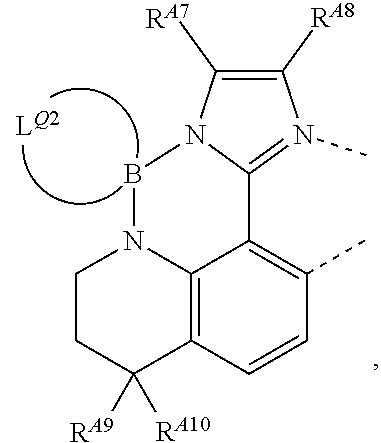 | wherein RA7 = RAo, RA8 = RAp, RA9 = RAq, RA10 = RAr, and LQ2 = LQt, |
| LAa29-(q)(r)(s)(t), wherein q and r are each an integer from 1 to 77, s is an integer from 1 to 14, and t is an integer from 89 to 184, wherein LAa29- (1)(1)(1)(89) to LAa29-(77)(77)(14)(184), having the structure |  | wherein RA9 = RAq, RA10 = RAr, LQ1 = LQs, and LQ2 = LQt, |
| LAa30-X(i)(o)(p)(w), wherein i, o and p are each an integer from 1 to 86, and w is an integer from 15 to 43, wherein LAa30-X(1)(1)(1)(15) to LAa30- X(86)(86)(86)(43), having the structure |  | wherein RA1 = RAi, RA7 = RAo, RA8 = RAp, and LQ5 = LQw, wherein X = B, Al, Ga, or In, |
| LAa31-X(i)(s)(w), wherein i is an integer from 1 to 86, s is an integer from 1 to 14, and w is an integer from 15 to 43, wherein LAa31-X(1)(1)(15) to LAa31-X(86)(14)(43), having the structure |  | wherein RA1 = RAi, LQ1 = LQs, and LQ5 = LQw, wherein X = B, Al, Ga, or In, |
| LAa32-(o)(p)(t)(w), wherein o and p are each an integer from 1 to 86, t is an integer from 89 to 184, and w is an integer from 15 to 43, wherein LAa32-(1)(1)(89)(15) to LAa32-(86)(86)(184)(43), having the structure |  | wherein RA7 = RAo, RA8 = RAp, LQ2 = LQt, and LQ5 = LQw, |
| LAa33-(s)(t)(w), wherein s is an integer from 1 to 14, t is an integer from 89 to 184, and w is an integer from 15 to 43, wherein LAa33-(1)(89)(15) to LAa33-(14)(184)(43), having the structure |  | wherein LQ1 = LQs, LQ2 = LQt, and LQ5 = LQw, |
| LAa34-(m)(n)(p)(q)(r), wherein m, n, q and r are each an integer from 1 to 77, and p is an integer from 1 to 86, wherein LAa34-(1)(1)(1)(1)(1) to LAa34-(77)(77)(86)(77)(77), having the structure |  | wherein RA5 = RAm, RA6 = RAn, RA8 = RAp, RA9 = RAq, and RA10 = RAr, |
| LAa35-(m)(n)(p)(q)(r)(x), wherein m, n, q, r and x are each an integer from 1 to 77, and p is an integer from 1 to 86, wherein LAa35- (1)(1)(1)(1)(1)(1) to LAa35- (77)(77)(86)(77)(77)(77), having the structure |  | wherein RA5 = RAm, RA6 = RAn, RA8 = RAp, RA9 = RAq, RA10 = RAr, and RA11 = RAx, |
| LAa36-(k)(m)(n)(p)(q)(r), wherein k, m, n, q and r are each an integer from 1 to 77, and p is an integer from 1 to 86, wherein LAa36- (1)(1)(1)(1)(1)(1) to LAa36- (77)(77)(77)(86)(77)(77), having the structure |  | wherein RA3 = RAk, RA5 = RAm, RA6 = RAn, RA8 = RAp, RA9 = RAq, and RA10 = RAr, |
| LAa37-(k)(m)(n)(p)(q)(r)(x), wherein k, m, n, q, r and x are each an integer from 1 to 77, and p is an integer from 1 to 86, wherein LAa37- (1)(1)(1)(1)(1)(1)(1) to LAa37- (77)(77)(77)(86)(77)(77)(77), having the structure |  | wherein RA3 = RAk, RA5 = RAm , RA6 = RAn, RA8 = RAp, RA9 = RAq, RA10 = RAr, and RA11 = RAx, |
| LAa38-(m)(n)(p)(q)(r)(y)(z), wherein m, n, q, r, y and z are each an integer from 1 to 77, and p is an integer from 1 to 86, wherein LAa38- (1)(1)(1)(1)(1)(1)(1) to LAa38- (77)(77)(86)(77)(77)(77)(77), having the structure |  | wherein RA5 = RAm, RA6 = RAn, RA8 = RA9 = RAq, RA10 = RAr, RA12 = RAy, and RA13 = RAz, |
| LAa39-(k)(m)(n)(p)(q)(r)(y)(z), wherein k, m, n, q, r, y and z are each an integer from 1 to 77, and p is an integer from 1 to 86, wherein LAa39- (1)(1)(1)(1)(1)(1)(1)(1) to LAa39- (77)(77)(77)(86)(77)(77)(77)(77), having the structure |  | wherein RA3 = RAk, RA5 = RAm, RA6 = RAn, RA8 = RAp, RA9 = RAq, RA10 = RAr, RA12 = RAy, and RA13 = RAz, |
| LAa40-X(o)(p)(t), wherein o and p are each an integer from 1 to 86; wherein t is an integer from 89 to 184, 254 to 267; wherein LAa40-X(1)(1)(89) to LAa40-X(86)(86)(267), having the structure |  | wherein RA7 = RAo, RA8 = RAp, and LQ2 = LQt, wherein X = Al, Ga, or In, |
| LAa41-X(s)(t), wherein s is an integer from 1 to 14 and t is an integer from 89 to 184, 254 to 267; wherein LAa41-X(1)(89) to LAa41-X(14)(267), having the structure |  | wherein LQ1 = LQs, and LQ2 = LQt, wherein X = Al, Ga, or In, |
| LAa42-X(k)(o)(p)(t), wherein k is an integer from 1 to 77, o and p are each an integer from 1 to 86; wherein t is an integer from 89 to 184, 254 to 267, wherein LAa42-X(1)(1)(1)(89) to LAa42- X(77)(86)(86)(267), having the structure |  | wherein RA3 = RAk, RA7 = RAo, RA8 = RAp, and LQ2 = LQt, wherein X = Al, Ga, or In, |
| LAa43-X(k)(l)(o)(p)(t), wherein k and l are each an integer from 1 to 77, o and p are each an integer from 1 to 86; wherein t is an integer from 15 to 88, 268 to 345, wherein LAa43- X(1)(1)(1)(1)(15) to LAa43- X(77)(77)(86)(86)(345), having the structure |  | wherein RA3 = RAk, RA4 = RAl, RA7 = RAo, RA8 = RAp, and LQ2 = LQt,; wherein X = Al, Ga, or In, |
| LAa44-X(o)(p)(t)(u), wherein o and p are each an integer from 1 to 86, and u is an integer from 15 to 24; wherein t is an integer from 15 to 88, 268 to 345, wherein LAa44-X(1)(1)(15)(15) to LAa44- X(86)(86)(345)(24), having the structure |  | wherein RA7 = RAo, RA8 = RAp, LQ2 = LQt, and LQ3 = LQu, wherein X = Al, Ga, or In, |
| LAa45-X(k)(s)(t), wherein k is an integer from 1 to 77, s is an integer from 1 to 14; wherein t is an integer from 89 to 184, 254 to 267; wherein LAa45-X(1)(1)(89) to LAa45-X(77)(14)(267), having the structure |  | wherein RA3 = RAk, LQ1 = LQs, and LQ2 = LQt, wherein X = Al, Ga, or In, |
| LAa46-X(k)(l)(s)(t), wherein k and l are each an integer from 1 to 77, s is an integer from 1 to 14; wherein t is an integer from 15 to 88, 268 to 345, wherein LAa46-X(1)(1)(1)(15) to LAa46- X(77)(77)(14)(345), having the structure |  | wherein RA3 = RAk, RA4 = RAl, LQ1 = LQs, and LQ2 = LQt, wherein X = Al, Ga, or In, |
| LAa47-X(s)(t)(u), wherein s is an integer from 1 to 14, u is an integer from 15 to 24; wherein t is an integer from 15 to 88 268 to 345, wherein LAa47-X(1)(15)(15) to LAa47-X(14)(345)(24), having the structure |  | wherein LQ1 = LQs, LQ2 = LQt, and LQ3 = LQu, wherein X = Al, Ga, or In, |
| LAa48-X(o)(p)(q)(r)(t), wherein o and p are each an integer from 1 to 86, q and r are each an integer from 1 to 77; wherein t is an integer from 89 to 184, 254 to 267, wherein LAa48- X(1)(1)(1)(1)(89) to LAa48- X(86)(86)(77)(77)(267), having the structure |  | wherein RA7 = RAo, RA8 = RAp, RA9 = RAq, RA10 = RAr, and LQ2 = LQt, wherein X = Al, Ga, or In, |
| LAa49-X(q)(r)(s)(t), wherein q and r are each an integer from 1 to 77, s is an integer from 1 to 14; wherein t is an integer from 89 to 184, 254 to 267, wherein LAa49-X(1)(1)(1)(89) to LAa49- X(77)(77)(14)(267), having the structure |  | wherein RA9 = RAq, RA10 = RAr, LQ1 = LQs, and LQ2 = LQt, wherein X = Al, Ga, or In, |
| LAa50-X(o)(p)(t)(w), wherein o and p are each an integer from 1 to 86, w is an integer from 15 to 43; wherein t is an integer from 89 to 184, 254 to 267, wherein LAa50-X(1)(1)(89)(15) to LAa50- X(86)(86)(267)(43), having the structure |  | wherein RA7 = RAo, RA8 = RAp, LQ2 = LQt, and LQ5 = LQw, wherein X = Al, Ga, or In, |
| LAa51-X(s)(t)(w), wherein s is an integer from 1 to 14, w is an integer from 15 to 43; wherein t is an integer from 89 to 184, 254 to 267, wherein LAa51-X(1)(89)(15) to LAa51-X(14)(267)(43), having the structure |  | wherein LQ1 = LQs, LQ2 = LQt, and LQ5 = LQw, wherein X = Al, Ga, or In, |
| LAa52-X(i)(j)(k)(o)(p), wherein i, j, o, and p are each an integer from 1 to 86 and k is an integer from 1 to 77, wherein LAa52-X(1)(1)(1)(1)(1) to LAa52-X(86)(86)(77)(86)(86), having the structure |  | wherein RA1 = RAi, RA2 = RAj, RA3 = RAk, RA7 = RAo, and RA8 = RAp, wherein X = B, Al, Ga, or In, |
| LAa53-X(i)(o)(p), wherein i, o, and p are each an integer from 1 to 86, wherein LAa53-X(1)(1)(1) to LAa53-X(86)(86)(86), having the structure |  | wherein RA1 = RAi, RA7 = RAo, and RA8 = RAp, wherein X = B, Al, Ga, or In, |
| LAa54-X(i)(k)(o)(p), wherein i, o, and p are each an integer from 1 to 86 and k is an integer from 1 to 77, wherein LAa54-X(1)(1)(1)(1) to LAa54- X(86)(77)(86)(86), having the structure |  | wherein RA1 = RAi, RA3 = RAk, RA7 = RAo, and RA8 = RAp, wherein X = B, Al, Ga, or In, |
| LAa55-X(i)(j)(k)(l)(o)(p), wherein i, j, o, and p are each an integer from 1 to 86 and k and l are each an integer from 1 to 77, wherein LAa55- X(1)(1)(1)(1)(1)(1) to LAa55- X(86)(86)(77)(77)(86)(86), having the structure |  | wherein RA1 = RAi, RA2 = RAj, RA3 = RAk, RA4 = RAl, RA7 = RAo, and RA8 = RAp, wherein X = B, Al, Ga, or In, |
| LAa56-X(i)(j)(k)(o)(p), wherein i, j, o, and p are each an integer from 1 to 86 and k is an integer from 1 to 77, wherein LAa56-X(1)(1)(1)(1)(1) to LAa56-X(86)(86)(77)(86)(86), having the structure |  | wherein RA1 = RAi, RA2 = RAj, RA3 = RAk, RA7 = RAo, and RA8 = RAp, wherein X = B, Al, Ga, or In, |
| LAa57-X(l)(k)(o)(p), wherein i, o, and p are each an integer from 1 to 86 and k is an integer from 1 to 77, wherein LAa57-X(1)(1)(1)(1) to LAa57- X(86)(77)(86)(86), having the structure |  | wherein RA1 = RAi, RA3 = RAk, RA7 = RAo, and RA8 = RAp, wherein X = B, Al, Ga, or In, |
| LAa58-(o)(p), wherein o and p are each an integer from 1 to 86, wherein LAa58-(1)(1) to LAa58- (86)(86), having the structure |  | wherein RA7 = RAo, and RA8 = RAp, |
| LAa59-(s), wherein s is an integer from 1 to 14, wherein LAa59-(1) to LAa59-(14), having the structure |  | wherein LQ1 = LQs,. |
| LAa60-(k)(o)(p), wherein o and p are each an integer from 1 to 86 and k is an integer from 1 to 77, wherein LAa60-(1)(1)(1) to LAa60- (77)(86)(86), having the structure |  | wherein RA3 = RAk, RA7 = RAo, and RA8 = RAp, |
| LAa61-(k)(s), wherein k is an integer from 1 to 77 and s is an integer from 1 to 14, wherein LAa61- (1)(1) to LAa61-(77)(14), having the structure |  | wherein RA3 = RAk, and LQ1 = LQs, |
| LAa62-(o)(p), wherein o and p are each an integer from 1 to 86, wherein LAa62-(1)(1) to LAa62- (86)(86), having the structure |  | wherein RA7 = RAo, and RA8 = RAp, |
| LAa63-(s), wherein s is an integer from 1 to 14, wherein LAa63-(1) to LAa63-(14), having the structure |  | wherein LQ1 = LQs, |
| LAa64-(k)(o)(p), wherein o and p are each an integer from 1 to 86 and k is an integer from 1 to 77, wherein LAa64-(1)(1)(1) to LAa64- (77)(86)(86), having the structure |  | wherein RA3 = RAk, RA7 = RAo, and RA8 = RAp, |
| LAa65-(k)(s), wherein k is an integer from 1 to 77 and s is an integer from 1 to 14, wherein LAa65- (1)(1) to LAa65-(77)(14), having the structure |  | wherein RA3 = RAk, and LQ1 = LQs, |
| LAa66-(i)(o)(p), wherein i, o, and p are each an integer from 1 to 86, wherein LAa66-(1)(1)(1) to LAa66-(86)(86)(86), having the structure |  | wherein RA1 = RAi, RA7 = RAo, and RA8 = RAp, |
| LAa67-(i)(s), wherein i is an integer from 1 to 86 and s is an integer from 1 to 14, wherein LAa67- (1)(1) to LAa67-(86)(14), having the structure |  | wherein RA1 = RAi, and LQ1 = LQs, |
| LAa68-(i)(k)(o)(p), wherein i, o, and p are each an integer from 1 to 86 and k is an integer from 1 to 77, wherein LAa68-(1)(1)(1)(1) to LAa68- (86)(77)(86)(86), having the structure |  | wherein RA1 = RAi, RA3 = RAk, RA7 = RAo, and RA8 = RAp, |
| LAa69-(i)(k)(s), wherein i is an integer from 1 to 86, k is an integer from 1 to 77, and s is an integer from 1 to 14, wherein LAa69-(1)(1)(1) to LAa69- (86)(77)(14), having the structure |  | wherein RA1 = RAi, RA3 = RAk, and LQ1 = LQs, |
| LAa70-(i)(k)(o), wherein i and o are each an integer from 1 to 86, and k is an integer from 1 to 77, wherein LAa70-(1)(1)(1) to LAa70- (86)(77)(86), having the structure |  | wherein RA1 = RAi, RA3 = RAk, and RA7 = RAo, |
| LAa71-(i)(j)(k)(o), wherein i, j, and o are each an integer from 1 to 86, and k is an integer from 1 to 77, wherein LAa71-(1)(1)(1)(1) to LAa71- (86)(86)(77)(86), having the structure |  | wherein RA1 = RAi, RA2 = RAj, RA3 = RAk, and RA7 = RAo, |
| LAa72-(i)(j)(k)(l)(o), wherein i, j, and o are each an integer from 1 to 86, and k and l are each an integer from 1 to 77, wherein LAa72- (1)(1)(1)(1)(1) to LAa72-(86)(86)(77)(77)(86), having the structure |  | wherein RA1 = RAi, RA2 = RAj, RA3 = RAk, RA4 = RAl, and RA7 = RAo, |
| LAa73-(i)(k)(o), wherein i and o are each an integer from 1 to 86, and k is an integer from 1 to 77, wherein LAa73-(1)(1)(1) to LAa73- (86)(77)(86), having the structure |  | wherein RA1 = RAi, RA3 = RAk, and RA7 = RAo, |
| LAa74-(i)(j)(k)(o), wherein i, j, and o are each an integer from 1 to 86, and k is an integer from 1 to 77, wherein LAa74-(1)(1)(1)(1) to LAa74- (86)(86)(77)(86), having the structure |  | wherein RA1 = RAi, RA2 = RAj, RA3 = RAk, and RA7 = RAo, |
| LAa75-(i)(j)(k)(l)(o), wherein i, j, and o are each an integer from 1 to 86, and k and l are each an integer from 1 to 77, wherein LAa75- (1)(1)(1)(1)(1) to LAa75-(86)(86)(77)(77)(86), having the structure |  | wherein RA1 = RAi, RA2 = RAj, RA3 = RAk, RA4 = RAl, and RA7 = RAo, |
| LAa76-X(i)(j)(k)(o)(p), wherein i, j, k, o, and p are each an integer from 1 to 86 and k is an integer from 1 to 77, wherein LAa76-X(1)(1)(1)(1)(1) to LAa76-X(86)(86)(77)(86)(86), having the structure |  | wherein RA1 = RAi, RA2 = RAj, RA3 = RAk, RA7 = RAo, and RA8 = RAp, wherein X = B, Al, Ga, or In |
wherein RAi, RAj, RAk, RAl, RAm, RAn, RAo, RAp, RAq, RAr, RAx, RAy, and RAz have the structures defined in RA LIST1 below:


and
wherein LQs, LQt, LQu, LQv, and LQw have the structures defined in LQ LIST1 below:


wherein:
X1, X2, and X3 are each independently C or N, with at least two of them being C;
one of Z1 and Z5 is C and the other is N; and
the remaining variables are the same as previously defined in Formula I.

wherein Y1 is O, S, NR3, PR3, CR3R4, or SiR3R4; and the remaining variables are the same as previously defined.
| LAbx | Structure of LAbx | RA1, RA2, RA3 | x |
| LAb1 to LAb8000 having the structure |  | wherein RA1 = RAi, RA2 = RAj, RA3 = RAk, wherein i, j, and k are each an integer from 1 to 20, | wherein x = 20[20(i − 1) + (j − 1)] + k |
| LAb8001 to LAb16000 having the structure |  | wherein RA1 = RAi, RA2 = RAj, RA3 = RAk, wherein i, j, and k are each an integer from 1 to 20, | wherein x = 20[20(i − 1) + (j − 1)] + k + 8000 |
| LAb16001 to LAb24000 having the structure |  | wherein RA1 = RAi, RA2 = RAj, RA3 = RAk, wherein i, j, and k are each an integer from 1 to 20, | wherein x = 20[20(i − 1) + (j − 1)] + k + 16000 |
| LAb24001 to LAb32000 having the structure |  | wherein RA1 = RAi, RA2 = RAj, RA3 = RAk, wherein i, j, and k are each an integer from 1 to 20, | wherein x = 20[20(i − 1) + (j − 1)] + k + 24000 |
| LAb32001 to LAb40000 having the structure |  | wherein RA1 = RAi, RA2 = RAj, RA3 = RAk, wherein i, j, and k are each an integer from 1 to 20, | wherein x = 20[20(i − 1) + (j − 1)] + k + 32000 |
| LAb40001 to LAb48000 having the structure |  | wherein RA1 = RAi, RA2 = RAj, RA3 = RAk, wherein i, j, and k are each an integer from 1 to 20, | wherein x = 20[20(i − 1) + (j − 1)] + k + 40000 |
| LAb48001 to LAb56000 having the structure |  | wherein RA1 = RAi, RA2 = RAj, RA3 = RAk, wherein i, j, and k are each an integer from 1 to 20, | wherein x = 20[20(i − 1) + (j − 1)] + k + 48000 |
| LAb56001 to LAb64000 having the structure |  | wherein RA1 = RAi, RA2 = RAj, RA3 = RAk, wherein i, j, and k are each an integer from 1 to 20, | wherein x = 20[20(i − 1) + (j − 1)] + k + 56000 |
| LAb64001 to LAb72000 having the structure |  | wherein RA1 = RAi, RA2 = RAj, RA3 = RAk, wherein i, j, and k are each an integer from 1 to 20, | wherein x = 20[20(i − 1) + (j − 1)] + k + 64000 |
| LAb72001 to LAb80000 having the structure |  | wherein RA1 = RAi, RA2 = RAj, RA3 = RAk, wherein i, j, and k are each an integer from 1 to 20, | wherein x = 20[20(i − 1) + (j − 1)] + k + 72000 |
| LAb80001 to LAb88000 having the structure |  | wherein RA1 = RAi, RA2 = RAj, RA3 = RAk, wherein i, j, and k are each an integer from 1 to 20, | wherein x = 20[20(i − 1) + (j − 1)] + k + 80000 |
| LAb88001 to LAb96000 having the structure |  | wherein RA1 = RAi, RA2 = RAj, RA3 = RAk, wherein i, j, and k are each an integer from 1 to 20, | wherein x = 20[20(i − 1) + (j − 1)] + k + 88000 |
| LAb96001 to LAb94000 having the structure |  | wherein RA1 = RAi, RA2 = RAj, wherein i and j are each an integer from 1 to 20, | wherein x = 20(i − 1) + j + 96000 |
| LAb96401 to LAb96800 having the structure |  | wherein RA1 = RAi, RA2 = RAj, wherein i and j are each an integer from 1 to 20, | wherein x = 20(i − 1) + j + 96400 |
| LAb96801 to LAb97200 having the structure |  | wherein RA1 = RAi, RA2 = RAj, wherein i and j are each an integer from 1 to 20, | wherein x = 20(i − 1) + j + 96800 |
| LAb97201 to LAb97600 having the structure |  | wherein RA1 = RAi, RA2 = RAj, wherein i and j are each an integer from 1 to 20, | wherein x = 20(i − 1) + j + 97200 |
| LAb97601 to LAb98000 having the structure |  | wherein RA1 = RAi, RA2 = RAj, wherein i and j are each an integer from 1 to 20, | wherein x = 20(i − 1) + j + 97600 |
| LAb98001 to LAb106000 having the structure |  | wherein RA1 = RAi, RA2 = RAj, RA3 = RAk, wherein i, j, and k are each an integer from 1 to 20, | wherein x = 20[20(i − 1) + (j − 1)] + k + 98000 |
| LAb106001 to LAb114000 having the structure |  | wherein RA1 = RAi, RA2 = RAj, RA3 = RAk, wherein i, j, and k are each an integer from 1 to 20, | wherein x = 20[20(i − 1) + (j − 1)] + k + 106000 |
| LAb114001 to LAb122000 having the structure |  | wherein RA1 = RAi, RA2 = RAj, RA3 = RAk, wherein i, j, and k are each an integer from 1 to 20, | wherein x = 20[20(i − 1) + (j − 1)] + k + 114000 |
| LAb122001 to LAb130000 having the structure |  | wherein RA1 = RAi, RA2 = RAj, RA3 = RAk, wherein i, j, and k are each an integer from 1 to 20, | wherein x = 20[20(i − 1) + (j − 1)] + k + 122000 |
| LAb130001 to LAb138000 having the structure |  | wherein RA1 = RAi, RA2 = RAj, RA3 = RAk, wherein i, j, and k are each an integer from 1 to 20, | wherein x = 20[20(i − 1) + (j − 1)] + k + 130000 |
wherein RAi, RAj, and RAk have the structures defined below:


wherein:
each of Y1 to Y13 is independently selected from the group consisting of C and N;
wherein Y′ is selected from the group consisting of BRe, NRe, PRe, O, S, Se, C═O, S═O, SO2, CReRf, SiReRf, and GeReRf; wherein Re and Rf can be fused or joined to form a ring;
each of Ra, Rb, Rc, and Rd independently represents zero, mono, or up to a maximum allowed substitution to its associated ring;
each of Ra, Rb, Rc, Rd, Re and Rf is independently a hydrogen or a substituent selected from the group consisting of the general substituents as described herein; and
any two adjacent substituents of Ra, Rb, Rc, and Rd can be fused or joined to form a ring or form a multidentate ligand.


wherein:
Ra′, Rb′, and Rc′ each independently represents zero, mono, or up to a maximum allowed substitution to its associated ring;
each of Ra, Rb, Rc, RN, Ra′, Rb′, and Rc′ is independently a hydrogen or a substituent selected from the group consisting of the general substituents as described herein; and two adjacent substituents of Ra′, Rb′, and Rc′ can be fused or joined to form a ring or form a multidentate ligand.


and
wherein LC can be selected from the group “First LC List” consisting of LCj-I based on a structure of

and LCj-II based on a structure of

wherein j is an integer from 1 to 768, wherein for each LCj in LCj-I and LCj-II, R1′ and R2′ are defined as provided in LC LIST1 below:
| LCj | R1′ | R2′ | LCj | R1′ | R2′ | LCj | R1′ | R2′ | LCj | R1′ | R2′ |
| LC1 | RD1 | RD1 | LC193 | RD1 | RD3 | LC385 | RD17 | RD40 | LC577 | RD143 | RD120 |
| LC2 | RD2 | RD2 | LC194 | RD1 | RD4 | LC386 | RD17 | RD41 | LC578 | RD143 | RD133 |
| LC3 | RD3 | RD3 | LC195 | RD1 | RD5 | LC387 | RD17 | RD42 | LC579 | RD143 | RD134 |
| LC4 | RD4 | RD4 | LC196 | RD1 | RD9 | LC388 | RD17 | RD43 | LC580 | RD143 | RD135 |
| LC5 | RD5 | RD5 | LC197 | RD1 | RD10 | LC389 | RD17 | RD48 | LC581 | RD143 | RD136 |
| LC6 | RD6 | RD6 | LC198 | RD1 | RD17 | LC390 | RD17 | RD49 | LC582 | RD143 | RD144 |
| LC7 | RD7 | RD7 | LC199 | RD1 | RD18 | LC391 | RD17 | RD50 | LC583 | RD143 | RD145 |
| LC8 | RD8 | RD8 | LC200 | RD1 | RD20 | LC392 | RD17 | RD54 | LC584 | RD143 | RD146 |
| LC9 | RD9 | RD9 | LC201 | RD1 | RD22 | LC393 | RD17 | RD55 | LC585 | RD143 | RD147 |
| LC10 | RD10 | RD10 | LC202 | RD1 | RD37 | LC394 | RD17 | RD58 | LC586 | RD143 | RD149 |
| LC11 | RD11 | RD11 | LC203 | RD1 | RD40 | LC395 | RD17 | RD59 | LC587 | RD143 | RD151 |
| LC12 | RD12 | RD12 | LC204 | RD1 | RD41 | LC396 | RD17 | RD78 | LC588 | RD143 | RD154 |
| LC13 | RD13 | RD13 | LC205 | RD1 | RD42 | LC397 | RD17 | RD79 | LC589 | RD143 | RD155 |
| LC14 | RD14 | RD14 | LC206 | RD1 | RD43 | LC398 | RD17 | RD81 | LC590 | RD143 | RD161 |
| LC15 | RD15 | RD15 | LC207 | RD1 | RD48 | LC399 | RD17 | RD87 | LC591 | RD143 | RD175 |
| LC16 | RD16 | RD16 | LC208 | RD1 | RD49 | LC400 | RD17 | RD88 | LC592 | RD144 | RD3 |
| LC17 | RD17 | RD17 | LC209 | RD1 | RD50 | LC401 | RD17 | RD89 | LC593 | RD144 | RD5 |
| LC18 | RD18 | RD18 | LC210 | RD1 | RD54 | LC402 | RD17 | RD93 | LC594 | RD144 | RD17 |
| LC19 | RD19 | RD19 | LC211 | RD1 | RD55 | LC403 | RD17 | RD116 | LC595 | RD144 | RD18 |
| LC20 | RD20 | RD20 | LC212 | RD1 | RD58 | LC404 | RD17 | RD117 | LC596 | RD144 | RD20 |
| LC21 | RD21 | RD21 | LC213 | RD1 | RD59 | LC405 | RD17 | RD118 | LC597 | RD144 | RD22 |
| LC22 | RD22 | RD22 | LC214 | RD1 | RD78 | LC406 | RD17 | RD119 | LC598 | RD144 | RD37 |
| LC23 | RD23 | RD23 | LC215 | RD1 | RD79 | LC407 | RD17 | RD120 | LC599 | RD144 | RD40 |
| LC24 | RD24 | RD24 | LC216 | RD1 | RD81 | LC408 | RD17 | RD133 | LC600 | RD144 | RD41 |
| LC25 | RD25 | RD25 | LC217 | RD1 | RD87 | LC409 | RD17 | RD134 | LC601 | RD144 | RD42 |
| LC26 | RD26 | RD26 | LC218 | RD1 | RD88 | LC410 | RD17 | RD135 | LC602 | RD144 | RD43 |
| LC27 | RD27 | RD27 | LC219 | RD1 | RD89 | LC411 | RD17 | RD136 | LC603 | RD144 | RD48 |
| LC28 | RD28 | RD28 | LC220 | RD1 | RD93 | LC412 | RD17 | RD143 | LC604 | RD144 | RD49 |
| LC29 | RD29 | RD29 | LC221 | RD1 | RD116 | LC413 | RD17 | RD144 | LC605 | RD144 | RD54 |
| LC30 | RD30 | RD30 | LC222 | RD1 | RD117 | LC414 | RD17 | RD145 | LC606 | RD144 | RD58 |
| LC31 | RD31 | RD31 | LC223 | RD1 | RD118 | LC415 | RD17 | RD146 | LC607 | RD144 | RD59 |
| LC32 | RD32 | RD32 | LC224 | RD1 | RD119 | LC416 | RD17 | RD147 | LC608 | RD144 | RD78 |
| LC33 | RD33 | RD33 | LC225 | RD1 | RD120 | LC417 | RD17 | RD149 | LC609 | RD144 | RD79 |
| LC34 | RD34 | RD34 | LC226 | RD1 | RD133 | LC418 | RD17 | RD151 | LC610 | RD144 | RD81 |
| LC35 | RD35 | RD35 | LC227 | RD1 | RD134 | LC419 | RD17 | RD154 | LC611 | RD144 | RD87 |
| LC36 | RD36 | RD36 | LC228 | RD1 | RD135 | LC420 | RD17 | RD155 | LC612 | RD144 | RD88 |
| LC37 | RD37 | RD37 | LC229 | RD1 | RD136 | LC421 | RD17 | RD161 | LC613 | RD144 | RD89 |
| LC38 | RD38 | RD38 | LC230 | RD1 | RD143 | LC422 | RD17 | RD175 | LC614 | RD144 | RD93 |
| LC39 | RD39 | RD39 | LC231 | RD1 | RD144 | LC423 | RD50 | RD3 | LC615 | RD144 | RD116 |
| LC40 | RD40 | RD40 | LC232 | RD1 | RD145 | LC424 | RD50 | RD5 | LC616 | RD144 | RD117 |
| LC41 | RD41 | RD41 | LC233 | RD1 | RD146 | LC425 | RD50 | RD18 | LC617 | RD144 | RD118 |
| LC42 | RD42 | RD42 | LC234 | RD1 | RD147 | LC426 | RD50 | RD20 | LC618 | RD144 | RD119 |
| LC43 | RD43 | RD43 | LC235 | RD1 | RD149 | LC427 | RD50 | RD22 | LC619 | RD144 | RD120 |
| LC44 | RD44 | RD44 | LC236 | RD1 | RD151 | LC428 | RD50 | RD37 | LC620 | RD144 | RD133 |
| LC45 | RD45 | RD45 | LC237 | RD1 | RD154 | LC429 | RD50 | RD40 | LC621 | RD144 | RD134 |
| LC46 | RD46 | RD46 | LC238 | RD1 | RD155 | LC430 | RD50 | RD41 | LC622 | RD144 | RD135 |
| LC47 | RD47 | RD47 | LC239 | RD1 | RD161 | LC431 | RD50 | RD42 | LC623 | RD144 | RD136 |
| LC48 | RD48 | RD48 | LC240 | RD1 | RD175 | LC432 | RD50 | RD43 | LC624 | RD144 | RD145 |
| LC49 | RD49 | RD49 | LC241 | RD4 | RD3 | LC433 | RD50 | RD48 | LC625 | RD144 | RD146 |
| LC50 | RD50 | RD50 | LC242 | RD4 | RD5 | LC434 | RD50 | RD49 | LC626 | RD144 | RD147 |
| LC51 | RD51 | RD51 | LC243 | RD4 | RD9 | LC435 | RD50 | RD54 | LC627 | RD144 | RD149 |
| LC52 | RD52 | RD52 | LC244 | RD4 | RD10 | LC436 | RD50 | RD55 | LC628 | RD144 | RD151 |
| LC53 | RD53 | RD53 | LC245 | RD4 | RD17 | LC437 | RD50 | RD58 | LC629 | RD144 | RD154 |
| LC54 | RD54 | RD54 | LC246 | RD4 | RD18 | LC438 | RD50 | RD59 | LC630 | RD144 | RD155 |
| LC55 | RD55 | RD55 | LC247 | RD4 | RD20 | LC439 | RD50 | RD78 | LC631 | RD144 | RD161 |
| LC56 | RD56 | RD56 | LC248 | RD4 | RD22 | LC440 | RD50 | RD79 | LC632 | RD144 | RD175 |
| LC57 | RD57 | RD57 | LC249 | RD4 | RD37 | LC441 | RD50 | RD81 | LC633 | RD145 | RD3 |
| LC58 | RD58 | RD58 | LC250 | RD4 | RD40 | LC442 | RD50 | RD87 | LC634 | RD145 | RD5 |
| LC59 | RD59 | RD59 | LC251 | RD4 | RD41 | LC443 | RD50 | RD88 | LC635 | RD145 | RD17 |
| LC60 | RD60 | RD60 | LC252 | RD4 | RD42 | LC444 | RD50 | RD89 | LC636 | RD145 | RD18 |
| LC61 | RD61 | RD61 | LC253 | RD4 | RD43 | LC445 | RD50 | RD93 | LC637 | RD145 | RD20 |
| LC62 | RD62 | RD62 | LC254 | RD4 | RD48 | LC446 | RD50 | RD116 | LC638 | RD145 | RD22 |
| LC63 | RD63 | RD63 | LC255 | RD4 | RD49 | LC447 | RD50 | RD117 | LC639 | RD145 | RD37 |
| LC64 | RD64 | RD64 | LC256 | RD4 | RD50 | LC448 | RD50 | RD118 | LC640 | RD145 | RD40 |
| LC65 | RD65 | RD65 | LC257 | RD4 | RD54 | LC449 | RD50 | RD119 | LC641 | RD145 | RD41 |
| LC66 | RD66 | RD66 | LC258 | RD4 | RD55 | LC450 | RD50 | RD120 | LC642 | RD145 | RD42 |
| LC67 | RD67 | RD67 | LC259 | RD4 | RD58 | LC451 | RD50 | RD133 | LC643 | RD145 | RD43 |
| LC68 | RD68 | RD68 | LC260 | RD4 | RD59 | LC452 | RD50 | RD134 | LC644 | RD145 | RD48 |
| LC69 | RD69 | RD69 | LC261 | RD4 | RD78 | LC453 | RD50 | RD135 | LC645 | RD145 | RD49 |
| LC70 | RD70 | RD70 | LC262 | RD4 | RD79 | LC454 | RD50 | RD136 | LC646 | RD145 | RD54 |
| LC71 | RD71 | RD71 | LC263 | RD4 | RD81 | LC455 | RD50 | RD143 | LC647 | RD145 | RD58 |
| LC72 | RD72 | RD72 | LC264 | RD4 | RD87 | LC456 | RD50 | RD144 | LC648 | RD145 | RD59 |
| LC73 | RD73 | RD73 | LC265 | RD4 | RD88 | LC457 | RD50 | RD145 | LC649 | RD145 | RD78 |
| LC74 | RD74 | RD74 | LC266 | RD4 | RD89 | LC458 | RD50 | RD146 | LC650 | RD145 | RD79 |
| LC75 | RD75 | RD75 | LC267 | RD4 | RD93 | LC459 | RD50 | RD147 | LC651 | RD145 | RD81 |
| LC76 | RD76 | RD76 | LC268 | RD4 | RD116 | LC460 | RD50 | RD149 | LC652 | RD145 | RD87 |
| LC77 | RD77 | RD77 | LC269 | RD4 | RD117 | LC461 | RD50 | RD151 | LC653 | RD145 | RD88 |
| LC78 | RD78 | RD78 | LC270 | RD4 | RD118 | LC462 | RD50 | RD154 | LC654 | RD145 | RD89 |
| LC79 | RD79 | RD79 | LC271 | RD4 | RD119 | LC463 | RD50 | RD155 | LC655 | RD145 | RD93 |
| LC80 | RD80 | RD80 | LC272 | RD4 | RD120 | LC464 | RD50 | RD161 | LC656 | RD145 | RD116 |
| LC81 | RD81 | RD81 | LC273 | RD4 | RD133 | LC465 | RD50 | RD175 | LC657 | RD145 | RD117 |
| LC82 | RD82 | RD82 | LC274 | RD4 | RD134 | LC466 | RD55 | RD3 | LC658 | RD145 | RD118 |
| LC83 | RD83 | RD83 | LC275 | RD4 | RD135 | LC467 | RD55 | RD5 | LC659 | RD145 | RD119 |
| LC84 | RD84 | RD84 | LC276 | RD4 | RD136 | LC468 | RD55 | RD18 | LC660 | RD145 | RD120 |
| LC85 | RD85 | RD85 | LC277 | RD4 | RD143 | LC469 | RD55 | RD20 | LC661 | RD145 | RD133 |
| LC86 | RD86 | RD86 | LC278 | RD4 | RD144 | LC470 | RD55 | RD22 | LC662 | RD145 | RD134 |
| LC87 | RD87 | RD87 | LC279 | RD4 | RD145 | LC471 | RD55 | RD37 | LC663 | RD145 | RD135 |
| LC88 | RD88 | RD88 | LC280 | RD4 | RD146 | LC472 | RD55 | RD40 | LC664 | RD145 | RD136 |
| LC89 | RD89 | RD89 | LC281 | RD4 | RD147 | LC473 | RD55 | RD41 | LC665 | RD145 | RD146 |
| LC90 | RD90 | RD90 | LC282 | RD4 | RD149 | LC474 | RD55 | RD42 | LC666 | RD145 | RD147 |
| LC91 | RD91 | RD91 | LC283 | RD4 | RD151 | LC475 | RD55 | RD43 | LC667 | RD145 | RD149 |
| LC92 | RD92 | RD92 | LC284 | RD4 | RD154 | LC476 | RD55 | RD48 | LC668 | RD145 | RD151 |
| LC93 | RD93 | RD93 | LC285 | RD4 | RD155 | LC477 | RD55 | RD49 | LC669 | RD145 | RD154 |
| LC94 | RD94 | RD94 | LC286 | RD4 | RD161 | LC478 | RD55 | RD54 | LC670 | RD145 | RD155 |
| LC95 | RD95 | RD95 | LC287 | RD4 | RD175 | LC479 | RD55 | RD58 | LC671 | RD145 | RD161 |
| LC96 | RD96 | RD96 | LC288 | RD9 | RD3 | LC480 | RD55 | RD59 | LC672 | RD145 | RD175 |
| LC97 | RD97 | RD97 | LC289 | RD9 | RD5 | LC481 | RD55 | RD78 | LC673 | RD146 | RD3 |
| LC98 | RD98 | RD98 | LC290 | RD9 | RD10 | LC482 | RD55 | RD79 | LC674 | RD146 | RD5 |
| LC99 | RD99 | RD99 | LC291 | RD9 | RD17 | LC483 | RD55 | RD81 | LC675 | RD146 | RD17 |
| LC100 | RD100 | RD100 | LC292 | RD9 | RD18 | LC484 | RD55 | RD87 | LC676 | RD146 | RD18 |
| LC101 | RD101 | RD101 | LC293 | RD9 | RD20 | LC485 | RD55 | RD88 | LC677 | RD146 | RD20 |
| LC102 | RD102 | RD102 | LC294 | RD9 | RD22 | LC486 | RD55 | RD89 | LC678 | RD146 | RD22 |
| LC103 | RD103 | RD103 | LC295 | RD9 | RD37 | LC487 | RD55 | RD93 | LC679 | RD146 | RD37 |
| LC104 | RD104 | RD104 | LC296 | RD9 | RD40 | LC488 | RD55 | RD116 | LC680 | RD146 | RD40 |
| LC105 | RD105 | RD105 | LC297 | RD9 | RD41 | LC489 | RD55 | RD117 | LC681 | RD146 | RD41 |
| LC106 | RD106 | RD106 | LC298 | RD9 | RD42 | LC490 | RD55 | RD118 | LC682 | RD146 | RD42 |
| LC107 | RD107 | RD107 | LC299 | RD9 | RD43 | LC491 | RD55 | RD119 | LC683 | RD146 | RD43 |
| LC108 | RD108 | RD108 | LC300 | RD9 | RD48 | LC492 | RD55 | RD120 | LC684 | RD146 | RD48 |
| LC109 | RD109 | RD109 | LC301 | RD9 | RD49 | LC493 | RD55 | RD133 | LC685 | RD146 | RD49 |
| LC110 | RD110 | RD110 | LC302 | RD9 | RD50 | LC494 | RD55 | RD134 | LC686 | RD146 | RD54 |
| LC111 | RD111 | RD111 | LC303 | RD9 | RD54 | LC495 | RD55 | RD135 | LC687 | RD146 | RD58 |
| LC112 | RD112 | RD112 | LC304 | RD9 | RD55 | LC496 | RD55 | RD136 | LC688 | RD146 | RD59 |
| LC113 | RD113 | RD113 | LC305 | RD9 | RD58 | LC497 | RD55 | RD143 | LC689 | RD146 | RD78 |
| LC114 | RD114 | RD114 | LC306 | RD9 | RD59 | LC498 | RD55 | RD144 | LC690 | RD146 | RD79 |
| LC115 | RD115 | RD115 | LC307 | RD9 | RD78 | LC499 | RD55 | RD145 | LC691 | RD146 | RD81 |
| LC116 | RD116 | RD116 | LC308 | RD9 | RD79 | LC500 | RD55 | RD146 | LC692 | RD146 | RD87 |
| LC117 | RD117 | RD117 | LC309 | RD9 | RD81 | LC501 | RD55 | RD147 | LC693 | RD146 | RD88 |
| LC118 | RD118 | RD118 | LC310 | RD9 | RD87 | LC502 | RD55 | RD149 | LC694 | RD146 | RD89 |
| LC119 | RD119 | RD119 | LC311 | RD9 | RD88 | LC503 | RD55 | RD151 | LC695 | RD146 | RD93 |
| LC120 | RD120 | RD120 | LC312 | RD9 | RD89 | LC504 | RD55 | RD154 | LC696 | RD146 | RD117 |
| LC121 | RD121 | RD121 | LC313 | RD9 | RD93 | LC505 | RD55 | RD155 | LC697 | RD146 | RD118 |
| LC122 | RD122 | RD122 | LC314 | RD9 | RD116 | LC506 | RD55 | RD161 | LC698 | RD146 | RD119 |
| LC123 | RD123 | RD123 | LC315 | RD9 | RD117 | LC507 | RD55 | RD175 | LC699 | RD146 | RD120 |
| LC124 | RD124 | RD124 | LC316 | RD9 | RD118 | LC508 | RD116 | RD3 | LC700 | RD146 | RD133 |
| LC125 | RD125 | RD125 | LC317 | RD9 | RD119 | LC509 | RD116 | RD5 | LC701 | RD146 | RD134 |
| LC126 | RD126 | RD126 | LC318 | RD9 | RD120 | LC510 | RD116 | RD17 | LC702 | RD146 | RD135 |
| LC127 | RD127 | RD127 | LC319 | RD9 | RD133 | LC511 | RD116 | RD18 | LC703 | RD146 | RD136 |
| LC128 | RD128 | RD128 | LC320 | RD9 | RD134 | LC512 | RD116 | RD20 | LC704 | RD146 | RD146 |
| LC129 | RD129 | RD129 | LC321 | RD9 | RD135 | LC513 | RD116 | RD22 | LC705 | RD146 | RD147 |
| LC130 | RD130 | RD130 | LC322 | RD9 | RD136 | LC514 | RD116 | RD37 | LC706 | RD146 | RD149 |
| LC131 | RD131 | RD131 | LC323 | RD9 | RD143 | LC515 | RD116 | RD40 | LC707 | RD146 | RD151 |
| LC132 | RD132 | RD132 | LC324 | RD9 | RD144 | LC516 | RD116 | RD41 | LC708 | RD146 | RD154 |
| LC133 | RD133 | RD133 | LC325 | RD9 | RD145 | LC517 | RD116 | RD42 | LC709 | RD146 | RD155 |
| LC134 | RD134 | RD134 | LC326 | RD9 | RD146 | LC518 | RD116 | RD43 | LC710 | RD146 | RD161 |
| LC135 | RD135 | RD135 | LC327 | RD9 | RD147 | LC519 | RD116 | RD48 | LC711 | RD146 | RD175 |
| LC136 | RD136 | RD136 | LC328 | RD9 | RD149 | LC520 | RD116 | RD49 | LC712 | RD133 | RD3 |
| LC137 | RD137 | RD137 | LC329 | RD9 | RD151 | LC521 | RD116 | RD54 | LC713 | RD133 | RD5 |
| LC138 | RD138 | RD138 | LC330 | RD9 | RD154 | LC522 | RD116 | RD58 | LC714 | RD133 | RD3 |
| LC139 | RD139 | RD139 | LC331 | RD9 | RD155 | LC523 | RD116 | RD59 | LC715 | RD133 | RD18 |
| LC140 | RD140 | RD140 | LC332 | RD9 | RD161 | LC524 | RD116 | RD78 | LC716 | RD133 | RD20 |
| LC141 | RD141 | RD141 | LC333 | RD9 | RD175 | LC525 | RD116 | RD79 | LC717 | RD133 | RD22 |
| LC142 | RD142 | RD142 | LC334 | RD10 | RD3 | LC526 | RD116 | RD81 | LC718 | RD133 | RD37 |
| LC143 | RD143 | RD143 | LC335 | RD10 | RD5 | LC527 | RD116 | RD87 | LC719 | RD133 | RD40 |
| LC144 | RD144 | RD144 | LC336 | RD10 | RD17 | LC528 | RD116 | RD88 | LC720 | RD133 | RD41 |
| LC145 | RD145 | RD145 | LC337 | RD10 | RD18 | LC529 | RD116 | RD89 | LC721 | RD133 | RD42 |
| LC146 | RD146 | RD146 | LC338 | RD10 | RD20 | LC530 | RD116 | RD93 | LC722 | RD133 | RD43 |
| LC147 | RD147 | RD147 | LC339 | RD10 | RD22 | LC531 | RD116 | RD117 | LC723 | RD133 | RD48 |
| LC148 | RD148 | RD148 | LC340 | RD10 | RD37 | LC532 | RD116 | RD118 | LC724 | RD133 | RD49 |
| LC149 | RD149 | RD149 | LC341 | RD10 | RD40 | LC533 | RD116 | RD119 | LC725 | RD133 | RD54 |
| LC150 | RD150 | RD150 | LC342 | RD10 | RD41 | LC534 | RD116 | RD120 | LC726 | RD133 | RD58 |
| LC151 | RD151 | RD151 | LC343 | RD10 | RD42 | LC535 | RD116 | RD133 | LC727 | RD133 | RD59 |
| LC152 | RD152 | RD152 | LC344 | RD10 | RD43 | LC536 | RD116 | RD134 | LC728 | RD133 | RD78 |
| LC153 | RD153 | RD153 | LC345 | RD10 | RD48 | LC537 | RD116 | RD135 | LC729 | RD133 | RD79 |
| LC154 | RD154 | RD154 | LC346 | RD10 | RD49 | LC538 | RD116 | RD136 | LC730 | RD133 | RD81 |
| LC155 | RD155 | RD155 | LC347 | RD10 | RD50 | LC539 | RD116 | RD143 | LC731 | RD133 | RD87 |
| LC156 | RD156 | RD156 | LC348 | RD10 | RD54 | LC540 | RD116 | RD144 | LC732 | RD133 | RD88 |
| LC157 | RD157 | RD157 | LC349 | RD10 | RD55 | LC541 | RD116 | RD145 | LC733 | RD133 | RD89 |
| LC158 | RD158 | RD158 | LC350 | RD10 | RD58 | LC542 | RD116 | RD146 | LC734 | RD133 | RD93 |
| LC159 | RD159 | RD159 | LC351 | RD10 | RD59 | LC543 | RD116 | RD147 | LC735 | RD133 | RD117 |
| LC160 | RD160 | RD160 | LC352 | RD10 | RD78 | LC544 | RD116 | RD149 | LC736 | RD133 | RD118 |
| LC161 | RD161 | RD161 | LC353 | RD10 | RD79 | LC545 | RD116 | RD151 | LC737 | RD133 | RD119 |
| LC162 | RD162 | RD162 | LC354 | RD10 | RD81 | LC546 | RD116 | RD154 | LC738 | RD133 | RD120 |
| LC163 | RD163 | RD163 | LC355 | RD10 | RD87 | LC547 | RD116 | RD155 | LC739 | RD133 | RD133 |
| LC164 | RD164 | RD164 | LC356 | RD10 | RD88 | LC548 | RD116 | RD161 | LC740 | RD133 | RD134 |
| LC165 | RD165 | RD165 | LC357 | RD10 | RD89 | LC549 | RD116 | RD175 | LC741 | RD133 | RD135 |
| LC166 | RD166 | RD166 | LC358 | RD10 | RD93 | LC550 | RD143 | RD3 | LC742 | RD133 | RD136 |
| LC167 | RD167 | RD167 | LC359 | RD10 | RD116 | LC551 | RD143 | RD5 | LC743 | RD133 | RD146 |
| LC168 | RD168 | RD168 | LC360 | RD10 | RD117 | LC552 | RD143 | RD17 | LC744 | RD133 | RD147 |
| LC169 | RD169 | RD169 | LC361 | RD10 | RD118 | LC553 | RD143 | RD18 | LC745 | RD133 | RD149 |
| LC170 | RD170 | RD170 | LC362 | RD10 | RD119 | LC554 | RD143 | RD20 | LC746 | RD133 | RD151 |
| LC171 | RD171 | RD171 | LC363 | RD10 | RD120 | LC555 | RD143 | RD22 | LC747 | RD133 | RD154 |
| LC172 | RD172 | RD172 | LC364 | RD10 | RD133 | LC556 | RD143 | RD37 | LC748 | RD133 | RD155 |
| LC173 | RD173 | RD173 | LC365 | RD10 | RD134 | LC557 | RD143 | RD40 | LC749 | RD133 | RD161 |
| LC174 | RD174 | RD174 | LC366 | RD10 | RD135 | LC558 | RD143 | RD41 | LC750 | RD133 | RD175 |
| LC175 | RD175 | RD175 | LC367 | RD10 | RD136 | LC559 | RD143 | RD42 | LC751 | RD175 | RD3 |
| LC176 | RD176 | RD176 | LC368 | RD10 | RD143 | LC560 | RD143 | RD43 | LC752 | RD175 | RD5 |
| LC177 | RD177 | RD177 | LC369 | RD10 | RD144 | LC561 | RD143 | RD48 | LC753 | RD175 | RD18 |
| LC178 | RD178 | RD178 | LC370 | RD10 | RD145 | LC562 | RD143 | RD49 | LC754 | RD175 | RD20 |
| LC179 | RD179 | RD179 | LC371 | RD10 | RD146 | LC563 | RD143 | RD54 | LC755 | RD175 | RD22 |
| LC180 | RD180 | RD180 | LC372 | RD10 | RD147 | LC564 | RD143 | RD58 | LC756 | RD175 | RD37 |
| LC181 | RD181 | RD181 | LC373 | RD10 | RD149 | LC565 | RD143 | RD59 | LC757 | RD175 | RD40 |
| LC182 | RD182 | RD182 | LC374 | RD10 | RD151 | LC566 | RD143 | RD78 | LC758 | RD175 | RD41 |
| LC183 | RD183 | RD183 | LC375 | RD10 | RD154 | LC567 | RD143 | RD79 | LC759 | RD175 | RD42 |
| LC184 | RD184 | RD184 | LC376 | RD10 | RD155 | LC568 | RD143 | RD81 | LC760 | RD175 | RD43 |
| LC185 | RD185 | RD185 | LC377 | RD10 | RD161 | LC569 | RD143 | RD87 | LC761 | RD175 | RD48 |
| LC186 | RD186 | RD186 | LC378 | RD10 | RD175 | LC570 | RD143 | RD88 | LC762 | RD175 | RD49 |
| LC187 | RD187 | RD187 | LC379 | RD17 | RD3 | LC571 | RD143 | RD89 | LC763 | RD175 | RD54 |
| LC188 | RD188 | RD188 | LC380 | RD17 | RD5 | LC572 | RD143 | RD93 | LC764 | RD175 | RD48 |
| LC189 | RD189 | RD189 | LC381 | RD17 | RD18 | LC573 | RD143 | RD116 | LC765 | RD175 | RD59 |
| LC190 | RD190 | RD190 | LC382 | RD17 | RD20 | LC574 | RD143 | RD117 | LC766 | RD175 | RD78 |
| LC191 | RD191 | RD191 | LC383 | RD17 | RD22 | LC575 | RD143 | RD118 | LC767 | RD175 | RD79 |
| LC192 | RD192 | RD192 | LC384 | RD17 | RD37 | LC576 | RD143 | RD119 | LC768 | RD175 | RD81 |
wherein RD1 to RD192 have the following structures:


wherein:
M is Pd or Pt; rings C and D are each independently a 5-membered or 6-membered carbocyclic or heterocyclic ring; M1 and M2 are each independently C or N; A1-A3 are each independently C or N; K1 and K2 are each independently selected from the group consisting of a direct bond, O, and S; L1-L3 are each independently selected from the group consisting of a direct bond, O, S, CR′R″, SiR′R″, BR′, and NR′; R′ and R″ are each independently selected from the group consisting of hydrogen or a general substituent as described herein; m, n, and o are each independently 0 or 1; m+n+o=2 or 3; RC and RD each have the same definition as RA in Formula I; the remaining variables are the same as previously defined; and any two substituents can be joined or fused together to form a ring.


wherein Wj have the following structures:


wherein X is B, Al, Ga, or In;
wherein RE, RF, RG, RH, RI, and RJ have the same definition as RA in Formula I, and R5 through R28 have the same definition as R1 in Formula I.

wherein all the variables are the same as previously defined.
| Ligand # | Structure of LAx/LAx′ | RA1-RA13, LQ1-LQ5 |
| LAx1-X(i)(o)(p) and LAx′1- X(i)(o)(p), wherein i, o, and p are each an integer from 1 to 86, wherein LAx1-X(1)(1)(1) to LAx1- X(86)(86)(86) and LAx′1- X(1)(1)(1) to LAx′1- X(86)(86)(86), having the structure |  | wherein RA1 = RAi, RA7 = RAo, and RA8 = RAp, wherein X = B, A, Ga, or In, |
| wherein a is 0 or 1, wherein the structure is | ||
| LAx1 when a is 1, and the structure is LAx′1 | ||
| when a is 0, | ||
| LAx2-X(i)(s) and LAx′2-X(i)(s), wherein i is an integer from 1 to 86, and s is an integer from 1 to 14, wherein LAx2-X(1)(1) to LAx2-X(86)(14) and LAx′2- X(1)(1) to LAx′2-X(86)(14), having the structure |  | wherein RA1 = RAi, and LQ1 = LQs, wherein X = B, Al, Ga, or In, |
| wherein a is 0 or 1, wherein the structure is | ||
| LAx2 when a is 1, and the structure is LAx′2 | ||
| when a is 0, | ||
| LAx3-(o)(p)(t) and LAx′3-(o)(p)(t), wherein o and p are each an integer from 1 to 86 and t is an integer from 89 to 184, wherein LAx3-(1)(1)(89) to LAx3- (86)(86)(184) and LAx′3- (1)(1)(89) to LAx′3-(86)(86)(184), having the structure |  | wherein RA7 = RAo, RA8 = RAp and LQ2 = LQt, |
| wherein a is 0 or 1, wherein the structure is | ||
| LAx3 when a is 1, and the structure is LAx′3 | ||
| when a is 0, | ||
| LAx4-(s)(t) and LAx′4-(s)(t), wherein s is an integer from 1 to 14 and t is an integer from 89 to 184. wherein LAx4-(1)(89) to LAx4-(14)(184) and LAx′4-(1)(89) to LAx′4-(14)(184), having the structure |  | wherein LQ1 = LQs, and LQ2 = LQt, |
| wherein a is 0 or 1, wherein the structure is | ||
| LAx4 when a is 1, and the structure is LAx′4 | ||
| when a is 0, | ||
| LAx5-X(i)(o)(p) and LAx′5- X(i)(o)(p), wherein i, o, and p are each an integer from 1 to 86, wherein LAx5-X(1)(1)(1) to LAx5- X(86)(86)(86) and LAx′5- X(1)(1)(1) to or LAx′5- X(86)(86)(86), having the structure |  | wherein RA1 = RAi, RA7 = RAo and RA8 = RAp, wherein X = B, Al, Ga, or In, |
| wherein a is 0 or 1, wherein the structure is | ||
| LAx5 when a is 1, and the structure is LAx′5 | ||
| when a is 0, | ||
| LAx6-X(i)(j)(k)(o)(p) and LAx′6- X(i)(j)(k)(o)(p), wherein i, j, o, and p are each an integer from 1 to 86 and k is an integer from 1 to 77, wherein LAx6- X(1)(1)(1)(1)(1) to LAx6- X(86)(86)(77)(86)(86) and LAx′6- X(1)(1)(1)(1)(1) to LAx′6- X(86)(86)(77)(86)(86), having the structure |  | wherein RA1 = RAi, RA2 = RAj, RA3 = RAk, RA7 = RAo, and RA8 = RAp, wherein X = B, Al, Ga, or In, |
| wherein a is 0 or 1, wherein the structure is | ||
| LAx6 when a is 1, and the structure is LAx′6 | ||
| when a is 0, | ||
| LAx7-X(k)(m)(n) (p) and LAx′7- X(k)(m)(n) (p), wherein k, m, and n are each an integer from 1 to 77 and p is an integer from 1 to 86, wherein LAx7- X(1)(1)(1)(1) to LAx7- X(77)(77)(77)(86) and LAx′7-X(1)(1)(1)(1) to LAx-7- X(77)(77)(77)(86), having the structure |  | wherein RA3 = RAk, RA5 = RAm, RA6 = RAn, and RA8 = RAp, wherein X = B, Al, Ga, or In, |
| wherein a is 0 or 1, wherein the structure is | ||
| LAx7 when a is 1, and the structure is LAx′7 | ||
| when a is 0, | ||
| LAx8-X(k)(p)(w) and LAx′8- X(k)(p)(w), wherein k is an integer from 1 to 77, p is an integer from 1 to 86, and w is an integer from 15 to 43, wherein LAx8-X(1)(1)(15) to LAx8- X(77)(86)(43) and LAx′8- X(1)(1)(15) to LAx′8- X(77)(86)(43), having the structure |  | wherein RA3 = RAk, RA8 = RAp, and LQ5 = LQw, wherein X = B, Al, Ga, or In, |
| wherein a is 0 or 1, wherein the structure is | ||
| LAx8 when a is 1, and the structure is LAx′8 | ||
| when a is 0, | ||
| LAx9-X(k)(m)(n)(p) and LAx′9- X(k)(m)(n)(p), wherein k, m, and n are each an integer from 1 to 77 and p is an integer from 1 to 86, wherein LAx9-X(1)(1)(1)(1) to LAx9-X(77)(77)(77)(86) and LAx′9-X(1)(1)(1)(1) to LAx′9- X(77)(77)(77)(86), having the structure |  | wherein RA3 = RAk, RA5 = RAm, RA6 = RAn, and RA8 = RAp, wherein X = B, Al, Ga, or In, |
| wherein a is 0 or 1, wherein the structure is | ||
| LAx9 when a is 1, and the structure is LAx′9 | ||
| when a is 0, | ||
| LAx10-X(k)(p)(w) and LAx′10- X(k)(p)(w), wherein k is an integer from 1 to 77, p is an integer from 1 to 86, and w is an integer from 15 to 43, wherein LAx10-X(1)(1)(15) to LAx10- X(77)(86)(43) and LAx′10- X(1)(1)(15) to LAx′10- X(77)(86)(43), having the structure |  | wherein RA3 = RAk, RA8 = RAp, and LQ5 = LQw, wherein X = B, Al, Ga, or In, |
| wherein a is 0 or 1, wherein the structure is | ||
| | ||
| when a is 0, | ||
| LAx11-X(k)(p) and LAx′11- X(k)(p), wherein k is an integer from 1 to 77 and p is an integer from 1 to 86, wherein LAx11- X(1)(1) to LAx11-X(77)(86) and LAx′11-X(1)(1) to LAx′11- X(77)(86), having the structure |  | wherein RA3 = RAk, and RA8 = RAp, wherein X = B, Al, Ga, or In, |
| wherein a is 0 or 1, wherein the structure is | ||
| LAx11 when a is 1, and the structure is LAx′11 | ||
| when a is 0, | ||
| LAx12-X(i)(k)(o)(p) and LAx′12- X(i)(k)(o)(p), wherein i, o, and p are each an integer from 1 to 86 and k is an integer from 1 to 77, wherein LAx12-X(1)(1)(1)(1) to LAx12-X(86)(77)(86)(86) and LAx′12-X(1)(1)(1)(1) to LAx′12- X(86)(77)(86)(86), having the structure |  | wherein RA1 = RAi, RA3 = RAk, RA7 = RAo, and RA8 = RAp, wherein X = B, Al, Ga, or In, |
| wherein a is 0 or 1, wherein the structure is | ||
| LAx12 when a is 1, and the structure is LAx′12 | ||
| when a is 0, | ||
| LAx13-X(i)(j)(k)(l)(o)(p) and LAx′13-X(i)(j)(k)(l)(o)(p), wherein i, j, o, and p are each an integer from 1 to 86 and k and l are each an integer from 1 to 77 wherein LAx13-X(1)(1)(1)(1)(1)(1) to LAx13-X(86)(86)(77)(77)(86)(86) and LAx′13-X(1)(1)(1)(1)(1)(1) to LAx′13- X(86)(86)(77)(77)(86)(86), having the structure |  | wherein RA1 = RAi, RA2 = RAj, RA3 = RAk, RA4 = RAl, RA7 = RAo, and RA8 = RAp, wherein X = B, Al, Ga, or In, |
| wherein a is 0 or 1, wherein the structure is | ||
| LAx13 when a is 1, and the structure is LAx′13 | ||
| when a is 0, | ||
| LAx14-X(i)(k)(s) and LAx′14- X(i)(k)(s), wherein i is an integer from 1 to 86, k is an integer from 1 to 77, and s is an integer from 1 to 14, wherein LAx14-X(1)(1)(1) to LAx14-X(86)(77)(14) and LAx′14-X(1)(1)(1) to LAx′14- X(86)(77)(14), having the structure |  | wherein RA1 = RAi, RA3 = RAk, and LQ1 = LQs, wherein X = B, Al, Ga, or In, |
| wherein a is 0 or 1, wherein the structure is | ||
| LAx14 when a is 1, and the structure is LAx′14 | ||
| when a is 0, | ||
| LAx15-X(i)(j)(k)(l)(s) and LAx′15- X(i)(j)(k)(l)(s), wherein i and j are each an integer from 1 to 86, k and l are each an integer from 1 to 77, and s is an integer from 1 to 14, wherein LAx15- X(1)(1)(1)(1)(1) to LAx15- X(86)(86)(77)(77)(14) and LAx′15-X(1)(1)(1)(1)(1) to LAx′15- X(86)(86)(77)(77)(14), having the structure |  | wherein RA1 = RAi, RA2 = RAj, RA3 = RAk, RA4 = RAl, and LQ1 = LQs, wherein X = B, Al, Ga, or In, |
| wherein a is 0 or 1, wherein the structure is | ||
| LAx15 when a is 1, and the structure is LAx′15 | ||
| when a is 0, | ||
| LAx16-(k)(o)(p)(t) and LAx′16- (k)(o)(p)(t), wherein k is an integer from 1 to 77, o and p are each an integer from 1 to 86, and t is an integer from 89 to 184, wherein LAx16-(1)(1)(1)(89) to LAx16-(77)(86)(86)(184) and LAx′16-(1)(1)(1)(89) to LAx′16- (77)(86)(86)(184), having the structure |  | wherein RA3 = RAk, RA7 = RAo, RA8 = RAp, and LQ2 = LQt, |
| wherein a is 0 or 1, wherein the structure is | ||
| LAx16 when a is 1, and the structure is LAx′16 | ||
| when a is 0, | ||
| LAx17-(k)(l)(o)(p)(t) and LAx′17- (k)(l)(o)(p)(t), wherein k and l are each an integer from 1 to 77, o and p are each an integer from 1 to 86, and t is an integer from 15- 88, wherein LAx17- (1)(1)(1)(1)(15) to LAx17- (77)(77)(86)(86)(88) and LAx′17- (1)(1)(1)(1)(15) to LAx′17- (77)(77)(86)(86)(88), having the structure |  | wherein RA3 = RAk, RA4 = RAl, RA7 = RAo, RA8 = RAp, and LQ2 = LQt, |
| wherein a is 0 or 1, wherein the structure is | ||
| LAx17 when a is 1, and the structure is LAx′17 | ||
| when a is 0, | ||
| LAx18-X(i)(j)(o)(p)(u) and LAx′18-X(i)(j)(o)(p)(u), wherein i, j, o and p are each an integer from 1 to 86, and u is an integer from 15 to 24, wherein LAx18- X(1)(1)(1)(1)(15) to LAx18- X(86)(86)(86)(86)(24) and LAx′18-X(1)(1)(1)(1)(15) to LAx′18-X(86)(86)(86)(86)(24), having the structure |  | wherein RA1 = RAi, RA2 = RAj, RA7 = RAo, RA8 = RAp, and LQ3 = LQw, wherein X = B, Al, Ga, or In, |
| wherein a is 0 or 1, wherein the structure is | ||
| LAx18 when a is 1, and the structure is LAx′18 | ||
| when a is 0, | ||
| LAx19-(o)(p)(t)(u) and LAx′19- (o)(p)(t)(u), wherein o and p are each an integer from 1 to 86, t is an integer from 15 to 88, and u is an integer from 15 to 24, wherein LAx19-(1)(1)(15)(15) to LAx19- (86)(86)(88)(24) and LAx′19- (1)(1)(15)(15) to LAx′19- (86)(86)(88)(24), having the structure |  | wherein RA7 = RAo, RA8 = RAp, LQ2 = LQt, and LQ3 = LQu, |
| wherein a is 0 or 1, wherein the structure is | ||
| LAx19 when a is 1, and the structure is LAx′19 | ||
| when a is 0, | ||
| LAx20-(k)(s)(t) and LAx′20- (k)(s)(t), wherein k is an integer from 1 to 77, s is an integer from 1 to 14, and t is an integer from 89 to 184, wherein LAx20- (1)(1)(89) to LAx20-(77)(14)(184) and LAx′20-(1)(1)(89) to LAx′20- (77)(14)( 184), having the structure |  | wherein RA3 = RAk, LQ1 = LQs, and LQ2 = LQt, |
| wherein a is 0 or 1, wherein the structure is | ||
| LAx20 when a is 1, and the structure is LAx′20 | ||
| when a is 0, | ||
| LAx21-(k)(l)(o)(s) and LAx′21- (k)(l)(o)(s), wherein k and l are each an integer from 1 to 77, s is an integer from 1 to 14, and 1 is an integer from 15 to 88, wherein LAx21-(1)(1)(1)(15) to LAx21- (77)(77)(14)(88) and LAx′21- (1)(1)(1)(15) to LAx′21- (77)(77)(14)(88), having the structure |  | wherein RA3 = RAk, RA4 = RAl, LQ1 = LQs, and LQ2 = LQt, |
| wherein a is 0 or 1, wherein the structure is | ||
| LAx21 when a is 1, and the structure is LAx′21 | ||
| when a is 0, | ||
| LAx22-X(i)(j)(s)(u) and LAx′22- X(i)(j)(s)(u), wherein i and j are each an integer from 1 to 86, s is an integer from 1 to 14, and u is an integer from 15 to 24, wherein LAx22-X(1)(1)(1)(15) to LAx22- X(86)(86)(14)(24) and LAx′22- X(1)(1)(1)(15) to LAx-22- X(86)(86)(14)(24), having the structure |  | wherein RA1 = RAi, RA2 = RAj, LQ1 = LQs, and LQ3 = LQu, wherein X = B, Al, Ga, or In, |
| wherein a is 0 or 1, wherein the structure is | ||
| LAx22 when a is 1, and the structure is LAx′22 | ||
| when a is 0, | ||
| LAx23-(s)(t)(u) and LAx′23- (s)(t)(u), wherein s is an integer from 1 to 14, t is an integer from 15 to 88, and u is an integer from 15 to 24, wherein LAx23- (1)(15)(15) to LAx23-(14)(88)(24) and LAx′23-(1)(15)(15) to LAx′23- (14)(88)(24), having the structure |  | wherein LQ1 = LQs, LQ2 = LQt, and LQ3 = LQu, |
| wherein a is 0 or 1, wherein the structure is | ||
| LAx23 when a is 1, and the structure is LAx′23 | ||
| when a is 0, | ||
| LAx24-X(o)(p)(v) and LAx′24- X(o)(p)(v), wherein o and p are each an integer from 1 to 86, and v is an integer from 185 to 253, wherein LAx24-(1)(1)(185) to LAx24-(86)(86)(253) and LAx′24- X(1)(1)(185) to LAx′24- X(86)(86)(253), having the structure |  | wherein RA7 = RAo, RA8 = RAp, and LQ4 = LQv, wherein X = B, Al, Ga, or In, |
| wherein a is 0 or 1, wherein the structure is | ||
| LAx24 when a is 1, and the structure is LAx′24 | ||
| when a is 0, | ||
| LAx25-X(s)(v) or LAx′25-X(s)(v), wherein s is an integer from 1 to 14. and v is an integer from 185 to 255, wherein LAx25-X(1)(185) to LAx25-X(14)(253) and LAx′25- X(1)(185) to LAx′25-X(14)(253), having the structure |  | wherein LQ1 = LQs, and = LQ4 = LQv, wherein X = B, Al, Ga, or In, |
| wherein a is 0 or 1, wherein the structure is | ||
| LAx25 when a is 1, and the structure is LAx′25 | ||
| when a is 0, | ||
| LAx26-X(i)(o)(p)(q)(r) and LAx′26-X(i)(o)(p)(q)(r), wherein i, o, and p are each an integer from 1 to 86, and q and r are integers from 1 to 77, wherein LAx26- X(1)(1)(1)(1)(1) to LAx26- X(86)(86)(86)(77)(77) and LAx′26-X(1)(1)(1)(1)(1) to LAx′26-X(86)(86)(86)(77)(77), having the structure |  | wherein RA1 = RAi, RA7 = RAo, RA8 = RAp, RA9 = RAq, and RA10 = RAr, wherein X = B, Al, Ga, or In, |
| wherein a is 0 or 1, wherein the structure is | ||
| LAx26 when a is 1, and the structure is LAx′26 | ||
| when a is 0, | ||
| LAx27-X(i)(q)(r)(s) and LAx′27- X(i)(q)(r)(s), wherein i is an integer from 1 to 86, q and r are each an integer from 1 to 77, and s is an integer from 1 to 14, wherein LAx27-X(1)(1)(1)(1) to LAx27-X(86)(77)(77)(14) and LAx′27-X(1)(1)(1)(1) to LAx′27- X(86)(77)(77)(14), having the structure |  | wherein RA1 = RAi, RA9 = RAq, RA10 = RAr, and LQ1 = LQs, wherein X = B, Al, Ga, or In, |
| wherein a is 0 or 1, wherein the structure is | ||
| LAx27 when a is 1, and the structure is LAx′27 | ||
| when a is 0, | ||
| LAx28-(o)(p)(q)(r)(t) or LAx′28- (o)(p)(q)(r)(t), wherein o and p are each an integer from to 1 to 86, q and r are each an integer from 1 to 77, and 1 is an integer from 89 to 184, wherein LAx28- (1)(1)(1)(1)(89) to LAx28- (86)(86)(77)(77)(184) and LAx′28- (1)(1)(1)(1)(89) to LAx′28- (86)(86)(77)(77)(184), having the structure |  | wherein RA7 = RAo, RA8 = RAp, RA9 = RAq, RA10 = RAr, and LQ2 = LQt, |
| wherein a is 0 or 1, wherein the structure is | ||
| LAx28 when a is 1, and the structure is LAx′28 | ||
| when a is 0, | ||
| LAx29-(q)(r)(s)(t) and LAx′29- (q)(r)(s)(t), wherein q and r are each an integer from 1 to 77, s is an integer from 1 to 14, and t is an integer from 89 to 184, wherein LAx29-(1)(1)(1)(89) to LAx29-(77)(77)(14)(184) and LAx′29-(1)(1)(1)(89) to LAx′29- (77)(77)(14)(184), having the structure |  | wherein RA9 = RAq, RA10 = RAr, LQ1 = LQs, and LQ2 = LQt, |
| wherein a is 0 or 1, wherein the structure is | ||
| LAx29 when a is 1, and the structure is LAx′29 | ||
| when a is 0, | ||
| LAx30-X(i)(o)(p)(w) and LAx′30- X(i)(o)(p)(w), wherein i, o and p are each an integer from 1 to 86, and w is an integer from 15 to 43, wherein LAx30-X(1)(1)(1)(15) to LAx30-X(86)(86)(86)(43) and LAx′30-X(1)(1)(1)(15) to LAx′30- X(86)(86)(86)(43), having the structure |  | wherein RA1 = RAi, RA7 = RAo, RA8 = RAp, and LQ5 = LQw, wherein X = B, Al, Ga. or In, |
| wherein a is 0 or 1, wherein the structure is | ||
| LAx30 when a is 1, and the structure is LAx′30 | ||
| when a is 0, | ||
| LAx31-X(i)(s)(w) and LAx′31- X(i)(s)(w), wherein i is an integer from 1 to 86, s is an integer from 1 to 14, and w is an integer from 15 to 43, wherein LAx31- X(1)(1)(15) to LAx31- X(86(14)(43) and LAx′31- X(1)(1)(15) to LAx′31- X(86)(14)(43), having the structure |  | wherein RA1 = RAi, LQ1 = LQs, and LQ5 = LQw, wherein X = B, Al, Ga, or In, |
| wherein a is 0 or 1, wherein the structure is | ||
| LAx31 when a is 1, and the structure is LAx′31 | ||
| when a is 0, | ||
| LAx32-(o)(p)(t)(w) or LAx′32- (o)(p)(t)(w), wherein o and p are each an integer from 1 to 86.1 is an integer from 89 to 184, and w is an integer from 15 to 43, wherein LAx32-(1)(1)(89)(15) to LAx32-(86)(86)(184)(43) and LAx′32-(1)(1)(89)(15) to LAx32-or LAx′32-(86)(86)(184)(43), having the structure |  | wherein RA7 = RAo, RA8 = RAp, LQ2 = LQt, and LQ5 = LQw, |
| wherein a is 0 or 1, wherein the structure is | ||
| LAx32 when a is 1, and the structure is LAx′32 | ||
| when a is 0, | ||
| LAx33-(s)(t)(w) and LAx′33- (s)(t)(w), wherein s is an integer from 1 to 14, t is an integer from 89 to 184, and w is an integer from 15 to 43, wherein LAx33- (1)(89)(15) to LAx33- (14)(184)(43) and LAx′33- (1)(89)(15) to LAx′33- (14)(184)(43), having the structure |  | wherein LQ1 = LQs, LQ2 = LQt, and LQ5 = LQw, |
| wherein a is 0 or 1, wherein the structure is | ||
| LAx33 when a is 1, and the structure is LAx′33 | ||
| when a is 0, | ||
| LAx34-(m)(n)(p)(q)(r) and LAx′34- (m)(n)(p)(q)(r), wherein m, n, q and r are each an integer from 1 to 77, and p is an integer from 1 to 86, wherein LAx34- (1)(1)(1)(1)(1) to LAx34- (77)(77)(86)(77)(77) and LAx′34- (1)(1)(1)(1)(1) to LAx′34- (77)(77)(86)(77)(77), having the structure |  | wherein RA5 = RAm, RA6 = RAn, RA8 = RAp, RA9 = RAq, and RA10 = RAr, |
| wherein a is 0 or 1, wherein the structure is | ||
| LAx34 when a is 1, and the structure is LAx′34 | ||
| when a is 0, | ||
| LAx35-(m)(n)(p)(q)(r)(x) and LAx′35-(m)(n)(p)(q)(r)(x), wherein m, n, q, r and x are each an integer from 1 to 77, and p is an integer front 1 to 86, wherein LAx35-(1)(1)(1)(1)(1)(1) to LAx35-(77)(77)(86)(77)(77)(77) and LAx′35-(1)(1)(1)(1)(1)(1) to LAx′35-(77)(77)(86)(77)(77)(77), having the structure |  | wherein RA5 = RAm, RA6 = RAn, RA8 = RAp, RA9 = RAq, RA10 = RAr, and RA11 = RAx, |
| wherein a is 0 or 1, wherein the structure is | ||
| LAx35 when a is 1, and the structure is LAx′35 | ||
| when a is 0, | ||
| LAx36-(k)(m)(n)(p)(q)(r) or LAx′36-(k)(m)(n)(p)(q)(r), wherein k, m, n, q and r are each an integer from 1 to 77, and p is an integer from 1 to 86, wherein LAx36-(1)(1)(1)(1)(1)(1) to LAx36-(77)(77)(77)(86)(77)(77) and LAx′36-(1)(1)(1)(1)(1)(1) to LAx′36-(77)(77)(77)(86)(77)(77), having the structure |  | wherein RA3 = RAk, RA5 = RAm, RA6 = RAn, RA8 = RAp, RA9 = RAq, and RA10 = RAr, |
| wherein a is 0 or 1, wherein the structure is | ||
| LAx36 when a is 1, and the structure is LAx′36 | ||
| when a is 0, | ||
| LAx37-(k)(m)(n)(p)(q)(r)(x) and LAx′37-(k)(m)(n)(p)(q)(r)(x), wherein k, m, n, q, r and x are each an integer from 1 to 77, and p is an integer from 1 to 86. wherein LAx37- (1)(1)(1)(1)(1)(1)(1) to LAx37- (77)(77)(77)(86)(77)(77)(77) arrd LAx′37-(1)(1)(1)(1)(1)(1)(1) to LAx′37- (77)(77)(77)(86)(77)(77)(77), having the structure |  | wherein RA3 = RAk, RA5 = RAm, RA6 = RAn, RA8 = RAp, RA9 = RAq, RA10 = RAr, and RA11 = RAx, |
| wherein a is 0 or 1, wherein the structure is | ||
| LAx37 when a is 1, and the structure is LAx′37 | ||
| when a is 0, | ||
| LAx38-(m)(n)(p)(q)(r)(y)(z) and LAx′38-(m)(n)(p)(q)(r)(y)(z), wherein m, n, q, r, y and z are each an integer from 1 to 77, and p is an integer from 1 to 86, wherein LAx38- (1)(1)(1)(1)(1)(1)(1) to LAx38- (77)(77)(86)(77)(77)(77)(77) and LAx′38-(1)(1)(1)(1)(1)(1)(1) to LAx′38- (77)(77)(86)(77)(77)(77)(77), having the structure |  | wherein RA5 = RAm, RA6 = RAn, RA8 = RAp, RA9 = RAq, RA10 = RAr, RA12 = RAy, and RA13 = RAz |
| wherein a is 0 or 1, wherein the structure is | ||
| LAx38 when a is 1, and the structure is LAx′38 | ||
| when a is 0, | ||
| LAx39-(k)(m)(n)(p)(q)(r)(y)(z) and LAx′39-(k)(m)(n)(p)(q)(r)(y)(z), wherein k, m, n, q, r, y and z are each an integer from 1 to 77, and p is an integer from 1 to 86, wherein LAx39- (1)(1)(1)(1)(1)(1)(1)(1) to LAx39- (77)(77)(77)(86)(77)(77)(77)(77) and LAx′39- (1)(1)(1)(1)(1)(1)(1)(1) to LAx′39- (77)(77)(77)(86)(77)(77)(77)(77), having the structure |  | wherein RA3 = RAk, RA5 = RAm, RA6 = RAn, RA8 = RAp, RA9 = RAq, RA10 = RAr, RA12 = RAy, and RA13 = RAz, |
| wherein a is 0 or 1, wherein the structure is | ||
| LAx39 when a is 1, and the structure is LAx′39 | ||
| when a is 0, | ||
| LAx40-X(o)(p)(t) and LAx′40- X(o)(p)(t), wherein o and p are each an integer from 1 to 86; wherein t is an integer from 89 to 184, 254 to 267, wherein LAx40- X(1)(1)(89) to LAx40- X(86)(86)(267) and LAx′40- X(1)(1)(89) to LAx′40- X(86)(86)(267), having the structure |  | wherein RA7 = RAo, RA8 = RAp, and LQ2 = LQt, wherein X = Al, Ga, or In, |
| wherein a is 0 or 1, wherein the structure is | ||
| LAx40 when a is 1, and the structure is LAx′40 | ||
| when a is 0, | ||
| LAx41-(s)(t) and LAx′41-(s)(t), wherein s is an integer from 1 to 14; wlterein t is an integer from 89 to 184, 254 to 267, wherein LAx41-(1)(89) to LAx41 -(14)(267) and LAx′41-(1)(89) to LAx′41- (14)(267), having the structure |  | wherein LQ1 = LQs, and LQ2 = LQt, wherein X = Al, Ga, or In, |
| wherein a is 0 or 1, wherein the structure is | ||
| LAx41 when a is 1, and the structure is LAx′41 | ||
| when a is 0, | ||
| LAx42-X(k)(o)(p)(t) and LAx′42- X(k)(o)(p)(t), wherein k is an integer from 1 to 77, o and p are each an integer from 1 to 86, wherein 1 is an integer from 89 to 184, 254 to 267, wherein LAx42-X(1)(1)(1)(89) to LAx42- X(77)(86)(86)(267) and LAx′42- X(1)(1)(1)(89) to LAx′42- X(77)(86)(86)(267), having the structure |  | wherein RA3 = RAk, RA7 = RAo, RA8 = RAp, and LQ2 = LQt, |
| wherein a is 0 or 1, wherein the structure is | ||
| LAx42 when a is 1, and the structure is LAx′42 | ||
| when a is 0, | ||
| LAx43-X(k)(l)(o)(p)(t) or LAx′43- X(k)(l)(o)(p)(t), wherein k and l are each an integer from 1 to 77, o and p are each an integer from 1 to 86; wherein t is an integer from 13 to 88, 268 to 345; wherein LAx43-X(1)(1)(1)(1)(15) to LAx43-X(77)(77)(86)(86)(345) and LAx′43-X(1)(1)(1)(1)(15) to LAx′43-X(77)(77)(86)(86)(345), having the structure |  | wherein RA3 = RAk, RA4 = RAl, RA7 = RAo, RA8 = RAp, and LQ2 = LQt, wherein X = Al, Ga, or In, |
| wherein a is 0 or 1, wherein the structure is | ||
| LAx43 when a is 1, and the structure is LAx′43 | ||
| when a is 0, | ||
| LAx44-X(o)(p)(t)(u) and LAx′44- X(o)(p)(t)(u), wherein o and p are each an integer from 1 to 86, and u is an integer from 15 to 24; wherein t is an integer from 15 to 88, 268 to 345; wherein LAx44- X(1)(1)(15)(15) to LAx44- X(86)(86)(345)(24) and LAx′44- X(1)(1)(15)(15) to LAx′44- X(86)(86)(345)(24), having the structure |  | wherein RA7 = RAo, RA8 = RAp, LQ2 = LQt, and LQ3 = LQu, wherein X = Al, Ga, or In, |
| wherein a is 0 or 1, wherein the structure is | ||
| LAx44 when a is 1, and the structure is LAx′44 | ||
| when a is 0, | ||
| LAx45-X(k)(s)(t) and LAx′45- X(k)(s)(t), wherein k is an integer from 1 to 77, s is an integer from 1 to 14; w herein t is an integer from 89 to 184, 254 to 267, wherein LAx45-X(1)(1)(89) to LAx45-X(77)(14)(267) and LAx′45-X(1)(1)(89) to LAx′45- X(77)(14)(267), having the structure |  | wherein RA3 = RAk, LQ1 = LQs, and LQ2 = LQt, wherein X = Al, Ga, or In, |
| wherein a is 0 or 1, wherein the structure is | ||
| LAx45 when a is 1, and the structure is LAx′45 | ||
| when a is 0, | ||
| LAx46-X(k)(t)(s)(t) and LAx′46- X(k)(t)(s)(t), wherein k and l are each an integer from 1 to 77, s is an integer from 1 to 14; wherein t is an integer from 15 to 88, 268 to 345, wherein LAx46- X(1)(1)(1)(15) to LAx46- X(77)(77)(14)(345) and LAx′46- X(1)(1)(1)(15) to LAx′46- X(77)(77)(14)(345), having the structure |  | wherein RA3 = RAk, RA4 = RAl, LQ1 = LQs, and LQ2 = LQt, wherein X = Al, Ga, or In, |
| wherein a is 0 or 1, wherein the structure is | ||
| LAx46 when a is 1, and the structure is LAx′46 | ||
| when a is 0, | ||
| LAx47-X(s)(t)(u) and LAx′47- X(s)(t)(u), wherein s is an integer from 1 to 14, u is an integer from 15 to 24; wherein t is an integer from 15 to 88, 268 to 345, wherein LAx47-X(1)(15)(15) to LAx47-X(14)(345)(24) and LAx′47-X(1)(15)(15) to LAx′47- X(14)(345)(24), having the structure |  | wherein LQ1 = LQs, LQ2 = LQt, and LQ3 = LQw, wherein X = Al, Ga, or In, |
| wherein a is 0 or 1, wherein the structure is | ||
| LAx47 when a is 1, and the structure is LAx′47 | ||
| when a is 0, | ||
| LAx48-X(o)(p)(q)(r)(t) and LAx′48-X(o)(p)(q)(r)(t), wherein o and p are each an integer from 1 to 86, q and r are each an integer from 1 to 77; wherein t is an integer from 89 to 184, 254 to 267, wherein LAx48- X(1)(1)(1)(1)(89) to LAx48- X(86)(86)(77)(77)(267) and LAx′48-X(1)(1)(1)(1)(89) to LAx′48-X(86)(86)(77)(77)(267), having the structure |  | wherein RA7 = RAo, RA8 = RAp, RA9 = RAq, RA10 = RAr, and LQ2 = LQt, wherein X = Al, Ga, or In, |
| wherein a is 0 or 1, wherein the structure is | ||
| LAx48 when a is 1, and the structure is LAx′48 | ||
| when a is 0, | ||
| LAx49-X(i)(j)(k)(o)(p) and LAx′49-X(i)(j)(k)(o)(p), wherein i, j, o, and p are each an integer from 1 to 86 and k is an integer from 1 to 77, wherein LAx49- X(1)(1)(1)(1)(1) to LAx49- X(86)(86)(77)(86)(86) and LAx′49-X(1)(1)(1)(1)(1) to LAx′49- X(86)(86)(77)(86)(86), having the structure |  | wherein RA1 = RAi, RA2 = RAj, RA3 = RAk, RA7 = RAo, and RA8 = RAp, wherein X = B, Al, Ga, or In, |
| wherein a is 0 or 1, wherein the structure is | ||
| LAx49 when a is 1, and the structure is LAx′49 | ||
| when a is 0, | ||
| LAx50-X(i)(o)(p) or LAx′50- X(i)(o)(p), wherein i, o, and p are each an integer from 1 to 86, wherein LAx50-X(1)(1)(1) to LAx50-X(86)(86)(86) and LAx′50- X(1)(1)(1) to LAx′50- X(86)(86)(86), having the structure |  | wherein RA1 = RAi, RA7 = RAo, and RA8 = RAp, wherein X = B, Al, Ga, or In, |
| wherein a is 0 or 1, wherein the structure is | ||
| LAx50 when a is 1, and the structure is LAx′50 | ||
| when a is 0, | ||
| LAx51-X(i)(k)(o)(p) and LAx′51- X(i)(k)(o)(p), wherein i, o, and p are each an integer from 1 to 86 and k is an integer from 1 to 77, wherein LAx51-X(1)(1)(1)(1) to LAx51-X(86)(77)(86)(86) and LAx′51-X(1)(1)(1)(1) to LAx′51- X(86)(77)(86)(86), having the structure |  | wherein RA1 = RAi, RA3 = RAk, RA7 = RAo, and RA8 = RAp, wherein X = B, Al, Ga, or In, |
| wherein a is 0 or 1, wherein the structure is | ||
| LAx51 when a is 1, and the structure is LAx′51 | ||
| when a is 0, | ||
| LAx52-X(i)(j)(k)(l)(o)(p) and LAx52-X(i)(j)(k)(l)(o)(p), wherein i, j, o, and p are each an integer from 1 to 86 and k and l are each an integer from 1 to 77, wherein LAx52-X(1)(1)(1)(1)(1)(1) to LAx52-X(86)(86)(77)(77)(86)(86) and LAx′52-X(1)(1)(1)(1)(1)(1) to LAx′52-X(86)(86)(77)(77)(86)(86), having the structure |  | wherein RA1 = RAi, RA2 = RAj, RA5 = RAk, RA4 = RAl, RA7 = RAo, and RA8 = RAp, wherein X = B, Al, Ga, or In, |
| wherein a is 0 or 1, wherein the structure is | ||
| LAx52 when a is 1, and the structure is LAx′52 | ||
| when a is 0, | ||
| LAx53-X(i)(j)(k)(o)(p) and LAx′53- X(i)(j)(k)(o)(p), wherein i, j, o, and p are each an integer from 1 to 86 and k is an integer from 1 to 77, wherein LAx53- X(1)(1)(1)(1)(1) to LAx53- X(86)(86)(77)(86)(86) and LAx′53-X(1)(1)(1)(1)(1) to LAx′53- X(86)(86)(77)(86)(86), having the structure |  | wherein RA1 = RAi, RA2 = RAj, RA3 = RAk, RA7 = RAo, and RA8 = RAp, wherein X = B, Al, Ga, or In, |
| wherein a is 0 or 1, wherein the structure is | ||
| LAx53 when a is 1, and the structure is LAx′53 | ||
| when a is 0, | ||
| LAx54-X(i)(k)(o)(p) and LAx′54- X(i)(k)(o)(p), wherein i, o, and p are each an integer from 1 to 86 and k is an integer from 1 to 77, wherein LAx54-X(1)(1)(1)(1) to LAx54-X(86)(77)(86)(86) and LAx′54-X(1)(1)(1)(1) to LAx′54- X(86)(77)(86)(86), having the structure |  | wherein RA1 = RAi, RA3 = RAk, RA7 = RAo, and RA8 = RAp, wherein X = B, Al, Ga, or In, |
| wherein a is 0 or 1, wherein the structure is | ||
| LAx54 when a is 1, and the structure is LAx′54 | ||
| when a is 0, | ||
| LAx55-(o)(p) and LAx′55-(o)(p), wherein o and p are integers from 1 to 86., wherein LAx55-(1)(1) to LAx55-(86)(86) and LAx′55-(1)(1) to LAx′55-(86)(86), having the structure |  | wherein RA7 = RAo, and RA8 = RAp, |
| wherein a is 0 or 1, wherein the structure is | ||
| LAx55 when a is 1, and the structure is LAx′55 | ||
| when a is 0, | ||
| LAx56-(s) and LAx′56-(s), wherein s is an integer from 1 to 14, wherein LAx56-(1) to LAx56-(14) and LAx′56-(1) to LAx′56-(14), having the structure |  | wherein LQ1 = LQs, |
| wherein a is 0 or 1, wherein the structure is | ||
| LAx56 when a is 1, and the structure is LAx′56 | ||
| when a is 0, | ||
| LAx57-(k)(o)(p) and LAx′57- (k)(o)(p), wherein o and p are each an integer from 1 to 86 and k is an integer from 1 to 77, wherein LAx57-(1)(1)(1) to LAx57- (77)(86)(86) and LAx′57-(1)(1)(1) to LAx′57-(77)(86)(86), having the structure |  | wherein RA3 = RAk, RA7 = RAo, and RA8 = RAp, |
| wherein a is 0 or 1, wherein the structure is | ||
| LAx57 when a is 1, and the structure is LAx′57 | ||
| when a is 0, | ||
| LAx58-(k)(s) and LAx′58-(k)(s), wherein k is an integer from 1 to 77 and s is an integer from 1 to 14, wherein LAx58-(1)(1) to LAx58-(77)(14) and LAx′58-(1)(1) to LAx′58-(77)(14), having the structure |  | wherein RA3 = RAk, and LQ1 = LQs, |
| wherein a is 0 or 1, wherein the structure is | ||
| LAx58 when a is 1, and the structure is LAx′58 | ||
| when a is 0, | ||
| LAx59-(o)(p) and LAx′59-(o)(p), wherein o and p are each an integer from 1 to 86, wherein LAx59-(1)(1) to LAx59-(86)(86) and LAx′59-(1)(1) to LAx′59- (86)(86), having the structure |  | wherein RA7 = RAo, and RA8 = RAp, |
| wherein a is 0 or 1, wherein the structure is | ||
| LAx59 when a is 1, and the structure is LAx′59 | ||
| when a is 0, | ||
| LAx60-(s) and LAx′60-(s), wherein s is an integer from 1 to 14, wherein LAx60-(1) to LAx60-(14) and LAx′60-(1) to LAx′60-(14), having the structure |  | wherein LQ1 = LQs, |
| wherein a is 0 or 1, wherein the structure is | ||
| LAx60 when a is 1, and the structure is LAx′60 | ||
| when a is 0, | ||
| LAx61-(k)(o)(p) and LAx′61- (k)(o)(p), wherein o and p are each an integer from 1 to 86 and k is an integer from 1 to 77, wherein LAx61-(1)(1)(1) to LAx61- (77)(86)(86) and LAx′61-(1)(1)(1) to LAx′61-(77)(86)(86), having the structure |  | wherein RA3 = RAk, RA7 = RAo, and RA8 = RAp, |
| wherein a is 0 or 1, wherein the structure is | ||
| LAx61 when a is 1, and the structure is LAx′61 | ||
| when a is 0, | ||
| LAx62-(k)(s) and LAx′62-(k)(s), wherein k is an integer from 1 to 77 and s is an integer from 1 to 14, wherein LAx62-(1)(1) to LAx62-(77)(14) and LAx′62-(1)(1) to LAx′62-(77)(14), having the structure |  | wherein RA3 = RAk, and LQ1 = LQs, |
| wherein a is 0 or 1, wherein the structure is | ||
| LAx62 when a is 1, and the structure is LAx′62 | ||
| when a is 0, | ||
| LAx63-(i)(o)(p) and LAx′63- (i)(o)(p), wherein i, o, and p are each an integers from 1 to 86, wherein LAx63-(1)(1)(1) to LAx63- (86)(86)(86) and LAx′63-(1)(1)(1) to LAx′63-(86)(86)(86), having the structure |  | wherein RA1 = RAi, RA7 = RAo, and RA8 = RAp, |
| wherein a is 0 or 1, wherein the structure is | ||
| LAx63 when a is 1, and the structure is LAx′63 | ||
| when a is 0, | ||
| LAx64-(i)(s) and LAx′64-(i)(s), wherein i is an integer from 1 to 86 and s is an integer from 1 to 14, wherein LAx64-(1)(1) to LAx64-(86)(14) and LAx′64-(1)(1) to LAx′64-(86)(14), having the structure |  | wherein RA1 = RAi, and LQ1 = LQs, |
| wherein a is 0 or 1, wherein the structure is | ||
| LAx64 when a is 1, and the structure is LAx′64 | ||
| when a is 0, | ||
| LAx65-(i)(k)(o)(p) and LAx′65- (i)(k)(o)(p), wherein i, o, and p are each an integer from 1 to 86 and k is an integer from 1 to 77, wherein LAx65-(1)(1)(1)(1) to LAx65-(86)(77)(86)(86) and LAx′65-(1)(1)(1)(1) to LAx′65- (86)(77)(86)(86), having the structure |  | wherein RA1 = RAi, RA3 = RAk, RA7 = RAo, and RA8 = RAp, |
| wherein a is 0 or 1, wherein the structure is | ||
| LAx65 when a is 1, and the structure is LAx′65 | ||
| when a is 0, | ||
| LAx66-(i)(k)(s) and LAx′66- (i)(k)(s), wherein i is an integer from 1 to 86, k is an integer from 1 to 77, and s is an integer from 1 to 14, wherein LAx66-(1)(1)(1) to LAx66-(86)(77)(14) and LAx′66- (1)(1)(1) to LAx′66-(86)(77)(14), having the structure |  | wherein RA1 = RAi, RA3 = RAk, and LQ1 = LQs, |
| wherein a is 0 or 1, wherein the structure is | ||
| LAx66 when a is 1, and the structure is LAx′66 | ||
| when a is 0, | ||
| LAx67-(i)(j)(k)(o)(p)(q)(r) and LAx′67-(i)(j)(k)(o)(p)(q)(r), wherein j, k, o, p, q and r are each an integer from 1 to 86 and i is an integer from 1 to 77, wherein LAx67-(1)(1)(1)(1)(1)(1)(1) to LAx67- (77)(86)(86)(86)(86)(86)(86) and LAx′67-(1)(1)(1)(1)(1)(1)(1) to LAx′67- (77)(86)(86)(86)(86)(86)(86), having the structure |  | wherein RA1 = RAi, RA2 = RAj, RA3 = RAk, RA4 = RAo, RA5 = RAp, RA7 = RAq, and RA8 = RAr, |
| wherein a is 0 or 1, wherein the structure is | ||
| LAx67 when a is 1, and the structure is LAx′67 | ||
| when a is 0, | ||
| LAx68-(i)(j)(k)(o)(p)(q)(r)(s) and LAx′68-(i)(j)(k)(o)(p)(q)(r)(s), wherein j, k. o, p, q and r are each an integer from 1 to 86 and i is an integer from 1 to 77 and s is an integer from 1 to 14, wherein LAx68-(1)(1)(1)(1)(1)(1)(1)(1) to LAx68- (77)(86)(86)(86)(86)(86)(86)(14) and LAx′68- (1)(1)(1)(1)(1)(1)(1)(1) to LAx′68- (77)(86)(86)(86)(86)(86)(86)(14), having the structure |  | wherein RA1 = RAi, RA2 = RAj, RA3 = RAk, RA4 = RAo, RA5 = RAp, RA7 = RAq, RA8 = RAr, and LQ1 = LQs, |
| wherein a is 0 or 1, wherein the structure is | ||
| LAx68 when a is 1, and the structure is LAx′68 | ||
| when a is 0, | ||
| LAa69-(i)(k)(o) and LAx′69- (i)(k)(o), wherein i and o are each an integer from 1 to 86, and k is an integer from 1 to 77, wherein LAa69-(1)(1)(1) to LAa69- (86)(77)(86) and LAx′69-(1)(1)(1) to LAx′69-(86)(77)(86), having the structure |  | wherein RA1 = RAi, RA3 = RAk, and RA7 = RAo, |
| wherein a is 0 or 1, wherein the structure is | ||
| LAx69 when a is 1, and the structure is LAx′69 | ||
| when a is 0, | ||
| LAa70-(i)(j)(k)(o) and LAx′70- (i)(j)(k)(o), wherein i, j, and o are each an integer from 1 to 86, and A is an integer from 1 to 77, wherein LAa70-(1)(1)(1)(1) to LAa70-(86)(86)(77)(86) and LAx′70-(1)(1)(1)(1) to LAx′70- (86)(86)(77)(86), having the structure |  | wherein RA1 = RAi, RA2 = RAj, RA3 = RAk, and RA7 = RAo, |
| wherein a is 0 or 1, wherein the structure is | ||
| LAx70 when a is 1, and the structure is LAx′70 | ||
| when a is 0, | ||
| LAa71-(i)(j)(k)(l)(o) and LAx′71- (i)(j)(k)(l)(o), wherein i, j, and o are each an integer from 1 to 86, and k and l are each an integer from 1 to 77, wherein LAa71- (1)(1)(1)(1)(1) to LAa71- (86)(86)(77)(77)(86) and LAx′71- (1)(1)(1)(1)(1) to LAx′71- (86)(86)(77)(77)(86), having the structure |  | wherein RA1 = RAi, RA2 = RAj, RA3 = RAk, RA4 = RAl, and RA7 = RAo, |
| wherein a is 0 or 1, wherein the structure is | ||
| LAx71 when a is 1, and the structure is LAx′71 | ||
| when a is 0, | ||
| LAa72-(i)(k)(o) and LAx′72- (i)(k)(o), wherein i and o are each an integer from 1 to 86, and k is an integer from 1 to 77, wherein LAa72-(1)(1)(1) to LAa72- (86)(77)(86) and LAx′72-(1)(1)(1) to LAx′72-(86)(77)(86), having the structure |  | wherein RA1 = RAi, RA3 = RAk, and RA7 = RAo, |
| wherein a is 0 or 1, wherein the structure is | ||
| LAx72 when a is 1, and the structure is LAx′72 | ||
| when a is 0, | ||
| LAa73-(i)(j)(k)(o) and LAx′73- (i)(j)(k)(o), wherein i, j, and o are each an integer from 1 to 86, and k is an integer from 1 to 77, wherein LAa73-(1)(1)(1)(1) to LAa73-(86)(86)(77)(86) and LAx′73-(1)(1)(1)(1) to LAx′73- (86)(86)(77)(86), having the structure |  | wherein RA1 = RAi, RA2 = RAj, RA3 = RAk, and RA7 = RAo, |
| wherein a is 0 or 1, wherein the structure is | ||
| LAx73 when a is 1, and the structure is LAx′73 | ||
| when a is 0, | ||
| LAa74-(i)(j)(k)(l)(o) and LAx′74- (i)(j)(k)(l)(o), wherein i, j, and o are each an integer from 1 to 86, and k and l are each an integer from 1 to 77, wherein LAa74- (1)(1)(1)(1)(1) to LAx′74- (86)(86)(77)(77)(86) to LAx′74- (86)(86)(77)(77)(86), having the structure |  | wherein RA1 = RAi, RA2 = RAj, RA3 = RAk, RA4 = RAl, and RA7 = RAo, |
| wherein a is 0 or 1, wherein the structure is | ||
| LAx74 when a is 1, and the structure is LAx′74 | ||
| when a is 0, | ||
wherein a=1 for all LAx and a=0 for all LAx′, and LBy=LAx whenever a=0,
wherein LBy has the following structures:
| Ligands # | Structure of LBy | RB1-RB17 |
| LBy1-(i)(j)(k)(o)(p)(q), wherein j, k, o, p and q are each an integer from 1 to 86 and i is an integer from 1 to 77, wherein LBy1-(1)(1)(1)(1)(1)(1) to LBy1-(77)(86)(86)(86)(86)(86), having the structure |  | wherein RB1 = RAi, RB6 = RAj, RB7 = RAk, RB8 = RAo, RB9 = RAp, and RB10 = RAq, |
| LBy2-(i)(j)(k)(o)(p)(q)(r)(x), where in j, k, o, p, q, r and x are integers from 1 to 86 and i is an integer from 1 to 77, wherein LBy2- (1)(1)(1)(1)(1)(1)(1)(1) to LBy2- (77)(86)(86)(86)(86)(86)(86)(86), having the structure |  | wherein RB1 = RAi, RB6 = RAj, RB7 = RAk, RB8 = RAo, RB9 = RAp, RB10 = RAq, RB11 = RAr, and RB12 = RAs, |
| LBy3-(i)(j)(k)(o)(p)(q)(r)(x), wherein j, k, o, p, q, r and x are integers from 1 to 86 and i is an integer from 1 to 77, wherein LBy3- (1)(1)(1)(1)(1)(1)(1)(1) to LBy3- (77)(86)(86)(86)(86)(86)(86)(86), having the structure |  | wherein RB1 = RAi, RB6 = RAj, RB7 = RAk, RB8 = RAo, RB9 = RAp, RB10 = RAq, RB11 = RAr, and RB12 = RAx, |
| LBy4-(i)(j)(k)(o)(p)(q)(r)(x)(y)(z), wherein j, k, o, p, q, r, x, y and z are integers from 1 to 86 and i is an integer from 1 to 77, wherein LBy4- (1)(1)(1)(1)(1)(1)(1)(1)(1)(1) to LBy4- (77)(86)(86)(86)(86)(86)(86)(86)(86)(86), having the structure |  | wherein RB1 = RAi, RB6 = RAj, RB7 = RAk, RB8 = RAo, RB9 = RAp, RB10 = RAq, RB11 = RAr, and RB12 = RAx, RB13 = RAy, and RB14 = RAz, |
| LBy5-(i)(j)(k)(o)(p)(q), wherein i, j, k, o, p and q are integers from 1 to 86, wherein LBy5- (1)(1)(1)(1)(1)(1) to LBy5- (86)(86)(86)(86)(86)(86), having the structure |  | wherein RB6 = RAi, RB7 = RAj, RB8 = RAk, RB9 = RAo, RB10 = RAp and RB11 = RAq, |
| LBy6-(i)(j)(k)(o)(p)(q)(r)(x), wherein p, q, r and x are integers from 1 to 86 and i, j, k and o are integers from 1 to 77, wherein LBy6- (1)(1)(1)(1)(1)(1)(1)(1) to LBy6 = (77)(77)(77)(77)(86)(86)(86)(86), having the structure |  | wherein RB2 = RAi, RB3 = RAj, RB4 = RAk, RB5 = RAo, RB6 = RAp, RB7 = RAq, RB8 = RAr, and RB9 = RAx, |
| LBy7-(i)(j)(k)(o)(p)(q), wherein j, k, o, p and q are integers from 1 to 86 and i is an integer from 1 to 77, wherein LBy7-(1)(1)(1)(1)(1)(1) to LBy7- (77)(86)(86)(86)(86)(86), having the structure |  | wherein RB1 = RAi, RB6 = RAj, RB7 = RAk, RB8 = RAo, RB9 = RAp, and RB11 = RAq, |
| LBy8-(i)(j)(k)(o)(p)(q)(r)(x), wherein q, r and x are integers from 1 to 86 and i, j, k, o and p are integers from 1 to 77, wherein LBy8- (1)(1)(1)(1)(1)(1)(1)(1) to LBy8- (77)(77)(77)(77)(77)(86)(86)(86), having the structure |  | wherein RB1 = RAi, RB2 = RAj, RB3 = RAk, RB4 = RAo, RB5 = RAp, RB6 = RAq, RB7 = RAr, and RB8 = RAx, |
| LBy9-(i)(j)(k)(o)(p)(q)(r)(x)(y)(z), wherein i, j, k, o, p, q, r, x, y and z are integers from 1 to 86, wherein LBy9-(1)(1)(1)(1)(1)(1)(1)(1)(1)(1), to LBy9-(86)(86)(86)(86)(86)(86)(86)(86)(86)(86), having the structure |  | wherein RB6 = RAi, RB7 = RAj, RB8 = RAk, RB9 = RAo, RB10 = RAp, RB11 = RAq, RB12 = RAr, RB13 = RAx, RB14 = RAy and RB15 = RAz, |
| LBy10-(i)(j)(k)(o)(p)(q)(r)(x)(y)(z)(e)(f), wherein i, j, k, o, p, q, r, s, t, u, v and w are integers from 1 to 86, wherein LBy10- (1)(1)(1)(1)(1)(1)(1)(1)(1)(1)(1)(1) to LBy10- (86)(86)(86)(86)(86)(86)(86)(86)(86)(86)(86)(86), having the structure |  | wherein RB6 = RAi, RB7 = RAj, RB8 = RAk, RB9 = RAo, RB10 = RAp, RB11 = RAq, RB12 = RAr, RB13 = RAx, RB14 = RAy, RB15 = RAz, RB16 = RAe and RB17 = RAf, |
| LBy11-(i)(j)(k)(o)(p)(q)(r)(x)(y)(z)(e)(f), wherein i, j, k, o, p, q, r, s, t, u, v and w are integers from 1 to 86, wherein LBy11- (1)(1)(1)(1)(1)(1)(1)(1)(1)(1)(1)(1) to LBy11- (86)(86)(86)(86)(86)(86)(86)(86)(86)(86)(86)(86), having the structure |  | wherein RB6 = RAi, RB7 = RAj, RB8 = RAk, RB9 = RAo, RB10 = RAp, RB11 = RAq, RB12 = RAr, RB13 = RAx, RB14 = RAy, RB15 = RAz, RB16 = RAe and RB17 = RAf, |
| LBy12-(i)(j)(k)(o)(p)(q)(r)(x)(y), wherein i, j, k, o, p, q, r, x and y are integers from 1 to 86, wherein LBy12-(1)(1)(1)(1)(1)(1)(1)(1)(1) to LBy12- (86)(86)(86)(86)(86)(86)(86)(86)(86), having the stmcture |  | wherein RB6 = RAi, RB7 = RAj, RB8 = RAk, RB9 = RAo, RB10 = RAp, RB11 = RAq, RB12 = RAr, RB13 = RAx and RB14 = RAy, |
| LBy13-(i)(j)(k)(o)(p)(q)(r)(x)(y)(z), wherein i, j, k, o, p, q, r, x, y, and z are integers from 1 to 86, wherein LBy13-(1)(1)(1)(1)(1)(1)(1)(1)(1)(1) to LBy13-(86)(86)(86)(86)(86)(86)(86)(86)(86), having the structure |  | wherein RB6 = RAi, RB7 = RAj, RB8 = RAk, RB9 = RAo, RB10 = RAp, RB11 = RAq, RB12 = RAr, RB13 = RAx, RB14 = RAy and RB15 = RAz, |
| LBy14-(i)(j)(k)(o)(p)(q)(r)(x)(y)(z)(e)(f), wherein i, j, k, o, p, q, r, x, y, z, e, and f are each an integer from 1 to 86, wherein LBy14- (1)(1)(1)(1)(1)(1)(1)(1)(1)(1)(1)(1) to LBy14- (86)(86)(86)(86)(86)(86)(86)(86)(86)(86)(86)(86), having the structure |  | wherein RB6 = RAi, RB7 = RAj, RB8 = RAk, RB9 = RAo, RB10 = RAp, RB11 = RAq, RB12 = RAr, RB13 = RAx, RB14 = RAy, RB15 = RAz, RB16 = RAe and RB17 = RAf, |
| LBy15-(i)(j)(k)(o)(p)(q)(r)(x)(y)(z)(e)(f), wherein i, j, k, o, p, q, r, x, y, z, e, and f are each an integer from 1 to 86, wherein LBy15- (1)(1)(1)(1)(1)(1)(1)(1)(1)(1)(1)(1) to LBy15- (86)(86)(86)(86)(86)(86)(86)(86)(86)(86)(86)(86), having the structure |  | wherein RB6 = RAi, RB7 = RAj, RB8 = RAk, RB9 = RAo, RB10 = RAp, RB11 = RAq, RB12 = RAr, RB13 = RAx, RB14 = RAy, RB15 = RAz, RB16 = RAe and RB17 = RAf, |
| LBy16-(i)(j)(k)(o)(p)(q)(r)(x)(y)(z), wherein i, j, k, o, p, q, r, x, y, and z are each an integer from 1 to 86, wherein LBy16-(1)(1)(1)(1)(1)(1)(1)(1)(1)(1) to LBy16- (86)(86)(86)(86)(86)(86)(86)(86)(86)(86), having the structure |  | wherein RB6 = RAi, RB7 = RAj, RB8 = RAk, RB9 = RAo, RB10 = RAp, RB11 = RAq, RB12 = RAr, RB13 = RAx, RB14 = RAy and RB15 = RAz, |
| LBy17-(i)(j)(k)(o)(p)(q)(r)(x)(y), wherein i is an integer from 1 to 77 and j, k, o, p, q, r, x, and y are each an integer from 1 to 86, wherein LBy17- (1)(1)(1)(1)(1)(1)(1)(1)(1) to LBy17- (77)(86)(86)(86)(86)(86)(86)(86)(86), having the structure |  | wherein RB1 = RAi, RB6 = RAj, RB7 = RAk, RB8 = RAo, RB9 = RAp, RB10 = RAq, RB11 = RAr, RB12 = RAx, and RB13 = RAy, |
| LBy18-(i)(j)(k)(o)(p)(q)(r)(x)(y), wherein i is an integer from 1 to 77 and j, k, o, p, q, r, x, and y are each an integer from 1 to 86, wherein LBy18- (1)(1)(1)(1)(1)(1)(1)(1)(1) to LBy18- (77)(86)(86)(86)(86)(86)(86)(86)(86), having the structure |  | wherein RB1 = RAi, RB6 = RAj, RB7 = RAk, RB8 = RAo, RB9 = RAp, RB10 = RAq, RB11 = RAr, RB12 = RAx, and RB13 = RAy, |
| LBy19-(i)(j)(k)(o)(p)(q)(r)(x)(y), wherein i is an integer from 1 to 77 and j, k, o, p, q, r, x, and y are each an integer from 1 to 86, wherein LBy19- (1)(1)(1)(1)(1)(1)(1)(1)(1) to LBy19- (77)(86)(86)(86)(86)(86)(86)(86)(86), having the structure |  | wherein RB1 = RAi, RB6 = RAj, RB7 = RAk, RB8 = RAo, RB9 = RAp, RB10 = RAq, RB11 = RAr, RB12 = RAx, and RB13 = RAy, |
| LBy20-(i)(j)(k)(o)(p)(q)(r)(x)(y), wherein i is an integer from 1 to 77 and j, k, o, p, q, r, x, and y are each an integer from 1 to 86, wherein LBy20- (1)(1)(1)(1)(1)(1)(1)(1)(1) to LBy20- (77)(86)(86)(86)(86)(86)(86)(86)(86), having the structure |  | wherein RB1 = RAi, RB6 = RAj, RB7 = RAk, RB8 = RAo, RB9 = RAp, RB10 = RAq, RB11 = RAr, RB12 = RAx, and RB13 = RAy, |
| LBy21-(i)(j)(k)(o)(p)(q)(r)(x), wherein i is an integer from 1 to 77 and j, k, o, p, q, r, and x are each an integerfrom 1 to 86, wherein LBy21- (1)(1)(1)(1)(1)(1)(1)(1) to LBy21- (77)(86)(86)(86)(86)(86)(86)(86)(86), having the structure |  | wherein RB1 = RAi, RB6 = RAj, RB7 = RAk, RB8 = RAo, RB9 = RAp, RB10 = RAq, RB11 = RAr, and RB12 = RAx, |
| LBy22-(i)(j)(k)(o)(p)(q)(r)(x)(y), wherein i is an integer from 1 to 77 and j, k, o, p, q, r, and x are each an integer from 1 to 86, wherein LBy22- (1)(1)(1)(1)(1)(1)(1)(1) to LBy22- (77)(86)(86)(86)(86)(86)(86)(86)(86), having the structure |  | wherein RB1 = RAi, RB6 = RAj, RB7 = RAk, RB8 = RAo, RB9 = RAp, RB10 = RAq, RB11 = RAr, and RB12 = RAx, |
| LBy23-(i)(j)(k)(o)(p)(q)(r)(x), wherein i is an integer from 1 to 77 and j, k, o, p, q, r, and x are each an integer from 1 to 86, wherein LBy23- (1)(1)(1)(1)(1)(1)(1)(1) to LBy23- (77)(86)(86)(86)(86)(86)(86)(86), having the structure |  | wherein RB1 = RAi, RB6 = RAj, RB7 = RAk, RB8 = RAo, RB9 = RAp, RB10 = RAq, RB11 = RAr, and RB12 = RAx, |
| LBy24-(i)(j)(k)(o)(p)(q)(r)(x), wherein i is an integer from 1 to 77 and j, k, o, p, q, r, and x are each an integer from 1 to 86, wherein LBy24- (1)(1)(1)(1)(1)(1)(1)(1) to LBy24- (77)(86)(86)(86)(86)(86)(86)(86), having the structure |  | wherein RB1 = RAi, RB6 = RAj, RB7 = RAk, RB8 = RAo, RB9 = RAp, RB10 = RAq, RB11 = RAr, and RB12 = RAx, |
| LBy25-(i)(j)(k)(o)(p)(q)(r)(x), wherein i is an integer from 1 to 77 and j, k, o, p, q, r, and x are each an integer from 1 to 86, wherein LBy25- (1)(1)(1)(1)(1)(1)(1)(1) to LBy25- (77)(86)(86)(86)(86)(86)(86)(86), having the structure |  | wherein RB1 = RAi, RB6 = RAj, RB7 = RAk, RB8 = RAo, RB9 = RAp, RB10 = RAq, RB11 = RAr, and RB12 = RAx, |
| LBy26-(i)(j)(k)(o)(p)(q)(r)(x), wherein i is an integer from 1 to 77 and j, k, o, p, q, r, and x are each an integer from 1 to 86, wherein LBy26- (1)(1)(1)(1)(1)(1)(1)(1) to LBy26- (77)(86)(86)(86)(86)(86)(86)(86), having the structure |  | wherein RB1 = RAi, RB6 = RAj, RB7 = RAk, RB8 = RAo, RB9 = RAp, RB10 = RAq, RB11 = RAr, and RB12 = RAx, |
| LBy27-(i)(j)(k)(o)(p)(q)(r)(x)(y)(z)(e), wherein i is an integer from 1 to 77 and j, k, o, p, q, r, x, y, z, and e are each an integer from 1 to 86, wherein LBy27-(1)(1)(1)(1)(1)(1)(1)(1)(1)(1) to LBy27- (77)(86)(86)(86)(86)(86)(86)(86)(86)(86)(86), having the structure |  | wherein RB1 = RAi, RB6 = RAj, RB7 = RAk, RB8 = RAo, RB9 = RAp, RB10 = RAq, RB11 = RAr, RB12 = RAx, RB13 = RAy, RB14 = RAz, and RB15 = RBe, |
| LBy28-(i)(j)(k)(o)(p)(q)(r)(x)(y)(z)(e), wherein i is an integer from 1 to 77 and j, k, o, p, q, r, x, y, z, and e are each an integer from 1 to 86, wherein LBy28-(1)(1)(1)(1)(1)(1)(1)(1)(1)(1) to LBy28- (77)(86)(86)(86)(86)(86)(86)(86)(86)(86)(86), having the structure |  | wherein RB1 = RAi, RB6 = RAj, RB7 = RAk, RB8 = RAo, RB9 = RAp, RB10 = RAq, RB11 = RAr, RB12 = RAx, RB13 = RAy, RB14 = RAz, and RB15 = RBe, |
| LBy29-(i)(j)(k)(o)(p)(q)(r)(x)(y)(z), wherein i is an integer from 1 to 77 and j, k, o, p, q, r, x, y, z, and e are each an integer from 1 to 86, wherein LBy29-(1)(1)(1)(1)(1)(1)(1)(I)(1)(1) to LBy29- (77)(77)(77)(77)(86)(86)(86)(86)(86)(86), having the structure |  | wherein RB2 = RAi, RB3 = RAj, RB4 = RAk, RB5 = RAo, RB6 = RAp, RB7 = RAq, RB8 = RAr, RB9 = RAx, RB10 = RAy, and RB11 = RA, |
| LBy30-(i)(j)(k)(o)(p)(q), wherein i is an integer from 1 to 77 and j, k, o, p, and q are each an integer from 1 to 86, w herein LBy30- (1)(1)(1)(1)(1)(1)(1)(1)(1)(1) to LBy30- (77)(77)(77)(77)(86)(86)(86)(86)(86)(86), having the structure |  | wherein RB1 = RAi, RB6 = RAj, RB7 = RAk, RB8 = RAo, RB9 = RAp, and RB11 = RAq, |
| LBy31-(i)(j)(k)(o)(p)(q)(r)(x), wherein i, j, k, o, p, q, r, and x are each an integer front 1 to 86, wherein LBy31-(1)(1)(1)(1)(1)(1)(1)(1) to LBy31- (86)(86)(86)(86)(86)(86)(86)(86), having the structure |  | wherein RB6 = RAi, RB7 = RAj, RB8 = RAk, RB9 = RAo, RB10 = RAp, RB11 = RAq, RB12 = RAr, and RB13 = RAx, |
| LBy32-(i)(j)(k)(o)(p)(q)(r)(x)(y), wherein i, j, k, o, p, q, r, x, and y are each an integer front 1 to 86, wherein LBy32-(1)(1)(1)(1)(1)(1)(1)(1)(1) to LBy32-(86)(86)(86)(86)(86)(86)(86)(86)(86), having the structure |  | wherein RB6 = RAi, RB7 = RAj, RB8 = RAk, RB9 = RAo, RB10 = RAp, RB11 = RAq, RB12 = RAr, RB13 = RAx and RB14 = RAy, |
| LBy33-(i)(j)(k)(o)(p)(q)(r)(x)(y)(z), wherein i, j, k, o, p, q, r, x, y, and z are each an integer from 1 to 86, wherein LBy33-(1)(1)(1)(1)(1)(1)(1)(1)(1)(1) to LBy33- (86)(86)(86)(86)(86)(86)(86)(86)(86)(86), having the structure |  | wherein RB6 = RAi, RB7 = RAj, RB8 = RAk, RB9 = RAo, RB10 = RAp, RB11 = RAq, RB12 = RAr, RB13 = RAx, RB14 = RAy and RB15 = RAz, |
| LBy34-(i)(j)(k)(o)(p)(q)(r)(x)(y)(z), wherein i, j, k, o, p, q, r, x, y, and z are each an integer from 1 to 86, wherein LBy34-(1)(1)(1)(1)(1)(1)(1)(1)(1)(1) to LBy34- (86)(86)(86)(86)(86)(86)(86)(86)(86)(86), having the structure |  | wherein RB6 = RAi, RB7 = RAj, RB8 = RAk, RB9 = RAo, RB10 = RAp, RB11 = RAq, RB12 = RAr, RB13 = RAx, RB14 = RAy and RB15 = RAz, |
| LBy35-(i)(j)(k)(o)(p)(q)(r)(x)(y)(z), wherein i, j, k, o, p, q, r, x, y, and z are each an integer from 1 to 86, wherein LBy35- (1)(1)(1)(1)(1)(1)(1)(1)(1)(1) to LBy35- (86)(86)(86)(86)(86)(86)(86)(86)(86)(86), having the structure |  | wherein RB6 = RAi, RB7 = RAj, RB8 = RAk, RB9 = RAo, RB10 = RAp, RB11 = RAq, RB12 = RAr, RB13 = RAx, RB14 = RAy and RB15 = RAz, |
wherein RAi, RAj, RAk, RAl, RAm, RAn, RAo, RAp, RAq, RAr, RAx, RAy, RAz, LQs, LQt, LQu, LQv, and LQw are the same as previously defined.


wherein RE has the same definition as RA in Formula I; and the remaining variables are the same as previously defined.


wherein ring A and ring B are each independently a 5-membered or 6-membered carbocyclic or heterocyclic ring; Z1-Z5 are each independently C or N; X is BR1, BR1R2, AlR1, AlR1R2, GaR1, GaR1R2, InR1, InR1R2, CO, SO2, or POR1; Y is NR3, NR3R4, PR3, O, S, SO, SO2, CR3R4, SiR3R4, PR3R4, or GeR3R4; RA and RB each represent zero, mono, or up to a maximum allowed substitution to its associated ring; each of RA, RB, R1, R2, R3, and R4 is independently a hydrogen or a general substituent as described herein; and any two substituents can be joined or fused together to form a ring, wherein the ligand LA is coordinated to a metal M by the two indicated dash lines; and wherein the ligand LA can be joined with other ligands to form a tridentate, tetradentate, pentadentate, or hexadentate ligand.


and combinations thereof.

wherein ring A and ring B are each independently a 5-membered or 6-membered carbocyclic or heterocyclic ring; Z1-Z5 are each independently C or N; X is BR1, BR1R2, AlR1, AlR1R2, GaR1, GaR1R2, InR1, InR1R2, CO, SO2, or POR1; Y is NR3, NR3R4, PR3, O, S, SO, SO2, CR3R4, SiR3R4, PR3R4, or GeR3R4; RA and RB each represent zero, mono, or up to a maximum allowed substitution to its associated ring; each of RA, RB, R1, R2, R3, and R4 is independently a hydrogen or a general substituent as described herein; and any two substituents can be joined or fused together to form a ring, wherein the ligand LA is coordinated to a metal M by the two indicated dash lines; and wherein the ligand LA can be joined with other ligands to form a tridentate, tetradentate, pentadentate, or hexadentate ligand.

wherein ring A and ring B are each independently a 5-membered or 6-membered carbocyclic or heterocyclic ring; Z1-Z5 are each independently C or N; X is BR1, BR1R2, AlR1, AlR1R2, GaR1, GaR1R2, InR1, InR1R2, CO, SO2, or POR1; Y is NR3, NR3R4, PR3, O, S, SO, SO2, CR3R4, SiR3R4, PR3R4, or GeR3R4; RA and RB each represent zero, mono, or up to a maximum allowed substitution to its associated ring; each of RA, RB, R1, R2, R3, and R4 is independently a hydrogen or a general substituent as described herein; and any two substituents can be joined or fused together to form a ring, wherein the ligand LA is coordinated to a metal M by the two indicated dash lines; and wherein the ligand LA can be joined with other ligands to form a tridentate, tetradentate, pentadentate, or hexadentate ligand.


b) HIL/HTL:


wherein k is an integer from 1 to 20; X101 to X108 is C (including CH) or N; Z101 is NAr1, O, or S; Ar1 has the same group defined above.

wherein Met is a metal, which can have an atomic weight greater than 40; (Y101-Y102) is a bidentate ligand, Y101 and Y102 are independently selected from C, N, O, P, and S; L101 is an ancillary ligand; k′ is an integer value from 1 to the maximum number of ligands that may be attached to the metal; and k′+k″ is the maximum number of ligands that may be attached to the metal.


c) EBL:

wherein Met is a metal; (Y103-Y104) is a bidentate ligand, Y103 and Y104 are independently selected from C, N, O, P, and S; L101 is an another ligand; k′ is an integer value from 1 to the maximum number of ligands that may be attached to the metal; and k′+k″ is the maximum number of ligands that may be attached to the metal.

wherein (O—N) is a bidentate ligand, having metal coordinated to atoms O and N.


wherein R101 is selected from the group consisting of hydrogen, deuterium, halogen, alkyl, cycloalkyl, heteroalkyl, heterocycloalkyl, arylalkyl, alkoxy, aryloxy, amino, silyl, alkenyl, cycloalkenyl, heteroalkenyl, alkynyl, aryl, heteroaryl, acyl, carboxylic acids, ether, ester, nitrile, isonitrile, sulfanyl, sulfinyl, sulfonyl, phosphino, and combinations thereof, and when it is aryl or heteroaryl, it has the similar definition as Ar's mentioned above. k is an integer from 0 to 20 or 1 to 20. X101 to X108 are independently selected from C (including CH) or N. Z101 and Z102 are independently selected from NR101, O, or S.


e) Additional Emitters:


f) HBL:

wherein k is an integer from 1 to 20; L101 is another ligand, k′ is an integer from 1 to 3.
g) ETL:

wherein R101 is selected from the group consisting of hydrogen, deuterium, halogen, alkyl, cycloalkyl, heteroalkyl, heterocycloalkyl, arylalkyl, alkoxy, aryloxy, amino, silyl, alkenyl, cycloalkenyl, heteroalkenyl, alkynyl, aryl, heteroaryl, acyl, carboxylic acids, ether, ester, nitrile, isonitrile, sulfanyl, sulfinyl, sulfonyl, phosphino, and combinations thereof, when it is aryl or heteroaryl, it has the similar definition as Ar's mentioned above. Ar1 to Ar3 has the similar definition as Ar's mentioned above. k is an integer from 1 to 20. X101 to X108 is selected from C (including CH) or N.

wherein (O—N) or (N—N) is a bidentate ligand, having metal coordinated to atoms O, N or N, N; L101 is another ligand; k′ is an integer value from 1 to the maximum number of ligands that may be attached to the metal.


h) Charge Generation Layer (CGL)


| TABLE 1 |
| Properties of some typical compounds: |
| λ max | λ max | λ max | PLQY | |
| (77K) | (RT) | (PMMA) | (PMMA) | |
| Compound | (nm) | (nm) | (nm) | (%) |
| Ir[LAa12-B(30)(1)(15)(15)]3 | 452 | 455 | 454 | 36 |
| Ir[LAa12-B(33)(1)(15)(15)]3 | 450 | 454 | 454 | 32 |
| Ir[LAa12-B(30)(28)(15)(15)]3 | 448 | 452 | 453 | 41 |
| Ir[LAa12-B(33)(28)(15)(15)]3 | 448 | 454 | 453 | 43 |
| Ir[LAa12-B(30)(1)(15)(28)]3 | 454 | — | 457 | 27 |
| Ir[LAa12-B(30)(5)(15)(15)]3 | 448 | 452 | 453 | 45 |
| Ir[LAa12-B(30)(2)(15)(15)]3 | 452 | 455 | 454 | 36 |
| Ir[LAa12-B(49)(1)(15)(15)]3 | 451 | 456 | 457 | 71 |
| Ir[LAa12-B(30)(8)(15)(15)]3 | 449 | 453 | 454 | 43 |
| Ir[LAa57-B(33)(28)(15)(15)]3 | 448 | 453 | 453 | 18 |
| Ir[LAa12-B(33)(18)(15)(15)]3 | 447 | 453 | 453 | 47 |
| Ir[LAa12-B(74)(8)(15)(15)]3 | 451 | 452 | 455 | 49 |
| Ir[LAa12-B(33)(30)(15)(15)]3 | 449 | 455 | 456 | 45 |
| Ir[LAa12-B(33)(5)(15)(15)]3 | 448 | 453 | 451 | 37 |
| Ir[LAa12-B(76)(1)(15)(15)]3 | 449 | 455 | 454 | 33 |
| Ir[LAa12-B(33)(20)(15)(15)]3 | 449 | 455 | 456 | 33 |
| Ir[LAa12-B(33)(11)(15)(15)[3 | 447 | 453 | 453 | 30 |
| Ir[LAa12-B(33)(10)(15)(15)]3 | 448 | 455 | 455 | 38 |
| Ir[LAa12-B(30)(33)(15)(15)]3 | 452 | 457 | 456 | 65 |
| Ir[LAa12-B(50)(5)(15)(15)]3 | 448 | 453 | 454 | 48 |
| Ir[LAa12-B(30)(34)(15)(15)]3 | 450 | 455 | 456 | 52 |
| Ir[LAa12-B(33)(1)(28)(28)]3 | 480 | 490 | 486 | 80 |
| Ir[LAa12-B(33)(33)(15)(15)]3 | 454 | 458 | 459 | 58 |
| Ir[LAa12-B(30)(10)(15)(15)]3 | 448 | 450 | 450 | 40 |
| Ir[LAa12-B(30)(8)(15)(37)]3 | 459 | 495 | 460 | 41 |
| Ir[LAa14-B(33)(1)(1)]3 | 465 | 469 | 468 | 85 |
| Ir[LAa12-B(33)(1)(15)(15)] | 457 | 463 | 465 | 88 |
| [LBB139]2 | ||||
| Ir[LAa12-B(30)(2)(15)(15)] | 456 | 463 | 463 | 72 |
| [LBB139]2 | ||||
| Ir[LAa12-B(30)(8)(15)(15)] | 457 | 463 | 461 | 69 |
| [LBB139]2 | ||||
| Ir[LAa12-B(74)(8)(15)(15)] | 456 | 463 | 464 | 75 |
| [LBB139]2 | ||||
| Ir[LAa57-B(33)(28)(15)(15)] | 456 | 463 | 461 | 72 |
| [LBB139]2 | ||||
| Ir[LAa12-B(49)(1)(15)(15)] | 457 | 463 | 461 | 76 |
| [LBB139]2 | ||||
| Ir[LAa12-B(30)(2)(15)(15)]2 | 454 | 459 | 459 | 54 |
| [LBB139] | ||||
| Ir[LAa12-B(76)(1)(15)(15)]2 | 453 | 567 | 484 | 50 |
| [LBB164] | ||||


b) Preparation of Exemplary Devices of the Present Disclosure


| TABLE 2 | |||||
| EML | at 10 mA/cm2 | at 20 mA/cm2 | |||
| Emitter | 1931 CIE | λ max | FWHM | Voltage | EQE | LT90% |
| Molecule | [%] | x | y | [nm] | [nm] | [norm] | [norm] | [norm] |
| Ir[LAa12- | 15 | 0.153 | 0.209 | 456 | 51 | 1.0 | 1.7 | 4.9 |
| B(30)(1)(15)(15)]3 | ||||||||
| Ir[LAa12- | 15 | 0.156 | 0.207 | 455 | 51 | 0.9 | 1.6 | 4.6 |
| B(33)(1)(15)(15)]3 | ||||||||
| Ir[LAa12- | 15 | 0.147 | 0.199 | 456 | 50 | 1.0 | 1.7 | 3.8 |
| B(33)(28)(15)(15)]3 | ||||||||
| Ir[LAa12- | 15 | 0.153 | 0.201 | 455 | 51 | 1.0 | 2.1 | 3.3 |
| B(30)(5)(15)(15)]3 | ||||||||
| Ir[LAa12- | 15 | 0.149 | 0.198 | 456 | 51 | 1.0 | 1.9 | 3.4 |
| B(30)(8)(15)(15)]3 | ||||||||
| Ir[LAa12- | 21 | 0.149 | 0.272 | 467 | 52 | 0.9 | 4.4 | 5.3 |
| B(33)(1)(15)(15)][LBB139]2 | ||||||||
| Ir[LAa12- | 18 | 0.155 | 0.276 | 467 | 52 | 0.9 | 4.1 | 2.9 |
| B(30)(2)(15)(15)][LBB139]2 | ||||||||
| Ir[LAa12- | 20 | 0.149 | 0.270 | 467 | 51 | 0.9 | 4.5 | 3.5 |
| B(30)(8)(15)(15)][LBB139]2 | ||||||||
| Ir[LAa12- | 20 | 0.149 | 0.269 | 467 | 51 | 0.9 | 4.5 | 4.2 |
| B(74)(8)(15)(15)][LBB139]2 | ||||||||
| Ir[LAa57- | 21 | 0.149 | 0.276 | 467 | 53 | 0.9 | 4.4 | 4.6 |
| B(33)(28)(15)(15)][LBB139]2 | ||||||||
| Ir[LAa12- | 21 | 0.153 | 0.239 | 461 | 53 | 0.9 | 2.6 | 3.6 |
| B(30)(2)(15)(15)]2[LBB139] | ||||||||
| Ir[LAa1-B(48)(15)(15)]3 | 15 | 0.168 | 0.261 | 461 | 56 | 1.0 | 1.1 | 1.0 |
| Comparative | 20 | 0.153 | 0.217 | 460 | 52 | 1.0 | 1.0 | 1.0 |
| Compound 1 | ||||||||
| TABLE 3 | |||
| at 10 mA/cm2 | at | ||
| EML | λ | 20 mA/cm2 |
| Emitter | 1931 CIE | max | FWHM | Voltage | EQE | LT90% |
| Molecule | [%] | x | y | [nm] | [nm] | [V] | [%] | [hour] |
| Pt[LAx12-B(33)(28)(15)(15)][LBy9- | 12 | 0.155 | 0.241 | 463 | 47 | 4.6 | 18.1 | 2 |
| (15)(15)(12)(15)(15)(15)(15)(15)(15)(15)] | ||||||||
| Pt[LAx12-B(33)(1)(15)(15)][LBy9- | 12 | 0.146 | 0.222 | 463 | 47 | 4.3 | 18.0 | 1 |
| (15)(15)(12)(15)(15)(15)(15)(15)(15)(15)] | ||||||||
Claims (20)


Priority Applications (8)
| Application Number | Priority Date | Filing Date | Title |
|---|---|---|---|
| US16/884,509 US11737349B2 (en) | 2018-12-12 | 2020-05-27 | Organic electroluminescent materials and devices |
| JP2020097393A JP7618395B2 (en) | 2019-06-10 | 2020-06-04 | Organic electroluminescent materials and devices |
| EP20178788.4A EP3750897A1 (en) | 2019-06-10 | 2020-06-08 | Organic electroluminescent materials and devices |
| CN202010529378.6A CN112062788A (en) | 2019-06-10 | 2020-06-10 | Organic Electroluminescent Materials and Devices |
| KR1020200070601A KR20200141954A (en) | 2019-06-10 | 2020-06-10 | Organic electroluminescent materials and devices |
| US17/380,482 US12281129B2 (en) | 2018-12-12 | 2021-07-20 | Organic electroluminescent materials and devices |
| JP2025002756A JP2025061697A (en) | 2019-06-10 | 2025-01-08 | Organic electroluminescent materials and devices |
| US19/039,972 US20260042791A1 (en) | 2020-05-27 | 2025-01-29 | Organic electroluminescent materials and devices |
Applications Claiming Priority (3)
| Application Number | Priority Date | Filing Date | Title |
|---|---|---|---|
| US16/217,467 US11081659B2 (en) | 2018-01-10 | 2018-12-12 | Organic electroluminescent materials and devices |
| US201962859433P | 2019-06-10 | 2019-06-10 | |
| US16/884,509 US11737349B2 (en) | 2018-12-12 | 2020-05-27 | Organic electroluminescent materials and devices |
Related Parent Applications (1)
| Application Number | Title | Priority Date | Filing Date |
|---|---|---|---|
| US16/217,467 Continuation-In-Part US11081659B2 (en) | 2018-01-10 | 2018-12-12 | Organic electroluminescent materials and devices |
Related Child Applications (1)
| Application Number | Title | Priority Date | Filing Date |
|---|---|---|---|
| US17/380,482 Continuation-In-Part US12281129B2 (en) | 2018-12-12 | 2021-07-20 | Organic electroluminescent materials and devices |
Publications (2)
| Publication Number | Publication Date |
|---|---|
| US20200295277A1 US20200295277A1 (en) | 2020-09-17 |
| US11737349B2 true US11737349B2 (en) | 2023-08-22 |
Family
ID=71078399
Family Applications (1)
| Application Number | Title | Priority Date | Filing Date |
|---|---|---|---|
| US16/884,509 Active 2040-05-03 US11737349B2 (en) | 2018-12-12 | 2020-05-27 | Organic electroluminescent materials and devices |
Country Status (5)
| Country | Link |
|---|---|
| US (1) | US11737349B2 (en) |
| EP (1) | EP3750897A1 (en) |
| JP (2) | JP7618395B2 (en) |
| KR (1) | KR20200141954A (en) |
| CN (1) | CN112062788A (en) |
Families Citing this family (7)
| Publication number | Priority date | Publication date | Assignee | Title |
|---|---|---|---|---|
| US12514110B2 (en) | 2021-08-06 | 2025-12-30 | Universal Display Corporation | Organic electroluminescent materials and devices |
| US12286447B2 (en) * | 2020-10-06 | 2025-04-29 | Universal Display Corporation | Organic electroluminescent materials and devices |
| US20220384742A1 (en) * | 2021-04-14 | 2022-12-01 | Universal Display Corporation | Organic electroluminescent materials and devices |
| US12673967B2 (en) * | 2021-04-14 | 2026-07-07 | Universal Display Corporation | Organic electroluminescent materials and devices |
| US12600902B2 (en) | 2021-04-16 | 2026-04-14 | Univerals Display Corporation | Organic electroluminescent materials and devices |
| US20230018990A1 (en) * | 2021-05-06 | 2023-01-19 | Universal Display Corporation | Organic electroluminescent materials and devices |
| US12507586B2 (en) | 2021-07-21 | 2025-12-23 | Universal Display Corporation | Organic electroluminescent materials and devices |
Citations (131)
| Publication number | Priority date | Publication date | Assignee | Title |
|---|---|---|---|---|
| US4769292A (en) | 1987-03-02 | 1988-09-06 | Eastman Kodak Company | Electroluminescent device with modified thin film luminescent zone |
| US5061569A (en) | 1990-07-26 | 1991-10-29 | Eastman Kodak Company | Electroluminescent device with organic electroluminescent medium |
| US5247190A (en) | 1989-04-20 | 1993-09-21 | Cambridge Research And Innovation Limited | Electroluminescent devices |
| EP0650955A1 (en) | 1993-11-01 | 1995-05-03 | Hodogaya Chemical Co., Ltd. | Amine compound and electro-luminescence device comprising same |
| US5703436A (en) | 1994-12-13 | 1997-12-30 | The Trustees Of Princeton University | Transparent contacts for organic devices |
| US5707745A (en) | 1994-12-13 | 1998-01-13 | The Trustees Of Princeton University | Multicolor organic light emitting devices |
| US5834893A (en) | 1996-12-23 | 1998-11-10 | The Trustees Of Princeton University | High efficiency organic light emitting devices with light directing structures |
| US5844363A (en) | 1997-01-23 | 1998-12-01 | The Trustees Of Princeton Univ. | Vacuum deposited, non-polymeric flexible organic light emitting devices |
| US6013982A (en) | 1996-12-23 | 2000-01-11 | The Trustees Of Princeton University | Multicolor display devices |
| US6087196A (en) | 1998-01-30 | 2000-07-11 | The Trustees Of Princeton University | Fabrication of organic semiconductor devices using ink jet printing |
| US6091195A (en) | 1997-02-03 | 2000-07-18 | The Trustees Of Princeton University | Displays having mesa pixel configuration |
| US6097147A (en) | 1998-09-14 | 2000-08-01 | The Trustees Of Princeton University | Structure for high efficiency electroluminescent device |
| WO2001039234A2 (en) | 1999-11-24 | 2001-05-31 | The Trustees Of Princeton University | Organic light emitting diode having a blue phosphorescent molecule as an emitter |
| US6294398B1 (en) | 1999-11-23 | 2001-09-25 | The Trustees Of Princeton University | Method for patterning devices |
| US6303238B1 (en) | 1997-12-01 | 2001-10-16 | The Trustees Of Princeton University | OLEDs doped with phosphorescent compounds |
| US6337102B1 (en) | 1997-11-17 | 2002-01-08 | The Trustees Of Princeton University | Low pressure vapor phase deposition of organic thin films |
| WO2002002714A2 (en) | 2000-06-30 | 2002-01-10 | E.I. Du Pont De Nemours And Company | Electroluminescent iridium compounds with fluorinated phenylpyridines, phenylpyrimidines, and phenylquinolines and devices made with such compounds |
| WO2002015654A1 (en) | 2000-08-04 | 2002-02-21 | Toray Engineering Co., Ltd. | Mounting method and mounting device |
| US20020034656A1 (en) | 1998-09-14 | 2002-03-21 | Thompson Mark E. | Organometallic complexes as phosphorescent emitters in organic LEDs |
| US20020134984A1 (en) | 2001-02-01 | 2002-09-26 | Fuji Photo Film Co., Ltd. | Transition metal complex and light-emitting device |
| US20020158242A1 (en) | 1999-12-31 | 2002-10-31 | Se-Hwan Son | Electronic device comprising organic compound having p-type semiconducting characteristics |
| US6528187B1 (en) | 1998-09-08 | 2003-03-04 | Fuji Photo Film Co., Ltd. | Material for luminescence element and luminescence element using the same |
| WO2003040257A1 (en) | 2001-11-07 | 2003-05-15 | E. I. Du Pont De Nemours And Company | Electroluminescent platinum compounds and devices made with such compounds |
| US20030138657A1 (en) | 2000-12-07 | 2003-07-24 | Canon Kabushiki Kaisha | Deuterated semi-conducting organic compounds used for opto-electronic devices |
| WO2003060956A2 (en) | 2002-01-18 | 2003-07-24 | Lg Chem, Ltd. | New material for transporting electrons and organic electroluminescent display using the same |
| US20030152802A1 (en) | 2001-06-19 | 2003-08-14 | Akira Tsuboyama | Metal coordination compound and organic liminescence device |
| US20030162053A1 (en) | 1996-06-25 | 2003-08-28 | Marks Tobin J. | Organic light - emitting diodes and methods for assembly and enhanced charge injection |
| US20030175553A1 (en) | 2001-12-28 | 2003-09-18 | Thompson Mark E. | White light emitting oleds from combined monomer and aggregate emission |
| US20030230980A1 (en) | 2002-06-18 | 2003-12-18 | Forrest Stephen R | Very low voltage, high efficiency phosphorescent oled in a p-i-n structure |
| US6687266B1 (en) | 2002-11-08 | 2004-02-03 | Universal Display Corporation | Organic light emitting materials and devices |
| US20040036077A1 (en) | 2002-08-22 | 2004-02-26 | Fuji Photo Film Co., Ltd. | Light emitting element |
| US20040137267A1 (en) | 2002-12-27 | 2004-07-15 | Fuji Photo Film Co., Ltd. | Organic electroluminescent device |
| US20040137268A1 (en) | 2002-12-27 | 2004-07-15 | Fuji Photo Film Co., Ltd. | Organic electroluminescent device |
| US20040174116A1 (en) | 2001-08-20 | 2004-09-09 | Lu Min-Hao Michael | Transparent electrodes |
| WO2004093207A2 (en) | 2003-04-15 | 2004-10-28 | Covion Organic Semiconductors Gmbh | Mixtures of matrix materials and organic semiconductors capable of emission, use of the same and electronic components containing said mixtures |
| WO2004107822A1 (en) | 2003-05-29 | 2004-12-09 | Nippon Steel Chemical Co., Ltd. | Organic electroluminescent element |
| US6835469B2 (en) | 2001-10-17 | 2004-12-28 | The University Of Southern California | Phosphorescent compounds and devices comprising the same |
| JP2005011610A (en) | 2003-06-18 | 2005-01-13 | Nippon Steel Chem Co Ltd | Organic electroluminescence device |
| US20050025993A1 (en) | 2003-07-25 | 2005-02-03 | Thompson Mark E. | Materials and structures for enhancing the performance of organic light emitting devices |
| WO2005014551A1 (en) | 2003-08-07 | 2005-02-17 | Nippon Steel Chemical Co., Ltd. | Aluminum chelate compelx for organic el material |
| WO2005019373A2 (en) | 2003-08-19 | 2005-03-03 | Basf Aktiengesellschaft | Transition metal complexes comprising carbene ligands serving as emitters for organic light-emitting diodes (oled's) |
| WO2005030900A1 (en) | 2003-09-25 | 2005-04-07 | Nippon Steel Chemical Co., Ltd. | Organic electroluminescent device |
| US20050112407A1 (en) | 2003-11-21 | 2005-05-26 | Fuji Photo Film Co., Ltd. | Organic electroluminescent device |
| US6921915B2 (en) | 2001-03-08 | 2005-07-26 | Canon Kabushiki Kaisha | Metal coordination compound, luminescence device and display apparatus |
| WO2005089025A1 (en) | 2004-03-15 | 2005-09-22 | Nippon Steel Chemical Co., Ltd. | Organic electroluminescent device |
| US20050238919A1 (en) | 2004-04-23 | 2005-10-27 | Fuji Photo Film Co., Ltd. | Organic electroluminescent device |
| US20050244673A1 (en) | 2002-08-27 | 2005-11-03 | Fujitsu Limited | Organometallic complex, organic EL element and organic EL display |
| US20050260449A1 (en) | 2004-05-18 | 2005-11-24 | Robert Walters | Complexes with tridentate ligands |
| US20050260441A1 (en) | 2004-05-18 | 2005-11-24 | Thompson Mark E | Luminescent compounds with carbene ligands |
| WO2005123873A1 (en) | 2004-06-17 | 2005-12-29 | Konica Minolta Holdings, Inc. | Organic electroluminescent device material, organic electroluminescent device, display and illuminating device |
| US20060008670A1 (en) | 2004-07-06 | 2006-01-12 | Chun Lin | Organic light emitting materials and devices |
| WO2006009024A1 (en) | 2004-07-23 | 2006-01-26 | Konica Minolta Holdings, Inc. | Organic electroluminescent device, display and illuminating device |
| WO2006056418A2 (en) | 2004-11-25 | 2006-06-01 | Basf Aktiengesellschaft | Use of transition metal carbene complexes in organic light-emitting diodes (oleds) |
| WO2006072002A2 (en) | 2004-12-30 | 2006-07-06 | E.I. Dupont De Nemours And Company | Organometallic complexes |
| US7087321B2 (en) | 2003-04-22 | 2006-08-08 | Universal Display Corporation | Organic light emitting devices having reduced pixel shrinkage |
| WO2006082742A1 (en) | 2005-02-04 | 2006-08-10 | Konica Minolta Holdings, Inc. | Organic electroluminescent device material, organic electroluminescent device, display and illuminating device |
| US7090928B2 (en) | 2003-04-01 | 2006-08-15 | The University Of Southern California | Binuclear compounds |
| US20060202194A1 (en) | 2005-03-08 | 2006-09-14 | Jeong Hyun C | Red phosphorescene compounds and organic electroluminescence device using the same |
| WO2006098120A1 (en) | 2005-03-16 | 2006-09-21 | Konica Minolta Holdings, Inc. | Organic electroluminescent device material and organic electroluminescent device |
| WO2006100298A1 (en) | 2005-03-24 | 2006-09-28 | Basf Aktiengesellschaft | Use of compounds containing aromatic or heteroaromatic rings linked via carbonyl group-containing groups, for use as matrix materials in organic light-emitting diodes |
| WO2006103874A1 (en) | 2005-03-29 | 2006-10-05 | Konica Minolta Holdings, Inc. | Organic electroluminescent device material, organic electroluminescent device, display and illuminating device |
| US20060240279A1 (en) | 2005-04-21 | 2006-10-26 | Vadim Adamovich | Non-blocked phosphorescent OLEDs |
| WO2006114966A1 (en) | 2005-04-18 | 2006-11-02 | Konica Minolta Holdings, Inc. | Organic electroluminescent device, display and illuminating device |
| US20060251923A1 (en) | 2005-05-06 | 2006-11-09 | Chun Lin | Stability OLED materials and devices |
| EP1725079A1 (en) | 2004-03-11 | 2006-11-22 | Mitsubishi Chemical Corporation | Composition for charge-transporting film and ion compound, charge-transporting film and organic electroluminescent device using same, and method for manufacturing organic electroluminescent device and method for producing charge-transporting film |
| US20060263635A1 (en) | 2005-05-06 | 2006-11-23 | Fuji Photo Film Co., Ltd. | Organic electroluminescent device |
| WO2006132173A1 (en) | 2005-06-07 | 2006-12-14 | Nippon Steel Chemical Co., Ltd. | Organic metal complex and organic electroluminescent device using same |
| US20060280965A1 (en) | 2005-05-31 | 2006-12-14 | Raymond Kwong | Triphenylene hosts in phosphorescent light emitting diodes |
| US7154114B2 (en) | 2004-05-18 | 2006-12-26 | Universal Display Corporation | Cyclometallated iridium carbene complexes for use as hosts |
| WO2007002683A2 (en) | 2005-06-27 | 2007-01-04 | E. I. Du Pont De Nemours And Company | Electrically conductive polymer compositions |
| WO2007004380A1 (en) | 2005-07-01 | 2007-01-11 | Konica Minolta Holdings, Inc. | Organic electroluminescent element material, organic electroluminescent element, display device, and lighting equipment |
| JP2007123392A (en) | 2005-10-26 | 2007-05-17 | Konica Minolta Holdings Inc | Organic electroluminescence element, display device and lighting device |
| WO2007063754A1 (en) | 2005-12-01 | 2007-06-07 | Nippon Steel Chemical Co., Ltd. | Compound for organic electroluminescent element and organic electroluminescent element |
| WO2007063796A1 (en) | 2005-12-01 | 2007-06-07 | Nippon Steel Chemical Co., Ltd. | Organic electroluminescent device |
| US7250226B2 (en) | 2001-08-31 | 2007-07-31 | Nippon Hoso Kyokai | Phosphorescent compound, a phosphorescent composition and an organic light-emitting device |
| US20070190359A1 (en) | 2006-02-10 | 2007-08-16 | Knowles David B | Metal complexes of cyclometallated imidazo[1,2-ƒ]phenanthridine and diimidazo[1,2-a:1',2'-c]quinazoline ligands and isoelectronic and benzannulated analogs thereof |
| JP2007254297A (en) | 2006-03-20 | 2007-10-04 | Nippon Steel Chem Co Ltd | Luminescent layer compound and organic electroluminescent device |
| US20070278938A1 (en) | 2006-04-26 | 2007-12-06 | Idemitsu Kosan Co., Ltd. | Aromatic amine derivative and electroluminescence device using the same |
| US20080015355A1 (en) | 2004-06-28 | 2008-01-17 | Thomas Schafer | Electroluminescent Metal Complexes With Triazoles And Benzotriazoles |
| US20080020234A1 (en) * | 2006-07-18 | 2008-01-24 | Eastman Kodak Company | Light emitting device containing phosphorescent complex |
| US7332232B2 (en) | 2004-02-03 | 2008-02-19 | Universal Display Corporation | OLEDs utilizing multidentate ligand systems |
| US7338722B2 (en) | 2003-03-24 | 2008-03-04 | The University Of Southern California | Phenyl and fluorenyl substituted phenyl-pyrazole complexes of Ir |
| JP2008074939A (en) | 2006-09-21 | 2008-04-03 | Konica Minolta Holdings Inc | ORGANIC ELECTROLUMINESCENT ELEMENT MATERIAL, ORGANIC ELECTROLUMINESCENT ELEMENT, DISPLAY DEVICE AND LIGHTING DEVICE |
| US20080106190A1 (en) | 2006-08-23 | 2008-05-08 | Idemitsu Kosan Co., Ltd. | Aromatic amine derivatives and organic electroluminescent device using same |
| WO2008056746A1 (en) | 2006-11-09 | 2008-05-15 | Nippon Steel Chemical Co., Ltd. | Compound for organic electroluminescent device and organic electroluminescent device |
| US20080124572A1 (en) | 2006-11-24 | 2008-05-29 | Idemitsu Kosan Co., Ltd. | Aromatic amine derivative and organic electroluminescence device using the same |
| US7393599B2 (en) | 2004-05-18 | 2008-07-01 | The University Of Southern California | Luminescent compounds with carbene ligands |
| US7396598B2 (en) | 2001-06-20 | 2008-07-08 | Showa Denko K.K. | Light emitting material and organic light-emitting device |
| WO2008101842A1 (en) | 2007-02-23 | 2008-08-28 | Basf Se | Electroluminescent metal complexes with benzotriazoles |
| US20080214818A1 (en) * | 2006-12-28 | 2008-09-04 | Industrial Technology Research Institute | Organic metal complexes |
| US20080220265A1 (en) | 2006-12-08 | 2008-09-11 | Universal Display Corporation | Cross-linkable Iridium Complexes and Organic Light-Emitting Devices Using the Same |
| US7431968B1 (en) | 2001-09-04 | 2008-10-07 | The Trustees Of Princeton University | Process and apparatus for organic vapor jet deposition |
| US7445855B2 (en) | 2004-05-18 | 2008-11-04 | The University Of Southern California | Cationic metal-carbene complexes |
| WO2008132085A1 (en) | 2007-04-26 | 2008-11-06 | Basf Se | Silanes containing phenothiazine-s-oxide or phenothiazine-s,s-dioxide groups and the use thereof in oleds |
| US20080297033A1 (en) | 2006-02-10 | 2008-12-04 | Knowles David B | Blue phosphorescent imidazophenanthridine materials |
| WO2009000673A2 (en) | 2007-06-22 | 2008-12-31 | Basf Se | Light emitting cu(i) complexes |
| US20090009065A1 (en) | 2007-07-07 | 2009-01-08 | Idemitsu Kosan Co., Ltd. | Organic electroluminescence device and material for organic electroluminescence device |
| US20090008605A1 (en) | 2007-07-07 | 2009-01-08 | Idemitsu Kosan Co., Ltd. | Naphthalene derivative, material for organic electroluminescence device, and organic electroluminescence device using the same |
| WO2009003898A1 (en) | 2007-07-05 | 2009-01-08 | Basf Se | Organic light-emitting diodes containing carbene transition metal complex emitters and at least one compound selected from disilylcarbazoles, disilyldibenzofurans, disilyldibenzothiophenes, disilyldibenzophospholes, disilyldibenzothiophene s-oxides and disilyldibenzothiophene s,s-dioxides |
| US20090017330A1 (en) | 2007-07-10 | 2009-01-15 | Idemitsu Kosan Co., Ltd. | Material for organic electroluminescence device and organic electroluminescence device utilizing the same |
| WO2009008311A1 (en) | 2007-07-07 | 2009-01-15 | Idemitsu Kosan Co., Ltd. | Chrysene derivative and organic electroluminescent device using the same |
| US20090030202A1 (en) | 2007-07-10 | 2009-01-29 | Idemitsu Kosan Co., Ltd. | Material for organic electroluminescent element and organic electroluminescent element employing the same |
| WO2009018009A1 (en) | 2007-07-27 | 2009-02-05 | E. I. Du Pont De Nemours And Company | Aqueous dispersions of electrically conducting polymers containing inorganic nanoparticles |
| US20090039776A1 (en) | 2007-08-09 | 2009-02-12 | Canon Kabushiki Kaisha | Organometallic complex and organic light-emitting element using same |
| WO2009021126A2 (en) | 2007-08-08 | 2009-02-12 | Universal Display Corporation | Benzo-fused thiophene or benzo-fused furan compounds comprising a triphenylene group |
| US20090045730A1 (en) | 2007-07-07 | 2009-02-19 | Idemitsu Kosan Co., Ltd. | Organic electroluminescence device and material for organic electroluminescence device |
| US20090045731A1 (en) | 2007-07-07 | 2009-02-19 | Idemitsu Kosan Co., Ltd. | Organic electroluminescence device and material for organic electroluminescence device |
| EP2034538A1 (en) | 2006-06-02 | 2009-03-11 | Idemitsu Kosan Co., Ltd. | Material for organic electroluminescence element, and organic electroluminescence element using the material |
| US20090101870A1 (en) | 2007-10-22 | 2009-04-23 | E. I. Du Pont De Nemours And Company | Electron transport bi-layers and devices made with such bi-layers |
| WO2009050290A1 (en) | 2007-10-17 | 2009-04-23 | Basf Se | Transition metal complexes having bridged carbene ligands and the use thereof in oleds |
| US20090108737A1 (en) | 2006-12-08 | 2009-04-30 | Raymond Kwong | Light-emitting organometallic complexes |
| US20090115316A1 (en) | 2007-11-02 | 2009-05-07 | Shiying Zheng | Organic electroluminescent device having an azatriphenylene derivative |
| US7534505B2 (en) | 2004-05-18 | 2009-05-19 | The University Of Southern California | Organometallic compounds for use in electroluminescent devices |
| WO2009062578A1 (en) | 2007-11-12 | 2009-05-22 | Merck Patent Gmbh | Organic electroluminescent devices comprising azomethine-metal complexes |
| WO2009063833A1 (en) | 2007-11-15 | 2009-05-22 | Idemitsu Kosan Co., Ltd. | Benzochrysene derivative and organic electroluminescent device using the same |
| WO2009066779A1 (en) | 2007-11-22 | 2009-05-28 | Idemitsu Kosan Co., Ltd. | Organic el element |
| WO2009066778A1 (en) | 2007-11-22 | 2009-05-28 | Idemitsu Kosan Co., Ltd. | Organic el element and solution containing organic el material |
| US20090165846A1 (en) | 2005-09-07 | 2009-07-02 | Universitaet Braunschweig | Triplet emitter having condensed five-membered rings |
| US20090167162A1 (en) | 2007-12-28 | 2009-07-02 | Universal Display Corporation | Dibenzothiophene-containing materials in phosphorescent light emitting diodes |
| WO2009086028A2 (en) | 2007-12-28 | 2009-07-09 | Universal Display Corporation | Carbazole-containing materials in phosphorescent light emitting diodes |
| US20090179554A1 (en) | 2006-05-11 | 2009-07-16 | Hitoshi Kuma | Organic electroluminescent device |
| WO2009100991A1 (en) | 2008-02-12 | 2009-08-20 | Basf Se | Electroluminescent metal complexes with dibenzo[f,h]quinoxalines |
| WO2014056564A1 (en) | 2012-10-09 | 2014-04-17 | Merck Patent Gmbh | Metal complexes |
| WO2014153648A1 (en) | 2013-03-25 | 2014-10-02 | Lu Jiasheng | Organoboron compounds and methods of making same |
| JP2014197607A (en) * | 2013-03-29 | 2014-10-16 | コニカミノルタ株式会社 | Organic electroluminescent element, display device, and lighting device |
| GB2515491A (en) | 2013-06-24 | 2014-12-31 | Cambridge Display Tech Ltd | Light-emitting compound |
| US20160233424A1 (en) | 2014-11-14 | 2016-08-11 | Universal Display Corporation | Organic electroluminescent materials and devices |
| US20160351811A1 (en) | 2015-06-01 | 2016-12-01 | Universal Display Corporation | Organic electroluminescent materials and devices |
| US20160351812A1 (en) * | 2015-06-01 | 2016-12-01 | Universal Display Corporation | Organic electroluminescent materials and devices |
| US20160359123A1 (en) * | 2015-06-04 | 2016-12-08 | University Of Southern California | Organic electroluminescent materials and devices |
| US20180261793A1 (en) | 2017-01-20 | 2018-09-13 | Universal Display Corporation | Organic electroluminescent materials and devices |
Family Cites Families (243)
| Publication number | Priority date | Publication date | Assignee | Title |
|---|---|---|---|---|
| JPH0773529A (en) | 1993-08-31 | 1995-03-17 | Hitachi Ltd | Magneto-optical recording method and magneto-optical recording medium |
| KR0117693Y1 (en) | 1995-03-16 | 1998-04-23 | 천일선 | Opening and closing apparatus in a roaster |
| US6517957B1 (en) | 1997-05-19 | 2003-02-11 | Canon Kabushiki Kaisha | Organic compound and electroluminescent device using the same |
| US6413656B1 (en) | 1998-09-14 | 2002-07-02 | The University Of Southern California | Reduced symmetry porphyrin molecules for producing enhanced luminosity from phosphorescent organic light emitting devices |
| US6461747B1 (en) | 1999-07-22 | 2002-10-08 | Fuji Photo Co., Ltd. | Heterocyclic compounds, materials for light emitting devices and light emitting devices using the same |
| US6821645B2 (en) | 1999-12-27 | 2004-11-23 | Fuji Photo Film Co., Ltd. | Light-emitting material comprising orthometalated iridium complex, light-emitting device, high efficiency red light-emitting device, and novel iridium complex |
| US6670645B2 (en) | 2000-06-30 | 2003-12-30 | E. I. Du Pont De Nemours And Company | Electroluminescent iridium compounds with fluorinated phenylpyridines, phenylpyrimidines, and phenylquinolines and devices made with such compounds |
| CN101924190B (en) | 2000-08-11 | 2012-07-04 | 普林斯顿大学理事会 | Organometallic compounds and emission-shifting organic electrophosphorescence |
| EP1881050B1 (en) | 2000-11-30 | 2013-01-09 | Canon Kabushiki Kaisha | Luminescence device and display apparatus |
| JP4154145B2 (en) | 2000-12-01 | 2008-09-24 | キヤノン株式会社 | Metal coordination compound, light emitting device and display device |
| JP4438042B2 (en) | 2001-03-08 | 2010-03-24 | キヤノン株式会社 | Metal coordination compound, electroluminescent element and display device |
| JP4307001B2 (en) | 2001-03-14 | 2009-08-05 | キヤノン株式会社 | Metal coordination compound, electroluminescent element and display device |
| DE10116962A1 (en) | 2001-04-05 | 2002-10-10 | Covion Organic Semiconductors | Rhodium and iridium complexes |
| US6653654B1 (en) | 2002-05-01 | 2003-11-25 | The University Of Hong Kong | Electroluminescent materials |
| JP4106974B2 (en) | 2002-06-17 | 2008-06-25 | コニカミノルタホールディングス株式会社 | Organic electroluminescence element and display device |
| US6916554B2 (en) | 2002-11-06 | 2005-07-12 | The University Of Southern California | Organic light emitting materials and devices |
| DE10238903A1 (en) | 2002-08-24 | 2004-03-04 | Covion Organic Semiconductors Gmbh | New heteroaromatic rhodium and iridium complexes, useful in electroluminescent and/or phosphorescent devices as the emission layer and for use in solar cells, photovoltaic devices and organic photodetectors |
| JP4261855B2 (en) | 2002-09-19 | 2009-04-30 | キヤノン株式会社 | Phenanthroline compound and organic light emitting device using the same |
| DE10310887A1 (en) | 2003-03-11 | 2004-09-30 | Covion Organic Semiconductors Gmbh | Matallkomplexe |
| JP4891615B2 (en) | 2003-07-22 | 2012-03-07 | 出光興産株式会社 | Metal complex compound and organic electroluminescence device using the same |
| JP4561221B2 (en) | 2003-07-31 | 2010-10-13 | 三菱化学株式会社 | Compound, charge transport material and organic electroluminescence device |
| US7504049B2 (en) | 2003-08-25 | 2009-03-17 | Semiconductor Energy Laboratory Co., Ltd. | Electrode device for organic device, electronic device having electrode device for organic device, and method of forming electrode device for organic device |
| HU0302888D0 (en) | 2003-09-09 | 2003-11-28 | Pribenszky Csaba Dr | In creasing of efficacity of stable storage by freezing of embryos in preimplantation stage with pretreatment by pressure |
| DE10345572A1 (en) | 2003-09-29 | 2005-05-19 | Covion Organic Semiconductors Gmbh | metal complexes |
| JP5112601B2 (en) | 2003-10-07 | 2013-01-09 | 三井化学株式会社 | Heterocyclic compound and organic electroluminescent device containing the compound |
| EP1683804B1 (en) | 2003-11-04 | 2013-07-31 | Takasago International Corporation | Platinum complex and luminescent element |
| JP4215621B2 (en) | 2003-11-17 | 2009-01-28 | 富士電機アセッツマネジメント株式会社 | External circuit handle device for circuit breaker |
| DE10357044A1 (en) | 2003-12-04 | 2005-07-14 | Novaled Gmbh | Process for doping organic semiconductors with quinonediimine derivatives |
| US20050123791A1 (en) | 2003-12-05 | 2005-06-09 | Deaton Joseph C. | Organic electroluminescent devices |
| US7029766B2 (en) | 2003-12-05 | 2006-04-18 | Eastman Kodak Company | Organic element for electroluminescent devices |
| TW200535134A (en) | 2004-02-09 | 2005-11-01 | Nippon Steel Chemical Co | Aminodibenzodioxin derivative and organic electroluminescent device using same |
| US20060182993A1 (en) | 2004-08-10 | 2006-08-17 | Mitsubishi Chemical Corporation | Compositions for organic electroluminescent device and organic electroluminescent device |
| KR100880220B1 (en) | 2004-10-04 | 2009-01-28 | 엘지디스플레이 주식회사 | Iridium compound light emitting compound including phenyl pyridine group having organic silicon and organic electroluminescent device using the same as color developing material |
| US8021765B2 (en) | 2004-11-29 | 2011-09-20 | Samsung Mobile Display Co., Ltd. | Phenylcarbazole-based compound and organic electroluminescent device employing the same |
| JP4478555B2 (en) | 2004-11-30 | 2010-06-09 | キヤノン株式会社 | Metal complex, light emitting element and image display device |
| US20060134459A1 (en) | 2004-12-17 | 2006-06-22 | Shouquan Huo | OLEDs with mixed-ligand cyclometallated complexes |
| TWI242596B (en) | 2004-12-22 | 2005-11-01 | Ind Tech Res Inst | Organometallic compound and organic electroluminescent device including the same |
| ATE430789T1 (en) | 2004-12-23 | 2009-05-15 | Ciba Holding Inc | ELECTROLUMINESCENT METAL COMPLEXES WITH NUCLEOPHILIC CARBENE LIGANDS |
| US20070181874A1 (en) | 2004-12-30 | 2007-08-09 | Shiva Prakash | Charge transport layers and organic electron devices comprising same |
| KR20070091319A (en) | 2005-01-05 | 2007-09-10 | 이데미쓰 고산 가부시키가이샤 | Aromatic Amine Derivatives and Organic Electroluminescent Devices Using The Same |
| WO2006081973A1 (en) | 2005-02-03 | 2006-08-10 | Merck Patent Gmbh | Metal complexes |
| WO2006081780A1 (en) | 2005-02-04 | 2006-08-10 | Novaled Ag | Dopants for organic semiconductors |
| KR100676965B1 (en) | 2005-03-05 | 2007-02-02 | 주식회사 두산 | Novel Iridium Complexes and Organic Electroluminescent Devices Using the Same |
| KR100797469B1 (en) | 2005-03-08 | 2008-01-24 | 엘지전자 주식회사 | Red phosphorescent compound and organic light emitting device using the same |
| WO2006114921A1 (en) | 2005-04-18 | 2006-11-02 | Idemitsu Kosan Co., Ltd. | Aromatic triamine compound and organic electroluminescent device using same |
| CN1321125C (en) | 2005-04-30 | 2007-06-13 | 中国科学院长春应用化学研究所 | Complexes of red light iridium by using nitrogen heterocycles in quinoline as ligand, and application |
| US8586204B2 (en) | 2007-12-28 | 2013-11-19 | Universal Display Corporation | Phosphorescent emitters and host materials with improved stability |
| US7902374B2 (en) | 2005-05-06 | 2011-03-08 | Universal Display Corporation | Stability OLED materials and devices |
| KR20080028425A (en) | 2005-07-11 | 2008-03-31 | 이데미쓰 고산 가부시키가이샤 | Nitrogen-containing heterocyclic derivatives having electron-withdrawing substituents and organic electroluminescent devices using them |
| US8187727B2 (en) | 2005-07-22 | 2012-05-29 | Lg Chem, Ltd. | Imidazole derivatives, preparation method thereof and organic electronic device using the same |
| JP5317386B2 (en) | 2005-08-05 | 2013-10-16 | 出光興産株式会社 | Nitrogen-containing heterocyclic derivative and organic electroluminescence device using the same |
| KR20080037006A (en) | 2005-08-05 | 2008-04-29 | 이데미쓰 고산 가부시키가이샤 | Transition Metal Complex Compound and Organic Electroluminescent Device Using the Same |
| JP4848152B2 (en) | 2005-08-08 | 2011-12-28 | 出光興産株式会社 | Aromatic amine derivative and organic electroluminescence device using the same |
| JP5040216B2 (en) | 2005-08-30 | 2012-10-03 | 三菱化学株式会社 | Organic compound, charge transport material, material for organic electroluminescence device, charge transport material composition, and organic electroluminescence device |
| US20070104977A1 (en) | 2005-11-07 | 2007-05-10 | Idemitsu Kosan Co., Ltd. | Organic electroluminescent device |
| KR100662378B1 (en) | 2005-11-07 | 2007-01-02 | 엘지전자 주식회사 | Red phosphorescent compound and organic light emitting device using the same |
| US9023489B2 (en) | 2005-11-07 | 2015-05-05 | Lg Display Co., Ltd. | Red phosphorescent compounds and organic electroluminescent devices using the same |
| US7462406B2 (en) | 2005-11-15 | 2008-12-09 | Eastman Kodak Company | OLED devices with dinuclear copper compounds |
| US20070145888A1 (en) | 2005-11-16 | 2007-06-28 | Idemitsu Kosan Co., Ltd. | Aromatic amine derivatives and organic electroluminescence device using the same |
| US20080233410A1 (en) | 2005-11-17 | 2008-09-25 | Idemitsu Kosan Co., Ltd. | Transition metal complex compound |
| US7999103B2 (en) | 2005-12-15 | 2011-08-16 | Chuo University | Metal complex compound and organic electroluminescence device using the compound |
| JPWO2007080801A1 (en) | 2006-01-11 | 2009-06-11 | 出光興産株式会社 | Novel imide derivative, material for organic electroluminescence device and organic electroluminescence device using the same |
| US7759489B2 (en) | 2006-01-27 | 2010-07-20 | Idemitsu Kosan Co., Ltd. | Transition metal complex compound and organic electroluminescence device using the compound |
| EP1998387B1 (en) | 2006-03-17 | 2015-04-22 | Konica Minolta Holdings, Inc. | Organic electroluminescent device, display and illuminating device |
| DE502006000749D1 (en) | 2006-03-21 | 2008-06-19 | Novaled Ag | Heterocyclic radical or diradical, their dimers, oligomers, polymers, dispiro compounds and polycycles, their use, organic semiconducting material and electronic component |
| KR20070097139A (en) | 2006-03-23 | 2007-10-04 | 엘지전자 주식회사 | Red phosphorescent compound and organic light emitting device using the same |
| WO2007111263A1 (en) | 2006-03-27 | 2007-10-04 | Idemitsu Kosan Co., Ltd. | Nitrogen-containing heterocyclic derivative and organic electroluminescent device using same |
| JP5273910B2 (en) | 2006-03-31 | 2013-08-28 | キヤノン株式会社 | Organic compound for light emitting element, light emitting element and image display device |
| KR20090007389A (en) | 2006-04-04 | 2009-01-16 | 바스프 에스이 | Transition metal complexes comprising one bicarbene ligand and one or two carbene ligands and their use in OLD |
| KR101431844B1 (en) | 2006-04-05 | 2014-08-25 | 바스프 에스이 | Heterogeneous ligand transition metal-carbene complexes and their use in organic light emitting diodes (OLEDs) |
| WO2007123061A1 (en) | 2006-04-20 | 2007-11-01 | Idemitsu Kosan Co., Ltd. | Organic light-emitting device |
| US20070278936A1 (en) | 2006-06-02 | 2007-12-06 | Norman Herron | Red emitter complexes of IR(III) and devices made with such compounds |
| TW200815446A (en) | 2006-06-05 | 2008-04-01 | Idemitsu Kosan Co | Organic electroluminescent device and material for organic electroluminescent device |
| US7675228B2 (en) | 2006-06-14 | 2010-03-09 | E.I. Du Pont De Nemours And Company | Electroluminescent iridium compounds with silylated, germanylated, and stannylated ligands, and devices made with such compounds |
| US7629158B2 (en) | 2006-06-16 | 2009-12-08 | The Procter & Gamble Company | Cleaning and/or treatment compositions |
| KR101422864B1 (en) | 2006-06-22 | 2014-07-24 | 소니 주식회사 | Organic electroluminescent device using heterocyclic-containing arylamine derivative |
| JP2008021687A (en) | 2006-07-10 | 2008-01-31 | Mitsubishi Chemicals Corp | Organic electroluminescent element material, organic electroluminescent element composition, and organic electroluminescent element |
| US7736756B2 (en) | 2006-07-18 | 2010-06-15 | Global Oled Technology Llc | Light emitting device containing phosphorescent complex |
| JP2008069120A (en) | 2006-09-15 | 2008-03-27 | Idemitsu Kosan Co Ltd | Aromatic amine derivatives and organic electroluminescence devices using them |
| JP5556014B2 (en) | 2006-09-20 | 2014-07-23 | コニカミノルタ株式会社 | Organic electroluminescence device |
| US7968146B2 (en) | 2006-11-01 | 2011-06-28 | The Trustees Of Princeton University | Hybrid layers for use in coatings on electronic devices or other articles |
| US8541112B2 (en) | 2006-12-13 | 2013-09-24 | Konica Minolta Holdings, Inc. | Organic electroluminescent element, display device and lighting device |
| JP2008150310A (en) | 2006-12-15 | 2008-07-03 | Idemitsu Kosan Co Ltd | Aromatic amine derivatives and organic electroluminescence devices using them |
| JP5262104B2 (en) | 2006-12-27 | 2013-08-14 | 住友化学株式会社 | Metal complexes, polymer compounds, and devices containing them |
| WO2008096609A1 (en) | 2007-02-05 | 2008-08-14 | Idemitsu Kosan Co., Ltd. | Transition metal complex compound and organic electroluminescent device using the same |
| US20130032785A1 (en) | 2011-08-01 | 2013-02-07 | Universal Display Corporation | Materials for organic light emitting diode |
| US9130177B2 (en) | 2011-01-13 | 2015-09-08 | Universal Display Corporation | 5-substituted 2 phenylquinoline complexes materials for light emitting diode |
| TWI573854B (en) | 2007-03-08 | 2017-03-11 | 環球展覽公司 | Phosphorescent materials |
| JP5053713B2 (en) | 2007-05-30 | 2012-10-17 | キヤノン株式会社 | Phosphorescent material, organic electroluminescent element and image display device using the same |
| DE102007031220B4 (en) | 2007-07-04 | 2022-04-28 | Novaled Gmbh | Quinoid compounds and their use in semiconducting matrix materials, electronic and optoelectronic components |
| US8372527B2 (en) | 2007-07-11 | 2013-02-12 | Idemitsu Kosan Co., Ltd. | Material for organic electroluminescent element, and organic electroluminescent element |
| JP5289979B2 (en) | 2007-07-18 | 2013-09-11 | 出光興産株式会社 | Material for organic electroluminescence device and organic electroluminescence device |
| KR20100038193A (en) | 2007-08-06 | 2010-04-13 | 이데미쓰 고산 가부시키가이샤 | Aromatic amine derivative and organic electroluminescent device using the same |
| US8956737B2 (en) | 2007-09-27 | 2015-02-17 | Lg Display Co., Ltd. | Red phosphorescent compound and organic electroluminescent device using the same |
| US8067100B2 (en) | 2007-10-04 | 2011-11-29 | Universal Display Corporation | Complexes with tridentate ligands |
| ATE554095T1 (en) | 2007-10-17 | 2012-05-15 | Basf Se | TRANSITION METAL COMPLEXES WITH BRIDGED CARBENE LIGANDS AND THEIR USE IN OLEDS |
| KR100950968B1 (en) | 2007-10-18 | 2010-04-02 | 에스에프씨 주식회사 | Red phosphorescent compound and organic light emitting device using the same |
| KR100933226B1 (en) | 2007-11-20 | 2009-12-22 | 다우어드밴스드디스플레이머티리얼 유한회사 | Novel red phosphorescent compound and organic light emitting device employing it as light emitting material |
| WO2009084268A1 (en) | 2007-12-28 | 2009-07-09 | Idemitsu Kosan Co., Ltd. | Aromatic amine derivatives and organic electroluminescent device employing these |
| KR101379133B1 (en) | 2008-05-29 | 2014-03-28 | 이데미쓰 고산 가부시키가이샤 | Aromatic amine derivative and organic electroluminescent device using the same |
| KR101011857B1 (en) | 2008-06-04 | 2011-02-01 | 주식회사 두산 | Benzofluoranthene derivatives and organic light emitting device using the same |
| US8049411B2 (en) | 2008-06-05 | 2011-11-01 | Idemitsu Kosan Co., Ltd. | Material for organic electroluminescence device and organic electroluminescence device using the same |
| US8057919B2 (en) | 2008-06-05 | 2011-11-15 | Idemitsu Kosan Co., Ltd. | Material for organic electroluminescence device and organic electroluminescence device using the same |
| US8318323B2 (en) | 2008-06-05 | 2012-11-27 | Idemitsu Kosan Co., Ltd. | Polycyclic compounds and organic electroluminescence device employing the same |
| WO2009150151A1 (en) | 2008-06-10 | 2009-12-17 | Basf Se | Deuterated transition metal complex and use thereof in organic light-emitting diodes v |
| KR101913462B1 (en) | 2008-06-30 | 2018-10-30 | 유니버셜 디스플레이 코포레이션 | Hole transport materials having a sulfer-containing group |
| KR101176261B1 (en) | 2008-09-02 | 2012-08-22 | 주식회사 두산 | Anthracene derivative and organic electroluminescence device using the same |
| WO2010027583A1 (en) | 2008-09-03 | 2010-03-11 | Universal Display Corporation | Phosphorescent materials |
| TWI555734B (en) | 2008-09-16 | 2016-11-01 | 環球展覽公司 | Phosphorescent substance |
| WO2010036036A2 (en) | 2008-09-24 | 2010-04-01 | 주식회사 엘지화학 | Novel anthracene derivatives and organic electronic device using same |
| US8101755B2 (en) | 2008-10-23 | 2012-01-24 | Semiconductor Energy Laboratory Co., Ltd. | Organometallic complex including pyrazine derivative |
| KR101348699B1 (en) | 2008-10-29 | 2014-01-08 | 엘지디스플레이 주식회사 | Red color phosphorescent material and Organic electroluminescent device using the same |
| KR100901888B1 (en) | 2008-11-13 | 2009-06-09 | (주)그라쎌 | Novel Electroluminescent Metal Compounds and Electroluminescent Devices Employing the Same as Light Emitting Materials |
| DE102008057050B4 (en) | 2008-11-13 | 2021-06-02 | Merck Patent Gmbh | Materials for organic electroluminescent devices |
| DE102008057051B4 (en) | 2008-11-13 | 2021-06-17 | Merck Patent Gmbh | Materials for organic electroluminescent devices |
| KR101600127B1 (en) | 2008-11-25 | 2016-03-04 | 이데미쓰 고산 가부시키가이샤 | Aromatic amine derivative, and organic electroluminescent element |
| US8815415B2 (en) | 2008-12-12 | 2014-08-26 | Universal Display Corporation | Blue emitter with high efficiency based on imidazo[1,2-f] phenanthridine iridium complexes |
| JP2010138121A (en) | 2008-12-12 | 2010-06-24 | Canon Inc | Triazine compound, and organic light emitting element employing the same |
| DE102008064200A1 (en) | 2008-12-22 | 2010-07-01 | Merck Patent Gmbh | Organic electroluminescent device |
| KR20100079458A (en) | 2008-12-31 | 2010-07-08 | 덕산하이메탈(주) | Bis-carbazole compound and organic electric element using same, terminal thereof |
| US9067947B2 (en) | 2009-01-16 | 2015-06-30 | Universal Display Corporation | Organic electroluminescent materials and devices |
| DE102009007038A1 (en) | 2009-02-02 | 2010-08-05 | Merck Patent Gmbh | metal complexes |
| US8759818B2 (en) | 2009-02-27 | 2014-06-24 | E I Du Pont De Nemours And Company | Deuterated compounds for electronic applications |
| KR101511072B1 (en) | 2009-03-20 | 2015-04-10 | 롬엔드하스전자재료코리아유한회사 | Novel organic electroluminescent compounds and organic electroluminescent device using the same |
| US8722205B2 (en) | 2009-03-23 | 2014-05-13 | Universal Display Corporation | Heteroleptic iridium complex |
| CN105820192B (en) | 2009-04-06 | 2020-04-07 | 通用显示公司 | Metal complexes comprising novel ligand structures |
| TWI496772B (en) | 2009-04-28 | 2015-08-21 | Universal Display Corp | 铱-compound with methyl-D3 substitution |
| US8603642B2 (en) | 2009-05-13 | 2013-12-10 | Global Oled Technology Llc | Internal connector for organic electronic devices |
| US8586203B2 (en) | 2009-05-20 | 2013-11-19 | Universal Display Corporation | Metal complexes with boron-nitrogen heterocycle containing ligands |
| JP2011018765A (en) | 2009-07-08 | 2011-01-27 | Furukawa Electric Co Ltd:The | Optical fiber for optical amplification, optical fiber amplifier, and optical fiber laser |
| JP4590020B1 (en) | 2009-07-31 | 2010-12-01 | 富士フイルム株式会社 | Charge transport material and organic electroluminescent device |
| EP2468731B1 (en) | 2009-08-21 | 2014-11-05 | Tosoh Corporation | Cyclic azine derivatives, processes for producing these, and organic electroluminescent element containing these as component |
| JP4564588B1 (en) * | 2009-08-31 | 2010-10-20 | 富士フイルム株式会社 | Material for organic electroluminescence device and organic electroluminescence device |
| DE102009049587A1 (en) | 2009-10-16 | 2011-04-21 | Merck Patent Gmbh | metal complexes |
| CN102598343B (en) | 2009-10-23 | 2015-07-08 | 保土谷化学工业株式会社 | Organic electroluminescent element |
| KR101986469B1 (en) | 2009-10-28 | 2019-06-05 | 유디씨 아일랜드 리미티드 | Heteroleptic carbene complexes and the use thereof in organic electronics |
| JP5423363B2 (en) | 2009-12-07 | 2014-02-19 | コニカミノルタ株式会社 | Organic electroluminescence element, display device and lighting device |
| KR101288566B1 (en) | 2009-12-16 | 2013-07-22 | 제일모직주식회사 | Compound for organic photoelectric device and organic photoelectric device including the same |
| US9139688B2 (en) | 2009-12-18 | 2015-09-22 | Solvay Usa, Inc. | Copolymers of 3,4-dialkoxythiophenes and methods for making and devices |
| KR101290011B1 (en) | 2009-12-30 | 2013-07-30 | 주식회사 두산 | Organic electroluminescent compounds and organic electroluminescent device comprising same |
| KR101183722B1 (en) | 2009-12-30 | 2012-09-17 | 주식회사 두산 | Triphenylene-based compounds and organic electroluminescent device comprising same |
| JP4617393B1 (en) | 2010-01-15 | 2011-01-26 | 富士フイルム株式会社 | Organic electroluminescence device |
| JPWO2011090149A1 (en) | 2010-01-21 | 2013-05-23 | 出光興産株式会社 | Aromatic amine derivative and organic electroluminescence device using the same |
| KR20110088898A (en) | 2010-01-29 | 2011-08-04 | 주식회사 이엘엠 | Organic electroluminescent composition and organic electroluminescent device comprising same |
| US9156870B2 (en) | 2010-02-25 | 2015-10-13 | Universal Display Corporation | Phosphorescent emitters |
| EP2540707A4 (en) | 2010-02-25 | 2014-01-15 | Hodogaya Chemical Co Ltd | SUBSTITUTED PYRIDYL COMPOUND AND ORGANIC ELECTROLUMINESCENT ELEMENT |
| DE102010002482B3 (en) | 2010-03-01 | 2012-01-05 | Technische Universität Braunschweig | Luminescent organometallic compound |
| US9175211B2 (en) | 2010-03-03 | 2015-11-03 | Universal Display Corporation | Phosphorescent materials |
| KR101182444B1 (en) | 2010-04-01 | 2012-09-12 | 삼성디스플레이 주식회사 | Organic light emitting diode comprising the same |
| EP2558476B1 (en) | 2010-04-16 | 2015-02-25 | Basf Se | Bridged benzimidazole-carbene complexes and use thereof in oleds |
| US8691401B2 (en) * | 2010-04-16 | 2014-04-08 | Basf Se | Bridged benzimidazole-carbene complexes and use thereof in OLEDS |
| TWI395804B (en) | 2010-05-18 | 2013-05-11 | Ind Tech Res Inst | Organic metal compound, organic electroluminescence device and composition employing the same |
| KR20130116003A (en) | 2010-07-13 | 2013-10-22 | 도레이 카부시키가이샤 | Light emitting element |
| KR20120032054A (en) | 2010-07-28 | 2012-04-05 | 롬엔드하스전자재료코리아유한회사 | Novel organic luminescent compounds and organic electroluminescent device using the same |
| JP5825846B2 (en) | 2010-09-13 | 2015-12-02 | キヤノン株式会社 | Novel condensed polycyclic compound and organic light emitting device having the same |
| JP5707818B2 (en) | 2010-09-28 | 2015-04-30 | コニカミノルタ株式会社 | Material for organic electroluminescence element, organic electroluminescence element, display element, lighting device and metal complex compound |
| JP5656534B2 (en) | 2010-09-29 | 2015-01-21 | キヤノン株式会社 | Indolo [3,2,1-jk] carbazole compound and organic light emitting device having the same |
| US9349964B2 (en) | 2010-12-24 | 2016-05-24 | Lg Chem, Ltd. | Organic light emitting diode and manufacturing method thereof |
| EP2660300B1 (en) | 2010-12-29 | 2019-02-13 | LG Chem, Ltd. | Novel compound, and organic light-emitting device using same |
| US8415031B2 (en) | 2011-01-24 | 2013-04-09 | Universal Display Corporation | Electron transporting compounds |
| CN103476781B (en) | 2011-02-23 | 2017-02-15 | 通用显示公司 | Novel tetradentate platinum complexes |
| CN103429570A (en) | 2011-03-24 | 2013-12-04 | 出光兴产株式会社 | Biscarbazole derivative and organic electroluminescent device using same |
| JP5906114B2 (en) | 2011-03-31 | 2016-04-20 | ユー・ディー・シー アイルランド リミテッド | Charge transport material, organic electroluminescent element, light emitting device, display device and lighting device |
| JP5984450B2 (en) | 2011-03-31 | 2016-09-06 | ユー・ディー・シー アイルランド リミテッド | ORGANIC ELECTROLUMINESCENT ELEMENT, LIGHT EMITTING DEVICE USING THE ELEMENT, DISPLAY DEVICE, LIGHTING DEVICE, AND COMPOUND FOR THE ELEMENT |
| KR101298735B1 (en) | 2011-04-06 | 2013-08-21 | 한국화학연구원 | Novel organometallic compound and organic light-emitting diode using the same |
| US8795850B2 (en) | 2011-05-19 | 2014-08-05 | Universal Display Corporation | Phosphorescent heteroleptic phenylbenzimidazole dopants and new synthetic methodology |
| KR20120129733A (en) | 2011-05-20 | 2012-11-28 | (주)씨에스엘쏠라 | Organic light compound and organic light device using the same |
| EP2714704B1 (en) | 2011-06-03 | 2015-04-29 | Merck Patent GmbH | Metal complexes |
| WO2012177006A2 (en) | 2011-06-22 | 2012-12-27 | 덕산하이메탈(주) | Compound for organic electronics, organic electronics using same, and electronic device for same |
| US9309223B2 (en) | 2011-07-08 | 2016-04-12 | Semiconductor Energy Laboratory Co., Ltd. | Heterocyclic compound, light-emitting element, light-emitting device, electronic device, and lighting device |
| JP5882621B2 (en) | 2011-08-01 | 2016-03-09 | キヤノン株式会社 | Aminoindolo [3,2,1-jk] carbazole compound and organic light-emitting device having the same |
| TWI429652B (en) | 2011-08-05 | 2014-03-11 | Ind Tech Res Inst | Organic metal compound, organic electroluminescence device employing the same |
| KR102138351B1 (en) | 2011-08-18 | 2020-07-28 | 이데미쓰 고산 가부시키가이샤 | Biscarbazole derivative and organic electroluminescence element using same |
| KR102048688B1 (en) | 2011-09-09 | 2019-11-26 | 이데미쓰 고산 가부시키가이샤 | Nitrogen-containing heteroaromatic ring compound |
| JP5836488B2 (en) | 2011-09-09 | 2015-12-24 | エルジー・ケム・リミテッド | Organic light emitting device material and organic light emitting device using the same |
| CN103907217B (en) | 2011-09-12 | 2016-10-12 | 新日铁住金化学株式会社 | Organic electroluminescent device |
| KR101720395B1 (en) | 2011-09-15 | 2017-03-27 | 이데미쓰 고산 가부시키가이샤 | Aromatic amine derivative and organic electroluminescence element using same |
| KR101897044B1 (en) | 2011-10-20 | 2018-10-23 | 에스에프씨 주식회사 | Organic metal compounds and organic light emitting diodes comprising the same |
| KR20130053846A (en) | 2011-11-16 | 2013-05-24 | 롬엔드하스전자재료코리아유한회사 | Novel organic electroluminescence compounds and organic electroluminescence device using the same |
| JP5783007B2 (en) | 2011-11-21 | 2015-09-24 | コニカミノルタ株式会社 | ORGANIC ELECTROLUMINESCENT ELEMENT AND LIGHTING DEVICE |
| WO2013081315A1 (en) | 2011-11-28 | 2013-06-06 | 덕산하이메탈(주) | Compound for organic electronic device, organic electronic device comprising same and electronic device comprising the organic electronic device |
| JP6170501B2 (en) | 2011-11-30 | 2017-07-26 | ノヴァレッド ゲーエムベーハー | display |
| WO2013084881A1 (en) | 2011-12-05 | 2013-06-13 | 出光興産株式会社 | Material for organic electroluminescent element and organic electroluminescent element |
| US9512355B2 (en) | 2011-12-09 | 2016-12-06 | Universal Display Corporation | Organic light emitting materials |
| JP6570834B2 (en) | 2011-12-12 | 2019-09-04 | メルク パテント ゲーエムベーハー | Compounds for electronic devices |
| TWI490211B (en) | 2011-12-23 | 2015-07-01 | Semiconductor Energy Lab | Organometallic complex, light-emitting element, light-emitting device, electronic device and lighting device |
| KR101497135B1 (en) | 2011-12-29 | 2015-03-02 | 제일모직 주식회사 | Compound for organic OPTOELECTRONIC device, ORGANIC LIGHT EMITTING DIODE INCLUDING THE SAME and DISPLAY INCLUDING THE organic LIGHT EMITTING DIODE |
| WO2013104649A1 (en) | 2012-01-12 | 2013-07-18 | Basf Se | Metal complexes with dibenzo[f,h]quinoxalines |
| JP6316756B2 (en) | 2012-01-16 | 2018-04-25 | メルク パテント ゲーエムベーハー | Organometallic complex |
| US10211413B2 (en) | 2012-01-17 | 2019-02-19 | Universal Display Corporation | Organic electroluminescent materials and devices |
| JP5981770B2 (en) | 2012-01-23 | 2016-08-31 | ユー・ディー・シー アイルランド リミテッド | Organic electroluminescence device, charge transport material for organic electroluminescence device, and light emitting device, display device and illumination device using the device |
| WO2013118812A1 (en) | 2012-02-10 | 2013-08-15 | 出光興産株式会社 | Organic electroluminescent element |
| EP3235892B1 (en) | 2012-02-14 | 2019-02-27 | Merck Patent GmbH | Materials for organic electroluminescent devices |
| US9054323B2 (en) | 2012-03-15 | 2015-06-09 | Universal Display Corporation | Secondary hole transporting layer with diarylamino-phenyl-carbazole compounds |
| DE102012005215B3 (en) | 2012-03-15 | 2013-04-11 | Novaled Ag | New substituted N-phenyl-4-(4-(4-(phenylamino)phenyl)phenyl)aniline derivatives useful for an organic semiconducting component, preferably an organic light-emitting diode or a photovoltaic component, preferably a solar cell |
| US20130248830A1 (en) | 2012-03-22 | 2013-09-26 | Rohm And Haas Electronic Materials Korea Ltd. | Charge transport layers and films containing the same |
| WO2013145667A1 (en) | 2012-03-29 | 2013-10-03 | ソニー株式会社 | Organic electroluminescence element |
| DE102012205945A1 (en) | 2012-04-12 | 2013-10-17 | Siemens Aktiengesellschaft | Organic super donors with at least two coupled carbene groups and their use as n-dopants |
| KR101565200B1 (en) | 2012-04-12 | 2015-11-02 | 주식회사 엘지화학 | New compound and organic light emitting device using the same |
| JP2015155378A (en) | 2012-04-18 | 2015-08-27 | 保土谷化学工業株式会社 | Compound having triphenylene ring structure and organic electroluminescent element |
| WO2013175747A1 (en) | 2012-05-22 | 2013-11-28 | 出光興産株式会社 | Organic electroluminescent element |
| CN104335377B (en) | 2012-05-24 | 2017-12-15 | 默克专利有限公司 | Include the metal complex of fusion heteroaromatic rings |
| WO2013180376A1 (en) | 2012-05-30 | 2013-12-05 | Alpha Chem Co., Ltd. | New electron transport material and organic electroluminescent device using the same |
| DE102012209523A1 (en) | 2012-06-06 | 2013-12-12 | Osram Opto Semiconductors Gmbh | Main group metal complexes as p-dopants for organic electronic matrix materials |
| CN102702075A (en) | 2012-06-13 | 2012-10-03 | 吉林奥来德光电材料股份有限公司 | Organic electroluminescent material containing tertiary aromatic amine structure and preparation method and application thereof |
| CN103508940B (en) | 2012-06-21 | 2017-05-03 | 昆山维信诺显示技术有限公司 | 6, 6-disubstituted-6-H-benzo[cd]pyrene derivatives and intermediates, and preparation methods and applications of derivatives and intermediates |
| US9502672B2 (en) * | 2012-06-21 | 2016-11-22 | Universal Display Corporation | Organic electroluminescent materials and devices |
| KR101507423B1 (en) | 2012-06-22 | 2015-04-08 | 덕산네오룩스 주식회사 | Compound for organic electronic element, organic electronic element using the same, and a electronic device thereof |
| JP6088161B2 (en) | 2012-06-29 | 2017-03-01 | 出光興産株式会社 | Aromatic amine derivative and organic electroluminescence device |
| JP6189431B2 (en) | 2012-07-04 | 2017-08-30 | サムスン エスディアイ カンパニー, リミテッドSamsung Sdi Co., Ltd. | Compound for organic optoelectronic device, organic light emitting device including the same, and display device including the organic light emitting device |
| EP2684932B8 (en) | 2012-07-09 | 2016-12-21 | Hodogaya Chemical Co., Ltd. | Diarylamino matrix material doped with a mesomeric radialene compound |
| KR20140008126A (en) | 2012-07-10 | 2014-01-21 | 삼성디스플레이 주식회사 | Organic light emitting device |
| US9559310B2 (en) | 2012-07-11 | 2017-01-31 | Samsung Display Co., Ltd. | Compound with electron injection and/or electron transport capabilities and organic light-emitting device including the same |
| CN104428392B (en) | 2012-07-13 | 2017-05-31 | 默克专利有限公司 | metal complex |
| KR101452577B1 (en) | 2012-07-20 | 2014-10-21 | 주식회사 두산 | Organic light-emitting compound and organic electroluminescent device using the same |
| KR102006621B1 (en) | 2012-07-23 | 2019-08-02 | 메르크 파텐트 게엠베하 | Compounds and organic electroluminescent devices |
| KR102696532B1 (en) | 2012-07-23 | 2024-08-19 | 메르크 파텐트 게엠베하 | Fluorenes and electronic devices containing them |
| WO2014023377A2 (en) | 2012-08-07 | 2014-02-13 | Merck Patent Gmbh | Metal complexes |
| CN104540840B (en) | 2012-08-09 | 2019-01-25 | Udc 爱尔兰有限责任公司 | Transition metal complexes with carbene ligands and their use in OLEDs |
| KR101497138B1 (en) | 2012-08-21 | 2015-02-27 | 제일모직 주식회사 | Organic optoelectronic device and display including the same |
| KR102128702B1 (en) | 2012-08-21 | 2020-07-02 | 롬엔드하스전자재료코리아유한회사 | Novel organic electroluminescence compounds and organic electroluminescence device containing the same |
| WO2014031977A1 (en) | 2012-08-24 | 2014-02-27 | Arizona Board Of Regents For And On Behalf Of Arizona State University | Metal compounds and methods and uses thereof |
| US20150228899A1 (en) | 2012-08-31 | 2015-08-13 | Idemitsu Kosan Co., Ltd. | Organic electroluminescent element |
| JP6119754B2 (en) | 2012-09-04 | 2017-04-26 | コニカミノルタ株式会社 | Organic electroluminescence element, lighting device and display device |
| KR101848885B1 (en) | 2012-10-29 | 2018-04-16 | 삼성디스플레이 주식회사 | Amine-based compound and organic light emitting diode comprising the same |
| US8946697B1 (en) | 2012-11-09 | 2015-02-03 | Universal Display Corporation | Iridium complexes with aza-benzo fused ligands |
| JP6253971B2 (en) | 2012-12-28 | 2017-12-27 | 株式会社半導体エネルギー研究所 | LIGHT EMITTING ELEMENT, LIGHT EMITTING DEVICE, ELECTRONIC DEVICE, AND LIGHTING DEVICE |
| WO2014104535A1 (en) | 2012-12-31 | 2014-07-03 | 제일모직 주식회사 | Compound for organic optoelectronic device, organic light-emitting diode including same, and display apparatus including said organic light-emitting diode |
| KR20140087647A (en) | 2012-12-31 | 2014-07-09 | 제일모직주식회사 | Compound for organic optoelectronic device, organic light emitting diode including the same and display including the organic light emitting diode |
| KR101684979B1 (en) | 2012-12-31 | 2016-12-09 | 제일모직 주식회사 | Organic optoelectronic device and display including the same |
| JP6071569B2 (en) | 2013-01-17 | 2017-02-01 | キヤノン株式会社 | Organic light emitting device |
| US9627629B2 (en) | 2013-02-12 | 2017-04-18 | Samsung Electronics Co., Ltd. | Compound for organic optoelectronic device, organic light emitting diode including the same, and display including the organic light emitting diode |
| TWI612051B (en) | 2013-03-01 | 2018-01-21 | 半導體能源研究所股份有限公司 | Organometallic complex, light-emitting element, light-emitting device, electronic device, and lighting device |
| KR102081689B1 (en) | 2013-03-15 | 2020-02-26 | 덕산네오룩스 주식회사 | Compound for organic electronic element, organic electronic element using the same, and an electronic device thereof |
| US20140284580A1 (en) | 2013-03-22 | 2014-09-25 | E-Ray Optoelectronics Techonology Co., Ltd. | Electron transporting compounds and organic electroluminescent devices using the same |
| KR102399864B1 (en) | 2013-03-26 | 2022-05-20 | 가부시키가이샤 한도오따이 에네루기 켄큐쇼 | Organic compound, light-emitting element, light-emitting device, display device, electronic device, and lighting device |
| CN103694277A (en) | 2013-12-12 | 2014-04-02 | 江西冠能光电材料有限公司 | Red-phosphorescence organic light emitting diode (LED) |
| CN111454297A (en) | 2014-05-08 | 2020-07-28 | 环球展览公司 | Stable imidazophenanthridine material |
| TWI666803B (en) | 2014-09-17 | 2019-07-21 | 日商日鐵化學材料股份有限公司 | Organic electric field light emitting element and manufacturing method thereof |
| KR101818579B1 (en) | 2014-12-09 | 2018-01-15 | 삼성에스디아이 주식회사 | Organic optoelectric device and display device |
| KR101604647B1 (en) | 2015-08-28 | 2016-03-21 | 덕산네오룩스 주식회사 | Compound for organic electronic element, organic electronic element using the same, and an electronic device thereof |
| US10468609B2 (en) * | 2016-06-02 | 2019-11-05 | Universal Display Corporation | Organic electroluminescent materials and devices |
| CN107973823A (en) * | 2016-10-21 | 2018-05-01 | 上海和辉光电有限公司 | The electroluminescent organic material of a kind of quinolyl dibenzo substitution as ligand and application thereof |
-
2020
- 2020-05-27 US US16/884,509 patent/US11737349B2/en active Active
- 2020-06-04 JP JP2020097393A patent/JP7618395B2/en active Active
- 2020-06-08 EP EP20178788.4A patent/EP3750897A1/en active Pending
- 2020-06-10 KR KR1020200070601A patent/KR20200141954A/en not_active Ceased
- 2020-06-10 CN CN202010529378.6A patent/CN112062788A/en active Pending
-
2025
- 2025-01-08 JP JP2025002756A patent/JP2025061697A/en active Pending
Patent Citations (137)
| Publication number | Priority date | Publication date | Assignee | Title |
|---|---|---|---|---|
| US4769292A (en) | 1987-03-02 | 1988-09-06 | Eastman Kodak Company | Electroluminescent device with modified thin film luminescent zone |
| US5247190A (en) | 1989-04-20 | 1993-09-21 | Cambridge Research And Innovation Limited | Electroluminescent devices |
| US5061569A (en) | 1990-07-26 | 1991-10-29 | Eastman Kodak Company | Electroluminescent device with organic electroluminescent medium |
| EP0650955A1 (en) | 1993-11-01 | 1995-05-03 | Hodogaya Chemical Co., Ltd. | Amine compound and electro-luminescence device comprising same |
| US5703436A (en) | 1994-12-13 | 1997-12-30 | The Trustees Of Princeton University | Transparent contacts for organic devices |
| US5707745A (en) | 1994-12-13 | 1998-01-13 | The Trustees Of Princeton University | Multicolor organic light emitting devices |
| US20030162053A1 (en) | 1996-06-25 | 2003-08-28 | Marks Tobin J. | Organic light - emitting diodes and methods for assembly and enhanced charge injection |
| US5834893A (en) | 1996-12-23 | 1998-11-10 | The Trustees Of Princeton University | High efficiency organic light emitting devices with light directing structures |
| US6013982A (en) | 1996-12-23 | 2000-01-11 | The Trustees Of Princeton University | Multicolor display devices |
| US5844363A (en) | 1997-01-23 | 1998-12-01 | The Trustees Of Princeton Univ. | Vacuum deposited, non-polymeric flexible organic light emitting devices |
| US6091195A (en) | 1997-02-03 | 2000-07-18 | The Trustees Of Princeton University | Displays having mesa pixel configuration |
| US6337102B1 (en) | 1997-11-17 | 2002-01-08 | The Trustees Of Princeton University | Low pressure vapor phase deposition of organic thin films |
| US6303238B1 (en) | 1997-12-01 | 2001-10-16 | The Trustees Of Princeton University | OLEDs doped with phosphorescent compounds |
| US6087196A (en) | 1998-01-30 | 2000-07-11 | The Trustees Of Princeton University | Fabrication of organic semiconductor devices using ink jet printing |
| US6528187B1 (en) | 1998-09-08 | 2003-03-04 | Fuji Photo Film Co., Ltd. | Material for luminescence element and luminescence element using the same |
| US6097147A (en) | 1998-09-14 | 2000-08-01 | The Trustees Of Princeton University | Structure for high efficiency electroluminescent device |
| US20020034656A1 (en) | 1998-09-14 | 2002-03-21 | Thompson Mark E. | Organometallic complexes as phosphorescent emitters in organic LEDs |
| US6468819B1 (en) | 1999-11-23 | 2002-10-22 | The Trustees Of Princeton University | Method for patterning organic thin film devices using a die |
| US6294398B1 (en) | 1999-11-23 | 2001-09-25 | The Trustees Of Princeton University | Method for patterning devices |
| WO2001039234A2 (en) | 1999-11-24 | 2001-05-31 | The Trustees Of Princeton University | Organic light emitting diode having a blue phosphorescent molecule as an emitter |
| US20020158242A1 (en) | 1999-12-31 | 2002-10-31 | Se-Hwan Son | Electronic device comprising organic compound having p-type semiconducting characteristics |
| WO2002002714A2 (en) | 2000-06-30 | 2002-01-10 | E.I. Du Pont De Nemours And Company | Electroluminescent iridium compounds with fluorinated phenylpyridines, phenylpyrimidines, and phenylquinolines and devices made with such compounds |
| WO2002015654A1 (en) | 2000-08-04 | 2002-02-21 | Toray Engineering Co., Ltd. | Mounting method and mounting device |
| US20030138657A1 (en) | 2000-12-07 | 2003-07-24 | Canon Kabushiki Kaisha | Deuterated semi-conducting organic compounds used for opto-electronic devices |
| US20020134984A1 (en) | 2001-02-01 | 2002-09-26 | Fuji Photo Film Co., Ltd. | Transition metal complex and light-emitting device |
| US6921915B2 (en) | 2001-03-08 | 2005-07-26 | Canon Kabushiki Kaisha | Metal coordination compound, luminescence device and display apparatus |
| US20030152802A1 (en) | 2001-06-19 | 2003-08-14 | Akira Tsuboyama | Metal coordination compound and organic liminescence device |
| US7396598B2 (en) | 2001-06-20 | 2008-07-08 | Showa Denko K.K. | Light emitting material and organic light-emitting device |
| US20040174116A1 (en) | 2001-08-20 | 2004-09-09 | Lu Min-Hao Michael | Transparent electrodes |
| US7250226B2 (en) | 2001-08-31 | 2007-07-31 | Nippon Hoso Kyokai | Phosphorescent compound, a phosphorescent composition and an organic light-emitting device |
| US7431968B1 (en) | 2001-09-04 | 2008-10-07 | The Trustees Of Princeton University | Process and apparatus for organic vapor jet deposition |
| US6835469B2 (en) | 2001-10-17 | 2004-12-28 | The University Of Southern California | Phosphorescent compounds and devices comprising the same |
| WO2003040257A1 (en) | 2001-11-07 | 2003-05-15 | E. I. Du Pont De Nemours And Company | Electroluminescent platinum compounds and devices made with such compounds |
| US20030175553A1 (en) | 2001-12-28 | 2003-09-18 | Thompson Mark E. | White light emitting oleds from combined monomer and aggregate emission |
| WO2003060956A2 (en) | 2002-01-18 | 2003-07-24 | Lg Chem, Ltd. | New material for transporting electrons and organic electroluminescent display using the same |
| US20030230980A1 (en) | 2002-06-18 | 2003-12-18 | Forrest Stephen R | Very low voltage, high efficiency phosphorescent oled in a p-i-n structure |
| US20040036077A1 (en) | 2002-08-22 | 2004-02-26 | Fuji Photo Film Co., Ltd. | Light emitting element |
| US20050244673A1 (en) | 2002-08-27 | 2005-11-03 | Fujitsu Limited | Organometallic complex, organic EL element and organic EL display |
| US6687266B1 (en) | 2002-11-08 | 2004-02-03 | Universal Display Corporation | Organic light emitting materials and devices |
| US20040137267A1 (en) | 2002-12-27 | 2004-07-15 | Fuji Photo Film Co., Ltd. | Organic electroluminescent device |
| US20040137268A1 (en) | 2002-12-27 | 2004-07-15 | Fuji Photo Film Co., Ltd. | Organic electroluminescent device |
| US7338722B2 (en) | 2003-03-24 | 2008-03-04 | The University Of Southern California | Phenyl and fluorenyl substituted phenyl-pyrazole complexes of Ir |
| US7090928B2 (en) | 2003-04-01 | 2006-08-15 | The University Of Southern California | Binuclear compounds |
| WO2004093207A2 (en) | 2003-04-15 | 2004-10-28 | Covion Organic Semiconductors Gmbh | Mixtures of matrix materials and organic semiconductors capable of emission, use of the same and electronic components containing said mixtures |
| US7087321B2 (en) | 2003-04-22 | 2006-08-08 | Universal Display Corporation | Organic light emitting devices having reduced pixel shrinkage |
| WO2004107822A1 (en) | 2003-05-29 | 2004-12-09 | Nippon Steel Chemical Co., Ltd. | Organic electroluminescent element |
| JP2005011610A (en) | 2003-06-18 | 2005-01-13 | Nippon Steel Chem Co Ltd | Organic electroluminescence device |
| US20050025993A1 (en) | 2003-07-25 | 2005-02-03 | Thompson Mark E. | Materials and structures for enhancing the performance of organic light emitting devices |
| WO2005014551A1 (en) | 2003-08-07 | 2005-02-17 | Nippon Steel Chemical Co., Ltd. | Aluminum chelate compelx for organic el material |
| WO2005019373A2 (en) | 2003-08-19 | 2005-03-03 | Basf Aktiengesellschaft | Transition metal complexes comprising carbene ligands serving as emitters for organic light-emitting diodes (oled's) |
| WO2005030900A1 (en) | 2003-09-25 | 2005-04-07 | Nippon Steel Chemical Co., Ltd. | Organic electroluminescent device |
| US20050112407A1 (en) | 2003-11-21 | 2005-05-26 | Fuji Photo Film Co., Ltd. | Organic electroluminescent device |
| US7332232B2 (en) | 2004-02-03 | 2008-02-19 | Universal Display Corporation | OLEDs utilizing multidentate ligand systems |
| EP1725079A1 (en) | 2004-03-11 | 2006-11-22 | Mitsubishi Chemical Corporation | Composition for charge-transporting film and ion compound, charge-transporting film and organic electroluminescent device using same, and method for manufacturing organic electroluminescent device and method for producing charge-transporting film |
| WO2005089025A1 (en) | 2004-03-15 | 2005-09-22 | Nippon Steel Chemical Co., Ltd. | Organic electroluminescent device |
| US20050238919A1 (en) | 2004-04-23 | 2005-10-27 | Fuji Photo Film Co., Ltd. | Organic electroluminescent device |
| US7393599B2 (en) | 2004-05-18 | 2008-07-01 | The University Of Southern California | Luminescent compounds with carbene ligands |
| US7154114B2 (en) | 2004-05-18 | 2006-12-26 | Universal Display Corporation | Cyclometallated iridium carbene complexes for use as hosts |
| US20050260441A1 (en) | 2004-05-18 | 2005-11-24 | Thompson Mark E | Luminescent compounds with carbene ligands |
| US7279704B2 (en) | 2004-05-18 | 2007-10-09 | The University Of Southern California | Complexes with tridentate ligands |
| US7534505B2 (en) | 2004-05-18 | 2009-05-19 | The University Of Southern California | Organometallic compounds for use in electroluminescent devices |
| US20050260449A1 (en) | 2004-05-18 | 2005-11-24 | Robert Walters | Complexes with tridentate ligands |
| US7445855B2 (en) | 2004-05-18 | 2008-11-04 | The University Of Southern California | Cationic metal-carbene complexes |
| WO2005123873A1 (en) | 2004-06-17 | 2005-12-29 | Konica Minolta Holdings, Inc. | Organic electroluminescent device material, organic electroluminescent device, display and illuminating device |
| US20080015355A1 (en) | 2004-06-28 | 2008-01-17 | Thomas Schafer | Electroluminescent Metal Complexes With Triazoles And Benzotriazoles |
| US20060008670A1 (en) | 2004-07-06 | 2006-01-12 | Chun Lin | Organic light emitting materials and devices |
| WO2006009024A1 (en) | 2004-07-23 | 2006-01-26 | Konica Minolta Holdings, Inc. | Organic electroluminescent device, display and illuminating device |
| WO2006056418A2 (en) | 2004-11-25 | 2006-06-01 | Basf Aktiengesellschaft | Use of transition metal carbene complexes in organic light-emitting diodes (oleds) |
| US20080018221A1 (en) | 2004-11-25 | 2008-01-24 | Basf Aktiengesellschaft | Use Of Transition Metal Carbene Complexes In Organic Light-Emitting Diodes (Oleds) |
| WO2006072002A2 (en) | 2004-12-30 | 2006-07-06 | E.I. Dupont De Nemours And Company | Organometallic complexes |
| WO2006082742A1 (en) | 2005-02-04 | 2006-08-10 | Konica Minolta Holdings, Inc. | Organic electroluminescent device material, organic electroluminescent device, display and illuminating device |
| US20060202194A1 (en) | 2005-03-08 | 2006-09-14 | Jeong Hyun C | Red phosphorescene compounds and organic electroluminescence device using the same |
| WO2006098120A1 (en) | 2005-03-16 | 2006-09-21 | Konica Minolta Holdings, Inc. | Organic electroluminescent device material and organic electroluminescent device |
| WO2006100298A1 (en) | 2005-03-24 | 2006-09-28 | Basf Aktiengesellschaft | Use of compounds containing aromatic or heteroaromatic rings linked via carbonyl group-containing groups, for use as matrix materials in organic light-emitting diodes |
| WO2006103874A1 (en) | 2005-03-29 | 2006-10-05 | Konica Minolta Holdings, Inc. | Organic electroluminescent device material, organic electroluminescent device, display and illuminating device |
| WO2006114966A1 (en) | 2005-04-18 | 2006-11-02 | Konica Minolta Holdings, Inc. | Organic electroluminescent device, display and illuminating device |
| US20060240279A1 (en) | 2005-04-21 | 2006-10-26 | Vadim Adamovich | Non-blocked phosphorescent OLEDs |
| US20060251923A1 (en) | 2005-05-06 | 2006-11-09 | Chun Lin | Stability OLED materials and devices |
| US20060263635A1 (en) | 2005-05-06 | 2006-11-23 | Fuji Photo Film Co., Ltd. | Organic electroluminescent device |
| US20060280965A1 (en) | 2005-05-31 | 2006-12-14 | Raymond Kwong | Triphenylene hosts in phosphorescent light emitting diodes |
| WO2006132173A1 (en) | 2005-06-07 | 2006-12-14 | Nippon Steel Chemical Co., Ltd. | Organic metal complex and organic electroluminescent device using same |
| WO2007002683A2 (en) | 2005-06-27 | 2007-01-04 | E. I. Du Pont De Nemours And Company | Electrically conductive polymer compositions |
| WO2007004380A1 (en) | 2005-07-01 | 2007-01-11 | Konica Minolta Holdings, Inc. | Organic electroluminescent element material, organic electroluminescent element, display device, and lighting equipment |
| US20090165846A1 (en) | 2005-09-07 | 2009-07-02 | Universitaet Braunschweig | Triplet emitter having condensed five-membered rings |
| JP2007123392A (en) | 2005-10-26 | 2007-05-17 | Konica Minolta Holdings Inc | Organic electroluminescence element, display device and lighting device |
| WO2007063754A1 (en) | 2005-12-01 | 2007-06-07 | Nippon Steel Chemical Co., Ltd. | Compound for organic electroluminescent element and organic electroluminescent element |
| WO2007063796A1 (en) | 2005-12-01 | 2007-06-07 | Nippon Steel Chemical Co., Ltd. | Organic electroluminescent device |
| US20080297033A1 (en) | 2006-02-10 | 2008-12-04 | Knowles David B | Blue phosphorescent imidazophenanthridine materials |
| US20070190359A1 (en) | 2006-02-10 | 2007-08-16 | Knowles David B | Metal complexes of cyclometallated imidazo[1,2-ƒ]phenanthridine and diimidazo[1,2-a:1',2'-c]quinazoline ligands and isoelectronic and benzannulated analogs thereof |
| JP2007254297A (en) | 2006-03-20 | 2007-10-04 | Nippon Steel Chem Co Ltd | Luminescent layer compound and organic electroluminescent device |
| US20070278938A1 (en) | 2006-04-26 | 2007-12-06 | Idemitsu Kosan Co., Ltd. | Aromatic amine derivative and electroluminescence device using the same |
| US20090179554A1 (en) | 2006-05-11 | 2009-07-16 | Hitoshi Kuma | Organic electroluminescent device |
| EP2034538A1 (en) | 2006-06-02 | 2009-03-11 | Idemitsu Kosan Co., Ltd. | Material for organic electroluminescence element, and organic electroluminescence element using the material |
| US20080020234A1 (en) * | 2006-07-18 | 2008-01-24 | Eastman Kodak Company | Light emitting device containing phosphorescent complex |
| US20080106190A1 (en) | 2006-08-23 | 2008-05-08 | Idemitsu Kosan Co., Ltd. | Aromatic amine derivatives and organic electroluminescent device using same |
| JP2008074939A (en) | 2006-09-21 | 2008-04-03 | Konica Minolta Holdings Inc | ORGANIC ELECTROLUMINESCENT ELEMENT MATERIAL, ORGANIC ELECTROLUMINESCENT ELEMENT, DISPLAY DEVICE AND LIGHTING DEVICE |
| WO2008056746A1 (en) | 2006-11-09 | 2008-05-15 | Nippon Steel Chemical Co., Ltd. | Compound for organic electroluminescent device and organic electroluminescent device |
| US20080124572A1 (en) | 2006-11-24 | 2008-05-29 | Idemitsu Kosan Co., Ltd. | Aromatic amine derivative and organic electroluminescence device using the same |
| US20080220265A1 (en) | 2006-12-08 | 2008-09-11 | Universal Display Corporation | Cross-linkable Iridium Complexes and Organic Light-Emitting Devices Using the Same |
| US20090108737A1 (en) | 2006-12-08 | 2009-04-30 | Raymond Kwong | Light-emitting organometallic complexes |
| US20080214818A1 (en) * | 2006-12-28 | 2008-09-04 | Industrial Technology Research Institute | Organic metal complexes |
| WO2008101842A1 (en) | 2007-02-23 | 2008-08-28 | Basf Se | Electroluminescent metal complexes with benzotriazoles |
| WO2008132085A1 (en) | 2007-04-26 | 2008-11-06 | Basf Se | Silanes containing phenothiazine-s-oxide or phenothiazine-s,s-dioxide groups and the use thereof in oleds |
| WO2009000673A2 (en) | 2007-06-22 | 2008-12-31 | Basf Se | Light emitting cu(i) complexes |
| WO2009003898A1 (en) | 2007-07-05 | 2009-01-08 | Basf Se | Organic light-emitting diodes containing carbene transition metal complex emitters and at least one compound selected from disilylcarbazoles, disilyldibenzofurans, disilyldibenzothiophenes, disilyldibenzophospholes, disilyldibenzothiophene s-oxides and disilyldibenzothiophene s,s-dioxides |
| US20090045731A1 (en) | 2007-07-07 | 2009-02-19 | Idemitsu Kosan Co., Ltd. | Organic electroluminescence device and material for organic electroluminescence device |
| US20090008605A1 (en) | 2007-07-07 | 2009-01-08 | Idemitsu Kosan Co., Ltd. | Naphthalene derivative, material for organic electroluminescence device, and organic electroluminescence device using the same |
| US20090009065A1 (en) | 2007-07-07 | 2009-01-08 | Idemitsu Kosan Co., Ltd. | Organic electroluminescence device and material for organic electroluminescence device |
| US20090045730A1 (en) | 2007-07-07 | 2009-02-19 | Idemitsu Kosan Co., Ltd. | Organic electroluminescence device and material for organic electroluminescence device |
| WO2009008311A1 (en) | 2007-07-07 | 2009-01-15 | Idemitsu Kosan Co., Ltd. | Chrysene derivative and organic electroluminescent device using the same |
| US20090030202A1 (en) | 2007-07-10 | 2009-01-29 | Idemitsu Kosan Co., Ltd. | Material for organic electroluminescent element and organic electroluminescent element employing the same |
| US20090017330A1 (en) | 2007-07-10 | 2009-01-15 | Idemitsu Kosan Co., Ltd. | Material for organic electroluminescence device and organic electroluminescence device utilizing the same |
| WO2009018009A1 (en) | 2007-07-27 | 2009-02-05 | E. I. Du Pont De Nemours And Company | Aqueous dispersions of electrically conducting polymers containing inorganic nanoparticles |
| WO2009021126A2 (en) | 2007-08-08 | 2009-02-12 | Universal Display Corporation | Benzo-fused thiophene or benzo-fused furan compounds comprising a triphenylene group |
| US20090039776A1 (en) | 2007-08-09 | 2009-02-12 | Canon Kabushiki Kaisha | Organometallic complex and organic light-emitting element using same |
| WO2009050290A1 (en) | 2007-10-17 | 2009-04-23 | Basf Se | Transition metal complexes having bridged carbene ligands and the use thereof in oleds |
| US20090101870A1 (en) | 2007-10-22 | 2009-04-23 | E. I. Du Pont De Nemours And Company | Electron transport bi-layers and devices made with such bi-layers |
| US20090115316A1 (en) | 2007-11-02 | 2009-05-07 | Shiying Zheng | Organic electroluminescent device having an azatriphenylene derivative |
| WO2009062578A1 (en) | 2007-11-12 | 2009-05-22 | Merck Patent Gmbh | Organic electroluminescent devices comprising azomethine-metal complexes |
| WO2009063833A1 (en) | 2007-11-15 | 2009-05-22 | Idemitsu Kosan Co., Ltd. | Benzochrysene derivative and organic electroluminescent device using the same |
| WO2009066779A1 (en) | 2007-11-22 | 2009-05-28 | Idemitsu Kosan Co., Ltd. | Organic el element |
| WO2009066778A1 (en) | 2007-11-22 | 2009-05-28 | Idemitsu Kosan Co., Ltd. | Organic el element and solution containing organic el material |
| WO2009086028A2 (en) | 2007-12-28 | 2009-07-09 | Universal Display Corporation | Carbazole-containing materials in phosphorescent light emitting diodes |
| US20090167162A1 (en) | 2007-12-28 | 2009-07-02 | Universal Display Corporation | Dibenzothiophene-containing materials in phosphorescent light emitting diodes |
| WO2009100991A1 (en) | 2008-02-12 | 2009-08-20 | Basf Se | Electroluminescent metal complexes with dibenzo[f,h]quinoxalines |
| US20150270500A1 (en) * | 2012-10-09 | 2015-09-24 | Merck Patent Gmbh | Metal complexes |
| WO2014056564A1 (en) | 2012-10-09 | 2014-04-17 | Merck Patent Gmbh | Metal complexes |
| US9831446B2 (en) | 2012-10-09 | 2017-11-28 | Merck Patent Gmbh | Metal complexes |
| WO2014153648A1 (en) | 2013-03-25 | 2014-10-02 | Lu Jiasheng | Organoboron compounds and methods of making same |
| US20160046652A1 (en) * | 2013-03-25 | 2016-02-18 | Jiasheng Lu | Organoboron Compounds and Methods of Making Same |
| JP2014197607A (en) * | 2013-03-29 | 2014-10-16 | コニカミノルタ株式会社 | Organic electroluminescent element, display device, and lighting device |
| GB2515491A (en) | 2013-06-24 | 2014-12-31 | Cambridge Display Tech Ltd | Light-emitting compound |
| US20160233424A1 (en) | 2014-11-14 | 2016-08-11 | Universal Display Corporation | Organic electroluminescent materials and devices |
| US20160351811A1 (en) | 2015-06-01 | 2016-12-01 | Universal Display Corporation | Organic electroluminescent materials and devices |
| US20160351812A1 (en) * | 2015-06-01 | 2016-12-01 | Universal Display Corporation | Organic electroluminescent materials and devices |
| US20160359123A1 (en) * | 2015-06-04 | 2016-12-08 | University Of Southern California | Organic electroluminescent materials and devices |
| US20180261793A1 (en) | 2017-01-20 | 2018-09-13 | Universal Display Corporation | Organic electroluminescent materials and devices |
Non-Patent Citations (48)
Also Published As
| Publication number | Publication date |
|---|---|
| JP7618395B2 (en) | 2025-01-21 |
| EP3750897A1 (en) | 2020-12-16 |
| KR20200141954A (en) | 2020-12-21 |
| US20200295277A1 (en) | 2020-09-17 |
| JP2020200312A (en) | 2020-12-17 |
| CN112062788A (en) | 2020-12-11 |
| JP2025061697A (en) | 2025-04-11 |
Similar Documents
| Publication | Publication Date | Title |
|---|---|---|
| US12234249B2 (en) | Organic electroluminescent materials and devices | |
| US12281128B2 (en) | Organic electroluminescent materials and devices | |
| US20220367821A1 (en) | Organic electroluminescent materials and devices | |
| US12035613B2 (en) | Organic electroluminescent materials and devices | |
| US20220302395A1 (en) | Organic electroluminescent materials and devices | |
| US20250255173A1 (en) | Organic electroluminescent materials and devices | |
| US12497420B2 (en) | Organic electroluminescent materials and devices | |
| US20200295277A1 (en) | Organic electroluminescent materials and devices | |
| US12331237B2 (en) | Organic electroluminescent materials and devices | |
| US20250169353A1 (en) | Organic electroluminescent materials and devices | |
| US12250875B2 (en) | Organic electroluminescent materials and devices | |
| US12435102B2 (en) | Organic electroluminescent materials and devices | |
| US20220106344A1 (en) | Organic electroluminescent materials and devices | |
| US20210167302A1 (en) | Organic electroluminescent materials and devices | |
| US11746122B2 (en) | Organic electroluminescent materials and devices | |
| US20200274079A1 (en) | Organic electroluminescent materials and devices | |
| US20230142498A1 (en) | Organic electroluminescent materials and devices | |
| US20220285631A1 (en) | Organic electroluminescent materials and devices | |
| US20230147066A1 (en) | Organic electroluminescent materials and devices | |
| US20220144871A1 (en) | Organic electroluminescent materials and devices | |
| US20260042791A1 (en) | Organic electroluminescent materials and devices | |
| US20250243229A1 (en) | Organic electroluminescent materials and devices | |
| US12628547B2 (en) | Organic electroluminescent materials and devices | |
| US12606582B2 (en) | Organic electroluminescent materials and devices | |
| US12187748B2 (en) | Organic electroluminescent materials and devices |
Legal Events
| Date | Code | Title | Description |
|---|---|---|---|
| AS | Assignment |
Owner name: UNIVERSAL DISPLAY CORPORATION, NEW JERSEY Free format text: NUNC PRO TUNC ASSIGNMENT;ASSIGNORS:FITZGERALD, GEORGE;MACOR, JOSEPH A.;BROOKS, JASON;AND OTHERS;SIGNING DATES FROM 20200521 TO 20200526;REEL/FRAME:052762/0289 |
|
| FEPP | Fee payment procedure |
Free format text: ENTITY STATUS SET TO UNDISCOUNTED (ORIGINAL EVENT CODE: BIG.); ENTITY STATUS OF PATENT OWNER: LARGE ENTITY |
|
| STPP | Information on status: patent application and granting procedure in general |
Free format text: DOCKETED NEW CASE - READY FOR EXAMINATION |
|
| STPP | Information on status: patent application and granting procedure in general |
Free format text: NON FINAL ACTION MAILED |
|
| STPP | Information on status: patent application and granting procedure in general |
Free format text: RESPONSE TO NON-FINAL OFFICE ACTION ENTERED AND FORWARDED TO EXAMINER |
|
| STPP | Information on status: patent application and granting procedure in general |
Free format text: PUBLICATIONS -- ISSUE FEE PAYMENT VERIFIED |
|
| STCF | Information on status: patent grant |
Free format text: PATENTED CASE |
|
| FEPP | Fee payment procedure |
Free format text: PETITION RELATED TO MAINTENANCE FEES GRANTED (ORIGINAL EVENT CODE: PTGR); ENTITY STATUS OF PATENT OWNER: LARGE ENTITY |
|
| CC | Certificate of correction | ||
| CC | Certificate of correction |