US11668698B2 - Apparatus and method for capturing neural recordings - Google Patents
Apparatus and method for capturing neural recordings Download PDFInfo
- Publication number
- US11668698B2 US11668698B2 US16/603,092 US201816603092A US11668698B2 US 11668698 B2 US11668698 B2 US 11668698B2 US 201816603092 A US201816603092 A US 201816603092A US 11668698 B2 US11668698 B2 US 11668698B2
- Authority
- US
- United States
- Prior art keywords
- micro
- electrode
- mea
- electrodes
- present disclosure
- Prior art date
- Legal status (The legal status is an assumption and is not a legal conclusion. Google has not performed a legal analysis and makes no representation as to the accuracy of the status listed.)
- Active, expires
Links
- 238000000034 method Methods 0.000 title claims description 40
- 230000001537 neural effect Effects 0.000 title description 9
- 238000004519 manufacturing process Methods 0.000 claims abstract description 21
- 238000000576 coating method Methods 0.000 claims abstract description 16
- 239000011248 coating agent Substances 0.000 claims abstract description 15
- 239000000758 substrate Substances 0.000 claims description 33
- 239000011810 insulating material Substances 0.000 claims description 13
- 238000005520 cutting process Methods 0.000 claims description 6
- 238000004891 communication Methods 0.000 abstract description 31
- 239000000615 nonconductor Substances 0.000 abstract description 15
- 238000002360 preparation method Methods 0.000 description 32
- 210000001519 tissue Anatomy 0.000 description 32
- 210000004027 cell Anatomy 0.000 description 31
- 230000000694 effects Effects 0.000 description 29
- 239000002585 base Substances 0.000 description 25
- 238000001727 in vivo Methods 0.000 description 23
- 239000000463 material Substances 0.000 description 22
- 210000004556 brain Anatomy 0.000 description 19
- 239000004020 conductor Substances 0.000 description 13
- 229920001486 SU-8 photoresist Polymers 0.000 description 11
- 238000000338 in vitro Methods 0.000 description 10
- PCHJSUWPFVWCPO-UHFFFAOYSA-N gold Chemical compound [Au] PCHJSUWPFVWCPO-UHFFFAOYSA-N 0.000 description 8
- 229910052737 gold Inorganic materials 0.000 description 8
- 239000010931 gold Substances 0.000 description 8
- 230000001709 ictal effect Effects 0.000 description 8
- 238000000151 deposition Methods 0.000 description 7
- 230000008569 process Effects 0.000 description 7
- 230000002269 spontaneous effect Effects 0.000 description 7
- 150000002500 ions Chemical class 0.000 description 6
- 210000001103 thalamus Anatomy 0.000 description 6
- 230000000971 hippocampal effect Effects 0.000 description 5
- 206010010904 Convulsion Diseases 0.000 description 4
- 241001465754 Metazoa Species 0.000 description 4
- 238000003491 array Methods 0.000 description 4
- 238000001514 detection method Methods 0.000 description 4
- 239000011521 glass Substances 0.000 description 4
- 210000001259 mesencephalon Anatomy 0.000 description 4
- 210000003061 neural cell Anatomy 0.000 description 4
- BASFCYQUMIYNBI-UHFFFAOYSA-N platinum Chemical compound [Pt] BASFCYQUMIYNBI-UHFFFAOYSA-N 0.000 description 4
- 230000004044 response Effects 0.000 description 4
- RYGMFSIKBFXOCR-UHFFFAOYSA-N Copper Chemical compound [Cu] RYGMFSIKBFXOCR-UHFFFAOYSA-N 0.000 description 3
- 241001529936 Murinae Species 0.000 description 3
- 208000012902 Nervous system disease Diseases 0.000 description 3
- 208000025966 Neurological disease Diseases 0.000 description 3
- 230000001154 acute effect Effects 0.000 description 3
- 229910052802 copper Inorganic materials 0.000 description 3
- 239000010949 copper Substances 0.000 description 3
- 230000003247 decreasing effect Effects 0.000 description 3
- 210000001320 hippocampus Anatomy 0.000 description 3
- 239000012212 insulator Substances 0.000 description 3
- 230000007774 longterm Effects 0.000 description 3
- 210000002569 neuron Anatomy 0.000 description 3
- 230000003287 optical effect Effects 0.000 description 3
- 238000004544 sputter deposition Methods 0.000 description 3
- 230000004936 stimulating effect Effects 0.000 description 3
- 230000000638 stimulation Effects 0.000 description 3
- 239000004593 Epoxy Substances 0.000 description 2
- PXHVJJICTQNCMI-UHFFFAOYSA-N Nickel Chemical compound [Ni] PXHVJJICTQNCMI-UHFFFAOYSA-N 0.000 description 2
- KDLHZDBZIXYQEI-UHFFFAOYSA-N Palladium Chemical compound [Pd] KDLHZDBZIXYQEI-UHFFFAOYSA-N 0.000 description 2
- NIXOWILDQLNWCW-UHFFFAOYSA-N acrylic acid group Chemical group C(C=C)(=O)O NIXOWILDQLNWCW-UHFFFAOYSA-N 0.000 description 2
- 230000005540 biological transmission Effects 0.000 description 2
- 230000009172 bursting Effects 0.000 description 2
- 230000001413 cellular effect Effects 0.000 description 2
- 238000007877 drug screening Methods 0.000 description 2
- 206010015037 epilepsy Diseases 0.000 description 2
- 238000001704 evaporation Methods 0.000 description 2
- 230000008020 evaporation Effects 0.000 description 2
- 230000007246 mechanism Effects 0.000 description 2
- 239000012528 membrane Substances 0.000 description 2
- 230000004770 neurodegeneration Effects 0.000 description 2
- 208000015122 neurodegenerative disease Diseases 0.000 description 2
- 230000010412 perfusion Effects 0.000 description 2
- 238000000206 photolithography Methods 0.000 description 2
- 229920002120 photoresistant polymer Polymers 0.000 description 2
- 229910052697 platinum Inorganic materials 0.000 description 2
- 239000000126 substance Substances 0.000 description 2
- 238000011282 treatment Methods 0.000 description 2
- 206010001497 Agitation Diseases 0.000 description 1
- 229910000838 Al alloy Inorganic materials 0.000 description 1
- OKTJSMMVPCPJKN-UHFFFAOYSA-N Carbon Chemical compound [C] OKTJSMMVPCPJKN-UHFFFAOYSA-N 0.000 description 1
- VYZAMTAEIAYCRO-UHFFFAOYSA-N Chromium Chemical compound [Cr] VYZAMTAEIAYCRO-UHFFFAOYSA-N 0.000 description 1
- 241000699670 Mus sp. Species 0.000 description 1
- ZLMJMSJWJFRBEC-UHFFFAOYSA-N Potassium Chemical compound [K] ZLMJMSJWJFRBEC-UHFFFAOYSA-N 0.000 description 1
- BQCADISMDOOEFD-UHFFFAOYSA-N Silver Chemical compound [Ag] BQCADISMDOOEFD-UHFFFAOYSA-N 0.000 description 1
- RTAQQCXQSZGOHL-UHFFFAOYSA-N Titanium Chemical compound [Ti] RTAQQCXQSZGOHL-UHFFFAOYSA-N 0.000 description 1
- 239000002253 acid Substances 0.000 description 1
- 150000007513 acids Chemical class 0.000 description 1
- 230000036982 action potential Effects 0.000 description 1
- CSDREXVUYHZDNP-UHFFFAOYSA-N alumanylidynesilicon Chemical compound [Al].[Si] CSDREXVUYHZDNP-UHFFFAOYSA-N 0.000 description 1
- 229910052782 aluminium Inorganic materials 0.000 description 1
- XAGFODPZIPBFFR-UHFFFAOYSA-N aluminium Chemical compound [Al] XAGFODPZIPBFFR-UHFFFAOYSA-N 0.000 description 1
- SNAAJJQQZSMGQD-UHFFFAOYSA-N aluminum magnesium Chemical compound [Mg].[Al] SNAAJJQQZSMGQD-UHFFFAOYSA-N 0.000 description 1
- 238000004458 analytical method Methods 0.000 description 1
- 238000013528 artificial neural network Methods 0.000 description 1
- QVGXLLKOCUKJST-UHFFFAOYSA-N atomic oxygen Chemical compound [O] QVGXLLKOCUKJST-UHFFFAOYSA-N 0.000 description 1
- 230000003542 behavioural effect Effects 0.000 description 1
- 239000000560 biocompatible material Substances 0.000 description 1
- 230000015572 biosynthetic process Effects 0.000 description 1
- 230000007177 brain activity Effects 0.000 description 1
- 230000003925 brain function Effects 0.000 description 1
- 210000005013 brain tissue Anatomy 0.000 description 1
- 229910052799 carbon Inorganic materials 0.000 description 1
- 238000005266 casting Methods 0.000 description 1
- 230000015556 catabolic process Effects 0.000 description 1
- 210000003169 central nervous system Anatomy 0.000 description 1
- 239000000919 ceramic Substances 0.000 description 1
- 210000001175 cerebrospinal fluid Anatomy 0.000 description 1
- 238000004140 cleaning Methods 0.000 description 1
- 230000001149 cognitive effect Effects 0.000 description 1
- 230000006835 compression Effects 0.000 description 1
- 238000007906 compression Methods 0.000 description 1
- 230000001276 controlling effect Effects 0.000 description 1
- 230000007850 degeneration Effects 0.000 description 1
- 238000006731 degradation reaction Methods 0.000 description 1
- 238000013461 design Methods 0.000 description 1
- 238000011161 development Methods 0.000 description 1
- 229940079593 drug Drugs 0.000 description 1
- 239000003814 drug Substances 0.000 description 1
- 230000009977 dual effect Effects 0.000 description 1
- 238000004070 electrodeposition Methods 0.000 description 1
- 230000002996 emotional effect Effects 0.000 description 1
- 238000002474 experimental method Methods 0.000 description 1
- 238000001125 extrusion Methods 0.000 description 1
- 239000012530 fluid Substances 0.000 description 1
- 230000006870 function Effects 0.000 description 1
- 210000002216 heart Anatomy 0.000 description 1
- 238000007654 immersion Methods 0.000 description 1
- 238000002513 implantation Methods 0.000 description 1
- 230000006872 improvement Effects 0.000 description 1
- 229910052738 indium Inorganic materials 0.000 description 1
- APFVFJFRJDLVQX-UHFFFAOYSA-N indium atom Chemical compound [In] APFVFJFRJDLVQX-UHFFFAOYSA-N 0.000 description 1
- 238000001802 infusion Methods 0.000 description 1
- 238000009413 insulation Methods 0.000 description 1
- 238000011835 investigation Methods 0.000 description 1
- 229910052741 iridium Inorganic materials 0.000 description 1
- GKOZUEZYRPOHIO-UHFFFAOYSA-N iridium atom Chemical compound [Ir] GKOZUEZYRPOHIO-UHFFFAOYSA-N 0.000 description 1
- 230000001535 kindling effect Effects 0.000 description 1
- 238000002595 magnetic resonance imaging Methods 0.000 description 1
- 238000012423 maintenance Methods 0.000 description 1
- 210000005171 mammalian brain Anatomy 0.000 description 1
- 239000000155 melt Substances 0.000 description 1
- 230000003278 mimic effect Effects 0.000 description 1
- 210000000337 motor cortex Anatomy 0.000 description 1
- 210000003205 muscle Anatomy 0.000 description 1
- 210000000663 muscle cell Anatomy 0.000 description 1
- 210000000118 neural pathway Anatomy 0.000 description 1
- 230000010004 neural pathway Effects 0.000 description 1
- 229910052759 nickel Inorganic materials 0.000 description 1
- 150000004767 nitrides Chemical class 0.000 description 1
- 235000015097 nutrients Nutrition 0.000 description 1
- 229910052760 oxygen Inorganic materials 0.000 description 1
- 239000001301 oxygen Substances 0.000 description 1
- 229910052763 palladium Inorganic materials 0.000 description 1
- 230000037361 pathway Effects 0.000 description 1
- 238000000059 patterning Methods 0.000 description 1
- 230000035515 penetration Effects 0.000 description 1
- 230000002093 peripheral effect Effects 0.000 description 1
- 210000001428 peripheral nervous system Anatomy 0.000 description 1
- 229920000729 poly(L-lysine) polymer Polymers 0.000 description 1
- 229920000642 polymer Polymers 0.000 description 1
- 229910052700 potassium Inorganic materials 0.000 description 1
- 239000011591 potassium Substances 0.000 description 1
- -1 potassium) Chemical class 0.000 description 1
- 230000003334 potential effect Effects 0.000 description 1
- 238000004321 preservation Methods 0.000 description 1
- 230000005855 radiation Effects 0.000 description 1
- 230000009467 reduction Effects 0.000 description 1
- 230000001105 regulatory effect Effects 0.000 description 1
- 238000011160 research Methods 0.000 description 1
- 238000005070 sampling Methods 0.000 description 1
- 210000004761 scalp Anatomy 0.000 description 1
- 238000001878 scanning electron micrograph Methods 0.000 description 1
- 230000001953 sensory effect Effects 0.000 description 1
- 230000011664 signaling Effects 0.000 description 1
- 229910052709 silver Inorganic materials 0.000 description 1
- 239000004332 silver Substances 0.000 description 1
- 239000002904 solvent Substances 0.000 description 1
- 238000004528 spin coating Methods 0.000 description 1
- 238000012453 sprague-dawley rat model Methods 0.000 description 1
- 230000001954 sterilising effect Effects 0.000 description 1
- 238000003860 storage Methods 0.000 description 1
- 230000002123 temporal effect Effects 0.000 description 1
- 238000002560 therapeutic procedure Methods 0.000 description 1
- 230000000451 tissue damage Effects 0.000 description 1
- 231100000827 tissue damage Toxicity 0.000 description 1
- 229910052719 titanium Inorganic materials 0.000 description 1
- 239000010936 titanium Substances 0.000 description 1
- 238000012546 transfer Methods 0.000 description 1
- 230000035899 viability Effects 0.000 description 1
Images




Classifications
-
- G—PHYSICS
- G01—MEASURING; TESTING
- G01N—INVESTIGATING OR ANALYSING MATERIALS BY DETERMINING THEIR CHEMICAL OR PHYSICAL PROPERTIES
- G01N33/00—Investigating or analysing materials by specific methods not covered by groups G01N1/00 - G01N31/00
- G01N33/48—Biological material, e.g. blood, urine; Haemocytometers
- G01N33/483—Physical analysis of biological material
- G01N33/4833—Physical analysis of biological material of solid biological material, e.g. tissue samples, cell cultures
- G01N33/4836—Physical analysis of biological material of solid biological material, e.g. tissue samples, cell cultures using multielectrode arrays
-
- A—HUMAN NECESSITIES
- A61—MEDICAL OR VETERINARY SCIENCE; HYGIENE
- A61B—DIAGNOSIS; SURGERY; IDENTIFICATION
- A61B5/00—Measuring for diagnostic purposes; Identification of persons
- A61B5/68—Arrangements of detecting, measuring or recording means, e.g. sensors, in relation to patient
- A61B5/6846—Arrangements of detecting, measuring or recording means, e.g. sensors, in relation to patient specially adapted to be brought in contact with an internal body part, i.e. invasive
- A61B5/6847—Arrangements of detecting, measuring or recording means, e.g. sensors, in relation to patient specially adapted to be brought in contact with an internal body part, i.e. invasive mounted on an invasive device
- A61B5/685—Microneedles
-
- A—HUMAN NECESSITIES
- A61—MEDICAL OR VETERINARY SCIENCE; HYGIENE
- A61B—DIAGNOSIS; SURGERY; IDENTIFICATION
- A61B5/00—Measuring for diagnostic purposes; Identification of persons
- A61B5/24—Detecting, measuring or recording bioelectric or biomagnetic signals of the body or parts thereof
- A61B5/25—Bioelectric electrodes therefor
- A61B5/279—Bioelectric electrodes therefor specially adapted for particular uses
- A61B5/291—Bioelectric electrodes therefor specially adapted for particular uses for electroencephalography [EEG]
-
- A—HUMAN NECESSITIES
- A61—MEDICAL OR VETERINARY SCIENCE; HYGIENE
- A61B—DIAGNOSIS; SURGERY; IDENTIFICATION
- A61B5/00—Measuring for diagnostic purposes; Identification of persons
- A61B5/24—Detecting, measuring or recording bioelectric or biomagnetic signals of the body or parts thereof
- A61B5/25—Bioelectric electrodes therefor
- A61B5/279—Bioelectric electrodes therefor specially adapted for particular uses
- A61B5/291—Bioelectric electrodes therefor specially adapted for particular uses for electroencephalography [EEG]
- A61B5/293—Invasive
-
- G—PHYSICS
- G01—MEASURING; TESTING
- G01N—INVESTIGATING OR ANALYSING MATERIALS BY DETERMINING THEIR CHEMICAL OR PHYSICAL PROPERTIES
- G01N27/00—Investigating or analysing materials by the use of electric, electrochemical, or magnetic means
-
- A—HUMAN NECESSITIES
- A61—MEDICAL OR VETERINARY SCIENCE; HYGIENE
- A61B—DIAGNOSIS; SURGERY; IDENTIFICATION
- A61B2503/00—Evaluating a particular growth phase or type of persons or animals
- A61B2503/42—Evaluating a particular growth phase or type of persons or animals for laboratory research
-
- A—HUMAN NECESSITIES
- A61—MEDICAL OR VETERINARY SCIENCE; HYGIENE
- A61B—DIAGNOSIS; SURGERY; IDENTIFICATION
- A61B2562/00—Details of sensors; Constructional details of sensor housings or probes; Accessories for sensors
- A61B2562/02—Details of sensors specially adapted for in-vivo measurements
- A61B2562/0209—Special features of electrodes classified in A61B5/24, A61B5/25, A61B5/283, A61B5/291, A61B5/296, A61B5/053
-
- A—HUMAN NECESSITIES
- A61—MEDICAL OR VETERINARY SCIENCE; HYGIENE
- A61B—DIAGNOSIS; SURGERY; IDENTIFICATION
- A61B2562/00—Details of sensors; Constructional details of sensor housings or probes; Accessories for sensors
- A61B2562/02—Details of sensors specially adapted for in-vivo measurements
- A61B2562/028—Microscale sensors, e.g. electromechanical sensors [MEMS]
-
- A—HUMAN NECESSITIES
- A61—MEDICAL OR VETERINARY SCIENCE; HYGIENE
- A61B—DIAGNOSIS; SURGERY; IDENTIFICATION
- A61B2562/00—Details of sensors; Constructional details of sensor housings or probes; Accessories for sensors
- A61B2562/04—Arrangements of multiple sensors of the same type
- A61B2562/046—Arrangements of multiple sensors of the same type in a matrix array
Definitions
- the present disclosure relates to the field of micro-electrodes.
- the present disclosure relates to micro-electrodes and arrays thereof for detecting the electrical activity of an electrically-excitable cell or a network of electrically-excitable cells.
- ECNs excitable cellular-networks
- planar-MEAs planar micro-electrodes that form part of planar micro-electrode arrays
- the planar-MEAs can interface with an ECN for studying homogeneous neuron populations within controlled extra-cellular environments. It is also known to interface hippocampal brain slices with planar-MEAs to study intact three-dimensional ECNs in an effort to mimic the scenario found in vivo. The preservation of ECNs is crucial when investigating neural function and, in particular, during attempts to perturb the connectivity within the ECN.
- the signal-to-noise ratio (SNR) within recordings captured by known MEAs, such as planar-MEAs, is often very low and this can interfere with the ability to conduct longer-term experimentation. Longer-term experimentation is desired for various investigations including but not limited to drug screening and in understanding the neural pathways and foci of electrical activity in the brain for various neurological diseases including but not limited to epilepsy. As shown in FIG. 1 , the limitations of known MEAs may be due to at least three factors:
- planar-MEAs 10 only record neural activity from an outer layer 13 of a tissue preparation 12 that includes a network of electrically-excitable cells and the outer layer 13 has a higher population of damaged or dead cells, which are not likely representative of in vivo ECNs, which are found within an inner and undamaged layer 14 of the tissue preparation 12 ;
- damaged neurons release different types of ions (mainly potassium), that can be detected by the planar-MEAs 10 and produce a signaling artifact; and
- the tissue preparation 12 also often require a temperature-controlled perfusion system with a flow of perfusion fluids 16 to provide a continuous flow of nutrients and oxygen, this can create a flow of ions 18 within a gap 20 of the recording chamber and around the electrodes 10 that generates further electrical noise (see FIG. 1 ).
- planar micro-electrodes or planar-MEAs may be questionable due to the viability of the neurons being recorded, which makes interpretation of that data difficult.
- Embodiments of the present disclosure relate to a three-dimensional (3D) micro-electrode comprising an electrically conductive, elongate body with: a base that is electrically connectible to a recording system; a tip that is opposite the base and that is configured to establish electrical communication with an excitable cellular-network (ECN); and an elongate portion between the base and the tip.
- the elongate portion is optionally covered with at least one layer of an electrical-insulator coating that extends from the base to proximal the tip.
- the 3D-microelectrode is configured to come into contact with or penetrate at least partially into a subject's tissue (either in vitro, ex vivo or in vivo) so that the tip is in electrical communication with the one or more cells of the ECN.
- the electrical-insulator coating may reduce the signal artifact that may arise from passing through the outer layer of the subject's tissue.
- micro-electrode array that comprises at least two 3D micro-electrodes, as described above, which are electrically connectible to at least one recording system.
- the 3D-MEA can be used to present the tips of multiple 3D micro-electrodes into electrical communication with one or more cells of an ECN.
- Each 3D-microelectrodes of the 3D-MEA can be selectively fabricated so that all 3D micro-electrodes have substantially the same dimensions of height and diameter or not.
- each 3D micro-electrode can be selected during the fabrication process so that the 3D-MEA is optimally designed for a given in vitro, ex vivo or in vivo application.
- 3D micro-electrodes that are positioned within a specific region of the 3D-MEA may be longer to reach further into a specific region of the subject's tissue preparation.
- Other 3D micro-electrodes that are positioned within a specific region of the 3D-MEA may have a larger diameter in order to establish more robust electrical communication with a specific region of the subject's tissue preparation.
- inventions of the present disclosure relate to a method of fabricating 3D micro-electrodes and 3D-MEAs to create a multisite recording platform that permits in vitro, ex vivo and in vivo high-resolution, long-term recording of electrical activity of ECNs with higher signal-to-noise ratio and that cause less tissue damage than known devices.
- Each 3D micro-electrode that is part of a 3D-MEA can be selectively fabricated so that the dimensions of height and diameter are selected based upon the region of the subject's tissue preparation those 3D micro-electrodes are intended to establish electrical communication with.
- the amount of the tip of each 3D micro-electrode that is bare and not coated in the electrical-insulator coating can be selected as well.
- the shape of the tip of each 3D micro-electrode may also be selectively fabricated between blunt, sharp or flat. The shape of the tip may be selected based upon the region of the subject's tissue preparation that the 3D micro-electrode is intended to establish electrical communication with.
- FIG. 1 A block diagram illustrating an exemplary computing environment in accordance with the present disclosure.
- FIG. 1 A block diagram illustrating an exemplary computing environment in accordance with the present disclosure.
- FIG. 1 A block diagram illustrating an exemplary computing environment in accordance with the present disclosure.
- FIG. 1 A block diagram illustrating an exemplary computing environment in accordance with the present disclosure.
- FIG. 1 A block diagram illustrating an exemplary computing environment in accordance with the present disclosure.
- planar micro-electrodes and planar micro-electrode arrays can only record neural activity from the external layer of tissue that contains electrically-excitable cells.
- the selectable length of the 3D micro-electrodes and 3D-MEAs of the present disclosure may allow the 3D micro-electrode tip to access more deeply within the subject's tissue preparation and, therefore, establish electrical communication with undamaged cells.
- the electrically-insulated elongate portions and bases of the 3D micro-electrodes of the present disclosure may decrease the recorded noise from ionic movement within the local environment while providing structural support.
- embodiments of the present disclosure may be useful for increasing the understanding and potential treatment of neuro-degenerative diseases such as, but not limited to: Alzheimer, Parkinson and epilepsy.
- the present disclosure may also be useful for increasing understanding of cognitive, emotional and behavioral abilities within a subject.
- Embodiments of the present disclosure may also be useful for controlling neuro-prosthetics, providing feedback to the patients and allow for development of personalized medication or therapies for neuro-degenerative diseases.
- Using embodiments of the present disclosure for research may also be useful for drug screening as well as understanding fundamental brain functions including, but not limited to, neural network phenomena.
- FIG. 1 shows two schematics of micro-electrode arrays, wherein FIG. 1 (A) is a schematic of a tissue preparation positioned upon a prior art planar micro-electrode array (planar-MEA); and FIG. 1 (B) shows a three dimensional micro-electrode array (3D-MEA) according to embodiments of the present disclosure;
- FIG. 2 is two schematics of methods of fabricating and using a 3D-MEA according to embodiments of the present disclosure, wherein FIG. 2 (A) through (G) shows steps in a fabrication method of a 3D-MEA and FIG. (H) shows a method of using a 3D-MEA;
- FIG. 3 is a series of photographs of a 3D-MEA that comprises 3D micro-electrodes according to embodiments of the present disclosure, wherein FIG. 3 A is a photograph of the MEA; FIG. 3 B is a photograph of a closer view than FIG. 3 A of nine 3D micro-electrodes; and FIG. 3 C is a scanning electron micrograph image of a tip of one 3D micro-electrode;
- FIG. 4 is two photographs of the 3D-MEA of FIG. 3 for use with a tissue preparation that contains an ECN sample, wherein FIG. 4 A is a photograph of the 3D-MEA integrated with a recording system; and FIG. 4 B is a photograph of the tissue preparation positioned upon the 3D-MEA;
- FIG. 5 shows an example of a recording of electrical activity detected from an ECN sample using the 3D-MEA of FIG. 3 ;
- FIG. 6 shows another example of a recording of electrical activity detected from an ECN sample using the 3D-MEA of FIG. 3 ;
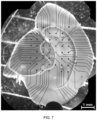
- FIG. 7 shows a picture taken with an optical microscope of an acute hippocampal brain slice positioned on an array of electrodes. Areas such as the mid-brain (MD), the thalamus (TH) with sub-areas T 1 , T 2 , T 3 , T 4 , T 5 , T 6 and T 7 identified and the hippocampus (H) with sub-areas H 1 , H 2 , H 3 , H 4 and H 5 identified;
- MD mid-brain
- TH thalamus
- T 5 , T 6 and T 7 identified
- H hippocampus
- FIG. 8 shows examples of electrical activity recorded within the thalamus sub-areas T 1 through T 7 ;
- FIG. 9 shows examples of electrical activity recorded within the hippocampus sub-areas H 1 through H 5 ;
- FIG. 10 is a top-plan schematic of a 3D-MEA according to one embodiment of the present disclosure.
- FIG. 11 is a top-plan schematic of one portion of the 3D-MEA shown in FIG. 10 ;
- FIG. 12 is two schematics of portions of the 3D-MEA shown in FIG. 10 , wherein FIG. 12 (A) is a top-plan schematic of an electrode-supporting pad and a wire section; and FIG. 12 (B) is a side-elevation view of the pad shown in FIG. 12 (A) ;
- FIG. 13 show three sets of example data obtained after implanting an MEA upon a live animal brain, wherein FIG. 13 (A) shows an example of electrical communication data obtained using a known electrode; FIG. 13 (B) shows an example of electrical communication data obtained using a 3D-MEA according to the present disclosure; and FIG. 13 (C) shows evidence of an ictal period within the animal's brain that is followed by a post-ictal period; and
- FIG. 14 is a photograph of two flexible 3D-MEAs, according to one embodiment of the present disclosure, wherein one is substantially straight and the other is in a flexed position.
- the term “about” refers to an approximately +/ ⁇ 10% variation from a given value. It is to be understood that such a variation is always included in any given value provided herein, whether or not it is specifically referred to.
- the term “electrical communication” refers to a one-way flow of an electrical signal and/or a two-way exchange of electrical signals.
- the one-way flow of the electrical signal may originate in: at least one electrically-excitable cell, a three-dimensional (3D) micro-electrode according to the present disclosure or both.
- the two-way exchange of electrical signals refers to both the transmission and receipt of electrical signals by a 3D micro-electrode and at least one electrically-excitable cell.
- Electrical communication may also refer to the detection and/or transmission of an electrical signal between the 3D micro-electrode and at least one electrically-excitable cell.
- electrically-excitable cell refers to a cell that have the potential to communicate charged ions across the cellular membrane in response to an electric, chemical or physical stimuli.
- the electrically-excitable cells can depolarize in a regulated fashion to generate and propagate one or more action potentials or end-plate potentials.
- electrically-excitable cells include but are not limited to all types of neural cells and muscle cells.
- ECN electronic cellular-network
- ECN electrically-excitable cellular-network
- stimulation of one or more than one electrically-excitable cell within the network will elicit a response in at least one other electrically-excitable cell within the network.
- the response of at least one other electrically-excitable cell will include a communication of charged ions across its cellular membrane and/or the release of one or more extra-cellular signal molecules.
- tissue preparation refers to a subject's tissue that comprises one or more electrically excitable cells and at least a portion of an ECN.
- a 3D-MEA according to the present disclosure can come into contact with a tissue preparation and establish in vitro, ex vivo or in vivo electrical communication with the one or more electrically excitable cells and at least a portion of the ECN.
- the present disclosure relates to a 3D micro-electrode 210 for establishing electrical communication with a single electrically-excitable cell and/or a network of electrically-excitable cells, which is referred to herein as an excitable cellular-network (ECN) (see FIG. 1 (B) ).
- the 3D micro-electrode 210 comprises an electrically conductive, elongate body 204 with a base 202 that is electrically connectible to a recording system.
- the 3D micro-electrode 210 also comprises a tip 206 that is opposite the base 202 and that is configured to establish electrical communication with at least a portion of an ECN.
- the elongate portion 204 is defined between the base 202 and the tip 206 .
- the base 202 typically has a larger diameter than the elongate portion 204 and the elongate portion typically has a greater length than the base 202 and the tip 206 .
- the tip 206 is frustoconical in shape with a decreasing diameter to a fine point with a diameter that is many times less than the diameter of the elongate portion 204 .
- a substrate 102 can comprise multiple layers (e.g. the additional materials 104 placed in between the substrate 102 and an electrically conductive, electrode supporting pad 109 ) that support each 3D-microelectrode 210 . Some of these multiple layers, or portions of which, may be removed or degraded during the fabrication process.
- the additional material 104 can be placed on the substrate 102 that provides structural support for one or more layers of different materials thereupon (e.g. the layer of conductive material that forms the pads 109 ).
- the substrate 102 is rigid and in some instances the substrate 102 is more flexible.
- the further layers of materials upon the substrate 102 may be provided to allow different materials (e.g. the different materials that make up the pads 109 and the wires 105 ) to be attached to the substrate 102 .
- the elongate portion 204 may be covered with at least one layer of an electrical-insulator coating 208 that extends from the base 202 towards and proximal the tip 206 .
- the tip 206 of the 3D micro-electrode 210 is configured to establish electrical communication with the ECN.
- the 3D micro-electrode 210 may establish electrical communication with the ECN by direct physical contact, or not.
- the 3D micro-electrodes 210 are configured to penetrate at least partially into a tissue preparation 12 (shown in FIG. 2 H ) that comprises electrically-excitable cells and that make up at least a portion of the ECN.
- At least two 3D micro-electrodes 210 are configured into an array, referred to herein as a 3D micro-electrode array (3D-MEA) 212 (shown in FIG. 1 (B) ).
- the 3D-MEA 212 can be used with various types of tissue preparations 12 including, but not limited to: in vitro tissue preparations 12 , ex vivo tissue preparations 12 or in vivo tissue preparations 12 .
- the 3D-MEA 212 can be used to establish electrical communication with the ECN within the tissue preparation 12 for detecting any changes in the electrical activity of the ECN in response to electrical stimuli, chemical stimuli or physical stimuli.
- the 3D-MEA 212 can establish electrical communication for stimulating the ECN within the tissue preparation 12 . In some embodiments of the present disclosure, the 3D-MEA 212 can establish electrical communication for both detecting and stimulating the ECN within the tissue preparation 12 .
- the two 3D micro-electrodes 210 of the 3D-MEA 212 are electrically connectible to the same recording system. As shown in FIG. 1 (B) , an individual 3D-MEA 212 may comprise 3D micro-electrodes 210 that have different lengths and/or different diameters.
- each individual 3D micro-electrode 210 of a given 3D-MEA 212 can be selectively fabricated based upon the method described herein and the specific dimensions of each 3D micro-electrode 210 can be individually selected based upon the desired application of use of the 3D-MEA 212 .
- FIG. 10 shows one embodiment of a 3D-MEA 212 that comprises the substrate 102 with a first substrate portion 104 A and a second substrate portion 104 B.
- FIG. 10 , FIG. 11 and FIG. 12 (A) show planar portions of the 3D-MEA 212 .
- the first substrate portion 104 A includes one or more terminals 107 that are configured to provide electronic communication with a transmitter/receiver system (not shown). Extending from each terminal 107 is a wire section 105 .
- the wire section extends from the first portion 104 A to the second portion 104 B and to the pads 109 , which are located in the second portion 104 B.
- the wire sections 105 are electrically conductive and provide electronic communication between each 3D micro-electrode 210 upon a given pad 109 and a given terminal 107 .
- the wire sections 105 can be insulated or not, with one or more insulation layers.
- Each pad 109 is the location of the 3D-MEA 212 where the base 202 of a 3D micro-electrode 210 is deposited and attached to the substrate 102 .
- FIG. 14 shows a photograph of two examples of a 3D-MEA 212 with one being in a flexed position between the pads 109 and the first substrate portion 104 A.
- neither portion 104 A, 104 B is flexible. In some embodiments of the present disclosure, one of or both of the first portion 104 A and the second portion 104 B are flexible. As will be appreciated by one skilled in the art, having at least one portion of the substrate 102 being flexible is advantageous for establishing optimal physical contact or proximity between the 3D micro-electrodes 210 of a 3D-MEA 212 and the ECN that is defined by an oftentimes, non-flat, flexible surface of the tissue preparation 12 .
- the design of the 3D-MEA 212 can be selected based upon the nature of the tissue preparation 12 that contains the ECN that the 3D-MEA 212 is intended to electrically communicate with.
- the substrate 102 may have a general T shape, or it may take any other desired shape.
- the first portion 104 A and the second portion 104 B each define various dimensions that are set out in Table 1 below. The person skilled in the art will appreciate that the dimensions provided in Table 1 are provided as examples only. The dimensions provided in Table 1 were selected based upon the intent of using the 3D-MEA 212 for establishing in vitro electrical communication with a rat brain tissue preparation.
- the 3D-MEA 212 can be selectively fabricated with larger or smaller dimensions than those presented in Table 1 below.
- a 3D-MEA 212 that is intended to be used with a human subject may be selectively fabricated with larger dimensions than those below in Table 1.
- the 3D-MEA 212 can be manufactured on to a flexible and biocompatible substrate 102 that is configured to be implanted into a living organism.
- the 3D-MEA 212 can also be configured to detect the electrical activity of the in vivo ECN and/or to stimulate the in vivo ECN or specific regions thereof.
- Some embodiments of the present disclosure relate to a fabrication method of making a 3D micro-electrode 210 and a method of making a 3D-MEA 212 .
- the 3D micro-electrodes 210 can be made individually with precise control of: the height and diameter of each 3D micro-electrode 210 within the 3D-MEA 212 ; the length of the elongate portion 204 that is covered in the electrical-insulator material 208 ; the length of the tip 206 ; and the shape of the tip 206 .
- each 3D micro-electrode 210 within the 3D-MEA 212 and upon the substrate 102 .
- the fabrication method allows the selectability of the materials used to make the 3D micro-electrodes 210 , the electrical insulating coatings 208 and the materials of each layer of the substrate 102 upon which the 3D-MEA 212 is built.
- the fabrication method also allows for selectability of the surface area of each 3D micro-electrode 210 that is not covered by the electrical insulating coating 208 and the position of these uncovered sections within the 3D-MEA 212 .
- the fabrication method comprises a step to establish 300 a first layer comprised of one or more materials 104 and conductive materials that form the electrically conductive, electrode supporting pads 109 upon the substrate 102 .
- the product of this first step is referred to as a coated blank 100 .
- the next step of the fabrication method is to establish 302 one or more grooves 106 upon the coated blank 100 by removing one or more layers of the substrate 102 .
- the next step of the fabrication step is to position 304 an electrical-insulating material 108 between the grooves to define one or more pads 109 .
- the electrical-insulating material 108 can be deposited upon the substrate 102 and then substantially removed from the location of the pads 109 .
- a layer of the electrical-insulating material 108 can have holes defined therein, and then that insulating layer can be adhered to the substrate 102 with pads 109 already thereupon. The holes in the insulating layer will align with the pads 109 .
- the electrical-insulator material 108 can cover, or overlap, the peripheral edges of the pad 109 . This overlap provides some additional rigid support while depositing the 3D micro-electrode 210 upon the pad 109 .
- the next step in the fabrication method is to deposit 306 a conductive material upon the one or more pads 109 .
- the step of depositing 306 can occur by various methods, including but not limited to: wire bonding, sputtering, electrodeposition, evaporation, extrusion, combinations thereof or other methods to make a conductive material of a desired geometry.
- the step of depositing 306 may further include a step of selecting the diameter of the elongate portion 204 of the 3D micro-electrode 210 .
- each elongate portion 204 may be selected within a range of between about 1 microns and 1000 microns. In some embodiments of the present disclosure, the diameter of the elongate portion 204 may be selected to be within a range of between about 5 microns and about 750 microns. In some embodiments of the present disclosure, the diameter of the elongate portion 204 is between about 5 and 1000 microns.
- the step of depositing 306 includes forming the base 202 and a step of selecting the height of the 3D micro-electrode 210 .
- the selecting of the length can include a step of stopping the depositing 306 of the conductive material upon the pad 109 and/or cutting the conductive material as it is being deposited.
- the length of the 3D micro-electrode 210 is selected by cutting the conductive material.
- Some of the methods of cutting the conductive material include, but are not limited to: using micro-scissors, electronic flame off (EFO)—whereby the conductive material is heated at a very localized position such that it melts and cuts the conductive material, use of a laser to cut the wire at a selected height, physically pulling the wire until it stretches and then breaks due to mechanical stresses, or combinations thereof.
- EFO electronic flame off
- the length of each elongate portion 204 may be selected within a range of between about 1 micron and 10 cm. In some embodiments of the present disclosure the length of each elongate portion 204 may be selected within a range of between about 1 micron and 5 cm.
- the length of the elongate portion 204 may be selected to be within a range of between about 5 microns and about 1000 microns. In some embodiments of the present disclosure, the length of the elongate portion 204 is between about 25 and 500 microns.
- the end of 3D micro-electrode 210 that is opposite to the base 202 is referred to as the tip 206 .
- the elongate portion 204 of the 3D micro-electrode 210 is defined between the base 202 and the tip 206 .
- the tip 206 is the portion of the elongate portion 204 that is not coated with the electrical-insulating coating 108 .
- the method of selecting the height of the 3D micro-electrode 210 may also include providing the tip 206 with either a sharp, a blunt or a flat shape.
- the steps 302 to 306 can be repeated 308 to selectably fabricate the desired number of electrodes 210 in multiple locations on the substrate with the same or different diameters and lengths.
- the next step is to coat 310 the electrodes 210 with the electrical-insulating coating 108 .
- the insulating materials may have other desirable properties such as, but not limited to, being curable, photoresistant, waterproof, biocompatible or combinations thereof.
- suitable materials for the electrical-insulating coating 108 includes, but is not limited to, dielectric and insulator materials, such as photoresists (both positive and negative), polymers, oxides, nitrides and ceramics.
- the material SU8 was utilized.
- SU8 is a chemically amplified, epoxy based negative photoresist that is optically transparent and photoimageable to near ultraviolet (UV) (about 365 nm) radiation.
- UV near ultraviolet
- Cured films or microstructures of SU8 are very resistant to solvents, acids and bases, have excellent thermal and mechanical stability and are biocompatible when cured.
- the coating step 310 can be achieved by various methods including, but not limited to: sputtering, spin coating, evaporation, casting, pouring, syringe dispensation, micropipette dispensation, combinations thereof or other methods that are commonly known to one skilled in the art.
- the fabrication method also includes a step of selecting 312 how much surface area and/or which portion(s) of the 3D micro-electrode 210 are coated with the insulating material. As shown in FIG. 2 (G) the step of selecting can result in some, most or all of the elongate portion 204 being coated in the insulating material. In some embodiments of the present disclosure, some, most, all or none of the tip 206 is coated in the insulating material. In some preferred embodiments, none of the tip 206 is coated in the insulating material.
- the detection method may comprise a step 314 of positioning the tips 206 of each 3D micro-electrode 210 within a tissue preparation 12 that comprises at least a portion of an ECN.
- the tissue preparation 12 may be an in vitro preparation, an ex vivo preparation or an in vivo preparation.
- the step 314 positioning includes positioning the 3D-MEA 212 proximal to an ECN and then establishing electrical communication between one or more 3D micro-electrodes 210 of the 3D-MEA 212 and the ECN.
- the step of establishing electrical communication may include receiving (also referred to as detecting) electrical signals from the ECN and/or transmitting electrical signals from the 3D-MEA 212 to the ECN.
- the detection method may further comprise a step of stimulating the ECN and detecting any changes in the electrical activity of the ECN.
- the ECN can be stimulated electrically (via the 3D-MEA 212 or not), mechanically or chemically.
- the electrical communication is transmitted from each electrode to a transmitter/receiver system (not shown).
- the transmitter/receiver system may transmit an output signal from each 3D micro-electrode 210 to a processor (not shown) for example when the 3D-MEA 212 is receiving electrical signals from the ECN.
- the transmitter may also transmit a processor signal to each 3D micro-electrode 210 , which each electrode transmits to the ECN.
- Planar electrodes in 8 ⁇ 8 array configuration were fabricated using photolithography onto a substrate that had a rigid glass, base substrate layer and that measured 49 mm ⁇ 49 mm ⁇ 1 mm.
- the substrate included a 50 nm chrome adhesion layer that was coated by sputter deposition and the adhesion layer was then coated with about 400 nm of gold ( FIG. 2 A ).
- the size, shape and the spacing between the planar micro-electrodes can be adjusted according to experimental needs using different photomasks during the photolithography process.
- the planar micro-electrodes were fabricated with a diameter of about 100 ⁇ m and with inter-electrode spacing of about 500 ⁇ m ( FIG. 2 B ).
- a first electrical-insulator layer was formed with an epoxy photoresistant material (SU8), which was spin coated over the entire 3D-MEA.
- the insulator layer was then patterned with a second photomask to leave the planar electrodes bare of SU8 insulator, but with their connecting wires insulated ( FIG. 2 C ). This formed the pads of the 3D-MEA.
- SU8 epoxy photoresistant material
- 3D micro-electrodes with a base, an opposite tapered tip and an elongate portion therebetween were added onto the pads of the planar electrodes using a manually programmable wire bonder (West-Bond model 454647E). Briefly, the 3D micro-electrodes were created by bonding gold wires onto the planar electrodes at the base of the 3D micro-electrode, manually extending the gold to a predetermined height and then cutting the gold wires with micro-scissors mounted on micro-manipulators ( FIG. 2 D and FIG. 2 E ). This cutting step formed a tip of the 3D micro-electrode that can be tapered, beveled, blunt or substantially flat.
- This method yields control and flexibility in the diameter and the height of each 3D micro-electrode and the inter-electrode spacing.
- Electrically conductive materials other than gold may also suitable for making the 3D micro-electrodes including but not limited to: aluminum, aluminum alloys such as. 0.5-1% magnesium-aluminum or silicon-aluminum, carbon, iridium, indium, titanium, copper, silver, palladium, platinum and combinations thereof and any other material that can be used in or adapted for any process to create 3D micro-electrodes, including at least a wire-bond process.
- the micro-electrodes can also be individually fabricated and addressable.
- the 3D gold micro-electrodes were fabricated with controlled heights ranging from about 50 microns ( ⁇ m) to about 400 ⁇ m with a diameter of between about 8 ⁇ m to about 500 ⁇ m depending on the bonder wires used.
- smaller or larger heights and diameters of 3D micro-electrodes are also contemplated by the present disclosure. These heights, spacing and materials were chosen specifically for recording from a 400 ⁇ m thick murine brain-slice but the 3D micro-electrode height and diameter and the 3D-MEA inter-electrode spacing may be adjusted individually, either increased or decreased, to suit other types of ECNs or different experimental arrangements with similar or different ECNs.
- a second electrical-insulator layer may be made up of the epoxy photoresist SU8 that was locally deposited on the bases and edges of the newly formed 3D micro-electrodes using a fine sharp glass micropipette with a 30 ⁇ m tip opening whose positioning was accurately controlled using a 3-axis micromanipulator ( FIG. 2 F and FIG. 2 G ).
- This micropipette was connected through a plastic tube to a syringe containing the SU8, which was itself mounted on a syringe micro-pump to control the flow (Harvard Apparatus Co., Dover, Mass., USA, Dual infusion/withdrawal pump model 942).
- the SU8 was then cured with UV light to form the second electrical-insulator layer upon the 3D micro-electrodes.
- This process allowed the 3D-micro-electrode tips to be left without any of the second electrical-insulator layer for the last few micrometers so that the tip could establish electrical communication by direct contact with the healthy neural cells inside the brain slice ( FIG. 2 ).
- the amount of surface area of the tip that can come into direct contact with the neural cells can be adjusted by adding more or less of the second electrical-insulator layer on the 3D micro-electrodes of the 3D-MEA.
- a glass ring was then placed on the 3D-MEA to form a recording chamber ( FIG. 3 A ).
- the small dark circles are the bases the 3D micro-electrodes, and the dark lines extending therefrom are the electrodes traces that connect each 3D micro-electrodes to the recording system on the outside of the 49 mm ⁇ 49 mm glass substrate.
- the recording chamber was perfused with either one of three types of artificial cerebrospinal fluid (aCSF): (1) “normal” aCSF; (2) “low” aCSF with 0 mM of Mg 2+ ; and (3) “high” aCSF with 8.5 mM of K + . All of the aCSF were used at about 32° C., with about 5% CO 2 and about 95% O 2 .
- the different ion concentrations in the aCSF types (2) “low” and (3) “high” can cause spontaneous neural-activity to occur within the murine brain slices and are known to induce spontaneous seizure-like activity within murine brain slices.
- Spontaneous, seizure-like activity is referred to herein as an ictal phase.
- a recording system (MEA1060; Multichannel Systems, Reutlingen, Germany) was then electrically connected with each 3D micro-electrode of the 3D-MEA to collect data at a 10 kHz sampling rate ( FIG. 5 and FIG. 6 ).
- the 3D micro-electrodes and the 3D-MEAs of the present disclosure may offer opportunities to track high frequency bursting activity between different areas of a brain slice and analyze its overall excitability.
- the SNR of the 3D micro-electrodes was then compared with earlier reported devices, including other three-dimensional (e.g. pyramidal-shaped) and planar micro-electrodes.
- the 3D micro-electrodes of the present disclosure demonstrated an average noise reduction to about 20 ⁇ V as compared to about 40 ⁇ V to about 60 ⁇ V observed in traditional planar micro-electrodes.
- the 3D micro-electrodes provided a highest recorded field potential activity peak-to-peak, which was in the mV range (about 3.2 mV) as compared with recordings of ⁇ 1 mV that were captured with traditional planar micro-electrodes ( FIG. 6 ).
- the 3D micro-electrodes and the 3D-MEAs of the present disclosure may offer a higher signal-to-noise ratio (with a greater than 300% improvement) than commercially available devices using traditional planar micro-electrodes.
- a temporal resolution may refer to either the time length of a given recording or the frequency of the recording, i.e. how many data points are recorded per second. In the present disclosure, the maximum time length of recording was about 3 hours and frequency of the recording can go up to about 50 kHz. It is also worth highlighting that the cured SU8 (the electrical-insulator layer) on the electrodes' edges provides structural support and reduces the physical degradation of the three-dimensional electrodes, thus allowing the MEAs to be re-used multiple times.
- FIG. 7 shows a picture taken with an optical microscope of an acute hippocampal brain slice positioned on an array of electrodes. Areas such as the mid-brain (MD), thalamus (TH) and hippocampus (H) are clearly visible.
- FIG. 8 shows the spontaneous electrical activity that was recorded using an embodiment of the present disclosure from sub-areas of the TH, including T 1 to T 7 , whose positions are indicated on FIG. 7 .
- FIG. 9 shows the spontaneous electrical activity that was recorded using an embodiment of the present disclosure from sub-areas of the H, including H 1 to H 5 , whose positioned are indicated on FIG. 7 .
- a similar method to the one described above for fabricating the in-vitro 3D-MEA was used to manufacture an implantable, and optionally flexible, 3D-MEA that can record activity from electrically excitable cells in vivo.
- the primary difference between the fabrication method described herein above for making the in vitro 3D-MEA and the in vivo 3D-MEA of the present example is that the planar electrodes were fabricated on a flexible substrate.
- the method steps for making the 3D micro-electrodes includes the same steps as described above.
- Various materials can be used for the substrate, the wires, the electrodes, and the electrical-insulator layer.
- the patterning of the wires and the electrodes can be performed in multiple ways.
- low impedance and high conductivity materials are preferred for making the wires and the electrodes.
- a flexible printed circuit board (flex PCB) was used as the substrate.
- the wires were made of copper using copper electrode traces subsequently coated by an Electroless Nickel Immersion Gold (ENIG) process to create wires and biocompatible electrode pads upon the flex PCB.
- ENIG Electroless Nickel Immersion Gold
- the 3D micro-electrodes were then fabricated on top of the electrode pads and their bases and edges were insulated by coating with the electrical-insulating material that is biocompatible.
- insulating material is SU8, but other insulating and biocompatible materials are known to those skilled in the art.
- the materials for fabricating the electrodes were selected from low impedance, high conductivity and magnetic resonance imaging (MRI) benign materials, for example gold, platinum and other known materials.
- MRI magnetic resonance imaging
- FIG. 10 which shows a top plan view of a schematic of one example of the in vivo 3D-MEA without the 3D micro-electrodes manufactured upon the pads 109 .
- the in vivo 3D-MEA had the following dimensions, which are provided as an example only and not as a limitation upon the embodiments of the present disclosure: a—3 mm, b—5.04 mm, c—1.27 mm, c1—3.81 mm, d and f—0.865 mm, e—1.27 mm, g—0.5 mm, h—0.651 mm, j and k—0.5 mm, l—8 mm, m—1.75 mm, n and o—75 micron, q and r—350 micron, s—700 micron, t—525 micron, u and v—200 micron, w—100 micron, x—150 micron, z1—10 micron, z2—600 nm
- the in vivo MEA flex PCB was held in place by a dental surgical acrylic and the scalp was held in place after implantation by the same acrylic.
- brain activity including ictal phases, were successfully recorded during more than 15 different experiments (100% success rate). Ictal phases were experimentally induced by kindling
- the electrophysiological data collected in-vivo from the rat brains was transferred wirelessly to a computer to further the analysis of the electrophysiological activity.
- the data was also recorded locally onto a removable storage device, allowing for data to be backed up, and also available for later transfer. Ensuring fidelity of both recorded and transmitted data was important.
- the wireless data was also transmitted using compression techniques to allow live viewing of the
- FIG. 13 shows an example of baseline activity obtained from a live animal brain using a known MEA that did not have any electrical-insulating coating 108 and that had much larger dimensions than the in-vivo 3D-MEA.
- FIG. 13 B shows an example of baseline activity obtained from a live animal brain using the in-vivo 3D-MEA. The decreased noise level from the signal obtained by the in-vivo 3D-MEA is apparent when comparing the two examples.
- FIG. 13 C shows an example of electrical communication data obtained from a live rat brain that underwent an experimentally induced ictal phase (seizure), which was followed by a post-ictal period. The ictal phase is associated with an increased electrical activity, as evidenced by at least a ten-fold increase in detected voltage ( FIG. 13 B shows increments of 0.2 V on the Y axis and FIG. 13 C show increments of 2 V).
- the 3D micro-electrodes and 3D-MEAs described herein can be used to record activity from electrically excitable cells (Central Nervous System and Peripheral Nervous System, heart, muscle and others) and stimulate these cells using electrical stimulation. By establishing two-way electrical communication (both recording and stimulation), a feedback loop system can be established.
Landscapes
- Health & Medical Sciences (AREA)
- Life Sciences & Earth Sciences (AREA)
- Engineering & Computer Science (AREA)
- Physics & Mathematics (AREA)
- Biomedical Technology (AREA)
- Pathology (AREA)
- General Health & Medical Sciences (AREA)
- Biophysics (AREA)
- Molecular Biology (AREA)
- Chemical & Material Sciences (AREA)
- Animal Behavior & Ethology (AREA)
- Medical Informatics (AREA)
- Surgery (AREA)
- Veterinary Medicine (AREA)
- Heart & Thoracic Surgery (AREA)
- Public Health (AREA)
- Biochemistry (AREA)
- Immunology (AREA)
- General Physics & Mathematics (AREA)
- Analytical Chemistry (AREA)
- Hematology (AREA)
- Urology & Nephrology (AREA)
- Food Science & Technology (AREA)
- Medicinal Chemistry (AREA)
- Optics & Photonics (AREA)
- Electrochemistry (AREA)
- Chemical Kinetics & Catalysis (AREA)
- Measurement And Recording Of Electrical Phenomena And Electrical Characteristics Of The Living Body (AREA)
Priority Applications (1)
| Application Number | Priority Date | Filing Date | Title |
|---|---|---|---|
| US16/603,092 US11668698B2 (en) | 2017-04-04 | 2018-04-04 | Apparatus and method for capturing neural recordings |
Applications Claiming Priority (3)
| Application Number | Priority Date | Filing Date | Title |
|---|---|---|---|
| US201762481473P | 2017-04-04 | 2017-04-04 | |
| US16/603,092 US11668698B2 (en) | 2017-04-04 | 2018-04-04 | Apparatus and method for capturing neural recordings |
| PCT/CA2018/050411 WO2018184104A1 (en) | 2017-04-04 | 2018-04-04 | Apparatus and method for capturing neural recordings |
Publications (2)
| Publication Number | Publication Date |
|---|---|
| US20200393438A1 US20200393438A1 (en) | 2020-12-17 |
| US11668698B2 true US11668698B2 (en) | 2023-06-06 |
Family
ID=63712030
Family Applications (1)
| Application Number | Title | Priority Date | Filing Date |
|---|---|---|---|
| US16/603,092 Active 2039-11-01 US11668698B2 (en) | 2017-04-04 | 2018-04-04 | Apparatus and method for capturing neural recordings |
Country Status (6)
| Country | Link |
|---|---|
| US (1) | US11668698B2 (de) |
| EP (1) | EP3607307B1 (de) |
| CN (1) | CN110709692A (de) |
| AU (1) | AU2018247588B2 (de) |
| CA (1) | CA3058920A1 (de) |
| WO (1) | WO2018184104A1 (de) |
Families Citing this family (9)
| Publication number | Priority date | Publication date | Assignee | Title |
|---|---|---|---|---|
| US11668698B2 (en) | 2017-04-04 | 2023-06-06 | Neuraura Biotech Inc. | Apparatus and method for capturing neural recordings |
| US12085557B2 (en) * | 2018-05-06 | 2024-09-10 | University Of Central Florida Research Foundation, Inc. | Fabrication of 3D microelectrodes and use thereof in multi-functional biosystems |
| US11612344B2 (en) * | 2018-11-02 | 2023-03-28 | Biocircuit Technologies, Inc. | Electrode-based systems and devices for interfacing with biological tissue and related methods |
| US11020594B2 (en) * | 2019-06-14 | 2021-06-01 | National Chiao Tung University | Electrochemical dephosphorylation technique for treating Alzheimer's disease and use thereof |
| CN110623655A (zh) * | 2019-09-24 | 2019-12-31 | 中国科学院电子学研究所 | 模拟失重大鼠的植入式微纳电极阵列芯片及其制备方法 |
| CN111557713B (zh) * | 2020-05-12 | 2025-03-07 | 上海微创电生理医疗科技股份有限公司 | 一种穿刺针组件及穿刺系统 |
| CN111956220B (zh) * | 2020-08-24 | 2024-04-09 | 中国科学院上海微系统与信息技术研究所 | 一种双向皮层脑电极制备方法及其制备的双向皮层脑电极 |
| CN113855031B (zh) * | 2021-09-18 | 2024-11-19 | 浙江清华柔性电子技术研究院 | 柔性微针电极及其制备方法 |
| CN119120193A (zh) * | 2024-08-16 | 2024-12-13 | 中山大学 | 一种微电极阵列器件及其制备方法和检测系统 |
Citations (13)
| Publication number | Priority date | Publication date | Assignee | Title |
|---|---|---|---|---|
| US5215088A (en) | 1989-11-07 | 1993-06-01 | The University Of Utah | Three-dimensional electrode device |
| US20060265039A1 (en) * | 2005-05-20 | 2006-11-23 | Interuniversitair Microelektronica Centrum (Imec) | Probe device for electrical stimulation and recording of the activity of excitable cells |
| CN101006920A (zh) | 2007-01-25 | 2007-08-01 | 中国科学院上海微系统与信息技术研究所 | 一种三维植入式微电极阵列的制作方法 |
| US20080138583A1 (en) | 2006-07-17 | 2008-06-12 | Rajmohan Bhandari | Micro-needle arrays having non-planar tips and methods of manufacture thereof |
| US20090283425A1 (en) | 2008-04-02 | 2009-11-19 | University Of Utah Research Foundation | Microelectrode Array System With Integrated Reference Microelectrodes To Reduce Detected Electrical Noise And Improve Selectivity Of Activation |
| US20100041972A1 (en) * | 2006-07-07 | 2010-02-18 | Lectus Therapeutics Limited | Apparatus and methods |
| CN102783942A (zh) | 2011-05-20 | 2012-11-21 | 中国科学院电子学研究所 | 植入式神经信息双模检测微电极阵列芯片及制备方法 |
| US20130105312A1 (en) | 2010-04-16 | 2013-05-02 | Element Six Limited | Diamond microelectrode |
| KR20140075905A (ko) | 2012-12-11 | 2014-06-20 | 서울대학교산학협력단 | 신경 자극 및 기록용 전극 어레이 및 이의 제조방법 |
| WO2015143443A1 (en) | 2014-03-21 | 2015-09-24 | University Of Utah Research Foundation | Multi-site electrode arrays and methods of making the same |
| CN106054519A (zh) | 2016-07-07 | 2016-10-26 | 中国科学院深圳先进技术研究院 | 一种利用光刻胶制备三维微电极阵列的方法 |
| WO2018184104A1 (en) | 2017-04-04 | 2018-10-11 | Neuraura Biotech Inc. | Apparatus and method for capturing neural recordings |
| US20190021619A1 (en) * | 2016-01-19 | 2019-01-24 | The Regents Of The University Of California | Addressable vertical nanowire probe arrays and fabrication methods |
Family Cites Families (1)
| Publication number | Priority date | Publication date | Assignee | Title |
|---|---|---|---|---|
| EP2506920B1 (de) * | 2009-12-01 | 2016-07-13 | Ecole Polytechnique Fédérale de Lausanne | Mikrogefertigte oberflächennervenstimulationsvorrichtung sowie verfahren zu ihrer herstellung |
-
2018
- 2018-04-04 US US16/603,092 patent/US11668698B2/en active Active
- 2018-04-04 CN CN201880036810.9A patent/CN110709692A/zh active Pending
- 2018-04-04 AU AU2018247588A patent/AU2018247588B2/en active Active
- 2018-04-04 CA CA3058920A patent/CA3058920A1/en active Pending
- 2018-04-04 EP EP18781570.9A patent/EP3607307B1/de active Active
- 2018-04-04 WO PCT/CA2018/050411 patent/WO2018184104A1/en not_active Ceased
Patent Citations (15)
| Publication number | Priority date | Publication date | Assignee | Title |
|---|---|---|---|---|
| US5215088A (en) | 1989-11-07 | 1993-06-01 | The University Of Utah | Three-dimensional electrode device |
| US20060265039A1 (en) * | 2005-05-20 | 2006-11-23 | Interuniversitair Microelektronica Centrum (Imec) | Probe device for electrical stimulation and recording of the activity of excitable cells |
| US20100041972A1 (en) * | 2006-07-07 | 2010-02-18 | Lectus Therapeutics Limited | Apparatus and methods |
| US20080138583A1 (en) | 2006-07-17 | 2008-06-12 | Rajmohan Bhandari | Micro-needle arrays having non-planar tips and methods of manufacture thereof |
| CN100431487C (zh) | 2007-01-25 | 2008-11-12 | 中国科学院上海微系统与信息技术研究所 | 一种三维植入式微电极阵列的制作方法 |
| CN101006920A (zh) | 2007-01-25 | 2007-08-01 | 中国科学院上海微系统与信息技术研究所 | 一种三维植入式微电极阵列的制作方法 |
| US20090283425A1 (en) | 2008-04-02 | 2009-11-19 | University Of Utah Research Foundation | Microelectrode Array System With Integrated Reference Microelectrodes To Reduce Detected Electrical Noise And Improve Selectivity Of Activation |
| US20130105312A1 (en) | 2010-04-16 | 2013-05-02 | Element Six Limited | Diamond microelectrode |
| CN102783942A (zh) | 2011-05-20 | 2012-11-21 | 中国科学院电子学研究所 | 植入式神经信息双模检测微电极阵列芯片及制备方法 |
| KR20140075905A (ko) | 2012-12-11 | 2014-06-20 | 서울대학교산학협력단 | 신경 자극 및 기록용 전극 어레이 및 이의 제조방법 |
| WO2015143443A1 (en) | 2014-03-21 | 2015-09-24 | University Of Utah Research Foundation | Multi-site electrode arrays and methods of making the same |
| US20190021619A1 (en) * | 2016-01-19 | 2019-01-24 | The Regents Of The University Of California | Addressable vertical nanowire probe arrays and fabrication methods |
| CN106054519A (zh) | 2016-07-07 | 2016-10-26 | 中国科学院深圳先进技术研究院 | 一种利用光刻胶制备三维微电极阵列的方法 |
| WO2018184104A1 (en) | 2017-04-04 | 2018-10-11 | Neuraura Biotech Inc. | Apparatus and method for capturing neural recordings |
| EP3607307A1 (de) | 2017-04-04 | 2020-02-12 | Neuraura Biotech Inc. | Vorrichtung und verfahren zur erfassung von neuronalen aufzeichnungen |
Non-Patent Citations (7)
| Title |
|---|
| Chen, J., The enhancement of a chronically implanted microwire electrode array performance and the investigation of evaluation method. A thesis submitted to Zhengzhou university for the degree of master. Basic Science Series, 2015, No. 2, pp. A006-51. |
| Dimaki, Maria, et al., "Fabrication and Characterization of 3D Micro- and Nanoelectrodes for Neuron Recordings", Sensors, vol. 10, 2010, 10339-10355. |
| EP18781570.9 European Search Report dated Aug. 13, 2020. |
| Musick, Katherine , et al., "Three-dimensional micro-electrode array for recording dissociated neuronal cultures", Lab Chip., vol. 9, No. 14, 2009, 1-18. |
| Obien, Marie Engelene J., et al., "Revelaing neuronal function through microelectrode array recordings", Frontiers in Neuroscience, vol. 8, Article 423, 2015, 1-30. |
| PCT/CA2018/050411 International Search Report and Written Opinion dated Jun. 18, 2018. |
| Rajaraman, Swaminathan , "Micromachined Three-Dimensional Electrode Arrays for In-Vitro and In-Vivo Electrogenic Cellular Networks", Georgia Institute of Technology, 2009, 1-268. |
Also Published As
| Publication number | Publication date |
|---|---|
| AU2018247588A1 (en) | 2019-10-24 |
| WO2018184104A1 (en) | 2018-10-11 |
| EP3607307A1 (de) | 2020-02-12 |
| EP3607307C0 (de) | 2025-06-18 |
| US20200393438A1 (en) | 2020-12-17 |
| EP3607307A4 (de) | 2020-09-16 |
| CA3058920A1 (en) | 2018-10-11 |
| AU2018247588B2 (en) | 2023-03-16 |
| EP3607307B1 (de) | 2025-06-18 |
| CN110709692A (zh) | 2020-01-17 |
Similar Documents
| Publication | Publication Date | Title |
|---|---|---|
| US11668698B2 (en) | Apparatus and method for capturing neural recordings | |
| Salatino et al. | Glial responses to implanted electrodes in the brain | |
| Cheung | Implantable microscale neural interfaces | |
| Fu et al. | Stable long-term chronic brain mapping at the single-neuron level | |
| Cheung et al. | Flexible polyimide microelectrode array for in vivo recordings and current source density analysis | |
| Gunasekera et al. | Intracortical recording interfaces: current challenges to chronic recording function | |
| Lee et al. | Scalable thousand channel penetrating microneedle arrays on flex for multimodal and large area coverage brainmachine interfaces | |
| JP5165575B2 (ja) | 電極束 | |
| Steins et al. | A flexible protruding microelectrode array for neural interfacing in bioelectronic medicine | |
| Hong et al. | Tissue-like neural probes for understanding and modulating the brain | |
| Park et al. | Optogenetic mapping of functional connectivity in freely moving mice via insertable wrapping electrode array beneath the skull | |
| KR100466954B1 (ko) | 스크리닝 장치 및 방법, 스크리닝 방법에 의해 얻어지는후점막 자극 화합물, 및, 치료 장치, 측정 전극부 | |
| US20090187159A1 (en) | Chronically implantable hybrid cannula-microelectrode system for continuous monitoring electrophysiological signals during infusion of a chemical or pharmaceutical agent | |
| Uguz et al. | Spatially controlled, bipolar, cortical stimulation with high-capacitance, mechanically flexible subdural surface microelectrode arrays | |
| US20200261025A1 (en) | System and method for making and implanting high-density electrode arrays | |
| Kim et al. | Iridium oxide–electrodeposited nanoporous gold multielectrode array with enhanced stimulus efficacy | |
| Xu et al. | High-throughput PEDOT: PSS/PtNPs-modified microelectrode array for simultaneous recording and stimulation of hippocampal neuronal networks in gradual learning process | |
| Borda et al. | Three-dimensional multilayer concentric bipolar electrodes restrict spatial activation in optic nerve stimulation | |
| Ramsey | Signals reflecting brain metabolic activity | |
| Sanda et al. | Low-invasive neural recording in mouse models with diabetes via an ultrasmall needle-electrode | |
| Gnatkovsky et al. | Recording electrical brain activity with novel stretchable electrodes based on supersonic cluster beam implantation nanotechnology on conformable polymers | |
| Vajrala et al. | Hollow ring-like flexible electrode architecture enabling subcellular multi-directional neural interfacing | |
| Myllymaa et al. | Flexible implantable thin film neural electrodes | |
| Steenland et al. | Techniques for large-scale multiunit recording | |
| Castagnola | Implantable microelectrodes on soft substrate with nanostructured active surface for stimulation and recording of brain activities |
Legal Events
| Date | Code | Title | Description |
|---|---|---|---|
| FEPP | Fee payment procedure |
Free format text: ENTITY STATUS SET TO UNDISCOUNTED (ORIGINAL EVENT CODE: BIG.); ENTITY STATUS OF PATENT OWNER: LARGE ENTITY |
|
| STPP | Information on status: patent application and granting procedure in general |
Free format text: APPLICATION DISPATCHED FROM PREEXAM, NOT YET DOCKETED |
|
| STPP | Information on status: patent application and granting procedure in general |
Free format text: DOCKETED NEW CASE - READY FOR EXAMINATION |
|
| STPP | Information on status: patent application and granting procedure in general |
Free format text: NON FINAL ACTION MAILED |
|
| STPP | Information on status: patent application and granting procedure in general |
Free format text: RESPONSE TO NON-FINAL OFFICE ACTION ENTERED AND FORWARDED TO EXAMINER |
|
| STPP | Information on status: patent application and granting procedure in general |
Free format text: FINAL REJECTION MAILED |
|
| STPP | Information on status: patent application and granting procedure in general |
Free format text: DOCKETED NEW CASE - READY FOR EXAMINATION |
|
| AS | Assignment |
Owner name: NEURAURA BIOTECH INC., CANADA Free format text: ASSIGNMENT OF ASSIGNORS INTEREST;ASSIGNORS:WIJDENES, PIERRE JEAN JACQUES;DALTON, COLIN;REEL/FRAME:061994/0539 Effective date: 20221205 |
|
| STPP | Information on status: patent application and granting procedure in general |
Free format text: NON FINAL ACTION MAILED |
|
| STCF | Information on status: patent grant |
Free format text: PATENTED CASE |