US11474038B2 - Method for evaluating protective effect against external damage to skin - Google Patents
Method for evaluating protective effect against external damage to skin Download PDFInfo
- Publication number
- US11474038B2 US11474038B2 US16/966,276 US201916966276A US11474038B2 US 11474038 B2 US11474038 B2 US 11474038B2 US 201916966276 A US201916966276 A US 201916966276A US 11474038 B2 US11474038 B2 US 11474038B2
- Authority
- US
- United States
- Prior art keywords
- coating film
- skin
- protective effect
- evaluation method
- external preparation
- Prior art date
- Legal status (The legal status is an assumption and is not a legal conclusion. Google has not performed a legal analysis and makes no representation as to the accuracy of the status listed.)
- Active, expires
Links
Images


Classifications
-
- G—PHYSICS
- G01—MEASURING; TESTING
- G01N—INVESTIGATING OR ANALYSING MATERIALS BY DETERMINING THEIR CHEMICAL OR PHYSICAL PROPERTIES
- G01N21/00—Investigating or analysing materials by the use of optical means, i.e. using sub-millimetre waves, infrared, visible or ultraviolet light
- G01N21/17—Systems in which incident light is modified in accordance with the properties of the material investigated
- G01N21/59—Transmissivity
-
- G—PHYSICS
- G01—MEASURING; TESTING
- G01N—INVESTIGATING OR ANALYSING MATERIALS BY DETERMINING THEIR CHEMICAL OR PHYSICAL PROPERTIES
- G01N21/00—Investigating or analysing materials by the use of optical means, i.e. using sub-millimetre waves, infrared, visible or ultraviolet light
- G01N21/17—Systems in which incident light is modified in accordance with the properties of the material investigated
- G01N21/25—Colour; Spectral properties, i.e. comparison of effect of material on the light at two or more different wavelengths or wavelength bands
- G01N21/31—Investigating relative effect of material at wavelengths characteristic of specific elements or molecules, e.g. atomic absorption spectrometry
- G01N21/33—Investigating relative effect of material at wavelengths characteristic of specific elements or molecules, e.g. atomic absorption spectrometry using ultraviolet light
-
- A—HUMAN NECESSITIES
- A61—MEDICAL OR VETERINARY SCIENCE; HYGIENE
- A61K—PREPARATIONS FOR MEDICAL, DENTAL OR TOILETRY PURPOSES
- A61K8/00—Cosmetics or similar toiletry preparations
-
- A—HUMAN NECESSITIES
- A61—MEDICAL OR VETERINARY SCIENCE; HYGIENE
- A61Q—SPECIFIC USE OF COSMETICS OR SIMILAR TOILETRY PREPARATIONS
- A61Q17/00—Barrier preparations; Preparations brought into direct contact with the skin for affording protection against external influences, e.g. sunlight, X-rays or other harmful rays, corrosive materials, bacteria or insect stings
- A61Q17/04—Topical preparations for affording protection against sunlight or other radiation; Topical sun tanning preparations
-
- G—PHYSICS
- G01—MEASURING; TESTING
- G01N—INVESTIGATING OR ANALYSING MATERIALS BY DETERMINING THEIR CHEMICAL OR PHYSICAL PROPERTIES
- G01N33/00—Investigating or analysing materials by specific methods not covered by groups G01N1/00 - G01N31/00
- G01N33/15—Medicinal preparations ; Physical properties thereof, e.g. dissolubility
-
- A—HUMAN NECESSITIES
- A61—MEDICAL OR VETERINARY SCIENCE; HYGIENE
- A61B—DIAGNOSIS; SURGERY; IDENTIFICATION
- A61B5/00—Measuring for diagnostic purposes; Identification of persons
Definitions
- the present invention relates to an evaluation method of a protective effect of an external preparation for skin against external damage to skin, especially an evaluation method of an ultraviolet (UV) protective effect (or UV blocking effect) of a sunscreen cosmetic and the like. More specifically, the present invention relates to an evaluation method which makes it possible to appropriately specify a change in the UV protective effect due to heat by intentionally incorporating a heat treatment step, which has not been considered in conventional methods for evaluating UV protective effects.
- UV ultraviolet
- UV rays such as ultraviolet (UV) rays, blue light, visible rays, and infrared rays are known to have an influence on skin, and various external preparation for skins (including skin care cosmetics and the like) exhibiting an effect of reducing influences of these rays on skin have been known.
- sunscreen cosmetics exhibit an effect of suppressing baneful influences on skin by decreasing the dose of UV rays reaching to skin with the cosmetics applied thereon, by virtue of the action of an ultraviolet (UV) absorber or an ultraviolet (UV) scattering agent blended in the cosmetics.
- UV ultraviolet
- UV ultraviolet
- Sun Protection Factor is most widely known as an index of UV protective effects of sunscreen cosmetics, and the UV protective effects are identified as SPF values (for example, “SPF 30” and the like).
- SPF Sun Protection Factor
- PFA Protection Factor of UVA
- UVAPF UVA Protection factor of product
- PA Protection grade of UVA
- CW critical wavelength
- Non-Patent Document 1 In-vivo determination of SPF (2010) and in-vivo determination of sunscreen UVA protection (2011) have been successively established by International Organization for Standardization (ISO) as International Standards (IS) for measurement methods of UV protective effects of sunscreen cosmetics.
- ISO International Organization for Standardization
- IS International Standards
- JCIA Japan Cosmetic Industry Association
- Patent Document 1 describes an in-vitro measurement method and an in-vitro measurement device which provide an SPF value highly correlating with a value obtained in in-vitro measurement.
- Patent Document 2 a method and a device for evaluating a UV protective effect based on a predicted SPF value obtained in-vitro have also been developed (Patent Document 2).
- Cosmetics exerting a high UV protective effect in a wide wavelength region from UVA to UVB have been required recently so as to suppress bad influences of UV rays on skin, and sunscreen products targeting SPF of 50 or higher (50+) and PA++++ have been commercially available, for example.
- UV protective effects of sunscreen products are exerted by an UV absorber or an UV scattering agent (titanium oxide, zinc oxide, and the like) blended therein, some UV absorbers deteriorate in UV absorbing performance due to light irradiation (for example, see Patent Document 3), and UV scattering agents may outflow through contact with water to deteriorate protective performance. Accordingly, methods for testing optical stability and waterproofness of a UV protective effect have been studied also in ISO (Non-Patent Document 1).
- Patent Document 3 Various measures have been proposed to suppress optical deterioration of a UV protective effect (Patent Document 3), and a sunscreen cosmetic having such an innovative property that the UV protective effect thereof is not deteriorated even when the sunscreen cosmetic is brought into contact with water, but on the contrary, the protective effect improves has been developed (Patent Document 4) in regard to waterproofness.
- Patent Document 5 While there is an example in which an influence of heat on emulsion stability of an emulsion cosmetic including a sunscreen cosmetic is studied (Patent Document 5), for example, a change in a UV protective effect due to heat has not been studied so far.
- Patent Document 1 JP 3337832 B
- Patent Document 2 JP 4365452 B
- Patent Document 3 JP 2010-150172 A
- Patent Document 4 WO 2016/068300 A
- Patent Document 5 JP 4397286 B
- Non-Patent Document 1 Journal of the Society of Cosmetic Chemists of Japan Vol. 47, No. 4, pp. 271-277, 2013
- an object of the present invention is to newly provide a method capable of appropriately evaluating an influence of heat on a protective effect of an external preparation for skin against rays of light having an influence on skin, especially an influence of heat on a UV protective effect of a sunscreen external preparation for skin.
- the present invention provides an evaluation method for an external preparation for skin such as a sunscreen cosmetic, the evaluation method including:
- step (1) and step (2) may be simultaneously performed.
- the step of measuring the UV protective effect preferably includes at least one selected from the group consisting of SPF measurement, UVAPF or PFA measurement, critical wavelength measurement, absorbance measurement, transmittance measurement, and a test method comparing any UV protective effect.
- an influence of heat on a ray (UV ray or the like) protective effect of an external preparation for skin such as a sunburn-preventer (sunscreen) can be appropriately evaluated.
- FIG. 1 is an explanatory diagram illustrating an outline of an evaluation method of the present invention.
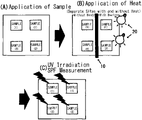
- FIG. 2 is an explanatory diagram illustrating an example of the evaluation method of the present invention appropriate for being conducted in-vivo.
- FIG. 3 is a graph showing a temporal change of a UV protective effect of a sunscreen cosmetic evaluated according to the method of the present invention.
- An evaluation method of an external preparation for skin, such as a sunscreen cosmetic, according to the present invention includes:
- the “external preparation for skin” in the present disclosure includes, in addition to a sunscreen cosmetic, a makeup cosmetic, a hair care product, and the like.
- the “protective effect” in the present disclosure includes, in addition to a protective effect against UV rays, a protective effect against rays of light such as blue light, visible rays, infrared rays, and the like.
- FIG. 1 is a diagram for explaining an outline of the evaluation method of the present invention.
- step (1) a predetermined amount of a sample (test material) 1 of a sunscreen external preparation for skin is applied to a base body 2 and optionally drying the sample 1 to form a coating film of the sample 1 on the base body 2 .
- step 1 ′ a step of measuring a UV protective effect (absorbance or the like) of the formed sample coating film before heating may be optionally included.
- step (2) heat is applied to the sample coating film formed in step (1).
- This heating step (2) may be performed by applying heat to the sample coating film formed on the base body, or by heating the base body to a predetermined temperature in step (1) and applying the sample thereto to heat the sample coating film (that is, step (1) and step (2) are simultaneously performed).
- UV protective effect (absorbance or the like) of the sample coating film subjected to heat treatment is measured in step (3).
- the evaluation method of the present invention may include steps of: providing another sample (second sample) of the same sunscreen external preparation for skin as the above-described sample; applying the second sample to another area of the base body and optionally drying the second sample to form a second sample coating film (step 1A); preferably keeping the second sample coating film at ordinary temperature without subjecting the second sample coating film to heat treatment (step (2)) (step 2A); and measuring a UV protective effect of the unheated second sample coating film in step (3) (step 3A). Furthermore, (4) a step of comparing the UV protective effect of the heated sample coating film and the UV protective effect of the unheated second sample coating film may be included.
- step (1′) when measurement of the UV protective effect of the sample coating film before being heated (step (1′) is carried out in the above-described step (1), (4′) a step of comparing the UV protective effect before being heated and the UV protective effect after being heated measured in step (3) may be included.
- the evaluation method of the present invention can be conducted in-vivo or in-vitro.
- FIG. 2 is a diagram for explaining an example of the evaluation method of the present invention conducted in-vivo.
- SPF measurement is employed as UV protective effect measurement. See “Japan Cosmetic Industry Association Standard SPF Test Method (revised in 2011)” and “ISO24444 Cosmetics-Sun protection test methods-In vivo determination of the sun protection factor (SPF)” for details of the SPF measurement method.
- a sample of a sunscreen external preparation for skin is firstly applied to a predetermined site of a base body (skin of a subject), and the sample is optionally dried to form a sample coating film ( FIG. 2(A) ). At this time, it is preferable that the same sample be applied to at least two areas of the base body to form coating films. In FIG. 2 , two kinds of sample ( 1 ) and sample ( 2 ) are each applied to two areas.
- the above-described predetermined site is not particularly limited and is preferably set within a region between the shoulder blade and the waist of the back of the subject.
- heat treatment of applying heat to at least one of the sample coating films formed on at least two areas of the base body is subsequently carried out.
- the non-heating site be covered with a heat-insulating or heat-shielding member such as a towel or aluminum foil, or a shielding material 10 be provided in between the heating site and the non-heating site.
- a heat-insulating or heat-shielding member such as a towel or aluminum foil
- a shielding material 10 be provided in between the heating site and the non-heating site.
- the shielding material 10 shields heat (infrared rays) emitted from an infrared lamp 20 illustrated in FIG. 2(B) , for example, to prevent heat from reaching the non-heating site.
- a heating method is not particularly limited, and infrared ray irradiation using an infrared lamp 20 , or the like is preferably used, for example.
- the temperature of the heating site is preferably checked by a thermography, a thermometer, or the like during heat treatment so as to confirm that the temperature of the heating site is kept at the predetermined temperature. It is preferable to also confirm that the temperature at the non-heating site is not changed by a thermography, a thermometer, or the like at the same time.
- Heat treatment is preferably carried out at a temperature higher than a body surface temperature and equal to or lower than about 45° C.
- the body surface temperature may vary according to an environmental temperature and a state of the subject (febrile or afebrile, before or after exercise, and the like).
- a healthy person for example, 10 minutes, 30 minutes, one hour, or the like
- a body surface temperature of the subject having rested for a predetermined time for example, 10 minutes, 30 minutes, one hour, or the like
- the body surface temperature is usually about 30° C. or higher and becomes 32° C. or higher, 35° C. or higher, or 37° C.
- Heat treatment is preferably carried out at a temperature at least 1° C. or higher, preferably 2° C. or higher, and more preferably 3° C. or higher than the body surface temperature.
- An upper limit of the heat treatment temperature is preferably about 45° C. or lower in consideration of a temperature at which the sunscreen cosmetic is actually used (for example, the body surface temperature under irradiation with sunlight in the summer season is about 40° C. and becomes 41° C. to 45° C. in some cases), safety of the subject, and the like.
- a heating time is preferably one minute or longer and more preferably 10 minutes or longer in order to accurately evaluate the influence of heat.
- An upper limit of the heating time is not particularly limited and is usually 60 minutes or shorter and preferably 30 minutes or shorter.
- the sample coating films are left until the temperature of the heating site is decreased and return to a normal skin temperature.
- the temperatures of the heating site and the non-heating site are confirmed to become equal to each other using, a thermography, a thermometer, or the like.
- the sample-coated part and an uncoated part adjacent to the sample-coated part in the tested site are irradiated with UV rays, and the minimum UV ray dose (MED) initially evoking clearly bounded slight erythema in an area equal to or more than two thirds of the irradiated part is determined after a lapse of a predetermined time (usually 16 to 24 hours).
- MEDp the minimum UV ray dose
- MEDu the MEDu.
- the above steps are performed on a plurality of subjects, and an arithmetical mean value (decimal places are rounded down) of SPFi values obtained from the subjects is regarded as the SPF of the sample.
- steps (1) and (2) are performed as with the above-described manner, and UVAPF or PFA which is preferably measured in accordance with Japan Cosmetic Industry Association Standard UVA Protective Effect Test Method (revised in 2012) or ISO24442 is calculated instead of the SPF measurement in step (3), and the UV protective effect can be identified as PA according to the following classification.
- the subject is recommended not to expose the portion to be tested (back) to sunlight at least four weeks before being subjected to SPF measurement from medical and ethical considerations. In view of this, it is preferable not to carry out UV protective effect measurement before heat treatment (step (1′)).
- a resin substrate such as a PMMA, nylon, or acrylic plate and a plate of an inorganic material such as glass and quartz can be used as the base body in an in-vitro evaluation method according to the present invention.
- the base body may be an organic substance such as paper.
- a skin-substitutive membrane also referred to as an “S-plate”: see Japanese Patent No. 4453995 comprised of a PMMA plate having a surface on which a groove having a V-letter shape is provided, or the like is preferably used.
- step (1) illustrated in FIG. 1 a predetermined amount of a sample (test material) of a sunscreen external preparation for skin is applied to the surface of the base body, and the sample is optionally dried to form a sample coating film.
- step (2) the base body on which the sample coating film is formed is heated.
- the above-described infrared irradiation may be employed as a heating method, but heating may be carried out by leaving the base body on which the sample coating film is formed to stand in a thermostatic chamber in which the temperature is adjusted to a predetermined temperature.
- step (1) and step (2) can also be simultaneously performed by forming the sample coating film on the base body which is heated to a predetermined temperature in advance.
- a heating temperature preferably falls within a range of 30° C. to 70° C. When the heating temperature exceeds 70° C., a problem such as melting of the substrate made of resin may arise.
- the heating temperature is not particularly limited as long as it is a temperature falling within the above range and can be 32° C. or higher, 35° C. or higher, 37° C. or higher, or 40° C. or higher, for example, and heat treatment may be carried out at a temperature of 65° C. or lower, 60° C. or lower, 55° C. or lower, or 50° C. or lower.
- a heating time is preferably one minute or longer and more preferably 10 minutes or longer in order to accurately evaluate the influence of heat.
- An upper limit of the heating time is not particularly limited and is usually 60 minutes or shorter and preferably 30 minutes or shorter.
- a coating film be formed on each of a plurality of substrates using the same sample at the same amount in the above-described step (1), at least one of the coating films be subjected to heat treatment in step (2) (heated sample), and the rest (non-heated sample) be kept at ordinary temperature.
- the sample coating films are preferably left until the temperatures of the base bodies return to ordinary temperature, and an absorbance at a predetermined wavelength (UVA or UVB region) of the sample coating film of each base body is measured (step (3)).
- absorbance measurement includes absorbance measurement at a single wavelength (UV region) and absorbance measurement over a predetermined wavelength region (critical wavelength measurement is also included).
- SPF or UVAPF may be calculated on the basis of the absorbance measured in step (3) and used as an index of the UV protective effect.
- a change in the UV protective effect due to heat can be detected by comparing the UV protective effect of the “heated sample” and the UV protective effect of the “non-heated sample” in step (3).
- step (2) heat treatment (step (2)) be performed in an environment shielded from UV rays from the viewpoint of eliminating influences of factors other than heat.
- the evaluation method of the present invention can directly compare the UV protective effect of the heated sample and the UV protective effect of the non-heated sample for the same sunscreen external preparation for skin (cosmetic) sample regardless of whether the evaluation method is conducted in-vivo or in-vitro.
- a test method of comparing UV protective effects includes a test method using photosensitive paper and a test method utilizing a substance whose color changes by UV irradiation.
- the evaluation method of the present invention can be used as a method for screening a sunscreen external preparation for skin (cosmetic) whose UV protective effect changes by heat, preferably whose UV protective effect improves by heat.
- the present invention provides a sunscreen external preparation for skin (cosmetic) whose UV protective effect improves by heat and which is identified by the screening method.
- UV protective effects was calculated using a value obtained by integrating absorbance over a wavelength region from 280 to 400 nm. Results are shown in the graph in FIG. 3 .
- the evaluation method of the present invention can be used as a method for screening a unburn-preventing cosmetic having a property of having a UV protective effect which is changed by heat.
Landscapes
- Health & Medical Sciences (AREA)
- Life Sciences & Earth Sciences (AREA)
- Physics & Mathematics (AREA)
- General Health & Medical Sciences (AREA)
- Chemical & Material Sciences (AREA)
- Analytical Chemistry (AREA)
- Biochemistry (AREA)
- General Physics & Mathematics (AREA)
- Immunology (AREA)
- Pathology (AREA)
- Engineering & Computer Science (AREA)
- Public Health (AREA)
- Animal Behavior & Ethology (AREA)
- Veterinary Medicine (AREA)
- Spectroscopy & Molecular Physics (AREA)
- Pharmacology & Pharmacy (AREA)
- Medicinal Chemistry (AREA)
- Food Science & Technology (AREA)
- Bioinformatics & Cheminformatics (AREA)
- Biophysics (AREA)
- Molecular Biology (AREA)
- Dermatology (AREA)
- Epidemiology (AREA)
- Birds (AREA)
- Investigating Or Analysing Biological Materials (AREA)
- Cosmetics (AREA)
- Investigating Or Analysing Materials By Optical Means (AREA)
- Measuring And Recording Apparatus For Diagnosis (AREA)
Abstract
Description
SPFi=(MEDpi)/(MEDui) [Expression 1]
| TABLE 1 | |||
| | Classification identification | ||
| 2 or more and less than 4 | PA+ | ||
| 4 or more and less than 8 | PA++ | ||
| 8 or more and less than 16 | PA+++ | ||
| 16 or more | PA++++ | ||
Change in UV protective effect=(“absorbance after heating”/“absorbance without heating”)×100 [Expression 2]
Claims (16)
Applications Claiming Priority (7)
| Application Number | Priority Date | Filing Date | Title |
|---|---|---|---|
| JP2018018269 | 2018-02-05 | ||
| JPJP2018-018269 | 2018-02-05 | ||
| JP2018-018269 | 2018-02-05 | ||
| JP2018-151682 | 2018-08-10 | ||
| JPJP2018-151682 | 2018-08-10 | ||
| JP2018151682 | 2018-08-10 | ||
| PCT/JP2019/003305 WO2019151374A1 (en) | 2018-02-05 | 2019-01-31 | Method for evaluating protective effect against external damage to skin |
Publications (2)
| Publication Number | Publication Date |
|---|---|
| US20200371027A1 US20200371027A1 (en) | 2020-11-26 |
| US11474038B2 true US11474038B2 (en) | 2022-10-18 |
Family
ID=67478403
Family Applications (1)
| Application Number | Title | Priority Date | Filing Date |
|---|---|---|---|
| US16/966,276 Active 2039-05-25 US11474038B2 (en) | 2018-02-05 | 2019-01-31 | Method for evaluating protective effect against external damage to skin |
Country Status (6)
| Country | Link |
|---|---|
| US (1) | US11474038B2 (en) |
| EP (1) | EP3751254B1 (en) |
| JP (2) | JP7509544B2 (en) |
| CN (1) | CN111684265B (en) |
| TW (1) | TW201942561A (en) |
| WO (1) | WO2019151374A1 (en) |
Families Citing this family (5)
| Publication number | Priority date | Publication date | Assignee | Title |
|---|---|---|---|---|
| JP7740871B2 (en) * | 2020-11-18 | 2025-09-17 | ロレアル | Method and device for determining UV coverage on an irradiation target in real time |
| KR102811142B1 (en) | 2021-04-07 | 2025-05-22 | 더 프록터 앤드 갬블 캄파니 | Ultraviolet imaging system and method |
| DE102022124831A1 (en) * | 2022-09-27 | 2024-03-28 | Courage + Khazaka Electronic Gmbh | MEASURING SYSTEM AND MEASURING METHODS |
| WO2025013802A1 (en) * | 2023-07-07 | 2025-01-16 | 花王株式会社 | Estimation method, estimation device, estimation system, and program |
| JP7828381B2 (en) * | 2023-07-07 | 2026-03-11 | 花王株式会社 | Estimation method, estimation device, estimation system, and program |
Citations (14)
| Publication number | Priority date | Publication date | Assignee | Title |
|---|---|---|---|---|
| JP2006028335A (en) | 2004-07-15 | 2006-02-02 | Hitachi Chem Co Ltd | Anti-fog paint and anti-fog molding |
| JP2007284516A (en) | 2006-04-14 | 2007-11-01 | Toyo Ink Mfg Co Ltd | Ultraviolet shielding resin composition and use thereof |
| WO2010095116A1 (en) | 2009-02-23 | 2010-08-26 | L'oreal | A method of removing makeup and a makeup remover |
| CN102179011A (en) * | 2011-03-04 | 2011-09-14 | 赵广 | Infrared-ultraviolet composite therapeutic apparatus |
| JP2012063323A (en) | 2010-09-17 | 2012-03-29 | Shiseido Co Ltd | Evaluation method, evaluation device, and evaluation program for ultraviolet light prevention effect, and recording medium with the recorded program |
| JP5184031B2 (en) * | 2007-10-01 | 2013-04-17 | ポーラ化成工業株式会社 | Emulsifier-type powder-containing external skin preparation |
| US20130231401A1 (en) * | 2010-10-19 | 2013-09-05 | Shiseido Company, Ltd. | External Oil-In-Water-Type Skin Preparation |
| JP2014071007A (en) | 2012-09-28 | 2014-04-21 | Kao Corp | Method and device for evaluating ultraviolet protecting cosmetic |
| JP2015178489A (en) * | 2014-02-25 | 2015-10-08 | 日本メナード化粧品株式会社 | External preparation or internal preparation for skin containing extract of fenugreek which is raised by being irradiated with light having a specific wavelength range |
| US20150308945A1 (en) | 2012-12-11 | 2015-10-29 | Shiseido Company, Ltd. | Method and apparatus for evaluating ultraviolet radiation protection effect, and recording medium |
| US20160025481A1 (en) | 2013-03-15 | 2016-01-28 | Suncare Research Laboratories, Llc | In vitro determination of sunscreen protection based on image analysis of sunscreens applied to skin |
| WO2016068300A1 (en) | 2014-10-31 | 2016-05-06 | 株式会社 資生堂 | Sunscreen cosmetic |
| WO2016138249A1 (en) | 2015-02-26 | 2016-09-01 | Edgewell Personal Care Brands, Llc | Sunscreen compositions with improved water resistance |
| JP2017146211A (en) | 2016-02-17 | 2017-08-24 | 花王株式会社 | Evaluation apparatus, evaluation method, evaluation program, and recording medium |
Family Cites Families (13)
| Publication number | Priority date | Publication date | Assignee | Title |
|---|---|---|---|---|
| JP3135158B2 (en) * | 1992-03-10 | 2001-02-13 | ポーラ化成工業株式会社 | Evaluation method of ultraviolet transmission prevention effect using artificial skin membrane |
| JP3337832B2 (en) | 1993-09-27 | 2002-10-28 | 株式会社資生堂 | Method and apparatus for measuring ultraviolet protection effect |
| JP4453995B2 (en) | 2000-12-05 | 2010-04-21 | 信越石英株式会社 | Carrier boat made of fluororesin-coated quartz glass |
| JP4397286B2 (en) | 2003-11-28 | 2010-01-13 | 日清オイリオグループ株式会社 | Oil-in-water emulsified cosmetic and method for producing the same |
| JP2006038335A (en) * | 2004-07-27 | 2006-02-09 | Valeo Thermal Systems Japan Corp | Core part for heat exchanger |
| JP2006306842A (en) * | 2005-03-30 | 2006-11-09 | Kose Corp | Two-layer type ultraviolet-proof cosmetic |
| EP2204646B1 (en) | 2007-10-18 | 2013-03-27 | Shiseido Company, Ltd. | Ultraviolet protection effect evaluation method, evaluation device, evaluation program, and recording medium where the program is recorded |
| JP5540243B2 (en) | 2008-12-25 | 2014-07-02 | 株式会社 資生堂 | Sunscreen cosmetics |
| CN102753136B (en) | 2009-11-20 | 2016-08-03 | 株式会社爱茉莉太平洋 | Comprise the make-up composition of inorganic powder |
| JP5819637B2 (en) * | 2011-05-18 | 2015-11-24 | 株式会社 資生堂 | UV protection effect evaluation device |
| JP6594992B2 (en) * | 2015-03-19 | 2019-10-23 | アモーレパシフィック コーポレーション | Solar screening functional substance screening method and solar screening efficacy evaluation method |
| JP6867293B2 (en) | 2015-09-30 | 2021-04-28 | 株式会社 資生堂 | Sunscreen cosmetics |
| JP6619262B2 (en) | 2016-03-02 | 2019-12-18 | 株式会社コスモビューティー | COMPOSITE PARTICLE, COSMETIC COMPOSITION, AND METHOD FOR PRODUCING COMPOSITE PARTICLE |
-
2019
- 2019-01-31 US US16/966,276 patent/US11474038B2/en active Active
- 2019-01-31 EP EP19748439.7A patent/EP3751254B1/en active Active
- 2019-01-31 WO PCT/JP2019/003305 patent/WO2019151374A1/en not_active Ceased
- 2019-01-31 CN CN201980011534.5A patent/CN111684265B/en active Active
- 2019-01-31 JP JP2019569210A patent/JP7509544B2/en active Active
- 2019-02-01 TW TW108104079A patent/TW201942561A/en unknown
-
2023
- 2023-03-06 JP JP2023033308A patent/JP2023085264A/en active Pending
Patent Citations (16)
| Publication number | Priority date | Publication date | Assignee | Title |
|---|---|---|---|---|
| JP2006028335A (en) | 2004-07-15 | 2006-02-02 | Hitachi Chem Co Ltd | Anti-fog paint and anti-fog molding |
| JP2007284516A (en) | 2006-04-14 | 2007-11-01 | Toyo Ink Mfg Co Ltd | Ultraviolet shielding resin composition and use thereof |
| JP5184031B2 (en) * | 2007-10-01 | 2013-04-17 | ポーラ化成工業株式会社 | Emulsifier-type powder-containing external skin preparation |
| WO2010095116A1 (en) | 2009-02-23 | 2010-08-26 | L'oreal | A method of removing makeup and a makeup remover |
| JP2012063323A (en) | 2010-09-17 | 2012-03-29 | Shiseido Co Ltd | Evaluation method, evaluation device, and evaluation program for ultraviolet light prevention effect, and recording medium with the recorded program |
| US20130169951A1 (en) | 2010-09-17 | 2013-07-04 | Shiseido Company, Ltd. | Ultraviolet protection effect evaluation method, evaluation apparatus, and recording medium |
| US20130231401A1 (en) * | 2010-10-19 | 2013-09-05 | Shiseido Company, Ltd. | External Oil-In-Water-Type Skin Preparation |
| CN102179011B (en) * | 2011-03-04 | 2013-03-13 | 赵广 | Infrared-ultraviolet composite therapeutic apparatus |
| CN102179011A (en) * | 2011-03-04 | 2011-09-14 | 赵广 | Infrared-ultraviolet composite therapeutic apparatus |
| JP2014071007A (en) | 2012-09-28 | 2014-04-21 | Kao Corp | Method and device for evaluating ultraviolet protecting cosmetic |
| US20150308945A1 (en) | 2012-12-11 | 2015-10-29 | Shiseido Company, Ltd. | Method and apparatus for evaluating ultraviolet radiation protection effect, and recording medium |
| US20160025481A1 (en) | 2013-03-15 | 2016-01-28 | Suncare Research Laboratories, Llc | In vitro determination of sunscreen protection based on image analysis of sunscreens applied to skin |
| JP2015178489A (en) * | 2014-02-25 | 2015-10-08 | 日本メナード化粧品株式会社 | External preparation or internal preparation for skin containing extract of fenugreek which is raised by being irradiated with light having a specific wavelength range |
| WO2016068300A1 (en) | 2014-10-31 | 2016-05-06 | 株式会社 資生堂 | Sunscreen cosmetic |
| WO2016138249A1 (en) | 2015-02-26 | 2016-09-01 | Edgewell Personal Care Brands, Llc | Sunscreen compositions with improved water resistance |
| JP2017146211A (en) | 2016-02-17 | 2017-08-24 | 花王株式会社 | Evaluation apparatus, evaluation method, evaluation program, and recording medium |
Non-Patent Citations (4)
| Title |
|---|
| International Search Report and Written Opinion dated Apr. 9, 2019, in PCT/JP2019/003305, with English translation. |
| Mizuno, Makoto, "Current Conditions of Sun Protection Test Methods for Sunscreen Products," Journal of Society of Cosmetic Chemists of Japan, Apr. 2013, 47(4):271-277, with English abstract on last page. |
| Shiseido Information Letter, "Countermeasures against UV rays to protect beautiful skin," Mar. 26, 2015, 92(2015):1-9. |
| Supplementary European Search Report dated Sep. 13, 2021 in EP 19748439.7. |
Also Published As
| Publication number | Publication date |
|---|---|
| EP3751254A1 (en) | 2020-12-16 |
| JP7509544B2 (en) | 2024-07-02 |
| WO2019151374A1 (en) | 2019-08-08 |
| JP2023085264A (en) | 2023-06-20 |
| EP3751254A4 (en) | 2021-10-13 |
| TW201942561A (en) | 2019-11-01 |
| JPWO2019151374A1 (en) | 2021-03-11 |
| US20200371027A1 (en) | 2020-11-26 |
| CN111684265B (en) | 2024-03-29 |
| CN111684265A (en) | 2020-09-18 |
| EP3751254B1 (en) | 2024-01-10 |
Similar Documents
| Publication | Publication Date | Title |
|---|---|---|
| US11474038B2 (en) | Method for evaluating protective effect against external damage to skin | |
| Wang et al. | Comparison of ultraviolet A light protection standards in the United States and European Union through in vitro measurements of commercially available sunscreens | |
| US11137347B2 (en) | Optically ascertaining the sun protection factor of sunscreens or other radiation protection agents | |
| Moyal et al. | The revised COLIPA in vitro UVA method | |
| Bendová et al. | In vitro approaches to evaluation of Sun Protection Factor | |
| Suh et al. | A long‐term evaluation of erythema and pigmentation induced by ultraviolet radiations of different wavelengths | |
| Miura et al. | Influence of application amount on sunscreen photodegradation in in vitro sun protection factor evaluation: proposal of a skin‐mimicking substrate | |
| Kohli et al. | Spectral characteristics of visible light‐induced pigmentation and visible light protection factor | |
| Isser et al. | High-energy visible light transparency and ultraviolet ray transmission of metallized rescue sheets | |
| Essendoubi et al. | New approach for hair keratin characterization: Use of the confocal Raman spectroscopy to assess the effect of thermal stress on human hair fibre | |
| Bielfeldt et al. | Multicenter methodology comparison of the FDA and ISO standard for measurement of in vitro UVA protection of sunscreen products | |
| AU2016223870A1 (en) | Method for examining sunscreens on the skin | |
| JPH07167781A (en) | Measuring method and device for ultraviolet protection effect | |
| KR20190102611A (en) | Device and Method for Measuring Skin changes due to Blue-light | |
| Throm et al. | In vivo sun protection factor and UVA protection factor determination using (hybrid) diffuse reflectance spectroscopy and a multi‐lambda‐LED light source | |
| CN106442331B (en) | Method for testing waterproof capability of sun-proof product | |
| Egawa et al. | Changes in facial moisture distribution and feelings of moisture/dryness among various environmental temperatures and humidities in summer and winter | |
| JP2008111834A (en) | Method and device for evaluating ultraviolet radiation protective effect | |
| Fajuyigbe et al. | Diffuse reflectance spectroscopy as a reliable means of comparing ultraviolet radiation‐induced erythema in extreme skin colors | |
| Nishino et al. | Development of the multispectral UV polarization reflectance imaging system (MUPRIS) for in situ monitoring of the UV protection efficacy of sunscreen on human skin | |
| Akrman et al. | Quartz plates for determining sun protection in vitro and testing photostability of commercial sunscreens | |
| Touti et al. | Standardized In Vivo Method Using High‐Resolution Diffuse Reflectance Spectroscopy for Evaluating Sunscreen Effectiveness Against Ultraviolet A and High‐Energy Visible Light | |
| Wilczyński et al. | The use of directional reflectance measurement for in vivo assessment of protective properties of cosmetics in the infrared radiation range | |
| Ruvolo Jr et al. | Diffuse reflectance spectroscopy for ultraviolet A protection factor measurement: correlation studies between in vitro and in vivo measurements | |
| CN106370604B (en) | Human body test method for cleaning capability of cleaning product to sun-proof product |
Legal Events
| Date | Code | Title | Description |
|---|---|---|---|
| FEPP | Fee payment procedure |
Free format text: ENTITY STATUS SET TO UNDISCOUNTED (ORIGINAL EVENT CODE: BIG.); ENTITY STATUS OF PATENT OWNER: LARGE ENTITY |
|
| AS | Assignment |
Owner name: SHISEIDO COMPANY, LTD., JAPAN Free format text: ASSIGNMENT OF ASSIGNORS INTEREST;ASSIGNORS:NAGAI, KOUICHI;UJIMOTO, KEI;TOUATI, MARIANNE AYAKA;AND OTHERS;SIGNING DATES FROM 20200714 TO 20200916;REEL/FRAME:053857/0649 |
|
| STPP | Information on status: patent application and granting procedure in general |
Free format text: DOCKETED NEW CASE - READY FOR EXAMINATION |
|
| STPP | Information on status: patent application and granting procedure in general |
Free format text: NON FINAL ACTION MAILED |
|
| STPP | Information on status: patent application and granting procedure in general |
Free format text: RESPONSE TO NON-FINAL OFFICE ACTION ENTERED AND FORWARDED TO EXAMINER |
|
| STPP | Information on status: patent application and granting procedure in general |
Free format text: NOTICE OF ALLOWANCE MAILED -- APPLICATION RECEIVED IN OFFICE OF PUBLICATIONS |
|
| STPP | Information on status: patent application and granting procedure in general |
Free format text: PUBLICATIONS -- ISSUE FEE PAYMENT VERIFIED |
|
| STCF | Information on status: patent grant |
Free format text: PATENTED CASE |
|
| MAFP | Maintenance fee payment |
Free format text: PAYMENT OF MAINTENANCE FEE, 4TH YEAR, LARGE ENTITY (ORIGINAL EVENT CODE: M1551); ENTITY STATUS OF PATENT OWNER: LARGE ENTITY Year of fee payment: 4 |