US11447488B2 - Heterocyclic compounds - Google Patents
Heterocyclic compounds Download PDFInfo
- Publication number
- US11447488B2 US11447488B2 US16/753,630 US201816753630A US11447488B2 US 11447488 B2 US11447488 B2 US 11447488B2 US 201816753630 A US201816753630 A US 201816753630A US 11447488 B2 US11447488 B2 US 11447488B2
- Authority
- US
- United States
- Prior art keywords
- group
- compound
- alkyl
- atom
- optionally further
- Prior art date
- Legal status (The legal status is an assumption and is not a legal conclusion. Google has not performed a legal analysis and makes no representation as to the accuracy of the status listed.)
- Active, expires
Links
- 0 *.[1*]N([2*])C(=O)C1CCC(c2cc([5*])c([6*])c3c2nc(C(F)(F)F)n3[3*])CC1 Chemical compound *.[1*]N([2*])C(=O)C1CCC(c2cc([5*])c([6*])c3c2nc(C(F)(F)F)n3[3*])CC1 0.000 description 16
- JCBXZCPSIVVJQG-UHFFFAOYSA-N O=C(c1ccc(-c2cccc3c2nc(C(F)(F)F)n3CC(F)F)cc1)N1CCOC(C(F)F)C1 Chemical compound O=C(c1ccc(-c2cccc3c2nc(C(F)(F)F)n3CC(F)F)cc1)N1CCOC(C(F)F)C1 JCBXZCPSIVVJQG-UHFFFAOYSA-N 0.000 description 3
- ZUPAMFCLRBUORG-UHFFFAOYSA-N CN(CCC#N)C(=O)c1ccc(-c2nccc3c2nc(C(F)(F)F)n3CC(F)F)cc1F Chemical compound CN(CCC#N)C(=O)c1ccc(-c2nccc3c2nc(C(F)(F)F)n3CC(F)F)cc1F ZUPAMFCLRBUORG-UHFFFAOYSA-N 0.000 description 2
- CDQRGNZDBXENLN-UHFFFAOYSA-N O=C(c1ccc(-c2nccc3c2nc(C(F)(F)F)n3CC(F)F)c(F)c1)N1CCOCC1 Chemical compound O=C(c1ccc(-c2nccc3c2nc(C(F)(F)F)n3CC(F)F)c(F)c1)N1CCOCC1 CDQRGNZDBXENLN-UHFFFAOYSA-N 0.000 description 2
- GEFYFNJUKCHVMA-UHFFFAOYSA-N O=C(c1ccc(-c2nccc3c2nc(C(F)(F)F)n3CC(F)F)c(F)c1F)N1CCOCC1 Chemical compound O=C(c1ccc(-c2nccc3c2nc(C(F)(F)F)n3CC(F)F)c(F)c1F)N1CCOCC1 GEFYFNJUKCHVMA-UHFFFAOYSA-N 0.000 description 2
- AVLHSFBSRJFVSF-UHFFFAOYSA-N CC(C)n1c(C(F)(F)F)nc2c(-c3ccc(C(=O)N4CCOCC4)cc3)cccc21 Chemical compound CC(C)n1c(C(F)(F)F)nc2c(-c3ccc(C(=O)N4CCOCC4)cc3)cccc21 AVLHSFBSRJFVSF-UHFFFAOYSA-N 0.000 description 1
- KRFNHIRPWFZZFH-UHFFFAOYSA-N CCn1c(C(F)(F)F)nc2c(-c3ccc(C(=O)N4CCOCC4)c(F)c3)nccc21 Chemical compound CCn1c(C(F)(F)F)nc2c(-c3ccc(C(=O)N4CCOCC4)c(F)c3)nccc21 KRFNHIRPWFZZFH-UHFFFAOYSA-N 0.000 description 1
- HYUMZLTVJAEPKP-UHFFFAOYSA-N CCn1c(C(F)(F)F)nc2c(-c3ccc(C(=O)N4CCOCC4)cc3)cccc21 Chemical compound CCn1c(C(F)(F)F)nc2c(-c3ccc(C(=O)N4CCOCC4)cc3)cccc21 HYUMZLTVJAEPKP-UHFFFAOYSA-N 0.000 description 1
- LKYKDMWQJZMYGJ-UHFFFAOYSA-N CCn1c(C(F)(F)F)nc2c(-c3ccc(C(=O)N4CCOCC4)cc3)nccc21 Chemical compound CCn1c(C(F)(F)F)nc2c(-c3ccc(C(=O)N4CCOCC4)cc3)nccc21 LKYKDMWQJZMYGJ-UHFFFAOYSA-N 0.000 description 1
- ODXCVMDGWXVDSD-LBPRGKRZSA-N CCn1c(C(F)(F)F)nc2c(-c3ccc(C(=O)N4CCO[C@@H](C)C4)c(F)c3)nccc21 Chemical compound CCn1c(C(F)(F)F)nc2c(-c3ccc(C(=O)N4CCO[C@@H](C)C4)c(F)c3)nccc21 ODXCVMDGWXVDSD-LBPRGKRZSA-N 0.000 description 1
- AWKRETZHDQJVGU-FCHARDOESA-N CCn1nc(C)c2c1C[Y]CC2.[2HH] Chemical compound CCn1nc(C)c2c1C[Y]CC2.[2HH] AWKRETZHDQJVGU-FCHARDOESA-N 0.000 description 1
- CPOUIBWAIDNAAH-UHFFFAOYSA-N CN(C(=O)c1ccc(-c2nccc3c2nc(C(F)(F)F)n3CC(F)F)cc1F)C1CCOCC1 Chemical compound CN(C(=O)c1ccc(-c2nccc3c2nc(C(F)(F)F)n3CC(F)F)cc1F)C1CCOCC1 CPOUIBWAIDNAAH-UHFFFAOYSA-N 0.000 description 1
- LPASQVCCCUJRKW-UHFFFAOYSA-N CN(CCC#N)C(=O)c1ccc(-c2cccc3c2nc(C(F)(F)F)n3CC(F)F)cc1 Chemical compound CN(CCC#N)C(=O)c1ccc(-c2cccc3c2nc(C(F)(F)F)n3CC(F)F)cc1 LPASQVCCCUJRKW-UHFFFAOYSA-N 0.000 description 1
- ZEWZLIKBHQXDQJ-UHFFFAOYSA-N COC1CCN(C(=O)c2ccc(-c3nccc4c3nc(C(F)(F)F)n4CC(F)F)cc2F)CC1 Chemical compound COC1CCN(C(=O)c2ccc(-c3nccc4c3nc(C(F)(F)F)n4CC(F)F)cc2F)CC1 ZEWZLIKBHQXDQJ-UHFFFAOYSA-N 0.000 description 1
- WHFIMPQKGZBGLV-UHFFFAOYSA-N COCCn1c(C(F)(F)F)nc2c(-c3ccc(C(=O)N4CCOCC4)c(F)c3)nccc21 Chemical compound COCCn1c(C(F)(F)F)nc2c(-c3ccc(C(=O)N4CCOCC4)c(F)c3)nccc21 WHFIMPQKGZBGLV-UHFFFAOYSA-N 0.000 description 1
- QUCILWNAXQVHMO-GFCCVEGCSA-N CO[C@@H]1CCN(C(=O)c2ccc(-c3nccc4c3nc(C(F)(F)F)n4CC(F)F)cc2F)C1 Chemical compound CO[C@@H]1CCN(C(=O)c2ccc(-c3nccc4c3nc(C(F)(F)F)n4CC(F)F)cc2F)C1 QUCILWNAXQVHMO-GFCCVEGCSA-N 0.000 description 1
- QUCILWNAXQVHMO-LBPRGKRZSA-N CO[C@H]1CCN(C(=O)c2ccc(-c3nccc4c3nc(C(F)(F)F)n4CC(F)F)cc2F)C1 Chemical compound CO[C@H]1CCN(C(=O)c2ccc(-c3nccc4c3nc(C(F)(F)F)n4CC(F)F)cc2F)C1 QUCILWNAXQVHMO-LBPRGKRZSA-N 0.000 description 1
- GZWRQUBDADZJND-UHFFFAOYSA-N COc1cc(-c2nccc3c2nc(C(F)(F)F)n3CC(F)F)ccc1C(=O)N1CCOCC(F)(F)C1 Chemical compound COc1cc(-c2nccc3c2nc(C(F)(F)F)n3CC(F)F)ccc1C(=O)N1CCOCC(F)(F)C1 GZWRQUBDADZJND-UHFFFAOYSA-N 0.000 description 1
- TXFSQEYWCJBWDV-UHFFFAOYSA-N COc1cc(-c2nccc3c2nc(C(F)(F)F)n3CC(F)F)ccc1C(=O)N1CCOCC1 Chemical compound COc1cc(-c2nccc3c2nc(C(F)(F)F)n3CC(F)F)ccc1C(=O)N1CCOCC1 TXFSQEYWCJBWDV-UHFFFAOYSA-N 0.000 description 1
- GSOGKBWFJCSLLK-LLVKDONJSA-N C[C@@H]1CN(C(=O)c2ccc(-c3nccc4c3nc(C(F)(F)F)n4CC(F)F)cc2F)CCO1 Chemical compound C[C@@H]1CN(C(=O)c2ccc(-c3nccc4c3nc(C(F)(F)F)n4CC(F)F)cc2F)CCO1 GSOGKBWFJCSLLK-LLVKDONJSA-N 0.000 description 1
- ANZVQPHPYTXNIE-LBPRGKRZSA-N C[C@H]1CN(C(=O)c2ccc(-c3cccc4c3nc(C(F)(F)F)n4C)cc2F)CCO1 Chemical compound C[C@H]1CN(C(=O)c2ccc(-c3cccc4c3nc(C(F)(F)F)n4C)cc2F)CCO1 ANZVQPHPYTXNIE-LBPRGKRZSA-N 0.000 description 1
- UAWJZKQCSPFQJN-ZDUSSCGKSA-N C[C@H]1CN(C(=O)c2ccc(-c3cccc4c3nc(C(F)(F)F)n4CC(F)F)cc2)CCO1 Chemical compound C[C@H]1CN(C(=O)c2ccc(-c3cccc4c3nc(C(F)(F)F)n4CC(F)F)cc2)CCO1 UAWJZKQCSPFQJN-ZDUSSCGKSA-N 0.000 description 1
- GSOGKBWFJCSLLK-NSHDSACASA-N C[C@H]1CN(C(=O)c2ccc(-c3nccc4c3nc(C(F)(F)F)n4CC(F)F)cc2F)CCO1 Chemical compound C[C@H]1CN(C(=O)c2ccc(-c3nccc4c3nc(C(F)(F)F)n4CC(F)F)cc2F)CCO1 GSOGKBWFJCSLLK-NSHDSACASA-N 0.000 description 1
- KQXNUOCUHXZXMK-UHFFFAOYSA-N Cc1cc2c(nc(C(F)(F)F)n2CC(F)F)c(-c2ccc(C(=O)N3CCCOCC3)c(F)c2)n1 Chemical compound Cc1cc2c(nc(C(F)(F)F)n2CC(F)F)c(-c2ccc(C(=O)N3CCCOCC3)c(F)c2)n1 KQXNUOCUHXZXMK-UHFFFAOYSA-N 0.000 description 1
- ZICHLBXEAGQIEZ-UHFFFAOYSA-N Cc1cc2c(nc(C(F)(F)F)n2CC(F)F)c(-c2ccc(C(=O)N3CCOCC(F)(F)C3)c(F)c2)n1 Chemical compound Cc1cc2c(nc(C(F)(F)F)n2CC(F)F)c(-c2ccc(C(=O)N3CCOCC(F)(F)C3)c(F)c2)n1 ZICHLBXEAGQIEZ-UHFFFAOYSA-N 0.000 description 1
- OCVCTUGNTAYTIK-UHFFFAOYSA-N Cc1cc2c(nc(C(F)(F)F)n2CC(F)F)c(-c2ccc(C(=O)N3CCOCC3)c(F)c2)n1 Chemical compound Cc1cc2c(nc(C(F)(F)F)n2CC(F)F)c(-c2ccc(C(=O)N3CCOCC3)c(F)c2)n1 OCVCTUGNTAYTIK-UHFFFAOYSA-N 0.000 description 1
- GCWVTYUPPWUWIQ-UHFFFAOYSA-N Cc1ccc2c(nc(C(F)(F)F)n2CC(F)F)c1-c1cnc(C(=O)N2CCOCC(F)(F)C2)c(F)c1 Chemical compound Cc1ccc2c(nc(C(F)(F)F)n2CC(F)F)c1-c1cnc(C(=O)N2CCOCC(F)(F)C2)c(F)c1 GCWVTYUPPWUWIQ-UHFFFAOYSA-N 0.000 description 1
- GIGMMTKQURZBSC-UHFFFAOYSA-N Cc1ccc2c(nc(C(F)(F)F)n2CC(F)F)c1-c1cnc(C(=O)N2CCOCC2)c(F)c1 Chemical compound Cc1ccc2c(nc(C(F)(F)F)n2CC(F)F)c1-c1cnc(C(=O)N2CCOCC2)c(F)c1 GIGMMTKQURZBSC-UHFFFAOYSA-N 0.000 description 1
- RNMROCQQRWLUGP-UHFFFAOYSA-N Cn1c(C(F)(F)F)nc2c(-c3ccc(C(=O)N4CCOCC4)c(F)c3)cccc21 Chemical compound Cn1c(C(F)(F)F)nc2c(-c3ccc(C(=O)N4CCOCC4)c(F)c3)cccc21 RNMROCQQRWLUGP-UHFFFAOYSA-N 0.000 description 1
- WZQXFAKFGPGFMW-UHFFFAOYSA-N Cn1c(C(F)(F)F)nc2c(-c3ccc(C(=O)N4CCOCC4)cc3)cccc21 Chemical compound Cn1c(C(F)(F)F)nc2c(-c3ccc(C(=O)N4CCOCC4)cc3)cccc21 WZQXFAKFGPGFMW-UHFFFAOYSA-N 0.000 description 1
- HMSMPLAUMIXQLP-UHFFFAOYSA-N Cn1c(C(F)(F)F)nc2c(-c3ccc(C(=O)N4CCOCC4)cc3)nccc21 Chemical compound Cn1c(C(F)(F)F)nc2c(-c3ccc(C(=O)N4CCOCC4)cc3)nccc21 HMSMPLAUMIXQLP-UHFFFAOYSA-N 0.000 description 1
- YJKRSHWOFBOHME-UHFFFAOYSA-N Cn1cc(-c2ccc(=O)n(C)c2)c(COc2ccc(-c3cccc4c3nc(C(F)(F)F)n4C)cc2)n1 Chemical compound Cn1cc(-c2ccc(=O)n(C)c2)c(COc2ccc(-c3cccc4c3nc(C(F)(F)F)n4C)cc2)n1 YJKRSHWOFBOHME-UHFFFAOYSA-N 0.000 description 1
- KOGRKQJPOSTENL-UHFFFAOYSA-N N#CCn1c(C(F)(F)F)nc2c(-c3ccc(C(=O)N4CCOCC4)cc3)cccc21 Chemical compound N#CCn1c(C(F)(F)F)nc2c(-c3ccc(C(=O)N4CCOCC4)cc3)cccc21 KOGRKQJPOSTENL-UHFFFAOYSA-N 0.000 description 1
- JOBUZGHJJSRAKJ-UHFFFAOYSA-N O=C(NC1CCOCC1)c1ccc(-c2cccc3c2nc(C(F)(F)F)n3CC(F)F)cc1 Chemical compound O=C(NC1CCOCC1)c1ccc(-c2cccc3c2nc(C(F)(F)F)n3CC(F)F)cc1 JOBUZGHJJSRAKJ-UHFFFAOYSA-N 0.000 description 1
- POAQXUQXJCSFSG-UHFFFAOYSA-N O=C(NCC1CC1)c1ccc(-c2nccc3c2nc(C(F)(F)F)n3CC(F)F)cc1F Chemical compound O=C(NCC1CC1)c1ccc(-c2nccc3c2nc(C(F)(F)F)n3CC(F)F)cc1F POAQXUQXJCSFSG-UHFFFAOYSA-N 0.000 description 1
- XFPOOLYWLAGDND-OAHLLOKOSA-N O=C(N[C@@H]1CCCOC1)c1ccc(-c2cccc3c2nc(C(F)(F)F)n3CC(F)F)cc1 Chemical compound O=C(N[C@@H]1CCCOC1)c1ccc(-c2cccc3c2nc(C(F)(F)F)n3CC(F)F)cc1 XFPOOLYWLAGDND-OAHLLOKOSA-N 0.000 description 1
- XFPOOLYWLAGDND-HNNXBMFYSA-N O=C(N[C@H]1CCCOC1)c1ccc(-c2cccc3c2nc(C(F)(F)F)n3CC(F)F)cc1 Chemical compound O=C(N[C@H]1CCCOC1)c1ccc(-c2cccc3c2nc(C(F)(F)F)n3CC(F)F)cc1 XFPOOLYWLAGDND-HNNXBMFYSA-N 0.000 description 1
- GIVODODBMUKCKP-UHFFFAOYSA-N O=C(c1ccc(-c2c(F)ccc3c2nc(C(F)(F)F)n3CC(F)F)cc1)N1CCOCC1 Chemical compound O=C(c1ccc(-c2c(F)ccc3c2nc(C(F)(F)F)n3CC(F)F)cc1)N1CCOCC1 GIVODODBMUKCKP-UHFFFAOYSA-N 0.000 description 1
- KNIGMZZSCUGBOS-UHFFFAOYSA-N O=C(c1ccc(-c2cccc3c2nc(C(F)(F)F)n3CC(F)F)c(F)c1)N1CCOCC1 Chemical compound O=C(c1ccc(-c2cccc3c2nc(C(F)(F)F)n3CC(F)F)c(F)c1)N1CCOCC1 KNIGMZZSCUGBOS-UHFFFAOYSA-N 0.000 description 1
- KJMLTICLGOQMEJ-UHFFFAOYSA-N O=C(c1ccc(-c2cccc3c2nc(C(F)(F)F)n3CC(F)F)cc1)N1CCCOCC1 Chemical compound O=C(c1ccc(-c2cccc3c2nc(C(F)(F)F)n3CC(F)F)cc1)N1CCCOCC1 KJMLTICLGOQMEJ-UHFFFAOYSA-N 0.000 description 1
- OJVKVSNMDOHSTK-UHFFFAOYSA-N O=C(c1ccc(-c2cccc3c2nc(C(F)(F)F)n3CC(F)F)cc1)N1CCOCC(F)(F)C1 Chemical compound O=C(c1ccc(-c2cccc3c2nc(C(F)(F)F)n3CC(F)F)cc1)N1CCOCC(F)(F)C1 OJVKVSNMDOHSTK-UHFFFAOYSA-N 0.000 description 1
- DJYVWFBNJWRTCG-UHFFFAOYSA-N O=C(c1ccc(-c2cccc3c2nc(C(F)(F)F)n3CC(F)F)cc1)N1CCOCC1 Chemical compound O=C(c1ccc(-c2cccc3c2nc(C(F)(F)F)n3CC(F)F)cc1)N1CCOCC1 DJYVWFBNJWRTCG-UHFFFAOYSA-N 0.000 description 1
- SNTHDHVFCWTJKI-UHFFFAOYSA-N O=C(c1ccc(-c2cccc3c2nc(C(F)(F)F)n3CC(F)F)cn1)N1CCOCC(F)(F)C1 Chemical compound O=C(c1ccc(-c2cccc3c2nc(C(F)(F)F)n3CC(F)F)cn1)N1CCOCC(F)(F)C1 SNTHDHVFCWTJKI-UHFFFAOYSA-N 0.000 description 1
- OIZFOHSDWVKMLO-UHFFFAOYSA-N O=C(c1ccc(-c2cccc3c2nc(C(F)(F)F)n3CC(F)F)nc1)N1CCOCC(F)(F)C1 Chemical compound O=C(c1ccc(-c2cccc3c2nc(C(F)(F)F)n3CC(F)F)nc1)N1CCOCC(F)(F)C1 OIZFOHSDWVKMLO-UHFFFAOYSA-N 0.000 description 1
- QSQMYXXJTJQCIF-UHFFFAOYSA-N O=C(c1ccc(-c2cccc3c2nc(C(F)(F)F)n3CC(F)F)nc1)N1CCOCC1 Chemical compound O=C(c1ccc(-c2cccc3c2nc(C(F)(F)F)n3CC(F)F)nc1)N1CCOCC1 QSQMYXXJTJQCIF-UHFFFAOYSA-N 0.000 description 1
- HGUMKEAUZJZDDZ-UHFFFAOYSA-N O=C(c1ccc(-c2nccc3c2nc(C(F)(F)F)n3C(F)F)cc1)N1CCOCC1 Chemical compound O=C(c1ccc(-c2nccc3c2nc(C(F)(F)F)n3C(F)F)cc1)N1CCOCC1 HGUMKEAUZJZDDZ-UHFFFAOYSA-N 0.000 description 1
- AMYIBKQDMJPAEJ-UHFFFAOYSA-N O=C(c1ccc(-c2nccc3c2nc(C(F)(F)F)n3CC(F)(F)F)cc1F)N1CCOCC1 Chemical compound O=C(c1ccc(-c2nccc3c2nc(C(F)(F)F)n3CC(F)(F)F)cc1F)N1CCOCC1 AMYIBKQDMJPAEJ-UHFFFAOYSA-N 0.000 description 1
- DLKGSQKDTLNPAZ-UHFFFAOYSA-N O=C(c1ccc(-c2nccc3c2nc(C(F)(F)F)n3CC(F)F)cc1)N1CCOCC(F)(F)C1 Chemical compound O=C(c1ccc(-c2nccc3c2nc(C(F)(F)F)n3CC(F)F)cc1)N1CCOCC(F)(F)C1 DLKGSQKDTLNPAZ-UHFFFAOYSA-N 0.000 description 1
- SDPXHOUJTSRAIC-UHFFFAOYSA-N O=C(c1ccc(-c2nccc3c2nc(C(F)(F)F)n3CC(F)F)cc1)N1CCOCC1 Chemical compound O=C(c1ccc(-c2nccc3c2nc(C(F)(F)F)n3CC(F)F)cc1)N1CCOCC1 SDPXHOUJTSRAIC-UHFFFAOYSA-N 0.000 description 1
- HXXLQVMYXQXXIZ-UHFFFAOYSA-N O=C(c1ccc(-c2nccc3c2nc(C(F)(F)F)n3CC(F)F)cc1F)N1CC(F)(F)C1 Chemical compound O=C(c1ccc(-c2nccc3c2nc(C(F)(F)F)n3CC(F)F)cc1F)N1CC(F)(F)C1 HXXLQVMYXQXXIZ-UHFFFAOYSA-N 0.000 description 1
- IAEKAHOCOUNACV-UHFFFAOYSA-N O=C(c1ccc(-c2nccc3c2nc(C(F)(F)F)n3CC(F)F)cc1F)N1CCC1 Chemical compound O=C(c1ccc(-c2nccc3c2nc(C(F)(F)F)n3CC(F)F)cc1F)N1CCC1 IAEKAHOCOUNACV-UHFFFAOYSA-N 0.000 description 1
- WHRFICFUWCMAKP-UHFFFAOYSA-N O=C(c1ccc(-c2nccc3c2nc(C(F)(F)F)n3CC(F)F)cc1F)N1CCCOCC1 Chemical compound O=C(c1ccc(-c2nccc3c2nc(C(F)(F)F)n3CC(F)F)cc1F)N1CCCOCC1 WHRFICFUWCMAKP-UHFFFAOYSA-N 0.000 description 1
- VSUJSJSQNNVXAB-UHFFFAOYSA-N O=C(c1ccc(-c2nccc3c2nc(C(F)(F)F)n3CC(F)F)cc1F)N1CCOC(F)(F)C1 Chemical compound O=C(c1ccc(-c2nccc3c2nc(C(F)(F)F)n3CC(F)F)cc1F)N1CCOC(F)(F)C1 VSUJSJSQNNVXAB-UHFFFAOYSA-N 0.000 description 1
- MRWKMZIHVNRUBQ-UHFFFAOYSA-N O=C(c1ccc(-c2nccc3c2nc(C(F)(F)F)n3CC(F)F)cc1F)N1CCOCC(F)(F)C1 Chemical compound O=C(c1ccc(-c2nccc3c2nc(C(F)(F)F)n3CC(F)F)cc1F)N1CCOCC(F)(F)C1 MRWKMZIHVNRUBQ-UHFFFAOYSA-N 0.000 description 1
- BLHXFUFHAPLHFS-UHFFFAOYSA-N O=C(c1ccc(-c2nccc3c2nc(C(F)(F)F)n3CC(F)F)cc1F)N1CCOCC1 Chemical compound O=C(c1ccc(-c2nccc3c2nc(C(F)(F)F)n3CC(F)F)cc1F)N1CCOCC1 BLHXFUFHAPLHFS-UHFFFAOYSA-N 0.000 description 1
- KMYGVVYOXXLDSJ-UHFFFAOYSA-N O=C(c1ccc(-c2nccc3c2nc(C(F)(F)F)n3CC(F)F)cc1F)N1CCOCC2(CC2)C1 Chemical compound O=C(c1ccc(-c2nccc3c2nc(C(F)(F)F)n3CC(F)F)cc1F)N1CCOCC2(CC2)C1 KMYGVVYOXXLDSJ-UHFFFAOYSA-N 0.000 description 1
- TUWJDAMMENSMIU-UHFFFAOYSA-N O=C(c1ncc(-c2cccc3c2nc(C(F)(F)F)n3CC(F)F)cc1F)N1CCOCC1 Chemical compound O=C(c1ncc(-c2cccc3c2nc(C(F)(F)F)n3CC(F)F)cc1F)N1CCOCC1 TUWJDAMMENSMIU-UHFFFAOYSA-N 0.000 description 1
Classifications
-
- C—CHEMISTRY; METALLURGY
- C07—ORGANIC CHEMISTRY
- C07D—HETEROCYCLIC COMPOUNDS
- C07D405/00—Heterocyclic compounds containing both one or more hetero rings having oxygen atoms as the only ring hetero atoms, and one or more rings having nitrogen as the only ring hetero atom
- C07D405/02—Heterocyclic compounds containing both one or more hetero rings having oxygen atoms as the only ring hetero atoms, and one or more rings having nitrogen as the only ring hetero atom containing two hetero rings
- C07D405/12—Heterocyclic compounds containing both one or more hetero rings having oxygen atoms as the only ring hetero atoms, and one or more rings having nitrogen as the only ring hetero atom containing two hetero rings linked by a chain containing hetero atoms as chain links
-
- A—HUMAN NECESSITIES
- A61—MEDICAL OR VETERINARY SCIENCE; HYGIENE
- A61K—PREPARATIONS FOR MEDICAL, DENTAL OR TOILETRY PURPOSES
- A61K31/00—Medicinal preparations containing organic active ingredients
- A61K31/33—Heterocyclic compounds
- A61K31/395—Heterocyclic compounds having nitrogen as a ring hetero atom, e.g. guanethidine or rifamycins
- A61K31/41—Heterocyclic compounds having nitrogen as a ring hetero atom, e.g. guanethidine or rifamycins having five-membered rings with two or more ring hetero atoms, at least one of which being nitrogen, e.g. tetrazole
- A61K31/4164—1,3-Diazoles
- A61K31/4184—1,3-Diazoles condensed with carbocyclic rings, e.g. benzimidazoles
-
- A—HUMAN NECESSITIES
- A61—MEDICAL OR VETERINARY SCIENCE; HYGIENE
- A61K—PREPARATIONS FOR MEDICAL, DENTAL OR TOILETRY PURPOSES
- A61K31/00—Medicinal preparations containing organic active ingredients
- A61K31/33—Heterocyclic compounds
- A61K31/395—Heterocyclic compounds having nitrogen as a ring hetero atom, e.g. guanethidine or rifamycins
- A61K31/435—Heterocyclic compounds having nitrogen as a ring hetero atom, e.g. guanethidine or rifamycins having six-membered rings with one nitrogen as the only ring hetero atom
- A61K31/4353—Heterocyclic compounds having nitrogen as a ring hetero atom, e.g. guanethidine or rifamycins having six-membered rings with one nitrogen as the only ring hetero atom ortho- or peri-condensed with heterocyclic ring systems
- A61K31/437—Heterocyclic compounds having nitrogen as a ring hetero atom, e.g. guanethidine or rifamycins having six-membered rings with one nitrogen as the only ring hetero atom ortho- or peri-condensed with heterocyclic ring systems the heterocyclic ring system containing a five-membered ring having nitrogen as a ring hetero atom, e.g. indolizine, beta-carboline
-
- A—HUMAN NECESSITIES
- A61—MEDICAL OR VETERINARY SCIENCE; HYGIENE
- A61K—PREPARATIONS FOR MEDICAL, DENTAL OR TOILETRY PURPOSES
- A61K31/00—Medicinal preparations containing organic active ingredients
- A61K31/33—Heterocyclic compounds
- A61K31/395—Heterocyclic compounds having nitrogen as a ring hetero atom, e.g. guanethidine or rifamycins
- A61K31/535—Heterocyclic compounds having nitrogen as a ring hetero atom, e.g. guanethidine or rifamycins having six-membered rings with at least one nitrogen and one oxygen as the ring hetero atoms, e.g. 1,2-oxazines
- A61K31/5375—1,4-Oxazines, e.g. morpholine
- A61K31/5377—1,4-Oxazines, e.g. morpholine not condensed and containing further heterocyclic rings, e.g. timolol
-
- A—HUMAN NECESSITIES
- A61—MEDICAL OR VETERINARY SCIENCE; HYGIENE
- A61K—PREPARATIONS FOR MEDICAL, DENTAL OR TOILETRY PURPOSES
- A61K31/00—Medicinal preparations containing organic active ingredients
- A61K31/33—Heterocyclic compounds
- A61K31/395—Heterocyclic compounds having nitrogen as a ring hetero atom, e.g. guanethidine or rifamycins
- A61K31/55—Heterocyclic compounds having nitrogen as a ring hetero atom, e.g. guanethidine or rifamycins having seven-membered rings, e.g. azelastine, pentylenetetrazole
- A61K31/553—Heterocyclic compounds having nitrogen as a ring hetero atom, e.g. guanethidine or rifamycins having seven-membered rings, e.g. azelastine, pentylenetetrazole having at least one nitrogen and one oxygen as ring hetero atoms, e.g. loxapine, staurosporine
-
- A—HUMAN NECESSITIES
- A61—MEDICAL OR VETERINARY SCIENCE; HYGIENE
- A61P—SPECIFIC THERAPEUTIC ACTIVITY OF CHEMICAL COMPOUNDS OR MEDICINAL PREPARATIONS
- A61P25/00—Drugs for disorders of the nervous system
-
- A—HUMAN NECESSITIES
- A61—MEDICAL OR VETERINARY SCIENCE; HYGIENE
- A61P—SPECIFIC THERAPEUTIC ACTIVITY OF CHEMICAL COMPOUNDS OR MEDICINAL PREPARATIONS
- A61P25/00—Drugs for disorders of the nervous system
- A61P25/28—Drugs for disorders of the nervous system for treating neurodegenerative disorders of the central nervous system, e.g. nootropic agents, cognition enhancers, drugs for treating Alzheimer's disease or other forms of dementia
-
- A—HUMAN NECESSITIES
- A61—MEDICAL OR VETERINARY SCIENCE; HYGIENE
- A61P—SPECIFIC THERAPEUTIC ACTIVITY OF CHEMICAL COMPOUNDS OR MEDICINAL PREPARATIONS
- A61P43/00—Drugs for specific purposes, not provided for in groups A61P1/00-A61P41/00
-
- C—CHEMISTRY; METALLURGY
- C07—ORGANIC CHEMISTRY
- C07D—HETEROCYCLIC COMPOUNDS
- C07D235/00—Heterocyclic compounds containing 1,3-diazole or hydrogenated 1,3-diazole rings, condensed with other rings
- C07D235/02—Heterocyclic compounds containing 1,3-diazole or hydrogenated 1,3-diazole rings, condensed with other rings condensed with carbocyclic rings or ring systems
- C07D235/04—Benzimidazoles; Hydrogenated benzimidazoles
- C07D235/06—Benzimidazoles; Hydrogenated benzimidazoles with only hydrogen atoms, hydrocarbon or substituted hydrocarbon radicals, directly attached in position 2
- C07D235/10—Radicals substituted by halogen atoms or nitro radicals
-
- C—CHEMISTRY; METALLURGY
- C07—ORGANIC CHEMISTRY
- C07D—HETEROCYCLIC COMPOUNDS
- C07D407/00—Heterocyclic compounds containing two or more hetero rings, at least one ring having oxygen atoms as the only ring hetero atoms, not provided for by group C07D405/00
- C07D407/02—Heterocyclic compounds containing two or more hetero rings, at least one ring having oxygen atoms as the only ring hetero atoms, not provided for by group C07D405/00 containing two hetero rings
- C07D407/12—Heterocyclic compounds containing two or more hetero rings, at least one ring having oxygen atoms as the only ring hetero atoms, not provided for by group C07D405/00 containing two hetero rings linked by a chain containing hetero atoms as chain links
-
- C—CHEMISTRY; METALLURGY
- C07—ORGANIC CHEMISTRY
- C07D—HETEROCYCLIC COMPOUNDS
- C07D413/00—Heterocyclic compounds containing two or more hetero rings, at least one ring having nitrogen and oxygen atoms as the only ring hetero atoms
- C07D413/02—Heterocyclic compounds containing two or more hetero rings, at least one ring having nitrogen and oxygen atoms as the only ring hetero atoms containing two hetero rings
- C07D413/10—Heterocyclic compounds containing two or more hetero rings, at least one ring having nitrogen and oxygen atoms as the only ring hetero atoms containing two hetero rings linked by a carbon chain containing aromatic rings
-
- C—CHEMISTRY; METALLURGY
- C07—ORGANIC CHEMISTRY
- C07D—HETEROCYCLIC COMPOUNDS
- C07D413/00—Heterocyclic compounds containing two or more hetero rings, at least one ring having nitrogen and oxygen atoms as the only ring hetero atoms
- C07D413/14—Heterocyclic compounds containing two or more hetero rings, at least one ring having nitrogen and oxygen atoms as the only ring hetero atoms containing three or more hetero rings
-
- C—CHEMISTRY; METALLURGY
- C07—ORGANIC CHEMISTRY
- C07D—HETEROCYCLIC COMPOUNDS
- C07D471/00—Heterocyclic compounds containing nitrogen atoms as the only ring hetero atoms in the condensed system, at least one ring being a six-membered ring with one nitrogen atom, not provided for by groups C07D451/00 - C07D463/00
- C07D471/02—Heterocyclic compounds containing nitrogen atoms as the only ring hetero atoms in the condensed system, at least one ring being a six-membered ring with one nitrogen atom, not provided for by groups C07D451/00 - C07D463/00 in which the condensed system contains two hetero rings
- C07D471/04—Ortho-condensed systems
-
- C—CHEMISTRY; METALLURGY
- C12—BIOCHEMISTRY; BEER; SPIRITS; WINE; VINEGAR; MICROBIOLOGY; ENZYMOLOGY; MUTATION OR GENETIC ENGINEERING
- C12N—MICROORGANISMS OR ENZYMES; COMPOSITIONS THEREOF; PROPAGATING, PRESERVING, OR MAINTAINING MICROORGANISMS; MUTATION OR GENETIC ENGINEERING; CULTURE MEDIA
- C12N15/00—Mutation or genetic engineering; DNA or RNA concerning genetic engineering, vectors, e.g. plasmids, or their isolation, preparation or purification; Use of hosts therefor
- C12N15/09—Recombinant DNA-technology
Definitions
- the present invention relates to a heterocyclic compound, particularly a heterocyclic compound having an AMPA ( ⁇ -amino-3-hydroxy-5-methyl-4-isoxazolepropionic acid) receptor potentiator effect, which is expected to be useful as an agent for the prophylaxis or treatment of depression, Alzheimer's disease, schizophrenia, attention deficit hyperactivity disorder (ADHD) and the like.
- AMPA ⁇ -amino-3-hydroxy-5-methyl-4-isoxazolepropionic acid
- Glutamic acid is an excitatory neurotransmitter most abundantly present in the central nervous system of mammals. Glutamic acid plays an important role in the cognition, mood and control of motor function, and the neurotransmission thereof becomes unstable in psychiatric diseases and neuropathy. Glutamic acid receptors are classified into ion ligand-gated ion channel and G protein conjugated-type receptor, and the ligand-gated ion channel is further classified into ⁇ -amino-3-hydroxy-5-methyl-4-isoxazolepropionic acid (AMPA) receptor, N-methyl-D-aspartic acid (NMDA) receptor and kainic acid (KA) receptor (Non-patent Document 1).
- AMPA ⁇ -amino-3-hydroxy-5-methyl-4-isoxazolepropionic acid
- NMDA N-methyl-D-aspartic acid
- KA kainic acid
- AMPA receptor is one kind of receptor for excitatory neurotransmitter glutamic acid, and was named based on selective activation of the receptor by AMPA.
- AMPA receptor consists of 4 subunits (GluR1, GluR2, GluR3, GluR4). Each subunit contains flip type and flop type splicing variants. In the living body, AMPA receptor forms a homogeneous or heterogeneous tetramer consisting of such subunits. It has been reported that the physiological property of AMPA receptor varies depending on the subunits constituting the receptor (Non-patent Documents 1, 2 and 3).
- Non-patent Documents 4 to 10 The importance of AMPA receptor in brain physiology is well known, and a compound having an AMPA receptor potentiator effect is expected to be useful as an agent for the prophylaxis or treatment of psychiatric diseases, neurodegenerative disease, memory disorders, sleep disorder, genetic diseases associated with psychiatric disorders and cognitive impairment, stroke, hearing loss and the like.
- heterocyclic compound As a heterocyclic compound, the following compounds are disclosed.
- Patent Document 1 discloses a compound represented by the following formula:
- Patent Document 2 discloses a compound represented by the following formula:
- Patent Document 3 discloses a compound represented by the following formula:
- Non-Patent Document 11 discloses a compound represented by the following formula:
- Patent Document 4 discloses a compound represented by the following formula:
- Patent Document 5 discloses a compound represented by the following formula:
- each symbol is as defined in the document, which is a PDE10A inhibitor and is useful for schizophrenia, anxiety, Huntington's disease, drug dependence, cognitive impairment caused by Alzheimer's disease and peripheral symptoms thereof, and the like.
- heterocyclic compound having an AMPA receptor potentiator effect the following compounds are disclosed.
- Patent Document 6 discloses a compound represented by the following formula:
- Patent Document 7 discloses a compound represented by the following formula:
- Patent Document 8 discloses a compound represented by the following formula:
- Patent Document 9 discloses a compound represented by the following formula:
- Patent Document 10 discloses a compound represented by the following formula:
- Patent Document 11 discloses a compound represented by the following formula:
- Patent Document 12 discloses a compound represented by the following formula:
- the present invention aims to provide a heterocyclic compound having an AMPA receptor potentiator effect, which is expected to be useful as an agent for the prophylaxis or treatment of depression, Alzheimer's disease, schizophrenia, attention deficit hyperactivity disorder (ADHD) and the like (AMPA receptor potentiator; AMPA receptor potentiator is sometimes also referred to as AMPA receptor positive modulator, AMPAkine, AMPA receptor allosteric modulator, AMPA receptor positive allosteric modulator or positive allosteric modulator of AMPA receptor).
- AMPA receptor potentiator is sometimes also referred to as AMPA receptor positive modulator, AMPAkine, AMPA receptor allosteric modulator, AMPA receptor positive allosteric modulator or positive allosteric modulator of AMPA receptor).
- compound (I) may have an AMPA receptor potentiator effect, and conducted further studies, which resulted in the completion of the present invention.
- compound (I) and a prodrug thereof are also sometimes collectively referred to as the compound of the present invention.
- the present invention provides the following.
- R 1 and R 2 are each independently a hydrogen atom or a substituent, or R 1 and R 2 are bonded to each other to form, together with the adjacent nitrogen atom, an optionally further substituted non-aromatic nitrogen-containing heterocycle
- R 3 is an optionally substituted C 1-6 alkyl group
- X is CR 4 or N
- R 4 , R 5 and R 6 are each independently a hydrogen atom, a halogen atom, an optionally substituted C 1-6 alkyl group or an optionally substituted C 1-6 alkoxy group
- Ring A is a 6-membered aromatic ring optionally further substituted by 1 to 4 substituents selected from (i) a halogen atom, (ii) a C 1-6 alkyl group and (iii) a C 1-6 alkoxy group, or a salt thereof.
- R 1 and R 2 are each independently
- R 1 and R 2 are each independently
- R 1 and R 2 are bonded to each other to form, together with the adjacent nitrogen atom
- R 3 is a C 1-6 alkyl group substituted by 1 to 3 halogen atoms
- R 5 is a hydrogen atom
- R 6 is a hydrogen atom
- a benzene ring optionally further substituted by 1 or 2 halogen atoms, or
- R 1 and R 2 are bonded to each other to form, together with the adjacent nitrogen atom
- R 3 is a C 1-6 alkyl group substituted by two halogen atoms
- R 6 is a hydrogen atom
- the medicament of the above-mentioned [9] which is an agent for the prophylaxis or treatment of depression, Alzheimer's disease, schizophrenia or attention deficit hyperactivity disorder.
- a method of enhancing AMPA receptor function in a mammal which comprises administering an effective amount of the compound or salt of any of the above-mentioned [1] to [8] to the mammal.
- a useful compound having an AMPA receptor potentiator effect which is expected to be useful as an agent for the prophylaxis or treatment of depression, Alzheimer's disease, schizophrenia, attention deficit hyperactivity disorder (ADHD) and the like, can be provided.
- halogen atom examples include fluorine, chlorine, bromine and iodine.
- examples of the “optionally halogenated C 1-6 alkyl group” include a C 1-6 alkyl group optionally having 1 to 7, preferably 1 to 5, halogen atoms. Specific examples thereof include methyl, chloromethyl, difluoromethyl, trichloromethyl, trifluoromethyl, ethyl, 2-bromoethyl, 2,2,2-trifluoroethyl, tetrafluoroethyl, pentafluoroethyl, propyl, 2,2-difluoropropyl, 3,3,3-trifluoropropyl, isopropyl, butyl, 4,4,4-trifluorobutyl, isobutyl, sec-butyl, tert-butyl, pentyl, isopentyl, neopentyl, 5,5,5-trifluoropentyl, hexyl and 6,6,6-trifluorohexyl.
- examples of the “C 2-6 alkynyl group” include ethynyl, 1-propynyl, 2-propynyl, 1-butynyl, 2-butynyl, 3-butynyl, 1-pentynyl, 2-pentynyl, 3-pentynyl, 4-pentynyl, 1-hexynyl, 2-hexynyl, 3-hexynyl, 4-hexynyl, 5-hexynyl and 4-methyl-2-pentynyl.
- examples of the “C 3-10 cycloalkyl group” include cyclopropyl, cyclobutyl, cyclopentyl, cyclohexyl, cycloheptyl, cyclooctyl, bicyclo[2.2.1]heptyl, bicyclo[2.2.2]octyl, bicyclo[3.2.1]octyl and adamantyl.
- examples of the “optionally halogenated C 3-10 cycloalkyl group” include a C 3-10 cycloalkyl group optionally having 1 to 7, preferably 1 to 5, halogen atoms. Specific examples thereof include cyclopropyl, 2,2-difluorocyclopropyl, 2,3-difluorocyclopropyl, cyclobutyl, difluorocyclobutyl, cyclopentyl, cyclohexyl, cycloheptyl and cyclooctyl.
- examples of the “C 3-10 cycloalkenyl group” include cyclopropenyl, cyclobutenyl, cyclopentenyl, cyclohexenyl, cycloheptenyl and cyclooctenyl.
- examples of the “C 6-14 aryl group” include phenyl, 1-naphthyl, 2-naphthyl, 1-anthryl, 2-anthryl and 9-anthryl.
- examples of the “C 7-16 aralkyl group” include benzyl, phenethyl, naphthylmethyl and phenylpropyl.
- examples of the “C 1-6 alkoxy group” include methoxy, ethoxy, propoxy, isopropoxy, butoxy, isobutoxy, sec-butoxy, tert-butoxy, pentyloxy and hexyloxy.
- examples of the “optionally halogenated C 1-6 alkoxy group” include a C 1-6 alkoxy group optionally having 1 to 7, preferably 1 to 5, halogen atoms. Specific examples thereof include methoxy, difluoromethoxy, trifluoromethoxy, ethoxy, 2,2,2-trifluoroethoxy, propoxy, isopropoxy, butoxy, 4,4,4-trifluorobutoxy, isobutoxy, sec-butoxy, pentyloxy and hexyloxy.
- examples of the “C 3-10 cycloalkyloxy group” include cyclopropyloxy, cyclobutyloxy, cyclopentyloxy, cyclohexyloxy, cycloheptyloxy and cyclooctyloxy.
- examples of the “C 1-6 alkylthio group” include methylthio, ethylthio, propylthio, isopropylthio, butylthio, sec-butylthio, tert-butylthio, pentylthio and hexylthio.
- examples of the “optionally halogenated C 1-6 alkylthio group” include a C 1-6 alkylthio group optionally having 1 to 7, preferably 1 to 5, halogen atoms. Specific examples thereof include methylthio, difluoromethylthio, trifluoromethylthio, ethylthio, propylthio, isopropylthio, butylthio, 4,4,4-trifluorobutylthio, pentylthio and hexylthio.
- examples of the “C 1-6 alkyl-carbonyl group” include acetyl, propanoyl, butanoyl, 2-methylpropanoyl, pentanoyl, 3-methylbutanoyl, 2-methylbutanoyl, 2,2-dimethylpropanoyl, hexanoyl and heptanoyl.
- examples of the “optionally halogenated C 1-6 alkyl-carbonyl group” include a C 1-6 alkyl-carbonyl group optionally having 1 to 7, preferably 1 to 5, halogen atoms. Specific examples thereof include acetyl, chloroacetyl, trifluoroacetyl, trichloroacetyl, propanoyl, butanoyl, pentanoyl and hexanoyl.
- examples of the “C 1-6 alkoxy-carbonyl group” include methoxycarbonyl, ethoxycarbonyl, propoxycarbonyl, isopropoxycarbonyl, butoxycarbonyl, isobutoxycarbonyl, sec-butoxycarbonyl, tert-butoxycarbonyl, pentyloxycarbonyl and hexyloxycarbonyl.
- examples of the “C 6-14 aryl-carbonyl group” include benzoyl, 1-naphthoyl and 2-naphthoyl.
- examples of the “C 7-16 aralkyl-carbonyl group” include phenylacetyl and phenylpropionyl.
- examples of the “5- to 14-membered aromatic heterocyclylcarbonyl group” include nicotinoyl, isonicotinoyl, thenoyl and furoyl.
- examples of the “3- to 14-membered non-aromatic heterocyclylcarbonyl group” include morpholinylcarbonyl, piperidinylcarbonyl and pyrrolidinylcarbonyl.
- examples of the “mono- or di-C 1-6 alkyl-carbamoyl group” include methylcarbamoyl, ethylcarbamoyl, dimethylcarbamoyl, diethylcarbamoyl and N-ethyl-N-methylcarbamoyl.
- examples of the “mono- or di-C 7-16 aralkyl-carbamoyl group” include benzylcarbamoyl and phenethylcarbamoyl.
- examples of the “C 1-6 alkylsulfonyl group” include methylsulfonyl, ethylsulfonyl, propylsulfonyl, isopropylsulfonyl, butylsulfonyl, sec-butylsulfonyl and tert-butylsulfonyl.
- examples of the “optionally halogenated C 1-6 alkylsulfonyl group” include a C 1-6 alkylsulfonyl group optionally having 1 to 7, preferably 1 to 5, halogen atoms. Specific examples thereof include methylsulfonyl, difluoromethylsulfonyl, trifluoromethylsulfonyl, ethylsulfonyl, propylsulfonyl, isopropylsulfonyl, butylsulfonyl, 4,4,4-trifluorobutylsulfonyl, pentylsulfonyl and hexylsulfonyl.
- examples of the “C 6-14 arylsulfonyl group” include phenylsulfonyl, 1-naphthylsulfonyl and 2-naphthylsulfonyl.
- examples of the “substituent” include a halogen atom, a cyano group, a nitro group, an optionally substituted hydrocarbon group, an optionally substituted heterocyclic group, an acyl group, an optionally substituted amino group, an optionally substituted carbamoyl group, an optionally substituted thiocarbamoyl group, an optionally substituted sulfamoyl group, an optionally substituted hydroxy group, an optionally substituted sulfanyl (SH) group and an optionally substituted silyl group.
- examples of the “hydrocarbon group” include a C 1-6 alkyl group, a C 2-6 alkenyl group, a C 2-6 alkynyl group, a C 3-10 cycloalkyl group, a C 3-10 cycloalkenyl group, a C 6-14 aryl group and a C 7-16 aralkyl group.
- examples of the “optionally substituted hydrocarbon group” include a hydrocarbon group optionally having substituent(s) selected from the following Substituent group A.
- a C 6-14 aryloxy group e.g., phenoxy, naphthoxy
- a 3- to 14-membered non-aromatic heterocyclyloxy group e.g., morpholinyloxy, piperidinyloxy
- a C 1-6 alkyl-carbonyloxy group e.g., acetoxy, propanoyloxy
- a C 6-14 aryl-carbonyloxy group e.g., benzoyloxy, 1-naphthoyloxy, 2-naphthoyloxy
- a C 1-6 alkoxy-carbonyloxy group e.g., methoxycarbonyloxy, ethoxycarbonyloxy, propoxycarbonyloxy, butoxycarbonyloxy
- a C 1-6 alkoxy-carbonyloxy group e.g., methoxycarbonyloxy, ethoxycarbonyloxy, propoxycarbonyloxy, butoxycarbonyloxy
- a mono- or di-C 1-6 alkyl-carbamoyloxy group e.g., methylcarbamoyloxy, ethylcarbamoyloxy, dimethylcarbamoyloxy, diethylcarbamoyloxy
- a mono- or di-C 1-6 alkyl-carbamoyloxy group e.g., methylcarbamoyloxy, ethylcarbamoyloxy, dimethylcarbamoyloxy, diethylcarbamoyloxy
- a C 6-14 aryl-carbamoyloxy group e.g., phenylcarbamoyloxy, naphthylcarbamoyloxy
- a 5- to 14-membered aromatic heterocyclylcarbonyloxy group e.g., nicotinoyloxy
- a 3- to 14-membered non-aromatic heterocyclylcarbonyloxy group e.g., morpholinylcarbonyloxy, piperidinylcarbonyloxy
- an optionally halogenated C 1-6 alkylsulfonyloxy group e.g., methylsulfonyloxy, trifluoromethylsulfonyloxy
- a C 6-14 arylsulfonyloxy group optionally substituted by a C 1-6 alkyl group e.g., phenylsulfonyloxy, toluenesulfonyloxy
- a C 6-14 aryloxy-carbonyl group e.g., phenyloxycarbonyl, 1-naphthyloxycarbonyl, 2-naphthyloxycarbonyl
- a C 7-16 aralkyloxy-carbonyl group e.g., benzyloxycarbonyl, phenethyloxycarbonyl
- a C 6-14 aryl-carbamoyl group e.g., phenylcarbamoyl
- a 5- to 14-membered aromatic heterocyclylcarbamoyl group e.g., pyridylcarbamoyl, thienylcarbamoyl
- (37) a 3- to 14-membered non-aromatic heterocyclylcarbamoyl group (e.g., morpholinylcarbamoyl, piperidinylcarbamoyl),
- a 3- to 14-membered non-aromatic heterocyclylcarbamoyl group e.g., morpholinylcarbamoyl, piperidinylcarbamoyl
- a 5- to 14-membered aromatic heterocyclylsulfonyl group e.g., pyridylsulfonyl, thienylsulfonyl
- a C 6-14 arylsulfinyl group e.g., phenylsulfinyl, 1-naphthylsulfinyl, 2-naphthylsulfinyl
- arylsulfinyl group e.g., phenylsulfinyl, 1-naphthylsulfinyl, 2-naphthylsulfinyl
- a 5- to 14-membered aromatic heterocyclylsulfinyl group e.g., pyridylsulfinyl, thienylsulfinyl
- a mono- or di-C 1-6 alkylamino group e.g., methylamino, ethylamino, propylamino, isopropylamino, butylamino, dimethylamino, diethylamino, dipropylamino, dibutylamino, N-ethyl-N-methylamino
- a mono- or di-C 1-6 alkylamino group e.g., methylamino, ethylamino, propylamino, isopropylamino, butylamino, dimethylamino, diethylamino, dipropylamino, dibutylamino, N-ethyl-N-methylamino
- a mono- or di-C 6-14 arylamino group e.g., phenylamino
- a C 1-6 alkyl-carbonylamino group e.g., acetylamino, propanoylamino, butanoylamino
- a C 6-14 aryl-carbonylamino group e.g., phenylcarbonylamino, naphthylcarbonylamino
- a C 1-6 alkoxy-carbonylamino group e.g., methoxycarbonylamino, ethoxycarbonylamino, propoxycarbonylamino, butoxycarbonylamino, tert-butoxycarbonylamino
- a C 7-16 aralkyloxy-carbonylamino group e.g., benzyloxycarbonylamino
- a C 1-6 alkylsulfonylamino group e.g., methylsulfonylamino, ethylsulfonylamino
- a C 6-14 arylsulfonylamino group optionally substituted by a C 1-6 alkyl group e.g., phenylsulfonylamino, toluenesulfonylamino
- a C 1-6 alkyl group e.g., phenylsulfonylamino, toluenesulfonylamino
- the number of the above-mentioned substituents in the “optionally substituted hydrocarbon group” is, for example, 1 to 5, preferably 1 to 3.
- the respective substituents may be the same or different.
- heterocyclic group examples include (i) an aromatic heterocyclic group, (ii) a non-aromatic heterocyclic group and (iii) a 7- to 10-membered bridged heterocyclic group, each containing, as a ring-constituting atom besides carbon atom, 1 to 4 heteroatoms selected from a nitrogen atom, a sulfur atom and an oxygen atom.
- examples of the “aromatic heterocyclic group” include a 5- to 14-membered (preferably 5- to 10-membered) aromatic heterocyclic group containing, as a ring-constituting atom besides carbon atom, 1 to 4 heteroatoms selected from a nitrogen atom, a sulfur atom and an oxygen atom.
- aromatic heterocyclic group examples include 5- or 6-membered monocyclic aromatic heterocyclic groups such as thienyl, furyl, pyrrolyl, imidazolyl, pyrazolyl, thiazolyl, isothiazolyl, oxazolyl, isoxazolyl, pyridyl, pyrazinyl, pyrimidinyl, pyridazinyl, 1,2,4-oxadiazolyl, 1,3,4-oxadiazolyl, 1,2,4-thiadiazolyl, 1,3,4-thiadiazolyl, triazolyl, tetrazolyl, triazinyl and the like; and 8- to 14-membered fused polycyclic (preferably bi or tricyclic) aromatic heterocyclic groups such as benzothiophenyl, benzofuranyl, benzimidazolyl, benzoxazolyl, benzisoxazolyl, benzothiazolyl,
- non-aromatic heterocyclic group examples include a 3- to 14-membered (preferably 4- to 10-membered) non-aromatic heterocyclic group containing, as a ring-constituting atom besides carbon atom, 1 to 4 heteroatoms selected from a nitrogen atom, a sulfur atom and an oxygen atom.
- non-aromatic heterocyclic group examples include 3- to 8-membered monocyclic non-aromatic heterocyclic groups such as aziridinyl, oxiranyl, thiiranyl, azetidinyl, oxetanyl, thietanyl, tetrahydrothienyl, tetrahydrofuranyl, pyrrolinyl, pyrrolidinyl, imidazolinyl, imidazolidinyl, oxazolinyl, oxazolidinyl, pyrazolinyl, pyrazolidinyl, thiazolinyl, thiazolidinyl, tetrahydroisothiazolyl, tetrahydrooxazolyl, tetrahydroisooxazolyl, piperidinyl, piperazinyl, tetrahydropyridinyl, dihydropyridiny
- preferable examples of the “7- to 10-membered bridged heterocyclic group” include quinuclidinyl and 7-azabicyclo[2.2.1]heptanyl.
- examples of the “nitrogen-containing heterocyclic group” include a “heterocyclic group” containing at least one nitrogen atom as a ring-constituting atom.
- examples of the “optionally substituted heterocyclic group” include a heterocyclic group optionally having substituent(s) selected from the above-mentioned Substituent group A.
- the number of the substituents in the “optionally substituted heterocyclic group” is, for example, 1 to 3. When the number of the substituents is two or more, the respective substituents may be the same or different.
- examples of the “acyl group” include a formyl group, a carboxy group, a carbamoyl group, a thiocarbamoyl group, a sulfino group, a sulfo group, a sulfamoyl group and a phosphono group, each optionally having “1 or 2 substituents selected from a C 1-6 alkyl group, a C 2-6 alkenyl group, a C 3-10 cycloalkyl group, a C 3-10 cycloalkenyl group, a C 6-14 aryl group, a C 7-16 aralkyl group, a 5- to 14-membered aromatic heterocyclic group and a 3- to 14-membered non-aromatic heterocyclic group, each of which optionally has 1 to 3 substituents selected from a halogen atom, an optionally halogenated C 1-6 alkoxy group, a hydroxy group, a nitro group,
- acyl group also include a hydrocarbon-sulfonyl group, a heterocyclylsulfonyl group, a hydrocarbon-sulfinyl group and a heterocyclylsulfinyl group.
- the hydrocarbon-sulfonyl group means a hydrocarbon group-bonded sulfonyl group
- the heterocyclylsulfonyl group means a heterocyclic group-bonded sulfonyl group
- the hydrocarbon-sulfinyl group means a hydrocarbon group-bonded sulfinyl group
- the heterocyclylsulfinyl group means a heterocyclic group-bonded sulfinyl group.
- acyl group examples include a formyl group, a carboxy group, a C 1-6 alkyl-carbonyl group, a C 2-6 alkenyl-carbonyl group (e.g., crotonoyl), a C 3-10 cycloalkyl-carbonyl group (e.g., cyclobutanecarbonyl, cyclopentanecarbonyl, cyclohexanecarbonyl, cycloheptanecarbonyl), a C 3-10 cycloalkenyl-carbonyl group (e.g., 2-cyclohexenecarbonyl), a C 6-14 aryl-carbonyl group, a C 7-16 aralkyl-carbonyl group, a 5- to 14-membered aromatic heterocyclylcarbonyl group, a 3- to 14-membered non-aromatic heterocyclylcarbonyl group, a C 1-6 alkoxy-carbonyl group, a C 6
- examples of the “optionally substituted amino group” include an amino group optionally having “1 or 2 substituents selected from a C 1-6 alkyl group, a C 2-6 alkenyl group, a C 3-10 cycloalkyl group, a C 6-14 aryl group, a C 7-16 aralkyl group, a C 1-6 alkyl-carbonyl group, a C 6-14 aryl-carbonyl group, a C 7-16 aralkyl-carbonyl group, a 5- to 14-membered aromatic heterocyclylcarbonyl group, a 3- to 14-membered non-aromatic heterocyclylcarbonyl group, a C 1-6 alkoxy-carbonyl group, a 5- to 14-membered aromatic heterocyclic group, a carbamoyl group, a mono- or di-C 1-6 alkyl-carbamoyl group, a mono- or di-C 7-16 aralkyl-carbamoy
- the optionally substituted amino group include an amino group, a mono- or di-(optionally halogenated C 1-6 alkyl) amino group (e.g., methylamino, trifluoromethylamino, dimethylamino, ethylamino, diethylamino, propylamino, dibutylamino), a mono- or di-C 2-6 alkenylamino group (e.g., diallylamino), a mono- or di-C 3-10 cycloalkylamino group (e.g., cyclopropylamino, cyclohexylamino), a mono- or di-C 6-14 arylamino group (e.g., phenylamino), a mono- or di-C 7-16 aralkylamino group (e.g., benzylamino, dibenzylamino), a mono- or di-(optionally halogenated C 1-6 alkyl) amino group (
- examples of the “optionally substituted carbamoyl group” include a carbamoyl group optionally having “1 or 2 substituents selected from a C 1-6 alkyl group, a C 2-6 alkenyl group, a C 3-10 cycloalkyl group, a C 6-14 aryl group, a C 7-16 aralkyl group, a C 1-6 alkyl-carbonyl group, a C 6-14 aryl-carbonyl group, a C 7-16 aralkyl-carbonyl group, a 5- to 14-membered aromatic heterocyclylcarbonyl group, a 3- to 14-membered non-aromatic heterocyclylcarbonyl group, a C 1-6 alkoxy-carbonyl group, a 5- to 14-membered aromatic heterocyclic group, a carbamoyl group, a mono- or di-C 1-6 alkyl-carbamoyl group and a mono- or di-C 7-16 a
- the optionally substituted carbamoyl group include a carbamoyl group, a mono- or di-C 1-6 alkyl-carbamoyl group, a mono- or di-C 2-6 alkenyl-carbamoyl group (e.g., diallylcarbamoyl), a mono- or di-C 3-10 cycloalkyl-carbamoyl group (e.g., cyclopropylcarbamoyl, cyclohexylcarbamoyl), a mono- or di-C 6-14 aryl-carbamoyl group (e.g., phenylcarbamoyl), a mono- or di-C 7-16 aralkyl-carbamoyl group, a mono- or di-C 1-6 alkyl-carbonyl-carbamoyl group (e.g., acetylcarbamoyl, propionylcarbam
- examples of the “optionally substituted thiocarbamoyl group” include a thiocarbamoyl group optionally having “1 or 2 substituents selected from a C 1-6 alkyl group, a C 2-6 alkenyl group, a C 3-10 cycloalkyl group, a C 6-14 aryl group, a C 7-16 aralkyl group, a C 1-6 alkyl-carbonyl group, a C 6-14 aryl-carbonyl group, a C 7-16 aralkyl-carbonyl group, a 5- to 14-membered aromatic heterocyclylcarbonyl group, a 3- to 14-membered non-aromatic heterocyclylcarbonyl group, a C 1-6 alkoxy-carbonyl group, a 5- to 14-membered aromatic heterocyclic group, a carbamoyl group, a mono- or di-C 1-6 alkyl-carbamoyl group and a mono-
- thiocarbamoyl group examples include a thiocarbamoyl group, a mono- or di-C 1-6 alkyl-thiocarbamoyl group (e.g., methylthiocarbamoyl, ethylthiocarbamoyl, dimethylthiocarbamoyl, diethylthiocarbamoyl, N-ethyl-N-methylthiocarbamoyl), a mono- or di-C 2-6 alkenyl-thiocarbamoyl group (e.g., diallylthiocarbamoyl), a mono- or di-C 3-10 cycloalkyl-thiocarbamoyl group (e.g., cyclopropylthiocarbamoyl, cyclohexylthiocarbamoyl), a mono- or di-C 6-14 aryl-thiocarbam
- examples of the “optionally substituted sulfamoyl group” include a sulfamoyl group optionally having “1 or 2 substituents selected from a C 1-6 alkyl group, a C 2-6 alkenyl group, a C 3-10 cycloalkyl group, a C 6-14 aryl group, a C 7-16 aralkyl group, a C 1-6 alkyl-carbonyl group, a C 6-14 aryl-carbonyl group, a C 7-16 aralkyl-carbonyl group, a 5- to 14-membered aromatic heterocyclylcarbonyl group, a 3- to 14-membered non-aromatic heterocyclylcarbonyl group, a C 1-6 alkoxy-carbonyl group, a 5- to 14-membered aromatic heterocyclic group, a carbamoyl group, a mono- or di-C 1-6 alkyl-carbamoyl group and a mono- or di
- the optionally substituted sulfamoyl group include a sulfamoyl group, a mono- or di-C 1-6 alkyl-sulfamoyl group (e.g., methylsulfamoyl, ethylsulfamoyl, dimethylsulfamoyl, diethylsulfamoyl, N-ethyl-N-methylsulfamoyl), a mono- or di-C 2-6 alkenyl-sulfamoyl group (e.g., diallylsulfamoyl), a mono- or di-C 3-10 cycloalkyl-sulfamoyl group (e.g., cyclopropylsulfamoyl, cyclohexylsulfamoyl), a mono- or di-C 6-14 aryl-sulfamoyl group (e.g., phenyl
- examples of the “optionally substituted hydroxy group” include a hydroxy group optionally having “a substituent selected from a C 1-6 alkyl group, a C 2-6 alkenyl group, a C 3-10 cycloalkyl group, a C 6-14 aryl group, a C 7-16 aralkyl group, a C 1-6 alkyl-carbonyl group, a C 6-14 aryl-carbonyl group, a C 7-16 aralkyl-carbonyl group, a 5- to 14-membered aromatic heterocyclylcarbonyl group, a 3- to 14-membered non-aromatic heterocyclylcarbonyl group, a C 1-6 alkoxy-carbonyl group, a 5- to 14-membered aromatic heterocyclic group, a carbamoyl group, a mono- or di-C 1-6 alkyl-carbamoyl group, a mono- or di-C 7-16 aralkyl-carbamoy
- the optionally substituted hydroxy group include a hydroxy group, a C 1-6 alkoxy group, a C 2-6 alkenyloxy group (e.g., allyloxy, 2-butenyloxy, 2-pentenyloxy, 3-hexenyloxy), a C 3-10 cycloalkyloxy group (e.g., cyclohexyloxy), a C 6-14 aryloxy group (e.g., phenoxy, naphthyloxy), a C 7-16 aralkyloxy group (e.g., benzyloxy, phenethyloxy), a C 1-6 alkyl-carbonyloxy group (e.g., acetyloxy, propionyloxy, butyryloxy, isobutyryloxy, pivaloyloxy), a C 6-14 aryl-carbonyloxy group (e.g., benzoyloxy), a C 7-16 aralkyl-carbonyloxy group
- examples of the “optionally substituted sulfanyl group” include a sulfanyl group optionally having “a substituent selected from a C 1-6 alkyl group, a C 2-6 alkenyl group, a C 3-10 cycloalkyl group, a C 6-14 aryl group, a C 7-16 aralkyl group, a C 1-6 alkyl-carbonyl group, a C 6-14 aryl-carbonyl group and a 5- to 14-membered aromatic heterocyclic group, each of which optionally has 1 to 3 substituents selected from Substituent group A” and a halogenated sulfanyl group.
- the optionally substituted sulfanyl group include a sulfanyl (—SH) group, a C 1-6 alkylthio group, a C 2-6 alkenylthio group (e.g., allylthio, 2-butenylthio, 2-pentenylthio, 3-hexenylthio), a C 3-10 cycloalkylthio group (e.g., cyclohexylthio), a C 6-14 arylthio group (e.g., phenylthio, naphthylthio), a C 7-16 aralkylthio group (e.g., benzylthio, phenethylthio), a C 1-6 alkyl-carbonylthio group (e.g., acetylthio, propionylthio, butyrylthio, isobutyrylthio, pivaloylthio), a C 6-14 ary
- examples of the “optionally substituted silyl group” include a silyl group optionally having “1 to 3 substituents selected from a C 1-6 alkyl group, a C 2-6 alkenyl group, a C 3-10 cycloalkyl group, a C 6-14 aryl group and a C 7-16 aralkyl group, each of which optionally has 1 to 3 substituents selected from Substituent group A”.
- Preferable examples of the optionally substituted silyl group include a tri-C 1-6 alkylsilyl group (e.g., trimethylsilyl, tert-butyl(dimethyl)silyl).
- non-aromatic heterocycle examples include a 3- to 14-membered (preferably 4- to 10-membered) non-aromatic heterocycle containing, as a ring-constituting atom besides carbon atom, 1 to 4 hetero atoms selected from a nitrogen atom, a sulfur atom and an oxygen atom.
- non-aromatic heterocycle examples include 3- to 8-membered monocyclic non-aromatic heterocycles such as aziridine, oxirane, thiirane, azetidine, oxetane, thietane, tetrahydrothiophene, tetrahydrofuran, pyrroline, pyrrolidine, imidazoline, imidazolidine, oxazoline, oxazolidine, pyrazoline, pyrazolidine, thiazoline, thiazolidine, tetrahydroisothiazole, tetrahydrooxazole, tetrahydroisoxazole, piperidine, piperazine, tetrahydropyridine, dihydropyridine, dihydrothiopyran, tetrahydropyrimidine, tetrahydropyridazine, dihydropyran, tetrahydropyran, tetrahydropyran,
- R 1 and R 2 are each independently a hydrogen atom or a substituent, or R 1 and R 2 are bonded to each other to form, together with the adjacent nitrogen atom, an optionally further substituted non-aromatic nitrogen-containing heterocycle.
- the “substituent” represented by R 1 or R 2 is preferably
- an optionally substituted C 1-6 alkyl group e.g., methyl, ethyl
- an optionally substituted 3- to 14-membered non-aromatic heterocyclic group preferably a 3- to 8-membered monocyclic non-aromatic heterocyclic group (e.g., tetrahydropyranyl)).
- the “substituent” represented by R 1 or R 2 is more preferably
- non-aromatic nitrogen-containing heterocycle of the “optionally further substituted non-aromatic nitrogen-containing heterocycle” formed by R 1 and R 2 bonded to each other, together with the adjacent nitrogen atom, include a non-aromatic heterocycle containing at least one nitrogen atom as a ring-constituting atom, from among the “non-aromatic heterocycle”.
- non-aromatic nitrogen-containing heterocycle includes a 6- to 9-membered nitrogen-containing spiro ring (e.g., 5-oxa-8-azaspiro[2.6]nonane).
- non-aromatic nitrogen-containing heterocycle examples include a 3- to 14-membered monocyclic non-aromatic nitrogen-containing heterocycle (preferably a 3- to 8-membered monocyclic non-aromatic nitrogen-containing heterocycle (e.g., azetidine, pyrrolidine, piperidine, morpholine, oxazepane (e.g., 1,4-oxazepane)), a 6- to 9-membered nitrogen-containing spiro ring (e.g., 5-oxa-8-azaspiro[2.6]nonane)) and the like.
- a 3- to 14-membered monocyclic non-aromatic nitrogen-containing heterocycle preferably a 3- to 8-membered monocyclic non-aromatic nitrogen-containing heterocycle (e.g., azetidine, pyrrolidine, piperidine, morpholine, oxazepane (e.g., 1,4-oxazepane)),
- non-aromatic nitrogen-containing heterocycle is preferably a 3- to 8-membered monocyclic non-aromatic nitrogen-containing heterocycle (e.g., azetidine, pyrrolidine, piperidine, morpholine, oxazepane (e.g., 1,4-oxazepane)), or a 6- to 9-membered nitrogen-containing spiro ring (e.g., 5-oxa-8-azaspiro[2.6]nonane).
- azetidine e.g., azetidine, pyrrolidine, piperidine, morpholine, oxazepane (e.g., 1,4-oxazepane)
- a 6- to 9-membered nitrogen-containing spiro ring e.g., 5-oxa-8-azaspiro[2.6]nonane
- non-aromatic nitrogen-containing heterocycle is more preferably a morpholine ring, an oxazepane ring (preferably 1,4-oxazepane), an azetidine ring, a pyrrolidine ring, a piperidine ring or a 5-oxa-8-azaspiro[2.6]nonane ring.
- non-aromatic nitrogen-containing heterocycle is further more preferably a morpholine ring or an oxazepane ring (preferably 1,4-oxazepane).
- non-aromatic nitrogen-containing heterocycle is particularly preferably a morpholine ring.
- non-aromatic nitrogen-containing heterocycle of the “optionally further substituted non-aromatic nitrogen-containing heterocycle” formed by R 1 and R 2 bonded to each other, together with the adjacent nitrogen atom, is optionally further substituted, at substitutable position(s), by substituent(s) selected from the above-mentioned Substituent Group A.
- the number of the substituents is, for example, 1 to 3. When the number of the substituents is 2 or more, the respective substituents may be the same or different.
- the Substituent Group A is optionally further substituted by substituent(s) selected from the above-mentioned Substituent Group A.
- the number of the substituents is, for example, 1 to 3. When the number of the substituents is 2 or more, the respective substituents may be the same or different.
- R 1 and R 2 are preferably each independently
- an optionally substituted 3- to 14-membered non-aromatic heterocyclic group preferably a 3- to 8-membered monocyclic non-aromatic heterocyclic group (e.g., tetrahydropyranyl)
- 3- to 8-membered monocyclic non-aromatic heterocyclic group e.g., tetrahydropyranyl
- R 1 and R 2 are bonded to each other to form, together with the adjacent nitrogen atom, an optionally further substituted 3- to 14-membered non-aromatic nitrogen-containing heterocycle (preferably a 3- to 8-membered monocyclic non-aromatic nitrogen-containing heterocycle (e.g., azetidine, pyrrolidine, piperidine, morpholine, oxazepane (e.g., 1,4-oxazepane)), a 6- to 9-membered nitrogen-containing spiro ring (e.g., 5-oxa-8-azaspiro[2.6]nonane)).
- a 3- to 8-membered monocyclic non-aromatic nitrogen-containing heterocycle e.g., azetidine, pyrrolidine, piperidine, morpholine, oxazepane (e.g., 1,4-oxazepane)
- R 1 and R 2 are more preferably each independently
- R 1 and R 2 are further more preferably each independently
- R 1 and R 2 are still more preferably each independently
- R 1 and R 2 are even more preferably each independently
- a C 1-6 alkyl group e.g., methyl, ethyl
- a C 1-6 alkyl group optionally substituted by 1 to 3 cyano groups
- R 1 and R 2 are bonded to each other to form, together with the adjacent nitrogen atom
- a morpholine ring optionally further substituted by 1 to 3 C 1-6 alkyl groups (e.g., methyl) optionally substituted by 1 to 3 halogen atoms (e.g., a fluorine atom),
- an oxazepane ring e.g., 1,4-oxazepane
- 1 to 3 halogen atoms e.g., a fluorine atom
- an azetidine ring optionally further substituted by 1 to 3 halogen atoms (e.g., a fluorine atom),
- a pyrrolidine ring optionally further substituted by 1 to 3 C 1-6 alkoxy groups (e.g., methoxy),
- a piperidine ring optionally further substituted by 1 to 3 C 1-6 alkoxy groups (e.g., methoxy), or
- R 1 and R 2 are bonded to each other to form, together with the adjacent nitrogen atom,
- an oxazepane ring e.g., 1,4-oxazepane
- 1 to 3 halogen atoms e.g., a fluorine atom
- R 1 and R 2 are bonded to each other to form, together with the adjacent nitrogen atom,
- an oxazepane ring e.g., 1,4-oxazepane
- two halogen atoms e.g., a fluorine atom
- R 1 and R 2 are bonded to each other to form, together with the adjacent nitrogen atom,
- an oxazepane ring e.g., 1,4-oxazepane
- R 3 is an optionally substituted C 1-6 alkyl group.
- the “C 1-6 alkyl group” of the “optionally substituted C 1-6 alkyl group” represented by R 3 is optionally substituted, at substitutable position(s), by substituent(s) selected from the above-mentioned Substituent Group A.
- the number of the substituents is, for example, 1 to 3. When the number of the substituents is 2 or more, the respective substituents may be the same or different.
- R 3 is preferably a C 1-6 alkyl group (e.g., methyl, ethyl, isopropyl) optionally substituted by 1 to 3 substituents selected from
- R 3 is more preferably a C 1-6 alkyl group (e.g., methyl, ethyl) optionally substituted by 1 to 3 (preferably 2) halogen atoms (e.g., a fluorine atom).
- R 3 is further more preferably a C 1-6 alkyl group (e.g., ethyl) substituted by 1 to 3 (preferably 2) halogen atoms (e.g., a fluorine atom).
- R 3 is particularly preferably a C 1-6 alkyl group (e.g., ethyl) substituted by two halogen atoms (e.g., a fluorine atom).
- R 4 , R 5 and R 6 are each independently a hydrogen atom, a halogen atom, an optionally substituted C 1-6 alkyl group or an optionally substituted C 1-6 alkoxy group.
- C 1-6 alkyl group” of the “optionally substituted C 1-6 alkyl group” represented by R 4 , R 5 or R 6 is optionally further substituted, at substitutable position(s), by substituent(s) selected from the above-mentioned Substituent Group A.
- the number of the substituents is, for example, 1 to 3. When the number of the substituents is 2 or more, the respective substituents may be the same or different.
- the “C 1-6 alkoxy group” of the “optionally substituted C 1-6 alkoxy group” represented by R 4 , R 5 or R 6 is optionally further substituted, at substitutable position(s), by substituent(s) selected from the above-mentioned Substituent Group A.
- the number of the substituents is, for example, 1 to 3. When the number of the substituents is 2 or more, the respective substituents may be the same or different.
- R 4 is preferably
- halogen atom e.g., a fluorine atom
- R 4 is more preferably
- halogen atom e.g., a fluorine atom
- R 4 is further more preferably
- a halogen atom e.g., a fluorine atom
- R 4 is particularly preferably a hydrogen atom.
- R 5 is preferably
- R 5 is more preferably
- R 5 is particularly preferably a hydrogen atom.
- R 6 is preferably a hydrogen atom.
- X is CR 4 or N.
- X is preferably CH, CF, CCH 3 or N.
- X is more preferably CH, CF or N.
- X is further more preferably CH or N.
- X is particularly preferably CH.
- Ring A is a 6-membered aromatic ring optionally further substituted by 1 to 4 substituents selected from (i) a halogen atom, (ii) a C 1-6 alkyl group and (iii) a C 1-6 alkoxy group.
- Examples of the “6-membered aromatic ring” include a benzene ring, a pyridine ring, a pyrazine ring, a pyrimidine ring, a pyridazine ring and a triazine ring.
- the “6-membered aromatic ring” is preferably a benzene ring or a pyridine ring, particularly preferably a pyridine ring.
- Ring A is preferably a 6-membered aromatic ring (e.g., benzene, pyridine) optionally further substituted by 1 to 4 (preferably 1 or 2) substituents selected from (i) a halogen atom (e.g., a fluorine atom) and (ii) a C 1-6 alkoxy group (e.g., methoxy).
- substituents selected from (i) a halogen atom (e.g., a fluorine atom) and (ii) a C 1-6 alkoxy group (e.g., methoxy).
- Ring A is more preferably
- a benzene ring optionally further substituted by 1 to 4 (preferably 1 or 2) substituents selected from (i) a halogen atom (e.g., a fluorine atom) and (ii) a C 1-6 alkoxy group (e.g., methoxy), or
- a pyridine ring optionally further substituted by 1 to 4 (preferably 1 or 2) halogen atoms (e.g., a fluorine atom).
- Ring A is further more preferably
- a benzene ring optionally further substituted by 1 or 2 halogen atoms (e.g., a fluorine atom), or
- a pyridine ring optionally further substituted by 1 or 2 halogen atoms (e.g., a fluorine atom).
- Ring A is still more preferably,
- a benzene ring optionally further substituted by one halogen atom (e.g., a fluorine atom), or
- a pyridine ring optionally further substituted by one halogen atom (e.g., a fluorine atom).
- one halogen atom e.g., a fluorine atom
- Ring A is particularly preferably
- a benzene ring further substituted by one halogen atom (e.g., a fluorine atom), or
- a pyridine ring optionally further substituted by one halogen atom (e.g., a fluorine atom).
- one halogen atom e.g., a fluorine atom
- Ring A is preferably a benzene ring or a pyridine ring, each optionally further substituted by 1 to 4 substituents selected from (i) a halogen atom, (ii) a C 1-6 alkyl group and (iii) a C 1-6 alkoxy group.
- compound (I) include the following compounds:
- R 1 and R 2 are each independently
- an optionally substituted 3- to 14-membered non-aromatic heterocyclic group preferably a 3- to 8-membered monocyclic non-aromatic heterocyclic group (e.g., tetrahydropyranyl)
- 3- to 8-membered monocyclic non-aromatic heterocyclic group e.g., tetrahydropyranyl
- R 1 and R 2 are bonded to each other to form, together with the adjacent nitrogen atom, an optionally further substituted 3- to 14-membered non-aromatic nitrogen-containing heterocycle (preferably a 3- to 8-membered monocyclic non-aromatic nitrogen-containing heterocycle (e.g., azetidine, pyrrolidine, piperidine, morpholine, oxazepane (e.g., 1,4-oxazepane)), a 6- to 9-membered nitrogen-containing spiro ring (e.g., 5-oxa-8-azaspiro[2.6]nonane));
- R 3 is an optionally substituted C 1-6 alkyl group (e.g., methyl, ethyl, isopropyl);
- X is CR 4 or N;
- R 4 is (1) a hydrogen atom, (2) a halogen atom (e.g., a fluorine atom), or (3) an optionally substituted C
- R 1 and R 2 are each independently
- R 1 and R 2 are each independently
- R 1 and R 2 are each independently
- R 1 and R 2 are each independently
- a C 1-6 alkyl group e.g., methyl, ethyl
- a C 1-6 alkyl group optionally substituted by 1 to 3 cyano groups
- R 1 and R 2 are bonded to each other to form, together with the adjacent nitrogen atom
- a morpholine ring optionally further substituted by 1 to 3 C 1-6 alkyl groups (e.g., methyl) optionally substituted by 1 to 3 halogen atoms (e.g., a fluorine atom),
- an oxazepane ring e.g., 1,4-oxazepane
- 1 to 3 halogen atoms e.g., a fluorine atom
- an azetidine ring optionally further substituted by 1 to 3 halogen atoms (e.g., a fluorine atom),
- a pyrrolidine ring optionally further substituted by 1 to 3 C 1-6 alkoxy groups (e.g., methoxy),
- a piperidine ring optionally further substituted by 1 to 3 C 1-6 alkoxy groups (e.g., methoxy), or
- R 3 is a C 1-6 alkyl group (e.g., methyl, ethyl) optionally substituted by 1 to 3 (preferably 2) halogen atoms (e.g., a fluorine atom);
- X is CR 4 or N (preferably CH, CF or N);
- a halogen atom e.g., a fluorine atom
- R 6 is a hydrogen atom
- a benzene ring optionally further substituted by 1 or 2 halogen atoms (e.g., a fluorine atom), or
- a pyridine ring optionally further substituted by 1 or 2 halogen atoms (e.g., a fluorine atom).
- R 1 and R 2 are bonded to each other to form, together with the adjacent nitrogen atom
- an oxazepane ring e.g., 1,4-oxazepane
- 1 to 3 halogen atoms e.g., a fluorine atom
- R 3 is a C 1-6 alkyl group (e.g., ethyl) substituted by 1 to 3 (preferably 2) halogen atoms (e.g., a fluorine atom);
- X is CH or N
- R 5 is a hydrogen atom
- R 6 is a hydrogen atom
- a benzene ring optionally further substituted by 1 or 2 halogen atoms (e.g., a fluorine atom), or
- a pyridine ring optionally further substituted by 1 or 2 halogen atoms (e.g., a fluorine atom).
- R 1 and R 2 are bonded to each other to form, together with the adjacent nitrogen atom
- an oxazepane ring e.g., 1,4-oxazepane
- two halogen atoms e.g., a fluorine atom
- R 3 is a C 1-6 alkyl group (e.g., ethyl) substituted by two halogen atoms (e.g., a fluorine atom);
- a benzene ring further substituted by one halogen atom (e.g., a fluorine atom), or
- a pyridine ring optionally further substituted by one halogen atom (e.g., a fluorine atom).
- one halogen atom e.g., a fluorine atom
- R 1 and R 2 are bonded to each other to form, together with the adjacent nitrogen atom
- an oxazepane ring e.g., 1,4-oxazepane
- R 3 is a C 1-6 alkyl group (e.g., ethyl) substituted by two halogen atoms (e.g., a fluorine atom); and
- a benzene ring optionally further substituted by one halogen atom (e.g., a fluorine atom), or
- a pyridine ring optionally further substituted by one halogen atom (e.g., a fluorine atom).
- one halogen atom e.g., a fluorine atom
- compound (I) include the compounds of Examples 1 to 59.
- compound (I) is a salt
- it is preferably a pharmacologically acceptable salt
- examples of such salt include a salt with inorganic base, a salt with organic base, a salt with inorganic acid, a salt with organic acid, a salt with basic or acidic amino acid and the like.
- the salt with inorganic base include alkali metal salts such as sodium salt, potassium salt and the like, alkaline earth metal salts such as calcium salt, magnesium salt and the like, aluminum salt, ammonium salt and the like.
- the salt with organic base include salts with trimethylamine, triethylamine, pyridine, picoline, ethanolamine, diethanolamine, triethanolamine, tromethamine[tris(hydroxymethyl)methylamine], tert-butylamine, cyclohexylamine, benzylamine, dicyclohexylamine, N,N-dibenzylethylenediamine and the like.
- salt with inorganic acid examples include salts with hydrochloric acid, hydrobromic acid, nitric acid, sulfuric acid, phosphoric acid and the like.
- the salt with organic acid include salts with formic acid, acetic acid, trifluoroacetic acid, phthalic acid, fumaric acid, oxalic acid, tartaric acid, maleic acid, citric acid, succinic acid, malic acid, methanesulfonic acid, benzenesulfonic acid, p-toluenesulfonic acid and the like.
- Preferable examples of the salt with basic amino acid include salts with arginine, lysine, ornithine and the like.
- Preferable examples of the salt with acidic amino acid include salts with aspartic acid, glutamic acid and the like.
- the raw material compound and reagent used and the compound obtained in each step in the following production method may be each in a form of a salt, and examples of such salt include those similar to the salts of compound (I) and the like.
- the compound obtained in each step When the compound obtained in each step is a free form, it can be converted to the objective salt according to a method known per se. When the compound obtained in each step is a salt, it can be converted to the objective free form or the other salt according to a method known per se.
- the compound obtained in each step can be used directly as the reaction mixture or as a crude product for the next reaction.
- the compound obtained in each step can be isolated and purified from a reaction mixture according to a method known per se, for example, a separation means such as concentration, crystallization, recrystallization, distillation, solvent extraction, fractional distillation, column chromatography and the like.
- the commercially available product can also be used directly.
- reaction time varies depending on the kind of the reagent and solvent to be used, it is generally 1 min-48 hr, preferably 10 min-8 hr, unless otherwise specified.
- reaction temperature varies depending on the kind of the reagent and solvent to be used, it is generally ⁇ 78° C.-300° C., preferably ⁇ 78° C.-150° C., unless otherwise specified.
- the pressure varies depending on the kind of the reagent and solvent to be used, it is generally 1 atm-20 atm, preferably 1 atm-3 atm, unless otherwise specified.
- Microwave synthesizer such as Initiator manufactured by Biotage and the like may be used for the reaction in each step. While the reaction temperature varies depending on the kind of the reagent and solvent to be used, it is generally room temperature-300° C., preferably 50° C.-250° C., unless otherwise 35 specified. While the reaction time varies depending on the kind of the reagent and solvent to be used, it is generally 1 min-48 hr, preferably 1 min-8 hr, unless otherwise specified.
- the reagent is used in an amount of 0.5 equivalents-20 equivalents, preferably 0.8 equivalents-5 equivalents, relative to the substrate, unless otherwise specified.
- the reagent is used as a catalyst, the reagent is used in an amount of 0.001 equivalent-1 equivalent, preferably 0.01 equivalent-0.2 equivalent, relative to the substrate.
- the reagent is used as a reaction solvent, the reagent is used in a solvent amount.
- reaction in each step is carried out without solvent, or by dissolving or suspending the raw material compound in a suitable solvent.
- suitable solvent include those described in Examples and the following solvents.
- alcohols methanol, ethanol, tert-butyl alcohol, 2-methoxyethanol, 2-methyl-2-butanol and the like;
- ethers diethyl ether, diphenyl ether, tetrahydrofuran, 1,2-dimethoxyethane and the like;
- aromatic hydrocarbons chlorobenzene, toluene, xylene and the like;
- amides N,N-dimethylformamide, N-methylpyrrolidone and the like;
- halogenated hydrocarbons dichloromethane, carbon tetrachloride and the like;
- nitriles acetonitrile and the like
- sulfoxides dimethyl sulfoxide and the like;
- aromatic organic bases pyridine and the like;
- organic acids formic acid, acetic acid, trifluoroacetic acid and the like;
- inorganic acids hydrochloric acid, sulfuric acid and the like;
- esters ethyl acetate and the like
- ketones acetone, methyl ethyl ketone and the like; water.
- the above-mentioned solvent can be used in a mixture of two or more kinds thereof in an appropriate ratio.
- inorganic bases sodium hydroxide, magnesium hydroxide, sodium carbonate, calcium carbonate, sodium hydrogen carbonate and the like;
- organic bases triethylamine, diethylamine, pyridine, 4-dimethylaminopyridine, N,N-dimethylaniline, 1,4-diazabicyclo[2.2.2]octane, 1,8-diazabicyclo[5.4.0]-7-undecene, imidazole, piperidine, N,N-diisopropylethylamine and the like;
- metal alkoxides sodium ethoxide, potassium tert-butoxide and the like;
- alkali metal hydrides sodium hydride and the like
- metal amides sodium amide, lithium diisopropylamide, lithium hexamethyldisilazide and the like;
- organic lithiums n-butyllithium and the like.
- inorganic acids hydrochloric acid, sulfuric acid, nitric acid, hydrobromic acid, phosphoric acid and the like;
- organic acids acetic acid, trifluoroacetic acid, citric acid, p-toluenesulfonic acid, 10-camphorsulfonic acid and the like;
- Lewis acid boron trifluoride diethyl ether complex, zinc iodide, anhydrous aluminum chloride, anhydrous zinc chloride, anhydrous iron chloride and the like.
- reaction in each step is carried out according to a method known per se, for example, the method described in Jikken Kagaku Kouza, 5th Edition, vol. 13-19 (the Chemical Society of Japan ed.); Shin Jikken Kagaku Kouza, vol. 14-15 (the Chemical Society of Japan ed.); Fine Organic Chemistry, Revised 2nd Edition (L. F. Tietze, Th.
- the protection or deprotection reaction of an functional group is carried out according to a method known per se, for example, the method described in “Protective Groups in Organic Synthesis, 4th Ed”, Wiley-Interscience, Inc., 2007 (Theodora W. Greene, Peter G. M. Wuts); “Protecting Groups 3rd Ed.” Thieme, 2004 (P. J. Kocienski), or the like, or the method described in Examples.
- Examples of the protecting group for a hydroxy group of an alcohol and the like and a phenolic hydroxy group include ether-type protecting groups such as methoxymethyl ether, benzyl ether, tert-butyldimethylsilyl ether, tetrahydropyranyl ether and the like; carboxylate ester-type protecting groups such as acetate ester and the like; sulfonate ester-type protecting groups such as methanesulfonate ester and the like; carbonate ester-type protecting groups such as tert-butylcarbonate and the like, and the like.
- ether-type protecting groups such as methoxymethyl ether, benzyl ether, tert-butyldimethylsilyl ether, tetrahydropyranyl ether and the like
- carboxylate ester-type protecting groups such as acetate ester and the like
- sulfonate ester-type protecting groups such as methanesulfonate
- Examples of the protecting group for a carbonyl group of an aldehyde include acetal-type protecting groups such as dimethylacetal and the like; cyclic acetal-type protecting groups such as 1,3-dioxane and the like, and the like.
- Examples of the protecting group for a carbonyl group of a ketone include ketal-type protecting groups such as dimethylketal and the like; cyclic ketal-type protecting groups such as 1,3-dioxane and the like; oxime-type protecting groups such as O-methyloxime and the like; hydrazone-type protecting groups such as N,N-dimethylhydrazone and the like, and the like.
- Examples of the protecting group for a carboxyl group include ester-type protecting groups such as methyl ester and the like; amide-type protecting groups such as N,N-dimethylamide and the like, and the like.
- Examples of the protecting group for a thiol include ether-type protecting groups such as benzyl thioether and the like; ester-type protecting groups such as thioacetate ester, thiocarbonate, thiocarbamate and the like, and the like.
- Examples of the protecting group for an amino group and an aromatic heterocycle such as imidazole, pyrrole, indole and the like include carbamate-type protecting groups such as benzyl carbamate and the like; amide-type protecting groups such as acetamide and the like; alkyl amine-type protecting groups such as N-triphenylmethylamine and the like; sulfonamide-type protecting groups such as methanesulfonamide and the like, and the like.
- the protecting groups can be removed according to a method known per se, for example, by employing a method using acid, base, ultraviolet rays, hydrazine, phenylhydrazine, sodium N-methyldithiocarbamate, tetrabutylammonium fluoride, palladium acetate, trialkylsilyl halide (e.g., trimethylsilyl iodide, trimethylsilyl bromide) and the like, a reduction method, and the like.
- a method known per se for example, by employing a method using acid, base, ultraviolet rays, hydrazine, phenylhydrazine, sodium N-methyldithiocarbamate, tetrabutylammonium fluoride, palladium acetate, trialkylsilyl halide (e.g., trimethylsilyl iodide, trimethylsilyl bromide) and the like, a reduction method, and the like.
- examples of the reducing agent to be used include metal hydrides such as lithium aluminum hydride, sodium triacetoxyborohydride, sodium cyanoborohydride, diisobutylaluminum hydride (DIBAL-H), sodium borohydride, tetramethylammonium triacetoxyborohydride and the like; boranes such as borane tetrahydrofuran complex and the like; Raney nickel; Raney cobalt; hydrogen; formic acid; triethylsilane and the like.
- a method using a catalyst such as palladium-carbon, Lindlar's catalyst and the like may be employed.
- examples of the oxidizing agent to be used include peroxides such as m-chloroperbenzoic acid (mCPBA), hydrogen peroxide, tert-butylhydroperoxide and the like; perchlorates such as tetrabutylammonium perchlorate and the like; chlorates such as sodium chlorate and the like; chlorites such as sodium chlorite and the like; periodates such as sodium periodate and the like; hypervalent iodine reagents such as iodosylbenzene and the like; reagents containing manganese such as manganese dioxide, potassium permanganate and the like; leads such as lead tetraacetate and the like; reagents containing chromium such as pyridinium chlorochromate (PCC), pyridinium dichromate (PDC), Jones reagent and the like; halogen compounds such as N-bromosuccinimide (NBS) and
- mCPBA m-chlor
- radical initiator to be used examples include azo compounds such as azobisisobutyronitrile (AIBN) and the like; water-soluble radical initiators such as 4-4′-azobis-4-cyanopentanoic acid (ACPA) and the like; triethylboron in the presence of air or oxygen; benzoyl peroxide and the like.
- radical reagent to be used examples include tributylstannane, tristrimethylsilylsilane, 1,1,2,2-tetraphenyldisilane, diphenylsilane, samarium iodide and the like.
- Examples of the Wittig reagent to be used include alkylidene phosphoranes and the like.
- the alkylidene phosphoranes can be prepared according to a method known per se, for example, by reacting a phosphonium salt with a strong base.
- examples of the reagent to be used include phosphonoacetates such as methyl dimethylphosphonoacetate, ethyl diethylphosphonoacetate and the like; and bases such as alkali metal hydrides, organic lithiums and the like.
- a combination of a Lewis acid and an acid chloride or a combination of a Lewis acid and an alkylating agent e.g., an alkyl halide, an alcohol, an olefin etc.
- an organic acid or an inorganic acid can also be used instead of a Lewis acid
- an anhydride such as acetic anhydride and the like can also be used instead of an acid chloride.
- a nucleophile e.g., an amine, imidazole etc.
- a base e.g., an organic base etc.
- nucleophilic addition reaction by a carbo anion nucleophilic 1,4-addition reaction (Michael addition reaction) by a carbo anion or nucleophilic substitution reaction by a carbo anion is carried out in each step, and examples of the base to be used for generation of the carbo anion include organic lithiums, metal alkoxides, inorganic bases, organic bases and the like.
- examples of the Grignard reagent to be used include arylmagnesium halides such as phenylmagnesium bromide and the like; and alkylmagnesium halides such as methylmagnesium bromide and the like.
- the Grignard reagent can be prepared according to a method known per se, for example, by reacting an alkyl halide or an aryl halide with a metal magnesium in an ether or tetrahydrofuran as a solvent.
- a compound having an activated methylene group with two electron withdrawing groups e.g., malonic acid, diethyl malonate, malononitrile etc.
- a base e.g., an organic base, a metal alkoxide, an inorganic base
- phosphoryl chloride and an amide derivative are used as a reagent.
- an amide derivative e.g., N,N-dimethylformamide etc.
- examples of the azidating agent to be used include diphenylphosphorylazide (DPPA), trimethylsilylazide, sodium azide and the like.
- DPPA diphenylphosphorylazide
- DBU 1,8-diazabicyclo[5.4.0]undec-7-ene
- a method using trimethylsilylazide and a Lewis acid, and the like are employed.
- examples of the reducing agent to be used include sodium triacetoxyborohydride, sodium cyanoborohydride, hydrogen, formic acid and the like.
- examples of the carbonyl compound to be used include paraformaldehyde, aldehydes such as acetaldehyde and the like, and ketones such as cyclohexanone and the like.
- examples of the amine to be used include ammonia, primary amines such as methylamine and the like; secondary amines such as dimethylamine and the like, and the like.
- an azodicarboxylate e.g., diethyl azodicarboxylate (DEAD), diisopropyl azodicarboxylate (DIAD) etc.
- triphenylphosphine e.g., triphenylphosphine
- examples of the reagent to be used include acyl halides such as acid chlorides, acid bromides and the like; activated carboxylic acids such as anhydrides, activated esters, sulfates and the like.
- Examples of the activating agent of the carboxylic acid include carbodiimide condensing agents such as 1-ethyl-3-(3-dimethylaminopropyl)carbodiimide (WSC) hydrochloride and the like; triazine condensing agents such as 4-(4,6-dimethoxy-1,3,5-triazin-2-yl)-4-methylmorpholinium chloride n-hydrate (DMT-MM) and the like; carbonate condensing agents such as 1,1-carbonyldiimidazole (CDI) and the like; diphenylphosphoryl azide (DPPA); benzotriazol-1-yloxy-trisdimethylaminophosphonium salt (BOP reagent); 2-chloro-1-methyl-pyridinium iodide (Mukaiyama reagent); thionyl chloride; lower alkyl haloformates such as ethyl chloroformate and the like; O-(7-aza
- an additive such as 1-hydroxybenzotriazole (HOBt), N-hydroxysuccinimide (HOSu), dimethylaminopyridine (DMAP) and the like may be added to the reaction system.
- HOBt 1-hydroxybenzotriazole
- HSu N-hydroxysuccinimide
- DMAP dimethylaminopyridine
- examples of the metal catalyst to be used include palladium compounds such as palladium(II) acetate, tetrakis(triphenylphosphine)palladium(0), dichlorobis(triphenylphosphine)palladium(II), dichlorobis(triethylphosphine)palladium(II), tris(dibenzylideneacetone)dipalladium(0), 1,1′-bis(diphenylphosphino)ferrocene palladium(II) chloride and the like; nickel compounds such as tetrakis(triphenylphosphine)nickel(0) and the like; rhodium compounds such as tris(triphenylphosphine)rhodium(III) chloride and the like; cobalt compounds; copper compounds such as copper oxide, copper(I) iodide and the like; platinum compounds and the like.
- a base can be added to the reaction
- phosphorus pentasulfide is typically used as the thiocarbonylating agent.
- a reagent having a 1,3,2,4-dithiadiphosphetane-2,4-disulfide structure e.g., 2,4-bis(4-methoxyphenyl)-1,3,2,4-dithiadiphosphetane-2,4-disulfide (Lawesson reagent) etc.
- Lawesson reagent 2,4-bis(4-methoxyphenyl)-1,3,2,4-dithiadiphosphetane-2,4-disulfide
- halogenating agent examples include N-iodosuccinimide, N-bromosuccinimide (NBS), N-chlorosuccinimide (NCS), bromine, sulfuryl chloride and the like.
- NBS N-bromosuccinimide
- NCS N-chlorosuccinimide
- the reaction can be accelerated by subjecting a radical initiator such as heat, light, benzoyl peroxide, azobisisobutyronitrile and the like to the reaction system reaction.
- examples of the halogenating agent to be used include hydrohalic acids and acid halides of inorganic acids, specifically, hydrochloric acid, thionyl chloride, phosphorus oxychloride and the like for chlorination, 48% hydrobromic acid and the like for bromination.
- a method of producing an alkyl halide by reacting an alcohol with triphenylphosphine and carbon tetrachloride or carbon tetrabromide or the like can be employed.
- a method of producing an alkyl halide via two steps comprising converting an alcohol to the corresponding sulfonate, and then reacting the sulfonate with lithium bromide, lithium chloride or sodium iodide can also be employed.
- examples of the reagent to be used include alkyl halides such as ethyl bromoacetate and the like; and phosphites such as triethyl phosphite, tri(isopropyl) phosphite and the like.
- examples of the sulfonating agent to be used include methanesulfonyl chloride, p-toluenesulfonyl chloride, methanesulfonic anhydride, p-toluenesulfonic anhydride and the like.
- an acid or a base is used as a reagent.
- formic acid, triethylsilane and the like may be added to reductively-trap tert-butyl cation which is by-produced.
- examples of the dehydrating agent to be used include sulfuric acid, diphosphorus pentaoxide, phosphorus oxychloride, N,N′-dicyclohexylcarbodiimide, alumina, polyphosphoric acid and the like.
- Compound (I) can be produced from compound (1) according to the following method.
- Hal is a halogen atom
- R is an optionally substituted C 1-6 alkyl group
- R′ is a methyl group, a trifluoromethyl group or a p-tolyl group
- Y is a boronic acid group (—B(OH) 2 ), a boronate ester group (—B(OR′′) 2 , a trifluoroborate group
- R′′ is a C 1-6 alkyl group) or a cyclic group thereof (e.g., 4,4,5,5-tetramethyl-1,3,2-dioxaborolan-2-yl, etc.), and the other symbols are as defined above.
- Example of the “optionally substituted C 1-6 alkyl group” represented by R include those exemplified as the above-mentioned R 3 and the like.
- Compound (I) can be produced by subjecting compound (3) to the Suzuki-Miyaura coupling reaction with compound (11).
- Compound (I) can also be produced by subjecting compound (7) or compound (8) to an amidation reaction.
- the amidation reaction include a method of reacting compound (7) with compound (16) in the presence of an aluminium reagent such as bis(trimethylaluminium)-1,4-diazabicyclo[2.2.2]octane adduct and the like, and a method of condensing compound (8) with compound (16) using an activating agent such as HATU and the like.
- Compound (3) can be produced by subjecting compound (2) to an alkylation reaction.
- the alkylation reaction can be carried out by reacting compound (2) with compound (14) or compound (15), in the presence of a base.
- Compound (2) can be produced by subjecting compound (1) to a cyclization reaction with trifluoromethylacetic anhydride.
- Compound (7) can be produced by subjecting compound (6) to an alkylation reaction.
- the alkylation reaction can be carried out by reacting compound (6) with compound (14) or compound (15), in the presence of a base.
- Compound (7) can also be produced by subjecting compound (3) to the Suzuki-Miyaura coupling reaction with compound (12).
- Compound (7) can also be produced by subjecting compound (3) to a borylation reaction, followed by the Suzuki-Miyaura coupling reaction with compound (13).
- the borylation reaction of compound (3) can be carried out by reacting compound (3) with a borylating reagent, in the presence of a palladium catalyst and a base.
- the borylating reagent include bispinacolatodiborane and the like.
- Compound (8) can be produced by subjecting compound (7) to a hydrolysis reaction.
- Compound (6) can be produced by subjecting compound (5) to a cyclization reaction with trifluoromethylacetic anhydride.
- Compound (5) can be produced by subjecting compound (1) to the Suzuki-Miyaura coupling reaction with compound (12).
- Compound (11) can be produced from compound (9) according to the following method.
- Compound (11) can be produced by subjecting compound (10) to a borylation reaction.
- the borylation reaction can be carried out by reacting compound (10) with a borylating reagent, in the presence of a palladium catalyst and a base.
- the borylating reagent include bispinacolatodiborane and the like.
- Compound (10) can be produced by subjecting compound (9) to an amidation reaction.
- Compound (12) can be produced from compound (13) according to the following method.
- Compound (12) can be produced by subjecting compound (13) to a borylation reaction.
- the borylation reaction can be carried out by reacting compound (13) with a borylating reagent, in the presence of a palladium catalyst and a base.
- the borylating reagent include bispinacolatodiborane and the like.
- R 1 -R 6 , Hal, R and R′ can also be converted by using a general organic reaction singly or using a plurality of general organic reactions in combination, for example, halogenation reaction, acylation reaction, sulfonylation reaction, alkylation reaction, hydrolysis reaction, amination reaction, amidation reaction, esterification reaction, etherification reaction, oxidation reaction, reduction reaction, protection reaction, deprotection reaction, coupling reaction, addition reaction, elimination reaction, substitution reaction and the like.
- Compound (1), compound (9), compound (13), compound (14), compound (15) and compound (16) may be available commercially product, or can also be produced by a method known per se, or a method analogous thereto.
- an intramolecular functional group can also be converted to an object functional group by a combination of chemical reactions known per se.
- the chemical reaction include oxidation reaction, reduction reaction, alkylation reaction, acylation reaction, ureation reaction, hydrolysis reaction, amination reaction, esterification reaction, aryl coupling reaction, deprotection reaction and the like.
- a protecting group generally used in the peptide chemistry may be introduced into these groups, and the object compound can be obtained by removing the protecting group as necessary after the reaction.
- Compound (I) obtained by the above-mentioned production method can be isolated and purified by a known means, such as solvent extraction, liquid conversion, phase transfer, crystallization, recrystallization, chromatography and the like.
- the optical resolution may be a method known per se, such as a fractional recrystallization method, a chiral column method, a diastereomer method etc.
- a method wherein a salt of a racemate with an optically active compound e.g., (+)-mandelic acid, ( ⁇ )-mandelic acid, (+)-tartaric acid, ( ⁇ )-tartaric acid, (+)-1-phenethylamine, ( ⁇ )-1-phenethylamine, cinchonine, ( ⁇ )-cinchonidine, brucine etc.
- an optically active compound e.g., (+)-mandelic acid, ( ⁇ )-mandelic acid, (+)-tartaric acid, ( ⁇ )-tartaric acid, (+)-1-phenethylamine, ( ⁇ )-1-phenethylamine, cinchonine, ( ⁇ )-cinchonidine, brucine etc.
- a method wherein a racemate or a salt thereof is applied to a column (a chiral column) for separation of an optical isomer to allow separation.
- a column a chiral column
- a mixture of the optical isomers is applied to a chiral column such as ENANTIO-OVM (manufactured by Tosoh Corporation), CHIRAL series (manufactured by Daicel Chemical Industries, Ltd.) and the like, and developed with water, various buffers (e.g., phosphate buffer, etc.) and organic solvents (e.g., ethanol, methanol, isopropanol, acetonitrile, trifluoroacetic acid, diethylamine, etc.) as an eluent, solely or in admixture to separate the optical isomer.
- buffers e.g., phosphate buffer, etc.
- organic solvents e.g., ethanol, methanol, isopropanol, aceton
- a typical separation means e.g., a fractional recrystallized method, a chromatography method etc.
- compound (I) when compound (I) contains a hydroxy group or a primary or secondary amino group in a molecule, the compound and an optically active organic acid (e.g., MTPA [ ⁇ -methoxy- ⁇ -(trifluoromethyl)phenylacetic acid], ( ⁇ )-menthoxyacetic acid etc.) and the like are subjected to condensation reaction to give diastereomers of the ester compound or the amide compound, respectively.
- compound (I) has a carboxy group
- the compound and an optically active amine or an optically active alcohol reagent are subjected to condensation reaction to give diastereomers of the amide compound or the ester compound, respectively.
- the separated diastereomer is converted to an optical isomer of the original compound by acid hydrolysis or base hydrolysis.
- Compound (I) may be a crystal. A single crystal form and a mixture of crystal forms are both encompassed in compound (I).
- a crystal of compound (I) can be produced by crystallizing compound (I), by applying a crystallization method known per se.
- the melting point means a melting point measured, for example, by micro melting point apparatus (Yanako, MP-500D or Buchi, B-545), DSC (differential scanning calorimetry analysis) apparatus (SEIKO, EXSTAR6000) and the like.
- the crystal of compound (I) may be a crystal showing a melting point different from the values described in the present specification as long as the difference is within a general error range.
- the crystal of compound (I) is superior in the physicochemical properties (e.g., melting point, solubility, stability) and biological properties (e.g., pharmacokinetics (absorbability, distribution, metabolism, excretion), efficacy expression), and is extremely useful as a medicament.
- physicochemical properties e.g., melting point, solubility, stability
- biological properties e.g., pharmacokinetics (absorbability, distribution, metabolism, excretion), efficacy expression
- compound (I) may be a pharmaceutically acceptable cocrystal or cocrystal salt.
- the cocrystal or cocrystal salt means a crystalline substance constituted with two or more special solids at room temperature, each having different physical properties (e.g., structure, melting point, melting heat, hygroscopicity, solubility and stability).
- the cocrystal or cocrystal salt can be produced by a cocrystallization method known per se.
- compound (I) has an asymmetric center
- isomers such as enantiomer, diastereomer and the like may be present.
- Such isomer and a mixture thereof are encompassed in the present invention.
- isomer due to conformation or tautomerism is present, such isomer and a mixture thereof are also encompassed in compound (I) of the present invention.
- a prodrug of compound (I) means a compound which is converted to compound (I) of the present invention with a reaction due to an enzyme, an gastric acid, etc. under the physiological condition in the living body, that is, a compound which is converted to compound (I) of the present invention with oxidation, reduction, hydrolysis, etc. according to an enzyme; a compound which is converted to compound (I) of the present invention by hydrolysis etc. due to gastric acid, etc.
- a prodrug of compound (I) may be any prodrug of compound (I).
- a compound obtained by subjecting an amino group in compound (I) to an acylation, alkylation or phosphorylation e.g., a compound obtained by subjecting an amino group in compound (I) to an eicosanoylation, alanylation, pentylaminocarbonylation, (5-methyl-2-oxo-1,3-dioxolen-4-yl)methoxycarbonylation, tetrahydrofuranylation, pyrrolidylmethylation, pivaloyloxymethylation and tert-butylation, etc.); a compound obtained by subjecting a hydroxy group in compound (I) to an acylation, alkylation, phosphorylation or boration (e.g., a compound obtained by subjecting an hydroxy group in compound (I) to an acetylation, palmitoylation, propanoylation, pivaloylation, succinylation, fumarylation, alanylation, dimethylaminomethylcarbonylation, etc.);
- a prodrug for compound (I) may also be one which is converted into compound (I) under a physiological condition, such as those described in IYAKUHIN no KAIHATSU (Development of Pharmaceuticals), Vol. 7, Design of Molecules, p. 163-198, Published by HIROKAWA SHOTEN (1990).
- a prodrug may form a salt, and examples of such salt include those exemplified as a salt of compound (I).
- Compound (I) may be labeled with an isotope (e.g., 3 H, 13 C, 14 C, 18 F, 35 S, 125 I) and the like.
- an isotope e.g., 3 H, 13 C, 14 C, 18 F, 35 S, 125 I
- Compound (I) labeled with or substituted by an isotope can be used, for example, as a tracer used for Positron Emission Tomography (PET) (PET tracer), and expected to be useful in the field of medical diagnosis and the like.
- PET tracer Positron Emission Tomography
- compound (I) may be a hydrate or a non-hydrate, or a non-solvate (e.g., anhydride), or a solvate (e.g., hydrate).
- Compound (I) also encompasses a deuterium conversion form wherein 1 H is converted to 2 H(D).
- a medicament containing compound (I) can be used solely or as a pharmaceutical composition prepared by mixing with a pharmacologically acceptable carrier, according to a method known per se (e.g., the method described in the Japanese Pharmacopoeia etc.) as the production method of a pharmaceutical preparation.
- various organic or inorganic carrier substances conventionally used as preparation materials can be used as the “pharmacologically acceptable carrier”. These are incorporated as excipient, lubricant, binder and disintegrant for solid preparations; or solvent, solubilizing agent, suspending agent, isotonicity agent, buffer and soothing agent for liquid preparations; and the like; and preparation additives such as preservative, antioxidant, colorant, sweetening agent and the like can be used as necessary.
- excipient examples include lactose, sucrose, D-mannitol, D-sorbitol, starch, gelatinated starch, dextrin, crystalline cellulose, low-substituted hydroxypropylcellulose, sodium carboxymethylcellulose, gum arabic, pullulan, light anhydrous silicic acid, synthetic aluminum silicate and magnesium alumino metasilicate.
- lubricant examples include magnesium stearate, calcium stearate, talc and colloidal silica.
- binder examples include gelatinated starch, sucrose, gelatin, gum arabic, methylcellulose, carboxymethylcellulose, sodium carboxymethylcellulose, crystalline cellulose, sucrose, D-mannitol, trehalose, dextrin, pullulan, hydroxypropylcellulose, hydroxypropylmethylcellulose and polyvinylpyrrolidone.
- disintegrant examples include lactose, sucrose, starch, carboxymethylcellulose, calcium carboxymethylcellulose, croscarmellose sodium, sodium carboxymethyl starch, light anhydrous silicic acid and low-substituted hydroxypropylcellulose.
- the solvent include water for injection, physiological brine, Ringer's solution, alcohol, propylene glycol, polyethylene glycol, sesame oil, corn oil, olive oil and cottonseed oil.
- solubilizing agent examples include polyethylene glycol, propylene glycol, D-mannitol, trehalose, benzyl benzoate, ethanol, trisaminomethane, cholesterol, triethanolamine, sodium carbonate, sodium citrate, sodium salicylate and sodium acetate.
- the suspending agent include surfactants such as stearyltriethanolamine, sodium lauryl sulfate, lauryl aminopropionate, lecithin, benzalkonium chloride, benzethonium chloride, glycerol monostearate and the like; hydrophilic polymers such as poly(vinyl alcohol), polyvinylpyrrolidone, carboxymethylcellulose sodium, methylcellulose, hydroxymethylcellulose, hydroxyethylcellulose, hydroxypropylcellulose and the like, polysorbates; and polyoxyethylene hydrogenated castor oil.
- the isotonicity agent include sodium chloride, glycerol, D-mannitol, D-sorbitol and glucose.
- buffers include buffers of phosphate, acetate, carbonate, citrate etc.
- the soothing agent include benzyl alcohol.
- preservatives include p-oxybenzoate esters, chlorobutanol, benzyl alcohol, phenethyl alcohol, dehydroacetic acid and sorbic acid.
- antioxidants include sulfite salts and ascorbate salts.
- the colorant include aqueous food tar colors (e.g., food colors such as Food Color Red Nos. 2 and 3, Food Color Yellow Nos. 4 and 5, Food Color Blue Nos. 1 and 2 and the like food colors), water insoluble lake dyes (e.g., aluminum salt of the above-mentioned aqueous food tar color), natural dyes (e.g., p-carotene, chlorophyll, red iron oxide) and the like.
- aqueous food tar colors e.g., food colors such as Food Color Red Nos. 2 and 3, Food Color Yellow Nos. 4 and 5, Food Color Blue Nos. 1 and 2 and the like food colors
- water insoluble lake dyes e.g., aluminum salt of the above-mentioned aqueous food tar color
- natural dyes e.g., p-carotene, chlorophyll, red iron oxide
- sweetening agent examples include saccharin sodium, dipotassium glycyrrhizinate, aspartame and stevia.
- Examples of the dosage form of the medicament of the present invention include oral preparations such as tablet (including sugar-coated tablet, film-coated tablet, sublingual tablet, orally disintegrating tablet, buccal tablet), capsule (including soft capsule, microcapsule), pill, granule, powder, troche, syrup, liquid, emulsion, suspension, aerosol, films (e.g., orally disintegrable films, oral mucosa-adhesive film) and the like; and parenteral agents such as injection (e.g., subcutaneous injection, intravenous injection, intramuscular injection, intraperitoneal injection, drip infusion), external preparation (e.g., transdermal absorption type preparation, ointment, lotion, adhesive preparation), suppository (e.g., rectal suppository, vaginal suppository), pellet, nasal preparation, pulmonary preparation (inhalant), eye drop and the like.
- oral preparations such as tablet (including sugar-coated tablet, film-coated tablet, sublingual tablet, orally disintegrating tablet
- Compound (I) and the medicament of the present invention can be respectively safely administered orally or parenterally (e.g., intrarectal, intravenous, intraarterial, intramuscular, subcutaneous, intraorgan, intranasal, intradermal, instillation, intracerebral, intravaginal, intraperitoneal, intratumoral, proximal tumor administrations, and administration to the lesion).
- parenterally e.g., intrarectal, intravenous, intraarterial, intramuscular, subcutaneous, intraorgan, intranasal, intradermal, instillation, intracerebral, intravaginal, intraperitoneal, intratumoral, proximal tumor administrations, and administration to the lesion).
- These preparations may be a release control preparation (e.g., sustained-release microcapsule) such as an immediate-release preparation, a sustained-release preparation and the like.
- a release control preparation e.g., sustained-release microcapsule
- immediate-release preparation e.g., immediate-release preparation, a sustained-release preparation and the like.
- the content of compound (I) in the medicament of the present invention varies depending on the dosage form, dose of compound (I) and the like, it is, for example, about 0.1 to 100 wt %, preferably about 0.1 to 50 wt %, more preferably about 0.5 to 20 wt %.
- coating When an oral preparation is produced, coating may be applied where necessary for the purpose of taste masking, enteric solubility or sustainability.
- coating base used for coating examples include sugar coating base, water-soluble film coating base, enteric film coating base, and sustained-release film coating base.
- sucrose is used, and one or more kinds selected from talc, and the precipitated calcium carbonate, gelatin, gum arabic, pullulan, carnauba wax and the like may be further used in combination.
- water-soluble film coating base examples include cellulose polymers such as hydroxypropylcellulose, hydroxypropylmethylcellulose, hydroxyethylcellulose, methylhydroxyethylcellulose and the like; synthetic polymers such as polyvinyl acetal diethylaminoacetate, aminoalkylmethacrylate copolymer E [Eudragit E (trade name)], polyvinylpyrrolidone and the like; and polysaccharides such as pullulan and the like.
- cellulose polymers such as hydroxypropylcellulose, hydroxypropylmethylcellulose, hydroxyethylcellulose, methylhydroxyethylcellulose and the like
- synthetic polymers such as polyvinyl acetal diethylaminoacetate, aminoalkylmethacrylate copolymer E [Eudragit E (trade name)], polyvinylpyrrolidone and the like
- polysaccharides such as pullulan and the like.
- enteric film coating base examples include cellulose polymers such as hydroxypropylmethylcellulose phthalate, hydroxypropylmethylcellulose acetate succinate, carboxymethylethylcellulose, cellulose acetate phthalate and the like; acrylic acid polymers such as methacrylic acid copolymer L [Eudragit L (trade name)], methacrylic acid copolymer LD [Eudragit L-30D-55 (trade name)], methacrylic acid copolymer S [Eudragit S (trade name)] and the like; and naturally-occurring substances such as shellac and the like.
- cellulose polymers such as hydroxypropylmethylcellulose phthalate, hydroxypropylmethylcellulose acetate succinate, carboxymethylethylcellulose, cellulose acetate phthalate and the like
- acrylic acid polymers such as methacrylic acid copolymer L [Eudragit L (trade name)], methacrylic acid copolymer LD [Eudragit L-30D-55
- sustained-release film coating base examples include cellulose polymers such as ethylcellulose and the like; and acrylic acid polymers such as aminoalkylmethacrylate copolymer RS [Eudragit RS (trade name)], ethyl acrylate-methyl methacrylate copolymer suspension [Eudragit NE (trade name)] and the like.
- cellulose polymers such as ethylcellulose and the like
- acrylic acid polymers such as aminoalkylmethacrylate copolymer RS [Eudragit RS (trade name)], ethyl acrylate-methyl methacrylate copolymer suspension [Eudragit NE (trade name)] and the like.
- Two or more kinds of the above-mentioned coating bases may be used in a mixture at an appropriate ratio.
- light shielding agents such as titanium oxide, red ferric oxide and the like may also be used during coating.
- Compound (I) can be used as a prophylactic or therapeutic agent, or diagnostic agent for the below-mentioned various diseases in mammals (e.g., mice, rats, hamster, rabbits, cats, dogs, cows, sheep, monkeys, humans etc.).
- Compound (I) can be expected to be useful as an agent for the prophylaxis or treatment of diseases, for example,
- psychiatric diseases e.g., depression, major depression, bipolar depression, dysthymic disorder, emotional disorder (seasonal affective disorder and the like), recurrent depression, postpartum depression, stress disorder, depression symptom, mania, anxiety, generalized anxiety disorder, anxiety syndrome, panic disorder, phobia, social phobia, social anxiety disorder, obsessive disorder, post-traumatic stress syndrome, post-traumatic stress disorder, Tourette syndrome, autism spectrum disorder, adjustment disorder, bipolar disorder, neurosis, drug dependence, schizophrenia (e.g., positive symptom, negative symptom, cognitive impairment), neurosis, chronic fatigue syndrome, anxiety neurosis, compulsive neurosis, panic disorder, epilepsy, anxiety, anxious mental state, emotional abnormality, cyclothymia, nervous erethism, faint, addiction, low sex drive, attention deficit hyperactivity disorder (ADHD), psychotic major depression, refractory major depression, treatment-resistant depression, cognitive impairment in major depression], (2) genetic diseases associated with psychiatric disorders and cognitive impairment [e
- compound (I) can be expected to be useful as an agent for the prophylaxis or treatment of depression, Alzheimer's disease, schizophrenia, attention deficit hyperactivity disorder (ADHD) and the like.
- ADHD attention deficit hyperactivity disorder
- compound (I) Since compound (I) has an excellent AMPA receptor potentiator effect, it is expected to provide an excellent prophylactic or therapeutic effect for the above-mentioned diseases.
- Compound (I) shows excellent solubility in water, the second solution of Japanese Pharmacopeia Elution Test, or the second solution of Japanese Pharmacopoeia Disintegration Test, shows excellent in vivo kinetics (e.g., plasma drug half-life, intracerebral migration, metabolic stability, CYP inhibition), shows low toxicity (e.g., more excellent as a medicament in terms of acute toxicity, chronic toxicity, genetic toxicity, reproductive toxicity, cardiotoxicity, drug interaction, carcinogenicity, phototoxicity, and the like), and also has excellent properties as a pharmaceutical product such as a few side effects. Therefore, compound (I) can be safely administered orally or parenterally to a mammal (e.g., mouse, rat, hamster, rabbit, cat, dog, bovine, sheep, monkey, human and the like).
- a mammal e.g., mouse, rat, hamster, rabbit, cat, dog, bovine, sheep, monkey, human and the like.
- the dose of compound (I) varies depending on the subject of administration, administration route and symptoms and is not particularly limited.
- the dose may be, for example, 0.001 to 1000 mg/kg body weight/day, preferably 0.01 to 100 mg/kg body weight/day, more preferably 0.1 to 10 mg/kg body weight/day, as compound (I). This amount can be administered in one to three portions per day.
- concomitant drug examples include the following drugs.
- benzodiazepine chlordiazepoxide, diazepam, potassium clorazepate, lorazepam, clonazepam, alprazolam etc.
- L-type calcium channel inhibitor pregabalin etc.
- tricyclic or tetracyclic antidepressant imipramine hydrochloride, amitriptyline hydrochloride, desipramine hydrochloride, clomipramine hydrochloride etc.
- selective serotonin reuptake inhibitor fluvoxamine maleate, fluoxetine hydrochloride, citalopram hydrobromide, sertraline hydrochloride, paroxetine hydrochloride, escitalopram oxalate etc.
- serotonin-noradrenaline reuptake inhibitor (venlafaxine hydrochloride, duloxetine hydrochloride, desvenlafaxine hydrochloride etc.), noradrenaline reuptake inhibitor (reboxetine mesylate etc
- the dose can be reduced as compared to single administration of compound (I) or a concomitant drug,
- the drug to be combined with compound (I) can be selected according to the condition of patients (mild case, severe case and the like),
- the period of treatment can be set longer by selecting a concomitant drug having different action and mechanism from compound (I),
- a sustained treatment effect can be designed by selecting a concomitant drug having different action and mechanism from compound (I),
- the administration time of compound (I) and the concomitant drug is not restricted, and compound (I) or a pharmaceutical composition thereof and the concomitant drug or a pharmaceutical composition thereof can be administered to an administration subject simultaneously, or may be administered at different times.
- the dosage of the concomitant drug may be determined according to the dose clinically used, and can be appropriately selected depending on an administration subject, administration route, disease, combination and the like.
- the administration mode of the combination agent of the present invention is not particularly restricted, and it is sufficient that compound (I) and the concomitant drug are combined in administration.
- Examples of such administration mode include the following methods:
- the combination agent of the present invention can be used as a pharmaceutical composition prepared by mixing compound (I) or(and) the above-mentioned concomitant drug with a pharmacologically acceptable carrier, like the medicament of the present invention.
- the dosage of the concomitant drug may be appropriately selected according to the dose clinically used.
- the mixing ratio of compound (I) to the concomitant drug can be appropriately selected depending on administration subject, route of administration, target disease, symptom, combination and the like.
- the content of compound (I) in the combination agent of the present invention differs depending on the form of a preparation, and usually from about 0.01 to about 100 wt %, preferably from about 0.1 to about 50 wt %, further preferably from about 0.5 to about 20 wt %, based on the preparation.
- the content of the concomitant drug in the combination agent of the present invention differs depending on the form of a preparation, and usually from about 0.01 to about 100 wt %, preferably from about 0.1 to about 50 wt %, further preferably from about 0.5 to about 20 wt %, based on the preparation.
- compound (I) and a concomitant drug are separately formulated into preparations, the contents thereof are similar to the above.
- room temperature in the following Examples is generally about 10° C. to about 35° C.
- the ratio for mixed solvent is, unless otherwise specified, a volume mixing ratio and % means wt % unless otherwise specified.
- the elution by column chromatography in the Examples was performed under the observation by TLC (Thin Layer Chromatography) unless otherwise specified.
- TLC Thin Layer Chromatography
- 60 F 254 manufactured by Merck was used as a TLC plate
- the solvent used as an elution solvent in column chromatography was used as an eluent
- UV detector was used for the detection.
- silica gel column chromatography the indication of NH means use of aminopropylsilane-bonded silica gel and the indication of Diol means use of 3-(2,3-dihydroxypropoxy)propylsilane-bonded silica gel.
- the indication of C18 means use of octadecyl-bonded silica gel.
- the ratio for elution solvent is, unless otherwise specified, a volume mixing ratio.
- MS was measured by LC/MS.
- ESI method As the ionization method, ESI method, or APCI method was used. The data indicates actual measured value (found). While molecular ion peak is generally observed, a fragment ion is sometimes observed. In the case of a salt, a molecular ion peak or fragment ion peak of free form is generally observed.
- the unit of sample concentration (c) for optical rotation ([ ⁇ ] D ) is g/100 mL.
- Elemental analysis value (Anal.) is described as calculated value (Calcd) and actual measured value (Found).
- HATU O-(7-azabenzotriazol-1-yl)-N,N,N′,N′-tetramethyluronium hexafluorophosphate
- DIPEA N-ethyl-N-isopropylpropan-2-amine
- the mixture was stirred for 30 min, and filtered through Celite.
- the Celite was washed with ethyl acetate (50 mL).
- the filtrate was diluted with ethyl acetate (500 mL), and the organic layer was separated.
- the obtained organic layer was washed with water (250 mL and 150 mL) and saturated brine (125 mL), dried over magnesium sulfate, and concentrated under reduced pressure to give the title compound (44.2 g) as a crude product.
- Trifluoroacetic anhydride (70.5 mL) was added to a solution of (5-(2-amino-3-((2,2-difluoroethyl)amino)phenyl)-3-fluoropyridin-2-yl)(morpholin-4-yl)methanone (76 g) in THF (1500 mL) at 0° C. The mixture was stirred for 0.5 hr, and concentrated under reduced pressure. To the residue was added acetic acid (760 mL), and the mixture was stirred overnight at 70° C.
- the compound having a shorter retention time was obtained as the compound of Example 22 by the resolution, whereas the compound having a longer retention time was obtained as the compound of Example 23 by the resolution.
- Human GluR1 flip cDNA was amplified by PCR method using forward primer ACTGAATTCGCCACCATGCAGCACATTTTTGCCTTCTTCTGC (SEQ ID NO: 1) and reverse primer CCGCGGCCGCTTACAATCCCGTGGCTCCCAAG (SEQ ID NO: 2) artificially synthesized using human brain-derived cDNA (BD Bioscience) as a template.
- the amplified product was digested with restriction enzymes EcoRI, NotI (TAKARA SHUZO CO. LTD.) and incorporated into the same site of pcDNA3.1(+) (Invitrogen) to construct pcDNA3.1(+)/human GluR1 flip gene.
- Human stargazin cDNA was amplified by PCR method using forward primer GGTCTCGAGGCCACCATGGGGCTGTTTGATCGAGGTGTTCA (SEQ ID NO: 3) and reverse primer GTTGGATCCTTATACGGGGGTGGTCCGGCGGTTGGCTGTG (SEQ ID NO: 4) artificially synthesized using human hippocampus cDNA as a template.
- the amplified product was digested with restriction enzymes XhoI, BamHI (TAKARA SHUZO CO. LTD.) and incorporated into the same site of pcDNA3.1( ⁇ ) (Invitrogen) to construct pcDNA3.1 Zeo( ⁇ )/human stargazing gene.
- CHO-K1 cells passaged in a culture medium Ham's F12 medium (Invitrogen) added with 10% inactivated fetal bovine serum (Morgate) and penicillin, streptomycin (Invitrogen)
- a culture medium Ham's F12 medium (Invitrogen) added with 10% inactivated fetal bovine serum (Morgate) and penicillin, streptomycin (Invitrogen)
- trypsin and 0.53 mM EDTA Invitrogen
- the detached cells were suspended in a culture medium, and recovered by centrifugation at 1,000 rpm.
- the recovered cells were re-suspended in D-PBS( ⁇ ) and added into 0.4 cm electroporation cuvette (BioRad).
- pcDNA3.1(+)/human GluR1 flip gene (5 ⁇ g) and pcDNA3.1 Zeo( ⁇ )/human stargazin gene (15 ⁇ g) were added, and introduced into CHO-K1 cells under the conditions of 950 ⁇ Fd, 250 mV and using Gene Pulser II (BioRad). The introduced cells were cultured overnight in a culture medium. The next day, using a selection medium (culture medium added with zeocin (Invitrogen) at 250 ⁇ g/mL), the cells were plated in a 96 well plate at 250 cells/well. The clones showing drug resistance were selected, and GluR1 flip/stargazin expression clones were selected by an assay method shown below using calcium influx as an index.
- CHO-K1/GluR1 flip/stargazin-expressing cells were plated on a 384 well black bottom transparent plate, and cultured for 2 days in a CO 2 incubator (SANYO ELECTRIC Co. Ltd.) at 37° C. The medium of the cell plate was removed.
- a calcium indicator (Calcium5 Assay Kit, Molecular Devices) was diluted with an assay buffer (HBSS (Thermo Fisher Scientific), 0.1% BSA (Merck Millipoer) and 10 mM HEPES (Thermo Fisher Scientific)), and 1.25 mM probenecid (Dojindo Laboratories) was added thereto.
- HBSS Thermo Fisher Scientific
- BSA Merck Millipoer
- HEPES Thermo Fisher Scientific
- the mixture prepared above was added at 30 ⁇ L/well (100 ⁇ L/well in case of 96 wells) to the well, and the well was left standing in 37° C., CO 2 incubator for 1 hr.
- the cell plate was set in CellLux (PerkinElmer), a mixture (15 ⁇ L) (50 ⁇ L/well in case of 96 wells) of 9 mM glutamic acid (final concentration 3 mM) diluted with an assay buffer and a test compound (test compound concentration 30 ⁇ M) was added thereto, and variation in the amount of fluorescence was measured for 3 min.
- the variation of fluorescence level of a well added with final concentration 3 mM of glutamic acid and 300 ⁇ M cyclothiazide (TOCRIS) was defined as 100%
- the variation of fluorescence level of a well added with final concentration 3 mM of glutamic acid alone was defined as 0%
- T variation of fluorescence level of well added with final concentration 3 mM of glutamic acid and 300 ⁇ M cyclothiazide
- C variation of fluorescence level of well added with final concentration 3 mM of glutamic acid alone
- X variation of fluorescence level of well added with test compound
- the compound of the present invention induced cellular calcium influx in an AMPA receptor-expressing cells. That is to say the compound of the present invention has an AMPA receptor potentiator effect.
- mice Male Long Evans rats were supplied by Japan SLC, and used at 7-week-old in the experiments. After arrival to the vivarium, animals were allowed a minimum of 1 week for acclimation. They were housed under a 12:12-h light/dark cycle in a temperature- and humidity-controlled laboratory and allowed food and water ad libitum.
- test compound was suspended in 0.5% methylcellulose in distilled water and orally administered (p.o.). All test compounds were dosed in a volume of 2 mL/kg body weight for rats.
- Novel object recognition test is a test system utilizing the novel object preference characteristics of rodents.
- This novel object recognition test consists of two trials, “acquisition trial” and “retention trial”, and, when an interval between these two trials is short, rodents spend a longer period for novel object exploration behaviors, and the preference dissipates as the interval gets longer. From this, the behavioral change in the novel object recognition test is considered to reflect the rodents' memory of the object during the acquisition trial.
- the retention trial was carried out 48 hr after the acquisition trial. On the day before the test, for acclimation, Long-Evans rats were allowed to freely move about the test box (40 ⁇ 40 ⁇ 50 cm) for 10 minutes.
- the test compound (Compound A (Example 10), Compound B (Example 35), 1 mg/kg) were orally administered to the rats twice 1 hr before the acquisition trial and 1 hr before the retention trial.
- two identical objects A1, A2 were placed in the test box.
- the rats were put in the test box for 3 min, and the duration contacting each object was measured.
- the retention trial was carried out 48 hr after the acquisition trial.
- the familiar object (A3) used for the acquisition trial and the novel object (B) different shape from A3 were placed in the test box.
- the rats were put in the test box for 3 min.
- the duration contacting each object in the acquisition trial and the retention trial, and the novel object interaction (%) was calculated.
- the novel object interaction (%) was expressed as (the duration contacting the novel object)/[(the duration contacting the novel object)+(the duration contacting the familiar object)] ⁇ 100(%) at mean ⁇ standard error. The results are shown in Table 3.
- capsule (1) compound obtained in Example 1 40 mg
- lactose 70 mg (3) microcrystalline cellulose 9 mg
- Example 2 tablet (1) compound obtained in Example 1 40 mg (2) lactose 58 mg (3) cornstarch 18 mg (4) microcrystalline cellulose 3.5 mg (5) magnesium stearate 0.5 mg 1 tablet 120 mg
- the compound of the present invention has an AMPA receptor potentiator effect, and is expected to be useful as an agent for the prophylaxis or treatment of depression, Alzheimer's disease, schizophrenia, attention deficit hyperactivity disorder (ADHD) and the like.
- ADHD attention deficit hyperactivity disorder
- SEQ ID NO: 1 is a forward primer for GluR1 flip cDNA.
- SEQ ID NO: 2 is a reverse primer for GluR1 flip cDNA.
- SEQ ID NO: 3 is a forward primer for stargazin cDNA.
- SEQ ID NO: 4 is a reverse primer for stargazin cDNA.
Landscapes
- Chemical & Material Sciences (AREA)
- Organic Chemistry (AREA)
- Health & Medical Sciences (AREA)
- Veterinary Medicine (AREA)
- Medicinal Chemistry (AREA)
- Pharmacology & Pharmacy (AREA)
- Life Sciences & Earth Sciences (AREA)
- Animal Behavior & Ethology (AREA)
- General Health & Medical Sciences (AREA)
- Public Health (AREA)
- Bioinformatics & Cheminformatics (AREA)
- Epidemiology (AREA)
- Engineering & Computer Science (AREA)
- General Chemical & Material Sciences (AREA)
- Biomedical Technology (AREA)
- Neurology (AREA)
- Neurosurgery (AREA)
- Nuclear Medicine, Radiotherapy & Molecular Imaging (AREA)
- Chemical Kinetics & Catalysis (AREA)
- Hospice & Palliative Care (AREA)
- Psychiatry (AREA)
- Pharmaceuticals Containing Other Organic And Inorganic Compounds (AREA)
- Nitrogen Condensed Heterocyclic Rings (AREA)
- Peptides Or Proteins (AREA)
- Plural Heterocyclic Compounds (AREA)
Abstract
Description

wherein each symbol is as defined in the document, which is a metallo-P-lactamase inhibitor and is useful as an antimicrobial agent and the like.
(2) Patent Document 2 discloses a compound represented by the following formula:

wherein each symbol is as defined in the document, which is a metallo-P-lactamase inhibitor and is useful as an antimicrobial agent and the like.
(3) Patent Document 3 discloses a compound represented by the following formula:

wherein each symbol is as defined in the document, which is a serotonin receptor agonist and is useful for Alzheimer-type dementia, depression, schizophrenia and the like.
(4) Non-Patent Document 11 discloses a compound represented by the following formula:

which is a PDE10A inhibitor and is useful for schizophrenia and the like.
(5) Patent Document 4 discloses a compound represented by the following formula:

wherein each symbol is as defined in the document, which is useful for hypertension, fibrosis and the like.
(6) Patent Document 5 discloses a compound represented by the following formula:

wherein each symbol is as defined in the document, which is a PDE10A inhibitor and is useful for schizophrenia, anxiety, Huntington's disease, drug dependence, cognitive impairment caused by Alzheimer's disease and peripheral symptoms thereof, and the like.

wherein each symbol is as defined in the document.
(8) Patent Document 7 discloses a compound represented by the following formula:

wherein each symbol is as defined in the document.
(9) Patent Document 8 discloses a compound represented by the following formula:

wherein each symbol is as defined in the document.
(10) Patent Document 9 discloses a compound represented by the following formula:

wherein each symbol is as defined in the document.
(11) Patent Document 10 discloses a compound represented by the following formula:

wherein each symbol is as defined in the document.
(12) Patent Document 11 discloses a compound represented by the following formula:

wherein each symbol is as defined in the document.
(13) Patent Document 12 discloses a compound represented by the following formula:

wherein each symbol is as defined in the document.
- Patent Document 1: WO 2016/210234
- Patent Document 2: WO 2016/206101
- Patent Document 3: WO 2014/092104
- Patent Document 4: WO 2015/039172
- Patent Document 5: WO 2012/133607
- Patent Document 6: WO 2009/119088
- Patent Document 7: WO 2010/140339
- Patent Document 8: WO 2011/036889
- Patent Document 9: WO 2011/036885
- Patent Document 10: WO 2012/020848
- Patent Document 11: WO 2012/137982
- Patent Document 12: WO 2013/118845
- Non-Patent Document 1: Pharmacological Reviews, Vol. 51, p. 7-61, 1999
- Non-Patent Document 2: Neuropharmacology, Vol. 34, p. 123-139, 1995
- Non-Patent Document 3: Annual Review of Neuroscience, Vol. 25, p. 103-126, 2002
- Non-Patent Document 4: CNS & Neurological Disorders-Drug Targets, Vol. 7, p. 129-143, 2008
- Non-Patent Document 5: Current Opinion in Drug Discovery and Development, Vol. 9, p. 571-579, 2006
- Non-Patent Document 6: Journal of Neuroscience, Vol. 27, p. 10912-10917, 2007
- Non-Patent Document 7: Journal of Neuroscience, Vol. 27, p. 5338-5348, 2007
- Non-Patent Document 8: Neurobiology of Disease, Vol. 47, p. 210-215, 2012
- Non-Patent Document 9: Journal of Neuroscience, Vol. 31, p. 3766-3775, 2011
- Non-Patent Document 10: Journal of Neurophysiology, Vol. 94, p. 1814-1824, 2005
- Non-Patent Document 11: Bioorganic Medicinal Chemistry, Vol. 23(13), p. 3351-67

wherein
R1 and R2 are each independently a hydrogen atom or a substituent, or R1 and R2 are bonded to each other to form, together with the adjacent nitrogen atom, an optionally further substituted non-aromatic nitrogen-containing heterocycle,
R3 is an optionally substituted C1-6 alkyl group,
X is CR4 or N,
R4, R5 and R6 are each independently a hydrogen atom, a halogen atom, an optionally substituted C1-6 alkyl group or an optionally substituted C1-6 alkoxy group, and
Ring A is a 6-membered aromatic ring optionally further substituted by 1 to 4 substituents selected from (i) a halogen atom, (ii) a C1-6 alkyl group and (iii) a C1-6 alkoxy group, or a salt thereof.
[2]
-
- (a) a cyano group, and
- (b) a C3-10 cycloalkyl group, or
(3) a 3- to 14-membered non-aromatic heterocyclic group, or
R1 and R2 are bonded to each other to form, together with the adjacent nitrogen atom, a 3- to 14-membered non-aromatic nitrogen-containing heterocycle optionally further substituted by 1 to 3 substituents selected from - (a) a halogen atom,
- (b) a C1-6 alkyl group optionally substituted by 1 to 3 halogen atoms, and
- (c) a C1-6 alkoxy group;
R3 is a C1-6 alkyl group optionally substituted by 1 to 3 substituents selected from - (a) a halogen atom,
- (b) a cyano group, and
- (c) a C1-6 alkoxy group;
X is CR4 or N;
R4 is
(1) a hydrogen atom,
(2) a halogen atom, or
(3) a C1-6 alkyl group;
R5 is
(1) a hydrogen atom, or
(2) a C1-6 alkyl group;
R6 is a hydrogen atom; and
Ring A is
(1) a benzene ring optionally further substituted by 1 to 4 substituents selected from (i) a halogen atom, and (ii) a C1-6 alkoxy group, or
(2) a pyridine ring optionally further substituted by 1 to 4 halogen atoms.
[3]
-
- (a) a cyano group, and
- (b) a C3-6 cycloalkyl group, or
(3) a tetrahydropyranyl group, or
R1 and R2 are bonded to each other to form, together with the adjacent nitrogen atom,
(1) a morpholine ring optionally further substituted by 1 to 3 substituents selected from - (a) a halogen atom, and
- (b) a C1-6 alkyl group optionally substituted by 1 to 3 halogen atoms,
(2) an oxazepane ring optionally further substituted by 1 to 3 halogen atoms,
(3) an azetidine ring optionally further substituted by 1 to 3 halogen atoms,
(4) a pyrrolidine ring optionally further substituted by 1 to 3 C1-6 alkoxy groups,
(5) a piperidine ring optionally further substituted by 1 to 3 C1-6 alkoxy groups, or
(6) a 5-oxa-8-azaspiro[2.6]nonane ring;
R3 is a C1-6 alkyl group optionally substituted by 1 to 3 substituents selected from - (a) a halogen atom,
- (b) a cyano group, and
- (c) a C1-6 alkoxy group;
X is CR4 or N;
R4 is
(1) a hydrogen atom,
(2) a halogen atom, or
(3) a C1-6 alkyl group;
R5 is
(1) a hydrogen atom, or
(2) a C1-6 alkyl group;
R6 is a hydrogen atom; and
Ring A is
(1) a benzene ring optionally further substituted by 1 to 4 substituents selected from (i) a halogen atom, and (ii) a C1-6 alkoxy group, or
(2) a pyridine ring optionally further substituted by 1 to 4 halogen atoms.
[4]
[15] Use of the compound or salt of any of the above-mentioned [1] to [8] for the manufacture of an agent for the prophylaxis or treatment of depression, Alzheimer's disease, schizophrenia or attention deficit hyperactivity disorder.
-
- (a) a cyano group, and
- (b) a C3-10 cycloalkyl group (e.g., cyclopropyl), or
(2) a 3- to 14-membered non-aromatic heterocyclic group (preferably a 3- to 8-membered monocyclic non-aromatic heterocyclic group (e.g., tetrahydropyranyl)).
-
- (a) a halogen atom (e.g., a fluorine atom),
- (b) a C1-6 alkyl group (e.g., methyl) optionally substituted by 1 to 3 halogen atoms (e.g., a fluorine atom), and
- (c) a C1-6 alkoxy group (e.g., methoxy).
-
- (a) a cyano group, and
- (b) a C3-10 cycloalkyl group (e.g., cyclopropyl), or
(3) a 3- to 14-membered non-aromatic heterocyclic group (preferably a 3- to 8-membered monocyclic non-aromatic heterocyclic group (e.g., tetrahydropyranyl)), or
R1 and R2 are bonded to each other to form, together with the adjacent nitrogen atom, a 3- to 14-membered non-aromatic nitrogen-containing heterocycle (preferably a 3- to 8-membered monocyclic non-aromatic nitrogen-containing heterocycle (e.g., azetidine, pyrrolidine, piperidine, morpholine, oxazepane (e.g., 1,4-oxazepane)), a 6- to 9-membered nitrogen-containing spiro ring (e.g., 5-oxa-8-azaspiro[2.6]nonane)) optionally further substituted by 1 to 3 substituents selected from - (a) a halogen atom (e.g., a fluorine atom),
- (b) a C1-6 alkyl group (e.g., methyl) optionally substituted by 1 to 3 halogen atoms (e.g., a fluorine atom), and
- (c) a C1-6 alkoxy group (e.g., methoxy).
-
- (a) a cyano group, and
- (b) a C3-6 cycloalkyl group (e.g., cyclopropyl), or
(3) a 3- to 8-membered monocyclic non-aromatic heterocyclic group (e.g., tetrahydropyranyl), or
R1 and R2 are bonded to each other to form, together with the adjacent nitrogen atom, a 3- to 8-membered monocyclic non-aromatic nitrogen-containing heterocycle (e.g., azetidine, pyrrolidine, piperidine, morpholine, oxazepane (e.g., 1,4-oxazepane)), or a 6- to 9-membered nitrogen-containing spiro ring (e.g., 5-oxa-8-azaspiro[2.6]nonane), each optionally further substituted by 1 to 3 substituents selected from - (a) a halogen atom (e.g., a fluorine atom),
- (b) a C1-6 alkyl group (e.g., methyl) optionally substituted by 1 to 3 halogen atoms (e.g., a fluorine atom), and
- (c) a C1-6 alkoxy group (e.g., methoxy).
-
- (a) a cyano group, and
- (b) a C3-6 cycloalkyl group (e.g., cyclopropyl), or
(3) a tetrahydropyranyl group, or
R1 and R2 are bonded to each other to form, together with the adjacent nitrogen atom,
(1) a morpholine ring optionally further substituted by 1 to 3 substituents selected from - (a) a halogen atom (e.g., a fluorine atom), and
- (b) a C1-6 alkyl group (e.g., methyl) optionally substituted by 1 to 3 halogen atoms (e.g., a fluorine atom),
(2) an oxazepane ring (e.g., 1,4-oxazepane) optionally further substituted by 1 to 3 halogen atoms (e.g., a fluorine atom),
(3) an azetidine ring optionally further substituted by 1 to 3 halogen atoms (e.g., a fluorine atom),
(4) a pyrrolidine ring optionally further substituted by 1 to 3 C1-6 alkoxy groups (e.g., methoxy),
(5) a piperidine ring optionally further substituted by 1 to 3 C1-6 alkoxy groups (e.g., methoxy), or
(6) a 5-oxa-8-azaspiro[2.6]nonane ring.
-
- (a) a halogen atom (e.g., a fluorine atom),
- (b) a cyano group, and
- (c) a C1-6 alkoxy group (e.g., methoxy).
R3 is an optionally substituted C1-6 alkyl group (e.g., methyl, ethyl, isopropyl);
X is CR4 or N;
R4 is
(1) a hydrogen atom,
(2) a halogen atom (e.g., a fluorine atom), or
(3) an optionally substituted C1-6 alkyl group (e.g., methyl);
R5 is
(1) a hydrogen atom, or
(2) an optionally substituted C1-6 alkyl group (e.g., methyl);
R6 is a hydrogen atom; and
Ring A is a 6-membered aromatic ring (e.g., benzene, pyridine) optionally further substituted by 1 to 4 (preferably 1 or 2) substituents selected from (i) a halogen atom (e.g., a fluorine atom) and (ii) a C1-6 alkoxy group (e.g., methoxy).
[Compound B]
-
- (a) a cyano group, and
- (b) a C3-10 cycloalkyl group (e.g., cyclopropyl), or
(3) a 3- to 14-membered non-aromatic heterocyclic group (preferably a 3- to 8-membered monocyclic non-aromatic heterocyclic group (e.g., tetrahydropyranyl)), or
R1 and R2 are bonded to each other to form, together with the adjacent nitrogen atom, a 3- to 14-membered non-aromatic nitrogen-containing heterocycle (preferably a 3- to 8-membered monocyclic non-aromatic nitrogen-containing heterocycle (e.g., azetidine, pyrrolidine, piperidine, morpholine, oxazepane (e.g., 1,4-oxazepane)), a 6- to 9-membered nitrogen-containing spiro ring (e.g., 5-oxa-8-azaspiro[2.6]nonane)) optionally further substituted by 1 to 3 substituents selected from - (a) a halogen atom (e.g., a fluorine atom),
- (b) a C1-6 alkyl group (e.g., methyl) optionally substituted by 1 to 3 halogen atoms (e.g., a fluorine atom), and
- (c) a C1-6 alkoxy group (e.g., methoxy);
R3 is a C1-6 alkyl group (e.g., methyl, ethyl, isopropyl) optionally substituted by 1 to 3 substituents selected from - (a) a halogen atom (e.g., a fluorine atom),
- (b) a cyano group, and
- (c) a C1-6 alkoxy group (e.g., methoxy);
X is CR4 or N (preferably CH, CF, CCH3 or N);
R4 is
(1) a hydrogen atom,
(2) a halogen atom (e.g., a fluorine atom), or
(3) a C1-6 alkyl group (e.g., methyl);
R5 is
(1) a hydrogen atom, or
(2) a C1-6 alkyl group (e.g., methyl);
R6 is a hydrogen atom; and
Ring A is
(1) a benzene ring optionally further substituted by 1 to 4 (preferably 1 or 2) substituents selected from (i) a halogen atom (e.g., a fluorine atom) and (ii) a C1-6 alkoxy group (e.g., methoxy), or
(2) a pyridine ring optionally further substituted by 1 to 4 (preferably 1 or 2) halogen atoms (e.g., a fluorine atom).
[Compound C]
-
- (a) a cyano group, and
- (b) a C3-6 cycloalkyl group (e.g., cyclopropyl), or
(3) a 3- to 8-membered monocyclic non-aromatic heterocyclic group (e.g., tetrahydropyranyl), or
R1 and R2 are bonded to each other to form, together with the adjacent nitrogen atom, a 3- to 8-membered monocyclic non-aromatic nitrogen-containing heterocycle (e.g., azetidine, pyrrolidine, piperidine, morpholine, oxazepane (e.g., 1,4-oxazepane)), or a 6- to 9-membered nitrogen-containing spiro ring (e.g., 5-oxa-8-azaspiro[2.6]nonane), each optionally further substituted by 1 to 3 substituents selected from - (a) a halogen atom (e.g., a fluorine atom),
- (b) a C1-6 alkyl group (e.g., methyl) optionally substituted by 1 to 3 halogen atoms (e.g., a fluorine atom), and
- (c) a C1-6 alkoxy group (e.g., methoxy).
[Compound D]
-
- (a) a cyano group, and
- (b) a C3-6 cycloalkyl group (e.g., cyclopropyl), or
(3) a tetrahydropyranyl group, or
R1 and R2 are bonded to each other to form, together with the adjacent nitrogen atom,
(1) a morpholine ring optionally further substituted by 1 to 3 substituents selected from - (a) a halogen atom (e.g., a fluorine atom), and
- (b) a C1-6 alkyl group (e.g., methyl) optionally substituted by 1 to 3 halogen atoms (e.g., a fluorine atom),
(2) an oxazepane ring (e.g., 1,4-oxazepane) optionally further substituted by 1 to 3 halogen atoms (e.g., a fluorine atom),
(3) an azetidine ring optionally further substituted by 1 to 3 halogen atoms (e.g., a fluorine atom),
(4) a pyrrolidine ring optionally further substituted by 1 to 3 C1-6 alkoxy groups (e.g., methoxy),
(5) a piperidine ring optionally further substituted by 1 to 3 C1-6 alkoxy groups (e.g., methoxy), or
(6) a 5-oxa-8-azaspiro[2.6]nonane ring.
[Compound E]
- (4-(1-(2,2-difluoroethyl)-2-(trifluoromethyl)-1H-imidazo[4,5-c]pyridin-4-yl)-2-fluorophenyl)(morpholin-4-yl)methanone, or a salt thereof.
- (4-(1-(2,2-difluoroethyl)-2-(trifluoromethyl)-1H-imidazo[4,5-c]pyridin-4-yl)-2-fluorophenyl)(1,4-oxazepan-4-yl)methanone, or a salt thereof.
- (5-(1-(2,2-difluoroethyl)-2-(trifluoromethyl)-1H-benzimidazol-4-yl)-3-fluoropyridin-2-yl)(morpholin-4-yl)methanone, or a salt thereof.

wherein Hal is a halogen atom, R is an optionally substituted C1-6 alkyl group, R′ is a methyl group, a trifluoromethyl group or a p-tolyl group, and Y is a boronic acid group (—B(OH)2), a boronate ester group (—B(OR″)2, a trifluoroborate group; R″ is a C1-6 alkyl group) or a cyclic group thereof (e.g., 4,4,5,5-tetramethyl-1,3,2-dioxaborolan-2-yl, etc.), and the other symbols are as defined above.

wherein each symbol is as defined above.

wherein each symbol is as defined above.
a compound obtained by subjecting a hydroxy group in compound (I) to an acylation, alkylation, phosphorylation or boration (e.g., a compound obtained by subjecting an hydroxy group in compound (I) to an acetylation, palmitoylation, propanoylation, pivaloylation, succinylation, fumarylation, alanylation, dimethylaminomethylcarbonylation, etc.);
a compound obtained by subjecting a carboxyl group in compound (I) to an esterification or amidation (e.g., a compound obtained by subjecting a carboxyl group in compound (I) to an ethyl esterification, phenyl esterification, carboxymethyl esterification, dimethylaminomethyl esterification, pivaloyloxymethyl esterification, ethoxycarbonyloxyethyl esterification, phthalidyl esterification, (5-methyl-2-oxo-1,3-dioxolen-4-yl)methyl esterification, cyclohexyloxycarbonylethyl esterification and methylamidation, etc.)
and the like. Any of these compounds can be produced from compound (I) by a method known per se.
(2) genetic diseases associated with psychiatric disorders and cognitive impairment [e.g., Rett syndrome, fragile X syndrome, Angelman's syndrome, tuberous sclerosis, RAS/MAPK syndromes (RASopathy) (e.g., neurofibromatosis type 1, Noonan syndrome, Noonan syndrome with multiple lentigines, Cardio-facio-cutaneous (CFC) syndrome, Costello syndrome, Legius syndrome, Leopard syndrome, capillary malformation-arteriovenous malformation (CM-AVM) syndrome, Parkes Weber syndrome, etc.), 22q11.2 deletion syndrome]
(3) neurodegenerative diseases [e.g., Alzheimer's disease, Alzheimer-type senile dementia, Parkinson's disease, Huntington's disease, dementia associated with Huntington's disease, multi-infarct dementia, frontotemporal dementia, Parkinson-type dementia, frontotemporal dementia Parkinson's Type, progressive supranuclear palsy, Pick's syndrome, Niemann-Pick syndrome, corticobasal degeneration, Down's disease, vascular dementia (VaD) (e.g., multi-infarct dementia, strategic single infarct dementia, Small vessel disease with dementia, hypoperfusion vascular dementia, hemorrhagic dementia, chronic subdural hematoma etc.), postencephalitic parkinsonism, Lewy body dementia, HIV dementia, amyotrophic lateral sclerosis (ALS), motor neurogenesis disease (MND), Creutzfeldt-Jakob disease or prion disease, cerebral palsy, progressive supranuclear palsy, multiple sclerosis, neurodegeneration accompanying stroke, neurodegeneration accompanying cerebral infarction],
(4) age-related cognition memory disorders [e.g., age-related memory disorders, senile dementia]
(5) sleep disorders [e.g., intrinsic sleep disorders (e.g., psychophysiological insomnia and the like), extrinsic sleep disorder, circadian rhythm disorders (e.g., time zone change syndrome (jet lag), shift work sleep disorder, irregular sleep-wake pattern, delayed sleep phase syndrome, advanced sleep phase syndrome, non-24-hour sleep-wake and the like), parasomnia, sleep disorders associated with internal medical or psychiatric disorder (e.g., chronic obstructive pulmonary diseases, Alzheimer's disease, Parkinson's disease, cerebrovascular dementia, schizophrenia, depression, anxiety neurosis), stress insomnia, insomnia, insomniac neurosis, sleep apnea syndrome],
(6) respiratory depression caused by anesthetics, traumatic disease, or neurodegenerative disease and the like,
(7) traumatic brain injury, stroke, cerebral infarction, cerebral apoplexy, hearing loss, neurotic anorexia, eating disorder, anorexia nervosa, hyperorexia, other eating disorder, alcohol dependence, alcohol abuse, alcoholic amnesia, alcohol paranoia, alcohol preference, alcohol withdrawal, alcoholic insanity, alcohol poisoning, alcoholic jealousy, alcoholic mania, alcohol-dependent psychiatric disorder, alcoholic insanity, pharmacophilia, pharmacophobia, pharmacomania, drug withdrawal, migraine, stress headache, catatonic headache, diabetic neuropathy, obesity, diabetes, muscular spasm, Meniere's disease, autonomic ataxia, alopecia, glaucoma, hypertension, cardiac disease, tachycardia, cardiac failure, hyperventilation, bronchial asthma, apnea, sudden infant death syndrome, inflammatory disease, allergic disease, impotence, climacteric disorder, infertility, cancer, immunodeficiency syndrome caused by HIV infection, autoimmune encephalitis (e.g., autoimmune limbic encephalitis), immunodeficiency syndrome caused by stress, cerebrospinal meningitis, acromegaly, incontinence, metabolic syndrome, osteoporosis, peptic ulcer, irritable bowel syndrome, inflammatory bowel disease, ulcerative colitis, Crohn's disease, stress gastrointestinal disorder, stress vomiting, stress ulcer, diarrhea, constipation, postoperative ileus, stress gastrointestinal disorder, and the like.
| TABLE 1-1 | ||||
| EXAMPLE | IUPAC NAME | Structure | ADDITIVE | MS |
| 1 | (4-(1-methyl-2-(trifluoromethyl)- 1H-benzimidazol-4- yl)phenyl)(morpholin-4- yl)methanone |
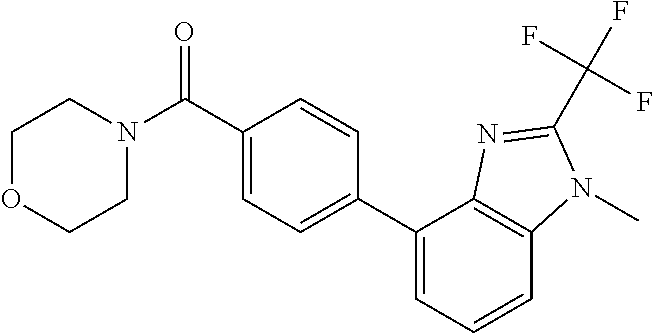 |
390.1 | |
| 2 | (4-(1-ethyl-2-(trifluoromethyl)- 1H-benzimidazol-4- yl)phenyl)(morpholin-4- yl)methanone |
 |
404.0 | |
| 3 | (4-(1-isopropyl-2- (trifluoromethyl)-1H-benzimidazol- 4-yl)phenyl)(morpholin-4- yl)methanone |
 |
418.0 | |
| 4 | (4-(1-ethyl-2-(trifluoromethyl)- 1H-imidazo[4,5-c]pyridin-4- yl)phenyl)(morpholin-4- yl)methanone |
 |
405.1 | |
| 5 | (4-(1-(difluoromethyl)-2- (trifluoromethyl)-1H-imidazo[4,5- c]pyridin-4-yl)phenyl)(morpholin- 4-yl)methanone |
 |
427.0 | |
| 6 | (4-(1-methyl-2-(trifluoromethyl)- 1H-imidazo[4,5-c]pyridin-4- yl)phenyl)(morpholin-4- yl)methanone |
 |
391.0 | |
| 7 | (4-(1-(2,2-difluoroethyl)-2- (trifluoromethyl)-1H-benzimidazol- 4-yl)phenyl)(morpholin-4- yl)methanone |
 |
440.1 | |
| TABLE 1-2 | ||||
| EXAMPLE | IUPAC NAME | Structure | ADDITIVE | MS |
| 8 | (4-(1-ethyl-2-(trifluoromethyl)- 1H-imidazo[4,5-c]pyridin-4-yl)-2- fluorophenyl)(morpholin-4- yl)methanone |
 |
423.1 | |
| 9 | (4-(1-ethyl-2-(trifluoromethyl)- 1H-imidazo[4,5-c]pyridin-4-yl)-2- fluorophenyl)((2S)-2- methylmorpholin-4-yl)methanone |
 |
437.1 | |
| 10 | (4-(1-(2,2-difluoroethyl)-2- (trifluoromethyl)-1H-imidazo[4,5- c]pyridin-4-yl)-2- fluorophenyl)(morpholin-4- yl)methanone |
 |
459.1 | |
| 11 | (2-fluoro-4-(1-methyl-2- (trifluoromethyl)-1H-benzimidazol- 4-yl)phenyl)(2S)-2- methylmorpholin-4-yl)methanone |
 |
422.1 | |
| 12 | (2-fluoro-4-(1-methyl-2- (trifluoromethyl)-1H-benzimidazol- 4-yl)phenyl)(morpholin-4- yl)methanone |
 |
408.0 | |
| 13 | (4-(1-(2,2-difluoroethyl)-2- (trifluoromethyl)-1H-benzimidazol- 4-yl)phenyl)((2S)-2- methylmorpholin-4-yl)methanone |
 |
454.1 | |
| 14 | (4-(1-(2,2-difluoroethyl)-2- (trifluoromethyl)-1H-benzimidazol- 4-yl)phenyl)(1,4-oxazepan-4- yl)methanone |
 |
454.1 | |
| TABLE 1-3 | ||||
| EXAMPLE | IUPAC NAME | Structure | ADDITIVE | MS |
| 15 | (4-(1-(2,2-difluoroethyl)-2- (trifluoromethyl)-1H-imidazo[4,5- c]pyridin-4-yl)-2- fluorophenyl)(1,4-oxazepan-4- yl)methanone |
 |
473.1 | |
| 16 | (4-(1-(2,2-difluoroethyl)-2- (trifluoromethyl)-1H-benzimidazol- 4-yl)phenyl)(2- (difluoromethyl)morpholin-4- yl)methanone |
 |
490.1 | |
| 17 | (4-(1-(2,2-difluoroethyl)-2- (trifluoromethyl)-1H-imidazo[4,5- c]pyridin-4-yl)-2- fluorophenyl)((2S)-2- methylmorpholin-4-yl)methanone |
 |
473.0 | |
| 18 | (4-(4-(morpholin-4- ylcarbonyl)phenyl)-2- (trifluoromethyl)-1H-benzimidazol- 1-yl)acetonitrile |
 |
415.1 | |
| 19 | N-(2-cyanoethyl)-4-(1-(2,2- difluoroethyl)-2-(trifluoromethyl)- 1H-imidazo[4,5-c]pyridin-4-yl)-2- fluoro-N-methylbenzamide |
 |
456.0 | |
| 20 | (2-fluoro-4-(1-(2-methoxyethyl)- 2-(trifluoromethyl)-1H- imidazo[4,5-c]pyridin-4- yl)phenyl)(morpholin-4- yl)methanone |
 |
453.1 | |
| 21 | N-(2-cyanoethyl)-4-(1-(2,2- difluoroethyl)-2-(trifluoromethyl)- 1H-benzimidazol-4-yl)-N- methylbenzamide |
 |
437.1 | |
| TABLE 1-4 | ||||
| EXAMPLE | IUPAC NAME | Structure | ADDITIVE | MS |
| 22 | (4-(1-(2,2-difluoroethyl)-2- (trifluoromethyl)-1H-benzimidazol- 4-yl)phenyl)(2- (difluoromethyl)morpholin-4- yl)methanone optical isomer (retention time: shorter) |
 |
490.1 | |
| 23 | (4-(1-(2,2-difluoroethyl)-2- (trifluoromethyl)-1H-benzimidazol- 4-yl)phenyl)(2- (difluoromethyl)morpholin-4- yl)methanone optical isomer (retention time: longer) |
 |
490.1 | |
| 24 | azetidin-1-yl(4-(1-(2,2- difluoroethyl)-2-(trifluoromethyl)- 1H-imidazo[4,5-c]pyridin-4-yl)-2- fluorophenyl)methanone |
 |
429.2 | |
| 25 | (2-fluoro-4-(1-(2,2,2- trifluoroethyl)-2-(trifluoromethyl)- 1H-imidazo[4,5-c]pyridin-4- yl)phenyl)(morpholin-4- yl)methanone |
 |
477.1 | |
| 26 | (3,3-difluoroazetidin-1-yl)(4-(1- (2,2-difluoroethyl)-2- (trifluoromethyl)-1H-imidazo[4,5- c]pyridin-4-yl)-2- fluorophenyl)methanone |
 |
465.0 | |
| 27 | 4-(1-(2,2-difluoroethyl)-2- (trifluoromethyl)-1H-benzimidazol- 4-yl)-N-((3S)-tetrahydro-2H- pyran-3-yl)benzamide |
 |
454.1 | |
| 28 | 4-(1-(2,2-difluoroethyl)-2- (trifluoromethyl)-1H-imidazo[4,5- c]pyridin-4-yl)-2-fluoro-N- methyl-N-(tetrahydro-2H-pyran- 4-yl)benzamide |
 |
487.0 | |
| TABLE 1-5 | ||||
| EXAMPLE | IUPAC NAME | Structure | ADDITIVE | MS |
| 29 | (4-(1-(2,2-difluoroethyl)-2- (trifluoromethyl)-1H-benzimidazol- 4-yl)phenyl)(6,6-difluoro-1,4- oxazepan-4-yl)methanone |
 |
490.1 | |
| 30 | N-(2-cyanoethyl)-4-(1-(2,2- difluoroethyl)-2-(trifluoromethyl)- 1H-imidazo[4,5-c]pyridin-4-yl)-2- fluoro-N-methylbenzamide |
 |
HCl | 456.0 |
| 31 | 4-(1-(2,2-difluoroethyl)-2- (trifluoromethyl)-1H-benzimidazol- 4-yl)-N-(tetrahydro-2H-pyran-4- yl)benzamide |
 |
454.0 | |
| 32 | 4-(1-(2,2-difluoroethyl)-2- (trifluoromethyl)-1H-benzimidazol- 4-yl)-N-((3R)-tetrahydro-2H- pyran-3-yl)benzamide |
 |
454.1 | |
| 33 | N-(cyclopropylmethyl)-4-(1-(2,2- difluoroethyl)-2-(trifluoromethyl)- 1H-imidazo[4,5-c]pyridin-4-yl)-2- fluorobenzamide |
 |
443.1 | |
| 34 | (4-(1-(2,2-difluoroethyl)-2- (trifluoromethyl)-1H-imidazo[4,5- c]pyridin-4-yl)-2- fluorophenyl)(6,6-difluoro-1,4- oxazepan-4-yl)methanone |
 |
509.1 | |
| 35 | (5-(1-(2,2-difluoroethyl)-2- (trifluoromethyl)-1H-benzimidazol- 4-yl)-3-fluoropyridin-2- yl)(morpholin-4-yl)methanone |
 |
459.1 | |
| TABLE 1-6 | ||||
| EXAMPLE | IUPAC NAME | Structure | ADDITIVE | MS |
| 36 | (4-(1-(2,2-difluoroethyl)-5-fluoro- 2-(trifluoromethyl)-1H- benzimidazol-4- yl)phenyl)(morpholin-4- yl)methanone |
 |
458.1 | |
| 37 | (4-(1-(2,2-difluoroethyl)-2- (trifluoromethyl)-1H-imidazo[4,5- c]pyridin-4-yl)-2- fluorophenyl)((3R)-3- methoxypyrrolidin-1-yl)methanone |
 |
473.1 | |
| 38 | (4-(1-(2,2-difluoroethyl)-6- methyl-2-(trifluoromethyl)-1H- imidazo[4,5-c]pyridin-4-yl)-2- fluorophenyl)(6,6-difluoro-1,4- oxazepan-4-yl)methanone |
 |
523.1 | |
| 39 | (5-(1-(2,2-difluoroethyl)-2- (trifluoromethyl)-1H-benzimidazol- 4-yl)pyridin-2-yl)(6,6-difluoro-1,4- oxazepan-4-yl)methanone |
 |
491.1 | |
| 40 | (4-(1-(2,2-difluoroethyl)-6- methyl-2-(trifluoromethyl)-1H- imidazo[4,5-c]pyridin-4-yl)-2- fluorophenyl)(morpholin-4- yl)methanone |
 |
473.1 | |
| 41 | (4-(1-(2,2-difluoroethyl)-6- methyl-2-(trifluoromethyl)-1H- imidazo[4,5-c]pyridin-4-yl)-2- fluorophenyl)(1,4-oxazepan-4- yl)methanone |
 |
487.1 | |
| 42 | (4-(1-(2,2-difluoroethyl)-2- (trifluoromethyl)-1H-imidazo[4,5- c]pyridin-4-yl)-2,3- difluorophenyl)(morpholin-4- yl)methanone |
 |
477.1 | |
| TABLE 1-7 | ||||
| EXAMPLE | IUPAC NAME | Structure | ADDITIVE | MS |
| 43 | (4-(1-(2,2-difluoroethyl)-2- (trifluoromethyl)-1H-imidazo[4,5- c]pyridin-4-yl)-2- fluorophenyl)((3S)-3- methoxypyrrolidin-1-yl)methanone |
 |
473.1 | |
| 44 | (4-(1-(2,2-difluoroethyl)-2- (trifluoromethyl)-1H-imidazo[4,5- c]pyridin-4-yl)-2- fluorophenyl)((2R)-2- methylmorpholin-4-yl)methanone |
 |
473.0 | |
| 45 | (5-(1-(2,2-difluoroethyl)-5- methyl-2-(trifluoromethyl)-1H- benzimidazol-4-yl)-3- fluoropyridin-2-yl)(morpholin-4- yl)methanone |
 |
473.1 | |
| 46 | (6-(1-(2,2-difluoroethyl)-2- (trifluoromethyl)-1H-benzimidazol- 4-yl)pyridin-3-yl)(6,6-difluoro-1,4- oxazepan-4-yl)methanone |
 |
491.1 | |
| 47 | (6-(1-(2,2-difluoroethyl)-2- (trifluoromethyl)-1H-benzimidazol- 4-yl)pyridin-3-yl)(morpholin-4- yl)methanone |
 |
441.1 | |
| 48 | (4-(1-(2,2-difluoroethyl)-2- (trifluoromethyl)-1H-imidazo[4,5- c]pyridin-4-yl)-2-fluorophenyl)(5- oxa-8-azaspiro[2.6]non-8- yl)methanone |
 |
499.0 | |
| 49 | (5-(1-(2,2-difluoroethyl)-5- methyl-2-(trifluoromethyl)-1H- benzimidazol-4-yl)-3- fluoropyridin-2-yl)(6,6-difluoro- 1,4-oxazepan-4-yl)methanone |
 |
523.1 | |
| TABLE 1-8 | ||||
| EXAMPLE | IUPAC NAME | Structure | ADDITIVE | MS |
| 50 | (4-(1-(2,2-difluoroethyl)-2- (trifluoromethyl)-1H-imidazo[4,5- c]pyridin-4-yl)phenyl)(6,6-difluoro- 1,4-oxazepan-4-yl)methanone |
 |
491.1 | |
| 51 | (4-(1-(2,2-difluoroethyl)-2- (trifluoromethyl)-1H-benzimidazol- 4-yl)-3-fluorophenyl)(morpholin-4- yl)methanone |
 |
458.1 | |
| 52 | (4-(1-(2,2-difluoroethyl)-2- (trifluoromethyl)-1H-imidazo[4,5- c]pyridin-4-yl)-2-fluorophenyl)(4- methoxypiperidin-1-yl)methanone |
 |
487.1 | |
| 53 | (4-(1-(2,2-difluoroethyl)-2- (trifluoromethyl)-1H-imidazo[4,5- c]pyridin-4-yl)-3- fluorophenyl)(morpholin-4- yl)methanone |
 |
458.9 | |
| 54 | (4-(1-(2,2-difluoroethyl)-2- (trifluoromethyl)-1H-imidazo[4,5- c]pyridin-4-yl)-3- fluorophenyl)(morpholin-4- yl)methanone |
 |
HCl | 459.1 |
| 55 | (4-(1-(2,2-difluoroethyl)-2- (trifluoromethyl)-1H-imidazo[4,5- c]pyridin-4-yl)-2,3- difluorophenyl)(morpholin-4- yl)methanone |
 |
HCl | 477.1 |
| 56 | (4-(1-(2,2-difluoroethyl)-2- (trifluoromethyl)-1H-imidazo[4,5- c]pyridin-4-yl)phenyl)(morpholin- 4-yl)methanone |
 |
441.1 | |
| TABLE 9 | ||||
| EXAMPLE | IUPAC NAME | Structure | ADDITIVE | MS |
| 57 | (4-(1-(2,2-difluoroethyl)-2- (trifluoromethyl)-1H-imidazo[4,5- c]pyridin-4-yl)-2- methoxyphenyl)(morpholin-4- yl)methanone |
 |
471.1 | |
| 58 | (4-(1-(2,2-difluoroethyl)-2- (trifluoromethyl)-1H-imidazo[4,5- c]pyridin-4-yl)-2- methoxyphenyl)(6,6-difluoro-1,4- oxazepan-4-yl)methanone |
 |
521.1 | |
| 59 | (4-(1-(2,2-difluoroethyl)-2- (trifluoromethyl)-1H-imidazo[4,5- c]pyridin-4-yl)-2- fluorophenyl)(2,2- difluoromorpholin-4-yl)methanone |
 |
494.8 | |
activity (%)=(X−C)/(T−C)×100
T: variation of fluorescence level of well added with final concentration 3 mM of glutamic acid and 300 μM cyclothiazide
C: variation of fluorescence level of well added with final concentration 3 mM of glutamic acid alone
X: variation of fluorescence level of well added with test compound
| TABLE 2 | |||
| Example No. | hG1uR1 flip/30 μM (%) | ||
| 2 | 79.3 | ||
| 4 | 68.4 | ||
| 7 | 83.3 | ||
| 8 | 108.9 | ||
| 9 | 110.4 | ||
| 10 | 90.5 | ||
| 11 | 80.3 | ||
| 12 | 84.4 | ||
| 13 | 112.2 | ||
| 14 | 92.6 | ||
| 15 | 72 | ||
| 16 | 107.6 | ||
| 17 | 95.1 | ||
| 19 | 81 | ||
| 21 | 93.7 | ||
| 22 | 105.5 | ||
| 23 | 103 | ||
| 24 | 78.1 | ||
| 26 | 79.3 | ||
| 28 | 97.8 | ||
| 29 | 93 | ||
| 30 | 92.6 | ||
| 34 | 94.2 | ||
| 35 | 81.2 | ||
| 36 | 93.5 | ||
| 37 | 89.8 | ||
| 38 | 100.4 | ||
| 39 | 110.2 | ||
| 42 | 83.9 | ||
| 44 | 85.5 | ||
| 46 | 77 | ||
| 48 | 80.2 | ||
| 50 | 122.2 | ||
| 51 | 113 | ||
| 52 | 67.1 | ||
| 53 | 69 | ||
| TABLE 3 | |||
| Dose | |||
| Novel Object Interaction (%) | 0 mg/kg | 1 mg/kg | ||
| Compound A (Example 10) | 51.08 ± 1.52 | 56.32 ± 1.56 | ||
| Compound B (Example 35) | 52.96 ± 2.03 | 61.28 ± 2.35 | ||
| 1. capsule |
| (1) compound obtained in Example 1 | 40 | mg | ||
| (2) lactose | 70 | mg | ||
| (3) microcrystalline cellulose | 9 | mg | ||
| (4) magnesium stearate | 1 | mg | ||
| 1 capsule | 120 | mg | ||
| 2. tablet |
| (1) compound obtained in Example 1 | 40 | mg | ||
| (2) lactose | 58 | mg | ||
| (3) cornstarch | 18 | mg | ||
| (4) microcrystalline cellulose | 3.5 | mg | ||
| (5) magnesium stearate | 0.5 | mg | ||
| 1 tablet | 120 | mg | ||
Claims (9)

Applications Claiming Priority (4)
| Application Number | Priority Date | Filing Date | Title |
|---|---|---|---|
| JP2017195906 | 2017-10-06 | ||
| JP2017-195906 | 2017-10-06 | ||
| JPJP2017-195906 | 2017-10-06 | ||
| PCT/JP2018/037283 WO2019070044A1 (en) | 2017-10-06 | 2018-10-04 | Heterocyclic compounds |
Related Parent Applications (1)
| Application Number | Title | Priority Date | Filing Date |
|---|---|---|---|
| PCT/JP2018/037283 A-371-Of-International WO2019070044A1 (en) | 2017-10-06 | 2018-10-04 | Heterocyclic compounds |
Related Child Applications (1)
| Application Number | Title | Priority Date | Filing Date |
|---|---|---|---|
| US17/819,818 Division US11939327B2 (en) | 2017-10-06 | 2022-08-15 | Heterocyclic compounds |
Publications (2)
| Publication Number | Publication Date |
|---|---|
| US20200247801A1 US20200247801A1 (en) | 2020-08-06 |
| US11447488B2 true US11447488B2 (en) | 2022-09-20 |
Family
ID=65994964
Family Applications (2)
| Application Number | Title | Priority Date | Filing Date |
|---|---|---|---|
| US16/753,630 Active 2038-12-21 US11447488B2 (en) | 2017-10-06 | 2018-10-04 | Heterocyclic compounds |
| US17/819,818 Active US11939327B2 (en) | 2017-10-06 | 2022-08-15 | Heterocyclic compounds |
Family Applications After (1)
| Application Number | Title | Priority Date | Filing Date |
|---|---|---|---|
| US17/819,818 Active US11939327B2 (en) | 2017-10-06 | 2022-08-15 | Heterocyclic compounds |
Country Status (5)
| Country | Link |
|---|---|
| US (2) | US11447488B2 (en) |
| EP (1) | EP3693360B1 (en) |
| JP (1) | JP7250687B2 (en) |
| ES (1) | ES2971497T3 (en) |
| WO (1) | WO2019070044A1 (en) |
Cited By (1)
| Publication number | Priority date | Publication date | Assignee | Title |
|---|---|---|---|---|
| US11939327B2 (en) | 2017-10-06 | 2024-03-26 | Takeda Pharmaceutical Company Limited | Heterocyclic compounds |
Families Citing this family (2)
| Publication number | Priority date | Publication date | Assignee | Title |
|---|---|---|---|---|
| JP7250686B2 (en) | 2017-10-06 | 2023-04-03 | 武田薬品工業株式会社 | heterocyclic compound |
| EP4450502A4 (en) * | 2021-12-17 | 2025-06-11 | Sato Pharmaceutical Co., Ltd. | Azaindole derivative inhibiting h-pgds |
Citations (17)
| Publication number | Priority date | Publication date | Assignee | Title |
|---|---|---|---|---|
| WO2007040438A2 (en) | 2005-10-03 | 2007-04-12 | Astrazeneca Ab | Novel imidazo [4,5 -b] pyridine derivatives as inhibitors of glycogen synthase kinase 3 for use in the treatment of dementia and neurodegenerative disorders |
| WO2009119088A1 (en) | 2008-03-25 | 2009-10-01 | 武田薬品工業株式会社 | Heterocyclic compound |
| US20100041891A1 (en) | 2008-08-12 | 2010-02-18 | Takeda Pharmaceutical Company Limited | Amide compound |
| WO2010140339A1 (en) | 2009-06-01 | 2010-12-09 | 武田薬品工業株式会社 | Heterocyclic compound |
| WO2011036885A1 (en) | 2009-09-25 | 2011-03-31 | 武田薬品工業株式会社 | Heterocyclic compound |
| WO2011036889A1 (en) | 2009-09-25 | 2011-03-31 | 武田薬品工業株式会社 | Heterocyclic compound |
| WO2012020848A1 (en) | 2010-08-10 | 2012-02-16 | Takeda Pharmaceutical Company Limited | Heterocyclic compound and use thereof |
| WO2012133607A1 (en) | 2011-03-31 | 2012-10-04 | アステラス製薬株式会社 | Pyrazole compound |
| WO2012137982A2 (en) | 2011-04-05 | 2012-10-11 | Takeda Pharmaceutical Company Limited | Sulfonamide derivative and use thereof |
| WO2013118845A1 (en) | 2012-02-08 | 2013-08-15 | 武田薬品工業株式会社 | Heterocyclic compound and use thereof |
| WO2014092104A1 (en) | 2012-12-12 | 2014-06-19 | 大日本住友製薬株式会社 | Oxadiazole derivative and pharmaceutical use of same |
| WO2015039172A1 (en) | 2013-09-17 | 2015-03-26 | Vectus Biosystems Pty Ltd | Compositions for the treatment of hypertension and/or fibrosis |
| WO2016176463A1 (en) | 2015-04-29 | 2016-11-03 | Janssen Pharmaceutica Nv | Indolone compounds and their use as ampa receptor modulators |
| WO2016176460A1 (en) | 2015-04-29 | 2016-11-03 | Janssen Pharmaceutica Nv | Azabenzimidazoles and their use as ampa receptor modulators |
| WO2016176457A1 (en) | 2015-04-29 | 2016-11-03 | Janssen Pharmaceutica Nv | Imidazopyrazines and pyrazolopyrimidines and their use as ampa receptor modulators |
| WO2016176449A1 (en) | 2015-04-29 | 2016-11-03 | Janssen Pharmaceutica Nv | Benzimidazolone and benzothiazolone compounds and their use as ampa receptor modulators |
| WO2016210234A1 (en) | 2015-06-26 | 2016-12-29 | Merck Sharp & Dohme Corp. | Metallo-beta-lactamase inhibitors |
Family Cites Families (8)
| Publication number | Priority date | Publication date | Assignee | Title |
|---|---|---|---|---|
| FR2833956B1 (en) | 2001-12-21 | 2004-01-30 | Servier Lab | NOVEL BENZOTHIAZINE AND BENZOTHIADIAZINE DERIVATIVES, PROCESS FOR THEIR PREPARATION AND THE PHARMACEUTICAL COMPOSITIONS CONTAINING THEM |
| EP1790649A1 (en) | 2005-11-21 | 2007-05-30 | Sanofi-Aventis | Substituted bicyclic pyrimidone derivatives |
| EP2138492A1 (en) | 2008-06-26 | 2009-12-30 | Sanofi-Aventis | Substituted pyrimidin-4-one derivatives |
| KR101405623B1 (en) * | 2012-08-13 | 2014-06-10 | 현대자동차주식회사 | Electric box for vehicle |
| CN108349989B (en) | 2015-11-13 | 2021-01-01 | 卫材R&D管理有限公司 | Pyranodipyridine compounds |
| JP6519614B2 (en) | 2017-08-10 | 2019-05-29 | 井関農機株式会社 | Work vehicle |
| EP3693360B1 (en) | 2017-10-06 | 2023-12-13 | Takeda Pharmaceutical Company Limited | Heterocyclic compounds |
| JP7250686B2 (en) | 2017-10-06 | 2023-04-03 | 武田薬品工業株式会社 | heterocyclic compound |
-
2018
- 2018-10-04 EP EP18864009.8A patent/EP3693360B1/en active Active
- 2018-10-04 ES ES18864009T patent/ES2971497T3/en active Active
- 2018-10-04 JP JP2019547023A patent/JP7250687B2/en active Active
- 2018-10-04 WO PCT/JP2018/037283 patent/WO2019070044A1/en not_active Ceased
- 2018-10-04 US US16/753,630 patent/US11447488B2/en active Active
-
2022
- 2022-08-15 US US17/819,818 patent/US11939327B2/en active Active
Patent Citations (38)
| Publication number | Priority date | Publication date | Assignee | Title |
|---|---|---|---|---|
| WO2007040438A2 (en) | 2005-10-03 | 2007-04-12 | Astrazeneca Ab | Novel imidazo [4,5 -b] pyridine derivatives as inhibitors of glycogen synthase kinase 3 for use in the treatment of dementia and neurodegenerative disorders |
| WO2009119088A1 (en) | 2008-03-25 | 2009-10-01 | 武田薬品工業株式会社 | Heterocyclic compound |
| US20110118236A1 (en) | 2008-03-25 | 2011-05-19 | Michiyo Mochizuki | Heterocyclic compound |
| US20100041891A1 (en) | 2008-08-12 | 2010-02-18 | Takeda Pharmaceutical Company Limited | Amide compound |
| WO2010140339A1 (en) | 2009-06-01 | 2010-12-09 | 武田薬品工業株式会社 | Heterocyclic compound |
| WO2011036885A1 (en) | 2009-09-25 | 2011-03-31 | 武田薬品工業株式会社 | Heterocyclic compound |
| WO2011036889A1 (en) | 2009-09-25 | 2011-03-31 | 武田薬品工業株式会社 | Heterocyclic compound |
| US20120077799A1 (en) | 2010-08-10 | 2012-03-29 | Takeda Pharmaceutical Company Limited | Heterocyclic compound and use thereof |
| US20150073137A1 (en) | 2010-08-10 | 2015-03-12 | Takeda Pharmaceutical Company Limited | Heterocyclic compound and use thereof |
| WO2012020848A1 (en) | 2010-08-10 | 2012-02-16 | Takeda Pharmaceutical Company Limited | Heterocyclic compound and use thereof |
| US20190263832A1 (en) | 2010-08-10 | 2019-08-29 | Takeda Pharmaceutical Company Limited | Heterocyclic compound and use thereof |
| US20130184266A1 (en) | 2010-08-10 | 2013-07-18 | Takeda Pharmaceutical Company Limited | Heterocyclic compound and use thereof |
| US20130190291A1 (en) | 2010-08-10 | 2013-07-25 | Takeda Pharmaceutical Company Limited | Heterocyclic compound and use thereof |
| US20180162875A1 (en) | 2010-08-10 | 2018-06-14 | Takeda Pharmaceutical Company Limited | Heterocyclic compound and use thereof |
| US20170022222A1 (en) | 2010-08-10 | 2017-01-26 | Takeda Pharmaceutical Company Limited | Heterocyclic compound and use thereof |
| US20140080817A1 (en) | 2010-08-10 | 2014-03-20 | Takeda Pharmaceutical Company Limited | Heterocyclic compound and use thereof |
| US20150353578A1 (en) | 2010-08-10 | 2015-12-10 | Takeda Pharmaceutical Company Limited | Heterocyclic compound and use thereof |
| WO2012133607A1 (en) | 2011-03-31 | 2012-10-04 | アステラス製薬株式会社 | Pyrazole compound |
| US20140024650A1 (en) | 2011-04-05 | 2014-01-23 | Takeda Pharmaceutical Company Limited | Sulfonamide derivative and use thereof |
| WO2012137982A2 (en) | 2011-04-05 | 2012-10-11 | Takeda Pharmaceutical Company Limited | Sulfonamide derivative and use thereof |
| US20150051197A1 (en) | 2012-02-08 | 2015-02-19 | Takeda Pharmaceutical Company Limited | Heterocyclic compound and use thereof |
| WO2013118845A1 (en) | 2012-02-08 | 2013-08-15 | 武田薬品工業株式会社 | Heterocyclic compound and use thereof |
| WO2014092104A1 (en) | 2012-12-12 | 2014-06-19 | 大日本住友製薬株式会社 | Oxadiazole derivative and pharmaceutical use of same |
| WO2015039172A1 (en) | 2013-09-17 | 2015-03-26 | Vectus Biosystems Pty Ltd | Compositions for the treatment of hypertension and/or fibrosis |
| US20160280671A1 (en) | 2013-09-17 | 2016-09-29 | Vectus Biosystems Limited | Compositions for the treatment of hypertension and/or fibrosis |
| WO2016176460A1 (en) | 2015-04-29 | 2016-11-03 | Janssen Pharmaceutica Nv | Azabenzimidazoles and their use as ampa receptor modulators |
| WO2016176449A1 (en) | 2015-04-29 | 2016-11-03 | Janssen Pharmaceutica Nv | Benzimidazolone and benzothiazolone compounds and their use as ampa receptor modulators |
| US20180118751A1 (en) | 2015-04-29 | 2018-05-03 | Janssen Pharmaceutica Nv | Imidazopyrazines and pyrazolopyrimidines and their use as ampa receptor modulators |
| US20180118683A1 (en) | 2015-04-29 | 2018-05-03 | Janssen Pharmaceutica Nv | Indolone compounds and their use as ampa receptor modulators |
| US20180118740A1 (en) | 2015-04-29 | 2018-05-03 | Janssen Pharmaceutica Nv | Azabenzimidazoles and their use as ampa receptor modulators |
| WO2016176457A1 (en) | 2015-04-29 | 2016-11-03 | Janssen Pharmaceutica Nv | Imidazopyrazines and pyrazolopyrimidines and their use as ampa receptor modulators |
| US20190092735A1 (en) | 2015-04-29 | 2019-03-28 | Janssen Pharmaceutica Nv | Benzimidazolone and benzothiazolone compounds and their use as ampa receptor modulators |
| WO2016176463A1 (en) | 2015-04-29 | 2016-11-03 | Janssen Pharmaceutica Nv | Indolone compounds and their use as ampa receptor modulators |
| WO2016210234A1 (en) | 2015-06-26 | 2016-12-29 | Merck Sharp & Dohme Corp. | Metallo-beta-lactamase inhibitors |
| WO2016206101A1 (en) | 2015-06-26 | 2016-12-29 | Merck Sharp & Dohme Corp. | Metallo-beta-lactamase inhibitors |
| US20180179190A1 (en) | 2015-06-26 | 2018-06-28 | Marck Sharp & Dohme Corp. | Metallo-beta-lactamase inhibitors |
| US20180244656A1 (en) | 2015-06-26 | 2018-08-30 | Merck Sharp & Dohme Corp. | Metallo-beta-lactamase inhibitors |
| US20190144432A1 (en) | 2015-06-26 | 2019-05-16 | Merck Sharp & Dohme Corp. | Metallo-beta-lactamase inhibitors |
Non-Patent Citations (13)
Cited By (1)
| Publication number | Priority date | Publication date | Assignee | Title |
|---|---|---|---|---|
| US11939327B2 (en) | 2017-10-06 | 2024-03-26 | Takeda Pharmaceutical Company Limited | Heterocyclic compounds |
Also Published As
| Publication number | Publication date |
|---|---|
| EP3693360A1 (en) | 2020-08-12 |
| US11939327B2 (en) | 2024-03-26 |
| US20200247801A1 (en) | 2020-08-06 |
| EP3693360C0 (en) | 2023-12-13 |
| JP7250687B2 (en) | 2023-04-03 |
| EP3693360A4 (en) | 2021-02-17 |
| ES2971497T3 (en) | 2024-06-05 |
| EP3693360B1 (en) | 2023-12-13 |
| US20230278999A1 (en) | 2023-09-07 |
| JPWO2019070044A1 (en) | 2020-10-22 |
| WO2019070044A1 (en) | 2019-04-11 |
Similar Documents
| Publication | Publication Date | Title |
|---|---|---|
| US10214508B2 (en) | Nitrogen-containing heterocyclic compound | |
| US10208046B2 (en) | Nitrogen-containing heterocyclic compound | |
| US10548899B2 (en) | Quinazolinone and benzotriazinone compounds with cholinergic muscarinin M1 receptor positive allosteric modulator activity | |
| US10548877B2 (en) | Aromatic ring compound | |
| US12024505B2 (en) | Heterocyclic compounds useful as modulators of acetylcholine receptors | |
| US11939327B2 (en) | Heterocyclic compounds | |
| US12378256B2 (en) | Heterocyclic compound | |
| US11407748B2 (en) | Substituted pyrido[1,2-a]pyrimidines and pyrazino[1,2-a]pyrimidines for enhancing AMPA receptor function | |
| US11702419B2 (en) | Heterocyclic compound and use thereof | |
| US20220089525A1 (en) | Heterocyclic compound and use thereof | |
| EP3643718A1 (en) | Heterocyclic compound | |
| HK40033904B (en) | Heterocyclic compounds | |
| HK40033904A (en) | Heterocyclic compounds | |
| HK40033905B (en) | Heterocyclic compound | |
| HK40033905A (en) | Heterocyclic compound |
Legal Events
| Date | Code | Title | Description |
|---|---|---|---|
| FEPP | Fee payment procedure |
Free format text: ENTITY STATUS SET TO UNDISCOUNTED (ORIGINAL EVENT CODE: BIG.); ENTITY STATUS OF PATENT OWNER: LARGE ENTITY |
|
| STPP | Information on status: patent application and granting procedure in general |
Free format text: APPLICATION DISPATCHED FROM PREEXAM, NOT YET DOCKETED |
|
| AS | Assignment |
Owner name: TAKEDA PHARMACEUTICAL COMPANY LIMITED, JAPAN Free format text: ASSIGNMENT OF ASSIGNORS INTEREST;ASSIGNORS:HASUI, TOMOAKI;NAKAMURA, SHINHI;MIKAMI, SATOSHI;AND OTHERS;SIGNING DATES FROM 20200402 TO 20200621;REEL/FRAME:053165/0420 |
|
| AS | Assignment |
Owner name: TAKEDA PHARMACEUTICAL COMPANY LIMITED, JAPAN Free format text: CORRECTIVE ASSIGNMENT TO CORRECT THE SECOND INVENTOR'S FIRST NAME PREVIOUSLY RECORDED ON REEL 053165 FRAME 0420. ASSIGNOR(S) HEREBY CONFIRMS THE ASSIGNMENT;ASSIGNORS:HASUI, TOMOAKI;NAKAMURA, SHINJI;MIKAMI, SATOSHI;AND OTHERS;SIGNING DATES FROM 20200402 TO 20200621;REEL/FRAME:053181/0624 |
|
| STPP | Information on status: patent application and granting procedure in general |
Free format text: DOCKETED NEW CASE - READY FOR EXAMINATION |
|
| STPP | Information on status: patent application and granting procedure in general |
Free format text: NON FINAL ACTION MAILED |
|
| STPP | Information on status: patent application and granting procedure in general |
Free format text: RESPONSE TO NON-FINAL OFFICE ACTION ENTERED AND FORWARDED TO EXAMINER |
|
| STPP | Information on status: patent application and granting procedure in general |
Free format text: NON FINAL ACTION MAILED |
|
| STPP | Information on status: patent application and granting procedure in general |
Free format text: NOTICE OF ALLOWANCE MAILED -- APPLICATION RECEIVED IN OFFICE OF PUBLICATIONS |
|
| STCF | Information on status: patent grant |
Free format text: PATENTED CASE |
|
| CC | Certificate of correction | ||
| MAFP | Maintenance fee payment |
Free format text: PAYMENT OF MAINTENANCE FEE, 4TH YEAR, LARGE ENTITY (ORIGINAL EVENT CODE: M1551); ENTITY STATUS OF PATENT OWNER: LARGE ENTITY Year of fee payment: 4 |