US11264506B2 - Semiconductor device and manufacturing method thereof - Google Patents
Semiconductor device and manufacturing method thereof Download PDFInfo
- Publication number
- US11264506B2 US11264506B2 US16/658,768 US201916658768A US11264506B2 US 11264506 B2 US11264506 B2 US 11264506B2 US 201916658768 A US201916658768 A US 201916658768A US 11264506 B2 US11264506 B2 US 11264506B2
- Authority
- US
- United States
- Prior art keywords
- sacrificial
- layers
- forming
- semiconductor
- dielectric layer
- Prior art date
- Legal status (The legal status is an assumption and is not a legal conclusion. Google has not performed a legal analysis and makes no representation as to the accuracy of the status listed.)
- Active
Links
Images




Classifications
-
- H—ELECTRICITY
- H10—SEMICONDUCTOR DEVICES; ELECTRIC SOLID-STATE DEVICES NOT OTHERWISE PROVIDED FOR
- H10D—INORGANIC ELECTRIC SEMICONDUCTOR DEVICES
- H10D84/00—Integrated devices formed in or on semiconductor substrates that comprise only semiconducting layers, e.g. on Si wafers or on GaAs-on-Si wafers
- H10D84/80—Integrated devices formed in or on semiconductor substrates that comprise only semiconducting layers, e.g. on Si wafers or on GaAs-on-Si wafers characterised by the integration of at least one component covered by groups H10D12/00 or H10D30/00, e.g. integration of IGFETs
- H10D84/82—Integrated devices formed in or on semiconductor substrates that comprise only semiconducting layers, e.g. on Si wafers or on GaAs-on-Si wafers characterised by the integration of at least one component covered by groups H10D12/00 or H10D30/00, e.g. integration of IGFETs of only field-effect components
- H10D84/83—Integrated devices formed in or on semiconductor substrates that comprise only semiconducting layers, e.g. on Si wafers or on GaAs-on-Si wafers characterised by the integration of at least one component covered by groups H10D12/00 or H10D30/00, e.g. integration of IGFETs of only field-effect components of only insulated-gate FETs [IGFET]
- H10D84/834—Integrated devices formed in or on semiconductor substrates that comprise only semiconducting layers, e.g. on Si wafers or on GaAs-on-Si wafers characterised by the integration of at least one component covered by groups H10D12/00 or H10D30/00, e.g. integration of IGFETs of only field-effect components of only insulated-gate FETs [IGFET] comprising FinFETs
-
- B—PERFORMING OPERATIONS; TRANSPORTING
- B82—NANOTECHNOLOGY
- B82Y—SPECIFIC USES OR APPLICATIONS OF NANOSTRUCTURES; MEASUREMENT OR ANALYSIS OF NANOSTRUCTURES; MANUFACTURE OR TREATMENT OF NANOSTRUCTURES
- B82Y10/00—Nanotechnology for information processing, storage or transmission, e.g. quantum computing or single electron logic
-
- H01L29/7853—
-
- H—ELECTRICITY
- H10—SEMICONDUCTOR DEVICES; ELECTRIC SOLID-STATE DEVICES NOT OTHERWISE PROVIDED FOR
- H10D—INORGANIC ELECTRIC SEMICONDUCTOR DEVICES
- H10D30/00—Field-effect transistors [FET]
- H10D30/60—Insulated-gate field-effect transistors [IGFET]
- H10D30/67—Thin-film transistors [TFT]
- H10D30/6729—Thin-film transistors [TFT] characterised by the electrodes
- H10D30/673—Thin-film transistors [TFT] characterised by the electrodes characterised by the shapes, relative sizes or dispositions of the gate electrodes
- H10D30/6735—Thin-film transistors [TFT] characterised by the electrodes characterised by the shapes, relative sizes or dispositions of the gate electrodes having gates fully surrounding the channels, e.g. gate-all-around
-
- H01L27/1211—
-
- H01L29/0673—
-
- H01L29/24—
-
- H01L29/247—
-
- H01L29/42392—
-
- H01L29/66969—
-
- H—ELECTRICITY
- H10—SEMICONDUCTOR DEVICES; ELECTRIC SOLID-STATE DEVICES NOT OTHERWISE PROVIDED FOR
- H10D—INORGANIC ELECTRIC SEMICONDUCTOR DEVICES
- H10D30/00—Field-effect transistors [FET]
- H10D30/01—Manufacture or treatment
- H10D30/014—Manufacture or treatment of FETs having zero-dimensional [0D] or one-dimensional [1D] channels, e.g. quantum wire FETs, single-electron transistors [SET] or Coulomb blockade transistors
-
- H—ELECTRICITY
- H10—SEMICONDUCTOR DEVICES; ELECTRIC SOLID-STATE DEVICES NOT OTHERWISE PROVIDED FOR
- H10D—INORGANIC ELECTRIC SEMICONDUCTOR DEVICES
- H10D30/00—Field-effect transistors [FET]
- H10D30/01—Manufacture or treatment
- H10D30/021—Manufacture or treatment of FETs having insulated gates [IGFET]
- H10D30/024—Manufacture or treatment of FETs having insulated gates [IGFET] of fin field-effect transistors [FinFET]
-
- H—ELECTRICITY
- H10—SEMICONDUCTOR DEVICES; ELECTRIC SOLID-STATE DEVICES NOT OTHERWISE PROVIDED FOR
- H10D—INORGANIC ELECTRIC SEMICONDUCTOR DEVICES
- H10D30/00—Field-effect transistors [FET]
- H10D30/01—Manufacture or treatment
- H10D30/021—Manufacture or treatment of FETs having insulated gates [IGFET]
- H10D30/031—Manufacture or treatment of FETs having insulated gates [IGFET] of thin-film transistors [TFT]
-
- H—ELECTRICITY
- H10—SEMICONDUCTOR DEVICES; ELECTRIC SOLID-STATE DEVICES NOT OTHERWISE PROVIDED FOR
- H10D—INORGANIC ELECTRIC SEMICONDUCTOR DEVICES
- H10D30/00—Field-effect transistors [FET]
- H10D30/40—FETs having zero-dimensional [0D], one-dimensional [1D] or two-dimensional [2D] charge carrier gas channels
- H10D30/43—FETs having zero-dimensional [0D], one-dimensional [1D] or two-dimensional [2D] charge carrier gas channels having one-dimensional [1D] charge carrier gas channels, e.g. quantum wire FETs or transistors having 1D quantum-confined channels
-
- H—ELECTRICITY
- H10—SEMICONDUCTOR DEVICES; ELECTRIC SOLID-STATE DEVICES NOT OTHERWISE PROVIDED FOR
- H10D—INORGANIC ELECTRIC SEMICONDUCTOR DEVICES
- H10D30/00—Field-effect transistors [FET]
- H10D30/60—Insulated-gate field-effect transistors [IGFET]
- H10D30/62—Fin field-effect transistors [FinFET]
-
- H—ELECTRICITY
- H10—SEMICONDUCTOR DEVICES; ELECTRIC SOLID-STATE DEVICES NOT OTHERWISE PROVIDED FOR
- H10D—INORGANIC ELECTRIC SEMICONDUCTOR DEVICES
- H10D30/00—Field-effect transistors [FET]
- H10D30/60—Insulated-gate field-effect transistors [IGFET]
- H10D30/67—Thin-film transistors [TFT]
-
- H—ELECTRICITY
- H10—SEMICONDUCTOR DEVICES; ELECTRIC SOLID-STATE DEVICES NOT OTHERWISE PROVIDED FOR
- H10D—INORGANIC ELECTRIC SEMICONDUCTOR DEVICES
- H10D30/00—Field-effect transistors [FET]
- H10D30/60—Insulated-gate field-effect transistors [IGFET]
- H10D30/67—Thin-film transistors [TFT]
- H10D30/674—Thin-film transistors [TFT] characterised by the active materials
- H10D30/6755—Oxide semiconductors, e.g. zinc oxide, copper aluminium oxide or cadmium stannate
-
- H—ELECTRICITY
- H10—SEMICONDUCTOR DEVICES; ELECTRIC SOLID-STATE DEVICES NOT OTHERWISE PROVIDED FOR
- H10D—INORGANIC ELECTRIC SEMICONDUCTOR DEVICES
- H10D30/00—Field-effect transistors [FET]
- H10D30/60—Insulated-gate field-effect transistors [IGFET]
- H10D30/67—Thin-film transistors [TFT]
- H10D30/674—Thin-film transistors [TFT] characterised by the active materials
- H10D30/6755—Oxide semiconductors, e.g. zinc oxide, copper aluminium oxide or cadmium stannate
- H10D30/6756—Amorphous oxide semiconductors
-
- H—ELECTRICITY
- H10—SEMICONDUCTOR DEVICES; ELECTRIC SOLID-STATE DEVICES NOT OTHERWISE PROVIDED FOR
- H10D—INORGANIC ELECTRIC SEMICONDUCTOR DEVICES
- H10D30/00—Field-effect transistors [FET]
- H10D30/60—Insulated-gate field-effect transistors [IGFET]
- H10D30/67—Thin-film transistors [TFT]
- H10D30/6757—Thin-film transistors [TFT] characterised by the structure of the channel, e.g. transverse or longitudinal shape or doping profile
-
- H—ELECTRICITY
- H10—SEMICONDUCTOR DEVICES; ELECTRIC SOLID-STATE DEVICES NOT OTHERWISE PROVIDED FOR
- H10D—INORGANIC ELECTRIC SEMICONDUCTOR DEVICES
- H10D62/00—Semiconductor bodies, or regions thereof, of devices having potential barriers
- H10D62/10—Shapes, relative sizes or dispositions of the regions of the semiconductor bodies; Shapes of the semiconductor bodies
- H10D62/117—Shapes of semiconductor bodies
- H10D62/118—Nanostructure semiconductor bodies
-
- H—ELECTRICITY
- H10—SEMICONDUCTOR DEVICES; ELECTRIC SOLID-STATE DEVICES NOT OTHERWISE PROVIDED FOR
- H10D—INORGANIC ELECTRIC SEMICONDUCTOR DEVICES
- H10D62/00—Semiconductor bodies, or regions thereof, of devices having potential barriers
- H10D62/10—Shapes, relative sizes or dispositions of the regions of the semiconductor bodies; Shapes of the semiconductor bodies
- H10D62/117—Shapes of semiconductor bodies
- H10D62/118—Nanostructure semiconductor bodies
- H10D62/119—Nanowire, nanosheet or nanotube semiconductor bodies
- H10D62/121—Nanowire, nanosheet or nanotube semiconductor bodies oriented parallel to substrates
-
- H—ELECTRICITY
- H10—SEMICONDUCTOR DEVICES; ELECTRIC SOLID-STATE DEVICES NOT OTHERWISE PROVIDED FOR
- H10D—INORGANIC ELECTRIC SEMICONDUCTOR DEVICES
- H10D62/00—Semiconductor bodies, or regions thereof, of devices having potential barriers
- H10D62/10—Shapes, relative sizes or dispositions of the regions of the semiconductor bodies; Shapes of the semiconductor bodies
- H10D62/13—Semiconductor regions connected to electrodes carrying current to be rectified, amplified or switched, e.g. source or drain regions
- H10D62/149—Source or drain regions of field-effect devices
- H10D62/151—Source or drain regions of field-effect devices of IGFETs
-
- H—ELECTRICITY
- H10—SEMICONDUCTOR DEVICES; ELECTRIC SOLID-STATE DEVICES NOT OTHERWISE PROVIDED FOR
- H10D—INORGANIC ELECTRIC SEMICONDUCTOR DEVICES
- H10D62/00—Semiconductor bodies, or regions thereof, of devices having potential barriers
- H10D62/10—Shapes, relative sizes or dispositions of the regions of the semiconductor bodies; Shapes of the semiconductor bodies
- H10D62/17—Semiconductor regions connected to electrodes not carrying current to be rectified, amplified or switched, e.g. channel regions
- H10D62/351—Substrate regions of field-effect devices
- H10D62/357—Substrate regions of field-effect devices of FETs
- H10D62/364—Substrate regions of field-effect devices of FETs of IGFETs
-
- H—ELECTRICITY
- H10—SEMICONDUCTOR DEVICES; ELECTRIC SOLID-STATE DEVICES NOT OTHERWISE PROVIDED FOR
- H10D—INORGANIC ELECTRIC SEMICONDUCTOR DEVICES
- H10D62/00—Semiconductor bodies, or regions thereof, of devices having potential barriers
- H10D62/40—Crystalline structures
- H10D62/405—Orientations of crystalline planes
-
- H—ELECTRICITY
- H10—SEMICONDUCTOR DEVICES; ELECTRIC SOLID-STATE DEVICES NOT OTHERWISE PROVIDED FOR
- H10D—INORGANIC ELECTRIC SEMICONDUCTOR DEVICES
- H10D64/00—Electrodes of devices having potential barriers
- H10D64/01—Manufacture or treatment
- H10D64/017—Manufacture or treatment using dummy gates in processes wherein at least parts of the final gates are self-aligned to the dummy gates, i.e. replacement gate processes
-
- H—ELECTRICITY
- H10—SEMICONDUCTOR DEVICES; ELECTRIC SOLID-STATE DEVICES NOT OTHERWISE PROVIDED FOR
- H10D—INORGANIC ELECTRIC SEMICONDUCTOR DEVICES
- H10D84/00—Integrated devices formed in or on semiconductor substrates that comprise only semiconducting layers, e.g. on Si wafers or on GaAs-on-Si wafers
- H10D84/01—Manufacture or treatment
- H10D84/0123—Integrating together multiple components covered by H10D12/00 or H10D30/00, e.g. integrating multiple IGBTs
- H10D84/0126—Integrating together multiple components covered by H10D12/00 or H10D30/00, e.g. integrating multiple IGBTs the components including insulated gates, e.g. IGFETs
- H10D84/0147—Manufacturing their gate sidewall spacers
-
- H—ELECTRICITY
- H10—SEMICONDUCTOR DEVICES; ELECTRIC SOLID-STATE DEVICES NOT OTHERWISE PROVIDED FOR
- H10D—INORGANIC ELECTRIC SEMICONDUCTOR DEVICES
- H10D84/00—Integrated devices formed in or on semiconductor substrates that comprise only semiconducting layers, e.g. on Si wafers or on GaAs-on-Si wafers
- H10D84/01—Manufacture or treatment
- H10D84/0123—Integrating together multiple components covered by H10D12/00 or H10D30/00, e.g. integrating multiple IGBTs
- H10D84/0126—Integrating together multiple components covered by H10D12/00 or H10D30/00, e.g. integrating multiple IGBTs the components including insulated gates, e.g. IGFETs
- H10D84/0158—Integrating together multiple components covered by H10D12/00 or H10D30/00, e.g. integrating multiple IGBTs the components including insulated gates, e.g. IGFETs the components including FinFETs
-
- H—ELECTRICITY
- H10—SEMICONDUCTOR DEVICES; ELECTRIC SOLID-STATE DEVICES NOT OTHERWISE PROVIDED FOR
- H10D—INORGANIC ELECTRIC SEMICONDUCTOR DEVICES
- H10D86/00—Integrated devices formed in or on insulating or conducting substrates, e.g. formed in silicon-on-insulator [SOI] substrates or on stainless steel or glass substrates
- H10D86/01—Manufacture or treatment
- H10D86/021—Manufacture or treatment of multiple TFTs
- H10D86/0231—Manufacture or treatment of multiple TFTs using masks, e.g. half-tone masks
-
- H—ELECTRICITY
- H10—SEMICONDUCTOR DEVICES; ELECTRIC SOLID-STATE DEVICES NOT OTHERWISE PROVIDED FOR
- H10D—INORGANIC ELECTRIC SEMICONDUCTOR DEVICES
- H10D86/00—Integrated devices formed in or on insulating or conducting substrates, e.g. formed in silicon-on-insulator [SOI] substrates or on stainless steel or glass substrates
- H10D86/40—Integrated devices formed in or on insulating or conducting substrates, e.g. formed in silicon-on-insulator [SOI] substrates or on stainless steel or glass substrates characterised by multiple TFTs
- H10D86/421—Integrated devices formed in or on insulating or conducting substrates, e.g. formed in silicon-on-insulator [SOI] substrates or on stainless steel or glass substrates characterised by multiple TFTs having a particular composition, shape or crystalline structure of the active layer
- H10D86/423—Integrated devices formed in or on insulating or conducting substrates, e.g. formed in silicon-on-insulator [SOI] substrates or on stainless steel or glass substrates characterised by multiple TFTs having a particular composition, shape or crystalline structure of the active layer comprising semiconductor materials not belonging to the Group IV, e.g. InGaZnO
-
- H—ELECTRICITY
- H10—SEMICONDUCTOR DEVICES; ELECTRIC SOLID-STATE DEVICES NOT OTHERWISE PROVIDED FOR
- H10D—INORGANIC ELECTRIC SEMICONDUCTOR DEVICES
- H10D86/00—Integrated devices formed in or on insulating or conducting substrates, e.g. formed in silicon-on-insulator [SOI] substrates or on stainless steel or glass substrates
- H10D86/40—Integrated devices formed in or on insulating or conducting substrates, e.g. formed in silicon-on-insulator [SOI] substrates or on stainless steel or glass substrates characterised by multiple TFTs
- H10D86/60—Integrated devices formed in or on insulating or conducting substrates, e.g. formed in silicon-on-insulator [SOI] substrates or on stainless steel or glass substrates characterised by multiple TFTs wherein the TFTs are in active matrices
-
- H—ELECTRICITY
- H10—SEMICONDUCTOR DEVICES; ELECTRIC SOLID-STATE DEVICES NOT OTHERWISE PROVIDED FOR
- H10D—INORGANIC ELECTRIC SEMICONDUCTOR DEVICES
- H10D88/00—Three-dimensional [3D] integrated devices
-
- H—ELECTRICITY
- H10—SEMICONDUCTOR DEVICES; ELECTRIC SOLID-STATE DEVICES NOT OTHERWISE PROVIDED FOR
- H10D—INORGANIC ELECTRIC SEMICONDUCTOR DEVICES
- H10D99/00—Subject matter not provided for in other groups of this subclass
-
- H—ELECTRICITY
- H10—SEMICONDUCTOR DEVICES; ELECTRIC SOLID-STATE DEVICES NOT OTHERWISE PROVIDED FOR
- H10P—GENERIC PROCESSES OR APPARATUS FOR THE MANUFACTURE OR TREATMENT OF DEVICES COVERED BY CLASS H10
- H10P14/00—Formation of materials, e.g. in the shape of layers or pillars
- H10P14/60—Formation of materials, e.g. in the shape of layers or pillars of insulating materials
- H10P14/63—Formation of materials, e.g. in the shape of layers or pillars of insulating materials characterised by the formation processes
- H10P14/6326—Deposition processes
- H10P14/6328—Deposition from the gas or vapour phase
Definitions
- the cell height is generally defined as a periodic distance (pitch) between two power supply lines, VDD and VSS, and is generally determined by the number and a pitch of fin structures and/or metal lines.
- the cell height is also called a track height. Typical track heights are 7.5 T, 6.5 T or 5.5 T, where T is a smallest pitch of metal lines running over the standard cell. Scaling down to 4.5 T or 4 T is currently required to further minimize the size of semiconductor devices.
- FIG. 1 shows a circuit diagram of a semiconductor device according to an embodiment of the present disclosure.
- FIG. 2 shows a cross sectional view of a semiconductor device according to an embodiment of the present disclosure.
- FIG. 3 shows a cross sectional view of a semiconductor device according to an embodiment of the present disclosure.
- FIG. 4 shows a cross sectional view of a semiconductor device according to an embodiment of the present disclosure.
- FIG. 5 shows a cross sectional view of a semiconductor device according to an embodiment of the present disclosure.
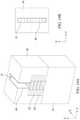
- FIGS. 6A and 6B are schematic illustrations of a sequential process of manufacturing a semiconductor device according to an embodiment of the present disclosure.
- FIG. 6A is an isometric view and
- FIG. 6B is a plan view.
- FIGS. 7A and 7B are schematic illustrations of a sequential process of manufacturing a semiconductor device according to an embodiment of the present disclosure.
- FIG. 7A is an isometric view and
- FIG. 7B is a plan view.
- FIGS. 8A and 8B are schematic illustrations of a sequential process of manufacturing a semiconductor device according to an embodiment of the present disclosure.
- FIG. 8A is an isometric view and
- FIG. 8B is a plan view.
- FIGS. 9A and 9B are schematic illustrations of a sequential process of manufacturing a semiconductor device according to an embodiment of the present disclosure.
- FIG. 9A is an isometric view and
- FIG. 9B is a plan view.
- FIGS. 10A and 10B are schematic illustrations of a sequential process of manufacturing a semiconductor device according to an embodiment of the present disclosure.
- FIG. 10A is an isometric view and
- FIG. 10B is a plan view.
- FIGS. 11A and 11B are schematic illustrations of a sequential process of manufacturing a semiconductor device according to an embodiment of the present disclosure.
- FIG. 11A is an isometric view and
- FIG. 11B is a plan view.
- FIGS. 12A and 12B are schematic illustrations of a sequential process of manufacturing a semiconductor device according to an embodiment of the present disclosure.
- FIG. 12A is an isometric view and
- FIG. 12B is a plan view.
- FIGS. 13A and 13B are schematic illustrations of a sequential process of manufacturing a semiconductor device according to an embodiment of the present disclosure.
- FIG. 13A is an isometric view and
- FIG. 13B is a plan view.
- FIGS. 14A and 14B are schematic illustrations of a sequential process of manufacturing a semiconductor device according to an embodiment of the present disclosure.
- FIG. 14A is an isometric view and
- FIG. 14B is a plan view.
- FIGS. 15A and 15B are schematic illustrations of a sequential process of manufacturing a semiconductor device according to an embodiment of the present disclosure.
- FIG. 15A is an isometric view and
- FIG. 15B is a plan view.
- FIGS. 16A and 16B are schematic illustrations of a sequential process of manufacturing a semiconductor device according to an embodiment of the present disclosure.
- FIG. 16A is an isometric view and
- FIG. 16B is a plan view.
- FIGS. 17A and 17B are schematic illustrations of a sequential process of manufacturing a semiconductor device according to an embodiment of the present disclosure.
- FIG. 17A is an isometric view and
- FIG. 17B is a plan view.
- FIGS. 18A and 18B are schematic illustrations of a sequential process of manufacturing a semiconductor device according to an embodiment of the present disclosure.
- FIG. 18A is an isometric view and
- FIG. 18B is a plan view.
- FIGS. 19A and 19B are schematic illustrations of a sequential process of manufacturing a semiconductor device according to an embodiment of the present disclosure.
- FIG. 19A is an isometric view and
- FIG. 19B is a plan view.
- FIGS. 20A and 20B are schematic illustrations of a sequential process of manufacturing a semiconductor device according to an embodiment of the present disclosure.
- FIG. 20A is an isometric view and
- FIG. 20B is a plan view
- FIGS. 21A and 21B are schematic illustrations of a sequential process of manufacturing a semiconductor device according to an embodiment of the present disclosure.
- FIG. 21A is an isometric view and
- FIG. 21B is a plan view
- FIGS. 22A and 22B are schematic illustrations of a sequential process of manufacturing a semiconductor device according to an embodiment of the present disclosure.
- FIG. 22A is an isometric view and
- FIG. 22B is a plan view.
- FIG. 23 shows a cross sectional view of a semiconductor FET device according to an embodiment of the present disclosure.
- spatially relative terms such as “beneath,” “below,” “lower,” “above,” “upper” and the like, may be used herein for ease of description to describe one element or feature's relationship to another element(s) or feature(s) as illustrated in the figures.
- the spatially relative terms are intended to encompass different orientations of the device in use or operation in addition to the orientation depicted in the figures.
- the device may be otherwise oriented (rotated 90 degrees or at other orientations) and the spatially relative descriptors used herein may likewise be interpreted accordingly.
- the term “made of” may mean either “comprising” or “consisting of.” Further, in the following fabrication process, there may be one or more additional operations in/between the described operations, and the order of operations may be changed. In the following embodiments, the term “upper” “over” and/or “above” are defined along directions with an increase in a distance from the front surface and the back surface. Materials, configurations, dimensions, processes and/or operations as explained with respect to one embodiment may be employed in the other embodiments, and the detailed description thereon may be omitted.
- VVDD and/or VVSS virtual power supply line
- VDD and/or VSS main power supply line
- the virtual power supply line may be called a local power supply line, while the main power supply line may be called a global power supply line.
- VDD is generally at a higher potential (voltage) than VSS, and in some embodiments, VSS is coupled to the ground (0 V).
- the power consumption is reduced by turning-off (opening) the header/footer switch coupled to a non-active functional circuit in the semiconductor device.
- a first main power supply line VDD is coupled to a VDD generation circuit (Vdd Source) which generates a voltage, such as 0.5 V, 0.8 V, 1.0 V, 1.2 V, 1.8 V, 2.4 V, 3.3 V or 5.0 V.
- Vdd Source VDD generation circuit
- a second main power supply line VSS is coupled to a VSS generation circuit (Vss Source) which generates a voltage lower than VDD, or the ground, in some embodiments.
- the local power supply lines VVDD is divided into a plurality of local power supply lines, to each of which one or more standard cells STDC are connected, as a cell block. Accordingly, power supply to the standard cells can be controlled on a block-by-block basis.
- the standard cells STDC includes an internal power supply line (bus line) INT, and the local power supply line VVDD is coupled to the internal power supply line with or without a switch.
- a power switch circuit (header and/or footer switch) is moved from the front end of the line (FEOL) circuit level to the back end of the line (BEOL) circuit level in a semiconductor device to allow for reduced size devices, as shown in FIG. 2 .
- the FEOL circuit level includes MOS transistors formed on a semiconductor substrate.
- the MOS transistors incudes planar field effect transistors (FETs), fin FETs, and/or gate-all-around (GAA) FETs.
- the FEOL circuit level further includes local interconnects in some embodiments.
- the BEOL circuit level includes metal wiring structures, which include one or more dielectric layers, metal wirings and vias embedded in the dielectric layer.
- TFTs using non-crystalline semiconductor are suitable for a back-end-of-line process because non-crystalline semiconductor can generally be formed at a low temperature, for example, less than 450° C.
- the power switch circuit incudes thin-film transistors (TFTs) as shown in FIG. 2 , because manufacturing operations of TFTs do not generally require a high temperature to form, for example, an epitaxial semiconductor channel, and are suitable for the BEOL circuit level.
- the power switch circuit is placed in, for example, M 1 -M 2 level, M 4 -M 5 level or M 8 -M 9 level as shown in FIG. 2 .
- the channel region of the TFTs includes oxide semiconductors, such as amorphous indium gallium zinc oxide (IGZO), c-axis aligned crystal (CAAC)-IGZO, ZnO, In 2 O 3 , Ga 2 O 3 , and ZnON.
- oxide semiconductors such as amorphous indium gallium zinc oxide (IGZO), c-axis aligned crystal (CAAC)-IGZO, ZnO, In 2 O 3 , Ga 2 O 3 , and ZnON.
- a multiple stacked nano-sheet gate-all-around oxide semiconductor device structure and corresponding process flow are provided to increase the effective width per footprint to reduce R on without compromising the I on /I off ratio.
- the benefits of using an oxide semiconductor, like IGZO, includes low leakage current, reasonable electron mobility, and high reliability.
- FIG. 3 is a schematic cross-sectional illustration cut (X-Z plane) across the oxide semiconductor nano-sheet of a semiconductor device and
- FIG. 4 is a schematic cross-sectional illustration cut (Y-Z plane) across the gate electrode of the semiconductor device according to an embodiment of the disclosure.
- the semiconductor device is a gate all around (GAA) FET as shown in FIGS. 3 and 4 .
- the oxide semiconductor nano-sheets 25 extend in the Y direction (source-to-drain direction) and are stacked along the Z direction (vertical direction). Although four oxide semiconductor nano-sheets 25 are illustrated in FIGS. 3 and 4 , the number of the oxide semiconductor nano-sheets 25 can be as few as 2 and as many as 20 depending on a required current. In some embodiments, the number of the oxide semiconductor nano-sheets ranges from 4 to 10.
- a width W 1 of the oxide semiconductor nano-sheets 25 is in a range from about 10 nm to about 50 nm in some embodiments, and is in a range from about 15 nm to about 30 nm in other embodiments, depending on the required current and/or manufacturing process conditions.
- a thickness T 1 of the oxide semiconductor nano-sheets 25 is in a range from about 5 nm to about 30 nm in some embodiments, and is in a range from about 10 nm to about 20 nm in other embodiments, depending on the required current and/or manufacturing process conditions. In some embodiments, W 1 >T 1 .
- an aspect ratio W 1 /T 1 is in a range from about 1.2 to about 10 and is in a range from about 2 to about 5 in other embodiments.
- a space S 1 between adjacent oxide semiconductor nano-sheets 25 is in a range from about 5 nm to about 30 nm in some embodiments, and is in a range from about 10 nm to about 20 nm in other embodiments, depending on the required current and/or manufacturing process conditions.
- S 1 ⁇ T 1 and in other embodiments, S 1 ⁇ T 1 If the space S 1 is too narrow, it would be difficult to uniformly form layers (e.g., gate dielectric layer and a gate electrode layer) to wrap around the oxide semiconductor nano-sheet 25 .
- a gate dielectric layer 82 wraps around each of the oxide semiconductor nano-sheet 25 .
- the gate dielectric layer is a high-k dielectric material, such as, silicon nitride, HfO 2 , La 2 O 3 , ZrO 2 , BaO, TiO 2 , Ta 2 O 5 , SrO, Y 2 O 3 , HfSiO 4 , ZrSiO 4 , Al 2 O 3 , MgO, CaO, other suitable high-k dielectric materials, and/or combinations thereof.
- a thickness of the gate dielectric layer 82 is in a range from about 2 nm to about 20 nm in some embodiments.
- the gate dielectric layer 82 may be formed from CVD, ALD or any suitable method.
- the gate dielectric layer is formed using a highly conformal deposition process such as ALD in order to ensure the formation of a gate dielectric layer having a uniform thickness around each oxide semiconductor nano-sheet.
- a metal gate electrode 80 is formed on the gate dielectric layer 82 so as to wrap around each of the oxide semiconductor nano-sheets 25 .
- the metal gate electrode 80 includes multiple conductive layers in some embodiments.
- the metal gate electrode 80 includes one or more work function adjustment layers 84 and a body metal gate electrode layer 86 .
- the work function adjustment layers are made of a conductive material such as a single layer of TiN, TaN, TaAlC, TiC, TaC, Co, Al, TiAl, HfTi, TiSi, TaSi or TiAlC, or a multilayer of two or more of these materials.
- the work function adjustment layer may be formed by ALD, PVD, CVD, e-beam evaporation, or other suitable process.
- the work function adjustment layer 84 may be formed separately for the nFET and the pFET which may use different metal layers.
- the body gate electrode layer is formed to surround each oxide semiconductor nano-sheet (channel region).
- the body gate electrode layer includes one or more layers of conductive material, such as polysilicon, aluminum, copper, titanium, tantalum, tungsten, cobalt, molybdenum, tantalum nitride, nickel silicide, cobalt silicide, TiN, WN, TiAl, TiAlN, TaCN, TaC, TaSiN, metal alloys, other suitable materials, and/or combinations thereof.
- the body gate electrode layer may be formed from CVD, ALD, electro-plating, or other suitable method.
- the gate structure including the gate dielectric layer 82 and the metal gate electrode 80 are disposed between gate sidewall spacers 48 as shown in FIG. 3 , and an interlayer dielectric (ILD) layer 50 is further disposed as shown in FIG. 3 .
- ILD interlayer dielectric
- the oxide semiconductor nano-sheet 25 also has a source/drain region as shown in FIG. 4 .
- a source/drain contact 70 is formed in contact with and wraps around the source/drain region of each of the oxide semiconductor nano-sheets 25 .
- the source/drain contact 70 has a multilayer structure.
- the source/drain contact 70 includes a liner or a barrier layer 72 and a body contact layer 74 in some embodiments as shown in FIG. 4 .
- the liner layer 72 is made of one or more of Ti, TiN, Ta, and TaN
- the body contact layer 74 is made of one or more of W, Cu, Ti, Ag, Al, Mn, Co, Pd, Ni, Re, Ir, Ru, Pt, and Zr.
- the oxide semiconductor nano-sheets 25 pass through the source/drain contact 70 and reaches the ILD layer 50 as shown in FIG. 4 . In other embodiments, the ends of the oxide semiconductor nano-sheets 25 are located in the source/drain contact 70 .
- FIG. 5 is a schematic cross-sectional illustration cut (Y-Z plane) across the gate electrode of the semiconductor device according to another embodiment of the disclosure.
- the oxide semiconductor nano-sheets 25 do not penetrate into or pass through the source/drain contact 70 .
- the source/drain contact 70 covers end faces of the oxide semiconductor non-sheets 25 , as shown in FIG. 5 .
- FIGS. 6A-20B show sequential operations for manufacturing a semiconductor device according to an embodiment of the present disclosure. It is understood that additional operations can be provided before, during, and after the processes shown by FIGS. 6A-20B , and some of the operations described below can be replaced or eliminated, for additional embodiments of the method. The order of the operations/processes may be interchangeable.
- the “A” figures show isometric views and the “B” figures show plan (top) views.
- FIGS. 6A and 6B are schematic illustrations of one of the stages of a sequential manufacturing operation of a semiconductor device according to an embodiment of the present disclosure.
- a substrate 5 is provide.
- the substrate 5 includes a single crystal semiconductor layer on at least its surface portion.
- the substrate 5 may comprise a single crystal semiconductor material such as, but not limited to Si, Ge, SiGe, GaAs, InSb, GaP, GaSb, InAlAs, InGaAs, GaSbP, GaAsSb and InP.
- the substrate 5 is made of crystalline Si, SiGe or Ge.
- the substrate 5 may include in its surface region, one or more buffer layers (not shown) in some embodiments.
- the buffer layers can serve to gradually change the lattice constant from that of the substrate to that of the source/drain regions.
- the buffer layers may be formed from epitaxially grown single crystal semiconductor materials such as, but not limited to Si, Ge, GeSn, SiGe, GaAs, InSb, GaP, GaSb, InAlAs, InGaAs, GaSbP, GaAsSb, GaN, GaP, and InP.
- the substrate 5 comprises silicon germanium (SiGe) buffer layers epitaxially grown on the silicon substrate 5 .
- the germanium concentration of the SiGe buffer layers may increase from 30 atomic % germanium for the bottom-most buffer layer to 70 atomic % germanium for the top-most buffer layer.
- first interlayer dielectric (ILD) layers 10 are formed over the substrate 5 .
- one or more electronic devices such as transistors (e.g., FETs), memories (e.g., dynamic random access memory (DRAM), static RAM, magnetic MRAM, and/or phase change RAM), are formed on the substrate 5 and the one or more first interlayer dielectric layers 10 cover the electronic devices.
- transistors e.g., FETs
- memories e.g., dynamic random access memory (DRAM), static RAM, magnetic MRAM, and/or phase change RAM
- one or more metal wiring structures are embedded in the ILD layers 10 .
- the dielectric material for the first ILD layers 10 includes silicon oxide, silicon nitride, silicon oxynitride (SiON), SiCN, fluorine-doped silicate glass (FSG), or a low-K dielectric material, formed by LPCVD (low pressure chemical vapor deposition), plasma-CVD or flowable CVD or any other suitable film formation method.
- An annealing operation may be performed after the formation of the first ILD layer 10 .
- a planarization operation such as a chemical mechanical polishing (CMP) method and/or an etch-back method, is performed to flatten the surface of the first ILD layer 10 .
- CMP chemical mechanical polishing
- FIGS. 7A and 7B are schematic illustrations of a sequential step of manufacturing a semiconductor device according to an embodiment of the present disclosure.
- semiconductor layers 25 and sacrificial layers 20 are alternately formed over the ILD layer 10 .
- the semiconductor layers 25 are made of oxide semiconductor materials, such as such as amorphous indium gallium zinc oxide (IGZO), c-axis aligned crystal (CAAC)-IGZO, ZnO, In 2 O 3 , Ga 2 O 3 , and ZnON. In some embodiments, amorphous IGZO is used.
- the semiconductor layers 25 are formed by CVD, atomic layer deposition (ALD), physical vapor deposition including sputtering, or any other suitable film formation method. In some embodiments, the semiconductor layers 25 are formed by CVD at a temperature in a range from about 50° C. to 600° C.
- the semiconductor layers 25 are formed by atomic layer deposition (ALD) at a temperature in a range from about 25° C. to 400° C. In some embodiments, the semiconductor layers 25 are formed by physical vapor deposition including sputtering at a temperature in a range from about 25° C. to 400° C.
- ALD atomic layer deposition
- the semiconductor layers 25 are formed by physical vapor deposition including sputtering at a temperature in a range from about 25° C. to 400° C.
- the sacrificial layers 20 are made of different material than the semiconductor layers 25 so that the sacrificial layers 20 are removed selective to the semiconductor layers 25 in the subsequent process.
- the sacrificial layer 25 are made of one or more layers of insulating materials, such as silicon oxide, silicon nitride, silicon oxynitride, SiOC, aluminum oxide, hafnium oxide or any other suitable insulating material.
- the sacrificial layers 25 are made of one or more layers of semiconductor material, such as Si, SiGe and Ge.
- the semiconductor layer is amorphous or polycrystalline.
- the sacrificial layers 25 are made of one or more layers of metallic material, such as metal nitride including TiN and TaN.
- the thickness of the semiconductor layers 25 is in a range from about 5 nm to about 30 nm, and is in a range from about 10 nm to about 20 nm in other embodiments. In some embodiments, the thickness of the sacrificial layers 20 is in a range from about 5 nm to about 30 nm, and is in a range from about 10 nm to about 20 nm in other embodiments. In some embodiments, the thickness of the semiconductor layers 25 is equal to the thickness of the sacrificial layers 20 , and in other embodiments, the thickness of the semiconductor layers 25 is greater or smaller than the thickness of the sacrificial layers 20 .
- a sacrificial layer 20 is directly formed on the first ILD layer 10 and the uppermost layer of the alternate stack is a sacrificial layer 20 . In other embodiments, the uppermost layer of the alternate stack is a semiconductor layer 25 .
- FIGS. 8A and 8B are schematic illustrations of a sequential step of manufacturing a semiconductor device according to an embodiment of the present disclosure.
- the alternate stack of the semiconductor layers 25 and sacrificial layers 20 is patterned into fin structures 22 .
- the fin structures 22 may be patterned by any suitable method.
- the structures may be patterned using one or more photolithography processes, including double-patterning or multi-patterning processes.
- double-patterning or multi-patterning processes combine photolithography and self-aligned processes, allowing patterns to be created that have, for example, pitches smaller than what is otherwise obtainable using a single, direct photolithography process.
- a sacrificial layer (a mandrel pattern) is formed over a substrate and patterned using a photolithography process. Spacers are formed alongside the patterned sacrificial layer using a self-aligned process. The sacrificial layer (mandrel pattern) is then removed, and the remaining spacers may then be used to pattern the fin structure 22 .
- the number of the fin structures for one TFT is not limited to five. In some embodiments, the number of the fin structures per TFT ranges from 1 to 10 and is in a range from 2 to 5 in other embodiments, depending on driving current requirements.
- a width of the fin structures 25 is in a range from about 10 nm to about 50 nm in some embodiments, and is in a range from about 15 nm to about 30 nm in other embodiments.
- FIGS. 9A and 9B are schematic illustrations of a sequential step of manufacturing a semiconductor device according to an embodiment of the present disclosure.
- a sacrificial gate dielectric layer 42 is formed over the fin structures 22 and the ILD layer 20 as shown in FIG. 9A .
- the sacrificial gate dielectric layer 42 is made of insulating material such as silicon oxide, silicon nitride, silicon oxynitride, SiOC, aluminum oxide, hafnium oxide or any other suitable insulating material. In other embodiments, no sacrificial gate dielectric layer is formed.
- FIGS. 10A and 10B are schematic illustrations of a sequential step of manufacturing a semiconductor device according to an embodiment of the present disclosure. Then, a sacrificial gate structure 40 for a gate replacement technique is formed as shown in FIGS. 10A and 10B .
- the sacrificial gate structure includes a sacrificial gate electrode layer 44 and a hard mask layer 46 .
- the sacrificial gate electrode layer 44 is polycrystalline or amorphous Si, SiGe or Ge.
- the sacrificial gate electrode layer 44 is formed by chemical vapor deposition (CVD) or any other suitable film formation methods, and a hard mask layer 46 is formed over the sacrificial gate electrode layer 44 .
- the hard mask layer 46 is made of a silicon nitride based material, such as silicon nitride, SiON or SiCN or a silicon oxide based material, such as silicon oxide. After the hard mask layer 46 is formed, by using one or more lithography and etching operations, the hard mask layer 46 is patterned. Then, by using the patterned hard mask layer 46 as an etching mask, the deposited sacrificial gate electrode layer 44 is patterned. In some embodiments, one or more dummy gate structures for suppressing process variations and/or to improve pattern fidelity are formed to surround the sacrificial gate structures for a functional transistor.
- FIGS. 11A and 11B are schematic illustrations of a sequential step of manufacturing a semiconductor device according to an embodiment of the present disclosure. Subsequently, as shown in FIGS. 11A and 11B , gate sidewall spacers 48 are formed on side faces of the sacrificial gate structure 40 .
- a blanket layer of an insulating material for first sidewall spacers is conformally formed by using CVD or other suitable methods. The blanket layer is deposited in a conformal manner so that it is formed to have substantially equal thicknesses on vertical surfaces, such as the sidewalls, horizontal surfaces, and the top of the sacrificial gate structure 40 . In some embodiments, the blanket layer is deposited to a thickness in a range from about 2 nm to about 30 nm.
- the insulating material of the blanket layer is different from the materials of the sacrificial gate structure, and is made of a silicon nitride-based material, such as silicon nitride, SiON, SiOCN or SiCN and combinations thereof.
- the blanket layer is made of silicon nitride.
- the sidewall spacers are formed on opposite side faces of the sacrificial gate structure, by anisotropic etching.
- the gate side wall spacers 48 are formed on opposing side faces of the hard mask layer 46 .
- sidewall spacers are formed on side faces of the fin structures 22 .
- FIGS. 12A and 12B are schematic illustrations of a sequential step of manufacturing a semiconductor device according to an embodiment of the present disclosure. Then, the sacrificial gate dielectric layer 42 is removed and the fin structures 22 are exposed, as shown in FIGS. 12A and 12B . As shown in FIG. 12A , the sacrificial gate dielectric layer 42 remains under the sacrificial gate structure 40 and the gate sidewall spacers 48 .
- FIGS. 13A and 13B are schematic illustrations of a sequential step of manufacturing a semiconductor device according to an embodiment of the present disclosure.
- a second ILD layer 50 is formed over the sacrificial gate structure 40 and the fin structures 22 , as shown in FIGS. 13A and 13B .
- the materials for the second ILD layer 50 include compounds comprising Si, O, C and/or H, such as silicon oxide, SiCOH and SiOC. Organic materials, such as polymers, may be used for the second ILD layer 50 .
- the second ILD layer 50 is made of the same material as the first ILD layer 10 .
- a planarization operation such as CMP, is performed, so that the top portion of the sacrificial gate electrode layer 44 is exposed, as shown in FIGS. 13A and 13B .
- FIGS. 14A and 14B are schematic illustrations of a sequential step of manufacturing a semiconductor device according to an embodiment of the present disclosure.
- the sacrificial gate electrode layer 44 and the sacrificial gate dielectric layer 42 are removed, thereby forming a gate space 52 , as shown in FIGS. 14A and 14B .
- the sacrificial gate electrode layer 44 can be removed using plasma dry etching and/or wet etching.
- TMAH tetramethylammonium hydroxide solution
- the sacrificial gate dielectric layer 42 is also removed by suitable wet/dry etching.
- the sacrificial layers 20 are also removed under the gate space 52 .
- the removal operation e.g., wet etching
- the sacrificial layers 20 and the sacrificial gate dielectric layer 42 are made of the same or similar materials, the removal operation (e.g., wet etching) of the sacrificial gate dielectric layer 42 also removes the sacrificial layer 20 .
- two or more etching operations are performed to remove the sacrificial gate dielectric layer 42 and the sacrificial layers 20 sequentially. By removing the sacrificial layers 20 , channel regions of the semiconductor layers 25 are released in the gate space 52 as semiconductor nano-sheets.
- FIGS. 15A and 15B are schematic illustrations of a sequential step of manufacturing a semiconductor device according to an embodiment of the present disclosure. Then, as shown in FIGS. 15A and 15B , a gate dielectric layer 82 and a gate electrode layer 80 are formed in the gate space 52 .
- the gate dielectric layer 82 includes one or more layers of a dielectric material, such as silicon oxide, silicon nitride, or a high-k dielectric material, other suitable dielectric material, and/or combinations thereof.
- high-k dielectric materials include HfO 2 , HfSiO, HfSiON, HfTaO, HfTiO, HfZrO, zirconium oxide, aluminum oxide, titanium oxide, hafnium dioxide-alumina (HfO 2 -Al 2 O 3 ) alloy, other suitable high-k dielectric materials, and/or combinations thereof.
- the gate dielectric layer 82 includes an interfacial layer formed between the channel region and the dielectric material.
- the gate dielectric layer 82 may be formed by CVD, ALD or any suitable methods.
- the gate dielectric layer 82 is formed using a highly conformal deposition process such as ALD in order to ensure the formation of a gate dielectric layer having a uniform thickness around each channel region.
- the thickness of the gate dielectric layer 82 is in a range from about 1 nm to about 20 nm in some embodiments and is in a range from about 2 nm to about 10 nm in other embodiments.
- the metal gate electrode layer 80 includes one or more work function adjustment layers 84 and a body metal gate electrode layer 86 in some embodiments.
- the work function adjustment layers are made of a conductive material such as a single layer of TiN, TaN, TaAlC, TiC, TaC, Co, Al, TiAl, HfTi, TiSi, TaSi or TiAlC, or a multilayer of two or more of these materials.
- the work function adjustment layer may be formed by ALD, PVD, CVD, e-beam evaporation, or other suitable process. Further, the work function adjustment layer 84 may be formed separately for the nFET and the pFET, which may use different metal layers.
- the body gate electrode layer is formed to surround each oxide semiconductor nano-sheet (channel region).
- the body gate electrode layer includes one or more layers of conductive material, such as polysilicon, aluminum, copper, titanium, tantalum, tungsten, cobalt, molybdenum, tantalum nitride, nickel silicide, cobalt silicide, TiN, WN, TiAl, TiAlN, TaCN, TaC, TaSiN, metal alloys, other suitable materials, and/or combinations thereof.
- the body gate electrode layer may be formed by CVD, ALD, electro-plating, or other suitable method.
- the metals for the gate dielectric layer 82 and the gate electrode layer 80 are also deposited over the upper surface of the second ILD layer 50 .
- the material for the gate electrode layer 80 formed over the second ILD layer 50 is then planarized by using, for example, CMP, until the top surface of the second ILD layer 50 is revealed, as shown in FIGS. 15A and 15B .
- the metal gate electrode layer is recessed and a cap insulating layer (not shown) is formed over the recessed gate electrode layer.
- the cap insulating layer includes one or more layers of a silicon nitride-based material, such as silicon nitride.
- the cap insulating layer can be formed by depositing an insulating material followed by a planarization operation.
- FIGS. 16A and 16B are schematic illustrations of a sequential step of manufacturing a semiconductor device according to an embodiment of the present disclosure.
- a third ILD layer 60 is formed over the second ILD layer 50 , and contact holes 65 for source/drain contact are formed in the third and second ILD layers, as shown in FIGS. 16A and 16B .
- the materials for the third ILD layer 60 include compounds comprising Si, O, C and/or H, such as silicon oxide, SiCOH and SiOC. Organic materials, such as polymers, may be used for the third ILD layer 60 .
- the third ILD layer 60 is made of the same material as the second ILD layer and/or the first ILD layer 10 .
- the third ILD layer 60 functions as a hard mask layer for etching the second ILD layer.
- FIGS. 17A and 17B are schematic illustrations of a sequential step of manufacturing a semiconductor device according to an embodiment of the present disclosure. After the contact holes 65 are formed, the sacrificial layers 20 are removed under the contact holes 65 , thereby source/drain regions of the semiconductor layers 20 are released, as shown in FIG. 17A .
- part of the sacrificial layers 20 remain as inner spacers 21 .
- the sacrificial layers 20 are made of an insulating material in some embodiments. In other embodiments, the sacrificial layers 20 are fully removed.
- FIGS. 18A-20B are schematic illustrations of a sequential step of manufacturing a semiconductor device according to an embodiment of the present disclosure.
- FIG. 18A shows a cross section cutting along the source-to-drain direction (Y direction)
- FIG. 19A shows a cross section cutting along the gate extending direction (X direction) of the gate electrode
- FIG. 20 A shows a cross section cutting along the X direction of a source/drain contact.
- source/drain contacts 70 are formed in the contact holes 65 .
- One or more layers of conductive materials are formed in and over the contact holes then a planarization operation, such as a CMP operation, is performed to form conductive contacts 70 .
- the source/drain contact 70 includes a liner or a barrier layer 72 and a body contact layer 74 , as shown in FIG. 4 .
- the liner layer 72 is made of one or more of Ti, TiN, Ta, and TaN
- the body contact layer 74 is made of one or more of W, Cu, Ti, Ag, Al, Mn, Co, Pd, Ni, Re, Jr, Ru, Pt, and Zr.
- at least the liner layer 72 wraps around the source/drain regions of the semiconductor layers (nano-sheet) 25 .
- the body contact layer 74 also wraps around the source/drain regions.
- TFT undergoes further processes to form various features such as contacts/vias, interconnect metal layers, dielectric layers, passivation layers, etc.
- FIGS. 21A-22B shows sequential operations for manufacturing a semiconductor device according to another embodiment of the present disclosure. It is understood that additional operations can be provided before, during, and after the processes shown by FIGS. 21A-22B , and some of the operations described below can be replaced or eliminated, for additional embodiments of the method.
- the manufacturing operations shown in FIGS. 21A-22B correspond to the TFT structure shown in FIG. 5 .
- both the semiconductor layer 25 and the sacrificial layers 20 are removed in the contact holes 65 , as shown in FIGS. 21A and 21B .
- source/drain contacts 70 are formed, as shown in FIGS. 22A and 22B .
- FIG. 23 shows a cross sectional view of a semiconductor device according to an embodiment of the present disclosure.
- a lower layer device 100 is formed over a substrate.
- the lower layer devices 100 includes one or more fin field effect transistors (FinFETs), gate-all-around FET (GAA FET), planar FETs, vertical FETs or any other electronic devices.
- FIG. 23 also shows an upper layer device 200 disposed over the lower layer device 100 .
- one or more ILD layers, metal wiring layers and/or via contacts are disposed between the lower layer device 100 and the upper layer device 200 .
- the upper layer device 200 includes one or more TFTs manufactured by the aforementioned embodiments of the present disclosure.
- a power switching circuit for switching power supply from the main power supply (VDD or VSS) to the local power supply (VVDD or VVSS) and power supply wirings are formed by using an oxide semiconductor such as IGZO. Accordingly, it is possible to provide the power switching circuit at the BEOL circuit level.
- a stacked structure including semiconductor layers and sacrificial layers are alternately stacked is formed, a sacrificial gate structure is formed over the stacked structure, a dielectric layer is formed over the sacrificial gate structure, the sacrificial gate structure is removed, thereby forming a gate space, the sacrificial layers are removed in the gate space, thereby releasing the semiconductor layers, a gate structure wrapping around the semiconductor layers is formed.
- the semiconductor layers are made of an oxide semiconductor material.
- the oxide semiconductor material includes one selected from the group consisting of indium gallium zinc oxide (IGZO), c-axis aligned crystal (CAAC)-IGZO, ZnO, In 2 O 3 , Ga 2 O 3 , and ZnON.
- the oxide semiconductor material includes amorphous indium gallium zinc oxide (IGZO).
- the sacrificial layer includes one selected from the group consisting of an insulating material, an amorphous or polycrystalline semiconductor material, and a metal nitride material.
- the stacked structure is formed on an insulating material layer.
- the insulating material layer covers transistors formed over a semiconductor substrate.
- the stacked structure is formed by alternately forming the semiconductor layers and the sacrificial layers on an insulating material layer, and patterning the semiconductor layers and the sacrificial layers into one or more fin structures.
- a fin structure including semiconductor layers and sacrificial layers are alternately stacked is formed over a first dielectric layer, a sacrificial gate structure is formed over the fin structure, gate sidewall spacers are formed on opposing side faces of the sacrificial gate structure, a second dielectric layer is formed over the sacrificial gate structure and the fin structure, the sacrificial gate structure are removed, thereby forming a gate space, the sacrificial layers are removed in the gate space, thereby releasing channel regions of the semiconductor layers, a gate structure wrapping around the channel regions of the semiconductor layers is formed, a third dielectric layer is formed, a contact opening is formed in the third dielectric layer and the second dielectric layer, the sacrificial layers are removed in the contact opening, thereby releasing source/drain regions of the semiconductor layers, and a source/drain contact wrapping around the source/drain regions of the semiconductor layers is formed.
- the semiconductor layers are made of an oxide semiconductor material.
- the oxide semiconductor material includes one selected from the group consisting of indium gallium zinc oxide (IGZO), c-axis aligned crystal (CAAC)-IGZO, ZnO, In 2 O 3 , Ga 2 O 3 , and ZnON.
- the oxide semiconductor material includes amorphous indium gallium zinc oxide (IGZO).
- the sacrificial layer includes one selected from the group consisting of as silicon oxide, silicon nitride, silicon oxynitride, SiOC, aluminum oxide, hafnium oxide.
- the sacrificial layer includes one selected from the group consisting of amorphous or polycrystalline Si, SiGe and Ge. In one or more of the foregoing and/or following embodiments, the sacrificial layer includes one selected from the group consisting of TiN and TaN. In one or more of the foregoing and/or following embodiments, the first dielectric layer covers transistors formed over a semiconductor substrate.
- the remaining parts of the sacrificial layers are disposed between the source/drain contact and the gate structure.
- a fin structure including semiconductor layers and sacrificial layers are alternately stacked is formed over a first dielectric layer, a sacrificial gate structure is formed over the fin structure, gate sidewall spacers are formed on opposing side faces of the sacrificial gate structure, a second dielectric layer is formed over the sacrificial gate structure and the fin structure, the sacrificial gate structure is removed, thereby forming a gate space, the sacrificial layers are removed in the gate space, thereby releasing channel regions of the semiconductor layers, a gate structure wrapping around the channel regions of the semiconductor layers is formed, a third dielectric layer is formed, a contact opening is formed in the third dielectric layer and the second dielectric layer, the sacrificial layers and the semiconductor layer are removed in the contact opening, and a source/drain contact is formed in the contact opening.
- the semiconductor layers are made of an oxide semiconductor material.
- the oxide semiconductor material includes one selected from the group consisting of indium gallium zinc oxide (IGZO), c-axis aligned crystal (CAAC)-IGZO, ZnO, In 2 O 3 , Ga 2 O 3 , and ZnON.
- the oxide semiconductor material includes amorphous indium gallium zinc oxide (IGZO).
- the sacrificial layer includes one selected from the group consisting of as silicon oxide, silicon nitride, silicon oxynitride, SiOC, aluminum oxide, hafnium oxide.
- the remaining parts of the sacrificial layers are disposed between the source/drain contact and the gate structure.
- a semiconductor device includes a power switch circuit and a logic circuit.
- the semiconductor device includes a first dielectric layer and a thin film transistor (TFT) formed on the first dielectric layer.
- the TFT includes a semiconductor nano-sheet, a gate dielectric layer wrapping around a channel region of the semiconductor nano-sheet, and a gate electrode layer formed on the gate dielectric layer.
- the semiconductor nano-sheet is made of an oxide semiconductor material.
- the oxide semiconductor material includes one selected from the group consisting of indium gallium zinc oxide (IGZO), c-axis aligned crystal (CAAC)-IGZO, ZnO, In 2 O 3 , Ga 2 O 3 , and ZnON.
- the oxide semiconductor material includes amorphous indium gallium zinc oxide (IGZO).
- IGZO amorphous indium gallium zinc oxide
- a thickness T 1 of the semiconductor nano-sheet is in a range from 5 nm to 30 nm
- a width W 1 of each of the semiconductor nano-sheets along a gate extending direction is in a range from 10 nm to 50 nm.
- a ratio W 1 /T 1 is in a range from 1.2 to 10.
- a semiconductor device includes a power switch circuit and a logic circuit.
- the power switch circuit includes a first dielectric layer and a thin film transistor (TFT) formed on the first dielectric layer.
- TFT thin film transistor
- the TFT includes semiconductor nano-sheets vertically arranged, a gate dielectric layer wrapping around a channel region of each of the semiconductor nano-sheets, and a gate electrode layer formed on the gate dielectric layer.
- the semiconductor nano-sheets are made of an oxide semiconductor material.
- the oxide semiconductor material includes one selected from the group consisting of indium gallium zinc oxide (IGZO), c-axis aligned crystal (CAAC)-IGZO, ZnO, In 2 O 3 , Ga 2 O 3 , and ZnON. In one or more of the foregoing and/or following embodiments, the oxide semiconductor material includes amorphous indium gallium zinc oxide (IGZO).
- a thickness T 1 of each of the semiconductor nano-sheets is in a range from 5 nm to 30 nm, and a width W 1 of each of the semiconductor nano-sheets along a gate extending direction is in a range from 10 nm to 50 nm.
- a ratio W 1 /T 1 is in a range from 2 to 5.
- a number of the semiconductor nano-sheets is in a range from 2 to 10.
- the TFT further includes a source/drain contact wrapping around a source/drain region of each of the semiconductor nano-sheets. In one or more of the foregoing and/or following embodiments, the TFT further includes inner spacers disposed between the source/drain contact and the gate electrode layer. In one or more of the foregoing and/or following embodiments, the TFT further includes a source/drain contact in contact with end faces of the semiconductor nano-sheets. In one or more of the foregoing and/or following embodiments, the TFT further includes inner spacers disposed between the source/drain contact and the gate electrode layer.
- a semiconductor device including a power switch circuit and a logic circuit, and the semiconductor device includes a first dielectric layer, and a thin film transistor (TFT) formed on the first dielectric layer.
- the TFT includes a plurality of groups of semiconductor nano-sheets, wherein the semiconductor nano-sheets are vertically arranged in each of the plurality of groups, a gate dielectric layer wrapping around a channel region of each of the semiconductor nano-sheets of the plurality of groups of semiconductor nano-sheets, and a gate electrode layer formed on the gate dielectric layer over the plurality of groups of semiconductor nano-sheets.
- the the semiconductor nano-sheets are made of an oxide semiconductor material.
- the oxide semiconductor material includes amorphous indium gallium zinc oxide (IGZO).
- IGZO amorphous indium gallium zinc oxide
- a thickness T 1 of each of the semiconductor nano-sheets is in a range from 5 nm to 30 nm
- a width W 1 of each of the semiconductor nano-sheets along a gate extending direction is in a range from 10 nm to 50 nm.
- a number of the semiconductor nano-sheets is in a range from 2 to 10.
- a number of the plurality of groups is in a range from 2 to 5.
Landscapes
- Engineering & Computer Science (AREA)
- Chemical & Material Sciences (AREA)
- Nanotechnology (AREA)
- Crystallography & Structural Chemistry (AREA)
- Physics & Mathematics (AREA)
- Mathematical Physics (AREA)
- Theoretical Computer Science (AREA)
- Thin Film Transistor (AREA)
- Insulated Gate Type Field-Effect Transistor (AREA)
- Encapsulation Of And Coatings For Semiconductor Or Solid State Devices (AREA)
Abstract
Description
Claims (20)
Priority Applications (6)
| Application Number | Priority Date | Filing Date | Title |
|---|---|---|---|
| US16/658,768 US11264506B2 (en) | 2018-10-31 | 2019-10-21 | Semiconductor device and manufacturing method thereof |
| DE102019128703.0A DE102019128703B4 (en) | 2018-10-31 | 2019-10-24 | SEMICONDUCTOR DEVICE AND MANUFACTURING METHOD |
| TW108139131A TWI787553B (en) | 2018-10-31 | 2019-10-29 | Semiconductor device and manufacturing method thereof |
| KR1020190137257A KR102330560B1 (en) | 2018-10-31 | 2019-10-31 | Semiconductor device and manufacturing method thereof |
| CN201911055398.8A CN111199886B (en) | 2018-10-31 | 2019-10-31 | Semiconductor device and method for manufacturing the same |
| US17/682,087 US12563781B2 (en) | 2018-10-31 | 2022-02-28 | Semiconductor device and manufacturing method thereof |
Applications Claiming Priority (2)
| Application Number | Priority Date | Filing Date | Title |
|---|---|---|---|
| US201862753890P | 2018-10-31 | 2018-10-31 | |
| US16/658,768 US11264506B2 (en) | 2018-10-31 | 2019-10-21 | Semiconductor device and manufacturing method thereof |
Related Child Applications (1)
| Application Number | Title | Priority Date | Filing Date |
|---|---|---|---|
| US17/682,087 Division US12563781B2 (en) | 2018-10-31 | 2022-02-28 | Semiconductor device and manufacturing method thereof |
Publications (2)
| Publication Number | Publication Date |
|---|---|
| US20200135929A1 US20200135929A1 (en) | 2020-04-30 |
| US11264506B2 true US11264506B2 (en) | 2022-03-01 |
Family
ID=70327429
Family Applications (2)
| Application Number | Title | Priority Date | Filing Date |
|---|---|---|---|
| US16/658,768 Active US11264506B2 (en) | 2018-10-31 | 2019-10-21 | Semiconductor device and manufacturing method thereof |
| US17/682,087 Active 2039-10-22 US12563781B2 (en) | 2018-10-31 | 2022-02-28 | Semiconductor device and manufacturing method thereof |
Family Applications After (1)
| Application Number | Title | Priority Date | Filing Date |
|---|---|---|---|
| US17/682,087 Active 2039-10-22 US12563781B2 (en) | 2018-10-31 | 2022-02-28 | Semiconductor device and manufacturing method thereof |
Country Status (5)
| Country | Link |
|---|---|
| US (2) | US11264506B2 (en) |
| KR (1) | KR102330560B1 (en) |
| CN (1) | CN111199886B (en) |
| DE (1) | DE102019128703B4 (en) |
| TW (1) | TWI787553B (en) |
Families Citing this family (20)
| Publication number | Priority date | Publication date | Assignee | Title |
|---|---|---|---|---|
| DE102020119963A1 (en) | 2020-01-30 | 2021-08-05 | Taiwan Semiconductor Manufacturing Co., Ltd. | SEMICONDUCTOR DEVICE AND METHOD |
| TWI871421B (en) * | 2020-02-03 | 2025-02-01 | 荷蘭商Asm Ip私人控股有限公司 | Devices and structures including a vanadium or indium layer and methods and systems for forming the same |
| TWI787787B (en) | 2020-04-24 | 2022-12-21 | 台灣積體電路製造股份有限公司 | Semiconductor transistor device and method of forming semiconductor transistor device |
| US11658220B2 (en) | 2020-04-24 | 2023-05-23 | Taiwan Semiconductor Manufacturing Company, Ltd. | Drain side recess for back-side power rail device |
| US11581224B2 (en) * | 2020-05-08 | 2023-02-14 | Taiwan Semiconductor Manufacturing Company, Ltd. | Method for forming long channel back-side power rail device |
| DE102021109149A1 (en) * | 2020-05-28 | 2021-12-02 | Taiwan Semiconductor Manufacturing Co. Ltd. | ADVANTAGE FIELD EFFECT TRANSISTOR AND ITS MANUFACTURING PROCESS |
| US12513984B2 (en) * | 2020-06-18 | 2025-12-30 | Intel Corporation | Double-sided integrated circuit transistor structures with depopulated bottom channel regions |
| US11653581B2 (en) | 2020-08-13 | 2023-05-16 | Taiwan Semiconductor Manufacturing Co., Ltd. | RRAM device structure and manufacturing method |
| US12230716B2 (en) * | 2021-06-02 | 2025-02-18 | Taiwan Semiconductor Manufacturing Company, Ltd. | Semiconductor structure with thin film transistor |
| US12538520B2 (en) * | 2021-08-20 | 2026-01-27 | Tokyo Electron Limited | 3D high density self-aligned nanosheet device formation with efficient layout and design |
| US20230128495A1 (en) * | 2021-10-22 | 2023-04-27 | Tokyo Electron Limited | 3d transistor stacking using non-epitaxial compound semiconductor |
| JP7715996B2 (en) * | 2021-12-14 | 2025-07-31 | ユナイテッド・セミコンダクター・ジャパン株式会社 | Semiconductor device and manufacturing method thereof |
| US12484207B2 (en) | 2021-12-23 | 2025-11-25 | Intel Corporation | SRAM with channel count contrast for greater read stability |
| US20230378179A1 (en) * | 2022-05-17 | 2023-11-23 | Taiwan Semiconductor Manufacturing Co.,Ltd. | Semiconductor Device and Method of Manufacturing the Same |
| US20240032274A1 (en) * | 2022-07-19 | 2024-01-25 | Taiwan Semiconductor Manufacturing Company, Ltd. | Back-end-of-line memory devices and methods of fabricating the same |
| CN119629985A (en) * | 2023-09-13 | 2025-03-14 | 华为技术有限公司 | Chip, electronic device and chip manufacturing method |
| US20250119143A1 (en) * | 2023-10-10 | 2025-04-10 | Taiwan Semiconductor Manufacturing Company, Ltd. | Power switch device, layout method, and system |
| US20250185378A1 (en) * | 2023-11-30 | 2025-06-05 | Taiwan Semiconductor Manufacturing Company, Ltd. | Semiconductor device and method for forming the same |
| KR20250105801A (en) * | 2023-12-29 | 2025-07-09 | 삼성전자주식회사 | Semiconductor device with power gating element |
| WO2025243156A1 (en) * | 2024-05-23 | 2025-11-27 | 株式会社半導体エネルギー研究所 | Semiconductor device |
Citations (15)
| Publication number | Priority date | Publication date | Assignee | Title |
|---|---|---|---|---|
| US20050272231A1 (en) * | 2004-06-08 | 2005-12-08 | Eun-Jung Yun | Gate-all-around type of semiconductor device and method of fabricating the same |
| US20070158679A1 (en) * | 2005-12-31 | 2007-07-12 | Samsung Electronics Co., Ltd. | Semiconductor device with multiple channels and method of fabricating the same |
| US20110175646A1 (en) | 2010-01-20 | 2011-07-21 | Semiconductor Energy Laboratory Co., Ltd. | Semiconductor device |
| US20120138886A1 (en) | 2010-12-01 | 2012-06-07 | Kuhn Kelin J | Silicon and silicon germanium nanowire structures |
| US20140001441A1 (en) | 2012-06-29 | 2014-01-02 | Seiyon Kim | Integration methods to fabricate internal spacers for nanowire devices |
| US20140017890A1 (en) | 2012-07-12 | 2014-01-16 | International Business Machines Corporation | Replacement Contacts for All-Around Contacts |
| KR20160061876A (en) | 2014-11-24 | 2016-06-01 | 인텔 코포레이션 | Electrode configurations to increase electro-thermal isolation of phase-change memory elements and associated techniques |
| US20170140996A1 (en) * | 2015-11-16 | 2017-05-18 | Taiwan Semiconductor Manufacturing Company, Ltd. | Horizontal Gate-All-Around Device Having Wrapped-Around Source and Drain |
| US20170154958A1 (en) | 2015-11-30 | 2017-06-01 | Taiwan Semiconductor Manufacturing Co., Ltd. | Semiconductor device and manufacturing method thereof |
| WO2017111797A1 (en) | 2015-12-23 | 2017-06-29 | Intel Corporation | Fabrication of non-planar igzo devices for improved electrostatics |
| JP2018164085A (en) | 2017-03-27 | 2018-10-18 | 三星電子株式会社Samsung Electronics Co.,Ltd. | Memory element including variable resistance material layer |
| US20190131437A1 (en) * | 2016-06-30 | 2019-05-02 | Intel Corporation | Integrated circuit die having back-end-of-line transistors |
| US20190333990A1 (en) * | 2017-03-30 | 2019-10-31 | Intel Corporation | Removal of a bottom-most nanowire from a nanowire device stack |
| US20200006388A1 (en) * | 2018-06-29 | 2020-01-02 | Intel Corporation | Transistors stacked on front-end p-type transistors |
| US20200091288A1 (en) * | 2018-09-18 | 2020-03-19 | International Business Machines Corporation | Inner spacer formation and contact resistance reduction in nanosheet transistors |
Family Cites Families (21)
| Publication number | Priority date | Publication date | Assignee | Title |
|---|---|---|---|---|
| JPH08280142A (en) * | 1995-04-07 | 1996-10-22 | Sony Corp | Power supply switching circuit |
| KR101377597B1 (en) * | 2007-03-21 | 2014-03-27 | 삼성디스플레이 주식회사 | Transistor and method of manufacturing the same |
| US8685850B2 (en) * | 2011-06-13 | 2014-04-01 | Stmicroelectronics, Inc. | System and method of plating conductive gate contacts on metal gates for self-aligned contact interconnections |
| WO2013101230A1 (en) * | 2011-12-30 | 2013-07-04 | Intel Corporation | Variable gate width for gate all-around transistors |
| TWI664731B (en) * | 2013-05-20 | 2019-07-01 | 半導體能源研究所股份有限公司 | Semiconductor device |
| EP2884542A3 (en) * | 2013-12-10 | 2015-09-02 | IMEC vzw | Integrated circuit device with power gating switch in back end of line |
| US9722049B2 (en) * | 2013-12-23 | 2017-08-01 | Intermolecular, Inc. | Methods for forming crystalline IGZO with a seed layer |
| US9455150B2 (en) * | 2013-12-24 | 2016-09-27 | Intel Corporation | Conformal thin film deposition of electropositive metal alloy films |
| KR20150112148A (en) * | 2014-03-27 | 2015-10-07 | 삼성전자주식회사 | Power gating circuit and integrated circuit |
| US10050147B2 (en) * | 2015-07-24 | 2018-08-14 | Taiwan Semiconductor Manufacturing Co., Ltd. | Semiconductor device and manufacturing method thereof |
| US9583399B1 (en) * | 2015-11-30 | 2017-02-28 | Taiwan Semiconductor Manufacturing Co., Ltd. | Semiconductor device and manufacturing method thereof |
| CN108292672B (en) * | 2015-12-23 | 2022-04-12 | 英特尔公司 | Fabrication of Wrap-around Conductive Metal Oxide Contacts for IGZO Nonplanar Devices |
| EP3273325B1 (en) * | 2016-07-20 | 2019-05-15 | IMEC vzw | Power control in integrated circuits |
| KR102483546B1 (en) * | 2016-11-28 | 2023-01-02 | 삼성전자주식회사 | Semiconductor devices having a vertical channel |
| CN108172625B (en) * | 2016-12-07 | 2020-09-29 | 清华大学 | a logic circuit |
| CN106756877B (en) * | 2016-12-13 | 2019-02-19 | 武汉华星光电技术有限公司 | C-axis crystalline IGZO thin film and preparation method thereof |
| US10170584B2 (en) * | 2017-01-27 | 2019-01-01 | International Business Machines Corporation | Nanosheet field effect transistors with partial inside spacers |
| WO2018182738A1 (en) * | 2017-03-31 | 2018-10-04 | Intel Corporation | Thin film transistors with spacer controlled gate length |
| US10297663B2 (en) * | 2017-04-19 | 2019-05-21 | International Business Machines Corporation | Gate fill utilizing replacement spacer |
| US11309400B2 (en) * | 2018-01-12 | 2022-04-19 | Intel Corporation | Stacked thin film transistors with nanowires |
| US11380684B2 (en) * | 2018-09-28 | 2022-07-05 | Intel Corporation | Stacked transistor architecture including nanowire or nanoribbon thin film transistors |
-
2019
- 2019-10-21 US US16/658,768 patent/US11264506B2/en active Active
- 2019-10-24 DE DE102019128703.0A patent/DE102019128703B4/en active Active
- 2019-10-29 TW TW108139131A patent/TWI787553B/en active
- 2019-10-31 CN CN201911055398.8A patent/CN111199886B/en active Active
- 2019-10-31 KR KR1020190137257A patent/KR102330560B1/en active Active
-
2022
- 2022-02-28 US US17/682,087 patent/US12563781B2/en active Active
Patent Citations (16)
| Publication number | Priority date | Publication date | Assignee | Title |
|---|---|---|---|---|
| US20050272231A1 (en) * | 2004-06-08 | 2005-12-08 | Eun-Jung Yun | Gate-all-around type of semiconductor device and method of fabricating the same |
| US20070158679A1 (en) * | 2005-12-31 | 2007-07-12 | Samsung Electronics Co., Ltd. | Semiconductor device with multiple channels and method of fabricating the same |
| US20110175646A1 (en) | 2010-01-20 | 2011-07-21 | Semiconductor Energy Laboratory Co., Ltd. | Semiconductor device |
| US20120138886A1 (en) | 2010-12-01 | 2012-06-07 | Kuhn Kelin J | Silicon and silicon germanium nanowire structures |
| US20140001441A1 (en) | 2012-06-29 | 2014-01-02 | Seiyon Kim | Integration methods to fabricate internal spacers for nanowire devices |
| US20140017890A1 (en) | 2012-07-12 | 2014-01-16 | International Business Machines Corporation | Replacement Contacts for All-Around Contacts |
| KR20160061876A (en) | 2014-11-24 | 2016-06-01 | 인텔 코포레이션 | Electrode configurations to increase electro-thermal isolation of phase-change memory elements and associated techniques |
| US20170140996A1 (en) * | 2015-11-16 | 2017-05-18 | Taiwan Semiconductor Manufacturing Company, Ltd. | Horizontal Gate-All-Around Device Having Wrapped-Around Source and Drain |
| US20170154958A1 (en) | 2015-11-30 | 2017-06-01 | Taiwan Semiconductor Manufacturing Co., Ltd. | Semiconductor device and manufacturing method thereof |
| WO2017111797A1 (en) | 2015-12-23 | 2017-06-29 | Intel Corporation | Fabrication of non-planar igzo devices for improved electrostatics |
| US20180366587A1 (en) * | 2015-12-23 | 2018-12-20 | Intel Corporation | Fabrication of non-planar igzo devices for improved electrostatics |
| US20190131437A1 (en) * | 2016-06-30 | 2019-05-02 | Intel Corporation | Integrated circuit die having back-end-of-line transistors |
| JP2018164085A (en) | 2017-03-27 | 2018-10-18 | 三星電子株式会社Samsung Electronics Co.,Ltd. | Memory element including variable resistance material layer |
| US20190333990A1 (en) * | 2017-03-30 | 2019-10-31 | Intel Corporation | Removal of a bottom-most nanowire from a nanowire device stack |
| US20200006388A1 (en) * | 2018-06-29 | 2020-01-02 | Intel Corporation | Transistors stacked on front-end p-type transistors |
| US20200091288A1 (en) * | 2018-09-18 | 2020-03-19 | International Business Machines Corporation | Inner spacer formation and contact resistance reduction in nanosheet transistors |
Non-Patent Citations (2)
| Title |
|---|
| Shao Hui Wu, "Performance Boost of Crystalline In—Ga—Zn—O Material and Transistor with Extremely Low Leakage for IoT Normally-Off CPU Application", 2017 Symposium on VLSI Technology Digest of Technical Papers. T166-T167. |
| Shunpei Yamazaki, "Unique Technology from Japan to the World—Super Low Power LSI using CAAC-OS-" Semiconductor Energy Laboratory presentation (May 27, 2015). |
Also Published As
| Publication number | Publication date |
|---|---|
| DE102019128703A1 (en) | 2020-04-30 |
| KR102330560B1 (en) | 2021-11-26 |
| US20200135929A1 (en) | 2020-04-30 |
| TWI787553B (en) | 2022-12-21 |
| KR20200050422A (en) | 2020-05-11 |
| TW202025498A (en) | 2020-07-01 |
| CN111199886A (en) | 2020-05-26 |
| CN111199886B (en) | 2022-11-01 |
| US20220181491A1 (en) | 2022-06-09 |
| DE102019128703B4 (en) | 2025-06-05 |
| US12563781B2 (en) | 2026-02-24 |
Similar Documents
| Publication | Publication Date | Title |
|---|---|---|
| US12563781B2 (en) | Semiconductor device and manufacturing method thereof | |
| US12300550B2 (en) | Complementary MOS FETS vertically arranged and including multiple dielectric layers surrounding the MOS FETS | |
| US12317586B2 (en) | Semiconductor device having fin structures with unequal channel heights and manufacturing method thereof | |
| US11682587B2 (en) | Semiconductor device and manufacturing method thereof | |
| US11177179B2 (en) | Method of manufacturing a semiconductor device and a semiconductor device | |
| US10083972B2 (en) | Hybrid logic and SRAM contacts | |
| US20210408049A1 (en) | Semiconductor chip | |
| US11152213B2 (en) | Transistor device with ultra low-k self aligned contact cap and ultra low-k spacer | |
| US20240365564A1 (en) | Structure and method for mram devices | |
| US11189490B2 (en) | Method of manufacturing a semiconductor device and a semiconductor device | |
| US12074061B2 (en) | Field effect transistor with multi-metal gate via and method | |
| US20240313124A1 (en) | Semiconductor structure with barrier and method for manufacturing the same | |
| US20240030310A1 (en) | Semiconductor device and method for forming the same | |
| KR102390076B1 (en) | Method of manufacturing a semiconductor device and a semiconductor device | |
| US20250311295A1 (en) | Suspension region configuration for semiconductor devices |
Legal Events
| Date | Code | Title | Description |
|---|---|---|---|
| FEPP | Fee payment procedure |
Free format text: ENTITY STATUS SET TO UNDISCOUNTED (ORIGINAL EVENT CODE: BIG.); ENTITY STATUS OF PATENT OWNER: LARGE ENTITY |
|
| AS | Assignment |
Owner name: TAIWAN SEMICONDUCTOR MANUFACTURING CO., LTD., TAIWAN Free format text: ASSIGNMENT OF ASSIGNORS INTEREST;ASSIGNORS:VAN DAL, MARCUS JOHANNES HENRICUS;DOORNBOS, GERBEN;REEL/FRAME:052299/0782 Effective date: 20191022 |
|
| STPP | Information on status: patent application and granting procedure in general |
Free format text: RESPONSE TO NON-FINAL OFFICE ACTION ENTERED AND FORWARDED TO EXAMINER |
|
| STPP | Information on status: patent application and granting procedure in general |
Free format text: NON FINAL ACTION MAILED |
|
| STPP | Information on status: patent application and granting procedure in general |
Free format text: RESPONSE TO NON-FINAL OFFICE ACTION ENTERED AND FORWARDED TO EXAMINER |
|
| STPP | Information on status: patent application and granting procedure in general |
Free format text: FINAL REJECTION MAILED |
|
| STPP | Information on status: patent application and granting procedure in general |
Free format text: RESPONSE AFTER FINAL ACTION FORWARDED TO EXAMINER |
|
| STPP | Information on status: patent application and granting procedure in general |
Free format text: NOTICE OF ALLOWANCE MAILED -- APPLICATION RECEIVED IN OFFICE OF PUBLICATIONS Free format text: AWAITING TC RESP., ISSUE FEE NOT PAID |
|
| STPP | Information on status: patent application and granting procedure in general |
Free format text: PUBLICATIONS -- ISSUE FEE PAYMENT VERIFIED |
|
| STCF | Information on status: patent grant |
Free format text: PATENTED CASE |
|
| MAFP | Maintenance fee payment |
Free format text: PAYMENT OF MAINTENANCE FEE, 4TH YEAR, LARGE ENTITY (ORIGINAL EVENT CODE: M1551); ENTITY STATUS OF PATENT OWNER: LARGE ENTITY Year of fee payment: 4 |