US11249129B2 - IGBT-module condition monitoring equipment and method - Google Patents

IGBT-module condition monitoring equipment and method Download PDF

Info

Publication number
US11249129B2
US11249129B2 US16/850,770 US202016850770A US11249129B2 US 11249129 B2 US11249129 B2 US 11249129B2 US 202016850770 A US202016850770 A US 202016850770A US 11249129 B2 US11249129 B2 US 11249129B2
Authority
US
United States
Prior art keywords
voltage
igbt
voltage overshoot
gate
turning
Prior art date
Legal status (The legal status is an assumption and is not a legal conclusion. Google has not performed a legal analysis and makes no representation as to the accuracy of the status listed.)
Active, expires
Application number
US16/850,770
Other versions
US20210063466A1 (en
Inventor
Pinjia Zhang
Yanyong YANG
Zheng Wang
HongDong Zhu
Current Assignee (The listed assignees may be inaccurate. Google has not performed a legal analysis and makes no representation or warranty as to the accuracy of the list.)
Tsinghua University
Envision Energy Jiangsu Co Ltd
Original Assignee
Tsinghua University
Priority date (The priority date is an assumption and is not a legal conclusion. Google has not performed a legal analysis and makes no representation as to the accuracy of the date listed.)
Filing date
Publication date
Application filed by Tsinghua University filed Critical Tsinghua University
Assigned to TSINGHUA UNIVERSITY reassignment TSINGHUA UNIVERSITY ASSIGNMENT OF ASSIGNORS INTEREST (SEE DOCUMENT FOR DETAILS). Assignors: ENVISION ENERGY (JIANGSU) CO., LTD., TSINGHUA UNIVERSITY
Assigned to ENVISION ENERGY (JIANGSU) CO., LTD., TSINGHUA UNIVERSITY reassignment ENVISION ENERGY (JIANGSU) CO., LTD. ASSIGNMENT OF ASSIGNORS INTEREST (SEE DOCUMENT FOR DETAILS). Assignors: WANG, ZHENG, YANG, YANYONG, ZHANG, PINJIA, ZHU, HONGDONG
Publication of US20210063466A1 publication Critical patent/US20210063466A1/en
Application granted granted Critical
Publication of US11249129B2 publication Critical patent/US11249129B2/en
Active legal-status Critical Current
Adjusted expiration legal-status Critical

Links

Images

Classifications

    • GPHYSICS
    • G01MEASURING; TESTING
    • G01RMEASURING ELECTRIC VARIABLES; MEASURING MAGNETIC VARIABLES
    • G01R31/00Arrangements for testing electric properties; Arrangements for locating electric faults; Arrangements for electrical testing characterised by what is being tested not provided for elsewhere
    • G01R31/26Testing of individual semiconductor devices
    • G01R31/2607Circuits therefor
    • G01R31/2608Circuits therefor for testing bipolar transistors
    • GPHYSICS
    • G01MEASURING; TESTING
    • G01RMEASURING ELECTRIC VARIABLES; MEASURING MAGNETIC VARIABLES
    • G01R31/00Arrangements for testing electric properties; Arrangements for locating electric faults; Arrangements for electrical testing characterised by what is being tested not provided for elsewhere
    • G01R31/50Testing of electric apparatus, lines, cables or components for short-circuits, continuity, leakage current or incorrect line connections
    • G01R31/66Testing of connections, e.g. of plugs or non-disconnectable joints
    • G01R31/70Testing of connections between components and printed circuit boards
    • GPHYSICS
    • G01MEASURING; TESTING
    • G01RMEASURING ELECTRIC VARIABLES; MEASURING MAGNETIC VARIABLES
    • G01R31/00Arrangements for testing electric properties; Arrangements for locating electric faults; Arrangements for electrical testing characterised by what is being tested not provided for elsewhere
    • G01R31/26Testing of individual semiconductor devices
    • G01R31/2601Apparatus or methods therefor
    • HELECTRICITY
    • H01ELECTRIC ELEMENTS
    • H01LSEMICONDUCTOR DEVICES NOT COVERED BY CLASS H10
    • H01L22/00Testing or measuring during manufacture or treatment; Reliability measurements, i.e. testing of parts without further processing to modify the parts as such; Structural arrangements therefor
    • H01L22/30Structural arrangements specially adapted for testing or measuring during manufacture or treatment, or specially adapted for reliability measurements
    • H01L29/7393
    • HELECTRICITY
    • H10SEMICONDUCTOR DEVICES; ELECTRIC SOLID-STATE DEVICES NOT OTHERWISE PROVIDED FOR
    • H10DINORGANIC ELECTRIC SEMICONDUCTOR DEVICES
    • H10D12/00Bipolar devices controlled by the field effect, e.g. insulated-gate bipolar transistors [IGBT]
    • H10D12/411Insulated-gate bipolar transistors [IGBT]
    • H10P74/27

Definitions

  • the present invention belongs to the field of electrical engineering, and relates to a power electronic converter condition monitoring solution, and more particularly, to an IGBT-module condition monitoring equipment and method.
  • Power electronic devices are key components of power electronic converters, and are also the most vulnerable converter components that are prone to failures.
  • the failure rate of the power electronic devices is 31%, which can be the highest among all types of failures.
  • IGBT Insulated Gate Bipolar Transistor
  • IGBT Insulated Gate Bipolar Transistor
  • Bond wire failures are the most prominent and common causes of failures for wire-bonding packaged devices.
  • the interior of the IGBT keeps a high-speed switching operation state for a long time, suffering frequent fluctuations of thermal and electromagnetic stresses. These fluctuations of stresses lead to fatigue and aging of the devices.
  • Lift-off and fracture of bond wires are the prominent types of failures for the wire-bonding packaged devices.
  • the bond wire monitoring method based on short-circuit current has high resolution, but it requires complicated gate driving circuit. Besides, constant switching of the driving voltage increases the complexity of driving, and regular short-circuit monitoring interferes with the normal operation of the converters.
  • the method based on on-state voltage drop can identify the lift-off of the bond wires. However, it has low resolution when the bond wire failure is slight. Moreover, it is difficult to measure the on-state voltage drops accurately in operation.
  • the method based on the gate turning-on voltage and current has been studied for bond wire identification, but it is difficult to make a quantitative description. There is a significant difference only when a very severe bond wire failure occurs.
  • the method based on gate Miller platform time can evaluate the aging of the IGBT, but it requires a large driving resistance. However, the large driving resistance makes it difficult to increase the switching frequency of IGBT.
  • An object of the present invention is to propose an IGBT-module condition monitoring equipment and method to address the problems in the prior art.
  • the IGBT-module condition monitoring method gate voltage signals that are convenient to measure are sampled, which is free of invasiveness. The failure of slight bond wire failure can be identified in time.
  • the proposed method has high resolution and is effective for early warning of IGBT failures.
  • the present invention has a high application value in the online condition monitoring of IGBT module.
  • the present invention is implemented by the following technical solutions.
  • an IGBT-module condition monitoring equipment including: an IGBT module, a gate turn on voltage overshoot monitoring module, a driving circuit, a bond wire state judging module, and a signal acquisition module, wherein
  • the gate turns on voltage overshoot monitoring module includes a voltage sampling circuit for measuring a voltage between the gate and the emitter of IGBT module to monitor an actual gate turn on voltage overshoot;
  • the driving circuit includes a driving power source and a driving resistor which is connected to the gate and the emitter of the IGBT module;
  • the bond wire state judging module estimates a bonding-wire condition by judging a magnitude relationship between the actual gate turning-on voltage overshoot and a reference gate turning-on voltage overshoot threshold V g_p ;
  • the signal acquisition module transmits an acquired signal to the bond wire state judging module for determining the reference gate turn on voltage overshoot threshold V g_p .
  • the bond wire state judging module includes a comparator and a processor
  • the comparator is configured to judge the magnitude relationship between the actual gate turning-on voltage overshoot and the reference gate turning-on voltage overshoot threshold V g_p and send a judging result to the processor;
  • the processor performs an early warning on the bond wire state according to the judging result.
  • the comparators are provided, and the reference gate turning-on voltage overshoot threshold V g_p of each of the comparators corresponds to a corresponding number of broken bond wires;
  • the IGBT-module condition monitoring equipment further includes latches, which are connected to outputs of the comparators and configured to perform comparison state locking on a gate turning-on voltage overshoot value.
  • the IGBT-module condition monitoring equipment includes counters, wherein inputs of the counters are connected to outputs of the latches, and outputs of the counters are connected to the processor;
  • the counters are configured to record reversing numbers of different comparators for judging a probability of occurrence that a corresponding number of lift-off bond wires.
  • the reference gate turning-on voltage overshoot threshold V g_p is calculated by means of a formula as follows:
  • V g_p V g_mil + ( L p_A n - m + L s_e + L g ) ⁇ di c dt ( 1 )
  • V g_mil is a gate Miller voltage
  • L p_A is parasitic inductance of each bond wire which is between an emitter of an IGBT chip and a copper busbar in the IGBT module
  • n is a number of the bond wires
  • m is a number of broken or lift-off bond wires
  • L s_e is equivalent parasitic inductance of the bond wires between the emitter of the IGBT and a cathode of the driving power source
  • L g is the sum parasitic inductance of the internal gate bond wire and driving resistor
  • i c is the collector current.
  • V g_mil V g_mil
  • di c dt are related to the bus voltage, the collector-emitter current and the temperature; in case of different bus voltages, collector-emitter currents and temperatures, the gate turning-on voltage overshoot is tested in a preliminary test, and then a relationship among V g_mil
  • di c dt as well as the bus voltage, collector-emitter current, and temperature is given by multi-point fitting or by building a data table; and then with the formula 1 above, the reference gate turning-on voltage overshoot thresholds V g_p corresponding to different number of broken bond wires in operating states at different bus voltages, collector-emitter currents and temperatures are calculated.
  • an IGBT-module condition monitoring method including the following steps:
  • the IGBT-module condition monitoring method further includes a step of setting the reference gate turning-on voltage overshoot threshold in advance, and the step includes:
  • di c dt as well as the bus voltage, collector-emitter current, and temperature by multi-point fitting or by building a data table
  • V g_p V g_mil + ( L p_A n - m + L s_e + L g ) ⁇ di c dt ( 1 )
  • V g_mil is a gate Miller voltage
  • L p_A is parasitic inductance of each bond wire which is between an emitter of an IGBT chip and a copper busbar in the IGBT module
  • n is a number of the bond wires
  • m is a number of broken or lift-off bond wires
  • L s_e is equivalent parasitic inductance of the bond wires between the emitter of the IGBT and a cathode of the driving power source
  • L g is the sum parasitic inductance of the internal gate bond wire and driving resistor
  • i c is the collector current.
  • the step of comparing the actual gate turning-on voltage overshoot with the reference gate turning-on voltage overshoot threshold to obtain the comparison result includes:
  • n comparators wherein n is the number of the bond wires, and the m-th comparator corresponds to the reference gate turning-on voltage overshoot threshold of the m broken bond wires, with m ⁇ n;
  • the IGBT-module condition monitoring method further includes: setting n latches corresponding to the n comparators for latching reversing of the corresponding comparators;
  • the step of judging the bond wire state according to the comparison result includes:
  • the present invention provides an IGBT-module condition monitoring equipment and method.
  • the IGBT-module condition monitoring equipment includes an IGBT module, a gate turning-on voltage overshoot monitoring module, a driving circuit, and a bond wire state judging module.
  • the breakage condition of bond wires is obtained by comparing a monitored actual gate turning-on voltage overshoot with a preset reference gate turning-on voltage overshoot threshold.
  • the present invention solves the problem encountered in monitoring the aging of IGBT bond wires in power electronic converters.
  • the slight aging of the detached bond wires can be monitored without disturbing the operation, which is high in resolution and free of invasiveness and enables real-time online monitoring at high sampling rate and low cost, showing great significance in the monitoring of the IGBT and the reliability evaluation of power electronic converters.
  • FIG. 1 is a schematic structural diagram of an IGBT-module condition monitoring equipment according to the present invention
  • FIG. 2 shows a bond wire structure inside a typical IGBT in the prior art
  • FIG. 3 is an equivalent circuit diagram of distributed driving in consideration of bond wires inside an IGBT
  • FIG. 4 is an equivalent circuit diagram in consideration of multiple bond wires and parasitic capacitance inside an IGBT
  • FIG. 5 is a schematic diagram of key waveforms of an IGBT turning-on process
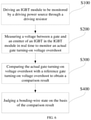
  • FIG. 6 is a schematic flowchart of a bonding-wire condition monitoring method according to the present invention.
  • FIG. 7 is a circuit diagram showing a judging logic for bonding-wire condition monitoring according to a specific embodiment of the present invention.
  • an IGBT module condition monitoring equipment As shown in FIG. 1 , the equipment includes: an IGBT module 1 , a gate turning-on voltage overshoot monitoring module 2 , a driving circuit 3 , a bond wire state judgment module 4 and a signal acquisition module 5 .
  • the gate turning-on voltage overshoot monitoring module 4 includes a voltage sampling circuit for measuring the voltage between the gate and the emitter of an IGBT in the IGBT module 1 to monitor the actual gate turning-on voltage overshoot;
  • the driving circuit 3 includes a driving power source and a driving resistor, and the driving power source is connected to the gate and the emitter of the IGBT module 1 through the driving resistor;
  • the bond wire state judging module 4 judges a bond wire state by judging a magnitude relationship between the actual gate turning-on voltage overshoot and a reference gate turning-on voltage overshoot threshold V g_p ;
  • the signal acquisition module transmits an acquired signal to the bond wire state judgment module for setting the reference gate turning-on voltage overshoot threshold V g_p to specifically acquire information such as bus voltage, load current, and temperature.
  • the IGBT module 1 is a typical large-capacity wire-bonded IGBT module, which has an internal structure as shown in FIG. 2 , and generally includes an IGBT chip 11 , a diode 12 , a solder layer 13 , an aluminum bond wire 14 , an upper copper layer 15 on a copper substrate, a ceramic layer 16 , a lower copper layer 17 on the copper substrate, a substrate 18 , and a heat sink 19 .
  • the module consists of multiple IGBT chips connected in parallel. The connections among all the chips and between the chips and connection terminals are typically implemented depending on bond wires, copper plates and busbars.
  • the chips are filled with transparent silicone grease with extremely low thermal conductivity coefficient, at the top.
  • the power loss of the IGBT module is basically dissipated by the lower copper layer on the copper substrate through the heat sink.
  • FIG. 3 is an equivalent circuit of distributed driving in consideration of the bond wires inside the IGBT.
  • parasitic capacitance of the IGBT and parasitic resistance and parasitic inductance of the bond wires are considered.
  • R g_on is the driving resistance
  • the driving power source is connected to a gate of the IGBT internal chip via the R g_on and one bond wire
  • the bond wire contains parasitic inductance L g and parasitic resistance R g .
  • the collector and emitter include n bond wires, and the n bond wires contain parasitic inductance L e and parasitic resistance R e .
  • a driving loop returns to a cathode of the driving power source via one bond wire of an auxiliary emitter, and the bond wire of the auxiliary emitter includes parasitic inductance L s_e and parasitic resistance R s_e . Meanwhile, the capacitance between the gate and the emitter of the IGBT is C ge , and the capacitance between the gate and the collector is C ge .
  • FIG. 4 shows an equivalent circuit in consideration of multiple bond wires and parasitic capacitance inside an IGBT.
  • L p_A is the parasitic inductance of each bond wire, and can be expressed as:
  • L P_A 2 ⁇ 10 - 1 ⁇ l ⁇ [ ln ⁇ ( 4 ⁇ 10 3 ⁇ l d ) - 0 . 7 ⁇ 5 ] ( 1 )
  • V bus is a DC bus voltage
  • I L is a current which flows through a load and will flow through the collector and emitter of the IGBT after the IGBT is fully turned on.
  • FIG. 5 is a schematic diagram of key waveforms (including a collector-emitter voltage ⁇ ce , a collector current i c , and a gate voltage ⁇ g ) when the IGBT is turned on.
  • all the physical quantities are expressed as follows: gate current i g , gate driving voltage ⁇ g , collector-emitter voltage ⁇ ce , collector current i c , gate threshold voltage V g_th , load current I L , gate Miller voltage V g_mil , gate turning-on voltage overshoot V g_p , gate turning-on voltage V g_on , gate turning-off voltage V g_off , DC bus voltage V bus , collector turning-on current overshoot V c_max .
  • the gate driving resistance is expressed as R g_on
  • the gate input capacitance is expressed as C ies . According to different waveform characteristics, there are 6 phases divided.
  • the gate voltage ⁇ g rises exponentially, which makes the concentration of electrons at the gate of the IGBT increase gradually.
  • the collector-emitter voltage ⁇ ce and the collector current i c remain unchanged, the collector-emitter voltage ⁇ ce is the DC bus voltage V bus , and the collector current i c is zero.
  • the gate begins to show a strong inversion layer.
  • a gate channel begins to conduct, and the collector current i c rapidly increases from 0 to the load current I L .
  • the collector-emitter voltage ⁇ ce drops slightly due to the presence of the parasitic inductance of the bus.
  • Phase 3 [t 2 -t 3 ]: at the beginning of this phase, the collector current i c has risen to I L .
  • the voltage of an anti-parallel diode of an upper tube starts to rise, and the collector-emitter voltage ⁇ ce starts to decrease rapidly.
  • the Miller capacitance equivalent to the input capacitance is very large, so that all the gate currents i g charge the input Miller capacitance, and the voltage of the gate capacitance C gc remains unchanged as a constant gate Miller voltage V g_mil .
  • the anti-parallel diode of the upper tube undergoes reverse recovery at a turning-off time. Therefore, the collector current i c will continue to rise after rising to the load current I L .
  • the rising current may form a very high induced voltage, which is superimposed on the gate Miller voltage V g_mil to form the gate turning-on voltage overshoot V g_p .
  • This voltage overshoot is closely related to the value of the parasitic inductance of the bond wire, so that the health state of the bond wire can be monitored by using the gate turning-on voltage overshoot.
  • the gate turning-on voltage overshoot V g_p is expressed as follows (in case of operating at the same bus voltage, collector-emitter current, and temperature):
  • V g_mil is a gate Miller voltage
  • L p_A is parasitic inductance of each bond wire which is between an emitter of an IGBT chip and a copper busbar in the IGBT module
  • n is a number of the bond wires
  • m is a number of broken or detached bond wires
  • L s_e is equivalent parasitic inductance of the bond wire between the emitter of the IGBT and a cathode of the driving power source
  • L g is the sum parasitic inductance of the internal gate bond wire and driving resistor
  • i c is a collector current.
  • V g_mil V g_mil
  • di c dt are related to the bus voltage, the collector-emitter current and the temperature; in case of different bus voltages, collector-emitter currents and temperatures, the gate turning-on voltage overshoot is tested in a preliminary test, and then a relationship among V g_mil ,
  • di c dt as well as the bus voltage, collector-emitter current, and temperature is given by multi-point fitting or by building a data table; here, L p_A , L s_e and L g are solved by means of a physical calculation formula of inductance. In this way, the reference gate turning-on voltage overshoot thresholds V g_p corresponding to different number of lift-off bond wires in operating states at different bus voltages, collector-emitter currents and temperatures are calculated by means of the formula 3.
  • a converter bus voltage (through isolated differential sampling), an IGBT load current (measured through Rogowski coil), and IGBT module temperature (through NTC and a ⁇ - ⁇ conversion circuit) can be obtained by sampling. Then, based on these signals, the reference gate turning-on voltage overshoot threshold V g_p may be set in real time with an analytical method or a look-up table method.
  • di c dt of the turning-on collector current of IGBT is as high as more than 1000 A/us, therefore, as the number m of broken bond wires increases, there will be a voltage difference of several hundred millivolts or even several volts, generally.
  • the calculated gate turning-on voltage overshoot V g_p can be used as a theoretical value for the reference gate turning-on voltage overshoot threshold V g_p in judging the bond wire state.
  • the gate turning-on voltage overshoots are tested in a preliminary test with different voltages, currents, and temperatures, so as to determine the reference gate turning-on voltage overshoot thresholds V g_p corresponding to different numbers of broken bond wires.
  • Phase 4 [t 3 -t 4 ]: At this phase, the reverse recovery current I rr of the diode starts to decrease, and the collector-emitter voltage ⁇ ce continues to decrease.
  • the gate voltage V g remains at V g_mil unchanged.
  • the gate voltage V g remains at V g_mil unchanged.
  • Phase 6 [t 5 -t 6 ]: After the IGBT is turned on, a saturation region is entered, and the collector current i c and the collector-emitter voltage ⁇ ce remain unchanged.
  • the gate power source charges the gate input capacitance to the gate turning-on voltage V g_on through the driving resistance R g_on .
  • the bond wire state judging module includes a comparator and a processor; the comparator is configured to judge the magnitude relationship between the actual gate turning-on voltage overshoot and the reference gate turning-on voltage overshoot threshold V g_p and send a judging result to the processor; and the processor performs an early warning on the bond wire state according to the judging result.
  • the IGBT-module condition monitoring equipment further includes latches, which are connected to outputs of the comparators and configured to perform comparison state locking on a gate turning-on voltage overshoot value, thereby guaranteeing the reversing stability at the comparison state.
  • the IGBT-module condition monitoring equipment includes counters, wherein inputs of the counters are connected to outputs of the latches, and outputs of the counters are connected to the processor; and the counters are configured to record reversing numbers of different comparators for judging a probability of occurrence that a corresponding number of bond wires break.
  • the processor includes a DSP or MCU, which may be configured to set the reference gate turning-on voltage overshoot threshold, receive a counting value of the counter, judge the bond wire state, perform early warning and the like.
  • an IGBT-module condition monitoring method As shown in FIG. 6 , the method includes the following steps.
  • an IGBT module to be monitored is driven by a driving power source through a driving resistor.
  • a voltage between a gate and an emitter of an IGBT in the IGBT module is measured in real time to monitor an actual gate turning-on voltage overshoot.
  • the actual gate turning-on voltage overshoot is compared with a reference gate turning-on voltage overshoot threshold to obtain a comparison result.
  • the step that the actual gate turning-on voltage overshoot is compared with the reference gate turning-on voltage overshoot threshold to obtain the comparison result includes:
  • n comparators wherein n is the number of bond wires, and the m-th comparator corresponds to the reference gate turning-on voltage overshoot threshold of the m broken bond wires, with m ⁇ n;
  • the method further includes: setting n latches corresponding to the n comparators for latching the reversing of the corresponding comparators;
  • the step of judging the bond wire state according to the comparison result includes:
  • FIG. 7 shows a judging logic circuit for bonding-wire condition monitoring.
  • a driving turning-on voltage signal overshoot i.e. a gate turning-on voltage overshoot signal
  • the gate turning-on voltage overshoot signal is compared with a reference signal.
  • the reference signal is obtained by performing an AND operation on a reference selection logic and a reference comparison setting signal.
  • a reference comparison setting signal is the aforementioned reference gate turning-on voltage overshoot threshold V g_p which can be calculated by the formula 3, or obtained by testing in a preliminary test.
  • the IGBTs with different number of broken bond wires correspond to different reference gate turning-on voltage overshoot thresholds V g_p .
  • the reference selection logic is obtained by delaying the gate turning-on signal by one Miller platform, and the reference comparison setting signal is set on the basis of the gate turning-on voltage signal overshoot value in cases of different numbers of bond wires.
  • a comparator a latch connected to an output of the comparator, a counter connected to an output of the latch, and a corresponding IGBT monitoring unit are provided for each case of bond wire breakage.
  • Multiple IGBT chips are connected in parallel to form an IGBT module.
  • the IGBT monitoring unit for each IGBT chip aggregates and inputs monitoring results (judging results of m broken bond wires) to the processor (specifically, a DSP or MCU may be selected), by which the bond wire state of each IGBT chip is obtained.
  • the action of a high-speed comparator with a certain number indicates that the actual gate turning-on voltage overshoot of the IGBT exceeds a preset value (that is, the reference gate turning-on voltage overshoot threshold), and the bond wire is partially broken or detached (for instance, if the level of the high-speed comparator of No.
  • 3 reverses to be low, 3 bond wires are indicated to be broken, the high-speed comparators with a number less than 3 may also undergo level reversing as low, and the high-speed comparators with a number greater than 3 may keep at high level).
  • the outputs of the high-speed comparators are connected to the set inputs of the latches, so that the latches connected to the comparators that has undergone level reversing may undergo level reversing as high; and when a driving turning-off signal arrives, the latches are reset and the latch outputs become low. This process is repeated when the signal of the next cycle arrives. Therefore, the output signal period of the latches having the numbers corresponding to or below the number of broken bond wires is consistent with the switching period.
  • the signal is output to a counter, and then the probability of the reversing is judged on the basis of the value of the counter.
  • the larger the counter value the more likely the corresponding number of bond wires are broken.
  • the state of the corresponding IGBT bond wires can be judged, and early warning can be made in time.
  • the purpose of monitoring the state of the entire IGBT module can be achieved.
  • the voltage sampling circuit in the gate voltage overshoot monitoring module is an isolation circuit, thereby ensuring the electrical isolation for strong and weak electricity and the anti-interference capability of voltage signals.
  • the DSP or MCU judges the health degree of the emitter bond wires inside the IGBT module and obtains the number of broken bond wires, the IGBT module with significantly reduced health degree may be replaced, thereby reducing losses caused by the catastrophic failure of the IGBT.
  • the present invention provides an IGBT-module condition monitoring equipment and method.
  • the IGBT-module condition monitoring equipment includes an IGBT module, a gate turning-on voltage overshoot monitoring module, a driving circuit, a bond wire state judging module and a signal acquisition module.
  • the breakage condition of bond wires is obtained by comparing a monitored actual gate turning-on voltage overshoot with a preset reference gate turning-on voltage overshoot threshold.
  • the present invention solves the problem encountered in monitoring the aging of IGBT bond wires in power electronic converters.
  • the slight aging of the detached bond wires can be monitored without disturbing the operation, which is high in resolution and free of invasiveness and enables real-time online monitoring at high sampling rate and low cost, showing great significance in the monitoring of the IGBT and the reliability evaluation of power electronic converters.

Landscapes

  • Physics & Mathematics (AREA)
  • General Physics & Mathematics (AREA)
  • Engineering & Computer Science (AREA)
  • Microelectronics & Electronic Packaging (AREA)
  • Manufacturing & Machinery (AREA)
  • Power Conversion In General (AREA)
  • Computer Hardware Design (AREA)
  • Power Engineering (AREA)

Abstract

Disclosed are an IGBT-module condition monitoring equipment and method. The IGBT-module condition monitoring equipment includes an IGBT module, a gate turning-on voltage overshoot monitoring module, a driving circuit, a bond wire state judging module, and a signal acquisition module. The breakage condition of bond wires is obtained by comparing a monitored actual gate turning-on voltage overshoot with a preset reference gate turning-on voltage overshoot threshold. The present invention solves the problem encountered in monitoring the aging of IGBT bond wires in power electronic converters. By characterizing the bond wire detachment with the gate turning-on voltage overshoot, the slight aging of the detached bond wires can be monitored without disturbing the operation, which is high in resolution and free of invasiveness and enables real-time online monitoring at high sampling rate and low cost, showing great significance in the monitoring of the IGBT and the reliability evaluation of power electronic converters.

Description

CROSS-REFERENCE TO RELATED PATENT APPLICATION
This application claims priority to and the benefit of CN201910825141.X, filed Sep. 3, 2019 entitled “IGBT-MODULE CONDITION MONITORING EQUIPMENT AND METHOD,” by Pinjia Zhang et al. The entire disclosure of the above-identified application is incorporated herein by reference.
Some references, which may include patents, patent applications, and various publications, are cited and discussed in the description of the present disclosure. The citation and/or discussion of such references is provided merely to clarify the description of the present disclosure and is not an admission that any such reference is “prior art” to the present disclosure described herein. All references cited and discussed in this specification are incorporated herein by reference in their entireties and to the same extent as if each reference was individually incorporated by reference.
TECHNICAL FIELD
The present invention belongs to the field of electrical engineering, and relates to a power electronic converter condition monitoring solution, and more particularly, to an IGBT-module condition monitoring equipment and method.
BACKGROUND OF THE INVENTION
Power electronic devices are key components of power electronic converters, and are also the most vulnerable converter components that are prone to failures. The failure rate of the power electronic devices is 31%, which can be the highest among all types of failures. As the most widely used power electronic devices, IGBT (Insulated Gate Bipolar Transistor) accounts for the largest proportion among all types of power electronic devices. In order to prevent heavy losses caused by catastrophic failures of the power electronic converters, it is of great significance to carry out online reliability monitoring for the power electronic devices.
Bond wire failures are the most prominent and common causes of failures for wire-bonding packaged devices. The interior of the IGBT keeps a high-speed switching operation state for a long time, suffering frequent fluctuations of thermal and electromagnetic stresses. These fluctuations of stresses lead to fatigue and aging of the devices. Lift-off and fracture of bond wires are the prominent types of failures for the wire-bonding packaged devices.
Scholars at home and abroad have performed a lot of researches on the bond wire monitoring of IGBT modules, and proposed methods that mainly include: a method based on the short-circuit current, a method based on the turning-on voltage drop, and a method based on the gate signals.
The bond wire monitoring method based on short-circuit current has high resolution, but it requires complicated gate driving circuit. Besides, constant switching of the driving voltage increases the complexity of driving, and regular short-circuit monitoring interferes with the normal operation of the converters. The method based on on-state voltage drop can identify the lift-off of the bond wires. However, it has low resolution when the bond wire failure is slight. Moreover, it is difficult to measure the on-state voltage drops accurately in operation. The method based on the gate turning-on voltage and current has been studied for bond wire identification, but it is difficult to make a quantitative description. There is a significant difference only when a very severe bond wire failure occurs. The method based on gate Miller platform time can evaluate the aging of the IGBT, but it requires a large driving resistance. However, the large driving resistance makes it difficult to increase the switching frequency of IGBT.
Therefore, a heretofore unaddressed need exists in the art to address the aforementioned deficiencies and inadequacies.
SUMMARY OF THE INVENTION
An object of the present invention is to propose an IGBT-module condition monitoring equipment and method to address the problems in the prior art. According to the IGBT-module condition monitoring method, gate voltage signals that are convenient to measure are sampled, which is free of invasiveness. The failure of slight bond wire failure can be identified in time. The proposed method has high resolution and is effective for early warning of IGBT failures. The present invention has a high application value in the online condition monitoring of IGBT module.
The present invention is implemented by the following technical solutions.
According to the first aspect of the present invention, there is provided an IGBT-module condition monitoring equipment, including: an IGBT module, a gate turn on voltage overshoot monitoring module, a driving circuit, a bond wire state judging module, and a signal acquisition module, wherein
the gate turns on voltage overshoot monitoring module includes a voltage sampling circuit for measuring a voltage between the gate and the emitter of IGBT module to monitor an actual gate turn on voltage overshoot;
the driving circuit includes a driving power source and a driving resistor which is connected to the gate and the emitter of the IGBT module;
the bond wire state judging module estimates a bonding-wire condition by judging a magnitude relationship between the actual gate turning-on voltage overshoot and a reference gate turning-on voltage overshoot threshold Vg_p; and
the signal acquisition module transmits an acquired signal to the bond wire state judging module for determining the reference gate turn on voltage overshoot threshold Vg_p.
Further, the bond wire state judging module includes a comparator and a processor;
the comparator is configured to judge the magnitude relationship between the actual gate turning-on voltage overshoot and the reference gate turning-on voltage overshoot threshold Vg_p and send a judging result to the processor; and
the processor performs an early warning on the bond wire state according to the judging result.
Further, a plurality of the comparators is provided, and the reference gate turning-on voltage overshoot threshold Vg_p of each of the comparators corresponds to a corresponding number of broken bond wires; and
the IGBT-module condition monitoring equipment further includes latches, which are connected to outputs of the comparators and configured to perform comparison state locking on a gate turning-on voltage overshoot value.
Further, the IGBT-module condition monitoring equipment includes counters, wherein inputs of the counters are connected to outputs of the latches, and outputs of the counters are connected to the processor; and
the counters are configured to record reversing numbers of different comparators for judging a probability of occurrence that a corresponding number of lift-off bond wires.
Further, in case of operating at the same bus voltage, collector-emitter current and temperature, the reference gate turning-on voltage overshoot threshold Vg_p is calculated by means of a formula as follows:
V g_p = V g_mil + ( L p_A n - m + L s_e + L g ) di c dt ( 1 )
wherein Vg_mil is a gate Miller voltage, Lp_A is parasitic inductance of each bond wire which is between an emitter of an IGBT chip and a copper busbar in the IGBT module, n is a number of the bond wires, m is a number of broken or lift-off bond wires, Ls_e is equivalent parasitic inductance of the bond wires between the emitter of the IGBT and a cathode of the driving power source, Lg is the sum parasitic inductance of the internal gate bond wire and driving resistor, and ic is the collector current.
Further, among them, Vg_mil and
di c dt
are related to the bus voltage, the collector-emitter current and the temperature; in case of different bus voltages, collector-emitter currents and temperatures, the gate turning-on voltage overshoot is tested in a preliminary test, and then a relationship among Vg_mil
di c dt ,
as well as the bus voltage, collector-emitter current, and temperature is given by multi-point fitting or by building a data table; and then with the formula 1 above, the reference gate turning-on voltage overshoot thresholds Vg_p corresponding to different number of broken bond wires in operating states at different bus voltages, collector-emitter currents and temperatures are calculated.
According to the second aspect of the present invention, there is provided an IGBT-module condition monitoring method, including the following steps:
driving an IGBT module to be monitored by a driving power source through a driving resistor;
measuring a voltage between a gate and an emitter of an IGBT in the IGBT module in real time to monitor an actual gate turning-on voltage overshoot;
comparing the actual gate turning-on voltage overshoot with a reference gate turning-on voltage overshoot threshold to obtain a comparison result; and
judging a bond wire state on the basis of the comparison result.
Further, the IGBT-module condition monitoring method further includes a step of setting the reference gate turning-on voltage overshoot threshold in advance, and the step includes:
testing the gate turning-on voltage overshoot in a preliminary test with different bus voltages, collector currents and temperatures;
giving a relationship among Vg_mil,
di c dt ,
as well as the bus voltage, collector-emitter current, and temperature by multi-point fitting or by building a data table; and
calculating the reference gate turning-on voltage overshoot thresholds Vg_p corresponding to different number of broken bond wires in operating states at different bus voltages, collector-emitter currents and temperatures, with a formula 1 below:
V g_p = V g_mil + ( L p_A n - m + L s_e + L g ) di c dt ( 1 )
wherein Vg_mil is a gate Miller voltage, Lp_A is parasitic inductance of each bond wire which is between an emitter of an IGBT chip and a copper busbar in the IGBT module, n is a number of the bond wires, m is a number of broken or lift-off bond wires, Ls_e is equivalent parasitic inductance of the bond wires between the emitter of the IGBT and a cathode of the driving power source, Lg is the sum parasitic inductance of the internal gate bond wire and driving resistor, and ic is the collector current.
Further, the step of comparing the actual gate turning-on voltage overshoot with the reference gate turning-on voltage overshoot threshold to obtain the comparison result includes:
setting the reference gate turning-on voltage overshoot thresholds corresponding to the different numbers m of broken bond wires;
setting n comparators, wherein n is the number of the bond wires, and the m-th comparator corresponds to the reference gate turning-on voltage overshoot threshold of the m broken bond wires, with m∈n; and
judging a magnitude relationship between the actual gate turning-on voltage overshoot and the reference gate turning-on voltage overshoot threshold, and reversing output levels of the first to the m-th comparators if the actual gate turning-on voltage overshoot is greater than the m-th reference gate turning-on voltage overshoot threshold.
Further, the IGBT-module condition monitoring method further includes: setting n latches corresponding to the n comparators for latching reversing of the corresponding comparators;
connecting a driving signal of the driving power source to reset terminals of the latches, so that output signal periods of the latches are consistent with IGBT switching periods.
Further, the step of judging the bond wire state according to the comparison result includes:
setting n counters corresponding to the n latches for recording reversing number of the corresponding comparators; and
when the reversing number of the corresponding comparator exceeds a threshold, judging that the bond wires with the number corresponding to the comparator break.
In summary, the present invention provides an IGBT-module condition monitoring equipment and method. The IGBT-module condition monitoring equipment includes an IGBT module, a gate turning-on voltage overshoot monitoring module, a driving circuit, and a bond wire state judging module. The breakage condition of bond wires is obtained by comparing a monitored actual gate turning-on voltage overshoot with a preset reference gate turning-on voltage overshoot threshold. The present invention solves the problem encountered in monitoring the aging of IGBT bond wires in power electronic converters. By characterizing the bond wire fracture with the gate turning-on voltage overshoot, the slight aging of the detached bond wires can be monitored without disturbing the operation, which is high in resolution and free of invasiveness and enables real-time online monitoring at high sampling rate and low cost, showing great significance in the monitoring of the IGBT and the reliability evaluation of power electronic converters.
BRIEF DESCRIPTION OF THE DRAWINGS
The accompanying drawings illustrate one or more embodiments of the present invention and, together with the written description, serve to explain the principles of the invention. Wherever possible, the same reference numbers are used throughout the drawings to refer to the same or like elements of an embodiment.
FIG. 1 is a schematic structural diagram of an IGBT-module condition monitoring equipment according to the present invention;
FIG. 2 shows a bond wire structure inside a typical IGBT in the prior art;
FIG. 3 is an equivalent circuit diagram of distributed driving in consideration of bond wires inside an IGBT;
FIG. 4 is an equivalent circuit diagram in consideration of multiple bond wires and parasitic capacitance inside an IGBT;
FIG. 5 is a schematic diagram of key waveforms of an IGBT turning-on process;
FIG. 6 is a schematic flowchart of a bonding-wire condition monitoring method according to the present invention; and
FIG. 7 is a circuit diagram showing a judging logic for bonding-wire condition monitoring according to a specific embodiment of the present invention.
DETAILED DESCRIPTION OF THE INVENTION
To make the object, technical solutions, and advantages of the present invention clearer, the following further explains the present invention in detail in conjunction with specific embodiments and with reference to the accompanying drawings. It should be understood that the following description is merely exemplary and is in no way intended as a limitation to the scope of the present invention. In addition, the description of well-known structures and techniques is omitted in the illustration below so as to avoid unnecessarily obscuring the concept of the present invention.
According to the first aspect of the present invention, there is provided an IGBT module condition monitoring equipment. As shown in FIG. 1, the equipment includes: an IGBT module 1, a gate turning-on voltage overshoot monitoring module 2, a driving circuit 3, a bond wire state judgment module 4 and a signal acquisition module 5. The gate turning-on voltage overshoot monitoring module 4 includes a voltage sampling circuit for measuring the voltage between the gate and the emitter of an IGBT in the IGBT module 1 to monitor the actual gate turning-on voltage overshoot; the driving circuit 3 includes a driving power source and a driving resistor, and the driving power source is connected to the gate and the emitter of the IGBT module 1 through the driving resistor; the bond wire state judging module 4 judges a bond wire state by judging a magnitude relationship between the actual gate turning-on voltage overshoot and a reference gate turning-on voltage overshoot threshold Vg_p; and the signal acquisition module transmits an acquired signal to the bond wire state judgment module for setting the reference gate turning-on voltage overshoot threshold Vg_p to specifically acquire information such as bus voltage, load current, and temperature.
Specifically, the IGBT module 1 is a typical large-capacity wire-bonded IGBT module, which has an internal structure as shown in FIG. 2, and generally includes an IGBT chip 11, a diode 12, a solder layer 13, an aluminum bond wire 14, an upper copper layer 15 on a copper substrate, a ceramic layer 16, a lower copper layer 17 on the copper substrate, a substrate 18, and a heat sink 19. The module consists of multiple IGBT chips connected in parallel. The connections among all the chips and between the chips and connection terminals are typically implemented depending on bond wires, copper plates and busbars. To ensure the temperature stability and safety inside the module, and improve the insulation performance of an electrical part and prevent cosmic-ray radiation, the chips are filled with transparent silicone grease with extremely low thermal conductivity coefficient, at the top. Generally, the power loss of the IGBT module is basically dissipated by the lower copper layer on the copper substrate through the heat sink.
FIG. 3 is an equivalent circuit of distributed driving in consideration of the bond wires inside the IGBT. In this circuit, parasitic capacitance of the IGBT and parasitic resistance and parasitic inductance of the bond wires are considered. Among them, Rg_on is the driving resistance; the driving power source is connected to a gate of the IGBT internal chip via the Rg_on and one bond wire; and the bond wire contains parasitic inductance Lg and parasitic resistance Rg. The collector and emitter include n bond wires, and the n bond wires contain parasitic inductance Le and parasitic resistance Re. A driving loop returns to a cathode of the driving power source via one bond wire of an auxiliary emitter, and the bond wire of the auxiliary emitter includes parasitic inductance Ls_e and parasitic resistance Rs_e. Meanwhile, the capacitance between the gate and the emitter of the IGBT is Cge, and the capacitance between the gate and the collector is Cge.
FIG. 4 shows an equivalent circuit in consideration of multiple bond wires and parasitic capacitance inside an IGBT. Lp_A is the parasitic inductance of each bond wire, and can be expressed as:
L P_A = 2 · 10 - 1 · l · [ ln ( 4 · 10 3 · l d ) - 0 . 7 5 ] ( 1 )
In the formula, l indicates the length of the bond wire, and d indicates the diameter of the bond wire. Then, in a circuit containing n healthy bond wires connected in parallel, the equivalent parasitic inductance thereof is expressed as:
L e = L p_A n , ( 2 )
wherein
Vbus is a DC bus voltage, and IL is a current which flows through a load and will flow through the collector and emitter of the IGBT after the IGBT is fully turned on.
FIG. 5 is a schematic diagram of key waveforms (including a collector-emitter voltage νce, a collector current ic, and a gate voltage νg) when the IGBT is turned on. In FIG. 5, all the physical quantities are expressed as follows: gate current ig, gate driving voltage νg, collector-emitter voltage νce, collector current ic, gate threshold voltage Vg_th, load current IL, gate Miller voltage Vg_mil, gate turning-on voltage overshoot Vg_p, gate turning-on voltage Vg_on, gate turning-off voltage Vg_off, DC bus voltage Vbus, collector turning-on current overshoot Vc_max. In addition, the gate driving resistance is expressed as Rg_on, and the gate input capacitance is expressed as Cies. According to different waveform characteristics, there are 6 phases divided.
Phase 1 [t0-t1]: at this phase, the driving power source charges input capacitance Cies through the driving resistance Rg_on, with a charging current expressed as ig. Here, the gate voltage νg rises exponentially, which makes the concentration of electrons at the gate of the IGBT increase gradually. During this period, the collector-emitter voltage νce and the collector current ic remain unchanged, the collector-emitter voltage νce is the DC bus voltage Vbus, and the collector current ic is zero.
Phase 2 [t1-t2]: this phase starts from the moment t1, at which the gate voltage increases to the gate threshold voltage Vg_th. The gate begins to show a strong inversion layer. A gate channel begins to conduct, and the collector current ic rapidly increases from 0 to the load current IL. Here, the collector-emitter voltage νce drops slightly due to the presence of the parasitic inductance of the bus.
Phase 3 [t2-t3]: at the beginning of this phase, the collector current ic has risen to IL. Here, the voltage of an anti-parallel diode of an upper tube starts to rise, and the collector-emitter voltage νce starts to decrease rapidly. At this phase, the Miller capacitance equivalent to the input capacitance is very large, so that all the gate currents ig charge the input Miller capacitance, and the voltage of the gate capacitance Cgc remains unchanged as a constant gate Miller voltage Vg_mil. However, the anti-parallel diode of the upper tube undergoes reverse recovery at a turning-off time. Therefore, the collector current ic will continue to rise after rising to the load current IL. On a lead inductor, the rising current may form a very high induced voltage, which is superimposed on the gate Miller voltage Vg_mil to form the gate turning-on voltage overshoot Vg_p. This voltage overshoot is closely related to the value of the parasitic inductance of the bond wire, so that the health state of the bond wire can be monitored by using the gate turning-on voltage overshoot. When the m bond wires are broken, if the parasitic resistance of the bond wire and the voltage drop across the driving circuit are ignored, the gate turning-on voltage overshoot Vg_p is expressed as follows (in case of operating at the same bus voltage, collector-emitter current, and temperature):
V g_p = V g_mil + ( L e + L s_e + L g ) di c dt = V g_mil + ( L p_A n - m + L s_e + L g ) di c dt ( 3 )
Among them, Vg_mil is a gate Miller voltage, Lp_A is parasitic inductance of each bond wire which is between an emitter of an IGBT chip and a copper busbar in the IGBT module, n is a number of the bond wires, m is a number of broken or detached bond wires, Ls_e is equivalent parasitic inductance of the bond wire between the emitter of the IGBT and a cathode of the driving power source, Lg is the sum parasitic inductance of the internal gate bond wire and driving resistor, and ic is a collector current.
Specifically, among them, Vg_mil and
di c dt
are related to the bus voltage, the collector-emitter current and the temperature; in case of different bus voltages, collector-emitter currents and temperatures, the gate turning-on voltage overshoot is tested in a preliminary test, and then a relationship among Vg_mil,
di c dt ,
as well as the bus voltage, collector-emitter current, and temperature is given by multi-point fitting or by building a data table; here, Lp_A, Ls_e and Lg are solved by means of a physical calculation formula of inductance. In this way, the reference gate turning-on voltage overshoot thresholds Vg_p corresponding to different number of lift-off bond wires in operating states at different bus voltages, collector-emitter currents and temperatures are calculated by means of the formula 3.
Specifically, a converter bus voltage (through isolated differential sampling), an IGBT load current (measured through Rogowski coil), and IGBT module temperature (through NTC and a Δ-Σ conversion circuit) can be obtained by sampling. Then, based on these signals, the reference gate turning-on voltage overshoot threshold Vg_p may be set in real time with an analytical method or a look-up table method.
Generally, a change rate
di c dt
of the turning-on collector current of IGBT is as high as more than 1000 A/us, therefore, as the number m of broken bond wires increases, there will be a voltage difference of several hundred millivolts or even several volts, generally. The calculated gate turning-on voltage overshoot Vg_p can be used as a theoretical value for the reference gate turning-on voltage overshoot threshold Vg_p in judging the bond wire state. Or, in the case of different broken bond wires of the IGBT module, the gate turning-on voltage overshoots are tested in a preliminary test with different voltages, currents, and temperatures, so as to determine the reference gate turning-on voltage overshoot thresholds Vg_p corresponding to different numbers of broken bond wires.
Phase 4 [t3-t4]: At this phase, the reverse recovery current Irr of the diode starts to decrease, and the collector-emitter voltage νce continues to decrease. The gate voltage Vg remains at Vg_mil unchanged.
Phase 5 [t4-t5]: The collector current ic has decreased to the load current IL, and the collector-emitter voltage νce continues to decrease. The gate voltage Vg remains at Vg_mil unchanged.
Phase 6 [t5-t6]: After the IGBT is turned on, a saturation region is entered, and the collector current ic and the collector-emitter voltage νce remain unchanged. The gate power source charges the gate input capacitance to the gate turning-on voltage Vg_on through the driving resistance Rg_on.
Further, the bond wire state judging module includes a comparator and a processor; the comparator is configured to judge the magnitude relationship between the actual gate turning-on voltage overshoot and the reference gate turning-on voltage overshoot threshold Vg_p and send a judging result to the processor; and the processor performs an early warning on the bond wire state according to the judging result.
Further, a plurality of the comparators is provided, and the reference gate turning-on voltage overshoot thresholds Vg_p of each of the comparators corresponds to a corresponding number of broken bond wires. The IGBT-module condition monitoring equipment further includes latches, which are connected to outputs of the comparators and configured to perform comparison state locking on a gate turning-on voltage overshoot value, thereby guaranteeing the reversing stability at the comparison state.
Further, the IGBT-module condition monitoring equipment includes counters, wherein inputs of the counters are connected to outputs of the latches, and outputs of the counters are connected to the processor; and the counters are configured to record reversing numbers of different comparators for judging a probability of occurrence that a corresponding number of bond wires break.
Specifically, the processor includes a DSP or MCU, which may be configured to set the reference gate turning-on voltage overshoot threshold, receive a counting value of the counter, judge the bond wire state, perform early warning and the like.
According to the second aspect of the present invention, there is provided an IGBT-module condition monitoring method. As shown in FIG. 6, the method includes the following steps.
In S100, an IGBT module to be monitored is driven by a driving power source through a driving resistor.
In S200, a voltage between a gate and an emitter of an IGBT in the IGBT module is measured in real time to monitor an actual gate turning-on voltage overshoot.
In S300, the actual gate turning-on voltage overshoot is compared with a reference gate turning-on voltage overshoot threshold to obtain a comparison result.
In S400, a bond wire state is judged on the basis of the comparison result.
Further, in S300, the step that the actual gate turning-on voltage overshoot is compared with the reference gate turning-on voltage overshoot threshold to obtain the comparison result includes:
setting the reference gate turning-on voltage overshoot thresholds corresponding to the different numbers m of broken bonding-wires;
setting n comparators, wherein n is the number of bond wires, and the m-th comparator corresponds to the reference gate turning-on voltage overshoot threshold of the m broken bond wires, with m∈n; and
judging a relationship between the actual gate turning-on voltage overshoot and the reference gate turning-on voltage overshoot threshold, and reversing output levels of the first to the m-th comparators if the actual gate turning-on voltage overshoot is greater than the m-th reference gate turning-on voltage overshoot threshold.
Further, the method further includes: setting n latches corresponding to the n comparators for latching the reversing of the corresponding comparators; and
connecting a driving signal of the driving power source to reset terminals of the latches, so that output signal periods of the latches are consistent with IGBT periods.
Further, the step of judging the bond wire state according to the comparison result includes:
setting n counters corresponding to the n latches for recording the reversing number of the corresponding comparators; and judging that the bond wires with the number corresponding to the comparators break, when the reversing number of the corresponding comparator exceeds a threshold.
The equipment and method according to the present invention will be further explained below through a specific embodiment.
FIG. 7 shows a judging logic circuit for bonding-wire condition monitoring. A driving turning-on voltage signal overshoot, i.e. a gate turning-on voltage overshoot signal, prior to a Miller platform is the actual object to be monitored. The gate turning-on voltage overshoot signal is compared with a reference signal. Among them, the reference signal is obtained by performing an AND operation on a reference selection logic and a reference comparison setting signal. A reference comparison setting signal is the aforementioned reference gate turning-on voltage overshoot threshold Vg_p which can be calculated by the formula 3, or obtained by testing in a preliminary test. The IGBTs with different number of broken bond wires correspond to different reference gate turning-on voltage overshoot thresholds Vg_p. The reference selection logic is obtained by delaying the gate turning-on signal by one Miller platform, and the reference comparison setting signal is set on the basis of the gate turning-on voltage signal overshoot value in cases of different numbers of bond wires. As shown in FIG. 7, in an IGBT chip, a comparator, a latch connected to an output of the comparator, a counter connected to an output of the latch, and a corresponding IGBT monitoring unit are provided for each case of bond wire breakage. Multiple IGBT chips are connected in parallel to form an IGBT module. The IGBT monitoring unit for each IGBT chip aggregates and inputs monitoring results (judging results of m broken bond wires) to the processor (specifically, a DSP or MCU may be selected), by which the bond wire state of each IGBT chip is obtained. Specifically, the action of a high-speed comparator with a certain number indicates that the actual gate turning-on voltage overshoot of the IGBT exceeds a preset value (that is, the reference gate turning-on voltage overshoot threshold), and the bond wire is partially broken or detached (for instance, if the level of the high-speed comparator of No. 3 reverses to be low, 3 bond wires are indicated to be broken, the high-speed comparators with a number less than 3 may also undergo level reversing as low, and the high-speed comparators with a number greater than 3 may keep at high level). The outputs of the high-speed comparators are connected to the set inputs of the latches, so that the latches connected to the comparators that has undergone level reversing may undergo level reversing as high; and when a driving turning-off signal arrives, the latches are reset and the latch outputs become low. This process is repeated when the signal of the next cycle arrives. Therefore, the output signal period of the latches having the numbers corresponding to or below the number of broken bond wires is consistent with the switching period. Due to interferences and errors present in an actual circuit, certain reversing ineffectiveness will occur. Therefore, the signal is output to a counter, and then the probability of the reversing is judged on the basis of the value of the counter. The larger the counter value, the more likely the corresponding number of bond wires are broken. Furthermore, the state of the corresponding IGBT bond wires can be judged, and early warning can be made in time. By performing such judgment on each IGBT power bond wire, the purpose of monitoring the state of the entire IGBT module can be achieved. Among them, the voltage sampling circuit in the gate voltage overshoot monitoring module is an isolation circuit, thereby ensuring the electrical isolation for strong and weak electricity and the anti-interference capability of voltage signals. When the DSP or MCU judges the health degree of the emitter bond wires inside the IGBT module and obtains the number of broken bond wires, the IGBT module with significantly reduced health degree may be replaced, thereby reducing losses caused by the catastrophic failure of the IGBT.
In summary, the present invention provides an IGBT-module condition monitoring equipment and method. The IGBT-module condition monitoring equipment includes an IGBT module, a gate turning-on voltage overshoot monitoring module, a driving circuit, a bond wire state judging module and a signal acquisition module. The breakage condition of bond wires is obtained by comparing a monitored actual gate turning-on voltage overshoot with a preset reference gate turning-on voltage overshoot threshold. The present invention solves the problem encountered in monitoring the aging of IGBT bond wires in power electronic converters. By characterizing the bond wire detachment with the gate turning-on voltage overshoot, the slight aging of the detached bond wires can be monitored without disturbing the operation, which is high in resolution and free of invasiveness and enables real-time online monitoring at high sampling rate and low cost, showing great significance in the monitoring of the IGBT and the reliability evaluation of power electronic converters.
It should be understood that the specific embodiments above according to the present invention are merely for exemplarily illustrating or explaining the principle of the present invention, and are not intended to limit the present invention. Therefore, any modifications, equivalent substitutions, improvements and the like made without departing from the spirit and scope of the present invention shall be construed as falling within the protection scope of the present invention. In addition, the attached claims of the present invention are intended to encompass all the variations and amendments falling within the scope and boundaries or any equivalent forms of the attached claims.
The foregoing description of the exemplary embodiments of the present invention has been presented only for the purposes of illustration and description and is not intended to be exhaustive or to limit the invention to the precise forms disclosed. Many modifications and variations are possible in light of the above teaching.
The embodiments were chosen and described in order to explain the principles of the invention and their practical application so as to activate others skilled in the art to utilize the invention and various embodiments and with various modifications as are suited to the particular use contemplated. Alternative embodiments will become apparent to those skilled in the art to which the present invention pertains without departing from its spirit and scope. Accordingly, the scope of the present invention is defined by the appended claims rather than the foregoing description and the exemplary embodiments described therein.

Claims (14)

What is claimed is:
1. An IGBT-module condition monitoring equipment, comprising: an IGBT module, a gate turning-on voltage overshoot monitoring module, a driving circuit, a bond wire state judging module, and a signal acquisition module, wherein
the gate turning-on voltage overshoot monitoring module comprises a voltage sampling circuit for measuring a voltage between a gate and an emitter of an IGBT in the IGBT module to monitor an actual gate turning-on voltage overshoot;
the driving circuit comprises a driving power source and a driving resistor by which the driving power source is connected to the gate and the emitter of the IGBT module;
the bond wire state judging module is configured to judge a bond wire state by judging a magnitude relationship between the actual gate turning-on voltage overshoot and a reference gate turning-on voltage overshoot threshold Vg_p; and
the signal acquisition module is configured to transmit an acquired signal to the bond wire state judging module for determining the reference gate turning-on voltage overshoot threshold Vg_p.
2. The equipment according to claim 1, wherein the bond wire state judging module comprises a comparator and a processor;
the comparator is configured to judge the magnitude relationship between the actual gate turning-on voltage overshoot and the reference gate turning-on voltage overshoot threshold Vg_p, and send a judging result to the processor; and
the processor is configured to perform an early warning on the bond wire state according to the judging result.
3. The equipment according to claim 2, wherein a plurality of the comparators are provided, and the reference gate turning-on voltage overshoot threshold Vg_p of each of the comparators corresponds to a corresponding number of broken bond wires; and
the IGBT-module condition monitoring equipment further comprises latches, which are connected to outputs of the comparators and configured to perform comparison state locking on a gate turning-on voltage overshoot value.
4. The equipment according to claim 3, further comprising counters, wherein inputs of the counters are connected to outputs of the latches, and outputs of the counters are connected to the processor; and
the counters are configured to record reversing numbers of different comparators for judging a probability of occurrence that a corresponding number of bond wires break.
5. The equipment according to claim 1, wherein in case of operating at the same bus voltage, collector-emitter current and temperature, the reference gate turning-on voltage overshoot threshold Vg_p is calculated by means of a formula as follows:
V g_p = V g_mil + ( L p_A n - m + L s_e + L g ) di c dt ( 1 )
wherein Vg_mil is a gate Miller voltage, Lp_A is parasitic inductance of each bond wire which is between an emitter of an IGBT chip and a copper busbar in the IGBT module, n is a number of the bond wires, m is a number of broken or detached bond wires, Ls_e is equivalent parasitic inductance of the bond wire between the emitter of the IGBT chip and a cathode of the driving power source, Lg is the sum parasitic inductance of the internal gate bond wire and driving resistor, and ic is a collector current.
6. The equipment according to claim 5, wherein Vg_mil and
di c dt
are related to a bus voltage, a collector-emitter current and temperature; in case of different bus voltages, collector-emitter currents and temperatures, the gate turning-on voltage overshoot is tested in a preliminary test, and then a relationship among Vg_mil,
di c dt ,
as well as the bus voltage, collector-emitter current, and temperature is given by multi-point fitting or by building a data table; and then with the formula 1 above, the reference gate turning-on voltage overshoot thresholds Vg_p corresponding to different number of broken bond wires in operating states at different bus voltages, collector-emitter currents and temperatures are calculated.
7. An IGBT-module condition monitoring method, comprising the following steps:
driving an IGBT module to be monitored by a driving power source through a driving resistor;
measuring a voltage between a gate and an emitter of an IGBT in the IGBT module in real time to monitor an actual gate turning-on voltage overshoot;
comparing the actual gate turning-on voltage overshoot with a reference gate turning-on voltage overshoot threshold to obtain a comparison result; and
judging a bond wire state on the basis of the comparison result.
8. The method according to claim 7, further comprising a step of setting the reference gate turning-on voltage overshoot threshold in advance, wherein the step comprises:
testing the gate turning-on voltage overshoot in a preliminary test with different bus voltages, collector currents and temperatures;
giving a relationship among Vg_mil,
di c dt ,
as well as the bus voltage, collector-emitter current, and temperature by multi-point fitting or by building a data table; and
calculating the reference gate turning-on voltage overshoot thresholds Vg_p corresponding to different number of broken bond wires in operating states at different bus voltages, collector-emitter currents and temperatures, with a formula 1 below:
V g_p = V g_mil + ( L p_A n - m + L s_e + L g ) di c dt ( 1 )
wherein Vg_mil is a gate Miller voltage, Lp_A is parasitic inductance of each bond wire which is between an emitter of an IGBT chip and a copper busbar in the IGBT module, n is a number of the bond wires, m is a number of broken or detached bond wires, Ls_e is equivalent parasitic inductance of the bond wire between an emitter of an IGBT and a cathode of the driving power source, Lg is the sum parasitic inductance of the internal gate bond wire and driving resistor, and ic is a collector current.
9. The method according to claim 7, wherein the step of comparing the actual gate turning-on voltage overshoot with the reference gate turning-on voltage overshoot threshold to obtain the comparison result comprises:
setting the reference gate turning-on voltage overshoot thresholds corresponding to different numbers m of broken bonding-wires;
setting n comparators, wherein n is the number of the bond wires, and the m-th comparator corresponds to the reference gate turning-on voltage overshoot threshold of the m broken bond wires, with m∈n; and
judging a magnitude relationship between the actual gate turning-on voltage overshoot and the reference gate turning-on voltage overshoot threshold, and reversing output levels of the first to the m-th comparators if the actual gate turning-on voltage overshoot is greater than the m-th reference gate turning-on voltage overshoot threshold.
10. The method according to claim 9, further comprising: setting n latches corresponding to the n comparators for latching reversing of the corresponding comparators; and
connecting a driving signal of the driving power source to reset terminals of the latches, so that output signal periods of the latches are consistent with IGBT periods, wherein
the step of judging the bond wire state according to the comparison result comprises:
setting n counters corresponding to the n latches for recording reversing number of the corresponding comparators; and
when the reversing number of the corresponding comparator exceeds a threshold, judging that the bond wires with the number corresponding to the comparator break.
11. The equipment according to claim 2, wherein in case of operating at the same bus voltage, collector-emitter current and temperature, the reference gate turning-on voltage overshoot threshold Vg_p is calculated by means of a formula as follows:
V g_p = V g_mil + ( L p_A n - m + L s_e + L g ) di c dt ( 1 )
wherein Vg_mil is a gate Miller voltage, Lp_A is parasitic inductance of each bond wire which is between an emitter of an IGBT chip and a copper busbar in the IGBT module, n is a number of the bond wires, m is a number of broken or detached bond wires, Ls_e is equivalent parasitic inductance of the bond wire between the emitter of the IGBT chip and a cathode of the driving power source, Lg is the sum parasitic inductance of the internal gate bond wire and driving resistor, and ic is a collector current.
12. The equipment according to claim 3, wherein in case of operating at the same bus voltage, collector-emitter current and temperature, the reference gate turning-on voltage overshoot threshold Vg_p is calculated by means of a formula as follows:
V g_p = V g_mil + ( L p_A n - m + L s_e + L g ) di c dt ( 1 )
wherein Vg_mil is a gate Miller voltage, Lp_A is parasitic inductance of each bond wire which is between an emitter of an IGBT chip and a copper busbar in the IGBT module, n is a number of the bond wires, m is a number of broken or detached bond wires, Ls_e is equivalent parasitic inductance of the bond wire between the emitter of the IGBT chip and a cathode of the driving power source, Lg is the sum parasitic inductance of the internal gate bond wire and driving resistor, and ic is a collector current.
13. The equipment according to claim 4, wherein in case of operating at the same bus voltage, collector-emitter current and temperature, the reference gate turning-on voltage overshoot threshold Vg_p is calculated by means of a formula as follows:
V g_p = V g_mil + ( L p_A n - m + L s_e + L g ) di c dt ( 1 )
wherein Vg_mil is a gate Miller voltage, Lp_A is parasitic inductance of each bond wire which is between an emitter of an IGBT chip and a copper busbar in the IGBT module, n is a number of the bond wires, m is a number of broken or detached bond wires, Ls_e is equivalent parasitic inductance of the bond wire between the emitter of the IGBT chip and a cathode of the driving power source, Lg is the sum parasitic inductance of the internal gate bond wire and driving resistor, and ic is a collector current.
14. The method according to claim 8, wherein the step of comparing the actual gate turning-on voltage overshoot with the reference gate turning-on voltage overshoot threshold to obtain the comparison result comprises:
setting the reference gate turning-on voltage overshoot thresholds corresponding to different numbers m of broken bonding-wires;
setting n comparators, wherein n is the number of the bond wires, and the m-th comparator corresponds to the reference gate turning-on voltage overshoot threshold of the m broken bond wires, with m∈n; and
judging a magnitude relationship between the actual gate turning-on voltage overshoot and the reference gate turning-on voltage overshoot threshold, and reversing output levels of the first to the m-th comparators if the actual gate turning-on voltage overshoot is greater than the m-th reference gate turning-on voltage overshoot threshold.
US16/850,770 2019-09-03 2020-04-16 IGBT-module condition monitoring equipment and method Active 2040-06-22 US11249129B2 (en)

Applications Claiming Priority (2)

Application Number Priority Date Filing Date Title
CN201910825141.XA CN110632490B (en) 2019-09-03 2019-09-03 An IGBT module state monitoring device and method
CN201910825141.X 2019-09-03

Publications (2)

Publication Number Publication Date
US20210063466A1 US20210063466A1 (en) 2021-03-04
US11249129B2 true US11249129B2 (en) 2022-02-15

Family

ID=68969996

Family Applications (1)

Application Number Title Priority Date Filing Date
US16/850,770 Active 2040-06-22 US11249129B2 (en) 2019-09-03 2020-04-16 IGBT-module condition monitoring equipment and method

Country Status (2)

Country Link
US (1) US11249129B2 (en)
CN (1) CN110632490B (en)

Cited By (1)

* Cited by examiner, † Cited by third party
Publication number Priority date Publication date Assignee Title
US20250012848A1 (en) * 2021-11-23 2025-01-09 Universite Gustave Eiffel Method and device for measuring the state of health of semiconductor-based electronic components

Families Citing this family (34)

* Cited by examiner, † Cited by third party
Publication number Priority date Publication date Assignee Title
CN111781482B (en) * 2020-06-10 2022-10-25 徐州中矿大传动与自动化有限公司 Method and device for detecting health state of bonding wire of high-power SIC MOSFET module
CN111856233B (en) * 2020-07-03 2021-04-27 武汉大学 IGBT module reliability evaluation method and device based on bond wire degradation
CN112730958B (en) * 2020-12-22 2023-02-28 海光信息技术股份有限公司 A voltage overshoot detection circuit
CN113131725A (en) * 2021-04-16 2021-07-16 安徽大学 Intelligent power module based on silicon carbide and application
CN113239653B (en) * 2021-04-20 2022-08-12 武汉大学 IGBT life prediction method and system based on composite failure mode coupling
CN113358996B (en) * 2021-05-28 2024-03-12 特变电工西安柔性输配电有限公司 Universal testing device and method for power module of flexible direct current converter valve
CN113406466B (en) * 2021-06-03 2024-05-17 合肥工业大学 IGBT module package aging on-line health management method and system
CN113608091B (en) * 2021-06-28 2024-08-30 臻驱科技(上海)有限公司 Double-pulse test protection method and device
CN113567825B (en) * 2021-07-26 2023-01-13 华北电力大学 IGBT module bonding wire breakage online monitoring device, monitoring method and application
CN113759227B (en) * 2021-08-24 2023-04-18 桂林电子科技大学 Detection method of power device
CN114002575B (en) * 2021-11-03 2024-05-24 华北电力大学 A method and device for monitoring the fracture state of bonding wires of an IGBT module
CN114217201B (en) * 2021-12-15 2022-10-18 中南大学 IGBT online junction temperature measurement circuit and its measurement method
CN114217202A (en) * 2021-12-16 2022-03-22 湖南大学 An IGBT module bond wire condition monitoring and evaluation method based on multiple electrical parameters
CN114487683A (en) * 2022-02-16 2022-05-13 天津理工大学 Online monitoring method for considering aging state of inverter power device based on line voltage
CN114624559B (en) * 2022-03-01 2025-08-08 格力电器(合肥)有限公司 Testing method for welding quality of bipolar transistor
CN114966356B (en) * 2022-04-29 2025-04-29 河北工业大学 A composite relay IGBT fault detection method and detection circuit
CN115078942B (en) * 2022-05-17 2024-10-01 北京交通大学 A method for online monitoring of IGBT of converter using self-excited short circuit
CN114740327B (en) * 2022-06-10 2022-10-11 江苏东海半导体股份有限公司 IGBT module state monitoring method and device
CN115508683A (en) * 2022-09-23 2022-12-23 重庆大学 IGBT module bonding wire state detection device and detection method thereof
CN115616369B (en) * 2022-10-24 2024-05-10 合肥工业大学 Health monitoring method for bonding wires of power modules of wireless charging equipment for electric vehicles
CN115714138B (en) * 2022-11-10 2023-08-15 上海功成半导体科技有限公司 IGBT device and preparation method thereof
CN116203370A (en) * 2023-01-05 2023-06-02 重庆大学 Threshold voltage stability test method and test equipment for MOS semiconductor device
CN116520114A (en) * 2023-03-09 2023-08-01 重庆大学 MOS type semiconductor device testing equipment
CN117630627B (en) * 2024-01-25 2024-04-26 广东仁懋电子有限公司 Silicon carbide MOS device packaging detection method and system
CN118483540B (en) * 2024-05-17 2025-04-15 北京行实科技有限公司 An IGBT working state monitoring circuit
CN118378179B (en) * 2024-06-24 2024-09-24 湖南工程学院 Optimization and control method of distributed new energy storage network
CN119199463B (en) * 2024-11-29 2025-02-28 华北电力科学研究院有限责任公司 IGBT internal defect location method and device based on current rise transient process
CN119224522B (en) * 2024-12-03 2025-02-28 华北电力科学研究院有限责任公司 IGBT defect detection method and device based on gate current signal in turn-on process
CN119666981B (en) * 2024-12-16 2025-10-10 清华大学 Electromagnetic soundprint monitoring method and device for IGBT module bonding wire failure status
CN119310430B (en) * 2024-12-19 2025-03-28 湖南大学 Aging separation method for converter-level power semiconductor device
CN119556093B (en) * 2025-01-26 2025-04-15 成都高投芯未半导体有限公司 IGBT device testing method and system
CN120446724B (en) * 2025-05-21 2025-12-05 深圳市海思通光电科技有限公司 An aging detection circuit for internal circuitry of a chip
CN120891350B (en) * 2025-10-10 2025-12-09 山东大学 A method, system, device and medium for measuring IGBT turn-off time
CN121208577A (en) * 2025-11-28 2025-12-26 电子科技大学 IGBT module bonding lead stripping detection method based on surface magnetic signals

Citations (2)

* Cited by examiner, † Cited by third party
Publication number Priority date Publication date Assignee Title
JP2003075314A (en) * 2001-08-31 2003-03-12 Toyota Motor Corp Wire bond joint fatigue test equipment
US20150002183A1 (en) * 2012-02-24 2015-01-01 Freescale Semiconductor, Inc. Semiconductor device comprising an output driver circuitry, a packaged semiconductor device and associated methods

Family Cites Families (6)

* Cited by examiner, † Cited by third party
Publication number Priority date Publication date Assignee Title
JP6056299B2 (en) * 2012-09-13 2017-01-11 富士電機株式会社 Semiconductor device and wire open defect detection method
CN102981098B (en) * 2012-12-06 2015-08-05 天津理工大学 A kind of IGBT module interior keys wiring faults monitoring system and method for work thereof
CN104880657B (en) * 2014-02-28 2018-01-12 西安永电电气有限责任公司 The fault detection method of IGBT device and circuit is detected accordingly
JP6465348B2 (en) * 2015-02-19 2019-02-06 国立大学法人九州工業大学 Method and apparatus for detecting bonding wire current magnetic field distribution of power semiconductor device
CN108256276A (en) * 2018-03-12 2018-07-06 电子科技大学 Power electronic device failure analysis method based on faulty physical
CN108627753A (en) * 2018-05-11 2018-10-09 西安交通大学 A kind of IGBT on-line condition monitorings method and measuring system based on Miller platform time delay

Patent Citations (2)

* Cited by examiner, † Cited by third party
Publication number Priority date Publication date Assignee Title
JP2003075314A (en) * 2001-08-31 2003-03-12 Toyota Motor Corp Wire bond joint fatigue test equipment
US20150002183A1 (en) * 2012-02-24 2015-01-01 Freescale Semiconductor, Inc. Semiconductor device comprising an output driver circuitry, a packaged semiconductor device and associated methods

Cited By (1)

* Cited by examiner, † Cited by third party
Publication number Priority date Publication date Assignee Title
US20250012848A1 (en) * 2021-11-23 2025-01-09 Universite Gustave Eiffel Method and device for measuring the state of health of semiconductor-based electronic components

Also Published As

Publication number Publication date
US20210063466A1 (en) 2021-03-04
CN110632490B (en) 2020-11-03
CN110632490A (en) 2019-12-31

Similar Documents

Publication Publication Date Title
US11249129B2 (en) IGBT-module condition monitoring equipment and method
US10605854B2 (en) Method for estimating power system health
US12117352B2 (en) Method, device and system for monitoring IGBT junction temperature
Yang et al. In situ junction temperature monitoring and bond wire detecting method based on IGBT and FWD on-state voltage drops
CN108627753A (en) A kind of IGBT on-line condition monitorings method and measuring system based on Miller platform time delay
CN111781482B (en) Method and device for detecting health state of bonding wire of high-power SIC MOSFET module
Zheng et al. Monitoring of SiC MOSFET junction temperature with on-state voltage at high currents
Pu et al. SiC MOSFET aging detection based on miller plateau voltage sensing
CN114355134B (en) Online state monitoring circuit based on power device turn-on delay time
CN111371293A (en) IGBT drive circuit with state monitoring and fault recording functions
Hanif et al. Active power cycling and condition monitoring of IGBT power modules using reflectometry
Luo et al. A fault detection method for partial chip failure in multichip IGBT modules based on turn-off delay time
Hanif et al. Degradation detection of thermally aged SiC and Si power MOSFETs using spread spectrum time domain reflectometry (SSTDR)
Peng et al. A temperature-independent method for monitoring the degradation of bond wires in IGBT modules based on transfer characteristics
CN115616367A (en) Power electronic device state information online monitoring method and system
Peng et al. Parasitic effect compensation method for IGBT ON-state voltage measurement in traction inverter application
Huang et al. IGBT condition monitoring drive circuit based on self-excited short-circuit current
Tan et al. Junction temperature estimation technologies of igbt modules in converter-based applications
Roy et al. State of health (SOH) estimation of multiple switching devices using a single intelligent gate driver module
Zhang et al. In situ diagnosis of multisite wire bonding failures for multichip IGBT power modules based on crosstalk voltage
Huang et al. Research of self-excited short circuit method for monitoring IGBT health status with improved temperature criterion
Shi et al. A current sensorless IGBT junction temperature extraction method via parasitic parameters between power collector and auxiliary collector
Yu et al. Determination of Short-Circuit Safe Operating Area of Trench SiC MOSFETs Under Repetitive Stress Conditions
Zhang et al. Analysis of fault precursor parameters under accelerated aging tests for IGBT modules
CN118444123A (en) IGBT fault diagnosis method based on stray inductance and concentrated voltage

Legal Events

Date Code Title Description
AS Assignment

Owner name: TSINGHUA UNIVERSITY, CHINA

Free format text: ASSIGNMENT OF ASSIGNORS INTEREST;ASSIGNORS:ZHANG, PINJIA;YANG, YANYONG;WANG, ZHENG;AND OTHERS;REEL/FRAME:052421/0968

Effective date: 20200408

Owner name: ENVISION ENERGY (JIANGSU) CO., LTD., CHINA

Free format text: ASSIGNMENT OF ASSIGNORS INTEREST;ASSIGNORS:ZHANG, PINJIA;YANG, YANYONG;WANG, ZHENG;AND OTHERS;REEL/FRAME:052421/0968

Effective date: 20200408

Owner name: TSINGHUA UNIVERSITY, CHINA

Free format text: ASSIGNMENT OF ASSIGNORS INTEREST;ASSIGNORS:TSINGHUA UNIVERSITY;ENVISION ENERGY (JIANGSU) CO., LTD.;REEL/FRAME:052429/0589

Effective date: 20200408

FEPP Fee payment procedure

Free format text: ENTITY STATUS SET TO UNDISCOUNTED (ORIGINAL EVENT CODE: BIG.); ENTITY STATUS OF PATENT OWNER: SMALL ENTITY

FEPP Fee payment procedure

Free format text: ENTITY STATUS SET TO SMALL (ORIGINAL EVENT CODE: SMAL); ENTITY STATUS OF PATENT OWNER: SMALL ENTITY

STPP Information on status: patent application and granting procedure in general

Free format text: DOCKETED NEW CASE - READY FOR EXAMINATION

STPP Information on status: patent application and granting procedure in general

Free format text: NOTICE OF ALLOWANCE MAILED -- APPLICATION RECEIVED IN OFFICE OF PUBLICATIONS

STPP Information on status: patent application and granting procedure in general

Free format text: PUBLICATIONS -- ISSUE FEE PAYMENT VERIFIED

STCF Information on status: patent grant

Free format text: PATENTED CASE

MAFP Maintenance fee payment

Free format text: PAYMENT OF MAINTENANCE FEE, 4TH YR, SMALL ENTITY (ORIGINAL EVENT CODE: M2551); ENTITY STATUS OF PATENT OWNER: SMALL ENTITY

Year of fee payment: 4