US11225252B2 - Device and method for controlling driving of vehicle - Google Patents

Device and method for controlling driving of vehicle Download PDF

Info

Publication number
US11225252B2
US11225252B2 US16/456,400 US201916456400A US11225252B2 US 11225252 B2 US11225252 B2 US 11225252B2 US 201916456400 A US201916456400 A US 201916456400A US 11225252 B2 US11225252 B2 US 11225252B2
Authority
US
United States
Prior art keywords
vehicle
driving mode
controller
safety driving
driver
Prior art date
Legal status (The legal status is an assumption and is not a legal conclusion. Google has not performed a legal analysis and makes no representation as to the accuracy of the status listed.)
Active, expires
Application number
US16/456,400
Other versions
US20200238989A1 (en
Inventor
Byung Soo MOON
Current Assignee (The listed assignees may be inaccurate. Google has not performed a legal analysis and makes no representation or warranty as to the accuracy of the list.)
Hyundai Motor Co
Kia Corp
Original Assignee
Hyundai Motor Co
Kia Motors Corp
Priority date (The priority date is an assumption and is not a legal conclusion. Google has not performed a legal analysis and makes no representation as to the accuracy of the date listed.)
Filing date
Publication date
Application filed by Hyundai Motor Co, Kia Motors Corp filed Critical Hyundai Motor Co
Assigned to HYUNDAI MOTOR COMPANY, KIA MOTORS CORPORATION reassignment HYUNDAI MOTOR COMPANY ASSIGNMENT OF ASSIGNORS INTEREST (SEE DOCUMENT FOR DETAILS). Assignors: MOON, BYUNG SOO
Publication of US20200238989A1 publication Critical patent/US20200238989A1/en
Application granted granted Critical
Publication of US11225252B2 publication Critical patent/US11225252B2/en
Active legal-status Critical Current
Adjusted expiration legal-status Critical

Links

Images

Classifications

    • BPERFORMING OPERATIONS; TRANSPORTING
    • B60VEHICLES IN GENERAL
    • B60WCONJOINT CONTROL OF VEHICLE SUB-UNITS OF DIFFERENT TYPE OR DIFFERENT FUNCTION; CONTROL SYSTEMS SPECIALLY ADAPTED FOR HYBRID VEHICLES; ROAD VEHICLE DRIVE CONTROL SYSTEMS FOR PURPOSES NOT RELATED TO THE CONTROL OF A PARTICULAR SUB-UNIT
    • B60W30/00Purposes of road vehicle drive control systems not related to the control of a particular sub-unit, e.g. of systems using conjoint control of vehicle sub-units
    • B60W30/18Propelling the vehicle
    • B60W30/182Selecting between different operative modes, e.g. comfort and performance modes
    • BPERFORMING OPERATIONS; TRANSPORTING
    • B60VEHICLES IN GENERAL
    • B60WCONJOINT CONTROL OF VEHICLE SUB-UNITS OF DIFFERENT TYPE OR DIFFERENT FUNCTION; CONTROL SYSTEMS SPECIALLY ADAPTED FOR HYBRID VEHICLES; ROAD VEHICLE DRIVE CONTROL SYSTEMS FOR PURPOSES NOT RELATED TO THE CONTROL OF A PARTICULAR SUB-UNIT
    • B60W30/00Purposes of road vehicle drive control systems not related to the control of a particular sub-unit, e.g. of systems using conjoint control of vehicle sub-units
    • B60W30/18Propelling the vehicle
    • BPERFORMING OPERATIONS; TRANSPORTING
    • B60VEHICLES IN GENERAL
    • B60KARRANGEMENT OR MOUNTING OF PROPULSION UNITS OR OF TRANSMISSIONS IN VEHICLES; ARRANGEMENT OR MOUNTING OF PLURAL DIVERSE PRIME-MOVERS IN VEHICLES; AUXILIARY DRIVES FOR VEHICLES; INSTRUMENTATION OR DASHBOARDS FOR VEHICLES; ARRANGEMENTS IN CONNECTION WITH COOLING, AIR INTAKE, GAS EXHAUST OR FUEL SUPPLY OF PROPULSION UNITS IN VEHICLES
    • B60K26/00Arrangement or mounting of propulsion-unit control devices in vehicles
    • B60K26/02Arrangement or mounting of propulsion-unit control devices in vehicles of initiating means or elements
    • B60K26/021Arrangement or mounting of propulsion-unit control devices in vehicles of initiating means or elements with means for providing feel, e.g. by changing pedal force characteristics
    • BPERFORMING OPERATIONS; TRANSPORTING
    • B60VEHICLES IN GENERAL
    • B60KARRANGEMENT OR MOUNTING OF PROPULSION UNITS OR OF TRANSMISSIONS IN VEHICLES; ARRANGEMENT OR MOUNTING OF PLURAL DIVERSE PRIME-MOVERS IN VEHICLES; AUXILIARY DRIVES FOR VEHICLES; INSTRUMENTATION OR DASHBOARDS FOR VEHICLES; ARRANGEMENTS IN CONNECTION WITH COOLING, AIR INTAKE, GAS EXHAUST OR FUEL SUPPLY OF PROPULSION UNITS IN VEHICLES
    • B60K28/00Safety devices for propulsion-unit control, specially adapted for, or arranged in, vehicles, e.g. preventing fuel supply or ignition in the event of potentially dangerous conditions
    • B60K28/10Safety devices for propulsion-unit control, specially adapted for, or arranged in, vehicles, e.g. preventing fuel supply or ignition in the event of potentially dangerous conditions responsive to conditions relating to the vehicle 
    • B60K28/14Safety devices for propulsion-unit control, specially adapted for, or arranged in, vehicles, e.g. preventing fuel supply or ignition in the event of potentially dangerous conditions responsive to conditions relating to the vehicle  responsive to accident or emergency, e.g. deceleration, tilt of vehicle
    • BPERFORMING OPERATIONS; TRANSPORTING
    • B60VEHICLES IN GENERAL
    • B60WCONJOINT CONTROL OF VEHICLE SUB-UNITS OF DIFFERENT TYPE OR DIFFERENT FUNCTION; CONTROL SYSTEMS SPECIALLY ADAPTED FOR HYBRID VEHICLES; ROAD VEHICLE DRIVE CONTROL SYSTEMS FOR PURPOSES NOT RELATED TO THE CONTROL OF A PARTICULAR SUB-UNIT
    • B60W10/00Conjoint control of vehicle sub-units of different type or different function
    • B60W10/04Conjoint control of vehicle sub-units of different type or different function including control of propulsion units
    • B60W10/06Conjoint control of vehicle sub-units of different type or different function including control of propulsion units including control of combustion engines
    • BPERFORMING OPERATIONS; TRANSPORTING
    • B60VEHICLES IN GENERAL
    • B60WCONJOINT CONTROL OF VEHICLE SUB-UNITS OF DIFFERENT TYPE OR DIFFERENT FUNCTION; CONTROL SYSTEMS SPECIALLY ADAPTED FOR HYBRID VEHICLES; ROAD VEHICLE DRIVE CONTROL SYSTEMS FOR PURPOSES NOT RELATED TO THE CONTROL OF A PARTICULAR SUB-UNIT
    • B60W30/00Purposes of road vehicle drive control systems not related to the control of a particular sub-unit, e.g. of systems using conjoint control of vehicle sub-units
    • B60W30/14Adaptive cruise control
    • B60W30/143Speed control
    • B60W30/146Speed limiting
    • BPERFORMING OPERATIONS; TRANSPORTING
    • B60VEHICLES IN GENERAL
    • B60WCONJOINT CONTROL OF VEHICLE SUB-UNITS OF DIFFERENT TYPE OR DIFFERENT FUNCTION; CONTROL SYSTEMS SPECIALLY ADAPTED FOR HYBRID VEHICLES; ROAD VEHICLE DRIVE CONTROL SYSTEMS FOR PURPOSES NOT RELATED TO THE CONTROL OF A PARTICULAR SUB-UNIT
    • B60W40/00Estimation or calculation of non-directly measurable driving parameters for road vehicle drive control systems not related to the control of a particular sub unit, e.g. by using mathematical models
    • BPERFORMING OPERATIONS; TRANSPORTING
    • B60VEHICLES IN GENERAL
    • B60WCONJOINT CONTROL OF VEHICLE SUB-UNITS OF DIFFERENT TYPE OR DIFFERENT FUNCTION; CONTROL SYSTEMS SPECIALLY ADAPTED FOR HYBRID VEHICLES; ROAD VEHICLE DRIVE CONTROL SYSTEMS FOR PURPOSES NOT RELATED TO THE CONTROL OF A PARTICULAR SUB-UNIT
    • B60W40/00Estimation or calculation of non-directly measurable driving parameters for road vehicle drive control systems not related to the control of a particular sub unit, e.g. by using mathematical models
    • B60W40/02Estimation or calculation of non-directly measurable driving parameters for road vehicle drive control systems not related to the control of a particular sub unit, e.g. by using mathematical models related to ambient conditions
    • B60W40/06Road conditions
    • B60W40/076Slope angle of the road
    • BPERFORMING OPERATIONS; TRANSPORTING
    • B60VEHICLES IN GENERAL
    • B60WCONJOINT CONTROL OF VEHICLE SUB-UNITS OF DIFFERENT TYPE OR DIFFERENT FUNCTION; CONTROL SYSTEMS SPECIALLY ADAPTED FOR HYBRID VEHICLES; ROAD VEHICLE DRIVE CONTROL SYSTEMS FOR PURPOSES NOT RELATED TO THE CONTROL OF A PARTICULAR SUB-UNIT
    • B60W40/00Estimation or calculation of non-directly measurable driving parameters for road vehicle drive control systems not related to the control of a particular sub unit, e.g. by using mathematical models
    • B60W40/08Estimation or calculation of non-directly measurable driving parameters for road vehicle drive control systems not related to the control of a particular sub unit, e.g. by using mathematical models related to drivers or passengers
    • BPERFORMING OPERATIONS; TRANSPORTING
    • B60VEHICLES IN GENERAL
    • B60WCONJOINT CONTROL OF VEHICLE SUB-UNITS OF DIFFERENT TYPE OR DIFFERENT FUNCTION; CONTROL SYSTEMS SPECIALLY ADAPTED FOR HYBRID VEHICLES; ROAD VEHICLE DRIVE CONTROL SYSTEMS FOR PURPOSES NOT RELATED TO THE CONTROL OF A PARTICULAR SUB-UNIT
    • B60W40/00Estimation or calculation of non-directly measurable driving parameters for road vehicle drive control systems not related to the control of a particular sub unit, e.g. by using mathematical models
    • B60W40/10Estimation or calculation of non-directly measurable driving parameters for road vehicle drive control systems not related to the control of a particular sub unit, e.g. by using mathematical models related to vehicle motion
    • B60W40/107Longitudinal acceleration
    • FMECHANICAL ENGINEERING; LIGHTING; HEATING; WEAPONS; BLASTING
    • F02COMBUSTION ENGINES; HOT-GAS OR COMBUSTION-PRODUCT ENGINE PLANTS
    • F02DCONTROLLING COMBUSTION ENGINES
    • F02D41/00Electrical control of supply of combustible mixture or its constituents
    • F02D41/02Circuit arrangements for generating control signals
    • F02D41/04Introducing corrections for particular operating conditions
    • F02D41/10Introducing corrections for particular operating conditions for acceleration
    • FMECHANICAL ENGINEERING; LIGHTING; HEATING; WEAPONS; BLASTING
    • F02COMBUSTION ENGINES; HOT-GAS OR COMBUSTION-PRODUCT ENGINE PLANTS
    • F02DCONTROLLING COMBUSTION ENGINES
    • F02D41/00Electrical control of supply of combustible mixture or its constituents
    • F02D41/22Safety or indicating devices for abnormal conditions
    • FMECHANICAL ENGINEERING; LIGHTING; HEATING; WEAPONS; BLASTING
    • F02COMBUSTION ENGINES; HOT-GAS OR COMBUSTION-PRODUCT ENGINE PLANTS
    • F02DCONTROLLING COMBUSTION ENGINES
    • F02D41/00Electrical control of supply of combustible mixture or its constituents
    • F02D41/24Electrical control of supply of combustible mixture or its constituents characterised by the use of digital means
    • F02D41/26Electrical control of supply of combustible mixture or its constituents characterised by the use of digital means using computer, e.g. microprocessor
    • F02D41/263Electrical control of supply of combustible mixture or its constituents characterised by the use of digital means using computer, e.g. microprocessor the program execution being modifiable by physical parameters
    • BPERFORMING OPERATIONS; TRANSPORTING
    • B60VEHICLES IN GENERAL
    • B60WCONJOINT CONTROL OF VEHICLE SUB-UNITS OF DIFFERENT TYPE OR DIFFERENT FUNCTION; CONTROL SYSTEMS SPECIALLY ADAPTED FOR HYBRID VEHICLES; ROAD VEHICLE DRIVE CONTROL SYSTEMS FOR PURPOSES NOT RELATED TO THE CONTROL OF A PARTICULAR SUB-UNIT
    • B60W2510/00Input parameters relating to a particular sub-units
    • B60W2510/06Combustion engines, Gas turbines
    • B60W2510/0638Engine speed
    • BPERFORMING OPERATIONS; TRANSPORTING
    • B60VEHICLES IN GENERAL
    • B60WCONJOINT CONTROL OF VEHICLE SUB-UNITS OF DIFFERENT TYPE OR DIFFERENT FUNCTION; CONTROL SYSTEMS SPECIALLY ADAPTED FOR HYBRID VEHICLES; ROAD VEHICLE DRIVE CONTROL SYSTEMS FOR PURPOSES NOT RELATED TO THE CONTROL OF A PARTICULAR SUB-UNIT
    • B60W2520/00Input parameters relating to overall vehicle dynamics
    • B60W2520/10Longitudinal speed
    • B60W2520/105Longitudinal acceleration
    • BPERFORMING OPERATIONS; TRANSPORTING
    • B60VEHICLES IN GENERAL
    • B60WCONJOINT CONTROL OF VEHICLE SUB-UNITS OF DIFFERENT TYPE OR DIFFERENT FUNCTION; CONTROL SYSTEMS SPECIALLY ADAPTED FOR HYBRID VEHICLES; ROAD VEHICLE DRIVE CONTROL SYSTEMS FOR PURPOSES NOT RELATED TO THE CONTROL OF A PARTICULAR SUB-UNIT
    • B60W2540/00Input parameters relating to occupants
    • B60W2540/10Accelerator pedal position
    • BPERFORMING OPERATIONS; TRANSPORTING
    • B60VEHICLES IN GENERAL
    • B60WCONJOINT CONTROL OF VEHICLE SUB-UNITS OF DIFFERENT TYPE OR DIFFERENT FUNCTION; CONTROL SYSTEMS SPECIALLY ADAPTED FOR HYBRID VEHICLES; ROAD VEHICLE DRIVE CONTROL SYSTEMS FOR PURPOSES NOT RELATED TO THE CONTROL OF A PARTICULAR SUB-UNIT
    • B60W2540/00Input parameters relating to occupants
    • B60W2540/30Driving style
    • BPERFORMING OPERATIONS; TRANSPORTING
    • B60VEHICLES IN GENERAL
    • B60WCONJOINT CONTROL OF VEHICLE SUB-UNITS OF DIFFERENT TYPE OR DIFFERENT FUNCTION; CONTROL SYSTEMS SPECIALLY ADAPTED FOR HYBRID VEHICLES; ROAD VEHICLE DRIVE CONTROL SYSTEMS FOR PURPOSES NOT RELATED TO THE CONTROL OF A PARTICULAR SUB-UNIT
    • B60W2552/00Input parameters relating to infrastructure
    • B60W2552/15Road slope, i.e. the inclination of a road segment in the longitudinal direction
    • BPERFORMING OPERATIONS; TRANSPORTING
    • B60VEHICLES IN GENERAL
    • B60WCONJOINT CONTROL OF VEHICLE SUB-UNITS OF DIFFERENT TYPE OR DIFFERENT FUNCTION; CONTROL SYSTEMS SPECIALLY ADAPTED FOR HYBRID VEHICLES; ROAD VEHICLE DRIVE CONTROL SYSTEMS FOR PURPOSES NOT RELATED TO THE CONTROL OF A PARTICULAR SUB-UNIT
    • B60W2710/00Output or target parameters relating to a particular sub-units
    • B60W2710/06Combustion engines, Gas turbines
    • BPERFORMING OPERATIONS; TRANSPORTING
    • B60VEHICLES IN GENERAL
    • B60WCONJOINT CONTROL OF VEHICLE SUB-UNITS OF DIFFERENT TYPE OR DIFFERENT FUNCTION; CONTROL SYSTEMS SPECIALLY ADAPTED FOR HYBRID VEHICLES; ROAD VEHICLE DRIVE CONTROL SYSTEMS FOR PURPOSES NOT RELATED TO THE CONTROL OF A PARTICULAR SUB-UNIT
    • B60W2710/00Output or target parameters relating to a particular sub-units
    • B60W2710/06Combustion engines, Gas turbines
    • B60W2710/0616Position of fuel or air injector
    • B60W2710/0627Fuel flow rate
    • BPERFORMING OPERATIONS; TRANSPORTING
    • B60VEHICLES IN GENERAL
    • B60WCONJOINT CONTROL OF VEHICLE SUB-UNITS OF DIFFERENT TYPE OR DIFFERENT FUNCTION; CONTROL SYSTEMS SPECIALLY ADAPTED FOR HYBRID VEHICLES; ROAD VEHICLE DRIVE CONTROL SYSTEMS FOR PURPOSES NOT RELATED TO THE CONTROL OF A PARTICULAR SUB-UNIT
    • B60W2710/00Output or target parameters relating to a particular sub-units
    • B60W2710/06Combustion engines, Gas turbines
    • B60W2710/0644Engine speed
    • BPERFORMING OPERATIONS; TRANSPORTING
    • B60VEHICLES IN GENERAL
    • B60WCONJOINT CONTROL OF VEHICLE SUB-UNITS OF DIFFERENT TYPE OR DIFFERENT FUNCTION; CONTROL SYSTEMS SPECIALLY ADAPTED FOR HYBRID VEHICLES; ROAD VEHICLE DRIVE CONTROL SYSTEMS FOR PURPOSES NOT RELATED TO THE CONTROL OF A PARTICULAR SUB-UNIT
    • B60W2710/00Output or target parameters relating to a particular sub-units
    • B60W2710/10Change speed gearings
    • B60W2710/1005Transmission ratio engaged
    • BPERFORMING OPERATIONS; TRANSPORTING
    • B60VEHICLES IN GENERAL
    • B60WCONJOINT CONTROL OF VEHICLE SUB-UNITS OF DIFFERENT TYPE OR DIFFERENT FUNCTION; CONTROL SYSTEMS SPECIALLY ADAPTED FOR HYBRID VEHICLES; ROAD VEHICLE DRIVE CONTROL SYSTEMS FOR PURPOSES NOT RELATED TO THE CONTROL OF A PARTICULAR SUB-UNIT
    • B60W2720/00Output or target parameters relating to overall vehicle dynamics
    • B60W2720/10Longitudinal speed
    • BPERFORMING OPERATIONS; TRANSPORTING
    • B60VEHICLES IN GENERAL
    • B60WCONJOINT CONTROL OF VEHICLE SUB-UNITS OF DIFFERENT TYPE OR DIFFERENT FUNCTION; CONTROL SYSTEMS SPECIALLY ADAPTED FOR HYBRID VEHICLES; ROAD VEHICLE DRIVE CONTROL SYSTEMS FOR PURPOSES NOT RELATED TO THE CONTROL OF A PARTICULAR SUB-UNIT
    • B60W2720/00Output or target parameters relating to overall vehicle dynamics
    • B60W2720/10Longitudinal speed
    • B60W2720/106Longitudinal acceleration
    • FMECHANICAL ENGINEERING; LIGHTING; HEATING; WEAPONS; BLASTING
    • F02COMBUSTION ENGINES; HOT-GAS OR COMBUSTION-PRODUCT ENGINE PLANTS
    • F02DCONTROLLING COMBUSTION ENGINES
    • F02D2200/00Input parameters for engine control
    • F02D2200/02Input parameters for engine control the parameters being related to the engine
    • F02D2200/10Parameters related to the engine output, e.g. engine torque or engine speed
    • F02D2200/101Engine speed
    • FMECHANICAL ENGINEERING; LIGHTING; HEATING; WEAPONS; BLASTING
    • F02COMBUSTION ENGINES; HOT-GAS OR COMBUSTION-PRODUCT ENGINE PLANTS
    • F02DCONTROLLING COMBUSTION ENGINES
    • F02D2200/00Input parameters for engine control
    • F02D2200/60Input parameters for engine control said parameters being related to the driver demands or status
    • F02D2200/602Pedal position
    • FMECHANICAL ENGINEERING; LIGHTING; HEATING; WEAPONS; BLASTING
    • F02COMBUSTION ENGINES; HOT-GAS OR COMBUSTION-PRODUCT ENGINE PLANTS
    • F02DCONTROLLING COMBUSTION ENGINES
    • F02D2200/00Input parameters for engine control
    • F02D2200/60Input parameters for engine control said parameters being related to the driver demands or status
    • F02D2200/606Driving style, e.g. sporty or economic driving
    • FMECHANICAL ENGINEERING; LIGHTING; HEATING; WEAPONS; BLASTING
    • F02COMBUSTION ENGINES; HOT-GAS OR COMBUSTION-PRODUCT ENGINE PLANTS
    • F02DCONTROLLING COMBUSTION ENGINES
    • F02D2200/00Input parameters for engine control
    • F02D2200/70Input parameters for engine control said parameters being related to the vehicle exterior
    • F02D2200/702Road conditions

Definitions

  • the present disclosure relates to a device and a method for controlling driving of a vehicle.
  • a non-skillful driver often operates by mistake an accelerator pedal in place of a brake pedal or vice versa when driving immediately after starting a vehicle; when entering a parking lot or departing from the parking lot; when driving along an alley; when repeating “stop and go” operations due to a traffic jam in downtowns; and when moving suddenly from a dark area to a bright area, and the like.
  • An aspect of the present disclosure provides a device and a method for controlling driving of a vehicle that may reduce or prevent accidents even when a driver incorrectly operates the accelerator pedal in place of the brake pedal.
  • a device for controlling driving of a vehicle includes: a detector configured to acquire driving information, driver information, and surrounding environment information about the vehicle, and a controller configured to determine whether to activate a safety driving mode based on at least one of the driving information, the driver information, or the surrounding environment information about the vehicle, and to determine whether to maintain the safety driving mode based on a state of the vehicle after activating the safety driving mode.
  • the controller determines whether the vehicle is in a rapid acceleration state based on a sensed value from an accelerator pedal sensor associated with a gradient of a road on which the vehicle travels.
  • the controller determines that the vehicle is in the rapid acceleration state.
  • the controller determines that the vehicle is in the rapid acceleration state.
  • the controller determines that the vehicle is in the rapid acceleration state.
  • the controller when the state of the vehicle is determined as the rapid acceleration state, the controller maintains the safety driving mode, and adapts a speed of the vehicle to a speed corresponding to the safety driving mode.
  • the safety driving mode includes a driving mode in which, when the vehicle is determined to be in the rapid acceleration state while being in a parked state or a stopped state, a gear level of the vehicle is set to a lowest level and a revolutions per minute (RPM) of an engine of the vehicle is maintained to be equal to or lower than a reference revolutions per minute (RPM).
  • a revolutions per minute (RPM) of an engine of the vehicle is maintained to be equal to or lower than a reference revolutions per minute (RPM).
  • the safety driving mode includes a driving mode in which, when the vehicle is determined to be in the rapid acceleration state while being in a driving state, a gear level of the vehicle is set to a gear level corresponding to the driving state, and a fuel supply to an engine of the vehicle is cut.
  • the controller determines a safety driving mode subject or a safety driving mode area based on at least one of the driving information, the driver information, or the surrounding environment information about the vehicle. Further, the controller determines whether to activate the safety driving mode based on whether a driver of the vehicle is the safety driving mode subject or whether a current location of the vehicle is in the safety driving mode area.
  • the controller when the driver is not the safety driving mode subject, or when the current location of the vehicle is not in the safety driving mode area, the controller adapts the vehicle speed to a speed corresponding to a normal driving mode.
  • a method for controlling driving of a vehicle includes: acquiring, by a detector, driving information, driver information, and surrounding environment information about the vehicle; determining, by a controller, whether to activate a safety driving mode based on at least one of the driving information, the driver information, or the surrounding environment information about the vehicle; and determining, by the controller, whether to maintain the safety driving mode based on a state of the vehicle after activating the safety driving mode.
  • the method further includes determining, by the controller, whether the vehicle is in a rapid acceleration state based on a sensed value from an accelerator pedal sensor associated with a gradient of a road on which the vehicle is traveling.
  • the method further includes determining, by the controller, that the vehicle is in the rapid acceleration state when the road has a downward gradient and the sensed value from the accelerator pedal sensor is equal to or greater than a first reference value.
  • the method further includes determining by the controller that the vehicle is in the rapid acceleration state when the road has a downward gradient, a flat gradient, or an upward gradient and the sensed value from the accelerator pedal sensor is equal to or greater than a second reference value higher than the first reference value.
  • the method further includes determining by the controller that the vehicle is in the rapid acceleration state when the road has an upward gradient and the sensed value from the accelerator pedal sensor is equal to or greater than a third reference value.
  • the method further includes maintaining, by the controller, the safety driving mode and adapting a speed of the vehicle to a speed corresponding to the safety driving mode when the state of the vehicle is determined to be in the rapid acceleration state.
  • the safety driving mode includes a driving mode in which, when the vehicle is determined to be in the rapid acceleration state while being in a parked or stopped state, a gear level of the vehicle is set to a lowest level and a revolutions per minute (RPM) of an engine of the vehicle is maintained to be equal to or lower than a reference revolutions per minute (RPM).
  • a revolutions per minute (RPM) of an engine of the vehicle is maintained to be equal to or lower than a reference revolutions per minute (RPM).
  • the safety driving mode includes a driving mode in which, when the vehicle is determined to be in the rapid acceleration state while being in a driving state, a gear level of the vehicle is set to a gear level corresponding to the driving state, and a fuel supply to an engine of the vehicle is cut.
  • the method further includes determining, by the controller, a safety driving mode subject or a safety driving mode area based on at least one of the driving information, the driver information, and the surrounding environment information about the vehicle, and determining, by the controller, whether to activate the safety driving mode based on whether the driver of the vehicle is the safety driving mode subject or whether a current location of the vehicle is in the safety driving mode area.
  • the method further includes adapting, by the controller, the speed of the vehicle to a speed corresponding to a normal driving mode when the driver is not the safety driving mode subject, or when the current location of the vehicle is not in the safety driving mode area.
  • FIG. 1 is a block diagram of a device for controlling driving of a vehicle
  • FIG. 2 illustrates an input device
  • FIG. 3 illustrates a driver state warning device
  • FIG. 4 illustrates an image output in a safety driving mode
  • FIG. 5 is a flowchart illustrating a method for determining a driving mode of a vehicle
  • FIG. 6 is a flowchart illustrating a method for determining a safety driving mode subject
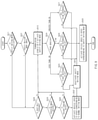
  • FIG. 7 is a flowchart illustrating a method for determining a driving mode of a vehicle
  • FIG. 8 is a flowchart illustrating a method for controlling driving of a vehicle during stopping
  • FIG. 9 is a flowchart illustrating a method for controlling driving of a vehicle during driving.
  • FIG. 10 illustrates a computing system
  • FIG. 1 is a block diagram of a device for controlling driving of a vehicle according to an exemplary form of the present disclosure.
  • a device for controlling driving of a vehicle includes an input device 110 , a detector 120 , a display 130 , and a controller 140 .
  • the input device 110 may output an input signal, which is an electrical signal corresponding to a manipulation of a driver.
  • the input device 110 may output an input signal to deactivate a safety driving mode corresponding to a manipulation of the driver.
  • the input device 110 may be implemented as at least one of a scroll wheel, a button, a knob, a touch screen, a touch pad, a lever, a track ball, an operation sensor and a voice recognition sensor, or a combination thereof, and may be provided on a dashboard.
  • the detector 120 may include a first detector 121 , a second detector 122 , and a third detector 123 .
  • the first detector 121 may acquire driving information of the vehicle
  • the second detector 122 may acquire driver information
  • the third detector 123 may acquire surrounding environment information about the vehicle.
  • the first detector 121 may acquire an engine RPM sensed by an engine RPM sensor, a speed of the vehicle sensed by a vehicle speed sensor, speed change information of the vehicle sensed by a transmission lever sensor, and sensed values sensed by a brake pedal sensor and an accelerator pedal sensor.
  • the sensed value from the accelerator pedal sensor may refer to a measure of a degree to which the driver presses the accelerator pedal.
  • the second detector 122 may acquire driver personal information pre-stored in a Driver State Warning (DSW) device and looking ahead information of the driver sensed from the DSW device.
  • the driver personal information may include a gender, an age, a driving experience, a vehicle driving time of the driver.
  • the second detector 122 may acquire information on whether the driver wears a seat belt sensed by a seat belt sensor, a steering angle of a steering wheel sensed by a steering angle sensor, and information on whether a driver's hand grips the steering wheel from a pressure sensor provided on the steering wheel.
  • the third detector 123 may acquire a current location of the vehicle from a navigation, the vehicle surrounding information from a camera provided in a front or rear of the vehicle, and a gradient of a road sensed by a gradient sensor.
  • the display 130 may be controlled to display the same.
  • the display 130 may be provided on the dashboard of the vehicle, and may be provided on in an AVN or a cluster, as an example.
  • the display 130 may be implemented as an LCD (Liquid Crystal Display), an LED (Light Emitting Diode), a PDP (Plasma Display Panel), an AMOLED (Active Matrix Organic Light Emitting Diode), a POLED (Plastic Organic Light Emitting Diode), and the like, but is not limited thereto.
  • the display 130 may be implemented as a touch screen type, in which case a function of the input device may also be performed.
  • the controller 140 may control an overall operation of the device for controlling driving of the vehicle according to the present disclosure.
  • the controller 140 may determine the safety driving mode subject and the safety driving mode area based on at least one of the driving information, driver information, or surrounding environment information about the vehicle, and may adapt the vehicle speed to a speed corresponding to the safety driving mode or a normal driving mode.
  • the safety driving mode may refer to a driving mode in which, when the vehicle changes from the stopped or parked state to the acceleration state (rapid acceleration state), a gear level is set to a lowest level and the engine RPM is maintained to be equal to or lower than a reference RPM.
  • the safety driving mode may refer to a driving mode in which, when the vehicle is determined to be in the acceleration state (rapid acceleration state) while being in a driving state, the gear level is set to a gear level corresponding to the driving state, and a supply of fuel to an engine is cut (or blocked).
  • the normal driving mode may refer to a driving mode in which the gear level is set based on a manipulation of the driver.
  • the controller 140 may determine the safety driving mode subject based on at least one of the driving information, driver information, or surrounding environment information about the vehicle acquired from the detector 120 .
  • the controller 140 may authenticate a passenger seated on a driver's seat as the driver based on the driver personal information stored in the driver state warning device.
  • the controller 140 determines whether the authenticated driver is the safety driving mode subject.
  • the controller 140 first determines whether the driver is male. Then, when the driver is male, the controller 140 determines whether the driver belongs to a first reference age group.
  • the first reference age group may include the age group (under the age of 25 or over the age of 60) in which driving is determined non-skillful.
  • the controller 140 may determine a male driver under the age of 25 or over the age of 60 as a non-skillful driver.
  • the controller 140 determines whether a driving experience is greater than a reference experience period.
  • the controller 140 determines whether a driving time of the driver is greater than a reference driving time. Meanwhile, when the driving experience period thereof is smaller than the reference experience period, the controller 140 determines the driver as the safety driving mode subject.
  • the controller 140 determines the driver as a normal driving mode subject not the safety driving mode subject. Meanwhile, when the driving time thereof is smaller than the reference driving time, the controller 140 determines the driver as the safety driving mode subject.
  • the controller 140 determines whether the driver belongs to a second reference age group.
  • the second reference age group include the age group (under the age of 25 or over the age of 50) in which driving is determined non-skillful.
  • the controller 140 may determine a female driver under the age of 25 or over the age of 50 as a non-skillful driver.
  • the controller 140 determines whether a driving experience is greater than a reference experience period, when the driving experience period of the driver is determined to be greater than the reference experience period, the controller 140 determines whether a driving time of the driver is greater than a reference driving time.
  • the controller 140 determines the driver as a normal driving mode subject not the safety driving mode subject. Meanwhile, when the driving experience period thereof is smaller than the reference experience period, or the driving time thereof is smaller than the reference driving time, the controller 140 may determine the driver as the safety driving mode subject.
  • the controller 140 may determine the driver as the safety driving mode subject.
  • the controller 140 may activate the safety driving mode. Further, when the driver is not determined to be the safety driving mode subject, the controller 140 may activate the normal driving mode.
  • the controller 140 may determine the safety driving mode area based on at least one of the driving information, driver information, or surrounding environment information about the vehicle acquired from the detector 120 .
  • the controller 140 may determine that the vehicle is located in the safety driving mode area.
  • the controller 140 may determine that the vehicle is located in the safety driving mode area.
  • the controller 140 may determine that the vehicle is located in the safety driving mode area.
  • the controller 140 may determine that the vehicle is located in the safety driving mode area.
  • the controller 140 may activate the safety driving mode. Further, when it is determined that the vehicle is not located in the safety driving mode area, the controller 140 may activate the normal driving mode.
  • the controller 140 determines whether a vehicle in front of or rear the vehicle is in a congested state.
  • the controller 140 may activate the safety driving mode.
  • the controller 140 may activate the normal driving mode.
  • the controller 140 may determine whether to maintain the safety driving mode based on a result of the determination of the state of the vehicle.
  • the controller 140 may maintain the safety driving mode, and adapt the vehicle speed to a speed corresponding to the safety driving mode. Further, when the vehicle is determined not to be in the acceleration state, the controller 140 may deactivate the safety driving mode, and adapt the vehicle speed to a speed corresponding to the normal driving mode.
  • the controller 140 may determine the state of the vehicle based on whether the vehicle is in the stopped or parked state, or in the driving state.
  • the controller 140 may determine that the vehicle is in the stopped or parked state.
  • the controller 140 may determine whether the safety driving mode is deactivated based on the input signal output from the input device 110 .
  • the controller 140 may determine whether the transmission lever of the vehicle has been changed to ‘D’ or ‘R’.
  • the controller 140 may reactivate the safety driving mode. Further, the controller 140 may determine the state of the vehicle after the reactivation of the safety driving mode.
  • the state of the vehicle may be determined based on the sensed value from the accelerator pedal sensor (APS) associated with the road gradient acquired from the detector 120 .
  • whether the vehicle is in the acceleration state may be determined based on the sensed value from the accelerator pedal sensor associated with the road gradient.
  • the state of the vehicle may be determined based on the engine RPM associated with the pressed degree of the accelerator pedal. Further, whether the vehicle is in the acceleration state may be determined based on the engine RPM.
  • the acceleration state may refer to an abnormal accelerator pedal pressed state at a certain road gradient rather than a normal acceleration state due to driving of non-skillful driver.
  • the acceleration state may refer to rapid acceleration state.
  • the road gradient may include a road gradient less than ⁇ 5%, a road gradient of ⁇ 5% to 5%, and a road gradient greater than 5%.
  • the road gradient less than ⁇ 5% may refer to a downhill road as a road having a downward gradient.
  • the road gradient of ⁇ 5% to 5% may refer to a downhill road, a flat road, and an uphill road respectively having a downward gradient, horizontal gradient, and an upward gradient.
  • the road gradient greater than 5% may refer to an uphill road as a road having an upward gradient.
  • the controller 140 may determine that the vehicle is in the acceleration state (rapid acceleration state).
  • the controller 140 may determine that the vehicle is in the acceleration state (rapid acceleration state).
  • the controller 140 may determine that the vehicle is in the acceleration state (rapid acceleration state).
  • the controller 140 determines that the vehicle is in the acceleration state (rapid acceleration state).
  • the controller 140 may maintain the safety driving mode, and adapt the vehicle speed to the speed corresponding to the safety driving mode.
  • the controller 140 may set the gear level to the lowest level (e.g.: gear level 1), and control the engine RPM to maintain equal to or lower than the reference RPM. Further, the controller 140 may control the display 130 to display that the vehicle speed is being adapted to the speed corresponding to the safety driving mode.
  • the controller 140 may determine that the vehicle is not in the acceleration state (rapid acceleration state).
  • the controller 140 may determine that the vehicle is not in the acceleration state (rapid acceleration state).
  • the controller 140 may determine that the vehicle is not in the acceleration state (rapid acceleration state).
  • the controller 140 may determine that the vehicle is not in the acceleration state (rapid acceleration state) according to the present disclosure.
  • the controller 140 may deactivate the safety driving mode, activate the normal driving mode, and adapt the vehicle speed to the speed corresponding to the normal driving mode.
  • the controller 140 determines whether the seat belt is fastened, whether the steering wheel is gripped, or whether the driver is looking ahead.
  • the controller 140 may reactivate the safety driving mode, and adapt the vehicle speed to the speed corresponding to the safety driving mode.
  • the controller 140 may activate the normal driving mode, and adapt the vehicle speed to the speed corresponding to the normal driving mode.
  • the controller 140 may determine that the vehicle is driving.
  • the controller 140 determines whether the safety driving mode is deactivated based on the input signal output from the input device 110 while the vehicle is in the driving state, and determines whether the vehicle is currently located in the safety driving mode area.
  • the controller 140 determines whether the transmission lever of the vehicle is ‘D’ or ‘R’.
  • the controller 140 may reactivate the safety driving mode. Further, the controller 140 determines the state of the vehicle after the reactivation of the safety driving mode.
  • the controller 140 may determine that the vehicle is in the acceleration state (rapid acceleration state).
  • the controller 140 may determine that the vehicle is in the acceleration state (rapid acceleration state).
  • the controller 140 may determine that the vehicle is in the acceleration state (rapid acceleration state).
  • the controller 140 determines that the vehicle is in the acceleration state (rapid acceleration state).
  • the controller 140 adapts the vehicle speed to the speed corresponding to the safety driving mode.
  • the controller 140 In adapting the vehicle speed to the speed corresponding to the safety driving mode, when the transmission lever is unchanged and maintains ‘D’ or ‘R’, the controller 140 sets the gear level to the gear level of the driving state and blocks the fuel supply to the engine. Further, the controller 140 controls the display 130 to display that the vehicle speed is being adapted to the speed corresponding to the safety driving mode.
  • the controller 140 may determine that the vehicle is not in the acceleration state.
  • the controller 140 may determine that the vehicle is not in the acceleration state (rapid acceleration state).
  • the controller 140 may determine that the vehicle is not in the acceleration state (rapid acceleration state).
  • the controller 140 may determine that the vehicle is not in the acceleration state (rapid acceleration state) according to the present disclosure.
  • the controller 140 may deactivate the safety driving mode, activate the normal driving mode, and adapt the vehicle speed to the speed corresponding to the normal driving mode.
  • the controller 140 determines whether the seat belt is fastened, whether the steering wheel is gripped, or whether the driver is looking ahead.
  • the controller 140 may activate the safety driving mode.
  • the controller 140 may activate the normal driving mode, and adapt the vehicle speed to a speed corresponding to the normal driving mode.
  • FIG. 2 illustrates an input device according to an form of the present disclosure.
  • an input device 200 may be implemented in a button type, and may be provided on a dashboard on one side of the driver's seat.
  • the input device 200 may output a corresponding input signal to deactivate the safety driving mode.
  • the input device 200 is not limited to being implemented as the button type as shown in FIG. 2 .
  • the input device 200 may be implemented in various forms as described in the description of the input device 110 .
  • FIG. 3 illustrates a driver state warning device according to an exemplary form of the present disclosure.
  • a driver state warning device 300 may be provided in a cluster.
  • the driver state warning device 300 may include an infrared sensor, an image sensor, and the like.
  • the sensor may sense a driver's face in a predetermined region 310 , and monitor a driver's state such as a driver's gaze direction, and the like based on the sensed information.
  • the driver state warning device 300 may include storage for storing the driver personal information at a beginning of a setting.
  • the driver personal information may include the gender, the age, the driving experience, the vehicle driving time of the driver.
  • FIG. 4 illustrates an image output in a safety driving mode according to one form of the present disclosure.
  • a display 400 may be provided in a cluster.
  • the display 400 may display a message that the vehicle is currently controlled in the safety driving mode.
  • FIG. 5 is a flowchart illustrating a method for determining a driving mode of a vehicle according to one form of the present disclosure.
  • the controller 140 determines whether the passenger seated on the driver's seat may be authenticated as the driver based on the driver personal information stored in the driver state warning device (see FIG. 3 ) (S 110 ).
  • the controller 140 determines whether the driver is the safety driving mode subject (S 120 ).
  • the controller 140 activates the safety driving mode (S 130 ).
  • the controller 140 activates the normal driving mode (S 140 ).
  • FIG. 6 is a flowchart illustrating a method for determining a safety driving mode subject according to another form of the present disclosure.
  • the controller 140 determines whether the driver is male (S 210 ).
  • the controller 140 determines whether the driver is male driver and belongs to the first reference age group (S 220 ).
  • the controller 140 determines whether the driving experience is greater than the reference experience period (S 230 ).
  • the controller 140 determines whether the driving time is greater than the reference driving time (S 240 ). When the driving experience of the male driver is determined to be smaller than the reference experience period in S 230 , the controller 140 determines the driver is the safety driving mode subject (S 270 ).
  • the controller 140 determines that the driver is the normal driving mode subject not the safety driving mode subject (S 250 ).
  • the controller 140 determines that the driver is the safety driving mode subject (S 270 ).
  • the controller 140 determines whether the female driver belongs to the second reference age group (S 260 ). When the female driver does not belong to the second reference age group in S 260 , the controller 140 determines whether the driving experience is greater than the reference experience period (S 230 ). When the driving experience of the female driver is determined to be greater than the reference experience period in S 230 , the controller 140 determines whether the driving time is greater than the reference driving time (S 240 ). When the driving experience of the female driver is determined to be smaller than the reference experience period in S 230 , the controller 140 determines the driver is the safety driving mode subject (S 270 ).
  • the controller 140 determines that the driver is the normal driving mode subject not the safety driving mode subject (S 250 ).
  • the controller 140 determines that the driver is the safety driving mode subject (S 270 ).
  • the controller 140 may determine, when the driver is male who driver belongs to the first reference age group, when the driver is female who belongs to the second reference age group, the driver as the safety driving mode subject (S 270 ).
  • the controller 140 determines the driver as the normal driving mode subject not the safety driving mode subject (S 250 ).
  • FIG. 7 is a flowchart illustrating a method for determining a driving mode of a vehicle according to another form of the present disclosure.
  • the controller 140 determines the safety driving mode area based on the driving information, the driver information, and the surrounding environment information about the vehicle acquired from the detector 120 (S 310 ).
  • the controller 140 may determine that the vehicle is located in the safety driving mode area.
  • the controller 140 may determine that the vehicle is located in the safety driving mode area.
  • the controller 140 may determine that the vehicle is located in the safety driving mode area.
  • the controller 140 may determine that the vehicle is located in the safety driving mode area.
  • the controller 140 may activate the safety driving mode (S 340 ).
  • the controller 140 determines whether a vehicle in front of or rear the vehicle is in the congested state (S 320 ).
  • the controller 140 may activate the safety driving mode (S 340 ).
  • the controller 140 may activate the normal driving mode (S 330 ).
  • FIG. 8 is a flowchart illustrating a method for controlling driving of a vehicle during stopping according to other form of the present disclosure.
  • the controller 140 may determine that the vehicle is in the stopped or parked state.
  • the controller 140 determines whether the driver is the safety driving mode subject while the vehicle is in the parked or stopped state (S 411 ).
  • the controller 140 determines whether the safety driving mode is deactivated based on the input signal output from the input device (S 412 ).
  • the controller 140 determines whether the transmission lever of the vehicle is changed to ‘D’ or ‘R’. When the transmission lever of the vehicle is changed, the controller 140 activates the safety driving mode (S 413 ).
  • the controller 140 determines the road gradient (S 414 ).
  • the controller 140 may determine the road gradient in S 414 by dividing into a case of the road having the downward gradient (e.g.: a road gradient less than ⁇ 5%), a case of the road having one of the downward, the flat, and the upward gradients (e.g.: a road gradient of ⁇ 5% to 5%), and a case of the road having the upward gradient (e.g.: a road gradient greater than 5%).
  • a case of the road having the downward gradient e.g.: a road gradient less than ⁇ 5%
  • a case of the road having one of the downward, the flat and the upward gradients
  • a case of the road having the upward gradient e.g.: a road gradient greater than 5%
  • the controller 140 determines whether the sensed value from the accelerator pedal sensor on the road having the downward gradient at S 414 is equal to or greater than the first reference value (S 415 ).
  • the controller 140 determines whether the sensed value from the accelerator pedal sensor on the road having one of the downward, the flat, and the upward gradients at S 414 is equal to or greater than the second reference value that is higher than the first reference value (S 416 ).
  • the controller 140 determines whether the sensed value from the accelerator pedal sensor on the road having the upward gradient at S 414 is equal to or greater than the third reference value that is higher than the second reference value (S 417 ).
  • the controller 140 may determine that the vehicle is in the acceleration state (rapid acceleration state), maintain the safety driving mode, and adapt the vehicle speed to the speed corresponding to the safety driving mode (S 423 ).
  • the controller 140 sets the gear level to the lowest level (e.g., gear level 1), and controls the engine RPM to maintain equal to or lower than the reference RPM, thereby setting the speed corresponding to the safety driving mode, and controlling the display 130 to display that the vehicle speed is being adapted to the speed corresponding to the safety driving mode.
  • the gear level e.g., gear level 1
  • the controller 140 may determine that the vehicle is not in the acceleration state (rapid acceleration state).
  • the controller 140 deactivates the safety driving mode (S 421 ), and activates the normal driving mode, and then adapts the vehicle speed to the speed corresponding to the normal driving mode (S 422 ).
  • the controller 140 determines whether the seat belt is fastened (S 418 ).
  • the controller 140 determines whether the steering wheel is gripped (S 419 ).
  • the controller determines whether the driver is looking ahead (S 420 ).
  • the controller 140 activates the normal driving mode, and adapts the vehicle speed to the speed corresponding to the normal driving mode (S 422 ).
  • the controller 140 may reactivate the safety driving mode (S 413 ).
  • the controller 140 may adapt the vehicle speed to the speed corresponding to the normal driving mode (S 422 ).
  • FIG. 9 is a flowchart illustrating a method for controlling driving of a vehicle during driving according to another form of the present disclosure.
  • the controller 140 may determine that the vehicle is in the driving state.
  • the controller 140 determines whether the safety driving mode is deactivated (S 511 ).
  • the controller 140 determines whether the vehicle is located in the safety driving mode area (S 512 ).
  • the controller 140 determines whether the transmission lever of the vehicle is ‘D’ or ‘R’, and activates the safety driving mode (S 513 ).
  • the controller 140 determines the road gradient (S 514 ).
  • the controller 140 may determine the road gradient in S 514 by dividing into a case of the road having the downward gradient (e.g.: a road gradient less than ⁇ 5%), a case of the road having one of the downward, the flat, and the upward gradients (e.g.: a road gradient of ⁇ 5% to 5%), and a case of the road having the upward gradient (e.g.: a road gradient of greater than 5%).
  • a case of the road having the downward gradient e.g.: a road gradient less than ⁇ 5%
  • a case of the road having one of the downward, the flat and the upward gradients
  • a case of the road having the upward gradient e.g.: a road gradient of greater than 5%
  • the controller 140 determines whether the sensed value from the accelerator pedal sensor on the road having the downward gradient at S 514 is equal to or greater than the first reference value (S 515 ).
  • the controller 140 determines whether the sensed value from the accelerator pedal sensor on the road having one of the downward, the flat, and the upward gradients at S 514 is equal to or greater than the second reference value that is higher than the first reference value (S 516 ).
  • the controller 140 determines whether the sensed value from the accelerator pedal sensor on the road having the upward gradient at S 514 is equal to or greater than the third reference value that is higher than the second reference value (S 517 ).
  • the controller 140 may determine that the vehicle is in the acceleration state (rapid acceleration state). When it is determined that the vehicle is in the acceleration state (rapid acceleration state), the controller 140 maintains the safety driving mode, and adapts the vehicle speed to the speed corresponding to the safety driving mode (S 523 ).
  • the controller 140 sets the gear level to the gear level of the driving state, and cuts the fuel supply to the engine, thereby setting the speed corresponding to the safety driving mode, and controlling the display 130 to display that the vehicle speed is being adapted to the speed corresponding to the safety driving mode.
  • the controller 140 may determine that the vehicle is not in the acceleration state (rapid acceleration state).
  • the controller 140 deactivates the safety driving mode (S 521 ), activates the normal driving mode, and then adapts the vehicle speed to the speed corresponding to the normal driving mode (S 522 ).
  • the controller 140 determines whether the seat belt is fastened (S 518 ).
  • the controller 140 determines whether the steering wheel is gripped (S 519 ).
  • the controller 140 determines whether the driver is looking ahead (S 520 ).
  • the controller 140 activates the normal driving mode, and adapts the vehicle speed to the speed corresponding to the normal driving mode (S 522 ).
  • the controller 140 may activate the safety driving mode (S 513 ).
  • the controller 140 may adapt the vehicle speed to the speed corresponding to the normal driving mode (S 522 ).
  • FIG. 10 illustrates a computing system according to one form of the present disclosure.
  • a computing system 1000 may include at least one processor 1100 , a memory 1300 , a user interface input device 1400 , a user interface output device 1500 , storage 1600 , and a network interface 1700 , which are connected with each other via a bus 1200 .
  • the processor 1100 may be a central processing unit (CPU) or a semiconductor device that processes instructions stored in the memory 1300 and/or the storage 1600 .
  • the memory 1300 and the storage 1600 may include various types of volatile or non-volatile storage media.
  • the memory 1300 may include a ROM (Read Only Memory) and a RAM (Random Access Memory).
  • the operations of the method or the algorithm described in connection with the exemplary forms disclosed herein may be embodied directly in hardware or a software module executed by the processor 1100 , or in a combination thereof.
  • the software module may reside on a storage medium (that is, the memory 1300 and/or the storage 1600 ) such as a RAM memory, a flash memory, a ROM memory, an EPROM memory, an EEPROM memory, a register, a hard disk, a removable disk, a CD-ROM.
  • the exemplary storage medium may be coupled to the processor 1100 , and the processor 1100 may read information out of the storage medium and may record information in the storage medium. Alternatively, the storage medium may be integrated with the processor 1100 .
  • the processor 1100 and the storage medium may reside in an application specific integrated circuit (ASIC).
  • the ASIC may reside within a user terminal. In another case, the processor 1100 and the storage medium may reside in the user terminal as separate components.
  • the device and the method for controlling driving of the vehicle according to one form of the present disclosure may support the safety driving of the vehicle by restricting the speed of the vehicle even when the driver incorrectly puts the accelerator pedal in place of the brake pedal.

Landscapes

  • Engineering & Computer Science (AREA)
  • Mechanical Engineering (AREA)
  • Transportation (AREA)
  • Automation & Control Theory (AREA)
  • Chemical & Material Sciences (AREA)
  • Combustion & Propulsion (AREA)
  • Mathematical Physics (AREA)
  • Physics & Mathematics (AREA)
  • General Engineering & Computer Science (AREA)
  • Computer Hardware Design (AREA)
  • Microelectronics & Electronic Packaging (AREA)
  • Control Of Vehicle Engines Or Engines For Specific Uses (AREA)
  • Auxiliary Drives, Propulsion Controls, And Safety Devices (AREA)
  • Control Of Driving Devices And Active Controlling Of Vehicle (AREA)

Abstract

A device for controlling driving of a vehicle includes: a detector to acquire driving information, driver information, and surrounding environment information about the vehicle, and a controller to determine whether to activate a safety driving mode based on at least one of the driving information, driver information, and surrounding environment information about the vehicle, and to determine whether to maintain the safety driving mode state based on a vehicle state after the activation of the safety driving mode. Thus, the device may support a safety driving of the vehicle by restricting a speed of the vehicle even when the driver incorrectly operates an accelerator pedal in place of a brake pedal of the vehicle.

Description

CROSS-REFERENCE TO RELATED APPLICATION
This application claims priority to and the benefit of Korean Patent Application No. 10-2019-0011798, filed on Jan. 30, 2019, the entire contents of which are incorporated herein by reference.
FIELD
The present disclosure relates to a device and a method for controlling driving of a vehicle.
BACKGROUND
The statements in this section merely provide background information related to the present disclosure and may not constitute prior art.
Generally, a non-skillful driver often operates by mistake an accelerator pedal in place of a brake pedal or vice versa when driving immediately after starting a vehicle; when entering a parking lot or departing from the parking lot; when driving along an alley; when repeating “stop and go” operations due to a traffic jam in downtowns; and when moving suddenly from a dark area to a bright area, and the like.
In such situations, when the non-skillful driver incorrectly operates the accelerator pedal in place of the brake pedal, accidents may occur.
SUMMARY
The present disclosure has been made to solve the above-mentioned problems occurring in the prior art while advantages achieved by the prior art are maintained intact.
An aspect of the present disclosure provides a device and a method for controlling driving of a vehicle that may reduce or prevent accidents even when a driver incorrectly operates the accelerator pedal in place of the brake pedal.
The technical problems to be solved by the present inventive concept are not limited to the aforementioned problems, and any other technical problems not mentioned herein will be clearly understood from the following description by those skilled in the art to which the present disclosure pertains.
According to an aspect of the present disclosure, a device for controlling driving of a vehicle includes: a detector configured to acquire driving information, driver information, and surrounding environment information about the vehicle, and a controller configured to determine whether to activate a safety driving mode based on at least one of the driving information, the driver information, or the surrounding environment information about the vehicle, and to determine whether to maintain the safety driving mode based on a state of the vehicle after activating the safety driving mode.
According to an aspect of the present disclosure, the controller determines whether the vehicle is in a rapid acceleration state based on a sensed value from an accelerator pedal sensor associated with a gradient of a road on which the vehicle travels.
According to an aspect of the present disclosure, when the sensed value is indicative of a downward gradient and equal to or greater than a first reference value, the controller determines that the vehicle is in the rapid acceleration state.
According to an aspect of the present disclosure, when the sensed value is indicative of a downward gradient, a flat gradient, or an upward gradient and is equal to or greater than a second reference value higher than the first reference value, the controller determines that the vehicle is in the rapid acceleration state.
According to an aspect of the present disclosure, when the sensed value is indicative of an upward gradient and equal to or greater than a third reference value, the controller determines that the vehicle is in the rapid acceleration state.
According to an aspect of the present disclosure, when the state of the vehicle is determined as the rapid acceleration state, the controller maintains the safety driving mode, and adapts a speed of the vehicle to a speed corresponding to the safety driving mode.
According to an aspect of the present disclosure, the safety driving mode includes a driving mode in which, when the vehicle is determined to be in the rapid acceleration state while being in a parked state or a stopped state, a gear level of the vehicle is set to a lowest level and a revolutions per minute (RPM) of an engine of the vehicle is maintained to be equal to or lower than a reference revolutions per minute (RPM).
According to an aspect of the present disclosure, the safety driving mode includes a driving mode in which, when the vehicle is determined to be in the rapid acceleration state while being in a driving state, a gear level of the vehicle is set to a gear level corresponding to the driving state, and a fuel supply to an engine of the vehicle is cut.
According to an aspect of the present disclosure, the controller determines a safety driving mode subject or a safety driving mode area based on at least one of the driving information, the driver information, or the surrounding environment information about the vehicle. Further, the controller determines whether to activate the safety driving mode based on whether a driver of the vehicle is the safety driving mode subject or whether a current location of the vehicle is in the safety driving mode area.
According to an aspect of the present disclosure, when the driver is not the safety driving mode subject, or when the current location of the vehicle is not in the safety driving mode area, the controller adapts the vehicle speed to a speed corresponding to a normal driving mode.
According to an aspect of the present disclosure, a method for controlling driving of a vehicle includes: acquiring, by a detector, driving information, driver information, and surrounding environment information about the vehicle; determining, by a controller, whether to activate a safety driving mode based on at least one of the driving information, the driver information, or the surrounding environment information about the vehicle; and determining, by the controller, whether to maintain the safety driving mode based on a state of the vehicle after activating the safety driving mode.
According to an aspect of the present disclosure, the method further includes determining, by the controller, whether the vehicle is in a rapid acceleration state based on a sensed value from an accelerator pedal sensor associated with a gradient of a road on which the vehicle is traveling.
According to an aspect of the present disclosure, the method further includes determining, by the controller, that the vehicle is in the rapid acceleration state when the road has a downward gradient and the sensed value from the accelerator pedal sensor is equal to or greater than a first reference value.
According to an aspect of the present disclosure, the method further includes determining by the controller that the vehicle is in the rapid acceleration state when the road has a downward gradient, a flat gradient, or an upward gradient and the sensed value from the accelerator pedal sensor is equal to or greater than a second reference value higher than the first reference value.
According to an aspect of the present disclosure, the method further includes determining by the controller that the vehicle is in the rapid acceleration state when the road has an upward gradient and the sensed value from the accelerator pedal sensor is equal to or greater than a third reference value.
According to an aspect of the present disclosure, the method further includes maintaining, by the controller, the safety driving mode and adapting a speed of the vehicle to a speed corresponding to the safety driving mode when the state of the vehicle is determined to be in the rapid acceleration state.
According to an aspect of the present disclosure, the safety driving mode includes a driving mode in which, when the vehicle is determined to be in the rapid acceleration state while being in a parked or stopped state, a gear level of the vehicle is set to a lowest level and a revolutions per minute (RPM) of an engine of the vehicle is maintained to be equal to or lower than a reference revolutions per minute (RPM).
According to an aspect of the present disclosure, the safety driving mode includes a driving mode in which, when the vehicle is determined to be in the rapid acceleration state while being in a driving state, a gear level of the vehicle is set to a gear level corresponding to the driving state, and a fuel supply to an engine of the vehicle is cut.
According to an aspect of the present disclosure, the method further includes determining, by the controller, a safety driving mode subject or a safety driving mode area based on at least one of the driving information, the driver information, and the surrounding environment information about the vehicle, and determining, by the controller, whether to activate the safety driving mode based on whether the driver of the vehicle is the safety driving mode subject or whether a current location of the vehicle is in the safety driving mode area.
According to an aspect of the present disclosure, the method further includes adapting, by the controller, the speed of the vehicle to a speed corresponding to a normal driving mode when the driver is not the safety driving mode subject, or when the current location of the vehicle is not in the safety driving mode area.
Further areas of applicability will become apparent from the description provided herein. It should be understood that the description and specific examples are intended for purposes of illustration only and are not intended to limit the scope of the present disclosure.
DRAWINGS
In order that the disclosure may be well understood, there will now be described various forms thereof, given by way of example, reference being made to the accompanying drawings, in which:
FIG. 1 is a block diagram of a device for controlling driving of a vehicle;
FIG. 2 illustrates an input device;
FIG. 3 illustrates a driver state warning device;
FIG. 4 illustrates an image output in a safety driving mode;
FIG. 5 is a flowchart illustrating a method for determining a driving mode of a vehicle;
FIG. 6 is a flowchart illustrating a method for determining a safety driving mode subject;
FIG. 7 is a flowchart illustrating a method for determining a driving mode of a vehicle;
FIG. 8 is a flowchart illustrating a method for controlling driving of a vehicle during stopping;
FIG. 9 is a flowchart illustrating a method for controlling driving of a vehicle during driving; and
FIG. 10 illustrates a computing system.
The drawings described herein are for illustration purposes only and are not intended to limit the scope of the present disclosure in any way.
DETAILED DESCRIPTION
The following description is merely exemplary in nature and is not intended to limit the present disclosure, application, or uses. It should be understood that throughout the drawings, corresponding reference numerals indicate like or corresponding parts and features.
In adding the reference numerals to the components of each drawing, it should be noted that the identical or equivalent component is designated by the identical numeral even when they are displayed on other drawings. Further, in describing the form of the present disclosure, a detailed description of well-known features or functions will be ruled out in order not to unnecessarily obscure the gist of the present disclosure.
In describing the components of the form according to the present disclosure, terms such as first, second, “A”, “B”, (a), (b), and the like may be used. These terms are merely intended to distinguish one component from another component, and the terms do not limit the nature, sequence or order of the constituent components. Unless otherwise defined, all terms used herein, including technical or scientific terms, have the same meanings as those generally understood by those skilled in the art to which the present disclosure pertains. Such terms as those defined in a generally used dictionary are to be interpreted as having meanings equal to the contextual meanings in the relevant field of art, and are not to be interpreted as having ideal or excessively formal meanings unless clearly defined as having such in the present application.
FIG. 1 is a block diagram of a device for controlling driving of a vehicle according to an exemplary form of the present disclosure.
As shown in FIG. 1, a device for controlling driving of a vehicle includes an input device 110, a detector 120, a display 130, and a controller 140.
The input device 110 may output an input signal, which is an electrical signal corresponding to a manipulation of a driver.
The input device 110 may output an input signal to deactivate a safety driving mode corresponding to a manipulation of the driver.
The input device 110 may be implemented as at least one of a scroll wheel, a button, a knob, a touch screen, a touch pad, a lever, a track ball, an operation sensor and a voice recognition sensor, or a combination thereof, and may be provided on a dashboard.
The detector 120 may include a first detector 121, a second detector 122, and a third detector 123. For example, the first detector 121 may acquire driving information of the vehicle, the second detector 122 may acquire driver information, and the third detector 123 may acquire surrounding environment information about the vehicle.
The first detector 121 may acquire an engine RPM sensed by an engine RPM sensor, a speed of the vehicle sensed by a vehicle speed sensor, speed change information of the vehicle sensed by a transmission lever sensor, and sensed values sensed by a brake pedal sensor and an accelerator pedal sensor. In this connection, the sensed value from the accelerator pedal sensor may refer to a measure of a degree to which the driver presses the accelerator pedal.
The second detector 122 may acquire driver personal information pre-stored in a Driver State Warning (DSW) device and looking ahead information of the driver sensed from the DSW device. In this connection, the driver personal information may include a gender, an age, a driving experience, a vehicle driving time of the driver.
Further, the second detector 122 may acquire information on whether the driver wears a seat belt sensed by a seat belt sensor, a steering angle of a steering wheel sensed by a steering angle sensor, and information on whether a driver's hand grips the steering wheel from a pressure sensor provided on the steering wheel.
The third detector 123 may acquire a current location of the vehicle from a navigation, the vehicle surrounding information from a camera provided in a front or rear of the vehicle, and a gradient of a road sensed by a gradient sensor.
When the controller 140 determines a safety driving mode subject or a safety driving mode area, the display 130 may be controlled to display the same.
The display 130 may be provided on the dashboard of the vehicle, and may be provided on in an AVN or a cluster, as an example.
The display 130 may be implemented as an LCD (Liquid Crystal Display), an LED (Light Emitting Diode), a PDP (Plasma Display Panel), an AMOLED (Active Matrix Organic Light Emitting Diode), a POLED (Plastic Organic Light Emitting Diode), and the like, but is not limited thereto. The display 130 may be implemented as a touch screen type, in which case a function of the input device may also be performed.
The controller 140 may control an overall operation of the device for controlling driving of the vehicle according to the present disclosure.
The controller 140 may determine the safety driving mode subject and the safety driving mode area based on at least one of the driving information, driver information, or surrounding environment information about the vehicle, and may adapt the vehicle speed to a speed corresponding to the safety driving mode or a normal driving mode.
According to an exemplary form of the present disclosure, the safety driving mode may refer to a driving mode in which, when the vehicle changes from the stopped or parked state to the acceleration state (rapid acceleration state), a gear level is set to a lowest level and the engine RPM is maintained to be equal to or lower than a reference RPM.
Further, the safety driving mode may refer to a driving mode in which, when the vehicle is determined to be in the acceleration state (rapid acceleration state) while being in a driving state, the gear level is set to a gear level corresponding to the driving state, and a supply of fuel to an engine is cut (or blocked).
Further, the normal driving mode may refer to a driving mode in which the gear level is set based on a manipulation of the driver.
The controller 140 may determine the safety driving mode subject based on at least one of the driving information, driver information, or surrounding environment information about the vehicle acquired from the detector 120.
More specifically, the controller 140 may authenticate a passenger seated on a driver's seat as the driver based on the driver personal information stored in the driver state warning device.
When the driver is authenticated, the controller 140 determines whether the authenticated driver is the safety driving mode subject.
The controller 140 first determines whether the driver is male. Then, when the driver is male, the controller 140 determines whether the driver belongs to a first reference age group. According to another form, the first reference age group may include the age group (under the age of 25 or over the age of 60) in which driving is determined non-skillful. In one form, the controller 140 may determine a male driver under the age of 25 or over the age of 60 as a non-skillful driver.
When the driver is male and the driver does not belong to the first reference age group, the controller 140 determines whether a driving experience is greater than a reference experience period.
When the driving experience period of the driver is determined to be greater than the reference experience period, the controller 140 determines whether a driving time of the driver is greater than a reference driving time. Meanwhile, when the driving experience period thereof is smaller than the reference experience period, the controller 140 determines the driver as the safety driving mode subject.
When the vehicle driving time is determined to be greater than the reference driving time, the controller 140 determines the driver as a normal driving mode subject not the safety driving mode subject. Meanwhile, when the driving time thereof is smaller than the reference driving time, the controller 140 determines the driver as the safety driving mode subject.
Further, when the driver is not male, that is, the driver is female, the controller 140 determines whether the driver belongs to a second reference age group. According to another form, the second reference age group include the age group (under the age of 25 or over the age of 50) in which driving is determined non-skillful. According to other form, the controller 140 may determine a female driver under the age of 25 or over the age of 50 as a non-skillful driver.
When the driver is female and the driver does not belongs to the second reference age group, the controller 140 determines whether a driving experience is greater than a reference experience period, when the driving experience period of the driver is determined to be greater than the reference experience period, the controller 140 determines whether a driving time of the driver is greater than a reference driving time. When the vehicle driving time is determined to be greater than the reference driving time, the controller 140 determines the driver as a normal driving mode subject not the safety driving mode subject. Meanwhile, when the driving experience period thereof is smaller than the reference experience period, or the driving time thereof is smaller than the reference driving time, the controller 140 may determine the driver as the safety driving mode subject.
When the driver is male who belongs to the first reference age group, and when the driver is female who belongs to the second reference age group the controller 140 may determine the driver as the safety driving mode subject.
When the driver is determined to be the safety driving mode subject, the controller 140 may activate the safety driving mode. Further, when the driver is not determined to be the safety driving mode subject, the controller 140 may activate the normal driving mode.
The controller 140 may determine the safety driving mode area based on at least one of the driving information, driver information, or surrounding environment information about the vehicle acquired from the detector 120.
According to another form, when it is determined that the vehicle is located in a building or at a parking lot based on the vehicle surrounding environment information about the vehicle acquired from the detector 120, the controller 140 may determine that the vehicle is located in the safety driving mode area.
Further, when at least one of a children protection zone, a senior protection zone, or a speed-bump zone is located in a predetermined range around the vehicle based on the vehicle surrounding environment information, the controller 140 may determine that the vehicle is located in the safety driving mode area.
Further, when the vehicle is located on a two lane road except for an expressway, a local road, and a driveway based on the vehicle surrounding environment information about the vehicle, the controller 140 may determine that the vehicle is located in the safety driving mode area.
When the vehicle is located in an expressway service area, a rest area, a road without lane/signal information, a residential area road, the controller 140 may determine that the vehicle is located in the safety driving mode area.
When it is determined that the vehicle is located in the safety driving mode area, the controller 140 may activate the safety driving mode. Further, when it is determined that the vehicle is not located in the safety driving mode area, the controller 140 may activate the normal driving mode.
When it is determined that the vehicle is not located in the safety driving mode area, the controller 140 determines whether a vehicle in front of or rear the vehicle is in a congested state.
When it is determined that a vehicle in front of or rear the vehicle is in the congested state, the controller 140 may activate the safety driving mode.
When the vehicle is not located in the safety driving mode area, and a vehicle in front of or rear the vehicle is not in the congested state, the controller 140 may activate the normal driving mode.
The controller 140 may determine whether to maintain the safety driving mode based on a result of the determination of the state of the vehicle.
In this connection, when the vehicle is determined to be in the acceleration state, the controller 140 may maintain the safety driving mode, and adapt the vehicle speed to a speed corresponding to the safety driving mode. Further, when the vehicle is determined not to be in the acceleration state, the controller 140 may deactivate the safety driving mode, and adapt the vehicle speed to a speed corresponding to the normal driving mode.
The controller 140 may determine the state of the vehicle based on whether the vehicle is in the stopped or parked state, or in the driving state.
First, an operation, by the controller 140, for determining the state of the vehicle while the vehicle is in the stopped or parked state will be described.
When the transmission lever of the vehicle is ‘P’ or ‘N’, and the vehicle speed is ‘0’, the controller 140 may determine that the vehicle is in the stopped or parked state.
Upon determining whether the driver is the safety driving mode subject while the vehicle is in the stopped or parked state, and determining the driver as the safety driving mode subject, the controller 140 may determine whether the safety driving mode is deactivated based on the input signal output from the input device 110.
When the safety driving mode is not deactivated, the controller 140 may determine whether the transmission lever of the vehicle has been changed to ‘D’ or ‘R’.
When the transmission lever of the vehicle is changed to ‘D’ or ‘R’, the controller 140 may reactivate the safety driving mode. Further, the controller 140 may determine the state of the vehicle after the reactivation of the safety driving mode.
In this connection, the state of the vehicle may be determined based on the sensed value from the accelerator pedal sensor (APS) associated with the road gradient acquired from the detector 120. In addition, whether the vehicle is in the acceleration state may be determined based on the sensed value from the accelerator pedal sensor associated with the road gradient.
Further, the state of the vehicle may be determined based on the engine RPM associated with the pressed degree of the accelerator pedal. Further, whether the vehicle is in the acceleration state may be determined based on the engine RPM.
In this connection, as used herein, the acceleration state may refer to an abnormal accelerator pedal pressed state at a certain road gradient rather than a normal acceleration state due to driving of non-skillful driver. Thus, the acceleration state may refer to rapid acceleration state.
According to an exemplary form of the present disclosure, the road gradient may include a road gradient less than −5%, a road gradient of −5% to 5%, and a road gradient greater than 5%.
In one example, the road gradient less than −5% may refer to a downhill road as a road having a downward gradient. In addition, the road gradient of −5% to 5% may refer to a downhill road, a flat road, and an uphill road respectively having a downward gradient, horizontal gradient, and an upward gradient. Further, the road gradient greater than 5% may refer to an uphill road as a road having an upward gradient.
When the sensed value from the accelerator pedal sensor on the road having the downward gradient (downhill road) is equal to or greater than the first reference value, the controller 140 may determine that the vehicle is in the acceleration state (rapid acceleration state).
Further, when the sensed value from the accelerator pedal sensor on a road having one of the downward (downhill), the flat, and the upward (uphill) gradients is equal to or greater than the second reference value that is higher than the first reference value, the controller 140 may determine that the vehicle is in the acceleration state (rapid acceleration state).
Further, when the sensed value from the accelerator pedal on the road having the upward gradient (uphill road) is equal to or greater than the third reference value that is higher than the second reference value, the controller 140 may determine that the vehicle is in the acceleration state (rapid acceleration state).
Further, when an actual engine RPM rises abnormally relative to a normal engine RPM based on a pressed degree of the accelerator pedal, the controller 140 determines that the vehicle is in the acceleration state (rapid acceleration state).
When it is determined that the vehicle changes from the stopped or parked state to the acceleration state (rapid acceleration state), the controller 140 may maintain the safety driving mode, and adapt the vehicle speed to the speed corresponding to the safety driving mode.
When the transmission lever is changed from ‘P’ or ‘N’ to ‘D’ or ‘R’, in setting the speed corresponding to the safety driving mode, the controller 140 may set the gear level to the lowest level (e.g.: gear level 1), and control the engine RPM to maintain equal to or lower than the reference RPM. Further, the controller 140 may control the display 130 to display that the vehicle speed is being adapted to the speed corresponding to the safety driving mode.
Further, when the sensed value from the accelerator pedal sensor on the road having the downward gradient (downhill road) is lower than the first reference value, the controller 140 may determine that the vehicle is not in the acceleration state (rapid acceleration state).
Further, when the sensed value from the accelerator pedal sensor on the road having one of the downward (downhill), the flat, and the upward (uphill) gradients is lower than the second reference value that is higher than the first reference value, the controller 140 may determine that the vehicle is not in the acceleration state (rapid acceleration state).
Further, when the sensed value from the accelerator pedal on the road having the upward gradient (uphill road) is lower than the third reference value that is higher than the second reference value, the controller 140 may determine that the vehicle is not in the acceleration state (rapid acceleration state).
Further, when the engine RPM rises normally based on the pressed degree of the accelerator pedal, the controller 140 may determine that the vehicle is not in the acceleration state (rapid acceleration state) according to the present disclosure.
When it is determined that the vehicle is not in the acceleration state (rapid acceleration state), the controller 140 may deactivate the safety driving mode, activate the normal driving mode, and adapt the vehicle speed to the speed corresponding to the normal driving mode.
When it is determined that the driver is not the safety driving mode subject, or determining that the safety driving mode is deactivated based on the input signal output from the input device 110, the controller 140 determines whether the seat belt is fastened, whether the steering wheel is gripped, or whether the driver is looking ahead.
When the seat belt is not fastened, when the driver's hand is not gripping the steering wheel, or when the driver is not looking ahead, the controller 140 may reactivate the safety driving mode, and adapt the vehicle speed to the speed corresponding to the safety driving mode.
When the seat belt is fastened, when the driver's hand is gripping the steering wheel, and when the driver is looking ahead, the controller 140 may activate the normal driving mode, and adapt the vehicle speed to the speed corresponding to the normal driving mode.
Hereinafter, an operation, by the controller 140, for determining the state of the vehicle in the driving state of the vehicle will be described in detail.
When the transmission lever of the vehicle is ‘D’ or ‘R’, and the vehicle speed is not ‘0’, the controller 140 may determine that the vehicle is driving.
The controller 140 determines whether the safety driving mode is deactivated based on the input signal output from the input device 110 while the vehicle is in the driving state, and determines whether the vehicle is currently located in the safety driving mode area.
When it is determined that the vehicle is located in the safety driving mode area, the controller 140 determines whether the transmission lever of the vehicle is ‘D’ or ‘R’.
When the transmission lever of the vehicle is ‘D’ or ‘R’, the controller 140 may reactivate the safety driving mode. Further, the controller 140 determines the state of the vehicle after the reactivation of the safety driving mode.
When the sensed value from the accelerator pedal sensor on the road having the downward gradient (downhill road) is equal to or greater than the first reference value, the controller 140 may determine that the vehicle is in the acceleration state (rapid acceleration state).
Further, when the sensed value from the accelerator pedal sensor on the road having one of the downward (downhill road), the flat, and the upward (uphill) gradients is equal to or greater than the second reference value that is higher than the first reference value, the controller 140 may determine that the vehicle is in the acceleration state (rapid acceleration state).
Further, when the sensed value from the accelerator pedal sensor on the uphill road is equal to or greater than the third reference value that is higher than the second reference value, the controller 140 may determine that the vehicle is in the acceleration state (rapid acceleration state).
Further, when an actual engine RPM rises abnormally relative to a normal engine RPM based on a pressed degree of the accelerator pedal, the controller 140 determines that the vehicle is in the acceleration state (rapid acceleration state).
When it is determined that the vehicle is in the acceleration state (rapid acceleration state) while being in the driving state, the controller 140 adapts the vehicle speed to the speed corresponding to the safety driving mode.
In adapting the vehicle speed to the speed corresponding to the safety driving mode, when the transmission lever is unchanged and maintains ‘D’ or ‘R’, the controller 140 sets the gear level to the gear level of the driving state and blocks the fuel supply to the engine. Further, the controller 140 controls the display 130 to display that the vehicle speed is being adapted to the speed corresponding to the safety driving mode.
Further, when the sensed value from the accelerator pedal sensor on the road having the downward gradient (downhill road) is lower than the first reference value, the controller 140 may determine that the vehicle is not in the acceleration state.
Further, when the sensed value from the accelerator pedal sensor on the road having one of the downward (downhill), the flat, and the upward (uphill) gradients is lower than the second reference value that is higher than the first reference value, the controller 140 may determine that the vehicle is not in the acceleration state (rapid acceleration state).
Further, when the sensed value from the accelerator pedal sensor on the road having the upward gradient is lower than the third reference value that is higher than the second reference value, the controller 140 may determine that the vehicle is not in the acceleration state (rapid acceleration state).
Further, when the engine RPM rises normally based on the pressed degree of the accelerator pedal, the controller 140 may determine that the vehicle is not in the acceleration state (rapid acceleration state) according to the present disclosure.
When it is determined that the vehicle is not in the acceleration state (rapid acceleration state), the controller 140 may deactivate the safety driving mode, activate the normal driving mode, and adapt the vehicle speed to the speed corresponding to the normal driving mode.
When it is determined that the driver is not the safety driving mode subject, or determining that the safety driving mode is deactivated based on the input signal output from the input device 110, the controller 140 determines whether the seat belt is fastened, whether the steering wheel is gripped, or whether the driver is looking ahead.
When the seat belt is not fastened, when the driver's hand is not gripping the steering wheel, or when the driver is not looking ahead, the controller 140 may activate the safety driving mode.
When the seat belt is fastened, when the driver's hand is gripping the steering wheel, and when the driver is looking ahead, the controller 140 may activate the normal driving mode, and adapt the vehicle speed to a speed corresponding to the normal driving mode.
FIG. 2 illustrates an input device according to an form of the present disclosure.
As shown in FIG. 2, an input device 200 according to an form of the present disclosure may be implemented in a button type, and may be provided on a dashboard on one side of the driver's seat.
Upon pressed by the driver, the input device 200 may output a corresponding input signal to deactivate the safety driving mode.
The input device 200 is not limited to being implemented as the button type as shown in FIG. 2. The input device 200 may be implemented in various forms as described in the description of the input device 110.
FIG. 3 illustrates a driver state warning device according to an exemplary form of the present disclosure.
As shown in FIG. 3, a driver state warning device 300 may be provided in a cluster.
The driver state warning device 300 may include an infrared sensor, an image sensor, and the like. The sensor may sense a driver's face in a predetermined region 310, and monitor a driver's state such as a driver's gaze direction, and the like based on the sensed information.
The driver state warning device 300 may include storage for storing the driver personal information at a beginning of a setting. The driver personal information may include the gender, the age, the driving experience, the vehicle driving time of the driver.
FIG. 4 illustrates an image output in a safety driving mode according to one form of the present disclosure.
As shown in FIG. 4, a display 400 may be provided in a cluster. In addition, when the vehicle speed is adapted to the speed corresponding to the safety driving mode, the display 400 may display a message that the vehicle is currently controlled in the safety driving mode.
FIG. 5 is a flowchart illustrating a method for determining a driving mode of a vehicle according to one form of the present disclosure.
As shown in FIG. 5, the controller 140 determines whether the passenger seated on the driver's seat may be authenticated as the driver based on the driver personal information stored in the driver state warning device (see FIG. 3) (S110).
When the passenger is authenticated as the driver (Y) in S110, the controller 140 determines whether the driver is the safety driving mode subject (S120).
When the driver is determined as the safety driving mode subject in S120, the controller 140 activates the safety driving mode (S130).
When the passenger is not authenticated as the driver (N) in S110, or when the driver is determined not to be the safety driving mode subject, the controller 140 activates the normal driving mode (S140).
FIG. 6 is a flowchart illustrating a method for determining a safety driving mode subject according to another form of the present disclosure.
As shown in FIG. 6, the controller 140 determines whether the driver is male (S210).
When the driver is determined to be male (Y) in S210, the controller 140 determines whether the driver is male driver and belongs to the first reference age group (S220).
When the male driver does not belong to the first reference age group in S220, the controller 140 determines whether the driving experience is greater than the reference experience period (S230).
When the driving experience of the male driver is determined to be greater than the reference experience period in S230, the controller 140 determines whether the driving time is greater than the reference driving time (S240). When the driving experience of the male driver is determined to be smaller than the reference experience period in S230, the controller 140 determines the driver is the safety driving mode subject (S270).
When the vehicle driving time is determined to be greater than the reference driving time in S240, the controller 140 determines that the driver is the normal driving mode subject not the safety driving mode subject (S250). When the vehicle driving time is determined to be smaller than the reference driving time in S240, the controller 140 determines that the driver is the safety driving mode subject (S270).
Further, when the driver is not male (N) in S210, that is, the driver is female, the controller 140 determines whether the female driver belongs to the second reference age group (S260). When the female driver does not belong to the second reference age group in S260, the controller 140 determines whether the driving experience is greater than the reference experience period (S230). When the driving experience of the female driver is determined to be greater than the reference experience period in S230, the controller 140 determines whether the driving time is greater than the reference driving time (S240). When the driving experience of the female driver is determined to be smaller than the reference experience period in S230, the controller 140 determines the driver is the safety driving mode subject (S270). When the vehicle driving time is determined to be greater than the reference driving time in S240, the controller 140 determines that the driver is the normal driving mode subject not the safety driving mode subject (S250). When the vehicle driving time is determined to be smaller than the reference driving time in S240, the controller 140 determines that the driver is the safety driving mode subject (S270).
The controller 140 may determine, when the driver is male who driver belongs to the first reference age group, when the driver is female who belongs to the second reference age group, the driver as the safety driving mode subject (S270).
When the driver is male and the driver does not belong to the first reference age group, or when the driver is female and is the driver does not belong to the second reference age group, the driving experience thereof is greater than the reference experience period, and the driving time thereof is greater than the reference driving time, the controller 140 determines the driver as the normal driving mode subject not the safety driving mode subject (S250).
FIG. 7 is a flowchart illustrating a method for determining a driving mode of a vehicle according to another form of the present disclosure.
As shown in FIG. 7, the controller 140 determines the safety driving mode area based on the driving information, the driver information, and the surrounding environment information about the vehicle acquired from the detector 120 (S310).
When the vehicle is determined to be located in the building or at the parking lot based on the vehicle surrounding environment information acquired from the detector 120 in S310, the controller 140 may determine that the vehicle is located in the safety driving mode area.
When the at least one of the children protection zone, the senior protection zone, or the speed-bump zone is located in the predetermined range around the vehicle based on the vehicle surrounding environment information in S310, the controller 140 may determine that the vehicle is located in the safety driving mode area.
When the vehicle is located on the two lane road except for the expressway, the local road, and the driveway based on the vehicle surrounding environment information about the vehicle in S310, the controller 140 may determine that the vehicle is located in the safety driving mode area.
When the vehicle is located in the expressway service area, the rest area, the road without the lane/signal information, the residential area road, the controller 140 may determine that the vehicle is located in the safety driving mode area.
When it is determined that the vehicle is located in the safety driving mode area (Y) in S310, the controller 140 may activate the safety driving mode (S340).
When it is determined that the vehicle is not located in the safety driving mode area (N) in S310, the controller 140 determines whether a vehicle in front of or rear the vehicle is in the congested state (S320).
When it is determined that a vehicle in front of or rear the vehicle is in the congested state, the controller 140 may activate the safety driving mode (S340).
When the vehicle is not located in the safety driving mode area in S310, and a vehicle in front of or rear the vehicle is not in the congested state in S320, the controller 140 may activate the normal driving mode (S330).
FIG. 8 is a flowchart illustrating a method for controlling driving of a vehicle during stopping according to other form of the present disclosure.
When the transmission lever of the vehicle is ‘P’ or ‘N’, and the vehicle speed is ‘0’, the controller 140 may determine that the vehicle is in the stopped or parked state.
The controller 140 determines whether the driver is the safety driving mode subject while the vehicle is in the parked or stopped state (S411).
When it is determined that the driver is the safety driving mode subject (Y) in S411, the controller 140 determines whether the safety driving mode is deactivated based on the input signal output from the input device (S412).
When the safety driving mode is not deactivated (N) in S412, the controller 140 determines whether the transmission lever of the vehicle is changed to ‘D’ or ‘R’. When the transmission lever of the vehicle is changed, the controller 140 activates the safety driving mode (S413).
The controller 140 determines the road gradient (S414).
The controller 140 may determine the road gradient in S414 by dividing into a case of the road having the downward gradient (e.g.: a road gradient less than −5%), a case of the road having one of the downward, the flat, and the upward gradients (e.g.: a road gradient of −5% to 5%), and a case of the road having the upward gradient (e.g.: a road gradient greater than 5%).
The controller 140 determines whether the sensed value from the accelerator pedal sensor on the road having the downward gradient at S414 is equal to or greater than the first reference value (S415).
The controller 140 determines whether the sensed value from the accelerator pedal sensor on the road having one of the downward, the flat, and the upward gradients at S414 is equal to or greater than the second reference value that is higher than the first reference value (S416).
The controller 140 determines whether the sensed value from the accelerator pedal sensor on the road having the upward gradient at S414 is equal to or greater than the third reference value that is higher than the second reference value (S417).
When the sensed value from the accelerator pedal sensor is equal to or greater than the first reference value (Y) in S415, when the sensed value from the accelerator pedal sensor is equal to or greater than the second reference value, which is higher than the first reference value (Y) in S416, or when the sensed value from the accelerator pedal sensor is equal to or greater than the third reference value, which is higher than the second reference value (Y) in S417, the controller 140 may determine that the vehicle is in the acceleration state (rapid acceleration state), maintain the safety driving mode, and adapt the vehicle speed to the speed corresponding to the safety driving mode (S423).
In S423, the controller 140 sets the gear level to the lowest level (e.g., gear level 1), and controls the engine RPM to maintain equal to or lower than the reference RPM, thereby setting the speed corresponding to the safety driving mode, and controlling the display 130 to display that the vehicle speed is being adapted to the speed corresponding to the safety driving mode.
Further, when the sensed value from the accelerator pedal sensor is lower than the first reference value (N) in S415, when the sensed value from the accelerator pedal sensor is lower than the second reference value, which is higher than the first reference value (N) in S416, or when the sensed value from the accelerator pedal sensor is lower than the third reference value, which is higher than the second reference value (N) in S417, the controller 140 may determine that the vehicle is not in the acceleration state (rapid acceleration state).
When it is determined that the vehicle is not in the acceleration state (rapid acceleration state), the controller 140 deactivates the safety driving mode (S421), and activates the normal driving mode, and then adapts the vehicle speed to the speed corresponding to the normal driving mode (S422).
When it is determined that the driver is not the safety driving mode subject (N) in S411, or that the safety driving mode is deactivated (Y) in S412, the controller 140 determines whether the seat belt is fastened (S418).
When it is determined that the driver is wearing the seat belt (Y) in S418, the controller 140 determines whether the steering wheel is gripped (S419).
When it is determined that the driver's hand is gripping the steering wheel (Y) in S419, the controller determines whether the driver is looking ahead (S420).
When it is determined that the driver is looking ahead (Y) in S420, the controller 140 activates the normal driving mode, and adapts the vehicle speed to the speed corresponding to the normal driving mode (S422).
When the seat belt is not fastened (N) in S418, when the driver's hand is not gripping the steering wheel (N) in S419, or when the driver is not looking ahead (N) in S420, the controller 140 may reactivate the safety driving mode (S413).
When the seat belt is fastened (Y) in S418, when the driver's hand is gripping the steering wheel (Y) in S419, and when the driver is looking ahead (Y) in S420, the controller 140 may adapt the vehicle speed to the speed corresponding to the normal driving mode (S422).
FIG. 9 is a flowchart illustrating a method for controlling driving of a vehicle during driving according to another form of the present disclosure.
When the transmission lever of the vehicle is ‘D’ or ‘R’, and the vehicle speed is not ‘0’, the controller 140 may determine that the vehicle is in the driving state.
The controller 140 determines whether the safety driving mode is deactivated (S511).
When the safety driving mode is not deactivated (N) in S511, the controller 140 determines whether the vehicle is located in the safety driving mode area (S512).
When it is determined that the vehicle is located in the safety driving mode area in S512, the controller 140 determines whether the transmission lever of the vehicle is ‘D’ or ‘R’, and activates the safety driving mode (S513).
The controller 140 determines the road gradient (S514).
The controller 140 may determine the road gradient in S514 by dividing into a case of the road having the downward gradient (e.g.: a road gradient less than −5%), a case of the road having one of the downward, the flat, and the upward gradients (e.g.: a road gradient of −5% to 5%), and a case of the road having the upward gradient (e.g.: a road gradient of greater than 5%).
The controller 140 determines whether the sensed value from the accelerator pedal sensor on the road having the downward gradient at S514 is equal to or greater than the first reference value (S515).
The controller 140 determines whether the sensed value from the accelerator pedal sensor on the road having one of the downward, the flat, and the upward gradients at S514 is equal to or greater than the second reference value that is higher than the first reference value (S516).
The controller 140 determines whether the sensed value from the accelerator pedal sensor on the road having the upward gradient at S514 is equal to or greater than the third reference value that is higher than the second reference value (S517).
When the sensed value from the accelerator pedal sensor is equal to or greater than the first reference value (Y) in S515, when the sensed value from the accelerator pedal sensor is equal to or greater than the second reference value, which is higher than the first reference value (Y) in S516, or when the sensed value from the accelerator pedal sensor is equal to or greater than the third reference value, which is higher than the second reference value (Y) in S517, the controller 140 may determine that the vehicle is in the acceleration state (rapid acceleration state). When it is determined that the vehicle is in the acceleration state (rapid acceleration state), the controller 140 maintains the safety driving mode, and adapts the vehicle speed to the speed corresponding to the safety driving mode (S523).
In S523, the controller 140 sets the gear level to the gear level of the driving state, and cuts the fuel supply to the engine, thereby setting the speed corresponding to the safety driving mode, and controlling the display 130 to display that the vehicle speed is being adapted to the speed corresponding to the safety driving mode.
Further, when the sensed value from the accelerator pedal sensor is lower than the first reference value (N) in S515, when the sensed value from the accelerator pedal sensor is lower than the second reference value, which is higher than the first reference value (N) in S516, or when the sensed value from the accelerator pedal sensor is lower than the third reference value, which is higher than the second reference value (N) in S517, the controller 140 may determine that the vehicle is not in the acceleration state (rapid acceleration state).
When it is determined that the vehicle is not in the acceleration state (rapid acceleration state), the controller 140 deactivates the safety driving mode (S521), activates the normal driving mode, and then adapts the vehicle speed to the speed corresponding to the normal driving mode (S522).
When it is determined that the safety driving mode is deactivated (Y) in S511 or that the vehicle is not located in the safety driving mode area (N) in S512, the controller 140 determines whether the seat belt is fastened (S518).
When it is determined that the driver wears the seat belt (Y) in S518, the controller 140 determines whether the steering wheel is gripped (S519).
When it is determined that the driver's hand is gripping the steering wheel (Y) in S519, the controller 140 determines whether the driver is looking ahead (S520).
When it is determined that the driver is looking ahead (Y) in S520, the controller 140 activates the normal driving mode, and adapts the vehicle speed to the speed corresponding to the normal driving mode (S522).
When the seat belt is not fastened (N) in S518, when the driver's hand is not gripping the steering wheel (N) in S519, or when the driver is not looking ahead (N) in S520, the controller 140 may activate the safety driving mode (S513).
When the seat belt is fastened (Y) in S518, when the driver's hand is gripping the steering wheel (Y) in S519, and when the driver is looking ahead (Y) in S520, the controller 140 may adapt the vehicle speed to the speed corresponding to the normal driving mode (S522).
FIG. 10 illustrates a computing system according to one form of the present disclosure.
Referring to FIG. 10, a computing system 1000 may include at least one processor 1100, a memory 1300, a user interface input device 1400, a user interface output device 1500, storage 1600, and a network interface 1700, which are connected with each other via a bus 1200.
The processor 1100 may be a central processing unit (CPU) or a semiconductor device that processes instructions stored in the memory 1300 and/or the storage 1600. The memory 1300 and the storage 1600 may include various types of volatile or non-volatile storage media. For example, the memory 1300 may include a ROM (Read Only Memory) and a RAM (Random Access Memory).
Thus, the operations of the method or the algorithm described in connection with the exemplary forms disclosed herein may be embodied directly in hardware or a software module executed by the processor 1100, or in a combination thereof. The software module may reside on a storage medium (that is, the memory 1300 and/or the storage 1600) such as a RAM memory, a flash memory, a ROM memory, an EPROM memory, an EEPROM memory, a register, a hard disk, a removable disk, a CD-ROM. The exemplary storage medium may be coupled to the processor 1100, and the processor 1100 may read information out of the storage medium and may record information in the storage medium. Alternatively, the storage medium may be integrated with the processor 1100. The processor 1100 and the storage medium may reside in an application specific integrated circuit (ASIC). The ASIC may reside within a user terminal. In another case, the processor 1100 and the storage medium may reside in the user terminal as separate components.
Hereinabove, although the present disclosure has been described with reference to exemplary forms and the accompanying drawings, the present disclosure is not limited thereto, but may be variously modified and altered by those skilled in the art to which the present disclosure pertains without departing from the spirit and scope of the present disclosure.
Therefore, the exemplary forms of the present disclosure are provided to explain the spirit and scope of the present disclosure, but not to limit them, so that the spirit and scope of the present disclosure is not limited by the forms. The scope of the present disclosure should be construed on the basis of the accompanying claims, and all the technical ideas within the scope equivalent to the claims should be included in the scope of the present disclosure.
The device and the method for controlling driving of the vehicle according to one form of the present disclosure may support the safety driving of the vehicle by restricting the speed of the vehicle even when the driver incorrectly puts the accelerator pedal in place of the brake pedal.
Hereinabove, although the present disclosure has been described with reference to exemplary forms and the accompanying drawings, the present disclosure is not limited thereto, but may be variously modified and altered by those skilled in the art to which the present disclosure pertains without departing from the spirit and scope of the present disclosure.

Claims (18)

What is claimed is:
1. A device for controlling driving of a vehicle, the device comprising:
at least one or more sensors configured to acquire driving information, driver information, and surrounding environment information about the vehicle; and
a controller configured to:
determine whether to activate a safety driving mode based on at least one of the driving information, the driver information, or the surrounding environment information about the vehicle; and
determine whether to maintain the safety driving mode based on a state of the vehicle after activating the safety driving mode,
wherein when the state of the vehicle is determined as a rapid acceleration state, the controller is configured to maintain the safety driving mode and configured to adapt a speed of the vehicle to a speed corresponding to the safety driving mode.
2. The device of claim 1, wherein the controller is configured to determine whether the vehicle is in the rapid acceleration state based on a sensed value from an accelerator pedal sensor associated with a gradient of a road on which the vehicle travels.
3. The device of claim 2, wherein when the sensed value is indicative of a downward gradient and equal to or greater than a first reference value, the controller is configured to determine that the vehicle is in the rapid acceleration state.
4. The device of claim 2, wherein when the sensed value from the accelerator pedal is indicative of a downward gradient, a flat gradient, or an upward gradient, and is equal to or greater than a second reference value higher than the first reference value, the controller is configured to determine that the vehicle is in the rapid acceleration state.
5. The device of claim 2, wherein when the sensed value from the accelerator pedal sensor is indicative of an upward gradient and equal to or greater than a third reference value, the controller is configured to determine that the vehicle is in the rapid acceleration state.
6. The device of claim 1, wherein the safety driving mode includes a driving mode in which, when the vehicle is determined to be in the rapid acceleration state while being in a parked state or a stopped state, a gear level of the vehicle is set to a lowest level and a revolutions per minute (RPM) of an engine of the vehicle is maintained to be equal to or lower than a reference RPM.
7. The device of claim 1, wherein the safety driving mode includes a driving mode in which, when the vehicle is determined to be in the rapid acceleration state while being in a driving state, a gear level of the vehicle is set to a gear level corresponding to the driving state, and a fuel supply to an engine of the vehicle is cut.
8. The device of claim 1, wherein the controller is configured to determine a safety driving mode subject or a safety driving mode area based on at least one of the driving information, the driver information, or the surrounding environment information about the vehicle, and
wherein the controller is configured to determine whether to activate the safety driving mode based on whether a driver of the vehicle is the safety driving mode subject or whether a current location of the vehicle is in the safety driving mode area.
9. The device of claim 8, wherein when the driver is not the safety driving mode subject, or when the current location of the vehicle is not in the safety driving mode area, the controller is configured to adapt a speed of the vehicle to a speed corresponding to a normal driving mode.
10. A method for controlling driving of a vehicle, the method comprising:
acquiring, by at least one or more sensors, driving information, driver information, and surrounding environment information about the vehicle;
determining, by a controller, whether to activate a safety driving mode based on at least one of the driving information, the driver information, or the surrounding environment information about the vehicle; and
determining, by the controller, whether to maintain the safety driving mode based on a state of the vehicle after activating the safety driving mode,
maintaining, by the controller, the safety driving mode and adapting a speed of the vehicle to a speed corresponding to the safety driving mode when the state of the vehicle is determined to be in a rapid acceleration state.
11. The method of claim 10, further comprising: determining, by the controller, whether the vehicle is in the rapid acceleration state based on a sensed value from an accelerator pedal sensor associated with a gradient of a road on which the vehicle is traveling.
12. The method of claim 11, further comprising: determining by the controller that the vehicle is in the rapid acceleration state when the road has a downward gradient and the sensed value from the accelerator pedal sensor is equal to or greater than a first reference value.
13. The method of claim 11, further comprising: determining by the controller that the vehicle is in the rapid acceleration state when the road has a downward gradient, a flat gradient, or an upward gradient and the sensed value from the accelerator pedal sensor is equal to or greater than a second reference value higher than the first reference value.
14. The method of claim 11, further comprising: determining by the controller that the vehicle is in the rapid acceleration state when the road has an upward gradient and the sensed value from the accelerator pedal sensor is equal to or greater than a third reference value.
15. The method of claim 10, wherein the safety driving mode includes a driving mode in which, when the vehicle is determined to be in the rapid acceleration state while being in a parked state or a stopped state, a gear level of the vehicle is set to a lowest level and a revolutions per minute (RPM) of an engine of the vehicle is maintained to be equal to or lower than a reference RPM.
16. The method of claim 10, wherein the safety driving mode includes a driving mode in which, when the vehicle is determined to be in the rapid acceleration state while being in a driving state, a gear level of the vehicle is set to a gear level corresponding to the driving state, and a fuel supply to an engine of the vehicle is cut.
17. The method of claim 10, further comprising:
determining, by the controller, a safety driving mode subject or a safety driving mode area based on at least one of the driving information, the driver information, or the surrounding environment information about the vehicle; and
determining, by the controller, whether to activate the safety driving mode based on whether a driver of the vehicle is the safety driving mode subject or whether a current location of the vehicle is in the safety driving mode area.
18. The method of claim 17, further comprising: adapting, by the controller, a vehicle speed to a speed corresponding to a normal driving mode when the driver is not the safety driving mode subject, or when the current location of the vehicle is not in the safety driving mode area.
US16/456,400 2019-01-30 2019-06-28 Device and method for controlling driving of vehicle Active 2040-04-15 US11225252B2 (en)

Applications Claiming Priority (2)

Application Number Priority Date Filing Date Title
KR1020190011798A KR102778249B1 (en) 2019-01-30 2019-01-30 Apparatus and method for controlling driving of vehicle
KR10-2019-0011798 2019-01-30

Publications (2)

Publication Number Publication Date
US20200238989A1 US20200238989A1 (en) 2020-07-30
US11225252B2 true US11225252B2 (en) 2022-01-18

Family

ID=71733345

Family Applications (1)

Application Number Title Priority Date Filing Date
US16/456,400 Active 2040-04-15 US11225252B2 (en) 2019-01-30 2019-06-28 Device and method for controlling driving of vehicle

Country Status (3)

Country Link
US (1) US11225252B2 (en)
KR (1) KR102778249B1 (en)
CN (1) CN111497849B (en)

Families Citing this family (6)

* Cited by examiner, † Cited by third party
Publication number Priority date Publication date Assignee Title
KR102778249B1 (en) * 2019-01-30 2025-03-11 현대자동차주식회사 Apparatus and method for controlling driving of vehicle
CN114633757A (en) * 2020-11-30 2022-06-17 荷兰移动驱动器公司 Driving assistance method and vehicle-mounted device
CN115285130A (en) * 2021-04-15 2022-11-04 上海博泰悦臻网络技术服务有限公司 Vehicle control method, device, vehicle and computer storage medium
US11220182B1 (en) * 2021-04-30 2022-01-11 Fisker Inc. Rotating vehicle center information display with stationary buttons and touch bar
CN113858946B (en) * 2021-10-25 2023-06-13 华人运通(江苏)技术有限公司 Vehicle control method and device and vehicle
JP7753970B2 (en) * 2022-04-18 2025-10-15 トヨタ自動車株式会社 Driving assistance device, driving assistance method, and program

Citations (4)

* Cited by examiner, † Cited by third party
Publication number Priority date Publication date Assignee Title
US9745912B2 (en) * 2014-08-20 2017-08-29 Dr. Ing. H.C. F. Porsche Aktiengesellschaft Method for avoiding pre-ignitions during the operation of an internal combustion engine
US10144290B2 (en) * 2016-02-12 2018-12-04 Lg Electronics Inc. User interface apparatus for vehicle, and vehicle
US20190185015A1 (en) * 2017-12-15 2019-06-20 Hyundai Motor Company Apparatus for limiting vehicle speed and method thereof
US20200238989A1 (en) * 2019-01-30 2020-07-30 Hyundai Motor Company Device and method for controlling driving of vehicle

Family Cites Families (18)

* Cited by examiner, † Cited by third party
Publication number Priority date Publication date Assignee Title
JP2000255352A (en) * 1999-03-08 2000-09-19 Mazda Motor Corp Warning device of vehicle
KR20010026291A (en) * 1999-09-04 2001-04-06 박종섭 Apparatus for preventing quick-starting of vehicles
KR20010028193A (en) * 1999-09-18 2001-04-06 배재철 Method for controlling quick start in vehicles
JP5076363B2 (en) * 2006-05-26 2012-11-21 株式会社デンソー Shifting operation instruction device
JP5092363B2 (en) * 2006-11-21 2012-12-05 日産自動車株式会社 Vehicle start control device
KR101172303B1 (en) * 2010-06-29 2012-08-14 현대 파워텍 주식회사 Control method of apparatus for preventing unexpected start of auto transmission vehicle
JP5830846B2 (en) * 2010-10-20 2015-12-09 富士通株式会社 In-vehicle device, vehicle, and control method
JP2014041449A (en) * 2012-08-22 2014-03-06 Zenrin Datacom Co Ltd Driving support system, portable terminal and computer program
KR101518921B1 (en) * 2013-12-05 2015-05-12 현대자동차 주식회사 System and method of controlling starting of vehicle
CN104477163B (en) * 2014-11-25 2017-06-20 浙江吉利汽车研究院有限公司 Prevent the control method and control system of fresh driver's maloperation
KR101684541B1 (en) * 2015-06-24 2016-12-08 현대자동차 주식회사 Device for controlling driving mode and method for controlling driving mode using the same
KR101714205B1 (en) * 2015-09-02 2017-03-08 현대자동차주식회사 Apparatus and method for controlling driving mode of hybrid electric vehicle
CN105974918B (en) * 2016-06-01 2019-08-06 北京小米移动软件有限公司 Balance car control method, device and balance car
CN106274476A (en) * 2016-08-15 2017-01-04 湖南科技大学 A kind of vehicle security drive control system and control method thereof
KR101816238B1 (en) * 2016-08-17 2018-01-08 현대오트론 주식회사 Diagnosing system and method for an safety status of vehicle using the acceleration data and the change of acceleration pedal location
KR20180077891A (en) * 2016-12-29 2018-07-09 쌍용자동차 주식회사 Intelligent danger prevent vehicles
KR102310378B1 (en) * 2017-04-18 2021-10-12 현대자동차주식회사 Apparatus and method for drive controlling of vehicle
CN107901910A (en) * 2017-11-07 2018-04-13 惠州华阳通用电子有限公司 A kind of driving model control method and device

Patent Citations (4)

* Cited by examiner, † Cited by third party
Publication number Priority date Publication date Assignee Title
US9745912B2 (en) * 2014-08-20 2017-08-29 Dr. Ing. H.C. F. Porsche Aktiengesellschaft Method for avoiding pre-ignitions during the operation of an internal combustion engine
US10144290B2 (en) * 2016-02-12 2018-12-04 Lg Electronics Inc. User interface apparatus for vehicle, and vehicle
US20190185015A1 (en) * 2017-12-15 2019-06-20 Hyundai Motor Company Apparatus for limiting vehicle speed and method thereof
US20200238989A1 (en) * 2019-01-30 2020-07-30 Hyundai Motor Company Device and method for controlling driving of vehicle

Also Published As

Publication number Publication date
US20200238989A1 (en) 2020-07-30
KR102778249B1 (en) 2025-03-11
KR20200094386A (en) 2020-08-07
CN111497849A (en) 2020-08-07
CN111497849B (en) 2025-07-18

Similar Documents

Publication Publication Date Title
US11225252B2 (en) Device and method for controlling driving of vehicle
US8041493B2 (en) Cruise control device and method for controlling the running of a vehicle
KR102485348B1 (en) Apparatus and method for controlling the driving assist function of vehicle automatically
CN102753417B (en) For without the need to user's action autonomous driving run in automobile is run automatically method and apparatus
CN103842232B (en) Method for activating driver assistance system
US11807277B2 (en) Driving assistance apparatus
US20190155279A1 (en) Automatic driving system for vehicles
US20190317495A1 (en) Apparatus and method for managing control authority transition in vehicle
US20170202501A1 (en) Driving assistance system
KR20190105152A (en) Autonomous driving control apparatus and method for notifying departure of forward vehicle thereof
CN111196279B (en) Device and method for controlling driving assistance of vehicle, and system comprising device
WO2013132961A1 (en) Driving assistance device
US20190152386A1 (en) Methods and apparatus to facilitate suggestion of under-utilized features
JP7361117B2 (en) Vehicle speed control device
KR101390906B1 (en) System and method for controlling winker according to the detection direction of tires
JPH03260900A (en) Device for warning approach to preceding car
JP2001199327A (en) Running state presentation device
JP2008024165A (en) Load control device, load control method and vehicle slip suppression device
US11919532B2 (en) System matching driver intent with forward-reverse gear setting
US20170203688A1 (en) Driving assistance system
US20220144088A1 (en) Display device control apparatus
US10977942B2 (en) Driving assistance device and driving assistance program product
JP6990221B2 (en) Vehicle and its control device and control method
US20230141439A1 (en) Driver controlling system for a vehicle
US20250256720A1 (en) Driving assistance device and driving assistance method

Legal Events

Date Code Title Description
FEPP Fee payment procedure

Free format text: ENTITY STATUS SET TO UNDISCOUNTED (ORIGINAL EVENT CODE: BIG.); ENTITY STATUS OF PATENT OWNER: LARGE ENTITY

AS Assignment

Owner name: KIA MOTORS CORPORATION, KOREA, REPUBLIC OF

Free format text: ASSIGNMENT OF ASSIGNORS INTEREST;ASSIGNOR:MOON, BYUNG SOO;REEL/FRAME:049931/0534

Effective date: 20190617

Owner name: HYUNDAI MOTOR COMPANY, KOREA, REPUBLIC OF

Free format text: ASSIGNMENT OF ASSIGNORS INTEREST;ASSIGNOR:MOON, BYUNG SOO;REEL/FRAME:049931/0534

Effective date: 20190617

STPP Information on status: patent application and granting procedure in general

Free format text: NON FINAL ACTION MAILED

STPP Information on status: patent application and granting procedure in general

Free format text: RESPONSE TO NON-FINAL OFFICE ACTION ENTERED AND FORWARDED TO EXAMINER

STPP Information on status: patent application and granting procedure in general

Free format text: NOTICE OF ALLOWANCE MAILED -- APPLICATION RECEIVED IN OFFICE OF PUBLICATIONS

STPP Information on status: patent application and granting procedure in general

Free format text: PUBLICATIONS -- ISSUE FEE PAYMENT VERIFIED

STCF Information on status: patent grant

Free format text: PATENTED CASE

MAFP Maintenance fee payment

Free format text: PAYMENT OF MAINTENANCE FEE, 4TH YEAR, LARGE ENTITY (ORIGINAL EVENT CODE: M1551); ENTITY STATUS OF PATENT OWNER: LARGE ENTITY

Year of fee payment: 4