US11214130B2 - Glazing for motor vehicles - Google Patents
Glazing for motor vehicles Download PDFInfo
- Publication number
- US11214130B2 US11214130B2 US14/130,787 US201214130787A US11214130B2 US 11214130 B2 US11214130 B2 US 11214130B2 US 201214130787 A US201214130787 A US 201214130787A US 11214130 B2 US11214130 B2 US 11214130B2
- Authority
- US
- United States
- Prior art keywords
- sheet
- sheets
- glass sheet
- assembly
- thickness
- Prior art date
- Legal status (The legal status is an assumption and is not a legal conclusion. Google has not performed a legal analysis and makes no representation as to the accuracy of the status listed.)
- Active
Links
Images


Classifications
-
- B—PERFORMING OPERATIONS; TRANSPORTING
- B32—LAYERED PRODUCTS
- B32B—LAYERED PRODUCTS, i.e. PRODUCTS BUILT-UP OF STRATA OF FLAT OR NON-FLAT, e.g. CELLULAR OR HONEYCOMB, FORM
- B32B17/00—Layered products essentially comprising sheet glass, or glass, slag, or like fibres
- B32B17/06—Layered products essentially comprising sheet glass, or glass, slag, or like fibres comprising glass as the main or only constituent of a layer, next to another layer of a specific material
- B32B17/10—Layered products essentially comprising sheet glass, or glass, slag, or like fibres comprising glass as the main or only constituent of a layer, next to another layer of a specific material of synthetic resin
- B32B17/10005—Layered products essentially comprising sheet glass, or glass, slag, or like fibres comprising glass as the main or only constituent of a layer, next to another layer of a specific material of synthetic resin laminated safety glass or glazing
- B32B17/10009—Layered products essentially comprising sheet glass, or glass, slag, or like fibres comprising glass as the main or only constituent of a layer, next to another layer of a specific material of synthetic resin laminated safety glass or glazing characterized by the number, the constitution or treatment of glass sheets
- B32B17/10128—Treatment of at least one glass sheet
- B32B17/10137—Chemical strengthening
-
- B—PERFORMING OPERATIONS; TRANSPORTING
- B60—VEHICLES IN GENERAL
- B60J—WINDOWS, WINDSCREENS, NON-FIXED ROOFS, DOORS, OR SIMILAR DEVICES FOR VEHICLES; REMOVABLE EXTERNAL PROTECTIVE COVERINGS SPECIALLY ADAPTED FOR VEHICLES
- B60J1/00—Windows; Windscreens; Accessories therefor
- B60J1/008—Windows; Windscreens; Accessories therefor of special shape, e.g. beveled edges, holes for attachment, bent windows, peculiar curvatures such as when being integrally formed with roof, door, etc.
-
- B—PERFORMING OPERATIONS; TRANSPORTING
- B32—LAYERED PRODUCTS
- B32B—LAYERED PRODUCTS, i.e. PRODUCTS BUILT-UP OF STRATA OF FLAT OR NON-FLAT, e.g. CELLULAR OR HONEYCOMB, FORM
- B32B17/00—Layered products essentially comprising sheet glass, or glass, slag, or like fibres
- B32B17/06—Layered products essentially comprising sheet glass, or glass, slag, or like fibres comprising glass as the main or only constituent of a layer, next to another layer of a specific material
- B32B17/10—Layered products essentially comprising sheet glass, or glass, slag, or like fibres comprising glass as the main or only constituent of a layer, next to another layer of a specific material of synthetic resin
- B32B17/10005—Layered products essentially comprising sheet glass, or glass, slag, or like fibres comprising glass as the main or only constituent of a layer, next to another layer of a specific material of synthetic resin laminated safety glass or glazing
- B32B17/10009—Layered products essentially comprising sheet glass, or glass, slag, or like fibres comprising glass as the main or only constituent of a layer, next to another layer of a specific material of synthetic resin laminated safety glass or glazing characterized by the number, the constitution or treatment of glass sheets
- B32B17/10036—Layered products essentially comprising sheet glass, or glass, slag, or like fibres comprising glass as the main or only constituent of a layer, next to another layer of a specific material of synthetic resin laminated safety glass or glazing characterized by the number, the constitution or treatment of glass sheets comprising two outer glass sheets
-
- B—PERFORMING OPERATIONS; TRANSPORTING
- B32—LAYERED PRODUCTS
- B32B—LAYERED PRODUCTS, i.e. PRODUCTS BUILT-UP OF STRATA OF FLAT OR NON-FLAT, e.g. CELLULAR OR HONEYCOMB, FORM
- B32B17/00—Layered products essentially comprising sheet glass, or glass, slag, or like fibres
- B32B17/06—Layered products essentially comprising sheet glass, or glass, slag, or like fibres comprising glass as the main or only constituent of a layer, next to another layer of a specific material
- B32B17/10—Layered products essentially comprising sheet glass, or glass, slag, or like fibres comprising glass as the main or only constituent of a layer, next to another layer of a specific material of synthetic resin
- B32B17/10005—Layered products essentially comprising sheet glass, or glass, slag, or like fibres comprising glass as the main or only constituent of a layer, next to another layer of a specific material of synthetic resin laminated safety glass or glazing
- B32B17/1055—Layered products essentially comprising sheet glass, or glass, slag, or like fibres comprising glass as the main or only constituent of a layer, next to another layer of a specific material of synthetic resin laminated safety glass or glazing characterized by the resin layer, i.e. interlayer
- B32B17/10761—Layered products essentially comprising sheet glass, or glass, slag, or like fibres comprising glass as the main or only constituent of a layer, next to another layer of a specific material of synthetic resin laminated safety glass or glazing characterized by the resin layer, i.e. interlayer containing vinyl acetal
-
- B—PERFORMING OPERATIONS; TRANSPORTING
- B32—LAYERED PRODUCTS
- B32B—LAYERED PRODUCTS, i.e. PRODUCTS BUILT-UP OF STRATA OF FLAT OR NON-FLAT, e.g. CELLULAR OR HONEYCOMB, FORM
- B32B17/00—Layered products essentially comprising sheet glass, or glass, slag, or like fibres
- B32B17/06—Layered products essentially comprising sheet glass, or glass, slag, or like fibres comprising glass as the main or only constituent of a layer, next to another layer of a specific material
- B32B17/10—Layered products essentially comprising sheet glass, or glass, slag, or like fibres comprising glass as the main or only constituent of a layer, next to another layer of a specific material of synthetic resin
- B32B17/10005—Layered products essentially comprising sheet glass, or glass, slag, or like fibres comprising glass as the main or only constituent of a layer, next to another layer of a specific material of synthetic resin laminated safety glass or glazing
- B32B17/10807—Making laminated safety glass or glazing; Apparatus therefor
- B32B17/10816—Making laminated safety glass or glazing; Apparatus therefor by pressing
-
- B—PERFORMING OPERATIONS; TRANSPORTING
- B32—LAYERED PRODUCTS
- B32B—LAYERED PRODUCTS, i.e. PRODUCTS BUILT-UP OF STRATA OF FLAT OR NON-FLAT, e.g. CELLULAR OR HONEYCOMB, FORM
- B32B17/00—Layered products essentially comprising sheet glass, or glass, slag, or like fibres
- B32B17/06—Layered products essentially comprising sheet glass, or glass, slag, or like fibres comprising glass as the main or only constituent of a layer, next to another layer of a specific material
- B32B17/10—Layered products essentially comprising sheet glass, or glass, slag, or like fibres comprising glass as the main or only constituent of a layer, next to another layer of a specific material of synthetic resin
- B32B17/10005—Layered products essentially comprising sheet glass, or glass, slag, or like fibres comprising glass as the main or only constituent of a layer, next to another layer of a specific material of synthetic resin laminated safety glass or glazing
- B32B17/10807—Making laminated safety glass or glazing; Apparatus therefor
- B32B17/10889—Making laminated safety glass or glazing; Apparatus therefor shaping the sheets, e.g. by using a mould
-
- Y—GENERAL TAGGING OF NEW TECHNOLOGICAL DEVELOPMENTS; GENERAL TAGGING OF CROSS-SECTIONAL TECHNOLOGIES SPANNING OVER SEVERAL SECTIONS OF THE IPC; TECHNICAL SUBJECTS COVERED BY FORMER USPC CROSS-REFERENCE ART COLLECTIONS [XRACs] AND DIGESTS
- Y10—TECHNICAL SUBJECTS COVERED BY FORMER USPC
- Y10T—TECHNICAL SUBJECTS COVERED BY FORMER US CLASSIFICATION
- Y10T428/00—Stock material or miscellaneous articles
- Y10T428/24—Structurally defined web or sheet [e.g., overall dimension, etc.]
- Y10T428/24628—Nonplanar uniform thickness material
Definitions
- the invention relates to a curved laminated glazing for motor vehicles.
- the manufacturers propose models, in which the glazing offers new properties or where the glazed areas are increased in size.
- the presence of glazed roofs is an example of these trends.
- Laminated structures are also proposed for all the glazing units in particular for reasons of acoustic comfort or for protection against break-in.
- laminated glazing units of low thickness raises some questions in particular when the glazing units have to be bent.
- the aim of the invention is to enable laminated and curved glazing units with a low thickness to be obtained that also have all the mechanical or optical properties required by the car manufacturers, in particular to meet the standards in this field.
- the set aim must be achieved without necessitating costly treatments or those where the yields would be inadequate.
- the prior art includes a large number of techniques dedicated to the production of curved laminated glazing units.
- the bending operation is conducted on both sheets simultaneously.
- the traditional methods used endeavour to ensure as far as possible that during the bending operation the two superposed sheets are in conditions that are as similar as possible. This is achieved in particular by controlling the temperature of these sheets when they are deformed, whether by gravity or by pressing, or even a combination of these two methods.
- Patent EP 1 200 255 discusses this type of difficulty, in particular for assemblies that include the presence of layers that modify the behaviour of the sheets during a thermal treatment. This publication relates to relatively thick glass sheets and the essence of its instruction relates to the control of the temperature of each sheet during the bending operation.
- the invention proposes the production methods for curved laminated glazing units disclosed in claim 1 .
- the invention proposes as one of its principles to assemble two glass sheets of different thickness, which also have different shapes before assembly, wherein the previously bent thickest sheet predominantly determines the final shape of the assembly.
- the thinnest sheet undergoes a deformation operation that substantially moulds it to the shape of the thicker sheet.
- the thick sheet can also undergo some modification in its shape, but this is very limited and sufficiently reduced so that the shape of the final laminated glazing can be assimilated to that of the thick sheet before its assembly.
- the thickness of the sheets predominantly determines the bending behaviour.
- the thicker sheet For the thicker sheet to be able to impose its shape, its thickness is several times that of the thinner sheet.
- the ratio of the thicknesses is at least 3:1 and preferably 4:1. The higher this ratio is, the closer the curve of this laminated glazing conforms to that of the thicker sheet.
- the thickness of the laminated glazing units according to the invention is essentially in the order of 4 mm at most, that is including the thickness of the thermoplastic interlayer sheet.
- thermoplastic sheets used are traditional sheets. Thus, this mostly relates to a polyvinyl butyral sheet (PVB) commercially available in thicknesses of 0.38 or 0.76 mm.
- PVB polyvinyl butyral sheet
- the formation of the glazing units according to the invention does not require specific thicknesses. Combinations of several sheets are also possible.
- the most frequent choice will be to use the available sheets, possibly after these have undergone a drawing operation using practices known in this field.
- the preference is to use an interlayer sheet with a thickness not greater than 0.8 mm, whatever the nature of this sheet.
- the combined thicknesses of the two glass sheets advantageously does not exceed 3.7 mm.
- This combined thickness is mostly less than 3.2 mm and preferably less than 2.8 mm.
- the second glass sheet which must undergo a significant deformation during assembly, is necessarily relatively thin. The thinner it is, the easier the shaping.
- the second sheet with a thickness at most equal to 0.8 mm and preferably at most equal to 0.6 mm. Sheets as thin as 0.4 are also well suited to the products according to the invention.
- the production conditions and the subsequent conditions of use of very thin layers constitute a limit to the reduction in thickness.
- the thin sheets of the laminated glazing units according to the invention have a thickness that is advantageously not less than 0.1 mm and preferably not less than 0.2 mm.
- the thickest sheet of the laminated structure its thickness remains limited so as not to compromise the benefit of reducing the weight of the assembly.
- This sheet preferably does not have a thickness of more than 3.2 mm and particularly preferred not more than 2.1 mm.
- the “thick” sheet can be as thin as 1.6 mm or even less, in particular 1.2 mm.
- the difference in their shapes before assembly is also a determining factor for providing a glazing unit that will be stable in quality over time.
- the stresses introduced into the sheets must in fact remain within the limits that the laminated glazing unit can withstand without risk of subsequent modification or without impairing the properties of the glazing units, in particular the mechanical properties.
- the stresses applied firstly concern the second sheet which undergoes the most significant deformation.
- the stresses that can be withstood without risk of fault in the laminated assembly are also dependent on the thickness of the sheets. The smaller the thickness of the second sheet, the more flexible the sheets are and the greater the deformation caused, and therefore the surface stresses generated can be significant.
- ⁇ E.h/ 2.
- the radius of curvature that can be applied to the sheet is deduced for each thickness and for a stress that it is essential not to exceed.
- the choice of the surface stresses that must be adhered to depends on the methods of use.
- the permanent stresses i.e. as their name suggests, those that are present all the time in the sheet, and the momentary stresses. The latter are those that result from additional deformations. In the case of vehicles, these are the consequence of the limited deformability of the passenger compartment as a function of the situation of the vehicle.
- the permanent stresses are those that impose the limits in the present case. They are necessarily lower than the momentary stresses that the sheet can withstand.
- the surface stresses that one endeavours not to exceed for the second sheet are advantageously 50 MPa, preferably 30 MPa.
- the limits in the assembly conditions can also be expressed in relation to the curvatures imposed on the glazing units.
- the significance of the curvatures imposed taking into account the thicknesses of the sheets forms another approach for the conditions that should preferably be adhered to in the production of the glazing units according to the invention.
- the curvatures of the first sheet must not have a radius of less than 1 m, preferably not less than 1.5 m.
- the possible curvatures take into account the deformation that can be withstood by the second sheet. If this second sheet is not plane, but is itself initially curved, the final curvature can be more accentuated and the resulting deformation remains limited.
- the ratio of the smallest radii of curvature of the second sheet, R 2 , to those of the first sheet, R 1 is advantageously such that R 2 /R 1 >2 and preferably R 2 /R 1 >10. The ratio is infinite when, in the preferred case, the second sheet is plane.
- the thermal toughening of thin sheets is a difficult operation.
- the thermal inertia is reduced so that it is difficult to maintain an adequate temperature in the thickness of the sheet.
- the toughening for the second sheet in particular is advantageously conducted chemically using traditional techniques. In these techniques the aim is to substitute constituents such as sodium with elements of greater volume such as potassium.
- the techniques of assembling the sheets must include a pressure exerted onto the superposed sheets, between which the thermoplastic interlayer sheet has been placed, and an increase in temperature leading to the adhesion of the thermoplastic sheet to the two glass sheets.
- a pressure exerted onto the superposed sheets between which the thermoplastic interlayer sheet has been placed, and an increase in temperature leading to the adhesion of the thermoplastic sheet to the two glass sheets.
- the vacuum can be obtained in an airtight flexible envelope of material, in which the assembly of the elements of the glazing is positioned.
- the pressure is exerted by means of the envelope in question.
- this pressure must be sufficient to apply the two glass sheets firmly against one another with the thermoplastic sheet between them.
- the temperature is brought to a level that renders the thermoplastic material adherent by contact with the glass.
- the temperature remains limited so as not to lead to an excessive softening of the thermoplastic material.
- the temperature is in the order of 100 to 120° C.
- the laminated glazing is usually insufficiently transparent.
- the subsequent treatment consists of passage through an oven under pressure and at a higher temperature than that previously applied for the adhesion.
- the temperature reached increases to about 140° C., for example.
- the production methods for the laminated glazing units according to the invention can be applied to all glasses customarily used to form automotive glazing units. These are clear glasses, but also coloured glasses, i.e. glasses with a very low light transmission such as glasses referred to as “privacy” glasses.
- the glasses used in the laminated structure are either identical or different.
- an advantage of the considered technique is to provide possibilities for pairing sheets that in traditional simultaneous bending techniques would not readily lead to shapes that can be perfectly superposed.
- a potential advantage of the glazing units according to the invention is to allow curved glazing units to be obtained without the sheet to which the layer system is applied being subjected to these elevated temperatures. For this, it is selected to apply the layer system to the thin layer that is preferably only bent by the deformation performed during the course of the assembly.
- the glazing units according to the invention can additionally include interlayer components comprising functional elements otherwise known. These are, for example, interlayers comprising photovoltaic cells or elements that are electrically controlled to modify the features of light transmission: electrochromic elements, suspended particles . . . .
- the glazing units can be configured by integrating an interlayer that has sound absorption properties. These interlayers can compensate in particular at least for part of the reduction in thickness of the glass sheets with their contribution to this sound absorption.
- FIG. 1 is a diagram showing the principle of the implementation of the invention
- FIG. 2 is a diagram in which the dimensional elements of the glazing units according to the invention are illustrated
- FIG. 3 is a graph of the first step of a cycle of the assembly of the glazing units according to the invention.
- FIG. 4 is a graph of a second step of a cycle of the assembly of the glazing units according to the invention.
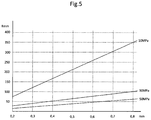
- FIG. 5 gives the example of the ratio of radius of curvature to thickness for three levels of corresponding stresses.
- FIG. 1 a shows the principle of the combination of two glass sheets according to the invention.
- a glass sheet 1 is initially bent in a usual technique for bending a single sheet. This bending can be achieved by pressing, by gravity or a combination of pressing and gravity.
- a glass sheet 2 has a substantially gentler curvature, or better is plane.
- the two sheets have substantially identical dimensions so that once they are assembled, their edges are contiguous.
- This arrangement which is not represented precisely, means that when the sheets are superposed the plane, or almost plane, sheet 2 projects very slightly in relation to the initially bent sheet 1 .
- the diagram exaggerates the differences in shape for the purposes of understanding. In practice, since the curvatures are relatively gentle, the initial overlap remains very small, which allows an adequate final assembly edge to edge.
- sheet 2 As indicated, to enable sheet 2 to be consistent with sheet 1 , their respective thicknesses are very different, wherein sheet 2 has to undergo a mechanical deformation operation utilising its flexibility, and has a small thickness compared to that of sheet 1 , which is necessarily more rigid.
- the deformation of sheet 2 is achieved during assembly by pressure exerted onto the outside faces of the two sheets.
- the final assembly comprises, in addition to the two glass sheets, a thermoplastic interlayer sheet 3 of the type traditionally used in laminated glazing units.
- composition of the glazing units according to the invention which is based on differences in rigidity of the sheets necessarily leads to a curvature that progresses in an essentially “cylindrical” manner, i.e. in a single direction, as opposed to a “spherical” curvature that progresses in two directions.
- Any spherical curvature involves an “extension” in the plane of the glass sheet, which extension only being possible during the softening at elevated temperature.
- glass sheets do not have the elasticity that would allow a significant spherical bending. For this reason, the figures show glass sheets curved in a single direction.
- the assembled sheets have very different thicknesses. Assemblies that respond satisfactorily in terms of optical quality are obtained, for example, by assembling glass of 0.9 mm and 3.8 mm, but this type of assembly is primarily of interest in forming laminated structures of very small thickness.
- glazing units formed with a sheet of 0.4 mm and a sheet of 1.6 mm are of particular interest. In association with an interlayer sheet of 0.76 mm, they have a total thickness of 2.76 mm and are lighter than the traditional monolithic glazing units of a greater thickness.
- the glazing units according to the invention additionally provide advantageous mechanical characteristics.
- the anti-intrusion characteristics are added by the presence of the thermoplastic sheet.
- impact tests referred to as the “gravel test” show a better resistance by virtue of the assembly of two sheets of different thicknesses.
- FIG. 2 schematically shows the structural parameters associated with the laminated glazing units according to the invention besides those relating to the thicknesses h 1 and h 2 shown in FIG. 1 a .
- the radii of curvature R 1 and R 2 are shown with the greatest distance d existing between the sheets before their assembly. In the most usual case according to the invention sheet 2 is plane, the radius R 2 is infinite.
- the assembly of the sheets comprises two steps, the conditions of implementation of which are shown in FIGS. 3 and 4 .
- the first step that takes the sheets to an assembly of the structural elements of glass sheets and thermoplastic interlayer comprises placement under pressure and the elevation of temperature.
- FIG. 3 indicates the development in time expressed in minutes of the pressure exerted in bar and the temperature.
- the pressure is expressed negatively to illustrate the fact that a relative vacuum is formed, which allows not only the pressure to be exerted on the sheets by means of the envelopes in which they are placed, but at the same time enables elimination of the air present between these sheets.
- thermoplastic interlayer is then perfectly stabilised after the necessary softening time for adhesion of the glass sheets. This adhesion occurs in the phase corresponding to the temperature level in the order of 110° C. for a polyvinyl butyral interlayer.
- the low pressure presses the sheets against one another, the less rigid sheet 2 moulding to the shape of sheet 2 .
- the interlayer does not pose any resistance to this shaping operation which is much easier when sheet 2 is less thick and therefore more flexible.
- the laminated glazing unit also requires an oven stage under pressure which provides it with its final transparency.
- the glazing units also has a haze due to the adhesion not being perfectly uniform between the surfaces of the glass sheets and those of the interlayer.
- the oven at a higher temperature, e.g. 140° C., and at a pressure of 12 bar for a PVB interlayer enables the light transmission to be increased.
- the assembly must be held under pressure to prevent delamination.
- FIG. 4 shows the desired oven temperature (straight lines) and the temperature of the glazing (curved line).
- the pressure is represented by broken lines.
- FIG. 5 shows the relation existing between the thickness of the second sheet and the radius of curvature imposed on it during assembly.
- the graph shows this relationship when a surface stress is set that is not to be exceeded. As an indication, three stress values are shown: 10 MPa, 20 MPa and 50 MPa.
- This graph shows very clearly that the radius of curvature for the same thickness is greatly dependent on the acceptable stress level.
- the radius of curvature can be as small as 300 mm. If the stress must not exceed 10 MPa, the radius of curvature must not be less than 1500 mm.
- the acceptable radii of curvature are also more significant. In other words, to be able to provide the sheets with a relatively small radius of curvature, it is necessary to choose sheets with as small a thickness as possible.
Landscapes
- Engineering & Computer Science (AREA)
- Mechanical Engineering (AREA)
- Chemical & Material Sciences (AREA)
- Chemical Kinetics & Catalysis (AREA)
- General Chemical & Material Sciences (AREA)
- Joining Of Glass To Other Materials (AREA)
- Laminated Bodies (AREA)
Abstract
Description
σ=E.h/2.R(1−n 2)
in which h is the thickness of the sheet, R the radius of curvature, E is the Young's modulus (in practice 72 GPa for glass) and n is the Poisson's coefficient (in practice 0.22).
-
-
sheet 1 1.6 mm; d 8.5 mm;sheet 2 0.4 mm; modification after assembly about 1 mm; -
sheet 2 3.8 mm, d 12.3 mm;sheet 2 0.4 mm; modification after assembly about 0.4 mm.
-
Claims (15)
Applications Claiming Priority (4)
| Application Number | Priority Date | Filing Date | Title |
|---|---|---|---|
| BEBE2011/0415 | 2011-07-04 | ||
| BE2011/0415 | 2011-07-04 | ||
| BE2011/0415A BE1020051A3 (en) | 2011-07-04 | 2011-07-04 | AUTOMOBILE GLAZING. |
| PCT/EP2012/061557 WO2013004473A1 (en) | 2011-07-04 | 2012-06-18 | Glass panel for an automobile |
Publications (2)
| Publication Number | Publication Date |
|---|---|
| US20140141206A1 US20140141206A1 (en) | 2014-05-22 |
| US11214130B2 true US11214130B2 (en) | 2022-01-04 |
Family
ID=46354276
Family Applications (1)
| Application Number | Title | Priority Date | Filing Date |
|---|---|---|---|
| US14/130,787 Active US11214130B2 (en) | 2011-07-04 | 2012-06-18 | Glazing for motor vehicles |
Country Status (7)
| Country | Link |
|---|---|
| US (1) | US11214130B2 (en) |
| EP (1) | EP2729303B1 (en) |
| JP (1) | JP6031099B2 (en) |
| CN (1) | CN103635315B (en) |
| BE (1) | BE1020051A3 (en) |
| EA (1) | EA027002B1 (en) |
| WO (1) | WO2013004473A1 (en) |
Families Citing this family (66)
| Publication number | Priority date | Publication date | Assignee | Title |
|---|---|---|---|---|
| EP2858822A1 (en) * | 2012-06-08 | 2015-04-15 | Corning Incorporated | Process for laminating thin glass laminates |
| CA2925022C (en) * | 2013-10-23 | 2018-07-17 | Saint-Gobain Glass France | Composite glass with at least one chemically tempered pane |
| FR3012073A1 (en) * | 2013-10-23 | 2015-04-24 | Saint Gobain | ASYMMETRIC SHEET GLAZING |
| GB201322240D0 (en) * | 2013-12-16 | 2014-01-29 | Pilkington Group Ltd | Laminated glazing |
| US9321677B2 (en) | 2014-01-29 | 2016-04-26 | Corning Incorporated | Bendable glass stack assemblies, articles and methods of making the same |
| JP2017518246A (en) * | 2014-04-15 | 2017-07-06 | サン−ゴバン グラス フランスSaint−Gobain Glass France | Laminated glass including thin inner flat glass |
| KR102393391B1 (en) * | 2014-07-10 | 2022-05-02 | 코닝 인코포레이티드 | Cold formed glass applique |
| JP2016041634A (en) * | 2014-08-15 | 2016-03-31 | 日本板硝子株式会社 | Laminated glass |
| GB201415163D0 (en) * | 2014-08-27 | 2014-10-08 | Pilkington Group Ltd | Laminated glazing |
| JP6668823B2 (en) * | 2015-04-08 | 2020-03-18 | Agc株式会社 | Plywood |
| US20160297169A1 (en) * | 2015-04-08 | 2016-10-13 | Asahi Glass Company, Limited | Laminated plate |
| JPWO2016181740A1 (en) * | 2015-05-11 | 2018-03-01 | 旭硝子株式会社 | Insulating glass unit for vehicle and method for manufacturing the same |
| JP6760273B2 (en) | 2015-05-11 | 2020-09-23 | Agc株式会社 | Insulated glass unit for vehicles |
| CN107848265B (en) | 2015-07-10 | 2020-09-08 | 康宁股份有限公司 | cold formed laminate |
| JP6540386B2 (en) * | 2015-08-31 | 2019-07-10 | Agc株式会社 | Laminated plate and method of manufacturing laminated plate |
| CN109071302B (en) | 2016-03-09 | 2022-04-26 | 康宁股份有限公司 | Cold forming of complexly curved glass articles |
| EP3429893B1 (en) * | 2016-03-17 | 2021-07-07 | AGC Glass Europe | Exterior glass trim element for vehicle |
| JP2017190271A (en) * | 2016-04-15 | 2017-10-19 | 日本電気硝子株式会社 | Laminated glass and method for producing the same |
| TWI800484B (en) | 2016-06-28 | 2023-05-01 | 美商康寧公司 | Laminating thin strengthened glass to curved molded plastic surface for decorative and display cover application |
| WO2018009504A1 (en) | 2016-07-05 | 2018-01-11 | Corning Incorporated | Cold-formed glass article and assembly process thereof |
| US11027525B2 (en) | 2016-10-07 | 2021-06-08 | Lg Chem, Ltd. | Curved laminated glass and manufacturing method for curved laminated glass |
| CN115403280B (en) | 2016-10-25 | 2024-03-19 | 康宁公司 | Cold formed glass laminate for display |
| BR112019000952A2 (en) * | 2016-11-24 | 2019-06-11 | Saint Gobain | method for producing a curved composite glass panel with a thin glass panel |
| CN110088059B (en) * | 2016-12-21 | 2021-12-31 | 株式会社Lg化学 | Method for manufacturing bent laminated glass and bent laminated glass |
| US11016590B2 (en) | 2017-01-03 | 2021-05-25 | Corning Incorporated | Vehicle interior systems having a curved cover glass and display or touch panel and methods for forming the same |
| KR102445875B1 (en) | 2017-01-03 | 2022-09-21 | 코닝 인코포레이티드 | Vehicle interior system having curved cover glass and display or touch panel and method of forming same |
| EP3569579A4 (en) * | 2017-01-12 | 2020-11-04 | Central Glass Company, Limited | Automotive laminated glass, and production method therefor |
| US11384013B2 (en) | 2017-01-12 | 2022-07-12 | Central Glass Company, Limited | Automotive laminated glass, and production method therefor |
| KR102723083B1 (en) * | 2017-01-17 | 2024-10-29 | 세키스이가가쿠 고교가부시키가이샤 | Filling-bonding material, protective sheet-equipped filling-bonding material, laminated body, optical device, and protective panel for optical device |
| GB201701272D0 (en) * | 2017-01-25 | 2017-03-08 | Pilkington Group Ltd | Process |
| DE202018006739U1 (en) | 2017-02-20 | 2022-07-20 | Corning Incorporated | Shaped glass laminates |
| KR101911621B1 (en) * | 2017-02-27 | 2018-10-24 | 주식회사 엘지화학 | Lamination glass and manufacturing method for lamination glass |
| PT3600882T (en) * | 2017-03-22 | 2021-07-26 | Saint Gobain | Device and method for picking up, deforming and depositing a thin glass pane |
| US11685684B2 (en) | 2017-05-15 | 2023-06-27 | Corning Incorporated | Contoured glass articles and methods of making the same |
| WO2018210612A1 (en) * | 2017-05-19 | 2018-11-22 | Agc Glass Europe | Side laminated automotive glazing |
| CN117962601A (en) | 2017-07-18 | 2024-05-03 | 康宁公司 | Cold forming of complex curved glass products |
| CN111163932A (en) | 2017-07-28 | 2020-05-15 | 皮尔金顿集团有限公司 | Window assembly |
| EP3681847B1 (en) | 2017-09-12 | 2025-01-29 | Corning Incorporated | Tactile elements for deadfronted glass and methods of making the same |
| TWI873668B (en) | 2017-09-13 | 2025-02-21 | 美商康寧公司 | Light guide-based deadfront for display, related methods and vehicle interior systems |
| US11065960B2 (en) | 2017-09-13 | 2021-07-20 | Corning Incorporated | Curved vehicle displays |
| CO2017012697A1 (en) * | 2017-09-29 | 2018-02-28 | Agp America Sa | Laminated with printed oscillation that has superior resistance and optical quality |
| TWI844520B (en) | 2017-10-10 | 2024-06-11 | 美商康寧公司 | Vehicle interior systems having a curved cover glass with improved reliability and methods for forming the same |
| EP3697735A1 (en) | 2017-10-18 | 2020-08-26 | Corning Incorporated | Methods for controlling separation between glasses during co-sagging to reduce final shape mismatch therebetween |
| WO2019103469A1 (en) | 2017-11-21 | 2019-05-31 | Corning Precision Materials Co., Ltd. | Aspheric mirror for head-up display system and methods for forming the same |
| KR102605341B1 (en) | 2017-11-30 | 2023-11-24 | 코닝 인코포레이티드 | Vacuum mold apparatus, system, and method for forming curved mirrors |
| CN111656254B (en) | 2017-11-30 | 2023-06-02 | 康宁公司 | Systems and methods for vacuum forming aspheric mirrors |
| JP6959130B2 (en) * | 2017-12-20 | 2021-11-02 | トヨタ自動車株式会社 | Solar cell module |
| KR102252182B1 (en) * | 2018-01-10 | 2021-05-14 | 주식회사 엘지화학 | Manufacturing method for curved laminated glass and curved laminated glass manufactured by the same |
| WO2019169293A1 (en) | 2018-03-02 | 2019-09-06 | Corning Incorporated | Anti-reflective coatings and articles and methods of forming the same |
| US11718071B2 (en) | 2018-03-13 | 2023-08-08 | Corning Incorporated | Vehicle interior systems having a crack resistant curved cover glass and methods for forming the same |
| CN108516669A (en) * | 2018-03-16 | 2018-09-11 | 信义玻璃工程(东莞)有限公司 | Laminated hollow glass and manufacturing method thereof |
| TW201938410A (en) * | 2018-03-16 | 2019-10-01 | 美商康寧公司 | Thin thermally strengthened glass cover panel for vehicle frame assembly and related method |
| EP3787894B1 (en) * | 2018-05-03 | 2025-09-03 | Central Glass Company, Limited | Laminated vehicle glazing having a stiff interlayer |
| KR102200636B1 (en) * | 2018-05-21 | 2021-01-11 | 주식회사 엘지화학 | Manufacturing method for curved laminated glass and curved laminated glass manufactured by the same |
| KR102264217B1 (en) | 2018-05-24 | 2021-06-11 | 주식회사 엘지화학 | Manufacturing method for curved thin glass having functional layer and manufacturing method for curved laminated glass having functional layer |
| CN112672984B (en) | 2018-07-12 | 2023-03-10 | 康宁公司 | Configure an electroless board for color comparison |
| JP7181478B2 (en) | 2018-07-13 | 2022-12-01 | セントラル硝子株式会社 | LAMINATED GLASS FOR AUTOMOBILE WINDSHIELD AND METHOD FOR MANUFACTURING THE SAME |
| KR20210032976A (en) | 2018-07-16 | 2021-03-25 | 코닝 인코포레이티드 | In-vehicle system with cold-bending glass substrate and method for forming same |
| GB201812147D0 (en) | 2018-07-25 | 2018-09-05 | Pilkington Group Ltd | Process |
| WO2020021269A1 (en) * | 2018-07-25 | 2020-01-30 | Pilkington Group Limited | Process |
| RU2764891C1 (en) * | 2018-08-29 | 2022-01-24 | Сэн-Гобэн Гласс Франс | Composite window glass |
| FR3096926B1 (en) * | 2019-06-05 | 2023-04-28 | Saint Gobain | SLIDING LAMINATED GLAZING WITH LATERAL INSIDE OVERLENGTH |
| EP3771695A1 (en) | 2019-07-31 | 2021-02-03 | Corning Incorporated | Method and system for cold-forming glass |
| US12466756B2 (en) | 2019-10-08 | 2025-11-11 | Corning Incorporated | Curved glass articles including a bumper piece configured to relocate bending moment from display region and method of manufacturing same |
| US11772361B2 (en) | 2020-04-02 | 2023-10-03 | Corning Incorporated | Curved glass constructions and methods for forming same |
| FR3119112B1 (en) | 2021-01-27 | 2023-01-20 | Saint Gobain | SLIDING LAMINATED GLAZING WITH INTERNAL REMOVAL AND METHOD FOR MANUFACTURING THIS GLAZING |
Citations (8)
| Publication number | Priority date | Publication date | Assignee | Title |
|---|---|---|---|---|
| US3801423A (en) * | 1971-05-21 | 1974-04-02 | Glaverbel | Multiple glazing panel and manufacturing method therefor |
| US4139359A (en) * | 1977-11-02 | 1979-02-13 | Ppg Industries, Inc. | Method and apparatus for shaping glass sheets by roll forming |
| GB2011316A (en) | 1977-12-29 | 1979-07-11 | Bfg Glassgroup | A Windscreen Comprising A Chemically Toughened Silicate Glass Inner Pane |
| GB2078169A (en) | 1980-06-13 | 1982-01-06 | Siv Soc Italiana Vetro | Forming and Assembly Process for Two or More Curved Glass Panes Having Different Physical-chemical Properties and/or Different Thickness |
| US4643944A (en) * | 1976-07-02 | 1987-02-17 | Saint-Gobain Vitrage | Glazing laminates and method of making same |
| EP0895853A2 (en) | 1997-08-06 | 1999-02-10 | Nippon Sheet Glass Co., Ltd. | Laminated glass and automobile window |
| WO2000073062A1 (en) | 1999-06-02 | 2000-12-07 | Ppg Industries Ohio, Inc. | Laminated transparency |
| DE102009017805A1 (en) | 2009-04-20 | 2010-10-21 | Saint-Gobain Sekurit Deutschland Gmbh & Co. Kg | Transparent laminated glass and its use |
Family Cites Families (13)
| Publication number | Priority date | Publication date | Assignee | Title |
|---|---|---|---|---|
| ZA71126B (en) | 1970-02-09 | 1971-10-27 | Ppg Industries Inc | Glass article |
| GB1359169A (en) | 1971-05-21 | 1974-07-10 | Glaverbel | Articles incorporating glass sheets |
| LU87241A1 (en) | 1988-06-15 | 1990-02-28 | Glaverbel | METHOD FOR INCREASING THE PENETRATION RESISTANCE THROUGH A GLAZED BAY AND GLAZING WITH STRENGTHENED BREAKING RESISTANCE |
| WO2002007967A1 (en) | 2000-07-20 | 2002-01-31 | Glaverbel | Glazing |
| JP2007197288A (en) | 2006-01-30 | 2007-08-09 | Nippon Sheet Glass Co Ltd | Laminated glass and glass window structure using the same |
| US20070291384A1 (en) | 2006-06-14 | 2007-12-20 | Guardian Industries Corp. | Method of making reflector for solar collector or the like, and corresponding product, including reflective coating designed for improved adherence to laminating layer |
| US8814372B2 (en) | 2006-03-23 | 2014-08-26 | Guardian Industries Corp. | Stiffening members for reflectors used in concentrating solar power apparatus, and method of making same |
| DE102006042538B4 (en) | 2006-09-11 | 2011-07-14 | FuTech GmbH, 39124 | Laminated glass, glazing element and method of making the same, and use of the laminated glass |
| US7461564B2 (en) | 2006-10-04 | 2008-12-09 | Corning Incorporated | Method and apparatus for proof testing a sheet of brittle material |
| JP5788134B2 (en) | 2008-10-01 | 2015-09-30 | 日本電気硝子株式会社 | GLASS ROLL AND GLASS ROLL MANUFACTURING METHOD |
| JP5435267B2 (en) | 2008-10-01 | 2014-03-05 | 日本電気硝子株式会社 | Glass roll, glass roll manufacturing apparatus, and glass roll manufacturing method |
| JP2010222233A (en) * | 2009-02-27 | 2010-10-07 | Central Glass Co Ltd | Heat insulating laminated glass |
| US10035331B2 (en) * | 2011-06-24 | 2018-07-31 | Corning Incorporated | Light-weight hybrid glass laminates |
-
2011
- 2011-07-04 BE BE2011/0415A patent/BE1020051A3/en active
-
2012
- 2012-06-18 EP EP12729524.4A patent/EP2729303B1/en not_active Revoked
- 2012-06-18 CN CN201280033171.3A patent/CN103635315B/en active Active
- 2012-06-18 WO PCT/EP2012/061557 patent/WO2013004473A1/en not_active Ceased
- 2012-06-18 JP JP2014517586A patent/JP6031099B2/en active Active
- 2012-06-18 US US14/130,787 patent/US11214130B2/en active Active
- 2012-06-18 EA EA201490203A patent/EA027002B1/en not_active IP Right Cessation
Patent Citations (11)
| Publication number | Priority date | Publication date | Assignee | Title |
|---|---|---|---|---|
| US3801423A (en) * | 1971-05-21 | 1974-04-02 | Glaverbel | Multiple glazing panel and manufacturing method therefor |
| US4643944A (en) * | 1976-07-02 | 1987-02-17 | Saint-Gobain Vitrage | Glazing laminates and method of making same |
| US4139359A (en) * | 1977-11-02 | 1979-02-13 | Ppg Industries, Inc. | Method and apparatus for shaping glass sheets by roll forming |
| GB2011316A (en) | 1977-12-29 | 1979-07-11 | Bfg Glassgroup | A Windscreen Comprising A Chemically Toughened Silicate Glass Inner Pane |
| GB2078169A (en) | 1980-06-13 | 1982-01-06 | Siv Soc Italiana Vetro | Forming and Assembly Process for Two or More Curved Glass Panes Having Different Physical-chemical Properties and/or Different Thickness |
| EP0895853A2 (en) | 1997-08-06 | 1999-02-10 | Nippon Sheet Glass Co., Ltd. | Laminated glass and automobile window |
| US6086983A (en) * | 1997-08-06 | 2000-07-11 | Nippon Sheet Glass Co., Ltd. | Laminated glass and automobile window |
| WO2000073062A1 (en) | 1999-06-02 | 2000-12-07 | Ppg Industries Ohio, Inc. | Laminated transparency |
| US6582799B1 (en) | 1999-06-02 | 2003-06-24 | Ppg Industries Ohio, Inc. | Laminated transparency |
| DE102009017805A1 (en) | 2009-04-20 | 2010-10-21 | Saint-Gobain Sekurit Deutschland Gmbh & Co. Kg | Transparent laminated glass and its use |
| US20120025559A1 (en) * | 2009-04-20 | 2012-02-02 | Volkmar Offermann | Transparent laminated glass and use thereof |
Non-Patent Citations (1)
| Title |
|---|
| International Search Report dated Sep. 13, 2012 in PCT/EP12/061557 Filed Jun. 18, 2012. |
Also Published As
| Publication number | Publication date |
|---|---|
| BE1020051A3 (en) | 2013-04-02 |
| CN103635315A (en) | 2014-03-12 |
| WO2013004473A1 (en) | 2013-01-10 |
| JP2014527011A (en) | 2014-10-09 |
| US20140141206A1 (en) | 2014-05-22 |
| EP2729303A1 (en) | 2014-05-14 |
| JP6031099B2 (en) | 2016-11-24 |
| EP2729303B1 (en) | 2018-08-08 |
| EA201490203A1 (en) | 2014-06-30 |
| CN103635315B (en) | 2016-07-06 |
| EA027002B1 (en) | 2017-06-30 |
Similar Documents
| Publication | Publication Date | Title |
|---|---|---|
| US11214130B2 (en) | Glazing for motor vehicles | |
| US9925743B2 (en) | Process for laminating thin glass laminates | |
| EP2723562B1 (en) | Light-weight hybrid glass laminates | |
| US20150122406A1 (en) | Process for laminating thin glass laminates | |
| CN116442606B (en) | Method for preparing laminated window glass | |
| US20120094084A1 (en) | Chemically-strengthened glass laminates | |
| CN107405884B (en) | Composite glass with thin inner glass pane and acoustic damping thermoplastic interlayer | |
| JP2019511987A (en) | Composite pane with conductive coating for head-up display | |
| CN114616097A (en) | Laminated glass with low-emissivity coating on chemically strengthened thin glass and preparation method thereof | |
| CN105658426A (en) | Composite pane, composed of a polymeric pane and a glass pane | |
| CN114206609A (en) | Small-radius laminated glass with complex shape | |
| EP3625050B1 (en) | Side laminated automotive glazing | |
| CN112721355B (en) | Laminated glass for vehicle window and preparation method thereof | |
| EP3826842B1 (en) | Process | |
| WO2025192376A1 (en) | Laminated glass | |
| WO2019008470A1 (en) | Method laminating thin glass with pressing plate | |
| CN121133230A (en) | Laminated glass and vehicle |
Legal Events
| Date | Code | Title | Description |
|---|---|---|---|
| AS | Assignment |
Owner name: AGC GLASS EUROPE, BELGIUM Free format text: ASSIGNMENT OF ASSIGNORS INTEREST;ASSIGNORS:GILLARD, QUENTIN;HUBERT, RENAUD;LECOMTE, BENOIT;AND OTHERS;REEL/FRAME:032050/0098 Effective date: 20140106 |
|
| STCV | Information on status: appeal procedure |
Free format text: APPEAL BRIEF (OR SUPPLEMENTAL BRIEF) ENTERED AND FORWARDED TO EXAMINER |
|
| STPP | Information on status: patent application and granting procedure in general |
Free format text: NON FINAL ACTION MAILED |
|
| STPP | Information on status: patent application and granting procedure in general |
Free format text: RESPONSE TO NON-FINAL OFFICE ACTION ENTERED AND FORWARDED TO EXAMINER |
|
| STPP | Information on status: patent application and granting procedure in general |
Free format text: FINAL REJECTION MAILED |
|
| STCV | Information on status: appeal procedure |
Free format text: ON APPEAL -- AWAITING DECISION BY THE BOARD OF APPEALS |
|
| STCV | Information on status: appeal procedure |
Free format text: BOARD OF APPEALS DECISION RENDERED |
|
| STPP | Information on status: patent application and granting procedure in general |
Free format text: AMENDMENT / ARGUMENT AFTER BOARD OF APPEALS DECISION |
|
| STPP | Information on status: patent application and granting procedure in general |
Free format text: NOTICE OF ALLOWANCE MAILED -- APPLICATION RECEIVED IN OFFICE OF PUBLICATIONS |
|
| STPP | Information on status: patent application and granting procedure in general |
Free format text: AWAITING TC RESP., ISSUE FEE NOT PAID |
|
| STPP | Information on status: patent application and granting procedure in general |
Free format text: NOTICE OF ALLOWANCE MAILED -- APPLICATION RECEIVED IN OFFICE OF PUBLICATIONS |
|
| STPP | Information on status: patent application and granting procedure in general |
Free format text: PUBLICATIONS -- ISSUE FEE PAYMENT VERIFIED |
|
| STCF | Information on status: patent grant |
Free format text: PATENTED CASE |
|
| MAFP | Maintenance fee payment |
Free format text: PAYMENT OF MAINTENANCE FEE, 4TH YEAR, LARGE ENTITY (ORIGINAL EVENT CODE: M1551); ENTITY STATUS OF PATENT OWNER: LARGE ENTITY Year of fee payment: 4 |