US11097104B2 - Electroporation device and a method for controlling an electroporation device - Google Patents
Electroporation device and a method for controlling an electroporation device Download PDFInfo
- Publication number
- US11097104B2 US11097104B2 US16/344,753 US201716344753A US11097104B2 US 11097104 B2 US11097104 B2 US 11097104B2 US 201716344753 A US201716344753 A US 201716344753A US 11097104 B2 US11097104 B2 US 11097104B2
- Authority
- US
- United States
- Prior art keywords
- electroporation
- voltage
- skin
- output
- pulses
- Prior art date
- Legal status (The legal status is an assumption and is not a legal conclusion. Google has not performed a legal analysis and makes no representation as to the accuracy of the status listed.)
- Active, expires
Links
Images



Classifications
-
- A—HUMAN NECESSITIES
- A61—MEDICAL OR VETERINARY SCIENCE; HYGIENE
- A61B—DIAGNOSIS; SURGERY; IDENTIFICATION
- A61B5/00—Measuring for diagnostic purposes; Identification of persons
- A61B5/05—Detecting, measuring or recording for diagnosis by means of electric currents or magnetic fields; Measuring using microwaves or radio waves
- A61B5/053—Measuring electrical impedance or conductance of a portion of the body
- A61B5/0531—Measuring skin impedance
-
- A—HUMAN NECESSITIES
- A61—MEDICAL OR VETERINARY SCIENCE; HYGIENE
- A61N—ELECTROTHERAPY; MAGNETOTHERAPY; RADIATION THERAPY; ULTRASOUND THERAPY
- A61N1/00—Electrotherapy; Circuits therefor
- A61N1/02—Details
- A61N1/025—Digital circuitry features of electrotherapy devices, e.g. memory, clocks, processors
-
- A—HUMAN NECESSITIES
- A61—MEDICAL OR VETERINARY SCIENCE; HYGIENE
- A61N—ELECTROTHERAPY; MAGNETOTHERAPY; RADIATION THERAPY; ULTRASOUND THERAPY
- A61N1/00—Electrotherapy; Circuits therefor
- A61N1/02—Details
- A61N1/04—Electrodes
- A61N1/0404—Electrodes for external use
- A61N1/0408—Use-related aspects
- A61N1/0412—Specially adapted for transcutaneous electroporation, e.g. including drug reservoirs
-
- A—HUMAN NECESSITIES
- A61—MEDICAL OR VETERINARY SCIENCE; HYGIENE
- A61N—ELECTROTHERAPY; MAGNETOTHERAPY; RADIATION THERAPY; ULTRASOUND THERAPY
- A61N1/00—Electrotherapy; Circuits therefor
- A61N1/18—Applying electric currents by contact electrodes
- A61N1/32—Applying electric currents by contact electrodes alternating or intermittent currents
- A61N1/327—Applying electric currents by contact electrodes alternating or intermittent currents for enhancing the absorption properties of tissue, e.g. by electroporation
-
- A—HUMAN NECESSITIES
- A61—MEDICAL OR VETERINARY SCIENCE; HYGIENE
- A61N—ELECTROTHERAPY; MAGNETOTHERAPY; RADIATION THERAPY; ULTRASOUND THERAPY
- A61N1/00—Electrotherapy; Circuits therefor
- A61N1/18—Applying electric currents by contact electrodes
- A61N1/32—Applying electric currents by contact electrodes alternating or intermittent currents
- A61N1/36—Applying electric currents by contact electrodes alternating or intermittent currents for stimulation
- A61N1/36014—External stimulators, e.g. with patch electrodes
-
- A—HUMAN NECESSITIES
- A61—MEDICAL OR VETERINARY SCIENCE; HYGIENE
- A61N—ELECTROTHERAPY; MAGNETOTHERAPY; RADIATION THERAPY; ULTRASOUND THERAPY
- A61N1/00—Electrotherapy; Circuits therefor
- A61N1/18—Applying electric currents by contact electrodes
- A61N1/32—Applying electric currents by contact electrodes alternating or intermittent currents
- A61N1/36—Applying electric currents by contact electrodes alternating or intermittent currents for stimulation
- A61N1/36014—External stimulators, e.g. with patch electrodes
- A61N1/36021—External stimulators, e.g. with patch electrodes for treatment of pain
-
- A—HUMAN NECESSITIES
- A61—MEDICAL OR VETERINARY SCIENCE; HYGIENE
- A61N—ELECTROTHERAPY; MAGNETOTHERAPY; RADIATION THERAPY; ULTRASOUND THERAPY
- A61N1/00—Electrotherapy; Circuits therefor
- A61N1/18—Applying electric currents by contact electrodes
- A61N1/32—Applying electric currents by contact electrodes alternating or intermittent currents
- A61N1/36—Applying electric currents by contact electrodes alternating or intermittent currents for stimulation
- A61N1/36014—External stimulators, e.g. with patch electrodes
- A61N1/3603—Control systems
- A61N1/36031—Control systems using physiological parameters for adjustment
-
- A—HUMAN NECESSITIES
- A61—MEDICAL OR VETERINARY SCIENCE; HYGIENE
- A61N—ELECTROTHERAPY; MAGNETOTHERAPY; RADIATION THERAPY; ULTRASOUND THERAPY
- A61N1/00—Electrotherapy; Circuits therefor
- A61N1/18—Applying electric currents by contact electrodes
- A61N1/32—Applying electric currents by contact electrodes alternating or intermittent currents
- A61N1/36—Applying electric currents by contact electrodes alternating or intermittent currents for stimulation
- A61N1/36014—External stimulators, e.g. with patch electrodes
- A61N1/3603—Control systems
- A61N1/36034—Control systems specified by the stimulation parameters
Definitions
- the present invention relates to an electroporation device for applying electric pulses to skin to introduce substances into the skin and a method for controlling an electroporation device.
- the ionic introduction method is a method for introducing various substances provided onto a human skin into the inside of the skin such as a stratum corneum by applying a voltage.
- Vitamin C derivatives such as an ascorbic acid generally have a negative charge. Therefore, when an aqueous solution including an ascorbic acid is provided onto skin and a negative voltage is applied to the portion where the solution is provided, the ascorbic acid is moved into the skin by the electrostatic repulsion force.
- the ionic introduction method has a problem that the substances to be introduced into skin must be ionic molecule. Furthermore, the ionic introduction method has another problem in which molecules having a large molecular mass cannot be introduced because the mechanism of the delivery of substances into skin is infiltration between skin cells. Therefore, the ionic introduction method is not suitable to introduce substances having a large molecular mass such as a collagen and hyaluronic acid.
- the electroporation method comprises applying voltage pulses to skin after substances to be introduced into the skin are provided onto the skin. Since applying voltage pulses makes microscopic holes in the skin, the provided substances are introduced into the skin via the microscopic holes. The holes are cured and filled in a short time because the holes are extremely small. Therefore, electroporation has a capacity of introducing even electrically neutral molecules of substances into skin in contrast to the ionic introduction method. Since substances are introduced via holes made in skin instead of just infiltration, molecules having a larger molecule mass can be introduced compared with the ionic introduction method.
- the electroporation method has a problem of discomfort for a user due to applying voltage pulses.
- the higher the voltage of the applied pulses is the more holes are made on the skin and the larger the size of the holes is, and this results in more efficient introduction of substances into the skin.
- the higher the voltage of the applied pulses is the more current is applied to the skin, and this results in discomfort for a user such as stimulation, irritation, or a pain sensation. Therefore, conventional methods have employed applying voltage pulses to skin of a user based on output pattern data which are the voltage heights of the pulses. The voltage heights are preliminarily determined based on data of measured electric resistance values of skin.
- the electric resistance values of the skin are, however, not necessarily constant and are different with each person due to influences of moisture and fat included in skin. Even in the same person, the electric resistance value of the skin is variable due to the variation of moisture included in the skin affected by temperature and humidity of air and variations of other conditions of the surface of the skin. Since the voltage of pulses are generally set as high as possible in order to maximize the efficiency of the introduction of substances into the skin, the user may feel a pain sensation even applying the same voltage pulses if the electric resistance value of the skin varies.
- the present invention provides an electroporation device and a method for controlling an electroporation device for modulating voltage pulses to be applied in order to minimize the discomfort of a user and facilitate delivering active substances inside the skin, such as a stratum corneum or epidermis.
- an electroporation device of the present invention comprises:
- a measurement unit being configured to provide multiple outputs of one or more resistance measurement voltage pulses for measuring an electric resistance of skin of a user at a predetermined interval
- an output unit being configured to provide an output of one or more electroporation voltage pulses to the skin of the user based on the resistance of the skin of the user per each output of the one or more resistance measurement voltage pulses.
- the measurement unit may be configured to provide multiple outputs of one resistance measurement voltage pulse at a predetermined interval, and the output unit may be configured to provide an output of one electroporation voltage pulse per output of the one resistance measurement voltage pulse.
- the output unit may be configured to output the electroporation voltage pulses after varying at least one of a voltage, a pulse duration, an interval between pulses, a number of pulses, and a pulse duty ratio of the electroporation voltage pulse based on the resistance measured by the measurement unit.
- the output unit may be configured to output the electroporation voltage pulses after varying the voltage of the electroporation voltage pulse based on the resistance measured by the measurement unit.
- the output unit may be configured to output the electroporation pluses after varying the voltage of the electroporation voltage pulse based on the electric resistance measured by the measurement unit such that a current applied on the skin of the user by the electroporation voltage pulses is set to be a predetermined value.
- the output unit may be configured to output the electroporation voltage pulses after varying the voltage of the electroporation voltage pulses in a stepwise manner.
- the output unit may be configured to output the electroporation voltage pulses after varying the voltage of the electroporation voltage pulses in a continuous manner.
- the output unit may be configured to output the electroporation voltage pulses after varying the voltage of the electroporation voltage pulses within a range between 5 to 100 V.
- the measurement unit may be configured to output the resistance measurement voltage pulses having a voltage lower than a voltage of the electroporation voltage pulse.
- the measurement unit may be configured to output the resistance measurement voltage pulses to the skin of the user via a first electrode, and the output unit may be configured to output the electroporation voltage pulses to the skin of the user via a second electrode.
- the measurement unit and the output unit may be configured to output the resistance measurement voltage pulses and the electroporation voltage pulses to the skin of the user via a common electrode, respectively.
- the electroporation device of the present invention may further comprise a timing unit being configured to output timing instructions for outputting the resistance measurement voltage pulses and the electroporation voltage pulses to the measurement unit and the output unit.
- a method for controlling an electroporation device comprises a plurality of steps, each step comprising:
- the electric resistance of the skin of the user may be measured once and the parameters of the electroporation voltage pulse may be determined once in each step.
- At least one of a voltage, a pulse duration, an interval between pulses, a number of pulses, and a pulse duty ratio among the parameters of the electroporation voltage pulse may be varied based on the measured electric resistance.
- the voltage of the electroporation voltage pulse may be varied based on the measured electric resistance.
- the voltage of the electroporation voltage pulse may be varied such that a current applied onto the skin of the user by the electroporation voltage pulse is set to be a predetermined value.
- the voltage of the electroporation voltage pulse may be varied in a stepwise manner.
- the voltage of the electroporation voltage pulse may be varied in a continuous manner.
- the voltage of the electroporation voltage pulse may be varied within a range between 10 and 50 V.
- a voltage of the resistance measurement voltage pulse may be lower than a voltage of the electroporation voltage pulse.
- the resistance measurement voltage pulses and the electroporation voltage pulses may be output in accordance with timing instructions output by a timing unit.
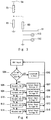
- FIG. 1 shows an illustrative configuration of an electroporation device according to an embodiment of the present invention.
- FIG. 2 shows a situation in which electrodes of the electroporation device according to the embodiment of the present invention are attached to a user.
- FIG. 3 shows a schematic example of a circuit of the electroporation device according to the embodiment of the present invention for measuring an electric resistance value of skin.
- FIG. 4 shows an example of a flow diagram for determining a voltage of an electroporation voltage pulse of the electroporation device according to the embodiment of the present invention.
- FIG. 5 shows illustrative outputs of resistance measurement voltage pulses and electroporation voltage pulses of the electroporation device according to the embodiment of the present invention.
- FIG. 6 shows illustrative outputs of resistance measurement voltage pulses and electroporation voltage pulses of the electroporation device according to the embodiment of the present invention.
- FIG. 7 shows a side view and a plan view of a schematic test system for measuring a variation of an electric resistance value of skin due to applying voltage pulses.
- An electroporation method is a technology for introducing active substances inside of the skin; For example, with stratum corneum by applying voltage pulses to the skin to form microscopic holes in the skin. Thus, a higher voltage of the pulse is able to deliver the substrates more efficiently into the skin.
- the electroporation method provides a decrease of an electric resistance of the skin. The decrease of the electric resistance of the skin results from a decrease of a barrier function of the stratum corneum.
- Conventional electroporation devices apply a constant voltage to the skin regardless of the electric resistance of the skin. Therefore, when the electric resistance of the skin is high, an output current becomes lower and results in a decrease of an efficiency of introducing substances.
- the present invention provides an electroporation device and a method for controlling an electroporation device for measuring an electric resistance of skin of a user in real time and determining parameters of an electroporation voltage pulse output to the skin. Based on the measured electric resistance of the skin, in order to improve an efficiency of an introduction of substances into the skin of the user within a range in which the user does not feel or can accept the discomfort such as stimulation, irritation, or a pain sensation.
- FIG. 1 shows an illustrative configuration of an electroporation device 100 according to an embodiment of the present invention.
- the electroporation device 100 comprises a measurement unit 102 for measuring an electric resistance of skin and an output unit 104 for outputting electroporation voltage pulses.
- the electroporation device 100 may comprise a microprocessor 106 for controlling the measurement unit 102 and the output unit 104 , a timing unit 108 , a first electrode 110 , and a second electrode 112 . At least one of the measurement unit 102 , the output unit 104 , and the timing unit 108 may be incorporated in the microprocessor 106 .
- FIG. 1 shows the electroporation device 100 incorporating the measurement unit 102 in the microprocessor 106 , such a configuration does not limit embodiments of the present invention.
- FIG. 2 shows a situation in which the first and second electrodes 110 , 112 of the electroporation device 100 shown in FIG. 1 are attached to a body of the user.
- the first electrode 110 is attached to a position for introducing an active substance by the electroporation method, for example, a cheek
- the second electrode 112 is attached to a position different from the position to which the first electrode 110 is attached, for example, a palm.
- Forming the first and second electrodes 110 , 112 in a shape of a tape or a patch helps to be easily attached to the skin of the user.
- the measurement unit 102 outputs and applies one or more resistance measurement voltage pulses to the skin of the user via the first electrode 110 . After outputting the resistance measurement voltage pulses, the measurement unit 102 measures an electric resistance value of the skin by using various methods described below based on a potential difference between the first and second electrodes 110 , 112 .
- FIG. 3 shows a schematic example of a circuit for measuring the electric resistance value of the skin by the resistance measurement voltage pulse.
- a first resistor R 1 and a second resistor R 2 are serially connected between an output voltage Vm of the resistance measurement voltage pulse of the measurement unit 102 and a ground potential and a third resistor R 3 is connected to a point between the first and second resistors R 1 , R 2 .
- the first electrode 110 is serially connected to the third resistor R 3 .
- the second electrode 112 is connected to the ground potential.
- the output voltage Vm of the measurement unit 102 is divided by the first and second resistors R 1 , R 2 , and a potential between the first and second resistors R 1 , R 2 is denoted by V 0 .
- the potential V 0 is further divided by the third resistor R 3 and the skin resistor Rskin, and a potential between the third resistor R 3 and the first electrode 110 is denoted by V 1 .
- V 1 an electric resistance value of the skin resistor Rskin is obtained.
- methods for measuring the electric resistance value of the skin by the measurement unit 102 are not limited to the circuit configuration shown in FIG. 3 , but bridge circuits such as a wheatstone bridge and other various methods for measuring an electric resistance can be employed.
- the output unit 104 determines parameters of an electroporation voltage pulse for the electroporation method based on the measured electric resistance value of the skin.
- the parameters to be determined may be at least one of a voltage, a pulse duration, an interval between pulses, a number of pulses, and a pulse duty ratio of the electroporation voltage pulse.
- a discomfort such as a pain sensation caused by applying the electroporation voltage pulses mainly results from a current applied to the skin. Therefore, it is advantageous to determine the voltage of the electroporation voltage pulse such that the current is maintained at a predetermined value lower than a value at which the user feels the discomfort.
- the voltage of the electroporation voltage pulse can be set to be, for example, 100 V or less, or for example, between 10 and 50 V.
- the voltage of the resistance measurement voltage pulse should be set to be sufficient to measure the electric resistance value of the skin but not to vary the electric resistance value of the skin. Therefore, while the electroporation voltage pulse is generally output at a voltage of 100 V or less, the voltage of the resistance measurement voltage pulse may be lower than that of the electroporation voltage pulse, for example, 10 V or less, or for example, 1 V or less.
- FIGS. 1 to 3 show, a configuration in which the resistance measurement voltage pulse and the electroporation voltage pulse are output via the common electrode 110 .
- an electrode, to which the resistance measurement voltage pulses may be different from an electrode to which the electroporation voltage pulses.
- the voltage of the electroporation voltage pulse can be determined, for example, by using an analog multiplying circuit for multiplying the measured electric resistance value of the skin and the current value described above preliminarily set.
- the voltage of the electroporation voltage pulse can be determined by converting the measured electric resistance value to a digital value by using an analog-digital converter and processing the digital value by the microprocessor 106 . These methods can determine the voltage of the electroporation voltage device as a substantially continuous value.
- a voltage corresponding to a comparator circuit matching with a comparing condition can be determined as the voltage of the electroporation voltage pulse by comparing the measured electric resistance value of the skin with a preliminarily set threshold value of each of a plurality of comparator circuits.
- FIG. 4 shows a schematic flow diagram for determining the voltage of the electroporation voltage pulse by using comparator circuits.
- the electric resistance value of the skin measured by the measurement unit 102 is converted to a digital value by an analog-digital converter (step 402 ). Then, it is determined whether or not the measured electric resistance value is larger than a predetermined resistance value Rx (step 404 ). If the measured electric resistance value is larger than Rx, it is determined that the electrodes are in an open state, i.e., at least one of the first and second electrodes 110 , 112 is not attached to the skin of the user (step 405 ), then the process returns to a measurement of the electric resistance value of the skin by the measurement unit 102 .
- a first comparator determines whether or not the measured electric resistance value is larger than a predetermined electric resistance value Ra (step 406 ). If the measured electric resistance value is larger than Ra, the voltage of the electroporation voltage pulse is determined to be Va (step 407 ). If the measured electric resistance is smaller than Ra, a second comparator circuit determines whether or not the measured electric resistance value is larger than a predetermined electric resistance value Rb ( 408 ). In the following steps, the measured resistance value is compared with a predetermined resistance value of a comparator circuit and it is determined whether the voltage of the electroporation voltage pulse is set or the process proceeds to the next comparator circuit similarly to the above steps. The example shown in FIG.
- FIG. 5 comprises the five comparator circuits and therefore a voltage can be determined among five voltage values as the electroporation voltage pulse in a stepwise manner.
- FIG. 5 shows the configuration in which the measured electric resistance value of the skin is converted to a digital value by the analog-digital converter and the voltage is selected, a configuration, in which a voltage is selected by analog circuits, can be used.
- Such circuits having the above configuration have an advantage in which the configuration of the circuits is simple and low-cost compared with the configuration of the circuits varying the voltage in a continuous manner as described above.
- the output unit 104 outputs and apply one or more electroporation voltage pulses having the determined parameters to the skin of the user via the second electrode 112 .
- FIG. 5 shows an example of voltage pulses output by the measurement unit 102 and the output unit 104 over time.
- the measurement unit 102 outputs one resistance measurement voltage pulse 602 and measures the electric resistance of the skin as described above.
- the output unit 104 determines, for example, a voltage of the electroporation voltage pulse based on the measured electric resistance value and outputs one electroporation voltage pulse 604 as described above.
- the measurement unit 102 outputs a next resistance measurement voltage pulse 602 ′ with a predetermined interval after the output of the resistance measurement voltage pulse 602 and measures the electric resistance value of the skin.
- the output unit 104 determines, for example, the voltage of the electroporation voltage pulse based on the measured electric resistance value and outputs a next electroporation voltage pulse 604 ′ with a predetermined interval after the output of the electroporation voltage pulse 604 .
- the above cycle is repeated to perform the electroporation method to the skin of the user. Since, in general, an electric resistance value of skin decreases for each application of electroporation voltage pulse as described below, the voltage of the electroporation voltage pulse gradually decreases in order to maintain the current applied to the skin at a predetermined value.
- the electroporation device is configured to alternatively output the resistance measurement voltage pulse 602 and the electroporation voltage pulse 604 one by one and measure the electric resistance value of the skin for one output of the electroporation voltage pulse
- the voltage of the electroporation voltage pulse can be varied to follow the change of the electric resistance of the skin and precisely maintain the current applied to the skin to be a predetermined value. Therefore, discomfort such as a pain sensation to the user can be avoided.
- FIG. 6 shows another example of voltage pulses output by the measurement unit 102 and the output unit 104 over time.
- the measurement unit 102 outputs one resistance measurement voltage pulse 702 and measures the electric resistance value of the skin as described above.
- the output unit 104 determines, for example, the voltage of the electroporation voltage pulse based on the measured electric resistance value and outputs a bunch of electroporation voltage pulses 704 including a plurality of electroporation voltage pulses 704 a , 704 b , 704 c as described above.
- the measurement unit 102 outputs a next resistance measurement voltage pulse 702 ′ with a predetermined interval after outputting the resistance measurement voltage pulse 702 and measures the electric resistance value of the skin.
- the output unit 104 determines, for example, the voltage of the electroporation voltage pulse based on the measured electric resistance value of the skin and outputs a bunch of electroporation voltage pulses 704 ′ including a plurality of electroporation voltage pulses 704 a ′, 704 b ′, 704 c ′ with a predetermined interval after outputting the bunch of electroporation voltage pulses 704 .
- the above cycle is repeated to perform the electroporation method to the skin of the user.
- FIG. 6 shows the example outputting three electroporation voltage pulses for one resistance measurement voltage pulse, the number of the electroporation voltage pulses in a bunch is not limited to the above example and any numbers of electroporation voltage pulses can be output in a bunch.
- the electroporation device is configured to output a plurality of electroporation voltage pulses 704 after outputting one resistance measurement voltage pulse 702 , the power consumption associated with the output of the resistance measurement voltage pulse, measurement of the electric resistance value, and determination of the voltage of the electroporation voltage pulse can be reduced.
- Such a configuration is particularly suitable for a case that the change of the electric resistance value of the skin due to output of the electroporation voltage pulses is relatively small.
- the output of the resistance measurement voltage pulses and the electroporation voltage pulses is not limited to the above examples but can employ various configurations.
- the electroporation device can be configured such that output unit 104 outputs one or more electroporation voltage pulses after the measurement unit 102 outputs a plurality of resistance measurement voltage pulses and measures the electric resistance value of the skin.
- the electric resistance value of the skin can be determined by averaging the measurement results obtained by the output of the plurality of resistance measurement voltage pulses, the electric resistance value can be stably determined even if the results of the measurement of the electric resistance value of the skin are unstable.
- the output of the resistance measurement of the voltage pulses and the electroporation voltage pulses described above can be controlled by timing instructions output to the measurement unit 102 and the output unit 104 by the microprocessor 106 or the timing unit 108 such as a timer circuit.
- the electroporation device and the method for controlling the electroporation device configured as described above can minimize discomfort of the user and facilitate delivering active substances to the skin such as the stratum corneum because the electric resistance value of the skin of the user is measured substantially in real time and the electroporation voltage pulses to be applied are modulated based on the measured electric resistance value.
- FIG. 7( a ) shows a side view of a schematic test system 10 for measuring a variation of an electric resistance value of skin and FIG. 7( b ) shows a plan view of the test system 10 .
- a piece of a porcine ear skin 12 electric characteristics of which are similar to those of a human skin, was disposed on an aluminum heating plate 16 with interposing a sheet of paper 14 including 0.9% NaCl solution. Then, two electrodes 18 , 20 were disposed on a surface of the porcine ear skin 12 with a predetermined gap. The electrodes 18 , 20 were wetted. Voltage pulses were repeatedly applied between the electrodes 18 , 20 .
- Table 1 shows electric resistance values of the porcine ear skin 12 after applying the electric pulses 99 times with a voltage between 5 to 100 V, a duration of 10 milliseconds, an interval of 10 milliseconds, and therefore a pulse duty ratio of 1 as relative values when an electric resistance value before applying the voltage pulses is 100%.
- Table 2 shows electric resistance values of the porcine ear skin 12 after applying the electric pulses 99 times with a voltage of 20 V, a duration between 1 to 10 milliseconds, and a pulse duty ratio of 1, and electric resistance values of the porcine ear skin 12 after application of the voltage pulses with 10 cycles of 99 times as relative values when an electric resistance value before applying the voltage pulses is 100%.
- the present invention measures the electric resistance of the skin substantially in real time and varies the parameters of the voltage pluses substantially in real time based on the measurement during applying the electroporation voltage pulses, a current applied to the skin can be maintained at a predetermined value or less and avoid an increase of a discomfort due to a decrease of the electric resistance of the skin.
Landscapes
- Health & Medical Sciences (AREA)
- Life Sciences & Earth Sciences (AREA)
- Engineering & Computer Science (AREA)
- Biophysics (AREA)
- Nuclear Medicine, Radiotherapy & Molecular Imaging (AREA)
- Animal Behavior & Ethology (AREA)
- General Health & Medical Sciences (AREA)
- Public Health (AREA)
- Veterinary Medicine (AREA)
- Biomedical Technology (AREA)
- Radiology & Medical Imaging (AREA)
- Heart & Thoracic Surgery (AREA)
- Bioinformatics & Cheminformatics (AREA)
- Physiology (AREA)
- Physics & Mathematics (AREA)
- Pathology (AREA)
- Medical Informatics (AREA)
- Molecular Biology (AREA)
- Surgery (AREA)
- Dermatology (AREA)
- Pain & Pain Management (AREA)
- Measurement And Recording Of Electrical Phenomena And Electrical Characteristics Of The Living Body (AREA)
- Electrotherapy Devices (AREA)
Applications Claiming Priority (4)
| Application Number | Priority Date | Filing Date | Title |
|---|---|---|---|
| JP2016-209380 | 2016-10-26 | ||
| JP2016209380A JP7158820B2 (ja) | 2016-10-26 | 2016-10-26 | エレクトロポレーションデバイスおよびエレクトロポレーションデバイスを制御するための方法 |
| JPJP2016-209380 | 2016-10-26 | ||
| PCT/JP2017/026586 WO2018078973A1 (en) | 2016-10-26 | 2017-07-14 | An electroporation device and a method for controlling an electroporation device |
Publications (2)
| Publication Number | Publication Date |
|---|---|
| US20190329035A1 US20190329035A1 (en) | 2019-10-31 |
| US11097104B2 true US11097104B2 (en) | 2021-08-24 |
Family
ID=59649973
Family Applications (1)
| Application Number | Title | Priority Date | Filing Date |
|---|---|---|---|
| US16/344,753 Active 2037-07-28 US11097104B2 (en) | 2016-10-26 | 2017-07-14 | Electroporation device and a method for controlling an electroporation device |
Country Status (7)
| Country | Link |
|---|---|
| US (1) | US11097104B2 (de) |
| EP (1) | EP3551276B1 (de) |
| JP (1) | JP7158820B2 (de) |
| KR (1) | KR102256172B1 (de) |
| CN (1) | CN109843370B (de) |
| ES (1) | ES3012791T3 (de) |
| WO (1) | WO2018078973A1 (de) |
Families Citing this family (4)
| Publication number | Priority date | Publication date | Assignee | Title |
|---|---|---|---|---|
| KR200498115Y1 (ko) | 2020-05-04 | 2024-07-03 | 비티엘 헬쓰케어 테크놀로지스 에이.에스. | 환자의 미용 시술을 위한 디바이스 |
| US11878167B2 (en) | 2020-05-04 | 2024-01-23 | Btl Healthcare Technologies A.S. | Device and method for unattended treatment of a patient |
| KR102330057B1 (ko) * | 2020-11-30 | 2021-11-23 | 오철현 | 피부 케어 최적화를 위한 제어 방법 및 장치 |
| KR102580438B1 (ko) * | 2021-04-01 | 2023-09-20 | 주식회사 뉴라이브 | 피부에 전기 자극을 가하는 전기 자극 장치 및 전기 자극 장치의 제어 방법 |
Citations (13)
| Publication number | Priority date | Publication date | Assignee | Title |
|---|---|---|---|---|
| WO1989006555A1 (en) | 1988-01-21 | 1989-07-27 | Massachusetts Institute Of Technology | Transport of molecules across tissue using electroporation |
| US5983131A (en) | 1995-08-11 | 1999-11-09 | Massachusetts Institute Of Technology | Apparatus and method for electroporation of tissue |
| JP2003502416A (ja) | 1999-06-18 | 2003-01-21 | イー・アイ・デュポン・ドウ・ヌムール・アンド・カンパニー | 架橋剤としてのガンマ−ブチロラクトンの製造および使用 |
| US6654636B1 (en) | 1998-07-13 | 2003-11-25 | Genetronics, Inc. | Skin and muscle-targeted gene therapy by pulsed electrical field |
| US20040039327A1 (en) | 2000-04-21 | 2004-02-26 | Damijan Miklavcic | Electroporation device and method, delivering a modulated signal under continuous control of cell electropermeabilization |
| US20070232984A1 (en) | 2006-03-30 | 2007-10-04 | Michael Lovell | Hand-held electrical stimulation device |
| US20080091135A1 (en) * | 2006-10-17 | 2008-04-17 | Ruxandra Draghia-Akli | Electroporation devices and methods of using same for electroporation of cells in mammals |
| US20100030211A1 (en) * | 2008-04-29 | 2010-02-04 | Rafael Davalos | Irreversible electroporation to treat aberrant cell masses |
| US8048067B2 (en) * | 2003-12-24 | 2011-11-01 | The Regents Of The University Of California | Tissue ablation with irreversible electroporation |
| US20120323165A1 (en) * | 2010-03-01 | 2012-12-20 | Kate Broderick | Multiple tissue layer electroporation applicator and device |
| US20130030430A1 (en) * | 2011-07-29 | 2013-01-31 | Stewart Mark T | Intracardiac tools and methods for delivery of electroporation therapies |
| CN203451533U (zh) | 2013-08-27 | 2014-02-26 | 苏州文曲生物微系统有限公司 | 一种基于新型微电极芯片的电穿孔系统 |
| WO2016161201A2 (en) | 2015-03-31 | 2016-10-06 | Oncosec Medical Incorporated | Systems and methods for improved tissue-sensing based electroporation |
Family Cites Families (5)
| Publication number | Priority date | Publication date | Assignee | Title |
|---|---|---|---|---|
| JP2004148026A (ja) | 2002-11-01 | 2004-05-27 | Hisamitsu Pharmaceut Co Inc | エレクトロポレーション用電極 |
| US20070150008A1 (en) | 2004-03-25 | 2007-06-28 | Koninklijke Philips Electronics, N.V. | Defibrillation electrode having drug delivery capablity |
| CN101563132A (zh) * | 2006-10-17 | 2009-10-21 | Vgx药品公司 | 电穿孔装置及用其进行哺乳动物细胞电穿孔的方法 |
| CN102046239B (zh) * | 2008-05-16 | 2014-08-20 | 皇家飞利浦电子股份有限公司 | 用于经皮神经电刺激刺激点的动态重新校准以使用防故障和自动恢复功能补偿变化电极条件的方法和系统 |
| FR2943550A1 (fr) * | 2009-03-31 | 2010-10-01 | Kader Simone Nadia Leonardi | Procede et appareil de soin cosmetique de la peau |
-
2016
- 2016-10-26 JP JP2016209380A patent/JP7158820B2/ja active Active
-
2017
- 2017-07-14 CN CN201780065783.3A patent/CN109843370B/zh active Active
- 2017-07-14 WO PCT/JP2017/026586 patent/WO2018078973A1/en not_active Ceased
- 2017-07-14 EP EP17754208.1A patent/EP3551276B1/de active Active
- 2017-07-14 KR KR1020197013210A patent/KR102256172B1/ko active Active
- 2017-07-14 US US16/344,753 patent/US11097104B2/en active Active
- 2017-07-14 ES ES17754208T patent/ES3012791T3/es active Active
Patent Citations (18)
| Publication number | Priority date | Publication date | Assignee | Title |
|---|---|---|---|---|
| WO1989006555A1 (en) | 1988-01-21 | 1989-07-27 | Massachusetts Institute Of Technology | Transport of molecules across tissue using electroporation |
| JPH03502416A (ja) | 1988-01-21 | 1991-06-06 | マサチユセツツ・インスチチユート・オブ・テクノロジー | エレクトロポレーションを利用した診断装置及び分子の組織内移動装置 |
| US5983131A (en) | 1995-08-11 | 1999-11-09 | Massachusetts Institute Of Technology | Apparatus and method for electroporation of tissue |
| US6654636B1 (en) | 1998-07-13 | 2003-11-25 | Genetronics, Inc. | Skin and muscle-targeted gene therapy by pulsed electrical field |
| JP2003502416A (ja) | 1999-06-18 | 2003-01-21 | イー・アイ・デュポン・ドウ・ヌムール・アンド・カンパニー | 架橋剤としてのガンマ−ブチロラクトンの製造および使用 |
| US20040039327A1 (en) | 2000-04-21 | 2004-02-26 | Damijan Miklavcic | Electroporation device and method, delivering a modulated signal under continuous control of cell electropermeabilization |
| US8048067B2 (en) * | 2003-12-24 | 2011-11-01 | The Regents Of The University Of California | Tissue ablation with irreversible electroporation |
| US20070232984A1 (en) | 2006-03-30 | 2007-10-04 | Michael Lovell | Hand-held electrical stimulation device |
| WO2008048632A1 (en) | 2006-10-17 | 2008-04-24 | Vgx Pharmaceuticals, Inc. | Electroporation devices and methods of using same for electroporation of cells in mammals |
| JP2010506660A (ja) | 2006-10-17 | 2010-03-04 | ヴィージーエックス ファーマシューティカルズ,インコーポレイテッド | 哺乳動物の細胞の電気穿孔のための電気穿孔装置および該電気穿孔装置を使用する方法 |
| US20080091135A1 (en) * | 2006-10-17 | 2008-04-17 | Ruxandra Draghia-Akli | Electroporation devices and methods of using same for electroporation of cells in mammals |
| US20100030211A1 (en) * | 2008-04-29 | 2010-02-04 | Rafael Davalos | Irreversible electroporation to treat aberrant cell masses |
| US20120323165A1 (en) * | 2010-03-01 | 2012-12-20 | Kate Broderick | Multiple tissue layer electroporation applicator and device |
| US20130030430A1 (en) * | 2011-07-29 | 2013-01-31 | Stewart Mark T | Intracardiac tools and methods for delivery of electroporation therapies |
| US20200297418A1 (en) * | 2011-07-29 | 2020-09-24 | Medtronic Ablation Frontiers Llc | Intracardiac tools and methods for delivery of electroporation therapies |
| CN203451533U (zh) | 2013-08-27 | 2014-02-26 | 苏州文曲生物微系统有限公司 | 一种基于新型微电极芯片的电穿孔系统 |
| WO2016161201A2 (en) | 2015-03-31 | 2016-10-06 | Oncosec Medical Incorporated | Systems and methods for improved tissue-sensing based electroporation |
| US20190117964A1 (en) * | 2015-03-31 | 2019-04-25 | Oncosec Medical Incorporated | Systems and Methods for Improved Tissue-Sensing Based Electroporation |
Non-Patent Citations (2)
| Title |
|---|
| International Search Report dated Nov. 8, 2017, issued in corresponding International Application No. PCT/JP2017/026586, filed Jul. 14, 2017, 4 pages. |
| Notice of Reasons for Rejection dated Jul. 6, 2020, issued in corresponding Japanese Application No. 2016-209380, 7 pages. |
Also Published As
| Publication number | Publication date |
|---|---|
| WO2018078973A1 (en) | 2018-05-03 |
| KR20190065380A (ko) | 2019-06-11 |
| JP7158820B2 (ja) | 2022-10-24 |
| CN109843370B (zh) | 2024-06-07 |
| EP3551276B1 (de) | 2025-01-22 |
| EP3551276A1 (de) | 2019-10-16 |
| US20190329035A1 (en) | 2019-10-31 |
| JP2018068469A (ja) | 2018-05-10 |
| EP3551276C0 (de) | 2025-01-22 |
| ES3012791T3 (en) | 2025-04-10 |
| CN109843370A (zh) | 2019-06-04 |
| KR102256172B1 (ko) | 2021-05-25 |
Similar Documents
| Publication | Publication Date | Title |
|---|---|---|
| US11097104B2 (en) | Electroporation device and a method for controlling an electroporation device | |
| KR102222759B1 (ko) | 사용자의 피부의 저항률에 기초하여 전압을 가변시키는 수단을 구비하는 전기 자극 및/또는 이온 영동 디바이스 | |
| DK2858715T3 (en) | ELECTRICAL TRANSPORT POWER CONTROL FOR ELECTRICAL TRANSPORT | |
| JP2005506158A (ja) | 経皮パッチ | |
| US12138451B2 (en) | Adaptive transdermal iontophoretic introduction system for beauty field | |
| KR20200071145A (ko) | 적응형 회로를 구비한 비침습성 신경 활성화기 | |
| US20210268276A1 (en) | Wound Treatment System | |
| AU2015310658A1 (en) | Apparatus for topical application of material | |
| KR20130043298A (ko) | 전기치료가 가능한 고주파 피부미용기 | |
| AU2020369800B2 (en) | Iontophoresis administration device | |
| US11504348B2 (en) | Iontophoresis method of delivering vitamin C through the skin and iontophoresis device comprising: an electrode assembly including at least one electrode and an aqueous active agent | |
| US11730958B2 (en) | Non-invasive nerve activator with boosted charge delivery | |
| KR102580438B1 (ko) | 피부에 전기 자극을 가하는 전기 자극 장치 및 전기 자극 장치의 제어 방법 | |
| KR20160114441A (ko) | 피부 상태 측정 및 판단 기능을 갖는 이온 도입기 | |
| US20210299438A1 (en) | Alopecia Repair System | |
| KR20200054556A (ko) | 마스크 시트의 동적 이온 토포레시스 수행 장치 | |
| KR20180055683A (ko) | 자극기 및 자극기 제어 방법 | |
| US20210290954A1 (en) | Wrinkle Repair System | |
| Luna et al. | Skin-electrode impedance model for typical transcutaneous electrical stimulation pulses | |
| KR20250055632A (ko) | 피부 임피던스 측정 기반 주파수 출력제어를 통한 일렉트로포레이션 장치 | |
| JPH04135573A (ja) | サブスレッショルド細動除去電極抵抗を測定する方法および装置、並びに定エネルギのショックを付与する方法 |
Legal Events
| Date | Code | Title | Description |
|---|---|---|---|
| FEPP | Fee payment procedure |
Free format text: ENTITY STATUS SET TO UNDISCOUNTED (ORIGINAL EVENT CODE: BIG.); ENTITY STATUS OF PATENT OWNER: LARGE ENTITY |
|
| AS | Assignment |
Owner name: L'OREAL, FRANCE Free format text: ASSIGNMENT OF ASSIGNORS INTEREST;ASSIGNORS:PARK, WOO RAM;LEE, CHIN KAI;PISTORIO, BRADFORD;AND OTHERS;SIGNING DATES FROM 20190315 TO 20190605;REEL/FRAME:050739/0500 |
|
| STPP | Information on status: patent application and granting procedure in general |
Free format text: DOCKETED NEW CASE - READY FOR EXAMINATION |
|
| STPP | Information on status: patent application and granting procedure in general |
Free format text: NON FINAL ACTION MAILED |
|
| STPP | Information on status: patent application and granting procedure in general |
Free format text: NOTICE OF ALLOWANCE MAILED -- APPLICATION RECEIVED IN OFFICE OF PUBLICATIONS |
|
| STCF | Information on status: patent grant |
Free format text: PATENTED CASE |
|
| MAFP | Maintenance fee payment |
Free format text: PAYMENT OF MAINTENANCE FEE, 4TH YEAR, LARGE ENTITY (ORIGINAL EVENT CODE: M1551); ENTITY STATUS OF PATENT OWNER: LARGE ENTITY Year of fee payment: 4 |