US11059446B2 - Airbag - Google Patents

Airbag Download PDF

Info

Publication number
US11059446B2
US11059446B2 US16/574,307 US201916574307A US11059446B2 US 11059446 B2 US11059446 B2 US 11059446B2 US 201916574307 A US201916574307 A US 201916574307A US 11059446 B2 US11059446 B2 US 11059446B2
Authority
US
United States
Prior art keywords
panel
airbag
bag body
joint
tether
Prior art date
Legal status (The legal status is an assumption and is not a legal conclusion. Google has not performed a legal analysis and makes no representation as to the accuracy of the status listed.)
Active, expires
Application number
US16/574,307
Other versions
US20200094765A1 (en
Inventor
Yu Kimura
Norihisa TAYA
Yoshiki KANEKO
Takashi Shigemura
Current Assignee (The listed assignees may be inaccurate. Google has not performed a legal analysis and makes no representation or warranty as to the accuracy of the list.)
Toyoda Gosei Co Ltd
Original Assignee
Toyoda Gosei Co Ltd
Priority date (The priority date is an assumption and is not a legal conclusion. Google has not performed a legal analysis and makes no representation as to the accuracy of the date listed.)
Filing date
Publication date
Application filed by Toyoda Gosei Co Ltd filed Critical Toyoda Gosei Co Ltd
Assigned to TOYODA GOSEI CO., LTD. reassignment TOYODA GOSEI CO., LTD. ASSIGNMENT OF ASSIGNORS INTEREST (SEE DOCUMENT FOR DETAILS). Assignors: KANEKO, YOSHIKI, KIMURA, YU, SHIGEMURA, TAKASHI, TAYA, NORIHISA
Publication of US20200094765A1 publication Critical patent/US20200094765A1/en
Application granted granted Critical
Publication of US11059446B2 publication Critical patent/US11059446B2/en
Active legal-status Critical Current
Adjusted expiration legal-status Critical

Links

Images

Classifications

    • BPERFORMING OPERATIONS; TRANSPORTING
    • B60VEHICLES IN GENERAL
    • B60RVEHICLES, VEHICLE FITTINGS, OR VEHICLE PARTS, NOT OTHERWISE PROVIDED FOR
    • B60R21/00Arrangements or fittings on vehicles for protecting or preventing injuries to occupants or pedestrians in case of accidents or other traffic risks
    • B60R21/02Occupant safety arrangements or fittings, e.g. crash pads
    • B60R21/16Inflatable occupant restraints or confinements designed to inflate upon impact or impending impact, e.g. air bags
    • B60R21/20Arrangements for storing inflatable members in their non-use or deflated condition; Arrangement or mounting of air bag modules or components
    • B60R21/205Arrangements for storing inflatable members in their non-use or deflated condition; Arrangement or mounting of air bag modules or components in dashboards
    • B60R21/206Arrangements for storing inflatable members in their non-use or deflated condition; Arrangement or mounting of air bag modules or components in dashboards in the lower part of dashboards, e.g. for protecting the knees
    • BPERFORMING OPERATIONS; TRANSPORTING
    • B60VEHICLES IN GENERAL
    • B60RVEHICLES, VEHICLE FITTINGS, OR VEHICLE PARTS, NOT OTHERWISE PROVIDED FOR
    • B60R21/00Arrangements or fittings on vehicles for protecting or preventing injuries to occupants or pedestrians in case of accidents or other traffic risks
    • B60R21/02Occupant safety arrangements or fittings, e.g. crash pads
    • B60R21/16Inflatable occupant restraints or confinements designed to inflate upon impact or impending impact, e.g. air bags
    • B60R21/23Inflatable members
    • B60R21/231Inflatable members characterised by their shape, construction or spatial configuration
    • BPERFORMING OPERATIONS; TRANSPORTING
    • B60VEHICLES IN GENERAL
    • B60RVEHICLES, VEHICLE FITTINGS, OR VEHICLE PARTS, NOT OTHERWISE PROVIDED FOR
    • B60R21/00Arrangements or fittings on vehicles for protecting or preventing injuries to occupants or pedestrians in case of accidents or other traffic risks
    • B60R21/02Occupant safety arrangements or fittings, e.g. crash pads
    • B60R21/16Inflatable occupant restraints or confinements designed to inflate upon impact or impending impact, e.g. air bags
    • B60R21/23Inflatable members
    • B60R21/231Inflatable members characterised by their shape, construction or spatial configuration
    • B60R21/233Inflatable members characterised by their shape, construction or spatial configuration comprising a plurality of individual compartments; comprising two or more bag-like members, one within the other
    • BPERFORMING OPERATIONS; TRANSPORTING
    • B60VEHICLES IN GENERAL
    • B60RVEHICLES, VEHICLE FITTINGS, OR VEHICLE PARTS, NOT OTHERWISE PROVIDED FOR
    • B60R21/00Arrangements or fittings on vehicles for protecting or preventing injuries to occupants or pedestrians in case of accidents or other traffic risks
    • B60R21/02Occupant safety arrangements or fittings, e.g. crash pads
    • B60R21/16Inflatable occupant restraints or confinements designed to inflate upon impact or impending impact, e.g. air bags
    • B60R21/23Inflatable members
    • B60R21/231Inflatable members characterised by their shape, construction or spatial configuration
    • B60R21/2334Expansion control features
    • B60R21/2338Tethers
    • BPERFORMING OPERATIONS; TRANSPORTING
    • B60VEHICLES IN GENERAL
    • B60RVEHICLES, VEHICLE FITTINGS, OR VEHICLE PARTS, NOT OTHERWISE PROVIDED FOR
    • B60R21/00Arrangements or fittings on vehicles for protecting or preventing injuries to occupants or pedestrians in case of accidents or other traffic risks
    • B60R21/02Occupant safety arrangements or fittings, e.g. crash pads
    • B60R21/16Inflatable occupant restraints or confinements designed to inflate upon impact or impending impact, e.g. air bags
    • B60R21/23Inflatable members
    • B60R21/231Inflatable members characterised by their shape, construction or spatial configuration
    • B60R2021/23169Inflatable members characterised by their shape, construction or spatial configuration specially adapted for knee protection
    • BPERFORMING OPERATIONS; TRANSPORTING
    • B60VEHICLES IN GENERAL
    • B60RVEHICLES, VEHICLE FITTINGS, OR VEHICLE PARTS, NOT OTHERWISE PROVIDED FOR
    • B60R21/00Arrangements or fittings on vehicles for protecting or preventing injuries to occupants or pedestrians in case of accidents or other traffic risks
    • B60R21/02Occupant safety arrangements or fittings, e.g. crash pads
    • B60R21/16Inflatable occupant restraints or confinements designed to inflate upon impact or impending impact, e.g. air bags
    • B60R21/23Inflatable members
    • B60R21/231Inflatable members characterised by their shape, construction or spatial configuration
    • B60R21/233Inflatable members characterised by their shape, construction or spatial configuration comprising a plurality of individual compartments; comprising two or more bag-like members, one within the other
    • B60R2021/23324Inner walls crating separate compartments, e.g. communicating with vents
    • BPERFORMING OPERATIONS; TRANSPORTING
    • B60VEHICLES IN GENERAL
    • B60RVEHICLES, VEHICLE FITTINGS, OR VEHICLE PARTS, NOT OTHERWISE PROVIDED FOR
    • B60R21/00Arrangements or fittings on vehicles for protecting or preventing injuries to occupants or pedestrians in case of accidents or other traffic risks
    • B60R21/02Occupant safety arrangements or fittings, e.g. crash pads
    • B60R21/16Inflatable occupant restraints or confinements designed to inflate upon impact or impending impact, e.g. air bags
    • B60R21/23Inflatable members
    • B60R21/231Inflatable members characterised by their shape, construction or spatial configuration
    • B60R21/2334Expansion control features
    • B60R21/2338Tethers
    • B60R2021/23382Internal tether means
    • BPERFORMING OPERATIONS; TRANSPORTING
    • B60VEHICLES IN GENERAL
    • B60RVEHICLES, VEHICLE FITTINGS, OR VEHICLE PARTS, NOT OTHERWISE PROVIDED FOR
    • B60R21/00Arrangements or fittings on vehicles for protecting or preventing injuries to occupants or pedestrians in case of accidents or other traffic risks
    • B60R21/02Occupant safety arrangements or fittings, e.g. crash pads
    • B60R21/16Inflatable occupant restraints or confinements designed to inflate upon impact or impending impact, e.g. air bags
    • B60R21/23Inflatable members
    • B60R21/235Inflatable members characterised by their material
    • B60R2021/23571Inflatable members characterised by their material characterised by connections between panels
    • B60R2021/23576Sewing

Definitions

  • the present invention relates to an airbag for a vehicle including a bag body and a partitioning tether that is joined to an outer shell of the bag body in order to partition an interior of the bag body and is provided with a communication hole for providing gas communication between the partitioned sections.
  • JP 2017-047744 A discloses a known airbag which includes a partitioning tether that partitions an interior of the bag body and is provided with a communication hole for providing gas communication between the partitioned sections. More particularly, the partitioning tether includes a plurality of generally oval communication holes.
  • the partitioning tether is formed by laminating a plurality of base members for increasing strength. This configuration has a room for improvement in reduction of production cost of the airbag as well as in size reduction of the airbag as folded.
  • An object of the present invention is to provide an airbag in which a communication hole formed in a partitioning tether thereof is steadily maintained in shape at airbag deployment, with a simple configuration.
  • An exemplary embodiment of the invention relates to an airbag which is formed of a flexible sheet-shaped material and includes a bag body that is inflatable with an inflation gas.
  • the bag body includes a first panel and a second panel which are opposed to each other.
  • the airbag also includes at least one partitioning tether that is joined to the first panel and second panel of the bag body in such a manner as to partition an interior of the bag body.
  • the partitioning tether limits a distance between the first panel and second panel at airbag deployment.
  • the partitioning tether includes a first edge and a second edge which are opposed to each other, and at least one communication hole for providing gas communication in the interior of the bag body.
  • a first joint and a second joint respectively join the first edge and second edge of the partitioning tether to the first panel and second panel of the bag body.
  • Each of the at least one communication hole is formed into a generally rectangular contour which has two corners in a vicinity of each of the first and second edges of the partitioning tether. In both of the first and second edges of the partitioning tether, the corners of the communication hole are disposed closer to the first or second edge of the partitioning tether than a corresponding one of the joints.
  • each of the communication holes formed in the partitioning tether is formed into a generally rectangular contour such that its corners are disposed in a vicinity of each of the first and second edges of the partitioning tether.
  • the corners of the communication hole are disposed closer to the first or second edge of the partitioning tether than the corresponding one of the first joint or second joint.
  • a tensile force is likely to occur in a portion of the partitioning tether disposed between the first and second joints at airbag deployment, but the corners of the communication hole of the exemplary embodiment are dislocated from such a portion.
  • This configuration will prevent a stress concentration from occurring in the corners of the communication holes, such that the communication holes will be steadily maintained in shape at airbag deployment even with no reinforcing member, and the airbag will be inflated quickly in a steady fashion.
  • the communication holes formed in the partitioning tether are steadily maintained in shape at airbag deployment, with a simple configuration.
  • first and second joints are formed by sewing using sewing threads. This configuration will facilitate the jointing work of the partitioning tether and production of the airbag, in comparison with an instance where a tether component is joined to the first panel and second panel of the bag body with such adhering means as an adhesive.
  • each of the first and second joints may be formed continuously generally along the corresponding edge of the partitioning tether, including portions where the communication holes are disposed.
  • the partitioning tether is composed of two, first and second base cloths that are joined together by first edges thereof with a center joint.
  • the partitioning tether is joined to the first panel and second panel of the bag body by second edges of the first and second base cloths with two, first and second panel-side joints.
  • At least one communication hole is formed in each of the first and second base cloths.
  • Each of the at least one communication hole in each of the first and second base cloths is formed into a generally rectangular contour such that two corners each of the communication holes are disposed in a vicinity of the center joint and in a vicinity of the first or second panel-side joint.
  • the at least one communication hole of the first base cloth and the at least one communication hole of the second base cloth are so arranged as not to overlap in a joint direction of the first and second base cloths, and arranged in an alternate fashion in a direction extending along the edges of the base cloths.
  • the corners of each of the communication holes disposed in the vicinity of the panel-side joints are disposed closer to the second edge of the base cloths than a corresponding one of the panel-side joints, and the corners of each of the communication holes disposed in the vicinity of the center joint are disposed closer to the first edges of the base cloths than the center joint.
  • each of the communication holes of the partitioning tether is formed into a generally rectangular contour, and the corners of the communication holes disposed in a vicinity of the center joint or panel-side joints are not positioned farther towards an interior of the base cloths than the center joint or panel-side joints.
  • the corners of the communication holes of the exemplary embodiment are dislocated from such portions. This configuration will prevent a stress concentration from occurring in the corners of the communication holes, such that each of the communication holes will be steadily maintained in shape at airbag deployment even with no reinforcing member, and the airbag will be inflated quickly in a steady fashion.
  • the communication holes formed in the partitioning tether are steadily maintained in shape at airbag deployment, with a simple configuration.
  • FIG. 1 is a schematic vertical sectional view of an airbag device for knee protection in service taken along a front and rear direction of a vehicle, the airbag device employing an airbag in accordance with an exemplary embodiment;
  • FIG. 2 is a schematic enlarged vertical sectional view of the airbag device of FIG. 1 taken along the front and rear direction of the vehicle;
  • FIG. 3 is a back view of the airbag in accordance with the exemplary embodiment as laid flat in an unfolded state
  • FIG. 4 is a sectional view taken along line IV-IV of FIG. 3 ;
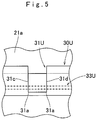
  • FIG. 5 is an enlarged view of a part of the airbag of FIG. 3 as viewed from an interior of a bag body, showing a vicinity of a joint of an edge of one partitioning tether and a bag body;
  • FIG. 6 is an enlarged plan view of the partitioning tether as laid flat
  • FIG. 7 depicts base members of the bag body of the airbag of FIG. 3 in plan
  • FIG. 8 depicts base members of two partitioning tethers for use in the airbag of FIG. 3 in plan
  • FIG. 9 is a schematic partial enlarged cross sectional view of an airbag in accordance with another exemplary embodiment taken along the location of a partitioning tether.
  • FIG. 10 depicts base members for forming the partitioning tether for use in the airbag of FIG. 9 in plan.
  • An airbag 20 in accordance with an exemplary embodiment is herein described as used in an airbag device S for knee protection for the illustrative purpose.
  • the airbag device S is mounted beneath a steering column 1 in front of a driver's seat.
  • Interior trim members such as an instrument panel 3 and an undercover 4 are disposed around the airbag device S.
  • up-down, left-right and front-rear directions in this specification are intended to refer to up-down, left-right and front-rear directions of the vehicle on which the airbag device S is mounted.
  • the airbag device S includes an airbag 20 , which is folded, an inflator 15 for feeding the airbag 20 with an inflation gas, a case 12 for storing the airbag 20 and inflator 15 , and an airbag cover 10 for covering the rear side of the airbag 20 .
  • the airbag cover 10 is fabricated from thermoplastic elastomer of polyolefin, and covers the rear side of the case 12 .
  • the airbag cover 10 includes a door 10 a which covers an opening of the case 12 , and a circumferential wall 10 b that extends forward from a periphery of the door 10 a for coupling with the case 12 .
  • the door 10 a of the illustrated embodiment is a double door which is openable upward and downward.
  • the case 12 is fabricated of a sheet metal. As shown in FIG. 2 , the case 12 includes a generally quadrangular bottom wall 12 a which is disposed at a front side, and a generally square tubular circumferential wall 12 b which extends rearward from the peripheral edge of the bottom wall 12 a generally along a front and rear direction. The rear end of the circumferential wall 12 b is open to allow the airbag 20 to be deployed therefrom.
  • the case 12 is mounted on a dashboard reinforcement (i.e. vehicle body structure) through the use of one or more brackets.
  • the inflator 15 includes a generally cylindrical body 16 and a retainer 17 which holds the inflator body 16 .
  • the inflator body 16 is adapted to be disposed generally along a left and right direction of the vehicle.
  • the inflator body 16 includes a plurality of gas discharge ports for discharging an inflation gas at the first end.
  • a lead wire for feeding an actuating signal is connected to the second end of the inflator body 16 .
  • the retainer 17 includes a generally tubular holding section 17 a which is mounted around the inflator body 16 and one or more bolts 17 b which protrude in a direction generally perpendicular to an axial direction of the holding section 17 a .
  • the retainer 17 of the illustrated embodiment is provided with two bolts 17 b arranged along the axial direction of the holding section 17 a , though not depicted in the drawings.
  • the inflator 15 and airbag 20 are mounted on the case 12 by firstly inserting the retainer 17 into the airbag 20 such that the bolts 17 b protrude from the airbag 20 , folding the airbag 20 , inserting the inflator body 16 into the holding section 17 a of the retainer 17 inside the airbag 20 , then placing the airbag 20 and inflator 15 in the case 12 such that the bolts 17 b of the retainer 17 go through the bottom wall 12 a of the case 12 , and then fastening the bolts 17 b with nuts 18 .
  • the airbag 20 includes a bag body 21 which is formed into a bag, and two partitioning tethers 30 ( 30 U, 30 D) each of which partitions an interior of the bag body 21 .
  • the bag body 21 is designed to be inflated into a generally rectangular board and be deployed for protecting left and right knees of a driver D, as indicated with double-dotted lines in FIG. 1 .
  • the bag body 21 is formed by joining together peripheral edges of a vehicle-side wall 21 a (as a first panel) which is deployable towards the steering column 1 and an occupant-side wall 21 b (as a second panel) which is deployable towards the driver D.
  • the vehicle-side wall 21 a and the occupant-side wall 21 b are generally identical in outer contour.
  • the bag body 21 includes a mounting portion 22 which stays inside the case 12 as the airbag 20 is deployed, and a protection portion 27 which is inflatable and disposed above the mounting portion 22 at airbag deployment for protecting the knees K of the driver D.
  • the protection portion 27 has a greater width in the left and right direction than the mounting portion 22 .
  • the vehicle-side wall 21 a is provided, in the mounting portion 22 , with two apertures 23 for receiving the bolts 17 b of the retainer 17 , a slit 24 which is used to insert the retainer 17 and inflator body 16 into the bag body 21 , and a through hole 25 for receiving a not-shown supporting projection formed in the bottom wall 12 a of the case 12 .
  • the airbag 20 of the illustrated embodiment includes two partitioning tethers 30 ( 30 U, 30 D) one above the other. More specifically, a partitioning tether 30 D is disposed on the lower side to partition the mounting portion 22 from the protection portion 27 , and a partitioning tether 30 U is disposed on the upper side to partition the protection portion 27 into upper and lower sections.
  • the partitioning tethers 30 U, 30 D are each joined to the vehicle-side wall 21 a and occupant-side wall 21 b by a generally entire outer circumferential edge so as to limit a distance between the vehicle-side wall 21 a and occupant-side wall 21 b at airbag deployment.
  • opposite edges 30 a , 30 b in the width direction are respectively entirely joined to the vehicle-side wall 21 a and occupant-side wall 21 b with a first joint (sewn seam) 33 U, 33 D, and a second joint (sewn seam) 34 U, 34 D each of which is formed into a continuous straight line, as shown in FIG. 3 .
  • Opposite edges 30 c , 30 d in the length direction (in other words, first and second edges 30 c , 30 d in the length direction) of each of the partitioning tethers 30 U, 30 D are respectively sewn to the vehicle-side wall 21 a and occupant-side wall 21 b with an edge seam 36 that sews outer peripheral edges of the vehicle-side wall 21 a and occupant-side wall 21 b together with sewing threads for forming the bag body 21 into a bag shape.
  • Each of the partitioning tethers 30 ( 30 U, 30 D) is provided with a plurality of communication holes 31 ( 31 U, 31 D) for providing gas communication inside the bag body 21 .
  • the upper partitioning tether 30 U includes five communication holes 31 U along the left and right direction
  • the lower partitioning tether 30 D includes four communication holes along the left and right direction.
  • the communication holes 31 ( 31 U, 31 D) have a generally identical, generally rectangular contour, as shown in FIG. 6 .
  • each of the communication holes 31 U, 31 D is formed into such a rectangular contour that is elongated in the width direction of the partitioning tether 31 U, 31 D.
  • each of the communication holes 31 U, 31 D is so configured that its corners 31 a , 31 b are respectively disposed farther towards (or closer to) the first and second edges 30 a , 30 b than the first joint 33 U, 33 D and second joint 34 U, 34 D, which join the edges 30 a , 30 b of each of the partitioning tethers 30 U, 30 D to the vehicle-side wall 21 a or occupant-side wall 21 b .
  • each of the joints 33 U, 33 D, 34 U, 34 D is continuously formed generally along the edge 30 a , 30 b of the partitioning tether 30 U, 30 D including portions where the communication holes 31 U, 31 D are disposed, as shown in FIG.
  • each of the communication holes 31 U, 31 D is so formed as to open an area in the partitioning tether 30 U/ 30 D between the vehicle-side wall 21 a and occupant-side wall 21 b entirely at airbag deployment.
  • each of the joints 33 U, 33 D, 34 U, 34 D joins the tether 30 U or 30 D to the vehicle-side wall 21 a or occupant-side wall 21 b .
  • each of the joints 33 U, 33 D, 34 U, 34 D is formed only on the vehicle-side wall 21 a or occupant-side wall 21 b .
  • the joints 33 U, 33 D, 34 U, 34 D are disposed farther towards the interior than the corners 31 a and 31 b of the communication holes 31 U, 31 D. Further, opposite inner edges 31 c and 31 d of each the communication holes 31 ( 31 U, 31 D) which are disposed between the first joint 33 ( 33 U, 33 D) and second joint 34 ( 34 U, 34 D) are formed into straight lines which are parallel to each other and generally orthogonal to the joints 33 and 34 , as shown in FIG. 6 .
  • each of the communication holes 31 U, 31 D has, in portions of the inner edges 31 c and 31 d disposed between the first joint 33 ( 33 U, 33 D) and second joint 34 ( 34 U, 34 D), no such curving portion that is likely to induce stress concentration at airbag deployment.
  • the airbag 20 is composed of a plurality of base members which are formed of a flexible fabric woven with polyester yarns, polyamide yarns or the like and cut into predetermined shapes.
  • the airbag 20 is formed by sewing the base members together with sewing threads.
  • the airbag 20 of the illustrated embodiment is composed of three body base members 40 , 41 , 42 for forming the vehicle-side wall 21 a and occupant-side wall 21 b of the bag body 21 , and two base members 45 , 46 for forming the partitioning tethers 30 U, 30 D, respectively, as can be seen in FIGS. 7 and 8 .
  • the body base members 40 and 41 are each formed into a generally trapezoidal contour. As shown in FIGS. 3, 4 and 7 , the body base members 40 , 41 respectively form portions of the vehicle-side wall 21 a and occupant-side wall 21 b from the mounting portion 22 to the location of the upper partitioning tether 30 U (in other words, portions of the vehicle-side wall 21 a and occupant-side wall 21 b below the upper partitioning tether 30 U).
  • the body base cloth 42 is formed into a generally rectangle and forms portions of the vehicle-side wall 21 a and occupant-side wall 21 b above the partitioning tether 30 U.
  • the tether base cloths 45 , 46 respectively form the partitioning tethers 30 U, 30 D in a half folded state, and are each provided with a plurality of openings 45 a , 46 a for forming the communication holes 31 U, 31 D, as shown in FIG. 8 .
  • the upper partitioning tether 30 U is joined to the vehicle-side wall 21 a and occupant-side wall 21 b as follows: As shown in FIGS. 3 and 4 , when an upper front edge 42 a of the body base cloth 42 and a rear edge 40 b of the body base cloth 40 are mated and joined together, the first edge 30 a in the width direction of the partitioning tether 30 U is placed on the inner side of the upper front edge 42 a and rear edge 40 b as mated and sewn together with the upper front edge 42 a and rear edge 40 b with sewing threads, thus forming the first joint 33 U.
  • the second edge 30 b in the width direction of the partitioning tether 30 U is placed on the inner side of the lower front edge 42 b and rear edge 41 b as mated and sewn together with the lower front edge 42 b and rear edge 41 b with sewing threads, thus forming the second joint 34 U.
  • the lower partitioning tether 30 D is sewn to central portions in the front and rear direction of the body base cloths 40 and 41 with sewing threads.
  • the first and second edges 30 a and 30 b of the lower partitioning tether 30 D are respectively placed on the inner surface of the body base cloths 40 and 41 , and sewn thereto, thus forming the first and second joints 33 D and 34 D.
  • the bag body 21 is formed by sewing up the left edge 42 c and right edge 42 d of the body base cloth 42 , and sewing the left edges 40 c and 41 c , front edges 40 a and 41 a , and right edges 40 d and 41 d of the body base cloths 40 and 41 together with sewing threads continuously.
  • the edge seam 36 is formed, and the edge seam 36 joins the opposite edges 30 c and 30 d in the length direction of the partitioning tethers 30 U and 30 D to the bag body 21 .
  • the airbag 20 of the illustrated embodiment is mounted on the vehicle as follows: Firstly, the retainer 17 is inserted into the airbag 20 , and the airbag 20 is folded up so as to fit in the case 12 . Then the inflator body 16 is inserted into the airbag 20 , and the airbag 20 as housing the inflator 15 is stored in the case 12 .
  • the airbag cover 10 is mounted on the case 12 , and the case 12 is mounted on the vehicle body structure. Thus the airbag device S is mounted on the vehicle.
  • the airbag device S After the airbag device S was mounted on the vehicle, if an actuating signal is fed to the inflator 15 , the inflator body 16 will emit an inflation gas into the airbag 20 . Then the airbag 20 will be inflated with the inflation gas and push open the door 10 a of the airbag cover 10 , then protrude from the case 12 and be deployed rearwardly, as indicated by double-dotted lines in FIG. 1 .
  • each of the communication holes 31 is formed into a generally rectangular contour such that two each corners 31 a , 31 b are disposed in a vicinity of each of the first and second edges 30 a and 30 b of the partitioning tether 30 .
  • the corners 31 a , 31 b of the communication hole 31 are disposed closer to the first or second edge 30 a / 30 b of the partitioning tether 30 than the corresponding joint 33 / 34 that joins the first or second edge 30 a / 30 b of the partitioning tether 30 to the first panel (vehicle-side wall 21 a ) or the second panel (occupant-side wall 21 b ) of the bag body 21 .
  • a tensile force is likely to occur in a portion of the partitioning tether 30 disposed between the first and second joints 33 and 34 at airbag deployment, but the corners 31 a and 31 b of each of the communication holes 31 of the illustrated embodiment are dislocated from such a portion.
  • This configuration will prevent a stress concentration from occurring in the corners 31 a and 31 b of each of the communication holes 31 , such that each of the communication holes 31 will be steadily maintained in shape at airbag deployment even with no reinforcing member, and the airbag 20 will be inflated quickly in a steady fashion.
  • the communication holes 31 formed in the partitioning tether 30 are steadily maintained in shape at airbag deployment, with a simple configuration.
  • the opposite inner edges 31 c and 31 d of the communication hole 31 disposed between the first and second joints 33 and 34 are formed into straight lines generally parallel to each other. This configuration will adequately prevent stress concentration from occurring not only at the corners but also in other portions of the inner edge of the communication hole 31 .
  • the inner edges of the communication hole disposed between the first and second joints do not absolutely necessarily have to be straight. The inner edges may be slightly curving to such a degree as not to cause stress concentration.
  • the first joint 33 ( 33 U, 33 D) and second joint 34 ( 34 U, 34 D) are formed by sewing using sewing threads.
  • This configuration will facilitate the jointing work of the partitioning tethers and production of the airbag 20 , in comparison with an instance where a tether component (such as base cloths 45 , 46 ) is joined to the vehicle-side wall 21 a and occupant-side wall 21 b of the bag body 21 with adhering means like an adhesive, by way of example. If such an advantageous effect does not have to be considered, the tether may be joined to the bag body with such an adhering means as adhesive.
  • each of the first and second joints 33 and 34 is formed continuously generally along the corresponding edge 30 a , 30 b of the partitioning tether 30 , including portions where the communication holes 31 are disposed.
  • the partitioning tether 30 can be easily joined to the vehicle-side wall 21 a and occupant-side wall 21 b with one each continuous straight stitch in accordance with the length of the partitioning tether 30 , irrespective of the number of the communication holes 31 . If such an advantageous effect does not have to be considered, the joint may be formed intermittently skipping the communication holes.
  • the partitioning tether 30 ( 30 U, 30 D) of the foregoing embodiment is joined to the vehicle-side wall 21 a and occupant-side wall 21 b of the bag body 21 by the opposite edges 30 a and 30 b
  • the partitioning tether may alternatively be configured like a partitioning tether 53 depicted in FIG. 9 .
  • the partitioning tether 53 is disposed in a bag body 51 of an airbag 50 .
  • the partitioning tether 53 is composed of two base cloths 55 and 57 .
  • the partitioning tether 53 is formed by joining first edges 55 a and 57 a of the base cloths 55 and 57 with a center joint 60 , and joined to a first panel 51 a and a second panel 51 b constituting the bag body 51 by second edges 55 b and 57 b of the base cloths 55 and 57 , with panel-side joints 61 .
  • Each of the tether base cloths 55 and 57 is provided with two communication holes 56 and 58 each of which is formed into a generally rectangular contour. As shown in FIG. 9 , the communication holes 56 and 58 are so arranged as not to overlap in a joint direction of the base cloths 55 and 57 (i.e.
  • the communication holes 56 and 58 have a generally identical contour.
  • each of the communication holes 56 and 58 is formed into such a contour that is elongated in a width direction of each of the base cloths 55 and 57 , and is so configured that its corners 56 a , 56 b , 58 a , 58 b are disposed farther towards (or closer to) the edge 55 a , 55 b , 57 a , 57 b than the center joint 60 or panel-side joints 61 , as shown in FIG. 10 .
  • the center joint 60 that joins the first edges 55 a and 57 a of the base cloths 55 and 57 together and the panel-side joints 61 that join the second edges 55 b and 57 b of the base cloths 55 and 57 to the first panel 51 a and second panel 51 b respectively are continuously formed generally along the edges 55 a , 55 b , 57 a , 57 b of the base cloths 55 and 57 including portions where the communication holes 56 and 58 are disposed.
  • the center joint 60 or panel-side joints 61 are disposed farther towards an interior than the corners 56 a , 56 b , 58 a , 58 b of the communication holes 56 , 58 , and inner edges 56 c and 56 d / 58 c and 58 d of each of the communication holes 56 , 58 which are disposed between the center joint 60 and panel-side joints 61 are formed into straight lines which are parallel to each other and generally orthogonal to the center joint 60 and panel-side joints 61 .
  • each of the communication holes 56 , 58 has, in portions of the inner edges 56 c , 56 d , 58 c , 58 d disposed between the center joint 60 and panel-side joints 61 , no such curving portion that is likely to cause stress concentration at airbag deployment.
  • each of the communication holes 56 , 58 of the partitioning tether 53 is formed into a generally rectangular contour, and the corners 56 a , 56 b , 58 a , 58 b of the communication holes 56 , 58 disposed in a vicinity of the center joint 60 or panel-side joints 61 are not positioned farther towards an interior of the base cloths 55 , 57 than the center joint 60 or panel-side joints 61 .
  • the communication holes 56 , 58 formed in the partitioning tether 53 are steadily maintained in shape at airbag deployment, with a simple configuration.
  • the opposite inner edges 56 c , 56 d , 58 c and 58 d disposed between the center joint 60 and panel-side joints 61 are formed into straight lines generally parallel to each other. This configuration will adequately prevent stress concentration from occurring not only at the corners but also in other portions of the inner edge of each of the communication holes 56 and 58 .
  • the center joint 60 and panel-side joints 61 of the partitioning tether 53 are formed by sewing using sewing threads in the airbag 50 , too, and the center joint 60 and panel-side joints 61 are continuously formed generally along the edges 55 a , 55 b , 57 a , 57 b of the base cloths 55 and 57 including portions where the communication holes 56 and 58 are disposed. This configuration will facilitate production of the airbag 50 .
  • the airbag 20 has been described as used for the airbag device for knee protection. However, the application of the invention should not be limited thereby.
  • the invention may be suitable for any airbags which are inflatable in a board shape, such as an airbag for side impact, an airbag for pedestrian protection, or the like.

Landscapes

  • Engineering & Computer Science (AREA)
  • Mechanical Engineering (AREA)
  • Air Bags (AREA)

Abstract

An airbag includes a bag body that includes a first panel and a second panel which are opposed to each other, a partitioning tether that is disposed in such a manner as to partition an interior of the bag body, a communication hole that is formed in the tether for providing gas communication in the interior of the bag body, and first and second joints that respectively join first and second edges of the tether to the first and second panels of the bag body. The communication hole has a generally rectangular contour which has two corners in a vicinity of each of the first and second edges of the tether. In both of the first and second edges of the tether, the corners of the communication hole are disposed closer to the first or second edge of the partitioning tether than a corresponding one of the joints.

Description

CROSS REFERENCE TO RELATED APPLICATIONS
The present application claims priority from Japanese Patent Application No. 2018-179259 of Kimura, filed on Sep. 25, 2018, the entire disclosure of which is incorporated herein by reference.
BACKGROUND 1. Technical Field
The present invention relates to an airbag for a vehicle including a bag body and a partitioning tether that is joined to an outer shell of the bag body in order to partition an interior of the bag body and is provided with a communication hole for providing gas communication between the partitioned sections.
2. Description of Related Art
JP 2017-047744 A discloses a known airbag which includes a partitioning tether that partitions an interior of the bag body and is provided with a communication hole for providing gas communication between the partitioned sections. More particularly, the partitioning tether includes a plurality of generally oval communication holes.
In the above conventional airbag, when a tensile force is exerted in the partitioning tether at airbag deployment, a stress concentration is likely to occur in a vicinity of each of corners of each of the communication holes, which leads to deformation of the contour of each of the communication holes. To prevent such deformation of the communication holes due to stress concentration, the partitioning tether is formed by laminating a plurality of base members for increasing strength. This configuration has a room for improvement in reduction of production cost of the airbag as well as in size reduction of the airbag as folded.
SUMMARY
An object of the present invention is to provide an airbag in which a communication hole formed in a partitioning tether thereof is steadily maintained in shape at airbag deployment, with a simple configuration.
An exemplary embodiment of the invention relates to an airbag which is formed of a flexible sheet-shaped material and includes a bag body that is inflatable with an inflation gas. The bag body includes a first panel and a second panel which are opposed to each other. The airbag also includes at least one partitioning tether that is joined to the first panel and second panel of the bag body in such a manner as to partition an interior of the bag body. The partitioning tether limits a distance between the first panel and second panel at airbag deployment. The partitioning tether includes a first edge and a second edge which are opposed to each other, and at least one communication hole for providing gas communication in the interior of the bag body. A first joint and a second joint respectively join the first edge and second edge of the partitioning tether to the first panel and second panel of the bag body. Each of the at least one communication hole is formed into a generally rectangular contour which has two corners in a vicinity of each of the first and second edges of the partitioning tether. In both of the first and second edges of the partitioning tether, the corners of the communication hole are disposed closer to the first or second edge of the partitioning tether than a corresponding one of the joints.
In the airbag of the above exemplary embodiment, each of the communication holes formed in the partitioning tether is formed into a generally rectangular contour such that its corners are disposed in a vicinity of each of the first and second edges of the partitioning tether. In both of the first and second edges of the partitioning tether, the corners of the communication hole are disposed closer to the first or second edge of the partitioning tether than the corresponding one of the first joint or second joint. In other words, a tensile force is likely to occur in a portion of the partitioning tether disposed between the first and second joints at airbag deployment, but the corners of the communication hole of the exemplary embodiment are dislocated from such a portion. This configuration will prevent a stress concentration from occurring in the corners of the communication holes, such that the communication holes will be steadily maintained in shape at airbag deployment even with no reinforcing member, and the airbag will be inflated quickly in a steady fashion.
Therefore, with the airbag of the exemplary embodiment, the communication holes formed in the partitioning tether are steadily maintained in shape at airbag deployment, with a simple configuration.
In the airbag of the above exemplary embodiment, it is desired that opposite inner edges of each of the at least one communication hole which are disposed between the first joint and second joint are formed into straight lines generally parallel to each other. This configuration will adequately prevent stress concentration from occurring not only at the corners but also in other portions of the inner edge of each of the communication holes.
Further, it is desired that the first and second joints are formed by sewing using sewing threads. This configuration will facilitate the jointing work of the partitioning tether and production of the airbag, in comparison with an instance where a tether component is joined to the first panel and second panel of the bag body with such adhering means as an adhesive.
If a plurality of the communication holes are arranged along a direction generally perpendicular to a direction that the first panel and the second panel of the bag body are opposed, each of the first and second joints may be formed continuously generally along the corresponding edge of the partitioning tether, including portions where the communication holes are disposed. With this configuration, the partitioning tether can be easily joined to the first panel and second panel with one each continuous straight stitch in accordance with the length of the partitioning tether, irrespective of the number of the communication holes.
In another exemplary embodiment of the invention, the partitioning tether is composed of two, first and second base cloths that are joined together by first edges thereof with a center joint. The partitioning tether is joined to the first panel and second panel of the bag body by second edges of the first and second base cloths with two, first and second panel-side joints. At least one communication hole is formed in each of the first and second base cloths. Each of the at least one communication hole in each of the first and second base cloths is formed into a generally rectangular contour such that two corners each of the communication holes are disposed in a vicinity of the center joint and in a vicinity of the first or second panel-side joint. The at least one communication hole of the first base cloth and the at least one communication hole of the second base cloth are so arranged as not to overlap in a joint direction of the first and second base cloths, and arranged in an alternate fashion in a direction extending along the edges of the base cloths. The corners of each of the communication holes disposed in the vicinity of the panel-side joints are disposed closer to the second edge of the base cloths than a corresponding one of the panel-side joints, and the corners of each of the communication holes disposed in the vicinity of the center joint are disposed closer to the first edges of the base cloths than the center joint.
Also in the airbag configured as described above, each of the communication holes of the partitioning tether is formed into a generally rectangular contour, and the corners of the communication holes disposed in a vicinity of the center joint or panel-side joints are not positioned farther towards an interior of the base cloths than the center joint or panel-side joints. In other words, although a tensile force occurs in portions of the partitioning tether disposed between the center joint and panel-side joints at airbag deployment, the corners of the communication holes of the exemplary embodiment are dislocated from such portions. This configuration will prevent a stress concentration from occurring in the corners of the communication holes, such that each of the communication holes will be steadily maintained in shape at airbag deployment even with no reinforcing member, and the airbag will be inflated quickly in a steady fashion.
Therefore, with the airbag of the another exemplary embodiment, the communication holes formed in the partitioning tether are steadily maintained in shape at airbag deployment, with a simple configuration.
BRIEF DESCRIPTION OF DRAWINGS
FIG. 1 is a schematic vertical sectional view of an airbag device for knee protection in service taken along a front and rear direction of a vehicle, the airbag device employing an airbag in accordance with an exemplary embodiment;
FIG. 2 is a schematic enlarged vertical sectional view of the airbag device of FIG. 1 taken along the front and rear direction of the vehicle;
FIG. 3 is a back view of the airbag in accordance with the exemplary embodiment as laid flat in an unfolded state;
FIG. 4 is a sectional view taken along line IV-IV of FIG. 3;
FIG. 5 is an enlarged view of a part of the airbag of FIG. 3 as viewed from an interior of a bag body, showing a vicinity of a joint of an edge of one partitioning tether and a bag body;
FIG. 6 is an enlarged plan view of the partitioning tether as laid flat;
FIG. 7 depicts base members of the bag body of the airbag of FIG. 3 in plan;
FIG. 8 depicts base members of two partitioning tethers for use in the airbag of FIG. 3 in plan;
FIG. 9 is a schematic partial enlarged cross sectional view of an airbag in accordance with another exemplary embodiment taken along the location of a partitioning tether; and
FIG. 10 depicts base members for forming the partitioning tether for use in the airbag of FIG. 9 in plan.
DETAILED DESCRIPTION
Exemplary embodiments are described below with reference to the accompanying drawings. However, the invention is not limited to the embodiments disclosed herein. All modifications within the appended claims and equivalents relative thereto are intended to be encompassed in the scope of the claims.
An airbag 20 in accordance with an exemplary embodiment is herein described as used in an airbag device S for knee protection for the illustrative purpose. The airbag device S is mounted beneath a steering column 1 in front of a driver's seat. Interior trim members such as an instrument panel 3 and an undercover 4 are disposed around the airbag device S. Unless otherwise specified, up-down, left-right and front-rear directions in this specification are intended to refer to up-down, left-right and front-rear directions of the vehicle on which the airbag device S is mounted.
As shown in FIGS. 1 and 2, the airbag device S includes an airbag 20, which is folded, an inflator 15 for feeding the airbag 20 with an inflation gas, a case 12 for storing the airbag 20 and inflator 15, and an airbag cover 10 for covering the rear side of the airbag 20.
The airbag cover 10 is fabricated from thermoplastic elastomer of polyolefin, and covers the rear side of the case 12. As can be seen in FIG. 2, the airbag cover 10 includes a door 10 a which covers an opening of the case 12, and a circumferential wall 10 b that extends forward from a periphery of the door 10 a for coupling with the case 12. The door 10 a of the illustrated embodiment is a double door which is openable upward and downward.
The case 12 is fabricated of a sheet metal. As shown in FIG. 2, the case 12 includes a generally quadrangular bottom wall 12 a which is disposed at a front side, and a generally square tubular circumferential wall 12 b which extends rearward from the peripheral edge of the bottom wall 12 a generally along a front and rear direction. The rear end of the circumferential wall 12 b is open to allow the airbag 20 to be deployed therefrom. Although not shown in the drawings in detail, the case 12 is mounted on a dashboard reinforcement (i.e. vehicle body structure) through the use of one or more brackets.
As can be seen in FIG. 2, the inflator 15 includes a generally cylindrical body 16 and a retainer 17 which holds the inflator body 16. The inflator body 16 is adapted to be disposed generally along a left and right direction of the vehicle. Although not depicted in the drawings, the inflator body 16 includes a plurality of gas discharge ports for discharging an inflation gas at the first end. A lead wire for feeding an actuating signal is connected to the second end of the inflator body 16. The retainer 17 includes a generally tubular holding section 17 a which is mounted around the inflator body 16 and one or more bolts 17 b which protrude in a direction generally perpendicular to an axial direction of the holding section 17 a. The retainer 17 of the illustrated embodiment is provided with two bolts 17 b arranged along the axial direction of the holding section 17 a, though not depicted in the drawings. In the illustrated embodiment, the inflator 15 and airbag 20 are mounted on the case 12 by firstly inserting the retainer 17 into the airbag 20 such that the bolts 17 b protrude from the airbag 20, folding the airbag 20, inserting the inflator body 16 into the holding section 17 a of the retainer 17 inside the airbag 20, then placing the airbag 20 and inflator 15 in the case 12 such that the bolts 17 b of the retainer 17 go through the bottom wall 12 a of the case 12, and then fastening the bolts 17 b with nuts 18.
As shown in FIGS. 3 and 4, the airbag 20 includes a bag body 21 which is formed into a bag, and two partitioning tethers 30 (30U, 30D) each of which partitions an interior of the bag body 21.
The bag body 21 is designed to be inflated into a generally rectangular board and be deployed for protecting left and right knees of a driver D, as indicated with double-dotted lines in FIG. 1. As can be seen in FIG. 3, the bag body 21 is formed by joining together peripheral edges of a vehicle-side wall 21 a (as a first panel) which is deployable towards the steering column 1 and an occupant-side wall 21 b (as a second panel) which is deployable towards the driver D. The vehicle-side wall 21 a and the occupant-side wall 21 b are generally identical in outer contour. The bag body 21 includes a mounting portion 22 which stays inside the case 12 as the airbag 20 is deployed, and a protection portion 27 which is inflatable and disposed above the mounting portion 22 at airbag deployment for protecting the knees K of the driver D. The protection portion 27 has a greater width in the left and right direction than the mounting portion 22.
As shown in FIG. 3, the vehicle-side wall 21 a is provided, in the mounting portion 22, with two apertures 23 for receiving the bolts 17 b of the retainer 17, a slit 24 which is used to insert the retainer 17 and inflator body 16 into the bag body 21, and a through hole 25 for receiving a not-shown supporting projection formed in the bottom wall 12 a of the case 12.
The airbag 20 of the illustrated embodiment includes two partitioning tethers 30 (30U, 30D) one above the other. More specifically, a partitioning tether 30D is disposed on the lower side to partition the mounting portion 22 from the protection portion 27, and a partitioning tether 30U is disposed on the upper side to partition the protection portion 27 into upper and lower sections. The partitioning tethers 30U, 30D are each joined to the vehicle-side wall 21 a and occupant-side wall 21 b by a generally entire outer circumferential edge so as to limit a distance between the vehicle-side wall 21 a and occupant-side wall 21 b at airbag deployment. In the illustrated embodiment, opposite edges 30 a, 30 b in the width direction (in other words, first and second edges 30 a, 30 b in the width direction) of each of the partitioning tethers 30U, 30D are respectively entirely joined to the vehicle-side wall 21 a and occupant-side wall 21 b with a first joint (sewn seam) 33U, 33D, and a second joint (sewn seam) 34U, 34D each of which is formed into a continuous straight line, as shown in FIG. 3. Opposite edges 30 c, 30 d in the length direction (in other words, first and second edges 30 c, 30 d in the length direction) of each of the partitioning tethers 30U, 30D are respectively sewn to the vehicle-side wall 21 a and occupant-side wall 21 b with an edge seam 36 that sews outer peripheral edges of the vehicle-side wall 21 a and occupant-side wall 21 b together with sewing threads for forming the bag body 21 into a bag shape.
Each of the partitioning tethers 30 (30U, 30D) is provided with a plurality of communication holes 31 (31U, 31D) for providing gas communication inside the bag body 21. In the illustrated embodiment, the upper partitioning tether 30U includes five communication holes 31U along the left and right direction, while the lower partitioning tether 30D includes four communication holes along the left and right direction.
The communication holes 31 (31U, 31D) have a generally identical, generally rectangular contour, as shown in FIG. 6. In the illustrated embodiment, each of the communication holes 31U, 31D is formed into such a rectangular contour that is elongated in the width direction of the partitioning tether 31U, 31D. Referring to FIGS. 5 and 6, each of the communication holes 31U, 31D is so configured that its corners 31 a, 31 b are respectively disposed farther towards (or closer to) the first and second edges 30 a, 30 b than the first joint 33U, 33D and second joint 34U, 34D, which join the edges 30 a, 30 b of each of the partitioning tethers 30U, 30D to the vehicle-side wall 21 a or occupant-side wall 21 b. To describe more specifically, in the illustrated embodiment, each of the joints 33U, 33D, 34U, 34D is continuously formed generally along the edge 30 a, 30 b of the partitioning tether 30U, 30D including portions where the communication holes 31U, 31D are disposed, as shown in FIG. 3. That is, each of the communication holes 31U, 31D is so formed as to open an area in the partitioning tether 30U/30D between the vehicle-side wall 21 a and occupant-side wall 21 b entirely at airbag deployment. At portions where the communication holes 31U, 31D are not disposed, each of the joints 33U, 33D, 34U, 34D joins the tether 30U or 30D to the vehicle-side wall 21 a or occupant-side wall 21 b. On the other hand, at portions where the communication holes 31U, 31D are disposed, each of the joints 33U, 33D, 34U, 34D is formed only on the vehicle-side wall 21 a or occupant-side wall 21 b. The joints 33U, 33D, 34U, 34D are disposed farther towards the interior than the corners 31 a and 31 b of the communication holes 31U, 31D. Further, opposite inner edges 31 c and 31 d of each the communication holes 31 (31U, 31D) which are disposed between the first joint 33 (33U, 33D) and second joint 34 (34U, 34D) are formed into straight lines which are parallel to each other and generally orthogonal to the joints 33 and 34, as shown in FIG. 6. That is, in the illustrated embodiment, each of the communication holes 31U, 31D has, in portions of the inner edges 31 c and 31 d disposed between the first joint 33 (33U, 33D) and second joint 34 (34U, 34D), no such curving portion that is likely to induce stress concentration at airbag deployment.
In the illustrated embodiment, the airbag 20 is composed of a plurality of base members which are formed of a flexible fabric woven with polyester yarns, polyamide yarns or the like and cut into predetermined shapes. The airbag 20 is formed by sewing the base members together with sewing threads. The airbag 20 of the illustrated embodiment is composed of three body base members 40, 41, 42 for forming the vehicle-side wall 21 a and occupant-side wall 21 b of the bag body 21, and two base members 45, 46 for forming the partitioning tethers 30U, 30D, respectively, as can be seen in FIGS. 7 and 8.
The body base members 40 and 41 are each formed into a generally trapezoidal contour. As shown in FIGS. 3, 4 and 7, the body base members 40, 41 respectively form portions of the vehicle-side wall 21 a and occupant-side wall 21 b from the mounting portion 22 to the location of the upper partitioning tether 30U (in other words, portions of the vehicle-side wall 21 a and occupant-side wall 21 b below the upper partitioning tether 30U). The body base cloth 42 is formed into a generally rectangle and forms portions of the vehicle-side wall 21 a and occupant-side wall 21 b above the partitioning tether 30U. The tether base cloths 45, 46 respectively form the partitioning tethers 30U, 30D in a half folded state, and are each provided with a plurality of openings 45 a, 46 a for forming the communication holes 31U, 31D, as shown in FIG. 8.
In the airbag 20 of the illustrated embodiment, the upper partitioning tether 30U is joined to the vehicle-side wall 21 a and occupant-side wall 21 b as follows: As shown in FIGS. 3 and 4, when an upper front edge 42 a of the body base cloth 42 and a rear edge 40 b of the body base cloth 40 are mated and joined together, the first edge 30 a in the width direction of the partitioning tether 30U is placed on the inner side of the upper front edge 42 a and rear edge 40 b as mated and sewn together with the upper front edge 42 a and rear edge 40 b with sewing threads, thus forming the first joint 33U. In a similar fashion, when a lower front edge 42 b of the body base cloth 42 and a rear edge 41 b of the body base cloth 41 are mated and joined together, the second edge 30 b in the width direction of the partitioning tether 30U is placed on the inner side of the lower front edge 42 b and rear edge 41 b as mated and sewn together with the lower front edge 42 b and rear edge 41 b with sewing threads, thus forming the second joint 34U. The lower partitioning tether 30D is sewn to central portions in the front and rear direction of the body base cloths 40 and 41 with sewing threads. More specifically, the first and second edges 30 a and 30 b of the lower partitioning tether 30D are respectively placed on the inner surface of the body base cloths 40 and 41, and sewn thereto, thus forming the first and second joints 33D and 34D. After the body base cloths 40, 41 and 42 were joined in tandem and the partitioning tethers 30U and 30D were joined to the body base cloths 40, 41 and 42, the bag body 21 is formed by sewing up the left edge 42 c and right edge 42 d of the body base cloth 42, and sewing the left edges 40 c and 41 c, front edges 40 a and 41 a, and right edges 40 d and 41 d of the body base cloths 40 and 41 together with sewing threads continuously. At this time, the edge seam 36 is formed, and the edge seam 36 joins the opposite edges 30 c and 30 d in the length direction of the partitioning tethers 30U and 30D to the bag body 21.
The airbag 20 of the illustrated embodiment is mounted on the vehicle as follows: Firstly, the retainer 17 is inserted into the airbag 20, and the airbag 20 is folded up so as to fit in the case 12. Then the inflator body 16 is inserted into the airbag 20, and the airbag 20 as housing the inflator 15 is stored in the case 12. The airbag cover 10 is mounted on the case 12, and the case 12 is mounted on the vehicle body structure. Thus the airbag device S is mounted on the vehicle.
After the airbag device S was mounted on the vehicle, if an actuating signal is fed to the inflator 15, the inflator body 16 will emit an inflation gas into the airbag 20. Then the airbag 20 will be inflated with the inflation gas and push open the door 10 a of the airbag cover 10, then protrude from the case 12 and be deployed rearwardly, as indicated by double-dotted lines in FIG. 1.
In the airbag 20 of the illustrated embodiment, in each of the partitioning tethers 30U and 30D, each of the communication holes 31 is formed into a generally rectangular contour such that two each corners 31 a, 31 b are disposed in a vicinity of each of the first and second edges 30 a and 30 b of the partitioning tether 30. In both of the first and second edges 30 a and 30 b of the partitioning tether 30, the corners 31 a, 31 b of the communication hole 31 are disposed closer to the first or second edge 30 a/30 b of the partitioning tether 30 than the corresponding joint 33/34 that joins the first or second edge 30 a/30 b of the partitioning tether 30 to the first panel (vehicle-side wall 21 a) or the second panel (occupant-side wall 21 b) of the bag body 21. In other words, a tensile force is likely to occur in a portion of the partitioning tether 30 disposed between the first and second joints 33 and 34 at airbag deployment, but the corners 31 a and 31 b of each of the communication holes 31 of the illustrated embodiment are dislocated from such a portion. This configuration will prevent a stress concentration from occurring in the corners 31 a and 31 b of each of the communication holes 31, such that each of the communication holes 31 will be steadily maintained in shape at airbag deployment even with no reinforcing member, and the airbag 20 will be inflated quickly in a steady fashion.
Therefore, with the airbag 20 of the illustrated embodiment, the communication holes 31 formed in the partitioning tether 30 are steadily maintained in shape at airbag deployment, with a simple configuration.
In the airbag of the illustrated embodiment, in each of the communication holes 31 (31U, 31D) of the partitioning tethers 30 (30U, 30D), the opposite inner edges 31 c and 31 d of the communication hole 31 disposed between the first and second joints 33 and 34 are formed into straight lines generally parallel to each other. This configuration will adequately prevent stress concentration from occurring not only at the corners but also in other portions of the inner edge of the communication hole 31. However, the inner edges of the communication hole disposed between the first and second joints do not absolutely necessarily have to be straight. The inner edges may be slightly curving to such a degree as not to cause stress concentration.
Moreover, in the airbag 20 of the illustrated embodiment, the first joint 33 (33U, 33D) and second joint 34 (34U, 34D) are formed by sewing using sewing threads. This configuration will facilitate the jointing work of the partitioning tethers and production of the airbag 20, in comparison with an instance where a tether component (such as base cloths 45, 46) is joined to the vehicle-side wall 21 a and occupant-side wall 21 b of the bag body 21 with adhering means like an adhesive, by way of example. If such an advantageous effect does not have to be considered, the tether may be joined to the bag body with such an adhering means as adhesive.
Furthermore, in the airbag 20 of the illustrated embodiment, although a plurality of the communication holes 31 (31U, 31D) are arranged along a direction generally perpendicular to the direction that the vehicle-side wall 21 a and occupant-side wall 21 b are opposed (i.e. along the length direction of the partitioning tether 30 (30U, 30D), each of the first and second joints 33 and 34 (33U, 33D, 34U, 34D) is formed continuously generally along the corresponding edge 30 a, 30 b of the partitioning tether 30, including portions where the communication holes 31 are disposed. With this configuration, the partitioning tether 30 can be easily joined to the vehicle-side wall 21 a and occupant-side wall 21 b with one each continuous straight stitch in accordance with the length of the partitioning tether 30, irrespective of the number of the communication holes 31. If such an advantageous effect does not have to be considered, the joint may be formed intermittently skipping the communication holes.
Although the partitioning tether 30 (30U, 30D) of the foregoing embodiment is joined to the vehicle-side wall 21 a and occupant-side wall 21 b of the bag body 21 by the opposite edges 30 a and 30 b, the partitioning tether may alternatively be configured like a partitioning tether 53 depicted in FIG. 9. The partitioning tether 53 is disposed in a bag body 51 of an airbag 50. As shown in FIG. 10, the partitioning tether 53 is composed of two base cloths 55 and 57. To describe more specifically, the partitioning tether 53 is formed by joining first edges 55 a and 57 a of the base cloths 55 and 57 with a center joint 60, and joined to a first panel 51 a and a second panel 51 b constituting the bag body 51 by second edges 55 b and 57 b of the base cloths 55 and 57, with panel-side joints 61. Each of the tether base cloths 55 and 57 is provided with two communication holes 56 and 58 each of which is formed into a generally rectangular contour. As shown in FIG. 9, the communication holes 56 and 58 are so arranged as not to overlap in a joint direction of the base cloths 55 and 57 (i.e. in a width direction of the partitioning tether 53), and arranged in an alternate fashion (or at dislocated positions) in a direction extending along the edges 55 a, 55 b, 57 a, 57 b (i.e. along a length direction of the partitioning tether 53). The communication holes 56 and 58 have a generally identical contour. In the illustrated embodiment, each of the communication holes 56 and 58 is formed into such a contour that is elongated in a width direction of each of the base cloths 55 and 57, and is so configured that its corners 56 a, 56 b, 58 a, 58 b are disposed farther towards (or closer to) the edge 55 a, 55 b, 57 a, 57 b than the center joint 60 or panel-side joints 61, as shown in FIG. 10. In the partitioning tether 53 as well, the center joint 60 that joins the first edges 55 a and 57 a of the base cloths 55 and 57 together and the panel-side joints 61 that join the second edges 55 b and 57 b of the base cloths 55 and 57 to the first panel 51 a and second panel 51 b respectively are continuously formed generally along the edges 55 a, 55 b, 57 a, 57 b of the base cloths 55 and 57 including portions where the communication holes 56 and 58 are disposed. Further, in the partitioning tether 53, the center joint 60 or panel-side joints 61 are disposed farther towards an interior than the corners 56 a, 56 b, 58 a, 58 b of the communication holes 56, 58, and inner edges 56 c and 56 d/58 c and 58 d of each of the communication holes 56, 58 which are disposed between the center joint 60 and panel-side joints 61 are formed into straight lines which are parallel to each other and generally orthogonal to the center joint 60 and panel-side joints 61. That is, in the partitioning tether 53 configured as described above as well, each of the communication holes 56, 58 has, in portions of the inner edges 56 c, 56 d, 58 c, 58 d disposed between the center joint 60 and panel-side joints 61, no such curving portion that is likely to cause stress concentration at airbag deployment.
In the airbag 50 configured as described above as well, each of the communication holes 56, 58 of the partitioning tether 53 is formed into a generally rectangular contour, and the corners 56 a, 56 b, 58 a, 58 b of the communication holes 56, 58 disposed in a vicinity of the center joint 60 or panel-side joints 61 are not positioned farther towards an interior of the base cloths 55, 57 than the center joint 60 or panel-side joints 61. In other words, although a tensile force occurs in portions of the partitioning tether 53 disposed between the center joint 60 and panel-side joints 61 at airbag deployment, the corners 56 a, 56 b, 58 a, 58 b of the communication holes 56, 58 are dislocated from such portions. This configuration will prevent a stress concentration from occurring in the corners 56 a, 56 b, 58 a, 58 b of the communication holes 56, 58, such that each of the communication holes 56, 58 will be steadily maintained in shape at airbag deployment even with no reinforcing member, and the airbag 50 will be inflated quickly in a steady fashion.
Therefore, with the airbag 50 of the illustrated embodiment, the communication holes 56, 58 formed in the partitioning tether 53 are steadily maintained in shape at airbag deployment, with a simple configuration.
Also in the airbag 50, in each of the communication holes 56 and 58, the opposite inner edges 56 c, 56 d, 58 c and 58 d disposed between the center joint 60 and panel-side joints 61 are formed into straight lines generally parallel to each other. This configuration will adequately prevent stress concentration from occurring not only at the corners but also in other portions of the inner edge of each of the communication holes 56 and 58. Moreover, the center joint 60 and panel-side joints 61 of the partitioning tether 53 are formed by sewing using sewing threads in the airbag 50, too, and the center joint 60 and panel-side joints 61 are continuously formed generally along the edges 55 a, 55 b, 57 a, 57 b of the base cloths 55 and 57 including portions where the communication holes 56 and 58 are disposed. This configuration will facilitate production of the airbag 50.
The airbag 20 has been described as used for the airbag device for knee protection. However, the application of the invention should not be limited thereby. The invention may be suitable for any airbags which are inflatable in a board shape, such as an airbag for side impact, an airbag for pedestrian protection, or the like.

Claims (7)

What is claimed is:
1. An airbag adapted to be mounted on a vehicle, comprising:
a bag body that is formed of a flexible sheet-shaped material and inflatable with an inflation gas, the bag body including a first panel and a second panel which are opposed to each other;
at least one partitioning tether that is formed of a flexible sheet-shaped material and joined to the first panel and second panel of the bag body in such a manner as to partition an interior of the bag body for limiting a distance between the first panel and second panel at airbag deployment, the partitioning tether including a first edge and a second edge which are opposed to each other;
at least one communication hole that is formed in the partitioning tether for providing gas communication in the interior of the bag body; and
a first joint and a second joint that respectively join the first edge and second edge of the partitioning tether to the first panel and second panel of the bag body,
wherein each of the at least one communication hole is formed into a generally rectangular contour which has two corners in a vicinity of each of the first and second edges of the partitioning tether; and
wherein, in both of the first and second edges of the partitioning tether, the corners of the communication hole are disposed closer to the first or second edge of the partitioning tether than a corresponding one of the joints.
2. The airbag of claim 1, wherein opposite inner edges of each of the at least one communication hole which are disposed between the first joint and second joint are formed into straight lines generally parallel to each other.
3. The airbag of claim 1, wherein the first and second joints are formed by sewing using sewing threads.
4. The airbag of claim 3, wherein:
a plurality of the communication holes are arranged along a direction generally perpendicular to a direction that the first panel and the second panel of the bag body are opposed; and
each of the first and second joints is formed continuously generally along the corresponding edge of the partitioning tether, including portions where the communication holes are disposed.
5. An airbag adapted to be mounted on a vehicle, comprising:
a bag body that is formed of a flexible sheet-shaped material and inflatable with an inflation gas, the bag body including a first panel and a second panel which are opposed to each other; and
at least one partitioning tether that is joined to the first panel and second panel of the bag body in such a manner as to partition an interior of the bag body for limiting a distance between the first panel and second panel at airbag deployment,
wherein the partitioning tether is composed of two, first and second base cloths that are joined together by first edges thereof with a center joint;
wherein the partitioning tether is joined to the first panel and second panel of the bag body by second edges of the first and second base cloths with two, first and second panel-side joints;
wherein at least one communication hole is formed in each of the first and second base cloths for providing gas communication in the interior of the bag body;
wherein each of the at least one communication hole in each of the first and second base cloths is formed into a generally rectangular contour such that two corners each of the communication holes are disposed in a vicinity of the center joint and in a vicinity of the first or second panel-side joint;
wherein the at least one communication hole of the first base cloth and the at least one communication hole of the second base cloth are so arranged as not to overlap in a joint direction of the first and second base cloths, and arranged in an alternate fashion in a direction extending along the edges of the base cloths;
wherein the corners of each of the communication holes disposed in the vicinity of the panel-side joints are disposed closer to the second edge of the base cloths than a corresponding one of the panel-side joints; and
wherein the corners of each of the communication holes disposed in the vicinity of the center joint are disposed closer to the first edges of the base cloths than the center joint.
6. The airbag of claim 5, wherein opposite inner edges of each of the communication holes which are disposed between the center joint and panel-side joint are formed into straight lines generally parallel to each other.
7. The airbag of claim 5, wherein the center joint and panel-side joints are formed by sewing using sewing threads.
US16/574,307 2018-09-25 2019-09-18 Airbag Active 2040-02-14 US11059446B2 (en)

Applications Claiming Priority (3)

Application Number Priority Date Filing Date Title
JP2018179259A JP6973342B2 (en) 2018-09-25 2018-09-25 Airbag
JP2018-179259 2018-09-25
JPJP2018-179259 2018-09-25

Publications (2)

Publication Number Publication Date
US20200094765A1 US20200094765A1 (en) 2020-03-26
US11059446B2 true US11059446B2 (en) 2021-07-13

Family

ID=69883930

Family Applications (1)

Application Number Title Priority Date Filing Date
US16/574,307 Active 2040-02-14 US11059446B2 (en) 2018-09-25 2019-09-18 Airbag

Country Status (2)

Country Link
US (1) US11059446B2 (en)
JP (1) JP6973342B2 (en)

Families Citing this family (3)

* Cited by examiner, † Cited by third party
Publication number Priority date Publication date Assignee Title
JP7087814B2 (en) * 2018-08-10 2022-06-21 トヨタ自動車株式会社 Front structure of the passenger compartment
JP7223342B2 (en) * 2020-03-25 2023-02-16 豊田合成株式会社 Airbag
WO2024108850A1 (en) * 2022-11-24 2024-05-30 廊坊市金色时光科技发展有限公司 Pneumatic pouch, massage air bag, and automobile seat

Citations (10)

* Cited by examiner, † Cited by third party
Publication number Priority date Publication date Assignee Title
JP2005075142A (en) 2003-08-29 2005-03-24 Nippon Plast Co Ltd Vehicular knee airbag device
US20060076758A1 (en) * 2004-05-31 2006-04-13 Nihon Plast Co., Ltd. Air bag module
JP3868226B2 (en) 2001-05-21 2007-01-17 豊田合成株式会社 Air bag device for knee protection
US20090278341A1 (en) * 2008-05-08 2009-11-12 Delphi Technologies, Inc. Airbag module having a tether holder
US20110109070A1 (en) * 2009-11-10 2011-05-12 Toyoda Gosei Co. Ltd. Wrap-around airbag device
US20120007345A1 (en) * 2010-07-09 2012-01-12 Hyundai Mobis Co., Ltd Knee airbag apparatus
US20150197210A1 (en) * 2014-01-10 2015-07-16 Takata Corporation Leg airbag apparatus and automobile
US20160288758A1 (en) * 2015-03-31 2016-10-06 Toyoda Gosei Co., Ltd. Knee-protecting airbag device
US20170057447A1 (en) 2015-08-31 2017-03-02 Toyoda Gosei Co., Ltd. Knee protecting air bag system
US20170247007A1 (en) * 2016-02-29 2017-08-31 Toyoda Gosei Co., Ltd. Center airbag device

Family Cites Families (6)

* Cited by examiner, † Cited by third party
Publication number Priority date Publication date Assignee Title
JP4082271B2 (en) * 2003-05-07 2008-04-30 豊田合成株式会社 Airbag
JP4211479B2 (en) * 2003-05-09 2009-01-21 タカタ株式会社 Crew protection device
JP4530018B2 (en) * 2007-09-27 2010-08-25 豊田合成株式会社 Knee protection airbag
JP2009149236A (en) * 2007-12-21 2009-07-09 Nippon Plast Co Ltd Airbag device
JP5051181B2 (en) * 2009-05-29 2012-10-17 豊田合成株式会社 Air bag device for knee protection
CN104968537B (en) * 2013-02-07 2017-10-31 奥托立夫开发公司 Vehicle side airbag device and manufacturing method thereof

Patent Citations (12)

* Cited by examiner, † Cited by third party
Publication number Priority date Publication date Assignee Title
JP3868226B2 (en) 2001-05-21 2007-01-17 豊田合成株式会社 Air bag device for knee protection
JP2005075142A (en) 2003-08-29 2005-03-24 Nippon Plast Co Ltd Vehicular knee airbag device
US20060076758A1 (en) * 2004-05-31 2006-04-13 Nihon Plast Co., Ltd. Air bag module
US20090278341A1 (en) * 2008-05-08 2009-11-12 Delphi Technologies, Inc. Airbag module having a tether holder
US20110109070A1 (en) * 2009-11-10 2011-05-12 Toyoda Gosei Co. Ltd. Wrap-around airbag device
US20120007345A1 (en) * 2010-07-09 2012-01-12 Hyundai Mobis Co., Ltd Knee airbag apparatus
US20150197210A1 (en) * 2014-01-10 2015-07-16 Takata Corporation Leg airbag apparatus and automobile
US20160288758A1 (en) * 2015-03-31 2016-10-06 Toyoda Gosei Co., Ltd. Knee-protecting airbag device
US20170057447A1 (en) 2015-08-31 2017-03-02 Toyoda Gosei Co., Ltd. Knee protecting air bag system
JP2017047744A (en) 2015-08-31 2017-03-09 豊田合成株式会社 Airbag device for knee protection
US10093265B2 (en) * 2015-08-31 2018-10-09 Toyoda Gosei Co., Ltd. Knee protecting air bag system
US20170247007A1 (en) * 2016-02-29 2017-08-31 Toyoda Gosei Co., Ltd. Center airbag device

Also Published As

Publication number Publication date
JP6973342B2 (en) 2021-11-24
JP2020050034A (en) 2020-04-02
US20200094765A1 (en) 2020-03-26

Similar Documents

Publication Publication Date Title
US10351093B2 (en) Airbag
US7549671B2 (en) Knee-protecting airbag apparatus
US10086788B2 (en) Knee-protecting airbag device
US8696020B2 (en) Airbag apparatus
US7891700B2 (en) Airbag for knee protection
US20170057447A1 (en) Knee protecting air bag system
US20150001836A1 (en) Airbag apparatus for a front passenger seat
US20160288757A1 (en) Knee-protecting airbag device
JP2004284416A (en) Airbag device for knee protection
US11059446B2 (en) Airbag
US11260823B2 (en) Airbag for a passenger seat
JP4530018B2 (en) Knee protection airbag
JP5839449B2 (en) Airbag device
JP2010149690A (en) Airbag device
JP2005096625A (en) Knee protection airbag apparatus
JP6819508B2 (en) Airbag device
JP4063168B2 (en) Knee protection airbag
JP6544263B2 (en) Side airbag device
JP5424947B2 (en) Airbag
JP2005029101A (en) Air bag for knee protection
JP4254451B2 (en) Air bag device for knee protection
JP5413343B2 (en) Side airbag device
JP7298530B2 (en) air bag device
JP2006008083A (en) Air bag for front passenger seat
JP2002308035A (en) Head protection airbag device

Legal Events

Date Code Title Description
AS Assignment

Owner name: TOYODA GOSEI CO., LTD., JAPAN

Free format text: ASSIGNMENT OF ASSIGNORS INTEREST;ASSIGNORS:KIMURA, YU;TAYA, NORIHISA;KANEKO, YOSHIKI;AND OTHERS;REEL/FRAME:050413/0538

Effective date: 20190909

FEPP Fee payment procedure

Free format text: ENTITY STATUS SET TO UNDISCOUNTED (ORIGINAL EVENT CODE: BIG.); ENTITY STATUS OF PATENT OWNER: LARGE ENTITY

STPP Information on status: patent application and granting procedure in general

Free format text: NOTICE OF ALLOWANCE MAILED -- APPLICATION RECEIVED IN OFFICE OF PUBLICATIONS

STPP Information on status: patent application and granting procedure in general

Free format text: PUBLICATIONS -- ISSUE FEE PAYMENT RECEIVED

STPP Information on status: patent application and granting procedure in general

Free format text: PUBLICATIONS -- ISSUE FEE PAYMENT VERIFIED

STCF Information on status: patent grant

Free format text: PATENTED CASE

MAFP Maintenance fee payment

Free format text: PAYMENT OF MAINTENANCE FEE, 4TH YEAR, LARGE ENTITY (ORIGINAL EVENT CODE: M1551); ENTITY STATUS OF PATENT OWNER: LARGE ENTITY

Year of fee payment: 4