US11047908B2 - Device and methods for reducing peak noise and peak power consumption in semiconductor devices under test - Google Patents
Device and methods for reducing peak noise and peak power consumption in semiconductor devices under test Download PDFInfo
- Publication number
- US11047908B2 US11047908B2 US16/227,424 US201816227424A US11047908B2 US 11047908 B2 US11047908 B2 US 11047908B2 US 201816227424 A US201816227424 A US 201816227424A US 11047908 B2 US11047908 B2 US 11047908B2
- Authority
- US
- United States
- Prior art keywords
- test
- semiconductor devices
- input
- delay
- circuit
- Prior art date
- Legal status (The legal status is an assumption and is not a legal conclusion. Google has not performed a legal analysis and makes no representation as to the accuracy of the status listed.)
- Active
Links
Images




Classifications
-
- G—PHYSICS
- G01—MEASURING; TESTING
- G01R—MEASURING ELECTRIC VARIABLES; MEASURING MAGNETIC VARIABLES
- G01R31/00—Arrangements for testing electric properties; Arrangements for locating electric faults; Arrangements for electrical testing characterised by what is being tested not provided for elsewhere
- G01R31/28—Testing of electronic circuits, e.g. by signal tracer
- G01R31/317—Testing of digital circuits
- G01R31/31721—Power aspects, e.g. power supplies for test circuits, power saving during test
-
- G—PHYSICS
- G11—INFORMATION STORAGE
- G11C—STATIC STORES
- G11C29/00—Checking stores for correct operation ; Subsequent repair; Testing stores during standby or offline operation
- G11C29/56—External testing equipment for static stores, e.g. automatic test equipment [ATE]; Interfaces therefor
-
- G—PHYSICS
- G11—INFORMATION STORAGE
- G11C—STATIC STORES
- G11C29/00—Checking stores for correct operation ; Subsequent repair; Testing stores during standby or offline operation
- G11C29/56—External testing equipment for static stores, e.g. automatic test equipment [ATE]; Interfaces therefor
- G11C29/56012—Timing aspects, clock generation, synchronisation
-
- G—PHYSICS
- G01—MEASURING; TESTING
- G01R—MEASURING ELECTRIC VARIABLES; MEASURING MAGNETIC VARIABLES
- G01R31/00—Arrangements for testing electric properties; Arrangements for locating electric faults; Arrangements for electrical testing characterised by what is being tested not provided for elsewhere
- G01R31/28—Testing of electronic circuits, e.g. by signal tracer
- G01R31/317—Testing of digital circuits
- G01R31/3177—Testing of logic operation, e.g. by logic analysers
-
- G—PHYSICS
- G01—MEASURING; TESTING
- G01R—MEASURING ELECTRIC VARIABLES; MEASURING MAGNETIC VARIABLES
- G01R31/00—Arrangements for testing electric properties; Arrangements for locating electric faults; Arrangements for electrical testing characterised by what is being tested not provided for elsewhere
- G01R31/28—Testing of electronic circuits, e.g. by signal tracer
- G01R31/317—Testing of digital circuits
- G01R31/3181—Functional testing
- G01R31/319—Tester hardware, i.e. output processing circuits
- G01R31/31917—Stimuli generation or application of test patterns to the device under test [DUT]
- G01R31/31919—Storing and outputting test patterns
-
- G—PHYSICS
- G01—MEASURING; TESTING
- G01R—MEASURING ELECTRIC VARIABLES; MEASURING MAGNETIC VARIABLES
- G01R31/00—Arrangements for testing electric properties; Arrangements for locating electric faults; Arrangements for electrical testing characterised by what is being tested not provided for elsewhere
- G01R31/28—Testing of electronic circuits, e.g. by signal tracer
- G01R31/317—Testing of digital circuits
- G01R31/3181—Functional testing
- G01R31/319—Tester hardware, i.e. output processing circuits
- G01R31/31917—Stimuli generation or application of test patterns to the device under test [DUT]
- G01R31/31922—Timing generation or clock distribution
-
- G—PHYSICS
- G11—INFORMATION STORAGE
- G11C—STATIC STORES
- G11C29/00—Checking stores for correct operation ; Subsequent repair; Testing stores during standby or offline operation
- G11C29/006—Checking stores for correct operation ; Subsequent repair; Testing stores during standby or offline operation at wafer scale level, i.e. wafer scale integration [WSI]
-
- G—PHYSICS
- G11—INFORMATION STORAGE
- G11C—STATIC STORES
- G11C29/00—Checking stores for correct operation ; Subsequent repair; Testing stores during standby or offline operation
- G11C29/04—Detection or location of defective memory elements, e.g. cell constructio details, timing of test signals
- G11C29/08—Functional testing, e.g. testing during refresh, power-on self testing [POST] or distributed testing
- G11C29/48—Arrangements in static stores specially adapted for testing by means external to the store, e.g. using direct memory access [DMA] or using auxiliary access paths
-
- G—PHYSICS
- G11—INFORMATION STORAGE
- G11C—STATIC STORES
- G11C29/00—Checking stores for correct operation ; Subsequent repair; Testing stores during standby or offline operation
- G11C29/54—Arrangements for designing test circuits, e.g. design for test [DFT] tools
-
- G—PHYSICS
- G11—INFORMATION STORAGE
- G11C—STATIC STORES
- G11C29/00—Checking stores for correct operation ; Subsequent repair; Testing stores during standby or offline operation
- G11C29/56—External testing equipment for static stores, e.g. automatic test equipment [ATE]; Interfaces therefor
- G11C29/56016—Apparatus features
-
- G—PHYSICS
- G11—INFORMATION STORAGE
- G11C—STATIC STORES
- G11C5/00—Details of stores covered by group G11C11/00
- G11C5/02—Disposition of storage elements, e.g. in the form of a matrix array
-
- G—PHYSICS
- G01—MEASURING; TESTING
- G01R—MEASURING ELECTRIC VARIABLES; MEASURING MAGNETIC VARIABLES
- G01R31/00—Arrangements for testing electric properties; Arrangements for locating electric faults; Arrangements for electrical testing characterised by what is being tested not provided for elsewhere
- G01R31/28—Testing of electronic circuits, e.g. by signal tracer
- G01R31/317—Testing of digital circuits
- G01R31/31701—Arrangements for setting the Unit Under Test [UUT] in a test mode
-
- G—PHYSICS
- G01—MEASURING; TESTING
- G01R—MEASURING ELECTRIC VARIABLES; MEASURING MAGNETIC VARIABLES
- G01R31/00—Arrangements for testing electric properties; Arrangements for locating electric faults; Arrangements for electrical testing characterised by what is being tested not provided for elsewhere
- G01R31/28—Testing of electronic circuits, e.g. by signal tracer
- G01R31/317—Testing of digital circuits
- G01R31/31723—Hardware for routing the test signal within the device under test to the circuits to be tested, e.g. multiplexer for multiple core testing, accessing internal nodes
-
- G—PHYSICS
- G01—MEASURING; TESTING
- G01R—MEASURING ELECTRIC VARIABLES; MEASURING MAGNETIC VARIABLES
- G01R31/00—Arrangements for testing electric properties; Arrangements for locating electric faults; Arrangements for electrical testing characterised by what is being tested not provided for elsewhere
- G01R31/28—Testing of electronic circuits, e.g. by signal tracer
- G01R31/317—Testing of digital circuits
- G01R31/3181—Functional testing
- G01R31/3185—Reconfiguring for testing, e.g. LSSD, partitioning
- G01R31/318533—Reconfiguring for testing, e.g. LSSD, partitioning using scanning techniques, e.g. LSSD, Boundary Scan, JTAG
- G01R31/318566—Comparators; Diagnosing the device under test
-
- G—PHYSICS
- G01—MEASURING; TESTING
- G01R—MEASURING ELECTRIC VARIABLES; MEASURING MAGNETIC VARIABLES
- G01R31/00—Arrangements for testing electric properties; Arrangements for locating electric faults; Arrangements for electrical testing characterised by what is being tested not provided for elsewhere
- G01R31/28—Testing of electronic circuits, e.g. by signal tracer
- G01R31/317—Testing of digital circuits
- G01R31/3181—Functional testing
- G01R31/319—Tester hardware, i.e. output processing circuits
- G01R31/31903—Tester hardware, i.e. output processing circuits tester configuration
- G01R31/31908—Tester set-up, e.g. configuring the tester to the device under test [DUT], down loading test patterns
-
- G—PHYSICS
- G01—MEASURING; TESTING
- G01R—MEASURING ELECTRIC VARIABLES; MEASURING MAGNETIC VARIABLES
- G01R31/00—Arrangements for testing electric properties; Arrangements for locating electric faults; Arrangements for electrical testing characterised by what is being tested not provided for elsewhere
- G01R31/28—Testing of electronic circuits, e.g. by signal tracer
- G01R31/317—Testing of digital circuits
- G01R31/3181—Functional testing
- G01R31/319—Tester hardware, i.e. output processing circuits
- G01R31/31917—Stimuli generation or application of test patterns to the device under test [DUT]
-
- G—PHYSICS
- G11—INFORMATION STORAGE
- G11C—STATIC STORES
- G11C29/00—Checking stores for correct operation ; Subsequent repair; Testing stores during standby or offline operation
- G11C29/04—Detection or location of defective memory elements, e.g. cell constructio details, timing of test signals
- G11C2029/0403—Detection or location of defective memory elements, e.g. cell constructio details, timing of test signals during or with feedback to manufacture
-
- G—PHYSICS
- G11—INFORMATION STORAGE
- G11C—STATIC STORES
- G11C29/00—Checking stores for correct operation ; Subsequent repair; Testing stores during standby or offline operation
- G11C29/56—External testing equipment for static stores, e.g. automatic test equipment [ATE]; Interfaces therefor
- G11C2029/5602—Interface to device under test
Definitions
- the inventive concept relates to methods of testing semiconductor devices and, more particularly, to test devices and test methods that reduce the occurrence of peak noise and/or peak power consumption during testing, and semiconductor devices on which testing is performed using the test devices and test methods.
- DUT devices-under-test
- A amperes
- test devices and test methods which are capable of reducing test performance degradation due to peak noise and/or peak power consumption in a test environment, and semiconductor devices on which testing is performed using the test devices and the test methods.
- a test device which includes a test mounting circuit and test logic.
- the test mounting circuit includes a plurality of semiconductor devices mounted thereon as respective devices-under-test. Each of these devices-under-test includes a corresponding delay control circuit and a target circuit to be tested therein.
- the test logic which is electrically coupled to the test mounting circuit, is configured to generate a test input(s) that is typically provided in parallel to the delay control circuits within the plurality of devices-under-test.
- These delay control circuits may include at least first and second delay control circuits, which are configured to pass the test input(s) to corresponding first and second target circuits during respective first and second test time intervals that are out-of-phase relative to each other.
- the first and second delay control circuits may receive the same test input(s) at the same time from the test logic, yet provide the test input(s) to the first and second target circuits at different times so that a first test mode is commenced within the first target circuit using the test input(s) before or after a second test mode is commenced within the second target circuit using the test input(s).
- the first delay control circuit may include a timing control circuit that delays a passing of the test input(s) through the first delay control circuit and to the first target circuit by a programmable first delay amount.
- this first delay control circuit may be configured to bypass the timing control circuit when output test data generated by the first target circuit is passed through the first delay control circuit.
- the first delay control circuit may include a first timing control circuit that delays passing of a plurality of portions of the test input(s) therethrough and to the first target circuit by a corresponding plurality of unequal delay amounts.
- a method of testing semiconductor devices includes providing a test input(s) to a test mounting circuit having a plurality of equivalent semiconductor devices mounted thereon as devices-under-test that respectively include corresponding delay control circuits and target circuits therein. The test input(s) is then passed from the test mounting circuit to the plurality of delay control circuits within the plurality of devices-under-test.
- test input(s) is passed from the plurality of delay control circuits to a corresponding plurality of target circuits to be tested in a staged out-of-sync manner so that a first test mode is commenced within a first one of the target circuits using the test input(s) before or after a second test mode is commenced within a second one of the target circuits using the test input(s).
- the passing includes passing the test input(s) from all of the plurality of delay control circuits to all of a corresponding plurality of target circuits to be tested in a staged out-of-sync manner so that each of the plurality of target circuits is tested with the same test input(s) in an out-of-sync manner relative to all of the other target circuits.
- the delay control circuits within the devices-under-test may provide programmable delays to the test input(s).
- the passing of the test input(s) from the test mounting circuit may include passing the test input(s) in parallel from the test mounting circuit to the plurality of delay control circuits within the plurality of devices-under-test.
- a test device including: a device under test (DUT) mounting circuit on which a plurality of semiconductor devices are mounted as a DUT; and test logic configured to generate a test input provided to target circuits in the plurality of semiconductor devices and determine whether the DUT is defective based on a test output from the plurality of semiconductor devices.
- the test logic may be configured to provide the test input to the plurality of semiconductor devices in parallel, and the timing at which the test input is delivered to target circuits in some of the plurality of semiconductor devices is different from a timing at which the test input is delivered to target circuits in some other semiconductor devices.
- a semiconductor device including: a delay control circuit configured to receive a test input provided from an external test logic in a test mode, delay the test input, and output a delayed test input; and a target circuit configured to receive the delayed test input from the delay control circuit.
- the delay control circuit is configured to delay the test input depending on a delay amount set in response to a delay control signal in the test mode.
- a method of testing a semiconductor device including a delay control circuit having a programmable delay amount.
- This method can include: setting a delay amount of the delay control circuit in response to a delay control signal in a test mode; receiving a test input from an external test logic; performing delay processing on the received test input depending on the set delay amount; and transmitting a delayed test input to a target circuit in the semiconductor device.
- the timing at which the test input is delivered to the target circuit may be adjusted depending on the set delay amount.
- FIG. 1 is a block diagram of a test device according to an example embodiment of the inventive concept
- FIGS. 2 and 3 are block diagrams illustrating examples of a delay control circuit provided in a semiconductor device
- FIGS. 4A and 4B are diagrams illustrating examples of a design for testability (DFT) circuit according to embodiments of the inventive concept
- FIGS. 5 and 6 are flowcharts of a method of testing a semiconductor device, according to example embodiments of the inventive concept
- FIGS. 7A and 7B are views illustrating an example of a test operation for a semiconductor wafer according to an example embodiment of the inventive concept
- FIGS. 8 and 9 are diagrams illustrating an example of group setting for a plurality of device under tests (DUTs) arranged on a test board and an example of delaying a test input, respectively;
- FIGS. 10 and 11 are block diagrams illustrating examples of setting a delay amount for DUTs according to various methods
- FIG. 12 is a block diagram illustrating an example in which a semiconductor device according to an example embodiment of the inventive concept is implemented as a high bandwidth memory (HBM);
- HBM high bandwidth memory
- FIGS. 13 and 14 are circuit diagrams illustrating examples of a delay control circuit according to example embodiments of the inventive concept.
- FIG. 15 is a block diagram illustrating an example in which a semiconductor device according to an example embodiment of the inventive concept is implemented as a memory device.
- first, second, third, etc. may be used herein to describe various elements, components, regions, layers and/or sections, these elements, components, regions, layers and/or sections should not be limited by these terms. These terms are only used to distinguish one element, component, region, layer or section from another region, layer or section. Thus, a first element, component, region, layer or section discussed below could be termed a second element, component, region, layer or section without departing from the teachings of the present invention.
- FIG. 1 is a block diagram of a test device 100 according to an example embodiment of the inventive concept.
- the test device 100 for testing a semiconductor device may include a tester (or test logic) 110 and at least one device under test (DUT) to be tested.
- the test device 100 may include a test board, and the test board may include a DUT mounting circuit 120 on which a plurality of DUTs are mounted.
- FIG. 1 illustrates an example in which the test logic 110 is mounted on the test board, embodiments of the inventive concept are not limited thereto.
- the test logic 110 may be defined as being located outside the test board.
- the DUT mounting circuit 120 may include a plurality of sockets (not shown) on which a plurality of semiconductor devices 121 _ 1 to 121 _N are mounted as DUTs, respectively.
- the test device 100 may further include a communication device (not shown) for communicating with an external host requesting a test, a memory (not shown) for temporarily storing various types of information related to various tests, and a power supply circuit (not shown) for supplying power to various devices provided in the test device 100 .
- the test device 100 according to the example embodiment of the inventive concept may be variously defined.
- components other than the plurality of semiconductor devices 121 _ 1 to 121 _N may be defined as constituting the test device 100 .
- the test logic 110 may be implemented as a semiconductor chip such as a field programmable gate array (FPGA), an application specific integrated circuit (ASIC), or an application processor (AP) and may transmit and receive various information to and from the semiconductor devices 121 _ 1 to 121 _N according to a parallel communication method.
- the test logic 110 may provide a test input to the DUT mounting circuit 120 through a plurality of channels, and the plurality of semiconductor devices 121 _ 1 to 121 _N in the DUT mounting circuit 120 may receive the test input in parallel from the test logic 110 .
- a test process for determining whether a semiconductor device is defective may be performed at various stages of a semiconductor process and may include, for example, a wafer level test and a test(s) subsequent to wafer level testing.
- the wafer level test may correspond to a test for individual semiconductor dies at the wafer level.
- the test after the wafer level test may be a test for a semiconductor die before packaging is performed, or may be a test for a semiconductor package in which one semiconductor die (or semiconductor chip) is packaged.
- the test for a semiconductor package may be a test for a semiconductor package including a plurality of semiconductor chips. According to an embodiment, when the test device 100 shown in FIG.
- the plurality of semiconductor devices 121 _ 1 to 121 _N may respectively correspond to a plurality of semiconductor dies formed on a semiconductor wafer, and the DUT mounting circuit 120 may be a device on which a semiconductor wafer is placed.
- the test device 100 shown in FIG. 1 is a device for testing a semiconductor package
- each of the semiconductor devices 121 _ 1 to 121 _N mounted on the DUT mounting circuit 120 may be a semiconductor package.
- the semiconductor devices 121 _ 1 to 121 _N may be devices that perform various functions.
- each of the semiconductor devices 121 _ 1 to 121 _N may be a memory device including a memory cell array.
- the memory device may be dynamic random access memory (DRAM) such as double data rate synchronous dynamic random access memory (DDR SDRAM), low power double data rate (LPDDR) SDRAM, graphics double data rate (GDDR) SDRAM, or rambus dynamic random access memory (RDRAM).
- DRAM dynamic random access memory
- DDR SDRAM double data rate synchronous dynamic random access memory
- LPDDR low power double data rate SDRAM
- GDDR graphics double data rate SDRAM
- RDRAM rambus dynamic random access memory
- the memory device may correspond to a nonvolatile memory such as a flash memory, magnetic RAM (MRAM), ferroelectric RAM (FeRAM), phase change RAM (PRAM), or resistive RAM (ReRAM).
- MRAM magnetic RAM
- FeRAM ferroelectric RAM
- PRAM phase change RAM
- test inputs Input_ 1 to Input_M from the test logic 110 may be provided to the semiconductor devices 121 _ 1 to 121 _N in the DUT mounting circuit 120 in parallel.
- Each of the semiconductor devices 121 _ 1 to 121 _N may include a delay control circuit 122 .
- the delay control circuit 122 may delay a received test input and provide the delayed test input to a target circuit (not shown) in a semiconductor device.
- the delay control circuit 122 may receive and delay a first test input, i.e., the test input Input_ 1 , and transmit the delayed first test input to a target circuit in the first semiconductor device, i.e., the semiconductor device 121 _ 1 .
- the plurality of semiconductor devices 121 _ 1 to 121 _N may delay respective test inputs according to different delay amounts. Accordingly, the test inputs Input_ 1 to Input_M are provided in parallel (or simultaneously) to the DUT mounting circuit 120 , whereas the plurality of semiconductor devices 121 _ 1 to 121 _N may provide respective test inputs to respective internal target circuits at different points in time. Accordingly, the plurality of semiconductor devices 121 _ 1 to 121 _N may perform testing at different timings, thereby dispersing large peak noise that may be caused by simultaneous testing, and thus, degradation of the characteristics of the DUT in a parallel test environment may be prevented.
- the number of test inputs Input_ 1 to Input_M may be equal to the number of semiconductor devices 121 _ 1 to 121 _N.
- the number of test inputs Input_ 1 to Input_M may be greater than or less than the number of semiconductor devices 121 _ 1 to 121 _N.
- the number of test inputs Input_ 1 to Input_M may be equal to the number of semiconductor devices 121 _ 1 to 121 _N.
- the number of test inputs Input_ 1 to Input_M may be less than the number of semiconductor devices 121 _ 1 to 121 _N.
- the number of test inputs Input_ 1 to Input_M may be greater than the number of semiconductor devices 121 _ 1 to 121 _N.
- the delay control circuit 122 within each of the semiconductor devices 121 _ 1 to 121 _N may delay a test input according to a programmable delay amount.
- each of the semiconductor devices 121 _ 1 to 121 _N may include an element for generating a delay control signal for setting a delay amount of the delay control circuit 122 and may delay a test input according to the set delay amount during a test mode of operation.
- the test logic 110 may provide a delay control signal Ctrl_delay to the semiconductor devices 121 _ 1 to 121 _N, and each of the semiconductor devices 121 _ 1 to 121 _N may set a delay amount in response to the delay control signal Ctrl_delay.
- the timings at which the test inputs Input_ 1 to Input_M are provided to the target circuits of the semiconductor devices 121 _ 1 to 121 _N may be different from each other, and thus, the timings at which the semiconductor devices 121 _ 1 to 121 _N perform testing may be different from each other.
- the plurality of semiconductor devices 121 _ 1 to 121 _N may be classified into one or more groups, and each group may include one or more semiconductor devices. Furthermore, as the delay amount of the delay control circuit 122 is set differently on a group basis, test inputs may be simultaneously provided to target circuits of semiconductor devices belonging to the same group. For example, delay control circuits 122 of semiconductor devices belonging to the same group may delay test inputs according to the same amount of delay. On the other hand, delay control circuits 122 of semiconductor devices belonging to different groups may delay test inputs according to different amounts of delay.
- any one semiconductor device includes a plurality of channels for receiving test inputs through independent interfaces as described above, a plurality of channels of each of the semiconductor devices 121 _ 1 to 121 _N may perform testing at different timings.
- each of the semiconductor devices 121 _ 1 to 121 _N may include a plurality of delay control circuits 122 respectively corresponding to a plurality of channels and target circuits respectively corresponding to the plurality of delay control circuits 122 , and the delay control circuits 122 of the plurality of channels may delay test inputs according to different amounts of delay.
- the semiconductor devices 121 _ 1 to 121 _N which may consume a large amount of current when operating in a parallel test environment, may be prevented from performing the same operation at the same time. Accordingly, a peak current and peak noise of the test device 100 may be reduced and degradation of the characteristics of the DUT may be prevented in a test environment.
- the test inputs Input_ 1 to Input_M need not be sequentially provided for each semiconductor device from the viewpoint of the test logic 110 , a test speed may be prevented from being deteriorated in a parallel test environment.
- the test logic 110 may receive a test result sequentially from the semiconductor devices 121 _ 1 to 121 _N of the DUT mounting circuit 120 and may determine whether the semiconductor devices 121 _ 1 to 121 _N are defective, based on a logic process. For example, the test logic 110 may determine whether the semiconductor devices 121 _ 1 to 121 _N are defective, based on determining whether the patterns of the test inputs Input_ 1 to Input_M provided to the semiconductor devices 121 _ 1 to 121 _N are the same as the patterns of test outputs provided from the semiconductor devices 121 _ 1 to 121 _N.
- FIGS. 2 and 3 are block diagrams illustrating examples of a delay control circuit provided in a semiconductor device.
- a semiconductor device 200 A may include a target circuit 220 A that receives a test input and a delay control circuit described above.
- the delay control circuit may also be referred to as a design for testability (DFT) circuit 210 A, which is a circuit for managing a test operation in the semiconductor device 200 A.
- DFT design for testability
- the DFT circuit 210 A may include a buffer circuit (e.g., a DFT buffer 211 A) for receiving the test input Input from the external test logic and a timing control circuit 212 A for receiving the test input Input provided by the DFT buffer 211 A and delaying the received test input Input.
- the target circuit 220 A may also include a buffer 221 A for receiving the delayed test input, and the buffer 221 A may provide the delayed test input to another circuit block (not shown) in the semiconductor device 200 A.
- the delayed test input may have a pattern to be stored in the memory cell array and may be provided to the memory cell array.
- the timing control circuit 212 A may include a programmable delay circuit, and a delay amount of the timing control circuit 212 A may be programmed by various methods such as fuse cutting.
- a control logic (not shown) for generating a delay control signal according to a mode may be provided in the semiconductor device 200 A, and the delay amount of the timing control circuit 212 A may be set based on the control of the control logic in a test mode.
- the delay amount of the timing control circuit 212 A may be set as the external test logic described above provides a delay control signal to the semiconductor device 200 A.
- a large number of semiconductor devices 200 A may be mass-produced, the DFT circuit 210 A may be provided in each of the large number of semiconductor devices 200 A, and different delay control signals may be supplied to the semiconductor devices 200 A in a test mode. Accordingly, the delay amounts of test inputs Input of a plurality of semiconductor devices 200 A mounted on one test board may be set differently, and thus, the timings at which the test inputs Input are delivered to target circuits 220 A in the plurality of semiconductor devices 200 A may be adjusted differently. Therefore, when a test operation is performed in a parallel test environment, the plurality of semiconductor devices 200 A may perform testing at different timings regardless of when the test input Input is applied from an external test logic.
- the same delay amount may be set in the timing control circuits 212 A of the same group of semiconductor devices 200 A.
- different delay amounts may be set for the groups.
- the semiconductor device 200 A may perform signal processing using a received test input Input and provide a processing result to an external test logic as a test output Output.
- the DFT buffer 211 A may include an input buffer and a transmit buffer, and the test input Input received by the input buffer may be provided to the target circuit 220 A via the timing control circuit 212 A, whereas a test output from the target circuit 220 A may be provided to the DFT buffer 211 A without going through the timing control circuit 212 A.
- the target circuit 220 A may be variously defined.
- the test input Input may be provided via the buffer 221 A to various circuit blocks related to memory operations in the memory device, and the target circuit 220 A may be defined as including the various circuit blocks.
- the timing at which the test input Input is provided to at least some of the various circuit blocks may be adjusted.
- FIG. 3 An example in which one semiconductor device 200 B includes a plurality of channels is illustrated in FIG. 3 .
- the semiconductor device 200 B may include a DFT circuit 210 B and a target circuit 220 B, and a test input from an external test logic may be provided to the target circuit 220 via the DFT circuit 210 B.
- the DFT circuit 210 B may include a DFT buffer 211 B and a timing control circuit 212 B.
- the target circuit 220 B may include first to A-th channel buffers 221 B_ 1 to 221 B_A.
- FIG. 3 illustrates an example in which one test input Input is provided to the timing control circuit 212 B via the DFT buffer 211 B and the timing control circuit 212 B branches the test input Input and provides the test input Input to the first to A-th channel buffers 221 B_ 1 to 221 B_A
- the DFT circuit 210 B may include a plurality of DFT buffers 211 B
- the external test logic may provide a plurality of test inputs Input respectively corresponding to a plurality of channels to the DFT circuit 210 B
- the timing control circuit 212 B may perform a delay processing operation on the plurality of test inputs Input.
- different delay amounts may be applied to the plurality of test inputs Input, and the plurality of test inputs Input may be respectively provided to the first to A-th channel buffers 221 B_ 1 to 221 B_A of the target circuit 220 B at different timings.
- the test inputs Input provided to the first to A-th channel buffers 221 B_ 1 to 221 B_A may be independently transmitted to circuit blocks included in the plurality of channels. For example, when the test inputs Input correspond to a pattern to be written to a memory cell array, the test inputs Input may be provided at different timings to memory cell arrays provided in the plurality of channels.
- FIGS. 4A and 4B are diagrams illustrating examples of a DFT circuit according to embodiments of the inventive concept.
- FIG. 4A illustrates a case where a test input in a test mode and a normal input in a normal mode are received via different pads.
- FIG. 4B illustrates a case where a test input and a normal input are received via the same pad.
- a semiconductor device may include a first input/output buffer IO Buf_N for receiving a normal input via a first pad PAD 1 in a normal mode and a second input/output buffer IO Buf_T for receiving a test input via a second pad PAD 2 in a test mode.
- a first pad i.e., the first pad PAD 1
- a second pad i.e., the second pad PAD 2
- the semiconductor device may include a plurality of first pads for receiving a normal input and a plurality of second pads for receiving a test input.
- the semiconductor device may transmit and receive information through an external memory controller and the first pad PAD 1 , and may transmit and receive information through a tester (or test logic) and the second pad PAD 2 .
- a delay control circuit Delay Ctrl may be placed on a path through which a test input is transmitted via the second input/output buffer IO Buf_T, and the delay amount of the delay control circuit Delay Ctrl may be set in response to a delay control signal in a test mode. As described above, the delay amount of the delay control circuit Delay Ctrl may be set in response to a delay control signal from an external test logic or a control logic in the semiconductor device in a test mode.
- a test output may be generated after a certain delay time after the test input is provided to a target circuit.
- the test output may be transmitted to the outside via the second pad PAD 2 without passing through the delay control circuit Delay Ctrl.
- an input/output buffer IO Buf of a semiconductor device may receive a normal input via a pad PAD in a normal mode.
- the input/output buffer IO Buf may receive a test input via the pad PAD in a test mode.
- the delay amount of a delay control circuit Delay Ctrl may be set according to the embodiments described above, and the test input may be provided to a target circuit through the delay control circuit Delay Ctrl.
- the input/output buffer IO Buf may be used for receiving the normal input in the normal mode, and the normal input may be provided to the target circuit without delay.
- the delay control circuit Delay Ctrl may receive a mode control signal Ctrl_mode and a delay operation may be enabled or disabled depending on the mode control signal Ctrl_mode.
- the mode control signal Ctrl_mode may be generated in a semiconductor device and in a normal mode, the mode control signal Ctrl_mode may include information for disabling the delay control circuit Delay Ctrl, and accordingly, delay processing may not be applied to the normal input.
- the delay control circuit Delay Ctrl may include a transmission path (first path) to which a delay is applied and a transmission path (second path) to which a delay is not applied, and may transmit a test input via the first path or a normal input via the second path in response to the mode control signal Ctrl_mode.
- FIGS. 5 and 6 are flowcharts of a method of testing a semiconductor device, according to example embodiments of the inventive concept.
- a wafer level test and/or a test after the wafer level test may be performed in the manufacturing process of the semiconductor device, so that the semiconductor device may enter a test mode based on the control from an external tester (operation S 11 ).
- the semiconductor device may include a delay control circuit for performing delay processing on a test input, and the delay amount of the delay control circuit may be programmed in response to a delay control signal.
- the semiconductor device may receive a delay control signal from an external tester, and in response to the delay control signal, the delay amount of the delay control circuit may be set (operation S 12 ).
- delay amounts applied to the plurality of semiconductor devices may be different from each other.
- the semiconductor device may receive a test input from the external tester and perform delay processing on the received test input (operation S 13 ).
- a delayed test input may be transmitted to a target circuit in the semiconductor device (operation S 14 ).
- the target circuit may correspond to one or more various types of circuit blocks, and when the semiconductor device is a memory device and the test input has pattern information to be written to a memory cell array, the delayed test input may be provided to the memory cell array via a data input buffer.
- different delay amounts may be set, based on the delay control signal, for a plurality of semiconductor devices to be tested by the same tester, and accordingly, even if a test input from a tester is provided simultaneously to the plurality of semiconductor devices, the plurality of semiconductor devices may perform signal processing for testing at different timings.
- FIG. 6 illustrates an example of the operation of a test device for a test operation according to embodiments of the inventive concept.
- the test device may include a test logic for generating a test input and a DUT mounting circuit on which a plurality of semiconductor devices are mounted as DUTs, respectively.
- a first DUT and a second DUT are illustrated.
- the test logic may output a plurality of test inputs in parallel to test a plurality of DUTs (operation S 21 ), and the plurality of test inputs may be simultaneously provided to the DUT mounting circuit.
- a first test input may be provided to the first DUT and a second test input may be provided to the second DUT, and the timing at which the first test input is provided to the first DUT and the timing at which the second test input is provided to the second DUT may be substantially the same.
- the first DUT may internally perform delay processing on the first test input and then provide the first test input to a target circuit of the first DUT (operation S 22 ).
- the second DUT may internally perform delay processing on the second test input and may provide the second test input to a target circuit of the second DUT after a first delay after the first test input is provided to the target circuit of the first DUT, according to a result of internally performing the delay processing on the second test input (operation S 23 ). That is, a difference between a delay amount in the first DUT and a delay amount in the second DUT may correspond to the first delay.
- the first DUT may perform internal signal processing by using the first test input, and a first test result from the first DUT may be provided to the test logic (operation S 24 ).
- a second test result from the second DUT may be provided to the test logic after a second delay after the first test result is provided to the test logic (operation S 25 ). That is, from the viewpoint of the test logic, although the first test input and the second test input are provided simultaneously to the first DUT and the second DUT, a difference corresponding to the second delay may be generated between the timing of receiving a test result from the first DUT and the timing of receiving a test result from the second DUT.
- the test logic may determine whether DUTs mounted on the DUT mounting circuit are defective by using a plurality of test results including the first and second test results (operation S 26 ).
- FIGS. 7A and 7B are views illustrating an example of a test operation for a semiconductor wafer according to an example embodiment of the inventive concept.
- a plurality of semiconductor dies manufactured by a semiconductor manufacturing process on a semiconductor wafer may be arranged in an array, and in a test operation at a wafer level, each of the plurality of semiconductor dies may constitute a DUT.
- each of the semiconductor dies may be provided with contact pads (not shown) for electrically connecting internal circuits to external devices.
- a delay control circuit for performing delay processing on a test input according to the embodiments described above may be formed in each of the semiconductor dies.
- a test device 300 may include a probe card 310 to perform a test at a wafer level, and pins 312 that may be in electrical contact with contact pads of the semiconductor dies may be arranged on one side of the probe card 310 .
- the test device 300 may include various components, and for example, a plurality of semiconductor dies formed in a semiconductor wafer 320 as test objects may be further included in the test device 300 .
- the semiconductor wafer 320 may be placed on a wafer prober, and the wafer prober may adjust the location of the semiconductor wafer 320 such that contact pads of the semiconductor wafer 320 electrically contact the pins 312 of the probe card 310 .
- the probe card 310 may have a flat structure including a first surface on which the pins described above are arranged and a second surface on which a logic circuit is formed.
- the probe card 310 may be implemented with a printed circuit board and a test logic 311 may be implemented in the second surface or proximity to the second surface.
- the test logic 311 of the probe card 310 may control a test operation on a plurality of semiconductor dies formed in the semiconductor wafer 320 .
- the test logic 311 of the probe card 310 may provide the semiconductor dies with a delay control signal for adjusting the timing of transmitting a test input provided to the semiconductor dies to a target circuit.
- a plurality of semiconductor dies formed in the semiconductor wafer 320 may be classified into a plurality of groups, and different delay amounts may be set for the plurality of groups.
- Each of the semiconductor dies may include a plurality of channels, and different delay amounts may be set for the plurality of channels.
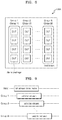
- FIGS. 8 and 9 are diagrams illustrating an example of group setting for a plurality of DUTs arranged on a test board and an example of delaying a test input, respectively.
- a plurality of semiconductor devices are mounted as DUTs, respectively, on a test board provided in a test device 400 A.
- the plurality of semiconductor devices are classified into first to B-th groups Group 1 to Group B, and each of the first to B-th groups Group 1 to Group B may include a plurality of semiconductor devices.
- the first to the B-th groups Group 1 to Group B include the same number of semiconductor devices.
- embodiments of the inventive concept are not limited thereto.
- the first to the B-th groups Group 1 to Group B may include different numbers of semiconductor devices.
- the DUTs to be tested may be semiconductor dies or semiconductor packages.
- FIG. 9 illustrates the timing at which a test input is transmitted to target circuits in the plurality of DUTs mounted on the test board of FIG. 8 .
- a tester (or test logic) may provide a bitstream having one or more pieces of bit information as a test input to a plurality of semiconductor devices, and the timings at which the test input is provided to the plurality of semiconductor devices may be substantially the same. That is, the tester may provide the test input simultaneously to the plurality of semiconductor devices in a parallel test environment.
- a delay control circuit of semiconductor devices in the first group Group 1 may delay the test input according to a first delay amount Delay 1
- a delay control circuit of semiconductor devices in the second group Group 2 may delay the test input according to a second delay amount Delay 2
- a delay control circuit of semiconductor devices in the B-th group Group B may delay the test input according to a B-th delay amount Delay B.
- a test input with a delay applied thereto and provided to a target circuit may be referred to as a valid bitstream that is effectively provided for testing.
- FIGS. 10 and 11 are block diagrams illustrating examples of setting a delay amount for DUTs according to various methods.
- FIG. 10 illustrates an example in which different delay amounts are set for the DUTs
- FIG. 11 illustrates an example in which different delay amounts are set for channels in one DUT.
- a plurality of semiconductor devices are mounted as DUTs, respectively, on a test board.
- FIG. 10 illustrates an example in which a plurality of semiconductor devices are arranged in a matrix form
- the plurality of semiconductor devices may be arranged in various forms on a test board.
- a plurality of semiconductor devices may be arranged I rows and J columns and thus I*J semiconductor devices may be mounted on the test board, and different delay amounts Delay 1 to Delay I*J may be set for the I*J semiconductor devices.
- the test input may be delivered at substantially different points in time to target circuits in the I*J semiconductor devices and thus tests for the I*J semiconductor devices may be performed at different points in time.
- a plurality of semiconductor devices 410 C are mounted as DUTs, respectively, on a test board, and each of the semiconductor devices 410 C may include a plurality of channels CH 1 to CH A.
- a test input provided to any one semiconductor device 410 C may be provided to the plurality of channels CH 1 to CH A in the semiconductor device 410 C and the delay amount of the test input may be set differently for the plurality of channels CH 1 to CH A.
- FIG. 11 illustrates an example in which a first delay amount Delay 1 is set for a first channel, i.e.
- a second delay amount Delay 2 is set for a second channel, i.e., the channel CH 2
- an A-th delay amount Delay A is set for an A-th channel, i.e., the channel CH A.
- FIG. 12 is a block diagram illustrating an example in which a semiconductor device according to an example embodiment of the inventive concept is implemented as a high bandwidth memory (HBM) 500 .
- the HBM 500 may include a plurality of semiconductor dies, for example, a logic die (or buffer die) 510 and one or more core dies 520 including a memory cell array 521 .
- the HBM 500 may have an increased bandwidth by including a plurality of channels CH 1 to CH 8 having independent interfaces
- FIG. 12 illustrates an example in which the HBM 500 includes four core dies 520 and each of the four core dies 520 includes two channels.
- the number of core dies 520 and the number of channels CH 1 to CH 8 may be variously changed.
- the logic die 510 may include a through-silicon via (TSV) area 511 , a physical (PHY) area 512 , and a direct access area 513 .
- the logic die 510 may further include a control logic (not shown) for controlling overall operations in the HBM 500 , and may perform, for example, an internal control operation in response to a command from an external controller.
- a delay control circuit 514 for delaying a test input may be further included in the logic die 510 .
- the TSV area 511 corresponds to an area where a TSV for communication with the core dies 520 is formed.
- the PHY area 512 may include a plurality of input and output circuits for communicating with an external controller and the direct access area 513 may directly communicate with an external tester via a conductive means positioned on an outer surface of the HBM 500 in a test mode for the HBM 500 .
- Various signals provided from the external tester may be provided to the core dies 520 via the direct access area 513 and the TSV area 511 .
- a test input from the external tester may be provided to the delay control circuit 514 via the direct access area 513 and a delayed test input may be provided to the core dies 520 via the TSV area 511 .
- the HBM 500 may be mounted on a test board and receive a test input in a test mode, and as an example, a plurality of HBMs 500 may be mounted on the test board.
- the delay control circuit 514 may receive a test input commonly provided for the plurality of channels CH 1 to CH 8 , delay the test input, and then provide the delayed test input to the plurality of channels CH 1 to CH 8 .
- the delay control circuit 514 may receive test inputs provided separately for the plurality of channels CH 1 to CH 8 and may output a delayed test input through a delay operation on the test inputs.
- a test input may be provided at different timings to target circuits included in the plurality of channels CH 1 to CH 8 .
- the plurality of channels CH 1 to CH 8 may be classified into a plurality of channel groups, and a test input may be provided to the target circuits at different timings for the channel groups.
- a test input may be provided to target circuits of first and third channels (i.e., the channels CH 1 and CH 3 ) of the first core die Core Die 1 and then provided to target circuits of second and fourth channels (i.e., the channels CH 2 and CH 4 ) of the second core die Core Die 2 .
- a test input may be provided to the target circuits of the channels CH 1 to CH 8 regardless of the stacking order of a plurality of core dies stacked on the logic die 510 .
- FIGS. 13 and 14 are circuit diagrams illustrating examples of a delay control circuit according to example embodiments of the inventive concept.
- a semiconductor device 600 A may include a delay control circuit and a target circuit 630 A, and the delay control circuit may include a DFT buffer 610 A and a timing control circuit 620 A.
- the timing control circuit 620 A may include a plurality of transmission paths for transmitting a test input to the target circuit 630 A, and different delay amounts may be applied to the plurality of transmission paths.
- a plurality of switches SW 1 to SWC may be further included in the timing control circuit 620 A to select any one of the plurality of transmission paths.
- the plurality of switches SW 1 to SWC may be controlled in response to the delay control signal Ctrl_delay according to the embodiments described above.
- the semiconductor device 600 A may set a delay amount of the test input by selectively turning on any one of the plurality of switches SW 1 to SWC in a test mode.
- any one of the plurality of transmission paths may be selected according to the delay control signal Ctrl_delay from a test logic, whereby the delay amount of the test input may be adjusted.
- a semiconductor device 600 B may include a delay control circuit and target circuits 630 B_ 1 to 630 B_A, and the delay control circuit may include a DFT buffer 610 B and a timing control circuit 620 B.
- FIG. 14 illustrates an example in which one semiconductor device 600 B includes a plurality of channels CH 1 to CH A.
- the timing control circuit 620 B includes a plurality of transmission paths and different delay amounts may be applied to the plurality of transmission paths.
- the timing control circuit 620 B may further include a plurality of switch blocks SW BLK 1 to SW BLK A, which respectively correspond to the plurality of channels CH 1 to CH A, and the plurality of switch blocks SW BLK 1 to SW BLK A may be controlled by a delay control signal Ctrl_delay.
- the switching states of the switch blocks SW BLK 1 to SW BLK A in the test mode of the semiconductor device 600 B may be controlled differently. Accordingly, paths through which a test input is transmitted to target circuits of the plurality of channels CH 1 to CH A may be different from each other. Accordingly, the timings at which the test input is provided to the target circuits of the plurality of channels CH 1 to CH A of the semiconductor device 600 B may be adjusted differently.
- FIG. 15 is a block diagram illustrating an example in which a semiconductor device according to an example embodiment of the inventive concept is implemented as a memory device 700 .
- the memory device 700 may include a memory cell array 711 , a row decoder 712 , and a column decoder 713 to perform memory operations of storing and reading data, 700 .
- the memory device 700 may further include a control logic 720 for controlling overall operations in the memory device 700 and a data buffer 730 for temporarily storing input/output data.
- the memory device 700 may further include other various components related to memory operations, for example, a voltage generator, a write driver, and a sense amplifier.
- the control logic 720 may control the memory operations according to various signals from a memory controller (not shown). For example, the control logic 720 may receive an address ADD from the memory controller, provide a row address for selecting word lines of the memory cell array 711 to the row decoder 712 , and provide a column address for selecting bit lines of the memory cell array 711 to the column decoder 713 . In addition, the control logic 720 may include a command decoder 721 that decodes a command CMD from the memory controller to control operations in the memory device 700 .
- information corresponding to the command CMD and the address ADD may be provided from a test logic to the memory device 700 as a test input (e.g., a first test input) in a test environment for the memory device 700 .
- information corresponding to data DATA may be provided to the memory device 700 as a test input (e.g., a second test input).
- each of the first test input and the second test input may be provided to a target circuit in the memory device 700 via a DFT buffer and a timing control circuit, according to the embodiments described above.
- the first test input may be provided to the control logic 720 after being delayed by a certain delay amount through a DFT buffer 741 and a timing control circuit 742
- the second test input may be provided to the data buffer 730 after being delayed by a certain delay amount through a DFT buffer 751 and a timing control circuit 752 .
- the memory device 700 may perform signal processing using the first test input and the second test input and generate a test output and provide the test output to an external test logic.
- the memory device 700 may receive a command/address CMD/ADD and data DATA for a memory operation in a normal mode via a command address (CA) buffer 743 and a data buffer 753 , respectively, and received signals may be provided to circuit blocks in the memory device 700 without delay processing.
- FIG. 15 illustrates a configuration in which pads and buffers for receiving various types of information in a test mode are provided separately from pads and buffers for receiving various types of information in a normal mode.
- the memory device 700 may have a configuration in which pads and buffers are shared in the test mode and the normal mode.
Landscapes
- Engineering & Computer Science (AREA)
- General Engineering & Computer Science (AREA)
- Physics & Mathematics (AREA)
- General Physics & Mathematics (AREA)
- Tests Of Electronic Circuits (AREA)
Abstract
Description
Claims (13)
Applications Claiming Priority (2)
| Application Number | Priority Date | Filing Date | Title |
|---|---|---|---|
| KR10-2018-0092053 | 2018-08-07 | ||
| KR1020180092053A KR20200016680A (en) | 2018-08-07 | 2018-08-07 | Test Device and Test Method reducing peak noise and Semiconductor Device under test |
Publications (2)
| Publication Number | Publication Date |
|---|---|
| US20200049765A1 US20200049765A1 (en) | 2020-02-13 |
| US11047908B2 true US11047908B2 (en) | 2021-06-29 |
Family
ID=69405771
Family Applications (1)
| Application Number | Title | Priority Date | Filing Date |
|---|---|---|---|
| US16/227,424 Active US11047908B2 (en) | 2018-08-07 | 2018-12-20 | Device and methods for reducing peak noise and peak power consumption in semiconductor devices under test |
Country Status (3)
| Country | Link |
|---|---|
| US (1) | US11047908B2 (en) |
| KR (1) | KR20200016680A (en) |
| CN (1) | CN110827914B (en) |
Families Citing this family (4)
| Publication number | Priority date | Publication date | Assignee | Title |
|---|---|---|---|---|
| TWI871453B (en) * | 2020-05-14 | 2025-02-01 | 台灣積體電路製造股份有限公司 | Method and apparatus for detecting defective logic devices |
| KR102837279B1 (en) * | 2020-07-24 | 2025-07-23 | 삼성전자주식회사 | System for semiconductor package test and manufacturing method for semiconductor package using the same |
| KR102563047B1 (en) * | 2021-09-14 | 2023-08-04 | 테크위드유 주식회사 | Pmic and switch ic for probe card supporting efficient channel control |
| CN115995260B (en) * | 2023-03-23 | 2023-08-11 | 长鑫存储技术有限公司 | a test method |
Citations (39)
| Publication number | Priority date | Publication date | Assignee | Title |
|---|---|---|---|---|
| US5682472A (en) * | 1995-03-17 | 1997-10-28 | Aehr Test Systems | Method and system for testing memory programming devices |
| US6324485B1 (en) * | 1999-01-26 | 2001-11-27 | Newmillennia Solutions, Inc. | Application specific automated test equipment system for testing integrated circuit devices in a native environment |
| US6356490B1 (en) * | 1999-05-12 | 2002-03-12 | Nec Corporation | Semiconductor device, testing device thereof and testing method thereof |
| KR100340715B1 (en) | 1999-10-25 | 2002-06-20 | 윤종용 | Semiconductor testing system having advanced test ability |
| US6499121B1 (en) | 1999-03-01 | 2002-12-24 | Formfactor, Inc. | Distributed interface for parallel testing of multiple devices using a single tester channel |
| US6642734B1 (en) * | 1999-12-01 | 2003-11-04 | Hitachi Electronics Engineering Co., Ltd. | Method and apparatus to generate a ground level of a semiconductor IC tester having a plurality of substrates |
| US20040044938A1 (en) * | 2002-08-14 | 2004-03-04 | Samsung Electronics Co., Ltd. | System for testing different types of semiconductor devices in parallel at the same time |
| US20040216006A1 (en) * | 2003-04-11 | 2004-10-28 | Kim Hong-Beom | Semiconductor memory device capable of accessing all memory cells |
| JP2005147679A (en) | 2003-11-11 | 2005-06-09 | Matsushita Electric Ind Co Ltd | Semiconductor wafer, semiconductor device inspection method and inspection apparatus |
| US20050234674A1 (en) | 2004-04-19 | 2005-10-20 | Bundy Laura M | Apparatus, system and/or method for converting a serial test to a parallel test |
| US7046563B1 (en) | 2005-03-29 | 2006-05-16 | Hynix Semiconductor Inc. | Parallel compression test circuit of memory device |
| KR20070114964A (en) | 2006-05-30 | 2007-12-05 | 주식회사 하이닉스반도체 | Semiconductor memory device |
| US20080030218A1 (en) * | 2006-08-01 | 2008-02-07 | Unitest Inc. | Tester For Testing Semiconductor Device |
| US20080080261A1 (en) | 2005-09-26 | 2008-04-03 | Rambus Inc. | Memory system topologies including a buffer device and an integrated circuit memory device |
| US20090055690A1 (en) * | 2007-08-24 | 2009-02-26 | Verigy (Singapore) Pte. Ltd. | Error catch RAM support using fan-out/fan-in matrix |
| US20090058454A1 (en) * | 2007-08-31 | 2009-03-05 | Sang Bae An | Device power supply extension circuit, test system including the same and method of testing semiconductor devices |
| KR100909969B1 (en) | 2007-06-28 | 2009-07-29 | 삼성전자주식회사 | Semiconductor devices and method of fabricating the same, and stacked modules, card and system including the same |
| US20090295404A1 (en) * | 2006-05-26 | 2009-12-03 | Advantest Corporation | Test apparatus and test module |
| US20100052724A1 (en) * | 2006-11-10 | 2010-03-04 | Masayuki Mizuno | Circuit and method for parallel testing and semiconductor device |
| JP2011029535A (en) | 2009-07-29 | 2011-02-10 | Elpida Memory Inc | Semiconductor device |
| US7979760B2 (en) | 2008-03-07 | 2011-07-12 | Samsung Electronics Co., Ltd. | Test system for conducting parallel bit test |
| US8242589B2 (en) | 2009-02-27 | 2012-08-14 | Hitachi, Ltd. | Semiconductor device |
| US8326565B2 (en) | 2007-08-22 | 2012-12-04 | Advantest (Singapore) Pte Ltd | Chip tester, method for providing timing information, test fixture set, apparatus for post-processing propagation delay information, method for post-processing delay information, chip test set up and method for testing devices under test |
| US20130047047A1 (en) | 2011-08-17 | 2013-02-21 | Texas Instruments Incorporated | 3d stacked die test architecture |
| JP2013072762A (en) | 2011-09-28 | 2013-04-22 | Yokogawa Electric Corp | Semiconductor testing apparatus and timing adjustment method of semiconductor testing apparatus |
| US20130102091A1 (en) * | 2011-10-25 | 2013-04-25 | Teradyne, Inc. | Test system supporting simplified configuration for controlling test block concurrency |
| US20140063887A1 (en) | 2011-05-12 | 2014-03-06 | Rambus Inc. | Stacked dram device and method of manufacture |
| US20140111243A1 (en) | 2012-10-19 | 2014-04-24 | Taiwan Semiconductor Manufacturing Company, Ltd. | Transition delay detector for interconnect test |
| US20140269119A1 (en) | 2013-03-13 | 2014-09-18 | Samsung Electronics Co., Ltd. | Synchronous semiconductor memory device having delay locked loop circuit and method of controlling the delay locked loop circuit |
| US9036435B2 (en) | 2010-10-29 | 2015-05-19 | SK Hynix Inc. | Semiconductor apparatus, method for delaying signal thereof, stacked semiconductor memory apparatus, and method for generating signal thereof |
| US9165624B2 (en) | 2012-12-24 | 2015-10-20 | SK Hynix Inc. | Semiconductor integrated circuit with switch to select single or multiple chips |
| US20150377967A1 (en) * | 2014-06-30 | 2015-12-31 | Bharani Thiruvengadam | Duty cycle based timing margining for i/o ac timing |
| US20160034371A1 (en) | 2014-07-30 | 2016-02-04 | Gi-Won OH | Semiconductor memory device, memory system including the same, and method of operating the same |
| US9405506B2 (en) | 2012-12-13 | 2016-08-02 | Samsung Electronics Co., Ltd. | Method of operating system on chip and apparatuses including the same |
| US20160284423A1 (en) | 2014-05-13 | 2016-09-29 | SK Hynix Inc. | Semiconductor memory apparatus |
| US20170103930A1 (en) | 2014-06-09 | 2017-04-13 | SK Hynix Inc. | Stacked semiconductor apparatus being electrically connected through through-via and monitoring method |
| US20170236597A1 (en) | 2016-02-16 | 2017-08-17 | Micron Technology, Inc. | Selectors on interface die for memory device |
| US20170316990A1 (en) | 2016-04-28 | 2017-11-02 | Lapis Semiconductor Co., Ltd. | Semiconductor device, semiconductor chip, and test method for semiconductor chip |
| US20200049767A1 (en) | 2018-08-07 | 2020-02-13 | Samsung Electronics Co., Ltd. | Semiconductor devices including stacked dies and methods of testing the semiconductor devices |
Family Cites Families (7)
| Publication number | Priority date | Publication date | Assignee | Title |
|---|---|---|---|---|
| US6263463B1 (en) * | 1996-05-10 | 2001-07-17 | Advantest Corporation | Timing adjustment circuit for semiconductor test system |
| JP2003045179A (en) * | 2001-08-01 | 2003-02-14 | Mitsubishi Electric Corp | Semiconductor element and semiconductor memory module using the same |
| US7154259B2 (en) * | 2003-10-23 | 2006-12-26 | Formfactor, Inc. | Isolation buffers with controlled equal time delays |
| KR101254280B1 (en) * | 2008-10-14 | 2013-04-12 | 가부시키가이샤 어드밴티스트 | Test apparatus and manufacturing method |
| KR20110002318A (en) * | 2009-07-01 | 2011-01-07 | 주식회사 하이닉스반도체 | Semiconductor memory device and test method thereof |
| US20170125125A1 (en) * | 2015-10-30 | 2017-05-04 | Texas Instruments Incorporated | Area-efficient parallel test data path for embedded memories |
| KR102521756B1 (en) * | 2016-06-22 | 2023-04-14 | 삼성전자주식회사 | Delay circuit of semiconductor memory device, semiconductor memory device and method of operating the same |
-
2018
- 2018-08-07 KR KR1020180092053A patent/KR20200016680A/en not_active Withdrawn
- 2018-12-20 US US16/227,424 patent/US11047908B2/en active Active
-
2019
- 2019-03-05 CN CN201910167066.2A patent/CN110827914B/en active Active
Patent Citations (44)
| Publication number | Priority date | Publication date | Assignee | Title |
|---|---|---|---|---|
| US5682472A (en) * | 1995-03-17 | 1997-10-28 | Aehr Test Systems | Method and system for testing memory programming devices |
| US6324485B1 (en) * | 1999-01-26 | 2001-11-27 | Newmillennia Solutions, Inc. | Application specific automated test equipment system for testing integrated circuit devices in a native environment |
| KR100599348B1 (en) | 1999-03-01 | 2006-07-12 | 폼팩터, 인크. | Distributed interface for parallel testing of multiple devices using a single tester channel |
| US6499121B1 (en) | 1999-03-01 | 2002-12-24 | Formfactor, Inc. | Distributed interface for parallel testing of multiple devices using a single tester channel |
| US6356490B1 (en) * | 1999-05-12 | 2002-03-12 | Nec Corporation | Semiconductor device, testing device thereof and testing method thereof |
| US6507801B1 (en) | 1999-10-25 | 2003-01-14 | Samsung Electronics Co., Ltd. | Semiconductor device testing system |
| KR100340715B1 (en) | 1999-10-25 | 2002-06-20 | 윤종용 | Semiconductor testing system having advanced test ability |
| US6642734B1 (en) * | 1999-12-01 | 2003-11-04 | Hitachi Electronics Engineering Co., Ltd. | Method and apparatus to generate a ground level of a semiconductor IC tester having a plurality of substrates |
| US20040044938A1 (en) * | 2002-08-14 | 2004-03-04 | Samsung Electronics Co., Ltd. | System for testing different types of semiconductor devices in parallel at the same time |
| US20040216006A1 (en) * | 2003-04-11 | 2004-10-28 | Kim Hong-Beom | Semiconductor memory device capable of accessing all memory cells |
| JP2005147679A (en) | 2003-11-11 | 2005-06-09 | Matsushita Electric Ind Co Ltd | Semiconductor wafer, semiconductor device inspection method and inspection apparatus |
| US20050234674A1 (en) | 2004-04-19 | 2005-10-20 | Bundy Laura M | Apparatus, system and/or method for converting a serial test to a parallel test |
| US7046563B1 (en) | 2005-03-29 | 2006-05-16 | Hynix Semiconductor Inc. | Parallel compression test circuit of memory device |
| KR100669546B1 (en) | 2005-03-29 | 2007-01-15 | 주식회사 하이닉스반도체 | Parallel compression test circuit of memory device |
| US20080080261A1 (en) | 2005-09-26 | 2008-04-03 | Rambus Inc. | Memory system topologies including a buffer device and an integrated circuit memory device |
| US20090295404A1 (en) * | 2006-05-26 | 2009-12-03 | Advantest Corporation | Test apparatus and test module |
| KR20070114964A (en) | 2006-05-30 | 2007-12-05 | 주식회사 하이닉스반도체 | Semiconductor memory device |
| US20080030218A1 (en) * | 2006-08-01 | 2008-02-07 | Unitest Inc. | Tester For Testing Semiconductor Device |
| US20100052724A1 (en) * | 2006-11-10 | 2010-03-04 | Masayuki Mizuno | Circuit and method for parallel testing and semiconductor device |
| US7759716B2 (en) | 2007-06-28 | 2010-07-20 | Samsung Electronics Co., Ltd. | Semiconductor device, method of fabricating the same, stacked module including the same, card including the same, and system including the stacked module |
| KR100909969B1 (en) | 2007-06-28 | 2009-07-29 | 삼성전자주식회사 | Semiconductor devices and method of fabricating the same, and stacked modules, card and system including the same |
| US8326565B2 (en) | 2007-08-22 | 2012-12-04 | Advantest (Singapore) Pte Ltd | Chip tester, method for providing timing information, test fixture set, apparatus for post-processing propagation delay information, method for post-processing delay information, chip test set up and method for testing devices under test |
| US20090055690A1 (en) * | 2007-08-24 | 2009-02-26 | Verigy (Singapore) Pte. Ltd. | Error catch RAM support using fan-out/fan-in matrix |
| US20090058454A1 (en) * | 2007-08-31 | 2009-03-05 | Sang Bae An | Device power supply extension circuit, test system including the same and method of testing semiconductor devices |
| US7979760B2 (en) | 2008-03-07 | 2011-07-12 | Samsung Electronics Co., Ltd. | Test system for conducting parallel bit test |
| US8242589B2 (en) | 2009-02-27 | 2012-08-14 | Hitachi, Ltd. | Semiconductor device |
| US8310855B2 (en) | 2009-07-29 | 2012-11-13 | Elpida Memory, Inc. | Semiconductor device |
| JP2011029535A (en) | 2009-07-29 | 2011-02-10 | Elpida Memory Inc | Semiconductor device |
| US9036435B2 (en) | 2010-10-29 | 2015-05-19 | SK Hynix Inc. | Semiconductor apparatus, method for delaying signal thereof, stacked semiconductor memory apparatus, and method for generating signal thereof |
| US20140063887A1 (en) | 2011-05-12 | 2014-03-06 | Rambus Inc. | Stacked dram device and method of manufacture |
| US20130047047A1 (en) | 2011-08-17 | 2013-02-21 | Texas Instruments Incorporated | 3d stacked die test architecture |
| JP2013072762A (en) | 2011-09-28 | 2013-04-22 | Yokogawa Electric Corp | Semiconductor testing apparatus and timing adjustment method of semiconductor testing apparatus |
| US20130102091A1 (en) * | 2011-10-25 | 2013-04-25 | Teradyne, Inc. | Test system supporting simplified configuration for controlling test block concurrency |
| US20140111243A1 (en) | 2012-10-19 | 2014-04-24 | Taiwan Semiconductor Manufacturing Company, Ltd. | Transition delay detector for interconnect test |
| US9405506B2 (en) | 2012-12-13 | 2016-08-02 | Samsung Electronics Co., Ltd. | Method of operating system on chip and apparatuses including the same |
| US9165624B2 (en) | 2012-12-24 | 2015-10-20 | SK Hynix Inc. | Semiconductor integrated circuit with switch to select single or multiple chips |
| US20140269119A1 (en) | 2013-03-13 | 2014-09-18 | Samsung Electronics Co., Ltd. | Synchronous semiconductor memory device having delay locked loop circuit and method of controlling the delay locked loop circuit |
| US20160284423A1 (en) | 2014-05-13 | 2016-09-29 | SK Hynix Inc. | Semiconductor memory apparatus |
| US20170103930A1 (en) | 2014-06-09 | 2017-04-13 | SK Hynix Inc. | Stacked semiconductor apparatus being electrically connected through through-via and monitoring method |
| US20150377967A1 (en) * | 2014-06-30 | 2015-12-31 | Bharani Thiruvengadam | Duty cycle based timing margining for i/o ac timing |
| US20160034371A1 (en) | 2014-07-30 | 2016-02-04 | Gi-Won OH | Semiconductor memory device, memory system including the same, and method of operating the same |
| US20170236597A1 (en) | 2016-02-16 | 2017-08-17 | Micron Technology, Inc. | Selectors on interface die for memory device |
| US20170316990A1 (en) | 2016-04-28 | 2017-11-02 | Lapis Semiconductor Co., Ltd. | Semiconductor device, semiconductor chip, and test method for semiconductor chip |
| US20200049767A1 (en) | 2018-08-07 | 2020-02-13 | Samsung Electronics Co., Ltd. | Semiconductor devices including stacked dies and methods of testing the semiconductor devices |
Non-Patent Citations (2)
| Title |
|---|
| Agrawal et al. "A Distributed, Reconfigurable, and Reusable BIST Infrastructure for Test and Diagnosis of 3-D Stacked ICs" IEEE Transactions on Computer-Aided Design of Integrated Circuits and Systems 35(2):309-322 (2016). |
| Lu et al. "Efficient test and repair architectures for 3D TSV-based random access memories" 2013 International Symposium on VLSI Design, Automation, and Test (VLSI-DAT) (4 pages) (Apr. 2013). |
Also Published As
| Publication number | Publication date |
|---|---|
| CN110827914A (en) | 2020-02-21 |
| CN110827914B (en) | 2025-04-29 |
| KR20200016680A (en) | 2020-02-17 |
| US20200049765A1 (en) | 2020-02-13 |
Similar Documents
| Publication | Publication Date | Title |
|---|---|---|
| US20200049767A1 (en) | Semiconductor devices including stacked dies and methods of testing the semiconductor devices | |
| US10692583B2 (en) | Multi-channel package, and test apparatus and test method of testing the same | |
| US20070245200A1 (en) | Semiconductor apparatus and test method therefor | |
| US20200049765A1 (en) | Device and methods for reducing peak noise and peak power consumption in semiconductor devices under test | |
| WO2004086411A1 (en) | Memory built-in self-test (bist) architecture having distributed command interpretation and generalized command protocol | |
| US12266414B2 (en) | Memory device and test method of memory device | |
| US8368418B2 (en) | Testing apparatus for multiple identical circuit components | |
| US20220076778A1 (en) | Semiconductor memory device, method of testing the same and test system | |
| US20120155192A1 (en) | Semiconductor memory devices and methods of testing the same | |
| US9618575B2 (en) | Semiconductor device having plural data input/output terminals configured for write test and read test operations | |
| JP2011511395A (en) | Method and apparatus for improving yield in electronic circuits | |
| US7791967B2 (en) | Semiconductor memory device and method of testing the same | |
| EP3477647B1 (en) | Efficient testing of a magnetic memory circuit | |
| US12510584B2 (en) | Test board and test method for semiconductor device using the same | |
| US20090164809A1 (en) | Power supply testing architecture | |
| CN114724615B (en) | Output impedance calibration and related devices, systems, and methods | |
| US12498419B2 (en) | Semiconductor test apparatus using FPGA and memory control method for semiconductor test | |
| US7012443B2 (en) | System used to test plurality of DUTs in parallel and method thereof | |
| US11494198B2 (en) | Output impedance calibration, and related devices, systems, and methods | |
| KR100916009B1 (en) | Test Circuits and Test Methods for Semiconductor Memory Devices | |
| KR20080095681A (en) | Semiconductor memory device and test method of the semiconductor memory device can reduce the test time | |
| US20210165601A1 (en) | Data compression circuit, memory device and ic test device and method | |
| KR20250168990A (en) | Memory system and repair operation method thereof | |
| US7743291B2 (en) | Semiconductor memory device | |
| KR20260001903A (en) | Semiconductor memory device and stacked memory device |
Legal Events
| Date | Code | Title | Description |
|---|---|---|---|
| AS | Assignment |
Owner name: SAMSUNG ELECTRONICS CO., LTD., KOREA, REPUBLIC OF Free format text: ASSIGNMENT OF ASSIGNORS INTEREST;ASSIGNOR:HWANG, JONG-TAE;REEL/FRAME:047831/0682 Effective date: 20181121 |
|
| FEPP | Fee payment procedure |
Free format text: ENTITY STATUS SET TO UNDISCOUNTED (ORIGINAL EVENT CODE: BIG.); ENTITY STATUS OF PATENT OWNER: LARGE ENTITY |
|
| STPP | Information on status: patent application and granting procedure in general |
Free format text: NON FINAL ACTION MAILED |
|
| STPP | Information on status: patent application and granting procedure in general |
Free format text: RESPONSE TO NON-FINAL OFFICE ACTION ENTERED AND FORWARDED TO EXAMINER |
|
| STPP | Information on status: patent application and granting procedure in general |
Free format text: NOTICE OF ALLOWANCE MAILED -- APPLICATION RECEIVED IN OFFICE OF PUBLICATIONS |
|
| STPP | Information on status: patent application and granting procedure in general |
Free format text: PUBLICATIONS -- ISSUE FEE PAYMENT RECEIVED |
|
| STPP | Information on status: patent application and granting procedure in general |
Free format text: PUBLICATIONS -- ISSUE FEE PAYMENT VERIFIED |
|
| STCF | Information on status: patent grant |
Free format text: PATENTED CASE |
|
| MAFP | Maintenance fee payment |
Free format text: PAYMENT OF MAINTENANCE FEE, 4TH YEAR, LARGE ENTITY (ORIGINAL EVENT CODE: M1551); ENTITY STATUS OF PATENT OWNER: LARGE ENTITY Year of fee payment: 4 |